Predictive Maintenance in PV Systems: A Copula-Based Approach with Digital Twin Technique




Abstract
1. Introduction
- 1.
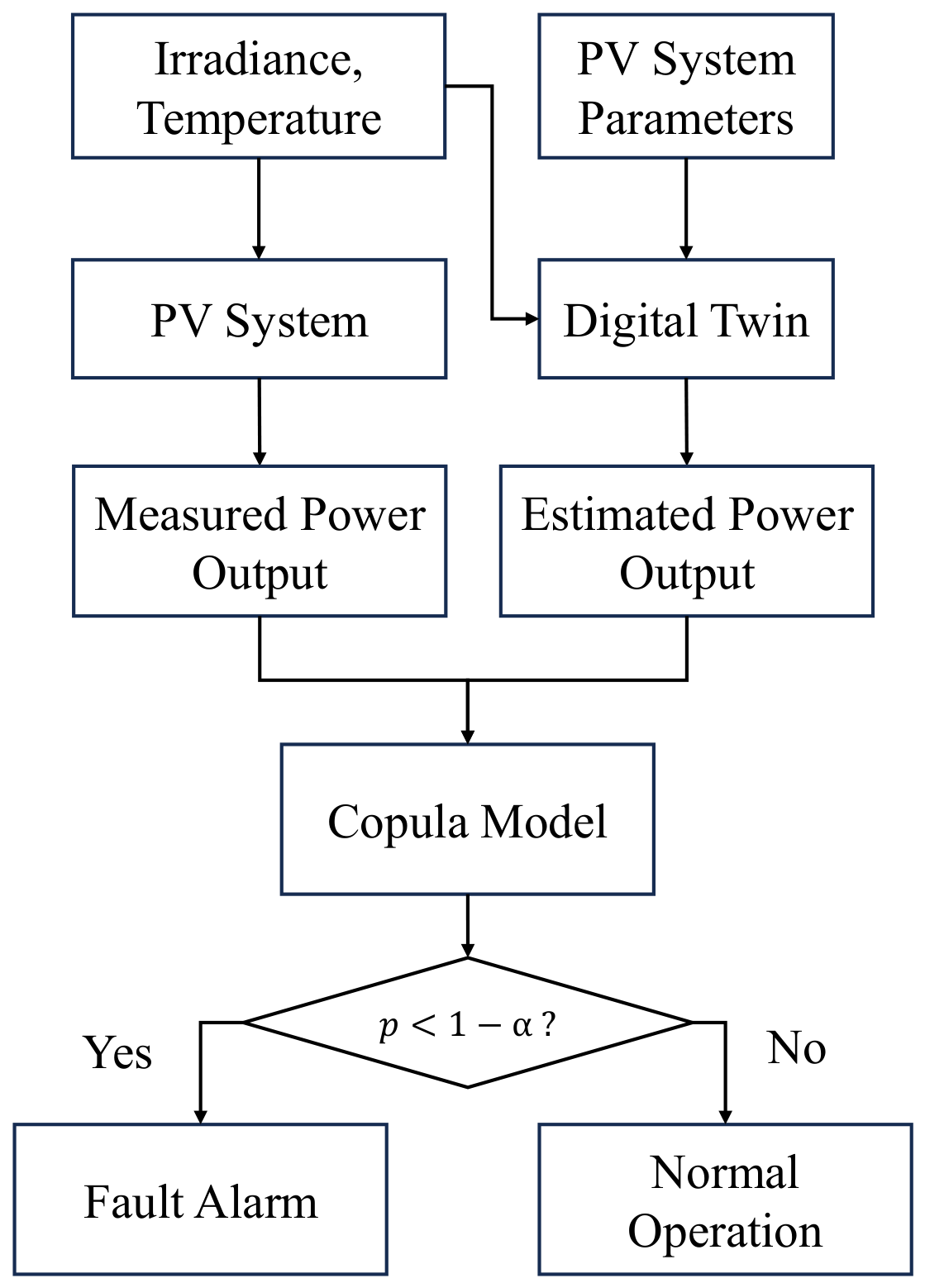
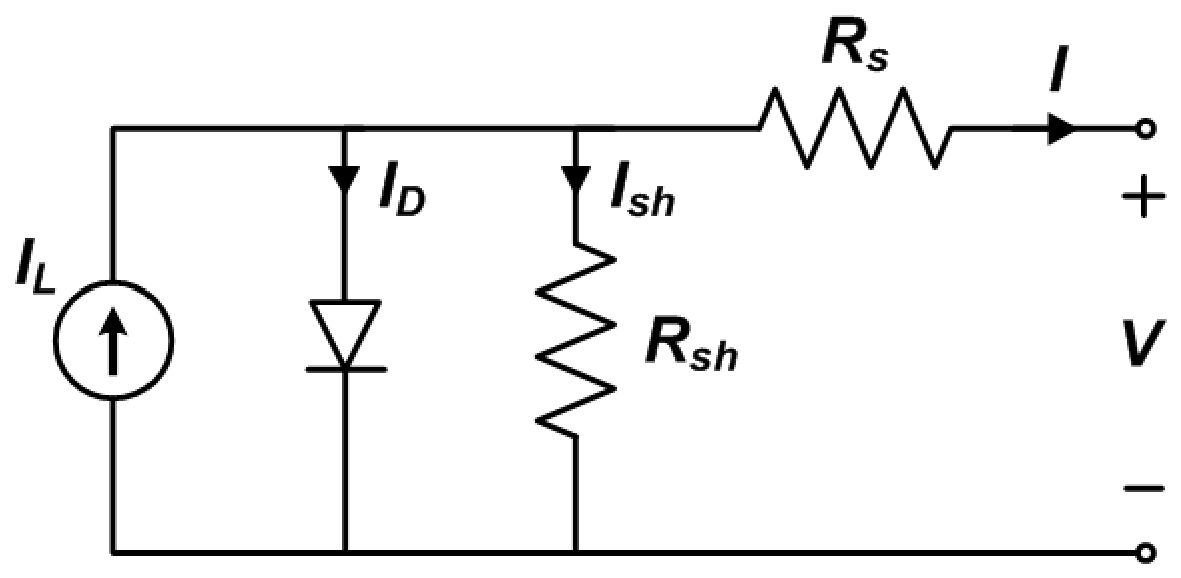
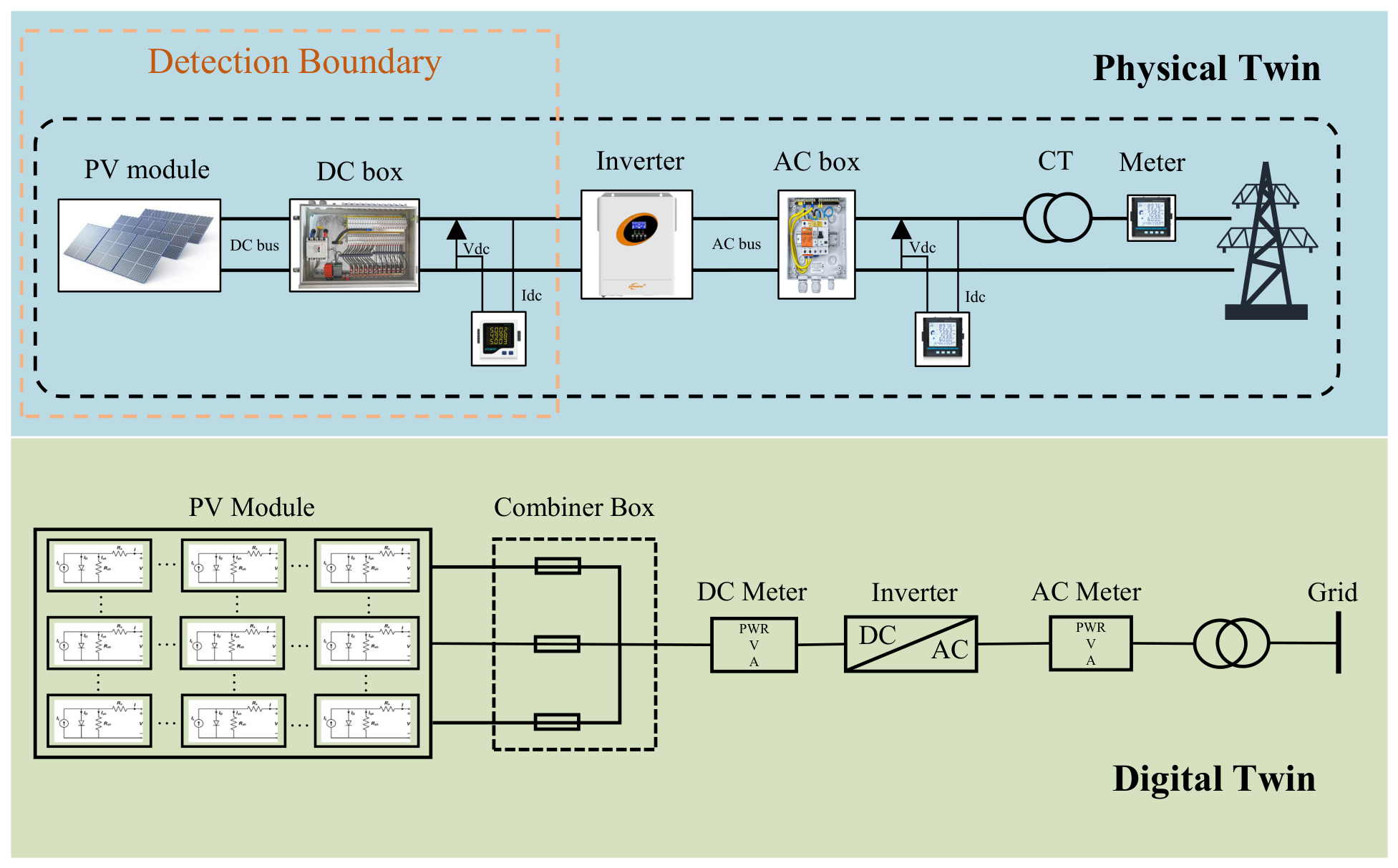
- A digital twin model is established to simulate the status of the PV system. The digital twin model is based on fundamental physical models constructed with internal electrical and thermal parameters, and its parameters are dynamically adjusted in real-time according to external environmental inputs.
- 2.
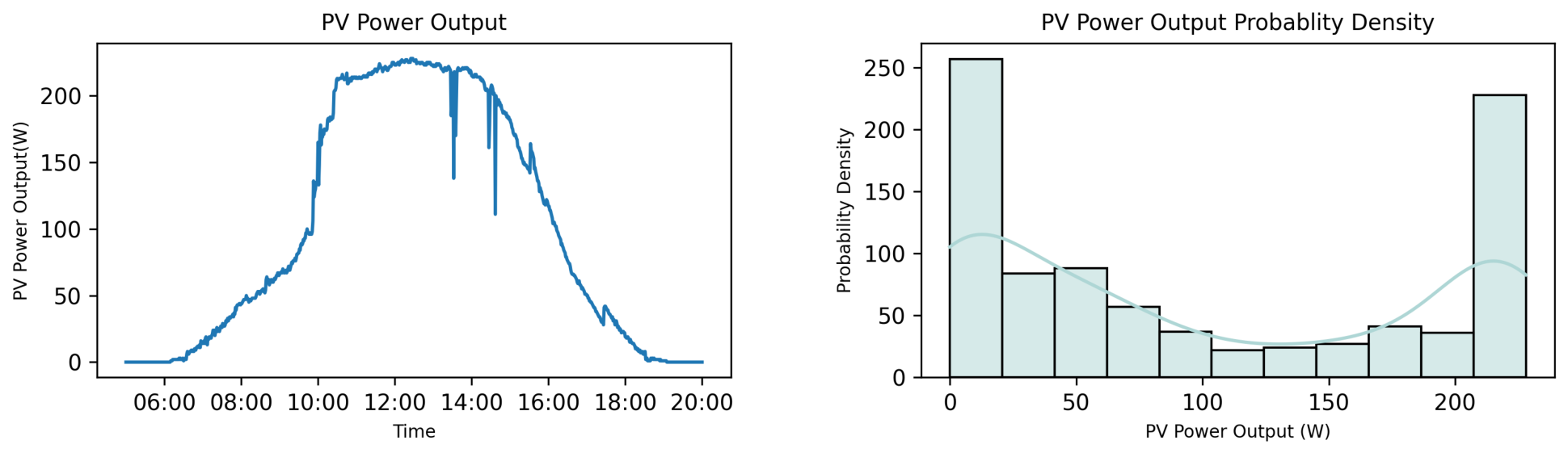
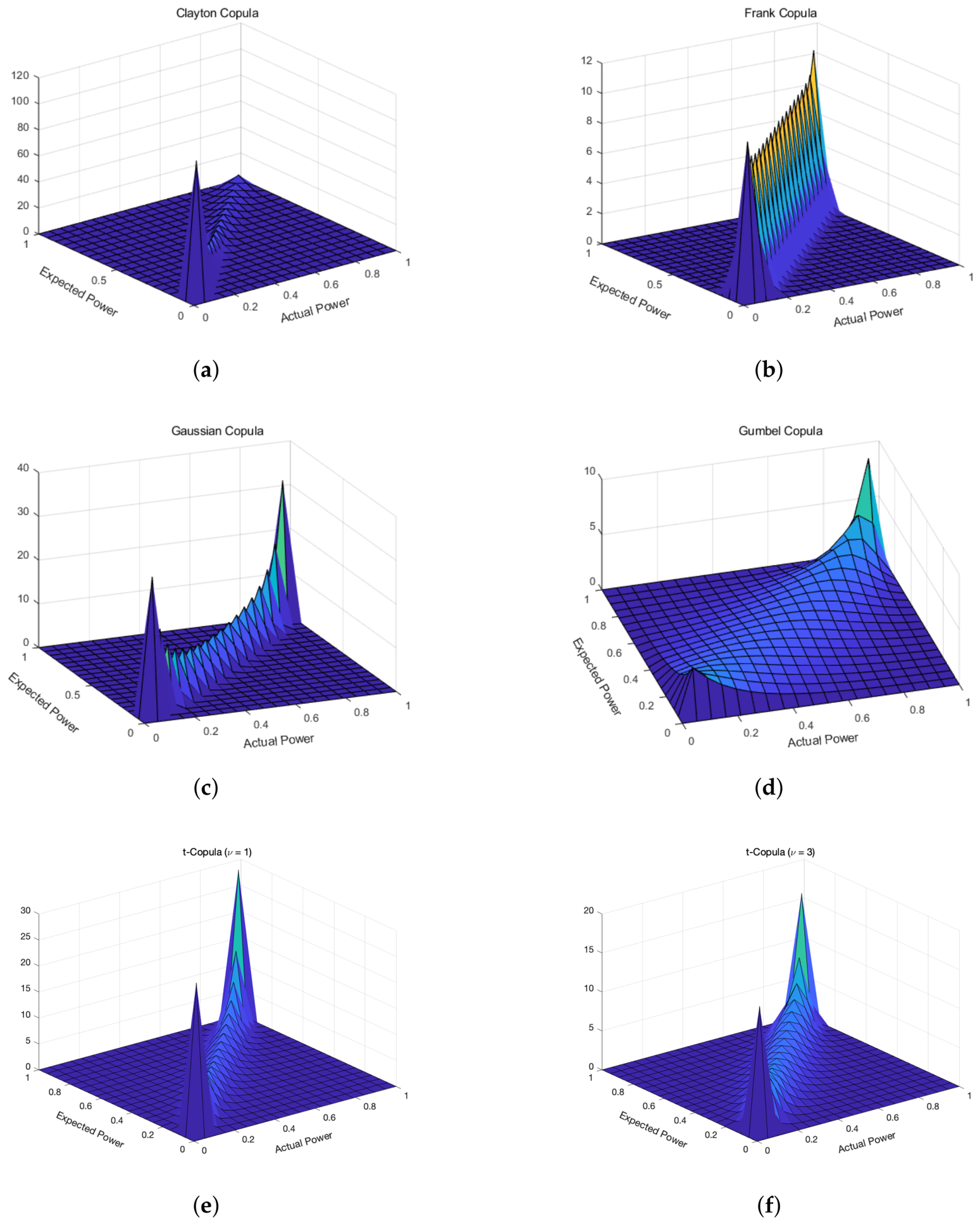
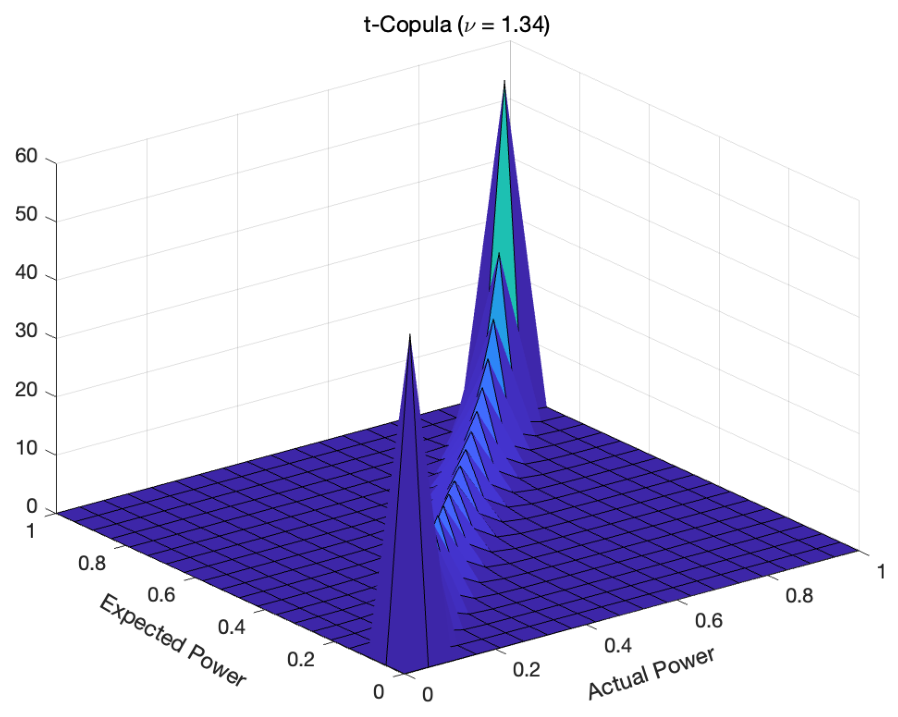
- The copula model is applied to represent the correlation between the digital twin’s power output and the measured output. In light of the characteristics of the PV output, several copula functions are experimentally compared. The results indicate that the Student’s t copula is most appropriate for modeling the dependence structure of PV power output.
- 3.
- A predictive maintenance approach for PV systems based on the digital twin and Student’s t copula is proposed. Given the power output of the digital twin model, the conditional cumulative distribution function (CDF) of the actual power output is obtained using the copula model. Anomalies in the measured values are detected based on the confidence interval (CI). Experimental results demonstrate the effectiveness of the proposed approach in identifying potential faults in PV systems.
2. Fault Mechanisms
2.1. Physical Faults
2.2. Electrical Faults
2.3. Environmental Faults
3. Predictive Maintenance Based on OCAD
3.1. Digital Twin of PV System
3.2. Copula-Based Dependency Modeling
3.3. Selection Criteria of Optimal Copulas
3.4. Anomaly Detection Based on OCAD
4. Case Study
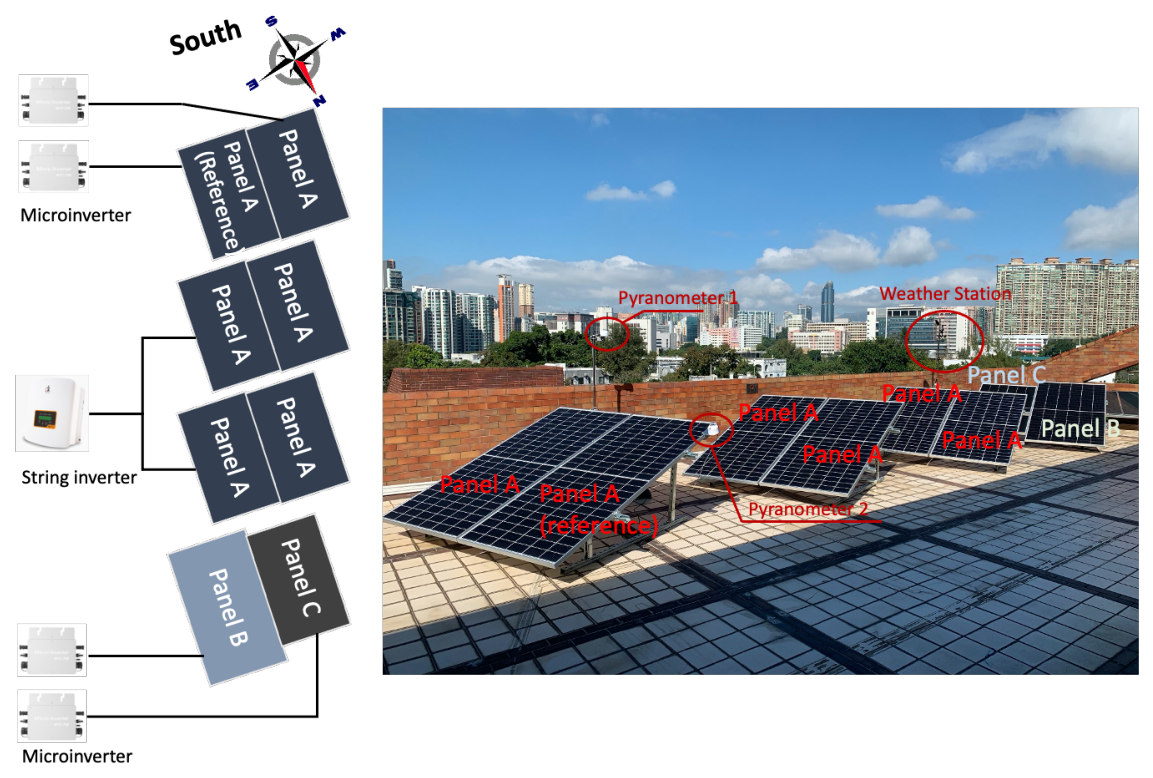
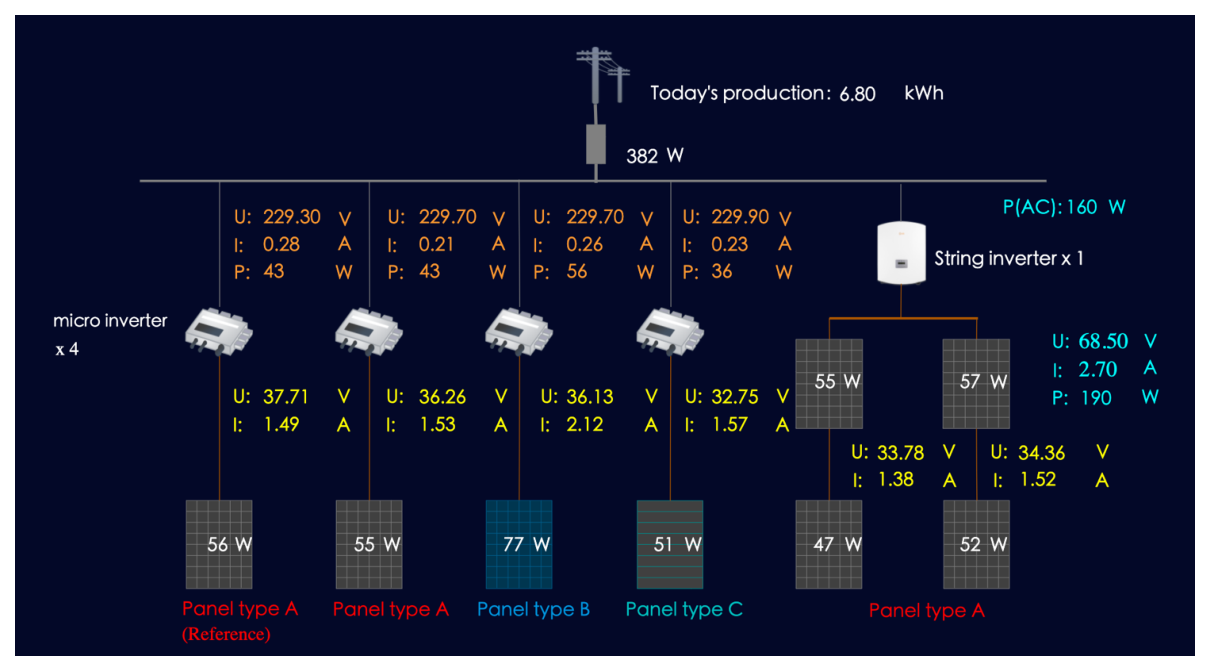
4.1. Dataset
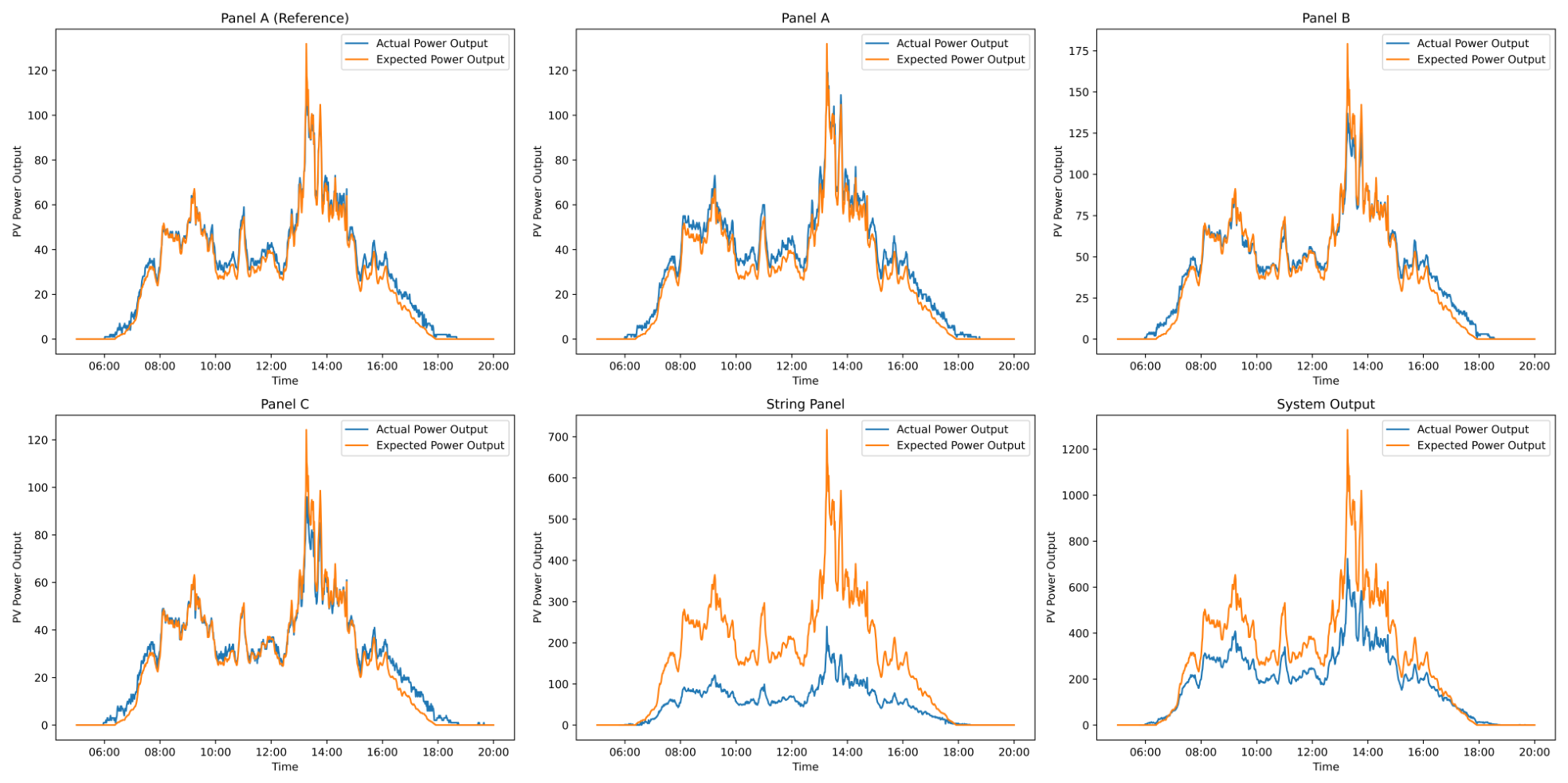
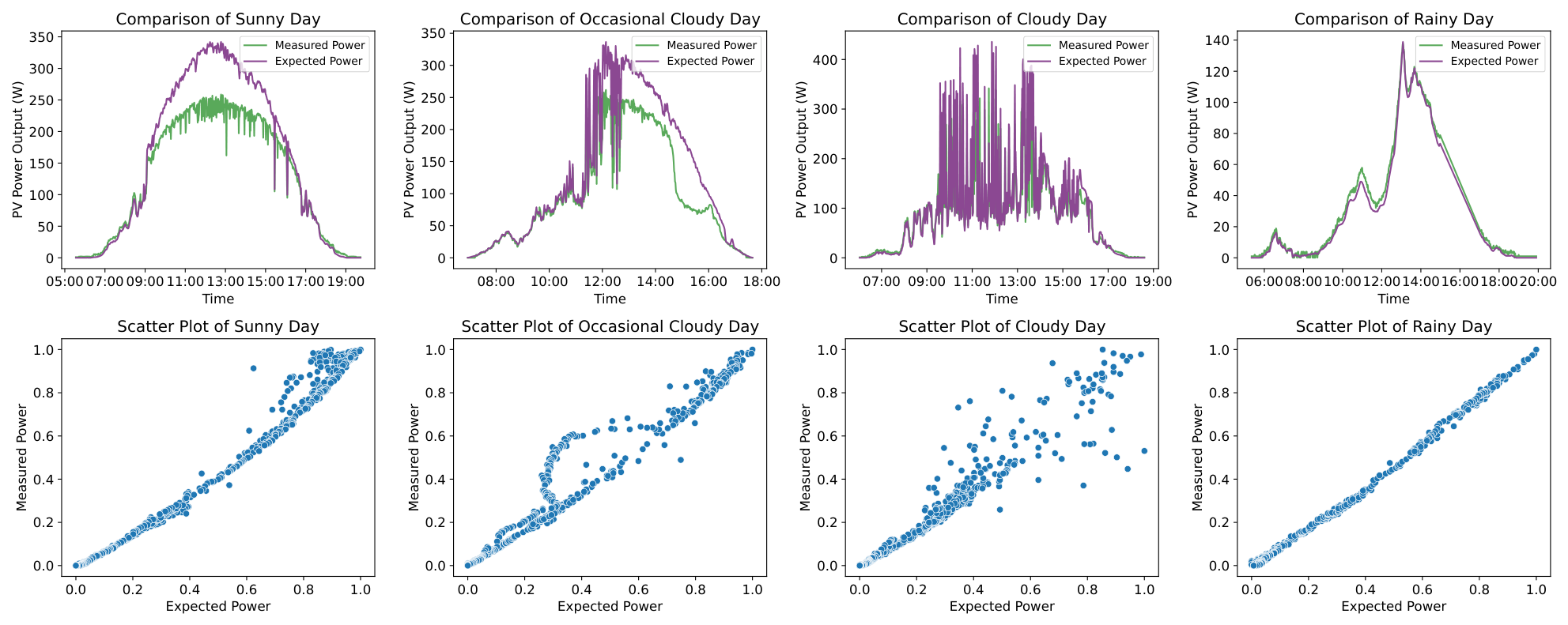
4.2. Performance Analysis
5. Conclusions
Author Contributions
Funding
Data Availability Statement
Conflicts of Interest
Appendix A

| Panel | Type A | Type B | Type C |
|---|---|---|---|
| Technology | Half-Cut Mono | Bifacial Mono | Shingled Mono PERC |
| Maximum power (Pmax) | 405 W | 540 W | 370 W |
| Optimum operating voltage () | 42.0 V | 41.75 V | 39.54 V |
| Optimum operating current () | 9.65 A | 12.94 A | 9.36 A |
| Open circuit voltage () | 49.2 V | 49.54 V | 47.47 V |
| Short circuit current () | 10.54 A | 13.89 A | 9.90 A |
| Efficiency | 20.10% | 20.80% | 19.9% |
| Temp. coefficient of | %/°C | %/°C | %/°C |
| No. of cells per module | 144 (6 × 24) | 144 (6 × 24) | 420 (6 × 70) |
| Dimensions (L × W × H) | 2008 × 1002 × 35 mm | 2287 × 1134 × 35 mm | 1842 × 1008 × 35 mm |
References
- Yang, D.; Li, W.; Yagli, G.M.; Srinivasan, D. Operational solar forecasting for grid integration: Standards, challenges, and outlook. Sol. Energy 2021, 224, 930–937. [Google Scholar] [CrossRef]
- Youssef, A.; El-Telbany, M.; Zekry, A. The role of artificial intelligence in photo-voltaic systems design and control: A review. Renew. Sustain. Energy Rev. 2017, 78, 72–79. [Google Scholar] [CrossRef]
- Pillai, D.S.; Rajasekar, N. A comprehensive review on protection challenges and fault diagnosis in PV systems. Renew. Sustain. Energy Rev. 2018, 91, 18–40. [Google Scholar] [CrossRef]
- Ge, L.; Xian, Y.; Yan, J.; Wang, B.; Wang, Z. A hybrid model for short-term PV output forecasting based on PCA-GWO-GRNN. J. Mod. Power Syst. Clean Energy 2020, 8, 1268–1275. [Google Scholar] [CrossRef]
- Eskandari, A.; Aghaei, M.; Milimonfared, J.; Nedaei, A. A weighted ensemble learning-based autonomous fault diagnosis method for photovoltaic systems using genetic algorithm. Int. J. Electr. Power Energy Syst. 2023, 144, 108591. [Google Scholar] [CrossRef]
- Oviedo, E.H.S.; Travé-Massuyès, L.; Subias, A.; Alonso, C.; Pavlov, M. Feature extraction and health status prediction in PV systems. Adv. Eng. Inform. 2022, 53, 101696. [Google Scholar] [CrossRef]
- Chen, Z.; Wu, L.; Cheng, S.; Lin, P.; Wu, Y.; Lin, W. Intelligent fault diagnosis of photovoltaic arrays based on optimized kernel extreme learning machine and IV characteristics. Appl. Energy 2017, 204, 912–931. [Google Scholar] [CrossRef]
- Mekki, H.; Mellit, A.; Salhi, H. Artificial neural network-based modelling and fault detection of partial shaded photovoltaic modules. Simul. Model. Pract. Theory 2016, 67, 1–13. [Google Scholar] [CrossRef]
- Chen, Z.; Han, F.; Wu, L.; Yu, J.; Cheng, S.; Lin, P.; Chen, H. Random forest based intelligent fault diagnosis for PV arrays using array voltage and string currents. Energy Convers. Manag. 2018, 178, 250–264. [Google Scholar] [CrossRef]
- Huang, J.M.; Wai, R.J.; Yang, G.J. Design of hybrid artificial bee colony algorithm and semi-supervised extreme learning machine for PV fault diagnoses by considering dust impact. IEEE Trans. Power Electron. 2019, 35, 7086–7099. [Google Scholar] [CrossRef]
- Zhu, L.; Wen, W.; Li, J.; Hu, Y. Integrated data-driven power system transient stability monitoring and enhancement. IEEE Trans. Power Syst. 2023, 39, 1797–1809. [Google Scholar] [CrossRef]
- Amiri, A.F.; Oudira, H.; Chouder, A.; Kichou, S. Faults detection and diagnosis of PV systems based on machine learning approach using random forest classifier. Energy Convers. Manag. 2024, 301, 118076. [Google Scholar] [CrossRef]
- Tsanakas, J.A.; Ha, L.; Buerhop, C. Faults and infrared thermographic diagnosis in operating c-Si photovoltaic modules: A review of research and future challenges. Renew. Sustain. Energy Rev. 2016, 62, 695–709. [Google Scholar] [CrossRef]
- Afridi, M.; Kumar, A.; ibne Mahmood, F.; Tamizhmani, G. Hotspot testing of glass/backsheet and glass/glass PV modules pre-stressed in extended thermal cycling. Sol. Energy 2023, 249, 467–475. [Google Scholar] [CrossRef]
- Liu, M.; Fang, S.; Dong, H.; Xu, C. Review of digital twin about concepts, technologies, and industrial applications. J. Manuf. Syst. 2021, 58, 346–361. [Google Scholar] [CrossRef]
- Semeraro, C.; Lezoche, M.; Panetto, H.; Dassisti, M. Digital twin paradigm: A systematic literature review. Comput. Ind. 2021, 130, 103469. [Google Scholar] [CrossRef]
- Fan, X.; Li, Y. Energy management of renewable based power grids using artificial intelligence: Digital twin of renewables. Sol. Energy 2023, 262, 111867. [Google Scholar] [CrossRef]
- Yao, C.; Wang, J.; Sun, H.; Chu, H.; Jin, T.; Xiang, Q. A Data-driven method for adaptive resource requirement allocation via probabilistic solar load and market forecasting utilizing digital twin. Sol. Energy 2023, 250, 368–376. [Google Scholar] [CrossRef]
- Yang, D.; Mi, C.; Lyu, X.; Xie, Y.; Luo, Z.; Huang, L. Real-time machine learning-driven digital twin framework of a floating solar system in waves. Energy Convers. Manag. 2026, 356, 121373. [Google Scholar] [CrossRef]
- Jain, P.; Poon, J.; Singh, J.P.; Spanos, C.; Sanders, S.R.; Panda, S.K. A digital twin approach for fault diagnosis in distributed photovoltaic systems. IEEE Trans. Power Electron. 2019, 35, 940–956. [Google Scholar] [CrossRef]
- Madeti, S.R.; Singh, S. A comprehensive study on different types of faults and detection techniques for solar photovoltaic system. Sol. Energy 2017, 158, 161–185. [Google Scholar] [CrossRef]
- Herraiz, Á.H.; Marugán, A.P.; Márquez, F.P.G. Photovoltaic plant condition monitoring using thermal images analysis by convolutional neural network-based structure. Renew. Energy 2020, 153, 334–348. [Google Scholar] [CrossRef]
- Gray, J.L. The physics of the solar cell. In Handbook of Photovoltaic Science and Engineering, 2nd ed.; John Wiley & Sons, Ltd.: Hoboken, NJ, USA, 2011. [Google Scholar]
- Motahhir, S.; El Ghzizal, A.; Sebti, S.; Derouich, A. Modeling of photovoltaic system with modified incremental conductance algorithm for fast changes of irradiance. Int. J. Photoenergy 2018, 2018, 3286479. [Google Scholar] [CrossRef]
- Chaibi, Y.; Allouhi, A.; Malvoni, M.; Salhi, M.; Saadani, R. Solar irradiance and temperature influence on the photovoltaic cell equivalent-circuit models. Sol. Energy 2019, 188, 1102–1110. [Google Scholar] [CrossRef]
- Yan, J. Enjoy the joy of copulas: With a package copula. J. Stat. Softw. 2007, 21, 1–21. [Google Scholar] [CrossRef]
- Wu, H.; Yuan, Y.; Zhu, J.; Xu, Y. Assessment model for distributed wind generation hosting capacity considering complex spatial correlations. J. Mod. Power Syst. Clean Energy 2021, 10, 1194–1206. [Google Scholar] [CrossRef]
- Zhang, G.; Li, Z.; Zhang, K.; Zhang, L.; Hua, X.; Wang, Y. Multi-objective interval prediction of wind power based on conditional copula function. J. Mod. Power Syst. Clean Energy 2019, 7, 802–812. [Google Scholar] [CrossRef]
- Hu, W.; Min, Y.; Zhou, Y.; Lu, Q. Wind power forecasting errors modelling approach considering temporal and spatial dependence. J. Mod. Power Syst. Clean Energy 2017, 5, 489–498. [Google Scholar] [CrossRef]
- Genest, C.; Rivest, L.P. Statistical inference procedures for bivariate Archimedean copulas. J. Am. Stat. Assoc. 1993, 88, 1034–1043. [Google Scholar] [CrossRef]
- Kole, E.; Koedijk, K.; Verbeek, M. Selecting copulas for risk management. J. Bank. Financ. 2007, 31, 2405–2423. [Google Scholar] [CrossRef]
- Sreekumar, S.; Sharma, K.C.; Bhakar, R. Gumbel copula based multi interval ramp product for power system flexibility enhancement. Int. J. Electr. Power Energy Syst. 2019, 112, 417–427. [Google Scholar] [CrossRef]
- Stoica, P.; Selen, Y. Model-order selection: A review of information criterion rules. IEEE Signal Process. Mag. 2004, 21, 36–47. [Google Scholar] [CrossRef]
- Joe, H. Multivariate Models and Dependence Concepts; Chapman & Hall/CRC: Boca Raton, FL, USA, 1997. [Google Scholar]
- Wang, J.; Gao, D.; Zhu, S.; Wang, S.; Liu, H. Fault diagnosis method of photovoltaic array based on support vector machine. Energy Sources Part A Recover. Util. Environ. Eff. 2023, 45, 5380–5395. [Google Scholar]
- Swarna, K.; Vinayagam, A.; Ananth, M.B.J.; Kumar, P.V.; Veerasamy, V.; Radhakrishnan, P. A KNN based random subspace ensemble classifier for detection and discrimination of high impedance fault in PV integrated power network. Measurement 2022, 187, 110333. [Google Scholar] [CrossRef]
- Yuan, Z.; Xiong, G.; Fu, X. Artificial Neural Network for Fault Diagnosis of Solar Photovoltaic Systems: A Survey. Energies 2022, 15, 8693. [Google Scholar] [CrossRef]
- Chine, W.; Mellit, A.; Lughi, V.; Malek, A.; Sulligoi, G.; Pavan, A.M. A novel fault diagnosis technique for photovoltaic systems based on artificial neural networks. Renew. Energy 2016, 90, 501–512. [Google Scholar] [CrossRef]
- Detrick, A.; Kimber, A.; Mitchell, L. Performance evaluation standards for photovoltaic modules and systems. In Conference Record of the Thirty-first IEEE Photovoltaic Specialists Conference, 2005; IEEE: New York, NY, USA, 2005; pp. 1581–1586. [Google Scholar]


| Copula Family | Frank | Clayton | Gumbel |
|---|---|---|---|
| Bivariate Copula | |||
| Generator | |||
| Generator Inverse | |||
| Kendall Distribution Function |
| Copula Function | Parameter(s) | Log-Likelihood | AIC | BIC |
|---|---|---|---|---|
| Clayton | 1844.60 | −3687.20 | −3682.29 | |
| Frank | 1782.34 | −3562.68 | −3557.77 | |
| Gumbel | 1592.44 | −3182.88 | −3177.97 | |
| Gaussian | 1578.34 | −3154.69 | −3149.78 | |
| Student’s t | , | 1924.54 | −3847.09 | −3842.18 |
| Bold values indicate the best performance. | ||||
| Method | Accuracy | Precision | Recall | F1-Score |
|---|---|---|---|---|
| OCAD (Proposed) | 92.51 | 96.72 | 88.01 | 92.13 |
| Clayton Copula | 91.85 | 95.10 | 88.25 | 91.54 |
| Frank Copula | 90.34 | 93.64 | 86.56 | 89.95 |
| Gumbel Copula | 86.41 | 90.10 | 81.83 | 85.77 |
| Gaussian Copula | 86.83 | 90.65 | 82.12 | 86.18 |
| SVM | 84.32 | 85.18 | 83.11 | 84.13 |
| KNN | 82.17 | 84.66 | 78.58 | 81.50 |
| ANN | 88.64 | 88.76 | 88.47 | 88.60 |
| Method | Training | Inference |
|---|---|---|
| OCAD (Proposed) | ||
| SVM | ||
| KNN | ||
| ANN (MLP) |
Disclaimer/Publisher’s Note: The statements, opinions and data contained in all publications are solely those of the individual author(s) and contributor(s) and not of MDPI and/or the editor(s). MDPI and/or the editor(s) disclaim responsibility for any injury to people or property resulting from any ideas, methods, instructions or products referred to in the content. |
© 2026 by the authors. Licensee MDPI, Basel, Switzerland. This article is an open access article distributed under the terms and conditions of the Creative Commons Attribution (CC BY) license.
Share and Cite
Zhang, S.; Yang, X.; Qi, D.; Xu, Z.; Wang, M.; Yan, Y. Predictive Maintenance in PV Systems: A Copula-Based Approach with Digital Twin Technique. Energies 2026, 19, 2686. https://doi.org/10.3390/en19112686
Zhang S, Yang X, Qi D, Xu Z, Wang M, Yan Y. Predictive Maintenance in PV Systems: A Copula-Based Approach with Digital Twin Technique. Energies. 2026; 19(11):2686. https://doi.org/10.3390/en19112686
Chicago/Turabian StyleZhang, Songjie, Xinyi Yang, Donglian Qi, Zhao Xu, Minghao Wang, and Yunfeng Yan. 2026. "Predictive Maintenance in PV Systems: A Copula-Based Approach with Digital Twin Technique" Energies 19, no. 11: 2686. https://doi.org/10.3390/en19112686
APA StyleZhang, S., Yang, X., Qi, D., Xu, Z., Wang, M., & Yan, Y. (2026). Predictive Maintenance in PV Systems: A Copula-Based Approach with Digital Twin Technique. Energies, 19(11), 2686. https://doi.org/10.3390/en19112686