Effect of Alcohol-Enhanced Diesel and Biodiesel Blends on Polycyclic Aromatic Hydrocarbons and Toxicity



Abstract
1. Introduction
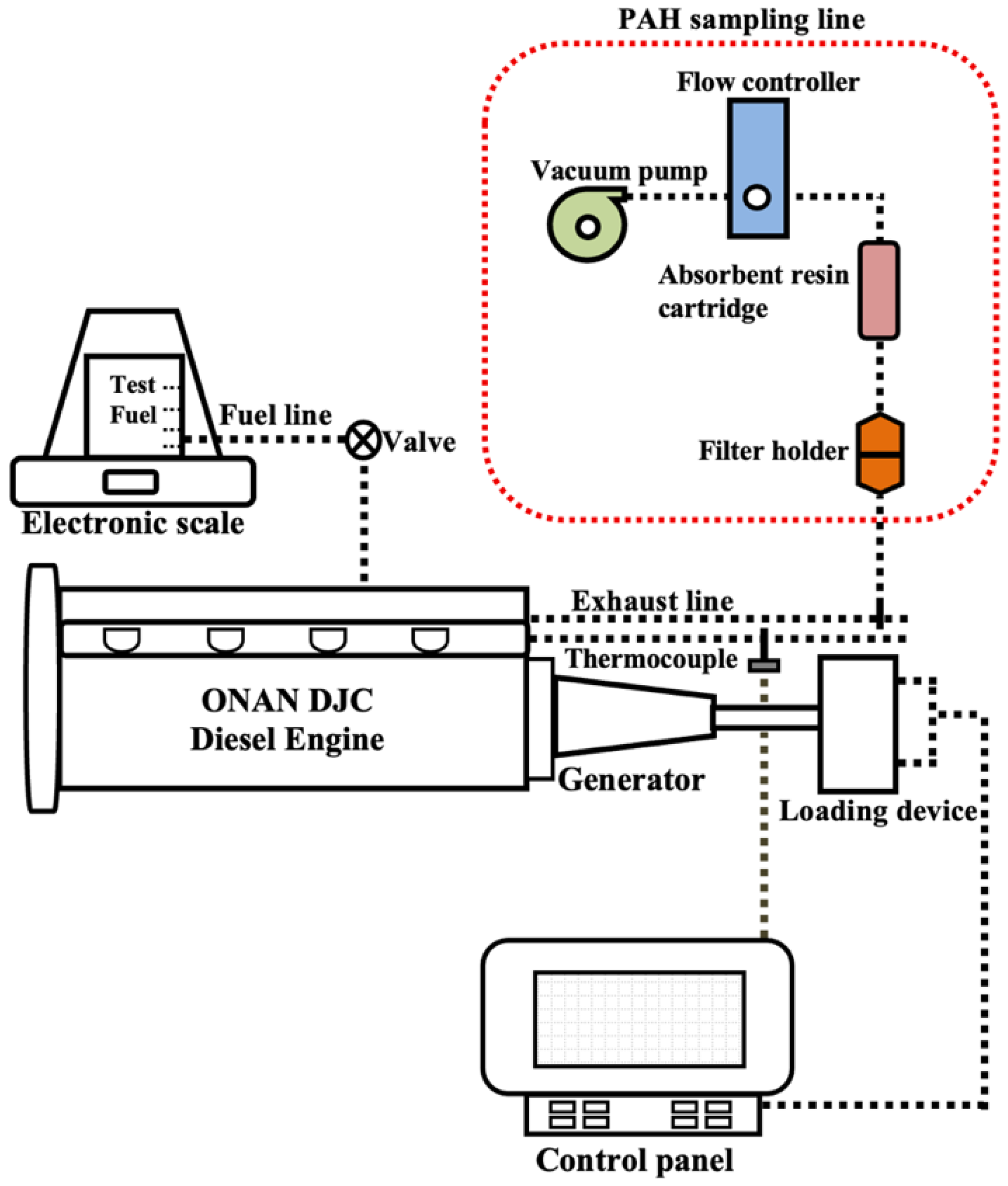
2. Experimental Setup and Specifications
2.1. Test Fuels and Operating Conditions
2.2. PAH Sampling
3. Results and Discussion
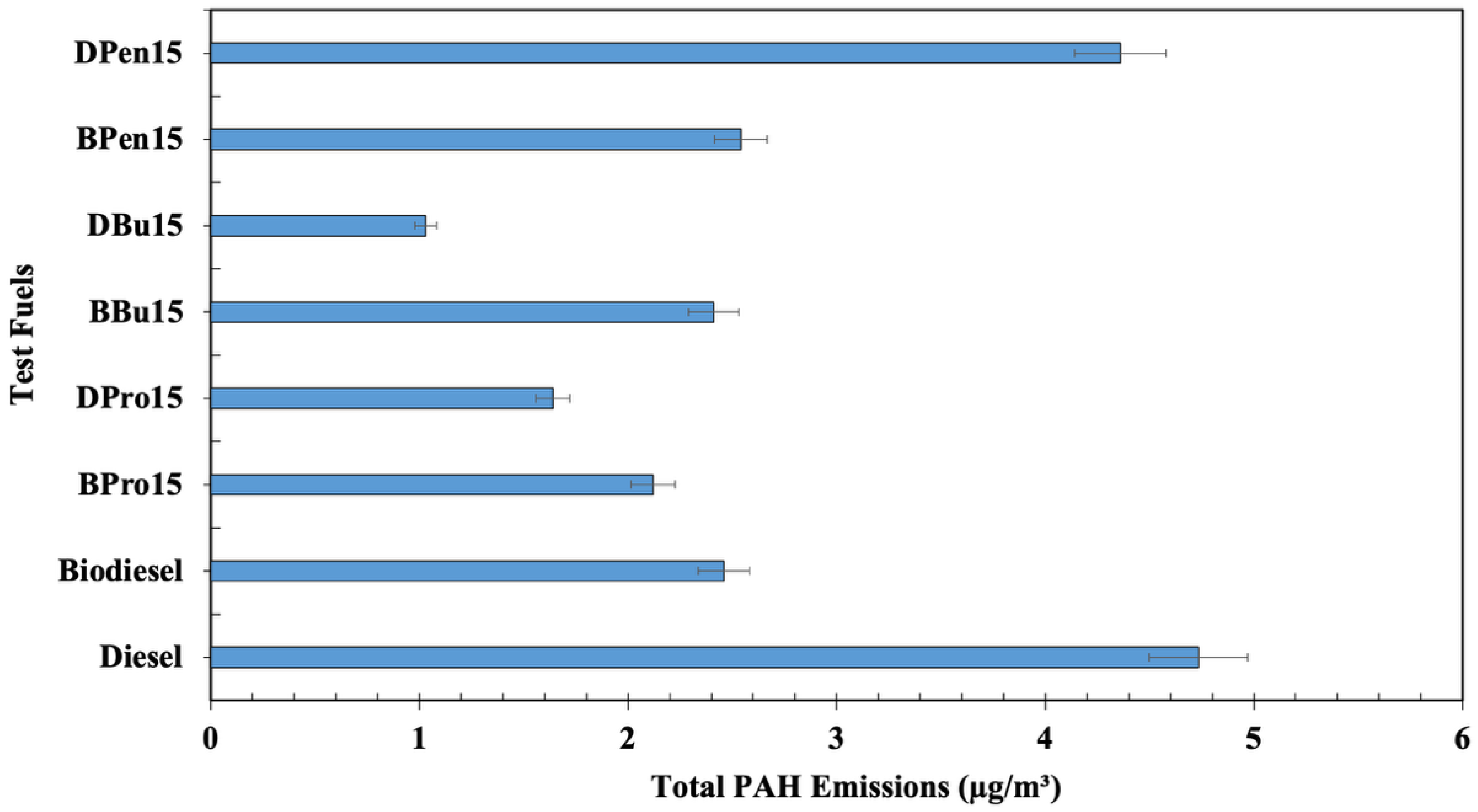
3.1. Presence of PAHs in Exhaust Gases
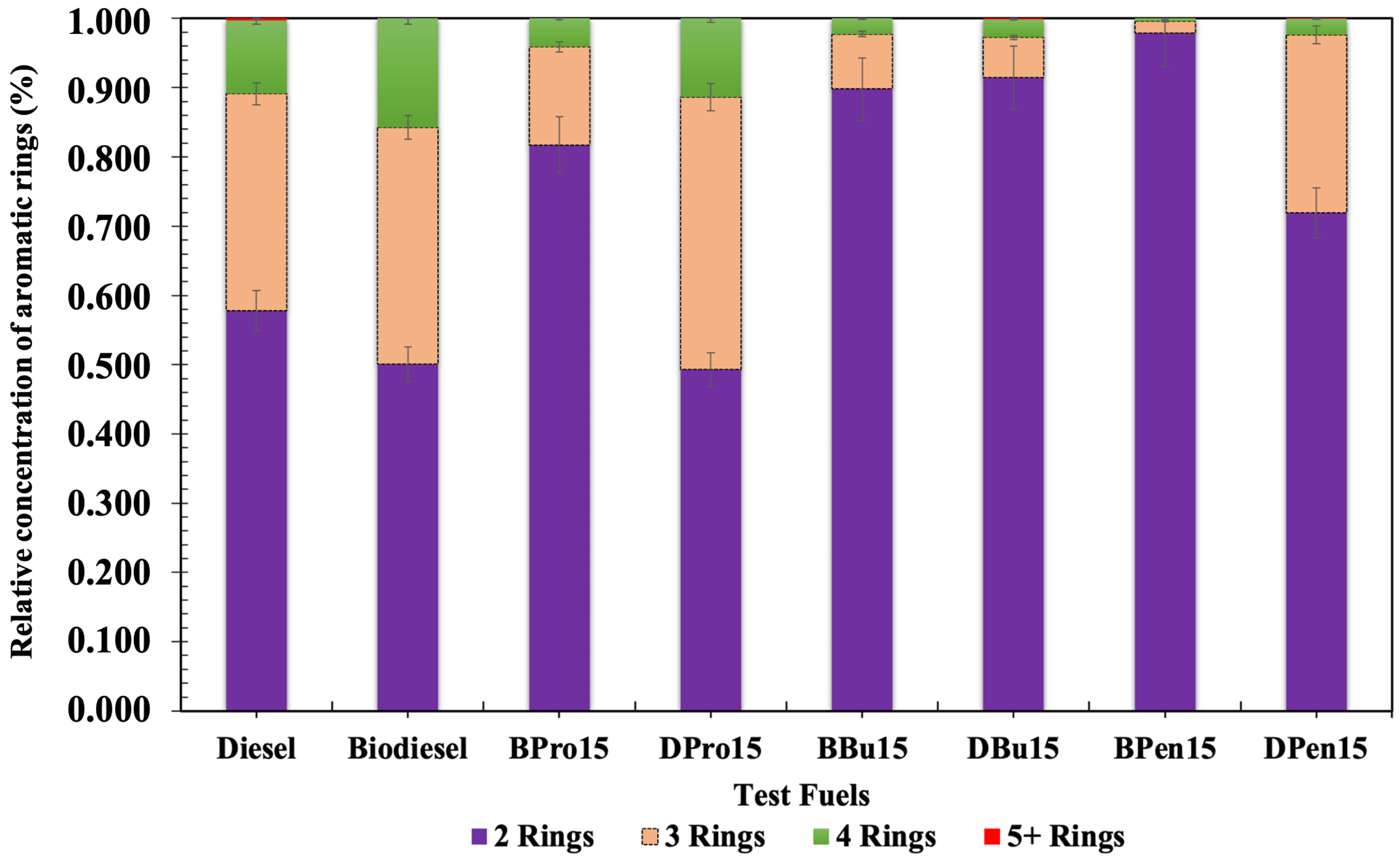
3.2. Ring Distribution of PAHs
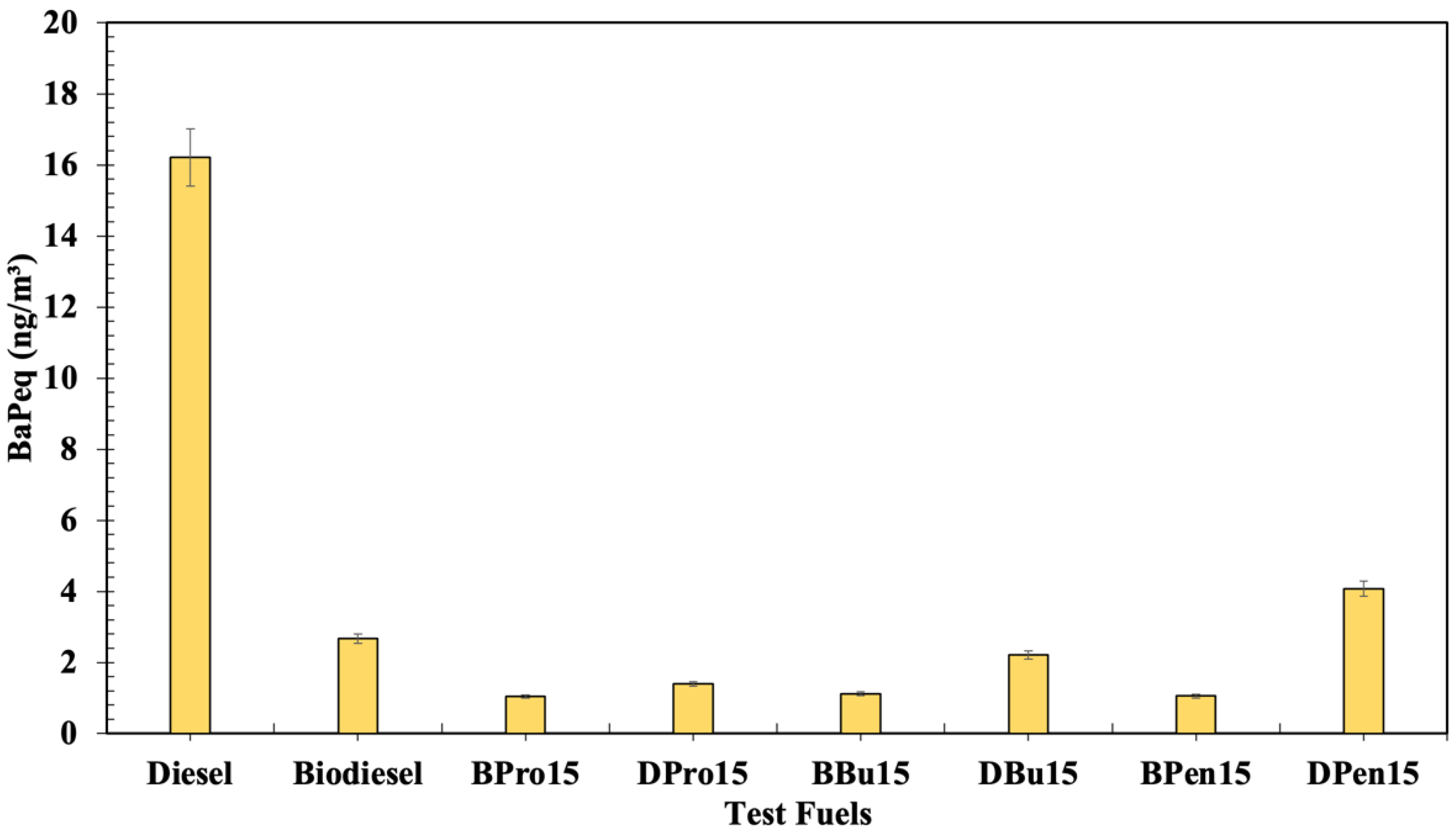
3.3. Toxicity-Weighted PAH Emissions
4. Conclusions
Author Contributions
Funding
Data Availability Statement
Acknowledgments
Conflicts of Interest
References
- Atmanli, A.; Yilmaz, N. An experimental assessment on semi-low temperature combustion using waste oil biodiesel/C3-C5 alcohol blends in a diesel engine. Fuel 2020, 260, 116357. [Google Scholar] [CrossRef]
- Chen, Z.; He, J.; Chen, H.; Geng, L.; Zhang, P. Comparative study on the combustion and emissions of dual-fuel common rail engines fueled with diesel/methanol, diesel/ethanol, and diesel/ n-butanol. Fuel 2021, 304, 121360. [Google Scholar] [CrossRef]
- Erdiwansyah; Mamat, R.; Sani, M.S.M.; Sudhakar, K.; Kadarohman, A.; Sardjono, R.E. An overview of Higher alcohol and biodiesel as alternative fuels in engines. Energy Rep. 2019, 5, 467–479. [Google Scholar] [CrossRef]
- Maleki, B.; Talesh, S.S.A. Cold flow properties and CI engine parameters synchronic improvement of biodiesel/diesel/ C3 and C4 alcohol blends: Mixture design approach. Process Saf. Environ. Prot. 2022, 160, 310–326. [Google Scholar] [CrossRef]
- Vinod, B.M.; Madhu, M.K.; Amba Prasad, R.G. Butanol and pentanol: The promising biofuels for CI engines-A review. Renew. Sustain. Energy Rev. 2017, 78, 1068–1088. [Google Scholar]
- Zhu, M.; Setyawan, H.Y.; Zhang, Z.; Zhang, D. Effect of n-butanol addition on the burning rate and soot characteristics during combustion of single droplets of diesel–biodiesel blends. Fuel 2020, 265, 117020. [Google Scholar] [CrossRef]
- Yang, K.; Wei, L.; Cheung, C.S.; Tang, C.; Huang, Z. The effect of pentanol addition on the particulate emission characteristics of a biodiesel operated diesel engine. Fuel 2017, 209, 132–140. [Google Scholar] [CrossRef]
- Sekhar, S.C.; Karuppasamy, K.; Vedaraman, N.; Kabeel, A.; Sathyamurthy, R.; Elkelawy, M.; Bastawissi, H.A.E. Biodiesel production process optimization from Pithecellobium dulce seed oil: Performance, combustion, and emission analysis on compression ignition engine fuelled with diesel/biodiesel blends. Energy Convers. Manag. 2018, 161, 141–154. [Google Scholar] [CrossRef]
- Pan, S.; Zabed, H.M.; Wei, Y.; Qi, X. Technoeconomic and environmental perspectives of biofuel production from sugarcane bagasse: Current status, challenges and future outlook. Ind. Crops Prod. 2022, 188, 115684. [Google Scholar] [CrossRef]
- Ahmad, A.; Naqvi, S.A.; Jaskani, M.J.; Waseem, M.; Ali, E.; Khan, I.A.; Manzoor, M.F.; Siddeeg, A.; Aadil, R.M. Efficient utilization of date palm waste for the bioethanol production through Saccharomyces cerevisiae strain. Food Sci. Nutr. 2021, 9, 2066–2074. [Google Scholar] [CrossRef]
- Zabed, H.M.; Akter, S.; Tian, Y.; Dar, M.A.; Yun, J.; Zhao, M.; Ragauskas, A.J.; Li, J.; Qi, X. Assessing microbial systems and process configurations for improved ethanol production from sugary stovers by integrating soluble sugars and holocellulose. Ind. Crops Prod. 2024, 212, 118269. [Google Scholar] [CrossRef]
- Wang, C.; Zhang, W.; Qiu, X.; Xu, C. Hydrothermal treatment of lignocellulosic biomass towards low-carbon development: Production of high-value-added bioproducts. EnergyChem 2024, 6, 100133. [Google Scholar] [CrossRef]
- Salvi, B.L.; Subramanian, K.A.; Panwar, N.L. Alternative fuels for transportation vehicles: A technical review. Renew. Sustain. Energy Rev. 2013, 25, 404–419. [Google Scholar] [CrossRef]
- Yatish, K.V.; Lalithamba, H.S.; Suresh, R.; Hebbar, H.H. Optimization of bauhinia variegata biodiesel production and its performance, combustion and emission study on diesel engine. Renew. Energy 2018, 122, 561–575. [Google Scholar] [CrossRef]
- Kumar, B.R.; Saravanan, S.; Ranad, D.; Nagendran, A. Use of some advanced biofuels for overcoming smoke/NOx trade-off in a light- duty DI diesel engine. Renew. Energy 2016, 96, 687–699. [Google Scholar] [CrossRef]
- Nour, M.; Attia, A.M.A.; Nada, S.A. Combustion, performance and emission analysis of diesel engine fuelled by higher alcohols (butanol, octanol and heptanol)/diesel blends. Energy Convers. Manag. 2019, 185, 313–329. [Google Scholar] [CrossRef]
- Yilmaz, N. Performance and emission characteristics of a diesel engine fuelled with biodiesel-ethanol and biodiesel-methanol blends at elevated air temperatures. Fuel 2012, 94, 440–443. [Google Scholar] [CrossRef]
- Atmanli, A.; Yilmaz, N. Comparative assessment of different diesel engines fueled with 1-pentanol and diesel blends. Environ. Prog. Sustain. Energy 2021, 40, ep13663. [Google Scholar] [CrossRef]
- Jin, C.; Pang, X.; Zhang, X.; Wu, S.; Ma, M.; Xiang, Y.; Ma, J.; Ji, J.; Wang, G.; Liu, H. Effects of C3–C5 alcohols on solubility of alcohols/diesel blends. Fuel 2019, 236, 65–74. [Google Scholar] [CrossRef]
- Atmanli, A.; Yilmaz, N. A comparative analysis of n-butanol/diesel and 1-pentanol/diesel blends in a compression ignition engine. Fuel 2018, 234, 161–169. [Google Scholar] [CrossRef]
- Bergthorson, J.M.; Thomson, M.J. A review of the combustion and emissions properties of advanced transportation biofuels and their impact on existing and future engines. Renew. Sustain. Energy Rev. 2015, 42, 1393–1417. [Google Scholar] [CrossRef]
- Elkelawy, M.; Hagar Bastawissi, A.E.; Esmaeil, K.K.; Radwan, A.M.; Panchal, H.; Sadasivuni, K.K.; Suresh, M.; Israr, M. Maximization of biodiesel production from sunflower and soybean oils and prediction of diesel engine performance and emission characteristics through response surface methodology. Fuel 2020, 266, 117072. [Google Scholar] [CrossRef]
- Surisetty, V.R.; Dalai, A.K.; Kozinski, J. Alcohols as alternative fuels: An overview. Appl. Catal. A General 2011, 404, 1–11. [Google Scholar] [CrossRef]
- Nanthagopal, K.; Kishna, R.S.; Atabani, A.E.; Al-Muhtaseb, A.H.; Kumar, G.; Ashok, B. A compressive review on the effects of alcohols and nanoparticles as an oxygenated enhancer in compression ignition engine. Energy Convers. Manag. 2020, 203, 112244. [Google Scholar] [CrossRef]
- Redel-Macías, M.D.; Leiva-Candia, D.E.; Soriano, J.A.; Herreros, J.M.; Cubero-Atienza, A.J.; Pinzi, S. Influence of short carbon-chain alcohol (Ethanol and 1-Propanol)/diesel fuel blends over diesel engine emissions. Energies 2021, 14, 1309. [Google Scholar] [CrossRef]
- Liu, X.; Wang, H.; Zheng, Z.; Liu, J.; Reitz, R.D.; Yao, M. Development of a combined reduced primary reference fuel-alcohols (methanol/ethanol/propanols/butanols/n-pentanol) mechanism for engine applications. Energy 2016, 114, 542–558. [Google Scholar] [CrossRef]
- Yusri, I.M.; Mamat, R.; Akasyah, M.K.; Jamlos, M.F.; Yusop, A.F. Evaluation of engine combustion and exhaust emissions characteristics using diesel/butanol blended fuel. Appl. Therm. Eng. 2019, 156, 209–219. [Google Scholar] [CrossRef]
- Alli, A.K.; Kotha, M.M.; Alur, V.B.; Kamarapu, S.K.; Tiwari, S. Impact of higher alcohol injection rates and exhaust gas recirculation on efficiency, combustion, and NOx emissions in reactivity controlled compression ignition engines. Therm. Sci. Eng. Prog. 2026, 74, 104713. [Google Scholar] [CrossRef]
- Kumar, B.R.; Saravanan, S. Use of higher alcohol biofuels in diesel engines: A review. Renew. Sustain. Energy Rev. 2016, 60, 84–115. [Google Scholar] [CrossRef]
- Agarwal, A.K. Biofuels (alcohols and biodiesel) applications as fuels in internal combustion engines. Prog. Energy Combust. Sci. 2007, 32, 233–271. [Google Scholar] [CrossRef]
- Li, L.; Wang, J.; Wang, Z.; Xiao, J. Combustion and emission characteristics of diesel engine fueled with diesel/biodiesel/pentanol fuel blends. Fuel 2015, 156, 211–218. [Google Scholar] [CrossRef]
- Yilmaz, N.; Vigil, F.M. Potential Use of a blend of diesel, biodiesel, alcohols and vegetable oil in compression ignition engines. Fuel 2014, 124, 168–172. [Google Scholar] [CrossRef]
- Wu, F.; Xu, B.; Liu, Y.; Wu, J. Performance and emission characteristics of a diesel engine fueled with alcohol-diesel fuel blends containing low ratio of alcohols. Environ. Prog. Sustain. Energy 2019, 38, 13035. [Google Scholar] [CrossRef]
- Kothiyal, N.C.; Kumar, V.; Kumar, N.; Saruchi; Pandey, S.; Ansar, S. Reduction of carcinogenic PAHs from petrodiesel engine exhaust by blending of green diesel (A new development in renewable fuels) with different biodiesel fuels. Environ. Technol. Innov. 2022, 25, 102089. [Google Scholar] [CrossRef]
- Tsapakis, M.; Stephanou, E.G. Diurnal cycle of PAHs, nitro-PAHs, and oxy-PAHs in a high oxidation capacity marine background atmosphere. Environ. Sci. Technol. 2007, 41, 8011–8017. [Google Scholar] [CrossRef] [PubMed]
- Karavalakis, G.; Fontaras, G.; Ampatzoglou, D.; Kousoulidou, M.; Stournas, S.; Samaras, Z.; Bakeas, E. Effects of low concentration biodiesel blends application on modern passenger cars. Part 3: Impact on PAH, nitro-PAH, and oxy-PAH emissions. Environ. Pollut. 2010, 158, 1584–1594. [Google Scholar] [CrossRef]
- Gowtham, M.; Mohan, C.G.; Prakash, R. Effect of n-butanol fumigation on the regulated and unregulated emission characteristics of a diesel engine. Fuel 2019, 242, 84–95. [Google Scholar] [CrossRef]
- Arias, S.; Molina, F.; Palacio, R. Assessment of carbonyl and PAH emissions in an automotive diesel engine fueled with butanol and renewable diesel fuel blends. Fuel 2022, 316, 123290. [Google Scholar] [CrossRef]
- Correa, S.M.; Arbilla, G. Aromatic hydrocarbons emissions in diesel and biodiesel exhaust. Atmos. Environ. 2006, 40, 6821–6826. [Google Scholar] [CrossRef]
- Vojtisek-Lom, M.; Pechout, M.; Dittrich, L.; Beránek, V.; Kotek, M.; Schwarz, J.; Vodička, P.; Milcová, A.; Rossnerová, A.; Ambrož, A.; et al. Polycyclic aromatic hydrocarbons (PAH) and their genotoxicity in exhaust emissions from a diesel engine during extended low-load operation on diesel and biodiesel fuels. Atmos. Environ. 2015, 109, 9–18. [Google Scholar] [CrossRef]
- Guarieiro, L.F.N.; Souza, A.F.; Torres, E.A.; de Andrade, J.B. Emission profile of 18 carbonyl compounds, CO, CO2, and NOx emitted by a diesel engine fuelled with diesel and ternary blends containing diesel, ethanol and biodiesel or vegetable oils. Atmos. Environ. 2009, 43, 2754–2761. [Google Scholar] [CrossRef]
- Yilmaz, N.; Donaldson, B. Combined effects of engine characteristics and fuel aromatic content on polycyclic aromatic hydrocarbons and toxicity. Energy Sources Part A Recovery Util. Environ. Eff. 2022, 44, 9156–9171. [Google Scholar]
- Yilmaz, N.; Atmanli, A.; Vigil, F.M.; Donaldson, B. Comparative assessment of polycyclic aromatic hydrocarbons and toxicity in a diesel engine powered by diesel and biodiesel blends with high concentrations of alcohols. Energies 2022, 15, 8523. [Google Scholar] [CrossRef]
- Yilmaz, N.; Vigil, F.M.; Atmanli, A.; Donaldson, B. Influence of fuel oxygenation on regulated pollutants and unregulated aromatic compounds with biodiesel and n-pentanol blends. Int. J. Energy Res. 2023, 2023, 3040073. [Google Scholar] [CrossRef]
- Yilmaz, N.; Vigil, F.; Donaldson, B. Effect of diesel and propanol blends on regulated pollutants and polycyclic aromatic hydrocarbons under lean combustion conditions. Environ. Prog. Sustain. Energy 2023, 42, e14020. [Google Scholar] [CrossRef]
- ASTM Standard No. D6751-24; Standard Specification for Biodiesel Fuel Blend Stock (B100) for Middle Distillate Fuels. ASTM International: West Conshohocken, PA, USA, 2024. [CrossRef]
- EN 15779 Standard 2013-12; Petroleum Products and Fat and Oil Derivates-Fatty Acid Methyl Esters (FAME) for Diesel Engines—Determination of Polyunsaturated (≥4 Double Bonds) Fatty Acid Methyl Esters (PUFA) by Gas Chromatography. European Standards: Plzen, Czech Republic, 2013.
- Ghadikolaei, M.A. Effect of alcohol blend and fumigation on regulated and unregulated emissions of IC engines—A review. Renew. Sustain. Energy Rev. 2016, 57, 1440–1495. [Google Scholar] [CrossRef]
- Paim, J.N.; Santos, A.G.; Araujo, R.G.O.; Nascimento, M.M.; De Andrade, J.B.; Guarieiro, L.L.N. Nitro-PAHs and Quinones (Oxy-PAHs) Associated to PM1.0 and PM2.5 Emitted by a Diesel Engine Fueled with Diesel-Biodiesel-Ethanol Blends. Atmosphere 2023, 14, 656. [Google Scholar] [CrossRef]
- Sahu, T.K.; Shukla, P.C.; Mondal, A.; Gupta, S.; Belgiorno, G.; Di Blasio, G. Assessment of particulate PAHs toxicity from alcohol-diesel blends fuelled high compression ratio CI engine. Clean. Eng. Technol. 2024, 18, 100725. [Google Scholar] [CrossRef]
- Tsai, J.-H.; Chen, S.-J.; Huang, K.-L.; Lin, W.-Y.; Lee, W.-J.; Lin, C.-C.; Hsieh, L.-T.; Chiu, J.-Y.; Kuo, W.-C. Emissions from a Generator Fueled by Blends of Diesel, Biodiesel, Acetone, and Isopropyl Alcohol: Analyses of Emitted PM, Particulate Carbon, and PAHs. Sci. Total Environ. 2014, 466–467, 195–202. [Google Scholar] [CrossRef]
- Li, X.; Zheng, Y.; Guan, C.; Cheung, C.S.; Huang, Z. Effect of biodiesel on PAH, OPAH, and NPAH emissions from a direct injection diesel engine. Environ. Sci. Pollut. Res. 2018, 25, 34131–34138. [Google Scholar] [CrossRef] [PubMed]
- Kumar, V.; Singh, A.P.; Agarwal, A.K. Gaseous emissions (regulated and unregulated) and particulate characteristics of a medium-duty CRDI transportation diesel engine fueled with diesel-alcohol blends. Fuel 2020, 278, 118269. [Google Scholar] [CrossRef]
- Dandajeh, H.A.; Talibi, M.; Ladommatos, N.; Hellier, P. Influence of combustion characteristics and fuel composition on exhaust PAHs in a compression ignition engine. Energies 2019, 12, 2575. [Google Scholar] [CrossRef]
- Yilmaz, N.; Ukaoma, M. Impact of biodiesel and propanol blends on engine performance, regulated emissions and PAH formation. Int. J. Energy Res. 2022, 46, 23433–23448. [Google Scholar] [CrossRef]
- Yilmaz, N.; Donaldson, A.B. Evidence of PAH production under lean combustion conditions. Fuel 2007, 86, 2377–2382. [Google Scholar] [CrossRef]
- Borrás, E.; Tortajada-Genaro, L.A.; Vázquez, M.; Zielinska, B. Polycyclic aromatic hydrocarbon exhaust emissions from different reformulated diesel fuels and engine operating conditions. Atmos. Environ. 2009, 43, 5944–5952. [Google Scholar] [CrossRef]
- Borillo, G.C.; Tadano, Y.S.; Godoi, A.F.L.; Pauliquevis, T.; Sarmiento, H.; Rempel, D.; Yamamoto, C.I.; Marchi, M.R.R.; Potgieter-Vermaak, S.; Godoi, R.H.M. Polycyclic Aromatic Hydrocarbons (PAHs) and nitrated analogs associated to particulate matter emission from a Euro V-SCR engine fuelled with diesel/biodiesel blends. Sci. Total Environ. 2018, 644, 675–682. [Google Scholar] [CrossRef]
- Zhang, Y.; Lou, D.; Hu, Z.; Tan, P. Particle number, size distribution, carbons, polycyclic aromatic hydrocarbons and inorganic ions of exhaust particles from a diesel bus fueled with biodiesel blends. J. Clean. Prod. 2019, 225, 627–636. [Google Scholar] [CrossRef]
- Yilmaz, N.; Davis, S.M. Polycyclic aromatic hydrocarbon (PAH) formation in a diesel engine fueled with diesel, biodiesel and biodiesel/n-butanol blends. Fuel 2016, 181, 729–740. [Google Scholar] [CrossRef]
- Ravindra, K.; Sokhi, R.; Van Grieken, R. Atmospheric polycyclic aromatic hydrocarbons: Source attribution, emission factors and regulation. Atmos. Environ. 2008, 42, 2898–2921. [Google Scholar] [CrossRef]
- Souza, C.V.; Corrêa, S.M. Polycyclic aromatic hydrocarbons in diesel emission, diesel fuel and lubricant oil. Fuel 2016, 185, 925–931. [Google Scholar] [CrossRef]
- Liu, Y.; Gao, Y.; Yu, N.; Zhang, C.; Wang, S.; Ma, L.; Lohmann, R. Particulate matter, gaseous and particulate polycyclic aromatic hydrocarbons (PAHs) in an urban traffic tunnel of China: Emission from on-road vehicles and gas-particle partitioning. Chemosphere 2015, 134, 52–59. [Google Scholar] [CrossRef]
- Georgios, K.; Stavros, P.; Efthimios, Z. Impact of Diesel Fuels on the Emissions of Non-Regulated Pollutants. Fuel 2012, 102, 85–91. [Google Scholar] [CrossRef]
- Lin, S.L.; Lee, W.J.; Lee, C.F.; Wu, Y. Reduction in Emissions of Nitrogen Oxides, Particulate Matter, And Polycyclic Aromatic Hydrocarbon by Adding Water-Containing N-butanol Into A Diesel-Fueled Engine Generator. Fuel 2012, 93, 364–372. [Google Scholar] [CrossRef]
- Bakeas, E.B.; Karavalakis, G. Regulated, Carbonyl and Polycyclic Aromatic Hydrocarbon Emissions from a Light-Duty Vehicle Fueled with Diesel and Biodiesel Blends. Environ. Sci. Process. Impacts 2013, 15, 412–422. [Google Scholar] [CrossRef] [PubMed]
- Wu, S.; Bao, J.; Wang, Z.; Zhang, H.; Xiao, R. The regulated emissions and PAH emissions of bio-based long-chain ethers in a diesel engine. Fuel Process. Technol. 2021, 214, 106724. [Google Scholar] [CrossRef]
- Dandajeh, H.A.; Ladommatos, N.; Hellier, P.; Eveleigh, A. Effects of unsaturation of C2 and C3 hydrocarbons on the formation of PAHs and on the toxicity of soot particles. Fuel 2017, 194, 306–320. [Google Scholar] [CrossRef]
- Xu, L.; Yu, J.; Wan, G.; Sun, L. Emission characteristics and source identification of polycyclic aromatic hydrocarbons (PAHs) from used mineral oil combustion. Fuel 2021, 304, 121357. [Google Scholar] [CrossRef]



| Engine Type | Onan DJC Diesel Generator |
|---|---|
| Number of cylinders | 4 |
| Firing order | 1-2-4-3 |
| Number of cycles | 4 cycles |
| Fuel injection system | Indirect |
| Injection pressure (MPa) | 13.1 |
| Injection timing (BTDC) | 18 °CA |
| Bore (mm) | 82.55 |
| Stroke (mm) | 92.08 |
| Displacement (cm3) | 1970 |
| Compression ratio | 19:1 |
| Max output (kW) | 12 |
| Max speed (rpm) | 1800 |
| Items | Cetane Number | Density (g/mL) | Kinematic Viscosity at 40 °C (mm2/s) | Lower Heating Value (MJ/kg) | Flash Point (°C) | Cloud Point (°C) | CFPP (°C) |
|---|---|---|---|---|---|---|---|
| Diesel | 54 | 0.818 | 2.95 | 44.8 | 74 | −12 | −21 |
| Biodiesel | 52 | 0.855 | 4.57 | 40.5 | 126 | −8.1 | −13.2 |
| n-propanol | 12 | 0.803 | 1.74 | 30.63 | 22 | - | <−51 |
| n-butanol | 17 | 0.810 | 2.23 | 33.10 | 35 | - | <−51 |
| n-pentanol | 20 | 0.815 | 2.89 | 34.94 | 49 | - | −40 |
| BPro15 | 44.51 | 0.845 | 4.12 | 32.67 | 94.15 | −11.5 | −17.1 |
| BBu15 | 45.60 | 0.846 | 4.03 | 39.34 | 95.45 | −12.2 | −18.6 |
| BPen15 | 45.89 | 0.848 | 4.21 | 39.87 | 98.63 | −11.2 | −17.8 |
| DPro15 | 44.42 | 0.811 | 2.48 | 42.06 | 44.78 | −18 | −22 |
| DBu15 | 46.51 | 0.815 | 2.93 | 42.96 | 59.50 | −18 | −24 |
| DPen15 | 45.67 | 0.814 | 2.98 | 42.50 | 50.53 | −18 | −23 |
| Instrument Details | GC-MS: HP 5890/5971A Column: DB5-MS |
|---|---|
| Injection Volume | 1 µL |
| Injection Temperature | 300 °C |
| Thermal Program | Hold 70 °C for 1 min Heat from 70–200 °C @ 70 °C/min Hold 200 °C for 2 min Heat 200–300 °C @ 7 °C/min Hold 200 °C for 10 min |
| PAH | Number of Rings | Total PAHs (µg/m3) | |||||||
|---|---|---|---|---|---|---|---|---|---|
| Diesel | Biodiesel | BPro15 | BBu15 | BPen15 | DPro15 | DBu15 | DPen15 | ||
| Naphthalene | 2 | 1.93 | 0.76 | 1.28 | 1.54 | 1.58 | 0.33 | 0.61 | 1.07 |
| Acenaphthylene | 2 | 0.21 | 0.25 | 0.23 | 0.71 | 0.81 | 0.11 | 0.23 | 0.71 |
| Fluorene | 2 | 0.59 | 0.22 | 0.24 | 0.12 | 0.11 | 0.34 | 0.12 | 1.18 |
| Phenanthrene | 3 | 1.19 | 0.66 | 0.25 | 0.01 | 0.01 | 0.55 | 0.02 | 1.19 |
| Fluoranthene | 3 | 0.29 | 0.18 | 0.04 | 0.02 | 0.02 | 0.12 | 0.03 | 0.09 |
| Pyrene | 4 | 0.4 | 0.31 | 0.07 | 0.01 | 0.01 | 0.18 | 0.02 | 0.11 |
| Benzo[a]anthracene | 4 | 0.00 * | 0.01 | 0.00 * | 0.00 * | 0.00 * | 0.00 * | 0.00 * | 0.00 * |
| Chrysene | 4 | 0.09 | 0.07 | 0.01 | 0.00 * | 0.00 * | 0.01 | 0.00 * | 0.01 |
| Benzo[k]fluoranthene | 4 | 0.00 * | 0.01 | 0.00 * | 0.00 * | 0.00 * | 0.00 * | 0.00 * | 0.00 * |
| Benzo[a]pyrene | 5 | 0.01 | 0.00 * | 0.00 * | 0.00 * | 0.00 * | 0.00 * | 0.00 * | 0.00 * |
| * undetected (below the detection limit) | |||||||||
| PAH | Number of Rings | Toxicity BaPeq (ng/m3) | |||||||
|---|---|---|---|---|---|---|---|---|---|
| Diesel | Biodiesel | BPro15 | BBu15 | BPen15 | DPro15 | DBu15 | DPen15 | ||
| Acenaphthylene | 2 | 0.211 | 0.246 | 0.287 | 0.941 | 0.91 | 0.131 | 0.351 | 0.752 |
| Fluorene | 2 | 0.593 | 0.223 | 0.284 | 0.133 | 0.11 | 0.372 | 0.166 | 1.198 |
| Phenanthrene | 3 | 1.194 | 0.66 | 0.266 | 0.011 | 0.01 | 0.574 | 0.637 | 1.378 |
| Fluoranthene | 3 | 0.288 | 0.18 | 0.054 | 0.028 | 0.02 | 0.121 | 0.922 | 0.141 |
| Pyrene | 4 | 0.403 | 0.305 | 0.082 | 0.004 | 0.01 | 0.192 | 0.123 | 0.119 |
| Benzo[a]anthracene | 4 | 0 | 0.919 | 0 | 0 | 0 | 0.001 | 0 | 0.462 |
| Chrysene | 4 | 0.094 | 0.065 | 0.07 | 0.002 | 0 | 0.006 | 0.002 | 0.007 |
| Benzo[k]fluoranthene | 4 | 0.046 | 0.077 | 0 | 0 | 0 | 0 | 0 | 0 |
| Benzo[a]pyrene | 5 | 13.378 | 0 | 0 | 0 | 0 | 0 | 0.009 | 0.021 |
Disclaimer/Publisher’s Note: The statements, opinions and data contained in all publications are solely those of the individual author(s) and contributor(s) and not of MDPI and/or the editor(s). MDPI and/or the editor(s) disclaim responsibility for any injury to people or property resulting from any ideas, methods, instructions or products referred to in the content. |
© 2026 by the authors. Licensee MDPI, Basel, Switzerland. This article is an open access article distributed under the terms and conditions of the Creative Commons Attribution (CC BY) license.
Share and Cite
Atmanli, A.; Yilmaz, N.; Vigil, F.M.; Donaldson, B. Effect of Alcohol-Enhanced Diesel and Biodiesel Blends on Polycyclic Aromatic Hydrocarbons and Toxicity. Energies 2026, 19, 2644. https://doi.org/10.3390/en19112644
Atmanli A, Yilmaz N, Vigil FM, Donaldson B. Effect of Alcohol-Enhanced Diesel and Biodiesel Blends on Polycyclic Aromatic Hydrocarbons and Toxicity. Energies. 2026; 19(11):2644. https://doi.org/10.3390/en19112644
Chicago/Turabian StyleAtmanli, Alpaslan, Nadir Yilmaz, Francisco M. Vigil, and Burl Donaldson. 2026. "Effect of Alcohol-Enhanced Diesel and Biodiesel Blends on Polycyclic Aromatic Hydrocarbons and Toxicity" Energies 19, no. 11: 2644. https://doi.org/10.3390/en19112644
APA StyleAtmanli, A., Yilmaz, N., Vigil, F. M., & Donaldson, B. (2026). Effect of Alcohol-Enhanced Diesel and Biodiesel Blends on Polycyclic Aromatic Hydrocarbons and Toxicity. Energies, 19(11), 2644. https://doi.org/10.3390/en19112644