Review

Recent Progress of Advanced Biofuel 2,5-Dimethylfuran Production from 5-Hydroxymethylfurfural

1
College of Mechanical and Electrical Engineering, Henan Agricultural University, Zhengzhou 450002, China
2
College of Big Data and Information Engineering, Guizhou University, Guiyang 550025, China
*
Authors to whom correspondence should be addressed.
Energies 2026, 19(11), 2598; https://doi.org/10.3390/en19112598
Submission received: 4 April 2026 / Revised: 21 May 2026 / Accepted: 24 May 2026 / Published: 27 May 2026

Abstract

Given the depletion of fossil resources and mounting environmental pressures, the efficient conversion of the biomass-derived platform molecule 5-hydroxymethylfurfural (HMF) into the liquid fuel 2,5-dimethylfuran (DMF) is of critical strategic importance. The recent advances in the hydrogenolysis of HMF to DMF were systematically summarized in this review. The performance advantages and limitations of monometallic catalysts, including noble metals and non-noble metals, were discussed. The bimetallic active centers engineered through synergistic effects to enhance activity were summarized. Crucially, the roles of the physicochemical properties of catalyst supports and the hydrogen donors in governing reaction pathways and efficiency were also analyzed in depth. Finally, future research directions were proposed to address current challenges related to catalyst durability and economic viability.

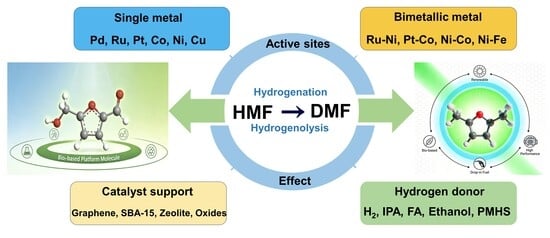
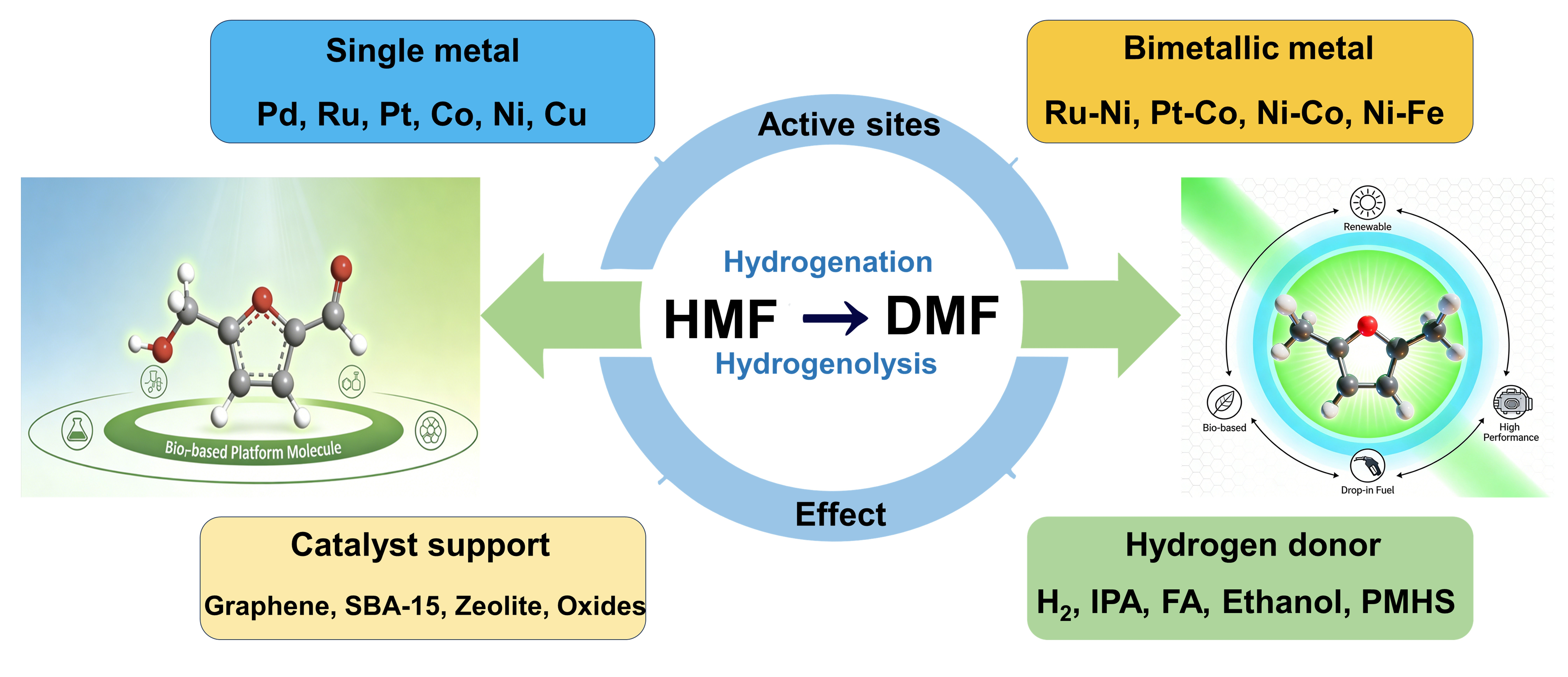
Graphical Abstract

1. Introduction

In light of increasing fossil fuel consumption and growing environmental concerns, renewable and clean energy have attracted considerable attention as a viable alternative to conventional fossil resources [1,2]. Biomass, as the only renewable natural carbon source, has garnered significant research interest due to its abundance and carbon-neutral characteristics [3,4]. In contrast to fossil fuels, biomass is composed of polar, reactive, and oxygen-containing functional moieties [5,6]. Therefore, the catalytic conversion of biomass into biofuels and high-value chemicals offers a promising route to reduce dependence on fossil resources [7,8,9]. The platform chemical 5-hydroxymethylfurfural (HMF), typically derived from biomass, serves as a crucial bridge between raw biomass and bio-based chemicals [10,11,12,13,14,15].
HMF molecule contains aldehyde, hydroxymethyl, and furan ring functionalities, enabling its further conversion into a wide array of high-value chemicals via hydrogenation, oxidation, amination, etherification, or HDO [16,17]. Among these, the selective hydrogenolysis of HMF to the liquid biofuel 2,5-dimethylfuran (DMF) is of particular significance [18,19,20]. The properties of DMF are similar to gasoline, including a high octane number (119) and energy density (31.5 MJ·L−1), and it also serves as a common intermediate in the chemical industry [21,22]. Moreover, the boiling point of DMF is between that of ethanol and butanol, and readily miscible with gasoline. Its favorable vaporization characteristics help reduce air intake resistance in engines, satisfy cold-start requirements, and perform well in direct-injection and spark-ignition engines [23]. Consequently, the production of DMF is of great importance for advancing the renewability of liquid fuels [24,25].
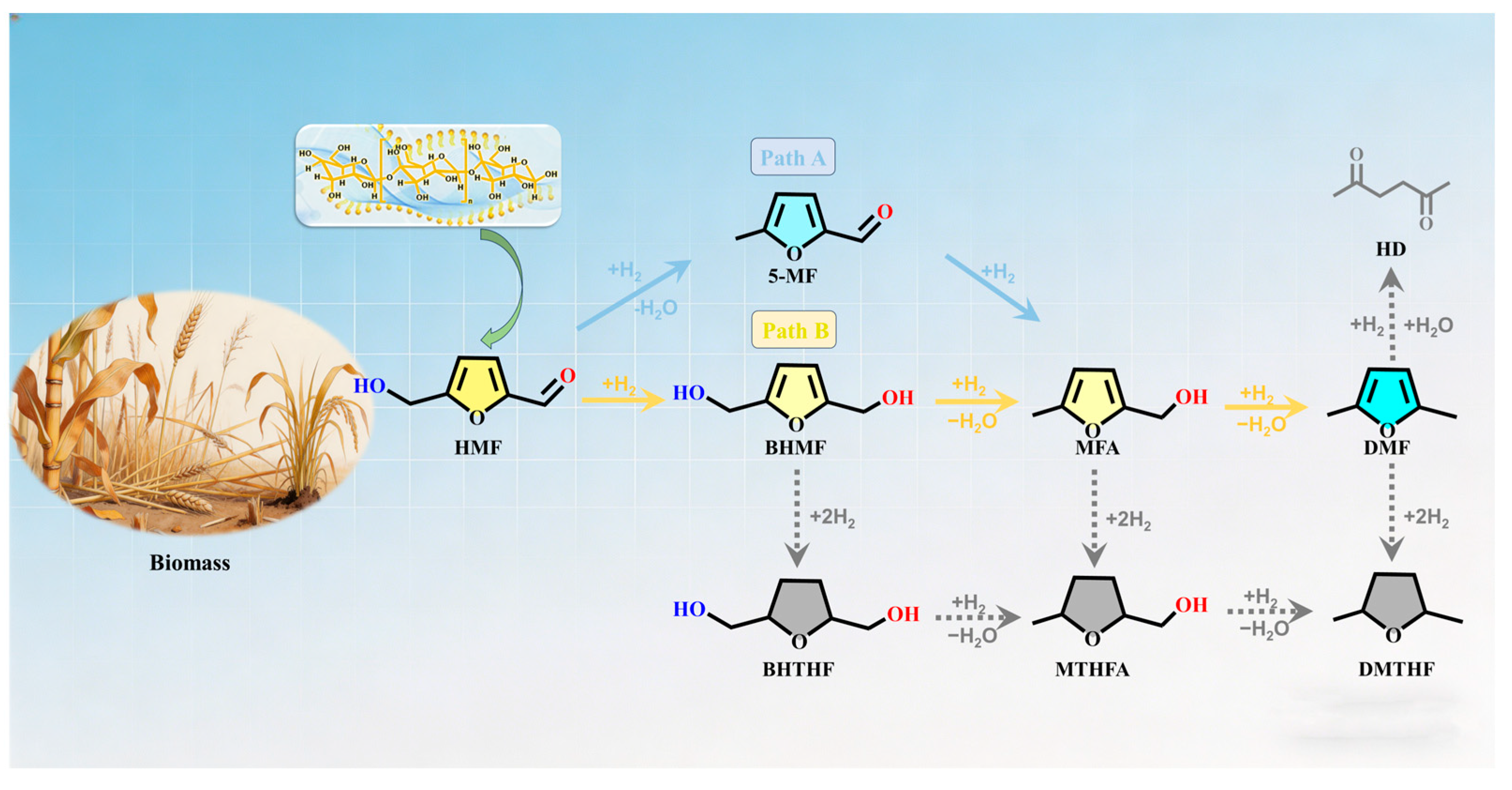
Two main reaction pathways for the conversion of HMF to DMF were reported (Figure 1). In pathway A, the hydroxymethyl group of HMF undergoes hydrogenolysis and dehydration to form 5-methylfurfural (5-MF), followed by hydrogenation of the aldehyde group to yield 5-methylfurfuryl alcohol (MFA). In pathway B, the aldehyde group of HMF is first hydrogenated to form 2,5-bis(hydroxymethyl)furan (BHMF), after which the hydroxymethyl groups undergo hydrogenolysis to produce MFA as the key intermediate. In both pathways, MFA is subsequently converted to DMF through further hydrogenolysis of its hydroxyl group. Additionally, due to the reactive nature of the furan ring, side reactions such as over-hydrogenation and hydrolytic ring-opening may occur, leading to byproduct production including 2,5-dimethyltetrahydrofuran (DMTHF), 2,5-bis(hydroxymethyl)tetrahydrofuran (BMTHF), 5-methyltetrahydrofurfural alcohol (MTHFA), and 2,5-hexanedione (HD) [26].
In recent years, numerous studies have been devoted to the selective hydrogenation of HMF to DMF. The structure–activity relationship between catalyst supports and active centers, as well as the primary functions and synergistic interactions of catalytic active sites in HMF hydrogenation, were systematically summarized in this review. The influence of hydrogen donors on the hydrogenation process was also discussed. In addressing the key challenges in current research, future directions for catalyst and reaction system design to support the scaled and renewable production of liquid fuels were proposed.
While DMF has garnered the majority of research attention owing to its exceptional octane number (~119) and high energy density (30 MJ/L), the economics of its production require explicit, direct comparison with those of other furanic biofuels. 2-Methylfuran (2-MF) is a related furanic biofuel produced from furfural, a far lower-cost and industrially mature platform molecule. 2-MF benefits from a simpler hydrogenolysis pathway, which requires fewer H2 equivalents per mole of product. This simplified production route positions 2-MF much closer to commercial viability than DMF. By contrast, DMF production remains burdened by three core cost drivers. First is the high cost of the HMF feedstock. Second is the reliance on noble metals in most high-performing catalytic systems. Third is the stoichiometric consumption of sacrificial hydrogen donors, such as polymethylhydrosiloxane (PMHS). All of these factors introduce cost barriers that are far less pronounced in 2-MF synthesis. The production cost of DMF has also been benchmarked against fossil-derived gasoline. This cost estimate accounts for all key process steps: feedstock pretreatment, catalyst materials, solvent recovery, and product purification. Under this full process accounting, DMF production costs remain at least 1–2 orders of magnitude higher than those of fossil gasoline. This cost disparity cannot be offset by the combustion performance advantages of DMF alone.
Although HMF-to-DMF conversion has not yet been commercialized, several catalyst families are already widely used in related industrial hydrogenation and hydrodeoxygenation processes. These established industrial catalysts include four primary categories: Raney Ni [23], Copper chromite/Cu–Cr oxides such as Cu2Cr2O5 [27], Ni/kieselguhr and Ni/SiO2 catalysts [27], and supported noble metal catalysts including Pd/C, Pt/C, and Ru/C [23]. These mature catalytic systems serve as valuable industrial benchmarks for HMF-to-DMF process development. However, their direct application to this specific reaction remains limited by multiple critical drawbacks. These limitations include insufficient product selectivity, over-hydrogenation of the furan ring, high noble metal costs, catalyst deactivation in oxygenated biomass-derived media, Cr-related environmental concerns, and the need for harsh sulfiding conditions. Therefore, the development of more selective, stable, and economically viable catalysts remains an essential prerequisite for advancing the practical, large-scale production of DMF from HMF.
Several reviews have discussed the catalytic conversion of HMF into liquid fuels, DMF. For example, Mäki-Arvela et al. provided a comprehensive overview of the catalytic performance for HMF hydrogenolysis in 2021 [19]. Their work emphasized the critical roles of metal and solvent selection, the application of homogeneous acidic co-catalysts, and the operational challenges associated with over-hydrogenation, continuous processing, and catalyst deactivation. Recently, He et al. [28] summarized key advancements in noble and non-noble metal-based heterogeneous catalysts for this filed. Their review focused on the correlation between catalyst structures and reaction mechanisms at active sites, while also prospecting the integration of theoretical calculations and microkinetic modeling. Despite these valuable prior contributions, rapid progress has been made in this field in recent years. The advances in this review were included in non-noble metal catalysts, bimetallic active centers, support engineering, catalytic transfer hydrogenation, and integrated conversion strategies. Accordingly, the interplay effect among metal sites, support properties, and hydrogen donors were emphasized. Through this targeted analysis, we provide a more integrated, actionable framework for future catalyst design and industrial-scale implementation.

2. Metal Active Sites

2.1. Single-Metal Active Site Catalysts

Given the diversity of products arising from the hydrogenation and hydrogenolysis of HMF, achieving highly selective hydrogenolysis to DMF remains a significant challenge. Recent studies on single-metal active site catalysts for the selective hydrogenation of HMF to DMF was summarized (Table 1).

2.1.1. Single Noble Metal Active Site Catalysts

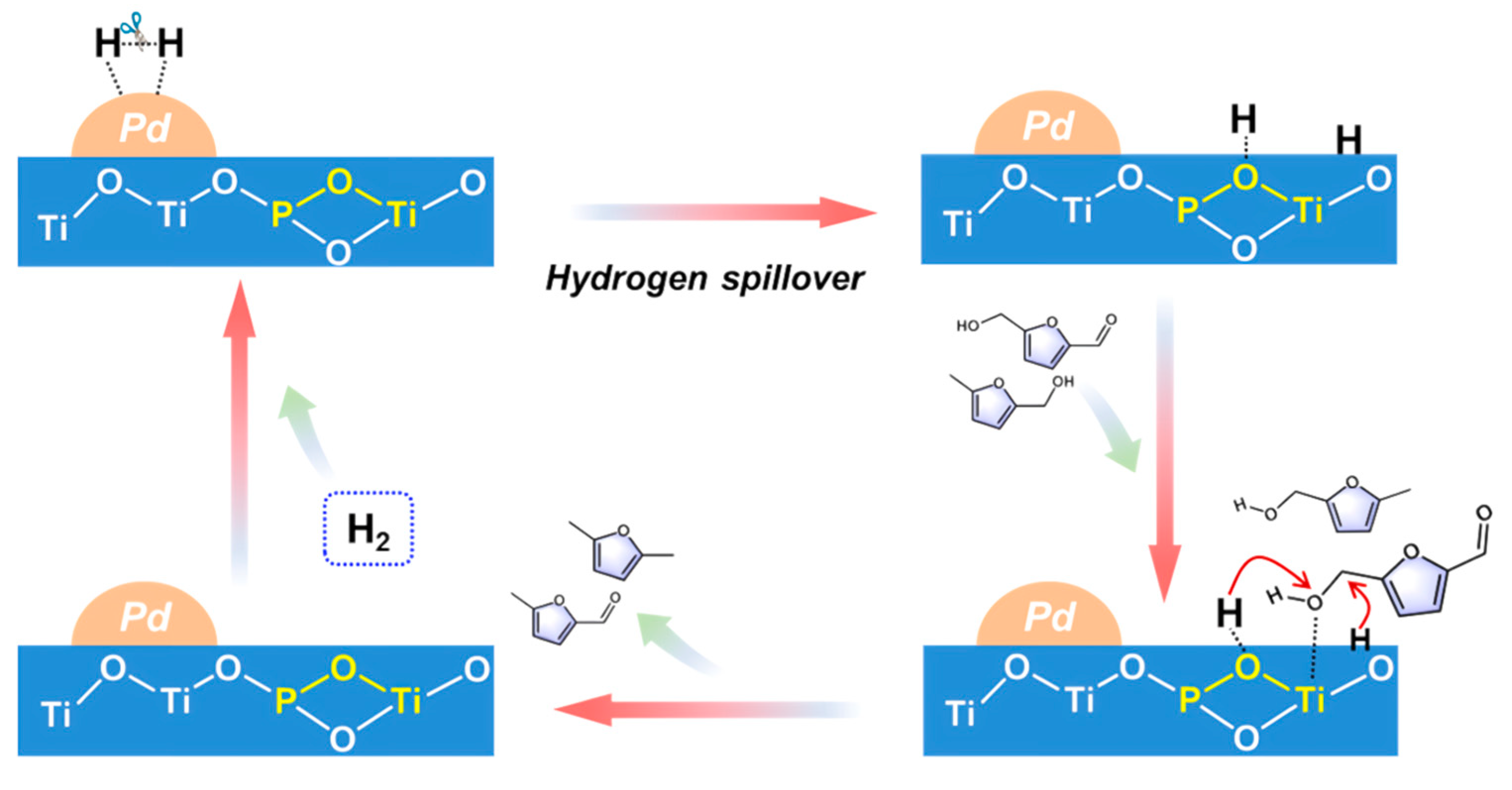
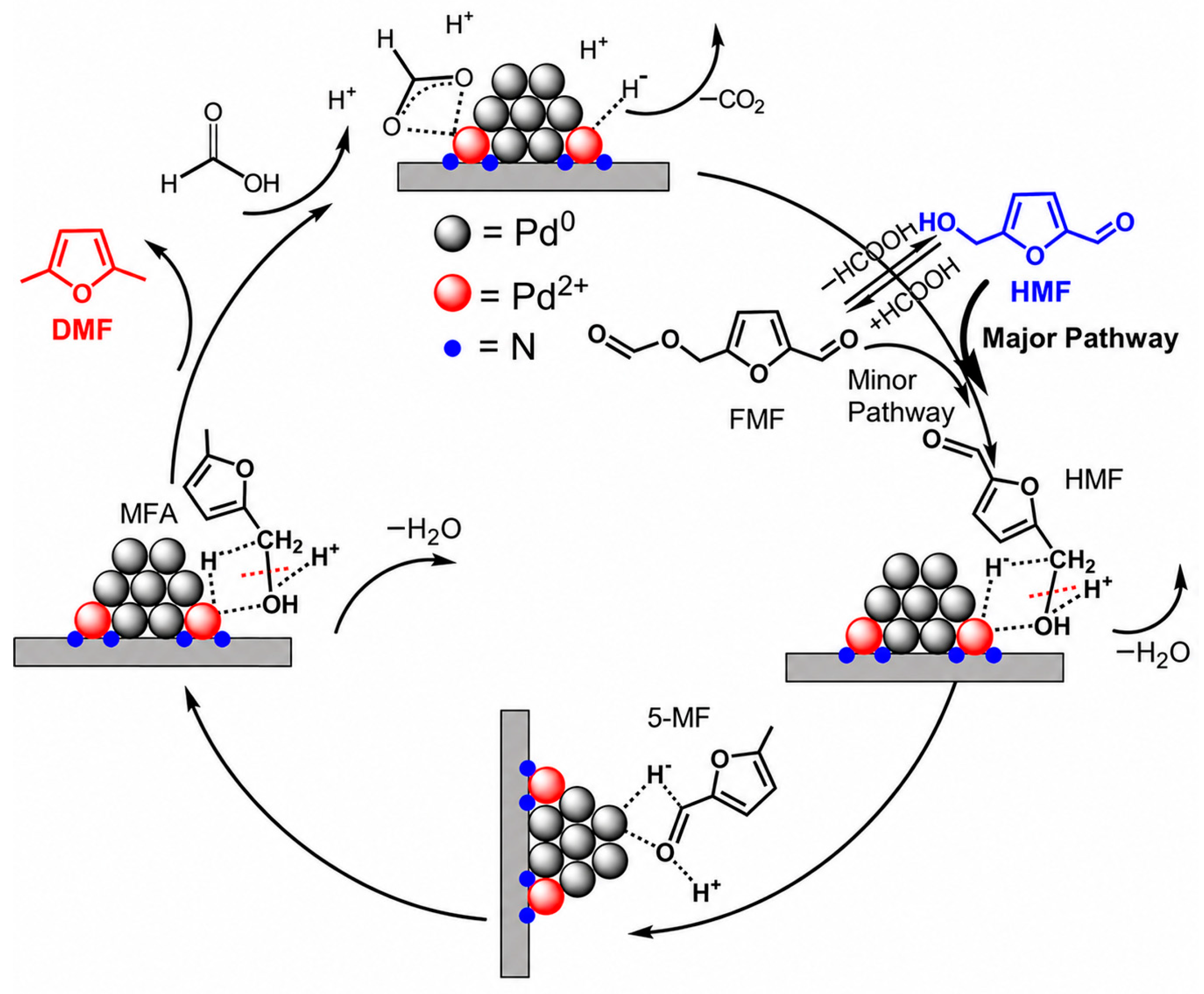
Noble metals such as Pd, Ru, and Pt have been reported for DMF production. Owing to their partially filled d-orbitals, noble metal catalysts readily adsorb reactants and facilitate the formation of highly active intermediates, thereby exhibiting excellent catalytic performance [57]. They also possess high thermal stability and corrosion resistance, which are usually used as common catalysts in early studies [58,59,60]. Pd0 exhibits good activity, along with high catalytic performance and excellent recyclability in HDO reactions. To achieve a close integration of metallic and acidic properties on the surface of metal nanoparticles, a Pd–Br bifunctional catalyst featuring halogen-modified noble metal nanoparticles was developed [29]. This catalyst generated electronegative Br atoms through the hydrogenolysis of bromobenzene, which further modified Pd to create strong Brønsted acid sites, enabling efficient conversion of HMF to DMF at room temperature with a yield of 96% [29]. Under the influence of the halogen bromine (Br), the catalyst exhibited an elevated turnover frequency (TOF) of 181.7 h−1. TOF is a core catalytic metric that represents intrinsic catalytic activity, normalized to the number of active sites in a material. This metric reflects how efficiently each active site converts reactants to products per unit time. Valid TOF measurements must be collected under conditions where mass and heat transfer limitations have been rigorously excluded. TOF serves as the most fundamental metric for benchmarking catalysts with different compositions, structures, and active site densities. It enables meaningful, standardized comparisons between distinct catalytic systems. These head-to-head comparisons are essential for establishing reliable structure–performance relationships in heterogeneous catalysis [61]. Furthermore, the synergy between metal sites and acid sites is critical for H2 activation and C-O bond hydrogenolysis [62,63,64]. For example, hydrogen spillover and reactant adsorption could be enhanced when phosphorus was doped into a TiO2 support (Figure 2) [30]. The spilled-over active hydrogen was used for a P-doped Pd/P-TiO2 catalyst to induce Brønsted acid sites, and C-O bond activation was further promoted. A 67% DMF yield could be achieved from HMF by P-doped Pd/P-TiO2 catalyst at 150 °C and 1 MPa H2. Although it has a high TOF number (58.7 h−1), its cycle stability is extremely poor.
Pd is generally regarded as the optimal metal for formic acid decomposition, and high activity is exhibited for HMF hydrogenolysis when formic acid (FA) is used as the hydrogen source. For example, a Pd/NMC catalyst (Figure 3) was employed in FA solvent, achieving a complete HMF conversion and 97% DMF yield at 160 °C and 0.5 MPa H2 with a superior DMF productivity (108.66 molDMF h−1 mol−1metal_total), high catalytic stability (95.1% yield after five runs), and minimal Pd leaching confirmed by ICP-OES analysis of the post-reaction solution and TEM imaging showing preserved particle size [31]. This study further revealed that the reactivity of HMF was modulated, and the reaction pathway was also influenced by suppressing ring hydrogenation and acting as a mild reducing agent. Crucially, catalyst stability remains a major unresolved issue for the Pd-catalyzed hydrogenolysis of HMF. The Pd/MOF-808 catalyst achieved a quantitative HMF conversion and >99% DMF yield under mild reaction conditions (100 °C, 1.0 MPa H2) [32]. Despite this excellent catalytic performance, the activity of the Pd/MOF-808 catalyst was highly sensitive to the nature of the support and the reaction medium. This performance instability was caused by the structural collapse of the MOF support under hydrothermal reaction conditions, which was confirmed by X-ray diffraction (XRD) analysis. MOF-supported and N-doped carbon-supported catalytic systems face persistent challenges during prolonged operation. The most critical of these are hydrothermal instability and pore structural collapse. These stability issues are less pronounced in robust carbon-encapsulated catalyst architectures. Even so, stability limitations remain a central concern for the practical implementation of these catalytic systems.
Ru-based catalysts are less expensive and represent one of the most effective systems for the selective conversion of furanic compounds [65,66]. The good hydrogenation activity, even in acidic hydrothermal environments, is retained for Ru-based catalysts, and they have garnered considerable attention. For example, Ru nanoparticles supported on nitrogen-doped mesoporous carbon could efficiently catalyze the hydrogenolysis of HMF to DMF (88% yield). It was found that the nitrogen-doped carbon support provided suitable basic sites that not only promote the dispersion of Ru nanoparticles but also effectively activate the hydroxyl groups of isopropanol, thereby releasing active hydrogen species [33]. Another study showed that a Ru/ZSM-5 catalyst was employed for DMF production, and 95% DMF yield was observed due to the Brønsted acidity of Ru/ZSM-5 and its affinity toward C-O bonds [34]. Despite this advantage, Ru catalysts supported on oxide supports exhibit a pronounced tendency toward over-hydrogenation. When reaction times are extended beyond the optimal window, substantial amounts of byproducts 2,5-dimethyltetrahydrofuran (DMTHF) is usually generated with Ru-based catalysts [67]. This undesired catalytic behavior is intrinsically linked to the oxophilic nature of Ru. Specifically, this oxophilicity drives a strong, direct interaction between Ru metal and the furan ring of the reaction intermediate. These mechanistic insights indicate that two key strategies are required to direct selectivity exclusively toward DMF: precise control of metal–support interactions and the introduction of selective site-blocking agents.
Pt-based catalysts are similar to Ru-based systems, exhibiting unique catalytic properties and high selectivity for C=O hydrogenation. This is attributed to the large radial extension of their d-orbitals [68]. However, the high activity of Pt often makes the hydrogenation rate difficult to control, leading to over-hydrogenation side reactions, which limit its application in the HDO of HMF. In recent years, single-atom catalysts (SACs) have attracted considerable attention due to their exceptional atom efficiency and unique geometric and electronic structures [69,70,71]. For instance, a single-atom Pt catalyst anchored on a Co2AlO4 spinel support was developed. This catalyst achieved a DMF yield of 99% at 180 °C under 2 MPa H2 for 3 h with extremely high DMF productivity (1276.20 molDMF h−1 mol−1metal_total). Unfortunately, it lacks good cyclic stability. In situ studies and theoretical calculations revealed that the activation and adsorption of C=O bonds and the cleavage of the first C-OH bond were promoted by the single-atom Pt sites, while the dissociation of the second C-O bond was accelerated by the adjacent Brønsted acid sites [35].
Single-metal catalysts play a fundamental and critical role in the selective hydrogenation of HMF to DMF, with their performance strongly dependent on the intrinsic properties of the metal center. The excellent adsorption and activation capabilities toward reactants were exhibited by the noble metal catalysts (e.g., Pd, Ru, Pt). It can be attributed to their partially filled d-orbitals, enabling high HMF conversion and DMF selectivity under relatively mild conditions. Through precise tuning of the active center microenvironment, such as constructing metal-acid bifunctional sites, exploiting strong metal–support interactions, or designing atomically dispersed single-atom catalysts, the reaction pathway can be further optimized, and DMF yields were increased to near-quantitative levels. However, the high cost of noble metals and their potential to induce deep hydrogenation remained major barriers to large-scale industrial application.

2.1.2. Single Non-Noble Metal Active Site Catalysts

Searching for low-cost catalysts has been a key research focus for DMF production. The development of low-cost, efficient, and environmentally friendly non-noble metal catalysts to replace noble metal systems is crucial for the economic viability of this process. Among these, Co-based catalysts have attracted considerable attention due to their low cost, high abundance, and good activity for C=O bond hydrogenation. Their catalytic performance can be significantly enhanced through electronic structure modulation. For example, a B,N-codoped multilayer graphene-encapsulated Co-based catalyst (Co@BNG) was prepared for hydrogenolysis of HMF to DMF [38]. It was shown that electron transfer from Co to neighboring B and N atoms was facilitated by the B doping, forming electron-deficient Co centers (Co-Nx/B) and possessing a high TOF number (13.85 h−1). These centers were acted as Lewis acid sites and C=O and C-OH bonds were preferentially activated, accelerating the hydrogenation of HMF to BHMF and its subsequent hydrogenolysis to DMF. The activation energy barrier for the rate-determining step (BHMF → MFA) was significantly reduced for the Co–B1N3C model by the theoretical calculations. A 99.2% DMF yield was achieved over Co-Nx/B catalyst at 140 °C under 1 MPa H2, which also showed an excellent cycling stability. In addition to electronic modulation, metal–metal synergy is another effective strategy for enhancing the performance of Co-based catalysts. For example, supporting Co on Sn-Beta zeolite catalyst (Co/Sn-Beta) was constructed for DMF production [39]. It was found that the HMF conversion efficiency was primarily governed by metallic Co, while the DMF selectivity was significantly enhanced by the framework Sn due to promoting the adsorption and conversion of the key intermediate BHMF. Under optimized conditions (170 °C, 14 h), an exceeding 99% DMF yield was achieved over Co/Sn-Beta. An 89% DMF yield was achieved over a core–shell catalyst (Co@CoO) [44]. There is a fundamental difference between this catalytic system and conventional supported Co catalysts. It stemmed from the fact that the active sites were not located within the metallic Co core, but rather on the oxygen-vacancy-rich CoO shell. The oxygen-vacancy-rich CoO shell had two core catalytic functions. First, it drove both homolytic and heterolytic cleavage of H2 to generate highly reactive Hδ− species. Second, it promoted the adsorption and activation of HMF via its inherent Lewis acid sites. This integrated bifunctional mechanism bypasses the rate-limiting step of C-OH bond cleavage, which usually constrains the catalytic activity of monometallic Co catalysts. Furthermore, the Co@CoO catalyst exhibited an exceptional operational stability, which maintained its catalytic performance for more than 100 h in a continuous-flow reactor, at a weight hourly space velocity (WHSV) of 26.6 h−1. The corresponding turnover frequency (TOF) of the catalyst was reached 4.26 h−1 under these operating conditions.
Recently, a Co/Mg-Beta catalyst has been developed. This catalyst was synthesized by incorporating Mg directly into the framework of Beta zeolite via a structural reconstruction method [56]. When evaluated for the hydrodeoxygenation of HMF to DMF, Co/Mg-Beta exhibited markedly superior performance. It outperformed both Co/Beta and a co-impregnated CoMg/Beta control catalyst in terms of HMF conversion and DMF selectivity. It also achieved a remarkably high product yield under mild reaction conditions. A comprehensive mechanistic investigation was conducted to explain this enhanced performance. The investigation combined multiple complementary techniques: H2-TPR, density functional theory (DFT) calculations, kinetic isotope effect studies, and selective poisoning experiments. These studies established that the performance improvement originates from a hydrogen spillover effect mediated by framework Mg species. Specifically, Mg incorporation significantly increases the concentration of active hydrogen on the catalyst surface. It achieves this by facilitating hydrogen spillover from metallic Co nanoparticles to the zeolite support. This spillover hydrogen reservoir then efficiently participates in the hydrogenolysis steps of the reaction. This mechanism provides a new paradigm for the design of non-noble metal HDO catalysts. The study further demonstrated that the Co/Mg-Beta catalyst exhibits reasonable recyclability. The authors also used Aspen Plus simulations to evaluate its industrial application potential. In addition, a single-metal iron-based catalyst has been developed for the first time for this reaction. An Fe/TiO2 catalyst was constructed via interfacial engineering [55]. In this material, Fe species were anchored onto the surface of a TiO2 support. Systematic experiments were performed to eliminate internal and external diffusion limitations. This enabled the extraction of reliable intrinsic kinetic data for the catalytic system. The Fe/TiO2 catalyst exhibited superior activity compared to pure TiO2 or kaolinite-supported Fe. This enhanced performance was ascribed to a strong synergistic effect between the Fe species and the TiO2 surface. Kinetic analysis was conducted under mild conditions (50 °C, 0.6 MPa H2). The results revealed that the Fe/TiO2 system drives the hydrogenation process more efficiently. It also has an optimized temperature window that avoids the over-hydrogenation typically observed at elevated temperatures. Subsequent investigations extended this interfacial engineering concept. The TiO2 support was doped with phosphorus to generate Brønsted acidic Fe2+-Oᵥ-Ti4+ structures. These structures are induced by spillover hydrogen species during the reaction. These newly formed acid sites were shown to selectively activate C-O bond. This selective activation shifts the product selectivity toward DMF. Collectively, this work highlights a key design principle for HMF upgrading catalysts. The interplay between metallic Fe sites and support-derived acid functionalities can be precisely tuned to control reaction pathways.
Ni is an ideal transition metal with hydrogenation activity higher than that of Fe and Co but lower than that of noble metals such as Pt and Pd. The over-hydrogenation was avoided due to the moderate activity of Ni-based catalysts. The selectivity could also be controlled by adjusting reaction conditions, making Ni used as a common hydrogenation catalyst. It has been demonstrated that high catalytic activity was exhibited in biomass hydrogenation, hydrogenolysis, and HDO reactions [72,73]. Adding an appropriate amount of Lewis acid sites on the catalyst surface could be enhanced DMF selectivity, which is usually used as a widely adopted strategy. For example, a Ni/ZSM-5 catalyst was prepared via a solid-state grinding method with leveraging of the synergy between metal sites and Lewis acid sites [47]. In total, 91.2% HMF conversion and 96.2% DMF selectivity were achieved over Ni/ZSM-5 under a relatively low H2 pressure (0.25 MPa). Furthermore, a Ni/TMC catalyst was prepared by self-assembly of Ni with transition metal carbides (TMC) exhibiting high Lewis acidity [48]. It was found that the abundant Lewis acid sites were generated due to the synergy between Ni and TMC, facilitating C=O hydrogenation and C-O bond cleavage.
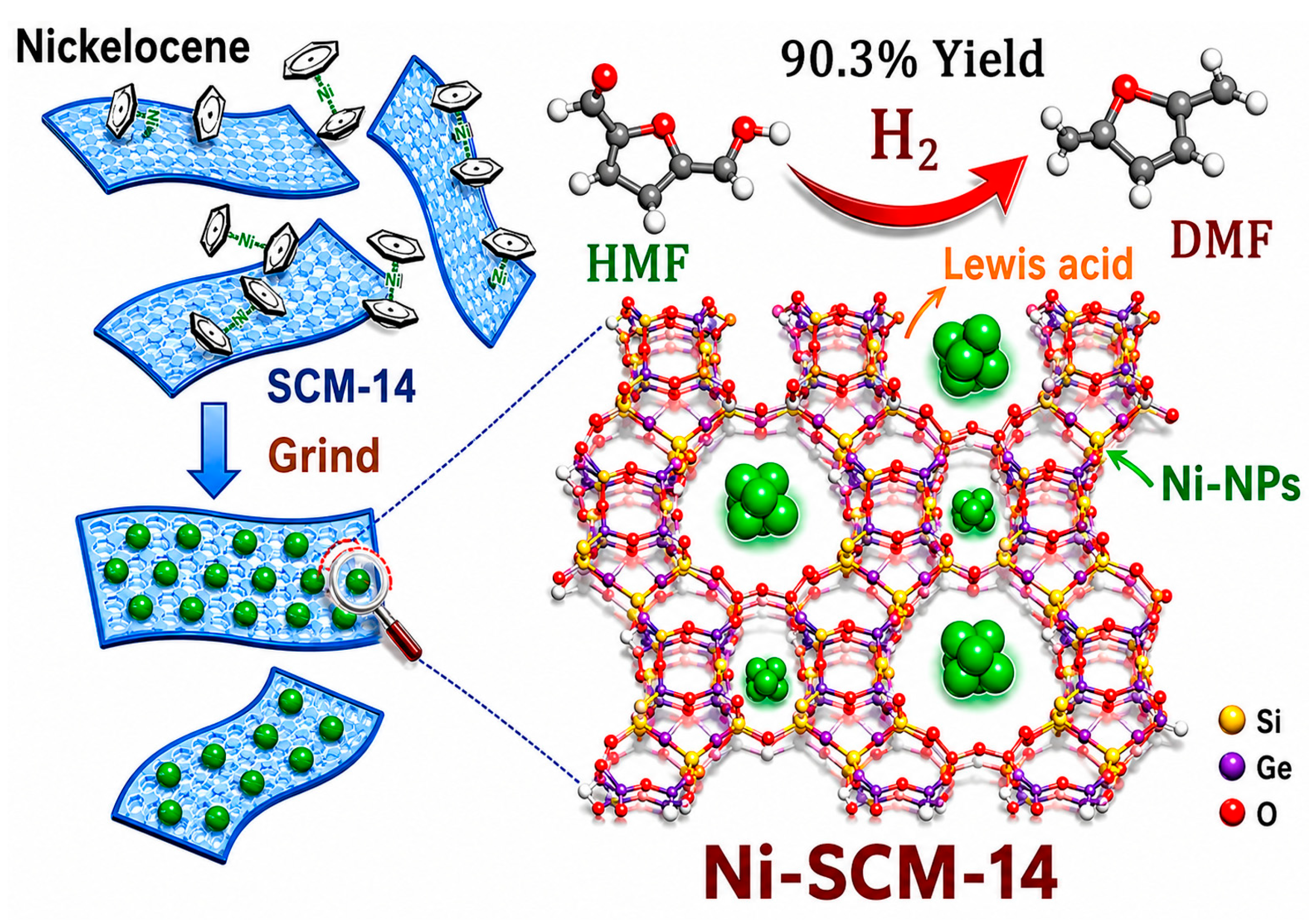
Beyond the introduction of Lewis acid sites, the construction of strong metal–support interactions has also been explored as a means to enhance catalytic performance. For instance, a catalyst leveraging the synergy between highly dispersed Ni hydrogenation sites and the weak acidity was provided by SCM-14 zeolite, enabling efficient HMF hydrogenolysis (Figure 4), and >99% conversion and 90.3% DMF yield were obtained [49]. Similarly, an ultra-low Ni loading catalyst consisting of Ni-C3N4 supported on hydrogenated carbon (HC) was designed and prepared, and a high 94.2% DMF yield was achieved due to Ni-N bonds playing a key role in the activation and cleavage of C-O bonds [46]. Although the reaction time is relatively long (4 h), its cycle stability remains very high (92% yield after four runs). In addition, the strategy of promoting hydrogen spillover via the creation of oxygen vacancies has been applied to Ni-based catalysts. For example, a highly dispersed Ni/ZrO2 catalyst was found to contain Zr3+ species and oxygen vacancies formed during preparation, generating abundant active sites capable of adsorbing and activating C=O/C-O groups. This catalyst ultimately achieved 98.4% HMF conversion and 99.1% DMF selectivity [51]. The collective data on monometallic Ni catalysts reveal a consistent trend: high DMF yields approaching or exceeding 90% are achievable, but only at temperatures generally above 150 °C and hydrogen pressures in the range of 1.5–5.0 MPa. A key observation from previous studies is that large Ni particles tend to promote the hydrogenation of the furan ring, leading to the formation of the undesirable DMTHF [69]. This relationship between structure and selectivity underscores the need for precise synthetic control over metal dispersion when designing Ni catalysts for DMF production.
The more detailed discussion about the role of oxygen vacancies, metal–support interactions, and hydrogen spillover mechanisms has been added to further clarify the reaction mechanism. Combined X-ray photoelectron spectroscopy (XPS) and density functional theory (DFT) analyses have yielded critical insights into the function of oxygen vacancies. These analyses confirmed that oxygen vacancies on the CoO shell of Co@CoO had two key functions. First, they promoted the adsorption and polarization of the hydroxyl group in BHMF. Second, they participated directly in the heterolytic cleavage of H2 to generate highly active Hδ− species [44]. Similarly, strong metal–support interactions are frequently reported to enhance both catalytic activity and operational stability. However, these interactions must be precisely tuned to avoid performance limitations. Excessively strong interactions can lead to the encapsulation of metal particles by reduced oxide overlayers, which block catalytically active sites. Conversely, insufficient metal–support interactions failed to prevent nanoparticle sintering during prolonged reaction [74]. For Cu-based and Mo-based catalysts, enhancing activity is often observed when the hydrogenation metal and oxyphilic component were mixed [64,75]. This is attributed to hydrogen spillover. In fact, these three mechanisms are deeply interconnected. Oxygen vacancies on the support can serve as anchoring sites that strengthen metal–support interactions. These tuned metal–support interactions, in turn, modulate the directionality and efficiency of hydrogen spillover during the reaction. Hydrogen spillover is another core mechanism phenomenon widely discussed in this field, which describes a process wherein H atoms dissociated on metal nanoparticles migrate onto the support surface. These migrated H atoms can then participate in remote hydrogenation or hydrogenolysis events.
Copper-based catalysts, as oxophilic metals, have garnered attention due to their unique properties and low cost. The intrinsically low activity of Cu results in a slow conversion rate of HMF to DMF, and single-metal Cu systems struggle to achieve complete HDO. However, the d-orbital electron configuration of Cu induces strong repulsion toward carbon atoms, including the carbonyl carbon, which endows Cu-based catalysts with excellent selectivity toward DMF. The C=O bond hydrogenation is promoted and the side reactions (such as ring hydrogenation and decarbonylation) were minimized by this selectivity [28]. Consequently, the outstanding performance in the selective transfer hydrogenation of HMF was exhibited over Cu-based catalysts. For example, without an external hydrogen source, 91.9% HMF conversion and 65.9% DMF yield were detected by a highly dispersed Cu/PBSAC catalyst consisting of small Cu0 nanoparticles [22]. Cu0 nanoparticles not only catalyze the dehydrogenation of isopropanol but also activate HMF for subsequent hydrogen-free HDO. In another study, a Cu-CPM catalyst was prepared using the inexpensive nitrogen-containing ligand 2-methylimidazole. After calcination at 700 °C, 100% HMF conversion and 95.9% DMF selectivity were achieved in ethanol media [45]. Despite the relatively high reaction temperature (200 °C), it still exhibits excellent cycle stability (90% yield after five runs). Notably, supporting Cu on high-surface-area graphite (HSAG) to prepare Cu/HSAG catalyst, 92% DMF yield was obtained under optimal conditions (180 °C, 4 h) using butanol as both solvent and hydrogen donor [52]. Cu-based catalysts, while generally less active than their Ni and Co counterparts for complete HMF hydrogenolysis to DMF, offer distinct advantages in terms of selectivity control when the reaction pathway is carefully managed. However, compared to noble metal benchmarks, the required hydrogen pressure and reaction time remain quite high, and the DMF yield is highly sensitive to the degree of metal reduction and the surface concentration of Cu+/Cu0 sites.
In recent years, transition metal carbides and nitrides, particularly molybdenum carbide and nitride, have attracted considerable attention. Doping with C and N atoms modifies their d-band structure, imparting noble metal-like electronic characteristics and positioning them as potential alternatives to Pt-based catalysts for hydrogenation and hydrogenolysis reactions [76]. For instance, 91% selectivity for the hydrogenolysis of HMF to DMF was achieved over a nitrogen-doped Mo single-metal catalyst (MoNC) [53]. β-Mo2C catalyst was reported to exhibit activity in furfural (FF) hydrogenation, and molybdenum carbide supported on activated carbon or carbon nanotubes served as an excellent catalyst for ethanol decomposition to produce H2 [77,78,79,80]. Accordingly, a β-Mo2C catalyst embedded in carbon microspheres under a nitrogen atmosphere was prepared for the synthesis of DMF. Under optimized conditions (180 °C, 10 h), a high DMF yield of 91.6% was achieved in the selective hydrogenolysis of HMF with ethanol as the hydrogen donor [54]. Despite the relatively long reaction time (10 h), it surprisingly exhibits a high TOF number (102.83 h−1). This indicates that excellent catalytic performance can be achieved even under conditions of very low Mo content. Developing advanced molybdenum-based catalyst systems and exploring synergistic effects with other metals to further enhance low-temperature activity and DMF selectivity should be the focus of future research. Remarkable DMF yield (91%) was achieved using a “metal-free catalyst” (N-C), which exhibited a high TOF value (12 h−1) and high DMF productivity (10.59 molDMF h−1 molmetal_total) [50]. Intriguingly, investigations into N-doped carbon materials have revealed that trace Fe impurities, rather than the carbon matrix itself, can serve as the active sites for hydrodeoxygenation, an observation that calls for rigorous control experiments and comprehensive elemental analysis before claims of “metal-free” catalysis are substantiated. These findings collectively expand the design space beyond conventional metal-on-support formulations and open new avenues for the rational development of earth-abundant and cost-effective catalytic materials.
The reaction pathway preference over monometallic catalysts is governed by two intrinsic properties of the metal: its oxophilicity and electronic structure. Two primary reaction pathways have been identified for HMF-to-DMF conversion: Path A (via 5-methylfuran, 5-MF) and Path B (via 2,5-bis(hydroxymethyl)furan, BHMF). Noble metals such as Pd and Ru predominantly follow Path B [29,32,33]. These metals exhibit strong hydrogenation activity but weak oxophilicity. In this pathway, hydride species preferentially attack the carbonyl carbon of HMF to yield BHMF. Subsequent C-OH bond cleavage of BHMF requires either elevated temperatures (≥150 °C) or cooperation with acid sites on the catalyst support. In contrast, Cu-based catalysts favor Path A through a Cu0/Cu+ synergistic mechanism. Cu+ Lewis acid sites located at the metal–support interface activated the hydroxyl group of HMF. This activation enables direct C-OH scission to form 5-MF [81,82]. The 5-MF intermediate is then rapidly hydrogenated to DMF on adjacent Cu0 sites. This sequential mechanism bypasses the thermodynamic bottleneck associated with Path B. Ni and Co catalysts occupy an intermediate reactivity regime between noble metals and Cu-based systems. Their stronger H2 activation capability can drive the reaction toward undesired ring-hydrogenated byproducts. However, when Ni or Co is well-dispersed on acidic or reducible supports, both Path A and Path B may operate concurrently. The dominant reaction route under these conditions is determined by two key factors: the support’s acid–base character and the size of the metal particles.
A critical yet often underappreciated metric exists for evaluating the practical viability of HMF-to-DMF catalytic systems: catalyst loading. This metric is defined here as the molar ratio of HMF to total metal (nHMF/nM). A high nHMF/nM ratio corresponds to a low metal inventory per unit of substrate processed. This low metal loading directly translates to two key benefits: reduced catalyst costs and, in many cases, attenuated metal leaching and sintering during prolonged operation. Examination of the data compiled in Table 1 reveals a striking divergence in this parameter across reported catalytic systems. This variability has profound implications for the industrial translation of these technologies. On the one hand, several noble metal catalysts achieve outstanding DMF yields at remarkably low metal loadings. For instance, Pd/0.15P-TiO2-500 (Entry 2) delivered a 67% DMF yield at an nHMF/nM ratio of 425.68. Similarly, Pd/NMC (Entry 4) provided a 97% DMF yield at an nHMF/nM ratio of 336.06. These high-performance, low-loading systems demonstrate a key principle. When the active metal is atomically dispersed or optimally interfaced with a functional support, the intrinsic activity per metal atom can be sufficiently high to render noble metal use economically justifiable. Such ultra-low-loading noble metal catalysts represent a compelling direction for further development. They combine two critical advantages: the high activity and mild operating conditions characteristic of noble metals, and a material cost profile approaching that of base metal systems.
On the other hand, a number of noble metal catalysts with otherwise respectable performance operate at substantially higher metal inventories. For example, Br-Pd/Al2O3 (Entry 1) and Pd/MOF-808 (Entry 5) exhibited only 33.75 and 27.67 nHMF/nM ratios, respectively. At such metal-intensive loadings, the capital cost associated with the noble metal component becomes prohibitive for large-scale deployment, regardless of the system’s catalytic efficiency. A parallel concern emerges when evaluating non-noble metal systems. Several non-noble metal catalysts require extremely high metal loadings to achieve competitive DMF yields. Ni/HSAG (Entry 27) and Cu/HSAG (Entry 28) operated at nHMF/nM ratios of merely 5.87 and 5.58, respectively. Meanwhile, CA-Ni/ZrO2 (Entry 26) required an nHMF/nM ratio of 14.67 to attain its 97% DMF yield. Although the base metals themselves are inexpensive, such excessive loadings carry critical drawbacks. They inevitably lead to low atom economy, increased susceptibility to metal agglomeration and leaching, and greater challenges in catalyst separation and recycling. All of these limitations erode the economic advantages that initially motivate the shift away from noble metals.
Conversely, non-noble metal catalysts with moderate to high nHMF/nM ratio have demonstrated exceptional performance. Key examples include Mo@C-900 (Entry 30, ratio of 247.03) and Ni-SCM-14 (Entry 24, ratio of 226.15). These systems demonstrate that base metals can deliver high DMF yields without resorting to excessive metal inventories, provided that the active phase is judiciously dispersed and stabilized.
Collectively, these observations define a clear strategic imperative for future research in this field. First, the field should prioritize the development of ultra-low-loading noble metal catalysts, ideally approaching the single-atom limit, that maximize the return on noble metal investment. Second, parallel advancement is required for non-noble metal catalysts with moderate, optimized metal contents. These base metal systems must preserve high atom efficiency while maintaining the activity and durability required for continuous industrial operation.
In contrast to noble metals, non-noble metal catalysts represented by Co, Ni, Cu, and Mo are abundant and low-cost, making them highly promising alternatives. Studies have shown that strategies such as support engineering (e.g., using zeolites [39,43], nitrogen-doped carbon [36,38], or constructing oxygen vacancies [44]), introducing Lewis acid sites [37,47,48], or forming specific metal–nitrogen coordination structures (e.g., Co-Nx [43]) can significantly enhance the selectivity of catalysts for C=O hydrogenation and C-O bond hydrogenolysis, enabling excellent DMF yields even under relatively harsh conditions [39,43]. Nevertheless, non-noble metal catalysts often face challenges related to their intrinsically lower activity, the need for more severe reaction conditions (higher temperatures and pressures), and stability issues such as sintering or leaching of active components during long-term operation.
In summary, it is necessary to clarify the decisive influence of the intrinsic activity of the metal, the microenvironment of the active center (acid–base property, coordination structure), and the metal–support interaction on the selective hydrogenolysis and deoxygenation performance of HMF in single-metal catalyst systems. However, whether considering the cost and selectivity control challenges of noble metals or the activity and stability limitations of non-noble metals, the inherent constraints of single-metal active centers in simultaneously meeting the multiple objectives of high activity, high selectivity, high stability, and economic viability are evident. This situation naturally leads to an advanced strategy in catalyst design: the construction of bimetallic or alloy catalyst systems through the introduction of a second metal component. This approach aims to leverage electronic and geometric effects between the metals to synergistically regulate reactant adsorption, H2 activation, and the energy barriers for key C-O bond cleavage. It holds promise for integrating the advantages of single-metal components under milder conditions while overcoming their respective drawbacks, thereby opening new avenues for the efficient and economical conversion of HMF to DMF.
The development of monometallic catalysts for HMF-to-DMF conversion follows a clear, deliberate trajectory. This trajectory is defined by a distinct shift away from noble metals (Pd, Pt, Ru) and toward earth-abundant alternative metals (Cu, Ni, Co). Noble metal catalysts retain key performance advantages for this reaction. They continue to deliver the highest turnover frequencies (TOFs) and can operate under the mildest reaction conditions. Despite these performance benefits, their practical industrial deployment is increasingly regarded as economically unsustainable. The central challenge for non-noble monometallic catalysts remains an intrinsic trade-off between catalytic activity and product selectivity. Elevated temperatures are required to activate the active sites of Cu or Ni catalysts. These high temperatures frequently promote two major undesired side reactions: over-hydrogenation of the furan ring, and C-O bond scission at non-target positions. Future research efforts should focus on the rational modulation of key properties of the metal catalyst. These core properties include particle size, morphology, and electronic state. This modulation will be implemented through advanced synthetic strategies, such as the controlled engineering of strong metal–support interactions. The core objective of these efforts is to narrow the performance gap with noble metal benchmarks. Critically, this goal must be achieved without sacrificing product selectivity.

2.2. Bimetallic Metal Active Site Catalysts

Designing bimetallic catalysts effectively addresses the problems of low activity and poor selectivity often encountered with monometallic systems, while also significantly enhancing HMF conversion and DMF yield. The superior activity of bimetallic catalysts stems from strong metal–metal interactions and the high dispersion of nanoparticles, enabling efficient conversion under milder conditions. Moreover, bimetallic systems offer additional tunability, such as optimizing performance through the geometric configuration of reactant molecules on the surface of alloy nanoparticles, thereby improving catalyst stability [83,84,85]. Importantly, the synergistic effects and alloying of bimetallic catalysts can reduce the usage of noble metals, enhancing process economics. Recent advances in the application of bimetallic active site catalysts for the selective hydrogenation of HMF to DMF are summarized in Table 2.
Weak interactions between the support and metal nanoparticles can lead to metal leaching, a primary cause of the poor stability exhibited by monometallic noble metal catalysts. Incorporating a second metal represents an effective strategy to overcome this limitation [58]. The introduction of an appropriate second metal into noble metals (e.g., Ru, Pt, and Pd) is crucial, as bimetallic catalysts allow catalytic performance to be tuned through geometric and electronic effects [28,111,112]. Ru is among the most effective metals for the hydrogenation and hydrogenolysis of biomass-derived oxygenates, largely due to its ability to substantially lower the energy barrier of reaction pathways in protic solvents [113]. Its activity can be further enhanced and its properties tuned to avoid side reactions such as over-hydrogenation through modification with other metals [95]. For instance, Ir-based catalysts have been shown to modulate the product distribution in the hydrogenation of FF and HMF [114]. Based on this, a carbon-supported Ru-Ir alloy nanoparticle catalyst (Ru-Ir/C) was developed [86]. Leveraging the synergistic effects between Ru and Ir, the substrate reduction was accelerated over Ru-Ir/C, and a DMF yield of 99% was achieved within 1 h. The TOF number can reach as high as 291.46 h−1. Similarly, it has been demonstrated that the addition of Ni can modify Ru catalysts, and the resulting Ru-Ni/TiO2 bimetallic catalyst exhibited enhanced surface acidity and improved performance due to changes in the electronic properties, particle size, and support interactions of Ru [95]. Chemical reduction and hydrogen reduction are common methods for preparing hydrogenation catalysts [115]. A two-step reduction method (NaBH4 followed by H2) was employed for the sequential reduction in Ru and Co to prepare a Ru-Co/AC bimetallic catalyst [105]. The introduction of Co not only promoted the dispersion of Ru nanoparticles on activated carbon (AC) but also facilitated electron transfer from Co to Ru, thereby increasing catalytic activity. Under optimal condition (200 °C, 1 MPa), a DMF yield of 97.9% and an HMF conversion of 98.7% were achieved over Ru-Co/AC within 1.5 h. This catalyst is highly versatile, featuring a high TOF number (89.86 h−1), excellent cycling performance, and short reaction times (1 h). It is considered an excellent bimetallic site catalyst.
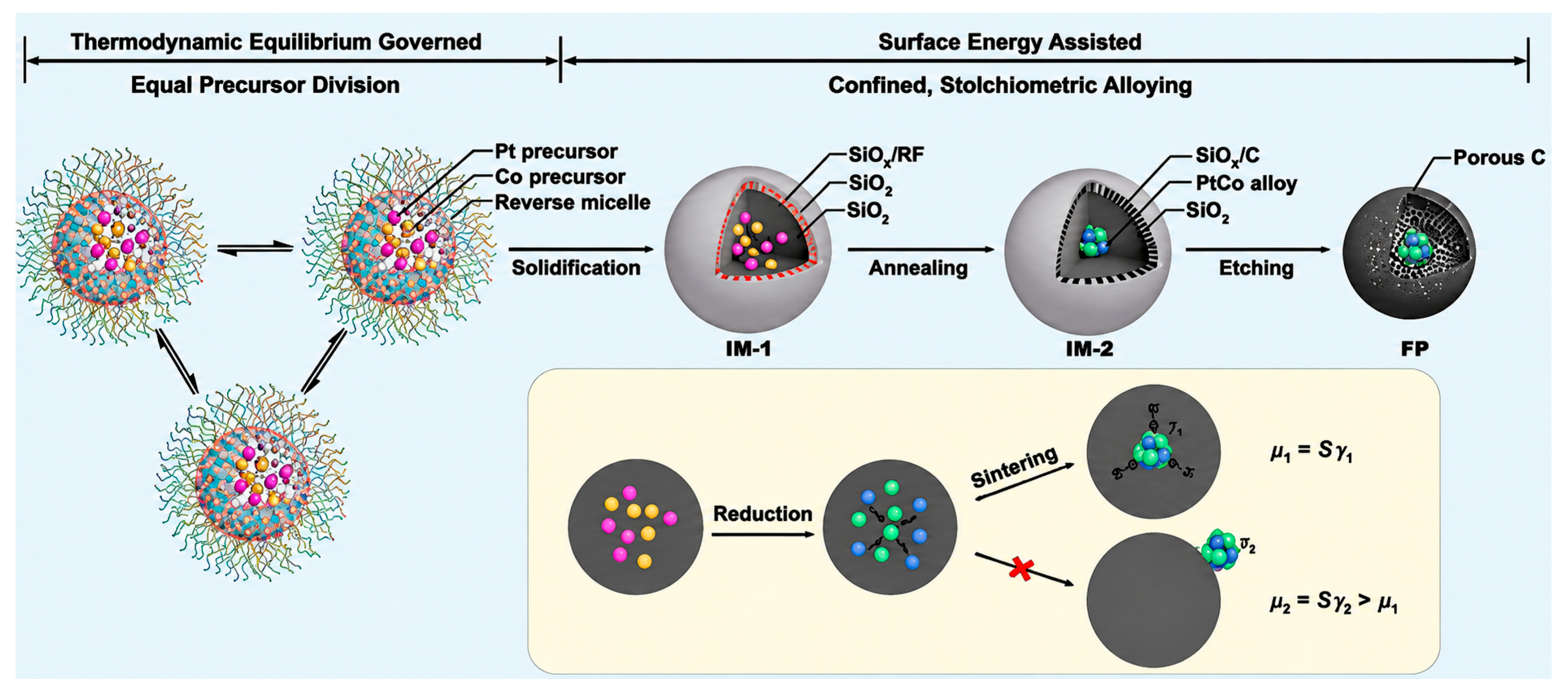
Pt-Co catalysts, known for their excellent performance in FF hydrogenation, have also been applied to the hydrogenation of HMF. For instance, a catalyst prepared by adjusting nanoscale Pt on a Co/Al2O3 support was investigated [96]. It was found that the coexistence of metallic Pt0/Co0 and oxidized PtO2/CoOx species acted as the active component, and the catalyst acidity was influenced by the Co/Pt ratio. Under complete HMF conversion, a DMF selectivity of 85% was obtained over the Co1Pt0.013Al catalyst with a low Pt loading. Additionally, an ultrasmall (1.2 nm) PtCo-1.2 bimetallic alloy nanoparticle catalyst (Figure 5) was synthesized [74]. It stood as a landmark example: it achieved a TOF of 9733 h−1 and productivity of 191.94 mmolDMFh−1g−1 at mild 50 °C, a value that places it among the most intrinsically active catalysts ever reported for HMF hydrogenolysis. Notably, it possessed excellent cycle stability. The size of bimetallic nanoparticles played a decisive role in catalytic performance for the hydrogenolysis of HMF to DMF. Miniaturizing bimetallic alloy nanoparticles to sizes below the 3 nm threshold has been shown to yield distinct catalytic properties. These properties differed significantly from those of both single-atom catalysts and larger nanoparticles [74]. However, conventional synthesis methods faced critical limitations in producing well-defined ultrasmall alloy nanoparticles. Common methods include impregnation and nanocluster chemistry. These approaches often yield nanoparticles with broad size and composition distributions. This heterogeneity made it challenging to establish reliable structure–activity relationships. To address this critical limitation, A synthesis strategy based on thermodynamic control has been developed. This strategy utilized nanoscale compartments formed within microemulsions. It enabled the precise synthesis of sub-3 nm bimetallic alloy nanoparticles. Importantly, both the size and composition of these nanoparticles could be independently tuned [74]. This novel synthetic approach enables systematic investigation of the catalytic properties of ultrasmall bimetallic nanoparticles. It provides a robust experimental platform for elucidating intrinsic size effects in HMF hydrogenolysis.
Remarkably, a near 100% DMF selectivity was achieved in butanol solvent under mild condition (120 °C, 1 MPa H2, 2 h). Notably, a catalyst featuring Pt1Sn1 intermetallic species coupled with ordered mesoporous SnO2 (OM-SnO2) was constructed [20]. Impressively, a DMF yield of up to 99% was achieved over the Pt@OM-SnO2 catalyst, which can be attributed to the Pt1Sn1 nanoparticles and the defect-rich OM-SnO2 serving as highly active species. It has strong catalytic performance and a high TOF number (97.5 h−1). The combination of noble and non-noble metals represents a pragmatic strategy to dilute noble metal content while simultaneously harnessing synergistic electronic and geometric effects. The combination of noble and non-noble metals represents a pragmatic strategy to dilute noble metal content while simultaneously harnessing synergistic electronic and geometric effects.
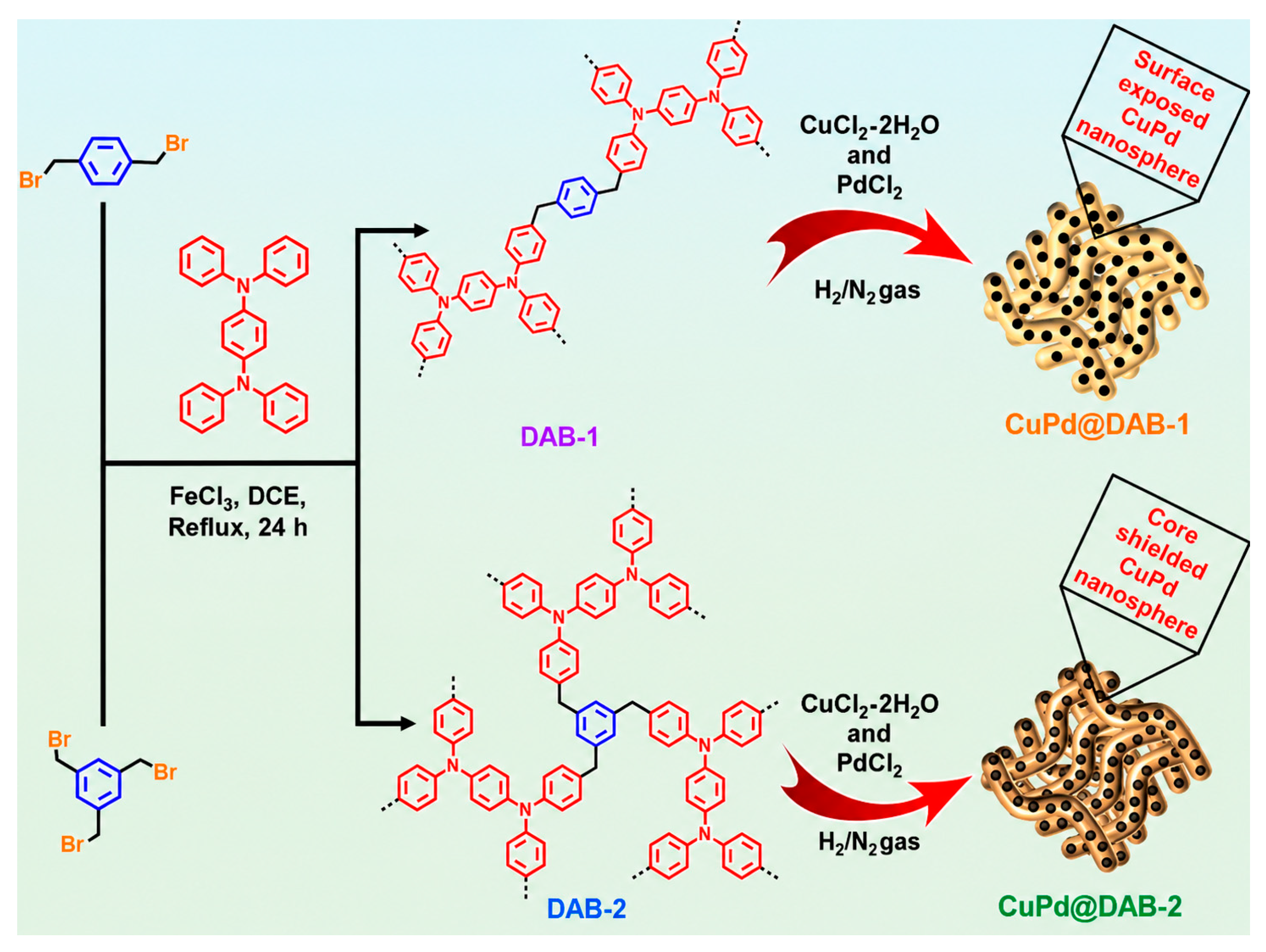
Pd-based bimetallic catalysts have also provided promising performance. For example, supporting atomically dispersed Cu-Pd bimetallic alloy nanospheres on a nitrogen-rich porous organic polymer (POP) was prepared (Figure 6) [92]. Due to its high TOF number (94.3 h−1), it has certain prospects for industrial applications. The stable Cu0/2+ and Pd0/2+ active surface species were maintained for bimetallic nanospheres, achieving a DMF selectivity of 81.5% under optimized condition (130 °C, 1.5 MPa H2,10 h) in THF solvent. Similarly, a Cu-Pd bimetallic catalyst supported on boron carbonitride (CuPd/BCN) was developed [99]. The strong interactions between the alloy and the BCN support catalyst were exhibited, enabling complete HMF conversion and a DMF selectivity of 99% with an excellent cycle stability (85% yield after five runs). Furthermore, the strong synergistic effects between Pd and Co were also shown. For example, a highly dispersed Pd-Co bimetallic catalyst supported on molybdenum carbide (PdCo/MoCx) was designed [75]. It was confirmed that the HDO reaction was facilitated due to abundant oxygen vacancies and the presence of low-valence Pd and Co species. Meanwhile, the synergy between the bimetallic sites alters the reaction pathway and promotes aldehyde group hydrogenation, significantly enhancing reaction efficiency and achieving a DMF yield exceeding 97% under mild conditions. These cases illustrate a broader design principle: the noble metal component functions primarily as a potent H2 dissociation center, while the adjacent non-noble metal and metal oxide sites facilitate the adsorption and polarization of the C-OH bond, thereby enabling efficient bifunctional catalysis.
The addition of metals or metal oxides such as Ni, Cu, Ag and Mo can enhance the activity of Co-based catalysts. For example, a series of ZrO2-modified Co nanocatalysts was synthesized [87]. It was found that the addition of ZrO2 stabilized CoO species, enhancing HMF adsorption and heterolytic H2 dissociation, generating highly active Hδ− species. The excellent performance and stability were shown for 2ZrO2-Co/Al2O3 catalyst, achieving a DMF yield of 97.3%. In addition, Lu et al. [93] revealed a synergistic catalytic effect between Co and Mo sites, wherein Mo sites primarily governed substrate adsorption while Co sites dominated H2 adsorption and activation.
The alloying of Ni and Co not only prevents the formation of large Ni particles but also promotes selective cleavage of C=O bonds to enhance hydrogenation, making NiCo alloys ideal metal sites [116,117,118,119]. Recently, a cost-effective and magnetically separable bimetallic NixCoy catalyst was developed, wherein the hydrogenation sites of Ni and Co cooperate with Lewis acid sites in NiO and CoO to promote the conversion of HMF to DMF [94]. Furthermore, the HDO activity was enhanced, and over-hydrogenation and ring-opening of the furan ring were suppressed due to the electronic effect of Ni-Co nanoalloys [102]. Beyond preformed nanoparticles, nanoparticle catalysts formed in situ represent another important class of catalytic materials. These catalysts are generated during the catalyst preparation process under actual reaction conditions. For example, the Co2Ni1@N1C-700 catalyst was developed [98], where CoNi alloy nanoparticles were confined within N-doped porous carbon. The nanoparticles were formed in situ during the carbonization process of the precursor. This in situ formation strategy offers several key advantages. First, the N-doped carbon matrix provides effective spatial confinement. This confinement limits nanoparticle sintering and leaching during the reaction. Second, in situ formation from the Co2Ni1@N1C precursor ensures intimate contact between the alloy nanoparticles and the N-doped carbon support. Density functional theory (DFT) calculations provide mechanistic insights into this effect. They demonstrated that this intimate contact enhanced the adsorption of both H2 and HMF. It simultaneously lowers the adsorption energies of H* intermediates and DMF products. This electronic modulation facilitates two critical reaction steps: C=O hydrogenation and C-OH hydrogenolysis. Both steps are essential for selective DMF formation. Under optimized reaction conditions, this catalyst achieved a 98.9% DMF yield at 150 °C. This performance validates the effectiveness of in situ-formed nanoscale alloy particles confined in N-doped carbon for HMF hydrogenolysis. In addition, A mechanical activation (MA) strategy was employed to construct an efficient and stable MA-NiCo@ZrO2/NBC/NBC composite [106]. Using formic acid (FA) as the hydrogen source at 200 °C for 2 h, this catalyst achieved 99.3% HMF conversion and 96.7% DMF yield. Importantly, the formation of NiCo alloys and the rapid electron transfer at metal-acid bifunctional sites enhanced preferential C=O adsorption while preserving the integrity of the furan ring during C-O hydrogenolysis. Beyond CoNi alloys, the synergistic interaction between CoNi alloys and Co-Nx species also markedly improves catalytic performance. It was found that Co-Nₓ species can act as Lewis acid sites, facilitating C=O activation and subsequent C-OH cleavage, thereby enhancing DMF selectivity [98].
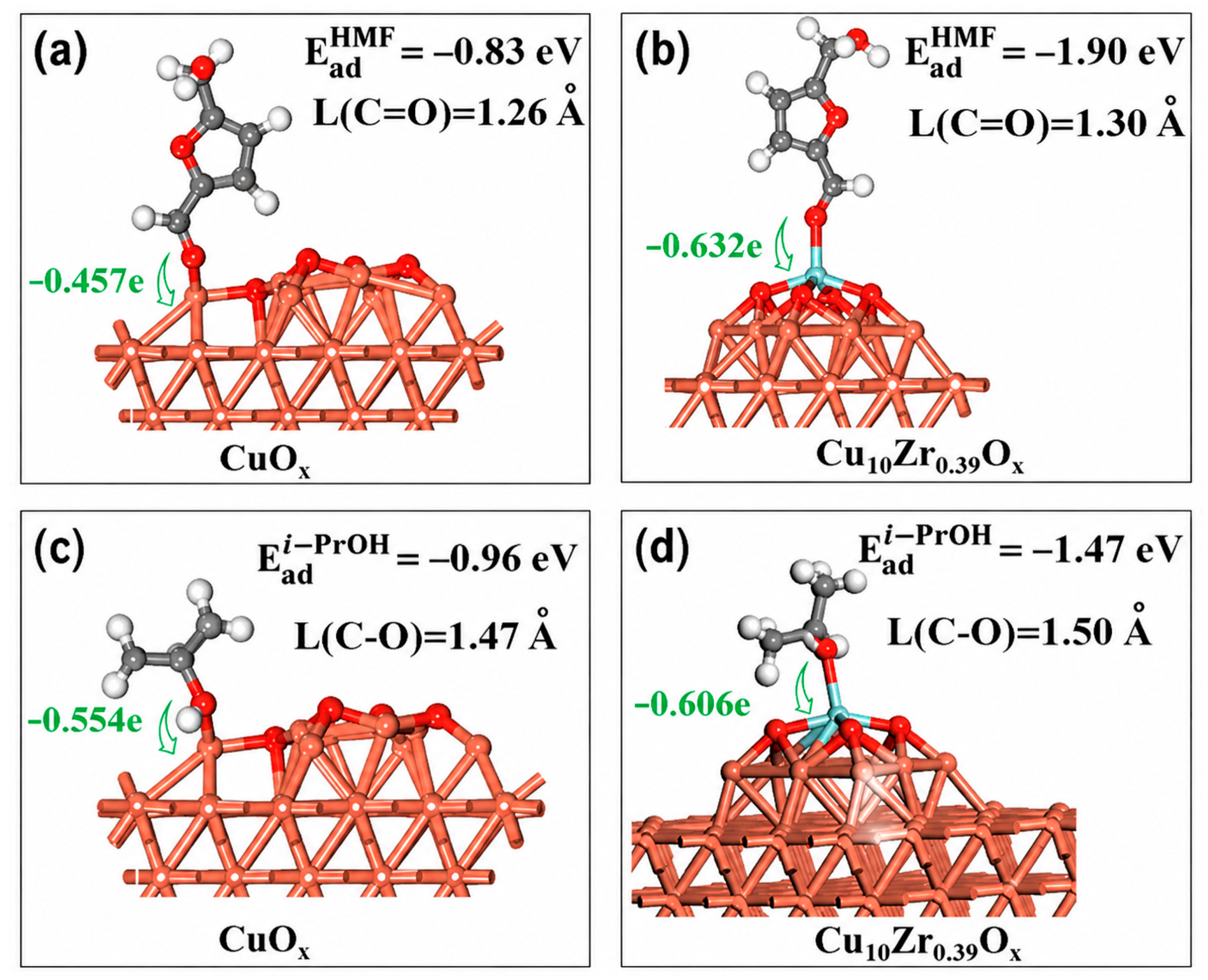
Cu-based catalysts are often regarded as potential substitutes for noble metals in catalytic transfer hydrogenation (CTH) reactions [120]. Zr single-atom species were successfully introduced into CuOx, creating strong positively charged atomic Lewis acid sites [81]. These sites not only modulated and increased the content and stability of Cu+ species through electronic interactions but also enhanced catalyst acidity. Using isopropanol as the hydrogen donor, this single-atom Zr-doped CuOx catalyst (Cu10Zr0.39Ox) exhibited outstanding performance, achieving a DMF yield of 97.7%. Similarly, the CZ-ag-70 catalyst, which is rich in Cuδ+- V Z r + interfacial sites, favored the formation of the dehydroxylated product DMF [89]. Hence, this catalyst achieved 100% HMF conversion and 82.2% DMF selectivity. In another study, the catalytic transfer hydrogenation performance of a CuCoOx catalyst using 2-propanol (IPA) as the hydrogen donor was investigated [97]. At 170 °C, 100% HMF conversion was reached with a DMF yield of 99%. The study also identified the hydrogenolysis of BHMF to 5-MFA as the rate-determining step. Similarly, a CuxZnAl catalyst using isopropanol as the hydrogen donor also performed well [88]. This catalyst not only achieved good dispersion of Cu species but also attained an optimal ratio of Cu2+, Cu0, and Cu+. The synergistic effect between Cu0 and Cu+ enabled efficient hydrogenation/hydrogenolysis of HMF, yielding 91.7% DMF after 4 h at 180 °C. Additionally, Ag can improve the dispersion of Cu on the surface of catalysts. Lakshmi et al. [108] found that the activity of Cu-Ag catalysts depends on the silver content. The catalyst with 2 wt% Ag and 10% Cu exhibited the best performance, achieving complete HMF conversion and a DMF yield of 93% at 180 °C.
Fe is abundant, inexpensive, and environmentally benign; However, the hydrogenation/hydrogenolysis activity of monometallic Fe catalysts was very limited. Therefore, Fe is typically employed as an oxophilic metal additive in the catalytic conversion of furan derivatives. The incorporation of Fe promotes the formation of electron-rich metal sites and strong acid sites within the catalyst. For instance, an amorphous Ni-Fe bimetallic boride catalyst was constructed via a simple chemical reduction method [90]. This catalyst exhibited a DMF formation rate 1.7–16.5 times higher than that of state-of-the-art nickel-based catalysts. It can be attributed to the incorporation of Fe facilitating hydrogen activation and C-O bond cleavage, thereby accelerating the hydrogenolysis process. Fe species can also form alloys with Ni [121,122]. The presence of Fe-containing surface phases helps maintain a high degree of Ni atom dispersion. For example, a TiO2-supported bimetallic NiFe alloy catalyst was developed [101]. Its specific surface structure promotes HMF adsorption via the carbonyl group while preventing hydrogenation of the aromatic furan ring, thus preserving high DMF selectivity. Another study reached a similar conclusion, introducing Fe into Ni-Al resulted in the formation of an oxophilic FeNi alloy [104]. This modification influences the interactions between components, the formation of Lewis acid sites, H2 adsorption/activation, and the activation of oxygen-containing groups in reaction intermediates, thereby affecting DMF selectivity and the structural stability of the Ni-Fe-Al catalyst. Furthermore, Fe can serve as an acidic site for HMF adsorption and activation in the form of FeOx. For example, a stable and efficient Co-FeOx/NC (NC = nitrogen−doped carbon) catalyst was prepared [100]. Due to electron transfer from Co to FeOx, an electron-deficient state was exhibited for the interfacial Co exhibits an electron-deficient state, enhancing hydrogen activation and spillover to the interfacial FeOx. The combination of efficient hydrogen spillover and interfacial acidity significantly improved the selectivity for the selective hydrogenolysis of HMF to DMF, achieving a yield as high as 99.9%. Fe can also form synergistic bimetallic catalysts with noble metals, exhibiting excellent performance (e.g., a DMF yield of 99.6%) [103]. It was reported that the interaction between Pt and Fe species establishes a balanced synergy between metal and acid sites, thereby enhancing HDO activity. Recently, a NiFe alloy catalyst supported on nitrogen-doped carbon has been reported [110]. This catalyst was prepared via a two-step pyrolysis method. It achieves 96.3% DMF selectivity at complete HMF conversion. The active site structure of this catalyst was precisely elucidated using extended X-ray absorption fine structure (EXAFS) spectroscopy. EXAFS analysis revealed that the key catalytic species is an Fe-N4-stabilized NiFe alloy nanoparticle. Complementary characterization and control experiments provided further mechanistic insights. Hydrogen temperature-programmed reduction (H2-TPR) measurements and control experiments over model catalysts demonstrated two core functions of the Fe-N4 coordination framework. First, it promotes the uniform dispersion of the NiFe alloy nanoparticles. Second, it electronically modulates the active metal sites to enhance deoxygenation selectivity. The catalyst was further modified with a small amount of Ru to form a ternary system. In this modified catalyst, DMF selectivity remained high (88.2% vs. 96.3% for the unmodified material). Notably, the cycling stability was significantly improved. Only a minor decrease in activity was observed after three consecutive reaction runs. This stability enhancement was attributed to well-dispersed Ru clusters. These clusters inhibit the aggregation of NiFe alloy nanoparticles during the reaction. This interpretation was supported by post-reaction transmission electron microscopy (TEM) analysis. Collectively, these findings underscore the critical role of M-Nₓ coordination in non-noble HDO catalysts. This coordination environment defines both the catalytic activity and long-term durability of these materials. Fully non-noble bimetallic systems have attracted intense research interest in this field. This interest stems from two key advantages: their inherent economic viability and the rich phase space of possible compositions and alloy structures available for optimization.
A common mechanistic motif has emerged consistently across these studies. This motif centers on the electronic modulation effect of a secondary metal (e.g., Fe, Zn, Sn) on the primary hydrogenation metal (e.g., Ni, Co). This electronic tuning adjusts the adsorption strength of the furan ring and aldehyde/hydroxyl functional groups on the catalyst surface, which directly governs reaction selectivity. Furthermore, many of these bimetallic systems offer an additional key advantage. They enable the in situ generation of interfacial acid–base pairs during the reaction. These acid–base pairs facilitate the dehydration of BHMF to MFA, a critical intermediate in the HMF-to-DMF conversion pathway. Despite these encouraging performance results, critical knowledge gaps remain for non-noble bimetallic catalysts. Most notably, their long-term operational stability remains inadequately characterized. Systematic studies are therefore urgently needed to guide the rational optimization of these promising materials. These studies must correlate three core factors with catalytic performance: alloy composition, surface segregation phenomena, and catalyst deactivation mechanisms.
Bimetallic catalysts enable rational manipulation of reaction pathway selectivity. This control is achieved through spatial and electronic interplay between two core components: a hydrogenation-active metal and an oxophilic promoter (e.g., Fe, Mo, Zn, Co, Re). However, the actual dominant reaction pathway is highly system-dependent. It cannot be generalized across all bimetallic catalyst compositions. In Ni-Fe bimetallic systems, both Path A and Path B have been observed to operate concurrently. For example, on NiFe/TiO2 catalysts, HMF is preferentially adsorbed via the carbonyl group on metallic Ni sites. This adsorption behavior is consistent with a Path B reaction bias. In this system, Fe-containing surface phases serve two primary functions: they maintain Ni nanoparticle dispersion, and they suppress undesired furan ring hydrogenation. Notably, they do not exclusively promote direct C-OH bond scission [101]. In contrast, other studies have identified Path B as the sole primary reaction route for Ni-Fe catalysts. These Ni-Fe systems generate electron-rich metal sites and strongly acidic sites. These sites collectively facilitate two key reaction steps: hydrogen activation and C-O bond cleavage. This synergistic effect thereby promotes the efficient conversion of HMF to DMF [90]. In contrast, noble metal–cobalt bimetallic systems exhibit distinct reaction pathway preferences. This is observed for both Pd-Co and Pt-Co catalyst formulations. For the Pd-Co/MoCₓ catalyst, Path A (via 5-MF) is the predominant reaction route. Two key factors drive this pathway selectivity. First, the high concentration of oxygen vacancies in the support facilitates C-O bond cleavage. Second, the synergistic interaction between bimetallic sites redirects the reaction pathway. This interaction promotes selective hydrogenation of the aldehyde group, thereby significantly enhancing overall reaction efficiency [75]. In contrast, Path B is dominant for the PtCo-1.2 catalyst [74]. Stoichiometric alloying was achieved through high-temperature synthesis. This process produced homogeneous bimetallic alloy nanoparticles with precisely controlled size (<3 nm) and composition. These well-defined nanoparticles delivered exceptional catalytic yields. On the other hand, the Co1Pt0.013Al catalyst follows Path B exclusively [96]. Characterization confirmed the coexistence of two distinct phases in this material: metallic Pt0/Co0 and oxygen-containing PtO2/CoOₓ species. This catalyst exhibits remarkable temperature-dependent functional diversity. By adjusting the reaction temperature, the selective production of different products was achieved. BHMF was obtained at 40 °C, while DMF was produced at 160 °C. Therefore, the general design principle for bimetallic catalysts should be further refined. Pairing a hydrogenation-active metal with an oxophilic promoter can accelerate the rate-limiting C-OH cleavage step. This acceleration effect holds true regardless of the dominant reaction pathway. Furthermore, the optimal metal-promoter pairing must be tailored to the specific C-OH cleavage site that constitutes the kinetic bottleneck in each target catalytic system.
Although one-pot conversion strategies bypass the energy-intensive isolation of HMF, current systems still fall short of practical efficiency benchmarks. 2D MOF-based bifunctional catalysts (Pd/NUS-SO3H) [123] achieved a ~90% DMF yield from fructose over 6 h. This performance is enabled by the catalyst’s ultrathin nanosheet structure, which integrates Brønsted acid sites, Lewis acid sites, and Pd hydrogenation sites within a confined space. This confined spatial design directly suppresses humin formation during the reaction. However, this system has two key limitations. First, it relies on the noble metal Pd. Second, it is primarily effective for high-cost fructose feedstocks. When it was extended to glucose, the system required a prolonged 12 h reaction time and delivered only a ~73% DMF yield. This performance gap underscores the inherent difficulty of balancing the additional glucose isomerization step with hydrogenolysis reaction kinetics. A fully noble-metal-free alternative has also been reported. This system combines P-UiO-66 (a solid acid catalyst) with Ni-Co@NC (a hydrogenation/hydrogenolysis catalyst), and delivered >80% DMF yield from glucose in 8 h, with a comparable timeframe for fructose feedstocks [124]. Although this system is commendable for eliminating noble metals, its space–time yield remained markedly inferior to that of optimized two-step processes. In these established two-step processes, purified HMF undergoes hydrogenolysis at substantially higher reaction rates. A fundamental conflict persists across all reported one-pot systems. The dehydration step requires elevated temperature and the absence of H2 to suppress humin formation. In contrast, the hydrogenolysis step requires sufficient H2 pressure and moderate temperatures to achieve high selectivity. The compromised operating conditions required to reconcile these conflicting demands invariably extend overall reaction times or reduce product selectivity. Furthermore, the durability of these catalysts under the harsh hydrothermal and reducing environments of one-pot conversion has only been evaluated in short-term recycling tests. Collectively, these studies establish the conceptual viability of one-pot DMF synthesis. At the same time, they reveal that current state-of-the-art systems are constrained by three key limitations: long reaction time, a narrow substrate scope, and unproven long-term stability. These gaps highlight an urgent need for more robust, efficient, and earth-abundant catalytic systems for this reaction.
Bimetallic catalysts have demonstrated significant advantages in the selective hydrogenation of HMF to DMF and have emerged as an important research direction. Compared to monometallic systems, bimetallic catalysts leverage metal–metal synergy to achieve superior activity, selectivity, and stability. They enable efficient conversion under milder conditions while reducing the use of noble metals, aligning with the dual requirements of green chemistry and economic viability [83,84,85]. Their enhanced performance primarily arises from the combined effects of geometric and electronic modulation, as well as strengthened metal–support interactions. These factors collectively promote reactant adsorption, hydrogen activation, and the selective cleavage of key C-O bonds [28,111,112]. Although bimetallic catalysts exhibit high activity, good recyclability, and strong resistance to poisoning and sintering, their preparation is often complex [125,126]. Precise control over the metal ratio, dispersion, and degree of alloying is required to achieve optimal active site configurations [28]. Furthermore, the long-term operational stability, regenerability, and adaptability to practical reaction systems still warrant systematic investigation. In summary, the rational design and integration of multiple metal components in bimetallic catalysts provide a powerful platform for achieving highly efficient and selective conversion of HMF. This approach not only advances the optimization of synthetic pathways for furan-based fuels and chemicals but also aligns closely with the goals of renewable resource utilization and sustainable development. Future research should focus on the precise construction of active interfaces, elucidation of the dynamic evolution of metal sites during reaction, and the development of low-cost metal combinations to facilitate the practical industrial application of such catalysts.
Bimetallic catalysts have emerged as the most versatile platform for HMF hydrodeoxygenation (HDO). They uniquely address the conflicting demands of three core performance metrics: high catalytic activity, product selectivity, and material cost. The performance advantages of these catalysts stem from the synergistic interplay between two key components. The first is a hydrogenation-active primary metal, such as Cu, Ni, or Co. The second is an oxophilic promoter that facilitates C-O bond scission, with common examples including Ru, Pd, Fe, and Zn. This synergistic effect has proven highly effective for directing the reaction selectively toward DMF, while simultaneously suppressing undesired furan ring hydrogenation. Operando spectroscopic techniques and density functional theory (DFT) calculations will be indispensable in this research endeavor. Moreover, the integration of bimetallic particles with acidic supports represents an exciting research direction. This material design enables true one-pot conversion of saccharides to DMF. It also bridges rational catalyst design with industrial process intensification.

3. Catalyst Support

The choice of support plays a critical role in the catalytic performance for the selective hydrogenation of HMF to DMF. Various support materials optimize the catalytic process through their unique physicochemical properties, including activated carbon (AC), molecular sieves [127], zeolites [62,128], metal oxides [129,130,131], carbon nanotubes [132], and graphene-based materials [36,38]. A key function of the support lies in its ability to modulate the electronic properties of the active metal centers. For instance, when Co catalyst was encapsulated in nitrogen-doped graphene (Co@NGs), strong electronic interactions occurred at the interface between the support and metallic Co. This led to electron transfer from Co to the doped N, generating electron-deficient metal centers. Such a decrease in electron density has been shown to favor the selective hydrogenation of HMF, achieving a DMF selectivity of up to 95% [36]. A B,N-codoped graphene-encapsulated Co catalyst (Co@BNG) induced the formation of electron-deficient Co-Nₓ/B species [38]. These species acted as Lewis acid centers, facilitating the activation of C=O bonds and subsequent cleavage of C-OH bonds.
The structural characteristics of the support also govern the dispersion, accessibility, and mass transfer efficiency of the active sites. SBA-15, with its high surface area and well-ordered mesoporous structure, provided an excellent environment for the dispersion of Co species while ensuring efficient diffusion of both reactants and products [37]. This forms the basis for achieving high activity (complete HMF conversion) and high selectivity (96% DMF yield). Similarly, DMF production was also facilitated over dealuminated Beta zeolite (Beta-DA) due to its relatively open channel architecture [43].
In addition, certain supports can create synergistic catalytic sites either intrinsically or through interactions with the metal. Highly dispersed metallic Co worked in concert with adjacent Lewis acidic Co2+ sites to jointly catalyze the hydrogenation and hydrogenolysis steps for the Co/SBA-15 catalyst [37]. The adsorption and conversion of the key intermediate BHMF were enhanced by framework Sn species of the Co/Sn-Beta catalyst, thereby promoting the selective formation of DMF [39]. For metal oxide supports such as Co@CoO, surface oxygen vacancies (Ov) enable efficient heterolytic and homolytic cleavage of H2, generating highly active Hδ− [45,133,134] species [44,135,136]. These species directly participate in and accelerate the hydrogenolysis reaction.
Metal–organic frameworks (MOFs) are widely employed as supports for heterogeneous catalysts due to their exceptionally high porosity, regularly arranged metal nodes, and tunable structures [133,137]. So they are frequently used as supports for various catalysts. For example, a Pd-UiO-66 catalyst with controlled ligand vacancy content was developed. By tailoring the support structure to enhance hydrogenolysis activity, a higher proportion of Pd0 species and Brønsted acid sites were generated. Remarkably, the DMF yield was increased by approximately threefold, achieving a selectivity of 92.2% at 160 °C and 1.5 MPa H2 [6]. Furthermore, Pd supported on the Zr-based MOF-808 (Pd/MOF-808) was also designed, and it could enable efficient hydrogenolysis of HMF to DMF [32]. A yield as high as 99% was detected under mild conditions (100 °C) and without any additives. It revealed that the Pd2+ species not only enhanced catalytic performance but also bound to the oxygen atoms of reactants and stabilized active hydrogen, thereby significantly improving the hydrogenolysis capability of the catalyst. This work also revealed a strong metal–support interaction between Pd2+ species and pyridinic nitrogen atoms.
Zeolitic imidazolate frameworks (ZIFs), a subclass of MOFs, exhibit high stability, high specific surface area, and nitrogen-rich composition, making them ideal templates for the preparation of nitrogen-doped carbon catalysts [134]. A nitrogen-doped carbon catalyst (Co/N-C) with a hexagonal structure via solvothermal crystallization was developed, utilizing coordination between Co atoms and benzimidazole ligands [43]. Notably, Co nanoparticles are highly dispersed within the porous N-C framework, forming Co-Nx active species and achieving excellent catalytic activity. Under relatively mild conditions (150 °C, 0.25 MPa H2), the Co0.25/N-C-500 catalyst with a specific Co loading delivered 99.9% HMF conversion and 98.5% DMF selectivity.
Beyond conventional supports, the use of waste materials as catalyst supports offers a novel approach. This strategy not only addresses waste disposal but also provides new support options for the green synthesis of DMF. Coal fly ash (CFA), a major solid waste generated by coal-fired power plants, occupies substantial land and causes environmental pollution when stockpiled. Its comprehensive utilization offers both cost advantages and environmental benefits [138,139,140]. Recently, CFA-supported Co used as a catalyst was first reported for the HDO of HMF to DMF [40]. The pore structure and specific surface area of the CFA were increased by acid modification treatment, enhancing the activity of the Co/CFA catalyst. Under the optimal Co loading, this catalyst achieved 99.0% HMF conversion and 98.1% DMF selectivity.
Carbon materials are commonly used as supports for metal nanoparticles, but some studies have employed them directly as catalysts [141]. Recently, a simple nitrogen-doped carbon catalyst was shown to achieve HDO of HMF to DMF with a yield as high as 91%. C-O bond cleavage through heteroatom doping was promoted over this carbon-based catalyst. The role of metal impurities in “quasi-metal-free” catalysts was explored for the first time. Characterization, experimental results, and calculations indicated that trace Fe-Nₓ sites formed during pyrolysis may play a significant role in key steps of the HDO reaction, such as H2 activation and -OH deoxygenation [50].
In summary, the support is far from an inert carrier in the conversion of HMF to DMF; rather, it constitutes a critical component of the efficient catalytic system alongside the active metal centers through mechanisms such as electronic modulation, structural optimization, and the provision of synergistic active sites. Rational design of support properties represents an effective strategy for steering reaction pathways and enhancing catalyst activity and selectivity.
Future design strategies should have two clear objectives. First, it should enhance the diffusion of polar reactive intermediates. Second, it should confine metal nanoparticles within well-defined microenvironments. The key challenge in this field remains the hydrothermal stability of these engineered supports. This stability must be maintained under harsh operating conditions, including aqueous-phase environments, high temperature, and the reaction conditions relevant to integrated biomass conversion processes.

4. Hydrogen Donor

In the catalytic hydrogenation of HMF to DMF, the choice of hydrogen donor is a critical factor determining the reaction pathway, catalytic efficiency, and process sustainability. Different hydrogen sources not only influence the mode of hydrogen supply and reaction thermodynamics but also profoundly modulate the rates and selectivities of elementary steps such as hydrogenation, hydrogenolysis, and dehydration through their microscopic interactions with the catalyst active centers, thereby governing the final product distribution and yield. Recent studies on the effects of hydrogen donors are summarized in Table 3.
To overcome the limitations associated with the direct use of H2, CTH using liquid organic compounds as hydrogen donors has emerged as a research frontier. Alcohols are currently regarded as the most promising hydrogen donors and are also frequently employed as reaction solvents. Compared to H2, the use of alcohols as hydrogen donors offers advantages such as milder reaction conditions, enhanced safety, and operational simplicity. Lower alcohols (e.g., isopropanol and ethanol) and FA represent the two most representative classes of hydrogen donors. These low-carbon alcohols can dictate the catalytic transfer hydrogenation pathway through their hydrogen-donating ability and can act as surface ligands on metals via strong dissociative adsorption, thereby modulating the transient states of reaction intermediates through steric effects [144].
Isopropanol (IPA) is commonly employed as a reaction medium for the hydrogenation of furan-based compounds [145,146], owing to its favorable hydrogen-donating ability, low toxicity, and ease of separation (Figure 7). For example, the influence of various hydrogen donors was investigated, and it was found that the DMF yields obtained with isopropanol and 2-butanol were significantly higher than those with methanol, ethanol, n-propanol, and n-butanol [33]. Secondary alcohol exhibited higher activity than primary alcohols for the selective synthesis of DMF from HMF via catalytic transfer hydrogenation, which may be attributed to their lower reduction potential. Furthermore, the strong proton-donating ability of isopropanol plays a crucial role in promoting the HDO of HMF. Huang et al. discovered a hydrogen-shuttling mechanism for isopropanol, in which protons assist in the removal of hydroxyl groups, thereby lowering the activation barrier and achieving exceptionally high DMF selectivity (99.5%) [109]. Interestingly, a positive linear correlation between solvent polarity (ET(30)) and DMF selectivity was also observed [147], which was attributed to the enhanced solubility of substrates in more polar solvents, leading to more complete reactions.
In addition, ethanol has attracted considerable attention as a green solvent due to its high hydrogen-donating tendency, low dielectric constant, and low boiling point. For instance, it demonstrated that the choice of hydrogen donor influenced product distribution [34]; DMF selectivity was significantly higher when ethanol was used as the solvent compared to water or methanol. This phenomenon was attributed to the lower solubility of hydrogen and the enhanced etherification effect promoted by lower alcohols [148]. Moreover, specific catalysts can enhance H2 release through ethanol decomposition and hydrogenolysis. This was exemplified by the Mo@C-900 catalyst embedded in carbon microspheres, which leverages the synergy between nanoparticles and adjacent defective carbon to facilitate the selective hydrogenation of HMF, achieving a DMF yield as high as 91.6% [54]. In summary, the use of isopropanol and renewable ethanol, both possessing excellent hydrogen-donating capabilities, provides an effective and economical route for the production of DMF via the selective hydrogenolysis of HMF.
In contrast to the alcohols discussed above, FA, an acidic solvent, can also serve as a hydrogen donor. It is a readily available hydrogen donor material that is easy to store and handle [149]. FA can be derived from biomass oxidation or acid hydrolysis and has attracted considerable attention due to its high hydrogen content (4.4 wt%), liquid state at room temperature, and ability to catalytically decompose into H2 and CO2 under mild conditions [150]. Zhang’s group discussed the advantages of FA as a hydrogen source relative to methanol, ethanol, and isopropanol in the catalytic transfer hydrogenation of HMF [106]. It was found that while methanol, ethanol, and isopropanol all resulted in high HMF conversion, DMF yields were low, a phenomenon attributed to acetal formation in methanol and ethanol systems [151,152] and etherification in the isopropanol system [153]. By selecting FA, a green and cost-effective hydrogen donor, a DMF yield of 96.7% was achieved after 2 h at 200 °C. Moreover, FA plays multiple roles in the hydrogenolysis of HMF to DMF: (i) suppressing ring hydrogenation to enhance DMF selectivity; (ii) serving as a mild hydrogen source; (iii) generating formate esters as intermediates; and (iv) forming protonated intermediates that lower the activation barrier for C-O bond cleavage. Functions (ii) through (iv) collectively contribute to the enhancement of catalytic activity [31].
Beyond alcohols and FA, silane compounds have emerged as a novel class of hydrogen donors in the HDO of HMF to DMF, offering distinct advantages. Among them, polymethylhydrosiloxane (PMHS) has attracted considerable attention due to its non-toxic, inexpensive, safe, and air- and moisture-stable characteristics. As a byproduct of the silicone industry, PMHS has been widely applied in the reduction in amides, carbonyl compounds, and other functional groups. The electronegativity difference between Si and H in silanes imparts a partial negative charge to the hydrogen atom, enabling the generation of H species through catalyst activation under mild conditions for use as a hydrogen donor [142,154,155,156] using commercial PdCl2 as the catalyst and PMHS as the hydrogen donor was studied, achieving a DMF yield of 89.7% from HMF HDO within 0.5 h at room temperature (298 K). A synergistic effect among the hydrogen donor PMHS, in situ generated Pd0 species, and the acidic HCl generated during the reaction was found to promote the efficient formation of DMF. Notably, this system required no external hydrogen supply or pre-reduction treatment and can also convert biomass-derived sugars to DMF in a one-pot reaction with relatively high efficiency. Li’s group further applied the hydride (H) from PMHS in a direct conversion system for sugars catalyzed by hydrophobic palladium nanoparticles [143]. Under mild conditions (110–130 °C), this system achieved efficient conversion of various sugars to furan-based biofuels (DMF and 2-methylfuran) with yields exceeding 95%. The study demonstrated that PMHS, as a green hydrogen donor, does not interfere with the upstream reactions for the in situ formation of furanic aldehydes/alcohols from sugars and selectively promotes the subsequent HDO steps. The catalytic system exhibited excellent stability, with a polydimethylsiloxane-coated Pd/MIL-53(Al) catalyst showing negligible deactivation or Pd leaching over at least five cycles, achieving 100% HMF conversion and 99% DMF yield. Thus, PMHS represents an inexpensive, green, and readily accessible hydrogen donor, offering a new route for the efficient conversion of HMF and sugars to DMF under mild conditions.
The safety and toxicity profiles of solvents and hydrogen donors used in HMF-to-DMF conversion present critical concerns. These risks are seldom addressed in studies focused on catalyst development. Tetrahydrofuran (THF) is the most prevalent solvent in reported catalytic systems for this reaction. It is highly flammable, with a flash point of −17 °C, and prone to forming explosive peroxides upon exposure to air. These properties create a severe hazard during distillation-based solvent recovery. Formic acid is an attractive renewable hydrogen donor, but it carries notable safety risks. It is corrosive and can decompose exothermically to carbon monoxide (CO) under specific reaction conditions. These hazards necessitate rigorous process control for industrial use. Polymethylhydrosiloxane (PMHS) is non-toxic and non-flammable in its native form. However, it generates stoichiometric quantities of siloxane byproducts during the reaction. The separation and safe disposal of these byproducts pose substantial practical challenges for process scale-up. In contrast, ethanol and isopropanol offer inherently safer hazard profiles. Ethanol benefits from inherent renewability and well-established industrial handling infrastructure. Despite these advantages, both solvents require explosion-proof process equipment for safe large-scale operation. There is a clear divergence between two classes of solvents: those that deliver optimal laboratory-scale yields, and those that are compatible with safe, scalable industrial operation. This gap underscores the critical need for systematic solvent-catalyst co-design. This co-design process must be guided by both catalytic performance metrics and inherent safety considerations.
Although the primary focus of catalyst development has been on activity and selectivity, the environmental footprint of the overall process warrants equal scrutiny. The majority of high-performing catalytic systems were summarized in this review operate in organic solvents such as THF, n-butanol, and 1,4-dioxane, which are derived from petrochemical feedstocks and carry inherent toxicity and volatility concerns. From a life-cycle perspective, the energy input associated with elevated temperatures (130–200 °C) and moderate to high H2 pressures (1.0–3.0 MPa) represents a substantial contributor to the global warming potential of DMF production, particularly when H2 is sourced from steam methane reforming without carbon capture. Moreover, the environmental cost of noble metals, encompassing energy-intensive mining, ore processing, and geopolitical supply risks, must be weighed against the marginal gains in catalytic efficiency. In this context, the recent shift toward non-noble metal catalysts and catalytic transfer hydrogenation using renewable hydrogen donors (e.g., formic acid, isopropanol, and polymethylhydrosiloxane) represents not merely an economic imperative but an environmental one.

5. Current Challenges and Future Prospects

In summary, the conversion of the platform chemical HMF to DMF offers a promising route to reduce dependence on fossil resources. Supported monometallic and bimetallic catalysts have enabled the selective hydrogenation of HMF to DMF under relatively mild conditions, achieving significant advances in both selectivity and yield. Notably, the research focus for the catalytic synthesis of DMF has shifted from noble metal-based catalysts to non-noble metal systems. However, the industrial production of DMF has not yet been realized, and the development of highly effective, low-cost catalysts remains a critical objective. Current catalytic systems still face challenges such as harsh reaction conditions involving high temperatures, high pressures, and the use of hazardous organic solvents. Non-noble metal catalysts also suffer from issues including relatively low catalytic efficiency and limited cycling stability in some cases. As for the future industrial production of DMF, the most challenging aspect to industrialization lies in the HMF supply chain itself. Currently, there are two commercial grades of HMF available on the market. The first is an aqueous solution, which is low-cost but highly impure, containing water and other organic impurities. The second is high-purity 5-HMF, which remains costly at present. This price discrepancy arises for a clear reason: this heat-sensitive and highly polar product must be separated from aqueous reaction mixtures through an extraction process with high yield losses, which keeps its price prohibitively high [157]. This high feedstock cost renders DMF produced via this pathway far outside the economic viability range for any bulk fuel application. Until scalable, energy-efficient separation technologies are developed to bridge the purity–cost gap, the catalytic performance of HDO catalysts will remain of secondary relevance to industrial viability, no matter how impressive the performance is. The second key barrier concerns the absence of clearly defined techno-economic performance targets for HDO catalysts. Unlike well-established industrial hydrogenation processes, the present studies on HMF-to-DMF conversion lack consensus on the minimum catalyst productivity, stability, and cost thresholds required for commercial feasibility. To address this gap, we propose that the field should work toward the following actionable benchmarks:
  • TOF is reached 100 h−1 under mild conditions (≤150 °C, ≤10 bar H2 or equivalent CTH conditions), to ensure reasonable reactor productivity. This target has already been achieved by several noble metal catalysts, but it is rarely met by non-noble metal systems.
  • Stable operation is at least 1000 h with less than 10% activity loss. This lifetime corresponds to a catalyst service life that justifies the upfront material investment.
To meet these proposed targets, catalyst systems will require continued innovation. Accordingly, we propose the following key research directions:
  • Develop efficient and stable non-noble metal catalytic systems under mild conditions. Although non-noble metal catalysts offer significant cost advantages, they often require high reaction temperatures and hydrogen pressures, and their long-term operational stability remains insufficient. Future efforts should focus on precisely constructing active centers with high intrinsic activity through electronic structure modulation (e.g., heteroatom doping, alloying) and nanostructure design, aiming to achieve efficient conversion under low-temperature and ambient-pressure hydrogen conditions.
  • Deepen understanding of reaction mechanisms and advance the application of characterization techniques. The HDO of HMF involves complex reaction pathways with multiple competing processes. In situ characterization techniques combined with theoretical calculations are needed to elucidate, at the molecular and atomic levels, the structural evolution of active centers, the transformation pathways of key intermediates, and the mechanisms governing side-reaction suppression. Such insights can provide theoretical guidance for the rational design of catalysts. Given the complexity and heterogeneity of the reaction system, more precise characterization is essential to determine reaction mechanisms and pathways.
  • Developing green solvent systems and sustainable reaction processes. Conventional reaction systems often rely on toxic organic solvents, which are inconsistent with the principles of green chemistry. Efforts should be directed toward developing bio-based solvents, aqueous-phase systems, or solvent-free systems, and toward systematically investigating how solvent properties influence reaction selectivity. In addition, continuous-flow reaction technologies should be explored to enhance mass and heat transfer efficiency while reducing energy consumption and solvent usage.
  • Advance integrated processes for the one-pot synthesis of DMF directly from biomass feedstocks. Current DMF production typically relies on two-step processes involving multiple separation and purification steps, which limit overall yields. Future efforts should focus on designing multifunctional catalysts that combine dehydration and HDO functionalities, enabling the sequential completion of hydrolysis, dehydration, and HDO steps in a single reactor using feedstocks such as sugars, cellulose, or even raw biomass. Compatible product separation technologies should also be developed to enhance process economics. In particular, the development of multifunctional catalysts capable of one-pot conversion from crude sugar streams directly to DMF, together with compatible product recovery technologies, offers the most viable path toward economically sustainable DMF production.
The findings summarized in this review carry significant practical implications for sustainable biofuel development. DMF exhibits a unique combination of three desirable fuel properties: high energy density, high octane number, and low water solubility. These properties collectively make it a more attractive gasoline substitute than ethanol. Three core design principles have been elucidated in this review: bifunctional metal–oxophilic promoter synergy, support engineering, and metal–support electronic interactions. These principles provide a rational, evidence-based framework for developing industrially viable catalysts for HMF-to-DMF conversion. The field is converging toward earth-abundant, non-noble metal catalyst formulations that rival the performance of noble metal systems. This transition promises two key benefits: significant reductions in raw material cost and decreased supply chain vulnerabilities. The rapid progress in cost-competitive, structurally stabilized catalyst systems documented herein provides strong grounds for cautious optimism. The catalytic hydrogenolysis of HMF to DMF can transition from a well-studied academic reaction to a cornerstone technology of the future bio-based economy.

Author Contributions

B.C. and J.L. conceived and designed this work; J.L.: Writing—original draft; B.C., S.M. and G.X.: Writing—review and editing; Y.J.: Formal analysis; T.W.: Formal analysis; Z.W.: Formal analysis; H.L.: Investigation; X.H.: Investigation; Z.Z.: Conceptualization. All authors have read and agreed to the published version of the manuscript.

Funding

The authors gratefully acknowledge the financial support from the National Natural Science Foundation of China (No. 22408088), China Postdoctoral Science Foundation (CPSF, No. 2023M741053), Postdoctoral Fellowship Program of CPSF (No. GZC20230713), Henan Science and Technology Research Project (No. 262102110355), and the Key Research and Development Special Program of Henan Province (No. 231111321400).

Data Availability Statement

The original contributions presented in this study are included in the article. Further inquiries can be directed to the corresponding authors.

Conflicts of Interest

The authors declare no conflicts of interest.

Abbreviations

ACActivated carbon
BHMF2,5-Bis(hydroxymethyl)furan
BMTHF2,5-Bishydroxymethyl-tetrahydrofuran
CFACoal fly ash
CTHCatalytic transfer hydrogenation
DFTdensity functional theory
DMF2,5-Dimethylfuran
DMTHF2,5-Dimethoxytetrahydrofuran
EXAFSextended X-ray absorption fine structure
FAFormic acid
FFFurfural
HChydrogenated carbon
HD2,5-hexanedione
HDOHydrodeoxygenation
HMF5-Hydroxymethylfurfural
H2-TPRhydrogen temperature-programmed reduction
ICP-OESInductively coupled plasma–optical emission spectroscopy
INSinelastic neutron scattering
IPAIsopropanol
TEMTransmission electron microscopy
THFTetrahydrofuran
TMCTransition metal carbides
TOFturnover frequency
MAMechanical activation
MFA5-Methyl-2-furanmethanol
MOFsMetal–organic frameworks
MTHFA5-Methyltetrahydrofurfural alcohol
N-Cnitrogen-doped carbon catalyst
OM-SnO2ordered mesoporous SnO2
PMHSPolymethylhydrosiloxane
POPPorous organic polymer
PrOHIsopropyl alcohol
WHSVweight-hour space velocity
XPSX-ray photoelectron spectroscopy
ZIFsZeolitic imidazolate frameworks
5-MF5-Methyl furfural

References

  1. Zhang, Y.; Bu, Y.; Wang, L.; Ao, J.-P. Regulation of the photogenerated carrier transfer process during photoelectrochemical water splitting: A review. Green Energy Environ. 2021, 6, 479–495. [Google Scholar] [CrossRef]
  2. Kopetz, H. Build a biomass energy market. Nature 2013, 494, 29–31. [Google Scholar] [CrossRef] [PubMed]
  3. Iglesias, J.; Martínez-Salazar, I.; Maireles-Torres, P.; Martin Alonso, D.; Mariscal, R.; López Granados, M. Advances in catalytic routes for the production of carboxylic acids from biomass: A step forward for sustainable polymers. Chem. Soc. Rev. 2020, 49, 5704–5771. [Google Scholar] [CrossRef] [PubMed]
  4. Hu, D.; Zhang, M.; Xu, H.; Wang, Y.; Yan, K. Recent advance on the catalytic system for efficient production of biomass-derived 5-hydroxymethylfurfural. Renew. Sustain. Energy Rev. 2021, 147, 111253. [Google Scholar] [CrossRef]
  5. Zheng, F.; Cao, Z.; Lin, T.; Tu, B.; Shao, S.; Yang, C.; An, P.; Chen, W.; Fang, Q.; Wang, Y.; et al. Nanocavity in hollow sandwiched catalysts as substrate regulator for boosting hydrodeoxygenation of biomass-derived carbonyl compounds. Sci. Adv. 2024, 10, eadn9896. [Google Scholar] [CrossRef] [PubMed]
  6. Lin, L.; Zeng, Y.; Zhang, S.; Hu, D.; Jiang, Z.; Guan, G.; Yan, K. Tuning ligand-vacancies in Pd-UiO-66 to boost biofuel production from 5-hydroxymethylfurfural hydrodeoxygenation. Appl. Catal. B Environ. Energy 2025, 361, 124592. [Google Scholar] [CrossRef]
  7. Zhang, T. Taking on all of the biomass for conversion. Science 2020, 367, 1305–1306. [Google Scholar] [CrossRef]
  8. Vogt, E.T.C.; Weckhuysen, B.M. The refinery of the future. Nature 2024, 629, 295–306. [Google Scholar] [CrossRef]
  9. Hoang, A.T.; Ong, H.C.; Fattah, I.M.R.; Chong, C.T.; Cheng, C.K.; Sakthivel, R.; Ok, Y.S. Progress on the lignocellulosic biomass pyrolysis for biofuel production toward environmental sustainability. Fuel Process. Technol. 2021, 223, 106997. [Google Scholar] [CrossRef]
  10. Hu, L.; He, A.; Shen, X.; Gu, Q.; Zheng, J.; Wu, Z.; Jiang, Y.; Wang, X.; Xu, J.; Kan, Y.; et al. A high-efficiency zirconium-based single-atom catalyst for the transformation of biomass-derived 5 hydroxymethylfurfural to 2,5-bis(hydroxymethyl)furan with nearly 100% selectivity. Green Chem. 2022, 24, 6931–6944. [Google Scholar] [CrossRef]
  11. Zhang, Q.; Guo, Z.; Zeng, X.; Ramarao, B.; Xu, F. A sustainable biorefinery strategy: Conversion and fractionation in a facile biphasic system towards integrated lignocellulose valorizations. Renew. Energy 2021, 179, 351–358. [Google Scholar] [CrossRef]
  12. Zhao, H.; Holladay, J.E.; Brown, H.; Zhang, Z.C. Metal chlorides in ionic liquid solvents convert sugars to 5-hydroxymethylfurfural. Science 2007, 316, 1597–1600. [Google Scholar] [CrossRef] [PubMed]
  13. Román-Leshkov, Y.; Chheda, J.N.; Dumesic, J.A. Phase modifiers promote efficient production of hydroxymethylfurfural from fructose. Science 2006, 312, 1933–1937. [Google Scholar] [CrossRef] [PubMed]
  14. Bozell, J.J.; Petersen, G.R. Technology development for the production of biobased products from biorefinery carbohydrates—The US Department of Energy’s “Top 10” revisited. Green Chem. 2010, 12, 539–554. [Google Scholar] [CrossRef]
  15. van Putten, R.-J.; van der Waal, J.C.; de Jong, E.; Rasrendra, C.B.; Heeres, H.J.; de Vries, J.G. Hydroxymethylfurfural, A Versatile Platform Chemical Made from Renewable Resources. Chem. Rev. 2013, 113, 1499–1597. [Google Scholar] [CrossRef]
  16. Turkin, A.A.; Makshina, E.V.; Sels, B.F. Catalytic hydroconversion of 5-HMF to value-added chemicals: Insights into the role of catalyst properties and feedstock purity. ChemSusChem 2022, 15, e202200412. [Google Scholar] [CrossRef]
  17. Wan, Y.; Lee, J.-M. Recent advances in reductive upgrading of 5-hydroxymethylfurfural via heterogeneous thermocatalysis. ChemSusChem 2022, 15, e202102041. [Google Scholar] [CrossRef]
  18. Dutta, S.; Bhat, N.S. Catalytic synthesis of renewable p-xylene from biomass-derived 2,5-dimethylfuran: A mini review. Biomass Convers. Biorefin. 2023, 13, 541–554. [Google Scholar] [CrossRef]
  19. Mäki-Arvela, P.; Ruiz, D.; Murzin, D.Y. Catalytic hydrogenation/hydrogenolysis of 5-hydroxymethylfurfural to 2,5-dimethylfuran. ChemSusChem 2021, 14, 150–168. [Google Scholar] [CrossRef]
  20. Xiao, S.; Wang, L.; Chen, L.; Li, Y.; Shen, K. Tandem upgrading of bio-furans to benzene, toluene, and p-xylene by Pt1Sn1 intermetallic coupling ordered mesoporous SnO2 catalyst. Adv. Mater. 2025, 37, 2415295. [Google Scholar] [CrossRef]
  21. Román-Leshkov, Y.; Barrett, C.J.; Liu, Z.Y.; Dumesic, J.A. Production of dimethylfuran for liquid fuels from biomass-derived carbohydrates. Nature 2007, 447, 982–985. [Google Scholar] [CrossRef]
  22. Hsiao, Y.W.; Zong, X.; Zhou, J.; Zheng, W.; Vlachos, D.G. Selective hydrodeoxygenation of 5-hydroxymethylfurfural (HMF) to 2,5-dimethylfuran (DMF) over carbon supported copper catalysts using isopropyl alcohol as a hydrogen donor. Appl. Catal. B Environ. 2022, 317, 121790. [Google Scholar] [CrossRef]
  23. Chen, S.; Wojcieszak, R.; Dumeignil, F.; Marceau, E.; Royer, S. How catalysts and experimental conditions determine the selective hydroconversion of furfural and 5-hydroxymethylfurfural. Chem. Rev. 2018, 118, 11023–11117. [Google Scholar] [CrossRef]
  24. Jiang, Z.; Zeng, Y.; Hu, D.; Guo, R.; Yan, K.; Luque, R. Chemical transformations of 5-hydroxymethylfurfural into highly added value products: Present and future. Green Chem. 2023, 25, 871–892. [Google Scholar] [CrossRef]
  25. Xu, C.; Paone, E.; Rodríguez-Padrón, D.; Luque, R.; Mauriello, F. Recent catalytic routes for the preparation and the upgrading of biomass derived furfural and 5-hydroxymethylfurfural. Chem. Soc. Rev. 2020, 49, 4273–4306. [Google Scholar] [CrossRef]
  26. Wang, X.; Liu, Y.; Liang, X. Hydrogenolysis of 5-hydroxymethylfurfural to 2,5-dimethylfuran over supported Pt–Co bimetallic catalysts under mild conditions. Green Chem. 2018, 20, 2894–2902. [Google Scholar] [CrossRef]
  27. Mariscal, R.; Maireles-Torres, P.; Ojeda, M.; Sádaba, I.; López Granados, M. Furfural: A renewable and versatile platform molecule for the synthesis of chemicals and fuels. Energy Environ. Sci. 2016, 9, 1144–1189. [Google Scholar] [CrossRef]
  28. He, J.; Peng, J.; Ling, R.; Wang, J. Recent progress on the production of liquid fuel 2,5-dimethylfuran via chemoselective hydrogenolysis biomass-derived 5-hydroxymethylfurfural. Catalysts 2025, 15, 31. [Google Scholar] [CrossRef]
  29. Wu, D.; Zhang, S.; Hernández, W.Y.; Baaziz, W.; Ersen, O.; Marinova, M.; Khodakov, A.Y.; Ordomsky, V.V. Dual metal–acid Pd-Br catalyst for selective hydrodeoxygenation of 5-hydroxymethylfurfural (HMF) to 2,5-dimethylfuran at ambient temperature. ACS Catal. 2020, 11, 19–30. [Google Scholar] [CrossRef]
  30. Xiao, T.; Li, J.; Li, J.; Gong, Q.; Luo, P.; Su, X.; Cheng, H.; Zhang, C.; Zhao, F. Efficient hydrogenolysis of C–O bond over Pd/P-TiO2: The generation and role of brønsted acid site triggered by spillover hydrogen. ACS Catal. 2025, 15, 2222–2235. [Google Scholar] [CrossRef]
  31. Hu, B.; Warczinski, L.; Li, X.; Lu, M.; Bitzer, J.; Heidelmann, M.; Eckhard, T.; Fu, Q.; Schulwitz, J.; Merko, M. Formic acid-assisted selective hydrogenolysis of 5-hydroxymethylfurfural to 2,5-dimethylfuran over bifunctional Pd nanoparticles supported on N-doped mesoporous carbon. Angew. Chem. Int. Ed. 2021, 60, 6807–6815. [Google Scholar] [CrossRef]
  32. Zhang, K.; Meng, Q.; Wu, H.; He, M.; Han, B. Selective hydrogenolysis of 5-hydroxymethylfurfural into 2,5-dimethylfuran under mild conditions using Pd/MOF-808. ACS Sustain. Chem. Eng. 2022, 10, 10286–10293. [Google Scholar] [CrossRef]
  33. Buta, J.G.; Dame, B.; Ayala, T. Nitrogen-doped ordered mesoporous carbon supported ruthenium metallic nanoparticles: Opportunity for efficient hydrogenolysis of biomass-derived 5-hydroxymethylfurfural to 2,5-dimethylfuran by catalytic transfer hydrogenation. Heliyon 2024, 10, e26690. [Google Scholar] [CrossRef]
  34. Feng, L.; Li, X.; Lin, Y.; Liang, Y.; Chen, Y.; Zhou, W. Catalytic hydrogenation of 5-hydroxymethylfurfural to 2,5-dimethylfuran over Ru based catalyst: Effects of process parameters on conversion and products selectivity. Renew. Energy 2020, 160, 261–268. [Google Scholar] [CrossRef]
  35. Wang, L.; Yang, Y.; Shi, Y.; Liu, W.; Tian, Z.; Zhang, X.; Zheng, L.; Hong, S.; Wei, M. Single-atom catalysts with metal-acid synergistic effect toward hydrodeoxygenation tandem reactions. Chem. Catal. 2023, 3, 100483. [Google Scholar] [CrossRef]
  36. Wang, J.; Wei, Q.; Ma, Q.; Guo, Z.; Qin, F.; Ismagilov, Z.R.; Shen, W. Constructing Co@N-doped graphene shell catalyst via Mott-Schottky effect for selective hydrogenation of 5-hydroxylmethylfurfural. Appl. Catal. B Environ. 2020, 263, 118339. [Google Scholar] [CrossRef]
  37. Wu, T.; Zhang, X.; Liang, H.; Wang, Q.; Liu, C.-L.; Dong, W.-S. Tailored Co/SBA-15 catalyst for highly efficient hydrodeoxygenation of 5-hydroxymethylfurfural to 2,5-dimethylfuran. Appl. Catal. A Gen. 2025, 693, 120134. [Google Scholar] [CrossRef]
  38. Liao, X.; Cui, H.; Luo, H.; Lv, Y.; Liu, P. Boron, nitrogen co-doped biomass-derived multilayer-graphene encapsulated Co nanoparticles as highly efficient catalysts for the selective hydrodeoxygenation of 5-hydroxymethylfurfural to 2,5-dimethylfuran. Chem. Eng. J. 2025, 505, 159602. [Google Scholar] [CrossRef]
  39. Zhang, J.; Bo, S.; Liao, W.; Yang, K.; Su, T.; Lü, H.; Zhu, Z. Zeolitic framework Sn boosts the 2,5-dimethylfuran selectivity for the hydrodeoxygenation of 5-hydroxymethylfurfural over Co/Sn-Beta catalyst. Chem. Eng. J. 2024, 484, 149511. [Google Scholar] [CrossRef]
  40. Luo, L.; Chen, S.; Chen, N.; Wang, F.; Liu, X.; Xiao, J. Unlocking solid waste utilization: Fly ash-supported cobalt catalyzed transformation of 5-hydroxymethylfurfural into biofuel 2,5-dimethylfuran. Mol. Catal. 2024, 567, 114467. [Google Scholar] [CrossRef]
  41. Yang, K.; Chen, N.; Guo, X.; Zhang, R.; Sheng, X.; Ge, H.; Zhu, Z.; Yang, H.; Lü, H. Phase-controlled cobalt catalyst boosting hydrogenation of 5-hydroxymethylfurfural to 2,5-dimethylfuran. Molecules 2023, 28, 4918. [Google Scholar] [CrossRef]
  42. Zeng, Z.; Yang, L.; Zhu, X.; Zhao, W.; Liu, X.; Huang, Z.; Xu, Q.; Zhong, W. Highly selective production of the biofuel 2,5-dimethylfuran from 5-hydroxymethylfurfural over Co/N–C catalysts. React. Chem. Eng. 2023, 8, 455–464. [Google Scholar] [CrossRef]
  43. Wang, Z.; Ma, Y.; Chen, L.; Yan, T.; Shang, N.; Li, H.; Han, Y.; Liu, X. Non-noble Co supported on beta framework for hydrogenolysis of biomass-derived 5-hydroxymethylfurfural to renewable biofuel 2,5-dimethylfuran. Renew. Energy 2024, 237, 121880. [Google Scholar] [CrossRef]
  44. Xiang, S.; Dong, L.; Wang, Z.-Q.; Han, X.; Daemen, L.L.; Li, J.; Cheng, Y.; Guo, Y.; Liu, X.; Hu, Y. A unique Co@CoO catalyst for hydrogenolysis of biomass-derived 5-hydroxymethylfurfural to 2,5-dimethylfuran. Nat. Commun. 2022, 13, 3657. [Google Scholar] [CrossRef]
  45. Li, Z.-F.; Li, Y.-T.; Zhang, Q.; Hu, T.-L. 2-Methylimidazole-modulated 2D Cu metal–organic framework for 5-hydroxymethylfurfural hydrodeoxygenation. Dalton Trans. 2024, 53, 1698–1705. [Google Scholar] [CrossRef]
  46. Qu, H.; Hu, W.; Li, X.; Xu, R.; Han, X.; Li, J.; Lu, Y.; Ye, Y.; Wang, C.; Wang, Z. Efficient hydrogenolysis of 5-hydroxymethylfurfural to 2,5-dimethylfuran over Ni-C3N4 catalysts with ultra-low Ni loading. Chin. J. Catal. 2024, 60, 253–261. [Google Scholar] [CrossRef]
  47. Guo, D.; Liu, X.; Cheng, F.; Zhao, W.; Wen, S.; Xiang, Y.; Xu, Q.; Yu, N.; Yin, D. Selective hydrogenolysis of 5-hydroxymethylfurfural to produce biofuel 2,5-dimethylfuran over Ni/ZSM-5 catalysts. Fuel 2020, 274, 117853. [Google Scholar] [CrossRef]
  48. Huang, R.; Jiang, J.; Liang, J.; Wang, S.; Chen, Y.; Zeng, X.; Wang, K. Selective hydrogenation of 5-hydroxymethylfurfural triggered bya high Lewis acidic Ni-based transition metal carbide catalyst. Green Energy Environ. 2024, 10, 573–584. [Google Scholar] [CrossRef]
  49. Qu, H.; Li, X.; Han, X.; Li, J.; Feng, X.; Liu, C.; Wang, Z.; Yang, W. Ni-supported germanosilicate zeolite SCM-14 for efficient hydrogenolysis of 5-hydroxymethylfurfural to 2,5-dimethylfuran. Ind. Eng. Chem. Res. 2024, 63, 17532–17544. [Google Scholar] [CrossRef]
  50. Li, J.; Liu, H.; An, Z.; Kong, Y.; Huang, L.; Duan, D.; Long, R.; Yang, P.; Jiang, Y.-Y.; Liu, J.; et al. Nitrogen-doped carbon for selective pseudo-metal-free hydrodeoxygenation of 5-hydroxymethylfurfural to 2,5-dimethylfuran: Importance of trace iron impurity. J. Catal. 2023, 417, 396–407. [Google Scholar] [CrossRef]
  51. Guo, D.; Wang, F.; Xu, Q.; Yin, D.; Liu, X. Oxygen vacancies enrichment in citric acid-assisted synthesis of zirconia supported Ni catalyst for highly selective hydrogenolysis of 5-hydroxymethylfurfural. ChemSusChem 2024, 17, e202401017. [Google Scholar] [CrossRef]
  52. Morales, M.; Conesa, J.; Guerrero-Ruiz, A.; Rodríguez-Ramos, I. Carbon-supported non-noble metal catalysts for efficient synthesis of the biofuel 2,5-dimethylfurfural from 5-hydroxymethylfurfural in 1-butanol under mild conditions. Catal. Today 2025, 449, 115189. [Google Scholar] [CrossRef]
  53. Rui, P.; Huang, W.; Xu, Q.; Lu, H.; Ye, T.; Yao, X.; Ye, Y.; Zhou, R. Catalytic hydrogenolysis of HMF to DMF over N-doped molybdenum carbide catalyst. Catal. Lett. 2024, 154, 5429–5438. [Google Scholar] [CrossRef]
  54. Cao, N.; Chen, Y.; Lu, K.; Wu, C.; Abudila, B.; Li, J.; Liu, C.-L.; Dong, W.-S. Selective hydrogenolysis of 5-hydroxymethylfurfural to 2,5-dimethylfuran with ethanol as a hydrogen donor over β-Mo2C embedded in carbon microspheres. Sustain. Energy Fuels 2021, 5, 4749–4757. [Google Scholar] [CrossRef]
  55. Ma, S.; Song, H.; Chen, J.; Yu, S.; Zhao, H. Interface engineering of Fe/TiO2 derived from kaoline impurities for selective 5-hydroxymethylfurfural hydrogenation to 2,5-dihydroxymethylfuran: The effect of Fe2+-Ov-Ti4+ sites synergy. Fuel 2026, 407, 137583. [Google Scholar] [CrossRef]
  56. Liu, X.; Liu, Y.; Zuo, F.; Yang, K.; Su, T.; Lü, H.; Zhu, Z. Zeolitic framework Mg-induced hydrogen spillover in non-noble Co/Mg-Beta catalyst for the efficient hydrodeoxygenation of 5-hydroxymethylfurfural. J. Catal. 2026, 454, 116632. [Google Scholar] [CrossRef]
  57. Birdsall, A.W.; Miner, C.; Mael, L.E.; Elrod, M.J. Mechanistic study of secondary organic aerosol components formed from nucleophilic addition reactions of methacrylic acid epoxide. Atmos. Chem. Phys. 2014, 14, 12951–12964. [Google Scholar] [CrossRef]
  58. Goyal, R.; Sarkar, B.; Bag, A.; Siddiqui, N.; Dumbre, D.; Lucas, N.; Bhargava, S.K.; Bordoloi, A. Studies of synergy between metal–support interfaces and selective hydrogenation of HMF to DMF in water. J. Catal. 2016, 340, 248–260. [Google Scholar] [CrossRef]
  59. Chen, M.-Y.; Chen, C.-B.; Zada, B.; Fu, Y. Perovskite type oxide-supported Ni catalysts for the production of 2,5-dimethylfuran from biomass-derived 5-hydroxymethylfurfural. Green Chem. 2016, 18, 3858–3866. [Google Scholar] [CrossRef]
  60. Nishimura, S.; Ikeda, N.; Ebitani, K. Selective hydrogenation of biomass-derived 5-hydroxymethylfurfural (HMF) to 2,5-dimethylfuran (DMF) under atmospheric hydrogen pressure over carbon supported PdAu bimetallic catalyst. Catal. Today 2014, 232, 89–98. [Google Scholar] [CrossRef]
  61. Zhang, M.; Wang, M.; Xu, B.; Ma, D. How to measure the reaction performance of heterogeneous catalytic reactions reliably. Joule 2019, 3, 2876–2883. [Google Scholar] [CrossRef]
  62. Jin, Z.; Yi, X.; Wang, L.; Xu, S.; Wang, C.; Wu, Q.; Wang, L.; Zheng, A.; Xiao, F.-S. Metal-acid interfaces enveloped in zeolite crystals for cascade biomass hydrodeoxygenation. Appl. Catal. B Environ. 2019, 254, 560–568. [Google Scholar] [CrossRef]
  63. Chen, S.; Ciotonea, C.; De Oliveira Vigier, K.; Jérôme, F.; Wojcieszak, R.; Dumeignil, F.; Marceau, E.; Royer, S. Hydroconversion of 5-hydroxymethylfurfural to 2,5-dimethylfuran and 2,5-dimethyltetrahydrofuran over non-promoted Ni/SBA-15. ChemCatChem 2020, 12, 2050–2059. [Google Scholar] [CrossRef]
  64. Chen, B.; Li, F.; Huang, Z.; Yuan, G. Carbon-coated Cu-Co bimetallic nanoparticles as selective and recyclable catalysts for production of biofuel 2,5-dimethylfuran. Appl. Catal. B Environ. 2017, 200, 192–199. [Google Scholar] [CrossRef]
  65. Besson, M.; Gallezot, P.; Pinel, C. Conversion of biomass into chemicals over metal catalysts. Chem. Rev. 2014, 114, 1827–1870. [Google Scholar] [CrossRef] [PubMed]
  66. Wang, Y.; Lu, Y.; Cao, Q.; Fang, W. A magnetic CoRu–CoOX nanocomposite efficiently hydrogenates furfural to furfuryl alcohol at ambient H2 pressure in water. Chem. Commun. 2020, 56, 3765–3768. [Google Scholar] [CrossRef] [PubMed]
  67. Zu, Y.; Yang, P.; Wang, J.; Liu, X.; Ren, J.; Lu, G.; Wang, Y. Efficient production of the liquid fuel 2,5-dimethylfuran from 5-hydroxymethylfurfural over Ru/Co3O4 catalyst. Appl. Catal. B Environ. 2014, 146, 244–248. [Google Scholar] [CrossRef]
  68. Bailón-García, E.; Maldonado-Hódar, F.J.; Pérez-Cadenas, A.F.; Carrasco-Marín, F. Catalysts supported on carbon materials for the selective hydrogenation of citral. Catalysts 2013, 3, 853–877. [Google Scholar] [CrossRef]
  69. Ding, S.; Guo, Y.; Hülsey, M.J.; Zhang, B.; Asakura, H.; Liu, L.; Han, Y.; Gao, M.; Hasegawa, J.-y.; Qiao, B. Electrostatic stabilization of single-atom catalysts by ionic liquids. Chem 2019, 5, 3207–3219. [Google Scholar] [CrossRef]
  70. Liu, G.; Robertson, A.W.; Li, M.M.-J.; Kuo, W.C.; Darby, M.T.; Muhieddine, M.H.; Lin, Y.-C.; Suenaga, K.; Stamatakis, M.; Warner, J.H. MoS2 monolayer catalyst doped with isolated Co atoms for the hydrodeoxygenation reaction. Nat. Chem. 2017, 9, 810–816. [Google Scholar] [CrossRef]
  71. Jiao, L.; Jiang, H.-L. Metal-organic-framework-based single-atom catalysts for energy applications. Chem 2019, 5, 786–804. [Google Scholar] [CrossRef]
  72. Gyngazova, M.S.; Negahdar, L.; Blumenthal, L.C.; Palkovits, R. Experimental and kinetic analysis of the liquid phase hydrodeoxygenation of 5-hydroxymethylfurfural to 2,5-dimethylfuran over carbon-supported nickel catalysts. Chem. Eng. Sci. 2017, 173, 455–464. [Google Scholar] [CrossRef]
  73. Yang, Y.; Liu, Q.; Cai, C.; Tan, J.; Wang, T.; Ma, L. Advances in DMF and C5/C6 alkanes production from lignocellulose. Prog. Chem. 2016, 28, 363. [Google Scholar]
  74. Wen, Z.; Zhang, S.; Yuan, H.; Zhang, Z.; She, J.; Qiao, Z.; Liu, Z.; Liu, K.; Hu, Z.; Gao, C. Precision synthesis of Sub-3 nm bimetallic alloy nanoparticles for efficient and selective catalytic hydrogenolysis of 5-hydroxymethylfurfural to 2,5-dimethylfuran. ACS Catal. 2024, 14, 6305–6318. [Google Scholar] [CrossRef]
  75. Chen, Y.; Guo, H.; Yang, J.; Xu, K.; Lu, X.; Yang, Y.; Lin, H.; Wu, L.; Tan, L.; Yang, G.; et al. Catalytic hydrodeoxygenation of 5-hydroxymethylfurfural to 2,5-dimethylfuran over Pd-Co bimetallic catalysts supported on MoCx. Fuel 2024, 361, 130682. [Google Scholar] [CrossRef]
  76. Meena, R.; Bitter, J.H.; Zuilhof, H.; Li, G. Toward the rational design of more efficient Mo2C catalysts for hydrodeoxygenation–mechanism and descriptor identification. ACS Catal. 2023, 13, 13446–13455. [Google Scholar] [CrossRef] [PubMed]
  77. Lee, W.-S.; Wang, Z.; Zheng, W.; Vlachos, D.G.; Bhan, A. Vapor phase hydrodeoxygenation of furfural to 2-methylfuran on molybdenum carbide catalysts. Catal. Sci. Technol. 2014, 4, 2340–2352. [Google Scholar] [CrossRef]
  78. Xiong, K.; Lee, W.S.; Bhan, A.; Chen, J.G. Molybdenum carbide as a highly selective deoxygenation catalyst for converting furfural to 2-methylfuran. ChemSusChem 2014, 7, 2146–2149. [Google Scholar] [CrossRef] [PubMed]
  79. Barthos, R.; Széchenyi, A.; Koós, Á.; Solymosi, F. The decomposition of ethanol over Mo2C/carbon catalysts. Appl. Catal. A Gen. 2007, 327, 95–105. [Google Scholar] [CrossRef]
  80. Barthos, R.; Széchenyi, A.; Solymosi, F. Efficient H2 production from ethanol over Mo2C/C nanotube catalyst. Catal. Lett. 2008, 120, 161–165. [Google Scholar] [CrossRef]
  81. Peng, L.; Yu, Y.; Gao, S.; Wang, M.; Zhang, J.; Zhang, R.; Jia, W.; Sun, Y.; Liu, H. Coupling Cu+ species and Zr single atoms for synergetic catalytic transfer hydrodeoxygenation of 5-hydroxymethylfurfural. ACS Catal. 2024, 14, 6623–6632. [Google Scholar] [CrossRef]
  82. Gao, Z.; Li, C.; Fan, G.; Yang, L.; Li, F. Nitrogen-doped carbon-decorated copper catalyst for highly efficient transfer hydrogenolysis of 5-hydroxymethylfurfural to convertibly produce 2,5-dimethylfuran or 2,5-dimethyltetrahydrofuran. Appl. Catal. B Environ. 2018, 226, 523–533. [Google Scholar] [CrossRef]
  83. Wang, G.-H.; Hilgert, J.; Richter, F.H.; Wang, F.; Bongard, H.-J.; Spliethoff, B.; Weidenthaler, C.; Schüth, F. Platinum–cobalt bimetallic nanoparticles in hollow carbon nanospheres for hydrogenolysis of 5-hydroxymethylfurfural. Nat. Mater. 2014, 13, 293–300. [Google Scholar] [CrossRef] [PubMed]
  84. Li, X.; Wang, Z.; Zhang, Z.; Yang, G.; Jin, M.; Chen, Q.; Yin, Y. Construction of Au–Pd alloy shells for enhanced catalytic performance toward alkyne semihydrogenation reactions. Mater. Horiz. 2017, 4, 584–590. [Google Scholar] [CrossRef]
  85. Jin, Y.; Wang, P.; Mao, X.; Liu, S.; Li, L.; Wang, L.; Shao, Q.; Xu, Y.; Huang, X. A top-down strategy to realize surface reconstruction of small-sized platinum-based nanoparticles for selective hydrogenation. Angew. Chem. Int. Ed. 2021, 60, 17430–17434. [Google Scholar] [CrossRef] [PubMed]
  86. Wang, Y.; Wang, Y.; Lu, Y.; Cao, Q.; Fang, W. Efficient hydrogenation of 5-hydroxymethylfurfural using a synergistically bimetallic Ru–Ir/C catalyst. Chem. Commun. 2021, 57, 1742–1745. [Google Scholar] [CrossRef]
  87. Lu, K.; Cao, M.; Du, Y.; Huang, H.; Xiang, W.; Liu, G.; Li, J.; Liu, C.-L.; Tsubaki, N.; Dong, W.-S. ZrO2 stablishing CoO facilitates hydrogenolysis of 5-hydroxymethylfurfural to 2,5-dimethylfuran. Mol. Catal. 2025, 572, 114765. [Google Scholar] [CrossRef]
  88. Wang, T.; Li, F.; Xue, W.; Wang, Y. Highly efficient catalytic transfer hydrogenation of 5-hydroxymethylfurfural to 2,5-dimethylfuran over CuxZnAl catalysts. Asia-Pac. J. Chem. Eng. 2022, 17, e2736. [Google Scholar] [CrossRef]
  89. Li, X.; Feng, W.; Yang, X.; Zhao, J.; Bai, H. Formation mechanism of cation-vacancy microenvironments and the effect on hydrogen transfer reaction of 5-hydroxymethylfurfural. J. Catal. 2024, 438, 115717. [Google Scholar] [CrossRef]
  90. Yu, Y.; Liu, H.; Zhang, J.; Zhang, H.; Sun, Y.; Peng, L. Highly efficient, amorphous bimetal Ni-Fe borides-catalyzed hydrogenolysis of 5-hydroxymethylfurfural into 2,5-dimethylfuran. Renew. Energy 2023, 209, 453–461. [Google Scholar] [CrossRef]
  91. Ji, J.; Wang, J.; Reinhold, J.S.; Zhu, W.; Tan, Y.; Meng, S.; Liu, X.; Ji, X.; Zhang, B. Single-atom iridium doped ultrathin MoS2 layers as a highly efficient catalyst for the hydrodeoxygenation of 5-hydroxymethylfurfural. Chem. Eng. Sci. 2024, 291, 119896. [Google Scholar] [CrossRef]
  92. Boro, B.; Koley, P.; Boruah, A.; Hosseinnejad, T.; Lee, J.M.; Chang, C.-C.; Pao, C.-W.; Bhargava, S.; Mondal, J. Deciphering reactivity factors of Cu(II)–Pd(0) engaged in porous organic polymer toward catalytic hydrogenolysis of 5-hydroxymethylfurfural to 2,5-dimethylfuran. ACS Sustain. Chem. Eng. 2024, 12, 14200–14217. [Google Scholar] [CrossRef]
  93. Lu, G.-P.; Wang, B.; Li, Y.; Lin, Y.; Hu, J.; Chen, Z.; Chen, F. Insights into the route of 5-hydroxymethylfurfural hydrodeoxygenation to 2,5-dimethylfuran over N-doped carbon anchored CoMo bimetallic catalyst. Appl. Catal. A Gen. 2023, 661, 119240. [Google Scholar] [CrossRef]
  94. Zhao, W.; Huang, Z.; Yang, L.; Liu, X.; Xie, H.; Liu, Z. Highly efficient syntheses of 2,5-bis (hydroxymethyl) furan and 2,5-dimethylfuran via the hydrogenation of biomass-derived 5-hydroxymethylfurfural over a nickel–cobalt bimetallic catalyst. Appl. Surf. Sci. 2022, 577, 151869. [Google Scholar] [CrossRef]
  95. Ruppert, A.M.; Brzezinska, M.; Keller, N. Titania-supported sub-nanometer sized Ru-Ni catalysts for the hydroxymethylfurfural hydrodeoxygenation. Catal. Today 2024, 433, 114651. [Google Scholar] [CrossRef]
  96. Srifa, A.; Kalong, M.; Praikaew, W.; Ratchahat, S.; Chaiwat, W.; Koo-Amornpattana, W.; Klysubun, W.; Limphirat, W.; Assabumrungrat, S.; Kawi, S. Regulation of Pt loading on Co/Al2O3 catalysts for selective hydrogenation and hydrogenolysis of 5-hydroxymethylfurfural to 2,5-bis (hydroxymethyl) furan and 2,5-dimethylfuran. ChemCatChem 2024, 16, e202301360. [Google Scholar] [CrossRef]
  97. Yan, Z.; Wang, X.; Zeng, F.; Li, Q.; Liang, X. Optimization and reaction kinetics of catalytic transfer hydrogenation of 5-hydroxymethylfurfural to 2,5-dimethylfuran over CuCoOx catalysts. ChemCatChem 2025, 17, e202401412. [Google Scholar] [CrossRef]
  98. Liao, X.; Cui, H.; Luo, H.; Lv, Y.; Liu, P. Highly efficient selective hydrodeoxygenation of 5-hydroxymethylfurfural to 2,5-dimethylfuran over Co-Ni in-situ encapsulated in biochar-based carbon catalysts: The crucial role of CoNi alloys and Co-Nx species. Chem. Eng. J. 2025, 503, 158336. [Google Scholar] [CrossRef]
  99. Chen, X.; Wang, J.; Du, Z.; Cai, H.; Huang, Y.; Chen, G.; Tang, C.; Fang, Y. Efficient and selective hydrogenolysis of 5-hydroxymethylfurfural to 2,5-dimethylfuran by a bimetallic copper-palladium catalyst on a carbon-doped boron nitride support. ChemistrySelect 2023, 8, e202300862. [Google Scholar] [CrossRef]
  100. Lu, K.; Tan, Z.; Wang, Y.; Li, J.; Liu, C.-L.; Dong, W.-S. Hydrogen spillover over Co-FeOx interfaces enhancing the selective hydrodeoxygenation of 5-hydroxymethylfurfural to 2,5-dimethylfuran. Fuel 2024, 377, 132686. [Google Scholar] [CrossRef]
  101. Przydacz, M.; Jędrzejczyk, M.; Rogowski, J.; Ihiawakrim, D.; Keller, N.; Ruppert, A.M. TiO2 supported non-noble Ni-Fe catalysts for the high yield production of 2,5-dimethylfuran biofuel. Fuel 2024, 356, 129606. [Google Scholar] [CrossRef]
  102. Bao, Y.; Pu, W.; Zhang, Y.; Xiao, Y.; Liu, Y. Ni-Co nano-alloys confined by N-doped porous carbon overlayer to boost hydrodeoxygenation of 5-hydroxymethylfurfural. J. Environ. Chem. Eng. 2024, 12, 114914. [Google Scholar] [CrossRef]
  103. Huang, Z.; Liu, Y.; Chen, L.; Zhang, X.; Liu, J.; Wang, C.; Zhang, Q.; Ma, L. Selective hydrodeoxygenation of 5-hydromethylfurfural to 2,5-dimethylfuran over PtFe/C catalyst. Mol. Catal. 2024, 561, 114169. [Google Scholar] [CrossRef]
  104. Shao, Y.; Guo, M.; Fan, M.; Sun, K.; Gao, G.; Li, C.; Kontchouo, F.M.B.; Zhang, L.; Zhang, S.; Hu, X. Importance of oxyphilic FeNi alloy in NiFeAl catalysts for selective conversion of biomass-derived 5-hydroxymethylfurfural to 2,5-dimethylfuran. Renew. Energy 2023, 208, 105–118. [Google Scholar] [CrossRef]
  105. Dong, Z.; Zhang, Y.; Xia, H. Selective hydrogenolysis of 5-hydroxymethylfurfural to 2,5-dimethylfuran with high yield over bimetallic Ru–Co/AC catalysts. RSC Adv. 2024, 14, 14982–14991. [Google Scholar] [CrossRef]
  106. Hu, F.; Zhang, H.; Fu, F.; Zhu, Y.; Huang, Z.; Gan, T.; Hu, H.; Zhang, Y. Construction of a stable NiCo@ZrO2/N-doped biomass carbon composite with layer-by-layer embedding structure and strong interactions for efficient catalytic hydrogenolysis of 5-hydroxymethylfurfural. Sep. Purif. Technol. 2025, 361, 131667. [Google Scholar] [CrossRef]
  107. Ahishakiye, R.; Wang, F.; Zhang, X.; Sun, M.; Zhai, Y.; Liu, Y.; Wu, Y.; Li, M.; Li, M.; Zhang, Q. Novel noble metal-free and recyclable Co-CoOx-FeNiCo/γ-Al2O3 catalyst for selective hydrogenation of 5-hydroxymethylfurfural to 2,5-dimethylfuran or 2,5-bis (hydroxymethyl) furan. Chem. Eng. J. 2022, 450, 138187. [Google Scholar] [CrossRef]
  108. Lakshmi, D.D.; Rao, B.S.; Lingaiah, N. Studies on bimetallic Cu–Ag supported alumina catalysts for hydrodeoxygenation of 5-hydroxymethylfurfural to 2,5-dimethylfuran. Sustain. Energy Fuels 2024, 8, 43–53. [Google Scholar] [CrossRef]
  109. Huang, R.; Liu, C.; Zhang, K.; Jiang, J.; Tian, Z.; Chai, Y.; Wang, K. A promising strategy for solvent-regulated selective hydrogenation of 5-hydroxymethylfurfural over porous carbon-supported Ni-ZnO nanoparticles. Nano-Micro Lett. 2026, 18, 5. [Google Scholar] [CrossRef]
  110. An, Z.; Li, J.; Wang, J.; Chen, J.; Zhang, L.; Wang, X.; Wei, B.; Ma, C.; Zhang, Q.; Li, Z. Selective hydrodeoxygenation of 5-hydroxymethylfurfural to 2,5-dimethylfuran over NiFe alloy catalyst. Nano Res. 2026, 19, 94908085. [Google Scholar] [CrossRef]
  111. Li, T.; Ji, N.; Jia, Z.; Diao, X.; Wang, Z.; Liu, Q.; Song, C.; Lu, X. Effects of metal promoters in bimetallic catalysts in hydrogenolysis of lignin derivatives into value-added chemicals. ChemCatChem 2020, 12, 5288–5302. [Google Scholar] [CrossRef]
  112. Zeng, Z.; Tang, Q.; Wen, B.; Luo, L.; Liu, X.; Xu, Q.; Zhong, W. Zn-modified Co/N-C catalysts for adjustable conversion of 5-hydroxymethylfurfural to furan-based chemicals. J. Environ. Chem. Eng. 2024, 12, 112190. [Google Scholar] [CrossRef]
  113. Michel, C.; Zaffran, J.; Ruppert, A.M.; Matras-Michalska, J.; Jędrzejczyk, M.; Grams, J.; Sautet, P. Role of water in metal catalyst performance for ketone hydrogenation: A joint experimental and theoretical study on levulinic acid conversion into gamma-valerolactone. Chem. Commun. 2014, 50, 12450–12453. [Google Scholar] [CrossRef]
  114. Nakagawa, Y.; Takada, K.; Tamura, M.; Tomishige, K. Total hydrogenation of furfural and 5-hydroxymethylfurfural over supported Pd–Ir alloy catalyst. ACS Catal. 2014, 4, 2718–2726. [Google Scholar] [CrossRef]
  115. Furusawa, T.; Shirasu, M.; Sugiyama, K.; Sato, T.; Itoh, N.; Suzuki, N. Preparation of Ru/ZrO2 catalysts by NaBH4 reduction and their catalytic activity for NH3 decomposition to produce H2. Ind. Eng. Chem. Res. 2016, 55, 12742–12749. [Google Scholar] [CrossRef]
  116. Pei, Z.; Lu, X.F.; Zhang, H.; Li, Y.; Luan, D.; Lou, X.W. Highly efficient electrocatalytic oxygen evolution over atomically dispersed synergistic Ni/Co dual sites. Angew. Chem. 2022, 134, e202207537. [Google Scholar] [CrossRef]
  117. Zhong, F.; Ge, X.; Sun, W.; Du, W.; Sang, K.; Yao, C.; Cao, Y.; Chen, W.; Qian, G.; Duan, X.; et al. Total hydrogenation of hydroxymethylfurfural via hydrothermally stable Ni catalysts and the mechanistic study. Chem. Eng. J. 2023, 455, 140536. [Google Scholar] [CrossRef]
  118. Zhang, C.; Zhang, X.; Wu, J.; Zhu, L.; Wang, S. Hydrodeoxygenation of lignin-derived phenolics to cycloalkanes over Ni–Co alloy coupled with oxophilic NbOx. Appl. Energy 2022, 328, 120199. [Google Scholar] [CrossRef]
  119. Wang, D.; Gong, W.; Zhang, J.; Han, M.; Chen, C.; Zhang, Y.; Wang, G.; Zhang, H.; Zhao, H. Encapsulated Ni-Co alloy nanoparticles as efficient catalyst for hydrodeoxygenation of biomass derivatives in water. Chin. J. Catal. 2021, 42, 2027–2037. [Google Scholar] [CrossRef]
  120. Ren, Y.; Yang, Y.; Chen, L.; Wang, L.; Shi, Y.; Yin, P.; Wang, W.; Shao, M.; Zhang, X.; Wei, M. Synergetic effect of Cu0−Cu+ derived from layered double hydroxides toward catalytic transfer hydrogenation reaction. Appl. Catal. B Environ. 2022, 314, 121515. [Google Scholar] [CrossRef]
  121. Jia, P.; Lan, X.; Li, X.; Wang, T. Highly active and selective NiFe/SiO2 bimetallic catalyst with optimized solvent effect for the liquid-phase hydrogenation of furfural to furfuryl alcohol. ACS Sustain. Chem. Eng. 2018, 6, 13287–13295. [Google Scholar] [CrossRef]
  122. Shao, Y.; Wang, J.; Sun, K.; Gao, G.; Li, C.; Zhang, L.; Zhang, S.; Xu, L.; Hu, G.; Hu, X. Selective hydrogenation of furfural and its derivative over bimetallic NiFe-based catalysts: Understanding the synergy between Ni sites and Ni–Fe alloy. Renew. Energy 2021, 170, 1114–1128. [Google Scholar] [CrossRef]
  123. Deng, Q.; Hou, X.; Zhong, Y.; Zhu, J.; Wang, J.; Cai, J.; Zeng, Z.; Zou, J.J.; Deng, S.; Yoskamtorn, T. 2D MOF with compact catalytic sites for the one-pot synthesis of 2,5-dimethylfuran from saccharides via tandem catalysis. Angew. Chem. 2022, 134, e202205453. [Google Scholar] [CrossRef]
  124. Nguyen, C.V.; Yeh, J.-Y.; Tran, T.V.; Wu, K.C.W. Highly efficient one-pot conversion of saccharides to 2,5-dimethylfuran using P-UiO-66 and Ni–Co@NC noble metal-free catalysts. Green Chem. 2022, 24, 5070–5076. [Google Scholar] [CrossRef]
  125. Srivastava, S.; Jadeja, G.C.; Parikh, J. A versatile bi-metallic copper–cobalt catalyst for liquid phase hydrogenation of furfural to 2-methylfuran. RSC Adv. 2016, 6, 1649–1658. [Google Scholar] [CrossRef]
  126. Zhang, Z.; Pei, Z.; Chen, H.; Chen, K.; Hou, Z.; Lu, X.; Ouyang, P.; Fu, J. Catalytic in-situ hydrogenation of furfural over bimetallic Cu–Ni alloy catalysts in isopropanol. Ind. Eng. Chem. Res. 2018, 57, 4225–4230. [Google Scholar] [CrossRef]
  127. Umasankar, S.; Tamizhdurai, P.; Santhana krishnan, P.; Narayanan, S.; Mangesh, V.L.; Shanthi, K. Effect of copper on NiCu bimetallic catalyst supported on SBA-16 for the catalytic hydrogenation of 5-hydroxymethylfurfural to 2,5-dimethylfuran. Biomass Bioenergy 2020, 143, 105868. [Google Scholar] [CrossRef]
  128. Chen, B.; Xu, G.; Zheng, Z.; Wang, D.; Zou, C.; Chang, C. Efficient conversion of corn stover into 5-ethoxymethylfurfural catalyzed by zeolite USY in ethanol/THF medium. Ind. Crops Prod. 2019, 129, 503–511. [Google Scholar] [CrossRef]
  129. Kong, X.; Zheng, R.; Zhu, Y.; Ding, G.; Zhu, Y.; Li, Y.-W. Rational design of Ni-based catalysts derived from hydrotalcite for selective hydrogenation of 5-hydroxymethylfurfural. Green Chem. 2015, 17, 2504–2514. [Google Scholar] [CrossRef]
  130. Guo, W.; Liu, H.; Zhang, S.; Han, H.; Liu, H.; Jiang, T.; Han, B.; Wu, T. Efficient hydrogenolysis of 5-hydroxymethylfurfural to 2,5-dimethylfuran over a cobalt and copper bimetallic catalyst on N-graphene-modified Al2O3. Green Chem. 2016, 18, 6222–6228. [Google Scholar] [CrossRef]
  131. Srivastava, S.; Jadeja, G.C.; Parikh, J. Influence of supports for selective production of 2,5-dimethylfuran via bimetallic copper-cobalt catalyzed 5-hydroxymethylfurfural hydrogenolysis. Chin. J. Catal. 2017, 38, 699–709. [Google Scholar] [CrossRef]
  132. Yu, L.; He, L.; Chen, J.; Zheng, J.; Ye, L.; Lin, H.; Yuan, Y. Robust and recyclable nonprecious bimetallic nanoparticles on carbon nanotubes for the hydrogenation and hydrogenolysis of 5-hydroxymethylfurfural. ChemCatChem 2015, 7, 1701–1707. [Google Scholar] [CrossRef]
  133. Sadakiyo, M. Support effects of metal–organic frameworks in heterogeneous catalysis. Nanoscale 2022, 14, 3398–3406. [Google Scholar] [CrossRef] [PubMed]
  134. Konnerth, H.; Matsagar, B.M.; Chen, S.S.; Prechtl, M.H.; Shieh, F.-K.; Wu, K.C.-W. Metal-organic framework (MOF)-derived catalysts for fine chemical production. Coord. Chem. Rev. 2020, 416, 213319. [Google Scholar] [CrossRef]
  135. Zhang, Z.; Wang, Z.-Q.; Li, Z.; Zheng, W.-B.; Fan, L.; Zhang, J.; Hu, Y.-M.; Luo, M.-F.; Wu, X.-P.; Gong, X.-Q.; et al. Metal-free ceria catalysis for selective hydrogenation of crotonaldehyde. ACS Catal. 2020, 10, 14560–14566. [Google Scholar] [CrossRef]
  136. Zhang, S.; Huang, Z.-Q.; Ma, Y.; Gao, W.; Li, J.; Cao, F.; Li, L.; Chang, C.-R.; Qu, Y. Solid frustrated-Lewis-pair catalysts constructed by regulations on surface defects of porous nanorods of CeO2. Nat. Commun. 2017, 8, 15266. [Google Scholar] [CrossRef]
  137. Liu, J.; Goetjen, T.A.; Wang, Q.; Knapp, J.G.; Wasson, M.C.; Yang, Y.; Syed, Z.H.; Delferro, M.; Notestein, J.M.; Farha, O.K.; et al. MOF-enabled confinement and related effects for chemical catalyst presentation and utilization. Chem. Soc. Rev. 2022, 51, 1045–1097. [Google Scholar] [CrossRef]
  138. Volli, V.; Purkait, M.K. Selective preparation of zeolite X and A from flyash and its use as catalyst for biodiesel production. J. Hazard. Mater. 2015, 297, 101–111. [Google Scholar] [CrossRef]
  139. Niveditha, S.V.; Gandhimathi, R. Flyash augmented Fe3O4 as a heterogeneous catalyst for degradation of stabilized landfill leachate in Fenton process. Chemosphere 2020, 242, 125189. [Google Scholar] [CrossRef]
  140. Czuma, N.; Zarębska, K.; Motak, M.; Gálvez, M.E.; Da Costa, P. Ni/zeolite X derived from fly ash as catalysts for CO2 methanation. Fuel 2020, 267, 117139. [Google Scholar] [CrossRef]
  141. Su, D.S.; Wen, G.; Wu, S.; Peng, F.; Schlögl, R. Carbocatalysis in Liquid-Phase Reactions. Angew. Chem. Int. Ed. 2017, 56, 936–964. [Google Scholar] [CrossRef]
  142. Zhang, J.; Dong, K.; Luo, W. PdCl2-catalyzed hydrodeoxygenation of 5-hydroxymethylfurfural into 2,5-dimethylfuran at room-temperature using polymethylhydrosiloxane as the hydrogen donor. Chem. Eng. Sci. 2019, 201, 467–474. [Google Scholar] [CrossRef]
  143. Li, H.; Zhao, W.; Fang, Z. Hydrophobic Pd nanocatalysts for one-pot and high-yield production of liquid furanic biofuels at low temperatures. Appl. Catal. B Environ. 2017, 215, 18–27. [Google Scholar] [CrossRef]
  144. Deng, Y.; Gao, R.; Lin, L.; Liu, T.; Wen, X.-D.; Wang, S.; Ma, D. Solvent tunes the selectivity of hydrogenation reaction over α-MoC catalyst. J. Am. Chem. Soc. 2018, 140, 14481–14489. [Google Scholar] [CrossRef] [PubMed]
  145. O’driscoll, Á.; Leahy, J.; Curtin, T. The influence of metal selection on catalyst activity for the liquid phase hydrogenation of furfural to furfuryl alcohol. Catal. Today 2017, 279, 194–201. [Google Scholar] [CrossRef]
  146. Wang, Y.; Prinsen, P.; Triantafyllidis, K.S.; Karakoulia, S.A.; Trikalitis, P.N.; Yepez, A.; Len, C.; Luque, R. Comparative study of supported monometallic catalysts in the liquid-phase hydrogenation of furfural: Batch versus continuous flow. ACS Sustain. Chem. Eng. 2018, 6, 9831–9844. [Google Scholar] [CrossRef]
  147. Liu, Z.; Li, H.; Gao, X.; Guo, X.; Wang, S.; Fang, Y.; Song, G. Rational highly dispersed ruthenium for reductive catalytic fractionation of lignocellulose. Nat. Commun. 2022, 13, 4716. [Google Scholar] [CrossRef]
  148. Solanki, B.S.; Rode, C.V. Selective hydrogenation of 5-HMF to 2,5-DMF over a magnetically recoverable non-noble metal catalyst. Green Chem. 2019, 21, 6390–6406. [Google Scholar] [CrossRef]
  149. Lu, H.P. Review on hydrogenation of biomass derived 5-hydroxymethylfurfural to 2,5-dimethylfuran. J. Tech. Educ. Sci. 2025, 20, 31–40. [Google Scholar] [CrossRef]
  150. Xia, H.; Li, J.; Zhou, M. Advances in selective hydrogenation of 5-hydroxymethylfurfural over heterogeneous metal catalysts. Energies 2023, 16, 6793. [Google Scholar] [CrossRef]
  151. Casanova, O.; Iborra, S.; Corma, A. Biomass into chemicals: One pot-base free oxidative esterification of 5-hydroxymethyl-2-furfural into 2,5-dimethylfuroate with gold on nanoparticulated ceria. J. Catal. 2009, 265, 109–116. [Google Scholar] [CrossRef]
  152. Hu, X.; Gunawan, R.; Mourant, D.; Lievens, C.; Li, X.; Zhang, S.; Chaiwat, W.; Li, C.-Z. Acid-catalysed reactions between methanol and the bio-oil from the fast pyrolysis of mallee bark. Fuel 2012, 97, 512–522. [Google Scholar] [CrossRef]
  153. Tang, Y.; Liu, X.; Xi, R.; Liu, L.; Qi, X. Catalytic one-pot conversion of biomass-derived furfural to ethyl levulinate over bifunctional Nb/Ni@OMC. Renew. Energy 2022, 200, 821–831. [Google Scholar] [CrossRef]
  154. Zhao, W.; Wu, W.; Li, H.; Fang, C.; Yang, T.; Wang, Z.; He, C.; Yang, S. Quantitative synthesis of 2,5-bis(hydroxymethyl)furan from biomass-derived 5-hydroxymethylfurfural and sugars over reusable solid catalysts at low temperatures. Fuel 2018, 217, 365–369. [Google Scholar] [CrossRef]
  155. Li, H.; Wang, C.; Xu, Y.; Yu, Z.; Saravanamurugan, S.; Wu, Z.; Yang, S.; Luque, R. Heterogeneous (de)chlorination-enabled control of reactivity in the liquid-phase synthesis of furanic biofuel from cellulosic feedstock. Green Chem. 2020, 22, 637–645. [Google Scholar] [CrossRef]
  156. Li, H.; Zhao, W.; Riisager, A.; Saravanamurugan, S.; Wang, Z.; Fang, Z.; Yang, S. A Pd-Catalyzed in situ domino process for mild and quantitative production of 2,5-dimethylfuran directly from carbohydrates. Green Chem. 2017, 19, 2101–2106. [Google Scholar] [CrossRef]
  157. Qi, Y.; Chen, B.; Guo, H. Critical advances in separation and purification of 5-hydroxymethylfurfural. Front. Chem. Sci. Eng. 2025, 19, 71. [Google Scholar] [CrossRef]
Figure 1. Schematic illustration of the proposed reaction pathways for the hydrogenation of HMF.
Energies 19 02598 g001
Figure 2. HDO of HMF to DMF over Pd/P-TiO2 catalyst. Reprinted with permission from ref. [30]. Copyright American Chemical Society, 2025.
Energies 19 02598 g002
Figure 3. HDO of HMF to DMF over Pd/NMC catalyst. Reprinted with permission from ref. [31]. Copyright Wiley, 2021.
Energies 19 02598 g003
Figure 4. HDO of HMF to DMF over Ni-SCM-14 catalyst. Reprinted with permission from ref. [22]. Copyright American Chemical Society, 2024.
Energies 19 02598 g004
Figure 5. HDO of HMF to DMF over Co1Pt0.013Al catalyst. Reprinted with permission from ref. [74]. Copyright American Chemical Society, 2024.
Energies 19 02598 g005
Figure 6. HDO of HMF to DMF over CuPd@DAB-1 catalyst. Reprinted with permission from ref. [92]. Copyright American Chemical Society, 2024.
Energies 19 02598 g006
Figure 7. HDO of HMF to DMF over Cu10Zr0.39Ox catalyst. Adsorption energies of HMF on CuOx (a) and Cu10Zr0.39Ox (b); i-PrOH on CuOx (c) and Cu10Zr0.39Ox (d) Reprinted with permission from ref. [81]. Copyright American Chemical Society, 2024.
Energies 19 02598 g007
Table 1. Single-metal active site catalysts for the conversion of HMF to DMF.
EntryCatalyst and Its Loading aSolventP. b
/MPa
Temp.
/°C
Time
/h
Conv.
/%
S. c
/%
Y. d
%
Productivity e/molDMF h−1 mol−1metal_totalCatalyst Stability fTOF g/h−1Ref.
1Br-Pd/Al2O3, 33.75THF h0.530610096965.40~85 (5 runs)181.7[29]
2Pd/0.15P-TiO2-500, 425.68THF1150494716771.30~20 (4 runs)58.7[30]
3Pd-UiO-66, 193.49THF1.51603100929259.34~31 (5 runs)42.66[6]
4Pd/NMC, 336.06FA i0.51603999797108.6695.1 (5 runs)150[31]
5Pd/MOF-808, 27.67THF1100310099999.13~95 (5 runs)152 j[32]
6Ru–N-CMK-1, 40.43Isopropanol-160810088884.45~82 (3 runs)4.70[33]
7Ru/ZSM-5, 160.29Ethanol1.7180398979550.7676.5 (5 runs)NA k[34]
8Pt/Co2AlO4, 3867.26Isopropanol21803>9999991276.20~45 (3 runs)2.55[35]
9Co@NGs-700, 29.47Ethanol2200610095954.67~63 (5 runs)4.73[36]
10Co/SBA-15, 8.97THF2150210096964.30~85 (5 runs)NA[37]
11Co@BNG, 34.91THF11402.5100999913.83~95 (5 runs)13.85[38]
12Co/Sn-Beta, 11.23THF1.517014100>99>990.79~58 (4 runs)0.83[39]
13Co/CFA, 1.96THF214069998970.32~90 (5 runs)NA[40]
14HCP-Co, 35.33THF21802100979717.13~85 (5 runs)10.2[41]
15Co/N-C, 4.71THF0.2515049999981.16~62 (5 runs)NA[42]
16Co/Beta-DA, 5.89THF11503>99>99>991.94~40 (4 runs)1.97[43]
17Co@CoO, 9.74THF11302>9989894.33NA4.26[44]
18Cu/PBSAC, 9.51Isopropanol11906100>98>981.55NANA[22]
19Cu-CPM, 0.88Ethanol1.5200310096960.28~90 (5 runs)NA[45]
20Ni-C3N4/HC, 54.11THF1.51904>99949412.72~92 (4 runs)NA[46]
21Ni/ZSM-5, 2.93THF0.2518079196870.36~42 (5 runs)0.40[47]
22Ni/WC, 8.16THF3180310098982.67~70 (5 runs)11.3[48]
23Ni-SCM-14, 226.15THF11902>99909011.77~65 (5 runs)NA[49]
24N-C, 139.60n-Butanol424012100919110.59~10 l (5 runs)~12[50]
25CA-Ni/ZrO2, 14.67THF0.518069899972.37~80 (5 runs)0.79[51]
26Ni/HSAG, 5.871-Butanol3220410065650.95NA1.33[52]
27Cu/HSAG, 5.581-Butanol318049498921.28~90 (2 runs)6.76[52]
28MoNC, 99.862-PrOH22001210091917.57NANA[53]
29Mo@C-900, 247.03Ethanol-18010100929222.73~74 (4 runs)102.83[54]
30Fe/TiO2, 106.44H2O0.6501.598939164.57~90 (5 runs)NA[55]
31Co/Mg-Beta, 10.81THF21701.51001001007.21~100 (5 runs)NA[56]
a The catalyst loading refers to the molar ratio of HMF to metal; b P./MPa is now defined as H2 pressure (MPa); c S./% is defined as selectivity to DMF (%); d Y.% is defined as yield to DMF (%); e  P r o d u c t i v i t y = n D M F n m e t a l _ t o t a l × t ; f Product yield after a certain number of recycling experiments under the optimal conditions; g TOF number toward DMF formation was calculated based on the number of active sites reported in the literature; h THF is tetrahydrofuran; i FA is formic acid; j The TOF number was related to HMF consumption; k NA = not available; l Reaction time is 2 h.
Table 2. Bimetallic active site catalysts for the conversion of HMF to DMF.
EntryCatalystSolventP.
/MPa
Temp.
/°C
Time
/h
Conv.
/%
S.
/%
Y.
%
Productivity a/mmolDMF h−1 g−1Catalyst StabilityTOF/h−1Ref.
1Ru-Ir/CTHF11201100999922.00NA291.46[86]
2ZrO2-Co/Al2O3THF2150610097976.41~45 (5 runs)NA[87]
3Cu10Zr0.39OxIsopropanol-180310098985.44~85 (5 runs)NA[81]
4Cu2ZnAlIsopropanol-18049992929.19NANA[88]
5CZ-ag-70Isopropanol-1901010082821.30~80 (5 runs)1.12[89]
6Ni1.52Fe0.36BOxEthanol11601100999916.50~15 b (5 runs)1.30[90]
7Ir-MoS2THF2.51606>9997974.27~87 (5 runs)22.20[91]
8PtCo-1.2Butanol1502>991001008.7096 (5 runs)9733[74]
9PtCo@CButanol11202>98100100191.94NA296.60[74]
10CuPd@DAB-1THF1.5130109282752.50NA94.3[92]
11CoMo1@NCn-Propanol217089577730.88~70 (5 runs)28.7[93]
12Ni1.5Co1THF0.2100410080805.56NA0.86[94]
13Ru-Ni/TiO21,4-Dioxane3160410071719.3877 (3 runs)8.97[95]
14Co1Pt0.013Al2-Propanol216021008787172.47~65 (4 runs)1.74[96]
15Cu1Co42-Propanol-1701210099991.9691 (5 runs)NA[97]
16Co2Ni1@NCTHF11503100999922.00~35 (5 runs)7.89[98]
1710Cu3Pd/BCNTHF1.5180410099992.47~85 (5 runs)1.37[99]
18PdCo/MoCxTHF218089997971.21~30 (5 runs)2.09[75]
19Co-FeOx/NCTHF21806100999913.08~50 (5 runs)NA[100]
20NiFe(C)-5001,4-Dioxane3220196747137.53NA22.48[101]
21Co2Ni1@NCEthanol2220410093939.22~90 (5 runs)3.7[102]
225Pt5Fe/C1,4-Dioxane3180410099994.91~75 (5 runs)5.06[103]
231.5Ni-1.5Fe-1.0AlIsopropanol4200610093932.33NA54.9[104]
24Ru-Co/ACTHF12001.599999846.00~80 (4 runs)89.86[105]
25MA-NiCo@ZrO2/NBCTHF + FA-20029997964.80~95 (5 runs)NA[106]
26Pt@OM-SnO2THF11204.510099994.40NA97.5[20]
2720Co-CoOx-10FeNiCo/γ-Al2O3-500THF219041001001004.95~99 (5 runs)0.02[107]
28CAA-2THF1.5180610093932.07~50 (5 runs)1.24[108]
29Ni-ZnO/AC1-Propanol1160310099995.23~90 (5 runs)1.54[109]
30Ni-280/Fe-N-C-800THF4240121009696<0.01~75 (3runs)0.01[110]
a    P r o d u c t i v i t y = n D M F m a s s c a t a l y s t × t ; b The reaction time is 130 °C.
Table 3. Effects of hydrogen donor on the conversion of HMF to DMF.
EntryCatalystSolventP.
/MPa
Temp.
/°C
Time
/h
Conv.
/%
S.
/%
Y.
%
Ref.
1Ru-N-CMK-1Isopropanol-16081008888[33]
2Pt/Co2AlO4Isopropanol21803>999999[35]
3Cu/PBSACIsopropanol11906100>98>98[22]
4Cu10Zr0.39OxIsopropanol-18031009898[81]
5Cu2ZnAlIsopropanol-1804999292[88]
6CZ-ag-70Isopropanol-190101008282[89]
71.5Ni-1.5Fe-1.0AlIsopropanol420061009393[104]
8Ru/ZSM-5Ethanol1.71803989795[34]
9Co@NGs-700Ethanol220061009595[36]
10Cu-CPMEthanol1.520031009696[45]
11Mo@C-900Ethanol-180101009292[54]
12Ni1.52Fe0.36BOxEthanol116011009999[90]
13Co2Ni1@NCEthanol222041009393[102]
14MA-NiCo@ZrO2/NBCTHF + FA-2002999797[106]
15Pd/NMCFA0.51603999797[31]
16PdCl2PMHS a + ethanol-250.51009090[142]
17Pd/MIL-53(Al)-PPMHS a-252.51009999[143]
a PMHS is Polymethylhydrosiloxane.
Disclaimer/Publisher’s Note: The statements, opinions and data contained in all publications are solely those of the individual author(s) and contributor(s) and not of MDPI and/or the editor(s). MDPI and/or the editor(s) disclaim responsibility for any injury to people or property resulting from any ideas, methods, instructions or products referred to in the content.