Review

Integrated Conversion of Plastic Waste and CO2 into Value-Added Chemicals and Fuels via Electrochemical, and Photoelectrochemical Pathways

Department of Civil and Environment Engineering, University of Ulsan, Daehakro 93, Namgu, Ulsan 44610, Republic of Korea
*
Authors to whom correspondence should be addressed.
Energies 2026, 19(11), 2588; https://doi.org/10.3390/en19112588
Submission received: 7 April 2026 / Revised: 18 May 2026 / Accepted: 26 May 2026 / Published: 27 May 2026

Abstract

The concurrent accumulation of plastic waste and CO2 emissions poses a critical environmental challenge while presenting a compelling opportunity for integrated carbon management. Coupled plastic waste reforming and CO2 conversion has recently emerged as a promising strategy to valorize these abundant waste streams into fuels and value-added chemicals, enabling a closed carbon cycle. This review systematically summarizes recent advances in integrated electrochemical and photoelectrochemical systems for the co-conversion of plastic waste and CO2. Fundamental reaction pathways, including plastic depolymerization, reforming, and oxidation, are discussed in conjunction with their thermodynamic and kinetic coupling to CO2 reduction. Particular emphasis is placed on paired electrochemical processes, such as plastic-derived alcohol oxidation coupled with CO2 reduction processes, all of which offer enhanced energy efficiency. Photoelectrochemical approaches driven by renewable energy are further highlighted for their potential to operate under mild conditions. In addition, key design strategies for catalysts and electrodes—focusing on earth-abundant materials, redox stability, interfacial engineering, and selectivity control—are critically evaluated. Finally, current challenges and future opportunities are outlined to accelerate the development of scalable, efficient, and sustainable technologies for circular chemical manufacturing.

1. Introduction

The rapid accumulation of plastic waste and the continuous rise in anthropogenic carbon dioxide (CO2) emissions are among the most pressing environmental challenges of the 21st century. Both plastics and CO2 are carbon-rich resources, yet they are largely underutilized or poorly managed, leading to severe environmental pollution, resource inefficiency, and climate change. Developing sustainable strategies to simultaneously convert these carbon-rich waste streams into value-added chemicals and fuels is essential for advancing a circular and carbon-neutral economy [1,2,3,4]. Plastic waste has become a global concern due to its large production volume, durability, and resistance to natural degradation. A significant portion of plastic waste is still disposed of through landfilling, incineration, or low-value recycling, which not only causes environmental damage but also results in the loss of valuable carbon resources. In parallel, excessive CO2 emissions from fossil fuel combustion have disrupted the global carbon balance, intensified the greenhouse effect, and accelerated climate change. As a result, considerable efforts have been devoted to developing technologies that can capture and convert CO2 into useful products, offering a pathway for renewable energy storage and carbon recycling.
Various approaches have been explored to address these challenges independently. For plastic waste, mechanical, chemical, and catalytic recycling strategies have been developed to recover materials or convert polymers into smaller molecules. For CO2 utilization, catalytic, electrochemical, and photo(electro)chemical conversion technologies have gained increasing attention due to their tunable selectivity, compatibility with renewable energy, and potential for decentralized operation. In particular, electrochemical and photoelectrochemical systems enable the conversion of CO2 into fuels and value-added chemicals under relatively mild conditions, making them attractive for sustainable chemical production. Among different types of plastics, polyethylene terephthalate (PET) plays an indispensable role for study as a representative model due to its large-scale production, well-defined structure, and accessibility to chemical depolymerization. PET can be chemically recycled via hydrolysis and solvolysis. Hydrolysis yields terephthalate and ethylene glycol, while solvolysis (e.g., glycolysis and methanolysis) produces intermediates such as bis(2-hydroxyethyl) terephthalate (BHET) and dimethyl terephthalate (DMT) [5]. PET is extensively used in packaging, textiles, and consumer products, with annual global production exceeding 70 million tons [6,7]. Upon depolymerization, PET can be converted into valuable intermediates such as ethylene glycol (EG) and terephthalic acid (TPA), which serve as important building blocks for further chemical transformations. For example, EG can be selectively oxidized into high-value chemicals such as formate, glycolic acid, or oxalate under mild conditions [8,9].
When coupled with cathodic CO2 reduction reactions (CO2RR), such systems enable the simultaneous upgrading of two waste streams while replacing the energy-intensive oxygen evolution reaction (OER), which accounts for more than 90% of the energy consumption in conventional CO2 electrolysis [10,11,12]. Electrocatalytic paired reactions, such as EG oxidation coupled with CO2 reduction to formate or CO, offer several compelling advantages. First, they significantly lower the overall cell voltage by substituting OER with thermodynamically favorable organic oxidation reactions. Second, they enable co-production of identical or complementary products at both electrodes, simplifying downstream separation and improving process economics [13,14]. Third, electrocatalysis can be directly powered by renewable electricity, enabling fossil-free chemical manufacturing. Transition-metal-based catalysts (e.g., Ni, Co, Cu, Sn, Bi, and In), metal oxides, heterostructures, and redox-stabilized interfaces have demonstrated promising activity and selectivity in these systems, although challenges related to catalyst durability, current density, and feedstock complexity remain [15,16,17,18,19,20,21]. Beyond electrocatalysis, photoelectrochemical (PEC) systems offer an attractive route for integrating plastic reforming with CO2 conversion using sunlight as the sole energy input. In such systems, plastic-derived oxygenated substrates act as sacrificial hole scavengers, facilitating CO2 reduction or fuel generation at reduced energetic cost. Replacing water oxidation with plastic oxidation not only enhances solar-to-chemical efficiency but also mitigates plastic pollution. However, issues such as catalyst bandgap matching, overoxidation to CO2, limited reaction rates, and scalability continue to hinder practical implementation [22,23,24].
Despite rapid progress, the field of integrated plastic waste and CO2 conversion remains in its early stages. Key challenges include the heterogeneity of plastic feedstocks, insufficient understanding of reaction mechanisms and structure–activity relationships, catalyst instability under industrially relevant conditions, and the lack of scalable reactor architectures. Addressing these challenges requires a holistic perspective that bridges catalysis, electrochemistry, materials science, reactor engineering, and systems analysis. In this review, we comprehensively summarize recent advances in the integrated conversion of plastic waste and CO2 into value-added chemicals and fuels, with a focus on electrochemical and photoelectrochemical approaches. We discuss fundamental reaction pathways, catalyst design principles, paired and tandem reaction strategies, and system-level considerations. Finally, we outline key challenges and future opportunities for translating these emerging technologies toward sustainable, large-scale, and circular carbon utilization.

2. Pairing Plastic Reforming with CO2 Reduction

The pairing of plastic reforming with carbon dioxide (CO2) reduction represents a transformative strategy in waste valorization and carbon management, enabling the simultaneous upgrading of two abundant and environmentally persistent waste streams within a single integrated process. Unlike conventional single-reaction systems that address plastic waste or CO2 independently, paired conversion strategies are designed to synergistically couple oxidation and reduction reactions, thereby enhancing overall energy efficiency, carbon utilization, and economic feasibility [25,26,27]. Plastic waste, particularly oxygenated polymers such as polyethylene terephthalate (PET), possesses a high density of chemically accessible carbon and hydrogen, rendering it an attractive feedstock for oxidation reactions. In contrast, CO2 is a highly thermodynamically stable molecule that requires substantial energy input for activation and reduction. By coupling plastic oxidation with CO2 reduction, a complementary redox framework can be established, in which electrons and protons released during plastic reforming are subsequently utilized in CO2 conversion. In practice, however, this transfer is subject to side reactions, mass transport limitations, and internal resistances. Nevertheless, the intrinsic redox balance provides a strategic basis to enhance charge utilization and mitigate energy losses compared to decoupled systems. From an energetic standpoint, certain plastic oxidation reactions can be thermodynamically more favorable and kinetically faster than the oxygen evolution reaction (OER), which conventionally serves as the anodic process in electrochemical and photoelectrochemical systems. However, this advantage is material- and condition-dependent; not all plastics exhibit superior kinetics or lower overpotentials compared to OER. Under ideal conditions, the replacement of OER with plastic reforming can reduce anodic overpotentials and lower overall cell voltage. In practice, however, real-world issues, such as electrode degradation from reaction intermediates, mass transport limitations in heterogeneous plastic waste streams, and additional energy inputs required for product separation, may partly offset these gains. Nevertheless, this energetic advantage remains a key driving force for paired plastic–CO2 conversion systems, provided these practical challenges are addressed.
From a mechanistic perspective, the coupled process involves interconnected proton-coupled electron transfer (PCET) reactions at both electrodes. After depolymerization of plastics such as PET, molecules like ethylene glycol (EG) are formed and undergo anodic oxidation through stepwise dehydrogenation and C–C bond cleavage. On transition metal catalysts, particularly Ni- or Co-based systems, active oxyhydroxide species (e.g., NiOOH) facilitate this process, leading to the formation of intermediates such as glycolaldehyde, glyoxal, and glycolate. These intermediates can be further oxidized into products like formate or oxalate, depending on the catalyst and operating conditions. At the cathode, CO2 reduction proceeds through multiple reaction steps involving key intermediates such as *COOH and *CO. The final products strongly depend on the catalyst: Sn-, Bi-, and In-based materials tend to produce formate, while Cu-based catalysts enable further reduction to CO, hydrocarbons, and oxygenated compounds.
Overall, the performance of these coupled systems is governed by the properties of the catalysts, including their electronic structure, ability to stabilize reaction intermediates, and interfacial characteristics. By carefully tuning these factors, it is possible to control activity, selectivity, and stability, making paired plastic–CO2 conversion a highly promising route toward sustainable and circular chemical production.

3. Electrochemical Plastic Waste Upcycling Coupled with CO2 Reduction Reactions

Electrochemical conversion has emerged as one of the most promising strategies for the integrated valorization of plastic waste and carbon dioxide due to its operation under mild conditions, tunable reaction pathways, and direct compatibility with renewable electricity. In contrast to conventional electrolysis systems dominated by the oxygen evolution reaction (OER) at the anode, plastic-derived oxidation reactions can serve as thermodynamically favorable alternatives, enabling simultaneous waste upgrading and enhanced energy efficiency. In typical paired electrolysis systems, plastic waste, often polyethylene terephthalate (PET), is first depolymerized into oxygenated intermediates such as ethylene glycol (EG) or terephthalic acid derivatives. These intermediates undergo anodic electro-oxidation to form value-added chemicals (e.g., formate, glycolate, or carboxylates), while CO2 reduction reactions (CO2RR) proceed at the cathode to generate products including CO, formate, syngas, hydrocarbons, or alcohols. This coupling not only avoids the kinetic limitations of OER but also reduces overall cell voltage and improves carbon utilization efficiency [25,26,27,28,29,30,31,32,33,34,35].
Recent advances in electrocatalyst design have played a pivotal role in enabling efficient plastic CO2 paired systems. Earth-abundant transition metal-based catalysts (e.g., Ni, Co, Cu, Sn, Bi) and oxide-derived or heterostructured materials have demonstrated high activity, selectivity, and stability for both anodic plastic oxidation and cathodic CO2RR. Furthermore, catalyst reconstruction, redox stabilization, and interfacial engineering have been shown to significantly influence reaction kinetics and product selectivity. From a system perspective, the development of flow electrolyzers and membrane electrode assemblies (MEAs) has addressed mass transport limitations and improved scalability, enabling operation at industrially relevant current densities. Despite these advances, challenges remain in handling mixed plastic feedstocks, suppressing catalyst deactivation, and achieving long-term stability under high-current-density operation. Overall, electrochemical coupling of plastic waste oxidation with CO2 reduction represents a highly versatile and scalable pathway toward sustainable chemical and fuel production.
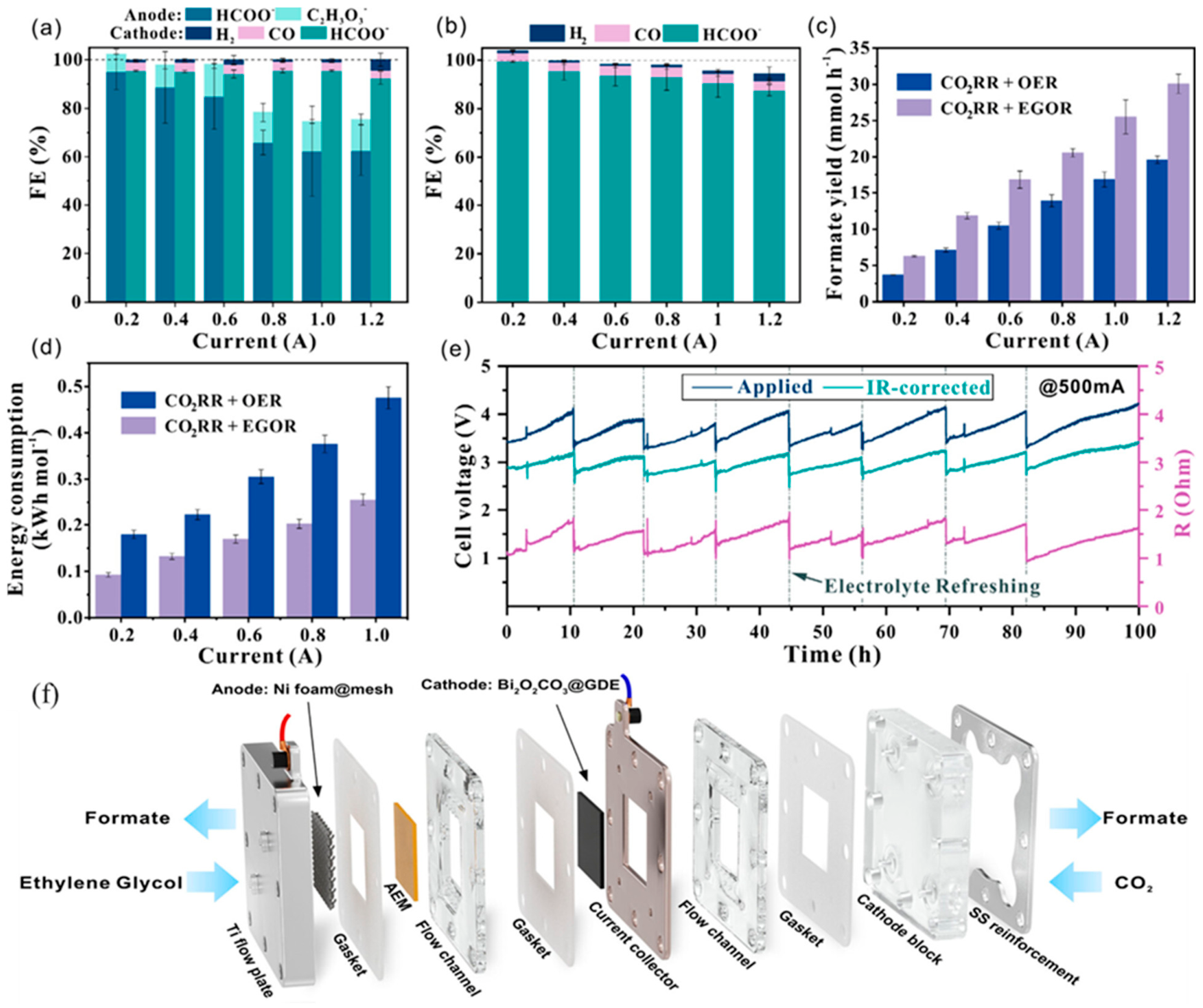
Yu et al. [36] reported an integrated paired electrolysis strategy that simultaneously addresses poly (ethylene terephthalate) (PET) waste upcycling and CO2 utilization by coproducing formate in a single flow electrolyzer. In this system, ethylene glycol (EG), obtained from the hydrolysis of PET, was selectively oxidized at the anode (Figure 1). This was achieved using a diffusion-enhanced, three-dimensional nickel foam that was fabricated through dynamic hydrogen bubble templating. Meanwhile, CO2 was reduced to formate at the cathode using a bismuth oxycarbonate (Bi2O2CO3)-based gas diffusion electrode. Benefiting from the engineered electrode architecture, ampere-level operation was achieved, with the anode delivering formate Faradaic efficiencies of up to 95% at 0.2 A cm−2 and maintaining 62.6% at 1.2 A cm−2, while the cathode exhibited >92% formate selectivity. Compared with the conventional CO2 reduction reaction (CO2RR) coupled with the oxygen evolution reaction (OER), replacing OER with ethylene glycol (EG) oxidation resulted in a more than 50% increase in formate productivity per electrode area. Additionally, the cell voltage decreased from 8.02 V to 6.52 V at a current of 1.0 A cm−2, which represents a 46.3% reduction in energy consumption. The integrated electrolyzer demonstrated stable operation for 100 h at 0.5 A cm−2 with high anodic and cathodic Faradaic efficiencies, highlighting the critical importance of anodic reaction selection and electrode structural design in overcoming mass-transport limitations at ultrahigh current densities. This work provides a compelling framework for coupling plastic waste valorization with CO2 electroreduction to achieve energy-efficient, high-rate production of value-added chemicals.
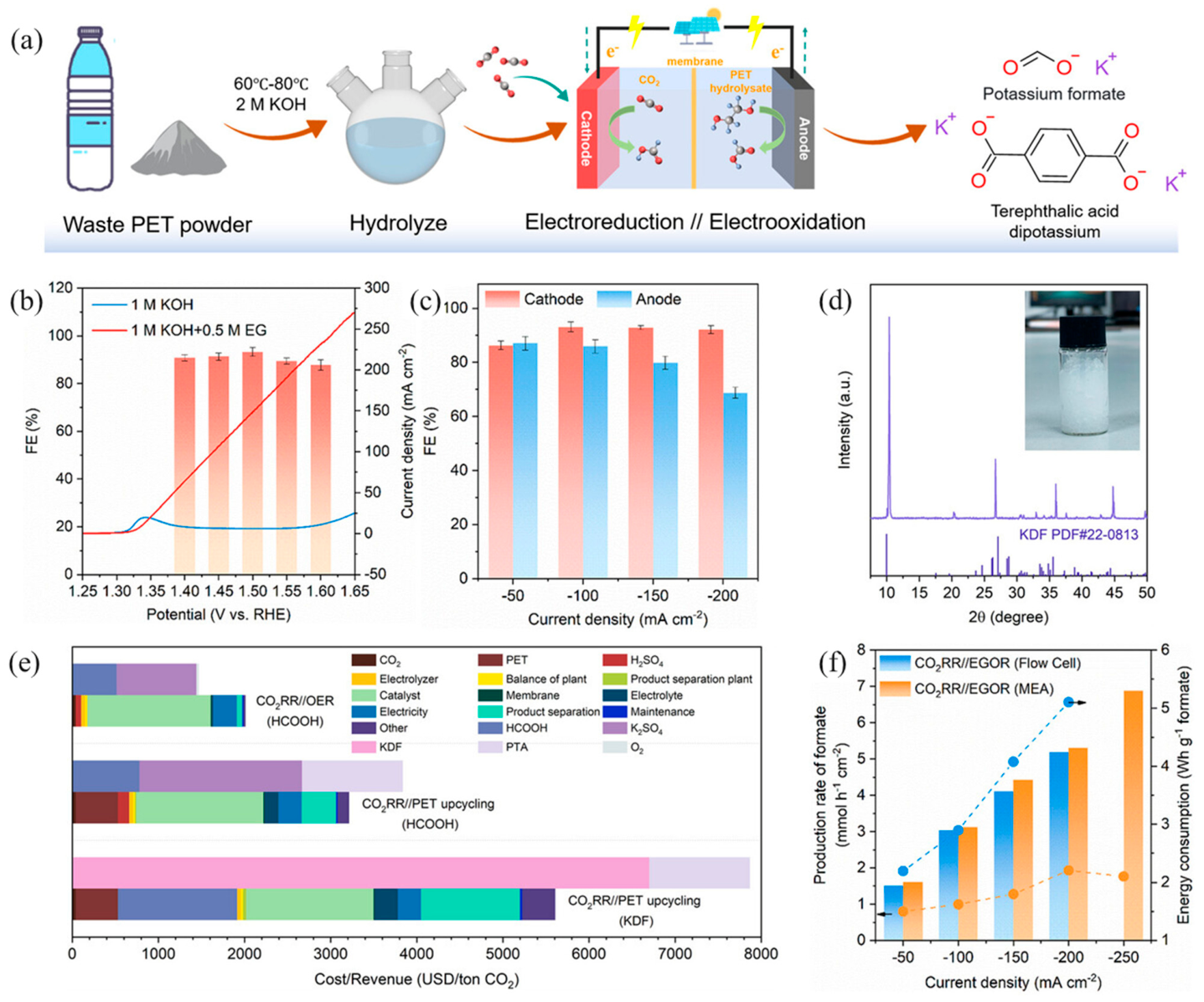
Li et al. [23] reported a high-current-density CO2 electroreduction platform based on an amorphous In-based catalyst, InOx(OH)3−2x (Figure 2). The catalyst was engineered to regulate structural reconstruction under operating conditions and to suppress instability at industrially relevant current densities. The amorphous catalyst exhibited exceptional selectivity toward formate, achieving Faradaic efficiencies up to 98% in the −800 to −1000 mA cm−2 range and maintaining stable performance for over 100 h of continuous operation. Mechanistic investigations revealed that InOx(OH)3−2x undergoes controlled partial reduction during CO2 electroreduction, forming stable crystalline/amorphous In/In–OH interfacial structures rather than fully reducing to metallic In. These interfacial domains lower the CO2 adsorption energy barrier and stabilize the *OCHO intermediate, thereby enhancing formate formation kinetics and long-term durability. To further reduce the energy demand of conventional electrolysis, researchers coupled CO2 electroreduction with waste PET plastic electrooxidation, using the latter as an alternative anodic reaction to replace oxygen evolution. Replacing the sluggish oxygen evolution reaction with ethylene glycol oxidation reduced the cell voltage by approximately 330 mV, resulting in a 34.7% decrease in energy consumption and a 49.7% increase in formate production. The coupled CO2RR//EGOR system delivered high anodic and cathodic Faradaic efficiencies over a wide current density range and demonstrated excellent operational stability during 100 h of continuous electrolysis. Techno-economic analysis further indicated that integrating plastic waste upcycling with CO2 electroreduction could substantially improve process profitability, particularly when targeting high-value products such as potassium diformate, highlighting the importance of catalyst reconstruction control, anodic reaction selection, and system-level optimization for scalable CO2 electroreduction.
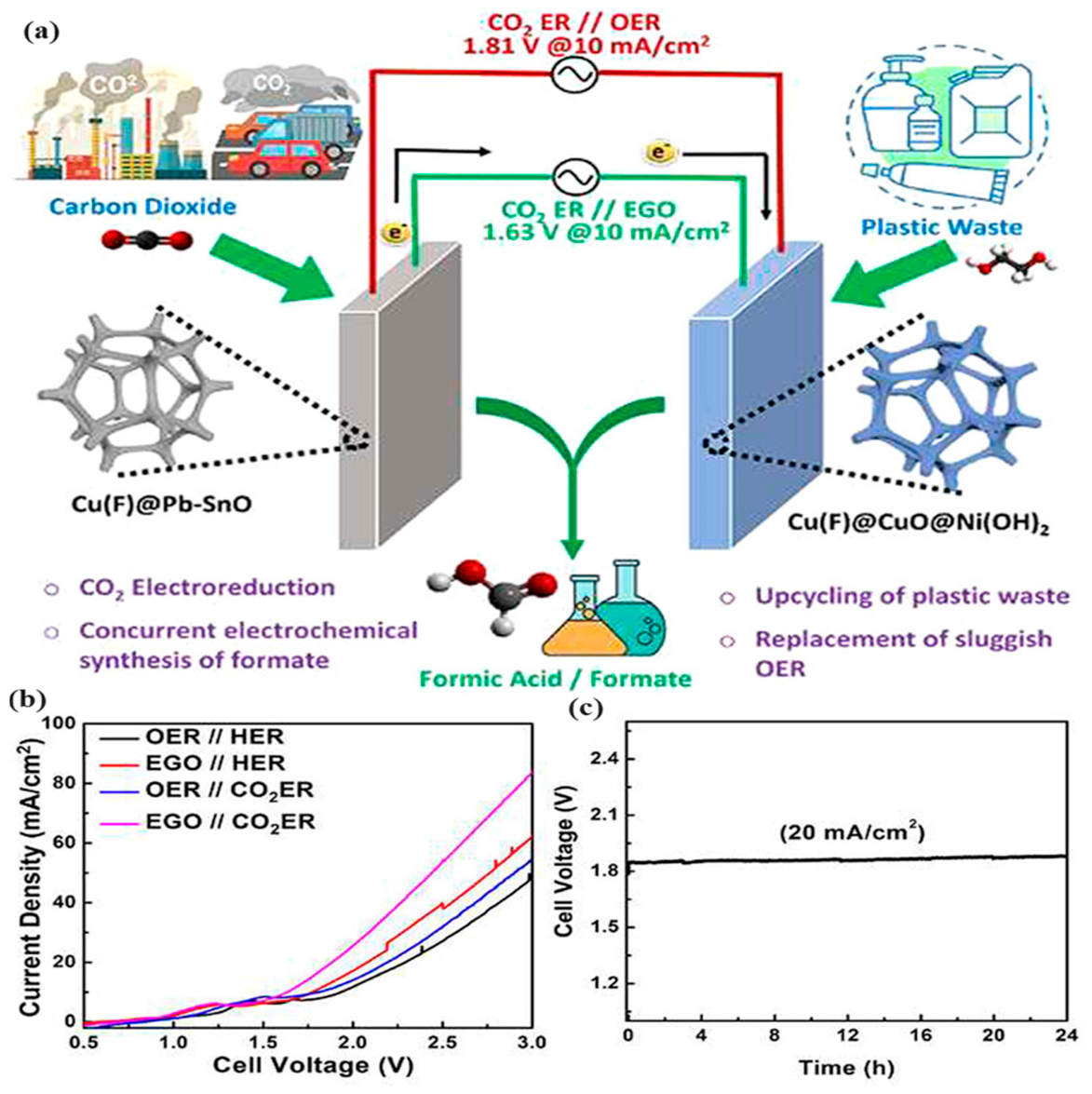
Bashir et al. [37] reported an effective strategy to improve the energy efficiency of CO2 electroreduction by replacing the sluggish oxygen evolution reaction (OER) with partial ethylene glycol oxidation (EGO), enabling simultaneous formate production at both the cathode and anode (Figure 3). By stabilizing Sn-based cathodes through Pb doping, the Faradaic efficiency for CO2-to-formate conversion was significantly enhanced from 68% to approximately 89%. In parallel, a CuO@Ni(OH)2 anode on copper foam efficiently promoted EGO, lowering the anodic overpotential by 200 mV at 50 mA cm−2. As a result, the EGO-coupled CO2 electrolyzer delivered 10 mA cm−2 at an overall cell voltage of 1.62 V, which is 180 mV lower than that required for conventional OER-coupled CO2 electrolysis. Long-term operation demonstrated excellent stability over 24 h at 20 mA cm−2, with sustained formate production at both electrodes. This work highlights the advantage of integrating value-added organic oxidation with CO2 electroreduction to reduce energy input and enable cost-effective, noble-metal-free electrosynthesis, while also pointing to the remaining challenges associated with directly utilizing PET hydrolysates due to membrane compatibility issues.
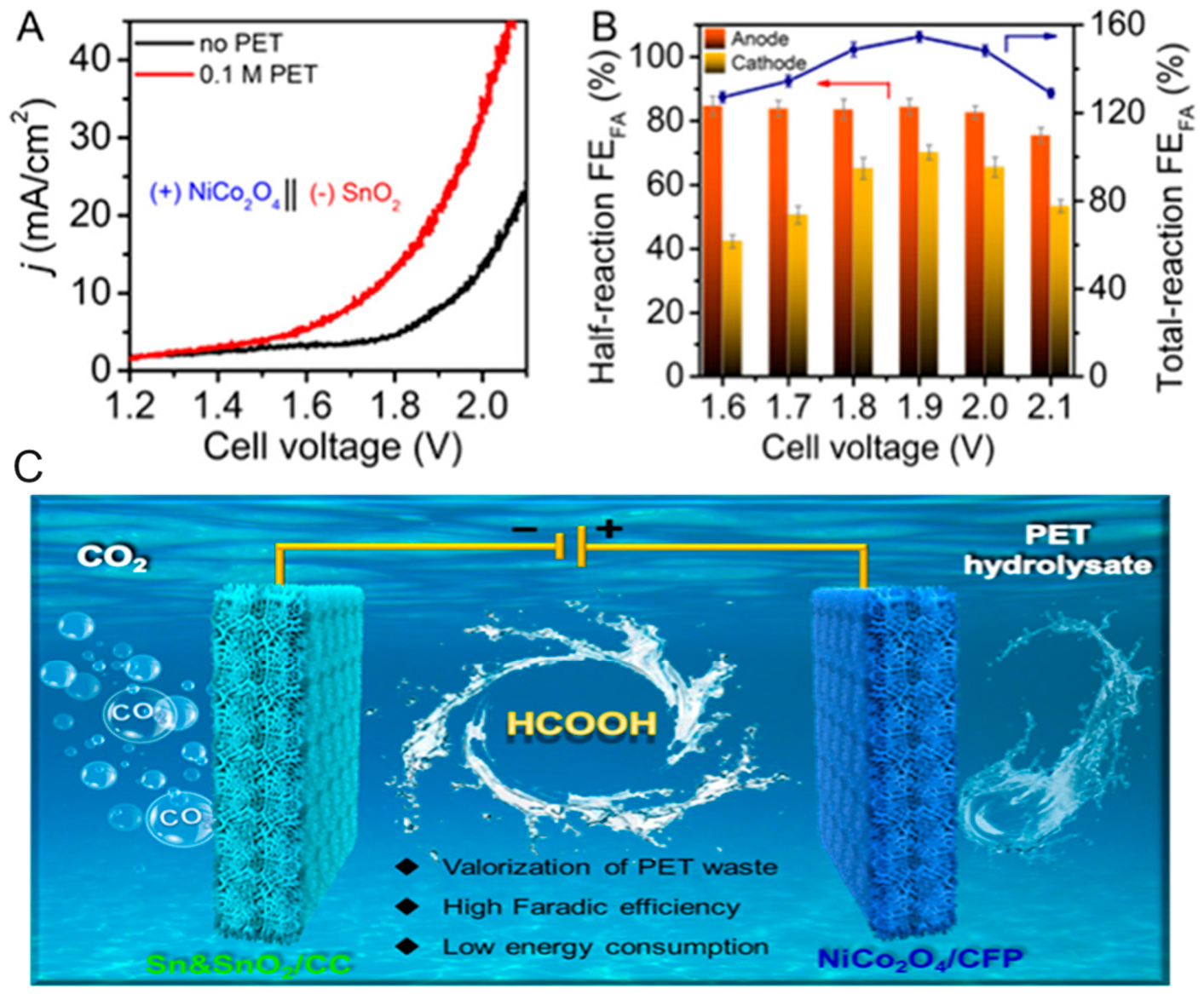
Wang et al. [38] reported an integrated electro-reforming strategy that couples PET plastic waste valorization with CO2 reduction, allowing the simultaneous production of formic acid at both the anode and cathode (Figure 4). In this system, PET hydrolysate oxidation over a NiCo2O4 electrocatalyst was paired with CO2 reduction on a SnO2 cathode, effectively replacing the conventional oxygen evolution reaction. Owing to the high selectivity of NiCo2O4 toward PET hydrolysate oxidation, a Faradaic efficiency of ~90% for anodic formic acid formation was achieved, while the cathodic CO2 reduction delivered up to ~70% formate selectivity. The coupled two-electrode electrolyzer exhibited a significantly reduced cell voltage of 1.55 V to initiate the integrated reactions, which is ~200 mV lower than that of the conventional CO2RR–OER system. At an applied cell voltage of 1.9 V, the system reached a combined Faradaic efficiency of ~155% for formic acid (a sum of the formic acid FE from the cathode (e.g., CO2 reduction) and that from the anode (e.g., plastic oxidation)), arising from its concurrent generation at both electrodes. Furthermore, the system exhibited stable operation over a wide voltage range. Preliminary techno-economic analysis indicated a net revenue of approximately 557 USD per ton of PET, highlighting the economic potential of this approach. Overall, this work demonstrates an energy-efficient and potentially scalable pathway for the simultaneous upcycling of PET plastic and CO2 into value-added chemicals using earth-abundant electrocatalysts.
Table 1 summarizes the recent progress in coupled ethylene glycol oxidation reaction (EGOR) and CO2 reduction reaction (CO2RR) systems for formate/formic acid production. Most reported catalysts achieved high Faradaic efficiencies above 85% for both anodic and cathodic reactions in flow or MEA cell configurations. These studies highlight that integrating EGOR with CO2RR can significantly reduce cell voltage while enhancing carbon utilization and value-added chemical production.

4. Photoelectrochemical (PEC) Systems for Coupled Plastic Reforming and CO2 Conversion

Building on the electrochemical approaches discussed earlier, photoelectrochemical (PEC) systems offer a natural next step by using sunlight instead of external electricity to drive the same coupled reactions. This makes PEC systems especially attractive from a sustainability perspective, as they combine plastic waste conversion and CO2 reduction with direct solar energy utilization. In contrast to purely electrochemical systems, PEC platforms integrate light absorption and charge generation within semiconductor materials, enabling these processes to occur under mild and energy-efficient conditions. Photoelectrochemical (PEC) systems offer a sustainable route for the simultaneous conversion of plastic waste and CO2 by directly harnessing solar energy. In these systems, compounds derived from plastic serve as sacrificial hole scavengers or reforming substrates. They facilitate charge separation and significantly enhance CO2 reduction efficiency when compared to processes driven by water oxidation [44,45,46,47]. In photoelectrochemical (PEC) systems, semiconductor materials such as TiO2, g-C3N4, BiVO4, and perovskite-based catalysts are utilized to generate electron–hole pairs under light irradiation. The photogenerated holes drive the oxidation of plastic-derived intermediates (e.g., ethylene glycol, alcohols, or oligomeric species), while the photogenerated electrons promote the reduction of CO2 to value-added products such as CO, formate, or methane. This method enhances energy efficiency and reduces the required overpotential by replacing the slow oxygen evolution reaction (OER) with more readily occurring plastic oxidation reactions. Additionally, it helps address catalyst deactivation issues that typically arise in standard OER processes. PEC systems further enhance control over reaction pathways by spatially separating oxidation and reduction reactions using photoelectrodes. In advanced PEC systems, the combination of plastic oxidation at the photoanode with CO2 reduction at the photocathode enables simultaneous plastic waste cleanup and CO2 emission reduction. These systems significantly reduce the need for external bias, allowing for effective operation without external power sources, known as self-biased operation. The replacement of OER with plastic oxidation at the photoanode leads to reduced onset potentials, improved solar-to-chemical conversion efficiencies, and extended device stability. Despite these benefits, several challenges still limit large-scale application. These include insufficient light absorption, inefficient charge transport, photocorrosion of materials, and difficulties in scaling up reactor systems. To overcome these issues, current research focuses on strategies such as tandem light absorbers, surface engineering, cocatalyst integration, and improved reactor design. Overall, PEC systems represent a promising direction for developing solar-driven and sustainable technologies that simultaneously address plastic waste and CO2 emissions [48,49].
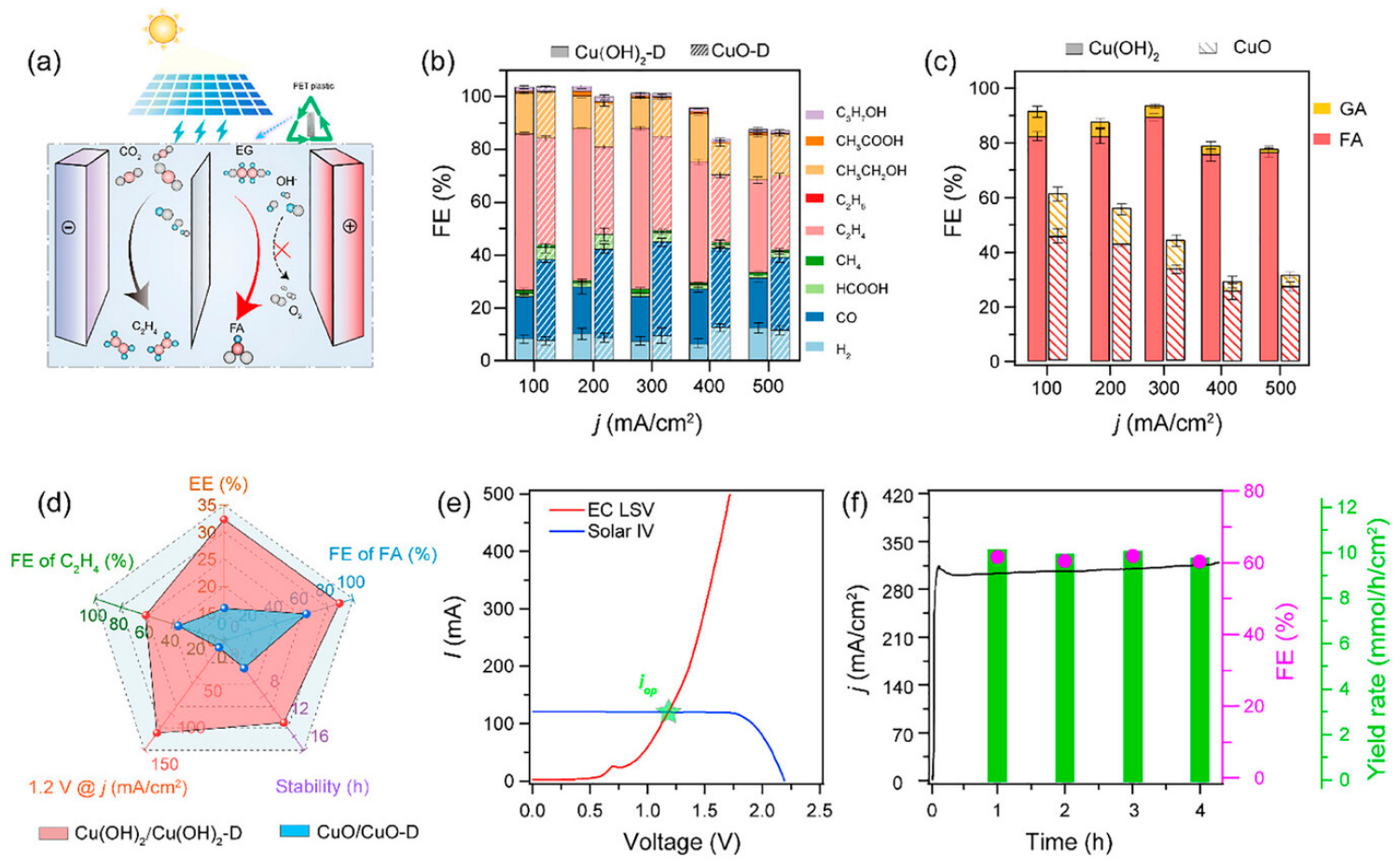
Wang et al. [50] developed a solar-assisted paired electrochemical system that couples PET plastic reforming with CO2 reduction by employing a bifunctional Cu (OH)2-derived catalyst capable of catalyzing both anodic ethylene glycol oxidation (EGOR) and cathodic CO2 reduction within a single integrated platform. By replacing the sluggish oxygen evolution reaction with PET-derived EG oxidation, the system simultaneously reduces energy consumption and enables the co-production of value-added chemicals. A key challenge addressed in this work is the energetic compatibility between PET oxidation and CO2RR, which was successfully overcome through the use of Cu (OH)2-based electrodes operating efficiently under matched conditions. Mechanistic investigations revealed that immersion of Cu (OH)2 in an EG-containing electrolyte induces the in situ formation of CuOOH species, which enhances EG adsorption and accelerates its oxidation to formate at the anode. Following electrochemical pre-reduction, the Cu (OH)2-derived cathode exhibited increased exposure of Cu (100) facets, promoting C–C coupling and enabling selective CO2 reduction to ethylene. As a result, the paired system achieved a high anodic formate Faradaic efficiency of 89.5% and a cathodic ethylene Faradaic efficiency of 60.8% at a current density of 300 mA cm−2, markedly outperforming the corresponding CuO-based electrodes. Figure 5 shows the electrochemical evaluations in a two-electrode flow cell, demonstrating that the Cu (OH)2/Cu (OH)2-D electrode configuration delivered superior activity, selectivity, and energy efficiency compared with CuO/CuO-D, maintaining stable operation for at least 12 h with negligible voltage and selectivity decay. When integrated into a photovoltaic–electrochemical (PV-EC) system under standard AM 1.5G illumination, the solar-driven device operated at 302.7 mA cm−2, achieving product formation rates of 4.72 mmol h−1 cm−2 for formate and 9.65 mmol h−1 cm−2 for ethylene, with average Faradaic efficiencies of 90.3% and 61.0%, respectively. Furthermore, the applicability of this strategy to real-world plastic waste was validated using PET-derived electrolytes obtained via alkaline hydrolysis, with product analysis confirming the efficient conversion of EG to formate and the generation of potassium diformate as a separable product. Overall, this work demonstrates a sustainable solar electrochemical approach for the concurrent upcycling of PET waste and CO2 into value-added fuels and chemicals, highlighting the promise of bifunctional catalyst design and renewable-energy-driven paired electrolysis for carbon-neutral chemical production.
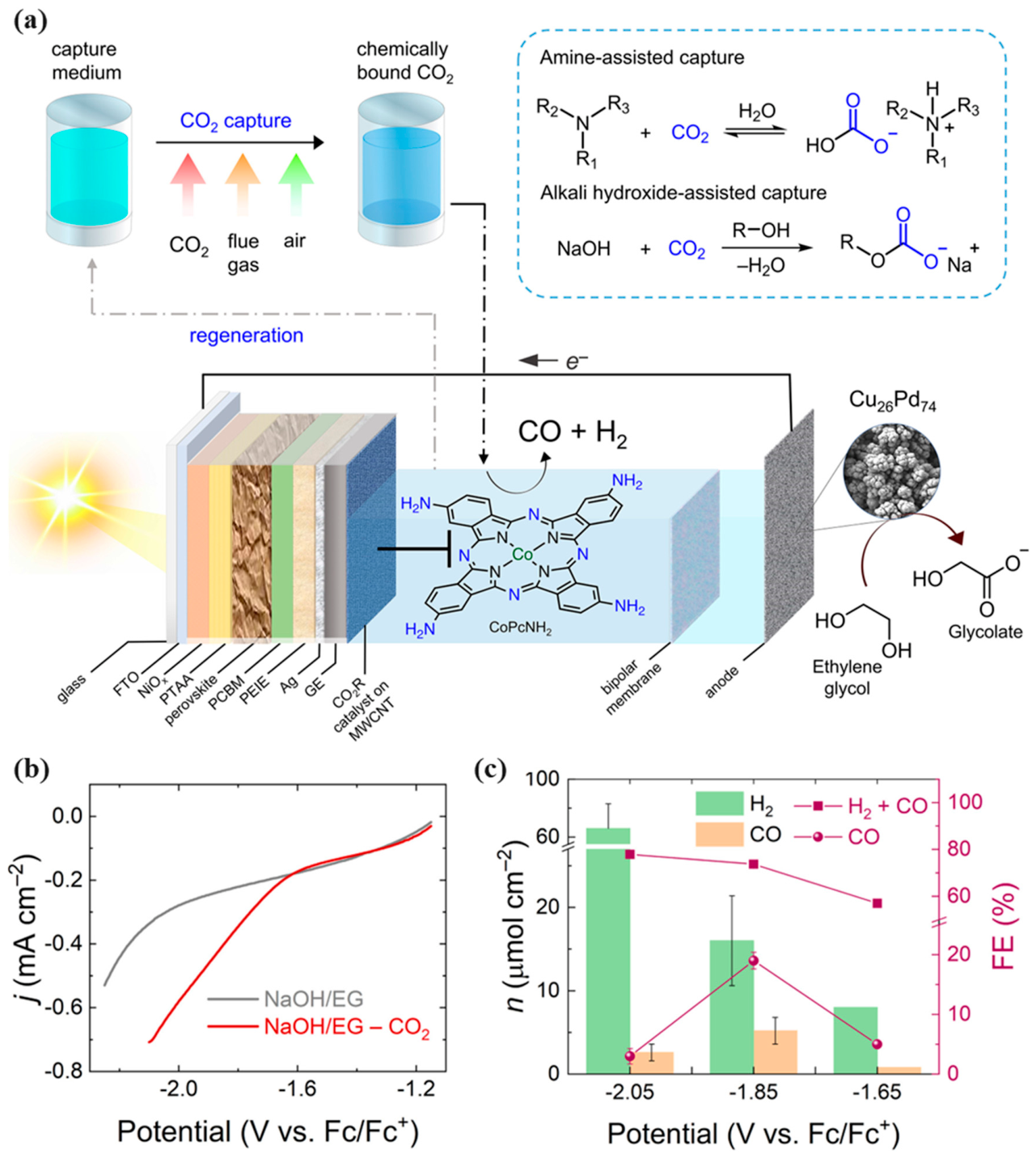
Kar et al. [51] developed an integrated solar-driven photoelectrochemical (PEC) system that directly couples CO2 capture with its conversion into syngas while simultaneously upcycling plastic-derived ethylene glycol (EG) into glycolic acid. In this approach, CO2 is captured from concentrated streams, simulated flue gas, or air using an amine or hydroxide solution and is directly utilized without further purification. The system employs a perovskite-based photocathode modified with a molecular Co-phthalocyanine catalyst for CO2 reduction, while a Cu26Pd74 alloy anode catalyzes EG oxidation. By replacing the energy-intensive oxygen evolution reaction with EG oxidation, the overall thermodynamic barrier is significantly reduced, enabling solar-driven operation without any external bias.
Figure 6 shows that in aqueous NaOH-captured CO2, CO production was limited (FE_CO < 3% at −0.7 V vs. RHE) due to dominant hydrogen evolution. To address this, a non-aqueous glycolic NaOH medium was employed, where captured CO2 species were directly converted. Under optimized conditions, controlled potential electrolysis at −1.85 V vs. Fc/Fc+ achieved a Faradaic efficiency for CO of 19.0 ± 1.4%, with an overall syngas Faradaic efficiency of ~75% after 10 h operation. The system also enabled tunable CO:H2 ratios depending on the CO2 source. Overall, this work demonstrates an efficient and sustainable approach for integrating carbon capture, CO2 utilization, and plastic waste upcycling in a single PEC platform, highlighting its potential for solar-driven production of fuels and value-added chemicals.

5. Conclusions

The integrated conversion of plastic waste and carbon dioxide (CO2) into value-added chemicals and fuels has emerged as a promising strategy. This approach simultaneously addresses plastic pollution, CO2 emissions, and the demand for sustainable chemical production. By coupling plastic reforming with CO2 conversion, these approaches exploit intrinsic redox complementarities between plastic oxidation and CO2 reduction, enabling improved energy efficiency, enhanced carbon utilization, and higher overall process value compared to conventional single-reaction systems. This review has critically examined recent progress in electrochemical and photoelectrochemical platforms, highlighting how paired and integrated reaction schemes can replace energetically demanding processes such as the OER. However, the practical replacement of OER must account for additional system-level energy demands, including product separation, membrane resistance and crossover losses, mixed-feedstock heterogeneity, and overall energy balance, which are often overlooked in the studies. Electrochemical systems demonstrate particular promise due to their modularity, operational flexibility, and compatibility with renewable electricity, while photoelectrochemical approaches offer pathways toward low-carbon and potentially bias-free operation. Overall, the advances discussed in this review emphasize that system-level integration spanning catalyst design, reaction coupling, and reactor architecture is essential for unlocking the full potential of plastic CO2 co-conversion technologies.

6. Future Perspectives

Despite rapid progress, researchers must address several critical challenges to transition integrated plastic-CO2 conversion systems from laboratory-scale demonstrations to industrially viable technologies. First, the development of durable, multifunctional catalysts and electrodes remains a priority. Future research should focus on earth-abundant materials with high selectivity, long-term stability, and tolerance to heterogeneous plastic-derived feedstocks. Mechanistic understanding of catalyst reconstruction, interfacial charge transfer, and degradation under coupled reaction environments will be essential. Second, advances in reactor and device engineering are crucial. Scalable electrochemical and photoelectrochemical architectures capable of sustaining high current densities, efficient mass transport, and continuous operation must be developed. Integrating plastic depolymerization, reforming, and CO2 conversion into unified or cascade reactor systems represents a promising yet underexplored direction. Third, greater emphasis on system integration and sustainability assessment is needed. Comprehensive techno-economic analysis and life-cycle assessment should be systematically incorporated to benchmark integrated plastic CO2 conversion processes against existing waste management, recycling, and CO2 utilization technologies. Finally, future studies should move beyond model substrates and pure CO2 feeds toward realistic plastic waste streams and captured CO2 sources, while considering practical constraints related to feedstock variability, product separation, and regulatory frameworks. Bridging fundamental research with industrial requirements will ultimately determine the role of paired plastic reforming and CO2 conversion in enabling a circular carbon and materials economy. In summary, integrated plastic–CO2 conversion represents a promising and versatile platform for sustainable chemical manufacturing. Continued interdisciplinary efforts across catalysis, electrochemistry, materials science, and systems engineering will be essential for realizing the full environmental and societal benefits of integrated plastic–CO2 conversion technologies.

Author Contributions

Z.M.: Writing—review & editing, Conceptualization. S.M.: Data curation, Investigation. S.L.: Data curation, Investigation. D.K.: Writing—review & editing, Supervision. M.T.: Writing—review & editing, Conceptualization, Supervision. All authors have read and agreed to the published version of the manuscript.

Funding

This work was supported by the National Research Foundation of Korea (NRF) grant funded by the Korean government (MSIT) (RS-2024-00343746) and the “Regional Innovation System & Education (RISE)” through the Ulsan RISE Center, funded by the Ministry of Education (MOE) and the Ulsan Metropolitan City, Republic of Korea (2025-RISE-07-001).

Data Availability Statement

The original contributions presented in the study are included in the article, further inquiries can be directed to the corresponding author.

Conflicts of Interest

The authors declare no conflicts of interest.

References

  1. Zhang, M.Q.; Wang, M.; Sun, B.; Hu, C.; Xiao, D.; Ma, D. Catalytic strategies for upvaluing plastic wastes. Chem 2022, 8, 2912–2923. [Google Scholar] [CrossRef]
  2. Wang, G.; Chen, J.; Ding, Y.; Cai, P.; Yi, L.; Li, Y.; Tu, C.; Hou, Y.; Wen, Z.; Dai, L. Electrocatalysis for CO2 conversion: From fundamentals to value-added products. Chem. Soc. Rev. 2021, 50, 4993–5061. [Google Scholar] [CrossRef]
  3. Kibria, M.G.; Edwards, J.P.; Gabardo, C.M.; Dinh, C.T.; Seifitokaldani, A.; Sinton, D.; Sargent, E.H. Electrochemical CO2 Reduction into Chemical Feedstocks: From Mechanistic Electrocatalysis Models to System Design. Adv. Mater. 2019, 31, 1807166. [Google Scholar] [CrossRef]
  4. Hepburn, C.; Adlen, E.; Beddington, J.; Carter, E.A.; Fuss, S.; Mac Dowell, N.; Minx, J.C.; Smith, P.; Williams, C.K. The technological and economic prospects for CO2 utilization and removal. Nature 2019, 575, 87–97. [Google Scholar] [CrossRef]
  5. Yang, Y.; Sharma, S.; Di Bernardo, C.; Rossi, E.; Lima, R.; Kamounah, F.S.; Poderyte, M.; Enemark-Rasmussen, K.; Ciancaleoni, G.; Lee, J.W. Catalytic Fabric Recycling: Glycolysis of Blended PET with Carbon Dioxide and Ammonia, ACS Sustain. Chem. Eng. 2023, 11, 11294–11304. [Google Scholar] [CrossRef]
  6. MacLeod, M.; Arp, H.P.H.; Tekman, M.B.; Jahnke, A. The global threat from plastic pollution. Science 2021, 373, 61–65. [Google Scholar] [CrossRef] [PubMed]
  7. Lu, H.; Diaz, D.J.; Czarnecki, N.J.; Zhu, C.; Kim, W.; Shroff, R.; Acosta, D.J.; Alexander, B.R.; Cole, H.O.; Zhang, Y.; et al. Machine learning-aided engineering of hydrolases for PET depolymerization. Nature 2022, 604, 662–667. [Google Scholar] [CrossRef] [PubMed]
  8. Valenzuela-Ortega, M.; Suitor, J.T.; White, M.F.M.; Hinchcliffe, T.; Wallace, S. Microbial Upcycling of Waste PET to Adipic Acid. ACS Cent. Sci. 2023, 9, 2057–2063. [Google Scholar] [CrossRef] [PubMed]
  9. Ren, T.; Duan, Z.; Wang, H.; Yu, H.; Deng, K.; Wang, Z.; Wang, H.; Wang, L.; Xu, Y. Electrochemical Co-Production of Ammonia and Biodegradable Polymer Monomer Glycolic Acid via the Co-Electrolysis of Nitrate Wastewater and Waste Plastic. ACS Catal. 2023, 13, 10394–10404. [Google Scholar] [CrossRef]
  10. Verma, S.; Lu, S.; Kenis, P.J.A. Co-electrolysis of CO2 and glycerol as a pathway to carbon chemicals with improved technoeconomics due to low electricity consumption. Nat. Energy 2019, 4, 466–474. [Google Scholar] [CrossRef]
  11. Li, R.; Xiang, K.; Peng, Z.; Zou, Y.; Wang, S. Recent Advances on Electrolysis for Simultaneous Generation of Valuable Chemicals at both Anode and Cathode. Adv. Energy Mater. 2021, 11, 2102292. [Google Scholar] [CrossRef]
  12. Na, J.; Seo, B.; Kim, J.; Lee, C.W.; Lee, H.; Hwang, Y.J.; Min, B.K.; Lee, D.K.; Oh, H.S.; Lee, U. General technoeconomic analysis for electrochemical coproduction coupling carbon dioxide reduction with organic oxidation. Nat. Commun. 2019, 10, 5193. [Google Scholar] [CrossRef]
  13. Anjos, R.P.R.; Santos, A.O.; Antoniassi, R.M.; Alves, O.C.; Ponzio, E.A.; Silva, J.C.M. The Effect of Tin Addition to Platinum Catalysts with Different Morphologies towards Methanol Electrooxidation in Alkaline Media. ACS Appl. Energy Mater. 2021, 4, 6253–6260. [Google Scholar] [CrossRef]
  14. You, H.; Gao, F.; Wang, C.; Li, J.; Zhang, K.; Zhang, Y.; Du, Y. Rich grain boundaries endow networked PdSn nanowires with superior catalytic properties for alcohol oxidation. Nanoscale 2021, 13, 17939–17944. [Google Scholar] [CrossRef]
  15. Zhuang, Z.; Huang, A.; Tan, X.; Sun, K.; Chen, C.; Peng, Q.; Zhuang, Z.; Han, T.; Xiao, H.; Zeng, Y.; et al. p-Block-metal bismuth-based electrocatalysts featuring tunable selectivity for high-performance oxygen reduction reaction. Joule 2023, 7, 1003–1015. [Google Scholar] [CrossRef]
  16. Li, Y.; Chen, J.; Chen, S.; Liao, X.; Zhao, T.; Cheng, F.; Wang, H. In Situ Confined Growth of Bismuth Nanoribbons with Active and Robust Edge Sites for Boosted CO2 Electroreduction. ACS Energy Lett. 2022, 7, 1454–1461. [Google Scholar] [CrossRef]
  17. Li, Y.; Niu, W.; Chen, T.; Sun, Y.; Yu, M. Integrating vacancy engineering and energy-level adapted coupling of electrocatalyst for enhancement of carbon dioxide conversion. Appl. Catal. B 2023, 321, 122037. [Google Scholar] [CrossRef]
  18. Cheng, Q.; Huang, M.; Xiao, L.; Mou, S.; Zhao, X.; Xie, Y.; Jiang, G.; Jiang, X.; Dong, F. Unraveling the Influence of Oxygen Vacancy Concentration on Electrocatalytic CO2 Reduction to Formate over Indium Oxide Catalysts. ACS Catal. 2023, 13, 4021–4029. [Google Scholar] [CrossRef]
  19. Li, Z.; Cao, A.; Zheng, Q.; Fu, Y.; Wang, T.; Arul, K.T.; Chen, J.L.; Yang, B.; Adli, N.M.; Lei, L.; et al. Elucidation of the Synergistic Effect of Dopants and Vacancies on Promoted Selectivity for CO2 Electroreduction to Formate. Adv. Mater. 2021, 33, e2005113. [Google Scholar] [CrossRef]
  20. Duan, J.; Liu, T.; Zhao, Y.; Yang, R.; Zhao, Y.; Wang, W.; Liu, Y.; Li, H.; Li, Y.; Zhai, T. Active and conductive layer stacked superlattices for highly selective CO2 electroreduction. Nat. Commun. 2022, 13, 2039. [Google Scholar] [CrossRef] [PubMed]
  21. Shen, H.; Jin, H.; Li, H.; Wang, H.; Duan, J.; Jiao, Y.; Qiao, S.Z. Acidic CO2-to-HCOOH electrolysis with industrial-level current on phase engineered tin sulfide. Nat. Commun. 2023, 14, 2843. [Google Scholar] [CrossRef]
  22. Xia, Q.; Jin, C.; Huang, Y.L.; Zhai, Y.; Han, W.; Wu, J.; Xia, C.; Lin, C.C.; Zhao, X.; Zhang, X. Methanol-Facilitated Surface Reconstruction Catalysts for Near 200% Faradaic Efficiency in a Coupled System. Adv. Funct. Mater. 2024, 34, 2314596. [Google Scholar] [CrossRef]
  23. Li, B.; Zhong, Z.; Li, H.; Yue, M.; Niu, Q.; Liu, L.; Xie, W.; Li, M.; Shao, M.; Wang, Q. Engineering Crystalline/Amorphous Interfaces for Enhanced CO2 Electroreduction. Angew. Chem. Int. Ed. 2025, 64, e202509502. [Google Scholar] [CrossRef] [PubMed]
  24. Liu, S.Q.; Gao, M.R.; Wu, S.; Feng, R.; Wang, Y.; Cui, L.; Guo, Y.; Fu, X.Z.; Luo, J.L. A coupled electrocatalytic system with reduced energy input for CO2 reduction and biomass valorization. Energy Environ. Sci. 2023, 16, 5305–5314. [Google Scholar] [CrossRef]
  25. Ji, L.; Zheng, H.; Wei, Y.; Gong, S.; Wang, T.; Wang, S.; Chen, Z. Temperature-controlled fabrication of Co-Fe-based nanoframes for efficient oxygen evolution. Sci. China Mater. 2022, 65, 431–441. [Google Scholar] [CrossRef]
  26. Wang, J.; Ji, L.; Zuo, S.; Chen, Z. Hierarchically Structured 3D Integrated Electrodes by Galvanic Replacement Reaction for Highly Efficient Water Splitting. Adv. Energy Mater. 2017, 7, 1700107. [Google Scholar] [CrossRef]
  27. Chen, F.Y.; Wu, Z.Y.; Adler, Z.; Wang, H. Stability challenges of electrocatalytic oxygen evolution reaction: From mechanistic understanding to reactor design. Joule 2021, 5, 1704–1731. [Google Scholar] [CrossRef]
  28. Chen, X.; Wang, Y.; Zhang, L. Recent Progress in the Chemical Upcycling of Plastic Wastes. ChemSusChem 2021, 14, 4137–4151. [Google Scholar] [CrossRef]
  29. Chen, H.; Wan, K.; Zhang, Y.; Wang, Y. Waste to Wealth: Chemical Recycling and Chemical Upcycling of Waste Plastics for a Great Future. ChemSusChem 2021, 14, 4123–4136. [Google Scholar] [CrossRef] [PubMed]
  30. Karimi Estahbanati, M.R.; Kong, X.Y.; Eslami, A.; Soo, H. Sen. Current Developments in the Chemical Upcycling of Waste Plastics Using Alternative Energy Sources. ChemSusChem 2021, 14, 4152–4166. [Google Scholar] [CrossRef]
  31. Zhou, H.; Ren, Y.; Li, Z.; Xu, M.; Wang, Y.; Ge, R.; Kong, X.; Zheng, L.; Duan, H. Electrocatalytic upcycling of polyethylene terephthalate to commodity chemicals and H2 fuel. Nat. Commun. 2021, 12, 4679. [Google Scholar] [CrossRef]
  32. Wang, J.; Li, X.; Zhang, T.; Chen, Y.; Wang, T.; Zhao, Y. Electro-Reforming Polyethylene Terephthalate Plastic to Co-Produce Valued Chemicals and Green Hydrogen. J. Phys. Chem. Lett. 2022, 13, 622–627. [Google Scholar] [CrossRef] [PubMed]
  33. Bin Yeo, J.; Ho Jang, J.; In Jo, Y.; Woo Koo, J.; Tae Nam, K. Paired Electrosynthesis of Formaldehyde Derivatives from CO2 Reduction and Methanol Oxidation. Angew. Chem. Int. Ed. 2024, 63, e202316020. [Google Scholar] [CrossRef]
  34. Crago, C.F.; Li, S.; Aleman, A.M.; Siboonruang, T.; Rojas Mendoza, M.; Jaramillo, T.F.; Stevens, M.B. Effects of Iron Impurities and Content on Electrochemical Performance and Oxygen Evolution Selectivity of Nickel Catalysts for Ethanol Oxidation. J. Am. Chem. Soc. 2025, 147, 3925–3930. [Google Scholar] [CrossRef] [PubMed]
  35. Zhang, X.; Hui, L.; He, F.; Li, Y. The Interfacial Interpenetration Effect for Controlled Reaction Stability of Palladium Catalysts. J. Am. Chem. Soc. 2024, 147, 436–445. [Google Scholar] [CrossRef] [PubMed]
  36. Yu, X.; Rabiee, H.; Dutta, A.; Li, Y.; Szakály, Z.; Vesztergom, S.; Warmuth, L.; Rieder, A.; Broekmann, P. Upcycling CO2and PET Waste: Ampere-Level Formate Electrosynthesis in an Integrated Electrolyzer. J. Am. Chem. Soc. 2025, 147, 41481–41491. [Google Scholar] [CrossRef]
  37. Bashir, I.; McGettrick, J.D.; Kühnel, M.F.; Sarfraz, B.; Arshad, S.N.; Rauf, A. Sustainable Formate Synthesis: Integrating Ethylene Glycol Oxidation with Carbon Dioxide Electrocatalysis Using Redox-Stabilized Earth-Abundant Electrodes. ACS Sustain. Chem. Eng. 2024, 12, 4795–4802. [Google Scholar] [CrossRef]
  38. Wang, J.; Li, X.; Wang, M.; Zhang, T.; Chai, X.; Lu, J.; Wang, T.; Zhao, Y.; Ma, D. Electrocatalytic Valorization of Poly(ethylene terephthalate) Plastic and CO2 for Simultaneous Production of Formic Acid. ACS Catal. 2022, 12, 6722–6728. [Google Scholar] [CrossRef]
  39. Kilaparthi, S.K.; Addad, A.; Barras, A.; Szunerits, S.; Boukherroub, R. Simultaneous upcycling of PET plastic waste and CO2 reduction through Co-electrolysis: A novel approach for integrating CO2 reduction and PET hydrolysate oxidation. J. Mater. Chem. A Mater. 2023, 11, 26075–26085. [Google Scholar] [CrossRef]
  40. Fang, Y.; Cai, C.; Yamashita, H.; Qian, X.; Zhao, Y. Efficient and cost-effective electrocatalysts for coproduction of formate through electrocatalytic oxidation of PET-derived ethylene glycol coupled with CO2 reduction. Catal. Today 2026, 462, 115544. [Google Scholar] [CrossRef]
  41. Hao, S.; Cong, M.; Han, Z.; Xu, H.; Liu, T.; Guo, M.; Ding, X.; Gao, Y. Electrocatalytic formate synthesis from polyethylene terephthalate and carbon dioxide through sulfide-and-reconstruct engineering of catalyst. Chem. Eng. J. 2024, 498, 155106. [Google Scholar] [CrossRef]
  42. Qiu, J.; Jing, Z.; Zhan, D.; Peng, J. Boosted production of formate via paired electro-reforming of poly (ethylene terephthalate) plastic and CO2 reduction. Chem. Eng. J. 2025, 519, 165447. [Google Scholar] [CrossRef]
  43. Sui, P.F.; Zhu, M.N.; Gao, M.R.; Wang, Y.C.; Feng, R.; Wang, X.; Liu, S.; Luo, J.L. Energy-conservative CO2 electroreduction for efficient formate co-generation. Appl. Catal. B Environ. Energy 2025, 373, 125355. [Google Scholar] [CrossRef]
  44. Morikawa, T.; Sato, S.; Sekizawa, K.; Suzuki, T.M.; Arai, T. Solar-Driven CO2 Reduction Using a Semiconductor/Molecule Hybrid Photosystem: From Photocatalysts to a Monolithic Artificial Leaf. Acc. Chem. Res. 2022, 55, 933–943. [Google Scholar] [CrossRef]
  45. Andrei, V.; Reuillard, B.; Reisner, E. Bias-free solar syngas production by integrating a molecular cobalt catalyst with perovskite–BiVO4 tandems. Nat. Mater. 2019, 19, 189–194. [Google Scholar] [CrossRef]
  46. Sahara, G.; Kumagai, H.; Maeda, K.; Kaeffer, N.; Artero, V.; Higashi, M.; Abe, R.; Ishitani, O. Photoelectrochemical Reduction of CO2 Coupled to Water Oxidation Using a Photocathode with a Ru(II)-Re(I) Complex Photocatalyst and a CoOx/TaON Photoanode. J. Am. Chem. Soc. 2016, 138, 14152–14158. [Google Scholar] [CrossRef]
  47. Uekert, T.; Pichler, C.M.; Schubert, T.; Reisner, E. Solar-driven reforming of solid waste for a sustainable future. Nat. Sustain. 2021, 4, 383–391. [Google Scholar] [CrossRef]
  48. Uekert, T.; Kuehnel, M.F.; Wakerley, D.W.; Reisner, E. Plastic waste as a feedstock for solar-driven H2 generation. Energy Environ. Sci. 2018, 11, 2853–2857. [Google Scholar] [CrossRef]
  49. Lu, S.; Shi, Y.; Meng, N.; Lu, S.; Yu, Y.; Zhang, B. Electrosynthesis of Syngas via the Co-Reduction of CO2 and H2O. Cell Rep. Phys. Sci. 2020, 1, 100237. [Google Scholar] [CrossRef]
  50. Wang, Z.; Zhang, Q.; Gao, J.; Wang, J.; He, H.; Pan, S.; Zhao, Y.; Zhang, X. Solar-driven Plastic Reforming With CO2 Conversion to Value-Added Chemicals Using Bifunctional Copper Hydroxide Catalyst. Small 2025, 21, 2502144. [Google Scholar] [CrossRef]
  51. Kar, S.; Rahaman, M.; Andrei, V.; Bhattacharjee, S.; Roy, S.; Reisner, E. Integrated capture and solar-driven utilization of CO2 from flue gas and air. Joule 2023, 7, 1496–1514. [Google Scholar] [CrossRef]
Figure 1. Faradaic efficiency for CO2RR integrated with (a) EGOR and (b) OER in the flow cell, (c) formate yield and (d) energy consumption in CO2RR + OER and CO2RR + EGOR configurations, respectively. (e) Cell voltage and resistance profiles of the CO2RR + EGOR system during the stability test at 500 mA cm−2, with average formate FEs of 93.7% (anode) and 86.0% (cathode). (f) Schematic of the flow electrolyzer for 3D Ni foam fabrication as anode for EGOR, and the structure of Bi2O2CO3@GDE used for CO2RR (Reproduced with permission from Yu et al., J. Am. Chem. Soc., 2025 [36], licensed under CC BY 4.0. Copyright © 2025 American Chemical Society).
Energies 19 02588 g001
Figure 2. Anode and coupled system tests. (a) Schematic illustration of electrocatalytic CO2 reduction coupled with the oxidative upcycling of waste PET. (b) LSV curves of the NiMn-LDH anode recorded in different electrolytes and the corresponding formate Faradaic efficiency (FE_formate) obtained in the potential range of 1.4–1.6 V vs. RHE after passing 200 C of charge in 1 M KOH + 0.5 M ethylene glycol (potentials not iR-corrected). (c) FE_formate of the CO2RR//EGOR system over a current density range of −50 to −200 mA cm−2. (d) XRD pattern of KDF. (e) Techno-economic comparison of CO2RR//OER (HCOOH), CO2RR//PET upcycling (HCOOH), and CO2RR//PET upcycling (KDF) systems. (f) Formate production rate and energy consumption of the CO2RR//EGOR system operated in flow-cell and MEA configurations (Reproduced with permission from Li et al., Angew. Chem. Int. Ed., 2025 [23]. Copyright © 2025 Wiley-VCH GmbH, Weinheim, Germany).
Energies 19 02588 g002
Figure 3. (a) Schematic illustration of integrated plastic waste valorization coupled with CO2 electrocatalysis. (b) Linear sweep voltammetry (LSV) curves of the Cu(F)@CuO@Ni(OH)2‖Cu(F)@Pb–SnO2 electrolyzer in a two-electrode configuration under different reaction conditions. (c) Chronopotentiometric stability of the electrolyzer operated at a constant current density of 20 mA cm−2 (Reproduced with permission from Bashir et al., ACS Sustain. Chem. Eng., 2024 [37]. Copyright © 2024 American Chemical Society).
Energies 19 02588 g003
Figure 4. Electrochemical performance of the SnO2‖NiCo2O4 system. (A) LSV curves with and without 0.1 M PET hydrolysate at the anode. (B) Faradaic efficiencies for PET hydrolysate oxidation (NiCo2O4/CFP) and CO2 reduction to formic acid (SnO2/CC) at different cell voltages. (C) Paired electrochemical conversion of PET hydrolysate and CO2 to formic acid (Reproduced with permission from Wang et al., ACS Catal., 2022 [38]. Copyright © 2022 American Chemical Society).
Energies 19 02588 g004
Figure 5. Solar-driven PET oxidation coupled with CO2 reduction reactions. (a) Schematic illustration of the solar-cell-driven CO2RR–PET oxidation system. (b) Cathodic and (c) anodic product distributions obtained in a two-electrode flow cell. (d) Radar plot comparing the catalytic performance of Cu (OH)2-D/Cu (OH)2 and CuO-D/CuO electrode pairs. (e) Representative photovoltaic–electrochemical (PV–EC) current–voltage characteristics under standard AM 1.5G illumination. (f) Current density (black line), ethylene Faradaic efficiency (purple symbols), and corresponding product yield rate (green bars) (Reproduced with permission from Wang et al., Small, 2025 [50]. Copyright © 2025 Wiley-VCH GmbH).
Energies 19 02588 g005
Figure 6. (a) One-step PEC system that directly uses a CO2 capture solution to convert CO2 and plastic-derived ethylene glycol (EG) into syngas (cathode) and glycolic acid (anode) using solar energy. (b) LSV shows higher activity in the CO2-containing solution compared to the blank, confirming effective CO2 conversion. (c) Faradaic efficiency for CO (FECO) varies with applied potential, indicating tunable performance under the described cell conditions (cathode, CoPcNH2@MWCNT; anode, Ni foam|Cu26Pd74 alloy; bipolar membrane) (Reproduced with permission from Kar et al., Joule, 2023 [51], licensed under CC BY. Copyright © 2023 Elsevier Inc., Amsterdam, The Netherlands).
Energies 19 02588 g006
Table 1. Summary and comparison of EGOR + CO2RR performance metrics of recently reported catalysts.
AnodeCathodeAnodic Product
and Its FE%
Cathodic Product and Its FE%Cell TypeVfull cells/FE%Reference
CuCoOBi2O2CO3Formic acid (from EG oxidation): 85.7% FE at 1.5 VRHEFormate (from CO2RR): 97.4% FE at −0.8 VRHEflow1.9 V, total FE of 151.8% for formic acid 2023/[39]
NiCo2O4SnO2Formic acid (from PET hydrolysate oxidation): 90% FE at 1.45 VRHEFormic acid (from CO2RR): 82% FE at −0.9 VRHEflow1.9 V, total FE of 155% for formic acid2022/[38]
CuO@Ni(OH)2Pb-SnOFormate (from EG oxidation)Formate (from CO2RR): 89% FE at −1 VRHEflow1.9 V 2024/[37]
NiOOH/NFBi2O3Formate (from EGOR): >88% FE (1.4–1.8 VRHE)Formate (from CO2RR): >90% FE (−0.8 to −1.2 VRHE)MEA2.0–2.6 V (FE > 85%) for formate2026/[40]
NiOOH/Ni3Bi2S2Bi2S3Formate (from PET hydrolysate oxidation): 96% FEFormate (from CO2RR): 97% FEMEA2.0 V, total FE of 175% for formate2024/[41]
NiMn-LDHInOxFormate (from EG/PET hydrolysate oxidation): ~90% FE at 1.5 VRHEFormate (from CO2RR): up to 98% FE at −800 mA cm−2flow-2025/[23]
SnO2In2O3Formate (from EGOR): 99.8% FE at 1.48 VRHE-flow2.9 V, total FE of 182%for formate2025/[42]
NiCo2O4BiOI-C-Formate (from CO2RR): >90% FE (−0.9 to −1.3 VRHE)MEA1.5 V, total FE of 175% for formate2025/[43]
3D Ni foamBi2O2CO3--flow2.91 V, total FE of 179.7% for formate2025/[36]
Disclaimer/Publisher’s Note: The statements, opinions and data contained in all publications are solely those of the individual author(s) and contributor(s) and not of MDPI and/or the editor(s). MDPI and/or the editor(s) disclaim responsibility for any injury to people or property resulting from any ideas, methods, instructions or products referred to in the content.