Capacity Optimization of Offshore Microgrids Considering Uncertainty and Conditional Risk


Abstract
1. Introduction
2. Theoretical Foundations of the Prediction Method
3. Offshore Multi-Energy Integrated Coupling System
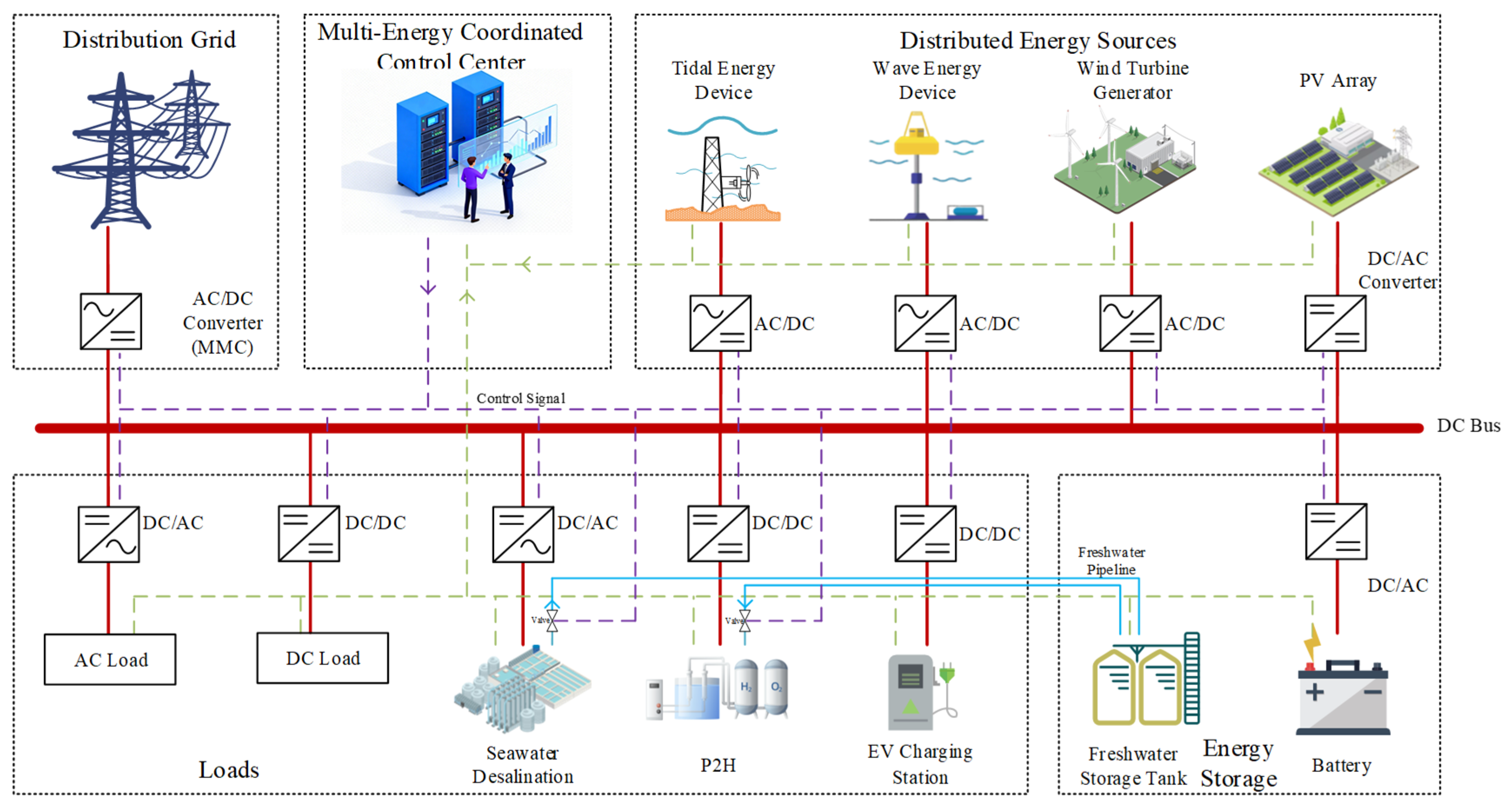
3.1. Multi-Energy Coupling System Architecture
3.2. Models of Distributed Energy Generation Units
3.2.1. Wind Power Generation Model
3.2.2. Photovoltaic Cell Model
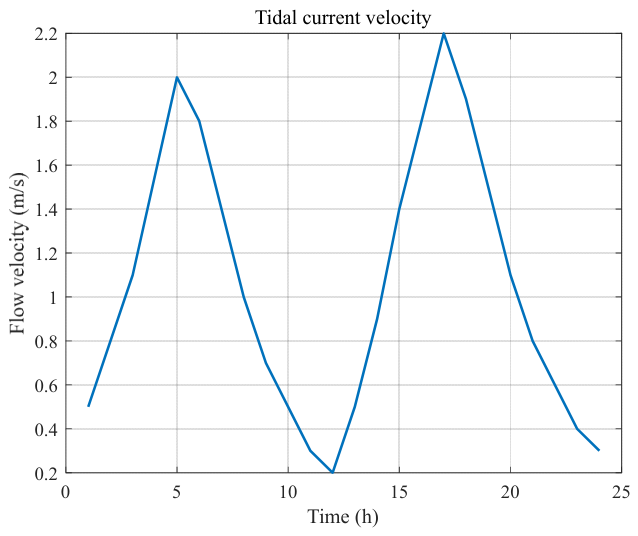
3.2.3. Tidal Current Energy Generation Model
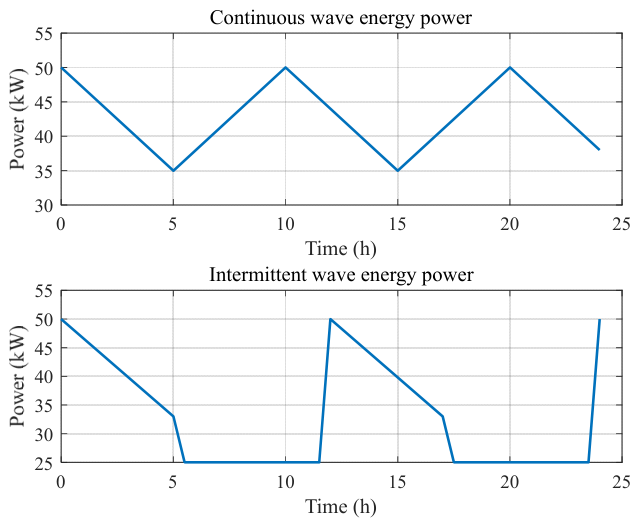
3.2.4. Wave Energy Conversion Model
4. Solution Method
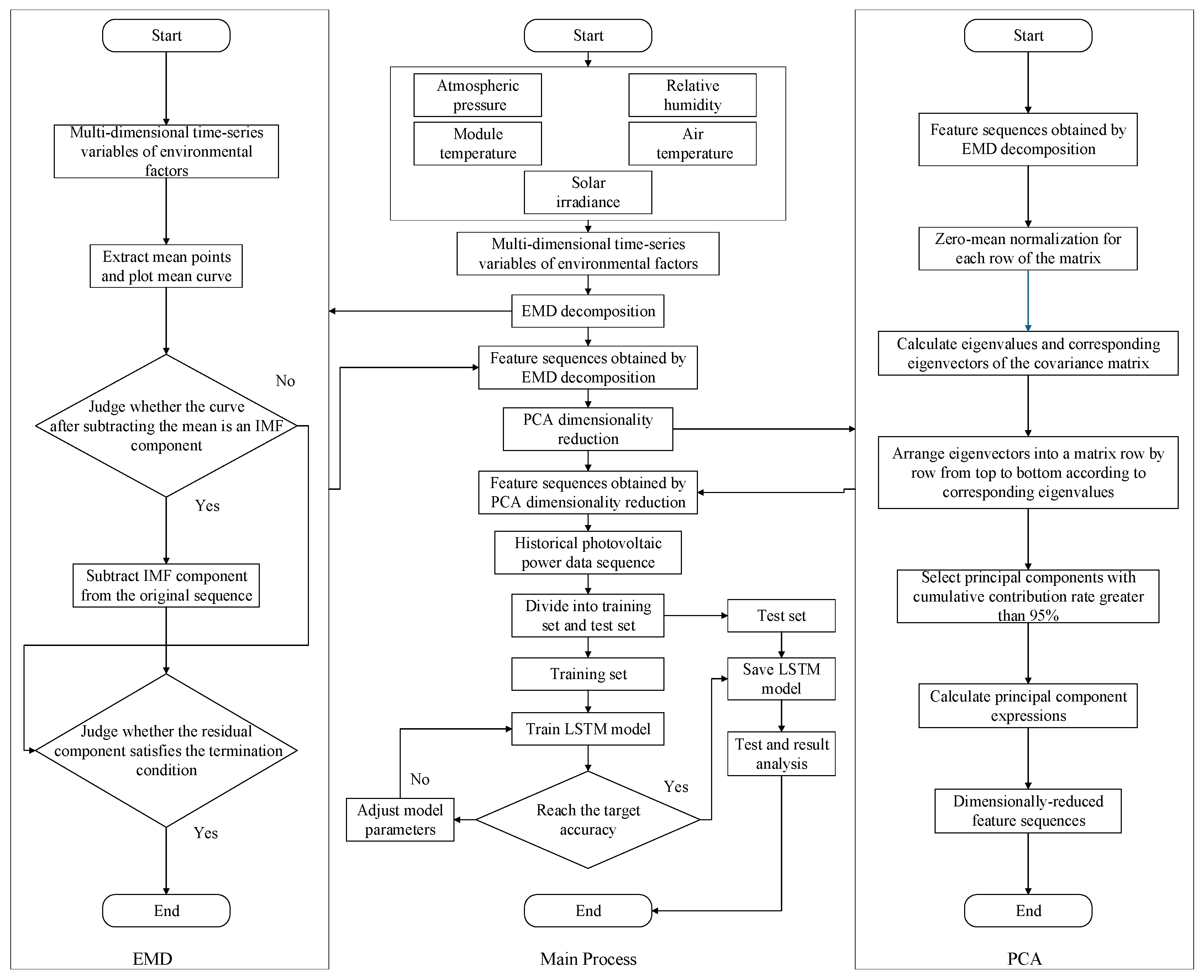
4.1. Prediction Model Based on EMD–PCA–LSTM
- (1)
- Data cleaning: The collected photovoltaic power data and environmental data are preprocessed to remove invalid data. Specifically, abnormal or “bad data” caused by communication failures or other operational issues are eliminated on a daily basis.
- (2)
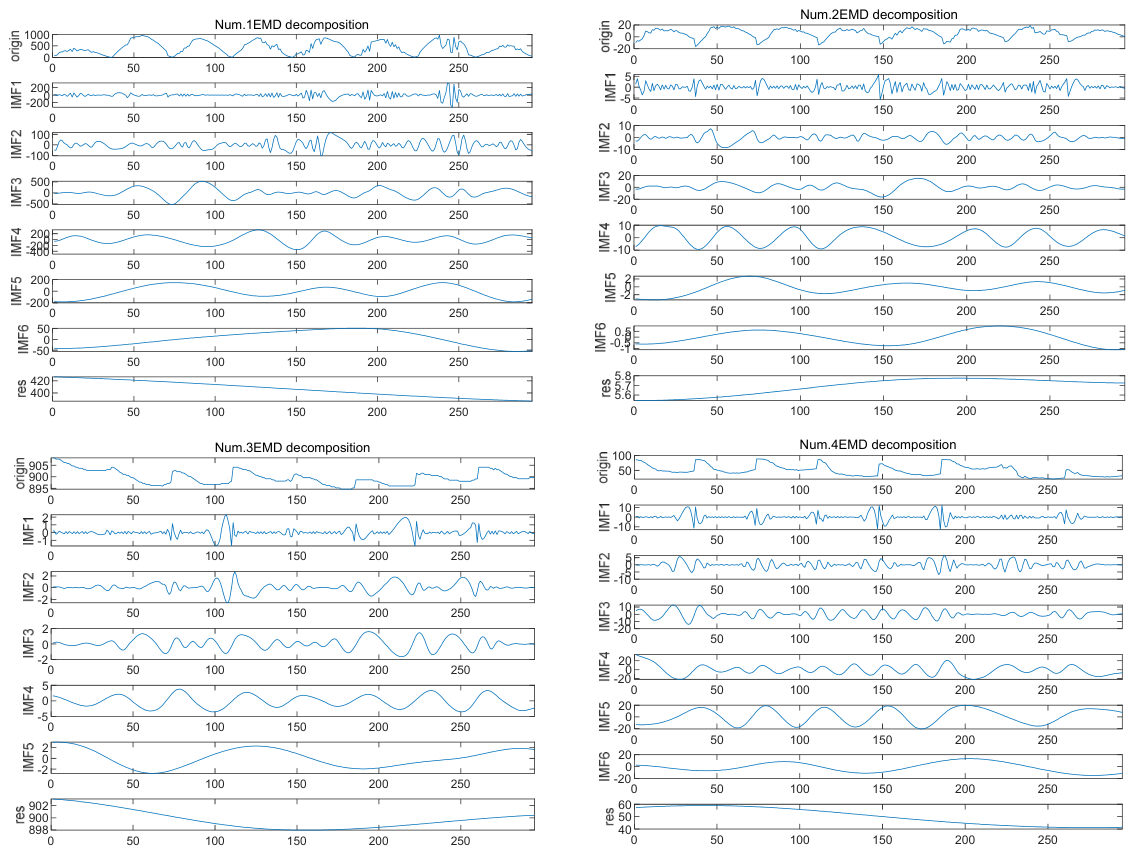
- EMD decomposition: The environmental data are decomposed into intrinsic mode functions (IMFs) with different frequencies and a residual component r using the EMD algorithm. This process decomposes the original environmental sequences into multiple characteristic fluctuation components, thereby extracting variations and trends at different time scales.
- (3)
- PCA dimensionality reduction: The decomposed data obtained in Step 2 are further processed using PCA. The PCA algorithm is employed to extract the key factors influencing photovoltaic power output while reducing redundancy and correlation among the multi-scale time series generated by EMD.
- (4)
- Data normalization: The dimensionally reduced data from Step 3, together with historical photovoltaic power data, are normalized and transformed into a dataset suitable for LSTM training. The dataset is then divided into training and testing sets.
- (5)
- Model training: The parameters of the LSTM model are initialized, and the training set is input into the model for training until the target accuracy is achieved.
- (6)
- Model testing: After training is completed, the trained model is saved, and the test set is used for evaluation.
- (7)
- Evaluation output: The model evaluation indicators RMSE, MAE, and R2 are obtained, and the process ends.
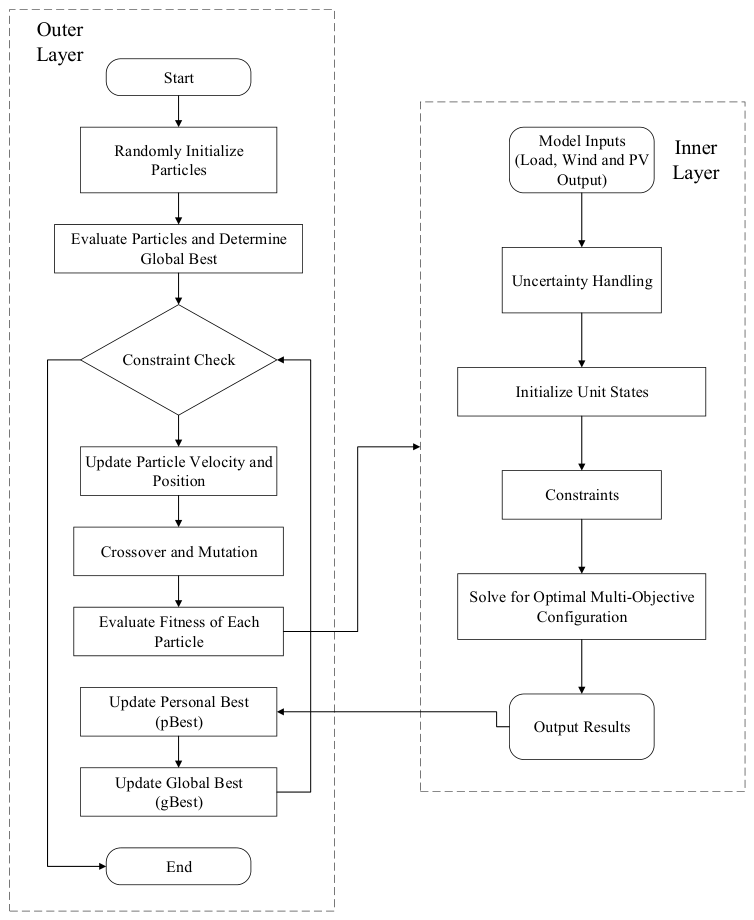
4.2. Bi-Level Configuration Model
4.2.1. Operation Layer
- (1)
- Objective Function
- (2)
- Operational Constraints
4.2.2. Planning Layer
- (1)
- Objective Function
- (2)
- Constraints
5. CVaR-Based Risk Planning Model
6. Case Study Analysis
6.1. Basic Data
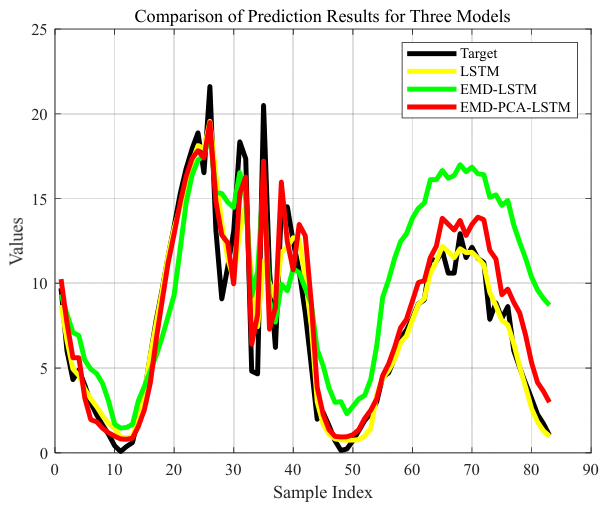
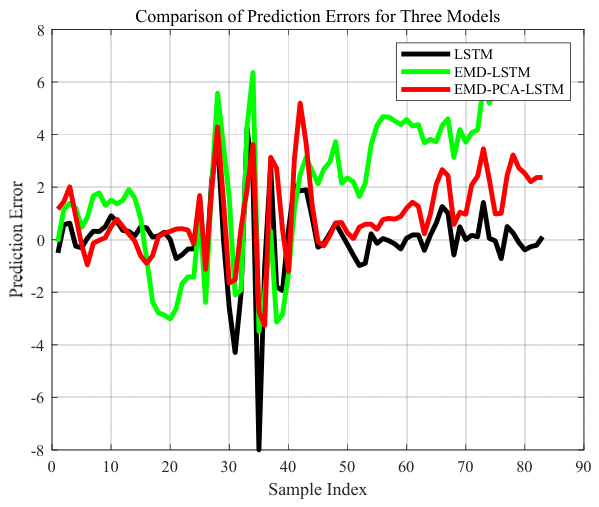
6.2. Analysis of Prediction Results
6.3. Analysis of Capacity Configuration Optimization Results
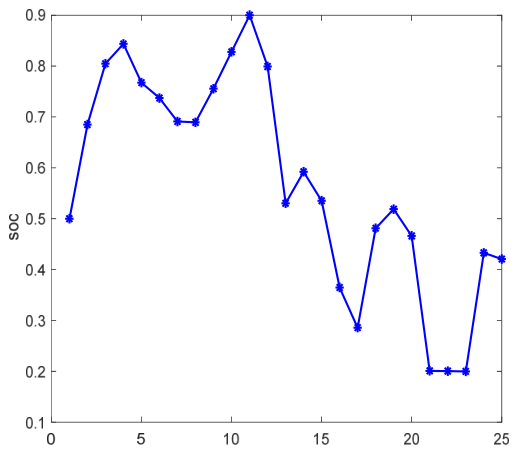
6.4. Analysis of System Optimal Scheduling Results
7. Conclusions
- (1)
- A multi-energy coupled system model including wind energy, photovoltaic, tidal current energy, wave energy, energy storage, hydrogen production via electrolysis, and desalination load is constructed. The complementary relationships among different energy units and the energy flow paths are systematically characterized, laying a foundation for the optimal operation of offshore integrated energy systems.
- (2)
- To address the high uncertainty of renewable energy and load, a hybrid prediction model based on EMD–PCA–LSTM is developed. Through decomposition, denoising, and feature extraction of the original sequences, the model significantly improves prediction accuracy and provides reliable data input for subsequent optimal scheduling.
- (3)
- A bi-level capacity configuration method based on joint operation–planning optimization is proposed. At the planning layer, Conditional Value at Risk (CVaR) is innovatively introduced to quantify the economic risk under extreme scenarios. With the minimization of the annualized total system cost and risk cost as the combined objective, an optimal balance between economic performance and robustness of energy and storage units is achieved.
- (4)
- The results verify the feasibility and superiority of the proposed method. The proposed framework effectively improves renewable energy accommodation and reduces the renewable energy curtailment rate to 0.7%. Meanwhile, the EMD–PCA–LSTM prediction model achieves higher prediction accuracy and better generalization capability compared with traditional LSTM-based models. Through the coordinated effects of high-accuracy prediction, risk-quantified decision-making, and bi-level scheduling optimization, the proposed method enhances both economic performance and operational stability of offshore integrated energy systems.
Author Contributions
Funding
Data Availability Statement
Conflicts of Interest
Nomenclature
| Abbreviations | |
| Abbreviation | Description |
| AC | Alternating current |
| DC | Direct current |
| IES | Integrated energy system |
| VPP | Virtual power plant |
| PV | Photovoltaic |
| WT | Wind turbine |
| WEC | Wave energy converter |
| ESS | Energy storage system |
| EV | Electric vehicle |
| EMD | Empirical mode decomposition |
| PCA | Principal component analysis |
| IMF | Intrinsic mode function |
| LSTM | Long short-term memory |
| RNN | Recurrent neural network |
| PSO | Particle swarm optimization |
| CVaR | Conditional value-at-risk |
| VaR | Value-at-risk |
| SOC | State of charge |
| RMSE | Root mean square error |
| MAE | Mean absolute error |
| R2 | Coefficient of determination |
| LCOE | Levelized cost of electricity |
| Indices | |
| Symbol | Description |
| Index of time period | |
| Index of scenario | |
| Index of energy component | |
| Set of scenarios | |
| Total number of samples | |
| Total number of energy components considered in the planning model | |
| Variables and Parameters | |
| Symbol | Description |
| Output power of the wind turbine at time | |
| Output power of photovoltaic generation at time | |
| Real-time output power of tidal current generation at time | |
| Wave energy output power under continuous operating conditions at time | |
| Wave energy output power under intermittent operating conditions at time | |
| Total wave energy output power at time | |
| Objective function of the operation layer | |
| Objective function of the planning layer | |
| System operating cost | |
| Investment cost | |
| System revenue | |
| Renewable energy curtailment ratio | |
| Penalty coefficient for renewable energy curtailment | |
| Total available renewable energy power at time | |
| Utilized renewable energy power at time | |
| Operating cost coefficients of different system units | |
| Revenue coefficients of flexible loads and electricity sales | |
| Wind power output | |
| Photovoltaic power output | |
| Tidal current power output | |
| Wave energy power output | |
| Battery discharge power | |
| Electric vehicle power | |
| Seawater desalination power | |
| Electrolyzer power | |
| Purchased power from the external grid | |
| Sold power to the external grid | |
| Stored energy of the battery at time | |
| Battery charging power at time | |
| Battery discharging power at time | |
| Battery charging efficiency | |
| Battery discharging efficiency | |
| Time interval | |
| State of charge of the energy storage system at time | |
| Discount rate | |
| Project lifetime | |
| Unit investment cost of the -th energy component | |
| Installed capacity of the -th energy component | |
| Number of wind turbine units | |
| Number of photovoltaic units | |
| Number of wave energy units | |
| Number of tidal current energy units | |
| Number of energy storage units | |
| CVaR value | |
| Estimated value of CVaR | |
| VaR value at confidence level | |
| Confidence level | |
| Loss function | |
| Decision variables of the planning model | |
| Stochastic variables associated with renewable energy output and load fluctuations | |
| Probability density function of | |
| The -th sample of the stochastic variable | |
| Risk preference coefficient | |
| Probability of scenario | |
| Profit or objective value under scenario | |
| VaR value of VPP profit | |
| Auxiliary variable representing the excess of VPP profit over in scenario | |
| Day-ahead profit of the VPP under scenario | |
| Investment cost in LCOE calculation | |
| Operational cost in LCOE calculation | |
| Maintenance cost in LCOE calculation | |
| Economic benefit or operational revenue | |
| Total equivalent energy output during the lifecycle | |
Appendix A. Mathematical Formulations of the RNN and LSTM Networks
References
- Xiong, B.; Wang, D.; Hao, S.; Wang, Z.; Zhang, C.; Huang, M.; Li, S.; Xiao, G. Opportunities, challenges, and perspectives on the high-quality development of new energy driven by global energy transition. Acta Pet. Sin. 2026, 47, 74–94. [Google Scholar]
- Chen, L.; Liao, Y.; Pan, Q.; Wu, C.; Wang, Z. Integration of Wind-Solar-Wave-Current Energy and Water Transportation: Current Status and Prospects. J. Chang. Univ. Sci. Technol. (Nat. Sci.) 2026, 23, 68–86. [Google Scholar]
- Wu, F.; Ju, P.; Qin, C.; Li, L.; Tao, A.; Sun, L. Progress and prospect of research on offshore renewable energy generation. J. Hohai Univ. (Nat. Sci.) 2014, 42, 80–87. [Google Scholar]
- Du, W.J.; Cai, G.T.; Qi, X.L.; Wang, P.; Zhang, J.X. Review on development and utilization of offshore renewable energy: An analysis based on a five-dimensional framework. Resour. Sci. 2025, 47, 675–690. [Google Scholar]
- Liu, S.G.; Zhang, P.; Zhao, X.Y. Study on integrated development and utilization modes of China’s offshore renewable energy from the perspective of new-quality productivity. Resour. Sci. 2025, 47, 691–702. [Google Scholar]
- Michaelis, D. Energy Island. In OCEANS 2003. Celebrating the Past … Teaming Toward the Future; IEEE: San Diego, CA, USA, 2003; Volume 4, pp. 2294–2302. [Google Scholar] [CrossRef]
- Liu, S. Design and Research on Foundational Platform of Offshore Complementary Power System with Wind and Wave Energy. Master’s Thesis, North China Electric Power University, Beijing, China, 2014. (In Chinese) [Google Scholar]
- Lü, C.; Liu, S.; Wang, S.; Lan, Y.; Rao, Y. Discussion on advances in power generation equipment and technology for marine renewable energy and its issues. J. Hydroelectr. Eng. 2015, 34, 195–198. [Google Scholar]
- Wang, S.; Li, Z.; Yu, T.; Ma, C. A review of research on multi-energy complementary ocean energy integrated power generation technology. Mar. Sci. Bull. 2019, 38, 241–249. [Google Scholar]
- Yu, H. Design and Application of the Wind-Photovotaic-Storage Complementary Microgrid System. Sci. Technol. Inf. 2023, 21, 94–97. [Google Scholar]
- Delbeke, O.; Bastianel, G.; Yurtseven, K.; Ergun, H.; Moschner, J.D.; Driesen, J. Hybrid offshore solar-wind farms: The potential of integrating floating photovoltaics with offshore wind. Appl. Energy 2026, 410, 127486. [Google Scholar] [CrossRef]
- Shi, X.; Chen, J.; Gao, Q.; Tang, P.; He, F. Complementary value of wave and tidal current energy in the power grid and their impact on balanced energy demand. Renew. Energy 2026, 261, 125311. [Google Scholar] [CrossRef]
- Li, P.; Lian, J.; Ma, C.; Zhang, J. Complementarity and development potential assessment of offshore wind and solar resources in China seas. Energy Convers. Manag. 2023, 296, 117705. [Google Scholar] [CrossRef]
- An, L.; Wang, M.; Qi, X.; Li, F.; Qu, T. Optimal dispatching of multi-power sources containing wind/photovoltaic/thermal/hydro-pumped and battery storage. Renew. Energy 2018, 36, 1492–1498. [Google Scholar]
- Ma, X.; Liang, C.; Dong, X.; Li, Y. Multi-objective reactive power optimization strategy of power system considering large-scale renewable integration. Front. Energy Res. 2023, 11, 1213154. [Google Scholar] [CrossRef]
- Li, X.; Wang, X.; Gu, J.; Xu, J. Day-Ahead Optimal Dispatching of Wind-Solar-Thermal Power Storage System Considering Deep Peak Shaving of Thermal Power. China Electr. Power 2023, 56, 1–7+48. [Google Scholar]
- Nan, B.; Jiang, C.; Dong, S.; Xu, C. Day-ahead and Intra-day Coordinated Optimal Scheduling of Integrated Energy System Considering Uncertainties in Source and Load. Power Syst. Technol. 2023, 47, 3669–3683. [Google Scholar]
- Zhu, Y.; Geng, Q. Capacity Allocation and Operation Optimization of Integrated Energy Park System Coupled with Hydrogen Energy Storage. Mod. Electr. Power 2023, 40, 931–938. [Google Scholar]
- Li, R.; Zhang, X.; Xu, Y.; Sun, W.; Zhou, X.; Guo, C.; Chen, H. Research on optimal configuration of hybrid energy storage capacity for wind-solar generation system. Energy Storage Sci. Technol. 2019, 8, 512–522. [Google Scholar]
- Zhang, Y.; Sun, H.; Tan, J.; Li, Z.; Hou, W.; Guo, Y. Capacity configuration optimization of multi-energy system integrating wind turbine/photovoltaic/hydrogen/battery. Energy 2022, 252, 124046. [Google Scholar] [CrossRef]
- Fu, J.; Zeng, G.; Ji, Y.; Zhou, A. Development of a Capacity Allocation Model for the Multi-Energy Hybrid Power System. J. Therm. Sci. 2025, 34, 936–952. [Google Scholar] [CrossRef]
- Yang, T.; Yang, Z.; Li, F.; Wang, H. A short-term wind power forecasting method based on multivariate signal decomposition and variable selection. Appl. Energy 2024, 360, 122759. [Google Scholar] [CrossRef]
- Sharief Basha, S.; Nagaraja Rao, A.; Nida Fariz, T.K. Dimensionality reduction in solar radiation forecasting: A combined PCA-SVM framework for renewable energy applications. Front. Environ. Sci. 2025, 13, 1692076. [Google Scholar] [CrossRef]
- Kanagarathinam, K.; Aruna, S.K.; Ravivarman, S.; Safran, M.; Alfarhood, S.; Alrajhi, W. Enhancing sustainable urban energy management through short-term wind power forecasting using LSTM neural network. Sustainability 2023, 15, 13424. [Google Scholar] [CrossRef]
- Guo, Y.; Ming, B.; Huang, Q.; Wang, Y.; Li, Y. Day-Ahead Robust Optimal Scheduling of Hydro-Wind-PV-Storage Complementary System Considering the Steadiness of Power Delivery. Trans. China Electrotech. Soc. 2023, 38, 2350–2363. [Google Scholar]
- Zhang, J.; Zhu, Y.; Li, X.; Liu, L. Optimization Scheduling Strategy of Offshore Wind Farm Power System Considering Wind Power Uncertainty. Distrib. Energy 2021, 6, 33–43. [Google Scholar]
- Rockafellar, R.T.; Uryasev, S. Optimization of Conditional Value-at-Risk. J. Risk 2000, 2, 21–42. [Google Scholar] [CrossRef]
- Inzunza, A.; Moreno, R.; Bernales, A.; Rudnick, H. CVaR-constrained planning of renewable generation with consideration of system inertial response, reserve services and demand participation. Energy Econ. 2016, 59, 104–117. [Google Scholar] [CrossRef]
- Fan, H.; Liu, Y.; Wang, C.; Wang, W. Capacity Optimization and Rolling Scheduling of Offshore Multi-Energy Coupling Systems. Energies 2026, 19, 447. [Google Scholar] [CrossRef]



| Unit Type | Wind Power | EV | Solar Power | Seawater Desalination | Wave Energy | Hydrogen Production | Tidal Energy | Battery |
|---|---|---|---|---|---|---|---|---|
| Capacity per Unit (kW) | 1500 | 200 | 6 | 500 | 50 | 200 | 70 | 300 |
| Unit Type | Wind Power | Solar Power | Wave Energy | Tidal Energy | Battery |
|---|---|---|---|---|---|
| Investment Cost (CNY/kW) | 14,000 | 5800 | 20,000 | 16,000 | 1500 |
| Lifetime (years) | 30 | 20 | 25 | 25 | 10 |
| Unit Type | Wind Power | Solar Power | Wave Energy | Tidal | Battery | EV | Hydrogen Production | Seawater Desalination |
|---|---|---|---|---|---|---|---|---|
| LCOE (CNY/kW) | 0.15 | 0.1 | 0.3 | 0.25 | 0.13 | −0.5 | −0.7 | −0.8 |
| Time Step | Input Dimension | Hidden Layers | Hidden Units | Output Dimension | Batch Size | Training Epochs | Training Samples | Test Samples |
|---|---|---|---|---|---|---|---|---|
| 1 | 9 | 1 | 50 | 1 | 10 | 500 | 4866 | 2086 |
| Model | RMSE | MAE | R2 |
|---|---|---|---|
| LSTM | 1.851 | 1.032 | 0.886 |
| EMD-LSTM | 3.676 | 3.192 | 0.551 |
| EMD-PCA-LSTM | 1.259 | 0.777 | 0.929 |
| Risk Coefficient | Wind Units | PV Units | ESS Units | Tidal Units | Wave Units | Net Cost (107 yuan) | CVaR Cost (107 yuan) |
|---|---|---|---|---|---|---|---|
| 0.05 | 3 | 350 | 8 | 15 | 20 | 1.190 | 1.349 |
| 0.1 | 4 | 326 | 10 | 13 | 22 | 1.196 | 1.337 |
| 0.2 | 4 | 247 | 13 | 14 | 21 | 1.211 | 1.322 |
| 0.4 | 4 | 333 | 13 | 14 | 21 | 1.237 | 1.318 |
| 0.6 | 4 | 388 | 17 | 14 | 21 | 1.266 | 1.315 |
| 0.8 | 5 | 218 | 21 | 13 | 21 | 1.283 | 1.304 |
| 1 | 5 | 200 | 29 | 14 | 20 | 1.305 | 1.295 |
Disclaimer/Publisher’s Note: The statements, opinions and data contained in all publications are solely those of the individual author(s) and contributor(s) and not of MDPI and/or the editor(s). MDPI and/or the editor(s) disclaim responsibility for any injury to people or property resulting from any ideas, methods, instructions or products referred to in the content. |
© 2026 by the authors. Licensee MDPI, Basel, Switzerland. This article is an open access article distributed under the terms and conditions of the Creative Commons Attribution (CC BY) license.
Share and Cite
Fan, H.; Liu, Y.; Chen, Z.; Wang, C.; Wang, W. Capacity Optimization of Offshore Microgrids Considering Uncertainty and Conditional Risk. Energies 2026, 19, 2585. https://doi.org/10.3390/en19112585
Fan H, Liu Y, Chen Z, Wang C, Wang W. Capacity Optimization of Offshore Microgrids Considering Uncertainty and Conditional Risk. Energies. 2026; 19(11):2585. https://doi.org/10.3390/en19112585
Chicago/Turabian StyleFan, Honggang, Yan Liu, Zipeng Chen, Cui Wang, and Wankun Wang. 2026. "Capacity Optimization of Offshore Microgrids Considering Uncertainty and Conditional Risk" Energies 19, no. 11: 2585. https://doi.org/10.3390/en19112585
APA StyleFan, H., Liu, Y., Chen, Z., Wang, C., & Wang, W. (2026). Capacity Optimization of Offshore Microgrids Considering Uncertainty and Conditional Risk. Energies, 19(11), 2585. https://doi.org/10.3390/en19112585