Review

Market-Oriented Transaction Rules and Policy Orientations of China’s New Power System Under Electricity–Carbon–Green Certificate Market Synergy


1
School of Public Policy and Management, China University of Mining and Technology, Xuzhou 221116, China
2
School of Economics and Management, Yanshan University, Qinhuangdao 066000, China
*
Author to whom correspondence should be addressed.
Energies 2026, 19(11), 2581; https://doi.org/10.3390/en19112581
Submission received: 31 March 2026 / Revised: 19 May 2026 / Accepted: 22 May 2026 / Published: 27 May 2026

Abstract

Developing market-oriented transaction rules for a new power system with electricity–carbon–green certificate synergy is a key support for promoting the green and low-carbon transformation of China’s energy sector. Based on the literature review and policy analysis methods, this paper systematically examines the evolutionary characteristics of market-oriented transaction rules in the new power system, analyzes the operational status and core issues of the electricity market, carbon market, and green certificate market, deeply interprets the synergy logic and institutional connection points of the electricity–carbon–green certificate trinity, and clarifies the shortcomings of current research and future research directions. The study finds that, according to existing literature, the market-oriented transaction rules of the new power system have shifted from “market construction” to “rule synergy”. Although the three markets have established basic operational frameworks, each still faces distinct institutional constraints, and the effectiveness of their coordination depends on market access and participant inclusion, price formation and value transmission, electricity–carbon–green certificate coordination, and cost allocation and settlement governance. Effective coordination also requires safeguards against carbon price dilution, duplicate environmental-attribute claims, and cross-market risk transmission.

1. Introduction

1.1. Background and Problem Statement

Under the dual constraints of China’s dual-carbon goals and energy security requirements, market-oriented transaction rules in the new power system have gradually become an important institutional issue in the country’s energy transition [1,2,3]. With the rapid expansion of installed renewable-energy capacity, the key challenge facing China’s power system is no longer confined to the scale of clean energy supply. It has further extended to the identification of capacity value, the provision of system support capability, the management of operational uncertainty, and the response to extreme weather risks under conditions of high shares of renewable energy integrated into the grid [4,5,6,7]. More importantly, attention now turns to whether market mechanisms can accommodate high shares of renewable energy, support cross-regional resource allocation, and provide sufficient flexibility for system operation. In this context, the construction of a unified national electricity market is increasingly becoming an important institutional vehicle for coordinating market-based resource allocation with the green and low-carbon transition.
Against the backdrop of new power system development, the parallel development of the electricity market, carbon market, and green certificate market is driving the continued adjustment of institutional arrangements in China’s power sector. The three markets perform distinct yet interrelated governance functions: the electricity market is mainly responsible for power trading, price discovery, and system balancing; the carbon market translates emissions constraints into compliance costs and carbon price signals; and the green certificate market carries the confirmation and trading of the environmental attributes of renewable energy. Although all three markets jointly serve the low-carbon transition, they differ in terms of value carriers, regulatory logic, benefit distribution, and responsibility boundaries. Therefore, the key issue that now needs to be addressed is no longer simply how to improve each market separately, but how to achieve cross-market rule alignment so that electricity value, carbon costs, and environmental attributes can operate in a coordinated manner within an interconnected institutional framework [8,9,10,11].
Consistency in policy objectives does not necessarily imply coordination at the rule level now. As renewable energy is progressively incorporated into market transactions, the unified national electricity market continues to evolve, and the green certificate system is further refined, a key question arises: have China’s current market-oriented transaction rules already formed a relatively clear, coordinated, and operational institutional framework capable of supporting the coordinated operation of the electricity market, carbon market, and green certificate market? This question matters because the institutional tensions among the three markets are no longer manifested primarily in the parallel configuration of isolated policy instruments, but are increasingly concentrated in rule interfaces, value transmission, compliance boundaries, and settlement governance.

1.2. Existing Research on Three-Market Coordination and Its Limitations

Existing research on China’s low-carbon power transition has discussed the electricity market, carbon market, and green certificate market extensively, yet most studies still proceed along relatively separate lines. Research on the electricity market has mainly focused on market-oriented reform, spot market development, joint clearing of ancillary services, and behavioral adjustment of generation-side entities. Some studies have further examined issues such as flexibility resources, new types of load-side participants, demand response, and the identification of renewable-energy capacity value, indicating that single-market research has expanded from traditional analyses of trading mechanisms to more complex dimensions such as price signals, participant behavior, and system value representation [12,13,14,15,16]. Research on the carbon market and green certificate market has mainly concentrated on topics such as allowance allocation, compliance design, price discovery, certificate pricing, subsidy substitution, and the realization of environmental attributes [8,9,11,17]. Overall, these studies have deepened the understanding of the internal operating mechanisms of each market, but they still tend to discuss them within separate institutional frameworks.
Further research has begun to examine the bilateral relationships among these market arrangements. Studies on electricity–carbon interactions mainly focus on the conditions under which carbon costs can be transmitted to electricity prices and generation decisions. Studies on electricity–green certificate interactions primarily examine how environmental attributes are embedded into electricity trading through quota obligations, property-right rules, and green-value pricing. Studies on carbon–green certificate interactions, by contrast, largely treat them as a policy-mix issue, discussing whether carbon constraints and renewable-energy support instruments are complementary, redundant, or overlapping. Overall, this line of research has clarified important mechanisms such as price linkage, carbon-cost pass-through, and environmental-attribute allocation, but it still tends to understand coordination through partial interfaces rather than through a unified analytical perspective [8,9,10,11,18].
More recent studies have begun to address three-market coordination more directly, mainly from the perspectives of multi-market coupling, policy synergy, and behavioral adjustment by power generation firms, with particular attention to joint clearing, coordinated quota design, and the redistribution of revenues and costs [10,19]. Nevertheless, the existing literature remains clearly unbalanced. On the one hand, most studies still rely on model simulations and scenario analysis. On the other hand, some studies have extended the research scope to technical and application-oriented issues such as renewable-energy capacity value, hybrid energy system configuration, distribution network optimization, and AI-enabled risk management in the carbon market [14,17,20,21,22]. Studies that can explain how the three markets are institutionally connected from the perspective of a unified rule framework remain limited.
Therefore, the main limitation of the existing literature lies not in the lack of discussion of individual markets or certain forms of coupling, but in the lack of integrated analysis of how the electricity market, carbon market, and green certificate market interact through institutional design. In particular, systematic discussion remains insufficient with regard to such key issues as rule interfaces, value transmission, compliance boundaries, and settlement governance.

1.3. Review Purpose, Conceptual Framework, and Contributions

This review aims to examine the evolutionary logic of market-oriented transaction rules in China’s new power system from the perspective of the collaborative governance of the electricity market, carbon market, and green certificate market. Rather than treating these three markets simply as separate institutional arrangements, this study understands them as an interconnected and interactive institutional system in the process of new power system development.
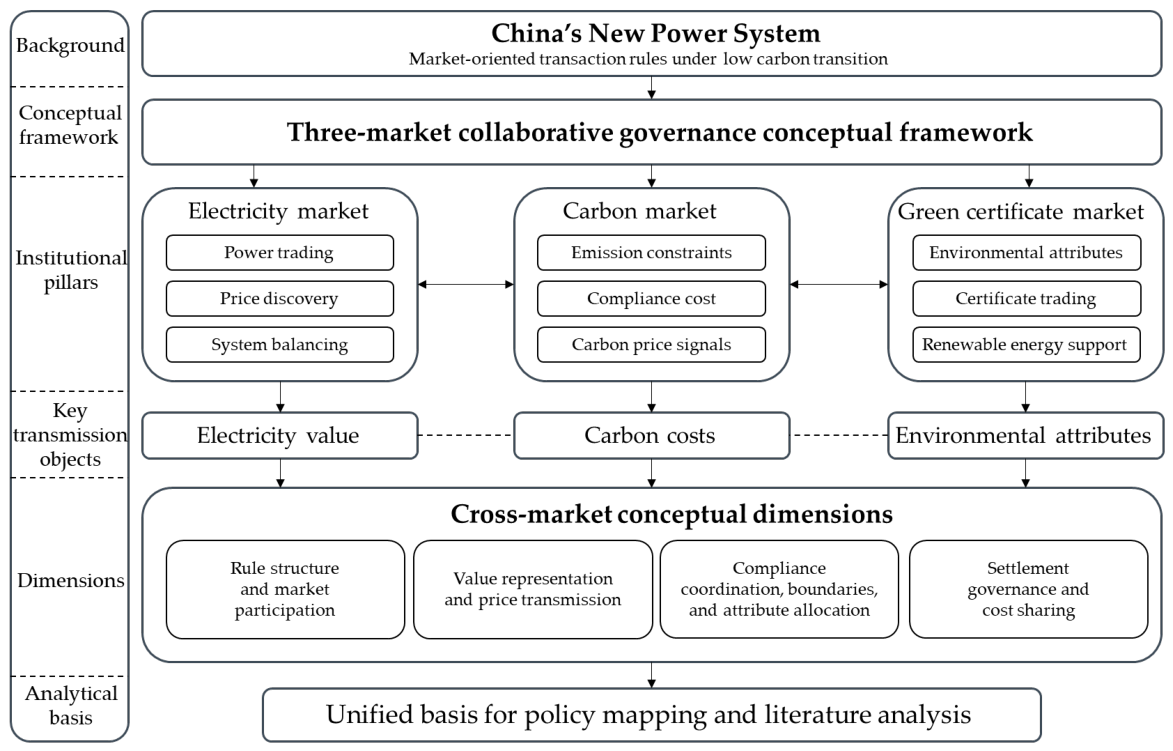
The review is defined primarily in terms of institutional issues rather than purely technical ones. It focuses on the market rules, policy arrangements, and governance mechanisms associated with China’s electricity market, carbon market, and green certificate market, with particular attention to their evolution in the context of new power system development. Rather than attempting a comprehensive review of all energy-transition policies or engineering and technical issues, this study concentrates on policy evolution, market operation, institutional interfaces, and the institutional tensions that arise when different forms of value and responsibility arrangements must be aligned across multiple market systems. On this basis, this study develops a conceptual framework for three-market collaborative governance, as shown in Figure 1. The framework is built upon three institutional pillars—the electricity market, carbon market, and green certificate market—and is organized around four cross-market analytical dimensions: (1) rule structure and market participation; (2) value representation and price transmission; (3) compliance coordination, boundaries, and attribute allocation; and (4) settlement governance and cost sharing. This framework is intended to explain how electricity value, carbon costs, and environmental attributes are represented, transmitted, and governed across interrelated market arrangements, and to provide a unified analytical foundation for the subsequent policy mapping and literature analysis.
The contributions of this review are threefold. First, it develops a unified conceptual framework for examining the collaborative governance of the three markets, thereby moving beyond fragmented discussions that centered on a single market or partial bilateral mechanisms. Second, it integrates policy evolution and academic research within a common rule-based perspective, revealing that studies consistently indicate market-oriented transaction rules in China’s new power system are shifting from market construction to rule coordination. Third, it identifies the key institutional bottlenecks currently constraining three-market coordination, particularly those related to rule interfaces, value transmission, compliance boundaries, and settlement governance.

1.4. Coding Method and Policy Mapping

To trace the policy evolution of market-oriented transaction rules under China’s new power system, this study constructs a structured policy corpus, mainly comprising national-level policy documents and related industry policy texts issued between 2021 and 2025. All texts directly related to market-oriented reform, cross-market coordination, or the governance of electricity, carbon, and green certificate arrangements are included in the corpus. In contrast, local or enterprise-level texts that do not directly reflect the rule structure of three-market coordination are not treated as primary analytical materials.
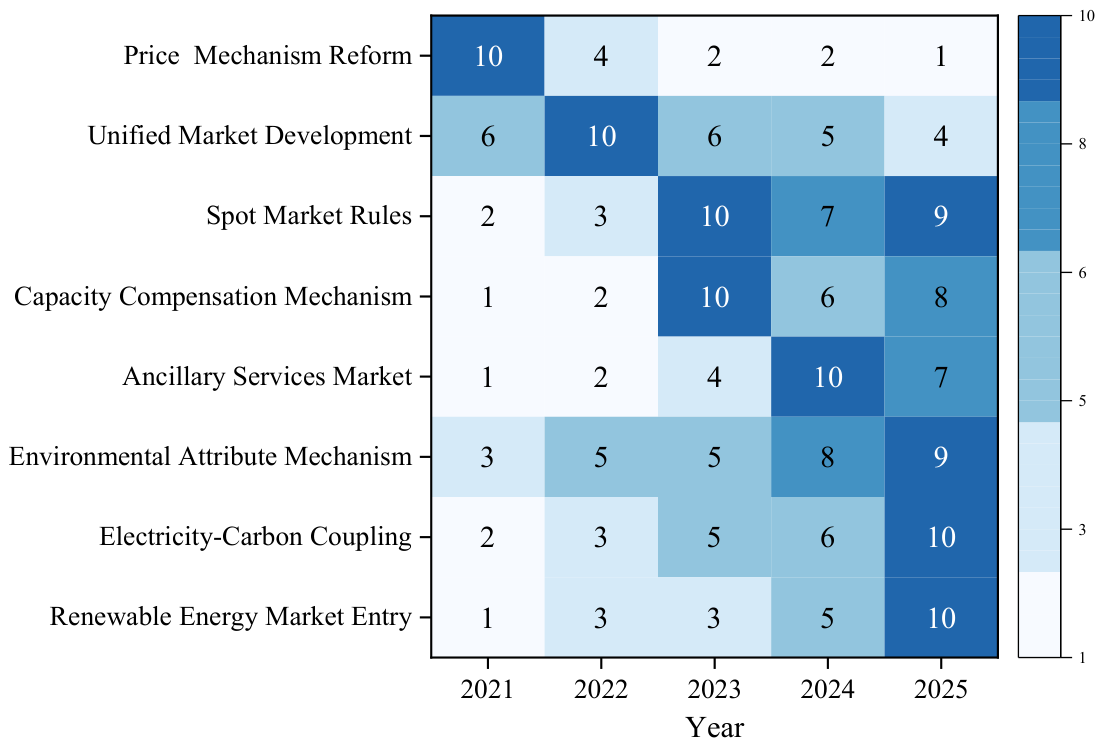
The coding scheme of this study is based on the above conceptual framework for three-market collaborative governance. In the policy text analysis, this framework is further operationalized into four coding dimensions: market access and participation, price formation and value, electricity–carbon–green certificate coordination, and cost allocation and settlement. Among them, market access and participation correspond to rule structure and market participation; price formation and value correspond to value representation and price transmission; electricity–carbon–green certificate coordination mainly corresponds to the cross-market interfaces involving value transmission, compliance, boundaries, and attribute allocation; and cost allocation and settlement correspond to settlement governance and cost sharing. Table 1 summarizes these coding dimensions and their correspondence with the conceptual framework and also provides the scoring scale used in the heatmap.
Each coding dimension is evaluated using a 1–10 intensity scale and visualized in the heatmap through five interval groups. During the coding process, each policy text was independently scored by multiple researchers, and the median score was adopted as the final intensity value for each dimension; items with substantial scoring discrepancies were further calibrated through discussion. The specific interval definitions are provided in Table 1. On this basis, Figure 2 presents the annual distribution of key policy themes in China’s market-oriented transaction rules from 2021 to 2025. As reflected in the annual distribution shown in Figure 2, policy attention in the earlier stage was mainly concentrated on unified market development, price mechanism reform, and spot market rules, whereas the later stage gradually shifted toward renewable energy market entry, environmental attribute mechanisms, electricity–carbon coupling, and rule arrangements related to capacity compensation and ancillary services. This change indicates that the policy focus in the new power system has moved beyond single-market development and is gradually turning toward cross-market rule alignment, value transmission, and governance coordination, thereby reflecting a broader institutional shift from market construction to rule coordination.

1.5. Structure of the Review

The remainder of this review is organized under the guidance of the above conceptual framework for three-market collaborative governance. Section 2 reviews the current operation of the electricity market, carbon market, and green certificate market, together with the rule-related issues associated with each, and on this basis discusses the overall state and practical constraints of three-market coordination. Section 3 then turns to cross-market analysis, focusing on the rule logic, institutional interfaces, and coordination mechanisms among the electricity, carbon, and green certificate markets. Section 4 identifies the main limitations of the existing literature based on the foregoing analysis and proposes key directions for future research. Section 5 concludes by summarizing the study’s main findings and discussing their policy implications for the collaborative governance of China’s new power system.

2. Current Operation and Problems of Market Rules in the Electricity, Carbon, and Green Certificate Markets

2.1. Current Operation and Problems of Electricity Market Rules

In recent years, electricity market reform in China has continued to deepen, and the governing rules have gradually shifted away from administrative allocation toward a layered institutional arrangement in which medium- and long-term transactions, spot trading, and ancillary services operate simultaneously. The literature generally shows that the development of China’s electricity market has not consisted simply of adding a spot market. Instead, it has involved continuous adjustment of tariff formation, market organization, and dispatch operations within the existing institutional framework. The coexistence of medium- and long-term transactions with short-term trading therefore remains a basic characteristic of China’s gradual electricity market reform [23,24]. Empirical evidence from Guangdong Province, China, indicates that a tiered market structure covering medium- and long-term contracts, day-ahead and real-time spot trading, and ancillary services has gradually taken shape [25]. Research on Yunnan Province, China, likewise suggests that, under the continued dominance of medium- and long-term trading, mechanisms such as continuous bilateral trading have been used to diversify trading products, reduce information asymmetry, and improve transaction efficiency [26]. Taken together, these findings show that the current Chinese electricity market is not centered on a single spot market. It has instead developed into a composite institutional arrangement in which transactions across multiple time scales proceed in parallel under system-security constraints.
Although the framework for market-based trading has been steadily improved, price rules remain strongly influenced by price-stabilization objectives and administrative coordination logic. After comparing several spot markets that have operated continuously, Dong and Chai found that upper and lower limits on bid prices and clearing prices are widely imposed across provinces, even though considerable differences remain in price boundaries, settlement constraints, and adjustment methods [27]. Evidence from Guangdong Province, China, likewise shows that price floors and cost compensation for gas-fired units can help preserve market stability, but may also lead to a certain degree of price distortion and welfare redistribution [25]. Other studies further indicate that, although reform has improved the efficiency of economic dispatch and resource allocation, local protectionism, regulatory constraints, and administrative intervention have not fully retreated. As a result, the formation and transmission of price signals still retain strong policy-adjustment features [28,29,30]. Under these conditions, the current spot market is better understood as a mechanism that seeks to balance price discovery, system stability, and policy objectives, rather than as a fully liberalized pricing regime. This global challenge of balancing short-term market efficiency with long-term stability is evident in Europe, where recent reforms combine short-term markets with long-term Contracts-for-Difference to mitigate price volatility and secure low-carbon investments [31].
A further issue lies in the coordination between medium- and long-term contracts and the spot market. When centralized monthly contract trading continues to play a major role, differences between contract and spot prices may create arbitrage opportunities, and the larger the share of generation not covered by contracts, the stronger the incentive for strategic bidding by generators [32]. Meanwhile, as the construction of the national unified electricity market accelerates, the lack of coordination between interprovincial and intraprovincial markets has become more visible. Under the model of a unified market with two-level operation, if intraprovincial markets treat interconnection power flows only as boundary conditions, the results of interprovincial transactions may cause transmission-line overload during intraprovincial clearing [33]. Other studies similarly show that cross-regional trading helps optimize resource allocation and improve renewable energy consumption. Yet, inconsistent rules, inadequate treatment of network constraints, and high regional coordination costs continue to limit the efficiency gains expected from a unified market [34,35,36]. Managing network constraints is a universal market design challenge. Foundational global research demonstrates that allocating transmission rights during congestion can interact with local market power, allowing dominant generators to further reduce overall economic welfare [37].
At the same time, the continued expansion of renewable energy integration is changing both the range of market participants and the composition of value in the electricity market. A number of studies show that, although flexibility resources in China are still concentrated mainly in the ancillary services market, emerging actors such as energy storage and virtual power plants are gradually extending into the energy market as renewable penetration rises and the spot market develops [38,39,40]. By coordinating day-ahead bids with real-time adjustments, virtual power plants can reduce deviation risk and improve spot-market returns [39]. Trading outcomes in both day-ahead and real-time markets are also sensitive to storage configuration, risk preferences, and forecasting errors in renewable generation [40]. This suggests that the participation model of virtual power plants is shifting from single-market ancillary services toward multi-timescale and multi-market coordination. Future electricity market rules, therefore, need to respond more clearly to how flexibility resources enter trading, form prices, and obtain reasonable compensation.
Existing studies show that China’s electricity market has formed a basic framework. This framework includes medium- and long-term trading, spot trading, cross-regional trading, and ancillary services. Market development has shifted focus. It now aims to coordinate rules across layers rather than merely launch a spot market. The more prominent contradiction today is not the absence of market mechanisms, but the lack of stable and consistent institutional interfaces among price formation, contract decomposition, network constraints, and the participation of new market entities. Put differently, electricity market reform is moving from a stage of market construction to a stage of rule coordination, and future reform needs to strengthen the connections among multi-timescale trading, multi-regional market arrangements, and participation mechanisms for flexibility resources to improve the effectiveness of price signals and the overall efficiency of resource allocation.

2.2. Current Operation and Problems of Carbon Market Rules

In practice, China’s carbon market started later, but studies show its rule construction has progressed rapidly. Since the launch of local pilot schemes, the carbon trading system has gradually formed a basic framework covering allowance allocation, monitoring, reporting, and verification, trading compliance, and offset mechanisms. It entered an accelerated stage of unification after the launch of the national market. China’s carbon market is generally not viewed as a straightforward transplantation of European or North American cap-and-trade systems. Instead, it has developed as a gradual institutional arrangement shaped by constraints on economic growth, sectoral heterogeneity, and the administrative governance system [41,42,43]. Although the national carbon market has already established a relatively complete trading and compliance mechanism [41], its operating logic remains closer to a tradable performance standard based on emissions-intensity benchmarks than to a conventional cap-and-trade system [42]. This design seeks to balance emission reduction with output stability. Still, it also means that the mechanisms governing price formation and market constraint differ from those of a traditional quantity-control market. The formation of China’s emissions trading system has likewise been characterized by adaptive innovation and policy experimentation, in which local policy innovation played an important role in building the early trading infrastructure and regulatory framework [43].
In terms of policy outcomes, the existing literature does not deny that carbon trading has generated some emission-reduction effects. The main disagreement instead concerns what kind of rule design can make those effects more stable and durable. Studies have found that carbon-trading pilots can improve carbon performance and reduce emissions intensity, mainly through energy-efficiency improvements and adjustments to the energy structure. Among them, sub-sectors that use benchmark-based allowance allocation tend to perform better in both emissions reduction and economic outcomes [44,45]. This echoes the early evaluation of the EU ETS Phase I, in which researchers found it challenging to determine whether observed emission reductions were driven by genuine carbon price-induced abatement or merely by structural over-allocation [46]. This suggests that the focus of the literature has shifted from whether the market works at all to whether existing rules can create stronger and more stable price constraints.
However, the existence of a rule framework does not mean that the national carbon market already has sufficient price-discovery capability. A broad body of research indicates that the national market still exhibits low prices, insufficient liquidity, and a strongly compliance-driven character, so that the carbon price is unable to continuously reflect the true marginal cost of emission reduction or exert strong constraints on enterprise decision-making [41,47,48]. One major reason is that allowance allocation remains relatively loose and benchmark values are set too generously, thereby weakening market scarcity. Existing studies argue that the current benchmark setting has produced substantial allowance surpluses [49]. At the same time, more recent analysis indicates that the relatively loose initial allocation under current rules has suppressed the overall carbon price. Such risks of over-allocation are not unique to China; during the formative years of the European system, decentralized National Allocation Plans created political pressure to protect domestic industries, leading to an aggregate oversupply that severely undermined the scarcity signal necessary for a robust carbon price [50]. The average transaction price in the national market in 2022 was about CNY 55 (approximately USD 8.1)/Mg, well below the marginal abatement cost required to achieve the established mitigation targets [51]. The literature further suggests that, compared with continuously tightening benchmarks alone, introducing price-regulation mechanisms may be more effective in raising the carbon price.
Market thinness in China’s carbon market cannot be attributed to loosened allowance allocation alone. Another structural constraint is the narrow scope of participation. The national market still covers only the power sector, and participating firms share highly similar emission–output profiles, which weakens the scope for effective matching between buyers and sellers. Focusing exclusively on the power sector also introduces the critical challenge of carbon cost transmission, a phenomenon widely documented in mature markets, where power producers pass the opportunity costs of freely allocated allowances onto wholesale electricity prices, potentially leading to substantial windfall profits [52]. Market depth is further limited by the small number of eligible participants and product types [47]. At the same time, the carbon market is shaped by a broader policy environment rather than operating as a self-contained mechanism. Differences in local rules, administrative boundary constraints, and the tension between short-term growth objectives and long-term low-carbon goals continue to affect market performance through the division of regulatory responsibilities, local incentives, and industry interest structures [48,53,54]. Seen in this light, the current operational problems of the carbon market are not confined to market design itself; they also reflect issues of policy coordination, implementation capacity, and institutional compatibility.
From a broader institutional perspective, China’s carbon market has already expanded from local pilots to the national level and has preliminarily established a framework in which emissions are constrained through price signals. Yet its operating logic remains strongly compliance-driven. The literature suggests that the central difficulty lies not simply in weak trading activity, but in the fact that scarcity, participant diversity, and price continuity have not been effectively established, making it hard for carbon prices to reflect the real cost of emission reduction stably. What matters for the next stage of reform is therefore not only broader market coverage. More fundamentally, the market needs to move beyond a compliance-centered arrangement and develop into a stronger constraint mechanism based on sustained price signals, so that carbon pricing can perform both incentive and resource-allocation functions more effectively.

2.3. Current Operation and Problems of Green Certificate Market Rules

In practice and in literature, China’s green certificate market is more specifically concerned with identifying, trading, and compensating the environmental value of renewable energy. Institutionally, it is built mainly on the renewable portfolio standard (RPS) and the tradable green certificates (TGCs) mechanism. The literature generally treats green certificates as a supporting instrument of the RPS, which means that their performance needs to be assessed together with developments in the electricity market [55,56]. In the Chinese setting, the green certificate market has also been expected to assume part of the role previously played by fiscal subsidies by translating environmental value into market returns, although the stability of that role still depends on supply-demand conditions and rule design [57].
A persistent problem in this market is weak trading activity. Current studies suggest that China’s green certificate market is still at a stage of institutional cultivation and gradual refinement, and market activity remains its most visible practical constraint. By May 2022, the cumulative transaction rate of green certificates in China was only 25.1%. Trading incentives are further weakened by double-counting, where both renewable electricity consumption and the corresponding certificates are credited toward compliance obligations [56]. This issue of institutional clarity is a foundational challenge in green certificate markets; experience from the United States indicates that the success of RPS policies relies heavily on clearly defining the ownership of environmental attributes—specifically, whether they belong to the generator or the utility—to prevent legal disputes and ensure that the certificates can be traded as distinct, valid commodities [58]. Other studies show that, without an effective quota-setting method and a mature mandatory enforcement mechanism, neither certificate prices nor transaction volume can provide stable market signals [55]. Evidence from Europe’s voluntary green electricity markets points in the same direction: without a policy framework capable of stimulating additional renewable-capacity investment, voluntary markets alone cannot replace state-led support mechanisms [59]. The North American experience similarly underscores that while RPS mandates are powerful drivers for renewable energy, their effectiveness is highly sensitive to design details, such as the stringency of enforcement and the degree of flexibility allowed in certificates to mitigate compliance costs [60]. The weakness of China’s green certificate market, then, is not confined to low trading volume. It also reflects the absence of clear and binding rules capable of generating a meaningful price for environmental value.
A related problem is the weakness of price formation and the limited capacity of certificates to provide revenue compensation. Under the coexistence of feed-in tariffs and the RPS, China’s green certificate price in 2025 is expected to remain below CNY 246.8 (approximately USD 36.3) per certificate, while the substitution efficiency of certificates for subsidies is only 41.8% [30,40]. For firms that still receive subsidies, certificate prices far below subsidy levels offer little incentive to enter the market. This means that green certificate revenue is still unable to replace the original subsidy function. Interprovincial transmission, although helpful for optimizing resource allocation, may also reduce green certificate demand in some provinces and weaken the independent demand base of the certificate market [57]. As a result, even though a basic trading framework has been established, price formation in the green certificate market remains heavily shaped by the legacy of subsidies, quota rules, and cross-regional renewable-consumption arrangements. It has not yet developed into a mature environmental-value market capable of allocating resources independently.
Recent research has increasingly examined the green certificate market together with green electricity trading and the broader electricity market. Stronger demand for green certificates can also increase demand for renewable electricity [56]. More recent studies further suggest that green electricity trading more directly promotes renewable-power consumption, whereas the green certificate market provides a more flexible way of pricing and trading green value. Under conditions of insufficient transmission capacity, the combination of these two mechanisms appears more suitable for China than relying on either one alone [61]. When the green certificate market operates in isolation, its incentive effect remains limited. Once it is linked with green electricity trading, electricity spot markets, and transmission systems, however, its institutional role becomes easier to identify. The difficulty is that if green certificates, green electricity, spot markets, and grid constraints all operate at the same time without a clear division of regulatory functions, value expression may become fragmented, incentives may be duplicated, and transmission channels may be obstructed.
Beyond internal market rules, cross-regional circulation and multi-actor games have also become major challenges in the deepening of the green certificate market. As cross-regional trading participants become more diverse, incomplete information, conflicts over revenue distribution, and uncertainty in renewable generation can all weaken trading incentives [62]. Other studies further indicate that coordination between the green certificate market and the carbon market can help drive the low-carbon transition, but the coexistence of multiple policy instruments may also create policy redundancy [9,63]. Further improvement of the green certificate market, therefore, can no longer be confined to the trading rules of certificates alone. It needs to be considered within a broader framework of electricity, carbon, and green certificate coordination.
As observed in policy practice and documented in literature, China’s green certificate market has transitioned from pilot to market-oriented operation. However, existing research fails to clarify its price formation mechanism and value transmission path, which is a prominent research gap. Even so, its institutional function still operates mainly as a supplementary arrangement to renewable-energy support policies, rather than as a mature market capable of independently discovering prices and allocating environmental value. A recurring finding in existing studies is that the stable expression of green value continues to be constrained by low transaction activity, weak price signals, and poor coordination with green electricity and the carbon market. In this sense, the central task facing the green certificate market is no longer limited to expanding transaction volume. It also involves improving the measurability, tradability, and realizability of environmental attributes, while gradually forming a clearer and more stable mechanism for value realization through coordination with the electricity and carbon markets.

2.4. Current Status and Problems of Three-Market Coordination

Existing studies show that in actual operation, the three markets have formed basic frameworks. Nevertheless, academic research still lacks a unified analytical framework for their synergy, leading to prominent research gaps in rule interface and value transmission. The electricity market is mainly responsible for price discovery and resource allocation for electricity as a commodity. The carbon market focuses on converting emission-reduction constraints into emissions costs. The green certificate market seeks to identify and trade the environmental attributes of renewable energy. Nevertheless, although all three markets are now in operation, they have not yet been transformed into a unified low-carbon pricing and responsibility system. Carbon-cost pass-through in the electricity market remains insufficient; the carbon market is still largely compliance-driven because of weak allowance scarcity and limited liquidity; and the environmental-value compensation function of the green certificate market has not yet stabilized. From the perspective of research review, the core problem in existing literature is not the lack of single-market rule research, but insufficient research on institutional interfaces, value transmission, and cross-market coordination, which forms key research gaps [41,47,57]. This fragmentation often leads to unintended interaction effects; for instance, evidence from the European power sector suggests that intensive renewable energy support can interact with a fixed carbon cap to depress CO2 prices and displace emissions to other sectors under the same cap, potentially complicating the achievement of integrated climate targets [64].
More importantly, coordination among multiple markets does not arise automatically. Existing research shows that the electricity market is not merely an external condition for the operation of the carbon and green certificate markets. Instead, it is the key carrier through which carbon costs can enter electricity prices and green value can be converted into market revenue. Studies find that electricity market reform and carbon trading do have synergistic emission-reduction effects, but such synergy depends heavily on market structure, pricing mechanisms, and revenue-allocation arrangements [65,66]. Furthermore, the interdependence of these mechanisms means that fluctuations in the carbon market can fundamentally alter the optimal level of support required for renewable energy, as carbon pricing inherently internalizes a portion of the environmental value that green certificates are designed to capture [67]. Other research likewise shows that, without an institutional framework linked to mandatory support policies and multi-market coordination mechanisms, environmental-attribute markets cannot continuously drive additional renewable-energy investment, while multi-market coupling reshapes the equilibrium relationships among electricity prices, carbon prices, and green certificate prices [10,59]. The key contradiction among the three markets, therefore, is not a conflict in policy objectives, but rather that carbon costs, green value, and electricity prices have not yet formed a unified transmission chain.
For this reason, the significance of reviewing the current operation and problems of the three markets lies not only in identifying the internal constraints of the electricity, carbon, and green certificate markets separately, but also in providing an institutional starting point for discussing how these markets can move from parallel operation to embedded rule coordination. On this basis, the analytical focus of the following discussion can shift from how to improve the rules of a single market to how electricity prices, carbon prices, and green certificate prices can form a unified transmission chain, thereby clarifying the institutional logic and implementation mechanisms of three-market coupling under the new power system.

3. Coordination Logic of Electricity, Carbon, and Green Certificates

3.1. Constraints on and Support for Carbon Cost Pass-Through Under Electricity Market Rules

Research on electricity–carbon interaction suggests that the effectiveness of policy coordination does not depend mainly on how high carbon prices rise. In liberalized international markets, the primary focus of this interaction is the degree of cost pass-through. For instance, empirical evidence from the Spanish and wider EU markets suggests that carbon costs can be significantly, and sometimes fully, transmitted to wholesale prices depending on market competition and the merit order of technologies [68,69]. The more critical question is whether carbon costs can be transmitted into generation decisions through electricity price formation, dispatch arrangements, and trading rules. This mechanism essentially functions to internalize environmental externalities into the daily operational and bidding costs of generators [70]. Evidence from China’s pilot ETS illustrates this problem clearly. Using plant-level data, Cao et al. [71] found that carbon trading did not significantly improve the coal-use efficiency of regulated coal-fired units. The observed mitigation effect appeared primarily in lower electricity output rather than in efficiency gains. As long as the marginal-cost effect of carbon allowances remains weaker than the regulated on-grid tariffs, emission reduction continues to rely heavily on administrative dispatch. Under these conditions, price regulation and planned dispatch can substantially weaken the internal transmission of carbon constraints within the power market.
This issue becomes more evident when electricity market reform is considered as a broader institutional condition for carbon-cost internalization. Li et al. [72] showed that, without concurrent power market reform, a moderate carbon price is unlikely to deliver meaningful emission reductions. Only when economic dispatch becomes effective can higher carbon prices induce carbon-intensive units to exit and encourage fuel switching. Jia et al. [73] likewise noted that administrative electricity pricing distorts cost transmission and thereby weakens the effectiveness of carbon-neutrality policies. Yuan et al. [74] further showed that electricity–carbon market coupling reshapes the system marginal clearing price and overall power supply costs while compressing the net revenues of coal-fired generators. Considered together, these findings point to the same institutional problem: policy synergy depends less on whether the carbon market can operate independently than on whether electricity pricing, market clearing, and dispatch rules are able to absorb carbon costs.
When retail tariffs remain partially regulated, the carbon market may still influence production behavior if carbon costs are reflected in generation-side decision rules rather than treated solely as end-user price signals. This distinction matters because incomplete retail pass-through does not necessarily imply a failure to internalize carbon costs. Possible rule adjustments include incorporating allowance costs into unit quotations, dispatch models, contract settlement, and emissions-performance-based cost allocation. Such arrangements can reduce the relative profitability of high-emission generation and strengthen incentives for efficiency improvements, fuel switching, and renewable substitution. However, this effect depends on whether electricity-market rules actually allow carbon costs to influence bidding, dispatch, and settlement outcomes.
There is, to be sure, room for complementarity between electricity reform and carbon pricing over the longer term, but such complementarity does not arise on its own. Xiang et al. [75] argued that power sector reform can reduce emissions by reshaping competition between efficient and inefficient generators and by facilitating renewable substitution. At the same time, lower electricity prices may stimulate electricity demand and create a rebound in emissions, which makes explicit carbon pricing necessary as a countervailing mechanism. Zhao et al. [66] Similarly, it is suggested that electricity market-oriented reform, when combined with emissions trading, can help optimize industrial structure and energy-consumption patterns. At the same time, fully liberalized pricing does not automatically generate better policy outcomes than regulated pricing. The effects of reform still depend on market structure, the extent of carbon-cost pass-through, and the way income is redistributed among market participants. Electricity market rules, therefore, affect not only mitigation efficiency but also the distribution of carbon costs across different actors in the market.
More recent studies have examined electricity–carbon interaction in a more dynamic market setting. Drawing on transaction data from China’s national carbon market together with operational data from thermal power enterprises, Song et al. [76] found that carbon prices significantly amplify abatement demand, while market liquidity plays a critical role in the transmission of price signals. Zhou and Zhao [77] similarly showed that greater marketization of electricity prices can increase allowance demand, trading volume, and market liquidity, whereas RPS-related mechanisms may partly crowd out demand in the carbon market. These studies indicate that the electricity market should not be treated simply as an external environment for carbon trading. It is a central institutional setting that determines whether carbon price discovery, trading activity, and mitigation incentives can be sustained over time.
The existing literature nevertheless remains subject to several limitations. Some studies focus on isolated policy scenarios, while others treat the electricity market and the carbon market separately, leaving bidirectional causality, price interaction, and macro-level feedback insufficiently explored. Liu et al. [78] therefore proposed that the electricity market, the carbon market, and the macroeconomic system should be analyzed within a unified framework to capture the interactions among electricity prices, carbon prices, generation behavior, and allowance demand. From the perspective of policy design, future research should therefore pay closer attention to electricity price formation, unit clearing, and cost-recovery rules, in order to identify which market arrangements can ensure effective carbon cost pass-through and improve the mitigation performance of coordinated market reform.

3.2. Rule Mechanisms Embedding Green-Certificate Environmental Attributes into Electricity Trading

Existing studies generally agree that the coordination between the electricity market and the green certificate market depends on whether TGCs can give renewable electricity an explicit price for its environmental attributes and, in doing so, reshape the revenue structure of renewable-energy projects. Theoretically, the effectiveness of this coordination relies on the rigorous decoupling of environmental attributes from physical electricity to ensure independent valuation and trade [79]. Unlike fixed subsidies, TGCs do not directly change the energy-only price of electricity. Instead, they provide an additional revenue stream alongside electricity sales. Effective coordination, therefore, depends not only on the existence of a certificate market but also on whether ownership rules, price formation, and compliance arrangements can be stably embedded on both the generation side and the consumption side. Studies on the RPS and the TGC mechanism show that they can influence electricity prices, trading volumes, and renewable-capacity expansion, but the incentive effect is not linear [80,81]. Its effectiveness depends largely on whether quota targets, penalty levels, and certificate price benchmarks or caps are aligned in a workable way.
The role of green certificates in electricity trading is highly sensitive to market design. International experience indicates that market participants’ expectations are shaped by long-term regulatory stability; high levels of policy uncertainty can lead to extreme price volatility and distorted investment signals [82]. Existing studies suggest that, given the large differences in provincial resource endowments across China, it would be premature to unify the TGC market nationwide at the initial stage. A more workable path is to begin with province-based operation and then expand gradually toward a broader market [83]. The same line of analysis also indicates that implementation would improve under higher RPS targets, stronger interprovincial transmission capacity, and lower renewable-technology costs. Other studies reach a related conclusion from a different angle: when the initial quota is too low or government commitment to RPS implementation is weak, thermal generators become less willing to participate in certificate trading [84]. The combined RPS–TGC mechanism may also function poorly when incentive coefficients are absent, when penalty coefficients fall below certificate prices, or when the two are set at excessively high levels. In practice, the effectiveness of the green-certificate mechanism depends on whether quota obligations, reward-and-penalty arrangements, and cross-regional consumption rules are designed in a mutually consistent way.
The literature suggests that green certificates can play only a limited role as a supplementary revenue source in the power market [57]. When unsubsidized projects are already able to supply enough certificates to meet market demand, TGC prices tend to fall toward zero. Prices rise toward the subsidy-equivalent level only when demand exceeds the supply available from unsubsidized projects, and subsidized projects must also enter the market. Projections further suggest that China’s TGC price would not exceed CNY 246.8 (approximately USD 36.3) per certificate in 2025, while the substitution efficiency of green certificates for subsidies would be only 41.8%. Under the current institutional setting, green certificates can therefore replace fiscal subsidies only to a limited extent and cannot independently undertake the full revenue-compensation function for renewable energy. Their more realistic role is to carry the value of environmental attributes into electricity transactions through compliance obligations and trading rules. To maintain market sustainability, regulatory processes often require a dynamic adjustment of percentage requirements based on evolving market performance and technological maturity [85].
This also means that the revenue function of green certificates should not be overstated. When unsubsidized renewable projects can supply most of the certificates demanded by the market, an undifferentiated spot-based certificate market may produce weak price signals. Under such conditions, GECs are unlikely to replace fiscal subsidies on their own. Their more realistic function is to monetize credible environmental attributes and support revenue diversification. This function depends on clear ownership and retirement rules, credible disclosure of green power use, possible differentiation by technology, vintage, location, additionality, or time matching, and closer linkage with bundled green electricity trading, long-term power purchase agreements, corporate green power procurement, and supply-chain carbon accounting.
Recent research has also paid closer attention to how certificate prices are transmitted to the green electricity market. Wu et al. [86], using a VAR model together with Granger causality tests, identified a significant dynamic relationship between TGC prices and the environmental value of green electricity. The transmission effect is positive, but limited, and it is subject to a time lag. Lin and Li [87] further showed that convergence in certificate-price volatility has an inverted-U effect on fixed-asset investment by new-energy enterprises: a moderate decline in volatility may initially encourage investment, but once volatility falls further and certificate-related profit margins narrow, firms tend to become more cautious.
These studies treat the green certificate market as a mechanism for separating the environmental attributes of renewable electricity from energy itself, assigning those attributes market value, and then feeding that value back into electricity-market allocation through quota compliance and price signals. The empirical basis of this literature, however, remains relatively limited. Much of the existing work still depends on system dynamics or scenario simulation, while long-term evidence based on actual trading data, firm behavior, and regional heterogeneity is still insufficient. In addition, evidence is still insufficient on how strongly prices are transmitted under certificate–electricity separation as compared with bundled green electricity trading. From a policy perspective, the next priority is not simply to raise certificate prices, but to improve the rules governing certificate entitlement, cross-provincial circulation, and linkage with electricity-market settlement.

3.3. Boundary Overlap and Coordination Rules Between the Carbon Market and the Green Certificate Market

The overlap between carbon markets and green certificate policies has long been treated in the literature as a policy-mix issue arising from the simultaneous use of quantity-based carbon constraints and technology-support instruments. In some scenarios, this overlap can trigger a “waterbed effect” where additional renewable support inadvertently lowers carbon prices and prolongs the operation of fossil-fuel plants [88]. Delarue and Van den Bergh [64] argued that additional support for renewable energy may change allowance demand, depress the carbon price, and shift abatement across sectors under the cap. Mulder and Zeng [89] further showed that such overlap does not necessarily lead to a strict waterbed effect, because the outcome depends on how strongly the carbon constraint remains binding in practice. When the carbon price approaches zero, or the cap becomes relatively loose, additional support for renewable energy may still generate net emission reductions. In the European policy-mix literature, Lindberg [90] likewise found growing acceptance among market actors of the view that emissions trading and renewable-energy policies are not inherently in conflict and may instead operate in a complementary way. The question, then, is not simply whether these two instruments can coexist, but how their functional boundaries, accounting rules, and compliance requirements are defined.
To reduce the potential waterbed effect, renewable-energy support and carbon allowance supply should be considered jointly rather than in isolation. If GEC-supported renewable consumption materially lowers allowance demand, regulators may need to assess whether allowance supply should be adjusted through future cap-setting, reserve management, or cancellation mechanisms. Market stability reserves, auction reserve prices, or carbon price floors can serve as safeguards against excessive carbon price declines, provided they are compatible with the overall ETS design. In this sense, GECs should not be treated as automatic substitutes for carbon allowances. Their coordination with the carbon market depends on whether allowance scarcity and carbon price signals are maintained through clear cap-adjustment and accounting rules.
In the Chinese context, Duan et al. [91] were among the earlier studies to treat the interaction between emissions trading and renewable-energy policy as a problem of institutional coordination. Their analysis suggested that the interaction is substantial, but that effective coordination remains weak because of administrative fragmentation and entrenched sectoral interests. They argued that, even if overlapping policy instruments cannot be removed at a higher policy level, technical coordination is still required in areas such as allowance allocation, compliance boundaries, and rule design in order to reduce regulatory duplication and implementation inefficiency. This line of argument indicates that the overlap between carbon markets and green certificate policies should first be understood as an institutional issue, rather than simply as a price issue.
Scenario-based studies of China’s power sector have generally taken a more optimistic view of the joint use of TGCs and CET. Feng et al. [92] argued that TGCs and CET are incentive-compatible in the Chinese electricity sector, and that tighter RPS obligations together with higher carbon prices can expand green electricity, improve the generation mix, and curb power-sector emissions. Similarly, Yu et al. [93] showed that the joint implementation of green certificate trading and carbon trading can help restrain emissions while promoting structural adjustment in the power sector, with greater investment in renewable-generation technologies also enlarging profit opportunities for power producers. Yan et al. [94] further found that, in a cross-regional trading setting, the combined TGC–CET mechanism yields stronger emission-reduction outcomes and better renewable-energy consumption, even though its cost lies between the costs of the two instruments when applied separately. These results imply that policy overlap does not necessarily lead to inefficiency. From a global policy perspective, renewable support schemes serve as vital complements to carbon trading by addressing technological externalities that carbon pricing alone cannot resolve [95]. Under appropriate rule design, carbon constraints and green incentives may instead play differentiated and mutually reinforcing roles.
Even so, later empirical work and more recent policy simulations have offered a more cautious assessment of such positive synergy. Zhou and Zhao [77] found that, under electricity price liberalization, the RPS and its supporting green certificate mechanism can weaken demand for carbon allowances and reduce carbon-market activity, thereby crowding out part of the effect of CET. Feng et al. [96] further argued that, if a higher renewable share is already sufficient to deliver the required emission reductions, the carbon price may fall and the effectiveness of CET may weaken. Conversely, if the carbon cap becomes more stringent, renewable-support policies may become partially redundant. Using provincial data from China, Zha et al. [97] found that policy mixes containing TGCs did not exhibit statistically significant synergy, whereas the combination of feed-in tariffs, CET, and R&D subsidies performed better in terms of emission reduction. Wang et al. [98] Likewise, it is suggested that green certificate policies impose higher economic costs than carbon trading policies, implying that the policy focus may need to shift across different stages of the decarbonization transition. Accordingly, the relationship between the two instruments cannot be treated as intrinsically complementary or intrinsically substitutive. Its actual effect depends more on the relative stringency of constraints, the policy target being pursued, and the sequencing of implementation.
More recent research has begun to move beyond parallel policy implementation and toward product-level linkage between environmental-attribute instruments. Li et al. [99], in their discussion of a connection market between China Certified Emission Reductions (CCER) and green certificates, proposed that surplus green certificates could be converted into a CCER-linked market under a framework constrained by contribution degree and social welfare. In their view, such a design could broaden mutual recognition across emission-reduction products and create new channels for market coordination. This shift in the literature indicates that the frontier of research is moving from the question of whether carbon-market and green-certificate policies conflict toward the question of how different environmental-rights products can be connected in an orderly way. From this perspective, the next analytical priority is to clarify their respective functional boundaries, identify the stages in which each instrument is most effective, and define the rule interfaces through which coordination can be achieved.
A further rule design issue is preventing double-counting across GECs, CCERs, and carbon-market compliance. In principle, one certificate-eligible unit of renewable generation should support one environmental attribute and one valid claim. Technically, this would require a unified registry or interoperable registries that assign each relevant renewable electricity record a unique identifier linked to metering data, generation time, location, certificate issuance, transfer, retirement, and any associated emission-reduction crediting. Regulatorily, GECs should certify renewable electricity consumption and environmental-attribute ownership, whereas CCERs should represent additional, independently verified emission reductions. If a renewable-generation activity is used to issue CCERs or similar voluntary emission-reduction credits, the corresponding GEC or environmental attribute should be retired, locked, or clearly disclosed as unavailable for separate green electricity claims, unless an explicit conversion rule prevents duplicate claims.

3.4. Rule Logic and Institutional Coordination in Three-Market Synergy

The literature on three-market coordination has gradually moved beyond viewing the electricity market, the carbon market, and the green certificate market as parallel policy instruments. This necessitates a design approach focused on “instrument synergy,” ensuring that overlapping market rules reinforce rather than undermine the overall policy objectives [100]. More attention is now being given to the interactions among price signals, quota constraints, and the strategies of market participants. Using a VAR framework for the European electricity, carbon, and green certificate markets, Schusser and Jaraitė [101] found that higher carbon prices did not depress certificate prices in the way predicted by some theoretical models. Instead, carbon prices produced a positive short-run effect on certificate prices. This indicates that the three markets are not connected through a simple substitution mechanism. Their interaction is transmitted through electricity demand, compliance obligations, and the renewable share in the generation mix. At the rule level, the key issue is therefore how to achieve consistent measurement and settlement of the value of electricity, carbon costs, and environmental attributes.
In the context of China’s new power system, research on three-market coordination has focused mainly on joint clearing, equilibrium formation, and quota allocation. Zheng et al. [102] proposed an ISO-led integrated framework in which electricity clearing, carbon allowance trading, and green certificate trading are embedded within one equilibrium system. Their analysis indicated that tighter carbon caps can reduce the output and profitability of high-emission units, whereas excessively stringent renewable quotas may increase the burden on end users and weaken the marginal incentive carried by green certificates. Li et al. [10] further showed that the carbon market tends to raise electricity prices, while green certificate prices display a complementary relationship with electricity prices. Revenue is thus shifted away from high-emission units and toward low-emission generators and renewable producers. In this sense, three-market coordination is more than a simple layering of instruments. It changes the competitive order of generation technologies through unified price formation, coordinated quota compliance, and revenue redistribution.
System dynamics and multi-scale modeling studies have further clarified the temporal lags and layered structure of such coordination. Zhang et al. [103] found that under a three-market coupling mechanism, carbon prices, green certificate prices, and electricity prices do not adjust simultaneously. Instead, they exhibit dynamic fluctuations followed by phase-specific stabilization, reflecting time lags between investment expectations and market rebalancing. Likewise, Zhao et al. [104] argued that the joint implementation of TGCs and emissions trading can help optimize the power supply structure and support emission-reduction targets. However, once generation-rights trading is added to the coordination framework, short-term fossil generation may be compressed at the cost of weaker long-run incentives for renewable expansion. Ma et al. [105] further showed that CET can increase spot prices and facilitate renewable participation in the spot market, whereas green certificates are more effective in raising the long-term share of renewable consumption. At the same time, their coordinated use may also generate policy redundancy. Recent global evidence suggests that institutional coordination is particularly critical in mitigating the destabilizing effects of political and regulatory uncertainty on market-driven investment signals [106]. These findings suggest that there is no fixed optimal combination for the three markets. The effectiveness of coordination depends more on the consistency of price interfaces, compliance interfaces, and market-layer design.
The existence of time lags also means that three-market coupling may create new channels of systemic risk. For example, extreme weather may reduce renewable output and affect electricity-market clearing and balancing costs. It may also reduce the availability or expected supply of GECs and, if fossil generation increases to maintain reliability, may change allowance demand in the carbon market. In this situation, a physical supply shock in the electricity market could be transmitted into certificate-market and carbon-market adjustments. This possibility does not mean that market synergy is undesirable; rather, it indicates that synergy should not be designed as mechanical price linkage. Three-market coordination should preserve long-term incentive consistency while using buffer mechanisms, differentiated compliance periods, emergency adjustment rules, and coordinated monitoring to limit short-term volatility spillovers.
Recent studies have shifted the discussion from macro-level equilibrium to mechanism design and participant strategy. Guo et al. [107] argued that the effectiveness of coordinated markets depends critically on incentive-compatible market design. Their multi-agent deep-reinforcement-learning results suggested that combining auction-based carbon allowance allocation with voluntary green certificate trading can expand trading volumes in both the carbon and certificate markets, strengthen prices, and improve renewable-energy consumption. Lu et al. [108] further showed that the optimal strategy of generation alliances depends on the balance among electricity-clearing outcomes, carbon costs, and green certificate revenues. As fossil-fuel output rises, higher carbon costs and lower certificate gains compress alliance profits. Gong et al. [109] reached a similar conclusion for virtual power plants, showing that participation in the integrated market can raise the share of renewable output by about 9.4%, reduce carbon allowance demand, and improve the profitability of virtual power plants with a higher renewable share. Three-market coordination affects more than relative prices. It also changes bidding logic, output portfolios, and the allocation of flexible resources.
Much of the current work on three-market coordination still depends on system dynamics, game-theoretic modeling, and optimization-based simulation, whereas empirical evidence drawn from actual transaction data remains limited. Liu et al. [110], using provincial panel data, found that the combination of pilot ETS and green power trading performs best in reducing carbon emissions, whereas the combination of national ETS, TGCs, and green power trading is more favorable for renewable-energy development. They also found a degree of redundancy between TGCs and green power trading. This suggests that the performance of three-market coordination depends not only on price linkage, but also on policy boundaries, the differentiation of environmental-rights products, and the consistency of market rules. For the policy design of China’s new power system, three issues remain particularly important: how to establish a unified settlement logic, how to define the boundaries and conversion rules among green certificates, green electricity, and carbon-reduction claims, and how to avoid both policy redundancy and excessive cost burdens on end users.

4. Future Research Directions

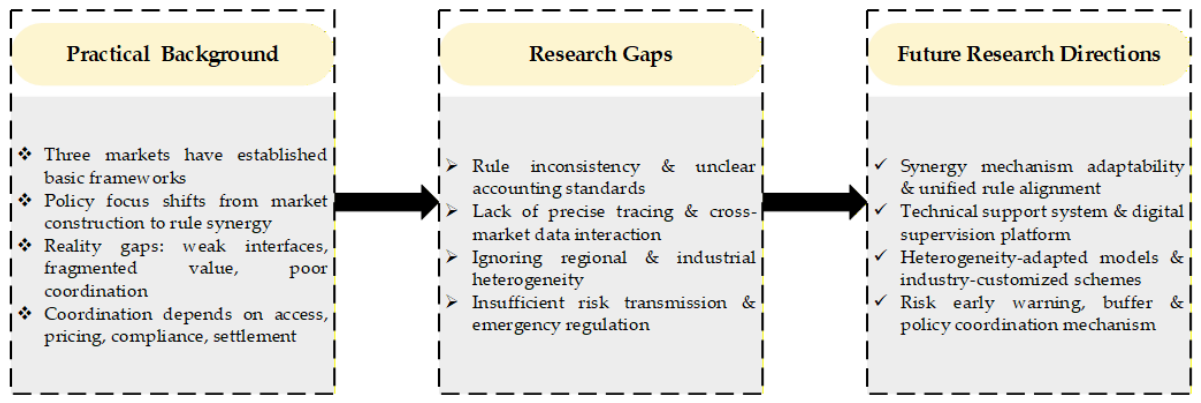
Current research has mostly focused on the rule design and operational efficiency of single markets [111,112,113], neglecting the linkage effects of subject interactions in the synergy process of the three markets. There is insufficient research on the technical support and accurate measurement of synergy mechanisms, making it difficult to adapt to complex application scenarios across regions and industries. Meanwhile, existing studies emphasize the positive promotion of synergy mechanisms on emission reduction targets [114], while relatively ignoring the transmission and response to potential risks such as market fluctuations and policy conflicts, and paying insufficient attention to adaptability issues caused by regional differences and industrial heterogeneity. As shown in Figure 3, under the practical background of China’s new power system transition, the electricity market, carbon market, and green certificate market have built basic operational frameworks. Policy focus has shifted from market construction to cross-market rule synergy. However, prominent research gaps still exist in rule consistency, technical measurement, regional and industrial heterogeneity, and risk governance. Accordingly, future research should focus on mechanism adaptation, technical support, heterogeneous applications, and risk control to improve the synergy efficiency of the three markets and support the green and low-carbon transformation of the power sector.

4.1. Research on the Adaptability of Synergy Mechanisms

The essence of electricity–carbon–green certificate synergy is to achieve the accurate realization of green value through the in-depth alignment of market rules. Existing research has not fully resolved the core contradiction of fragmented rules and inconsistent standards among the three markets. Current studies have insufficiently explored the dynamic adjustment mechanism of electricity carbon emission accounting standards, failing to fully consider the impact of power generation technology types and regional resource endowment differences on accounting results, leading to the risk of double-counting or omission in green certificate issuance and carbon emission reduction accounting. The analysis of the linkage logic and transmission path for the carbon price, electricity price, and green certificate price is not in-depth, and it lacks a pricing synergy mechanism that balances emission-reduction efficiency and market stability. Research on the definition of responsibilities and the adaptation of incentives for market entities remains insufficient. In particular, existing studies have not clearly explained how user-side green electricity consumption should be aligned with carbon footprint accounting, namely the accounting of carbon emissions attributable to products, firms, or consumption activities, nor have they fully clarified how the financial attributes and incentive effectiveness of green certificates can be strengthened. Therefore, future research urgently needs to systematically analyze the rule conflicts and synergy space among the electricity market, carbon market, and green certificate market, establish unified accounting standards and data interoperability norms, design differentiated subject incentive mechanisms and arbitrage risk prevention rules, and achieve seamless connection and efficient operation of the three markets.

4.2. Research on Technical Support Systems

The lack of technical support and inaccurate measurement methods have become key bottlenecks restricting the implementation of the electricity–carbon–green certificate synergy. Existing research has insufficiently focused on carbon emission traceability technology in cross-regional electricity transactions, lacking a “source-grid-load-storage” full-chain emission reduction accounting method based on power flow tracking, leading to an ambiguous definition of indirect carbon emission responsibilities. Research on digital supervision technology for synergy markets lags behind, failing to effectively integrate technologies such as blockchain and the Internet of Things to achieve end-to-end traceability of electricity transactions, carbon emission reporting, and green certificate circulation. The application of accurate measurement and verification technologies for green electricity consumption is insufficient, making it difficult to meet the actual needs of corporate carbon footprint accounting and green transformation. Therefore, future research needs to focus on breaking through core technologies such as accurate carbon emission traceability, real-time cross-market data docking, and green electricity consumption measurement and verification, build a digital supervision platform for synergy markets, develop measurement models and algorithms adapted to complex scenarios [115], and provide technical support for the accurate implementation of synergy mechanisms.
From a technical perspective, anti-double-counting governance requires a cross-market data infrastructure that links renewable generation metering, power flow tracking, GEC issuance and retirement, CCER registration, and carbon-market compliance accounts. Each certificate-eligible unit of renewable electricity, or the environmental attribute attached to it, should be traceable via a unique digital identifier. Its status should be updated whenever a certificate is issued, transferred, retired, canceled, or used for a recognized compliance or crediting purpose. This would help regulators and third-party verifiers determine whether the same environmental attribute has already been claimed in another market.

4.3. Research on Heterogeneity Across Regions and Industries

The practical application of electricity–carbon–green certificate synergy needs to fully adapt to regional development differences and industrial heterogeneity, and existing research lacks pertinence and practicality in this regard. Current studies mostly adopt a “one-size-fits-all” analytical framework, ignoring the differences in resource endowments and industrial structures among the eastern, central, and western regions, resulting in the designed synergy mechanisms lacking regional adaptability. The research on the synergy application in high-energy-consuming industries such as steel, the chemical industry, and data centers is not in-depth enough, failing to clarify the synergy schemes for green electricity consumption, carbon quota compliance, and green certificate deduction in these industries, making it difficult to meet the actual needs of green transformation in key industries. The exploration of the interconnection path of cross-regional synergy markets is insufficient, failing to effectively solve the barriers between provincial carbon markets and green certificate markets. Therefore, future research needs to focus on regional differentiated characteristics, design synergy models adapted to the development of the eastern, central, and western regions; construct industry-customized synergy application schemes according to the energy consumption characteristics and emission reduction needs of key energy-consuming industries; explore the interconnection mechanism of inter-provincial synergy markets, and promote cross-regional clean electricity consumption and carbon emission reduction synergy.

4.4. Research on Risk Transmission Mechanisms

The stable operation of the electricity–carbon–green certificate synergy system is inseparable from the effective control of potential risks and the synergy support of policies. Existing research still has obvious shortcomings in risk identification, transmission, and response. Current studies ignore the transmission paths and impact effects of potential risks such as energy price fluctuations, policy conflicts, and market arbitrage. The research on market emergency regulation plans under scenarios such as insufficient clean power supply caused by extreme weather is insufficient, making it difficult to ensure the dual realization of energy security and emission reduction targets. The analysis of conflicts and synergy in the existing policy system is not comprehensive enough, lacking a policy guarantee mechanism with clear levels and a smooth connection. Therefore, future research needs to deeply analyze the risk types, transmission paths, and fluctuation characteristics in the process of electricity–carbon–green certificate synergy, establish risk early warning and buffer mechanisms; systematically sort out the policy conflict points of the three markets, build a synergistic and complementary policy guarantee system; design emergency regulation plans for different risk scenarios to ensure the stable operation and sustainable development of the synergy system in complex environments.
Future research should also examine potential cross-market contagion risks in the synergy between electricity, carbon, and green certificate markets. Physical supply shocks, carbon price shocks, GEC supply shocks, and compliance shocks may be transmitted across markets if rule interfaces are overly rigid or poorly synchronized. Potential risk-buffer mechanisms for further analysis include carbon market stability reserves, GEC banking and validity-period rules, differentiated compliance deadlines, emergency quota adjustments, price collars, circuit breakers, reserve-capacity mechanisms, and coordinated disclosure of cross-market risk indicators.

5. Conclusions

Based on literature review and structured coding analysis, this paper systematically examines the evolutionary characteristics of market-oriented transaction rules in China’s new power system, analyzes the operation status and core issues of the electricity market, carbon market, and green certificate market, deeply interprets the synergy logic and institutional connection points of the electricity–carbon–green certificate trinity, and finally clarifies the deficiencies of current research and proposes potential future research directions.
The research finds that: (1) Regarding rule evolution and individual market operation, existing literature and policy analysis both demonstrate that the market-oriented transaction rules have shifted from “market construction” to “rule synergy”. In practice, the electricity market has formed a multi-level framework, while literature points out that it faces problems such as insufficient rule alignment and distorted price signals. According to practical operation and research findings, the national carbon market has completed unified framework construction, but studies reveal it features compliance-driven trading and insufficient price discovery. In practice, the green certificate market is still in cultivation, and academic studies consistently find problems such as low liquidity, weak price signals, limited subsidy-replacement capacity, and insufficient cross-market integration. (2) In terms of three-market synergy logic, electricity market rules determine the efficiency of carbon cost transmission. Green certificates reshape the revenue structure of the electricity market by embedding environmental attributes. The policy synergy between the carbon market and green certificates depends on functional boundaries and rule coordination. The core of three-market synergy lies in achieving the coordinated representation, transmission, and settlement of electricity value, carbon costs, and environmental attributes, while preventing allowance-scarcity dilution, duplicate environmental-attribute claims, and excessive cross-market risk transmission. Its effectiveness depends on rule alignment across market access and participation, price formation and value transmission, electricity–carbon–green certificate coordination, and cost allocation and settlement governance. (3) In existing literature, studies mostly focus on rule design for single markets. This creates clear research gaps in subject interaction, linkage effects, technical support, accurate measurement, cross-regional/industrial heterogeneity, and risk transmission. They pay insufficient attention to technical support, accurate measurement, and cross-regional/cross-industry heterogeneity of synergy mechanisms. They also lack systematic research on risk transmission and response in the synergy process.
Based on the above research results, this paper proposes four future research directions: (1) Research on synergy mechanism adaptability. Focus on rule conflicts and synergy space among the three markets, especially under partially regulated electricity pricing and incomplete carbon-cost pass-through. Establish unified accounting standards, data interoperability norms, and clearer claim boundaries among green electricity consumption, GEC retirement, CCER crediting, and carbon-market compliance. Design differentiated incentives for market players and rules to prevent arbitrage risks. Realize seamless connection of the three markets. (2) Research on technical support systems. Break through key technologies such as precise carbon emission tracing, cross-market data connection, and interoperable registry systems. Build a digital supervision platform capable of supporting certificate issuance, transfer, retirement, CCER registration, and carbon-compliance verification. Develop measurement models and algorithms suitable for complex scenarios. Provide technical support for the implementation of synergy mechanisms. (3) Research on cross-regional and cross-industry heterogeneity. Design adaptive synergy models according to regional differences in eastern, central, and western China. Build customized synergy schemes for energy-intensive industries. Explore interconnection mechanisms for inter-provincial synergy markets. (4) Research on risk transmission mechanisms. Identify risk types and transmission paths in the synergy process, including potential waterbed effects and cross-market contagion under external shocks. Establish risk early warning, market stability, and emergency buffer mechanisms. Build a coordinated and complementary policy guarantee system. Design emergency regulation plans for different risk scenarios. Ensure the stable and sustainable operation of the synergy system.

Author Contributions

Conceptualization, F.D., Q.J. and Y.L.; Methodology, Q.J. and Y.L.; Investigation, Q.J., Y.L., S.Z. and S.X.; Data curation, S.Z. and S.X.; Writing—original draft preparation, Q.J., Y.L., S.Z. and S.X.; Writing—review and editing, F.D., Q.J. and Y.L.; Supervision, F.D.; Project administration, F.D.; Funding acquisition, F.D. All authors have read and agreed to the published version of the manuscript.

Funding

This work was supported by the Key Project of Jiangsu Social Science Fund (Grant No. 23GLA006), the Key Project of Hebei Social Science Fund (Grant No. HB25GL001), Science Research Project of Hebei Education Department (JCZX2026003), Social Science Foundation Program of Jiangsu Province (Grant No. 24GLC020), and the Key Project of Social Science Foundation of Higher Education Institutions (Education Department of Jiangsu China) (Grant No. 2023SJZD066).

Data Availability Statement

The data supporting the findings of this study are contained within the article. The policy documents and literature reviewed in this study are publicly available from the sources cited in the manuscript. Further inquiries can be directed to the corresponding author.

Conflicts of Interest

The authors declare that they have no known competing financial interests or personal relationships that could have appeared to influence the work reported in this paper.

Abbreviations

The following abbreviations are used in this manuscript:
CETCarbon emissions trading
CCERChina Certified Emission Reductions
GECGreen Electricity Certificates
RPSRenewable portfolio standard
TGCTradable green certificates

References

  1. Ding, W.; Wang, L.; Tian, G. Electricity Spot Market Reform and Overcapacity in Fossil-Fired Power Firms: A Quasi-Natural Experiment Based on China Power Market. Energy Policy 2026, 209, 114961. [Google Scholar] [CrossRef]
  2. Han, J.; Tan, Q.; Ding, Y.; Liu, Y. Exploring the Diffusion of Low-Carbon Power Generation and Energy Storage Technologies under Electricity Market Reform in China: An Agent-Based Modeling Framework for Power Sector. Energy 2024, 308, 133060. [Google Scholar] [CrossRef]
  3. Feng, Y.; Lin, J.; Song, F.; Ho, M.S. Performance and Challenges of Power Sector Reform in China since 2015. iScience 2025, 28, 113461. [Google Scholar] [CrossRef]
  4. Qiao, T.; Li, W.; Liu, W.; Xu, G.; Jin, H. Design Considerations and Many-Objective Optimization of Synchronous Condenser Used for New Energy Power System Based on Electromagnetic-Thermal Constraints. IEEE Trans. Ind. Electron. 2026, 73, 5293–5304. [Google Scholar] [CrossRef]
  5. Adiche, S.; Toumi, D.; Larbi, M.; Bouddou, R.; Bouchikhi, N.; Soleimani, A.; Pinnarelli, A.; Heidari, M. Robust Modified Adaptive PI-Based Controller for Managing Uncertainties in Distributed Generation Systems of AC Microgrids. Results Eng. 2025, 26, 104949. [Google Scholar] [CrossRef]
  6. Li, Y.; Li, Y.; Hu, Z.; Zhang, J.; Hu, Z. Typhoon-Induced Risk Evolution in Wind Farms: From Disaster-Inducing Factors Identification to Domino Effect Assessment. Reliab. Eng. Syst. Saf. 2026, 272, 112638. [Google Scholar] [CrossRef]
  7. Su, L.; Shi, G.; Zhou, J.; Zang, J.; Cai, H.; Wang, Y.; Zhang, J. An Advanced Energy-Coordinated Control for Half-Bridge Submodule-Based Centralized DC Chopper in Offshore Wind MMC-HVDC Systems. IEEE Trans. Power Electron. 2026, 41, 11765–11779. [Google Scholar] [CrossRef]
  8. Wang, G.; Zhang, Q.; Su, B.; Shen, B.; Li, Y.; Li, Z. Coordination of Tradable Carbon Emission Permits Market and Renewable Electricity Certificates Market in China. Energy Econ. 2021, 93, 105038. [Google Scholar] [CrossRef]
  9. Chang, X.; Wu, Z.; Wang, J.; Zhang, X.; Zhou, M.; Yu, T.; Wang, Y. The Coupling Effect of Carbon Emission Trading and Tradable Green Certificates under Electricity Marketization in China. Renew. Sustain. Energy Rev. 2023, 187, 113750. [Google Scholar] [CrossRef]
  10. Li, J.; Hu, Y.; Chi, Y.; Liu, D.; Yang, S.; Gao, Z.; Chen, Y. Analysis on the Synergy between Markets of Electricity, Carbon, and Tradable Green Certificates in China. Energy 2024, 302, 131808. [Google Scholar] [CrossRef]
  11. Wang, H.; Feng, T.; Zhong, C. Effectiveness of CO2 Cost Pass-through to Electricity Prices under “Electricity–Carbon” Market Coupling in China. Energy 2023, 266, 126387. [Google Scholar] [CrossRef]
  12. Lan, L.; Zhang, X.; Zhang, Y. Low Carbon and Efficiency Oriented Day-Ahead Joint Electrical Energy and Ancillary Services Market Clearing Model for Generation-Side in China. Energy Econ. 2023, 121, 106686. [Google Scholar] [CrossRef]
  13. Yang, Y.; Yan, G.; Mu, G.; Chen, Z. Hierarchical Bidding Strategy for Heterogeneous P2H Loads and Wind Power: State-Driven Aggregation and Switching Time Scheduling. Energy 2025, 334, 137766. [Google Scholar] [CrossRef]
  14. Hosseini Dolatabadi, S.H.; Soleimani, A.; Maghanaki, M.; Ilinca, A. Enhancing Photovoltaic Farm Capacity Estimation: A Comprehensive Analysis with a Novel Approach. Energy Technol. 2024, 12, 2301294. [Google Scholar] [CrossRef]
  15. Wu, X.; Cao, W.; Wang, D.; Ding, M.; Yu, L.; Nakanishi, Y. Demand Response Model Based on Improved Pareto Optimum Considering Seasonal Electricity Prices for Dongfushan Island. Renew. Energy 2021, 164, 926–936. [Google Scholar] [CrossRef]
  16. Liu, Q.; Zhang, C.; Yang, H.; Zhu, L.; Zhou, B.; Li, J.; Zhou, Q.; Tian, W.; Li, X. Rapid and Less Conservative Interval Power Flow Analysis Based on a Scenario Reflection Method for Renewable Penetrated Power Systems. IEEE Trans. Sustain. Energy 2025, 17, 956–969. [Google Scholar] [CrossRef]
  17. Parhamfar, M.; Güven, A.F.; Pinnarelli, A.; Vizza, P.; Soleimani, A. Artificial Intelligence in Carbon Trading: Enhancing Market Efficiency and Risk Management. J. Comput. Data Technol. 2025, 1, 19–39. [Google Scholar] [CrossRef]
  18. Yang, Z.; Li, C.; Wang, H.; Yang, J. Dynamic Evolution of Electricity Price Transmission Effects from Electricity–Carbon Market Coupling under Tradable Green Certificate Price Regulation. Energy 2025, 334, 137861. [Google Scholar] [CrossRef]
  19. Zhang, X.; Guo, X.; Zhang, X. Assessing the Policy Synergy among Power, Carbon Emissions Trading and Tradable Green Certificate Market Mechanisms on Strategic GENCOs in China. Energy 2023, 278, 127833. [Google Scholar] [CrossRef]
  20. Mahdavi, M.; Soleimani, A.; Pinnarelli, A.; Heidari, M.; Jurado, F. Cost-Based Optimization of DG and Capacitor Placement in Distribution Networks under Dynamic Load Conditions. Energy Rep. 2025, 13, 5525–5534. [Google Scholar] [CrossRef]
  21. Soleimani, A.; Roghanian, P.; Heidari, M.; Heidari, M.; Pinnarelli, A.; Vizza, P.; Mahdavi, M.; Mousavi, S.F. Refining Hybrid Energy Systems: Elevating PV Sustainability, Cutting Emissions, and Maximizing Battery Cost Efficiency in Remote Areas. Energy Nexus 2025, 18, 100452. [Google Scholar] [CrossRef]
  22. Lin, P.; Du, L.; Zhang, H.; Zhu, M.; Ma, J.; Wang, P. Power Lever: To Transform Interlinking Architecture in Hybrid Ac/Dc Microgrids Community. IEEE Trans. Ind. Electron. 2026, 73, 6984–6997. [Google Scholar] [CrossRef]
  23. Lei, N.; Chen, L.; Sun, C.; Tao, Y. Electricity Market Creation in China: Policy Options from Political Economics Perspective. Sustainability 2018, 10, 1481. [Google Scholar] [CrossRef]
  24. Cheng, Y.; Chung, M.; Tsang, K. Electricity Market Reforms for Energy Transition: Lessons from China. Energies 2023, 16, 905. [Google Scholar] [CrossRef]
  25. Liu, Y.; Jiang, Z.; Guo, B. Assessing China’s Provincial Electricity Spot Market Pilot Operations: Lessons from Guangdong Province. Energy Policy 2022, 164, 112917. [Google Scholar] [CrossRef]
  26. Yu, X.; Li, G.; Cheng, C.; Sun, Y.; Chen, R. Research and Application of Continuous Bidirectional Trading Mechanism in Yunnan Electricity Market. Energies 2019, 12, 4663. [Google Scholar] [CrossRef]
  27. Dong, J.; Chai, Y. Design and Practice of Electricity Spot Market Price Mechanisms under Macro-Economic Regulation. In 2025 4th International Conference on Smart Grids and Energy Systems (SGES); IEEE: Hoboken, NJ, USA, 2025; pp. 76–79. [Google Scholar] [CrossRef]
  28. Zheng, X.; Menezes, F.; Nepal, R. In between the State and the Market: An Empirical Assessment of the Early Achievements of China’s 2015 Electricity Reform. Energy Econ. 2021, 93, 105003. [Google Scholar] [CrossRef]
  29. Chen, H.; Cui, J.; Song, F.; Jiang, Z. Evaluating the Impacts of Reforming and Integrating China’s Electricity Sector. Energy Econ. 2022, 108, 105912. [Google Scholar] [CrossRef]
  30. Xiang, C.; Zheng, X.; Song, F.; Lin, J.; Jiang, Z. Assessing the Roles of Efficient Market versus Regulatory Capture in China’s Power Market Reform. Nat. Energy 2023, 8, 747–757. [Google Scholar] [CrossRef]
  31. Fabra, N. Reforming European Electricity Markets: Lessons from the Energy Crisis. Energy Econ. 2023, 126, 106963. [Google Scholar] [CrossRef]
  32. Zhang, C.; Yan, W. Spot Market Mechanism Design for the Electricity Market in China Considering the Impact of a Contract Market. Energies 2019, 12, 1064. [Google Scholar] [CrossRef]
  33. Tian, Z.; Feng, D.; Zhou, Y.; Xu, S.; Luo, L.; Liu, J. Method of Eliminating Transmission Line Overload in Electricity Spot Market. In 2023 IEEE/IAS Industrial and Commercial Power System Asia (I&CPS Asia); IEEE: Hoboken, NJ, USA, 2023; pp. 1899–1904. [Google Scholar] [CrossRef]
  34. Wang, J.; Zhong, H.; Yang, Z.; Lai, X.; Xia, Q.; Kang, C. Incentive Mechanism for Clearing Energy and Reserve Markets in Multi-Area Power Systems. IEEE Trans. Sustain. Energy 2020, 11, 2470–2482. [Google Scholar] [CrossRef]
  35. Liu, S.; Yang, Q.; Cai, H.; Yan, M.; Zhang, M.; Wu, D.; Xie, M. Market Reform of Yunnan Electricity in Southwestern China: Practice, Challenges and Implications. Renew. Sustain. Energy Rev. 2019, 113, 109265. [Google Scholar] [CrossRef]
  36. Shen, J.; Cheng, C.; Jia, Z.; Zhang, Y.; Lv, Q.; Cai, H.; Wang, B.; Xie, M. Impacts, Challenges and Suggestions of the Electricity Market for Hydro-Dominated Power Systems in China. Renew. Energy 2022, 187, 743–759. [Google Scholar] [CrossRef]
  37. Joskow, P.L.; Tirole, J. Transmission Rights and Market Power on Electric Power Networks. Rand J. Econ. 2000, 31, 450–487. [Google Scholar] [CrossRef]
  38. Wang, Y.; Li, T.; Li, Y.; Shao, N.; Wang, Y. Spot Market Clearing Model and Flexibility Premium Assessment Method Considering Flexible Regulation of Virtual Power Plants. IEEE Access 2024, 12, 53855–53870. [Google Scholar] [CrossRef]
  39. Gao, R.; Guo, H.; Zhang, R.; Mao, T.; Xu, Q.; Zhou, B.; Yang, P. A Two-Stage Dispatch Mechanism for Virtual Power Plant Utilizing the CVaR Theory in the Electricity Spot Market. Energies 2019, 12, 3402. [Google Scholar] [CrossRef]
  40. Mei, S.; Tan, Q.; Trivedi, A.; Srinivasan, D. A Two-Step Optimization Model for Virtual Power Plant Participating in Spot Market Based on Energy Storage Power Distribution Considering Comprehensive Forecasting Error of Renewable Energy Output. Appl. Energy 2024, 376, 124234. [Google Scholar] [CrossRef]
  41. Li, J.; Yao, Y.; Wang, X. The First Compliance Cycle of China’s National Emissions Trading Scheme: Insights and Implications. Carbon Neutrality 2022, 1, 34. [Google Scholar] [CrossRef]
  42. Long, X.; Goulder, L.H. Carbon Emission Trading Systems: A Review of Systems across the Globe and a Close Look at China’s National Approach. China Econ. J. 2023, 16, 203–216. [Google Scholar] [CrossRef]
  43. Shen, W.; Wang, Y. Adaptive Policy Innovations and the Construction of Emission Trading Schemes in China: Taking Stock and Looking Forward. Environ. Innov. Soc. Transit. 2019, 30, 59–68. [Google Scholar] [CrossRef]
  44. Chen, X.; Lin, B. Towards Carbon Neutrality by Implementing Carbon Emissions Trading Scheme: Policy Evaluation in China. Energy Policy 2021, 157, 112510. [Google Scholar] [CrossRef]
  45. Peng, H.; Qi, S.; Cui, J. The Environmental and Economic Effects of the Carbon Emissions Trading Scheme in China: The Role of Alternative Allowance Allocation. Sustain. Prod. Consum. 2021, 28, 105–115. [Google Scholar] [CrossRef]
  46. Ellerman, A.D.; Buchner, B.K. Over-Allocation or Abatement? A Preliminary Analysis of the EU ETS Based on the 2005–06 Emissions Data. Environ. Resour. Econ. 2008, 41, 267–287. [Google Scholar] [CrossRef]
  47. Zheng, Y.; Zhang, B. Does China’s National Carbon Market Function Well? A Perspective on Effective Market Design. J. Chin. Gov. 2023, 8, 563–592. [Google Scholar] [CrossRef]
  48. Wang, Z.; Paavola, J. Emissions Trading in China: New Political Economy Dynamics. Environ. Policy Gov. 2023, 33, 504–516. [Google Scholar] [CrossRef]
  49. Ma, R.; Qian, H. Plant-Level Evaluation of China’s National Emissions Trading Scheme: Benchmark Matters. Clim. Change Econ. 2022, 13, 2240009. [Google Scholar] [CrossRef]
  50. Grubb, M.; Azar, C.; Persson, U.M. Allowance Allocation in the European Emissions Trading System: A Commentary. Clim. Policy 2005, 5, 127–136. [Google Scholar] [CrossRef]
  51. Ji, C.-J.; Wang, X.; Wang, X.-Y.; Tang, B.-J. Design and Impact Assessment of Policies to Overcome Oversupply in China’s National Carbon Market. J. Environ. Manag. 2024, 354, 120388. [Google Scholar] [CrossRef]
  52. Sijm, J.; Neuhoff, K.; Chen, Y. CO2 Cost Pass-through and Windfall Profits in the Power Sector. Clim. Policy 2006, 6, 49–72. [Google Scholar] [CrossRef]
  53. Munnings, C.; Morgenstern, R.D.; Wang, Z.; Liu, X. Assessing the Design of Three Carbon Trading Pilot Programs in China. Energy Policy 2016, 96, 688–699. [Google Scholar] [CrossRef]
  54. Lo, A.Y.; Chen, K.; Lee, A.K.; Mai, L.Q. The Neoliberal Policy Experimentation on Carbon Emission Trading in China. Environ. Plan. C Polit. Space 2020, 38, 153–173. [Google Scholar] [CrossRef]
  55. Zhang, Y.; Deng, H.; Yang, J.; Xu, C.; Zhou, Z.; Wen, F.; Qi, D. Impacts of Renewable Portfolio Standard on Carbon Emission Peaking and Tradable Green Certificate Market: A System Dynamics Analysis Method. Front. Energy Res. 2022, 10, 963177. [Google Scholar] [CrossRef]
  56. Leng, K.; Li, Z.; Tong, Z. How Will Tradable Green Certificates Affect Electricity Trading Markets under Renewable Portfolio Standards? A China Perspective. Clean Energy 2022, 6, 585–598. [Google Scholar] [CrossRef]
  57. Liu, D.; Jiang, Y.; Peng, C.; Jian, J.; Zheng, J. Can Green Certificates Substitute for Renewable Electricity Subsidies? A Chinese Experience. Renew. Energy 2024, 222, 119861. [Google Scholar] [CrossRef]
  58. Holt, E.A.; Wiser, R.; Bolinger, M. Who Owns Renewable Energy Certificates? An Exploration of Policy Options and Practice; Lawrence Berkeley National Laboratory: Berkeley, CA, USA, 2006. [Google Scholar]
  59. Herbes, C.; Rilling, B.; MacDonald, S.; Boutin, N.; Bigerna, S. Are Voluntary Markets Effective in Replacing State-Led Support for the Expansion of Renewables?–A Comparative Analysis of Voluntary Green Electricity Markets in the UK, Germany, France and Italy. Energy Policy 2020, 141, 111473. [Google Scholar] [CrossRef]
  60. Wiser, R.; Porter, K.; Grace, R. Evaluating Experience with Renewables Portfolio Standards in the United States. Mitig. Adapt. Strateg. Glob. Change 2005, 10, 237–263. [Google Scholar] [CrossRef]
  61. Yang, Y.-S.; Xie, B.-C.; Tan, X. Impact of Green Power Trading Mechanism on Power Generation and Interregional Transmission in China. Energy Policy 2024, 189, 114088. [Google Scholar] [CrossRef]
  62. Yan, S.; Wang, W.; Li, X.; Maimaiti, P.; Zhao, Y. Cross-Regional Green Certificate Transaction Strategies Based on a Double-Layer Game Model. Appl. Energy 2024, 356, 122223. [Google Scholar] [CrossRef]
  63. Su, Q.; Zhou, P.; Ding, H.; Xydis, G. Transition towards a Hybrid Energy System: Combined Effects of Renewable Portfolio Standards and Carbon Emission Trading. Energy Econ. 2024, 135, 107638. [Google Scholar] [CrossRef]
  64. Delarue, E.; Van den Bergh, K. Carbon Mitigation in the Electric Power Sector under Cap-and-Trade and Renewables Policies. Energy Policy 2016, 92, 34–44. [Google Scholar] [CrossRef]
  65. Yu, Y.; Wang, J.; Chen, Q.; Urpelainen, J.; Ding, Q.; Liu, S.; Zhang, B. Decarbonization Efforts Hindered by China’s Slow Progress on Electricity Market Reforms. Nat. Sustain. 2023, 6, 1006–1015. [Google Scholar] [CrossRef]
  66. Zhao, X.-G.; Hu, S.; Wang, H.; Chen, H.; Zhang, W.; Lu, W. Energy, Economic, and Environmental Impacts of Electricity Market-Oriented Reform and the Carbon Emissions Trading: A Recursive Dynamic CGE Model in China. Energy 2024, 298, 131416. [Google Scholar] [CrossRef]
  67. Abrell, J.; Kosch, M. The Impact of Carbon Prices on Renewable Energy Support. J. Assoc. Environ. Resour. Econ. 2022, 9, 531–563. [Google Scholar] [CrossRef]
  68. Fabra, N.; Reguant, M. Pass-through of Emissions Costs in Electricity Markets. Am. Econ. Rev. 2014, 104, 2872–2899. [Google Scholar] [CrossRef]
  69. Cludius, J.; de Bruyn, S.; Schumacher, K.; Vergeer, R. Ex-Post Investigation of Cost Pass-through in the EU ETS—An Analysis for Six Industry Sectors. Energy Econ. 2020, 91, 104883. [Google Scholar] [CrossRef]
  70. Amendola, M.; Valente, M. Taxing Carbon Emissions and Green Transition: The Case of the Italian Electricity Market; LEM Papers Series 2024/19; Laboratory of Economics and Management (LEM), Sant’Anna School of Advanced Studies: Pisa, Italy, 2024. [Google Scholar]
  71. Cao, J.; Ho, M.S.; Ma, R.; Teng, F. When Carbon Emission Trading Meets a Regulated Industry: Evidence from the Electricity Sector of China. J. Public Econ. 2021, 200, 104470. [Google Scholar] [CrossRef]
  72. Li, M.; Gao, H.; Abdulla, A.; Shan, R.; Gao, S. Combined Effects of Carbon Pricing and Power Market Reform on CO2 Emissions Reduction in China’s Electricity Sector. Energy 2022, 257, 124739. [Google Scholar] [CrossRef]
  73. Jia, Z.; Lin, B.; Wen, S. Electricity Market Reform: The Perspective of Price Regulation and Carbon Neutrality. Appl. Energy 2022, 328, 120164. [Google Scholar] [CrossRef]
  74. Yuan, J.; Zhang, W.; Shen, Q.; Zhang, L.; Zhou, Y.; Zhao, C.; Yang, J.; Zhang, J. The Impact of Electricity–Carbon Market Coupling on System Marginal Clearing Price and Power Supply Cost. Environ. Sci. Pollut. Res. 2023, 30, 84725–84741. [Google Scholar] [CrossRef]
  75. Xiang, C.; Zheng, X.; Xie, L. How Can China’s Power Sector Reform Reduce Carbon Emissions? A Long-Term Competition Perspective. China Econ. Rev. 2023, 80, 102000. [Google Scholar] [CrossRef]
  76. Song, Y.; Li, Y.; Peng, K. How Does Carbon Pricing Leverage Emission Reductions in the Power Sector? Evidence from China’s National Carbon Market. Carbon Balance Manag. 2025, 20, 46. [Google Scholar] [CrossRef]
  77. Zhou, Y.; Zhao, X.-G. The Impact of Renewable Portfolio Standards on Carbon Emission Trading under the Background of China’s Electricity Marketization Reform. Energy 2021, 226, 120322. [Google Scholar] [CrossRef]
  78. Liu, W.; He, B.; Xue, Y.; Huang, J.; Zhao, J.; Wen, F. A Comprehensive Modeling Framework for Coupled Electricity and Carbon Markets. Energy Convers. Econ. 2024, 5, 1–14. [Google Scholar] [CrossRef]
  79. Gillenwater, M. Redefining RECs—Part 1: Untangling Attributes and Offsets. Energy Policy 2008, 36, 2109–2119. [Google Scholar] [CrossRef]
  80. Song, X.; Han, J.; Zhang, L.; Zhao, C.; Wang, P.; Liu, X.; Li, Q. Impacts of Renewable Portfolio Standards on Multi-Market Coupling Trading of Renewable Energy in China: A Scenario-Based System Dynamics Model. Energy Policy 2021, 159, 112647. [Google Scholar] [CrossRef]
  81. Li, C.; Wang, D.; Mao, J.; Chen, F. How to Facilitate the Implementation of the Renewable Portfolio Standard? A System Dynamics Model Analysis. Renew. Energy 2024, 223, 120120. [Google Scholar] [CrossRef]
  82. Hustveit, M.; Frogner, J.S.; Fleten, S.-E. Tradable Green Certificates for Renewable Support: The Role of Expectations and Uncertainty. Energy 2017, 141, 1717–1727. [Google Scholar] [CrossRef]
  83. Hu, Y.; Chi, Y.; Zhao, H.; Zhou, W. The Development of Renewable Energy Industry under Renewable Portfolio Standards: From the Perspective of Provincial Resource Differences. Energy Policy 2022, 170, 113212. [Google Scholar] [CrossRef]
  84. Hu, F.; Zhou, D.; Zhu, Q.; Wang, Q. How Dynamic Renewable Portfolio Standards Affect Trading Behavior of Power Generators? Considering Green Certificate and Reward/Penalty Mechanism. Appl. Energy 2024, 375, 124114. [Google Scholar] [CrossRef]
  85. Currier, K.M. A Regulatory Adjustment Process for the Determination of the Optimal Percentage Requirement in an Electricity Market with Tradable Green Certificates. Energy Policy 2013, 62, 1053–1057. [Google Scholar] [CrossRef]
  86. Wu, X.; Huang, H.; Guo, B.; Song, L.; Yang, Y.; Li, Q.; Qian, F. A Study on the Price Transmission Mechanism of Environmental Benefits for Green Electricity in the Carbon Market and Green Certificate Markets: A Case Study of the East China Power Grid. Energies 2025, 18, 2235. [Google Scholar] [CrossRef]
  87. Lin, B.; Li, J. The Marketization of Green Electricity Trading and Investment Decisions of New Energy Enterprises. Energy Policy 2026, 210, 115037. [Google Scholar] [CrossRef]
  88. Boehringer, C.; Rosendahl, K.E. Green Promotes the Dirtiest: On the Interaction between Black and Green Quotas in Energy Markets. J. Regul. Econ. 2010, 37, 316–325. [Google Scholar] [CrossRef]
  89. Mulder, M.; Zeng, Y. Exploring Interaction Effects of Climate Policies: A Model Analysis of the Power Market. Resour. Energy Econ. 2018, 54, 165–185. [Google Scholar] [CrossRef]
  90. Lindberg, M.B. The EU Emissions Trading System and Renewable Energy Policies: Friends or Foes in the European Policy Mix? Polit. Gov. 2019, 7, 105–123. [Google Scholar] [CrossRef]
  91. Duan, M.; Tian, Z.; Zhao, Y.; Li, M. Interactions and Coordination between Carbon Emissions Trading and Other Direct Carbon Mitigation Policies in China. Energy Res. Soc. Sci. 2017, 33, 59–69. [Google Scholar] [CrossRef]
  92. Feng, T.; Yang, Y.; Yang, Y. What Will Happen to the Power Supply Structure and CO2 Emissions Reduction When TGC Meets CET in the Electricity Market in China? Renew. Sustain. Energy Rev. 2018, 92, 121–132. [Google Scholar] [CrossRef]
  93. Yu, X.; Dong, Z.; Zhou, D.; Sang, X.; Chang, C.-T.; Huang, X. Integration of Tradable Green Certificates Trading and Carbon Emissions Trading: How Will Chinese Power Industry Do? J. Clean. Prod. 2021, 279, 123485. [Google Scholar] [CrossRef]
  94. Yan, S.; Wang, W.; Li, X.; Lv, H.; Fan, T.; Aikepaer, S. Stochastic Optimal Scheduling Strategy of Cross-Regional Carbon Emissions Trading and Green Certificate Trading Market Based on Stackelberg Game. Renew. Energy 2023, 219, 119268. [Google Scholar] [CrossRef]
  95. Lehmann, P.; Gawel, E. Why Should Support Schemes for Renewable Electricity Complement the EU Emissions Trading Scheme? Energy Policy 2013, 52, 597–607. [Google Scholar] [CrossRef]
  96. Feng, T.; Li, R.; Zhang, H.; Gong, X.; Yang, Y. Induction Mechanism and Optimization of Tradable Green Certificates and Carbon Emission Trading Acting on Electricity Market in China. Resour. Conserv. Recycl. 2021, 169, 105487. [Google Scholar] [CrossRef]
  97. Zha, D.; Jiang, P.; Zhang, C.; Xia, D.; Cao, Y. Positive Synergy or Negative Synergy: An Assessment of the Carbon Emission Reduction Effect of Renewable Energy Policy Mixes on China’s Power Sector. Energy Policy 2023, 183, 113782. [Google Scholar] [CrossRef]
  98. Wang, H.; Feng, T.; Kong, J.; Cui, M.; Xu, M. Grappling with the Trade-Offs of Carbon Emission Trading and Green Certificate: Achieving Carbon Neutrality in China. J. Environ. Manag. 2024, 360, 121101. [Google Scholar] [CrossRef]
  99. Li, Y.; Gou, L.; Zhang, H.; Guo, J.; Wang, M.; Yang, S. Research on the Connection Market Trading Issues of Green Certificates and CCER Based on Contribution Degree and Social Welfare. Sustainability 2024, 16, 10572. [Google Scholar] [CrossRef]
  100. van den Bergh, J.; Castro, J.; Drews, S.; Exadaktylos, F.; Foramitti, J.; Klein, F.; Konc, T.; Savin, I. Designing an Effective Climate-Policy Mix: Accounting for Instrument Synergy. Clim. Policy 2021, 21, 745–764. [Google Scholar] [CrossRef]
  101. Schusser, S.; Jaraitė, J. Explaining the Interplay of Three Markets: Green Certificates, Carbon Emissions and Electricity. Energy Econ. 2018, 71, 1–13. [Google Scholar] [CrossRef]
  102. Zheng, B.; Bao, Z.; Yang, L. Design and Equilibrium Analysis of Integrated Market of ISO-Led Carbon Emissions, Green Certificates and Electricity Considering Their Interplay. Energy Econ. 2023, 126, 107022. [Google Scholar] [CrossRef]
  103. Zhang, W.; Ji, C.; Liu, Y.; Hao, Y.; Song, Y.; Cao, Y.; Qi, H. Dynamic Interactions of Carbon Trading, Green Certificate Trading, and Electricity Markets: Insights from System Dynamics Modeling. PLoS ONE 2024, 19, e0304478. [Google Scholar] [CrossRef]
  104. Zhao, W.; Lin, Y.; Pan, H. What Is the Effect of China’s Renewable Energy Market-Based Coupling Policy?—A System Dynamics Analysis Based on the Coupling of Electricity Market, Green Certificate Market and Carbon Market. Systems 2024, 12, 545. [Google Scholar] [CrossRef]
  105. Ma, T.; Peng, L.; Wu, G.; Wei, Y.; Zou, X. Research on Multi-Scale Electricity–Carbon–Green Certificate Market Coupling Trading Based on System Dynamics. Processes 2025, 13, 109. [Google Scholar] [CrossRef]
  106. Shahnazari, M.; McHugh, A.; Maybee, B.; Whale, J. Overlapping Carbon Pricing and Renewable Support Schemes under Political Uncertainty: Global Lessons from an Australian Case Study. Appl. Energy 2017, 200, 237–248. [Google Scholar] [CrossRef]
  107. Guo, X.; Zhang, X.; Zhang, X. Incentive-Oriented Power-Carbon Emissions Trading-Tradable Green Certificate Integrated Market Mechanisms Using Multi-Agent Deep Reinforcement Learning. Appl. Energy 2024, 357, 122458. [Google Scholar] [CrossRef]
  108. Lu, Z.; Zhan, B.; Li, Z.; Leng, Y.; Yang, X.; Wen, F. Optimal Bidding Strategy for Generation Companies Alliance in Electricity–Carbon–Green Certificate Markets. Energy Convers. Econ. 2024, 5, 156–166. [Google Scholar] [CrossRef]
  109. Gong, X.; Li, X.; Zhong, Z. Strategic Bidding of Virtual Power Plants in Integrated Electricity–Carbon–Green Certificate Market with Renewable Energy Uncertainties. Sustain. Cities Soc. 2025, 121, 106176. [Google Scholar] [CrossRef]
  110. Liu, L.; Feng, T.; Zhong, C.; Cui, M.; Wang, H. Synergy Pathway Innovation of Carbon Emission Trading, Tradable Green Certificate and Green Power Trading Policies: Achieving China’s Dual Carbon Goals. Humanit. Soc. Sci. Commun. 2025, 12, 1331. [Google Scholar] [CrossRef]
  111. Dormady, N.C. Carbon Auctions, Energy Markets & Market Power: An Experimental Analysis. Energy Econ. 2014, 44, 468–482. [Google Scholar] [CrossRef]
  112. Zhao, Z.; Sheng, S.; Zhang, Q.; Li, Y.; Yang, X. The Emission Reduction Effect and Collaborative Design of Parallel Carbon Emission Trading and Tradable Green Certificate Policies in the Power Industry. Xitong Gongcheng Lilun Yu Shijian Syst. Eng. Theory Pract. 2026, 46, 53–69. [Google Scholar]
  113. Li, X.; Liu, Z.; Yang, D.; Wang, D. Power Market Efficiency Evaluation and Carbon Market Price Design: Estimation of Pass-through Rate Based on the Perspective of Power-Carbon Market Correlation. China Ind. Econ. 2022, 1, 134–150. [Google Scholar] [CrossRef]
  114. Wu, Y.; Qi, J.; Xian, Q.; Chen, J. The Carbon Emission Reduction Effect of China’s Carbon Market—From the Perspective of the Coordination between Market Mechanism and Administrative Intervention. China Ind. Econ. 2021, 8, 114–132. [Google Scholar] [CrossRef]
  115. Mishra, A.; Mandal, S.; Dieulot, J.-Y.; Bachute, M.R.; Faizan, M.; Pinnarelli, A.; Heidari, M.; Soleimani, A. Non-Linear Control of Interleaved Boost Converter Using Disturbance Observer-Based Approach. IEEE Access 2025, 13, 23833–23840. [Google Scholar] [CrossRef]
Figure 1. Conceptual framework for the collaborative governance of electricity, carbon, and green certificate markets in China’s new power system.
Energies 19 02581 g001
Figure 2. Annual distribution of key policy themes in China’s market-oriented transaction rules, 2021–2025. The numbers indicate coding intensity scores on 1–10 scale, with higher values representing stronger policy emphasis.
Energies 19 02581 g002
Figure 3. Research Gaps and Future Research Opportunities of electricity–carbon–green certificate market synergy.
Energies 19 02581 g003
Table 1. Coding dimensions, conceptual mapping, and scoring scale for policy text analysis.
DimensionNodeDefinitionInclusion CriteriaExclusion Criteria
Market
Access &
Participation
Renewable Energy Market
Entry
Regulations on Renewable Energy projects form prices and volumes through market mechanismsExplicit rules for Renewable Energy market bidding; removal of guaranteed acquisition; defined market-based pricing for Renewable EnergyGeneral support for Renewable Energy development; targets for Renewable Energy capacity/consumption; no specific market entry or pricing arrangements
Unified Market DevelopmentRules on market identity and access for new entities (storage, VPPs, aggregators)Legal status for VPPs/storage; participation rules in day-ahead, spot, or ancillary markets; rules for aggregated tradingTechnical facility construction; general encouragement for storage/VPP development without market access rules
Price
Formation & Value
Capacity Compensation MechanismCompensation for the capacity support function of regulatable power sourcesImplementation of capacity tariffs or two-part tariffs
prices; fixed cost recovery arrangements; supportive value recognized in price
General energy price fluctuations; fuel cost adjustments; general price reforms without explicit capacity compensation
Ancillary Services MarketRegulations on pricing and compensation for frequency regulation, reserve, and peakingSpecific pricing for ancillary services; rules for market-based compensation; cost-sharing and settlement principlesStatements on system flexibility, technical equipment upgrades; no specific price, compensation, or settlement rules
Synergy
Mechanisms
Environmental Attribute MechanismRules on the confirmation and ownership of green electricity environmental attributesDefined ownership of GECs; anti-double-counting rules; specific linkage between GECs and power tradingPrinciples of green development/consumption; general GEC market construction without attribute accounting rules
Electricity–
Carbon
Coupling
Mechanisms for transmitting carbon costs/signals into electricity price formationRules for carbon cost pass-through; carbon price influencing bidding; linkage between green power and carbon accountingGeneral carbon reduction targets; Emissions Trading System rules without explicit electricity price links; no mention of carbon constraints on power
Cost
Sharing & Governance
Spot
Market Rules
Rules for sharing imbalance costs and profits/losses in market operationsClear allocation of imbalance funds; deviation
settlement rules; rules for congestion management costs
Generic statements on market stability; technical grid
dispatch details; no specific imbalance sharing or settlement rules
Price
Mechanism
Reform
Rules for itemized listing and transparent pass-through of system/ancillary costsMandatory separate listing of fees; transparent pass-through of system costs; itemized settlement requirementsGeneric phrases like “market-based pricing” and price adjustment notices without transparency or itemization rules
Note: Each coding dimension was assessed on a 1–10 intensity scale and visualized in five intervals: 1–2, 3–4, 5–6, 7–8, and 9–10, representing increasing levels of policy emphasis.
Disclaimer/Publisher’s Note: The statements, opinions and data contained in all publications are solely those of the individual author(s) and contributor(s) and not of MDPI and/or the editor(s). MDPI and/or the editor(s) disclaim responsibility for any injury to people or property resulting from any ideas, methods, instructions or products referred to in the content.