1. Introduction
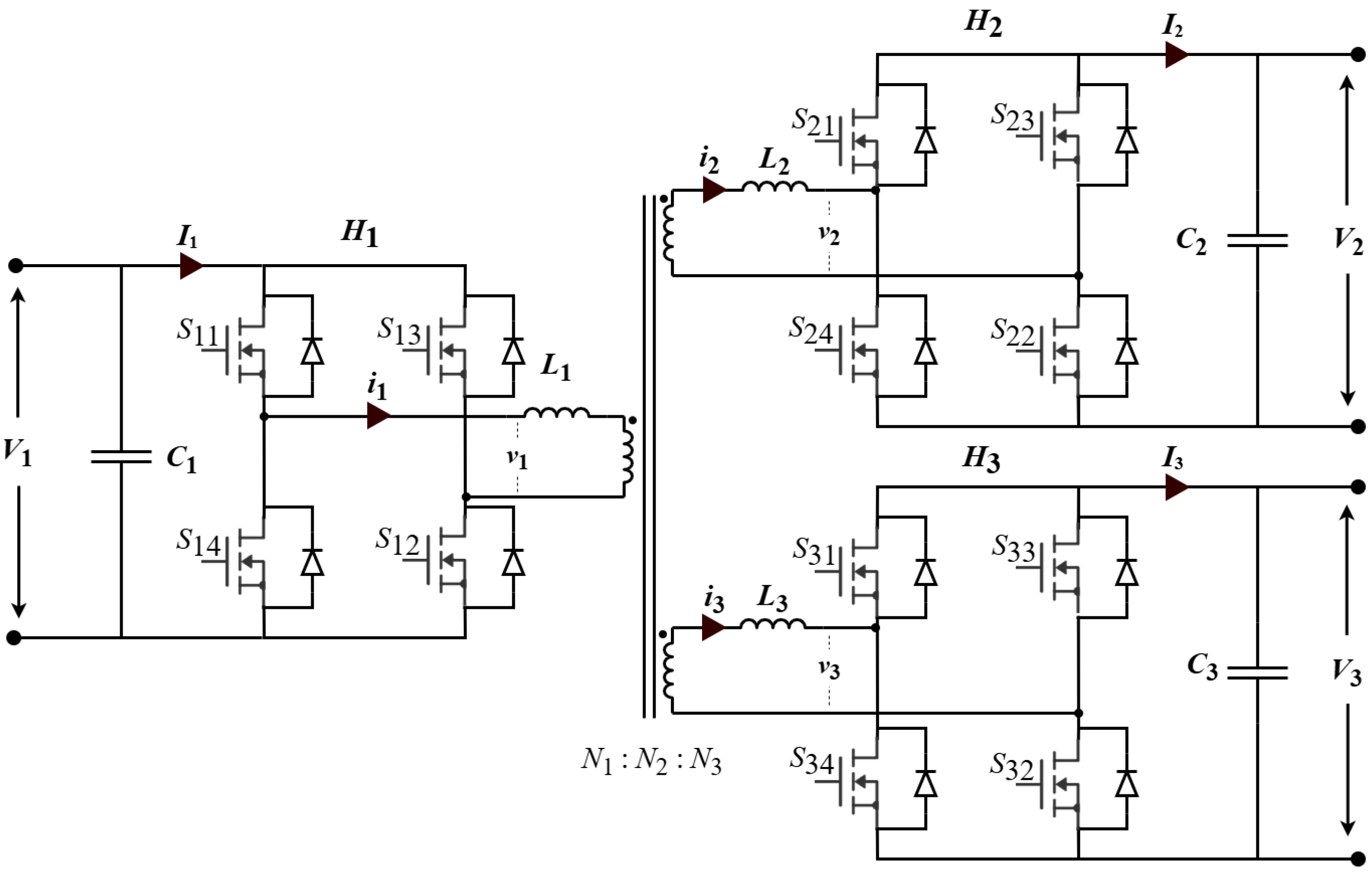
Simultaneous charging of two electric vehicles (EVs) using a single isolated multiport converter has emerged as an attractive architecture for compact charging stations [
1]. The triple active bridge (TAB) converter provides galvanic isolation, bidirectional power flow, and flexible power routing among three ports, making it a strong candidate for dual-EV charging [
2]. In such applications, the two EV ports can have different battery voltages, chemistry, rated powers, and unknown states of charge (SoC) and health (SoH), leading to highly unbalanced and time-varying power demands that must be satisfied concurrently. Power transfer in active-bridge DC–DC converters is regulated by adjusting the relative phase shifts among the bridges [
3]. For TAB converters, several phase-shift modulation schemes have been reported, among which comprehensive phase-shift (CPS) modulation exploits all five effective degrees of freedom available in the three-bridge structure [
4]. In principle, these variables provide sufficient freedom to independently regulate each port power, but they also create a large space in which inappropriate phase shift selections can induce severe circulating (reflux) power under asymmetric operating conditions [
5].
Circulating power in a TAB converter refers to internal power exchange among ports that does not contribute to the demanded power transfer [
6]. Such internal loops increase RMS current, conduction and switching losses, and thermal stress in semiconductor devices and magnetic components [
7]. In simultaneous dual-EV charging, where the two low-voltage ports operate at unknown and mismatched power levels, uncontrolled circulating power directly limits achievable efficiency and power density and may drive current stresses close to device ratings.
Mitigation of circulating power has been investigated from both magnetic-design and control perspectives. On the design side, several works co-optimize transformer turns ratios, blocking capacitors, and leakage inductance distribution to reshape inter-port currents and enlarge soft-switching regions. In [
8], leakage inductances between specific port pairs are deliberately increased or redistributed to reduce RMS current stress and attenuate internal oscillatory power around nominal voltage ratios. In [
9], circulating power between source ports is suppressed by inserting a blocking capacitor to create a high-impedance path, while [
10] optimizes leakage inductances using a harmonic-approximation-based model and a real-time power-flow algorithm to reduce circulating power by 42%. Dual-transformer TAB variants and three-winding designs with controllable leakage have also been proposed to alleviate circulating power through asymmetric magnetic structures and tailored turns ratios to achieve peak efficiency of 93.7% [
11]. A hybrid series-resonant TAB (HSR-TAB) with a resonant AC port and two DC-side inductors further improves soft switching and reduces tank RMS current via variable-frequency modulation achieving 96.3% efficiency and a total harmonic distortion of 4.1% at rated power [
12]. These design-oriented approaches demonstrate efficiency gains within prescribed operating windows, but the inductive coupling matrix is fixed once built and therefore tied to assumed voltage ratios and power distribution. As port voltages or load conditions deviate from these design points, circulating power suppression cannot be guaranteed. Moreover, such hardware modifications do not yield a generalized, adaptive control framework for non-circulating operation under arbitrary asymmetric three-port conditions.
On the control side, multi-degree-of-freedom, hybrid and extended hybrid modulation schemes, have been introduced to widen the ZVS region and mitigate current stress [
13,
14]. In particular, CPS and penta phase-shift (PPS) modulation [
15] are well suited for TAB converters, as their five independent phase variables span the full steady-state power-flow space, enabling simultaneous enforcement of three-port power references, circulating-power constraints, and soft-switching margins. For example, a generalized-harmonic-approximation (GHA) model and control strategy in [
16] enable high-efficiency of 97.6% with wider ZVS operation for a TAB-based on-board charger with simultaneous grid-to-battery operation, while [
17] introduces a modulation index as an extra degree of freedom to minimize reactive power by 54.33% and efficiency gain of over 52.9% in hybrid energy storage applications. An optimal phase–duty scheme in [
18] further minimizes RMS current and conduction losses for a 160 V input with two outputs at 110–130 V and 18–27 V to achieve improvement of efficiency by 21% under light-load condition. However, these methods are developed and validated under structured, largely balanced or mildly unbalanced port conditions; circulating power is mitigated only indirectly as a by-product of loss or current minimization and is not treated as an explicitly constrained variable. In particular, the very low and tightly bounded tertiary-port voltage in [
19] and the normalized, gain-specific operating regions in [
20] restrict applicability to narrow operating ranges, so these schemes do not extend to wider, strongly asymmetric three-port conditions and do not guarantee low inter-port circulating power in dual-EV charging.
Optimization-based and data-driven modulation methods further refine phase-shift selection. A five-variable modulation framework in [
21] establishes a universal analytical model and simplified ZVS constraints, then uses particle swarm optimization to achieve peak efficiency of 97% and reduce circulating current across predefined power-flow modes. A LUT-based decoupling controller with PI control in [
22] reduces apparent power coupling by 90–95% between ports in a DC microgrid, while a power-decoupling configurable model predictive control (PDC-MPC) strategy in [
23] achieves improved transient response with 2.3% improvement to achieve peak efficiency of 95% compared to PI control. These approaches demonstrate measurable efficiency and current-stress improvements for specific prototypes and bounded operating conditions, but they rely on predefined voltage ranges, linear operating spaces, or balanced port conditions. Circulating power is embedded within composite loss or decoupling objectives rather than isolated as an independent analytical quantity, and no explicit conditions for zero- or bounded-circulating operation over the full modulation space are formulated. In contrast, the present work formulates explicit non-circulating power-flow (NCPF) conditions in the effective phase-shift domain for the full CPS modulation space and uses them to synthesize a low-overhead Jacobian-based controller that directly enforces zero circulating power while tracking arbitrary asymmetric port-power references in dual-EV charging.
Some studies explicitly address circulating behaviour, but only in a limited sense. In [
24], a power-flow decoupling controller is developed based on a generalized average model (GAM) utilizing Fourier decomposition of the transformer currents and reconstructed high-frequency (HF) port voltages to achieve decoupled power regulation. However, the control strategy employs only two phase-shift variables, which inherently restricts the achievable control degrees of freedom and does not span the full five-dimensional phase-shift space of the TAB converter. As a result, the complete CPS operating space cannot be explored. Similarly in [
25], an intermittent control strategy periodically disables one bridge so the remaining two operate as a dual active bridge, which reduces cross-current and reactive power between source ports, but this scheme is tailored to intermittent source operation and lacks a continuous, closed-form circulating-power model or modulation law for cases where all low-voltage ports are simultaneously active.
Therefore, although existing work has advanced magnetic design, multi-phase modulation, and loss-oriented and decoupling control for TAB converters, circulating power has largely been addressed indirectly and within restricted operating regions. An explicit analytical framework that characterizes circulating power under general asymmetric three-port conditions and formulates control constraints to suppress it across the full phase shift modulation space has not yet been systematically established. The proposed NCPF framework fills this gap by providing such an analytical structure and a computationally lightweight controller that guarantees non-circulating operation for arbitrary asymmetric dual-EV charging profiles without specialized hardware. Addressing this unresolved limitation, specifically for strongly asymmetric, time-varying dual-EV charging, is the objective of the present work.
4. Simulation Validation of Non-Circulating Power-Flow Control
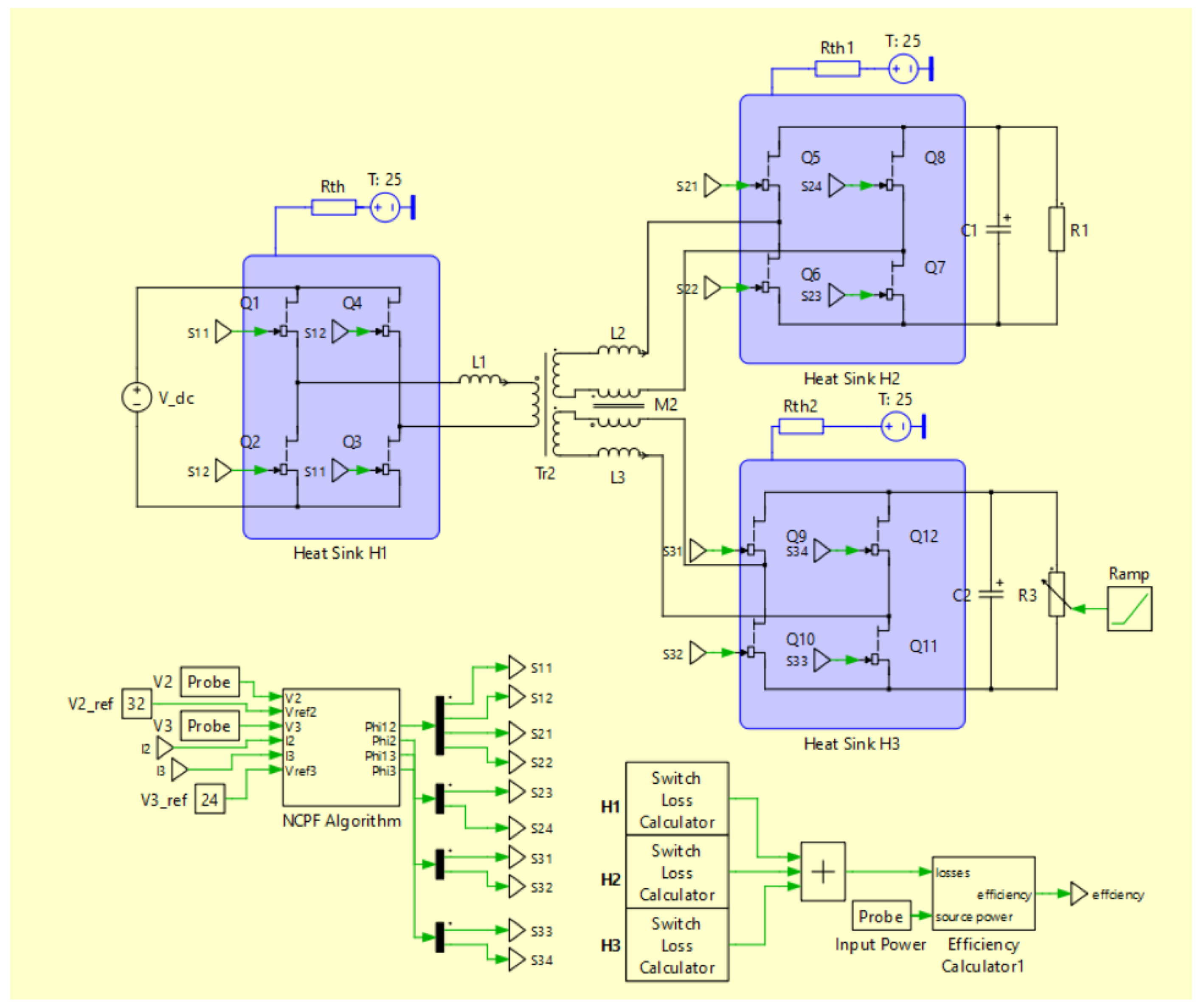
The proposed NCPF control strategy is first validated using a detailed PLECS model of the TAB converter, as shown in
Figure 4 with parameters summarized
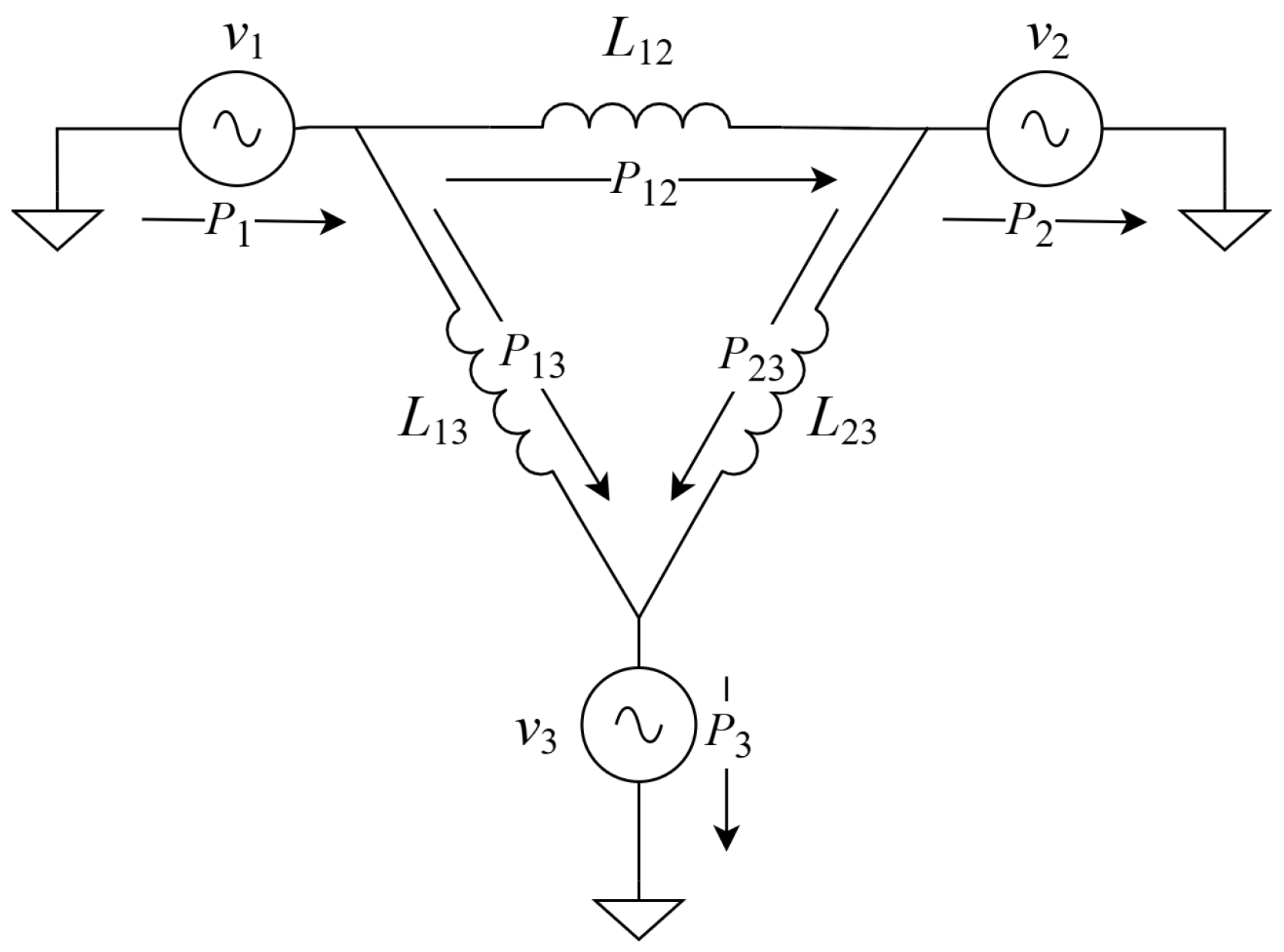
Table 1. The model includes device-level conduction and switching loss models, as well as transformer leakage inductances consistent with the star–delta representation introduced earlier. The gate signals for the three bridges are generated by a MATLAB 2025a control block that computes the CPS phase variables
from the NCPF controller. The corresponding effective shifts
are applied to the power-flow model (
11) within the controller to enforce the NCPF conditions.
4.1. Effect of Symmetric and Asymmetric Loads
Circulating power in TAB converters is driven both by leakage asymmetries and by deviations in port voltages and loading conditions. Even if the leakage paths are nearly identical, any mismatch in the secondary-side dc levels creates a non-zero average voltage difference across , which produces an internal power exchange between Ports 2 and 3 and increases RMS currents.
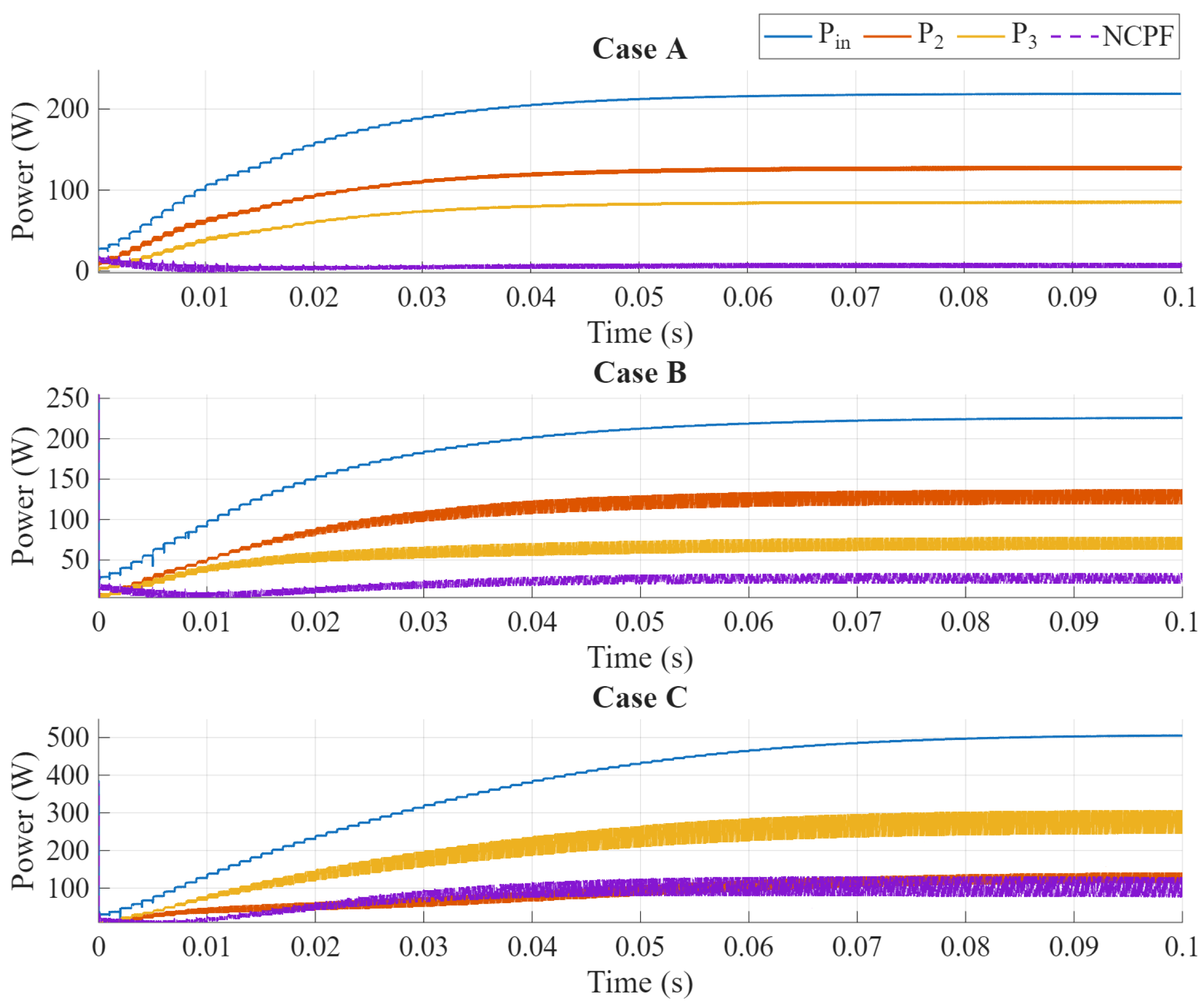
To quantify this effect, three representative operating cases are considered (
Figure 5). In Case A, the two outputs are maintained at equal voltage setpoints (
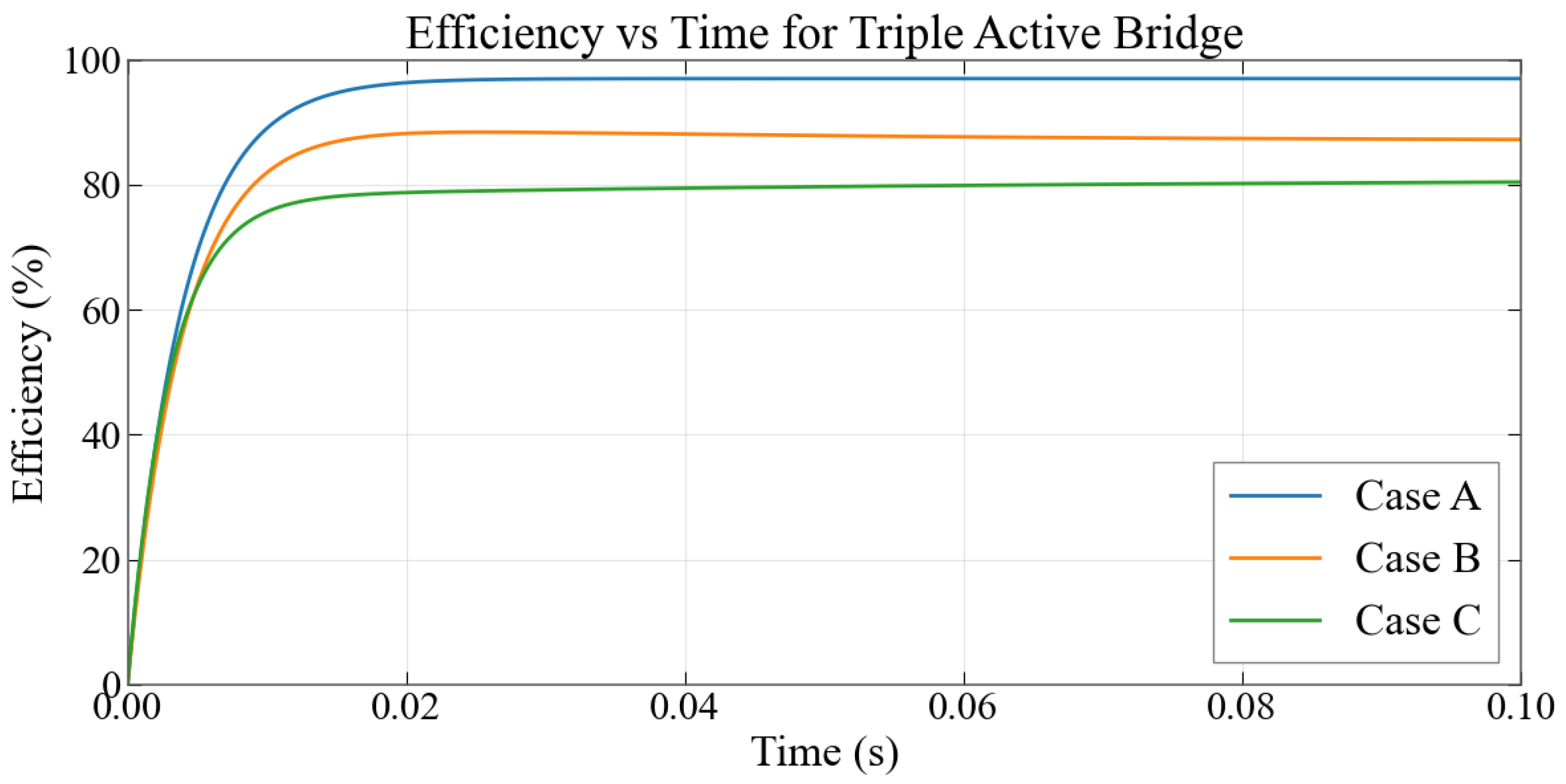
V), while asymmetry is introduced via unequal load currents and leakage inductances. Under these conditions, the TAB maintains high efficiency in the range of 96–97% (
Figure 6), and the internal circulating power remains negligible because no steady voltage offset exists between the secondary ports.
In Case B, is lowered to 24 V while remains at 32 V, with balanced load currents. The resulting dc voltage asymmetry forces additional RMS current through the bridges and induces a measurable internal power exchange between Ports 2 and 3. This increases conduction losses and reduces overall efficiency, even though the load currents are symmetric.
Case C further increases the asymmetry by raising
to 48 V while keeping
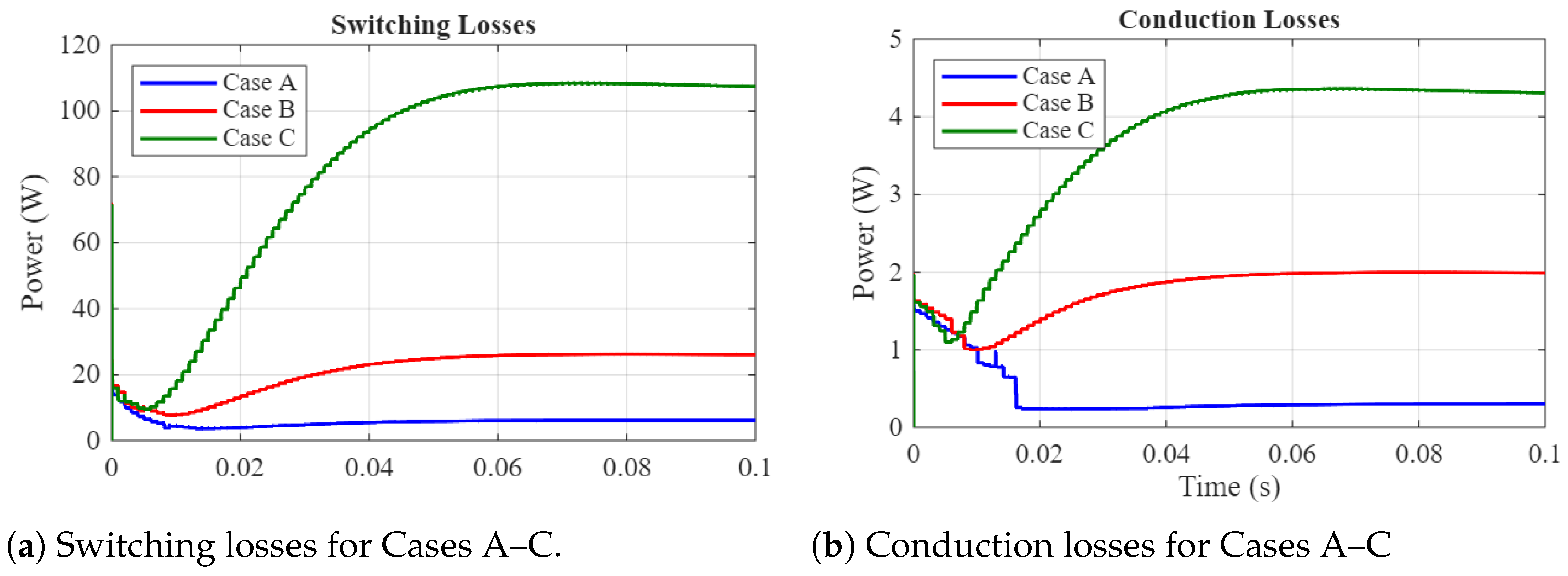
at 32 V. The magnitude of internal power flow between the low-voltage ports grows significantly, leading to a pronounced efficiency reduction and elevated conduction and switching losses, as summarized in
Figure 7.
These simulations confirm that efficiency is much more sensitive to secondary-side voltage mismatch than to load-current asymmetry alone. While unequal load currents can still be accommodated with high efficiency, deviations in output voltage directly aggravate internal power circulation and device stress.
4.2. Mitigation via NCPF Control
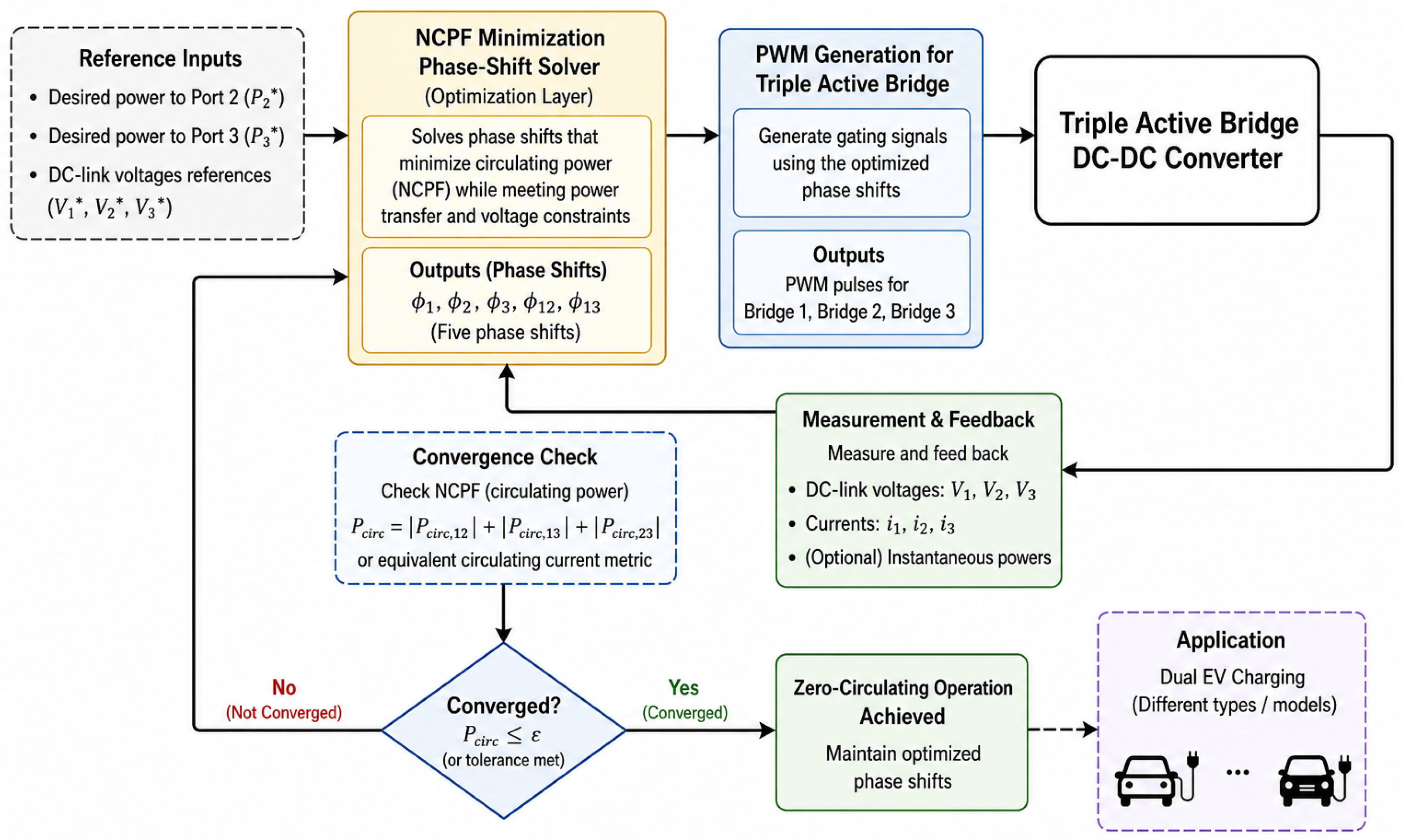
The NCPF controller mitigates this efficiency loss by actively steering the effective phase shifts
so that the scheduled port powers are met and the phase-closure constraint is enforced. In the simulation, the instantaneous port powers
,
, and
are computed from the measured voltages and currents, and the average input and output powers are estimated over one switching period. The circulating power is then evaluated as
which, in the lossless approximation, isolates the internal mesh power component.
The NCPF update law adjusts the three effective phase shifts at each sample so as to reduce
while preserving the desired
.
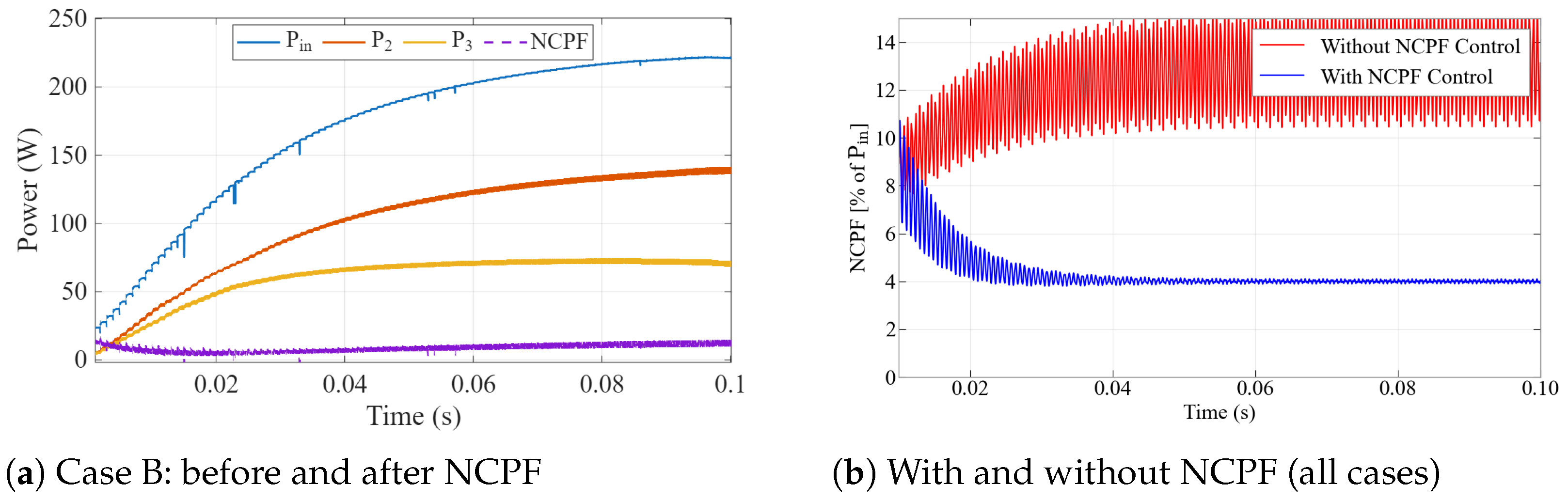
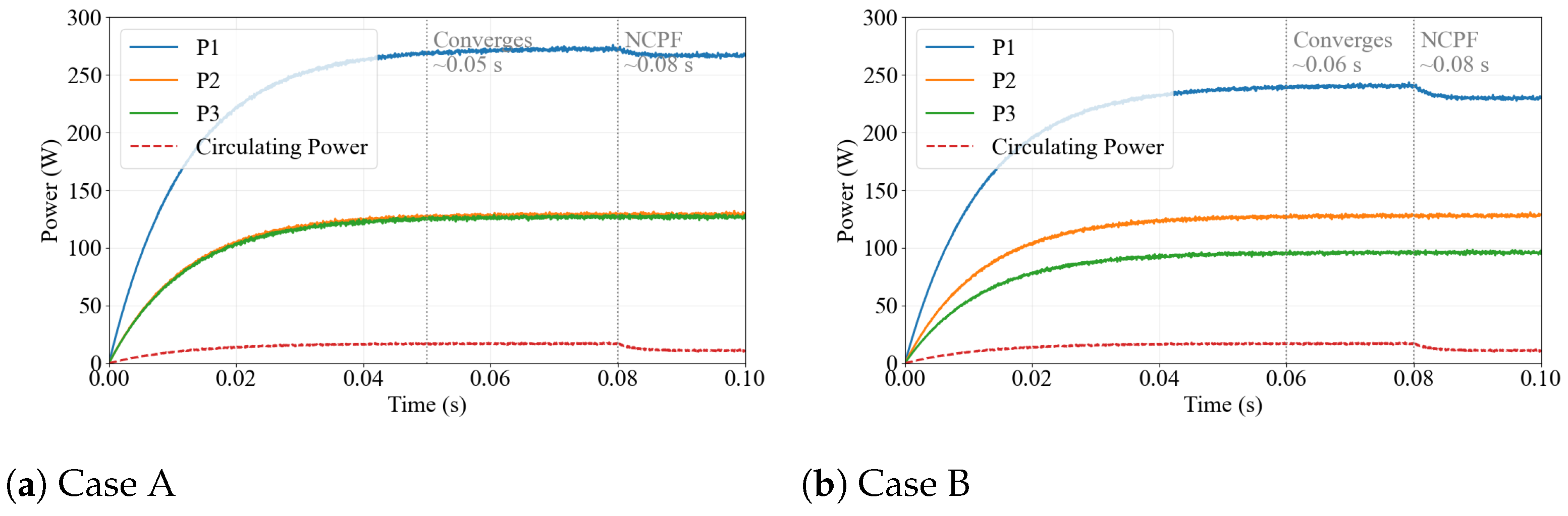
Figure 8a,b show the reduction in circulating power for Case B when NCPF control is activated. The circulating component, expressed as a percentage of input power, is reduced by approximately one order of magnitude, leading to a substantial recovery of efficiency relative to the uncontrolled case.
4.3. Performance Metrics
Two main performance metrics are used to quantify the benefit of the proposed NCPF strategy: circulating power reduction and thermal impact.
4.3.1. Circulating Power Reduction
The effectiveness of NCPF is measured by the fraction of the input power that is not involved in circulation. Over a given observation interval, the NCPF effectiveness index is defined as
A higher value of
indicates more effective suppression of circulating power.
Figure 8b compares the circulating power (before normalization) with and without NCPF control, expressed as a percentage of the input power. The proposed controller consistently reduces the circulating component to a small fraction of
across the tested operating points.
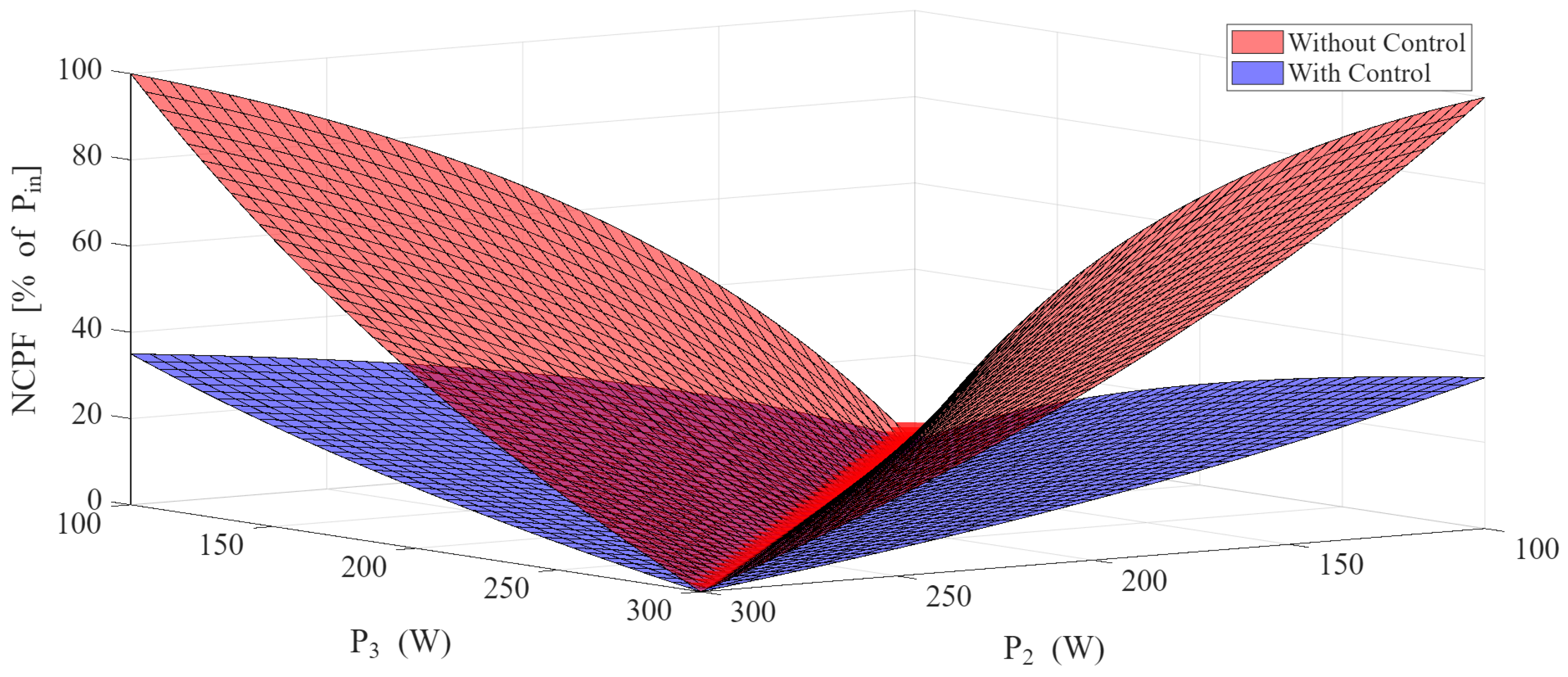
Figure 9 further illustrates the circulating power level over a wide operating range of
and
, both with and without NCPF. When the two low-voltage ports deliver similar power levels, the circulating component is inherently small. As the power sharing becomes increasingly unbalanced, the uncontrolled circulating power grows rapidly, whereas the NCPF controller maintains it at a much lower level, highlighting its importance for strongly asymmetric dual-EV charging conditions.
4.3.2. Thermal Analysis
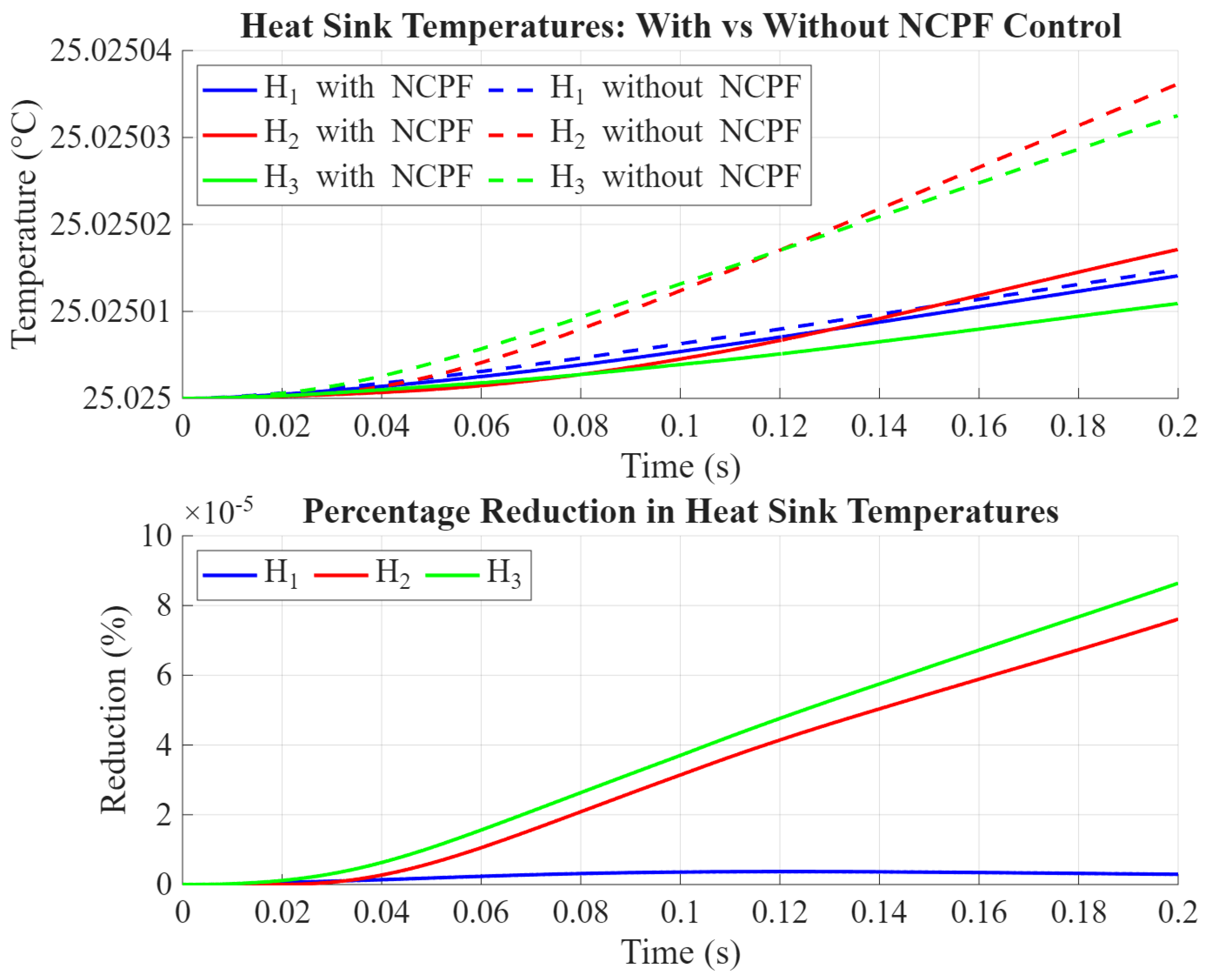
Electro-thermal simulations are used to assess the impact of NCPF on device temperatures. The GaN switches are modeled with detailed conduction and switching losses, and the resulting losses are mapped to heat-sink temperatures , , and associated with the three bridges.
Figure 10 shows the time-domain evolution of the heat-sink temperatures with and without NCPF control. A clear reduction in steady-state temperatures is observed when NCPF is enabled, consistent with the lower circulating power and reduced RMS currents.
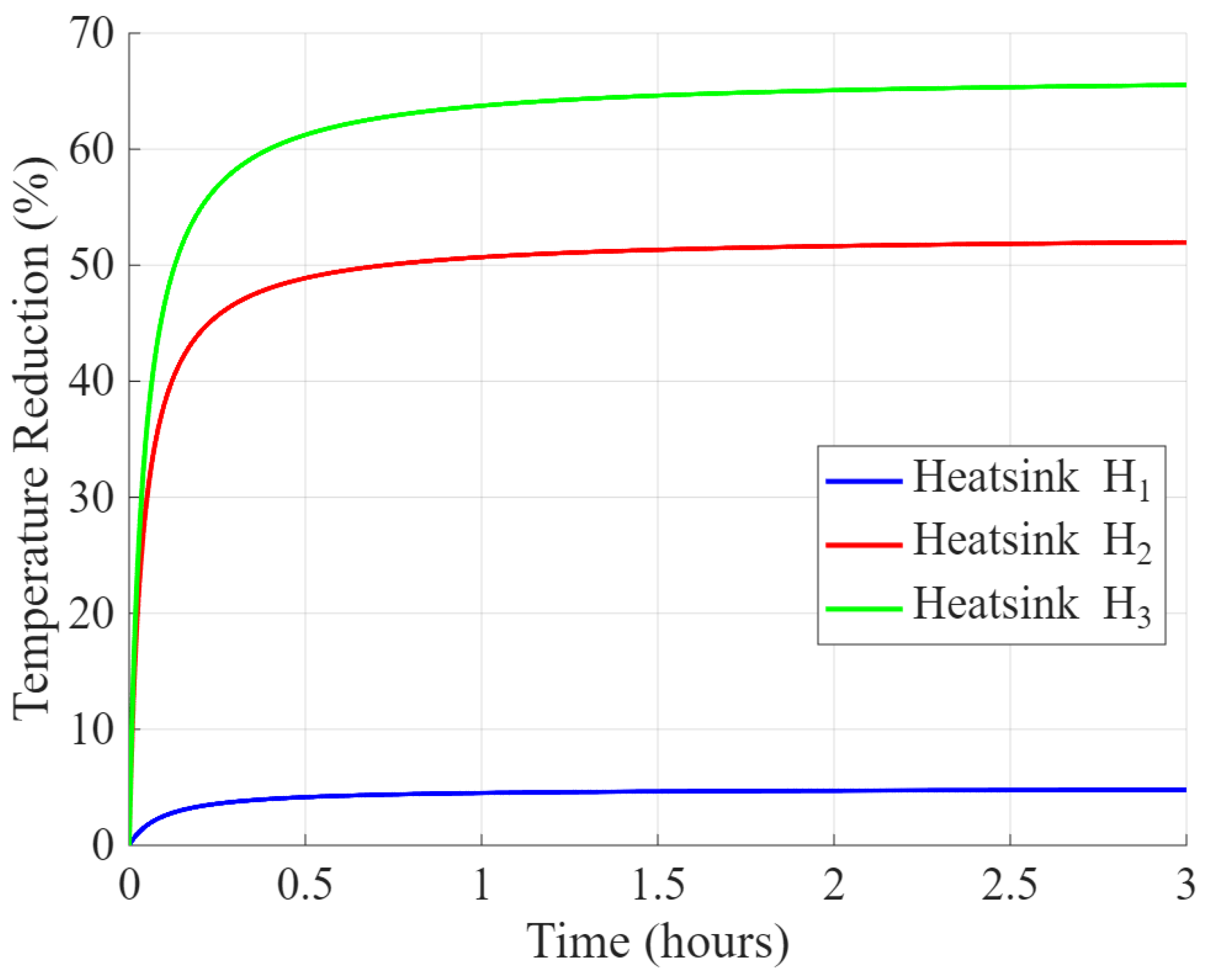
Figure 11 summarizes the percentage reduction in peak heat-sink temperature for each bridge. The largest improvement is observed on the most heavily stressed bridge, confirming that the NCPF controller alleviates thermal stress in the worst-case asymmetric operating conditions.
For the results in
Figure 5,
Figure 6,
Figure 7,
Figure 8 and
Figure 9, the detailed PLECS model includes an explicit magnetizing inductance and a core-loss model for the three-winding transformer, whereas the analytical derivation in
Section 2 uses only the equivalent star–delta leakage network. Across the representative operating points in Cases A–C, the difference between the circulating power predicted by the leakage-only model and that obtained from the detailed simulation remains within a few percent of the input power at full load, and the NCPF controller still reduces the circulating component by roughly one order of magnitude relative to baseline CPS modulation. At light load, the relative contribution of magnetizing current increases, but the closed-loop NCPF update law acts on measured average port powers and therefore compensates for these non-idealities; the residual circulating power observed in simulation remains small over the tested light-load operating points.
5. Hardware Implementation
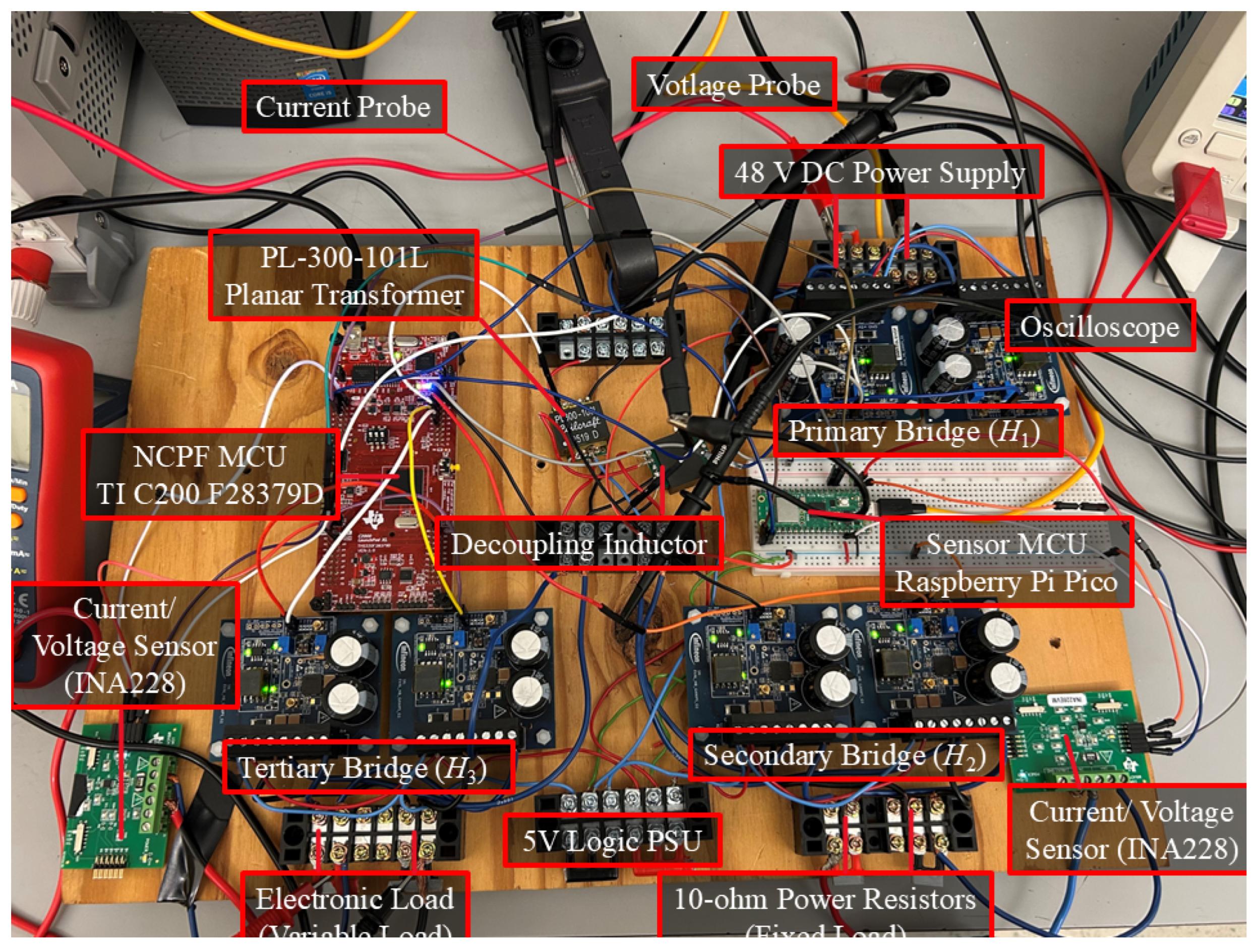
A laboratory prototype of the TAB converter, shown in
Figure 12, is built using the same nominal parameters as in the simulation model to experimentally validate the proposed NCPF control. This ensures that the hardware results directly corroborate the simulation findings.
The NCPF algorithm is implemented on a TI LAUNCHXL-F28379D microcontroller (TMS320F28379D from Texas Instruments, Dallas, TX, USA), assisted by a Raspberry Pi Pico (RP2040 from Adafruit, New York, NY, USA) for power sensing. The Pico board reads port voltages and currents using 20-bit INA228 power-meter devices from Adafruit, Newyork, US over an I2C bus operating at 400 kHz, computes the output powers and , and transmits them to the main MCU via a UART link. The MCU computes the effective phase shifts according to the NCPF update law and maps them to the five CPS variables used to generate PWM gate signals for the three full bridges.
Each full bridge is realized using half-bridge evaluation boards based on IGI60F1414A1L GaN devices with integrated gate drivers and isolated auxiliary supplies. A planar transformer with a turns ratio of 7:4:4 provides galvanic isolation and the desired voltage scaling. An external decoupling inductor is used to realize the required leakage and mutual inductance between the secondary and tertiary ports.
For the three representative operating cases, the secondary bridge is connected to a fixed 10
load, while the tertiary bridge is connected to a programmable dc electronic load to emulate different EV charging demands.
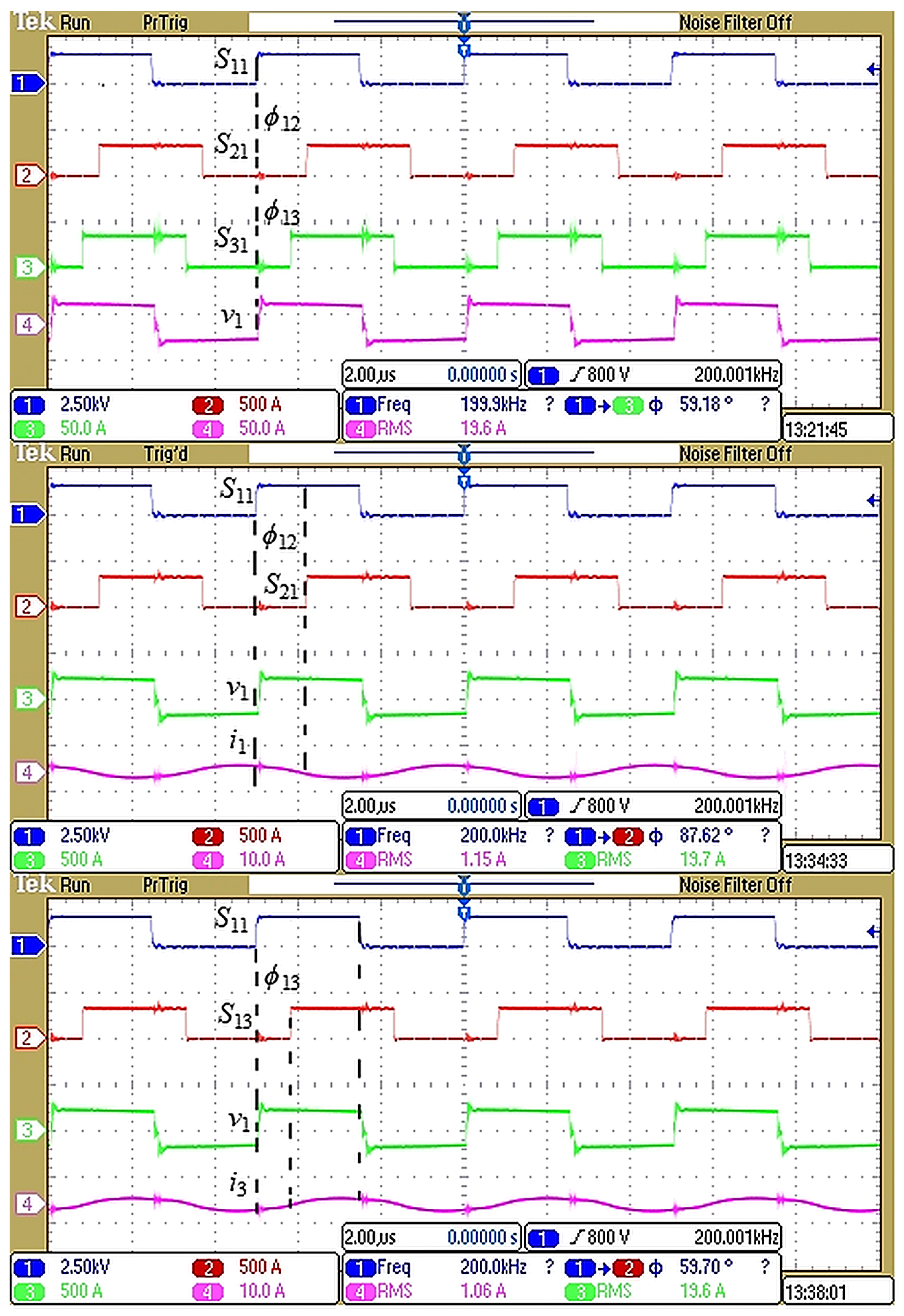
Figure 13 shows a representative steady-state oscilloscope capture of the transformer terminal voltages and currents with NCPF control, illustrating that the commanded phase-shift relationship and the resulting current magnitudes are consistent with the intended non-circulating operation.
Table 2 summarizes the measured efficiencies for three operating cases with and without NCPF control. In all cases, the NCPF controller yields a significant efficiency improvement, with the largest gains observed under the most asymmetric conditions.
While individual device loss components cannot be directly separated in hardware as in the simulation, the measured reduction in circulating power and the consistent efficiency gains across Cases A–C confirm that the NCPF control effectively mitigates the additional conduction and switching losses associated with internal power circulation.
6. Results and Discussion
The simulation and experimental results demonstrate that the proposed NCPF framework effectively suppresses the circulating power even under asymmetrical load conditions. The close match between simulated and experimental efficiency gains and circulating-power reduction indicates that the non-circulating phase-shift solution remains effective even when high-frequency harmonics and dead-time are present. The star–delta leakage model and CPS-based power map clarify that internal power circulation is primarily driven by secondary-side voltage imbalance between Ports 2 and 3, and only secondarily by load-current or leakage-inductance asymmetry. The three operating cases
Figure 14a,b and
Figure 15 in real-time testing on bench validate the findings of the simulations for the parameters mentioned in
Table 2. It verifies that even modest deviations in the secondary dc voltages can induce substantial RMS current stress and efficiency degradation. This confirms that, for dual-EV charging and multi-battery applications, explicit control of the phase geometry is critical, rather than relying only on loss-oriented or ZVS-oriented modulation [
27,
28]. In the hardware prototype, transitions between operating points are implemented by adjusting the electronic load at the tertiary port, and the measured port currents remain within their rated envelopes without detrimental overshoot.
In Case A, the TAB operates under nearly symmetric conditions with
V and equal target powers of approximately 128 W on both outputs. The baseline CPS modulation without NCPF produces non-negligible circulating power even in this nominally balanced case, leading to increased RMS current in the leakage network and a measured efficiency of 91%. With the proposed NCPF law enabled, the Case A power trajectories in
Figure 14a show that the commanded port powers are preserved while the internal circulating component is effectively suppressed, raising the measured efficiency to 95.8%. The relatively small difference between “with” and “without” NCPF under symmetric voltages highlights that conventional CPS modulation is already reasonably effective in this operating condition, but that there is still measurable losses associated with residual phase shifts misalignment.
Case B represents a mildly asymmetric scenario with
V and
V, corresponding to approximately 128 W and 96 W load powers, respectively. Under this moderate imbalance, the baseline TAB exhibits significantly higher circulating power and a drop in efficiency to 88.1%, consistent with the increased mismatch in secondary-side voltage levels. The power traces in
Figure 14b show that the branch currents must carry both the scheduled power-transfer component and a sizeable mesh current, which does not contribute to any useful load. When the NCPF control is applied, the effective phase vector is reoriented to cancel the mesh component while preserving the same scheduled powers at Ports 2 and 3. As a result, the circulating power is markedly reduced in all branches, and the measured efficiency improves to 94.3%, recovering nearly all of the loss penalty introduced by the secondary-side voltage asymmetry.
Case C considers a strongly asymmetric operating point with
V and
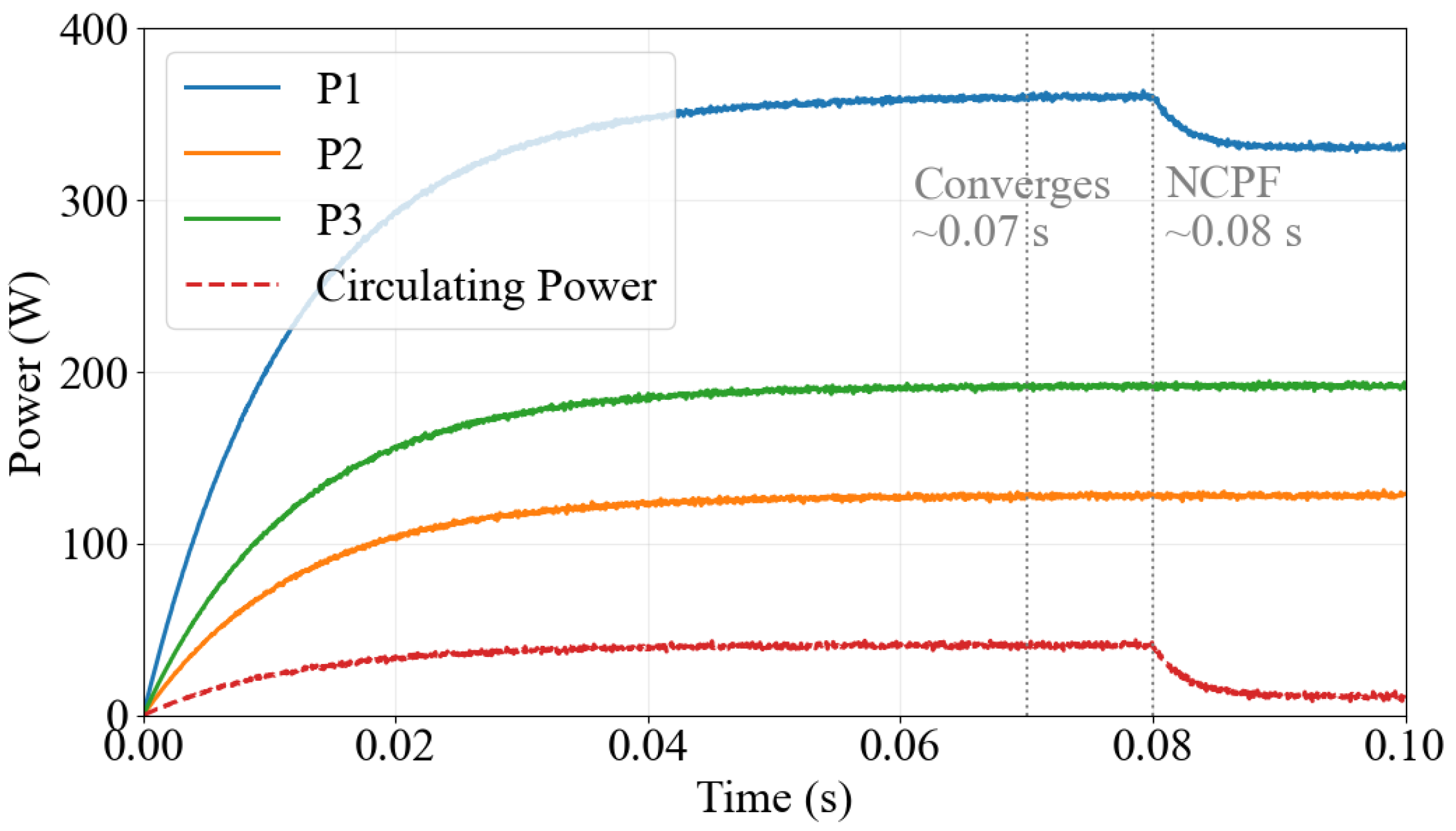
V, corresponding to approximately 128 W and 196 W outputs. This configuration is representative of highly unbalanced dual-battery or dual-EV charging scenarios, where one port operates at a significantly higher dc level or load. Without NCPF, the internal power circulation is severe, and the overall efficiency degrades to 85.4%. The power trajectories in
Figure 15 illustrate that large circulating components flow through the TAB leakage network, substantially increasing RMS current stress and, consequently, conduction and core losses. With NCPF enabled, the same case exhibits a clear reduction in circulating power while maintaining the scheduled port powers, raising the measured efficiency to 93.5%. This efficiency gain of more than 8 percentage points in the most challenging case underscores the importance of explicitly controlling the phase geometry in the presence of strong asymmetry.
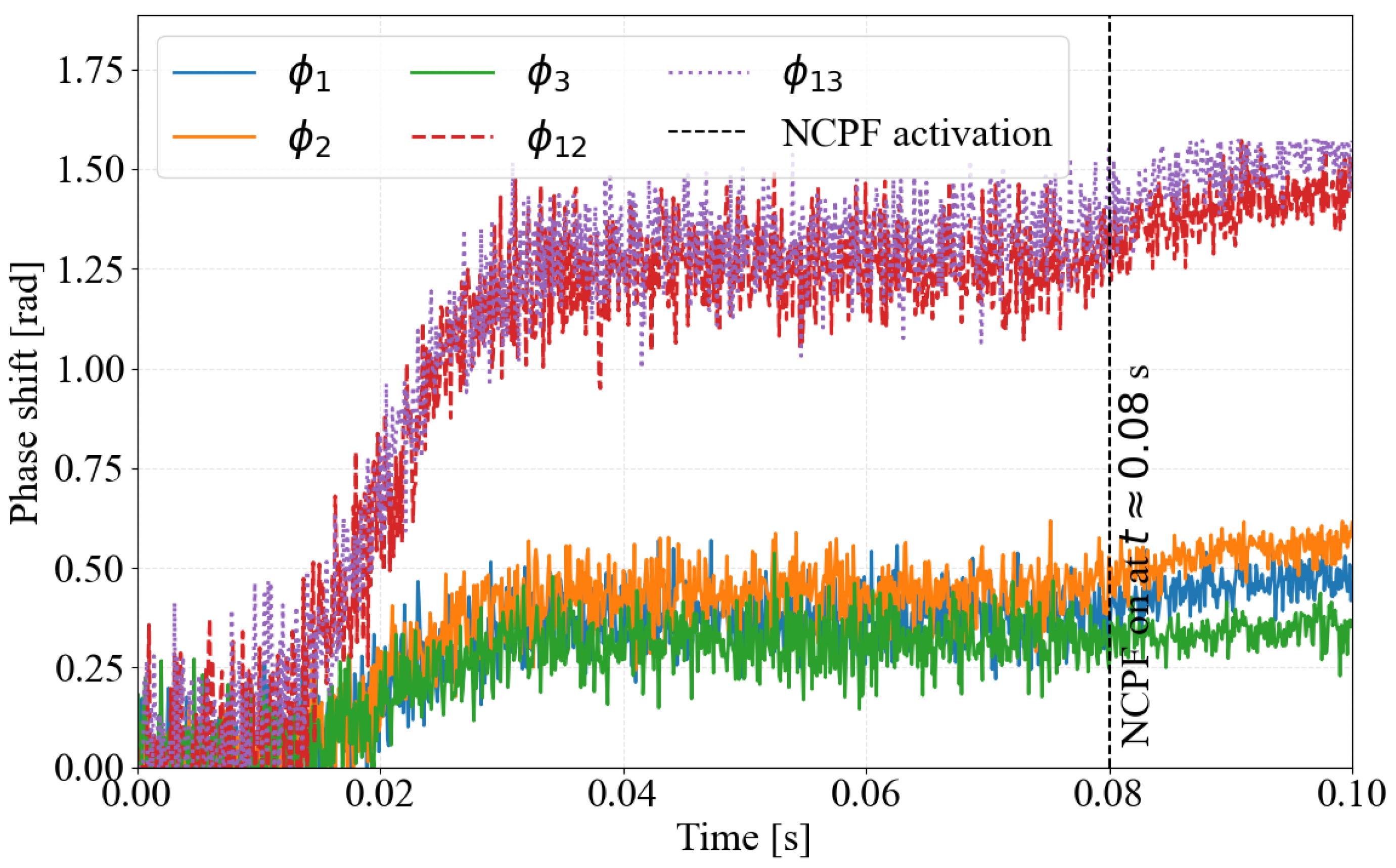
The dynamic behavior of the NCPF controller is further illustrated in
Figure 16, which shows the convergence of all five phase-shift variables for Case C. Starting from a generic CPS initialization, the phase shifts smoothly converge to the NCPF solution that both enforces the phase-closure constraint and eliminates the mesh component of the branch powers. The convergence occurs within a few switching cycles, with no observable overshoot or oscillation in the power trajectories, confirming that the proposed control law is numerically well-conditioned and dynamically well-damped. This behavior is particularly important for practical implementations, where phase-shift trajectories must be free of large transients to avoid exciting resonances or violating device current limits.
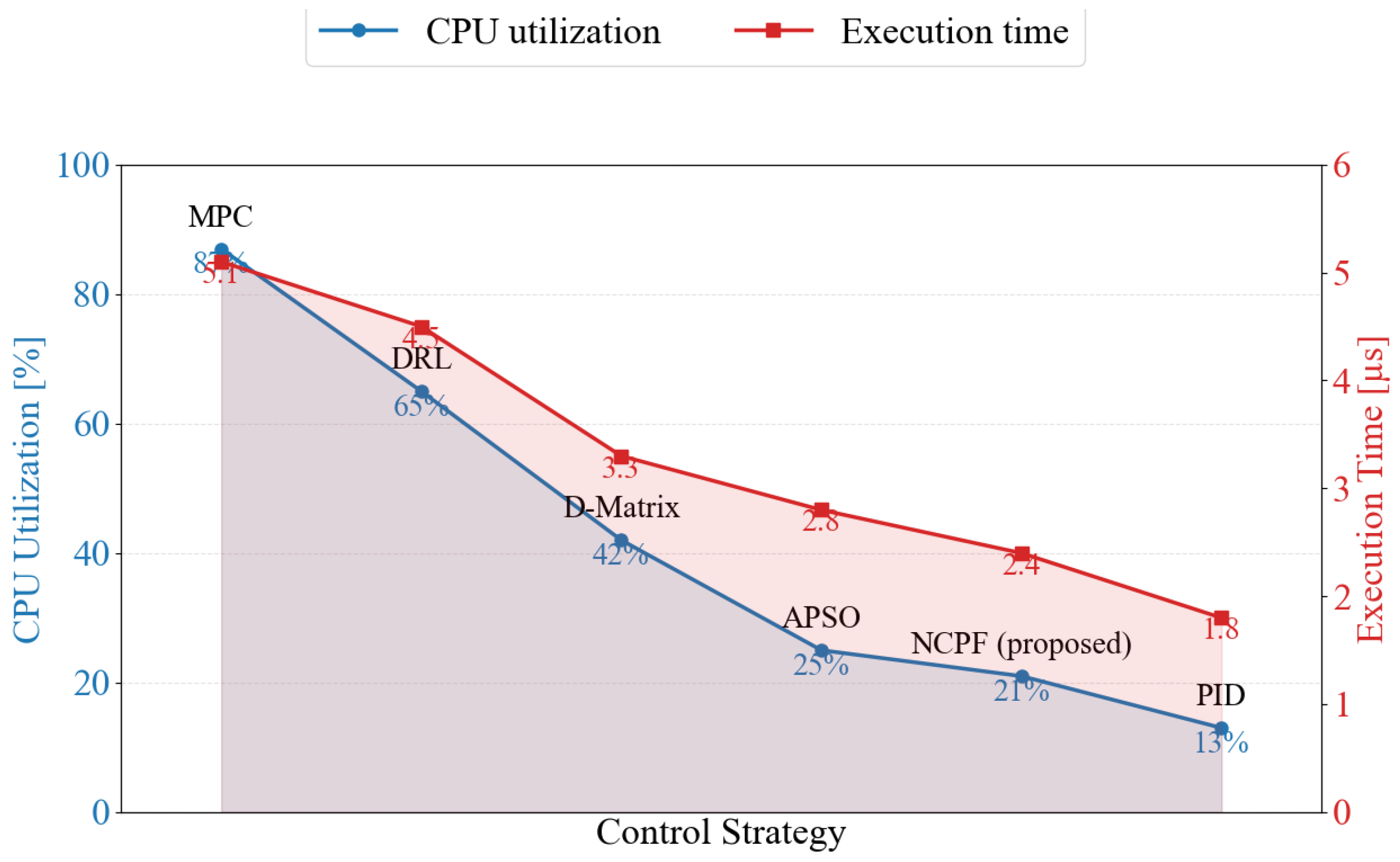
Beyond power-flow quality, the proposed NCPF controller is competitive in terms of real-time computational burden when compared against representative advanced control strategies in the literature.
Figure 17 compares the CPU utilization and execution time of the NCPF implementation on a TMS320F28379D controller against model predictive control (MPC) [
29], deep reinforcement learning (DRL) [
26], decoupling-matrix control [
4], adaptive particle swarm optimization (APSO) [
21], and a classical PID-based scheme [
1]. At a 200 kHz switching frequency, the proposed NCPF requires only 21% CPU utilization with an execution time of 2.4 µs per control cycle, whereas MPC and DRL consume 87% and 65% CPU, respectively, with significantly higher execution times. The decoupling-matrix and APSO-based controllers also exhibit higher computational overhead than NCPF, while the PID baseline is computationally light but does not provide any explicit suppression of circulating power. These results indicate that NCPF achieves a favorable trade-off between power-flow optimality and implementation cost, delivering explicit circulating-power control at a computational complexity closer to conventional linear controllers than to full-fledged MPC or DRL schemes. All controllers (NCPF, MPC, DRL, decoupling-matrix, APSO, and PID) were implemented on the same TMS320F28379D microcontroller and executed at a 200 kHz switching frequency using identical compiler settings and interrupt priorities, so that the reported CPU utilization and execution times reflect comparable embedded conditions.
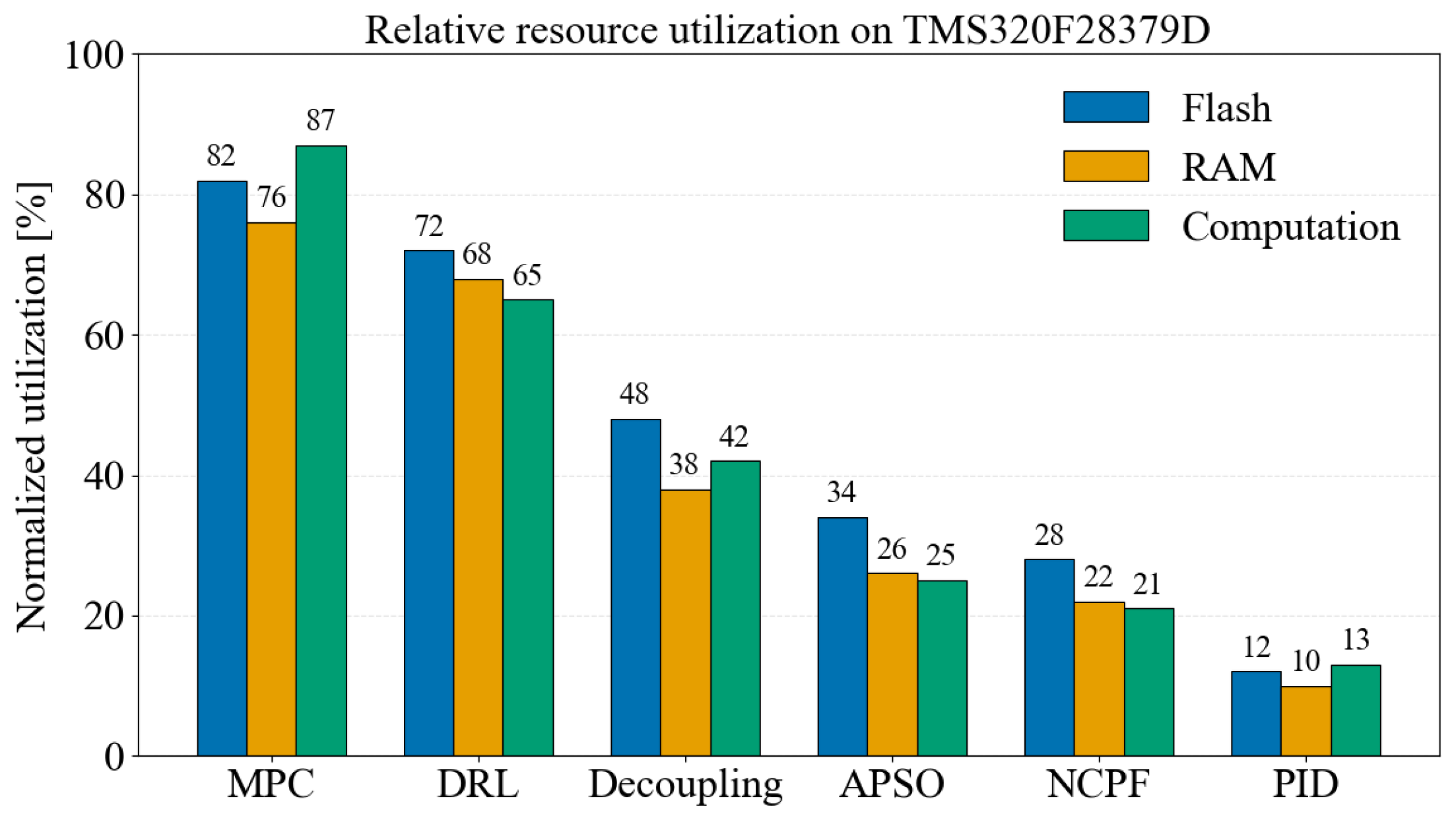
The resource-distribution profile of the NCPF implementation is further examined in
Figure 18, which reports the normalized utilization of Flash memory, RAM, and computational resources across the different controllers. For the proposed NCPF, the measured utilization is approximately 28% of Flash, 22% of RAM, and 21% of the available computation budget, leaving ample headroom for additional supervisory layers, communication stacks, or diagnostic functions on the same digital controller. In contrast, MPC and DRL occupy substantially more program memory and RAM and demand a greater fraction of the available computation, limiting their practical use in cost-sensitive embedded platforms. The decoupling-matrix and APSO controllers fall between these extremes, but still impose higher resource demands than the NCPF implementation. Taken together, the execution-time and resource-utilization results show that NCPF is not only effective in improving TAB efficiency and reducing circulating power, but is also lightweight enough to be deployed on standard automotive-grade microcontrollers without specialized hardware acceleration.
7. Conclusions
This paper presented a non-circulating power-flow (NCPF) control strategy for the triple active bridge (TAB) converter, aimed at suppressing internal power circulation and improving conversion efficiency under asymmetric three-port conditions. A generalized CPS model was first developed using a star–delta leakage transformation and a compact DAB-type power map, which expresses the average branch powers as functions of three effective phase shifts. On this basis, explicit NCPF conditions were formulated in the effective phase domain, showing that non-circulating operation corresponds to enforcing both the scheduled port powers and a phase-closure constraint that suppresses the mesh component of the branch powers. A closed-form NCPF solution was obtained for the symmetric-leakage case, and a Newton-based update law was proposed for general asymmetric leakage networks.
The resulting NCPF controller adjusts the three effective phase shifts (and, through them, the five CPS variables) so that the desired port powers are realized while circulating power is minimized over the full CPS space. The method was evaluated in simulation and hardware for three representative operating points: (i) a nearly symmetric case with equal secondary voltages and powers, (ii) a mildly asymmetric case with unequal output powers, and (iii) a strongly asymmetric case with mismatched voltages, inductances, and loads. Time-domain studies and real-time tests on a 400 W TAB prototype confirmed that, as asymmetry increases from mild to strong, the efficiency without NCPF falls from 91.0% to 85.4%, whereas NCPF raises the efficiency to 95.8%, 94.3%, and 93.5% for Cases A–C, respectively. These results correspond to gains of 4.8–8.1 percentage points and are accompanied by substantial reductions in circulating power, RMS current stress, and device temperature under worst-case asymmetry.
Beyond power-flow quality, the proposed NCPF controller was shown to be competitive in terms of real-time computational burden and resource usage. Measurements on a TMS320F28379D demonstrate that NCPF achieves only 21% CPU utilization and a 2.4 µs execution time per control cycle at 200 kHz, while occupying approximately 28% of Flash, 22% of RAM, and 21% of the available computation budget. In contrast, MPC, DRL, decoupling-matrix, and APSO-based controllers exhibit higher CPU usage, longer execution times, and larger memory footprints, whereas a PID baseline remains lightweight but cannot explicitly suppress circulating power. These results indicate that NCPF delivers explicit circulating-power mitigation at a computational complexity much closer to conventional linear controllers than to full-fledged MPC or DRL schemes.
Overall, the results demonstrate that, within the set of magnetic-design and advanced control strategies reviewed in this paper, the proposed NCPF framework overcomes several important limitations: it remains effective under strong asymmetry without specialized leakage design, explicitly targets the mesh circulating component rather than treating it indirectly, and achieves circulating-power suppression with significantly lower computational overhead than the representative MPC and DRL controllers evaluated. Owing to its explicit analytical formulation, its modest computational and memory footprint, and its compatibility with comprehensive phase-shift modulation, the method is particularly suitable for dual-EV charging modules, battery energy storage systems (BESS), and multiport DER interfaces, where port voltages and power demands are inherently asymmetric and time varying. Future work will extend the present study by co-optimizing the switching frequency, transformer design, and NCPF control parameters to identify application-specific operating points that maximize the efficiency gains. Additional future work will focus on scaling the approach to higher power levels typical of commercial EV charging stations, integrating battery management system (BMS) feedback to coordinate NCPF with cell-level charging constraints, and extending the framework to higher-port-count isolated topologies.