1. Introduction
The relationship between energy consumption and economic growth remains one of the most extensively debated issues in applied macroeconomics. Since the pioneering study [
1], which provided early empirical evidence of causality between energy use and output, the energy–growth nexus has developed into a central strand of empirical economic research. Over time, this line of inquiry expanded beyond energy economics into what is broadly referred to as the “X-variable–growth nexus” framework, encompassing finance–growth, tourism–growth, trade–growth, and environmental–growth relationships [
2].
The theoretical foundation of the energy–growth nexus is rooted in both neoclassical and endogenous growth models. Energy, particularly electricity, is not merely an intermediate input but a productive factor that enhances total factor productivity, enables mechanisation and digitalisation, supports capital accumulation, and facilitates structural transformation. Reliable energy infrastructure lowers transaction costs, improves industrial production efficiency, and strengthens technological diffusion. Conversely, energy instability constrains output, disrupts supply chains, increases production costs, and weakens investment confidence. The direction of causality between energy consumption and growth, therefore, carries significant policy implications, especially for economies undergoing structural transformation or energy transition.
Within the African context, South Africa provides a particularly compelling case for examining this relationship. As the continent’s most industrialised economy and a member of BRICS, South Africa’s economic structure is highly energy-intensive. Mining, mineral beneficiation, smelting, heavy manufacturing, and advanced services rely critically on an uninterrupted electricity supply. Historically, the country’s electricity generation has been overwhelmingly coal-based, with the vertically integrated state utility Eskom playing a dominant role in generation and transmission [
3]. Consequently, macroeconomic performance is closely linked to the stability of the electricity sector.
Despite substantial coal reserves and comparatively advanced infrastructure, South Africa has experienced recurrent electricity shortages since 2007 [
3]. Persistent load shedding is driven by ageing coal-fired plants, maintenance backlogs, operational inefficiencies, and financial distress within Eskom, which has imposed high economic costs. In recent years, electricity interruptions have been widespread and prolonged, constraining industrial production, increasing firms’ operating costs, dampening investment, and weakening overall economic performance. This electricity crisis has coincided with subdued GDP growth and persistently high unemployment, reinforcing concerns about the structural impact of energy instability on long-term development.
In addition to supply constraints, South Africa’s energy structure introduces further complexity. The economy remains highly carbon-intensive relative to GDP due to its dependence on coal-fired power generation. While coal historically underpinned industrial expansion and export competitiveness, it also exposes the country to environmental pressures and global decarbonisation commitments [
3]. Efforts to diversify the energy mix through renewable energy programmes represent an important structural shift, yet the transition entails significant macroeconomic and institutional adjustments. Understanding how different dimensions of energy consumption affect economic growth is therefore critical for informing both electricity sector reform and broader development strategy.
Although numerous empirical studies have examined the energy–growth nexus, findings remain mixed and context-dependent [
4]. Some studies support the energy-led growth hypothesis, others report bidirectional causality, while some find evidence of neutrality. Beyond empirical divergence, methodological limitations have also shaped the evolution of the literature. Early studies commonly relied on Engle and Granger’s residual-based cointegration approach [
5], the Phillips and Hansen’s fully modified ordinary least squares (FMOLS) procedure [
6], and Johansen’s maximum likelihood cointegration framework [
5,
6,
7]. While these techniques advanced time-series analysis, subsequent research revealed limitations, particularly in small samples and in contexts characterised by structural instability [
8].
Moreover, much of the earlier energy–growth literature adopted panel data configurations [
9,
10,
11]. Although panel methods increase statistical power, they often impose homogeneity assumptions across countries that differ substantially in institutional capacity, economic structure, and energy dependency [
12]. Unless interpreted carefully at the country level, such results may provide limited policy guidance. These methodological concerns generated demand for more flexible econometric approaches capable of accommodating small samples, mixed integration orders, and structural shifts [
13].
In response, Pesaran and Shin introduced the Autoregressive Distributed Lag (ARDL) modelling framework [
14], later formalised through the bounds testing procedure [
15]. The ARDL approach has since become widely applied in energy–growth research due to its methodological advantages. It can be employed regardless of whether variables are integrated of order I(0) or I(1), provided none is I(2), making it particularly suitable for macroeconomic data that exhibit mixed stationarity properties [
16,
17]. The model allows for different optimal lag lengths across variables, thereby better capturing the underlying data-generating process, especially in environments characterised by regime shifts, energy shocks, and policy reforms.
Importantly, the ARDL framework integrates short-run dynamics and long-run equilibrium relationships within a unified specification through the Error Correction Mechanism (ECM). This enables simultaneous estimation of short- and long-run effects and facilitates direct hypothesis testing on long-run coefficients—an advantage over traditional Engle–Granger procedures. Furthermore, ARDL performs reliably in small samples relative to Johansen-based approaches, and appropriate lag selection helps mitigate residual correlation and potential endogeneity concerns. Given South Africa’s prolonged electricity crisis, structural adjustments in the power sector, and ongoing energy transition, a flexible and robust econometric framework is essential for accurately assessing the energy–growth relationship.
Against this background, this study re-examines the energy–growth nexus in South Africa using a disaggregated specification that distinguishes electricity generation, per capita energy consumption, and total energy use. By applying the ARDL bounds testing approach, the study captures both short-run adjustments and long-run equilibrium dynamics, thereby providing updated and policy-relevant evidence tailored to South Africa’s evolving energy landscape.
This research contributes to the literature by offering a country-specific reassessment grounded in recent structural developments, employing a flexible econometric methodology suited to mixed integration properties, and distinguishing between multiple dimensions of energy consumption. In doing so, it aims to inform electricity sector reform, energy diversification strategy, and sustainable economic growth policy within a structurally energy-dependent economy. This study is structured as follows:
Section 1 provides an introduction,
Section 2 discusses both the theoretical and empirical literature review,
Section 3 provides the methodology,
Section 4 analyses the results, and
Section 5 discusses the conclusions, recommendations, and limitations.
2. Literature Review
This section presents a critical and synthesised review of the theoretical and empirical literature on the relationship between energy and economic growth, with particular emphasis on conceptual limitations, methodological implications, and relevance to South Africa.
2.1. Theoretical Literature Review
2.1.1. Growth Theory and the Energy–Growth Nexus
The relationship between energy and economic growth is grounded in both classical and modern growth theories, which provide complementary but incomplete explanations of long-run economic performance. Neoclassical growth theory, associated with Robert Solow [
18,
19], conceptualises output as a function of capital accumulation, labour, and exogenous technological progress. Within this framework, economic growth is primarily driven by capital deepening and technological advancement, while energy is implicitly treated as an intermediate input rather than a direct determinant of growth.
Although this abstraction enhances analytical tractability, it limits the model’s applicability in energy-constrained economies. By excluding energy and infrastructure constraints as explicit production factors, the neoclassical framework cannot adequately explain output disruptions arising from electricity shortages. While subsequent extensions acknowledge the supportive role of energy in production, they do not formally incorporate energy reliability into the growth process. Consequently, the framework underestimates the structural importance of energy in economies where production depends critically on stable electricity supply.
2.1.2. Endogenous Growth Theory and Infrastructure Productivity
Endogenous growth theory, developed by [
20,
21,
22], advances the analysis by internalising technological progress and emphasising the role of human capital, innovation, and infrastructure. In contrast to the neoclassical framework, endogenous models allow infrastructure—including energy systems—to directly influence productivity and long-run growth outcomes.
However, despite this advancement, endogenous growth theory shares a key limitation with the neoclassical model: both frameworks assume relatively stable production environments. While endogenous theory recognises infrastructure as growth-enhancing, it does not explicitly account for energy supply shocks, system unreliability, or persistent disruptions. This omission is particularly important in developing economies, where electricity instability directly constrains productivity. Thus, compared to neoclassical theory, endogenous models provide a more comprehensive role for infrastructure, but remain insufficient for explaining growth under conditions of energy insecurity.
2.1.3. Energy-Led Growth Hypothesis
The energy-led growth hypothesis provides a more explicit linkage between energy and economic performance by treating energy as a fundamental production input alongside capital and labour [
1,
23]. Unlike both neoclassical and endogenous models, this framework directly incorporates energy into the growth process and identifies four possible causal relationships: growth, conservation, feedback, and neutrality hypotheses.
Despite this conceptual advancement, the framework remains limited in scope. First, it focuses primarily on energy consumption quantity, without adequately accounting for energy efficiency, quality, or reliability. Second, while it improves upon earlier theories by recognising energy as a driver of growth, it does not fully capture structural constraints within energy systems. Compared to endogenous growth theory, which emphasises broader productivity drivers, the energy-led hypothesis provides a more direct but narrower explanation of growth, overlooking institutional and infrastructural constraints that condition energy use.
2.1.4. Structural Transformation and Development Theory
Structural transformation theory, associated with [
24], emphasises the shift from agriculture to industrial and service-based production as the foundation of long-term economic development. In this framework, energy plays a critical enabling role by supporting industrialisation, urbanisation, and productivity growth.
However, like the preceding theories, structural transformation models implicitly assume the availability of stable infrastructure. While they recognise the importance of industrial inputs, they do not explicitly consider the impact of persistent energy constraints on structural change. In comparison to the energy-led growth hypothesis, which directly incorporates energy as a factor of production, structural transformation theory provides a broader development perspective but lacks explicit treatment of energy system reliability. This limits its explanatory power in economies characterised by electricity instability.
2.1.5. Sustainable Development and Energy Transition Theory
Sustainable development theory extends the analysis by integrating economic growth with environmental and social objectives, particularly through the transition from fossil fuel-based systems to renewable energy sources [
25]. This framework introduces an important temporal dimension by recognising trade-offs between short-term economic costs and long-term sustainability benefits.
In contrast to earlier growth theories, sustainable development models explicitly acknowledge structural transitions; however, they still under-specify the macroeconomic consequences of energy instability during the transition process. In coal-dependent economies such as South Africa, the shift toward renewable energy may introduce short-term supply constraints, adjustment costs, and output volatility. While this framework captures long-term sustainability considerations more effectively than the energy-led growth hypothesis [
26], it remains limited in explaining short-run disruptions associated with unreliable energy systems.
2.1.6. Synthesis of Theoretical Literature
A comparative assessment of these theoretical frameworks reveals a shared and critical limitation: none fully integrates energy reliability, infrastructure instability, and supply disruptions into the growth process.
Neoclassical and endogenous growth theories differ in their treatment of technological progress but converge in assuming stable production environments. The energy-led growth hypothesis improves upon these models by explicitly incorporating energy as a production input, yet it focuses narrowly on energy quantity rather than system performance. Structural transformation theory broadens the development perspective but implicitly assumes uninterrupted industrial inputs, while sustainable development theory introduces long-term environmental considerations but under-specifies short-run energy constraints.
Collectively, these frameworks provide partial but fragmented explanations of the energy–growth relationship. None adequately captures the dual role of energy as both a productive input and a structural constraint, particularly in economies characterised by persistent electricity shortages.
This theoretical gap is especially relevant in the South African context, where energy system instability plays a central role in shaping economic performance and human development outcomes [
26]. Consequently, there is a need for empirical approaches that integrate multiple dimensions of energy, including availability, efficiency, and reliability, within a flexible econometric framework capable of capturing both short-run dynamics and long-run equilibrium relationships.
2.2. Empirical Literature
2.2.1. Empirical Literature Introduction
The empirical relationship between energy variables and development outcomes has attracted considerable attention in both developed and developing economies. While earlier studies primarily focused on the energy–growth nexus using aggregate economic indicators such as GDP, more recent research has expanded the analysis to include broader measures of welfare, particularly the Human Development Index.
Despite this expansion, the empirical literature remains inconclusive and fragmented. Differences in study periods, econometric methodologies, and variable selection have produced mixed findings regarding both the direction and magnitude of the relationship between energy use and development. In particular, the literature reveals three major areas of divergence: the causal direction between energy and development, the distinction between short-run and long-run effects, and the role of energy composition and efficiency.
To provide a structured overview of these issues, the summary below (
Table 1) presents selected empirical studies, organised chronologically and including their study periods, methodologies, and key findings.
2.2.2. Critical Synthesis of Empirical Literature
The evidence presented above reveals several important patterns and inconsistencies that require critical evaluation.
First, the choice of econometric methodology significantly influences empirical outcomes. Time-series approaches such as ARDL, as applied in studies focusing on South Africa and Nigeria, are effective in capturing country-specific long-run relationships and short-run adjustments. However, they are sensitive to lag selection and structural breaks. In contrast, panel techniques such as FMOLS, GMM, and VECM provide broader generalisation across countries but often obscure heterogeneity and institutional differences, particularly in developing economies.
Second, there is no consensus on the direction of causality. While some studies support the energy-led growth hypothesis, others find bidirectional relationships or neutrality. These inconsistencies are partly explained by differences in study periods. Long-span studies, such as those covering multiple decades, tend to identify stable long-run relationships, whereas shorter panel studies often report weak or insignificant short-run effects.
Third, the measurement of development remains a major limitation. Many studies rely on GDP, which fails to capture welfare dimensions such as education and health. Studies that incorporate HDI reveal more complex relationships, including negative or insignificant effects of energy consumption, suggesting that increased energy use does not automatically translate into improved human development.
Fourth, the literature highlights the importance of energy composition and structural factors. Renewable energy, fossil fuels, and energy efficiency have different effects on development outcomes. However, most studies analyse these variables in isolation, limiting understanding of the broader energy system.
Finally, there is limited consideration of structural disruptions, particularly in the South African context. Persistent electricity shortages and energy instability are likely to introduce non-linear and asymmetric effects, which are not adequately captured in conventional linear models.
2.3. Overall Research Gap
Based on the above synthesis, several gaps emerge.
First, the literature lacks consensus due to methodological fragmentation, with different estimation techniques producing inconsistent results. There is a need for a modelling approach that can accommodate mixed integration orders while capturing both short-run and long-run dynamics.
Second, there is an over-reliance on GDP as a proxy for development, with limited emphasis on multidimensional welfare indicators such as HDI. This restricts understanding of how energy systems affect broader human development outcomes.
Third, existing studies rarely account for energy system instability, particularly in South Africa, where electricity supply constraints have significantly shaped economic and social outcomes.
Fourth, most studies examine energy variables in isolation, rather than adopting a comprehensive framework that incorporates energy production, consumption, and fiscal dimensions simultaneously.
Finally, many studies rely on short sample periods, limiting their ability to capture long-term structural changes.
In light of these gaps, this study contributes to the literature by employing a long-run time-series dataset (1980–2023) within an Autoregressive Distributed Lag (ARDL) framework to examine the relationship between multiple energy indicators and human development in South Africa, thereby providing a comprehensive, context-specific, and methodologically robust analysis that captures both short-run dynamics and long-run equilibrium relationships in an energy-constrained economy.
4. Data Presentation and Interpretation
4.1. Analysis of Descriptive Statistics
Table 2 presents the descriptive statistics of the variables used in the study for the period 1980–2023. The statistics provide an overview of the central tendency, dispersion, and distribution of the variables prior to econometric analysis.
The Human Development Index (HDI) has a mean value of 0.614 with a standard deviation of 0.072. The minimum and maximum values range from 0.482 to 0.731. The relatively small standard deviation indicates that human development improved steadily over the study period. The narrow range suggests gradual progress in development outcomes, reflecting consistent improvements in life expectancy, education, and income levels.
Electricity generation records an average value of 654.9, with a standard deviation of 15.1. The variable ranges from 627.1 to 684.5. The low dispersion indicates that electricity production remained relatively stable over time, with gradual increases reflecting sustained investment in energy infrastructure and growing demand driven by economic expansion and industrial activity.
Per capita energy consumption has a mean value of 1309.8 and a standard deviation of 33.2, with values ranging from 1250.9 to 1395.6. The moderate variability suggests that individual energy consumption experienced some fluctuations over the study period. These changes may be linked to variations in income levels, population growth, industrialisation, and household energy demand.
Oil-related fiscal revenue share records a mean value of 5.92%, with a standard deviation of 0.67. The variable ranges from 5.76% to 6.01%. The relatively low variability indicates that the contribution of oil-related revenues to government finances remained stable over time, suggesting limited fluctuations in fiscal dependence on oil revenues.
Total energy consumption has a mean value of 184.0 with a standard deviation of 52.7. The values range from 92.1 to 325.4. Compared to other variables, total energy consumption exhibits higher variability, indicating significant fluctuations in overall energy demand. These changes may reflect shifts in economic activity, industrial production, technological development, and improvements in energy efficiency.
Overall, the descriptive statistics indicate that human development and electricity generation exhibit relatively stable patterns over time, while energy consumption variables show greater variability. The fluctuations in total energy consumption highlight the dynamic relationship between energy demand and economic activity. These patterns provide a useful foundation for subsequent econometric analysis.
4.2. Unit Root Test
To ensure the validity of the regression estimates and avoid spurious regression results, the stationarity properties of all variables were examined in
Table 3, using the Augmented Dickey–Fuller (ADF) and Phillips–Perron (PP) unit root tests at the 5% level of significance. Both tests are widely used in time-series econometrics to determine whether a variable contains a unit root, implying non-stationarity. While the ADF test corrects for serial correlation through lagged differences, the PP test provides robustness by correcting for heteroskedasticity and serial correlation using non-parametric adjustments.
A critical aspect of unit root testing involves the specification of the deterministic components of the test equation. In this study, three alternative specifications are considered, namely: (1) no constant and no trend, (2) intercept only, and (3) intercept with linear trend. The appropriate specification for each variable is selected based on its observed time-series properties and underlying economic behaviour. Variables that exhibit clear trending behaviour over time, such as Human Development Index, Electricity Generation, Per Capita Energy Consumption, and Total Energy Consumption, are tested using a specification that includes both an intercept and a deterministic trend. In contrast, Oil-related fiscal revenue share, which is expressed as a percentage of total government revenue and does not display a pronounced deterministic trend, is tested using an intercept-only specification. This approach ensures consistency and comparability of results while avoiding model misspecification.
Furthermore, the optimal lag length for the ADF test is selected using the Akaike Information Criterion, ensuring that residual serial correlation is adequately addressed. This is particularly important given the relatively long sample period of 1980 to 2023 and the presence of potential structural changes in the South African economy, including the 2008 global financial crisis and the onset of electricity supply constraints from 2007 onwards.
The null hypothesis of both the ADF and PP tests states that the series has a unit root, while the alternative hypothesis indicates stationarity.
The results indicate that the Human Development Index, Yt, is non-stationary at level under both ADF and PP tests, despite weak evidence of stationarity under certain specifications. Given the mixed significance levels and the known trending behaviour of development indicators, the series is conservatively treated as non-stationary at level. After first differencing, the ADF statistic of −9.1749 and the PP statistic of −17.9089 are both significant at the 1% level, confirming that the variable is integrated of order one, I(1). This outcome is consistent with macroeconomic theory, which suggests that human development evolves gradually over time due to structural improvements in education, health, and income.
Electricity Generation, X1t, is found to be non-stationary at level under both test procedures, as indicated by statistically insignificant test statistics. However, after first differencing, the series becomes stationary, with ADF and PP statistics of −4.9725 and −4.5279, respectively, both significant at the 1% level. This confirms that electricity generation is integrated of order one, I(1), reflecting its long-term upward trend driven by infrastructure expansion and rising energy demand.
Similarly, Per Capita Energy Consumption, X2t, is non-stationary at level and becomes stationary after first differencing, with highly significant ADF and PP statistics. This confirms that the variable is integrated of order one, I(1). This finding aligns with expectations for a developing economy such as South Africa, where energy consumption patterns are influenced by structural changes, technological progress, and population dynamics, and are therefore unlikely to be stationary over long periods.
Oil-related fiscal revenue share, X3t, is found to be stationary at level under both ADF and PP tests, indicating that it is integrated of order zero, I(0). It is important to note that this variable is not measured as absolute Oil-related fiscal revenue share, but rather as a ratio of oil-related revenue to total government revenue. This transformation reduces the impact of global oil price volatility and captures the relative fiscal importance of Oil-related fiscal revenue shares within the broader government revenue structure. As a result, the variable fluctuates around a stable mean, making level stationarity plausible.
Total Energy Consumption, X4t, is non-stationary at level but becomes stationary after first differencing, with ADF and PP statistics of −5.4540, both significant at the 1% level. This confirms that the variable is integrated of order one, I(1), reflecting long-term structural changes associated with industrialisation, urbanisation, and economic growth.
Overall, the unit root results indicate a mixed order of integration among the variables, with most variables integrated of order one and Oil-related fiscal revenue share integrated of order zero, while none are integrated of order two. This outcome satisfies the preconditions for applying the Autoregressive Distributed Lag bounds testing approach, which is appropriate for estimating both short-run and long-run relationships in the presence of mixed integration orders.
4.3. Data Analysis
4.3.1. ARDL Bounds Test for Cointegration
The Autoregressive Distributed Lag (ARDL) bounds testing approach was employed to determine whether a long-run equilibrium relationship exists between the Human Development Index and the explanatory variables, namely Electricity Generation, Per Capita Energy Consumption, and Total Energy Consumption. The F-bounds test result is presented in
Table 4 below.
The computed F-statistic of 3.3583 is compared with the critical value bounds at the 5% significance level. Since the calculated F-statistic is greater than both the lower bound value of 1.957 and the upper bound value of 3.0398, the null hypothesis of no long-run relationship is rejected. This confirms the existence of cointegration among human development and the explanatory energy variables. The implication of this result is that a stable long-run equilibrium relationship exists between human development and the selected energy indicators in South Africa. Therefore, despite short-run fluctuations, the variables move together over time, and any deviations from equilibrium are temporary and subject to correction. This finding justifies the estimation of long-run coefficients and the corresponding short-run Error Correction Model (ECM) within the ARDL framework.
4.3.2. Estimated Long-Run Coefficients Discussion
The long-run ARDL estimation results presented in
Table 5 reveal the equilibrium relationship between human development and the selected energy variables in South Africa over the period 1980–2023. The model includes four explanatory variables, namely Electricity Generation, Per Capita Energy Consumption, Oil-related fiscal revenue share, and Total Energy Consumption, together with a constant term. The selection of these variables reflects the multidimensional nature of energy system performance and its influence on socio-economic development.
The estimated coefficients are interpreted as elasticities, reflecting the proportional responsiveness of human development to changes in the explanatory variables. These values should therefore be interpreted as proportional effects rather than absolute changes in the level of human development.
The estimated long-run coefficients presented in
Table 5 describe the relationship between human development and the selected energy variables in their level form. Since the variables are not expressed in logarithms, the coefficients are interpreted as marginal effects rather than elasticities. Specifically, each coefficient reflects the change in the Human Development Index associated with a one-unit change in the respective explanatory variable, holding other factors constant.
The results indicate that electricity generation has a positive relationship with human development in South Africa, with a coefficient of 0.00000279, significant at the 10% level. This implies that a one-unit increase in electricity generation leads to a very small increase in human development. While statistically significant, the magnitude of this effect is economically minimal, suggesting that electricity supply alone is insufficient to generate substantial welfare improvements. This finding is consistent with the literature [
40], which emphasises that electricity contributes to development primarily through productivity channels, requiring complementary improvements in distribution and utilisation.
Per capita energy consumption exhibits a negative and statistically significant relationship with human development at the 1% level, with a coefficient of −0.0000201. This suggests that increases in energy consumption per individual are associated with a small decline in human development. This result supports the argument of [
41], which posits that higher energy consumption does not necessarily improve welfare outcomes when energy use is inefficient or unevenly distributed.
Oil-related fiscal revenue share shows a negative and statistically significant effect on human development at the 5% level, with a coefficient of −0.001490. This indicates that increased reliance on oil-related fiscal revenue is associated with a decline in human development. Adverse development effects of resource dependence, including revenue volatility and governance challenges, are not new [
42].
Total energy consumption has a positive and highly statistically significant relationship with human development at the 1% level, with a coefficient of 0.0000489. This implies that increases in aggregate energy use are associated with improvements in human development, particularly when energy is utilised in productive sectors. This result is consistent with the literature [
35], which demonstrates that productive energy utilisation supports development outcomes.
The constant term, valued at 0.6210013, is positive and statistically significant, indicating a baseline level of human development independent of the energy variables included in the model. This suggests that other structural factors, such as institutional quality, education, and healthcare, also play an important role in shaping development outcomes [
2].
Overall, the findings indicate that energy variables are statistically significant determinants of human development; however, their marginal effects are relatively small. This highlights the distinction between statistical significance and economic significance, suggesting that improvements in energy systems must be complemented by broader structural and institutional reforms.
4.3.3. Short-Run Dynamics (Error Correction Model)
The short-run dynamics of the model were estimated using the Error Correction Model (ECM) framework, and the results are presented in
Table 6. The ECM explains the speed at which deviations from long-run equilibrium are corrected following short-term shocks to the system. The statistical significance of coefficients was evaluated at the 5% significance level, and the negative error correction term confirms the stability of the model.
The short-run dynamics of human development were estimated using the ARDL-ECM framework, where the dependent variable is the first difference of HDI (ΔHDI). The error correction term ECM(-1) has a coefficient of −0.4517 and is statistically significant at the 1% level. The negative sign confirms the model’s stability and the existence of a long-run equilibrium relationship among the variables. The magnitude implies that approximately 45.17% of short-run deviations from equilibrium are corrected within one period, indicating a relatively fast speed of adjustment toward long-run equilibrium. This finding is consistent with the theoretical expectations of error-correction behaviour in dynamic systems, as discussed by [
7].
Lagged changes in human development, ΔHDI(-1) with a coefficient of −0.3584 and ΔHDI(-2) with a coefficient of −0.1258, are both negative and statistically significant at the 1% level. These results indicate that past changes in HDI exert a corrective influence in the short run, suggesting the presence of adjustment inertia. This reflects the gradual and dynamic nature of human development processes, where previous increases are followed by short-term adjustments rather than instability. Similar findings have been reported [
36], where socio-economic development indicators often adjust gradually due to structural rigidities.
In the short run, electricity generation ΔX
1 has a coefficient of −0.00000486 and is statistically significant at the 1% level. The negative sign indicates that increases in electricity generation are associated with a short-run decline in HDI. This may be attributed to transitional adjustment costs such as infrastructure expansion, inefficiencies in energy distribution, and delays in translating energy supply improvements into welfare gains. This finding aligns with [
16], which highlights that energy infrastructure expansion may initially impose costs before long-run benefits are realised.
Oil-related fiscal revenue share ΔX
3 has a positive coefficient of 0.000831 and is statistically significant at the 1% level. This suggests that increases in oil-related revenue contribute positively to human development in the short run, likely through increased government expenditure on social services such as education and healthcare. This result is consistent with the literature [
16], which shows that resource-based fiscal revenues can enhance development outcomes when effectively managed.
Total energy consumption ΔX
4 has a positive coefficient of 0.0000713 and is statistically significant at the 5% level. This indicates that increased energy consumption improves human development in the short run, supporting the energy-led development hypothesis. Energy consumption plays a crucial role in enhancing welfare and supporting economic activity in developing economies [
17].
Overall, the ECM results demonstrate that human development responds dynamically to short-run shocks in energy-related variables. While electricity generation exhibits a negative short-run effect due to adjustment frictions, both oil-related fiscal revenue and total energy consumption positively influence HDI. The statistically significant and negative error correction term confirms that the model is stable and converges toward the long-run equilibrium, reinforcing the robustness of the ARDL-ECM framework in capturing both short-run dynamics and long-run relationships.
4.3.4. Comparison of the Short-Run and Long-Run Effects
Table 7 presents a comparison of the short-run and long-run effects of electricity generation and Oil-related fiscal revenue share on human development in South Africa. The table highlights the contrasting dynamics, showing immediate versus sustained impacts, along with the statistical significance of each coefficient. These results illustrate the temporal divergence between short-term adjustments and long-term structural effects, providing key insights for policy and development planning.
Electricity Generation (X1t): In the short run, the first-differenced coefficient is −0.00000486, statistically significant at the 1% level. This indicates that immediate increases in electricity generation slightly reduce HDI, reflecting transitional adjustment costs such as infrastructure expansion, maintenance disruptions, and grid inefficiencies. In contrast, in the long run, the coefficient is 0.00000279, statistically significant at the 10% level. This positive elasticity shows that once the energy system stabilises, increases in electricity generation contribute to human development by enhancing energy reliability, industrial productivity, and service delivery. The contradiction between short-run negativity and long-run positivity reflects the difference between temporary adjustment frictions and the sustained benefits of improved energy infrastructure.
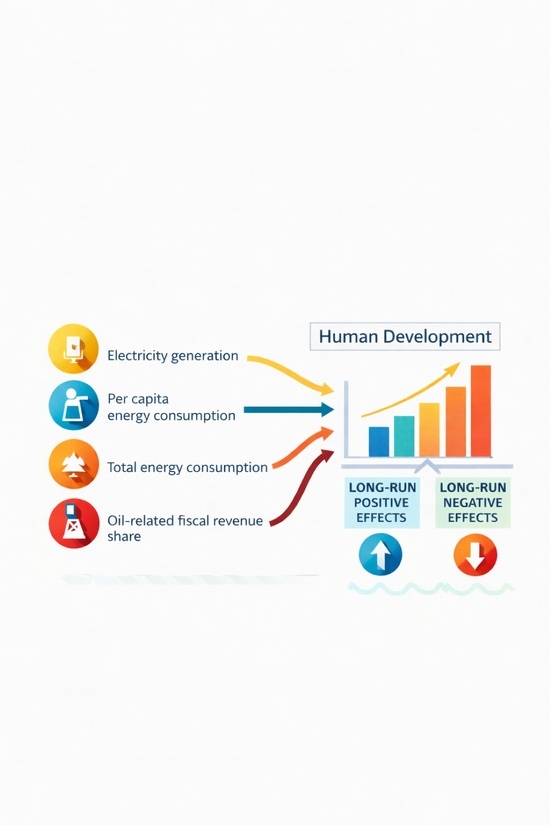
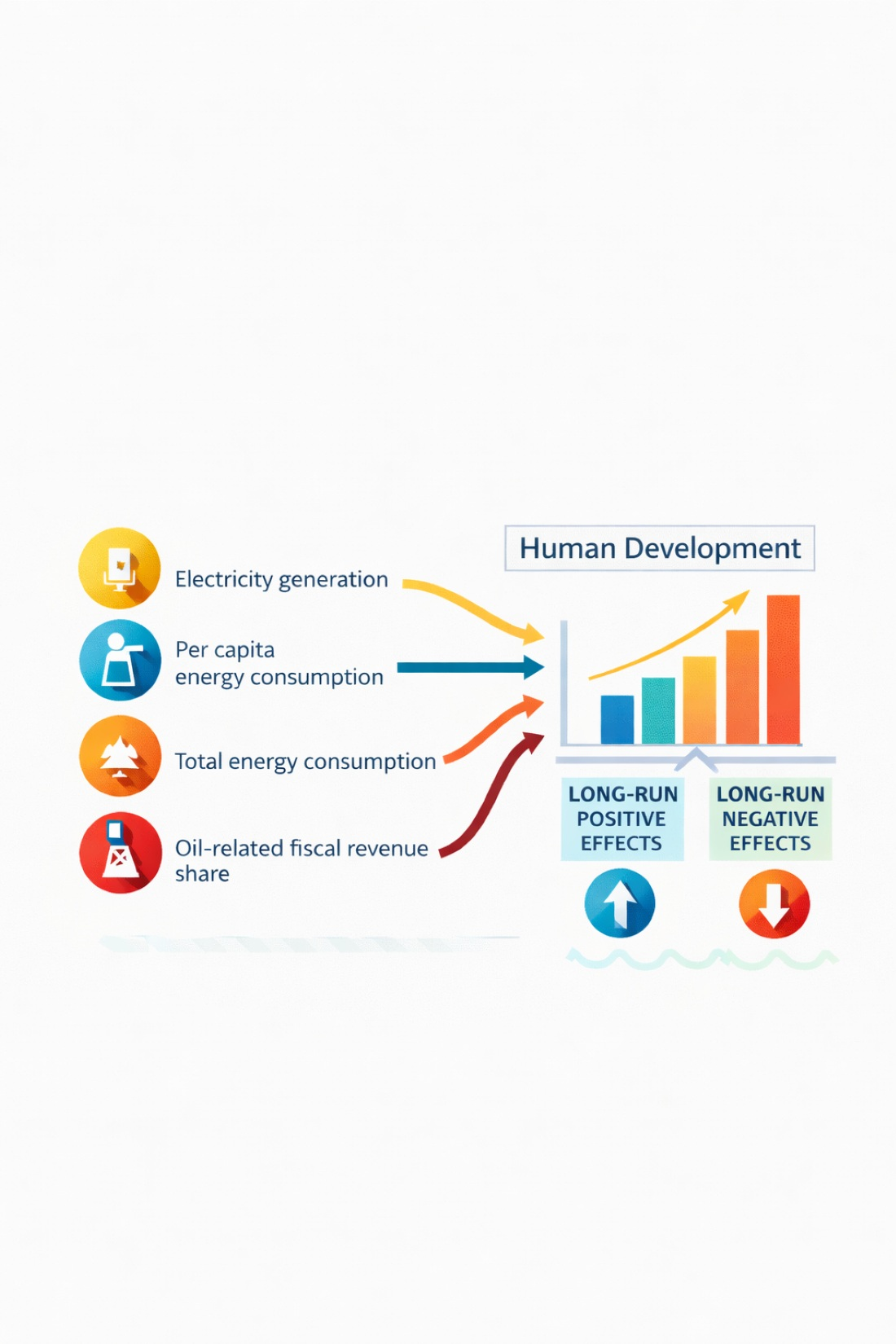
Oil-related fiscal revenue share (% of total revenue, X3t): In the short run, the differenced coefficient is 0.000831, statistically significant at the 1% level, indicating that immediate fiscal inflows from Oil-related fiscal revenue share can enhance HDI by enabling short-term social and welfare spending, especially in education and health. Over the long run, the log-level coefficient is −0.001490, statistically significant at the 5% level. This negative elasticity suggests that sustained reliance on oil-related revenue can reduce human development due to fiscal volatility, governance challenges, and inefficient allocation of public funds. Here, the contradiction between short-run positivity and long-run negativity highlights the temporal trade-off between immediate fiscal benefits and long-term structural risks from resource dependence.
Implications for South Africa: These contradictory dynamics underscore the importance of distinguishing short-run and long-run effects in policy design. Short-term expansions in electricity generation or fiscal spending from Oil-related fiscal revenue share may temporarily boost welfare, but sustained human development requires managing transitional costs, improving energy system efficiency, and diversifying government revenue sources to reduce the negative long-run consequences of resource dependence. In other words, positive short-run effects can mask long-run risks, and policymakers must account for both dimensions to ensure that interventions support sustainable human development.
4.3.5. Granger Causality Results
Table 8 presents the Granger causality relationship among human development, electricity generation, per capita energy consumption, Oil-related fiscal revenue share, and total energy consumption using the Toda–Yamamoto Block Exogeneity Wald causality test.
The results of the Granger causality analysis reveal the existence of both unidirectional and bidirectional predictive relationships between human development and selected energy system indicators in South Africa. The causal inference is based on the statistical significance of the reported F statistics together with the corresponding probability values when compared with conventional significance levels of 1%, 5%, and 10%.
Firstly, the null hypothesis that electricity generation does not Granger cause human development is rejected at the 5% level of significance, as indicated by the probability value of 0.0438, which is lower than the 5% threshold. Although the reported F statistic of 0.2382 is relatively small, the statistical significance of the probability value suggests that past variations in electricity generation contain useful predictive information regarding changes in human development. This finding implies the existence of a unidirectional causal relationship running from electricity generation to human development. The reverse null hypothesis that human development does not Granger cause electricity generation cannot be rejected since the probability value of 0.8728 is substantially higher than conventional significance levels. This result indicates the absence of feedback effects from human development to electricity generation.
Secondly, the causality results relating to per capita energy consumption show that both null hypotheses cannot be rejected. The probability values of 0.7628 and 0.3274 are higher than the 10% level of significance, which implies that the F statistics of 0.2741 and 1.3445 are not statistically significant. This finding provides no evidence of predictive causality between per capita energy consumption and human development in either direction during the study period. It therefore suggests that variations in individual energy consumption levels do not significantly influence human development outcomes, while improvements in human development do not immediately translate into increased energy use per person.
Thirdly, the results indicate that the null hypothesis that Oil-related fiscal revenue share does not Granger cause human development is rejected at the 5% level of significance. This conclusion is supported by the probability value of 0.0453, which is below the 5% threshold. Despite the relatively low F-statistic value of 0.4291, the statistical significance of the probability value indicates that Oil-related fiscal revenue share has predictive power with respect to human development. This implies the presence of a unidirectional causal relationship from Oil-related fiscal revenue share to human development. In contrast, the probability value of 0.4028 associated with the reverse causality test indicates that human development does not Granger cause Oil-related fiscal revenue share.
Finally, the causality relationship between total energy consumption and human development is statistically significant at the 10% level. The null hypothesis that total energy consumption does not Granger cause human development is rejected because the probability value of 0.1008 is marginally lower than the 10% significance threshold, with a corresponding F statistic of 2.412. Similarly, the reverse null hypothesis that human development does not Granger cause total energy consumption is also rejected at the 10% level, as indicated by the probability value of 0.0723, together with an F statistic of 1.2617. These findings suggest the existence of a weak bidirectional causal relationship between total energy consumption and human development. This implies that increases in overall energy utilisation contribute to improvements in welfare outcomes, while rising human development may simultaneously stimulate higher aggregate energy demand.
Overall, the Granger causality results demonstrate that human development in South Africa is primarily influenced by electricity generation and Oil-related fiscal revenue share in a predictive sense, whereas total energy consumption exhibits a feedback interaction with human development at a relatively lower level of statistical confidence. In contrast, per capita energy consumption does not display any causal linkage, indicating neutrality within the energy and human development relationship during the period under investigation.
4.3.6. Residual Test Analysis
The residual diagnostic tests were conducted as shown in
Table 9 to assess whether the estimated ARDL model satisfies the classical regression assumptions of no serial correlation, normality, and homoskedasticity. These tests ensure that the model estimates are efficient, unbiased, and reliable for statistical inference.
The residual diagnostic tests indicate that the estimated ARDL model satisfies the key classical regression assumptions required for valid inference. The Breusch–Godfrey LM test produced a statistic of 2.57312 with a probability value of 0.3147, which exceeds the 5% significance level. This suggests that the null hypothesis of no serial correlation cannot be rejected, indicating that the residuals are independent and that the regression estimates are not biased due to autocorrelation. The Jarque–Bera test further confirms that the residuals are normally distributed, with a test statistic of 3.2489 and a probability value of 0.2014, satisfying the normality assumption necessary for reliable hypothesis testing. In addition, the White test for heteroskedasticity yielded a statistic of 471.2194 with a probability value of 0.4319, showing no evidence of heteroskedasticity and confirming that the variance of the residuals is constant across observations.
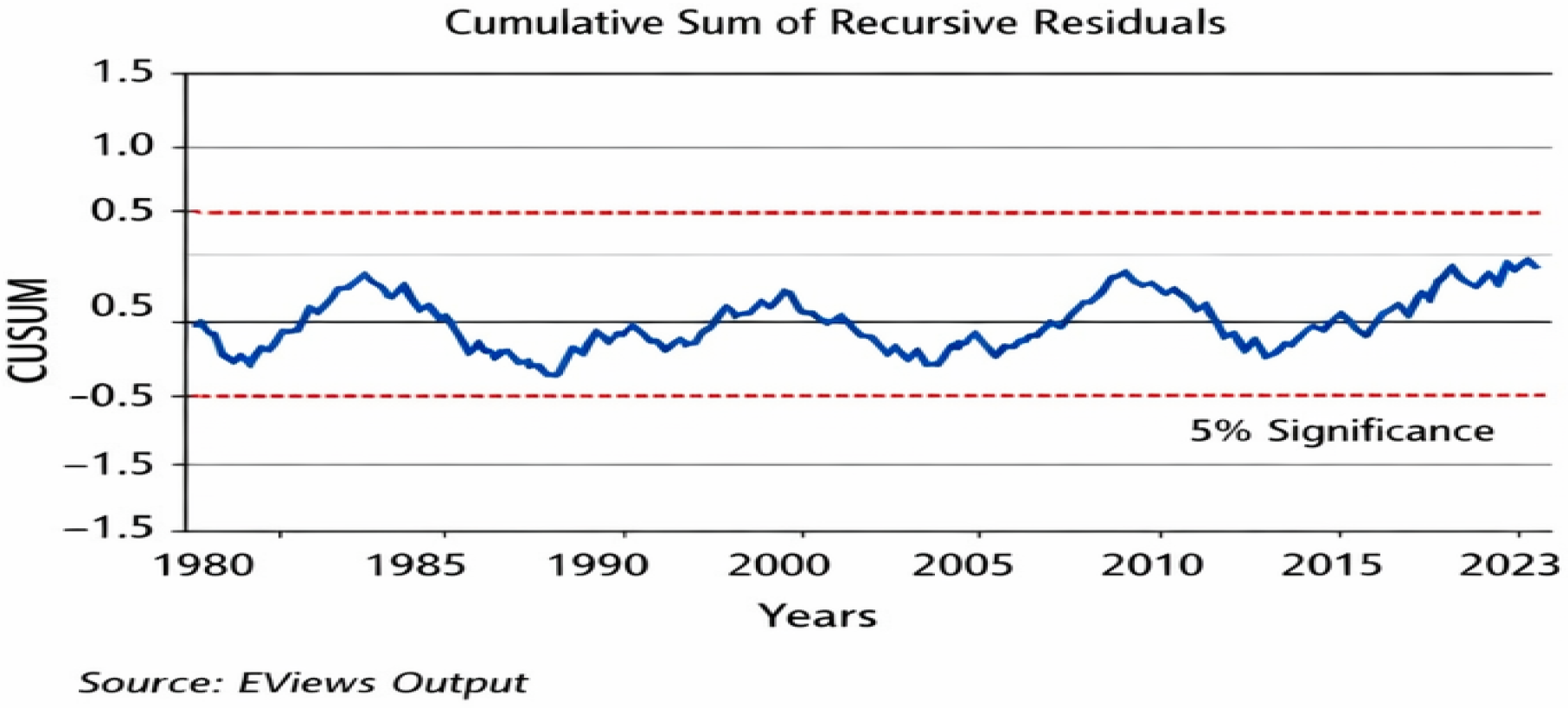
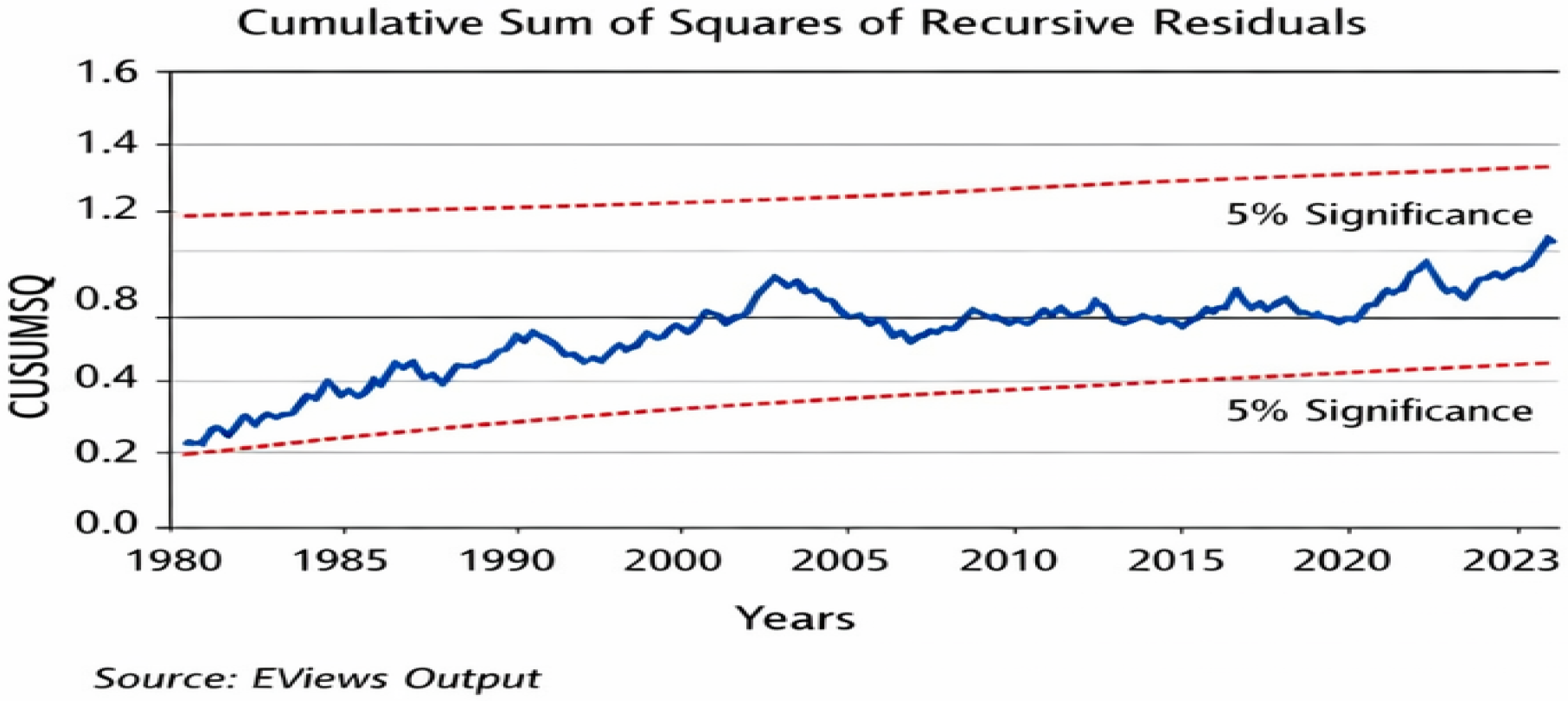
The following figures present the results of the CUSUM and CUSUMSQ stability tests for the ARDL model, which are used to assess the stability of the estimated coefficients over the sample period 1980–2023. These tests are particularly important given the presence of potential structural shifts in South Africa’s energy sector, including the electricity supply crisis that intensified after 2007, policy transitions, and fluctuations in energy demand and supply.
As illustrated in
Figure 1 and
Figure 2, the blue lines representing the CUSUM and CUSUMSQ test statistics remain entirely within the 5% critical bounds (red lines) throughout the sample period. This indicates that there is no evidence of structural instability or parameter instability in the model. In other words, the estimated coefficients do not exhibit systematic variation over time, even in the presence of major economic and energy-related shocks.
The stability of the coefficients suggests that the underlying relationship between human development and the selected energy variables is consistent and well-captured by the ARDL specification. This is particularly noteworthy given the long study period and the structural changes experienced in the South African economy, as it implies that the model is robust to such disruptions.
Furthermore, the absence of structural breaks reinforces the reliability of both the short-run and long-run estimates obtained from the ARDL-ECM framework. It provides additional confidence that the estimated relationships are not driven by episodic events or temporary shocks but rather reflect stable and meaningful economic linkages. Consequently, the results derived from the model can be considered dependable for policy formulation and empirical inference.
Overall, the diagnostic results confirm that the ARDL model is well specified and statistically robust. The residuals satisfy the key assumptions of independence, normality, and homoskedasticity, ensuring that the estimated coefficients are efficient, unbiased, and reliable. In addition, the CUSUM and CUSUMSQ tests indicate parameter stability over the sample period, further strengthening the validity of the model. Consequently, the empirical findings can be interpreted with confidence and provide a sound basis for policy recommendations and long-run analysis of the relationship between energy variables and human development.
4.3.7. Multicollinearity
To examine the presence of multicollinearity among the explanatory variables, the Variance Inflation Factor (VIF) test was conducted.
As shown in
Table 10, the VIF values for electricity generation (X
1), per capita energy consumption (X
2), oil-related fiscal revenue (X
3), and total energy consumption (X
4) are 2.128, 4.316, 5.252, and 1.129, respectively, at the 5% significance level. All values are below the conventional threshold of 10, indicating that there is no evidence of harmful multicollinearity in the model.
Although oil-related fiscal revenue (X3) exhibits the highest VIF value, it remains within acceptable limits, while total energy consumption (X4) shows minimal correlation with other variables. Overall, these results confirm that multicollinearity does not pose a threat to the reliability and stability of the estimated coefficients.
5. Conclusions, Recommendations, and Limitations
5.1. Conclusions
This study employed a quantitative research design to investigate the relationship between energy variables and human development in South Africa over the period 1980–2023. The analysis focused on electricity generation, per capita energy consumption, Oil-related fiscal revenue share, and total energy consumption, with human development proxied by the Human Development Index. The results obtained from the Autoregressive Distributed Lag bounds testing approach and the Error Correction Model confirm the existence of a long-run equilibrium relationship between human development and the selected energy indicators, consistent with previous studies that highlight the long-term linkage between energy systems and development outcomes.
However, a key contribution of this study lies in distinguishing between statistical significance and economic significance, which has important implications for policy interpretation.
The findings indicate that electricity generation and total energy consumption exert a positive influence on human development in the long run. However, the elasticity of electricity generation is extremely small, implying that increases in electricity supply result in only marginal improvements in human development. This suggests that expansion of electricity generation alone is not sufficient to drive meaningful welfare gains, and that the developmental impact of electricity depends more on how effectively it is distributed, accessed, and utilised within the economy. By contrast, total energy consumption exhibits a stronger positive relationship, indicating that productive and widespread use of energy plays a more significant role in improving human development outcomes.
In contrast, per capita energy consumption exhibits a negative long-run relationship with human development, suggesting that higher average energy use reflects inefficiencies, unequal access, and potentially energy-intensive consumption patterns that do not translate into broad welfare improvements. Similarly, Oil-related fiscal revenue share shows a negative long-run effect, supporting the resource dependence hypothesis, where reliance on energy-related revenues may undermine development through volatility, weak governance, and inefficient allocation of public resources.
In the short run, electricity generation has a negative effect on human development, reflecting transitional adjustment costs, such as infrastructure constraints and inefficiencies in the energy system. Conversely, Oil-related fiscal revenue share and total energy consumption have positive short-run effects, indicating temporary welfare gains that are not sustained over time. These findings highlight the importance of distinguishing between short-term benefits and long-term structural outcomes.
The causality analysis further refines these results. The presence of unidirectional causality from electricity generation and Oil-related fiscal revenue share to human development indicates that these variables influence development outcomes; however, given the very small coefficient magnitude for electricity generation, this causal effect is economically limited. In contrast, the bidirectional relationship between total energy consumption and human development suggests a reinforcing dynamic, where improved development increases energy use, and productive energy use further enhances development. The absence of causality between per capita energy consumption and human development supports the view that aggregate consumption levels alone do not drive meaningful welfare improvements.
Overall, the findings demonstrate that the relationship between energy system performance and human development in South Africa is not driven by energy supply expansion alone, but rather by the efficiency, accessibility, and productive use of energy resources. Consequently, policies aimed at improving human development must move beyond increasing energy supply to focus on improving system performance, reducing inefficiencies, and ensuring equitable access.
5.2. Recommendations
Based on the empirical findings and explicitly guided by the magnitude, direction, and causality of the estimated coefficients, the following policy recommendations are proposed:
Electricity Generation (X1t): While electricity generation exhibits a positive long-run effect and Granger-causes human development, its relatively low elasticity implies that increases in generation capacity alone are unlikely to yield substantial economic gains. Therefore, policy should prioritise improving grid efficiency, reducing transmission losses, and enhancing reliability, rather than focusing solely on capacity expansion. Investment in infrastructure maintenance, distribution networks, and load management is essential to ensure that existing and additional electricity supply translates into meaningful and widespread welfare improvements.
Per Capita Energy Consumption (X2t): The negative long-run relationship and absence of causality indicate that higher per capita energy consumption does not improve human development. This suggests inefficient and unequal energy use. Policies should therefore focus on energy efficiency and equitable access, including promoting energy-efficient technologies, supporting low-income households, and encouraging productive energy use in sectors that generate employment and income.
Oil-related fiscal revenue share (X3t): The negative long-run effect, combined with unidirectional causality, indicates that reliance on Oil-related fiscal revenue share influences development but in a detrimental way. Policy should focus on reducing fiscal dependence on oil-related revenue, strengthening revenue diversification, and improving governance in resource allocation. Oil-related fiscal revenue share should be strategically invested in human capital development, particularly in education, healthcare, and infrastructure.
Total Energy Consumption (X4t): The positive coefficient and bidirectional causality suggest that total energy consumption plays a central and reinforcing role in human development. Policies should therefore promote inclusive and productive energy use, particularly in industrial and service sectors, while ensuring sustainability. Investment in energy technologies that improve productivity and reduce waste will enhance the positive developmental impact.
Integrated Policy Approach: Overall, the findings indicate that energy policy should shift from a supply-driven approach to a systems-based approach. Rather than focusing on increasing energy availability alone, policymakers must prioritise efficiency, accessibility, reliability, and productive utilisation. Coordinated interventions across the energy, economic, and social sectors are essential to ensure that energy contributes meaningfully to both short-term welfare gains and long-term human development.
5.3. Limitations of the Study
Although this study provides valuable insights into the relationship between energy indicators and human development in South Africa, several limitations must be acknowledged. First, the study relies exclusively on secondary time-series data from 1980 to 2023. While the use of multiple reputable sources enhances reliability, historical data may contain inconsistencies, measurement errors, or reporting gaps that could influence the results.
Second, the research design limits the ability to establish strict causality. Although the ARDL bounds testing and Granger causality approaches reveal long-run associations and predictive relationships, unobserved factors or structural shocks may have influenced both energy variables and human development outcomes. This constraint means that some observed relationships should be interpreted as indicative rather than definitive.
Third, the analysis is conducted at the national level, which may conceal regional disparities in energy access, consumption, and human development outcomes. As such, the findings may not fully reflect local or provincial differences, limiting the direct applicability of the results for sub-national policy interventions.
Fourth, some variables are proxies that may not capture all aspects of the phenomena under study. For instance, Oil-related fiscal revenue share as a share of total government revenue reflects fiscal exposure to global oil markets but may not fully account for government efficiency in revenue allocation or broader resource dependence dynamics. Similarly, the Human Development Index aggregates multiple socio-economic dimensions, potentially masking sector-specific effects of energy consumption.
Finally, while the study period covers over four decades, structural changes, technological advancements, and policy shifts in the energy sector may have altered the nature of the relationships over time. Although stability tests suggest consistent model behaviour, future structural breaks could affect the long-term validity of these findings.
Future research could address these limitations by incorporating disaggregated provincial or sectoral data to capture regional variations in energy access and development outcomes. Researchers could also explore alternative proxies for human development and government fiscal dependence or employ mixed methods approaches combining quantitative analysis with qualitative insights to better understand causal mechanisms. Additionally, extending the analysis to include emerging energy technologies, renewable energy adoption, and policy interventions would provide a more comprehensive understanding of the evolving energy–development nexus in South Africa.