1. Introduction
The European Union (EU) aims for climate neutrality by 2050, with an interim target of a 55% emissions reduction by 2030 compared to 1990 levels [
1]. Achieving these goals requires rapid deployment of renewable energy sources (RES), mainly that of wind and solar. Yet, their variable output challenges the reliability and adequacy of electricity systems [
2]. To preserve these essential features, system flexibility must be urgently enhanced through demand response, cross-border interconnections, electricity storage, and flexible generation [
3]. Each mechanism, however, faces limitations: demand response depends on advanced metering and consumer engagement; interconnections demand high capital investment and long lead times; storage technologies remain costly for large-scale deployment; and most flexible generation still relies on fossil fuels [
4,
5].
Combined Cycle Gas Turbines (CCGTs) currently provide the most reliable source of operational flexibility, ensuring rapid ramping and grid stability as RES penetration rises [
6]. Compared to coal, CCGTs offer lower emissions, but their economic sustainability is threatened. With near-zero marginal cost RES displacing CCGTs in marginalist markets, these plants operate fewer hours and struggle to recover fixed costs [
7]. Although demand-side measures, storage, and interconnections will gain importance in the long term, CCGTs remain the only fully deployable option today to safeguard the security of supply.
In Portugal, this challenge is acute. Between 2003 and 2023, RES penetration increased dramatically: solar grew from 2 MW to 3.9 GW, and wind from 0.2 GW to 5.9 GW [
8]. The national roadmap foresees renewables supplying 93.5% of electricity by 2030 and nearly 100% by 2050 [
9]. With CCGTs as the sole non-renewable source, their role in adequacy is crucial, yet market revenues remain insufficient. Without capacity remuneration mechanisms (CRMs), CCGTs risk decommissioning, endangering system security [
10]. Portugal thus provides a valuable case study for analyzing the economic and regulatory conditions needed to maintain CCGTs during the transition.
Although previous studies have examined resource adequacy, capacity remuneration mechanisms, and the economic challenges of CCGTs, these aspects are often addressed separately. In particular, there is limited work that combines the EU adequacy assessment framework (CONE and CORP) with empirical estimation of market revenues in a specific national context.
This paper addresses the following research question: to what extent can CCGT plants remain financially viable in high-renewable electricity markets under current energy-only market conditions, and what level of additional remuneration is required to ensure system adequacy?
The contribution of this work is threefold. First, it applies the European Union adequacy assessment framework to the Portuguese context, providing updated estimates of CONE and CORP for CCGT technology based on recent data. Second, it develops a simplified market closure algorithm using real 2023 MIBEL data to estimate the actual revenues of CCGTs under current market conditions, bridging the gap between theoretical adequacy metrics and observed market outcomes. Third, it derives concrete policy-relevant benchmarks for capacity remuneration mechanisms by quantifying the revenue gap between market earnings and adequacy requirements.
By combining regulatory methodology, market simulation, and empirical data, this study contributes to the ongoing debate on the “missing money” problem and the role of capacity mechanisms in ensuring security of supply in decarbonized electricity systems. Moreover, this study provides actionable insights for policymakers and regulators in Portugal and the EU on sustaining CCGT adequacy during the energy transition.
From a theoretical perspective, this work contributes to the literature on resource adequacy and the “missing money” problem by operationalizing the CONE and CORP concepts in a high-renewable context. From an empirical perspective, it provides updated estimates based on real 2023 MIBEL data and a simulation of CCGT market revenues. From a policy perspective, it offers concrete benchmarks for capacity remuneration mechanisms, supporting decision-making in the Portuguese and European contexts.
These contributions are grounded in the literature on resource adequacy, the “missing money” problem, and investment incentives in energy-only markets, providing a conceptual basis for the empirical and policy analysis developed in this work (see
Section 2).
The paper assesses how Portuguese CCGTs can remain financially viable under the EU adequacy methodology [
2]. Specifically, it:
Assesses the role of CCGTs in ensuring system adequacy in the Iberian market.
Reviews capacity mechanisms and their ability to support investment in flexible generation.
Models CCGT market revenues using a simplified market closure algorithm with MIBEL data.
Calculates the Cost of New Entry (CONE) and Cost of Renewal or Prolongation (CORP) for CCGTs, identifying the “extra-market” revenues required.
Conducts sensitivity analyses of the main cost drivers.
Recommends CRM thresholds to secure existing and potential new CCGT plants.
This paper is set to start with an extensive literature review regarding the operation of electricity markets, the evolving role of CCGT within the Iberian system, and the importance of CRMs in ensuring financial viability and system adequacy, in
Section 2.
Section 3 sets out the methodological framework, including the recommended approach by the EU for the calculation of CONE and CORP and the market closure algorithm. Moreover, the main inputs are described.
Section 4 shows the results obtained. Additionally, the results will be discussed, evaluating their grip on reality. Finally,
Section 5 synthesizes the main insights, providing policy recommendations for Portugal and areas of future research in energy market design.
2. Literature Review
The analysis developed in this work is grounded in the economic literature on resource adequacy and investment incentives in electricity markets. In particular, it relates to the well-known “missing money” problem, whereby energy-only markets may fail to provide sufficient revenues for dispatchable generation to recover fixed costs, especially in systems with high shares of low marginal cost renewable energy.
In this context, adequacy assessment tools such as CONE and CORP provide a structured way to quantify the minimum revenue required to sustain investment and the retention of capacity. These concepts are directly linked to the role of capacity remuneration mechanisms in correcting market failures associated with incomplete price signals. Dispatchable technologies such as CCGTs remain essential in this framework, as they provide flexibility and reliability that are not fully remunerated in energy-only markets.
The European energy system is undergoing a fundamental transformation, driven by ambitious decarbonization targets, high renewable energy penetration, and the need to ensure long-term energy security. In this context, CCGTs remain a crucial component of the electricity mix, offering flexibility, dispatchability, and support for system adequacy. However, the evolving market landscape—characterized by volatile fuel prices, suppressed electricity prices due to renewables, and energy-only market limitations—poses significant challenges to the economic viability of these assets. This literature review explores the current state of knowledge on the role of CCGTs in decarbonizing power systems, focusing on their economic sustainability, market design limitations, and the growing relevance of CRMs. It also examines the regulatory frameworks underpinning resource adequacy assessments at both the European and national levels, with particular attention to Portugal’s RMSA-E (Portuguese Report on the Monitoring of the Security of Supply of the National Electricity System) and its alignment with the European Resource Adequacy Assessment (ERAA).
2.1. Electricity Market Design and Marginal Pricing
The liberalization and integration of European electricity markets have led to the widespread adoption of marginal pricing or pay-as-clear mechanisms [
11]. In this system, all producers are paid the spot price, determined by the marginal cost of the last dispatched unit. This model promotes transparency, competition, and dispatch efficiency, but it increasingly marginalizes high-cost, dispatchable units like CCGTs.
CCGTs are often marginal producers, especially in low renewable output periods, and therefore play a key role in setting electricity prices. However, this role also exposes them to volatility in natural gas prices and carbon costs [
12]. In the MIBEL market, CCGTs have become essential for ensuring system flexibility and supply security, especially during periods of low renewable output or interconnection unavailability [
7]. Their contributions include: (i) providing backup and grid flexibility; (ii) ensuring adequacy during energy system transitions; and (iii) acting as critical infrastructure in stress scenarios. Despite reduced utilization rates due to growing RES penetration, CCGTs remain vital for grid reliability. Maintaining these assets requires new financial mechanisms to ensure profitability.
The levelized cost of electricity (LCOE) for CCGTs depends heavily on fuel costs, carbon pricing, and capital expenditures. Literature reports wide LCOE ranges: low gas price scenario, 50–70 €/MWh [
13]; high gas and carbon prices, 100–150 €/MWh [
14,
15]. Market revenues often fail to cover these costs, particularly as RES lower spot prices. Historical data show that CCGTs achieved profitability only during rare price spikes, such as those following the COVID-19 recovery and the 2022 gas crisis [
16].
2.2. Economic Challenges of CCGTs in High-RES Systems
Energy-only markets under marginal pricing do not provide sufficient signals for CCGT investment or retention. Studies show that CCGTs often recover less than half of their fixed costs through wholesale prices alone [
17,
18]. Strategies to improve revenue streams include: (i) participation in balancing markets; (ii) hybridization with RES [
19]; (iii) long-term contracts or policy-based support mechanisms.
It is concluded that to ensure the continued operation and strategic role of CCGTs in systems like MIBEL (Iberian Electricity Market), CRM may be necessary. These would provide stable income streams that reflect their contribution to security of supply and grid flexibility. Future viability also hinges on their decarbonization, through Carbon Capture and Storage (CCS), fuel switching (e.g., to hydrogen), and efficiency gains [
20,
21].
2.3. Capacity Remuneration Mechanisms
The introduction of CRM offers a potential solution to address the financial viability challenges faced by CCGT power plants. CRMs provide payments to installed capacity based on various factors such as location, availability during peak demand periods, and the overall capacity relative to system needs, with a focus on reliability criteria [
22]. These mechanisms compensate for resources for making generation capacity available for use, regardless of whether it is dispatched, creating an additional revenue stream for generators. This incentivizes investment in additional generation capacity and helps maintain system adequacy [
23].
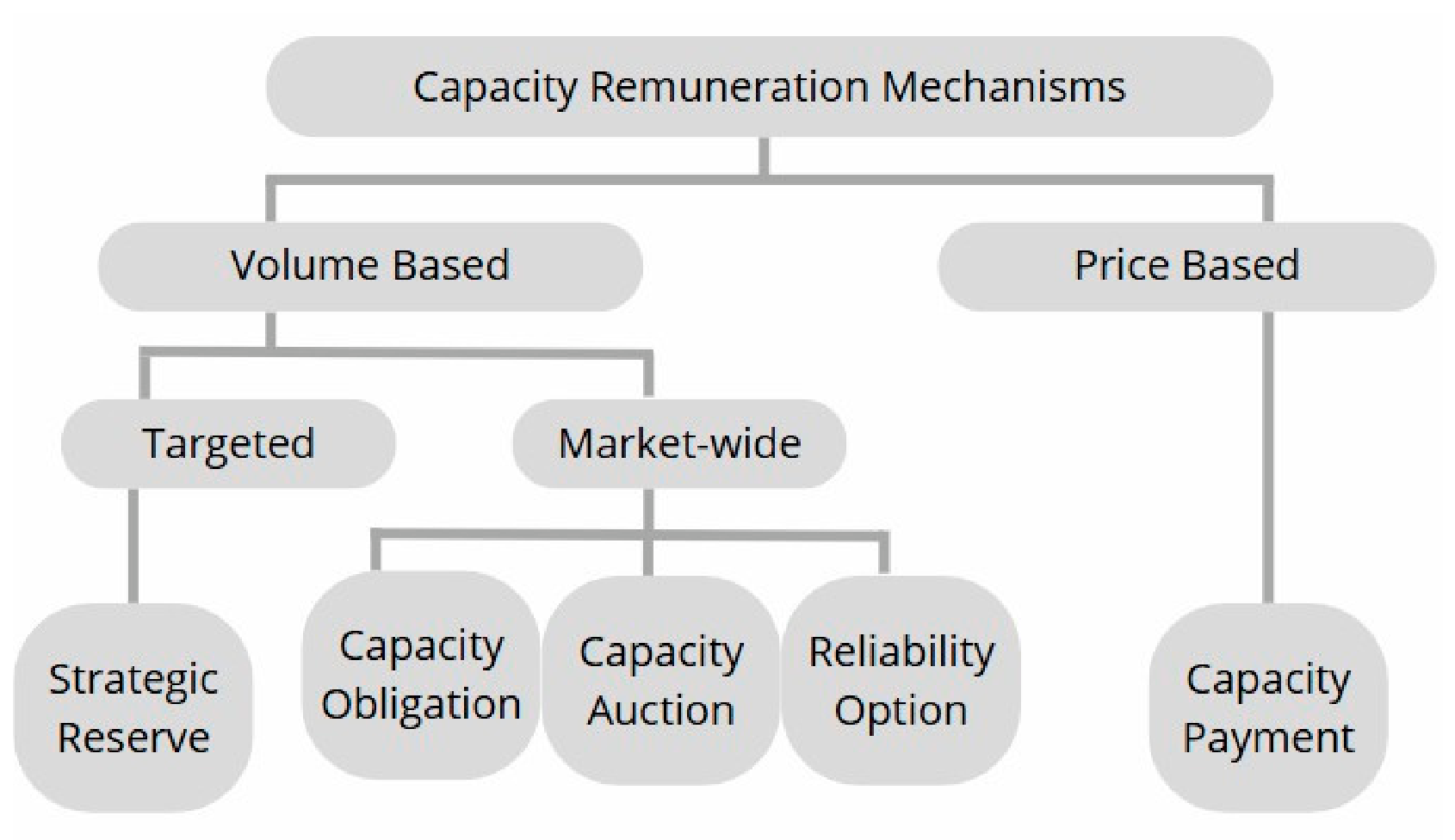
There are several types of CRMs, including technology-neutral and technology-specific models, as well as centralized and decentralized mechanisms. These mechanisms can be volume-based or price-based. Regardless of their design, CRMs share a common goal: to reduce the risks associated with investments in capacity by offering supplementary income to resource providers, in addition to earnings from market sales, thus ensuring that there are no adequacy concerns during times of system stress [
24]. The earliest CRM in the US dates back to the late 1990s. In recent years, several European countries have also adopted various forms of CRM [
23].
CRMs are designed to offer market participants a more effective incentive compared to the traditional “energy-only” markets. It ensures investors receive a more stable and predictable revenue stream, such as through capacity payments. However, since these revenues are often higher than those typically generated in an energy-only market, the implementation of CRM usually leads to additional costs for energy consumers, although it depends on the CRM design [
25]. The different CRM designs proposed by ACER can be shown in
Figure 1 [
25]:
Each CRM category can be tailored with various design features to address specific market needs. Key design considerations include [
23]:
Differentiation between types of capacity.
Eligibility criteria for capacity providers.
The time horizon for capacity obligations and contracts.
Determination of the required capacity level and adequacy criteria.
Processes for documenting or certifying capacity availability.
Pricing mechanisms for capacity payments (administratively set prices or auction-determined prices).
Threshold or strike price definitions for schemes like Capacity Obligations and Reliability Options.
Allocation of costs among market participants.
Operational rules for capacity activation and integration with energy markets.
CRMs inevitably interact with energy-only markets, and their design must ensure that they complement, rather than distort, market signals. Poorly designed CRMs risk undermining the effectiveness of wholesale markets in producing reliable and efficient price signals. It remains essential to prioritize removing barriers to the functioning of energy-only markets while using CRMs to address specific adequacy challenges [
25]. The goal is to achieve a well-functioning energy market that supports both short-term reliability and long-term investment needs.
Over the last few years, capacity mechanisms have been increasingly adopted to ensure resource adequacy and revenue stability for CCGT plants, particularly in electricity markets experiencing high-RES penetration [
26], as European markets increasingly are. At least thirteen EU Member States now operate some form of capacity arrangement, either through centralized auction-based designs or strategic reserve mechanisms [
27]. France, Italy, and Poland remain among the largest adopters by total contracted capacity, while Great Britain, although no longer a member of the EU, also operates a significant capacity market that continues to influence the broader European debate [
28]. France has designed a market-based capacity mechanism that became fully operational in 2017, with annual auctions procuring large volumes of capacity. Recent reports cite procurements in the range of 50 GW for new and existing resources [
1].
Although these mechanisms have gained support for enhancing security of supply, there remain questions about long-term cost-effectiveness, potential market distortions, and compatibility with broader decarbonization objectives. One major issue is that CCGTs often face revenue caps within CRM structures, limiting their ability to fully recover investment costs, especially during periods of volatile fuel prices [
29]. Additionally, some CRM frameworks lead to overcapacity, reducing the profitability of participating CCGTs by encouraging excessive generation investments [
30]. While there are still doubts on the most effective CRM design, high shares of renewables in the markets are adding complexity to resource adequacy frameworks and raising discussions on whether capacity markets should evolve to incentivize flexibility, storage, and demand responses more explicitly [
27].
Going forward, the future of capacity mechanisms in Europe looks like a path of cautious expansion and refinement. Ongoing revisions of the EU Electricity Regulation involve making capacity mechanisms act as a measure of last resort with no distortion to cross-border trade or inter-state competition. Member States are facing greater pressures regarding their adequacy assessment harmonization as well as opening the auction to other states where such feasibility exist [
27]. According to the European guidelines, any future design of capacity mechanisms must be based on the principles of transparency and non-discriminatory access, while being aligned with decarbonization targets [
31]. This would suggest that, while capacity mechanisms are likely to remain an integral part of Europe’s resource adequacy toolbox, their role will continue to evolve, with new rules and market arrangements shaping both contract characteristics and the types of technologies that secure funding under these schemes. The prospects for CCGT under CRM depend on market design evolution, with capacity obligations, reliability options, and hybrid models emerging as potential frameworks that can better integrate flexible generation into decarbonized power systems [
32]. Moving forward, policymakers must refine CRM structures by introducing more dynamic strike prices, improving cross-border CRM harmonization, and aligning capacity payments with system adequacy needs to ensure that CCGTs remain financially viable while supporting the energy transition [
33].
2.4. Adequacy Assessment Frameworks (EU and Portugal)
CRMs should bridge the gap between the revenue needed to assure financial viability and the revenue obtained from the energy-only market. A set of rules has been published by the EU to assess the revenue necessary to maintain resource adequacy.
The regulatory framework governing energy security and resource adequacy in Europe has evolved significantly in response to recent geopolitical events, particularly Russia’s 2022 invasion of Ukraine. These developments exposed vulnerabilities in Europe’s energy system, shifting the focus toward energy independence, diversification, and resilience [
34,
35]. CCGT plants are highlighted as key flexible technologies to ensure grid stability amidst rising renewable energy integration [
36].
The European Resource Adequacy Assessment (ERAA) plays a central role in evaluating system adequacy, mandated by Regulation (EU) 2019/943. ERAA uses probabilistic simulations, Economic Viability Assessments (EVA), and Monte Carlo models to identify shortfalls in supply–demand balance over a 10-year horizon [
6,
37]. Core indicators such as Loss of Load Expectation (LOLE) and Expected Energy Not Served (EENS) quantify adequacy risks and inform investment needs.
The methodologies tied to ERAA include:
Value of Lost Load (VOLL): Measures the socioeconomic cost of power outages [
38].
Cost of New Entry (CONE): Reflects the investment needed to incentivize new capacity.
Cost of Renewal or Prolongation (CORP): Calculates the cost of sustaining existing assets, typically lower than CONE.
Reliability Standard (RS): Defines acceptable LOLE or EENS thresholds, derived using VOLL and CONE values.
For fossil-based plants like CCGT, CORP is particularly relevant, as it quantifies the viability of extending the life of existing units. By contrast, for emerging technologies (e.g., storage, demand-side response), CONE is prioritized [
39].
Cross-border participation in CRM is regulated by Article 26 of Regulation (EU) 2019/943 and detailed in ACER’s technical specifications. These mechanisms allow countries to access foreign capacity, promoting cost-efficiency and enhancing system reliability [
37]. Eligibility criteria, maximum entry capacities, and revenue-sharing frameworks ensure fair participation, based on synchronized resource adequacy assessments via ERAA. Key considerations include interconnection availability, stress condition simultaneity, and transparent data reporting.
Despite these robust methodologies, challenges persist in harmonizing national regulations, ensuring high-quality data, and keeping pace with evolving technologies and market dynamics. Future iterations of ERAA are expected to leverage AI tools, enhance resilience to cyber and climate-related risks, and deepen Member State cooperation [
6].
Portugal’s national adequacy assessment—RMSA-E 2023 [
7]—mirrors many ERAA methodologies and evaluates energy security between 2024 and 2040. Three planning scenarios are outlined:
Conservative Trajectory: Gradual phase-out of older CCGT units (e.g., Tapada do Outeiro by 2029), increased reliance on Spanish interconnections, and up to 35% of Net Transfer Capacity (NTC) required by 2030 to meet LOLE targets.
Ambition Trajectory: Assumes 88% RES penetration by 2030, emphasizing variability and interconnection needs.
Stress-Test Scenario: Simulates extreme demand-growth cases, identifying risks of LOLE breaches without major capacity additions.
Portugal’s heavy reliance on interconnection with Spain (target: 4700 MW by 2040) underscores the need for coordinated capacity mechanisms. The RMSA-E report recommends increasing flexible capacity (1750–1950 MW), upgrading grids, expanding demand-side measures, and introducing or extending CRM.
Although RMSA-E does not directly compute CONE or CORP, it supports the EU framework’s principles. It concludes that capacity payments are essential to: (i) ensure cost recovery (CONE/CORP); (ii) bridge the revenue gap from RES-induced price suppression; (iii) maintain energy security during extreme events.
In summary, the literature highlights a structural tension in electricity markets with high renewable penetration. While marginal pricing ensures short-term efficiency, it often fails to provide sufficient revenue signals for dispatchable generation, giving rise to the well-known “missing money” problem. As a result, CCGTs—despite their critical role in ensuring flexibility and adequacy—face increasing economic challenges.
Capacity remuneration mechanisms have emerged as a policy response to address these shortcomings, aiming to bridge the gap between market revenues and the costs required to sustain adequate capacity. At the same time, European adequacy assessment frameworks, particularly through indicators such as CONE and CORP, provide a quantitative basis to evaluate these requirements.
However, there remains a need for empirical applications that connect these regulatory concepts with real market outcomes. In particular, limited work has quantified the revenue gap between observed market earnings and adequacy-based thresholds in specific national contexts. This paper addresses this gap by applying the EU adequacy framework to the Portuguese system and by estimating CCGT revenues using recent MIBEL data.
3. Methodology
This section evaluates the methodologies for the CONE and CORP calculations, according to EU’s Directive 2019/943 [
38]. Additionally, the methodology for the model that replicates a market closure algorithm is explained. All calculations and methodologies have CCGT as the reference technology and Portugal as the geographic area.
This study does not rely on econometric or statistical inference methods. Instead, it adopts a deterministic and regulatory-based approach, consistent with the EU adequacy assessment framework. This choice reflects the objective of the work, which is to quantify cost thresholds (CONE and CORP) and compare them with observed market revenues, rather than to estimate statistical relationships between variables.
3.1. Calculation of CONE According to EU Directive
In this subsection, the key methodologies underpinning European resource adequacy will be explored, drawing insights primarily from the EU’s Directive 2019/943 where the methodologies for calculating the CONE are found. The equations used in the methodology for calculating the CONE include variables that are integral to determining the financial viability and economic efficiency of introducing new energy capacity into the electricity market. Additionally, the CORP will be calculated. To calculate CORP, the economic variables used are the same as the ones used in CONE; the difference resides in the capital costs incurred, the annual fixed costs, and the years of operation and construction. Below is the meaning and significance of these variables within the framework provided by the EU methodology.
The variables used in this study, including their definitions, values, and sources, are summarized in
Table 1,
Table 2,
Table 3 and
Table 4. These tables distinguish between the parameters used in the CONE/CORP calculation and those used in the market closure algorithm.
The CONE represents the fixed annual revenue required per unit of de-rated capacity to incentivize investment in new generation, storage, or DSR resources. It is defined by the relationship between the Equivalent Annual Cost (
) and the de-rating capacity factor (
). Here,
quantifies the effective contribution of the installed capacity to system adequacy by accounting for the statistical availability of the capacity during periods of stress in the system.
The
calculation, as outlined in Equation (2), aggregates the costs associated with capital investments (
), which is the best estimate of the capital costs incurred during each year of the construction period (
), and annual fixed costs (
), that represents the best estimate of the annual fixed cost incurred during operational lifetime (
). Each year, from the beginning of the construction period until the end of the operational period, is represented by (
). The formula incorporates the Weighted Average Cost of Capital (
) to discount these costs to their present value, reflecting the time value of money. The equation is:
This ensures that all costs are captured and distributed over the plant’s operational lifespan.
The
is calculated to determine the required rate of return on investment, blending the cost of equity (
) and the cost of debt (
), proportionally weighted by the gearing ratio (
), which represents the proportion of debt in the financing structure. The
calculation considers corporate taxes (
) and inflation (
) for realism:
The cost of equity (
) incorporates the risk-free rate of return (
) that represents the theoretical rate of return on an investment with zero risk, serving as the baseline return required by investors, reflecting the opportunity cost of capital without any risk premium. The equity risk premium (
) reflects the additional return that investors require for investing in equities over the risk-free rate. The country’s risk premium (
) accounts for the additional risk associated with investing in a particular country due to its specific economic, political, and regulatory conditions adjusted by the beta (
), which reflects the volatility of returns relative to the overall market:
The cost of debt (
), similarly, is calculated as the sum of the risk-free rate and a debt premium (
), capturing the additional return required by lenders to compensate for the risk of lending to a specific project or company.
These variables collectively define the financial dynamics and operational expectations of the reference technology, ensuring a comprehensive and harmonized framework for calculating the CONE. Each parameter is carefully aligned with the realities of the market and the specificities of the geographic area under consideration, ensuring the applicability and accuracy of the CONE estimate. This methodology provides a robust basis for decision-making regarding capacity investments and market design.
The variables used in the calculation of CONE were found in the literature and are shown in
Table 1.
Table 1.
Base variables for CONE calculation.
Table 1.
Base variables for CONE calculation.
| Variables | Symbol | Value | Sources |
|---|
| Capital Cost (€/MW) | | 1,000,000 | [40,41,42,43] |
| Annual Fixed Cost (€/MW) | | 14,000 | [43,44] |
| Economic Lifetime (years) | | 30 | [40] |
| Construction Time (years) | | 3 | [40] |
| De-Rate Capacity (%) | | 85 | [45] |
To calculate the intermediate parameters of cost of debt, cost of equity, and the Weighted Average Cost of Capital,
Table 2 shows the parameters found in the literature and a comparison to other sources found.
Table 2.
Parameters to calculate intermediate variables, found in the literature.
Table 2.
Parameters to calculate intermediate variables, found in the literature.
| Calculated Parameter | Symbol | Value | Source | Other Values Found in the Literature |
|---|
| Cost of Equity () | (%) | 3.5 | [46] | 3 [47] |
| 0.9 | [48] | 0.7 [49] |
| (%) | 6.5 | [43,46] | 6.5 [43] |
| (%) | 1.75 | [50] | 1.41 [49] |
| Cost of Debt () | (%) | 3.5 | [46] | 3 [47] |
| (%) | 3.25 | [51] | 3.5 [49] |
| Weighted Average Cost of Capital () | Tax rate () (%) | 30 | [52] | 31 [49] |
| Long-term inflation rate () (%) | 2.5 | [53] | 2.8 [43] |
| Gearing () (%) | 65 | [54] | 60 [47] |
The parameters shown in
Table 2 are the best estimates in the context of this work. The variations when compared with other values found in the literature reflect the distinct timeframes and national contexts employed by each source. Because there is no single technical report or relevant literature that directly provides all the necessary 2023 data for Portugal’s energy sector, which would be ideal in the context of this work, the validity of these assumptions is heavily dependent on the validity of the results these parameters yield, namely the WACC, CONE, and CORP, which will be assessed.
The distribution of capital costs and annual fixed costs is then calculated through the years of construction and operational lifetime of the power plant. It is assumed that the capital cost distribution for the 3 years of construction is 50%, 33%, and 17%, respectively, for modelling purposes [
55]. This distribution reflects a typical front-loaded investment profile observed in power plant construction projects, where a larger share of capital expenditure occurs in the initial stages. While alternative distributions could be considered, their impact on the final CONE results is limited, as the total capital cost and discounting assumptions remain the dominant factors.
The present values of these costs are computed based on the WACC. Based on these costs, the intermediate parameters are calculated and compared with the literature to make sure these align with reality.
The CORP calculation will follow the same methodology as the CONE. While the WACC value will be the same, the capital costs, operational lifetime, and construction time will differ, and are as shown in
Table 3. The annual fixed cost is also higher when applied to CORP, as this generally applies to an older power plant with a higher cost.
Table 3.
Base variables for CORP calculation.
Table 3.
Base variables for CORP calculation.
| Variables | Symbol | Value | Sources |
|---|
| Capital Cost (€/MW) | | 100,000 | [39] |
| Annual Fixed Cost (€/MW) | | 22,000 | [39] |
| Economic Lifetime (years) | | 15 | [39] |
| Construction Time (years) | | 1 | [39] |
| De-Rate Capacity (%) | | 85 | [45] |
After computing the CONE and CORP, a sensitivity test is conducted to evaluate which parameters are the most relevant to the calculation, and a comparison with other values found in the literature will be conducted to assess if the methodology is well implemented and if the result aligns with others.
Both parameters, CONE and CORP, have a variable component that may be calculated according to the EU methodology. This component incorporates key cost elements such as fuel costs, CO
2 emissions costs, variable OPEX, and taxes for any reference technology [
38]. These cost elements are designed to reflect the operational characteristics and market dynamics of reference technologies during the specified timeframe. However, the EU methodology also specifies that if the estimated magnitude of the variable CONE
and variable CORP (
) for a given reference technology is negligible in comparison to the VOLL, the entity responsible for the calculations may abstain from performing a detailed calculation [
38].
Based on data from similar studies, the variable costs of CCGT rarely exceed 100 €/MWh and are often well below this threshold [
39]. Additionally, further on in this work, the variable cost of CCGT will be calculated, and the value aligns with the expectation, being lower than this threshold. This results in a variable CONE that is less than 2% of the VOLL, making its impact negligible in the context of this work. The same applies to the variable CORP. As such, calculating the variable component of these parameters with precision would provide little added value while introducing unnecessary complexity to the analysis. Even if the variable component were increased within plausible ranges, its contribution would remain small relative to the magnitude of CONE and CORP, and would not materially affect the estimation of the adequacy-related revenue gap.
From an economic perspective, this result can be interpreted as follows. The variable component reflects short-run operational costs, which are only incurred when the plant is dispatched. In contrast, adequacy cost metrics such as CONE and CORP are primarily driven by fixed and capital-related costs associated with ensuring the long-term availability of capacity. As a result, when compared to VOLL—which represents the economic value of avoided supply interruptions—the contribution of variable costs becomes relatively small, reinforcing their limited relevance in the adequacy assessment framework.
Due to the limited availability of recent and publicly accessible cost and financial data specific to Portugal, several input parameters are based on values reported in the literature and international benchmarks. This approach is consistent with the common practice in adequacy and techno-economic studies, where standardized assumptions are used in the absence of country-specific data.
The selected values are representative of current European conditions and fall within the ranges reported in the literature. In addition, sensitivity analyses are performed on key parameters, such as capital costs and WACC, to assess the impact of these assumptions on the results and ensure the robustness of the conclusions.
3.2. A Note on LOLE Calculation
LOLE represents the expected number of hours during which available capacity is insufficient to meet demand and is a key metric in the EU adequacy framework [
38]. It is used to define reliability standards and is conceptually linked to adequacy cost metrics such as CONE and CORP.
In this context, LOLE can be expressed as a function of these cost parameters and the Value of Lost Load (VOLL). However, its practical computation requires a reliable estimation of VOLL, which, according to EU guidelines, should be based on detailed consumer surveys.
In the Portuguese case, only outdated estimates of VOLL are available in the literature (e.g., 5120 €/MWh reported in [
56]), and no recent, robust assessment exists. For this reason, a full LOLE calculation is not performed in this study. The purpose of this section is therefore to provide context on the role of LOLE within the EU adequacy framework, rather than to derive quantitative results.
3.3. Simplified Market Closure Algorithm
To compute an estimate for the annual revenue of a CCGT power plant operating in MIBEL, a model was developed to simulate a simplified market closure for a CCGT. The model calculates whether the plant operates each hour (based on electricity prices, cost thresholds, renewable energy supply and demand) and then derives both daily and annual net revenue.
The input are hourly energy prices, demand, and renewable generation for 2023 in MIBEL, along with key cost and operational parameters for CCGT (fuel cost, CO
2 price, emission factor, and capacity). The hourly prices were taken from OMIE, the MIBEL market operator publicly available for each country, for Portugal and Spain [
57]. For demand and renewable generation, the data was collected from ENTSOE for 2023 [
58]. The key cost of CCGT and operational parameters were taken from the literature and are as shown in
Table 4.
Table 4.
Base parameters for the market closure algorithm.
Table 4.
Base parameters for the market closure algorithm.
| Parameter | Symbol | Value | Source |
|---|
| Emission Factor (ton CO2/MWh) | | 0.402 | [59] |
| Capacity (MW) | | 500 | -- |
| Fuel Cost (€/MWh) | | 40 | [8] |
| Carbon Pricing (€/ton CO2) | | 30 | [60] |
| Efficiency (%) | | 55 | [40] |
The use of 2023 MIBEL data allows the model to reflect recent market conditions, providing a representative snapshot of current price dynamics, demand patterns, and renewable generation levels. This is particularly relevant for illustrating the revenue gap under present-day market conditions.
The model determines whether the CCGT will operate in a given hour by computing a minimum price threshold. To do so, it first computes the variable cost (
). This threshold price (
) represents the approximate short-run marginal cost of generating electricity with gas (fuel cost plus CO
2 emission charges per MWh), including tax rates (
).
In this work, Equation (6) computes the variable cost of the CCGT,
, while Equation (7) converts it into the threshold price
used in the dispatch rule. For the base case values shown in
Table 4 and a tax rate of 30%, the corresponding values are
and
, respectively. The use of the tax rate factor is necessary since the computed results of this simulation will be compared with CONE and CORP, which, by definition, take into consideration taxes. The same tax rate is used on both calculations.
If the market price () in a particular hour () is lower than this threshold, the CCGT will not be dispatched, and the model assigns zero generation for that hour. If the market price is above that threshold, the plant may operate, with the power output () being the lesser of:
This ensures that if demand is already met by renewables, or if the price is too low, the CCGT remains off. Conversely, if there is residual demand and a profitable price, the turbine runs up to its rated capacity or the needed megawatts, whichever is smaller. The price threshold works exclusively as a test to see if the power plant should or should not generate electricity. After deciding, this price is not relevant anymore, as the price at which the power plant will sell electricity is the market price. This conditional dispatch logic mimics how a generator would close its bids in a real-world market, shutting off if not cost-competitive and running at partial or full capacity if the net demand is sufficient and prices are favourable.
After determining the CCGT’s actual output for each hour, the hourly revenue is calculated by multiplying the cleared generation (in MWh) by the market price at that hour. The yearly net total revenue (
) is given by:
By combining threshold-based dispatch, cost accounting (fuel and carbon emissions), and a check of whether or not supply from renewables exceeds the total demand, the model represents a basic market closure algorithm for a CCGT. It is important to note that this algorithm specifically targets energy-only market revenues. Consequently, it does not account for additional revenue streams such as participation in ancillary services, balancing markets, or reserve markets, which are outside the scope of this simplified deterministic model.
To assess the accuracy of the algorithm, the capacity factor of the simulated power plant will be compared to the Portuguese overall capacity factor for natural gas power plants. The formula for computing the capacity factor (
) is:
The capacity factor is a ratio between the energy output that the power plant produced () and the total energy output the power plant would have generated if operating at its rated capacity () throughout the entire year.
4. Results and Discussion
4.1. Results of CONE and CORP
The computation of CONE and CORP, according to the methodology presented before, is presented in
Table 5. These values were obtained through the intermediate calculation of the described parameters in the Methodology section, and are shown and compared in
Table 6.
4.2. Sensitivity Test
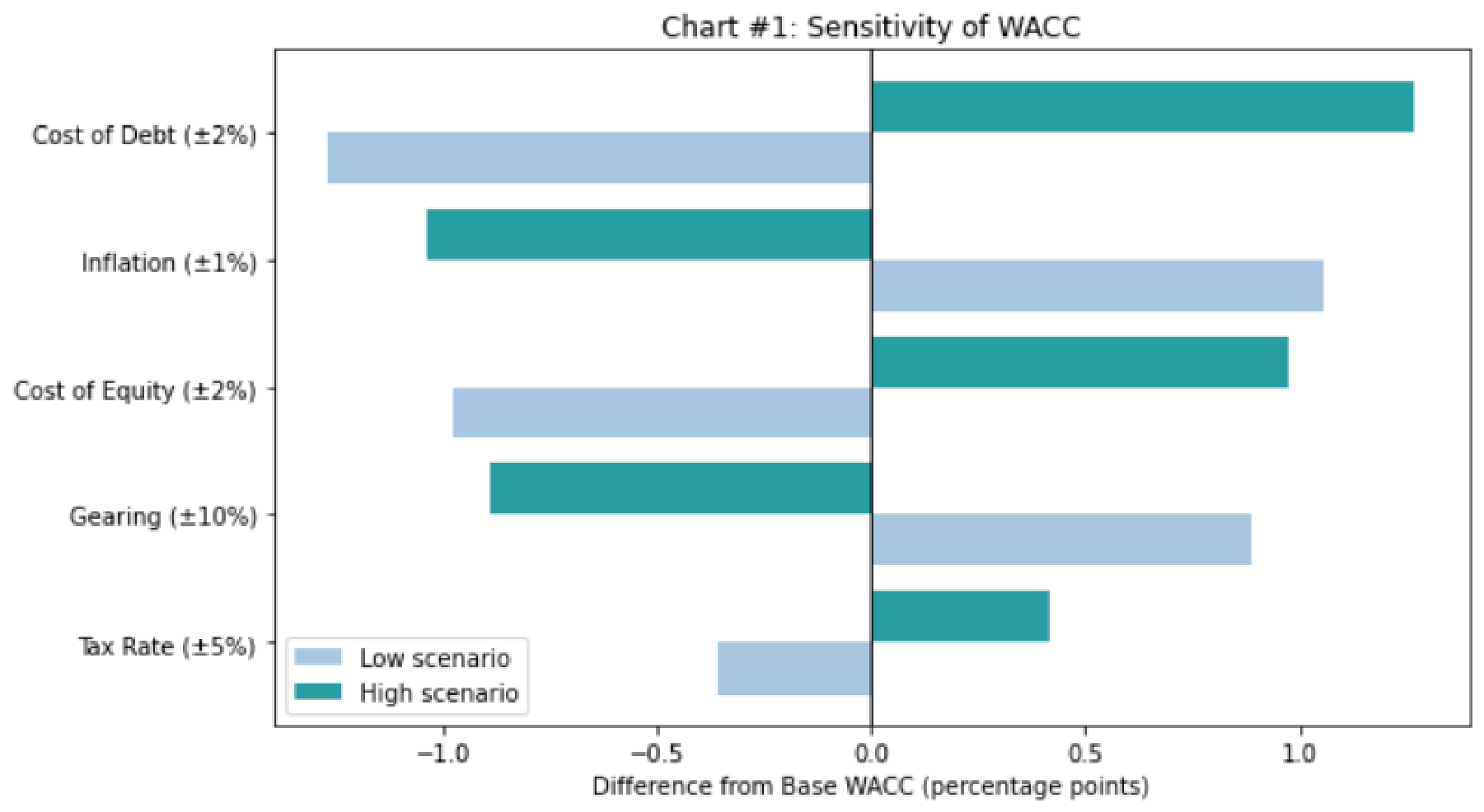
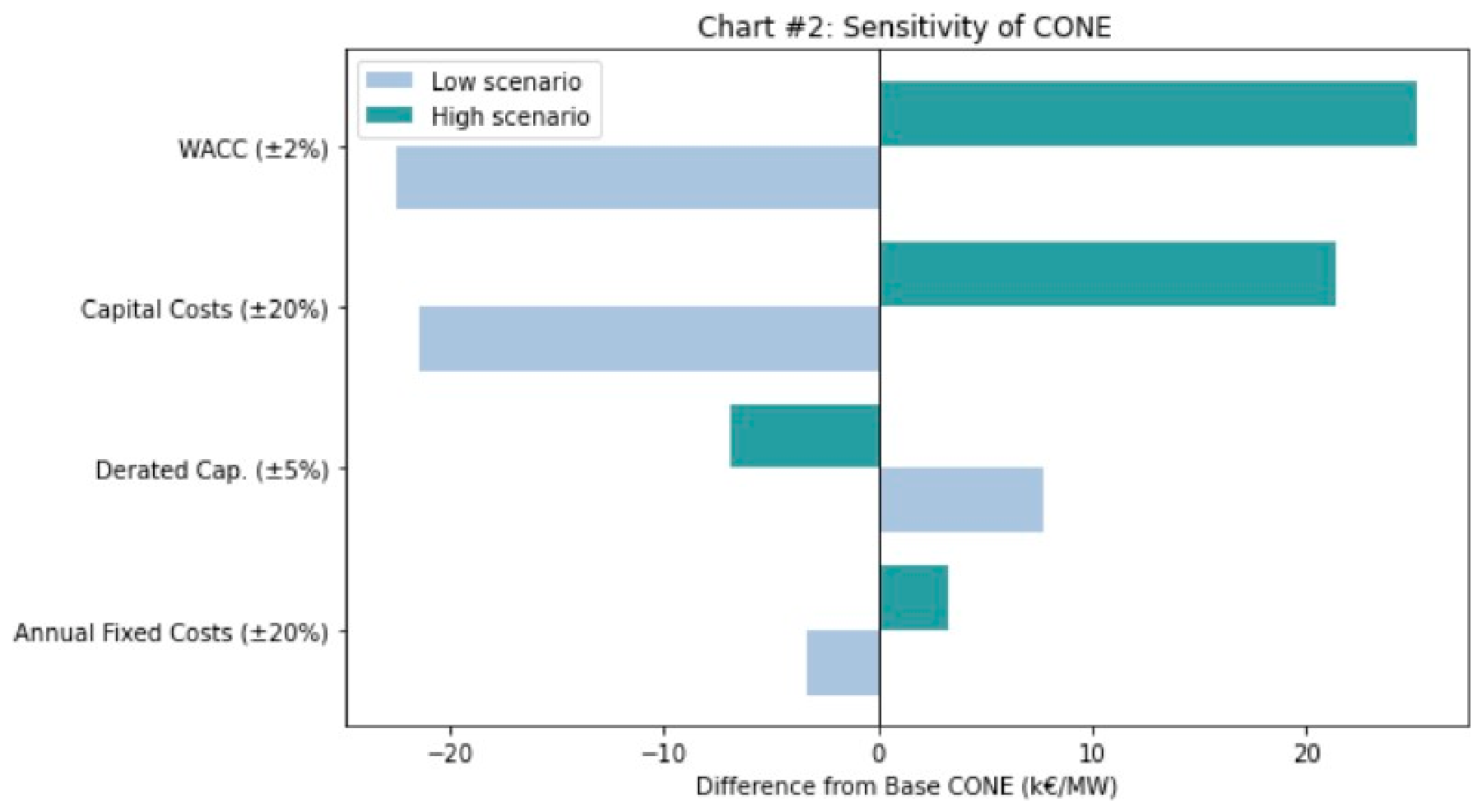
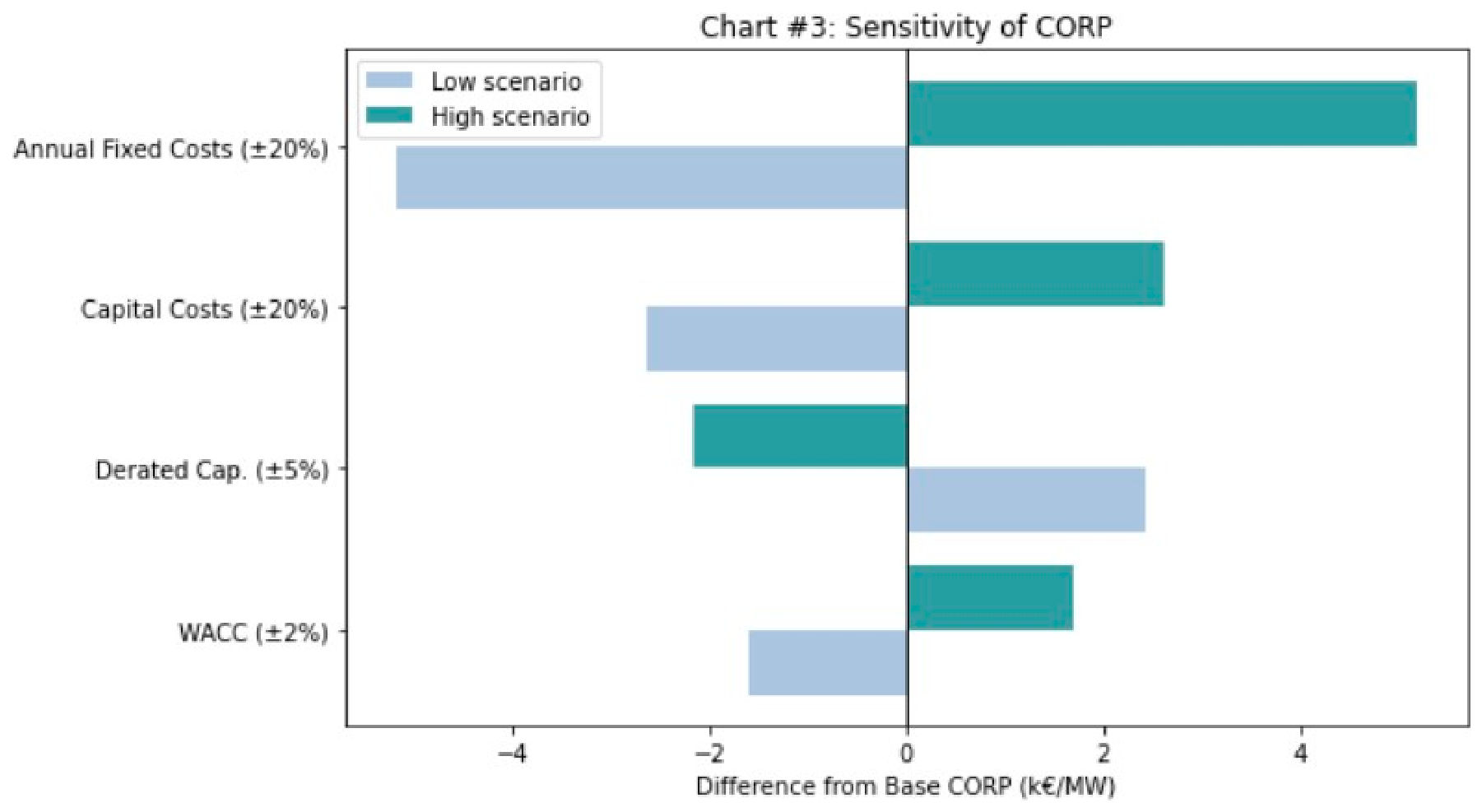
As the intermediate parameters have a degree of uncertainty, because they correspond to economic predictions that frequently do not match real-world outcomes, a sensitivity test was performed to examine how each of the parameters influences the results. In this test, each parameter of interest is varied within a specified “low” and “high” range in three separate sensitivity analyses. The main goal is to determine how shifting each parameter by a plausible range affects the WACC, CONE, and CORP. By holding all other variables constant at their base case values, while one parameter moves to its lower or higher bound, it is possible to observe how sensitive the chosen output metric is to that particular input. The obtained results are displayed in
Figure 2 (WACC),
Figure 3 (CONE), and
Figure 4 (CORP).
The sensitivity analysis (
Figure 2,
Figure 3 and
Figure 4) follows a one-at-a-time perturbation approach. Each parameter in
Table 2 is shifted to a predefined ‘low’ or ‘high’ level, with the resulting deviations are recalculated and plotted to rank the most influential drivers. This method provides a clear, visual ranking of which assumptions drive the WACC, CONE, and CORP results the most, highlighting the variables with the most pronounced impact on the final estimates.
In the first chart (
Figure 2), which focuses on WACC, cost of debt, cost of equity, and inflation stand out as the most influential drivers. Even a modest change in the proportion of debt financing or inflation can produce a disproportionately large swing in the overall weighted average. By contrast, parameters such as gearing and corporate tax rate still affect the WACC but with relatively smaller deviations when tested over their respective ranges, indicating that they represent lower risk exposure under the given assumptions.
Turning to the second chart (
Figure 3), which examines the CONE, the results confirm that WACC and the capital costs are particularly sensitive when each is varied within its plausible range. A ±20% shift in capital cost can substantially alter the total construction-related expenses, while moving the WACC by ±2% has a great influence, underscoring the significance of financing conditions in determining the overall Cost of New Entry, particularly with a long operational life power plant. The de-rated capacity exerts less influence, and annual fixed costs, though not insignificant, yield smaller changes to CONE relative to other inputs.
Analyzing the third chart (
Figure 4), the sensitivity test for CORP, one can conclude that the annual fixed costs and the capital costs are the parameters that influence CORP the most. With fewer years in construction and operational lifetime, the WACC is notably the input that results in smaller changes on the CORP.
Additional sensitivity analysis was performed to assess the impact of CO
2 price assumptions on the market revenue model. While the base case considers a CO
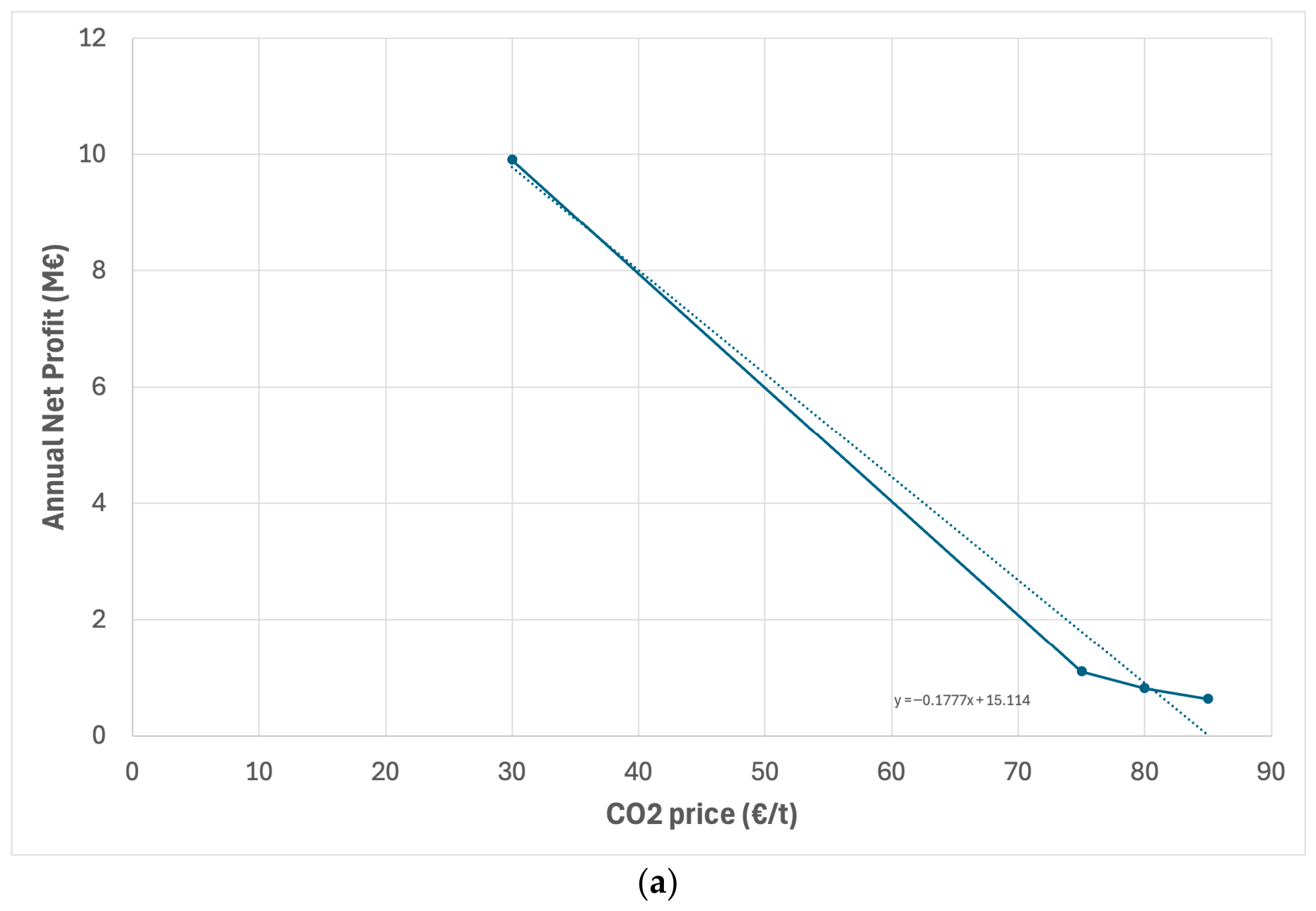
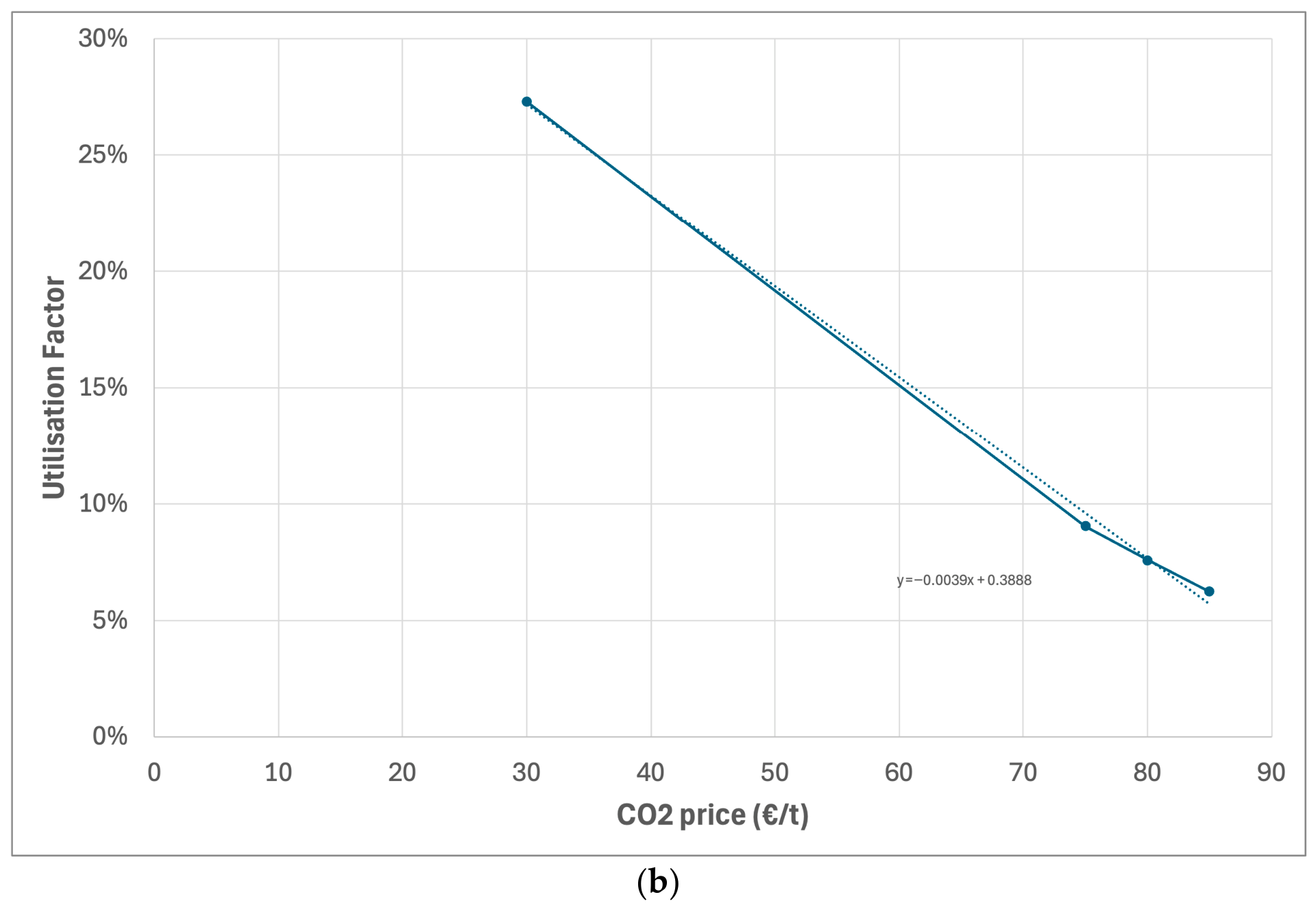
2 price of 30 €/t, alternative scenarios reflecting EU ETS conditions in 2023 were analyzed, namely 75, 80, and 85 €/t. The results are presented in
Figure 5.
As shown in
Figure 5a, the annual net profit decreases sharply as the CO
2 price increases. This reduction is not linear: at higher CO
2 price levels, the decline in profitability becomes more pronounced. This behaviour is explained by the combined effect of increasing marginal costs and a reduction in dispatch hours. As the CO
2 price rises, the variable cost of CCGT generation approaches or exceeds market prices in a larger number of hours, leading to a structural reduction in utilization rather than a simple decrease in profit margins.
This effect is clearly reflected in
Figure 5b, where the utilization factor drops from approximately 27% at 30 €/t to around 6% at 85 €/t. In practical terms, higher CO
2 prices not only reduce the profitability per unit of electricity generated, but also significantly limit the number of hours during which the CCGT is dispatched.
Overall, the results indicate an approximate decrease of 177 k€ in annual net profit and 0.38 percentage points in utilization factor for each 1 €/t increase in CO2 price over the analyzed range. These findings confirm that the base case assumption underestimates the variable cost of CCGT operations. However, even under higher and more realistic CO2 price scenarios, the market revenues remain significantly below the adequacy-based cost thresholds (CONE and CORP), reinforcing the robustness of the main conclusions.
Taken together, these findings reinforce that not all parameters carry equal weight in shaping either WACC, CONE, or CORP. The cost of debt, cost of equity, and inflation appear to dominate WACC risk; WACC and capital costs assumptions are especially critical in defining the range of potential CONE, and the costs, both fixed annual and capital, influence CORP the most. This highlights the importance of closely monitoring those key drivers—and carefully validating their assumptions—when conducting the computations.
4.3. Comparison with the Literature
The Portuguese results are interpreted in a broader context by comparing the calculated CONE and CORP values with estimates reported in the literature for other countries and institutions. This comparison helps assess the consistency of the results with previous empirical evidence and supports the plausibility of the adopted methodology.
Table 7 shows the found results.
The review of the CONE for CCGT suggests that the 123 k€/MW/year figure obtained for Portugal is well within the range reported in the literature and aligns methodologically with similar studies undertaken in other geographic areas. Although no existing source in the surveyed references directly addresses Portugal, the reported data from the United States and the EU—spanning approximately a decade—show a notable amplitude in estimated CONE for new CCGT plants. This amplitude reflects varying capital costs, financing conditions, regulatory environments, and the underlying modelling assumptions.
In one of the earlier studies published in 2011, researchers evaluated the U.S. market conditions and reported a CCGT CONE between 133.7 and 156.4 k€/MW/year [
43]. Subsequent updates on U.S. markets have narrowed and refined those ranges: one analysis from 2018 shows 116–120 k€/MW/year [
63], while projections for 2027 suggest higher figures in the range of 166–171 k€/MW/year [
64]. The rising values in recent projections could be attributable to evolving capital cost structures, potential escalations in the cost of carbon compliance, and possibly more conservative risk assumptions leading to higher financing. It is worth mentioning that this study was released in 2022, which was the year that gas prices reached a peak, which could have influenced the predictions for the future. Taken together, the U.S. examples illustrate how even within a single country, estimates can span nearly 60 k€/MW/year (from roughly 110 to 170 k€/MW/year) due to differences in the year studied, technology advances, and outlooks for fuel and carbon prices.
Looking at European markets provides further insight into why national contexts produce distinct estimates. Sweden’s CONE of about 60 k€/MW/year in 2024 (Universität Linz, 2024 [
69]) is at the low end of the surveyed values, and underscores, among other factors, the country’s then-prevailing financing assumptions and more favourable market conditions. By contrast, the Czech Republic’s estimate of 151 k€/MW/year [
69] stands out on the higher end of the spectrum among the European figures. Differences there may stem from local capital cost data, variations in expected operating hours for a CCGT in the Finnish system, or specific tax and policy parameters that affect the Weighted Average Cost of Capital (WACC). Ireland’s reported range of 90.8–104.6 k€/MW/year for 2022 [
67] presents a mid-range reference for current European contexts, shaped by the island’s electricity market structure.
Portugal, absent from these cited references, cannot be directly compared on a one-to-one basis with any of these studies, yet the 123 k€/MW/year calculation is consistent with the mid-range levels widely observed. The obtained value is consistent with ACER’s given range (80–100 k€/MW-year) presented for European countries in 2021 [
22]. It falls below the highest U.S. projections of 166–171 k€/MW/year but remains higher than the particularly low figure of 60 k€/MW/year for Sweden. Numerous underlying inputs can explain this positioning. Financing assumptions (such as the debt–equity ratio, the cost of debt, or the equity risk premium) lead to different cost structures. Carbon costs assumptions shift the net revenues needed for a new gas-fired power plant to enter the market. Lastly, renewable energy installed capacity highly influences the amount of time the gas-fired plant is dispatched—playing a decisive role in how net revenues offset the total capital and annual fixed costs components.
The methodology used in the present Portuguese CONE analysis further parallels that seen in other jurisdictions. Most studies, including those from the United States and Europe, adopt either a net-present-value framework for capital- and fixed-cost recovery, or a net-missing-money approach that subtracts projected energy market and ancillary service revenues from the gross annual costs. This common structure ensures that the final result, even if drawn from different input data and market contexts, remains conceptually comparable. The value calculated for Portugal assumes that the marginal cost of producing electricity by a CCGT power plant is covered by market revenue.
In addition, part of the variation observed across studies is due to methodological differences, including the treatment of revenues, cost components, and underlying modelling assumptions, which further limits the direct comparability of reported CONE values.
Ultimately, the 123 k€/MW/year figure for Portugal should be viewed as broadly consistent with the range of published estimates. This variety of observed values underscores both the inherent complexity in CONE estimation and the legitimacy of the result for Portugal, given that it lies within the general range of recognized benchmarks for modern CCGT entry.
The calculated CORP of 39 k€/MW/year aligns with the calculation on the Spanish CORP that ranges from 27 to 44 k€/MW/year [
39]. The Spanish CORP range reflects variations in the age and condition of the CCGT plants across the country, which this work does not have in consideration. Older plants typically require higher investment in maintenance, upgrades, and component replacements, pushing the CORP towards the upper end of the range. In contrast, newer or well-maintained facilities may incur lower renewal costs, explaining the lower bound of the range. This calculation assumes a value of annual fixed costs of an old power plant, resulting in a CORP that aligns with the higher end of the Spanish range.
These differences can be further interpreted in light of the underlying modelling assumptions. In particular, variations in capital costs, financing conditions (e.g., WACC), and expected utilization levels play a central role in shaping CONE estimates across studies. In addition, differences in market structure, regulatory frameworks, and assumptions regarding operating regimes can significantly influence the resulting values. As such, the observed dispersion in the literature reflects not only geographical differences, but also the sensitivity of CONE to these key modelling inputs.
From a policy perspective, the sensitivity analysis indicates that, although the exact values of CONE and CORP depend on key assumptions such as WACC and capital costs, the overall conclusion remains robust. Even under favourable parameter variations, the estimated market revenues remain significantly below adequacy-based cost thresholds. This suggests that the identified revenue gap is not driven by a specific set of assumptions, but rather reflects a structural feature of the current market conditions. As such, the need for additional remuneration mechanisms is robust to reasonable variations in the main economic parameters.
Overall, the Portuguese results are consistent with the empirical evidence reported in the literature and support the view that CCGTs in high-renewable systems face a structural revenue gap under energy-only market conditions. In this sense, the findings of this work are aligned with the broader literature on the “missing money” problem and on the role of capacity remuneration mechanisms in preserving system adequacy.
4.4. “Extra-Market” Payments
In the market closure simulation (performed as detailed in
Section 3.3), 2023 data from MIBEL’s demand, renewable generation, and energy market prices were given as input to assess how much revenue a 500 MW CCGT power plant could have generated. The computed annual net revenue was approximately 9.9 M€ (i.e., approximately 20 k€/MW), equivalent to the value this power plant receives after discounting taxes and the variable cost associated with producing electricity. This outcome primarily reflects the results of a technology that is present in the market infrequently, with high marginal costs and CO
2 pricing. The annual energy produced amounts to 1.2 TWh.
As seen, a newly built/already in operation CCGT power plant would require 123 (CONE)/39 (CORP) k€/MW to achieve financial viability in the market. This means that around 103/19 k€/MW needs to be provided through “extra-market” capacity remuneration mechanisms, to support the critical role CCGT power plants play in today’s power system.
To assess the accuracy of the developed simplified model, the capacity factor was calculated based on the yearly generation and compared with the Portuguese capacity factor for natural gas power plants. As the market closure algorithm has 2023 data as its input, the comparison drawn in
Table 8 uses the Portuguese values from that year. The capacity factor computed for the modelled power plant is slightly higher, but generally in line with the one verified in Portugal, further validating the results obtained.
The alignment between the simulated capacity factor (27.28%) and the actual 2023 Portuguese fleet average (25.36%) serves as a proxy for operational consistency. While the model lacks plant-level granularity, this aggregate match suggests that the simplified dispatch logic effectively captures the collective operational behaviour of CCGTs in MIBEL—operating primarily as flexible backup generation during periods of lower renewable output or higher residual demand. This consistency confirms that the model’s revenue estimates are grounded in the actual volume of energy supplied by such units to the grid, reflecting their real-world roles in ensuring system adequacy.
It is important to understand that this is a simplified market closure algorithm. The main limitations include the fact that it assumes that the MIBEL final price is the same with or without the modelled power plant, assumes this particular CCGT power plant to be the first to be dispatched among non-renewable sources, and it misses operational constraints such as forced or planned outages for maintenance. All of these factors would change the obtained result. Nevertheless, the approximation used gives a general idea of how a 500 MW CCGT would behave in MIBEL, with results that align with reality, such as the capacity factor and the price received per unit of electricity produced.
Rather than reproducing detailed market dynamics, this simplified approach provides a transparent estimation of the order of magnitude of CCGT revenues and utilization, which is sufficient for assessing the adequacy-related revenue gap. However, as it focuses strictly on energy-only outcomes, it does not account for secondary income from ancillary services or reserve markets. Therefore, the estimated revenue of approximately 20 k€/MW/year should be interpreted as an upper-bound focused assessment of the ‘missing money’ problem in the primary market.
In the absence of plant-level data, additional validation can be supported through consistency with stylized operational characteristics reported in the literature. In high-renewable electricity systems, CCGT plants are expected to operate with relatively low capacity factors, reflecting their role as flexible backup generation. The utilization levels obtained in this work are consistent with this expected behaviour, as well as with evidence from comparable European markets where increasing renewable penetration has led to reduced operating hours and lower energy market revenues for thermal generation. This consistency provides an additional level of confidence in the plausibility of the results, despite the simplified modelling framework.
In practice, CCGTs compete with other dispatchable resources, such as pumped-storage hydro and electricity imports, particularly from Spain, which can limit their operating hours. As a result, the assumption that the modelled CCGT is always the first non-renewable unit to be dispatched may lead to an overestimation of its utilization and, consequently, of its market revenues.
This implies that the estimated revenue of approximately 20 k€/MW/year should be interpreted as an upper-bound approximation, and that the actual revenues of CCGTs in the Portuguese system may be lower under real market conditions.
5. Conclusions
This research sought to determine the financial viability of a CCGT power plant in a changing energy landscape, using Portugal as a case study, EU methodologies, and a simplified market closure algorithm. Firstly, the value of CONE for a CCGT in Portugal was calculated in order to compare it with the net revenue such a plant could earn under 2023 MIBEL market conditions. The work yields a CONE of 123 k€/MW/year, calculated in accordance with European methodology. In parallel, a 500 MW CCGT has been modelled through a simplified market closure model, drawing on demand, renewable generation, and electricity prices in MIBEL for 2023. This dispatch simulation produced an annual net revenue of approximately 9.9 million €. Despite showing certain fluctuations, this yearly net revenue remains significantly below the threshold implied by the 123 k€/MW/year CONE, being roughly six times lower than what would be required to make a new entrant power plant financially viable. By multiplying the 123 k€/MW/year figure by the 500 MW of installed capacity, it becomes evident that about 51.5 million € extra-market would be needed every year for the investment to be financially justified.
This discrepancy highlights the idea behind calculating the CONE: it establishes the minimum annual net revenue necessary for a specific technology to secure an acceptable return on equity and debt without supplementary market support. Consequently, if the revenue streams observed in current market conditions fail to meet this requirement, there is a considerable investment gap that the market alone is not bridging. Although this conclusion primarily addresses prospective new builds, it also raises broader concerns about Portugal’s electricity sector, particularly as renewables continue to expand their share and reduce the frequency and duration of CCGT operations, endangering the already built power plants from not receiving enough return, resulting in a possible early decommissioning or non-renewal.
Moreover, for these power plants, the CORP was calculated. The estimations of the CORP for existing CCGT plants amount to 39 k€/MW/year and present a more pragmatic insight into the short-term challenges. CORP, which corresponds to the Cost of Renewal or Prolongation, is commonly used to determine the revenue threshold for preserving the economic viability of an operational plant, considering necessary expenses and financial costs to any renewal of equipment. From this perspective, it is easier and of most interest, from the financial, administrative, and time point of view, to maintain or upgrade an already established asset rather than invest in constructing an entirely new facility. The upgrading of old and already decommissioned power plants is also an option. However, even with a lower annual requirement, the modelled net revenue of 9.9 million € remains insufficient to meet the 19.5 million € needed annually to prolong or renew a 500 MW CCGT based on the 39 k€/MW/year CORP.
If such a gap persists for a long duration, there is an increased risk of premature closures of existing gas-fired capacity. This risk, in turn, might disrupt resource adequacy targets, particularly if the decommissioned units are not replaced by equally reliable and flexible assets. The presence of growing renewable generation underscores the importance of flexible thermal power as a backup resource during periods of low renewable production or high demand spikes, thereby exposing the vulnerability of the system if that flexibility is diminished. Policymakers, therefore, may reference both the CONE for new entrants and the CORP for at-risk units to judge whether a market intervention, most likely in the form of capacity remuneration, is necessary to maintain a balanced and reliable electricity mix.
Capacity remuneration mechanisms can bridge this gap. The calculations show that a newly built 500 MW CCGT might require approximately 103 k€/MW/year to compensate for its capacity and meet the CONE target. This estimate exceeds the level of capacity remuneration found in some other European markets, as discussed in the literature review of this work, reflecting the fact that Portugal’s high penetration of renewables further constrains the operating hours and profitability of thermal generation. In case the same 500 MW plant already exists, and it requires financial support to renew its functioning, a capacity payment of at least 19 k€/MW/year would make the CCGT power plant reach the necessary CORP figure.
It is crucial to reiterate that these estimated revenue gaps—approximately 103 k€/MW/year for new capacity and 19 k€/MW/year for existing units—serve as indicative benchmarks to quantify the adequacy shortfall. These figures are intended to inform the policy debate regarding the scale of the ‘missing money’ problem and should not be interpreted as the exact or optimal magnitude of a CRM payment for market implementation, which would require further regulatory and design considerations.
A sensitivity analysis was also performed to assess the impact of CO2 price assumptions on the market revenue model. Using EU ETS price levels representative of 2023 (75–85 €/t), the results show a significant reduction in both utilization factor and annual net revenue, reflecting higher marginal costs and reduced dispatch hours. Under these conditions, the estimated revenue of the modelled CCGT decreases substantially compared to the base case. However, the revenue gap with respect to CONE and CORP remains significant, confirming that the main conclusions of this study are robust to more realistic carbon pricing assumptions.
The analysis does not aim to compare alternative market designs, but rather to quantify the revenue gap under current market conditions, which provides an indication of the need for additional remuneration mechanisms.
At the same time, it is important to clarify the limits of the conclusions that can be drawn from the adopted modelling framework. Due to the simplified representation of market operation, the results should not be interpreted as prescriptive policy outcomes, nor as a basis for comparing alternative market designs. Instead, the analysis provides an order-of-magnitude assessment of the revenue gap under current market conditions, highlighting the existence and scale of the adequacy challenge rather than defining specific regulatory solutions.
The findings of this work provide clear policy guidance for the Portuguese electricity system. The significant gap identified between market revenues (≈20 k€/MW/year) and the adequacy-based thresholds (123 k€/MW/year for CONE and 39 k€/MW/year for CORP) indicates that energy-only market revenues are insufficient to sustain CCGT capacity.
Therefore, Portugal should consider the implementation of a capacity remuneration mechanism (CRM). Depending on the preferred design, this could involve either moderate payments over longer contract durations or higher payments over shorter timeframes, ensuring both investment signals for new capacity and the retention of existing plants.
In addition, the consistent application of EU adequacy methodologies—namely the calculation of VOLL and LOLE—is recommended to support transparent and comparable adequacy assessments, both at national and European levels. These tools are essential for designing efficient and proportionate capacity mechanisms.
At the same time, it is important to acknowledge that such mechanisms may involve trade-offs. While capacity remuneration can improve investment signals and support system adequacy, it may also affect market price formation, weaken scarcity signals, and increase costs for consumers. These trade-offs should be carefully considered in the design and implementation of any regulatory intervention.
Beyond financial viability, these findings have broader economic implications for electricity market design. The persistence of a revenue gap may distort investment signals, delay the deployment of flexible capacity, and increase the risk of supply shortages in high-renewable systems. Ensuring adequate remuneration for dispatchable generation is therefore not only a matter of individual plant viability, but also of maintaining efficient market outcomes and system reliability during the energy transition.
These implications extend beyond the specific case study considered in this work. The identified revenue gap reflects structural features of energy-only markets under high renewable penetration, where increasing shares of low marginal cost generation reduce the operating hours and profitability of dispatchable capacity. As such, the results provide insight into broader challenges faced by European electricity markets in ensuring adequacy and investment signals during the energy transition.
From a broader economic perspective, these results have additional implications. The persistence of a revenue gap may weaken long-term investment signals, leading to underinvestment in flexible capacity and increasing reliance on regulatory interventions. This, in turn, can affect the efficiency of market outcomes, as price signals alone may no longer be sufficient to ensure an optimal generation mix. In this context, the adequacy challenge identified in this work reflects a broader tension between market-based coordination and the need for policy support in systems with high shares of renewable generation.
Overall, the results reinforce the role of CCGT as a critical transitional technology, capable of supporting high renewable penetration while maintaining system reliability in the short and medium term.
In the longer term, the role of CCGTs may evolve through decarbonization pathways, such as hydrogen co-firing or the integration of carbon capture technologies. However, these developments fall outside the scope of the present study, which focuses on current adequacy challenges and market conditions.
This study is subject to several limitations. First, the market closure algorithm relies on a simplified representation of market operation and does not account for all revenue streams, specifically excluding ancillary services and balancing markets. Second, some input parameters, particularly those related to financing conditions and cost assumptions, are based on the literature values rather than project-specific data. Third, the analysis is based on a single year (2023), which may not fully capture long-term market variability. Nevertheless, the analysis is based on 2023 data, which reflects more stabilized market conditions following the exceptional price volatility observed in 2021–2022. These earlier years were significantly affected by extraordinary events, including the COVID-19 pandemic and the energy crisis, and are therefore not considered representative of typical market conditions. While the use of a single year is a limitation, the identified revenue gap reflects structural features of energy-only markets under high renewable penetration, rather than a year-specific outcome.
A key limitation of the analysis relates to the reliance on cost assumptions derived from literature and benchmark data. In the absence of recent and publicly available project-specific information for the Portuguese context, these assumptions play a significant role in determining the resulting values of WACC, CONE, and CORP. While the selected parameters are consistent with ranges reported in the literature and their impact is explored through sensitivity analysis, the empirical credibility of the results remains dependent on the validity of these underlying assumptions.
An additional limitation relates to the treatment of parameter uncertainty. The sensitivity analysis performed in this work considers variations in individual parameters, holding others constant, and therefore does not capture potential interactions between multiple uncertain inputs. A more comprehensive assessment of combined uncertainty would require a probabilistic or scenario-based modelling approach, which is beyond the scope of the present study but represents a relevant direction for future research.
Future research could address these limitations by incorporating more detailed market modelling, including additional revenue streams and stochastic approaches. Extending the analysis to multiple years and alternative scenarios, particularly under different renewable penetration and price conditions, would also provide further insights. Finally, applying the methodology to other countries would allow for broader comparative assessments of adequacy and capacity mechanisms across Europe.