Article

Two-Stage Robust Optimization Approach Considering Energy Storage Degradation Under High Renewable Penetration

1
Yunnan Electric Power Dispatching and Control Center, Kunming 650011, China
2
Yunnan Electric Power Test & Research Institute (Group) Co., Ltd., Kunming 650217, China
3
Department of Electronics and Electrical Engineering, Southern University of Science and Technology, Shenzhen 518055, China
*
Author to whom correspondence should be addressed.
Energies 2026, 19(10), 2351; https://doi.org/10.3390/en19102351
Submission received: 29 January 2026 / Revised: 6 March 2026 / Accepted: 10 March 2026 / Published: 14 May 2026
(This article belongs to the Section D: Energy Storage and Application)

Abstract

The rising penetration of renewable energy introduces greater volatility and uncertainty into energy systems. Energy storage systems (ESS) play a vital role in enhancing system flexibility and stability. However, frequent charge–discharge cycles lead to significant degradation of storage devices, reducing their economic efficiency and lifespan. This paper proposes a two-stage robust optimization framework under high renewable penetration, explicitly considering battery degradation. The first stage determines the optimal capacity configuration of distributed energy resources, including PV, wind, gas turbines, and ESSs. The second stage optimizes operational strategies under worst-case uncertainty in renewable generation and load, while accounting for the degradation cost and cycle life of the ESS. A linearized degradation model is developed based on depth-of-discharge (DoD), and the overall problem is solved using a Column-and-Constraint Generation (C&CG) algorithm. Simulation results demonstrate that the proposed approach effectively balances investment and operation, reduces degradation-related costs, and ensures reliable performance under uncertainty.

1. Introduction

As the global transition toward clean energy accelerates, renewable energy (RE) such as photovoltaic (PV) and wind turbine (WT) are playing an increasingly vital role in modern power systems [1,2]. To accommodate high shares of renewable energy, the development of distributed energy systems that integrate generation, load, and storage functions has become a key trend [3]. These systems offer significant benefits in improving energy efficiency, reducing operational costs, and lowering carbon emissions. However, they also face critical challenges such as the intermittent nature of renewables [4,5] and energy storage (ESS) degradation [6,7]. Consequently, achieving joint optimization of capacity planning and operational strategies—while accounting for uncertainty and storage degradation—has emerged as a central focus of current research.
Most existing studies on distributed energy systems primarily focus on short-term operational strategies aimed at minimizing daily or hourly costs. For example, the authors of [8] developed a two-stage dispatch model to minimize operational, fuel, and carbon trading costs. In [9,10], the authors focused on energy scheduling of a hybrid system, aiming to reduce operational cost. In [11], a dispatch strategy is proposed for an islanded microgrid that switches between economic and resilient operation modes during extreme events. In addition, multi-time-scale optimization of distributed energy systems has attracted increasing attention in recent years. For example, a multi-time-scale scheduling model integrating ladder carbon trading and CCS-P2G coupling was developed in [12] to improve the economic and low-carbon performance of integrated energy systems. The authors of the study in [13] developed a multi-time-scale hierarchical optimization framework for distribution networks with aggregated distributed energy storage. Furthermore, ref. [14] presented a multi-time-scale model predictive control-based demand-side management framework for microgrids to enhance economic performance and operational robustness. However, these approaches often neglect long-term planning decisions such as the sizing of distributed energy resources and ESSs, which is essential for ensuring the long-term economic performance of microgrids.
To enable optimal planning decisions for energy systems, a co-optimization model that simultaneously determines system configuration and operational strategy was devised to improve overall efficiency [15]. In [16], the authors developed a two-stage co-optimization framework that integrates long-term capacity planning with short-term dispatch decisions, aiming to minimize the total system cost over the microgrid’s lifecycle. In [17], a bi-level programming model was established to coordinate investment decisions at the upper level with operational scheduling at the lower level, thereby capturing the interaction between capacity expansion and dispatch flexibility. In addition, an increasing number of studies have incorporated ESSs into the planning stage to enhance system flexibility and better accommodate RE [18,19,20]. For instance, ref. [18] proposed a reliability-aware chance-constrained battery sizing method for island microgrids, where system reliability was explicitly integrated into the objective function through expected energy not served. Ref. [19] proposed a two-stage distributionally robust planning model for stationary–mobile BESS to enhance distribution network resilience under extreme weather. Ref. [20] presented a co-optimization method for residential battery sizing and operation considering cycling aging and seasonal variations. However, most of the aforementioned studies either simplify the ESS degradation process or neglect load uncertainty in the planning stage. In practical energy systems, ESS degradation significantly affects lifecycle economic performance [21], while load and RE variability introduce additional operational risks [22].
There are two main approaches to handling uncertainty: stochastic programming (SP) and robust optimization (RO). SP characterizes uncertain parameters through a set of representative scenarios with associated probability distributions, and typically aims to minimize the expected system cost or risk-related metrics. By capturing the statistical properties of load demand and renewable generation, SP can provide economically efficient decisions under probabilistic uncertainty [23,24,25]. The study in ref. [26] developed a two-stage SP model for sizing and operating off-grid hybrid renewable energy systems under renewable generation uncertainty. A Monte Carlo-based scenario-generation method combined with K-means clustering was adopted to characterize renewable variability, ensuring system reliability across all scenarios while minimizing total annualized cost and CO2 emissions. A two-stage stochastic optimal power flow (OPF) model for microgrids under uncertain wildfire effects was formulated in ref. [27], in which wildfire progression and renewable generation uncertainties were represented by probabilistic scenarios. While SP can effectively capture the stochastic characteristics of demand and renewable generation, it relies heavily on accurate probability information and may suffer from scenario explosion as system scale increases.
In contrast, RO models uncertainty through predefined uncertainty sets without requiring precise distributional assumptions. By optimizing against the worst-case realization within the uncertainty set, RO ensures constraint feasibility under bounded uncertainty and enhances decision robustness [28,29]. In recent years, RO has been widely applied in energy system planning and operation problems with high renewable penetration. An adaptive robust optimization framework has been developed in ref. [30] to coordinate capacity expansion and operational dispatch under RE and load uncertainty. In addition, the study in ref. [31] proposed a two-stage RO model to determine first-stage investment decisions and second-stage recourse actions against worst-case realizations. Under high renewable penetration, the joint impact of load uncertainty, RE intermittency, and ESS degradation dynamics further complicates the planning problem.
To overcome these challenges, this study develops a two-stage robust optimization framework that accounts for ESS degradation under high levels of renewable penetration. The first stage determines the optimal capacity configuration of distributed energy resources, including PV, WT, distributed generator (DG), and ESS. The second stage optimizes the operational strategy against worst-case uncertainty in RE output and load, while capturing the impact of ESS degradation cost and cycle life.
This work makes the following primary contributions:
(1)
A two-stage robust optimization framework is proposed to jointly consider capacity planning and operation under uncertainty.
(2)
Battery degradation is modeled through depth-of-discharge and cycle-based cost representation, which is further linearized for tractability.
(3)
To efficiently solve the proposed model, a solution approach built upon the Column-and-Constraint Generation (C&CG) algorithm is employed.
The remainder of this paper is organized as follows: Section 2 introduces the system framework, followed by problem formulation in Section 3. Section 4 presents the C&CG-based solution methodology. Section 5 provides a case study, and Section 6 concludes the paper with future research directions.

2. System Modeling

2.1. System Architecture

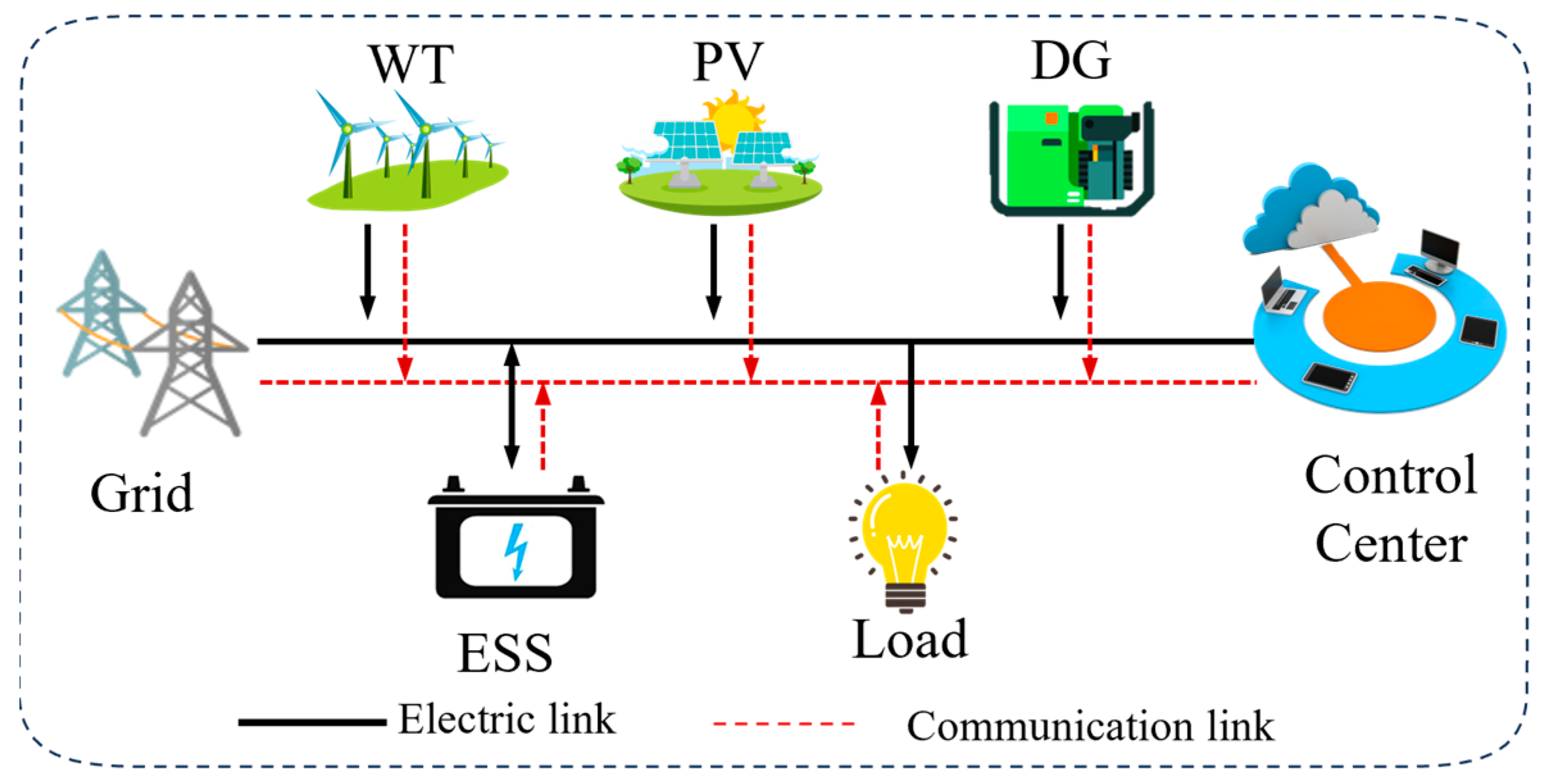
The energy system considered in this study is illustrated in Figure 1. It consists of multiple distributed energy sources, including WT, PV, DG, as well as ESS, loads, and the main grid. A central energy management system (EMS) is used to coordinate power flow among these components. The energy systems can operate in both grid-connected and islanded modes, ensuring supply–demand balance and optimal dispatch under uncertainty.
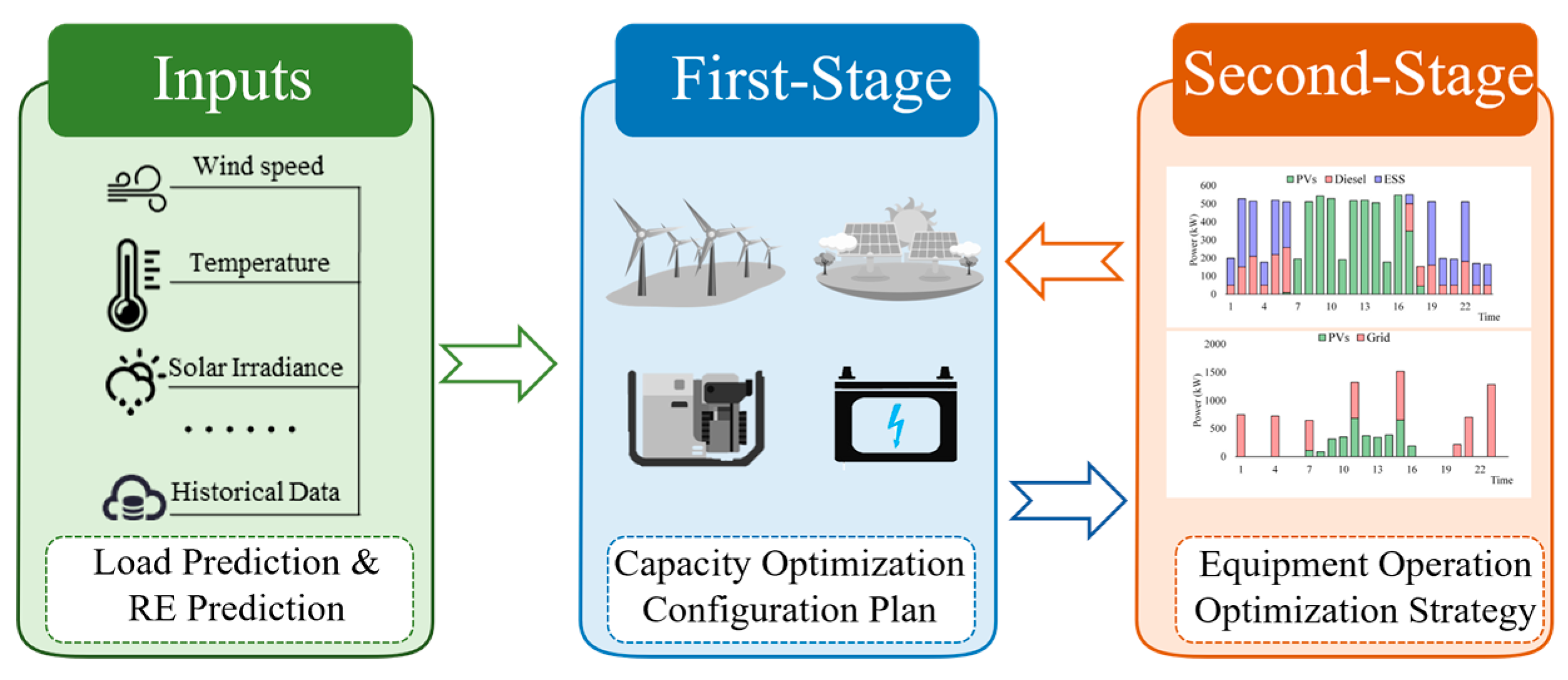
To achieve optimal planning and reliable operation of the energy systems under uncertainty, a two-stage robust optimization framework is developed, as shown in Figure 2.
Capacity configuration of PV system, WT system, DG system, ESS system. The inputs to this stage include predicted meteorological data such as wind speed, solar irradiance, temperature, and historical load profiles. This stage focuses on minimizing investment cost by making long-term planning decisions before the realization of uncertainties.
In the second stage, once uncertainties are realized (e.g., actual wind, solar, and load conditions), the model determines the optimal operation strategy of each energy unit. This stage focuses on minimizing operating costs, which include ESS degradation cost, fuel consumption, electricity transactions with the main grid, and O&M expenses. The model optimizes power dispatch decisions for each time period, ensuring energy balance, operational constraints, and robustness against uncertainty.

2.2. Battery Lifetime Degradation Model

In high renewable penetration scenarios, ESSs are frequently charged and discharged to mitigate power fluctuations and ensure grid stability. These intensive cycling operations can lead to accelerated battery degradation. Therefore, the battery lifetime degradation should be modeled.
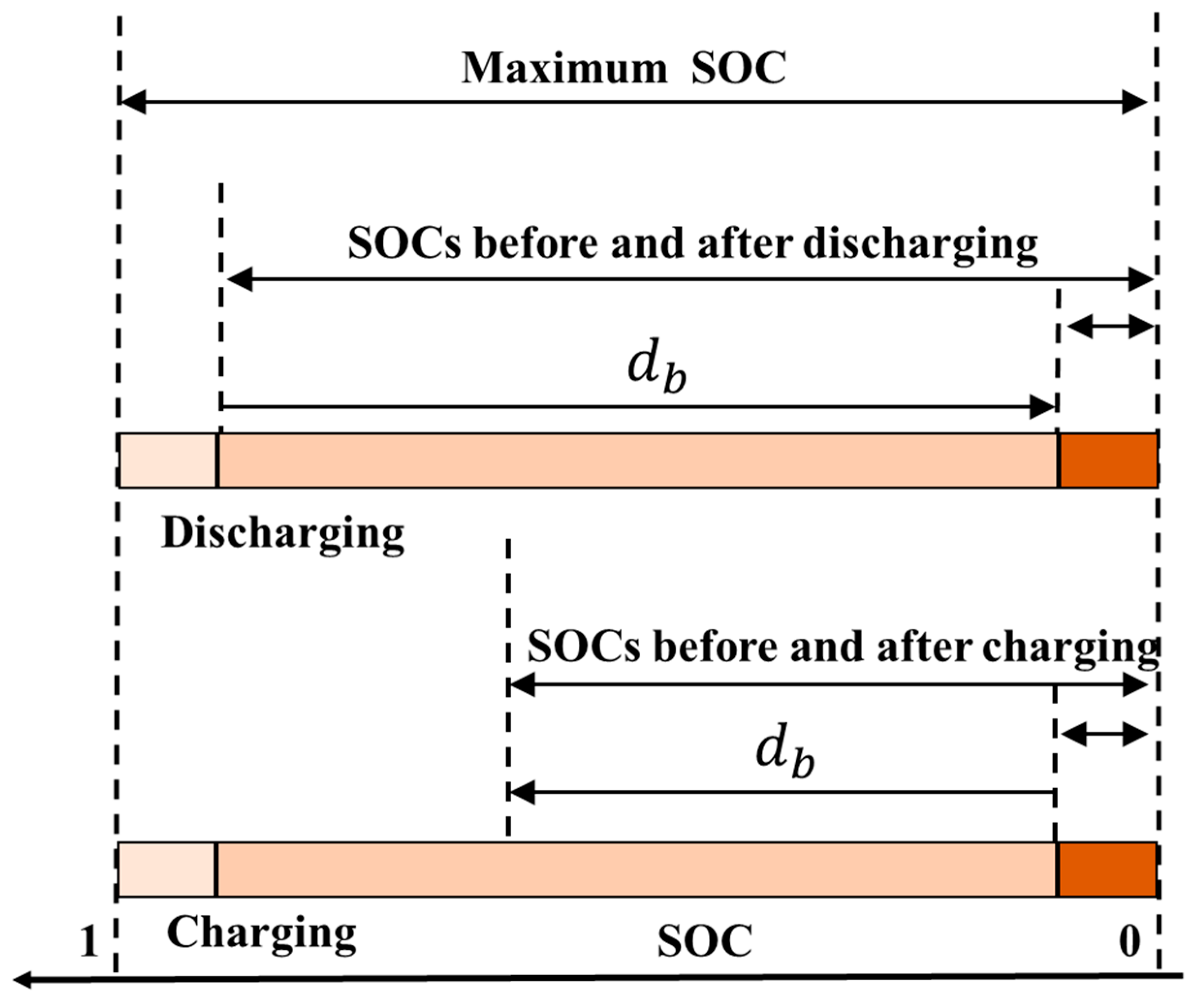
The two primary determinants of battery degradation are the actual usable capacity and the depth of discharge (DoD) [32]. In this paper, the DoD in each charging or discharging event is denoted as d b in this study as shown in Figure 3. The relationship between DoD and battery lifetime is illustrated with the mathematical expression given in Equation (1):
L l i f e ( d b ) = L 0 ( d b ) a
where L 0 represents the number of cycles the battery can endure under 100% DoD, and a is the fitting parameter.
To establish the fundamental physical relationship between cycle life and operational intensity, the service lifetime T l i f e is intrinsically related to the total cycle life L l i f e through:
T life = L l i f e ( d b ) 365 L day
where L d a y is the daily cycle number of the ESS. It should be noted that Equation (2) only describes the physical relationship between cycle life and DoD, rather than assuming constant daily cycling in actual operation. In the proposed framework, the effective cycling behavior and degradation cost are determined endogenously through the second-stage operational optimization under uncertainty.
The equivalent annual investment cost of a unit-capacity battery is evenly distributed over its cycle life to obtain the daily degradation cost. Given a daily cycle count L d a y , DoD is segmented linearly, allowing the degradation cost for each segment to be independently approximated. The parameter for the d-th segment reflects the degradation cost under its corresponding DoD range.
B d ( L day ) = c i n v , E S S 365 ρ ( 1 + ρ ) T life ( 1 + ρ ) T life 1
where ρ denotes the annual discount rate, c i n v , E S S represents the unit-capacity investment cost of ESS, and B d is the daily degradation cost for the d-th DoD segment. The DoD range is divided into 5 segments.
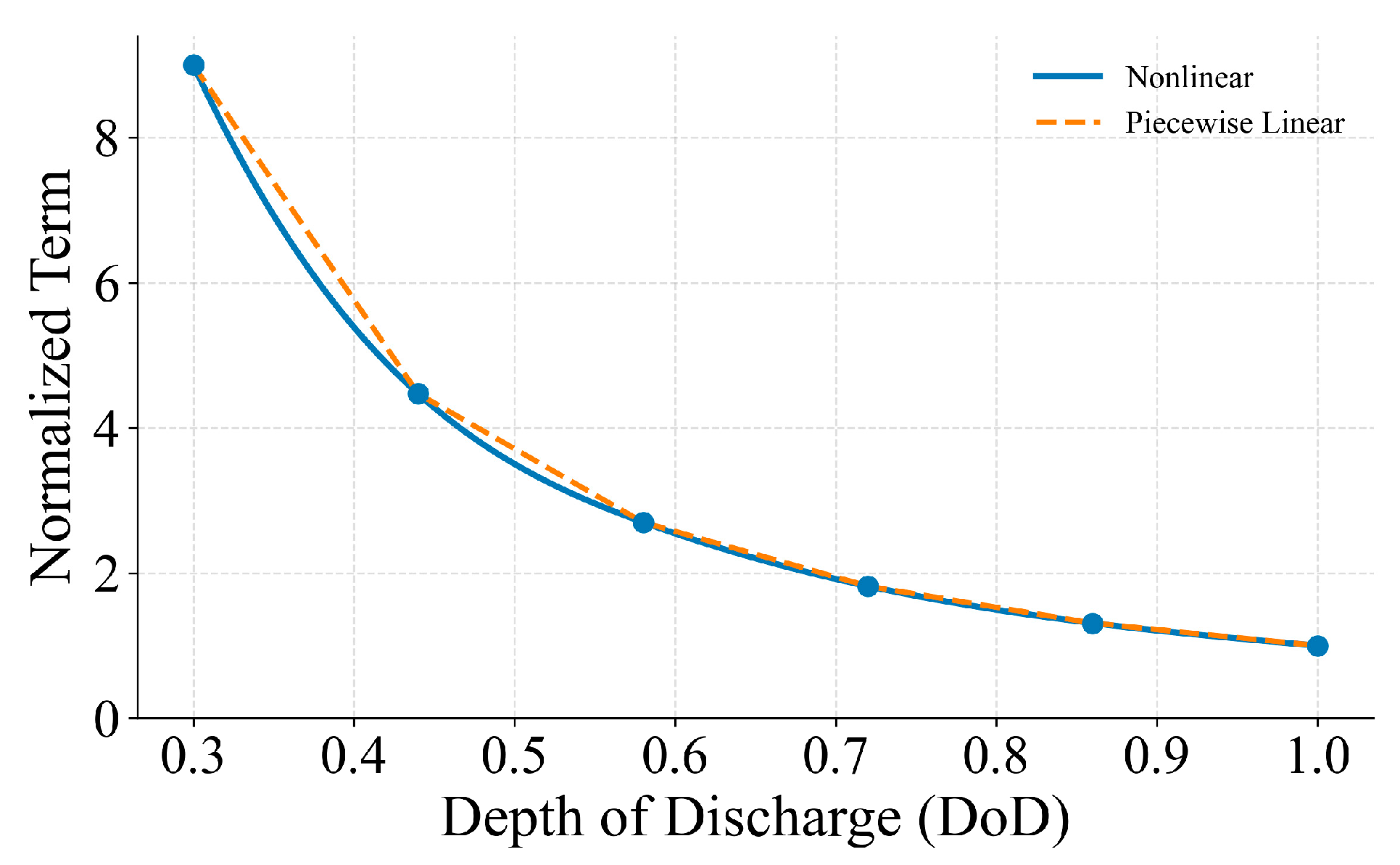
The piecewise-linear approximation of the battery degradation model in Equations (1)–(3) introduces a discretization error due to segmentation of the nonlinear cycle-life function. From a theoretical perspective, the cycle-life function L(DoD) is monotonic and convex over the considered interval [0.3, 1.0]. For a convex function, linear interpolation between adjacent breakpoints yields an overestimator of the original function. Consequently, the resulting degradation cost constitutes a conservative approximation of the true degradation cost within each segment.
Let Δ denote the segment width. For a twice-differentiable convex function, the interpolation error within each segment can be bounded by:
ε max ( Δ ) 2 8 max d b [ d 1 , d 2 ] L ( d b )
The inequation shows that the approximation error decreases quadratically as the segment width shrinks. In this study, the DoD range [0.3, 1.0] is divided into five equal-width segments with breakpoints at 0.30, 0.44, 0.58, 0.72, 0.86, and 1.00. Linear interpolation is performed between adjacent breakpoints, transforming the nonlinear degradation function into a set of linear constraints compatible with MILP formulation. As illustrated in Figure 4, the maximum relative approximation error is 9.79%, while the mean relative error is restricted to 2.84%. Given that long-term planning decisions are simultaneously influenced by other parametric uncertainties (e.g., fuel price, renewable variability), the bounded linearization residual introduced by the five-segment approximation is sufficiently small for planning-scale analysis.
The present degradation model focuses on cycle aging associated with the depth of discharge, which is typically the dominant factor in high renewable penetration scenarios with frequent charging and discharging. Calendar aging and temperature-dependent degradation are not explicitly modeled and may further influence long-term storage economics. Incorporating multi-factor aging mechanisms into robust planning frameworks represents an important direction for future research.

3. Problem Formulation

3.1. Two-Stage Planning Model

To address the optimization of renewable energy and energy storage, this study formulates an objective function aimed at minimizing the system’s total average cost. The total average cost C t o t a l can be divided into equipment investment cost C i n v and system operation cost C o p e . The equipment investment cost mainly includes the equivalent annualized investment cost of photovoltaic equipment C i n v , P V , wind power equipment C i n v , W T , DG C i n v , G T , and energy storage equipment C i n v , E S S . The system operation cost mainly covers the degradation cost of ESS C d e , operation and maintenance cost of C O M , electricity trading cost with the grid C g r i d , and fuel cost C f u e l . The formulation is as follows:
min C t o t a l = min { C i n v + C o p e }
C i n v = i I C R F i c i P i n v , i C R F i = ρ ( 1 + ρ ) r ( 1 + ρ ) r 1 , i I = { P V , W T , G T , E S S }
C o p e = i = 1 I 365 k i [ C d e . i + C g r i d . i + C o m . i + C f u e l , i ] C d e , i = E i n v . E S S max t d = 1 5 B d ( L d a y ) g d ( t ) C g r i d . i = t = 1 24 [ c b u y ( t ) P b u y , i ( t ) Δ t c s e l l ( t ) P s e l l , i ( t ) Δ t ] C o m . i = Ω t = 1 24 c o m . W P ω . i ( t ) Δ t   . Ω { P V , W T , G T , E S S } C f u e l . i = t = 1 24 c f u e l P G T . i ( t ) Δ t
where c i denotes the unit investment cost of technology i , and P i n v , i is the installed capacity. The capital recovery factor (CRF) is calculated based on the annual discount rate ρ and the equipment lifetime r . The planning horizon is assumed to be 20 years. In this study, the equipment lifetime is assumed to be equal to the planning horizon of the system. k i is the percentage of annual days represented by the typical day. Since four seasons are considered, I = 4 . g d ( t ) is a binary variable indicating whether the DoD at time t falls within segment d . c g r i d ( t ) denotes the electricity price. c o m . Ω is the operation and maintenance cost coefficient, and c f u e l is the unit fuel price; P b u y , i ( t ) and P s e l l , i ( t ) are the power purchased from and sold to the grid, respectively. P ω . i ( t ) is the power output of component Ω .
It should be noted that all cost components in the objective function are expressed in equivalent annual cost. The degradation cost is first computed on a typical-day basis and then annualized using the same scaling mechanism as the operating cost.

3.2. Constraints

The WT output is limited by rated bounds, as shown in (7).
P G T . min P G T ( t ) P i n v , G T
where P G T . min and P G T . max are the minimum and maximum output power, respectively.
The grid interaction constraints are defined in (8).
0 P buy ( t ) α g rid ( t ) P g rid . max 0 P s e l l ( t ) [ 1 α g rid ( t ) ] P g rid . max
where α g rid ( t ) { 0 , 1 } is a binary variable, and P g rid . max is the maximum allowable power exchanged with the grid.
The operation of ESS can be formulated as follows:
0 P d i s ( t ) [ 1 α E S S ( t ) ] P i n v , E S S 0 P c h ( t ) α E S S ( t ) P i n v , E S S
P i n v , E S S = μ E i n v , E S S
SOC ( t ) = SOC ( t 1 ) + η c h P c h ( t ) E i n v . max P d i s ( t ) η d i s E i n v . E S S
S O C min SOC ( t ) S O C max
η c h t = 1 24 P c h ( t ) Δ t 1 η d i s t = 1 24 P d i s ( t ) Δ t = 0
In the above constraints, the binary variable α E S S ( t ) { 0 , 1 } is used to prevent simultaneous charging and discharging. P i n v , E S S denotes the maximum power of the ESS, which is calculated as the product of the installed energy capacity E i n v , E S S and the fixed power-to-energy coefficient μ . The charging and discharging efficiencies are denoted by η c h and η d i s , respectively. The SOC at time t is represented by SOC ( t ) , and it is constrained within the bounds of S O C min and S O C max .
The power balance constraint is expressed in (14):
P d i s ( t ) + P b u y ( t ) + P G T ( t ) + P P V ( t ) + P W T ( t ) = P L ( t ) + P c h ( t ) + P s e l l ( t )
where P P V ( t ) , P W T ( t ) , P L ( t ) represent the uncertain power outputs of PV, WT, and load demand at time t , respectively.
The calculation of daily battery cycle count is defined in (15).
S E S S ( t ) = max α E S S ( t ) α E S S ( t 1 ) ,   0 L day = t = 1 24 S E S S ( t ) ,     L day { 0 , 1 , 2 , , 12 }
where S E S S ( t ) is an auxiliary variable that takes the value 1 when the battery transitions from a discharging to a charging state, and 0 otherwise.
The constraint on the DoD is formulated as shown in (16).
1 SOC ( t ) = d = 1 5 d b ( t ) d b ¯ g d ( t ) d b ( t ) d b ¯ g d ( t ) d = 1 5 g d ( t ) = 1
where d b ¯ and d b ¯ are the lower and upper bounds of the DoD.

3.3. Model Linearization

To enable linear optimization, the nonlinear max operator in the original degradation cost expression in (5) is replaced by an auxiliary variable, leading to the linear constraint:
C d e , max E i n v , E S S d = 1 5 B d ( L d a y ) g d ( t )
The linearized constraints for battery cycle count are expressed as:
S E S S ( t ) α E S S ( t ) α E S S ( t 1 ) S E S S ( t ) 0

4. Solution Methodology

The proposed two-stage robust optimization framework is conceptually different from stochastic and chance-constrained approaches. It does not rely on probability distributions but ensures feasibility under worst-case realizations within predefined uncertainty bounds, providing a distribution-free and risk-averse planning strategy for high-uncertainty environments.

4.1. Compact Form of Two-Stage Planning Model

The two-stage planning problem is rephrased in a compact form:
min x c T x + max u U min y , z d T y
s . t   A x d B y e C y = 0 D x + E y f F z g G y + H z = h I u y = u
In the first stage, the equipment capacity is determined prior to the realization of uncertainties. Let c T x denote the investment cost, where the decision vector x includes P i n v , P V , P i n v , W T , P i n v , G T , E i n v , E S S . In the second stage, the operational strategy is optimized under uncertainty. The term d T y represents the operating cost, with y includes continuous variables P d i s ( t ) , P b u y ( t ) , P G T ( t ) , P c h ( t ) , P s e l l ( t ) and discrete variables: α E S S ( t ) , α g rid ( t ) , g d ( t ) . The vector z = [ d b ( 1 ) . d b ( 2 ) . d b ( 3 ) . d b ( 4 ) . d b ( 5 ) ] T represents the DoD in five segmented time intervals. The uncertainty vector u includes P P V ( t ) , P W T ( t ) , and P L ( t ) .
The overall uncertainty set is defined using a box-type structure as:
U = u | ( 1 τ ) u 0 u ( 1 + τ ) u 0
where u 0 denotes the predicted values, τ [ 0 , 1 ] represents the maximum allowable deviation.
It should be noted that the box-type uncertainty set adopted in this study does not explicitly model temporal or cross-variable correlations among wind speed, solar irradiance, and load. Instead, it provides a distribution-free and tractable representation of uncertainty that ensures worst-case robustness within predefined bounds. For planning optimization problems, such a structure offers a reasonable trade-off between model fidelity and computational tractability. While more sophisticated uncertainty representations can capture temporal correlations more explicitly, they typically require additional probabilistic information or significantly increase computational complexity.

4.2. Solution Method Based on C&CG

The two-stage robust optimization problem is solved using the Column-and-Constraint Generation (C&CG) algorithm, which first decomposes it into the following master problem:
min x   c T x + α s . t . α d T y l       A x d       B y l e       C y l = 0       D x + E y l f       F z l g       G y l + H z l = h       I u y l = u l *       l k
where l is the current iteration number, u l * is the worst-case scenario from iteration l , y l and z l are the corresponding subproblem solutions.
The subproblem is as follows:
max u U   min y , z Ω ( x , u )   d T y s . t .   B y e χ C y = 0 δ D x k * + E y f γ F z g λ G y + H z = h μ I u y = u k + 1 * σ
where u k + 1 * is the worst-case scenario obtained in iteration k + 1 , x k * is the optimal solution of the master problem in iteration k , Ω ( x , u ) defines the feasible region of subproblem variables y and z .
For a given ( x , u ) , the inner minimization problem in (23) is a linear programming problem. By strong duality [33], it is converted to a maximization and merged with the outer max, yielding the reformulated subproblem:
max     e T χ + ( f D x k * ) T γ + g T λ + h T μ + u k + 1 * T σ s . t .   d B T χ + C T δ E T γ G T μ I u T σ = 0 F T λ H T μ = 0 χ 0 , γ 0 , λ 0
To address the nonlinear terms u T σ , auxiliary variables and corresponding constraints are introduced. The Big-M method is employed for linearization [34]. For the box uncertainty set U , if the dual variable satisfies σ > 0 , the objective function u T σ is maximized when U = ( 1 + τ ) u 0 ; conversely, if σ > 0 , the maximum is attained at U = ( 1 τ ) u 0 . To obtain a linear formulation, an auxiliary variable ω = u T σ is introduced, and the linearized reformulation is given as follows:
max     e T χ + ( f D x k * ) T γ + g T λ + h T μ + ω s . t .   d B T χ + C T δ E T γ G T μ I u T σ = 0 F T λ H T μ = 0 χ 0 , γ 0 , λ 0 ω ( 1 + τ ) u 0 ) σ + M ( 1 z ) ω ( 1 + τ ) u 0 ) σ M ( 1 z ) ω ( 1 τ ) u 0 ) σ + M z ω ( 1 τ ) u 0 ) σ M z M ( 1 z ) σ M z z { 0 , 1 } , ω R n
where M is the upper bound of the dual variables, which can be taken as a sufficiently large positive constant. In this work, M = 10 6 .
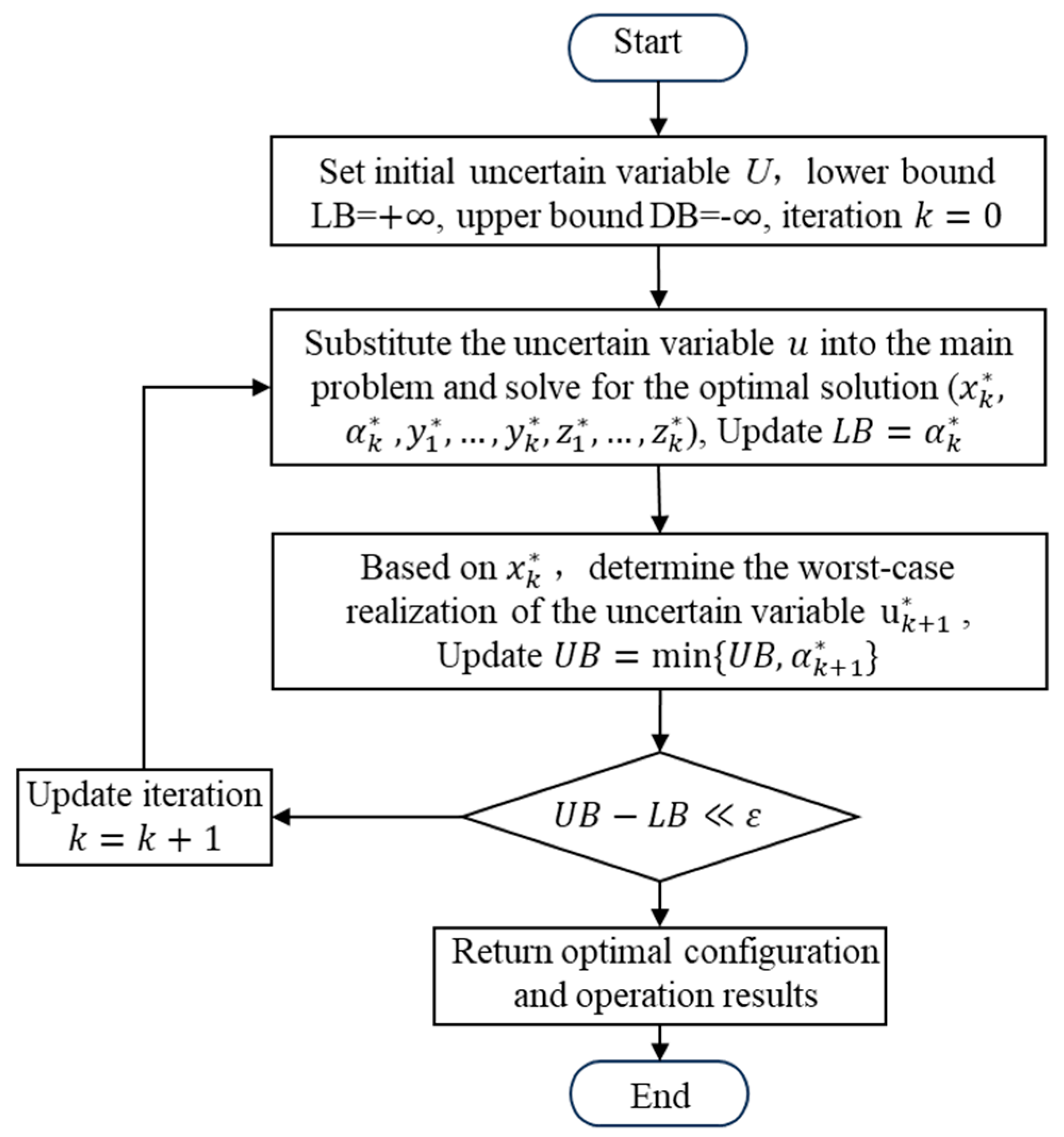
The detailed procedure of the C&CG algorithm is illustrated in Figure 5, and the solution process is described as follows.
Step 1: Set the initial uncertain variable u , bounds U B = + , L B = , and iteration index k = 0 .
Step 2: Fix u k , solve the deterministic optimization to obtain the optimal solution ( x k * , α k * , y k * , z 1 * , , z k * ) , and update the lower bound L B = α k * .
Step 3: Based on x k * , solve the subproblem to find the worst-case scenario u k + 1 * , and update the upper bound: U B = min ( U B , α k + 1 * ) .
Step 4: If U B L B ε , stop. Otherwise, set k = k + 1 , add the new constraint, and return to Step 2.
Step 5: Output the optimal configuration and corresponding operational results.
The convergence of the proposed C&CG algorithm is theoretically guaranteed for the two-stage robust optimization problem formulated in Equations (20) and (21). Specifically, since the uncertainty set U is a polyhedral box-type set and the second-stage recourse problem is a linear program (upon fixing the discrete degradation segment variables in the master problem), the C&CG algorithm is guaranteed to converge to the global optimal solution within a finite number of iterations. In each iteration k , the master problem provides a lower bound L B and the subproblem provides an upper bound U B . The optimality gap is defined as ε = ( U B L B ) / U B . The algorithm terminates when ε t o l , ensuring that the obtained solution is within the prescribed optimality tolerance of the true robust optimal.

5. Case Studies

5.1. Parameter Settings

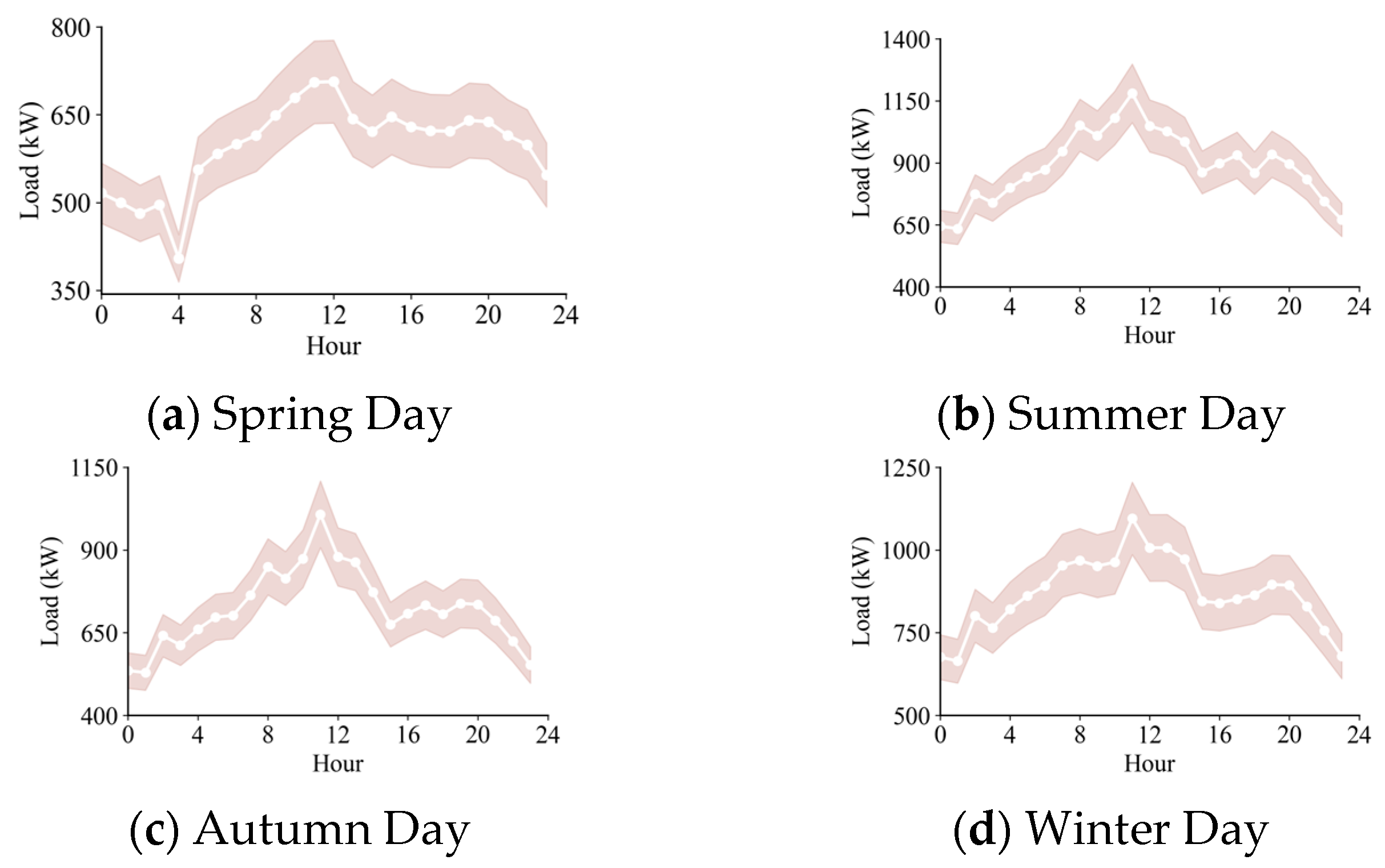
To verify the effectiveness of the proposed two-stage robust optimization model, a typical energy system is selected as a case study for simulation analysis, with its structure shown in Figure 1, For investment cost evaluation, the annual discount rate is assumed to be 8%. The corresponding unit investment costs are 1107 ¥/kWh for energy storage, 100 ¥/kW for PV, 300 ¥/kW for wind power, and 500 ¥/kW for DGs. The simulation uses one-year operational data sampled hourly from a specific region. Representative daily load profiles for spring, summer, autumn, and winter are shown in Figure 6 [2]. The system adopts a time-of-use (TOU) pricing scheme, with rates listed in Table 1 [35]. The equipment information is shown in Table 2.

5.2. Simulation Results

5.2.1. Algorithm Convergence Results

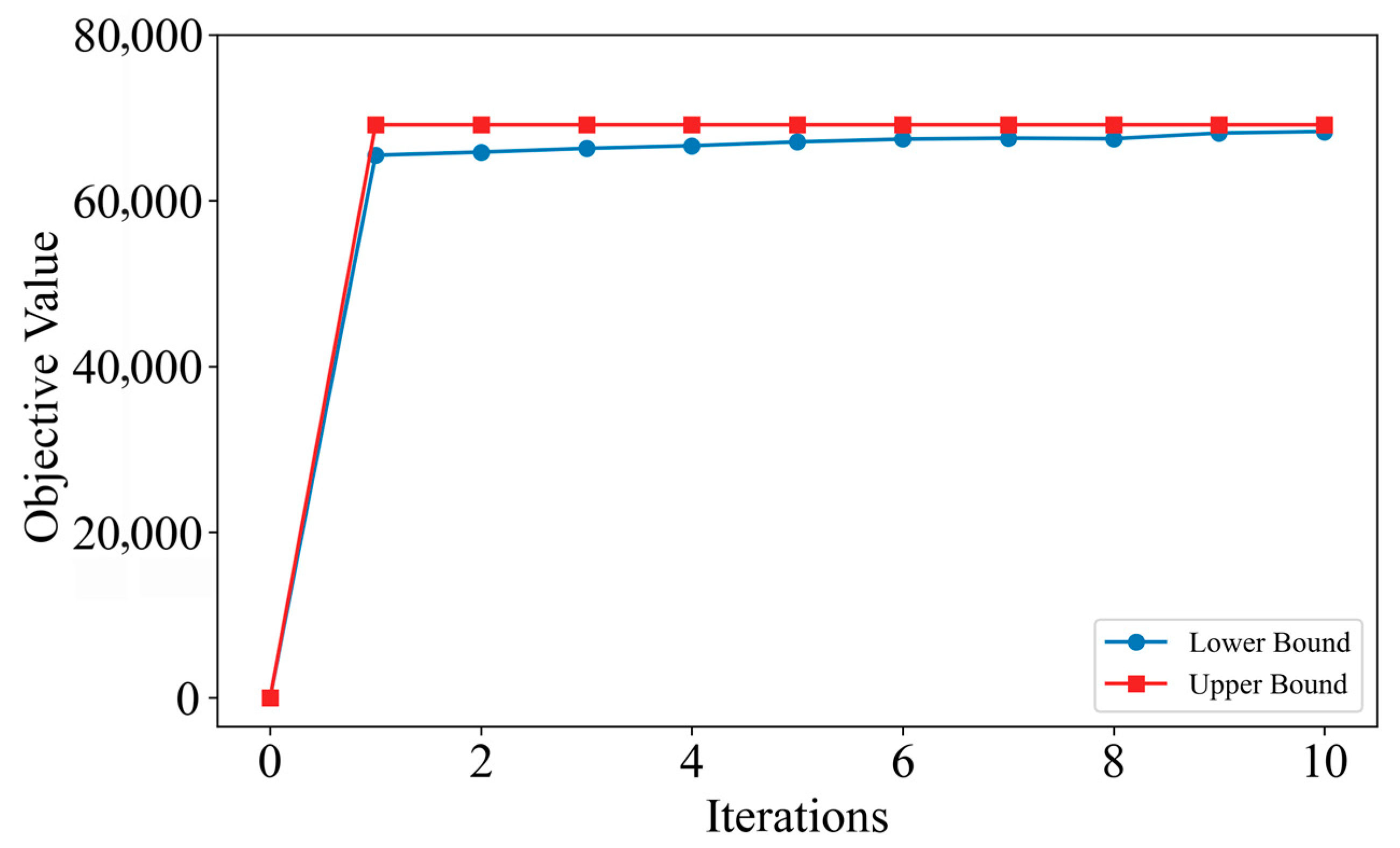
The C&CG algorithm is used to solve the model, with its convergence shown in Figure 7. The C&CG algorithm exhibits rapid convergence behavior. After the first iteration, the upper and lower bounds become closely aligned, and the optimality gap decreases monotonically as additional cuts are generated. The algorithm converges within 10 iterations, with the relative gap reduced to below 1% in the final stage. This indicates that the master and subproblem coordination efficiently identifies the worst-case scenario and tightens the solution space. The overall computation time is 116.56 s, demonstrating satisfactory performance for planning-scale robust optimization.
Although convex relaxation techniques have been proposed to reduce computational burden in large-scale problems [36], the moderate scale of the planning problem considered in this study allows the C&CG algorithm to achieve satisfactory performance without additional relaxation strategies.

5.2.2. Equipment Configuration Results

Table 3 presents the optimal equipment sizing and corresponding investment costs. The optimal capacities are 311.7 kW for PV, 371.7 kW for WT, 155.7 kW for DG, and 95.2 kWh for ESS. The associated investment costs are ¥3174.62, ¥13,023.14, ¥7930.82, and ¥15,710.15, respectively.
From the investment structure, WT and ESS constitute the major share. WT has the largest capacity; despite a moderate unit cost of ¥300/kW, its total investment is the highest due to the large scale. The ESS, with a high unit cost of ¥1107/kWh and smaller capacity, still incurs a near-equivalent investment to wind (¥15,710.15), reflecting a cautious balance after accounting for degradation costs. PV, with the lowest unit cost (¥100/kW), contributes less in both capacity and investment due to its generation characteristics and economics. The DG, sized at 155.7 kW, serves as a dispatchable source to compensate for renewable variability and enhance system reliability.
Overall, the configuration balances investment cost, equipment lifespan, and operational flexibility, demonstrating its effectiveness.

5.2.3. Operation Results

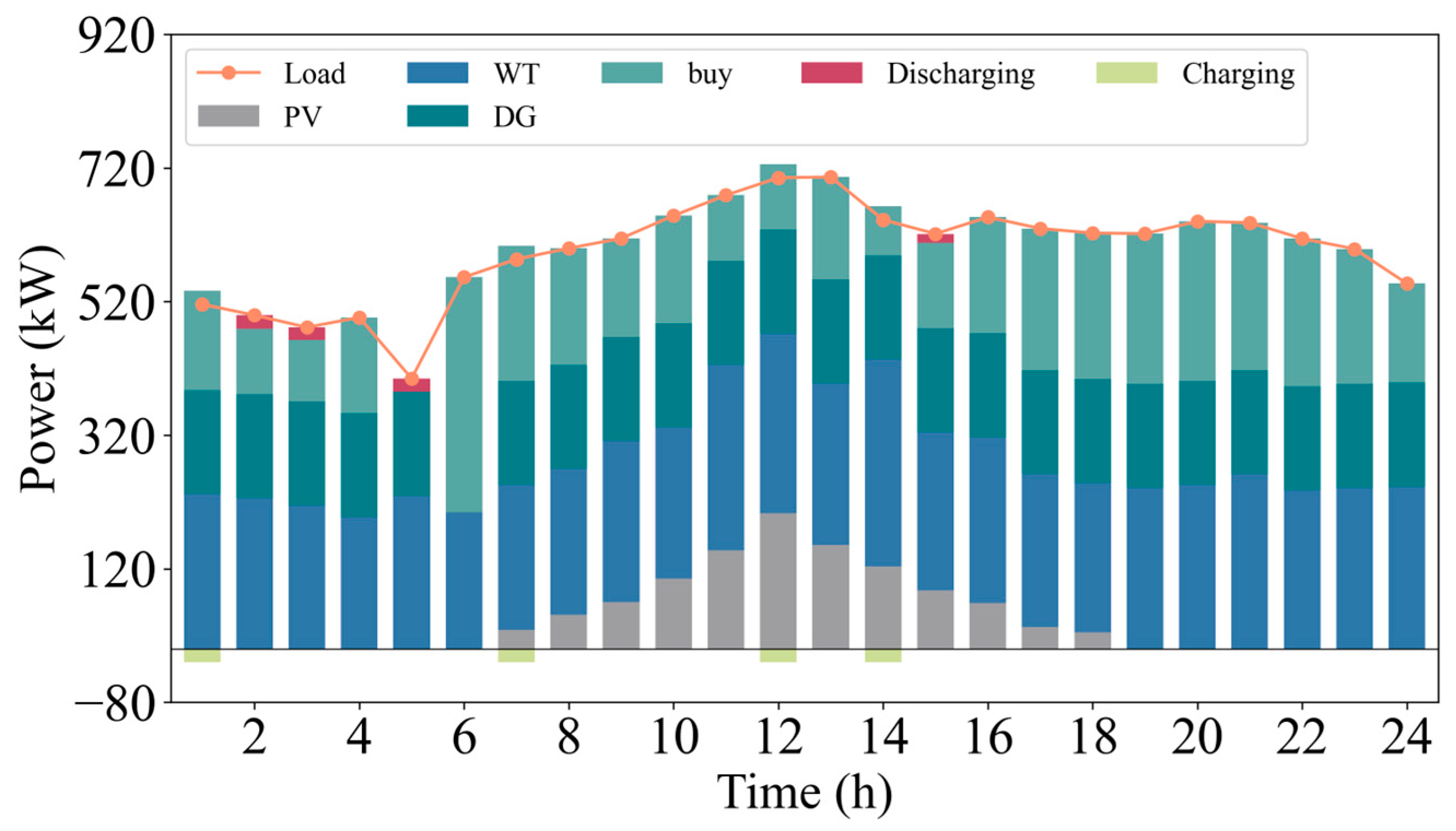
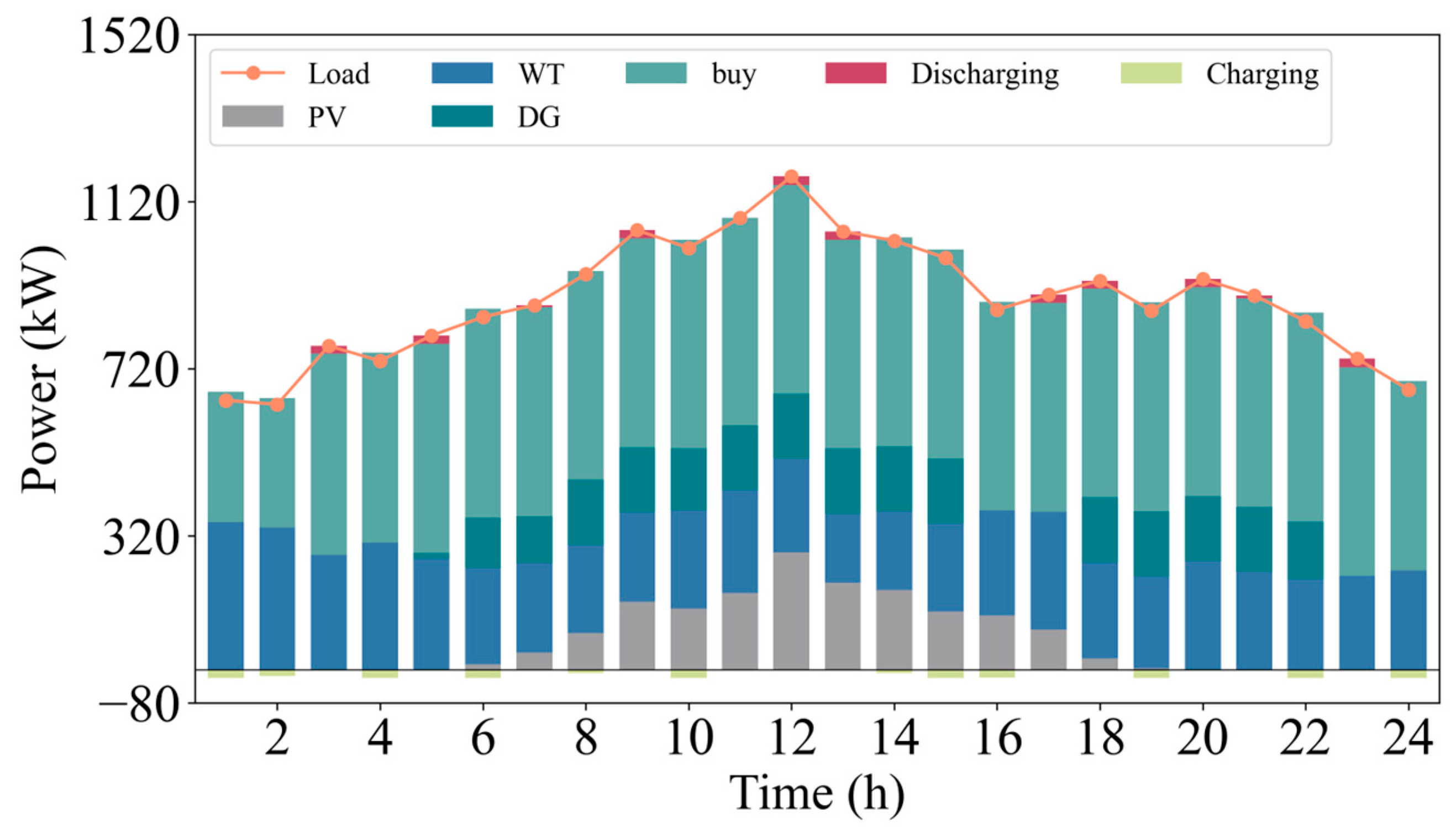
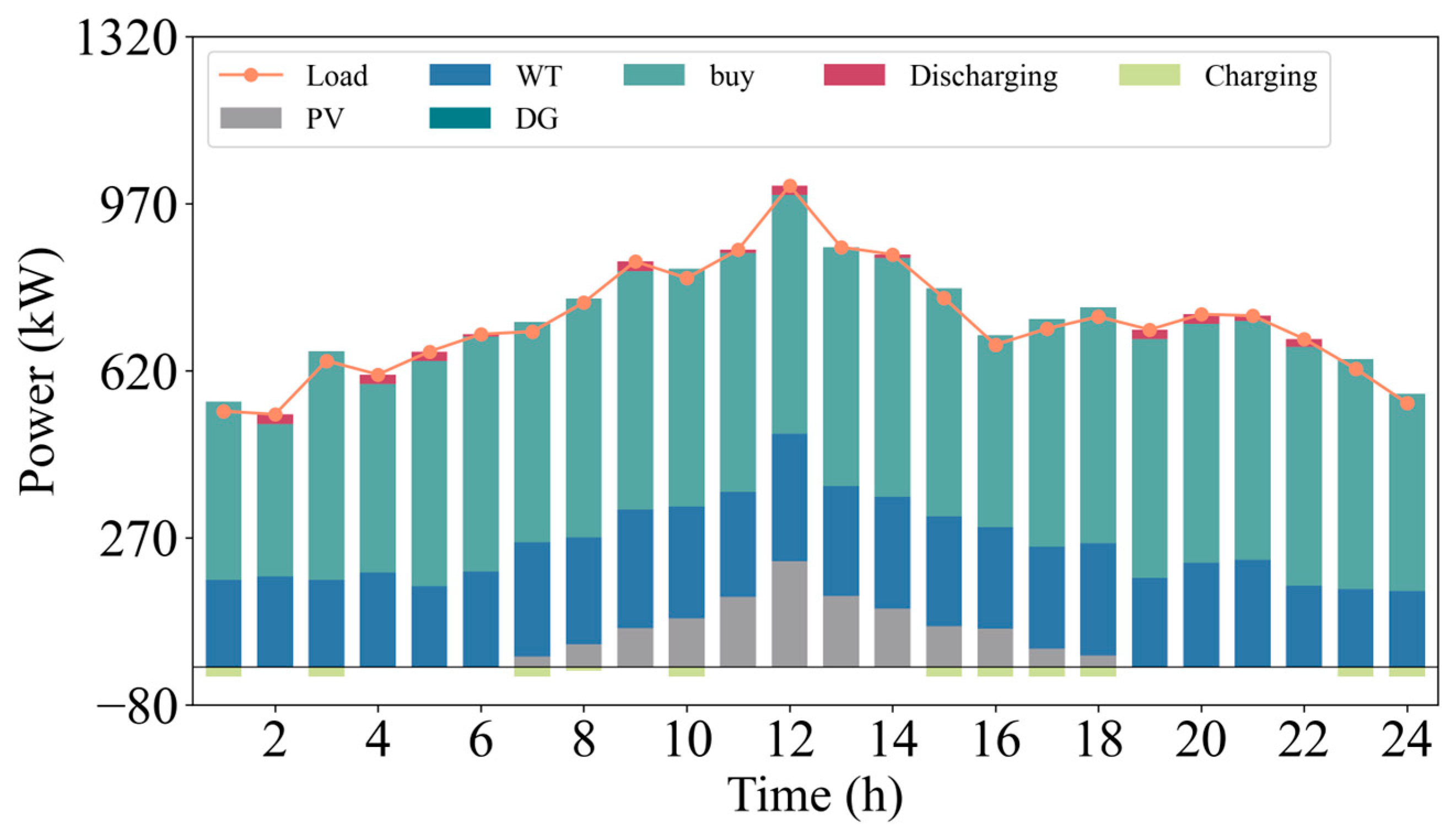
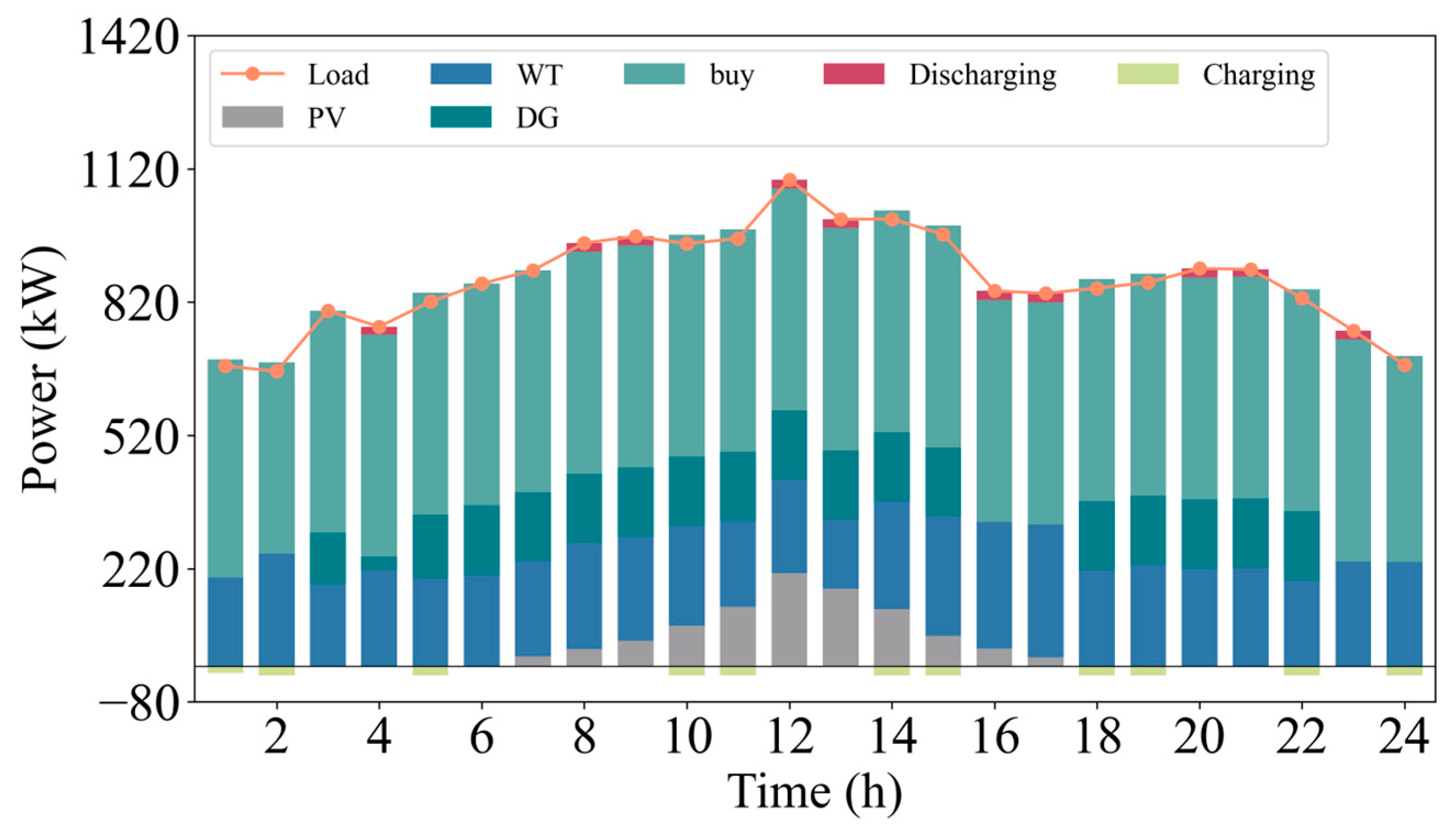
Figure 8, Figure 9, Figure 10 and Figure 11 shows the output profiles of system components across typical days in spring, summer, autumn, and winter. Figure 8 shows the dispatch results for spring days. The load profile is relatively stable, WT contributing a significant share and PV providing additional support around noon. The ESS discharges during the morning peak (hours 2–4) and charges during periods of abundant PV output (hours 6, 12, and 14), effectively flattening the load curve. The DG operates steadily, and grid purchases remain minimal.
On summer days, as shown in Figure 9, the load reaches its highest level. While PV output is abundant, frequent charging and discharging of the ESS are required to handle fluctuations. During hours 5–14, PV, WT, and ESS together are insufficient to meet demand, leading to frequent DG operation and grid purchases hitting their upper limit multiple times—indicating high operational stress.
For autumn days, as shown in Figure 10, both load and PV output are moderate, while WT remains stable. The system operates in a relatively balanced manner. The DG remains mostly idle. The ESS charges during PV peaks and discharges during load peaks, providing clear flexibility benefits. Grid power remains within a stable range.
During winter days, as shown in Figure 11, PV output is limited and WT shows strong fluctuations, with distinct morning and evening load peaks. The system heavily depends on both grid power and DG. The ESS charges overnight and during PV hours, discharging during peak periods to alleviate supply–demand imbalances. Grid power usage frequently reaches its upper bound, indicating the highest level of operational stress.

5.3. Comparative Analysis

To evaluate the impact of energy storage integration and degradation modeling on microgrid optimization, three comparison cases are designed:
  • Case 1: No energy storage; the system is powered solely by PV, WT, and DG.
  • Case 2: Energy storage is included, but ESS degradation costs are not considered.
  • Case 3: Energy storage is included, and degradation costs are explicitly accounted for.
The investment results under the three cases are shown in Table 4. In Case 1, without ESS, the system requires significantly larger capacities of PV, WT, and DG to ensure power supply reliability. The installed capacities are 388.2 kW for PV, 345.6 kW for WT, and 325.6 kW for DG—resulting in the largest overall configuration. Despite the absence of ESS investment, the total system cost reaches ¥33,707.52. In Case 2, a 95.2 kWh ESS is added, enabling smoother renewable dispatch and effective peak shaving. This reduces reliance on conventional generation, with PV and WT capacities reduced to 371.5 kW and 311.3 kW, respectively, and DG capacity significantly reduced to 146.8 kW. Although the total investment increases to ¥39,379.38, the overall configuration becomes more compact and economically efficient, highlighting the benefits of storage in enhancing energy utilization. In Case 3, degradation costs are explicitly considered. Compared to Case 2, DG capacity increases slightly from 146.8 kW to 155.7 kW, representing a 6.1% increase, while total investment rises marginally to ¥39,841.43, corresponding to only a 1.17% increment. Although the cost difference appears small, the dispatch structure changes noticeably: ESS cycling intensity decreases and part of peak regulation is shifted to dispatchable generation. This reflects a strategic trade-off between short-term operational savings and long-term asset preservation. By internalizing degradation costs, the model discourages excessive deep cycling and promotes a more balanced utilization of storage and conventional generation resources.
Although considering degradation cost slightly increases DG usage, the overall change in renewable penetration remains marginal. Moreover, excessive battery cycling may lead to more frequent battery replacement, which also carries embedded lifecycle carbon emissions.
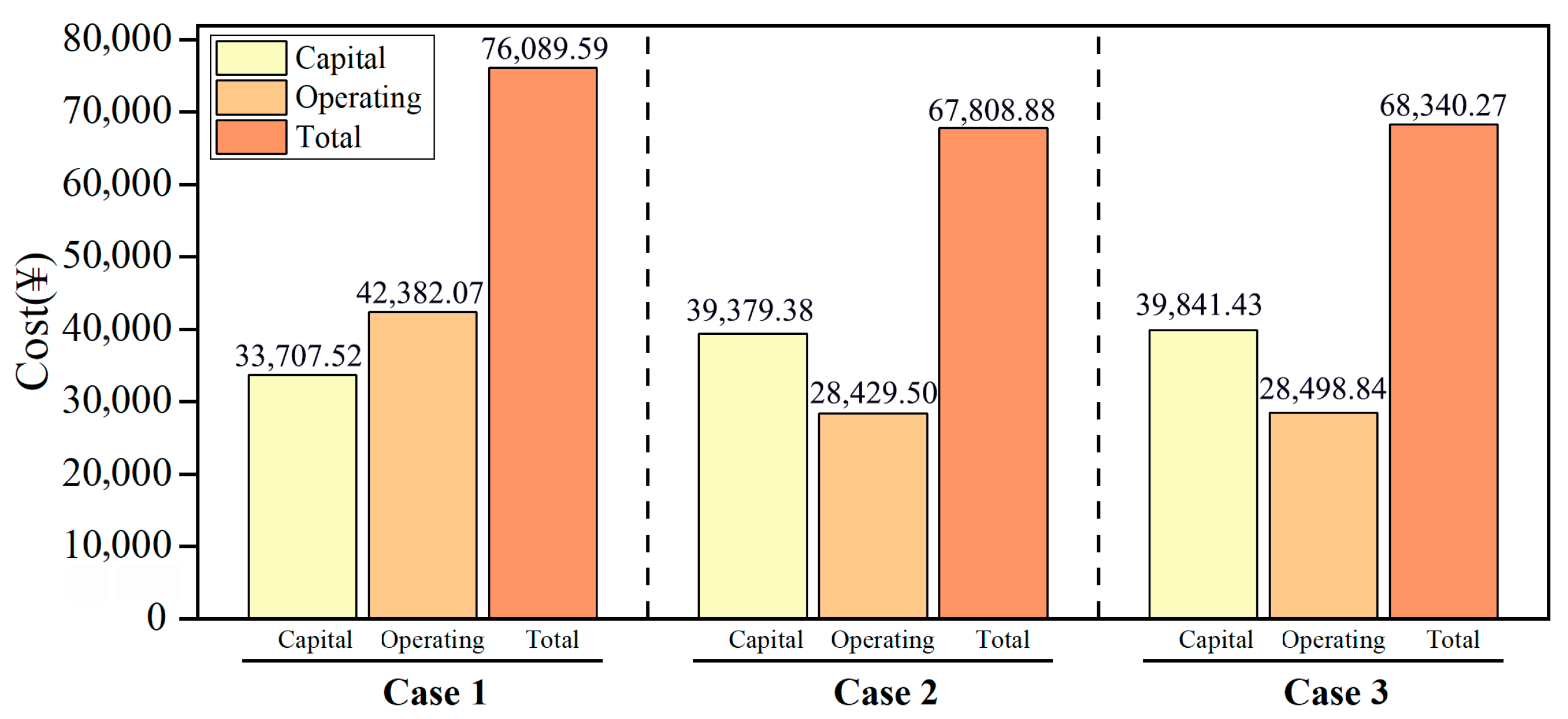
Figure 12 compares the investment, operational, and total costs of the system across the three cases.
In Case 1, the investment cost is the lowest at ¥33,707.52, but the absence of ESS leads to a high operational cost of ¥42,382.07, resulting in the highest total cost of ¥76,089.59 among all cases.
In Case 2, the investment increases to ¥39,379.38 (about 16.8% higher than Case 1) due to the inclusion of ESS. However, the ESS significantly reduces operational pressure by improving renewable utilization and decreasing DG cycling. As a result, the operational cost drops to ¥28,429.50, a 32.9% reduction compared to Case 1. The total cost decreases to ¥67,808.88, clearly demonstrating the economic and flexibility benefits of storage.
In Case 3, a degradation cost model based on ESS degradation costs is introduced to reflect the lifecycle economics of storage. The investment cost rises slightly to ¥39,841.43, and operational cost to ¥28,498.84, marginally higher than in Case 2. This indicates that, when degradation is considered, the model reduces battery usage intensity, resulting in slightly higher reliance on DGs. The total cost in Case 3 is ¥68,340.27, only 0.78% higher than Case 2 but still significantly lower than Case 1.
Although the total cost difference between Case 2 and Case 3 appears relatively small (approximately 0.78%), the inclusion of degradation modeling leads to observable structural changes in system configuration and dispatch behavior. Specifically, when degradation cost is considered, the model slightly increases DG capacity and reduces the cycling intensity of the ESS, thereby mitigating long-term battery wear.
It is important to note that this study is conducted under current battery investment costs and lifecycle assumptions. In scenarios with higher battery prices, shorter replacement cycles, higher cycling frequency, or more stringent islanded operation requirements, the economic impact of degradation modeling would become more pronounced. For example, under tighter lifecycle constraints or higher degradation coefficients, the dispatch strategy would rely more heavily on dispatchable generation, leading to larger cost deviations.
Therefore, while the cost difference in the base case is moderate, incorporating degradation modeling enhances planning robustness and prevents underestimation of long-term lifecycle costs, particularly in high-utilization storage scenarios.

5.4. Sensitivity Analysis

5.4.1. Impact of Equipment Lifespan on Total Cost

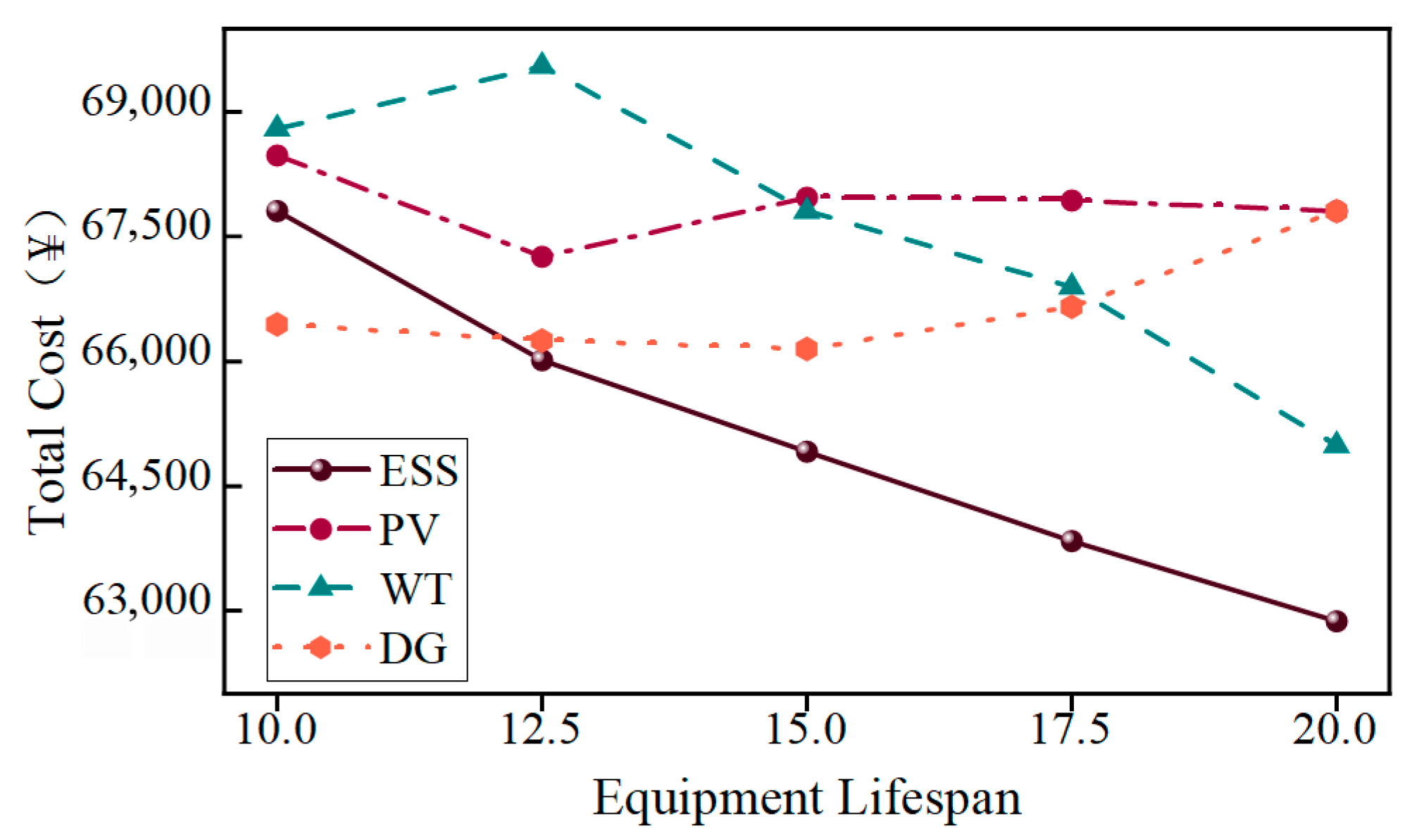
To assess the economic impact of different equipment lifespans, a sensitivity analysis of total system cost is conducted based on Case 3, with lifespans set to 10, 12.5, 15, 17.5, and 20 years. The results are shown in Figure 13.
As the figure illustrates, total costs decline to varying degrees as equipment lifespan increases. The ESS-dominated configuration shows the most consistent downward trend, dropping from ¥67,808.88 to ¥62,868.86, indicating strong lifecycle cost-effectiveness due to amortized capital investment and reduced degradation through optimized dispatch.
The PV-dominated setup remains relatively stable across all lifespans, with costs ranging from ¥67,260 to ¥68,476, reflecting reliable performance. The WT-dominated system shows higher initial costs but sees a significant drop over time, reaching ¥64,984.74 at 20 years, making it well-suited for long-term operation.
In contrast, the DG-dominated configuration starts with the lowest cost at 10 years (¥66,441.27) but becomes increasingly expensive, rising to ¥67,808.88 at 20 years due to accumulating operational costs, highlighting its limited sustainability.
Overall, configurations incorporating ESS with degradation modeling offer superior economic and operational performance over longer horizons, while long-term dependence on conventional DG results in cost inefficiencies. These findings underscore the importance of selecting appropriate planning horizons and lifecycle-optimized resource portfolios.

5.4.2. Impact of Uncertainty Level on Total Operating Cost

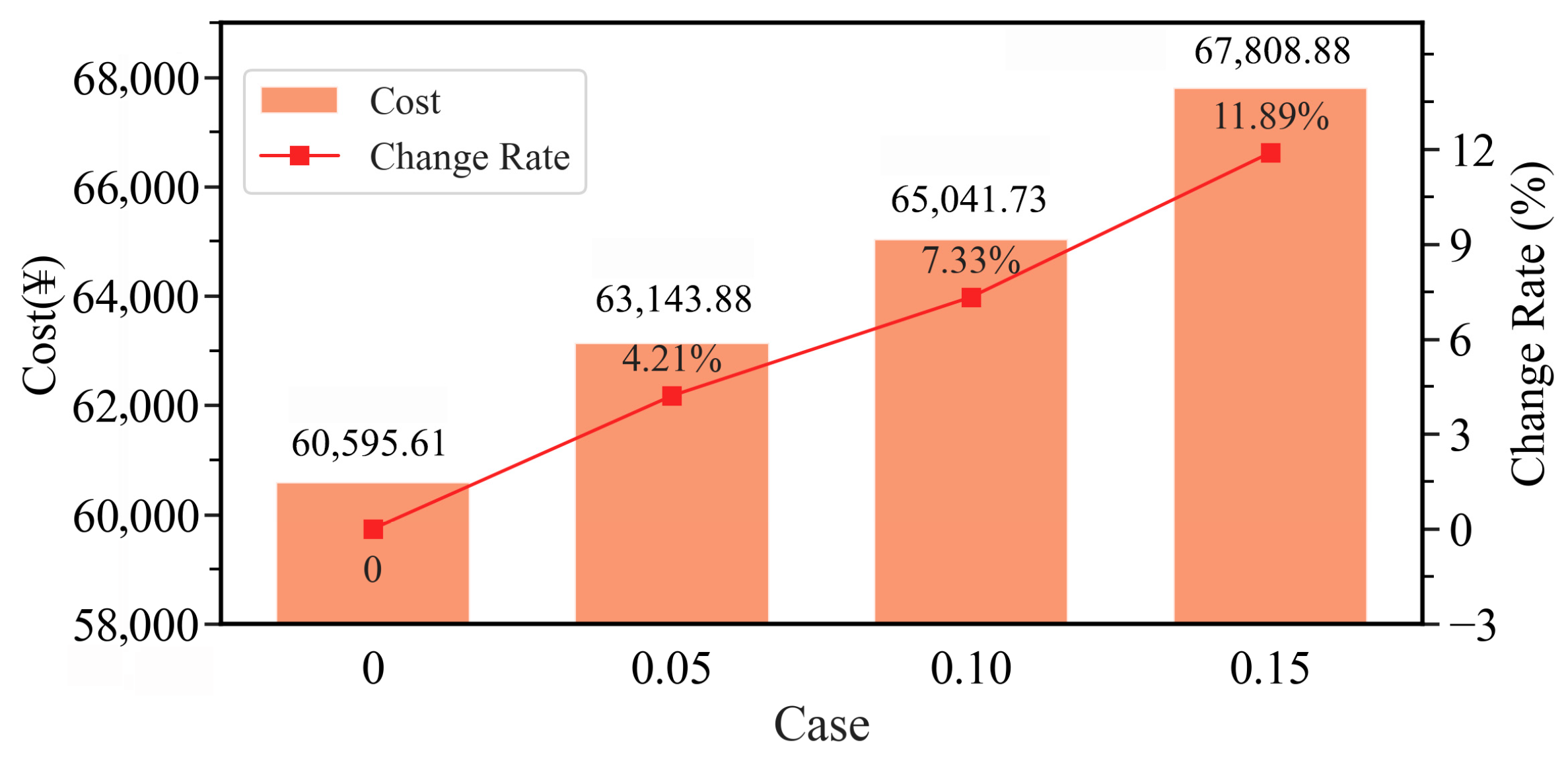
To assess the impact of uncertainties—such as renewable generation variability and load-forecasting errors on system performance, a sensitivity analysis is conducted based on the robust optimization model. The deviation scaling parameter τ is set to 0, 0.05, 0.10, and 0.15, and the corresponding total operating costs are analyzed. The results are shown in Figure 14.
As illustrated, total operating cost increases significantly with higher uncertainty levels. When Γ = 0, the cost is ¥60,595.61, while at Γ = 0.15, it rises to ¥67,808.88, an increase of 11.89%. This rise is due to the conservative dispatch strategies adopted by the robust optimization model to ensure reliable operation under worst-case scenarios. Greater uncertainty leads to the need for more reserve capacity and flexibility, which raises costs.
Therefore, the deviation scaling parameter directly affects system economics and resource allocation. While a moderate level of robustness enhances resilience, excessive uncertainty settings may result in resource redundancy and cost escalation.

6. Conclusions

This study proposes a two-stage robust optimization framework that integrates energy storage degradation into capacity planning under high renewable penetration. The results show that incorporating energy storage reduces the total system cost from ¥76,089.59 to ¥67,808.88, achieving a 10.9% reduction compared to the case without storage. When degradation is explicitly modeled, the total cost increases slightly to ¥68,340.27, representing only a 0.78% increase, while leading to structural adjustments in dispatch decisions and reduced battery cycling intensity. The C&CG algorithm converges within 10 iterations with a total computation time of 116.56 s, demonstrating satisfactory computational efficiency. Sensitivity analysis further indicates that increasing the uncertainty level significantly raises operating cost, underscoring the importance of robust planning under renewable variability.
Future research may focus on enhancing long-term planning robustness by explicitly incorporating multi-day low-generation periods, while simultaneously developing convex relaxation or decomposition-based acceleration techniques to improve computational scalability for larger and more complex hybrid microgrid systems.

Author Contributions

Conceptualization, R.D., Y.S. and Y.J. (Youwei Jia); Methodology, R.D., X.Z. and Y.S.; Validation, X.S.; Formal analysis, R.D., Y.J. (Yan Jiang) and Y.S.; Investigation, R.D., X.Z., Y.J. (Yan Jiang), X.S., Y.S. and Y.J. (Youwei Jia); Writing—original draft, Y.S.; Writing—review and editing, R.D., X.Z., Y.J. (Yan Jiang), X.S. and Y.J. (Youwei Jia); Supervision, Y.J. (Youwei Jia); Project administration, R.D. and Y.J. (Youwei Jia); Funding acquisition, R.D. All authors have read and agreed to the published version of the manuscript.

Funding

This research received no external funding.

Data Availability Statement

The original contributions presented in this study are included in the article. Further inquiries can be directed to the corresponding author.

Conflicts of Interest

Author Xiaolong Song was employed by Yunnan Electric Power Test & Research Institute (Group) Co., Ltd. The remaining authors declare that the research was conducted in the absence of any commercial or financial relationships that could be construed as a potential conflict of interest.

References

  1. He, H.; Wang, Z.; Jiang, Z.; Liu, T.; Qin, Z. The Regional and Personal Disparities of Global Renewable Energy Use from Four Perspectives. Sustainability 2025, 17, 7822. [Google Scholar] [CrossRef]
  2. Sun, Y.; Guo, Y.; Xu, R.; Jia, Y. Two-Stage Coordinated Transportation-Energy Scheduling with Fair Profit Allocation in Multi-Port Integrated Energy Systems. Energy 2026, 347, 140058. [Google Scholar] [CrossRef]
  3. Khan, M.R.B.; Jidin, R.; Pasupuleti, J. Multi-agent based distributed control architecture for microgrid energy management and optimization. Energy Convers. Manag. 2016, 112, 288–307. [Google Scholar] [CrossRef]
  4. Liu, Y.; Jia, Z.; Liu, L. Spatio-temporal feature amplified forecasting framework for uncertain power tracking of multitype renewable energy and loads. Appl. Energy 2025, 400, 126521. [Google Scholar] [CrossRef]
  5. Meziane, S.; Ryad, T.; Assolami, Y.O.; Aljohani, T.M. A Hierarchical Two-Layer MPC-Supervised Strategy for Efficient Inverter-Based Small Microgrid Operation. Sustainability 2025, 17, 8729. [Google Scholar] [CrossRef]
  6. Yong, P.; Guo, F.; Yang, Z. An age-dependent battery energy storage degradation model for power system operations. IEEE Trans. Power Syst. 2024, 40, 1188–1191. [Google Scholar] [CrossRef]
  7. Sun, S.; Che, L.; Zhao, R.; Chen, Y.; Li, M. Multi-task learning and voltage reconstruction-based battery degradation prediction under variable operating conditions of energy storage applications. Energy 2025, 317, 134645. [Google Scholar] [CrossRef]
  8. Ma, Y.; Meng, R.Q.; Wei, B.; Li, T. Two-stage robust optimal scheduling of a microgrid with a stepped carbon trading mechanism. Power Syst. Prot. Control. 2023, 51, 22–33. [Google Scholar]
  9. Wu, J.; Zhang, Q.; Lu, Y.; Qin, T.; Bai, J. Source-Load Coordinated Low-Carbon Economic Dispatch of Microgrid including Electric Vehicles. Sustainability 2023, 15, 15287. [Google Scholar] [CrossRef]
  10. Rajendran, A.; Selvam, K. Multi-objective Chaotic-Enhanced Competitive Swarm Optimizer (CECSO) algorithm based optimal scheduling of microgrid with renewable energy sources. Energy 2025, 334, 137550. [Google Scholar] [CrossRef]
  11. Jia, L.; Kandaperumal, G.; Pannala, S.; Srivastava, A. Coordinating Energy Resources in an Islanded Microgrid for Economic and Resilient Operation. In Proceedings of the Annual Meeting of the IEEE-Industry-Applications-Society (IAS), Vancouver, Canada, 10–14 October 2021. [Google Scholar]
  12. Jiang, H.; Liu, X.; Zhou, H.; Zhao, Y.; Yao, Z. Multi-time-scale optimal scheduling strategy of electricity-heat-cold-gas integrated energy system considering ladder carbon trading. Energy Rep. 2025, 13, 4000–4014. [Google Scholar] [CrossRef]
  13. Liu, J.; Niu, C.; Zhang, Y.; Xie, A.; Lu, R.; Yu, S.; Qiao, S.; Lin, Z. A multi-time scale hierarchical coordinated optimization operation strategy for distribution networks with aggregated distributed energy storage. Appl. Sci. 2025, 15, 2075. [Google Scholar] [CrossRef]
  14. Lin, Q.; Ding, L.; Kong, Z.; Yu, Z.-W.; Li, X.; Wang, H. Multi-time scale model predictive control-based demand side management for a microgrid. IEEE Trans. Smart Grid 2024, 16, 1181–1193. [Google Scholar] [CrossRef]
  15. Wang, X.Y.; Tang, Z. Capacity Optimization of Grid-Connected Microgrid Considering Self-Balance and Independent Operation Capability. Acta Energiae Solaris Sin. 2021, 42, 74–82. [Google Scholar]
  16. Mohseni, S.; Brent, A.C. Co-Optimization of the Sizing and Dispatch of Microgrids Considering Vehicle-to-Grid and Arbitrage. In Proceedings of the 14th IEEE PES Asia-Pacific Power and Energy Engineering Conference (APPEEC), Melbourne, Australia, 20–23 November 2022. [Google Scholar]
  17. Liang, W.; Ma, Z.; Li, Z.; Li, W.; Zhang, X.; Cai, L. A bi-level optimization framework for household distributed energy systems: Integrating multiple flexible loads. Energy Sources Part A Recovery Util. Environ. Eff. 2025, 47, 12202–12226. [Google Scholar]
  18. Huo, D.; Santos, M.; Sarantakos, I.; Resch, M.; Wade, N.; Greenwood, D. A reliability-aware chance-constrained battery sizing method for island microgrid. Energy 2022, 251, 123978. [Google Scholar] [CrossRef]
  19. Wang, Q.; Zhang, X.; Xu, Y.; Yi, Z.; Xu, D. Planning of Stationary-Mobile Integrated Battery Energy Storage Systems Under Severe Convective Weather. IEEE Trans. Sustain. Energy 2025, 16, 1253–1268. [Google Scholar] [CrossRef]
  20. Deng, X.; Wang, F.; Hu, B.; Lin, X.; Hu, X. Optimal sizing of residential battery energy storage systems for long-term operational planning. J. Power Sources 2022, 551, 232218. [Google Scholar] [CrossRef]
  21. Huang, B.; Xiao, G.; Hu, Z.; Xu, Y.; Liu, K.; Huang, Q. Operation Efficiency Optimization of Electrochemical ESS with Battery Degradation Consideration. Electronics 2025, 14, 4182. [Google Scholar] [CrossRef]
  22. Wang, X.-z.; Gu, X.-k.; Ding, J.; Wang, Q.-b.; Cai, Z.-w.; Cheng, X.-m.; Soares, C.G. Uncertainty analysis of wave loads for multi-connected domain large floating bodies near islands and reefs. Ocean. Eng. 2025, 335, 121676. [Google Scholar] [CrossRef]
  23. Lee, J.; Joung, S.; Lee, K. Scalable optimization approaches for microgrid operation under stochastic islanding and net load. Appl. Energy 2024, 374, 124040. [Google Scholar] [CrossRef]
  24. Xie, Y.; Xu, Y.; Yi, Z.; Lin, S.; Zhang, B.; Zhu, X.; Rong, S. A Hybrid Stochastic-Robust Planning Approach for the Flexible Devices in an Islanded Integrated Energy System Considering Multiple Uncertainties and Demand Response. IEEE Trans. Ind. Appl. 2025, 61, 8037–8050. [Google Scholar] [CrossRef]
  25. Wang, C.; Li, Y.; Liu, J.; Ma, W.; Yang, M.; Bi, T. Chance-Constrained Primary Frequency Reserve Optimization Considering Stochastic Disturbances and Contingencies. IEEE Trans. Power Syst. 2025, 40, 2873–2888. [Google Scholar] [CrossRef]
  26. Calabrese, M.; Ademollo, A.; Carcasci, C. Designing off-grid hybrid renewable energy systems under uncertainty: A two-stage stochastic programming approach. Renew. Energy 2025, 256, 124193. [Google Scholar] [CrossRef]
  27. Chowdhury, S.; Zhang, Y. Two-Stage Stochastic Optimal Power Flow for Microgrids with Uncertain Wildfire Effects. IEEE Access 2024, 12, 68857–68869. [Google Scholar] [CrossRef]
  28. Haghighat, H.; Wang, W.; Zeng, B. Robust Microgrid Capacity Investment with Endogenous and Exogenous Uncertainties. IEEE Trans. Smart Grid 2024, 15, 2480–2492. [Google Scholar] [CrossRef]
  29. Sun, X.; Chen, Z.; Pan, M.; Cai, Y.; Jin, Z.; Lei, G.; Tian, X. Robust energy management optimization for PHEB considering driving uncertainties by using sequential Taguchi method. IEEE Trans. Transp. Electrif. 2024, 11, 5191–5200. [Google Scholar] [CrossRef]
  30. Dong, Y.; Wuken, E.; Zhang, H.; Ren, P.; Zhou, X. Bi-level coordinated operation optimization of multi-park integrated energy systems considering categorized demand response and uncertainty: A unified adaptive robust optimization approach. Renew. Energy 2025, 241, 122331. [Google Scholar] [CrossRef]
  31. Luo, Y.; Xu, X.; Zhang, Z.; Li, P.; Hu, W.; Liu, J. A two-stage robust scheduling optimization of an energy hub with multiple chance constraints. IEEE Trans. Ind. Appl. 2024, 61, 1246–1255. [Google Scholar] [CrossRef]
  32. Zhou, C.; Qian, K.; Allan, M.; Zhou, W. Modeling of the Cost of EV Battery Wear Due to V2G Application in Power Systems. IEEE Trans. Energy Convers. 2011, 26, 1041–1050. [Google Scholar] [CrossRef]
  33. Pang, K.; Dimeas, A.L.; Hatziargyriou, N.D.; Wang, C.; Wen, F. Collaborative switch placement and operational measures to enhance distribution system flexibility considering uncertain operation costs. Energy 2025, 320, 134982. [Google Scholar] [CrossRef]
  34. Li, X.; Wu, N.; Lei, L. Nash-Stackelberg-Nash three-layer mixed game optimal control strategy for multi-integrated energy systems considering multiple uncertainties. Energy 2025, 320, 135418. [Google Scholar] [CrossRef]
  35. Sun, Y.; Guo, Y.; Zhang, Q.; Jia, Y. Berth allocation and energy scheduling for all-electric ships in seaport microgrid: A Stackelberg game approach. Energy 2025, 322, 135640. [Google Scholar] [CrossRef]
  36. Liang, Z.; Yin, X.; Chung, C.Y.; Rayeem, S.K.; Chen, X.; Yang, H. Managing Massive RES Integration in Hybrid Microgrids: A Data-Driven Quad-Level Approach with Adjustable Conservativeness. IEEE Trans. Ind. Inform. 2025, 21, 7698–7709. [Google Scholar] [CrossRef]
Figure 1. Energy system structure.
Energies 19 02351 g001
Figure 2. Two-stage optimization framework.
Energies 19 02351 g002
Figure 3. A depiction of the charging process (DoD).
Energies 19 02351 g003
Figure 4. Nonlinear function and 5-segment piecewise linear approximation.
Energies 19 02351 g004
Figure 5. Flowchart of the C&CG algorithm.
Energies 19 02351 g005
Figure 6. Load profiles of four typical days.
Energies 19 02351 g006
Figure 7. Convergence results of the algorithm iterations.
Energies 19 02351 g007
Figure 8. Typical spring day dispatch results.
Energies 19 02351 g008
Figure 9. Typical summer day dispatch results.
Energies 19 02351 g009
Figure 10. Typical autumn day dispatch results.
Energies 19 02351 g010
Figure 11. Typical winter day dispatch results.
Energies 19 02351 g011
Figure 12. Total cost comparison under different cases.
Energies 19 02351 g012
Figure 13. System operating costs under different equipment lifespans.
Energies 19 02351 g013
Figure 14. Total cost under varying deviation scaling parameters.
Energies 19 02351 g014
Table 1. Time-of-use (TOU) price.
Time c b u y c s e l l
1:00–6:000.400.24
7:00–8:00, 12:00–17:00, 23:00–24:000.700.42
9:00–11:00, 18:00–22:001.100.66
Table 2. Equipment information.
ParameterValueParameterValue
c o m . W T (¥/kWh)0.0296 η c h 0.95
c o m . P V (¥/kWh)0.0096 η d i s 0.95
c o m . G (¥/kWh)0.059 τ 0.15
c o m . E S S (¥/kWh)0.009 S O C min 0.1
c f u e l (¥/kWh)0.4 S O C max 0.9
P g rid . max (kWh)500 μ 0.21
Table 3. Capacity configuration and investment cost results.
EquipmentCapacityInvestment Cost (¥)
PV (kW)311.73174.62
WT (kW)371.713,023.14
DG (kW)155.77930.82
ESS (kWh)95.215,710.15
Table 4. Investment capacities of each component under different cases.
EquipmentCase 1Case 2Case 3
WT (kW)345.6311.3311.7
PV (kW)388.2371.5371.7
DG (kW)325.6146.8155.7
ESS (kWh)095.295.2
Investment Cost (¥)33,707.5239,379.3839,841.43
Disclaimer/Publisher’s Note: The statements, opinions and data contained in all publications are solely those of the individual author(s) and contributor(s) and not of MDPI and/or the editor(s). MDPI and/or the editor(s) disclaim responsibility for any injury to people or property resulting from any ideas, methods, instructions or products referred to in the content.