Artificial Intelligence Approaches for Energy Consumption and Generation Forecasting, Anomaly Detection, and Public Decision-Making: A Systematic Review


Abstract
1. Introduction
2. State of the Art
3. Methodology
3.1. Definition of Research Questions
- RQ1—What is the comparative performance of statistical, Machine Learning, and Deep Learning models for energy consumption and generation forecasting in smart grid environments?
- RQ2—How do predictive forecasting techniques contribute to the optimization of Smart Grid management, particularly in Demand Response and operational decision-making?
- RQ3—How do predictive techniques contribute to the security and monitoring of energy infrastructures, particularly through anomaly and fault detection?
3.2. Systematic Literature Search
3.3. Study Selection
3.4. Study Grouping and Synthesis Strategy
3.5. Exploration of Heterogeneity
3.6. Sensitivity Analysis
3.7. Reporting Bias Assessment
3.8. Certainty of Evidence Assessment
3.9. Study Quality and Risk of Bias Evaluation
- Q1: Does the article directly address electric energy consumption forecasting, energy generation prediction, or anomaly detection in power systems? (to mitigate selection and relevance bias by ensuring strict alignment with the predefined research domains)
- Q2: In the case of studies predicting energy consumption or generation, do they utilize real-world time-series datasets (such as AMI, SCADA, or meteorological data) to train and validate their models? (to reduce data validity bias by prioritizing empirical evidence derived from real operational environments)
- Q3: In the case of studies detecting anomalies and faults, do they utilize synthetic datasets generated coherently based on plausible values and realistic distributions? (to mitigate data realism bias by ensuring that simulated data adequately represent real-world fault conditions)
- Q4: In the case of studies not based on purely statistical approaches, do they address specific forecasting limitations by proposing advanced frameworks (e.g., metaheuristic hyperparameter tuning, dimensionality reduction techniques such as PCA/ICA, or energy-efficient architectures)? (to reduce methodological bias by ensuring that model complexity is justified and relevant limitations are explicitly addressed)
- Q5: In the case of studies based on purely statistical approaches, do they provide a detailed benchmark against more complex solutions, justifying their advantages and limitations? (to mitigate methodological bias by requiring comparative validation against state-of-the-art approaches)
- Q6: Does the proposed method demonstrate clear operational applicability to ensure grid reliability, infrastructure safety, or optimal energy management in real-world scenarios? (to reduce external validity bias by ensuring practical relevance and real-world applicability of the proposed methods)
- Low risk of bias (high methodological quality): 4–6 points
- High risk of bias (low methodological quality): 0–3 points
3.10. Data Items (Outcomes)
3.11. Data Presentation and Tabulation
3.12. Data Items (Other Variables)
4. Study Extraction and Selection
4.1. Variables to Be Extracted
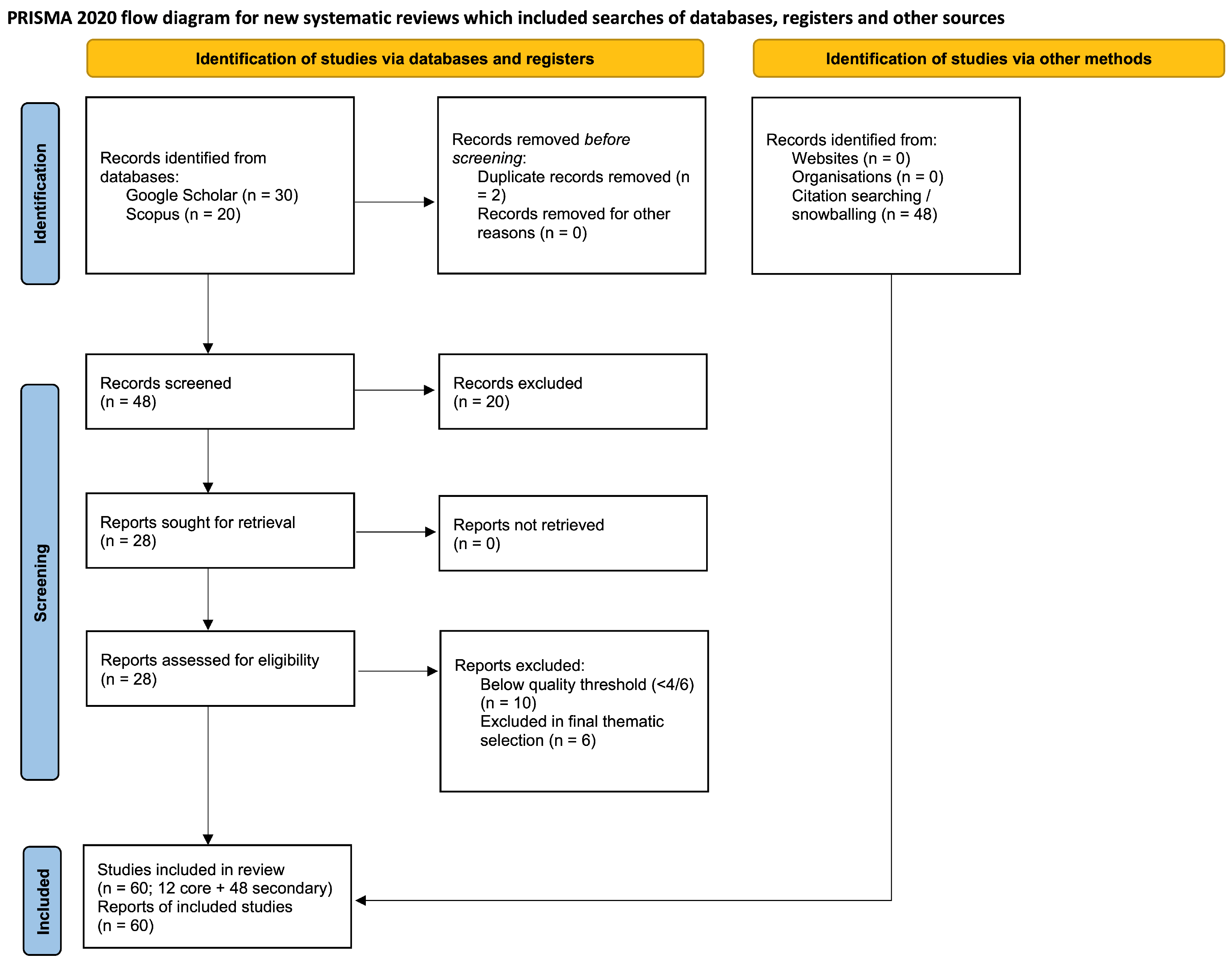
4.2. Data Extraction and Selection Diagram
4.3. Table for Systematic Literature Review
4.4. Explanation of the Comparison of Tables
5. Results and Discussion
5.1. Risk-of-Bias Assessment Results
5.2. Analysis of Impact
5.3. Analysis of Dataset Characteristics
5.4. In-Depth Analysis of Research Approaches
5.4.1. Critical Cross-Comparison of Methodological Approaches
5.4.2. Hardware Dependency of Neuromorphic Computing Benefits
5.4.3. Integrated Narrative Synthesis of Core and Secondary Literature
5.4.4. Energy Consumption Forecasting
5.4.5. Energy Generation Forecasting
5.4.6. Anomaly Detection
5.4.7. Cross-Temporal and Cross-Method Analysis
5.4.8. Interpretation in the Context of the Reviewed Evidence
5.4.9. Sim2Real Roadmap: Generative Models and Digital Twins for Anomaly Detection
5.5. Limitations of the Review Process and Implications for Practice
6. Research Gaps and Future Directions
7. Conclusions
Author Contributions
Funding
Institutional Review Board Statement
Informed Consent Statement
Data Availability Statement
Acknowledgments
Conflicts of Interest
Abbreviations
| ACF | Autocorrelation Function |
| ADF | Augmented Dickey–Fuller Test |
| AE | Autoencoder |
| AMI | Advanced Metering Infrastructure |
| ANN | Artificial Neural Network |
| AOD | Aerosol Optical Depth |
| ARIMA | Autoregressive Integrated Moving Average |
| ARIMAX | ARIMA with Exogenous Variables |
| AUC | Area Under the Curve |
| BO | Bayesian Optimization |
| BOA | Butterfly Optimization Algorithm |
| CNN | Convolutional Neural Network |
| DDPM | Denoising Diffusion Probabilistic Model |
| DL | Deep Learning |
| ESS | Energy Storage System |
| EV | Electric Vehicle |
| FPR | False Positive Rate |
| GA | Genetic Algorithm |
| GAN | Generative Adversarial Network |
| GHI | Global Horizontal Irradiance |
| GRU | Gated Recurrent Unit |
| GS | Google Scholar |
| GWO | Grey Wolf Optimizer |
| HVAC | Heating, Ventilation, and Air Conditioning |
| ICA | Independent Component Analysis |
| JCR | Journal Citation Reports |
| LIME | Local Interpretable Model-agnostic Explanations |
| LLM | Large Language Model |
| LoRA | Low-Rank Adaptation |
| LSTM | Long Short-Term Memory |
| MAE | Mean Absolute Error |
| MAPE | Mean Absolute Percentage Error |
| ML | Machine Learning |
| MLP | Multilayer Perceptron |
| MSE | Mean Squared Error |
| NILM | Non-Intrusive Load Monitoring |
| NSRDB | National Solar Radiation Database |
| NWP | Numerical Weather Prediction |
| PACF | Partial Autocorrelation Function |
| PCA | Principal Component Analysis |
| PRISMA | Preferred Reporting Items for Systematic Reviews and Meta-Analyses |
| PSO | Particle Swarm Optimization |
| RF | Random Forest |
| RMSE | Root Mean Square Error |
| RPCA | Robust Principal Component Analysis |
| SARIMA | Seasonal Autoregressive Integrated Moving Average |
| SARIMAX | SARIMA with Exogenous Variables |
| SC | Scopus |
| SCADA | Supervisory Control and Data Acquisition |
| SHAP | SHapley Additive exPlanations |
| SNN | Spiking Neural Network |
| SSA | Single Scattering Albedo/Sparrow Search Algorithm |
| SVM | Support Vector Machine |
| SVR | Support Vector Regression |
| TBATS | Trigonometric Seasonality, Box–Cox Transformation, ARMA Errors, Trend and Seasonal Components |
| VAE | Variational Autoencoder |
| VEP | Virtual Energy Plant |
| VRE | Variable Renewable Energy |
References
- Ejuh Che, E.; Roland Abeng, K.; Iweh, C.D.; Tsekouras, G.J.; Fopah-Lele, A. The Impact of Integrating Variable Renewable Energy Sources into Grid-Connected Power Systems: Challenges, Mitigation Strategies, and Prospects. Energies 2025, 18, 689. [Google Scholar] [CrossRef]
- Park, M.J.; Yang, H.S. Comparative Study of Time Series Analysis Algorithms Suitable for Short-Term Forecasting in Implementing Demand Response Based on AMI. Sensors 2024, 24, 7205. [Google Scholar] [CrossRef] [PubMed]
- Jin, H.; Guo, J.; Tang, L.; Du, P. Long-term electricity demand forecasting under low-carbon energy transition: Based on the bidirectional feedback between power demand and generation mix. Energy 2024, 286, 129435. [Google Scholar] [CrossRef]
- Serrano, A.L.M.; Rodrigues, G.A.P.; Martins, P.H.d.S.; Saiki, G.M.; Filho, G.P.R.; Gonçalves, V.P.; Albuquerque, R.D.O. Statistical Comparison of Time Series Models for Forecasting Brazilian Monthly Energy Demand Using Economic, Industrial, and Climatic Exogenous Variables. Appl. Sci. 2024, 14, 5846. [Google Scholar] [CrossRef]
- Saeedi, N.; Baharvand, D.; Shirini, K.; Gharehveran, S.S. Prediction of electrical energy consumption using principal component analysis and independent components analysis. J. Supercomput. 2025, 81, 1072. [Google Scholar] [CrossRef]
- Peng, X.; Yang, Z.; Li, Y.; Wang, B.; Che, J. Short-term wind power prediction based on stacked denoised auto-encoder deep learning and multi-level transfer learning. Wind Energy 2023, 26, 1066–1081. [Google Scholar] [CrossRef]
- Fan, H.; Li, M.; Zhang, Z.; Cheng, L.; Ye, Y.; Liu, W.; Liu, D. M2WLLM: Multi-modal multi-task ultra-short-term wind power prediction algorithm based on large language model. Inf. Fusion 2026, 126, 103541. [Google Scholar] [CrossRef]
- Liu, S.; Zhu, Z.; Zhao, X.; Wang, Y.; Sun, X.; Yu, L. Unsupervised anomaly detection for Nuclear Power Plants based on Denoising Diffusion Probabilistic Models. Prog. Nucl. Energy 2025, 178, 105521. [Google Scholar] [CrossRef]
- Dao, F.; Zeng, Y.; Qian, J. Fault diagnosis of hydro-turbine via the incorporation of bayesian algorithm optimized CNN-LSTM neural network. Energy 2024, 290, 130326. [Google Scholar] [CrossRef]
- Mosavi, A.; Salimi, M.; Faizollahzadeh Ardabili, S.; Rabczuk, T.; Shamshirband, S.; Varkonyi-Koczy, A.R. State of the Art of Machine Learning Models in Energy Systems, a Systematic Review. Energies 2019, 12, 1301. [Google Scholar] [CrossRef]
- Wang, H.; Lei, Z.; Zhang, X.; Zhou, B.; Peng, J. A review of deep learning for renewable energy forecasting. Energy Convers. Manag. 2019, 198, 111799. [Google Scholar] [CrossRef]
- Voyant, C.; Notton, G.; Kalogirou, S.; Nivet, M.L.; Paoli, C.; Motte, F.; Fouilloy, A. Machine learning methods for solar radiation forecasting: A review. Renew. Energy 2017, 105, 569–582. [Google Scholar] [CrossRef]
- Ayasi, B.; Vázquez, I.X.; Saleh, M.; Garcia-Vico, A.M.; Carmona, C.J. Application of spiking neural networks and traditional artificial neural networks for solar radiation forecasting in photovoltaic systems in Arab countries. Neural Comput. Appl. 2025, 37, 9095–9127. [Google Scholar] [CrossRef]
- Abdul Baseer, M.; Almunif, A.; Alsaduni, I.; Tazeen, N. Electrical Power Generation Forecasting from Renewable Energy Systems Using Artificial Intelligence Techniques. Energies 2023, 16, 6414. [Google Scholar] [CrossRef]
- Alwadei, S.; Farahat, A.; Ahmed, M.; Kambezidis, H.D. Prediction of Solar Irradiance over the Arabian Peninsula: Satellite Data, Radiative Transfer Model, and Machine Learning Integration Approach. Appl. Sci. 2022, 12, 717. [Google Scholar] [CrossRef]
- Salhein, K.; Kobus, C.J.; Zohdy, M. Forecasting Installation Capacity for the Top 10 Countries Utilizing Geothermal Energy by 2030. Thermo 2022, 2, 334–351. [Google Scholar] [CrossRef]
- Tarmanini, C.; Sarma, N.; Gezegin, C.; Ozgonenel, O. Short term load forecasting based on ARIMA and ANN approaches. Energy Rep. 2023, 9, 550–557. [Google Scholar] [CrossRef]
- Li, X.; Wang, Z.; Yang, C.; Bozkurt, A. An advanced framework for net electricity consumption prediction: Incorporating novel machine learning models and optimization algorithms. Energy 2024, 296, 131259. [Google Scholar] [CrossRef]
- Hora, S.K.; Poongodan, R.; de Prado, R.P.; Wozniak, M.; Divakarachari, P.B. Long Short-Term Memory Network-Based Metaheuristic for Effective Electric Energy Consumption Prediction. Appl. Sci. 2021, 11, 11263. [Google Scholar] [CrossRef]
- Zafar, A.; Che, Y.; Ahmed, M.; Sarfraz, M.; Ahmad, A.; Alibakhshikenari, M. Enhancing Power Generation Forecasting in Smart Grids Using Hybrid Autoencoder Long Short-Term Memory Machine Learning Model. IEEE Access 2023, 11, 118521–118537. [Google Scholar] [CrossRef]
- Page, M.J.; McKenzie, J.E.; Bossuyt, P.M.; Boutron, I.; Hoffmann, T.C.; Mulrow, C.D.; Shamseer, L.; Tetzlaff, J.M.; Akl, E.A.; Brennan, S.E.; et al. Declaración PRISMA 2020: Una guía actualizada para la publicación de revisiones sistemáticas. Rev. Espa NOla Cardiol. 2021, 74, 790–799. [Google Scholar] [CrossRef]
- Ramos, P.V.B.; Villela, S.M.; Silva, W.N.; Dias, B.H. Residential energy consumption forecasting using deep learning models. Appl. Energy 2023, 350, 121705. [Google Scholar] [CrossRef]
- Nooruldeen, O.; Baker, M.R.; Aleesa, A.M.; Ghareeb, A.; Shaker, E.H. Strategies for predictive power: Machine learning models in city-scale load forecasting. e-Prime-Adv. Electr. Eng. Electron. Energy 2023, 6, 100392. [Google Scholar] [CrossRef]
- Sundaram, K.; Sri Preethaa, K.R.; Natarajan, Y.; Muthuramalingam, A.; Ali, A.A.Y. Advancing building energy efficiency: A deep learning approach to early-stage prediction of residential electric consumption. Energy Rep. 2024, 12, 1281–1292. [Google Scholar] [CrossRef]
- Devanathan, B.; Jnana Varshitha, K.; Pavan Kumar, L.; Lakshmanan, S.A.; Krishna Prakash, N. Explainable AI Framework Using XGBoost With SHAP and LIME for Multi-Scale Household Energy Forecasting. IEEE Access 2025, 13, 149750–149764. [Google Scholar] [CrossRef]
- Moon, Y.; Lee, Y.; Hwang, Y.; Jeong, J. Long Short-Term Memory Autoencoder and Extreme Gradient Boosting-Based Factory Energy Management Framework for Power Consumption Forecasting. Energies 2024, 17, 3666. [Google Scholar] [CrossRef]
- Wang, H.; Chen, H.; Yu, F.; Xu, Z.; Peng, M. Anomaly detection and reconstruction of sensors in nuclear power plants based on principal component analysis and improved deep neural networks. Prog. Nucl. Energy 2026, 191, 106088. [Google Scholar] [CrossRef]
- Caixeta, B.M.; Guimaraes, J.V.S.A.; Santos, M.C.; Silva, M.C.; Nicolau, A.S.; Schirru, R.; Candeias, D.S.M.; Frazão, M.G.; Castro, J.M. Optimizing deep neural networks for nuclear power plant temperature estimation: A study on feature importance and outlier detection. Prog. Nucl. Energy 2026, 191, 106039. [Google Scholar] [CrossRef]
- Elbordany, A.A.; Kandil, M.M.; Youness, H.A.; Abdelaal, H.M. An efficient AI algorithm for fault diagnosis in nuclear power plants based on machine deep learning techniques. Prog. Nucl. Energy 2025, 180, 105580. [Google Scholar] [CrossRef]
- Xing, Y.; Wang, J.; Cui, S.; Liu, X.; Song, M. Interpretable Bayesian-optimized Autoencoder for fault detection and diagnosis in nuclear power plants. Prog. Nucl. Energy 2026, 190, 105982. [Google Scholar] [CrossRef]
- Su, B.; Zhou, Z.; Chen, H. PVEL-AD: A Large-Scale Open-World Dataset for Photovoltaic Cell Anomaly Detection. IEEE Trans. Ind. Inform. 2023, 19, 404–413. [Google Scholar] [CrossRef]
- Khan, P.W.; Yeun, C.Y.; Byun, Y.C. Fault detection of wind turbines using SCADA data and genetic algorithm-based ensemble learning. Eng. Fail. Anal. 2023, 148, 107209. [Google Scholar] [CrossRef]
- Leite Coelho da Silva, F.; da Silva Cordeiro, J.; da Costa, K.; Saboya, N.; Canas Rodrigues, P.; López-Gonzales, J.L. Time series forecasting via integrating a filtering method: An application to electricity consumption. Comput. Stat. 2025, 40, 5023–5042. [Google Scholar] [CrossRef]
- Alizadegan, H.; Rashidi Malki, B.; Radmehr, A.; Karimi, H.; Ilani, M.A. Comparative study of long short-term memory (LSTM), bidirectional LSTM, and traditional machine learning approaches for energy consumption prediction. Energy Explor. Exploit. 2025, 43, 281–301. [Google Scholar] [CrossRef]
- Hossain, M.L.; Shams, S.M.N.; Ullah, S.M. Time-series and deep learning approaches for renewable energy forecasting in Dhaka: A comparative study of ARIMA, SARIMA, and LSTM models. Discov. Sustain. 2025, 6, 775. [Google Scholar] [CrossRef]
- Moustati, I.; Gherabi, N.; Saadi, M. Time-Series Forecasting Models for Smart Meters Data: An Empirical Comparison and Analysis. J. Eur. Des. Syst. Autom. 2024, 57, 1419–1427. [Google Scholar] [CrossRef]
- Qureshi, S.; Shaikh, F.; Kumar, L.; Ali, F.; Awais, M.; Gürel, A.E. Short-term forecasting of wind power generation using artificial intelligence. Environ. Chall. 2023, 11, 100722. [Google Scholar] [CrossRef]
- Faruque, M.O.; Hossain, M.A.; Islam, M.R.; Alam, S.M.M.; Karmaker, A.K. Very short-term wind power forecasting using hybrid deep learning model with optimization algorithm. Clean. Energy Syst. 2024, 9, 100129. [Google Scholar] [CrossRef]
- Xiong, B.; Lou, L.; Meng, X.; Wang, X.; Ma, H.; Wang, Z. Short-term wind power forecasting based on Attention Mechanism and Deep Learning. Electr. Power Syst. Res. 2022, 206, 107776. [Google Scholar] [CrossRef]
- Ye, L.; Dai, B.; Pei, M.; Lu, P.; Zhao, J.; Chen, M.; Wang, B. Combined Approach for Short-Term Wind Power Forecasting Based on Wave Division and Seq2Seq Model Using Deep Learning. IEEE Trans. Ind. Appl. 2022, 58, 2586–2596. [Google Scholar] [CrossRef]
- Michalakopoulos, V.; Zakynthinos, A.; Sarmas, E.; Marinakis, V.; Askounis, D. Hybrid short-term wind power forecasting model using theoretical power curves and temporal fusion transformers. Renew. Energy 2026, 256, 124008. [Google Scholar] [CrossRef]
- Elshewey, A.M.; Jamjoom, M.M.; Alkhammash, E.H. An enhanced CNN with ResNet50 and LSTM deep learning forecasting model for climate change decision making. Sci. Rep. 2025, 15, 14372. [Google Scholar] [CrossRef]
- Ahmed, U.; Mahmood, A.; Khan, A.R.; Kuhlmann, L.; Alimgeer, K.S.; Razzaq, S.; Aziz, I.; Hammad, A. Parallel boosting neural network with mutual information for day-ahead solar irradiance forecasting. Sci. Rep. 2025, 15, 11642. [Google Scholar] [CrossRef]
- Ye, A.; Xu, D.; Li, Y.; Du, J.; Wu, Z.; Tang, J. Neuromorphic energy economics: Toward biologically inspired and sustainable power market design. Front. Comput. Neurosci. 2025, 19, 1597038. [Google Scholar] [CrossRef]
- Satti, S.; Dharmaraj, G.I. Power Quality Optimization in PV Grid Systems Using Hippopotamus-Driven MPPT and SyBel Inverter Control. Electronics 2025, 14, 4790. [Google Scholar] [CrossRef]
- Travieso-González, C.M.; Cabrera-Quintero, F.; Piñán-Roescher, A.; Celada-Bernal, S. A Review and Evaluation of the State of Art in Image-Based Solar Energy Forecasting: The Methodology and Technology Used. Appl. Sci. 2024, 14, 5605. [Google Scholar] [CrossRef]
- Alharbi, F.; Alwadie, A. Neuromorphic computing-based model for short-term forecasting of Global Horizontal Irradiance in Saudi Arabia. IEEE Access 2024, 12, 137642–137655. [Google Scholar] [CrossRef]
- Pérez-Delgado, M.L.; Román-Gallego, J.Á. Computational complexity of swarm-based algorithms: A detailed analysis. AIMS Math. 2025, 10, 15539–15587. [Google Scholar] [CrossRef]
- Liu, Y.; Qiu, J.; Ma, J. SAMNet: Toward Latency-Free Non-Intrusive Load Monitoring via Multi-Task Deep Learning. IEEE Trans. Smart Grid 2022, 13, 2412–2424. [Google Scholar] [CrossRef]
- Liang, Z.; Yung Chung, C.; Yang, H.; Liang, J.; Zhang, W.; Dong, H.; Zhu, J. A Heterogeneous Multiple-Experts Approach to Low-Frequency Nonintrusive Load Monitoring. IEEE Trans. Smart Grid 2026, 17, 746–765. [Google Scholar] [CrossRef]
- Khan, A.M.; Osinska, M. Comparing forecasting accuracy of selected grey and time series models based on energy consumption in Brazil and India. Expert Syst. Appl. 2023, 212, 118840. [Google Scholar] [CrossRef]
- Germán-Morales, M.; Rivera-Rivas, A.; del Jesus Díaz, M.; Carmona, C. Transfer Learning with Foundational Models for Time Series Forecasting Using Low-Rank Adaptations. Inf. Fusion 2025, 123, 103247. [Google Scholar] [CrossRef]
- Afzal, S.; Ziapour, B.M.; Shokri, A.; Shakibi, H.; Sobhani, B. Building energy consumption prediction using multilayer perceptron neural network-assisted models; comparison of different optimization algorithms. Energy 2023, 282, 128446. [Google Scholar] [CrossRef]
- da Silva, F.L.C.; da Costa, K.; Canas Rodrigues, P.; Salas, R.; López-Gonzales, J.L. Statistical and Artificial Neural Networks Models for Electricity Consumption Forecasting in the Brazilian Industrial Sector. Energies 2022, 15, 588. [Google Scholar] [CrossRef]
- Ding, S.; Hipel, K.W.; Dang, Y.g. Forecasting China’s electricity consumption using a new grey prediction model. Energy 2018, 149, 314–328. [Google Scholar] [CrossRef]
- Ismail, N.; Abdullah, S. Principal component regression with artificial neural network to improve prediction of electricity demand. Int. Arab. J. Inf. Technol. 2016, 13, 196–202. [Google Scholar]
- Kien, D.T.; Huong, P.D.; Minh, N.D. Application of Sarima Model in Load Forecasting in Hanoi City. Int. J. Energy Econ. Policy 2023, 13, 164–170. [Google Scholar] [CrossRef]
- Kumar Dubey, A.; Kumar, A.; García-Díaz, V.; Kumar Sharma, A.; Kanhaiya, K. Study and analysis of SARIMA and LSTM in forecasting time series data. Sustain. Energy Technol. Assess. 2021, 47, 101474. [Google Scholar] [CrossRef]
- Abbasimehr, H.; Paki, R. Improving time series forecasting using LSTM and attention models. J. Ambient. Intell. Humaniz. Comput. 2022, 13, 673–691. [Google Scholar] [CrossRef]
- Bouktif, S.; Fiaz, A.; Ouni, A.; Serhani, M.A. Multi-sequence LSTM-RNN deep learning and metaheuristics for electric load forecasting. Energies 2020, 13, 391. [Google Scholar] [CrossRef]
- Le, T.; Vo, M.T.; Vo, B.; Hwang, E.; Rho, S.; Baik, S.W. Improving electric energy consumption prediction using CNN and Bi-LSTM. Appl. Sci. 2019, 9, 4237. [Google Scholar] [CrossRef]
- Khan, N.; Haq, I.U.; Khan, S.U.; Rho, S.; Lee, M.Y.; Baik, S.W. DB-Net: A novel dilated CNN based multi-step forecasting model for power consumption in integrated local energy systems. Int. J. Electr. Power Energy Syst. 2021, 133, 107023. [Google Scholar] [CrossRef]
- Chaturvedi, S.; Rajasekar, E.; Natarajan, S.; McCullen, N. A comparative assessment of SARIMA, LSTM RNN and Fb Prophet models to forecast total and peak monthly energy demand for India. Energy Policy 2022, 168, 113097. [Google Scholar] [CrossRef]
- Parhizkar, T.; Rafieipour, E.; Parhizkar, A. Evaluation and improvement of energy consumption prediction models using principal component analysis based feature reduction. J. Clean. Prod. 2021, 279, 123866. [Google Scholar] [CrossRef]
- Albuquerque, P.C.; Cajueiro, D.O.; Rossi, M.D. Machine learning models for forecasting power electricity consumption using a high dimensional dataset. Expert Syst. Appl. 2022, 187, 115917. [Google Scholar] [CrossRef]
- Burg, L.; Gürses-Tran, G.; Madlener, R.; Monti, A. Comparative analysis of load forecasting models for varying time horizons and load aggregation levels. Energies 2021, 14, 7128. [Google Scholar] [CrossRef]
- Nyangon, J.; Akintunde, R. Principal component analysis of day-ahead electricity price forecasting in CAISO and its implications for highly integrated renewable energy markets. Wiley Interdiscip. Rev. Energy Environ. 2024, 13, e504. [Google Scholar] [CrossRef]
- Berrisch, J.; Ziel, F. Multivariate probabilistic CRPS learning with an application to day-ahead electricity prices. Int. J. Forecast. 2024, 40, 1568–1586. [Google Scholar] [CrossRef]
- Chen, Y.; Bhutta, M.S.; Abubakar, M.; Xiao, D.; Almasoudi, F.M.; Naeem, H.; Faheem, M. Evaluation of Machine Learning Models for Smart Grid Parameters: Performance Analysis of ARIMA and Bi-LSTM. Sustainability 2023, 15, 8555. [Google Scholar] [CrossRef]
- Lai, Z.; Wu, T.; Fei, X.; Ling, Q. BERT4ST: Fine-tuning pre-trained large language model for wind power forecasting. Energy Convers. Manag. 2024, 307, 118331. [Google Scholar] [CrossRef]
- Fan, H.; Zhang, X.; Mei, S.; Chen, K.; Chen, X. M2gsnet: Multi-modal multi-task graph spatiotemporal network for ultra-short-term wind farm cluster power prediction. Appl. Sci. 2020, 10, 7915. [Google Scholar] [CrossRef]
- Ren, X.; Zhang, F.; Zhu, H.; Liu, Y. Quad-kernel deep convolutional neural network for intra-hour photovoltaic power forecasting. Appl. Energy 2022, 323, 119682. [Google Scholar] [CrossRef]
- Gao, H.; Qiu, S.; Fang, J.; Ma, N.; Wang, J.; Cheng, K.; Wang, H.; Zhu, Y.; Hu, D.; Liu, H.; et al. Short-Term Prediction of PV Power Based on Combined Modal Decomposition and NARX-LSTM-LightGBM. Sustainability 2023, 15, 8266. [Google Scholar] [CrossRef]
- Wang, K.; Qi, X. A comparison of day-ahead photovoltaic power forecasting models based on deep learning neural network. Appl. Energy 2019, 251, 113315. [Google Scholar] [CrossRef]
- Zhang, Y.; Qin, C.; Srivastava, A.K.; Jin, C.; Sharma, R.K. Data-Driven Day-Ahead PV Estimation Using Autoencoder-LSTM and Persistence Model. IEEE Trans. Ind. Appl. 2020, 56, 7185–7192. [Google Scholar] [CrossRef]
- Mukhtar, M.; Oluwasanmi, A. Development and Comparison of Two Novel Hybrid Neural Network Models for Hourly Solar Radiation Prediction. Appl. Sci. 2022, 12, 1435. [Google Scholar] [CrossRef]
- Wu, H.; Meng, K.; Fan, D.; Zhang, Z.; Liu, Q. Multistep short-term wind speed forecasting using transformer. Energy 2022, 261, 125231. [Google Scholar] [CrossRef]
- Chen, J.; Zeng, G.Q.; Zhou, W.; Du, W.; Lu, K.D. Wind speed forecasting using nonlinear-learning ensemble of deep learning time series prediction and extremal optimization. Energy Convers. Manag. 2018, 165, 681–695. [Google Scholar] [CrossRef]
- Xiong, B.; Meng, X.; Wang, R. Combined Model for Short-term Wind Power Prediction Based on Deep Neural Network and Long Short-Term Memory. J. Phys. Conf. Ser. 2021, 1757, 012095. [Google Scholar] [CrossRef]
- Lai, C.S.; Zhong, C. A deep learning based hybrid method for hourly solar radiation forecasting. Expert Syst. Appl. 2021, 177, 114941. [Google Scholar] [CrossRef]
- Machalek, D.; Tuttle, J.; Andersson, K.; Powell, K.M. Dynamic energy system modeling using hybrid physics-based and machine learning encoder–decoder models. Energy AI 2022, 9, 100172. [Google Scholar] [CrossRef]
- Alzahrani, A.; Shamsi, P.; Dagli, C.; Ferdowsi, M. Solar Irradiance Forecasting Using Deep Neural Networks. Procedia Comput. Sci. 2017, 114, 304–313. [Google Scholar] [CrossRef]
- Benali, L.; Notton, G.; Fouilloy, A.; Voyant, C.; Dizene, R. Solar radiation forecasting using artificial neural network and random forest methods: Application to normal beam, horizontal diffuse and global components. Renew. Energy 2019, 132, 871–884. [Google Scholar] [CrossRef]
- Mukhoty, B.P.; Maurya, V.; Shukla, S.K. Sequence to sequence deep learning models for solar irradiation forecasting. In 2019 IEEE Milan PowerTech; IEEE: New York, NY, USA, 2019. [Google Scholar] [CrossRef]
- Kellil, N.; Aissat, A.; Mellit, A. Fault diagnosis of photovoltaic modules using deep neural networks and infrared images under Algerian climatic conditions. Energy 2023, 263, 125902. [Google Scholar] [CrossRef]
- Yong, S.; Linzi, Z. Robust deep auto-encoding network for real-time anomaly detection at nuclear power plants. Process Saf. Environ. Prot. 2022, 163, 438–452. [Google Scholar] [CrossRef]
- Kim, H.; Arigi, A.M.; Kim, J. Development of a diagnostic algorithm for abnormal situations using long short-term memory and variational autoencoder. Ann. Nucl. Energy 2021, 153, 108077. [Google Scholar] [CrossRef]
- Zhu, G.N.; Ma, J.; Hu, J. A fuzzy rough number extended AHP and VIKOR for failure mode and effects analysis under uncertainty. Adv. Eng. Inform. 2022, 51, 101454. [Google Scholar] [CrossRef]
- Du, Z.; Liang, X.; Chen, S.; Zhu, X.; Chen, K.; Jin, X. Knowledge-infused deep learning diagnosis model with self-assessment for smart management in HVAC systems. Energy 2023, 263, 125969. [Google Scholar] [CrossRef]
- Plakias, S.; Boutalis, Y.S. Exploiting the generative adversarial framework for one-class multi-dimensional fault detection. Neurocomputing 2019, 332, 396–405. [Google Scholar] [CrossRef]
- Chen, S.; Peng, M.; Xiong, H.; Wu, S. An anomaly detection method based on Lasso. Clust. Comput. 2019, 22, 5407–5419. [Google Scholar] [CrossRef]
- Wang, Z.; Yan, W.; Oates, T. Time Series Classification from Scratch with Deep Neural Networks. In 2017 International Joint Conference on Neural Networks (IJCNN); IEEE: New York, NY, USA, 2017; pp. 1578–1585. [Google Scholar] [CrossRef]
- Fawaz, H.I.; Forestier, G.; Weber, J.; Idoumghar, L.; Muller, P.A. Deep learning for time series classification: A review. Data Min. Knowl. Discov. 2019, 33, 917–963. [Google Scholar] [CrossRef]



| SS | Search String | Execution Date | DB | Filters and Limits |
|---|---|---|---|---|
| SS1 | “electric energy consumption forecasting” AND (“machine learning” OR “deep learning”) AND (“short-term” OR “long-term”) | October 2025 (earliest: 12 October 2025) | GS, SC | 2022–2026; peer-reviewed; Q1–Q3 JCR; empirical ML/DL/statistical; English |
| SS2 | (“energy consumption forecasting” OR “electricity consumption prediction”) AND (“machine learning” OR “deep learning”) AND (“PCA” OR “principal component analysis” OR “feature weighting” OR “feature importance”) AND (“efficiency” OR “training time” OR “performance”) | October–December 2025 (earliest: 29 October 2025) | GS, SC | 2022–2026; peer-reviewed; Q1–Q3 JCR; empirical ML/DL/statistical; English |
| SS3 | (“energy generation forecasting” OR “electric energy generation forecasting” OR “power generation forecasting” OR “power output prediction”) AND (“artificial intelligence” OR “machine learning” OR “deep learning” OR “AI”) | October–November 2025 (earliest: 19 October 2025) | GS, SC | 2022–2026; peer-reviewed; Q1–Q3 JCR; empirical ML/DL/statistical; English |
| SS4 | (“power generation forecasting” OR “energy generation forecasting” OR “solar power prediction” OR “photovoltaic forecasting” OR “wind power forecasting”) AND (“machine learning” OR “deep learning” OR “artificial intelligence”) AND (“short-term” OR “long-term” OR “multi-step”) | January 2026 (earliest: 4 January 2026) | GS, SC | 2022–2026; peer-reviewed; Q1–Q3 JCR; empirical ML/DL/statistical; renewable sources; English |
| SS5 | (“solar radiation forecasting” OR “solar irradiance forecasting” OR “photovoltaic forecasting” OR “PV forecasting”) AND (“spiking neural network” OR “SNN” OR “neuromorphic computing”) AND (“artificial neural network” OR “ANN” OR “deep learning”) AND (“comparison” OR “energy efficiency” OR “computational efficiency” OR “power consumption”) AND (“short-term” OR “hourly”) | February 2026 (earliest: 8 February 2026) | GS, SC | 2022–2026; peer-reviewed; Q1–Q3 JCR; empirical; explicit SNN vs. ANN efficiency comparison required; English |
| SS6 | (“photovoltaic” OR “wind turbine” OR “power plant”) AND (“fault detection” OR “anomaly detection”) AND (“deep learning” OR “machine learning”) | December 2025 (earliest: 17 December 2025) | GS, SC | 2023–2026; peer-reviewed; Q1–Q3 JCR; empirical; operational applicability required; no purely theoretical works; English |
| SS7 | (“energy consumption forecasting” OR “power generation forecasting”) AND (“SARIMA” OR “Holt-Winters” OR “Kalman filter”) AND (“comparison” OR “benchmark” OR "baseline") AND ("short-term" OR "long-term") | January 2026 (earliest: 4 January 2026; latest: 10 January 2026) | GS, SC | 2022–2026; peer-reviewed; Q1–Q3 JCR; empirical; benchmarking against ML/DL required; English |
| ID | Type | Description |
|---|---|---|
| IC1 | Inclusion | All studies must be directly focused on one of the three core research domains: electric energy consumption forecasting, energy generation prediction, or anomaly and fault detection in power systems. |
| IC2 | Inclusion | All studies must move beyond isolated algorithms by proposing, implementing, or benchmarking advanced hybrid models, ensemble methods, statistical approaches, or Large Language Models (LLMs) in order to clarify and contrast the limitations of different model types. |
| IC3 | Inclusion | Studies focused on consumption or generation forecasting must utilize real-world time-series datasetsa (such as AMI, SCADA, or meteorological data) to train, validate, or test their proposed models. |
| IC4 | Inclusion | Studies focused on predictive models must address the complex hyperparameter tuning process by incorporating advanced optimization techniques, such as bio-inspired metaheuristics (e.g., BOA, SSA, GWO) or Bayesian Optimization algorithms. |
| IC5 | Inclusion | Studies aiming to achieve a certain level of efficiency must address data redundancy, multicollinearity, and the “curse of dimensionality” by integrating robust data refinement frameworks, explicitly utilizing dimensionality reduction techniques (e.g., PCA, ICA) or advanced feature selection mechanisms. |
| IC6 | Inclusion | Studies proposing neuromorphic computing architectures (e.g., SNNs) as a solution to the high computational requirements of Deep Learning models must include an explicit analysis of energy efficiency or computational cost, benchmarking them against traditional ANNs. |
| IC7 | Inclusion | Studies within the anomaly detection domain must diagnose equipment faults or identify anomalous states in energy components with direct operational applicability to infrastructure safety and stability, using either supervised or unsupervised learning approaches. |
| IC8 | Inclusion | Studies focused on statistical predictive models must clearly, quantitatively, and empirically justify their advantages and disadvantages compared to more modern and sophisticated architectures. |
| EC1 | Exclusion | Studies focusing on generic time-series forecasting or unrelated domains without a direct and explicit application to electric energy consumption, generation, or power system anomaly detection. |
| EC2 | Exclusion | Predictive studies that evaluate their proposed architectures in isolation, lacking rigorous empirical comparative analysis (benchmarking) against established baseline models, classical statistical methods, or state-of-the-art algorithms. |
| EC3 | Exclusion | Studies on consumption or generation forecasting that rely exclusively on synthetic or purely simulated data and fail to validate their frameworks using real-world operational datasets (such as AMI, SCADA, or meteorological records). |
| EC4 | Exclusion | Studies within the anomaly detection field that present purely theoretical approaches without clear and demonstrable operational applicability for monitoring components, diagnosing faults, or ensuring data quality in real power plants. |
| EC5 | Exclusion | Studies exploring neuromorphic architectures (e.g., SNNs) that omit a direct quantitative assessment of their energy efficiency or computational footprint compared to conventional ANNs. |
| EC6 | Exclusion | Purely qualitative research, systematic reviews, bibliometric analyses, or surveys that do not propose, implement, or quantitatively evaluate a mathematical, statistical, or algorithmic model. |
| EC7 | Exclusion | Studies relying solely on traditional statistical methods without justifying their application through comparison with more modern machine learning or deep learning architectures. |
| ID | Type | Description |
|---|---|---|
| SIC1 | Inclusion | Studies must be published prior to or in the same year as the core article citing them. The strict 2022–2026 timeframe applied to primary studies is relaxed to include foundational models, baselines, or comparative datasets that directly influenced the development of the core article, thereby preserving the historical and temporal relevance of the algorithms. |
| SIC2 | Inclusion | Studies must strictly comply with the foundational inclusion criteria (IC1 and IC2). Additionally, compliance with the remaining primary inclusion criteria (e.g., hyperparameter tuning, dimensionality reduction, or hybrid architectures) is positively valued. |
| SIC3 | Inclusion | Studies must demonstrate strong contextual relevance to the core article, providing algorithmic background, foundational mathematical frameworks, or prior state-of-the-art architectures. |
| SIC4 | Inclusion | Studies must facilitate synthesis and cross-comparison, enabling direct methodological or quantitative comparisons with the core articles or other secondary references. |
| SEC1 | Exclusion | Outdated studies published significantly prior to the core article’s timeframe are excluded. Older literature is only retained if it represents a direct methodological predecessor, a closely related comparative study within the energy domain, or a specific baseline application that the core article explicitly uses to benchmark its performance or justify its research gap. |
| SEC2 | Exclusion | Studies referenced by the core article solely for general contextualization or peripheral topics that diverge from the three main domains of this review (electric energy consumption, power generation, or anomaly detection in time-series data). |
| SEC3 | Exclusion | Purely qualitative literature reviews, conceptual surveys, or theoretical papers that do not provide empirical quantitative results, baseline comparisons, or specific hyperparameter configurations necessary to contextualize the methodological evolution of the core article. |
| SS | Excluded Study | Reason for Exclusion |
|---|---|---|
| SS3 | [22] Residential energy consumption forecasting using deep learning models | Benchmarking limited to comparison among deep learning architectures (RNN, LSTM, GRU, Transformer) without rigorous evaluation against established statistical baselines (EC2); quality score below the minimum four-point threshold. |
| SS3 | [23] Strategies for predictive power: Machine learning models in city-scale load forecasting | Published in a journal not indexed in Q1–Q3 JCR rankings; failed to meet the indexing quality criterion. |
| SS3 | [24] Advancing building energy efficiency: A deep learning approach to early-stage prediction of residential electric consumption | Evaluated proposed model against internal variants without rigorous benchmarking against established statistical or state-of-the-art baselines (EC2); did not incorporate metaheuristic optimization (IC4). |
| SS3 | [25] Explainable AI Framework Using XGBoost With SHAP and LIME for Multi-Scale Household Energy Forecasting | Primary contribution focused on model explainability (SHAP/LIME) rather than on advancing predictive accuracy through hybrid architectures (IC2), metaheuristic optimization (IC4), or dimensionality reduction (IC5). |
| SS3 | [26] Long Short-Term Memory Autoencoder and Extreme Gradient Boosting-Based Factory Energy Management Framework for Power Consumption Forecasting | Addressed factory-level consumption forecasting rather than energy generation prediction; did not incorporate metaheuristic optimization (IC4) or explicit dimensionality reduction (IC5). |
| SS4 | [27] Anomaly detection and reconstruction of sensors in nuclear power plants based on PCA and improved deep neural networks | Primary focus on sensor signal reconstruction rather than direct fault detection or classification (IC1/IC7); insufficient alignment with the anomaly detection scope of this review. |
| SS4 | [28] Optimizing deep neural networks for nuclear power plant temperature estimation: A study on feature importance and outlier detection | Primary objective centered on temperature estimation rather than anomaly or fault detection (IC1/IC7); outlier detection treated as a secondary byproduct without dedicated benchmarking. |
| SS4 | [29] An efficient AI algorithm for fault diagnosis in nuclear power plants based on machine deep learning techniques | Met the minimum quality threshold but excluded during the final thematic selection stage; standard ML/DL classifiers without advanced architectural contributions offered insufficient novelty relative to [8,9]. |
| SS4 | [30] Interpretable Bayesian-optimized Autoencoder for fault detection and diagnosis with application in nuclear power plants | Met the minimum quality threshold but were excluded during the final thematic selection stage; primary contribution focused on interpretability, which falls outside the core methodological focus of this review, offering insufficient novelty to justify inclusion alongside studies with greater architectural or algorithmic contributions. |
| SS4 | [31] PVEL-AD: A Large-Scale Open-World Dataset for Photovoltaic Cell Anomaly Detection | Dataset contribution rather than a predictive or diagnostic model; did not propose or benchmark an algorithmic solution (EC6). |
| SS4 | [32] Fault detection of wind turbines using SCADA data and genetic algorithm-based ensemble learning | Excluded during the final thematic selection stage; supervised ensemble approach superseded by the included core studies, which address unsupervised detection paradigms more aligned with the focus on unlabeled fault scenarios. |
| SS5 | [33] Time series forecasting via integrating a filtering method | Met the minimum quality threshold but excluded during the final thematic selection stage in favour of studies with stronger alignment with the energy domain focus and research gaps identified in this review. |
| SS5 | [34] Comparative study of long short-term memory (LSTM), bidirectional LSTM, and traditional machine learning approaches for energy consumption prediction | Comparative benchmark without proposing hybrid architectures (IC2) or incorporating metaheuristic optimization (IC4) or dimensionality reduction techniques (IC5); quality score below the minimum four-point threshold. |
| SS5 | [35] Time-series and deep learning approaches for renewable energy forecasting in Dhaka | Not indexed in Q1–Q3 JCR-ranked journals; failed to meet the indexing quality criterion. |
| SS5 | [25] Explainable AI Framework Using XGBoost With SHAP and LIME | Primary contribution focused on model explainability rather than statistical benchmarking; thematic misalignment with the comparative scope of this search string (IC8). |
| SS5 | [36] Time-Series Forecasting Models for Smart Meters Data | Not indexed in Q1–Q3 JCR-ranked journals; failed to meet the indexing quality criterion. |
| SS6 | [37] Short-term forecasting of wind power generation using artificial intelligence | Did not propose hybrid architectures (IC2) or incorporate metaheuristic optimization (IC4) or dimensionality reduction techniques (IC5); quality score below the minimum four-point threshold. |
| SS6 | [38] Very short-term wind power forecasting for real-time operation using hybrid deep learning model with optimization algorithm | Excluded during the final thematic selection stage; superseded by studies with greater algorithmic novelty and stronger benchmarking procedures. |
| SS6 | [39] Short-term wind power forecasting based on Attention Mechanism and Deep Learning | Excluded during the final thematic selection stage; superseded by studies with greater algorithmic novelty and closer alignment with the identified research gaps. |
| SS6 | [40] Combined approach for short-term wind power forecasting based on wave division and Seq2Seq model using deep learning | Excluded during the final thematic selection stage in favour of studies presenting greater novelty. |
| SS6 | [41] Hybrid short-term wind power forecasting model using theoretical power curves and temporal fusion transformers | Excluded during the final thematic selection stage in favour of studies presenting greater novelty. |
| SS6 | [42] An enhanced CNN with ResNet50 and LSTM deep learning forecasting model for climate change decision making | Insufficient direct applicability to power generation forecasting; primary focus on climate change modelling (EC1). |
| SS7 | [43] Parallel boosting neural network with mutual information | Addressed irradiance forecasting but did not employ SNN architectures nor include a comparison with ANN models within a neuromorphic computing framework (EC1); thematic misalignment with the neuromorphic scope of this search string. |
| SS7 | [44] Neuromorphic energy economics: toward biologically inspired and sustainable power market design | Conceptual contribution without empirical benchmarking of SNN against ANN for forecasting tasks; did not propose or evaluate a quantitative predictive model (EC6). |
| SS7 | [45] Power quality optimization in PV grid systems using hippopotamus-driven MPPT | Oriented towards power quality optimisation rather than irradiance forecasting (EC1); no neuromorphic or SNN component present. |
| SS7 | [46] A review and evaluation of the state of the art in image-based solar energy forecasting | Systematic review that does not propose or quantitatively evaluate an algorithmic model (EC6). |
| SS7 | [47] Neuromorphic computing-based model for short-term forecasting of Global Horizontal Irradiance in Saudi Arabia | Did not establish a systematic quantitative comparison between ANN and SNN architectures, nor provide a quantitative energy efficiency analysis (IC6/EC5). |
| Reference | Energy Domain & Source | Dataset Origin | Time Resolution | Main Model | Model Category | Optimization Method |
|---|---|---|---|---|---|---|
| [13] | Generation Forecasting—Photovoltaic | Real-world | Hourly | Spiking Neural Network | SNN | RAdam, SLAYER 2.0, Bootstrap |
| [2] | Consumption Forecasting—Smart grid (AMI) | Real-world | Hourly | ARIMA, SARIMA, LSTM, SVM | Comparative | Adam |
| [14] | Generation Forecasting—Wind turbine, Photovoltaic | Real-world | 10 min to hourly | LSTM, LightGBM, Sequenced-GRU | Hybrid | RMSProp |
| [15] | Generation Forecasting—Photovoltaic | Hybrid | Daily | Residual Network | Deep Learning | Adam |
| [4] | Consumption Forecasting—National grid | Real-world | Monthly | SARIMAX, FB Prophet, Holt–Winters, TBATS | Statistical | ADF, ACF/PACF |
| [18] | Consumption Forecasting—National grid | Real-world | Not reported | XGBoost-SSA | Hybrid | Sparrow Search Algorithm |
| [20] | Generation Forecasting—Photovoltaic | Real-world | Daily | Autoencoder-LSTM | Hybrid | Not reported |
| [9] | Anomaly Detection—Hydro-turbine | Experimental | 48 kHz | BO-CNN-LSTM | Hybrid | Bayesian Optimization |
| [19] | Consumption Forecasting—Residential | Real-world | 1 min to 10 min | LSTM-BOA | Hybrid | Butterfly Optimization Algorithm |
| [7] | Generation Forecasting—Wind turbine | Real-world | 15 min | M2WLLM (GPT-2 based) | LLM-based | Low-Rank Adaptation |
| [5] | Consumption Forecasting—Facility | Real-world | Not reported | PCA/ICA + RF, SVR, LR, ANN, LSTM | Hybrid | Not reported |
| [8] | Anomaly Detection—Nuclear power plant | Simulated | Not reported | DDPM | Deep Learning | AdamW |
| Reference | Evaluation Metrics | Main Results | Reported Precision | Limitations |
|---|---|---|---|---|
| [13] | MAE, RMSE, nRMSE, Power Efficiency | SNN achieved performance comparable to ANNs while being approximately 9 times more power efficient on neuromorphic hardware. | Not reported | Performance depends heavily on the encoding schema; efficiency gains diminish on non-neuromorphic hardware such as GPUs. |
| [2] | MSE, MAE, RMSE | SVM proved superior in handling nonlinear patterns and limited datasets compared to LSTM and statistical models. | Not reported | LSTM requires large datasets to perform adequately; the small sample size of 10 households limits the generalizability of the results. |
| [14] | MAE, MAPE, RMSE, | The stacking ensemble methodology outperformed all individual base models, achieving an optimal . | Not reported | LightGBM is sensitive to oversampling; prediction precision drops as the forecasting time horizon increases. |
| [15] | MAE, MSE, | ResNet achieved , accurately predicting irradiance patterns despite dust storm variability. | Not reported | Cloud effects on albedo and diurnal albedo variations were not considered in the model. |
| [4] | MAPE, MPE, RMSE, nRMSE | FB Prophet achieved 0.71% MAPE; SARIMA was the most adequate model after residual autocorrelation tests. | 98% confidence margin on execution times; 95% CI for ACF/PACF parameter estimation | Limited exogenous variables were incorporated; the study was restricted to demand data without demographic indicators. |
| [18] | RMSE, MAPE, , MBE, A10, PCD | XGBoost-SSA achieved the highest and the lowest testing errors among all optimizer combinations. | Error variability distribution via box plots (median, dispersion, and outliers) | Transferability to other geographical regions remains unvalidated; the temporal data span is limited. |
| [20] | MAE, MSE, RMSE | AE-LSTM achieved the lowest RMSE of 0.136, outperforming standard LSTM and Bi-LSTM architectures. | Model Confidence Set (MCS) with reported p-values | Standard LSTM models struggle with capturing long-term temporal dependencies in solar generation data. |
| [9] | Accuracy, Precision, Recall, F1-score | Achieved classification accuracies up to 98.4%, improving by up to 9% over unoptimized baseline models. | Not reported | Background noise degrades performance; scarce real-world fault data limits practical validation. |
| [19] | MAPE, MAE, RMSE, MSE | Obtained minimum MAPE between 0.05 and 0.09, while reducing prediction time by 25–30%. | Not reported | Not reported by the authors. |
| [7] | MAE, RMSE | Outperformed all deep learning benchmarks; demonstrated strong few-shot learning capability with only 10% of training data. | Daily RMSE distribution via box plots (median, quartiles, and maximum errors) | Relies on general pre-trained language models; the authors suggest training domain-specific base models for further improvement. |
| [5] | , RMSE, Willmott Index, MAE, MAPE | PCA outperformed ICA as a dimensionality reduction technique; Random Forest and LSTM combined with PCA achieved the highest accuracy. | Paired t-tests, | SVR struggles with sequential dependencies; the study would benefit from broader macroeconomic indicators. |
| [8] | Precision, Recall, F1-score, AUC, FPR | DDPM F1-score was 21.4% higher than the Autoencoder baseline; robustness remained above 0.935 under noisy conditions. | Not reported | Not reported by the authors. |
| Reference | Q1 | Q2 | Q3 | Q4 | Q5 | Q6 | Total | Risk |
|---|---|---|---|---|---|---|---|---|
| [18] XGBoost-SSA for net electricity consumption prediction | 1 | 1 | 1 | 1 | 1 | 1 | 6 | Low |
| [13] SNNs for solar radiation forecasting in Arab countries | 1 | 1 | 1 | 1 | 1 | 0 | 5 | Low |
| [14] Ensemble learning for wind and solar power generation | 1 | 1 | 1 | 1 | 1 | 0 | 5 | Low |
| [2] Comparative study of ARIMA, SARIMA, LSTM and SVM on AMI data | 1 | 1 | 1 | 0 | 1 | 1 | 5 | Low |
| [4] Statistical models for monthly energy demand forecasting in Brazil | 1 | 1 | 1 | 1 | 1 | 1 | 6 | Low |
| [20] AE-LSTM hybrid for solar power plant generation forecasting | 1 | 1 | 1 | 1 | 1 | 1 | 6 | Low |
| [9] BO-CNN-LSTM for fault diagnosis in hydraulic turbines | 1 | 1 | 1 | 1 | 1 | 1 | 6 | Low |
| [19] LSTM-BOA for electric energy consumption prediction | 1 | 1 | 1 | 1 | 1 | 0 | 5 | Low |
| [7] Multimodal LLM for ultra-short-term wind energy forecasting | 1 | 1 | 1 | 1 | 1 | 0 | 5 | Low |
| [5] PCA/ICA combined with RF, SVR, ANN and LSTM for facility energy consumption | 1 | 0 | 1 | 1 | 1 | 0 | 4 | Low |
| [8] DDPM for unsupervised anomaly detection in nuclear power plants | 1 | 1 | 1 | 1 | 1 | 1 | 6 | Low |
| [15] ResNet for solar irradiance prediction over the Arabian Peninsula | 1 | 1 | 1 | 1 | 1 | 1 | 6 | Low |
| Reference/Domain | Category | Model/Approach | Metric | Best Value | Notes |
|---|---|---|---|---|---|
| Consumption Forecasting | |||||
| [4] Consumption | Statistical | SARIMA/SARIMAX | MAPE | 1.28–1.38% | Monthly demand, Brazil |
| [2] Consumption | ML | SVM | RMSE | 0.120 | Best model on AMI data |
| [19] Consumption | DL | LSTM-BOA | MAPE | 0.09% | Metaheuristic-optimized LSTM |
| [18] Consumption | Hybrid | XGBoost-SSA | 0.9984 | Highest accuracy reported | |
| [5] Consumption | Hybrid | PCA + RF / LSTM | 0.79 | Dimensionality reduction applied | |
| Generation Forecasting | |||||
| [13] Generation | SNN | SNN-CNN | nRMSE | 0.022 | Comparable accuracy, higher efficiency |
| [15] Generation | DL | ResNet | 0.99 | Solar irradiance, Arabian Peninsula | |
| [14] Generation | Hybrid | LSTM + LightGBM | 0.9821 | Stacking ensemble, wind & PV | |
| [20] Generation | Hybrid | AE-LSTM | MAE | 0.0565 | Autoencoder reduces LSTM error |
| [7] Generation | LLM | M2WLLM (GPT-2) | MAE | 3.03 | Few-shot, 10% training data |
| Anomaly Detection | |||||
| [8] Anomaly | DL | DDPM | F1 | 0.971 | Best unsupervised detection |
| [9] Anomaly | Hybrid | BO-CNN-LSTM | Accuracy | 98.4% | Best supervised detection |
| Reference | Journal | Impact Factor | Quartile | Citations | Indexing |
|---|---|---|---|---|---|
| [13] | Neural Computing and Applications | 6.517 | Q1 | 6 | Scopus |
| [2] | Sensors | 4.620 | Q1 | 2 | SCIE, Scopus |
| [14] | Energies | 4.000 | Q2 | 12 | SCIE, Scopus |
| [15] | Applied Sciences | 3.145 | Q2 | 17 | SCIE, Scopus |
| [4] | Applied Sciences | 3.145 | Q2 | 16 | SCIE, Scopus |
| [18] | Energy | 10.951 | Q1 | 63 | SCIE, Scopus |
| [20] | IET Smart Grid | 3.370 | Q1 | 11 | Scopus |
| [9] | Energy | 10.951 | Q1 | 231 | SCIE, Scopus |
| [19] | Applied Sciences | 3.145 | Q2 | 199 | SCIE, Scopus |
| [7] | Applied Energy | 12.811 | Q1 | 5 | SCIE, Scopus |
| [5] | The Journal of Supercomputing | 4.199 | Q1 | 2 | SCIE, Scopus |
| [8] | Annals of Nuclear Energy | 2.653 | Q1 | 4 | SCIE, Scopus |
| Dataset | Year | Geographic Origin | Reference |
|---|---|---|---|
| National Solar Radiation Database (NSRDB) | 2017–2019 | Palestine, Jordan | [13] |
| KT AMI Platform (Time-Specific AMI AI Training Data) | 2021–2022 | South Korea | [2] |
| IEA/KAPSARC (Wind & Solar Energy Data) | 2019, 2022 | Middle East | [14] |
| MODIS/Terra satellite & RTM simulations | 2015–2018 | Arabian Peninsula | [15] |
| EPE, IPEA, ABVE, INMET | 2004–2023 | Brazil | [4] |
| Turkish Electricity Transmission Company | 1990–2010 | Turkey | [18] |
| 100 MW Solar Power Plant (real-time) | Not reported | Not reported | [20] |
| Hydro-turbine fault experiment bench | Not reported | China | [9] |
| IHEPC/AEP | 2006–2010 | France | [19] |
| Wind farm datasets (NWP-enriched) | 2020 | Inner Mongolia, Yunnan, Gansu (China) | [7] |
| Energy Consumption Prediction (Kaggle) | Not reported | Not reported | [5] |
| Fuqing Unit 2 Full-Scale Simulator (FU-FS) | Not reported | China | [8] |
| Dataset | Samples | Time Res. | Features/Exogenous Variables | Type |
|---|---|---|---|---|
| NSRDB | 26,280 | Hourly | GHI, air temperature, dew point, relative humidity, wind direction, wind speed | Real-world |
| KT AMI Platform | 316.7 M | Hourly | Consumer number, district code, date/time, consumer type, holiday indicator, energy consumed | Real-world |
| IEA/KAPSARC | Not reported | 10 min—Hourly | Solar irradiance, air temperature, relative humidity, atmospheric pressure, rainfall, wind speed/direction | Real-world |
| MODIS/RTM | 183,960/year | Daily | Aerosol Optical Depth (AOD), Single Scattering Albedo (SSA), pressure, temperature, wind, ozone, water vapor | Hybrid |
| EPE, IPEA, ABVE, INMET | 239 | Monthly | Energy consumption, industrial (vehicles, oil, fertilizers), climatic (temperature, precipitation, radiation, wind), economic (GDP, NCPI, ENCPI) | Real-world |
| Turkish Elec. Transmission Co. | 420 | Monthly | Gross income, population, hourly load, immediate load, import, export, gross production, transmitted energy, net electricity consumption | Real-world |
| 100 MW Solar Plant | 365 | Daily | Daily power generation (kWh), max grid-connected generation (MW), irradiance (MJ·m−2) | Real-world |
| Hydro-turbine bench | 280 | High-freq. | Acoustic signal amplitude (m/s2) under normal, sediment (0.73 kg/m3, 1.4 kg/m3), and impact conditions | Experimental |
| IHEPC/AEP | 2.07 M | 1 min/10 min | Voltage, global intensity, active/reactive power, sub-metering (IHEPC); visibility, humidity, temperatures, pressure, wind speed (AEP) | Real-world |
| Wind farm (NWP) | 17,546 | 15 min | Historical wind power output, NWP wind speed, air pressure, temperature, textual prompts | Real-world |
| Kaggle Energy Consumption | Not reported | Not reported | Temperature, humidity, square meters, occupancy, HVAC usage, lighting, renewable energy, day of week, holiday | Simulated |
| FU-FS Simulator | 7920 | Not reported | 2215 low-sensor monitoring points (reduced to 20–200 top features) | Simulated |
| Reference | Domain | Main Model | Best Metric/Value |
|---|---|---|---|
| Energy Consumption Forecasting | |||
| [3] Long-term electricity demand forecasting under low-carbon energy transition | Consumption | SDs + PGMP | MAPE = 1.8% |
| [51] Comparing forecasting accuracy of grey and time series models in Brazil and India | Consumption | ONGBM/NGBM-PSO | MAPE = 0.53% |
| [52] Transfer learning with foundational models for time series forecasting using low-rank adaptations | Consumption | LLIAM | SMAPE = 0.094 |
| [53] Building energy consumption prediction using MLP neural network-assisted models | Consumption | MLP-PSOGWO | = 0.998 |
| [17] Short-term load forecasting based on ARIMA and ANN approaches | Consumption | ANN | MAPE = 1.80% |
| [54] Statistical and ANN models for electricity consumption forecasting | Consumption | MLP | MAPE = 2.32% |
| [55] Forecasting China’s electricity consumption using a new grey prediction model | Consumption | Rolling NOGM ( 1,1) | MAPE = 2.86% |
| [56] Principal component regression with ANN to improve prediction of electricity demand | Consumption | PCR-BPNN | MAPE ≈ 5% |
| [57] Application of SARIMA model in load forecasting in Hanoi City | Consumption | SARIMA | = 0.90 |
| [58] Study and analysis of SARIMA and LSTM in forecasting time series data | Consumption | LSTM | RMSE = 0.23 |
| [59] Improving time series forecasting using LSTM and attention models | Time-series | ATT-LSTM | SMAPE = 1.39 |
| [60] Multi-sequence LSTM-RNN deep learning and metaheuristics for electric load forecasting | Consumption | LSTM-GA | CV (RMSE) = 0.621 |
| [61] Improving electric energy consumption prediction using CNN and Bi-LSTM | Consumption | CNN + Bi-LSTM | MAPE = 11.66 |
| [62] DB-Net: A dilated CNN multi-step forecasting model for power consumption in local energy systems | Consumption | DB-Net | MSE = 0.0029 |
| [63] Comparative assessment of SARIMA, LSTM and Fb Prophet for monthly energy demand forecasting in India | Consumption | FB Prophet | MAPE = 3.01% |
| [64] Evaluation and improvement of energy consumption prediction models using PCA | Consumption | PCA + RF | = 0.99 |
| [65] Machine learning models for forecasting power electricity consumption using a high dimensional dataset | Consumption | Random Forest | MAPE = 2.17 |
| [66] Comparative analysis of load forecasting models for varying time horizons and aggregation levels | Consumption | Random Forest | MSE = 0.003 |
| [67] PCA of day-ahead electricity price forecasting in CAISO | Price forecast. | PCA + Lin. Reg. | RMSE = 5.83 |
| [68] Multivariate probabilistic CRPS learning for day-ahead electricity prices | Price forecast. | CRPS BOA | CRPS = 1.28 |
| Energy Generation Forecasting | |||
| [69] Evaluation of ML models for smart grid parameters: ARIMA and Bi-LSTM | Generation (PV) | Bi-LSTM | MAE = 0.012 |
| [70] BERT4ST: Fine-tuning pre-trained LLM for wind power forecasting | Generation (wind) | BERT4ST | MAE = 1.20 |
| [71] M2GSNet: Multi-modal graph spatiotemporal network for wind farm cluster power prediction | Generation (wind) | M2GSNet | RMSE = 4.40% |
| [72] Quad-kernel deep CNN for intra-hour photovoltaic power forecasting | Generation (PV) | QK-CNN | = 0.98 |
| [73] Short-term prediction of PV power based on combined modal decomposition | Generation (PV) | CD-NARX-LSTM | RMSE = 0.399 kW |
| [74] A comparison of day-ahead photovoltaic power forecasting models | Generation (PV) | CNN + LSTM | MAPE = 0.022 |
| [75] Data-driven day-ahead PV estimation using autoencoder-LSTM and persistence model | Generation (PV) | AE-LSTM | nRMSE = 10.45% |
| [76] Development and comparison of hybrid neural network models for hourly solar radiation forecasting | Generation (solar) | CNN-ANN | r = 0.993 |
| [77] Multistep short-term wind speed forecasting using transformer | Generation (wind) | EEMD-Transformer | MAE = 0.167 |
| [78] Wind speed forecasting using nonlinear-learning ensemble of deep learning models | Generation (wind) | EnsemLSTM | MAPE = 5.42% |
| [79] Combined model for short-term wind power prediction | Generation (wind) | DNN-LSTM | MAE = 0.039 |
| [6] Short-term wind power prediction based on stacked denoised auto-encoder and transfer learning | Generation (wind) | SDAE + TL | NRMSE = 11.56% |
| [80] A deep learning based hybrid method for hourly solar radiation forecasting | Generation (solar) | Clustering + FADF | RMSE = 112.60 W/m2 |
| [81] Dynamic energy system modeling using hybrid physics-based and ML encoder-decoder models | Generation | Physics ED (GRU) | Norm. MSE = 0.024 |
| [82] Solar irradiance forecasting using deep neural networks | Generation (PV) | DRNN + LSTM | RMSE = 0.086 |
| [83] Solar radiation forecasting using artificial neural network and random forest methods | Generation (solar) | Random Forest | nRMSE = 19.65% |
| [84] Sequence to sequence deep learning models for solar irradiation forecasting | Generation (solar) | LSTM encoder-decoder | MAE = 30.3 W/m2 |
| Anomaly Detection | |||
| [85] Fault diagnosis of photovoltaic modules using deep neural networks and infrared images | Anomaly det. (PV) | VGG-16 | Accuracy = 99.91% |
| [86] Robust deep auto-encoding network for real-time anomaly detection at nuclear power plants | Anomaly det. (nuclear) | MVCGED | F1 = 0.999 |
| [87] Development of a diagnostic algorithm for abnormal situations using LSTM and variational autoencoder | Anomaly det. (nuclear) | LSTM-VAE | Accuracy = 98.44% |
| [88] A fuzzy rough number extended AHP and VIKOR for failure mode and effects analysis | Fault evaluation | FR-MCGDM | Spearman = 0.972 |
| [89] Knowledge-infused deep learning diagnosis model with self-assessment for HVAC systems | Anomaly det. (HVAC) | KINN | Accuracy = 0.897 |
| [90] Exploiting the generative adversarial framework for one-class multi-dimensional fault detection | Anomaly det. | GAN | g-mean = 88.1% |
| [91] An anomaly detection method based on Lasso | Anomaly det. | Lasso-LARS-SCAD | Accuracy = 95.49% |
| Time-Series Classification (Methodological Antecedents) | |||
| [92] Time series classification from scratch with deep neural networks: a strong baseline | Time-series classif. | FCN/ResNet | MPCE = 0.0219 |
| [93] Deep learning for time series classification: a review | Time-series classif. | ResNet | Rank 1st (85 datasets) |
Disclaimer/Publisher’s Note: The statements, opinions and data contained in all publications are solely those of the individual author(s) and contributor(s) and not of MDPI and/or the editor(s). MDPI and/or the editor(s) disclaim responsibility for any injury to people or property resulting from any ideas, methods, instructions or products referred to in the content. |
© 2026 by the authors. Licensee MDPI, Basel, Switzerland. This article is an open access article distributed under the terms and conditions of the Creative Commons Attribution (CC BY) license.
Share and Cite
Ayuso, D.V.; Román Gallego, J.Á.; Domínguez, C.Z. Artificial Intelligence Approaches for Energy Consumption and Generation Forecasting, Anomaly Detection, and Public Decision-Making: A Systematic Review. Energies 2026, 19, 2347. https://doi.org/10.3390/en19102347
Ayuso DV, Román Gallego JÁ, Domínguez CZ. Artificial Intelligence Approaches for Energy Consumption and Generation Forecasting, Anomaly Detection, and Public Decision-Making: A Systematic Review. Energies. 2026; 19(10):2347. https://doi.org/10.3390/en19102347
Chicago/Turabian StyleAyuso, David Velasco, Jesús Ángel Román Gallego, and Carolina Zato Domínguez. 2026. "Artificial Intelligence Approaches for Energy Consumption and Generation Forecasting, Anomaly Detection, and Public Decision-Making: A Systematic Review" Energies 19, no. 10: 2347. https://doi.org/10.3390/en19102347
APA StyleAyuso, D. V., Román Gallego, J. Á., & Domínguez, C. Z. (2026). Artificial Intelligence Approaches for Energy Consumption and Generation Forecasting, Anomaly Detection, and Public Decision-Making: A Systematic Review. Energies, 19(10), 2347. https://doi.org/10.3390/en19102347