1. Introduction
Automatic Transfer Switches (ATSs) represent a critical component for ensuring continuity of electrical supply in industrial, commercial, and residential installations. Existing research predominantly focuses on ATS architectures based on programmable logic controllers (PLCs), microcontrollers, or relay-based logic, with the primary objectives being automation, monitoring, and minimization of human intervention during power outages [
1,
2]. PLC-based ATS solutions offer flexibility and reliability, but their high cost and system complexity often limit their applicability to industrial environments rather than residential installations [
1].
A significant body of work addresses microcontroller-based ATS designs integrated with generators or renewable energy systems, emphasizing Internet of Things (IoT), SCADA monitoring, data logging, and remote user interaction [
2,
3,
4,
5,
6,
7]. These systems enhance observability and control but typically prioritize communication, energy management, or cyber-resilience aspects over electrical fault behavior. Reported switching times vary widely, from tens of milliseconds to several seconds, often influenced by intentional delays, relay actuation times, or generator start-up sequences [
3,
5,
8,
9,
10].
Contactor-based ATS solutions with phase failure protection and multiple backup sources are also well documented, demonstrating improved robustness and reduced reliance on manual switching [
11,
12]. Sequential loading strategies and voltage stability analyses show benefits in mitigating voltage sags during transfer; however, these studies are largely confined to simulations or controlled test benches and do not investigate abnormal real-world fault scenarios such as neutral discontinuity or asymmetric single-phase loading [
11].
More recent research highlights static transfer switches (STSs) and smart static transfer switches (SSTSs) based on semiconductor devices such as triacs, achieving sub-cycle or sub-millisecond transfer times through zero-crossing algorithms and digital control [
13,
14]. While these approaches offer superior switching speed and reduced inrush currents, they introduce increased circuit complexity, thermal management challenges, and are rarely evaluated in residential three-phase systems with mixed loads.
Across the surveyed literature, limited attention is given to failure modes of ATS devices themselves, particularly neutral path integrity, internal mechanical or electromechanical faults, and their consequences on residential installations. Furthermore, none of the reviewed studies investigates the behavior of low-cost ATS devices under abnormal fault scenarios such as neutral conductor discontinuity, nor their consequences on residential photovoltaic installations with hybrid inverters, a gap with significant safety implications, as demonstrated by the real-world incident analyzed in this work. In contrast, the present work provides an experimental investigation of a real overvoltage event caused by ATS malfunction, a comparative analysis of common low-cost ATS topologies, and the development of a safety-oriented, contactor-based ATS optimized for predictable switching behavior and fault tolerance in residential three-phase photovoltaic systems.
1.1. Research Motivation
In practical three-phase residential electrical installations, an increasing number of devices marketed as Automatic Transfer Switches (ATSs) can be observed that exhibit internally improvised construction. A particularly concerning aspect is that many of these devices display markings on their enclosure referencing international standards such as IEC 60947-6-1 [
15], or even non-existent standards such as IEC 60947-11, a designation that does not correspond to any published IEC document, suggesting a level of compliance and testing that has never been performed. Their actual operational behavior raises significant concerns and, in numerous cases, these devices prove unreliable and may generate substantial faults within the electrical installation. The motivation for developing a rigorously designed ATS arises precisely from these anomalies: budget-grade devices that rely on combinations of two mechanically actuated MCBs, or ATS assemblies built from mechanical systems with a movable contact that switches between two states, instead of using certified power contactors. Such unconventional solutions present a major risk of neutral conductor interruption, a phenomenon that, as demonstrated by the real-world event analyzed in
Section 2.1, can expose single-phase loads to line-to-line voltages approaching 400 V (√3 × 230 V ≈ 400 V) [
16], with potentially severe consequences for household appliances and sensitive electronic equipment. The situation becomes even more critical because, in the absence of electronic synchronization control, there is a possibility that both switching devices may be actuated simultaneously, either due to a mechanical failure of the switching mechanism or as a result of imprecise manual operation. Under such conditions, the load may be temporarily connected to two independent power sources, which can lead to severe short circuits and even create a fire hazard. Beyond neutral conductor failure, low-cost ATS devices also lack protection against weak grid conditions, including sustained undervoltage, single-phase loss, and phase asymmetry, which are monitored and acted upon by the phase monitoring relay integrated in the proposed solution.
These structural deficiencies explain why a significant portion of the budget-grade ATS devices available on the market are not suitable for three-phase residential installations, particularly in systems that also include photovoltaic energy sources. The absence of compliant protection mechanisms, proper interlocking systems, and correctly dimensioned contactors introduces a systemic risk, while the seemingly low acquisition cost of such devices is quickly outweighed by the potential damage that may occur to the electrical installation and household equipment. In this context, the need emerges for an affordable yet properly engineered solution, capable of integrating compliant electronic and mechanical protection mechanisms while employing tested and certified power contactors in accordance with international standards.
Another critical issue associated with improvised ATS devices is the uncertainty of the switching time. In these constructions, the transfer between sources is not performed by dedicated electromechanical contactors, but rather by a system of solenoids that actuate spring-loaded levers acting on the toggles of two four-pole circuit breakers. Due to this architecture, the effective transfer time from one source to another is neither constant nor precisely predictable. Furthermore, if the solenoid coil becomes damaged during actuation, there is a real risk that the device may remain stuck in an intermediate state, where the switching process is not fully completed. Such a condition may leave the load temporarily without power supply or, more critically, may create the circumstances for a partial simultaneous connection of the two sources, potentially leading to major faults and hazardous incidents.
In contrast, properly designed ATS systems that employ power contactors as switching elements provide clearly defined and well-documented switching times, typically in the range of 10–30 ms, to which only the decision time of the control system must be added. Such predictability is essential both for user safety and for the protection of connected equipment. Furthermore, the electrical and mechanical lifespan of contactors is significantly superior to that of MCBs when used for switching purposes. While an MCB is designed for a limited number of switching cycles, an industrial contactor is engineered to withstand hundreds of thousands of cycles, representing a fundamental difference in terms of rated endurance and operational predictability.
The reason why ATS devices with non-compliant construction continue to be widely used, despite the evident risks, is almost entirely related to economic factors. Such equipment can be found on the market at extremely low prices, sometimes even in the range of 30–80 USD, which makes them attractive to installers and end users who are often unaware of the associated technical and safety implications. This situation is particularly evident in the context of residential photovoltaic installations supported through public subsidy programs [
17], where cost pressure on installers frequently leads to the omission of a properly certified ATS from the system design.
In contrast, compact ATS units manufactured in accordance with international standards, which employ properly dimensioned contactors and tested interlocking mechanisms, are offered by established manufacturers such as ABB Ltd. (Zurich, Switzerland), e.g., the Compact ATS series [
18], Schneider Electric SE (Rueil-Malmaison, France), e.g., the TransferPacT series [
19], Eaton Corporation plc (Dublin, Ireland), e.g., the MATSN series [
20], or Chint Group Co., Ltd. (Wenzhou, China), e.g., the NXZ series [
21], but their cost frequently exceeds 1000 EUR. This significant price difference makes compliant solutions accessible primarily for industrial applications, where dedicated budgets and strict reliability requirements are typically available.
Beyond their low acquisition cost, budget-grade ATS devices often declare high switching current ratings, 63 A or 125 A, which may lead installers and end users into assuming genuine compliance with these operating conditions. In practice, however, these specifications do not necessarily reflect the actual switching capability under safe operating conditions, particularly when the internal elements are not compliant industrial contactors but rather improvised solutions based on four-pole circuit breakers or mechanical ATS assemblies with a movable contact that alternates between two states. This discrepancy between the declared technical specifications and the real operational performance represents one of the principal identified failure modes affecting residential consumers.
In contrast, the ATS proposed in this study, built around two compact three-phase contactors and a phase monitoring relay, provides a reliable solution that can be easily integrated into residential electrical infrastructure. A significant advantage is its compatibility with standard residential distribution boards, where the available space on the DIN rail is typically limited. High-power industrial contactors generally have greater depth and width, which makes them difficult to install in standard residential electrical panels, often requiring the use of larger professional enclosures or switchboards that are not suitable for typical residential applications.
The proposed solution is optimized for three-phase installations with a Technical Connection Approval (ATR) of up to 21 kW, a limit that covers the electrical demand of most residential buildings equipped with photovoltaic systems. From a constructive standpoint, the space required within the distribution board remains moderate: the phase monitoring relay occupies two DIN rail modules, while each contactor requires three modules, resulting in a total of eight modules for the core system. When auxiliary components, such as indicator lamps for displaying the active power source, are included, the total requirement increases to approximately ten modules. Even in this extended configuration, the system can be accommodated within a standard residential electrical panel, maintaining both the necessary functionality and the compact footprint required for a practical and cost-effective residential implementation.
1.2. Classification of ATS Classes
According to the IEC 60947 framework, Transfer Switching Equipment (TSE), devices designed for automatic switching between power sources, are classified into three main categories [
22], depending on their capability to establish and interrupt short-circuit currents:
Class CC—This category includes automatic transfer switching devices that are capable of making and withstanding short-circuit currents, but are not designed to interrupt them. Such systems are typically based on devices complying with IEC 60947-4-1 [
23] and are commonly implemented using mechanically and electrically interlocked contactors.
Class PC—This class refers to switching equipment capable of making and carrying short-circuit currents, but not intended to interrupt them, while complying with the requirements of IEC 60947-3 [
24]. Devices in this category are typically motorized switching units, frequently used in automated power distribution systems.
Class CB—This category includes switching equipment that can make, withstand, and safely interrupt short-circuit currents. Such devices incorporate overcurrent trip mechanisms and comply with IEC 60947-2 [
25]. In practice, this class corresponds to motorized circuit breakers, commonly used in industrial or critical applications where full short-circuit protection is required.
1.3. Classification of Load Types According to Utilization Category
For the proper sizing of contactors and switching equipment, IEC 60947-4-1 defines several utilization categories (AC-x) that specify operating conditions based on the nature of the current and the characteristics of the connected load.
AC-1 category—This category applies to resistive or slightly inductive loads, where the power factor is typically greater than 0.95. Typical examples include electric heaters, ovens, and resistive lighting systems. Under these conditions, the electric arc generated when the contacts open is minimal, resulting in reduced contact wear and a longer operational lifespan for the contactor.
AC-3 category—This category applies to squirrel-cage induction motors, where the contactor is subjected to a high inrush current at start-up, typically five to seven times the rated motor current, while opening occurs at rated load current under normal operating conditions. This utilization category is widely used in industrial applications and automatic switching systems, where the load is predominantly inductive.
In the context of the present study, the proposed ATS system is designed in alignment with the principles applicable to the CC class; it employs mechanically and electrically interlocked contactors as the primary switching elements and is not intended to interrupt short-circuit currents, with overcurrent protection provided by external protective devices. It should be noted that formal type-testing under IEC 60947-6-1 has not been performed; this CC class designation reflects design-intent alignment rather than certified compliance. From the perspective of the served load type, the system is designed for the AC-1 utilization category, which is characteristic of three-phase residential installations, where the majority of connected loads are resistive or only weakly inductive.
2. Materials and Methods
The methodology and design proposed in this study are scoped to the following boundary conditions:
Three-phase residential electrical installations;
Systems equipped with a hybrid photovoltaic inverter providing a dedicated backup output port;
Installations operating within a Technical Connection Approval (ATR) limit of up to 21 kW;
TN-S or TN-C-S earthing systems, which represent the standard arrangement for EU residential networks.
These boundaries are stated to delimit the applicability of the experimental results and design recommendations and to avoid overgeneralization of the conclusions.
2.1. Safety Assessment of Commercial ATS Devices Through the Analysis of a Real-World Event
Following a real incident in a residential electrical installation, an investigation was required to determine the root cause of a severe overvoltage observed on the household supply circuits. A detailed assessment of the electrical installation and the photovoltaic system, corroborated by the parameters recorded at the time of the event, identified the most likely cause as the loss of the neutral conductor within the ATS, triggered by a faulty transfer during the transition between the public grid supply (Grid) and the inverter’s backup supply mode (Backup Power).
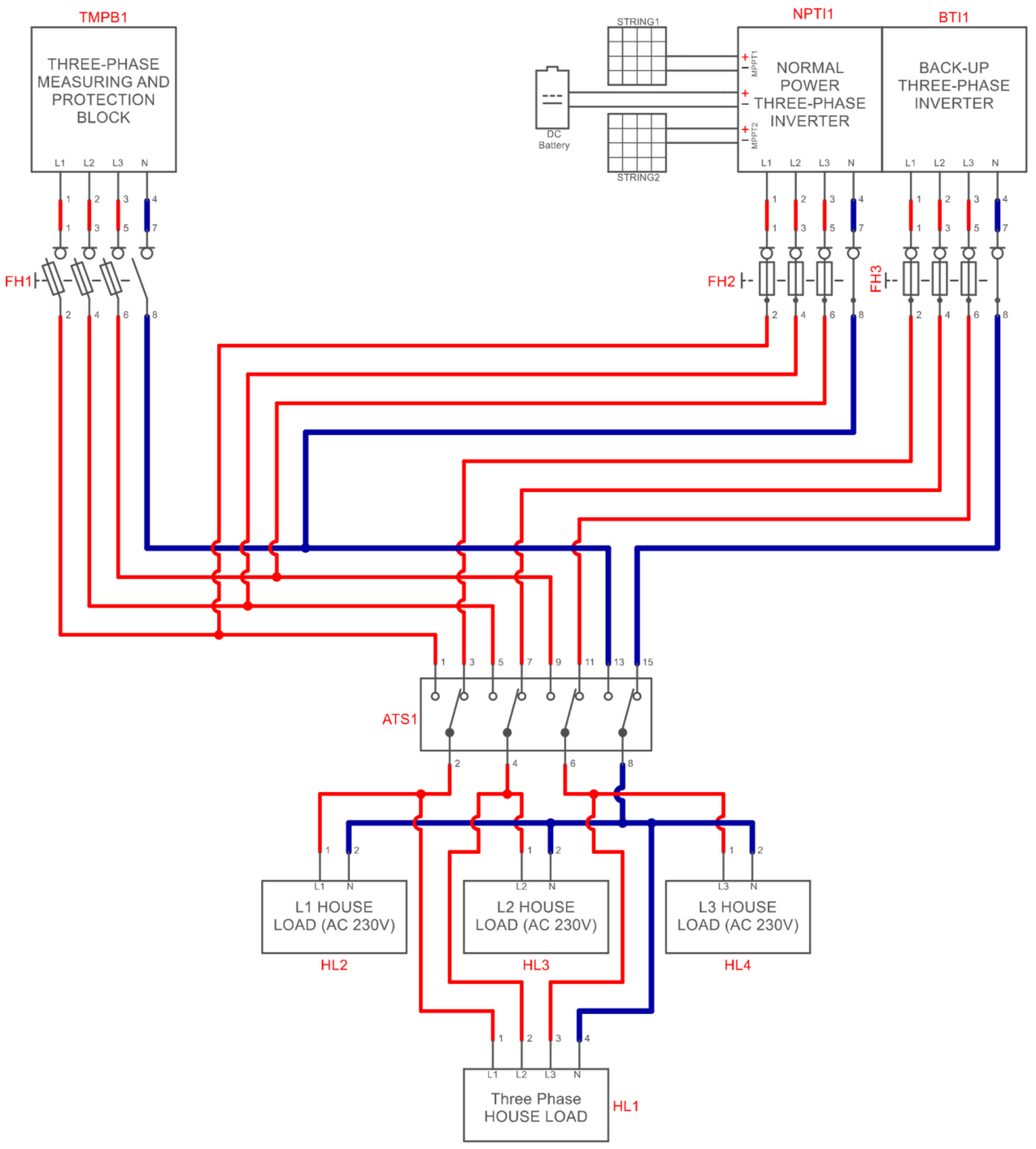
The electrical configuration of the residential installation in which the overvoltage event occurred is illustrated in
Figure 1. The house is connected to the three-phase distribution network through a three-phase metering and protection unit, denoted TMPB1, provided by the distribution system operator. Manual disconnection from the grid can be performed by opening the fuse disconnector FH1.
The photovoltaic installation is equipped with an inverter that provides two types of outputs: a main output connected in parallel with the distribution grid, used both for supplying local loads and for injecting electrical energy into the grid, and a separate backup output, intended to power the household when the public grid becomes unavailable. The transfer between these two power sources is performed by the ATS1 device.
The household loads are connected at the output of the ATS. These include both three-phase loads, denoted HL1, and single-phase loads distributed across the three phases, denoted HL2, HL3, and HL4.
The photovoltaic inverter is equipped with two distinct output ports. The first is the main output (Normal Power), denoted NTPI1, which is connected in parallel with the public distribution grid. Through this interface, the inverter continuously monitors the grid parameters, such as voltage and frequency, and synchronizes with them in order to supply local loads and, when applicable, to inject electrical energy into the grid.
When the public grid becomes unavailable or when its parameters fall outside the permitted operating limits, this output is immediately disabled internally within the inverter, through an internal switching mechanism, in order to prevent any unintended back-feeding of the distribution network.
The second inverter output, denoted BTI1, corresponds to the Backup Power output, through which electrical energy remains available as long as photovoltaic generation is present or the battery storage system retains sufficient charge. This output operates independently of the public grid; however, it is not directly connected to the household electrical installation.
For this reason, the use of an Automatic Transfer Switch (ATS) is necessary to ensure the automatic transfer of the household supply from the Normal Power output to the inverter’s Backup Power output in the event of a grid outage. In the absence of such a switching device, even if the inverter continues to provide power on the backup output, the household would remain unpowered because no electrical connection would exist between this output and the residential loads.
The fuse disconnectors FH1 and FH2 are used to provide manual isolation of the distribution grid and, respectively, of one of the inverter outputs, for safety or maintenance purposes.
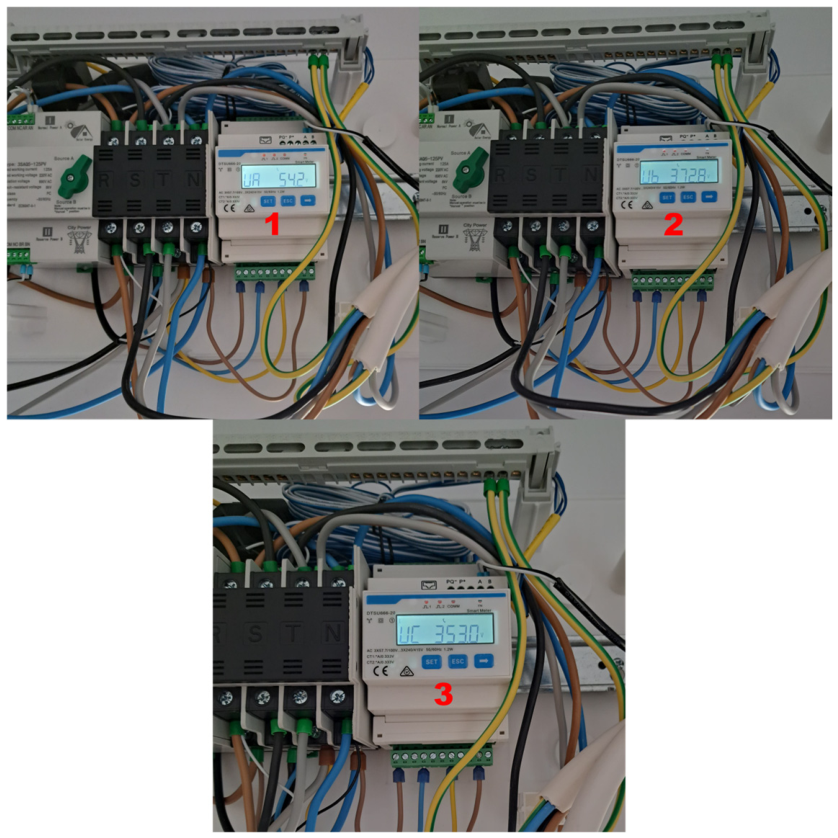
The examination of the voltage history in backup mode indicated normal voltage levels on all three phases, confirming that the inverter was operating correctly in standalone (islanded) mode. In contrast, measurements performed within the household electrical installation during the event revealed a severely abnormal voltage distribution: phase L1 registered 54.2 V, while phases L2 and L3 reached 372.8 V and 353 V, respectively (
Figure 2).
The voltage values recorded during the event exhibited significant fluctuations, at certain moments reaching levels higher than those captured in the documented images. This variation is directly influenced by the connection and disconnection of loads, as well as by the overall load level present during the event. For instance, the activation of high-power appliances, such as a microwave oven, resulted in an increase in the absorbed current, while the switching on of lighting fixtures produced comparatively smaller load variations.
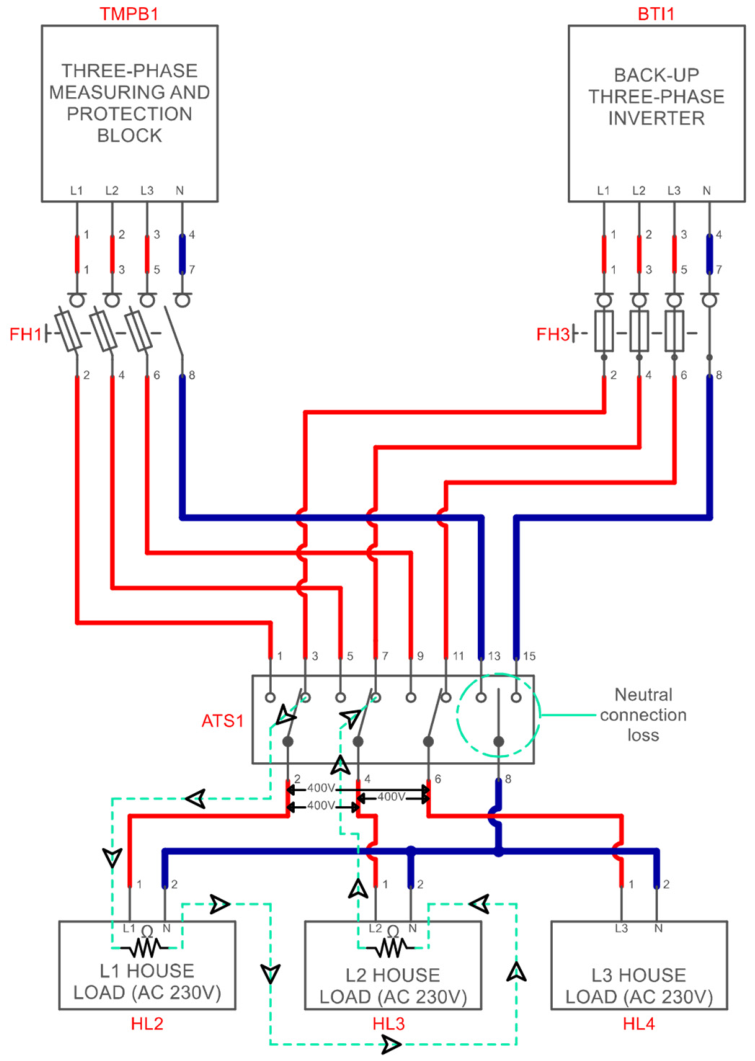
To facilitate a clearer understanding of the mechanism that led to the overvoltage event, the electrical diagram was simplified and is presented in
Figure 3. In this configuration, it can be observed that the fuse disconnector FH1 was open, indicating that the public grid had been disconnected, while the ATS had transferred the supply to the inverter’s backup output. The three-phase loads were removed from the diagram, as they were not connected at the time the event occurred.
The evidence strongly indicates that, during the switching process, the neutral contact within the ATS failed to establish a proper connection, as confirmed by the subsequent structural analysis in
Section 2.2, as highlighted in the diagram by the green circle. As a result, the neutral conductor was interrupted, causing the system to operate under a floating neutral condition.
In a three-phase system with a shared neutral, the loss of the neutral conductor leads to a redistribution of phase voltages depending on the impedances of the connected loads [
26]. The overvoltage mechanism can be described analytically using the equations governing an unbalanced star-connected circuit without a neutral conductor. When the neutral conductor is interrupted, the neutral point of the load
is no longer bonded to the neutral point of the source
, and a neutral displacement voltage
develops, given by:
where
,
, and
are the admittances of the loads connected to phases
,
, and
respectively, and
,
, and
are the source phase voltages (230 V RMS). The actual voltage across each load becomes
, deviating significantly from the nominal value. Phases with low-impedance loads experience undervoltage, while phases with high-impedance loads experience overvoltages approaching the line-to-line voltage (≈400 V).
Although the exact load impedances at the time of the incident could not be determined directly, numerical analysis of Equation (1) constrained by the recorded phase voltages (54.2 V, 372.8 V, 353 V) demonstrates that all physically consistent solutions share the same qualitative characteristics: the equivalent load impedance on phase was in the range of approximately 35–55 Ω, consistent with a high-power appliance such as a resistive heating element or an active load with low apparent impedance, while phases and carried predominantly light or standby loads with impedances in the range of 280–5000 Ω. Under all plausible configurations, the neutral displacement voltage is estimated at approximately 175–190 V.
To illustrate the neutral displacement mechanism, consider a purely resistive loading configuration with , , and . Substituting into Equation (1) yields , and the resulting load voltages are —in reasonable agreement with the recorded values, noting that the measured voltages exhibited significant fluctuations throughout the event as loads were connected and disconnected. The corresponding load currents are , , and . These impedance values represent one illustrative configuration consistent with the observed voltage order of magnitude; the actual load configuration at the time of the incident could not be determined precisely.
Due to the unbalanced loading conditions and the fact that the neutral of the single-phase loads is common, the circuit associated with the load connected to effectively closed through another phase, for example , as illustrated in the diagram by the current path marked in green with directional arrows. Although the example is illustrated for the phase pair, the same phenomenon may also occur between or .
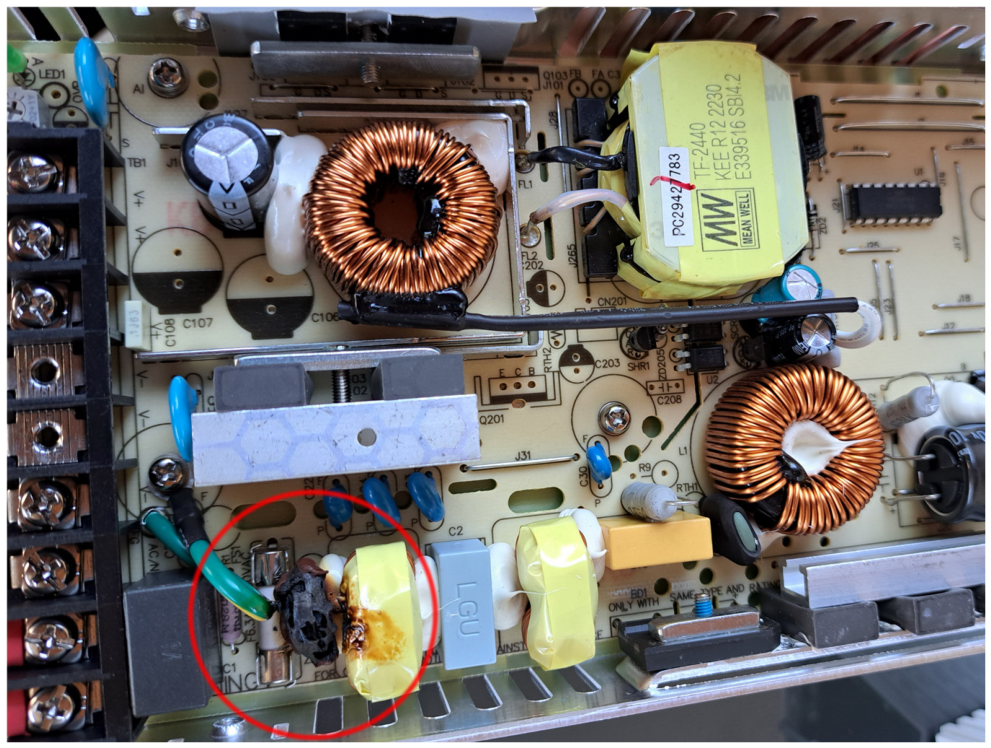
The analysis of the affected equipment indicated that AC–DC switching power supplies were among the components most vulnerable to the overvoltage condition [
27]. In devices equipped with a varistor connected between phase and neutral, together with a fuse on the supply line, the abnormally high voltage exceeded the maximum allowable voltage of the varistor. As a result, its internal resistance dropped abruptly, causing excessive heating; in several cases the component entered a thermal runaway condition, leading to burning or even explosion (
Figure 4).
In many devices, the overvoltage also caused the failure of electrolytic capacitors in the primary side of the power supply, which ruptured violently when the applied voltage exceeded their rated limit, ejecting electrolyte inside the enclosure.
A noteworthy case involved a properly designed device in which the combination of the input fuse and the current-limiting resistor had been correctly dimensioned. In this unit, once the varistor reached its breakdown voltage and the current through the circuit increased rapidly, the fuse promptly interrupted the power supply, thereby preventing damage to other components on the electronic board. This case clearly illustrates the importance of appropriately dimensioned protection elements in switching power supplies.
Following a detailed analysis of the failed equipment, it was concluded that preventing such events is essential, primarily through the use of switching equipment designed to minimize the risk of neutral conductor loss. In a three-phase installation, the absence of the neutral conductor leads to a redistribution of phase voltages according to the impedances of the connected loads, which may result in dangerous overvoltages [
28] as evidenced by the measurements presented above. Equally important is the speed of response once such an anomaly is detected. In these situations, the emergency disconnection of the household supply, both from the public grid and from the photovoltaic system, becomes necessary until the root cause is identified and resolved. In the case presented, the power supply was disconnected within a few minutes after the overvoltage occurred, which limited the propagation of failures and prevented, in the worst-case scenario, the outbreak of a fire hazard.
Subsequently, the internal construction of the ATS installed in the electrical installation shown in
Figure 1, which experienced the neutral loss during the switching process, was analyzed in detail.
2.2. Analysis of the ATS Installed in the Existing System and the Cause of the Overvoltage Event
A subsequent investigation focused on the internal construction of the ATS installed in the affected residence, since this device lost the neutral conductor during the transfer between the grid supply and the inverter’s backup mode.
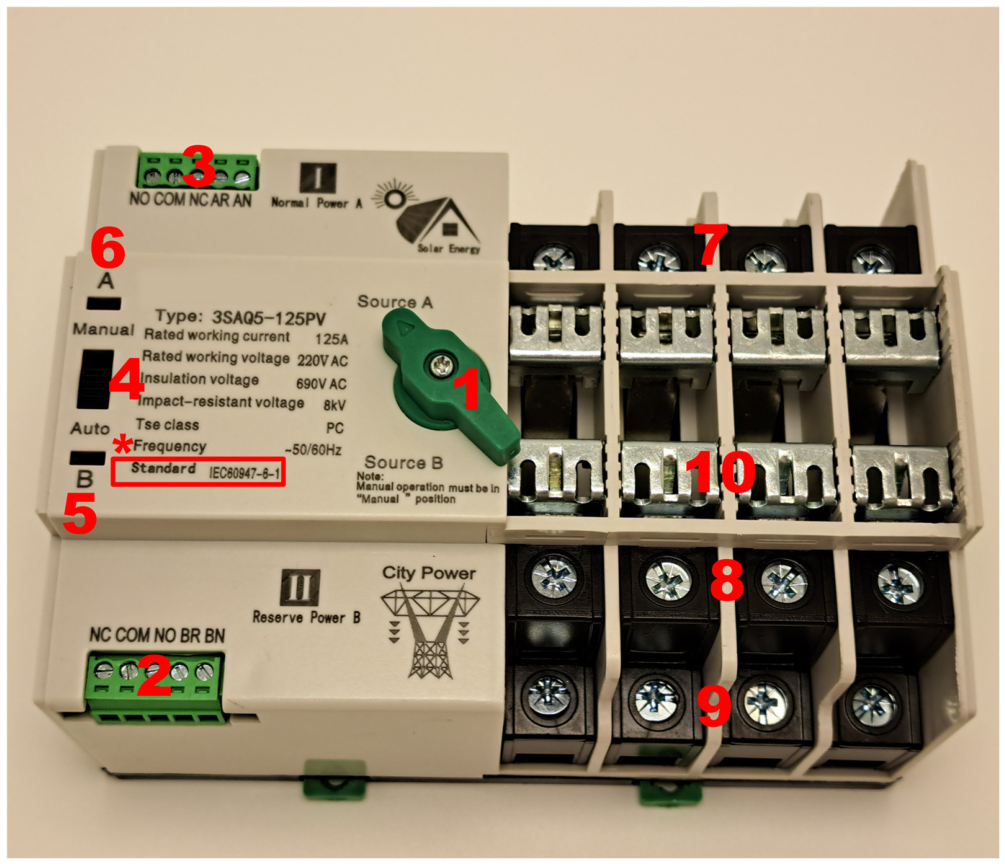
Figure 5 illustrates the main components of the investigated ATS, which are described below:
(1) Manual operating lever—used to perform switching in manual mode. Although the enclosure bears the warning “Manual operation must be in MANUAL position”, no physical mechanism is present to prevent incorrect or incomplete actuation.
(2) Signal connector, pins BR and BN—Reserve Power input (L1 and N)—in the analyzed installation: this corresponds to the connection to the backup output of the photovoltaic inverter. The NC, COM, and NO pins of this connector represent part of the control relay used for auxiliary connections.
(3) Signal connector, pins AR and AN—Normal Power input (L1 and N)—corresponding to the public grid supply. The NC, COM, and NO pins of this connector also form part of the control relay used for auxiliary connections.
(4) Operating mode selector switch—allows selection between AUTO mode (automatic transfer) and MANUAL mode (lever-actuated switching).
(5) and (6) Indicator LEDs—signal the presence of voltage on the reserve supply (B) and on the normal supply (A), respectively.
(7) L1, L2, L3, and N input for Normal Power—the connection point for the four conductors supplied by the public electrical grid.
(8) L1, L2, L3, and N input for Reserve Power—the connection point for the four conductors supplied by the inverter operating in backup mode.
(9) L1, L2, L3, and N output to the load—the conductors supplying the main residential distribution panel.
(10) Arc chutes, components designed to extinguish the electric arc generated during contact opening, protecting the contacts and reducing switching transients.
The plastic enclosure of the device bears the inscription “Standard IEC 60947-6-1”, marked in the figure with the symbol *. Although this marking suggests declared compliance with the IEC 60947-6-1 standard, the internal analysis performed subsequently raises significant doubts regarding the actual constructive conformity of the device.
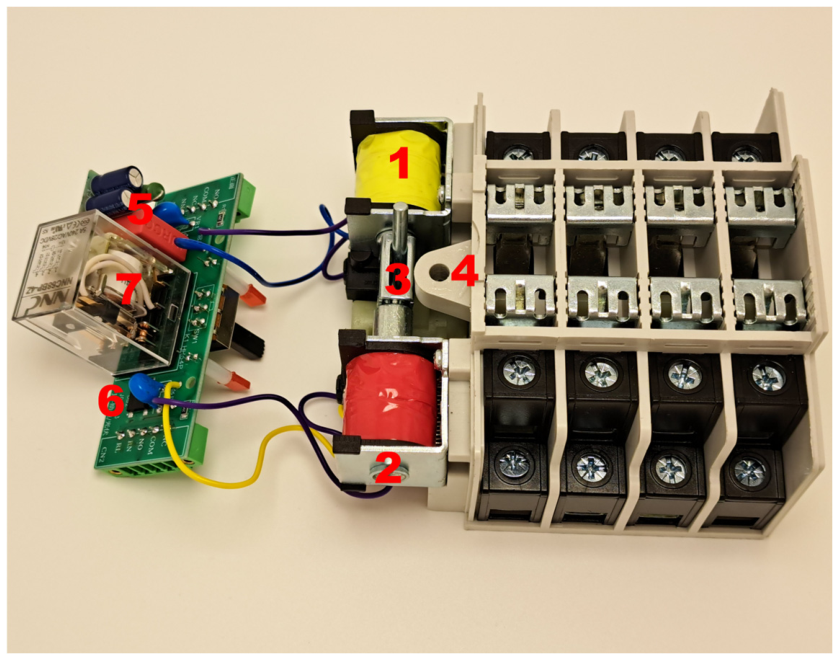
After removing the device enclosure, the main internal components visible in
Figure 6 can be identified and are numbered as follows:
(1) Yellow solenoid—responsible for actuating the movable contacts into the Reserve Power supply position.
(2) Red solenoid—performs a similar function for establishing the connection with Normal Power.
(3) Metal coupling mechanism—transmits the mechanical motion generated by the solenoids to the switching assembly and also serves as the mechanical interface for the manual operating lever.
(4) Lever pivot point—a structural element of the enclosure that allows the manual operating lever to rotate around a fixed axis.
(5) Control PCB (secondary board)—manages the actuation of the solenoids and processes the input control signals.
(6) Rectifier bridge and varistor—provide the DC supply required by the solenoids; the varistor offers basic protection against local voltage transients.
(7) Switching relay—directs the supply between the two solenoids and also transmits signals to the auxiliary connectors described previously.
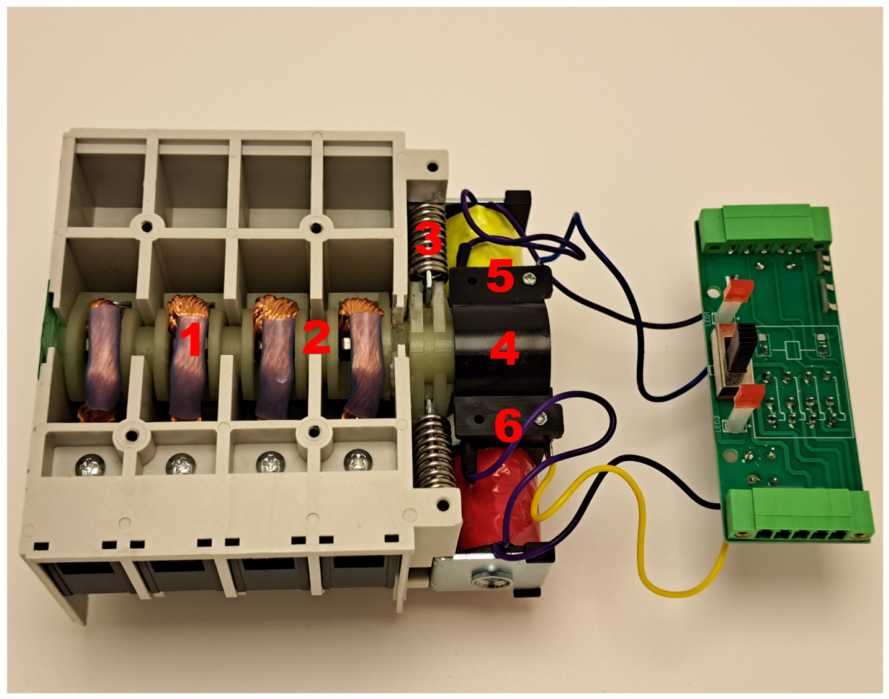
Figure 7 illustrates the rear side of the device, where the mechanical elements and the switching contacts can be observed:
(1) Moving contacts—implemented using braided multi-strand conductors with very thin wires to ensure mechanical flexibility. However, this design raises concerns regarding their actual current-carrying capability, particularly under higher load conditions.
(2) Plastic actuation mechanism—transfers the mechanical motion generated by the solenoids to the moving contacts, shifting them between the two switching positions.
(3) Return springs—maintain the mechanism under mechanical tension and contribute to achieving a rapid switching action.
(4) Mechanical support for the solenoids and limit switches—a plastic structural component that connects the actuation mechanism to the solenoids and provides support for the micro-switches used as limit switches.
(5) Limit switch for the yellow solenoid—connected in series with the yellow solenoid and used to interrupt its power supply once the switching action is completed.
(6) Limit switch for the red solenoid—similar to the previous element, connected in series with the red solenoid and serving the same post-actuation power interruption function.
This structural analysis highlights that the ATS used in the installation has a mechanically and electrically vulnerable architecture, susceptible to switching faults and to the loss of the neutral conductor, which confirms the conclusions drawn from the analysis of the overvoltage event.
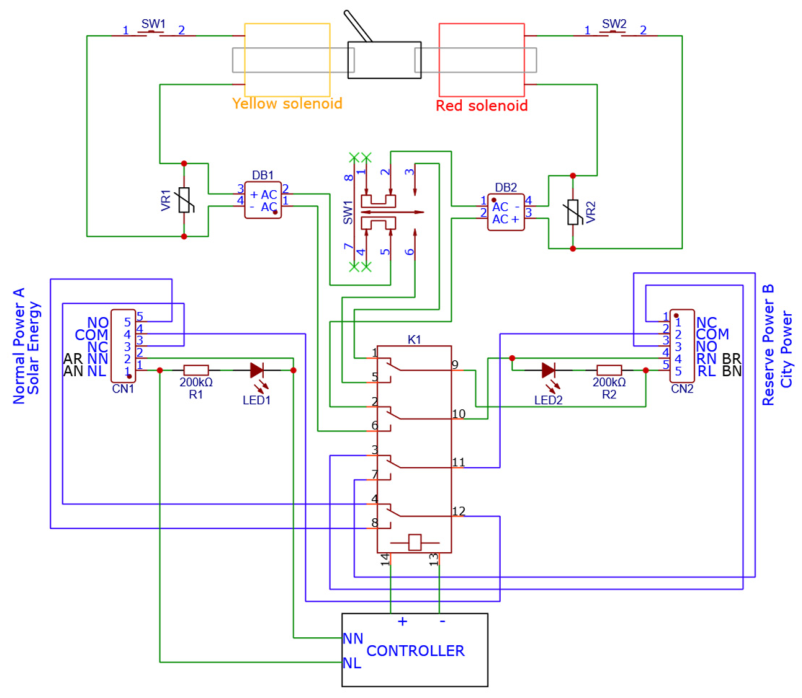
To better understand the operating principle of the investigated ATS, the electronic schematic shown in
Figure 8 was reconstructed. The diagram illustrates the two solenoids, each connected in series with the limit switches SW1 and SW2, whose role is to interrupt the power supply to the solenoid once the mechanical switching operation has been completed.
The solenoids are powered through the rectifier bridges DB1 and DB2, while varistors VR1 and VR2 are connected in parallel with the output of each rectifier bridge. These components are intended to suppress voltage spikes and provide a minimal level of protection against transient overvoltages.
The selection between manual and automatic operation is performed through switch SW3, which interrupts one of the supply conductors feeding the rectifier bridges. Consequently, when the device is placed in manual mode, the power supply to the solenoids is completely disabled, allowing switching to be performed only through mechanical actuation of the lever.
For the control section, a dedicated PCB is used, supplied with phase and neutral from connector CN1, corresponding to the Normal Power (A) input. Its function is to detect the presence of voltage on the grid and to control relay K1, energizing its coil whenever the Normal Power source is available. Under these conditions, the relay contacts transition from the normally closed (NC) position to the normally open (NO) position.
Connector CN2 is assigned to the Reserve Power input, and the phase and neutral supplied through this connector are connected to relay K1 contacts 9 and 10. As a result, the supply for both solenoids is derived exclusively from the Reserve Power source, which explains the inability of the device to automatically switch back to the grid if the backup source itself loses voltage.
Both CN1 and CN2 also expose the auxiliary contacts of relay K1—common (COM), normally open (NO), and normally closed (NC)—which can be used to control additional circuits or to interface the ATS with other automation systems.
To indicate the presence of voltage at the two inputs, two LED indicators (LED1 and LED2) are implemented, each connected in series with its corresponding current-limiting resistor (R1 and R2). This arrangement allows the user to easily determine whether the grid supply or the backup supply is currently available.
A major drawback of the analyzed ATS lies in the way the solenoid coils are powered. When the device operates in Reserve Power mode (i.e., supplied from the inverter’s backup output), the loss of voltage on this source makes automatic switching back to the public grid impossible, because the solenoid coils are powered exclusively from the conductors of the Reserve Power circuit. Under such circumstances, the user is forced to perform a manual transfer back to the Normal Power source.
Detecting this limitation is difficult for an average user, as it requires knowledge of the internal structure and operating principle of the ATS. This lack of transparency significantly increases the operational risk, making the device potentially hazardous in practical use.
Another significant issue identified is the complete absence of fuses or any other protective element connected in series with the solenoids. In the event of an overcurrent caused by an internal fault in one of the solenoids, the supply is not interrupted by any protective device. This condition may lead to overheating, insulation degradation, and in extreme cases even fire.
Furthermore, if one of the limit switches fails in the closed position, the solenoid connected in series with it will remain continuously energized, inevitably resulting in excessive heating and rapid degradation of the assembly.
Additionally, when the device operates in AUTO mode, the mechanical mode selector effectively prevents the use of the manual lever. If the user attempts to actuate the lever while the selector is set to automatic mode, it encounters very high mechanical resistance, which can place significant stress on the internal components of the ATS.
Forcing the lever under these conditions may not only damage the switching mechanism, but also result in an unstable or incomplete switching state, thereby increasing the likelihood of malfunction or failure.
2.3. Analysis of an Alternative Commercial ATS and Constructive–Functional Evaluation
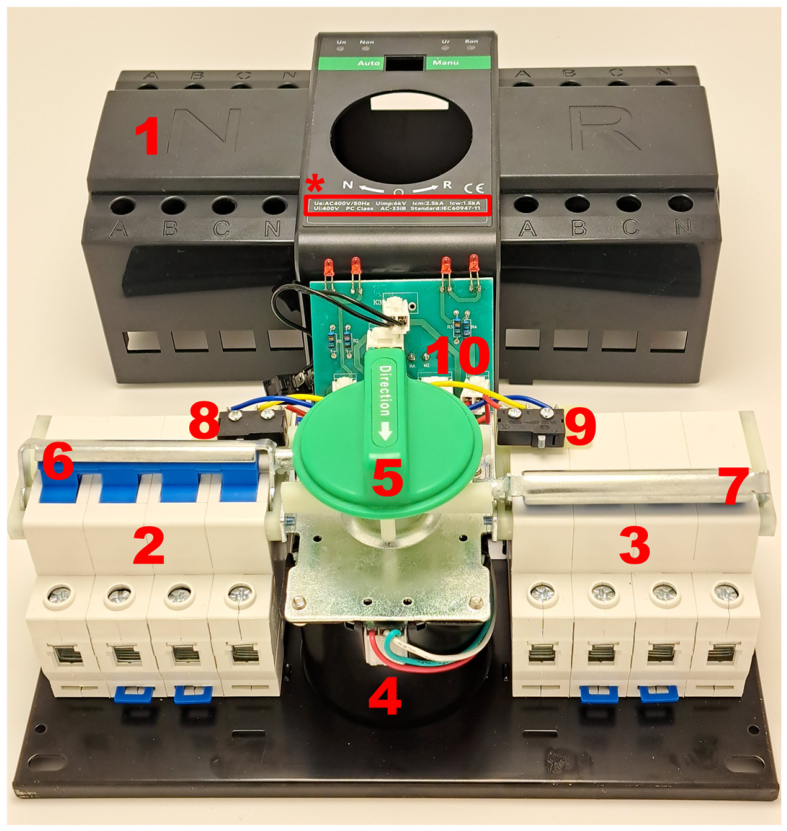
In order to address the issue caused by the defective ATS, another model available on the market was purchased and evaluated to determine whether it provides an adequate level of operational safety. During preliminary functional testing, a switching sound was observed that resembled the distinctive tripping noise of a miniature circuit breaker (MCB). Subsequent disassembly confirmed that the device employs two four-pole MCBs as the primary switching elements.
Figure 9 illustrates the main components of the analyzed ATS device:
(1) ATS enclosure—the outer casing displays the declared technical specifications of the device, including the marking “IEC 60947-11”, highlighted in the figure with the symbol *.
(2) Four-pole MCB (Normal Power)—a four-pole miniature circuit breaker whose input terminals are connected to the grid supply (Normal Power).
(3) Four-pole MCB (Reserve Power)—an identical circuit breaker used for connecting the backup supply (Reserve Power). The outputs of the two MCBs are not internally interconnected, requiring external wiring to connect them to the residential load.
(4) Actuation motor—responsible for performing the mechanical switching action between the two power sources.
(5) Manual operating lever—allows the user to perform manual switching between the two sources.
(6) and (7) MCB toggle levers—together with the metal coupling bracket, these components transmit the mechanical motion generated by the motor mechanism to the two circuit breakers.
(8) and (9) Limit switches—interrupt the motor supply once the MCB toggle reaches its final position, thereby preventing mechanical overstress of the actuation system.
(10) Control PCB—the main electronic board responsible for implementing the control logic, supplying the actuation motor, and processing the signals from the limit switches.
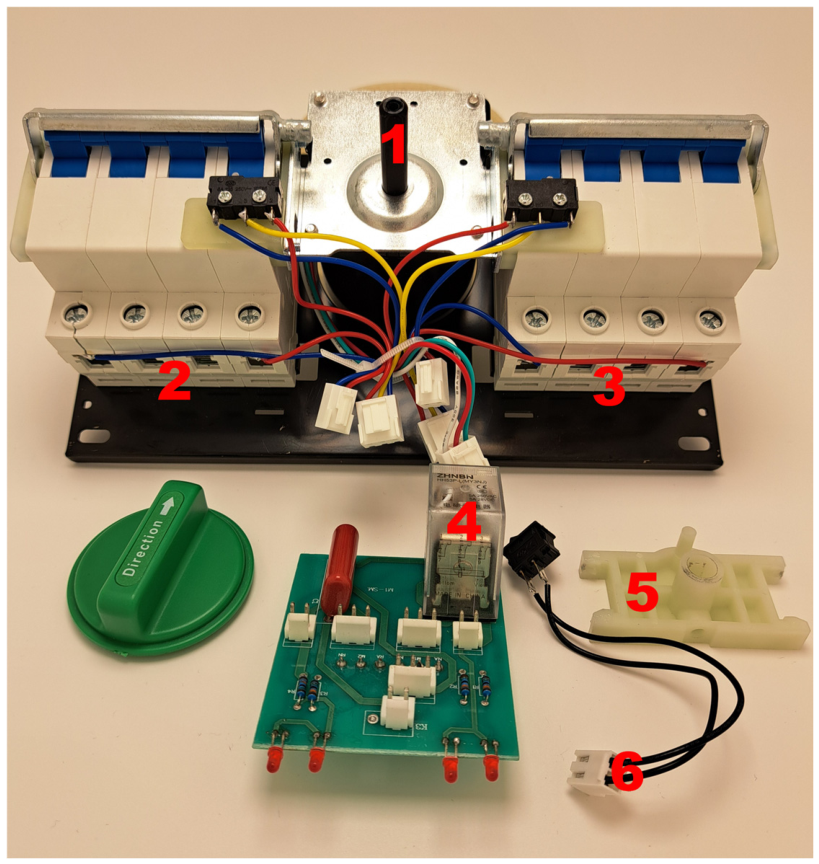
Figure 10 presents the internal components of the device after the switching mechanism has been removed:
(1) Motor shaft—enables bidirectional rotation, which is necessary for switching between the two MCBs.
(2) and (3) Input terminals of the two MCBs—at the L1 phase terminal and the neutral (N) terminal, two wires used for input voltage monitoring are directly soldered with tin. This method of voltage sensing suggests a low level of manufacturing quality and indicates an improvised construction approach.
(4) Direction-reversing relay—switches the polarity of the motor supply, allowing the motor to rotate in both directions.
(5) Plastic transmission mechanism—transfers the rotational motion of the motor to the toggle levers of the two MCBs.
(6) Manual mode selection button—allows the device to be switched to manual operation, enabling the use of a hand crank to actuate the mechanism.
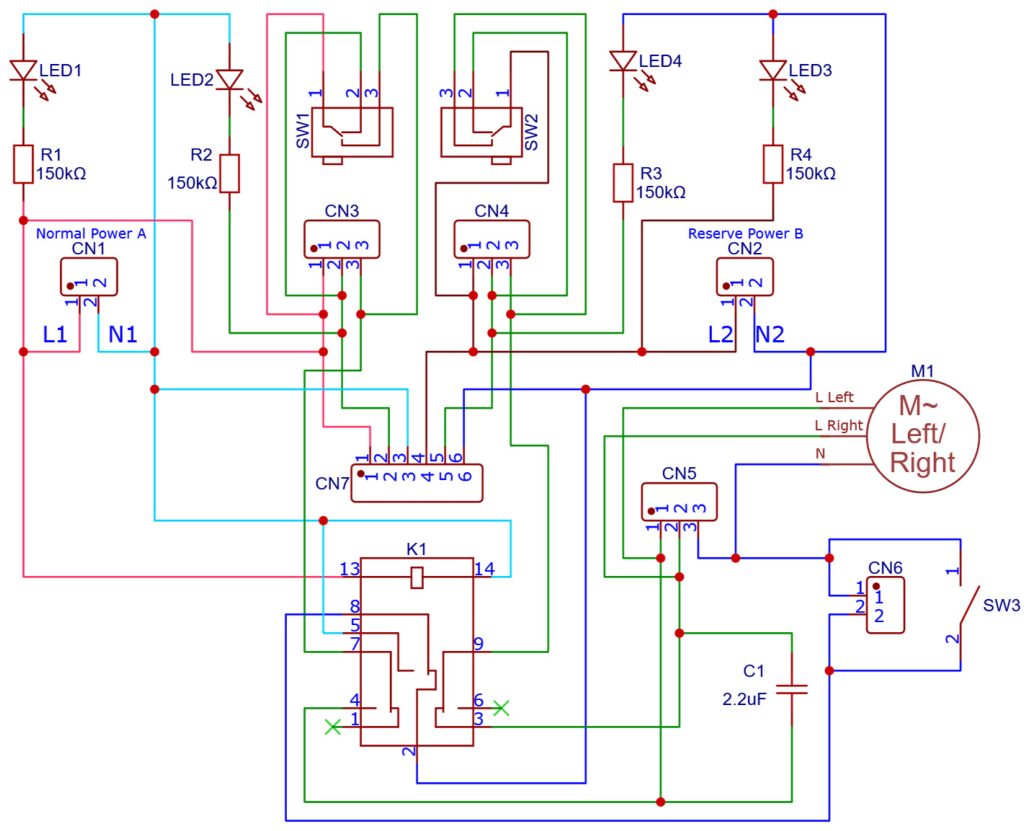
To better understand the operating principle of the second ATS device analyzed, the electronic schematic shown in
Figure 11 was reconstructed. The supply coming from the four-pole circuit breaker associated with the Normal Power source is applied to connector CN1, while the supply from the Reserve Power source is connected to CN2.
The presence of voltage at the two inputs is indicated by LED1 and LED3, each connected in series with their corresponding current-limiting resistors R1 and R4.
Connectors CN3 and CN4 provide the interface to the two limit switches SW1 and SW2, whose function is to interrupt the motor supply once the switching mechanism reaches one of its end positions.
To visually indicate the switching process, LED2 and LED4 are used together with the current-limiting resistors R2 and R3, signaling the activation of the motor in one of the two directions.
The coil of relay K1 is powered from connector CN1, corresponding to the Normal Power source. Therefore, when voltage is present at this input, the relay switches its contacts from the normally closed (NC) state to the normally open (NO) state. Relay K1 includes three contact groups, which are used to switch: the neutral conductors of the two sources toward the motor neutral, the phase signal originating from limit switch SW1, and the phase signal originating from limit switch SW2.
Connector CN5 is used to connect the motor responsible for actuating the switching mechanism of the two four-pole circuit breakers. Transition to manual operating mode is achieved through connector CN6, to which switch SW3 is connected in series. The function of this switch is to interrupt the motor’s neutral conductor, thereby cutting off its power supply and disabling the motor-driven switching mechanism.
Following the analysis of this ATS, it was observed that this solution also lacks dedicated protective elements, such as fuses connected in series with the motor that actuates the switching mechanism of the two four-pole circuit breakers (MCBs). If one of the limit switches fails or no longer interrupts the supply correctly, the motor remains energized and continues to exert mechanical force on the switching mechanism. In the most favorable scenario, the mechanism fails at its weakest mechanical points, leading to free-running operation and the appearance of a malfunction within a relatively short period of time. In a more severe scenario, the motor may remain stalled at the end of its travel, overheat, and potentially become a source of fire.
A second major issue concerns the fundamental design philosophy of this ATS, which relies on miniature circuit breakers (MCBs) as the primary switching elements. These devices are not designed for frequent load switching under voltage; their intended purpose is to protect electrical circuits against overloads and short circuits, as well as to safely interrupt the electric arc generated during fault conditions. Using them as the main switching elements in an ATS contradicts the operational principles for which they were originally designed. Furthermore, the absence of clear identification markings, such as product code, detailed electrical ratings, or manufacturer information, prevents verification of the device’s actual compliance with the declared specifications. This lack of traceability raises serious concerns regarding the ability of the device to operate safely in real-world applications.
Similar to the first ATS analyzed, this device also presents an additional risk associated with manual operation. Even when automatic mode is selected, no mechanism is implemented to physically block the manual lever. If the user attempts to perform a manual transfer while the device is operating automatically, the motor is forced to rotate against the mechanical resistance of the manual actuation mechanism, generating significant mechanical and electrical stress on the drive assembly. This condition accelerates component wear and substantially increases the probability of failure.
Based on these comparative analyses, it can be concluded that low-cost ATS solutions available on the market, although cost-effective at point of purchase, may introduce operational risks whose downstream failure costs far exceed the initial saving.
It should be noted that both construction archetypes analyzed in this study, the movable-contact mechanism and the MCB-actuated mechanism, represent the predominant low-cost ATS topologies encountered on the market; numerous commercially available devices from different manufacturers share the same fundamental architecture, differing only in enclosure design or minor component variations, while exhibiting identical structural failure modes.
Given the context, the development of a moderately priced ATS, properly dimensioned from both electrical and mechanical perspectives and, most importantly, designed with a strong emphasis on safety and reliability, represents a necessary and well-justified solution for modern residential electrical installations, particularly in applications involving photovoltaic systems equipped with backup functionality.
2.4. Electrical Schematic of the Developed ATS
The main components of the ATS developed in this study include a phase monitoring relay ETI Elektroelement d.o.o. (Izlake, Slovenia) HRN-100 [
29], two three-phase contactors ABB AF38-40-00-13 [
30,
31] a mechanical interlocking system ABB VM4 [
32], and fuse holders ETI EFD 10 LED equipped with appropriate protective fuses. Additionally, two signal indicator lamps ABB E219 may be integrated to provide visual indication of the active power source. These indicators are controlled through two auxiliary contact blocks ABB CAL4-11 mounted on the contactors.
The contactors were selected to accommodate the maximum connected load within the rated connection capacity of the installation. The ABB AF38-40-00-13 contactor is rated at 38 A under AC-1 utilization category (three-phase, 400 V), corresponding to a maximum resistive load of approximately 26 kW, providing a margin of approximately 24% above the 21 kW Technical Connection Approval (ATR) limit applicable to residential grid connections in Romania. This margin ensures reliable operation across the full rated connection capacity without approaching the contactor’s thermal or electrical limits under normal service conditions. For installations with a lower ATR limit, the ABB AFC16-40-00-88 contactor (AC coil variant, rated at 16 A AC-1, corresponding to approximately 11 kW) represents a more compact and cost-effective alternative, achieving approximately 50% faster average transfer times at the cost of a narrower supply voltage tolerance for the coil circuit.
Regarding short-circuit behavior, IEC 60947 defines three distinct capabilities for transfer switching equipment: making capacity, the ability to close contacts onto a circuit already carrying short-circuit current without catastrophic failure; short-circuit withstand capacity, the ability to remain intact for the duration required for the upstream protective device to clear the fault; and breaking capacity, the ability to interrupt active short-circuit current, which is explicitly not required for Class CC devices. In the proposed design, short-circuit interruption is the exclusive function of the upstream fuse disconnectors FH1 and FH2 in series with each source. The ABB AF38-40-00-13 contactor provides the required making and withstand capability: its rated short-time withstand current is Icw = 450 A for 1 s [
30], confirming that the contactor remains intact for the duration required for the upstream fuse to operate, typically in the range of milliseconds, well within the rated withstand envelope.
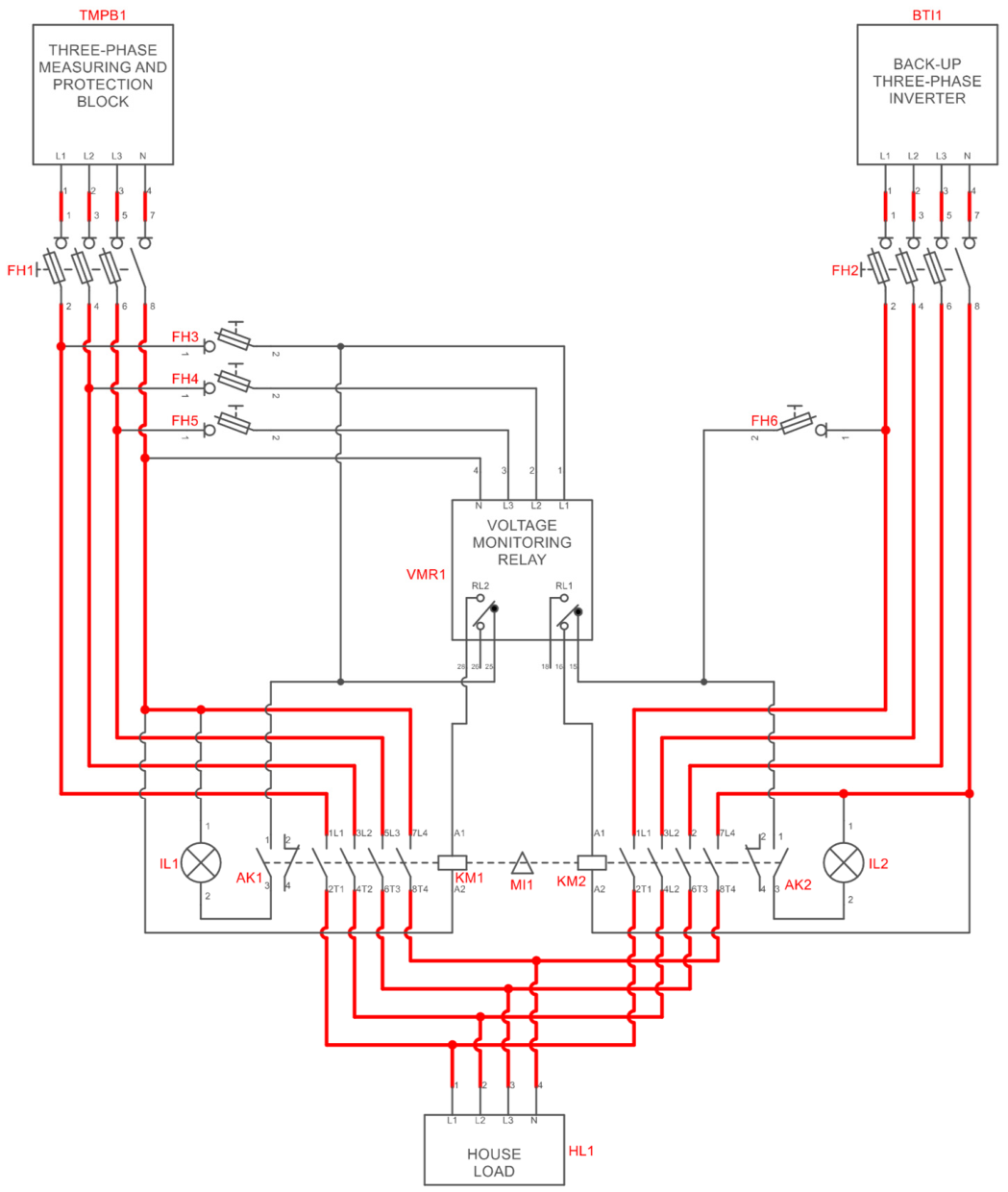
Figure 12 presents the electrical schematic of the proposed ATS. The block labeled TMPB1 represents the three-phase measuring and protection unit provided by the electricity distribution operator when a three-phase grid connection is installed. From this unit, the three phases (L1, L2, L3) and the neutral conductor (N) are taken and routed through the fuse disconnector FH1. The outputs of FH1 are then connected directly to the power contacts of contactor KM1, which is responsible for supplying the installation from the public grid.
On the right side of the schematic, BTI1 denotes the three-phase inverter with backup capability, which also provides three phases and a neutral conductor. In series with this source, the fuse disconnector FH2 is installed, whose outputs are connected to the power contacts of contactor KM2.
It is important to note that in the fuse holders FH1 and FH2, the neutral conductor connection does not contain fuses, but rather solid metallic links, ensuring that the neutral conductor remains permanently connected and cannot be inadvertently interrupted.
The non-switching neutral design is a deliberate safety measure, directly motivated by the overvoltage incident documented in
Section 2.1, where the failure of a switchable neutral contact was identified as the root cause of the event. In TN-S and TN-C-S distribution systems, the standard earthing arrangement for EU residential installations, the neutral conductor is bonded to protective earth at the distribution transformer and at the consumer’s main earthing terminal. In this topology, both the public grid supply and the hybrid inverter’s backup output share the same neutral reference point, derived from the distribution transformer. Maintaining a continuous, non-switched neutral therefore eliminates the floating-neutral failure mode without introducing any safety risk. It should be noted that IEC 60947-6-1 does not universally mandate neutral switching; the applicable requirements depend on the system topology and earthing arrangement, and the non-switching neutral is the appropriate design choice for the TN topology described.
The phase conductors L1, L2, and L3 are connected to the inputs of the phase monitoring relay VMR1, while the neutral conductor is also connected directly to the relay input. This configuration allows continuous monitoring of the supply parameters and prevents the occurrence of faults in the event of internal relay failures.
The coil of contactor KM1 has terminal A2 connected to the grid neutral (through FH1), while terminal A1 is connected to pin 28 (normally open contact) of relay RL2 inside VMR1. The movable contact of relay RL2 (pin 25) is supplied from phase L1 of the grid, protected by fuse FH3, thereby providing overcurrent protection for the contactor coil.
Similarly, the coil of contactor KM2 has terminal A2 connected to the neutral conductor of the backup source (through FH2), while terminal A1 is connected to pin 16 (normally closed contact) of relay RL1 within VMR1. The movable contact of relay RL1 (pin 15) is supplied from phase L1 of the inverter, protected by fuse FH6, which serves the same overcurrent protection function for the contactor coil.
To prevent the simultaneous energization of the two contactors, in addition to the electrical interlocking implemented through the control circuit, a mechanical interlock MI1 is also used. This mechanism physically prevents one contactor from being actuated while the other is already engaged.
Beyond the basic circuit required for ATS operation, two indicator lamps were added to signal the active power source. Indicator IL1 has one terminal connected to the grid neutral, while the other is controlled through auxiliary contact AK1, mechanically actuated by contactor KM1 and supplied from grid phase L1, protected by FH3. In a similar configuration, indicator IL2 is connected to the neutral of the backup source, while its other terminal is controlled through auxiliary contact AK2, associated with contactor KM2 and supplied from phase L1 of the inverter, protected by FH6.
Furthermore, the proposed ATS architecture is built exclusively on standard industrial components (ABB AF/AFC contactors, ETI HRN-100 phase monitoring relay, ETI fuse holders) which are commercially available in versions compatible with both 50 Hz and 60 Hz grids and with the principal regional voltage standards. The design principles presented in this study are therefore broadly applicable beyond the Romanian/EU market context, with adaptation requiring only the selection of the appropriate frequency/voltage variant of each component.
2.5. Experimental Setup for Laboratory Testing
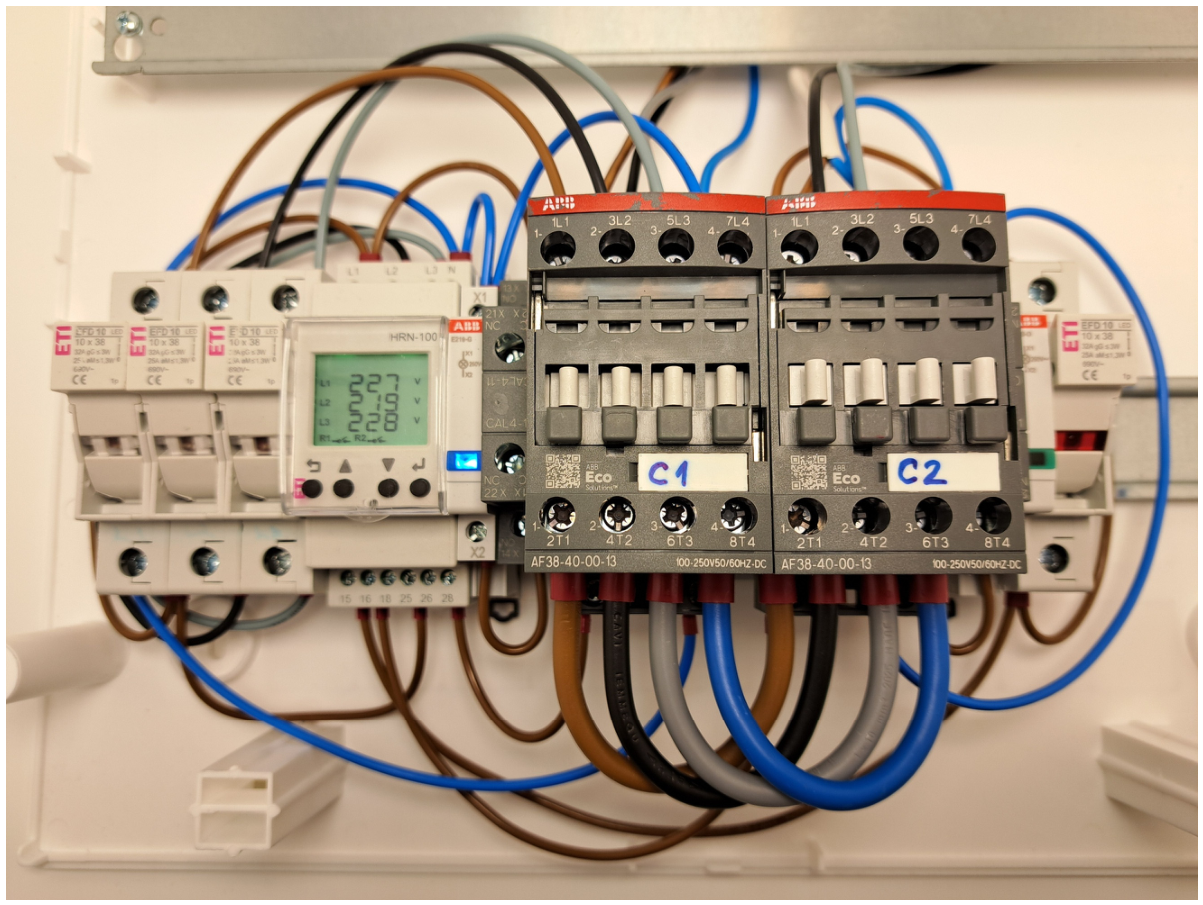
Figure 13 presents the experimental setup used for testing the proposed ATS inside a residential electrical distribution panel. To optimize the wiring paths, the components were arranged on the DIN rail, from left to right, as follows: three fuse holders for protecting the grid phases, the phase monitoring relay, the indicator lamp for the main power source together with its auxiliary contact, contactor KM1, contactor KM2, and the mechanical interlock installed between the two contactors.
Following the second contactor, the auxiliary contact used for signaling the backup source is installed, and finally the fuse holder providing protection for phase L1 of the inverter.
In
Figure 13, the system can be observed operating under normal conditions: the grid indicator lamp is active, the phase monitoring relay does not signal any fault, and contactor KM1 is energized, indicating that the loads are currently supplied from the public grid.
The outputs of the two contactors are connected in parallel using 10 mm2 conductors. In the laboratory configuration, these outputs are not connected to real loads. In the final implementation, all connections will be made using properly dimensioned conductors, and the system will be tested under real operating conditions.
The ETI HRN-100 relay was configured with the following parameters during laboratory testing (
Table 1): SPL.CFH = 3P4 (three-phase four-wire), PON.DLY = 0 s (set to zero to eliminate power-on delay during measurements; set to 10 s in the final field installation to prevent repeated backup activations during brief grid fluctuations), U VTG = 192 V, O VTG = 253 V, U FREQ = 49 Hz, O FREQ = 51 Hz, ASY = 10%, VHYST = 10 V, FRHYST = 1 Hz, ASHYST = 2%, PHLOSS = EN, PHREV = EN, N OPEN = EN, ON DLY = 0.5 s, OFF DLY = 0.1 s, RLY MD = NO, and LCH MD = YES. Parameter designations follow the device LCD display notation as documented in the manufacturer’s instruction manual [
29].
2.6. Operating Principle of the ATS
The operating principle of the proposed ATS is simple and robust. The relay VMR1 continuously monitors the parameters of the three grid phases with respect to the neutral conductor, including voltage, phase sequence, frequency, phase loss, asymmetry, and neutral loss. The thresholds for overvoltage, undervoltage, overfrequency, underfrequency, asymmetry, and hysteresis are configured through the relay’s button-based user interface.
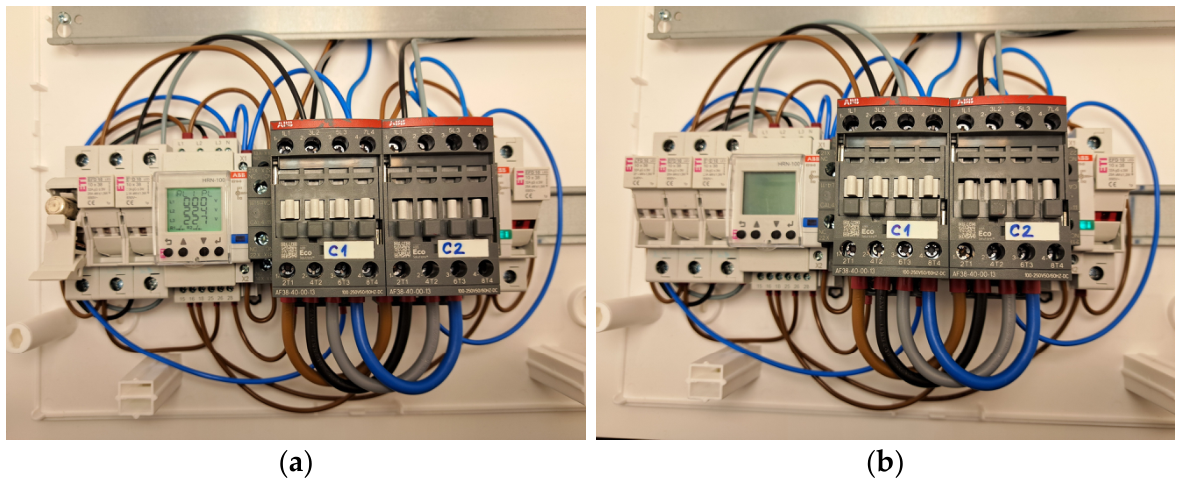
Laboratory testing allowed the determination of the optimal delay times for relays RL1 and RL2. When the grid parameters remain within the configured limits, contactor KM1 is energized, the residential installation is supplied from the public grid, and the corresponding indicator lamp is active. If any parameter exceeds the preset thresholds or if a phase loss occurs (
Figure 14a) or the neutral conductor is lost, the monitoring relay de-energizes the KM1 contactor coil and enables the supply of the KM2 contactor coil, thereby transferring the load to the backup source, such as the backup output of a photovoltaic inverter. The complete electrical configuration validated during laboratory testing is presented in
Figure 15.
A second operating scenario occurs when the public grid becomes completely unavailable, and the monitoring relay is no longer powered. In this situation, the normally closed contact of relay RL1 allows the KM2 contactor coil to be energized, ensuring that the loads continue to be supplied from the backup source, as illustrated in
Figure 14b.
2.7. Optimization of the Switching Time
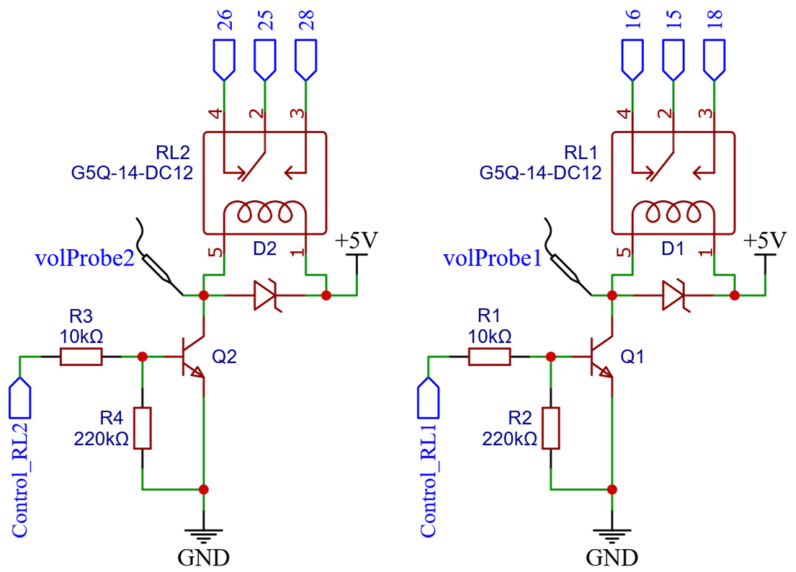
In order to optimize the switching times of the ATS, it was necessary to analyze the internal construction of the phase monitoring relay. Following disassembly and a reverse engineering process, it was determined that the control circuitry follows a conventional relay-driving architecture, illustrated in
Figure 15.
The control of relays RL1 and RL2 is performed by a microcontroller, with the control signals (Control_RL1 and Control_RL2) applied to the bases of the NPN transistors Q1 and Q2 through the base current-limiting resistors R1 and R3. The resistors R2 and R4, connected between the base and emitter, ensure the rapid discharge of the base charge, improving the switching dynamics.
The collectors of the transistors are connected to the relay coils, while the diodes D1 and D2, connected in series, provide protection against transient overvoltages generated during coil de-energization.
To evaluate the time difference between the activation commands of the two relays, two oscilloscope probes were connected to the coil terminals of relays RL1 and RL2.
After performing multiple measurements and testing various parameter scenarios, it was observed that the microcontroller within the monitoring relay prioritizes the activation of relay RL1, followed shortly afterward by relay RL2. This characteristic led to the final control configuration, in which relay RL1 is responsible for actuating the coil of contactor KM2 through its normally closed contact, while relay RL2 controls the coil of contactor KM1 through its normally open contact.
During the initial phase of the preliminary tests, the connections were implemented in a more intuitive configuration, where RL1 controlled the first contactor and RL2 controlled the second contactor. However, this arrangement resulted in longer switching times. In order to reduce the overall transfer time, the internal operating behavior of the monitoring relay was analyzed in detail, leading to the identification of an optimized connection strategy.
The experimental results regarding the timing differences between the control signals of the two relays are presented in the following section, dedicated to testing and measurements.
3. Results
3.1. Determination of the Switching Times of Individual Contactors—Coil Energization and De-Energization
To evaluate the switching-time specifications of the contactors, indicated in the datasheet as Operate Time: Between Coil De-energization and NO Contact Opening: 11–95 ms, five tests were performed for each contactor.
The switching times were measured by monitoring two signals simultaneously on a Teledyne LeCroy Inc. (Chestnut Ridge, NY, USA) HDO6104-MS oscilloscope: the contactor coil voltage, acquired using a Gwinstek Good Will Instrument Co., Ltd. (New Taipei City, Taiwan) GDP-025 differential probe set to ×200 attenuation, and the power contact output voltage, acquired using standard oscilloscope probes connected directly across the contact terminals. The power contacts were connected to a Tabor Electronics Ltd. (Tel Aviv, Israel) WW5062 signal generator configured to deliver a 50 Hz sinusoidal signal at 10 V amplitude, used to detect contact closure and opening events by monitoring the presence or absence of the signal at the contact output. The contactor coils were supplied through the ETI HRN-100 phase monitoring relay under normal operating conditions, replicating the actual control circuit architecture of the proposed ATS.
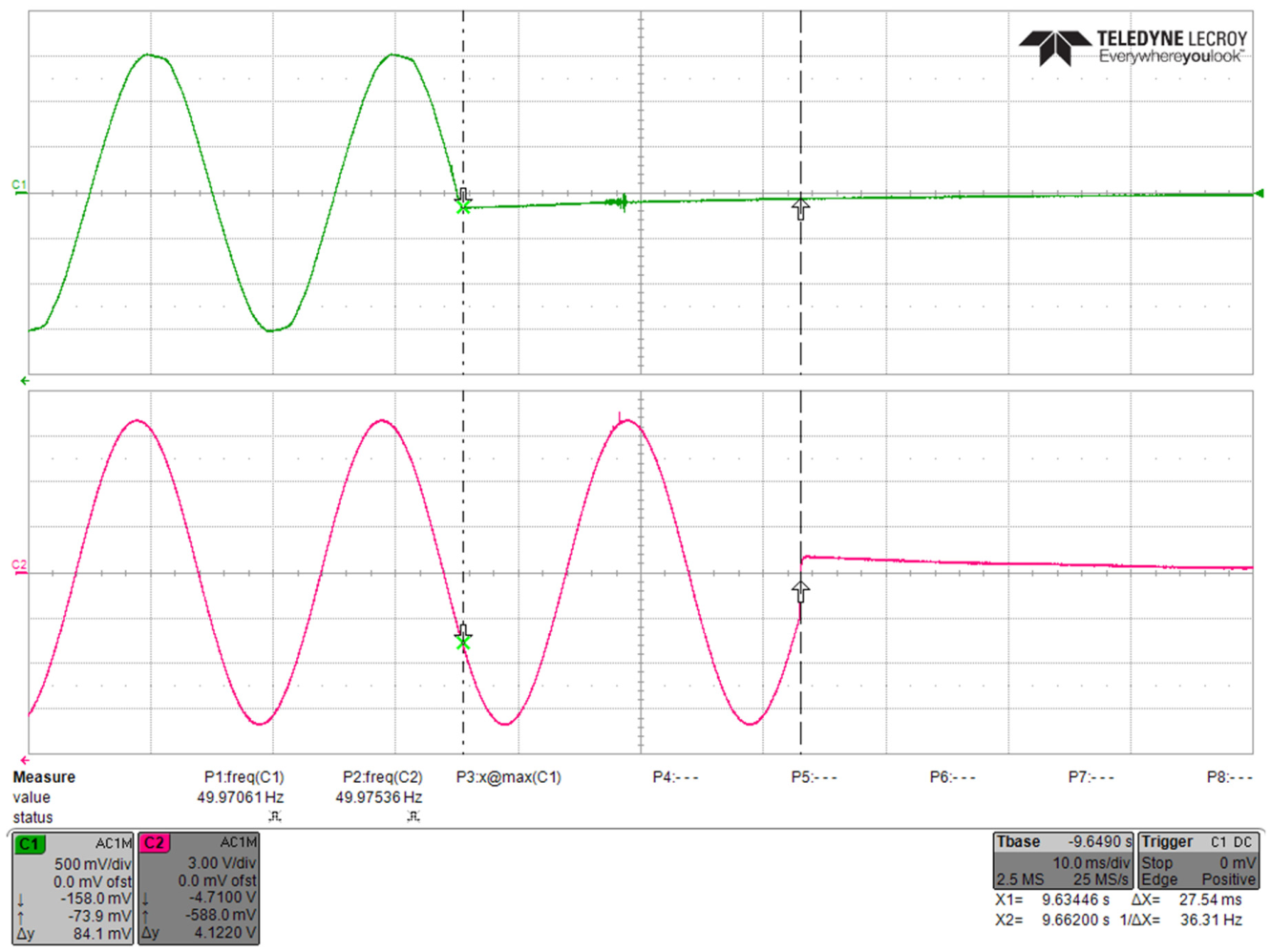
Figure 16 illustrates the waveform corresponding to the coil de-energization process. The signal shown in green represents the coil supply voltage, measured with the differential probe, while the red signal corresponds to the voltage measured at the output of the power contacts. It can be observed that the interruption of the output voltage occurs after a certain delay following coil de-energization. The measured time difference between the two signals is Δt = 27.54 ms, representing the coil de-energization time of the ABB contactor.
The obtained values are summarized in
Table 2, where it can be observed that the coil de-energization time ranges between 27 ms and 31 ms. The resulting average values are 27.96 ms for the first contactor and 29.3 ms for the second contactor.
To evaluate the coil energization time, in accordance with the specification Operate Time: Between Coil Energization and NO Contact Closing: 40–95 ms, five tests were also performed for each contactor.
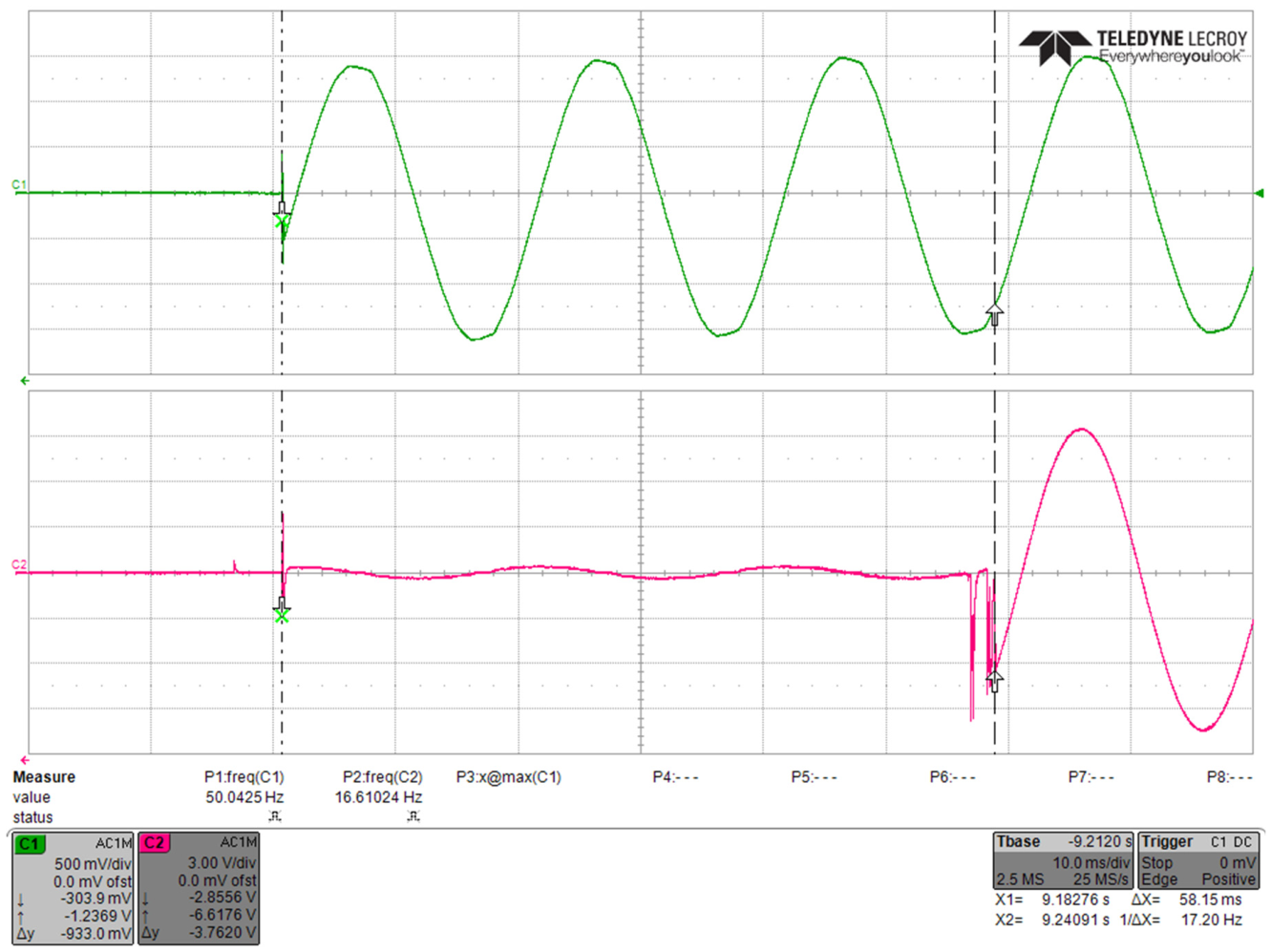
Figure 17 illustrates the waveform corresponding to this process, where the green signal represents the coil supply voltage, while the red signal indicates the voltage measured at the output of the power contacts. The measured time difference is Δt = 58.15 ms, representing the coil energization time of the contactor.
According to the data presented in
Table 3, the energization time ranges between 53 ms and 58 ms, with an average value of 56.68 ms for the first contactor and 56.28 ms for the second contactor. These values fall entirely within the intervals specified by the manufacturer, confirming both the proper operation of the contactors and the validity of the testing methodology employed.
Through these measurements, the time intervals corresponding to both the energization and de-energization of the contactor coils were determined under supply conditions of 230–240 V AC.
3.2. Comparison of Switching Times Between the Developed ATS, the Mid-Contact ATS, and the MCB-Based ATS—Main Power → Backup Power
To comparatively evaluate the switching times of the three ATS configurations analyzed, five tests were conducted for each device, measuring the transfer time from the main source (Main Power) to the backup source (Backup Power).
In the case of the developed ATS, the signal generated by the signal generator was applied simultaneously to the power contact inputs of both contactors. The oscilloscope probe was connected to their common output, allowing the determination of the time interval during which the output remained without voltage, corresponding to the transfer process.
In
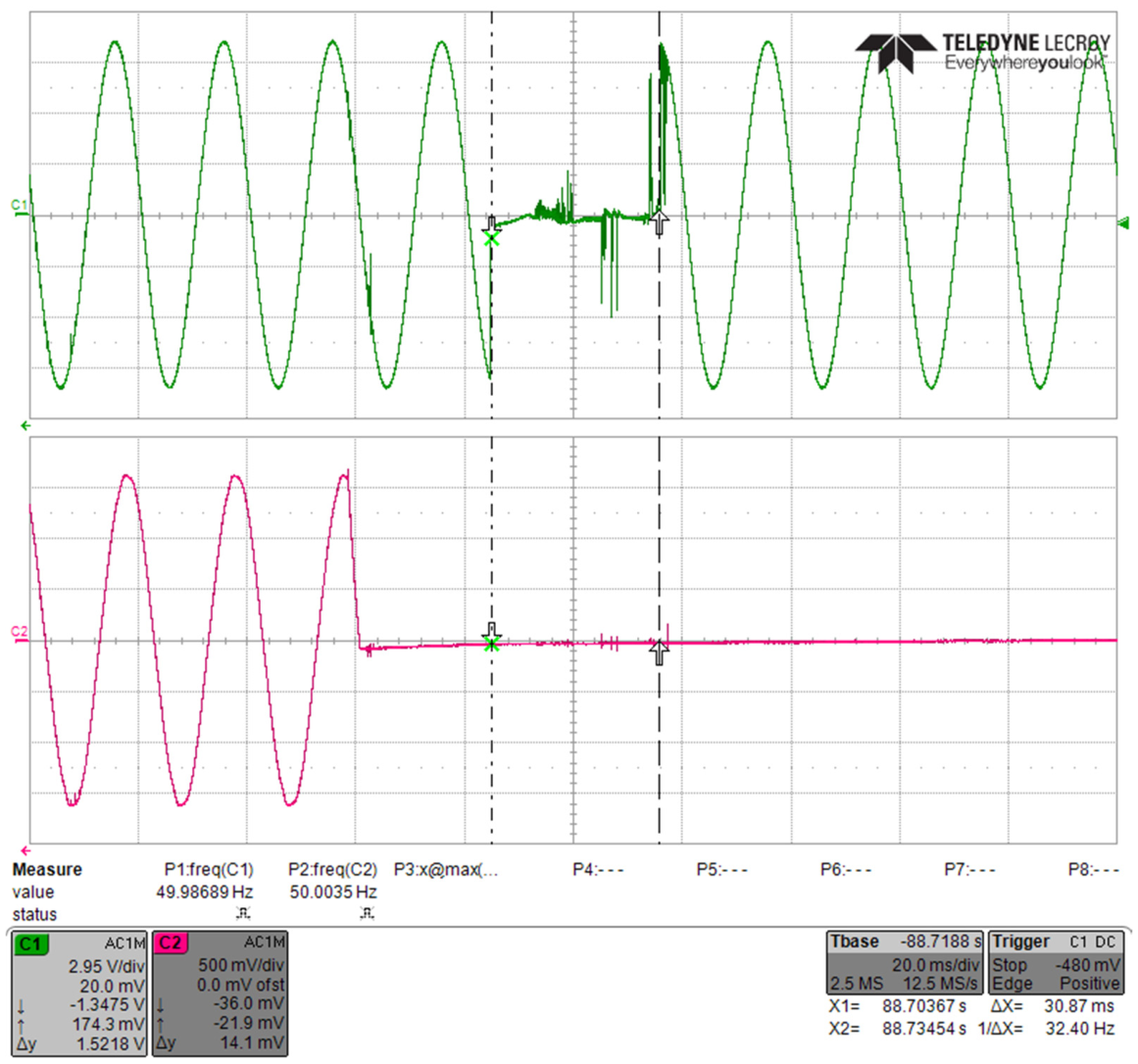
Figure 18, the green signal represents the voltage at the ATS output (supplying the loads), while the red signal corresponds to the supply voltage of the KM1 contactor coil, measured using the differential probe. A temporary interruption of the output voltage can be observed, with a duration of 30.87 ms, representing the transfer time between Main Power and Backup Power for the developed ATS.
The same testing methodology was applied to both the ATS with mid-contact switching and the ATS based on four-pole MCBs. The comparative results are summarized in
Table 4, where it can be observed that the average switching time for the developed ATS is 30.38 ms, which is longer than that of the mid-contact ATS (13.22 ms) but shorter than the switching time of the MCB-based ATS (36.9 ms).
3.3. Comparison of Switching Times Between ATS Devices—Backup Power → Main Power
To evaluate the transfer times from the backup source to the main source, five tests were also conducted for each ATS using the same experimental methodology.
The result obtained for the developed ATS is illustrated in
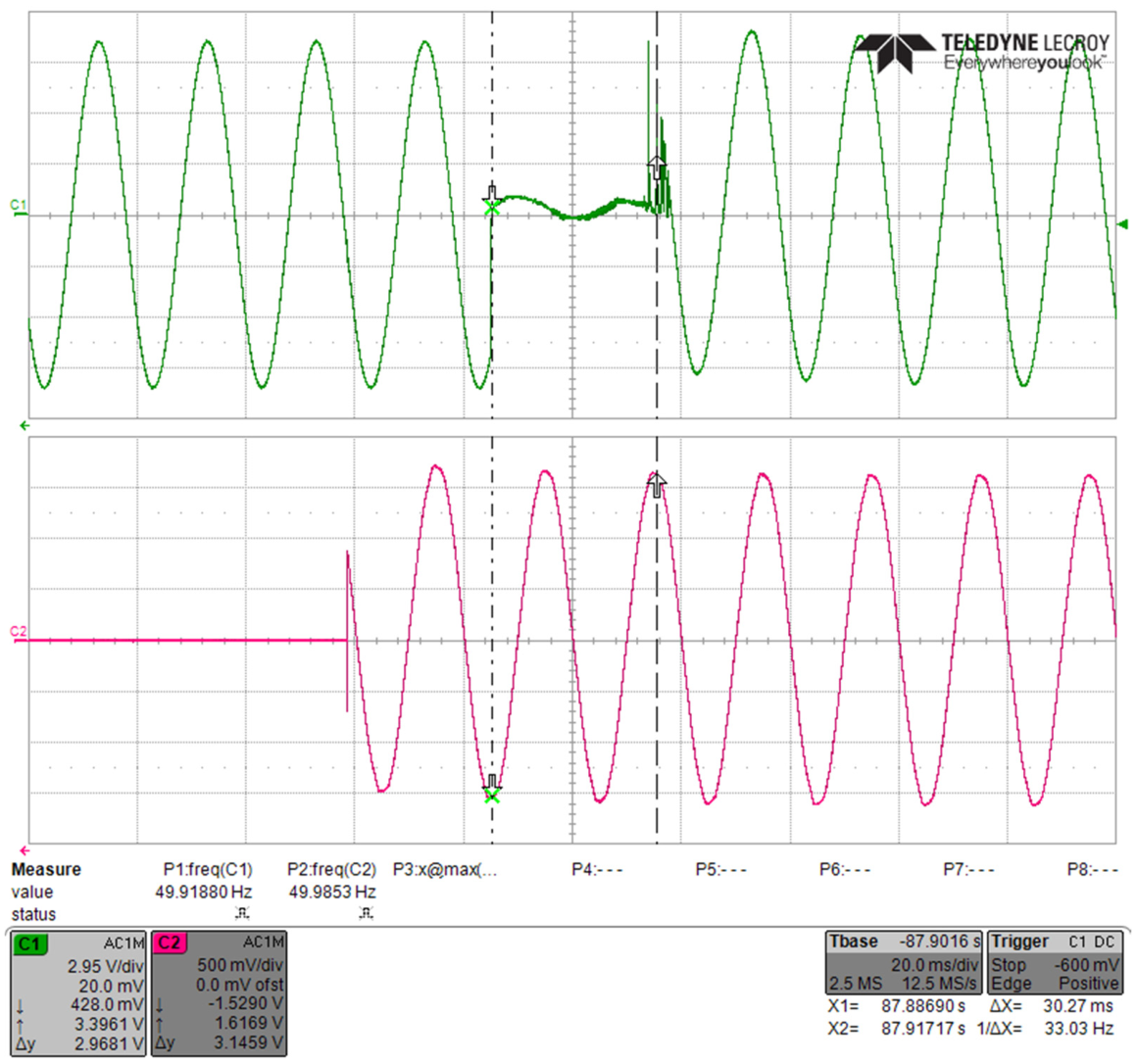
Figure 19, where the red signal indicates the energization of the contactor coil upon restoration of the grid voltage, followed by a temporary interruption of the output voltage, represented by the green signal, with a duration of 30.27 ms. This interval corresponds to the transfer time from Backup Power to Main Power.
The comparative values are summarized in
Table 5, where it can be observed that the average switching time from Backup Power to Main Power for the developed ATS is 28.94 ms, which is higher than that of the mid-contact ATS (11.78 ms) but significantly lower than the switching time of the ATS based on four-pole MCBs (67.5 ms).
3.4. Analysis of Switching Times as a Function of Grid Faults—Protection Activation for the Developed ATS
Unlike the other two solutions analyzed, the developed ATS incorporates protection functions implemented through the phase monitoring relay. In this context, additional tests were carried out to evaluate the switching times when protection mechanisms are triggered, specifically in the case of phase loss or neutral conductor loss.
The testing methodology was identical to that used in the previous experiments.
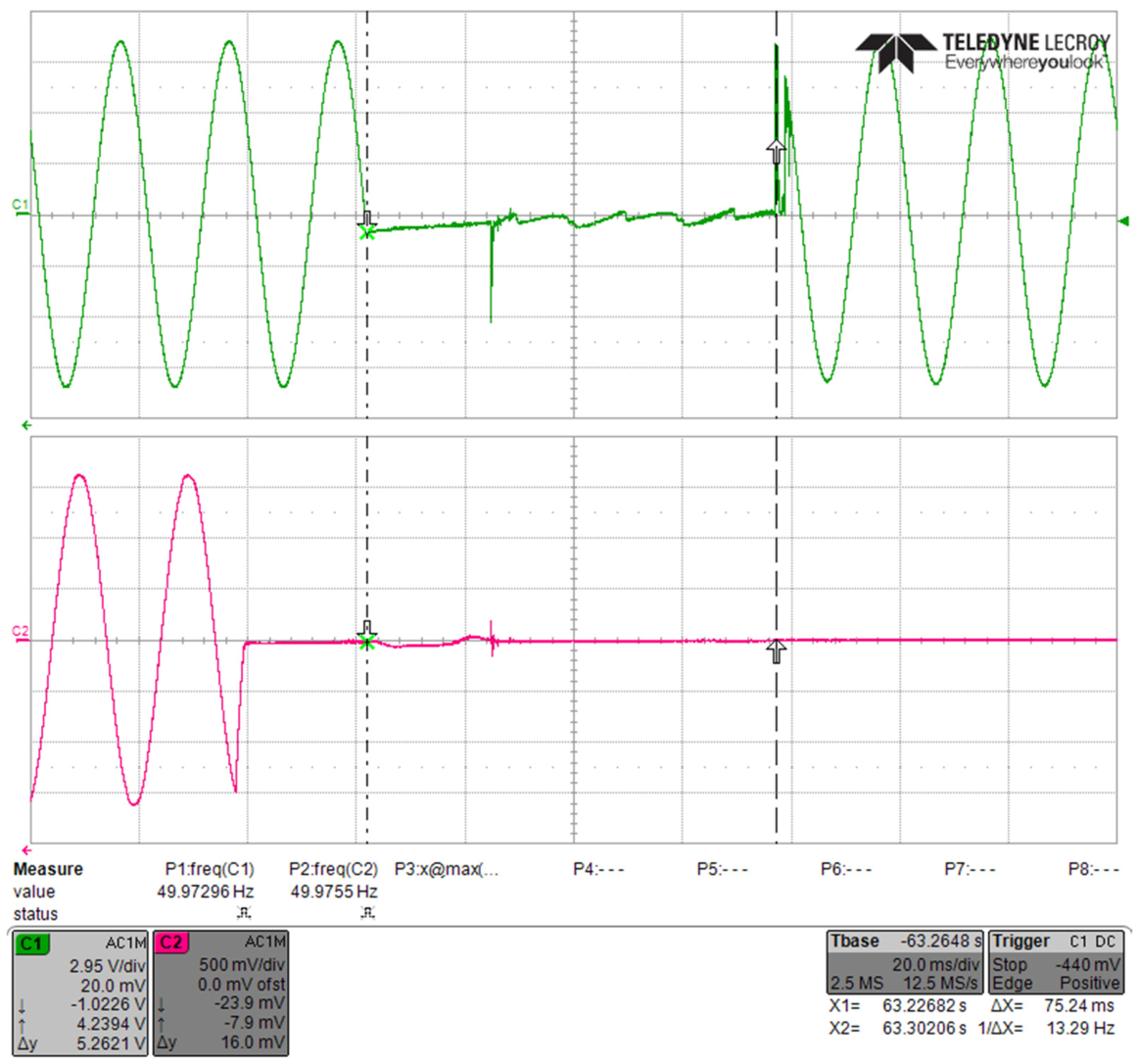
Figure 20 illustrates a measured switching time of 75.24 ms, representing the highest value recorded during the tests and therefore the worst-case scenario. Although such a situation is relatively uncommon in electrical networks supplying residential loads, the longer interruption duration may be noticeable to the end user, particularly in the case of high-power equipment or devices with low electrical inertia, such as switched-mode power supplies with insufficient primary-side capacitance to sustain the output voltage during the transfer interval, which typically requires at least 100 ms to ensure a seamless transition imperceptible to the user.
The results presented in
Table 6 indicate that the average switching time when phase L1 is lost is 78.76 ms, a value significantly higher than the switching times obtained for the loss of phase L2 (28 ms), phase L3 (29.12 ms), or the neutral conductor (29 ms). This difference can be explained by the fact that the coil of contactor KM1 is supplied from phase L1, which requires both the de-energization of KM1 and the subsequent energization of the KM2 contactor coil before the transfer to the backup source can be completed.
3.5. Analysis of Switching Times upon Restoration of Normal Grid Parameters—Protection Deactivation
Additional tests were performed to evaluate the deactivation of the protection functions, measuring the switching times from Backup Power to Main Power once the grid parameters returned to their normal operating ranges.
The values obtained, presented in
Table 7, indicate normal switching times, with average values of 24.9 ms for neutral loss, 27.8 ms for L1 loss, 30.9 ms for L2 loss, and 21.9 ms for L3 loss.
3.6. Analysis of the Time Differences Between the Control Signals of the Internal Relays in the Phase Monitoring Relay
To optimize the switching time of the developed ATS, the phase monitoring relay ETI HRN-100 [
29] was disassembled and analyzed with respect to its internal control architecture. This investigation revealed the presence of two electromechanical relays, model Omron Corporation (Kyoto, Japan) G5Q-14 DC12, each independently driven by the device’s microcontroller.
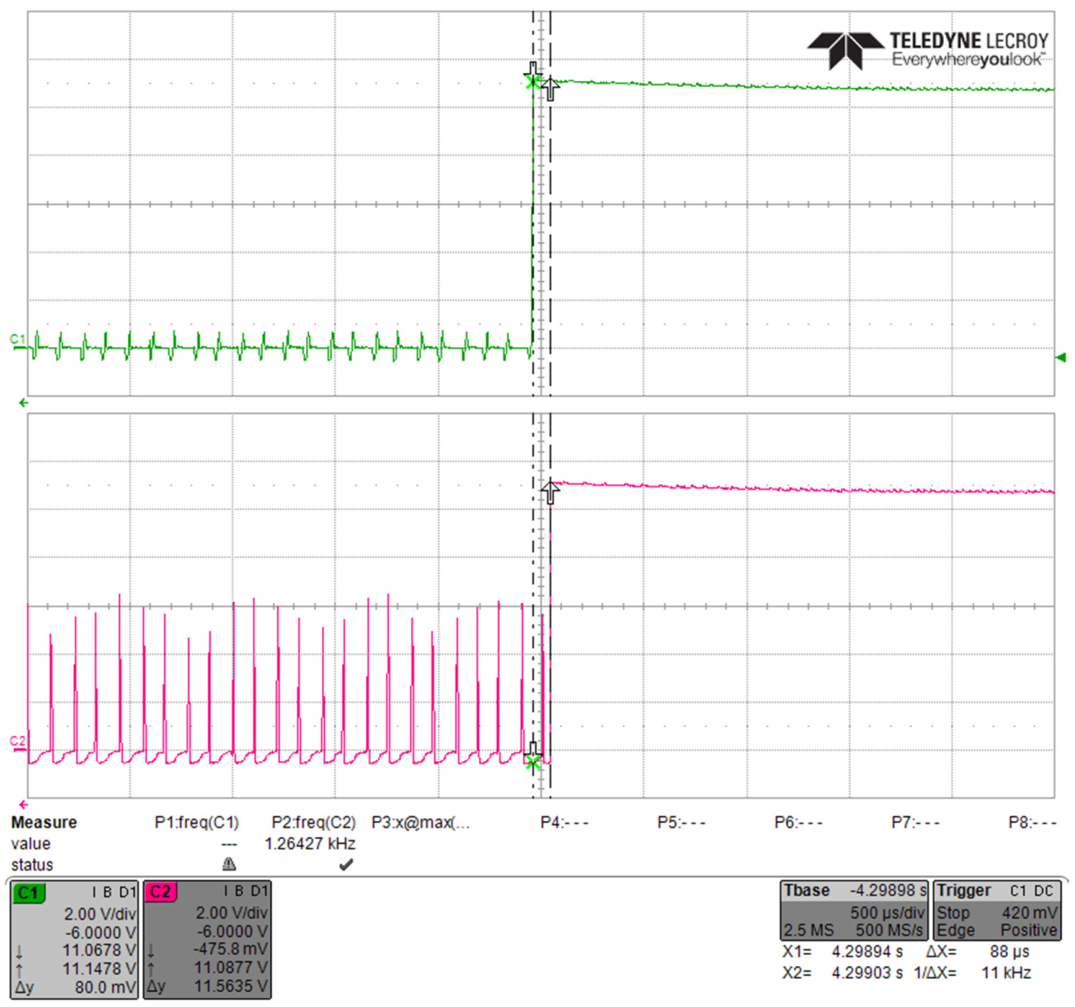
The time differences between the energization and de-energization commands of the two relays were measured by connecting oscilloscope probes directly across the coils of relays RL1 and RL2. In the first test, illustrated in
Figure 21, a time difference of approximately 88 µs was measured between the command issued by the microcontroller to the first relay RL1 (green signal) and the command sent to the second relay RL2 (red signal).
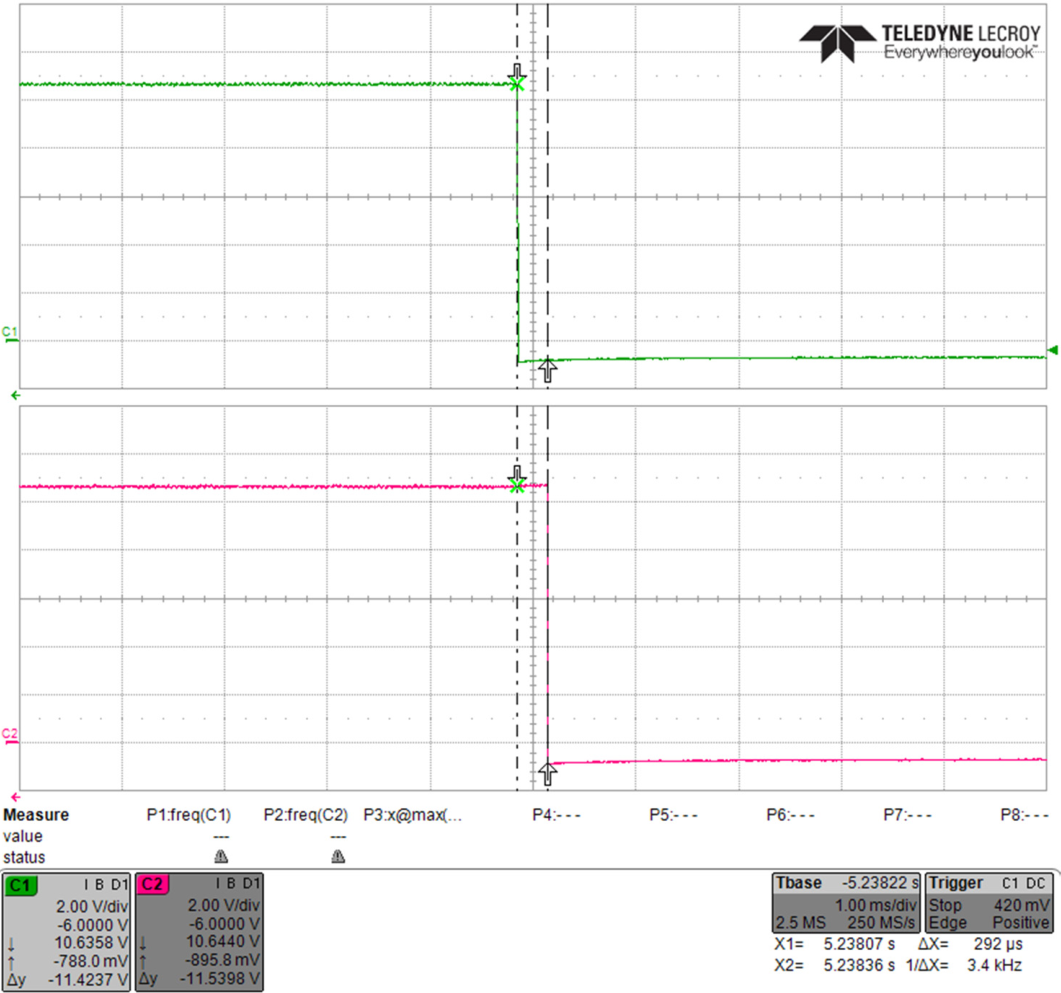
Figure 22 illustrates the situation corresponding to the de-energization command, where it can again be observed that the signal associated with relay RL1 (green) is generated prior to the signal associated with relay RL2 (red). This sequencing confirms that the microcontroller consistently actuates relay RL1 before relay RL2, both during energization and de-energization events.
The noise observed on the measured signals is attributed to the measurement method, since the acquisitions were performed using standard oscilloscope probes, which required operating the oscilloscope in floating mode (i.e., removing the earth connection) in order to connect the GND reference to the 0 V potential of the phase monitoring relay. When a battery-powered oscilloscope was used, these disturbances were no longer observed, confirming that their origin was external to the circuit under test and that they did not affect the actual operation of the relay control circuitry.
After performing five measurements, the values summarized in
Table 8 indicate an average time difference of 159.6 µs between the energization commands of the two relays, and 282.2 µs between their de-energization commands. It was observed that the relay associated with contacts 15–16–18 is consistently actuated faster than the relay corresponding to contacts 25–26–28, both during the energization and de-energization processes.
3.7. Final Optimization of the Switching Time of the Developed ATS
Based on the results obtained from the temporal analysis of the internal relays, an optimized control scheme for the contactors was implemented. In this configuration, the coil of contactor ABB KM2 is connected to contact 15 (common) and contact 16 (normally closed) of the first relay RL1, while the coil of contactor KM1 is connected to contact 25 (common) and contact 28 (normally open) of the second relay RL2.
With this arrangement, during the transfer from Backup Power to Main Power, the ETI phase monitoring relay becomes energized, verifies the grid parameters, and first issues a command to Omron relay RL1. RL1 switches from the normally closed state to the normally open state, causing the de-energization of contactor KM2. After an average delay of approximately 150 µs, the Omron relay RL2 is actuated, switching from the normally open state to the normally closed state, thereby allowing the energization of contactor KM1 and completing the transfer to the main power source.
Through this controlled sequencing and the intentional delay between the relay commands, the mechanical interlock system of the contactors does not negatively affect the overall switching time. Consequently, the total transfer time is primarily limited by the inherent mechanical and electrical characteristics of the contactors themselves.
A similar behavior is observed during the transfer from Main Power to Backup Power. When the ETI phase monitoring relay loses its supply, it first actuates the Omron relay RL1, which switches from the normally open state to the normally closed state, resulting in the energization of contactor KM2. Subsequently, after an average delay of approximately 280 µs, Omron relay RL2 is actuated, switching from the normally closed state to the normally open state, which leads to the de-energization of contactor KM1.
Ideally, in the event of supply loss, it would have been preferable for the deactivation sequence to occur in the opposite order, meaning that Omron relay RL2 should be actuated first, followed by Omron relay RL1. However, considering the internal architecture of the ETI HRN-100 phase monitoring relay, the implemented solution represents the optimal configuration achievable without performing internal hardware modifications.
To further reduce the switching time of the developed ATS below the average value of 30 ms, the initial contactors ABB AF38-40-00-13, whose coils can operate with both AC and DC supply, were replaced with ABB AFC16-40-00-88 contactors, designed exclusively for AC coil operation. The main objective of this modification was to reduce the mechanical energization and de-energization times, which are typically higher in contactors equipped with universal AC/DC coils.
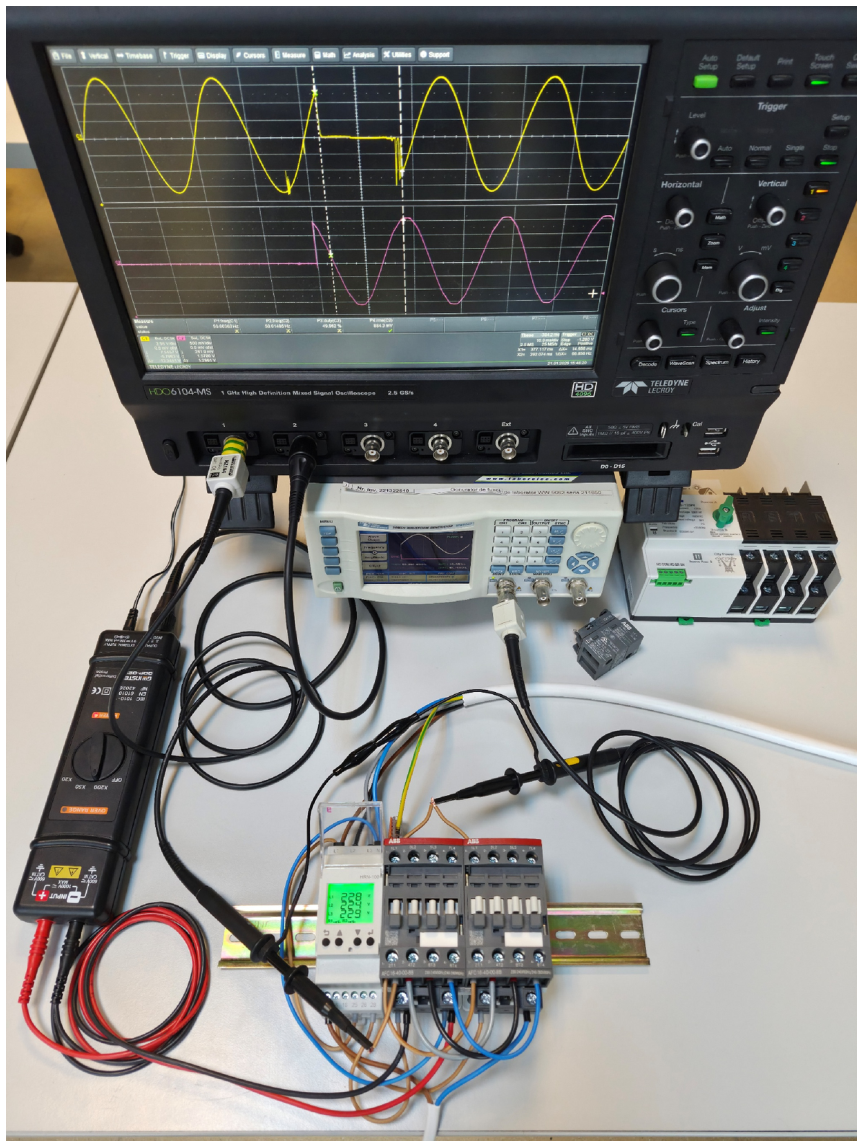
The experimental configuration used to evaluate the new contactors is shown in
Figure 23. The testing methodology was kept identical to that used in the previous experiments, ensuring the direct comparability of the obtained results and eliminating the influence of external factors on the measurements.
The experimental results obtained with the new contactors demonstrate a significant reduction in switching times, of approximately 50% compared to the initial configuration. The values summarized in
Table 9 indicate an average switching time of 15.4 ms for the transfer from Backup Power to Normal Power, and an average time of 14.5 ms for the transfer from Normal Power to Backup Power.
Through this optimization, the switching times of the developed ATS become comparable to those of solutions based on mid-contact switching, but without inheriting their constructive disadvantages. However, it should be noted that contactors with coils capable of operating in both AC and DC offer the advantage of more stable actuation under supply voltage variations, which may be relevant in applications where the stability of the control power supply cannot be fully guaranteed.
3.8. ATS Load Testing Under Balanced and Unbalanced Conditions
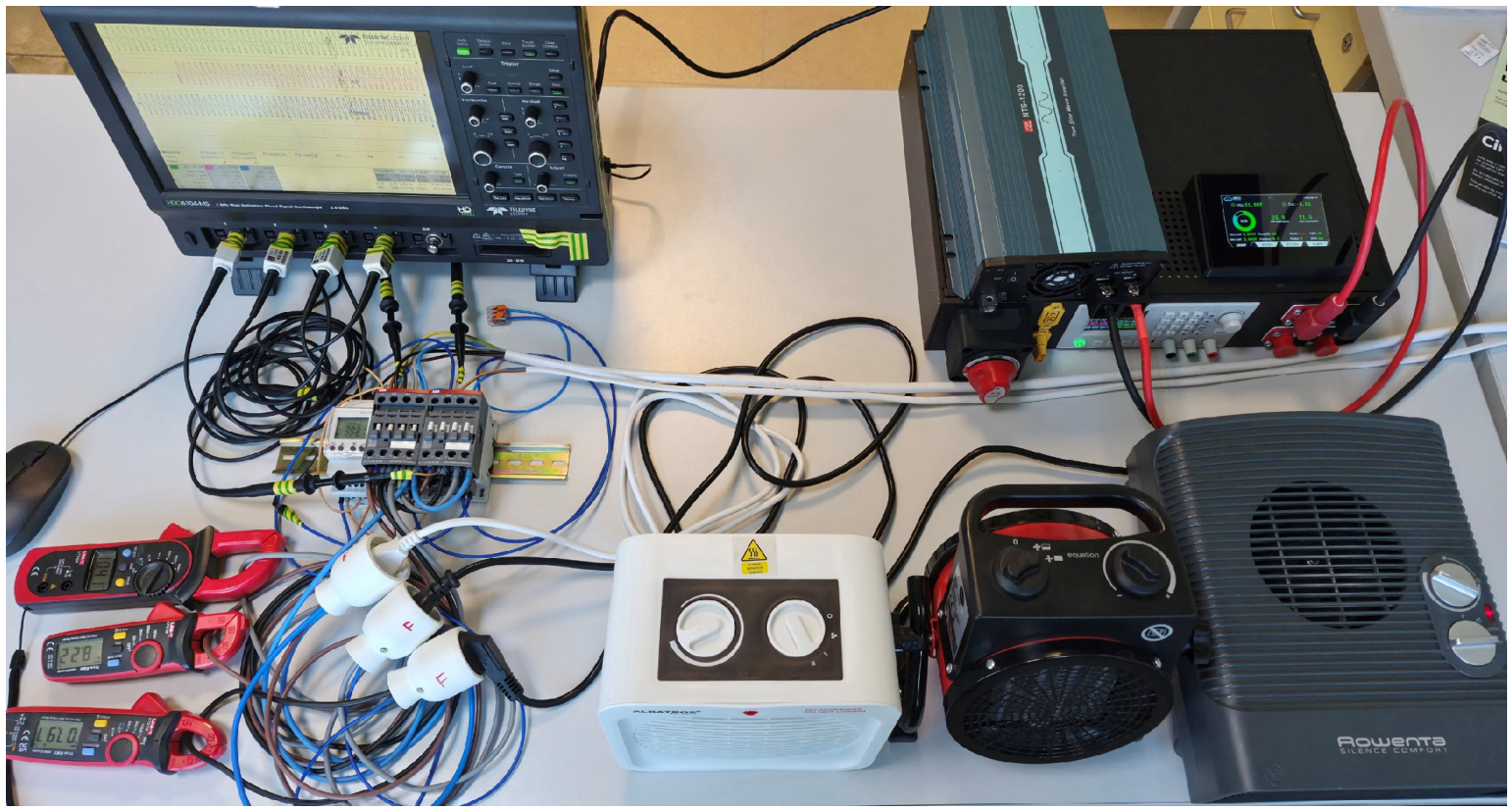
To validate the switching time measurements obtained under no-load conditions and to assess ATS performance under representative residential load configurations, a dedicated load test setup was developed, as illustrated in
Figure 24.
The test methodology retained the signal generator approach described in
Section 2.5 for the ATS input signals, ensuring operator safety and enabling repeatable measurements across multiple test configurations. To supply real resistive loads at mains voltage while maintaining electrical isolation from the laboratory supply network, the oscilloscope was operated in floating mode [
33], powered by a custom 48 V battery pack through a DC-AC inverter Mean Well Enterprises Co., Ltd. (New Taipei City, Taiwan) NTS-1200-212EU. A non-earthed plug was used for the load connections, providing additional protection for both operators and equipment.
Four oscilloscope channels were configured; all probes were set to 10:1 attenuation as follows:
Channel 1—common force output of the ATS (load connection point);
Channel 2—input of contactor KM1 (grid source);
Channel 3—input of contactor KM2 (backup source);
Channel 4—common neutral of the ATS.
Three single-phase resistive heaters were connected, one per phase, as the representative load. Phase currents were monitored using three Uni-Trend Technology (China) Co., Ltd. (Dongguan, China) clamp ammeters (UT210B on L1, UT210E on L2, UT202A on L3), with each clamp positioned around the respective phase conductor.
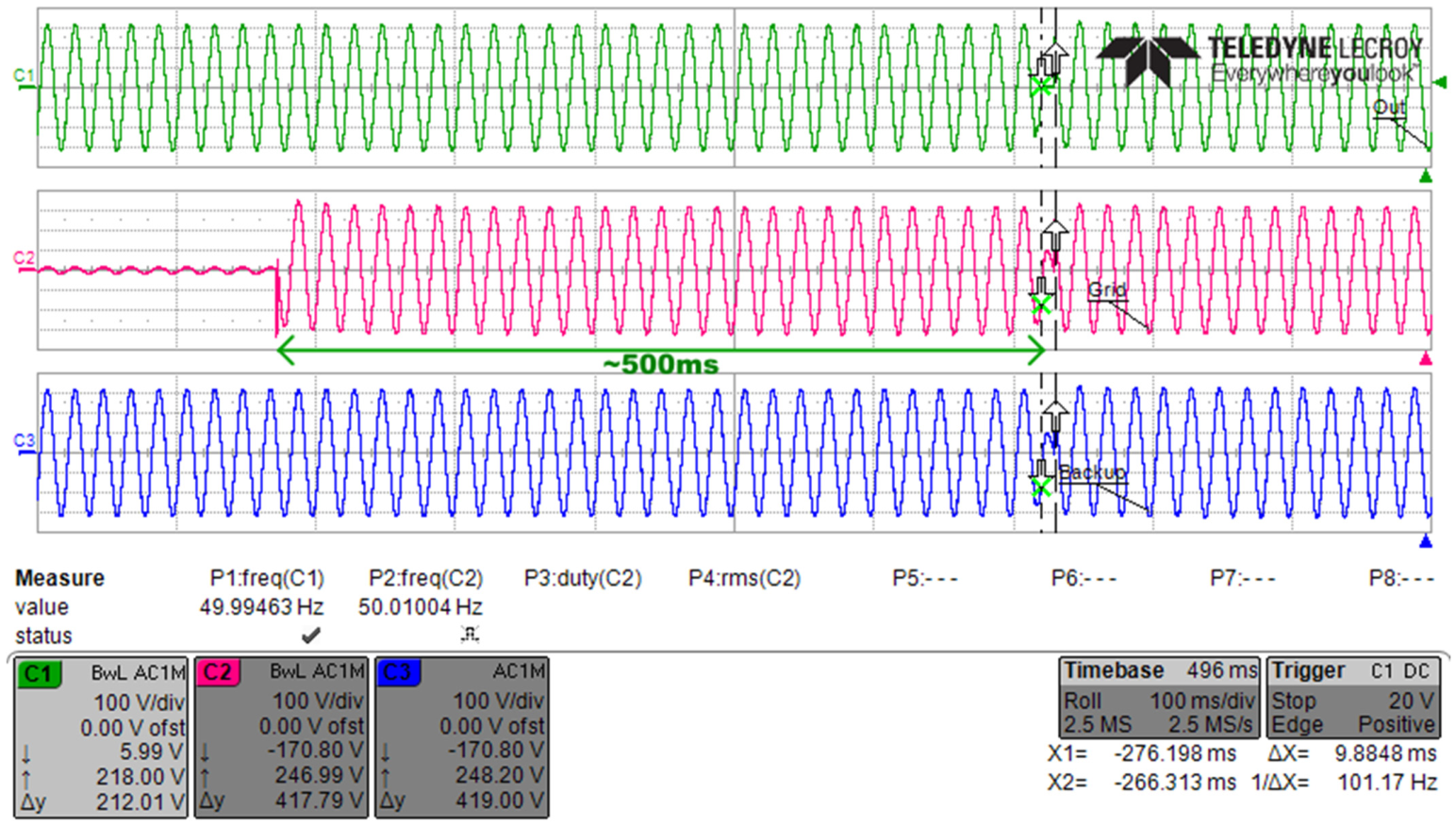
Figure 25 presents a representative oscilloscope capture of a Backup-to-Grid transfer under unbalanced load conditions, with a 2 kW resistive heater connected on phase L2 and phases L1 and L3 unloaded. Following the detection of grid restoration, the phase monitoring relay imposed the configured ON DLY delay of 0.5 s before issuing the contactor energization command (Channel 2, pink). The measured transfer time from relay command to completed contact closure was 9.88 ms (Channel 1, green), consistent with the no-load laboratory results reported in
Section 3.1.
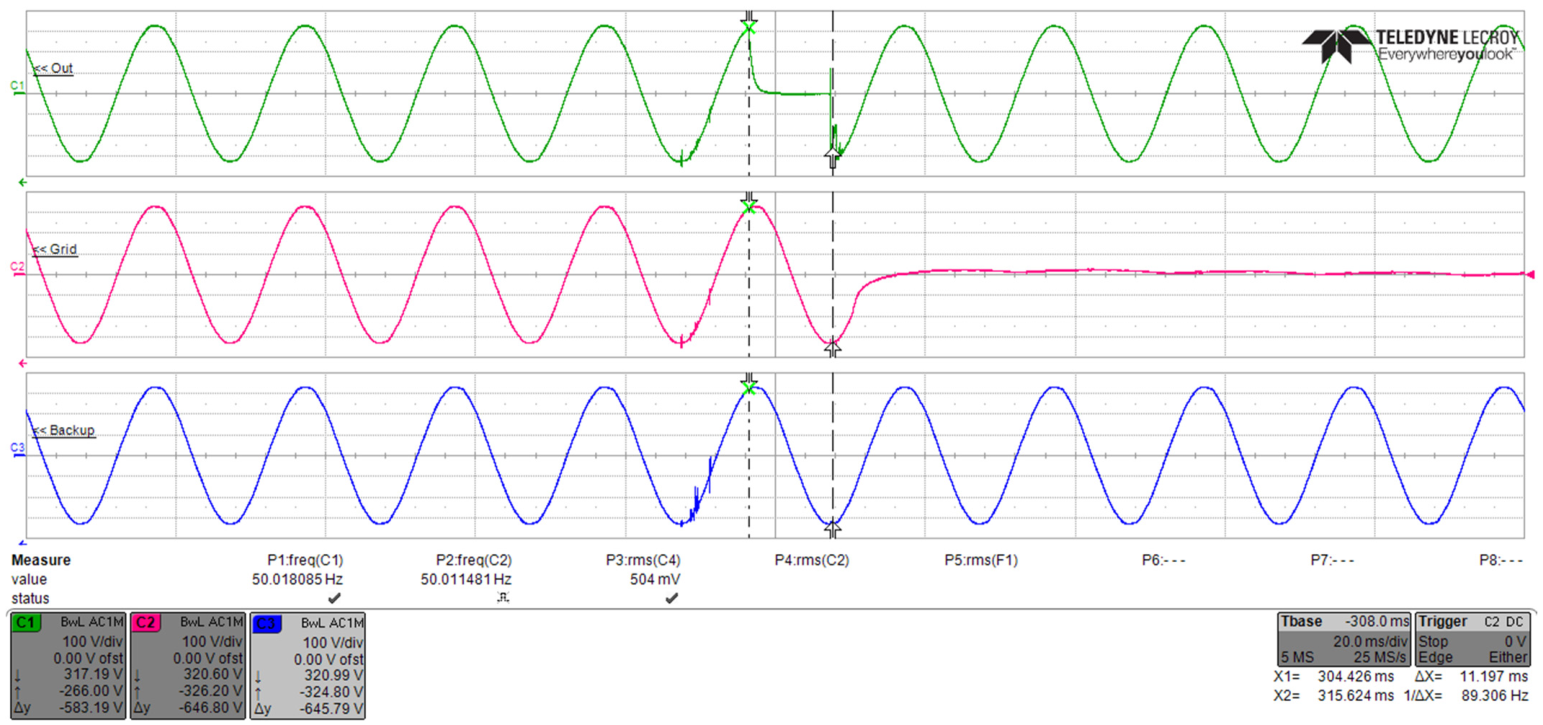
Figure 26 presents an oscilloscope capture of a Grid-to-Backup transfer under balanced resistive load conditions, with a 2 kW resistive heater connected on each of the three phases. The grid signal (Channel 2, pink) is interrupted, while the backup signal (Channel 3, blue) remains continuously present throughout the transfer. The measured transfer time at the ATS load output (Channel 1, green) is 11.19 ms, consistent with the no-load laboratory results reported in
Section 3.1.
The load testing results confirm that the switching times of the proposed ATS remain consistent under both balanced and unbalanced resistive load conditions. The measured transfer time of 9.88 ms (Backup-to-Grid, unbalanced load—2 kW on phase L2 only) and 11.19 ms (Grid-to-Backup, balanced load—approximately 2 kW per phase) are in close agreement with the no-load laboratory measurements reported in
Section 3.1, with deviations within the normal measurement uncertainty range. These results demonstrate that the electromechanical switching performance of the proposed ATS is not significantly affected by the connected load current within the tested range, which is consistent with the operating principle of the contactor: the closing and opening dynamics are governed by the electromagnetic actuator and the mechanical spring system, both of which are largely independent of the load current at the rated AC-1 operating conditions.
4. Discussion
The switching times measured for the proposed ATS, averaging 30.4 ms (main to backup) and 28.9 ms (backup to main) in the DC coil configuration, and 15.7 ms and 14.1 ms respectively in the AC coil configuration, are consistent with the performance envelope reported for contactor-based ATS solutions in the literature, where transfer times generally range from tens of milliseconds to several seconds depending on control architecture and intentional delays [
3,
5,
8,
9,
10]. The AC coil variant achieves transfer times comparable to those of the changeover-contact commercial ATS evaluated in this study (13.2 ms and 11.8 ms), while eliminating the structural failure modes identified in that device. Relative to the MCB-based commercial ATS (average 36.9 ms main-to-backup and 67.5 ms backup-to-main), both proposed configurations offer a measurable improvement. It should be noted that the switching times reported here reflect exclusively the electromechanical response of the contactor and the internal relay sequencing; in a complete installation, the phase monitoring relay’s configurable detection delay, typically set between 0.1 and 10 s depending on the application, would be added to these values before load interruption is initiated.
It is important to frame the switching performance results in the context of the primary design objective of the proposed ATS, which is safety and fault tolerance rather than minimum transfer time. Under normal source-transfer conditions, both contactor variants achieve competitive transfer times (30.4 ms and 15.7 ms respectively), which are adequate for the vast majority of residential load equipment. The worst-case transfer time of 78.76 ms, occurring specifically under L1-phase loss, is a direct architectural consequence: the KM1 contactor coil is supplied from phase L1, and its de-energization upon L1 loss depends on the natural collapse of that supply voltage rather than on an active relay command. This behavior is a known characteristic of this contactor supply architecture and represents a deliberate design tradeoff: the simplicity and reliability of a direct coil supply connection is retained at the cost of a longer worst-case transfer time under this specific, relatively uncommon fault scenario. This tradeoff is explicitly acknowledged rather than presented as a limitation to be minimized.
From a safety perspective, the proposed architecture addresses all three principal failure categories identified in the commercial devices evaluated in
Section 2.2 and
Section 2.3. First, neutral conductor continuity is guaranteed by design: the neutral path passes through solid metallic links rather than switchable contacts, eliminating the neutral-loss failure mode that caused the overvoltage event documented in
Section 2.1. Second, simultaneous energization of both contactors is prevented by a dual interlocking strategy combining electrical interlocking through the monitoring relay logic with a mechanical interlock (ABB VM4), ensuring that no single-point failure, whether in the control circuit or the mechanical mechanism, can result in both sources being connected simultaneously. Third, all control circuits are individually fuse-protected, so a fault in any coil circuit produces a controlled de-energization rather than uncontrolled overheating. Neither commercial ATS evaluated in this study implements any of these three protective measures, and the mid-contact device additionally lacks any fuse protection for its solenoid coils, a condition that, as demonstrated in
Section 2.2, can lead to thermal runaway under a limit-switch failure.
The choice between the DC coil and AC coil contactor variants involves a tradeoff between switching speed and actuation stability. The DC coil implementation (ABB AF38-40-00-13) offers unconditional electromagnetic force stability across the full rated voltage range, as the rectified supply eliminates the dependence on instantaneous AC waveform amplitude, virtually eliminating the risk of contact chattering under grid voltage fluctuations. The AC coil implementation (ABB AFC16-40-00-88) reduces average transfer time by approximately 50%, from ~30 ms to ~15 ms, at the cost of a theoretical susceptibility to contact chattering when the coil supply falls outside the 85–110% nominal voltage window [
30,
31]. In the proposed system, this risk is effectively mitigated by the phase monitoring relay, which is configured with voltage thresholds that keep the contactor coil within its safe operating range at all times; any grid condition that would otherwise induce chattering triggers a controlled transfer before the instability threshold is reached. Both variants are therefore considered viable, with the DC coil solution recommended where supply voltage stability cannot be guaranteed, and the AC coil solution preferred where minimizing transfer time is the primary design objective.
The phase relay timing analysis presented in
Section 3.6 revealed an average sequencing asymmetry of 159.6 µs (energization) and 282.2 µs (de-energization) between the two internal Omron relays. By deliberately assigning the faster relay (RL1) to the normally closed contact driving KM2, the contactor de-energization always precedes energization of the opposing contactor by at least this interval, rendering the mechanical interlock non-limiting for total transfer time under normal conditions. This micro-sequencing approach, derived through reverse engineering of a commercial monitoring relay, represents a practical optimization method applicable to any ATS design employing a multi-relay monitoring device, and its contribution to transfer time reduction has not been previously reported in the literature for this class of residential ATS.
To substantiate the cost-competitiveness of the proposed solution,
Table 10 presents a detailed bill of materials with indicative market prices (Romanian market, 2025; 1 EUR ≈ 5 RON). The table is organized into three sections: mandatory protection components required for any compliant grid-connected photovoltaic installation (regardless of ATS choice), the incremental components needed to add ATS functionality, and optional visual indicators.
Table 11 provides a comparative overview of the proposed ATS against low-cost commercial alternatives.
A key observation emerging from this analysis concerns the cost structure of any compliant residential photovoltaic installation. In accordance with applicable grid connection requirements, a phase monitoring relay providing overvoltage, undervoltage, frequency, asymmetry, and neutral loss protection, together with at least one grid disconnection contactor, represent mandatory components regardless of whether an automatic transfer switch is installed. The proposed solution integrates both protection and automatic transfer functions within a single coherent architecture, sharing these mandatory components between the two functions. A further design efficiency is that the fuse protecting phase L1 feeding the monitoring relay (FH3) simultaneously protects the KM1 contactor coil, eliminating the need for a dedicated additional fuse holder. As a result, the true incremental cost of the ATS functionality, beyond what must be installed in any case for grid protection, is limited to one additional contactor (approximately 100–140 EUR) and the ABB VM4 mechanical interlock (approximately 10–12 EUR). When evaluated on this basis, the proposed solution is cost-competitive with, or less expensive than, a low-cost commercial ATS supplemented with the mandatory protection components it does not include.
Beyond the cost comparison,
Table 12 provides a functional and safety overview of the three ATS configurations across ten parameters. The evaluation confirms that the low-cost commercial devices provide only the basic switching function, without any of the protective features required for safe operation in a grid-connected photovoltaic installation. When supplemented with mandatory protection components, the augmented configuration approaches the functional profile of the proposed solution, but still lacks dedicated control circuit fuse protection and retains a switchable neutral contact, the failure mode directly responsible for the overvoltage event documented in
Section 2.1. The proposed ATS integrates all functions within a single coherent architecture, with the neutral conductor routed through solid metallic links rather than switchable contacts, and with dual interlocking, both mechanical (ABB VM4) and electrical (relay logic), preventing simultaneous energization of both contactors under any single fault condition.
From a long-term reliability perspective, the ABB AF38-40-00-13/ABB AFC16-40-00-88 contactor is rated for 10,000,000 mechanical operations under AC-1 conditions [
30]. Under a conservative residential worst-case scenario of 50 switching events per day, encompassing daily grid interruptions, protection activations, inverter mode transitions, and maintenance operations, the projected operational lifetime exceeds 500 years. Even at 500 switching events per day, a figure substantially exceeding typical EU residential grid reliability statistics, the projected lifetime remains above 50 years, consistent with the intended service life of a photovoltaic installation.
Regarding the ETI HRN-100 monitoring relay, the manufacturer datasheet specifies 10,000,000 mechanical operations and 100,000 electrical operations under AC-1 conditions [
29]. Under the same conservative residential scenario of 50 switching events per day, the projected electrical lifetime exceeds 5 years, while the mechanical lifetime exceeds 500 years.
Regarding thermal behavior, infrared thermography performed during load testing with a a FLIR One Pro thermal imaging camera (FLIR Systems, Inc., Wilsonville, OR, USA) thermal imaging camera (
Figure 27) at an unbalanced load condition (approximately 32 A on phase L1, near the contactor’s AC-1 rated current) recorded temperatures of 34.7 °C and 42.0 °C on the contactor and relay assembly. In both measurements, the connecting conductors reached higher surface temperatures than the switching components themselves, confirming correct thermal dimensioning and the absence of abnormal thermal stress on the contactors or relay at rated operating conditions.
Several limitations of the present study should be acknowledged. The field deployment of the DC coil implementation in the affected residential installation, initiated in November 2025, has accumulated approximately five months of continuous operation at the time of this revision, with no switching failures, contact chattering, or anomalies recorded. While this period is insufficient for statistically significant empirical conclusions regarding long-term contact wear or relay degradation [
34,
35], the rated specifications of the components employed provide a strong theoretical basis for long-term reliability: as demonstrated in
Section 4, the ABB AF38-40-00-13 contactor is rated for 10,000,000 mechanical operations under AC-1 conditions [
30], corresponding to projected lifetimes well in excess of 50 years under realistic residential switching frequencies. Extended field monitoring of at least 12 months with logged switching event data is nonetheless identified as future work to substantiate these projections empirically. The study evaluates only two representative low-cost ATS construction archetypes, which are among the most prevalent types in the EU residential market but may not represent all variants available globally. Finally, the proposed ATS has not been submitted to formal type-testing under IEC 60947-6-1 [
15], and the Class CC designation reflects design-intent alignment rather than certified compliance; formal certification testing is identified as a direction for future work.
5. Conclusions
The present study aimed to conduct a detailed analysis of a real overvoltage event that occurred in a three-phase residential electrical installation equipped with a photovoltaic system and an Automatic Transfer Switch (ATS). In addition, a comparative evaluation of several existing ATS solutions was performed in order to identify their limitations and to develop an optimized solution in terms of safety and switching performance.
The analysis of the incident revealed that the loss of the neutral conductor during backup operation, combined with unbalanced phase loading, resulted in significant overvoltages on certain phases. Although this phenomenon is well understood theoretically in three-phase electrical systems, it is rarely addressed in practical residential installations, and its consequences can be severe, as demonstrated by the failure of switching power supply components in several connected devices. The study clearly shows that the absence of reliable and safe neutral switching in an ATS constitutes a major risk for residential consumers.
Following the comparative analysis of two commercial ATS solutions, a mid-contact ATS and an ATS based on four-pole MCBs, multiple constructive vulnerabilities were identified. These include the dependence on mechanical end-of-travel limiters to stop the actuation mechanism, the lack of dedicated protection for the control circuits, and the absence of precise control over the switching sequence. In the event of failure of these elements, there are real risks of overheating in coils or drive motors, mechanical degradation of internal mechanisms, and, in extreme cases, the potential emergence of a fire hazard. These findings demonstrate that certain commercially available devices do not provide an adequate level of safety for use in critical residential electrical installations.
The ATS developed in this study was designed specifically to address the limitations identified in the analyzed commercial solutions, with a strong emphasis on safety, control, and operational predictability. The inclusion of dedicated fuses for the control circuits of the contactor coils, as well as for the supply of the phase monitoring relay, provides an additional layer of protection for both the equipment and the residential electrical installation. In the event of a fault, the system transitions to a safe operating state, preventing the escalation of the incident.
A key contribution of this work is the detailed experimental analysis of switching times. By employing oscilloscope measurements with differential probes, the actual energization and de-energization times of the contactors were determined, confirming their compliance with the manufacturer’s datasheet specifications. Furthermore, through the comparative testing of the three ATS configurations, it was demonstrated that the developed ATS achieves competitive switching times, positioned between the other two analyzed solutions, while offering a significantly higher level of safety and functional control.
The final optimization of the switching time, achieved through the analysis of the timing differences between the internal relays of the phase monitoring relay, represents a distinctive contribution of this study. Identifying delays on the order of hundreds of microseconds and intentionally using them to establish a correct and controlled switching sequence for the contactors reflects an advanced engineering approach. Through this method, the mechanical interlock of the contactors no longer negatively affects the total transfer time, which becomes primarily limited by the intrinsic mechanical characteristics of the contactor itself.
In conclusion, the study demonstrates that designing a safe and high-performance ATS involves far more than implementing a basic functional switching scheme. It requires a comprehensive analysis of the real behavior of components, potential fault scenarios, and the interaction between system subsystems. The proposed solution validates that, through careful design and rigorous experimental testing, it is possible to develop an automatic transfer system tailored to the requirements of modern residential installations with multiple energy sources, providing a high level of safety, reliability, and operational predictability.