Article

Magnetic Levitation Triboelectric Nanogenerator for Vibration Monitoring of Hydroelectric Units

by
Yanhui Wang
1,
Xiao Zhang
1,*,
Song Xu
2,
Futian Geng
1,
Da Che
1,
Guanzheng Xu
1,
Siyu Zhang
1,
Fei Zhong
1 and
Jianmei Chen
3,*
1
School of Energy and Power Engineering, Changchun Institute of Technology, Changchun 130012, China
2
Hubei Branch of CGN New Energy Investment Co., Ltd., Building A, Huitong New Changjiang Center, No. 6, Xudong Street, Wuchang District, Wuhan 430200, China
3
School of Physics, Northeast Normal University, 5268 Renmin Street, Changchun 130024, China
*
Authors to whom correspondence should be addressed.
Energies 2026, 19(10), 2344; https://doi.org/10.3390/en19102344
Submission received: 14 March 2026 / Revised: 30 April 2026 / Accepted: 11 May 2026 / Published: 13 May 2026

Abstract

To address dependence on external power and the limited capability of conventional hydroelectric units to detect low-amplitude vibrations, this work introduces a self-contained, highly accurate monitoring device. The design incorporates a magnetically levitated configuration, with triboelectric films placed on both the upper and lower faces of the floating magnet. Under minor oscillations, magnetic repulsion increases the relative displacement between the friction layers, producing a substantial voltage that permits low-level vibration sensing. A surrounding induction coil responds to the levitated pole’s vertical motion; this motion intersects the magnetic flux, generating a current that provides stable energy for wireless data transmission. Experimental outcomes confirm a detection limit of 0.1 mm. At an amplitude of 1 mm and a load of 1000 Ω, the system achieves a maximum output of 9 mW and a power density of 1.587 W/m2, ensuring reliable power. This configuration provides a new pathway for monitoring vibrations in hydroelectric turbine generators.

1. Introduction

Accurate monitoring of hydraulic turbine units’ operational status during an operation is critical for ensuring long-term stable performance. As essential monitoring components, vibration sensors provide real-time insights into equipment health conditions, vibration characteristics, and potential fault indicators. However, existing vibration sensors face technical challenges, including power self-sufficiency limitations and high manufacturing costs [1,2]. Traditional vibration monitoring systems still exhibit limitations in the vibration amplitude range and sensitivity, particularly in the poor detection of low-amplitude vibrations and the difficulty in capturing subtle vibration variations. These shortcomings not only hinder precise evaluation of turbine operational status but may also delay early fault warnings, posing operational risks to equipment integrity [3]. There is therefore an urgent need for innovative sensor technologies that would overcome current technical constraints, enhance monitoring accuracy, achieve self-powered operation, and reduce production costs [4].
In 2012, Professor Wang Zelin’s team invented the nano-frictional electric generator (TENG), a nano-scale energy technology with great potential. Its working principle is based on the coupling of contact discharge and electrostatic induction [5,6,7,8]. Initially, TENG was developed to collect low-frequency environmental energy. However, it offers significant advantages in industrial process monitoring [9,10] and is considered a key driver of self-powered sensor networks [11]. Particularly, vibration sensors and energy collectors based on TENG have attracted increasing attention in recent years due to their high efficiency, low cost, and compact structure [12,13,14,15,16]. However, the current TENG design has practical flaws when applied in industrial environments with strict requirements, such as vibration monitoring in hydropower stations. For instance, a contact single-electrode (TENG) described by Shen Hong et al. can quantitatively measure vibration amplitude but lacks an alarm function that quickly triggers when the threshold is exceeded [17,18,19]. Li Shaoxin et al. developed a fully self-powered monitor that uses a dual-mode frictional nanogenerator to collect energy and measure vibration characteristics. However, it is not suitable for precise amplitude and frequency measurements [20]. Xiao Bin et al. proposed a hybrid chain-line generator for wireless temperature and vibration monitoring, but it has a limited detection amplitude range and poor sensitivity to weak vibrations [21]. These limitations highlight the need for a nanogenerator that can simultaneously achieve precise vibration monitoring, efficient energy collection, stable power supply, and higher sensitivity to low-amplitude vibrations, all of which are crucial for ensuring reliable monitoring of the self-powered turbine’s status.
To address these challenges, this study proposes an improved magnetic suspension nanogenerator (ML-TENG). This device integrates upper and lower power generation units and features a magnetic suspension structure. Between these units, opposite-polarity magnets vibrate, cutting the flux embedded in the electromagnetic coil, thereby increasing the generation of electrical energy. Meanwhile, the periodic movement of the friction layer between the electrodes generates a potential difference that powers charging the external capacitor. This design ensures a linear relationship between the output voltage and the displacement of the free suspension layer, enabling high sensitivity even at very small vibration amplitudes.
The self-powered monitoring system manufactured by ML-Teng Company operates reliably within a frequency range of 5 Hz to 15 Hz and an amplitude range of 0.1 mm to 11 mm. When the capacitor’s amplitude is 1 mm, and its resistance is 1000 ohms, the system outputs 9 milliwatts of power and has a power density of 1.587 W/m2. Once the capacitor is charged, the system can operate autonomously without an external power supply. Its detectable minimum amplitude is as low as 0.1 mm, indicating that ML-TENG can capture weak vibrations and provides significant application potential for vibration monitoring of hydropower generating units.

2. Design Concepts and Analytical Discussion

2.1. Architecture and Operating Mechanism

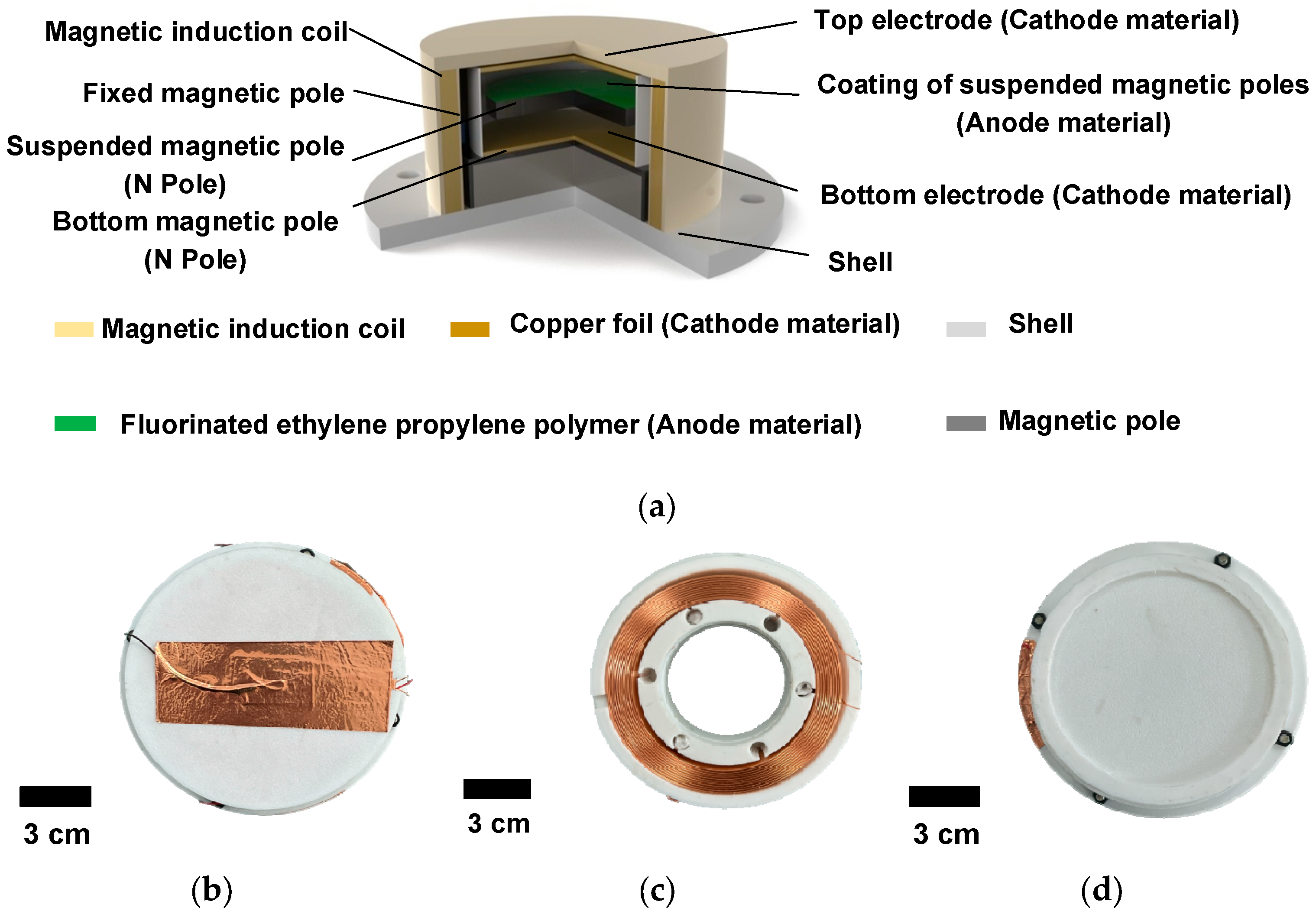
Figure 1a illustrates the structural design of the proposed ML-TENG, and Figure 1b displays its physical prototype. The device integrates three key components: a magnetic levitation module, peripheral electromagnetic sensing coils, and a triboelectric power generation unit.
At the heart of the system is the magnetic levitation configuration, which comprises two primary magnets oriented with like poles facing each other. The lower magnet is fixed to the base of the housing. In contrast, the upper magnet is laterally confined by the housing walls and surrounding auxiliary magnets, ensuring stable alignment and vertical levitation relative to the fixed magnet. For enhanced stabilization, three small auxiliary magnets (each 5 mm × 5 mm) are evenly placed around the lower magnet.
The levitating upper magnet serves as the central moving element of the triboelectric unit. Both its upper and lower surfaces are coated with a fluorinated ethylene propylene (FEP) film. This allows the magnet to oscillate vertically between two stationary copper (Cu) foil electrodes, which function as the triboelectric layers. As shown in Figure 1c and Figure 1d, these electrodes are attached to the inner top and inner bottom surfaces of the housing, respectively.
The device’s functional modules are differentiated as follows: TENG is specifically designed for vibration sensing, namely amplitude and frequency detection, while EMG is responsible for energy harvesting to power the system.
When the vibration amplitude is <0.5 mm, the suspended magnet does not physically contact the electrodes, and the output is generated solely by electrostatic induction (non-contact mode). When the amplitude reaches ≥0.5 mm, the FEP layer contacts the Cu electrode, producing triboelectric charge (contact mode).
When exposed to external vibration, the suspended magnetic pole forms a capacitor with the patch electrodes attached to its top and bottom surfaces, creating a contact-separation mode TENG (transducer energy generator). The vertical displacement of the suspended magnetic pole directly correlates with vibration amplitude, enabling effective sensing of vibrational signals. Simultaneously, a magnetic coil is fixed within the housing. The suspended magnetic pole experiences vertical motion due to repulsive forces from identical magnetic poles at the base and external vibrations, generating cutting magnetic-flux motions. This configuration establishes an electromagnetic generator (EMG) that delivers stable energy output to power downstream systems.
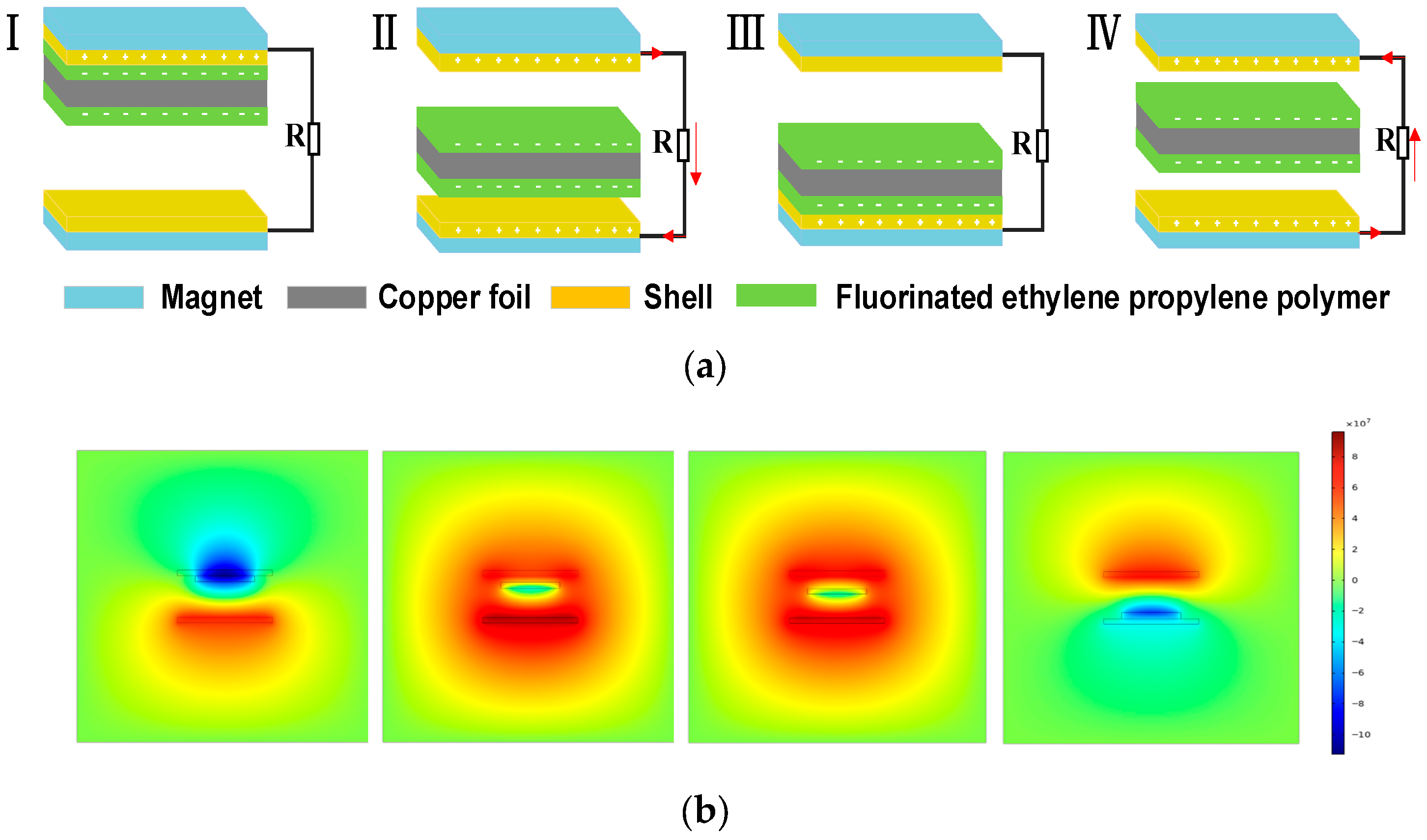
The triboelectric energy-harvesting modules of the ML-TENG employ fluorinated ethylene-propylene (FEP) and copper (Cu) foil as the triboelectric pair. Both the upper and lower power generation units operate on a contact-separation principle. During operation, the electrodes coated with these triboelectric materials remain stationary. The levitating magnet oscillates vertically in response to external excitation. Under low-amplitude vibrations, it does not come into physical contact with the upper or lower materials; under stronger excitation, it repeatedly contacts and separates from them. Consequently, stable positive charges accumulate on the copper foil surface and negative charges on the FEP film. Given that the capacitance between the electrodes remains unchanged, the electrical signal amplitude becomes directly proportional to the vertical displacement of the levitating magnet, enabling precise determination of vibration amplitude and frequency. Figure 2a illustrates the four stages of charge generation and transport in both the upper and lower power generation units.
The levitating magnet, which carries the FEP film on its top and bottom surfaces, moves vertically between two copper foil electrodes. Initially, the FEP film fully contacts the upper copper foil. Owing to the strong electronegativity of the FEP film (negative charge) and the opposite positive charge on the copper foil, an electrostatic equilibrium is reached. In this state, no charge flows in the external circuit, as shown in Figure 2a(I). When the levitating magnet moves downward under external vibration, the FEP film separates from the upper electrode and approaches the lower one. Positive charge then gradually transfers from the upper copper foil to the lower foil, and current flows downward through the external load (Figure 2a(II)). Once the FEP film contacts the lower copper foil, both triboelectric materials again maintain equal and opposite charges, returning to electrostatic equilibrium (Figure 2a(III)). The levitating magnet then rebounds upward, lifting the FEP film off the lower electrode and moving it toward the upper one. Positive charge now shifts upward, and current flows upward through the external circuit (Figure 2a(IV)). During the non-contact portions of the motion, although the FEP film does not touch either copper foil, the two layers still generate an induced electric field. The periodic vertical motion alters the induced electromotive force between the two electrodes, producing an alternating current that repeatedly passes through the external load. Each full cycle completes one round of charge transfer, and as long as external excitation continues, the next cycle begins. These four stages demonstrate that the magnetic levitation-based triboelectric nanogenerator can continuously deliver alternating current to an external load.
To further verify the charge-transfer behavior, a simulation was performed using appropriate software to evaluate the contact-separation states of the triboelectric units at different positions. The resulting charge distribution maps are presented in Figure 2b. The simulation results confirm that opposite charges exist on the surfaces of the FEP film and the copper foil. When the friction material moves downward, positive charges tend to move from the top copper-foil layer to the bottom layer; the opposite occurs during upward motion. At the third position (the fully contacted state with the lower electrode), the simulated charge-flow direction closely matches the actual current direction, effectively reflecting the electric potential distribution within the power generation units under realistic operating conditions.

2.2. Sensing Performance Characterization of the TENG

2.2.1. Experimental Analysis of Constant Frequency Vibration Frequency

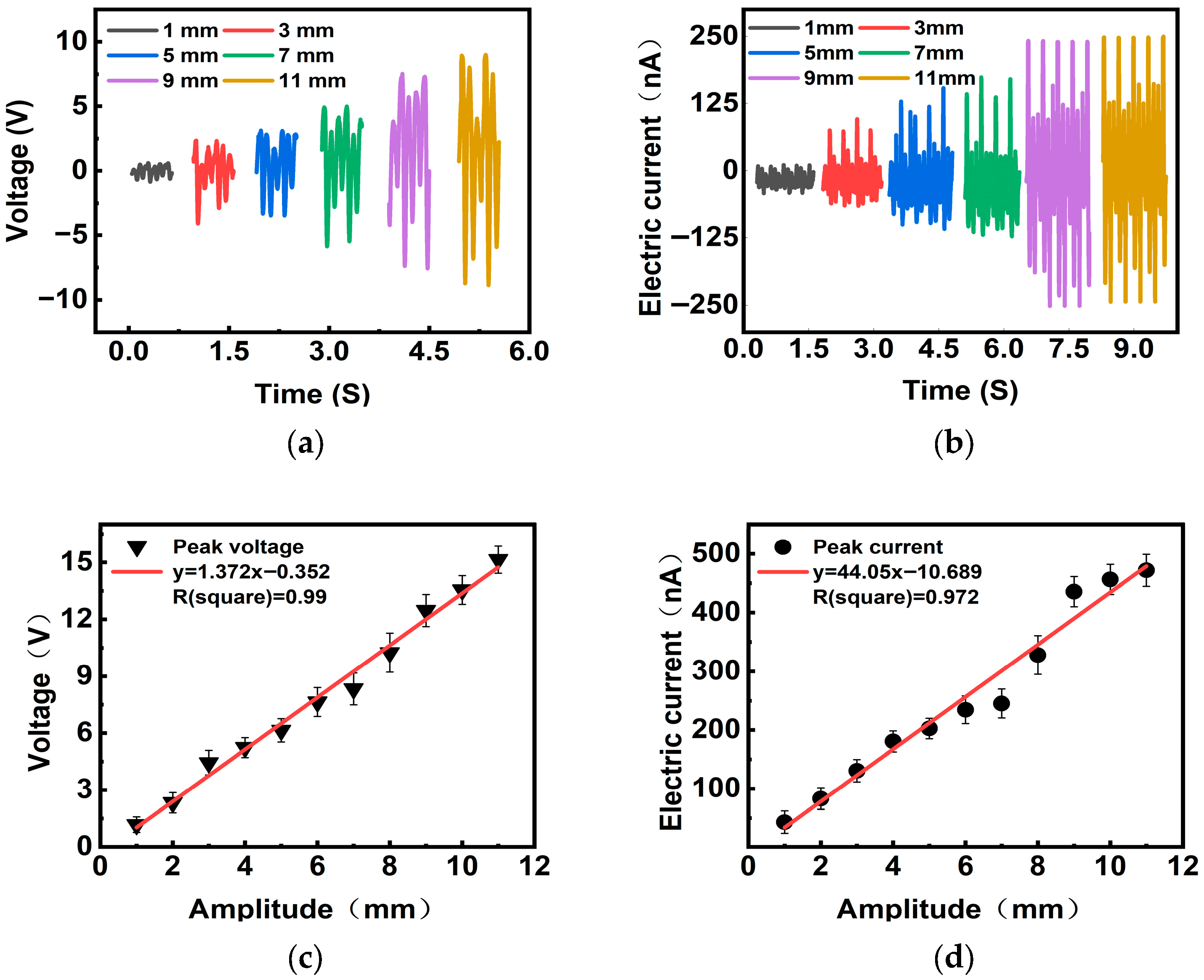
We described the operational behavior of the TENG steel system in the laboratory (Figure 3). The first category includes conditions not listed in the open-loop (circuit disturbances) and suppressed (circuit disturbances) categories. As the vibration increases, the height rises significantly from 1.17 mm to 11 mm; the vibration increases from 1.17 u to 15.14 u, and from 24.18 amperes to 472 amperes. The peak-to-peak is proportional to the external vibration.
This development is due to the oscillation of the electrodes in the developed mechanism, which causes periodic changes in the induction (alarm) cycle. Even in smaller cartridges (where there is no physical contact between the FEP layer and the copper surface), as the amplitude increases, the electrical induction also increases, resulting in higher emission. When the amplitude exceeds 11 mm, the FEP layer is connected to the copper electrode to generate additional charges and raise the test voltage to its maximum. Then, the increased amplitude is mechanically limited. At the same time, the frequency of the short-wave oscillation is proportional to the frequency at the given frequency. As the distance between the bracket’s vertical displacement increases, both the frequency and the voltage increase, resulting in a linear relationship between the bracket’s vertical displacement and the voltage.
This strong linearity enables the TENG to detect quantitative vibration amplitudes effectively. To validate the relationships, statistical analysis was performed on the output voltage and current across different amplitudes, as summarized in Figure 3c,d. Error bars represent ±1 standard deviation from five repeated measurements. The results confirm a positive linear correlation, with goodness-of-fit values of 0.99 for peak voltage and 0.972 for peak current. The peak voltage exhibits better fit quality and stability compared to the peak current, which remains relatively low and is more susceptible to interference. Therefore, the relationship between peak voltage and vibration amplitude is selected as the core sensing mechanism, enhancing both amplitude-sensing performance and energy-harvesting capability across a wide effective amplitude range.

2.2.2. Experimental Analysis of Constant Amplitude Vibration Frequency

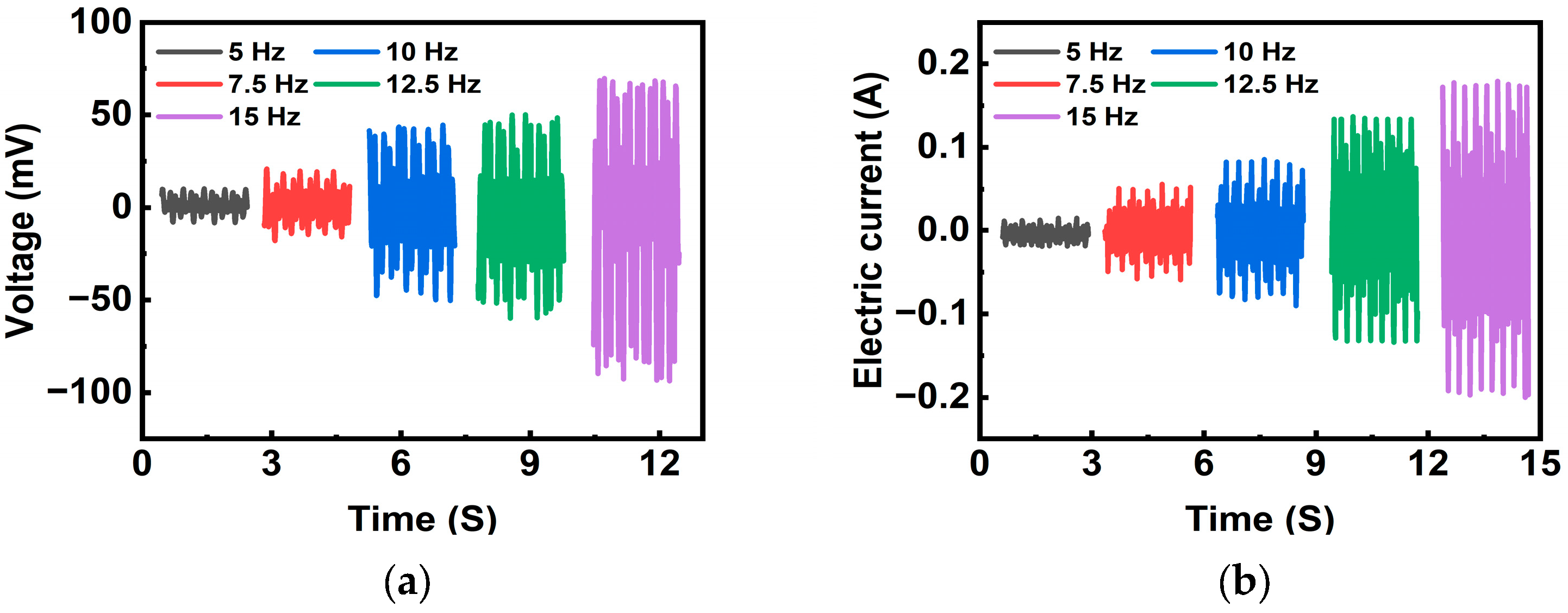
In addition to amplitude, vibration frequency is another important monitoring parameter. To evaluate the TENG’s response to frequency changes, the vibration amplitude was set to 6 mm, and the electrical output of the suspended element vibrating at different frequencies was recorded. The waveforms of open-circuit voltage and short-circuit current are shown in Figure 4a and Figure 4b, respectively. The output voltage and current increased significantly with frequency: as the frequency increased from 5 Hz to 15 Hz, the open-circuit voltage increased from 0.65 V to 0.82 V, and the short-circuit current increased from 55.89 nA to 175.84 nA. This indicates that TENG can effectively sense vibration frequency.
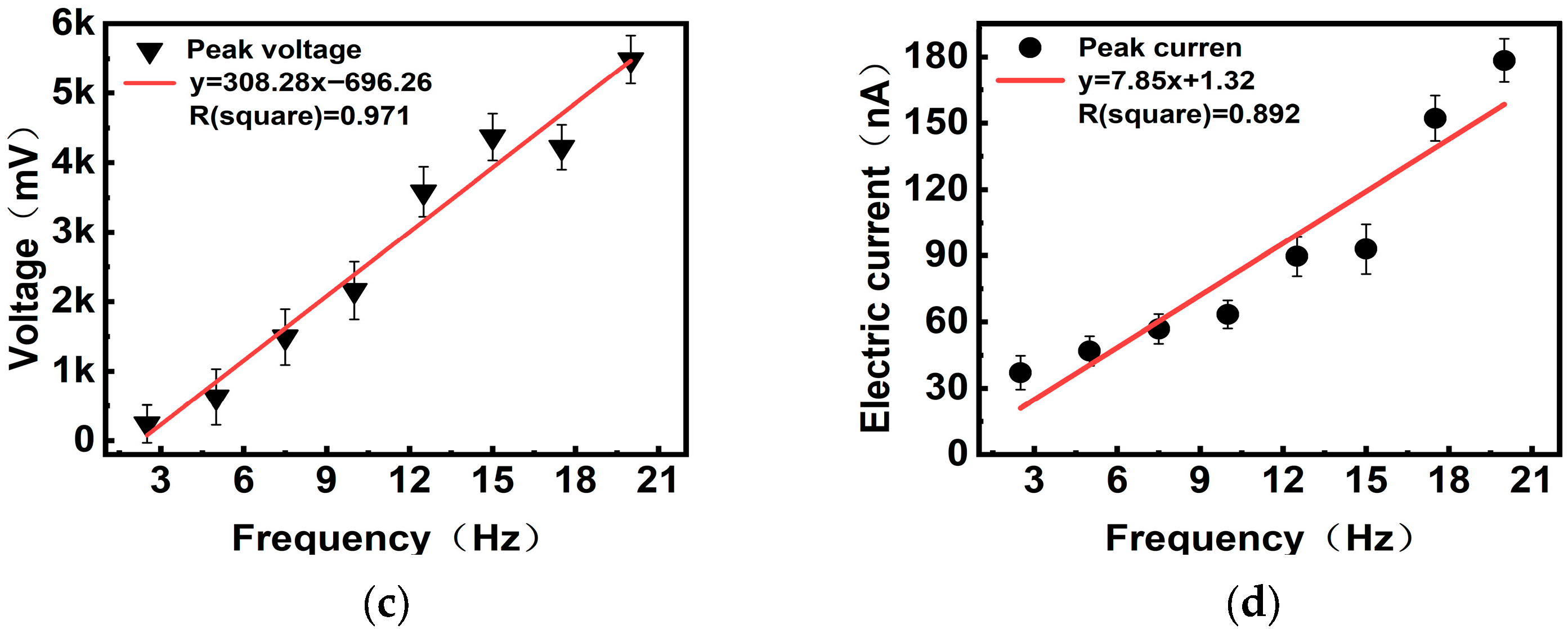
To quantitatively confirm the relationship between the output and frequency, statistical analysis was performed on the peak voltage and peak current data at different frequencies. The results are shown in Figure 4c,d. The error bars represent the standard deviation (SD) ±1 of 5 repeated measurements. The results show that the coefficients of determination (R2) for peak voltage and peak current are 0.971 and 0.892, respectively, indicating strong positive linear correlations. The relationship between peak voltage and vibration frequency was selected as the basis for subsequent frequency-detection analysis, because peak voltage provides a better linear fit and greater stability than peak current.

2.2.3. Experimental Analysis of Output Performance at Low Amplitude

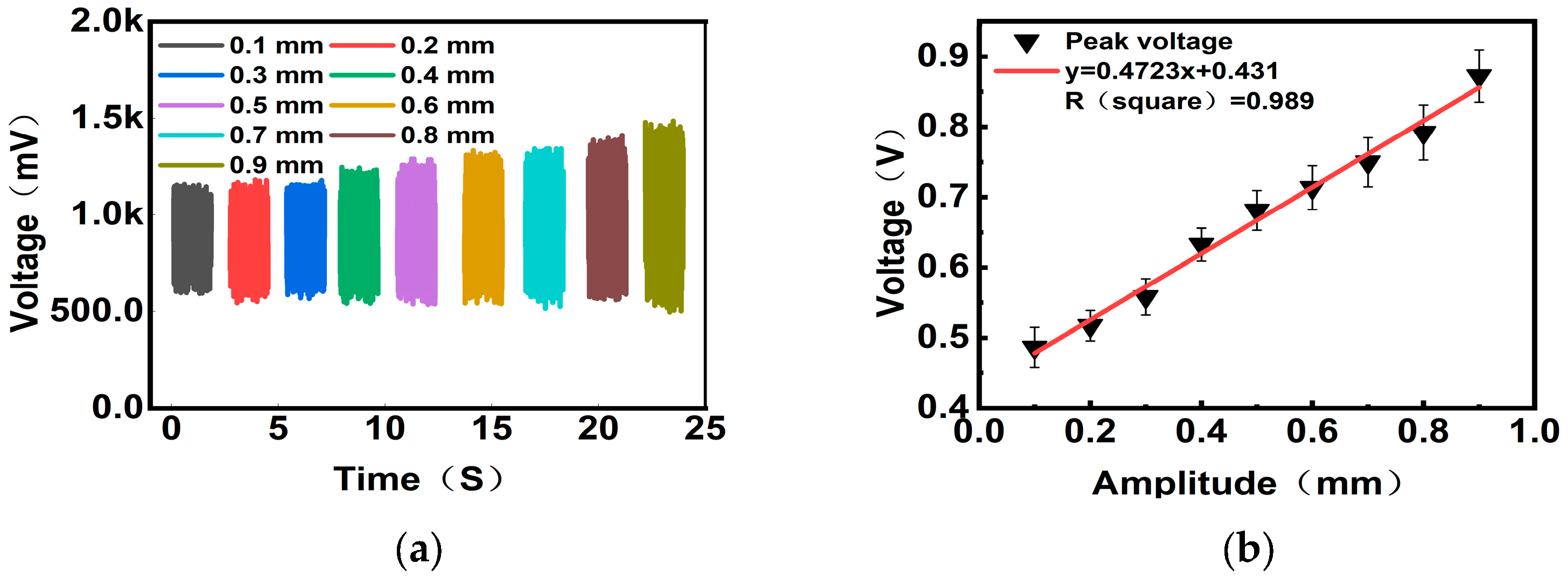
Accurately measuring vibration amplitude is key to monitoring turbine frame vibration. In turbine unit monitoring, an amplitude between 0.1 mm and 0.4 mm is generally considered acceptable, while an amplitude above 0.4 mm usually indicates a warning condition. To evaluate the performance of this equipment within the relevant range, output characteristics and linearity tests were conducted at a fixed frequency of 10 Hz over the range of 0.1 mm to 0.9 mm. The results (as shown in Figure 5a,b) indicate that as the vibration amplitude increases from 0.1 mm to 0.9 mm, the open-circuit voltage increases from 0.48 volts to 0.87 volts. This response shows strong linearity, with a coefficient of determination of 0.989. The error bars represent the standard deviation ±1 of 5 repeated measurements. The high sensitivity and good linearity observed in this low-amplitude range confirm that this equipment is suitable for accurate monitoring of mechanical vibration in turbine units, especially in normal and early-warning conditions.

2.3. Output Characteristics of the Electromagnetic Generator

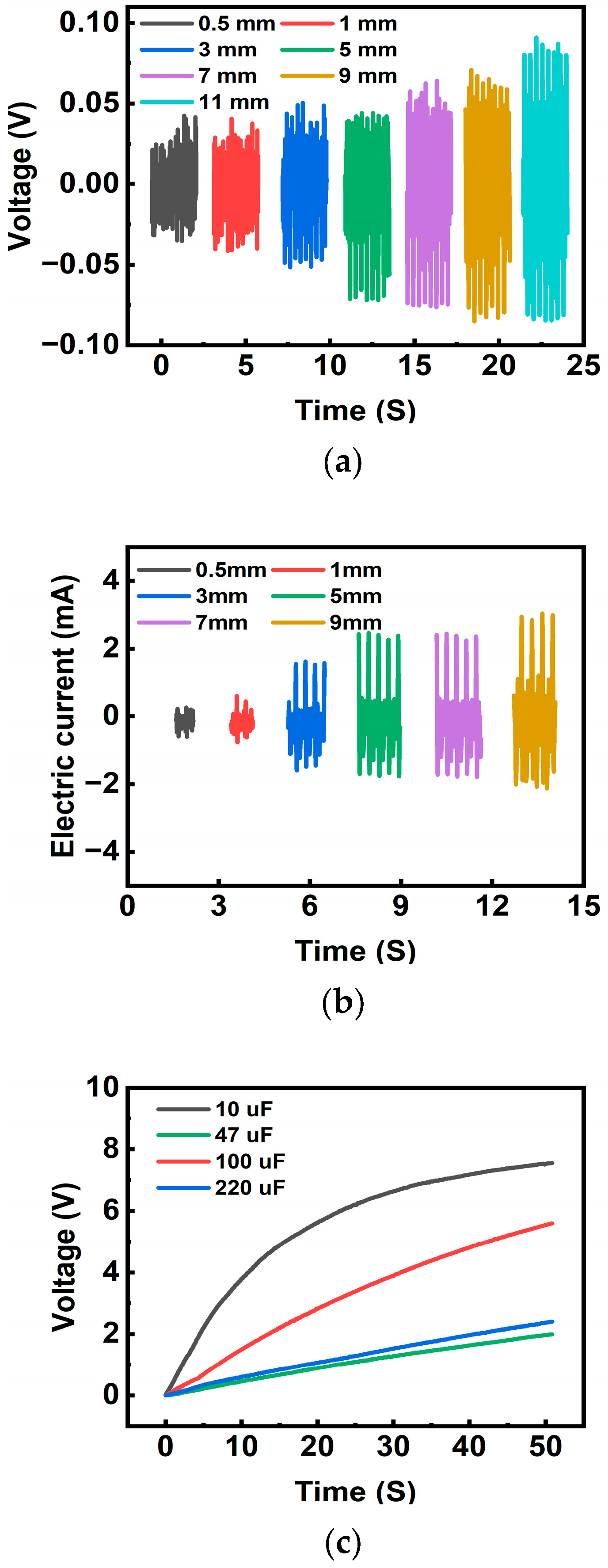
A linear motor is used as the external vibration excitation source to evaluate the performance of the ML-TENG; the electromagnetic generator (EMG) output is measured under linear motor excitation. As shown in Figure 6a (open-circuit voltage) and 6b (short-circuit current), the increase in the alternating stroke distance of the linear motor improves the output of the electromagnetic generator. The open-circuit voltage is not greatly affected by the vibration amplitude (0.5–11 mm), while the short-circuit current ranges from 0.37 volts to 3.66 volts. This increase is due to the magnet’s larger amplitude, which enables it to attract more force lines.
The system’s charging performance is illustrated in Figure 6c. Under excitation at 1 mm amplitude and 10 Hz frequency, a 10 μF capacitor charges most rapidly, while a 220 μF capacitor charges most slowly, indicating that larger capacitances require longer charging times and exhibit lower charging rates. For a 100 μF capacitor, the voltage increases from 0 V to 4.2 V after 60 s, corresponding to an energy increase of ΔE = ½ × 100 × 10−6 × (4.2)2 = 0.882 mJ. After 120 s, the voltage reaches 5.0 V, storing ΔE = 1.25 mJ.

2.4. Analysis of Self-Powered Performance

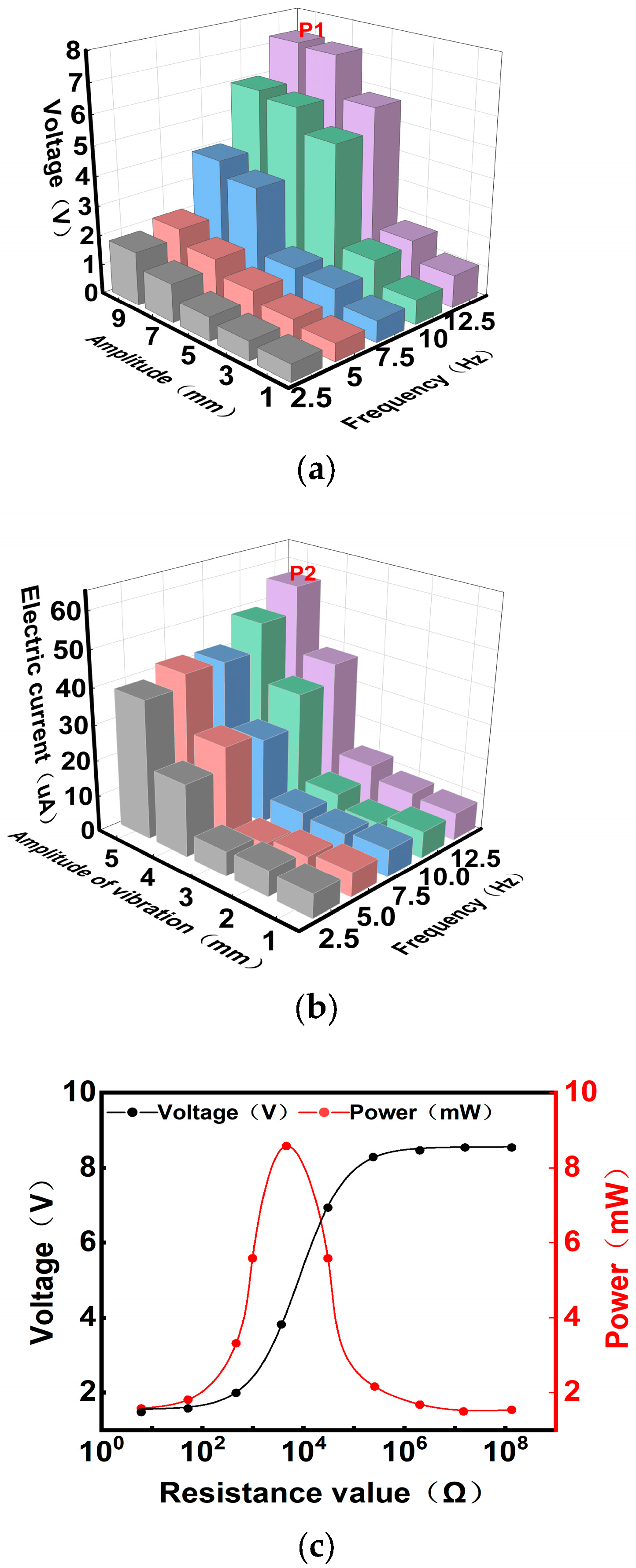
To describe the electrograph’s response under different vibration conditions, systematic adjustments were made to the amplitude and frequency. As shown in Figure 7a,b, the output voltage and current increase with increasing amplitude and frequency. When the voltage reaches 7.2 V (point P1) and the current reaches 56.2 mA (point P2), the best performance is observed at 12.5 Hz over a 9 mm amplitude range. This indicates that the equipment is in the optimal state before saturation. These high values provide a crucial benchmark for subsequent evaluations. In summary, the self-powered monitoring system offers a measurable vibration range of 0.1 mm to 11 mm, with a frequency range of 2.5 Hz to 12.5 Hz.
Figure 7c shows the maximum peak power obtained at an amplitude of 1 mm. The output voltage of the ML-TENG increases with increasing load resistance. At a load resistance of 1000 ohms, the maximum output power is 9 milliwatts. The generator’s internal resistance controls this trend. As the external load increases, the partial voltage drops across the load, and the internal resistance becomes more pronounced. When the external load matches the internal resistance, the power reaches its maximum; beyond this point, the output voltage gradually stabilizes.

2.5. Circuit Configuration of the Self-Powered Vibration Monitoring System

2.5.1. Experimental Evaluation of the Power Management Circuit

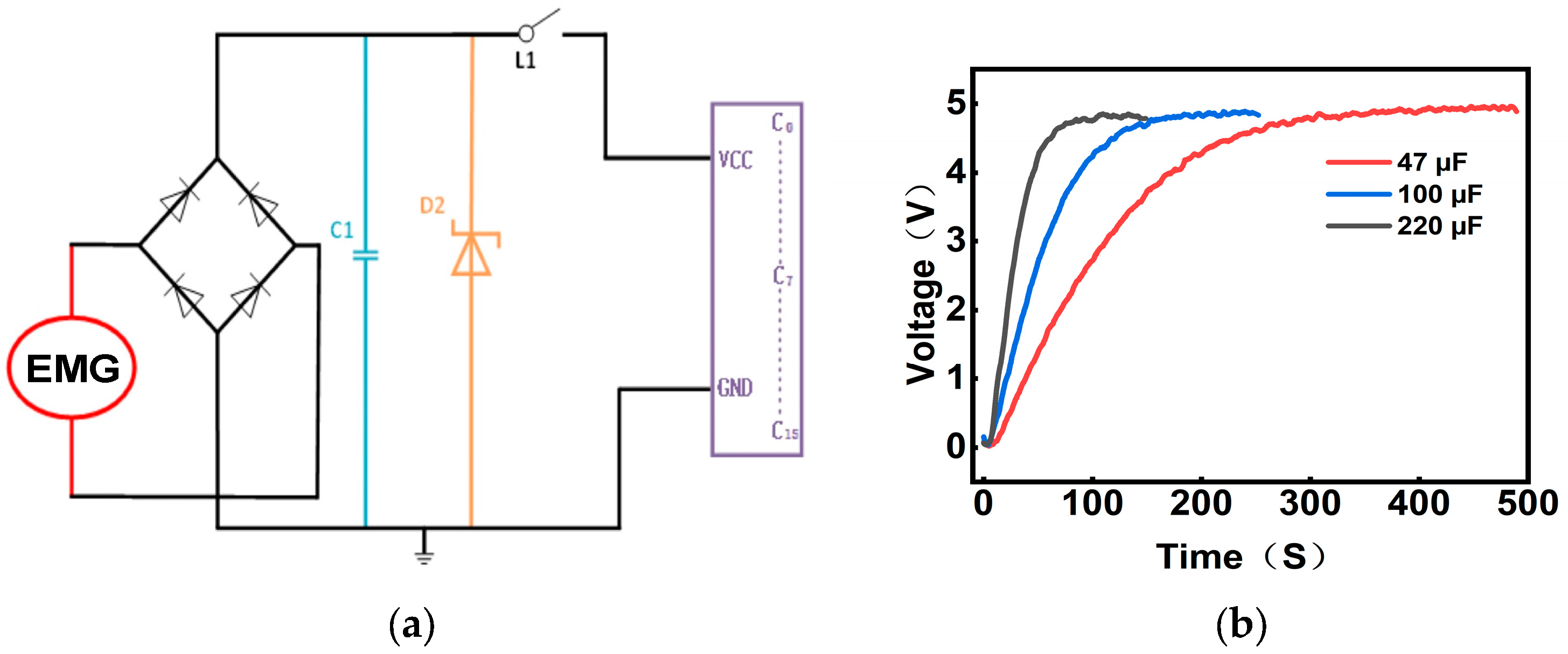
The power management circuit in Figure 8a includes a rectifier bridge, a Zener diode, and switching components. The energy from the device’s electromagnetic part is first rectified and regulated by this circuit, then stored in capacitors for later use. Full-bridge rectification is used by the electromagnetic generator (EMG) to convert AC signals into DC. Capacitor C1 filters and stores the rectified DC signal, and Zener diode D2 keeps the capacitor voltage at a steady 5 V. After passing through the power management circuit, the EMG output signal voltage changes as shown in Figure 8b. When 47 μF, 100 μF, and 220 μF capacitors are charged, the circuit produces a stable DC voltage regardless of the charging time for each capacitor. The stored DC energy then goes to the central processing unit. The power management unit (a full-bridge rectifier with a Zener diode) achieves a conversion efficiency of about 75.6%. It delivers a DC output power of 6.8 mW (5 V/1.36 mA) from an AC input power of 9 mW (into a 1000 Ω load).

2.5.2. Experimental Analysis of Frequency Signal Processing Circuit

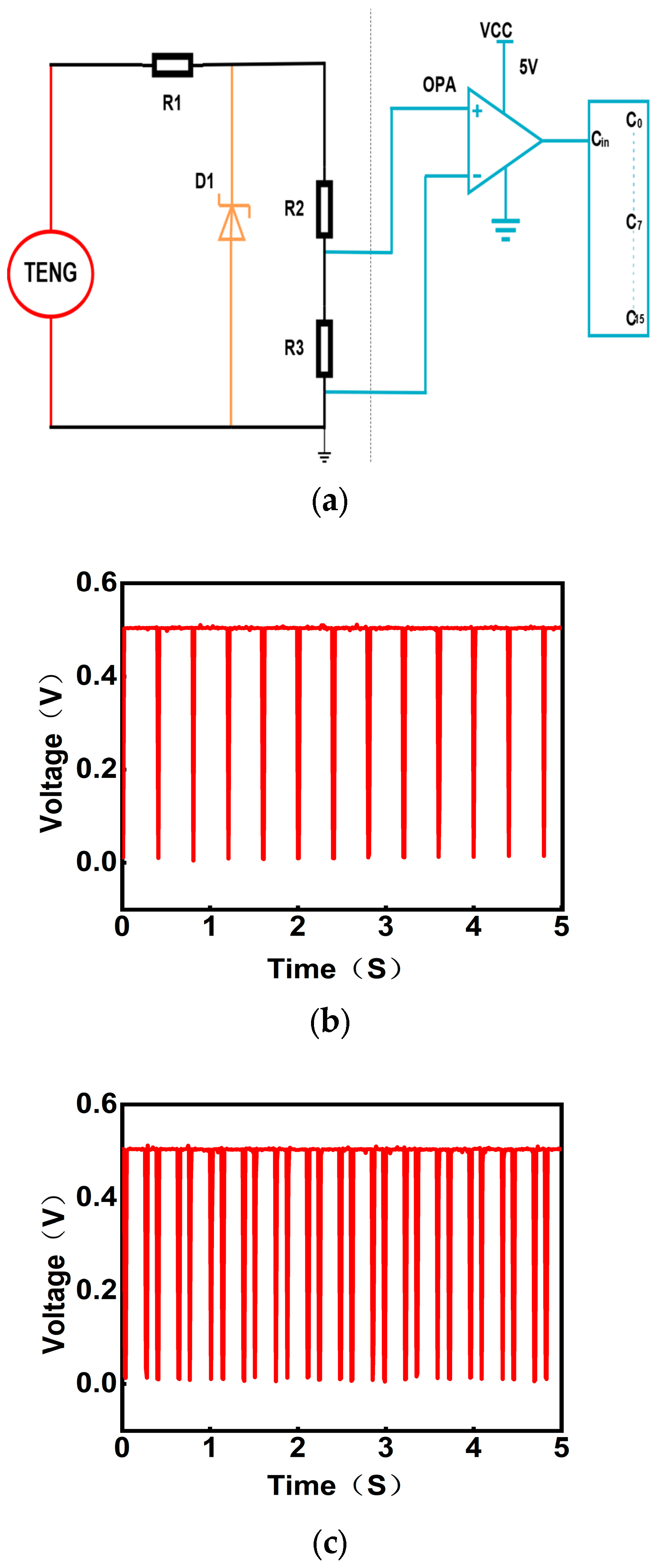
The frequency signal conditioning circuit proposed in this work, depicted in Figure 9a, interfaces with the central processing unit (CPU) and the TENG (turbine energy generator) to monitor vibration frequency. This circuitry comprises resistors, a diode D1 in parallel, an operational amplifier (model LM358AD, Texas Instruments, Dallas, TX, USA), and two resistors, R2 and R3, arranged in series. The diode rectifies the alternating-current (AC) output of the TENG, converting it into a direct-current (DC) voltage signal that preserves the original vibration frequency. Whenever the potential difference across R3 exceeds the operational amplifier’s reference voltage, the output voltage increments by a single frequency step. By tallying the quantity of square-wave pulses produced, the CPU determines the vibration frequency. Thus, the frequency signal circuitry transforms the original sinusoidal voltage from the TENG into measurable square-shaped waveforms, enabling the central processing unit to analyze the vibration frequency data using signal processing routines.
Experimental analyses were conducted separately for the frequency and amplitude signal processing circuits. In the frequency processing circuit, experimental verification demonstrated its ability to convert the AC sine-wave output into square waves, facilitating frequency recording by the central processing unit. Under fixed-amplitude conditions, waveform diagrams of the TENG output voltage at 5 Hz and 15 Hz were tested, as shown in Figure 9b,c. The results indicate that the sine signals from the TENG are converted into stable square waves by the signal processing circuit. As the vibration frequency increases, the number of square waves generated within the same time interval increases. Experimental results align with simulation analyses, validating the rational design of the frequency signal-processing circuit in self-powered vibration-monitoring devices. This configuration successfully converts the frequency signal, enabling effective vibration frequency monitoring for hydraulic turbine units.

2.5.3. Experimental Analysis of Amplitude Signal Processing Circuit

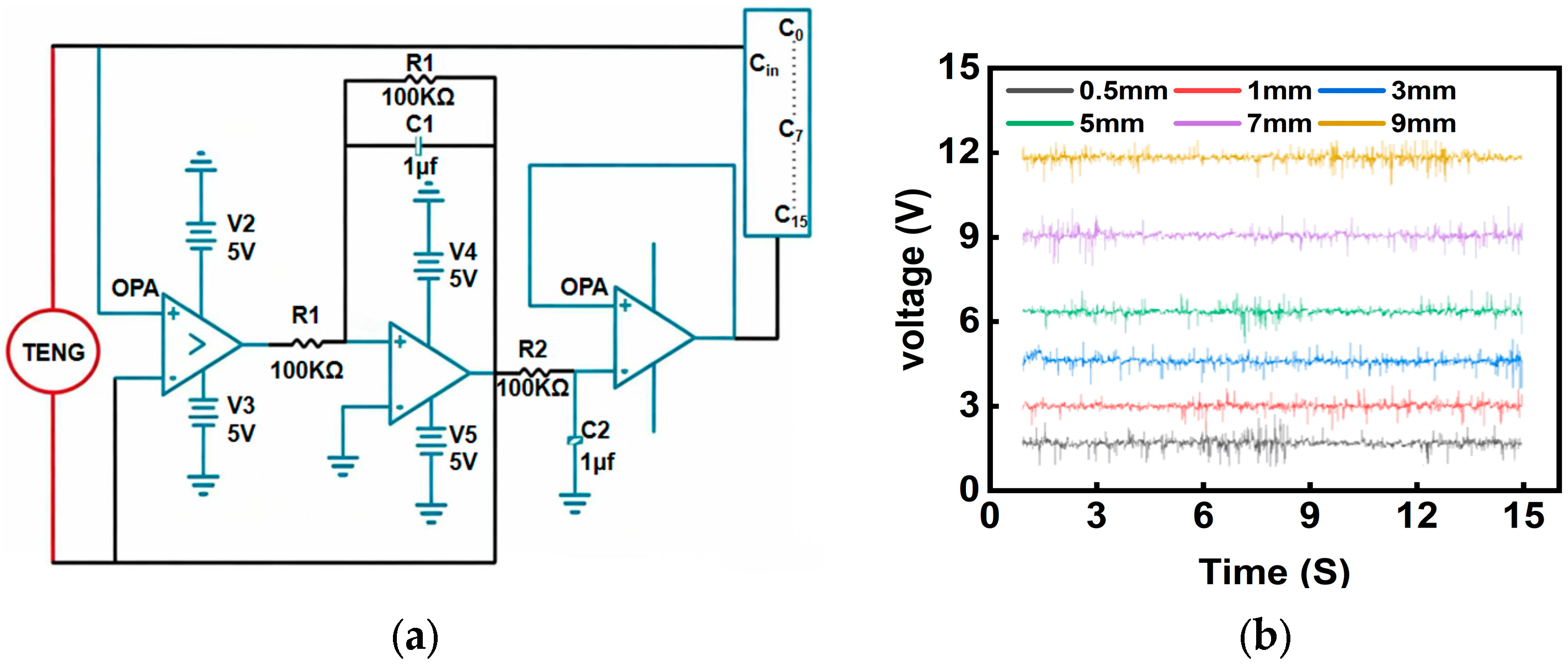
Figure 10a shows the signal amplitude scheme used to control the amplitude of the connection between the voltage generator (TENG) unit and the central processor (CPU). This circuit uses a linear relationship between the TENG output voltage and the amplitude to enable the processor to detect vibration level. Its design includes a voltage comparator (TLC372CD, Texas Instruments, Dallas, TX, USA), two operational amplifiers (LM358AD), and three passive components (R1, R2, R3). The operational amplifiers convert the peak voltage of the sine wave into a stable, continuous voltage corresponding to that peak. Then, the adjustable and stable voltage is transmitted to the central unit for amplitude analysis.
Subsequent experimental verification was performed on the amplitude signal circuit. Tests demonstrated that the circuit successfully converts the TENG’s original sinusoidal electrical output to constant-peak values, thereby simplifying amplitude extraction by the CPU. At a constant vibration frequency, Figure 10b displays the TENG output voltage waveforms recorded for different amplitude test conditions. The results confirm that the amplitude processing circuit generates waveforms with stable peaks and that the voltage magnitude increases with increasing vibration amplitude.

2.6. Durability Testing of Self-Powered Monitoring Devices

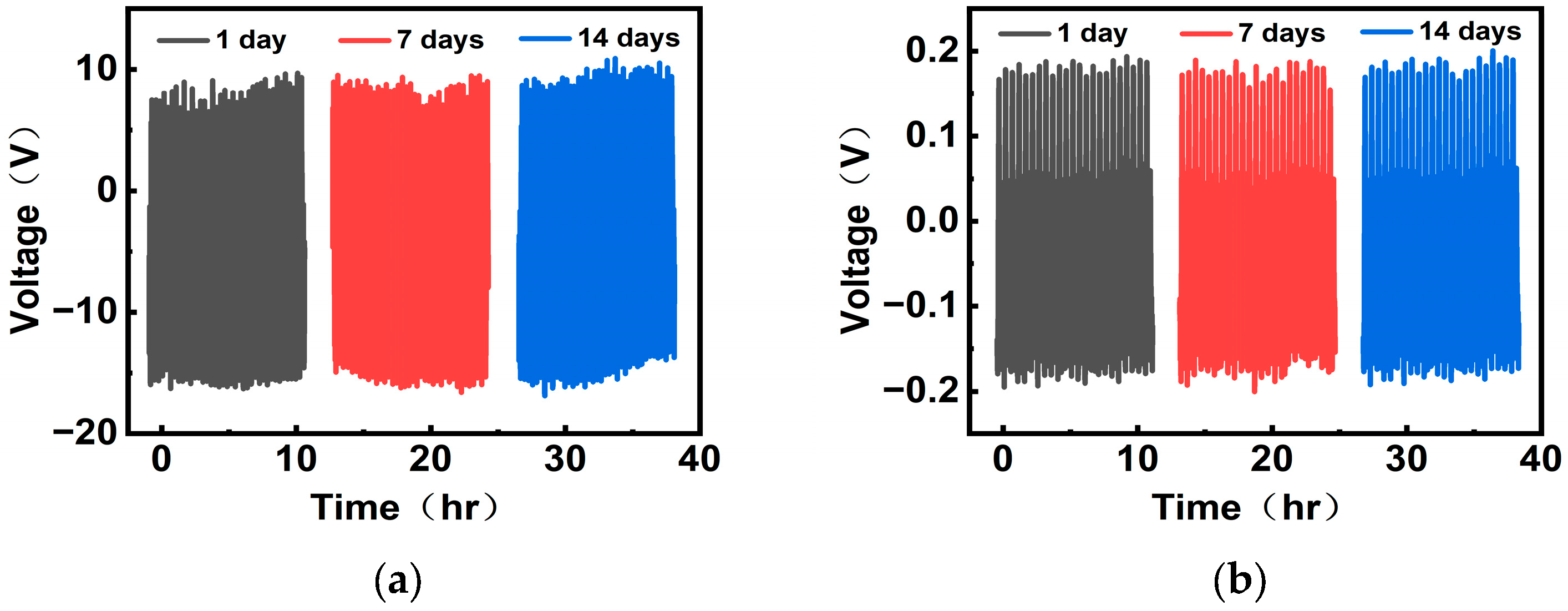
A 14-day durability test was conducted on both TENG and EMG systems. Preliminary tests conducted at relative humidity levels of 30–80% and temperatures ranging from 10 °C to 40 °C (Figure 11a) demonstrated that the TENG’s open-circuit voltage signal remained stable for 1, 7, and 14 days without significant degradation, confirming the vibration sensor’s long-term reliability for vibration-sensing applications. Figure 11b similarly showed that the electromagnetic generator (EMG) exhibited consistent open-circuit voltage signals during equivalent continuous operation periods without any noticeable performance decline. Both technologies demonstrated exceptional output stability; TENG ensures sensing accuracy, while the electromagnetic generator (EMG) provides continuous power support for vibration monitoring devices.

2.7. Performance Comparison and Precision Validation

To quantitatively evaluate the sensing performance of the proposed ML-TENG, Table 1 summarizes comparative results for five representative TENG-based vibration sensors. The comparison covers key parameters including detectable amplitude range, minimum detectable amplitude, sensitivity, frequency range, power density, and linearity. The results demonstrate that ML-TENG achieves a minimum detectable amplitude of 0.1 mm and high-voltage amplitude linearity (R2 = 0.99), making it suitable for low-amplitude vibration monitoring in hydroelectric power units.
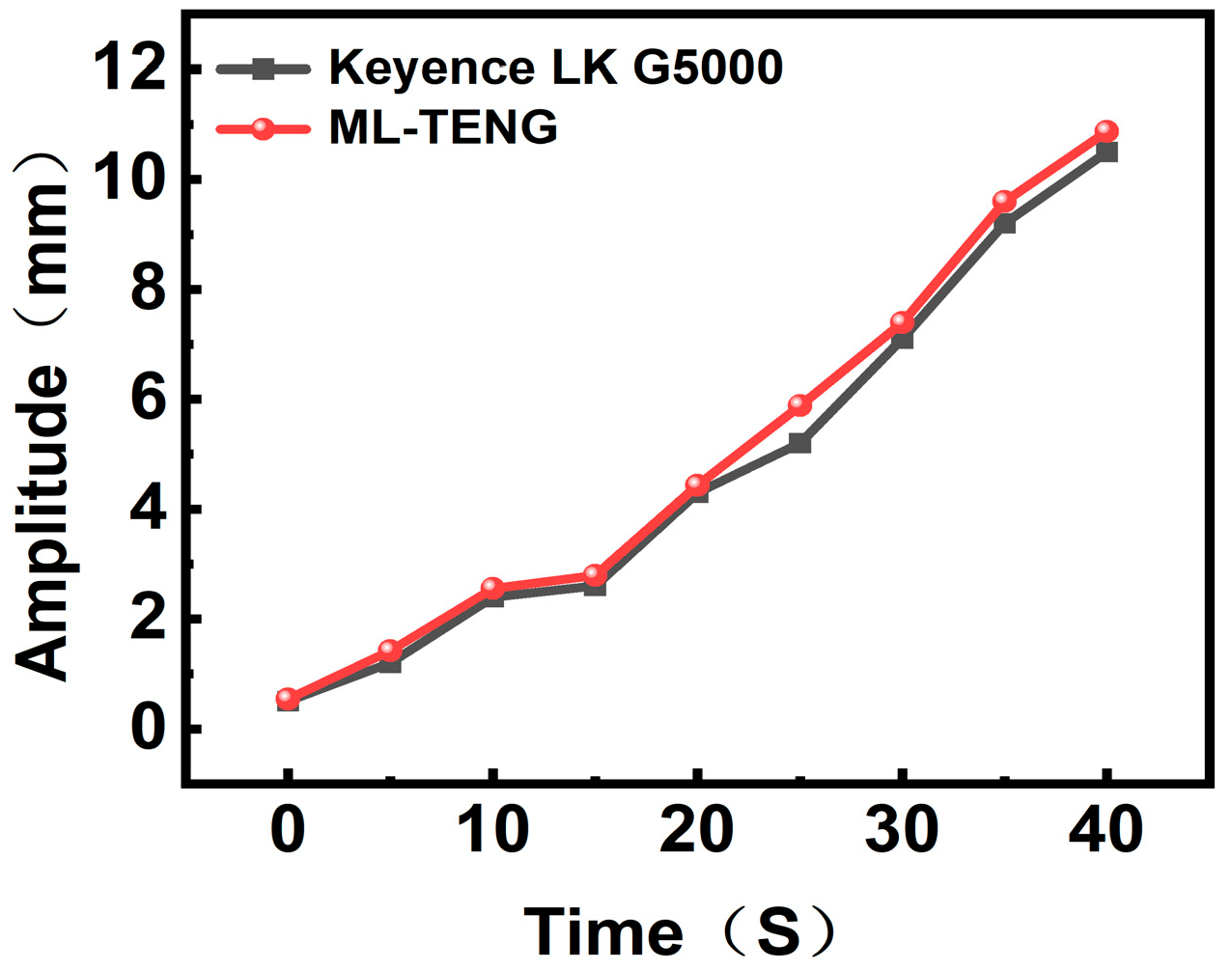
To verify the practical applicability of the ML-TENG, a comparative study of sensing performance was carried out. Vibration amplitude measurements were taken using both the proposed self-powered vibration sensing device and a commercial vibration sensor (Keyence LK-G5000 high-precision laser displacement sensor, Keyence Corporation, Osaka, Japan; resolution: 0.01 mm, accuracy: ±0.05 mm). Figure 12 presents the comparative data obtained from the self-powered device and the commercial sensor. The experimental results indicate that, relative to the commercial sensor, the ML-TENG shows a root mean square error of 0.026 mm and a mean absolute error of 0.021 mm, confirming that its accuracy is within ±0.05 mm of the reference device.

2.8. Experimental Platform Display

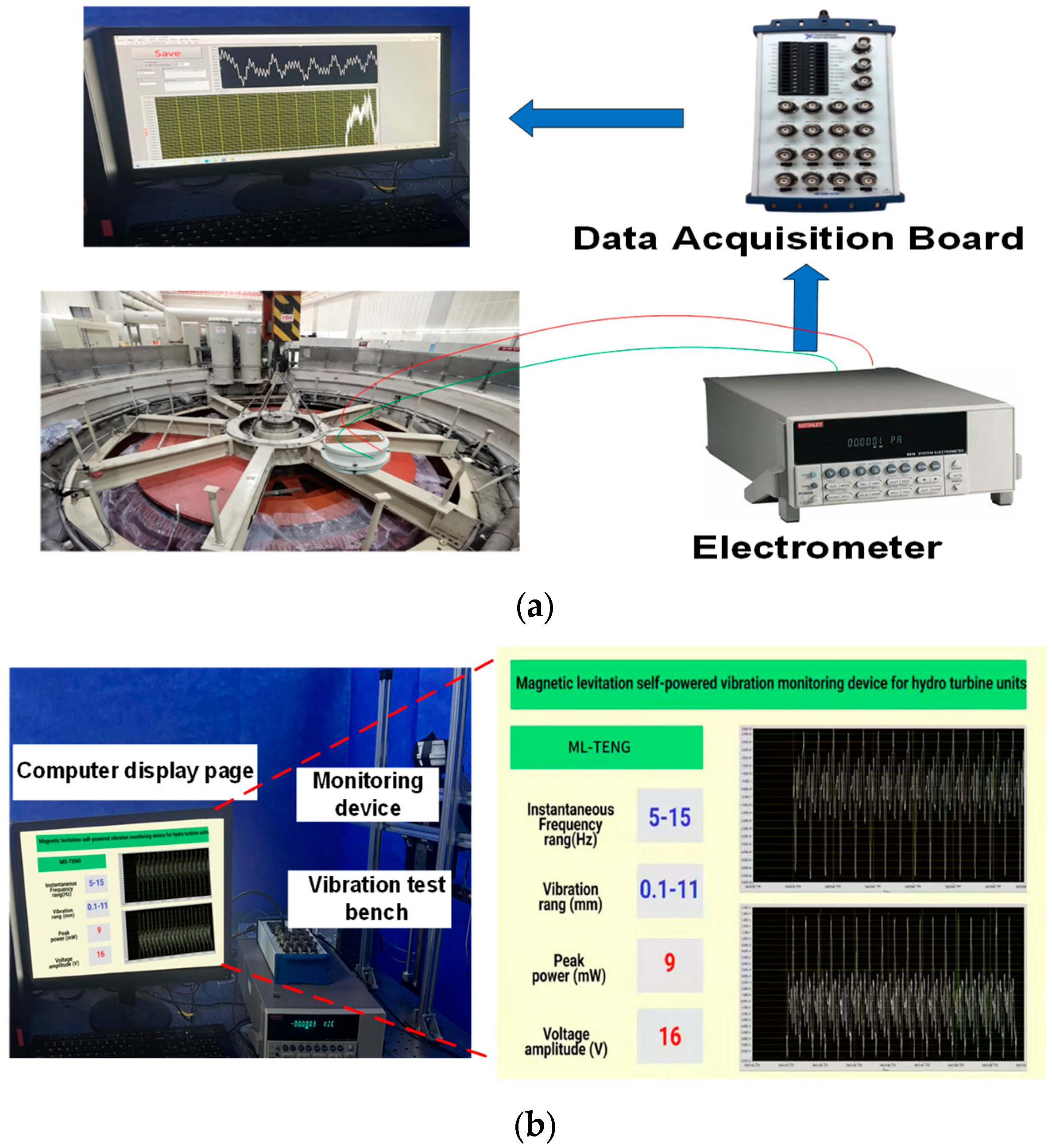
Figure 13a shows the deployment of the experimental system on a vibration monitoring platform. The monitoring device is connected to an electrometer via its two electrodes, which transmit the collected data to a data acquisition unit. This unit then sends the information to a personal computer (PC). A LabVIEW version 2023 program running on the PC displays real-time parameters, such as vibration frequency. The recorded monitoring signals are shown in Figure 13b. During testing, mechanical excitation drives the TENG to generate electrical energy, which powers the amplitude detection system for monitoring hydraulic turbine vibrations.
The device’s conversion efficiency from mechanical input to electrical output is defined as the ratio of electrical output power to mechanical input power. For the linear motor setup, the mechanical input power is calculated as force multiplied by speed. With an amplitude of 1 mm and a frequency of 10 Hz, the EMG achieves an efficiency of approximately 4.2%. In contrast, the TENG has a much lower efficiency (<0.1%) because it is primarily designed for sensing rather than power generation.
Power density is calculated as output power divided by the device’s projected area. The projected area, based on the cylindrical housing’s base, is π × (42.5 mm)2 = 5.67 × 10⁻³ m2. At 1 mm amplitude and a matched 1000 Ω load, the peak output power is 9 mW, resulting in a power density of approximately 1.587 W/m2.
The system can continuously record vibration amplitude and frequency, with a minimum detectable amplitude of 0.1 mm. Due to its wide operational range in both amplitude and frequency, the TENG can harvest energy from ambient vibrations. This energy can be stored in supercapacitors or batteries, enabling fully self-powered vibration monitoring of hydraulic turbine units without an external power supply.

3. Conclusions

With the ongoing growth in global electricity demand, optimizing energy systems and advancing low-carbon transitions have become key priorities for nations worldwide. Large hydropower stations, characterized by their high efficiency, environmental cleanliness, and sustainability, have emerged as crucial pathways for achieving green development, with their scale and number continuously expanding. As core equipment in power plants, hydraulic turbines require stable operation to ensure the safe and efficient functioning of entire power facilities. During electricity generation, maintenance personnel must continuously monitor vibration levels in turbine units to ensure stable, secure operation. Vibration monitoring systems serve as essential safeguards for turbine safety, yet traditional sensors face limitations, including limited material options, high costs, and reliance on external power sources.
To meet the actual requirements of vibration monitoring, this study proposes a new detection device, ML-TENG, which combines a triboelectric nanogenerator (TENG) and a magnetic levitation electromagnetic generator (EMG). In this integrated design, the EMG captures the vibration energy to power the system. Its peak power is 9 milliwatts, while the TENG captures the vibration information. Within the amplitude range of 0.1 to 11 mm (with the maximum output voltage reaching up to 16 volts), the peak voltage of the TENG has a significant linear response to the amplitude and frequency of the vibration, with an adjustment effect (R2) as high as 0.99. This linear characteristic makes vibration measurement more accurate and enables flexible application throughout the turbine. The magnetic levitation design replaces the traditional contact structure, significantly reducing energy loss from friction and wear, thereby improving the sensor’s durability and measurement accuracy. With these characteristics, the proposed self-powered device demonstrates the feasibility of monitoring vibration in hydropower stations. It provides a new method for real-time, autonomous monitoring of turbine vibration amplitude and frequency.
Future work will focus on three aspects: miniaturization and integration with wireless data-transmission modules for field deployment, long-term stability testing under actual hydropower plant operating conditions, and optimization of the magnetic levitation structure to further lower the detection threshold to below 0.05 mm.

4. Experimental Section

4.1. Fabrication of the ML-TENG

The proposed ML-TENG employs a cylindrical housing with an outer diameter of 85 mm and a height of 20 mm. Along the central axis, a hollow cylinder (8 mm in diameter, 11 mm in depth) is provided to seat the base magnet. Above it, a 40 mm-diameter, 20 mm-deep cavity allows vertical motion of the levitating magnet. This cavity is surrounded by an annular retaining ring 18 mm tall and 6 mm wide, which contains six small compartments (each 5 mm × 5 mm) for auxiliary magnets that stabilize the levitating magnet (40 mm in diameter, 4 mm thick).
Between the retaining ring and the outer wall lies a 54 mm × 75 mm × 16 mm space that houses the electromagnetic coil. The entire housing is 3D-printed from PLA material. The base magnet is a cylinder of dimensions 8 mm × 10 mm, while the levitating magnet measures 40 mm × 4 mm. The coil is automatically wound, with an inner diameter of 57 mm, an outer diameter of 72 mm, a height of 15 mm, a resistance of 23 Ω, 740 turns, a wire diameter of 0.4 mm, and an inductance of 43.5 mH. The triboelectric pair consists of copper foil (positive, 0.15 mm thick) and FEP film (negative, 0.08 mm thick). Circular strips 40 mm in diameter are attached to the inner surfaces of the housing cavity and to the levitating magnet.
Both the bottom magnet and the levitating magnet are composed of NdFeB (N35 grade) with axial magnetization, and the magnetic field strength at their surfaces is approximately 350 mT. The three auxiliary stabilizing magnets are of the same material and are positioned with like poles facing each other to produce a restoring force.

4.2. Characterizing the Performance of the Self-Powered Vibration Sensing System

A linear drive motor was used to generate vibration excitation. The ML-TENG’s output signals were measured with a programmable electrometer (Keithley Model 6514, Keithley Instruments, Inc., Solon, OH, USA) and a data acquisition card (NI-USB 6356, National Instruments, Austin, TX, USA), then transmitted to a computer and recorded using LabVIEW version 2023 software. The LabVIEW peak-detection function, configured with a threshold set to three times the ambient noise level and a minimum pulse width of 0.01 s, extracted the peak values, which were averaged over ten consecutive cycles. When the vibration amplitude was 0.1 mm, the open-circuit voltage measured 0.48 V against a noise floor of 0.02 V, yielding a signal-to-noise ratio (SNR) of 27.6 dB, well above the 3 dB detection threshold. Additionally, a 0.1 mm increase in amplitude produces a voltage change of 0.157 V, which is more than three times the noise level.

Author Contributions

Conceptualization and methodology, X.Z., F.Z. and J.C.; software, D.C.; validation, S.X. and F.G.; formal analysis and investigation, Y.W.; data curation, G.X.; writing—original draft preparation, Y.W. and D.C.; visualization, S.Z.; supervision, J.C.; project administration, S.Z.; funding acquisition, X.Z. and J.C. All authors have read and agreed to the published version of the manuscript.

Funding

This research was funded by Science and Technology Development Plan Project of Jilin Province, China (No. 20260205073GH); Ministry of Science and Technology of the People's Republic of China: Grant No. 2024YFE0101200.

Data Availability Statement

The raw data supporting the conclusions of this article will be made available by the authors on request.

Conflicts of Interest

Author Song Xu is employed by the Hubei Branch of CGN New Energy Investment Co. The remaining authors declare that the research was conducted in the absence of any commercial or financial relationships that could be construed as a potential conflict of interest.

Abbreviations

The following abbreviations are used in this manuscript:
TENGTriboelectric Nanogenerator
EMGElectromagnetic Generator
ML-TENGMagnetic Levitation Type Triboelectric Nanogenerator

References

  1. Ivanchenko, I.P.; Prokopenko, A.N.; Konakov, A.A. Vibrations at blade frequency of the support system of the hydraulic units at the Volgograd and Zhiguli HPPs. Power Technol. Eng. 2017, 51, 418–424. [Google Scholar] [CrossRef]
  2. Shao, J.J.; Jiang, T.; Wang, Z.L. Theoretical foundations of triboelectric nanogenerators (TENGs). Sci. China Technol. Sci. 2020, 63, 1087–1109. [Google Scholar] [CrossRef]
  3. Wu, C.; Huang, H.; Li, R.; Fan, C. Research on the potential of spherical triboelectric nanogenerator for collecting vibration energy and measuring vibration. Sensors 2020, 20, 1063. [Google Scholar] [CrossRef]
  4. Ni, W.; Jiang, J.; Huang, H.; Tian, G.; Ma, Y. Research on a vortex-induced vibration monitoring sensor technology based on triboelectric nanogenerator. Energy 2025, 325, 136121. [Google Scholar] [CrossRef]
  5. Zhou, L.; Liu, D.; Zhao, Z.; Li, S.; Liu, Y.; Liu, L.; Gao, Y.; Wang, Z.L.; Wang, J. Simultaneously enhancing power density and durability of sliding-mode triboelectric nanogenerator via interface liquid lubrication. Adv. Energy Mater. 2020, 10, 2002920. [Google Scholar] [CrossRef]
  6. Wang, Z.L. On the expanded Maxwell’s equations for moving charged media system–General theory, mathematical solutions and applications in TENG. Mater. Today 2022, 52, 348–363. [Google Scholar] [CrossRef]
  7. Chen, B.; Wang, Z.L. Toward a new era of sustainable energy: Advanced triboelectric nanogenerator for harvesting high entropy energy. Small 2022, 18, 2107034. [Google Scholar] [CrossRef]
  8. Wang, Z.L. On the first principle theory of nanogenerators from Maxwell's equations. Nano Energy 2020, 68, 104272. [Google Scholar] [CrossRef]
  9. Li, M.; Lou, Y.; Hu, J.; Cui, W.; Chen, L.; Yu, A.; Zhai, J. High-Coupled Magnetic-Levitation Hybrid Nanogenerator with Frequency Multiplication Effect for Wireless Water Level Alarm. Small 2024, 20, 2402009. [Google Scholar] [CrossRef]
  10. Du, T.; Zuo, X.; Dong, F.; Li, S.; Mtui, A.E.; Zou, Y.; Zhang, P.; Zhao, J.; Zhang, Y.; Sun, P.; et al. A self-powered and highly accurate vibration sensor based on bouncing-ball triboelectric nanogenerator for intelligent ship machinery monitoring. Micromachines 2021, 12, 218. [Google Scholar] [CrossRef]
  11. Cao, X.; Xiong, Y.; Sun, J.; Xie, X.; Sun, Q.; Wang, Z.L. Multidiscipline applications of triboelectric nanogenerators for the intelligent era of internet of things. Nano-Micro Lett. 2023, 15, 14. [Google Scholar] [CrossRef]
  12. Chung, C.K.; Ke, K.H. High contact surface area enhanced Al/PDMS triboelectric nanogenerator using novel overlapped microneedle arrays and its application to lighting and self-powered devices. Appl. Surf. Sci. 2020, 508, 145310. [Google Scholar] [CrossRef]
  13. Haroun, A.; Tarek, M.; Mosleh, M.; Ismail, F. Recent progress on triboelectric nanogenerators for vibration energy harvesting and vibration sensing. Nanomaterials 2022, 12, 2960. [Google Scholar] [CrossRef]
  14. Guo, X.; Wang, Y.; Feng, Y.; Yu, Y.; Wang, J.; He, S.; Zhu, J.; Li, H.; Cheng, T.; Wang, Z.L.; et al. Enhance Charge Transfer and Reduce Internal Resistance for Triboelectric Nanogenerator via Switching Charge Shuttling. Adv. Energy Mater. 2025, 15, 2405116. [Google Scholar] [CrossRef]
  15. Kumar, R.; Chand, P.; Sharma, S.; Kadyan, P. Electrochemical performance of copper-oxide flakes as an electrode material for supercapacitor applications. Ionics 2025, 31, 11021–11034. [Google Scholar] [CrossRef]
  16. Wang, Y.; Yu, X.; Yin, M.; Wang, J.; Gao, Q.; Yu, Y.; Cheng, T.; Wang, Z.L. Gravity triboelectric nanogenerator for the steady harvesting of natural wind energy. Nano Energy 2021, 82, 105740. [Google Scholar] [CrossRef]
  17. Fang, L.; Zheng, Q.; Hou, W.; Zheng, L.; Li, H. A self-powered vibration sensor based on the coupling of triboelectric nanogenerator and electromagnetic generator. Nano Energy 2022, 97, 107164. [Google Scholar] [CrossRef]
  18. Gustavsson, R.; Nässelqvist, M.; Österud, J. Radial dampers impact on shaft vibration at resonance. IOP Conf. Ser. Earth Environ. Sci. 2019, 240, 022011. [Google Scholar]
  19. Xiao, X.; Zhang, X.; Wang, S.; Ouyang, H.; Chen, P.; Song, L.; Yuan, H.; Ji, Y.; Wang, P.; Li, Z.; et al. Honeycomb structure inspired triboelectric nanogenerator for highly effective vibration energy harvesting and self-powered engine condition monitoring. Adv. Energy Mater. 2019, 9, 1902460. [Google Scholar] [CrossRef]
  20. Li, S.; Liu, D.; Zhao, Z.; Zhou, L.; Yin, X.; Li, X.; Gao, Y.; Zhang, C.; Zhang, Q.; Wang, J.; et al. A fully self-powered vibration monitoring system driven by dual-mode triboelectric nanogenerators. ACS Nano 2020, 14, 2475–2482. [Google Scholar]
  21. Xue, X.; Zhang, Z.; Wu, B.; He, S.; Wang, Q.; Zhang, W.; Bi, R.; Cui, J.; Zheng, Y.; Xue, C.; et al. Coil-levitated hybrid generator for mechanical energy harvesting and wireless temperature and vibration monitoring. Sci. China Technol. Sci. 2021, 64, 1325–1334. [Google Scholar] [CrossRef]
  22. Jo, M.S.; Bhatta, T.; Teli, A.; Park, J.Y. Dual Spring Assisted Hybrid Energy Harvester with Non-Contact Triboelectric Vibration Sensor for Self-Sustainable Vehicle IoTs. In Proceedings of the 2025 23rd International Conference on Solid-State Sensors, Actuators and Microsystems (Transducers), Orlando, FL, USA, 29 June–3 July 2025; pp. 1225–1228. [Google Scholar]
  23. Shen, J.; Yang, Y.; Yang, Z.; Li, B.; Ji, L.; Cheng, J. A multilayer triboelectric-electromagnetic hybrid nanogenerator for vibration energy harvesting and frequency monitoring. Nano Energy 2023, 116, 108818. [Google Scholar] [CrossRef]
  24. Liu, C.; Wang, Y.; Zhang, N.; Yang, X.; Wang, Z.; Zhao, L.; Yang, W.; Dong, L.; Che, L.; Wang, G.; et al. A self-powered and high sensitivity acceleration sensor with VQa model based on triboelectric nanogenerators (TENGs). Nano Energy 2020, 67, 104228. [Google Scholar] [CrossRef]
  25. Zhao, H.; Machado, L.Q.; Fu, Y.; Ouyang, H.; Mo, J. A self-powered accelerometer with over-range detection for vibration and shock based on triboelectric-electromagnetic mechanism. Nano Energy 2024, 128, 109788. [Google Scholar] [CrossRef]
  26. Wu, P.; Wang, F.; Xu, S.; Liu, T.; Qi, Y.; Zhao, X.; Zhang, C.; Mu, X. A highly sensitive triboelectric quasi-zero stiffness vibration sensor with ultrawide frequency response. Adv. Sci. 2023, 10, 2301199. [Google Scholar] [CrossRef] [PubMed]
Figure 1. Overview of the ML-TENG: (a) full structural layout, (b) physical realization of the device, (c) photographs of the stator, and (d) mover as actually fabricated.
Energies 19 02344 g001
Figure 2. Operational mechanism of the ML-TENG: (a) working principle of its triboelectric module; (b) simulated behavior of the triboelectric unit during operation.
Energies 19 02344 g002
Figure 3. TENG output characteristics as a function of vibration amplitude: (a) open-circuit voltage traces obtained at a constant TENG frequency for various amplitudes; (b) corresponding short-circuit current traces; (c) voltage output versus vibration amplitude; (d) current output versus vibration amplitude.
Energies 19 02344 g003
Figure 4. Frequency-dependent output characteristics of the TENG: (a) peak voltage versus vibration frequency, (b) peak current versus vibration frequency, (c) frequency response of the TENG voltage signal, (d) frequency response of the TENG current signal.
Energies 19 02344 g004aEnergies 19 02344 g004b
Figure 5. TENG output performance under low-amplitude conditions: (a) open-circuit voltage waveforms recorded at various amplitudes, (b) peak voltage plotted against vibration amplitude.
Energies 19 02344 g005
Figure 6. Output behavior of the electromagnetic generator (EMG): (a) no-load voltage versus vibration amplitude, (b) current traces under shorted conditions, (c) capacitor voltage rise during charging for different capacitance values.
Energies 19 02344 g006
Figure 7. Illustrates the operating characteristics of the self-powered vibration monitor: (a) presents the open-circuit voltage measured under different combinations of amplitude and frequency, (b) shows the corresponding short-circuit current response, (c) displays the system’s impedance-matching behavior, plotting both the output voltage and output power as functions of the external load resistance.
Energies 19 02344 g007
Figure 8. Presents the experimental evaluation of the power management circuitry: (a) provides a schematic diagram of the power management circuit, (b) illustrates the charging profiles for capacitors of different values.
Energies 19 02344 g008
Figure 9. Experimental investigation of frequency signal conditioning: (a) schematic of the frequency signal processing circuitry, (b) waveform produced by the conditioning circuit under 5 Hz excitation, (c) waveform produced by the conditioning circuit under 15 Hz excitation.
Energies 19 02344 g009
Figure 10. Experimental evaluation of amplitude signal conditioning: (a) circuitry for amplitude signal processing, (b) output waveforms of the conditioning circuit under different vibration amplitudes.
Energies 19 02344 g010
Figure 11. Device durability testing: (a) TENG durability testing, (b) EMG durability testing.
Energies 19 02344 g011
Figure 12. Sensor Comparison Test.
Energies 19 02344 g012
Figure 13. Scientific board overview: (a) workflow of the practical application scenario, (b) experimental monitoring signal readout.
Energies 19 02344 g013
Table 1. Performance Comparison Between ML-TENG and Existing TENG-Based Self-Driving Vibration Sensors.
Sensor TypeAmpl./Accel. RangeMin. AmplitudeSensitivityFreq RangePower DensLinearity (R2)
ML-TENG
(this work)
0.1–11 mm0.1 mm1.57 V/mm (0.1–0.9 mm);
43.18 nA/mm (1–11 mm)
5–15 Hz1.587 W/m2 (1 kΩ)Voltage-ampl.: 0.99;
Current-ampl.: 0.972;
Voltage-freq.: 0.971
ETHG [22]---14–24 Hz--
TENG accelerometer [23]1–11 m/s2-20.4 V/(m/s2)-371.8 mW/m2-
TENG-EMG accelerometer [24]--0.12 V·s2/m-EMG: 4.11 mW 12 m/s2-
HSVS-TENG [25]--0.32–134.9 V/g2.5–4000 Hz-0.08–2.81 V/g
Multilayer TENG-EMG [26]5–20 Hz (bridge)--5–20 Hz2.8 W/m3Acc.: 99.1%
Disclaimer/Publisher’s Note: The statements, opinions and data contained in all publications are solely those of the individual author(s) and contributor(s) and not of MDPI and/or the editor(s). MDPI and/or the editor(s) disclaim responsibility for any injury to people or property resulting from any ideas, methods, instructions or products referred to in the content.