1. Introduction
Methane management remains one of the most critical challenges in underground coal mining. Safe operation requires continuous ventilation of mine workings and the removal of methane released from coal seams. In most hard-coal mines, approximately 40% of the total methane released is captured as coal mine methane (CMM) at concentrations of 45–70%, while the remaining ~60% is emitted through ventilation shafts as ventilation air methane (VAM). For safety reasons, the methane concentration in the ventilation air is strictly maintained below 0.7%, well below the lower explosive limit. A single ventilation shaft may release 270,000–1,400,000 Nm3/h of a methane–air mixture, making VAM one of the largest point sources of diffuse methane emissions in the mining sector.
Methane is the second most important anthropogenic greenhouse gas, with a 100-year global warming potential (GWP100), 28 times higher than CO
2 [
1]. The issue of mitigating methane emissions, particularly from the energy and agricultural sectors, which are the two largest anthropogenic sources, has been extensively addressed in international literature for many years [
2,
3,
4]. Within the European Union, the EU Methane Strategy [
5] and the forthcoming emission limits for coal mines have intensified the need for practical, scalable and cost-effective VAM-reduction technologies.
The studies by Zięba and Smoliński [
6], Borowski et al. [
7], Gajdzik et al. [
8], and Niewiadomski and Koch [
9] provide a comprehensive overview of methane emissions from Polish mining, highlighting a significant technological gap between current mitigation practices and the evolving requirements of EU climate policy. These findings emphasize the urgent need for advanced, integrated solutions that not only improve reduction efficiency but also combine methane abatement with tangible energy and environmental benefits.
Global research on VAM mitigation has explored a wide range of approaches to address the problem of methane emissions from coal mines, which can be categorized by their operational maturity. The most mature industrial technologies are Regenerative Thermal Oxidizers (RTOs) and Regenerative Catalytic Oxidizers (RCOs), which involve the capture and utilization of methane, primarily through combustion-based processes [
3,
10,
11,
12,
13,
14]. These approaches are associated with several challenges, including the need for methane enrichment in certain technologies to maintain autothermal operation [
15,
16,
17].
International studies further show that the extremely low and highly variable methane concentration in VAM fundamentally limits the feasibility of combustion, ignition behaviour and process stability. Yang et al. [
18] showed that oxidizing methane at concentrations as low as 0.28% vol. is highly sensitive to thermal balance and small fluctuations in inlet composition. Their results indicate that RTOs operate within a narrow stability window, where both insufficient and excessive heat storage can destabilize the process. Liu et al. [
19] demonstrated that the oxidation behaviour of ultra-lean methane mixtures is highly sensitive to reactor temperature profiles and flow distribution, even under carefully controlled conditions. The authors showed that maintaining stable conversion requires tight thermal management and optimized heat-transfer pathways, as small deviations can lead to incomplete oxidation or rapid temperature decay.
To address the stability of lean combustion, recent studies have highlighted the potential of porous media combustion as an effective approach to enhance flame stability in low-calorific fuel systems [
20]. The strong internal heat recirculation within the porous structure enables stable operation under significantly lean conditions by extending the flammability limits and improving flame stabilization.
While CMM is commonly used in local combined heat and power (CHP) plants [
21,
22,
23,
24], other approaches represent pilot-scale and laboratory-stage demonstrations rather than established industrial practices. These include installing combustion or treatment systems directly in underground workings, as proposed in the VAM-PIRE project [
25]. Additionally, field tests have been conducted on underground cooling installations powered by VAM, utilizing catalytic reactors combined with absorption chillers to address both methane and thermal hazards in deep mines [
26]. Beyond thermal and catalytic processes, chemo-biological methods are also being explored for methane removal [
27,
28,
29]. However, much like the aforementioned underground oxidation systems, these biotechnological approaches remain at the preliminary research stage and have yet to be validated at a full industrial scale. Recent studies also indicate the potential economic feasibility of pilot-scale installations based on catalytic oxidation of ventilation air methane, supported by real operational data from Polish coal mines [
30].
Another significant environmental issue associated with mining activity is the management of saline mine water. In Poland, coal mines pump approximately 0.364 km
3 of water annually [
31], the majority of which is discharged into surface watercourses, either directly or after partial reuse in industrial processes. According to data from 1994, mines were pumping 996,200 m
3 of water daily, including: 386,900 m
3 with salinity below 1 g/dm
3, 252,300 m
3 containing 1.0 to 3.0 g/dm
3 of salts, 288,300 m
3 with mineral content between 3.0 and 70 g/dm
3, and 68,700 m
3 with over 70 g/dm
3. At that time, the average daily discharge of chloride and sulfate ions was approximately 7069 mg/day, of which 72% entered the Vistula River, leading to increased mineralization of the river water, from 0.3 to 3.5 g/dm
3, measured at locations such as Goczałkowice and Dwory.
Current mine water treatment methods include injection into rock formations, hydrotechnical protection, desalination, and recirculation [
32,
33]. However, high operational costs and limited market value of by-products have hindered the wide-scale application of thermal desalination [
12].
Recent international studies emphasize the importance of integrated mine-waste-to-value frameworks, in which environmental mitigation processes are embedded into existing mining and industrial chains to improve overall sustainability. For example, Veetil and Hitch [
34] analyzed the integration of aqueous mineral carbonation into mineral extraction and tailings management, demonstrating how thermal synergy between waste streams and treatment units can create environmental value while improving the techno-economic performance of the entire mining system. By analogy, such systems-integration thinking provides a foundational rationale for the hybrid configuration proposed in this study. By coupling methane mitigation with mine-water desalination and using available high-inertia thermal streams, the system transitions from a simple emission-reduction unit into a comprehensive energy-efficient waste-recovery plant.
The present article is positioned as an engineering-oriented, system-integration study rather than a fundamental combustion or CFD investigation. Its aim is to propose and evaluate a conceptual installation that simultaneously reduces VAM emissions and utilizes saline mine water, leveraging existing mine-site infrastructure. The study integrates established components (grate-fired steam boilers, heat-recovery units and multi-effect evaporators) into a unified configuration capable of converting the heat generated from the co-combustion of primary fuels (hard coal, mine gas or coal sludge) and VAM into superheated steam. The contribution of the work lies in the practical configuration, operational coupling and thermodynamic assessment of the system under realistic mine-ventilation conditions, forming the first stage of a broader research programme that will include dynamic modelling and experimental validation.
2. Base Assumptions
Methane emissions from ventilation air have a significant energy potential and are theoretically sufficient to meet the heat demand of a district heating system. However, this potential cannot be fully utilized through continuous combustion, as the oxidation of methane in ventilation air (at low CH4 concentrations) is an endothermic process. In the following example, the energy potential is estimated based on shaft emission data.
The thermal power generated by the combustion of methane is calculated as shown in Equation (1).
where
Q—thermal power [MJ/h];
V—methane flow rate [m3/h];
CV—calorific value of methane [MJ/m3].
Assuming a methane flow rate of 6000 m
3/h and a calorific value of 35.5 MJ/m
3, the thermal power is as follows:
Heating a ventilation air stream of 1,200,000 m
3/h to the autoignition temperature of methane (537 °C) requires a thermal power input calculated as presented in Equation (3).
where
conversion of air flow rate to m3/s—1,200,000/3600;
air density [kg/m3]—1.165;
specific heat capacity of air [kJ/kg·K]—1.005;
temperature increase [K]—537.
Given that the combustion of methane (as calculated in Equation (1)) provides only 59.15 MW, the process requires an additional thermal power input to maintain continuous (autothermal) combustion, calculated as follows:
This deficit can be covered by the combustion of solid, liquid, or gaseous fuels. Due to the relatively high supplementary power demand, it is advisable to utilize low-cost fuels with low calorific value, such as coal slurry (coal waste sludge).
In coal processing plants, the extracted raw material undergoes classification and beneficiation. Following the removal of waste rock (gangue), hard coal is separated into five types (grades), which differ in calorific value and combustion characteristics, as well as into five size-based assortments. The finest fractions (particle size R0.09 < 50%/below 1 mm) undergo flotation, resulting in two main products: a high-calorific flotation concentrate and coal sludges (slurry) with reduced energy value. The latter is attributed to their high ash and moisture content, as well as the presence of heavy metals.
Despite these limitations, coal sludges represent an economically attractive alternative fuel due to their useful calorific value (~16 MJ/kg) and substantial availability, both stored and continuously generated. Therefore, they are suitable for use as fuel in specially designed combustion systems capable of mitigating their adverse properties.
Polish patent PL239165 discloses a “Method and flow-through system for atomizing fuel suspensions in burners” [
35]. Additionally, the granted patent application (P.425271) describes a “Method and installation for feeding a grate boiler with multi-fuel burners for the combustion of alternative fuels” [
36]. Both technologies address the preliminary drying and combustion of flotation concentrate suspensions and coal sludges.
An essential complement to solid fuel combustion systems is a flue gas cleaning installation that removes particulates and acidic gaseous residues. The Polish patent PL242272, disclosing a “Method for environmentally friendly heat recovery from flue gases discharged into the environment, especially from combustion chambers” [
37], presents a wet flue gas cleaning technology (enabling removal of ash and acid compounds), integrated with the recovery and utilization of heat from cooled exhaust gases.
3. Conceptual Design of an Emission Reduction Installation for Coal Mines
3.1. Concept and System Configuration
Fuel-combustion installations such as heating plants, combined heat and power units or industrial boilers often operate below their nominal thermal capacity. Reduced-parameter operation or the use of steam-reducing stations leads to thermal losses, while significant amounts of low-temperature waste heat (e.g., from flue gases or mine water) frequently remain unused. The proposed installation combines VAM utilization with conventional boiler operation.
In the considered system, a grate-fired steam boiler combusts hard coal as the primary fuel, with the option of co-firing mine gas and/or a flotation-concentrate suspension supplied through a multi-fuel burner. Combustion air is drawn from above the mine ventilation shaft and contains approximately 0.6% methane, elevated humidity, and a temperature of around 30 °C. Prior to entering the combustion chamber, this air stream is preheated in water heaters utilizing thermal energy recovered from flue-gas cooling in the downstream cleaning system, where the gases are cooled below the dew point. The recovered heat can also support evaporator stations used for mine-water desalination. The superheated steam produced in the boiler [
38,
39,
40] is expanded in a back-pressure turbine [
41,
42] driving an electrical generator, while extraction steam (6 bar) and back-pressure steam (3 bar) supply the multi-stage evaporator system.
These technological components form the basis of the installation concept protected by patent application P.433768, “Energy-efficient installation for reducing methane emissions in ventilation air, especially from hard coal mines” [
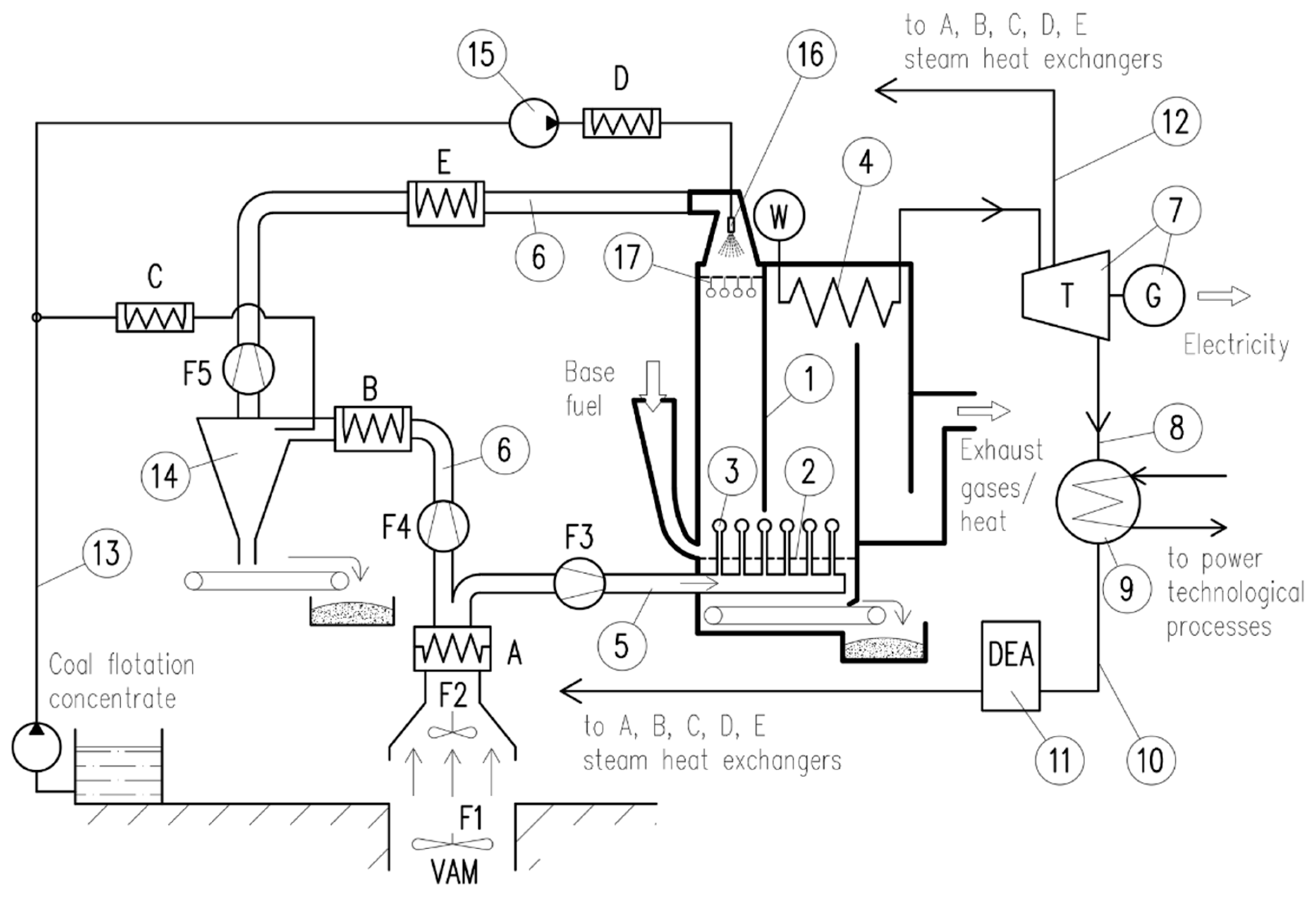
10], the simplified schematic of which is shown in
Figure 1.
The installation is designed to reduce methane emissions from ventilation air while enabling optional utilization of the generated thermal energy for mine-water desalination [
10]. Its functional objectives include:
Utilization of low-concentration methane from the ventilation shaft;
Combustion of a primary fuel (hard coal in the presented configuration);
Co-combustion of flotation concentrate in the boiler furnace;
Reduction in mine-water salinity through steam-driven evaporation.
Because VAM flow rates at shaft outlets often reach or exceed 300 m
3/s, a single boiler, capable of processing approximately 25 m
3/s, cannot handle the entire stream. Therefore,
Figure 1 illustrates a single-boiler configuration for clarity. Energy calculations, including primary-fuel input and steam-output parameters, are also presented for a single boiler operating with 25 m
3/s of VAM. The fuel quantities were selected based on the methane and oxygen content of the VAM stream. For clarity, most physical parameters are expressed per second.
According to
Figure 1, the proposed system operates as an integrated energy conversion unit in which thermal energy generated in the boiler is converted into electricity and useful heat via a back-pressure steam cycle. High-pressure steam produced in the boiler is expanded in a turbine driving an electrical generator, while the remaining thermal energy is recovered through a system of heat exchangers used for preheating process streams and supplying external heat demands. This configuration enables efficient utilization of both high-grade and low-grade heat within the system.
In the considered configuration, the combustion system operates as a co-combustion unit in which hard coal serves as the primary energy carrier (with a calorific value of 23 MJ/kg, supplied at 2.4 kg/s), supplemented by flotation concentrate and ventilation air methane. The presence of methane in the combustion air, although energetically limited due to its low concentration (~0.6%), contributes to the overall heat release and enables partial recovery of energy from ventilation emissions. Stable combustion is ensured by appropriate fuel ratios and continuous monitoring of methane concentration, which is critical for both process efficiency and operational safety.
VAM is extracted from the ventilation shaft using a hood or side-extraction fan (F2), designed to avoid throttling the main fan (F1). After extraction, the VAM is preheated in steam heat exchanger “A” and then divided into two streams supplying the lower and upper boiler sections via pipelines (5, 6) and fans (F3, F4, F5). For the example configuration, 60% of the VAM is directed to the lower grate and 40% to the upper grate. The upper-section VAM stream first passes through cyclone (14), which is part of the flotation-concentrate production line. In the upper boiler section, the pressurized flotation concentrate is heated in exchanger “D” and then injected through nozzle (16). Upon expansion, the saturated steam disperses the fuel particles, forming a suspension of solid particles in wet steam. This mixture, containing approximately 0.6% methane and sufficient oxygen, supports stable combustion.
3.2. Process Integration and Energy Utilization
The installation produces three forms of energy:
Electricity from the turbogenerator;
Back-pressure steam for heating or technological processes;
Thermal energy from the flue gases.
The system includes a flue-gas cleaning unit with heat recovery, enabling cooling below the dew point and removal of particulate and acidic pollutants.
Due to the high combustion temperature in the boiler, reaching approximately 1000 °C, the methane contained in the VAM stream undergoes complete oxidation. Water is converted into superheated steam in the boiler system and subsequently expanded in the turbine, where thermal energy is converted into electrical power.
Back-pressure steam from the turbine supplies thermal energy for heating applications and industrial processes such as mine-water desalination. The condensate is recirculated within the system. The primary heat source for preheating and drying processes is the extraction steam from the turbine.
Furthermore, the extraction-steam streams can be utilized for mine-water desalination: steam at 6 bar and back-pressure steam at 3 bar provide the thermal energy required for concentrating saline mine waters. The utilization of saline water to produce brine suitable for industrial applications constitutes an additional environmental benefit of the proposed installation. Depending on the volume of water to be desalinated, a significant portion of the high-pressure steam may be consumed in this process, which in turn reduces the electrical output of the turbogenerator.
The steam streams at 6 bar and at 3 bar supply thermal energy to two multi-effect evaporator stations, enabling the production of a saturated brine solution with a concentration of approximately 26.5%. Preliminary desalination is carried out in an evaporator station equipped with plate heat exchangers, where the first effect is heated using saturated steam at 3.0 bar and 133.5 °C. Final concentration of the brine to a saturated solution is achieved in two subsequent evaporator stages employing jet-ejector thermocompressors driven by saturated steam at 6.0 bar and 159 °C.
The concept assumes the commercial utilization of the concentrated brine, which may be transported to an external recipient. Alternatively, further salt-crystallization processes may be carried out using low-temperature waste heat from the methane-reduction installation at the mine.
Waste heat from the boiler flue gases is recovered through heat exchangers (not shown in the diagram), supplying heat for mine-site heating or other technological processes. To significantly reduce boiler heat losses [
31,
33], a set of partition and non-partition heat exchangers [
30,
35] may be installed in the flue-gas ducts, enabling cooling of the flue gases below the dew point. The recovery of condensation heat increases the boiler-plant efficiency by up to 15%. This solution also enables wet flue-gas cleaning, reducing particulate and gaseous pollutants to levels below the emission standards specified for each fuel type in Polish legislation.
Overall, the effectiveness of the proposed system results from the coupling of combustion, heat recovery, and phase-change processes, which together enable efficient energy utilization despite the low calorific value of ventilation air methane.
3.3. Safety Considerations and Explosion-Risk Mitigation
The introduction of ventilation air methane (VAM) into a combustion system requires careful consideration of explosion safety due to the presence of methane–air mixtures. In the proposed configuration, the methane concentration in ventilation air remains very low (typically 0.5–0.7 vol.% CH4), which is significantly below the lower explosive limit (LEL ≈ 5 vol.% CH4). This inherent safety margin is further guaranteed by mine ventilation protocols, which strictly maintain methane levels within these non-explosive limits. Consequently, the system operates under inherently fuel-lean conditions, providing a substantial safety margin under normal operation.
Nevertheless, transient fluctuations in methane concentration and local flow conditions must be considered. To ensure safe operation, continuous methane monitoring is required at key locations, including the ventilation shaft extraction point, the preheating section (heat exchanger A), and the combustion air inlets to the boiler. The use of redundant gas detection systems increases reliability and enables early identification of abnormal operating conditions.
If the methane concentration exceeds predefined safety thresholds, the VAM stream can be reduced or temporarily isolated, allowing the boiler to continue operation using the primary fuel and ambient air. Such procedures are standard in industrial combustion systems handling variable-composition gaseous streams and can be incorporated into the control strategy of the proposed installation.
From a fluid-dynamic perspective, the installation is designed to operate under continuous forced-flow conditions. The use of extraction and distribution fans (F2–F5) ensures stable transport of the VAM stream and promotes turbulent mixing within the air supply system and combustion zones. This prevents the formation of stagnant regions or locally enriched methane pockets that could otherwise pose an explosion hazard.
Additional safety is provided by maintaining excess air conditions in the combustion chamber. This inherently ensures sufficient dilution of methane and keeps the gas composition well outside the flammability range, even in the presence of moderate fluctuations in inlet conditions.
It should be emphasized that, due to the ultra-lean nature of VAM, methane oxidation occurs primarily in high-temperature zones governed by the combustion of the primary fuel, rather than as an independent flame process. This further reduces the likelihood of flame instability or uncontrolled combustion phenomena associated with premixed methane–air systems.
It should be emphasized that the present study focuses on conceptual system integration. A detailed quantitative safety assessment, including HAZOP analysis and CFD-based dispersion or explosion modelling, will be performed in subsequent stages of development. Nevertheless, the measures outlined above reflect established industrial practice for handling low-calorific gaseous mixtures and demonstrate that the proposed installation can be designed to operate within a robust safety envelope.
4. Power Energy Balance of the Installation
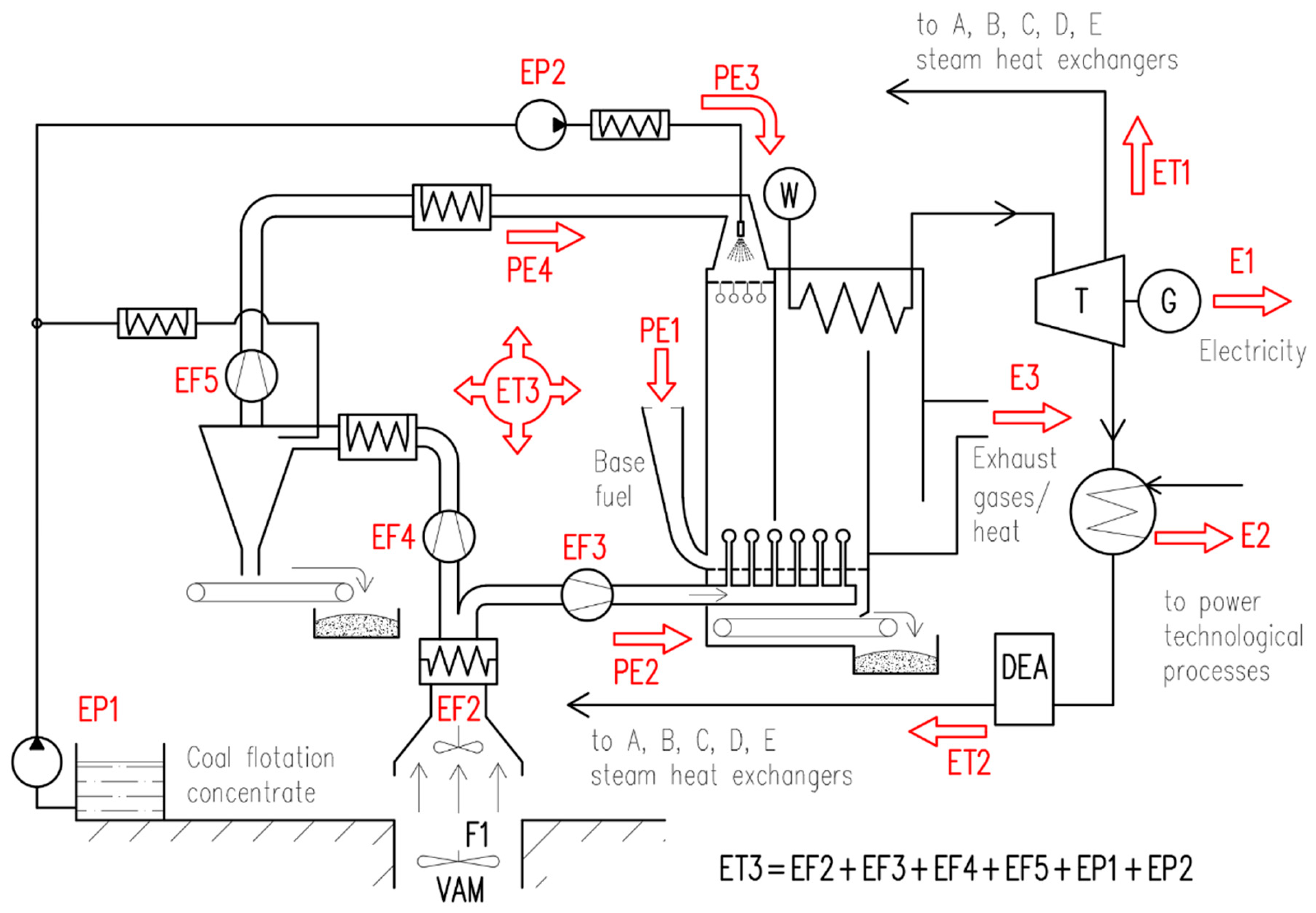
The power energy balance of the proposed installation with steam boilers is illustrated in
Figure 2.
The diagram symbolically illustrates the share of energy components at the boiler inlet side: the primary energy (potential) of the fuels supplied (symbols PE), and the electrical power required to drive the pumps and fans (symbols EP and EF). The outlet side displays output powers E1, E2 and E3, as well as steam powers ET1 and ET2, which are recirculated to the inlet side to heat the flotation concentrate and VAM. Individual power components and their projected power values are discussed below. The following primary energy components are supplied to the boiler for the combustion process:
PE1 is primary energy (i.e., potential power) in the form of thermal coal at 2.4 kg/s (as discussed regarding
Figure 1), with a calorific value of 23 MJ/kg, fed to the lower grate, calculated according to Equation (5):
Considering the sum of the primary power inputs PE1, PE2, PE3, and PE4, the total power is 76.45 MW. Since the steam boiler has an average efficiency of 85%, the HP steam power amounts to 64.98 MW.
ET1 corresponds to the thermal power of the high-pressure steam (HP steam) taken from the turbogenerator extraction point, which is required for heating the VAM and flotation concentrate in the heat exchangers (A–E as shown in
Figure 1). This power is estimated at 1.2 MW.
ET2 corresponds to the thermal power of the exhaust steam from the turbogenerator (LP steam), used for heating the VAM and flotation concentrate in the aforementioned heat exchangers. This power is estimated at 0.7 MW.
ET3 represents the electrical energy needed to drive fans EF2–EF5, as well as pumps EP1 and EP2, symbolically illustrated as a circle with four arrows and the label ET3. The energy balance does not include the main fan F1, as it is not strictly a process-related device, although it is responsible for discharging the VAM through the mine’s exhaust shaft. The total power of ET3 is estimated at 0.5 MW. However, it should be pointed out here that this value was adopted for simplified assumptions of capturing VAM from the mainstream behind the F2 fan and transmitting VAM through 0.5 m2 pipelines over a distance of approximately 200 m.
On the outlet side of the boiler, we obtain three types of energy:
E1 is the electrical power produced by the turbogenerator, which, assuming a thermodynamic and electrical efficiency of 30%, will amount to 19.49 MW. This energy is intended for the mine’s internal consumption or for the grid.
E2 is the thermal power obtained from the generator’s exhaust steam exchanger, estimated at approximately 42 MW.
E3 is the thermal power of the flue gases for potential further utilization, estimated at approximately 10 MW.
As shown above, the sum of E1, E2, and E3 totals 71.5 MW, which is close to the primary power of 76.45 MW. The difference is 4.9 MW, which essentially corresponds to the sum of the previously defined ET1 and ET2 (1.9 MW), while the remaining power deficit (3 MW) results from heat losses in the pipelines and the boiler itself, excluding flue gases.
Table 1 presents the aforementioned capacity data for an installation capable of processing 25 m
3/s, as well as projections for a scaled system of 12 boilers, corresponding to 300 m
3/s of VAM—a value representative of a large coal mine ventilation shaft.
The relatively small discrepancy between the inlet and outlet power of the system demonstrates the favorable energy potential of the proposed solution. Such low energy losses are only achievable when all available energy sources, including exhaust gases, are fully utilized. This raises the question of why such installations have not been implemented to date. While the economic aspects are beyond the scope of this article, it must be noted that the installation (especially the 12-boiler configuration proposed to process the total VAM of a mine) will require significant capital expenditure (CAPEX). However, with emission restrictions approaching, such systems may become essential for the continued operation of the coal industry. Starting in 2027, coal mines will face a limit of 5 tonnes of methane per 1000 tonnes of coal mined, tightening to 3 tonnes in 2031. Companies exceeding these limits will be subject to “dissuasive” financial penalties. For the Polish mining sector, potential costs could reach up to 1.5 billion PLN (approximately 400 million USD) annually.
5. Discussion
The presented results demonstrate that the proposed installation offers a high level of energy efficiency and significant potential for methane emission reduction in coal mines. The relatively small difference between the total primary energy input and the useful energy output confirms that the system effectively utilizes all available energy streams, including low-temperature waste heat from flue gases. This distinguishes the concept from conventional VAM mitigation technologies, which typically operate with limited or no energy recovery.
The main advantage of the proposed solution is its ability to integrate multiple processes within a single installation. This multifunctionality increases the overall economic and environmental value of the system.
Despite these advantages, several challenges must be acknowledged. The system requires maintaining a relatively stable methane concentration in the VAM stream. Achieving this may necessitate controlled enrichment using methane from drainage systems, which introduces operational complexity and requires continuous monitoring. Furthermore, the installation relies on the availability of flotation concentrate or coal slurry as a supplementary fuel. Although these materials are abundant in many coal mines, their properties (moisture content, ash content, particle size) may vary, necessitating preprocessing to ensure stable combustion.
Another important consideration is the scale of the installation. A single boiler can process approximately 25 m3/s of VAM, meaning that large mines may require multiple units operating in parallel. While modularity improves operational flexibility, it also increases capital expenditure and spatial requirements. However, upcoming methane emission limits in the European Union may significantly enhance the system’s economic viability. Financial penalties for exceeding emission thresholds could make such installations not only environmentally beneficial but also economically justified.
Finally, further research is needed to validate the long-term performance of the installation under variable operating conditions. Future work could include pilot-scale testing, dynamic modeling of methane concentration fluctuations, optimization of heat recovery systems, and a detailed techno-economic analysis comparing the proposed solution with existing VAM mitigation technologies. The integration of mine water desalination also warrants additional investigation, particularly regarding the quality of the resulting brine and its potential industrial applications.
6. Conclusions
The analysis presented in this manuscript demonstrates that the proposed installation is a technically feasible and energetically efficient solution for reducing ventilation air methane (VAM) in coal mines. Unlike Regenerative Thermal Oxidizers (RTOs), which primarily focus on methane destruction with limited energy recovery, the proposed system enables high-efficiency energy harvesting through the co-combustion of VAM, hard coal, and flotation concentrate. The resulting production of electricity, process heat, and recoverable low-temperature waste heat significantly enhances the overall energy balance of the installation.
The calculations show that a single boiler unit with a capacity of 25 m3/s of VAM can achieve a favorable ratio between primary energy input and useful energy output, confirming the effectiveness of the integrated heat-recovery concept. Maintaining methane concentrations in the range of 0.5–0.7% is essential for stable operation, and this requirement can be met by enriching VAM with methane from drainage systems. The modular nature of the installation allows it to be scaled to meet the needs of large mines, where multiple units can operate in parallel.
The proposed system also offers additional environmental benefits, including the potential integration of mine water desalination using extraction and back-pressure steam. This multifunctionality increases the ecological and economic value of the installation, particularly in the context of imminent EU methane emission limits. The results indicate that this concept may serve as a practical pathway for mines seeking to comply with future regulatory requirements while simultaneously improving energy efficiency.







 ,
,