Evaluating the Performance of Biogas Plants Operating on Organic Waste: A Practical Approach

Abstract
1. Introduction
2. Types and Characteristics of Feedstock Used in Biogas Plants
2.1. High-Energy Feedstocks: Characteristics and Role in Biogas Yield
2.2. Medium and Low-Energy Feedstocks: Slurry and Liquid Substrates
2.3. Co-Digestion Strategies and Optimization of Feedstock Mixtures
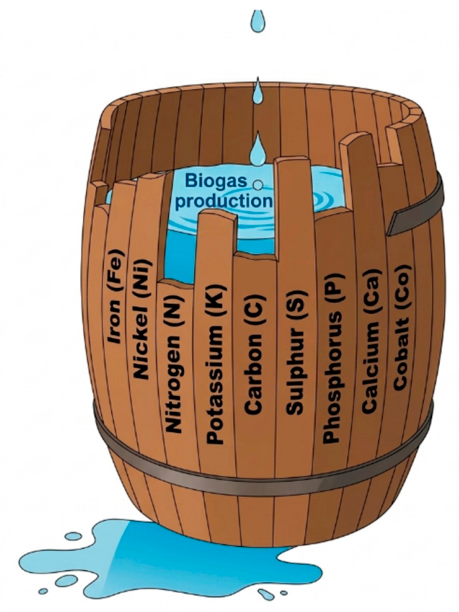
- Achieving the appropriate C:N ratio in the substrate mix (ideally in the range of 20–30:1) [96].
- Ammonium nitrogen concentration should remain within an optimal range. According to Procházka et al. [97] optimal concentrations for methanogens were 2.1, 2.6 and 3.1 g/L of ammonia nitrogen in dependence on inoculum origin. Higher ammonium nitrogen content may increase the risk of ammonium inhibition, while too low NH4+-N concentrations can cause nitrogen starvation [98]. However, variations in operating temperature, reactor design, and the level of ammonia nitrogen inhibition tolerated by microbial communities across different systems preclude the definition of universal threshold values [99].
- Certain substrates, such as various types of straw or beet pulp, are significantly deficient in essential micronutrients and trace elements essential for the metabolism of microorganisms involved in the anaerobic digestion process. Therefore, substrates should be supplemented with those rich in these elements, such as animal manure [100].
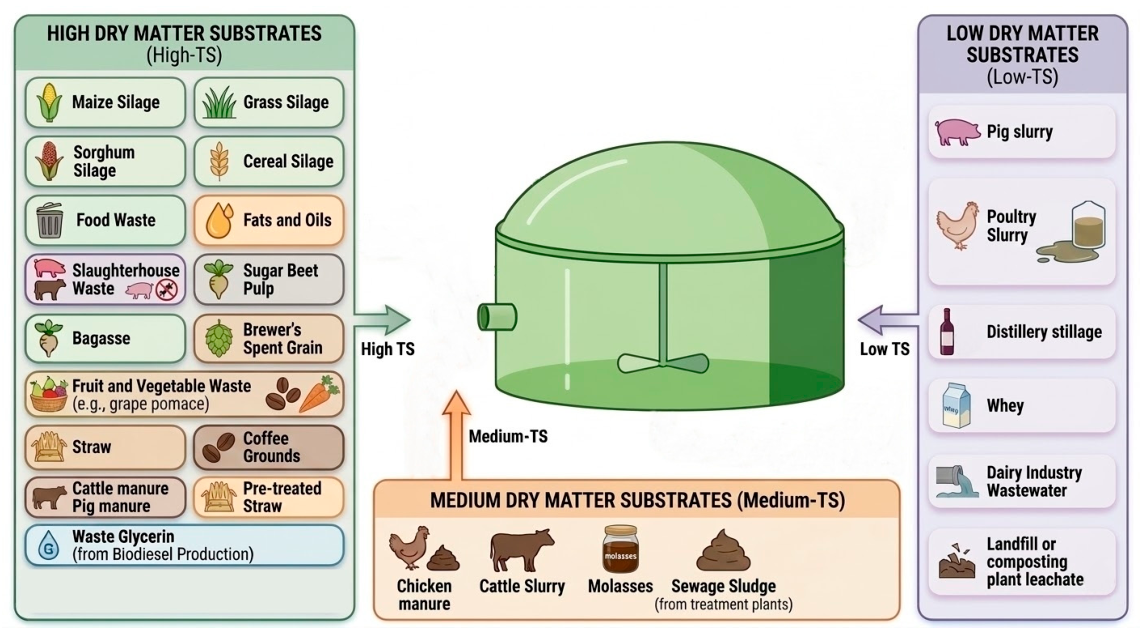
- The average dry matter content of the substrate mix fed to fermenters in wet fermentation should be approximately 12%. A lower value will result in a low organic loading rate (OLR), and as a result, the anaerobic digestion potential of the fermenters will be poorly utilized [101].
- Depending on the substrate mixing technology used and its pumpability, a specific dry matter content (TS) level of the substrate mixture should not be exceeded. Some high-solids technologies allow AD at dry matter contents often exceeding 15% [102].
2.4. Influence of Feedstock Properties on Biogas Plant Performance
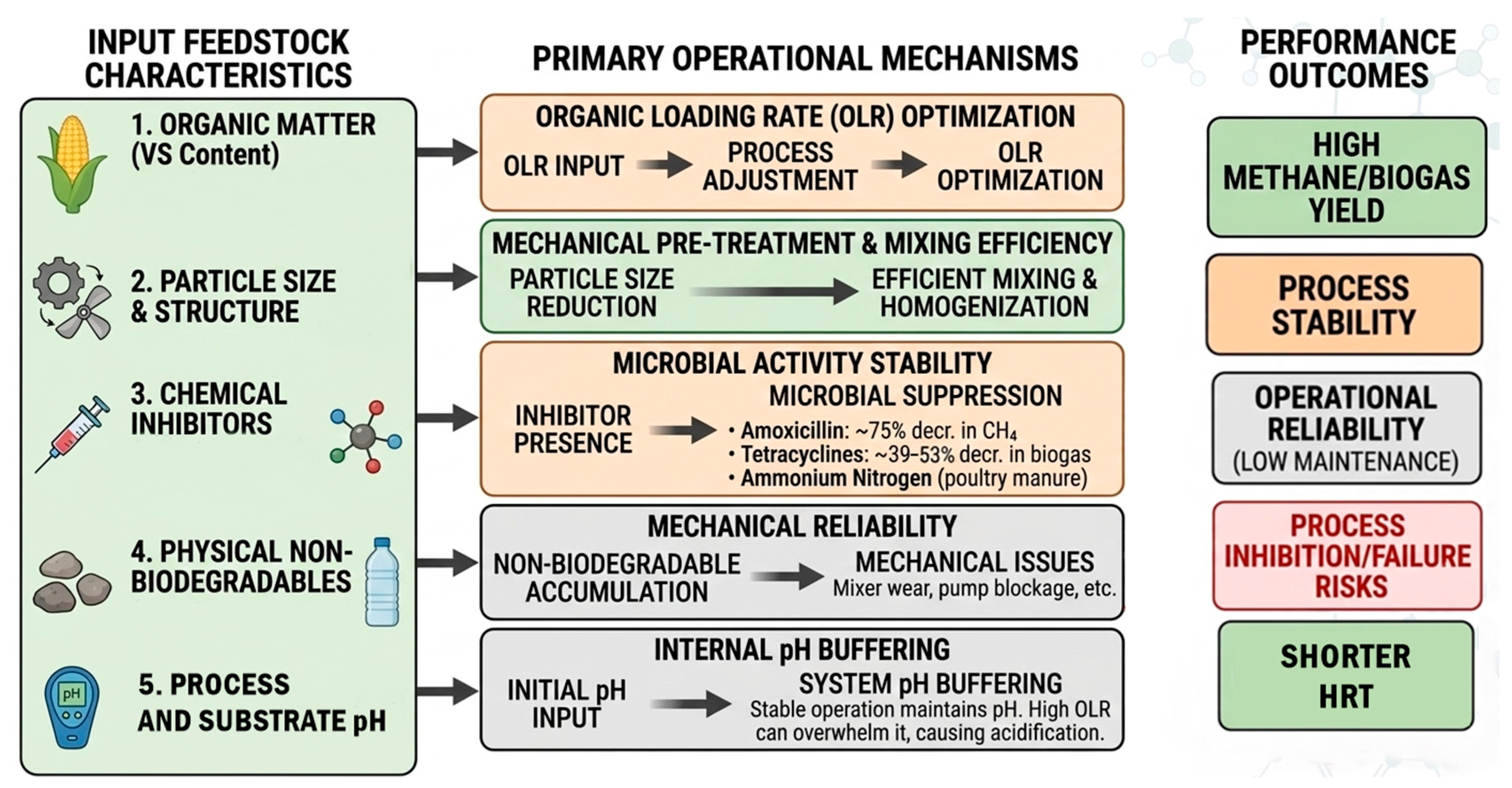
- Proper organic loading rate which is the amount of organic matter added to the fermenter daily. It is a key parameter controlling the efficiency and stability of a biogas plant. An OLR that is too high can lead to the accumulation of organic acids and acidification (and consequently to process failure), while an OLR that is too low can result in underutilization of reactor capacity. An appropriate OLR in the digester may vary depending on the substrate or substrate mixture used, temperature of the process and technology used [107,108]. For agricultural biogas plants, it typically should not exceed approximately 4–5 kg of VS/m3/d. Seick et al. [109] in laboratory conditions reached 5.8 g VS/L/day using maize silage and changing the regime from mesophilic to thermophilic conditions; Lindorfer et al. [110] in real-scale biogas plant conditions increased OLR from 2.11 to 4.25 kg of VS/m3/d in an agricultural biogas plant using pig manure, solid energy crops such as silages from maize and rye, ground grains from maize and wheat, and residues from vegetable processing as feedstock. Tamborrino et al. [111] described an installation in Italy fermenting olive waste (pulp and pitted olive pomace) and pulp pitted olive pomace and wheat bran shorts in the amount of 10% of the total powered biomass operated at an OLR of approximately 5.3–5.5 kg VS/m3/d. In turn, in the study by Jiang et al. [112] digested organic fraction of municipal solid waste (OFMSW) in a semi-continuous mode showed that the maximum achievable OLR was 9.00 g VS/L/d but the recommended operating conditions for the anaerobic digestion of OFMSW is an OLR of 7.50 g VS/L/d and thermophilic condition.
- Efficient mixing and substrate homogenization are essential for stable anaerobic digestion. Mechanical pretreatment such as grinding or chopping of biomass improves substrate accessibility for microorganisms and enhances the hydrolysis stage of the digestion process [113]. Particle size reduction increases the specific surface area of the substrate, facilitating microbial attachment and enzymatic degradation of organic matter. As reported in experimental studies, smaller particle sizes significantly improve methane production due to enhanced mass transfer and substrate availability for anaerobic microorganisms [114,115]. Mechanical pretreatment also improves reactor hydrodynamics and mixing efficiency. In industrial biogas plants, substrates are often milled or shredded before feeding to produce a pumpable slurry that can be effectively mixed in continuously stirred tank reactors. Adequate mixing ensures uniform distribution of microorganisms, nutrients and heat, which is essential for maintaining stable digestion performance [33,116].
- The absence of inhibitory compounds (e.g., antibiotics, toxic chemicals, excessive ammonium nitrogen). Antibiotics are among the most frequently reported inhibitors of anaerobic digestion because they directly affect microbial metabolism. These substances can disturb the activity of microorganisms responsible for the degradation of organic matter and the final stage of methane formation. According to Koniuszewska et al. [117] antibiotics in wastewater and cattle slurry used as substrates in the AD process can pose serious problems for anaerobic microorganisms, because they may reduce the activity of methanogenic microorganisms or alter the microbial community structure responsible for methane production [24]. Experimental studies confirm that many antibiotics can significantly reduce biogas production. For example, the addition of antimicrobial compounds to cattle manure during mesophilic anaerobic digestion caused substantial decreases in methane generation; in some cases, amoxicillin caused a 75% decrease in CH4 production in comparison with the control samples. Enrofloxacin, tetracycline, oxytetracycline, and chlortetracycline reduced the amount of biogas produced by 36, 39, 45 and 53%, respectively [117]. Therefore, maintaining substrates free from inhibitory compounds is essential for stable biogas plant operation. In practice, this requires careful control of feedstock sources, avoiding wastes contaminated with pharmaceuticals, disinfectants, or toxic industrial chemicals. In cases where inhibitors are present, strategies such as dilution, co-digestion with clean substrates, or adsorption using materials like biochar may help mitigate their negative effects on the anaerobic digestion process [73,118]. Another inhibitor may be ammonium nitrogen, which is found in large quantities in poultry manure, which can affect the operation of biogas plant [119]. In this context, cooperation between the farmer supplying animal manure to the biogas plant and the biogas plant operator is crucial [120]. If a herd becomes ill and a veterinarian administers a strong dose of antibiotics to the animals, a significant portion of the antibiotic will be excreted by the animals and found in the slurry or manure. There are numerous cases where digested pulp containing antimicrobials and antibiotics reduces or even stops the fermentation process [121,122,123].
- Removal of mineral and other non-biodegradable contaminants from the feedstock is a critical step in the operation of biogas plants. Substrates used for anaerobic digestion, such as manure, agricultural residues, food waste or municipal organic waste, often contain inert materials including sand, stones, soil particles, glass, metals or plastics [124,125]. These materials are not degradable in the anaerobic digestion process and may lead to both operational and mechanical problems and can cause damage to mixers, pumps, or valves. In turn, Hoffmann et al. [126] observed a positive effect of sand on methane yield—sewage sludge degradation to CH4 was significantly enhanced in the presence of sand.
- The pH of the input substrate is generally of secondary importance, as a well-managed biogas plant maintains a stable pH in the individual fermentation reactors (maintained spontaneously by cooperating groups of bacteria). Unless substrate is fed too intensively, which would overload the fermenter and cause acidification. The appropriate pH level, is difficult to determine, it depends on the technology used and on whether the digestion process phases are separated. Ward et al. [127] assumed that the pH level suitable for methanogenesis ranges from 6.8 to 7.2; on the other hand Khalid et al. [128] assumed that the pH levels suitable for hydrolysis and acidogenesis are 5.5 and 6.5, respectively. Some experts (biogas plant operators) even recommend values for methanogenesis at pH level of 7.4–7.7.
3. Internal Consumption of Electricity and Heat in the Biogas Plant
- Building local heating pipelines and heating supply to nearby buildings [150];
- Building drying facilities for wood, agricultural products or digestate drying [151];
- Heating greenhouses [152];
- Combining biogas production with ethyl alcohol production [153];
- Producing cold from heat using trigeneration technology and utilizing the cold in industrial installations (dairies, cold stores, etc.) [154].
4. Energy Efficiency in Biogas Plant Operation
5. Discussion and Future Outlook
6. Conclusions
Funding
Data Availability Statement
Acknowledgments
Conflicts of Interest
Abbreviations
| AD | Anaerobic Digestion |
| BMP | Biochemical Methane Potential |
| CHP | Combined Heat And Power |
| C:N | Carbon to Nitrogen Ratio |
| CNG | Compressed Natural Gas |
| COD | Chemical Oxygen Demand |
| DM | Dry Matter |
| EU | European Union |
| GHG | Greenhouse Gasses |
| HRT | Hydraulic Retention Time |
| IRENA | International Renewable Energy Agency |
| LCFAs | Long-Chain Fatty Acids |
| LNG | Liquefied Natural Gas |
| OFMSW | Organic Fraction of Municipal Solid |
| OLR | Organic Loading Rate |
| ORC | Organic Rankine Cycle |
| POME | Palm Oil Mill Effluent |
| RED III | Renewable Energy Directive III |
| VS | Volatile Solids |
| TS | Total Solids |
References
- Andrabi, S.J.A.; Kishore, K.; Wani, B.A.; Wani, K.A. Environmental Consideration of Landfills in Developed Countries. Environ. Claims J. 2025, 37, 307–332. [Google Scholar] [CrossRef] [Scilit]
- Marín-Beltrán, I.; Demaria, F.; Ofelio, C.; Serra, L.M.; Turiel, A.; Ripple, W.J.; Mukul, S.A.; Costa, M.C. Scientists’ Warning against the Society of Waste. Sci. Total Environ. 2022, 811, 151359. [Google Scholar] [CrossRef] [Scilit]
- Al-Gheethi, A.; Ma, N.L.; Rupani, P.F.; Sultana, N.; Yaakob, M.A.; Mohamed, R.M.S.R.; Soon, C.F. Biowastes of Slaughterhouses and Wet Markets: An Overview of Waste Management for Disease Prevention. Environ. Sci. Pollut. Res. Int. 2021, 30, 71780. [Google Scholar] [CrossRef] [Scilit] [PubMed]
- Alengebawy, A.; Ran, Y.; Osman, A.I.; Jin, K.; Samer, M.; Ai, P. Anaerobic Digestion of Agricultural Waste for Biogas Production and Sustainable Bioenergy Recovery: A Review. Environ. Chem. Lett. 2024, 22, 2641–2668. [Google Scholar] [CrossRef] [Scilit]
- Czekała, W.; Janczak, D.; Pochwatka, P.; Nowak, M.; Dach, J. Gases Emissions during Composting Process of Agri-Food Industry Waste. Appl. Sci. 2022, 12, 9245. [Google Scholar] [CrossRef] [Scilit]
- Pochwatka, P.; Rozakis, S.; Kowalczyk-Juśko, A.; Czekała, W.; Qiao, W.; Nägele, H.J.; Janczak, D.; Mazurkiewicz, J.; Mazur, A.; Dach, J. The Energetic and Economic Analysis of Demand-Driven Biogas Plant Investment Possibility in Dairy Farm. Energy 2023, 283, 129165. [Google Scholar] [CrossRef] [Scilit]
- Czekała, W.; Tarkowski, F.; Pochwatka, P. Social Aspects of Energy Production from Renewable Sources. Probl. Ekorozwoju 2021, 16, 61–66. [Google Scholar] [CrossRef] [Scilit]
- IRENA. Renewable Energy Statistics 2025; International Renewable Energy Agency: Abu Dhabi, United Arab Emirates, 2025. [Google Scholar]
- IEA Bioenergy. Implementation of Bioenergy in China, Country Reports. 2024. Available online: https://www.ieabioenergy.com/wp-content/uploads/2024/12/CountryReport2024_China_final.pdf (accessed on 23 April 2026).
- KOWR. Data on the Activities of Agricultural Biogas Producers. 2026. Available online: https://www.gov.pl/web/kowr/dane-dotyczace-dzialalnosci-wytworcow-biogazu-rolniczego (accessed on 26 April 2026).
- Ministry of Climate and Environment. Announcement of the Regulation of the Minister of Climate and Environment Regarding the Reference Price for Biomethane. 2023. Available online: https://www.gov.pl/web/klimat/ogloszenie-rozporzadzenia-ministra-klimatu-i-srodowiska-w-sprawie-ceny-referencyjnej-dla-biometanu (accessed on 2 February 2026).
- Noussan, M.; Negro, V.; Prussi, M.; Chiaramonti, D. The Potential Role of Biomethane for the Decarbonization of Transport: An Analysis of 2030 Scenarios in Italy. Appl. Energy 2024, 355, 122322. [Google Scholar] [CrossRef] [Scilit]
- Calero, M.; Godoy, V.; Heras, C.G.; Lozano, E.; Arjandas, S.; Martín-Lara, M.A. Current State of Biogas and Biomethane Production and Its Implications for Spain. Sustain. Energy Fuels 2023, 7, 3584–3602. [Google Scholar] [CrossRef] [Scilit]
- Un, C. Assessing Biogas from Wastewater Treatment Plants for Sustainable Transportation Fuel: A Detailed Analysis of Energy Potential and Emission Reductions. Gases 2025, 5, 6. [Google Scholar] [CrossRef] [Scilit]
- Kulichkova, G.I.; Ivanova, T.S.; Köttner, M.; Volodko, O.I.; Spivak, S.I.; Tsygankov, S.P.; Blume, Y.B. Plant Feedstocks and Their Biogas Production Potentials. Open Agric. J. 2020, 14, 219–234. [Google Scholar] [CrossRef] [Scilit]
- Weiland, P. Biogas Production: Current State and Perspectives. Appl. Microbiol. Biotechnol. 2010, 85, 849–860. [Google Scholar] [CrossRef] [Scilit]
- Mata-Alvarez, J.; Dosta, J.; Romero-Güiza, M.S.; Fonoll, X.; Peces, M.; Astals, S. A Critical Review on Anaerobic Co-Digestion Achievements between 2010 and 2013. Renew. Sustain. Energy Rev. 2014, 36, 412–427. [Google Scholar] [CrossRef] [Scilit]
- Czekała, W.; Nowak, M.; Bojarski, W. Characteristics of Substrates Used for Biogas Production in Terms of Water Content. Fermentation 2023, 9, 449. [Google Scholar] [CrossRef] [Scilit]
- Prasanna Kumar, D.J.; Mishra, R.K.; Chinnam, S.; Binnal, P.; Dwivedi, N. A Comprehensive Study on Anaerobic Digestion of Organic Solid Waste: A Review on Configurations, Operating Parameters, Techno-Economic Analysis and Current Trends. Biotechnol. Notes 2024, 5, 33. [Google Scholar] [CrossRef] [Scilit] [PubMed]
- Ervasti, S.; Kostensalo, J.; Tampio, E. Effects of Seasonal and Local Co-Feedstocks on the Performance of Continuous Anaerobic Digestion of Cattle Slurry. Bioresour. Technol. Rep. 2022, 19, 101207. [Google Scholar] [CrossRef] [Scilit]
- Ferreira, L.; Duarte, E.; Figueiredo, D. Utilization of Wasted Sardine Oil as Co-Substrate with Pig Slurry for Biogas Production—A Pilot Experience of Decentralized Industrial Organic Waste Management in a Portuguese Pig Farm. Bioresour. Technol. 2012, 116, 285–289. [Google Scholar] [CrossRef] [Scilit] [PubMed]
- Pilarski, K.; Pilarska, A.A.; Pietrzak, M.B. Biogas Production in Agriculture: Technological, Environmental, and Socio-Economic Aspects. Energies 2025, 18, 5844. [Google Scholar] [CrossRef] [Scilit]
- Nammana, B.; Racho, P.; Nawong, S.; Wichitsathian, B.; Tantrakarnapa, K. Feasibility of Anaerobic Co-Digestion for Biogas Production from Recycled Paper Industry Sludge: Optimization of Mixing Ratios and Application in Two-Stage CSTR System Design. Water Sci. Technol. 2025, 92, 683–703. [Google Scholar] [CrossRef] [Scilit]
- Kasinath, A.; Fudala-Ksiazek, S.; Szopinska, M.; Bylinski, H.; Artichowicz, W.; Remiszewska-Skwarek, A.; Luczkiewicz, A. Biomass in Biogas Production: Pretreatment and Codigestion. Renew. Sustain. Energy Rev. 2021, 150, 111509. [Google Scholar] [CrossRef] [Scilit]
- Abanades, S.; Abbaspour, H.; Ahmadi, A.; Das, B.; Ehyaei, M.A.; Esmaeilion, F.; El Haj Assad, M.; Hajilounezhad, T.; Jamali, D.H.; Hmida, A.; et al. A Critical Review of Biogas Production and Usage with Legislations Framework across the Globe. Int. J. Environ. Sci. Technol. 2021, 19, 3377. [Google Scholar] [CrossRef] [Scilit]
- Afridi, Z.U.R.; Ullah, K.; Mustafa, M.F.; Saleem, H.; Shaker, B.; Ashraf, N.; Aslam, S. Biogas as Sustainable Approach for Social Uplift in South East Asian Region. Energy Rep. 2023, 10, 4808–4818. [Google Scholar] [CrossRef] [Scilit]
- Li, Y.; Qing, C.; Zhou, W.; Xu, D. Exploring the Role of Environmental Regulations in Biogas Development in China, from the Perspective of Peer Effect. Energy 2025, 315, 134393. [Google Scholar] [CrossRef] [Scilit]
- Sarkar, O.; Rova, U.; Christakopoulos, P.; Matsakas, L. Acidogenic Valorization of Agricultural Residues and Industrial Waste Streams: Substrate Composition Regulating the Microbial Community and Metabolites. Environ. Sci. Adv. 2026, 5, 470–484. [Google Scholar] [CrossRef] [Scilit]
- Josimović, L.; Prvulović, S.; Djordjević, L.; Bicok, I.; Bakator, M.; Premčevski, V.; Šarenac, U.; Šeljmeši, D. Enhancing Biogas Plant Efficiency for the Production of Electrical and Thermal Energy. Appl. Sci. 2024, 14, 5858. [Google Scholar] [CrossRef] [Scilit]
- Chodkowska-Miszczuk, J.; Martinát, S.; van der Horst, D. Changes in Feedstocks of Rural Anaerobic Digestion Plants: External Drivers towards a Circular Bioeconomy. Renew. Sustain. Energy Rev. 2021, 148, 111344. [Google Scholar] [CrossRef] [Scilit]
- Popović, V.; Vasileva, V.; Ljubičić, N.; Rakašćan, N.; Ikanović, J. Environment, Soil, and Digestate Interaction of Maize Silage and Biogas Production. Agronomy 2024, 14, 2612. [Google Scholar] [CrossRef] [Scilit]
- Kupryaniuk, K.; Wójtowicz, A.; Mazurkiewicz, J.; Słowik, T.; Matwijczuk, A. The Influence of the Pressure-Thermal Agglomeration Methods of Corn Bran on Their Selected Physicochemical Properties and Biogas Efficiency. Energies 2021, 14, 6997. [Google Scholar] [CrossRef] [Scilit]
- Czekała, W.; Frankowski, J.; Sieracka, D.; Pochwatka, P.; Kowalczyk-Juśko, A.; Witaszek, K.; Dudnyk, A.; Zielińska, A.; Wisła-Świder, A.; Dach, J. The Energy Efficiency Analysis of Sorghum Waste Biomass Grown in a Temperate Climate. Energy 2025, 320, 135433. [Google Scholar] [CrossRef] [Scilit]
- RED III Directive. 2023. Available online: https://eur-lex.europa.eu/eli/dir/2023/2413/oj/eng (accessed on 12 February 2026).
- Fuksa, P.; Hakl, J.; Míchal, P.; Hrevušová, Z.; Šantrůček, J.; Tlustoš, P. Effect of Silage Maize Plant Density and Plant Parts on Biogas Production and Composition. Biomass Bioenergy 2020, 142, 105770. [Google Scholar] [CrossRef] [Scilit]
- Meegoda, J.N.; Chande, C.; Bakshi, I. Biodigesters for Sustainable Food Waste Management. Int. J. Environ. Res. Public Health 2025, 22, 382. [Google Scholar] [CrossRef] [Scilit]
- Ćurčić, S.; Milićević, D.; Kilibarda, N.; Peulić, A. Assessing Biogas Production Potential from Organic Waste and Livestock Byproducts in a Serbian Municipality: Implications for Sustainable Food Systems. Sustainability 2025, 17, 3144. [Google Scholar] [CrossRef] [Scilit]
- Lackner, M.; Besharati, M. Agricultural Waste: Challenges and Solutions, a Review. Waste 2025, 3, 18. [Google Scholar] [CrossRef] [Scilit]
- Pant, M.; Bisen, D.; Kewlani, P.; Srivastav, A.L.; Bhatt, I.D.; Chakma, S. Review of Food Waste Valorization Technologies: A Sustainable Approach to Resource Recovery and Utilization. Biomass Futures 2026, 1, 100001. [Google Scholar] [CrossRef] [Scilit]
- Costa, S.; Gugel, I.; Polchri, L.; Mazzocchi, M.; Ammendola, P.; Raganati, F.; Miccio, F. Biogas Production through Combined Thermochemical and Biochemical Processing of Grape Pomace. Biomass Bioenergy 2026, 205, 108512. [Google Scholar] [CrossRef] [Scilit]
- Sodri, A.; Septriana, F.E. Biogas Power Generation from Palm Oil Mill Effluent (POME): Techno-Economic and Environmental Impact Evaluation. Energies 2022, 15, 7265. [Google Scholar] [CrossRef] [Scilit]
- Gomez, C.C.; Demafelis, R.B.; Magadia, B.T.; Matanguihan, A.E.D.; Estante, E.P.V.; Nuñez, C.J.E.; Sumague, J.V.; Chong, K.; Roeder, M.; Jamieson, C. Greenhouse Gas Mitigation Potential of the Enhanced Rice Straw Biogas System in the Philippines. IOP Conf. Ser. Mater. Sci. Eng. 2024, 1318, 012016. [Google Scholar] [CrossRef] [Scilit]
- Kan, K.W.; Chan, Y.J.; Tiong, T.J.; Lim, J.W. Maximizing Biogas Yield from Palm Oil Mill Effluent (POME) through Advanced Simulation and Optimisation Techniques on an Industrial Scale. Chem. Eng. Sci. 2024, 285, 119644. [Google Scholar] [CrossRef] [Scilit]
- Chen, X.; Fu, W.; Hu, K.; Yin, G.; Liu, S.; Zhu, N.; Zhao, Y.; Cui, Z.; Yuan, X. Economic and Environmental Analysis: Straw Biogas Project Operating at Full Load with Dry Yellow Corn Straw. Bioresour. Technol. 2025, 426, 132335. [Google Scholar] [CrossRef] [Scilit] [PubMed]
- Jurgutis, L.; Slepetiene, A.; Volungevicius, J.; Amaleviciute-Volunge, K. Biogas Production from Chicken Manure at Different Organic Loading Rates in a Mesophilic Full Scale Anaerobic Digestion Plant. Biomass Bioenergy 2020, 141, 105693. [Google Scholar] [CrossRef] [Scilit]
- Manyi-Loh, C.E.; Lues, R. Anaerobic Digestion of Lignocellulosic Biomass: Substrate Characteristics (Challenge) and Innovation. Fermentation 2023, 9, 755. [Google Scholar] [CrossRef] [Scilit]
- Furtado, L.A.; Guerreiro Ribeiro, S.; Pradelle, F.; Parise, J.A.R. Modeling and Techno-Economic Analysis of a Hybrid Sugarcane Plant Fed by Vinasse Biogas and Bagasse Surplus for Electricity Generation. J. Clean. Prod. 2023, 413, 137511. [Google Scholar] [CrossRef] [Scilit]
- Anaya-Reza, O.; Altamirano-Corona, M.F.; Basurto-García, G.; Patricio-Fabián, H.; García-González, S.A.; Martinez-Hernandez, E.; Durán-Moreno, A. Wet Anaerobic Digestion of Organic Fraction of Municipal Solid Waste: Experience with Long-Term Pilot Plant Operation and Industrial Scale-Up. Bioprocess Biosyst. Eng. 2024, 47, 235. [Google Scholar] [CrossRef] [Scilit]
- Herrmann, C.; Idler, C.; Heiermann, M. Biogas Crops Grown in Energy Crop Rotations: Linking Chemical Composition and Methane Production Characteristics. Bioresour. Technol. 2016, 206, 23–35. [Google Scholar] [CrossRef] [Scilit]
- Kupryaniuk, K.; Witaszek, K.; Vaskina, I.; Filipek-Kaźmierczak, S.; Kupryaniuk, J.; Sołowiej, P.; Dach, J. The Effect of Corn Ensiling Methods on Digestibility and Biogas Yield. Energies 2025, 18, 188. [Google Scholar] [CrossRef] [Scilit]
- Meyer-Aurich, A.; Lochmann, Y.; Klauss, H.; Prochnow, A. Comparative Advantage of Maize- and Grass-Silage Based Feedstock for Biogas Production with Respect to Greenhouse Gas Mitigation. Sustainability 2016, 8, 617. [Google Scholar] [CrossRef] [Scilit]
- Nizami, A.S.; Murphy, J.D. Optimizing the Operation of a Two-Phase Anaerobic Digestion System Digesting Grass Silage. Environ. Sci. Technol. 2011, 45, 7561–7569. [Google Scholar] [CrossRef] [Scilit] [PubMed]
- Negri, M.; Bacenetti, J.; Fiala, M.; Bocchi, S. Evaluation of Anaerobic Degradation, Biogas and Digestate Production of Cereal Silages Using Nylon-Bags. Bioresour. Technol. 2016, 209, 40–49. [Google Scholar] [CrossRef] [Scilit]
- Czekała, W. Agricultural Biogas Plants as a Chance for the Development of the Agri-Food Sector. J. Ecol. Eng. 2018, 19, 179–183. [Google Scholar] [CrossRef] [Scilit]
- Wannasek, L.; Ortner, M.; Amon, B.; Amon, T. Sorghum, a Sustainable Feedstock for Biogas Production? Impact of Climate, Variety and Harvesting Time on Maturity and Biomass Yield. Biomass Bioenergy 2017, 106, 137–145. [Google Scholar] [CrossRef] [Scilit]
- Frei, M. Lignin: Characterization of a Multifaceted Crop Component. Sci. World J. 2013, 2013, 436517. [Google Scholar] [CrossRef] [Scilit]
- Angelidaki, I.; Sanders, W. Assessment of the Anaerobic Biodegradability of Macropollutants. Rev. Environ. Sci. Biotechnol. 2004, 3, 117–129. [Google Scholar] [CrossRef] [Scilit]
- Dasa, K.T.; Westman, S.Y.; Millati, R.; Cahyanto, M.N.; Taherzadeh, M.J.; Niklasson, C. Inhibitory Effect of Long-Chain Fatty Acids on Biogas Production and the Protective Effect of Membrane Bioreactor. Biomed. Res. Int. 2016, 2016, 7263974. [Google Scholar] [CrossRef] [Scilit]
- Ramos-Suárez, J.L.; Álvarez-Méndez, S.J.; Padrón Tejera, E.; Ritter, A.; Mata González, J. Temperature Control Effect on Cheese Whey Anaerobic Digestion with Low-Cost Tubular Digesters. Processes 2024, 12, 1452. [Google Scholar] [CrossRef] [Scilit]
- Dareioti, M.A.; Vavouraki, A.I.; Tsigkou, K.; Kornaros, M. Assessment of Single- vs. Two-Stage Process for the Anaerobic Digestion of Liquid Cow Manure and Cheese Whey. Energies 2021, 14, 5423. [Google Scholar] [CrossRef] [Scilit]
- Mioduszewska, N.; Pilarska, A.A.; Pilarski, K.; Adamski, M. The Influence of the Process of Sugar Beet Storage on Its Biochemical Methane Potential. Energies 2020, 13, 5104. [Google Scholar] [CrossRef] [Scilit]
- Ostojić, S.; Micić, D.; Dukić, J.; Sabljak, I.; Akyüz, A.; Ersus, S.; Režek Jambrak, A. Thermal Characteristics and Kinetics of the Thermal Degradation of Sugar Beet Waste Leaves and Pulp in Relation to Chemical Composition. Foods 2025, 14, 307. [Google Scholar] [CrossRef] [Scilit]
- Dhodduraj, K.; Narisetty, V.; Nabavi, S.A.; Saldivar, R.P.; Coulon, F.; Agrawal, D.; Maity, S.K.; Balan, V.; Kumar, V. Beets beyond Sugar: Potential and Limitations of Sugar Beet Pulp as a Feedstock for Biorefineries. Ind. Crops Prod. 2026, 240, 122559. [Google Scholar] [CrossRef] [Scilit]
- Oliveira, J.V.; Alves, M.M.; Costa, J.C. Biochemical Methane Potential of Brewery By-Products. Clean Technol. Environ. Policy 2018, 20, 435–440. [Google Scholar] [CrossRef] [Scilit]
- Bochmann, G.; Drosg, B.; Fuchs, W. Anaerobic Digestion of Thermal Pretreated Brewers’ Spent Grains. Environ. Prog. Sustain. Energy 2015, 34, 1092–1096. [Google Scholar] [CrossRef] [Scilit]
- Mulu, T.; Chala, B.; Kassa, Y.; Freyer, B.; Fentie, T.; Mulugeta, M.; Tibebe, D. Valorisation of Brewery Spent Grain for Biogas Production and Nutrient-Enriched Bioslurry in Sustainable Agriculture. Int. J. Sustain. Energy 2026, 45, 2629665. [Google Scholar] [CrossRef] [Scilit]
- Bucci, P.; Cantero, D.; Casas, A.; Marcos, E.; Menalla, E.; Muñoz, R. Hydrothermal Pretreatment of Brewer’s Spent Grain: A Pathway to Sustainable Biogas Production and Waste Valorization. Biomass Bioenergy 2026, 204, 108399. [Google Scholar] [CrossRef] [Scilit]
- Browne, J.D.; Murphy, J.D. Assessment of the Resource Associated with Biomethane from Food Waste. Appl. Energy 2013, 104, 170–177. [Google Scholar] [CrossRef] [Scilit]
- Al-Wahaibi, A.; Osman, A.I.; Al-Muhtaseb, A.H.; Alqaisi, O.; Baawain, M.; Fawzy, S.; Rooney, D.W. Techno-Economic Evaluation of Biogas Production from Food Waste via Anaerobic Digestion. Sci. Rep. 2020, 10, 15719. [Google Scholar] [CrossRef] [Scilit] [PubMed]
- Wu, H.M.; Li, X.; Chen, J.N.; Yan, Y.J.; Kobayashi, T.; Hu, Y.; Zhang, X. Food Waste Anaerobic Digestion Under High Organic Loading Rate: Inhibiting Factors, Mechanisms, and Mitigation Strategies. Processes 2025, 13, 2090. [Google Scholar] [CrossRef] [Scilit]
- Gunaseelan, V.N. Biochemical Methane Potential of Fruits and Vegetable Solid Waste Feedstocks. Biomass Bioenergy 2004, 26, 389–399. [Google Scholar] [CrossRef] [Scilit]
- Azevedo, A.; Lapa, N.; Moldão, M.; Gominho, J.; Duarte, E. Fruit and Vegetable Wastes as Co-Substrates in Anaerobic Co-Digestion: Effect of Storage Temperature on Physicochemical Properties and Biogas Production. Energy Nexus 2025, 17, 100354. [Google Scholar] [CrossRef] [Scilit]
- Hernandez, J.E.; Edyvean, R.G.J. Inhibition of Biogas Production and Biodegradability by Substituted Phenolic Compounds in Anaerobic Sludge. J. Hazard. Mater. 2008, 160, 20–28. [Google Scholar] [CrossRef] [Scilit]
- Ye, X.; Shen, C.; Zhang, J. Regional Characteristics of Livestock and Poultry Manure Production and Sustainable Resource Utilisation Technologies in China—A Review. Sustainability 2026, 18, 1844. [Google Scholar] [CrossRef] [Scilit]
- Wainer, A.; Love, D.C.; Kim, B.F.; Harding, J.; Lyu, Q.; Williams, D.L.; Heaney, C.D.; Hobbs, B.F.; Nachman, K.E. Deconstructing the Livestock Manure Digester and Biogas Controversy. Curr. Environ. Heal. Rep. 2025, 12, 43. [Google Scholar] [CrossRef] [Scilit]
- Pilarski, K.; Pilarska, A.A. Kinetics and Energy Yield in Anaerobic Digestion: Effects of Substrate Composition and Fundamental Operating Conditions. Energies 2025, 18, 6262. [Google Scholar] [CrossRef] [Scilit]
- Kowalczyk-Juśko, A.; Pochwatka, P.; Mazurkiewicz, J.; Pulka, J.; Kępowicz, B.; Janczak, D.; Dach, J. Reduction of Greenhouse Gas Emissions by Replacing Fertilizers with Digestate. J. Ecol. Eng. 2023, 24, 312–319. [Google Scholar] [CrossRef] [Scilit] [PubMed]
- Song, Y.; Qiao, W.; Westerholm, M.; Huang, G.; Taherzadeh, M.J.; Dong, R. Microbiological and Technological Insights on Anaerobic Digestion of Animal Manure: A Review. Fermentation 2023, 9, 436. [Google Scholar] [CrossRef] [Scilit]
- Giulianetti de Almeida, M.P.; Mockaitis, G.; Weissbrodt, D.G. Got Whey? Sustainability Endpoints for the Dairy Industry through Resource Biorecovery. Fermentation 2023, 9, 897. [Google Scholar] [CrossRef] [Scilit]
- Ni, J.Q. A Review of Household and Industrial Anaerobic Digestion in Asia: Biogas Development and Safety Incidents. Renew. Sustain. Energy Rev. 2024, 197, 114371. [Google Scholar] [CrossRef] [Scilit]
- Prasad, R.D.; Dbouk, W.; Yiadom, E.B.; Vassiliades, C. Biogas Digester Innovations as Solution to Clean Cooking Energy Challenge in the Pacific Islands: A Policy Perspective. Energy Rep. 2025, 13, 2417–2432. [Google Scholar] [CrossRef] [Scilit]
- Paranhos, A.G.d.O.; Adarme, O.F.H.; Barreto, G.F.; Silva, S.d.Q.; de Aquino, S.F. Methane Production by Co-Digestion of Poultry Manure and Lignocellulosic Biomass: Kinetic and Energy Assessment. Bioresour. Technol. 2020, 300, 122588. [Google Scholar] [CrossRef] [Scilit] [PubMed]
- Marcucci, S.M.P.; Santos, E.D.N.D.; Fuziki, M.E.K.; Lenzi, G.G.; Balthazar, J.M.; Tusset, A.M. Techno-Economic Analysis of Biogas Production with Vinasse and Co-Digestion with Vinasse and Filter Cake for Annexed Plants: Case Study in Paraná State, Brazil. Biomass 2025, 5, 10. [Google Scholar] [CrossRef] [Scilit]
- Stürmer, B.; Schmid, E.; Eder, M.W. Impacts of Biogas Plant Performance Factors on Total Substrate Costs. Biomass Bioenergy 2011, 35, 1552–1560. [Google Scholar] [CrossRef] [Scilit]
- DelaVega-Quintero, J.C.; Nuñez-Pérez, J.; Lara-Fiallos, M.; Barba, P.; Burbano-García, J.L.; Espín-Valladares, R. Advances and Challenges in Anaerobic Digestion for Biogas Production: Policy, Technological, and Microbial Perspectives. Processes 2025, 13, 3648. [Google Scholar] [CrossRef] [Scilit]
- Alves, I.R.; de Oliveira, M.C.; Santiago, E.P.; Bassin, I.D.; Santos, N.B.C.; Sambusiti, C.; Bassin, J.P. Exploring Feedstock Proportions in Anaerobic Co-Digestion of Food and Green Waste for Enhancing Methane Yield and Process Stability. Bioresour. Technol. 2026, 442, 133691. [Google Scholar] [CrossRef] [Scilit]
- Chaher, N.E.H.; Nassour, A.; Hamdi, M.; Nelles, M. Monitoring of Food Waste Anaerobic Digestion Performance: Conventional Co-Substrates vs. Unmarketable Biochar Additions. Foods 2021, 10, 2353. [Google Scholar] [CrossRef] [Scilit]
- Fagbohungbe, M.O.; Onyeri, C.A.; Semple, K.T. Co-Fermentation of Whey Permeates and Cattle Slurry Using a Partitioned up-Flow Anaerobic Digestion Tank. Energy 2019, 185, 567–572. [Google Scholar] [CrossRef] [Scilit]
- Hu, Y.; Ma, H.; Shi, C.; Kobayashi, T.; Xu, K.Q. Nutrient Augmentation Enhances Biogas Production from Sorghum Mono-Digestion. Waste Manag. 2021, 119, 63–71. [Google Scholar] [CrossRef] [Scilit] [PubMed]
- Ibro, M.K.; Ancha, V.R.; Lemma, D.B. Impacts of Anaerobic Co-Digestion on Different Influencing Parameters: A Critical Review. Sustainability 2022, 14, 9387. [Google Scholar] [CrossRef] [Scilit]
- Kreuger, E.; Tosi, V.; Lindblad, M.; Davidsson, Å. Co-Digestion and Mono-Digestion of Sewage Sludge and Steam-Pretreated Winter Wheat Straw in Continuous Stirred-Tank Reactors—Nutrient Composition and Process Performance. Fermentation 2024, 10, 414. [Google Scholar] [CrossRef] [Scilit]
- Zhu, X.; Yellezuome, D.; Liu, R.; Wang, Z.; Liu, X. Effects of Co-Digestion of Food Waste, Corn Straw and Chicken Manure in Two-Stage Anaerobic Digestion on Trace Element Bioavailability and Microbial Community Composition. Bioresour. Technol. 2022, 346, 126625. [Google Scholar] [CrossRef] [Scilit]
- Vergote, T.L.I.; De Dobbelaere, A.E.J.; Willems, B.; Leenknegt, J.; Buysse, J.; Volcke, E.I.P.; Meers, E. Stability of Thermophilic Pig Manure Mono-Digestion: Effect of Thermal Pre-Treatment and Separation. Front. Energy Res. 2020, 8, 518655. [Google Scholar] [CrossRef] [Scilit]
- Nie, H.; Jacobi, H.F.; Strach, K.; Xu, C.; Zhou, H.; Liebetrau, J. Mono-Fermentation of Chicken Manure: Ammonia Inhibition and Recirculation of the Digestate. Bioresour. Technol. 2015, 178, 238–246. [Google Scholar] [CrossRef] [Scilit]
- Angelidaki, I.; Ellegaard, L. Codigestion of Manure and Organic Wastes in Centralized Biogas Plants. Appl. Biochem. Biotechnol. 2003, 109, 95–105. [Google Scholar] [CrossRef] [Scilit]
- Rajlakshmi; Jadhav, D.A.; Dutta, S.; Sherpa, K.C.; Jayaswal, K.; Saravanabhupathy, S.; Mohanty, K.T.; Banerjee, R.; Kumar, J.; Rajak, R.C. Co-Digestion Processes of Waste: Status and Perspective. In Bio-Based Materials and Waste for Energy Generation and Resource Management: Present and Emerging Waste Management Practices; Volume 5 of Advanced Zero Waste Tools; Elsevier: Amsterdam, The Netherlands, 2023; pp. 207–241. [Google Scholar] [CrossRef] [Scilit]
- Procházka, J.; Dolejš, P.; MácA, J.; Dohányos, M. Stability and Inhibition of Anaerobic Processes Caused by Insufficiency or Excess of Ammonia Nitrogen. Appl. Microbiol. Biotechnol. 2011, 93, 439–447. [Google Scholar] [CrossRef] [Scilit]
- Psachoulia, P.; Schortsianiti, S.N.; Lortou, U.; Gkelis, S.; Chatzidoukas, C.; Samaras, P. Assessment of Nutrients Recovery Capacity and Biomass Growth of Four Microalgae Species in Anaerobic Digestion Effluent. Water 2022, 14, 221. [Google Scholar] [CrossRef] [Scilit]
- Yang, J.; Zhang, J.; Du, X.; Gao, T.; Cheng, Z.; Fu, W.; Wang, S. Ammonia Inhibition in Anaerobic Digestion of Organic Waste: A Review. Int. J. Environ. Sci. Technol. 2024, 22, 3927–3942. [Google Scholar] [CrossRef] [Scilit]
- Aboudi, K.; Gómez-Quiroga, X.; álvarez-Gallego, C.J.; Romero-García, L.I. Insights into Anaerobic Co-Digestion of Lignocellulosic Biomass (Sugar Beet By-Products) and Animal Manure in Long-Term Semi-Continuous Assays. Appl. Sci. 2020, 10, 5126. [Google Scholar] [CrossRef] [Scilit]
- Nsair, A.; Cinar, S.O.; Alassali, A.; Qdais, H.A.; Kuchta, K. Operational Parameters of Biogas Plants: A Review and Evaluation Study. Energies 2020, 13, 3761. [Google Scholar] [CrossRef] [Scilit]
- Li, W.; Gupta, R.; Zhang, Z.; Cao, L.; Li, Y.; Show, P.L.; Gupta, V.K.; Kumar, S.; Lin, K.Y.A.; Varjani, S.; et al. A Review of High-Solid Anaerobic Digestion (HSAD): From Transport Phenomena to Process Design. Renew. Sustain. Energy Rev. 2023, 180, 113305. [Google Scholar] [CrossRef] [Scilit]
- Gadirli, G.; Pilarska, A.A.; Dach, J.; Pilarski, K.; Kolasa-Więcek, A.; Borowiak, K. Fundamentals, Operation and Global Prospects for the Development of Biogas Plants—A Review. Energies 2024, 17, 568. [Google Scholar] [CrossRef] [Scilit]
- Liang, W.; Li, G.; Dai, Y.; Zhou, H.; Wang, Y.; Han, Y.; Qi, Y.; Wang, D.; Jiang, K.; Zhu, Q. Trace Element Supplementation Enables Sustainable High-Straw Dry Anaerobic Digestion by Suppressing Acidification and Boosting Biogas via Microbial Network Rewiring. Sustainability 2026, 18, 1395. [Google Scholar] [CrossRef] [Scilit]
- Ghiotto, G.; De Bernardini, N.; Orellana, E.; Fiorito, G.; Cenci, L.; Kougias, P.G.; Campanaro, S.; Treu, L. Impact of Trace Metal Supplementation on Anaerobic Biological Methanation under Hydrogen and Carbon Dioxide Starvation. npj Biofilms Microbiomes 2025, 11, 7. [Google Scholar] [CrossRef] [Scilit]
- Shamurad, B.; Sallis, P.; Petropoulos, E.; Tabraiz, S.; Ospina, C.; Leary, P.; Dolfing, J.; Gray, N. Stable Biogas Production from Single-Stage Anaerobic Digestion of Food Waste. Appl. Energy 2020, 263, 114609. [Google Scholar] [CrossRef] [Scilit]
- Shin, S.G.; Park, S.H.; Hwang, S. Substrate Characteristics Fluctuations in Full-Scale Anaerobic Digesters Treating Food Waste at Marginal Organic Loading Rates: A Case Study. Energies 2022, 15, 3471. [Google Scholar] [CrossRef] [Scilit]
- Park, Y.; Khim, J.; Kim, J.D. Application of a Full-Scale Horizontal Anaerobic Digester for the Co-Digestion of Pig Manure, Food Waste, Excretion, and Thickened Sewage Sludge. Processes 2023, 11, 1294. [Google Scholar] [CrossRef] [Scilit]
- Seick, I.; Vergara-Araya, M.; Wiese, J. Flexible Energy from Biogas: Use of Secondary Digesters for Heat Storage—Results of Fermentation Tests. Clean 2022, 50, 2000373. [Google Scholar] [CrossRef] [Scilit]
- Lindorfer, H.; Corcoba, A.; Vasilieva, V.; Braun, R.; Kirchmayr, R. Doubling the Organic Loading Rate in the Co-Digestion of Energy Crops and Manure—A Full Scale Case Study. Bioresour. Technol. 2008, 99, 1148–1156. [Google Scholar] [CrossRef] [Scilit] [PubMed]
- Tamborrino, A.; Catalano, F.; Leone, A.; Bianchi, B. A Real Case Study of a Full-Scale Anaerobic Digestion Plant Powered by Olive By-Products. Foods 2021, 10, 1946. [Google Scholar] [CrossRef] [Scilit]
- Jiang, J.; He, S.; Kang, X.; Sun, Y.; Yuan, Z.; Xing, T.; Guo, Y.; Li, L. Effect of Organic Loading Rate and Temperature on the Anaerobic Digestion of Municipal Solid Waste: Process Performance and Energy Recovery. Front. Energy Res. 2020, 8, 522334. [Google Scholar] [CrossRef] [Scilit]
- Izumi, K.; Okishio, Y.-K.; Nagao, N.; Niwa, C.; Yamamoto, S.; Toda, T. Effects of Particle Size on Anaerobic Digestion of Food Waste. Int. Biodeterior. Biodegrad. 2010, 64, 601–608. [Google Scholar] [CrossRef] [Scilit]
- Zhang, Y.; Banks, C.J. Impact of Different Particle Size Distributions on Anaerobic Digestion of the Organic Fraction of Municipal Solid Waste. Waste Manag. 2013, 33, 297–307. [Google Scholar] [CrossRef] [Scilit] [PubMed]
- Singh, B.; Kovács, K.L.; Bagi, Z.; Nyári, J.; Szepesi, G.L.; Petrik, M.; Siménfalvi, Z.; Szamosi, Z. Enhancing Efficiency of Anaerobic Digestion by Optimization of Mixing Regimes Using Helical Ribbon Impeller. Fermentation 2021, 7, 251. [Google Scholar] [CrossRef] [Scilit]
- Neuner, T.; Meister, M.; Pillei, M.; Senfter, T.; Draxl-Weiskopf, S.; Ebner, C.; Winkler, J.; Rauch, W. Impact of Design and Mixing Strategies on Biogas Production in Anaerobic Digesters. Water 2024, 16, 2205. [Google Scholar] [CrossRef] [Scilit]
- Koniuszewska, I.; Harnisz, M.; Korzeniewska, E.; Czatzkowska, M.; Jastrzȩbski, J.P.; Paukszto, L.; Bajkacz, S.; Felis, E.; Rusanowska, P. The Effect of Antibiotics on Mesophilic Anaerobic Digestion Process of Cattle Manure. Energies 2021, 14, 1125. [Google Scholar] [CrossRef] [Scilit]
- Zhao, Y.; He, J.; Pang, H.; Li, L.; Cui, X.; Liu, Y.; Jiang, W.; Liu, X. Anaerobic Digestion and Biochar/Hydrochar Enhancement of Antibiotic-Containing Wastewater: Current Situation, Mechanism and Future Prospects. Environ. Res. 2025, 264, 120087. [Google Scholar] [CrossRef] [Scilit]
- Molaey, R.; Bayrakdar, A.; Sürmeli, R.Ö.; Çalli, B. Anaerobic Digestion of Chicken Manure: Mitigating Process Inhibition at High Ammonia Concentrations by Selenium Supplementation. Biomass Bioenergy 2018, 108, 439–446. [Google Scholar] [CrossRef] [Scilit]
- Murat Yazan, D.; Fraccascia, L.; Mes, M.; Zijm, H. Cooperation in Manure-Based Biogas Production Networks: An Agent-Based Modeling Approach. Appl. Energy 2017, 212, 820–833. [Google Scholar] [CrossRef] [Scilit]
- Arikan, O.A.; Sikora, L.J.; Mulbry, W.; Khan, S.U.; Rice, C.; Foster, G.D. The Fate and Effect of Oxytetracycline during the Anaerobic Digestion of Manure from Therapeutically Treated Calves. Process Biochem. 2006, 41, 1637–1643. [Google Scholar] [CrossRef] [Scilit]
- Cetecioglu, Z.; Ince, B.; Orhon, D.; Ince, O. Acute Inhibitory Impact of Antimicrobials on Acetoclastic Methanogenic Activity. Bioresour. Technol. 2012, 114, 109–116. [Google Scholar] [CrossRef] [Scilit]
- Lu, X.; Zhen, G.; Liu, Y.; Hojo, T.; Estrada, A.L.; Li, Y.Y. Long-Term Effect of the Antibiotic Cefalexin on Methane Production during Waste Activated Sludge Anaerobic Digestion. Bioresour. Technol. 2014, 169, 644–651. [Google Scholar] [CrossRef] [Scilit]
- Zielińska, M.; Cydzik-Kwiatkowska, A. Effect of Emerging Micropollutants on the Anaerobic Digestion of Sewage Sludge. Energies 2024, 17, 1033. [Google Scholar] [CrossRef] [Scilit]
- Rocamora, I.; Wagland, S.T.; Villa, R.; Simpson, E.W.; Fernández, O.; Bajón-Fernández, Y. Dry Anaerobic Digestion of Organic Waste: A Review of Operational Parameters and Their Impact on Process Performance. Bioresour. Technol. 2020, 299, 122681. [Google Scholar] [CrossRef] [Scilit]
- Hoffmann, N.; Braga, C.S.N.; Rubilar, O.; Ciudad, G.; Tortella, G.; Hermosilla, E.; Duarte, M.S.; Pereira, L.; Salvador, A.F.; Martins, G. Challenging the Conductive Paradigm: The Unexpected Role of Sand in Anaerobic Digestion. Bioresour. Technol. 2025, 438, 133163. [Google Scholar] [CrossRef] [Scilit]
- Ward, A.J.; Hobbs, P.J.; Holliman, P.J.; Jones, D.L. Optimisation of the Anaerobic Digestion of Agricultural Resources. Bioresour. Technol. 2008, 99, 7928–7940. [Google Scholar] [CrossRef] [Scilit]
- Khalid, A.; Arshad, M.; Anjum, M.; Mahmood, T.; Dawson, L. The Anaerobic Digestion of Solid Organic Waste. Waste Manag. 2011, 31, 1737–1744. [Google Scholar] [CrossRef] [Scilit]
- Wu, Y.; Cui, E.; Zuo, Y.; Cheng, W.; Rensing, C.; Chen, H. Influence of two-phase anaerobic digestion on fate of selected antibiotic resistance genes and class I integrons in municipal wastewater sludge. Bioresour. Technol. 2016, 211, 414–421. [Google Scholar] [CrossRef] [Scilit]
- Lindkvist, E.; Johansson, M.T.; Rosenqvist, J. Methodology for Analysing Energy Demand in Biogas Production Plants—A Comparative Study of Two Biogas Plants. Energies 2017, 10, 1822. [Google Scholar] [CrossRef] [Scilit]
- Kumar, M.; Sen, S. Introduction to Hybrid Energy System. Encycl. Renew. Energy Sustain. Environ. 2024, 4, 219–230. [Google Scholar] [CrossRef] [Scilit]
- Skibko, Z.; Borusiewicz, A.; Filipkowski, J.; Pisarek, Ł.; Kuboń, M. Impact of Farm Biogas Plant Auxiliary Equipment on Electrical Power Quality. Energies 2025, 18, 3849. [Google Scholar] [CrossRef] [Scilit]
- Lemmer, A.; Naegele, H.J.; Sondermann, J. How Efficient Are Agitators in Biogas Digesters? Determination of the Efficiency of Submersible Motor Mixers and Incline Agitators by Measuring Nutrient Distribution in Full-Scale Agricultural Biogas Digesters. Energies 2013, 6, 6255–6273. [Google Scholar] [CrossRef] [Scilit]
- Kariyama, I.D.; Zhai, X.; Wu, B. Influence of Mixing on Anaerobic Digestion Efficiency in Stirred Tank Digesters: A Review. Water Res. 2018, 143, 503–517. [Google Scholar] [CrossRef] [Scilit] [PubMed]
- Björn, A.; Šafarič, L.; Karlsson, A.; Danielsson, A.; Ejlertsson, J.; Svensson, B.H.; Yekta, S.S. Substrate and Operational Conditions as Regulators of Fluid Properties in Full-Scale Continuous Stirred-Tank Biogas Reactors—Implications for Rheology-Driven Power Requirements. Water Sci. Technol. 2018, 78, 814–826. [Google Scholar] [CrossRef] [Scilit]
- Appels, L.; Baeyens, J.; Degrève, J.; Dewil, R. Principles and Potential of the Anaerobic Digestion of Waste-Activated Sludge. Prog. Energy Combust. Sci. 2008, 34, 755–781. [Google Scholar] [CrossRef] [Scilit]
- Marks, S.; Dach, J.; Morales, F.J.F.; Mazurkiewicz, J.; Pochwatka, P.; Gierz, Ł. New Trends in Substrates and Biogas Systems in Poland. J. Ecol. Eng. 2020, 21, 19–25. [Google Scholar] [CrossRef] [Scilit]
- Neuner, T.; Meister, M.; Pillei, M.; Rauch, W. Optimizing Mixing Efficiency of Anaerobic Digesters with High Total Solids Concentrations Using Validated CFD Simulations. Biochem. Eng. J. 2024, 208, 109320. [Google Scholar] [CrossRef] [Scilit]
- Kupryaniuk, K.; Oniszczuk, T.; Combrzyński, M.; Lisiecka, K.; Janczak, D. Influence of Modification of the Plasticizing System on the Extrusion-Cooking Process and Selected Physicochemical Properties of Rapeseed and Buckwheat Straws. Materials 2022, 15, 5039. [Google Scholar] [CrossRef] [Scilit]
- Dabiri, S.; Kumar, P.; Ebner, C.; Rauch, W. On the Effect of Biogas Bubbles in Anaerobic Digester Mixing. Biochem. Eng. J. 2021, 173, 108088. [Google Scholar] [CrossRef] [Scilit]
- Mladenovska, Z.; Ahring, B.K. Growth Kinetics of Thermophilic Methanosarcina Spp. Isolated from Full-Scale Biogas Plants Treating Animal Manures. FEMS Microbiol. Ecol. 2000, 31, 225–229. [Google Scholar] [CrossRef]
- Andersson, J.; Helander-Claesson, J.; Olsson, J. Study on Reduced Process Temperature for Energy Optimisation in Mesophilic Digestion: A Lab to Full-Scale Study. Appl. Energy 2020, 271, 115108. [Google Scholar] [CrossRef] [Scilit]
- Liu, X.; Lendormi, T.; Lanoisellé, J.L. Overview of Hygienization Pretreatment for Pasteurization and Methane Potential Enhancement of Biowaste: Challenges, State of the Art and Alternative Technologies. J. Clean. Prod. 2019, 236, 117525. [Google Scholar] [CrossRef] [Scilit]
- Czekała, W.; Jasiński, T.; Grzelak, M.; Witaszek, K.; Dach, J. Biogas Plant Operation: Digestate as the Valuable Product. Energies 2022, 15, 8275. [Google Scholar] [CrossRef] [Scilit]
- Yuki Junior, G.M.; Sochard, S.; Dela Pierre, F.; Dinuccio, E.; Marias, F. Combining Thermal Model and Kinetics: Implications in Dynamic Simulation of Anaerobic Digesters. Bioresour. Technol. 2024, 413, 131343. [Google Scholar] [CrossRef] [Scilit] [PubMed]
- Nik Zad, A.; Zainali, S.; Croci, M.; Guezgouz, M.; Impollonia, G.; Elia Campana, P.; Amaducci, S. Techno-Economic Optimization of Agrivoltaic-Powered Anaerobic Digestion Plant for Biomethane Production. Energy Convers. Manag. 2026, 348, 120791. [Google Scholar] [CrossRef] [Scilit]
- Ahmadi, A.; Avila, M.; Barna, L. Pathways for the Thermally Optimal Design and Practice of Anaerobic Digestion in Large-Scale Biogas Plants: Heat Transfer Modeling and Energy Analysis. Chem. Eng. Res. Des. 2023, 197, 884–907. [Google Scholar] [CrossRef] [Scilit]
- Avila-Lopez, M.; Robles-Rodriguez, C.; Tiruta-Barna, L.; Ahmadi, A. Toward Thermal Autarky for Large-Scale Biogas Plants: Dynamic Energy Modeling for Energy Efficiency in Anaerobic Digesters with Enhanced Multimembrane Gasholders. Fuel 2023, 339, 126978. [Google Scholar] [CrossRef] [Scilit]
- Negro, V.; Noussan, M.; Chiaramonti, D. Alternative Options for Biogas-to-Energy: A Comparison of Electricity and Biomethane Generation Based on the Real Operation of a Production Site. Appl. Energy 2025, 377, 124687. [Google Scholar] [CrossRef] [Scilit]
- Weinand, J.M.; McKenna, R.; Karner, K.; Braun, L.; Herbes, C. Assessing the Potential Contribution of Excess Heat from Biogas Plants towards Decarbonising Residential Heating. J. Clean. Prod. 2019, 238, 117756. [Google Scholar] [CrossRef] [Scilit]
- Herkowiak, M.; Adamski, M.; Marek, P.; Waliszewska, B.; Dzida, K.; Kapłan, M.; Klimek, K.E. Development of Digestate for Energy Purposes Using Excess Heat from Biogas Plants. Energies 2025, 18, 4896. [Google Scholar] [CrossRef] [Scilit]
- Argyropoulos, C.; Thomopoulos, V.; Petrakis, T.; Kavga, A. Implementing Circular Economy in the Production of Biogas from Plant and Animal Waste: Opportunities in Greenhouse Heating. AgriEngineering 2024, 6, 4675–4687. [Google Scholar] [CrossRef] [Scilit]
- Cesaro, A.; Belgiorno, V. Combined Biogas and Bioethanol Production: Opportunities and Challenges for Industrial Application. Energies 2015, 8, 8121–8144. [Google Scholar] [CrossRef] [Scilit]
- Tang, Z.; Ly, S.; Wang, Y.; Huang, Y.; Luo, J.; Fu, C. Biofuel Trigeneration with Energy Storage for Heating, Cooling and Power on Farms. Energy Rep. 2021, 7, 5394–5405. [Google Scholar] [CrossRef] [Scilit]
- Ciuła, J.; Wiewiórska, I.; Banaś, M.; Pająk, T.; Szewczyk, P. Balance and Energy Use of Biogas in Poland: Prospects and Directions of Development for the Circular Economy. Energies 2023, 16, 3910. [Google Scholar] [CrossRef] [Scilit]
- Naegele, H.J.; Thomas, B.; Schrade, C.; Lemmer, A.; Oechsner, H.; Jungbluth, T. Influence of Maintenance Intervals on Performance and Emissions of a 192 KWel Biogas Gas Otto CHP Unit and Results of Lubricating Oil Quality Tests—Outcome from a Continuous Two-Year Measuring Campaign. Energies 2013, 6, 2819–2839. [Google Scholar] [CrossRef] [Scilit]
- Ciuła, J.; Generowicz, A.; Gaska, K.; Gronba-Chyła, A. Efficiency Analysis of the Generation of Energy in a Biogas CHP System and Its Management in a Waste Landfill—Case Study. J. Ecol. Eng. 2022, 23, 143–156. [Google Scholar] [CrossRef] [Scilit]
- Biogas Report. Biogas in Poland Report. 2020. Available online: https://cdr112.e-kei.pl/cdr/images/2021/05/Raport-Biogaz-w-Polsce-2020-magazynbiomasa.pdf (accessed on 3 March 2026).
- Hewitt, J.; Holden, M.; Robinson, B.L.; Jewitt, S.; Clifford, M.J. Not Quite Cooking on Gas: Understanding Biogas Plant Failure and Abandonment in Northern Tanzania. Renew. Sustain. Energy Rev. 2022, 165, 112600. [Google Scholar] [CrossRef] [Scilit]
- Czatzkowska, M.; Harnisz, M.; Korzeniewska, E.; Koniuszewska, I. Inhibitors of the Methane Fermentation Process with Particular Emphasis on the Microbiological Aspect: A Review. Energy Sci. Eng. 2020, 8, 1880–1897. [Google Scholar] [CrossRef] [Scilit]
- Nyang’au, J.O.; El Mahdi, J.; Møller, H.B.; Sørensen, P. Unlocking Higher Methane Yields and Digestate Nitrogen Availability in Soil through Thermal Treatment of Feedstocks in a Two-Step Anaerobic Digestion. Chem. Biol. Technol. Agric. 2024, 11, 186. [Google Scholar] [CrossRef] [Scilit]
- Nowak, M.; Czekała, W. Sustainable Use of Digestate from Biogas Plants: Separation of Raw Digestate and Liquid Fraction Processing. Sustainability 2024, 16, 5461. [Google Scholar] [CrossRef] [Scilit]
- Nayak, J.K.; Ranade, V.V. Valorisation of Digestate: Characteristics, Products, Processes and Potential. Chem. Eng. J. Adv. 2025, 24, 100887. [Google Scholar] [CrossRef] [Scilit]
- Chen, Z.; Liu, J.; Tao, L.; Jia, D.; Ke, G.; Evrendilek, F.; Apul, O.G.; Zhuang, P.; He, Y.; Li, W.; et al. Interaction effects of feedstock and temperature on biogas production during torrefaction-coupled catalytic stepwise pyrolysis of phytoremediation biomass. Renew. Energy 2026, 260, 125131. [Google Scholar] [CrossRef] [Scilit]
- Lora Grando, R.; de Souza Antune, A.M.; da Fonseca, F.V.; Sánchez, A.; Barrena, R.; Font, X. Technology Overview of Biogas Production in Anaerobic Digestion Plants: A European Evaluation of Research and Development. Renew. Sustain. Energy Rev. 2017, 80, 44–53. [Google Scholar] [CrossRef] [Scilit]
- Sher, F.; Smječanin, N.; Hrnjić, H.; Karadža, A.; Omanović, R.; Šehović, E.; Sulejmanović, J. Emerging Technologies for Biogas Production: A Critical Review on Recent Progress, Challenges and Future Perspectives. Process Saf. Environ. Prot. 2024, 188, 834–859. [Google Scholar] [CrossRef] [Scilit]
- Łukomska, A.; Pulka, J.; Broński, M.; Dach, J. Demand-Driven Biogas Plants in Poland—Potential and Growth Perspectives. J. Ecol. Eng. 2024, 25, 236–248. [Google Scholar] [CrossRef] [Scilit]
- Chomać-Pierzecka, E.; Zupok, S.; Ćwik, K.; Bykowski, P. Management Challenges in the Biogas Production Sector in Poland—Current Status, Potential and Perspectives. Energies 2025, 18, 6255. [Google Scholar] [CrossRef] [Scilit]
- Łukomska, A.; Witaszek, K.; Dach, J. Current State of Development of Demand-Driven Biogas Plants in Poland. Processes 2025, 13, 2369. [Google Scholar] [CrossRef] [Scilit]



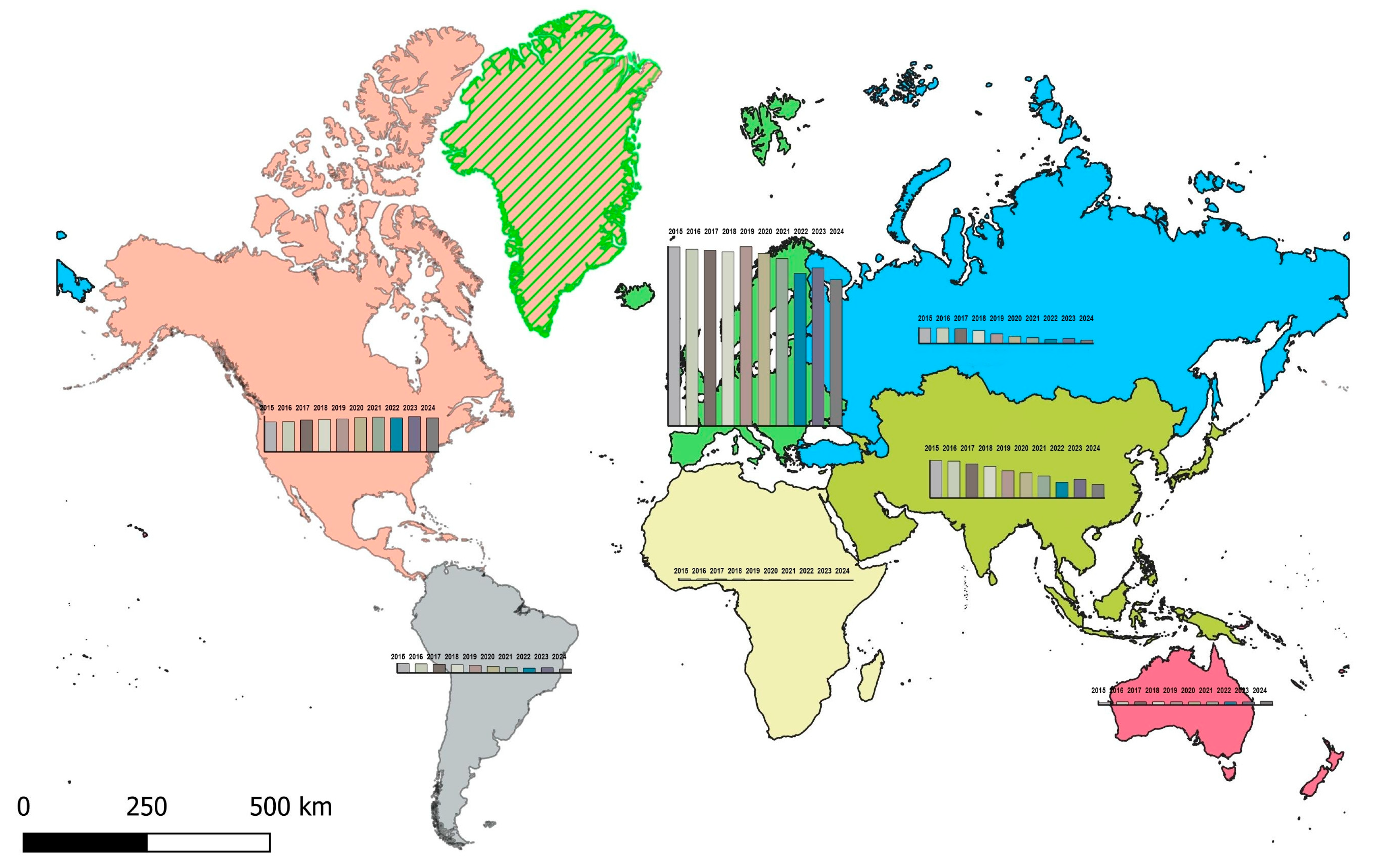
| Region | 2015 | 2016 | 2017 | 2018 | 2019 | 2020 | 2021 | 2022 | 2023 | 2024 |
|---|---|---|---|---|---|---|---|---|---|---|
| Europe | 11,314 | 11,795 | 12,222 | 12,946 | 13,348 | 13,860 | 13,465 | 13,577 | 13,674 | 13,845 |
| South America | 301 | 367 | 397 | 421 | 512 | 590 | 633 | 672 | 700 | 712 |
| North America | 2622 | 2626 | 2730 | 2686 | 2649 | 2549 | 2521 | 2463 | 2340 | 2319 |
| Asia | 1047 | 1212 | 1447 | 1701 | 1949 | 2105 | 2445 | 2631 | 2851 | 2885 |
| Africa | 26 | 35 | 38 | 44 | 55 | 55 | 100 | 100 | 110 | 110 |
| Australia | 282 | 241 | 240 | 240 | 240 | 247 | 247 | 247 | 247 | 216 |
| Eurasia | 266 | 311 | 390 | 452 | 561 | 754 | 1006 | 1145 | 1200 | 1196 |
| Σ: | 15,858 | 16,587 | 17,464 | 18,490 | 19,314 | 20,160 | 20,417 | 20,835 | 21,122 | 21,283 |
| Substrate | Methane Yield | Advantages | Disadvantages |
|---|---|---|---|
| Maize silage | 294.5–376.2 m3 CH4/t vs. (Volatile Solids) [49] | High starch content (up to 35%) ensures rapid fermentation, has an optimal C:N ratio [50] | Low C:N ratio (may require nitrogen supplementation) and risk of soil degradation with intensive cultivation [51] |
| Grass silage | 341 m3 CH4/t vs. [52] | High availability and low production costs (marginal agricultural soils) [51] | Lower methane yield than maize (more lignin), greater structural requirements of the fermenter [51] |
| Cereal silage | 300.8 m3 CH4/t vs. for winter wheat, 277 m3 CH4/t vs. for oat [49] | Balanced composition (protein, carbohydrates); quantitatively available raw biomass; contains sugars and starch (e.g., wheat, triticale) that facilitate fermentation [53] | Conflict between food production and feedstock production for biogas plants [54] |
| Sorghum | 287.8 m3 CH4/t vs. [49], 277.25–301.86 m3 CH4/t vs. [33] | Drought-resistant, an alternative to maize in Europe, tolerates higher temperatures [33,55] | Lignin present in sorghum hinders microbial decomposition of the cell wall, which may negatively impact biogas production [56] |
| Oil | up to 1014 m3 CH4/t vs. [57] with 70% methane content in biogas | Huge energy potential—very high biochemical methane potential (BMP) [57] | Risk of inhibition by LCFAs (long-chain fatty acids) [58] |
| Whey | 395.6–565.8 m3 CH4/t vs. [59] | Very high bioavailability (high lactose content) [59] | Low alkalinity levels, tendency for rapid acidification [60] |
| Sugar beet pulp | open silos 337–420 m3 CH4/t VS, closed silos 411 to 451 m3 CH4/t vs. [61] | Sugar beet pulp contains 60–70% carbohydrates in dry matter, of which almost 90% is composed of cellulose, hemicellulose and pectin [62] | Seasonal availability from sugar refineries [63] |
| Raw brewer’s spent grains | 301 m3 CH4/t vs. [64], 387 m3 CH4/t vs. [65] | Rich in protein and readily available carbohydrates; a waste product [66] | Often requires pretreatment, partially difficult to decompose [67] |
| Food waste | 467–529 m3 CH4/t vs. [68] * | Very high biodegradability (high content of sugars, fats, proteins), gives a quick and high level of biogas [69] | High protein and nitrogen content, therefore, nitrogen-containing organic compounds, such as proteins, amino acids, and nucleic acids, can be hydrolyzed to ammonium nitrogen [70] |
| Fruit and vegetable waste | 420 m3 CH4/t vs. grape pomace, 231 m3 CH4/t vs. beet leaves [71] | Very easily biodegradable (lots of sugars, pectins), digests quickly [72] | Often high humidity, variable composition, rapid acidification, leading to decreased pH within the bioreactor [19,73] |
Disclaimer/Publisher’s Note: The statements, opinions and data contained in all publications are solely those of the individual author(s) and contributor(s) and not of MDPI and/or the editor(s). MDPI and/or the editor(s) disclaim responsibility for any injury to people or property resulting from any ideas, methods, instructions or products referred to in the content. |
© 2026 by the author. Licensee MDPI, Basel, Switzerland. This article is an open access article distributed under the terms and conditions of the Creative Commons Attribution (CC BY) license.
Share and Cite
Pochwatka, P. Evaluating the Performance of Biogas Plants Operating on Organic Waste: A Practical Approach. Energies 2026, 19, 2337. https://doi.org/10.3390/en19102337
Pochwatka P. Evaluating the Performance of Biogas Plants Operating on Organic Waste: A Practical Approach. Energies. 2026; 19(10):2337. https://doi.org/10.3390/en19102337
Chicago/Turabian StylePochwatka, Patrycja. 2026. "Evaluating the Performance of Biogas Plants Operating on Organic Waste: A Practical Approach" Energies 19, no. 10: 2337. https://doi.org/10.3390/en19102337
APA StylePochwatka, P. (2026). Evaluating the Performance of Biogas Plants Operating on Organic Waste: A Practical Approach. Energies, 19(10), 2337. https://doi.org/10.3390/en19102337