Comprehensive Overview of Virtual Power Plants: Integration of Distributed Energy Resources into Power Systems in Terms of Aggregation, Application, and Innovation


Abstract
1. Introduction
1.1. Motivation and Background
1.2. Literature Review
1.2.1. Aggregation and Physical Capacity Modeling
1.2.2. Implementation Strategies and Control Architectures
1.2.3. Innovation and Advanced Optimization Techniques
1.3. Contributions and Paper Organization
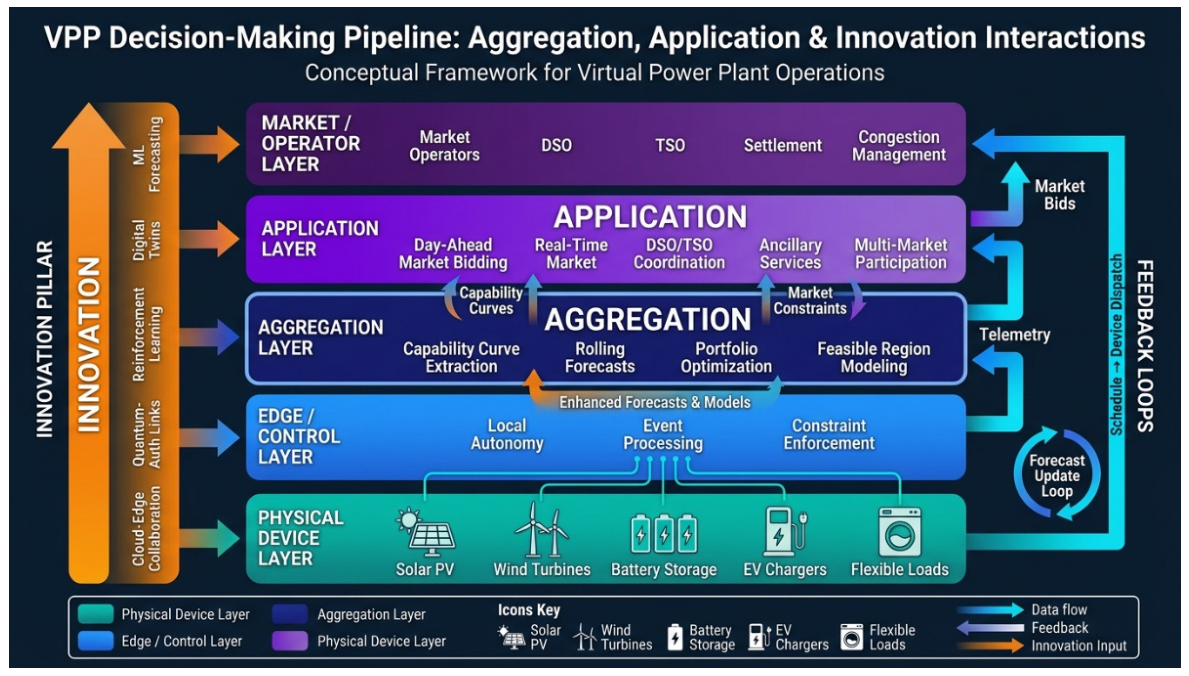
- Triple Perspective Integration (Aggregation-Application-Innovation): For the first time in the literature, VPP operations are systematically examined through three fundamental pillars: “Aggregation” (resource management), “Implementation” (grid and market services), and “Innovation” (AI, Blockchain, and Digital Twins). This holistic approach enables researchers to bridge the gap between technical algorithms and market requirements.
- Comprehensive and Contemporary Taxonomy: A broad methodological spectrum ranging from traditional mathematical frameworks such as Mixed-Integer Linear Programming (MILP) and Non-Linear Programming (NLP) to state-of-the-art artificial intelligence techniques like Deep Reinforcement Learning (DRL) and Federated Learning (FL) is classified based on specific application domains.
- Comparative Analysis of Uncertainty Management Strategies: The most significant hurdle for VPPs, renewable energy intermittency, is subjected to a critical analysis through the lenses of Stochastic Programming, Robust Optimization, Information Gap Decision Theory (IGDT), and Model Predictive Control (MPC). This analysis delineates which uncertainty model is most efficient for specific operational horizons (e.g., day-ahead scheduling vs. real-time balancing).
- CyberPhysical Security and Modern Technology Roadmap: The paper provides a novel forward-looking projection that encompasses Blockchain-based P2P trading, resilient control mechanisms against cyber-attacks, and Digital Twin applications that are shaping the future of VPPs.
2. Conceptual Framework of the Virtual Power Plant
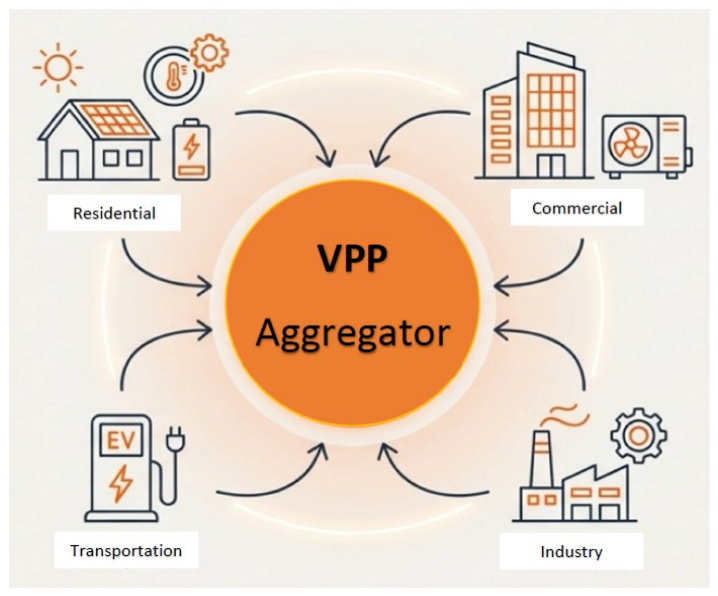
3. VPP Components: Distributed Energy Resources (DERs) and Others
- Wind Power Plants (WPP): Wind generation often carries significant operational uncertainty. Consequently, it is coordinated with other flexible assets within the VPP framework to mitigate potential imbalance penalties and ensure reliable dispatch [68].
- Photovoltaic (PV) Systems: PV resources can range from residential to commercial scales. To manage the inherent volatility of solar irradiance, VPPs employ advanced forecasting models and demand response (DR) mechanisms [69,70,71]. Furthermore, hybrid Photovoltaic-Thermal (PVT) panels, which simultaneously generate electrical and thermal energy, are increasingly being integrated into the VPP ecosystem [72].
- Battery Energy Storage Systems (BESS): Stationary battery infrastructures are utilized for high-speed frequency support, voltage regulation, and energy arbitrage [73].
- Thermal Energy Storage (TES): Operating in conjunction with heat pumps and boilers, TES units provide vital flexibility for district heating networks [75].
- Electric Vehicles (EVs) and Charging Stations: Within the VPP architecture, EVs are often modeled as Virtual Energy Storage (VES) units. Through Vehicle-to-Grid (V2G) technology and structured incentive programs, these mobile assets can sell energy back to the grid or perform load shifting to optimize charging schedules [76].
- Pumped Hydro Storage (PHS): For large-scale VPP operations, PHS remains one of the most economically impactful resources for storing surplus renewable energy. It allows the VPP to position itself as a “price-maker” in energy markets by managing substantial power volumes [73].
- Combined Heat and Power (CHP/CCHP): By simultaneously producing electricity and thermal energy (heating/cooling), these co-generation systems enable the VPP to participate actively in multi-carrier energy markets [80].
- Hydropower Plants: Due to their rapid response capabilities and high ramp rates, hydro units significantly enhance VPP performance in frequency regulation and reserve markets [81].
- Price-based and Incentive-based DR: Under these schemes, users reduce or shift their consumption during periods of high market prices or when provided with direct financial incentives by the VPP operator [83].
- Controllable and Interruptible Loads: These encompass industrial-scale assets, such as crushers or commercial refrigeration systems, which the VPP can directly curtail or de-energize to maintain grid stability during contingencies [84].
- HVAC Systems and Smart Buildings: The thermal inertia of building structures allows them to function as a “virtual battery.” By modulating HVAC setpoints within established comfort boundaries, VPPs can achieve peak load reductions ranging from 16% to 50% without requiring additional storage hardware [85].
- Power-to-Gas (P2G) Conversion: This technology facilitates the conversion of surplus renewable electricity into green hydrogen or synthetic methane via electrolysis. These gaseous energy carriers can be stored long-term, injected into the gas grid, or utilized in the transportation sector, effectively serving as a high-capacity energy storage medium [26].
- Natural Gas Grid Integration: The integration with gas infrastructure allows for cross-vector flexibility transfer. This is achieved either through P2G facilities injecting synthetic gas into the network or by utilizing high-efficiency gas turbines that draw from the gas grid to support the power system during peak demand or low-RES periods [87].
- District Heating Network (DHN) Integration: VPPs coordinate the thermal and electrical sectors through Combined Heat and Power (CHP) units and large-scale electric boilers. A sophisticated innovation in this domain involves the dynamic reconfiguration of DHN topologies through valve control. By altering the flow paths within the thermal network, VPPs can significantly augment their operational flexibility and optimize heat delivery patterns [80].
4. Market Participation and Trading Strategies
- VPP-to-Grid (Wholesale Trading): VPPs facilitate bulk energy exchange with the transmission grid in wholesale markets, significantly contributing to the aggregate supply–demand equilibrium [98].
- VPP-to-Retail Markets: At the distribution level, VPPs actively trade active/reactive power and reserves within retail markets, often leveraging Locational Marginal Pricing (LMP) mechanisms to reflect local grid conditions [108].
- VPP-to-DER Transactions (Internal Marketplace): To manage potential conflicts of interest among diverse asset owners (e.g., individual prosumers or third-party aggregators) within their portfolio, VPP operators establish dynamic internal pricing mechanisms and incentive structures [8,26,99,100,101,102,109].
- Peer-to-Peer (P2P) Trading and Decentralized Governance: Peer-to-Peer (P2P) energy trading represents a paradigm shift from centralized management, enabling multiple VPPs or prosumers to directly exchange energy and carbon credits [50,56,64,103,104,105]. Within this decentralized framework, Blockchain technology is leveraged to ensure transparency, bolster cybersecurity, and facilitate automated financial settlements through smart contracts [54,55]. The integration of P2P trading within the VPP ecosystem is instrumental in both minimizing operational expenditures and enhancing grid technical performance. By reducing reliance on centralized market structures and optimizing the utilization of local resources, P2P frameworks yield significant economic benefits. Empirical studies demonstrate that P2P mechanisms can reduce total operational costs by 7.2% to 16.77% [55,106]. In multi-energy systems (encompassing electricity, heat, and carbon), these savings can reach up to 15.2% [64]. Furthermore, blockchain-based hierarchical P2P models have been shown to lower electricity costs for end-users by 3.38% to 10.03% compared to traditional centralized governance [54]. To ensure the long-term sustainability and stability of these decentralized systems, game-theoretic approaches such as Nash Bargaining and the Shapley Value are employed. These methodologies facilitate the equitable distribution of surplus profits among participants based on their respective risk profiles and contributions to the network [50,105].
- Price-Maker Model: Large-scale VPPs with significant capacity can act as price-makers, strategically influencing Locational Marginal Prices (LMP) or Market Clearing Prices (MCP) to their advantage. Such entities may even employ strategic capacity withholding deliberately restricting available supply to manipulate market prices and enhance their competitive position [49,120].
- Supply Function Derivation (SFD): To facilitate market integration, uncertain resources particularly behind-the-meter (BTM) assets are modeled through a risk-adjusted supply function. This approach enables these resources to be presented to wholesale markets as reliable and dispatchable units equivalent to conventional generators [121].
- Emission Costs and Carbon Trading: By integrating into carbon markets (e.g., CEA, CCER), VPPs monetize emission reductions while internalizing the environmental costs associated with high-carbon assets [53,83,87,122,123,124]. Moreover, Tiered Carbon Trading mechanisms are increasingly utilized to provide more effective signals for deep decarbonization [76,88,104,125]. To effectively participate in tiered carbon trading and joint electricity-carbon markets, VPPs must move beyond static emission factors toward dynamic Carbon Emission Flow (CEF) tracking. CEF methodologies allow VPPs to quantify the real-time carbon intensity of the electricity being dispatched or stored, considering the varying emissions of the primary energy mix across different network nodes [126]. This precise quantification is essential for validating the environmental ‘additionality’ of VPP actions.
- Imbalance Penalties (Deviation Fees): These represent the financial liabilities incurred when a VPP’s actual output deviates from its day-ahead commitments. Robust optimization frameworks are specifically deployed to mitigate the risk of such penalties, ensuring more predictable financial performance [68,77,79,102,109,131,132,133,134].
5. Uncertainty Modeling and Risk Management
5.1. Mathematical Approaches to Uncertainty
- Information Gap Decision Theory (IGDT): In environments characterized by severe data scarcity where PDFs are unavailable, IGDT provides a flexible framework, allowing operators to choose between risk-averse (protecting against failure) or opportunity-oriented (capitalizing on favorable winds) strategies [159,160,161].
- Distributionally Robust Optimization (DRO): Representing the current frontier, DRO synergizes the advantages of both stochastic and robust frameworks. By utilizing data-driven Wasserstein metrics to define an ambiguity set of distributions, it achieves a more balanced management of uncertainty without the heavy computational burden or pessimism of traditional methods [45,72,76].
5.2. Risk Profiles and Decision-Making Behavior
- Profit-Seeker (Opportunistic): This profile views uncertainty as a potential source of revenue. By adopting aggressive bidding strategies, opportunistic operators aim to capitalize on positive deviations such as wind generation exceeding forecasted values to maximize instantaneous profit [60,78,160,161].
- Mean-Deviation Minimization: This approach seeks a middle ground by establishing a trade-off between expected profit and its volatility (variance). The goal is to ensure revenue stability and provide more predictable financial outcomes over long-term operation [117].
5.3. Scenario Management and Computational Efficiency
- Monte Carlo Simulation (MCS): Serving as a fundamental tool for uncertainty analysis, MCS generates a vast number of stochastic scenarios through random sampling to test system performance under diverse conditions [151].
- Scenario Reduction Strategies: To alleviate the computational burden while maintaining high representative fidelity, thousands of raw scenarios are condensed into a smaller, manageable subset. This is achieved using clustering algorithms such as K-means and K-medoids, or heuristic methods like Fast Forward Selection (FFS) [151,163,164,165].
- Unscented Transform (UT): For non-linear power system models, UT provides a highly efficient alternative to traditional stochastic methods. It captures the mean and covariance of uncertain variables using a minimal number of sample points (sigma points), significantly accelerating the optimization process compared to MCS [69,154].
5.4. Critical Synthesis: Selection Criteria for Uncertainty Frameworks
6. VPP Architecture and Control Schemes
6.1. Optimization Frameworks and Decision Hierarchies
- Single-Level Optimization: These are often linear or convex formulations where complex hierarchical problems, such as Mathematical Programs with Equilibrium Constraints (MPEC), are transformed into a single-level equivalent. This is typically achieved by leveraging Karush-Kuhn-Tucker (KKT) conditions and the Strong Duality theorem to ensure solvability [110,122,147,154].
- Bi-Level Optimization: Specifically utilized to model the strategic interaction between the VPP and upper-level entities (DSO/TSO) or between the VPP and its internal assets [107,110,122,154]. The most prevalent framework is the Stackelberg Game (Leader-Follower) model, where a “Leader” (e.g., the VPP operator) dictates price or dispatch strategies, and the “Followers” (e.g., individual DERs) respond optimally to these signals [8,119,147,148,173,174,175].
- Multi-Stage Frameworks: These structures extend decision-making across various temporal horizons, typically encompassing day-ahead, intraday, and real-time scheduling [84,91,176,177,178]. This temporal decomposition allows for the progressive correction of forecasting errors as more accurate data becomes available closer to the dispatch hour [65,179].
6.2. Control Mechanisms and Algorithmic Solutions
- Centralized Energy Management Systems (CEMS): In this configuration, all telemetry data from DERs are aggregated at a single control center for global optimization. While ensuring a theoretical global optimum, it faces significant computational intractability in large-scale systems and poses substantial data privacy risks [18,145,180,181,182].
- Distributed Control: To preserve privacy and enhance scalability, distributed architectures allow individual DERs or sub-clusters to make autonomous decisions. Communication is limited to neighboring nodes through algorithms such as the Alternating Direction Method of Multipliers (ADMM) or consensus-based protocols [34,36,55,92,181,183,184,185].
- Iterative Solution Techniques: Advanced decomposition methods are frequently employed to handle large-scale or robust problems. Key techniques include Column-and-Constraint Generation (C&CG) widely used to accelerate robust optimization [95,156,186,187,188] and Benders Decomposition (BD), which partitions complex master problems into more manageable sub-problems [183,189,190,191]. Contemporary research is increasingly moving toward Hybrid (Centralized-Distributed) architectures and Centralized Distributed Control (CDC) topologies. These emerging structures aim to bridge the gap between the efficiency of centralized schemes and the resilience of distributed systems, specifically targeting enhanced robustness against cyber–physical attacks [181,182].
6.3. Flexibility and Capacity Modeling
- VPP Capability Curve (VPP-CC) and Feasible Operating Region: These represent the geometric characterization of the active (P) and reactive (Q) power limits that a VPP can sustain without violating internal network constraints, such as voltage limits and thermal line ratings [19,22,192,193,194]. The technical flexibility of inverter-based resources within a VPP is constrained by their P-Q capability curve, which defines the limits of active () and reactive () power delivery based on the inverter’s apparent power rating ():
- Robust Capability Curve (RCC): This defines a guaranteed operational envelope, ensuring that the VPP can fulfill its market commitments even under significant system uncertainties [192].
6.4. Artificial Intelligence and Machine Learning Integration
- Deep Reinforcement Learning (DRL): To address complex scheduling and control problems in a model-free manner, advanced DRL algorithms including Soft Actor-Critic (SAC), Deep Deterministic Policy Gradient (DDPG), and Twin Delayed DDPG (TD3) are utilized. These agents learn optimal policies through continuous interaction with the environment [46,141,185,198,199,200].
- Advanced Forecasting Architectures: Deep learning models, such as Graph Convolutional Networks (GCN), Bidirectional Long Short-Term Memory (BiLSTM), and Informers, are leveraged to enhance the spatio-temporal accuracy of generation and market price predictions, thereby reducing the VPP’s exposure to imbalance risks [93,140,202,203,204].
7. Distribution Grid Integration and Operational Constraints
7.1. Power Flow Modeling and Benchmark Systems
7.2. Technical Constraints for Grid Security
- Voltage Security and Regulation: Maintaining grid stability and avoiding violations of physical limits are among the most critical tasks in power system operation. To mitigate overvoltage and undervoltage conditions, voltage stability metrics, such as the Voltage Security Index (VSI), are incorporated into the optimization objective function [211,212].
- Generator Ramping Limits: These define the maximum rate at which controllable units (e.g., gas turbines) can adjust their power output between consecutive time intervals, a critical factor for real-time balancing [186].
7.3. DSO Coordination and Market Integration
- Distribution Space Constraint (DSC) Uncertainty: This refers to the ambiguity in the capacity limits provided to the VPP by the DSO for security reasons. VPP operators can take an “active” role by utilizing machine learning to predict these conservative limits, thereby maximizing profit potential without compromising security [216].
7.4. Ancillary Services and Grid Resilience
- Volt/VAR Control (VVC): By leveraging the reactive power capabilities of multiple VPPs, grid voltage can be regulated efficiently. This is often achieved via model-free and distributed algorithms like ADMM to maintain data privacy [217].
- Network Reconfiguration: Optimizing the grid topology by changing the status of switches. This dynamic boundary adjustment can reduce voltage deviations by up to 48% [218].
- System Resilience and Self-Healing: During natural disasters or cyber-attacks, VPPs enhance resilience by partitioning the grid into autonomous, self-sufficient microgrids [37]. Such self-healing capabilities can reduce load shedding costs often measured as Value of Lost Load (VOLL) by up to 93% [67].
7.5. Global VPP Case Studies and Commercial Deployments
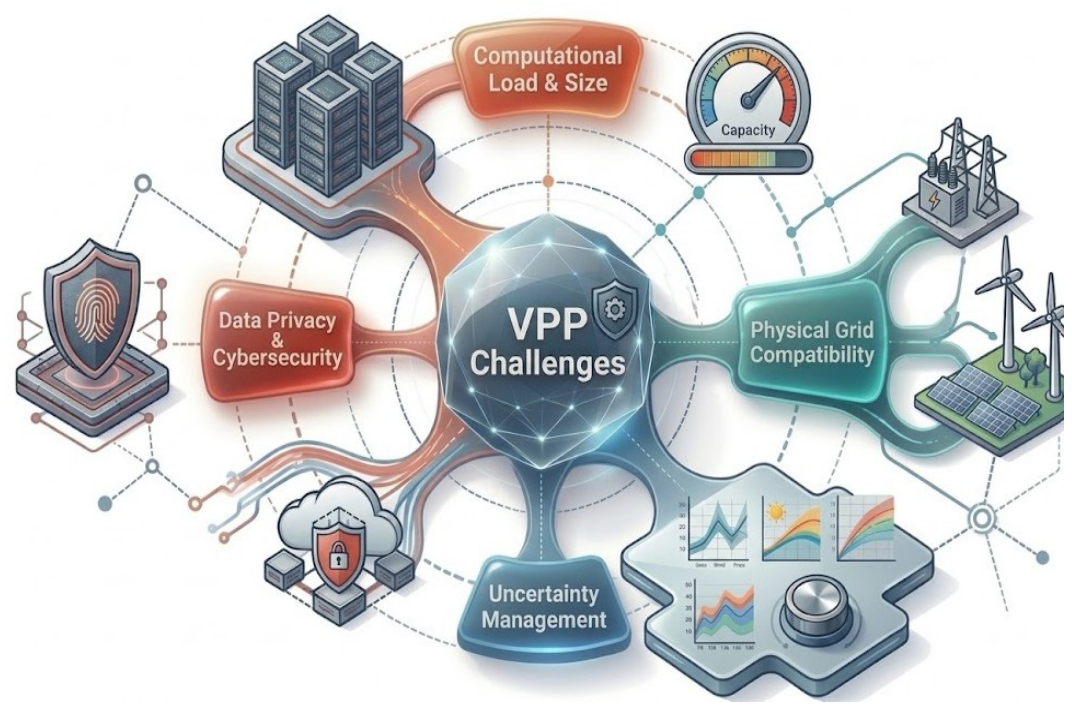
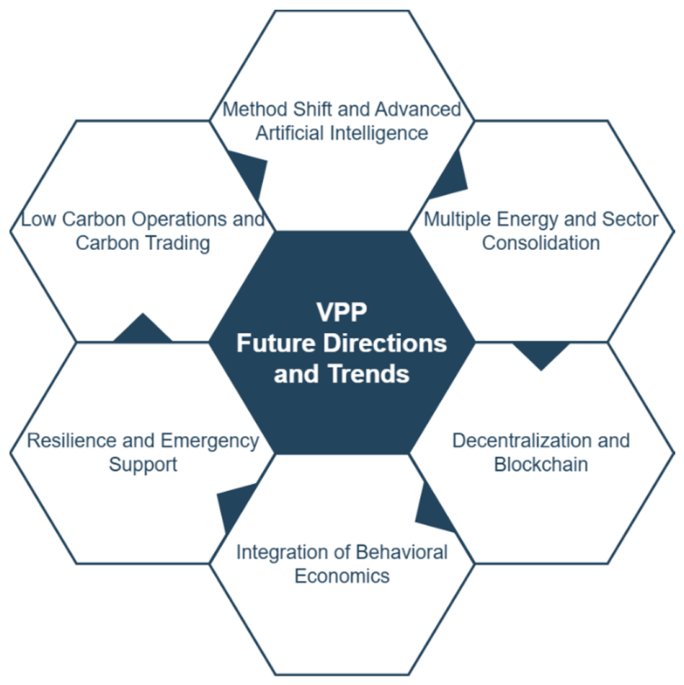
8. Challenges and Future Directions
- Multi-Energy VPPs (MEVPP) and Sector Coupling: Beyond the electrical domain, the emergence of MEVPPs that integrate heat, natural gas, and green hydrogen markets is gaining traction [94,228]. Through strategic sector coupling, these frameworks aim to reduce renewable energy curtailment to near-zero levels by converting surplus electricity into thermal or gaseous energy carriers [94].
- Decentralization and Blockchain: To address data privacy concerns, there is a clear trajectory away from centralized control toward Peer-to-Peer (P2P) trading and distributed algorithms like ADMM [50,103,229,230]. Blockchain technology is anticipated to provide the necessary transparent and secure settlement infrastructure for these decentralized exchanges [61,231].
- Environmental Stewardship and “Dual-Carbon” Goals: The integration of carbon emission allowances (CEA), certified emission reductions (CCER), and Green Certificate mechanisms into VPP objective functions is transforming these entities from purely economic players into critical environmental actors [109,123,232].
- Resilience and Self-Healing: Research is intensifying on the ability of VPPs to maintain grid continuity during natural disasters or cyber–physical contingencies through self-healing mechanisms and grid-forming controllers, effectively partitioning the grid into autonomous, self-sufficient microgrids [37,67,233,234].
- Spatial-Temporal Complexity of Coupled Transportation-Power Networks: While VPPs effectively utilize Electric Vehicles (EVs) as Virtual Energy Storage (VES), future architectures must move beyond stationary modeling to address the spatial-temporal complexities of coupled microgrid-transportation networks [236]. The robust scheduling of such systems is non-trivial, as it requires the simultaneous optimization of power flow and traffic flow. Factors such as charging station congestion, dynamic routing, and the stochastic nature of EV arrival/departure times introduce high-dimensional constraints [237]. Future VPP research should focus on co-optimization frameworks that can synchronize the charging requirements of mobile fleets with the localized capacity limits of microgrids, ensuring that V2G support does not compromise urban mobility or distribution transformer longevity [238].
- Security and Reliability-EV Charging Anomaly Detection: As the penetration of V2G-enabled EVs grows, the VPP’s reliability becomes increasingly susceptible to cyber–physical threats. A critical research frontier is the development of anomaly detection mechanisms tailored for EV charging behaviors [239]. Malicious actors could potentially trigger False Data Injection (FDI) attacks or manipulate charging signals to create synchronized load spikes, leading to grid instability or battery degradation [240]. Implementing AI-driven diagnostic tools—such as Autoencoders or Graph Neural Networks—to detect deviations from normal charging patterns in real-time is essential for securing the VPP’s operational integrity and protecting the infrastructure against both hardware malfunctions and cyber-attacks [241].
- Regulatory Landscapes and Legislative Barriers: Despite the technological maturity of VPP frameworks, their large-scale deployment is heavily dictated by regional regulatory landscapes. In the United States, FERC Order 2222 marks a significant milestone by mandating regional transmission organizations to allow DER aggregations to participate directly in wholesale energy markets, effectively lowering entry barriers for VPPs [242,243]. Similarly, the European Union’s ‘Clean Energy for All Europeans’ Package promotes the concept of ‘Citizen Energy Communities,’ granting prosumers the legal right to engage in collective energy actions and Peer-to-Peer (P2P) trading [244]. However, significant legislative hurdles remain. Many jurisdictions still struggle with ‘double-charging’ of network fees for storage-backed VPPs and a lack of standardized tariff structures for cross-boundary energy sharing. Furthermore, the transition of VPPs from passive price-takers to active market participants requires a fundamental redesign of ancillary service protocols to accommodate the stochastic nature of aggregated DERs. Addressing these regulatory inconsistencies is as vital as solving technical non-convexities for the practical realization of the energy transition [245].
- LLM-based Bidding Behavior and Market Sentiment Agents: As electricity markets become increasingly volatile, traditional numerical forecasting models are being augmented with Large Language Models (LLMs) to capture unstructured data such as market sentiment and regulatory news. Emerging research suggests that LLM-based agents can act as ‘Market Sentiment Agents’ and ‘Bidding Behavior Agents,’ analyzing textual information from policy reports and news cycles to predict the strategic moves of competitors [246]. By integrating LLMs with traditional deep learning models (e.g., LSTM or Transformers), VPPs can achieve a more holistic price forecasting framework that accounts for both quantitative trends and qualitative market shifts. This intersection of natural language processing and power economics represents a significant frontier for enhancing the bidding accuracy and strategic positioning of VPPs in complex multi-energy markets.
9. Conclusions
- Integrated Management and System Flexibility: VPPs successfully synchronize intermittent renewables such as wind and solar with flexible assets, including battery storage and thermal loads (HVAC, water heaters). By orchestrating these components, VPPs effectively transform individual resource vulnerabilities into collective systemic strength [31,62,135]. Specifically, the seamless integration of Demand Response (DR) and Electric Vehicles (EVs) has demonstrated the potential to reduce grid imbalance costs by over 80% [151].
- Market Transformation and Economic Efficiency: VPP technology democratizes energy landscapes by enabling small-scale prosumers to participate in wholesale and ancillary service markets, thereby enhancing aggregate social welfare [81,116]. The transition from passive “price-taker” models to strategic “price-maker” frameworks has been shown to augment operational profit margins by 20% to 36% [48,110].
- Methodological Evolution and Artificial Intelligence: Traditional stochastic approaches are increasingly being superseded by Distributionally Robust Optimization (DRO) which offers superior resilience against distribution modeling errors and Deep Reinforcement Learning (DRL), providing model-free solutions for high-dimensional, non-linear dispatch problems [45,200]. These advanced techniques can enhance system reliability under uncertainty by up to 85% [45].
- Sector Coupling and Decarbonization: VPPs are evolving beyond electricity-centric paradigms toward Multi-Energy VPP (MEVPP) structures, integrating thermal, natural gas, and green hydrogen markets [64,88,94]. The integration of carbon trading mechanisms within optimization frameworks has been proven to reduce emissions by 38.9% while significantly incentivizing the penetration of renewable energy [64,123].
- Security and Resilience: VPPs bolster grid resilience during cyber-attacks or natural disasters through self-healing capabilities and autonomous partitioning into microgrids [147]. Furthermore, the adoption of Peer-to-Peer (P2P) trading and distributed control mechanisms (e.g., ADMM) effectively alleviates the computational burden on central authorities while ensuring maximum data privacy for all participants [55,190,222].
Author Contributions
Funding
Data Availability Statement
Acknowledgments
Conflicts of Interest
Abbreviations
| AC-OPF | AC Optimal Power Flow |
| ADMM | Alternating Direction Method of Multipliers |
| ADN | Active Distribution Network |
| AI | Artificial Intelligence |
| ARIMA | Auto Regressive Integrated Moving Average |
| BESS | Battery Energy Storage System |
| BTM | Behind-the-Meter |
| C&CG | Column-and-Constraint Generation |
| CCER | China Certified Emission Reduction |
| CCS | Carbon Capture and Storage |
| CEA | Carbon Emission Allowance |
| CHP | Combined Heat and Power |
| CCHP | Combined Cooling, Heat, and Power |
| CPS | Cyber–Physical Systems |
| CUD | Control–Uncontrollability Decomposition |
| CVaR | Conditional Value-at-Risk |
| CVPP | Commercial Virtual Power Plant |
| DAM | Day-Ahead Market |
| DER | Distributed Energy Resource |
| DES | Distributed Energy Storage |
| DG | Distributed Generation |
| DGU | Dispatchable Generation Unit |
| DHN | District Heating Network |
| DLMP | Distribution Locational Marginal Pricing |
| DLR | Dynamic Line Rating |
| DMPC | Distributed Model Predictive Control |
| DoS | Denial of Service |
| DR | Demand Response |
| DRO | Distributionally Robust Optimization |
| DRL | Deep Reinforcement Learning |
| DSO | Distribution System Operator |
| ESS | Energy Storage System |
| EV | Electric Vehicle |
| FCAS | Frequency Control Ancillary Services |
| FDI | False Data Injection |
| FFR | Fast Frequency Response |
| FL | Federated Learning |
| GAN | Generative Adversarial Network |
| HVAC | Heating Ventilation Air Conditioning |
| IABC | Improved Artificial Bee Colony |
| ICNN | Input Convex Neural Networks |
| ICT | Information and Communication Technology |
| IGDT | Information Gap Decision Theory |
| IPT | Information Pipe Technology |
| ISO | Independent System Operator |
| KKT | Karush-Kuhn-Tucker |
| LAC-OPF | Linearized AC Optimal Power Flow |
| LLMs | Large Language Models |
| LMP | Locational Marginal Pricing |
| LOLP | Loss of Load Probability |
| LPF | Linear Power Flow |
| MCP | Market Clearing Price |
| MES | Multi-energy Systems |
| MEVPP | Multi-Energy Virtual Power Plant |
| MIP | Mixed-Integer Programming |
| MILP | Mixed-Integer Linear Programming |
| MINLP | Mixed-Integer Non-Linear Programming |
| MPC | Model Predictive Control |
| MPEC | Mathematical Program with Equilibrium Constraints |
| NBS | Nash Bargaining Solution |
| P2G | Power-to-Gas |
| P2H | Power-to-Hydrogen (or Heat) |
| P2P | Peer-to-Peer |
| PCC | Point of Common Coupling |
| Probability Density Function | |
| PEM | Point Estimation MethodV |
| PHFRL | Hierarchical Federated Reinforcement Learning |
| PV | Photovoltaic |
| RCC | Robust Capability Curve |
| REC | Renewable Energy Certificate |
| RES | Renewable Energy Source |
| RO | Robust Optimization |
| RTDS | Real-Time Digital Simulators |
| RTM | Real-Time Market |
| RTO | Regional Transmission Organization |
| SCADA | Supervisory Control And Data Acquisition |
| SoC | State of Charge |
| SOCP | Second-Order Cone Programming |
| TES | Thermal Energy Storage |
| TSO | Transmission System Operator |
| TVPP | Technical Virtual Power Plant |
| UT | Unscented Transform |
| V2G | Vehicle-to-Grid |
| VB | Virtual Battery |
| VES | Virtual Energy Storage |
| VG | Virtual Generator |
| VOLL | Value of Lost Load |
| VPP | Virtual Power Plant |
| VRE | Variable Renewable Energy |
| VSI | Voltage Security Index |
| VVC | Volt/VAR Control |
| WT | Wind Turbine |
References
- International Energy Agency. Electricity 2024. Available online: https://www.iea.org/reports/electricity-2024 (accessed on 26 October 2025).
- International Energy Agency. Global Energy Review 2025; International Energy Agency: Paris, France, 2025. [Google Scholar]
- United Nations. Paris Agreement. Available online: https://unfccc.int/sites/default/files/english_paris_agreement.pdf (accessed on 27 October 2025).
- Liang, Z.; Alsafasfeh, Q.; Jin, T.; Pourbabak, H.; Su, W. Risk-Constrained Optimal Energy Management for Virtual Power Plants Considering Correlated Demand Response. IEEE Trans. Smart Grid 2019, 10, 1577–1587. [Google Scholar] [CrossRef]
- Kasaei, M.J.; Gandomkar, M.; Nikoukar, J. Optimal management of renewable energy sources by virtual power plant. Renew. Energy 2017, 114, 1180–1188. [Google Scholar] [CrossRef]
- Yan, X.; Gao, C.; Meng, J.; Abbes, D. An analytical target cascading method-based two-step distributed optimization strategy for energy sharing in a virtual power plant. Renew. Energy 2024, 222, 119917. [Google Scholar] [CrossRef]
- Cheng, L.; Zhou, X.; Yun, Q.; Tian, L.; Wang, X.; Zhen, L. A Review on Virtual Power Plants Interactive Resource Characteristics and Scheduling Optimization. In Proceedings of the 2019 IEEE 3rd Conference on Energy Internet and Energy System Integration (EI2), Changsha, China, 8–10 November 2019. [Google Scholar]
- Yin, S.R.; Ai, Q.; Li, Z.Y.; Zhang, Y.F.; Lu, T.G. Energy management for aggregate prosumers in a virtual power plant: A robust Stackelberg game approach. Int. J. Electr. Power Energy Syst. 2020, 117, 105605. [Google Scholar] [CrossRef]
- Brehm, K.; McEvoy, A.; Usry, C.; Dyson, M. Virtual Power Plants, Real Benefits; Rocky Mountain Institute (RMI): Basalt, CO, USA, 2023. [Google Scholar]
- Wang, S.; Jia, R.; Shi, X.; Luo, C.; An, Y.; Huang, Q.; Guo, P.; Wang, X.; Lei, X. Research on capacity allocation optimization of commercial virtual power plant (CVPP). Energies 2022, 15, 1303. [Google Scholar] [CrossRef]
- Wang, Y.; Xu, J.; Pei, W.; Wang, H.; Zhang, Z. Low-carbon economic scheduling of virtual power plant considering carbon emission flow and demand response. Front. Energy Res. 2024, 12, 1398655. [Google Scholar] [CrossRef]
- Chu, T.; Wang, T.; Li, M.; Feng, J.; Sun, Y.; Liu, X. Research on the collaborative management of internal and external fluctuations and optimization of power trading in multi-virtual power plants. Front. Energy Res. 2024, 11, 1337205. [Google Scholar] [CrossRef]
- Yan, X.Y.; Gao, C.W.; Song, M.; Rizwan, M. AUGMECON2-based multi-objective optimization of virtual power plant considering economical and security operation of the distribution networks. Sustain. Energy Grids Netw. 2024, 38, 101388. [Google Scholar] [CrossRef]
- Razdan, S.; Downing, J.; White, L. Pathways to Commercial Liftoff: Virtual Power Plants 2025 Update; Technical Report; U.S. Department of Energy (DOE): Washington, DC, USA, 2025; Available online: https://kevinjkircher.com/wp-content/uploads/2025/03/DOE-LPO-VPP-Liftoff-2025-update.pdf (accessed on 1 February 2025).
- Peik-Herfeh, M.; Seifi, H.; Sheikh-El-Eslami, M.K. Decision making of a virtual power plant under uncertainties for bidding in a day-ahead market using point estimate method. Int. J. Electr. Power Energy Syst. 2013, 44, 88–98. [Google Scholar] [CrossRef]
- Wang, H.; Riaz, S.; Mancarella, P. Integrated techno-economic modeling, flexibility analysis, and business case assessment of an urban virtual power plant with multi-market co-optimization. Appl. Energy 2020, 259, 114142. [Google Scholar] [CrossRef]
- Yan, X.; Gao, C.; Jiang, H.; Francois, B. Multi-objective optimization and profit allocation of virtual power plant considering the security operation of distribution networks. J. Energy Storage 2024, 89, 111607. [Google Scholar] [CrossRef]
- Khan, R.; Islam, N.; Das, S.K.; Muyeen, S.M.; Moyeen, S.; Ali, M.F.; Tasneem, Z.; Islam, M.R.; Saha, D.K.; Badal, M.F.R.; et al. Energy Sustainability-Survey on Technology and Control of Microgrid, Smart Grid and Virtual Power Plant. IEEE Access 2021, 9, 104663–104694. [Google Scholar] [CrossRef]
- Tan, Z.F.; Zhong, H.W.; Wang, X.Y.; Tang, H.H. An Efficient Method for Estimating Capability Curve of Virtual Power Plant. CSEE J. Power Energy Syst. 2022, 8, 780–788. [Google Scholar] [CrossRef]
- Riaz, S.; Mancarella, P. Modelling and Characterisation of Flexibility From Distributed Energy Resources. IEEE Trans. Power Syst. 2022, 37, 38–50. [Google Scholar] [CrossRef]
- Tan, Z.F.; Zhong, H.W.; Xia, Q.; Kang, C.Q.; Wang, X.S.; Tang, H.H. Estimating the Robust P-Q Capability of a Technical Virtual Power Plant Under Uncertainties. IEEE Trans. Power Syst. 2020, 35, 4285–4296. [Google Scholar] [CrossRef]
- Lin, W.; Zhao, C. Improved characterization for AC-feasible power transfer regions of virtual power plants. Int. J. Electr. Power Energy Syst. 2023, 152, 109260. [Google Scholar] [CrossRef]
- Wang, S.Y.; Wu, W.C. Aggregate Flexibility of Virtual Power Plants With Temporal Coupling Constraints. IEEE Trans. Smart Grid 2021, 12, 5043–5051. [Google Scholar] [CrossRef]
- Rahimi, M.; Ardakani, F.J.; Olatujoye, O. Improving flexible optimal scheduling of virtual power plants considering dynamic line rating and flexible supply and demand. Int. J. Electr. Power Energy Syst. 2023, 150, 109099. [Google Scholar] [CrossRef]
- Tan, Z.F.; Wang, S.Y.; Zhong, H.W.; Xia, Q.; Kang, C.Q. Enlarging flexibility region of virtual power plant via dynamic line rating. IET Renew. Power Gener. 2022, 16, 751–760. [Google Scholar] [CrossRef]
- Zhang, T.; Hu, Z. Optimal scheduling strategy of virtual power plant with power-to-gas in dual energy markets. IEEE Trans. Ind. Appl. 2021, 58, 2921–2929. [Google Scholar] [CrossRef]
- Guo, J.R.; Dou, C.X.; Zhang, Z.J.; Yue, D. Bi-level economic dispatch strategy for virtual power plants based on electric vehicles aggregation. Electr. Power Syst. Res. 2023, 225, 109783. [Google Scholar] [CrossRef]
- Lin, W.; Wang, Y.; Wu, J.H.; Feng, F. Model-Free Aggregation for Virtual Power Plants Using Input Convex Neural Networks. IEEE Trans. Smart Grid 2025, 16, 2404–2415. [Google Scholar] [CrossRef]
- Gong, H.J.; Jones, E.S.; Alden, R.E.; Frye, A.G.; Colliver, D.; Ionel, D.M. Virtual Power Plant Control for Large Residential Communities Using HVAC Systems for Energy Storage. IEEE Trans. Ind. Appl. 2022, 58, 622–633. [Google Scholar] [CrossRef]
- Lu, X.; Qiu, J.; Zhang, C.; Lei, G.; Zhu, J. Assembly and Competition for Virtual Power Plants with Multiple ESPs Through a “Recruitment–Participation” Approach. IEEE Trans. Power Syst. 2024, 39, 4382–4396. [Google Scholar] [CrossRef]
- Yi, Z.K.; Xu, Y.L.; Gu, W.; Wu, W.C. A Multi-Time-Scale Economic Scheduling Strategy for Virtual Power Plant Based on Deferrable Loads Aggregation and Disaggregation. IEEE Trans. Sustain. Energy 2020, 11, 1332–1346. [Google Scholar] [CrossRef]
- Mohy-ud-din, G.; Muttaqi, K.M.; Sutanto, D. Adaptive and Predictive Energy Management Strategy for Real-Time Optimal Power Dispatch From VPPs Integrated With Renewable Energy and Energy Storage. IEEE Trans. Ind. Appl. 2021, 57, 1958–1972. [Google Scholar] [CrossRef]
- Hu, J.Q.; Ding, Y.N.; Cen, W.Y.; Cao, J.D. Scenario-Based Distributed Robust Optimization for Optimal Virtual Power Plant Scheduling Under Uncertainty. Int. J. Robust Nonlinear Control 2024, 1–15. [Google Scholar] [CrossRef]
- Feng, S.; Funding, D.S.Y.; Zhou, B.W.; Luo, Y.H.; Li, G.D. Real-time active power dispatch of virtual power plant based on distributed model predictive control. Electron. Lett. 2022, 58, 872–875. [Google Scholar] [CrossRef]
- Nam, J.H.; Park, S.J.; Cho, D.I.; Cho, Y.J.; Moon, W.S. Assessing the Suitability of Distributed Energy Resources in Distribution Systems Based on the Voltage Margin: A Case Study of Jeju, South Korea. IEEE Access 2025, 13, 36263–36272. [Google Scholar] [CrossRef]
- Wang, Q.; Wu, W.C.; Wang, B.; Wang, G.N.; Xi, Y.N.; Liu, H.T.; Wang, S.; Zhang, J. Asynchronous Decomposition Method for the Coordinated Operation of Virtual Power Plants. IEEE Trans. Power Syst. 2023, 38, 767–782. [Google Scholar] [CrossRef]
- Meng, Y.; Zhang, H.L. Recovery strategy of virtual power plant with resilience improvement under cascaded failure scenarios. Int. J. Electr. Power Energy Syst. 2023, 148, 108918. [Google Scholar] [CrossRef]
- Guo, J.R.; Dou, C.X.; Yue, D.; Kuzin, V.; Zhang, Z.J.; Zhang, Z.Q. A Cyber-Physical Collaboration Based Control Method for Frequency Regulation with VPP. IEEE Syst. J. 2024, 18, 746–757. [Google Scholar] [CrossRef]
- Zhang, Y.; Chen, Z.; Ma, K.; Chen, F. A decentralized IoT architecture of distributed energy resources in virtual power plant. IEEE Internet Things J. 2022, 10, 9193–9205. [Google Scholar] [CrossRef]
- Aftab, M.A.; Hussain, S.M.S.; Ali, I.; Ustun, T.S. IEC 61850 based substation automation system: A survey. Int. J. Electr. Power Energy Syst. 2020, 120, 106008. [Google Scholar] [CrossRef]
- IEC Standard 61970-301:2020; Energy Management System Application Program Interface (EMS-API)–Part 301: Common Information Model (CIM) Base. International Electrotechnical Commission: Geneva, Switzerland, 2020.
- Sun, L.Y.; Chen, Y.; Du, Q.J.; Cheng, Q.; Ding, R.; Liu, Z.D. Virtual power plant for monitoring of distributed energy resources using extensible messaging and presence protocol. Sustain. Energy Grids Netw. 2024, 38, 101365. [Google Scholar] [CrossRef]
- Bahloul, M.; Breathnach, L.; Khadem, S. Design and Field Implementation of a Hierarchical Control Solution for Residential Energy Storage Systems. IEEE Trans. Smart Grid 2023, 14, 1083–1092. [Google Scholar] [CrossRef]
- Bolzoni, A.; Parisio, A.; Todd, R.; Forsyth, A.J. Optimal Virtual Power Plant Management for Multiple Grid Support Services. IEEE Trans. Energy Convers. 2021, 36, 1479–1490. [Google Scholar] [CrossRef]
- Liu, H.C.A.; Qiu, J.; Zhao, J.H. A data-driven scheduling model of virtual power plant using Wasserstein distributionally robust optimization. Int. J. Electr. Power Energy Syst. 2022, 137, 107801. [Google Scholar] [CrossRef]
- Wang, J.N.; Guo, C.L.; Yu, C.S.; Liang, Y.C. Virtual power plant containing electric vehicles scheduling strategies based on deep reinforcement learning. Electr. Power Syst. Res. 2022, 205, 107714. [Google Scholar] [CrossRef]
- Sun, Z.; Lu, T. Collaborative operation optimization of distribution system and virtual power plants using multi-agent deep reinforcement learning with parameter-sharing mechanism. IET Gener. Transm. Distrib. 2024, 18, 39–49. [Google Scholar] [CrossRef]
- Baringo, L.; Freire, M.; García-Bertrand, R.; Rahimiyan, M. Offering strategy of a price-maker virtual power plant in energy and reserve markets. Sustain. Energy Grids Netw. 2021, 28, 100558. [Google Scholar] [CrossRef]
- Sheykhha, M.R.; Nazar, M.S. Dynamic capacity withholding assessment of virtual power plants in local energy and reserve market. Sustain. Energy Grids Netw. 2024, 40, 101514. [Google Scholar] [CrossRef]
- Li, J.; Guo, J.; Li, X.; Liang, W.; Zhang, J.; Yang, B.; Liang, F.; Yu, X. Coordinated Optimization of Virtual Power Plants Based on Peer-to-Peer Transactions and Nash Bargaining Approach. Int. Trans. Electr. Energy Syst. 2024, 2024, 3687275. [Google Scholar] [CrossRef]
- Chen, W.; Qiu, J.; Zhao, J.H.; Chai, Q.M.; Dong, Z.Y. Bargaining Game-Based Profit Allocation of Virtual Power Plant in Frequency Regulation Market Considering Battery Cycle Life. IEEE Trans. Smart Grid 2021, 12, 2913–2928. [Google Scholar] [CrossRef]
- Farzin Ghasemi, O.; Turaj, A.; Mojtaba, M.-S.; Ali, A. Coordinated multi-objective scheduling of a multi-energy virtual power plant considering storages and demand response. Iet Gener. Transm. Distrib. 2022, 16, 3539–3562. [Google Scholar] [CrossRef]
- Liu, D.; Xiao, F.; Wu, J.; Ji, X.; Xiong, P.; Zhang, M.; Kang, Y. Electricity-Carbon Joint Trading of Virtual Power Plant with Carbon Capture System. Int. Trans. Electr. Energy Syst. 2023, 2023, 6864403. [Google Scholar] [CrossRef]
- Zhou, K.; Xing, H.; Ding, T. P2P electricity trading model for urban multi-virtual power plants based on double-layer energy blockchain. Sustain. Energy Grids Netw. 2024, 39, 101444. [Google Scholar] [CrossRef]
- Yan, X.Y.; Gao, C.W.; Mou, Y.T.; Abbes, D. Consensus alternating direction multiplier method based fully distributed peer-to-peer energy transactions considering the network transmission distance. Sustain. Energy Grids Netw. 2024, 38, 101340. [Google Scholar] [CrossRef]
- Ji, X.T.; Wang, L.H.; Jin, X.Y.; Li, Y.Y.; Zhang, S.R.; Wang, Z.P.; Han, K.Z. Carbon-aware peer-to-peer energy trading within virtual power plants under networked constraints. Electr. Power Syst. Res. 2025, 247, 111733. [Google Scholar] [CrossRef]
- Taheri, S.I.; Davoodi, M.; Ali, M.H. A modified modeling approach of virtual power plant via improved federated learning. Int. J. Electr. Power Energy Syst. 2024, 158, 109905. [Google Scholar] [CrossRef]
- Khorasany, M.; Razzaghi, R.; Dorri, A.; Jurdak, R.; Siano, P. Paving the Path for Two-Sided Energy Markets: An Overview of Different Approaches. IEEE Access 2020, 8, 223708–223722. [Google Scholar] [CrossRef]
- Ochoa, D.E.; Galarza-Jimenez, F.; Wilches-Bernal, F.; Schoenwald, D.A.; Poveda, J.I. Control systems for low-inertia power grids: A survey on virtual power plants. IEEE Access 2023, 11, 20560–20581. [Google Scholar] [CrossRef]
- Marzbani, F.; Osman, A.H.; Hassan, M.S. Advances in Virtual Power Plant Operations: A Review of Optimization Models. IEEE Access 2025, 13, 131525–131548. [Google Scholar] [CrossRef]
- Chadokar, L.; Kirar, M.K.; Yadav, G.K.; Salaria, U.A.; Sajjad, M. Aggregation and Bidding Strategy of Virtual Power Plant. J. Electr. Eng. Technol. 2025, 20, 199–216. [Google Scholar] [CrossRef]
- Li, H.; Zhang, N.; Fan, Y.; Dong, L.; Cai, P.C. Decomposed Modeling of Controllable and Uncontrollable Components in Power Systems with High Penetration of Renewable Energies. J. Mod. Power Syst. Clean Energy 2022, 10, 1164–1173. [Google Scholar] [CrossRef]
- Ghanuni, A.; Sharifi, R.; Farahani, H.F. A risk-based multi-objective energy scheduling and bidding strategy for a technical virtual power plant. Electr. Power Syst. Res. 2023, 220, 109344. [Google Scholar] [CrossRef]
- Cui, Z.H.; Chang, X.Y.; Xue, Y.X.; Yi, Z.K.; Li, Z.N.; Sun, H.B. Distributed peer-to-peer electricity-heat-carbon trading for multi-energy virtual power plants considering copula-CVaR theory and trading preference. Int. J. Electr. Power Energy Syst. 2024, 162, 110231. [Google Scholar] [CrossRef]
- Naughton, J.; Wang, H.; Cantoni, M.; Mancarella, P. Co-Optimizing Virtual Power Plant Services Under Uncertainty: A Robust Scheduling and Receding Horizon Dispatch Approach. IEEE Trans. Power Syst. 2021, 36, 3960–3972. [Google Scholar] [CrossRef]
- Li, J.X.; Zhu, Y.C.; Yong, M. Cooperative Operation and Profit Distribution of Virtual Power Plant. Electr. Power Compon. Syst. 2023, 51, 71–82. [Google Scholar] [CrossRef]
- Mohy-ud-din, G.; Muttaqi, K.M.; Sutanto, D. A Cooperative Planning Framework for Enhancing Resilience of Active Distribution Networks With Integrated VPPs Under Catastrophic Emergencies. IEEE Trans. Ind. Appl. 2022, 58, 3029–3043. [Google Scholar] [CrossRef]
- Jafari, M.; Foroud, A.A. A Medium-Term Virtual Power Plant Optimization Framework Considering the Failure Rate of Its Intermittent Units Using Stochastic Programming. Electr. Power Compon. Syst. 2023, 1–16. [Google Scholar] [CrossRef]
- Zhang, J.; Wu, H.; Akbari, E.; Bagherzadeh, L.; Pirouzi, S. Eco-power management system with operation and voltage security objectives of distribution system operator considering networked virtual power plants with electric vehicles parking lot and price-based demand response. Comput. Electr. Eng. 2025, 121, 109895. [Google Scholar] [CrossRef]
- Ryu, J.; Kim, J. Virtual Power Plant Operation Strategy Under Uncertainty With Demand Response Resources in Electricity Markets. IEEE Access 2022, 10, 62763–62771. [Google Scholar] [CrossRef]
- Gulotta, F.; del Granado, P.C.; Pisciella, P.; Siface, D.; Falabretti, D. Short-term uncertainty in the dispatch of energy resources for VPP: A novel rolling horizon model based on stochastic programming. Int. J. Electr. Power Energy Syst. 2023, 153, 109355. [Google Scholar] [CrossRef]
- Wu, S.L.; Wang, Y.; Liu, L.R.; Yang, Z.; Cao, Q.; He, H.J.; Cao, Y.Y. Two-stage distributionally robust optimal operation of rural virtual power plants considering multi correlated uncertainties. Int. J. Electr. Power Energy Syst. 2024, 161, 110173. [Google Scholar] [CrossRef]
- Juan, C.S.-V.; Larruskain, D.M.; Esther, T.; Oihane, A. Assessment of the operational flexibility of virtual power plants to facilitate the integration of distributed energy resources and decision-making under uncertainty. Int. J. Electr. Power Energy Syst. 2024, 155, 109611. [Google Scholar] [CrossRef]
- Bo, L.; Mohammad, G. A New Strategy for Economic Virtual Power Plant Utilization in Electricity Market Considering Energy Storage Effects and Ancillary Services. J. Electr. Eng. Technol. 2021, 16, 2863–2874. [Google Scholar] [CrossRef]
- Aghdam, F.H.; Javadi, M.S.; Catalao, J.P.S. Optimal stochastic operation of technical virtual power plants in reconfigurable distribution networks considering contingencies. Int. J. Electr. Power Energy Syst. 2023, 147, 108799. [Google Scholar] [CrossRef]
- Chen, Y.; Niu, Y.G.; Qu, C.Z.; Du, M.; Wang, J.H. Data-driven-based distributionally robust optimization approach for a virtual power plant considering the responsiveness of electric vehicles and Ladder-type carbon trading. Int. J. Electr. Power Energy Syst. 2024, 157, 109893. [Google Scholar] [CrossRef]
- Yang, C.; Du, X.; Xu, D.; Tang, J.J.; Lin, X.Y.; Xie, K.G.; Li, W.Y. Optimal bidding strategy of renewable-based virtual power plant in the day-ahead market. Int. J. Electr. Power Energy Syst. 2023, 144, 108557. [Google Scholar] [CrossRef]
- Alahyari, A.; Skoltech, D.P. Performance-based virtual power plant offering strategy incorporating hybrid uncertainty modeling and risk viewpoint. Electr. Power Syst. Res. 2022, 203, 107632. [Google Scholar] [CrossRef]
- Ghamarypour, S.; Rahimiyan, M. Energy resources investment for industrial virtual power plants under techno-economic uncertainties. Int. J. Electr. Power Energy Syst. 2025, 164, 110409. [Google Scholar] [CrossRef]
- Foroughi, M.; Pasban, A.; Moeini-Aghtaie, M.; Fayaz-Heidari, A. A bi-level model for optimal bidding of a multi-carrier technical virtual power plant in energy markets. Int. J. Electr. Power Energy Syst. 2021, 125, 106397. [Google Scholar] [CrossRef]
- Suliman, M.S.; Farzaneh, H. Data-driven modeling of the aggregator-based price-maker virtual power plant (VPP) in the day-ahead wholesale electricity markets; evidence from the Japan Electric power Exchange (JEPX) market. Int. J. Electr. Power Energy Syst. 2025, 164, 110433. [Google Scholar] [CrossRef]
- Ranginkaman, S.; Mashhour, E.; Saniei, M. Bidding strategy of the virtual power plant consisting of thermal loads controlled by thermostats for providing primary frequency control ancillary service. Sustain. Energy Grids Netw. 2024, 38, 101242. [Google Scholar] [CrossRef]
- Liu, R.H.; Chen, K.Y.; Sun, G.P.; Lin, S.F.; Jiang, C.W. Bidding strategy for the virtual power plant based on cooperative game participating in the Electricity-Carbon joint market. Int. J. Electr. Power Energy Syst. 2024, 163, 110325. [Google Scholar] [CrossRef]
- Sheidaei, F.; Ahmarinejad, A. Multi-stage stochastic framework for energy management of virtual power plants considering electric vehicles and demand response programs. Int. J. Electr. Power Energy Syst. 2020, 120, 106047. [Google Scholar] [CrossRef]
- Wang, X.; Zhang, X. HVAC system dynamic management in communities via an aggregation–disaggregation framework. Int. J. Electr. Power Energy Syst. 2022, 142, 108207. [Google Scholar] [CrossRef]
- Heydari, R.; Nikoukar, J.; Gandomkar, M. Optimal Operation of Virtual Power Plant with Considering the Demand Response and Electric Vehicles. J. Electr. Eng. Technol. 2021, 16, 2407–2419. [Google Scholar] [CrossRef]
- Liu, X.O. Research on optimal dispatch method of virtual power plant considering various energy complementary and energy low carbonization. Int. J. Electr. Power Energy Syst. 2022, 136, 107670. [Google Scholar] [CrossRef]
- Pan, J.; Liu, X.O.; Huang, J.J. Multi-level games optimal scheduling strategy of multiple virtual power plants considering carbon emission flow and carbon trade. Electr. Power Syst. Res. 2023, 223, 109669. [Google Scholar] [CrossRef]
- Pandey, A.K.; Jadoun, V.K.; Jayalakshmi, N.S. Real-time and day-ahead risk averse multi-objective operational scheduling of virtual power plant using modified Harris Hawk’s optimization. Electr. Power Syst. Res. 2023, 220, 109285. [Google Scholar] [CrossRef]
- Naughton, J.; Wang, H.; Riaz, S.; Cantoni, M.; Mancarella, P. Optimization of multi-energy virtual power plants for providing multiple market and local network services. Electr. Power Syst. Res. 2020, 189, 106775. [Google Scholar] [CrossRef]
- Pandey, A.K.; Jadoun, V.K.; Sabhahit, J.N. Scheduling and assessment of multi-area virtual power plant including flexible resources using swarm intelligence technique. Electr. Power Syst. Res. 2025, 238, 111139. [Google Scholar] [CrossRef]
- Kong, W.L.; Ye, H.X.; Ge, Y.Y.; Mao, W.Q.; Gao, S. Privacy-preserving multi-VPPs scheduling for peak ramp minimization. Electr. Power Syst. Res. 2025, 241, 111375. [Google Scholar] [CrossRef]
- Gougheri, S.S.; Jahangir, H.; Golkar, M.A.; Ahmadian, A.; Golkar, M.A. Optimal participation of a virtual power plant in electricity market considering renewable energy: A deep learning-based approach. Sustain. Energy Grids Netw. 2021, 26, 100448. [Google Scholar] [CrossRef]
- Zepter, J.M.; Engelhardt, J.; Marinelli, M. Optimal expansion of a multi-domain virtual power plant for green hydrogen production to decarbonise seaborne passenger transportation. Sustain. Energy Grids Netw. 2023, 36, 101236. [Google Scholar] [CrossRef]
- Zhao, H.; Wang, B.; Wang, X.; Pan, Z.; Sun, H.; Liu, Z.; Guo, Q. Active dynamic aggregation model for distributed integrated energy system as virtual power plant. J. Mod. Power Syst. Clean Energy 2020, 8, 831–840. [Google Scholar] [CrossRef]
- Hannan, M.A.; Abdolrasol, M.G.; Mohamed, R.; Al-Shetwi, A.; Ker, P.; Begum, R.; Muttaqi, K. ANN-Based Binary Backtracking Search Algorithm for VPP Optimal Scheduling and Cost-Effective Evaluation. IEEE Trans. Ind. Appl. 2021, 57, 5603–5613. [Google Scholar] [CrossRef]
- Naughton, J.; Riaz, S.; Cantoni, M.; Zhang, X.P.; Mancarella, P. Comprehensive Optimization-based Techno-economic Assessment of Hybrid Renewable Electricity-hydrogen Virtual Power Plants. J. Mod. Power Syst. Clean Energy 2023, 11, 553–566. [Google Scholar] [CrossRef]
- Park, H.; Ko, W. A Bi-Level Scheduling Model of the Distribution System With a Distribution Company and Virtual Power Plants Considering Grid Flexibility. IEEE Access 2022, 10, 36711–36724. [Google Scholar] [CrossRef]
- Heydarian-Forushani, E.; Ben Elghali, S.; Zerrougui, M.; La Scala, M.; Mestre, P. An Auction-Based Local Market Clearing for Energy Management in a Virtual Power Plant. IEEE Trans. Ind. Appl. 2022, 58, 5724–5733. [Google Scholar] [CrossRef]
- Yi, Z.K.; Xu, Y.L.; Wang, H.Z.; Sang, L.W. Coordinated Operation Strategy for a Virtual Power Plant With Multiple DER Aggregators. IEEE Trans. Sustain. Energy 2021, 12, 2445–2458. [Google Scholar] [CrossRef]
- Li, S.; Huo, X.; Zhang, X.; Li, G.; Kong, X.; Zhang, S. A Multi-Agent Optimal Bidding Strategy in Multi-Operator VPPs Based on SGHSA. Int. Trans. Electr. Energy Syst. 2022, 2022, 7584424. [Google Scholar] [CrossRef]
- Jinho, L.; Dong-Jun, W. Optimal Operation Strategy of Virtual Power Plant Considering Real-Time Dispatch Uncertainty of Distributed Energy Resource Aggregation. IEEE Access 2021, 9, 56965–56983. [Google Scholar] [CrossRef]
- Lin, W.T.; Chen, G.; Li, C.J. Risk-averse energy trading among peer-to-peer based virtual power plants: A stochastic game approach. Int. J. Electr. Power Energy Syst. 2021, 132, 107145. [Google Scholar] [CrossRef]
- Liu, J.Q.; Yu, S.S.; Hu, H.J.; Trinh, H. A combinatorial auction energy trading approach for VPPs consisting of interconnected microgrids in demand-side ancillary services market. Electr. Power Syst. Res. 2023, 224, 109694. [Google Scholar] [CrossRef]
- Yan, X.Y.; Gao, C.W.; Ming, H.; Abbes, D.; Francois, B. Optimal scheduling strategy and benefit allocation of multiple virtual power plants based on general nash bargaining theory. Int. J. Electr. Power Energy Syst. 2023, 152, 109218. [Google Scholar] [CrossRef]
- Wei, X.; Liu, J.; Xu, Y.; Sun, H. Virtual power plants peer-to-peer energy trading in unbalanced distribution networks: A distributed robust approach against communication failures. IEEE Trans. Smart Grid 2023, 15, 2017–2029. [Google Scholar] [CrossRef]
- Rashidizadeh-Kermani, H.; Vahedipour-Dahraie, M.; Shafie-Khah, M.; Siano, P. A stochastic short-term scheduling of virtual power plants with electric vehicles under competitive markets. Int. J. Electr. Power Energy Syst. 2021, 124, 106343. [Google Scholar] [CrossRef]
- Yi, Z.K.; Xu, Y.L.; Sun, H.B. Self-adaptive hybrid algorithm based bi-level approach for virtual power plant bidding in multiple retail markets. IET Gener. Transm. Distrib. 2020, 14, 3762–3773. [Google Scholar] [CrossRef]
- Chen, Y.; Niu, Y.G.; Qu, C.Z.; Du, M.; Liu, P. A pricing strategy based on bi-level stochastic optimization for virtual power plant trading in multi-market: Energy, ancillary services and carbon trading market. Electr. Power Syst. Res. 2024, 231, 110371. [Google Scholar] [CrossRef]
- Steriotis, K.; Smpoukis, K.; Efthymiopoulos, N.; Tsaousoglou, G.; Makris, P.; Varvarigos, E. Strategic and network-aware bidding policy for electric utilities through the optimal orchestration of a virtual and heterogeneous flexibility assets’ portfolio. Electr. Power Syst. Res. 2020, 184, 106302. [Google Scholar] [CrossRef]
- Rahimi, M.; Ardakani, F.J.; Ardakani, A.J. Optimal stochastic scheduling of electrical and thermal renewable and non-renewable resources in virtual power plant. Int. J. Electr. Power Energy Syst. 2021, 127, 106658. [Google Scholar] [CrossRef]
- Zhang, S.; Pang, L.; Li, Y.; Chen, Y.; Li, K.; Zheng, M. Green-fitting scheduling equilibrium model of virtual power plant based on cooperative game with improved shapley value under new-type power system. Int. J. Electr. Power Energy Syst. 2025, 168, 110704. [Google Scholar] [CrossRef]
- Baringo, A.; Baringo, L.; Arroyo, J.M. Holistic planning of a virtual power plant with a nonconvex operational model: A risk-constrained stochastic approach. Int. J. Electr. Power Energy Syst. 2021, 132, 107081. [Google Scholar] [CrossRef]
- Maiz, S.; Baringo, L.; García-Bertrand, R. Expansion planning of a price-maker virtual power plant in energy and reserve markets. Sustain. Energy Grids Netw. 2022, 32, 100832. [Google Scholar] [CrossRef]
- Baringo, A.; Baringo, L.; Arroyo, J.M. Robust virtual power plant investment planning. Sustain. Energy Grids Netw. 2023, 35, 101105. [Google Scholar] [CrossRef]
- Mohy-Ud-Din, G.; Muttaqi, K.M.; Sutanto, D. A Cooperative Energy Transaction Model for VPP Integrated Renewable Energy Hubs in Deregulated Electricity Markets. IEEE Trans. Ind. Appl. 2022, 58, 7776–7791. [Google Scholar] [CrossRef]
- Peng, C.Y.; He, Y.B.; Gu, H.J.; Lai, K.T.; Zhou, X.; Luo, H.H.; Dong, C.; Lai, X.W. Dominance Constraints for Risk Control of a VPP’s Optimal Bidding Strategy. IEEE Access 2024, 12, 59122–59133. [Google Scholar] [CrossRef]
- Yuvaraj, T.; Sengolrajan, T.; Prabaharan, N.; Devabalaji, K.; Uehara, A.; Senjyu, T. Enhancing Smart Microgrid Resilience and Virtual Power Plant Profitability through Hybrid IGWO-PSO Optimization with a Three-Phase Bidding Strategy. IEEE Access 2025, 13, 80796–80820. [Google Scholar] [CrossRef]
- Wu, H.B.; Liu, X.; Ye, B.; Xu, B. Optimal dispatch and bidding strategy of a virtual power plant based on a Stackelberg game. IET Gener. Transm. Distrib. 2020, 14, 552–563. [Google Scholar] [CrossRef]
- Tabatabaei, M.; Nazar, M.S.; Shafie-khah, M.; Catalao, J.P.S. Capacity withholding assessment of power systems considering coordinated strategies of virtual power plants and generation companies. Int. J. Electr. Power Energy Syst. 2022, 141, 108212. [Google Scholar] [CrossRef]
- Papalexopoulos, A.; Oren, S.; Chao, H.P. Integrating Behind-the-Meter Grid Edge Technologies Into Wholesale Electricity Markets: A Novel Methodology Using Virtual Power Plants. IEEE Power Energy Mag. 2024, 22, 99–100. [Google Scholar] [CrossRef]
- He, W. Maximizing virtual power plant profit: A two-level optimization model for energy market participation. Comput. Electr. Eng. 2024, 120, 109732. [Google Scholar] [CrossRef]
- Zhang, L.; Liu, D.; Cai, G.; Lyu, L.; Koh, L.H.; Wang, T. An optimal dispatch model for virtual power plant that incorporates carbon trading and green certificate trading. Int. J. Electr. Power Energy Syst. 2023, 144, 108558. [Google Scholar] [CrossRef]
- Cao, J.Y.; Yang, D.C.; Dehghanian, P. Co-optimization of multiple virtual power plants considering electricity-heat-carbon trading: A Stackelberg game strategy. Int. J. Electr. Power Energy Syst. 2023, 153, 109294. [Google Scholar] [CrossRef]
- Zeng, X.; Xu, C.; Wei, T. Joint Optimization of Multienergy Virtual Power Plant Configuration and Operation Considering Electric Vehicle Access. Int. Trans. Electr. Energy Syst. 2025, 2025, 6254758. [Google Scholar] [CrossRef]
- Kang, C.; Zhou, T.; Chen, Q.; Wang, J.; Sun, Y.; Xia, Q.; Yan, H. Carbon Emission Flow From Generation to Demand: A Network-Based Model. IEEE Trans. Smart Grid 2015, 6, 2386–2394. [Google Scholar] [CrossRef]
- Pimentel Pincelli, I.; Hinkley, J.; Brent, A. Life cycle assessment of a virtual power plant: Evaluating the environmental performance of a system utilising solar photovoltaic generation and batteries. Renew. Energies 2024, 2, 27533735241285428. [Google Scholar] [CrossRef]
- Cui, Y.; Xu, Y.; Huang, T.; Wang, Y.; Cheng, D.; Zhao, Y. Low-carbon economic dispatch of integrated energy systems that incorporate CCPP-P2G and PDR considering dynamic carbon trading price. J. Clean. Prod. 2023, 423, 138812. [Google Scholar] [CrossRef]
- Akkaş, Ö.P.; Çam, E. Optimal operational scheduling of a virtual power plant participating in day-ahead market with consideration of emission and battery degradation cost. Int. Trans. Electr. Energy Syst. 2020, 30, e12418. [Google Scholar] [CrossRef]
- Wang, H.; Jia, Y.W.; Lai, C.S.; Li, K. Optimal Virtual Power Plant Operational Regime Under Reserve Uncertainty. IEEE Trans. Smart Grid 2022, 13, 2973–2985. [Google Scholar] [CrossRef]
- Wang, X.; Zhang, H.J.; Zhang, S.H.; Wu, L. Impacts of joint operation of wind power with electric vehicles and demand response in electricity market. Electr. Power Syst. Res. 2021, 201, 107513. [Google Scholar] [CrossRef]
- Chen, Y.T.; Chen, J.R.; Ge, C.C.; Zhong, W.L.; Liu, M.Y. Scheduled power tracking control of the virtual power plant for its internal contingency considering the communication delay and the unit capacity limitation. Electr. Power Syst. Res. 2023, 221, 109402. [Google Scholar] [CrossRef]
- Yang, Y.; Wang, Y.; Wu, W.C. Allocating Ex-post Deviation Cost of Virtual Power Plants in Distribution Networks. J. Mod. Power Syst. Clean Energy 2023, 11, 1014–1019. [Google Scholar] [CrossRef]
- Hou, L.B.; Yi, Z.K.; Xu, Y.; Wu, Y.F.; Qie, Z.F.; Zhou, Z.Z.; Leng, Z.L.; Han, L.; Feng, T. Robust Economic Dispatch Approach for the Multi-Energy Virtual Power Plant Considering Multiple Uncertainties. IEEE Trans. Ind. Appl. 2025, 61, 5338–5349. [Google Scholar] [CrossRef]
- Vahedipour-Dahraie, M.; Rashidizadeh-Kermani, H.; Anvari-Moghaddam, A.; Siano, P. Risk-averse probabilistic framework for scheduling of virtual power plants considering demand response and uncertainties. Int. J. Electr. Power Energy Syst. 2020, 121, 106126. [Google Scholar] [CrossRef]
- Appino, R.R.; Wang, H.; Ordiano, J.A.G.; Faulwasser, T.; Mikut, R.; Hagenmeyer, V.; Mancarella, P. Energy-based stochastic MPC for integrated electricity-hydrogen VPP in real-time markets. Electr. Power Syst. Res. 2021, 195, 106738. [Google Scholar] [CrossRef]
- Wang, H.; Jia, Y.W.; Shi, M.G.; Lai, C.S.; Li, K. A Mutually Beneficial Operation Framework for Virtual Power Plants and Electric Vehicle Charging Stations. IEEE Trans. Smart Grid 2023, 14, 4634–4648. [Google Scholar] [CrossRef]
- Chen, W.; Qiu, J.; Chai, Q.M. Customized Critical Peak Rebate Pricing Mechanism for Virtual Power Plants. IEEE Trans. Sustain. Energy 2021, 12, 2169–2183. [Google Scholar] [CrossRef]
- Chen, W.; Qiu, J.; Zhao, J.H.; Chai, Q.M.; Dong, Z.Y. Customized Rebate Pricing Mechanism for Virtual Power Plants Using a Hierarchical Game and Reinforcement Learning Approach. IEEE Trans. Smart Grid 2023, 14, 424–439. [Google Scholar] [CrossRef]
- Kim, H.J.; Kim, M.K. Data-Driven Virtual Power Plant Bidding Strategy in Electricity Markets Integrating Hybrid Forecasting Model and Customized Incentive Demand Response. IEEE Internet Things J. 2025, 12, 13851–13869. [Google Scholar] [CrossRef]
- Kuang, Y.; Wang, X.L.; Zhao, H.Y.; Qian, T.; Li, N.L.; Wang, J.X.; Wang, X.F. Model-free Demand Response Scheduling Strategy for Virtual Power Plants Considering Risk Attitude of Consumers. CSEE J. Power Energy Syst. 2023, 9, 516–528. [Google Scholar] [CrossRef]
- Hongliang, W.; Benjie, L.; Daoxin, P.; Ling, W. Virtual Power Plant Participates in the Two-Level Decision-Making Optimization of Internal Purchase and Sale of Electricity and External Multi-Market. IEEE Access 2021, 9, 133625–133640. [Google Scholar] [CrossRef]
- Wang, Y.; Wang, H.Y.; Du, X. Optimized Operation of Multi-Virtual Power Plant for Energy Sharing Based on Nash Multi-Stage Robust. IEEE Access 2024, 12, 169805–169823. [Google Scholar] [CrossRef]
- Liu, X.O. Research on bidding strategy of virtual power plant considering carbon-electricity integrated market mechanism. Int. J. Electr. Power Energy Syst. 2022, 137. [Google Scholar] [CrossRef]
- Pal, P.; Parvathy, A.K.; Devabalaji, K.R.; Antony, J.; Ocheme, S.; Babu, T.S.; Alhelou, H.H.; Yuvaraj, T. IoT-Based Real Time Energy Management of Virtual Power Plant Using PLC for Transactive Energy Framework. IEEE Access 2021, 9, 97643–97660. [Google Scholar] [CrossRef]
- Xie, T.; Wang, Q.; Zhang, G.; Zhang, K.; Li, H. Low-Carbon Economic Dispatch of Virtual Power Plant Considering Hydrogen Energy Storage and Tiered Carbon Trading in Multiple Scenarios. Processes 2023, 12, 90. [Google Scholar] [CrossRef]
- Liu, H.C.; Wang, C.; Ju, P.; Xu, Z.; Lei, S.B. A bi-level coordinated dispatch strategy for enhancing resilience of electricity-gas system considering virtual power plants. Int. J. Electr. Power Energy Syst. 2023, 147, 108787. [Google Scholar] [CrossRef]
- Liu, X.O. Bi-layer game method for scheduling of virtual power plant with multiple regional integrated energy systems. Int. J. Electr. Power Energy Syst. 2023, 149, 109063. [Google Scholar] [CrossRef]
- Wang, Y.L.; Li, Y.J.; Yang, Y.H.; Gao, Z.N.; Dehghanian, P.; Yang, D.C.; Ding, Z.H. Aggregated Operation Scheme for Distributed Photovoltaic and Energy Storage System Enabling Multi-Service Provision. IEEE Trans. Ind. Appl. 2024, 60, 2409–2421. [Google Scholar] [CrossRef]
- Ranginkaman, S.; Mashhour, E.; Saniei, M. The clearing strategy of primary frequency control ancillary services market from the point of view ISO in the presence of synchronous generations and virtual power plants based on responsive loads. Sustain. Energy Grids Netw. 2024, 40, 101566. [Google Scholar] [CrossRef]
- Falabretti, D.; Gulotta, F.; Siface, D. Scheduling and operation of RES-based virtual power plants with e-mobility: A novel integrated stochastic model. Int. J. Electr. Power Energy Syst. 2023, 144, 108604. [Google Scholar] [CrossRef]
- Qureshi, U.; Andrabi, I.; Manzoor, M.; Khan, S.J.; Gul, O.; Farooq, F.; Panigrahi, B.K. Optimizing Electric Vehicle Integration in Virtual Power Plants: A Stochastic Optimization Framework With MDNN Integration. IEEE Trans. Ind. Appl. 2024, 60, 9227–9236. [Google Scholar] [CrossRef]
- Wang, Y.; Li, T.S.; Li, Y.H.; Shao, N.; Wang, Y.X. Spot Market Clearing Model and Flexibility Premium Assessment Method Considering Flexible Regulation of Virtual Power Plants. IEEE Access 2024, 12, 53855–53870. [Google Scholar] [CrossRef]
- Seyyedi, A.Z.G.; Nejati, S.A.; Parsibenehkohal, R.; Hayerikhiyavi, M.; Khalafian, F.; Siano, P. Bi-level sitting and sizing of flexi-renewable virtual power plants in the active distribution networks. Int. J. Electr. Power Energy Syst. 2022, 137, 107800. [Google Scholar] [CrossRef]
- Liang, Z.; Yin, X.; Chung, C.Y.; Rayeem, S.K.; Chen, X.; Yang, H. Managing Massive RES Integration in Hybrid Microgrids: A Data-Driven Quad-Level Approach With Adjustable Conservativeness. IEEE Trans. Ind. Inform. 2025, 21, 7698–7709. [Google Scholar] [CrossRef]
- Fang, F.; Yu, S.Y.; Xin, X.L. Data-Driven-Based Stochastic Robust Optimization for a Virtual Power Plant With Multiple Uncertainties. IEEE Trans. Power Syst. 2022, 37, 456–466. [Google Scholar] [CrossRef]
- Alahyari, A.; Ehsan, M.; Pozo, D.; Farrokhifar, M. Hybrid uncertainty-based offering strategy for virtual power plants. IET Renew. Power Gener. 2020, 14, 2359–2366. [Google Scholar] [CrossRef]
- Aguilar, J.; Bordons, C.; Arce, A. Chance Constraints and Machine Learning integration for uncertainty management in Virtual Power Plants operating in simultaneous energy markets. Int. J. Electr. Power Energy Syst. 2021, 133, 107304. [Google Scholar] [CrossRef]
- Li, D.D.; Wang, M.N.; Shen, Y.W.; Li, F.X.; Lin, S.F.; Zhou, B. Low-carbon operation strategy of virtual power plant considering progressive demand response. Int. J. Electr. Power Energy Syst. 2024, 161, 110176. [Google Scholar] [CrossRef]
- Yan, X.Y.; Gao, C.W.; Song, M.; Chen, T.; Ding, J.Y.; Guo, M.X.; Wang, X.H.; Abbes, D. An IGDT-Based Day-Ahead Co-Optimization of Energy and Reserve in a VPP Considering Multiple Uncertainties. IEEE Trans. Ind. Appl. 2022, 58, 4037–4049. [Google Scholar] [CrossRef]
- Arman, A.; Arman, A.; Mehdi, E.; Mojtaba, M. Managing Distributed Energy Resources (DERs) Through Virtual Power Plant Technology (VPP): A Stochastic Information-Gap Decision Theory (IGDT) Approach. Iran. J. Sci. Technol. Trans. Electr. Eng. 2020, 44, 279–291. [Google Scholar] [CrossRef]
- Vahedipour-Dahraie, M.; Rashidizadeh-Kermani, H.; Shafie-Khah, M.; Catalao, J.P.S. Risk-Averse Optimal Energy and Reserve Scheduling for Virtual Power Plants Incorporating Demand Response Programs. IEEE Trans. Smart Grid 2021, 12, 1405–1415. [Google Scholar] [CrossRef]
- Yu, J.; Fu, Z.H.; Zhang, Q.J.; Chen, X.Y.; Wang, J. Heat and power energy management of VPP with renewable sources and plug-in electric vehicle in energy and reserve market. Sustain. Energy Grids Netw. 2025, 42, 101670. [Google Scholar] [CrossRef]
- Zhang, Z.; Zhao, Y.; Bo, W.; Wang, D.; Zhang, D.; Shi, J. Optimal Scheduling of Virtual Power Plant Considering Revenue Risk with High-Proportion Renewable Energy Penetration. Electronics 2023, 12, 4387. [Google Scholar] [CrossRef]
- Mujeeb, A.; Hu, Z.C.; Wang, J.X.; Diao, R.; Liu, L.K.; Bao, Z.Y. Optimizing Virtual Power Plant Operations in Energy and Frequency Regulation Reserve Markets: A Risk-Averse Two-Stage Scenario-Oriented Stochastic Approach. Int. Trans. Electr. Energy Syst. 2025, 6640754. [Google Scholar] [CrossRef]
- Soroudi, A.; Amraee, T. Decision making under uncertainty in energy systems: State of the art. Renew. Sustain. Energy Rev. 2013, 28, 376–384. [Google Scholar] [CrossRef]
- Cabrera-Tobar, A.; Massi Pavan, A.; Petrone, G.; Spagnuolo, G. A Review of the Optimization and Control Techniques in the Presence of Uncertainties for the Energy Management of Microgrids. Energies 2022, 15, 9114. [Google Scholar] [CrossRef]
- Bertsimas, D.; Brown, D.B.; Caramanis, C. Theory and applications of robust optimization. SIAM Rev. 2011, 53, 464–501. [Google Scholar] [CrossRef]
- Majidi, M.; Mohammadi-Ivatloo, B.; Soroudi, A. Application of information gap decision theory in practical energy problems: A comprehensive review. Appl. Energy 2019, 249, 157–165. [Google Scholar] [CrossRef]
- Lin, F.; Fang, X.; Gao, Z. Distributionally Robust Optimization: A Review on Theory and Applications. Numer. Algebra Control Optim. 2022, 12, 159–212. [Google Scholar] [CrossRef]
- Li, Z.; Jin, T.; Zhao, S.; Liu, J. Power System Day-Ahead Unit Commitment Based on Chance-Constrained Dependent Chance Goal Programming. Energies 2018, 11, 1718. [Google Scholar] [CrossRef]
- Yang, G.; Shan, N.; Cui, D.; Tang, H.; Li, S.; Qiao, M. Optimal Scheduling of Virtual Power Plants Considering Distributed Energy Storage and Demand Response. In Proceedings of the 2023 3rd International Conference on New Energy and Power Engineering (ICNEPE), Huzhou, China, 24–26 November 2023; pp. 66–70. [Google Scholar]
- Yin, S.; Sun, W.; Wang, H. Virtual power plant capacity tariff pricing method based on master–slave game. Int. J. Electr. Power Energy Syst. 2025, 169, 110774. [Google Scholar] [CrossRef]
- Nokandi, E.; Vahedipour-Dahraie, M.; Goldani, S.R.; Siano, P. A three-stage bi-level model for joint energy and reserve scheduling of VPP considering local intraday demand response exchange market. Sustain. Energy Grids Netw. 2023, 33, 100964. [Google Scholar] [CrossRef]
- Liu, X.; Niu, Z.Y.; Li, Y.; Hu, L.L.; Tang, J.B.; Cai, Y.; Zeng, S.Q. Optimal demand response for a virtual power plant with a hierarchical operation framework. Sustain. Energy Grids Netw. 2024, 39, 101443. [Google Scholar] [CrossRef]
- Li, W. The Virtual Power Plant Bidding Strategy Model based on Multi-stage Semi-anticipativity Distributionally Robust Optimization. Electr. Power Syst. Res. 2024, 237, 111015. [Google Scholar] [CrossRef]
- Yang, D.C.; He, S.W.; Wang, M.; Pandzic, H. Bidding Strategy for Virtual Power Plant Considering the Large-Scale Integrations of Electric Vehicles. IEEE Trans. Ind. Appl. 2020, 56, 5890–5900. [Google Scholar] [CrossRef]
- Xu, T.; Wang, R.J.; Meng, H.; Li, M.C.; Ji, Y.; Zhang, Y.; Zhao, J.L.; Xiang, J.N. Grid frequency regulation through virtual power plant of integrated energy systems with energy storage. IET Renew. Power Gener. 2024, 18, 2277–2293. [Google Scholar] [CrossRef]
- Toubeau, J.F.; Nguyen, T.H.; Khaloie, H.; Wang, Y.; Vallée, F. Forecast-Driven Stochastic Scheduling of a Virtual Power Plant in Energy and Reserve Markets. IEEE Syst. J. 2022, 16, 5212–5223. [Google Scholar] [CrossRef]
- Lin, Y.J.; Lei, X.A.; Yang, Q.F.; Zhou, J.Y.; Chen, X.; Wen, J.Y. A distributed PageRank-based dynamic partition algorithm to improve distributed energy storages participation in frequency regulation. Int. J. Electr. Power Energy Syst. 2023, 150, 109105. [Google Scholar] [CrossRef]
- Meng, Y.; Zhang, H.L.; Fan, W.H. Analysis of the network structure characteristics of virtual power plants based on a complex network. Electr. Power Syst. Res. 2022, 204, 107717. [Google Scholar] [CrossRef]
- Chang, J.W.; Moon, H.S.; Moon, S.I.; Yoon, Y.T.; Glick, M.B.; Kim, S.W. Improved Feeder Flow Control Method for a Virtual Power Plant With Various Resources to Reduce Communication Dependency. IEEE Access 2020, 8, 206820–206834. [Google Scholar] [CrossRef]
- Li, J.; Mo, H.H.; Sun, Q.M.; Wei, W.; Yin, K. Distributed optimal scheduling for virtual power plant with high penetration of renewable energy. Int. J. Electr. Power Energy Syst. 2024, 160, 110103. [Google Scholar] [CrossRef]
- Naina, P.M.; Swarup, K.S. Double-Consensus-Based Distributed Energy Management in a Virtual Power Plant. IEEE Trans. Ind. Appl. 2022, 58, 7047–7056. [Google Scholar] [CrossRef]
- Liu, X.; Li, S.A.; Zhu, J.G. Optimal Coordination for Multiple Network-Constrained VPPs via Multi-Agent Deep Reinforcement Learning. IEEE Trans. Smart Grid 2023, 14, 3016–3031. [Google Scholar] [CrossRef]
- Li, Z.H.; Liu, M.B.; Xie, M.; Zhu, J.Q. Robust optimization approach with acceleration strategies to aggregate an active distribution system as a virtual power plant. Int. J. Electr. Power Energy Syst. 2022, 142, 108316. [Google Scholar] [CrossRef]
- Song, J.Q.; Yang, Y.B.; Xu, Q.S. Two-stage robust optimal scheduling method for virtual power plants considering the controllability of electric vehicles. Electr. Power Syst. Res. 2023, 225, 109785. [Google Scholar] [CrossRef]
- Xu, W.; Guo, Y.F.; Zhou, S.T.; Xu, Z.F.; Sun, Q.Q. Spatiotemporal secure feasible region construction for multiple VPPs’ joint offering. Electr. Power Syst. Res. 2025, 247, 111866. [Google Scholar] [CrossRef]
- Asl, S.A.F.; Bagherzadeh, L.; Pirouzi, S.; Norouzi, M.; Lehtonen, M. A new two-layer model for energy management in the smart distribution network containing flexi-renewable virtual power plant. Electr. Power Syst. Res. 2021, 194, 107085. [Google Scholar] [CrossRef]
- Wu, C.Y.; Gu, W.; Zhou, S.Y.; Chen, X.G. Coordinated Optimal Power Flow for Integrated Active Distribution Network and Virtual Power Plants Using Decentralized Algorithm. IEEE Trans. Power Syst. 2021, 36, 3541–3551. [Google Scholar] [CrossRef]
- Yadollah, H.; Bahman, B.-F.; Mehdi, N. A Partnership of Virtual Power Plant in Day-Ahead Energy and Reserve Markets Based on Linearized AC Network-Constrained Unit Commitment Model. Int. Trans. Electr. Energy Syst. 2022, 2022, 5650527. [Google Scholar] [CrossRef]
- Gu, N.; Cui, J.S.; Wu, C.Y. An Auto-Tuned Robust Dispatch Strategy for Virtual Power Plants to Provide Multi-Stage Real-Time Balancing Service. IEEE Trans. Smart Grid 2023, 14, 4494–4507. [Google Scholar] [CrossRef]
- Lin, W.; Zhao, C.H. Cost Functions Over Feasible Power Transfer Regions of Virtual Power Plants. IEEE Syst. J. 2023, 17, 2950–2960. [Google Scholar] [CrossRef]
- Yu, J.Q.; Fan, Y.F.; Hou, J.J. Research on Distributed Optimization Scheduling and Its Boundaries in Virtual Power Plants. Electronics 2025, 14, 932. [Google Scholar] [CrossRef]
- Wang, S.Y.; Wu, W.C.; Chen, Q.Z.; Yu, J.J.; Wang, P. Stochastic Flexibility Evaluation for Virtual Power Plants by Aggregating Distributed Energy Resources. CSEE J. Power Energy Syst. 2024, 10, 988–999. [Google Scholar] [CrossRef]
- Pan, X.; Chen, M.; Zhao, T.; Low, S.H. DeepOPF: A Feasibility-Optimized Deep Neural Network Approach for AC Optimal Power Flow Problems. IEEE Syst. J. 2023, 17, 673–683. [Google Scholar] [CrossRef]
- Molzahn, D.K.; Dörfler, F.; Sandberg, H.; Low, S.H.; Chakrabarti, S.; Baldick, R.; Lavaei, J. A Survey of Distributed Optimization and Control Algorithms for Electric Power Systems. IEEE Trans. Smart Grid 2017, 8, 2941–2962. [Google Scholar] [CrossRef]
- Yang, T.; Feng, X.W.; Cai, S.T.; Niu, Y.Q.; Pen, H.B. A Privacy-Preserving Federated Reinforcement Learning Method for Multiple Virtual Power Plants Scheduling. IEEE Trans. Circuits Syst. I-Regul. Pap. 2025, 72, 1939–1950. [Google Scholar] [CrossRef]
- Tan, Y.Q.; Shen, Y.X.; Yu, X.Y.; Lu, X. Low-carbon economic dispatch of the combined heat and power-virtual power plants: A improved deep reinforcement learning-based approach. IET Renew. Power Gener. 2023, 17, 982–1007. [Google Scholar] [CrossRef]
- Yi, Z.K.; Xu, Y.; Wu, C.Y. Model-Free Economic Dispatch for Virtual Power Plants: An Adversarial Safe Reinforcement Learning Approach. IEEE Trans. Power Syst. 2024, 39, 3153–3168. [Google Scholar] [CrossRef]
- Fang, D.W.; Guan, X.; Hu, B.R.; Peng, Y.; Chen, M.; Hwang, K. Deep Reinforcement Learning for Scenario-Based Robust Economic Dispatch Strategy in Internet of Energy. IEEE Internet Things J. 2021, 8, 9654–9663. [Google Scholar] [CrossRef]
- Guo, J.R.; Dou, C.X.; Yue, D.; Zhang, Z.J. Utilizing virtual power plants to support main grid for frequency regulation. Electr. Power Syst. Res. 2024, 229, 110115. [Google Scholar] [CrossRef]
- Du, G.; Li, S.; Cao, S.; Wang, G.; Duan, J. Weekly economic scheduling of virtual power plant with electric vehicles: Deep-learning-based prediction and daily operation mode classification. Electr. Power Syst. Res. 2025, 241, 111362. [Google Scholar] [CrossRef]
- Bai, X.Y.; Fan, Y.F.; Hao, R.X.; Yu, J.Q. Data-driven virtual power plant aggregation method. Electr. Eng. 2025, 107, 569–578. [Google Scholar] [CrossRef]
- Ginzburg-Ganz, E.; Horodi, E.D.; Shadafny, O.; Savir, U.; Machlev, R.; Levron, Y. Statistical Foundations of Generative AI for Optimal Control Problems in Power Systems: Comprehensive Review and Future Directions. Energies 2025, 18, 2461. [Google Scholar] [CrossRef]
- Li, D.; Zhao, X.; Xu, W.; Ge, C.; Li, C. A Novel Renewable Energy Scenario Generation Method Based on Multi-Resolution Denoising Diffusion Probabilistic Models. Energies 2025, 18, 3781. [Google Scholar] [CrossRef]
- Liu, Z.; Wang, Y.; Vaidya, S.; Ruehle, F.; Halverson, J.; Soljacic, M.; Tegmark, M. KAN: Kolmogorov–Arnold Networks. In Proceedings of the International Conference on Learning Representations; ICLR: Singapore, 2025; Volume 2025, pp. 70367–70413. [Google Scholar]
- Wei, W.; Jingtao, W.; Xin, Y.; Zhiguang, W.; Jing, Z. Research on Resource Aggregation Application of Virtual Power Plants in the Grid Auxiliary Service Market. In Proceedings of the 2024 6th International Conference on Energy, Power and Grid (ICEPG), Guangzhou, China, 27–29 September 2024; pp. 1724–1728. [Google Scholar] [CrossRef]
- Krishna, R.; Hemamalini, S. Optimal Energy Management of Virtual Power Plants with Storage Devices Using Teaching-and-Learning-Based Optimization Algorithm. Int. Trans. Electr. Energy Syst. 2022, 2022, 1727524. [Google Scholar] [CrossRef]
- Basu, M.; Jena, C.; Khan, B. Dynamic optimal power flow for multi-operator renewable energy-based virtual power plants. IET Renew. Power Gener. 2023, 17, 2625–2637. [Google Scholar] [CrossRef]
- Padullaparti, H.; Pratt, A.; Mendoza, I.; Tiwari, S.; Baggu, M.; Bilby, C.; Ngo, Y. Peak Demand Management and Voltage Regulation Using Coordinated Virtual Power Plant Controls. IEEE Access 2023, 11, 130674–130687. [Google Scholar] [CrossRef]
- Han, D.; Koo, D.; Shin, C.; Won, D. Hierarchical robust Day-Ahead VPP and DSO coordination based on local market to enhance distribution network voltage stability. Int. J. Electr. Power Energy Syst. 2024, 160, 110076. [Google Scholar] [CrossRef]
- Yi, Z.K.; Xu, Y.L.; Wei, X.; Sun, H.B. Robust Security Constrained Energy and Regulation Service Bidding Strategy for a Virtual Power Plant. CSEE J. Power Energy Syst. 2025, 11, 692–704. [Google Scholar] [CrossRef]
- Nadeem, F.; Goswami, A.K.; Tiwari, P.K.; Pushkarna, M.; Bandhu, D.; Alhazmi, M. Multistage Scheduling of VPP Under Distributed Locational Marginal Prices and LCOE Evaluation. IEEE Access 2024, 12, 132236–132253. [Google Scholar] [CrossRef]
- Ge, C.Y.; Lin, S.F.; Li, F.X.; Wang, P.; Yang, F.; Li, D.D. Optimal Coordination Method for an ADN With Multiple Network-Constrained VPPs. IEEE Trans. Power Syst. 2025, 40, 394–407. [Google Scholar] [CrossRef]
- Park, S.Y.; Park, S.W.; Son, S.Y. Optimal VPP Operation Considering Network Constraint Uncertainty of DSO. IEEE Access 2023, 11, 8523–8530. [Google Scholar] [CrossRef]
- Li, S.Y.; Wu, W.C.; Lin, Y. Robust Data-Driven and Fully Distributed Volt/VAR Control for Active Distribution Networks with Multiple Virtual Power Plants. IEEE Trans. Smart Grid 2022, 13, 2627–2638. [Google Scholar] [CrossRef]
- Wang, L.; Wu, W.C.; Lu, Q.Y.; Yang, Y.G. Optimal Aggregation Approach for Virtual Power Plant Considering Network Reconfiguration. J. Mod. Power Syst. Clean Energy 2021, 9, 495–501. [Google Scholar] [CrossRef]
- Zare, A.; Shafie-khah, M.; Siano, P.; Lazaroiu, G.C. A systematic review of Virtual Power Plant configurations and their interaction with electricity, carbon, and flexibility markets. Renew. Sustain. Energy Rev. 2026, 226, 116448. [Google Scholar] [CrossRef]
- Roozbehani, M.M.; Heydarian-Forushani, E.; Hasanzadeh, S.; Elghali, S.B. Virtual Power Plant Operational Strategies: Models, Markets, Optimization, Challenges, and Opportunities. Sustainability 2022, 14, 12486. [Google Scholar] [CrossRef]
- Lin, C.R.; Hu, B.; Shao, C.Z.; Xie, K.G.; Peng, J.C.H. Computation Offloading for Cloud-Edge Collaborative Virtual Power Plant Frequency Regulation Service. IEEE Trans. Smart Grid 2024, 15, 5232–5244. [Google Scholar] [CrossRef]
- Huang, M.Y.; Cui, X.Y.; Wang, Y. Distributed differentially private energy management of virtual power plants. Electr. Power Syst. Res. 2024, 234, 110687. [Google Scholar] [CrossRef]
- Chen, Y.; Li, T.X.; Zhao, C.H.; Wei, W. Decentralized Provision of Renewable Predictions Within a Virtual Power Plant. IEEE Trans. Power Syst. 2021, 36, 2652–2662. [Google Scholar] [CrossRef]
- Wu, J.; Sun, Y.F.; Qian, J.Y.; Cui, Y.; Wang, Q.; Zhuo, L. Distributed Resilient Clustering Algorithm for Virtual Power Plants Under Cyber Attacks. IEEE Access 2025, 13, 38714–38725. [Google Scholar] [CrossRef]
- Yi, Z.K.; Xu, Y.L.; Wang, X.; Gu, W.; Sun, H.B.; Wu, Q.W.; Wu, C.Y. An Improved Two-Stage Deep Reinforcement Learning Approach for Regulation Service Disaggregation in a Virtual Power Plant. IEEE Trans. Smart Grid 2022, 13, 2844–2858. [Google Scholar] [CrossRef]
- Fan, Q.; Liu, D. A Wasserstein-distance-based distributionally robust chance constrained bidding model for virtual power plant considering electricity-carbon trading. IET Renew. Power Gener. 2024, 18, 456–475. [Google Scholar] [CrossRef]
- Li, G.Q.; Zhang, R.Q.; Bu, S.Q.; Zhang, J.M.; Gao, J.F. Probabilistic prediction-based multi-objective optimization approach for multi-energy virtual power plant. Int. J. Electr. Power Energy Syst. 2024, 161, 110200. [Google Scholar] [CrossRef]
- Qiu, Z.J.; Zhang, X.; Han, Z.Y.; Chen, F.C.; Luo, Y.X.; Zhang, K. Power allocation optimization strategy for multiple virtual power plants with diversified distributed flexibility resources. IET Renew. Power Gener. 2024, 18, 4034–4046. [Google Scholar] [CrossRef]
- Tanis, Z.; Durusu, A. Cooperative Behaviors and Multienergy Coupling Through Distributed Energy Storage in the Peer-to-Peer Market Mechanism. IEEE Access 2025, 13, 12081–12102. [Google Scholar] [CrossRef]
- Tanis, Z.; Durusu, A.; Altintas, N. A Comprehensive Review on Peer-to-Peer Energy Trading: Market Structure, Operational Layers, Energy Cooperatives and Multi-energy Systems. IET Renew. Power Gener. 2025, 19, e70075. [Google Scholar] [CrossRef]
- Yu, Z.W.; Qiu, Z.M.; Cai, Y.; Tao, W.J.; Ai, Q.; Wang, D. Hybrid Game Trading Mechanism for Virtual Power Plant Based on Main-Side Consortium Blockchains. Electronics 2023, 12, 4269. [Google Scholar] [CrossRef]
- Yang, Z.J.; Li, K.; Chen, J.J. Robust scheduling of virtual power plant with power-to-hydrogen considering a flexible carbon emission mechanism. Electr. Power Syst. Res. 2024, 226, 109868. [Google Scholar] [CrossRef]
- Häberle, V.; Tayyebi, A.; He, X.Q.; Prieto-Araujo, E.; Dörfler, F. Grid-Forming and Spatially Distributed Control Design of Dynamic Virtual Power Plants. IEEE Trans. Smart Grid 2024, 15, 1761–1777. [Google Scholar] [CrossRef]
- Zadehbagheri, M.; Dehghan, M.; Kiani, M.; Pirouzi, S. Resiliency-constrained placement and sizing of virtual power plants in the distribution network considering extreme weather events. Electr. Eng. 2025, 107, 2089–2105. [Google Scholar] [CrossRef]
- Tan, C.X.; Tan, Z.F.; Du, Y.D.; He, Z.H.; Geng, S.P.; Jiang, Z.W. Feasibility evaluation of virtual power plants participating in rural Energy Internet under zoning and stratification using prospect theory. Int. J. Electr. Power Energy Syst. 2023, 144, 108560. [Google Scholar] [CrossRef]
- Wang, Z.; Dridi, M.; El Moudni, A. Co-Optimization of Eco-Driving and Energy Management for Connected HEV/PHEVs near Signalized Intersections: A Review. Appl. Sci. 2023, 13, 5035. [Google Scholar] [CrossRef]
- Xu, Y.; He, Y.; Wu, A.Y.; Wu, H. A spatiotemporal optimization framework for electric vehicle charging scheduling considering user bounded rationality in power-transportation coupled networks. Sustain. Energy Grids Netw. 2026, 46, 102212. [Google Scholar] [CrossRef]
- Zhao, T.; Yan, H.; Liu, X.; Ding, Z. Congestion-Aware Dynamic Optimal Traffic Power Flow in Coupled Transportation Power Systems. IEEE Trans. Ind. Inform. 2023, 19, 1833–1843. [Google Scholar] [CrossRef]
- Almadhor, A.; Alsubai, S.; Bouazzi, I.; Karovic, V.; Davidekova, M.; Al Hejaili, A.; Sampedro, G.A. Transfer learning for securing electric vehicle charging infrastructure from cyber-physical attacks. Sci. Rep. 2025, 15, 9331. [Google Scholar] [CrossRef]
- Feng, Q.; Li, H.; Zhou, Y.; Feng, D.; Wang, Y.; Su, Y. Review of electric vehicles’ charging data anomaly detection based on deep learning. In Proceedings of the 2022 Power System and Green Energy Conference (PSGEC), Shanghai, China, 25–27 August 2022; pp. 337–341. [Google Scholar]
- Rathore, R.S.; Hewage, C.; Kaiwartya, O.; Lloret, J. In-Vehicle Communication Cyber Security: Challenges and Solutions. Sensors 2022, 22, 6679. [Google Scholar] [CrossRef]
- Trivedi, R.R.; Vijay, R.; Sharma, S.; Mathuria, P.; Bhakar, R. Participation of DERs at Transmission Level: FERC Order No.2222 and TSO-DSO Coordination. In Proceedings of the 2023 IEEE PES Conference on Innovative Smart Grid Technologies–Middle East (ISGT Middle East), Abu Dhabi, UAE, 12–15 March 2023; 2023, pp. 1–5. [Google Scholar]
- Federal Energy Regulatory Commission (FERC). Order No. 2222: Participation of Distributed Energy Resource Aggregations in Markets Operated by Regional Transmission Organizations and Independent System Operators; FERC: Washington, DC, USA, 2020. [Google Scholar]
- European Parliament, Council of the European Union; Council of the European Union. Directive (EU) 2019/944 on Common Rules for the Internal Market for Electricity and Amending Directive 2012/27/EU. Off. J. Eur. Union 2019, 18, 32019L30944. [Google Scholar]
- Frieden, D.; Tuerk, A.; Neumann, C.; d’Herbemont, S.; Roberts, J. Collective Self-Consumption and Energy Communities: Trends and Challenges in the Transposition of the EU Framework; COMPILE: Graz, Austria, 2020. [Google Scholar]
- Lu, X.; Qiu, J.; Yang, Y.; Zhang, C.; Lin, J.; An, S. Large language model-based bidding behavior agent and market sentiment agent-assisted electricity price prediction. IEEE Trans. Energy Mark. Policy Regul. 2024, 3, 223–235. [Google Scholar] [CrossRef]
- Bhuiyan, E.A.; Hossain, M.Z.; Muyeen, S.; Fahim, S.R.; Sarker, S.K.; Das, S.K. Towards next generation virtual power plant: Technology review and frameworks. Renew. Sustain. Energy Rev. 2021, 150, 111358. [Google Scholar] [CrossRef]
- Hledik, R.; Peters, K. Real Reliability: The Value of Virtual Power; The Brattle Group: Boston, MA, USA, 2023. [Google Scholar]



| Reference | Core Themes Covered in the Literature | Research Gaps Addressed in This Study |
|---|---|---|
| [18] | General comparative analyses of Microgrids, Smart Grids, and VPPs; classification of fundamental control topologies (Centralized/Decentralized) and cybersecurity threats. | Aggregation: Dynamic, spatial, and electrical aggregation models incorporating physical grid constraints (e.g., Dynamic Line Rating (DLR) and P-Q Feasible Region characterization). Implementation: Field validation of hardware-based applications (PLC, RTDS, HIL) and Industrial IoT architectures. |
| [58] | Conceptual foundations of Two-Sided Energy Markets; high-level taxonomies of VPP, Demand Response (DR), P2P, and Transactive Energy (TE) frameworks. | Innovation: State-of-the-art data-driven and hybrid uncertainty management (e.g., Wasserstein DRO, DRL, and Mean Field Games). Aggregation: Integration of multi-energy vectors (Electricity-Heat-Hydrogen) and flexibility boundary analysis. |
| [59] | Control strategies for power systems with high RES penetration; mitigation of low-inertia issues and analysis of sub-second grid dynamics. | Innovation: Integration of environmental market mechanisms (Carbon/Green Certificates) and behavioral modeling (Bounded Rationality, Cumulative Prospect Theory). Implementation: Strategic deployment of Industrial IoT (IPT) and protocols (IEC 61850, XMPP) for seamless market-grid co-integration. |
| [60] | Critical review of VPP optimization models (transition from traditional SP/RO to AI and Game Theory); identification of future challenges in multi-VPP coordination. | Aggregation: Real-time and dynamic clustering of heterogeneous assets (EV, HVAC, BESS) using advanced algorithms like PageRank and K-means. Implementation: Assessment of field tests and pilot projects based on Technology Readiness Levels (TRL). |
| [61] | High-level comparison of VPP architectures, components, and heuristic optimization algorithms (GA, PSO, GWO); overview of Blockchain and AI trends. | Aggregation: Geometric modeling of Robust Capability Curves (RCC) and Feasible Operating Regions to define secure market capacity. Innovation: Advanced data privacy protocols (Federated Learning, Differential Privacy) and cyber–physical resilience strategies. |
| Term | Definition |
|---|---|
| Virtual Power Plant (VPP) | Aggregations of hundreds or thousands of grid-integrated DERs that provide collective value to the power system. VPPs offer services directly to wholesale electricity markets (managed by RTOs/ISOs) and receive remuneration for providing capacity, energy, or ancillary services. |
| Distributed Energy Resources (DER) | The foundational units of a VPP, typically consisting of small-scale physical assets located at residential or commercial sites. Examples include behind-the-meter batteries, solar photovoltaics (PV), electric vehicles (EVs), smart thermostats, and heat pumps. |
| Aggregation | The process of consolidating numerous individual DER assets into a unified VPP. This can range from “tightly coupled” architectures, where the operator maintains direct control, to more “loosely coupled” frameworks. |
| Demand Flexibility | The capability of electricity demand to be shifted or reduced over time in response to price signals, grid conditions, or financial incentives. This is a core functional pillar of VPP operations. |
| Demand-Side Management (DSM) | An umbrella term for the strategies, programs, and technologies aimed at influencing consumer electricity usage patterns, serving as the historical and conceptual precursor to modern VPPs. |
| RTO/ISO | Regional Transmission Organization/Independent System Operator. These are independent entities responsible for managing wholesale electricity markets and ensuring the reliable operation of the high-voltage transmission grid. |
| Behind-the-Meter (BTM) | Refers to energy resources (such as rooftop PV or domestic BESS) located on the customer’s side of the electric meter, providing power for onsite use or grid support. |
| Reference | Renewable Energy Sources (RES) | Storage Systems | Controllable Generation | Demand Response (DR) Resources | Multi-Energy Systems/Sector Coupling |
|---|---|---|---|---|---|
| [18] | Solar (PV), Wind, Biomass, Geothermal | BESS, Flywheel, Supercapacitor, Pumped Hydro, PHEV | Diesel Generator, Fuel Cell, Micro-turbine (CHP) | Smart Home Appliances, Controllable Loads | CHP, Thermal Systems |
| [23] | Wind (WT), Photovoltaic (PV) | Electrical Energy Storage (ESS) | Combined Heat and Power (CHP) | HVAC Systems (Thermal Loads), Non-controllable Loads | Partial (Includes CHP/HVAC; focus on P-Q flexibility) |
| [39] | Solar, Wind, Biomass | Battery (BESS) | Distributed Generation (DG) | Controllable Loads (HVAC, Lighting, Pumps) | Wastewater Treatment Plant Integration |
| [64] | Wind, PV | Electricity, Heat, and Carbon Storage | Gas Turbine, Gas Boiler | Integrated Demand Response (IDR) | P2G, Carbon Capture and Storage (CCS) |
| [69] | Wind, PV, Bio-waste Units (BU) | EV Parking Lots (EVPL-V2G) | Distributed Generation (DG) | Price-Based DR (PBDR) | Waste-to-Energy (Bio-waste) |
| [75] | Wind, PV | Battery (BESS), Thermal Energy Storage (TES) | Diesel Generator, CHP, Boiler | Residential Loads (with interruption options) | Heat and Power Integration |
| [76] | Wind, PV | EV Virtual Energy Storage (EV-VES) | Gas Turbine (GT) | EV Responsiveness | Carbon Trading Integration |
| [83] | Wind, PV | Energy Storage (ES) | Thermal Power Unit (TP) | Enhanced PBDR (Elasticity-weighted) | Joint Electricity-Carbon Market |
| [87] | Wind, PV | Power, Heat, Flue Gas, Carbon Storage | Coal (with CCU), CHP, Gas Boiler, Waste Incineration | Interruptible Loads, Shiftable Loads (Carbon Capture Load) | P2G, Manure Treatment System (MTS), Gas/Heat/Waste Networks |
| [88] | Wind (WT), Photovoltaic (PV) | Electrical Energy Storage (EES) | Combined Heat and Power (CHP) | Electrical Load, Thermal Load, Electric Boiler (EB) | Carbon Capture and Storage (CCS), Combined Heat and Power |
| [89] | Solar PV, Wind, Fuel Cell (FC) | Energy Storage Systems (ESS), Electric Vehicles (EV) | Combined Heat and Power (CHP), Heat-Only Unit (HOU) | EV (as flexible reserve) | Heat and Power (Combined) |
| [90] | Wind Farm, Solar PV | Hydrogen Storage | Open-Cycle Gas Turbine (OCGT), Fuel Cell | Interruptible Load, Electrolyzer | Power-to-Gas (P2G) (Hydrogen Integration) |
| [91] | Solar (PV), Wind, Fuel Cell (FC) | ESS, Electric Vehicles (EV) | Combined Heat and Power (CHP), Heat-Only Unit (HOU) | Electrical Load | Heat-Power Integration, Multi-Area Interconnection |
| [92] | PV | Battery (BES) | Micro Gas Turbine (MGT) | Controllable Thermal Loads (CTL) | Thermal Load Management |
| [93] | Wind (WT) | ESS, Electric Vehicles (EV) | Distributed Generation (DG), CHP | Residential Load, Heat Demand (Boiler, Thermal Storage) | Integrated Heat and Power (CHP, Boiler, TES) |
| [94] | Wind (WPP), Photovoltaic (PV) | Hydrogen Storage, Thermal Energy Storage (TES) | Biogas CHP, District Heating Plant | Electrolyzer (P2H), Electric Boiler | Hydrogen Production, District Heating Network (DHN) |
| [95] | Photovoltaic (PV) | Battery (Electricity Storage) | Diesel Generator, CHP | Thermal Loads (Heating/Cooling), Controllable Loads (EB, Electric Chiller) | District Heating/Cooling Integration (Heat/Cooling Bus, Gas Station) |
| [96] | Photovoltaic (PV), Wind Turbine (WT) | Battery Storage, Electric Vehicles (EV) | Diesel Generator, Fuel Cell | Demand Response Control (Load Forecasting) | Fuel Cell (Potential Hydrogen/Gas Integration) |
| [97] | Wind, PV | Battery (BESS), Hydrogen Storage | Hydrogen-fueled OCGT, Fuel Cell | Electrolyzer (as Flexible Load) | Power-to-Hydrogen (P2H/P2G) |
| Reference | Market Types | Transaction Models | Bidding/Trading Strategy | Cost and Revenue Components |
|---|---|---|---|---|
| [8] | Day-Ahead (DA), Real-Time (RT) | VPP-to-Wholesale, VPP-to-Prosumer (Internal) | Stackelberg Game (Leader-Follower), Profit Maximization | Market trading revenues, internal trading, load shedding compensation. |
| [45] | DAM, Real-Time Operation (RTM) | VPP-to-Wholesale, VPP-to-Retail | Profit Maximization, Price Taker | Sales revenue, RT imbalance fees, BESS degradation costs. |
| [48] | DAM, Reserve Market (Up/Down) | VPP-to-Grid (Wholesale) | Price Maker, Profit Maximization, Stochastic Bidding | Energy and reserve sales, reserve deployment revenue, start-up/shut-down costs. |
| [51] | FCAS, Demand Response (Critical Peak Rebate) | VPP Retailer-to-Consumer | Profit and Utility Maximization (Cumulative Prospect Theory) | Rebate payments, dissatisfaction costs, CO2 reduction revenue. |
| [63] | Day-Ahead Market (DAM) | VPP-to-Grid, VPP-to-Customer (Retail) | Profit Maximization, Risk (Regret) Minimization | DR incentive payments, grid trading, TGU operating costs. |
| [64] | P2P (Electricity, Heat, Carbon) | Multi-VPP Trading | Trading Preference, Cost Minimization | P2P sales revenue, fuel costs, carbon tax, P2P transaction costs, risk cost (CVaR). |
| [68] | Futures Market, Day-Ahead Market (DAM) | VPP-to-Grid (Buy-Sell), Bilateral Agreements (PPA) | Profit Max., Price Taker, Two-stage Stochastic Bidding | Futures/Spot revenues, imbalance fees (failure-induced), fuel costs. |
| [71] | Day-Ahead (DAM), Ancillary Services (Frequency/Reserve) | VPP-to-Grid (Wholesale) | Cost Minimization, Price Taker | Imbalance fees, reserve capacity revenues, comfort violation penalties. |
| [79] | Wholesale Electricity Market | IVPP-to-Industrial Load (PPA), VPP-to-Grid | Profit Maximization (Investment and Operation) | CAPEX, OPEX, fuel, grid trading (buy/sell). |
| [83] | Spot Energy, Ancillary Services, Carbon | VPP-to-Grid, Cooperative Game | Cooperative Bidding, Profit Maximization | Energy/Ancillary revenue, CCER revenue, carbon quota costs, DR incentives. |
| [84] | Day-Ahead Market (DAM) | VPP-to-Grid, VPP-to-Microgrid (Coordinated) | Profit Max. (VPP), Cost Min. (MG) | Grid trading, fuel costs, DR costs. |
| [88] | Carbon Trading, Energy Market | VPP-to-VPP (Nash Bargaining), Intra-VPP (Leader-Follower) | Cost Minimization (Carbon-centric pricing) | Carbon tax, quota penalties, energy procurement costs. |
| [144] | Energy Market, Carbon Trading Market | VPP-to-Grid, Inter-regional Transfer | Operating Income Maximization | Energy/Carbon revenue, environmental costs, carbon storage cost, IL compensation. |
| [98] | Wholesale Market | DISCO-VPP Interaction (Internal), DISCO-to-Market | Bi-Level: DISCO (Cost Min.), VPP (Profit Max.), Price Taker | Operating costs, flexibility procurement costs, wholesale energy purchase costs. |
| [99] | Day-Ahead Energy Market | VPP-to-Grid, VPP-to-DER (Auction-based Local Market) | Cost Minimization, Price Taker (Exogenous Prices) | DR incentives, DG start-up/shut-down costs, grid trading revenues. |
| [100] | Wholesale Energy, Regulation Services | VPP-to-Grid, VPP-to-DER (Internal) | Price Maker (via Price-Quota Curves-PQC) | Market clearing revenues, DER incentive payments, load balancing costs. |
| [102] | DAM, RTM, Wholesale and Retail Markets | VPP-to-DERA (Internal), Wholesale-Retail Arbitrage | Two-stage Bidding (DA Plan + RT Correction), Dynamic Internal Pricing | Deviation penalties, internal pricing revenue/expense, wholesale-retail price spreads. |
| [107] | Day-Ahead (DA), Regulation Market | VPP-to-Wholesale, VPP-to-EV Owners (Retail) | Bi-Level Bidding (Profit Max/Cost Min), Competitive Pricing | Market revenue, charging revenue, imbalance penalties, customer attrition risk. |
| [111] | Day-Ahead (DA) | VPP-to-Grid, VPP-to-Local Loads | Profit Maximization, Price Taker | Electricity/Heat sales, fuel, O&M, load curtailment costs. |
| [114] | DAM, Reserve Market | VPP-to-Grid | Price Maker, Profit Maximization (Investment-oriented) | Investment costs, energy/reserve revenues, Capital Recovery Factor (CRF). |
| [119] | DAM, Real-Time (RTM) | VPP-to-User (Internal), VPP-to-Grid | Profit Max. (Leader), Cost Min. (Follower), Internal Market Price Maker | Risk costs (imbalance), energy sales revenues. |
| [120] | DAM, Intraday, Real-Time, Ancillary Services | VPP-to-Grid (Market Power Monitoring) | Strategic Bidding (Capacity Withholding, Arbitrage) | Energy/Ancillary sales, arbitrage revenue, penalty payments. |
| [121] | Wholesale Energy, Capacity, and Ancillary Services (FERC 2222) | VPP-to-Wholesale (DERA), BTM Asset Integration | Supply Function Derivation (Stepped Function), Revenue Management | Shortfall risk, opportunity cost, equipment amortization, customer compensation. |
| [122] | Energy Market (Day-Ahead) | VPP-to-Market (Strategic Bidding) | Strategic Bidding (Price Maker), Profit Maximization | Generation costs, load shedding costs, emissions (as objective). |
| [137] | DAM, Balancing Market | VPP-to-EV Charging Station Collaboration | Social Welfare Maximization, Price Taker, Minimax Regret | Deviation cost, EV incentive payments, fuel costs. |
| [140] | Day-Ahead (DA), Real-Time (RT) | VPP-to-Grid, VPP-to-Customer (Incentive DR) | Data-Driven Bidding, Multi-objective, Rolling Horizon | Market revenues, Personalized Incentive (CIR) payments, correction costs. |
| [142] | Electricity, Green Certificate (TGC), Carbon Trading | Bi-Level: Internal (VPP-User) and External (VPP-Market) | Stackelberg Game (Leader-Follower), Internal Price Maker | Emission costs/revenues, TGC revenue, CVaR risk cost. |
| [145] | Day-Ahead (I), Real-Time (II), General Market (III) | VPP-to-Grid (Price Taker) | Profit Maximization (Three-stage Strategy) | Energy Not Served (ENS) costs, Market Clearing Price (MCP). |
| [146] | Electricity, Carbon, Green Certificate | VPP-to-Grid, VPP-to-Environmental Markets | Net Profit Maximization | Electricity/Carbon/Certificate revenue, fuel, maintenance, RES curtailment fees. |
| [147] | Emergency/Resilience Dispatch | VPP-to-Grid (Stackelberg Game) | Cost Minimization (Follower) | Value of Lost Load (VOLL), operating costs, gas production costs. |
| [148] | VPP Internal Market, Grid | Two-Tier Game (Leader–Follower & Cooperative) | Profit Max (VPP), Cost Min (RIES Coalition) | RIES sales revenue, grid trading revenue, maintenance, P2G costs. |
| [149] | Energy, Carbon, and Green Certificate Markets | Energy Sharing (Intra-Alliance P2P), VPP-to-Grid | Cost Minimization (Alliance), Nash Bargaining (Fair Distribution) | Certificate revenue, carbon tax, robustness (risk) cost, fuel costs. |
| [150] | Primary Frequency Control (PFC) Ancillary Market | VPP-to-ISO | Price Taker, Profit Max, Droop-based Bidding | Availability payments, Deployment payments. |
| [151] | Day-Ahead Market (DAM) | VPP-to-Grid | Cost Minimization (Stochastic Bidding) | DAM sales revenue, EV charging revenue, purchase costs, imbalance penalties. |
| [152] | Spot Market, Intraday, Real-Time Balancing | VPP-to-EV (Energy Credit Mechanism), VPP-to-Grid | Profit Max., Stochastic Receding Horizon Strategy | Battery aging costs, EV owner incentives, energy sales revenue. |
| [153] | Spot Market, Ancillary Services (Partial) | VPP-to-Grid (Centralized Bidding) | Flexible Bidding (Block/Hourly), Social Welfare Maximization | Flexibility Premium, energy price. |
| Technique | Data Requirement | Computational Cost | Conservativeness | Key Application |
|---|---|---|---|---|
| Stochastic (SP) | High (Needs PDF) | High (Scale-dependent) | Low | Day-ahead scheduling |
| Robust (RO) | Low (Uncertainty set) | Low | High | Real-time security |
| DRO | Medium (Ambiguity set) | Medium/High | Medium | Risk-averse bidding |
| IGDT | Minimal (Point estimate) | Very Low | Adjustable | Strategic planning |
| Chance Constrained | High | Medium | Low | Reliability assessment |
| Reference | Sources of Uncertainty | Optimization Methodology | Risk Profiles and Attitudes | Scenario Management and Characterization |
|---|---|---|---|---|
| [45] | Market price, wind power forecasting error. | Distributionally Robust Optimization (DRO) via Wasserstein Metric. | Risk-Averse (CVaR). | Data-driven, Wasserstein Ball (Ambiguity Set). |
| [63] | Wind, solar, load, market price. | P-Robust Stochastic Programming, Fuzzy Satisfaction Method. | Minimax Regret, Profit-Risk balance. | Probability Density Functions (PDFs), MILP-based scenario reduction. |
| [68] | RES generation deviations (unit outages/curtailment), price volatility. | Two-stage Scenario-Based Stochastic Optimization (SBSO), CVaR. | Comparative analysis: Risk-Averse vs. Risk-Neutral. | Scenario generation based on failure type and duration. |
| [72] | Correlated wind and PV generation. | Two-stage Distributionally Robust Optimization (DRO). | Risk-Averse (Ambiguity Set). | Scenario generation via Copula functions. |
| [75] | Wind, solar, load, line contingencies. | Chance-Constrained Programming (CCP). | Reliability Level (ϵ)-Risk-Averse. | Probability distributions (Weibull, Normal). |
| [76] | Wind, PV, EV responsiveness. | Distributionally Robust Optimization (DRO)-Wasserstein. | Risk-Averse (Worst-case distribution). | Data-driven ambiguity sets. |
| [78] | Wind, EV behavior, price volatility. | Hybrid Stochastic/Robust Optimization. | Risk-Averse (RA) and Profit-Seeker (PS). | Box and Budget sets for wind; Scenarios for price and EV. |
| [84] | RES generation deviations (wind), load demand. | Scenario-Based Stochastic Optimization (SBSO). | Risk-neutral focus (Expected Value). | Monte Carlo Simulation, SCENRED (Scenario reduction). |
| [103] | Wind, solar, load. | Stochastic Game Theory. | Risk-Averse (CVaR). | Stochastic scenario modeling. |
| [135] | Wind, price, load, and contingencies (N-1). | Two-stage Stochastic Programming. | Risk-Averse (CVaR). | Monte Carlo Simulation, K-means clustering. |
| [107] | Competitor VPP prices, EV behavior, wind. | Bi-level Stochastic Programming. | Risk-Averse (CVaR). | PDF modeling, Monte Carlo, K-means reduction. |
| [117] | Market price volatility, wind generation. | Stochastic Optimization with Dominance Constraints (FODC/SODC). | Risk-Averse (Tail Risk control), Mean-Deviation Minimization. | ARIMA for generation + Scenario reduction. |
| [151] | PV errors, EV charging demand. | Two-stage Stochastic Programming. | Expected Cost (Risk-Neutral). | Monte Carlo Simulation, K-means clustering. |
| [152] | EV user behavior (battery availability), wind deviations, market price. | Stochastic Receding-Horizon Convex Optimization. | Profit-Seeker: Revenue maximization under uncertainty. | AI-driven forecasting: Mixture Density Neural Networks (MDNN). |
| [154] | Active/Reactive load, price, RES generation. | Bi-level Optimization. | Flexibility Tolerance (ΔF). | Unscented Transform (UT). |
| [158] | PV and load forecasting errors, price. | Stochastic MPC, Chance-Constrained (CC). | Pessimistic/Optimistic forecast management. | Historical error distributions (CDF/ECDF). |
| [160] | Market price volatility, RES deviations (PV/wind), load demand. | Information Gap Decision Theory (IGDT) for price; Cornish-Fisher VaR for Load/RES. | Robustness Strategy (Risk-Averse) vs. Opportunity Strategy (Risk-Seeking). | Statistical distribution estimation via historical data analysis. |
| [163] | Wind, PV, price, load, EV user behavior. | Point Estimation Method (PEM). | Hedging through reserve capacity. | Statistical Moments (Deterministic equivalence). |
| [172] | Wind and solar forecasting errors. | Quantile and Superquantile Theory. | Tail Risk (CVaR equivalent). | Forecasting via Artificial Neural Networks (ANN). |
| Feature | Centralized Control | Distributed Control |
|---|---|---|
| Computational Overhead | High; becomes intractable as the number of DERs increases. | Low; the computational burden is distributed across local units. |
| Data Privacy | Poor; necessitates the flow of all raw data to the central hub. | Robust; only boundary variables or limited information are shared. |
| Reliability | Low; susceptible to critical risks from a single point of failure. | High; resilient to cyber-attacks and communication link failures. |
| Decision Speed | May exhibit significant latency in large-scale systems. | Significantly faster due to plug-and-play capabilities. |
| Optimality | Global optimum can be theoretically guaranteed. | Converges toward the global optimum if properly formulated. |
| Reference | Optimization Hierarchy | Control & Solution Mechanisms | Flexibility & Capacity Characterization | AI and Machine Learning Integration |
|---|---|---|---|---|
| [22] | Dynamic Partitioning | Distributed Control | SoC Balancing Capacity | PageRank (Graph Theory), DBSCAN (Clustering) |
| [23] | Bi-Level Logic (used for grid constraint decomposition) | Iterative Boundary Diminishment (to find Inscribed Polytopes) | Aggregate Flexibility: Projection of high-dimensional regions onto Virtual Generator (VG) and Virtual Battery (VB) parameters. | Gaussian Mixture Model (GMM): Stochastic modeling of RES forecasting errors. |
| [36] | Decomposition-Coordination | Distributed Control: Asynchronous Hybrid ADMM | Comfort Flexibility: User preference deviation tolerance | ARIMA: Time-series analysis for missing data imputation |
| [46] | Two-Level (Master-Slave) | Hierarchical Planning, Kriging Meta-model | Power Output Limits | Genetic Algorithm (GA) |
| [91] | Single-Level (Multi-objective) | Centralized Control (Multi-Area Coordination) | Flexible and Spinning Reserve (EV, ESS) | Marine Predators Algorithm (MPOA) (Swarm Intelligence) |
| [93] | Single-Level (MILP) | Centralized Control | Flexible Reserve (EV, ESS) | BiLSTM (Wind/Price/Load Forecasting), Rough ANN (EV Behavior Prediction) |
| [107] | Bi-Level (Reduced to Single-Level via KKT) | Centralized (Competitive Bidding) | Self-Sufficiency Factor (SSF), EV Battery Capacity | K-means (Scenario Reduction) |
| [122] | Bi-Level (Reduced to Single-Level via KKT Conditions) | Centralized (Market Clearing Simulation) | Load Shedding Capacity | Discrete Water Flow Algorithm (DWFA) (Meta-heuristic), Chaos Theory |
| [140] | Multi-Stage (DA/RT via Rolling Horizon) | Centralized VPP Operator | Flexibility Modeling based on Customer Bid Data | Hybrid Deep Learning: (BiLSTM, TCN, EMD) and Unsupervised Learning: Customer Clustering |
| [156] | Two-Stage (Min-Max-Min Structure) | Iterative Solution: TC&CG Algorithm (Benders-like) | CHP and CPP Reserve Capacities | Dirichlet Process Mixture Model (DPMM) for uncertainty sets |
| [173] | Bi-Level (Master-Slave/Leader-Follower) | Centralized Pricing, Distributed Investment Decision | Capacity Utilization Constraints | Grey Wolf Optimizer (GWO) |
| [176] | Bi-Level (KKT Reduction), Multi-Stage Quasi-Predictability | Centralized Control | 3-Period VPP Model (Constraint tightening for generators) | Random Forest (for forecasting) |
| [177] | Multi-Stage (Day-Ahead, Real-Time, Balancing) | Centralized Control (VPP Control Center) | EV Charge/Discharge Capacity and Load Shifting | Improved Artificial Bee Colony (IABC) (Heuristic) |
| [179] | Two-Stage Stochastic (Day-Ahead/Intraday) | Centralized Control (Dynamic Allocation) | Energy-Constrained Resource Modeling | Bidirectional LSTM (BiLSTM) Forecasting |
| [181] | Structural Optimization (Partitioning) | Network Embedding, Centralized Control Point (CCC) Selection | Communication Capability Matrix | Graph Representation Learning: Node2vec, Clustering: K-means |
| [182] | Single-Level (ITAE minimization for PI gain tuning) | Hybrid (Centralized + Local): Centralized Active Power; Local SPQ Droop control for Reactive Power | Dynamic Response Time: Modeled based on asset time constants (τ) (e.g., Fast ESS vs. Slow MTG) | Particle Swarm Optimization (PSO) for controller parameter tuning |
| [184] | Distributed Optimization (Dual Decomposition) | Distributed Control (Dual Consensus-RFDCA) | Load Shedding Capacity | Iterative Convergence analysis |
| [192] | Multi-Stage (Reduced to COCP via ADP) | Centralized Control: Auto-Tuned Policy | Signal Tracking Flexibility: Ramp rates and tracking error bounds | Auto-Tuning: Learning parameters via Implicit Differentiation |
| [194] | Single-Level (Time-Decoupled) | Distributed Optimization (ADMM) | Spinning Reserve and Dynamic Boundary Setting | Hybrid Strategy HSPSO |
| [195] | Single-Level | Non-iterative TSO Coordination | Stochastic Power Flexibility Region (PFR)/P-Q Polygon, Temporally Coupled Flexibility (TCF) | Data-driven: Convex Piecewise-Linear Fitting, Gaussian Mixture Model (GMM) |
| [201] | Single-Level (Robust Optimization) | Centralized Training | Robustness against corner-case scenarios | Generative Adversarial Networks (GAN), DRL (DDPG) |
| Reference | Grid Models and Topologies | Operational Constraints | DSO/DISCO Interaction | Flexibility and Grid Services |
|---|---|---|---|---|
| [13] | IEEE 33-Bus System, AC-OPF based on SOCR-BFM (Second-Order Cone Relaxation-Branch Flow Model). | Voltage limits (0.95–1.05 p.u.), line current limits, network losses, power balance. | VPP-DSO partnership aimed at peak-to-valley load difference minimization. | System reliability indices (LOLP, EENS), dynamic risk reserve. |
| [19] | IEEE 33-Bus and IEEE 123-Bus systems, Linearized Network Configuration. | Line and transformer capacities (Sij limits), voltage limits (Vmin, Vmax), power factor (DER limits). | TSO-DSO Interface: VPP presents a secure operating region (P-Q Curve) compliant with grid constraints. | P-Q Capability Curve (VPP-CC): Geometric representation of total flexibility. |
| [22] | IEEE 33-Bus, IEEE 136-Bus, DistFlow model. | AC feasibility, voltage and current constraints. | TSO-VPP interaction (Capacity region presentation). | Power Transfer Region characterization. |
| [25] | AC-OPF Constraints, IEEE 33-Bus and IEEE 123-Bus systems. | Line ampacity (Dynamic via DLR), voltage limits. | DSO leverages DLR to relax grid constraints and provide expanded flexibility to the TSO. | Expansion of the VPP Flexibility Region (P-Q). |
| [65] | HL: Linearized Power Flow; ML/LL: Second-Order Cone (SOC) Relaxation (South Australian Grid). | Nodal voltage limits (0.95–1.05 p.u.), line thermal capacities, On-Load Tap Changer (OLTC) positions. | VPP assuming DSO roles or providing contractual support to the DSO. | Voltage support, synthetic inertia, Fast Frequency Response (FFR). |
| [67] | IEEE 13 and 123 Node Systems, Unbalanced Power Flow. | Current Unbalance Factor (CUF), thermal limits, radial topology. | Dynamic Operating Envelopes (DOEs) (VPP export limits). | Grid partitioning, system resilience. |
| [122] | IEEE 24-Bus and 6-Bus systems, DC Optimal Power Flow (DC-OPF). | Line capacity limits (Congestion management), power balance. | Network congestion management. | Congestion mitigation via Interruptible Load (IL). |
| [154] | IEEE 69-Bus, Linearized AC-OPF (LAC-OPF). | Voltage deviation, line capacity, transformer capacity, VPP flexibility boundaries. | Bi-level optimization between ADN Operator and VPP. | Active and Reactive power support. |
| [186] | IEEE 33-Bus, 185-Bus, Linear Power Flow (LPF). | Nodal voltage, line current, PCC power balance. | TSO-DSO/VPP coordination (Dispatch instructions). | TSO instruction tracking, ramping flexibility. |
| [208] | Unbalanced Distribution Grid, Enhanced LinDistFlow, IEEE 13 & 123 Bus. | 3-phase power balance, bus voltage limits, line current limits. | Bi-level DSO-VPPO interaction (Security control). | Dynamic balancing through P2P trading. |
| [213] | 35-Bus Distribution System, Linearized AC-OPF. | Line capacity (Smax), voltage limits (0.9–1.1 p.u.). | Regulation signal security check. | Frequency regulation. |
| [210] | Dynamic OPF; Multi-Area (IEEE 33, 15, 69 Bus systems). | Power balance (equality), voltage and line flow limits (inequality), generator ramp rates. | Multi-operator VPP interaction via tie-lines. | Inter-VPP power trading, Demand Side Management (DSM). |
| Project/Platform | Region | Primary Assets | Primary Services | Technology Readiness Level (TRL) |
|---|---|---|---|---|
| Next Kraftwerke | Europe (DE, BE) | Biogas, Solar, Wind | Frequency Regulation, Trading | 9 |
| Tesla SA VPP | Australia | Residential BESS, PV | Peak Shaving, V2G Support | 8–9 |
| Statkraft VPP | Europe (UK, DE) | Wind, Hydro, Solar | Market Access, Intermittency Management | 9 |
| StoreNet | Ireland | Residential BESS | Local Grid Balancing | 7 |
| Enel X VPP | North America | Industrial DR, BESS | Capacity Market, Peak Shaving | 9 |
Disclaimer/Publisher’s Note: The statements, opinions and data contained in all publications are solely those of the individual author(s) and contributor(s) and not of MDPI and/or the editor(s). MDPI and/or the editor(s) disclaim responsibility for any injury to people or property resulting from any ideas, methods, instructions or products referred to in the content. |
© 2026 by the authors. Licensee MDPI, Basel, Switzerland. This article is an open access article distributed under the terms and conditions of the Creative Commons Attribution (CC BY) license.
Share and Cite
Ayhanci, C.; Kekezoglu, B.; Durusu, A. Comprehensive Overview of Virtual Power Plants: Integration of Distributed Energy Resources into Power Systems in Terms of Aggregation, Application, and Innovation. Energies 2026, 19, 2311. https://doi.org/10.3390/en19102311
Ayhanci C, Kekezoglu B, Durusu A. Comprehensive Overview of Virtual Power Plants: Integration of Distributed Energy Resources into Power Systems in Terms of Aggregation, Application, and Innovation. Energies. 2026; 19(10):2311. https://doi.org/10.3390/en19102311
Chicago/Turabian StyleAyhanci, Cihan, Bedri Kekezoglu, and Ali Durusu. 2026. "Comprehensive Overview of Virtual Power Plants: Integration of Distributed Energy Resources into Power Systems in Terms of Aggregation, Application, and Innovation" Energies 19, no. 10: 2311. https://doi.org/10.3390/en19102311
APA StyleAyhanci, C., Kekezoglu, B., & Durusu, A. (2026). Comprehensive Overview of Virtual Power Plants: Integration of Distributed Energy Resources into Power Systems in Terms of Aggregation, Application, and Innovation. Energies, 19(10), 2311. https://doi.org/10.3390/en19102311