Article

Valorization of Sargassum via Hydrothermal Co-Liquefaction with Food Waste: Effects of Reaction Temperature and Feedstock Ratio on Biocrude Yield and Fuel Properties


by
Md Mostafizur Rahman
and
Toufiq Reza
*
Department of Chemistry and Chemical Engineering, Florida Institute of Technology, Melbourne, FL 32901, USA
*
Author to whom correspondence should be addressed.
Energies 2026, 19(10), 2277; https://doi.org/10.3390/en19102277
Submission received: 14 April 2026 / Revised: 1 May 2026 / Accepted: 5 May 2026 / Published: 8 May 2026

Abstract

The massive invasion of Sargassum (SG) in coastal regions has emerged as a growing environmental and economic challenge, driving interest in sustainable valorization strategies. Although hydrothermal liquefaction (HTL) has demonstrated potential for valorizing SG into biocrude, its high ash and low lipid content limit conversion efficiency. In this context, hydrothermal co-liquefaction (CoHTL) offers a promising route by leveraging synergistic interactions with complementary feedstocks. This study investigates the effects of HTL temperature (275–350 °C) and feedstock ratio (5–15 wt% SFW) on biocrude production during the CoHTL of SG with simulated food waste (SFW). CoHTL with 5 wt% SFW at 300 °C produced the maximum biocrude yield of 45.6 ± 0.8 wt%, which was 27.6 wt% higher than that obtained from the individual HTL of SG, indicating a significant positive synergistic effect. However, this synergy decreased with increasing temperature and SFW fraction, with temperature exerting a more pronounced influence than feedstock ratio. CoHTL also produced biocrude with higher carbon and energy contents than HTL of SG, reaching up to 78.7 ± 0.3% and 37.2 ± 0.1 MJ/kg, respectively. The boiling point distribution showed a dominance of lighter volatile compounds in the 125–340 °C range, although this fraction decreased slightly after CoHTL. In addition, a slight increase in nitrogen content was observed in the CoHTL biocrude, indicating a trade-off associated with the process. Overall, CoHTL with SFW is an effective strategy for improving biocrude yield and energy recovery from SG, offering an enhanced pathway for its valorization.

1. Introduction

Sargassum (SG) is a brown macroalgal seaweed that consists of various species and is abundantly found in marine environments [1]. It plays a critical role in maintaining the marine ecosystem by being a habitat for diverse marine species [2]. However, in the last decade, the massive recurrent invasion of SG has generated a large SG belt named as “Great Atlantic Sargassum belt” which expands more than 8000 km spanning from West Africa to the Gulf of Mexico and comprises around 10–20 million tons of floating seaweed [3,4]. These massive invasions significantly threatened the marine and coastal ecosystems [2,5]. For instance, the recurring influxes of SG have disrupted the fishing activities by causing navigation problems for fishing boats, preventing fisherfolk from going to the sea [6]. This causes a reduction in the fish landings and increased fish mortality in the coastal regions [6]. Beyond creating unpleasant conditions along the coast, the SG invasion has significantly impacted tourism, causing declines of up to 35% in places like Mexico [7], disrupting local economies. Moreover, its decomposition into hydrogen sulfide and organic compounds leads to environmental pollution, foul odors, and nearby water acidification, which affect the biodiversity [8,9].
To manage the large volumes of invasive Sargassum (SG) accumulated along coastlines, landfilling is commonly employed; however, this approach requires high economic costs and offers limited resource recovery [4]. Although more sustainable alternatives, such as composting, are being explored, their applicability remains constrained by the relatively low nutrient content of SG, along with concerns related to high microbial loads and the presence of contaminants such as arsenic, which restrict its safe and effective use as a soil amendment [6]. Thus, efficient valorization techniques must be evaluated to mitigate environmental problems and provide economic benefits. Hydrothermal liquefaction (HTL) is a thermochemical conversion technology capable of valorizing SG into renewable biofuel, enabling a highly valuable resource recovery supporting renewable energy infrastructure. HTL technology uses subcritical water, acting both as a reactant and a nonpolar solvent, facilitating the breakdown of organic materials into biocrude, solid char, water-soluble phase (WSP), and gaseous products [10,11]. The process is usually conducted at a reaction temperature of 200–374 °C and a pressure of 10 to 30 MPa [12,13,14,15]. The ability to process feedstock with higher moisture content and favorable properties of subcritical water, including higher ionic products and lower dielectric constant [16], makes HTL highly beneficial for sustainable biofuel production [17,18,19].
In recent times, researchers have conducted several HTL studies on SG to evaluate its valorization potential for sustainable biocrude. Biswas et al. [20] performed HTL of Sargassum tenerrimum at 260–300 °C with a 15-min retention time, achieving a maximum biocrude yield of 16.3 wt% at 280 °C. Bayat Mastalinezhad et al. [21] employed response surface methodology to evaluate the effects of temperature (250–350 °C), residence time (20–60 min), and feedstock concentration (5–10 wt%) on the biocrude yield from Sargassum angustifolium, which ranged from 5.2–21.6 wt%. Among these parameters, temperature had the greatest influence on product yields, and the interaction between temperature and time significantly impacted biocrude yield. Crespo Antonio et al. [22] studied Sargassum polyceratium and reported biocrude yields of 5.40–10.25 wt% at 300 °C, with the highest yield obtained at 60 min. Li et al. [23] achieved a maximum biocrude yield of 32.2 wt% at 340 °C with a 15 min residence time during the HTL of Sargassum patens c. agardh (320–380 °C). The limited conversion of SG to biocrude reported in these study is correlated with the high ash content (10–43 wt%) [8], low lipid content (0.3–6 wt%) [24,25,26], and low protein content (3–16 wt%) [25] of SG as proteins and lipids readily convert and stabilize into biocrude phase while ash promotes solid char formation [27,28,29]. Along with lower yield, the produced biocrude from these studies contained a significantly higher amount of oxygen (11–25%) and a lower heating value (HHV) of 27–34 MJ/kg [21,23,30] compared to petroleum crude [31], which limits its fuel properties and suitability for use as a fuel precursor. Therefore, it is important to explore improved valorization approaches for SG that can enhance both biocrude yield and quality.
Hydrothermal co-liquefaction (CoHTL) presents a promising modification of conventional HTL, utilizing synergistic interactions between multiple feedstocks to boost biocrude production. For instance, Hu et al. [32] observed an increase in biocrude yield from 16.5 wt% to 25 wt% when the food waste-to-cattle manure ratio was increased from 1:3 to 5:1 during CoHTL conducted at 270 °C for 30 min. CoHTL also enhanced the biocrude’s elemental composition, increasing carbon (around 3%) and hydrogen (around 2%) while reducing oxygen content (around 5%). Feuerbach et al. [33] also observed a synergistic enhancement of biocrude yield from 8.3 wt% to 30.7 wt% when the food waste-to-plastic ratio was raised from 0.5 to 0.75 at 330 °C for 30 min. The only work in the literature associating the CoHTL of SG was conducted by Biswas et al. with lignin feedstock [34]. However, due to a highly condensed aromatic structure of lignin and limited synergistic interactions [35,36], biocrude yield remained around 5 wt%. at 280 °C and 15 min with a sargassum to lignin ratio of 3:7. This highlights the need to explore alternative feedstock to enhance biocrude production from SG. Moreover, while both HTL temperature and feedstock ratio appeared to significantly influence the biocrude formation during CoHTL, no prior studies have systematically investigated their combined effect, limiting the advancement of CoHTL [37,38,39,40,41,42].
This study seeks to address these research gaps by systematically studying the CoHTL of SG with food waste, a regionally abundant feedstock with proven synergistic interactions [32,33]. The effect of both CoHTL temperature (275–350 °C) and food waste fraction (5–15%) on biocrude recovery and its properties, including elemental analysis, HHV, boiling point distribution, and molecular compound distribution, was thoroughly examined. Furthermore, a comparative assessment with individual HTL of SG was conducted to evaluate the benefits of CoHTL. Finally, possible formation pathways of the compound present in biocrude were identified, offering insights into the influence of CoHTL on reaction chemistry. This work contributes to advancing sustainable strategies for converting SG into renewable biocrude.

2. Materials and Methods

2.1. Materials

Sargassum (SG) was collected from Vero Beach, Indian River County, FL, USA, thoroughly washed with tap water and then with deionized water to remove impurities, and cut with a knife to a size range of 0.5–1.0 inches. Various food items were purchased from a local grocery store (Melbourne, FL, USA) and blended using a commercial food processor in defined proportions, as detailed in Table 1, as done previously in the literature and referred to as simulated food waste (SFW) [43,44,45]. Part of the SG and SFW were dried overnight in an oven at 105 °C to measure the moisture content, which was 82.2 ± 0.2 and 66.4 ± 0.8, respectively. The dried feedstock was then used for determining the elemental composition and higher heating value (HHV), which is presented in Table 2.
Dichloromethane (DCM, HPLC grade), used as an extraction solvent, was purchased from Fisher Scientific (Fair Lawn, NJ, USA). Nitrogen and oxygen gases (ultra-high purity) were procured from NexAir (Melbourne, FL, USA). Vanadium oxide (V2O5) and 5-tert-butyl-benzoxazol-2-yl thiophene (BBOT), utilized as standards in elemental analysis, were supplied by CE Elantech (Lakewood, NJ, USA).

2.2. Hydrothermal Co-Liquefaction

HTL was conducted in a 100 mL fixed-head reactor system (Parr 4598, Moline, IL, USA) at temperatures ranging from 275–350 °C. For each experiment, a slurry containing 40 mL of water and 4 g of solid biomass was prepared. Part of the water originated from the inherent moisture of the feedstocks, while the remaining volume was supplemented with deionized water. The moisture content was determined to be 82.2 ± 0.2 wt% for SG and 66.4 ± 0.8 wt% for SFW. Although this could result in a minor variation in the total water content, the effect was considered negligible, as the reactor pressure under HTL conditions is primarily governed by the vapor pressure of water at the corresponding temperature, provided sufficient liquid water is present. In the CoHTL slurry, the SFW fraction in the solid biomass was varied between 5% to 15%. The slurry was heated to the desired temperature using a ceramic fiber heater under constant agitation. The reaction was allowed to proceed for 30 min after reaching the set point and cooled rapidly using an ice water bath afterward. Gas was released inside the fume hood and was not analyzed further. The reactor effluent was taken in a beaker, and the reactor components were rinsed with approximately 150 mL of DCM, followed by DI water. DCM was also used as a biocrude-separating solvent due to its immiscibility with water and higher biocrude recovery potential [46,47]. The reactor effluent was mixed with the DCM and DI water rinses and filtered using a vacuum filtration setup equipped with a glass microfiber filter paper (1 µm), and the filtrate was allowed to undergo liquid–liquid extraction. The bottom phase was collected, and biocrude was separated from DCM using a rotary vacuum evaporator. Each experiment was replicated to ensure reproducibility. The yield of biocrude was calculated according to the following equation:
B i o c r u d e   y i e l d   w t % = M B i o c r u d e M D r y   S G + M D r y   S F W
  • M B i o c r u d e = M a s s   o f   b i o c r u d e
  • M D r y   S G = M a s s   o f   d r y   S G
  • M D r y   S F W = M a s s   o f   d r y   S F W
Moreover, to assess the synergistic effect of CoHTL, “Calculated yield” and “Synergy Index (SI)” were determined using the following equation,
C a l c u l a t e d   y i e l d w t % = Y i e l d S G   H T L × X S G + Y i e l d S F W   H T L × X S F W
S y n e r g y   I n d e x   S I = B i o c r u d e   y i e l d C a l c u l a t e d   y i e l d C a l c u l a t e d   y i e l d
  • Y i e l d S G   H T L = B i o c r u d e   y i e l d   f r o m   H T L   o f   S G
  • Y i e l d S F W   H T L = B i o c r u d e   y i e l d   f r o m   H T L   o f   S F W
  • X S G = M a s s   f r a c t i o n   o f   S G   i n   s o l i d   b i o m a s s   o f   C o H T L   s l u r r y
  • X S F W = M a s s   f r a c t i o n   o f   S F W   i n   s o l i d   b i o m a s s   o f   C o H T L   s l u r r y

2.3. Statistical Analysis

To evaluate the effects of temperature and feedstock ratio, a full factorial design was implemented using Minitab Statistical software (Version 22.2.2). The temperature levels were set at 275, 300, 325, and 350 °C, while the SFW loadings were 0, 5, 10, and 15 wt% to solely assess the CoHTL impact. The complete set of experimental runs is presented in Table S1. Statistical analysis, including analysis of variance (ANOVA) and Pareto analysis of standardized effects, was performed to identify the significance of main and interaction effects on biocrude yield.

2.4. Biocrude Characterization

Elemental characterization of biocrude was carried out in a Thermo Scientific FLASH EA 1112 elemental analyzer (Greenland, NY, USA). For each measurement, approximately 2–3 mg of biocrude was used for analysis. Vanadium oxide (V2O5) was added as a combustion promoter, while BBOT was utilized as a standard for calibration. The higher heating value (HHV) of raw feedstocks and the derived biocrude was calculated from using Dulong correlation [48], as presented in Equation (4), where each term corresponds to the mass fraction of the respective element.
H H V M J K g = 0.3383 × C + 1.443 × H O 8 + 0.0942 × S
The boiling point (BP) distribution was determined using a PerkinElmer TGA 4000 thermogravimetric analyzer (Waltham, MA, USA) under an inert nitrogen atmosphere at a flow rate of 10 mL/min [49]. To eliminate residual DCM, the biocrude sample was initially heated from room temperature to 45 °C and maintained for 30 min. The temperature then increased to 600 °C at a constant heating rate of 10 °C/min after which air was introduced, and the remaining sample was combusted for 10 min, and then cooled to room temperature. Based on the weight loss profile, the biocrude was divided into four fractions: BP < 125, BP 125–340, BP 340–560, and BP > 560 [49], where the percentage of each fraction was determined from the respective weight loss within these temperature intervals.
The GC–MS analysis of biocrude was conducted on an Agilent 7890 system equipped with a 5975 mass spectrometer (Santa Clara, CA, USA), fitted with a Supelco Equity 1701 capillary column (Bellefonte, PA, USA). The injector temperature was maintained at 250 °C with a split ratio of 1:1, and the samples were carried by helium with a constant flow rate of 5 mL/min. The oven temperature program was initiated at 45 °C with a 4 min hold, followed by a temperature ramp to 280 °C, and held for 20 min. Compound identification was achieved by matching the obtained mass spectra with entries in the NIST library, ensuring that the selected peaks were well resolved and not affected by co-elution.

3. Results and Discussion

3.1. Influence of CoHTL on Biocrude Yield

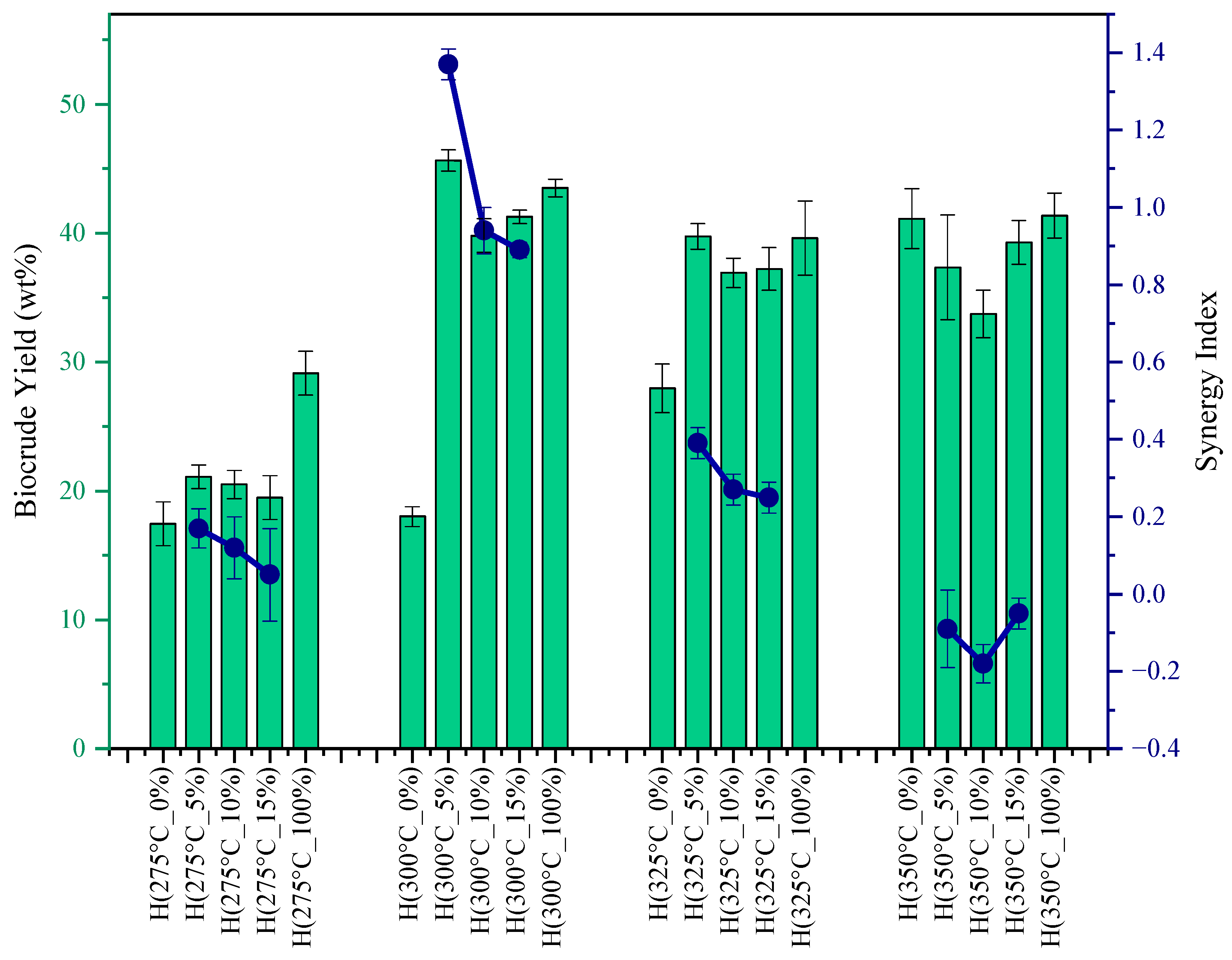
Figure 1 presents the biocrude yield under different conditions. The data is represented as H (T_X), where T represents the HTL temperature and X represents the SFW fraction. The value of T could be 4 different temperatures of 275, 300, 325, and 350 °C. The value of X could be five different values of SFW fraction (0, 5, 10, 15, and 100%), where 0% and 100% represent the individual HTL of SG and SFW, respectively, while the intermediates represent the CoHTL. Along with the yield, the SI was also presented in Figure 1, which effectively captures the synergistic interactions with higher values indicating a greater enhancement in biocrude yield from CoHTL compared to the individual HTL runs.
The biocrude yield of H (275 °C_5, 10, 15%) ranged between 19.5 ± 1.7% and 21.1 ± 0.9%, comparable to the yield of H (275 °C_0%) (17.4 ± 1.7%), indicating no significant synergy at this temperature. However, with an increase in temperature to 300 °C, the H (300 °C_5, 10, 15%) biocrude yield showed a substantial enhancement, reaching 39.8 ± 1.3% to 45.6 ± 0.8%. As the temperature increased beyond 300 °C, the yield slightly decreased and reached 33.7 ± 1.9–39.3 ± 1.7%, at H (350 °C_5, 10, 15%). The variation in biocrude yield can be seen in the SI, where at lower temperatures the SI was lower, which peaked at 300 °C and then decreased, with further increases in temperature, and showed an antagonistic effect (SI < 0) at 350 °C.
The observed synergistic increase in biocrude yield likely arises from protein and lipid-derived intermediates of SFW, which facilitate the breakdown and stabilization of SG-derived compounds in the biocrude phase. These probable synergistic interactions are discussed in detail in Section 3.3. The absence of noticeable synergy at lower temperatures (275 °C) is attributed to limited thermal energy, which hinders the breakdown of feedstocks into reactive intermediates that can interact [50]. In contrast, at higher temperatures (320 °C, 350 °C), interactions between intermediates are less dominant over higher thermal energy, which causes the secondary reactions, leading to reduced biocrude formation [51,52]. Thus, intermediate temperatures of 300 °C resulted in the maximum SI, which also corresponds to the maximum enhancement of biocrude yield at H (300 °C_5%), which was 27.6 wt% and 2.1 wt% higher than the individual HTL yields of SG and SFW, respectively. Similar trends have been reported in previous studies. Duan et al. [53] observed a slight synergistic increase in biocrude yield during CoHTL of Camellia oleifera Abel and Spirulina platensis at 260 °C, peaking at 320 °C and declining at higher temperatures. Other studies have noted antagonistic effects when the CoHTL was performed at higher temperatures (340–360 °C) [54,55].
The effect of the SFW fraction on biocrude yield can be understood by comparing the yield data for a particular temperature group. The results show that biocrude yield tends to decrease as the SFW fraction increases from 5% to 10%, and then stabilizes at 15% at, except at H (350 °C, 15%), where a slight increase in biocrude yield (from 33.7 to 39.3%) was observed. The SI also followed a similar trend. This might be due to the increase of protein-derived intermediates from a higher SFW fraction, which can undergo Mannich reaction with the carbohydrate and lignin-derived intermediates of SG, forming solid char [32,56]. However, the variation at 350 °C may be attributed to the reduced dominance of the Mannich reaction at higher temperature, while the increased lipid fraction from high SFW loading might slightly increase the biocrude yield. Mishra and Mohanty [57] observed a reduction in biocrude yield (35% to 24%) with the increase of domestic sewage sludge fraction from 25% to 75% during CoHTL with microalgae. However, Chen et al. [58] reported an initial decrease in biocrude yield up to a swine manure percentage of 50%, which increased with the further increase of swine manure fraction to 75% during CoHTL with algal biomass. Unlike these CoHTL studies that achieved maximum biocrude yields with 25 and 75% co-feed fractions, the CoHTL of SG exhibited the highest biocrude yield with 5% SFW, indicating a greater sensitivity of SG toward synergistic interactions at low co-feed ratios.
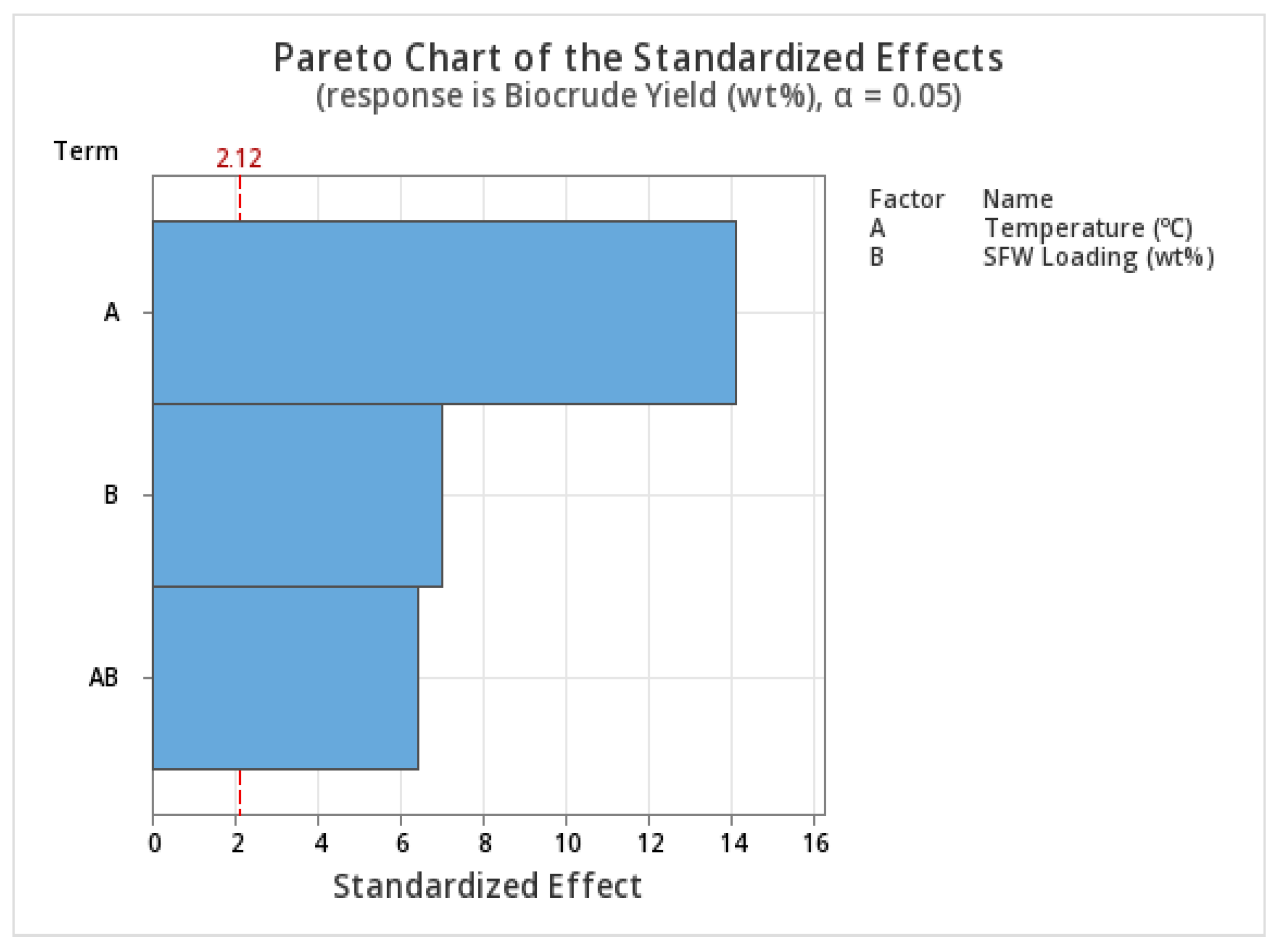
The ANOVA results presented in Table 3 indicate that CoHTL temperature, SFW fraction, and their interaction all have statistically significant effects on biocrude yield. The Pareto chart (Figure 2) further reveals that temperature is the dominant factor governing biocrude yield, while the SFW fraction exhibits a significant but comparatively smaller effect. Notably, the significant interaction term indicates that the influence of temperature strongly depends on the SFW fraction, highlighting a coupled effect between reaction severity and feedstock ratio. However, as the primary objective of this study is the valorization of SG, relatively low SFW fractions were employed during co-liquefaction. Therefore, exploring higher SFW loadings in future studies is necessary to further validate this effect.

3.2. Influence of CoHTL on Fuel Characteristics of Biocrude

To evaluate the fuel properties of the produced HTL and CoHTL biocrudes, elemental analysis was performed and presented in Table 4. The carbon content of CoHTL biocrude tends to increase with temperature, rising from 71.0 ± 1.4–71.8 ± 1.8% at H (275 °C_5, 10%) to a maximum of 77.6 ± 0.0–78.7 ± 0.3% at H (350 °C_5, 10, 15%) with an exception at H (275 °C_15%), where an elevated SFW fraction produced biocrude with a higher carbon content of 75.9 ± 0.8%. This trend aligns with enhanced deoxygenation at higher temperatures, as indicated by a corresponding decrease in oxygen content. Several studies have reported an increase in carbon content with an increase in HTL temperature [28,59,60]. The enhanced carbon and lower oxygen contents contributed to higher HHV of the biocrude at elevated temperatures, H (350 °C_5, 10, 15%), which ranged from 36.5 ± 0.1 to 37.2 ± 0.1 MJ/Kg. The nitrogen content of CoHTL biocrude peaked at H (300 °C_5, 10, 15%) (2.93 ± 0.07–3.45 ± 0.01%), then decreased slightly at H (350 °C_5, 10, 15%) (2.54 ± 0.05% to 2.86 ± 0.10%). This peak is attributed to the maximum efficacy of Maillard reactions at 300 °C, which promotes nitrogen incorporation into biocrude, forming heavier compounds and enhancing biocrude yield, discussed in the previous section [32,56,61]. The subsequent decline at higher temperatures suggests nitrogen is preferentially transferred to solid char via Mannich-type reactions [56].
Corresponding to the maximum SI of biocrude yield at H (300 °C_5%) as shown in Figure 1, the biocrude under this condition also showed maximum enhancement in carbon content and HHV. The carbon content was 11.4% and 9.7% higher than the individual HTL biocrude of SG and SFW, respectively, while the HHV exceeded by 7.2 and 5 MJ/kg. On the other hand, varying the SFW fraction at a given temperature resulted in a slight variation in carbon and energy content, indicating a less dominant effect of the SFW fraction. Similar observations have been reported in previous studies, where a maximum 3% variation was observed in the carbon content with the changes in the mass ratio of feedstocks during CoHTL [32,62].
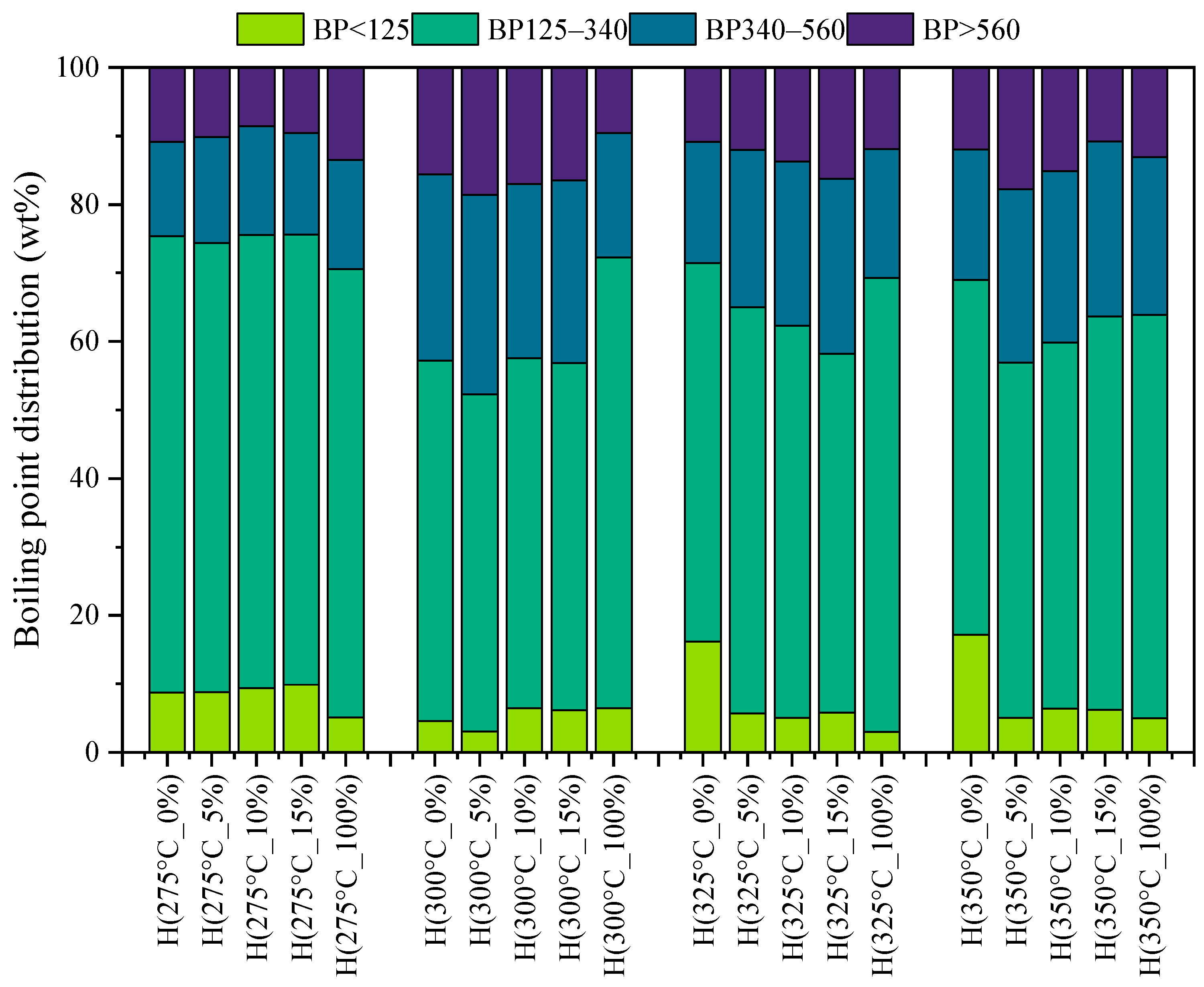
While elemental analysis provided the carbon content of the biocrude, further characterization using TGA was performed to determine its distribution across different boiling point cuts (Figure 3). This approach provides insights into the distillation profile of the biocrude and enables inference of the corresponding carbon number ranges of the constituent compounds. Both individual and CoHTL biocrudes exhibited a dominant BP 125–340 fraction, ranging from 49.1% to 66.7%. Several other researchers also found the dominance of this fraction in the CoHTL biocrude [17,18]. This indicates the significant potential of SG-derived biocrude, as mild hydrotreatment of this fraction can produce fuel in the diesel and jet fuel range [63]. The CoHTL biocrude at H (275 °C_5, 10, 15%) contained the highest proportion of BP 125–340 (65.6–66.1%), which significantly decreased at H (300 °C_5, 10, 15%) (49.1–51.1%). At higher temperatures, the BP 125–340 fraction increased again. Correspondingly, the heavier fractions (BP 340–560 and BP > 560) increased notably at 300 °C, suggesting enhanced formation of high-molecular-weight compounds, which declined at higher temperatures.
The H (275 °C_5, 10, 15%) biocrude is mainly obtained due to the breakdown of lipids and less complex carbohydrates fraction of the feedstock, resulting in a higher fraction of light oil (BP < 340) [64]. Lim et al. [65] also found the maximum fraction of light oil at 275 °C during the HTL of Korean native kenaf. As the temperature increases to 300 °C, CoHTL leads to the enhanced depolymerization of complex biomolecule structures [64], which introduces heteroatom-containing compounds in the biocrude [66], decreasing the light oil fraction. In addition, the stabilization of reactive compounds through cross-linking also leads to a higher proportion of heavy oil (BP > 340). At temperatures beyond 300 °C, increased thermal cracking likely breaks down the heavier fractions, causing deoxygenation and increasing the light oil proportion. This is also correlated with the lower amount of oxygen found in the CoHTL biocrude obtained at higher temperatures, as presented in Table 4. Motavaf and Savage [28] also demonstrated the increase of light oil fraction with the increase of temperature from 300 to 350 °C during the HTL of simulated food waste.
The effect of the SFW fraction on the boiling point distribution of biocrude was generally minor, except at 325 °C and 350 °C. At 325 °C, the BP 125–340 fraction in CoHTL biocrude decreased from 59.3% to 52.4% with increasing SFW fraction, accompanied by increases in the BP 340–560 and BP > 560 fractions. In contrast, at 350 °C, the BP 125–340 fraction increased from 51.8% to 57.4%, while the BP > 560 fraction decreased from 17.7% to 10.7%. These shifts suggest that higher SFW fractions may influence the formation and stabilization of heavier compounds at 325 °C, while promoting cracking reactions at higher temperatures (350 °C), leading to a redistribution toward lighter fractions. Overall, the CoHTL process significantly enhanced both biocrude yield and energy content at the cost of slightly higher nitrogen content and reduced light oil fraction.

3.3. Molecular Composition of Biocrude and Its Formation Pathway

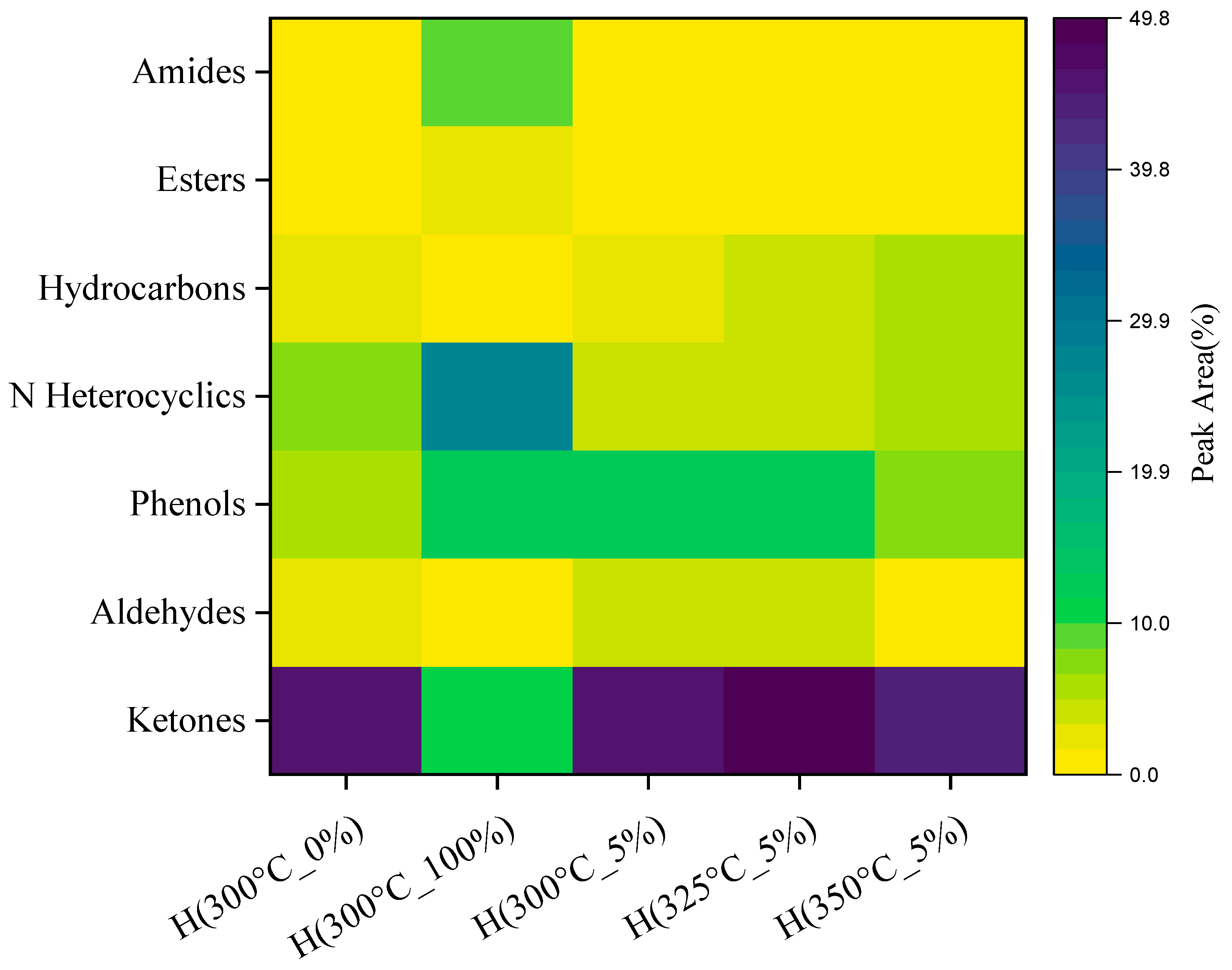
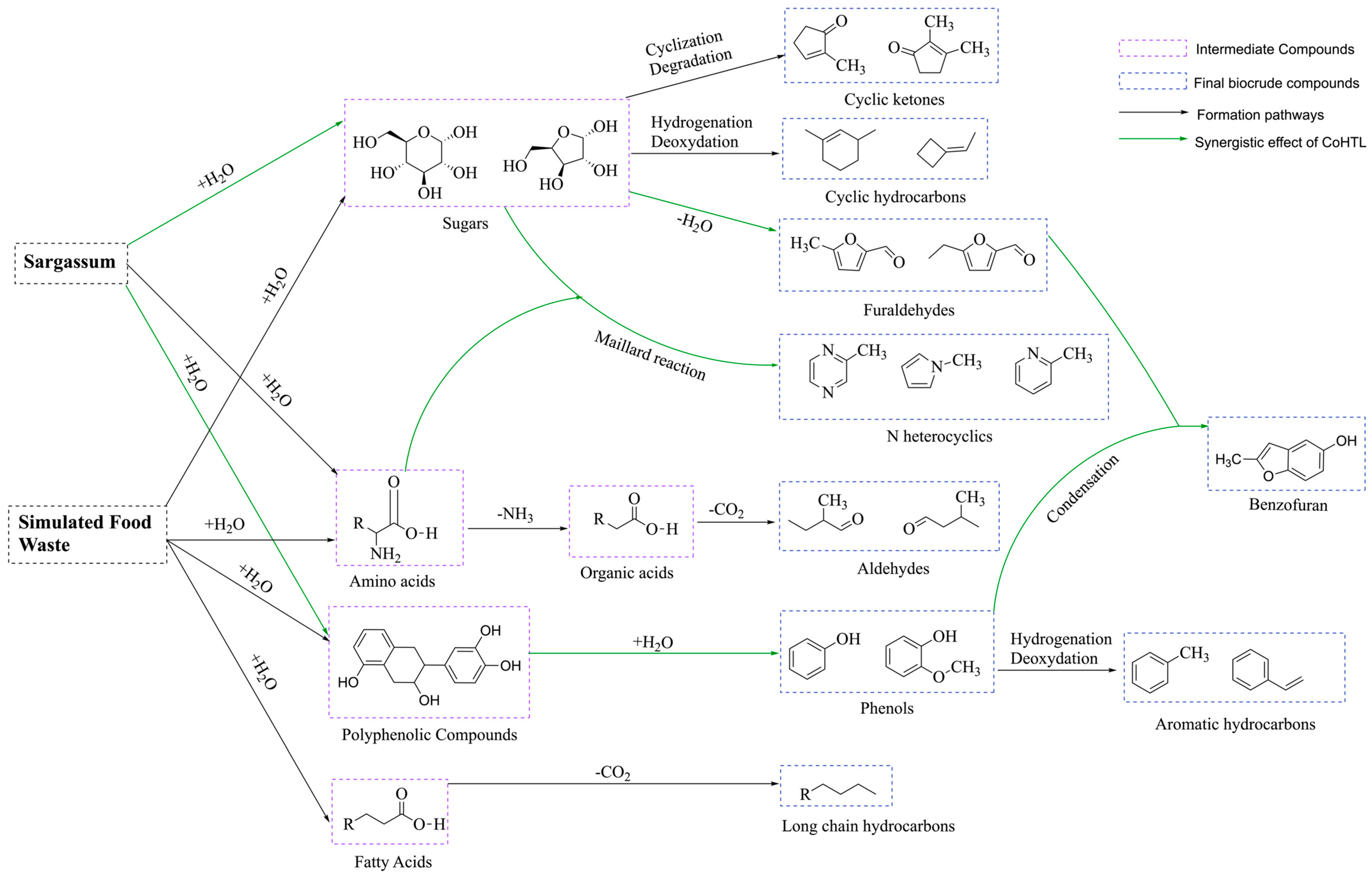
The boiling point distribution in Figure 3 indicates that, under all experimental conditions, more than 50% of the biocrude contains compounds having boiling points below 280 °C. The detailed molecular composition of this fraction present in H (300 °C_5%) and H (300 °C_0, 100%) biocrude was analyzed using GC-MS to assess the synergy of CoHTL. Additionally, the biocrude of H (325, 350 °C_5%) was analyzed to evaluate the impact of CoHTL temperature since no significant synergy was observed at H (275 °C, 5%). The identified compounds with match quality higher than 70% were identified and classified into multiple groups, and the peak of the corresponding groups was plotted as a heatmap, as shown in Figure 4 [67]. The total peak areas of these compound groups ranged between 62% to 74% of the total GC-MS chromatogram area. In addition, the possible formation pathways of these compounds are presented in Figure 5, where the green arrow represents the pathways that are affected by the addition of SFW. A detailed classification of the identified can be found in Table S2.
As shown in Figure 4, the biocrude obtained from both HTL and CoHTL of SG predominantly contains cyclic ketones (2-Cyclopenten-1-one, 2-methyl-, 2-Cyclopenten-1-one, 2,3-dimethyl-) derived mainly from the hydrolysis of carbohydrates such as cellulose and the hemicellulose fraction of SG [32], which is demonstrated in Figure 5. The higher abundance of carbohydrates in the SG [30] explains the predominance of these ketonic compounds. Apart from ketonic compounds, several reactions, such as hydrogenation and deoxidation reactions, convert the carbohydrate intermediates to cyclic hydrocarbons, and dehydration leads to the formation of furaldehydes [68]. Interestingly, furaldehydes such as 2-Furancarboxaldehyde, 5-methyl-, and 5-Ethyl-2-furaldehyde were absent in both SG and SFW biocrude and present only in the CoHTL biocrude, indicating the synergistic interaction of CoHTL discussed in Section 3.1.
The higher abundance of nitrogenated compounds in the H (300 °C_100%) (as can be seen from the 27.3% peak area of N Heterocyclics in Figure 4) indicates that addition of SFW during CoHTL can facilitate the Maillard reaction pathways, stabilizing the carbohydrate-derived intermediates of SG and forming heavier N heterocyclic compounds in the biocrude [32,56,69]. Although these heavier compounds may not be detected by GCMS, the higher nitrogen content (as shown in Table 4) and increased heavy oil fraction (Figure 3) of CoHTL biocrude support their presence. Previously, Yan et al. [70] demonstrated stabilization of phenolic compounds in the biocrude due to interaction with fatty acid through molecular dynamics simulation. These synergistic interactions in the present study can be evidenced from the increase in phenolic compounds peak area from 5.8% to 12.3% following CoHTL and the higher hydrogen content of SFW biocrude, which reflects its greater proportion of fatty acid [27].
With the increase of CoHTL temperature from 300 to 350 °C, a decrease in the peak area of aldehyde (from 3.6 to 0.8%) and phenols (from 12.2 to 8.2%) was observed, indicating the secondary reactions of these compounds. Moreover, the hydrocarbons in the CoHTL biocrude increased with temperature from 3.3% to 5.3%. This indicates the enhanced deoxygenation at higher CoHTL temperature discussed in Section 3.2. It is important to note that the pathways proposed in Figure 5 are intended to represent plausible reaction routes based on the compounds identified in the biocrude, rather than being supported by direct kinetic or isotopic evidence. Further validation would require targeted studies, such as model-compound experiments along with time-resolved kinetic analysis and isotopic labeling to track intermediates and confirm the proposed reactions.

4. Conclusions

This study examined the CoHTL of SG with SFW by evaluating the effects of temperature (275–350 °C) and SFW mass fraction (5–15 wt%) on biocrude yield and quality. The maximum biocrude yield of 45.6 ± 0.8 wt% was achieved at 300 °C with 5% SFW, demonstrating a remarkable synergistic increase compared to the individual HTL of each feedstock. The biocrude yield and the synergy of CoHTL declined at higher temperatures and SFW fractions. The effect of CoHTL temperature on biocrude yield was significantly higher than the SFW fraction. Although CoHTL at 300 °C with 5% SFW showed the maximum improvement in carbon and energy content compared to individual SG HTL, both the carbon and energy content of CoHTL biocrude increased at higher temperatures. A modest increase in nitrogen content at CoHTL biocrude was attributed to Maillard reactions, which also correlated with the increase in the fraction of heavier compounds. Reaction pathways revealed the enhanced formation and stabilization of furaldehydes, phenolic compounds, heavier N heterocyclics, and hydroxy-benzofurans following CoHTL. Overall, CoHTL of SG with SFW showed significant potential in biocrude production, offering a promising route for the efficient valorization of Sargassum.

Supplementary Materials

The following supporting information can be downloaded at: https://www.mdpi.com/article/10.3390/en19102277/s1, Table S1. List of experimental runs and the corresponding biocrude yield for full factorial design, Table S2. List of identified compounds present in the biocrude obtained from HTL and CoHTL of SG and SFW.

Author Contributions

M.M.R.: conceptualization, data curation, formal analysis, writing-original draft, writing-review, and editing. T.R.: conceptualization, manuscript revision, funding acquisition. All authors have read and agreed to the published version of the manuscript.

Funding

This study is supported by the U.S. Department of Energy’s Office of Biological and Environmental Research under contracts DE-SC0024701.

Data Availability Statement

The data presented in this study are available on request from the corresponding author due to an internal agreement between the authors.

Conflicts of Interest

The authors declare no conflicts of interest.

References

  1. Liu, F.; Liu, X.; Wang, Y.; Jin, Z.; Moejes, F.W.; Sun, S. Insights on the Sargassum Horneri Golden Tides in the Yellow Sea Inferred from Morphological and Molecular Data. Limnol. Oceanogr. 2018, 63, 1762–1773. [Google Scholar] [CrossRef]
  2. Gordillo Sierra, A.R.; Amador-Castro, L.F.; Ramírez-Partida, A.E.; García-Cayuela, T.; Carrillo-Nieves, D.; Alper, H.S. Valorization of Caribbean Sargassum Biomass as a Source of Alginate and Sugars for de Novo Biodiesel Production. J. Environ. Manag. 2022, 324, 116364. [Google Scholar] [CrossRef] [PubMed]
  3. Wang, M.; Hu, C.; Barnes, B.B.; Mitchum, G.; Lapointe, B.; Montoya, J.P. The Great Atlantic Sargassum Belt. Science 2019, 365, 83–87. [Google Scholar] [CrossRef]
  4. Alleyne, K.S.T.; Speede, R.; Oxenford, H.A.; McConney, P. History, Current Status and Future Perspectives of Sargassum Management in the Eastern Caribbean SIDS: A Story from the Frontline. Harmful Algae 2025, 148, 102910. [Google Scholar] [CrossRef] [PubMed]
  5. Alvarez-Filip, L.; Estrada-Saldívar, N.; Pérez-Cervantes, E.; Molina-Hernández, A.; González-Barrios, F.J. A Rapid Spread of the Stony Coral Tissue Loss Disease Outbreak in the Mexican Caribbean. PeerJ 2019, 7, e8069. [Google Scholar] [CrossRef]
  6. Bennett, M.; March, A.; Li, H.; Lallemand, P.; Maréchal, J.-P.; Failler, P. Qualitative and Quantitative Assessment of Sargassum Valorisation Solutions for the Caribbean. J. Environ. Manag. 2025, 381, 124954. [Google Scholar] [CrossRef]
  7. UN Environment Programme. Sargassum White Paper: Turning the Crisis into an Opportunity. Available online: https://www.unep.org/cep/resources/publication/sargassum-white-paper-turning-crisis-opportunity (accessed on 11 March 2026).
  8. Tobío-Pérez, I.; Alfonso-Cardero, A.; Díaz-Domínguez, Y.; Pohl, S.; Piloto-Rodríguez, R.; Lapuerta, M. Thermochemical Conversion of Sargassum for Energy Production: A Comprehensive Review. BioEnergy Res. 2022, 15, 1872–1893. [Google Scholar] [CrossRef]
  9. Amador-Castro, F.; García-Cayuela, T.; Alper, H.S.; Rodriguez-Martinez, V.; Carrillo-Nieves, D. Valorization of Pelagic Sargassum Biomass into Sustainable Applications: Current Trends and Challenges. J. Environ. Manag. 2021, 283, 112013. [Google Scholar] [CrossRef]
  10. Peterson, A.A.; Vogel, F.; Lachance, R.P.; Fröling, M.; Michael, J.; Antal, J.; Tester, J.W. Thermochemical Biofuel Production in Hydrothermal Media: A Review of Sub- and Supercritical Water Technologies. Energy Environ. Sci. 2008, 1, 32–65. [Google Scholar] [CrossRef]
  11. Brunner, G. Near Critical and Supercritical Water. Part I. Hydrolytic and Hydrothermal Processes. J. Supercrit. Fluids 2009, 47, 373–381. [Google Scholar] [CrossRef]
  12. Liu, Q.; Xu, R.; Yan, C.; Han, L.; Lei, H.; Ruan, R.; Zhang, X. Fast Hydrothermal Co-Liquefaction of Corn Stover and Cow Manure for Biocrude and Hydrochar Production. Bioresour. Technol. 2021, 340, 125630. [Google Scholar] [CrossRef]
  13. Wahyudiono; Sasaki, M.; Goto, M. Recovery of Phenolic Compounds through the Decomposition of Lignin in near and Supercritical Water. Chem. Eng. Process. Process Intensif. 2008, 47, 1609–1619. [Google Scholar] [CrossRef]
  14. Tymchyshyn, M.; Xu, C.C. Liquefaction of Bio-Mass in Hot-Compressed Water for the Production of Phenolic Compounds. Bioresour. Technol. 2010, 101, 2483–2490. [Google Scholar] [CrossRef]
  15. Lavoie, J.-M.; Baré, W.; Bilodeau, M. Depolymerization of Steam-Treated Lignin for the Production of Green Chemicals. Bioresour. Technol. 2011, 102, 4917–4920. [Google Scholar] [CrossRef]
  16. Akiya, N.; Savage, P.E. Roles of Water for Chemical Reactions in High-Temperature Water. Chem. Rev. 2002, 102, 2725–2750. [Google Scholar] [CrossRef] [PubMed]
  17. Roberts, V.M.; Stein, V.; Reiner, T.; Lemonidou, A.; Li, X.; Lercher, J.A. Towards Quantitative Catalytic Lignin Depolymerization. Chem.-Eur. J. 2011, 17, 5939–5948. [Google Scholar] [CrossRef]
  18. Miller, J.E.; Evans, L.; Littlewolf, A.; Trudell, D.E. Batch Microreactor Studies of Lignin and Lignin Model Compound Depolymerization by Bases in Alcohol Solvents. Fuel 1999, 78, 1363–1366. [Google Scholar] [CrossRef]
  19. Hidajat, M.J.; Riaz, A.; Park, J.; Insyani, R.; Verma, D.; Kim, J. Depolymerization of Concentrated Sulfuric Acid Hydrolysis Lignin to High-Yield Aromatic Monomers in Basic Sub- and Supercritical Fluids. Chem. Eng. J. 2017, 317, 9–19. [Google Scholar] [CrossRef]
  20. Biswas, B.; Fernandes, A.C.; Kumar, J.; Muraleedharan, U.D.; Bhaskar, T. Valorization of Sargassum Tenerrimum: Value Addition Using Hydrothermal Liquefaction. Fuel 2018, 222, 394–401. [Google Scholar] [CrossRef]
  21. Bayat Mastalinezhad, F.; Osfouri, S.; Azin, R. Production and Characterization of Biocrude from Persian Gulf Sargassum Angustifolium Using Hydrothermal Liquefaction: Process Optimization by Response Surface Methodology. Biomass Bioenergy 2023, 178, 106963. [Google Scholar] [CrossRef]
  22. Crespo, A.; Abelleira-Pereira, J.M.; Mascarell, J.J.; Garcia-Jarana, B.; Sanchez-Oneto, J.; Portela, J.R.; Martinez De La Ossa, E.; Duran, E. Bio-Crude Production by Hydrothermal Liquefaction of an Invasive Marine Algae (Sargassum Polyceratium). Chem. Eng. Trans. 2023, 98, 249–254. [Google Scholar] [CrossRef]
  23. Li, D.; Chen, L.; Xu, D.; Zhang, X.; Ye, N.; Chen, F.; Chen, S. Preparation and Characteristics of Bio-Oil from the Marine Brown Alga Sargassum Patens C. Agardh. Bioresour. Technol. 2012, 104, 737–742. [Google Scholar] [CrossRef] [PubMed]
  24. Milledge, J.J.; Maneein, S.; Arribas López, E.; Bartlett, D. Sargassum Inundations in Turks and Caicos: Methane Potential and Proximate, Ultimate, Lipid, Amino Acid, Metal and Metalloid Analyses. Energies 2020, 13, 1523. [Google Scholar] [CrossRef]
  25. Milledge, J.J.; Harvey, P.J. Golden Tides: Problem or Golden Opportunity? The Valorisation of Sargassum from Beach Inundations. J. Mar. Sci. Eng. 2016, 4, 60. [Google Scholar] [CrossRef]
  26. Oyesiku, O.O.; Egunyomi, A. Identification and Chemical Studies of Pelagic Masses of Sargassum Natans (Linnaeus) Gaillon and S. Fluitans (Borgessen) Borgesen (Brown Algae), Found Offshore in Ondo State, Nigeria. Afr. J. Biotechnol. 2014, 13, 1188–1193. [Google Scholar] [CrossRef]
  27. Teri, G.; Luo, L.; Savage, P.E. Hydrothermal Treatment of Protein, Polysaccharide, and Lipids Alone and in Mixtures. Energy Fuels 2014, 28, 7501–7509. [Google Scholar] [CrossRef]
  28. Motavaf, B.; Savage, P.E. Effect of Process Variables on Food Waste Valorization via Hydrothermal Liquefaction. ACS EST Eng. 2021, 1, 363–374. [Google Scholar] [CrossRef]
  29. Gollakota, A.R.K.; Kishore, N.; Gu, S. A Review on Hydrothermal Liquefaction of Biomass. Renew. Sustain. Energy Rev. 2018, 81, 1378–1392. [Google Scholar] [CrossRef]
  30. He, S.; Zhao, M.; Wang, J.; Cheng, Z.; Yan, B.; Chen, G. Hydrothermal Liquefaction of Low-Lipid Algae Nannochloropsis Sp. and Sargassum Sp.: Effect of Feedstock Composition and Temperature. Sci. Total Environ. 2020, 712, 135677. [Google Scholar] [CrossRef]
  31. do Couto Fraga, A.; de Almeida, M.B.B.; Sousa-Aguiar, E.F. Hydrothermal Liquefaction of Cellulose and Lignin: A New Approach on the Investigation of Chemical Reaction Networks. Cellulose 2021, 28, 2003–2020. [Google Scholar] [CrossRef]
  32. Hu, Y.; Hu, M.; Jiang, H.; Yu, P.; Yang, W. Co-Liquefaction of Livestock Manure and Food Waste: Synergistic Effects and Product Combustion Performance. Appl. Energy 2023, 341, 121073. [Google Scholar] [CrossRef]
  33. Feuerbach, S.; Toor, S.S.; Costa, P.A.; Paradela, F.; Marques, P.A.A.S.; Castello, D. Hydrothermal Co-Liquefaction of Food and Plastic Waste for Biocrude Production. Energies 2024, 17, 2098. [Google Scholar] [CrossRef]
  34. Biswas, B.; Kumar, A.; Kaur, R.; Krishna, B.B.; Bhaskar, T. Co-Hydrothermal Liquefaction of Lignin and Macroalgae: Effect of Process Parameters on Product Distribution. BioEnergy Res. 2023, 16, 33–44. [Google Scholar] [CrossRef]
  35. Kumar, A.; Yadav, P.; Reddy, S.N. Catalytic (Copper) Hydrothermal Liquefaction for Lignin to Produce High Quality Bio-Oil and Nano Cu Carbon Hybrids Material. Chem. Eng. Sci. 2023, 270, 118548. [Google Scholar] [CrossRef]
  36. Yamaguchi, A.; Mimura, N.; Shirai, M.; Sato, O. Bond Cleavage of Lignin Model Compounds into Aromatic Monomers Using Supported Metal Catalysts in Supercritical Water. Sci. Rep. 2017, 7, 46172. [Google Scholar] [CrossRef]
  37. Yuan, C.; Wang, S.; Cao, B.; Hu, Y.; Abomohra, A.E.-F.; Wang, Q.; Qian, L.; Liu, L.; Liu, X.; He, Z.; et al. Optimization of Hydrothermal Co-Liquefaction of Seaweeds with Lignocellulosic Biomass: Merging 2nd and 3rd Generation Feedstocks for Enhanced Bio-Oil Production. Energy 2019, 173, 413–422. [Google Scholar] [CrossRef]
  38. Huang, T.; Zhao, H.; Huang, C.; Ren, T.; Liu, F.; Wu, Y.; Deng, M.; Liu, Y.; Wu, S.; Liu, X. Co-Liquefaction of Microalgae and Industrial Wastewater: The Impact of Temperature on Product Yield and Quality. J. Energy Inst. 2025, 122, 102207. [Google Scholar] [CrossRef]
  39. Jin, B.; Duan, P.; Xu, Y.; Wang, F.; Fan, Y. Co-Liquefaction of Micro- and Macroalgae in Subcritical Water. Bioresour. Technol. 2013, 149, 103–110. [Google Scholar] [CrossRef] [PubMed]
  40. Raikova, S.; Knowles, T.D.J.; Allen, M.J.; Chuck, C.J. Co-Liquefaction of Macroalgae with Common Marine Plastic Pollutants. ACS Sustain. Chem. Eng. 2019, 7, 6769–6781. [Google Scholar] [CrossRef]
  41. Hu, Y.; Zhang, W.; Yan, J.; Yuan, C.; Cao, B.; Ni, J.; Qian, L.; Wang, Q.; Wang, S. Effect of Ni, Mo and W on Hydrothermal Co-Liquefaction of Macroalgae and Microalgae: Impact on Bio-Crude Yield and Composition. J. Energy Inst. 2023, 110, 101311. [Google Scholar] [CrossRef]
  42. Wang, S.; Yan, J.; Cao, B.; Yuan, C.; Qian, L.; Uzoejinwa, B.B.; Hu, Y. Study on Synergistic Mechanism of Co-Hydrothermal Liquefaction of Microalgae and Macroalgae. J. Anal. Appl. Pyrolysis 2022, 164, 105514. [Google Scholar] [CrossRef]
  43. Sultana, A.I.; Saha, N.; Reza, M.T. Upcycling Simulated Food Wastes into Superactivated Hydrochar for Remarkable Hydrogen Storage. J. Anal. Appl. Pyrolysis 2021, 159, 105322. [Google Scholar] [CrossRef]
  44. Saqib, N.U.; Baroutian, S.; Sarmah, A.K. Physicochemical, Structural and Combustion Characterization of Food Waste Hydrochar Obtained by Hydrothermal Carbonization. Bioresour. Technol. 2018, 266, 357–363. [Google Scholar] [CrossRef]
  45. Komilis, D.P.; Ham, R.K. Carbon Dioxide and Ammonia Emissions during Composting of Mixed Paper, Yard Waste and Food Waste. Waste Manag. 2006, 26, 62–70. [Google Scholar] [CrossRef] [PubMed]
  46. Watson, J.; Lu, J.; De Souza, R.; Si, B.; Zhang, Y.; Liu, Z. Effects of the Extraction Solvents in Hydrothermal Liquefaction Processes: Biocrude Oil Quality and Energy Conversion Efficiency. Energy 2019, 167, 189–197. [Google Scholar] [CrossRef]
  47. Valdez, P.J.; Dickinson, J.G.; Savage, P.E. Characterization of Product Fractions from Hydrothermal Liquefaction of Nannochloropsis Sp. and the Influence of Solvents. Energy Fuels 2011, 25, 3235–3243. [Google Scholar] [CrossRef]
  48. Channiwala, S.A.; Parikh, P.P. A Unified Correlation for Estimating HHV of Solid, Liquid and Gaseous Fuels. Fuel 2002, 81, 1051–1063. [Google Scholar] [CrossRef]
  49. Saha, N.; Banivaheb, S.; Toufiq Reza, M. Towards Solvothermal Upcycling of Mixed Plastic Wastes: Depolymerization Pathways of Waste Plastics in Sub- and Supercritical Toluene. Energy Convers. Manag. X 2022, 13, 100158. [Google Scholar] [CrossRef]
  50. Reddy, H.K.; Muppaneni, T.; Ponnusamy, S.; Sudasinghe, N.; Pegallapati, A.; Selvaratnam, T.; Seger, M.; Dungan, B.; Nirmalakhandan, N.; Schaub, T.; et al. Temperature Effect on Hydrothermal Liquefaction of Nannochloropsis Gaditana and Chlorella Sp. Appl. Energy 2016, 165, 943–951. [Google Scholar] [CrossRef]
  51. Cheikhwafa, J.; Glińska, K.; Torrens, E.; Bengoa, C. Effect of Temperature on Hydrothermal Liquefaction of High Lipids and Carbohydrates Content Municipal Primary Sludge. Heliyon 2024, 10, e24731. [Google Scholar] [CrossRef]
  52. Madsen, R.B.; Glasius, M. How Do Hydrothermal Liquefaction Conditions and Feedstock Type Influence Product Distribution and Elemental Composition? Ind. Eng. Chem. Res. 2019, 58, 17583–17600. [Google Scholar] [CrossRef]
  53. Duan, Y.; He, Z.; Zhang, B.; Wang, B.; Zhang, F. Synergistic Effect of Hydrothermal Co-Liquefaction of Camellia Oleifera Abel and Spirulina Platensis: Parameters Optimization and Product Characteristics. Renew. Energy 2022, 186, 26–34. [Google Scholar] [CrossRef]
  54. Zhang, G.; Wang, K.; Liu, Q.; Han, L.; Zhang, X. A Comprehensive Hydrothermal Co-Liquefaction of Diverse Biowastes for Energy-Dense Biocrude Production: Synergistic and Antagonistic Effects. Int. J. Environ. Res. Public Health 2022, 19, 10499. [Google Scholar] [CrossRef]
  55. Yang, J.; He, Q.S.; Yang, L. A Review on Hydrothermal Co-Liquefaction of Biomass. Appl. Energy 2019, 250, 926–945. [Google Scholar] [CrossRef]
  56. Chen, X.; Peng, X.; Ma, X.; Wang, J. Investigation of Mannich Reaction during Co-Liquefaction of Microalgae and Sweet Potato Waste. Bioresour. Technol. 2019, 284, 286–292. [Google Scholar] [CrossRef]
  57. Mishra, S.; Mohanty, K. Co-HTL of Domestic Sewage Sludge and Wastewater Treatment Derived Microalgal Biomass—An Integrated Biorefinery Approach for Sustainable Biocrude Production. Energy Convers. Manag. 2020, 204, 112312. [Google Scholar] [CrossRef]
  58. Chen, W.-T.; Zhang, Y.; Zhang, J.; Schideman, L.; Yu, G.; Zhang, P.; Minarick, M. Co-Liquefaction of Swine Manure and Mixed-Culture Algal Biomass from a Wastewater Treatment System to Produce Bio-Crude Oil. Appl. Energy 2014, 128, 209–216. [Google Scholar] [CrossRef]
  59. De Caprariis, B.; De Filippis, P.; Petrullo, A.; Scarsella, M. Hydrothermal Liquefaction of Biomass: Influence of Temperature and Biomass Composition on the Bio-Oil Production. Fuel 2017, 208, 618–625. [Google Scholar] [CrossRef]
  60. Brown, T.M.; Duan, P.; Savage, P.E. Hydrothermal Liquefaction and Gasification of Nannochloropsis Sp. Energy Fuels 2010, 24, 3639–3646. [Google Scholar] [CrossRef]
  61. Chacón-Parra, A.D.; Hall, P.A.; Lewis, D.M.; Glasius, M.; van Eyk, P.J. Elucidating the Maillard Reaction Mechanism in the Hydrothermal Liquefaction of Binary Model Compound Mixtures and Spirulina. ACS Sustain. Chem. Eng. 2022, 10, 10989–11003. [Google Scholar] [CrossRef]
  62. Xu, D.; Wang, Y.; Lin, G.; Guo, S.; Wang, S.; Wu, Z. Co-Hydrothermal Liquefaction of Microalgae and Sewage Sludge in Subcritical Water: Ash Effects on Bio-Oil Production. Renew. Energy 2019, 138, 1143–1151. [Google Scholar] [CrossRef]
  63. Yu, J.; Biller, P.; Mamahkel, A.; Klemmer, M.; Becker, J.; Glasius, M.; Iversen, B.B. Catalytic Hydrotreatment of Bio-Crude Produced from the Hydrothermal Liquefaction of Aspen Wood: A Catalyst Screening and Parameter Optimization Study. Sustain. Energy Fuels 2017, 1, 832–841. [Google Scholar] [CrossRef]
  64. Cheng, F.; Cui, Z.; Chen, L.; Jarvis, J.; Paz, N.; Schaub, T.; Nirmalakhandan, N.; Brewer, C.E. Hydrothermal Liquefaction of High- and Low-Lipid Algae: Bio-Crude Oil Chemistry. Appl. Energy 2017, 206, 278–292. [Google Scholar] [CrossRef]
  65. Lim, S.R.; Kim, S.J.; Um, B.H. Characteristic Analysis of Fractionized Light and Heavy Oil Derived from Korean Native Kenaf via Hydrothermal Liquefaction. Biomass Bioenergy 2022, 167, 106606. [Google Scholar] [CrossRef]
  66. Garcia Alba, L.; Torri, C.; Samorì, C.; van der Spek, J.; Fabbri, D.; Kersten, S.R.A.; Brilman, D.W.F.W. Hydrothermal Treatment (HTT) of Microalgae: Evaluation of the Process as Conversion Method in an Algae Biorefinery Concept. Energy Fuels 2012, 26, 642–657. [Google Scholar] [CrossRef]
  67. Rahman, M.M.; Reza, T. Hydrothermal Liquefaction of Structurally Diverse Lignins: Insights into Biocrude Yield, Fuel Properties, and Reaction Mechanisms. Energies 2025, 18, 4773. [Google Scholar] [CrossRef]
  68. Mazhkoo, S.; Norouzi, O.; Pourali, O.; Sarvestani, M.E.; Hayder, A.; Maria, F.D.; Dutta, A. Catalytic Hydrothermal Liquefaction of Grape Pomace Using Ni–ZrO2 –MSS and Ni–HZSM5 in a Water–Crude Glycerol Cosolvent. ACS Omega 2025, 10, 11836–11853. [Google Scholar] [CrossRef] [PubMed]
  69. Zhang, C.; Han, L.; Yan, M.; Xia, J.; Rong, N.; Baloch, H.A.; Guo, H.; Wu, P.; Xu, G.; Ma, K. Hydrothermal Co-Liquefaction of Rice Straw and Waste Cooking-Oil Model Compound for Bio-Crude Production. J. Anal. Appl. Pyrolysis 2021, 160, 105360. [Google Scholar] [CrossRef]
  70. Yan, S.; Xia, D.; Zhang, X.; Liu, X. Synergistic Mechanism of Enhanced Biocrude Production during Hydrothermal Co-Liquefaction of Biomass Model Components: A Molecular Dynamics Simulation. Energy 2022, 255, 124561. [Google Scholar] [CrossRef]
Figure 1. Effect of temperature and SFW fraction on biocrude yield and synergy index (SI) of CoHTL.
Energies 19 02277 g001
Figure 2. Pareto chart of the impact of temperature and SFW loading on biocrude yield.
Energies 19 02277 g002
Figure 3. Boiling point distribution of biocrude obtained from HTL and CoHTL of SG and SFW.
Energies 19 02277 g003
Figure 4. Types of compounds and their relative abundance on biocrude obtained from HTL and CoHTL of SG and SFW.
Energies 19 02277 g004
Figure 5. Plausible biocrude formation pathways during CoHTL.
Energies 19 02277 g005
Table 1. Moisture content of food items and their mixing percentage used for SFW production.
SubstanceMoisture Content (%)Mixing Percentage a
(%)
Bread34.0 ± 0.358.2 ± 0.3
Cheese46.6 ± 0.321.4 ± 0.3
Apple84.7 ± 0.26.7 ± 0.2
Canned Chicken71.2 ± 2.06.5 ± 2.0
Green Beans92.7 ± 0.24.6 ± 0.2
Cabbage90.7 ± 1.62.6 ± 1.6
a Mixing percentage is presented on a dry basis.
Table 2. Characteristics of raw SG and SFW feedstocks.
FeedstockMoisture
(wt%)
Elemental Analysis (wt%)HHV b
(MJ/kg)
CarbonHydrogenNitrogenSulfurOxygenAsh
SG82.1 ± 0.432.5 ± 1.74.2 ± 0.21.3 ± 0.01.2 ± 0.127.1 ± 2.433.7 ± 0.412.3 ± 1.3
SFW66.2 ± 0.841.1 ± 2.96.3 ± 0.53.4 ± 0.40.2 ± 044.2 ± 3.54.8 ± 0.415.1 ± 2.4
b Elemental analysis is reported on dry basis, and HHV was calculated according to Dulong formula.
Table 3. ANOVA analysis of the effect of HTL temperature and SFW loading on biocrude yield.
SourceDFAdj SSAdj MSF-Valuep-Value
Model152884.8192.3232.260.000
Linear62178.21363.03560.890.000
Temperature (°C)31733.02577.67496.90.000
SFW Loading (wt%)3445.19148.39724.890.000
2-Way Interactions9706.5978.5113.170.000
Temperature (°C) *SFW Loading (wt%)9706.5978.5113.170.000
Error1695.395.962
Total312980.19
Table 4. Ultimate analysis and HHV of biocrude obtained after HTL and CoHTL of SG and SFW.
Temperature
(°C)
SFW Fraction
(wt%)
Elemental Analysis cHHV e
(MJ/Kg)
Carbon (%)Hydrogen (%)Nitrogen (%)Sulfur (%)Oxygen d (%)
275071.0 ± 1.48.88 ± 0.003.23 ± 0.030.96 ± 0.1516.0 ± 1.634.3 ± 0.8
571.9 ± 0.89.26 ± 0.123.01 ± 0.031.85 ± 0.0414.0 ± 1.035.6 ± 0.6
1071.8 ± 1.89.26 ± 0.182.95 ± 0.090.94 ± 0.0515.0 ± 2.135.3 ± 1.2
1575.9 ± 0.810.06 ± 0.12.94 ± 0.060.59 ± 0.0110.5 ± 1.038.7 ± 0.6
10069.3 ± 1.78.76 ± 0.284.14 ± 0.130.34 ± 0.0117.5 ± 2.133.2 ± 1.4
300064.1 ± 0.17.69 ± 0.042.30 ± 0.010.70 ± 0.0425.2 ± 0.228.5 ± 0.1
575.5 ± 0.08.40 ± 0.012.93 ± 0.070.54 ± 0.0112.6 ± 0.135.7 ± 0.0
1073.2 ± 0.58.00 ± 0.043.45 ± 0.010.55 ± 0.0214.8 ± 0.533.9 ± 0.3
1573.6 ± 0.48.08 ± 0.033.20 ± 0.040.48 ± 0.0114.6 ± 0.434.2 ± 0.2
10065.8 ± 2.28.25 ± 0.314.74 ± 0.120.46 ± 0.0120.7 ± 2.630.7 ± 1.7
325070.6 ± 0.07.77 ± 0.012.41 ± 0.011.03 ± 0.0018.2 ± 0.032.1 ± 0.0
577.0 ± 0.28.17 ± 0.012.66 ± 0.010.53 ± 0.0111.7 ± 0.236.0 ± 0.1
1074.7 ± 0.18.14 ± 0.053.23 ± 0.050.49 ± 0.0113.4 ± 0.134.9 ± 0.1
1575.9 ± 0.28.03 ± 0.013.12 ± 0.010.42 ± 0.0012.6 ± 0.235.3 ± 0.1
10073.5 ± 0.09.18 ± 0.034.75 ± 0.040.28 ± 0.0112.3 ± 0.136.2 ± 0.1
350074.9 ± 0.38.16 ± 0.062.43 ± 0.050.65 ± 0.0113.8 ± 0.434.9 ± 0.3
578.3 ± 0.18.32 ± 0.102.54 ± 0.050.35 ± 0.0310.5 ± 0.236.9 ± 0.2
1077.6 ± 0.08.27 ± 0.012.64 ± 0.050.41 ± 0.0311.0 ± 0.136.5 ± 0.1
1578.7 ± 0.38.33 ± 0.102.86 ± 0.100.47 ± 0.009.7 ± 0.337.2 ± 0.1
10076.0 ± 0.59.50 ± 0.094.91 ± 0.050.24 ± 0.009.3 ± 0.638.1 ± 0.4
c Elemental analysis is presented in mass normalized basis. d Oxygen content is determined by the difference. e HHV was estimated according to the Dulong formula and reported on dry basis.
Disclaimer/Publisher’s Note: The statements, opinions and data contained in all publications are solely those of the individual author(s) and contributor(s) and not of MDPI and/or the editor(s). MDPI and/or the editor(s) disclaim responsibility for any injury to people or property resulting from any ideas, methods, instructions or products referred to in the content.