Parametric Investigation of Thermal Runaway Mechanism in Lithium Battery Under Nail Penetration

Abstract
1. Introduction
- (1)
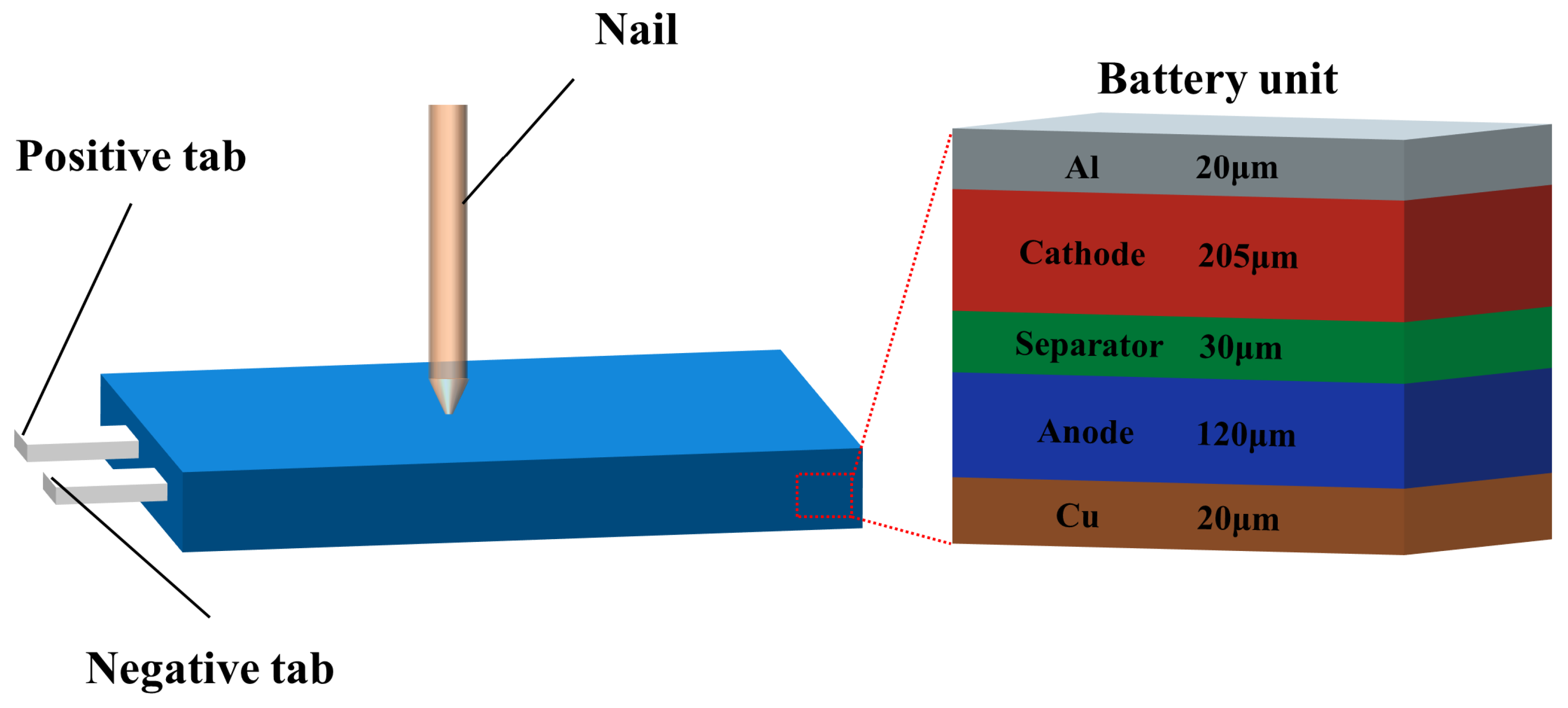
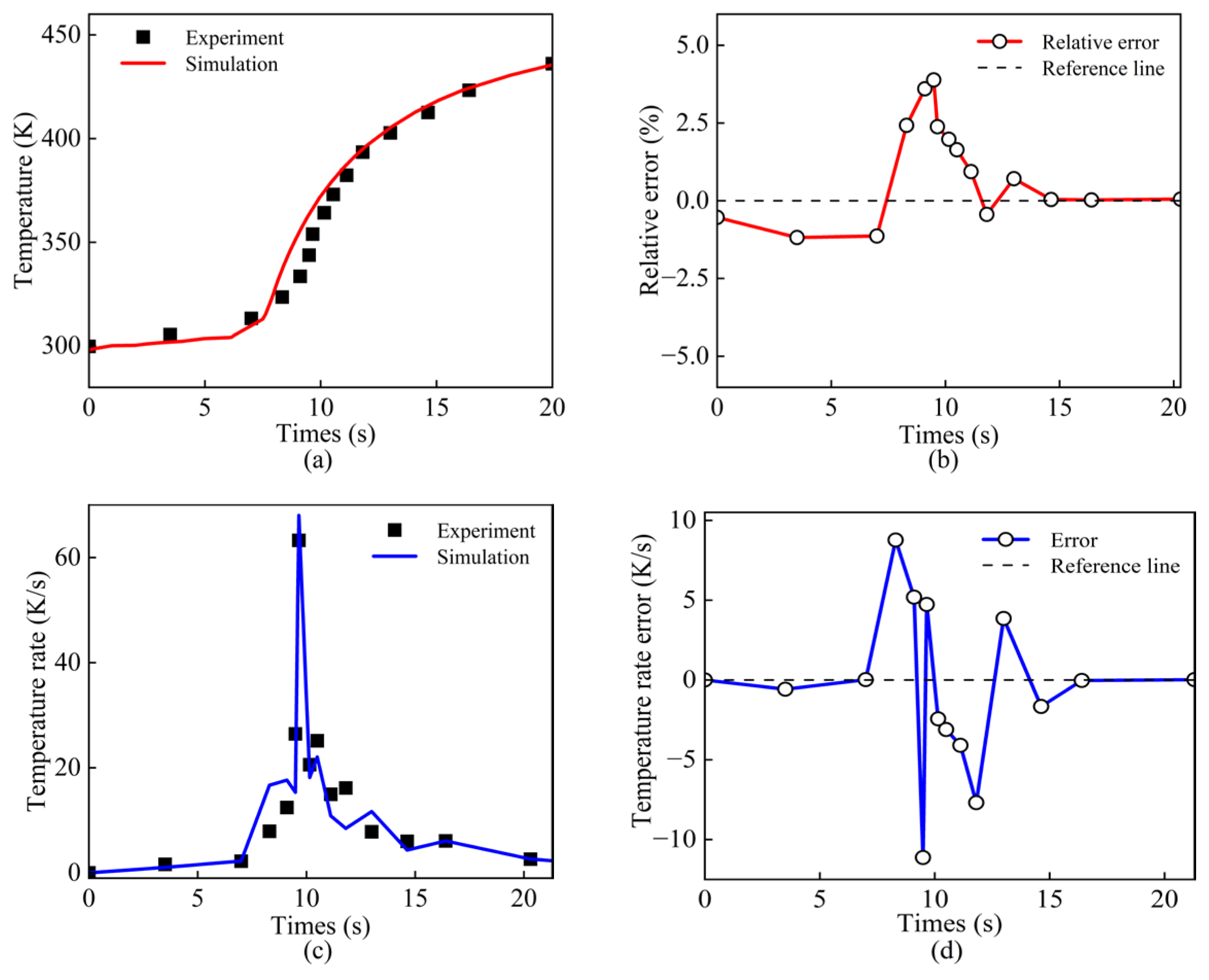
- A numerical model integrating electrochemical and thermal dynamics is developed based on the battery cell to replicate the thermal runaway phenomenon induced by nail penetration. This model enables a thorough investigation of the electro-thermal response evolution and the spatial temperature distribution patterns occurring within the battery throughout the entire process.
- (2)
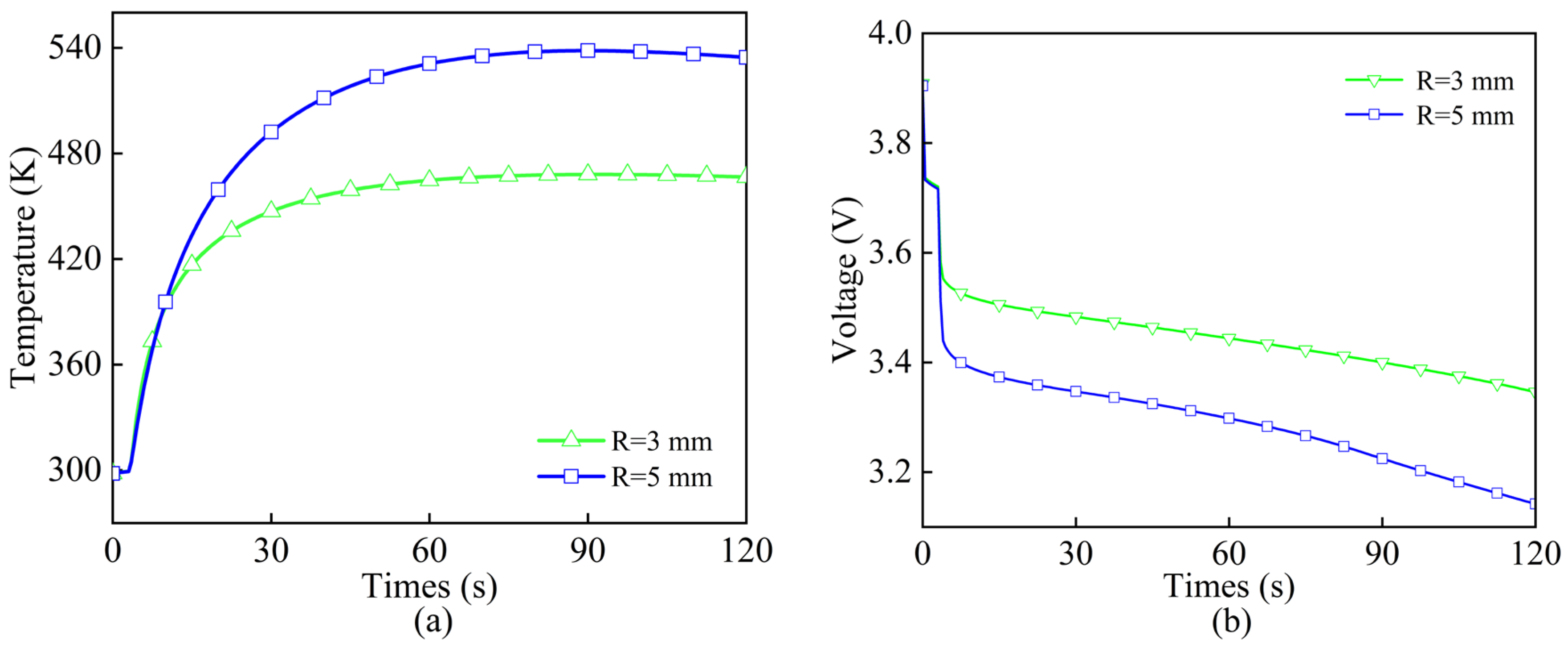
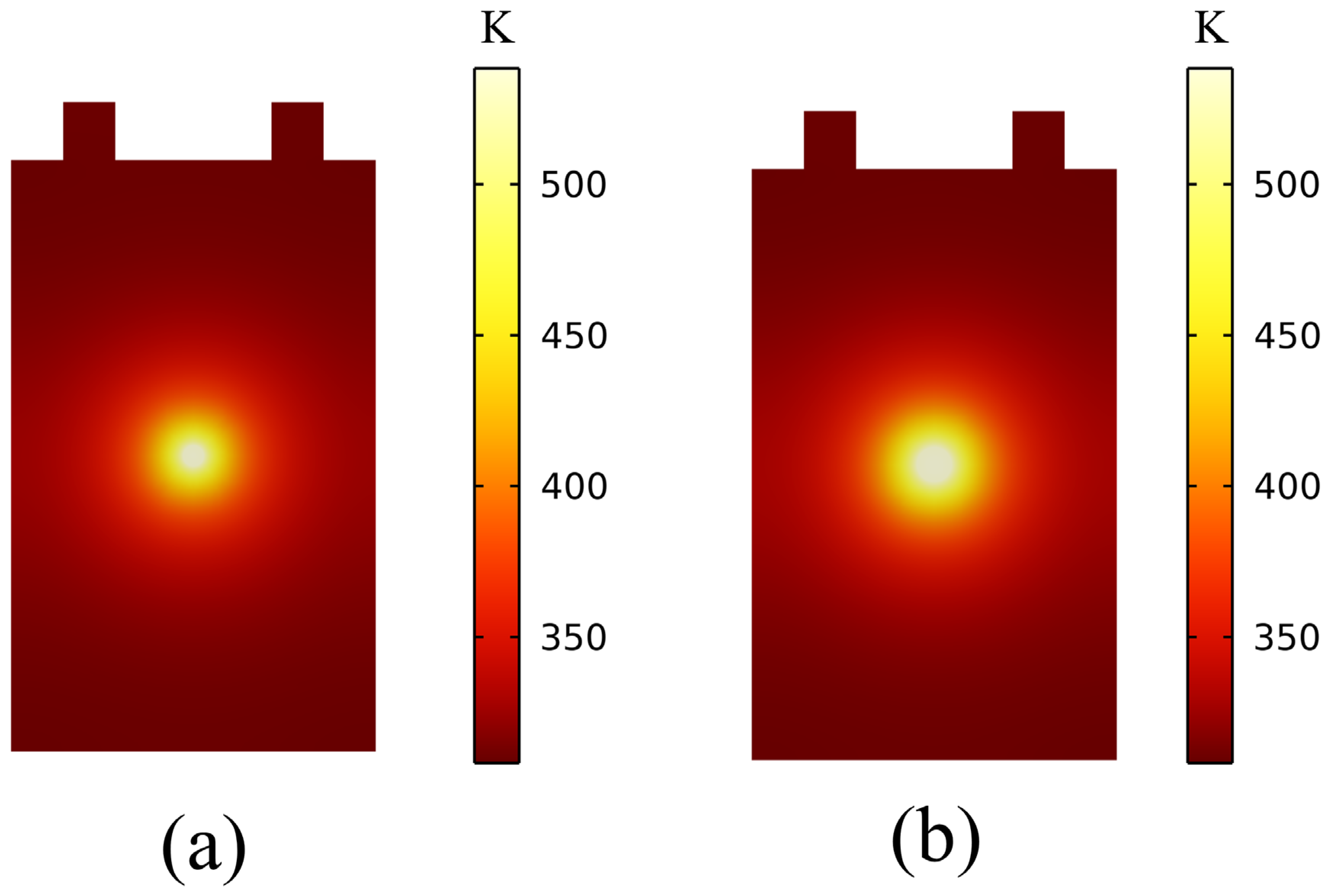
- By comprehensively examining the effects of factors such as penetration radius, velocity, surface cooling conditions, initial SOC, and penetration location on battery temperature, voltage evolution, and temperature distribution, the study provides in-depth insights into the intrinsic mechanisms of TR and heat transfer principles.
2. Modeling
2.1. Geometry Construction
2.2. Theoretical Model
2.2.1. Electrochemical Model
2.2.2. Thermal Model
2.2.3. Thermal Runaway Model
2.3. Simulation Steps
3. Model Validation
3.1. Mesh Independence Check
3.2. Model Validation
4. Results and Discussion
4.1. Influence of Different Radius
4.2. Effects of Different Needling Speeds
4.3. Needling at Different Positions
4.4. The Different Effects of Initial SOC
5. Conclusions
- (1)
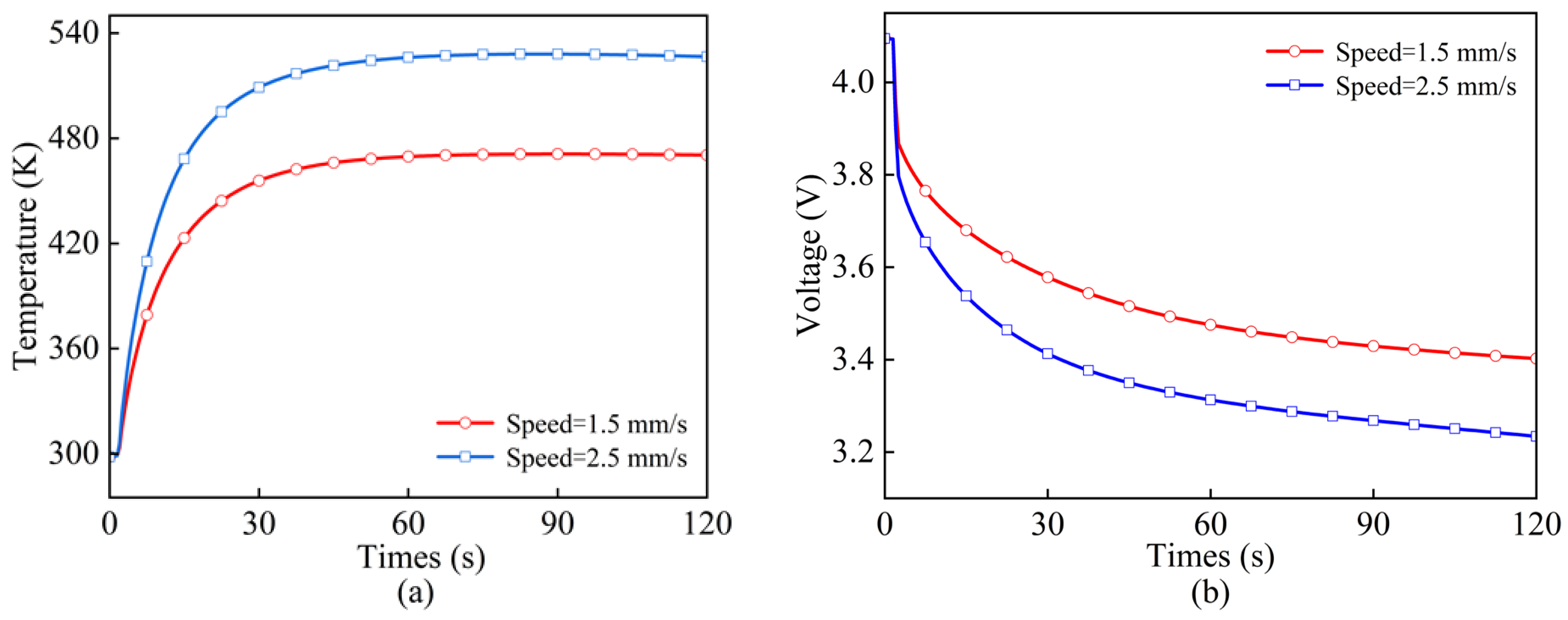
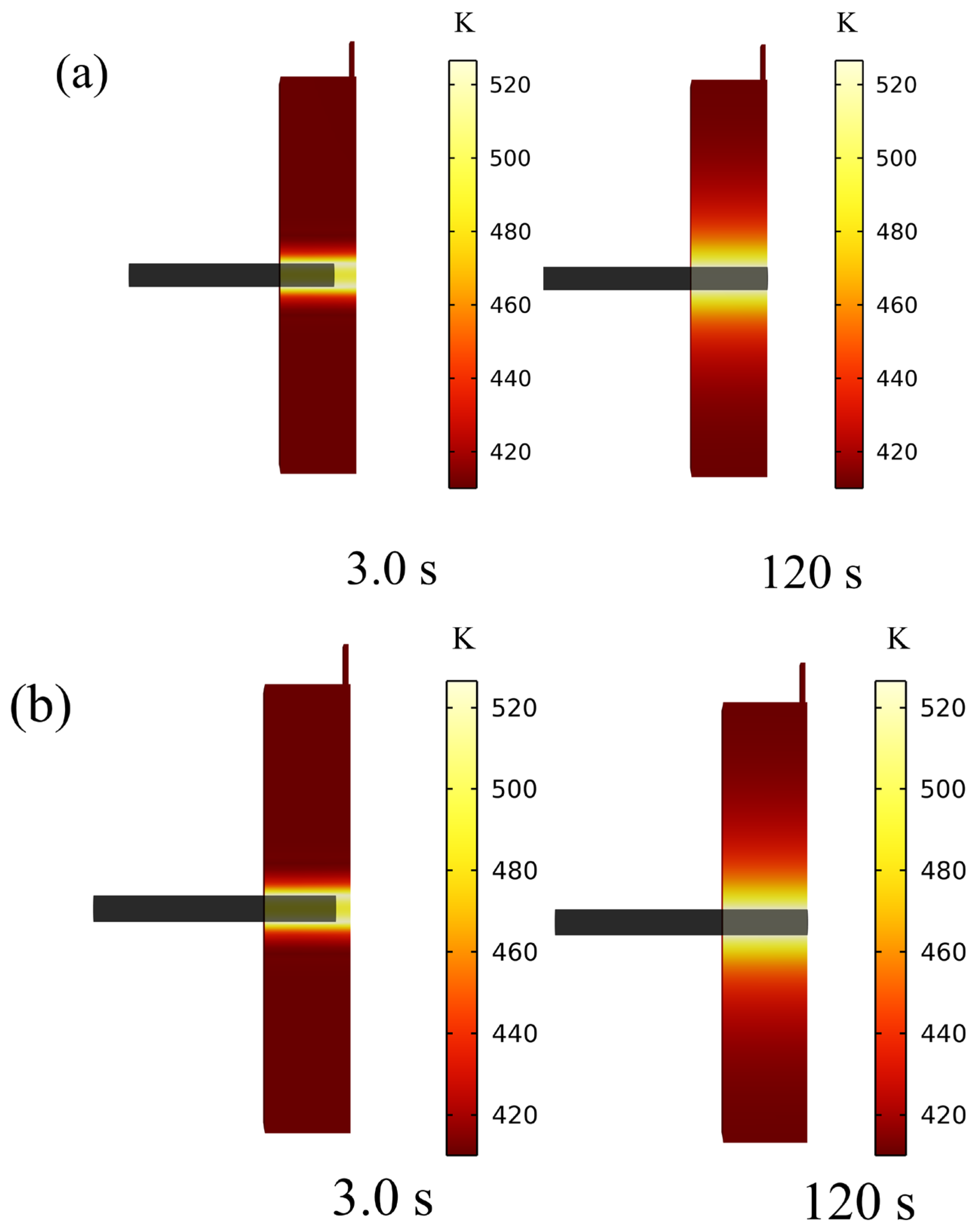
- Increasing the nail radius and penetration speed enlarges the internal short-circuit area within the battery and intensifies the short-circuit current, thereby exacerbating TR and elevating its peak temperature. When the nail radius reaches 5 mm, the maximum temperature of the single cell can rise to 538 K.
- (2)
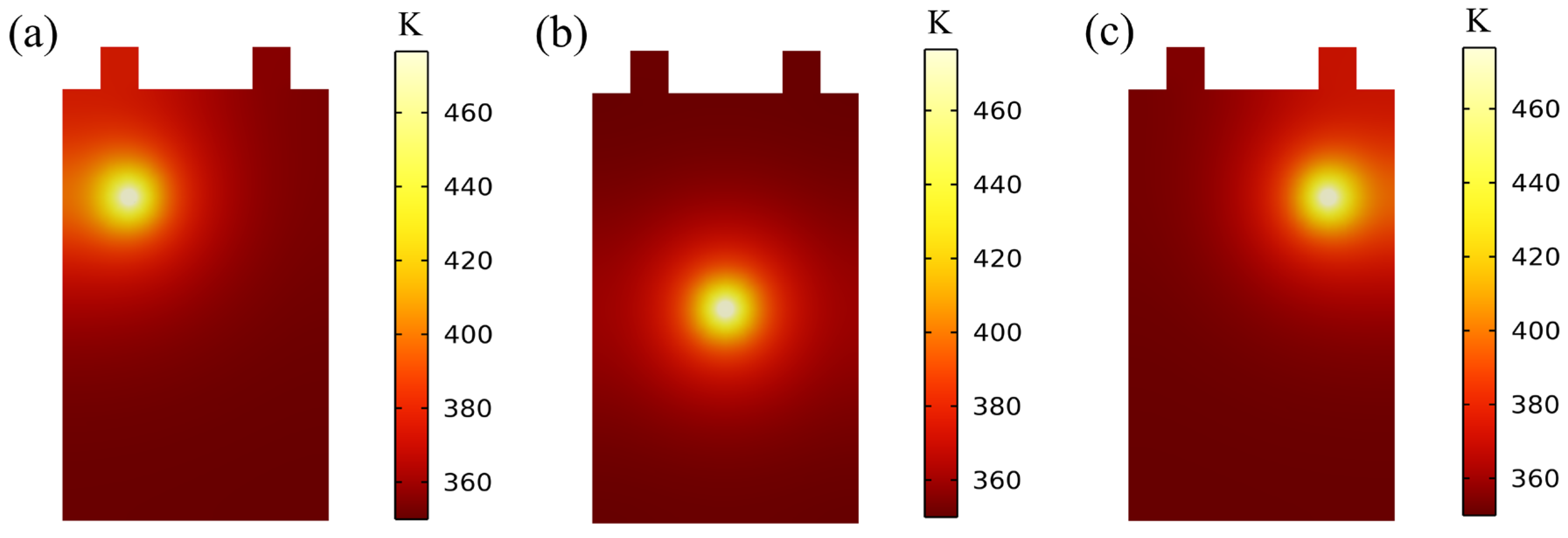
- Regions adjacent to the electrodes experience higher TR temperatures, whereas areas nearer to the tabs show more evident heat dissipation. Specifically, the peak TR temperature reaches 477 K near the negative electrode, 480 K near the positive electrode, and 468 K at the center of the cell.
- (3)
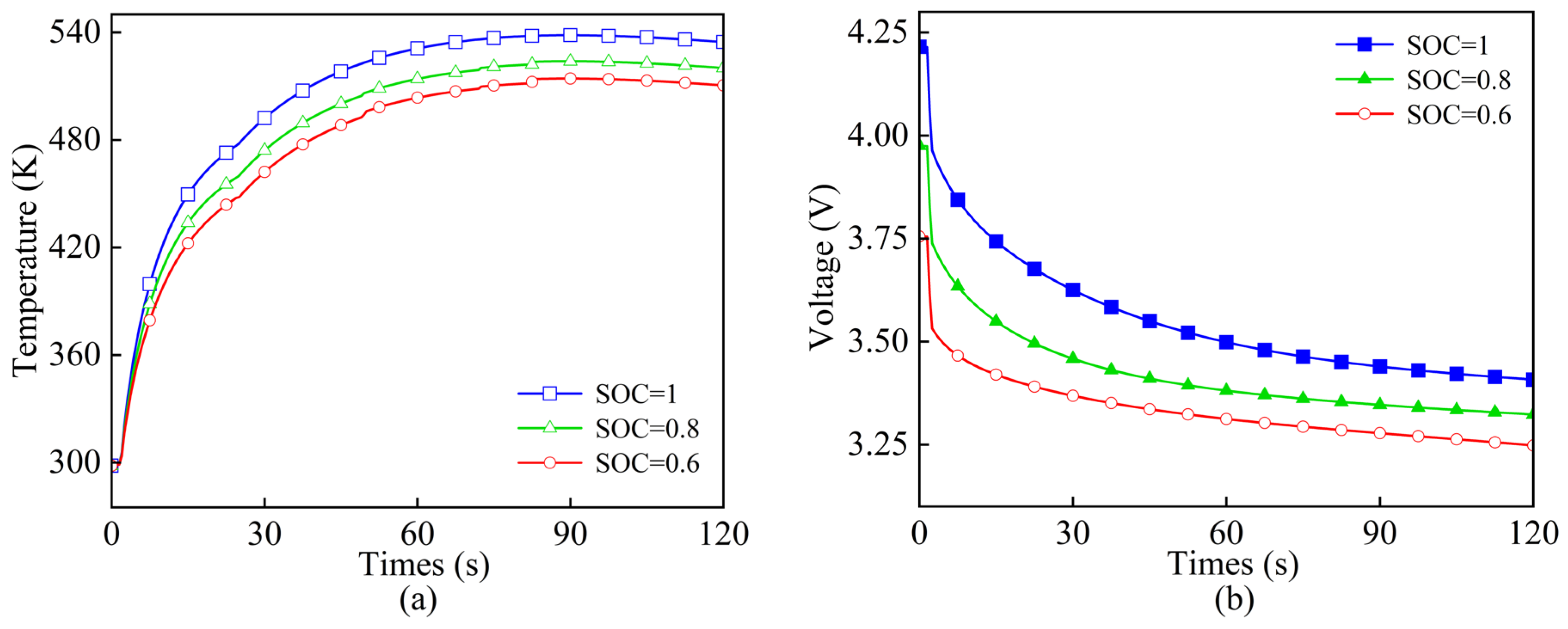
- A higher SOC in a LIB implies more stored energy, which results in faster electrochemical reactions, a more significant voltage decline, and intensified heat generation. At 100% SOC, the battery exhibits a maximum voltage drop of 0.8 V and attains a peak temperature of 500 K.
Author Contributions
Funding
Data Availability Statement
Conflicts of Interest
Abbreviations
| LIBs | Lithium-ion batteries |
| TR | Thermal runaway |
| ISC | Internal short circuits |
| SOC | State of charge |
References
- Zhao, X.; Ma, X.; Chen, B.; Shang, Y.; Song, M. Challenges toward carbon neutrality in China: Strategies and countermeasures. Resour. Conserv. Recycl. 2022, 176, 105959. [Google Scholar] [CrossRef] [Scilit]
- Wu, W.; Wang, S.; Wu, W.; Chen, K.; Hong, S.; Lai, Y. A critical review of battery thermal performance and liquid based battery thermal management. Energy Convers. Manag. 2019, 182, 262–281. [Google Scholar] [CrossRef] [Scilit]
- Kim, T.; Song, W.; Son, D.Y.; Ono, L.K.; Qi, Y. Lithium-ion batteries: Outlook on present, future, and hybridized technologies. J. Mater. Chem. A 2019, 7, 2942–2964. [Google Scholar] [CrossRef] [Scilit]
- Feng, X.; Ren, D.; He, X.; Ouyang, M. Mitigating thermal runaway of lithium-ion batteries. Joule 2020, 4, 743–770. [Google Scholar] [CrossRef] [Scilit]
- Wang, Q.; Mao, B.; Stoliarov, S.I.; Sun, J. A review of lithium-ion battery failure mechanisms and fire prevention strategies. Prog. Energy Combust. Sci. 2019, 73, 95–131. [Google Scholar] [CrossRef] [Scilit]
- Larsson, F.; Andersson, P.; Blomqvist, P.; Lorén, A.; Mellander, B.-E. Characteristics of lithium-ion batteries during fire tests. J. Power Sources 2014, 271, 414–420. [Google Scholar] [CrossRef] [Scilit]
- Ohsaki, T.; Kishi, T.; Kuboki, T.; Takami, N.; Shimura, N.; Sato, Y.; Sekino, M.; Satoh, A. Overcharge reaction of lithium-ion batteries. J. Power Sources 2005, 146, 97–100. [Google Scholar] [CrossRef] [Scilit]
- Spotnitz, R.; Franklin, J. Abuse behavior of high-power, lithium-ion cells. J. Power Sources 2003, 113, 81–100. [Google Scholar] [CrossRef] [Scilit]
- Shelkea, A.V.; Buston, J.E.H.; Gill, J.; Howard, D.; Williams, R.C.E.; Read, E.; Abaza, A.; Cooper, B.; Richards, P.; Wen, J.X. Combined numerical and experimental studies of 21700 lithium-ion battery thermal runaway induced by different thermal abuse. Int. J. Heat Mass Transf. 2022, 194, 123099. [Google Scholar] [CrossRef] [Scilit]
- Ping, P.; Wang, Q.S.; Huang, P.F.; Li, K.; Sun, J.; Kong, D.; Chen, C. Study of the fire behavior of high-energy lithium-ion batteries with full-scale burning test. J. Power Sources 2015, 285, 80–89. [Google Scholar] [CrossRef] [Scilit]
- Friesen, A.; Horsthemke, F.; Mönnighoff, X.; Brunklaus, G.; Krafft, R.; Börner, M.; Risthaus, T.; Winter, M.; Schappacher, F.M. Impact of cycling at low temperatures on the safety behavior of 18650-type lithium-ion cells: Combined study of mechanical and thermal abuse testing accompanied by post-mortem analysis. J. Power Sources 2016, 334, 1–11. [Google Scholar] [CrossRef] [Scilit]
- Yuan, Q.F.; Zhao, F.; Wang, W.; Zhao, Y.M.; Liang, Z.; Yan, D. Overcharge failure investigation of lithium-ion batteries. Electrochim. Acta 2015, 178, 682–688. [Google Scholar] [CrossRef] [Scilit]
- Fernandes, Y.; Bry, A.; De Persis, S. Identification and quantification of gases emitted during abuse tests by overcharge of a commercial Li-ion battery. J. Power Sources 2018, 389, 106–119. [Google Scholar] [CrossRef] [Scilit]
- Lamb, J.; Orendorff, C.J. Evaluation of mechanical abuse techniques in lithium-ion batteries. J. Power Sources 2014, 247, 189–196. [Google Scholar] [CrossRef] [Scilit]
- Maleki, H.; Howard, J.N. Internal short circuit in Li-ion cells. J. Power Sources 2009, 191, 568–574. [Google Scholar] [CrossRef] [Scilit]
- Finegan, D.P.; Tjaden, B.; Heenan, T.M.M.; Jervis, R.; Di Michiel, M.; Rack, A.; Hinds, G.; Brett, D.J.L.; Shearing, P.R. Tracking internal temperature and structural dynamics during nail penetration of lithium-ion cells. J. Electrochem. Soc. 2017, 164, A3285. [Google Scholar] [CrossRef] [Scilit]
- Doyle, M.; Newman, J.; Gozdz, A.S.; Schmutz, C.N.; Tarascon, J.-M. Comparison of modeling predictions with experimental data from plastic lithium-ion cells. J. Electrochem. Soc. 1996, 143, 1890. [Google Scholar] [CrossRef] [Scilit]
- Ping, P.; Wang, Q.; Chung, Y.; Wen, J. Modelling electro-thermal response of lithium-ion batteries from normal to abuse conditions. Appl. Energy 2017, 205, 1327–1344. [Google Scholar] [CrossRef] [Scilit]
- Zhao, W.; Luo, G.; Wang, C.Y. Modeling nail penetration process in large-format Li-ion cells. J. Electrochem. Soc. 2014, 162, A207. [Google Scholar] [CrossRef] [Scilit]
- Feng, X.; He, X.; Lu, L.; Ouyang, M. Analysis on the fault features for internal short circuit detection using an electrochemical-thermal coupled model. J. Electrochem. Soc. 2018, 165, A155. [Google Scholar] [CrossRef] [Scilit]
- Dong, T.; Peng, P.; Jiang, F. Numerical modeling and analysis of the thermal behavior of NCM lithium-ion batteries subjected to very high C-rate discharge/charge operations. Int. J. Heat Mass Transf. 2018, 117, 261–272. [Google Scholar] [CrossRef] [Scilit]
- Li, H.; Zhou, D.; Zhang, M.; Liu, B.; Zhang, C. Multi-field interpretation of internal short circuit and thermal runaway behavior for lithium-ion batteries under mechanical abuse. Energy 2023, 263, 126027. [Google Scholar] [CrossRef] [Scilit]
- Fuller, T.F.; Doyle, M.; Newman, J. Simulation and optimization of the dual lithium ion insertion cell. J. Electrochem. Soc. 1994, 141, 1. [Google Scholar] [CrossRef] [Scilit]
- Ouyang, T.; Liu, B.; Wang, C.; Ye, J.; Liu, S. Novel hybrid thermal management system for preventing Li-ion battery thermal runaway using nanofluids cooling. Int. J. Heat Mass Transf. 2023, 201, 123652. [Google Scholar] [CrossRef] [Scilit]
- Fang, W.; Ramadass, P.; Zhang, Z.J. Study of internal short in a Li-ion cell-II. numerical investigation using a 3D electrochemical-thermal model. J. Power Sources 2014, 248, 1090–1098. [Google Scholar] [CrossRef] [Scilit]
- Zhao, R.; Liu, J.; Gu, J. A comprehensive study on Li-ion battery nail penetrations and the possible solutions. Energy 2017, 123, 392–401. [Google Scholar] [CrossRef] [Scilit]
- Wang, J.; Zhou, Y.; Wang, Z.; He, C.; Zhao, Y.; Huang, X.; Richard, Y.K.K. Fire-resistant and mechanically-robust phosphorus-doped MoS2/epoxy composite as barrier of the thermal runaway propagation of lithium-ion batteries. Chem. Eng. J. 2024, 497, 154866. [Google Scholar] [CrossRef] [Scilit]



| Component Unit | Parameter | Value | Unit |
|---|---|---|---|
| Al | L × W × H | 105 × 0.02 × 170 | mm |
| Anode | L × W × H | 105 × 0.12 × 170 | mm |
| Cathode | L × W × H | 105 × 0.205 × 170 | mm |
| Cu | L × W × H | 105 × 0.02 × 170 | mm |
| Separator | L × W × H | 105 × 0.03 × 170 | mm |
| Mesh Number | 100,136 | 114,073 | 137,659 | 235,931 |
|---|---|---|---|---|
| The battery temperature at 30 s | 443.23 K | 445.49 K | 447.09 K | 447.52 K |
| The battery temperature at 60 s | 466.38 K | 466.62 K | 466.54 K | 466.53 K |
| The battery temperature rise from 30 s to 60 s | 23.15 K | 21.13 K | 19.45 K | 19.01 K |
| Relative error | 9.56% | 8.64% | 2.31% | — |
Disclaimer/Publisher’s Note: The statements, opinions and data contained in all publications are solely those of the individual author(s) and contributor(s) and not of MDPI and/or the editor(s). MDPI and/or the editor(s) disclaim responsibility for any injury to people or property resulting from any ideas, methods, instructions or products referred to in the content. |
© 2026 by the authors. Licensee MDPI, Basel, Switzerland. This article is an open access article distributed under the terms and conditions of the Creative Commons Attribution (CC BY) license.
Share and Cite
Xie, X.; Wang, Z.; Ouyang, T. Parametric Investigation of Thermal Runaway Mechanism in Lithium Battery Under Nail Penetration. Energies 2026, 19, 2274. https://doi.org/10.3390/en19102274
Xie X, Wang Z, Ouyang T. Parametric Investigation of Thermal Runaway Mechanism in Lithium Battery Under Nail Penetration. Energies. 2026; 19(10):2274. https://doi.org/10.3390/en19102274
Chicago/Turabian StyleXie, Xinjing, Zirui Wang, and Tiancheng Ouyang. 2026. "Parametric Investigation of Thermal Runaway Mechanism in Lithium Battery Under Nail Penetration" Energies 19, no. 10: 2274. https://doi.org/10.3390/en19102274
APA StyleXie, X., Wang, Z., & Ouyang, T. (2026). Parametric Investigation of Thermal Runaway Mechanism in Lithium Battery Under Nail Penetration. Energies, 19(10), 2274. https://doi.org/10.3390/en19102274