1. Introduction
District heating (DH) offers a unique opportunity to effectively drive the energy transition, as it facilitates the integration of renewable energy sources and waste heat (RESWH) in urban areas while providing notable flexibility to the electricity grid [
1].
The central role of DH in future urban energy systems is anticipated because of three primary potential benefits. First, DH enables the utilisation of low-grade heat from cogeneration, heat from renewable sources [
2,
3], and waste energy [
4,
5] for the heating of urban houses, and it is able to do so even when these houses are located in different areas. Second, DH supports the use of high-efficiency technologies such as heat pumps (HPs) [
6] and combined heat and power (CHP) plants [
7] for space heating. Third, it serves as a source of flexibility for the electricity network by enabling low-cost storage of heat and cold in pipelines as well as thermal storage units, evading what would otherwise be high costs associated with electricity storage [
8].
To support the energy transition, DH systems require a fundamental shift in their design and operation. The scientific community agrees that three key changes are necessary. The first change is the use of distributed generation to integrate heat sources of different natures (e.g., waste heat, renewable, HPs, CHPs) [
9]. The second change is the adoption of a low operating temperature, since heat sources of different natures provide heat at temperatures lower than 100 °C [
10,
11]. The third change is demand-side flexibility [
12] to ensure that the demand meets the production evolution [
13].
In this context, a main challenge concerns the transition of DH systems that are already installed into systems supplied primarily by renewable heat and waste heat. Currently, DH systems are supplied completely or primarily by fossil fuels. The urgency of this transition has been reinforced by the European Commission, which, in the 2023 Energy Efficiency Directive [
14], introduced progressive targets for DH and cooling efficiency. From 2028, efficient DH systems must include one of the following: at least 50% renewable energy sources (RES) and waste heat (WH), 80% of heat from high-efficiency CHP (HECHP), or a combination of these sources with a minimum 5% share of RES or WH and a total share of RES, WH, and HECHP of at least 50%. Over time, the thresholds become more ambitious, with progressive targets for 2035 and 2040. By 2045 and 2050, the aim for DH systems is to be supplied by 75–100% RES and/or WH, leading the sector towards full decarbonisation. Meeting these targets implies three major transformations for existing networks.
First, current networks require new sources of heat that can exploit RES such as thermal panels, photovoltaics (PV), or wind turbines associated with HPs or WH. An interesting opportunity, then, concerns the possibility of transforming consumers into producers, buying or selling energy depending on the conditions. An example is a consumer that, having installed a solar panel or PV with HP, can sell the excess heat when such heat is available or buy heat from DH when the auto-production is not sufficient to cover its own demand. New studies in the literature are analysing how to address these needs with the design of proper bidirectional substations [
15,
16].
Second, existing DH networks are designed to operate with high supply temperatures, often exceeding 100 °C. However, integrating RESWH requires a reduction in supply temperatures, since these energy sources are often available at lower levels. This transition poses significant challenges. For example, older pipelines may have insufficient diameters to maintain proper flow rates, leading to pressure drops and inefficient heat distribution. Furthermore, substations might have heat exchangers with limited surface areas, making it difficult to ensure adequate heating at reduced temperatures. Since infrastructure upgrades are essential to addressing these issues effectively, recent studies have focused on overcoming issues deriving from limitations due to unsuitable pipelines [
17] and substations [
18].
A third transition concerns the fact that in DH supplied by RES and WH, demand response is crucial for balancing supply fluctuations and maximising the adoption of carbon-neutral sources. Adaptive consumption patterns help match heat availability with demand, thereby enhancing system efficiency and reducing energy waste. For this reason, current studies are focused on the adoption of demand response not only in electrical grids but also in thermal grids.
Existing studies on the transition to renewable DH systems are primarily focused on technical aspects, such as system design or temperature optimisation, and there is a research gap on a multidisciplinary analysis that includes economic, social, and regulatory perspectives. Addressing this gap could provide a more comprehensive understanding of the challenges and opportunities in modernising DH networks for sustainable energy transition—highlighting how public perception, social acceptance, economic incentives, and user behaviour interact with technological and policy choices.
In this context, there is a clear need for empirical evidence on whether, and under which conditions, citizens are willing to support the decarbonisation of DH in practice. Without a systematic understanding of how factors such as income, tenure, age, environmental attitudes, trust in institutions, and technological familiarity shape willingness to pay for renewable heat and to accept demand-side flexibility, the European strategy for climate-neutral heating risks relying on unrealistic assumptions about public support. This study responds to that necessity by investigating the acceptance of renewable DH and heating flexibility in Turin, a city that combines a large, mature, and predominantly fossil-based DH network with the obligation to comply with the progressive RES and waste–heat targets set by the EU. Using a survey of 1200 residents and multivariate statistical analysis, we identify which social groups are most exposed to the distributive impacts of the transition, which are most resistant to cost increases or behavioural change, and which policy instruments could increase acceptance. In doing so, the article provides new evidence that is essential for operationalising the European Energy Efficiency Directive in the DH sector and for aligning technical decarbonisation pathways with social realities, rather than treating public acceptance as a secondary or automatic outcome.
On this basis, the article is structured as follows.
Section 2 describes the theoretical background of the article, which includes studies on public perceptions of DH and studies on heating decarbonisation.
Section 3 explains the methodology that is adopted in the study.
Section 4 focuses on the analysis relative to three levels: the perception of household heating technologies and decarbonised heating options, social acceptance of renewables, and social acceptance of flexibility.
Section 5 draws conclusions and policy recommendations.
2. Theoretical Background
The theoretical background of this paper builds on two main strands of literature: studies on public perceptions of DH, on the one hand, and the growing body of research on public perceptions of heating decarbonisation, on the other.
With regard to the first strand, a key contribution is provided by the study by [
19], which examines European households’ views on DH. The authors find that European citizens generally hold favourable opinions of DH, with particularly positive attitudes observed among Italian respondents. Moreover, statistically significant differences can be observed for two socio-demographic variables, namely, age and education. Findings indicate that older participants assess DH more positively than younger ones. Likewise, individuals with higher levels of education tend to express more favourable views of DH. In addition, ecological awareness plays a role. Respondents with stronger ecological consciousness display significantly more positive attitudes towards DH. A similar pattern is observed among individuals with a higher affinity for technology, compared to those lacking such an inclination. Nonetheless, the most pronounced differences concern levels of trust in policymakers, with higher trust being associated with more favourable perceptions of DH, and lower trust with more critical views. Overall, attitudes appear to exert a stronger influence on DH perceptions than socio-demographic characteristics. Lastly, the study considers factors related to network characteristics and DH governance. In particular, respondents living in countries without mandatory connection requirements report more positive perceptions and higher satisfaction levels. Additionally, more favourable views are found in contexts with more liberalised pricing regulation, as well as in countries where DH systems are predominantly publicly owned.
Similarly, Ref. [
20] investigates public preferences for local DH in Germany using a combination of focus groups and survey questionnaires. Their analysis reveals that cost considerations represent a key determinant of DH acceptance. Participants frequently referred to the relationship between costs and different energy sources. In particular, respondents appreciated the possibility for DH systems to integrate RES, thereby operating in an environmentally sustainable manner. However, not all participants were willing to incur higher costs in exchange for environmental benefits. Consequently, substantial shifts in preferences regarding energy sources emerged when additional expenses were introduced.
Beyond these contributions, an expanding literature addresses public perceptions of heat decarbonisation, within which DH is commonly identified as one of the technological pathways for achieving low-carbon heating.
In this context, Ref. [
21] examines public views on heat decarbonisation in the UK. Their review highlights a generally low level of awareness among the public concerning both the need to decarbonise heating and the available low-carbon alternatives. At the same time, the study points to widespread satisfaction with gas-based central heating systems. This finding aligns with previous research [
22], which shows that households tend to prefer updated versions of their existing systems rather than considering alternative options. Ref. [
21] emphasises that affordability, along with efficiency and effectiveness, is seen as a key advantage of DH for households. Conversely, perceived disadvantages include the reduction in individual control and the potentially high costs of implementation. The authors therefore argue that transitions towards DH must offer performance comparable to existing systems and entail minimal disruption to everyday practices.
Along similar lines, Ref. [
23] focuses on the UK by analysing attitudes towards three decarbonised heating technologies—HPs, hydrogen heating, and DH networks—through an online survey of 2226 respondents. The results suggest that most participants adopt an ambivalent stance: while they are generally aware of and supportive of heating decarbonisation, particularly with regard to HPs, their understanding of the different technologies remains limited. As a result, the willingness to adopt low-carbon heating solutions appears relatively resistant to change. One influential factor is the “social circle”, defined as the presence of family members or friends already using decarbonised heating systems. Housing tenure also emerges as a relevant variable, as renters—unlike homeowners—may face greater insecurity due to uncertainties related to disruptions in living spaces and potential changes in energy bills or rent ([
23], p.10).
A broader European perspective is provided by [
24], who conducted a comparative analysis of five original and representative national surveys carried out in Germany, Italy, Spain, Sweden, and the United Kingdom. Their findings once again underscore high levels of satisfaction with existing heating systems, which are often based on fossil fuels. Households show limited willingness to replace their heating technologies in the near future, a reluctance partly explained by low familiarity with and limited knowledge of alternative solutions. Moreover, the analysis indicates that experiential aspects of heating—such as thermal comfort, convenience, and cost—are more influential than the specific type of system or energy source. This conclusion is corroborated by other studies [
25,
26]. Overall, the persistence of a value–action gap becomes evident: while respondents claim to place high importance on environmental protection in relation to future heating systems, this concern rarely translates into behavioural change or a concrete readiness to adopt low-carbon heating options.
These quantitative findings are further supported by qualitative research. For instance, Ref. [
27] analyzes data from deliberative workshops conducted with members of the public in the UK, focusing on perceptions of heat decarbonisation. Their results indicate that public awareness of the need to decarbonise heating, as well as of its potential consequences, remains limited. Once again, cost considerations emerge as a central factor shaping public attitudes.
From this review of the existing literature, it emerges that public attitudes towards decarbonised DH remain relatively underexplored. This paper seeks to address this gap by drawing on survey data collected in the case study of the city of Turin, located in Northwest Italy.
Furthermore, this study contributes to the literature on energy demand flexibility. Heating decarbonisation is, in fact, closely linked to the still insufficiently examined issue of flexibility, as the shift towards low-carbon DH involves not only the continued expansion of renewable energy sources but also the deployment of smart grid infrastructures. Flexibility entails consumers’ ability to modify their usual patterns of electricity consumption (or production) across time and space, either implicitly in response to price signals or market-based incentives, or explicitly following specific requests from aggregators [
28]. Much of the existing scholarship has approached this topic from an economic perspective [
29,
30,
31,
32], highlighting behavioural adjustments and focusing on the influence of pricing mechanisms—such as time-of-use tariffs (e.g., peak and off-peak periods)—in shaping perceptions and consumption behaviours. More recently, however, sociological contributions (e.g., [
33,
34]) have underscored the importance of adopting a more nuanced understanding of flexibility, one that accounts for a broad range of social determinants, including social practices, household structures, cultural contexts, life-course stages, and economic resources. In this regard, the concept of flexibility capital [
35] has been introduced to emphasise the relevance of social factors and inequalities in shaping participation in energy demand management schemes [
36,
37]. These dimensions are also taken into account in the present analysis.
3. Materials and Methods
The methodology of our study is based on a survey of 1200 respondents (N = 1200) who were recruited among the citizens of Turin. Located in Northwest Italy, Turin is one of the largest cities in the country with a population of about 800,000 inhabitants. Almost half of the population is connected to a DH system, mostly based on fossil fuels. The network is operated by a mixed public–private company (Iren) in a system of liberalised prices.
Determining an exact sample size based solely on statistical parameters was not feasible. Instead, we relied on comparable studies available in the literature, which commonly adopt sample sizes in a similar range for investigations of this type. Following this evidence, and to strengthen the robustness of our analyses as much as possible, we maximised the sample size within the limits of the available budget and operational resources.
The study employed a structured sampling strategy based on the resident population of the city of Turin aged 25–75, using ISTAT demographic data as of 1 January 2023. The sample design ensured representativeness across age cohorts, gender groups, and the territorial distribution of the population within the city’s eight administrative districts, as defined by the Turin Statistical Center (data as of 31 December 2023). The sampling and fieldwork were outsourced to a specialised survey company that relies on citizen-based panels for participant recruitment and data collection. A mixed-mode design was implemented: 70% of interviews were conducted via Computer-Assisted Web Interviewing (CAWI; 840 cases), which achieved a 27% response rate and an incidence rate above 90%, while 30% were administered through Computer-Assisted Telephone Interviewing (CATI), yielding a 10.8% response rate. No statistical weights were applied to the resulting dataset. All participants provided informed consent according to the privacy policy accepted upon registration with the panel. All procedures complied with the EU General Data Protection Regulation (GDPR, Regulation 2016/679). The survey company managed recruitment, data collection, and anonymization according to its GDPR-compliant privacy policy. No personally identifiable information was accessible to the researchers.
The features of the sample are the following: 48.8% males, 50.9% females; 27% between 25 and 39 years old, 72.9% between 40 and 74 years old; 51.5% hold an undergraduate degree, 37.8% hold a university degree and of these 23.7% a scientific degree; 13.9% has a family unit composed of only one person, 34.5% of 2 persons, 51.6% of 3 persons or more; 36.4% have one or more children under 18 years old; 78.8% own their house, 20.2% rent their house, 0.9% live in social housing; regarding the average net family income, 25.3% have an income going from 500 to 2000, 37.4% have an income between 2000 and 4000, and 37.3% have an income over 4000.
The questionnaire was made up of 21 questions. Key issues investigated through the questionnaire included:
(a) Public perceptions of different decarbonised heating options: Here, questions aimed to evaluate respondents’ experiences with different types of heating in the main home and in the secondary home. Included in such considerations were their perceptions of different qualities—especially comfort, cost, and control—of the different heating technologies; their level of knowledge in relation to different low-carbon heating technologies (DH; renewable DH; hydrogen; HP); their perceptions of DH and its association to issues like nature of the energy source (renewable vs. fossil), control vs. freedom of energy use, energy efficiency, energy saving, and elite enrichment.
(b) Social acceptance of renewables: Here, questions aimed to evaluate public perceptions regarding the adoption of renewables in their home to produce heating (solar thermal collectors, PV and HPs) with respect to different ownership and managing structures; their willingness to pay to have a DH 100% from renewables; types of incentives that would convince the respondent to shift to a DH 100% from renewables; their willingness to pay to have a renewable energy technology on the roof of the house (e.g., solar thermal collectors, PV).
(c) Social acceptance of flexibility of energy demand: Here, questions aimed to evaluate public perceptions regarding demand response and the types of guarantees/incentives needed to accept a modification of heating timing by the energy provider.
Like [
19] but with a focus on decarbonisation, to identify possible relationships between perceptions of DH and socio-economic influencing factors, we consider a number of variables in our survey. First, socio-demographic factors such as gender, age, and education were collected. In addition, housing tenure and family composition were considered. Furthermore, the attitudes and practices of respondents in terms of eco-awareness, technology affinity, trust in public institutions, and intermediate organisations were included.
Eco-awareness: To capture this attitude, participants were asked to answer the following question: “Think about the last month, how often did you adopt the following behaviours?” An additive index was created by summing up how many times in the last month the respondent has engaged in the following behaviours: (1) used public transport or a bicycle; (2) consumed organic or zero-mileage food; or (3) used a water bottle instead of disposable plastic bottles when out of the house. For each item, the possible answers ranged from 0 = never to 3 = six times or more. An index was built by summing up all the answers. The index ranged between 0 (no ecological behaviour in the last month) and 9 (highest ecological behaviour), with a mean of 5.0. A principal component analysis confirmed the index’s unidimensionality, showing that the first component explained 48.6% of the variance.
Trust: To capture this attitude, participants were asked to express their level of trust in various institutions and organisations. An additive index was then obtained by considering the degree of trust (measured as 0 = not at all; 1 = a little; 2 = quite a lot; 3 = a lot) in the following institutions: the media, banks, energy companies, parties, the EU, national government, and local government. The sum of the answers for each item resulted in an index with values ranging from 0 (no trust) to 21 (highest trust), with a mean of 8.1. A principal component analysis confirmed the unidimensionality of this index, showing that the first component explained 51.1% of the variance.
Technology affinity: An additive index was created considering the question: ‘How well do you think you know the functioning of the following systems or technologies?’. The technologies to assess were (1) hydrogen, (2) an HP, (3) a DH network powered by renewable sources, and (4) a DH network. The possible answers ranged from 0 (I do not know the meaning) to 3 (I have in-depth knowledge). The sum of the answers given to each item made it possible to construct an index with values ranging from 0 (no knowledge) to 12 (maximum knowledge), with a mean of 5.0. The unidimensionality of this concept was checked with a principal component analysis, which showed that the first component explains 64.9% of the variance.
Finally, two further additive indices were created. The first, called economic guarantees for heating flexibility index, measures the guarantees required by the respondent to accept a change in the heating switching times by the energy service provider. The measure was built by adding up the answers to the following items: (1) guarantee of no increase in consumption and costs in the bill; (2) a fixed monthly/daily economic reward; and (3) A reduction in the price of energy per kWh. As the possible answers were 0 = no and 1 = yes, the values of the additive index vary between 0 (no guarantee required) and 3 (all guarantees required), with a mean of 1.2. The unidimensionality of the index was confirmed by a principal component analysis, which showed that the first component explains 53.8% of the variance.
The second relates to the propensity to install solar thermal on one’s home index. This index measures the willingness to install a solar thermal system on the roof of one’s home and was created by adding up the answers given to the items of this question: ‘For the same price, how much would you personally favour the following installations at your home?’. The items to be assessed were: (1) solar thermal on the roof (for hot water production) owned by the condominium owners; (2) solar thermal on the roof owned by the company providing DH; (3) solar thermal on the roof owned by the company providing DH and with the municipality as guarantor; and (4) solar thermal on the roof managed according to a community approach (energy community type). For each item, the possible answers were 0 = not at all favourable; 1 = not very favourable; 2 = quite favourable; 3 = very favourable. Summing up the answers of all items resulted in an index with values between 0 (never favourable) and 12 (always very favourable), with a mean of 7.1. The unidimensionality of the index was checked with a principal component analysis, which showed that the first component explained 65.0% of the variance.
Detailed information on the construction and reliability of the indices can be found in
Appendix A.
To analyse the data, the following techniques were used: analysis of variance (ANOVA), bivariate correlation, and multiple regression. ANOVA is a statistical technique that compares the means of a numerical variable across categorical variables. Multiple regression, on the other hand, is a type of regression that allows the development of a predictive model where a dependent variable (in our case, the variables concerning the willingness to install RES or to switch to DH) is expressed as a result of its simultaneous relationship with several independent variables. In the present research, we considered sociographic dimensions, attitudes, and other orientations concerning energy sources as independent variables.
Robustness and Diagnostic Checks of Multiple Regression Models
We verified model assumptions through comprehensive diagnostics: (1) Ordered logit models yielded substantively identical inferences to OLS; (2) Variance inflation factors confirmed no multicollinearity concerns (<2.5); (3) Residual analyses supported linearity and homoscedasticity; (4) Tests for influential observations revealed no problematic cases; (5) Quadratic and alternative functional forms for age and income were statistically insignificant, supporting linear specifications. All models use heteroskedasticity-robust standard errors, with both unstandardized and standardised coefficients (β) reported alongside 95% CIs.
4. Results
4.1. Perceptions of Household Heating Technologies and Decarbonised Heating Options
The majority of the sample uses fossil fuel-based technology to heat their home with either DH (45.8%) or an oil/gas boiler (42.3%). Only 5% have a HP, 2.9% have electric heating, and 2% have a wood or pellet stove.
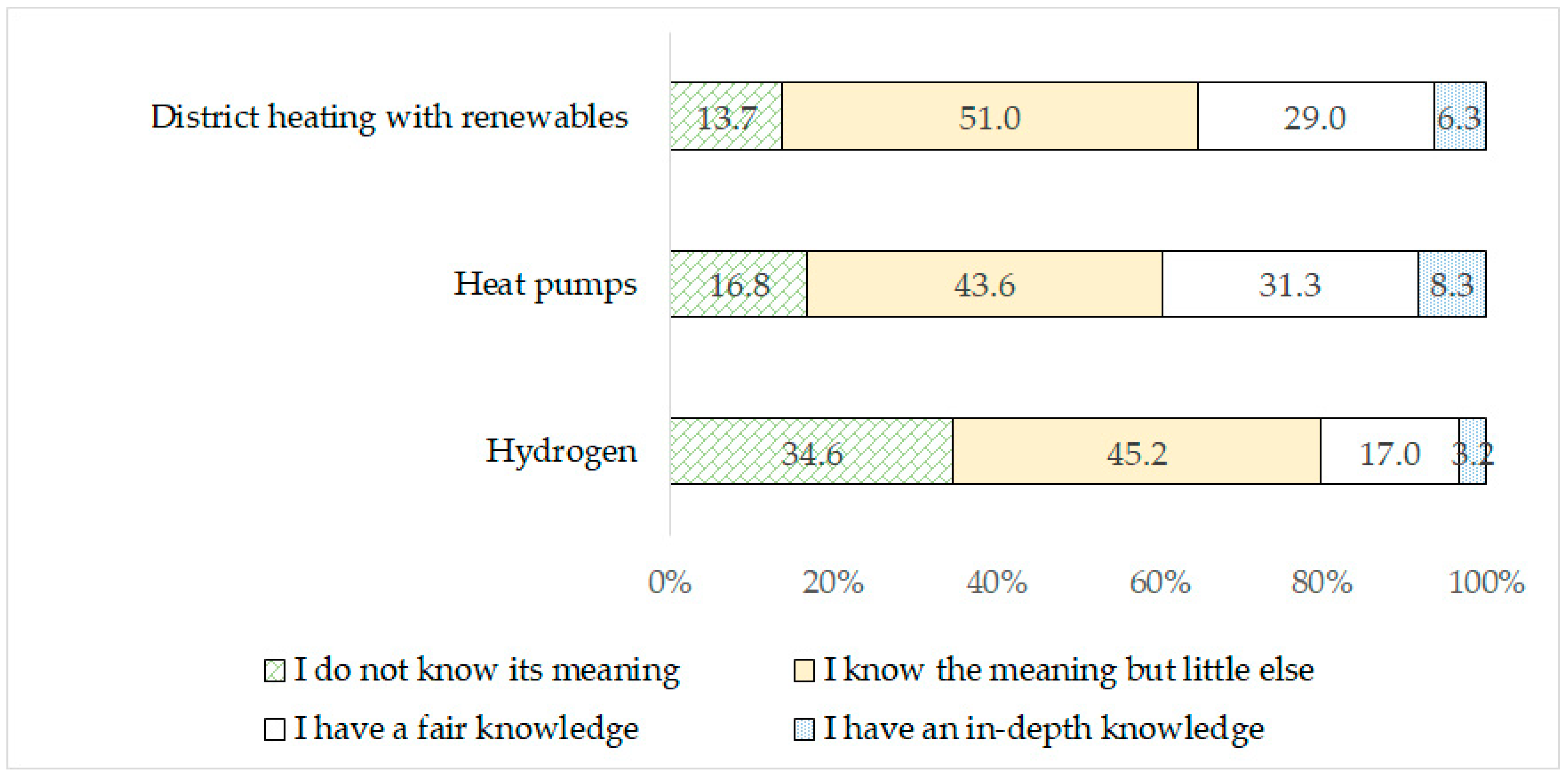
In light of citizens’ knowledge on the three low-carbon alternatives (
Figure 1)—namely, hydrogen, HPs, and renewable DH—the technology which the public appears to know less about is hydrogen, with only 20% of the sample attesting to average or in-depth knowledge. The public appears more knowledgeable in relation to DH with renewable sources, with 35.3% of the sample attesting to average or in-depth knowledge. Further, the public appears most informed about HPs, with almost 40% of the sample attesting to average or in-depth knowledge. Still, it is evident how, in relation to all three technologies, there is a problem of information with the public. This much is clear by, for example, a percentage that goes from 60% to 80% of the public saying that it is completely unaware of the technological option suggested in the question, or that it knows only the meaning and nothing more.
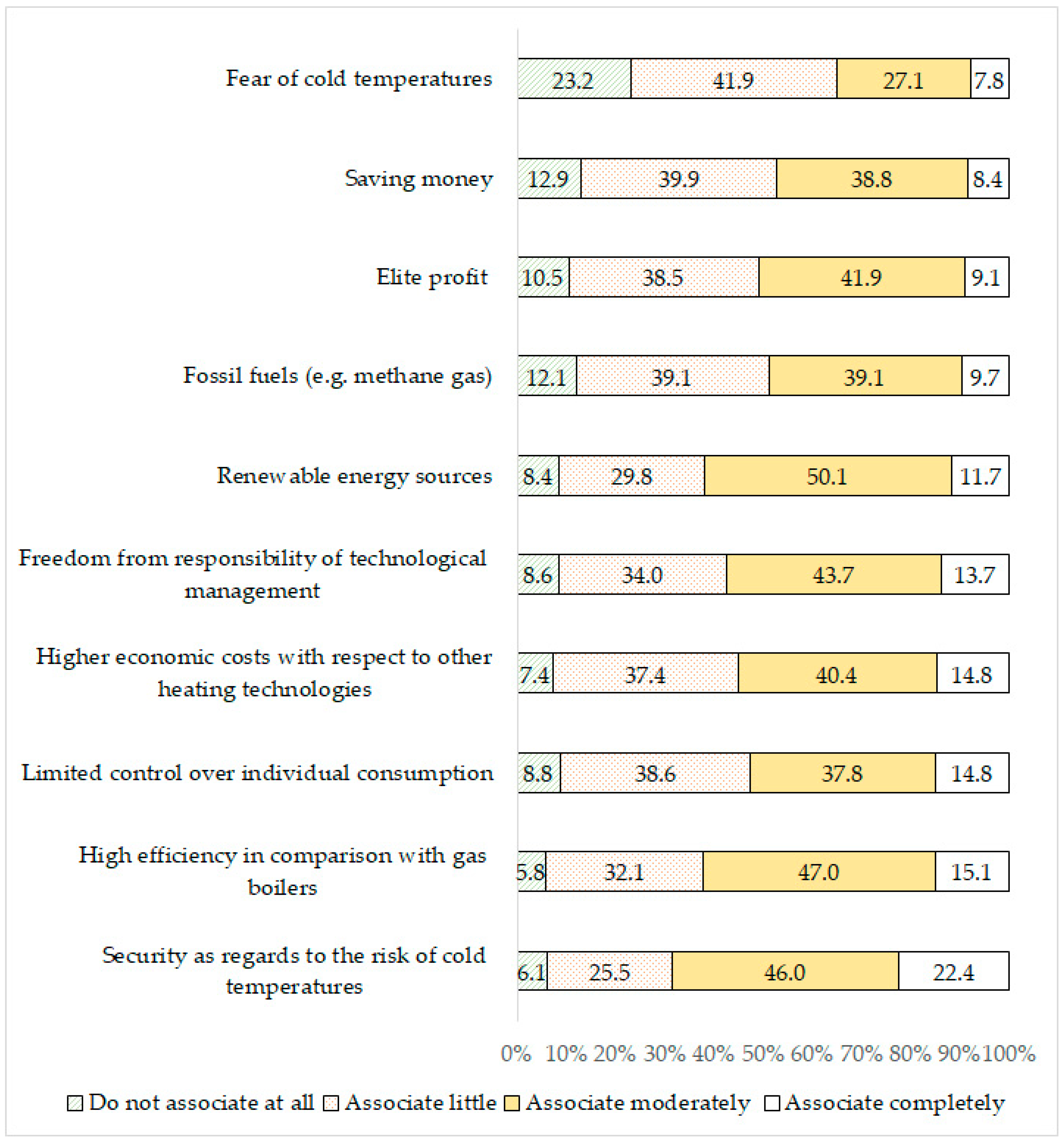
Concerning DH, as it emerges from
Figure 2, it is interesting to note that 60% of the sample associates renewable DH (the sum of those who associate it moderately and those who associate it completely). Other positive qualities which are strongly associated with DH are high efficiency in comparison with gas boilers (62.1%), security regarding the risk of cold temperatures (68.4%), and freedom from responsibility of technological management (57.4%). DH is instead quite divisive in relation to the associated economic costs: 55% of the sample associate DH with higher economic costs relative to other heating technologies, 51% associate it with elite profit, and 52.6% with limited control over individual consumption.
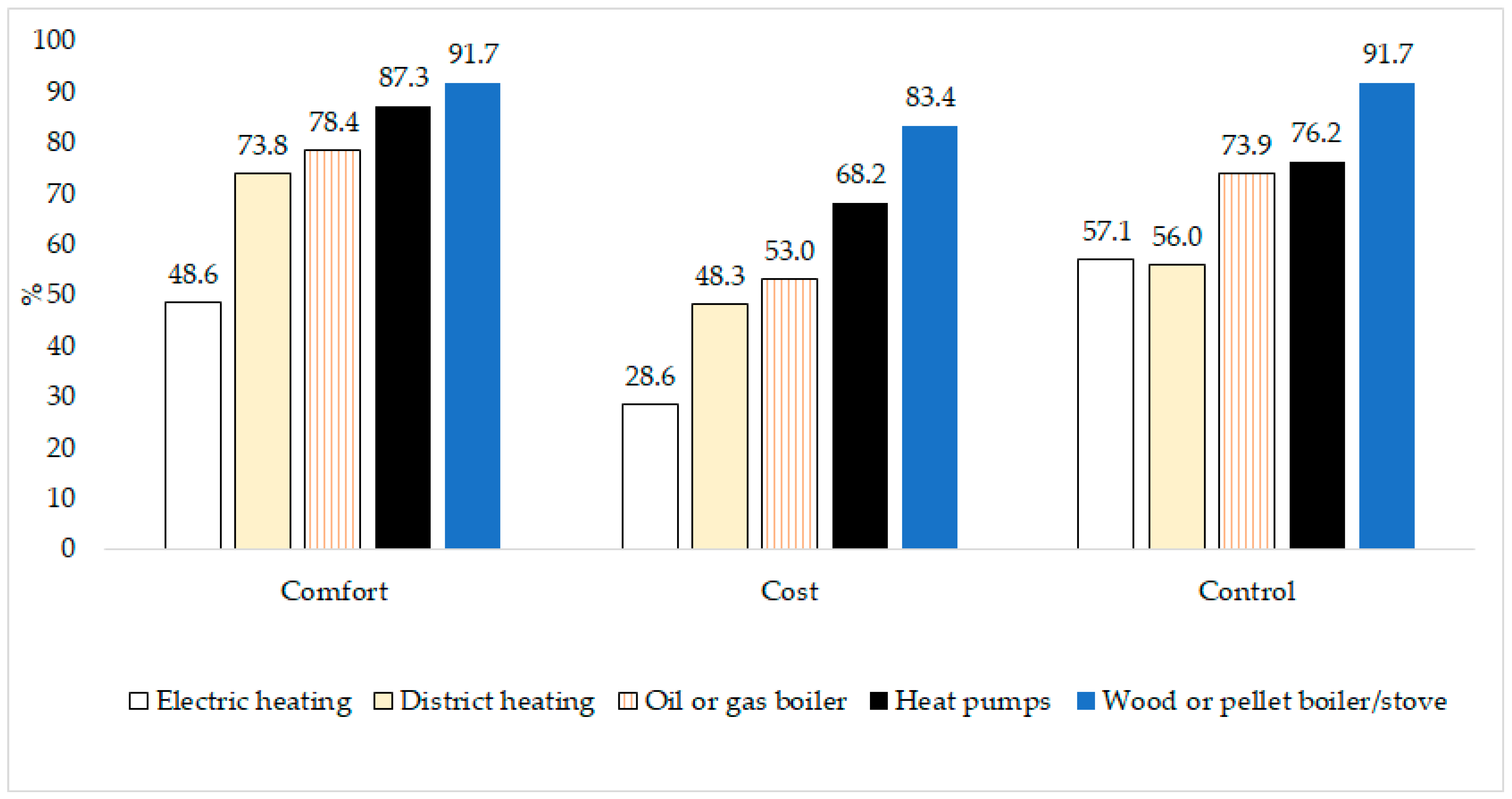
These results seem to be confirmed by
Figure 3, comparing the different heating technologies in relation to the features of comfort, cost, and control. Here, DH rates quite well in relation to the issue of comfort, with 73.8% of the sample giving an evaluation of good and optimum regarding this item. By contrast, regarding the associated costs of this technology, a good or optimum evaluation was given by less than half of the sample (48.3%). Regarding the feature of control, the sample is divided, with 56% giving a good or optimum evaluation. Ultimately, among the technologies that have the highest evaluations (sum of those who gave an evaluation of good and optimum) in relation to all three qualities, there is a low-carbon option like HPs.
4.2. Social Acceptance of Renewables
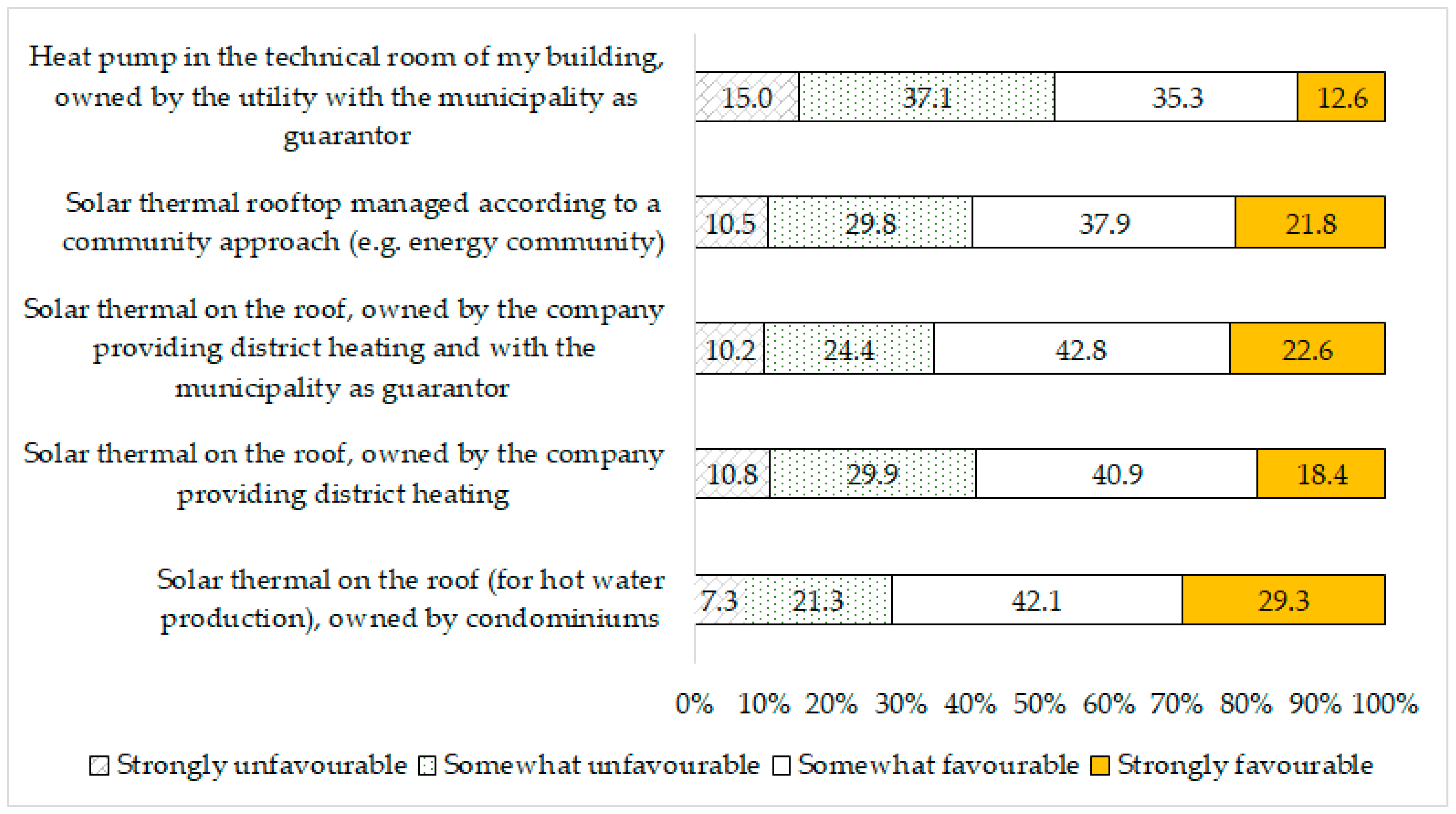
For decarbonised heating systems to diffuse, it is crucial that we address public acceptance of renewables. To evaluate respondents’ social acceptance of renewables integration in housing heating systems, the results of three key questions were analysed. The first question aimed to evaluate the degree to which the respondent felt favourably towards installing solar thermal collectors or PV with f HPs in their home. In this question, different ownership and management structures of the technological installations were considered. The results analysed in
Figure 4 show that the most acceptable technological solutions are either solar thermal collectors/PV on the roof owned by the inhabitants of the building, with 71.4% of respondents judging as much or quite favourable, or solar thermal collectors/PV on the roof owned by the utility that provides the DH and with the local municipality as guarantor. These results seem to line up with research on renewable energy communities, which shows how collective forms of energy prosumerism improve the acceptability of renewable energy facilities [
38]. The less accepted option in
Figure 4 is HP in the condominium technical room owned by the utility and with the local municipality as guarantor. This seems to confirm literature stressing that, on the one hand, public perceptions of HPs are, in general, low [
21], while on the other hand, HPs are potentially difficult to adopt as a technology because they may require a significant change in heating practices compared with gas boilers.
A second key question is the respondents’ willingness to pay for the shift to a DH system based on renewables. The willingness to pay for low-carbon heating of the sampled citizens appears extremely low. More than half of the sample—52.2%—say that they are not willing to pay anything and 34.1% say they would pay 10% more as the maximum.
Those who are not willing to pay more for a DH system based on renewables tend to be female rather than male (54% female), older (61% between 55 and 65), low educated (74. 7% has an elementary or middle school diploma), have a family with small children (68.2% have 3 or more children under 18 years old), have low income (63.7% have an average family income between 500 and 2000 euros), and have a more precarious housing tenure (58.9% do not own their house).
The ANOVA of the results of this question confirms these conclusions and allows us to identify a more complete profile of the citizens who are less likely to adopt a DH system based on renewables. Of note, those who are not willing to pay any additional cost have an average age of 51 years, whereas those who are willing to pay more than 20% have an average age of 39 years. Concerning the index of technology affinity, those who are not willing to pay any additional cost have the lowest average score—4.61—versus a value of 6.35 for those who are willing to pay more than 20%. We can observe a linear relation relative to the trust index. Those who are not willing to pay any additional cost tend to have a lower trust towards institutions at the local, national, and European level as well as towards the media and energy utilities (average score of 7). By contrast, those who are willing to pay more than 20% have the highest average score on trust (10.27). Finally, we tested the environmental awareness index. Here, those who are not willing to pay any additional cost are those who show the lowest level of environmental awareness, with an average score of 4.68, versus an average score of 6 for those who are willing to pay more than 20%.
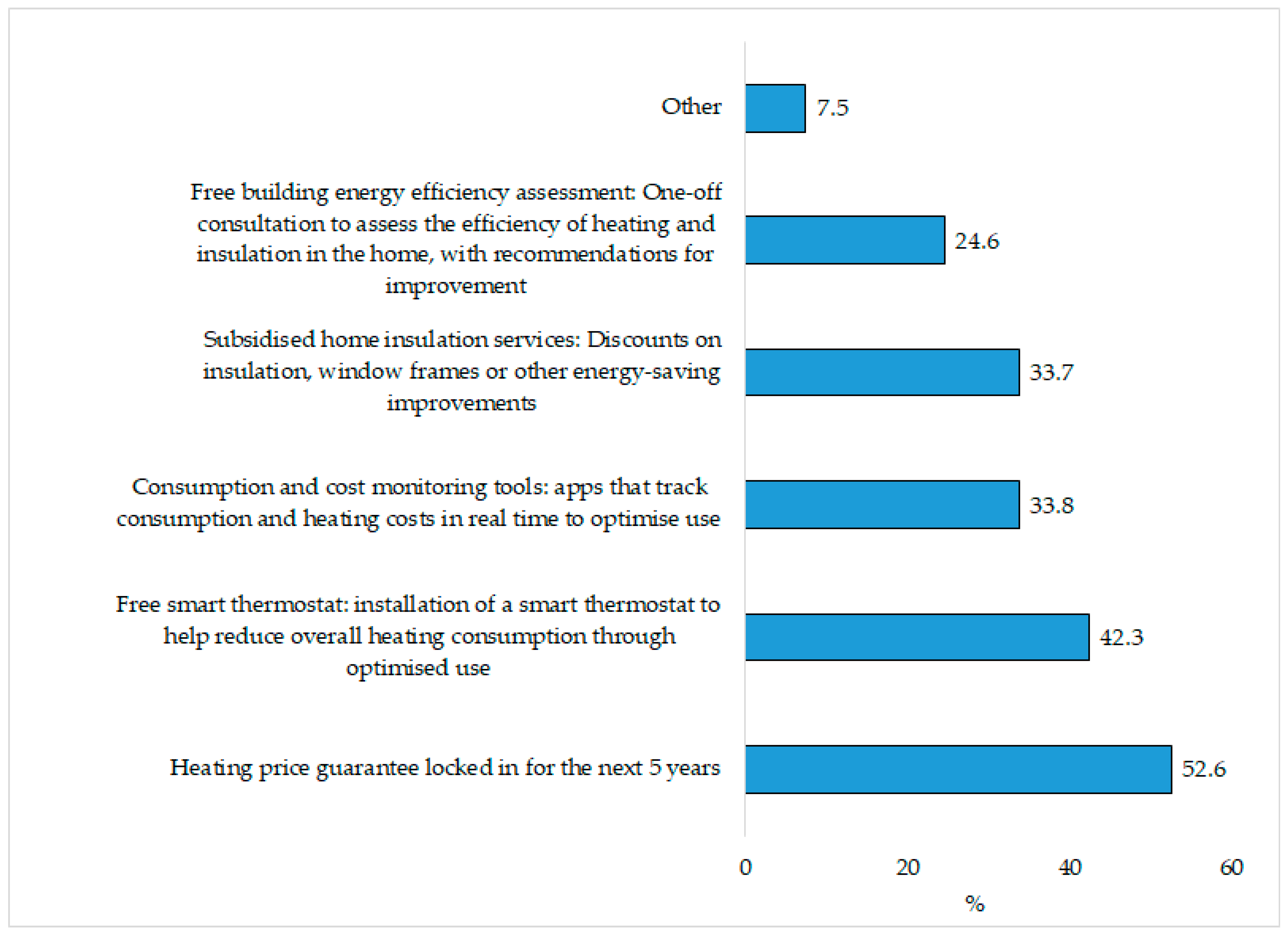
A third question concerns the types of incentives that would convince the respondent to shift to a DH system 100% from renewables. From
Figure 5, it emerges that the economic incentive is of paramount importance. Indeed, more than half of the sample (52.6%) would consider shifting to a DH system based on renewables with a 10% increase in costs if they were guaranteed fixed DH prices for the next 5 years. In addition, the free installation of a smart thermostat to optimise energy consumption patterns is positively considered by a significant part of the sample (42.3%).
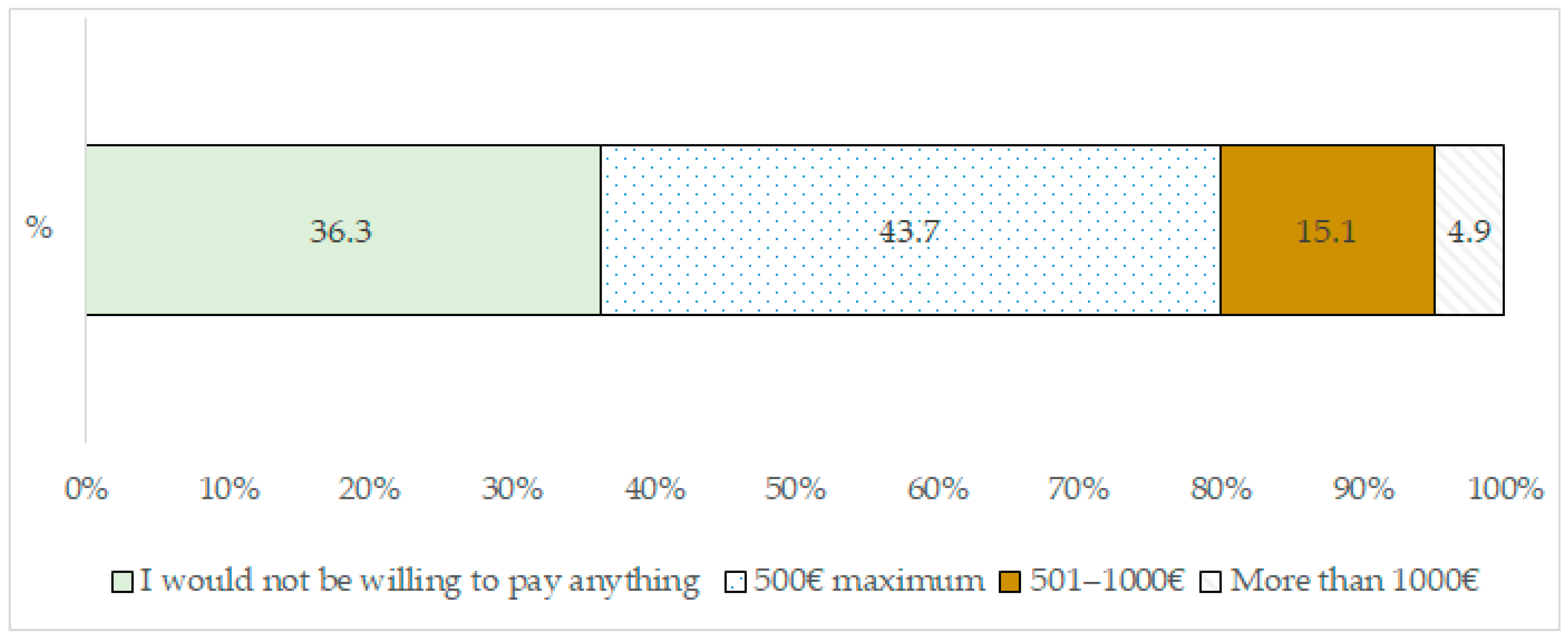
A fourth question concerns the respondents’ willingness to pay (how much they would be willing to pay) for the installation of the roof on the house of a renewable energy technology (e.g., solar thermal collectors/PV). This would reduce the heating costs by 10%.
Figure 6 shows how, in comparison with the previous question on decarbonised DH, in this case, the percentage of those who are not available to adopt the new technology at all decreases to 36.3% (persons not willing to pay anything more), while the majority of the sample (43.7%) shows a limited availability to spend (maximum 500 euros). These data show a very low acceptance of renewables as well as a very low availability to integrate them into the housing heating system.
In this case, those who are not willing to pay for renewables on their roof tend to be female rather than male (39.8% female vs. 32.9% male), older (45.6% older than 66 years of age), low educated (61.1% have an elementary or middle school diploma), low income (51.5% have an average family income between 500 and 2000 euros vs. 25.1 more than 3000 euros), and have a more precarious housing tenure (45.5% do not own their house vs. 33.9 who own it).
The ANOVA confirms the profile of the citizens who are less interested in renewables, and this information emerged in the question about decarbonised DH. In this case, but in addition to the citizens who are less available to integrate renewable heating technologies in their house, respondents are middle-aged (average age of 52 years), have the lowest average score relative to the index of technology affinity (score of 4.31) which shows a limited knowledge of renewable heating technologies, have the lowest score relative to the index of trust towards institutions, the media, and energy utilities (average score of 7.25), and show the lowest level of environmental awareness (average score of 4.39).
These results are confirmed by bivariate correlation and multiple regression. The bivariate correlation shows that the willingness to pay for the installation on the roof of the house of renewable energy technology is highly and positively correlated with the following variables: education, number of children below 18 years of age, trust towards institutions, intermediate organisations, energy utilities, technological affinity, eco-awareness, and house ownership (
Table 1). Interestingly, the correlation between average family income and willingness to pay, though positive, is less strong than the other variables. The willingness to pay for renewable technologies is instead strongly and negatively correlated with age.
A multiple regression was undertaken in relation to the question regarding the willingness to pay for a 100% renewable energy DH system and the question regarding the willingness to pay for renewable energy technology (
Table 2). With respect to the first question, the model explains 32% of the variance of the dependent variable. The statistically and positively correlated variables are education (the more educated, the more available) and trust in institutions (greater trust, more willingness). As expected, the willingness to pay for the installation of a renewable energy source has the highest effect—0.38—confirming the model’s internal consistency. The statistically and negatively correlated variables are age (young people are more willing to pay) and financial guarantees for demand flexibility (people who tend to accept flexibility without requiring much in guarantees are also more willing to pay).
Regarding the latter question, the model explains 34% of the variance of the dependent variable. As shown by
Table 3, the significantly and positively correlated variables are the following: income (the richest are the most willing), home ownership (those who own their house are more available), ecologism (those who have more ecological), the annual cost of heating (the more the cost of the heating the more willing one is), and, as expected, the willingness to pay for DH from renewable sources in addition to the propensity to install solar thermal. This last result confirms the internal consistency of the model. The statistically and negatively correlated variables are age (younger people are more willing) and gender (males are more willing).
4.3. Social Acceptance of Flexibility of Demand (Demand Response)
As discussed above, the flexibility of demand and the acceptance of demand response appear crucial to fostering decarbonised heating systems that integrate intermittent renewable sources. To investigate this issue, a first question concerned the availability to give the energy utility the freedom to modify, within a specific range defined contractually, the morning switch-on time of the heating system to reduce the environmental impacts (
Table 4). Here, most of the citizens in the sample (57.2%) appear to be in favour of this introduction of flexibility measures, 23.8% are contrary, and 19.1% do not express an opinion.
Those who oppose this measure tend to be older (31% over 66 years of age, 27.4% between 55 and 65 years of age) and have low–middle income (45% have an average family income between 500 and 3000 euros). However, differences related to sex, education, number of household members, and house tenure are not significant.
A second question concerned the guarantees or incentives that the citizens would like to receive from the energy service manager to agree to changing the switch-on times of the heating. Here, again, the centrality of economic concerns and motivations to adopt low-carbon solutions is confirmed. Indeed, the options that received the most support were the guarantee of not having an increase in costs on the energy bill (48.2%) and the incentive of a reduction in the price of energy per kWh (46.8% of responses).
5. Discussion and Conclusions
This study highlights the importance of complementing technical innovations in DH systems with a deeper understanding of socio-economic factors that shape public perceptions and behaviours. While DH is generally perceived positively in terms of comfort and efficiency, widespread scepticism remains concerning costs, control, and fairness—particularly among older, lower-income, and less tech-savvy populations.
Our findings underscore a clear gap between citizens’ environmental values and their willingness to invest in renewable DH. Moreover, social acceptance of flexibility in energy demand emerges as a complex issue, influenced not only by cost-related guarantees but also by structural inequalities and lifestyle constraints.
Accordingly, the results of this study highlight the critical role of economic incentives in shaping public acceptance of renewable district heating systems. While many respondents recognise the environmental and technical benefits of such systems, their willingness to pay remains strongly conditioned by socio-economic status, trust in institutions, and perceived financial risk. This underscores the need for policy frameworks that address affordability through targeted measures. Fixed pricing schemes, income-sensitive subsidies, and installation grants for renewable-compatible technologies (such as HPs and smart metres) could significantly lower the perceived entry barrier, particularly for renters, low-income households, and large families—groups consistently less willing or able to bear additional costs.
Beyond affordability, economic instruments should be designed to foster active engagement and flexibility among consumers. The positive response to guaranteed incentives for demand-side management, combined with the observed willingness to participate in collective renewable initiatives, suggests strong potential for integrating economic rewards with behavioural nudges. Energy policies that support community ownership models, reward prosumers through net-billing schemes, and link financial incentives with transparency and trust-building requirements could enhance participation and legitimacy. In this regard, economic policy tools must be conceived not merely as a tool for cost recovery or market correction, but as a means of cultivating social inclusion, institutional trust, and sustained behavioural change necessary for a just and effective energy transition.
In conclusion, what emerges from our analysis is that addressing the current barriers to adoption of renewable DH solutions requires a multidimensional approach: one that integrates affordability, trust-building, technological literacy, and inclusive governance. Such an approach would complement ongoing regulatory efforts, including the European Commission’s 2023 Energy Efficiency Directive, which introduces progressive targets to increase the share of RESs, WH, and high-efficiency cogeneration in DH systems, thereby providing a clear framework that guides the sector’s transition towards decarbonisation. Policy interventions that ignore these social factors risk falling short, even when technically sound. As Italy and other countries strive for low-carbon heating solutions, aligning technological advancement with social realities will be essential to ensuring a just and effective energy transition.
Our study benefited from a mixed-mode survey design (online and telephone interviews), which allowed us to reach a broad spectrum of the population and reduce selection bias associated with single-mode surveys. Moreover, the construction of additive indices—validated through principal component analysis—strengthens the internal consistency of the attitudinal measures and supports the robustness of our statistical modelling.
While this study provides some novel and valuable insights into the socio-economic drivers of public perception around renewable DH in Italy, it also has some limitations. First, the analysis is geographically focused on a single urban case study—Turin—which, despite being a relevant site due to its large and mature DH network, may not fully represent the diversity of regional, rural, or socio-cultural contexts across the country. Second, the reliance on self-reported data introduces potential biases related to social desirability and knowledge gaps among respondents. Third, while several socio-demographic and attitudinal factors were explored, other influential dimensions such as political orientation, cultural values, or historical energy experiences were not included. Moreover, despite the advantages of mixed-mode collection, differences between online and telephone respondents may introduce mode effects that cannot be entirely excluded. Finally, as a cross-sectional study, the analysis captures perceptions at a single point in time, preventing causal inference and limiting the ability to assess how attitudes toward decarbonised heating may evolve in response to policy or technological changes.
Future research could extend this investigation to other Italian cities or regions with different DH penetration rates and socio-economic profiles, as well as to rural areas where decentralised or community-based heating models might be more relevant. Broader cross-country comparisons also could meaningfully enhance the international relevance of the topic. Furthermore, longitudinal studies would be valuable to assess how public perceptions evolve over time as decarbonisation policies and technologies are implemented. Moreover, further studies may extend understanding of flexibility by empirically investigating its connections to, and implications for, the energy-justice framework. Future research could also usefully examine information sources and the potential influence of supplier marketing and energy experts on public perceptions and decision-making regarding renewable-energy technologies. Finally, integrating further qualitative methods—such as focus groups or ethnographic approaches—could deepen understanding of how everyday practices, values, and structural constraints shape engagement with low-carbon heating systems.





 ,
,