Review

A Critical Review of Green Hydrogen Production by Electrolysis: From Technology and Modeling to Performance and Cost

by
Rafika Louli
,
Stefan Giurgea
,
Issam Salhi
,
Salah Laghrouche
and
Abdesslem Djerdir
*
Université Marie et Louis Pasteur, UTBM, CNRS, Institut FEMTO-ST, FCLAB, F-90000 Belfort, France
*
Author to whom correspondence should be addressed.
Energies 2026, 19(1), 59; https://doi.org/10.3390/en19010059
Submission received: 30 October 2025 / Revised: 13 December 2025 / Accepted: 19 December 2025 / Published: 22 December 2025

Abstract

As the world shifts toward a low-carbon future, green hydrogen has emerged as a critical pillar of the energy transition. It is produced using renewable energy to power water electrolysis, and it is a clean and flexible alternative to hydrogen made from fossil fuels. However it is still hard to roll out on a large scale because of technological limits, high costs, and the need for infrastructure. This review critically analyzes current electrolysis methods, including established systems like alkaline and PEM electrolyzers, as well as newly developed concepts such as AEMWE and SOWE. It discusses how they can be used in renewable energy systems, important techno-economic and durability problems, system modeling, and grid interaction. This work clarifies both the technological potential and the practical limitations of green-hydrogen electrolyzer systems while highlighting key directions for future research and implementation.

1. Introduction

The increase in energy consumption worldwide has raised concerns about the sustainability of current energy practices. The extensive use of fossil fuels is becoming unsustainable due to resource depletion from over exploitation and the environmental consequences of greenhouse gas emissions, especially CO2. Since fossil fuels are non-renewable and take millions of years to form, sustaining current consumption levels is a significant challenge for energy security in the future.
To address these issues, the adoption of renewable energy sources (RESs) has become a vital solution. Their adoption aids in ecological restoration by lowering air pollution, conserving biodiversity, and improving soil and crop health for a cleaner and more sustainable energy future. Among RESs, photovoltaic and wind are the most deployed globally because they have fewer geographical and infrastructural limitations than other renewable alternatives such as hydropower, marine or biomass combustion with carbon capture. The appropriateness of RESs is often dependent on regional characteristics, as each nation develops its energy policy according to its natural resource availability. However, solar and wind power are intermittent, which makes it hard for the system to be reliable and for energy to be stable. This has led to the creation of new ways to store energy that help balance supply and demand, make operations more flexible, and let more renewable energy sources work together.
Energy storage (ES) technologies are commonly categorized into thermal, mechanical, and electrochemical systems, each offering distinct advantages depending on the application [1,2]. Thermal storage retains excess energy as heat and is particularly suitable for industrial or building-scale uses. Mechanical storage, notably pumped hydro, remains the most mature large-scale solution, offering high storage capacity and long discharge times, although it relies on suitable geographic conditions. Electrochemical storage includes both batteries (such as lithium-ion) and supercapacitors. Batteries are widely used for short-term storage due to their high round-trip efficiency and fast response, while supercapacitors excel in applications requiring very rapid power delivery over brief periods. Hydrogen, also often considered part of electrochemical storage, offers long-duration and large-scale energy retention, and stands out as a versatile solution for managing seasonal imbalances and supporting sectoral integration.
Hydrogen is central to the energy transition due to its unique properties and cross-sector versatility. As the lightest element, hydrogen has a gravimetric energy density of 120 MJ/kg (almost three times that of gasoline: 44 MJ/kg) and is therefore attractive for weight-sensitive applications such as aviation, heavy transport, and space propulsion. Its LHV and HHV are around 120 kJ/g and 141 kJ/g, respectively, which shows its high energy density. Combustion-wise, hydrogen has a wide flammability range in air (4.1% to 75%), high flame speed (2.75 m/s), and adiabatic flame temperature up to 2400 K, with an autoignition temperature of 850 K [2,3]. These characteristics highlight its reactivity and the challenges associated with its safe manipulation. Hydrogen’s low density (0.084 kg/m3) and critical pressure (12.9 bar) at STP necessitate specialized storage and compression systems, particularly for liquid or high-pressure gaseous forms. It liquefies at cryogenic temperatures (20.3 K) and solidifies at 14.01 K, demanding significant infrastructure and energy for storage and transportation. Current hydrogen storage methods, gaseous, liquid, or solid, are energy intensive and costly at scale. Big scale solutions are underground geological storage, particularly in salt caverns, which offer high capacity and containment security [4].
Hydrogen plays a central role in several industrial sectors especially ammonia production, petroleum refining, and increasingly in fuel cells for clean electricity generation with near zero emissions. Furthermore, hydrogen is naturally abundant (mainly in the form of water) and can be produced from different primary energy sources (including renewables), making it an enabler of energy system flexibility and sector coupling [5]. Among the different hydrogen production routes, water electrolysis driven by RESs is the most promising and sustainable. Electrolyzers, which use electricity to split water into hydrogen and oxygen, are thus critical to building a low-carbon hydrogen economy as nations seek to decarbonize emission-intensive sectors and increase energy system flexibility.
While numerous reviews exist on hydrogen technologies, electrolysis modeling, and the energy transition, a comprehensive and integrative analysis bridging these dimensions is still lacking. This review contributes by
  • Examining hydrogen production, applications, and associated challenges;
  • Comparing major electrolyzer technologies in terms of maturity, performance, and integration potential;
  • Reviewing recent advances in the modeling of electrolyzers and their integration into energy systems;
  • Identifying research gaps and future directions to scale up green hydrogen sustainably.
Historically, alkaline water electrolysis (AWE), although the oldest and most mature technology, has experienced limited progress over many years. In contrast, proton-exchange membrane water electrolysis (PEMWE), offering higher efficiency and compact designs, has driven most of the technological development in recent decades. More recently, anion-exchange membrane water electrolysis (AEMWE) has emerged as a promising approach that combines advantages of both AWE and PEMWE. Other emerging water electrolysis technologies will also be discussed, with a particular emphasis on PEMWE.
This review begins by introducing the context and challenges of the current energy system and highlights the role of renewable energy sources, presenting hydrogen as a promising energy carrier. Section 2 provides an overview of the main hydrogen production pathways and their applications, with particular attention to water electrolysis technologies, including their performance and limitations. Section 3 addresses the degradation phenomena affecting electrolyzers, while Section 4 examines modeling approaches for these systems. Finally, Section 5 discusses the integration of electrolyzers with renewable energy sources and power grids, emphasizing their contribution to sector coupling and grid flexibility. This paper concludes with key insights and recommendations for future research.

2. Hydrogen in the Energy Transition

2.1. Hydrogen Production Pathways

Hydrogen was first identified in 1766 by British scientist Henry Cavendish, who demonstrated that it reacted with oxygen to form water [6]. The term “hydrogen” was later introduced by Antoine Lavoisier, deriving from the Greek words hydro (water) and genes (to generate) [7]. Historically, hydrogen production relied primarily on coal gasification and the water–gas shift reaction, where carbon monoxide reacts with steam to generate H2. Since the 1960s, steam methane reforming (SMR) has emerged as the dominant industrial method due to its economic efficiency, supported by the widespread availability of natural gas. Other fossil based technologies such as autothermal reforming (ATR) and partial oxidation (POX) have also contributed to global hydrogen supply. Today, these processes collectively account for over 95% of hydrogen production worldwide [8]. Despite their maturity and efficiency, these fossil-based pathways emit significant amounts of C O 2 , rendering them increasingly incompatible with long-term decarbonization targets, even when carbon capture and storage (CCS) is employed [9].
These environmental limitations have accelerated the shift toward cleaner and more sustainable hydrogen production routes. Among them, water electrolysis, powered by RESs, leading to the production of green hydrogen is considered the most promising. Other low carbon approaches include biomass reforming and methane pyrolysis, which leverage organic feedstocks or decouple carbon in solid form. Each method varies in cost, energy intensity, and technological maturity. Biomass conversion processes such as pyrolysis and gasification provide renewable alternatives to fossil-based systems. However, they face scalability challenges related to feedstock logistics, availability, and the complexity of downstream processing. Biological production routes involving algae or hydrogen-producing bacteria are also under investigation, but remain in early development due to low yields and bioreactor constraints.
Water splitting technologies including electrolysis, thermolysis, and photolysis represent a major family of low-emission hydrogen production pathways. Among them, electrolysis is the most mature and scalable when powered by renewable energy sources. However, its wide deployment is limited by the high capital cost of electrolyzer systems and the intermittent nature and cost of RESs, which reduce its current competitiveness compared to fossil based methods. Advanced technologies such as photocatalysis [10,11] and thermochemical water splitting cycles are also being explored. These aim to use solar energy or high temperature heat to dissociate water molecules without direct fossil fuel input. Although promising from an environmental standpoint, they are still limited by low conversion efficiencies, materials degradation, and the lack of industrial scale demonstrations.
Finally, natural hydrogen found in underground reservoirs is emerging as a potentially renewable source of H2, continuously generated through geological processes such as serpentinization [12]. Despite the growing interest, its global potential remains difficult to quantify due to challenges in detection, extraction, and mapping technologies. As a result, hydrogen is still primarily considered an energy vector, produced through transformation rather than directly harvested in molecular form.
As a complement to the preceding discussion, Table 1 provides a summary of the hydrogen production methods.

2.2. Hydrogen Integration and Applications

Hydrogen has played a central role in industry since the early 20th century, with landmark applications such as the Haber–Bosch process for ammonia synthesis [18] and hydrocracking in petroleum refining [19]. It was also adopted in the aerospace sector, most notably as cryogenic fuel in NASA’s Apollo missions [20], and has found uses in electronics and metallurgy. Beyond these traditional applications, hydrogen has progressively gained prominence as a clean energy vector, owing to its ability to generate electricity in fuel cells with minimal direct emissions. This environmental advantage has repositioned hydrogen as a cornerstone of low carbon strategies.
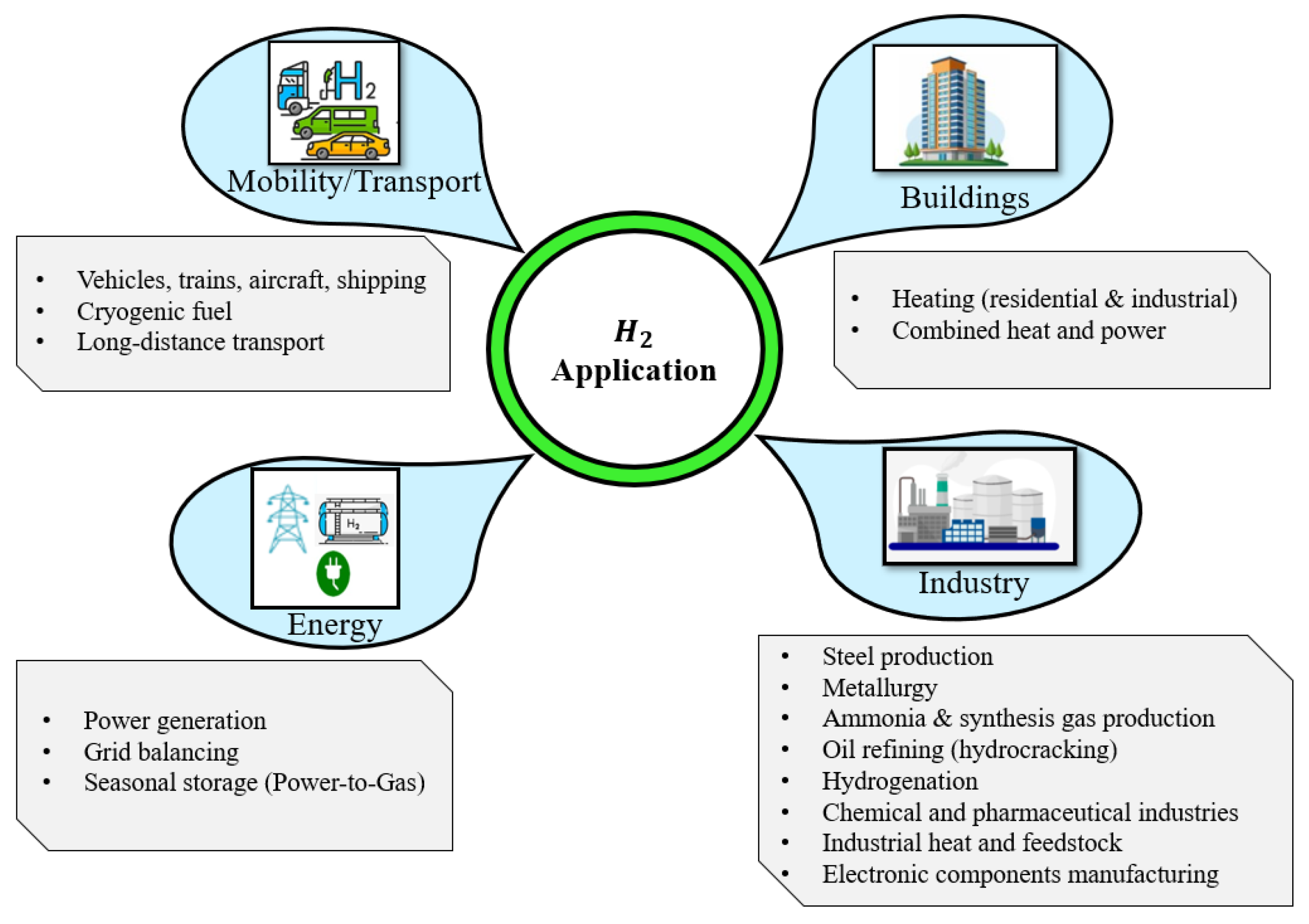
Recent technological advances have expanded its field of application well beyond conventional uses. In mobility, fuel cell systems provide low emission solutions for heavy duty transport, rail, aviation, and public transit. In the power sector, hydrogen supports electricity generation through stationary fuel cells, seasonal storage via Power-to-Gas pathways, and grid balancing by reconversion of surplus renewable electricity. Within industry, hydrogen enables the decarbonization of energy intensive processes such as steelmaking and green chemistry, while maintaining its importance as a feedstock for ammonia and refining. Its capacity to couple multiple sectors—electricity, heating, transport, and industry—positions hydrogen as a unique enabler of integrated, low-carbon energy systems. Figure 1 illustrates the diverse application sectors of hydrogen.
Although not a primary energy source, hydrogen acts as a versatile intermediary connecting renewable generation, long duration storage, and end-use demand. This cross sectoral role is reinforced by progress in electrochemical conversion technologies and the growing need for system flexibility. Unlocking its full potential, however, will depend on large scale deployment of infrastructure, storage facilities, and coordinated investment across the energy system.

2.3. Electrolysis Technologies

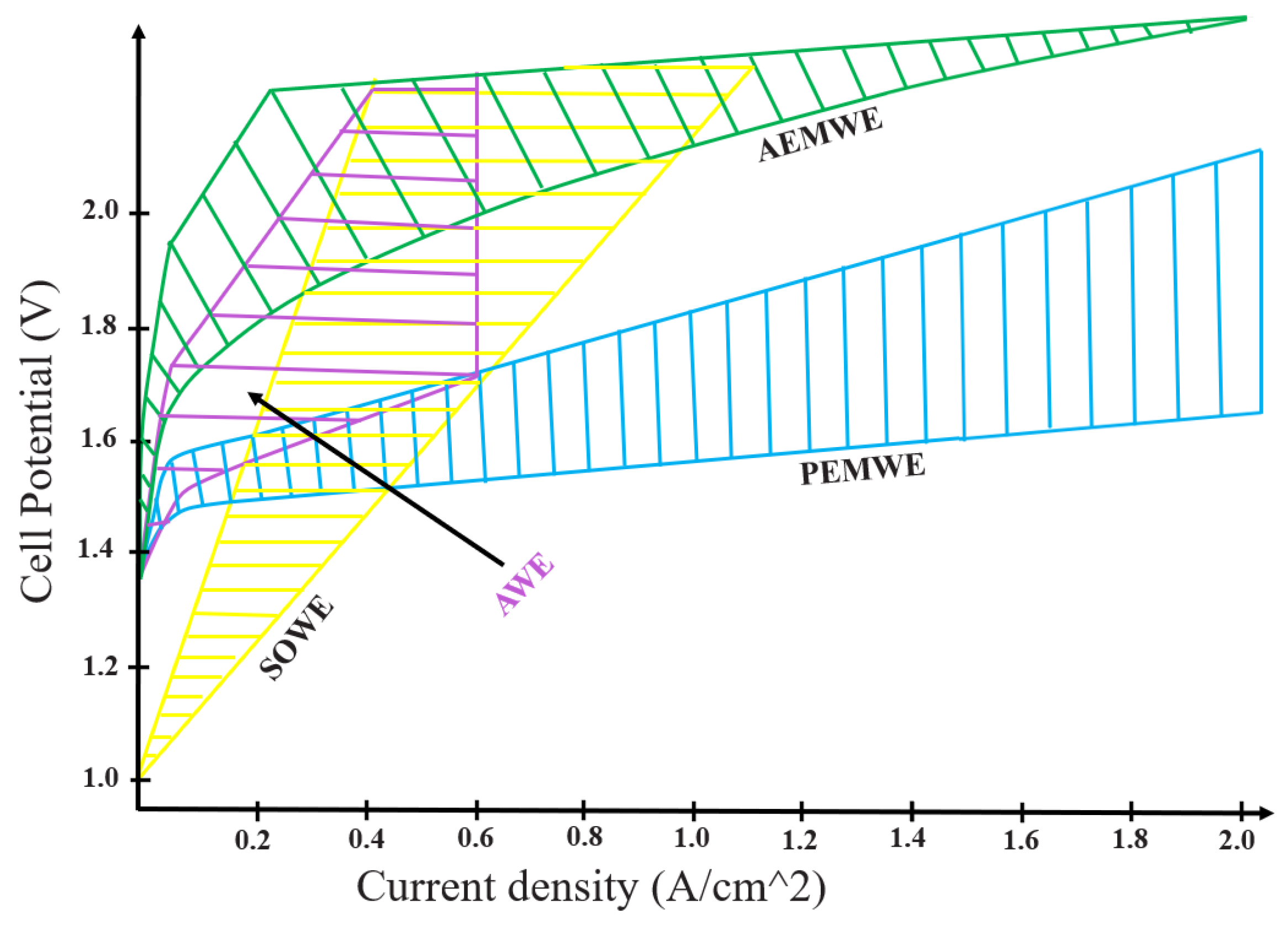
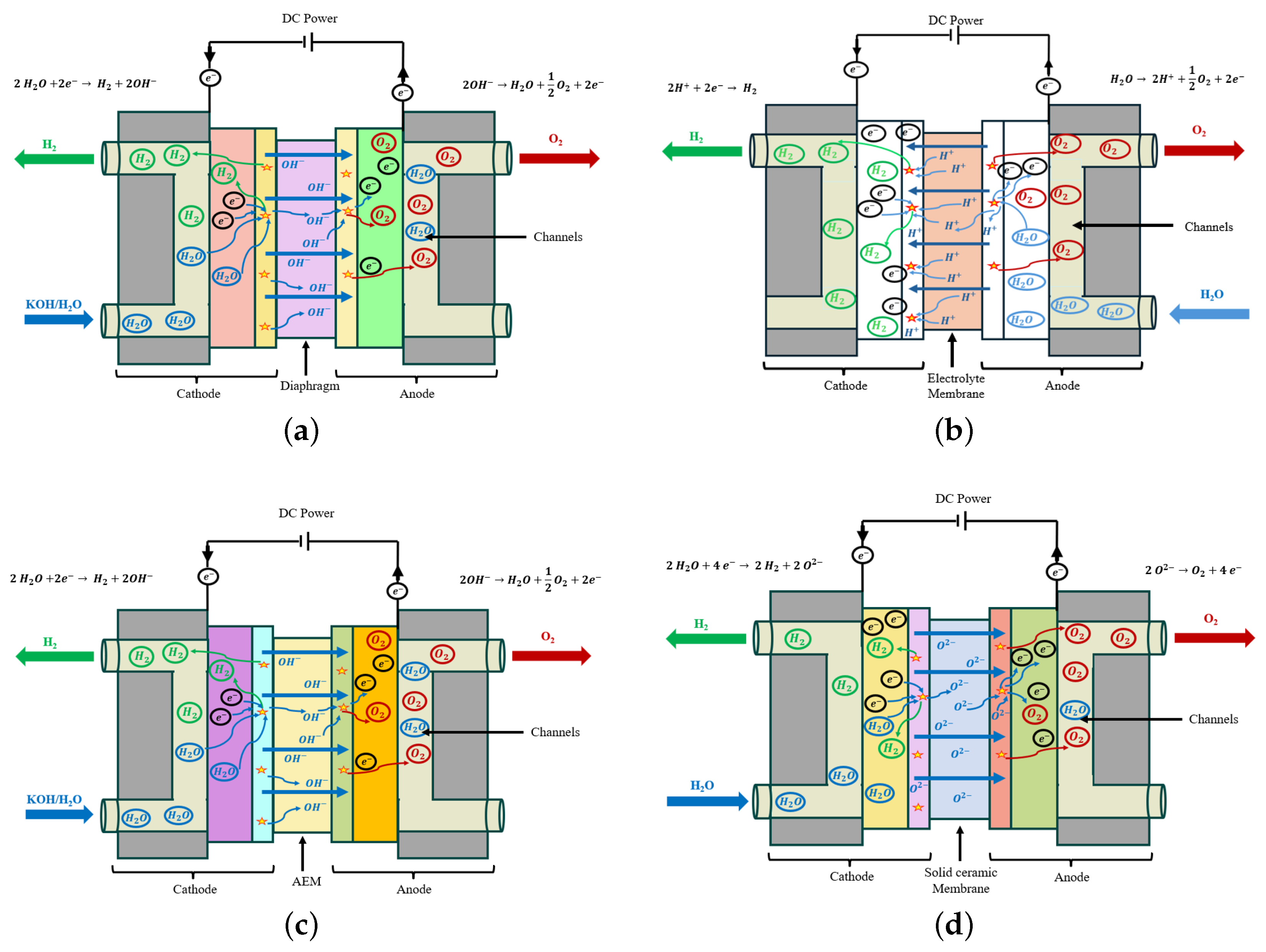
Electrolyzers are central to green hydrogen production, enabling the conversion of water into hydrogen and oxygen using electricity ideally sourced from RESs. Alkaline water electrolysis (AWE) and proton exchange membrane water electrolysis (PEMWE) currently dominate commercial deployment and are increasingly coupled to variable renewable energy. AWE is the most established and cost competitive option supported by decades of operation and plants exceeding 100 MW thanks to commodity materials, simple balance-of-plant (BoP), and strong scalability; pressurized (new-generation) AWE retains these benefits while improving ramping and delivering hydrogen at pressure, easing downstream compression [21]. PEMWE, by contrast, offers compact stacks, high current densities, as demonstrated in Figure 2, high outlet pressures, and excellent dynamic response for grid-following operation. However, PEMWE relies on scarce noble metal catalysts and fluorinated membranes; large scale (>20 MW) operating experience and long-term durability under demanding industrial operating conditions are still consolidating. Practical constraints include gas crossover that intensifies with differential pressure and coproduced water vapor requiring drying [22]. Anion exchange membrane electrolysis (AEMWE) seeks to combine the low-cost materials characteristic of AWE with the advantages of a solid polymer architecture [23], and while its dynamic behavior approaches that of PEM, it remains precommercial pending breakthroughs in membrane/ionomer stability and non-PGM (platinum group metals) catalysts. Solid oxide water electrolysis SOWE promises the highest theoretical electrical efficiency by operating at elevated temperatures and enabling the recovery of industrial waste heat to reduce electricity demand and improve overall system performance. Recent research has focused on advanced ceramic electrodes and thermal-management strategies that enhance stack robustness and extend operating lifetime under demanding conditions [24]. Despite these advances, SOWE deployment remains largely limited to pilot and early commercial installations, as material sensitivity to thermal cycling and the challenges of incorporating high-temperature stacks into variable-load energy systems still pose significant technical and engineering hurdles. These four technologies are based on redox reactions as shown in Figure 3; nevertheless, they are distinguished by their electrolytes, operating temperature, and materials as summarized in Table 2 and Table 3. Other types of electrolyzers are also being investigated at the research level, such as acidic alkaline amphoteric systems, microbial electrolysis cells, and photoelectrochemical electrolyzers [25].
Overall, technology selection is application specific, balancing capital cost and material criticality against dynamic response, pressure capability, efficiency potential, and maturity within project constraints (electricity price/profile, scale, required purity/pressure, footprint, site conditions); in practice, pressurized alkaline systems suit large scale industrial hydrogen (robustness, flexibility, cost efficiency), whereas PEM is favored where compactness, fast dynamics, and ultra high purity outweigh unit cost considerations.
Table 2. Comparison of water electrolyzer technologies [3,16,25,27,28].
SpecificationPEMWEAWEAEMWESOWE
MaturityCommercialCommercialearly commercialearly commercial
Charge carrierH+Hydroxide ions OH or hydronium ions H3O+OHO2–
ElectrolytePerfluoro Sulfonic Acid (PFSA) polymer membraneConcentrated aqueous alkaline solution (25–40 wt% KOH/NaOH)Anion-exchange polymer membraneSolid oxide ceramic electrolyte (oxygen-ion conductor, e.g., YSZ)
Working fluidUltrapure water (conductivity < 1 µS/cm)Aqueous alkaline electrolyteDeionized water or low-concentration alkaline solutionHigh-temperature steam (H2O(g))
Operating temperature30–90 °C60–90 °C50–70 °C650–1000 °C
Operating pressureCan operate at elevated pressure; the membrane ensures very low gas crossover even under pressure differentialsTypically limited to low pressure and requires balanced pressure between electrodes to prevent gas mixingCapable of operating at moderate to high pressure, depending on membrane stabilityUsually operated at near-atmospheric or moderate pressure, with pressure mainly applied at the stack level
VolumeCompact stack design with high power density (small footprint)Bulkier stack due to thicker components and liquid electrolyte managementSimilar to PEM in principle, but current prototypes are generally less compactTypically larger and more complex stack, often requiring thermal insulation and balance-of-plant volume
Production scalekW to multi MW (modular, flexible deployment)MW to GW (suitable for large scale plants)kW to low MW (currently limited in scale)kW to pilot scale MW
Response timeFast response; can rapidly follow fluctuations in power supplySlower response due to liquid electrolyte dynamics and gas liquid mass transfer limitationsGenerally fast response, similar to PEMLimited flexibility; high temperature operation constrains rapid load changes
ApplicationHighly suitable for renewable energy integration due to fast response and high energy efficiencyLess suitable for intermittent RESs; frequent start–stop cycles accelerate electrode degradation. Preferably operated in stable, grid-connected, large scale systemsPotentially suitable for renewable coupling, but long term durability under dynamic conditions is still under investigationBest suited for high temperature, continuous operation (e.g., industrial waste heat); limited compatibility with highly fluctuating renewable input
MaintenanceModerate maintenance due to electrocatalyst degradation in acidic environment; solid electrolyte reduces mechanical upkeepRequires regular maintenance because of corrosive liquid electrolyte, scaling, and gas–liquid managementPotential for lower maintenance (solid electrolyte), but long term chemical stability remains a concernHigh maintenance requirements due to high temperature operation, thermal cycling stress, and material degradation
Stack lifetime<40,000 h<90,000 h>10,000 h<40,000 h
Efficiency, HHV67–84%62–82%Similar to PEM (currently 60–75%)∼90%
Current density0.2–2 A/cm20.2–0.6 A/cm20.2–1 A/cm20.3–1 A/cm2
Key market actorsSiemens Energy, ITM Power, Plug Power, Nel Hydrogen, CumminsNel Hydrogen, Light Bridge, McPhy, H2PlanetEnapter, John Cockerill, LeancatSunfire, Topsoe, Bloom Energy, Genvia, Plug Power
AdvantagesCompact and simple stack design; fast response and start-up; high hydrogen purity; capable of operating at high current densitiesLow capital cost; technologically mature and well-established; no use of noble metalsCombines benefits of PEM and alkaline systems; suitable for dynamic operation and load fluctuations; uses low-cost, non-corrosive electrolyte and cheap componentsCan operate reversibly as a fuel cell; very high efficiency due to high-temperature operation; low noble metal usage reduces capital cost
DrawbacksHigh capital cost due to expensive membranes and noble metal catalysts; limited lifetime; sensitivity to water purity; historically limited to small and medium scale applicationsLower current densities; larger footprint; slower dynamic response; requires corrosive liquid electrolyte management; risk of gas crossover at low loadsMembrane stability and durability still limited; performance and lifetime lower than PEM; technology not yet fully optimized; sensitivity to C O 2 contamination of electrolyteRequires very high operating temperatures; material degradation due to thermal cycling; sealing and interface challenges; complex BoP; currently limited operational flexibility

2.4. Techno-Economic Comparison of Electrolyzer Technologies

Techno-economic assessments of water electrolysis typically rely on three key metrics: capital expenditure (CAPEX), operational expenditure (OPEX), and the Levelized Cost of Hydrogen (LCOH). CAPEX is generally divided into stack costs, associated with electrochemical cells, and balance-of-plant (BoP) costs, which include power electronics, fluid handling, thermal management, gas purification, and safety systems. OPEX encompasses recurring expenses such as electricity, maintenance, stack replacement, and water treatment. The LCOH expresses the average cost of producing hydrogen over the entire lifetime of a plant, taking into account all discounted costs and the total quantity of hydrogen produced.
Techno-economic studies [29,30] comparing the different electrolyzer technologies consistently show that AWE currently presents the lowest installed capital costs, with CAPEX typically ranging from a few hundred to roughly 1500 USD kW−1 (approximately 1816 USD kW−1). AWE systems also offer the longest stack lifetimes, on the order of 80,000 h, with LCOH in the range of 2.85–6.52 USD kg−1. In contrast, PEMWE remains more capital-intensive, with representative CAPEX values around 2147 USD kW−1 and shorter stack lifetimes of 40,000–60,000 h. However, PEMWE provides superior dynamic response and produces hydrogen of high purity. Depending on integration and operating conditions, current PEM-based LCOH values fall within 2.34–7.52 USD kg−1. AEMWE is still at an earlier stage of technological maturity but is expected to approach and potentially undercut AWE costs as manufacturing scales and non-noble catalysts become standard. Projections indicate that AEMWE could achieve CAPEX values below 1500 USD kW−1 and modeled LCOH values of 2.5–5.0 USD kg−1, provided that membrane stability and long-term durability continue to improve. Finally, SOWE aims to minimize specific electricity consumption and therefore long-term LCOH, although at the expense of higher stack costs and more stringent operating constraints. SOWE systems can reach the highest electrical efficiencies (70–90 % when external heat is available) but remain limited by elevated CAPEX (≥3000 USD kW−1) and comparatively short stack lifetimes (20,000–30,000 h). Across all four technologies, electricity constitutes well over half of the LCOH. Nevertheless, reported costs for current projects indicate that AWE and PEMWE are converging toward a few euros per kilogram under low-cost renewable electricity, while SOEC offers additional cost-reduction potential in high-temperature, heat-integrated applications. AEMWE, in turn, is emerging as a promising low-CAPEX option for future decentralized hydrogen production systems [25,31,32].
Based on the stoichiometry of water electrolysis, producing 1 kg of hydrogen requires 9 L of water. When accounting for additional water needs associated with purification, system blowdown, and cooling, the net water demand ranges from 10 to 25 L kg−1 of H2, depending on system design and operating conditions [33]. System-level energy consumption varies across electrolyzer technologies. AWE typically operates within (50–78 kWh kg−1 H2), while PEMWE shows comparable requirements of (53–70 kWh kg−1 H2). AEMWE currently achieves system-level values of (57–65 kWh kg−1 H2), and SOWE exhibits the highest efficiencies, with reported consumptions of (45–55 kWh kg−1 H2) [34,35].

2.5. Materials in Electrolyzer Technologies: Functional Roles, Selection Criteria, and Supply Considerations
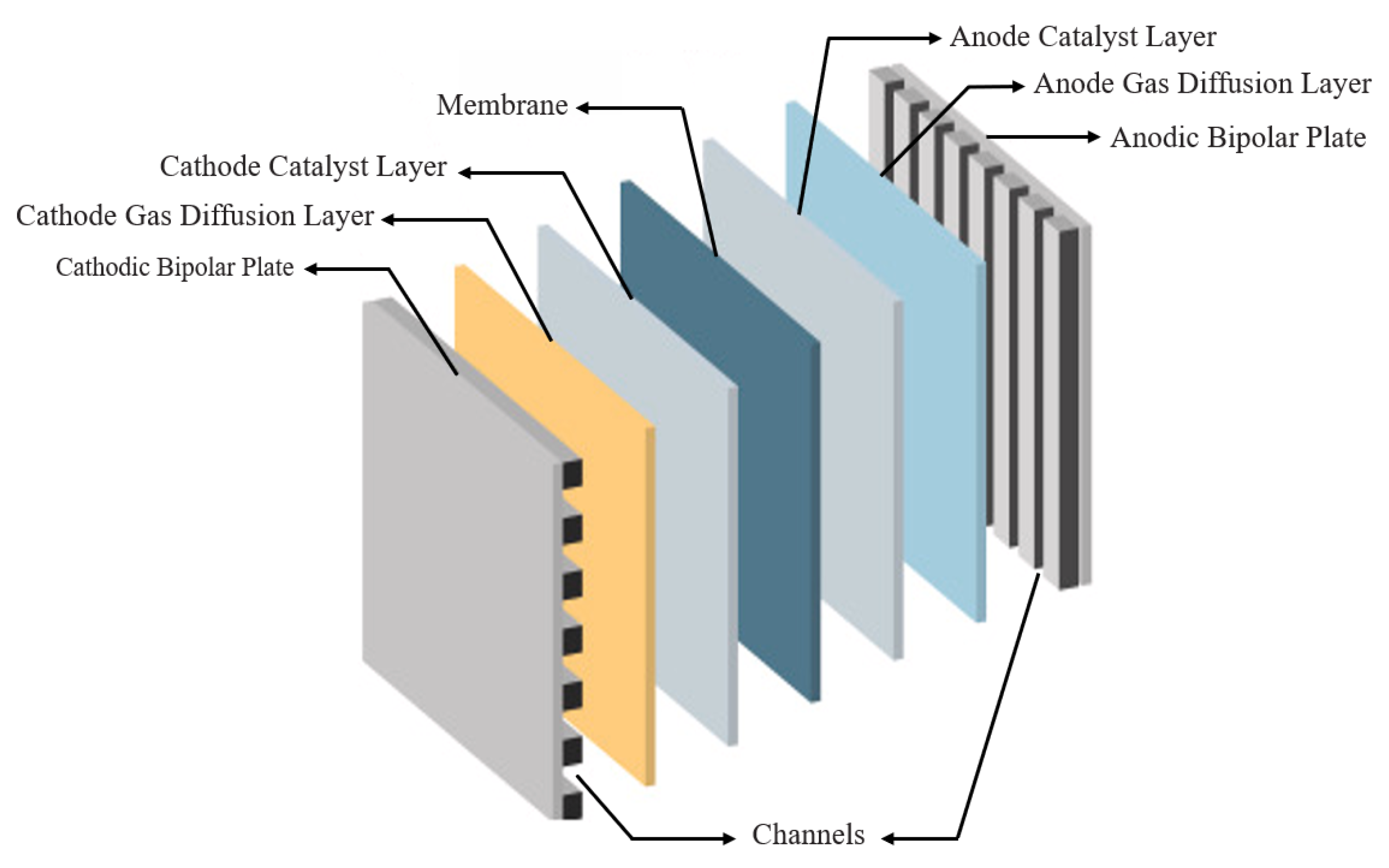
In water electrolysis technologies, the choice of materials for each functional layer, as shown in Figure 4, is a critical determinant of system performance, durability, and economic viability. Each electrolyzer type (PEMWE, AWE, AEMWE, SOWE) operates under specific physicochemical conditions (pH, temperature, voltage), which impose distinct material requirements at every layer.
Figure 4. Functional layers in an electrolyzer.
Energies 19 00059 g004
Table 3. Typical materials used in different functional layers of PEMWE, AWE, AEMWE, and SOWE electrolyzers [16,25,30,36,37,38,39,40,41,42,43,44].
Functional LayerPEMWEAWEAEMWESOWE
Anodic Bipolar PlateTitanium (uncoated or TiN/Pt-coated)Nickel or stainless steelNickel or stainless steelFerritic stainless steel (e.g., Crofer 22 APU)
Cathodic Bipolar PlateTitanium or coated TiNickel or stainless steelNickel or stainless steelFerritic stainless steel or Ni-based alloys
Anodic GDL/PTLSintered titanium or Ti felt (often coated)Nickel foam or meshNickel foam or meshPorous ceramic (e.g., LSM or lanthanum ferrite)
Cathodic GDL/PTLCarbon paper/felt or Pt-coated Ti meshNickel mesh or foamStainless steel, Ni mesh or carbon-based materialsNi-based porous cermet
Anode catalystIridium or ruthenium on titanium substrateNickel, Raney Ni, or Ni-based alloysNiFeOx, Co-based spinels, or MnOxLSM or LSCF (perovskite-type oxides)
Cathode catalystPlatinum or Pt alloys on carbon supportNickel or Ni alloysNi, Ag, or MnCo2O4Ni-YSZ (cermet)
Membrane/SeparatorNafion (PFSA) or other proton-conducting membraneZirfon (porous diaphragm) (zirconia/polysulfone)Anion-exchange membrane (quaternary ammonium functionalized polymer)Ceramic YSZ electrolyte layer
ElectrolyteSolid polymer electrolyte (e.g., Nafion)KOH or NaOH aqueous solution (25–40 wt%)Anion-exchange membrane + dilute KOH or NaOHYSZ (Yttria-Stabilized Zirconia) ceramic
While the selection of materials in each electrolyzer layer is primarily guided by performance, durability, and environmental compatibility, it is also limited by practical constraints such as resource availability, geopolitical sourcing, extraction complexity, and market cost. A deeper look into these supply considerations is essential to evaluate the sustainability and large scale feasibility of current and emerging electrolyzer technologies.
The deployment of electrolyzers at scale depends heavily on the availability of materials, particularly nickel, cobalt, platinum, iridium, titanium, graphite, and advanced polymer electrolytes like Nafion®, each of which has unique supply chains, extraction routes, and cost implications. These materials are often sourced from geographically concentrated regions and processed through energy and resource intensive techniques. Table 4 summarize representative producer countries for the principal materials used in electrolyzers.
Overall, each material represents a trade-off between performance, cost, availability, and environmental impact. As global demand for clean hydrogen accelerates, ensuring secure, ethical, and scalable access to key materials, particularly iridium and platinum, will be pivotal to the success of water electrolysis technologies.

3. Degradation Mechanisms Across Electrolyzer Technologies

Stack lifetime remains the primary bottleneck for commercial water electrolyzers, limiting their economic viability despite advances in efficiency and cost reduction. Degradation pathways differ markedly across technologies.
In alkaline water electrolyzers, degradation is primarily governed by the progressive corrosion of nickel-based electrodes and the chemical and mechanical deterioration of the diaphragm. High anodic potentials, local pH gradients, and dynamic operating conditions promote repeated oxidation and reduction of nickel, leading to dissolution–reprecipitation cycles, surface restructuring, and the formation of NiOOH phases with limited stability [50]. These processes progressively reduce the electrochemically active surface area and increase the OER overpotential. Dissolved nickel species and external impurities may accumulate within the electrode pores or diaphragm, causing blockage, altered wettability, and impaired ionic and gas transport. Simultaneously, long-term exposure to concentrated KOH and cyclic pressurization induces structural fatigue, swelling, and loss of dimensional stability in the diaphragm, ultimately increasing hydrogen–oxygen crossover. These degradation modes result in a gradual rise in cell voltage, reduced Faradaic efficiency, and shortened stack lifetime [51,52].
The durability of PEM water electrolyzers hinges on the interplay between chemical, electrochemical, and mechanical degradation mechanisms, all of which are exacerbated under dynamic or load-flexible operation. Transient voltage spikes, start–stop cycling, temperature and pressure fluctuations, and variations in membrane hydration alter the local electrochemical environment, introduce mechanical expansion–contraction cycles, and intermittently enhance gas crossover. These stressors initiate catalyst dissolution, membrane attack, and interfacial degradation [53]. At the catalyst level, high anodic potentials promote iridium and platinum dissolution, particle migration, agglomeration, and re-deposition, leading to a loss of electrochemically active surface area and increasing the anodic overpotential. Within the membrane, reactive oxygen species generated under high-voltage or transient conditions induce PFSA chain scission and fluoride release, while hydration/dehydration cycles and thermally induced hotspots generate mechanical fatigue, crack formation, creep, and membrane thinning. These phenomena collectively increase gas permeability and accelerate pinhole formation. The membrane–electrode interface undergoes delamination and void formation due to heterogeneous current distribution and mechanical mismatch, whereas porous transport layers can experience compression loss, porosity changes, and degradation of water and gas transport channels. At the stack level, metallic bipolar plates and structural components experience oxidation, passivation, or corrosion, and seals undergo fatigue, especially under differential pressure. These interconnected pathways manifest as increasing ohmic resistance, higher kinetic overpotentials, reduced mass transport efficiency, and continuous voltage rise under load [54].
In anion-exchange membrane water electrolyzers (AEMWEs), durability is predominantly limited by the chemical instability of the anion-exchange membrane and ionomer, which are inherently vulnerable to degradation in strongly alkaline environments. The quaternary ammonium functional groups responsible for hydroxide conduction undergo nucleophilic attack by O H , most notably through β -elimination, SN2 displacement, and dealkylation reactions [55]. These processes progressively reduce the density of fixed charges, lowering hydroxide conductivity and weakening the polymer backbone. Because AEMs typically absorb large amounts of water, they experience significant swelling and shrinkage during hydration cycles, which induces mechanical stress, micro-cracking, and partial delamination at the membrane–electrode interface. On the catalytic side, the non-noble metals commonly used in AEMWE such as Ni, Fe, or Co are susceptible to oxidation, dissolution, and restructuring under OER conditions; dissolved metal ions can further accelerate membrane degradation and alter the morphology of the catalyst layer [56,57].
In SOWE, degradation arises primarily from high-temperature thermomechanical stresses and redox cycling that challenge the structural integrity of ceramic electrodes and electrolytes. Large thermal gradients and repeated oxidation–reduction cycles generate mechanical mismatch and differential thermal expansion, causing microcracking, delamination, and loss of adhesion at electrode–electrolyte interfaces. Nickel-based fuel electrodes may undergo coarsening, phase redistribution, or morphological instabilities, while oxygen electrodes and electrolytes can suffer cation interdiffusion, impurity incorporation, and the formation of insulating secondary phases [58,59]. These chemical and mechanical transformations increase both ohmic and polarization losses, causing voltage drift and diminishing electrolysis efficiency. Over long-term operation, localized hotspots and mechanical fatigue can lead to interface failure.
These degradation mechanisms are diagnosed using electrochemical, imaging, and chemical analysis tools. Polarization curves, cell-voltage monitoring, cyclic voltammetry, and electrochemical impedance spectroscopy (EIS) are used in situ to track increases in activation, ohmic, and mass-transport losses and to identify changes in electrode or membrane behavior. Structural alterations such as cracking, thinning, catalyst growth, or delamination are detected ex situ through SEM, TEM, optical microscopy, and XRD, which reveal morphological and phase changes in electrodes, membranes, and porous transport layers. Complementary chemical analyses including XPS, FTIR, EDS, ion chromatography, and gas analysis detect polymer fragments, metal ions, and permeating gases, providing evidence of membrane or catalyst degradation [60,61]. Because most aging processes are intensified during load fluctuations, meaningful durability assessment relies on accelerated stress tests that simulate realistic operating profiles instead of idealized steady-state behavior [62].

4. Comparison and Evaluation of Electrolyzer Modeling Approaches

Electrolysis serves as a dual purpose technology, enabling both the large scale production of green hydrogen and the storage of electrical energy. In this context, modeling is essential to support system integration, guide design choices, and optimize performance. This section critically reviews the literature on low temperature proton exchange membrane (PEM) electrolysis systems, with a particular focus on how different modeling strategies contribute to performance assessment, control, and system-level integration.
In electrochemical systems such as proton exchange membrane water electrolyzers, modeling serves as a fundamental and versatile tool. It goes far beyond prediction, playing a critical role throughout the entire life cycle of the system. First, modeling enables a deep understanding of the coupled physical, chemical, thermal, and fluidic phenomena within the electrochemical cell. This understanding is essential to identify dominant mechanisms, assess the influence of key operating parameters (temperature, pressure, current density), and optimize performance. In parallel, mathematical models are widely used to design control strategies. They provide the foundation for developing robust controllers that ensure safe and efficient operation, particularly through temperature and pressure regulation. On the dynamic side, models allow the analysis of system responses to perturbations, distinguishing between transient and steady-state regimes, and characterizing fast (electrical) and slow (thermal, fluidic) dynamics. This temporal resolution is crucial for improved operational management. Modeling also plays a key role in diagnostics, enabling fault detection and localization, as well as in prognostics, by anticipating the degradation of critical components (membrane, catalyst) and estimating their remaining useful life. These functionalities support predictive maintenance strategies. Furthermore, models are instrumental in the optimal design of components and system-level integration, allowing the simulation of various technological configurations while accounting for constraints related to cost, energy efficiency, and compactness. Finally, with the rise of digital twins, modeling has become central to real time supervision. It enables adaptive and predictive control of electrolyzers and is thus a key enabler for the large scale deployment of hydrogen technologies.
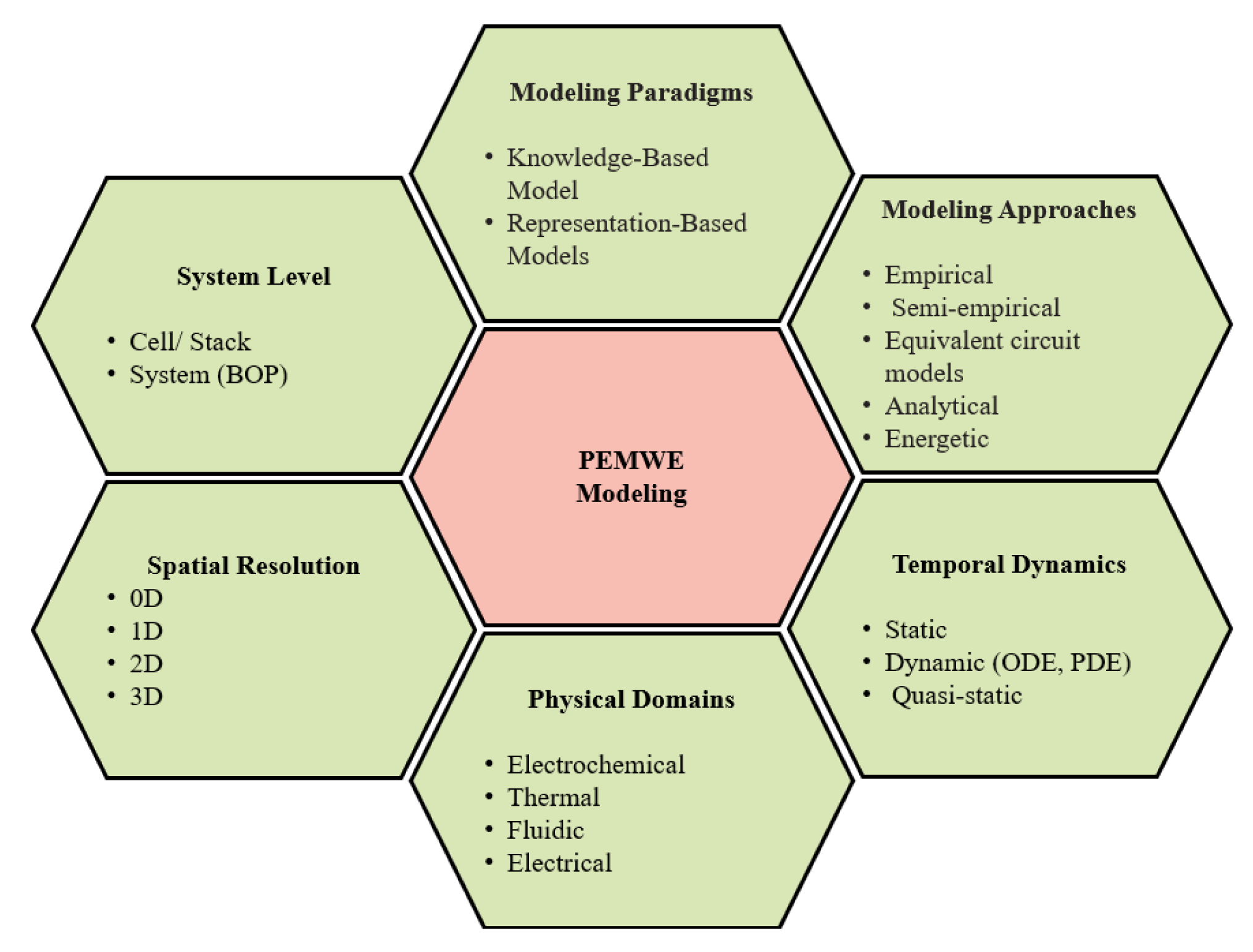
Overall, the modeling of PEM electrolysis remains a broad and diverse field, characterized by a wide range of approaches and terminologies. These can be distinguished along several axes, as summarized in Figure 5: their mathematical formulation, the paradigm on which they rely, the spatial resolution adopted, the system level considered, the physical domains represented, and their temporal dynamics.

4.1. Modeling Paradigms

A deeper distinction can be drawn between two main modeling paradigms. Knowledge-based models (physics-based models), rely on fundamental conservation laws and provide interpretable, mechanistic insights into system behavior. Their main limitation, however, lies in the high computational cost and the need for parameters that are often uncertain or difficult to measure, which can reduce accuracy under real operating conditions. In contrast, data-driven models build their predictive capability directly from experimental data and offer excellent computational efficiency, making them attractive for system-level studies, control, and optimization. Their weaknesses are the lack of physical interpretability and their poor extrapolation outside the training domain. Recent hybrid approaches, such as Physics-Informed Machine Learning (PIML) or Scientific Machine Learning (SciML), aim to combine the reliability of physics with the adaptability of data-driven methods [63,64]. However, their use in PEMWEs is still limited because high-quality datasets are scarce and it is difficult to represent all the coupled physical phenomena involved. Overall, physics-based models are preferred when detailed understanding is required, whereas data-driven approaches are more suitable for fast prediction and large-scale integration.

4.2. Modeling Approaches

Electrolyzer models can be grouped into several methodological families. Empirical models are purely based on experimental correlations, such as the relationship between efficiency and current density; they are simple and fast but lack predictive power outside their calibration range. Semi-empirical models combine simplified physical relations with fitted parameters, the most common example being the polarization curve that decomposes the cell voltage into activation, ohmic, and concentration overpotentials. Such models remain essentially static, describing equilibrium operating points. Analytical models rely on closed-form expressions derived from electrochemical laws under simplifying assumptions, such as the Nernst equation for equilibrium potential or the Butler–Volmer relation for charge-transfer kinetics. Equivalent circuit models (ECMs) use electrical analogies (resistances, capacitances, Warburg elements) to represent the dynamic response of the cell, typically identified from electrochemical impedance spectroscopy (EIS). Mechanistic (or physics-based) models go further by solving coupled differential and algebraic equations that describe transport, reaction kinetics, and multiphase phenomena inside the electrolyzer. They offer detailed predictive capability but at the cost of high computational demand, which makes them poorly suited for real-time applications [22]. Finally, Energetic Macroscopic Representation (EMR) and Bond Graphs do not introduce new electrochemical equations but provide systemic graphical frameworks for representing energy flows and causal interactions in multi-domain systems. EMR is particularly effective for integrating the electrolyzer with its balance-of-plant and for structuring control design [65], whereas Bond Graphs explicitly describe power exchange and storage across electrical, thermal, hydraulic, and mechanical domains, making them useful for dynamic simulation and digital twin development [66].
Polarization curves and electrochemical impedance spectroscopy (EIS) are experimental characterization techniques rather than modeling approaches. Polarization curves provide the steady-state voltage–current characteristics that support the calibration of semi-empirical or analytical models, while EIS enables the identification and validation of equivalent circuit models for small-signal dynamic behavior. These techniques are therefore complementary: polarization curves describe overall performance under steady conditions, whereas EIS reveals dynamic processes such as charge-transfer kinetics, double-layer effects, and mass-transport limitations.

4.3. Model Dynamics

PEMWE models can be organized by their treatment of time and by the mathematical class of equations they employ. Static (steady-state) models set time derivatives to zero and solve algebraic balances for fixed inputs; they underpin polarization curve analysis V(j) and instantaneous hydrogen production estimates via Faraday’s law under steady operating conditions (fixed current density, temperature, pressure). Although simple and useful for design-stage evaluations, their applicability is limited because they cannot reproduce transients, load fluctuations, or interactions with power electronics, which makes them unsuitable for renewable-driven operation. Quasi-static (pseudo-steady) models assume inputs vary slowly so that fast dynamics (e.g., double layer charging, local pressure equalization, short gas residence times) equilibrate essentially instantly; the solution is computed as a sequence of steady-states, sometimes retaining a few slow ODEs (typically thermal), while fast states are constrained to equilibrium. This is valid when imposed ramp rates are long relative to the dominant fast time constants.
Dynamic (transient) models keep time derivatives in the governing balances and come in two standard subclasses: lumped parameter dynamic models (ODE-based), and distributed-parameter dynamic models (PDE-based). ODE-based represent global states such as double layer potential, gas inventories and manifold pressures, and stack/coolant temperatures. These models offer a good compromise between fidelity and computational cost and are therefore widely used for control, diagnostics, hardware-in-the-loop testing, and for studying start-up/shutdown or load-following behavior. However, their lumped nature prevents them from capturing spatial heterogeneities, maldistribution, or local transport limitations. PDE-based resolve coupled spatio-temporal transport of mass, charge, momentum, and heat in channels, porous layers, and the membrane (convection–diffusion, two-phase flow, energy equation). They are essential for analyzing bubble dynamics, species depletion, localized hotspots, and two-phase behavior. Their main limitation is their high computational demand and numerical stiffness, which currently restricts their use to offline analysis and makes them unsuitable for real-time control or large-scale optimization.

4.4. System Level

Electrolyzer modeling can be conducted at different hierarchical levels depending on the purpose of the analysis. At the cell or stack level, the focus is placed on electrochemical performance, voltage–current behavior, and internal losses, typically assuming uniform conditions across cells; while such models are valuable for studying fundamental reaction mechanisms or degradation pathways, they do not reflect the operation of the electrolyzer as part of a complete system and often neglect the influence of auxiliary components and control strategies. At the system level, the stack must be complemented with its BoP, which includes auxiliary components such as pumps, compressors, heat exchangers, humidifiers, actuators, and power converters. These subsystems contribute significantly to the overall energy consumption and strongly influence the dynamic response and efficiency of the electrolyzer. However, system-level models necessarily simplify the internal electrochemical and transport phenomena of the stack, which can lead to inaccuracies when predicting local limitations, two-phase behavior, or degradation. Conversely, detailed stack models accurately capture internal physics but do not reflect BoP constraints, thermal inertia, or power–electronic interactions. As a result, both approaches are complementary, and the choice depends on whether the objective is local understanding or operational optimization.
When electrolyzers are integrated with RESs, their variability imposes stochastic operating conditions that require EMS supervision. Approaches such as EMR or Bond Graphs help structure multi-domain interactions, but their effectiveness depends on the fidelity of the underlying physical models. The literature also points to a lack of experimentally validated transient system-level models under real fluctuating conditions, highlighting the need for better coupling between detailed stack physics and fast system-level representations [67].

4.5. Multiphysics Domains

Electrolyzers are inherently multiphysical systems in which electrochemical conversion, thermal behavior, fluid and mass transport, electrical dynamics, and mechanical stresses are strongly coupled. As a result, accurate modeling and analysis of PEMWEs require integrating several physical domains rather than treating them in isolation. Depending on the operational regime and modeling objective (design, optimization, control, or degradation prediction), different domains may dominate. However, realistic system-level models must account for the interplay between electrochemical kinetics, heat generation and removal, fluid management, phase change, transport resistance, and mechanical integrity. This multiphysics nature enables a comprehensive understanding of electrolyzer dynamics but also increases computational complexity and demands sophisticated experimental validation.
From an electrochemical standpoint, the PEMWE converts electrical energy into chemical energy through water splitting. The cell voltage is typically expressed as the sum of the thermodynamic reversible voltage and various overpotentials associated with activation, ohmic resistance, and mass transport limitations. The cell voltage is expressed as follows:
V cell = V rev + V act + V ohm + V diff ,
where V rev is the reversible voltage, and the overpotentials account for activation, ohmic, and diffusion losses. Classical formulations are well established in the literature [22,68,69]; while classical formulations of activation losses often rely on Butler–Volmer or Tafel equations, their accurate representation under high current densities and dynamic conditions remains challenging due to nonlinear effects, local reactant depletion, and temperature dependence. The anode oxygen evolution reaction (OER) is particularly demanding and requires a high loading of iridium-based catalysts, whose kinetics depend heavily on catalyst dispersion, and local hydration. Ohmic losses arise from ionic resistance in the membrane, electronic resistance in the electrodes and current collectors, and interfacial contact resistances. These resistances are strongly affected by temperature, membrane hydration, and mechanical compression. Diffusion losses become significant at high current densities due to the limited transport of water to the reaction sites and accumulation of gas bubbles in the porous structures. Additionally, gas crossover through the membrane can lead to mixed potentials and reduced efficiency. Therefore, electrochemical models must capture spatially varying properties (local temperature, water activity, and current density) and dynamic behaviors such as double layer charging and transient mass transport.
Thermal management is critical in PEM water electrolyzers because temperature strongly influences membrane conductivity, electrochemical kinetics, gas solubility, and overall efficiency [70]. Thermal modeling is therefore commonly formulated through energy balances where the net heat within the cell arises from multiple contributions as expressed in Equation (2): internally generated heat ( Q ˙ gen ) due to irreversible losses (such as activation overpotentials, ohmic resistance, and mass transport limitations); reversible heat associated with the entropy change of the electrochemical reaction, which can be significant at high current densities and temperatures; heat removal via cooling systems ( Q ˙ cool ); environmental dissipation ( Q ˙ loss ); and enthalpy fluxes carried by process fluids Q ˙ exchange . Heat transfer occurs through conduction across the solid layers of the Membrane–Electrode Assembly (MEA), convection with circulating water and gas streams, and to a lesser extent radiation; while simplified thermal models often assume uniform temperature distributions or neglect certain heat pathways, high fidelity multiphysics simulations have revealed significant spatial temperature gradients within flow channels and porous media, which can lead to non-uniform current density, differential membrane hydration, and localized degradation. At the stack level, thermal management strategies range from passive heat dissipation to active liquid-cooling, depending on current density and operating pressure. However, validation of thermal models remains challenging due to limited access to in situ temperature measurements; most systems rely on bulk proxies such as coolant inlet/outlet temperature, which cannot capture local hotspots. Advanced diagnostics such as infrared thermography and embedded micro-thermocouples are emerging to provide higher spatial resolution, but their implementation is complex and often intrusive, highlighting the need for integrated modeling measurement approaches to accurately resolve thermo-electrochemical interactions [71].
C t d T d t = Q ˙ g e n Q ˙ l o s s Q ˙ c o o l Q ˙ exchange
Fluidic and mass transport phenomena further complicate PEMWE operation. Water is fed to the anode side, where oxygen gas is generated and must be efficiently removed. Simultaneously, hydrogen production occurs at the cathode. The two-phase flow behavior bubble nucleation, growth, coalescence, and detachment critically influences mass transport, local pressure, and overpotentials. Gas accumulation can block active sites or alter flow distribution, particularly in the anode where oxygen bubbles form within porous transport layers. The presence of gas increases pressure drop and can induce uneven current density distribution, leading to accelerated degradation. Capillary forces, wettability, and pore morphology govern phase distribution in porous media. However, many system-level models still assume single phase or homogenized flow, which fails to predict important phenomena such as anode flooding, channel blockages, or transient pressure spikes. High fidelity multiphase computational fluid dynamics (CFDs) and pore network models can capture detailed transport, but their computational cost is high. Consequently, hybrid approaches combining simplified flow models with local transport corrections are being explored.
These coupled phenomena make it clear that PEM electrolyzers cannot be accurately represented by isolated sub-models or overly simplified assumptions. Instead, the strong interactions between electrochemical, thermal, fluidic, and mechanical processes impose strict requirements on model dimensionality and physical resolution. In practice, realistic modeling strategies must couple these domains, but doing so directly at full fidelity is computationally expensive. Therefore, hybrid approaches are often adopted that exploit characteristic time scales: fast electrochemical and electrical dynamics are treated under quasi-steady assumptions, while slower thermal and fluidic subsystems are modeled dynamically. This selective coupling preserves the essential system behavior while remaining computationally tractable, particularly for control-oriented or system-level applications. These trade-offs between physical fidelity and computational efficiency naturally motivate the use of different modeling dimensions ranging from 0D to 3D, which are examined in the next subsection.

4.6. Multidimensional Modeling

Modeling approaches for PEM electrolyzers span multiple spatial resolutions, each offering a different balance between physical fidelity, computational cost, and suitability for design, optimization, or control. Because the underlying processes, electrochemical reactions, heat transfer, fluid flow, phase change, ion and electron transport, and mechanical deformation occur over different spatial and temporal scales, no single dimensional framework can capture all relevant phenomena efficiently [72]. The choice of model resolution is therefore application driven: while system designers may prioritize detailed spatial accuracy, control engineers require fast and robust models that can be solved in real time. Understanding the strengths and limitations of each modeling dimension is essential for building predictive and efficient simulation tools.
Zero-dimensional (0D) models treat the electrolyzer as a lumped system and neglect spatial gradients of temperature, concentration, and current density. Their formulation is built on global electrochemical relations (Nernst voltage, activation, ohmic and mass-transport losses) and simplified thermal or pressure dynamics. Owing to their extremely low computational cost, 0D models are widely used for system-level analysis, control design, hardware-in-the-loop simulations, and renewable-driven studies. However, they cannot represent reactant maldistribution, local dry-out or flooding, bubble accumulation, or in-plane/through-plane gradients, and their accuracy heavily depends on empirical parameterization, limiting extrapolation beyond the calibration range.
One-dimensional (1D) models provide a through-plane spatial resolution across the membrane–electrode assembly, resolving ionic and electronic potentials, species concentrations, temperature, and water content. They allow detailed prediction of activation, ohmic, and mass-transport overpotentials and can incorporate membrane hydration, swelling, phase change, and gas crossover. Their computational efficiency makes them suitable for material characterization, sensitivity studies, and reduced-order model development. Nevertheless, the assumption of uniform in-plane conditions becomes limiting when flow maldistribution, temperature gradients, or non-uniform gas evolution occur. Advanced 1D multiphysics models have been proposed to mitigate these limitations, such as the two-phase non-isothermal MEA model of García [73] and the dynamic anode-side model of Lin et al. [74], but they still cannot capture channel-dependent or lateral effects.
Two-dimensional (2D) models introduce in-plane resolution and can describe reactant starvation, flow distribution, bubble accumulation, and temperature variations along the channels. They are well suited for analyzing the influence of flow-field architecture and operating conditions on current-density distribution and electrode utilization. Aubras et al. [75] developed a 2D stationary multiphysics model integrating electrochemical, thermal, and two-phase transport to study bubble regimes at the anode, while Xu et al. [76] used a 2D isothermal formulation to investigate reactant distribution under different flow configurations. Although 2D models provide substantially more insight than 1D approaches, they still neglect the third spatial dimension and remain too computationally intensive for real-time control or large-scale optimization, especially in their transient form.
Three-dimensional (3D) models offer the highest spatial fidelity by resolving the full geometry of flow channels, porous transport layers, catalyst layers, and the membrane. They capture the coupled behavior of bubble dynamics, in-plane and through-plane transport, current density hotspots, and localized thermal gradients with high accuracy. These models are invaluable for flow-field optimization, diagnostics, and understanding scale-up phenomena. For instance, Xu et al. [77] proposed a 3D multiphase CFD model capable of simulating the interaction between electrochemical reactions and gas evolution, while Vedrtman et al. [37] reviewed the respective advantages and limitations of FEM, CFD, and surrogate-based methods for multiphysics electrolysis simulation. However, the computational cost and extensive parameterization requirements make 3D models impractical for system-level simulations or real-time integration.
Overall, 0D, 1D, 2D, and 3D models form a hierarchy of complementary tools, where increased spatial resolution improves physical accuracy but significantly raises computational cost. Table 5 provides a summary of the differences among the different modeling dimensions. A persistent gap in the literature is the lack of multiscale validation frameworks that link high-fidelity 2D/3D simulations with reduced-order 0D/1D models suitable for control and system integration. Addressing this gap is essential to ensure that system-level models accurately reflect internal electrochemical, thermal, and two-phase phenomena under realistic dynamic conditions.
As PEMWEs are increasingly deployed in renewable energy systems, advanced modeling will play a critical role in enhancing performance, durability, and integration with power grids, paving the way for more efficient and cost-effective hydrogen production.

5. Integration of WE with Renewable Energy Sources and the Power Grid

Clean hydrogen production through electrolysis depends on renewable electricity. When scaling from single cells to stacks or multi-unit systems, the focus shifts from individual components to the BOP and the overall power supply architecture. At this scale, new challenges emerge, particularly regarding thermal management and the dynamic interactions with renewable energy sources and the electrical grid [78].

5.1. Coupling with Renewable Energy Sources

Coupling electrolyzers with renewable energy sources is attracting growing attention as a strategy to mitigate intermittency and increase system flexibility [79,80]. Variable solar and wind profiles expose electrolyzers to frequent power ramps, partial-load operation, and low-frequency fluctuations, which influence both efficiency and degradation pathways [81]. These dynamic operating conditions increase transient overpotentials, and can accelerate catalyst and membrane aging, particularly under prolonged cycling.
Within this context, different electrolyzer technologies exhibit distinct levels of compatibility with RES variability. Comparative studies consistently show that PEM electrolyzers handle intermittent operation more effectively than alkaline and solid oxide systems, owing to their fast current response, wide dynamic range, and capability to follow rapid fluctuations in renewable output [42]. Conversely, alkaline units are limited by slower transients and narrower operating windows, while SOWE is constrained by thermal inertia, making both less suitable for highly variable generation profiles [24]. These characteristics explain why most RES–electrolyzer demonstrators today rely on PEM technology.
The main modeling challenge identified in the literature concerns the coordination between variable renewable availability and electrolyzer loading. Energy Management Systems (EMSs) based on Model Predictive Control (MPC) or Mixed-Integer Linear Programming (MILP) have been widely adopted to maximize renewable utilization and minimize curtailment [82,83]. Comparative analyses show that MPC offers superior short-term tracking performance but depends strongly on forecast accuracy, whereas MILP-based dispatchers capture operational constraints more explicitly but with higher computational burden. More recent work explores reinforcement learning (RL) controllers capable of handling uncertainty without explicit forecasting models; however, RL approaches generally lack experimental validation and rely heavily on idealized electrolyzer representations, limiting their transferability to real systems [84].
Architectural choices strongly shape RES–electrolyzer interactions, as systems may operate in off-grid, grid-connected, or hybrid configurations combining solar, wind, batteries, or hydrogen storage. Off-grid setups maximize renewable penetration but require careful sizing of RES and hydrogen buffers to avoid long idle periods, while grid-connected and hybrid architectures offer greater operational flexibility. To smooth the variability of renewable generation and reduce power fluctuations seen by the electrolyzer, hybrid RES–storage configurations are increasingly investigated. These designs involve trade-offs: oversizing RES can improve utilization and reduce curtailment but increases capital costs, whereas undersizing limits renewable absorption and raises the resulting LCOH. Although many techno-economic studies point to moderate electrolyzer sizing combined with hydrogen buffering as a cost-effective compromise, most dynamic assessments still rely on simplified 0D electrolyzer models that overlook internal states, startup behavior, and power–electronic constraints. This modeling gap remains a central limitation in current RES–electrolyzer integration research [67].

5.2. Integration into the Power Grid

When connected to the power grid, PEM electrolyzers operate as controllable loads capable of providing multi-timescale flexibility services. Their sub-second ramping capability enables rapid modulation of electricity consumption, supporting frequency containment, renewable balancing, and congestion management [85].
Accurate assessment of grid-support functions requires dynamic models that represent the interactions between the electrolyzer stack, balance-of-plant, and converter systems. Tuinema et al. developed large-scale dynamic models suitable for real-time simulation, demonstrating the ability of PEM electrolyzers to deliver primary frequency control [86]. However, the existing literature remains fragmented: many power-system studies rely on static voltage–current curves that neglect transient limitations, whereas high-fidelity multiphysics models are computationally intractable for grid-level analysis. This mismatch illustrates a recurring modeling gap that limits the evaluation of electrolyzer performance under realistic network disturbances.
Beyond frequency support, several studies show that PEM electrolyzers can assist voltage regulation through reactive power control and contribute to spinning or non-spinning reserves, depending on the capabilities of the associated converters [61]. Despite these promising results, comparative analyses highlight substantial heterogeneity across national grid codes, with no consensus on response requirements, operational limits, or control interfaces. This lack of standardization is increasingly cited as a key barrier hindering widespread participation of electrolyzers in ancillary service markets.
Recent advances in control-oriented modeling have further expanded the role of electrolyzers as active grid participants. Majumdar et al. [87] emphasized the importance of dynamic modeling, system identification, and robust feedback control to ensure stable operation under variable grid conditions. Digital twin frameworks have also emerged as promising tools for real-time monitoring and supervisory control. Monopoli et al. [88] proposed a reference architecture integrating simplified physical models with real-time data assimilation, while Deshmukh et al. [89] and Ruuskanen et al. [90] demonstrated PHIL platforms enabling accurate emulation of converter–electrolyzer interactions. Complementary diagnostic and prognostic approaches have been developed to detect faults or abnormal behaviors based on readily available measurements, as shown by Koo et al. [91].
Overall, the literature confirms that grid-connected PEM electrolyzers offer substantial flexibility benefits, but current modeling practices remain divided between low-fidelity representations that underestimate transient behavior and detailed physics-based models unsuitable for system-level studies. The absence of unified, experimentally validated dynamic models remains a critical research gap and is increasingly recognized as a major obstacle to large-scale deployment of electrolyzer-based grid services.

6. Conclusions

Hydrogen has become a key part of the shift to a flexible, integrated, and decarbonized energy system. In the last few years, national strategies, targets, and public and private investments are driving its deployment, aided by technological advances and regulatory frameworks that support large-scale electrolyzer manufacturing. This review looked at the hydrogen value chain, including how hydrogen is made, how electrolyzers work, how to model electrolyzers in multiple dimensions, and how to connect electrolyzers to renewable energy sources and energy networks.
PEM and alkaline technologies are already mature enough to be used on a larger scale. AEMWE and SOWE concepts are also moving toward commercialization. Deployment is still uneven in different areas though, and the transition from pilot projects to fully integrated energy infrastructure is still in its early stages.
Modeling is key for design, optimization, and control: from micro-scale and 3D models for materials research to reduced-order 0D/1D models for real-time applications. Hybrid physics-based and data-driven models are emerging, facilitated by tools like COMSOL, ANSYS Fluent, OpenFOAM, MATLAB/Simulink, Modelica, and PLECS. However, model sharing, reproducibility, and standardization are still issues, making it hard to compare results across studies.
Future studies should incorporate multi-scale and hybrid modeling techniques that encompass physical and electrochemical processes while allowing control-oriented and real-time applications. Adding degradation mechanisms, aging, uncertainty quantification, and digital twins will enhance lifetime prediction and techno-economic accuracy. At the system level, integrated planning for electrolyzer deployment in renewable-based energy systems, infrastructure, and storage is needed.
Electrolyzers need to be efficient, robust, cost-competitive, and integrated into multi-sector energy systems. This vision demands convergence in advanced modeling, materials science, manufacturing scale-up, infrastructure design, and policy. Through ongoing research, industrial scale-up, and international cooperation, water electrolysis can transition from a promising technology to a pillar of the hydrogen economy and the global shift towards a resilient, low-carbon energy future.

Author Contributions

Conceptualization, R.L.; methodology, R.L.; formal analysis, R.L. and S.G.; investigation, R.L.; writing—original draft preparation, R.L.; writing—review and editing, R.L., S.G., I.S., S.L. and A.D.; visualization, R.L.; supervision, S.G., I.S., S.L. and A.D.; All authors have read and agreed to the published version of the manuscript.

Funding

This work has been supported by the EIPHI Graduate School (contract ANR-17-EURE- 0002) and the Region Bourgogne Franche-Comté.

Data Availability Statement

No new data were created or analyzed in this study. Data sharing is not applicable to this article.

Conflicts of Interest

The authors declare no conflict of interest.

Abbreviations

AECAlkaline Electrolyzer Cell
PEMECProton Exchange Membrane Electrolyzer Cell
AEMECAnion Exchange Membrane Electrolyzer Cell
SOECSolid Oxide Electrolyzer Cell
PEMWEProton Exchange Membrane Water Electrolyzer
PFSAPerFluorosulfonic acid membrane
BoPBalance-of-Plant
EMSEnergy Management System
ESSEnergy Storage System
HILHardware-In-the-Loop
MPCModel Predictive Control
PMCPower Management Controller
PVPhotovoltaic
SoCState of Charge
HPALhigh-pressure acid leaching
YSZYttria-Stabilized Zirconia
EISElectrochemical Impedence Spectroscopy
SDESShort Duration Energy Storage
LDESLong Duration Energy Storage
P2GPower to Gas

References

  1. Elalfy, D.A.; Gouda, E.; Kotb, M.F.; Bureš, V.; Sedhom, B.E. Comprehensive review of energy storage systems technologies, objectives, challenges, and future trends. Energy Strategy Rev. 2024, 54, 101482. [Google Scholar] [CrossRef]
  2. Awad, M.; Said, A.; Saad, M.H.; Farouk, A.; Mahmoud, M.M.; Alshammari, M.S.; Alghaythi, M.L.; Aleem, S.H.A.; Abdelaziz, A.A.; Omar, A.I. A review of water electrolysis for green hydrogen generation considering PV/wind/hybrid/hydropower/geothermal/tidal and wave/biogas energy systems, economic analysis, and its application. Alex. Eng. J. 2024, 87, 213–239. [Google Scholar] [CrossRef]
  3. Nasser, M.; Megahed, T.F.; Ookawara, S.; Hassan, H. A review of water electrolysis–based systems for hydrogen production using hybrid/solar/wind energy systems. Environ. Sci. Pollut. Res. 2022, 29, 86994–87018. [Google Scholar] [CrossRef] [PubMed]
  4. Projet ROSTOCK-H. État des connaissances sur le stockage de l’hydrogène en cavité saline et apport du projet ROSTOCK-H. Rapport technique, France, 2021. Available online: https://www.researchgate.net/publication/382152344 (accessed on 1 September 2025).
  5. David, M.; Ocampo-Martínez, C.; Sánchez-Peña, R. Advances in alkaline water electrolyzers: A review. J. Energy Storage 2019, 23, 392–403. [Google Scholar] [CrossRef]
  6. Cavendish, H. Three Papers Containing Experiments on Factitious Air. Philos. Trans. R. Soc. 1766, 56, 141–184. [Google Scholar] [CrossRef]
  7. Lavoisier, A.L. Mémoire sur la Combustion en Général; Académie Royale des Sciences: Paris, France, 1783. [Google Scholar]
  8. Congressional Research Service. Hydrogen: Production, Uses, and Policy Considerations. Technical Report; United States Congress: Washington, DC, USA, 2023. Available online: https://www.congress.gov/crs-product/R48196 (accessed on 1 September 2025).
  9. International Energy Agency (IEA). Global Hydrogen Review. 2021. Available online: https://www.iea.org/reports/global-hydrogen-review-2021 (accessed on 1 September 2025).
  10. Ullah, I.; Amin, M.; Zhao, P.; Qin, N.; Xu, A.W. Recent advances in inorganic oxide semiconductor-based S-scheme heterojunctions for photocatalytic hydrogen evolution. Inorg. Chem. Front. 2025, 12, 1329–1348. [Google Scholar] [CrossRef]
  11. Ullah, I.; Zhao, P.; Qin, N.; Chen, S.; Li, J.H.; Xu, A.W. Emerging Trends in CdS-Based Nanoheterostructures: From Type-II and Z-Scheme toward S-Scheme Photocatalytic H2 Production. Chem. Rec. 2024, 24, e202400127. [Google Scholar] [CrossRef]
  12. Vitta, S. Sustainability of hydrogen manufacturing: A review. RSC Sustain. 2024, 2, 3202–3221. [Google Scholar] [CrossRef]
  13. Tuluhong, A.; Chang, Q.; Xie, L.; Xu, Z.; Song, T. Current Status of Green Hydrogen Production Technology: A Review. Sustainability 2024, 16, 9070. [Google Scholar] [CrossRef]
  14. Dincer, I.; Acar, C. Review and evaluation of hydrogen production methods for better sustainability. Int. J. Hydrogen Energy 2015, 40, 11094–11111. [Google Scholar] [CrossRef]
  15. Peiffer, E.; Williams, R.; Ba-aoum, M.; Hudson-Heck, E.; Aranda, I. Evaluation of New Opportunities for Marine Energy to Power the Blue Economy: Green Hydrogen and Marine Carbon Dioxide Removal. Technical Report; National Renewable Energy Laboratory (NREL): Golden, CO, USA, 2024. Available online: https://www.nrel.gov/docs/fy24osti/89475.pdf (accessed on 2 September 2025).
  16. Kumar, S.S.; Lim, H. An overview of water electrolysis technologies for green hydrogen production. Energy Rep. 2022, 8, 13793–13813. [Google Scholar] [CrossRef]
  17. Jiang, Y. Emerging Technologies Review: Carbon Capture and Conversion to Methane and Methanol; Pacific Northwest National Laboratory (PNNL): Richland, WA, USA, 2024. [Google Scholar] [CrossRef]
  18. Faria, J.A. Renaissance of ammonia synthesis for sustainable production of energy and fertilizers. Curr. Opin. Chem. Eng. 2021, 29, 100466. [Google Scholar] [CrossRef]
  19. Zhang, K.; He, L.; Jiang, L.; Jiang, S.; Yu, R.; Lau, H.C.; Xie, C.; Chen, Z. The role of hydrogen in the energy transition of the oil and gas industry. Adv. Appl. Energy 2024, 3, 100090. [Google Scholar] [CrossRef]
  20. Chandler, W.A. Apollo Experience Report: The Cryogenic Storage System. Technical Report; NASA: Washington, DC, USA, 1973. Available online: https://ntrs.nasa.gov/api/citations/19730017162/downloads/19730017162.pdf (accessed on 15 September 2025).
  21. Emam, A.S.; Hamdan, M.O.; Abu-Nabah, B.A.; Elnajjar, E. A review on recent trends, challenges, and innovations in alkaline water electrolysis. Int. J. Hydrogen Energy 2024, 64, 599–625. [Google Scholar] [CrossRef]
  22. Falcão, D.S.; Pinto, A.M. A review on PEM electrolyzer modelling: Guidelines for beginners. J. Clean. Prod. 2020, 261, 121184. [Google Scholar] [CrossRef]
  23. Zhang, L.; Qi, F.; Ren, R.; Gu, Y.; Gao, J.; Liang, Y.; Wang, Y.; Zhu, H.; Kong, X.; Zhang, Q.; et al. Recent Advances in Green Hydrogen Production by Electrolyzing Water with Anion-Exchange Membrane. Research 2025, 8, 0677. [Google Scholar] [CrossRef]
  24. Vostakala, M.F.; Ozcan, H.; El-Emam, R.S.; Horri, B.A. Recent Advances in High-Temperature Steam Electrolysis with Solid Oxide Electrolysers for Green Hydrogen Production. Energies 2023, 16, 3327. [Google Scholar] [CrossRef]
  25. Şahin, M.E. An Overview of Different Water Electrolyzer Types for Hydrogen Production. Energies 2024, 17, 4944. [Google Scholar] [CrossRef]
  26. Trattner, A.; Höglinger, M.; Macherhammer, M.G.; Sartory, M. Renewable Hydrogen: Modular Concepts from Production over Storage to the Consumer. Chem. Ing. Tech. 2021, 93, 706–716. [Google Scholar] [CrossRef]
  27. Turan, R.; Bilgen, E.; Koca, A. Electrode modifications with electrophoretic deposition methods for water electrolyzers. Int. J. Hydrogen Energy 2024, 81, 675–706. [Google Scholar] [CrossRef]
  28. Flis, G.; Wakim, G. Solid Oxide Electrolysis: A Technology Status Assessment. Technical Report; Clean Air Task Force: Boston, MA, USA, 2023; Available online: https://www.catf.us/resource/solid-oxide-electrolysis-technology-status-assessment/ (accessed on 2 September 2025).
  29. Aminaho, E.N.; Aminaho, N.S.; Aminaho, F. Techno-economic assessments of electrolysers for hydrogen production. Appl. Energy 2025, 399, 126515. [Google Scholar] [CrossRef]
  30. International Renewable Energy Agency (IRENA). Green Hydrogen Cost Reduction: Scaling up Electrolysers to Meet the 1.5°C Climate Goal; International Renewable Energy Agency: Abu Dhabi, United Arab Emirates, 2020; ISBN 978-92-9260-295-6. [Google Scholar]
  31. Krishnan, S.; Koning, V.; de Groot, M.T.; de Groot, A.; Mendoza, P.G.; Junginger, M.; Kramer, G.J. Present and future cost of alkaline and PEM electrolyser stacks. Int. J. Hydrogen Energy 2023, 48, 32313–32330. [Google Scholar] [CrossRef]
  32. Younus, H.A.; Al Hajri, R.; Ahmad, N.; Al-Jammal, N.; Verpoort, F.; Al Abri, M. Green hydrogen production and deployment: Opportunities and challenges. Discov. Electrochem. 2025, 2, 32. [Google Scholar] [CrossRef]
  33. International Renewable Energy Agency (IRENA); Bluerisk. Water for Hydrogen Production; International Renewable Energy Agency and Bluerisk: Abu Dhabi, United Arab Emirates, 2023. [Google Scholar]
  34. International Renewable Energy Agency (IRENA). Making the Breakthrough: Green Hydrogen Policies and Technology Costs; International Renewable Energy Agency: Abu Dhabi, United Arab Emirates, 2021. [Google Scholar]
  35. IEAGHG. Analysis of Electrolytic Hydrogen Technologies with a Comparative Perspective on Low-Carbon (CCS-Abated) Hydrogen Pathways; IEAGHG: Cheltenham, UK, 2024. [Google Scholar] [CrossRef]
  36. Shaya, N.; Gloser-Chahoud, S. A Review of Life Cycle Assessment (LCA) Studies for Hydrogen Production Technologies through Water Electrolysis: Recent Advances. Energies 2024, 17, 3968. [Google Scholar] [CrossRef]
  37. Vedrtnam, A.; Kalauni K, K.; Pahwa, R. Water Electrolysis Technologies and Their Modeling Approaches: A Comprehensive Review. Eng 2025, 6, 81. [Google Scholar] [CrossRef]
  38. Santoro, C.; Lavacchi, A.; Mustarelli, P.; Noto, V.D.; Elbaz, L.; Dekel, D.R.; Jaouen, F. What is Next in Anion-Exchange Membrane Water Electrolyzers? Bottlenecks, Benefits, and Future. ChemSusChem 2022, 15, e202200027. [Google Scholar] [CrossRef]
  39. Sebbahi, S.; Assila, A.; Belghiti, A.A.; Laasri, S.; Kaya, S.; Hlil, E.K.; Rachidi, S.; Hajjaji, A. A comprehensive review of recent advances in alkaline water electrolysis for hydrogen production. Int. J. Hydrogen Energy 2024, 82, 583–599. [Google Scholar] [CrossRef]
  40. Bonanno, M.; Müller, K.; Bensmann, B.; Hanke-Rauschenbach, R.; Aili, D.; Franken, T.; Chromik, A.; Peach, R.; Freiberg, A.T.S.; Thiele, S. Review and Prospects of PEM Water Electrolysis at Elevated Temperature Operation. Adv. Mater. Technol. 2023, 9, 2300281. [Google Scholar] [CrossRef]
  41. Rahim, A.H.A.; Tijani, A.S.; Kamarudin, S.K.; Hanapi, S. An overview of polymer electrolyte membrane electrolyzer for hydrogen production: Modeling and mass transport. J. Power Sources 2016, 309, 56–65. [Google Scholar] [CrossRef]
  42. Carmo, M.; Fritz, D.L.; Mergel, J.; Stolten, D. A comprehensive review on PEM water electrolysis. Int. J. Hydrogen Energy 2013, 38, 4901–4934. [Google Scholar] [CrossRef]
  43. Xu, Q.; Zhang, L.; Zhang, J.; Wang, J.; Hu, Y.; Jiang, H.; Li, C. Anion Exchange Membrane Water Electrolyzer: Electrode Design, Lab-Scaled Testing System and Performance Evaluation. EnergyChem 2022, 4, 100087. [Google Scholar] [CrossRef]
  44. Wang, Y.; Wang, Z.; Qiao, J.; Li, H.; Wang, X.; Cao, B.; Zhu, T.; Zhang, B.; Wang, M. Materials and flow fields of bipolar plates in polymer electrolyte membrane water electrolysis: A review. Energy Rev. 2025, 4, 100132. [Google Scholar] [CrossRef]
  45. Lima, A.; Torrubia, J.; Valero, A.; Valero, A. Non-Renewable and Renewable Exergy Costs of Water Electrolysis in Hydrogen Production. Energies 2025, 18, 1398. [Google Scholar] [CrossRef]
  46. Eikeng, E.; Makhsoos, A.; Pollet, B.G. Critical and Strategic Raw Materials for Electrolysers, Fuel Cells and Hydrogen Storage. Int. J. Hydrogen Energy 2024, 71, 433–464. [Google Scholar] [CrossRef]
  47. International Energy Agency (IEA). Global Critical Minerals Outlook 2025. Technical Report; IEA: Paris, France, 2025; Available online: https://www.iea.org/reports/global-critical-minerals-outlook-2025 (accessed on 10 October 2025).
  48. Natural Resources Canada. Platinum Facts, 2025. Available online: https://natural-resources.canada.ca/minerals-mining/mining-data-statistics-analysis/minerals-metals-facts/platinum-facts (accessed on 10 October 2025).
  49. Johnson Matthey. PGM Prices and Trading—PGM Management, 2025. Available online: https://matthey.com/products-and-markets/pgms-and-circularity/pgm-management (accessed on 10 October 2025).
  50. Liu, T.; Wang, X.; Jiang, X.; Deng, C.; Niu, S.; Mao, J.; Zeng, W.; Liu, M.; Liao, H. Mechanism of corrosion and sedimentation of nickel electrodes for alkaline water electrolysis. Mater. Chem. Phys. 2023, 303, 127806. [Google Scholar] [CrossRef]
  51. Ehlers, J.C.; Larrazábal, G.O.; Egelund, S.D.; Chatziaristodoulou, C. Nickel anode evolution and mass loss during intermittent alkaline water electrolysis. Chem. Eng. J. 2025, 525, 169990. [Google Scholar] [CrossRef]
  52. Marquez, R.A.; Bender, J.T.; Aleman, A.M.; Kalokowski, E.; Le, T.V.; Williamson, C.L.; Frederiksen, M.L.; Kawashima, K.; Chukwuneke, C.E.; Dolocan, A.; et al. Insights into catalyst degradation during alkaline water electrolysis under variable operation. Energy Environ. Sci. 2025, 18, 7170–7187. [Google Scholar] [CrossRef]
  53. Zaman, S.; Moradizadeh, L.; Murugaiah, D.K.; Khalid, M.; Farooq Lala, S.R.; Shahgaldi, S. Exploring the degradation of catalyst layer and porous transport layer in proton exchange membrane water electrolyzers. EES Catal. 2025, in press. [Google Scholar] [CrossRef]
  54. Maoulida, F.; Guilbert, D.; Camara, M.B.; Dakyo, B. Dynamic electrical degradation of PEM electrolyzers under renewable energy intermittency: Mechanisms, diagnostics, and mitigation strategies—A comprehensive review. Renew. Sustain. Energy Rev. 2026, 225, 116170. [Google Scholar] [CrossRef]
  55. Fang, Z.; Chao, Y.; Tao, L.; Ji, H.; Lu, C.; Ke, C.; Zhuang, X.; Shao, J. Stability challenges of anion-exchange membrane water electrolyzers from components to integration level. Chem. Catal. 2024, 4, 1145–1175. [Google Scholar] [CrossRef]
  56. Li, D.; Andrew, R.; Mortz, T.; Bae, C.; Fujimoto, C.Y.; Yang, G.; Zhang, K.; Ayers, K.E.; Kim, Y.S. Durability of anion exchange membrane water electrolyzers. Energy Environ. Sci. 2021, 14, 3393–3419. [Google Scholar] [CrossRef]
  57. Lei, J.; Wang, Y.; Zhang, M.; Hou, H.; Yuan, X.; Fu, Q.; Fang, R.; Liu, H.; Kong, J.; Wang, J. Understanding and resolving the heterogeneous degradation of anion exchange membrane water electrolysis for large-scale hydrogen production. Carbon Neutrality 2024, 3, 25. [Google Scholar] [CrossRef]
  58. Wang, Y.; Li, W.; Ma, L.; Li, W.; Liu, X. Degradation of solid oxide electrolysis cells: Phenomena, mechanisms, and emerging mitigation strategies—A review. J. Mater. Sci. Technol. 2020, 55, 35–55. [Google Scholar] [CrossRef]
  59. Khan, M.S.; Xu, X.; Knibbe, R.; Zhu, Z. Air electrodes and related degradation mechanisms in solid oxide electrolysis and reversible solid oxide cells. Renew. Sustain. Energy Rev. 2021, 143, 110918. [Google Scholar] [CrossRef]
  60. Zerrougui, I.; Li, Z.; Hissel, D. Toward optimal operations of long-lifetime PEM electrolysis: Degradation mechanisms, modeling, diagnostics, and control. Int. J. Hydrogen Energy 2025, 193, 152297. [Google Scholar] [CrossRef]
  61. Wallnöfer-Ogris, E.; Grümmer, I.; Ranz, M.; Höglinger, M.; Kartusch, S.; Raub, J.; Machhammerl, M.G.; Günther, B.; Trattner, A. A review on understanding and identifying degradation mechanisms in PEM water electrolysis cells: Insights for stack application, development, and research. Int. J. Hydrogen Energy 2024, 65, 381–397. [Google Scholar] [CrossRef]
  62. Urbano, E.; Pahon, E.; Yousfi-Steiner, N.; Guillou, M. Accelerated stress testing in proton exchange membrane water electrolysis—Critical review. J. Power Sources 2024, 623, 235451. [Google Scholar] [CrossRef]
  63. Quarteroni, A.; Gervasio, P.; Regazzoni, F. Combining physics-based and data-driven models: Advancing the frontiers of research with Scientific Machine Learning. Math. Model. Methods Appl. Sci. (M3AS) 2025, 35, 905–1071. [Google Scholar] [CrossRef]
  64. An, D.; Kim, N.H.; Choi, J.H. Practical options for selecting data-driven or physics-based prognostics algorithms with reviews. Reliab. Eng. Syst. Saf. 2015, 133, 223–236. [Google Scholar] [CrossRef]
  65. Agbli, K.S.; Péra, M.C.; Hissel, D.; Rallières, O.; Turpin, C.; Doumbia, I. Multiphysics simulation of a PEM electrolyser: Energetic Macroscopic Representation approach. Int. J. Hydrogen Energy 2011, 36, 1382–1398. [Google Scholar] [CrossRef]
  66. Sood, S.; Prakash, O.; Boukerdja, M.; Dieulot, J.Y.; Ould-Bouamama, B.; Bressel, M.; Gehin, A.L. Generic Dynamical Model of PEM Electrolyser under Intermittent Sources. Energies 2020, 13, 6556. [Google Scholar] [CrossRef]
  67. Olivier, P.; Bourasseau, C.; Bouamama, B. Low-temperature electrolysis system modelling: A review. Renew. Sustain. Energy Rev. 2017, 78, 280–300. [Google Scholar] [CrossRef]
  68. Benmehel, A.; Chabch, S.; Do Nascimento Rocha, A.L.; Chepy, M.; Kousksou, T. PEM water electrolyzer modeling: Issues and reflections. Energy Convers. Manag. X 2024, 24, 100738. [Google Scholar] [CrossRef]
  69. Espinosa-López, M.; Darras, C.; Poggi, P.; Glises, R.; Baucour, P.; Rakotondrainibe, A.; Besse, S.; Serre-Combe, P. Modelling and experimental validation of a 46 kW PEM high pressure water electrolyzer. Renew. Energy 2018, 119, 160–173. [Google Scholar] [CrossRef]
  70. Louli, R.; Giurgea, S.; Salhi, I.; Badji, A.; Laghrouche, S.; Li, Z.; Djerdir, A. Optimized Multiphysics Model for a Proton Exchange Membrane Water Electrolyzer. Renew. Energy 2025, 256, 124452. [Google Scholar] [CrossRef]
  71. Shangguan, Z.; Li, H.; Yang, B.; Zhao, Z.; Wang, T.; Jin, L.; Zhang, C. Optimization of alkaline electrolyzer operation in renewable energy power systems: A universal modeling approach for enhanced hydrogen production efficiency and cost-effectiveness. Int. J. Hydrogen Energy 2024, 49, 943–954. [Google Scholar] [CrossRef]
  72. Louli, R.; Chabane, D.; Giurgea, S.; Salhi, I.; Djerdir, A. A 3D Multiphysics Study of Different Channel Designs of PEM Electrolyzer. In Proceedings of the 2024 IEEE Vehicle Power and Propulsion Conference (VPPC), Washington, DC, USA, 7–10 October 2024. [Google Scholar] [CrossRef]
  73. García-Salaberri, P.A. 1D two-phase, non-isothermal modeling of a proton exchange membrane water electrolyzer: An optimization perspective. J. Power Sources 2022, 521, 230915. [Google Scholar] [CrossRef]
  74. Lin, N.; Zausch, J. 1D multiphysics modelling of PEM water electrolysis anodes with porous transport layers and the membrane. Chem. Eng. Sci. 2022, 253, 117600. [Google Scholar] [CrossRef]
  75. Aubras, F.; Deseure, J.; Kadjo, J.A.; Dedigama, I.; Majasan, J.; Grondin-Perez, B.; Chabriat, J.; Brett, D.J.L. Two-dimensional model of low-pressure PEM electrolyser: Two-phase flow regime, electrochemical modelling and experimental validation. Int. J. Hydrogen Energy 2017, 42, 26203–26216. [Google Scholar] [CrossRef]
  76. Xu, B.; Ouyang, T.; Wang, Y.; Yang, Y.; Li, J.; Jiang, L.; Qin, C.; Ye, D.; Chen, R.; Zhu, X.; et al. Progresses on two-phase modeling of proton exchange membrane water electrolyzer. Energy Rev. 2024, 3, 100073. [Google Scholar] [CrossRef]
  77. Xu, Y.; Zhang, G.; Wu, L.; Bao, Z.; Zu, B.; Jiao, K. A 3-D multiphase model of proton exchange membrane electrolyzer based on open-source CFD. Digit. Chem. Eng. 2021, 1, 100004. [Google Scholar] [CrossRef]
  78. Chahir, O.; Aboduraz, I.; Arjdla, E.H.; Elyaqouti, M.; Mellouli, E.M.; Souaid, F.E.; Maiall, S. Improved ADRC-based control of industrial alkaline electrolyzers for green hydrogen production in PV-battery microgrids. Int. J. Hydrogen Energy 2025, 190, 151925. [Google Scholar] [CrossRef]
  79. Dudek, M.; Raźniak, A.; Sada, U.M.; Iliev, I.; Markowski, J.; Dudek, P. Investigations of an Off-Grid System Based on a Hybrid Photovoltaic and Wind Turbine System with Integrated Hydrogen Production Located in Poland. E3S Web Conf. 2025, 638, 01001. [Google Scholar] [CrossRef]
  80. Dudek, M.; Raźniak, A.; Markowski, J.; Sada, U.M.; Iliev, I. Technical Assessment of Green Hydrogen Production in Anion Exchange Membrane Electrolyzers Integrated with Off-Grid Renewable Energy Systems at Different Scales. In Proceedings of the 5th International Conference on Communications, Information, Electronic and Energy Systems (CIEES), Veliko Tarnovo, Bulgaria, 2024; pp. 1–6. [Google Scholar] [CrossRef]
  81. Louli, R.; Badji, A.; Giurgea, S.; Salhi, I.; Laghrouche, S.; Djerdir, A. Energy Management of a Green Hydrogen Production Autonomous System. In Proceedings of the International Conference Electrical Systems and Automation (ICESA), Troyes, France; Cham, Switzerland, 2025; Springer. [Google Scholar] [CrossRef]
  82. Huang, C.; Zong, Y.; You, S.; Træholt, C. Economic model predictive control for multi-energy system considering hydrogen-thermal-electric dynamics and waste heat recovery of MW-level alkaline electrolyzer. Energy Convers. Manag. 2022, 265, 115697. [Google Scholar] [CrossRef]
  83. Zhou, Z.; Zhang, S.; Zhong, Y.; Sun, Z.; Peng, Y. A predictive control method for multi-electrolyzer off-grid hybrid hydrogen production systems with photovoltaic power prediction. Int. J. Hydrogen Energy 2024, 84, 383–393. [Google Scholar] [CrossRef]
  84. Urhan, B.B.; Erdoğmuş, A.; Şakir Dokuz, A.; Gökçek, M. Predicting green hydrogen production using electrolyzers driven by photovoltaic panels and wind turbines based on machine learning techniques: A pathway to on-site hydrogen refuelling stations. Int. J. Hydrogen Energy 2025, 101, 1421–1438. [Google Scholar] [CrossRef]
  85. Fernández, R.D.; Martínez, L.A.; Peña, R.R.; Mantz, R.J. Electrolyzers as smart loads, preserving the lifetime. Int. J. Hydrogen Energy 2024, 52, 72–79. [Google Scholar] [CrossRef]
  86. Tuinema, B.W.; Adabi, E.; Ayivor, P.K.; García Suárez, V.; Liu, L.; Perilla, A.; Ahmad, Z.; Rueda Torres, J.L.; van der Meijden, M.A.; Palensky, P. Modelling of large-sized electrolysers for real-time simulation and study of the possibility of frequency support by electrolysers. IET Gener. Transm. Distrib. 2020, 14, 1985–1992. [Google Scholar] [CrossRef]
  87. Majumdar, A.; Haas, M.; Elliot, I.; Nazari, S. Control and control-oriented modeling of PEM water electrolyzers: A review. Int. J. Hydrogen Energy 2023, 48, 30621–30641. [Google Scholar] [CrossRef]
  88. Monopoli, D.; Semeraro, C.; Abdelkareem, M.A.; Alalami, A.H.; Olabi, A.G.; Dassisti, M. How to build a Digital Twin for operating PEM-Electrolyser system—A reference approach. Annu. Rev. Control 2024, 57, 100943. [Google Scholar] [CrossRef]
  89. Deshmukh, R.S.; Rituraj, G.; Bauer, P.; Vahedi, H. Real-time digital twin implementation of power electronics-based hydrogen production system. Energy Rep. 2025, 13, 5006–5015. [Google Scholar] [CrossRef]
  90. Ruuskanen, V.; Koponen, J.; Huoman, K.; Kosonen, A.; Niemelä, M.; Ahola, J. PEM water electrolyzer model for a power-hardware-in-loop simulator. Int. J. Hydrogen Energy 2017, 42, 10775–10784. [Google Scholar] [CrossRef]
  91. Koo, T.; Ko, R.; Ha, D.; Han, J. Development of Model-Based PEM Water Electrolysis HILS (Hardware-in-the-Loop Simulation) System for State Evaluation and Fault Detection. Energies 2023, 16, 3379. [Google Scholar] [CrossRef]
Figure 1. Sectoral applications of hydrogen.
Energies 19 00059 g001
Figure 2. Current density performance of AWE, PEMWE, AEMWE, and SOWE, adapted from [26].
Energies 19 00059 g002
Figure 3. Schematic representation of electrochemical processes and ion transport phenomena in the main water electrolyzer technologies: (a) AWE, (b) PEMWE, (c) AEMWE, and (d) SOWE.
Energies 19 00059 g003
Figure 5. Framework for categorizing electrolyzer modeling approaches.
Energies 19 00059 g005
Table 1. Classification of hydrogen production methods based on energy source, environmental impact, and associated color codes [12,13,14,15,16,17].
Production MethodPrimary Energy SourceEnvironmental CharacteristicsColor Code
Steam methane reforming (SMR) without carbon captureNatural gas (CH4)High C O 2 emissionsGrey
Steam methane reforming with CCS (SMR + CCS)Natural gas (CH4)Lower emissions, not carbon-neutralBlue
Coal gasificationCoalVery high carbon footprintBlack or Brown
Methane pyrolysisNatural gasProduces solid carbon instead of C O 2 Turquoise
Water electrolysis (renewable electricity)Wind, solar, hydroelectric powerLow or zero emissionsGreen
Water electrolysis (fossil-based electricity)Coal, gas, or mixed gridDepends on electricity source; often high emissionsYellow or Grey
Water electrolysis (powered by nuclear energy)Water + NuclearLow emissions; depends on nuclear lifecycle impactsPurple or Pink
Biomass reforming/gasificationOrganic waste, agricultural residuesCan be carbon-neutral if sustainably sourcedOrange
Natural (geologic) hydrogenUnderground reservoirs (natural/geological)Potentially renewable, very low emissions (emissions from extraction only)White or Gold
Methane pyrolysisNatural gasSolid carbon byproduct; depends on process energy sourceTurquoise
Table 4. Extraction approaches and indicative costs of standard electrolyzer materials [45,46,47,48,49].
MaterialMain ProducersExtraction MethodsIndicative Price
Nickel (Ni)Indonesia, Philippines, New Caledonia, Canada, Russia, AustraliaLaterites via HPAL (high-pressure acid leaching); sulfide ores via flotation then electrorefining∼ USD 0.015 /g
Cobalt (Co)Democratic Republic of the Congo (mainly; byproduct of Ni/Cu), Canada, RussiaByproduct recovery: solvent extraction, precipitation, electrowinning∼ USD 0.033 /g
Platinum (Pt)South Africa, Russia, CanadaComplex PGM refining: aqua regia dissolution and selective precipitation∼ USD 45/g (2025)
Iridium (Ir)South Africa, Russia (very low global output, ∼8 t/yr)PGM byproduct; selective refining; notable corrosion/heat resistance> USD 160/g
Titanium (Ti)Australia, South Africa, CanadaFrom ilmenite/rutile; chlorination followed by the Kroll process< USD 0.01 /g
Graphite (natural/synthetic)China, Brazil, CanadaNatural: mining; Synthetic: high-temperature treatment of carbon-rich precursors; ultra-high-purity requires costly purificationVariable (UHP grades higher)
Nafion® (PFSA)(commercial membrane)Proton-conducting PFSA membrane for acidic environments; specialized membrane fabrication∼ USD 2000/m2
Table 5. Comparison of multidimensional modeling approaches for PEM water electrolyzers.
ModelDescriptionAdvantagesLimitationsTypical Applications
0DRepresents the system using lumped global balances without any spatial resolution.Very fast computation, suitable for real-time use, simple parameter identification.Cannot describe spatial heterogeneities, unable to capture local transport limits or flooding/dry-out phenomena.Control-oriented modeling, EMS integration, HIL/PHIL testing, system-level studies.
1DResolves through-plane variations across the MEA, including ionic/electronic potentials, species transport, and temperature.Captures the dominant electrochemical and thermal mechanisms with moderate computational cost.Assumes in-plane uniformity; cannot reproduce channel effects, flow-field influence, or lateral gradients.MEA-level analysis, parametric studies, and development of reduced-order models.
2DIntroduces in-plane spatial resolution, enabling the representation of channel-level gradients and flow-field effects.Predicts in-plane heterogeneities, useful for flow-field analysis.Still simplified, transient 2D expensive, limited validation.Flow-field optimization, local current density analysis.
3DFully resolves the three-dimensional geometry and all coupled multiphysics phenomena (electrochemical, thermal, fluidic, and two-phase transport).Highest spatial fidelity; captures hotspots, flow maldistribution, bubble dynamics, and detailed channel/porous-media interactions.Extremely high computational cost; requires advanced meshing and HPC resources, not suitable for control, real-time simulation, or large-scale system studies.Cell and flow-field design, diagnostic analysis, two-phase flow characterization, and scale-up investigations.
Disclaimer/Publisher’s Note: The statements, opinions and data contained in all publications are solely those of the individual author(s) and contributor(s) and not of MDPI and/or the editor(s). MDPI and/or the editor(s) disclaim responsibility for any injury to people or property resulting from any ideas, methods, instructions or products referred to in the content.