Article

Multi-Layer Nonlinear Extended Kalman Filters for Two-Mass Drive System Parameters Identification

by
Karol Wróbel
*,
Kacper Krzysztof Śleszycki
and
Piotr Majdański
Department of Electrical Drives and Measurements, Wrocław University of Science and Technology, PL50370 Wrocław, Poland
*
Author to whom correspondence should be addressed.
Energies 2026, 19(1), 28; https://doi.org/10.3390/en19010028
Submission received: 15 November 2025 / Revised: 12 December 2025 / Accepted: 17 December 2025 / Published: 20 December 2025
(This article belongs to the Special Issue Drive System and Control Strategy of Electric Vehicle)

Abstract

In this paper, the concept of an estimator of the parameters of the two-mass drive system is presented. Significant changes in parameters, such as the load-side time constant, can lead to large estimation errors and compromised closed-loop performance in drives with an elastic shaft. The proposed multi-layer estimators use multiple internal nonlinear extended Kalman filters (EKF) to enhance the accuracy of state estimation. After a theoretical introduction, different structures were studied with simulation tests conducted in MATLAB/Simulink (2010a) and the effect of the number of filters was presented. The results show that the use of multi-layer observers can improve state estimation and accelerate online identification compared to classical methods. The results are confirmed by experimental validation carried out using dSPACE 1103.

1. Introduction

The ever-evolving power electronic and microprocessor tools allow for increasingly dynamic control of drive systems. This situation brings to light additional phenomena in propulsion, such as the finite stiffness of the shaft connecting the elements of the drive system, that is, for example, the motor and the working machine. Initially, this phenomenon was considered in drive systems in which the rotating parts had a relatively large mass and, consequently, a large moment of inertia, and were connected by a relatively thin shaft. This phenomenon was considered for wind turbines [1,2,3], radio telescopes, and rolling mills [4,5,6], among others. Such systems are called two-mass systems, systems with elastic or flexible connection, and systems with a finite stiffness shaft. Due to the increasing dynamics of the drives in use, shaft flexibility is being recognised in a growing group of drives, including hard disc drives [7], drones and robotic arms [8,9], and parallel manipulators [7]. Failure to consider the finite stiffness of the shaft in the development of the control system can result in the appearance of torsional vibrations during operation [5,8,9,10,11,12]. Undamped torsional vibration cannot only degrade the quality of the drive system’s operation and, consequently, the process in which it is used, but can also lead to damage to drive system components, such as shaft fracture. Therefore, it seems that in a growing group of drives it is necessary to consider the finite stiffness of the drive shaft in the design process of the control system.
For a long time, the literature has been proposing more and more interesting solutions to dampen torsional vibrations; among others, we can distinguish classical control structures with additional feedback [9] and gains selected, for example, using the pole placement methodology or d-decomposition [13]. In addition, predictive controllers [11,12] and systems using artificial intelligence methods [14,15,16], including fuzzy controllers [17,18,19], are used. In principle, all these methods require knowledge of the state vector and often the parameters of the system, especially the changing ones. It should be noted that some of these variables are difficult to access or even unmeasurable. In addition, the realisation of the so-called sensorless drive systems is increasingly being pursued. Such systems use algorithms to reproduce state variables. In the case of drive systems with finite shaft stiffness, disturbance observers [10,19,20,21], Luenberger observers [21,22,23], and Kalman filters [17,24,25,26], among others, are used. Each of these systems has certain characteristic features that often limit their application in specific situations.
Disturbance observers are one of the simplest solutions, but they are not robust to disturbances occurring in the system. Luenberger observers are very popular, especially in industrial applications. This is due to their simple implementation. The selection of design parameters can be limited to analytical relationships and the method of pole placement. However, it should be noted that Luenberger observers are not robust to noise. There are many Kalman filter algorithms, such as the unscented or extended nonlinear Kalman filter. These algorithms are recommended for systems where noise is present. It should be noted that, compared to the Luenberger observer, the Kalman filter is computationally more complex, and its design coefficients are much more difficult to select, often using different optimisation methods. Both the extended Luenberger observer and the extended Kalman filter allow estimation of the state vector and selected system parameters. This is important because certain parameters change quite often and over a significant range. In the case of systems with an elastic connection, such a variable parameter can be the time constant of the load motor (that is, the moment of inertia in the physical approach). When the value of the time constant is changed, large estimation errors can occur, resulting in malfunction of the control system. The solution to this situation may be the concept of multi-layer estimator systems.
This paper presents the concept of a multi-layer estimator based on an extended nonlinear Kalman filter. In contrast to previous works that fix the number of observers heuristically, this study systematically analyses how the initial state error of the drive influences the optimal number of filters in the first layer and derives practical guidelines for selecting this number in order to achieve faster high-quality estimation.

2. Two-Mass Model

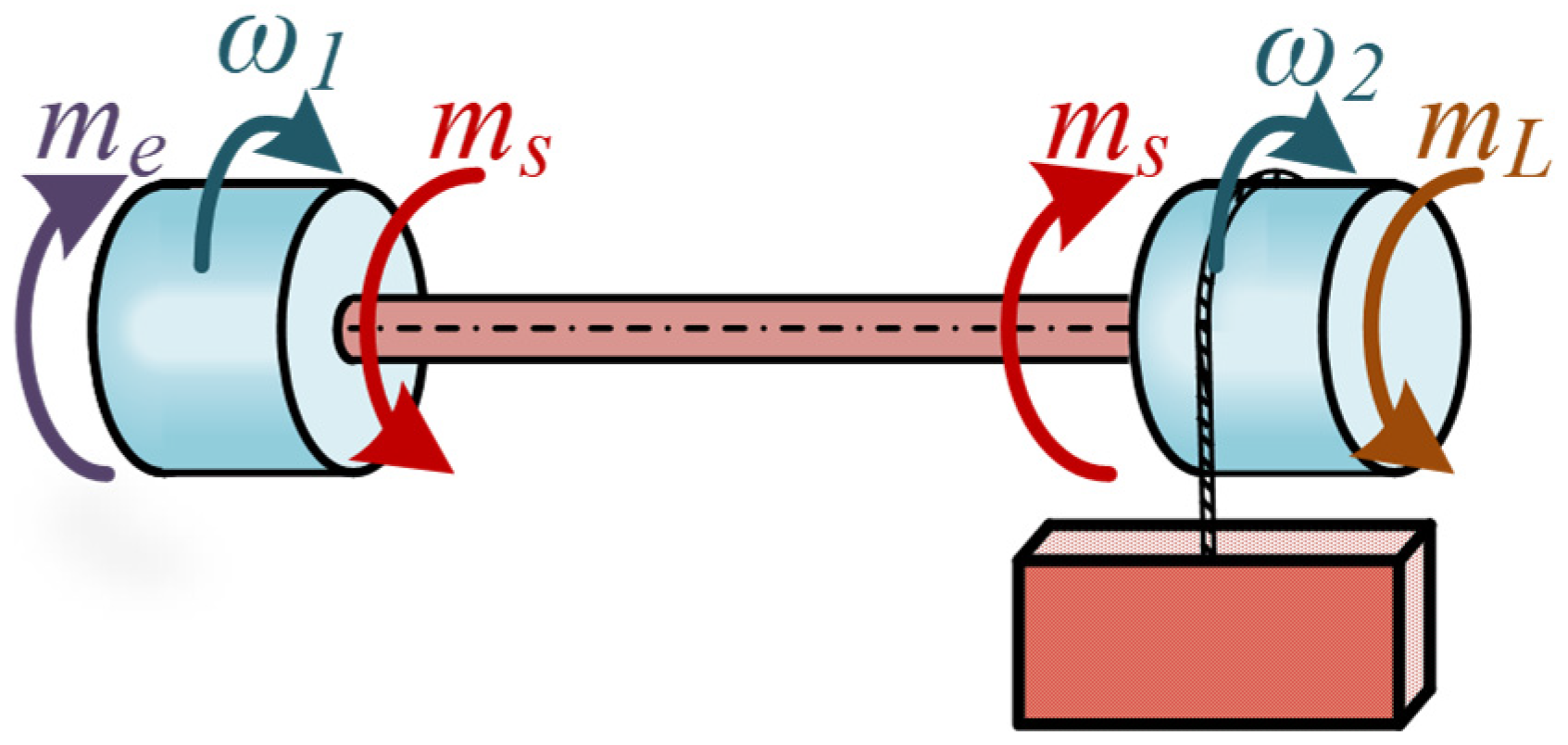
To perform the presented research, the per unit model with a non-inertial flexible shaft was selected. It was chosen because of low computational complexity and the sufficiently good fit to the real system. The model is presented in Figure 1 and described by Equations (1)–(3), provided that the following assumptions are made: half the value of the moment of inertia of the shaft is added to the moment of inertia of the drive (JM and, consequently, the time constant associated with this moment of inertia T1) and another half is added to the moment of inertia of the working machine (JL and, consequently, the time constant associated with this moment of inertia T2); mechanical parameters are constant in time; there is only one flexible element, which is homogeneous and linear; and friction torque is not present [9].
ω 1 ( t ) = 1 s T 1 ( m e ( t ) m s ( t ) )
ω 2 ( t ) = 1 s T 2 ( m s ( t ) m L ( t ) )
m s ( t ) = 1 s T c ( ω 1 ( t ) ω 2 ( t ) )
where ω1, ω2—angular velocity of the drive and load machine; T1, T2—time constant connected with moment of inertia of the drive and load machine; Tc—time constant connected with elasticity constant of the shaft; and me, ms, mL—electromagnetic, torsional and load torque.

3. Classical Nonlinear Extended Kalman Filter

In the classical nonlinear extended Kalman filter (NEKF), the basic state vector is extended by the load torque and the time constant of the load machine. This approach allows for not only the estimation of the state vector, but also of the disturbance—the load moment, and the system parameter—the time constant of the machine. The state vector and the input vectors will take the form shown in Equation (4):
x ^ E = [ ω ^ 1 ω ^ 2 m ^ S m ^ L 1 / T ^ 2 ] T ,   u = m e ,   y = ω 1
where x is the state vector, u is the input vector, y is the output vector, and ^ is the index of estimated variable.
By identifying the parameters of the system, the AE matrix of the Kalman filter is not constant but changes with the iterations of the algorithm, so the equations of state are of the form shown in Equations (5) and (6):
d d t x E ( t ) = A E ( 1 T 2 ( t ) ) x ( t ) + B E u ( t ) + w ( t ) = F E ( x E ( t ) , u ( t ) ) + w ( t )
y ( t ) = C E x E ( t ) + v ( t )
where the state AE, input BE, and output CE matrices are of the form shown in Equation (7), and w(t), v(t) represent process and measurement noises.
A E = [ 0 0 1 T 1 0 0 0 0 1 T 2 ( t ) 1 T 2 ( t ) 0 1 T c 1 T c 0 0 0 0 0 0 0 0 0 0 0 0 0 ] , B E = [ 1 T 1 0 0 0 0 ] , C E = [ 1 0 0 0 0 ] T
The nonlinear equation of state can be solved by introducing an FE matrix whose parameters are the state vector, input vector, and time as shown in Equation (5). After discretisation of the algorithm, as a result of linearisation operation for the current operating point—Equation (8), the FE matrix will take the form of Equation (9):
F E ( k ) = f ( x E ( k | k ) , u ( k | k ) , k ) ) x E ( k | k ) | x E = x ^ E ( k | k )
F E = [ 1 0 T s T 1 0 0 0 1 T s T 2 ( k ) T s T 2 ( k ) T s ( m s ( k ) m L ( k ) ) T s T c T s T c 1 0 0 0 0 0 1 0 0 0 0 0 1 ]
where Ts is the sampling time and k is the calculation step.
The covariance matrix of the estimation error of the state predictor is now determined by an FE matrix that changes at each iteration of the algorithm, as shown in Equation (10).
P ( k + 1 | k ) = F E ( k ) P ( k | k ) F E ( k ) T + Q

4. Multi-Layer Nonlinear Extended Kalman Filter

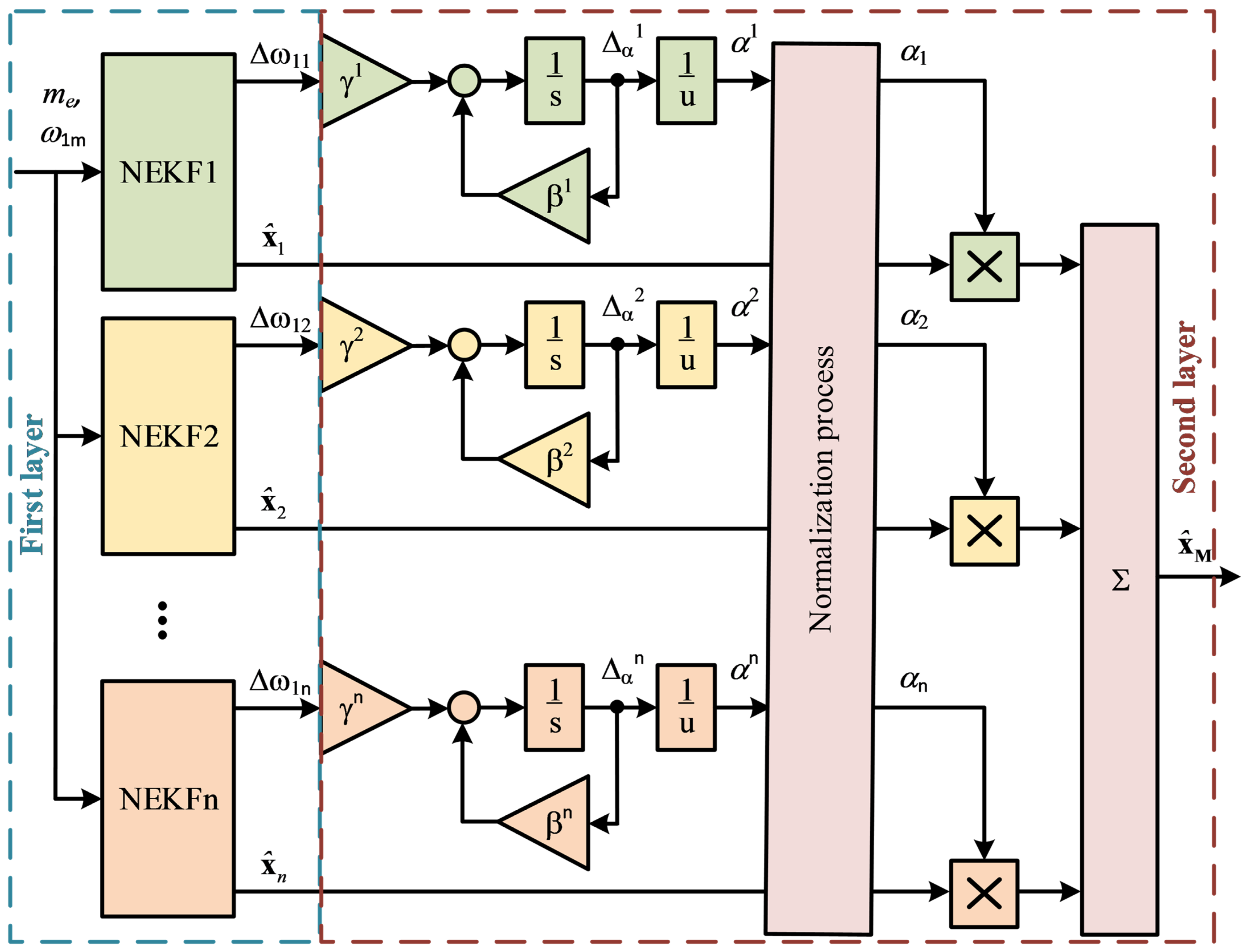
The general concept of the multi-observatory algorithm was first described in the papers [27,28]. In application to the two-mass system, it was described in the papers [29,30]. The idea is to use, in the first layer, multiple estimators differing in parameters, for example, initial state or dynamics, and to perform the calculations associated with them in the same iteration of the multi-observer algorithm. In the presented work, the nonlinear extended Kalman filters are used in the first layer. The estimates of the individual observers are then compared with the reference signal by a mechanism that uses their estimation errors to do so. As a result of the comparison, weighting coefficients (α—Equation (11)) are calculated, which determine the importance of the individual observers estimates in the output signal. Finally, the multi-observer output signal is the sum of all the individual observer estimates multiplied by their corresponding weighting factors. This process is referred to as the second layer. It is important to note that the quality of the multi-observer’s performance is determined by the algorithm for adapting the weighting factors, and by the chosen initial conditions in individual estimators from first layer.
α n ( t ) = 1 α n = 1 γ n | ω 1 n ω ^ 1 n | d t β n α n ( t 1 )
where n—number of estimator (n-th estimator) in first layer, αn—weight coefficient before normalisation of n-th estimator, γ—learning coefficient, and β—forgetting coefficient.
In this paper, the forgetting mechanism with a forgetting coefficient β is introduced. The calculation of the Δαn error will then be equivalent to the behaviour of the first-order inertial term. Thus, the Δαn error will not be the sum of all errors, but the sum of errors within a certain sliding window of size defined by the parameter β. This allows the algorithm to remain responsive to the occurrence of new conditions during the estimation, for example, the change in a load moment or a change in the system parameters.
The coefficients are then normalised according to Equation (12) so that the condition in Equation (13) is met.
α n = α n i = 1 n α i
α 1 + α 2 + + α n = 1
where αn—weight coefficient after normalisation of n-th estimator.
The use of normalisation implies that, by the superposition principle, the stability of the entire system is preserved, provided that the estimators in the first layer are stable. Therefore, in this case, the stability analysis of the proposed system can be reduced to the stability analysis of a single EKF.
The final output signal is described by Equation (14), where each of the estimated state vectors has a corresponding weighting factor α. The schematic block diagram of multi-layer nonlinear extended Kalman filter (MNEKF) is presented on Figure 2.
x ^ M = α 1 x ^ 1 + α 2 x ^ 2 + + α n x ^ n
where x ^ M —output signal of multi-layer estimator and x ^ n —output signal of n-th estimator.

5. Simulation Studies

In this paper, a multi-observer structure is presented in which the estimators in the first layer differ only in their initial conditions. Assuming that the two-mass system may not have zero initial conditions when control begins, a control structure with such a multi-observer that is resistant to such situations can be created. Algorithms, described earlier, were used in the first layer to create multi-layer, nonlinear, extended Kalman filters (MNEKF) to test whether it will improve the quality of parameter identification over the baseline algorithms. The algorithm was tested in a simulation manner in the MATLAB/Simulink (2010a) environment, using the ode1 solver with a fixed step size of 0.005 s. All Kalman filters used in the considered multi-observer structure are based on the same mathematical model and employ identical Q and R covariance matrices.
The study assumed a situation where the value of the load side time constant is unknown and only the interval of values between 0.5 × T2N and 6.5 × T2N in which it can lie is known, with T2N = T1 = 0.203 s. The extremes of this interval were used to create the initial state vectors of the internal Kalman filters, which, together with the other parameters of the multi-layer structure, are shown in Table 1. During the tests, the estimator was operated in an open loop and its input signals were collected from a two-mass drive structure with a state controller.
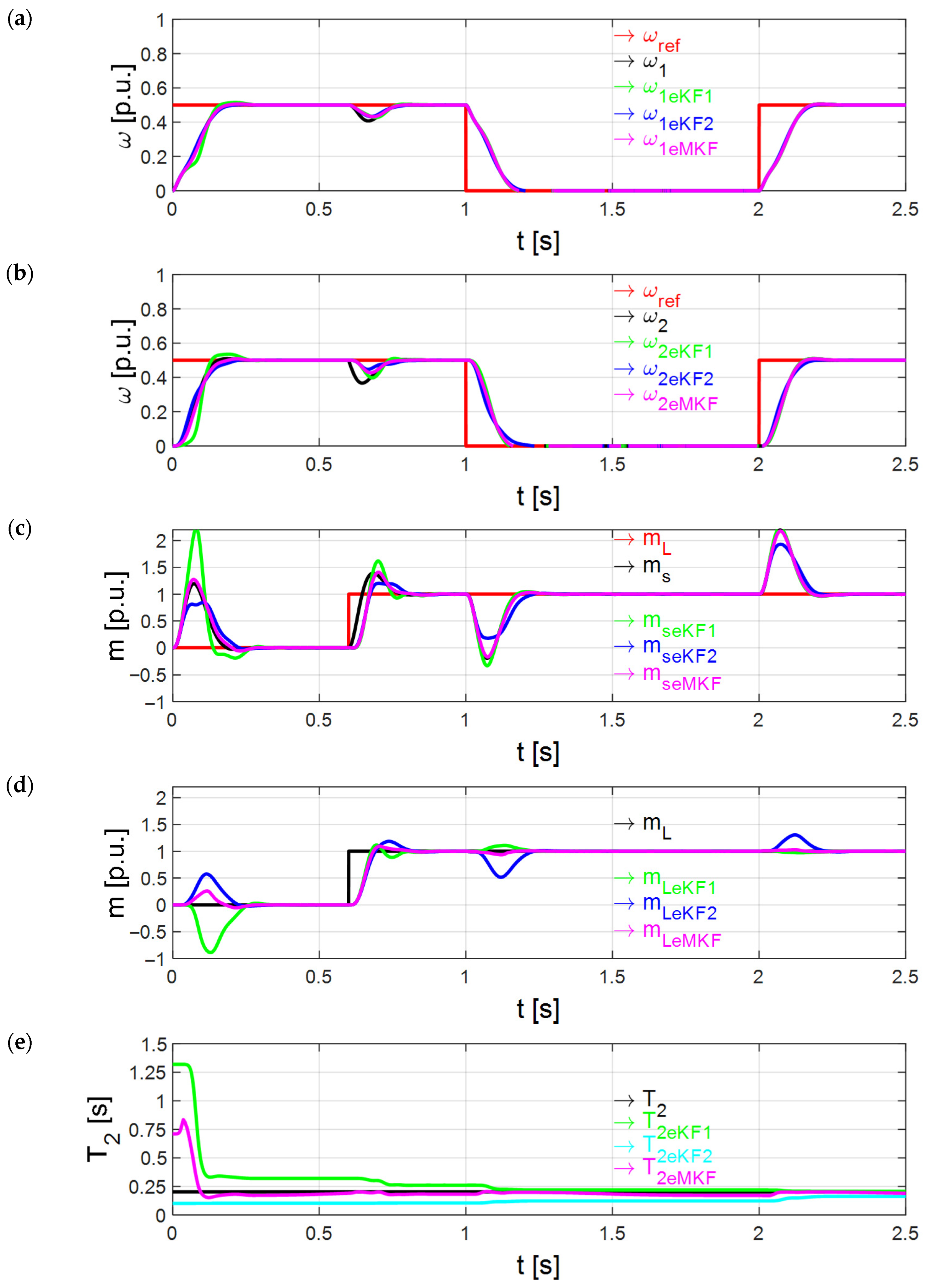
The results of simulation research are shown on Figure 3. The initial errors arise from the lack of knowledge of the initial value of the load machine time constant and therefore cannot be avoided. It can be observed that, as time progresses and subsequent cycles are executed, each estimator converges to the reference value and the errors in the other state variables also decrease.
The presented results show that the values estimated by the multi-observer, compared to internal Kalman filters, are much closer to the transients of the state variables of the two-mass drive system shown in Figure 3a–c and the set load torque shown in Figure 3d, and the identified load time constant converges to the correct value much faster, as shown in Figure 3e. The total estimation errors of the internal Kalman filters were determined and related to the total errors of the multi-structure according to Equations (15) and (16), the results are shown in Table 2.
Δ v = i = 1 N | v r e f v e | N
δ v = 100 % × Δ v K F Δ v M L O
where Δv—the sum of the estimation errors of the individual state variables, (v) divided by the number of samples N for the multi-observer (MLO) and the first layer observers (KF), and δv—the relative, percentage errors related to the multi-observer errors.
The results summarised in Table 2, which present internal Kalman filters estimation errors compared to the MNEKF errors, show that the estimation errors of internal, classical estimators are significantly larger for all estimated values. In the case of the estimated load time constant parameter, even 2.5 times larger.
However, from the point of view of the system designer, who, having only the classical system at his disposal and knowing that the load time constant lies in the interval 0.5 × T2N–6.5 × T2N, it would be best to set the initial conditions around the middle of this range, rather than at its edge. To extend the test, another internal Kalman filter was added to the multi-structure and a further three tests were performed for three different initial conditions of this sub-structure. The values were chosen to be ideally in the middle of the interval, but also below and above it. Table 3 shows the MNEKF parameters for the subsequent tests.
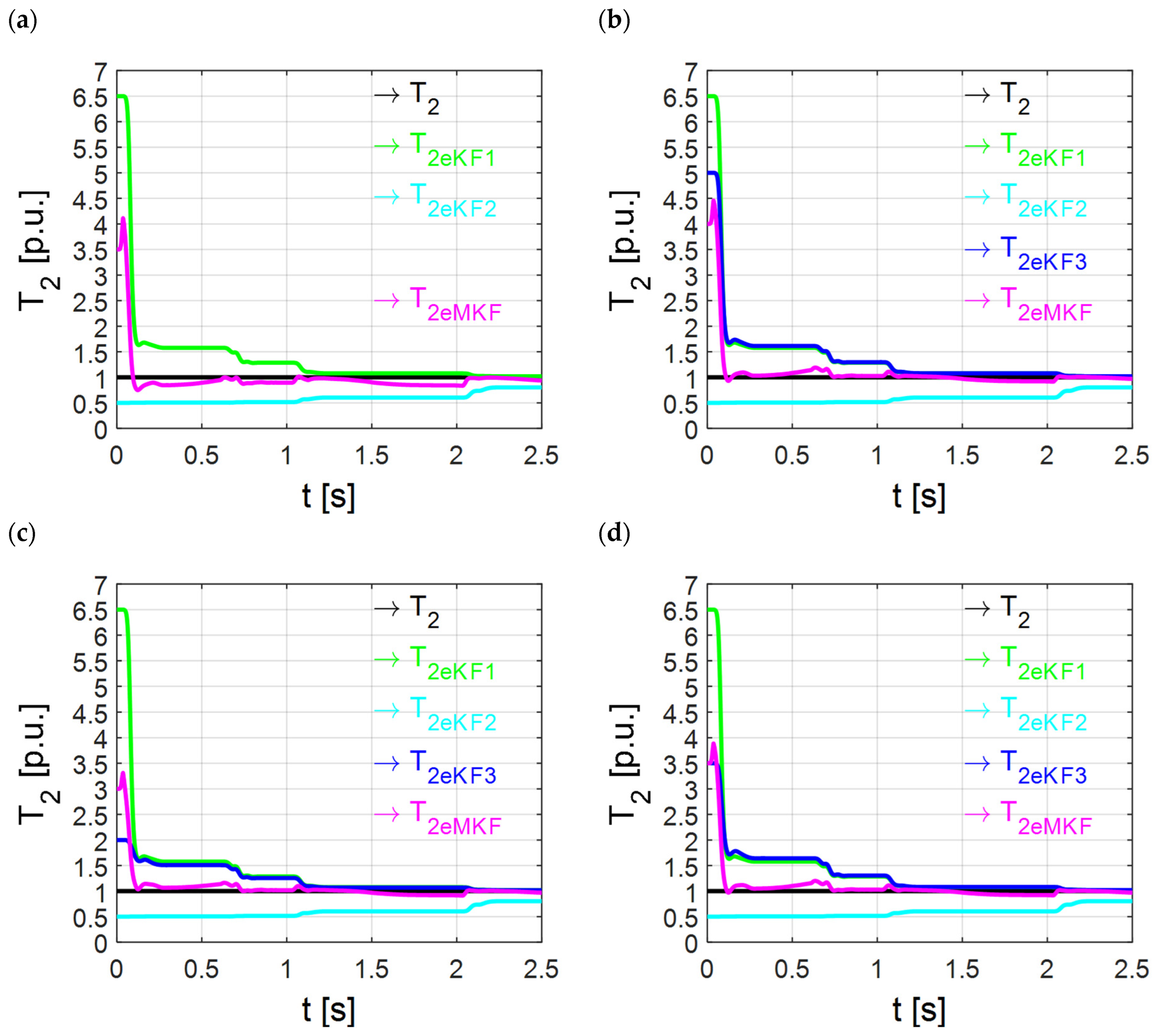
Figure 4 collects the load time constant identification transients from all 4 tests. The graphs have been scaled so that the values are related to the nominal value of T2N.
Figure 4 shows well the mechanism of adaptation of the weights of the multi-structure. In Figure 4a, the transient of identification starts exactly in the middle of the interval, because there are only two internal Kalman filters with extreme values and the initial weights for their signals are equal. In Figure 4b, the addition of a third internal Kalman filter with initial conditions above the centre of the interval moved the beginning of the identification of the multi-structure to 4 × T2N. Setting the initial conditions of the third Kalman filter below the midpoint of the interval moves the starting point of identification to 3 × T2N (Figure 4c) and setting them in the middle of the interval again sets the starting point of identification to 3.5 × T2N (Figure 4d). In all three tests with three internal Kalman filters, the identification of the T2 time constant by the multi-structure performed better; the initial upward bias and overshoot were reduced compared to the multi-structure with only two internal Kalman filters. This is also confirmed by Table 4, where the total estimation errors of individual values for MNEKF in all four tests are collected and the results of tests 2, 3 and 4 (3 internal Kalman filters) are also related to the results of test 1 (2 internal Kalman filters).
The results collected in Table 4 prove that a multi-structure with 3 internal Kalman filters is better than a multi-structure with 2 internal Kalman filters. The total estimation errors of the working machine’s speed, load torque, and parameter identification are smaller. In the case of time constant T2, even by several tens of percentage points, only the estimation of the torsional torque slightly worsened.
The results presented above were obtained for only one particular value of the load time constant. In order to extend the study, an extended test was carried out for many different values of the T2 parameter over the entire assumed range. In addition, tests were carried out for a multi-structure consisting of 2, 3, 4, 5, and 6 internal Kalman filters. Their initial values were always chosen to be evenly distributed over the assumed range of possible T2 parameter values, as shown in Table 5.
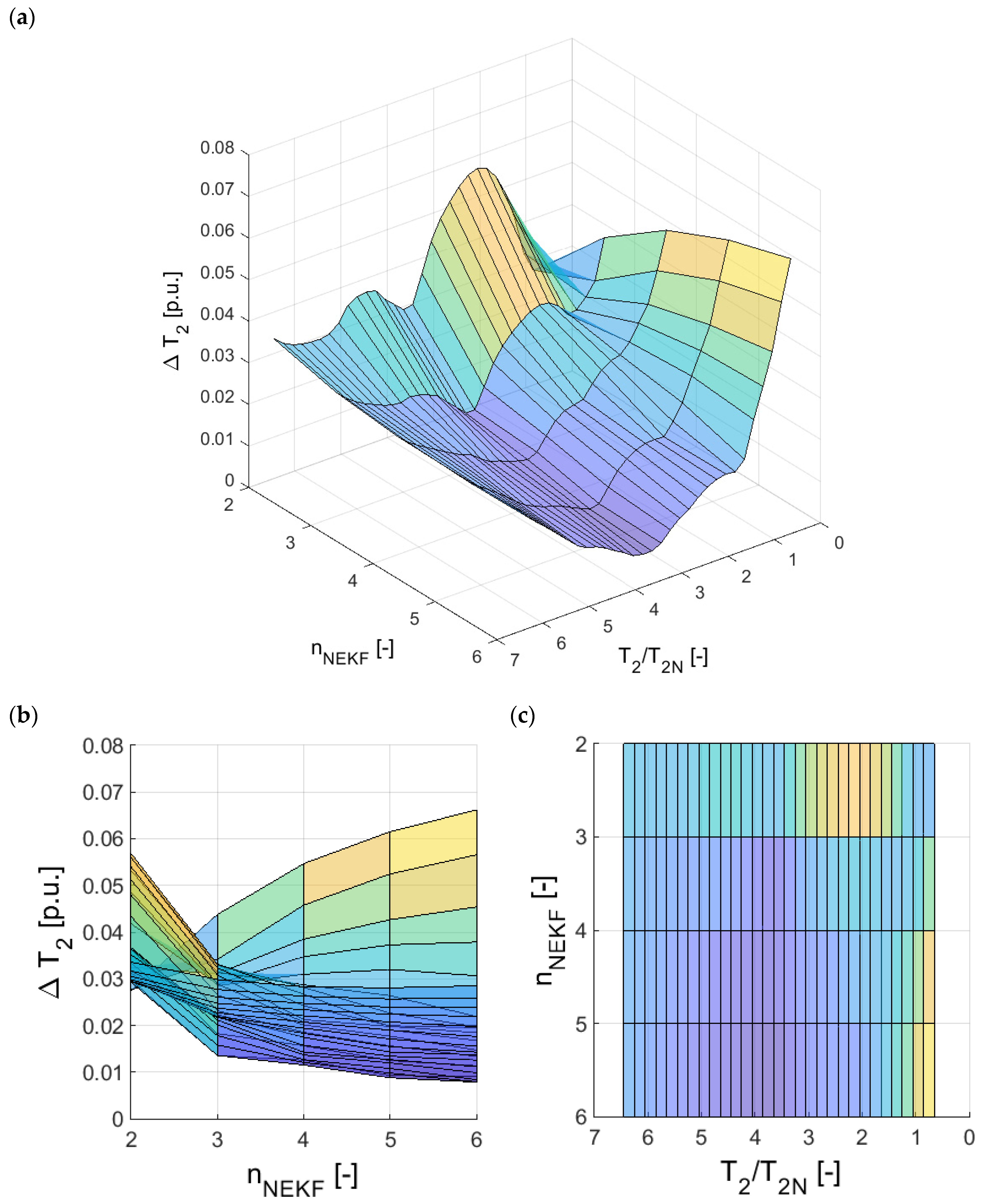
In order to visualise this study consisting of many simulation tests, the 3D graphics shown in Figure 5 were developed.
The results presented in Figure 5a show the error rate of identification of the load time constant by the MNEKF structure with different numbers of internal Kalman filters for different identified values of T2 from the range of 0.5 × T2N to 6.5 × T2N. The analysis of these results allows us to conclude that, in general, a higher number of internal estimators translates into better identification in most of the search range, which is clearly visible in Figure 5b. The smallest estimation errors are observed in the middle of the range, which is also due to the fact that the selected initial values are evenly distributed, so the multi-structure always starts identification at 3.5 × T2N. The closer the location of the identified T2 near the boundaries of the interval, the worse the performance of structures with a large number of internal estimators relative to those with a small number (Figure 5c). For values of T2 located near T2N, a number of internal estimators larger than three results in larger identification errors. For the case where T2 is closest to 0.5 × T2N, the best result was achieved by a structure with only two internal estimators. It is also worth noting that although the computational power requirement with the addition of more internal Kalman filters increases linearly, the identification error for cases where T2 is around the middle of the range does not decrease linearly either; the largest decrease in error occurs between a multi-structure with two internal estimators and a multi-structure with three internal estimators. After that, the decrease in identification error smooths out. The presented study allows us to conclude that the number of internal estimators of the multi-structure is a parameter that should be determined by the system designer. Increasing it may not lead to improved results at all in rare, specific situations. When designing, the following parameters should be taken into account: the minimum required quality of identification and the computational capabilities of the chip on which the structure is to be implemented. For the case under consideration, a structure with three estimators was selected for the experimental investigations.

6. Experimental Studies

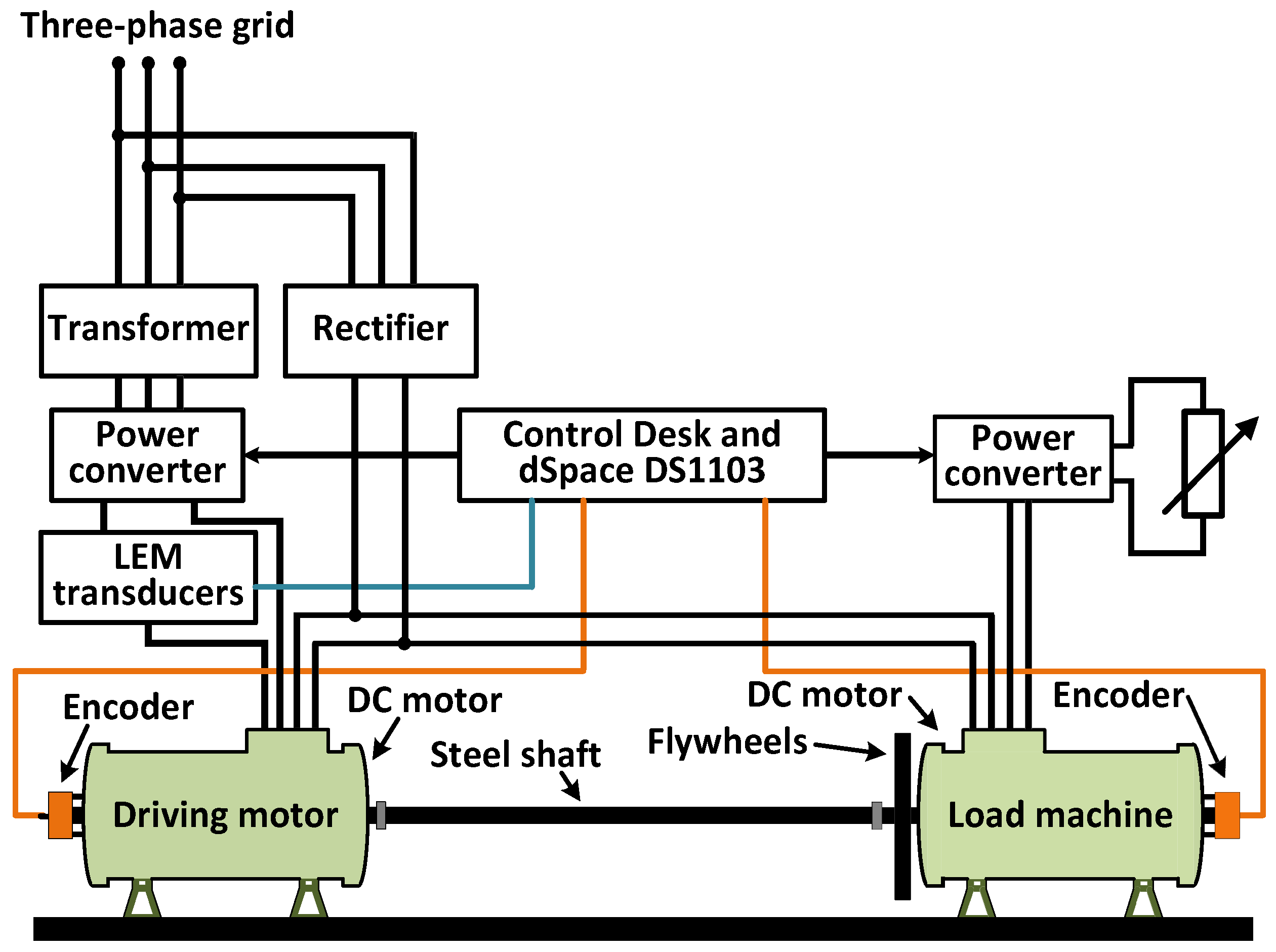
The test bench (Figure 6) consists of a DC motor and a DC generator (Table 6) connected by a long and thin steel shaft. The motor armature is powered by a power electronic converter with an H-bridge. Together with the motor, they form the drive. The generator serves as a load machine and has the ability to produce a controlled braking torque with the help of a power electronic converter and a braking resistor. The power supply for the excitation circuits for both the motor and the generator is implemented using a rectifier. A dSPACE 1103 processor (Paderborn, Germany) connected to a PC is responsible for control. The processor also collects measurement signals from the two encoders mounted on the machine shafts and from the LEM sensor measuring the armature current. Software for the dSPACE processor integrated with MATLAB’s Simulink environment allows the testing of various control algorithms, acquisition of the data, and visualisation of transients of the speeds, armature current, and signals from the control structure. The bench has the ability to mount spring shafts of different cross-sectional diameters and additional discs, allowing to configure systems with different parameters.
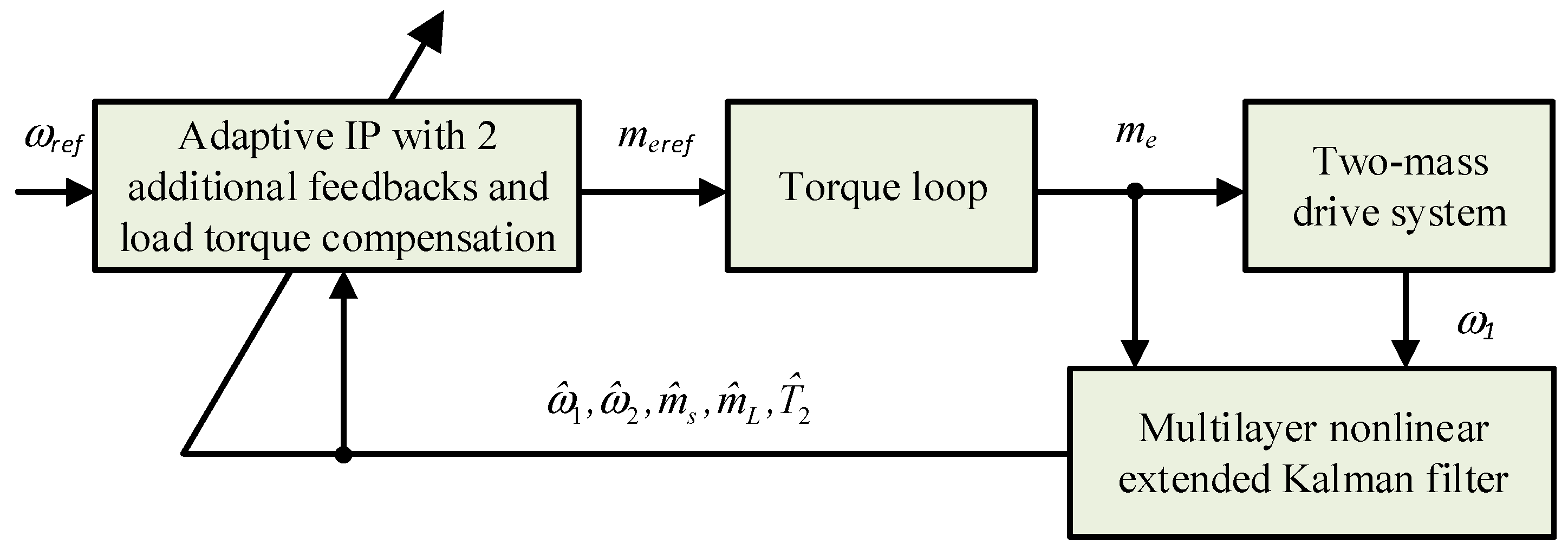
During the experimental study, the MNEKF was used in a closed adaptive control structure with an IP controller with two feedbacks and load torque compensation. The parameters KP, KI, K1, K2, and KL1 are retuned by online identification of the load time constant. The results obtained by the system with a multi-observer were compared with those obtained by the system with a single Kalman filter. The schematic block diagram of the control loop is presented in Figure 7. The experimental tests employed a multi-structure using 3 internal Kalman filters, because previous simulation studies have shown that this number is optimal from the perspective of the relation between the quality of identification and the required computing power. The parameters of the structure are shown in Table 7, and the initial parameters of the internal Kalman filters were adjusted to match the conditions of the test bench. The nominal value of the load time constant was assumed to be equal to the motor time constant: T2N = T1 = 0.203.
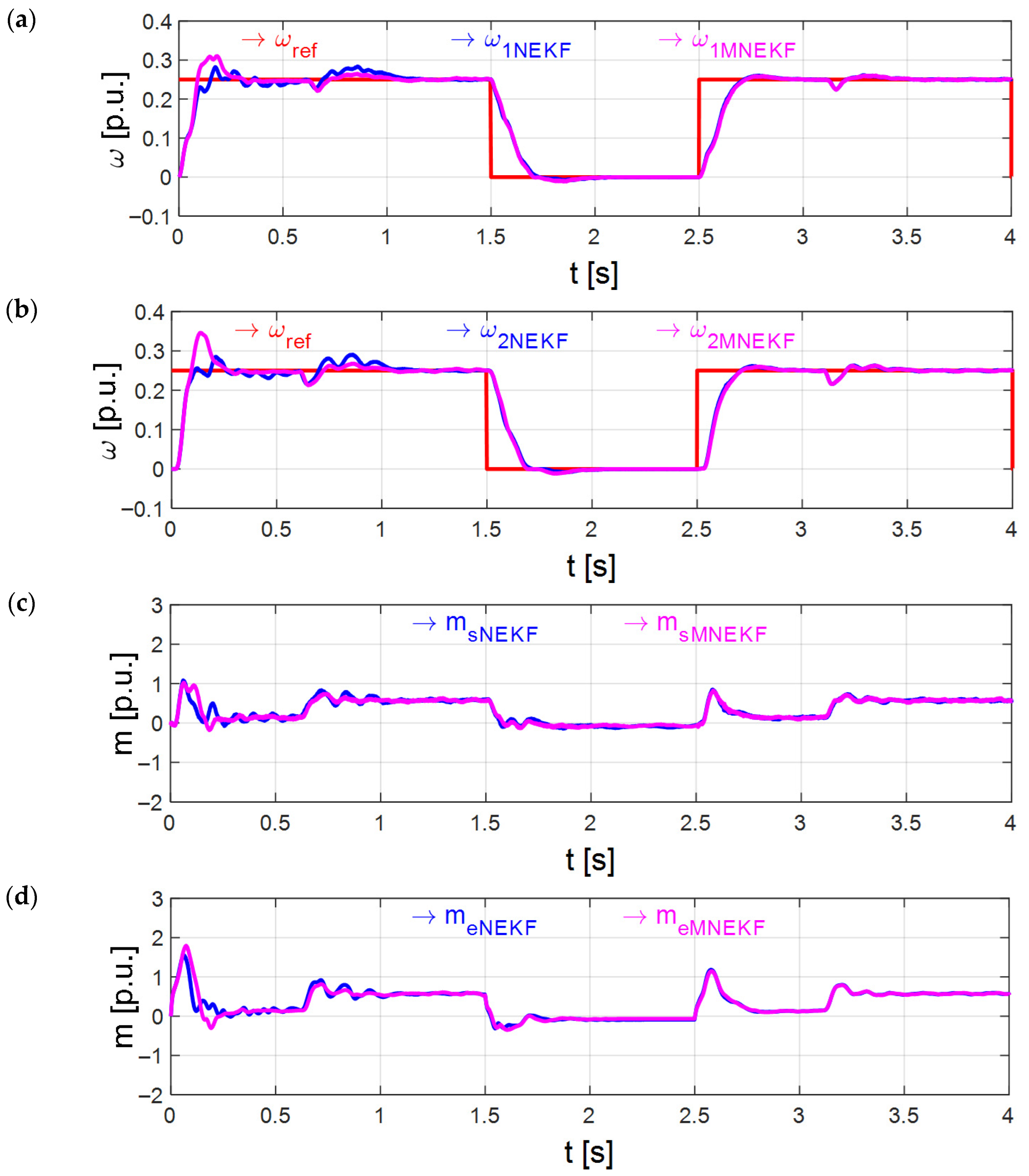
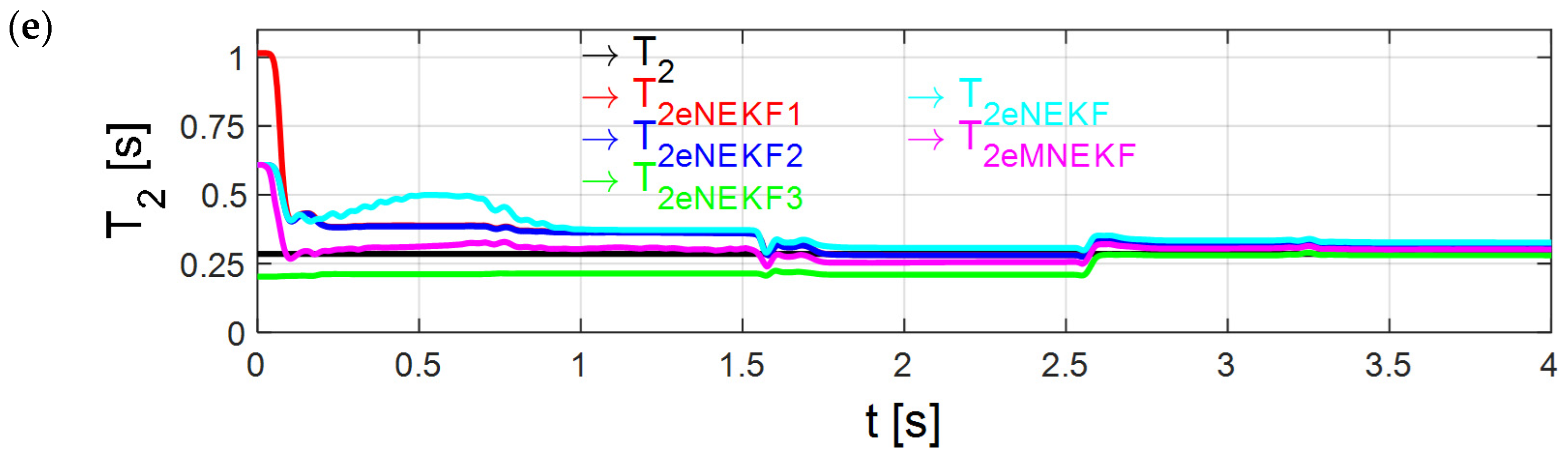
A study was conducted in which the value of the load time constant was unknown to the control system at the beginning of the control. Changing the time constant during the test is not possible on the system used, so this part of the test was omitted. But the operation of the estimator assumes such a situation. It was assumed that the moment of this change was known; in a real system, this could be realised with a suitable additional sensor. At this moment, the identified T2 values of the internal estimators NEKF1 and NEKF3 were reset to their initial values of 1/5T2N and 1/T2N, respectively. The internal estimator NEKF2 conducted continuous identification. The tests were carried out for two cases: when the adaptive controller cooperates with a multi-structure and when the adaptive controller cooperates with a single NEKF with initial conditions set like the internal estimator NEKF2. The experimental results obtained are shown in Figure 8 and in Table 8 (in this case, the closed-loop control system with the multi-layer estimator is the reference model for the individual estimators.).
The multi-layer structure already identified the time constant of the load quite accurately after about 0.1 s after the onset of the first dynamic state, while the standard NEKF estimator needed further dynamic states—the onset of the load moment and the change in the set speed in 1.5 s. As a result, the waveforms of the state variables obtained for the system with the standard NEKF show additional oscillations, while in the system using the multi-layer structure only overshoot appears at the beginning of the speed transients.

7. Conclusions

The study presented that the number of internal estimators of the multi-structure is a parameter that should be determined by the system designer, bearing in mind that increasing it may not lead to improved results at all. When designing, the following parameters should be considered: the minimum required quality of identification and the computational capabilities of the chip on which the structure is to be implemented. It should be noted that the proposed solution significantly increases the required computational resources as it is based on parallel computing of extended Kalman filters, which are already computationally demanding.
Moreover, the use of a properly designed multi-layer observer can improve the quality of the estimation of the state variables of the two-mass drive system compared to classical solutions. The use of a multi-layer approach on algorithms designed for online identification of parameters of the two-mass system makes it possible to speed up identification, and the multi-observers used in advanced control systems using adaptive approaches allow better use of the capabilities of these solutions compared to when they work with classical estimators.

Author Contributions

Conceptualization, K.W. and K.K.Ś.; Methodology, K.W. and K.K.Ś.; Software, K.K.Ś.; Validation, K.W. and K.K.Ś.; Formal analysis, K.W.; Investigation, K.K.Ś.; Resources, K.W.; Data curation, K.W. and K.K.Ś.; Writing—original draft, K.W.; Writing—review & editing, K.W., K.K.Ś. and P.M.; Visualization, K.W. and K.K.Ś.; Supervision, K.W.; Project administration, K.W.; Funding acquisition, K.W. All authors have read and agreed to the published version of the manuscript.

Funding

This research received no external funding.

Data Availability Statement

The original contributions presented in this study are included in the article. Further inquiries can be directed to the corresponding author.

Conflicts of Interest

The authors declare no conflict of interest.

References

  1. Golnary, F.; Moradi, H. Dynamic modelling and design of various robust sliding mode controls for the wind turbine with estimation of wind speed. Appl. Math. Model. 2019, 65, 566–585. [Google Scholar] [CrossRef]
  2. Remigius, W.D.; Natarajan, A. Identification of wind turbine main-shaft torsional loads from high-frequency SCADA (supervisory control and data acquisition) measurements using an inverse-problem approach. Wind Energy Sci. 2021, 6, 1401–1412. [Google Scholar] [CrossRef]
  3. Boukhezzar, B.; Siguerdidjane, H. Nonlinear Control of a Variable-Speed Wind Turbine Using a Two-Mass Model. IEEE Trans. Energy Convers. 2011, 26, 149–162. [Google Scholar] [CrossRef]
  4. Dhaouadi, R.; Kubo, K.; Tobise, M. Two-degree-of-freedom robust speed controller for high-performance rolling mill drives. IEEE Trans. Ind. Appl. 1993, 29, 919–926. [Google Scholar] [CrossRef]
  5. Zhang, R.; Tong, C. Torsional Vibration Control of the Main Drive System of a Rolling Mill Based on an Extended State Observer and Linear Quadratic Control. J. Vib. Control 2006, 12, 313–327. [Google Scholar] [CrossRef]
  6. Gasiyarov, V.R.; Radionov, A.A.; Loginov, B.M.; Zinchenko, M.A.; Gasiyarova, O.A.; Karandaev, A.S.; Khramshin, V.R. Method for Defining Parameters of Electromechanical System Model as Part of Digital Twin of Rolling Mill. J. Manuf. Mater. Process. 2023, 7, 183. [Google Scholar] [CrossRef]
  7. Wang, L.; Wang, D.; Wu, J. Dynamic performance analysis of parallel manipulators based on two-inertia-system. Mech. Mach. Theory 2019, 137, 237–253. [Google Scholar] [CrossRef]
  8. Gao, P.; Lou, Y.; Okada, K. Detection and suppression for mechanical resonance in hard disk drives with built-in piezoelectric sensors. In Proceedings of the Smart Structures and Materials 2002: Smart Sensor Technology and Measurement Systems, San Diego, CA, USA, 17–21 March 2002; SPIE: Bellingham, WC, USA; pp. 78–85. [Google Scholar] [CrossRef]
  9. Szabat, K.; Orlowska-Kowalska, T. Vibration Suppression in a Two-Mass Drive System Using PI Speed Controller and Additional Feedbacks—Comparative Study. IEEE Trans. Ind. Electron. 2007, 54, 1193–1206. [Google Scholar] [CrossRef]
  10. Bang, J.S.; Shim, H.; Park, S.K.; Seo, J.H. Robust Tracking and Vibration Suppression for a Two-Inertia System by Combining Backstepping Approach with Disturbance Observer. IEEE Trans. Ind. Electron. 2010, 57, 3197–3206. [Google Scholar] [CrossRef]
  11. Wang, C.; Yang, M.; Zheng, W.; Long, J.; Xu, D. Vibration Suppression with Shaft Torque Limitation Using Explicit MPC-PI Switching Control in Elastic Drive Systems. IEEE Trans. Ind. Electron. 2015, 62, 6855–6867. [Google Scholar] [CrossRef]
  12. Gorla, A.; Serkies, P. Comparative Study of Analytical Model Predictive Control and State Feedback Control for Active Vibration Suppression of Two-Mass Drive. Actuators 2025, 14, 254. [Google Scholar] [CrossRef]
  13. Nalepa, R.; Najdek, K.; Wróbel, K.; Szabat, K. Application of D-Decomposition Technique to Selection of Controller Parameters for a Two-Mass Drive System. Energies 2020, 13, 6614. [Google Scholar] [CrossRef]
  14. Kaczmarczyk, G.; Stanislawski, R.; Kaminski, M. Deep-Learning Techniques Applied for State-Variables Estimation of Two-Mass System. Energies 2025, 18, 568. [Google Scholar] [CrossRef]
  15. Kaczmarczyk, G.; Stanislawski, R.; Kaminski, M.; Kasprzak, K.; Ferreira, D.D. A neural-enhanced active disturbance load-side speed control of an electric drive with a flexible link. Arch. Electr. Eng. 2025, 74, 269–289. [Google Scholar] [CrossRef]
  16. Stanislawski, R.; Tapamo, J.-R.; Kaminski, M. Virtual Signal Calculation Using Radial Neural Model Applied in a State Controller of a Two-Mass System. Energies 2023, 16, 5629. [Google Scholar] [CrossRef]
  17. Serkies, P.; Szabat, K. Estimation of the state variables of the two-mass system using fuzzy Kalman filter. In Proceedings of the 2013 IEEE International Symposium on Industrial Electronics, Taipei, Taiwan, 28–31 May 2013; pp. 1–6. [Google Scholar] [CrossRef]
  18. Derugo, P. Transfer learning for fuzzy control of two-mass drive system using state variables feedback. In Proceedings of the 2023 10th International Conference on Electrical, Electronic and Computing Engineering (IcETRAN), East Sarajevo, Bosnia and Herzegovina, 5–8 June 2023; pp. 1–6. [Google Scholar] [CrossRef]
  19. Shang, D.; Li, X.; Yin, M.; Li, F. Vibration Suppression Method Based on PI Fuzzy Controller Containing Disturbance Observe for Dual-flexible Manipulator with an Axially Translating Arm. Int. J. Control Autom. Syst. 2022, 20, 1682–1694. [Google Scholar] [CrossRef]
  20. Kahsay, A.H.; Derugo, P.; Szabat, K.; Katsura, S. Design of Disturbance Observer-Based Robust Speed Control Structure for Two-Mass Drive System with the Help of Birch Optimization Algorithm. Energies 2025, 18, 1914. [Google Scholar] [CrossRef]
  21. Ruderman, M.; Iwasaki, M. Combined Luenberger state and disturbance observer for semi-dual loop control of two-mass actuator system. In Proceedings of the 2014 IEEE 13th International Workshop on Advanced Motion Control (AMC), Yokohama, Japan, 14–16 March 2014; pp. 500–505. [Google Scholar] [CrossRef]
  22. Wang, C.; Liu, J.; Xin, L.; Li, G.; Pan, J. Design of Full-Order State Observer for Two-Mass Joint Servo System Based on the Fixed Gain Filter. IEEE Trans. Power Electron. 2022, 37, 10466–10475. [Google Scholar] [CrossRef]
  23. Saarakkala, S.E.; Hinkkanen, M. State-Space Speed Control of Two-Mass Mechanical Systems: Analytical Tuning and Experimental Evaluation. IEEE Trans. Ind. Appl. 2014, 50, 3428–3437. [Google Scholar] [CrossRef]
  24. Wróbel, K.; Dróżdź, K.; Szabat, K. Application of Fuzzy Unscented Kalman Filter for States and Parameter Estimation of Two-Mass Drive. In Proceedings of the 2020 IEEE 29th International Symposium on Industrial Electronics (ISIE), Delft, The Netherlands, 17–19 June 2020; pp. 259–264. [Google Scholar] [CrossRef]
  25. Yokoyama, M.; Oboe, R.; Shimono, T. Robustness Analysis of Two-Mass System Control Using Acceleration-Aided Kalman Filter. In Proceedings of the IECON 2018—44th Annual Conference of the IEEE Industrial Electronics Society, Washington, DC, USA, 21–23 October 2018; pp. 4600–4605. [Google Scholar] [CrossRef]
  26. Nevaranta, N.; Derammelaere, S.; Parkkinen, J.; Vervisch, B.; Lindh, T.; Niemela, M.; Pyrhonen, O. Online Identification of a Two-Mass System in Frequency Domain using a Kalman Filter. Model. Identif. Control. 2016, 37, 133–147. [Google Scholar] [CrossRef]
  27. Bernat, J.; Stepien, S. Multi-modelling as new estimation schema for high-gain observers. Int. J. Control 2015, 88, 1209–1222. [Google Scholar] [CrossRef]
  28. Bernat, J.; Kołota, J.; Superczyńska, P.; Stępień, S. Multi-layer observer as new structure for state estimation in linear systems. Arch. Electr. Eng. 2017, 66, 507–521. [Google Scholar] [CrossRef]
  29. Szabat, K.; Wróbel, K.; Śleszycki, K.; Katsura, S. States Estimation of the Two-Mass Drive System Using Multilayer Observer. In Proceedings of the 2021 IEEE 19th International Power Electronics and Motion Control Conference (PEMC), Gliwice, Poland, 25–29 April 2021; pp. 743–748. [Google Scholar] [CrossRef]
  30. Szabat, K.; Tokarczyk, A.; Wróbel, K.; Katsura, S. Application of the Multi-Layer Observer for a Two-Mass Drive System. In Proceedings of the 2020 IEEE 29th International Symposium on Industrial Electronics (ISIE), Delft, The Netherlands, 17–19 June 2020; pp. 265–270. [Google Scholar] [CrossRef]
Figure 1. Schematic block diagram of a two-mass drive system.
Energies 19 00028 g001
Figure 2. Schematic block diagram of the multi-layer nonlinear extended Kalman filter (MNEKF).
Energies 19 00028 g002
Figure 3. Results of the MNEKF simulation test, drive speed transients (a); work machine speed transients (b); torsional torque transients (c); load torque transients (d); load time constant (e).
Energies 19 00028 g003
Figure 4. Results of the MNEKF simulation test, transients of identification of the load time constant in test 1 (a), test 2 (b), test 3 (c), test 4 (d).
Energies 19 00028 g004
Figure 5. Results of MNEKF simulation studies for different numbers of internal Kalman filters and different values of identified load time constant, axes, estimation errors, number of internal estimators, value of identified parameter (a); axes, estimation errors, number of internal estimators (b); axes, number of internal estimators, value of identified parameter (c).
Energies 19 00028 g005
Figure 6. Schematic diagram of the experimental test bench.
Energies 19 00028 g006
Figure 7. Schematic block diagram of the control loop.
Energies 19 00028 g007
Figure 8. Results of the experimental test containing structure with modified adaptive IP controller working with standard NEKF and MNEKF, drive speed transients (a); work machine speed transients (b); torsional torque transients (c); electromagnetic torque transients (d); and load time constant (e).
Energies 19 00028 g008aEnergies 19 00028 g008b
Table 1. MNEKF parameter values in test 1.
xIMNEKFγβ
xINEKF1[0 0 0 0 1/(6.5 × T2N)]100,00010
xINEKF2[0 0 0 0 1/(0.5 × T2N)]
Table 2. Internal Kalman filters estimation errors compared to the MNEKF errors.
Δω1 [-]Δω2 [-]Δms [-]ΔmL [-]ΔT2 [-]
MNEKF1.35 × 10−34.37 × 10−32.48 × 10−23.61 × 10−23.30 × 10−2
NEKF13.20 × 10−37.78 × 10−35.53 × 10−26.61 × 10−28.27 × 10−2
NEKF22.90 × 10−39.88 × 10−35.80 × 10−28.05 × 10−28.27 × 10−2
δω1 [%]δω2 [%]δms [%]δmL [%]δT2 [%]
MNEKF100100100100100
NEKF1236.62178.03223.28183.07250.14
NEKF2214.31226.16233.93223.10250.13
Table 3. Multi-observer parameter values in tests 2, 3 and 4.
xIMNEKFγβ
xINEKF1[0 0 0 0 1/(6.5 × T2N)]100,00010
xINEKF2[0 0 0 0 1/(0.5 × T2N)]
xINEKF3 (test 2)[0 0 0 0 1/(5 × T2N)]
xINEKF3 (test 3)[0 0 0 0 1/(2 × T2N)]
xINEKF3 (test 4)[0 0 0 0 1/(3.5 × T2N)]
Table 4. MNEKF estimation errors in test 2, 3 and 4 compared to the MNEKF estimation errors in test 1.
Δω1 [-]Δω2 [-]Δms [-]ΔmL [-]ΔT2 [-]
MNEKF (test 1)1.35 × 10−34.37 × 10−32.48 × 10−23.61 × 10−23.30 × 10⁻²
MNEKF (test 2)1.55 × 10−34.30 × 10−32.71 × 10−23.08 × 10−22.86 × 10⁻²
MNEKF (test 3)1.46 × 10−33.91 × 10−32.61 × 10−23.23 × 10−22.27 × 10⁻²
MNEKF (test 4)1.55 × 10−34.18 × 10−32.70 × 10−23.16 × 10−22.62 × 10⁻²
δω1 [%]δω2 [%]δms [%]δmL [%]δT2 [%]
MNEKF (test 1)100100100100100
MNEKF (test 2)114.6598.47109.3185.3886.50
MNEKF (test 3)108.1889.60105.1189.4368.56
MNEKF (test 4)114.3995.68109.0087.4179.43
Table 5. Multi-observer parameter values in extended test.
nNEKFxIMNEKFnNEKFxIMNEKF
2[0 0 0 0 1/(6.5 × T2N)]
[0 0 0 0 1/(0.5 × T2N)]
5[0 0 0 0 1/(6.5 × T2N)]
[0 0 0 0 1/(5 × T2N)]
[0 0 0 0 1/(3.5 × T2N)]
[0 0 0 0 1/(2 × T2N)]
[0 0 0 0 1/(0.5 × T2N)]
3[0 0 0 0 1/(6.5 × T2N)]
[0 0 0 0 1/(3.5 × T2N)]
[0 0 0 0 1/(0.5 × T2N)]
6[0 0 0 0 1/(6.5 × T2N)]
[0 0 0 0 1/(5.3 × T2N)]
[0 0 0 0 1/(4.1 × T2N)]
[0 0 0 0 1/(2.9 × T2N)]
[0 0 0 0 1/(1.7 × T2N)]
[0 0 0 0 1/(0.5 × T2N)]
4[0 0 0 0 1/(6.5 × T2N)]
[0 0 0 0 1/(4.5 × T2N)]
[0 0 0 0 1/(2.5 × T2N)]
[0 0 0 0 1/(0.5 × T2N)]
Table 6. Characteristics of the DC Motors.
DC MotorDC Generator
Power500 W400 W
Nominal voltage220 V230 V
Nominal armature current3.15 A3.15 A
Nominal excitation current0.254 A0.254 A
Nominal speed1450 rpm1450 rpm
Rotor resistance8.05 Ω8.05 Ω
Rotor inductance0.8 H0.8 H
Moment of inertia0.0044 kgm20.0044 kgm2
Auxiliary poles resistance2 Ω2 Ω
Table 7. Multi-observer parameter values.
xIMNEKFγβP
xINEKF1[0 0 0 0 1/(5 × T2N)]100,000101
xINEKF2[0 0 0 0 1/(3 × T2N)]
xINEKF3[0 0 0 0 1/(1 × T2N)]
Table 8. MNEKF and NEKF estimation errors during the experimental study.
δω1 [%]δω2 [%]
MNEKF100100
NEKF1120.37125.21
NEKF2100.29100.36
NEKF3114.46119.47
Disclaimer/Publisher’s Note: The statements, opinions and data contained in all publications are solely those of the individual author(s) and contributor(s) and not of MDPI and/or the editor(s). MDPI and/or the editor(s) disclaim responsibility for any injury to people or property resulting from any ideas, methods, instructions or products referred to in the content.