Article

In Situ Electrochemical Detection of Silicon Anode Crystallization for Full-Cell Health Management

School of Materials Science and Engineering, Pusan National University, Busandaehak-ro 63 beon-gil, Geumjeong-gu, Busan 46241, Republic of Korea
*
Author to whom correspondence should be addressed.
Energies 2026, 19(1), 279; https://doi.org/10.3390/en19010279
Submission received: 27 November 2025 / Revised: 27 December 2025 / Accepted: 3 January 2026 / Published: 5 January 2026
(This article belongs to the Special Issue Advanced Electrochemical Energy Storage Materials)

Abstract

In this study, we investigate the relationship between the progressive lowering of the silicon (Si) anode potential during lithiation and the accompanying crystallization reaction to enable in situ electrochemical detection in Si-based full cells. Si–Li half cells were first analyzed by differential capacity (dQ/dV), revealing a crystallization feature near 0.05 V vs. Li+/Li, commonly associated with crystallization to Li15Si4. In the initial cycle, this signal was obscured by a dominant amorphization peak near 0.1 V; however, once amorphization was completed and the end-of-lithiation potential dropped below ~0.05 V in later cycles, a distinct crystallization peak became clearly resolvable. Under capacity-limited cycling that mimics full-cell operation, degradation-induced lowering of the Si-anode potential led to the appearance of the crystallization signal when the anode potential crossed this threshold. Based on these results, we extended the analysis to LiFePO4–Si three-electrode full cells and, by reparameterizing dQ/dV as a function of charge time, separated electrode-specific contributions and identified the Si crystallization feature within the full-cell response when N/P ≈ 1. A simple degradation-modeling scenario further showed that in cells initially designed with N/P > 1, loss of anode active material can reduce the effective N/P, drive the Si potential into the crystallization window, and introduce a new peak in the full-cell dQ/dV curve associated with Si crystallization. These combined experimental and modeling results indicate that degradation-driven lowering of the Si-anode potential triggers crystallization and that this process can be detected in full cells via dQ/dV analysis. Practically, the emergence of the Si-crystallization feature provides an in situ marker that the effective N/P has drifted toward unity due to anode-dominated aging and may inform charge cut-off strategies to mitigate further Si-anode degradation.

1. Introduction

With increasing concerns about climate change, demand for clean energy technologies has risen rapidly, driving corresponding growth in the lithium-ion battery (LIB) market [1,2]. LIBs are widely deployed in high-energy applications such as electric vehicles and stationary energy storage systems [3,4,5]. Since the early stages of commercialization, graphite has been the predominant anode material in LIBs. However, as application requirements advance and new high-performance platforms (e.g., urban air mobility) emerge [6], there is a growing need for next-generation anodes that can deliver higher capacity than graphite [7,8]. To meet this demand, silicon (Si) has attracted significant attention as a promising high-capacity anode material due to its theoretical capacity of ~3600 mAh g−1, nearly ten times that of graphite (372 mAh g−1) [9,10].
Nevertheless, Si anodes face several intrinsic challenges. Low electrical conductivity, unstable solid electrolyte interphase (SEI) formation, and lithium trapping degrade electrochemical performance, while >300% volume change during full lithiation/delithiation induces particle pulverization and capacity fade [11,12]. To mitigate these issues, diverse nanostructuring strategies such as nanoparticles [13,14], nanowires [15,16], and porous networks [17] have been explored to alleviate mechanical stress and accommodate large volume changes. However, Si electrodes also undergo a characteristic amorphization–crystallization phase evolution during cycling that cannot be fully mitigated by mechanical design alone [18]. In particular, for crystalline Si (c-Si), amorphization to amorphous LixSi (a-LixSi) occurs at ~0.1 V vs. Li+/Li during the first cycle. Subsequently, when the lithium content approaches x ≈ 3.75 and the potential falls below ~0.05 V vs. Li+/Li, a-LixSi rapidly crystallizes to the metastable phase c-Li15Si4 [19]. This phase, observed at room temperature near the fully lithiated state of Si, introduces two-phase boundaries and additional volume change, thereby accelerating both mechanical and chemical degradation [20]. Specifically, formation of c-Li15Si4 contributes an additional ~200 mAh g−1 beyond the amorphous-lithiation pathway, exacerbating expansion and particle fracture [21]. Stress concentration at phase boundaries and side reactions with the electrolyte further cause self-discharge and irreversible capacity loss. Once crystallization occurs, it can recur in subsequent cycles, severely compromising long-term stability [10,22,23].
To suppress such degradation, prior studies have proposed controlling the Si potential during lithiation so that it does not fall below ~0.05 V vs. Li+/Li [24,25,26]. However, such potential control is feasible mainly in ideal Si-Li half-cell settings with fixed current density and initial electrode resistance. In practical full-cells, the Si-anode potential can vary substantially due to coupled effects of cell design (e.g., N/P ratio), electrode degradation, and charge-rate variations [27]. Consequently, inferring Si crystallization solely from cell voltage or cut-off conditions is subject to practical limitations. Ensuring the long-term stability of Si-anode-based LIBs therefore requires analytical methods that can detect Si crystallization in real time at the full-cell level during lithiation.
Conventional ex situ characterization methods such as X-ray diffraction (XRD) [28], transmission electron microscopy (TEM) [19], and nuclear magnetic resonance (NMR) [29] are not suited for real-time monitoring and can be affected by artifacts associated with cell disassembly and sample handling. Although in situ/operando XRD, TEM, and NMR enable real-time observation, they require specialized instrumentation and cell designs, limiting broad applicability. In contrast, electrochemical analyses are non-destructive and highly versatile, making them well suited for real-time examination. Among these, differential capacity (dQ/dV) analysis provides a simple yet powerful route to detect crystallization directly from charge–discharge profiles without additional electrochemical protocols [30]. When crystallization occurs, a dQ/dV peak emerges near 0.05 V during lithiation, and a pronounced peak appears near 0.42 V during delithiation of the crystalline phase, as widely reported [18,31]. While many studies have used the relatively strong delithiation peak to diagnose crystallization [21,32], analysis during the lithiation process is more crucial because crystallization itself initiates during lithiation (charging). Despite its importance for mitigating degradation in full-cell systems, practical detection of crystallization during lithiation in full cells remains scarce.
In this study, we aim to establish an electrochemical strategy for detecting Si-anode crystallization during lithiation in full cells using dQ/dV analysis. We first use Si–Li half cells to identify the potential window in which crystallization occurs and to track how the crystallization signature emerges under capacity-limited cycling as the anode potential shifts downward with accumulated degradation. Based on this understanding, we extend the approach to LiFePO4–Si three-electrode full cells by reparameterizing dQ/dV traces with respect to charge time, which enables electrode-specific responses to be resolved and the Si crystallization feature to be identified within the full-cell signal when the N/P ratio approaches unity. We further consider a simple degradation scenario representing practical designs with N/P > 1, showing that anode active-material loss can reduce the effective N/P and eventually introduce an additional peak in the full-cell dQ/dV curve associated with Si crystallization. Overall, the results demonstrate the potential of the Si-crystallization feature as an in situ electrochemical indicator that the effective N/P has drifted toward unity due to anode-dominated aging. This diagnostic criterion may also inform future strategies that manage operating windows (e.g., upper utilization limits) to mitigate further Si-related degradation.
While physical characterization techniques (e.g., ex situ/operando XRD or electron microscopy) can directly elucidate structural phase evolution, the present work is primarily aimed at developing a non-destructive and readily implementable electrochemical diagnostic for detecting the onset of Si crystallization in a full-cell context. The key lithiation-induced phase evolution of Si, including deep-lithiation crystallization to c-Li15Si4, has been extensively established in prior studies using complementary structural probes (see, e.g., Refs. [19,28,29]). Therefore, we focus here on leveraging the corresponding, literature-validated electrochemical signatures and demonstrating how they can be identified and tracked at the full-cell level. Importantly, the proposed diagnostic framework is not limited to the present full-cell configuration and is, in principle, transferable to other commercially relevant cathode chemistries (e.g., layered nickel–manganese–cobalt oxides, NMC), which will be explored in subsequent studies.

2. Experimental Details

2.1. Electrode and Cell Preparation

The Si anode was prepared using commercial Si powder (100 nm, crystalline, plasma synthesized, Alfa Aesar, Ward Hill, MA, USA), acetylene black (50% compressed, 99.9+%, metals basis, Alfa Aesar) as the conductive additive, and polyacrylic acid (PAA, Mw ~1,250,000, Sigma-Aldrich, St. Louis, MO, USA) as the binder in a weight ratio of 40:45:15. The mixture was dispersed in ethyl alcohol (94.5%, Samchun Pure Chemicals, Pyeongtaek, Republic of Korea) to form a slurry, coated onto a 20 μm-thick Cu current collector, and dried in an oven at 60 °C for 12 h. The dried electrodes were pressed, then punched into 16 mm diameter disks. The lithium iron phosphate (LiFePO4, LFP) cathode comprised LFP powder (~0.9 μm, 99.95%, Sigma-Aldrich), acetylene black (50% compressed, 99.9+%, metals basis, Alfa Aesar), and polyvinylidene fluoride (PVDF, Mw ~534,000, Sigma-Aldrich) in a weight ratio of 90:5:5. The mixture was dispersed in N-methyl-2-pyrrolidone (NMP, Sigma-Aldrich), coated on a 15 μm-thick Al current collector, and dried in an oven at 135 °C for 1 h. The electrodes were then pressed and punched into 14 mm diameter disks.
Si electrodes were used as the working electrodes in Si-Li half cells, and full-cells were assembled from the prepared LFP (cathode) and Si (anode). Three-electrode cells were also fabricated to decouple electrode-specific responses, employing Li metal as the reference electrode. The electrolyte was 1 M lithium hexafluorophosphate (LiPF6) in ethylene carbonate/ethyl methyl carbonate (EC:EMC = 3:7 vol%) (Dongwha Electrolyte, Nonsan, Republic of Korea), and a Celgard 2400 (Celgard, Charlotte, NC, USA) was used as the separator. All cells were assembled in an Ar-filled glove box (MBraun, Garching, Germany) with O2 and H2O < 1 ppm.

2.2. Electrochemical Measurements

2.2.1. Si–Li Half-Cell Tests

To identify the potential at which crystallization occurs in the Si electrode, galvanostatic charge–discharge tests were performed at 25 °C using a multi-current-range battery tester (M340A, LANDT Instruments, Vestal, NY, USA). The cells were cycled at a constant current (CC) of 150 μA (≈0.03 C-rate) within 0.01–1.5 V vs. Li+/Li, with 0.01 V defined as the fully lithiated state (State of charge (SoC) 100). To examine how amorphization-related dQ/dV features in the initial cycle influence detection of crystallization, the first cycle was conducted over 0.08–1.5 V vs. Li+/Li, and the second cycle over 0.01–1.5 V vs. Li+/Li, both at 150 μA (CC). In addition, cells were charged at 150 μA (CC) to a capacity limit of 2800 mAh g−1 and then discharged to 1.5 V vs. Li+/Li (CC), to track cycle-dependent anode-potential shifts and the variations in crystallization signals.

2.2.2. LFP–Si Full-Cell Tests

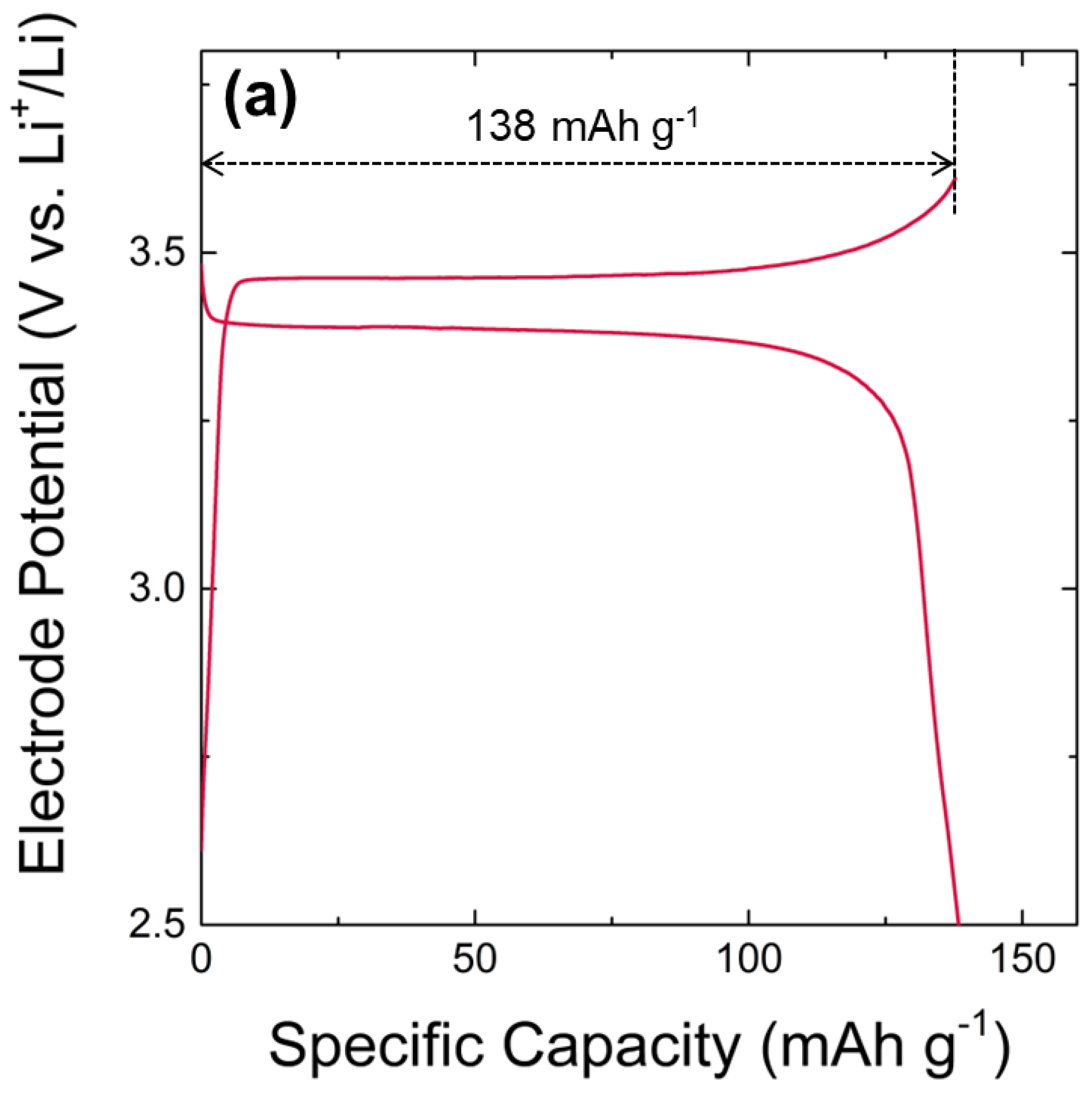
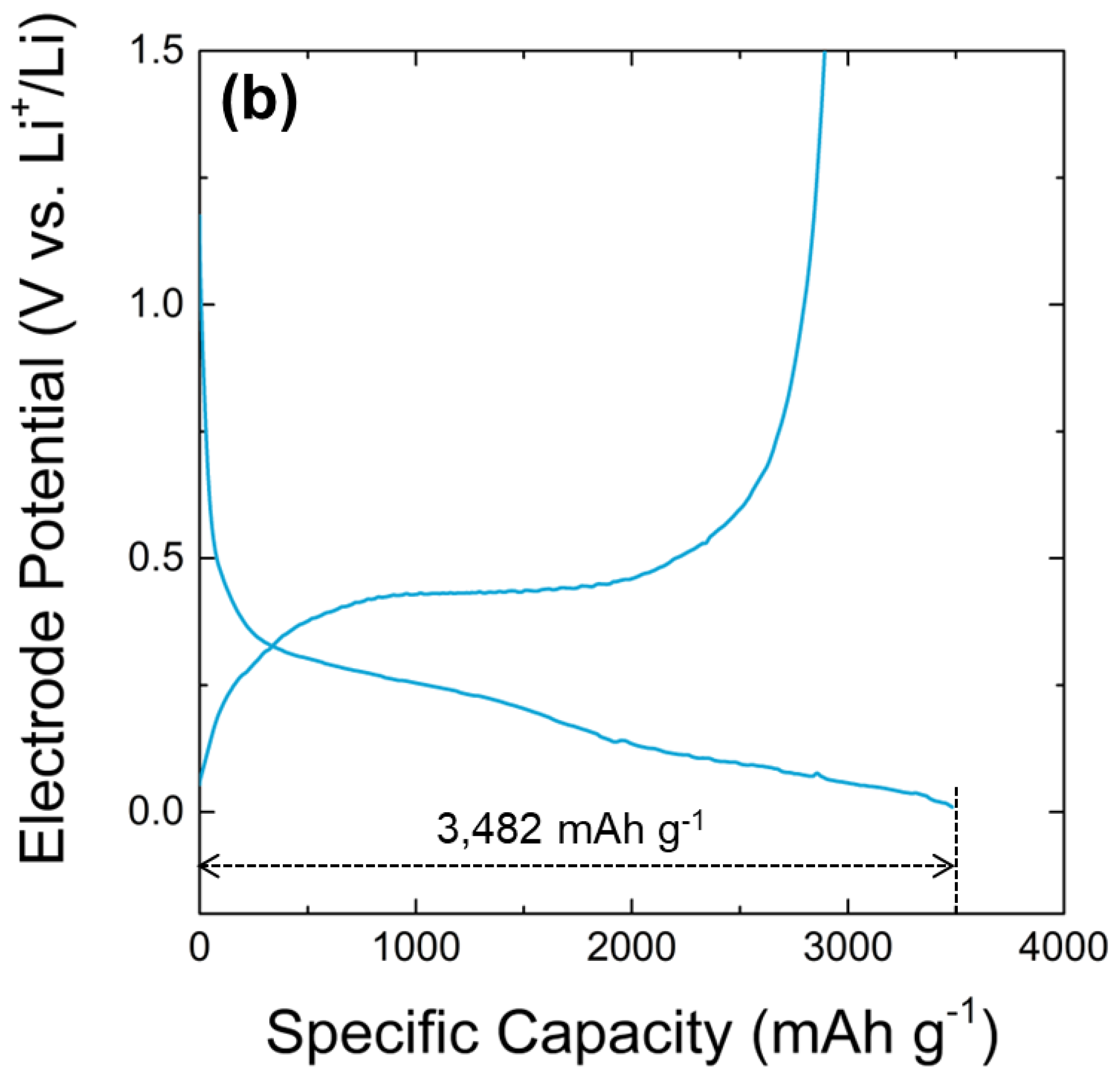
Baseline electrochemical behavior was first established in two-electrode half-cells (LFP-Li and Si-Li) at 150 μA (≈0.03 C-rate). The voltage windows were 2.5–3.61 V vs. Li+/Li for LFP and 0.01–1.5 V vs. Li+/Li for Si. The second-charge capacity of each half cell (LFP: ~138 mAh g−1, Si: ~3482 mAh g−1) was used to calculate the N/P ratio (see Figure 1). Full-cells with various N/P ratios were then assembled on this basis. In parallel, three-electrode full-cells employing Li metal as the reference electrode were prepared to resolve electrode-specific responses. Galvanostatic cycling was performed using a multi-channel potentiostat/galvanostat (VMP3, Biologic Co., Seyssinet-Pariset, France). For a representative N/P = 1 full cell, cycling was carried out within 2.5–3.6 V (cell voltage) at 150 μA (≈0.03 C-rate). In addition, conditions under which crystallization is not expected in the initial cycles were further explored by a simple degradation-modeling scenario using the ALAWA toolbox 2022 V1.0 (Section 3.2) to evaluate whether the Si-anode crystallization signal is expected to emerge with accumulated cycle degradation.

3. Result and Discussion

3.1. Crystallization Detection of Si Electrodes in Half-Cell Systems

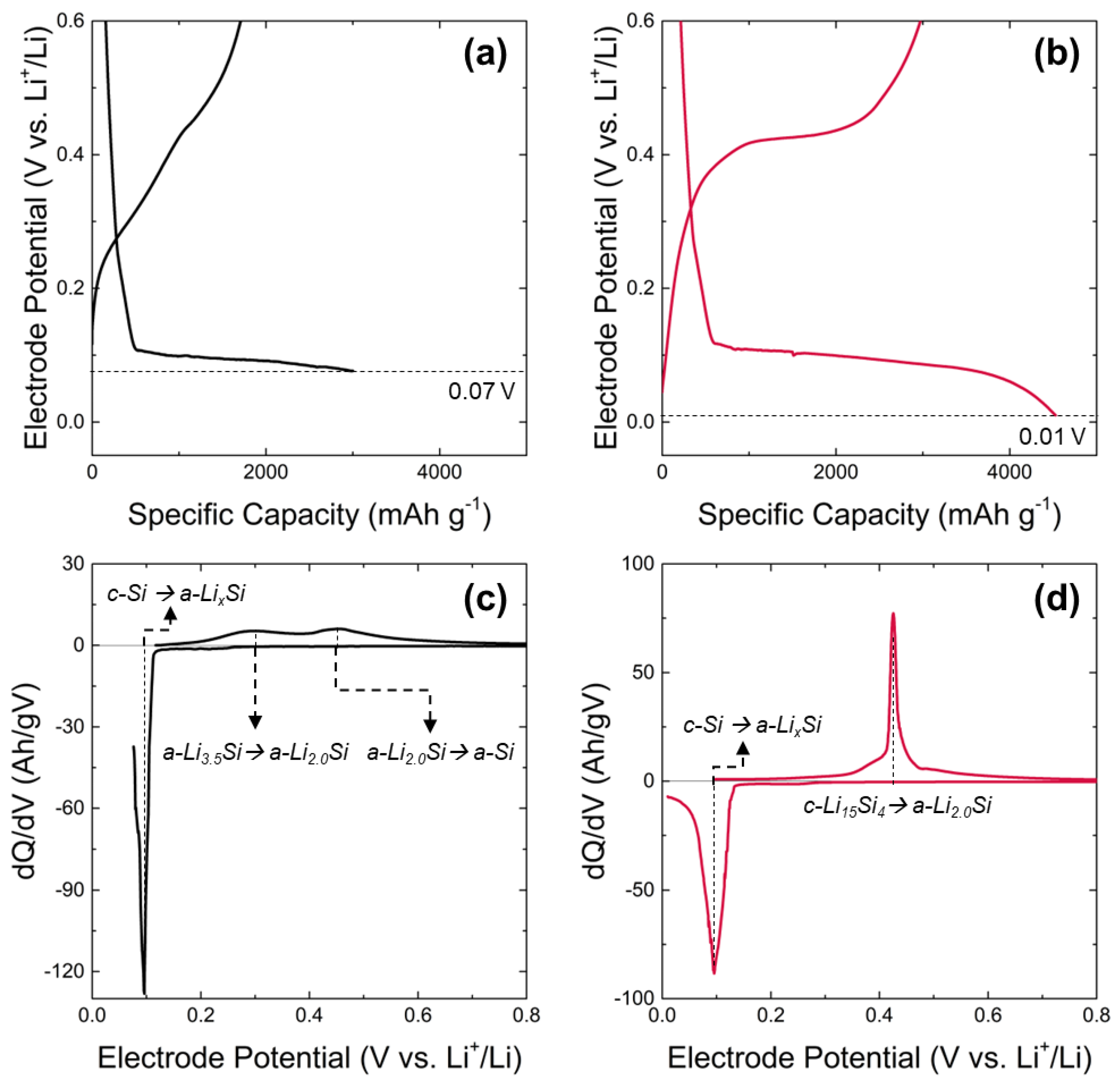
Figure 2a,b present the first-cycle voltage profiles of Si–Li half cells at different lithiation cut-off voltages. To probe how crystallization affects dQ/dV features, the lithiation cut-off was set slightly above and below the commonly reported threshold of 0.05 V vs. Li+/Li, namely 0.07 V and 0.01 V vs. Li+/Li. Figure 2c shows the dQ/dV curve obtained under the condition of terminating lithiation at 0.07 V vs. Li+/Li. During lithiation to 0.07 V, one peak appeared near 0.1 V (c-Si → a-LixSi amorphization). Upon delithiation, peaks at ~0.28 V (a-Li3.5Si → a-Li2.0Si) and ~0.45 V (a-Li2.0Si → a-Si) were observed. Figure 2d exhibits the dQ/dV response for lithiation terminated at 0.01 V vs. Li+/Li. During lithiation, only a single peak near ~0.10 V is observed, attributable to c-Si → a-LixSi amorphization. In other words, even with a 0.01 V cutoff, just as under the 0.07 V cutoff condition, no distinct crystallization peak appears during lithiation. Notably, however, unlike the case of 0.01 V cutoff, a pronounced single peak emerges at ~0.42 V during delithiation, corresponding to the c-Li15Si4 → a-Li2.0Si transition, i.e., the crystallization-derived peak [18,31]. These observations indicate that Si crystallization is initiated near the end of lithiation only when the lithiation cutoff is below ~0.05 V vs. Li+/Li. It then manifests most clearly as a distinct delithiation dQ/dV peak, not a lithiation peak.
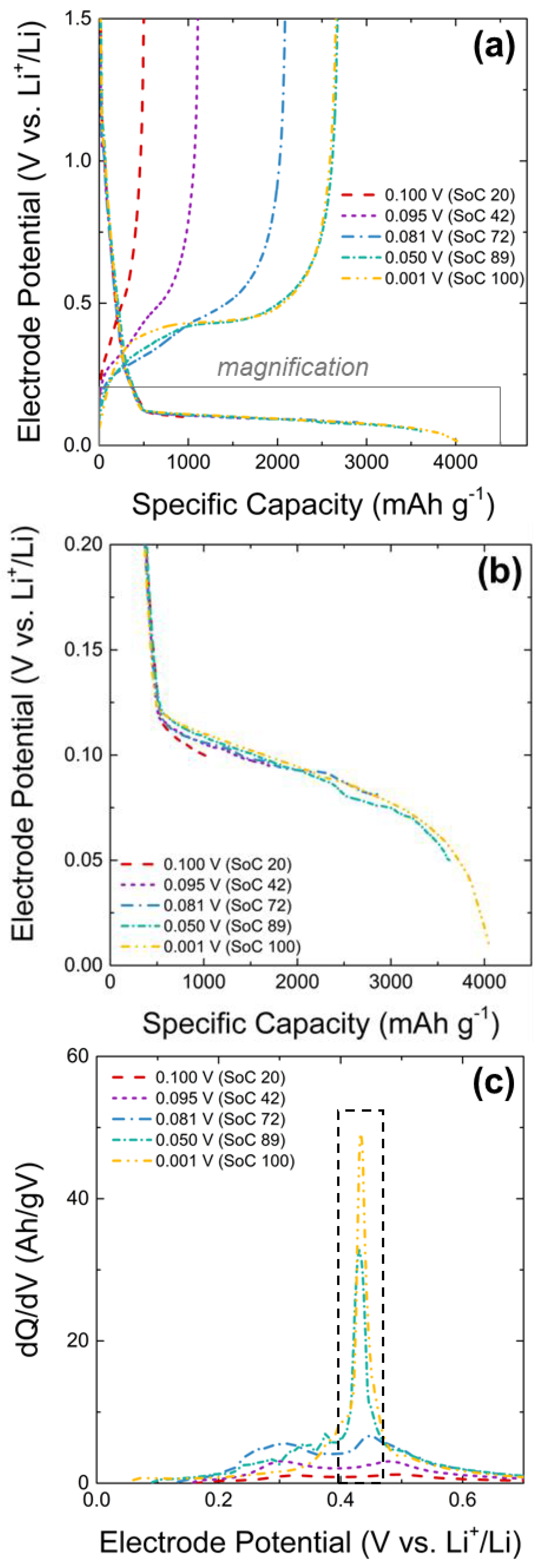
To more clearly determine the onset potential for Si crystallization during lithiation, we performed a series of galvanostatic tests in which the final lithiation SoC was stepwise increased. Figure 3a shows the first-cycle voltage profiles for each target SoC ranging from 20 to 100%. As the target SoC increased, the end-of-lithiation potential shifted progressively lower; once the target SoC reached ≥89%, it fell to ~0.05 V vs. Li+/Li (see the magnified view [Figure 3b]), a commonly reported crystallization threshold [19]. Consistent with this, the corresponding delithiation dQ/dV curves in Figure 3c show that, from SoC = 89% onward, a characteristic delithiation peak near 0.42 V (c-Li15Si4 → a-Li2.0Si) appeared, experimentally confirming that crystallization initiates around 0.05 V vs. Li+/Li during lithiation. Further increases in the target SoC led to a larger fraction of c-Li15Si4 formation (during lithiation) and its amorphization (during subsequent delithiation), reflected by the increase in the associated delithiation peak intensity (see the dotted box in the figure).
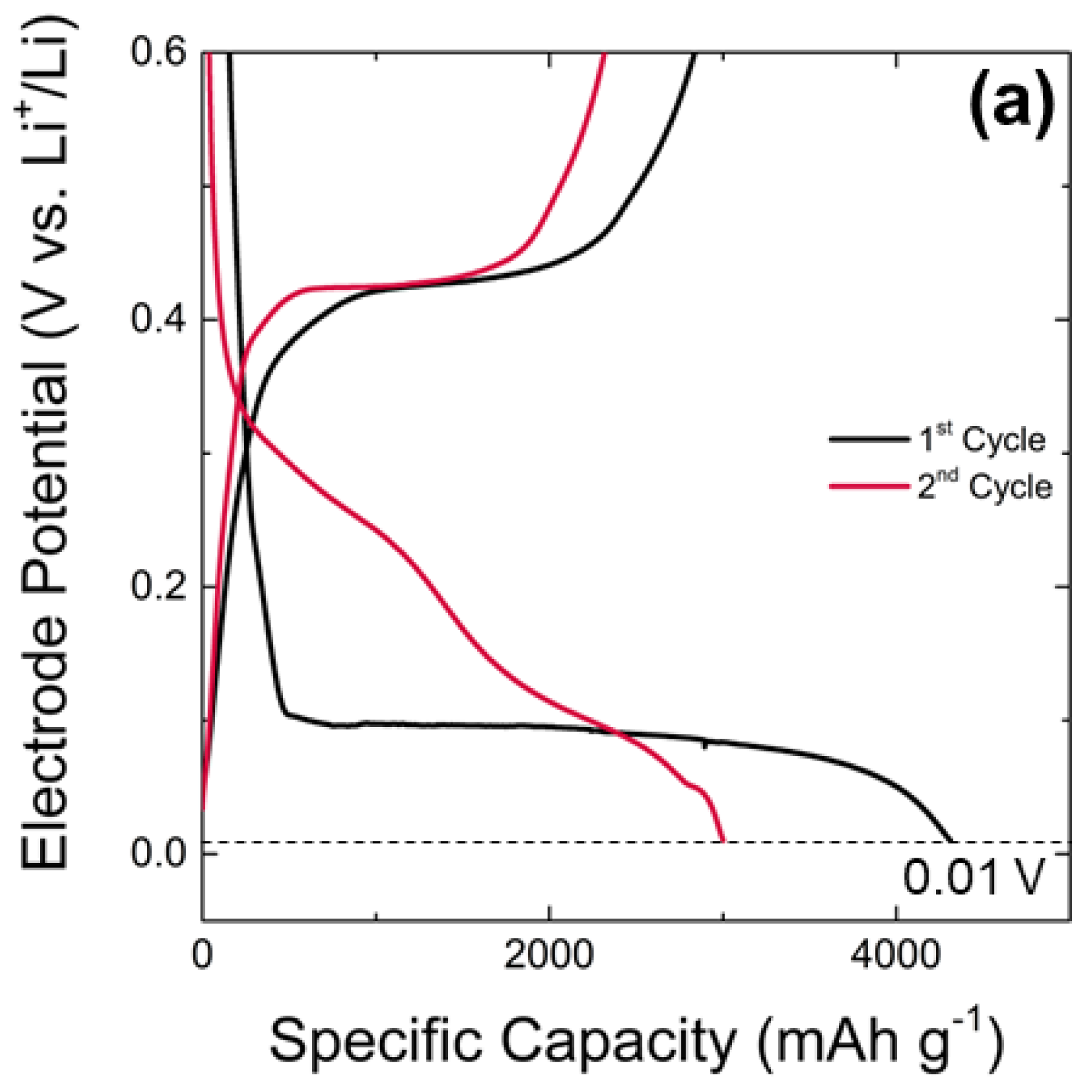
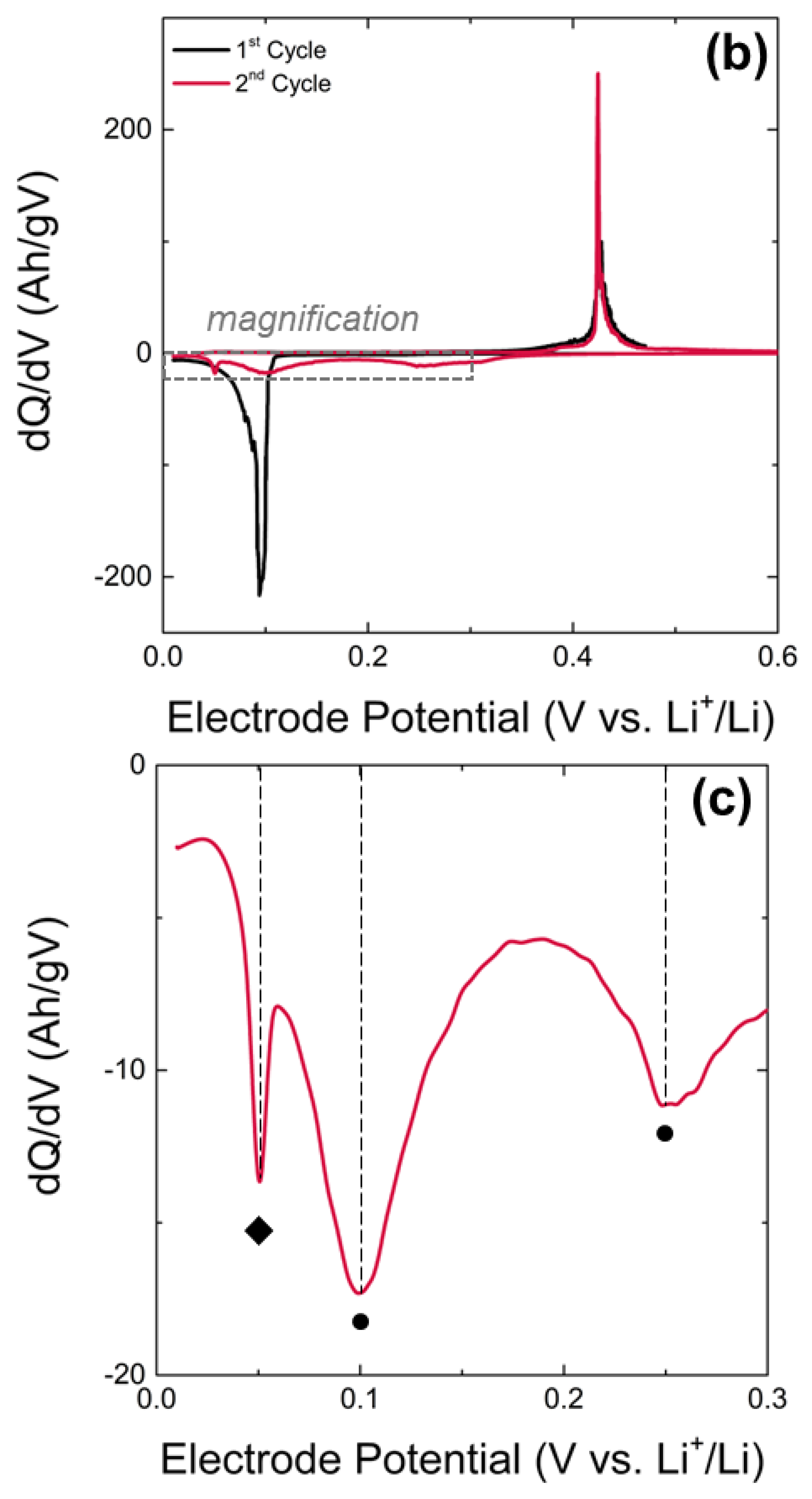
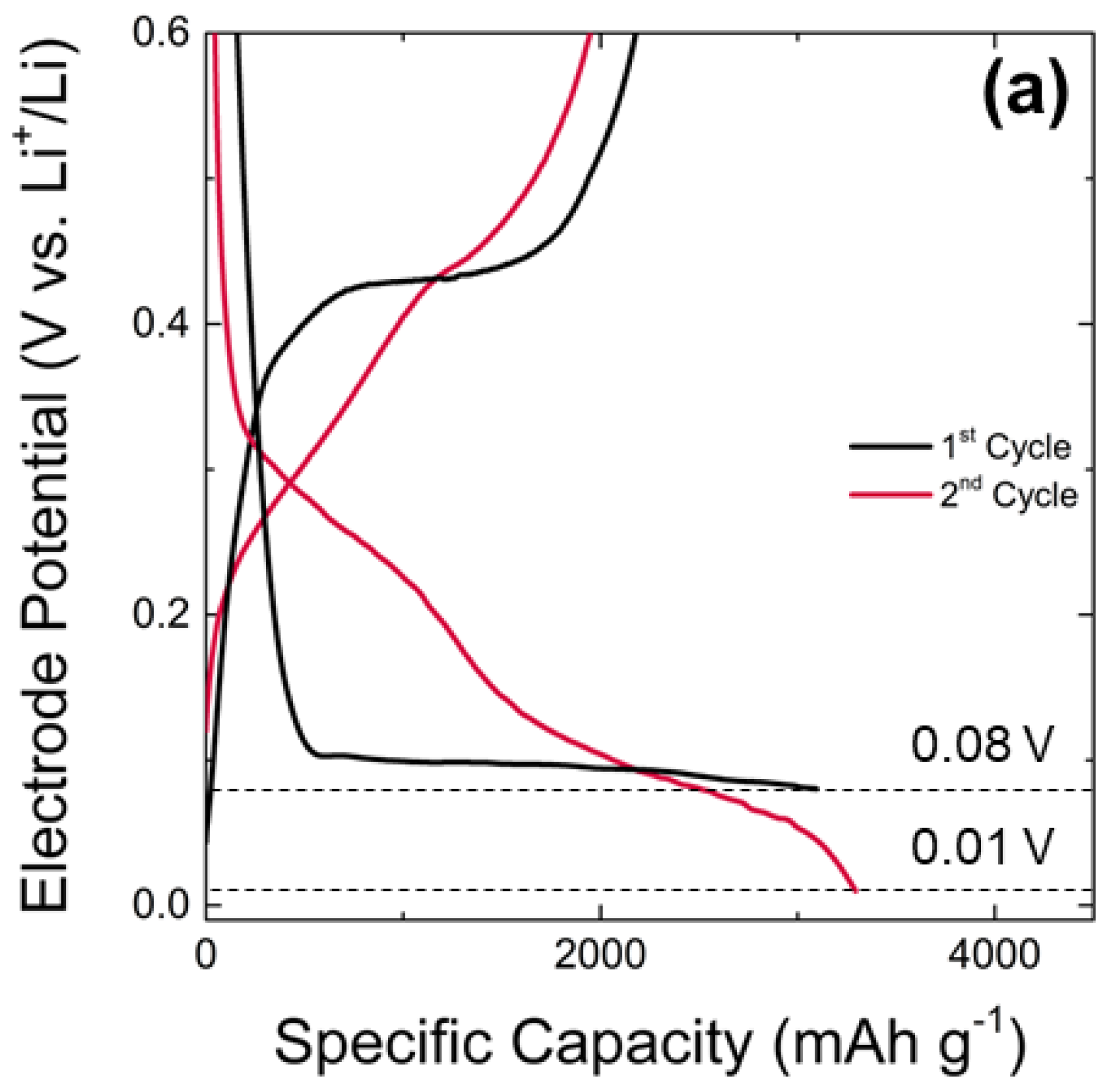
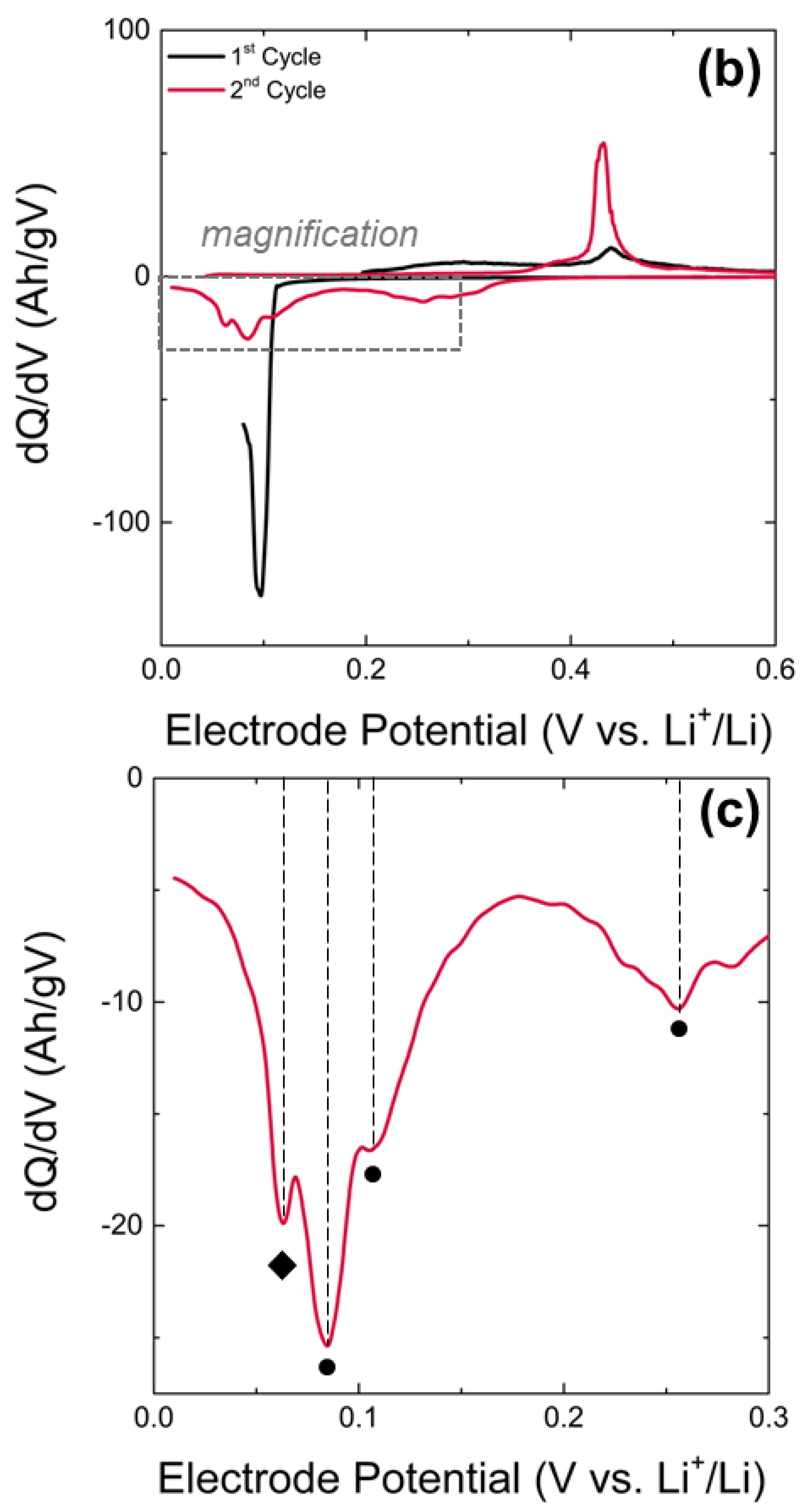
Although the previous experiment confirmed the potential at which the crystallization reaction begins, the dQ/dV signal from crystallization was clearly observable only after crystallization had already finished, specifically during the delithiation process. However, for practical applications, real-time detection of crystallization during lithiation is of greater importance, since preventing crystallization during charging is critical for avoiding electrode degradation. We therefore adopted a cycle-contrast approach: first cycle (amorphization dominant) versus second cycle (post-amorphization), to reveal crystallization during lithiation. Figure 4a shows the voltage profiles for lithiation to 0.01 V vs. Li+/Li in the first and second cycles, and Figure 4b presents the corresponding dQ/dV curves. In the first cycle, a strong single dQ/dV peak appears near 0.1 V, corresponding to c-Si → a-LixSi, but this feature disappears in the second cycle. In contrast, the second lithiation exhibits three dQ/dV peaks (see the magnified view [Figure 4c]): two features near ~0.25 V and ~0.1 V, attributable to deep-lithiation alloying of a-Si [33] (marked with ● in the figure), and, most importantly, a distinct peak near ~0.05 V (marked with ◆), which corresponds to the a-Li3.75Si → c-Li15Si4 crystallization reaction [19,31]. These findings suggest that, when crystalline Si is used as the starting anode material, clear electrochemical signatures of crystallization during lithiation can be reliably detected only after the dominant first-cycle amorphization peak has disappeared. In other words, amorphization must be completed beforehand for crystallization signals to appear during lithiation, which serves as a practical prerequisite for identifying the onset of crystallization. To rigorously test this hypothesis under more stringent conditions, we designed the following experimental protocol: the first cycle was terminated at a cutoff of 0.08 V vs. Li+/Li to ensure sufficient amorphization without inducing crystallization, whereas the second cycle used a 0.01 V vs. Li+/Li cutoff to allow crystallization to occur. Figure 5a shows the voltage profiles obtained under this protocol, and Figure 5b presents the dQ/dV curve for lithiation in the second cycle. With a 0.01 V cutoff, the second-cycle dQ/dV exhibits four peaks (the magnified view [Figure 5c]): ~0.25 V and ~0.12 V (deep-lithiation of a-Si), ~0.08 V (additional amorphization of residual c-Si) (marked with ● in the figure), and a peak at ~0.06 V (marked with ◆), attributable to the a-Li3.75Si → c-Li15Si4 crystallization reaction [34].
This pattern strongly implies that the crystallization feature during lithiation becomes resolvable only after the first-cycle amorphization background is removed and the end-of-lithiation potential falls below ~0.05 V in the subsequent cycles. These observations further indicate that crystallization becomes detectable once the Si anode has degraded sufficiently for its end-of-lithiation potential to drop below ~0.05 V, as occurs under practical operation where the anode accepts a fixed charge each cycle (as in full cells initially configured with N/P > 1). That is, in early cycles, lithiation terminates at the capacity cutoff before reaching the crystallization potential; with progressive degradation, the anode potential shifts lower and eventually crosses this threshold, triggering crystallization. At that first crossing, the lithiation-stage signature of Si crystallization is cleanly resolvable by dQ/dV.
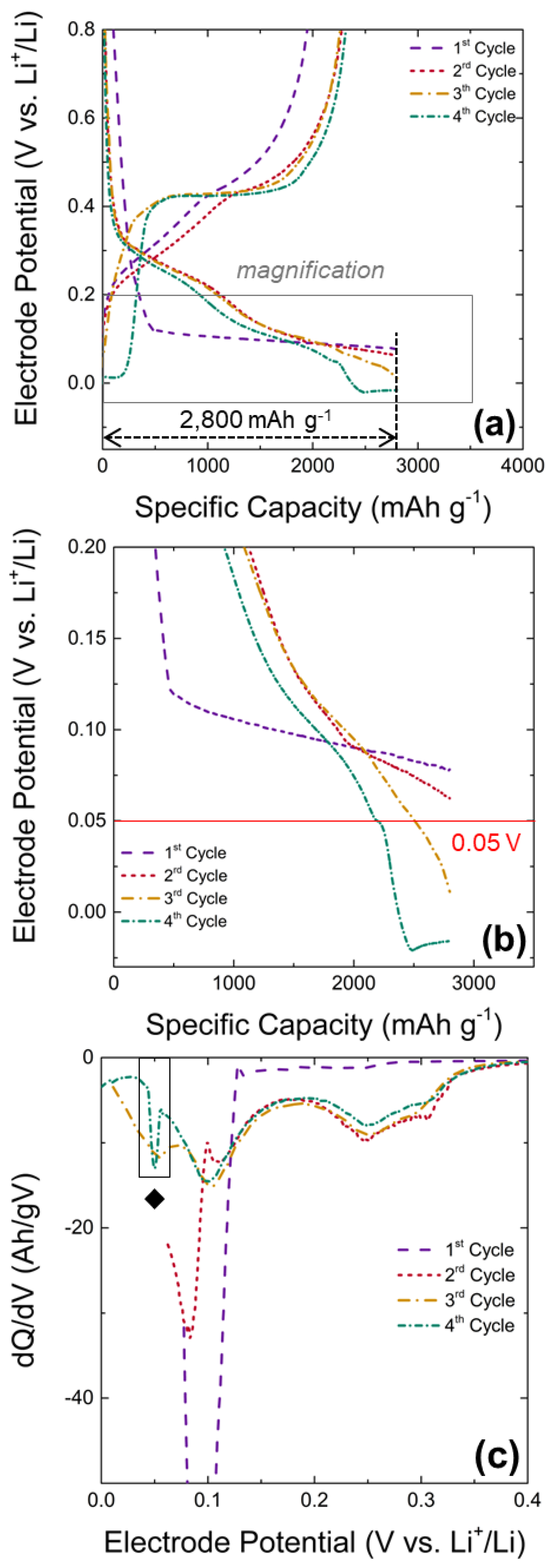
Motivated by this mechanism, we next assess detectability under a more practical control mode, i.e., capacity-limited cycling that mimics full-cell operation, by performing repeated charge–discharge tests with a capacity cutoff of 2800 mAh g−1. Figure 6a presents the voltage profiles of Si–Li half cells over successive cycles. As cycling progressed, the end-of-lithiation potential of the Si electrode gradually shifted to lower values, most likely due to Si degradation, and in the third cycle it crossed 0.05 V vs. Li+/Li for the first time (see the magnified view [Figure 6b]). Consistent with this crossing, the corresponding dQ/dV curves during lithiation (in Figure 6c) show a clear lithiation-stage crystallization peak (marked with ◆) near 0.05 V in the third cycle. The distinct feature near ~0.05 V vs. Li+/Li is widely attributed to crystallization to c-Li15Si4 [19,31]. Here, we accordingly use the emergence of this feature as a practical indicator of crystallization onset under capacity-limited operation. These results confirm that degradation accumulated under capacity-limited operation lowers the lithiation potential to the crystallization threshold, thereby initiating crystallization, and that the associated electrochemical signature is reliably detectable in the dQ/dV curve. Importantly, these half-cell results establish the potential window and cycling conditions under which Si crystallization becomes electrochemically visible, providing a quantitative basis for extending the analysis to more practical LFP–Si full-cell configurations.

3.2. Crystallization Detection of Si in Full-Cell Systems

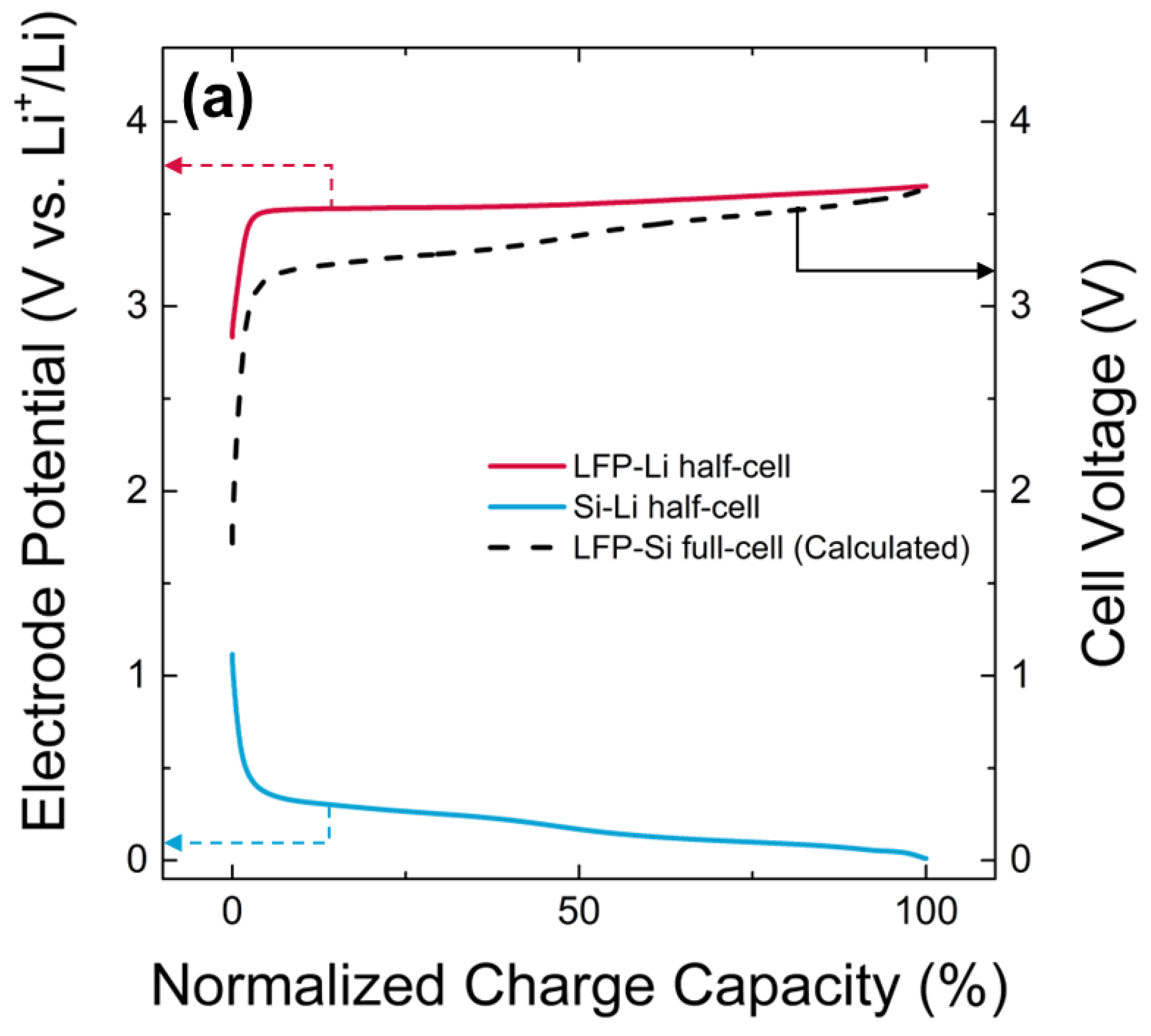
In the previous section, the electrochemical characteristics of Si crystallization were examined using Si–Li half-cells. We now extend this analysis to full-cell systems to assess whether crystallization of Si anodes can also be detected under more practical operating conditions. Unlike half-cells, where only a single electrode is involved, the full-cell response is a convolution of both the Si anode and the LFP cathode. Therefore, the individual contributions of each electrode were first characterized and related back to the full-cell behavior. Half-cells for each electrode were assembled, and the N/P ratio was calculated based on the second-cycle charge capacity. The Si anode delivered ~3482 mAh g−1 and the LFP cathode ~138 mAh g−1 (Figure 1), corresponding to an N/P ratio of 1, which was adopted as the reference condition. Figure 7a shows the normalized voltage profiles of the two half-cells (LFP–Li and Si–Li) together with the calculated LFP–Si full-cell voltage profile at N/P = 1, providing an intuitive picture of how the potential ranges of the Si anode and LFP cathode overlap and determine the overall cell voltage.
In a three-electrode full cell, the x-axis of the dQ/dV curve can be converted from voltage to charging/discharging time, enabling the dQ/dV peaks from each electrode to be aligned and compared on a common time basis [35,36]. This method exploits the fact that under constant-current operation, the cumulative charge passed through both electrodes is identical at any given time. Using this principle, the time-based dQ/dV response of each electrode can be obtained from the current (I) and the time derivative of the electrode potential (dV/dt) according to Equation (1):
d Q d V = d Q / d t d V / d t = d ( I t ) / d t d V / d t =   I d V / d t
This relationship allows reconstruction and direct comparison of the cathode and anode dQ/dV curves on a common time axis, and thus analysis of the sequence in which their respective reaction peaks occur. An important implication of Equation (1) is that the electrode exhibiting a slower potential change (i.e., smaller |dV/dt|, corresponding to a flatter plateau) at a given time tends to dominate the full-cell dQ/dV response, whereas the contribution from the other electrode can be partially masked. Consequently, for the Si crystallization peak to be discernible in the full-cell dQ/dV profile, the potential evolution associated with Si crystallization must not be completely overshadowed by a stronger LFP plateau in the same time window.
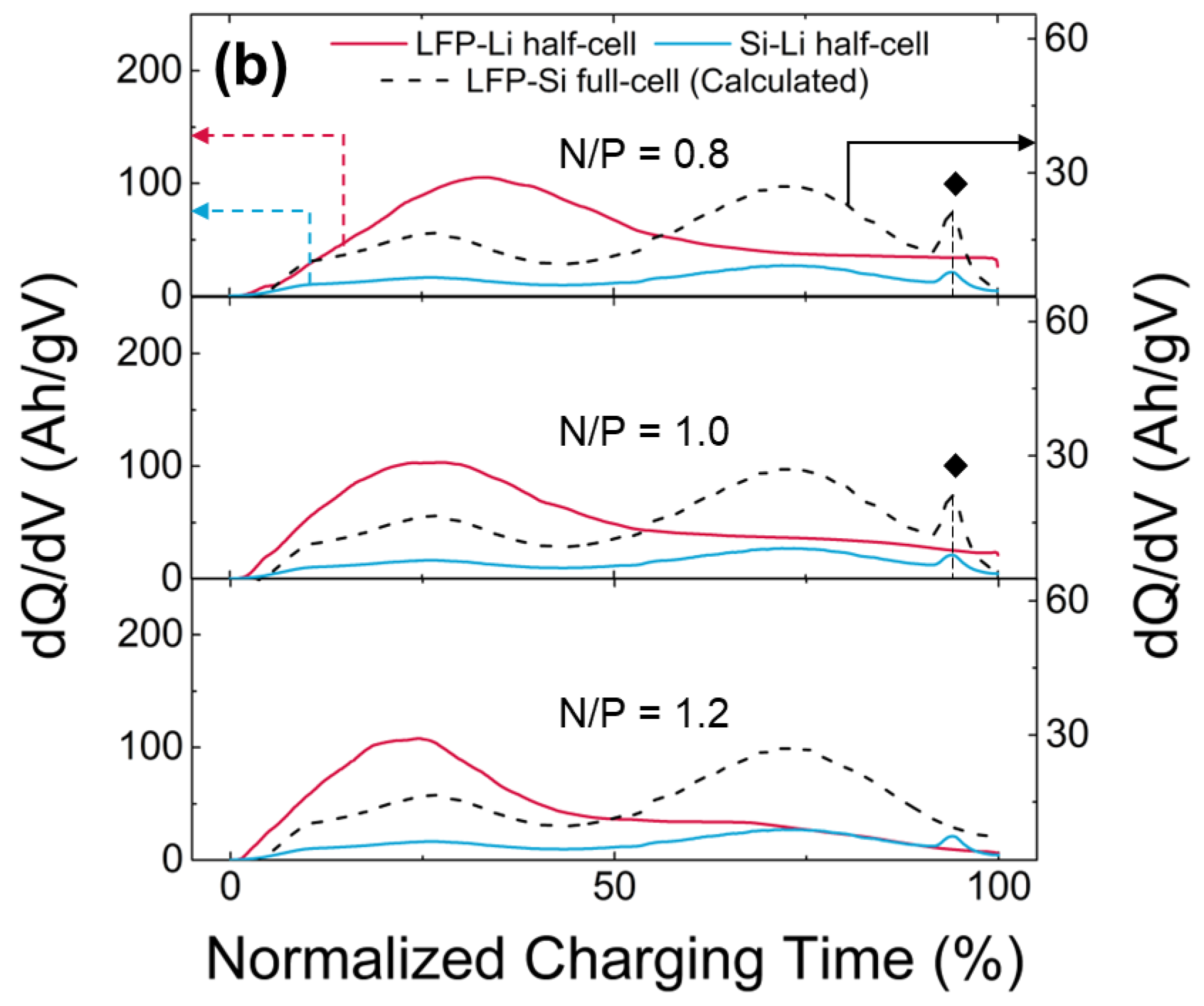
To quantitatively assess this condition, half-cell data for LFP and Si collected under identical current densities were normalized with respect to charging time, and full-cell dQ/dV curves were numerically constructed for different N/P ratios (0.8, 1.0, and 1.2). Figure 7b shows the time-normalized dQ/dV curves of each half-cell together with the predicted full-cell responses. The analysis indicates that in LFP–Si full-cell systems, when N/P ≤ 1, the Si crystallization-related dQ/dV peak (marked with ◆) remains sufficiently distinct relative to the LFP features that it can be clearly resolved in the overall full-cell dQ/dV profile.
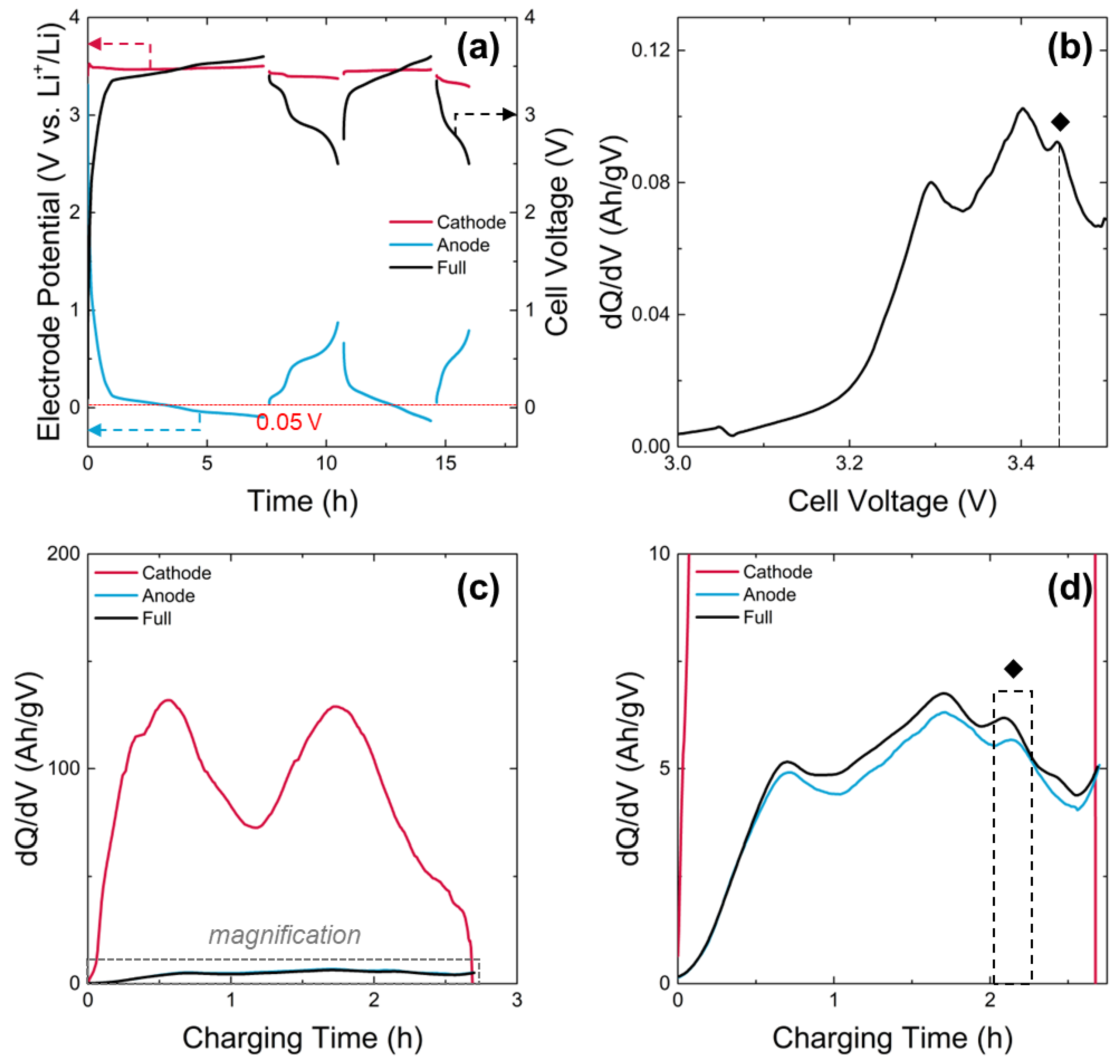
To experimentally validate this prediction, a three-electrode LFP–Si full cell with N/P = 1 was fabricated, and electrochemical detection of Si crystallization during lithiation was attempted. Figure 8a presents voltage profiles of LFP–Si full cell during cycle. It is evident that the Si anode potential drops below the crystallization threshold (0.05 V vs. Li+/Li) near the end of charging, indicating that the crystallization condition is reached. Figure 8b presents the second-cycle dQ/dV curve of the three-electrode full cell during charging, showing three distinct peaks. To analyze these peaks, we converted x-axis to charging time (Figure 8c), which enabled a direct comparison of the potential evolutions of the Si anode, the LFP cathode, and the full cell. This is corroborated by the time-based dQ/dV analysis, where a clear Si-anode crystallization peak appears in the later stage of charging (dQ/dV peak marked ◆ in magnified view [Figure 8d]). The intensity of this peak is lower than that of the cathode peak occurring at the same time, yet it remains clearly visible in the composite full-cell dQ/dV response. These observations strongly suggest that the final peak near 3.43 V in Figure 8b (marked with ◆) originates from the phase transition associated with Si crystallization at the anode.
Although these results confirm that Si crystallization can be electrochemically detected under full-cell conditions at N/P ≈ 1, one might argue that the applicability of this method is limited in commercial cells, which are typically designed with N/P > 1 to avoid anode over-lithiation. In such designs, the Si anode is not expected to reach the crystallization window during early-life operation, and the crystallization-derived dQ/dV peak would therefore be absent. However, as cycling proceeds, irreversible capacity loss in the anode, commonly referred to as loss of active material (LAM), accumulates, reducing the effective anode capacity and effectively lowering the operational N/P ratio. Under these conditions, the anode potential can eventually fall below 0.05 V vs. Li+/Li near the end of charging, thereby initiating Si crystallization [37,38]. Once this occurs, the crystallization-derived peak should become detectable in the full-cell dQ/dV response, in direct analogy with the N/P = 1 case demonstrated above. This suggests that the analytical method established here could, in principle, be used as a degradation and lifetime indicator even in practical Si-containing cells initially designed with N/P > 1.
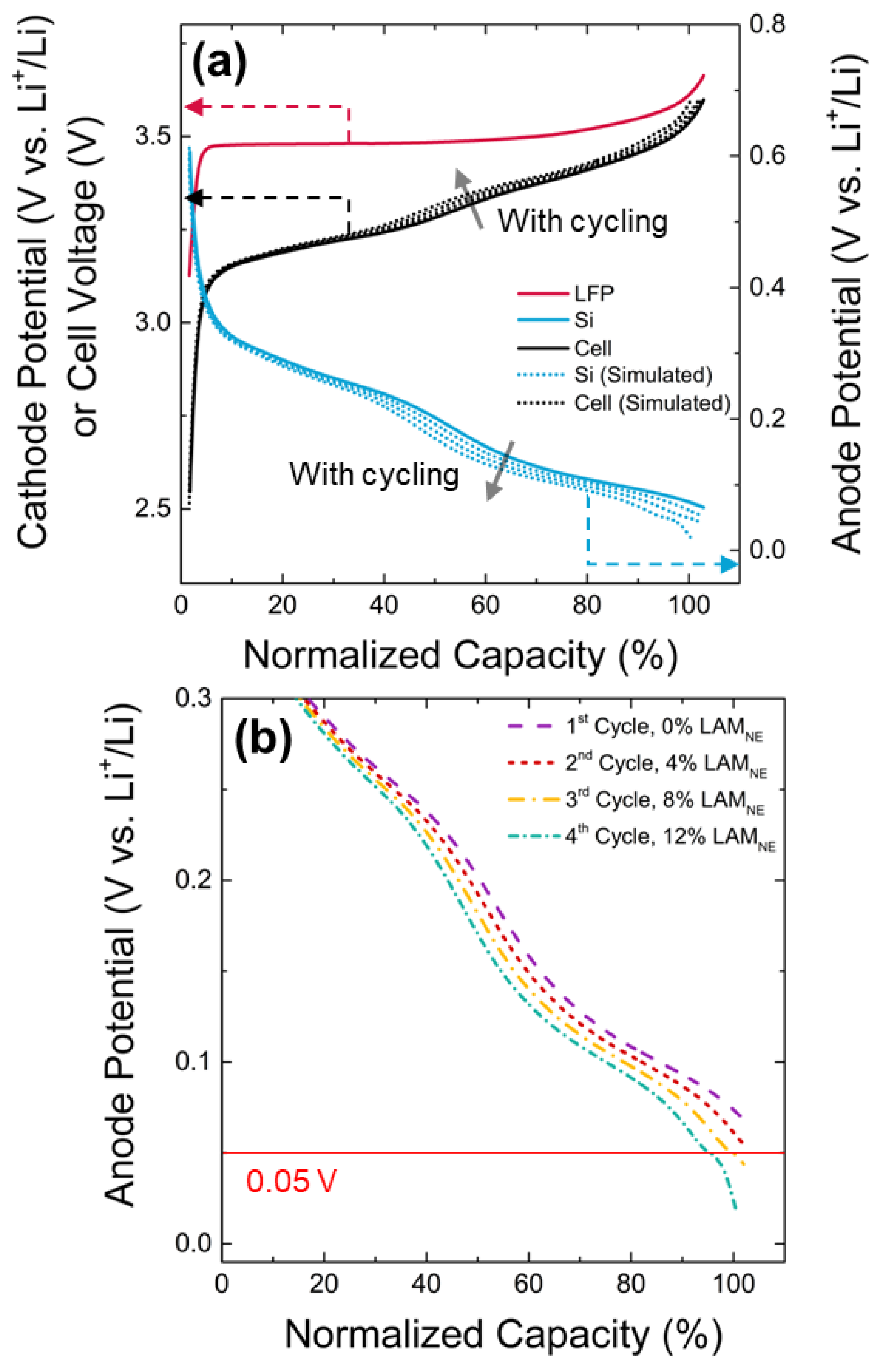
To further illustrate how cycling-induced anode degradation in cells initially designed with N/P > 1 can eventually drive the Si potential into the crystallization regime, we performed a simple scenario analysis using the ALAWA toolbox, a degradation-modeling framework developed by Dubarry et al. [39,40]. In this proof-of-concept modeling, the initial N/P ratio was set to 1.15 so that crystallization would not occur in the first cycle, and a constant anode LAM rate of 4% per cycle was imposed, while all other parameters were kept at their default values. The intent was not to reproduce a specific experimental dataset, but rather to examine whether a realistic level of anode LAM alone is sufficient to push the Si potential below the crystallization threshold under otherwise nominal operating conditions.
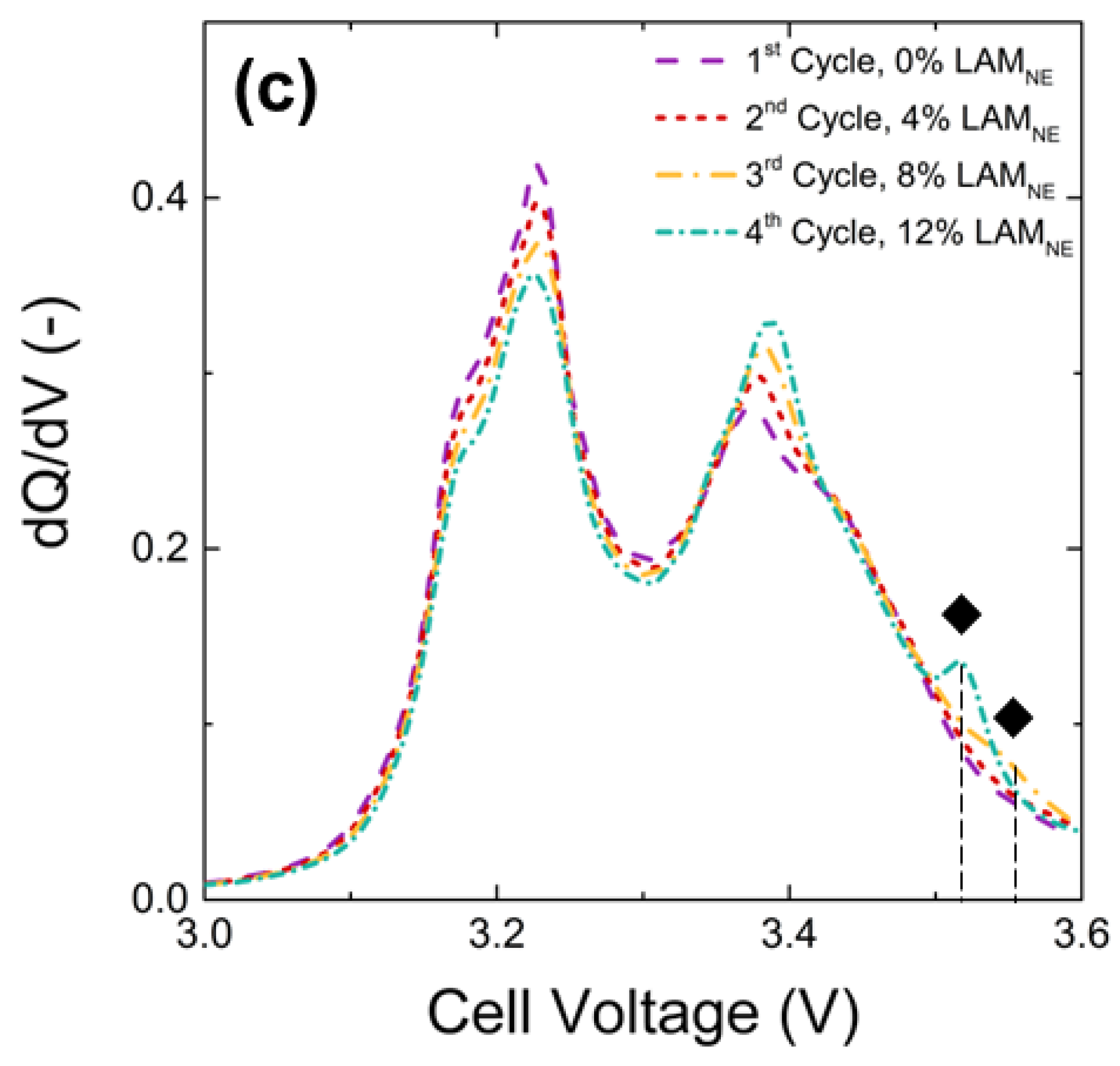
Under these assumptions, the simulated Si-anode potential gradually decreased with cycling, as shown in Figure 9a, and, as highlighted in Figure 9b, fell below 0.05 V vs. Li+/Li during the third charge. The corresponding full-cell differential capacity curves in Figure 9c exhibit the emergence of a new high-voltage peak (marked with ◆) around 3.55 V in the third cycle, which was absent in earlier cycles and shifted slightly to ~3.51 V in the fourth cycle as degradation accumulated. Within the ALAWA framework, this additional peak reflects the onset and growth of the c-Li15Si4 phase associated with over-lithiation of the Si anode, consistent with the crystallization mechanism inferred from our N/P = 1 experiments. Although simplified, this modeling exercise qualitatively supports the following picture: in full cells with N/P > 1, progressive anode LAM effectively reduces the usable anode capacity, causes the end-of-charge Si potential to cross the ~0.05 V crystallization threshold, and thereby renders the crystallization-derived peak detectable in the full-cell dQ/dV response. In this sense, the dQ/dV-based crystallization signature demonstrated experimentally here for N/P ≈ 1 should, in principle, be exploitable as a degradation and lifetime indicator even in practical Si-containing cells initially designed with N/P > 1.
From an experimental standpoint, directly validating this scenario in full cells that are initially designed and operated with N/P > 1 is nontrivial. In such cells, substantial anode LAM must accumulate before the Si potential enters the crystallization window, which typically requires long-term cycling under well-controlled conditions and careful separation of anode LAM from other degradation modes (e.g., cathode fading, impedance growth, and lithium inventory loss). Moreover, implementing stable three-electrode configurations in practical-format cells adds further complexity. While these challenges are beyond the scope of the present work, they point to clear directions for future research, particularly the combination of degradation modeling with long-term three-electrode measurements in practical N/P > 1 designs.
In summary, this work provides an electrode-relevant electrochemical criterion to detect the onset of Si crystallization, based on the emergence of a crystallization-related signature when the Si anode potential falls to ≈0.05 V vs. Li+/Li during lithiation. Because the lithiation cut-off condition influences whether this threshold is reached, the proposed diagnostic may serve as a useful basis for designing and interpreting future studies that examine how cut-off control relates to long-term cycling stability under practically relevant constraints (e.g., N/P balance, cathode utilization, and operating protocol). From a practical standpoint, detecting the crystallization-onset signature during lithiation can be used as a trigger for adaptive operating control (e.g., lowering the charge cut-off/upper utilization limit) to avoid entering the crystallization window in subsequent cycles. Notably, crystallization to c-Li15Si4 has been reported to introduce additional two-phase boundaries and incremental volume-change–induced stresses, which can exacerbate mechanical damage and interfacial instability, further motivating electrochemical detection of crystallization onset as a practically actionable marker.
Although this work uses a 100% Si anode as a controlled model system, the crystallization threshold near ≈0.05 V vs. Li+/Li is an intrinsic feature of the Si–Li system. Accordingly, varying the Si fraction in Si-containing anodes (e.g., Si-rich formulations or Si–graphite composites) is expected to primarily shift when and how clearly this threshold is reached, through changes in effective anode capacity (and thus effective N/P), polarization, and degradation rate, rather than altering the threshold itself. In this respect, an important next step is to systematically validate the proposed criterion across Si fractions under controlled electrode architectures. Beyond this validation, future work should (i) extend the framework to more commercially relevant cathode chemistries, including layered Ni–Mn–Co oxides (NMC), (ii) evaluate electrolyte and additive effects by quantifying their impact on polarization and threshold-reaching behavior, and (iii) integrate the approach with operando structural characterization (e.g., diffraction-based measurements) to provide complementary confirmation and refine the mechanistic linkage under broader operating conditions.

4. Conclusions

In this study, we systematically examined how crystallization of Si anodes can be detected electrochemically and assessed the applicability of this approach to full-cell systems. The main conclusions are as follows:
(1) In Si–Li half cells, a strong first-cycle amorphization feature near ~0.1 V vs. Li+/Li masks crystallization-related signals during lithiation. After amorphization is completed and the end-of-lithiation potential falls below ~0.05 V vs. Li+/Li, a distinct crystallization-related dQ/dV feature becomes resolvable. Under capacity-limited cycling that mimics full-cell operation, progressive degradation shifts the lithiation potential downward to this threshold, at which point the crystallization signature emerges during charge.
(2) In LFP–Si three-electrode full cells with N/P close to unity, time-reparameterized dQ/dV analysis confirms that the Si anode potential can approach (and cross) ~0.05 V vs. Li+/Li near the end of charge, and the associated crystallization feature can be identified within the overall full-cell dQ/dV response. Analysis based on half-cell reference behavior further indicates that the visibility of this feature depends strongly on full-cell design parameters, particularly the N/P ratio, and that the crystallization-related peak remains distinguishable when N/P is not greater than unity.
(3) A simplified degradation scenario implemented using the ALAWA toolbox qualitatively illustrates that, in cells initially designed with N/P > 1, accumulation of loss of anode active material can effectively reduce the usable anode capacity, drive the Si potential into the crystallization window, and introduce an additional peak in the full-cell dQ/dV curve. Direct experimental validation of this scenario in practical-format, high-N/P full cells, especially with stable long-term three-electrode measurements and rigorous separation of concurrent degradation modes, remains experimentally demanding and was not pursued in the present work.
(4) Overall, this work is intended as a model-system demonstration in LFP–Si full cells that establishes an electrode-relevant, non-destructive diagnostic criterion for identifying the onset of Si crystallization during lithiation via a threshold-linked electrochemical signature. The proposed framework provides a basis for further diagnostic investigations and for designing follow-up studies to evaluate how operating constraints (e.g., lithiation cut-off conditions) influence crystallization onset and long-term durability. Future work should extend validation to long-duration cycling, additional commercially relevant cathode chemistries (e.g., NMC), and complementary structural characterization (e.g., operando/ex situ diffraction or microscopy) to further strengthen the mechanistic linkage under broader practical operating conditions.

Author Contributions

Conceptualization, H.-W.J.; Methodology, H.-W.J. and G.-E.L.; Validation, H.-W.J., G.-E.L. and H.-C.S.; Investigation, H.-W.J.; Data curation, H.-W.J. and G.-E.L.; Writing—original draft, H.-W.J.; Writing—review & editing, H.-C.S.; Supervision, H.-C.S.; Project administration, H.-C.S.; Funding acquisition, H.-C.S. All authors have read and agreed to the published version of the manuscript.

Funding

This work was supported by the National Research Foundation of the Ministry of Science and ICT (RS-2025-00512708), by the Technology Innovation Program (20007045) funded by the Ministry of Trade, Industry & Energy (MOTIE), and by the Korea Institute of Energy Technology Evaluation and Planning (KETEP) and the MOTIE of the Republic of Korea (No. 20224000000400).

Data Availability Statement

The original contributions presented in this study are included in the article. Further inquiries can be directed to the corresponding author.

Conflicts of Interest

The authors declare no conflict of interest.

References

  1. Feng, K.; Li, M.; Liu, W.; Kashkooli, A.G.; Xiao, X.; Cai, M.; Chen, Z. Silicon-based anodes for lithium-ion batteries: From fundamentals to practical applications. Small 2018, 14, 1702737. [Google Scholar] [CrossRef] [PubMed]
  2. Wu, F.; Maier, J.; Yu, Y. Guidelines and trends for next-generation rechargeable lithium and lithium-ion batteries. Chem. Soc. Rev. 2020, 49, 1569–1614. [Google Scholar] [CrossRef] [PubMed]
  3. Li, M.; Lu, J.; Chen, Z.; Amine, K. 30 years of lithium-ion batteries. Adv. Mater. 2018, 30, 1800561. [Google Scholar] [CrossRef] [PubMed]
  4. Rivera-Barrera, J.P.; Muñoz-Galeano, N.; Sarmiento-Maldonado, H.O. SoC estimation for lithium-ion batteries: Review and future challenges. Electronics 2017, 6, 102. [Google Scholar] [CrossRef]
  5. Wali, S.B.; Hannan, M.A.; Ker, P.J.; Rahman, M.S.A.; Mansor, M.; Muttaqi, K.M.; Mahlia, T.M.I.; Begum, R.A. Grid-connected lithium-ion battery energy storage system: A bibliometric analysis for emerging future directions. J. Clean. Prod. 2022, 334, 130272. [Google Scholar] [CrossRef]
  6. Liu, T.; Yang, X.G.; Ge, S.; Leng, Y.; Wang, C.Y. Ultrafast charging of energy-dense lithium-ion batteries for urban air mobility. ETransportation 2021, 7, 100103. [Google Scholar] [CrossRef]
  7. Schmuch, R.; Wagner, R.; Hörpel, G.; Placke, T.; Winter, M. Performance and cost of materials for lithium-based rechargeable automotive batteries. Nat. Energy 2018, 3, 267–278. [Google Scholar] [CrossRef]
  8. Li, F.; Xu, J.; Hou, Z.; Li, M.; Yang, R. Silicon anodes for high-performance storage devices: Structural design, material compounding, advances in electrolytes and binders. ChemNanoMat 2020, 6, 720–738. [Google Scholar] [CrossRef]
  9. Liang, B.; Liu, Y.; Xu, Y. Silicon-based materials as high capacity anodes for next generation lithium ion batteries. J. Power Sources 2014, 267, 469–490. [Google Scholar] [CrossRef]
  10. Zhao, X.; Lehto, V.P. Challenges and prospects of nanosized silicon anodes in lithium-ion batteries. Nanotechnology 2020, 32, 042002. [Google Scholar] [CrossRef]
  11. Zhang, C.; Wang, F.; Han, J.; Bai, S.; Tan, J.; Liu, J.; Li, F. Challenges and recent progress on silicon-based anode materials for next-generation lithium-ion batteries. Small Struct. 2021, 2, 2100009. [Google Scholar] [CrossRef]
  12. Li, Y.; Zheng, X.; Cao, Z.; Wang, Y.; Wang, Y.; Lv, L.; Huang, W.; Huang, Y.; Zheng, H. Unveiling the mechanisms into Li-trapping induced (ir) reversible capacity loss for silicon anode. Energy Storage Mater. 2023, 55, 660–668. [Google Scholar] [CrossRef]
  13. Liu, N.; Lu, Z.; Zhao, J.; McDowell, M.T.; Lee, H.W.; Zhao, W.; Cui, Y. A pomegranate-inspired nanoscale design for large-volume-change lithium battery anodes. Nat. Nanotechnol. 2014, 9, 187–192. [Google Scholar] [CrossRef] [PubMed]
  14. Li, L.; Fang, C.; Wei, W.; Zhang, L.; Ye, Z.; He, G.; Huang, Y. Nano-ordered structure regulation in delithiated Si anode triggered by homogeneous and stable Li-ion diffusion at the interface. Nano Energy 2020, 72, 104651. [Google Scholar] [CrossRef]
  15. Chan, C.K.; Peng, H.; Liu, G.; McIlwrath, K.; Zhang, X.F.; Huggins, R.A.; Cui, Y. High-performance lithium battery anodes using silicon nanowires. Nat. Nanotechnol. 2008, 3, 31–35. [Google Scholar] [CrossRef] [PubMed]
  16. Favors, Z.; Bay, H.H.; Mutlu, Z.; Ahmed, K.; Ionescu, R.; Ye, R.; Ozkan, M.; Ozkan, C.S. Towards scalable binderless electrodes: Carbon coated silicon nanofiber paper via Mg reduction of electrospun SiO2 nanofibers. Sci. Rep. 2015, 5, 8246. [Google Scholar] [CrossRef]
  17. Kang, D.K.; Corno, J.A.; Gole, J.L.; Shin, H.C. Microstructured nanopore-walled porous silicon as an anode material for rechargeable lithium batteries. J. Electrochem. Soc. 2008, 155, A276. [Google Scholar] [CrossRef]
  18. Li, J.; Dahn, J.R. An in situ X-ray diffraction study of the reaction of Li with crystalline Si. J. Electrochem. Soc. 2007, 154, A156. [Google Scholar] [CrossRef]
  19. Wang, C.M.; Li, X.; Wang, Z.; Xu, W.; Liu, J.; Gao, F.; Kovarik, L.; Zhang, J.G.; Howe, J.; Burton, D.J.; et al. In situ TEM investigation of congruent phase transition and structural evolution of nanostructured silicon/carbon anode for lithium ion batteries. Nano Lett. 2012, 12, 1624–1632. [Google Scholar] [CrossRef]
  20. McDowell, M.T.; Lee, S.W.; Nix, W.D.; Cui, Y. 25th anniversary article: Understanding the lithiation of silicon and other alloying anodes for lithium-ion batteries. Adv. Mater. 2013, 25, 4966–4985. [Google Scholar] [CrossRef]
  21. Woodard, J.C.; Kalisvaart, W.P.; Sayed, S.Y.; Olsen, B.C.; Buriak, J.M. Beyond thin films: Clarifying the impact of c-Li15Si4 formation in thin film, nanoparticle, and porous Si electrodes. ACS Appl. Mater. Interfaces 2021, 13, 38147–38160. [Google Scholar] [CrossRef] [PubMed]
  22. Chon, M.J.; Sethuraman, V.A.; McCormick, A.; Srinivasan, V.; Guduru, P.R. Real-Time Measurement of Stress and Damage Evolution during Initial Lithiation of Crystalline Silicon. Phys. Rev. Lett. 2011, 107, 045503. [Google Scholar] [CrossRef] [PubMed]
  23. Nadimpalli, S.P.V.; Sethuraman, V.A.; Bucci, G.; Srinivasan, V.; Bower, A.F.; Guduru, P.R. On plastic deformation and fracture in Si films during electrochemical lithiation/delithiation cycling. J. Electrochem. Soc. 2013, 160, A1885. [Google Scholar] [CrossRef]
  24. Tornheim, A.; Trask, S.E.; Zhang, Z. Communication—Effect of lower cutoff voltage on the 1st cycle performance of silicon electrodes. J. Electrochem. Soc. 2019, 166, A132. [Google Scholar] [CrossRef]
  25. Schott, T.; Robert, R.; Ulmann, P.A.; Lanz, P.; Zu, S.; Spahr, M.E.; Novák, P.; Trabesinger, S. Cycling behavior of silicon-containing graphite electrodes, part a: Effect of the lithiation protocol. J. Phys. Chem. C 2017, 121, 18423–18429. [Google Scholar] [CrossRef]
  26. Obrovac, M.N.; Krause, L.J. Reversible cycling of crystalline silicon powder. J. Electrochem. Soc. 2006, 154, A103. [Google Scholar] [CrossRef]
  27. Abe, Y.; Kumagai, S. Effect of negative/positive capacity ratio on the rate and cycling performances of LiFePO4/graphite lithium-ion batteries. J. Energy Storage 2018, 19, 96–102. [Google Scholar] [CrossRef]
  28. Misra, S.; Liu, N.; Nelson, J.; Hong, S.S.; Cui, Y.; Toney, M.F. In situ X-ray diffraction studies of (de) lithiation mechanism in silicon nanowire anodes. Acs Nano 2012, 6, 5465–5473. [Google Scholar] [CrossRef]
  29. Key, B.; Bhattacharyya, R.; Morcrette, M.; Seznec, V.; Tarascon, J.M.; Grey, C.P. Real-time NMR investigations of structural changes in silicon electrodes for lithium-ion batteries. J. Am. Chem. Soc. 2009, 131, 9239–9249. [Google Scholar] [CrossRef]
  30. Sayed, S.Y.; Kalisvaart, W.P.; Olsen, B.C.; Luber, E.J.; Xie, H.; Buriak, J.M. Alternating silicon and carbon multilayer-structured anodes suppress formation of the c-Li3.75Si phase. Chem. Mater. 2019, 31, 6578–6589. [Google Scholar] [CrossRef]
  31. Obrovac, M.N.; Christensen, L. Structural changes in silicon anodes during lithium insertion/extraction. Electrochem. Solid State Lett. 2004, 7, A93. [Google Scholar] [CrossRef]
  32. Rezqita, A.; Sauer, M.; Foelske, A.; Kronberger, H.; Trifonova, A. The effect of electrolyte additives on electrochemical performance of silicon/mesoporous carbon (Si/MC) for anode materials for lithium-ion batteries. Electrochim. Acta 2017, 247, 600–609. [Google Scholar] [CrossRef]
  33. Ogata, K.; Salager, E.; Kerr, C.J.; Fraser, A.E.; Ducati, C.; Morris, A.J.; Hofmann, S.; Grey, C.P. Revealing lithium–silicide phase transformations in nano-structured silicon-based lithium ion batteries via in situ NMR spectroscopy. Nat. Commun. 2014, 5, 3217. [Google Scholar] [CrossRef]
  34. Graf, M.; Berg, C.; Bernhard, R.; Haufe, S.; Pfeiffer, J.; Gasteiger, H.A. Effect and progress of the amorphization process for microscale silicon particles under partial lithiation as active material in lithium-ion batteries. J. Electrochem. Soc. 2022, 169, 020536. [Google Scholar] [CrossRef]
  35. Li, S.; Tsutsumi, S.; Shironita, S.; Umeda, M. Peak attribution of the differential capacity profile of a LiCoO2-based three-electrode Li-ion laminate cell. Electrochemistry 2022, 90, 037004. [Google Scholar] [CrossRef]
  36. Li, S.; Tsutsumi, S.; Shironita, S.; Umeda, M. Verification of peak attribution in differential capacity profile by varying the electrode capacity balance in three-electrode Li-ion laminate cells. Electrochemistry 2022, 90, 067004. [Google Scholar] [CrossRef]
  37. Wang, P.; Xiong, R.; Shen, W.; Sun, F. Aging-induced, rate-independent Lithium plating: A complete mechanism analysis throughout the battery lifecycle. Appl. Energy 2025, 393, 126094. [Google Scholar] [CrossRef]
  38. Birkl, C.R.; Roberts, M.R.; McTurk, E.; Bruce, P.G.; Howey, D.A. Degradation diagnostics for lithium ion cells. J. Power Sources 2017, 341, 373–386. [Google Scholar] [CrossRef]
  39. Anseán, D.; Dubarry, M.; Devie, A.; Liaw, B.Y.; García, V.M.; Viera, J.C.; González, M. Operando lithium plating quantification and early detection of a commercial LiFePO4 cell cycled under dynamic driving schedule. J. Power Sources 2017, 356, 36–46. [Google Scholar] [CrossRef]
  40. Dubarry, M.; Truchot, C.; Liaw, B.Y. Synthesize battery degradation modes via a diagnostic and prognostic model. J. Power Sources 2012, 219, 204–216. [Google Scholar] [CrossRef]
Figure 1. Second-cycle potential profiles of Si–Li and LFP–Li half-cells, used as reference values corresponding to N/P = 1 (Si = 3482 mAh g−1; LFP = 138 mAh g−1). (a) Potential profile of the LFP–Li half-cell; (b) potential profile of Si–Li half-cell.
Energies 19 00279 g001aEnergies 19 00279 g001b
Figure 2. Potential profiles and dQ/dV curves of Si–Li half-cells under different lithiation cut-off potentials. (a) Potential profile with a lithiation cut-off above the crystallization potential (0.07 V vs. Li+/Li); (b) potential profile with a lithiation cut-off below the crystallization potential (0.01 V vs. Li+/Li); (c) dQ/dV curve corresponding to the 0.07 V cut-off; (d) dQ/dV curve corresponding to the 0.01 V cut-off.
Energies 19 00279 g002
Figure 3. Potential profiles and dQ/dV curves of Si–Li half-cells at different states of charge (SoC). (a) Potential profiles at SoCs of 20, 42, 72, 89, and 100%; (b) enlarged view of the boxed region in (a); (c) delithiation dQ/dV curves after lithiated to different SoCs.
Energies 19 00279 g003
Figure 4. Potential profiles and dQ/dV curves of Si–Li half-cells during the first and second cycles. (a) Potential profiles for lithiation to 0.01 V vs. Li+/Li; (b) dQ/dV curves for the first and second cycles; (c) magnified dQ/dV curve for the second cycle (boxed region in (b)).
Energies 19 00279 g004aEnergies 19 00279 g004b
Figure 5. Potential profiles and dQ/dV curves of Si–Li half-cells with sequential lithiation cut-off potentials. (a) Potential profiles for the first cycle (0.08 V vs. Li+/Li cut-off) and the second cycle (0.01 V vs. Li+/Li cut-off); (b) dQ/dV curves for the first and second cycles; (c) magnified dQ/dV curve for the second cycle (boxed region in (b)).
Energies 19 00279 g005aEnergies 19 00279 g005b
Figure 6. Potential profiles and dQ/dV curves of Si–Li half-cells under capacity-limited cycling (2800 mAh g−1 cut-off). (a) Potential profiles during capacity-limited cycling; (b) magnified lithiation potential profiles in the low potential region (dotted square in (a)); (c) lithiation dQ/dV curves for successive cycles.
Energies 19 00279 g006
Figure 7. Comparison of half-cell and calculated full-cell behavior, illustrating the separation of crystallization signals using half-cell reference data. (a) Normalized potential/voltage profiles of the LFP–Li and Si–Li half-cells (experimental) and the calculated LFP–Si full cell at N/P = 1; (b) dQ/dV curves plotted versus normalized charge time for the two half-cells and the calculated full cell at N/P ratios of 0.8, 1.0, and 1.2.
Energies 19 00279 g007aEnergies 19 00279 g007b
Figure 8. Detection of crystallization signals during Si lithiation in a full cell (N/P = 1). (a) Electrode potential profiles of LFP cathode and Si anode, together with the LFP–Si full cell voltage; (b) second-cycle dQ/dV curve derived from the full-cell voltage profile during charging; (c) dQ/dV vs. time curves of each electrode and the full cell during the second charge; (d) magnified dQ/dV vs. time curves (dotted square in (c)).
Energies 19 00279 g008
Figure 9. Detection of crystallization signals during Si lithiation in a full cell (N/P = 1.15) using ALAWA toolbox. (a) Simulated potential/voltage profiles under 4% per-cycle LAM degradation in Si anode (LAMNE); (b) simulated Si anode potential profiles; (c) dQ/dV curves derived from simulated full-cell voltage profiles.
Energies 19 00279 g009aEnergies 19 00279 g009b
Disclaimer/Publisher’s Note: The statements, opinions and data contained in all publications are solely those of the individual author(s) and contributor(s) and not of MDPI and/or the editor(s). MDPI and/or the editor(s) disclaim responsibility for any injury to people or property resulting from any ideas, methods, instructions or products referred to in the content.