Perspective

Perspectives on Energy, Environmental and Economic Benefits from Collaborative Interactions of Circular Start-Ups and Large Companies—A Case Study in the Textile District of Prato, Tuscany Region (Italy)


by
Patrizia Ghisellini
1,*,
Ivana Quinto
1,
Renato Passaro
1 and
Sergio Ulgiati
2,3,*
1
Department of Engineering, University of Naples Parthenope, 80143 Naples, Italy
2
Department of Science and Technology, University of Naples Parthenope, 80143 Naples, Italy
3
School of Environment, Beijing Normal University, Beijing 100875, China
*
Authors to whom correspondence should be addressed.
Energies 2026, 19(1), 184; https://doi.org/10.3390/en19010184
Submission received: 5 November 2025 / Revised: 20 December 2025 / Accepted: 24 December 2025 / Published: 29 December 2025

Abstract

This study investigates the transition to the circular economy (CE) model and its increasing application in industrial companies. The research context is the textile district of Prato, Tuscany region, that relies on a long historical tradition of CE application. Some industrial companies have been contacted, and their Administrators and CEOs have been interviewed, focusing on their understanding of the role of circular start-ups (CSUs) in the collaboration and relationships with large companies. The results show that this collaboration started for commercial purposes, since the companies interviewed in this study are producers of recycled yarns used by their customers, including CSUs, for the manufacturing of their garments. Over time, the collaboration further advanced, adding new types of interactions, characterized by environmentally and socially positive outcomes. This study shows that the collaboration between the small CSU Rifò and two of the largest companies of the Prato district as well as the outcomes in terms of environmental, energy and social benefits well extend over the micro, meso and macro levels of the CE model and reveal that the circular and sustainability performances of the selected CSU and its large partners are aligned with the goals of the district and the city of Prato towards consolidating themselves as a reference center of a CE and a circular city, respectively. This is an important result compared to the previous literature that encourages further future research to provide more generalizable results. Further, the case study of the Rifò regenerative circular business model shows the current “limits” of recycling and the need to thoroughly consider the CE model by implementing all CE principles and promoting a timeless and responsible fashion, conveying the emotional, environmental and social values behind garments.

1. Introduction

Climate change and other current environmental issues (fossil fuel dependence, biodiversity loss, plastic pollution, deforestation) require immediate actions to counteract their worsening [1,2]. The transition to renewable energies, a more efficient use of energy and the reduction in its consumption [3], and the adoption of more sustainable production models and consumption lifestyles are considered key actions in that regard [4]. Moreover, the circular economy (CE) model is receiving increasing attention for its potential of stimulating a more efficient use of natural resources and the use of renewable energies [5]. The transition to the CE is a complex process that requires changes in society [6] due to the need for adopting new regulations, innovating production systems, adopting new and cleaner technologies, producing new materials and goods [7] and engaging in more responsible lifestyles [8]. All these changes require considerable time, as is the nature of socio-technical and socio-ecological transitions [9] such as sustainability and the circular economy [6].
Companies in various sectors are increasingly involved in establishing circular business models (CBMs) [10,11], facing the challenges of their implementation [12]. The academic research on the adoption of CBMs in traditional companies is very rich, as outlined in recent literature reviews [12]. More limited is the literature on how start-ups design their CBMs [13,14] towards sustainability and how they measure their energy and environmental performances [15,16].
Circular start-ups (CSUs) are key actors in CE transition, with a high innovation capability [17,18] and flexibility to adapt to market [19] and societal changes [20]. They are also innovative on environmental and social dimensions [21] for which there is a pressing need to comply within entrepreneurial ecosystems [22].
At the same time, in their development, CSUs face several challenges, such as those related to the continuous acquisition of financial resources [23] and scalability of their circular business model [24,25]. Therefore, the role of supportive ecosystems [17] and the adoption of valuable collaborations with large companies and other stakeholders [26] are fundamental to better navigate the transition to CE [20] and successfully apply its principles [27], co-creating circular solutions and practices [28].
At this regard, an open innovation framework involving collaborations between CSUs and external partners, as large industrial companies, is suggested [20,29]. In terms of outcomes, collaborations provide reciprocal benefits for CSUs and companies and the industry and society as well [30], in particular, in the case of high environmentally impacting industries such as textiles [9,25]. The high personal motivation of CSU founders [13] is a strong driver for the design of circular and more responsible supply chains in such sectors [26,31] because CSUs were born to provide a response to sustainability problems and maximize social value creation [28]. Finally, CSUs also seem more open to collaborate and share their CE best practices, data and knowledge than incumbents [32].
Previous literature on corporate–start-up collaborations analyzed the alliances between CSUs and incumbent companies mainly from a managerial and organizational perspective in order to gain insights on the features and dynamics of such partnerships and the challenges and opportunities arising from them [30]. In this regard, corporations receive new inspiration from the collaboration with start-ups since they become an entrepreneurial model to be replicated by stimulating a look at corporate work from a different angle [33]. The partnerships with start-ups also become an occasion for improving the knowledge and human resources base of the conventional company, reducing its financial costs and enhancing its resilience capacity to adapt to possible future crises [34]. Giglio et al. [23] investigated the antecedent factors leading to the collaborations between start-ups and companies as well as the characteristics of such interactions, their outcomes and mediators. The study highlights the relevance of innovation as the crucial result of such collaborative patterns. Tuladhar et al. [35] show the different forms of collaboration between CSUs and incumbents based on outsourcing the CE activities to CSUs. Such interventions provide mutual benefits for both CSUs and large companies, demystifying the notion that CE activities require time to be implemented and high investments costs.
Large companies can externalize CE activities to CSUs, reducing their risk in transitioning to CE and improving their environmental performances and degree of innovation without disrupting changes to their business models and a need for a strong cultural shift [35]. On the other side, CSUs have the opportunity to scale up their innovative CE solutions and access to needed financial resources [26].
There is a considerable gap to fill in the literature concerning the assessment of the impacts of corporate and start-up interactions [36]. Some authors have explored the circular practices that incumbents outsource to CSUs [35]. However, it is necessary to expand further the analysis of the environmental and energy benefits from the interactions and how they are measured [37]. Ammirato et al. [36] also pointed out that the sustainable innovation capacity of start-ups could be narrowed and diverted from its original mission towards sustainability in the collaboration between corporates. The results could be a potential dealignment with environmental standards, social responsibility and ethical behavior and an orientation towards unsustainable practices [36].
This work addresses these research topics in the context of the textile sector, which is in profound transformation towards a reduction in its ecological footprint to land use, water, energy consumption and amount of waste generated [38]. The implementation of the CE model is a cornerstone for a paradigm shift towards higher sustainability [39]. More and more companies are adopting production models based on the principles of CE on circular design, reuse, repair and recycling [40] as well as adopting green industry standards in the dyeing processes to minimize the use of water and energy [41].
In the textile context, CSUs are also adopting innovative technologies for dyeing [42] and circular design approaches for designing longer-lasting products, the reuse of textile fibers and the creation of new materials from by-products [9], offering a wide range of CBMs [43] redefining the way fabrics are produced, used, reused and recycled [26,27,28,29,30,31,32,33,34,35,36,37,38,39,40,41,42,43,44]. CSUs are also experimenting with new solutions to reduce the production of new garments, such as on-demand production to avoid waste and the use of blockchain for traceability [40,45,46], and co-create their products with consumers, suppliers and local communities [47,48].
In this regard, the textile district of Prato (Tuscany region) in Italy is representative of this current transformation towards CE of the textile sector [49]. Companies are dedicating much attention to improving their environmental and energy performances and certifying them by means of life-cycle assessment and environmental labeling [49].
At the macro scale, the local municipality of the city of Prato is promoting the circular image of the city and the district beyond some key themes such as process innovation in the district, valorization of textile by-products, labor market and corporate welfare, management of urban resources and integrated management of waste, wastewater reuse, green public procurement, circular consumption, urban regeneration, eco-design, collaborative economy, repair and reuse, responsible consumption, urban agricultural sustainable systems, short supply chains and bio-districts [50]. Finally, it is important to underline that the district regenerates about 22,000 tons of rags annually, which contributes to saving (compared to the production of virgin fibers) about 60 million kWh of energy, 500,000 m3 of water and 18,000 tonnes of CO2 [49].
There are also important savings regarding the use of chemical substances [51]. Since the year 2016, a group of companies of the Prato district, with the support of the Confindustria association of the Tuscany region, has also joined the Greenpeace “Detox” project that aims to progressively reduce and eliminate 11 classes of polluting substances in the textile industry in the whole life cycle [52]. The companies have also created a consortium useful for the adhering companies in the implementation of project DETOX and those deciding to join it and produce in a cleaner and safer manner for people and the environment. The consortium guarantees the transparency and the accountability of the companies in informing about their commitment to eliminating the use of chemical substances and the full alignment with the principles of the DETOX project by Greenpeace [53].
The goal of this study is to enrich the current research on results related to corporate–start-up collaborations and shed light on the perspectives of environmental and energy benefits, taking, as a case study, the collaboration between a small CSU (named Rifò) and two large companies (Pinori Filati S.p.A. and Filpucci S.p.A.) in the analyzed innovation ecosystem. The three companies are located in the textile district of Prato (Tuscany Region, Central Italy). The attention in this study on the environmental and energy outcomes from the collaboration (as evidenced above) is the novelty of the present manuscript in relation to previous research works available in the international literature on collaborations.

2. Theoretical Background

Different theoretical approaches have been used in the international literature to study the mechanisms underlying the collaboration between start-ups and large companies. Giglio et al. [23] suggest the theory of dynamic capabilities because it offers a way of interpreting the innovation processes and the capacity of the company to adapt its internal resources to the changing competitive context. In this regard, the possibility for a company to move to CE and maintain its competitive advantage is associated with its ability to incorporate the CE principles into its internal strategies and foster collaboration and alignment with external partners [54].
Moreover, the integration between entrepreneurship theory [55] and innovation management [56] can provide further useful insights. CSUs, in their leader’s role, may shape circular entrepreneurship, since “CSUs’ system interactions impact their direct value chain, for instance through co-creation of value, new normative associations, joint standard setting, and customer empowerment” [13].
The applicability of organization cultural theory [57] also facilitates the interpretation of the cultural change in large companies towards the adoption of circular business models (CBMs) and collaborating with CSUs. The concept of CBM addresses both the competitive and systemic nature of the company [58] and its orientation towards the CE model, since “a focal company, together with partners, uses innovation to create, capture, and deliver value to improve resource efficiency by extending the lifespan of products and parts, thereby realizing environmental, social, and economic benefits” [59].
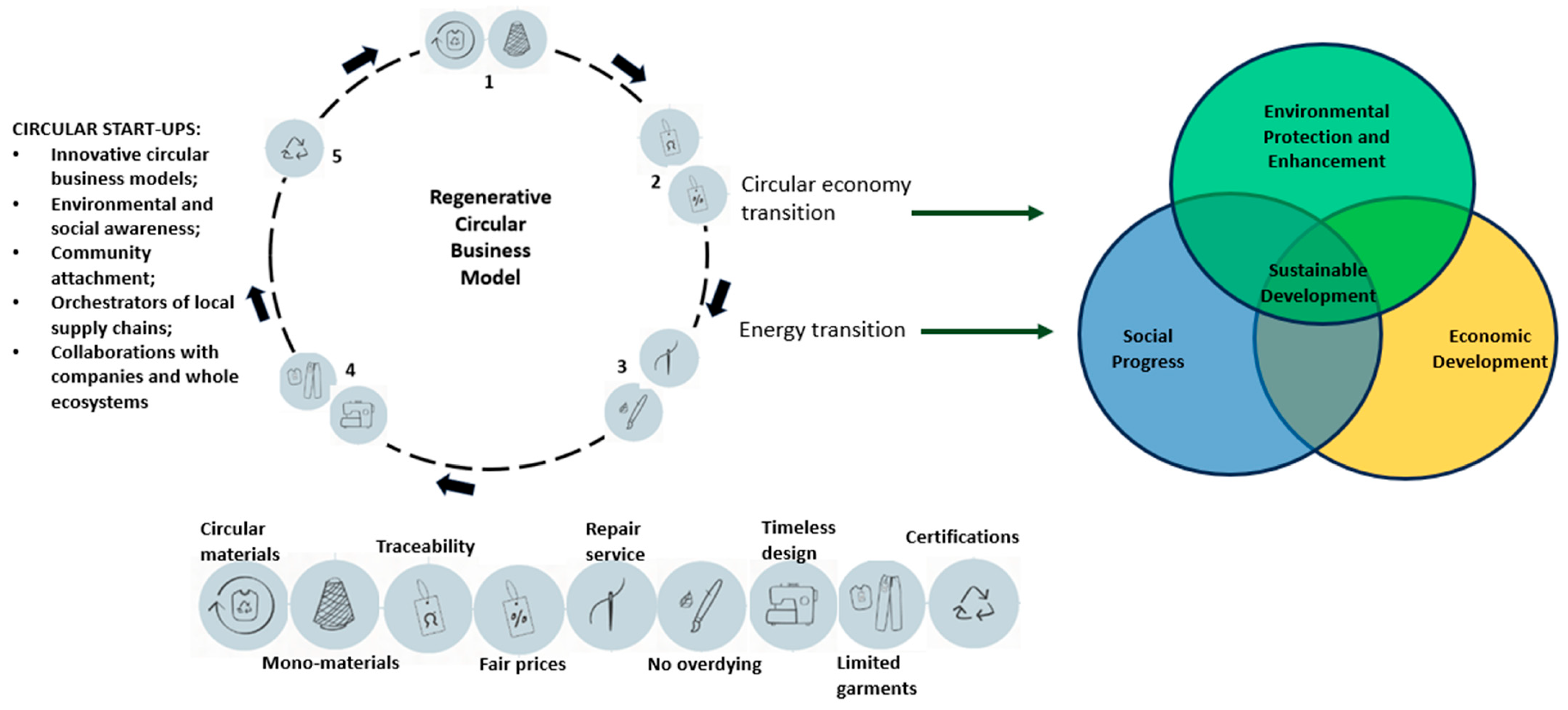
CSUs are a particular kind of company applying the CE model with a focus on all three pillars of sustainable development since their inception [13] (Figure 1). On that basis, CSUs design circular supply chains [26,31] and create strategic collaborations with potential partner companies, contributing to the renewal of their business models [33] and the adoption of more disruptive approaches [19].
In the light of the open innovation approach, alliances can be regarded as a proactive strategy useful to strengthen the commitment of a company towards sustainability and circularity and increase the validity of such efforts (legitimacy) [20]. Acquiring legitimacy is also important in increasing the environmental awareness of the internal stakeholders of a company, such as employees, and favoring their engagement with a firm’s sustainability strategies [30]. The image of both firms and start-ups compared to internal and external stakeholders (e.g., consumers and policy makers) will rise [23] if the firms endorse the start-ups as innovative and transformative [30].

The Transition Towards Circular Economy and Renewable Energies in Collaboration Practices

Several authors also argued on the evolution of the collaborations [29] and on the opportunities from exploring and exploiting new environmentally related knowledge, capabilities [14,30] and resilience [34]. These developments enhance the value of partnerships for the participating consolidated companies, leaving them with the necessary skills and knowledge for the implementation of circular activities [35]. As a result, open innovation projects have the potential to advance the transition to the CE and renewable energies in individual companies and industrial complexes in agreement with the concept of industrial symbiosis [20].
The interactions with CSUs are also driven by the capacity of firms to integrate the interests of their stakeholders [60]—creating social capital [19] and relations [61]—and the interests of the natural environment, contributing to the current socio-ecological [62], energy [37] and CE transitions [63]. In this regard, industrial ecology, which is one of the founding theories of CE, suggests viewing the industrial system and its environment as a joint ecosystem characterized by flows of material, energy and information as well as by the provision of resources and services from the biosphere [64]. Therefore, it is important to understand the following: how do the industrial system and companies work, what are the interactions with nature, and how do companies improve their performance? The LCA is one of the most important tools for this purpose, but even if its application has increased over the years, its use in companies faces some barriers.
The CSU can be considered a bridge between large companies and the natural environment because they are born with a particular environmental awareness that is crucial for promoting and triggering the circular renewal of large and conventional companies. Most of the theories of the CE model (e.g., Cradle to Cradle, biomimicry, regenerative design, blue economy and performance economy) [65] are interesting for a deeper understanding of the CBMs of the CSUs, even if their full application is still challenging [66]. For example, “Cradle to Cradle” suggests the design for upcycling for preserving the value of products, but it is not always possible to fully apply such an approach [40,65]. Regenerative design requires disrupting changes in society, while performance economy promotes the transition towards a higher role of renewable energies than fossils, reduction in waste generation and lower realization of pollutants [67].

3. Materials and Methods

Three companies were considered as case studies to be consistent with the multiple case approach [68]. This case study focuses on the analysis of two large companies and a CSU. They were interviewed because they are characterized by different types of relationships and joint projects in turn involving other stakeholders.
The CSUs were firstly identified and contacted by email in order to understand their availability to participate in the project and the interviews.
The selection of the CSU for its participation in the interviews was based on the following aspects:
1.
The CSU has collaborations with large companies of its ecosystem (the latter are identified during the first interview with the CSU);
2.
The CSU started its business more than 5 years ago, achieving a certain degree of maturity;
3.
The CSU is committed to perceiving all dimensions of sustainability in a clear and measurable sense by adopting certified assessment methods.
Most of the information concerning the three companies was collected by means of qualitative face-to-face semi-structured interviews. A specific protocol setting the procedure for the interviews in its main stages (before, during and after conducting the interviews) was adopted [67,68,69]. Previous literature on collaborations between CSUs and large companies as well as previous research of the authors on CSUs [15] were considered for the design of the questionnaire.
Two rounds of interviews were conducted with the three participants. The first round of interviews acquired most of the information, while the second round, in particular, with the CSU, focused on clarifying and examining more in depth the role of the CSU in the collaboration with the large companies. The first round of interviews, individually with each one of the large companies as well as with the CSU, lasted between 1 and 2 h. The second round of interviews with the CSU lasted about one hour.
The information collected from the interviewees was validated with the information available on the companies’ websites, secondary sources on the internet [70,71,72,73], literature on the topic summarized in Section 2 as well as by cross checking the interviews between the CSU and the large companies.
Before the conduction of the interviews, the founder of the CSU and the managers of the two large companies were invited to read the participant information sheet and the consent form summarizing aspects related to the purpose of this study, the motivations behind the selection of the participants and the implications due to the participation in the interview, reflecting the way the information provided in the interviews will be managed and used.
Meanwhile, before conducting the interviews, the research team carefully investigated the activities of the organizations on their websites. During the interviews, respondents were reminded of some of the activities mentioned on their website or press releases in order to stimulate and enrich the discussion. Respondents were also asked for their permission to record their interview in order to improve its effectiveness. The interviews were performed through the videoconference platforms (e.g., Microsoft Teams) most preferred by the participants in order to avoid any type of technical impediment and to create a friendly climate.
All the interview questions are listed in Appendix A (Rifò) and Appendix B (Pinori Filati S.p.A., Filpucci S.p.A.). Each conversation was recorded, transcribed into an interview report and then mailed to the participants to avoid errors in the interpretation of the information and to validate the information that emerged during the interview [69,73]. The coding procedure for the analysis of the information resulting from the interviews was organized and aggregated into specific themes (description of the activities of the companies, outcomes and features of the collaboration), following partially the conceptual framework developed by Giglio et al. [23], who structured the literature on collaborations between start-ups and large companies according to four main aspects: the antecedent factors behind the collaborations, the configuration of the collaboration, the outcomes and the mediators of the collaboration.

3.1. The Investigated Circular Start-Up and the Large Companies of Its Innovation Ecosystem

3.1.1. The Circular Start-Up Rifò and Its Perspective Business

Rifò was born in the year 2017 in Prato thanks to the idea of its founder, Niccolò Cipriani, of creating a company producing garments made of regenerated cashmere and wool yarn. The idea started to mature in Niccolò in Vietnam, where he became aware of the huge problem of overproduction in the clothing industry caused by the excessive amount of clothes produced at cheap prices. He returned to Prato deciding to create a start-up based on production and consumption models completely different from the conventional ones and mainly based on yarn quality and on the concept of responsible (real need of the consumers) and timeless fashion. From the foundation by means of a crowdfunding program, the start-up Rifò grew constantly and successfully over the years; today, it has a team of 25 people.
Figure 1 shows that the regenerative circular business model of Rifò is centered on garments that are made with recycled fibers and mono-materials to ensure that they are recyclable at the end of life (stage 1). In the year 2024, total garment production of Rifò used 97% mono-materials, while only 3% was made of mixed fibers. Moreover, 79% of the total yarn consumed by Rifò came from recycled fibers, while 6% came from organic and 15% came from conventional fibers. Recycled fibers originate from both pre-consumer (leftovers and unused garments) and post-consumer waste. The collection of pre-consumer and post-consumer textile waste is made through its stores or by means of the associated retail partners. The textile waste is transformed into new yarns and garments by local artisans near the Rifò headquarters. The garments are sold in Italy and abroad in more than 400 stores. All the production processes until the final consumer are traced by means of a digital product passport, while the prices to the consumers are fair and not seasonal (stage 2). Rifò has also introduced a repair service for its products, available up to three years, and a take back service to assure the circularity and control of the CBM. The colors of Rifò collections are selected from old clothes, eliminating the need for re-dying the yarns (stage 3). The garments are designed to last over time and avoid overproduction (stage 4). Finally, the production processes of Rifò and all the collaborating companies adopt several certification standards awarded after compliance to specific environmental and social multicriteria (stage 5).
Rifò is also very environmentally and socially committed, and since the year 2020, it is also certified as a Benefit Corporation. The latter certification is awarded to companies that constantly operate to create positive environmental and social impacts besides the economic goals.
Figure 1. Role of CSUs in circular economy and energy transition and main elements composing the circular business models of Rifò. Modified after Rifò [74]. 1. Production based on recycled materials and a limited number of materials for easier recyclability. 2. The supply chain is clearly traceable in order to identify the origin of each component and assign appropriate prices. 3. Providing a repair service for small damages to prevent unjustified disposal. Selection of recovered fibers from old clothes to avoid excess use of colors of dying. 4. Production oriented to ensure durable products and prevention of excessive production and waste. 5. Production is covered over the entire supply chain by quality certifications.
Energies 19 00184 g001

3.1.2. The Company Pinori Filati S.p.A.

The company is localized in the textile district of Prato (Tuscany Region in central Italy) and is a leading player in the international industrial yarn sector for knitting, with a history longer than 50 years [75]. Its traditional production deals with virgin yarns of wool, alpaca and cotton, while the more recent regenerated cotton yarn has been integrated in the last ten years. During the interview, Raffaella Pinori (Chief Executive Officer of the company) evidenced that “over time the company has characterized itself with a strong propensity to internationalization relying for the purpose on a large sales network throughout the world. We export about 70% of their whole production”.
Furthermore, Pinori Filati works “on two levels which are on one side the brand and on the other side the manufacturer itself, that is the knitwear factory, which co-designs its product with the brand. In that, at the end, the final customer is the brand”. One of the products that the company is currently selling to Rifò is a regenerated cotton yarn. This was created in the year 2015 thanks to the intuition of the father of Raffaella Pinori. He started the production of this type of yarn by using fibers obtained from the shredding of denim jeans.
The life cycle of the regenerated yarn starts with the collection of used jeans, which are cut in the further stage; the metal parts are removed and then are reduced to fiber through a shredding process. These steps are managed by a company in the Prato District. The fiber is then processed by Pinori Filati S.p.A. and mixed with a small percentage of pre-consumption cotton and virgin cotton in order to obtain the final regenerated yarn. The latter has a higher economic value than a normal new cotton yarn due to the particularity of the fiber that is not linear and similar to a malfilè.
Over time, the production of regenerated yarns by Pinori Filati has expanded to create an entire collection of such yarns, including polyester from pet bottles and recycled cotton from pre- or post-consumer cotton waste, among other sources. In this way, the company relies on an entire collection of regenerated yarns that can be proposed to customers who are interested in the CE and in purchasing of yarns in agreement with such a model [76].

3.1.3. The Company Filpucci S.p.A.

Filpucci is a company of historical relevance in the Italian textile district founded in the year 1967 in Campi Bisenzio near Florence (Tuscany Region) [77]. During the interview, Federico Filpucci, the son of the founder of the Filpucci company, traces the evolution of the company across the main changes in fashion, types of yarns and political and economic events. Accordingly, he shed light on how their company reacted (and in some cases anticipated) such changes by innovating and maintaining the excellent quality of their yarns. He said that “at the end of the 50s, the yarns for knitting were basically of two types: classic Biella, and the classic carded from Prato or from Biella which could also be cashmere. From the 60s onwards, fashion started to show more diversified needs concerning the yarns used in knitwear and became mainly created by designers such as Versace, Armani, Pucci. They began to request fantasy yarns that comprises yarns that are not linear namely tris, bouclé and others”.
Federico Filpucci underlined that, in the 60s, 70s and 80s, there were “ups and downs in the market”, but their company always positioned itself in a very high market segment, where its leadership is also recognized with regard to the emerging viscose as a filament mainly used until then to make the interiors of jackets. From then, it will be used to make knitwear and, therefore, multi-yarns dyed in the vat. Very often, the big revolution in textiles is made in the dyeing plant. Therefore, the highest challenge is dyeing the new fibers that are developed.
In the 90s and the 2000s, after the terroristic attack on the Twin Towers in 2001, the currency crisis posed the challenge of delocalizing part of the production. Filpucci S.p.A. responded by opening a company in Romania in 2004 and a company in China in 2005 while maintaining a relevant production in the Italian headquarters. The three countries have separate structures to take advantage of their respective markets and specific consumer demand. The Italian company has 30% of Italian customers as big brands, and the rest of the Italian production is exported worldwide.
Filpucci S.p.A. currently mainly produces wool and cashmere yarns as well as regenerated cashmere, whose fibers come from pre-consumer and post-consumer knitwear waste (mainly from the USA market). The regenerated chain is covered by environmental certifications and traceability of the whole life cycle. Interesting is the start of the production of the carded yarn by the company following the receipt of a very large order from an American customer. In Prato, there is a very important production and culture. Carded is the technology that allows the recycling of animal fibers in a better way than other types of recycling. Carding of fibers allows the use of sheet fibers, especially wool and cashmere.

4. Results

4.1. The Collaboration Model and Process

A corporate–start-up partnership can take different forms, such as corporate venture capital [78], corporate accelerator programmes [79,80,81] and buyer–supplier relationships [82].
In the interview, the founder of Rifò underlined that their start-up is involved in business collaborations with two large companies producing high quality virgin and recycled yarns (namely Filpucci S.p.A. and Pinori Filati S.p.A.) required for the production of its garments.
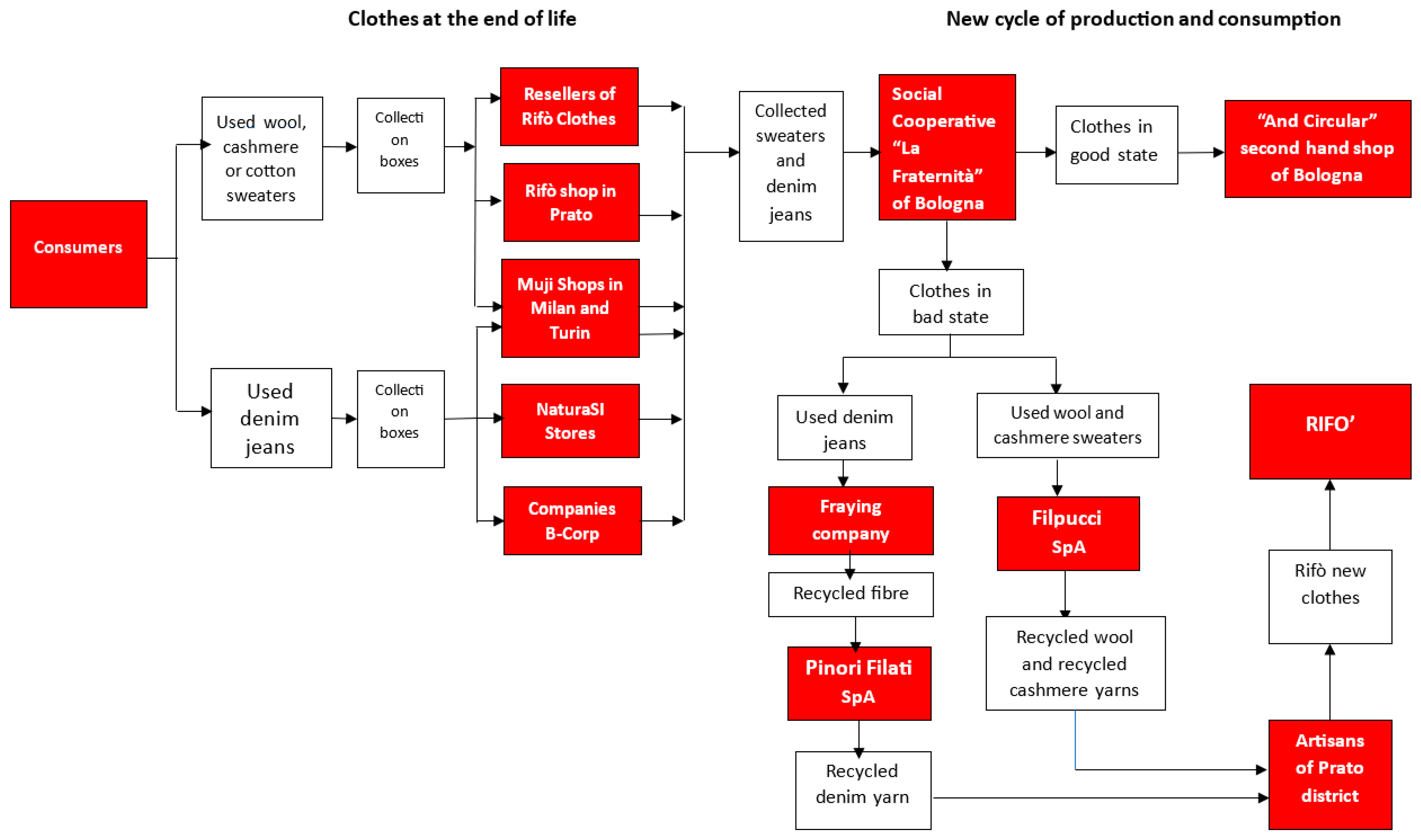
The collaboration with the two large companies extends well beyond the buyer–supplier relation [82] because both companies are involved in some projects of social impact coordinated by Rifò. The founder of Rifò indicated that “we are currently involved in two important projects that are expression of our idea of circular business and fashion more sustainable for the environment and the society”. The first project is called “Rethink your Jeans” and is based on the collection of used denim jeans in specific boxes available throughout Italy and Europe in a network of shops and other retailers. The project was born from an informal meeting of the founder of Rifò and the manager of the shop NaturaSì located in Prato and is an example of the creation of a successful initial collaboration that led to multiple collaborations with other actors.
NaturaSì is a national Italian company, dealing with the wholesale and retail trade and distribution of organic, biodynamic and natural products through a circular model—which starts from the seed and arrives at the table—in which the various actors collaborate to give life to a flow of responsible, virtuous, ethical and forward-looking relationships [83].
As a matter of fact, the initial idea of the project, focused only on the recycling of used denim jeans, was shared with the marketing director of NaturaSi as well as with the shops that could host the boxes for the collection of the used jeans, the cooperative for the selection of the jeans, the company involved in the production of jean fiber from the destruction of used jeans and, finally, the large company (Pinori Filati S.p.A.) using the jean fiber for the production of new denim yarn. The latter has been used for the production of new clothes by Rifò. An overview of the project is presented in Figure 2. The project has been extended later to the collection of cashmere and wool sweaters and their recycling from Filpucci S.p.A. (also shown in Figure 2).
Figure 2. Description of the main processes and stakeholders involved in the project “Rethink your Jeans”.
Energies 19 00184 g002
Pinori Filati S.p.A. had already developed the recycling technology for denim fiber but not yet a supply chain. The “Rethink your Jeans” project, as confirmed by Rifò, was born precisely to have traceability of the whole supply chain from the collection of the used jeans until their recycling into a new yarn.
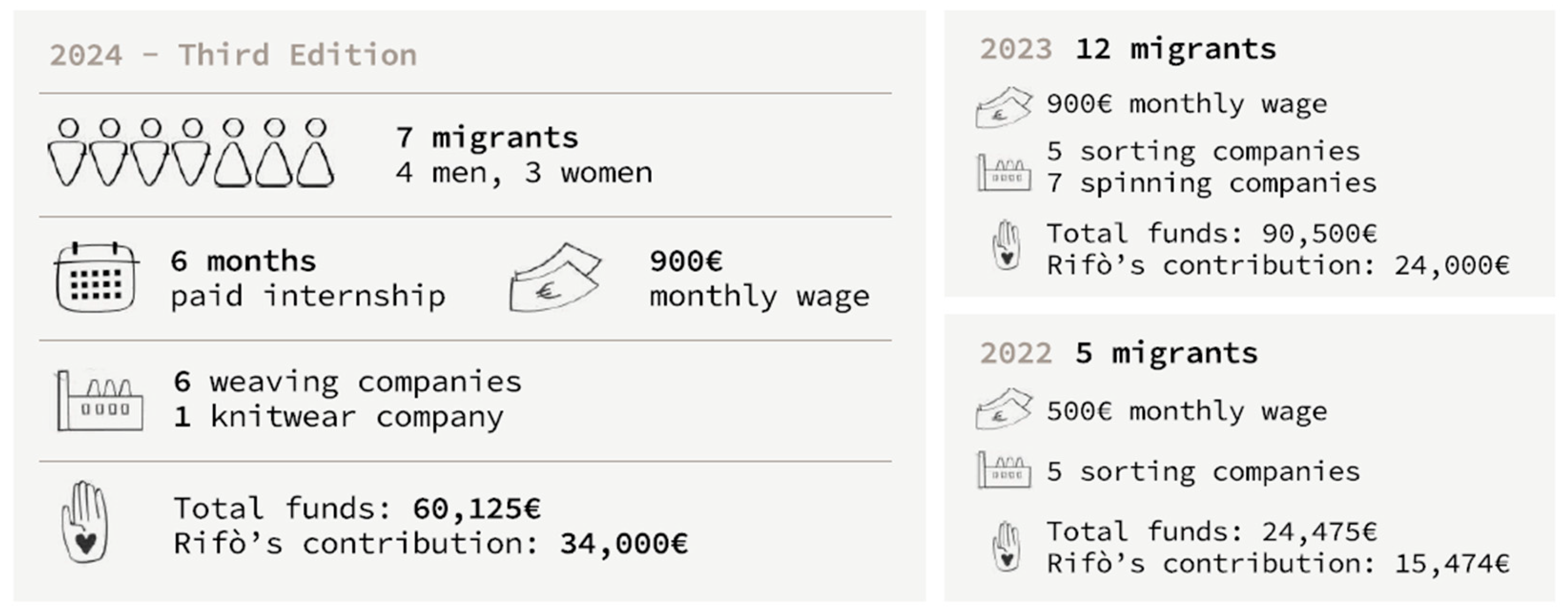
The other project, namely “Nei nostri panni” (“Within our clothes”) was born from an informal meeting and sharing of knowledge and experiences of the founder of Rifò with the general manager of the Foundation Opera Santa Rita of Prato. The founder of Rifò underlined that “we provided the business research and part of the funding with Filpucci S.p.A. and other main founders. The Foundation Opera Santa Rita realised the organization of the project along with other partners (These are: Municipality of Prato, Association of Cardato Riciclato Pratese, Confindustria Toscana Nord, CNA Toscana Centro, Associazione Tessile Riciclato Italiana, Consorzio Italiano Implementazione Detox of Prato) and the selection of the participants to the project”.
Figure 3 shows some of the most important elements of this project across the three annual editions. After the selection of the vulnerable migrants, they attend a first month of classroom training and 6 months of paid internship in the local textile companies of Prato district. Until now, the project involved 24 migrants globally. The Foundation Opera Santa Rita also supports the social integration of the migrants with the help of psychotherapists. In the future editions of the project 2026, one of the goals is also offering social housing to the participating migrants.
Niccolò Cipriani also discussed during the interview a third project, namely “Textile Tours”, that offers the opportunity to discover the companies of the supply chain of Rifò located in the textile district of Prato so that Rifò visitors can book a tour directly from the website of Rifò and have a full immersion in the CE practices of the four companies and see how leftovers and textile waste are transformed into new fibers and textile resources and then new Rifò clothes.
Very recently, a collaboration with a large historic company specialized in shirt making, namely Inghirami S.p.A [84], also came out. This last collaboration further characterizes the fashion collection by Rifò in a circular manner since it involves the reuse of vintage high quality unused fabrics extracted from the Inghirami Archive. The fabrics have been progressively catalogued since the year 1949. The project with Rifò provides an opportunity to reduce the environmental footprint of Inghirami company by adopting the so-called “upcycling” of its archived fabrics, giving them a second life.
Moreover, Rifò has technological collaborations with two digital start-ups for the development of traceability of the garments entering their store and free collaborations with other companies, such as Calzedonia and Oviesse, two Italian fashion brands with a large network of mono-brand stores throughout Italy and worldwide. These two companies contacted Rifò to know how to set up circular services and more about their collections designed according to the principles of CE. “We are not productive with them but we are happy to share our good circular practices”, claimed the founder of Rifò.

4.2. Energy, Environmental and Social Outcomes of the Collaboration

The previous literature, mentioned in the introduction, has clearly shown that collaborations between start-ups and large companies can provide multiple positive benefits both for the large companies and the start-ups but can also be a source of challenges. The interview with the founder of Rifò was focused on improving the understanding of these outcomes of the collaboration with two of the large companies of its ecosystem. The environmental and energy outcomes that emerged from the collaborations are summarized in the next subsection and in Table 1, while the other benefits and some challenges are summarized in Table 2.

4.2.1. The Perspective of the Circular Start-Up

Since the beginning of its activity, Rifò has prioritized the local production of its garments to reduce the environmental impacts of transportation, preserve the local textile traditions and support the economy and employment of the Prato district. The supply chain of Rifò (starting from the companies producing the yarns) is located in the textile district of Prato within a distance of 30 km, and this factor ensures better control of the quality of the production and ethical working conditions. Responsible purchasing practices are adopted for all the suppliers. The relationship with the textile district is one of the assets at the base of Rifò’s regenerative business model. According to the founder of Rifò, “the concept of innovation is not universal since it differs depending on the local context where it is applied. Prato has a longstanding tradition in recycling born centuries ago when recycling was a more common activity than today in fashion”.
The CSU “Rifò” fully reflects local innovation and the way of speaking of the artisans who invented, more than a hundred of years ago, the method of regenerating old garments to produce new yarns: the so-called “Cenciaioli”. Rifò (or “Redo”, in English) expresses such traditional craft that, in recent years, has been disappearing but is now being revitalized in one of its current social projects “Nei nostri panni” (described in Section 4.1). Importantly, Rifò reinvests part of the production revenues into the local community and into social projects that can provide benefits for the local area. The continuous environmental and social commitment is reflected in the score achieved as a Benefit Corporation in the year 2024, which increased to 127.1 from 99.9 (year 2020).
Table 1 shows the measured environmental and energy benefits from the productive collaborations with the two large companies and others for the supply of the recycled yarn used for the production of Rifò’s garments. For each type of yarn, details on the composition, supplier, recyclability potential and savings of water, energy and CO2 are provided. It is interesting to note that the highest savings are realized by the use of recycled wool. Moreover, light cashmere, recycled wool and recycled cashmere can be recycled up to three times, while the other yarns can be recycled only one time. It is worthwhile to underline that the supply of recycled yarns to Rifò improves its environmental performances and contributes to further confirm the ecological orientation of the two large companies because Rifò is well known to be a sustainable brand.
Table 1. Summary of the recycled yarns and their features used by Rifò for its production. Source of the data: Sustainability Report 2024 by Rifò [74].
Type of Yarn and CompositionCompositionSupplierRecyclable PotentialWater, Energy and CO2 Savings
Recycled cashmere95% recycled cashmere, 5% recycled woolFilpucci S.p.A. Campi Bisenzio (Florence)—Italy
Gori Alberto S.p.A. Montemurlo (Prato)—Italy
3 times
  • − 66% Water;
  • − 67% Energy;
  • − 85% CO2 Emissions.
Recycled wool100% recycled wool (pre-consumer)Filpucci S.p.A. Campi Bisenzio (Florence)—Italy3 times
  • − 99% Water;
  • − 76% Energy;
  • − 92% CO2 Emissions.
Light cashmere70% recycled cashmere, 25% cashmere, 5% woolFilpucci S.p.A. Campi Bisenzio (Florence)—Italy3 times
  • − 40% Water;
  • − 39% Energy;
  • − 55% CO2 Emissions.
Recycled wool fabric62% recycled wool, 38% recycled polyamideMapel S.p.A. Montemurlo (Prato)—Italy 1 timeTo be measured
Recycled and organic cotton50% recycled cotton, 50% organic cotton (100% recycled pre-consumer)Belda Lorens. Banyeres de Mariola (Alicante)—Spain 1 time
  • − 43% Water;
  • − 42% Energy;
  • − 44% CO2 emissions;
  • − 99% Chemicals.
Recycled and conventional cotton45–60% recycled cotton, 40–55% cotton (100% recycled pre-consumer)Marchi & Fildi S.p.A. Biella—Italy 1 time
  • − 67% Water;
  • − 38% Energy;
  • − 34% CO2 emissions;
  • − 60% Chemicals.
Twill denim24% recycled cotton, 76% Regenagri cottonCandiani denim S.p.A. Robecchetto con Induno (Milano)—Italy 1 timeTo be measured
Recycled denim75% recycled denim cotton, 20% cotton, 5% other fibersPinori Filati S.p.A. Prato—Italy 1 timeTo be measured
Further measured benefits by Rifò concern those from the project “Rethink your Jeans” (mentioned in Section 4.1) and its further extension to the collection of used garments in 100% wool and 100% cashmere. In the year 2024, the take back service of the project involved 228 collection points and more than 2500 people across Italy and Europe. The collection points have been distributed in 123 partners’ locations representing organizations in a wide range of sectors from NaturaSi and Coop [85] retailers to Banks, Non-profit organizations, textile manufacturers and so on. Consumers received a discount code in exchange for their used garments left at the collection points.
Overall, in the year 2024, 64% of the collected garments were recycled, and 11% were in a very good state and reused in the second-hand shop of And Circular [86]. AND is a project of the social cooperative La Fraternità of Bologna [87] that offers the opportunity to people of being reintroduced to the labor market, avoiding their exclusion, and, at the same time, gives used clothes an extension of their life. Furthermore, 25% of the total ended up as waste because they were not in pure yarns as recommended. They have been used for the production of the packaging by Rifò, namely Fluffypack [88]. The collected used garments in the take back service of Rifò have contributed to produce 23% of the recycled fibers used for the manufacturing of new yarns and garments.
Table 2 summarizes further benefits (more economic and managerial) from the productive collaborations between Rifò and the large companies, resulting from the interviews and compared with the existing literature. In particular, the Rifò founder was asked how large companies have supported the growth of the start-up and whether Rifò contributes to stimulate the innovation process in line with the CE principles of their large partners. He pointed out that “Large companies have helped us by sharing experiences and knowledge. Filpucci is also a business partner of Rifò and therefore is contributing financially to the growth of the start-up. The large companies also shared their studies and research. We also collaborate on the innovation level in a commission relationship, but, as said before, there is also the sharing of experiences, research, tests”. As a consequence, our research team also asked how Rifò supports the transition towards the CE of the large companies and about the role of Rifò in promoting the design based on the principles of CE applied to new yarns, by requiring, e.g., biodegradable yarns. Rifò is a renowned innovative CSU involved in CE research and in the close monitoring of fashion trends to stay competitive and is in a top position to discuss circular innovation with the large companies.
The interviews also focused (in accordance with the previous literature) on how the collaboration between small businesses/start-ups and large businesses can also limit the innovative capacity of start-ups [36], given that large businesses have different purposes [35] and, therefore, could use, in an instrumental way, the start-up, limiting its innovative capacity with regard to sustainability [36].
The founder of Rifò evidenced the increasing application of the CE model by large companies in the fashion sector and other sectors. In this initial stage of the transition to CE, he underlined that there is a lot of sharing of best practices because the CE is made up of many processes and steps with many environmental authorizations, and therefore, it is something still in the development phase, even if the transition is strongly accelerating in recent years There could be a compression of the innovative capacity of start-ups, and for this reason, the founder acknowledged that it is necessary to evaluate the corporate–start-up partnerships to avoid the negative impacts that could arise and become larger.
Furthermore, Rifò argued on the critical role of incentive policies to support the research and growth of CSUs and, in general, the transition of the whole industry towards the CE model. He pointed out that some countries, such as Switzerland and Norway, are providing significant funding to support investments in technologies for recycling medical textiles. Large companies have the financial resources to innovate, but they do not recycle textiles because it does not seem financially viable for them.
Table 2. Main benefits and challenges that emerged from the qualitative interviews and comparison with those retrieved from the analysis of the literature.
Quotations from the Interviews with RifòBenefits for the CSUChallenges for the CSUBenefits for the Large Companies
Large companies have helped us by sharing experiences, knowledge, research, testsSharing of resources needed for further advancing their innovation process, including product development and circular business models [20,23].
Filpucci is also a business partner of Rifò and therefore is contributing financiallyProvision of financial resources for the growth of the start-up [19,23].
There is currently a phase of great attention, but large companies and start-ups have different interests. Limitations to the innovation capacity of the start-up and sustainability performances due to resource asymmetries of the large companies [19,23,36].
Dealing with circular design, we ask the large firms with which we collaborate to start a circular innovation applied to new yarns Opportunities for large companies to access emerging technologies and more disruptive business models [19,20,35].
Sharing of the social benefits from social impacts projects Improvement of the social image of the companies involved in the shared projects [this study].

4.2.2. The Perspective of the Large Companies

The interviews with the two large companies of Rifò’s ecosystem explored their relationship with Rifò and the role of Rifò in their collaboration and innovation process as well as investigated if the companies have other collaborations beyond the Rifò start-up for the management of environmental impacts.
The Sustainability Policy of the Company Pinori Filati S.p.A. and Its Collaborative Link with the CSU Rifò
The Pinori Filati policy strictly focuses on transparency and establishing a corporate strategy that combines ethics and profits as well as long-term development in agreement with all three pillars of sustainable development (economic, social and environmental). In terms of environmental sustainability, the policy of Pinori Filati S.p.A. supports innovation, research and development and the reduction in the environmental impacts of its own business using a monitoring-oriented approach towards the continuous improvement of performance [89].
The company’s policy also entails the implementation of a chemical risk management system to reduce the impacts due to the use of hazardous chemical substances, the constant monitoring of wastewater flows to improve wastewater quality and the information and training of their employees to ensure the alignment is with the expected goals of research and innovation. The company also shares the results on its monitored environmental performance with all the stakeholders and defines the new goals [89].
With regard to the social pillar, Pinori Filati S.p.A. adheres to labor rights according to the Universal Declaration of Human Rights and the core conventions of the International Labour Organization (ILO) as well as the national legislation and conditions set out by the national negotiation. Labor rights include freedom of association and the right to collective bargaining, no child labor and employment of children, no forced labor, maintenance of health and safety working conditions, prevention of any discrimination and abuse, regularity and transparency in employment contracts, recording of working hours and payment of fair wages. Finally, the company also aims to collaborate with partners having the same social goals in agreement with the applicable regulations [89].
The first interview with Raffaella Pinori evidenced that the relationship with Rifò started as commercial and, over time, has extended to other forms of collaborations. “We sell to Rifò a product that we created in the year 2015, starting from what the Prato district is capable of valorising and recycling. We created a product that is not wool but cotton that comes from the shredding of used denim jeans. The latter are cut; the metal parts are removed and then they are reduced into fibre through the shredding process. The fibre is then mixed with regenerated cotton. Rifò analysed our collection and then decided to put a product like that in its collection”.
Raffaella Pinori said that they sell such recycled yarn not only to Rifò but also to other clients who are very diversified. Some of them are not interested in valorizing its origin of recycled yarns, while others include such yarn in their collections because it has peculiar characteristics linked to the presence of some little buttons similar to a malfilè. Such particular structure is given precisely by the stitching. Further, clients like Rifò are more interested in the environmental nature of such yarn being a recycled yarn. Some American customers use all eco-sustainable products and purchase such yarn to give value support to their company. There are also clients that require it within compliance because, currently, all of the most important brands adhere to product and management certification schemes.
In this regard, Raffaella Pinori evidenced the increasing attention from companies and, in particular, from fashion brands to environmental and social sustainability, and for this reason, companies use recycled yarn for their products, even if they do not have a specific environmental characterization. Instead, in the case of Rifò, she confirmed that it was born specifically with an environmental orientation, also measured by means of LCA studies to quantity scientifically the environmental impacts of their products.
The research team also explored with Raffaella Pinori if the company had further collaborations beyond Rifò focused on the management of environmental impacts. She evidenced that there is a tendency among the well-known brands to assure the traceability of their products and the monitoring and evaluation of their environmental and social performance:
Today everything is being managed from this point of view. Just think that the need to provide traceability to the products we make is growing more and more and therefore we collaborate with all our brands, our customers and also have a purchasing policy that follows their principles and basically have to make the supply chain transparent”.
She further discussed that brands are increasingly moving towards social and environmental aspects because they do not want their brand associated with the exploitation of the workforce in the supply chain. This orientation implies the “strict” adaptation of Pinori Filati to the requirements of the well-known brands, with the result that the concept of ecosystem is more labile and the collaboration and innovation processes are constrained by the rules of the brands, their certification schemes and then the dynamics of competition on sustainability and circular dimensions.
The interview called for the attention of Raffaella Pinori on the existence of a more marked concept of ecosystem process with the company and Rifò as well as a more collaborative relationship because the niche is smaller and the company is an important point of reference for Rifò. On the other side, Rifò is the leader of the project “Rethink your Jeans”, and in that, there is a more ecosystem element of systematic collaboration and innovation co-creation.
Raffaella Pinori acknowledged the peculiarity of the concept of ecosystem and also added further important elements about the collaboration with Rifò in terms of the benefits they receive. The partnership is important for her company because Rifò currently has a very high visibility and Pinori Filati understands how to communicate from the point of view of the life cycle of garments. The relationship also provides a benefit in terms of more visibility, even if it seems a local visibility.
The Sustainability Pillars of Filpucci S.p.A. and Its Collaborative Perspectives with the CSU Rifò
Since the 2000s, the company is committed to align gradually to all sustainability pillars (environmental and social), adopting innovative solutions in production to reduce their environmental impacts. The initiatives have involved the launch of new lines of eco-friendly and certified products. Moreover, collaborations with research institutes and universities have been strengthened by the development of advanced materials. A key aspect of the corporate sustainability policy is the increasing attention to traceability and transparency throughout the entire production chain, guaranteeing customers high-quality products with certified origins [90,91]. Filpucci S.p.A. is currently involved with four other companies (namely Green Line, Nuova Fratelli Boretti, A. Stelloni by Mapei, Antica Valserchio) in the Re-Verso project [92], which is an integrated supply chain offering the opportunity to recover panels, yarns and everything that the knitwear factories do not use or discard during the processing phases of the knitwear. Moreover, in the last few years, the company has continued to adapt to the new challenges of the global market, including digital transformations and growing consumer demands for sustainability, and invested in strategic policies by acquiring two historic companies in the Prato district: the Valfilo spinning mill and the Fiordiluce dyeing plant [90,91].
Since the year 2021, the company has adopted initiatives to improve energy efficiency and renewability, starting from the transition to low impact mobility by means of a gradual shift to hybrid cars and the installation of charging stations in the company’s car park. In the year 2022, led lights replaced the previous whole lighting system of the company, while at the end of the year 2023, a solar PV plant covering 2295 m2 (estimated power 500 kW) was installed. Currently, the plant satisfies about 20% of Filpucci’s energy needs. Finally, last year, the company installed control units for optimizing energy consumption and inverters for power modulation [91].
With regard to the social pillar of sustainability, some of the recent initiatives are aimed at promoting gender balance (e.g., by hiring a female Chief Financial Officer) and the constant monitoring of the whole corporate health by means of strengthening strategic and organizational oversight. The ESG function also has a central role in the structure of the company to express the strategic importance that sustainability has in the management of the company [91].
In the interview, Federico Filpucci confirmed that the company supplies Rifò with most of the recycled cashmere they have in their store and that is used for the production of their collections. Recycled cashmere yarn is composed of 95% recycled cashmere (65% recycled post-consumer and recycled pre-consumer) and 5% recycled wool. During the interview, Federico Filpucci explained in depth the recycling process of cashmere that is also certified by the Global Recycled Standard.
We have a standard and collect both post-consumer and pre-consumer cashmere. The Reverso supply chain collects and recycles cashmere from pre-consumer leftovers. However, we have to keep separate pre- and post-consumer cashmere because they have very different characteristics. Post-consumer cashmere mainly comes mainly from America because it is a large market for such yarn”.
He also said that the regulations of various countries are very strict regarding 100% cashmere, which cannot have contamination within the European Union beyond a limit of 0.2%: “The chemical separation of post-consumer cashmere cannot be done. As a result, the separation is made on the basis of the label with the risk of contamination in particular in the case of large lots of post-consumer cashmere. A blend cannot be marked 100% cashmere. We created as hoc product, precisely made by 95% recycled cashmere and 5% recycled wool which is a non-pure composition but allows us to be in compliance with the global regulations”.
Finally, Federico Filpucci also underlined that the price of recycled cashmere yarn is lower than that of virgin cashmere, and this is an attractive factor for some clients who have made sustainability a cornerstone of their production, such as Rifò.

5. Discussion

5.1. Entrepreneurial, Energy and Environmental Benefits from the Collaboration

The results shed light on the features and outcomes of the collaboration between the CSU Rifò and two large companies in its circular innovation ecosystem in the textile district of Prato. This study provides an opportunity to learn that all three economic actors (the CSU and the two companies) have been very involved in the transition to CE for some years, contributing to each other to strengthen the implementation of the circular principles in their organizations and measuring and certifying their environmental and social performance and the traceability of the life cycle of their products.
The environmental and energy savings realized by Rifò in the life cycle of its products and, in turn, from the two large companies in the production of their recycled yarns contribute to reduce the impacts of the textile industry, improving the health of people and the environment. The case study also offers empirical evidence of companies in the district of Prato that are transitioning to the CE model and contributing to the achievements of the communicated annual savings of the district in terms of less water, energy, CO2 emissions and toxic substances [49].
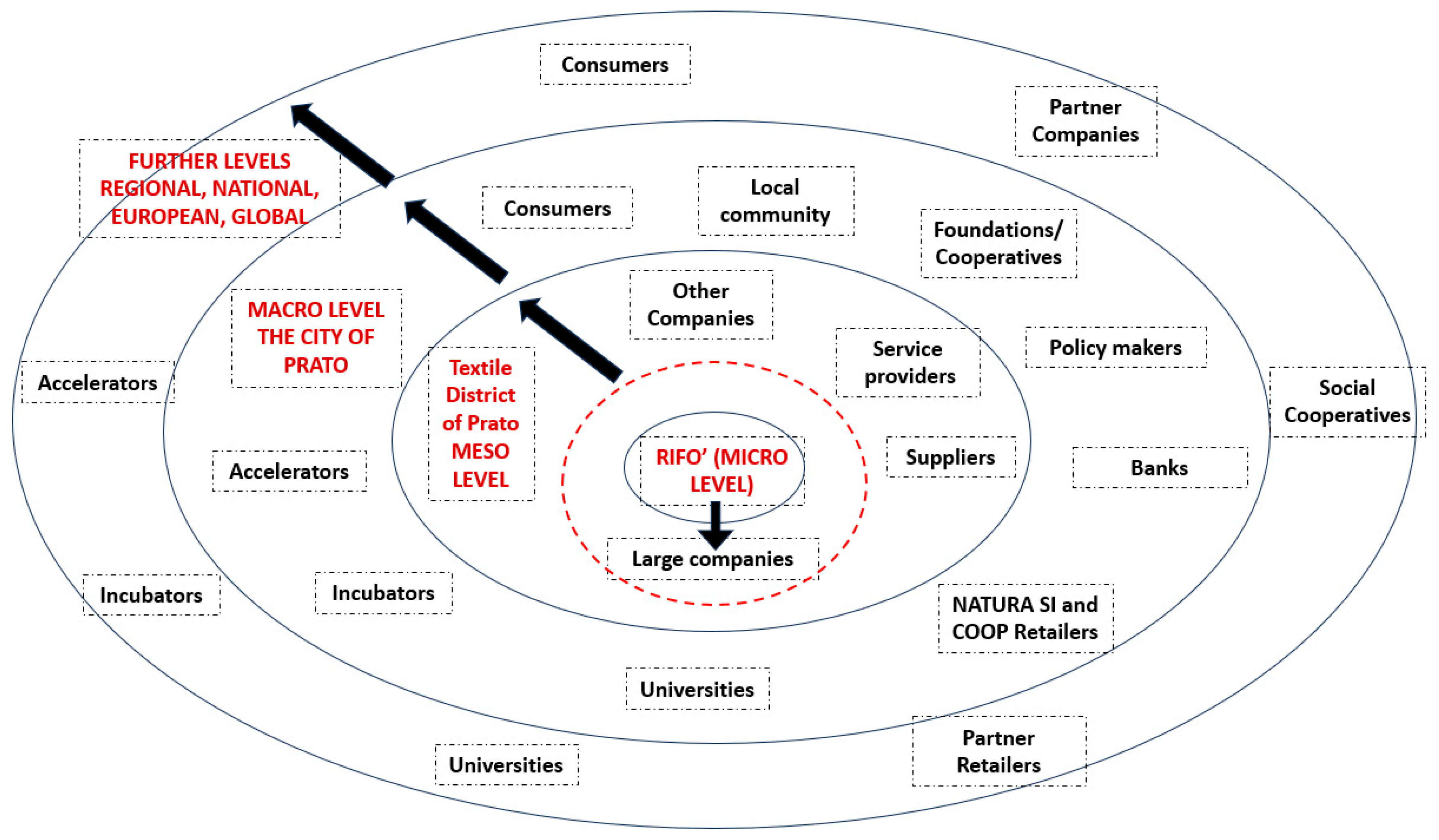
Moreover, the analysis of the collaboration among the CSU and the two large companies reveals that, besides the productive collaboration for the supply of recycled yarns, they are involved in other joint social projects that, in turn, gather multiple stakeholders, organizations, the municipality of Prato and the local community of the city. Therefore, this study is innovative and relevant because it shows the integration among the three levels of application of CE (micro, meso and macro) and the three pillars of sustainability. Figure 4 shows that the analysis expands from micro (the analyzed companies and their circular business models) to meso (their integration with other companies in the district) and macro (their integration into the city and its goals as a circular and socially inclusive city by launching projects of social impacts, such as “Within our clothes” and “Rethink your Jeans”). These are important results that have not been reported in the current literature focused on start-up–corporate collaborations.
Regarding the partnership results, this study also confirms the findings of previous studies in terms of benefits for the CSU from collaborations with large companies ranging from access to the financing necessary for securing further growth opportunities [23] to new market learning and innovation [19]. Moreover, this study confirms the benefits for the large companies, since collaborations with start-ups are sources of entrepreneurial and product renewal [33], provide support for the adoption of circular business models [35], signal ambitions towards eco-innovations [30] and enhance corporate strategic position and image compared to the competitors, customers and other stakeholders [26].
Figure 4. Levels of applications from micro to macro and scale of the outcomes of the investigated collaboration.
Energies 19 00184 g004

5.2. The Importance of the Collaboration for a Broader Energy, Environmental and CE Transition

The CE is considered an important intermediate goal towards sustainable development [92]. The application of the CE model must be more environmentally and socially sound compared to the linear model [93] to release the radical changes required to face the current environmental and social challenges [6]. In the roadmap towards more sustainable development [94] and a “good antropocene” [95], a system change is needed along with the participation of all the actors in society [37].
The collaboration provides commercial economic benefits to the large companies from the selling of recycled yarns to Rifò, and non-commercial benefits, such as the environmental and energy savings from the use of recycled yarns and the social benefits from the joint participation to the described social projects. Both the CSU and the large companies support the development and employment of the local community and the preservation of its cultural heritage.
In this perspective, the garments of the CSU acquire a particular and multifunctional value that also derives from the collaboration with the large companies and the alignment of their circular business models on sustainability, transparency, traceability and attachment to the local community [96].
Finally, the garments from the CSU contribute to satisfy a “niche demand” with regard to the final consumer [97] for whom there is a particular attention by CSU at the local level [98] as well as align with the recommendations of the EU Circular Economy Action Plan and the recent directive on empowering consumers for the green transition [99]. This aspect has important practical implications because reliable information facilitates the selection from the consumers of better environmental and social products compared to the others available in the market.

5.3. The Importance of the Collaborative Links for the Energy Transition

The case study also offers interesting results for the energy transition, a process that is strictly related to the CE transition that promotes the shift to renewable energies and more efficient energy use [100]. The proposed CE and renewable energies nexus suggest the need for both transitions to integrate each other’s to reduce the impacts and natural resources’ use.
From the analysis of the activities of the two companies and the CSU, we find that the energy benefits presented in Section 4.2.2 are underpinned in turn on individual corporate commitments to achieve energy benefits. The energy commitment seems more pronounced in Filpucci company [91], but in any case, the application of the CE model in itself (as indicated by the Circular Economy package), applied by the three companies, is important for reducing the energy demand [101]. The extension of the use of materials and products by means of the reuse or recycling of pre-consumer and post-consumer waste contributes to reduce the use of virgin raw materials and their extraction and the associated energy use [102].
The reduction in environmental and energy impacts are core values of the three companies, as revealed in the interviews and further confirmed in their sustainability policies and reports. This shared vision is essential for a corporate–CSU collaboration tied to achieve environmental and energy benefits effectively.
On the other hand, energy prices are increasing [103], and the supply of energy could be subject to possible disruptions due to the uncertainties of the current global geopolitical situation [103]. Therefore, the energy investments of the three companies are strategic for the continuous and necessary expansion of their business [104]. Important drivers at the basis of the creation of such collaborations are their entrepreneurial capacity and their policies by which they prefer collaborations with partners sharing the same social and environmental goals [74,89,91].
In absence of this environmental and social attitude, the outcomes of the collaboration could be limited and challenging because, e.g., the CSU could have to balance its sustainability goals with the interests of the large companies [36] or the large companies could take advantage of the environmental prestige of the CSU while not transforming its operation and business practices [30]. In this regard, the company’s sustainability report is an important tool to support the CSU and the creation of more transparent collaborations useful for measuring the effective contribution to the CE and energy transitions [105].

6. Conclusions

6.1. Energy and Environmental Perspectives

This study focused on the collaboration process and its outcomes between a CSU and two large companies and the perspectives of both actors on the collaboration. The final goal is to enrich the current research and also shed light on the role of the CSUs in the transition to CE and sustainability of the large companies in its innovation ecosystem.
From the interviews, we find that both start-ups and large companies show very interesting circular business models to study. The investigated start-up was born circular and is strongly committed to creating positive environmental and social impacts in its economic activity. The two companies have a long history characterized by high entrepreneurial capabilities, continuous innovation and prestige of their high-quality products. The collaboration between the CSU and the large companies started some years ago for commercial purposes since both companies are suppliers of recycled cotton yarn (Pinori Filati S.p.A.) and recycled cashmere (Filpucci S.p.A.) for the start-up.
The use of these recycled yarns and fibers for the manufacturing of new garments by Rifò generates important environmental and energy benefits compared to the production of garments with new yarns. However, recycled yarns still face technological challenges, and for this reason, it is important to apply (according to the case of the regenerative business model by Rifò) the CE model thoroughly, considering the other principles such as circular design, reuse and repair. The case study helps understand the configuration of the collaborative process in the textile industry, integrating the existing research with new knowledge.
Over time, the commercial collaboration has further strengthened among the CSU and both companies in terms of new initiatives. Filpucci S.p.A. is also a financial partner of the CSU. Moreover, the interviews pointed out that the innovation process between the start-up and the two companies is characterized by the sharing of experiences, knowledge, research and tests. The CSU also has a leading role in stimulating the application of circular design to the production of yarn of the two companies.
Between the CSU and each one of the two companies, there are also collaborations in projects with an important social impact both for the community of Prato textile district and other realities. The project “Rethink your Jeans” is currently coordinated by Rifò and also involves Pinori Filati S.p.A. and other actors, including a social cooperative where the employed workers have disabilities or are experiencing social recovery, not to mention that the project has environmental benefits preventing the disposal in landfills of unused denim jeans. Rifò and Filpucci S.p.A. are also involved in the project “Textile Tours” in the district of Prato that is important to show the supply chain of Rifò but also the full immersion in the capabilities of the companies in textile recycling.
The openness to other projects reveals that the collaboration extends on three levels of application of the CE model from micro to meso (the district of Prato) and macro (the city of Prato) and has important implications for studying further the framework and policy purposes.
Some of the limitations of this study are related to the methodological approach adopted (qualitative multiple case study research) that could limit the generalization of the results due to the sample size and the low number of interviewed actors. Nevertheless, this research provides interesting and rich insights in view of its peculiarity and focus on the textile industry of Prato, internationally renowned for its historical tradition in the application of the CE model in the textile industry. Therefore, its value is in agreement with the nature of qualitative explorative studies and previous research on corporate–start-up collaborations [106].
Future research can explore, with larger surveys, how this model of collaboration based on a strong commitment to sustainability of the CSU and the large companies can be applied to other textile districts or sectors. Some studies on larger samples of collaborations between start-ups and large companies [36] have found that the collaboration with large companies can also be challenging for the CSUs, compressing their goals towards sustainability. Therefore, it is important to understand in which sectors a CSU is capable of keeping intact their goals towards sustainability while facing the pressure of the large companies mainly oriented to the achievement of economic goals.

6.2. Managerial and Practical Implications

The results have implications for managerial theories, such as open innovation [20,37,107], theory of dynamic capabilities [23,108] and sustainable capabilities [109] institutional theory [110]. Since its inception in the year 2017, Rifò has aligned and realigned its internal and external resources [111] to the principles of CE and expanded its collection of garments from the initial t-shirt (50% recycled and 50% organic) towards the release of 100% recycled silk sweaters (year 2022) and the introduction in 2024 of the collections in recycled linen and viscose. Rifò also established its take back system for collecting used garments in 2019 (at the beginning, limited to denim jeans, and now, open to used wool and cashmere garments), while in the year 2021, Rifò launched its repairing program. The digital product passport was also introduced in the year 2023 to trace all the important information regarding the production and impacts in terms of water, energy and CO2 [74].
All these changes/achievements have been followed by progress in the score of the Benefit corporation assessment. This evolution has been accompanied by an expansion of the collaborations, opening up to new external partnerships both formal and informal and also showing that the transition to CE is a process that involves the sharing and mutual learning of experiences and best practices. In general, this case study points out that CSUs show a great openness to collaborate with new partners to facilitate the general application of the CE model in the textile industry, thus creating a varied innovation ecosystem including other businesses, start-ups, associations, cooperatives, universities and municipalities [107]. This confirms that open innovation approaches are conducive to the application and acceleration of the CE model [20] and energy transition [37]. Similarly, the two large companies have built and reconfigured over time their internal and external resources/competences [111] for a more responsible business model, combining industrial excellence with environmental, energy and social sustainability and circularity [112,113].
The case study also has implications in practice in showing collaborations based on the adoption of CE principles and sustainability, their benefits and challenges as well as the circular business models adopted by each one of the collaborating companies and the indicators they used for measuring their impacts. The collaboration between the CSU and the two companies represents an example that other entrepreneurs in Italy and abroad can follow, thus opening up prospects for circular development far beyond the size of the Prato textile district.
Finally, the challenges are also technological because some recycled yarns and fabrics can be recycled only one time, confirming the limits of recycling and the importance of implementing the other principles of CE beyond recycling, such as the circular design, reuse and repair.

6.3. Policy Recommendations

The case study showed that collaborations can provide commercial and non-commercial benefits for the participating partners, the local community and global society. The extent of the benefits depends on the commitment towards CE and energy transition and sustainability of all the partners. In this study, sustainable and circular innovation is one of the core assets of the two large companies and the CSU. This orientation requires investments and a continued commitment, as also disclosed in the sustainability reports and document policy of the companies. Their sustainable and circular practices are covered by certification schemes to assure the transparency and traceability of their processes, adding a higher complexity and challenge to their innovation sustainability processes.
The case study also shows the key role of the CSU in promoting projects of environmental and social impact that are important for facilitating the renewal of entrepreneurship models towards sustainability.
Supporting innovative CSUs and the creation of partnerships is, therefore, essential for rethinking the life cycle of textile products and promoting a systemic change since the design stage of products and processes. Important open innovation initiatives are developing, e.g., in Italy, aimed to strengthen the role of innovation ecosystems populated by start-ups, large businesses, university spin-offs and other stakeholders for facilitating the development of more environmentally friendly circular models also delivering positive economic, social and employment outcomes.

Author Contributions

Conceptualization, P.G. and S.U.; methodology, P.G.; validation, S.U.; formal analysis, P.G.; investigation, P.G., I.Q. and R.P.; data curation, P.G.; writing—original draft preparation, P.G.; writing—review and editing, P.G., I.Q., R.P. and S.U.; supervision, S.U.; funding acquisition, R.P. All authors have read and agreed to the published version of the manuscript.

Funding

This research was funded by the Ministry of University and Research from the Research Project Project of Relevant National Interest INSPIRE: Digital INnovation EcoSystem DeveloPment for the CIRcular Economy: the startups’ perspective. CUP I53D23006150001 and from the Explicit Project (Exploring Plausible Circular Future) Horizon Europe Maria Sklodowska Curie. G.A. Number: 101086465.

Data Availability Statement

The original contributions presented in this study are included in the article. Further inquiries can be directed to the corresponding authors.

Acknowledgments

The Authors thank the three companies for participating in the interviews and the research project. The Authors also gratefully thank the two anonymous Reviewers for their accurate reviews and suggestions.

Conflicts of Interest

The authors declare no conflicts of interest.

Appendix A. Interview Questions to Niccolò Cipriani, the Founder of Rifò

As previously mentioned, we are working on a PRIN project. The project focuses on innovation and entrepreneurial ecosystems centered around circular start-ups to understand the nature of relationships between start-ups and large companies that (directly or indirectly) support circular start-ups. Considering the relationship a start-up has with, for example, Pinori Filati S.p.A., their entrepreneurial experience could be a significant case study for our research group.
Questions:
  • We would be interested in knowing if there are large companies in your innovation ecosystem with which Rifò collaborates and how they support you in developing your circular business idea. What is also your opinion of the concept of innovation ecosystem?
  • Is the role of relationships in the innovation ecosystem a positive factor for the survival and growth of CSUs, as suggested by other studies in the literature?
  • Please, clarify the role of digital technologies in the formation, development and sustainability of CSUs.
  • Please describe barriers and drivers to the formation of CSUs (we can also send you a file with the ones we have identified so you can respond by selecting the ones most relevant to your experience).
  • Please, kindly let us know if there is a form of collaboration based on exchange of ideas, knowledge, communication that could be considered as a reference case.

Appendix B. Interview Questions to the Chief Executive Officer by Pinori Filati S.p.A. and Filpucci S.p.A

As previously mentioned, we are working on a PRIN project. The project focuses on innovation and entrepreneurial ecosystems centered on circular start-ups to understand the nature of the relationships between start-ups and large companies that (directly or indirectly) support circular start-ups.
  • Please kindly describe your company and its activity.
  • What type of operational and strategic relationships do you have with Rifò?
  • Do you also collaborate with other companies or start-ups inside or outside the Rifò network?
  • What is the role of digital technologies in the relationship with Rifò or other companies?
  • Can we talk about an ecosystem in your case in the relationship with Rifò, and how do you feel positioned? Alongside or leading Rifò?
  • What is your approach to environmental issues? Speculative or proactive? Which orientation prevails? Can you give examples of your environmental management?
  • What are the strengths and weaknesses of the collaboration with Rifò?

References

  1. Earth Org. 2025. Available online: https://earth.org/the-biggest-environmental-problems-of-our-lifetime/ (accessed on 25 October 2025).
  2. Hansen, J.E.; Kharecha, P.; Sato, M.; Tselioudis, G.; Kelly, J.; Bauer, S.E.; Ruedy, R.; Jeong, E.; Jin, Q.; Rignot, E.; et al. Global Warming Has Accelerated: Are the United Nations and the Public Well-Informed? Environ. Sci. Policy Sustain. Dev. 2025, 67, 6–44. [Google Scholar] [CrossRef] [Scilit]
  3. Mohammadi, Y.; Polajžer, B.; Azizi, S. Climate Change in Power and Energy Systems: Challenges, Innovations, and Solutions. 2026. Available online: https://www.mdpi.com/journal/energies/special_issues/61C1K86801 (accessed on 26 October 2025).
  4. Szalonka, K.; Stańczyk, E.; Gardocka-Jałowiec, A.; Waniowski, P.; Niemczyk, A.; Gródek-Szostak, Z. Food Choices and Their Impact on Health and Environment. Energies 2021, 14, 5460. [Google Scholar] [CrossRef] [Scilit]
  5. Barahona, I.; Almulhim, T. Renewable energies and circular economies: A systematic literature review before the ChatGPT boom. Energy Rep. 2024, 11, 2656–2669. [Google Scholar] [CrossRef] [Scilit]
  6. Ghisellini, P.; Ulgiati, S. Managing the transition to the circular economy. In Handbook of the Circular Economy; Brandão, M., Lazarevic, D., Finnveden, G., Eds.; Edward Elgar Publishing: Cheltenham, UK, 2020; pp. 491–504. [Google Scholar]
  7. Basile, V.; Capobianco, N.; Vona, R. Business model development in the circular bioeconomy: A focus on the fashion-textile industry. J. Clean. Prod. 2025, 494, 149944. [Google Scholar] [CrossRef] [Scilit]
  8. Pacheco, I.M.; Van der Weff, E.; Steg, L. Circular citizenship behaviors: How individuals can promote systemic change toward a circular economy. IScience 2025, 28, 112906. [Google Scholar] [CrossRef] [Scilit] [PubMed]
  9. Guberlet, J. Grassroots eco-social innovation driving inclusive circular economy. Detritus 2023, 22, 3–12. [Google Scholar] [CrossRef] [Scilit]
  10. Ranjbari, M.; Kuděj, M.; Kubálek, J.; Ferraris, A. A Typology of Circular Economy Startups in Agri-Food Supply Chains: An Analysis of 79 Innovative Startups. Bus. Strategy Environ. 2025, 34, 9301–9320. [Google Scholar] [CrossRef] [Scilit]
  11. Bocken, N.M.P.; Kimpimaki, J.-P.; Ritala, P.; Konietzko, J. How circular are large corporations? Evidence from a large-scale survey with senior leaders. Resour. Conserv. Recycl. 2025, 215, 108151. [Google Scholar] [CrossRef] [Scilit]
  12. Marchiore Petri, J.; de Francisco, A.C.; Martins de Souza, A.; de Lima, J.D.; Trojan, F. How Do Start-Ups Develop Circular Business Models? A Systematic Literature Review. Sustainability 2025, 17, 1246. [Google Scholar] [CrossRef] [Scilit]
  13. Henry, M.; Kirchherr, J.; Raven, R.; Hekkert, M. Bottom-up dynamics in circular innovation systems. The perspective of circular start-ups. J. Ind. Ecol. 2024, 28, 320–338. [Google Scholar] [CrossRef] [Scilit]
  14. Rippa, P.; Ponsiglione, C.; Bocanet, A.; Capaldo, G.; Zollo, G. Do new ventures explore, exploit or both? A case-based analysis of six innovative Italian start-ups. Int. J. Entrep. Behav. Res. 2019, 25, 1515–1536. [Google Scholar] [CrossRef] [Scilit]
  15. Ghisellini, P.; Quinto, I.; Passaro, R.; Ulgiati, S. Exploring environmental and social performances of circular start-ups: An orientation and certification assessment. Bus. Strategy Environ. 2024, 33, 3222–3241. [Google Scholar] [CrossRef] [Scilit]
  16. Das, A.; Konietko, J.; Bocken, N.M.P. How do companies measure and forecast environmental impacts when experimenting with circular business models? Sustain. Prod. Consum. 2022, 29, 273–285. [Google Scholar] [CrossRef] [Scilit]
  17. Provensi, T.; Sehem, S. Toward circular transition: Exploring the role of circular start-ups. Sustain. Prod. Consum. 2025, 57, 46–60. [Google Scholar] [CrossRef] [Scilit]
  18. Bauwens, T.; Hartley, K.; Hekkert, M.; Kirchherr, J. Building innovation ecosystems for circularity: Start-up business models in the food and construction sectors in the Netherlands. J. Clean. Prod. 2024, 481, 143970. [Google Scholar] [CrossRef] [Scilit]
  19. Corvello, V.; Felicetti, A.M.; Troise, C.; Ammirato, S.; Dana, L.-P. Start-ups as suppliers: Toward a new framework for understanding the role of innovative firms in supply chains. J. Int. Entrep. 2025. [Google Scholar] [CrossRef] [Scilit]
  20. Camilleri, M.A. Cocreating Value Through Open Circular Innovation Strategies: A Results-Driven Work Plan and Future Research Avenues. Bus. Strategy Environ. 2025, 34, 4561–4580. [Google Scholar] [CrossRef] [Scilit]
  21. Del Baldo, M.; Palazzi, F. High-growth benefit corporations: Leveraging on intangibles—Insights from Italy. Sustainability 2023, 15, 10974. [Google Scholar] [CrossRef] [Scilit]
  22. Filippelli, S.; Troise, C.; Bigliardi, B.; Corvello, V. Examining the influence of entrepreneurial ecosystem pressure on the economic, social, and environmental orientation of startups. Technol. Forecast. Soc. Change 2025, 210, 123900. [Google Scholar] [CrossRef] [Scilit]
  23. Giglio, C.; Corvello, V.; Coniglio, I.M.; Kraus, S.; Gast, J. Cooperation between large companies and start-ups: An overview of the current state of research. Eur. Manag. J. 2025, 43, 142–153. [Google Scholar] [CrossRef] [Scilit]
  24. Rok, B.; Kulik, M. Circular start-up development: The case of positive impact entrepreneurship in Poland. Corp. Gov. Int. J. Bus. Soc. 2021, 21, 339–358. [Google Scholar] [CrossRef] [Scilit]
  25. Todeschini, B.V.; Cortimiglia, M.N.; Callegaro-de-Menezes, D.; Ghezzi, A. Innovative and sustainable business models in the fashion industry: Entrepreneurial drivers, opportunities, and challenges. Bus. Horiz. 2017, 60, 759–770. [Google Scholar] [CrossRef] [Scilit]
  26. Colombo, B.; Boffelli, A.; Madonna, A.; Gaiardelli, P.; Kalchschmidt, M. The Fabric of Circular Economy: How can supply chain collaboration foster circular economy in the textile industry? Supply Chain Manag. Int. J. 2025, 30, 60–76. [Google Scholar] [CrossRef] [Scilit]
  27. Arroyave, J.J.; Sáez-Martínez, F.J.; Ruiz-Palomino, P.; González-Moreno, A. From Environmental Orientation to Circular Economy Practices: Is It Easier When Firms Frequently Cooperate with Stakeholders? Corp. Soc. Responsib. Environ. Manag. 2025, 32, 4802–4818. [Google Scholar] [CrossRef] [Scilit]
  28. Re, B.; Magnani, G. Value co-creation in circular entrepreneurship: An exploratory study on born circular SMEs. J. Bus. Res. 2022, 147, 189–207. [Google Scholar] [CrossRef] [Scilit]
  29. Usman, M.; Vanhaverbeke, V. How start-ups successfully organize and manage open innovation with large companies. Eur. J. Innov. Manag. 2017, 20, 71–186. [Google Scholar] [CrossRef] [Scilit]
  30. Riandita, A.; Broström, A.; Cagliano, R. Partnering with green start-ups: A vehicle for eco-innovation? Ind. Innov. 2025, 32, 24–52. [Google Scholar] [CrossRef] [Scilit]
  31. Ciccullo, F.; Pero, M.; Patrucco, S.A. Designing circular supply chains in start-up companies: Evidence from Italian fashion and construction start-ups. Int. J. Logist. Manag. 2022, 34, 553–581. [Google Scholar] [CrossRef] [Scilit]
  32. Von Kolpinski, C.; Yazan, D.M.; Fraccascia, L. The impact of internal company dynamics on sustainable circular business development: Insights from circular startups. Bus. Strategy Environ. 2023, 32, 1931–1950. [Google Scholar] [CrossRef] [Scilit]
  33. Rigering, J.P.C.; Behrens, M.A. The Effect of Corporate—Start-Up Collaborations on Corporate Entrepreneurship. Rev. Manag. Sci. 2021, 15, 2427–2454. [Google Scholar] [CrossRef] [Scilit]
  34. Dieterle, A.K.; Duchek, S. Implementing Strategic Resilience Through Cooperation Projects with Start-ups: A Multiple Case Study. Schmalenbach J. Bus. Res. 2023, 75, 549–586. [Google Scholar] [CrossRef] [Scilit]
  35. Tuladhar, A.; Latridis, K.; Dimov, D. Collaboration among circular start-ups and incumbents in the circular economy context. Bus. Strategy Environ. 2024, 33, 3317–3330. [Google Scholar] [CrossRef] [Scilit]
  36. Ammirato, S.; Felicetti, A.M.; Filippelli, S.; Maran, S. Navigating paradoxical tension: The influence of big corporations on startup sustainability performance in asymmetric collaborations. Rev. Manag. Sci. 2025, 19, 843–870. [Google Scholar] [CrossRef] [Scilit]
  37. Brodny, J.; Tutak, M.; Grebski, W.W. Open Innovation in Energy: A Conceptual Model of Stakeholder Collaboration for Green Transition and Energy Security. Energies 2025, 18, 5654. [Google Scholar] [CrossRef] [Scilit]
  38. European Environment Agency. Textiles. 2025. Available online: https://www.eea.europa.eu/en/topics/in-depth/textiles (accessed on 6 October 2025).
  39. Butturi, M.A.; Neri, A.; Mercalli, F.; Gamberini, R. Sustainability-Oriented Innovation in the Textile Manufacturing Industry: Pre-Consumer Waste Recovery and Circular Patterns. Environments 2025, 12, 82. [Google Scholar] [CrossRef] [Scilit]
  40. Gazzola, P.; Pavione, E.; Hillebrand, R.; Vota, V.; Rosa, R. The Circular Economy and the Role of Technology in the Fashion Industry: A Comparison of Empirical Evidence. Sustainability 2025, 17, 3104. [Google Scholar] [CrossRef] [Scilit]
  41. Yılmaz, K.; Aksu, İ.Ö.; Göçken, M.; Demirdelen, T. Sustainable Textile Manufacturing with Revolutionizing Textile Dyeing: Deep Learning-Based, for Energy Efficiency and Environmental-Impact Reduction, Pioneering Green Practices for a Sustainable Future. Sustainability 2024, 16, 8152. [Google Scholar] [CrossRef] [Scilit]
  42. Ghisellini, P.; Quinto, I.; Passaro, R.; Ulgiati, S. Evaluating Good Practices of Ecological Accounting and Auditing in a Sample of Circular Start-ups. 2024. In Place Based Approaches to Sustainability Volume II, Palgrave Studies in Sustainable Business in Association with Future Earth; Del Baldo, M., Baldarelli, M.G., Righini, E., Eds.; Springer Nature AG: Cham, Switzerland, 2024; pp. 201–227. [Google Scholar] [CrossRef] [Scilit]
  43. Engzell, J.; Kambanou, M.L. Incumbents versus circular startups in the workwear industry: Organisational and individual drivers and barriers to a circular economy. Int. Small Bus. J. Res. Entrep. 2024, 42, 551–580. [Google Scholar] [CrossRef] [Scilit]
  44. Colucci, M.; Vecchi, A. Close the loop: Evidence on the implementation of the circular economy from the Italian fashion industry. Bus. Strategy Environ. 2021, 30, 856–873. [Google Scholar] [CrossRef] [Scilit]
  45. The Trace of Transformation: How Blockchain Technology is Revolutionizing the Textile Industry with Unparalleled Traceability Benefits. Available online: https://www.beekaylon.com/how-blockchain-technology-is-revolutionizing-the-textile-industry (accessed on 26 October 2025).
  46. Nishad, N.H.; Mitra, P.; Nath, S.D. Investigating the key challenges and success factors for blockchain adoption in an emerging economy’s textile industry: An integrated DEMATEL and ANP approach. Ann. Oper. Res. 2025. [Google Scholar] [CrossRef] [Scilit]
  47. Mehrotra, S.; Jaladi, S.R. How start-ups in emerging economies embrace circular business models and contribute towards a circular economy. J. Entrep. Emerg. Econ. 2022, 14, 727–753. [Google Scholar] [CrossRef] [Scilit]
  48. IREN, Moda Sostenibile, Iren Aderisce All’italian Lifestyle Acceleration Program che Supporta le Start up Dedicates al Recupero dei Materiali Tessili. Available online: https://www.gruppoiren.it/it/everyday/sfide-di-innovazione/2025/moda-sostenibile-iren-aderisce-all-italian-lifestyle-acceleration-program.html (accessed on 27 October 2025). (In Italian)
  49. Bressanelli, G.; Visintin, F.; Saccani, N. Circular Economy and the evolution of industrial districts: A supply chain perspective. Int. J. Prod. Econ. 2022, 243, 108348. [Google Scholar] [CrossRef] [Scilit]
  50. Prato Circular City. Available online: https://www.pratocircularcity.it/en/pagina1486.html (accessed on 26 October 2025).
  51. DETOX. Available online: https://www.facebook.com/ConsorzioDetox/?locale=it_IT (accessed on 27 October 2025).
  52. Consorzio Detox Companies. Available online: https://consorziodetox.it/en/about/ (accessed on 26 October 2025).
  53. Commitment to an Eco-Sustainable Fashion Supply Chain. Available online: https://consorziodetox.it/campagna-detox-greenpeace/ (accessed on 26 October 2025).
  54. Leitão, F.; Paiva, E.; Guarnieri, P.; Costa Monteiro, L. Circularity as a dynamic capability: A review and future agenda for a circular transition. Rev. Adm. Empresas 2024, 64, e2023-0084. [Google Scholar] [CrossRef] [Scilit]
  55. Noguti, V.; Ho, H.; Padigar, M.; Zhang, S.X. Do individual ambidexterity and career experience help technological start-up founders acquire funding? IEEE Trans. Eng. Manag. 2021, 70, 4162–4174. [Google Scholar] [CrossRef] [Scilit]
  56. Hutter, K.; Gfrerer, A.; Lindner, B. From popular to profitable: Incumbents’ experiences and challenges with external corporate accelerators. Int. J. Innov. Manag. 2020, 25, 2150035. [Google Scholar] [CrossRef] [Scilit]
  57. Schein, E.H.; Schein, P.A. The Corporate Culture Survival Guide, 3rd ed.; John Wiley & Sons, Inc.: Hoboken, NJ, USA, 2019; p. 240. [Google Scholar]
  58. De Angelis, R. Circular economy business models as resilient complex adaptive systems. Bus. Strategy Environ. 2022, 31, 2245–2255. [Google Scholar] [CrossRef] [Scilit]
  59. Frishammar, J.; Parida, V. Circular business model transformation: A roadmap for incumbent firms. Calif. Manag. Rev. 2019, 61, 5–29. [Google Scholar] [CrossRef] [Scilit]
  60. Freeman, R.E. Strategic Management: A Stakeholder Approach; Cambridge University Press: Cambridge, UK, 1984; p. 292. [Google Scholar]
  61. Köhler, J.; Sönnichsen, S.D.; Beske-Jansen, P. Towards a Collaboration Framework for Circular Economy: The Role of Dynamic Capabilities and Open Innovation. Bus. Strategy Environ. 2022, 31, 2700–2713. [Google Scholar] [CrossRef] [Scilit]
  62. Carayannis, E.G.; Barth, T.D.; Campbell, D.F. The Quintuple Helix innovation model: Global warming as a challenge and driver for innovation. J. Innov. Entrep. 2012, 1, 2. [Google Scholar] [CrossRef] [Scilit]
  63. Klofsten, M.; Kanda, W.; Bienkowska, D.; Bocken, N.; Mian, S.; Lamine, W. Start-ups within entrepreneurial ecosystems: Transition towards a circular economy. Int. Small Bus. J. Res. Entrep. 2024, 42, 383–395. [Google Scholar] [CrossRef] [Scilit]
  64. Erkman, S. Industrial ecology: An historical view. J. Clean. Prod. 1997, 5, 1–10. [Google Scholar] [CrossRef] [Scilit]
  65. Ellen Mac Arthur Foundation. School of Thought that Inspired the Circular Economy. 2023. Available online: https://www.ellenmacarthurfoundation.org/schools-of-thought-that-inspired-the-circular-economy (accessed on 27 October 2025).
  66. Ghisellini, P.; Ulgiati, S. Evolution and current development of the circular economy concept with insights from worldwide cities and regions. In Regions, Cities and the Circular Economy; Bourdin, S., Torre, A., Van Leeuven, E., Eds.; Edward Elgar: Cheltenham, UK, 2024; pp. 14–43. [Google Scholar] [CrossRef] [Scilit]
  67. Stahel, W.; Clift, R. Stocks and flows in the performance economy. In Taking Stock of Industrial Ecology; Clift, R., Druckman, A., Eds.; Springer: Cham, Switzerland; Heidelberg, Germany; New York, NY, USA; Dordrecht, The Netherlands; London, UK, 2016; pp. 137–158. [Google Scholar]
  68. Eisenhardt, K.M. Building Theories from Case Study Research. Acad. Manag. Rev. 1989, 14, 532–550. [Google Scholar] [CrossRef] [Scilit]
  69. Gibbert, M.; Ruigrok, W.; Wicki, B. What Passes as a Rigorous Case Study? Strateg. Manag. J. 2008, 29, 1465–1474. [Google Scholar] [CrossRef] [Scilit]
  70. Angers, J.; Machtmes, K. An ethnographic-case study of beliefs, context factors, and practices of teachers integrating technology. Qual. Rep. 2005, 10, 771–794. [Google Scholar] [CrossRef] [Scilit]
  71. Bowen, G. Document analysis as a qualitative research method. Qual. Res. J. 2009, 9, 27–40. [Google Scholar] [CrossRef] [Scilit]
  72. Eisner, E.W. The Enlightened Eye: Qualitative Inquiry and the Enhancement of Educational Practice; Macmillan: New York, NY, USA, 1991. [Google Scholar]
  73. Patton, M.Q. Qualitative Evaluation and Research Methods; Sage Publications, Inc.: Thousand Oaks, CA, USA, 1990. [Google Scholar]
  74. Rifò. Sustainability Report 2024. Available online: https://rifo-lab.com/pages/report-sostenibilita-rifo?srsltid=AfmBOorgKD0g_7l-7rkinctqVfOniqQzT8zEbT2gxd5jXHvCZg8Lsm3n (accessed on 3 November 2025).
  75. Pinori Filati S.p.A. 2025. Available online: https://www.pinori.it/en/ (accessed on 27 October 2025).
  76. Pinori Filati S.p.A. Our Way to Sustainability. 2025. Available online: https://www.pinori.it/en/index.php/pinori-for-sustainbility/ (accessed on 16 December 2025).
  77. Filpucci S.p.A. 2025. Available online: https://www.filpucci.it/en/ (accessed on 27 October 2025).
  78. Bocken, N.M.P. Sustainable venture capital—Catalyst for sustainable start-up success? J. Clean. Prod. 2015, 108, 647–658. [Google Scholar] [CrossRef] [Scilit]
  79. Crișan, E.L.; Salanță, I.I.; Beleiu, I.N.; Bordean, O.N.; Bunduchi, R. A systematic literature review on accelerators. J. Technol. Transf. 2021, 46, 62–89. [Google Scholar] [CrossRef] [Scilit]
  80. Shankar, R.K.; Shepherd, D.A. Accelerating strategic fit or venture emergence: Different paths adopted by corporate accelerators. J. Bus. Ventur. 2019, 34, 105886. [Google Scholar] [CrossRef] [Scilit]
  81. Banka, M.; Marczewska, M.; Sauwin, M.; Dutra de Andrade, R.; Boulange, P.; Chmiel, N.; Golda, J. Exploring the impact of accelerator programs on startup success: A focus on corporate collaboration and goal achievement. J. Co-Oper. Organ. Manag. 2024, 12, 100235. [Google Scholar] [CrossRef] [Scilit]
  82. Dizdarevic, A.; van de Vrande, V.; Justin, J. When opposites attract: A review and synthesis of corporate-startup collaboration. Ind. Innov. 2024, 31, 544–578. [Google Scholar] [CrossRef] [Scilit]
  83. NaturaSI. Available online: https://www.naturasi.it/chi-siamo (accessed on 26 October 2025).
  84. Inghirami. Available online: https://www.inghirami1949.com/ (accessed on 26 October 2025).
  85. COOP. Sostenibilità. Available online: https://www.coopalleanza3-0.it/cooperativa/sostenibilita.html (accessed on 27 October 2025). (In Italian)
  86. And Circular. Manifesto. Available online: https://www.andcircular.com/pages/manifesto (accessed on 27 October 2025). (In Italian)
  87. Cooperative La Fraternità. Available online: https://www.lf23.it/ (accessed on 27 October 2025).
  88. Rifò. A Revolutionary Packaging. Available online: https://rifo-lab.com/en/pages/recycled-and-recyclable-materials (accessed on 27 October 2025).
  89. Pinori Filati S.p.A. Sustainability Policy. Available online: https://www.pinori.it/wp-content/uploads/2022/03/transparency-and-sustainability-policy-v3.0-2021.pdf (accessed on 19 December 2025).
  90. Filpucci S.p.A. Bilancio di Sostenibilità. The Unstoppable Journey. 2023. Available online: https://www.filpucci.it/wp-content/uploads/2024/07/filpucci-bilancio-sostenibilita-2023_ita.pdf (accessed on 16 December 2025).
  91. Filpucci S.p.A. Sustainability Report 2024. Available online: https://www.filpucci.it/sustainability/ (accessed on 16 December 2025).
  92. Reverso Project. Available online: https://www.re-verso.com/takeback-en/ (accessed on 27 October 2025).
  93. Hossain, M.; Park, S.; Sucheck, N.; Pansera, M. Circular economy: A review of review articles. Bus. Strategy Environ. 2024, 33, 7077–7099. [Google Scholar] [CrossRef] [Scilit]
  94. Ives, C.D.; Abson, D.J.; von Wehrden, H.; Dorninger, C.; Klaniecki, K.; Fischer, J. Reconnecting with nature for sustainability. Sustain. Sci. 2018, 13, 1389–1397. [Google Scholar] [CrossRef] [Scilit] [PubMed]
  95. McPhearson, T.; Raymond, C.M.; Gulsrud, N.; Albert, C.; Coles, N.; Fagerholm, N.; Nagatsu, M.; Olafsson, A.S.; Soininen, N.; Vierikko, K. Radical changes are needed for transformations to a good Anthropocene. NPJ Urban Sustain. 2021, 1, 5. [Google Scholar] [CrossRef] [Scilit]
  96. D’Eusanio, M.; Serreli, M.; Petti, L. Social Life-Cycle Assessment of a Piece of Jewellery. Emphasis on the local community. Resources 2019, 8, 158. [Google Scholar] [CrossRef] [Scilit]
  97. Pencarelli, T.; Taha, V.A.; Škerháková, V.; Valentiny, T.; Fedorko, R. Luxury Products and Sustainability Issues from the Perspective of Young Italian Consumers. Sustainability 2020, 12, 245. [Google Scholar] [CrossRef] [Scilit]
  98. De Angelis, R.; Feola, R. Circular business models in biological cycles: The case of an Italian spin-off. J. Clean. Prod. 2020, 247, 119603. [Google Scholar] [CrossRef] [Scilit]
  99. Directive (EU) 2024/825 of the European Parliament and of the Council of 28 February 2024 Amending Directives 2005/29/EC and 2011/83/EU as Regards Empowering Consumers for the Green Transition Through Better Protection Against Unfair Practices and Through Better Information (Text with EEA Relevance). Available online: https://eur-lex.europa.eu/eli/dir/2024/825/oj (accessed on 16 December 2025).
  100. Ghisellini, P.; Passaro, R.; Ulgiati, S. Is Green Hydrogen an Environmentally and Socially Sound Solution for Decarbonizing Energy Systems Within a Circular Economy Transition? Energies 2025, 18, 2769. [Google Scholar] [CrossRef] [Scilit]
  101. Communication from the Commission to the European Parliament, the Council, the European Economic and Social Committee and the Committee of the Regions A New Circular Economy Action Plan For a Cleaner and More Competitive Europe. Available online: https://eur-lex.europa.eu/legal-content/EN/TXT/?qid=1583933814386&uri=COM:2020:98:FIN (accessed on 19 December 2025).
  102. Environment Energy Agency. Improving the Climate Impact of Raw Material Sourcing. Available online: https://www.eea.europa.eu/en/analysis/publications/improving-the-climate-impact-of (accessed on 19 December 2025).
  103. European Council of the European Union. Energy Prices and Security of Supply. Available online: https://www.consilium.europa.eu/en/policies/energy-prices-and-security-of-supply/ (accessed on 16 December 2025).
  104. Sohail, M.T.; Ullah, S.; Sohail, S. How does the circular economy affect energy security and renewable energy development? Energy 2025, 320, 135348. [Google Scholar] [CrossRef] [Scilit]
  105. European Commission. Corporate Sustainability Reporting. Available online: https://finance.ec.europa.eu/capital-markets-union-and-financial-markets/company-reporting-and-auditing/company-reporting/corporate-sustainability-reporting_en (accessed on 19 December 2025).
  106. Santa-Maria, T.; Dougnac, N.; Llorente-González, L.J.; Geissdoerfer, M. From Challenges to Impact: Drivers, Barriers, and Shared Resources in Sustainability-Oriented Corporate-Startup Alliances. Bus. Strategy Environ. 2025, 34, 7488–7516. [Google Scholar] [CrossRef] [Scilit]
  107. Chesbrough, H. Open Innovation: The New Imperative for Creating and Profiting from Technology; Harvard Business School Press: Boston, MA, USA, 2003; p. 227. [Google Scholar]
  108. Castillo-Ospina, D.A.; Ormazabal, M.; De Vasconcelos Gomes, L.; Ometto, A.R. A dynamic capabilities framework for building circular ecosystems by focal firms. Sustain. Prod. Consum. 2025, 54, 130–148. [Google Scholar] [CrossRef] [Scilit]
  109. Aboelmaged, M.; Hashem, G. Absorptive capacity and green innovation adoption in SMEs: The mediating effects of sustainable organisational capabilities. J. Clean. Prod. 2019, 220, 853–863. [Google Scholar] [CrossRef] [Scilit]
  110. Magnano, D.G.; Grimstad, S.M.F.; Glavee-Geo, R.; Anwar, F. Disentangling circular economy practices and firm’s sustainability performance: A systematic literature review of past achievements and future promises. J. Environ. Manag. 2024, 353, 120138. [Google Scholar] [CrossRef] [Scilit]
  111. Teece, D.J. A capability theory of the firm: An economics and (Strategic) management perspective. N. Z. Econ. Pap. 2019, 53, 1–43. [Google Scholar] [CrossRef] [Scilit]
  112. Pinori Filati S.p.A. We Love the Planet. Available online: https://www.pinori.it/pdf-nuovi/WE-LOVE-THE-PLANET.pdf (accessed on 4 November 2025).
  113. Filpucci. Sustainability Report 2024. Available online: https://www.filpucci.it/en/sustainability-2/ (accessed on 4 November 2025).
Figure 3. The project “Within our clothes”, with the number of migrants, activities, companies of the Prato district involved in the training and funds to the project from Rifò in all the three editions. Source: Reprinted/adapted with permission from [74]. © 2024 The Authors [74].
Energies 19 00184 g003
Disclaimer/Publisher’s Note: The statements, opinions and data contained in all publications are solely those of the individual author(s) and contributor(s) and not of MDPI and/or the editor(s). MDPI and/or the editor(s) disclaim responsibility for any injury to people or property resulting from any ideas, methods, instructions or products referred to in the content.