1. Introduction
Superconducting transformers using second-generation (2G) YBCO superconducting tapes are one of the more promising superconducting applications that have been developed in recent years. The most useful property of superconducting windings in transformers is the ability to conduct high-density currents with very low energy losses [
1,
2,
3].
Transformers are elements of the power system necessary for the transmission and distribution of electricity. They change the values of currents and voltages to the values required for the transmission of electricity in the power system. They are used both to supply high-power energy devices and in lower-power end devices [
4,
5].
The use of the phenomenon of superconductivity allows theoretically lossless transformation of electrical energy parameters [
6,
7,
8]. However, during the operation of these transformers, emergency states occur, which include the following: switching on the unloaded HTS transformer with 2G superconducting tape windings to the network and short circuits of the secondary winding during the rated operation of the transformer [
2,
3,
4,
5]. The analysis of these failure states is an important research and operational problem for transformers in terms of design, construction and use. Both of these states in the case of transformers with copper windings are relatively well-described phenomena by theoretical analysis and experimental research on real units. Design changes to conventional transformers no longer lead to a significant improvement in their electrical parameters [
9,
10,
11,
12].
The only direction of development in this area seems to be the use of superconducting windings in transformers, which offer unique properties not found in conventional copper windings [
13,
14,
15,
16,
17,
18,
19]. They not only provide the possibility of energy transformation with unprecedented efficiency and power density [
1,
20,
21,
22,
23,
24,
25], but also show interesting operational properties during emergency situations, such as connecting the transformer to the network [
17,
19,
26,
27] and during a short circuit [
17,
18,
28,
29,
30]. However, they still require quite intensive and multi-threaded research at the laboratory level. The literature mainly includes analyses of the operation of superconducting transformers using numerical modelling using the finite element method (FEM) [
15,
31,
32,
33].
However, these works ignore the role of circuit modelling, which is an equally effective tool for analysing failure states and power losses of superconducting transformers. In their previous works, the authors undertook circuit modelling using software such as PSpice [
17,
18,
19]. The article uses a reference computer model of a 10 kVA superconducting transformer based on circuit modelling using the PSpice package. The analysis was extended to examine the change in resistance and temperature of the low- and high-voltage HTS windings during a short circuit. The authors additionally analysed the impact of the hysteresis loop on the operating parameters during emergency operation of the superconducting transformer. The obtained results of the failure tests were compared with the waveforms of the experimental transformer, achieving high accuracy. The verified circuit reference model was used to extend and develop the numerical model of a 21 MVA superconducting transformer [
17,
18,
19]. The developed model was extended with ABM blocks describing the thermal parameters of the SCS and SF tapes separately for the primary and secondary windings. The extended model was used to analyse the distribution of power losses in individual elements of the superconducting transformer. The authors also analysed emergency states, such as the process of connecting the transformer to the network and operational short-circuiting for a superconducting transformer with windings wound with SCS and SF tapes. This allowed for the analysis of the impact of various types of 2G superconducting tapes with and without a copper-stabiliser layer on the transformer’s properties during emergency states. The research was extended to include an analysis of the influence of the magnetic core material on the failure states of the superconducting transformer over an extended time period. Additionally, the time taken for the SC and SF windings to return to the superconducting state after an emergency condition was examined.
The article is divided as follows:
Section 2 describes the verification of emergency waveforms obtained using the numerical circuit model of a 10 kVA superconducting transformer with the measurement results of the experimental transformer.
Section 3 presents a detailed description of the numerical model of a high power transformer.
Section 4 and
Section 5 address the results obtained for power losses and failure states in a 21 MVA superconducting transformer for two types of HTS tapes. The conclusions discuss the obtained results and the validity of using a given type of HTS tape to limit currents in emergency states of connecting the transformer to the network and in operational short circuits. The direction for further considerations and research is also indicated.
The authors have previously published circuit-based models of HTS superconducting transformers developed in the PSpice environment, covering both a laboratory-scale 10 kVA unit and a 21 MVA power transformer. Those studies focused primarily on transformer-level current waveforms and on the general effectiveness of HTS windings in limiting transient currents. In contrast to these earlier works, the present article concentrates on the detailed behaviour of 2G HTS SCS and SF windings under fault conditions. A multilayer mathematical model of the YBCO tape was developed, combining Rhyner’s power law, the temperature dependence of the critical current, and a layer-wise definition of thermal capacity. This enables a coupled analysis of current, resistance, and temperature variations within the HTS layer during energisation and short-circuit events. The model was used to evaluate thermal margins, quench dynamics, and the distribution of losses in SCS and SF windings, as well as to determine their implications for transformer performance and power-system operation. This scope of analysis has not been addressed in any of the authors’ previous publications.
2. Reference Numerical Model of a Superconducting Transformer with HTS 2G Windings
Research on an experimental device is usually very expensive. Therefore, a well-developed numerical model and conducted simulations allow for the appropriate selection of elements that can be used to build a new real experimental model.
In this work, the reference model is a numerical model of a superconducting transformer with HTS 2G windings developed on the basis of a prototype experimental transformer made at the Laboratory of Superconducting Technologies in Lublin, Institute of Electrical Engineering in Warsaw [
4,
34,
35].
In the reference numerical model of a 10 kVA superconducting transformer with windings made of SCS4050 tape, all electrical and geometric parameters of the real model were taken into account. Mathematical models of phenomena occurring both in the transformer and in the HTS 2G superconducting windings were used, which allowed us to obtain results that were in good agreement with the experimental results.
The numerical model was made in the PSpice programme based on circuit modelling, which is a simplified alternative to field modelling. For known and well-studied issues, the perimeter modelling method seems to be as accurate as field modelling in determining the perimeter values. Both methods reflect reality well. Circuit modelling operates on experimentally confirmed average values, such as the average dissipation flux for a given transformer, average current density in a given superconducting layer at a given magnetic field and temperature. The use of peripheral modelling for new structures in the first place in order to verify the adopted models in the initial phase of research seems justified due to its universality. It makes it possible to determine, based on the developed numerical models, the parameters of a transformer which, through the appropriate selection of superconducting tapes, has good operational properties also in emergency situations. The description of the numerical model of the superconducting transformer [
4,
34] was developed on the basis of the research results of an experimental superconducting transformer with a power of 10 kVA. The results of the emergency analysis were compared.
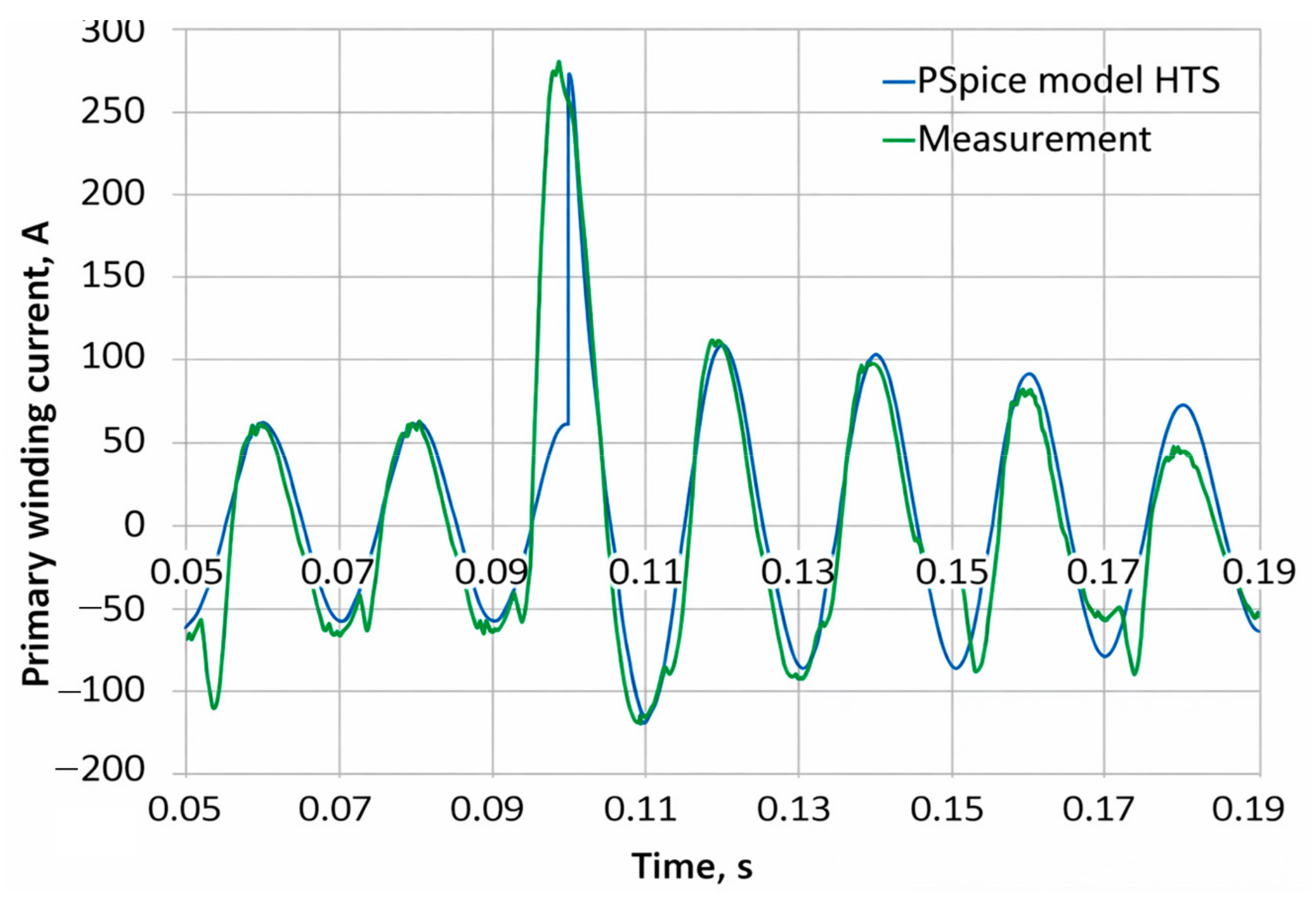
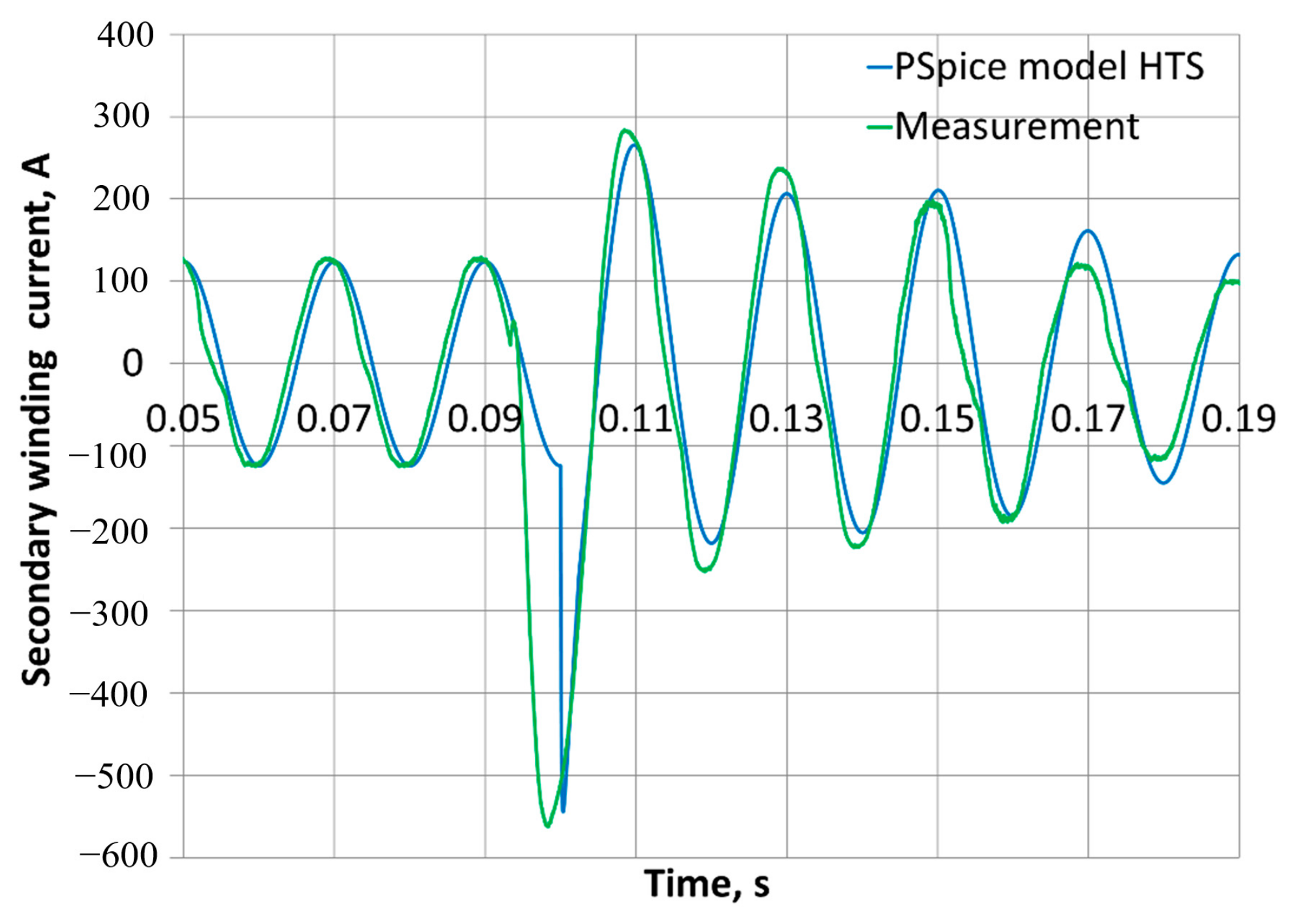
The first emergency condition analysed was the operational short-circuit current. The waveforms of this short circuit obtained during experimental tests and during numerical tests in a specific time period are presented for the primary winding (
Figure 1) and for the secondary winding (
Figure 2), respectively.
The surge short-circuit current in the primary winding in the case of experimental measurements was 285 A, while in the case of the numerical study it was 280 A. When comparing the real model to the numerical one, the difference is approximately 1.75%.
The surge short-circuit current in the secondary winding in the case of experimental measurements was 565 A, and in the case of the numerical study, 550 A. When comparing the real model to the numerical one, the difference is approximately 2.65%.
The first short-circuit current peak (surge current) in both windings exceeds the critical current value of 115 A of the SCS4050 tape.
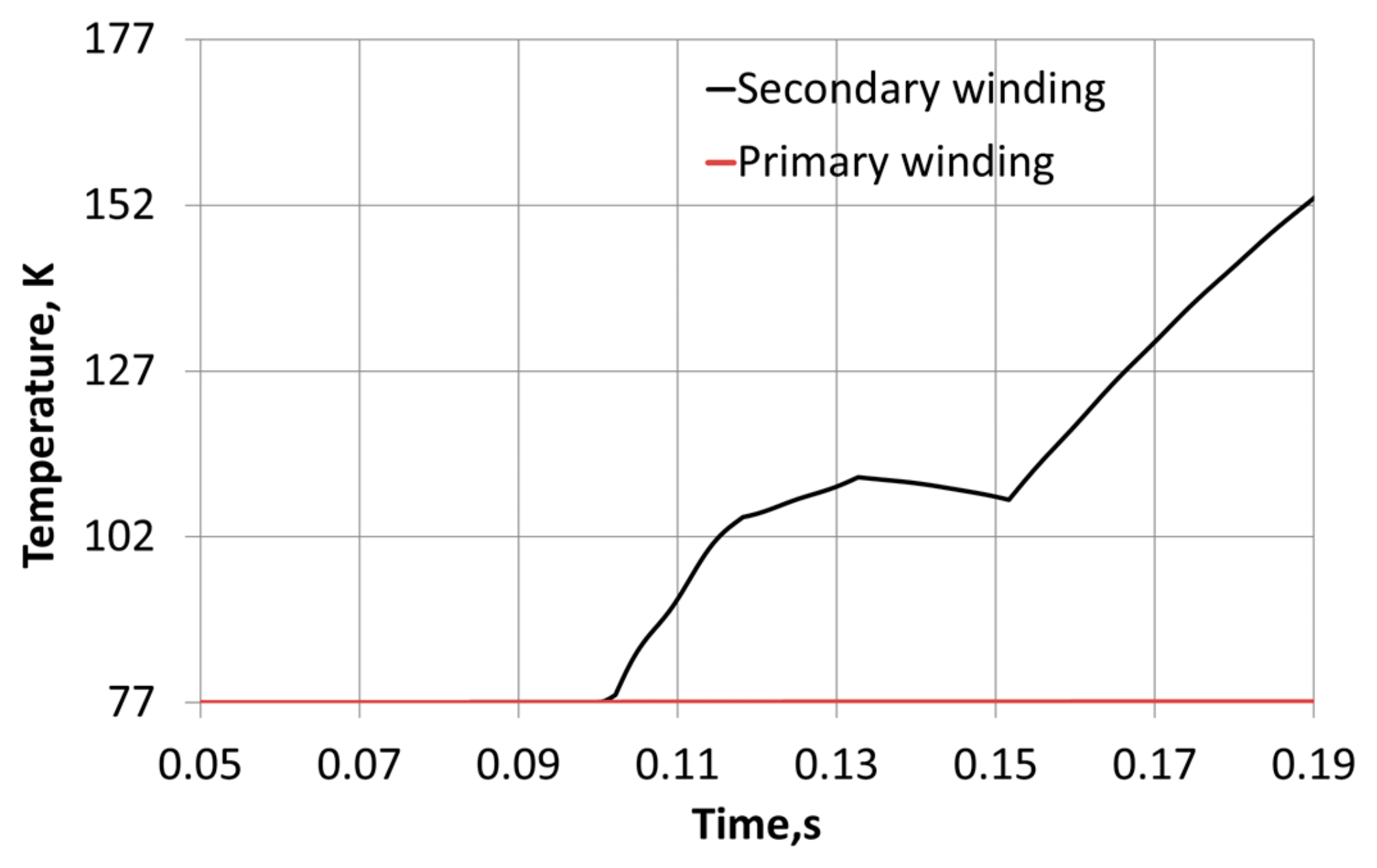
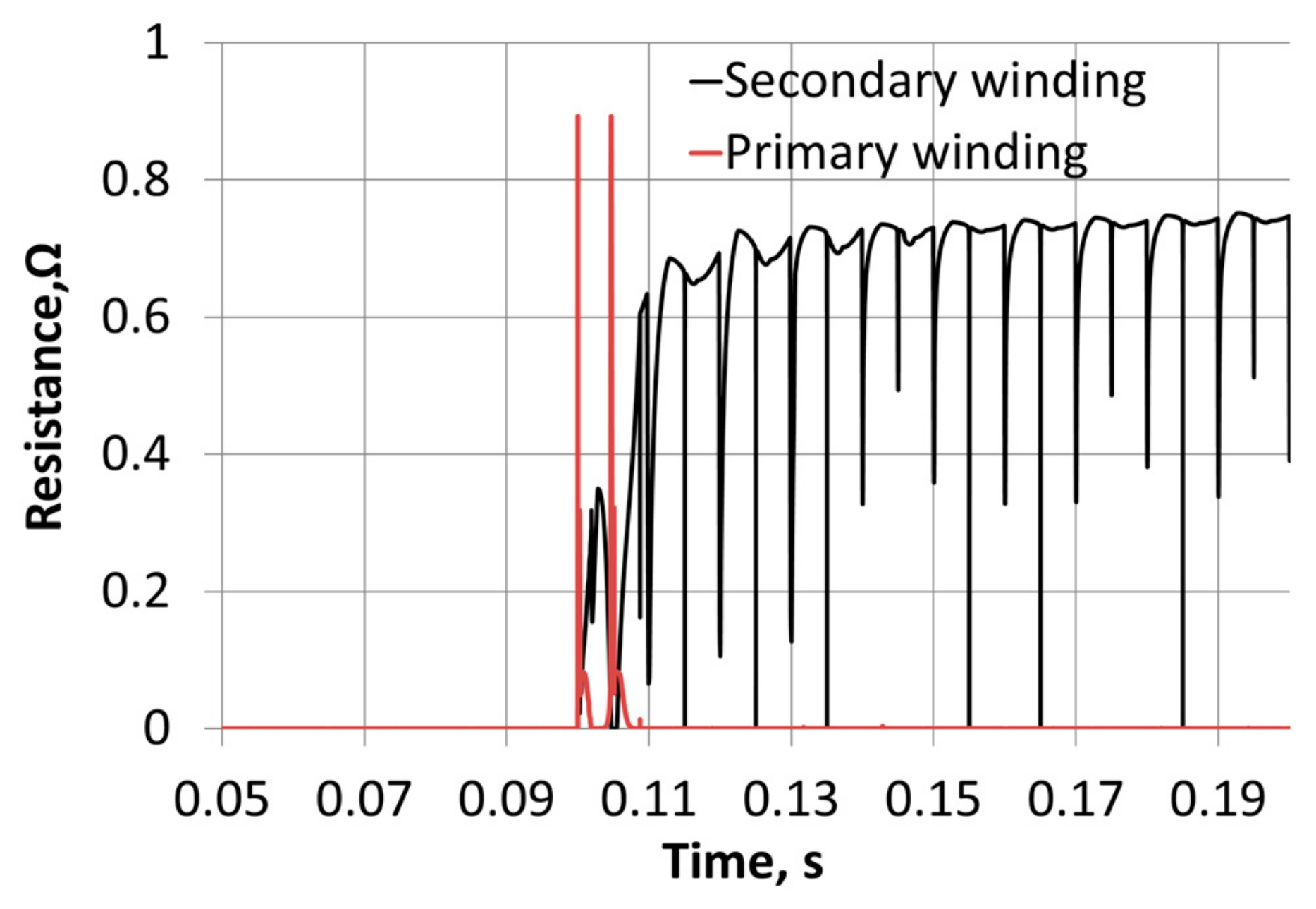
Numerical tests of the reference model of the HTS 10 kVA transformer made it possible to obtain time courses of temperature (
Figure 3) and resistance (
Figure 4) in a specific time interval in the primary and secondary windings during an operational short-circuit of HTS 2G windings wound with SCS4050 tape.
At the moment of the operational short circuit, the temperature of the primary winding remains at approximately 77 K, while the temperature in the secondary winding increased by 75 K in the tested time interval and amounted to 152 K.
At this moment, the resistance of the primary winding increased to a value of approximately 0.9 Ω, and then decreased rapidly to a value close to 0 Ω. In the case of the secondary winding, the resistance increased to 0.75 Ω during the tested time interval. The behaviour of the primary winding during an operational short circuit may indicate that the outer primary winding returns to the superconducting state more quickly due to better cooling than the inner secondary winding.
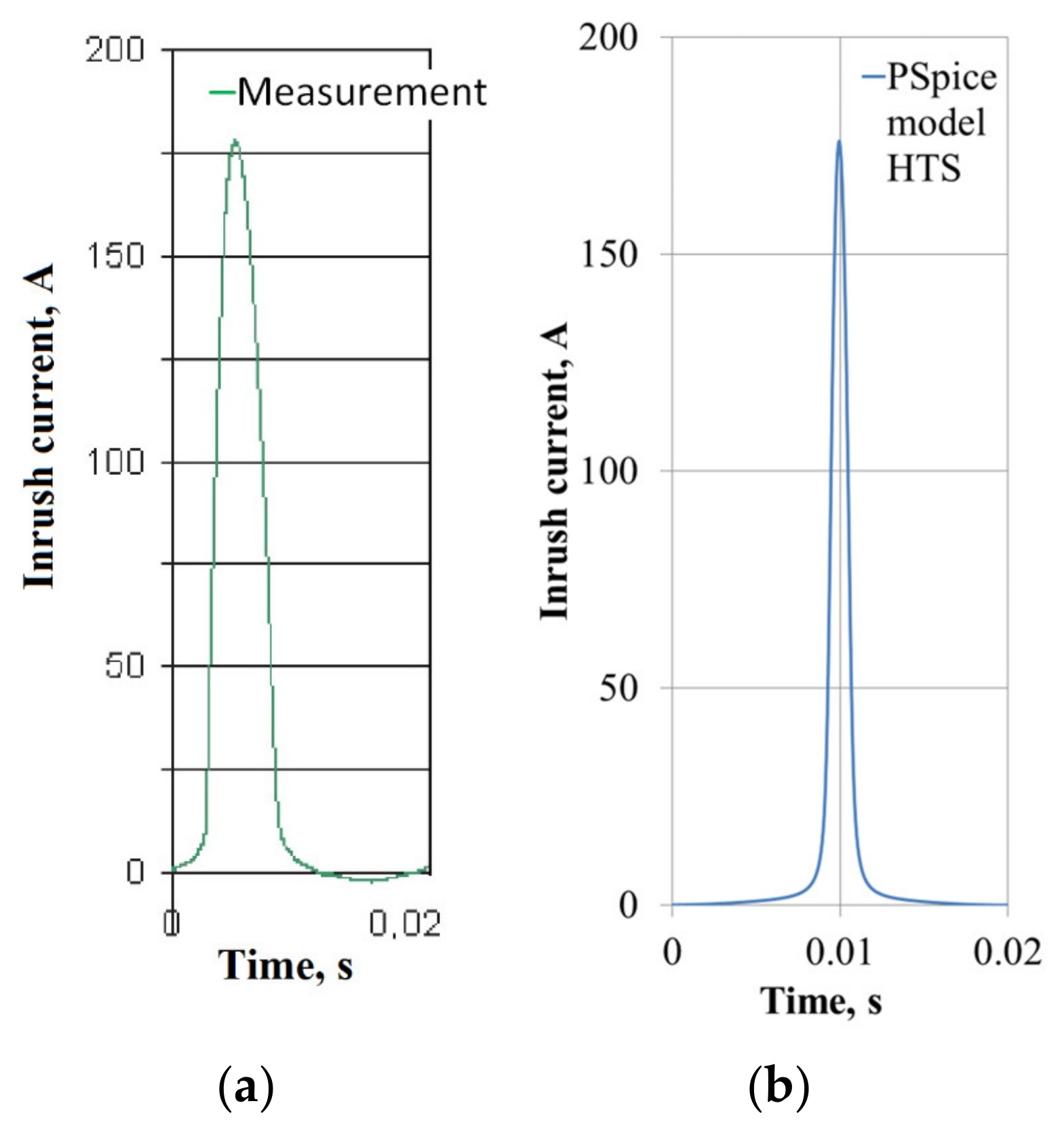
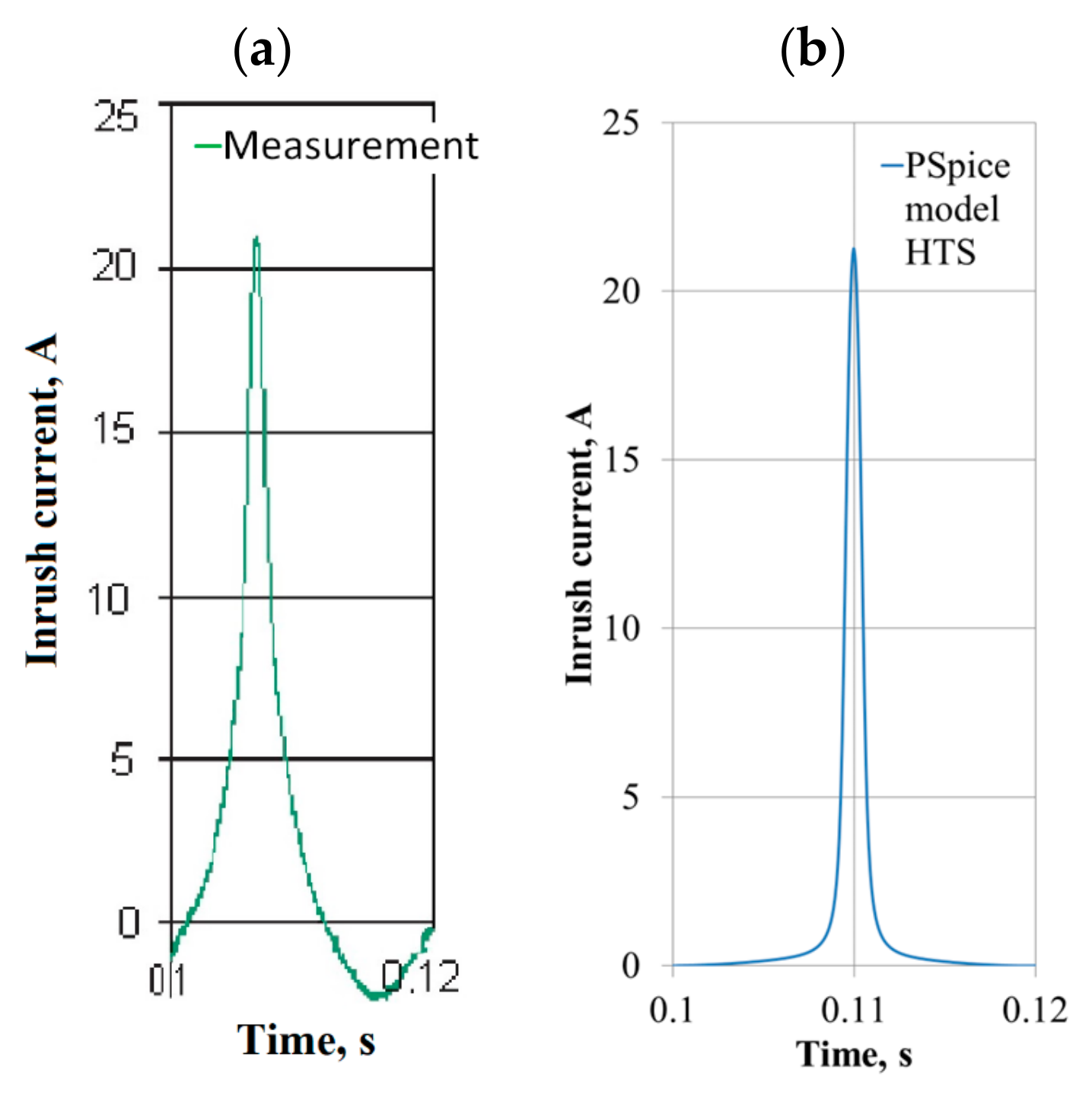
In order to confirm the correctness of the numerical model of the superconducting transformer, a comparative analysis of the second emergency condition was carried out, i.e., switching on the unloaded HTS 2G transformer. This analysis was carried out for the first (
Figure 5) and sixth (
Figure 6) switching current pulse obtained during experimental and numerical tests.
The first pulse of the switch-on current in the case of the real model of the superconducting transformer was approximately 180 A, while for the numerical model the first pulse of 175 A was obtained. In relation to the real model and the numerical model, the difference is approximately 2.78%.
The sixth pulse of the switching current in the case of the real model of the superconducting transformer was approximately 22.5 A, while for the numerical model, the first pulse of 22 A was obtained. In relation to the real model and the numerical model, the difference is approximately 2.22%.
Wider current pulses were noticed for the turn-on current waveform of the real HTS transformer model compared to the turn-on current waveform of the numerical model of HTS transformers. This may indicate that their energies are higher than the losses for any given switch-on moments. Differences between the measured value and the value obtained numerically in the PSpice programme may also result from the method of mapping the magnetisation curve of the core model described by the Jiles–Atherton level 2 equations. It is assumed that this difference may also result from the error introduced by the measurement system used.
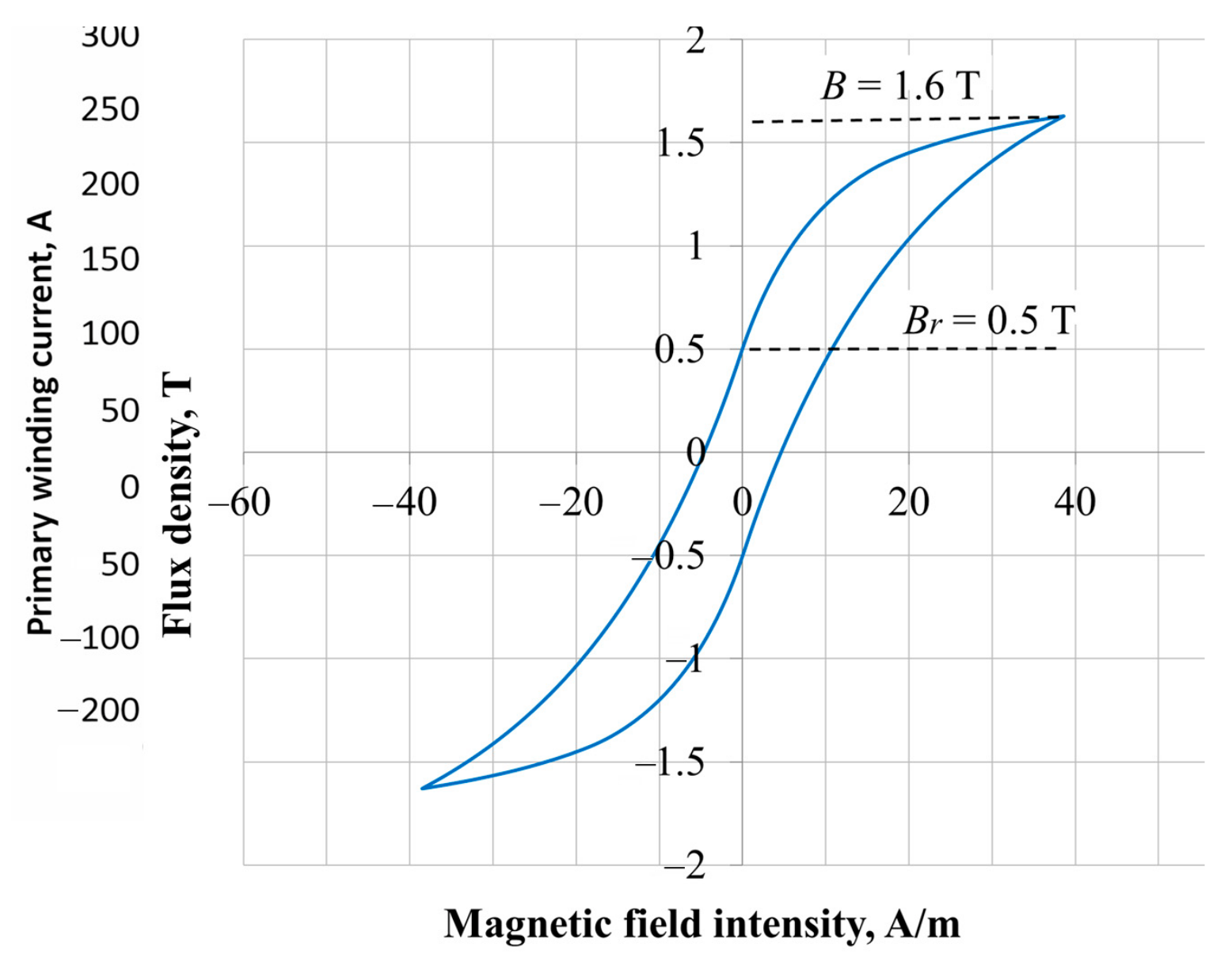
The hysteresis loop of the magnetic core material affects the operating parameters (core power losses) under normal operating conditions of a superconducting transformer. In the transient states of a superconducting transformer, the shape of the magnetic hysteresis of the core and the shape of the magnetisation curve in its saturation area have a significant impact on the value of the switch-on and short-circuit current. The plotted hysteresis loop of the RZC-70/230/70 core is shown in
Figure 7. The residual magnetism induction for the core is 0.5 T, which is 32% of the rated induction.
The comparative analysis performed for emergency states allows us to conclude that the results of simulation tests are in good agreement with experimental tests, which proves the appropriate methodology for designing the computer model.
To analyse the transient states of the superconducting transformer, the PSpice software package—based on the family of SPICE circuit simulators—was employed. This tool enables circuit-level modelling while accounting for the nonlinear properties of 2G HTS tapes, including the temperature dependence of the critical current, magnetic-field-dependent parameters, and the characteristic transition of superconducting materials from the superconducting to the resistive state. The use of ABM (Analogue Behavioural Modelling) blocks allows these phenomena to be represented with high precision, ensuring accurate current–voltage waveforms.
In engineering practice, MATLAB/Simulink (release R2024b) is also a widely used environment for modelling power-system components, particularly in studies involving control systems and phenomena occurring at the network level. However, this tool was not adopted in the present work, as the circuit model of the superconducting transformer requires detailed representation of electrical effects during faults, inrush currents, and other dynamic states—phenomena that are more accurately reproduced using PSpice. A comparison of both modelling environments, including their methodological differences and suitability for HTS transformer simulations, is presented in
Table 1.
3. Numerical Model of a High-Power Superconducting Transformer
In order to analyse the properties of HTS 2G windings of the SCS and SF types during failure states of high-power superconducting transformers, a verified reference model was developed.
The numerical model of superconducting windings was based on PSpice software, with user-defined ABM (Analogue Behavioural Modelling) computational blocks. It takes into account the description of the magnetic circuit using the level 2 Jiles–Atherton magnetic hysteresis model [
36,
37,
38] and Rhyner’s power law [
39]. The use of these blocks makes it possible to model the complex properties of superconductors, particularly the interdependence of their critical parameters.
The developed model of superconducting windings includes the following two types of HTS 2G tapes: SF12050 and SCS12050. The proposed tapes differ in that the first one is not coated with a layer of copper, and the second one is. The manufacturer of both tapes is SuperPower. Thanks to very good electrical and mechanical parameters, especially very high mechanical strength, high critical current density of the tape, and high resistivity in the resistive state, HTS 2G tapes are currently the basic conductors for practical applications, also allowing the testing of superconducting transformers in terms of limiting currents in resistive state emergencies. The dimensions of HTS 2G tapes and the thicknesses of individual tape layers are presented in
Table 2.
In higher power superconducting transformers it is necessary to use many HTS tapes connected in parallel. If the rated currents of the windings are higher than the critical current of the superconducting tape used, the windings are made in the form of a package of tapes connected in parallel. In the superconducting state, the resistance of the transformer’s superconducting windings is negligible because all the current flows through the superconducting layer. The primary and secondary windings of the designed superconducting transformer with a power of 21 MVA therefore have a more complex structure than that of the reference transformer with a power of 10 kVA, which was taken into account in the proposed numerical model.
In superconducting transformers with HTS 2G windings, exceeding the critical current of the superconductor due to a short circuit causes its immediate transition to the resistive state. To make windings in superconducting transformers, superconducting tapes are used, the critical current of which is higher than the rated current. If the critical current of a single tape is lower than the rated current of the superconducting transformer, it is necessary to use a set of parallel tapes in the windings. Even if the parallel connection reduces the winding resistance, the short-circuit current will still be limited due to the increase in winding resistance, causing the transformer’s impedance to increase several to several hundred times compared to its impedance in the superconducting state. Another difference in the developed numerical model of the 21 MVA transformer is the inclusion of two carcasses on a two-column core, while in the 10 kVA HTS transformer all windings are entirely on one carcass. In a 21 MVA HTS transformer, the primary winding consists of eight layers and the secondary one of seven. In the case of the reference transformer, these were four layers of primary windings and two of secondary ones, respectively.
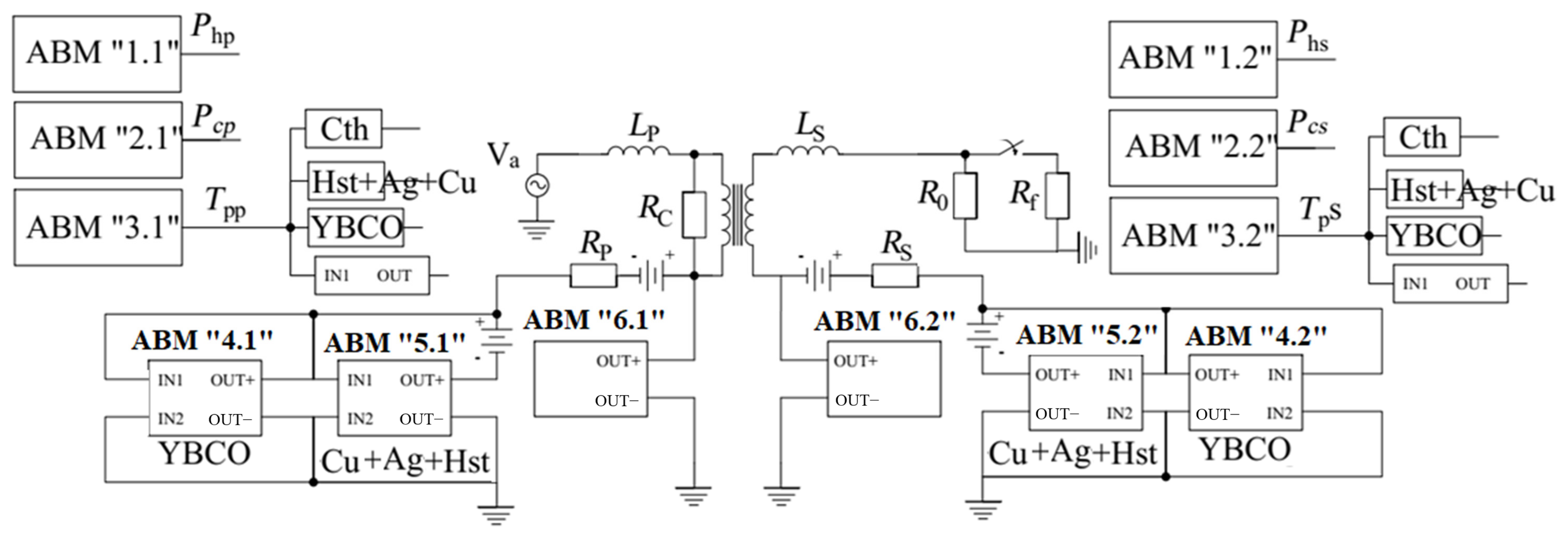
In the developed model of a 21 MVA superconducting transformer (
Figure 8), ABM (Analogue Behavioural Modelling) and hierarchical blocks were used. In ABM blocks 1.1, 2.1 and 3.1, the thermal properties of the primary winding are implemented, while ABM blocks 1.2, 2.2 and 3.2 implement the thermal properties of the secondary winding, respectively. In the ABM 1.1 and ABM 1.2 blocks, the heating power in the primary and secondary windings is calculated, while in the ABM 2.1 and ABM 2.2 blocks, the cooling power in the primary and secondary windings. In blocks ABM 3.1 and ABM 3.2, the relative temperature is determined based on the calculated heating and cooling power of the windings in the previous blocks. The heat capacity for the HTS SF and SCS windings is modelled by the Cth block. Modelling of the propagation of the resistive zone is carried out using the YBCO block. The Cu + Ag + Hst block describes the resistance of the copper, silver and Hastelloy layer. In the LN block, the heat flux density is calculated as a function of the temperature difference Δ
T. Blocks 4.1 and 4.2 calculate the superconducting layer currents, and blocks 5.1 and 5.2 calculate the currents of the copper, silver and Hastelloy layers in the primary and secondary windings, respectively. Due to the use of a package of parallel tapes in the primary and secondary windings, the duplication of the superconductor, copper, silver and Hastelloy layers is included in blocks 6.1 and 6.2.
In the numerical model of the superconducting transformer, a circuit-based model of the 2G HTS tapes SF12050 and SCS12050 was implemented using the PSpice environment with analytical ABM (Analogue Behavioural Modelling) blocks. The tape model was developed as a hierarchical block incorporating both the electrical and thermal properties of all constituent layers: copper, silver, the Hastelloy substrate, and the YBCO superconducting layer.
The model consists of the following components. The electrical behaviour of the superconducting YBCO layer is described by Rhyner’s power law. The relationship between the current density and the electric field in the YBCO layer is expressed as
where
E—electric field intensity (V/m),
Ec—critical electric field (V/m),
J—current density (A/m
2),
Jc(
T)—temperature-dependent critical current density (A/m
2),
n(
T)—temperature-dependent power exponent (–).
After transforming Rhyner’s relation for a uniform distribution, we obtain
where
U—voltage (V),
Uc—critical voltage (V),
I—current (A),
Ic(
T)—temperature-dependent critical current (A),
n0—power exponent at reference temperature
T0 (–),
T—conductor temperature (K),
T0—reference temperature, typically 77 K (K).
Therefore, the effective resistance of the YBCO layer is given by
where
RYBCO—resistance of the YBCO layer (Ω),
UC—critical voltage (V),
IC(
T)—temperature-dependent critical current (A),
I—current (A).
The critical current is determined from the linear relation:
where
Ic(
T)—temperature-dependent critical current (A),
IC0—critical current at reference temperature
T0 (A),
TC—critical temperature (K),
T0—reference temperature (K),
T—conductor temperature (K).
Substituting the above expression gives the complete resistance dependence:
where
EC—critical electric field (V/m),
L—tape length (m),
IC—critical current (A),
I—current (A).
The conductance is the inverse of the total resistance:
where
GYBCO—conductance of the YBCO layer (S),
Rw—residual resistance (Ω),
RYBCO—resistance of the YBCO layer (Ω).
The conductance of the copper, silver and Hastelloy layers is obtained from
where
Gi(T)—conductance of layer
i (S),
ρi(T)—temperature-dependent resistivity of layer
i (Ωm),
w—tape width (m),
di—thickness of layer
i (m),
L—tape length (m).
The resistivity of Hastelloy is assumed to be constant.
The total heat capacity is the sum of the heat capacities of all layers:
where
Cth(
T)—total heat capacity of the tape (J/K),
Cth
,i(
T)—heat capacity of layer
i (J/K), and
where
ρi—density of layer
i (kg/m
3),
Ai—cross-sectional area of layer
i (m
2),
cwi(
T)—temperature-dependent specific heat of layer
i (J/(kg·K)).
The temperature variation is described by the following relation:
where
T—tape temperature (K),
t—time (s),
Cth(
T)—total heat capacity (J/K),
Pheat(
T,
I)—heating power generated in the tape (W),
Pcool(
T)—cooling power transferred to liquid nitrogen (W).
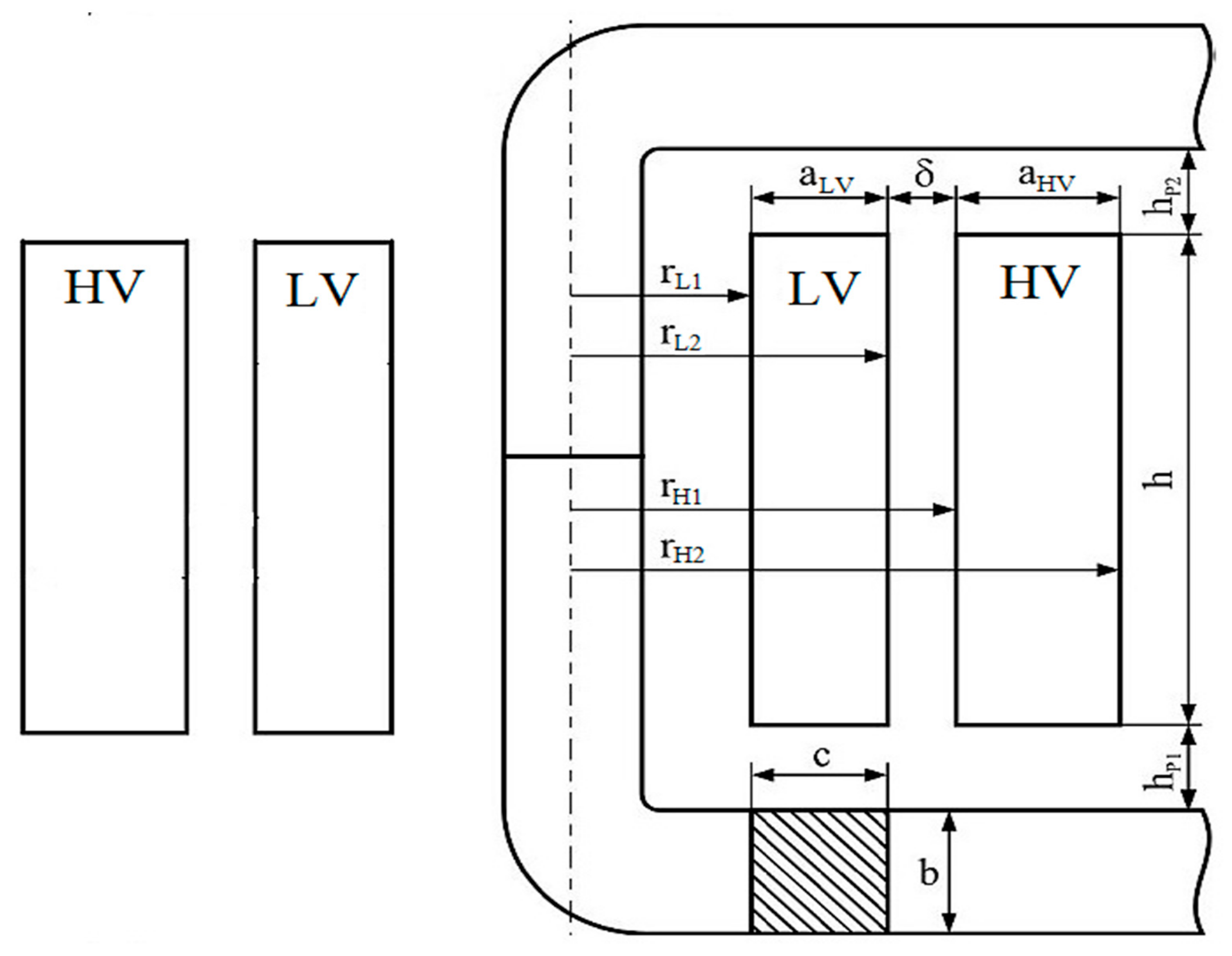
The geometry and dimensions of the modelled superconducting transformer with a power of 21 MVA are shown in
Figure 9 and
Table 3. The parameters of the magnetic core are found in
Table 4, while
Table 5 presents the rated parameters of the modelled superconducting transformer.
The key distinctions between the previous models [
17,
18,
19] and the extended approach developed in this work are outlined in
Table 6. All simulations were performed at a frequency of 50 Hz, consistent with the standard operating conditions of the European power system.
4. Power Losses in a High-Power Superconducting Transformer
The growing demand for electricity and increasing expectations regarding the efficiency of the energy conversion process force the need to construct electrical devices that are more and more efficient and with better and better parameters, while minimising power losses.
The use of superconducting tapes, characterised by low power losses, to wind the windings of power transformers improves the efficiency and density of electrical energy during its transformation in the power grid.
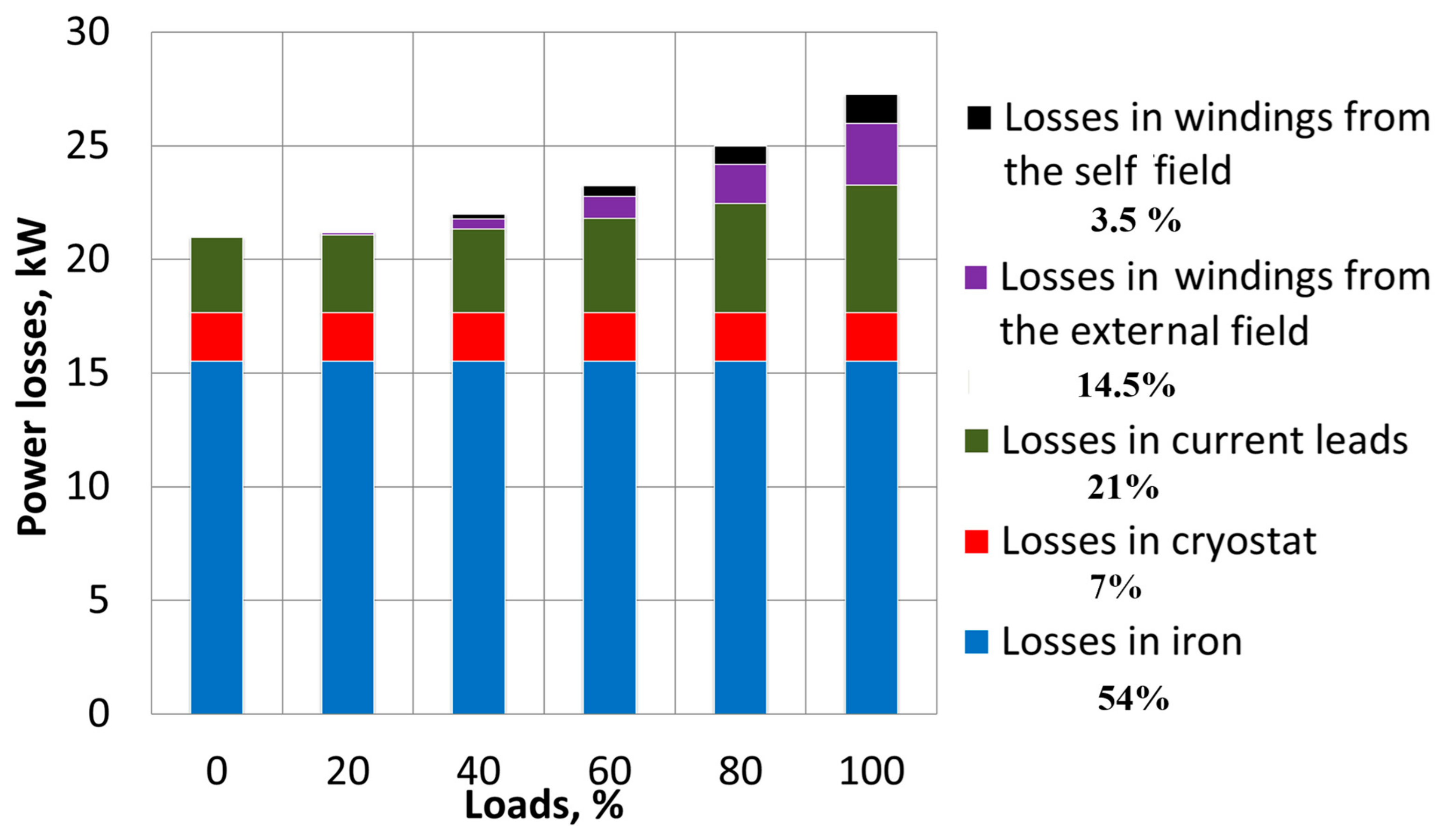
In this chapter, the developed numerical model was used to analyse power losses in a 21 MVA superconducting transformer depending on its load (
Figure 10). The calculations included power losses in the superconducting windings from their own magnetic field, from the external field, losses in current bushings, losses in current bushings, cooling losses (in the cryostat) and iron losses in the magnetic core.
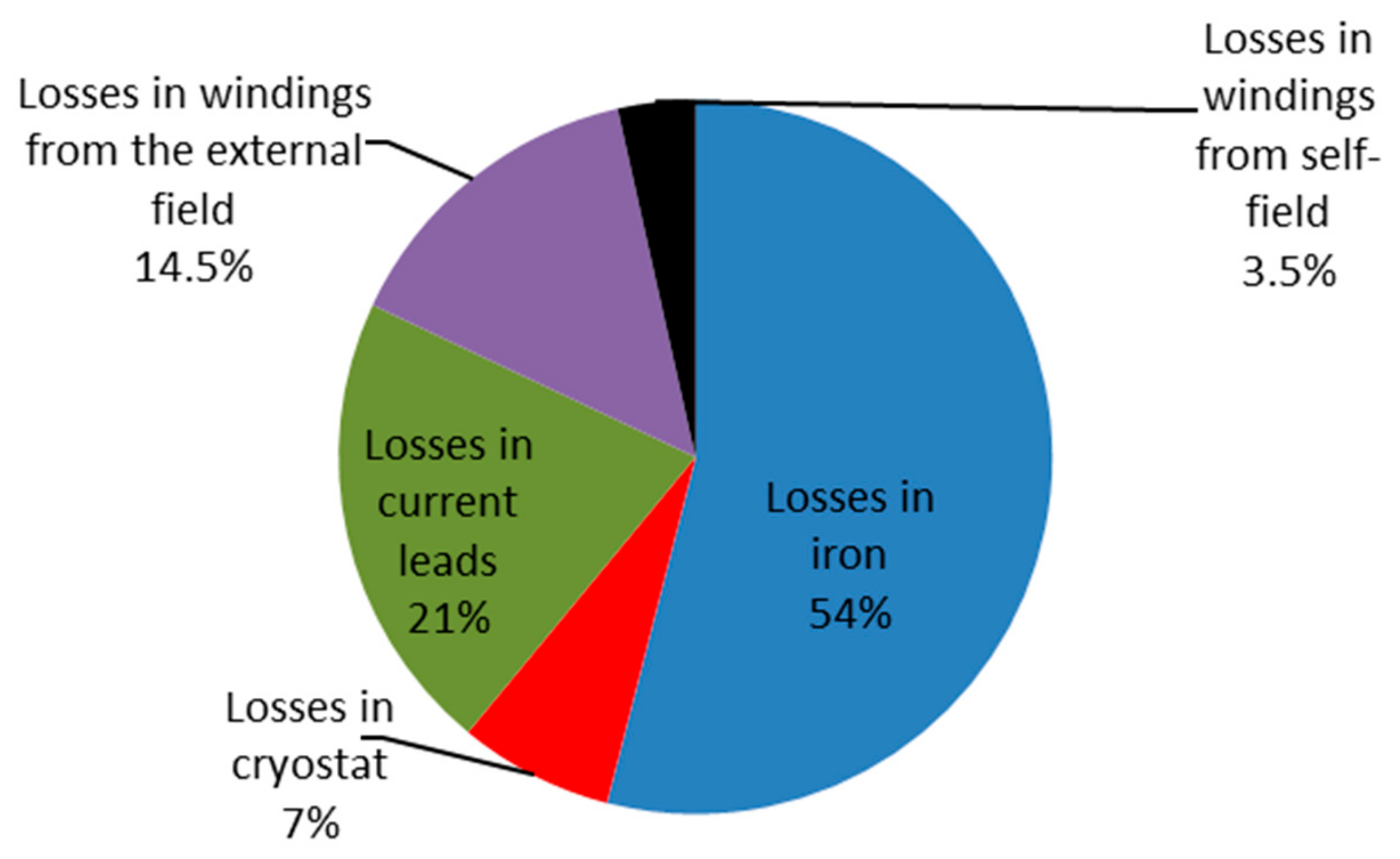
Regardless of the load, power losses in the core and in the cryostat are at the same level and amount to approximately 15 kW and 2 kW, respectively. As the load increases, losses in current bushings increase to 6 kW, losses in windings from the external field to 4 kW and from their own field to 1 kW. The power losses in the 21 MVA superconducting transformer total at approximately 28 kW. The percentage distribution of individual losses is illustrated in
Figure 11.
The largest share of power losses comes from those in the core (approx. 54% of the total losses), then losses in current bushings (21%), losses in the windings from the external field (14.5%), losses in the cryostat (7%) and those from own field (3.5%).
To maintain a constant temperature of 77 K for the liquid nitrogen bath, the cryocooler should dissipate all winding power at a given load. Therefore, the task of the starch cooler is to remove 13 kW of heat. Cooling energy losses are related to losses in the winding, therefore they should be included in the efficiency balance of the superconducting transformer, taking into account losses arising in the cryogenic cooling system. A high-power superconducting transformer with second-generation HTS superconducting tape windings will have higher efficiency than its conventional counterpart and power losses that will be approximately 5 times lower.
In conventional transformers, the efficiency is approximately 98%. This means that even a small improvement in efficiency—on the order of one percentage point—results in a noticeable reduction in total power losses. For high-power transformers, such an improvement corresponds to a significant decrease in the amount of energy dissipated as heat, which enhances thermal operating conditions and reduces the demands placed on the cooling system. In superconducting transformers, this effect becomes even more pronounced, as the intrinsic winding losses are very low and any reduction in losses directly decreases the load on the cryogenic system. Consequently, even a modest increase in efficiency leads to a meaningful reduction in thermal stress and a lower energy consumption of the cooling apparatus, which positively affects the operating parameters and overall performance of the transformer.
5. Analysis of the Properties of SCS and SF Type HTS 2G Windings During Emergency States of Superconducting Transformers
Superconducting transformers are characterised not only by low power losses, but also by the ability to limit emergency currents. In order to analyse the properties of 2G HTS windings of the SCS and SF types during emergency states of superconducting transformers, a numerical model of the 21 MVA superconducting transformer discussed in
Section 2 was used. This allowed for the analysis of the impact of various types of 2G superconducting tapes laminated with and without a copper layer on the properties of the transformer, particularly during emergency states such as the operational short circuit process and the process of connecting the transformer to the network.
The reduction in inrush and short-circuit currents in a superconducting transformer is of key importance both for the device itself and for the stability of the power system. Limiting the magnitude of the initial current peaks reduces the dynamic stresses acting on the windings, thereby lowering the risk of mechanical damage and thermal overload during fault conditions. This directly translates into improved insulation lifetime, reduced ageing effects, and enhanced reliability of the transformer operating within the network.
From a system perspective, lower inrush currents mitigate voltage dips in the grid, decrease the loading of protection devices, and reduce the likelihood of unintended protection operations. In the case of short circuits, the duration of overloads in adjacent power system components is also shortened, which improves selectivity and overall system stability. A transformer equipped with 2G HTS windings, due to the rapid increase in resistance once the critical current is exceeded, therefore provides an additional fault-current-limiting function. This enhances the resilience of the power network to transient disturbances and reduces the risk of secondary damage in interconnected equipment.
5.1. HTS Transformer Operational Short-Circuit Process
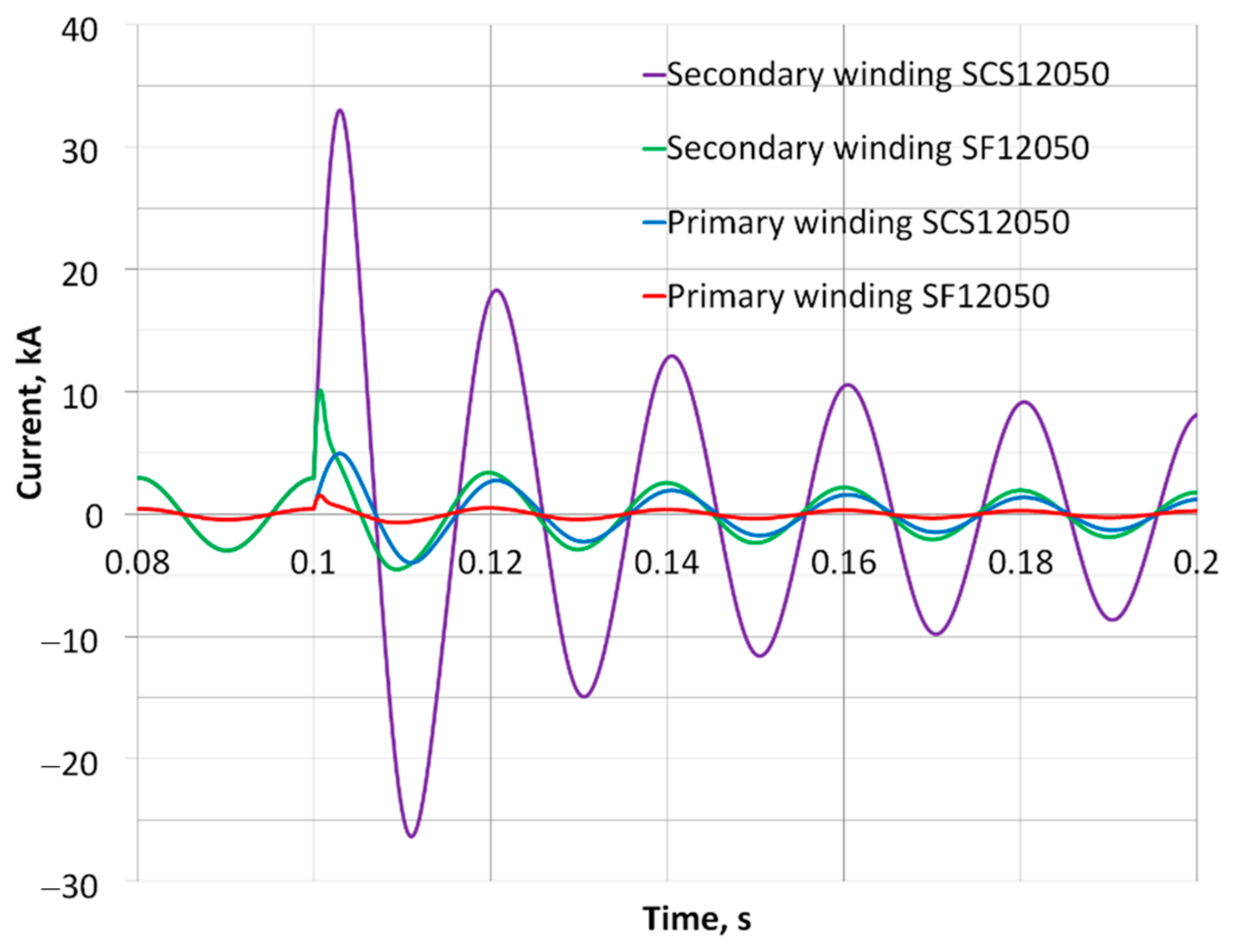
The first emergency condition discussed is the operational short-circuit process. The waveforms of the operational short-circuit current (
Figure 12) were obtained in a SC transformer with a power of 21 MVA for both the primary and secondary windings for windings made of two types of tapes.
The highest surge current occurred for the secondary winding made of SCS tape with a copper layer and reached a value of approximately 34 kA. After 0.1 s, the current was limited to below 10 kA. In the case of the secondary winding made of the second type of tape, the surge current was approximately 10 kA. In the tested time interval, it was limited to a value below the critical current of the tape and amounted to approximately 2700 A. For the primary winding of the SCS tape, the maximum short-circuit current reached a value of approximately 5 kA, and after a time of 0.1 s it was limited by half. The lowest short-circuit current value occurred in the primary winding without copper lamination and amounted to approximately 1.5 kA. Then, the short-circuit current was limited to a value of approximately 0.5 kA, which is a value below the critical current of the primary winding tape (Ic = 560 A). For both the primary and secondary windings made of SF tape, the short-circuit current was limited to values below the critical current in the tested time interval. For SCS tape windings, the surge current was limited, but during the analysed period, this current did not decrease below the critical current value.
During the operational short-circuit process of the superconducting transformer, the properties of the SCS and SF type HTS 2G windings change, particularly the thermal and electrical parameters of the windings.
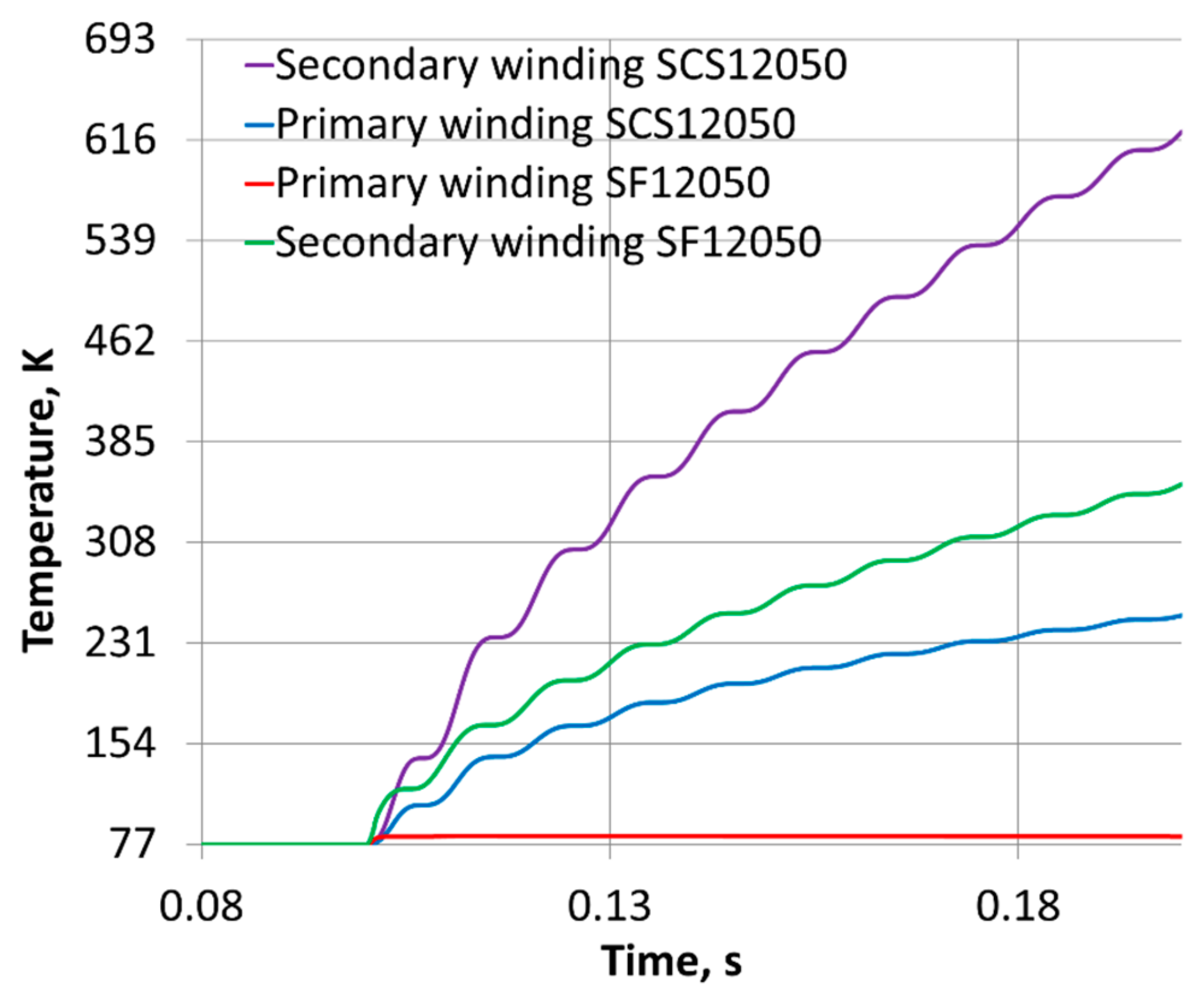
Figure 13 shows the temperature course of the primary and secondary windings for windings made of two types of tapes during the operational short circuit process. The highest temperature increase occurred for the secondary winding made of copper-coated tape, and in the tested time interval, it reached a value of approximately 616 K. In the case of the secondary winding made of the second type of tape, the temperature increased to 380 K. For the primary winding made of SCS tape, the maximum temperature reached after time 0.1 s was 235 K. The smallest temperature increase occurred in the SF primary winding without copper lamination and amounted to approximately 80 K. It should be borne in mind that the temperature of superconducting windings above 300 K is the destructive temperature of the windings. For the secondary winding made of both SCS and SF tapes, the temperature exceeded the destructive temperature value. In turn, for the primary winding made of SCS and SF tapes, the temperature did not exceed the destructive temperature of the superconducting winding.
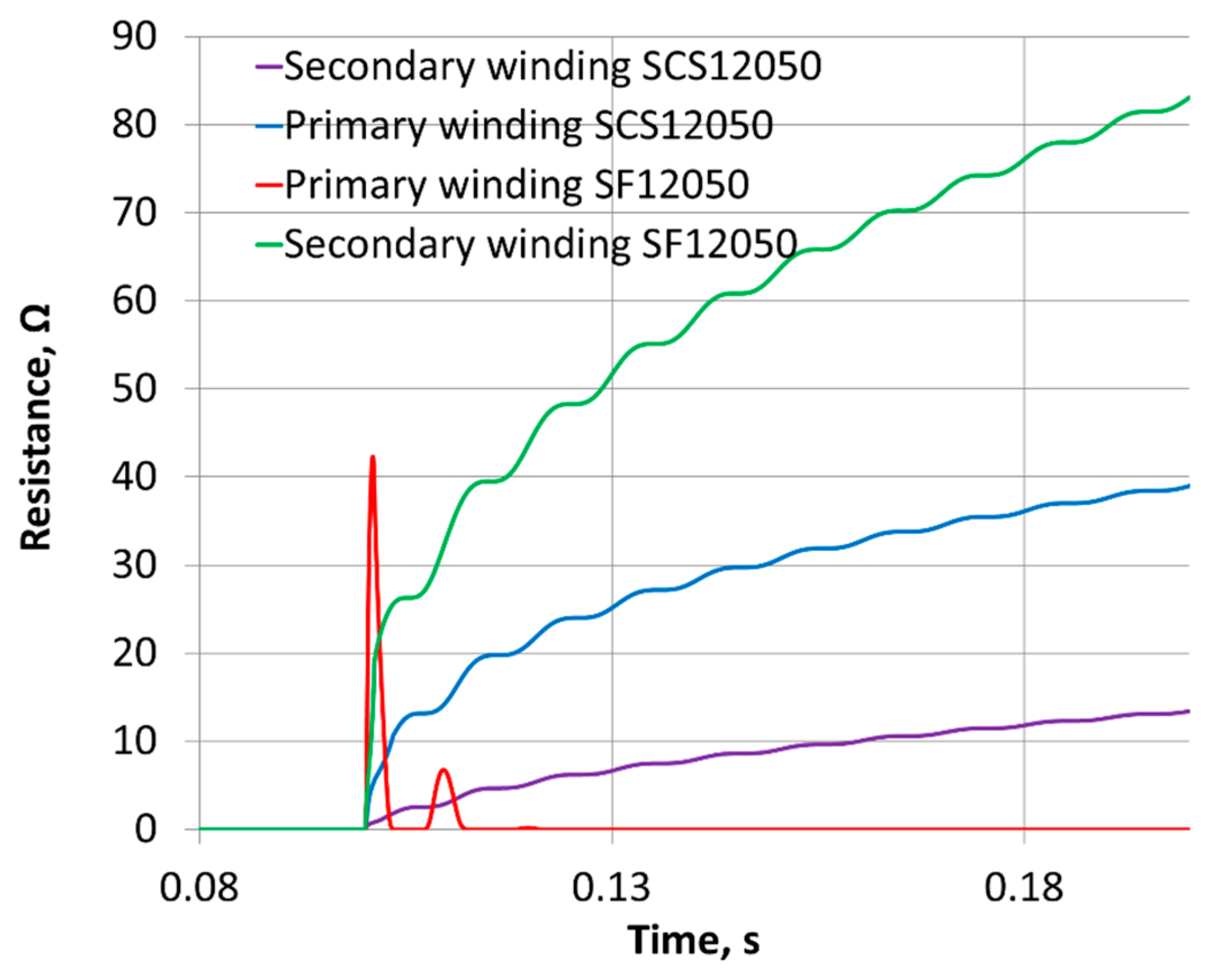
Figure 14 shows the time course of the resistance of the primary and secondary windings for windings made of two types of tapes during the operational short-circuit process. The highest increase in resistance occurred for the secondary winding made of tape without an SF copper stabiliser and reached a value of approximately 85 Ω in the tested time interval. A large step increase in resistance occurred in the case of the SF primary winding, reaching a value of approximately 41 Ω, and then began to drop rapidly to a value close to 0 Ω. This may indicate that the external primary winding returns to the superconducting state faster due to better cooling than the internal secondary winding, as indicated by the winding temperature time courses shown in
Figure 13. In the case of a tape with SCS copper stabiliser, the primary winding reaches resistance 39 Ω, and secondary 15 Ω.
Another significant threat is the problem of dynamic forces acting on the transformer winding in emergency situations. When failure states occur in superconducting transformers, the problem of dynamic forces acting on the transformer winding arises. An important issue is the selection of a superconducting wire in terms of mechanical strength and permissible current density, due to the dynamic forces and stresses acting in the windings. The values of the dynamic forces in the transformer windings during a short circuit, and thus the mechanical damage to the windings, are influenced by the value of the short-circuit surge current occurring during short circuits at the transformer terminals. The occurrence of electrodynamic forces in superconducting transformers is an important aspect in modelling these devices.
In order to protect the superconducting transformer against the effects of an operational short circuit caused by electrodynamic forces and stresses occurring in the windings as well as a sudden increase in the winding temperature exceeding 300 K, a fast power switch that is able to detect and turn off the short circuit within 0.01 s should be used.
5.2. The Process of Connecting the HTS Transformer to the Network
The second emergency condition discussed is the process of connecting the superconducting transformer to the power grid. The transformer’s switch-on current introduces higher harmonics into the power grid, generates overvoltages and causes resonance phenomena. It may cause damage to the windings and insulation of transformers due to the forces caused by it. In HTS transformers, the flow of the switch-on current may lead to the loss of the superconducting state of the windings and, consequently, prevent the transformer from being connected to the network due to exceeding the value of the critical current of the HTS tape.
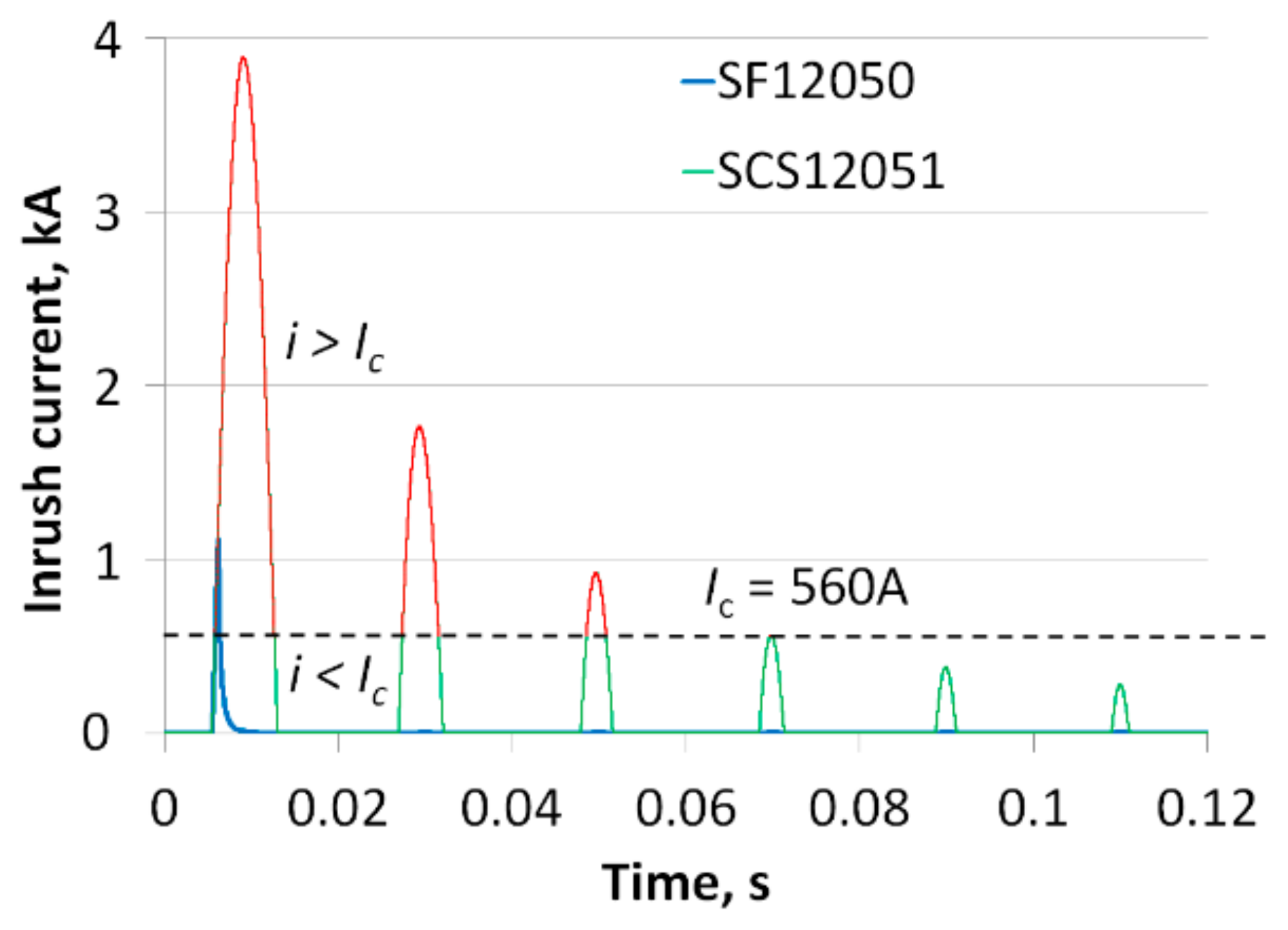
The analysis of the process of switching on the SC transformer with SCS and SF windings was carried out for the situation when the supply voltage passes through the zero value. The waveforms of the first six switching current pulses (
Figure 15) were obtained in the HTS transformer with a power of 21 MVA for windings made of the two types of tapes analysed.
The interval in which the switch-on impulse exceeds the critical current value is also marked on the waveform.
The highest unidirectional current value was obtained during the first pulse for a winding made of copper-coated SCS tape. This impulse reached a value of approximately 3.9 kA. The values of the next two switching current pulses decreased, but their values still exceeded the value of the critical winding current. Only the fourth and subsequent unidirectional current pulse reached a value below the critical current value. In the case of SF windings without copper lamination, the first switching current pulse reached the value of 1.1 kA and was 3.5 times smaller than for SCS windings. The value of subsequent pulses did not exceed the value of the critical current of the SF winding.
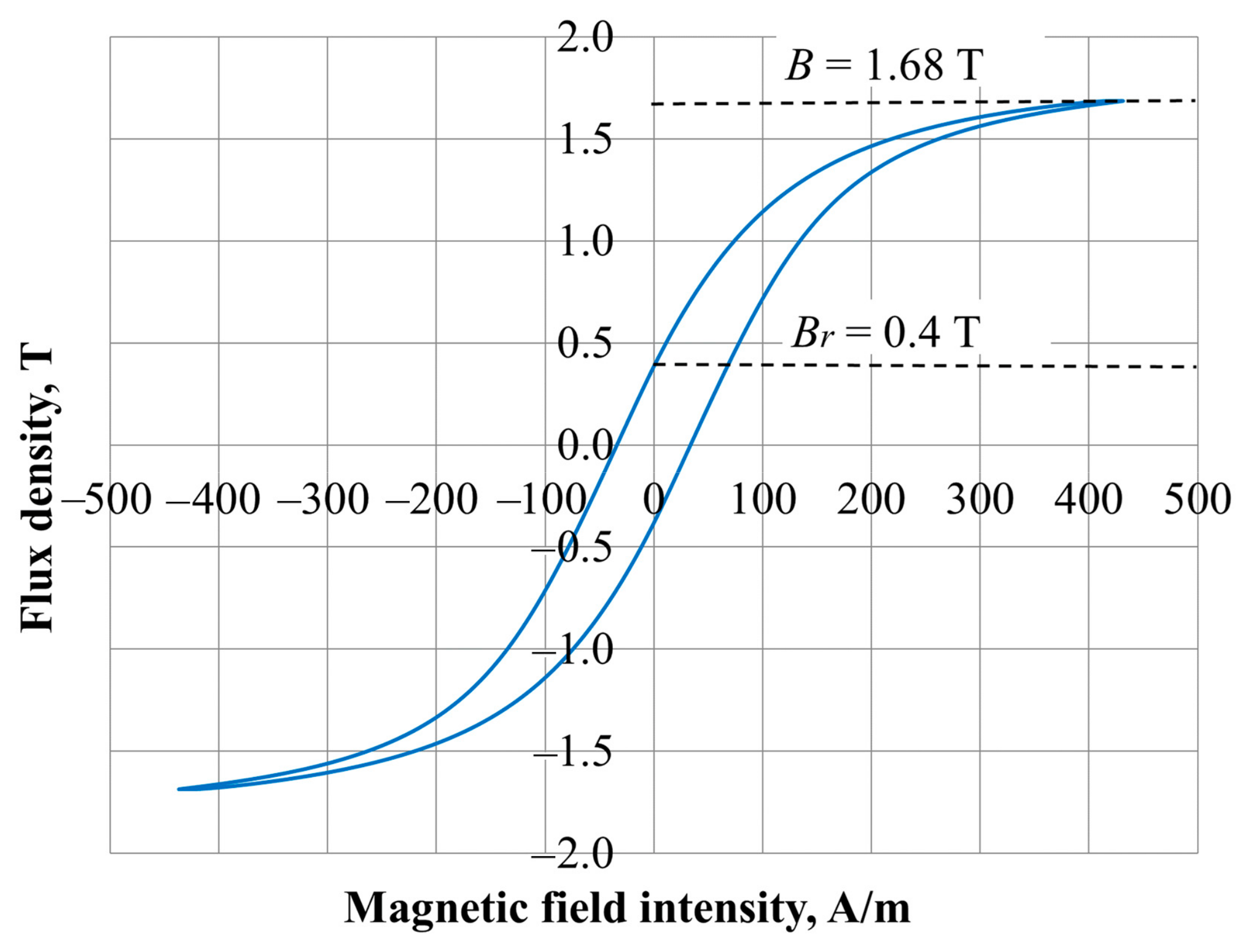
The shape of the magnetic hysteresis of the core in its saturation area and the value of the remanence magnetic flux density have a significant impact on the value of the switching current. The hysteresis loop of the RZC-70/230/70 core plotted on the basis of measurements is shown in
Figure 16. The remanence magnetic flux density is 0.4 T and constitutes 24% of the rated induction. The value of residual magnetism when the transformer is turned on has a significant impact on the amplitude of the switching current. The maximum value of the switch-on current pulse increases with the increase in the remanence magnetic flux density. An increase in the induction of residual magnetism causes a stronger damping of subsequent unidirectional current pulses.
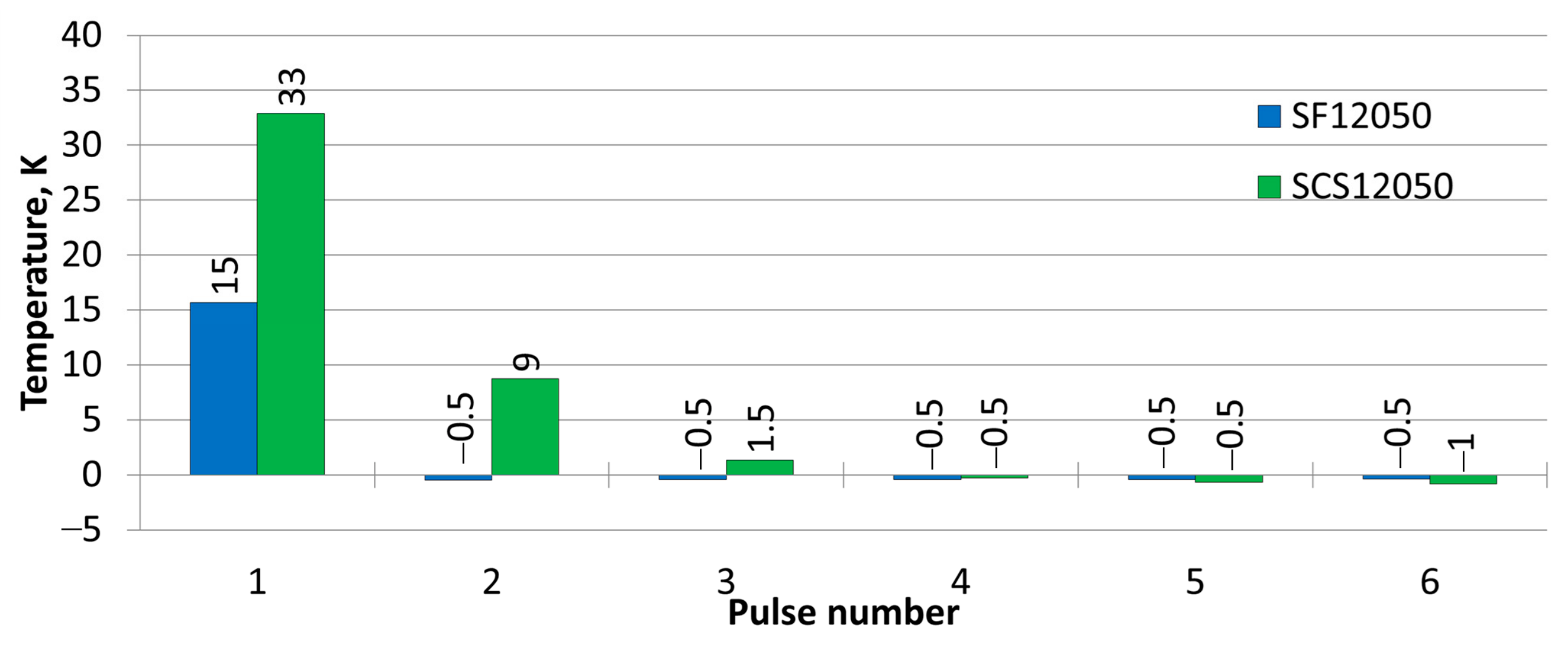
The process of connecting the transformer to the network causes an increase in the temperature of the windings (
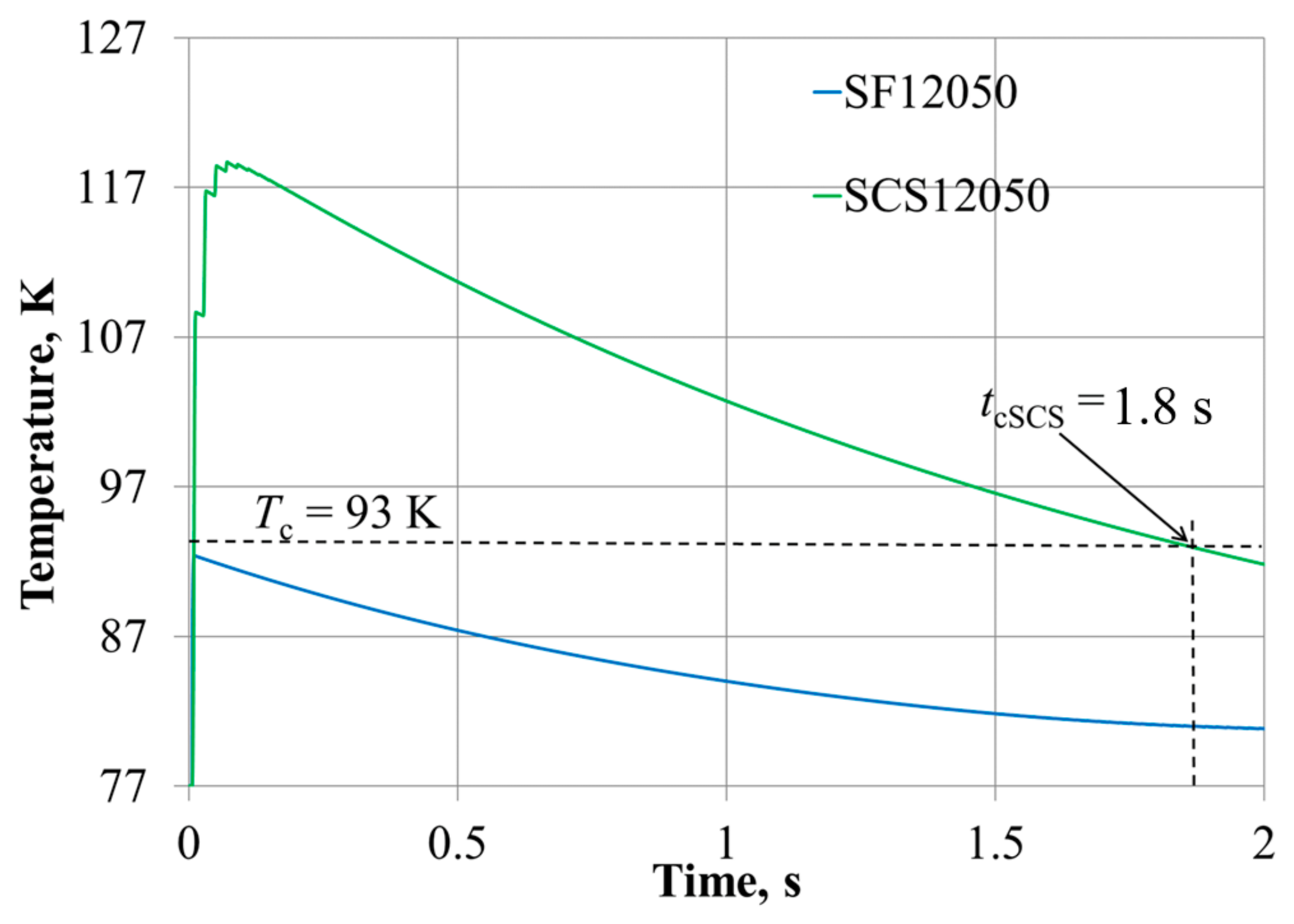
Figure 17). During the first turn-on current pulse, the temperature in the copper-laminated windings increased by 33 K. After the second and third pulses, the temperature increased by 10.5 K, after which the windings began to cool. However, in the case of windings without a copper stabiliser, the temperature increased by 15 K during the first switch-on current pulse. With subsequent pulses, the windings began to cool. During the process of turning on the SC transformer, the temperature of the SF12050 windings did not exceed the critical temperature of the windings, while the SCS windings exceeded the critical temperature by 27.5 K. In both cases, the temperature of the windings did not reach the winding destruction temperature value.
Figure 18 presents an analysis of the time needed to cool a winding made of SCS tape after connecting the transformer to the network to the critical temperature of the winding. The recovery time of the SCS12050 winding to 93 K is 1.8 s, during which time the SF12050 winding is cooled to 80 K.
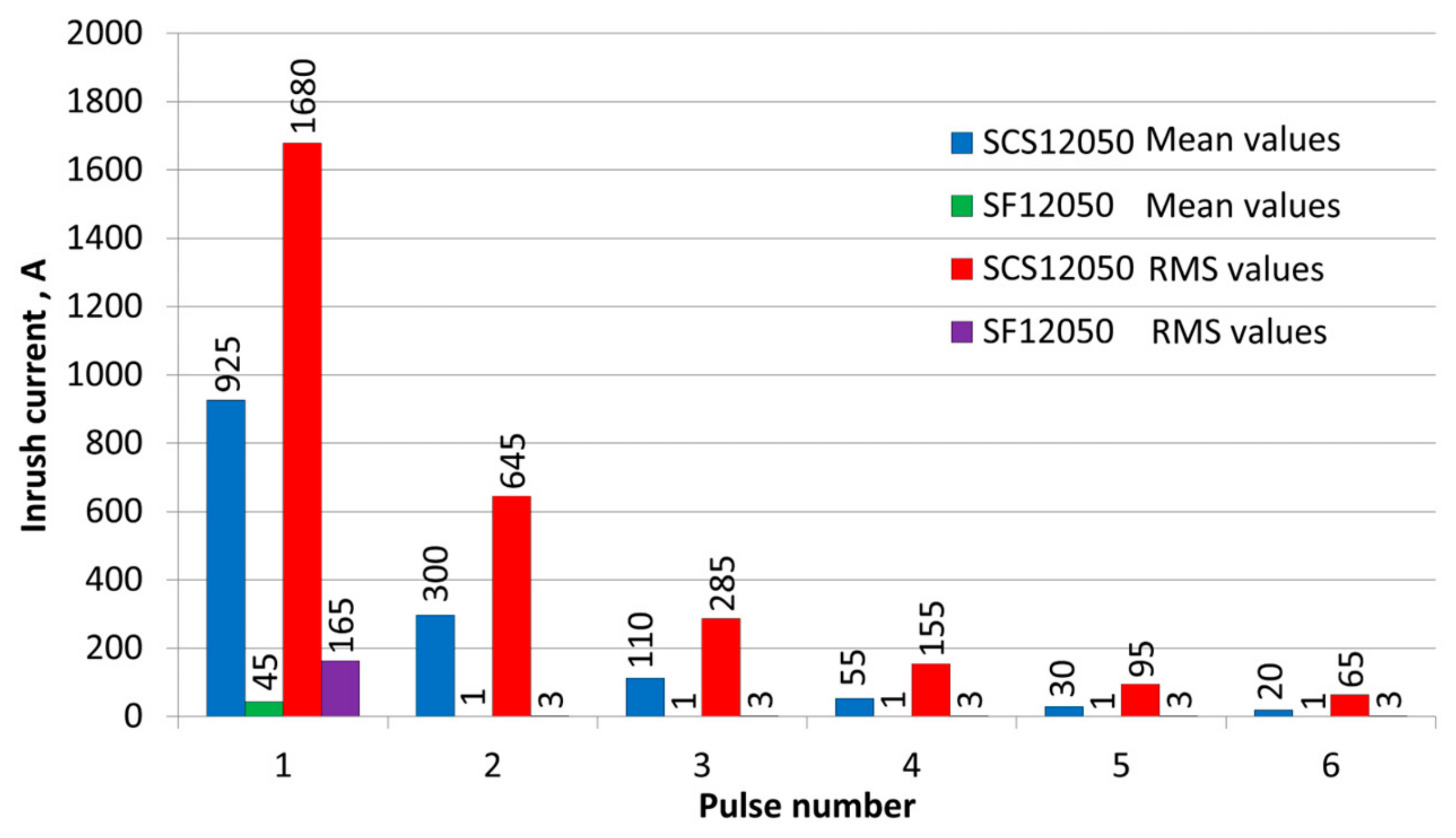
Figure 19 shows the average and effective values of the switching current for six pulses. The average and effective values of the switching current are much higher for a transformer with copper-coated windings than without lamination. The greatest difference occurs during the first and second switching current pulse.
6. Conclusions
The article presents a numerical model of a two-winding HTS superconducting transformer with a power of 21 MVA and a voltage of 70/10.5 kV. For the construction of the transformer windings, it was proposed to use superconducting tape of the SCS 12050 type (with a copper stabiliser layer) and SF 12050 (without a stabiliser). The circuit model of superconducting tapes developed in the PSpice software environment includes a description of the magnetic circuit using the second-level Jiles–Atherton magnetic hysteresis model and Rhyner’s power law. A properly designed and modelled superconducting transformer with appropriate electrical and thermal properties can reduce currents during a fault. It can therefore successfully fulfil its purpose.
The resistance of the transformer windings is responsible for attenuating the transformer’s connection current to the network and the short-circuit current. In the superconducting state, this resistance is zero. It increases rapidly when the winding goes into a resistive state, which can happen when the turn-on or short-circuit current exceeds the critical value for the superconductor. During the wave of this current, the winding can exit and return to the superconducting state many times. This translates into changes in other operating parameters, including, e.g., the decay time of the switching current of superconducting transformers, compared to conventional transformers. The behaviour of superconducting windings in emergency situations is determined by the parameters of the superconducting material from which they are made.
Due to the fact that limiting short-circuit currents in a superconducting transformer is based on the transition of HTS tapes to the resistive state, the short-circuit reactance of such a transformer can be designed at a very low level. This is facilitated by the favourable insulating properties of liquid nitrogen, significantly better than those of transformer oil. This allows for reducing the width of the air gap between the primary and secondary windings and thus reducing the leakage flux, which in turn significantly reduces the variability of the voltage supplied to consumers.
It is possible to build a superconducting power transformer cooled with liquid nitrogen based on currently available superconducting materials and technologies for making structural elements. Taking into account the losses occurring in the cryogenic cooling system, a high-power superconducting transformer based on the second-generation HTS superconducting tape will have higher efficiency than its conventional counterpart, and will also be lighter, smaller, easier to transport and safe in operation. The use of superconducting transformers leads to minimisation of load losses in the transformer windings and, as a result, to an increase in its energy efficiency.
In subsequent works, the authors plan to analyse the model’s sensitivity to changes in input data, together with the estimation of measurement errors, and to compare the modelling results using the circuit method and the finite element method.
In contrast to our earlier studies, which focused primarily on transient waveforms at the scale of the entire transformer, the present work provides a detailed description of the behaviour of SCS and SF windings under fault conditions, including quench dynamics, thermal margins, and the distribution of losses within the HTS layer. The extended, multilayer tape model enables the formulation of design criteria for the safe application of 2G HTS tapes in power transformers. Consequently, the 21 MVA transformer model is not merely reused in this study but serves as a validated platform for an in-depth analysis of HTS winding properties under realistic short-circuit scenarios.