Article

Fokker–Planck Model-Based Central Moment Lattice Boltzmann Method for Effective Simulations of Thermal Convective Flows

Department of Mechanical Engineering, University of Colorado Denver, Denver, CO 80204, USA
*
Author to whom correspondence should be addressed.
Energies 2025, 18(8), 1890; https://doi.org/10.3390/en18081890
Submission received: 2 February 2025 / Revised: 28 March 2025 / Accepted: 2 April 2025 / Published: 8 April 2025
(This article belongs to the Special Issue Numerical Heat Transfer and Fluid Flow 2024)

Abstract

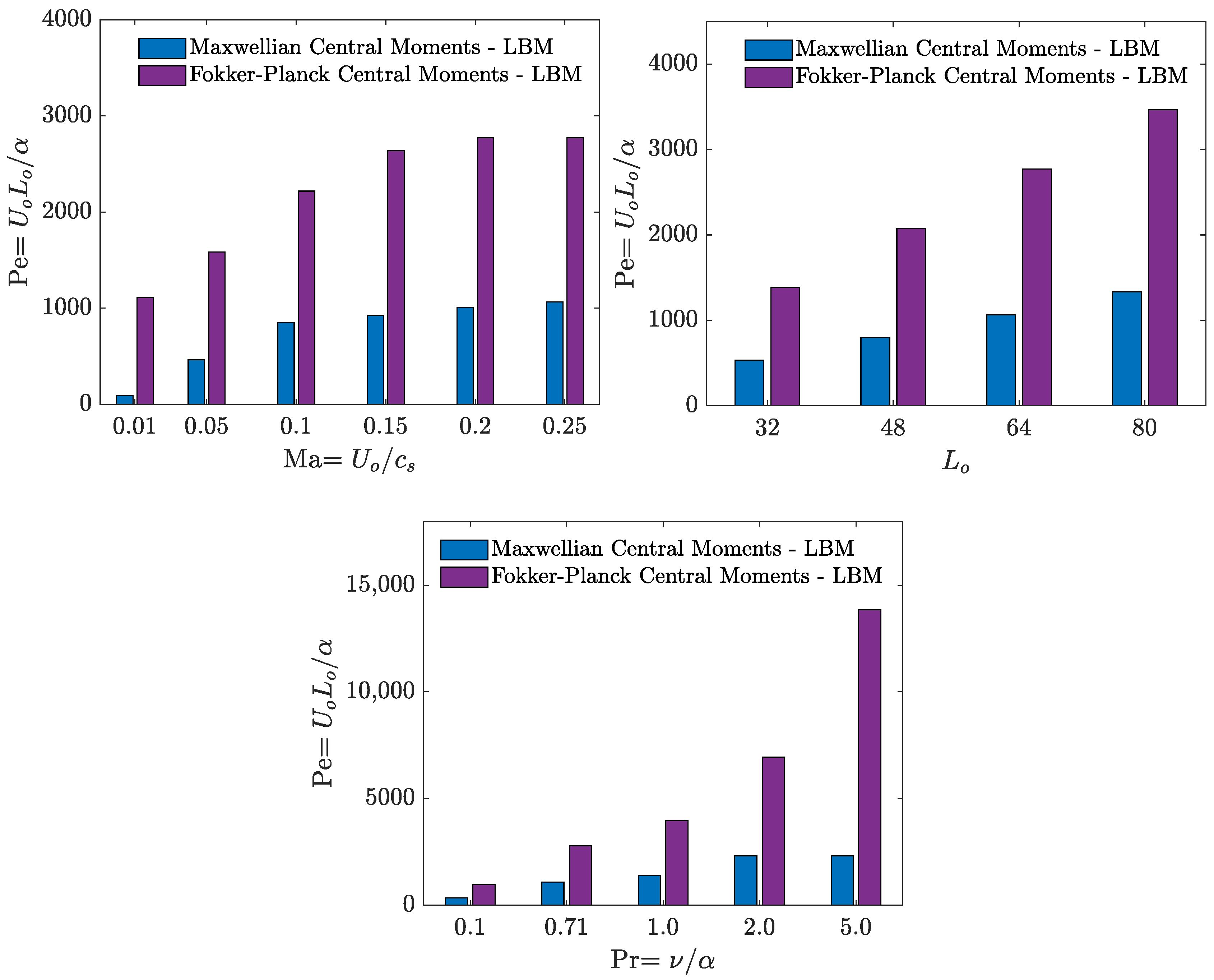
The Fokker–Planck (FP) equation represents the drift and diffusive processes in kinetic models. It can also be regarded as a model for the collision integral of the Boltzmann-type equation to represent thermo-hydrodynamic processes in fluids. The lattice Boltzmann method (LBM) is a drastically simplified discretization of the Boltzmann equation for simulating complex fluid motions and beyond. We construct new two FP-based LBMs, one for recovering the Navier–Stokes equations for fluid dynamics and the other for simulating the energy equation, where, in each case, the effect of collisions is represented as relaxations of different central moments to their respective attractors. Such attractors are obtained by matching the changes in various discrete central moments due to collision with the continuous central moments prescribed by the FP model. As such, the resulting central moment attractors depend on the lower-order moments and the diffusion tensor parameters, and significantly differ from those based on the Maxwell distribution. The diffusion tensor parameters for evolving higher moments in simulating fluid motions at relatively low viscosities are chosen based on a renormalization principle. Moreover, since the number of collision invariants of the FP-based LBMs for fluid motions and energy transport are different, the forms of the respective attractors are quite distinct. The use of such central moment formulations in modeling the collision step offers significant improvements in numerical stability, especially for simulations of thermal convective flows under a wide range of variations in the transport coefficients of the fluid. We develop new FP central moment LBMs for thermo-hydrodynamics in both two and three dimensions, and demonstrate the ability of our approach to simulate various cases involving thermal convective buoyancy-driven flows especially at high Rayleigh numbers with good quantitative accuracy. Moreover, we show significant improvements in the numerical stability of our FP central moment LBMs when compared to other existing central moment LBMs using the Maxwell distribution in achieving high Peclet numbers for mixed convection flows involving shear effects.
Keywords: lattice Boltzmann method; Fokker-Planck collision model; computational fluid dynamics; thermal convective flows; heat transfer; kinetic theory; central moments; numerical stability lattice Boltzmann method; Fokker-Planck collision model; computational fluid dynamics; thermal convective flows; heat transfer; kinetic theory; central moments; numerical stability