Article

Experimental Studies of the Effect of Operating Time and Temperature on the Dynamic Viscosity of Engine Oils


by
Agnieszka Leśniak
1,*,
Dariusz Kurczyński
2 and
Grzegorz Wcisło
3
1
Department of General Chemistry, Institute of Quality and Product Management Sciences, Krakow University of Economics, 31-510 Krakow, Poland
2
Department of Automotive Vehicles and Transportation, Faculty of Mechatronics and Mechanical Engineering, Kielce University of Technology, 25-314 Kielce, Poland
3
Department of Bioprocess Engineering, Power Engineering and Automation, Faculty of Production and Power Engineering, University of Agriculture in Krakow, 31-120 Krakow, Poland
*
Author to whom correspondence should be addressed.
Energies 2025, 18(24), 6530; https://doi.org/10.3390/en18246530
Submission received: 30 October 2025 / Revised: 1 December 2025 / Accepted: 10 December 2025 / Published: 13 December 2025
(This article belongs to the Section H1: Petroleum Engineering)

Abstract

The research problem concerning oils used for lubricating piston combustion engines is still very current and important. The proper selection of oil and its properties have a significant impact on engine reliability and durability, their efficiency, effective operating parameters, fuel consumption, environmental impact, and the proper operation of the turbocharger and exhaust system. The work concerned determining the effect of temperature and operating time on the dynamic viscosity of oils: mineral, semi-synthetic, and synthetic, used in compression-ignition engines (diesel engines). Dynamic viscosity tests were conducted for new oils, after a mileage of seven thousand kilometers, and after a mileage of fifteen thousand kilometers. The range of temperature measurement conditions used was from 0 to 50 °C and the shear transmission rate was 1000 s−1. This range allows the oil to be preserved at low and medium temperatures, which are crucial for engine operation during start-up and short operating cycles. As the conducted studies showed, both temperature and operating time have a very large influence on the dynamic viscosity of oils. It was demonstrated that as the operating time of the oils in the engine increased, their dynamic viscosity decreased, and increasing the viscosity measurement temperature results in smaller absolute changes in it.

1. Introduction

Lubricants are among the most essential materials required for the proper operation of various types of equipment across multiple industrial sectors. Their application is intended to protect interacting surfaces from accelerated wear. This is achieved primarily by reducing frictional forces occurring between two cooperating surfaces and by dissipating heat [1].
Automotive engine oils constitute a fundamental element in ensuring the functionality and durability of the piston–ring–cylinder assembly [2]. Their role involves lubricating this system, reducing frictional losses, preventing overheating and metal-to-metal contact between different engine components, lowering energy losses due to friction, maintaining wear and oxidation products in a dispersed state, protecting parts against corrosive substances formed during combustion, preventing premature wear, ensuring sealing and cleanliness of the assembly, cooling, and damping vibrations [3,4,5,6]. Additionally, engine oils collect wear debris and contaminants generated during engine operation [7]. They function over a wide temperature range and must perform reliably both during cold starts in winter and under high load when the engine is fully warmed up. Modern engine-oil manufacturers must continuously balance performance across various low-temperature rheological tests, particularly when vehicles operate in diverse climatic zones [8].
Based on the origin of the base stock, engine oils are classified into mineral, semi-synthetic, and synthetic oils [9]. Currently, the greatest attention is directed toward the development and improvement of synthetic oils by using various additives, commonly referred to as additive packages. These include, among others [10], detergents, dispersants, anti-foaming agents, anti-wear additives, pour point depressants, catalytic reaction deactivators on metal surfaces, and antioxidants.
Contemporary engines are more technologically advanced, making them increasingly sensitive to contamination within their lubrication systems. Contaminants that may appear in the lubrication circuit include metallic compounds such as metal particles and other hard materials generated through incomplete combustion, abrasion, and wear on the surfaces of cylinder liners, pistons, valves, and injectors [11]. Another factor contributing to the deterioration of engine-oil quality is soot produced during combustion; its solid particles, which may contain silicon compounds with abrasive properties, can be absorbed by the engine oil [12]. High soot concentrations can increase local acidity, and in the piston region—where elevated temperatures and volatile gases coexist—corrosion may also occur [13]. Another contaminant may be fuel dilution of the engine oil, which can alter its properties and increase friction between interacting components, ultimately leading to accelerated engine wear and potential failure [14]. Contamination with water or coolant causes lubricant dilution, reducing its viscosity and preventing proper lubrication. According to [15,16], antifreeze may also mix with oil, forming small droplets known as oil balls, 5–40 μm in size. These have abrasive properties and erode surfaces, which may induce material fatigue and degrade lubrication conditions in areas such as engine cylinders and bearing surfaces. Additionally, contamination of the lubricant with coolant leads to filter clogging, subsequently reducing flow and impairing oil filtration. The presence of water (particularly seawater) in oil intensifies oxidation processes, leading to the formation of organic and inorganic acids, sludge deposition, corrosion of metal surfaces, and oxidation of tin contained in bearing alloys [17].
Oil ageing results from two main causes: internal ageing caused by the destabilization of oils under the influence of high temperatures (oxidation, polymerization, cracking, etc.) and external, caused by contaminants in the form of dust, soot, ash, engine wear products, corrosion products, as well as water or fuels, an unfavorable change in viscosity and acidity occurs [18,19,20].
The use of engine oil in automotive engines involves continuous temperature fluctuations, and this variability leads to pronounced changes in lubricant behavior. Two key properties of engine oil that can significantly influence engine efficiency are viscosity and heat-transfer capability. Viscosity is the most critical characteristic of a lubricant [21,22,23]. Viscosity measurements provide a rapid, accurate, and reliable means of analyzing essential factors that affect the performance and reliability of technical systems requiring lubrication. Viscosity represents the ability of a lubricating material to resist shear stresses occurring during motion [24,25,26]. It determines the lubricant’s ability to form a film on surfaces and the load-carrying capacity of that film. Higher viscosity results in a greater load-bearing capacity. However, a highly viscous oil requires more power for shear and consequently generates higher power losses and increased heat, ultimately leading to elevated temperatures at contacting surfaces and the potential failure of machine components.
The viscosity of different oils changes at varying rates depending on temperature and shear rate. Therefore, understanding the viscosity characteristics of lubricating oils is crucial for the design and prediction of mechanical component behavior. During operation, lubricants are subjected to a wide range of conditions that may lead to degradation of the base oil and additives. Such factors include heat, moisture, internal or external contaminants, and process-related constituents [27].
The most important rheological parameter for lubricants is dynamic viscosity because it influences tribological properties, such as friction between cooperating surfaces and the wear of these elements [28].
In the work by Heredia-Cancino et al. [29], they proposed an alternative method for simulating engine oil degradation by mixing degraded oil with fresh oil to replicate the operational mileage. The effect of engine oil degradation on tribological properties was tested at temperatures of 50 °C and 80 °C. Dynamic viscosity tests showed that at lower temperatures, this value decreased exponentially with increasing simulated mileage, whereas at 80 °C, the changes were practically unnoticeable. With longer mileages, the dynamic viscosity approached the lower critical limit critical limit, which indicates the necessity of replacing the engine oil.
In the article by Wolak A. [30], the degradation processes of five engine oils from different manufacturers but belonging to the same viscosity class SAE 5W/30 were described. The oils were used in cars equipped with gasoline engines, constituting a uniform fleet of 25 vehicles. The first group of 23 vehicles was used in conditions that can be defined as “difficult,”, i.e., frequent engine start-up, short-distance driving, prolonged engine idling. The second group of 2 cars was used under typical urban and mixed driving conditions. For three engine oils, an increase in viscosity after 12 months of operation was observed, ranging from 11–27% at 40 °C and 5–12% at 100 °C compared to the initial value of fresh oil. The remaining two oils showed an initial decrease in viscosity, which lasted up to a mileage of approximately 10,000 km, after which the viscosity began to increase, finally reaching an increase of 8–14% at 40 °C and 5–12% at 100 °C compared to fresh engine oil. In this work, HTHS (High Temperature High Shear) viscosities were also determined. This is the dynamic viscosity measured at a high temperature of 150 °C and a shear rate of approximately 106 s−1. Such conditions correspond to maximum engine loads. The determined HTHS viscosity increased by about 10% after 12 months of operation in all tested oils compared to fresh oil. The authors also observed also an increase in dynamic viscosity at −30 °C (CCS), defined as the oil’s ability to spread effectively at low temperatures during engine start-up.
In the article by Zadarozhnaya E et al. [31], experimental results of HTHS viscosity caused by an increase in shear rate from 106 s−1 to 1.8 × 10⁶ s−1 for six 5W-40 class oils were presented. The study showed that the HTHS viscosity of modern multi-grade oils of the same class can differ by 10–12%. With an increase in shear rate from 106 s−1 to 1.8 × 10⁶ s−1, the decrease in viscosity did not exceed 5%. This suggests that with a further increase in shear rate, the viscosity will not change or will change slightly.
Wolak et al. [32] studied five synthetic oils of European brands, which the authors divided into two groups based on the base oil composition: synthetic oils: Motul 5W30, Total 5W30, Motul 0W30, and hydrocracked oils: Orlen 5W30, Revline 5W30. The viscosity of the tested oils showed significant differences in their rheological behavior. The lowest dynamic viscosity and the highest viscosity index characterizing oil stability as a function of temperature were characteristic of Motul 0W30 oil, which indicates its good fluidity at low temperatures and the greatest resistance to temperature changes. High viscosity index values were also recorded for Revline and Total oils, while the lowest index was obtained by Orlen oil. In the case of kinematic viscosity at 40 °C and 100 °C, the highest value was recorded for Total oil, and the lowest was obtained by Motul 0W30 at 40 °C and Orlen oil at 100 °C.
The influence of using two low-viscosity oils and two higher-viscosity oils as reference points on engine wear under real-world conditions was the subject of research by Marcian et al. [33]. HTHS viscosity for Low Viscosity Oils (LVO) showed insignificant fluctuations during the test in a diesel engine, while for high-viscosity base oils, the HTHS viscosity increased slightly.
Recently, many studies have been conducted on the use of nanoparticles as additives to lubricating oils [34,35,36,37,38,39,40,41,42]. From the literature review, it can be concluded that the addition of nanoparticles improves the tribological properties of base lubricants. Studies show that the improvement in tribological properties is attributed to an increase in the viscosity of lubricants after the addition of nanomaterials. As the viscosity of the nano-lubricant increases, the thickness of the lubricating film increases, which results in a more effective separation of the cooperating surfaces [43]. Furthermore, the addition of soft metals, such as copper nanoparticles, can reduce friction and wear due to repair effects [44]. Moreover, many studies on the viscosity of nanofluids indicate that viscosity depends on the shape and size of nanoparticles, temperature, volumetric solid fraction, and in some cases, the shear rate [45,46,47,48,49,50,51].
The aim of this study was to determine the influence of temperature and service time on the dynamic viscosity of five different types of engine oils. For each oil selected for testing, dynamic viscosity measurements were first carried out on samples collected from new oils, prior to filling the engines. The measurements were then repeated after a service interval of seven thousand kilometers for all oils. Dynamic viscosity tests were performed once more after a mileage of fifteen thousand kilometers. The study assessed the effect of temperature on the dynamic viscosity of engine oils, which is a key parameter affecting engine durability and operational reliability. A review of the literature revealed that only limited publications address the impact of real operating conditions on changes in the dynamic viscosity of engine oils. Engine and vehicle manufacturers continue to extend oil change intervals, which significantly affects the reliability of modern engines—highly loaded both thermally and mechanically—designed in accordance with the downsizing trend. In this article, the measurement conditions encompassed temperatures ranging from 0 to 50 °C and a constant shear rate of 1000 s−1. The adopted measurement range reflects the temperature and flow dynamics of oil during engine start-up and warm-up an operating phase particularly important for lubrication, yet not covered by the SAE J300 requirements nor by any ASTM measurement procedures. Consequently, the results obtained in this study complement existing standards and may constitute an innovative contribution, enabling a deeper understanding of engine oil behavior under real operating conditions.

2. Materials and Research Methodology

2.1. Oils Selected for Testing

The study was conducted for five different engine oils: one mineral, two semi-synthetic, and two synthetic. The mineral oil LOTOS 15W40 (Lotos Oil Ltd., Gdańsk, Poland) is intended for lubricating gasoline and diesel engines in older-generation passenger cars and light commercial vehicles. The oil can be used in both turbocharged and naturally aspirated engines, as well as in LPG-powered engines and those equipped with or without a catalytic converter.
The semi-synthetic Mobil 10W40 (ExxonMobil, Nowy York, NY, USA) oil is designed for a wide range of gasoline and diesel engines (without diesel particulate filters) in passenger cars, light-duty commercial vehicles, and delivery vehicles, and can be used across a broad temperature range. It is recommended especially for older-type engines. Another semi-synthetic oil is Castrol Magnatec 10W40 (Castrol Limited, Berkshire, UK), suitable for both gasoline and diesel engines (without DPF). The synthetic 5W40 oil marked Mercedes-Benz MB 229.5 (Mercedes-Benz AG, Stuttgart, Germany) is an all-season oil dedicated to gasoline and diesel engines in passenger cars and light commercial vehicles.
The last oil examined in the study is Motul 8100 X-Max SAE 0W40 (Motul S. A., Aubervilliers, France). This synthetic oil is designed for modern turbocharged and naturally aspirated gasoline engines, as well as diesel engines. Table 1 presents the characteristics of the tested engine oils.

2.2. Scope of Research

Five different engine oils were selected for testing: LOTOS 15W40, Mobil 10W40, CastrolMagnatec 10W40, MERCEDES-BENZ 5W40, Motul 0W40. For all selected new engine oils, before they were used to lubricate engines in motor vehicles, dynamic viscosity tests were performed at temperatures of 0, 5, 10, 15, 20, 25, 30, 40 and 50 degrees Celsius. Then, the measurements of the dynamic viscosity of selected oils were repeated after 7000 km and 15,000 km. The obtained results are the average of three measurements. Data in the figures are expressed as mean ± standard deviation.
The tests determined the dynamic viscosity of engine oils in such a temperature range, because the measurement system used in the Rheolab QC rotary rheometer from Anton Paar GmbH (Graz, Austria) does not allow measurements in which the assumed shear rate for the entire range should be 1000 s−1. At temperatures below 0 °C, engine oil is characterized by such high viscosity and generates such high flow resistance that the rheometer spindle no longer achieves a shear speed of 1000 s−1. At temperatures of −5 °C, the speeds achieved are approximately 600 to 700 s−1. The tests were carried out in the above-mentioned scope, even though the measuring system with a thermostatic bath is able to cool the samples to a temperature of −20 °C.

2.3. Research Apparatus

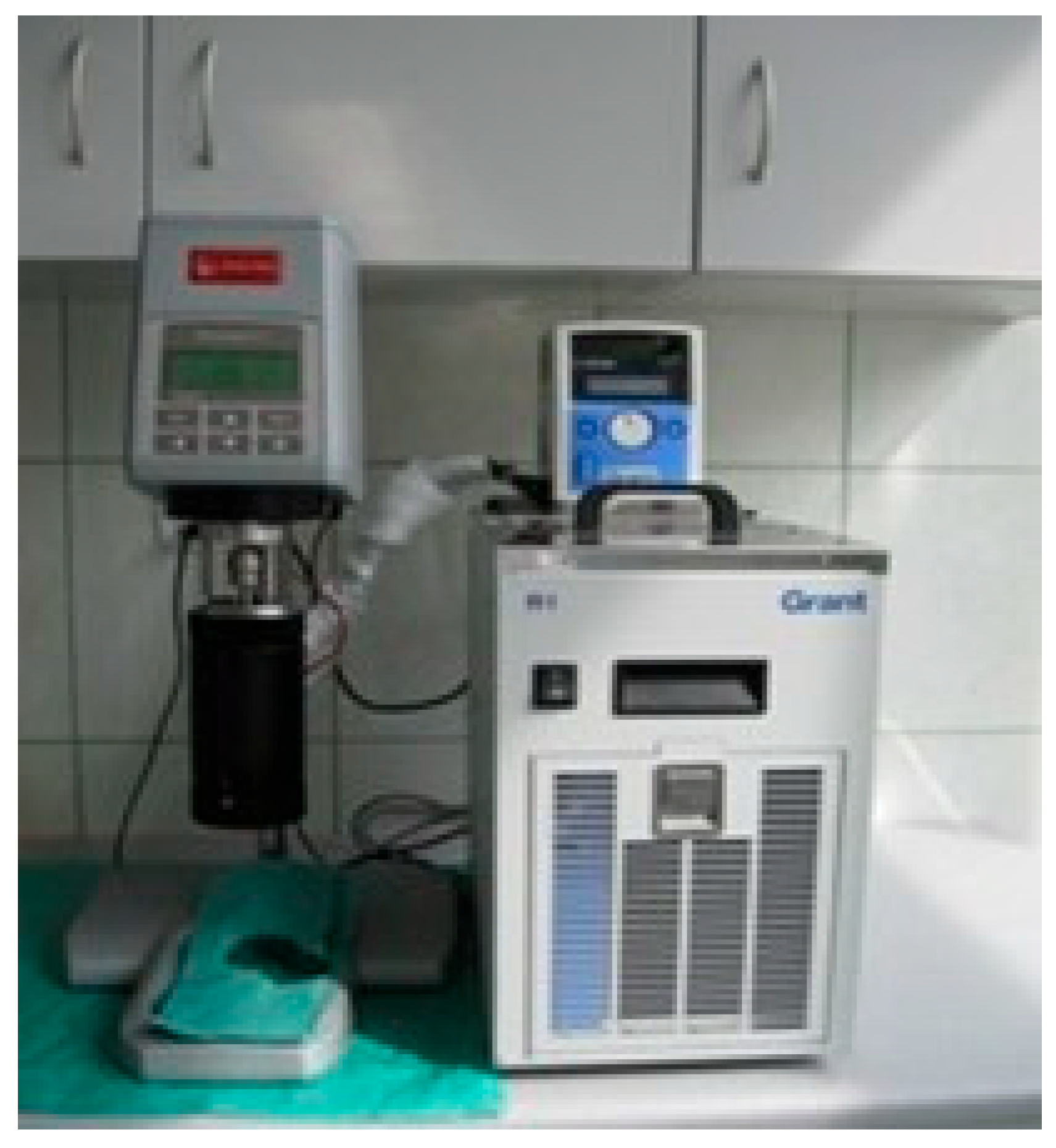
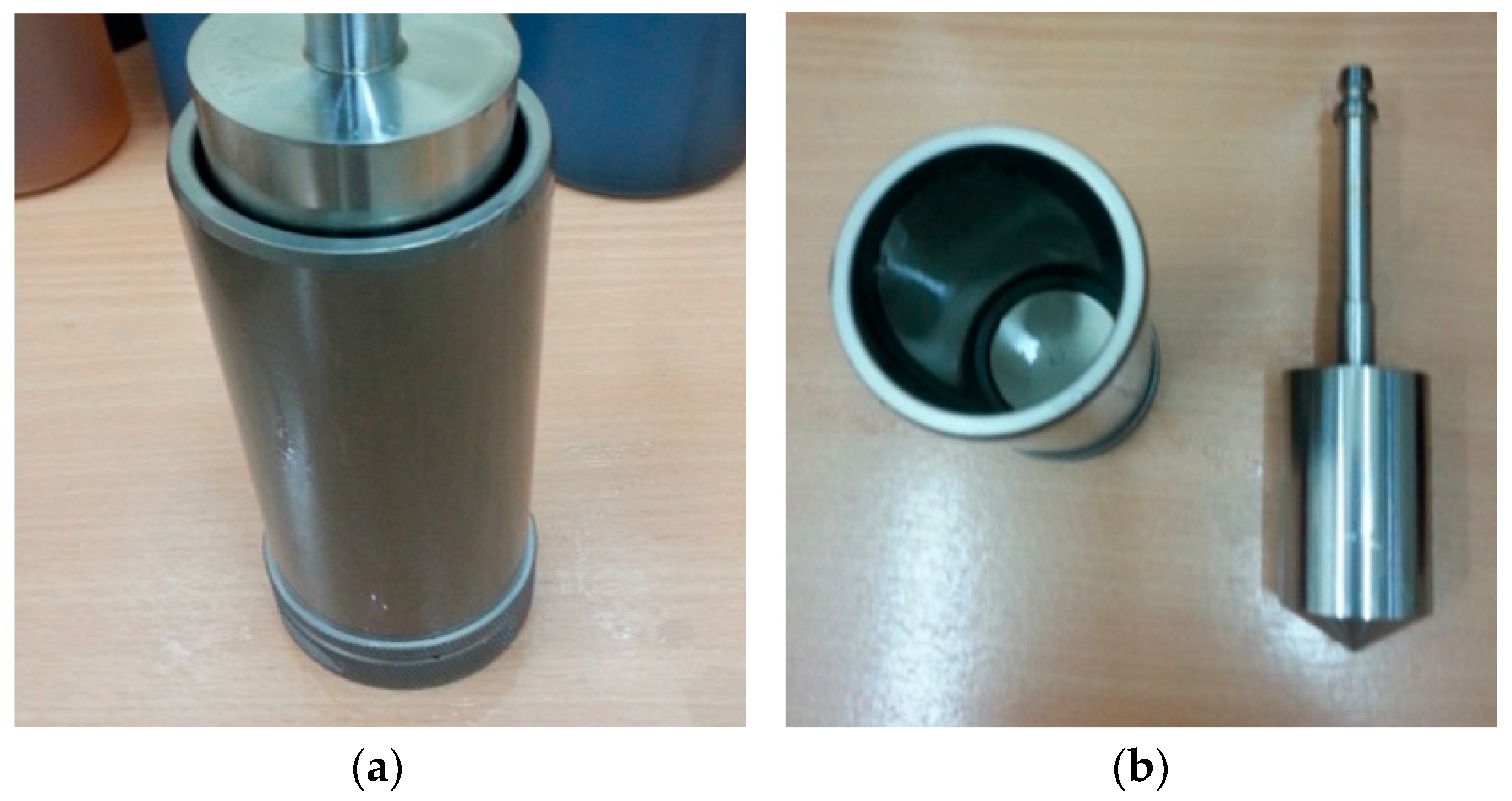
All tests were performed at the Laboratory of Technology and Evaluation of Physico-Chemical Properties located at the Faculty of Production Engineering and Energy of the Hugo Kołłątaj University of Agriculture in Krakow. The main device of the testing stand was the ReolabQC rheometer from Anton Paar GmbH, presented in Figure 1. The rheometer was equipped with a temperature sensor and an integrated measurement system for time. To determine the effect of temperature on dynamic viscosity, the rheometer was equipped with a thermostatic bath from Grant (Royston, UK). This bath allows for changing and stabilizing the temperature of the tested medium in the range from −20 to 50 °C. The test results, via the viscometer’s measurement system, were transmitted to a computer and recorded and processed there using the RHEOPLUS/32 V3.0 software. The measuring system used in the rheometer for determining dynamic viscosity is shown in Figure 2.

2.4. Methodology

According to DIN 51519 [52], SAE J300 [53], and ASTM D445 [54] standards, the viscosity of oils is described by kinematic viscosity, which characterizes the flow resistance an oil exhibits while moving. This parameter is determined using a capillary method by measuring the time it takes for the oil to flow through a calibrated capillary viscometer.
In actual operating conditions, oil moves through the engine’s lubrication system at high speeds and pressures. For this reason, the authors argue that dynamic viscosity is a far more suitable parameter for describing flow resistance under real engine service conditions. To determine the oil’s flow resistance, the authors selected dynamic viscosity measurements and employed a rotational rheometer equipped with a cylinder–sleeve measurement system as the most appropriate instrument for the expected viscosity range.
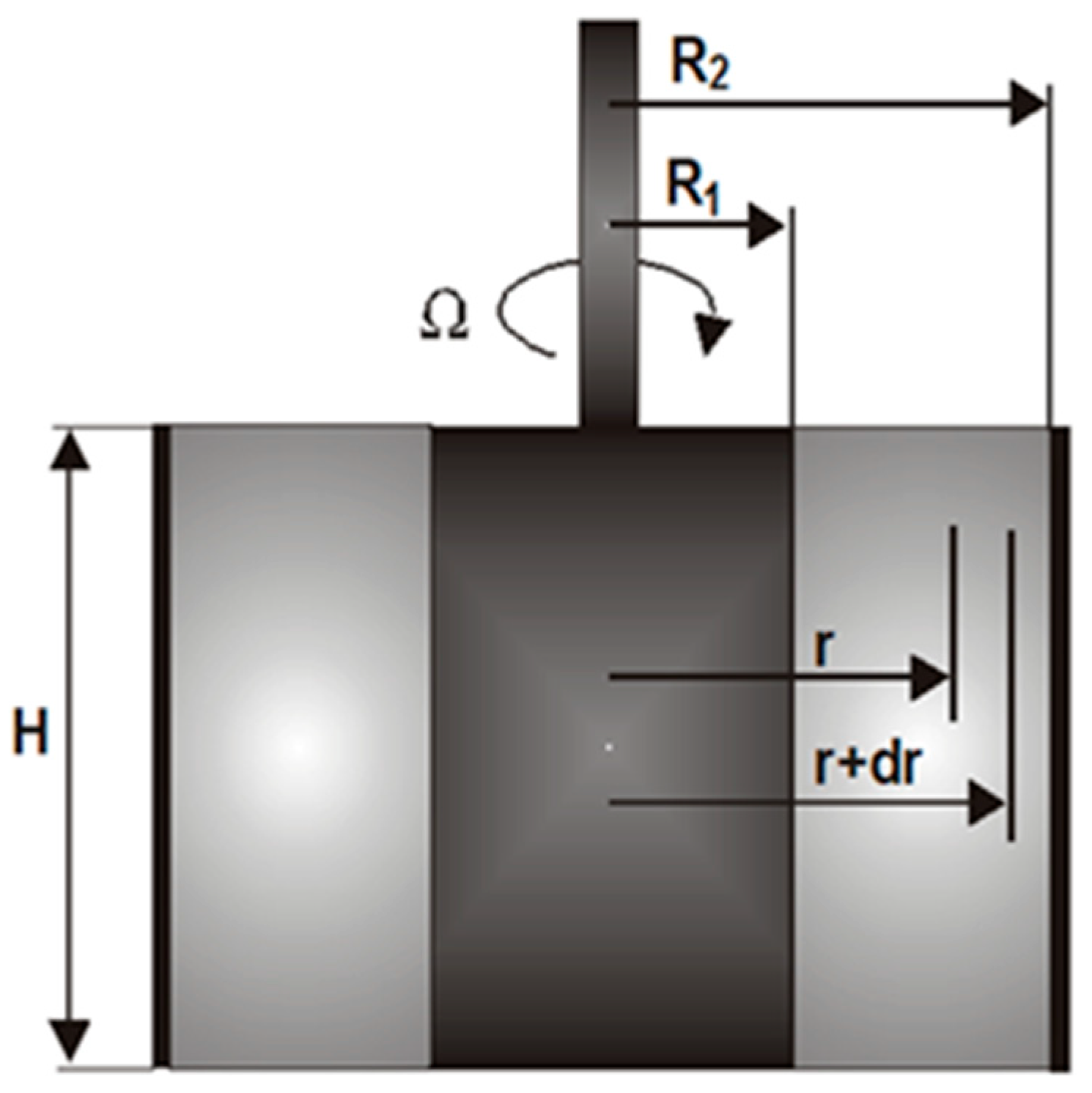
The diagram of the coaxial cylinder and bob measuring system used in the rheometer for the tests is shown in Figure 3. The measuring system consists of an outer cylinder with radius R2 and an inner bob with radius R1. The inner roller rotates at an angular velocity Ω. A sample of the engine oil is cut in the gap between the cylinder and the roller. The frictional forces are transferred by the oil to the cylinder, which causes the torque M to be generated on its axis. It is assumed for simplification of theoretical considerations that the cylinder and roller have infinite length, and only a section of height H is considered. At a distance r from the axis of rotation, for a Newtonian fluid, the relationship between tangential stress and shear rate can be expressed using the following dependence:
τ r = η r d ω d r
If we assume that the sample under consideration has height H, the tangential force in the engine oil at a distance r from the axis of rotation can be expressed by the formula:
F r = 2 π r H τ r
After substituting Equation (1) into Equation (2), we obtain:
F r = 2 π η H r 2 d ω d r
The torque caused by the tangential force will be equal to:
M = F r r
Substituting (3) into (4) yields:
M = 2 π η H r 3 d ω d r
Ultimately, the dependence for dynamic viscosity takes the following form:
η = 1 4 π H 1 R 1 2 1 R 2 2 M Ω

3. Results and Discussion

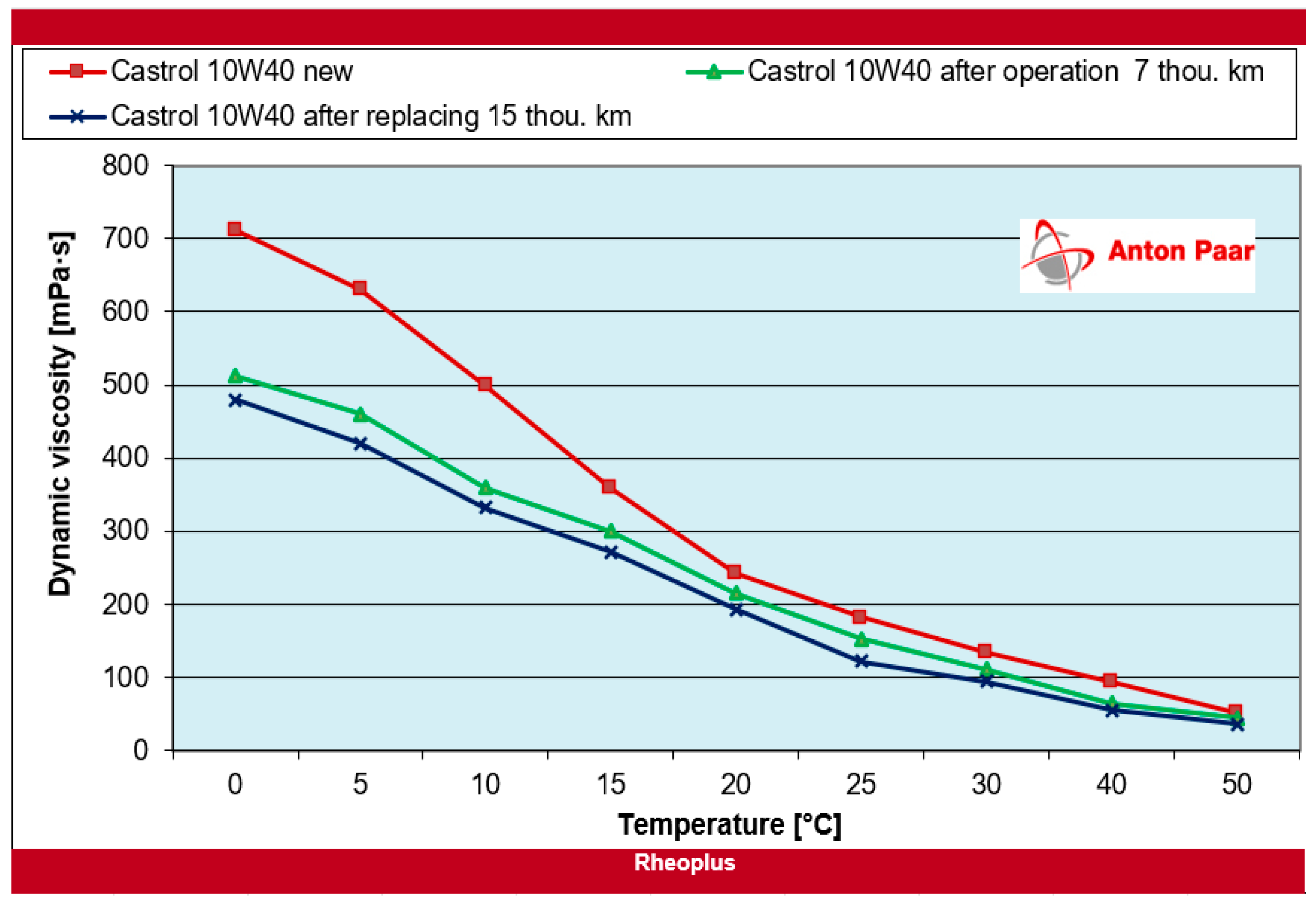
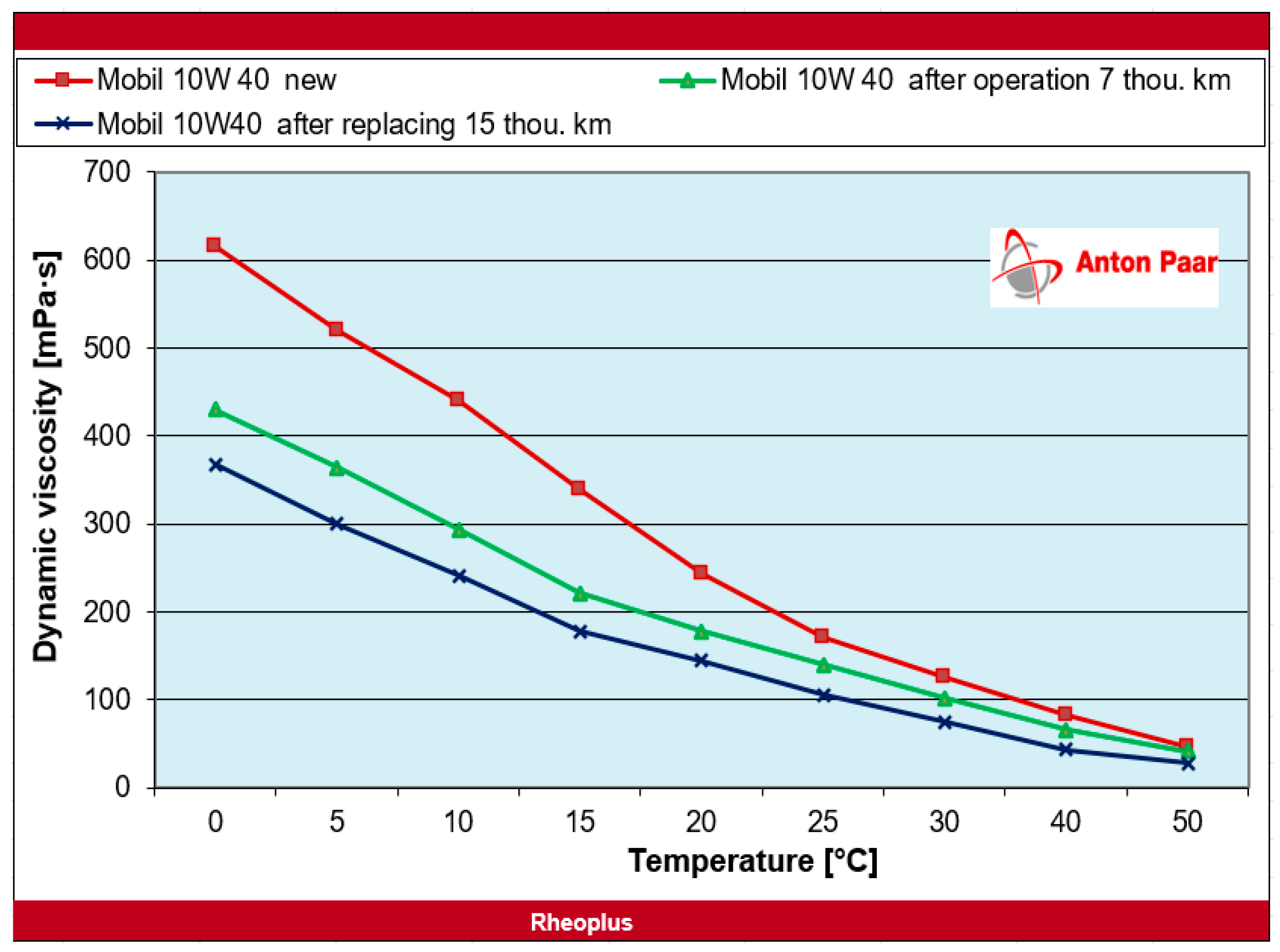
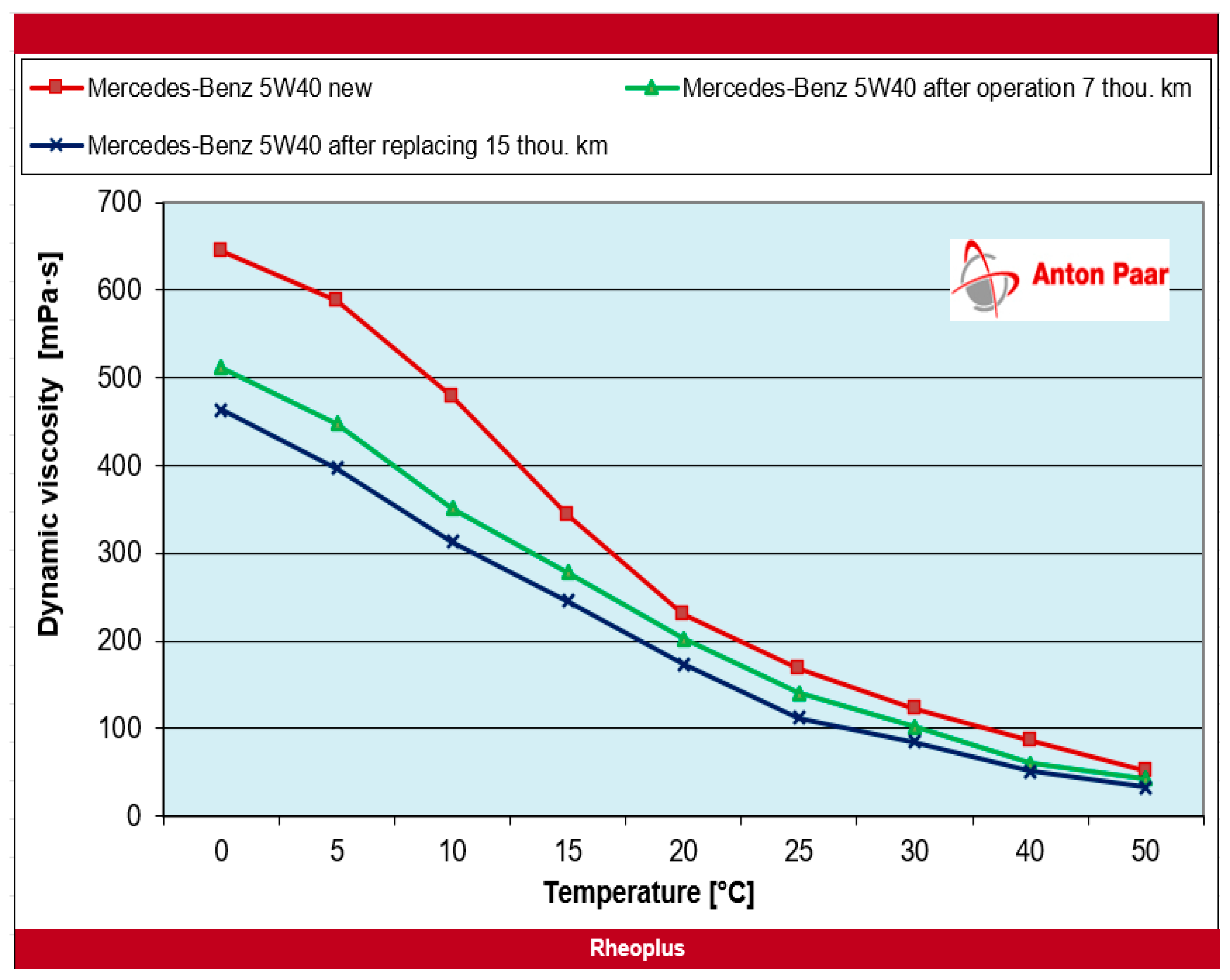
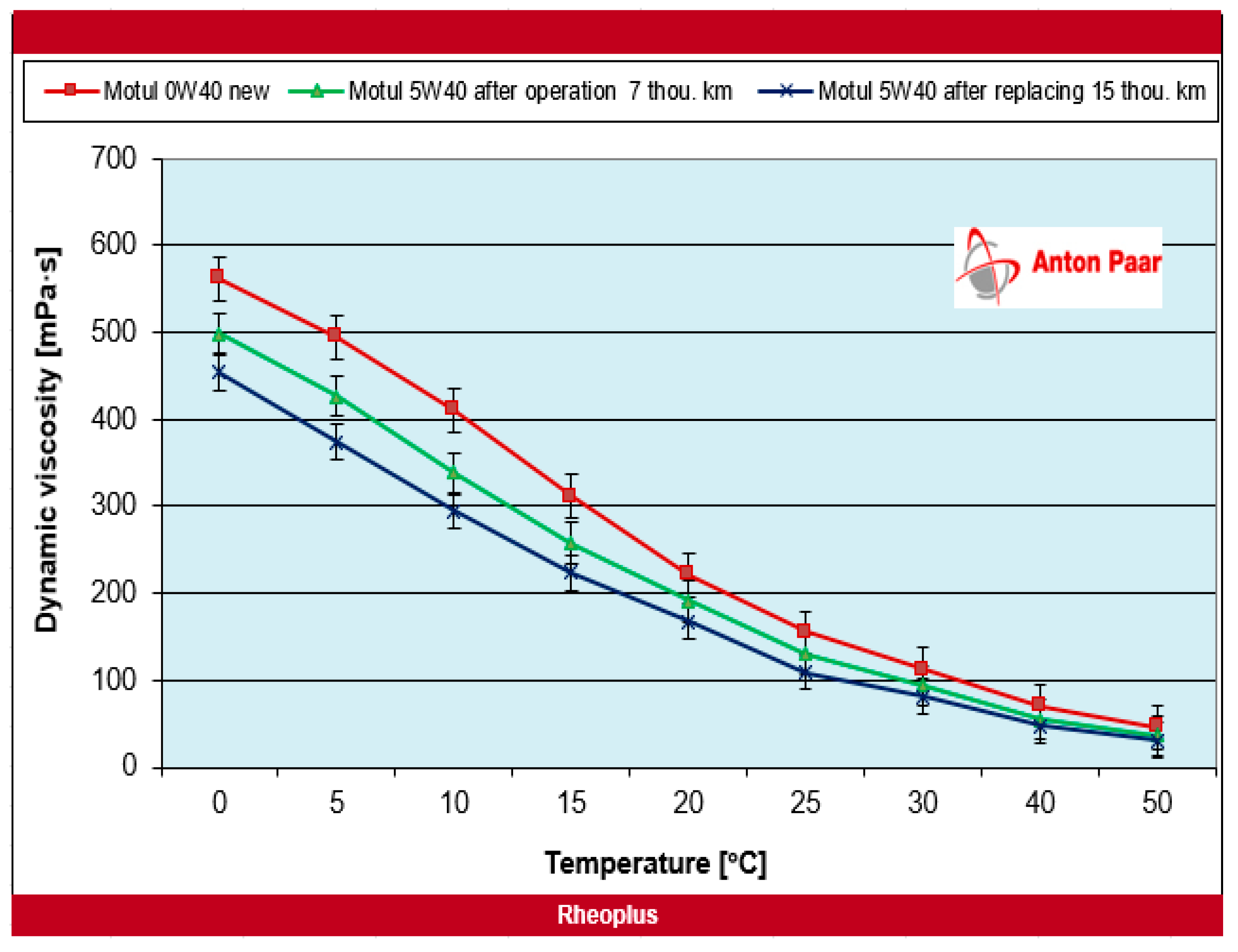
Figure 4, Figure 5, Figure 6, Figure 7 and Figure 8 present the courses of changes in the dynamic viscosity values of the tested new oils, as well as after a mileage of 7 thousand kilometers and after a mileage of 15 thousand kilometers, as a function of temperature change from 0 °C to 50 °C. Viscosity tests were determined for a constant shear rate of 1000 s−1. For all tested oils, a clear decrease in dynamic viscosity was obtained with increasing temperature, as well as a decrease in dynamic viscosity value with increasing mileage of the engines in which the oils were used for lubrication.
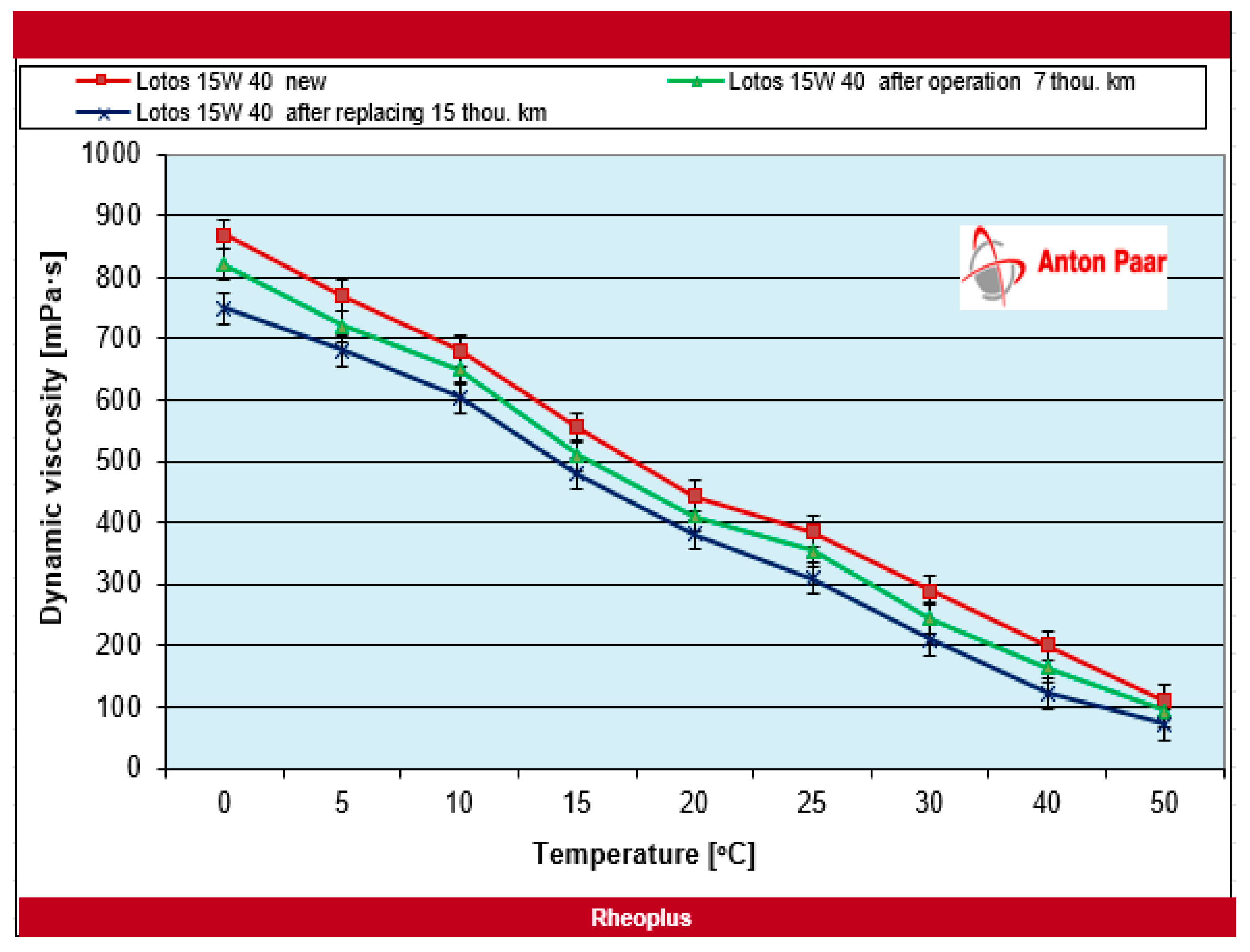
Figure 4 presents the results of studies on the influence of temperature and operating time on the dynamic viscosity of Lotos 15W40 mineral oil. With the increase in temperature from 0 °C to 50 °C, the dynamic viscosity of Lotos 15W40 oil decreases practically linearly. The graphs show that this tendency holds for new oil, as well as after a mileage of 7 and 15 thousand kilometers. Furthermore, the highest viscosity values are achieved by the new oil, smaller values across the entire temperature range are achieved by the oil after a mileage of 7 thousand km, and the lowest values are achieved by the oil after a mileage of 15 thousand km. New Lotos 15W40 oil achieved a dynamic viscosity value of 870 mPa·s at 0 °C, whereas at 50 °C, it achieved only 110 mPa·s. After a mileage of 7 thousand km, this oil achieved a dynamic viscosity of 820 mPa·s at 0 °C and 94 mPa·s at 50 °C. However, after a mileage of 15 thousand km, the dynamic viscosity of the oil amounted to 750 mPa·s at 0 °C and 72 mPa·s at 50 °C.
Figure 4. Dynamic viscosity of Lotos 15W40 mineral oil as a function of temperature and operating time.
Energies 18 06530 g004
Figure 5 shows the changes in dynamic viscosity values of new Castrol Magnetic 10W40 semi-synthetic oil, as well as after a mileage of 7 and 15 thousand kilometers, as a function of temperature in the range from 0 °C to 50 °C. At 0 °C for the new oil, a viscosity value of 711 mPa·s was obtained, 512 mPa·s after a mileage of 7 thousand km, and 480 mPa·s after a mileage of 15 thousand km. At 50 °C, Castrol Magnetic 10W40 new oil, as well as after mileages of 7 and 15 thousand km, achieved dynamic viscosity values of 52, 45, and 36 mPa·s, respectively. In the temperature range from 0 °C to 15 °C, a clear decrease in dynamic viscosity can be observed on the graph after covering 7 and 15 thousand km, relative to the new oil. Such a clear decrease in dynamic viscosity is not observed on the graph after a mileage of 15 thousand km compared to the oil after a mileage of 7 thousand km.
Figure 5. Dynamic viscosity of Castrol Magnetic 10W40 semi-synthetic oil as a function of temperature and operating time.
Energies 18 06530 g005
Figure 6 shows the changes in dynamic viscosity values of new Mobil Super 2000 10W40 semi-synthetic oil and after a mileage of 7 and 15 thousand km, as a function of temperature, in the range from 0 °C to 50 °C. The dynamic viscosity of the new oil at a temperature of 0 °C was 616 mPa·s, and at 50 °C was 47 mPa·s. After covering 15 thousand km, the dynamic viscosity of this oil at 0 °C was 368 mPa·s, and at 50 °C was 28 mPa·s. In the temperature range from 0 °C to 20 °C, a clear drop in the dynamic viscosity of the new Mobil Super 2000 10W40 oil is visible compared to the oil after a mileage of 7 and 15 thousand km. There was no longer such a significant decrease in viscosity for the oil after driving 15,000 km compared to the oil after driving 7000 km.
Figure 6. Dynamic viscosity of Mobil Super 2000 10W40 semi-synthetic oil as a function of temperature and operating time.
Energies 18 06530 g006
Figure 7 presents the courses of dynamic viscosity changes measured for new Mercedes-Benz 5W40 MB 229.5 synthetic oil, as well as after a mileage of 7 and 15 thousand km, as a function of temperature change in the range from 0 °C to 50 °C. For the new oil at 0 °C, the dynamic viscosity value was 645 mPa·s, and at 50 °C, the viscosity was 51 mPa·s. After a mileage of 15 thousand km, the dynamic viscosity was measured to be 463 mPa·s at 0 °C and 33 mPa·s at 50 °C. In the temperature range from 0 °C to 15 °C, a clear decrease in oil viscosity is visible after covering 7 thousand km relative to the new oil. There was no longer such a significant decrease in viscosity for the oil after driving 15,000 km compared to the oil after driving 7000 km.
Figure 7. Dynamic viscosity of Mercedes-Benz 5W40 MB 229.5 synthetic oil as a function of temperature and operating time.
Energies 18 06530 g007
Figure 8 presents the dynamic viscosity measurement results for new Motul 8100 X-Max SAE 0W40 synthetic oil and after a mileage of 7 and 15 thousand km, as a function of temperature change in the range from 0 °C to 50 °C. For the new oil, a dynamic viscosity value of 562 mPa·s at 0 °C and 46 mPa·s at 50 °C was obtained. These are the smallest measured dynamic viscosity values among all tested oils. After covering 15 thousand km, dynamic viscosity values of 454 mPa·s at 0 °C and 31 mPa·s at 50 °C, respectively, were obtained. For Motul 8100 X-Max SAE 0W40 oil, no significant changes in viscosity were observed on the graphs in the lower temperature range temperatures after a mileage of 7 thousand km, as is the case for Castrol Magnetic 10W40, Mobil Super 2000 10W40, and Mercedes-Benz 5W40 MB 229.5 oils.
Figure 8. Dynamic viscosity of Motul 8100 X-Max SAE 0W40 synthetic oil as a function of temperature and operating time.
Energies 18 06530 g008
Table 2, Table 3 and Table 4 summarize the measured dynamic viscosity values of the tested new oils, after covering 7 thousand km and after covering 15 thousand km, as a function of temperature in the range from 5 °C to 50 °C. Among the new oils, the lowest dynamic viscosity was recorded for Motul 0W40 synthetic oil. Higher viscosity values were observed for the semi-synthetic Mobil 10W40, synthetic Mercedes-Benz 5W40, and semi-synthetic Castrol Magnatec 10W40 oils, respectively. The highest viscosity values were obtained for Lotos 15W40 mineral oil. In oil samples with mileage of 7000 km and 15,000 km, the semi-synthetic Mobil 10W40 oil had the lowest dynamic viscosity at most measurement points. Subsequently, higher values were obtained for the synthetic Motul 0W40, synthetic Mercedes-Benz 5W40, and semi-synthetic Castrol Magnatec 10W40 oils. In both runs, the mineral Lotos 15W40 oil maintained the highest viscosity.
Table 5 presents the results of studies on the influence of temperature and operating time on the dynamic viscosity of Lotos 15W40 mineral oil. After 7000 km, the mean absolute change in measured dynamic viscosity values in the temperature range from 0 °C to 50 °C was smallest for Lotos 15W40 mineral oil. It was slightly higher for Motul 0W40 synthetic oil and increased successively for Mercedes-Benz 5W40 synthetic oil and the semi-synthetic oils Castrol Magnatec 10W40 and Mobil 10W40. In the temperature range from 20 °C to 50 °C, the absolute change in dynamic viscosity values was smallest for Motul 0W40 synthetic oil. Within this temperature range, they were also smaller for Mercedes-Benz 5W40 and Castrol Magnatec 10W40 oils, compared to Lotos 15W40 mineral oil. In the temperature range of 30 °C, 40 °C and 50 °C, the absolute changes in dynamic viscosity were significantly smaller for Mobil 10W40 oil compared to Lotos 15W40 mineral oil. After 15,000 km, the mean absolute change in dynamic viscosity of the tested oils, in the temperature range from 0 °C to 50 °C, was the smallest for Motul 0W40 synthetic oil. This value increased successively for Lotos 15W-40 mineral oil, Mercedes-Benz 5W40 synthetic oil, and Castrol Magnatec 10W40 and Mobil 10W40 semi-synthetic oils. In the temperature range from 25 °C to 50 °C, after 15,000 km, the absolute changes in dynamic viscosity were greatest for the mineral oil and smallest for the Motul 0W40 synthetic oil. For the synthetic oils: Motul 0W40, Mercedes-Benz 5W-40, and Castrol Magnatec 10W40 semi-synthetic oil, the absolute changes in dynamic viscosity for temperatures from 20 to 50 °C, after 15,000 km, were significantly smaller than for the Lotos 15W40 mineral oil. However, for the semi-synthetic oil Mobil 10W40 these changes were significantly smaller than for the mineral oil Lotos 15W40 in the temperature range from 25 to 50 °C.
Table 6 presents the relative change in dynamic viscosity of the tested oils after 7000 and 15,000 km compared to new oils, in the temperature range from 0 °C to 50 °C. Average values of relative change in dynamic viscosity were calculated for the tested oils as a function of temperature, after 7000 and 15,000 km. After 7000 and 15,000 km, the average value of relative change in dynamic viscosity was lowest for the mineral oil, slightly higher for the Motul 0W40 synthetic oil, and highest for the Mobil 10W40 semi-synthetic oil.
Table 7 presents the influence of temperature change on the absolute change in dynamic viscosity of the tested engine oils relative to the viscosity measured at 0 °C, for new oils and after a mileage of 7 and 15 thousand kilometers. The change in temperature had the greatest impact on the absolute change in viscosity of Lotos 15W40 mineral oil. The temperature change from 0 °C to 50 °C caused a decrease in the dynamic viscosity of the new Lotos 15W40 mineral oil by 760 mPa·s, the new Motul 0W40 synthetic oil by 516 mPa·s, while for the new Castrol Magnatec 10W40 semi-synthetic oil this change was 659 mPa·s. The increase in oil service time meant that the temperature change from 0 °C to 50 °C had less of an effect on the change in the dynamic viscosity value of the tested oils. After a mileage of 15,000 km, the temperature change from 0 °C to 50 °C caused a decrease in the dynamic viscosity of the mineral oil by 678 mPa·s, of the semi-synthetic oil Mobil 10W40 by 340 mPa·s and of the synthetic oil Motul 0W40 by 423 mPa·s. For the semi-synthetic oil Mobil 10W40 after 7 and 15 thousand km, the temperature change from 0 °C to 50 °C causes the smallest decrease in its dynamic viscosity.
Table 8 presents a comparison of the influence of temperature change on the relative change in dynamic viscosity of the tested engine oils relative to the viscosity measured at 0 °C for new oils, after a mileage of 7 thousand kilometers and after a mileage of 15 thousand kilometers. The smallest relative changes in dynamic viscosity caused by the change in viscosity measurement temperature were shown for Lotos 15W40 mineral oil. For the remaining tested oils, the relative changes in their dynamic viscosity were similar.
The observed reduction in viscosity can be interpreted against the background of several parallel physicochemical mechanisms. Firstly, oil oxidation under the influence of high temperatures leads to the breakage of long hydrocarbon chains, reducing their average molecular weight, causing the formation of oxidation products such as alcohols, aldehydes, organic acids, and consequently reducing the viscosity of the engine oil. Second, high loads and high rotational speeds can physically break down the long, high molecular weight polymers added to improve the viscosity of engine oils. This process, called mechanical shear, breaks these molecules into smaller fragments, and changes the rheological profile of the oil and its resistance to temperature changes, which can also contribute to reduced viscosity. Thirdly, impurities (fuel, combustion products, water) can reduce the viscosity. It follows from the above that the observed trend (e.g., systematic decrease in viscosity in used samples) most likely results from the dominant influence of thermal degradation and washing out of high molecular fractions, which is confirmed by research by other authors on the study of the dynamic viscosity of engine oils [55,56].
Based on the above information, it can be concluded that synthetic and semi-synthetic oils have better thermal stability, which is a consequence of their more uniform molecular structure and advanced additive packages. A significant drop in viscosity at low temperatures after 7000 km, especially in the case of semi-synthetic oils, may indicate the consumption of additives improving their properties. A reduction in the effect of temperature on viscosity in used oils was also observed, suggesting a breakdown of the oil structure caused by oxidation, mechanical shear and contamination, which leads to the loss of the ability to maintain the appropriate lubricant film thickness. The significant degradation observed in semi-synthetic oils, especially in Mobil Super 2000 10W40, proves that oils, despite having the same viscosity marking, may differ significantly in the quality of the base and additives. From a practical point of view, the results emphasize that oil change intervals should take into account not only mileage but also temperature conditions, since viscosity degradation is strongly dependent on operating temperature. In addition, the research also shows that synthetic oils offer significant operational benefits, especially in conditions of high temperature variability or high loads.

4. Conclusions

The aim of the research was to determine the influence of operating time and temperature on the dynamic viscosity value of various engine oils: mineral Lotos 15W40, semi-synthetic: Mobil 10W40 and Castrol Magnatec10W40, and synthetic: Mercedes-Benz 5W40, Motul 0W40. Based on the research conducted on the influence of operating time and temperature on the dynamic viscosity of engine oils, it can be concluded:
  • The operating time had an impact on the reduction in dynamic viscosity in the entire tested temperature range for all analyzed oils.
  • A nearly linear decrease in dynamic viscosity with increasing temperature was observed for the mineral oil. Similar viscosity and temperature characteristics were recorded for Motul 0W40 synthetic oil.
  • A significant reduction in dynamic viscosity was observed for Mobil 10W40, Castrol Magnatec 10W40, and Mercedes-Benz 5W40 oils after 7000 km at low temperatures (0–15 °C).
  • At higher temperatures (20–50 °C), the absolute changes in dynamic viscosity after 7000 and 15,000 km were smaller for synthetic and semi-synthetic oils than for mineral oils, which indicates their greater thermal stability.
  • For most of the tested temperatures, the relative reduction in dynamic viscosity after 7000 and 15,000 km was the smallest for the Lotos 15W40 mineral oil and the largest for the semi-synthetic Mobil 10W40.
  • Changing the temperature from 0 to 50 °C resulted in the greatest absolute reduction in dynamic viscosity for mineral oil.
  • With the extension of the oil service life, the increase in measurement temperature resulted in smaller absolute changes in dynamic viscosity. This is the result of a significant decrease in dynamic viscosity with increasing operating time.
Properly composed and selected engine oil has a decisive impact on the durability and reliability of the engine, power, torque, fuel consumption and impact on the environment. The viscosity of the oil lubricating a piston combustion engine should be appropriate, both at low and high temperatures. High oil viscosity at low temperatures increases the engine’s resistance to movement, and thus increases fuel consumption and exhaust emissions. Under all engine operating conditions, a lubricating wedge should be easily created to separate the mating surfaces, providing fluid friction to prevent their wear. It is necessary to further improve oil recipes in order to improve the operating parameters of combustion engines.

Author Contributions

Conceptualization, G.W., D.K. and A.L.; methodology, G.W. and D.K.; software, A.L., D.K. and G.W.; validation, A.L., D.K. and G.W.; formal analysis, A.L., D.K. and G.W.; investigation, A.L. and D.K.; resources, G.W.; data curation, G.W. and D.K.; writing—original draft preparation, A.L. and D.K.; writing—review and editing, A.L., D.K. and G.W.; visualization, A.L., D.K. and G.W.; supervision, A.L. and D.K.; project administration, A.L.; funding acquisition, G.W. All authors have read and agreed to the published version of the manuscript.

Funding

This research was funded by the Faculty of Production Engineering and Power Technologies, University of Agriculture in Krakow, and the Faculty of Mechatronics and Mechanical Engineering Kielce University of Technology, and Institute of Quality and Product Management Sciences, Krakow University of Economics.

Data Availability Statement

The original contributions presented in this study are included in the article. Further inquiries can be directed to the corresponding author.

Acknowledgments

The authors gratefully acknowledge the Faculty of Production Engineering and Power Technologies, University of Agriculture in Krakow, the Faculty of Mechatronics and Mechanical Engineering Kielce University of Technology, and Institute of Quality and Product Management Sciences, Krakow University of Economics.

Conflicts of Interest

The authors declare no conflicts of interest.

Abbreviations

APIAmerican Petroleum Institute
ACEAAssociation des Constructers Europeans d’Automobiles/European Automobile Manufacturers Association
A3/B3engine oil quality class for engine oil intended for gasoline engines (A3) and diesel engines (B3) in passenger cars.
CFengine oil quality class for diesel engines.
MB 229.1engine oil quality class developed by Mercedes Benz for gasoline and diesel engines
SMengine oil quality class for gasoline engines in passenger cars
SLengine oil quality class for all engines
CFengine oil quality class for diesel engines
VW 501.01/505.00Engine oil specification for older types of engine oils intended for gasoline engines (501.01) and diesel engines (505.00) of the Volkswagen Group
MB 229.5Requirements for both petrol and diesel engines of Mercedes Benz
BMW Longlife-01The BMW Longlife-01 standard is characterized by high HTHS viscosity. Its properties protect the engine against corrosion and deposits.
Viscosity HTHSHigh Temperature High Shear
R1roller radius
R2cylinder radius
Ωangular velocity
Hconsidered spindle height
rdistance from the axis of rotation
η dynamic viscosity
T5/T0temperature change range from 0 °C to 5 °C
T10/T0temperature change range from 0 °C to 10 °C
T15/T0temperature change range from 0 °C to 15 °C
T20/T0temperature change range from 0 °C to 20 °C
T25/T0temperature change range from 0 °C to 25 °C
T30/T0temperature change range from 0 °C to 30 °C
T40/T0temperature change range from 0 °C to 40 °C
T50/T0temperature change range from 0 °C to 50 °C

References

  1. Evans, J.S. How does Oil Work. Tech. Bull. Wear Check 2002, 23, 1–8. Available online: https://www.wearcheck.co.za/info/publications/technical-bulletin.html (accessed on 9 December 2025).
  2. Podniało, A. Oils and Greases in the Lubrication of Machines and Motor Vehicles; Publishing House RB: Opole, Poland, 2012. [Google Scholar]
  3. Ambrozik, A.; Jakóbiec, J.; Wysopal, G. Basic tendencies in motor lubricants changes. Autobusy Tech. Eksploat. Syst. Transp. 2011, 12, 51–56. [Google Scholar]
  4. Hebda, M. Car Operation; Instytut Technologii Eksploatacji—PIB: Radom, Poland, 2006; p. 8, ISBN/ISSN: 83-7204-476-7. [Google Scholar]
  5. Jakóbiec, J.; Mazanek, A.; Ambrozik, A. Operational assessment of lubricating oil SL/CF SAE 5W in engine fuelled by diesel oil and biodiesel B10. In Motoryz. Skażenie Sr; Piekarski, W., Ed.; Publishing House Wieś Jutra: Warszawa, Poland, 2009; pp. 48–57. [Google Scholar]
  6. Gritsenko, A.; Glemba, K.; Vozmilov, A. Improving the car environmental qualities by studying the engine load characteristics in the modes of injection rate off. Transp. Res. Procedia 2018, 36, 237–244. [Google Scholar] [CrossRef] [Scilit]
  7. Baskov, V.N.; Ignatov, A.V. Influence of ICE operation modes on environmental pollution. World Transp. Technol. Mach. 2018, 3, 112–118. [Google Scholar]
  8. Wolak, A.; Zając, G. Cold cranking viscosity of used synthetic oils originating from vehicles operated under similar driving conditions. Adv. Mech. Eng. 2018, 10, 11. [Google Scholar] [CrossRef] [Scilit]
  9. Faber, J.; Brodzik, K. Wpływ metody przygotowania próbek na oznaczanie zawartości pierwiastków w olejach silnikowych. Autobusy 2017, 6, 644–651. [Google Scholar]
  10. Jędrychowska, S.; Wieczorek, A. Multi-element analysis of lubricating oils with the use of Wavelength dispersive X-ray Fluorescence Spectrometry. Inst. Naft. I Gazu 2013, 6, 476–485. [Google Scholar]
  11. Hoang, A.T.; Pham, V.V. A study of emission characteristic, deposits and lubrication oil degradation of a diesel engine running on preheated vegetable oil and diesel oil. Energy Sources Part A Recovery Util. Environ. Eff. 2019, 41, 611–625. [Google Scholar] [CrossRef] [Scilit]
  12. Baskov, V.; Ignatov, A.; Polotnyanschikov, V. Assessing the influence of operating factors on the properties of engine oil and the environmental safety of internal combustion engine. Transp. Res. Procedia 2020, 50, 37–43. [Google Scholar] [CrossRef] [Scilit]
  13. Green, D.A.; Lewis, R. The effects of soot-contaminated engine oil on wear and friction: A review. Proc. Inst. Mech. Eng. Part D J. Automob. Eng. 2008, 222, 1669–1689. [Google Scholar] [CrossRef] [Scilit]
  14. Wakiru, J.; Pintelon, L.; Chemweno, P.; Muchiri, P. Analysis of lubrication oil contamination by fuel dilution with application of cluster analysis. In Proceedings of the XVII International Scientific Conference on Industrial Systems, Novi Sad, Serbia, 4–6 October 2017; pp. 252–257. [Google Scholar]
  15. Bordatchev, E.; Aghayan, H.; Yang, J. Object shape-based optical sensing methodology and system for condition monitoring of contaminated engine lubricants. Opt. Lasers Eng. 2014, 54, 128–138. [Google Scholar] [CrossRef] [Scilit]
  16. Zhu, J.; Yoon, J.; He, D.; Qiu, B.; Bechhoefer, E. Online condition monitoring and remaining useful life prediction of particle contaminated lubrication Oil. In Proceedings of the IEEE International Conference on Prognostics and Health Management, Gaithersburg, MD, USA, 24–27 June 2013. [Google Scholar] [CrossRef] [Scilit]
  17. Huang, L.; Bohac, S.V.; Chernyak, S.; Batterman, S. Effects of fuels, engine load and exhaust after-treatment on diesel engine SVOC emissions and development of SVOC profiles for receptor modeling. Atmos. Environ. 2015, 10, 228–238. [Google Scholar] [CrossRef] [Scilit]
  18. Kozina, A.; Radica, G.; Nižetić, S. Analysis of methods towards reduction of harmful pollutants from diesel engines. J. Clean. Prod. 2020, 262, 121105. [Google Scholar] [CrossRef] [Scilit]
  19. Denisov, A.S.; Grebennikov, A.S.; Grebennikov, S.A.; Nosov, A.O. Engine oil characteristics changes in uprated diesels. AIP Conf. Proc. 2019, 2141, 020005. [Google Scholar] [CrossRef] [Scilit]
  20. Chen, X.; Wang, Z.; Pan, S.; Pan, H. Improvement of engine performance and emissions by biomass oil filter in diesel engine. Fuel 2019, 235, 603–609. [Google Scholar] [CrossRef] [Scilit]
  21. Hawley, J.G.; Bannister, C.D.; Brace, C.J.; Akehurst, S.; Pegg, I.; Avery, M.R. The effect of engine and transmission oil viscometrics on vehicle fuel consumption. Proc. Inst. Mech. Eng. Part D J. Automob. Eng. 2010, 224, 1213–1228. [Google Scholar] [CrossRef] [Scilit]
  22. Sakamoto, K.; Mizutani, F.; Shimomura, M.; Yama, K.; Matsunaga, T.; Lee, S. Evaluation of engine oil degradation based on viscosity and transmitted light intensity measurements. Sens. Actuators A Phys. 2023, 361, 114597. [Google Scholar] [CrossRef] [Scilit]
  23. Carden, P.; Pisani, C.; Andersson, J.; Field, I.; Lainé, E.; Bansal, J.; Devine, M. The Effect of Low Viscosity Oil on the Wear, Friction and Fuel Consumption of a Heavy Duty Truck Engine. SAE Int. J. Fuels Lubr. 2013, 6, 311–319. [Google Scholar] [CrossRef] [Scilit]
  24. Totten, G.E. (Ed.) Handbook of Lubrication and Tribology: Volume I Application and Maintenance; CRC Press: Boca Raton, FL, USA, 2006. [Google Scholar] [CrossRef] [Scilit]
  25. Fox, M.F.; Stachowiak, G.W. Engine Lubricants. Engineering Tribology; Butterworth-Heinemann: Oxford, UK, 1993; p. 24. Available online: https://books.google.pl/books?id=yzxaPE1dwQkC&printsec=frontcover&hl=pl&source=gbs_ge_summary_r&cad=0#v=onepage&q&f=false (accessed on 9 December 2025).
  26. Zhu, X.; Zhong, C.; Zhe, J. Lubricating oil conditioning sensors for online machine health monitoring—A review. Tribol. Int. 2017, 109, 473–484. [Google Scholar] [CrossRef] [Scilit]
  27. Kumar, S.; Nand, P.; Kumar, M. A Study of Variation in Viscosity–Temperature Relationship with Time of Use of Lubricant. Int. Res. J. Eng. Technol. (IRJET) 2022, 9, 6. Available online: https://www.irjet.net/archives/V9/i6/IRJET-V9I6658.pdf (accessed on 9 December 2025).
  28. Vasishth, A.; Kuchhal, P.; Anand, G. Study of Rheological Properties of Industrial Lubricants. Conf. Pap. Sci. 2014, 1–5. [Google Scholar] [CrossRef] [Scilit]
  29. Heredia-Cancino, J.A.; Ramezani, M.; Álvarez-Ramos, M.E. Effect of degradation on tribological performance of engine lubricants at elevated temperatures. Tribol. Int. 2018, 124, 230–237. [Google Scholar] [CrossRef] [Scilit]
  30. Wolak, A. TBN performance study on a test fleet in real-world driving conditions using present-day engine oils. Measurement 2018, 114, 322–331. [Google Scholar] [CrossRef] [Scilit]
  31. Zadorozhnaya, E.; Levanova, I.; Oskina, O. Study of HTHS Viscosity of Modern Motor Oils. Procedia Eng. 2016, 150, 602–606. [Google Scholar] [CrossRef] [Scilit]
  32. Wolak, A.; Żywica, R. Electrical Properties of Engine Oils—Comparison of Electrical Parameters with Physicochemical Characteristics. Energies 2025, 18, 2776. [Google Scholar] [CrossRef] [Scilit]
  33. Macián, V.; Tormos, B.; Ruiz, S.; Miró, G. Low viscosity engine oils: Study of wear effects and oil key parameters in a heavy duty engine fleet test. Tribol. Int. 2016, 94, 240–248. [Google Scholar] [CrossRef] [Scilit]
  34. Esfe, M.H.; Afrand, M.; Gharehkhani, S.; Rostamia, H.; Toghraie, D.; Dahari, M. An experimental study on viscosity of alumina-engine oil. Effects of temperature and nanoparticles concentration. Int. Commun. Heat Mass Transf. 2016, 76, 202–208. [Google Scholar] [CrossRef] [Scilit]
  35. Asadi, A.; Asadi, M.; Rezaniakolaei, A.; Rosendahl, L.A.; Wongwises, S. An experimental and theoretical investigation on heat transfer capability of Mg (OH) 2/MWCNT-engine oil hybrid nano-lubricant adopted as a coolant and lubricant fluid. Appl. Therm. Eng. 2018, 129, 577–586. [Google Scholar] [CrossRef] [Scilit]
  36. Aghaei, A.; Khorasanizadeh, H.; Sheikhzadeh, G.A. Measurement of the dynamic viscosity of hybrid engine oil—Cuo-MWCNT nanofluid, development of a practical viscosity correlation and utilizing the artificial neural network. Heat Mass Transf. 2018, 54, 151–161. [Google Scholar] [CrossRef] [Scilit]
  37. Hou, X.; Chu, C.; Jiang, H.; Guan, W.; Ali, M.K.A. Revealing the thermal conductivity and viscosity mechanism of lubricating oil enhanced with nano-silicon carbide using molecular dynamics simulation. Int. J. Therm. Sci. 2025, 215, 110020. [Google Scholar] [CrossRef] [Scilit]
  38. Esfe, M.H.; Arani, A.A.A.; Esfandeh, S. Experimental study on rheological behavior of monograde heavy-duty engine oil containing CNTs and oxide nanoparticles with focus on viscosity analysis. J. Mol. Liq. 2018, 15, 319–329. [Google Scholar] [CrossRef] [Scilit]
  39. Dardan, E.; Afrand, M.; Isfahani, A.H.M. Effect of suspending hybrid nano-additives on rheological behavior of engine oil and pumping power. Appl. Therm. Eng. 2016, 109, 524–534. [Google Scholar] [CrossRef] [Scilit]
  40. Esfe, M.H.; Aran, A.A.A.; Esfandeh, S. Improving engine oil lubrication in light-duty vehicles by using of dispersing MWCNT and ZnO nanoparticles in 5W50 as viscosity index improvers(VII). Appl. Therm. Eng. 2018, 143, 493–506. [Google Scholar] [CrossRef] [Scilit]
  41. Esfe, M.H.; Arani, A.A.A.; Madadi, M.R.; Alirezaie, A. A study on rheological characteristics of hybrid nano-lubricants containing MWCNT-TiO2 nanoparticles. J. Mol. Liq. 2018, 15, 229–236. [Google Scholar] [CrossRef] [Scilit]
  42. Aghahadi, H.; Niknejadi, M.; Toghraie, D. An experimental study on the rheological behavior of hybrid Tungsten oxide (WO3)-MWCNTs/engine oil Newtonian nanofluids. J. Mol. Struct. 2019, 1197, 497–507. [Google Scholar] [CrossRef] [Scilit]
  43. Suresha, B. Tribological behaviour of neem oil with and without graphene nanoplatelets using four-ball tester. Adv. Tribol. 2020, 1–11. [Google Scholar] [CrossRef] [Scilit]
  44. Shafi, W.K.; Raina, A.; Haq, M.I.U. Tribological performance of avocado oil containing copper nanoparticles in mixed and boundary lubrication regime. Ind. Lubr. Tribol. 2018, 70, 865–871. [Google Scholar] [CrossRef] [Scilit]
  45. Duangthongsuk, W.; Wongwises, S. Measurement of temperature-dependent thermal conductivity and viscosity of TiO2-water nanofluids. Exp. Therm. Fluid Sci. 2009, 33, 706–714. [Google Scholar] [CrossRef] [Scilit]
  46. Godson, L.; Raja, B.; Lal, D.M.; Wongwises, S. Experimental investigation on the thermal conductivity and viscosity of silver-deionized water nanofluid. Exp. Heat Transf. 2010, 33, 317–332. [Google Scholar] [CrossRef] [Scilit]
  47. Kole, M.; Dey, T.K. Effect of aggregation on the viscosity of copper oxide-gear oil nanofluids. Int. J. Therm. Sci. 2011, 50, 1741–1747. [Google Scholar] [CrossRef] [Scilit]
  48. Sundar, L.S.; Ramana, E.V.; Singh, M.K.; De Sousa, A.C.M. Viscosity of low volume concentrations of magnetic Fe3O4 nanoparticles dispersed in ethylene glycol and water mixture. Chem. Phys. Lett. 2012, 554, 236–242. [Google Scholar] [CrossRef] [Scilit]
  49. Esfe, M.H.; Saedodin, S.; Mahian, O.; Wongwises, S. Thermophysical properties, heat transfer and pressure drop of COOH-functionalized multi walled carbon nanotubes/water nanofluids. Int. Commun. Heat Mass Transf. 2014, 58, 176–183. [Google Scholar] [CrossRef] [Scilit]
  50. Esfe, M.H.; Saedodin, S.; Mahian, O.; Wongwises, S. Heat transfer characteristics and pressure drop of COOH-functionalized DWCNTs/water nanofluid in turbulent flow at low concentrations. Int. J. Heat Mass Transf. 2014, 73, 186–194. [Google Scholar] [CrossRef] [Scilit]
  51. Esfe, M.H.; Goodarzi, M.; Reiszadeh, M.; Afrand, M. Evaluation of MWCNTs-ZnO/5W50 nanolubricant by design of an artificial neural network for predicting viscosity and its optimization. J. Mol. Liq. 2018, 277, 921–931. [Google Scholar] [CrossRef] [Scilit]
  52. DIN 51519; Lubricants-ISO Viscosity Classification for Industrial Liquid Lubricants. German Institute for Standardization: Berlin, Germany, 1998.
  53. SAE J300; Engine Oil Viscosity Classification. Society of Automotive Engineers: Warrendale, PA, USA, 1999.
  54. ASTM D445; Standard Test Method for Kinematic Viscosity of Transparent and Opaque Liquids (and Calculation of Dynamic Viscosity). ASTM International: West Conshohocken, PA, USA, 2024.
  55. Hlaváč, P.; Božiková, M.; Presová, R. Temperature Relations of Selected Engine Oils Dynamic Viscosity. Acta Technol. Agric. 2014, 17, 104–107. [Google Scholar] [CrossRef] [Scilit]
  56. Chomik, Z.; Smoleń, J. Changes in the viscosity of engine oil in agricultural tractors. Technol. Rol. Ogrod. Leśna 2018, 4, 20–23. [Google Scholar]
Figure 1. Test stand with the ReolabQC rheometer from Anton Paar GmbH and a Grant thermostatic bath.
Energies 18 06530 g001
Figure 2. Dynamic viscosity measurement system consisting of (a) cylinder, (b) rotating spindle inside cylinder.
Energies 18 06530 g002
Figure 3. Diagram of the dynamic viscosity measurement system: R1—roller radius, R2—cylinder radius, Ω—angular velocity, H—considered bob height, r—distance from the axis of rotation.
Energies 18 06530 g003
Table 1. Characteristics of the tested engine oils.
Type of OilOilViscosity ClassStandards
MineralLOTOS15W40API SN; ACEA A3/B3
Semi-syntheticMobil10W40API SL/SM/CF; ACEA A3/B3; MB-Approval 229.1; VW 501.01/505.00
Semi-syntheticCastrol Magnatec10W40API SN/CF; ACEA A3/B4; MB-Approval 229.1; VW 501.01/505.00
SyntheticMercedes-Benz5W40Requirements for both petrol and diesel engines of this brand MB 229.5
SyntheticMotul 8100 X-Max0W-40ACEA A3/B4 API SN/CF; and relevant standards of car manufacturers (MB 229.5; BMW Longlife-01)
Table 2. Comparison of measured dynamic viscosity values of tested new oils as a function of temperature.
Temperature
[°C]
Dynamic Viscosity; mPa·s
Lotos 15W40Mobil 10W40Castrol Magnatec 10W40MERCEDES-BENZ 5W40Motul 0W40
0870616711645562
5770520630588495
10680440500478411
15555340360343311
20444244243231221
25386171182168155
30290126135122112
4020082948671
5011047525146
Mean:478.3287.3323.0301.3264.9
Table 3. Comparison of measured dynamic viscosity values of tested oils as a function of temperature after covering 7 thousand kilometers.
Temperature
[°C]
Dynamic Viscosity; mPa·s
Lotos 15W 40Mobil 10W40Castrol Magnatec 10W40MERCEDES-BENZ 5W40Motul 0W40
0820430512512498
5720364460448427
10650294360351339
15510221300278258
20410178215202191
25355140153141130
3024410211110294
4016466656055
509441454337
Mean:440.8204.0246.8237.4225.4
Table 4. Summary of dynamic viscosity values of tested oils as a function of temperature after covering 15 thousand kilometers.
Temperature
[°C]
Dynamic Viscosity; mPa·s
Lotos 15W40Mobil 10W40Castrol Magnatec 10W40MERCEDES-BENZ 5W40Motul 0W40
0750368480463454
5680300420397374
10604241332313294
15480178272245224
20381144193173168
25310106122112109
3021075948581
4012243555148
507228363331
Mean:401.0164.8222.7208.0198.1
Table 5. Comparison of the absolute change in dynamic viscosity of tested engine oils after a mileage of 7 thousand and 15 thousand kilometers, measured at temperatures in the range from 0 °C to 50 °C, relative to new oils.
Temperature
[°C]
The Absolute Change in Dynamic Viscosity of the Tested Engine Oils; mPa·s
Lotos
15W40
Mobil
10W40
Castrol Magnatec 10W40MERCEDES-BENZ 5W40Motul
0W40
7000
km
15,000
km
7000
km
15,000
km
7000
km
15,000
km
7000
km
15,000
km
7000
km
15,000
km
0−50−120−186−248−199−231−133−182−64−108
5−50−90−156−220−170−210−140−191−68−121
10−30−76−146−199−140−168−127−165−72−117
15−45−75−119−162−60−88−65−98−53−87
20−34−63−66−100−28−50−29−58−30−53
25−31−76−31−65−29−60−27−56−25−46
30−46−80−24−51−24−41−20−37−18−31
40−36−78−16−39−29−39−26−35−16−23
50−16−38−6−19−7−16−8−18−9−15
Mean:−37.6−77.3−83.3−122.6−76.2−100.3−63.9−93.3−39.4−66.8
Table 6. Comparison of the relative change in dynamic viscosity of tested engine oils after a mileage of 7 and 15 thousand kilometers relative to new oil.
Temperature
[°C]
The Relative Change in Dynamic Viscosity of the Tested Engine Oils; %
Lotos 15W40Mobil 10W40Castrol Magnatec 10W40MERCEDES-BENZ 5W40Motul 0W40
7000
km
15,000
km
7000
km
15,000
km
7000
km
15,000
km
7000
km
15,000
km
7000
km
15,000
km
0−5.75−13.79−30.19−40.26−27.99−32.49−20.62−28.22−11.39−19.22
5−6.49−11.69−30.00−42.31−26.98−33.33−23.81−32.48−13.74−24.44
10−4.41−11.18−33.18−45.23−28.00−33.6−26.57−34.52−17.52−28.47
15−8.11−13.51−35.00−47.65−16.67−24.44−18.95−28.57−17.04−27.97
20−7.66−14.19−27.05−40.98−11.52−20.58−12.55−25.11−13.57−23.98
25−8.03−19.69−18.13−38.01−15.93−32.97−16.07−33.33−16.13−29.68
30−15.86−27.59−19.05−40.48−17.78−30.37−16.39−30.33−16.07−27.68
40−18.00−39.00−19.51−47.56−30.85−41.49−30.23−40.70−22.54−32.39
50−14.55−34.55−12.77−40.43−13.46−30.77−15.69−35.29−19.57−32.61
Mean:−9.9−20.6−25.0−42.5−21.0−31.1−20.1−32.1−16.4−27.4
Table 7. Comparison of the influence of temperature change on the absolute change in dynamic viscosity of the tested engine oils relative to the viscosity measured at 0 °C for new oils, after a mileage of 7 thousand kilometers and after a mileage of 15 thousand kilometers.
Interval Temperature Changes The Absolute Change in Dynamic Viscosity of the Tested Engine Oils; mPa·s
Lotos
15W40
Mobil
10W40
Castrol Magnatec 10W40MERCEDES-BENZ 5W40Motul
0W40
0 km7000 km15,000 km0 km7000 km15,000 km0 km7000 km15,000 km0 km7000 km15,000 km0 km7000 km15,000 km
T5/T0−100−100−70−96−66−68−81−52−60−57−64−66−67−71−80
T10/T0−190−170−146−176−136−127−211−152−148−167−161−150−151−159−160
T15/T0−315−310−270−276−209−190−351−212−208−302−234−218−251−240−230
T20/T0−426−410−369−372−252−224−468−297−287−414−310−290−341−307−286
T25/T0−484−465−440−445−290−262−529−359−358−477−371−351−407−368−345
T30/T0−580−576−540−490−328−293−576−401−386−523−410−378−450−404−373
T40/T0−670−656−628−534−364−325−617−447−425−559−452−412−491−443−406
T50/T0−760−726−678−569−389−340−659−467−444−594−469−430−516−461−423
Mean:−440.6−426.6−392.6−369.8−254.3−228.6−436.5−298.4−289.5−386.6−308.9−286.9−334.3−306.6−287.9
Table 8. Comparison of the influence of temperature change on the relative change in dynamic viscosity of the tested engine oils relative to the viscosity measured at 0 °C for new oils. after a mileage of 7 thousand kilometers and after a mileage of 15 thousand kilometers.
Interval Temperature Changes The Relative Change in Dynamic Viscosity of the Tested Engine Oils; %
Lotos
15W40
Mobil
10W40
Castrol Magnatec 10W40MERCEDES-BENZ 5W40Motul
0W40
0 km7000 km15,000 km0 km7000 km15,000 km0 km7000 km15,000 km0 km7000 km15,000 km0 km7000 km15,000 km
T5/T0−11.49−12.20−9.33−15.58−15.35−18.48−11.39−10.16−12.50−8.84−12.50−14.25−11.92−14.26−17.62
T10/T0−21.84−20.73−19.47−28.57−31.63−34.51−29.68−29.69−30.83−25.89−31.45−32.40−26.87−31.93−35.24
T15/T0−36.21−37.80−36.00−44.81−48.60−51.63−49.37−41.41−43.33−46.82−45.70−47.08−44.66−48.19−50.66
T20/T0−48.97−50.00−49.20−60.39−58.60−60.87−65.82−58.01−59.79−64.19−60.55−62.63−60.68−61.65−63.00
T25/T0−55.63−56.71−58.67−72.24−67.44−71.20−74.40−70.12−74.58−73.95−72.46−75.81−72.42−73.90−75.99
T30/T0−66.67−70.24−72.00−79.55−76.28−79.62−81.01−78.32−80.42−81.09−80.08−81.64−80.07−81.12−82.16
T40/T0−77.01−80.00−83.73−86.69−84.65−88.32−86.78−87.30−88.54−86.67−88.28−88.98−87.37−88.96−89.43
T50/T0−87.36−88.54−90.40−92.37−90.47−92.39−92.69−91.21−92.50−92.09−91.60−92.87−91.81−92.57−93.17
Mean:−50.6−52.0−52.4−60.0−59.1−62.1−61.4−58.3−60.3−59.9−60.3−62.0−59.5−61.6−63.4
Disclaimer/Publisher’s Note: The statements, opinions and data contained in all publications are solely those of the individual author(s) and contributor(s) and not of MDPI and/or the editor(s). MDPI and/or the editor(s) disclaim responsibility for any injury to people or property resulting from any ideas, methods, instructions or products referred to in the content.