A Comprehensive Methodology for Identifying Cadastral Plots Suitable for the Construction of Photovoltaic Farms: The Energy Transformation of the Częstochowa Poviat



Abstract
1. Introduction
1.1. Current State of Development of Photovoltaics in Poland
1.2. Brief Overview of the Methods and Factors Used for Determining the Location of Solar Farms
1.3. Purpose of the Research
- Which areas exhibit the highest potential for the location of photovoltaic farms, considering climatic factors, topography, land cover, and cadastral status?
- How can the integration of cadastral data with multi-criteria analysis support the planning process of PV investments at the local level?
- Which multi-criteria analysis methods can reduce the impact of uncertainty and expert subjectivity in the assessment of photovoltaic farm locations?
2. Materials and Methods
2.1. Selection of Research Area
2.2. Methodology
2.2.1. Factor Selection and Data Preparation
2.2.2. Raster Transformation Using the Fuzzy Membership Method and Determining the Criteria Weights Using the F-AHP Method
2.2.3. Land Register Analysis
3. Results
3.1. Determination of Weights
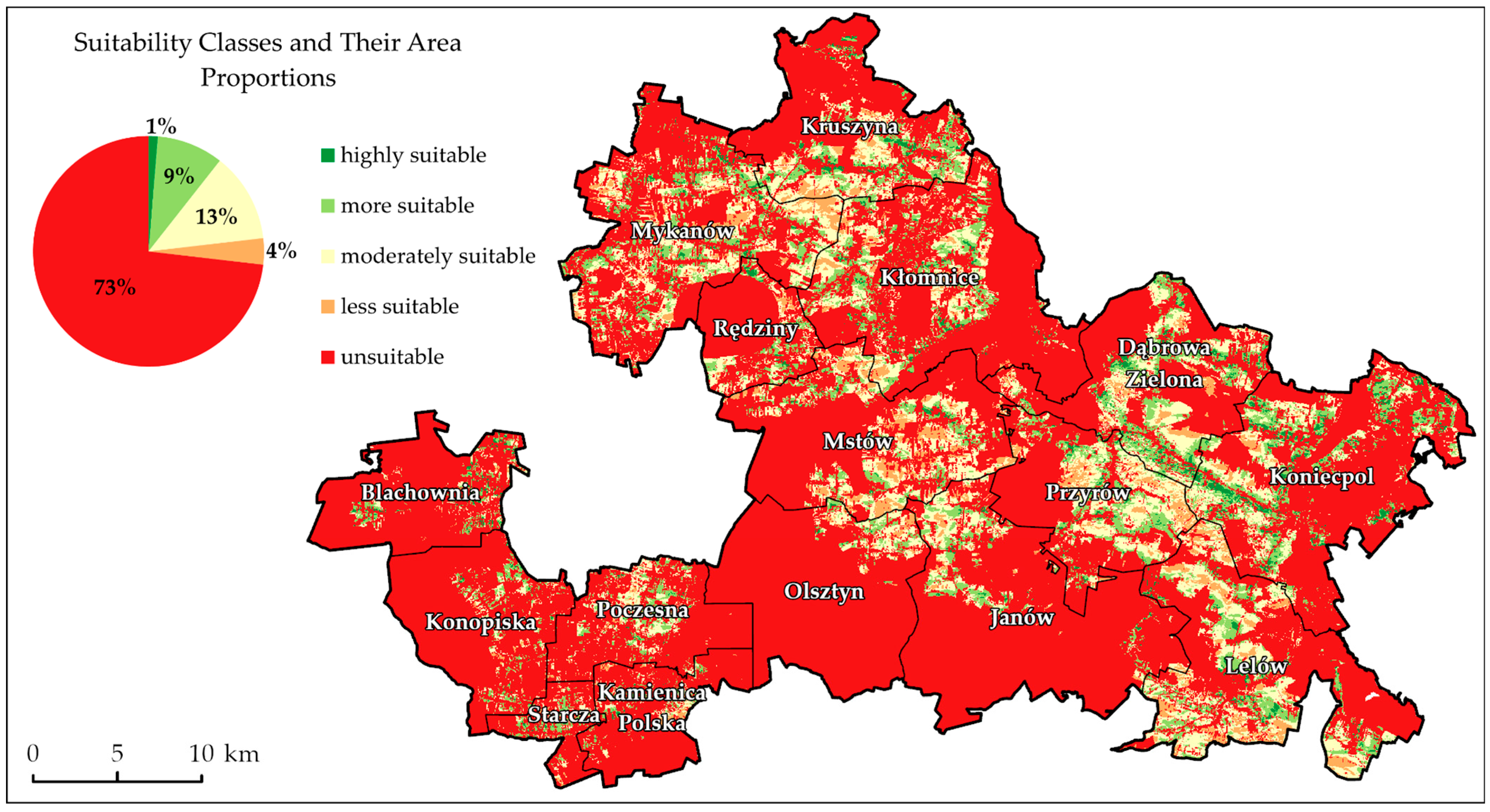
3.2. Development of a Suitability Map
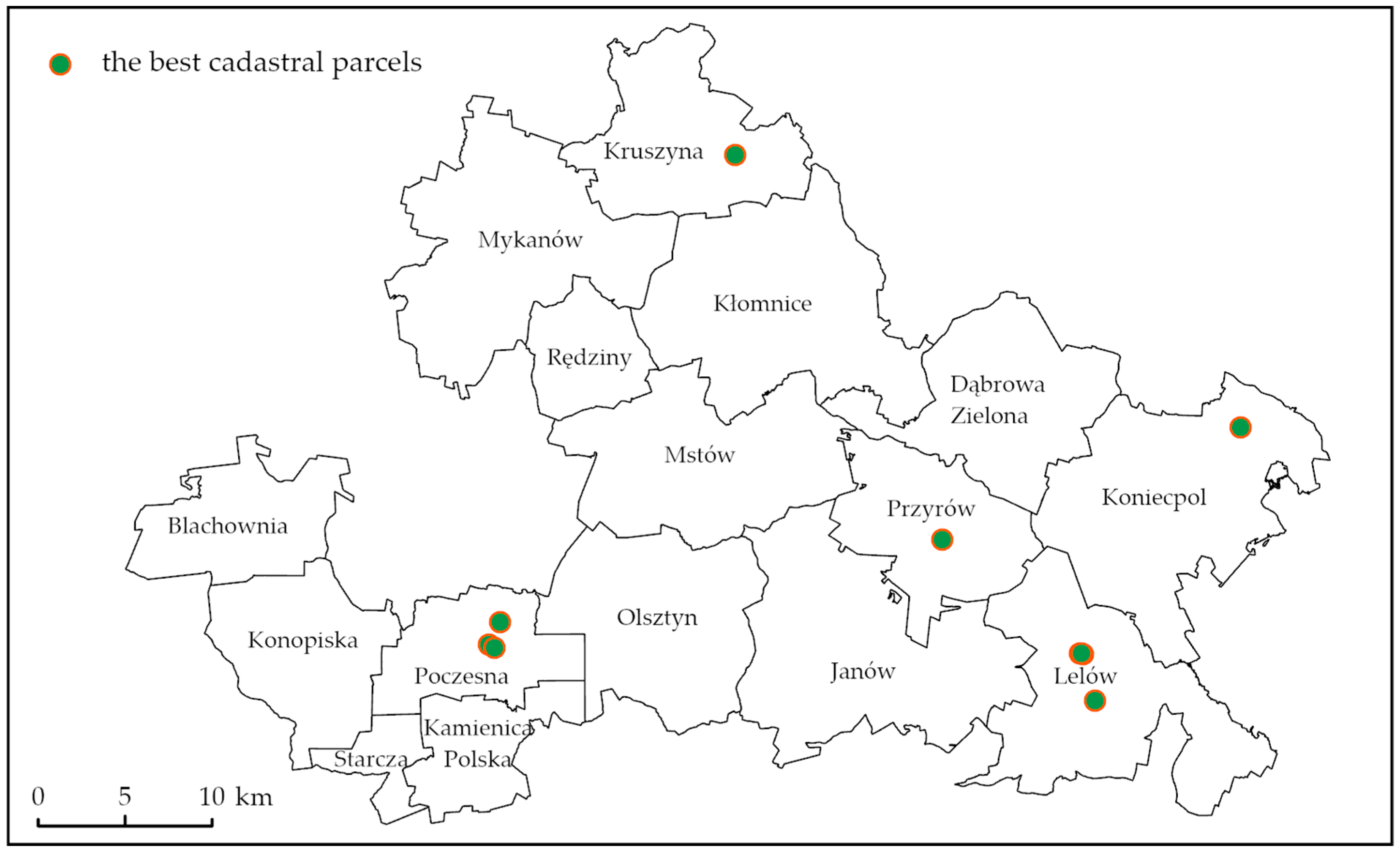
3.3. Analysis of Cadastral Plots in Areas of the Highest Suitability
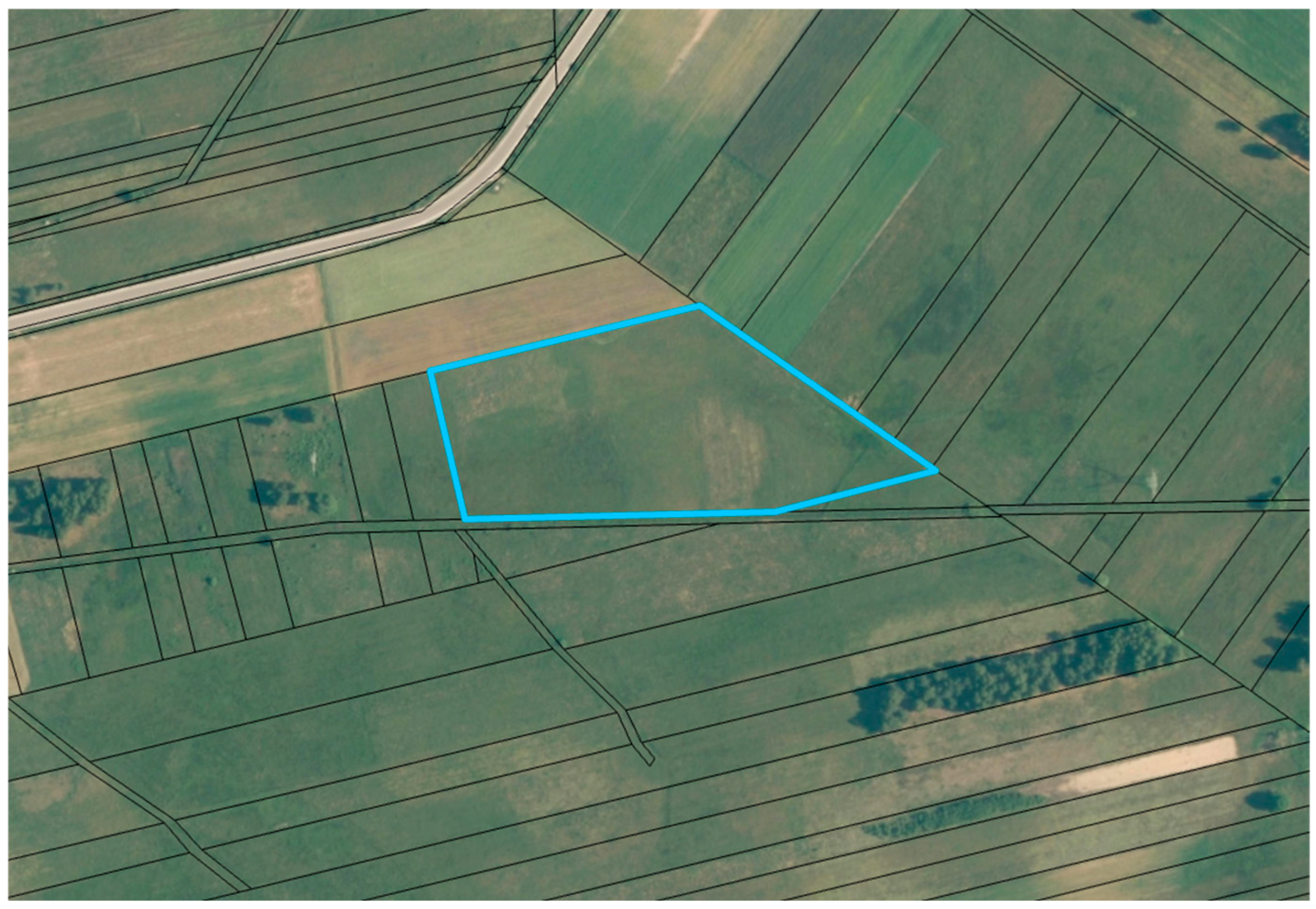
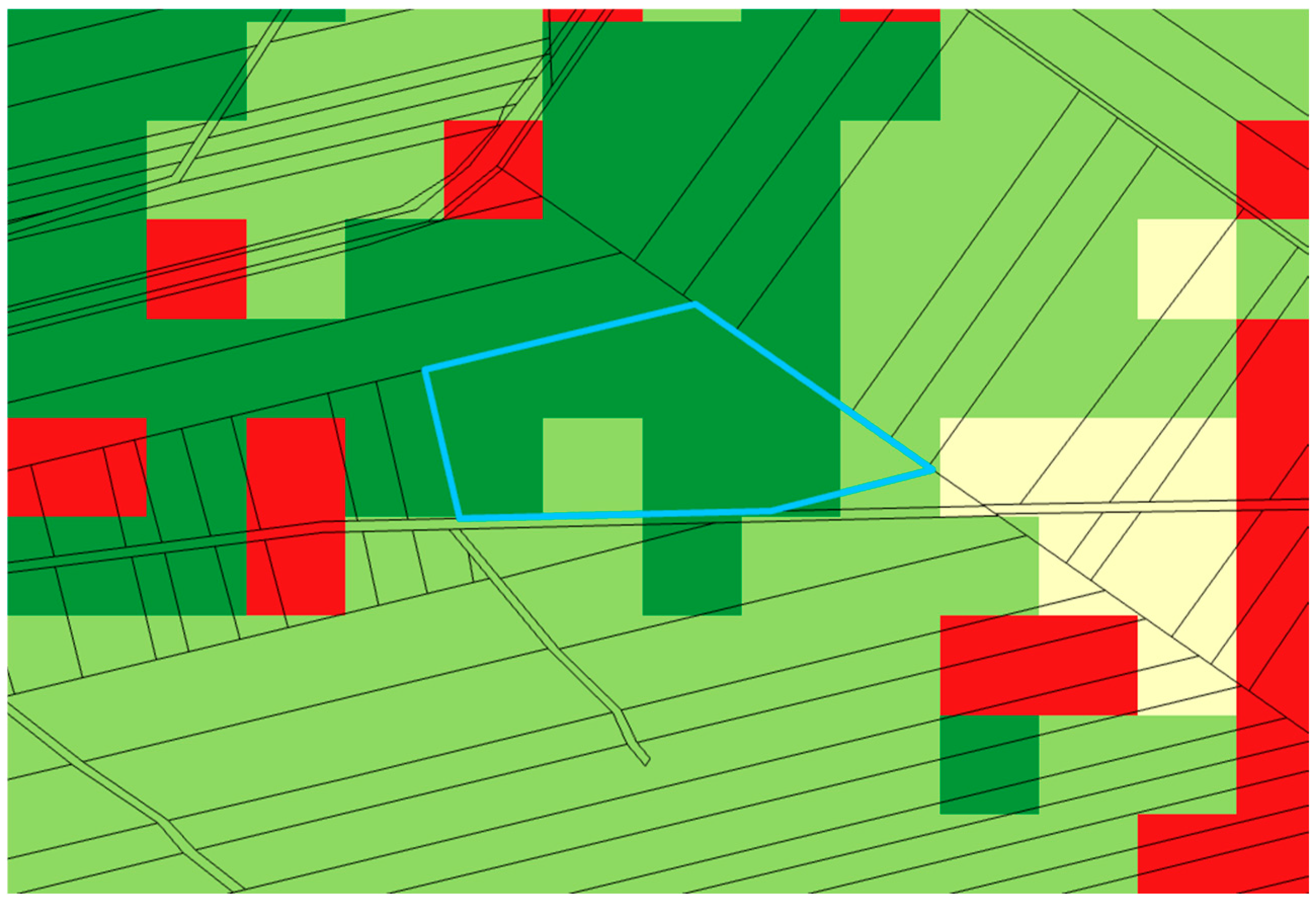
3.3.1. Analysis of Individual Cadastral Plots
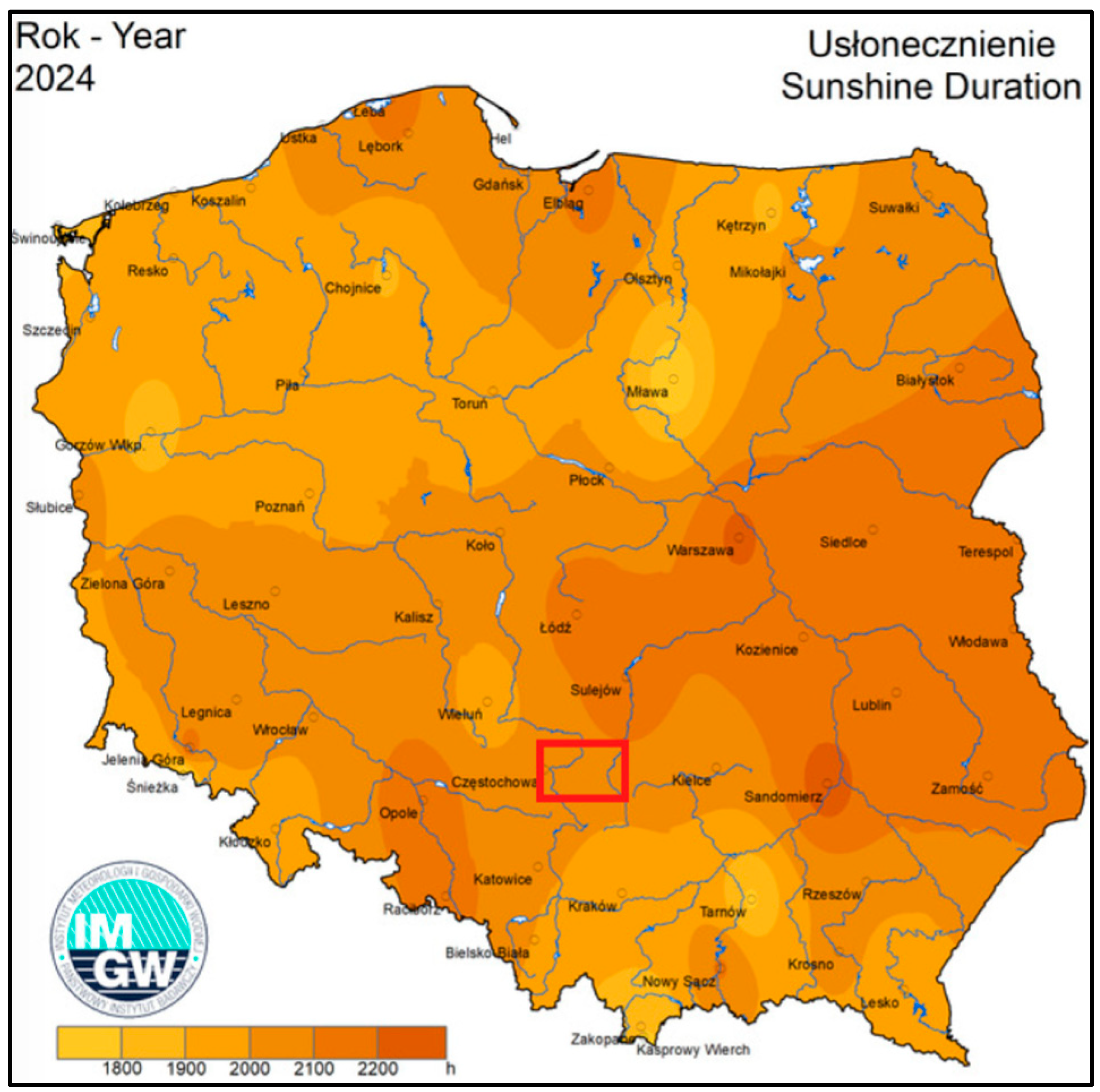
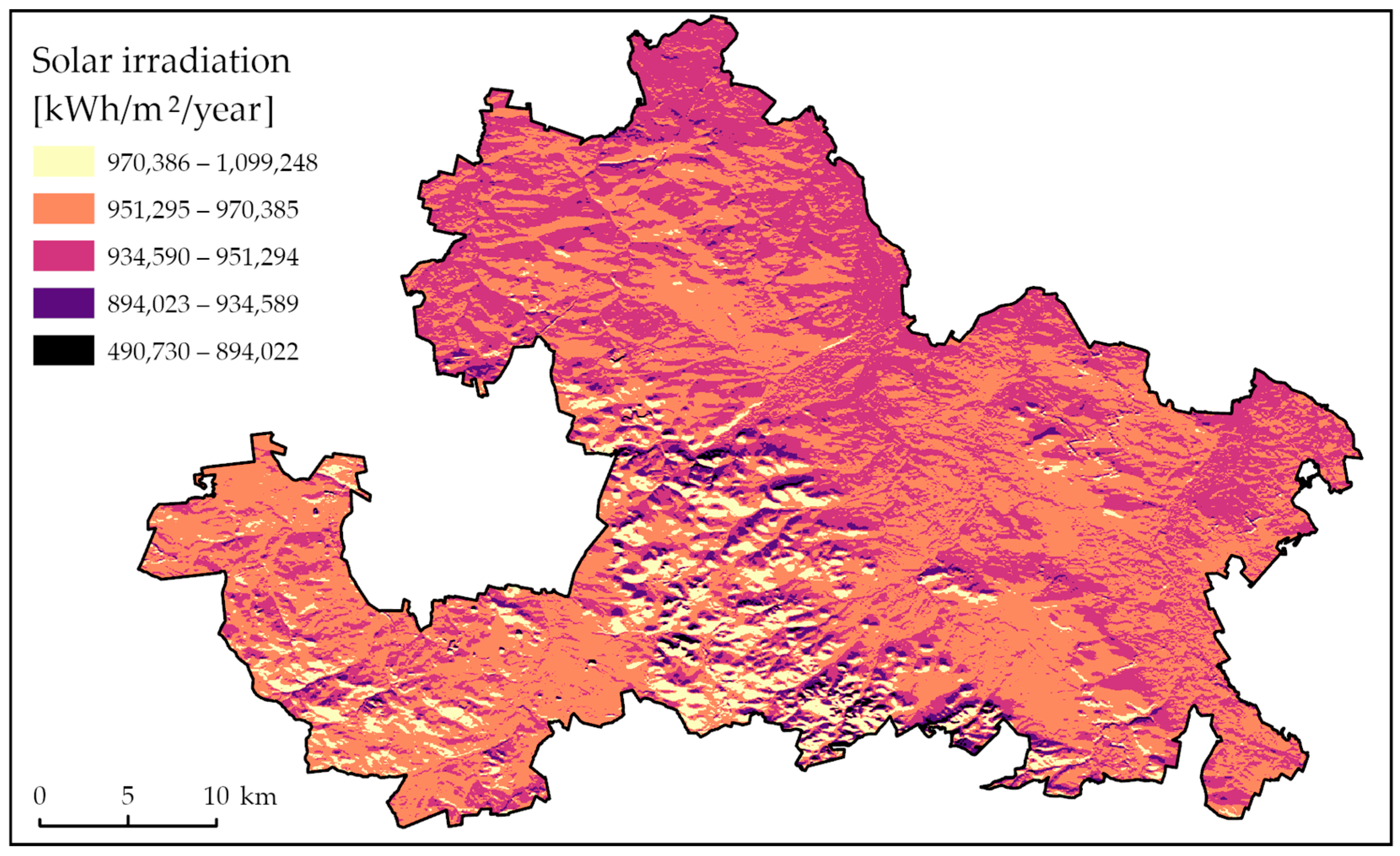
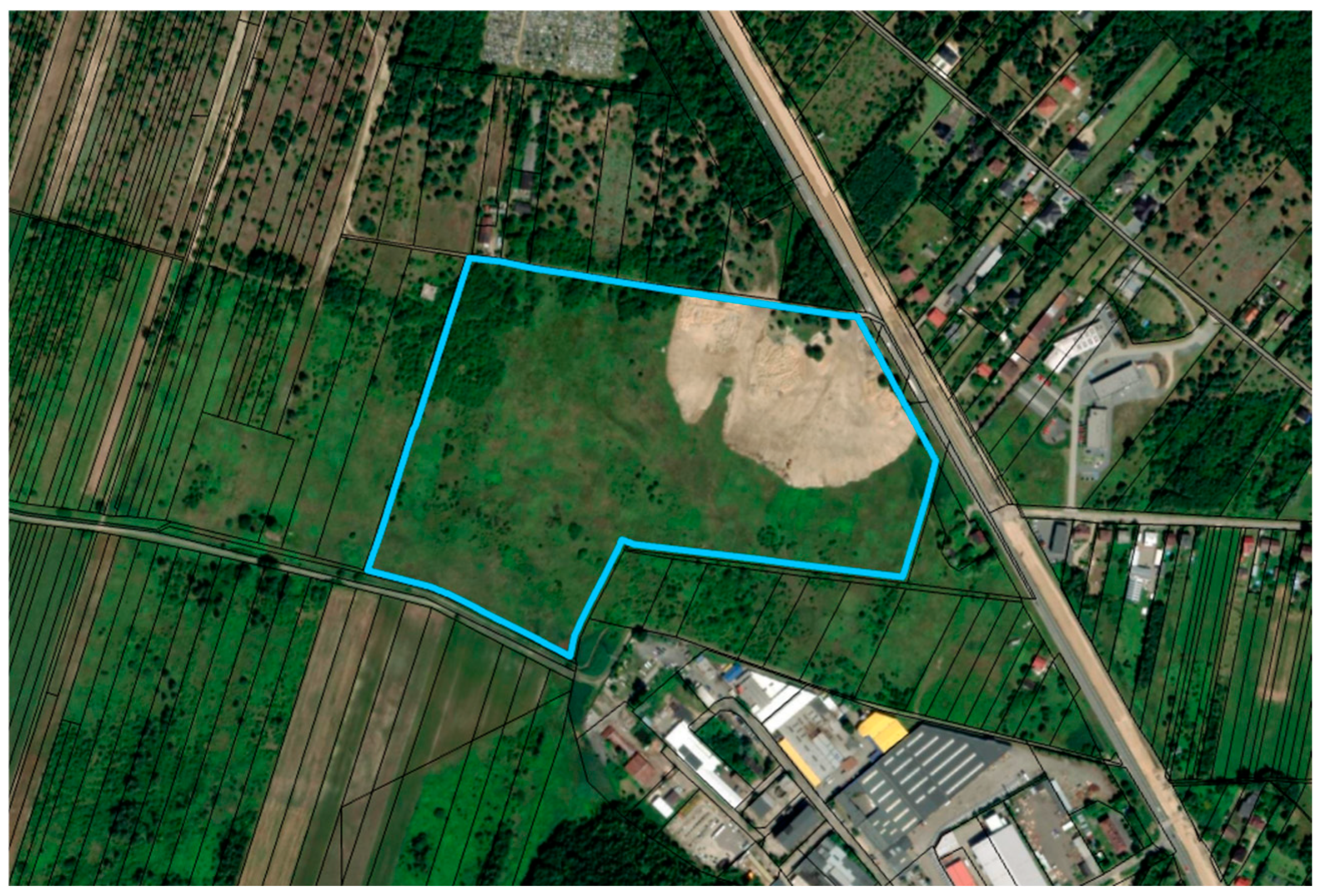
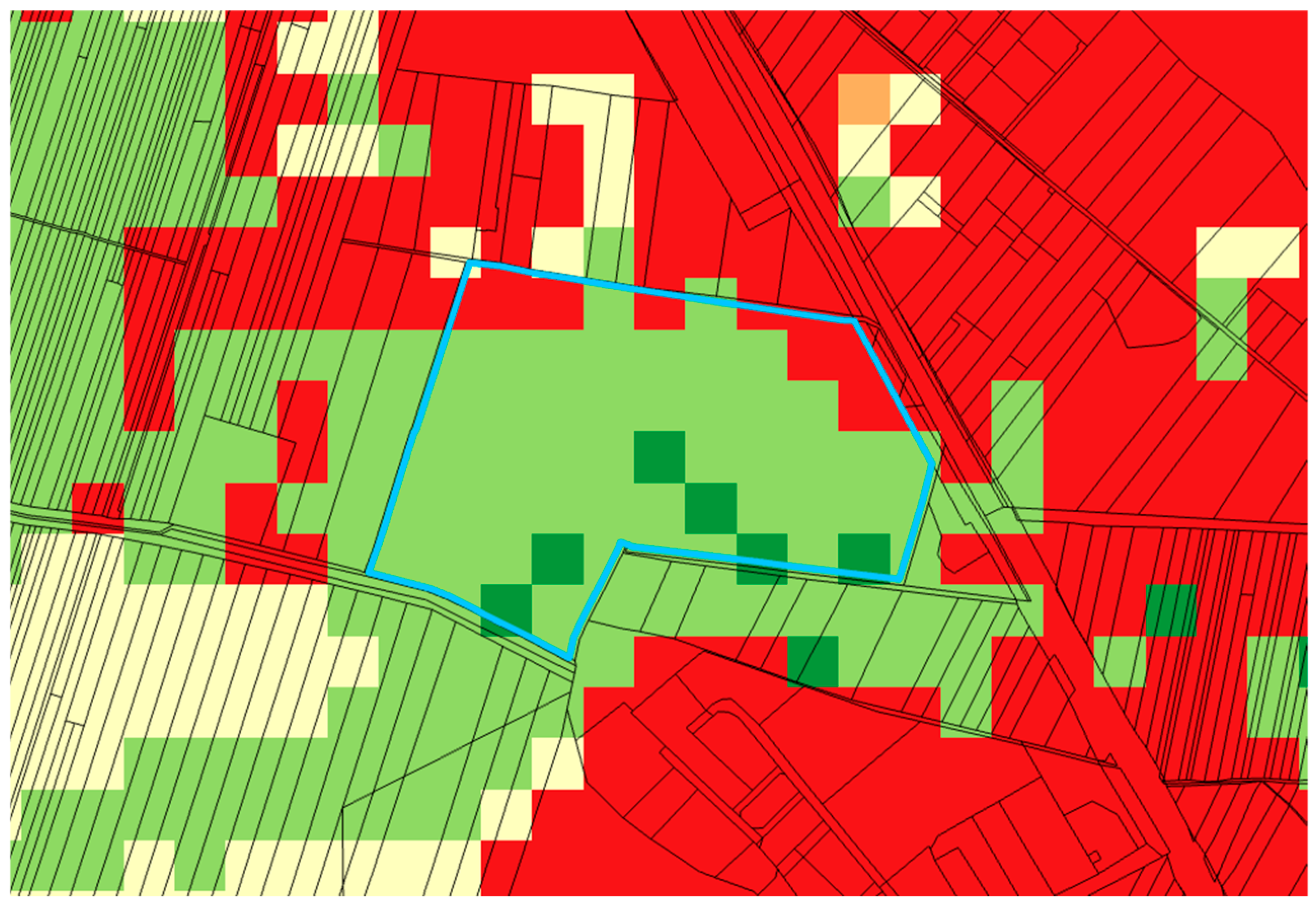
- Solar irradiation is in the range of 951,295–1,099,248 [kWh/m2/year];
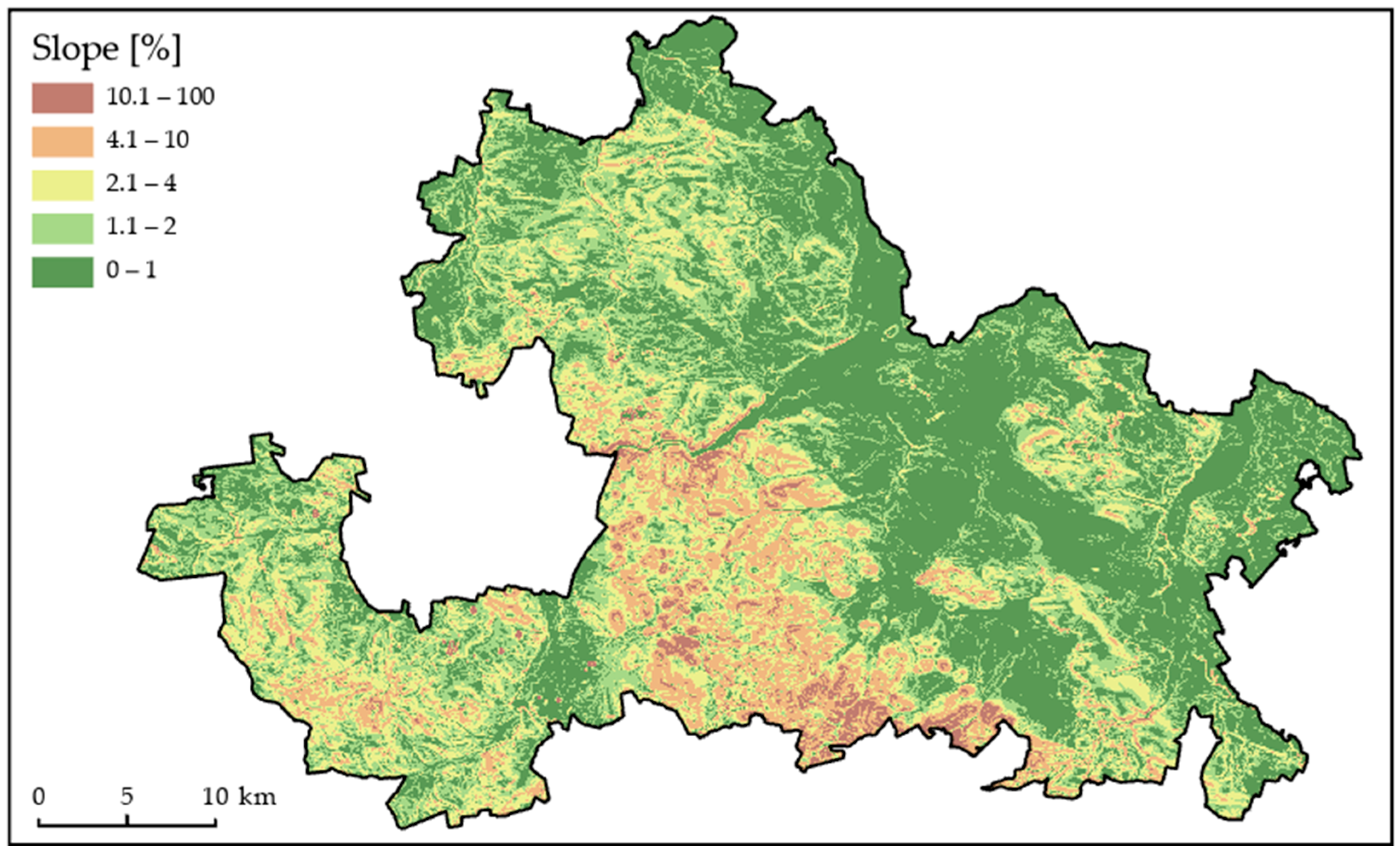
- The slope is no greater than 4% (plot 4231/2 is partially located on a 4–5% slope);
- The dominant exposure is S, SE, or SW (only plot 543/1 is E dominant);
- The soils are class IV–VI (only on plot no. 1588 was an area of up to 15% of the plot area classified as class III);
- Average monthly rainfall ranges from 21 to 27 mm;
- The straight-line distance to the road is no greater than 400 m;
- The distance to medium-voltage power lines is no greater than 109 m;
- The distance to residential buildings is no less than 120 m (only for plot 4231/2 with an area exceeding 13 ha, this distance is 15 m);
- The width of the plot is not less than 50 [m] [61].
3.3.2. Analysis of Cadastral Plot Complexes
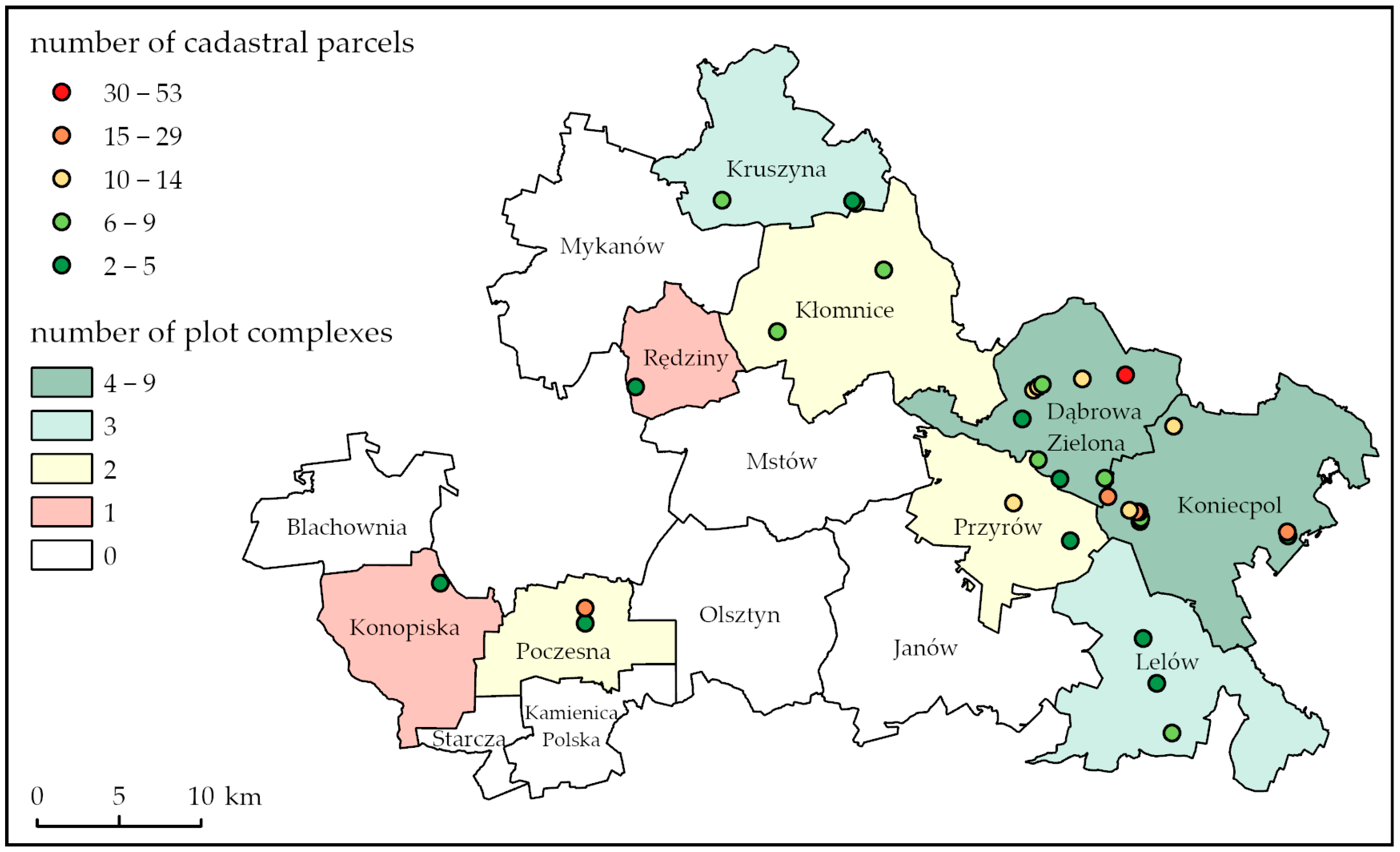
- The plots are located in areas designated as “more” or “highly suitable,” and the surface of these areas cannot be smaller than 1.5 [ha];
- Single plots (not adjacent to any other plot) whose area is smaller than 1.5 [ha] are rejected;
- The area of designated plot complexes cannot be smaller than 1.5 [ha], the aspect ratio is in the range <0.82, 1.042>, and the width of the complex is no less than 50 [m].
- Insolation ranging from 951,295 to 1,099,248 [kWh/m2/year];
- a slope of no more than 4% (only one complex with an area exceeding 5 ha in the Poczesna commune has a small area with a slope exceeding 4%);
- dominant exposure: S, SE, or SW;
- soil class IV, V, or VI;
- average monthly precipitation of 21–27 [mm];
- straight-line distance to a road no greater than 841 [m] (whereas for 26 of 32 complexes it is less than 400 [m]);
- distance to medium-voltage power lines no greater than 312 [m] (whereas for 31 complexes this value is less than 206 [m]);
- distance to residential buildings no less than 60 [m] (whereas for 29 complexes this distance is greater than 100 [m]).
4. Discussion
4.1. Advantages and Disadvantages of the Methodology
4.2. Sustainable Transition
4.3. Feature Works
5. Conclusions
- Located in areas with relatively high solar irradiation;
- The terrain slope is no greater than 4%;
- The dominant exposure is south, southeast, or southwest;
- No soil class higher than IV;
- The straight-line distance to roads is no greater than 841 m;
- The distance to medium-voltage power lines is no greater than 312 m;
- The distance to residential buildings is no less than 60 m;
- The area of the plot/complex is no less than 1.5 ha;
- The shape factor of the plot/complex is within the range <0.82, 1.042>;
- The shortest side of the plot/complex is no less than 50 m.
Author Contributions
Funding
Data Availability Statement
Acknowledgments
Conflicts of Interest
References
- Bajor, M. Innovative methods of energy getting from renewable sources of energy. Zesz. Naukowe. Organ. I Zarządzanie/Politech. Śląska 2017, 114, 11–21. [Google Scholar]
- Jędral, W. Ensuring Energy Security as a Condition for Sustainable Development of Poland. Stud. Ecol. Bioethicae 2020, 18, 89–99. [Google Scholar]
- Du, M.; Wu, F.; Luo, L.; Wang, Q.; Liao, L. Spatial effects of the market-based energy allocation on energy efficiency: A quasi-natural experiment of energy quota trading. Energy 2025, 318, 134902. [Google Scholar] [CrossRef]
- Tang, D.; Solangi, Y.A. Fostering a Sustainable Energy Future to Combat Climate Change: EESG Impacts of Green Economy Transitions. Processes 2023, 11, 1548. [Google Scholar] [CrossRef]
- Stala-Szlugaj, K.; Olczak, P.; Kulpa, J.; Soltysik, M. Methodology for Selecting a Location for a Photovoltaic Farm on the Example of Poland. Energies 2024, 17, 2394. [Google Scholar] [CrossRef]
- Wang, Y.; Xu, L.; Solangi, Y.A. Strategic Renewable Energy Resources Selection for Pakistan: Based on SWOT-Fuzzy AHP Approach. Sustain. Cities Soc. 2020, 52, 101861. [Google Scholar] [CrossRef]
- Dai, Y.; Solangi, Y.A. Evaluating and Prioritizing the Green Infrastructure Finance Risks for Sustainable Development in China. Sustainability 2023, 15, 7068. [Google Scholar] [CrossRef]
- Czepło, F.; Borowski, P.F. Innovation Solution in Photovoltaic Sector. Energies 2024, 17, 265. [Google Scholar] [CrossRef]
- Stecyk, A.; Miciuła, I. Empowering Sustainable Energy Solutions through Real-Time Data, Visualization, and Fuzzy Logic. Energies 2023, 16, 7451. [Google Scholar] [CrossRef]
- Santos, A.A.; Pereira, F.; da Silva, A.F.; Caetano, N.; Felgueiras, C.; Machado, J. Electrification of a Remote Rural Farm with Solar Energy—Contribution to the Development of Smart Farming. Energies 2023, 16, 7706. [Google Scholar] [CrossRef]
- Hosenuzzaman, M.; Rahim, N.A.; Selvaraj, J.; Hasanuzzaman, M.; Malek, A.B.M.A.; Nahar, A. Global Prospects, Progress, Policies, and Environmental Impact of Solar Photovoltaic Power Generation. Renew. Sustain. Energy Rev. 2015, 41, 284–297. [Google Scholar] [CrossRef]
- Instytut Energetyki Odnawialnej. Rynek Fotowoltaiki w Polsce; Instytut Energetyki Odnawialnej: Warsaw, Poland, 2024. [Google Scholar]
- Statistics Poland. Available online: https://bdl.stat.gov.pl/BDL/start (accessed on 1 August 2025).
- Energy Regulatory Office. Available online: https://www.ure.gov.pl (accessed on 13 August 2025).
- Igliński, B.; Piechota, G.; Kiełkowska, U.; Kujawski, W.; Pietrzak, M.B.; Skrzatek, M. The Assessment of Solar Photovoltaic in Poland: The Photovoltaics Potential, Perspectives and Development. Clean Technol Environ. Policy 2023, 25, 281–298. [Google Scholar] [CrossRef] [PubMed]
- Żurakowska-Sawa, J.; Gromada, A.; Trocewicz, A.; Wojciechowska, A.; Wysokiński, M.; Zielińska, A. Photovoltaic Farms: Economic Efficiency of Investments in South-East Poland. Energies 2025, 18, 170. [Google Scholar] [CrossRef]
- Juszczak, A.; Maj, M. Rozwój i Potencjał Energetyki Odnawialnej w Polsce; Polski Instytut Ekonomiczny: Warsaw, Poland, 2020; ISBN 8366698246. [Google Scholar]
- Amjad, F.; Shah, L.A. Identification and Assessment of Sites for Solar Farms Development Using GIS and Density Based Clustering Technique-A Case of Pakistan. Renew. Energy 2020, 155, 761–769. [Google Scholar] [CrossRef]
- Foks, A.; Całka, B.; Bielecka, E. Multi-criteria spatial analysis in search of the potential location of solar farms in Torzym commune. Rocz. Geomatyki 2019, 86, 171–182. [Google Scholar]
- Mierzwiak, M.; Calka, B. Multi-Criteria Analysis for Solar Farm Location Suitability. Rep. Geod. Geoinform. 2017, 104, 20–32. [Google Scholar] [CrossRef]
- Finn, T.; McKenzie, P. A High-Resolution Suitability Index for Solar Farm Location in Complex Landscapes. Renew. Energy 2020, 158, 520–533. [Google Scholar] [CrossRef]
- Soleymani, M.; Asakereh, A.; Safieddin Ardebili, S.M. A GIS-based multi-criteria fuzzy approach to select a suitable location for a MSW-based power plant and landfill: A case study, Khuzestan province, Iran. Environ. Monit. Assess. 2022, 194, 174. [Google Scholar] [CrossRef]
- Al Garni, H.Z.; Awasthi, A. Solar PV Power Plant Site Selection Using a GIS-AHP Based Approach with Application in Saudi Arabia. Appl. Energy 2017, 206, 1225–1240. [Google Scholar] [CrossRef]
- Thom, D.; Bugała, A.; Bugała, D.; Czekała, W. Comprehensive Energy and Economic Analysis of Selected Variants of a Large-Scale Photovoltaic Power Plant in a Temperate Climate. Energies 2025, 18, 4198. [Google Scholar] [CrossRef]
- Yilmaz, I. A Hybrid DEA–Fuzzy COPRAS Approach to the Evaluation of Renewable Energy: A Case of Wind Farms in Turkey. Sustainability 2023, 15, 11267. [Google Scholar] [CrossRef]
- Vagiona, D.G. Comparative Multicriteria Analysis Methods for Ranking Sites for Solar Farm Deployment: A Case Study in Greece. Energies 2021, 14, 8371. [Google Scholar] [CrossRef]
- Suprova, N.T.; Zidan, R.; Rashid, A. Optimal Site Selection for Solar Farms Using GIS and AHP: A Literature Review. In Proceedings of the International Conference on Industrial & Mechanical Engineering and Operations Management, Dhaka, Bangladesh, 26–27 December 2020; pp. 26–27. [Google Scholar]
- Saaty, T.L. The Analytic Hierarchy Process (AHP). J. Oper. Res. Soc. 1980, 41, 1073–1076. [Google Scholar]
- Prusak, A.; Stefanów, P. AHP—Analityczny Proces Hierarchiczny. Budowa I Analiza Modeli Decyzyjnych Krok Po Kroku; Wydawnictwo C.H.Beck: Warsaw, Poland, 2014. [Google Scholar]
- Basak, I.; Saaty, T. Group Decision Making Using the Analytic Hierarchy Process. Math. Comput. Model. 1993, 17, 101–109. [Google Scholar] [CrossRef]
- Sun, C.-C. A Performance Evaluation Model by Integrating Fuzzy AHP and Fuzzy TOPSIS Methods. Expert Syst. Appl. 2010, 37, 7745–7754. [Google Scholar] [CrossRef]
- Liu, Y.; Eckert, C.M.; Earl, C. A Review of Fuzzy AHP Methods for Decision-Making with Subjective Judgements. Expert Syst. Appl. 2020, 161, 113738. [Google Scholar] [CrossRef]
- Yang, C.-C.; Chen, B.-S. Key Quality Performance Evaluation Using Fuzzy AHP. J. Chin. Inst. Ind. Eng. 2004, 21, 543–550. [Google Scholar] [CrossRef]
- Siok, K.; Wyrzykowski, B. Methodology for Increasing Urban Greenery According to the 3-30-300 Concept: A Warsaw Case Study. Sustainability 2025, 17, 5563. [Google Scholar] [CrossRef]
- Calka, B.; Siok, K.; Szostak, M.; Bielecka, E.; Kogut, T.; Zhran, M. Improvement of the Reliability of Urban Park Location Results Through the Use of Fuzzy Logic Theory. Sustainability 2025, 17, 521. [Google Scholar] [CrossRef]
- Asakereh, A.; Soleymani, M.; Sheikhdavoodi, M.J. A GIS-Based Fuzzy-AHP Method for the Evaluation of Solar Farms Locations: Case Study in Khuzestan Province, Iran. Sol. Energy 2017, 155, 342–353. [Google Scholar] [CrossRef]
- Noorollahi, E.; Fadai, D.; Akbarpour Shirazi, M.; Ghodsipour, S.H. Land Suitability Analysis for Solar Farms Exploitation Using GIS and Fuzzy Analytic Hierarchy Process (FAHP)—A Case Study of Iran. Energies 2016, 9, 643. [Google Scholar] [CrossRef]
- Tavana, M.; Arteaga, F.J.S.; Mohammadi, S.; Alimohammadi, M. A Fuzzy Multi-Criteria Spatial Decision Support System for Solar Farm Location Planning. Energy Strategy Rev. 2017, 18, 93–105. [Google Scholar] [CrossRef]
- Abdullah, A.G.; Dwitasari, N.A.; Setiorini, A.H.; Hakim, D.L. Comparative Analysis of AHP and Fuzzy AHP for Solar Power Plant Site Selection. J. Eng. Sci. Technol. 2021, 16, 3505–3520. [Google Scholar]
- Yilmaz, İ.; Kocer, A.; Aksoy, E. Site selection for solar power plants using GIS and fuzzy analytic hierarchy process: Case study of the western mediterranean region of Turkiye. Renew. Energy 2024, 237, 121799. [Google Scholar] [CrossRef]
- Nazari, M.A.; Aslani, A.; Ghasempour, R. Analysis of Solar Farm Site Selection Based on TOPSIS Approach. Int. J. Soc. Ecol. Sustain. Dev. 2018, 9, 12–25. [Google Scholar] [CrossRef]
- Ahuja, S.; Saini, N.; Arora, R.; Narsaiah, M.N.; Bobba, P.B. Deployment of Solar Farms: A Hybrid AHP-TOPSIS Analysis with Data from Multiple Solar Farms. In Proceedings of the AIP Conference Proceedings, Dehradun, India, 30 November–2 December 2025; AIP Publishing LLC: Melville, NY, USA, 2025; Volume 3157, p. 130010. [Google Scholar]
- Wiguna, K.A.; Sarno, R.; Ariyani, N.F. Optimization Solar Farm Site Selection Using Multi-Criteria Decision Making Fuzzy AHP and PROMETHEE: Case Study in Bali. In Proceedings of the 2016 International Conference on Information & Communication Technology and Systems (ICTS), Surabaya, Indonesia, 12 October 2016; pp. 237–243. [Google Scholar]
- de Luis-Ruiz, J.M.; Salas-Menocal, B.R.; Pereda-García, R.; Pérez-Álvarez, R.; Sedano-Cibrián, J.; Ruiz-Fernández, C. Optimal Location of Solar Photovoltaic Plants Using Geographic Information Systems and Multi-Criteria Analysis. Sustainability 2024, 16, 2895. [Google Scholar] [CrossRef]
- Sindhu, S.; Nehra, V.; Luthra, S. Investigation of Feasibility Study of Solar Farms Deployment Using Hybrid AHP-TOPSIS Analysis: Case Study of India. Renew. Sustain. Energy Rev. 2017, 73, 496–511. [Google Scholar] [CrossRef]
- Gacu, J.G.; Garcia, J.D.; Fetalvero, E.G.; Catajay-Mani, M.P.; Monjardin, C.E.F. Suitability Analysis Using GIS-Based Analytic Hierarchy Process (AHP) for Solar Power Exploration. Energies 2023, 16, 6724. [Google Scholar] [CrossRef]
- Demir, A.; Dinçer, A.E.; Yılmaz, K. A novel procedure for the AHP method for the site selection of solar PV farms. Int. J. Energy Res. 2024, 2024, 5535398. [Google Scholar] [CrossRef]
- Sun, Y.; Zhu, D.; Li, Y.; Wang, R.; Ma, R. Spatial Modelling the Location Choice of Large-Scale Solar Photovoltaic Power Plants: Application of Interpretable Machine Learning Techniques and the National Inventory. Energy Convers. Manag. 2023, 289, 117198. [Google Scholar] [CrossRef]
- Ashraf, H.A.; Li, J.; Li, Z.; Sohail, A.; Ahmed, R.; Butt, M.H.; Ullah, H. Geographic Information System and Machine Learning Approach for Solar Photovoltaic Site Selection: A Case Study in Pakistan. Processes 2025, 13, 981. [Google Scholar] [CrossRef]
- Georgiou, A.; Skarlatos, D. Optimal Site Selection for Sitting a Solar Park Using Multi-Criteria Decision Analysis and Geographical Information Systems. Geosci. Instrum. Methods Data Syst. 2016, 5, 321–332. [Google Scholar] [CrossRef]
- Bober, A.; Całka, B.; Bielecka, E. Application of State Survey and Mapping Resources for Selecting Sites Suitable for Solar Farms. Int. Multidiscip. Sci. GeoConference 2016, 1, 593–600. [Google Scholar]
- Wang, C.-N.; Dang, T.-T.; Bayer, J. A Two-Stage Multiple Criteria Decision Making for Site Selection of Solar Photovoltaic (PV) Power Plant: A Case Study in Taiwan. IEEE Access 2021, 9, 75509–75525. [Google Scholar] [CrossRef]
- Zoghi, M.; Ehsani, A.H.; Sadat, M.; javad Amiri, M.; Karimi, S. Optimization Solar Site Selection by Fuzzy Logic Model and Weighted Linear Combination Method in Arid and Semi-Arid Region: A Case Study Isfahan-IRAN. Renew. Sustain. Energy Rev. 2017, 68, 986–996. [Google Scholar] [CrossRef]
- Wang, C.-N.; Chung, Y.-C.; Wibowo, F.D.; Dang, T.-T.; Nguyen, N.-A.-T. Site Selection of Solar Power Plants Using Hybrid MCDM Models: A Case Study in Indonesia. Energies 2023, 16, 4042. [Google Scholar] [CrossRef]
- Kowalczyk, A.M.; Czyża, S. Optimising Photovoltaic Farm Location Using a Capabilities Matrix and GIS. Energies 2022, 15, 6693. [Google Scholar] [CrossRef]
- Institute of Meteorology and Water Management, National Research Institute. Available online: https://klimat.imgw.pl/pl/climate-maps/#Sunshine/ (accessed on 1 August 2025).
- Bieda, A.; Cienciała, A. Towards a Renewable Energy Source Cadastre—A Review of Examples from around the World. Energies 2021, 14, 8095. [Google Scholar] [CrossRef]
- Matuk, O.; Calka, B. Consolidating the Polish Land Use Cadastral Register with the Austrian and German Systems: An Extension of the Polish Cadastre Model Towards Sustainable Land Management. Sustainability 2025, 17, 5783. [Google Scholar] [CrossRef]
- Drobne, S.; Lisec, A. Multi-Attribute Decision Analysis in GIS: Weighted Linear Combination and Ordered Weighted Averaging. Informatica 2009, 33, 459–474. [Google Scholar]
- Head Office of Geodesy and Cartography Geoportal. Available online: https://www.geoportal.gov.pl/ (accessed on 1 November 2024).
- Kurowska, K.; Kryszk, H.; Bielski, S. Location and Technical Requirements for Photovoltaic Power Stations in Poland. Energies 2022, 15, 2701. [Google Scholar] [CrossRef]
- ISAP, Ustawa o Drogach Publicznych. Available online: https://isap.sejm.gov.pl/isap.nsf/DocDetails.xsp?id=wdu19850140060 (accessed on 28 August 2025).
- Miejscowy Plan Zagospodarowanias Przestrzennego Terenów w Miejscowości Czarny Las w Gminie Mykanów. Available online: https://mpzp.igeomap.pl/doc/czestochowa/mykanow/015.pdf (accessed on 29 August 2025).
- Drozd, S.; Kussul, N. Solar Energy Potential Mapping in Ukraine through Integration of GIS, Remote Sensing, and Fuzzy Logic. Eur. J. Remote Sens. 2024, 57, 2362390. [Google Scholar] [CrossRef]
- Institute of Meteorology and Water Management, National Research Institute. Available online: https://danepubliczne.imgw.pl/ (accessed on 27 August 2025).
- Żmudzka, E.; Wojciechowska, I. The variability of diffuse solar irradiation and its circulation and meteorological related conditions in the specified stations in Poland (2001–2015). In Climate variability in Poland and Europe and Its Circulation Conditions, 2nd ed.; Kolendowicz, L., Bednorz, E., Tomczyk, A.M., Eds.; Bogucki Wydawnictwo Naukowe: Poznań, Poland, 2019; pp. 233–258. [Google Scholar]
- Li, J.; Heap, A.D. A Review of Spatial Interpolation Methods for Environmental Scientists; Geoscience Australia: Canberra, Australia, 2008.
- State Water Holding—Polish Waters, Head Office of Geodesy and Cartography, Institute of Meteorology and Water Management, National Institute of Telecommunications; Government Centre for Security. ISOK—Country’s Protection Against Extreme Hazards. Available online: https://isok.gov.pl/inspire.html (accessed on 29 May 2025).
- Rozporządzenie Ministra Gospodarki z Dnia 26 Kwietnia 2013 r. w Sprawie Warunków Technicznych, Jakim Powinny Odpowiadać Sieci Gazowe i Ich Usytuowanie. Available online: https://isap.sejm.gov.pl/isap.nsf/DocDetails.xsp?id=WDU20130000640 (accessed on 27 August 2025).
- Zimmermann, H.-J. Fuzzy Set Theory. Wiley Interdiscip. Rev. Comput. Stat. 2010, 2, 317–332. [Google Scholar] [CrossRef]
- Wang, T.; Gault, R.; Greer, D. Data Informed Initialization of Fuzzy Membership Functions. Int. J. Fuzzy Syst. 2025. [Google Scholar] [CrossRef]
- Chang, D.-Y. Applications of the Extent Analysis Method on Fuzzy AHP. Eur. J. Oper. Res. 1996, 95, 649–655. [Google Scholar] [CrossRef]
- Dmytrów, K.; Gnat, S.; Kokot, S. Próba Uwzględnienia Kształtu Nieruchomości Gruntowych Jako Atrybutu w Procesie Zalgorytmizowanej Wyceny. Biul. Stowarzyszenia Rzeczozn. Majątkowych Województwa Wielkop. 2018, 50, 4–10. [Google Scholar]
- Gąsiorowski, J.; Bielecka, E.; Poławski, Z.F. Multivariate Analysis of Environmental Determinants of Rural Areas Development; Instytut Geodezji i Kartografii: Warsaw, Poland, 2014; ISBN 8360024189. [Google Scholar]
- Sangiorgio, V.; Uva, G.; Fatiguso, F. Optimized AHP to Overcome Limits in Weight Calculation: Building Performance Application. J. Constr. Eng. Manag. 2018, 144, 04017101. [Google Scholar] [CrossRef]
- Rozporządzenie Ministra Klimatu i Środowiska w Sprawie Szczegółowych Warunków Funkcjonowania Systemu Elektroenergetycznego. Available online: https://isap.sejm.gov.pl/isap.nsf/download.xsp/WDU20230000819/O/D20230819.pdf (accessed on 8 September 2025).
- Ali, F.; Etemad-Shahidi, A.; Stewart, R.A.; Sanjari, M.J.; Hayward, J.A.; Nicholson, R.C. Co-Located Offshore Wind and Floating Solar Farms: A Systematic Quantitative Literature Review of Site Selection Criteria. Renew. Energy Focus 2024, 50, 100611. [Google Scholar] [CrossRef]
- Ikhennicheu, M.; Danglade, B.; Pascal, R.; Arramounet, V.; Trébaol, Q.; Gorintin, F. Analytical Method for Loads Determination on Floating Solar Farms in Three Typical Environments. Sol. Energy 2021, 219, 34–41. [Google Scholar] [CrossRef]
- Paul, D.; Devaprakasam, D.; Patil, S.; Agrawal, A. Floating Solar: A Review on the Comparison of Efficiency, Issues, and Projections with Ground-Mounted Solar Photovoltaics. Int. J. Sustain. Dev. Plan. 2023, 18, 3213–3228. [Google Scholar] [CrossRef]
- Khazael, S.M.; Maulud, K.N.A.; Karim, O.A. Geospatial Planning Strategies for Agrivoltaic Systems: A Review of Criteria, Decision Models and Emerging Challenges. Sustain. Energy Technol. Assess. 2025, 81, 104444. [Google Scholar] [CrossRef]



| Factor | Values | Function Type |
|---|---|---|
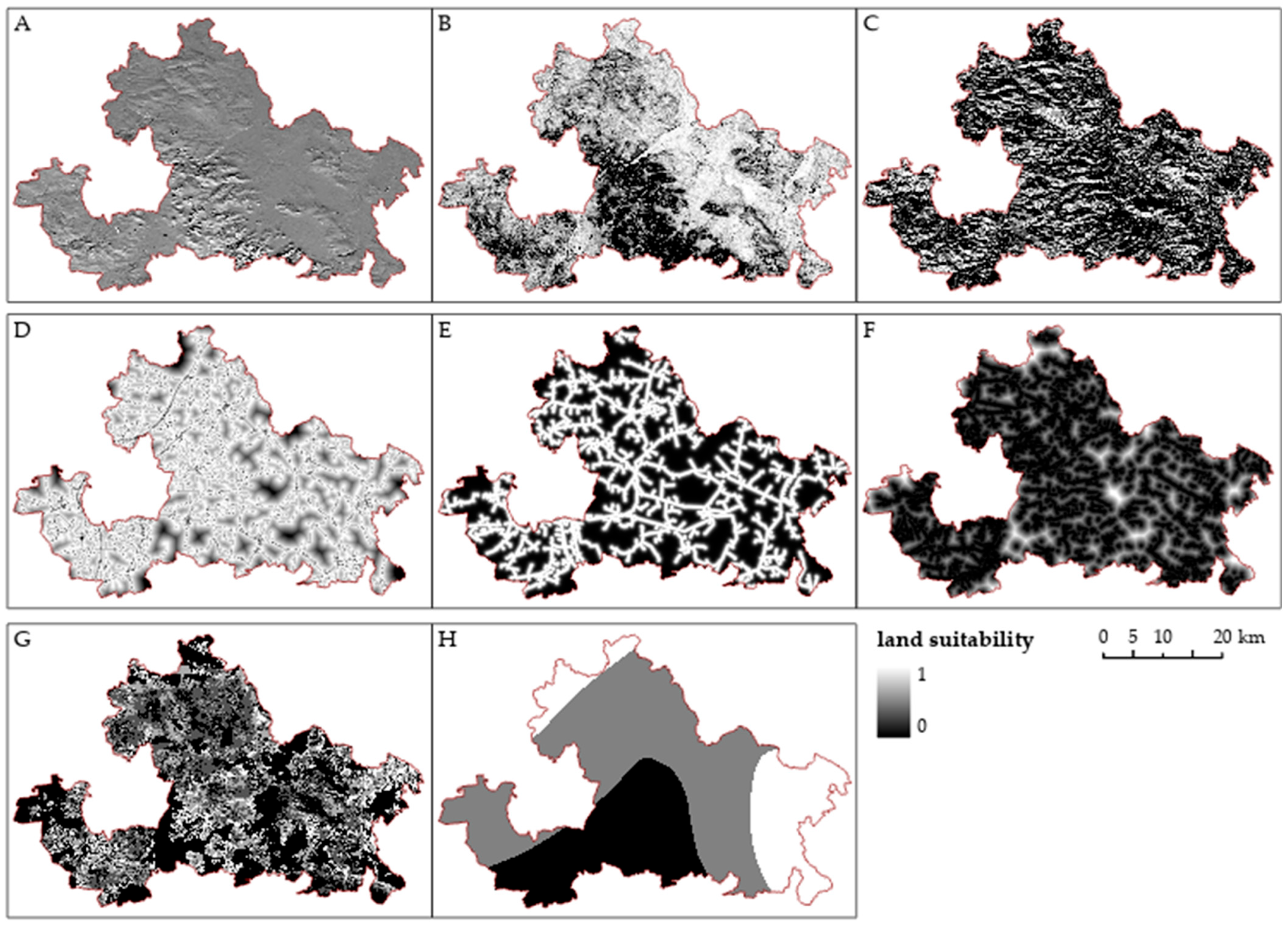
| Solar irradiation [kWh/m2/year] | 490,730–1,099,248 | Linear increasing |
| Slope [%] | 0–4 | Linear decreasing |
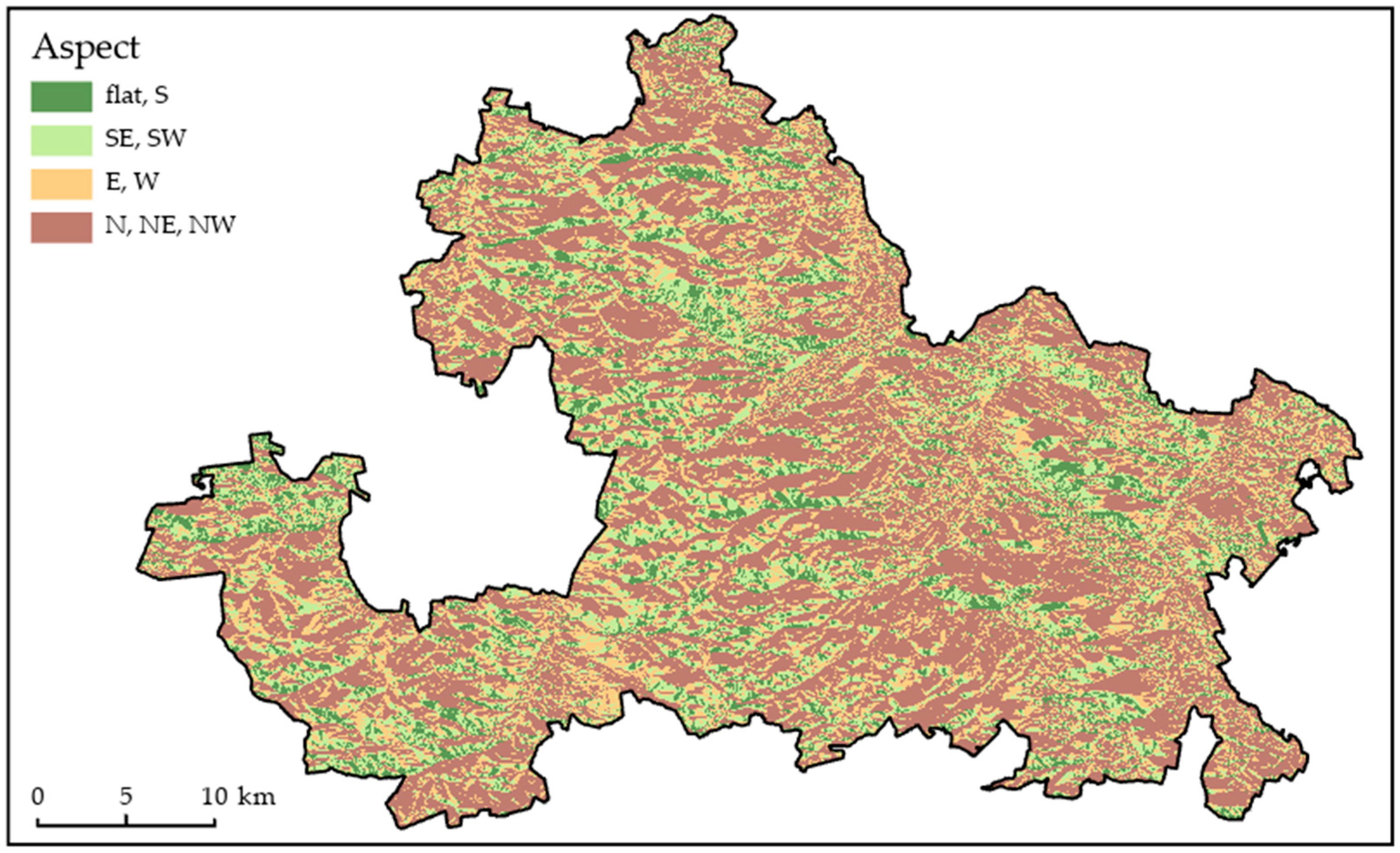
| Aspect | (1) S and flat (2) SE and SW (3) E and W (4) N, NE and NW | Linear decreasing |
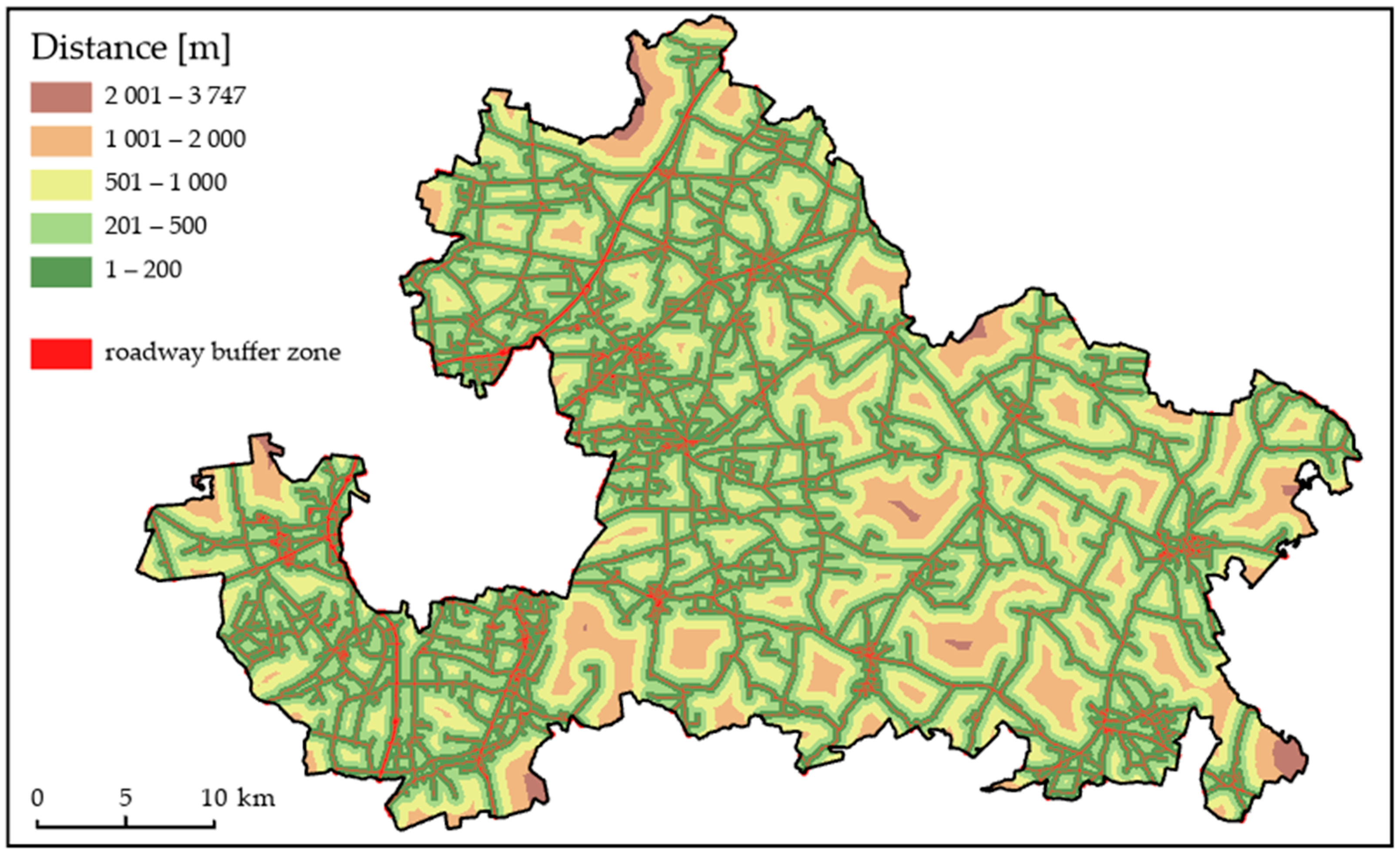
| Distance from roads [m] | 0–3747 | Linear decreasing |
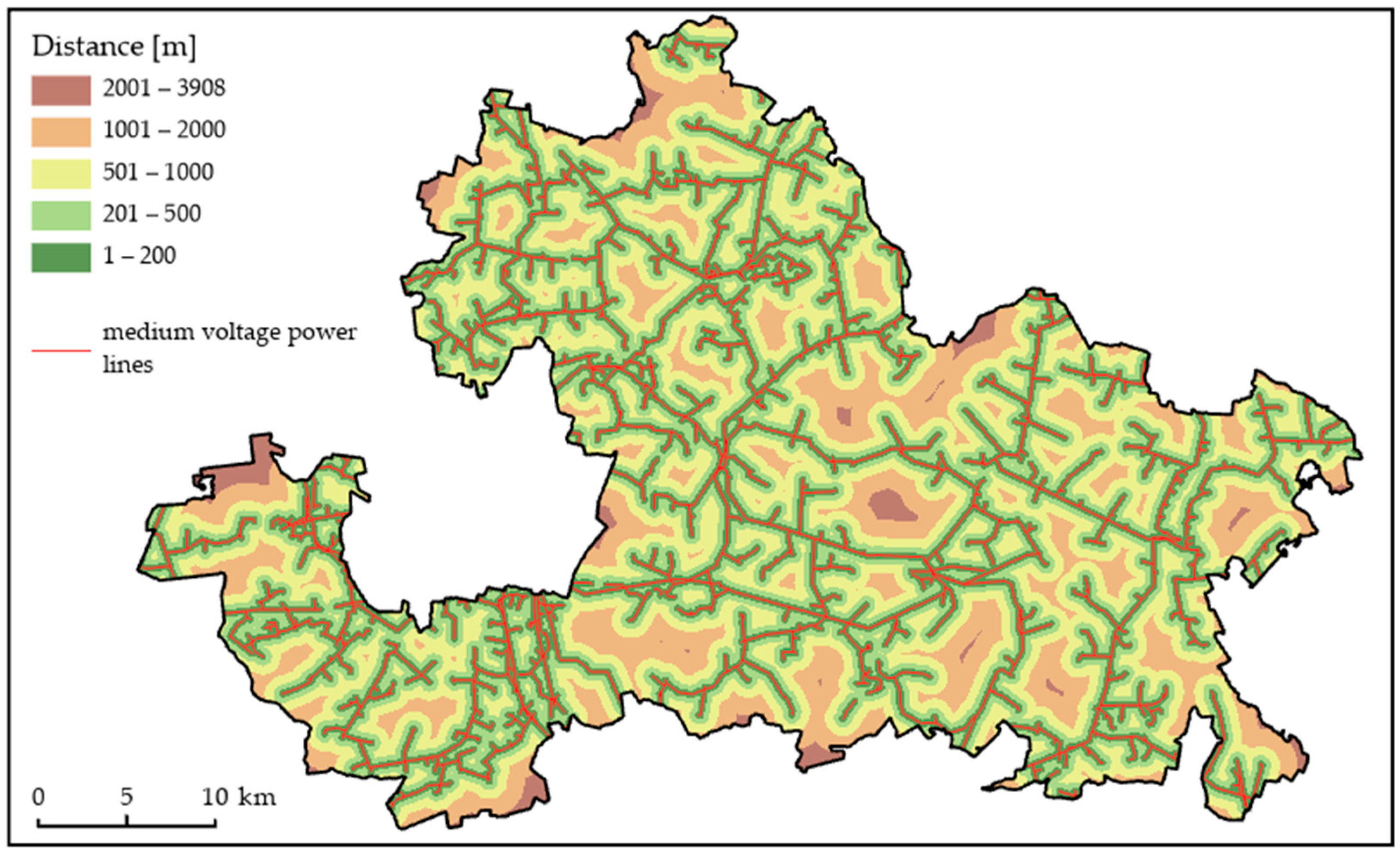
| Distance from power lines [m] | 0–3908 | Sigmoidal decreasing, Midpoint: 400 m, Spread: 3 |
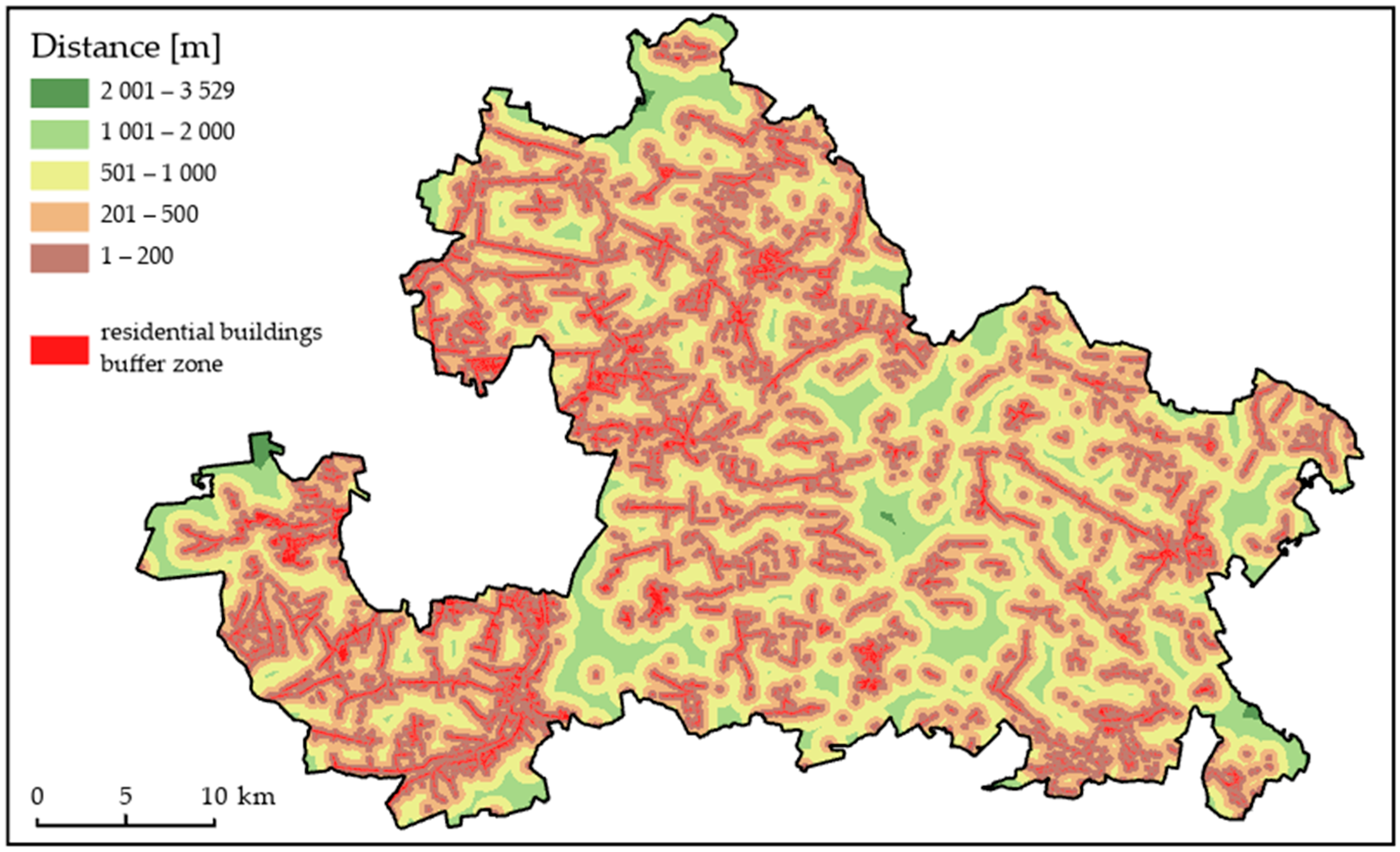
| Distance from residential buildings | 0–3529 | Linear increasing |
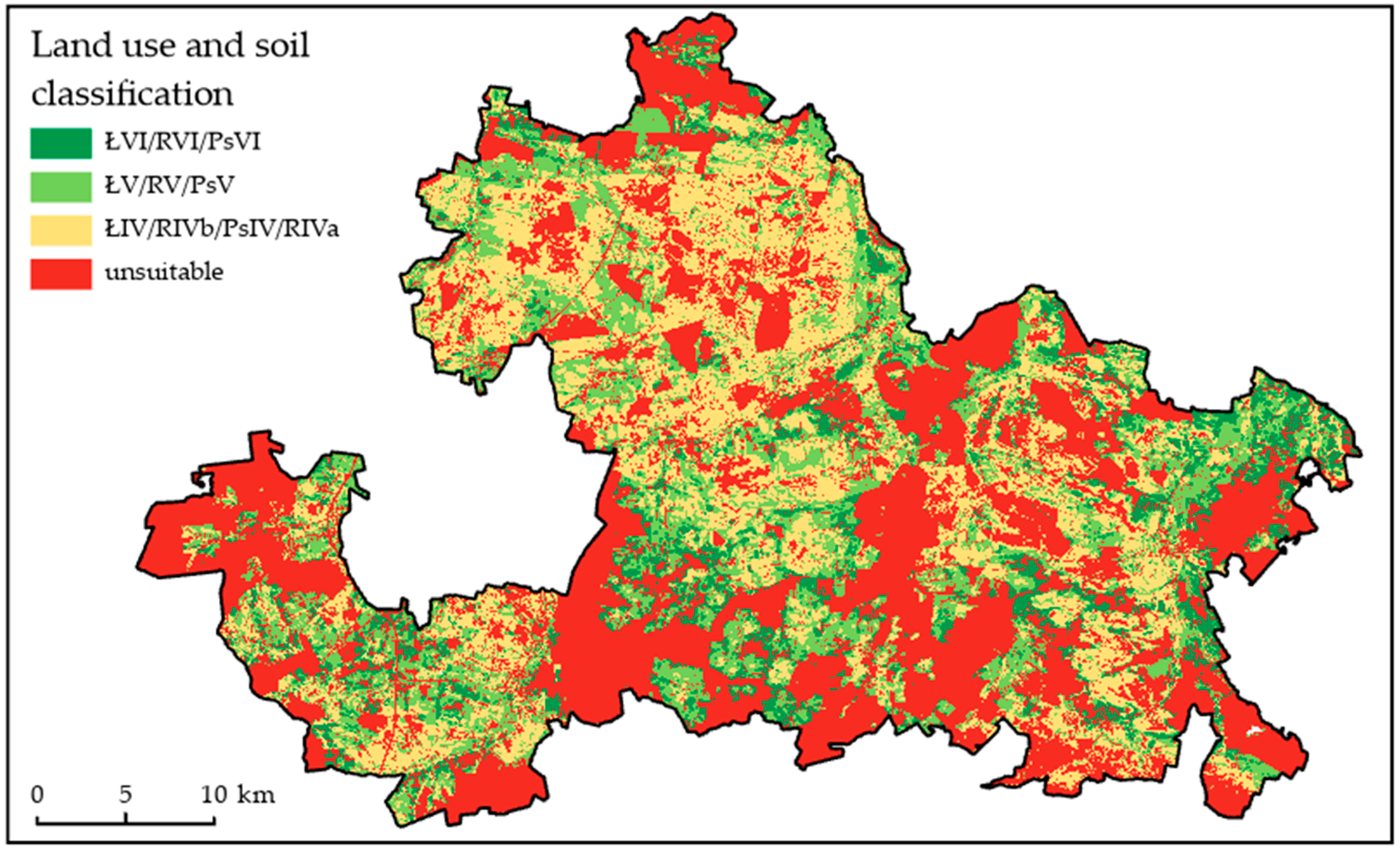
| Land use and soil class from Land and Building Register | (1) unsuitable land use and I-III soil classes (2) Ł/R/Ps, IVa-IVb (3) Ł/R/Ps, V (4) Ł/R/Ps, VI | Linear increasing |
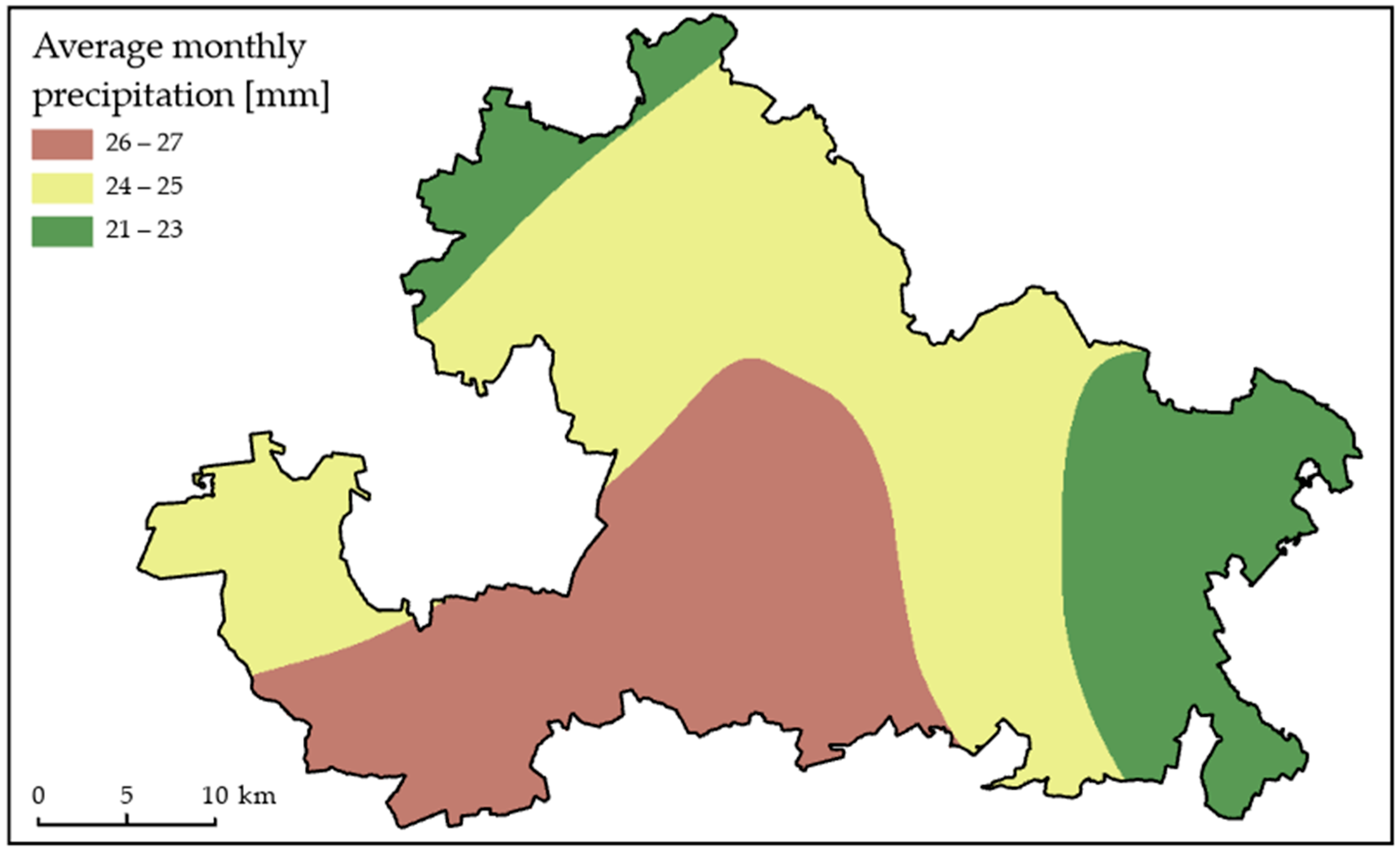
| Average monthly precipitation [mm] | 21–27 | Linear decreasing |
| Solar Irradiation | Slope | Distance from Power Lines | Aspect | Land Use and Soil Class | Distance from Roads | Average Monthly Precipitation [mm] | Distance from Residential Buildings | |
|---|---|---|---|---|---|---|---|---|
| Solar Irradiation | (1; 1; 1) | (2.67; 3.67; 4.67) | (0.78; 0.83; 1) | (1; 1; 1) | (1; 2; 3) | (2; 3; 4) | (3.33; 4.33; 5.33) | (4; 5; 6) |
| Slope | (0.22; 0.28; 0.39) | (1; 1; 1) | (0.25; 0.33; 0.50) | (0.33; 0.50; 1) | (1; 2; 3) | (0.33; 1.33; 2.33) | (2; 3; 4) | (2; 3; 4) |
| Distance from Power Lines | (1; 1.33; 1.67) | (2; 3; 4) | (1; 1; 1) | (1; 1; 1) | (1; 2; 3) | (1.33; 2.33; 3.33) | (2.33; 3.33; 4.33) | (4; 5; 6) |
| Aspect | (1; 1; 1) | (1; 2; 3) | (1; 1; 1) | (1; 1; 1) | (1; 1.33; 1.67) | (1; 1; 1) | (4; 5; 6) | (5.67; 6.67; 7.67) |
| Land Use and Soil Class | (0.33; 0.50; 1) | (0.33; 0.50; 1) | (0.33; 0.50; 1) | (0.78; 0.83; 1) | (1; 1; 1) | (0.56; 0.67; 1) | (2; 3; 4) | (2.67; 3.67; 4.67) |
| Distance from Roads | (0.25; 0.33; 0.50) | (1; 2; 3) | (0.31; 0.44; 0.83) | (1; 1; 1) | (1.00; 1.67; 2.33) | (1; 1; 1) | (3.33; 4.33; 5.33) | (4; 5; 6) |
| Average Monthly Precipitation [mm] | (0.19; 0.23; 0.31) | (0.25; 0.33; 0.50) | (0.23; 0.31; 0.44) | (0.17; 0.21; 0.26) | (0.25; 0.33; 0.50) | (0.19; 0.23; 0.31) | (1; 1; 1) | (4; 5; 6) |
| Distance from Residential Buildings | (0.17; 0.20; 0.25) | (0.25; 0.33; 0.50) | (0.17; 0.20; 0.25) | (0.13; 0.15; 0.18) | (0.22; 0.28; 0.39) | (0.17; 0.20; 0.25) | (0.17; 0.20; 0.25) | (1; 1; 1) |
| WEIGHTS | 0.2098 | 0.0969 | 0.2035 | 0.1608 | 0.1066 | 0.1380 | 0.0475 | 0.0269 |
| RANK | 1 | 6 | 2 | 3 | 5 | 4 | 7 | 8 |
| Municipality Name | Highly Suitable | More Suitable | Highly and More Suitable | Moderately Suitable | Less Suitable | Unsuitable |
|---|---|---|---|---|---|---|
| Dąbrowa Zielona | 257 ha 3% | 1626 ha 16% | 1883 ha 19% | 1668 ha 17% | 393 ha 4% | 5981 ha 60% |
| Konopiska | 27 ha 0% | 354 ha 5% | 380 ha 5% | 297 ha 4% | 49 ha 1% | 7044 ha 90% |
| Kruszyna | 184 ha 2% | 1061 ha 12% | 1245 ha 14% | 1425 ha 16% | 394 ha 4% | 6093 ha 66% |
| Lelów | 193 ha 2% | 1487 ha 12% | 1680 ha 14% | 2689 ha 22% | 1061 ha 9% | 6699 ha 55% |
| Mstów | 62 ha 1% | 814 ha 7% | 876 ha 8% | 1940 ha 16% | 948 ha 8% | 8159 ha 68% |
| Poczesna | 38 ha 1% | 472 ha 8% | 511 ha 9% | 654 ha 11% | 83 ha 1% | 4687 ha 79% |
| Starcza | 15 ha 1% | 217 ha 11% | 232 ha 12% | 135 ha 7% | 32 ha 2% | 1571 ha 79% |
| Kamienica Polska | 21 ha 1% | 192 ha 4% | 214 ha 5% | 233 ha 5% | 107 ha 2% | 4010 ha 88% |
| Olsztyn | 14 ha 0% | 244 ha 2% | 258 ha 2% | 509 ha 5% | 123 ha 1% | 9951 ha 92% |
| Janów | 43 ha 1% | 636 ha 4% | 680 ha 5% | 907 ha 6% | 225 ha 2% | 12,731 ha 87% |
| Kłomnice | 161 ha 1% | 1509 ha 10% | 1670 ha 11% | 1832 ha 12% | 427 ha 3% | 10,734 ha 74% |
| Koniecpol | 515 ha 4% | 1941 ha 13% | 2456 ha 17% | 1632 ha 11% | 190 ha 1% | 10,102 ha 71% |
| Blachownia | 88 ha 1% | 315 ha 5% | 404 ha 6% | 173 ha 3% | 26 ha 0% | 5855 ha 91% |
| Mykanów | 169 ha 1% | 1768 ha 13% | 1936 ha 14% | 2607 ha 19% | 811 ha 6% | 8595 ha 61% |
| Przyrów | 95 ha 1% | 1079 ha 14% | 1174 ha 15% | 1723 ha 21% | 584 ha 7% | 4590 ha 57% |
| Rędziny | 43 ha 1% | 311 ha 8% | 354 ha 9% | 454 ha 11% | 83 ha 2% | 3216 ha 78% |
| No. | Municipality Name | Cadastral District Code | Parcel Number | Shape Index | Total Area [ha] | Length of the Shortest Side [m] | Comments |
|---|---|---|---|---|---|---|---|
| 1 | Poczesna | 0003 | 543/1 | 0.947 | 1.896 | 53 | - |
| 2 | Poczesna | 0011 | 308/3 | 1.024 | 2.836 | 142.5 | partially unsuitable |
| 3 | Poczesna | 0015 | 4231/2 | 0.89 | 13.537 | 117.5 | partially unsuitable |
| 4 | Lelów | 0001 | 4462 | 0.976 | 2.17 | 123 | - |
| 5 | Lelów | 0003 | 1586 | 0.958 | 2.344 | 113 | - |
| 6 | Lelów | 0003 | 1587 | 0.862 | 1.687 | 85 | - |
| 7 | Lelów | 0003 | 1588 | 0.91 | 1.944 | 96 | - |
| 8 | Przyrów | 0012 | 1913 | 0.961 | 2.379 | 110 | partially unsuitable |
| 9 | Koniecpol | 0004 | 907 | 0.836 | 1.837 | 77 | - |
| 10 | Kruszyna | 0006 | 5776 | 1.041 | 3.218 | 187 | - |
Disclaimer/Publisher’s Note: The statements, opinions and data contained in all publications are solely those of the individual author(s) and contributor(s) and not of MDPI and/or the editor(s). MDPI and/or the editor(s) disclaim responsibility for any injury to people or property resulting from any ideas, methods, instructions or products referred to in the content. |
© 2025 by the authors. Licensee MDPI, Basel, Switzerland. This article is an open access article distributed under the terms and conditions of the Creative Commons Attribution (CC BY) license (https://creativecommons.org/licenses/by/4.0/).
Share and Cite
Siok, K.; Calka, B.; Kulesza, Ł. A Comprehensive Methodology for Identifying Cadastral Plots Suitable for the Construction of Photovoltaic Farms: The Energy Transformation of the Częstochowa Poviat. Energies 2025, 18, 6520. https://doi.org/10.3390/en18246520
Siok K, Calka B, Kulesza Ł. A Comprehensive Methodology for Identifying Cadastral Plots Suitable for the Construction of Photovoltaic Farms: The Energy Transformation of the Częstochowa Poviat. Energies. 2025; 18(24):6520. https://doi.org/10.3390/en18246520
Chicago/Turabian StyleSiok, Katarzyna, Beata Calka, and Łukasz Kulesza. 2025. "A Comprehensive Methodology for Identifying Cadastral Plots Suitable for the Construction of Photovoltaic Farms: The Energy Transformation of the Częstochowa Poviat" Energies 18, no. 24: 6520. https://doi.org/10.3390/en18246520
APA StyleSiok, K., Calka, B., & Kulesza, Ł. (2025). A Comprehensive Methodology for Identifying Cadastral Plots Suitable for the Construction of Photovoltaic Farms: The Energy Transformation of the Częstochowa Poviat. Energies, 18(24), 6520. https://doi.org/10.3390/en18246520