1. Introduction
The digital twin (DT) concept has become a cornerstone of Industry 4.0, offering transformative potential for electric drive systems. By creating high-fidelity virtual replicas of physical motors, DTs enable real-time simulation, predictive maintenance, advanced controller tuning, and system optimization without the need for physical prototypes. This is particularly valuable for complex electromechanical systems operating under dynamic and variable conditions, such as rolling mill drives.
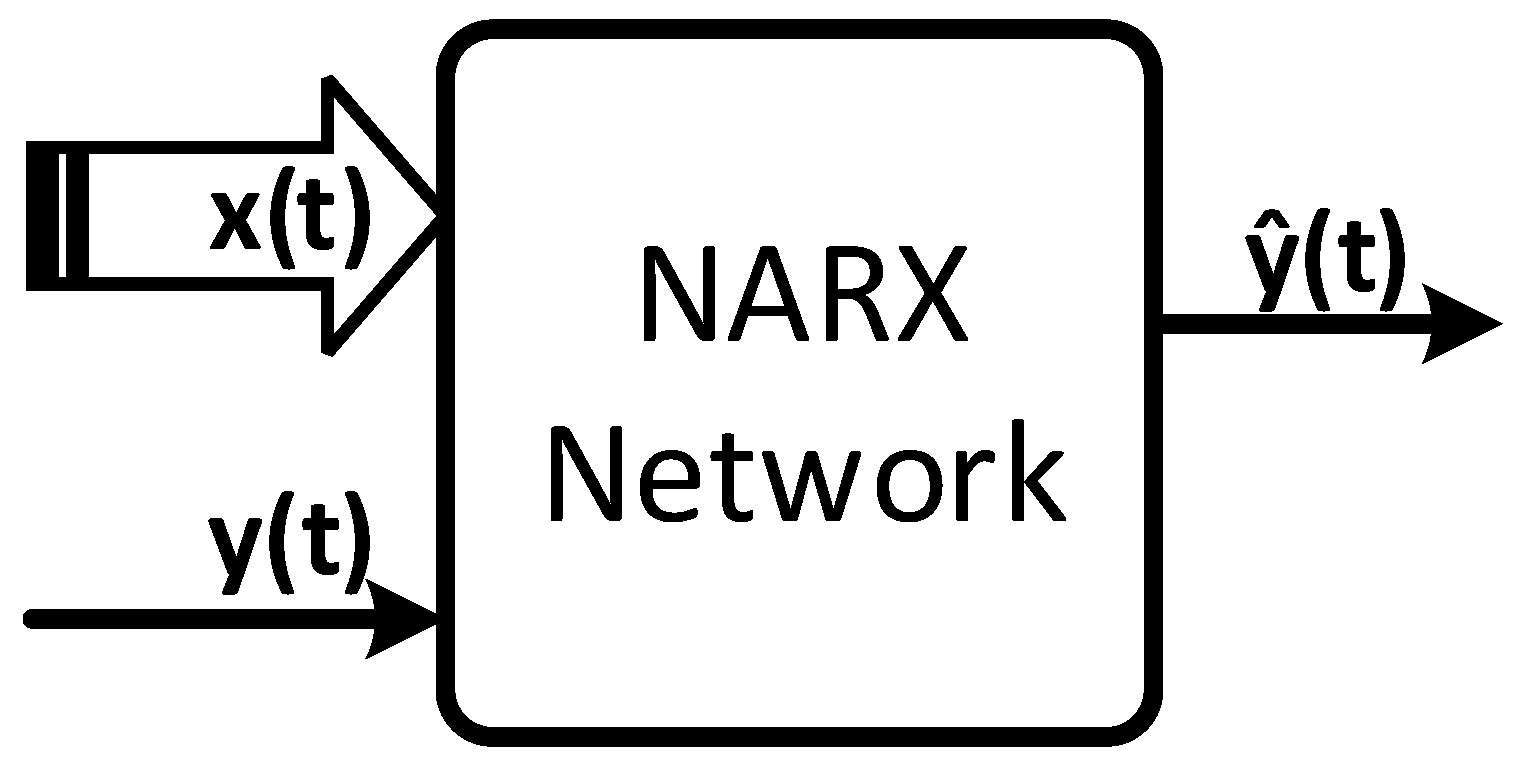
For modeling the nonlinear dynamics of such systems, data-driven approaches, particularly Artificial Neural Networks (ANNs), have shown significant promise. Among these, Nonlinear AutoRegressive with eXogenous inputs (NARX) networks are highly suited for modeling dynamic systems due to their inherent memory and ability to capture complex temporal dependencies. Their successful application spans various domains, including power system control, load forecasting, and robotic system identification.
When applying NARX networks to create a DT for a classic electromechanical object like a Separately Excited DC Motor (SEDCM), several challenges emerge. First, while the motor’s physics are well-described by ordinary differential equations, creating a single, generalized NARX model that accurately captures the coupled yet distinct dynamics of both armature current and rotational speed often leads to suboptimal accuracy and poor generalization. Second, the model’s performance is critically dependent on the training data regime. Inadequate data that do not cover the full range of operational states—including extreme transients and load disturbances—result in a DT that fails outside its training envelope. Third, to be practically useful, a motor DT must effectively account for external disturbances, primarily load torque, which is often an unmeasured variable in real systems.
Consequently, while existing literature demonstrates the viability of NARX networks for system identification and highlights the benefits of DTs for drives, a significant research gap remains in developing practically robust NARX-based DTs for electric motors. Key unresolved issues include: defining a physically interpretable network architecture that mirrors the motor’s energy conversion processes, establishing methodologies for generating comprehensive training signals that guarantee model stability and accuracy across the entire operational range, and integrating mechanisms to handle unmeasured disturbances like load torque without compromising model fidelity.
The aim of this work is to develop a high-fidelity, robust digital twin of a separately excited DC motor by addressing these specific gaps. The core novelty and contributions of our approach are as follows:
We propose a novel DT architecture based on two cross-connected NARX networks, explicitly separating the modeling of armature current and angular speed. This design aligns with the physical principle of electromechanical energy conversion within the motor.
We provide a rigorous analysis and justification for the required scope of training data, demonstrating that signals must cover approximately 120% of the nominal speed and 250–400% of the nominal current range to ensure model reliability at operational boundaries.
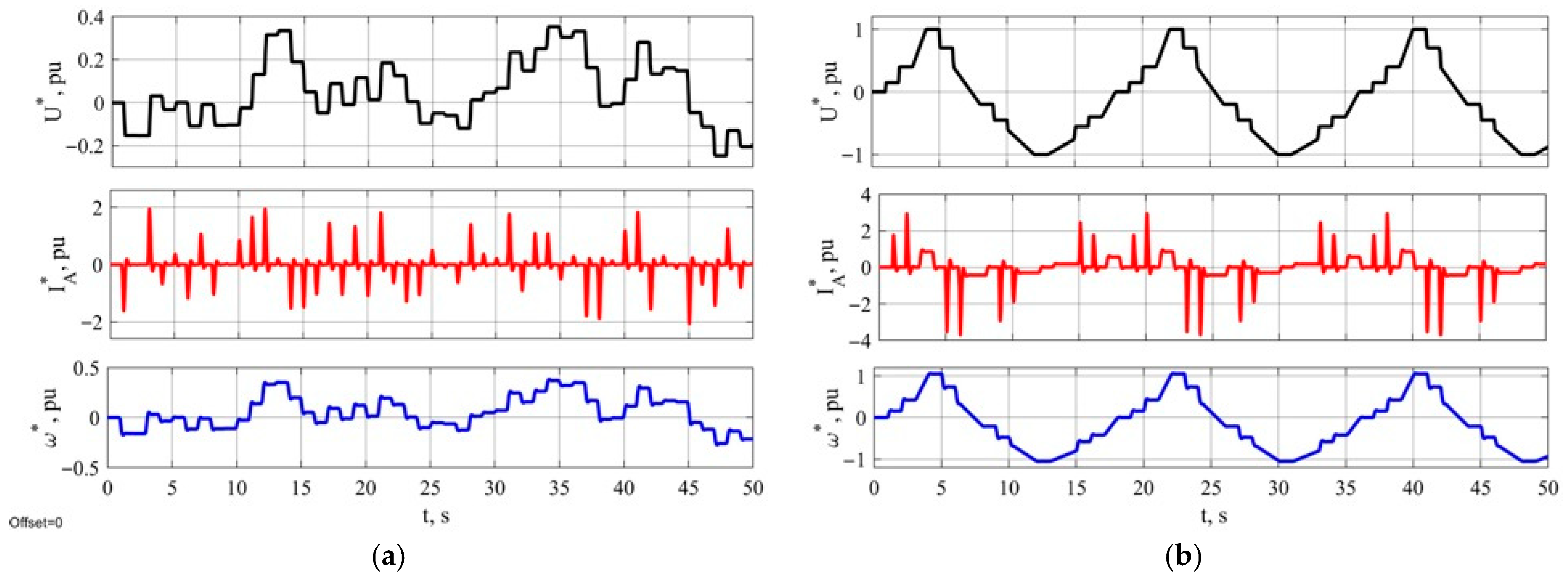
We demonstrate that structured “industrial” training signals (combining steps and ramps) yield superior model accuracy and generalization compared to random signals.
We enhance the DT’s practicality by integrating a mechanical load torque observer, enabling the model to respond correctly to unmeasured external disturbances.
The remainder of this paper is structured as follows.
Section 3 outlines the problem statement and provides preliminaries on NARX networks and the SEDCM mathematical model.
Section 4 details the process of creating and training the dual NARX network model.
Section 5 presents the results and a comprehensive discussion of the model’s performance under various conditions, including load disturbances. Finally,
Section 6 concludes the study and suggests directions for future work.
2. Literature Review
The concept of the digital twin has gained traction in electric drive systems, aiming to create virtual replicas of motors that mirror real-time behavior for analysis, control, and prediction. Early implementations in this domain have demonstrated the benefits of integrating high-fidelity models with sensor data and AI methods. For example, Ebadpour et al. developed digital-twin models for motor drives using Extended Kalman Filters and robust controllers, achieving improved state estimation and stable operation under adverse conditions [
1,
2]. These successes underscore that combining detailed physical models with intelligent algorithms can enhance reliability and efficiency in electric drives. At the same time, deploying digital twins poses new challenges such as multi-criteria optimization and managing model complexity, as well as ensuring real-time synchronization between physical and virtual systems. Recent reviews [
3,
4,
5,
6] highlight that fully realizing digital twins for electromechanical systems will require further research to overcome these technical and algorithmic hurdles, especially in integrating digital twins with artificial intelligence for predictive maintenance and optimization. Notably, dynamic neural networks—particularly the NARX (Nonlinear AutoRegressive with eXogenous inputs) architecture—are emerging as promising tools for developing such digital twins and other black-box models of electrical machines. NARX networks can capture complex nonlinear temporal behaviors by incorporating not only past input values but also their own past outputs as part of the input, an ability that is crucial for modeling motors with internal feedback loops and delays. This makes NARX a strong candidate for high-fidelity motor twin models that need to simulate transient and steady-state dynamics accurately in real-time.
NARX-based models have been widely applied across various domains of power and control systems due to their versatility and ability to represent complex nonlinear dynamics. The study in [
7] introduced several enhanced learning schemes (A-NARX, E-NARX, GE-NARX), enabling superior generalization when modeling nonlinear systems under stochastic disturbances, including offshore platforms subjected to random excitations. The work presented in [
8] proposed an adaptive NARX training approach that allows internal model-based controllers to adjust to changing external conditions, thereby maintaining stable operation in dynamic environments. In the field of process control, the research in [
9] demonstrated that a genetically optimized NARX controller for nonlinear chemical and biochemical reactors can significantly improve control accuracy and disturbance rejection compared to conventional techniques, highlighting the effectiveness of optimization algorithms in NARX-based control design. Furthermore, the study in [
10] showed that a properly tuned NARX model with feedback can effectively damp oscillations in electric power systems, thereby enhancing overall grid stability.
In power forecasting and energy management, NARX models have also demonstrated strong effectiveness. The study in [
11] proposed a short-term electric load forecasting technique based on a NARX network with exogenous weather inputs. By training the model in an open-loop configuration on historical data and then performing forecasting in closed-loop, the approach achieved higher accuracy and robustness compared to conventional ANN or ARMAX methods, with potential cost benefits due to reduced over-provisioning of generation capacity.
Similarly, the research in [
12] applied NARX networks to the prediction of wind speed, solar radiation, and electricity demand, showing that reliable performance can be achieved with a relatively simple network structure. The findings indicated that such NARX-based predictors can be implemented on low-cost hardware platforms, enabling real-time grid management.
In related work, the study in [
13] integrated a NARX model with a radial-basis function (RBF) network to manage a hybrid battery–supercapacitor storage system in a DC microgrid. This NARX–RBF framework optimized power sharing between storage elements, maintained battery operation within safe limits, and improved photovoltaic utilization. Simulation results confirmed that the method effectively stabilized microgrid voltage under varying irradiance and load conditions.
Hybridization with deep learning has also been explored. The investigation in [
14] introduced a hybrid convolutional NARX (HY-CNN-NARX) architecture for modeling solid-oxide fuel cell dynamics. By combining CNN-based spatiotemporal feature extraction with a NARX time-series prediction structure, the model provided faster and more accurate transient response predictions than traditional approaches, enhancing monitoring and control capabilities for fuel cell systems.
Beyond energy systems, dynamic NARX networks are increasingly employed in advanced mechatronics and robotics. The authors of [
15] applied NARX-based system identification to model the complex dynamics of an omnidirectional mobile robot. By incorporating a stability analysis framework (APLF), the researchers ensured that the identified model maintained accuracy and stability under varying operating conditions.
In precision motion control, the researchers in [
16] integrated a NARX-based neural architecture with a conventional PID controller to compensate for friction in a high-precision positioning stage. This hybrid control strategy markedly enhanced tracking accuracy and robustness relative to a standard PID, particularly in oscillatory motion, demonstrating the advantages of augmenting classical controllers with learned NARX components.
Similarly, the study in [
17] employed a data-driven NARX modeling approach to regulate the pitch (heave degree of freedom) of an underactuated underwater vehicle. By deriving a NARX model directly from real-time experimental data, the method yielded a high-fidelity representation of vehicle dynamics, eliminating the need for labor-intensive manual controller tuning. Experimental evaluations confirmed that the NARX-based strategy effectively controlled the vehicle’s motion, highlighting its applicability in complex nonlinear environments.
Taken together, these diverse applications—spanning power grids, renewable energy, industrial drives, fuel cells, robotics, and marine vehicles—demonstrate the broad potential of NARX neural networks for modeling and controlling dynamic systems.
In parallel with neural-network modeling, the control of electric drives has seen significant advances through modern nonlinear and adaptive control techniques. Sliding Mode Control (SMC), for instance, is known for its robustness against disturbances and model uncertainties, and it has been successfully applied to DC and AC motor drives to ensure stable tracking under load and parameter variations [
18]. However, a well-known drawback of classical SMC is the chattering phenomenon (high-frequency oscillations in control signals). To address this, researchers have proposed numerous SMC variants—including integral sliding modes, non-singular terminal SMC, and fractional-order SMC—that soften or eliminate chattering while preserving robustness [
18]. For example, Yang et al. reported that replacing a conventional SMC with a sliding-mode-based PID regulator improved wheel motor drive performance by 15–20%, though some residual output oscillations remained unexamined [
19].
In addition, adaptive control methods have been introduced to cope with motor nonlinearities such as magnetic saturation and load changes. Techniques such as Model Reference Adaptive Control (MRAC) and gradient-descent adaptation can adjust controller parameters on the fly to compensate for time-varying motor and load characteristics [
20]. These adaptive schemes enhance robustness over a wider operating range, albeit requiring careful stability analysis.
A notable development in electric-drive control is the hybridization of adaptive and robust control principles. The authors of [
21] proposed an Adaptive Backstepping–Integral Sliding Mode Controller (AB–ISMC) for a multi-input DC motor system, combining an adaptive backstepping law with integral SMC. This hybrid controller is capable of simultaneously estimating unknown parameters and disturbances while enforcing a sliding-mode regime, thereby ensuring Lyapunov-stable closed-loop dynamics. The results showed that AB–ISMC provided substantially better performance than either pure sliding-mode or pure adaptive controllers, with dramatically reduced settling times and nearly zero steady-state error in speed regulation. These outcomes illustrate that merging adaptiveness with robust SMC yields faster and more accurate responses under uncertainty.
Another innovative direction is the use of virtual inertia concepts in power-electronics control loops to emulate mechanical dynamics. The study in [
22] incorporated a virtual DC-motor model into the control loop of a DC–DC converter, with tunable parameters representing inertia, damping, and armature resistance. By adaptively updating these virtual parameters in real time—a strategy referred to as Three-Parameter Adaptive Virtual DC Motor Control—the researchers effectively created a digital twin of a motor-generator system embedded within the converter’s controller. This approach significantly improved system stability: voltage deviations during sudden load changes were reduced from approximately 18% to about 9%, while the recovery time shortened to 0.18 s. Although earlier works employing fixed-parameter virtual motors had already demonstrated benefits for DC-microgrid stabilization, the adaptive virtual motor model in [
22] clearly outperformed those by adjusting itself to real-time operating conditions.
Overall, the findings demonstrate an emerging form of digital-twin-based control, where a virtual electromechanical model inside the controller continuously mirrors and compensates for the behavior of the physical system. A noted limitation of such advanced hybrid schemes is their increased design complexity: additional tuning parameters are introduced, and stability analyses become more demanding. Nevertheless, the broader trend indicates that hybrid control architectures—integrating neural-network estimators, adaptive mechanisms, and robust control frameworks—can substantially enhance electric-drive performance under uncertainty. This trajectory is paving the way for next-generation drive systems that blend classical control with AI-driven components and physics-based models, leveraging the strengths of each.
Recent surveys indicate that artificial neural networks are increasingly influencing every aspect of electric-drive technology. The authors of [
23] identified three principal domains where neural-network solutions are actively employed: control, state estimation, and fault diagnosis. In the area of control, the researchers in [
23] noted that ANN-based controllers have been developed for various motor types, including induction machines and synchronous reluctance motors, where neural networks learn complex nonlinear mappings to enhance speed and torque regulation. Within state estimation, the study in [
23] demonstrated that recurrent neural architectures—including NARX-based observers—can be deployed in multi-mass drive systems to estimate otherwise unmeasurable states such as load-side speed or torque in a two-mass drivetrain. For fault diagnosis, the work in [
23] showed that intelligent neural modules can be trained to detect early stage faults from sensor data, even under strongly non-stationary operating conditions. Collectively, these developments underscore the rapid adoption of AI techniques in modern electric-drive systems.
However, the broader deployment of learning-based components introduces new challenges. Integrating adaptive and data-driven algorithms into safety-critical drive systems raises concerns regarding stability guarantees, particularly given the opaque or non-interpretable behavior of many neural models. Practical issues also arise in cybersecurity and data governance: as drive systems become interconnected–such as through IoT-enabled sensing or digital-twin architectures–secure communication and data protection become essential requirements. Furthermore, achieving real-time performance with computationally intensive AI algorithms demands careful optimization and hardware-aware implementation.
These concerns have been highlighted as key research priorities in advancing AI- and digital-twin-enabled electric drives. In particular, the reliability of AI-driven diagnostic systems is a major open question: embedding a neural fault-detection module directly into the control loop requires extremely low false-alarm rates and minimal detection delays, as diagnostic errors can trigger inappropriate and potentially harmful control actions. Ensuring such robustness and dependability remains one of the central challenges for the community.
In the domain of diagnostics and system identification, AI-driven techniques are rapidly advancing the state-of-the-art. Traditional parameter identification procedures for electric motors–such as no-load and locked-rotor tests used for induction machines–are increasingly being surpassed by data-driven approaches that rely on continuous real-time operational data. The authors of [
24] proposed an energy-based identification method for induction motors that utilizes both steady-state and transient measurements to compute equivalent-circuit parameters. Their results demonstrated a highly accurate estimation of resistance and inductance values, thereby improving the fidelity of digital motor models and strengthening the basis for adaptive control strategies.
Other studies have addressed reliability and sensor-related issues in electric drive systems. The researchers in [
25] investigated electromagnetic interference in railway traction circuits and its influence on trackside rail circuits. Their findings enabled the development of enhanced filtering strategies for speed and current sensors in high-power drive systems, ensuring stable and reliable measurements despite strong electromagnetic disturbances.
In a related work, the study in [
26] conducted an experimental analysis of induction motor behavior under degraded power quality conditions, including voltage imbalance and harmonic distortion. The results showed that supply distortions induce torque ripple and non-uniform magnetic flux distribution, highlighting the necessity for control algorithms that actively compensate for such asymmetries.
Similarly, the researchers in [
27] developed a comprehensive model of an induction generator–motor system incorporating inherent parameter asymmetry. The model captures how unequal phase parameters—for example, non-uniform inductances—affect both steady-state and dynamic performance, providing insights relevant for constructing digital twins of machines in faulty or degraded operational states.
Finally, the authors of [
28] demonstrated the value of high-fidelity physics-based simulation as a virtual testbed for electric drives. In their methodology, a detailed motor model served as the virtual plant, while various control algorithms were executed against this simulated system to assess adaptiveness and stability margins prior to real-world deployment. This approach—effectively tuning and validating controllers on a virtual twin of the physical drive—illustrates how simulation and AI can converge to enhance control design for complex electromechanical systems.
Building on these observations, several recent studies published in 2024–2025 have further advanced the understanding and practical implementation of digital twins in electric drives. In particular, Hu et al. [
29] presented a comprehensive review of digital-twin-based fault diagnosis methods for electric machines, emphasizing how multi-physics modeling combined with data-driven inference can significantly improve the early detection of anomalies in induction and synchronous machines. Their findings highlight that DT fidelity depends critically on data diversity, synchronization mechanisms, and the inclusion of physical constraints—all of which align with the challenges discussed earlier.
Complementing these insights, Lukman and Lee [
30] analyzed digital-twin architectures for PMSM drives, demonstrating that accurate parameter calibration and sensitivity-guided model structuring are essential for stable DT operation under varying electromagnetic and thermal conditions. Their conclusions reinforce the growing consensus that hybrid modeling strategies, in which neural predictors complement physically grounded submodels, offer superior reliability for electromechanical systems.
A broader systems-level evaluation was conducted by Li et al. [
31], who reviewed the application of digital twins in electric vehicle powertrains. Their analysis shows that the complex interactions among inverter dynamics, mechanical loads, and traction motor control create highly nonlinear behaviors well suited for recurrent neural-network modeling, particularly NARX-type architectures. This supports the applicability of sequence models for capturing strongly coupled electrical and mechanical states—an aspect particularly relevant to the modeling of DC motors.
Recent studies also highlight advancements in NARX-based modeling for industrial drives. Kahsay et al. [
32] proposed a hybrid NARX network with model-based feedback for torsional-torque estimation in elastic multi-mass drive systems, showing that embedding physical constraints into ANN architectures significantly improves robustness. Similarly, Araújo et al. [
33] used NARX networks for fault diagnosis in induction motors, demonstrating that recurrent models can reliably detect subtle non-stationary deviations in current and temperature signals.
Applications in transportation systems also support the utility of NARX models. Alhanouti and Gauterin [
34] demonstrated that NARX-based predictors outperform classical observers in estimating torque demand in electric vehicles, particularly when trained with structured, industrial-type excitation signals. This observation directly parallels the findings of the present study regarding the decisive role of training-signal design.
Further contributions have come from the domain of heavy-duty electromechanical systems. Batyrbek et al. [
35] developed an ANN-based self-learning controller for a drum-shear electric drive, illustrating that neural predictive models can maintain stability under nonlinear and varying torque disturbances. These results provide important evidence for the viability of combining ANN-based modeling with real-time disturbance-compensation mechanisms.
Several recent publications have focused specifically on DC-motor modeling and diagnostics. Siddiqi et al. [
36] proposed an ANN-based method for data-driven parameter estimation, enabling accurate identification of motor constants without traditional laboratory tests. Arévalo et al. [
37] examined state-estimation strategies for DC motors under uncertainties, highlighting the necessity of hybrid observer–ANN frameworks. Meanwhile, Antić et al. [
38] demonstrated that fault detection based on parameter-variation tracking can uncover multiplicative faults in DC motors and associated power amplifiers at early stages, underscoring the importance of high-fidelity digital models for predictive maintenance.
Together, these recent contributions reinforce several trends in the evolution of digital-twin technologies for electric drives: the shift toward hybrid modeling frameworks, the critical role of carefully structured training datasets, and the necessity of explicitly modeling load disturbances and parameter variations. These developments provide strong support for the dual-NARX framework adopted in the present study and highlight its relevance within the broader trajectory of state-of-the-art research.
Overall, the literature reveals a clear evolution in electric drive modeling and control: from traditional physics-based analysis of electromechanical processes, toward the integration of that domain knowledge with data-driven artificial intelligence methods and digital-twin technologies. Modern intelligent drive systems are being created that not only emulate the behavior of motors with high accuracy, but can also monitor their health and adapt control strategies in real-time to ensure optimal performance. However, integrating these approaches is far from straightforward. Simply adding a neural network to a complex system does not guarantee success—appropriate network architectures and sufficient training data (covering the full range of operating conditions) are critical. For example, a physically informed network design may be needed (e.g., using separate NARX models for a motor’s current and speed dynamics) along with expanded datasets that include extreme and edge-case scenarios to ensure the model’s reliability and generality. To date, studies have reported mixed results regarding the optimal neural network configurations for digital twin applications, and research is ongoing into hybrid models that combine data-driven learning with first-principles engineering knowledge. The issue of universality also remains open: many published works focus on specific machine types (such as a particular motor or drive) or narrow operating scenarios, and their approaches may not directly transfer to different contexts.
In light of this review, several key challenges emerge as frontiers for future research in the neural network modeling of electric drives. First, improving data acquisition and preprocessing is essential—advanced methods are needed to ensure that the training data for neural models truly captures all relevant dynamics and anomalies of real motor systems. Second, developing hybrid modeling techniques that integrate physical system knowledge (e.g., motor equations, conservation laws) with machine learning is a high priority. Such approaches could yield models that are both accurate and interpretable, combining the transparency of physics-based models with the flexibility of neural networks. Third, guaranteeing the stability and robustness of neural network-based digital twins remains a critical concern—both in the internal dynamics of the learned model (to avoid unstable behavior) and in the closed-loop context when the model is used for real-time control or estimation. Techniques to interpret neural models and enforce safety constraints (potentially via physics-informed network architectures or control-theoretic analyses) will be vital in this regard. Finally, identifying effective control strategies that leverage digital twins—for example, controllers that can adapt to model deviations or reconfigure based on real-time diagnostic feedback—is an open research avenue. Addressing these challenges will be crucial for translating the impressive progress in neural network modeling and hybrid control of drives into practical, reliable, and secure intelligent drive systems for the Industry 4.0 era. The present study contributes to this endeavor by focusing on a NARX-based digital twin for a separately excited DC motor, an approach that directly tackles some of the gaps identified in the literature. The following sections detail the proposed methodology and how it addresses the needs for accuracy, efficiency, and transparency outlined above.
The studies reviewed demonstrate the advantages of using digital twins in electric drives, while also highlighting the challenges that arise when implementing them in control systems, such as the need for more complex architectures, training procedures, or adaptive mechanisms.
5. Taking into Account the Disturbing Effect
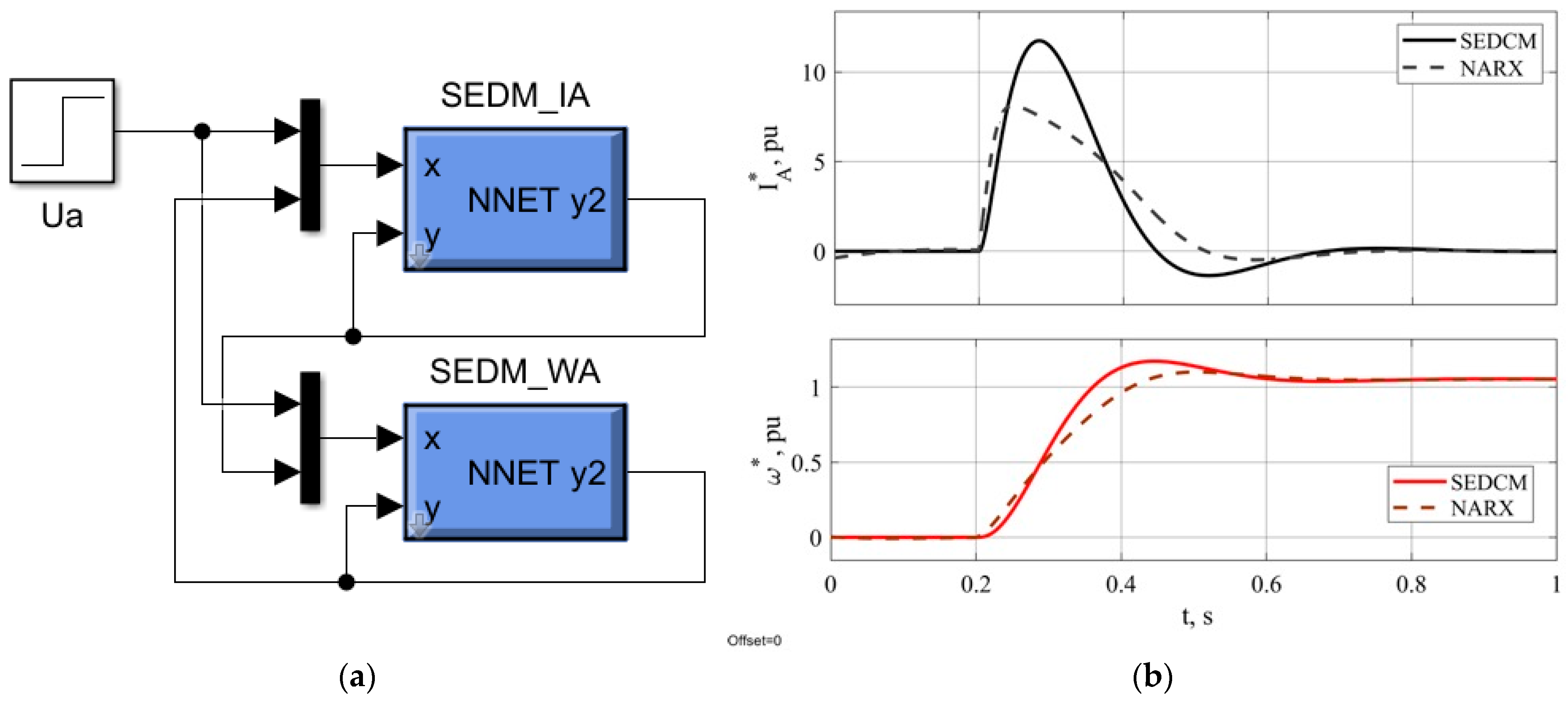
The proposed configuration of the neural network for modeling a SEDCM (
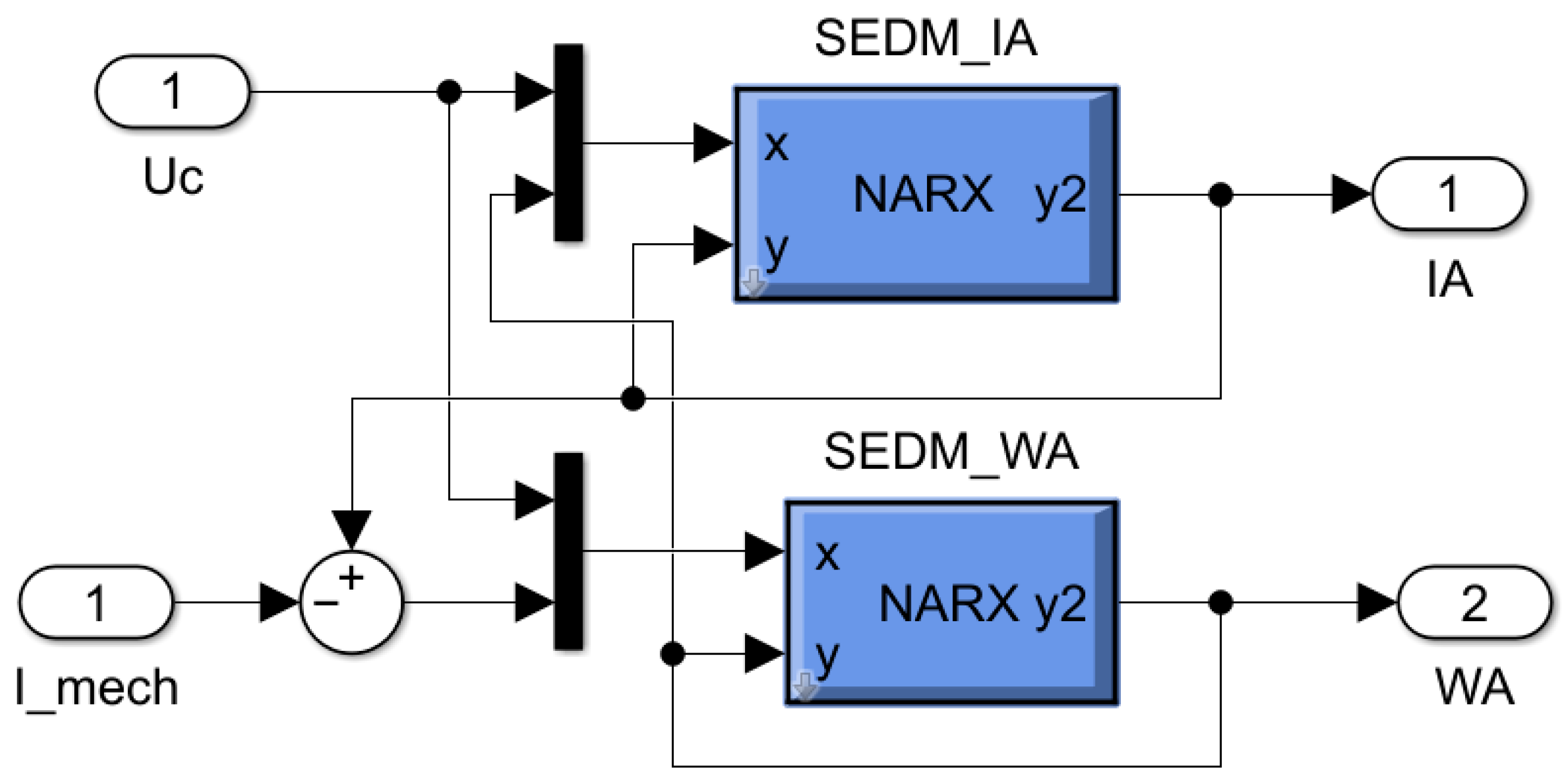
Figure 7a) allows, having trained the neural network in idle mode, to supplement it with an input corresponding to the mechanical load of the motor. The proposed architecture of the DC motor model is shown in
Figure 8.
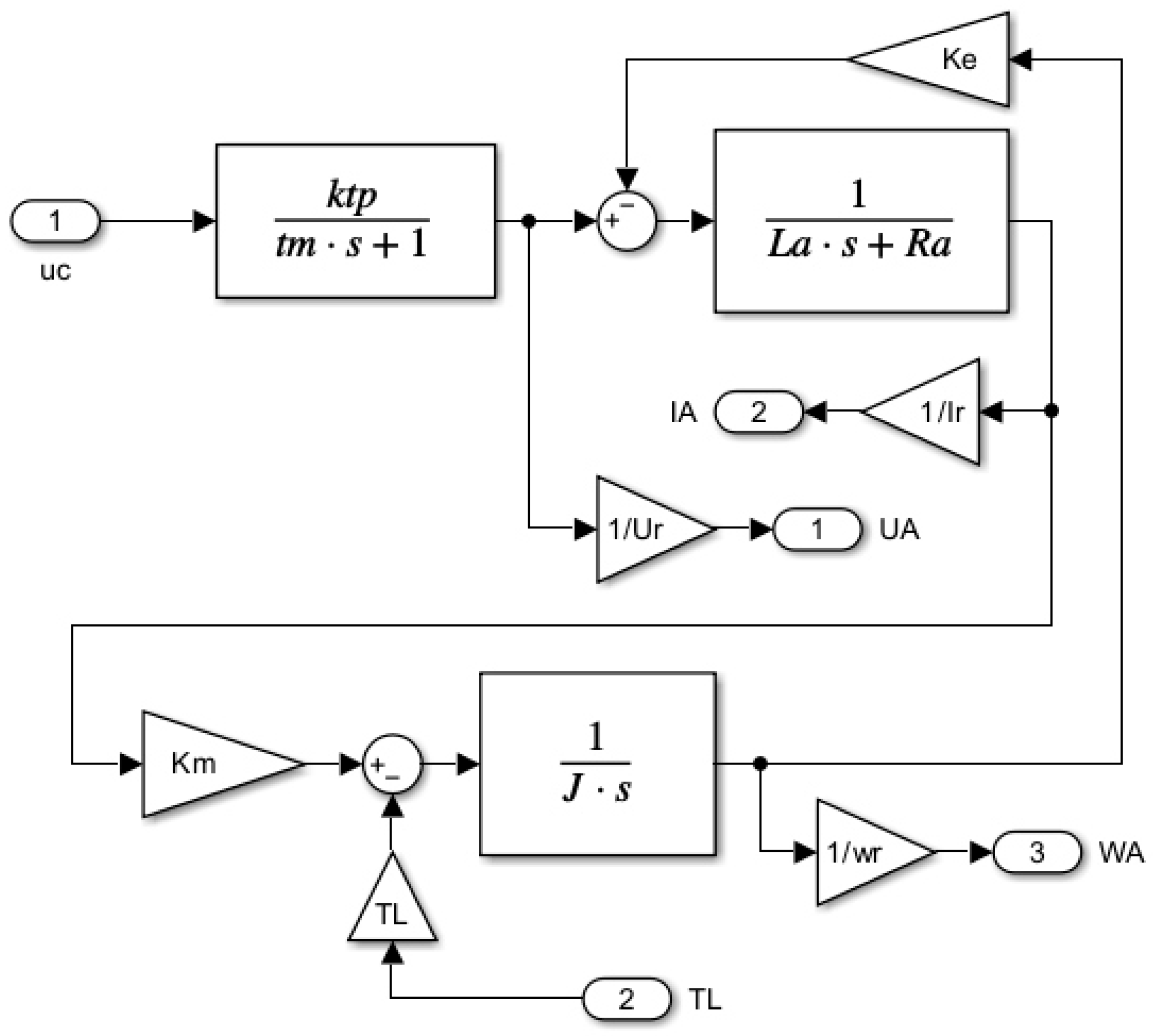
This approach allows for the simulation of dynamic and static operating modes of the mechanism, regulating current, speed, position, etc., without connecting a real electric drive. The neural network will operate as part of a system that measures the actual current and speed of the motor.
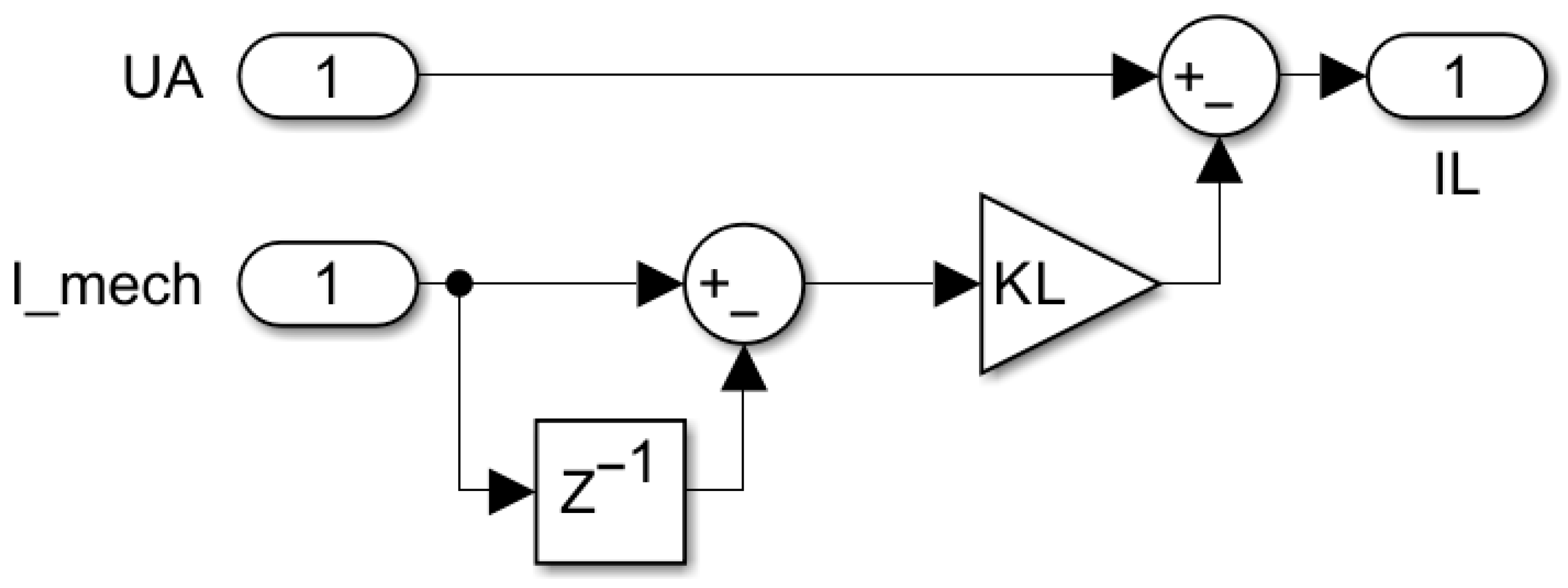
To achieve this, based on Newton’s second law of rotational motion, the following equation can be written:
The calculation of this signal can be implemented by the subsystem shown in
Figure 9.
SEDCM neural network model, supplemented by the input of the mechanical load of the motor according to
Figure 8, is presented in
Figure 10.
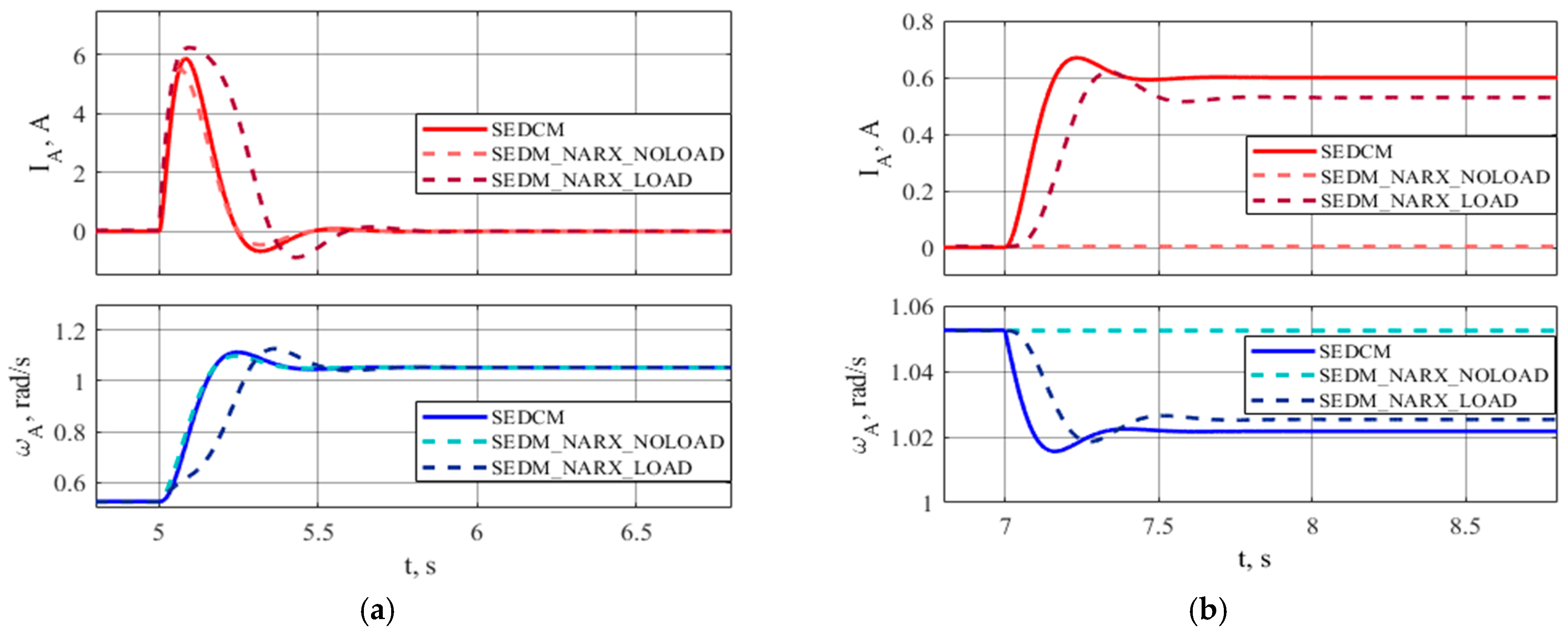
Figure 10 shows comparative diagrams of transient processes of the armature current and the angular velocity of the motor for the motor acceleration modes (a) and the load surge on the motor shaft (b). The results were compared for the full SEDCM model, the SEDCM neural network model trained on the data of the ideal idle mode (SEDCM_NARX_NOLOAD), and the SEDCM neural network model (SEDCM_NARX_LOAD) supplemented with the motor mechanical load observer according to
Figure 9.
The angular velocity reference signal Uc changed abruptly from 0.5 to 1.0 for the motor acceleration mode, and the torque of resistance applied to the SEDCM shaft in relative units also changed abruptly from 0 to 0.6 at time t = 7 s.
In the motor acceleration mode without a load on the shaft (
Figure 10a), the neural network model SEDCM_NARX_NOLOAD demonstrated higher accuracy for both the armature current and the angular velocity. It should be noted that both neural network models had high accuracy in the steady-state operating mode.
However, in the load surge mode, the SEDCM_NARX_NOLOAD neural network model demonstrated complete inoperability. Neither the angular velocity nor the armature current responded to the increase in load on the motor shaft. The SEDCM_NARX_LOAD neural network model demonstrated a theoretically justified response to load application, but its operation was accompanied by certain inaccuracies. In addition to the dynamic error, the operation of the SEDCM_NARX_NOLOAD neural network model also demonstrated an error in the steady-state mode. In the given experiment, the static current error was 7.4%, and the static speed error was 0.5%.
The model operated successfully even with more complex and nonlinear laws of change in the torque load, for example, with a fan load or elastic vibrations in the multi-mass mechanical part of an electric drive.
However, when the moment of inertia of the mechanism is not accurately specified, errors occur during transient processes. At relative angular velocity values exceeding 0.8 in modulus, errors caused by nonlinear properties of neural networks of both the motor model and the regulators accumulate, which leads to unreliable results.
Thus, from various research directions, the following can be formulated: to build a model based on the NARX ANN, even for such an object as a DC electric drive with subordinate regulation, it is necessary to generate test signals covering approximately 120% of the nominal speed range, 250 … 400% of the nominal current range.
6. Results and Discussion
The developed digital twin of a separately excited DC motor, constructed on the basis of two interconnected NARX-type artificial neural networks, demonstrated a high level of accuracy and robustness in reproducing the nonlinear dynamic behavior of the motor under various operating conditions. Dividing the model into two sub-networks—one responsible for predicting the armature current and the other for the angular velocity—proved to be an effective design strategy. This configuration allows the model to reflect the inherent electromechanical coupling within the system and to respond appropriately to variations in input voltage and load torque, ensuring a close correspondence between simulated and real motor responses.
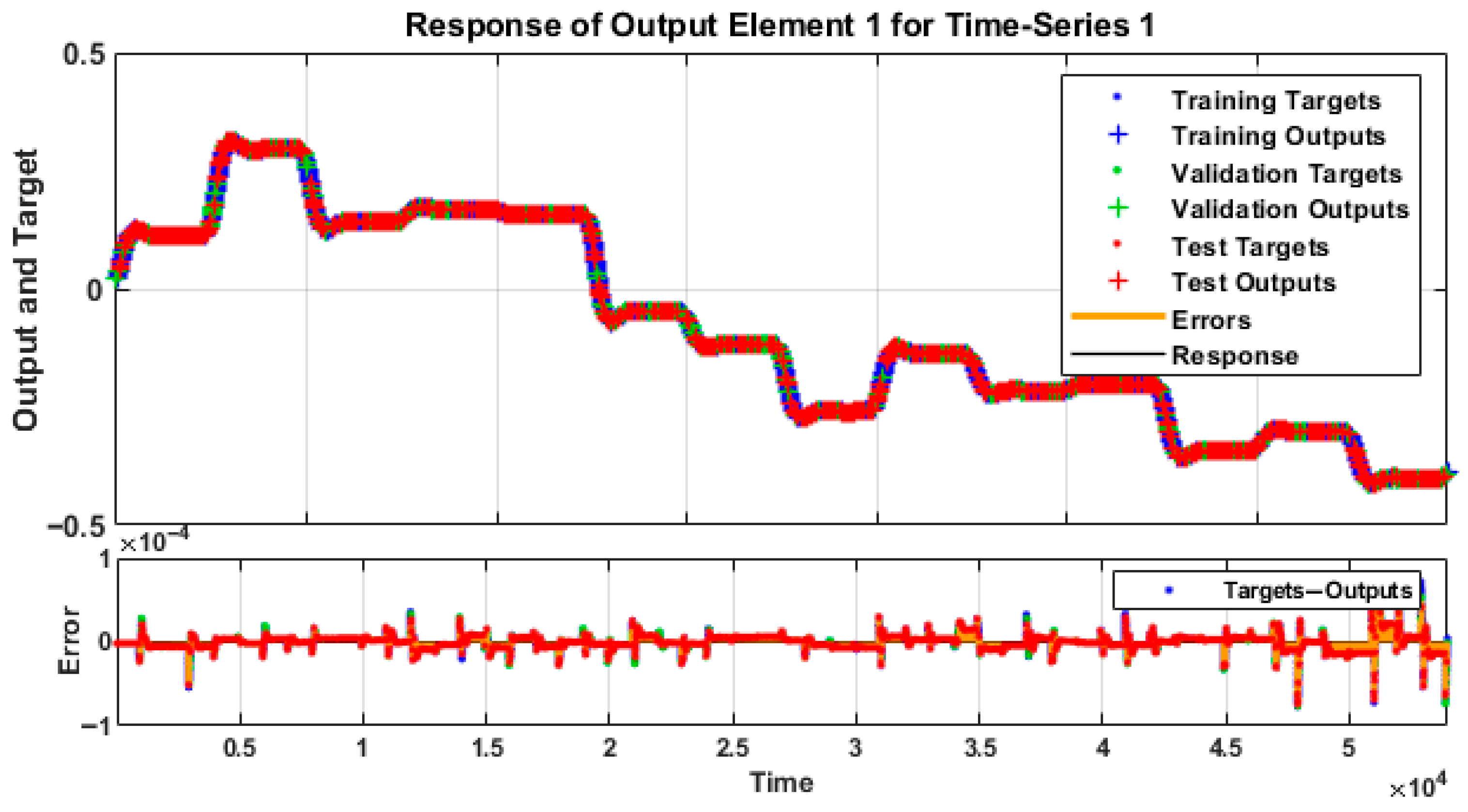
Quantitative evaluation confirmed the high precision of the proposed digital twin. The root-mean-square error (RMSe) for armature current prediction did not exceed 0.05 p.u. when trained on industrial-type excitation signals and remained below 0.09 p.u. for randomly generated signals. For angular velocity, the RMSe was within 0.01 p.u. across the nominal operating range, representing an improvement of approximately 40–50% compared with previously reported single-network NARX implementations. The model accurately reproduces transient phenomena such as current overshoot, speed sag, and post-disturbance recovery, indicating that the recurrent NARX structure effectively captures the temporal dependencies intrinsic to electromechanical energy conversion. Moreover, the strong agreement between the simulated and measured data demonstrates the model’s capability to represent nonlinear dynamics with high fidelity.
The composition of the training dataset was found to be a crucial factor influencing the model’s performance. Networks trained on structured “industrial” signals that combined step and ramp variations exhibited smoother transient responses and higher generalization capability compared with those trained on purely random signals. Furthermore, this finding emphasizes the importance of designing training datasets that reflect the physical nature of the system being modeled. By exposing the network to representative patterns observed in real industrial environments, the model not only improves its prediction accuracy but also enhances interpretability and stability under operating conditions beyond the training domain. Consequently, hybrid datasets that combine deterministic and stochastic features can be considered optimal for the development of neural digital twins of electromechanical systems.
In addition, the inclusion of a mechanical load observer further improved the realism and versatility of the digital twin. By introducing an additional input representing external torque disturbances, the modified architecture (SEDCM_NARX_LOAD) successfully reproduced the system’s response under variable mechanical loading. The model exhibited a physically consistent reaction to applied torque changes and maintained stability even under nonlinear or time-varying load conditions, such as fan-type or elastic torques. Although small steady-state errors were observed—7.4% for current and 0.5% for angular velocity—these deviations remain within acceptable limits for most simulation and control applications. Moreover, the observed discrepancies indicate potential for further refinement of the network structure, particularly in the selection of activation functions and adaptive learning mechanisms aimed at minimizing residual steady-state bias.
Another notable advantage of the proposed digital twin is its computational efficiency. The NARX-based model operates more faster than a conventional Simulink model based on differential equations while preserving comparable accuracy. This significant performance gain makes the approach suitable for integration into real-time control systems, hardware-in-the-loop (HIL) testing, and predictive maintenance frameworks. Furthermore, the ability to simulate the complete electromechanical response of a DC drive in real-time without requiring a physical prototype represents an essential step toward the practical deployment of intelligent digital twins in industrial environments.
The obtained results confirm that the proposed NARX-based digital twin accurately reproduces the dynamic characteristics of a DC motor while ensuring the computational efficiency, adaptability, and transparency required for modern industrial applications. Furthermore, the findings demonstrate that a physics-informed neural modeling approach, supported by well-structured training data, transcends conventional black-box modeling and provides a reliable analytical framework for the analysis, optimization, and control of electromechanical systems within the Industry 4.0 paradigm.
7. Conclusions
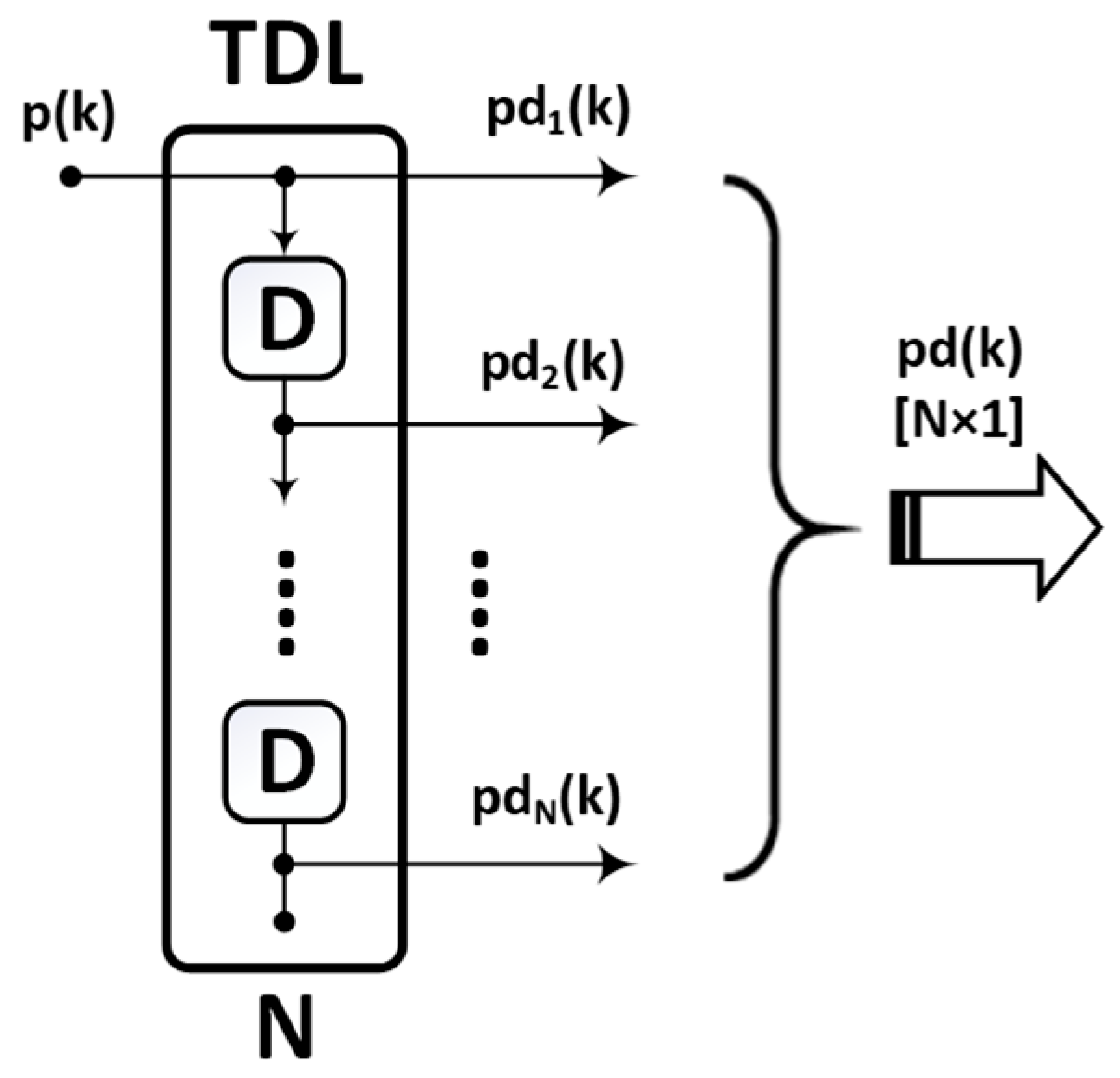
The performed study demonstrates the efficiency of using artificial neural networks based on the NARX architecture for modeling dynamic modes of SEDCM. The proposed approach, which involves using two separate NARX networks for modeling the armature current (SEDCM_IA) and angular velocity (SEDCM_WA), shows promising results in simulating the behavior of the motor in various operating modes. The use of interconnected networks allows for more accurate modeling of the motor response to changes in input signals, such as voltage and load torque. It is shown that the operation of artificial neural networks based on the NARX architecture, having a recurrent structure and using a tapped delay line, is in many ways similar to the methods of numerical solution of ordinary differential equations by the finite increment method. Namely, the lag value of the NARX network corresponds to the order of the ODE system equivalent to this network. The presence of internal feedback in the NARX network can negatively affect its stability and limits the permissible lag value of the network from above. The study used NARX(5, 3), which generally yielded satisfactory modeling results in terms of accuracy.
The studies have shown that the accuracy of the SEDCM neural network model is significantly affected not only by the volume of training data, but also by its structure and diversity. The experimental results show that neural networks trained on signals containing a combination of step changes and linear variations (Industrial) have a higher adaptability to dynamic changes compared to models trained on random signals (Random). At the same time, significant errors were observed for modes with sharp jumps in the input signal (Step source), which indicates the limited generalization capabilities of the network outside the training range. This emphasizes the importance of carefully selecting training data covering a wide range of operating modes, including transient and nonlinear processes. The importance of using specialized knowledge of the subject area should be especially noted when forming training datasets for ANN-based models.
In the neural network modeling of SEDCM, a problem arises related to the influence of disturbing effects from the load on the motor operation. In practice, the motor load torque is quite difficult to measure. Therefore, its value in the mathematical model cannot be used as an element of training data. To improve the accuracy of the SEDCM neural network model, a torque load observer was developed using the values of angular velocity and armature current of the SEDCM.
The inclusion of a mechanical load observer in the SEDCM neural network model improved the network’s ability to account for external disturbances such as load torque variations. This modification allowed the model to simulate more realistic scenarios, including load surges and dynamic responses. However, the model still exhibited some inaccuracies, particularly in the steady state, where static errors in current and speed prediction were observed. These errors indicate the need for further refinement of the network architecture or training process to improve the accuracy of the model.
The practical significance of the study is that the proposed model can be used to simulate dynamic and static modes in electromechanical systems, adjust controllers and test control strategies without the need to use a physical motor.
Summing up the results of the conducted research, the following conclusions can be drawn.
An architecture of a neural network model of SEDCM with two ANNs that separately model the armature current and angular velocity is proposed, which provides a flexible and accurate basis for describing the behavior of SEDCM in different operating modes.
ANN operation is substantiated by NARX with a numerical solution of the system of ordinary differential equations. The lag of the NARX network corresponds to the order of the ODE system equivalent to this network. This explains why increasing the lag of the network leads to instability of the network in Close Loop mode.
To control the reliability of the results of neural network modeling of SEDCM by NARX networks, the accuracy of the neural network models trained on different types of initial data, with different forms of control action by the value of the root-mean-square deviation, was analyzed. The root-mean-square deviation of the current and speed of the neural network model from the performance indicators of the real object of study was used as a quality criterion. In all of the cases considered, the neural network model trained on signals containing a combination of step changes and linear variations (Industrial) had a higher accuracy compared to models trained on random signals (Random).
To ensure the operability of the SEDCM neural network model when the load resistance torque changes, a mechanical load observer was developed and the SEDCM_NARX_LOAD architecture was proposed, containing an additional input for the disturbing effect. The SEDCM_NARX_LOAD neural network model demonstrated a theoretically substantiated response to load application. In addition to the dynamic error, the operation of the SEDCM_NARX_NOLOAD neural network model had a static error in the steady-state operating mode. In the given experiment, the static current error was 7.4%, and the static speed error was 0.5%.
The disadvantages of the study include the fact that no studies were performed on the influence of the number of neurons in the hidden layer of NARX and reducing the lag value on the accuracy of the SEDCM neural network model.
Further research could be aimed at improving the generalization ability of NARX networks, especially for scenarios with rapidly changing input signals or operating modes beyond the training range. In addition, further refinement of the mechanical load observer and exploration of alternative network architectures could help reduce static errors and improve the overall accuracy of the model. To improve the generality and robustness of the model, adaptive learning methods should be developed and experiments expanding the range of training signals should be conducted. This will ensure the robustness of the model when operating in real, often dynamically changing, electric drive operating conditions.




 ,
,