1. Introduction
With the advancement of contemporary technological and industrial revolutions, the digital economy has emerged as a pivotal catalyst. This phenomenon is reshaping global competition and altering the allocation of resources and the structuring of economies [
1]. However, amid the ongoing expansion of the global digital economy, its energy consumption and environmental impact have received considerable attention [
2]. Facing the severe challenge of global climate change, China has explicitly set the “dual carbon” goals, which entail the aspiration of reaching a point where carbon dioxide emissions reach their peak before the year 2030, followed by the attainment of carbon neutrality before the year 2060. Against this backdrop, how to strategically coordinate the new momentum of the digital economy with the new requirement of green energy development has become a major issue demanding urgent resolution.
Don Tapscott coined the phrase “digital economy” in 1996. In its narrow sense, the digital economy refers to “a new economy driven by interactive multimedia, the information superhighway, and the internet, based on the networking of human intelligence”. Broadly defined, it encompasses all economic activities related to digital technologies [
3]. Research indicates that its development significantly impacts regional energy efficiency [
4], though this influence is not isolated. Factors such as industrial structure, human capital, and technological sophistication collectively drive energy efficiency improvements [
5]. More importantly, the growth of the digital economy exhibits distinct spatial agglomeration and spillover characteristics, with its impacts often transcending administrative boundaries. This implies that a region’s digital economic development not only affects local energy consumption but may also generate complex spatial spillover effects on surrounding areas through channels such as technology spillovers, industrial relocation, and factor mobility [
6]. Therefore, examining the relationship between energy consumption and the digital economy solely from a local perspective may be insufficient; it is imperative to integrate the spatial dimension into the analytical framework.
It is imperative to clarify that the digital economy green paradox discussed in this paper inherits and reconstructs the concept of “green paradox” in environmental economics. In 2008, Sinn introduced the classic “green paradox” to characterize an unexpected result of climate policy [
7]. The advance announcement or implementation of climate policies will change the expectations of fossil fuel owners, prompting them to accelerate the extraction and sale of fossil energy. This will ultimately result in a temporary rise in emissions of carbon, which runs counter to the original goal of the policy. The digital economy green paradox, on the other hand, focuses on the dual effects of the demand side and resource allocation side. Although digital technology can achieve direct energy conservation by enhancing manufacturing procedures and increasing energy utilization efficiency, the high-energy-consuming nature of digital infrastructure and the energy “rebound effect” caused by the digital economy driving economic growth may offset its energy-saving effect, and even promote the increase of regional total energy consumption [
8,
9]. This adaptation of the concept is not a deviation from traditional theories, but a theoretical extension of the “non-linear relationship between technological progress and energy consumption” based on the characteristics of the digital economy as a general-purpose technology, which also provides a new analytical perspective for understanding the green development dilemma in the digital era.
Energy is a foundational element of socioeconomic development, with a close correlation between energy consumption and economic growth. Existing research indicates that energy consumption significantly drives economic growth [
10,
11], while energy security is closely tied to national development strategies and security thresholds [
12]. The “green paradox” on the demand side illustrates how the digital economy may hypothetically have a complicated effect on the consumption of energy, potentially manifesting as nonlinear characteristics with spatial correlations [
13,
14]. However, the existing literature still has obvious limitations in capturing this complex mechanism at the empirical level: first, most studies are based on linear assumptions and fail to effectively explore the possible nonlinear threshold features that define the influence of digital economy, whether its direction or intensity has undergone structural changes in different stages of development [
15]. Secondly, the widely used traditional econometric model ignores the spatial dependence caused by geographical distance and other factors, and it is difficult to reveal the regional interaction and spillover effect of energy consumption in the digital economy.
Although the digital economy is often regarded as an engine for green transformation, its actual energy impact may be more complex. It has been hypothesized that the emergence of the digital economy may trigger the manifestation of the so-called “green paradox” phenomenon: technologies aimed at energy conservation may increase total energy consumption due to their widespread use [
16]. This paradox leads to a deeper theoretical issue: the effect of the digital economy on energy consumption is likely not linear. Instead, the relationship between the two is complex and dynamic. It may not only achieve energy savings by improving efficiency [
17], but also increase the difficulty of energy management due to excessive digitalization [
18]. Furthermore, this impact may exhibit a nonlinear “optimal range” characteristic [
19]. However, significant limitations remain in the existing literature when it comes to empirically capturing this complex mechanism: first, most studies are based on linear assumptions and fail to effectively test the potential nonlinear threshold characteristics of the digital economy’s impact—that is, whether the direction or intensity of its effect undergoes structural changes at different stages of development [
11]. Second, spatial interactions (i.e., spatial dependence) may amplify or weaken the local green paradox effect in the digital economy [
20], yet commonly used traditional econometric models overlook spatial dependence caused by geographical distance and other factors, making it difficult to reveal the regional interactions and spillover effects of the digital economy’s impact on energy consumption.
Given this, this paper aims to delve into the following core questions: Does China’s digital economy exhibit a “green paradox”? Specifically, does its impact on energy consumption display a nonlinear threshold characteristic based on its own development level? Does the existence of nonlinear relationships lead to spatial heterogeneity? Furthermore, does this impact exhibit spillover effects across geographic spaces? The present study is driven by the necessity to respond to the following inquiries, and therefore employs provincial-level panel data from China. Building upon a scientifically measured index of digital economic development, it constructs a panel threshold regression model and a spatial Durbin model. By testing the threshold and spatial dynamics linking the digital economy and energy consumption, this research offers critical insights for aligning digital economic development with green energy objectives. Achieving the “dual carbon” goals and fostering the sustainable development of the digital economy is something the findings contribute to.
2. Research Hypotheses
By combining the technological innovation theory [
21], the Solow paradox [
22], and the technological spillover effect theory [
23], this study offers a theoretical framework that explains the complex relationship between the digital economy and energy consumption. The technological innovation theory highlights the pivotal function of technological progress in economic development. As a typical general-purpose technology, digital technology exhibits significant dual characteristics in its energy impact [
24]. On one hand, the digital economy enhances energy efficiency through intelligent and platform-based technologies; on the other hand, the high energy consumption of digital infrastructure may trigger energy rebound effects [
25]. The Solow Paradox indicates that new technologies may exhibit an “efficiency lag” during their initial adoption phase, offering a crucial perspective for understanding the dynamic impact of the digital economy on energy consumption. Meanwhile, the theory of technology spillover effects introduces a spatial dimension, thereby providing a theoretical foundation for examining the interregional linkage mechanisms.
2.1. The Nonlinear Relationship Between the Digital Economy and Energy Consumption
The core mechanism of the traditional “green paradox” lies in policy interventions disrupting expectations on the fossil fuel supply side. However, as an inclusive technology, the digital economy operates through fundamentally different pathways. It primarily reduces energy consumption per unit of output directly on the demand and allocation sides by optimizing production processes, enhancing resource allocation efficiency, and empowering energy management systems. This process, aimed at boosting total factor productivity, inherently incorporates improvements in energy efficiency. Therefore, the direct influence experienced by energy consumption from the digital economy is more likely to manifest as sustained optimization rather than a paradox triggering panic reactions on the supply side [
26].
However, the energy implications of the digital economy are not solely determined by direct energy-saving pathways. The Solow Paradox highlights that investment in information technology often faces time lags and uncertainties in its impact on productivity growth, offering a crucial perspective for understanding the implications of energy in the digital economy. The integration of digital technology with energy systems, representing a novel form of production factor, may also encounter comparable efficiency delays. On one hand, digital infrastructure, including data centers and communication networks inherently consumes significant energy, with their construction and operation creating additional energy demands [
27]. On the other hand, the digital economy drives economic growth by enhancing total factor productivity, potentially triggering a “rebound effect” that stimulates new energy consumption, thereby partially offsetting its direct energy-saving effects.
This implies that at the macro level or during specific developmental stages, the digital economy’s role in reducing energy intensity may be diminished. It could even temporarily elevate energy consumption due to expanding economic scale, creating a phenomenon seemingly at odds with green objectives—the “green paradox” at the demand side. This forms the foundation for Hypothesis 1:
Hypothesis 1. There exists a significant threshold effect between digital economic development and energy consumption, manifesting as a nonlinear relationship characterized by “initial inhibition followed by promotion.”
2.2. Spatial Heterogeneity of Nonlinear Relationships
Overall, the impact of the digital economy on energy consumption is not a simple linear suppression relationship. Instead, it results from the dynamic interplay and evolution of energy-saving effects and growth-driven energy consumption effects. This dynamic process aligns closely with the “rise-then-fall” evolutionary pattern revealed by the environmental Kuznets curve [
28].
Specifically, during the nascent stages of digital economic development, the demand-side “green paradox” effects (e.g., infrastructure energy consumption and rebound effects) often dominate, potentially leading to increased energy consumption alongside digital economic growth. However, as the digital economy matures beyond a particular point, the potential for energy savings and reduced consumption through the implementation benefits of digital technologies gain prominence. This occurs through technological sophistication, deep integration, and effective environmental regulation, ultimately achieving significant energy consumption suppression. Consequently, the relationship between the two exhibits pronounced nonlinear characteristics [
29,
30]. On the basis of this, Hypothesis 2 is hereby put forward:
Hypothesis 2. The magnitude of the threshold and the intensity of the influence in the aforementioned nonlinear relationship exhibit significant variations across different regions, demonstrating spatial heterogeneity.
2.3. Spatial Spillover Effects of the Digital Economy on Energy Consumption
Leveraging its potent network effects and spatial externalities, the digital economy generates significant spatial spillover effects on regional energy consumption patterns. These effects primarily materialize through three core channels: First, the technology diffusion effect, where knowledge, technologies, and innovations from the digital sphere spread to neighboring regions via talent mobility, information exchange, and collaborative R&D, fostering interregional technological synergy and innovation linkage. Second, the industrial linkage effect: a tight industrial chain division of labor enables digital technological innovations in one region to propagate along supply chains, driving energy efficiency improvements across the entire regional industrial chain. Finally, the factor mobility effect: the digital economy promotes more efficient interregional flow and allocation of production factors like capital, technology, and data, optimizing the overall regional energy utilization pattern and achieving cross-regional resource allocation [
31].
The research that is currently available provides substantial support for this claim. Zhao et al. (2022) [
32] demonstrated that the digital economy has significant regional spillover effects on carbon emissions using a spatial Durbin model. As a result of spatial spillover techniques, their research indicates that the growth of the digital economy not only lowers carbon emissions locally but also has positive emission reduction benefits in nearby regions. Xie et al. (2023) [
33] further deepened this understanding, discovering that the digital economy primarily reduces carbon emissions in neighboring regions through the path of industrial structure upgrading. This provides important insights into understanding the transmission mechanism of spatial spillovers from the digital economy. Building upon existing research, this study posits that the energy impacts of the digital economy also exhibit significant spatial dependence. Its spatial spillover effects manifest not only in carbon emissions but inevitably extend to broader energy consumption domains. The networked nature and externalities of the digital economy enable it to transcend traditional geographical boundaries. Through multiple mechanisms—including technological innovation diffusion, industrial collaborative transformation, and optimized factor allocation—it influences energy consumption patterns and efficiency across wider spatial scales. In conclusion, this investigation suggests Hypothesis 3.
Hypothesis 3. Through routes including technology diffusion, industry connections, and factor mobility, digital economic development has an impact on energy consumption that goes beyond local locations and creates spatial spillover effects in nearby regions.
4. Results Analysis
4.1. Panel Data Preprocessing Tests
Prior to conducting benchmark regressions, a series of preprocessing tests must be performed on the panel dataset to ensure the validity and unbiasedness of subsequent estimation results.
4.1.1. Stationarity Test
To avoid the problem of spurious regression, it is necessary to conduct stationarity tests on the variables. This study jointly employs the LLC test for the case of a common root and the IPS test for the case of different roots. The results of testing the original data are shown on the left side of
Table 3: the LLC test strongly rejects the null hypothesis of “unit root existence” at the 1% level, while the
p-value of the IPS test is greater than 0.1, failing to reject the null hypothesis, suggesting that some variables may be non-stationary. To verify this phenomenon, all variables were differenced once and retested. After differencing, both the LLC and IPS tests reject the null hypothesis of unit root existence at the 1% significance level, confirming that all variables are integrated of order one, meeting the prerequisite conditions for the cointegration test.
4.1.2. Cointegration Test
Considering that the variables are of the same order and integrated of order one, it is necessary to examine whether a stable long-term cointegration relationship exists among them. This study employs the Kao test and the Pedroni test, with results presented in
Table 4, respectively.
- (1)
Kao Test: With the primary ADF statistic significant at the 10% level and the DF statistic significant at the 1% level, the results provide evidence supporting the existence of cointegration.
- (2)
Pedroni Test: The null hypothesis of no cointegration is rejected by several test statistics at the 1% significance level.
Combining the results of both tests, it can be concluded that the variables are bound by a stable long-run equilibrium. Therefore, directly regressing on level variables is valid and will not produce spurious regression issues.
4.2. Baseline Regression
To empirically examine the direct impact of the digital economy on energy consumption, this study first employs stepwise regression for benchmark regression analysis.
Model 1 looks at how the digital economy affects energy consumption on its own. Building upon this, Model 2 further incorporates a series of control variables, including government expenditure levels, level of industrialization, foreign trade, and level of economic development, to control for the interference of other potential factors. The regression results are presented in
Table 5.
4.3. Threshold Effect
To investigate the nonlinear impact mechanism of digitalization on energy consumption, this study constructs a panel threshold model where the digital economy serves as both the threshold variable and the core explanatory variable. Statistical inference follows the method of Hansen (1999) [
45], based on 300 repeated bootstrap samples.
4.3.1. Nonlinear Threshold Effects of Core Variables
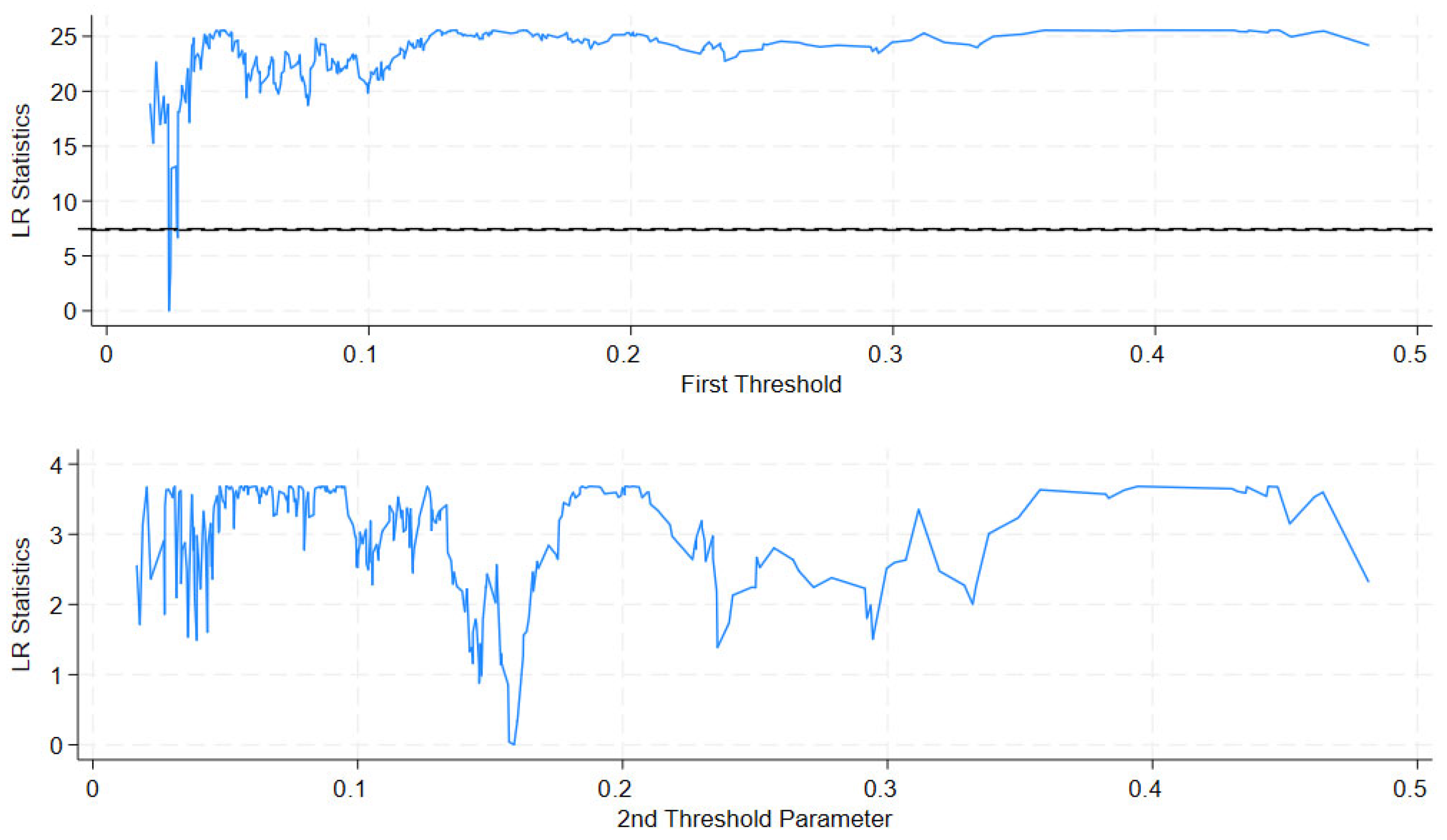
Table 6 of the threshold effect test shows that the digital economy has a single threshold effect on energy consumption. The single threshold value is 0.024, and the
p-value is 0.093, passing the test at the 10% significance level. However, the double and triple threshold tests do not pass the significance test, indicating that there is no multiple threshold effect.
To present these statistical results more intuitively, this paper plots a threshold effect test diagram. As shown in
Figure 2, the LR statistic forms a significant trough at the threshold value γ = 0.024, with its value at this point clearly falling below the critical line for the 10% significance level. This graphical outcome corroborates the numerical results in
Table 6, jointly confirming the existence of a single threshold effect in the digital economy’s influence on energy consumption. Both dual-threshold and triple-threshold tests failed to pass significance tests, indicating no presence of more complex multi-threshold effects.
Furthermore, the fixed-effects regression results of the single-threshold model (
Table 6 and
Table 7) reveal that when the digital economy level is less than or equal to 0.024, its coefficient is −6.274 and significantly negative at the 1% level; when the digital economy level exceeds 0.024, its coefficient shifts to 0.34 and is significantly positive at the 1% level. This structural change supports the nonlinear hypothesis of “inhibition followed by facilitation” proposed in Hypothesis 1.
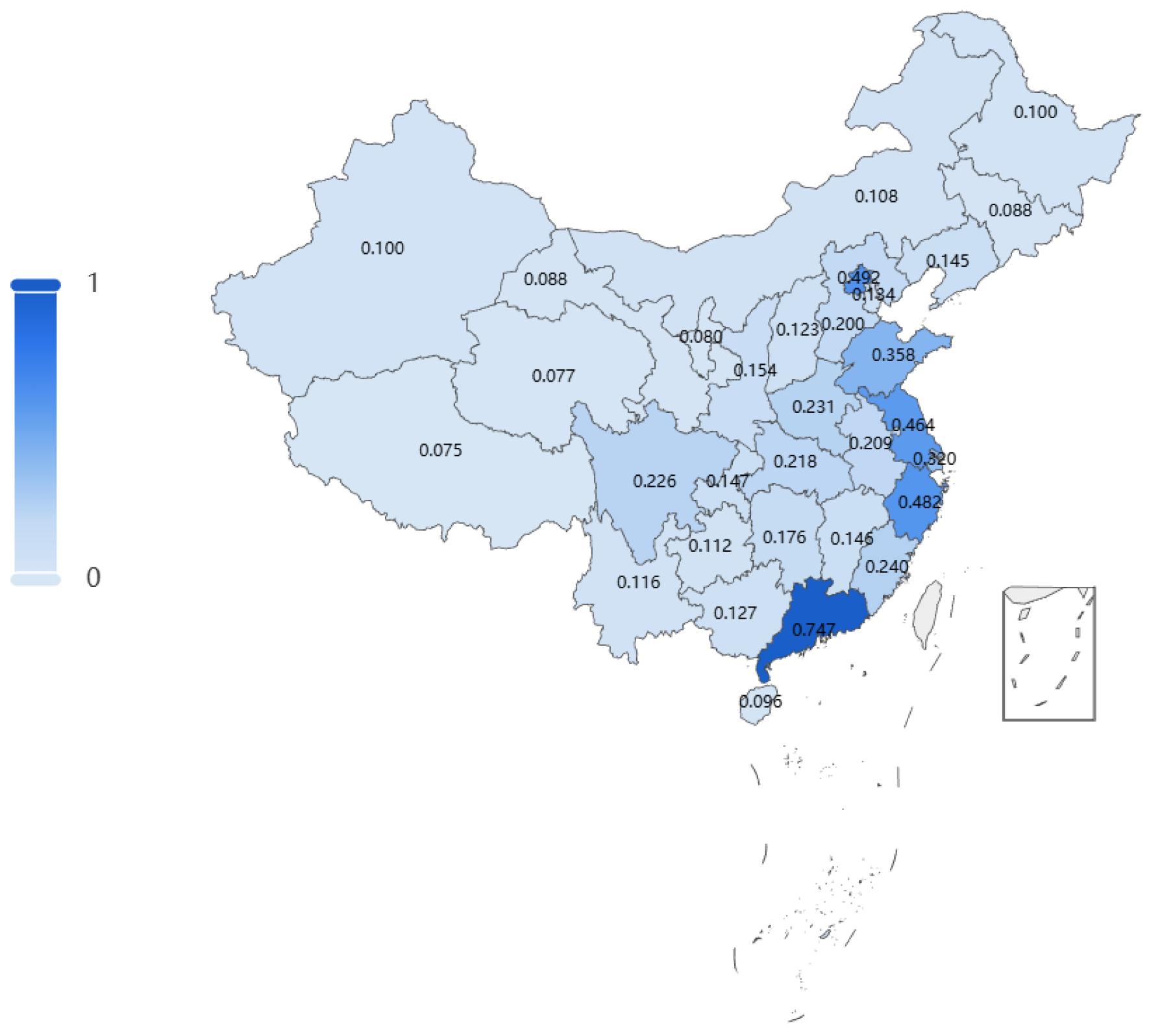
China Provincial Digital Development Level Assessment Map (
Figure 1) reveals that eastern coastal provinces generally exhibit higher digital economy levels, with most having crossed the threshold value, while central and western regions lag behind. This spatial heterogeneity effectively explains why distinct energy consumption trajectories emerge across regions: In regions with underdeveloped digital economies (DE ≤ 0.024), technological diffusion and efficiency gains effectively curb energy consumption, demonstrating the green effect of technological progress. Conversely, in digitally advanced regions (DE > 0.024), the energy consumption of digital infrastructure and rebound effects become dominant, leading to increased energy consumption as the economy grows—a classic manifestation of the green paradox in the digital economy.
This empirical result indicates that the impact of the digital economy on energy consumption exhibits distinct spatial heterogeneity: in regions with underdeveloped digital economies, its advancement effectively curbs energy consumption, demonstrating the green effect of technological progress. Conversely, in regions with advanced digital economies, further development paradoxically stimulates energy consumption growth, revealing the demand-side “green paradox” phenomenon. The above analysis confirms the validity of Hypothesis 2.
4.3.2. Control Variable Analysis
The estimation results for the control variables, as presented in
Table 8, are largely consistent with theoretical expectations. Specifically, the coefficients for the level of economic development and foreign trade are 0.275 and 0.230, respectively, both statistically significant at the 1% level. This confirms that economic growth and trade expansion constitute the most fundamental drivers of rising energy consumption. The coefficient for the level of industrialization is 0.406, significant at the 5% level, which aligns with the established understanding that the industrial sector is the primary consumer of energy. The coefficient for government expenditure levels is negative and marginally significant at the 10% level, suggesting that an expansion of government size or related regulatory policies may exert a slight inhibitory effect on energy consumption. However, the relative weakness of this evidence warrants cautious interpretation.
During the initial phases of development, the digital economy has a pronounced effect in reducing energy use, demonstrating a positive energy-saving effect. However, once its development level exceeds the threshold of 0.024, its impact on energy consumption shifts to a significant promoting effect, driving the increase in energy use. This precisely manifests the digital energy green paradox.
4.4. Results of the Spatial Dubein Model
This study employs a 0–1 Rook Contiguity Matrix based on shared boundaries to define spatial adjacency between provinces. It should be specifically noted that in constructing the adjacency relationships, this study treats Guangdong Province and Hainan Province as “adjacent” provinces.
The spatial econometric model’s diagnostic test results are displayed in
Table 9. The Lagrange multiplier (LM) tests (including the LM-lag, Robust LM-lag, LM-error, and Robust LM-error) and the Wald tests (containing the Wald-lag and Wald-error) are both passed at the 1% level under the 0–1 rook spatial weight matrix. As a result, the Spatial Durbin Model (SDM) is a reasonable and statistically sound choice. In conclusion, we decided to evaluate the spatial spillover effect between the growth of the digital economy and energy consumption using the SDM in conjunction with an individual fixed effects model.
The regression results of the Spatial Durbin model (
Table 10) provide crucial spatial evidence for understanding the complex relationship between the digital economy and energy consumption. The overall intra-group R
2 of the model is 0.6285, and the spatial autoregression coefficient ρ is significant, indicating that the model specification is reasonable. Regional energy consumption exhibits significant spatial dependence, making the use of a spatial econometric model necessary.
The effect decomposition on the core explanatory variable, the digital economy, constitutes a pivotal finding of this study. Its direct effect is estimated at 1.929 and is statistically significant at the 1% level. This indicates that, after controlling for spatial spillovers, the development of the local digital economy exerts a significant positive net impact on local energy consumption. Conversely, the indirect effect, representing spatial spillover, shows a significantly negative coefficient of −0.746 at the 10% significance level. This intriguing result implies that the advancement of the local digital economy paradoxically contributes to a reduction in energy consumption within neighboring regions. With a coefficient of 1.183 at the 5% significance level, the overall effect is still positive and statistically significant when taking into account both paths, demonstrating the digital economy’s overall stimulating function in regional energy consumption patterns.
This pattern of a positive direct effect coupled with a negative spillover can be interpreted through several theoretical mechanisms. First, the technology diffusion effect manifests as the spillover of digital efficiency and green technologies from core areas to neighboring regions, helping the latter reduce energy intensity. Second, the industrial linkage effect manifests as energy-intensive data infrastructure and digital industries clustering in digital hubs (direct promotion), while surrounding areas shift toward supporting industries with lower energy demands or reduce overall energy consumption through optimized regional supply chain arrangements (indirect suppression). Finally, the factor flow effect implies that the concentration of production factors like capital and talent in digital centers may lead to industrial hollowing-out or growth slowdowns in neighboring regions, thereby suppressing their energy consumption.
Regarding control variables, government expenditure and industrialization level exhibit significant local suppression and promotion effects, respectively. Foreign trade exerts a strong promotion effect on local energy consumption. Similarly to the digital economy, the level of socioeconomic development also generates a significant positive spatial spillover effect, indicating interregional linkage in energy consumption.
The analysis confirms that the growth of the digital economy has a positive and statistically significant spillover impact on energy demand using the framework of the Spatial Durbin Model. The spatial transmission mechanism of the green paradox in the digital economy is revealed by this finding: the digital economy paradoxically encourages lower energy consumption in nearby regions through negative spillover effects (indirect effect), while it increases energy consumption in localized areas (direct effect). However, the net effect across the entire regional system remains positive (overall effect), highlighting the fundamental challenge inherent in this paradox. This confirms the complex spatial mechanism of “local promotion and neighboring suppression” proposed in Hypothesis 3.
4.5. Robustness Test
To test the robustness of the benchmark regression results, this study employs the following two methods. (1) While maintaining the basic framework of the original digital economy development level indicator system, the “express delivery volume” indicator is excluded for threshold regression. This indicator carried a relatively high weight (0.130356) in the original entropy weighting method. Its exclusion helps verify whether the indicator system construction overly relies on a single metric, thereby assessing the sensitivity of core conclusions to indicator selection. (2) Recognizing that policy guidance serves as a crucial driver for digital economic development, this study further incorporates the frequency of digital economy policy terms (DEP) as an alternative measure of digital economic development level. A benchmark regression is then re-conducted to test the robustness of the research conclusions under different measurement approaches for the core explanatory variable.
As shown in
Table 11 and
Table 12, the threshold value estimated by the new model reaches 0.0237, demonstrating high consistency with the original value of 0.0238. The 95% confidence interval further overlaps substantially with the benchmark results, indicating remarkable parameter stability. The regression results in
Table 13 further reveal that the digital economy coefficient is −6.120 in the low-level range (DE ≤ 0.0237) and shifts to 0.329 in the high-level range (DE > 0.0237), both maintaining statistical significance at the 1% or 5% level. This finding indicates that the core discovery of a nonlinear threshold effect is robust and not significantly influenced by specific indicator selection.
Table 14 illustrates how the regression findings are still quite consistent with the baseline model even when the frequency of digital economy policy terms (DEP) is increased. The signs and significance levels of the control variables do not change, and the coefficient for the digital economy variable is still significantly positive at the 1% level. Furthermore, the coefficient of determination (R
2) stabilizes at a high level of 0.817. This indicates that the core finding of this study—that the digital economy has a significant promoting effect on energy consumption—is robust and does not depend on the selection of specific measurement indicators.
4.6. Mediation Effect Test
To examine whether the development of the digital economy influences energy consumption by affecting government spending, this study conducted a mediation analysis, with results presented in
Table 15.
As shown in
Table 15, in Model 1, the total effect coefficient of the digital economy on energy consumption is 3.144 and significant at the 1% level, satisfying the prerequisite for testing mediation effects. Model 2 indicates that the coefficient of the digital economy on government spending is −0.245 and significantly reduces government expenditure, with a coefficient of −0.245 that is significant at the 1% level, confirming the validity of path a. In Model 3, after controlling for government expenditure, the direct effect of the digital economy remains significantly positive at 2.556, while the coefficient for government expenditure is significantly negative at −2.403. This indicates that increased government expenditure inhibits energy consumption.
The Sobel test results further confirm the significance of the mediating effect, with a test statistic of 4.111 and significance at the 1% level. The mediating effect value is 0.588, accounting for 18.7% of the total effect. This finding indicates that government spending partially mediates the relationship between the digital economy and energy consumption.
5. Research Conclusions and Implications
5.1. Research Conclusions
Based on panel data from 30 Chinese provinces spanning 2011 to 2023, this study emp Using provincial-level longitudinal data (2011–2023), this research implements a dual econometric approach combining panel threshold regression with spatial Durbin specification to investigate the nonlinear dynamics and spatial dependence of digitalization on energy intensity. Key findings include: (1) The impact of the digital economy on energy consumption is not linear but exhibits a single threshold effect based on its own development level (threshold value of 0.024). Below this threshold, the digital economy primarily drives energy savings through efficiency gains. Beyond the threshold, the “rebound effect” and the energy consumption of digital infrastructure itself become dominant, significantly boosting total energy consumption and creating a pattern of “initial suppression followed by promotion.” (2) The digital economy exhibits pronounced spatial spillover effects. While local digital economic development has a negligible direct net impact on local energy consumption, its spatial spillover effects are significantly positive. This indicates that digital economic activities generate interregional linkages, substantially increasing energy consumption in neighboring areas, thereby revealing the transmission pathway of the green paradox in the digital economy from a spatial perspective.
This study breaks through the single-dimensional research perspective of “digital economy = green development” and innovatively examines the “green paradox” of the digital economy from the perspective of energy consumption, revealing the nonlinear and spatially differentiated impact mechanism of digital economic development on energy consumption. In terms of marginal contributions, this research not only identifies the critical threshold of the digital economy’s energy effect through empirical tests, providing a quantitative basis for optimizing the allocation efficiency of digital technology resources across regions, but also clarifies the spatial spillover path of the digital economy’s energy consumption impact. This finding enriches the theoretical connotation of the “green paradox” in the digital era and provides a micro-foundation for promoting the synergy between digitalization and greening.
Although this research offers empirical connections on the relationship between energy consumption and the digital economy, several limitations should be acknowledged. Even if the entropy weight approach was used to generate the digital economy index, it remains an indirect measure and struggles to fully capture implicit characteristics such as the value of data elements. Endogeneity issues may exist, including bidirectional causality and omitted variable bias. Furthermore, the sample is limited to 30 provinces in China, which constrains the generalizability of the conclusions. Future research could focus on refining the measurement of the digital economy and addressing endogeneity concerns.
5.2. Policy Implications
In light of the findings, the corresponding policy implications are as follows:
- (1)
Deploy a spectrum of targeted strategies for digital economic advancement. Local governments should establish scientific monitoring and evaluation systems for the development level of the digital economy, regularly calculate their regional Digital Economy Development Index, and adopt differentiated development strategies based on their position relative to the threshold value. For regions with a lower level of digital economy development, there should be active deployment of new digital infrastructure, such as 5G networks and the Internet of Things, focusing on promoting the deep integration and application of digital technologies in areas like industrial energy conservation, smart grids, and intelligent buildings [
46]. Specifically, fiscal subsidies, tax incentives, and other measures can be used to encourage enterprises to adopt technologies such as the Industrial Internet and big data analytics to optimize production processes and improve energy efficiency. For regions with a higher level of digital economy development, it is necessary to establish strict coordination mechanisms between digital economy development and energy consumption. From one perspective, stringent energy efficiency standards for new data centers must be enforced, requiring the Power Usage Effectiveness of new data centers to be controlled below 1.3. From the other perspective, an energy consumption assessment system for digital projects should be established, conducting pre-implementation energy consumption assessments for all large-scale digital economy projects to ensure their energy consumption remains within controllable limits. Additionally, these regions should prioritize the green transformation of existing digital infrastructure, adopting advanced technologies such as liquid cooling and AI-powered energy optimization algorithms to decrease the energy intensity of digital economic production.
- (2)
Establish regional collaborative governance mechanisms. Given the significant In consideration of the fact that the digital economy’s impact on energy consumption extends beyond geographical boundaries, it is imperative to break away from traditional administrative boundaries and establish multi-level, networked regional collaborative governance mechanisms. First, it is recommended to establish a national “Regional Coordination Committee for Digital Economy Development and Energy Consumption” responsible for formulating cross-regional digital economy development plans and energy consumption control schemes. This committee should comprise relevant department heads, energy experts, and digital economy experts, holding regular coordination meetings to address energy and environmental issues arising from regional digital economy development. Second, a cross-provincial mechanism for the joint construction and sharing of digital economy infrastructure should be established. By formulating unified regional plans for data center layout, redundant construction, and resource waste can be avoided. For example, locating large data centers in regions rich in energy resources and utilizing ultra-high-voltage power grids to realize “Computing from the East, Data in the West” can meet the digital economy development needs of eastern regions while leveraging the clean energy advantages of western regions. Simultaneously, a collaborative monitoring platform for regional digital economy development and energy consumption should be established to enable real-time sharing of digital economy development status and energy consumption data among provinces, providing data support for regional collaborative governance.
- (3)
Strengthen the green innovation orientation of digital technologies [
38]. To steer the digital economy towards green and low-carbon development, it is essential to strengthen technological innovation and standard leadership [
47]. First, priority support should be given to the research, development, and application of a range of key green digital technologies. These include, but are not limited to, data center waste heat recovery technology, dynamic server power management technology, and AI-based energy consumption optimization algorithms. Enterprises engaged in R&D for these technologies should receive policy support, such as R&D expense super-deductions and subsidies for the first set of equipment. Second, a comprehensive standard system for green digital technologies should be established. This involves formulating standards for the energy efficiency of digital infrastructure, carbon footprint accounting for digital products, and green evaluation criteria for the digital economy. A green certification system for digital technologies should be established, providing certification and labels for technologies and products that meet the standards, thereby guiding market choices towards green digital products. Third, mechanisms for industry–university–research application collaborative innovation should be promoted. Encouraging digital enterprises, universities, and research institutions to jointly establish green digital technology innovation alliances and shared technology R&D platforms is crucial. Support should be provided for the construction of demonstration projects for green digital technologies, fostering the utilization of advanced and suitable methodologies through pilot demonstrations.