Article

Quantifying Grid-Forming Requirement for Electrolyzer-Based Hydrogen Production in Off-Grid Systems

by
Lei Zhou
1,
Ningbo Zhang
1,
Yi Zhou
2,
Yiwei Qiu
2,* and
Shi Chen
2
1
Electric Power Research Institute of State Grid Ningxia Electric Power Co., Ltd., Yinchuan 750002, China
2
College of Electrical Engineering, Sichuan University, Chengdu 610065, China
*
Author to whom correspondence should be addressed.
Energies 2025, 18(24), 6440; https://doi.org/10.3390/en18246440
Submission received: 17 November 2025 / Revised: 3 December 2025 / Accepted: 5 December 2025 / Published: 9 December 2025
(This article belongs to the Special Issue Advances in Green Hydrogen Production Technologies)

Abstract

Off-grid renewable power-to-hydrogen (ReP2H) systems face stability and economic constraints driven by the variability of renewable resources. This paper presents a comparative analysis of grid-forming (GFM) service requirements under three approaches, i.e., centralized GFM battery energy storage system (BESS), GFM electrolyzers and coordinated multi-source GFM strategies. We first establish detailed GFM models for off-grid ReP2H systems under each approach and then conduct hardware-in-the-loop (HIL) real-time simulations. By evaluating both dynamic performance and cost, we identify the strengths and limitations of the three strategies and quantify the GFM capacity needed to ensure stable off-grid hydrogen production.

1. Introduction

In the green energy transition, renewable power-to-hydrogen (ReP2H) is regarded as a key pathway to achieving decarbonization across the electricity, energy and chemical industries [1,2], pointing towards critical applications in hard-to-abate sectors such as heavy transportation and industrial heating [3]. Driven by techno-economic concerns and policy incentives, ReP2H systems are required to integrate local renewable resources while limiting impacts on grid stability [4].
Despite advancements in solar-driven photocatalysis [5,6] and formic acid decomposition [7], water electrolysis remains the primary technology for green hydrogen. Its established maturity, zero carbon emissions and high product purity make it ideal for large-scale integration [8].
Off-grid ReP2H systems are particularly suitable for remote regions, islands and areas with weak grid connections, where they can use local low-cost wind and solar resources. Their independence from the grid, however, makes real-time power balance a central challenge. As a result, their design and operation must carefully reconcile economic efficiency with stable and reliable performance.
Most practical off-grid ReP2H projects use AC configurations [9], in which electrolyzers are directly coupled to wind and photovoltaic (PV) plants to form isolated 100% renewable networks [10]. These islanded systems must internally maintain voltage and frequency stability and continuously balance supply and demand [11,12,13]. Achieving these technical requirements while maximizing renewable utilization is critical to the economic viability of green hydrogen [14,15]. Recent studies mitigate renewable variability through advanced optimization and forecasting. Notably, Babay et al. [16] assessed green hydrogen production across diverse photovoltaic technologies.
In engineering practice, AC off-grid ReP2H systems commonly adopt a hybrid control architecture in which a battery energy storage system (BESS) operates in grid-forming (GFM) mode using a virtual synchronous machine (VSM) or voltage-frequency control. Other components, including wind turbines, PV inverters and electrolyzer rectifiers, typically operate in grid-following (GFL) mode and synchronize through phase-locked loops. This single-source GFM with multi-source GFL configuration remains the standard method for ensuring system stability.
BESS units are widely used in large-scale off-grid electrolyzer systems to improve renewable energy utilization [16,17]. Proper sizing and dispatch reduce curtailment and enhance energy-use efficiency. In practice, BESS can be deployed in centralized or distributed forms, but centralized configurations on the generation side are more common for smoothing renewable fluctuations and providing stable power delivery. Moreover, BESS units also frequently supply GFM support. For example, Sun et al. [18] proposed an enhanced VSM strategy that improves stability in low-inertia systems with storage constraints.
Recent research has also explored the GFM potential of electrolyzers. Tuinema et al. [19,20] developed a large-scale PEM electrolyzer model capable of contributing to frequency control. Wang et al. [21] analyzed the dynamic frequency response of alkaline electrolyzers, while Torres et al. [22] proposed a distributed power-sharing strategy for hybrid electrolyzer systems providing frequency regulation.
Beyond single-source GFM, multi-source coordinated strategies are gaining attention. Torres et al. [23] introduced a hybrid system integrating alkaline electrolyzers and supercapacitors, where supercapacitors address fast fluctuations and electrolyzers handle slower dynamics. Saha et al. [24] examined the use of multiple storage technologies to help electrolyzers meet grid requirements.
The recent literature addresses diverse hydrogen production challenges, beginning with reliability studies on fault diagnosis [25] and grid-forming services [26]. System planning advancements include optimal cost designs, dynamic balancing [27,28] and refined energy management strategies [29,30]. At the control level, research has improved capacitance modeling [31] while developing advanced DC/DC interfaces and rotational strategies [32,33]. Furthermore, studies have optimized efficiency, analyzed stability in weak grids and suppressed current ripples [34,35,36].
A broader set of related studies is summarized in Table 1. Overall, despite growing interest, the literature remains fragmented and does not fully address the system-level operation and design needs of large off-grid ReP2H facilities.
Building on these gaps, this paper focuses on analyzing the GFM capabilities of off-grid ReP2H systems. Section 2 introduces key principles and control schemes for GFM operation. Section 3 develops the modeling and optimization framework. Section 4 compares different GFM strategies through simulation and performance evaluation. The final section summarizes the main findings and outlines future research directions.

2. Analysis of GFM Control Principles and Strategies for Off-Grid ReP2H Systems

The stability of an off-grid ReP2H system requires establishing and maintaining internal voltage and frequency references. Unlike grid-connected configurations that rely on the external grid, off-grid systems must generate these references internally. This section outlines the fundamental principles of frequency and voltage control in off-grid electrolyzer systems and examines three GFM strategies.

2.1. Principles of Frequency and Voltage Control in Off-Grid ReP2H Systems

In an islanded system, frequency and voltage directly reflect the instantaneous balance of active and reactive power, as shown in Figure 1. Any mismatch between renewable generation and electrolyzer consumption causes deviations in these variables [37]. Surplus generation raises frequency and voltage, whereas a deficit lowers both. Maintaining stability, therefore, hinges on continuously matching power supply and demand.
Wind and PV output fluctuate rapidly, while electrolyzers, whose load changes are limited by electrochemical dynamics and controller response, cannot fully track fast variations. This mismatch creates a need for a dedicated GFM unit capable of supplying instantaneous power support [38]. The GFM units can be a single centralized BESS, electrolyzer with GFM control loops, or a combination of multiple GFM sources, which are introduced in Section 2.2, Section 2.3 and Section 2.4.

2.2. Solution Based on a Centralized Grid-Forming BESS

A common solution is to configure BESS as the system’s GFM unit. Rather than operating in the conventional GFL mode, the BESS runs in GFM mode using V/F droop control, acting similarly to a synchronous generator [9,15].
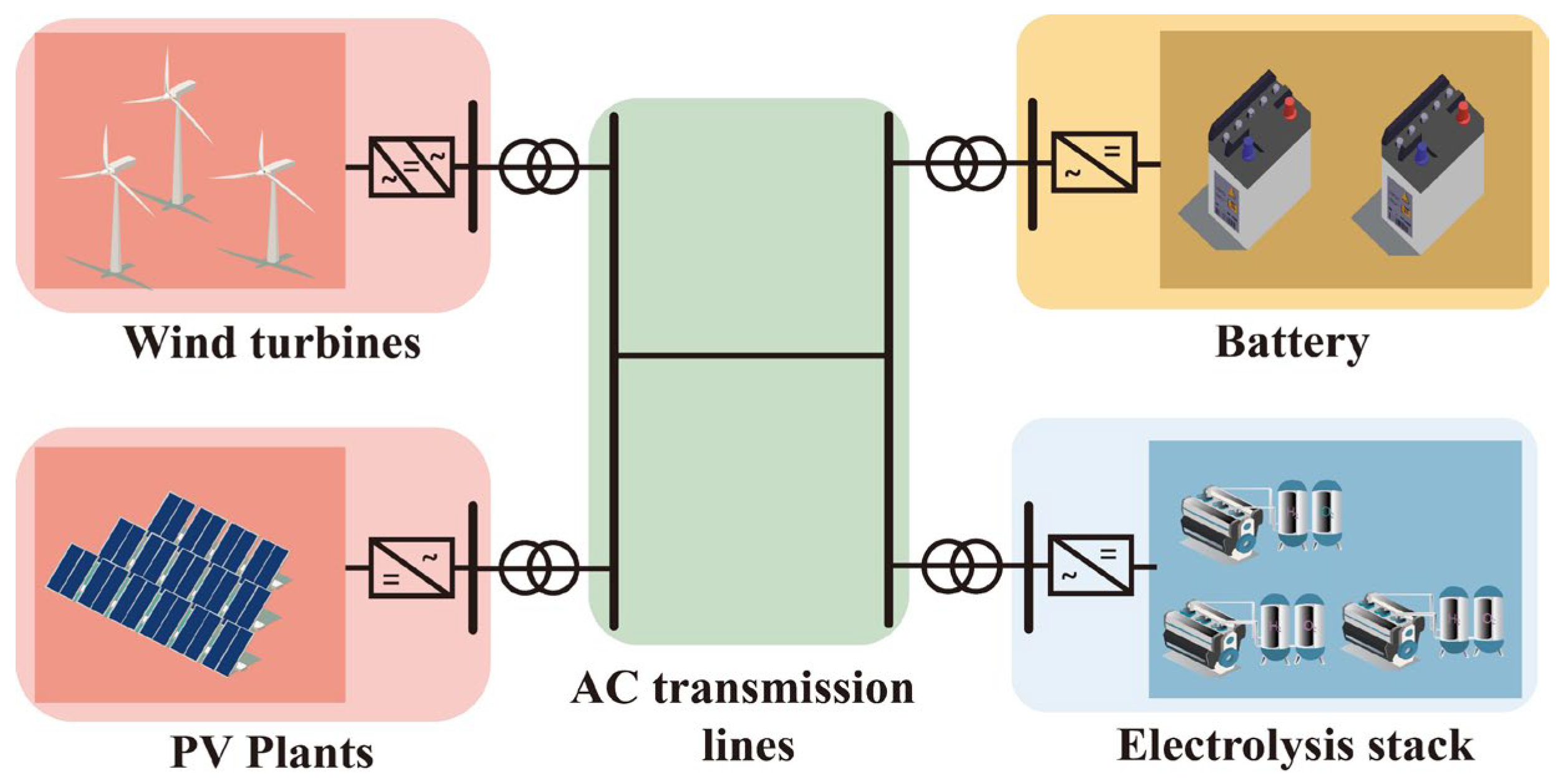
The BESS adjusts its voltage magnitude and frequency at the point of common coupling (PCC) based on deviations in its active and reactive power. During power imbalances, it rapidly absorbs or supplies power within its limits, providing the reference signals required for system-wide stability. The system structure is shown in Figure 2.
Despite its effectiveness, this centralized strategy has several limitations: (1) a single-point failure in the BESS can destabilize the entire system; (2) bidirectional energy transfer through the AC/DC converter increases losses; and (3) dedicated infrastructure adds engineering complexity, making deployment difficult in remote or constrained environments such as islands or high-altitude regions.

2.3. Solution Based on Grid-Forming Electrolyzers

Given the electrolyzer stack’s electrical double layer (EDL) effect, which enables fast energy buffers and load adjustments, recent work has investigated its potential to contribute to GFM services. Based on this idea, Dozein et al. [19] introduced the concept of a grid-forming electrolyzer by applying VSM control to the rectifier’s AC/DC converter.
Under this approach, the electrolyzer transitions from a passive GFL load to an active GFM unit. Through VSM control, the rectifier emulates synchronous machine dynamics to generate internal voltage and frequency references, enabling the electrolyzer to support system stability.
The VSM provides virtual inertia and damping. When a frequency deviation Δf occurs, the VSM provides a virtual inertia response by adjusting the active power consumption ΔPstack of the electrolysis stack. Detailed modeling analysis can be found in Section 3.2.
However, the support duration is inherently limited by the small energy stored in the EDL capacitance, restricting effective operation to only a few seconds. In addition, electrochemical constraints, including gas–liquid separation, liquid level control and lye/water circulation, limit both the regulation range and ramp rate, making fast, large-scale power modulation impractical [19].

2.4. Composite Multi-Source Coordinated Grid-Forming Strategy

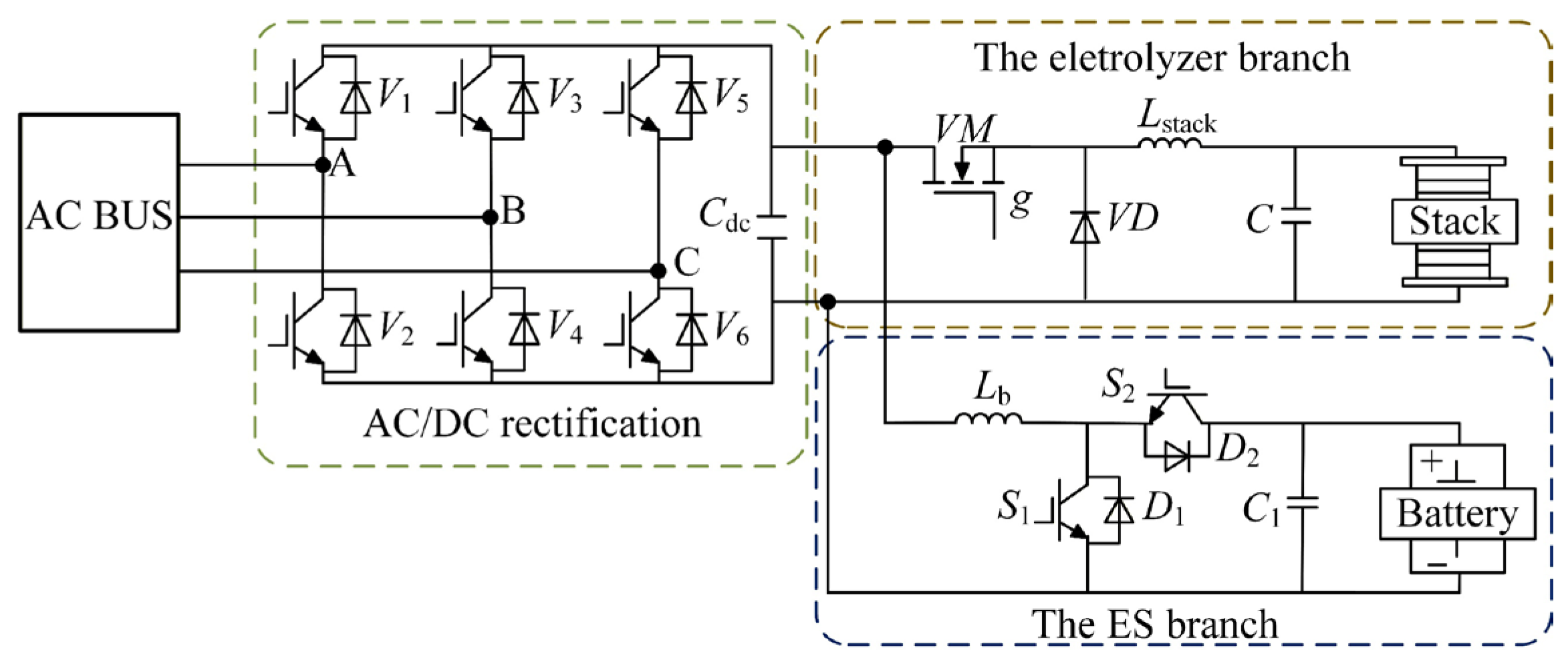
A third strategy places distributed batteries or supercapacitors on the DC bus of the electrolyzer rectifier to provide long-duration GFM support. This configuration includes three coordinated components inside the hydrogen electrolyzer: (1) an AC/DC control stage uses a VSM control framework, (2) an energy storage branch serves as the energy buffer, and (3) an electrolyzer branch that produces hydrogen. Through frequency-based power sharing, these elements coordinate across multiple timescales, enhancing both dynamic response and long-term stability. Detailed modeling appears in Section 3.
This approach enables sustained, stable hydrogen production, but practical deployment remains challenging. Key issues include selecting appropriate energy-storage technologies, sizing them relative to electrolyzer capacity and managing the added control complexity [39].
Each of the three GFM strategies offers distinct strengths and limitations. The following sections develop detailed models for each approach, followed by comparative analysis and verification.

3. Modeling and Optimization of GFM Capability in Off-Grid ReP2H Systems

3.1. Modeling of Centralized BESS Grid-Forming Control

In off-grid ReP2H systems, GFM control provides voltage support and virtual inertia by emulating the behavior of a synchronous generator. Among available methods, VSM control is widely adopted and is particularly suitable for BESS-based GFM operation.
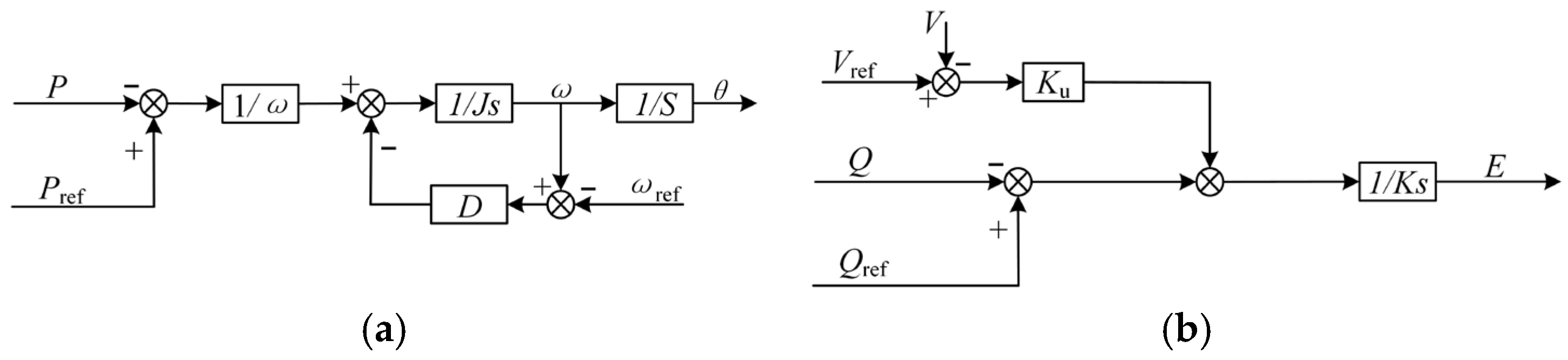
VSM control reproduces the rotor motion and excitation mechanisms of a synchronous generator. Active power-frequency control is governed by the virtual inertia J and damping coefficient D, while reactive power-voltage control regulates the output voltage through reactive power deviations. If the DC-side voltage is assumed to be constant, the VSM model is derived from the power balance relationship.
The active power loop simulates primary frequency regulation:
J d Δ ω d t = P ref P D Δ ω ,
where Δω is the angular frequency deviation, and Pref and P are the reference active power and the measured active power, respectively.
Equation (1) reflects the inertial response of the VSM. The virtual inertia J mitigates the frequency change by momentarily storing or releasing kinetic energy, while the damping coefficient D suppresses oscillations. The state-space form follows:
d d t Δ ω θ = D J 0 0 1 J Δ ω θ + 0 1 ( P ref P ) ,
where θ is the voltage phase angle, which is generated by integration and used for converter modulation.
Voltage support is achieved through reactive power droop control:
V = V ref + K q ( Q ref Q ) ,
where V and Vref are the output voltage and reference voltage, respectively; Kq is the reactive power droop coefficient; and Qref and Q are the reference reactive power and the measured value. This strategy enables the VSM to automatically adjust the voltage in response to load changes, mimicking the excitation control of a synchronous machine.
The overall architecture of the VSM control is shown in Figure 3, where the active power-frequency control simulates the mechanical equation and the reactive power-voltage control simulates the electromagnetic equation.
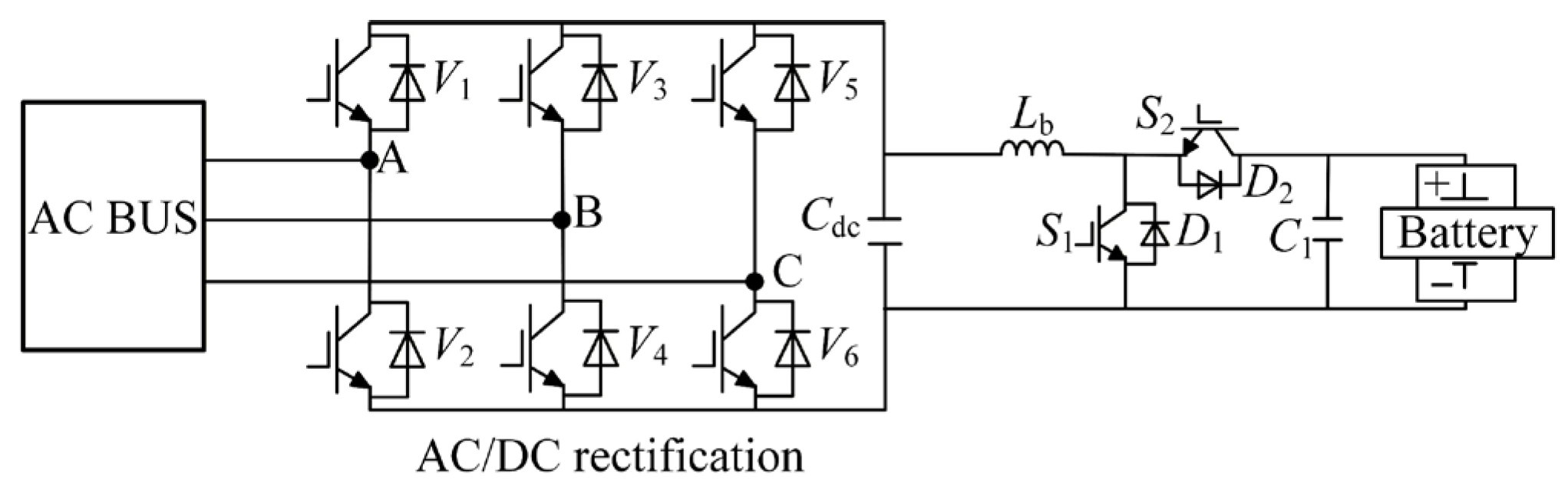
Centralized BESS-based GFM can be implemented on the grid-side converter and significantly improves system stability. Next, we model the ES-side power electronics. The ES branch uses a bidirectional DC/DC converter operating in Buck or Boost mode, as shown in Figure 4.
For charging (Buck mode):
V buck = D buck V dc   ( 0 < D buck < 1 ) ,
where Dbuck is the duty cycle of the Buch switch S2. The charging power is as follows:
P charge = V buck I buck = V dc 2 D buck 2 R charge ,
where Ibuck is the charging current, and Rcharge represents the equivalent resistance of the charging path.
For discharging (Boost mode):
V dc = V boost 1 D boost , ( 0 < D boost < 1 ) ,
where Dboost is the duty cycle of the Boost switch S1. The discharge power is as follows:
P discharge = V boost I boost = V dc 2 ( 1 D boost ) D boost R discharge ,
where Iboost is the discharge current, and Rdischarge represents the equivalent resistance of the discharge path. Rcharge and Rdischarge primarily consist of the parasitic resistance of the inductor (Rb, corresponding to Redg in Table 2) and the internal resistance of the battery pack.
The ES-side circuit dynamics are as follows:
L b d i b d t = D b V bat V dc i b R b C dc d V dc d t = i s i L _ b i b V dc R load ,
where Lb, Rb, ib, Vbat, is, IL_b and Rload denote the inductance, resistance, ES current, terminal voltage, bus current, inductor current and load resistance of the ES-side circuit, respectively.
The external voltage loop stabilizes the DC bus voltage Vdc and sets the BESS reference current Ibat_ref:
I bat _ ref = K p 1 V dc _ ref V dc + K i 1 V dc _ ref V dc d t ,
where Vdc_ref is the voltage reference; Kp1 and Ki1 are PI gains of the voltage loop of the ES-side circuit.
The internal current loop tracks the Ibat through duty cycle modulation as follows:
D b = K p 2 I bat _ ref V dc + K i 2 I bat _ ref i b d t ,
where Db is the duty cycle of the ES-side circuit; Kp2 and Ki2 are the current loop gains of the ES-side circuit, which are tuned to achieve a fast response while limiting the rate of transient change.

3.2. Modeling of Electrolyzer Grid-Forming Control

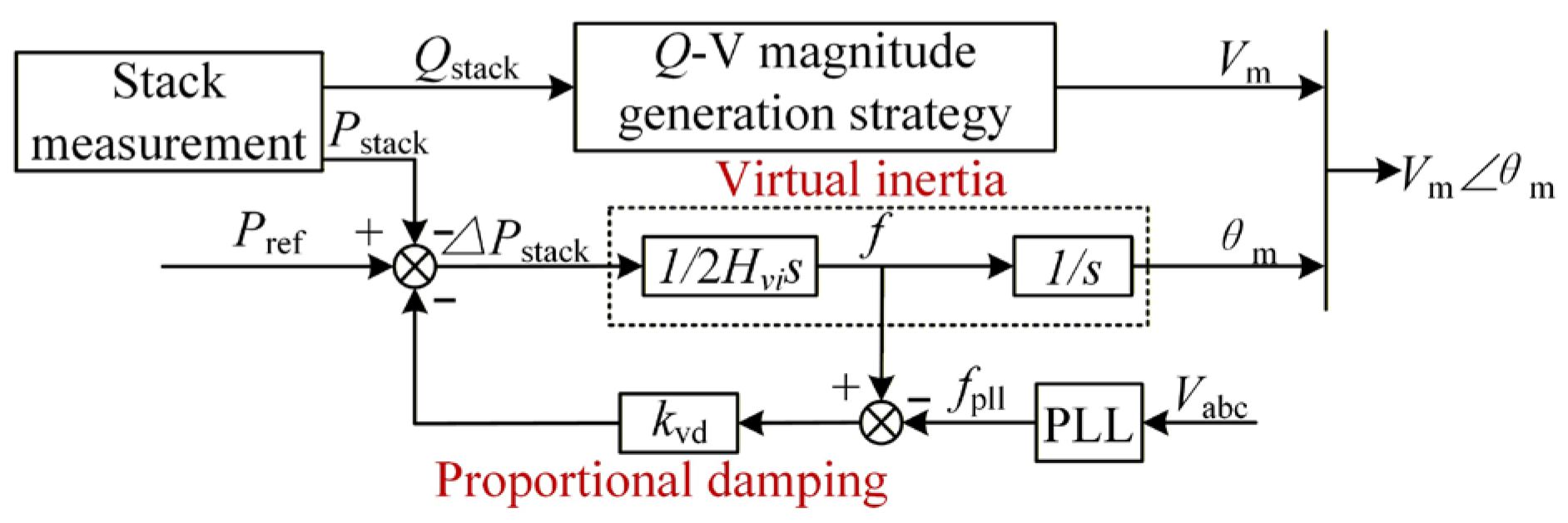
Electrolyzers can also provide GFM support by introducing virtual inertia at their power-electronic interface. The unified dynamic model proposed by Dozein et al. [19] applies to both AEL and PEMEL systems, accounting for nonlinear stack behavior and thermal dynamics, as shown in Figure 5.
The virtual inertia response is described by a second-order transfer function:
G v i ( s ) = Δ θ m Δ P stack = 2 H v i s 2 ,
where Hvi is the virtual inertia coefficient. This component simulates rotor motion of the synchronous generator, but since its inherent damping is zero, it may lead to frequency oscillations.
To suppress these oscillations, a proportional damping term kvd, is introduced. The output of the damping loop is proportional to the frequency deviation Δω:
Δ θ d = k vd Δ ω ,
Δ ω = 2 π Δ f ,
where Δf is the frequency deviation.
Combining the virtual inertia loop and the damping loop yields the phase reference:
θ m = 2 H v i s Δ P stack + k v d Δ ω d t ,
where the internal voltage magnitude Vm is adjusted according to the reactive power control loop.
The grid-side converter employs cascaded dq-axis current control to ensure terminal voltage tracking. The current controller parameters are designed based on the closed-loop transfer function to satisfy response time requirements.
In response to DC-link energy imbalance caused by AC/DC adjustments, the DC-DC converter of the electrolyzer utilizes cascaded voltage-current control, where the PI controller is tuned based on the electrolyzer’s parameters.
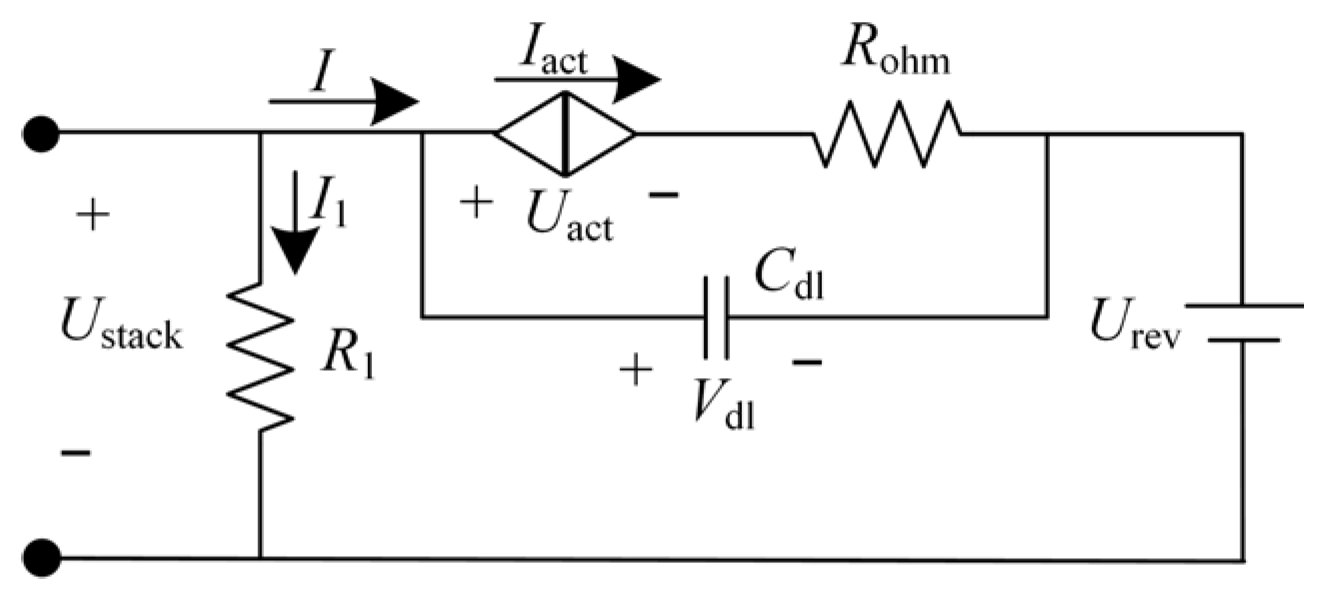
The electrolysis stack is modeled by the equivalent circuit in Figure 6. The total voltage of the stack is the sum of three components: the activation overpotential, the ohmic overpotential and the foundational reversible overvoltage Urev [32]. Urev is determined by the Gibbs free energy change associated with the water-splitting reaction:
U rev = Δ G 2 F + R T 2 F ln p H 2 p O 2 a H 2 O ,
where pH2 and pO2 are the partial pressures of hydrogen and oxygen; R is the gas constant; aH2O is the activity of water; T is the stack temperature; and F is the Faraday constant.
The activation overpotential Uact models the voltage loss associated with the electrochemical reaction’s potential barrier and is commonly approximated by the following modified Tafel equation:
U act = ν 1 ln I S ν 2 + 1 ,
where v1 and v2 are temperature-dependent parameters; S is the effective electrode area; and I is the electrolysis current.
The ohmic overvoltage Uohm represents the voltage drop across the internal resistance, and it is expressed as follows:
U ohm = I · R ohm ,
Summing up the above, the total electrolysis voltage Ustack is given by:
U stack = U rev + U act + U ohm .
Beyond the steady-state voltage components, the dynamic behavior is dominated by the EDL effect, which arises from charge accumulation at the electrode–electrolyte interface [19,32]. The resulting capacitance Cdl exhibits the following dynamic characteristics:
C dl d U dl d t = I I act ,
I act = U act R act ,
R act = d U act d I ,
where Iact is the current flowing through the activation resistance, and Ract represents its dynamically linearized value.
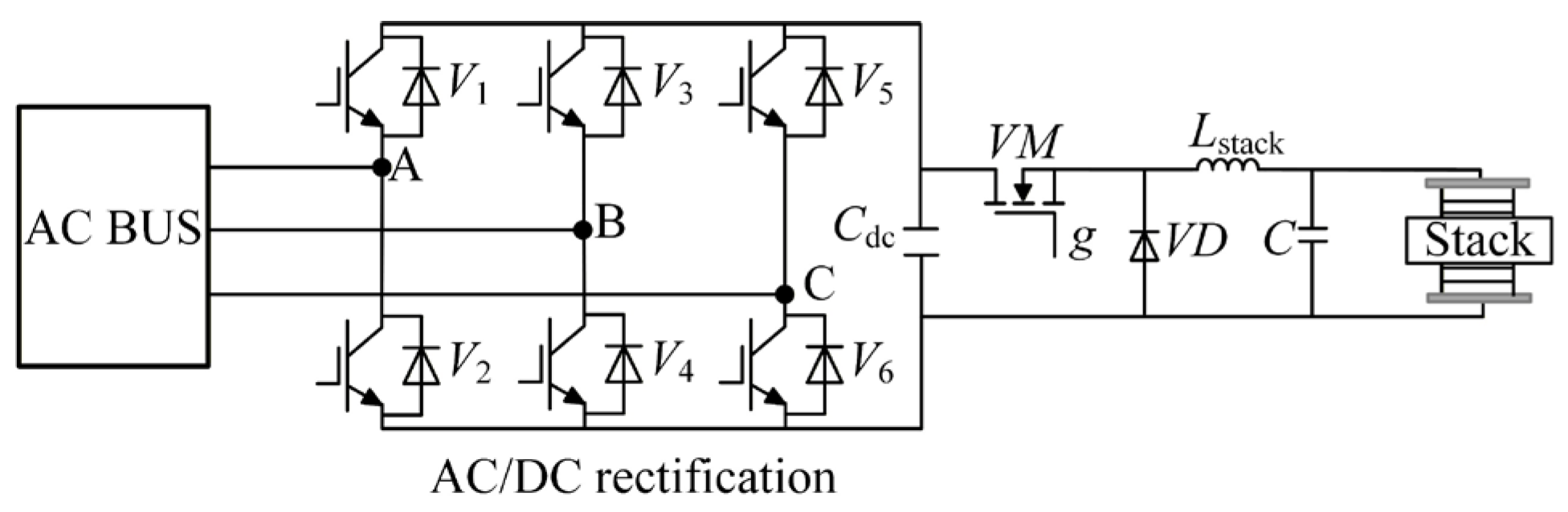
The circuit of the electrolyzer branch is composed of a buck circuit and an electrolysis stack, as shown in Figure 7.
The electrolysis power is regulated by the duty cycle Dstack of the DC/DC converter, as follows:
L d i L _ stack d t = D stack V dc V stack i L _ stack R L _ stack C d V stack d t = i L _ stack I stack = i L _ stack V stack R act ,
where iL_stack and Istack are the inductor current and stack current, respectively; Lstack is the inductor; RL_stack is the parasitic resistance of the inductor; and C is the output capacitance.
To compensate for the significant response latency introduced by the EDL effect, which can be as long as tens of seconds [19], a dual-loop control is implemented. The outer loop calculates stack current reference Iref based on the power reference Pref_stack as follows:
I ref _ stack = P ref _ stack / U stack ,
Following (23), the converter in the electrolyzer branch regulates the outer power loop and the inner current loop. The power loop tracks the power demand PL:
I ref _ stack = P L V stack + K p P L V stack i L _ stack + K i P L V stack i L _ stack d t ,
where Kp and Ki are the PI gains of the power loop.
The inner loop uses PI control to track Iref_stack, generating the duty cycle Dref:
D ref = K p 3 I ref _ stack I stack + K i 3 I ref _ stack I stack d t ,
where Kp3 and Ki3 are the PI gains of the inner current loop, respectively.
To actively release the EDL energy for fast active power support, the duty cycle Dref can be rapidly increased to boost the stack inductor current iL_stack, thereby discharging the EDL capacitance and providing a quick power boost.
To suppress high-frequency disturbances in the EDL voltage Vdl and reduce electrode stress, a feedforward term is added through the linearization of the inductor equation:
L d i L _ stack d t V dc Δ D Δ V stack ,
Δ D = K ff d V dl d t ,
Combining this with (26), we observe that VstackVdl at high frequencies. Therefore, the feedforward gain is as follows:
K ff = L stack V dc .
Therefore, the corrected duty cycle output is expressed as follows:
D = D ref + Δ D .
However, electrolyzer-based GFM is inherently energy limited due to finite EDL storage and slow electrochemical response, especially in AEL systems. This limitation leads to the idea of a mixed configuration, as presented in Section 3.3.

3.3. Modeling of Composite Multi-Source Coordinated Grid-Forming Control

In the composite strategy, the BESS, electrolyzer and AC/DC converter jointly form the grid as shown in Figure 8. The BESS is connected directly to the electrolyzer DC bus and a modified VSM control framework enables self-synchronization through DC bus capacitance.
The ES and stack models follow Section 3.1 and Section 3.2. Here, we focus on the AC/DC link. Following [40], DC bus voltage dynamics provide virtual inertia:
C dc d V dc d t = I dc I bat ,
where Cdc is the DC bus capacitance; Vdc is the DC bus voltage; Idc is the current injected by the AC/DC converter; and Ibat is the ES current. By controlling Idc, the following rotor dynamics can be simulated:
J d ω d t = T m T e D ω .
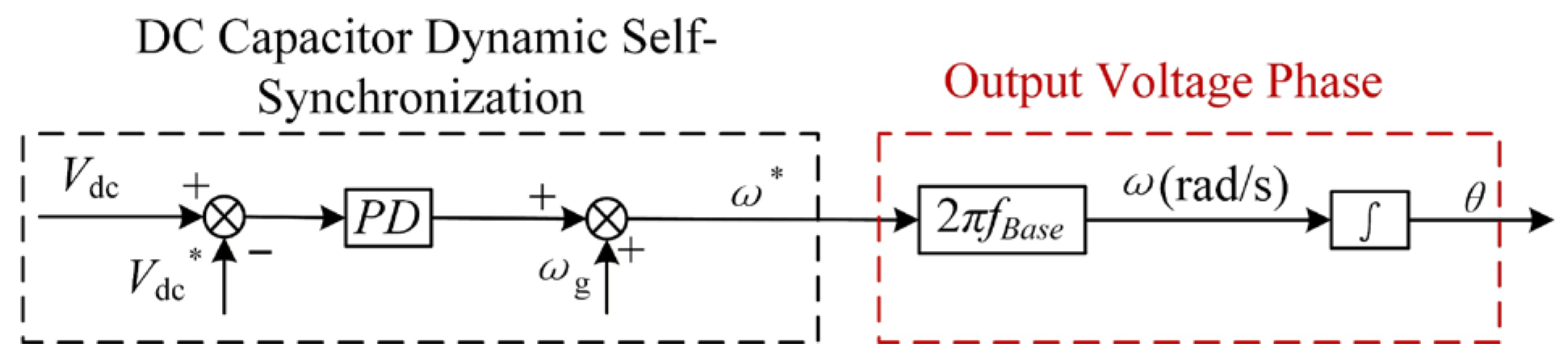
When the system frequency undergoes a sudden change, the DC bus capacitance Cdc instantaneously regulates the DC bus voltage Vdc according to (30). The VSM converts the DC voltage deviation Δ Vdc into a frequency regulation signal ω* by simulating the generator rotor dynamics, as follows:
ω * = ω 0 + K J Δ V dc d t + K D Δ V dc ,
where KJ is the virtual inertia coefficient; KD is the virtual damping coefficient; and ω0 is the rated angular frequency.
The AC/DC control based on DC bus capacitance dynamics is realized within the GFM control strategy module shown in Figure 9.
In this module, the active power reference is adjusted according to the DC voltage deviation, thereby implementing the power–voltage droop characteristic:
P ref = P 0 + K droop V dc * V dc ,
where P0 is the initial set point, specified by the higher-level Energy Management System (EMS); Kdroop is the droop coefficient; and Vdc* and Vdc are the rated and actual DC bus voltages of the composite multi-source coordinated GFM circuit.
Subsequently, the frequency regulation signal is derived via dynamic capacitance feedback:
Δ ω = 1 K J s + K D ( P ref P e ) ,
where Pe is the rated power.
The phase angle θ is obtained by integration. This, combined with the voltage reference from the reactive power loop, enables precise AC/DC converter modulation for autonomous GFM control.
While this strategy enables longer-term support by coordinating multiple sources, practical deployment requires further refinement of the coordination controller design and capacity allocation.

3.4. Optimal Sizing Principles and Feasibility Constraints

Capacity optimization aims to balance economy, stability and operational continuity while maintaining voltage and frequency within limits at all times. These principles serve as a theoretical basis for the capacity ratio analysis in Section 4.3.
The levelized cost of hydrogen (LCOH) serves as the main economic objective:
LCOH = C init + C O & M fixed + C O & M var i M H 2 ,
where Cinit is the annualized investment cost; CO&M is the operation and maintenance cost; and MH2 is the annual hydrogen yield.
The annualized investment cost Cinit is calculated using the Capital Recovery Factor (CRF) [9]:
C init = j Ω C R F ( r , T j ) S j c j unit ,
C R F ( r , T j ) = r ( 1 + r ) T j ( 1 + r ) T j 1
where Ω = {PV, electrolyzer, BESS}, j is the capacity; c j u n i t is the unit capital cost; Tj is the lifetime (set to 20 years for the project); and r is the discount rate, set at 8%.
The O&M costs consist of fixed and variable components. The fixed annual O&M cost is estimated as a percentage of the initial investment:
C O & M fixed = j Ω λ j S j c j unit
where λ j is the O&M ratio (set at 2%). The variable cost primarily accounts for BESS replacement due to degradation:
C O & M vari = k = 1 K rep S BESS c BESS rep ( 1 + r ) k T life / ( K rep + 1 )
where c B E S S r e p is the replacement cost, and Krep is the number of replacements derived from the battery degradation model.
Finally, according to the empirical data, the unit prices of PV, electrolyzer and BESS are set as 4000 CNY/kW, 3500 CNY/kW and 1500 CNY/kWh.
The optimal ES size is primarily evaluated via the ES capacity ratio, defined as the ratio of the rated capacity of the ES to the total system power capacity. Minimizing this ratio while maintaining stability is the immediate goal of the optimization:
ρ BESS = S BESS P total × 100 % ,
where SBESS is the ES capacity, and Ptotal is the total system power.
In addition, three constraints must be satisfied: (1) GFM ability; (2) continuous operation capability under emergency; and (3) long-term energy balance. Verification of these three constraints is based on maintaining voltage and frequency stability at the PCC. Instantaneous stability is enforced by voltage and frequency limits at the PCC:
f min PCC f Δ t sim PCC f max PCC V min PCC V Δ t sim PCC V max PCC ,
where f m i n P C C and f m a x P C C are minimum and maximum frequency deviation at the PCC, and V m i n P C C and V m a x P C C are minimum and maximum voltage deviation at the PCC.
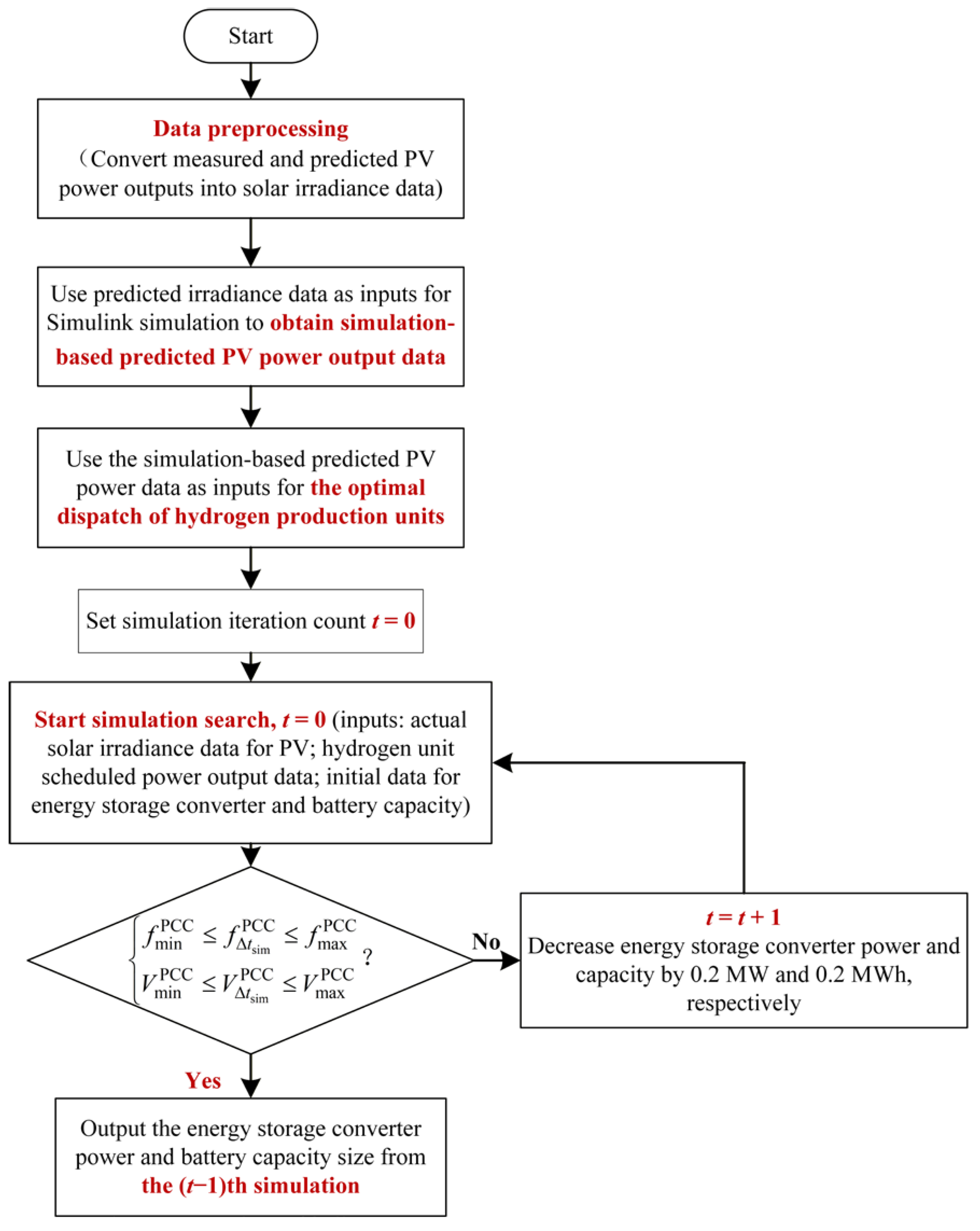
A simulation-based iterative sizing algorithm determined the optimal capacity ratios in Table 3. Unlike weighted multi-objective optimization, this approach treats system stability as a hard constraint. The process minimizes ES capacity subject to the voltage and frequency limits in Equation (41), as illustrated in Figure 10.
Figure 10 illustrates the descent search logic, which initializes with a large ES capacity to ensure stability. Capacity is iteratively reduced by 0.2 MW and 0.2 MWh while simulations monitor for voltage or frequency collapse under worst-case fluctuations. The process terminates when constraints are violated, selecting the previous iteration as the minimum viable size. This approach identifies the most economical solution that strictly satisfies safety margins.
The resulting capacity ratios offer a feasible baseline but may not be globally optimal. Further refinement of optimization algorithms remains an important direction for future work. Capacity results for the three GFM strategies are analyzed in Section 4.3.

4. Comparative Verification Analysis and Optimized Sizing of GFM Strategies

This section compares the three GFM strategies introduced earlier using simulation experiments and evaluates the optimal capacity ratio between the ES unit and the hydrogen electrolyzers. The case study setup is described below.

4.1. Simulation Setup and Verification Platform

To assess system performance under each GFM strategy, a 5 MW off-grid HE unit is directly coupled with a 5 MW grid-following PV unit. The 5 MW capacity represents a standard industrial electrolysis block. Large-scale systems typically aggregate these units in parallel through a modular design. As the proposed GFM strategies rely on local terminal measurements rather than high-speed central communication, they inherently support such modular scalability. The component models are obtained from [9]. Key parameters are listed in Table 2.
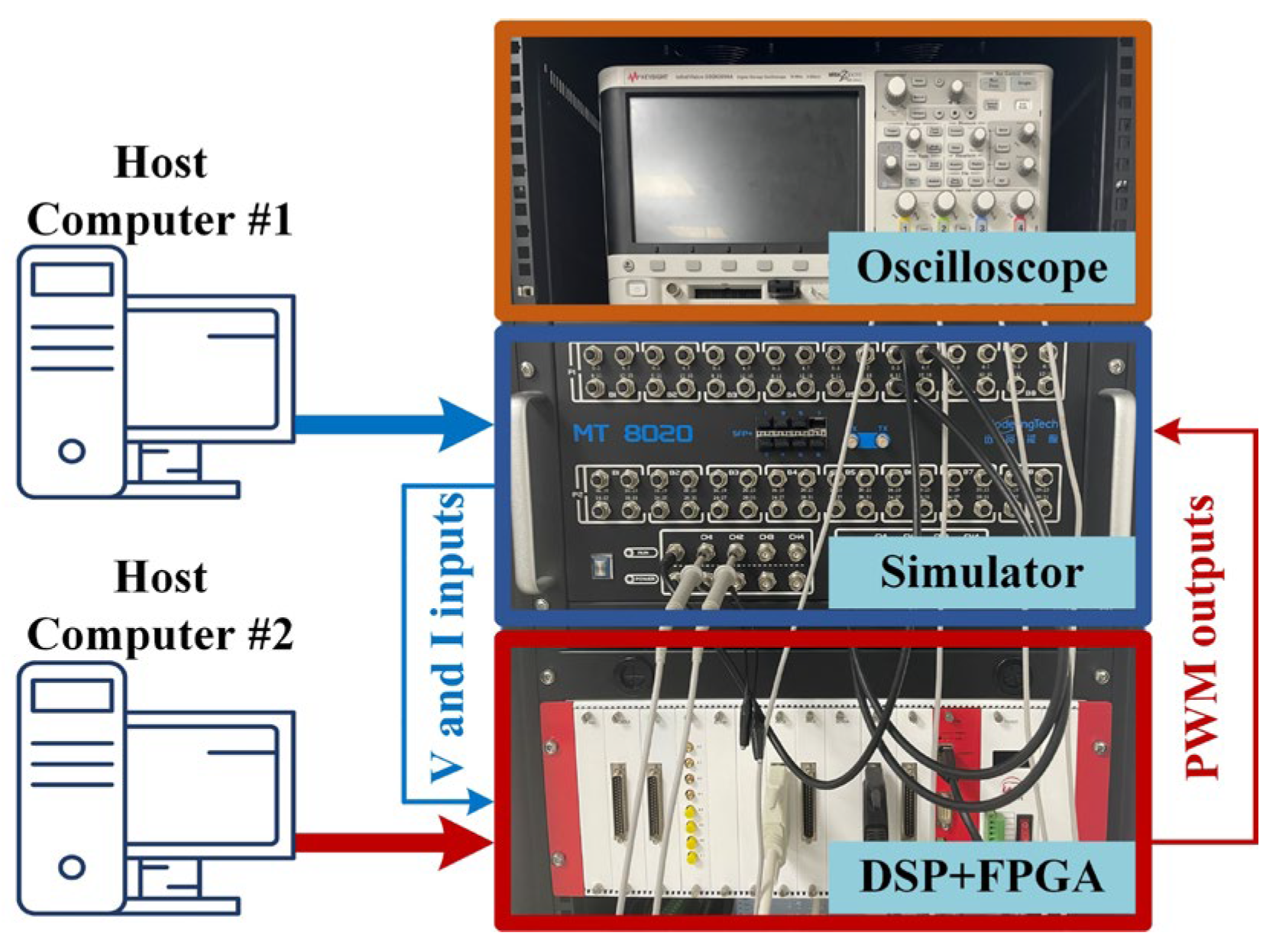
Verification is carried out on the HIL testbed shown in Figure 11. The plant model runs on an MT8020 real-time simulator (StarSim platform, manufactured by Shanghai Modeling Tech Energy Technology Co., Ltd., Shanghai, China) with a 1 μs time step. Control algorithms are executed on a TMS320C28346 DSP at 10 kHz, and a Xilinx XC6SLX16 FPGA (both supplied by Nanjing Ruidu Youte Information Technology Co., Ltd., Nanjing, China) performs PWM generation and IGBT gating. Dynamic responses of the three strategies are evaluated under multiple scenarios, including different levels of power fluctuation and emergencies such as ES branch disconnection, with focus on V/F stability, response speed and reliability.

Electrolyzer Materials and Specifications

To ensure reproducibility, simulation parameters derive from a standard commercial atmospheric AEL. The anodes employ nickel-plated steel or nickel-cobalt spinel coatings to withstand the oxygen evolution reaction, while the cathodes utilize Raney nickel or activated nickel-molybdenum alloys to enhance hydrogen evolution reaction kinetics. A Zirfon composite or polyphenylene sulfide fabric models the separator, preventing gas crossover while enabling hydroxide ion conductivity.
The system operates with a 30 wt% potassium hydroxide solution at 70 to 80 °C. These material characteristics directly determine the activation and ohmic overpotential parameters listed in Table 2.

4.2. Comparative Performance of the GFM Strategies

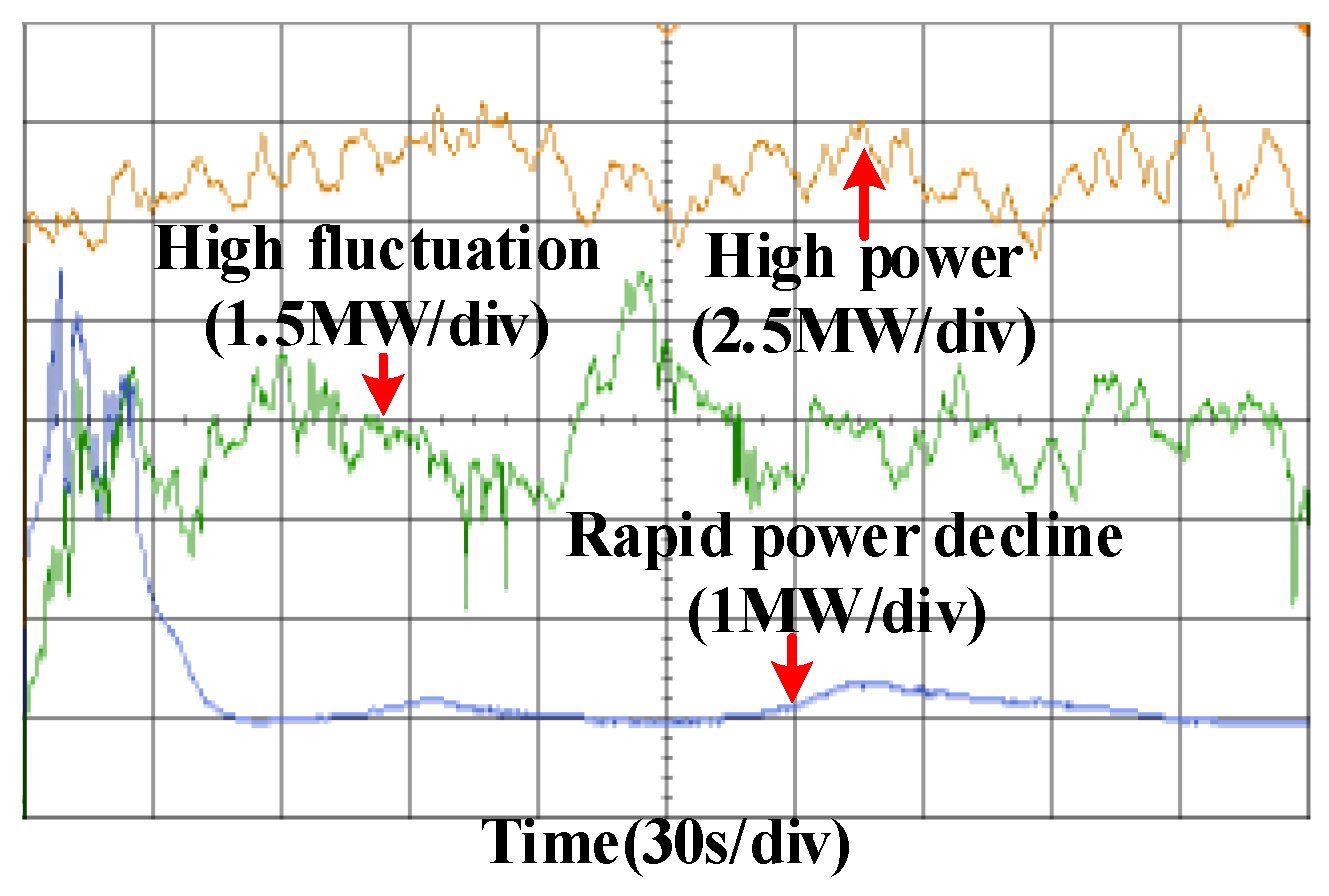
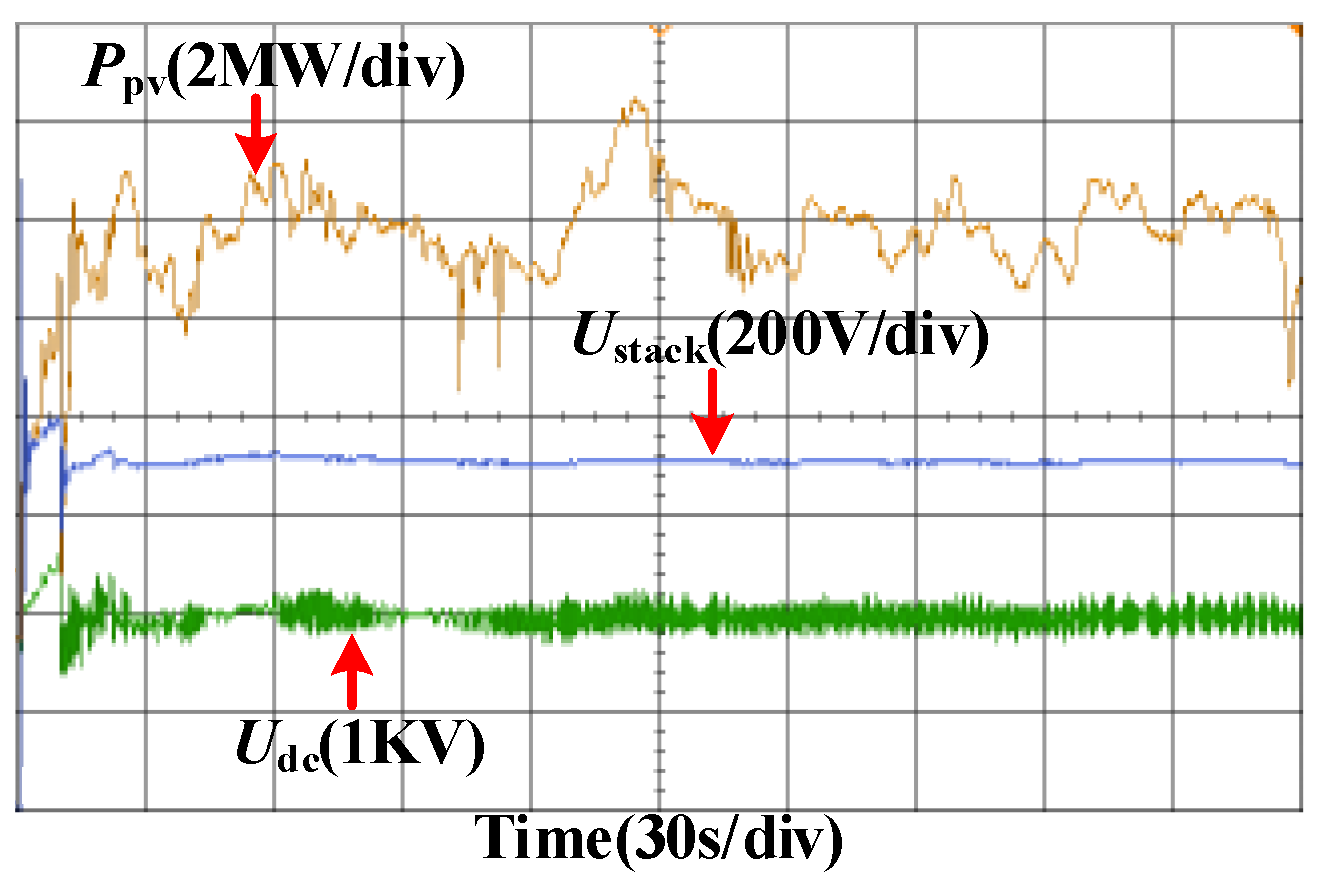
To comprehensively test the dynamic performance of the three GFM strategies under realistic conditions, a representative renewable energy output scenario, shown in Figure 12, is used as the primary output of the PV unit, which operates in GFL control. Babay et al. [16] analyzed nine years of meteorological data to highlight the impact of seasonal fluctuations. Since the upper-level energy management system typically manages these long-term variations via power setpoints, this study focuses on millisecond to second dynamic stability. The scenarios include periods of high fluctuation, rapid power decline and high power scenarios, allowing for a thorough assessment of each strategy’s ability to maintain system stability.

4.2.1. Centralized BESS-Based GFM Solution

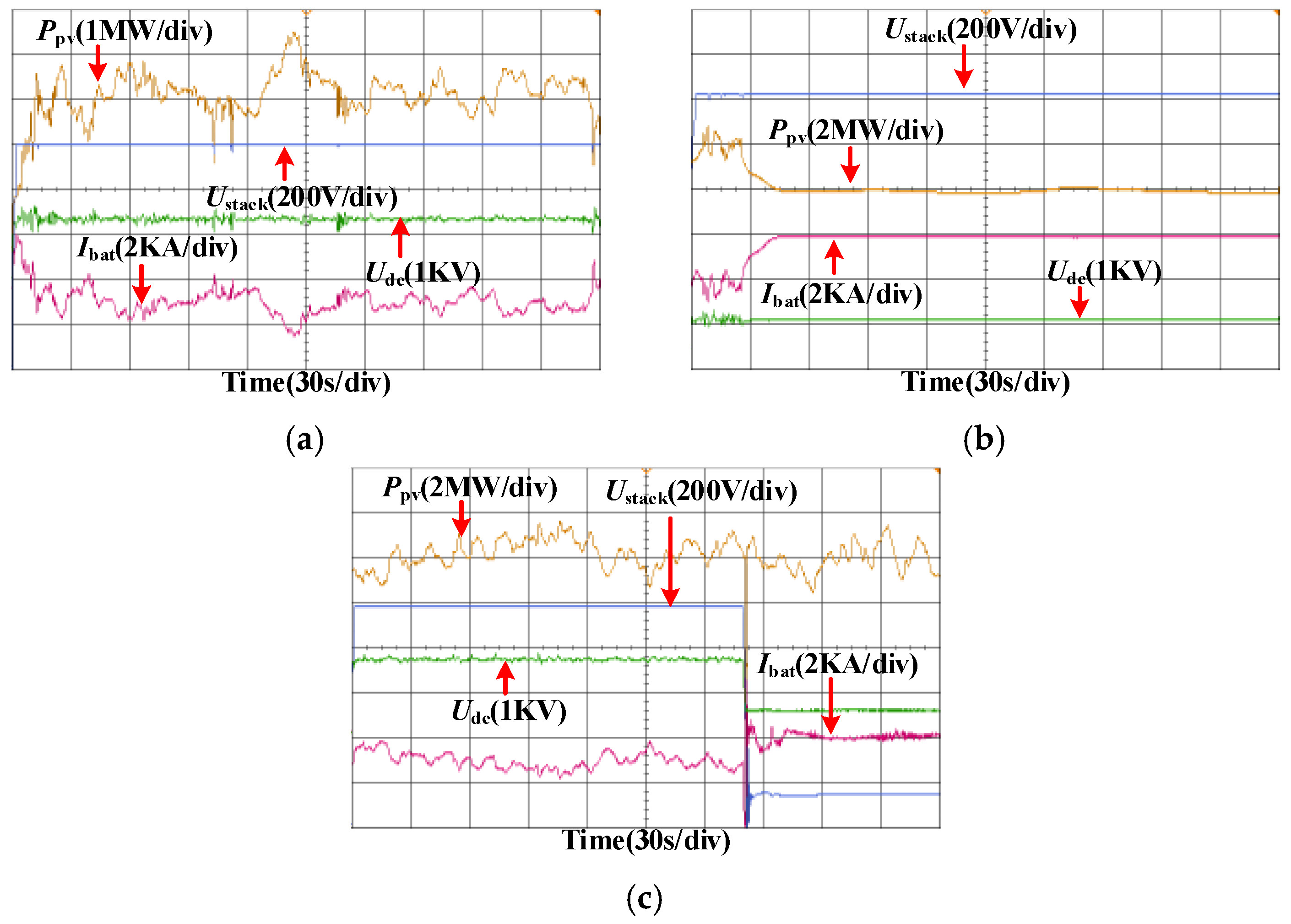
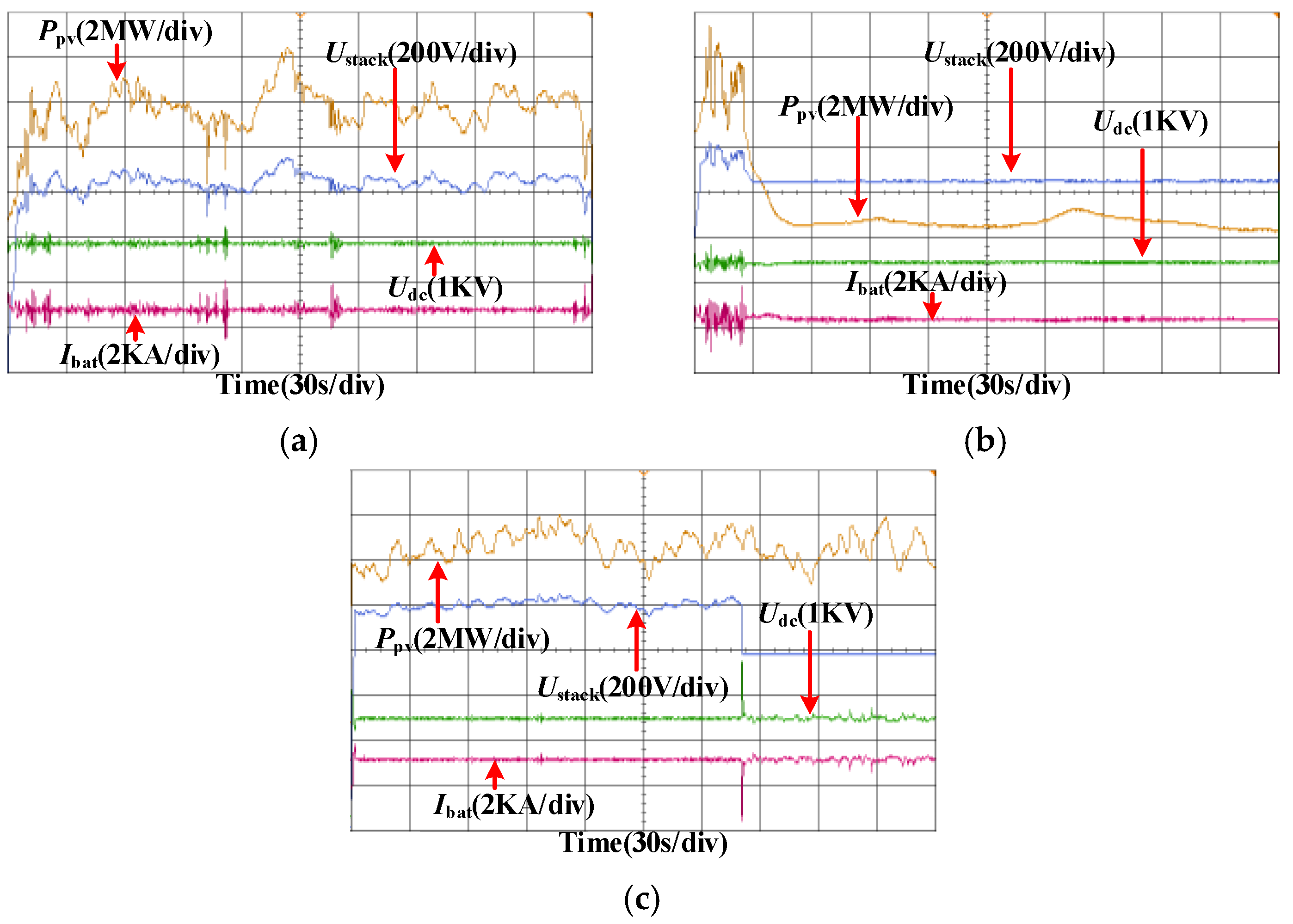
The BESS-based VSM control is evaluated. Figure 13a,b shows that under fluctuating and rapidly declining PV output, the centralized BESS can quickly adjust its power to maintain the DC bus voltage within a narrow range. The stack voltage also remains stable, ensuring uninterrupted electrolysis. These results confirm that the BESS provides effective virtual inertia and damping against power imbalance.
However, Figure 13c reveals a key drawback. When the ES branch is lost, the system immediately loses its only V/F support source, causing large DC bus oscillations and eventual system collapse. This validates the single-point failure risk of centralized BESS-only GFM control noted in Section 2.2.

4.2.2. GFM Electrolyzer-Based Solution

Figure 14 shows the response of the ReP2H system when the electrolyzer provides GFM support. The VSM-controlled stack delivers a fast virtual inertia response by adjusting its power consumption ΔPHE during the initial disturbance, helping suppress the rate of frequency change.
However, both the stack voltage Vstack and DC bus voltage Vdc exhibit persistent and considerable fluctuations. The limited energy stored in the EDL capacitors allows support only for a few seconds, after which the system becomes unable to handle sustained disturbances. In addition, the stack’s chemical nature restricts the speed and range of power regulation. As a result, the electrolyzer alone cannot reliably provide full GFM capability.

4.2.3. Composite Multi-Source Coordinated GFM Solution

Figure 15a,b demonstrates that the composite strategy maintains stable DC bus and stack voltages across both fluctuating and rapidly declining PV scenarios. Oscillations remain small because the BESS, electrolyzer and DC bus capacitor jointly participate in regulation.
To ensure stability with 16% BESS capacity, the control response time must satisfy the theoretical limit dictated by DC link dynamics. The critical time τlimit for preventing voltage collapse during a maximum power step ΔPmax is determined by the DC capacitance Cdc and the minimum allowable DC voltage Vmin:
τ limit C dc ( V nom 2 V min 2 ) 2 Δ P max .
Assuming a worst-case 5 MW power step, a 10% voltage drop tolerance and system parameters of Cdc = 50 mF and Vnom = 1000 V, the calculated limit τlimit is approximately 1.9 ms. Since the proposed control system operates at 10 kHz (0.1 ms time step), significantly faster than this physical limit (0.1 ms   1.9 ms), it theoretically guarantees stability against rapid fluctuations.
This coordinated response also reduces the frequency of large electrolyzer adjustments, benefiting the lifetime.
Moreover, in the ES branch disconnection scenario shown in Figure 15c, the system remains operational. Although some voltage oscillations occur, the DC bus quickly settles to a new stable point. The converter’s self-synchronization mechanism and the electrolyzer branch provide additional V/F support, eliminating single points of failure and improving overall system reliability.
Furthermore, system stability relies on the DC bus capacitance Cdc to provide virtual inertia, as modeled in Equations (30)–(32). Sensitivity analysis indicates that Cdc is critical for limiting the initial rate of change in frequency during transients; values below 20 mF risk voltage collapse before control loops engage, whereas 50 mF offers a sufficient inertial buffer. Notably, while increasing Cdc enhances transient support and reduces dynamic stress on the BESS, it cannot replace the BESS capacity SBESS, which is dictated by the long-term energy balance required for frequency stability.

4.3. Optimal ES–HE Capacity Ratio

The ES-to-HE capacity ratio strongly affects economic performance and operational stability. Using the criteria in Section 3.4, the LCOH and life-cycle cost (LCC) for each strategy are summarized in Table 3. Table 4 presents the sensitivity analysis of the stability metrics across the three strategies near their critical thresholds.

4.3.1. ES Capacity Requirements

According to Figure 13, Table 3 and Table 4, the ES capacity must cover extreme power fluctuations and N-1 emergency scenarios. Simulation results show that the centralized BESS strategy requires a minimum 36% capacity ratio to maintain frequency stability. For the GFM electrolyzer, limited electrical double layer energy necessitates 20% supplemental capacity to prevent voltage collapse, despite the virtual inertia provided by VSM control. In contrast, the composite strategy maintains frequency limits with only 16% capacity. Since exceeding these thresholds increases costs without strict necessity, the values in Table 3 represent the optimal minimum required to satisfy hard stability constraints.
For the GFM electrolyzer strategy, the short support duration of the EDL leads to relatively large V/F deviations, as shown in Table 3. Maintaining stable operation, therefore, requires additional ES support, commonly from supercapacitors or other fast-response devices [8,29]. The required ES proportion is estimated at 20%.
Table 3 shows that the composite strategy achieves tighter V/F control and, because of coordinated energy sharing, requires the smallest ES proportion at 16%. However, the composite strategy involves multiple conversion stages and requires higher ratings for the grid-forming interface. Specifically, the main converter must handle the full electrolyzer power flow to provide support, necessitating a 100% peak rating of 5 MW. In contrast, the centralized BESS approach limits grid-forming operation to the battery converter (rated at 36% or 1.8 MW) and utilizes a standard grid-following rectifier for the electrolyzer. This requirement for higher capacity converters increases hardware investment for the composite strategy.

4.3.2. LCOH and Life-Cycle Cost Analysis

For the centralized GFM BESS strategy, the LCOH is 33.212 CNY/kg. The ES degradation is evaluated using a semi-empirical model that integrates calendar and cycle aging, with the latter being significantly influenced by depth of discharge and discharge rates. Based on the simulation, the ES degradation rate is about 4.87% annually [9]. Considering an end-of-life criterion of 20% capacity fade, the effective battery lifespan is approximately 4.1 years. Therefore, with five replacement cycles over the 20-year line span of the ReP2H project, total LCC increases by roughly 0.6 million CNY.
The GFM electrolyzer strategy lowers LCOH because it does not rely on a dedicated BESS. In practice, however, supplemental ES, such as supercapacitors, is typically added to enhance stability and compensate for limited EDL capacitance and its energy buffering ability [22]. The resulting LCOH is 29.750 CNY/kg.
The composite coordinated strategy yields the lowest LCOH at 25.458 CNY/kg by optimizing ES-HE capacity allocation [9,33], as shown in Table 3. Nonetheless, variations in ES device selection across studies make long-term replacement rates uncertain, and the more complex control requires higher inverter capacity, raising equipment costs.
Reliability improvements provide significant economic value as quantified by the expected energy not supplied (EENS) metric. A BESS converter fault in the centralized strategy causes a complete shutdown and incurs additional costs, as shown in Figure 13c. Conversely, the composite strategy maintains operation during such faults (Figure 15c), effectively reducing the EENS to zero. Since Table 3 demonstrates that the composite strategy yields the lowest LCOH at 25.458 CNY/kg, the avoided EENS costs further solidify its economic superiority over the centralized approach despite the higher converter power rating.
Overall, each strategy presents specific benefits and limitations. The selection and optimization of the ES-HE capacity ratio remain open research challenges, particularly for achieving balanced performance across stability, reliability and economic metrics.
Furthermore, practical deployment must account for component degradation, such as increased internal ohmic resistance in electrolyzers. The proposed PI controllers within the current and voltage loops provide robustness against these uncertainties, ensuring stability as components age.

5. Conclusions

This study examined three GFM strategies for off-grid renewable ReP2H systems, including the following: (1) centralized GFM BESS-based GFM control, (2) GFM electrolyzer-based approach, and (3) a composite multi-source coordinated GFM approach. Detailed models and hardware-in-the-loop simulations were used to quantify their stability performance, required ES capacity and economic impacts. The key findings are as follows:
  • The centralized GFM BESS-based approach is straightforward to deploy and commonly used in practice but is vulnerable to single-point failures. Simulations show that it maintains voltage-frequency stability as summarized in Table 3 but requires the largest ES capacity among the three strategies, resulting in an LCOH of 33.212 CNY/kg.
  • The GFM electrolyzer-based approach, i.e., using the electrolyzer and VSM dynamics alone for V/F control, simplifies system architecture and reduces ES needs. However, its stability margin is insufficient for sustained hydrogen production and maintaining production efficiency under long-term fluctuations remains an open challenge.
  • The composite multi-source coordinated GFM solution provides strong V/F support and robustness while reducing ES capacity and lowering the LCOH to 25.458 CNY/kg. Its drawback lies in the higher complexity of coordinated control and the increased converter capacity required, which partially offsets its economic advantage.
Overall, the results indicate that composite-coordinated GFM offers the most balanced path for stable and economical off-grid hydrogen production. Future work should focus on optimizing the capacity allocation between ES and electrolyzer units and further improving coordinated multi-source GFM control to reduce converter requirements and overall system cost.

Author Contributions

Conceptualization, N.Z., L.Z. and Y.Z.; methodology, N.Z., L.Z. and Y.Z.; software, N.Z., L.Z. and Y.Z.; validation, N.Z., L.Z., Y.Z. and Y.Q.; resources, S.C.; data curation, L.Z.; writing—original draft preparation, N.Z., L.Z. and Y.Q.; writing—review and editing, Y.Z. and S.C.; project administration, S.C. All authors have read and agreed to the published version of the manuscript.

Funding

Financial support from the Natural Science Foundation of Ningxia Autonomous Region (2024AAC02085) is gratefully acknowledged.

Data Availability Statement

The original contributions presented in this study are included in the article. Further inquiries can be directed to the corresponding author.

Conflicts of Interest

Authors Lei Zhou and Ningbo Zhang was employed by the Electric Power Research Institute of State Grid Ningxia Electric Power Co., Ltd. The remaining authors declare that the research was conducted in the absence of any commercial or financial relationships that could be construed as a potential conflict of interest.

Abbreviations

The following abbreviations are used in this manuscript:
ReP2HRenewable Energy-to-Hydrogen
BESSBattery Energy Storage System
EDLElectrical Double Layer
HILHardware-in-the-Loop
LCOHLevelized Cost of Hydrogen
LCCLife-cycle Cost
CRFCapital Recovery Factor
EENSExpected Energy not Supplied
GFMGrid-Forming
GFLGrid-Following
V/FVoltage/Frequency
PCCPoint of Common Coupling
VSMVirtual Synchronous Machine
PVPhotovoltaic
HEHydrogen Electrolyzer
AELAlkaline Electrolyzer
PEMELProton Exchange Membrane Electrolyzer
ESEnergy Storage

References

  1. Blaabjerg, F.; Chen, Z.; Kjaer, S. Power electronics as efficient interface in dispersed power generation systems. IEEE Trans. Power Electron. 2004, 19, 1184–1194. [Google Scholar] [CrossRef]
  2. Chu, S.; Cui, Y.; Liu, N. The path towards sustainable energy. Nat. Mater. 2016, 16, 16–22. [Google Scholar] [CrossRef] [PubMed]
  3. Jeje, S.O.; Marazani, T.; Obiko, J.O.; Shongwe, M.B. Advancing the Hydrogen Production Economy: A Comprehensive Review of Technologies, Sustainability, and Future Prospects. Int. J. Hydrogen Energy 2024, 78, 642–661. [Google Scholar] [CrossRef]
  4. Koponen, J.; Ruuskanen, V.; Kosonen, A.; Niemelä, M.; Ahola, J. Effect of converter topology on the specific energy consumption of alkaline water electrolyzers. IEEE Trans. Power Electron. 2019, 34, 6171–6182. [Google Scholar] [CrossRef]
  5. Impemba, S.; Provinciali, G.; Filippi, J.; Caporali, S.; Muzzi, B.; Casini, A.; Caporali, M. Tightly Interfaced Cu2O with In2O3 to Promote Hydrogen Evolution in Presence of Biomass-Derived Alcohols. ChemNanoMat 2024, 10, e202400459. [Google Scholar] [CrossRef]
  6. Impemba, S.; Provinciali, G.; Filippi, J.; Salvatici, C.; Berretti, E.; Caporali, S.; Banchelli, M.; Caporali, M. Engineering the Heterojunction between TiO2 and In2O3 for Improving the Solar-Driven Hydrogen Production. Int. J. Hydrogen Energy 2024, 63, 896–904. [Google Scholar] [CrossRef]
  7. Diglio, M.; Contento, I.; Impemba, S.; Berretti, E.; Della Sala, P.; Oliva, G.; Naddeo, V.; Caporali, S.; Primo, A.; Talotta, C.; et al. Hydrogen Production from Formic Acid Decomposition Promoted by Gold Nanoparticles Supported on a Porous Polymer Matrix. Energy Fuels 2025, 39, 14320–14329. [Google Scholar] [CrossRef]
  8. Vidas, L.; Castro, R. Recent Developments on Hydrogen Production Technologies: State-of-the-Art Review with a Focus on Green-Electrolysis. Appl. Sci. 2021, 11, 11363. [Google Scholar] [CrossRef]
  9. Zhu, J.; Qiu, Y.; Zeng, Y.; Zhou, Y.; Chen, S.; Zang, T.; Zhou, B.; Yu, Z.; Lin, J. Exploring the optimal size of grid-forming energy storage in an off-grid renewable P2H system under multi-timescale Energy Management. arXiv 2024, arXiv:2409.05086. [Google Scholar]
  10. Zhou, B.; Wu, C.; Qiu, Y.; Zang, T.; Zhu, J.; Zhou, Y. Optimal scheduling of multi-electrolyzer power-to-hydrogen clusters considering the temporal uncertainty of photovoltaic power. Electr. Power Constr. 2023, 44, 108–117. [Google Scholar] [CrossRef]
  11. Liu, X.; Zou, J.; Long, R.; Liu, Z.; Liu, W. Variable period sequence control strategy for an off-grid photovoltaic-PEM electrolyzer hydrogen generation system. Renew. Energy 2023, 216, 119074. [Google Scholar] [CrossRef]
  12. Zeng, Y.; Qiu, Y.; Zhu, J.; Chen, S.; Zhou, B.; Li, J.; Yang, B.; Lin, J. Scheduling multiple industrial electrolyzers in renewable P2H systems: A coordinated active-reactive power management method. IEEE Trans. Sustain. Energy 2025, 16, 201–215. [Google Scholar] [CrossRef]
  13. Zeng, Y.; Qiu, Y.; Xu, L.; Gu, C.; Zhou, Y.; Li, J.; Chen, S.; Zhou, B. Optimal investment portfolio of thyristor-and IGBT-based electrolysis rectifiers in utility-scale renewable P2H systems. IEEE Trans. Sustain. Energy, 2025; early access. [Google Scholar] [CrossRef]
  14. Rastogi, S.K.; Shah, S.S.; Singh, B.N.; Bhattacharya, S. Vector-based open-circuit fault diagnosis technique for a three-phase DAB converter. IEEE Trans. Ind. Electron. 2024, 71, 8207–8211. [Google Scholar] [CrossRef]
  15. Yu, T.; Meng, J.; Xu, Z.; Xie, H.; Jia, Z.; Quan, H. Modeling and simulation of photovoltaic off-grid hydrogen production system. In Proceedings of the 2022 International Conference on Environmental Science and Green Energy (ICESGE), Shenyang, China, 9–11 December 2022; pp. 181–186. [Google Scholar] [CrossRef]
  16. Babay, M.-A.; Adar, M.; Chebak, A.; Mabrouki, M. Forecasting green hydrogen production: An assessment of renewable energy systems using deep learning and statistical methods. Fuel 2025, 381, 133496. [Google Scholar] [CrossRef]
  17. Nastasi, B.; Mazzoni, S. Renewable hydrogen energy communities’ layouts towards off-grid operation. Energy Convers. Manag. 2023, 291, 117293. [Google Scholar] [CrossRef]
  18. Sun, C.; Ali, S.Q.; Joos, G.; Bouffard, F. Virtual synchronous machine control for low-inertia power system considering energy storage limitation. In Proceedings of the 2019 IEEE Energy Conversion Congress and Exposition (ECCE), Baltimore, MD, USA, 29 September–3 October 2019; pp. 6021–6028. [Google Scholar] [CrossRef]
  19. Dozein, M.G.; De Corato, A.M.; Mancarella, P. Virtual inertia response and frequency control ancillary services from hydrogen electrolyzers. IEEE Trans. Power Syst. 2023, 38, 2447–2459. [Google Scholar] [CrossRef]
  20. Tuinema, B.; Adabi, E.; Ayivor, P.; Garcia Suarez, V.; Liu, L.; Perilla, A.; Ahmad, Z.; Rueda Torres, J.; van der Meijden, M.; Palensky, P. Modelling of large-sized electrolysers for real-time simulation and study of the possibility of frequency support by electrolysers. IET Gener. Transm. Distrib. 2020, 14, 1985–1992. [Google Scholar] [CrossRef]
  21. Wang, W.; Qi, Y.; Wang, F.; Yang, Y.; Guo, Y. A Coordinated control strategy for a coupled wind power and energy storage system for hydrogen production. Energies 2025, 18, 2012. [Google Scholar] [CrossRef]
  22. Agredano-Torres, M.; Zhang, M.; Söder, L.; Xu, Q. Decentralized dynamic power sharing control for frequency regulation using hybrid hydrogen electrolyzer systems. IEEE Trans. Sustain. Energy 2024, 15, 1847–1858. [Google Scholar] [CrossRef]
  23. Agredano-Torres, M.; Xu, Q. Decentralized power management of hybrid hydrogen electrolyzer-supercapacitor systems for frequency regulation of low-inertia Grids. IEEE Trans. Ind. Electron. 2025, 72, 8072–8081. [Google Scholar] [CrossRef]
  24. Saha, P.; Zhao, W.; Stroe, D.-I.; Iov, F.; Munk-Nielsen, S. Enabling LVRT compliance of electrolyzer systems using energy storage technologies. Batteries 2023, 9, 527. [Google Scholar] [CrossRef]
  25. Zhang, S.; Teng, Y.; Sun, Y.; Ding, F.; Wang, N.; Guo, X.; Hua, C. Fault Diagnosis and fault-tolerant operation strategy for triple-port hydrogen production system. IEEE Trans. Power Electron. 2025, 40, 11526–11536. [Google Scholar] [CrossRef]
  26. Tavakoli, S.D.; Dozein, M.G.; Lacerda, V.A.; Mañe, M.C.; Prieto-Araujo, E.; Mancarella, P.; Gomis-Bellmunt, O. Grid-forming services from hydrogen electrolyzers. IEEE Trans. Sustain. Energy 2023, 14, 2205–2219. [Google Scholar] [CrossRef]
  27. Yaïci, W.; Entchev, E.; Annuk, A.; Longo, M. Optimal design and cost analysis of microgrid hybrid renewable energy systems with hydrogen production and storage and battery. In Proceedings of the 2023 IEEE International Conference on Environment and Electrical Engineering and 2023 IEEE Industrial and Commercial Power Systems Europe (EEEIC/ICPS Europe), Madrid, Spain, 6–9 June 2023; pp. 1–6. [Google Scholar] [CrossRef]
  28. Zhou, L.; Zhou, J.; Liu, Q.; Zhao, J.; Huang, F.; Zhu, Z. Dynamic power balancing control method for energy storage DC/DC parallel supply system with low-frequency pulsed load. IEEE Trans. Ind. Electron. 2024, 71, 5766–5776. [Google Scholar] [CrossRef]
  29. Li, Y.; Deng, X.; Zhang, T.; Liu, S.; Song, L.; Yang, F.; Ouyang, M.; Shen, X. Exploration of the configuration and operation rule of the multi-electrolyzers hybrid system of large-scale alkaline water hydrogen production system. Appl. Energy 2023, 331, 120413. [Google Scholar] [CrossRef]
  30. Tang, Y.; Xun, Q.; Liserre, M.; Yang, H. Energy management of electric-hydrogen hybrid energy storage systems in photovoltaic microgrids. Int. J. Hydrogen Energy 2024, 80, 1–10. [Google Scholar] [CrossRef]
  31. Sha, L.; Lin, J.; Qi, R.; Song, Y. Low-frequency experimental method for measuring the electric double-layer capacitances of multi-cell electrolysis stacks based on equivalent circuit model. J. Power Sources 2023, 579, 233263. [Google Scholar] [CrossRef]
  32. Cheng, X.; Lin, J.; Zhang, M.; Sha, L.; Yang, B.; Liu, F.; Song, Y. Power controller design for electrolysis systems with DC/DC interface supporting fast dynamic operation: A model-based and experimental study. Appl. Energy 2025, 378, 124848. [Google Scholar] [CrossRef]
  33. Tan, Q.; Li, K.; Zeng, L.; Xie, L.; Cheng, M.; He, W. A multi-state rotational control strategy for hydrogen production systems based on hybrid electrolyzers. Energies 2025, 18, 2008. [Google Scholar] [CrossRef]
  34. Li, J.; Li, M.; Zhang, M.; Qi, R.; Lin, J. Design of a photovoltaic-to-hydrogen system for efficiency and safety under varying conditions. J. Power Sources 2025, 638, 236487. [Google Scholar] [CrossRef]
  35. Fang, W.; Teng, Y.; Zhang, S.; Kong, H.; Wang, H.; Guo, X. Impedance modeling and stability analysis of electrolysis system for hydrogen production under weak grid. Fuel 2024, 374, 132403. [Google Scholar] [CrossRef]
  36. Guo, X.; Zhu, H.; Zhang, H.; Du, S.; Li, B. A Current ripple suppression strategy of TAB for photovoltaic hydrogen production. IEEE Trans. Ind. Electron. 2025, 72, 3758–3767. [Google Scholar] [CrossRef]
  37. Wu, Z.; Wang, J.; Zhou, M.; Xia, Q.; Tan, C.W.; Li, G. Incentivizing frequency provision of power-to-hydrogen toward grid resiliency enhancement. IEEE Trans. Ind. Inform. 2023, 19, 9370–9381. [Google Scholar] [CrossRef]
  38. Li, J.; Shi, Z.; Chen, L. Hierarchical control strategy for electric-hydrogen coupled system considering the power distribution of multi-stack fuel cells. Electr. Power Constr. 2024, 45, 79–88. [Google Scholar] [CrossRef]
  39. Qiu, Y.; Zhou, Y.; Chen, S.; Zang, T.; Zhou, B. Flexibility assessment and aggregation of alkaline electrolyzers considering dynamic process constraints for energy management of renewable power-to-hydrogen systems. Renew. Energy 2024, 235, 121261. [Google Scholar] [CrossRef]
  40. Huang, L.; Xin, H.; Wang, Z.; Wu, K.; Wang, H.; Hu, J.; Lu, C. A Virtual Synchronous Control for Voltage-Source Converters Utilizing Dynamics of DC-Link Capacitor to Realize Self-Synchronization. IEEE J. Emerg. Sel. Top. Power Electron. 2017, 5, 1565–1577. [Google Scholar] [CrossRef]
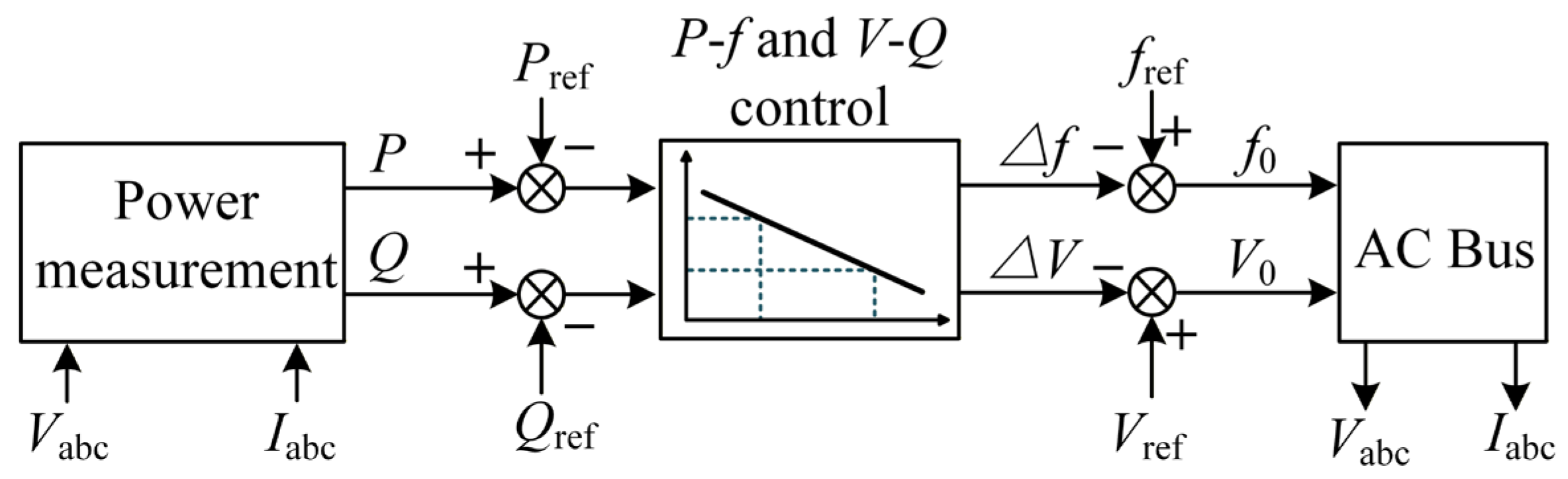
Figure 1. Power and voltage/frequency (V/F) control strategy in a GFM unit.
Energies 18 06440 g001
Figure 2. Structure of the off-grid ReP2H system based on a centralized GFM BESS.
Energies 18 06440 g002
Figure 3. Block diagram of VSM control for the AC/DC interface of a centralized BESS. (a) Active power-frequency control; (b) reactive power-voltage control.
Energies 18 06440 g003
Figure 4. Circuit of the BESS.
Energies 18 06440 g004
Figure 5. VSM control for inertia provision and synchronization from the electrolyzers.
Energies 18 06440 g005
Figure 6. Equivalent circuit model of the electrolysis stack.
Energies 18 06440 g006
Figure 7. Circuit of the electrolyzer and its power interface.
Energies 18 06440 g007
Figure 8. The circuit of the composite multi-source coordinated GFM.
Energies 18 06440 g008
Figure 9. The strategy of the VSM controller in the AC/DC link of the composite multi-source coordinated GFM solution.
Energies 18 06440 g009
Figure 10. Flow chart of energy storage capacity optimization algorithm.
Energies 18 06440 g010
Figure 11. HIL platform used for simulation analysis.
Energies 18 06440 g011
Figure 12. PV power in different scenarios used for simulation studies.
Energies 18 06440 g012
Figure 13. Responses of BESS current, electrolysis stack and HE DC bus voltage in the ReP2H system with the centralized GFM BESS under different scenarios. (a) High fluctuation scenario; (b) rapid power decline scenario; (c) ES branch disconnection under high power scenario.
Energies 18 06440 g013
Figure 14. Responses of the electrolysis stack and HE DC bus voltage in the ReP2H system based on the GFM electrolyzer under the high fluctuation scenario.
Energies 18 06440 g014
Figure 15. Responses of BESS current, electrolysis stack and HE DC bus voltage in the ReP2H system with composite multi-source coordinated GFM strategy under different scenarios. (a) High fluctuation scenario; (b) rapid power decline scenario; (c) ES branch disconnection under high power scenario.
Energies 18 06440 g015
Table 1. Comparison of this work with previous studies on GFM services in hydrogen production.
ReferenceSystem ConfigurationEnergy Support ProvisionReal-Time Energy Balance Control
WindPVOff-GridOn-GridESHE
2024 [9]-
2023 [10]----
2023 [11]----
2022 [15]-----
2019 [18]---
2023 [19]-----
2020 [20]-----
2025 [21]-
2024 [22]-----
2025 [23]- -
2025 [25]---●--
2023 [26]--
2023 [27]-
2024 [28]--
2023 [29]-----
2024 [30]----
2023 [31]-----
2025 [32]-
2025 [33]---
2024 [35]-
2025 [36]---
2023 [37]-----
2024 [38]----
“●” indicates included; “-” indicates not included.
Table 2. System and control parameters in the simulation.
StackValueUnitCircuitValueUnit
Cdl0.02F/cm2Vdc1000V
Urev1.228VCdc50mF
Rohm1.1918Ω/cm2fref50Hz
Iexchange0.0015A/cm2Lbuck25mH
Ncell445-Vacref35/1kV
area15,000cm2Vdroop0.9697V
Kact0.1521-Redge0.0009Ω
Eon40mJ
Eoff100mJ
Ileak5mA
Table 3. Comparison of optimal ES capacity ratio and economic metrics for three grid-forming strategies.
TypeVoltage Range (p.u.)Frequency Deviation (Hz)ES Proportion (%)LCOH (CNY/kg)
GFM BESS strategy±6–±12%±0.6–±1.13633.212
GFM electrolyzer strategy±9.5–±15%±1.1–±1.92029.750
Composite multi-source coordinated GFM strategy±3–±5%±0.3–±0.51625.458
Table 4. Sensitivity analysis of stability metrics of different ES capacity ratios under high fluctuation scenario.
StrategyEs Capacity Ratio (%)Max Frequency Deviation (Hz)Max Voltage Deviation
(V)
Stability Check
GFM BESS strategy30%±1.53±14%Fail
34%±1.15±12.5%Fail
36%±1.08±12%Pass
40%±0.92±10%Pass
GFM electrolyzer strategy16%±2.15±18%Fail
18%±1.35±16.5%Fail
20%±1.10±15%Pass
22%±0.85±12.5%Pass
Composite multi-source coordinated GFM strategy12%±0.85±8%Fail
14%±0.62±6%Fail
16%±0.48±5%Pass
18%±0.40±4.7%Pass
Disclaimer/Publisher’s Note: The statements, opinions and data contained in all publications are solely those of the individual author(s) and contributor(s) and not of MDPI and/or the editor(s). MDPI and/or the editor(s) disclaim responsibility for any injury to people or property resulting from any ideas, methods, instructions or products referred to in the content.