You are currently viewing a new version of our website. To view the old version click .
Energies
  • Article
  • Open Access

9 December 2025

Passenger Car Aerodynamic Drag, Thermal Cooling: A Perspective for Energy Saving and Improving Environment


,
,
and
1
School of Engineering (Aerospace, Mechanical and Manufacturing), RMIT University, Melbourne, VIC 3000, Australia
2
College of Automotive Engineering, Jilin University, Changchun 130022, China
*
Author to whom correspondence should be addressed.
This article belongs to the Special Issue Energy-Saving Control and Intelligent Technologies for Electric and Hybrid Vehicles

Abstract

Passenger cars, sports utility vehicles (SUVs), and light trucks/vans, constituting the overwhelming majority of all road vehicles globally, burn about 25% of all fossil fuels, emit significant amounts of greenhouse gas emissions (CO2), and deteriorate the environment. Nearly three-quarters of the engine power generated by burning fossil fuels is required to overcome aerodynamic resistance (drag) at highway driving speeds. Streamlining the body shape, especially the projected frontal area, can lead to a decrease in aerodynamic drag. Even though drag coefficients have plateaued since the late 1990s, further altering body shape might worsen vehicle cooling. Thus, the primary objective of this study is to explore the potential for aerodynamic drag reduction and improved cooling performance through careful component design unaffected by stylistic restraints. A variety of strategies for protecting the cooling intakes to reduce the drag coefficient are considered. The potential cooling drag reduction was found to be around 7% without compromising the cooling performance, which is in line with predictions for roughly 2.9% and 1.7% fuel consumption reductions for highway and city driving conditions, respectively. The study also reveals that passenger electric cars designed for city driving conditions possess a battery-to-kerb weight ratio of around one-quarter of the kerb weight, and vehicles designed for higher ranges have significantly higher ratios (nearly one-third), resulting in higher rolling resistance and energy consumption. The reduction of battery weight for EVs, streamlining vehicle shapes, and applying active and passive airflow management can help reduce aerodynamic drag and rolling resistance further, enhance driving range, and reduce energy consumption and greenhouse gas emissions.

1. Introduction

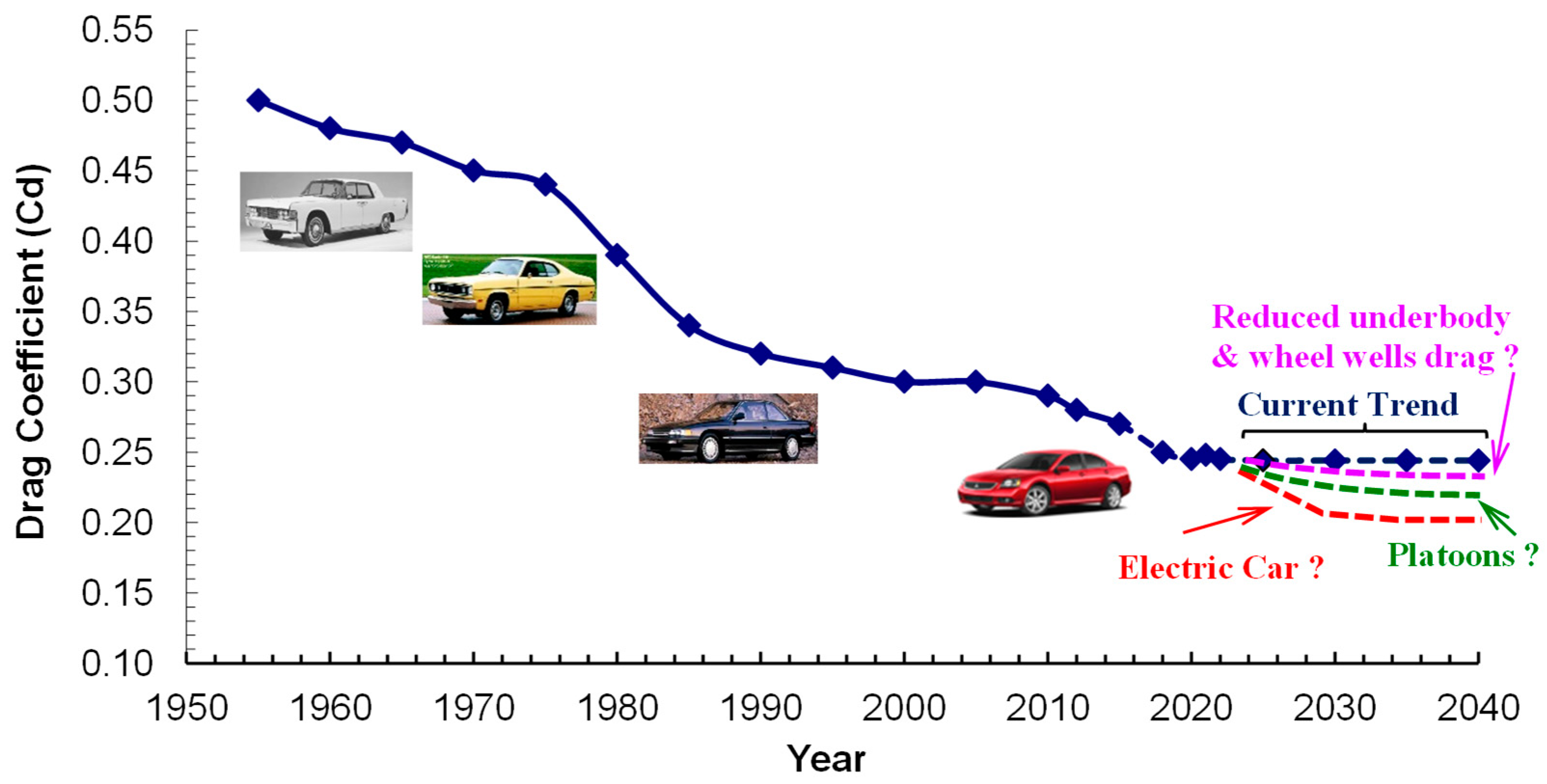
Passenger vehicles (cars, sports utility vehicles—SUVs, and light trucks/vans) account for around 95% of all road vehicles (1.7 billion) globally [1], consuming about 25% of all fossil fuels, releasing substantial greenhouse gas emissions (CO2), degrading the environment, and creating serious concern for sustainable living and energy security. The worldwide number of passenger vehicles indicated an annual growth rate of 3% since 2017 [2], underscoring the necessity of energy-efficient vehicles. Approximately 70–75% of the power generated from fossil fuel combustion is necessary to overcome aerodynamic resistance (drag) at highway driving speeds. Thus, aerodynamic drag is a critical factor influencing vehicle performance, fuel efficiency, and environment. The quest for drag reduction is motivated not only by rising fuel costs and depleting fossil fuel reserves but also stricter global pollution rules and increasing consumer demand for more efficient automobiles. Reducing drag is closely linked to better fuel economy; just a 10% drop in drag can lead to about a 2–3% improvement in fuel efficiency for regular fossil fuel-powered cars, and the benefits are even greater for new energy vehicles such as electric cars [3]. Over the past 50 years, passenger cars’ exterior body shape optimisation has led to appreciable drag reductions. Vehicles with conventional box designs began to streamline. The drag coefficient, a measure of aerodynamic efficiency, began to decline from about 0.50 for a conventional passenger car in the 1960s to 0.25 in 2020. A further decrease can have an impact on the vehicle’s style (shapes and aesthetics), which is crucial for marketing and customer perception [4]. The chronological drag reduction is depicted in Figure 1. As further drag reduction possesses a big challenge, especially since 2020, the figure illustrates possible areas of future drag reduction that may come from sources other than upper body shape. The only areas that can potentially reduce drag in the future are the smooth under-body, wheel wells, convoy driving and/or active flow control. However, due to their interdependence with the effectiveness of vehicle cooling, safety, and extra energy requirement, it is hard to achieve drag optimisation in these areas further for conventional fossil fuel-powered passenger vehicles.
Figure 1. Drag reduction timeline, adapted from [4]. The square on the curve in the figure indicates the data year.
Extensive studies have been conducted in the past to reduce the aerodynamic drag of passenger vehicles, and the reduction in drag in passenger cars has plateaued since 2020. Studies have been undertaken using a simplified, reduced-scale Ahmed model and box-type body shapes through using wind tunnels, computational modelling, and artificial intelligence, as well as artificial neural networks (ANN) and machine learning (ML), to reduce drag further. Additionally, researchers have employed various active and passive flow control systems, such as turbulent flow generators, vortex generators, and active and passive synthetic jets. Drag reduction using these flow control techniques has been reported in the open literature. Many of these flow control techniques induce challenges in the real world due to factors such as customer perception, aesthetics, regulatory restrictions, manufacturing, and ongoing costs. Studies were conducted on biomimicry for reducing drag in passenger cars, using nature’s time-tested patterns and tactics, which improves energy efficiency and performance. Energy is a valuable resource in nature. Animals that navigate through fluids (air or water) have developed forms that reduce drag to preserve energy for hunting, migrating, or evading predators. Exploring these shapes (boxfish, penguin, tuna, owl, shark skin (denticles), kingfisher’s beak, etc.) and applying the underlying principles to vehicle design can reduce drag, extend electric vehicle range, improve ICE fuel economy, decrease wind noise, and reduce vehicle weight. Table 1 provides a summary of selected relevant published work and highlights limitations and current knowledge gaps.
Table 1. Various approaches for passenger car drag reduction reported in the open literature.
As summarised in Table 1, although significant research has been undertaken on drag reduction endeavours using various approaches, including passive and active flow control, biomimicking through idealised scaled models and/or full-scale models by employing computational modelling, wind tunnel testing, and artificial intelligence and machine learning, very limited research has been conducted on the interplay between thermal performance and aerodynamic drag reduction in passenger vehicles. There are still scopes for optimising production passenger vehicles’ aerodynamic drag and thermal performance. Furthermore, scant study has been undertaken on production passenger cars, investigating additional reductions in aerodynamic drag with minimal or no alterations to the radiator front grille opening size of the vehicle. Such studies are more focused on new energy vehicles such as electric vehicles (EVs) for achieving higher range. The design and optimisation of aerodynamic drag and thermal efficiency, driving behaviour, and environmental circumstances intimately correlate with the distance a vehicle can traverse. Moreover, battery storage capacity, traction motor capacity, and battery thermal management significantly influence electric vehicle performance.
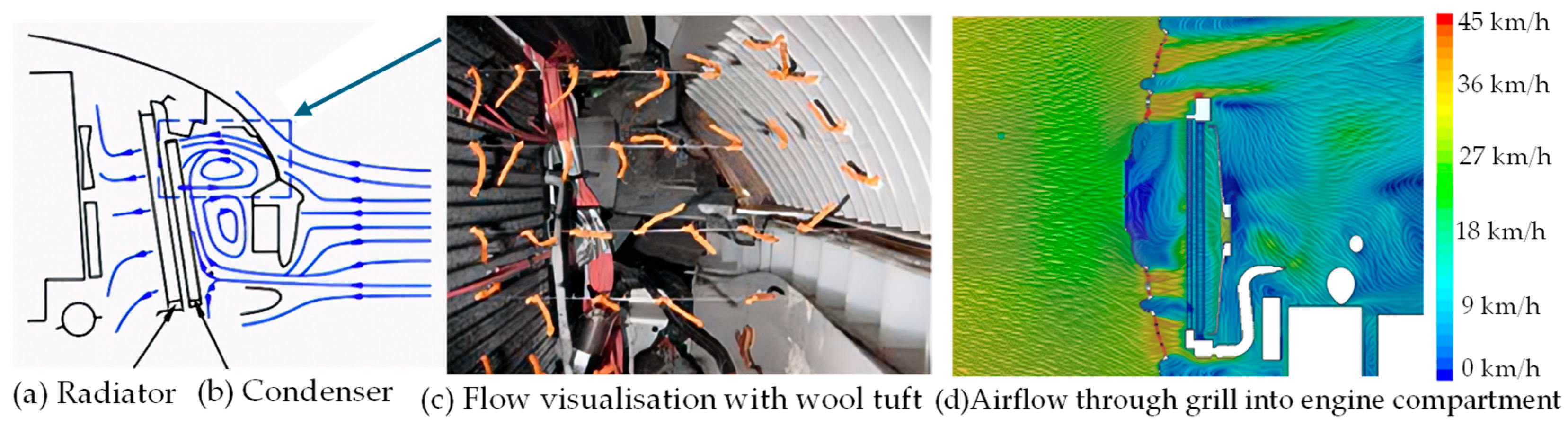
The need to minimise aerodynamic drag and styling compels car manufacturers to streamline the frontal area, which limits radiator and condenser cooling air intakes and lowers vehicle cooling performance. The airflow that passes through the grille and cooling packs (radiator, intercooler, condenser, and fans) and into the engine bay creates cooling drag. Pressure loss, momentum loss, and flow separation cause it. The radiator’s dense array of fins and tubes extracts heat but restricts flow, causing pressure loss. Passing airflow slows, losing pressure and forming a high-pressure zone in front of the radiator and a low-pressure zone behind it. The turbulent, sluggish, and momentum-lost air exiting the radiator causes momentum loss and flow separation. The airflow in and around the radiator is complex (as shown in Figure 2) and extremely difficult to quantify, either through experimentation and/or computational modelling. Cooling drag accounts for 5–12% of the total aerodynamic drag in a modern passenger car, and it depends on grille opening design, geometry and size, vehicle speed, crosswind, and cooling packs [3,4]. Although significant work has focused on reducing aerodynamic drag from external shapes, there has been relatively less research on reducing cooling drag and enhancing radiator thermal performance. Table 2 summarises research conducted over the past two decades on cooling systems for passenger car radiators. The table highlights current knowledge gaps in this vital area of road vehicles.
Figure 2. Complex airflow pattern in and around passenger car radiator and grill, adapted from Ng [36] and Zhang et al. [37].
Table 2. Summary of prior studies on passenger vehicle cooling performance.
Based on the literature available in the public domain, as summarised in Table 1 and Table 2, it is evident that there are significant knowledge gaps in internal aerodynamic drag reduction and thermal performance enhancement, especially for production vehicles. Thus, the objective of this study is to explore ways to further reduce aerodynamic drag (thereby increasing fuel efficiency and greenhouse gas reduction) and better understand the cooling performance of production passenger cars. The additional objective is to highlight the current limitations and ways forward for further aerodynamic drag reduction and enhanced thermal performance for electric vehicles.
The subsequent structure of the article is outlined as follows. Section 2 outlines the research methodology and approach, pertinent theories for assessing vehicle cooling performance, the wind tunnel experimental configuration, and the analysis of results. Section 3 presents results and analysis. Section 4 presents a general discussion on the current study and further scopes for drag reduction in internal combustion (IC) engine vehicles and new energy vehicles (electric vehicles), along with future implications, while Section 5 provides a summary of the study’s major findings and future direction.

2. Approach and Methodology

There are two parts to the research: first, the aerodynamic cooling drag through the passenger car’s radiator grille and thermal performance; and second, the possibility of reducing aerodynamic drag for EVs powered by batteries. Section 1 conducts experimental studies using industrial wind tunnels, while Section 2 conducts studies using the publicly available literature.

2.1. Cooling Drag and Thermal Performance

In order to undertake the experimental investigation of cooling drag and radiator thermal performance as a function of radiator air entrance opening, the RMIT Wind Tunnel and Monash University Wind Tunnel have been utilised. Cooling drag is determined in the Monash University Wind Tunnel, and the thermal performance is evaluated in the RMIT Industrial Wind Tunnel.

2.1.1. The RMIT Wind Tunnel

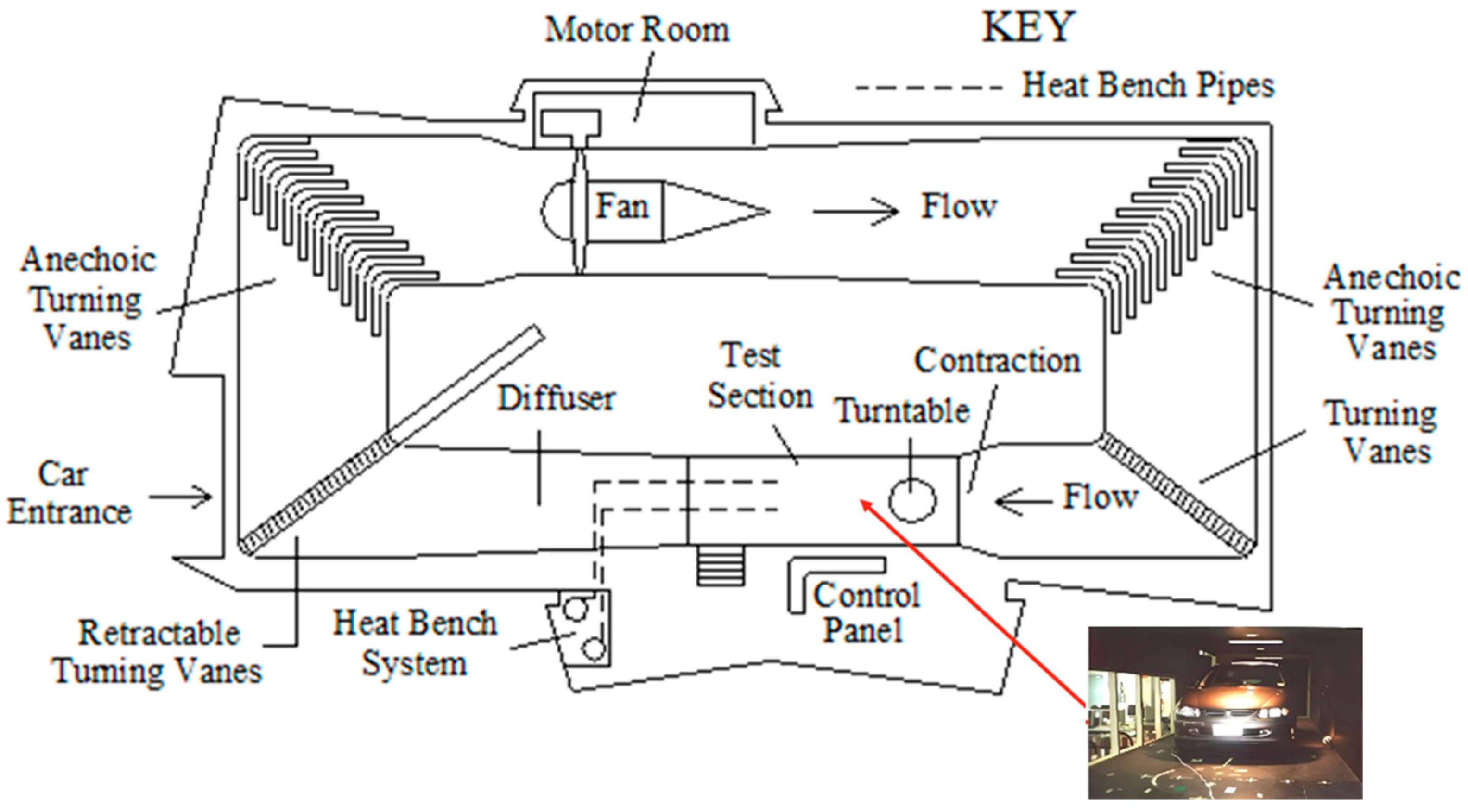
The RMIT Industrial Wind Tunnel is a closed return-circuit wind tunnel with approximately 150 km/h top air speed. Its rectangular test section is 9 metres long, 3 metres wide, and 2 metres high. The wind tunnel’s a cross-section area of the test section is 6 m2. A plan view of the tunnel is shown Figure 3. The car picture in the figure indicates the tunnel’s test section physical size. Additional information about the tunnel can be found in references [48,49]. The test vehicle has a solid blockage ratio of about 30% at the RMIT Wind Tunnel. This is why the aerodynamic cooling drag is evaluated at the Monash University Wind Tunnel. The radiator cooling performance is investigated at the RMIT Wind Tunnel using simulated air speed of equivalent on-road speed.
Figure 3. A plan view of the RMIT Wind Tunnel, adapted from [48,49].

2.1.2. The Monash University Wind Tunnel

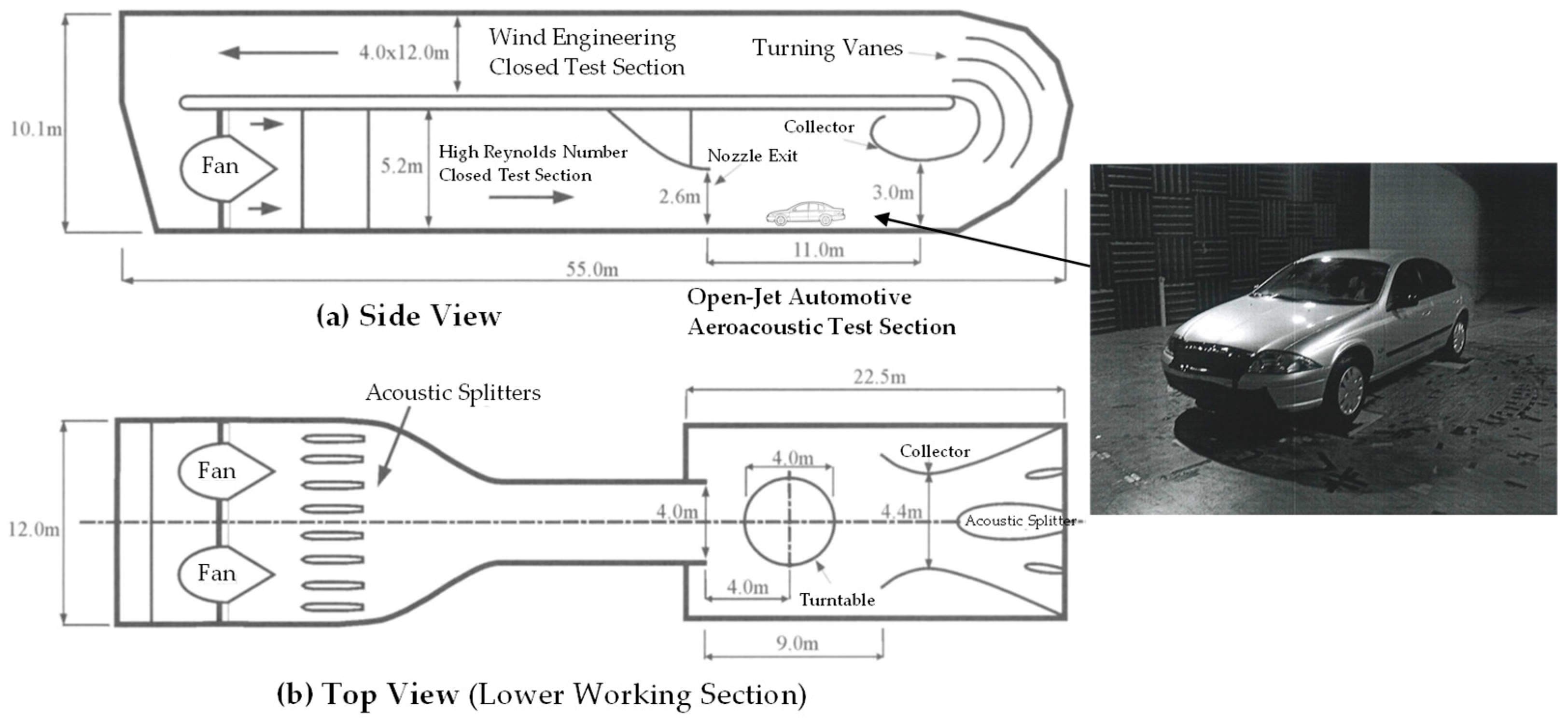
Aerodynamic testing is undertaken at the Monash University Wind Tunnel. It is an open jet wind tunnel with a maximum wind of 180 km/h. The exit nozzle size is 10.55 m2, and the test section has very low levels of background noise. The background noise level in the tunnel is around 10 dB(A) below a modern passenger car’s interior noise [50]. The test section has a turntable and is large enough to accommodate a full-size car. The tunnel has a turbulence level of approximately 1.8%. It is driven by two independently controlled fans of 5 m diameter. Figure 4 shows the layout of the wind tunnel and test vehicle. The arrows in Figure 4a indicate the airflow direction. The tunnel is equipped with six component force balance systems used for aerodynamic forces and moment measurements of large family-size passenger cars and mini vans.
Figure 4. Monash University Wind Tunnel and test vehicle for aerodynamic drag measurement.
Prior to aerodynamic testing at the Monash Wind Tunnel, the commercial 6-component force/torque sensor system, consisting of load cells and data acquisition systems, was calibrated. The aerodynamic loads are sampled at 250 Hz for 30 s. Three sets of data for 90 s are acquired, and their averaged value has been accepted. The uncertainty associated with force and moment measurement is less than ±0.2%. Each test involves recording baseline measurements for 10s with the wind speed reduced to zero before and after the testing.

2.1.3. Test Vehicle

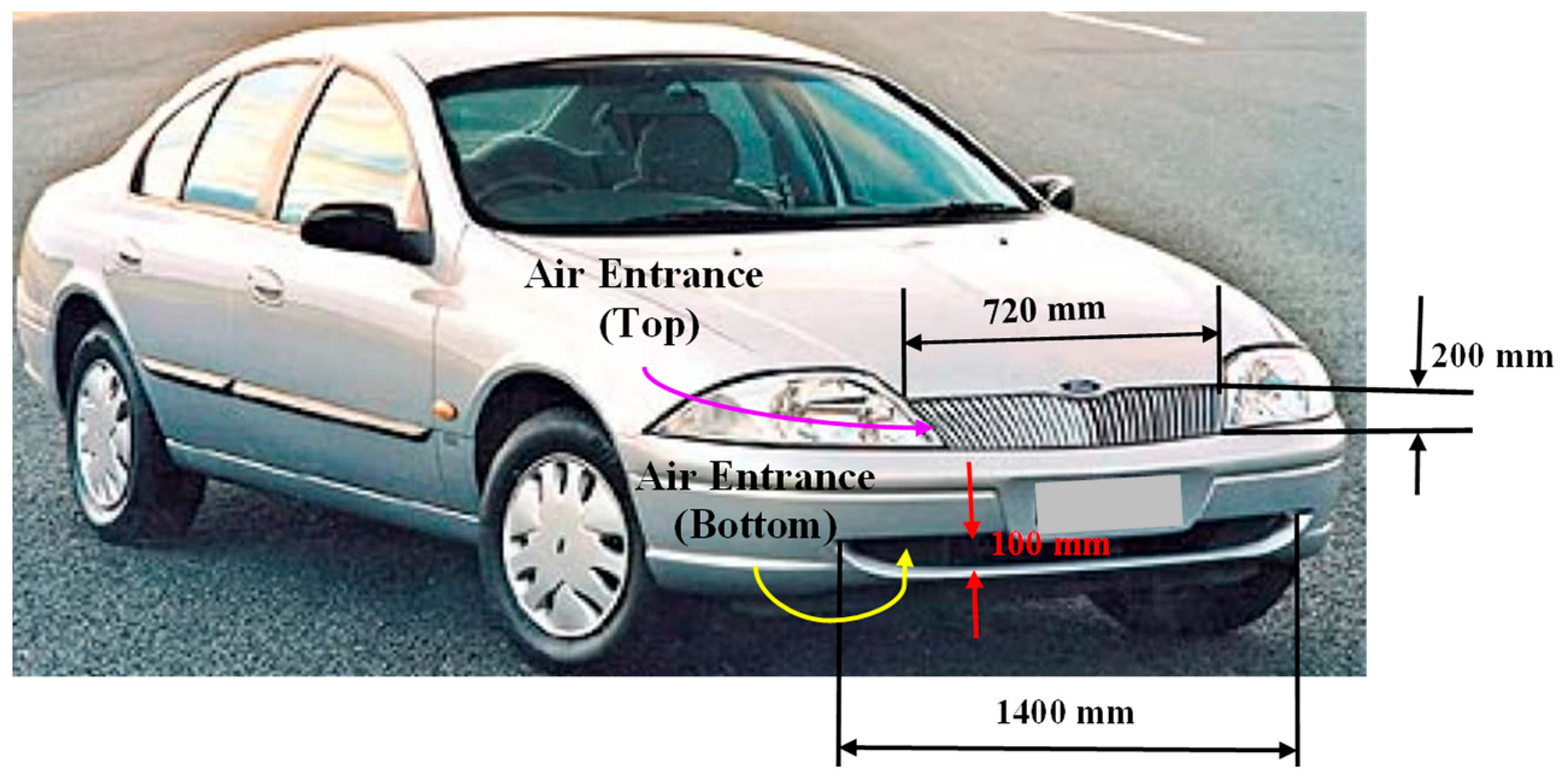
A Ford Falcon AU large passenger car manufactured in Australia was chosen to investigate the relationship between front grille designs’ cooling effectiveness and drag. This car had a four-speed automatic transmission and standard onboard equipment. A condenser for air conditioning was installed in front of the radiator, along with a mechanically powered centrifugal water pump, two electric fans with shrouds, and an air dam which made up the cooling system for the engine and air conditioning. The lower intake section and decorative grille that make up the front-end cooling air intake are both present. The typical dimensions of the top and bottom air intake entrances of a production large passenger car are shown in Figure 5. Specifications and dimensions of the vehicle are illustrated in Table 3.
Figure 5. Air entrance dimensions of a Ford Falcon AU model.
Table 3. Specifications and dimensions of the test vehicle, adapted from [51].

2.2. Thermal Performance Evaluation Approach

The intricate airflow and heat transfer characteristics across cooling packs (radiator, intercooler, condenser, fans, engine, etc.) make experimental and computational passenger car radiator cooling performance analysis difficult. Most car manufacturers analyse engine cooling performance and optimise vehicle front-end layouts using Air-to-Boil (ATB) or Specific Dissipation (SD) to overcome these issues. According to SAE standard J819 [52], the Air-to-Boil temperature (ATB) is the ambient air temperature that causes the cooling system to boil under certain driving conditions [36]. Equation (1) describes Air-to-Boil temperature.
A T B = T b p T c i T a i
Here,
  • Tbp = coolant boiling point (°C),
  • Tci = coolant radiator inlet temperature (top tank temperature) when the cooling system has stabilised (°C),
  • Tai = ambient temperature (°C).
SAE International (USA) established ATB field test protocols (SAE J1393 [53] and SAE J819). The ATB of a cooling system may only be measured during vehicle tests after it has stabilised under preset operating conditions [36]. The top tank temperature stabilises when the radiator’s heat dissipation matches the engine’s thermal demands. The parameter does not directly display cooling airflow rate, but it can demonstrate how airflow affects cooling performance. Improved cooling airflow on a radiator and evaluation under certain conditions lowers top tank temperature (Tci) once the cooling system stabilises, enhancing ATB. Thus, the ATB ranks vehicle front-end designs and indicates system failure. More details about the ATB method can be found in refs [54,55,56,57,58,59]. ATB requires the cooling system to run under extremely stable conditions (i.e., top tank temperature and ambient air temperature must be consistent) for a given configuration under precise road load and slope load criteria. Due to the time and resources required to accurately simulate stable ambient and engine load conditions in a climatic wind tunnel or on-road tests [36], ATB testing is difficult, expensive, and time-consuming. Specific Dissipation (SD) is a more efficient cooling system performance test than ATB because it can be performed in both stable and slowly changing driving situations and is less sensitive to ambient and coolant temperature fluctuations [60]. The SD method is employed in this investigation. The SD method measures a radiator’s efficiency by dividing its heat dissipation rate by its overall temperature difference as shown in Equation (2).
S D = Q T c i T a i
Here,
  • Q = heat dissipation rate of the radiator (W),
  • Tci = coolant radiator inlet temperature (°C),
  • Tai = ambient temperature (°C).
At equilibrium conditions, if the cooling air accounts for all heat lost from the radiator, it can be expressed as Equation (3).
Q a = Q c
  • Qa = heat carried by the air from the radiator, and Equation (4) shows its mathematical expression.
  • Qc = heat carried by the coolant to the radiator, and its mathematical expression is shown in Equation (5).
Q c = m ˙ c c p , c T c i T
Q a = m ˙ a c p , a T T a i
Equalising Equations (4) and (5), Equation (6) can be derived.
S D = m ˙ c C p , c T c i T T c i T a i
The SD parameter was first mentioned in Stratton et al. [61] and Paish and Stapleford [62], but RMIT researchers reimagined, developed, evaluated, and optimised it [42,60,63,64,65]. Equation (6) measures radiator cooling in calm winds and crosswinds [36,45]. This study experiments with radiator thermal performance utilising Equation (6)’s Specific Dissipation (SD) approach.

2.3. Test Matrix and Instrumentation

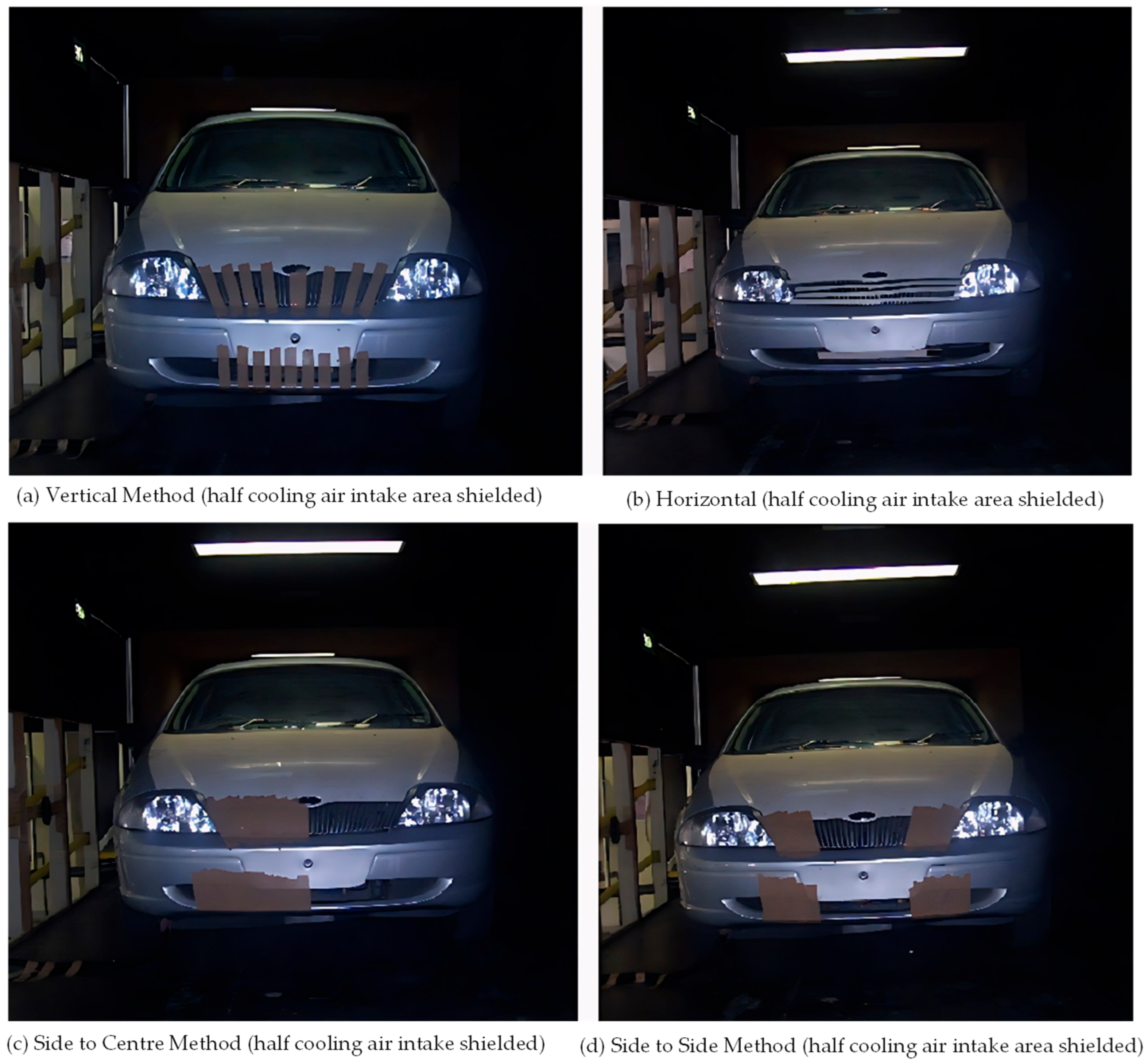
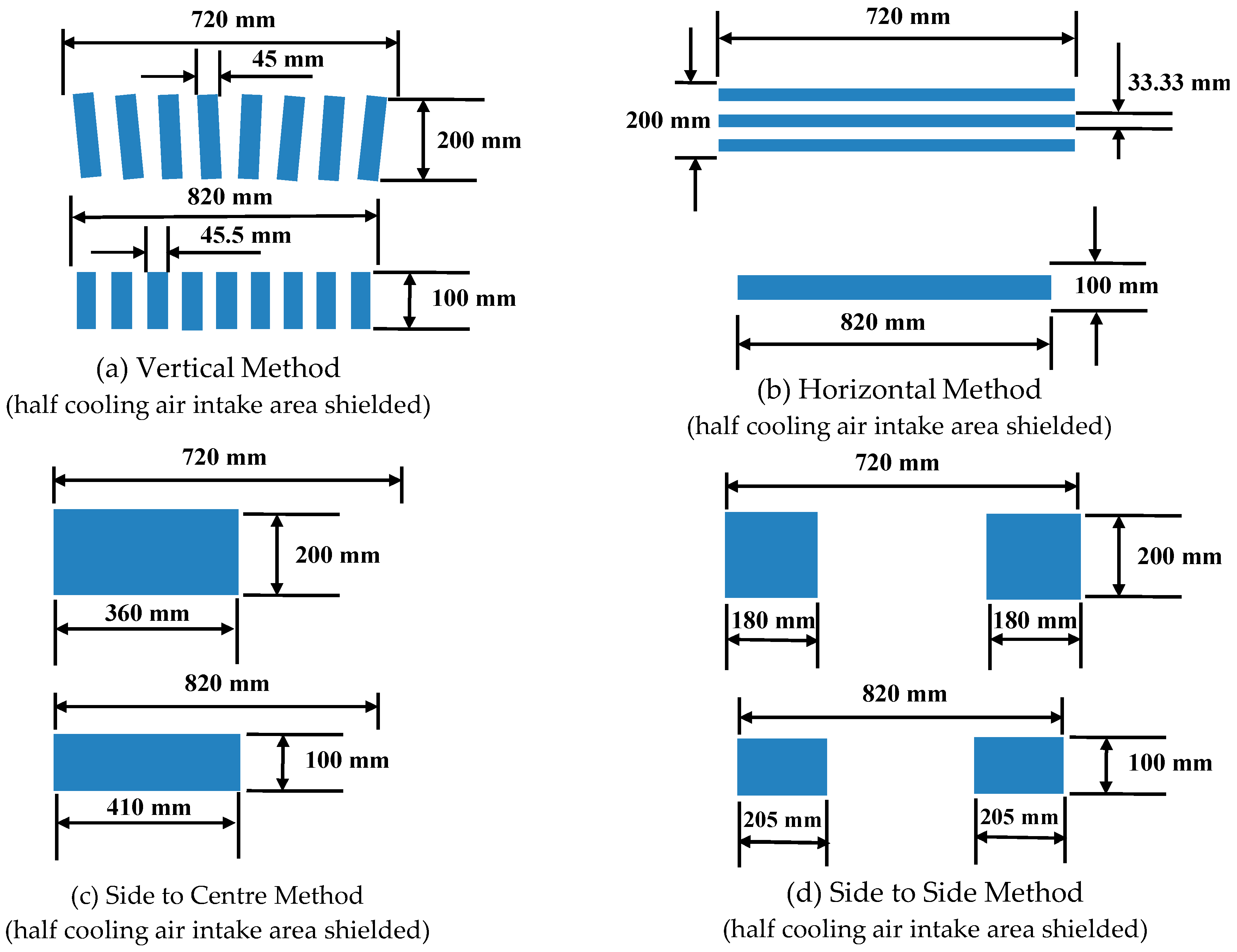
In order to evaluate the radiator cooling performance and aerodynamic cooling drag of a production large passenger car, four shielding approaches are applied to the air inlet. These shielding approaches include side-to-side, side-to-centre, vertical, and horizontal shielding. The detailed dimensions of shielding and shielding pattern are shown in Figure 6 and Figure 7. The shielding materials are made of cardboard, a single-faced E-flute type (1.6 mm thickness). This type of cardboard provides structural flexibility without compromising deformation due to aerodynamic pressure. The shielding configurations are chosen based on a considered practical implementation by the car manufacturers.
Figure 6. Test vehicle with shielding methods at RMIT Industrial Wind Tunnel.
Figure 7. Shielding and air intake entrance dimensions.
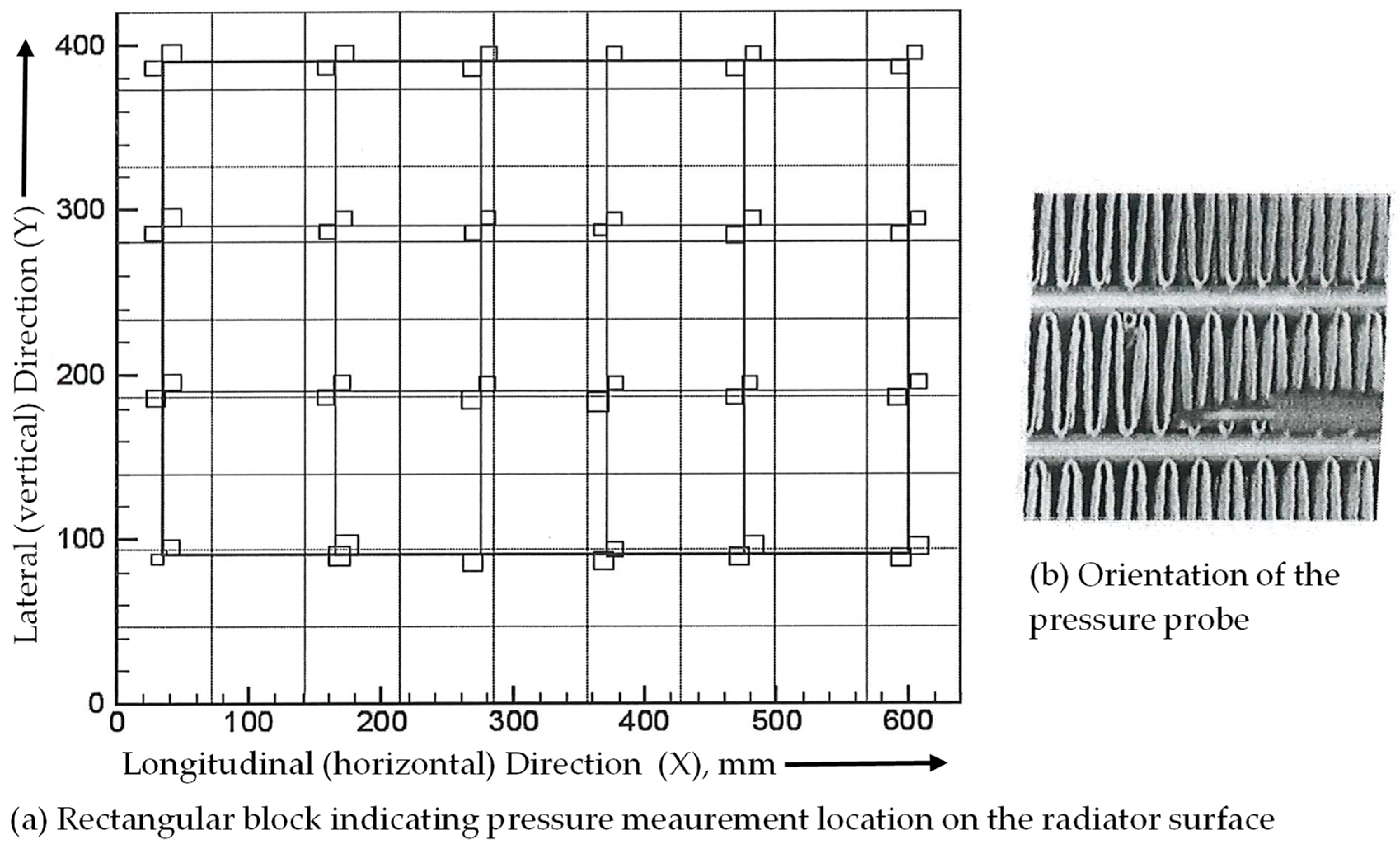
The in-house developed methodology included a pressure measuring device, 24 pairs of hypodermic tubes inserted into the radiator and condenser assemblies, a computer, and the necessary software. The device is reasonably affordable, reliable, and appropriate for detecting complex airflow during on-road testing as well as wind tunnel testing. The thermocouples and the voltage signal from the coolant flow metre are installed in the input module of a Fluke Hydra unit for data acquisition. The pump and heater are used to circulate the heated water through the radiator. The Fluke Hydra unit is used to monitor the water flow rate and temperature of all thermocouples in real time. The pressure-based technique developed at RMIT University is used in this study to quantify the airflow distribution behind the radiator core. The technique is low cost, robust, relatively insensitive to airflow temperature, and capable of detecting reverse flows [43,60,63]. The airflow distribution across the radiator has negligible effect on the Specific Dissipation (SD) of heat. The instruments used consist of four modules of pressure transducers developed by the company “Turbulentflow Instrumentation Pty Ltd.”, Wangaratta, Victoria 3677, Australia, accompanying cables, forty-eight (48) pairs of hypodermic tubes that are installed into the radiator and condenser assembly as shown in Figure 8, and rubber tubing to link the hypodermic tubes to the pressure transducers’ taps. In total, 48 (2 × 24) channels are used, and these pressures are converted into 24 velocities. Hypodermic tubes are inserted into the radiator to be flush with the condenser, while the other tube is inserted into the condenser to come out of the back of the radiator as shown in Figure 8b. The air velocity is related to the pressure for the radiator and cooling system using the following relationship as shown in Equation (7).
P U P D = 7.4   U 0 1.76
where
  • PU—pressure measured by the hypodermic tube facing the flow direction,
  • PD—pressure measured by the hypodermic tube facing away from the flow direction,
  • U0—velocity of airflow.
Figure 8. Position of pressure probes on the radiator and tubes and probes.
The results obtained by Equation (7) have been calibrated against a vane anemometer. The results obtained correlate well between the two methods except where the flow velocity is less than 2 m/s.
Figure 6 and Figure 7 illustrate the presence of two air entrances to the radiator: the top air entrance, which has an area of 0.14 m2, and the bottom air entrance, also with an area of 0.14 m2. The entry areas of both entrances are nearly identical. The upper entrance measures an average length of 700 mm and a width of 200 mm, whereas the lower entrance has a length of approximately 1400 mm and a width of about 100 mm. Figure 7 illustrates four shielding methods, vertical, horizontal, side-to-centre, and side-to-side, with half of the entrance closed. Figure 8 illustrates the position of pressure probes on the radiator and probes the orientation. The air pressure measurement locations on the radiator surface with rectangular block are shown in Figure 8a, and the orientation of the pressure probe is shown in Figure 8b. In figure, the arrows in the legends of the horizontal and vertical axes show the incremental distance from the radiator’s left bottom origin.
Aerodynamic drag tests and radiator thermal performance tests are conducted for various configurations of radiator air entrances: fully open, ¼ open, ½ open, and fully closed. Figure 6 depicts a half-open configuration for the radiator air entrance. Additional configurations are not presented here.
As mentioned earlier, the assessment of cooling performance is performed at the RMIT Wind Tunnel. The test matrix is presented in Table 4. The tick (√) symbol in Table 4 and Table 5 indicates that tests were undertaken under the planned configurations. The test speed replicated the car at 80 km/h, 100 km/h, and 120 km/h. The selected speeds were determined due to the prevalence of aerodynamic drag within this range. The cooling air speeds in the wind tunnel were lower than the simulated wind due to the blockage effect, as elaborated in Section 2.4. For analogous aerodynamic assessment, the test matrix presented in Table 4 was employed at a 0° yaw angle for the vertical, horizontal, lateral, and central front-end configurations. The cooling airflow across the radiator’s nonuniformity and velocity distributions are measured.
Table 4. Test matrix for aerodynamic evaluation at different speeds.
Table 5. Test matrix for aerodynamic evaluation at different yaw angles.
As described previously, aerodynamic tests are performed at the Monash University Wind Tunnel. The selected simulated test speed (air velocity) is 100 km/h, which closely corresponds to a similar road speed. The Reynolds number-dependence test, varied by velocity only, indicated a minimal variation within the range of 60 km/h to 120 km/h. The crosswind effects are quantified at ±15 degrees, with increments of 5°, as detailed in Table 5.

2.4. Wind Tunnel Blockage Correction and Estimation of Errors

Wind tunnel tests simulate road driving, which generates inaccuracies in aerodynamic force and moment measurement. These errors typically arise from the flow quality, boundary layer of wind tunnel flow, geometry of the test section, vehicle’s shape, wheel rotation, and blockage ratio. The blockage ratio is defined as the un-yawed projected frontal area of the vehicle divided by the cross-sectional area of the tunnel (SAE J1263 [66]). The Monash Wind Tunnel features a nozzle area measuring approximately 10.6 m2. In this investigation, a large full-size passenger vehicle with a cross-sectional area of approximately 2.1 m2 is used, which creates a blockage ratio of 0.2 (20%). In full-scale wind tunnel testing of passenger cars, this level of blockage ratio is frequently used. Nevertheless, minor corrections to the measured aerodynamic forces and moments are applied.
The objective of this study is to determine how modifications to the vehicle’s cooling air intakes affect its aerodynamic performance and stability. In all tests, the unaltered vehicle was considered the baseline. Thus, the data is shown with all forces, moments, and their derivatives expressed as percentage changes which have minimal or no effect on the displayed values.
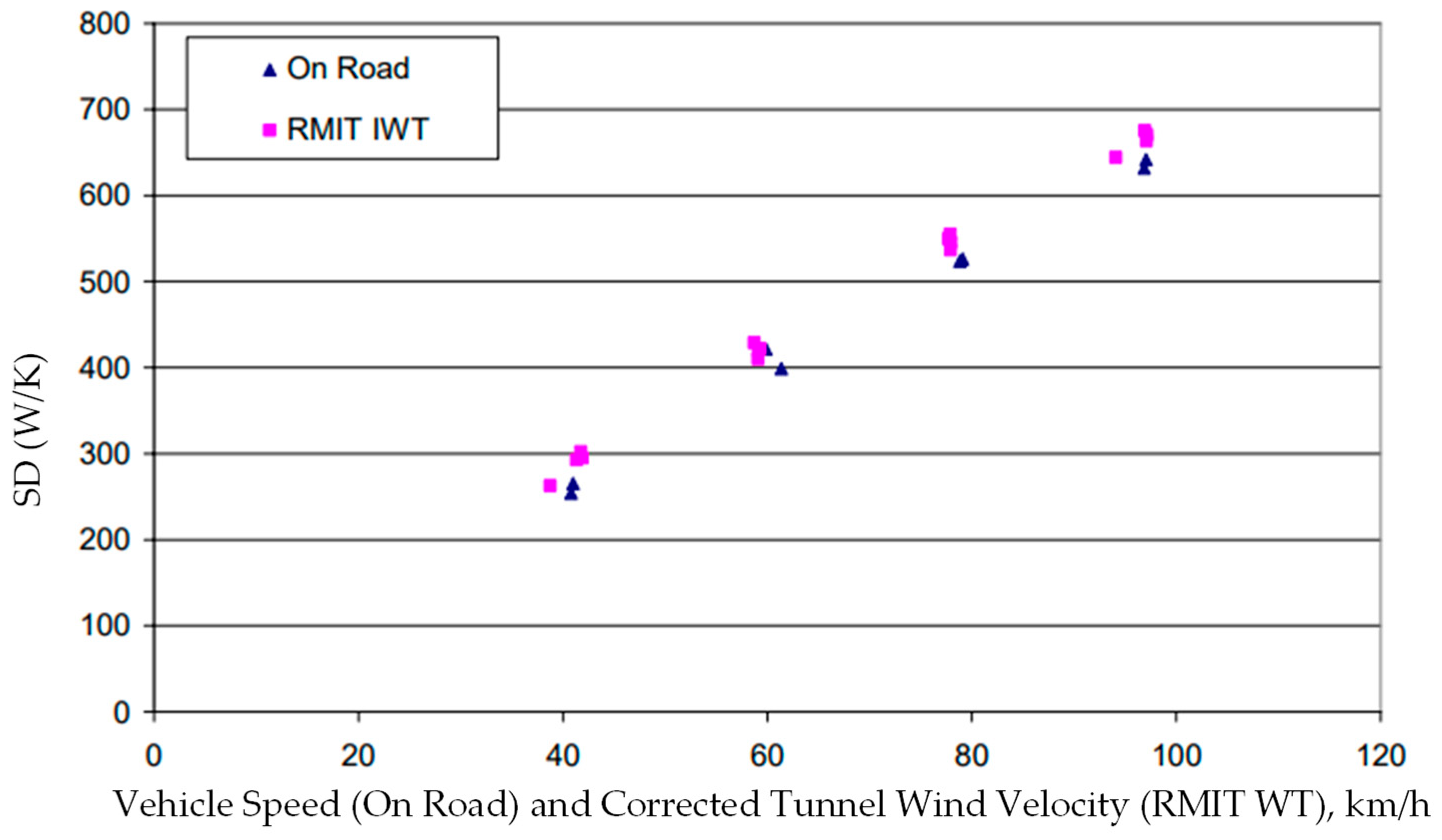
The blockage ratio of the RMIT Wind Tunnel is around 0.3745 (2.247/6). Although the figure is very high for aerodynamic testing, it is commonly encountered in climatic wind tunnels. Alam [48], Ng [42] and Zimmer et al. [67] conducted a series of tests on road, open jet and high blockage closed return circuit wind tunnels to determine the suitability of a high-blockage wind tunnel in evaluating vehicle engine cooling and aero-acoustic performance. The authors compared the Specific Dissipation results of a test vehicle from on-road and wind tunnel tests at various speeds to establish a correction factor that would be used to compare the two test methods. They establish that if the road speed is set to be equivalent to 1.207 times the wind tunnel air velocity, the results could be favourably compared. Figure 9 shows the variation in the SD method with the corrected air velocity or the on-road vehicle speed. The use of this corrector factor yields very similar results. It may be noted that the correction factor is specific to the RMIT Wind Tunnel and vehicle used; the corrector factor can be applied to vehicles that have a projected frontal area of about 2 m2.
Figure 9. Comparison of SD measured for a typical passenger car on-road and in a high-blockage wind tunnel at corrected wind speeds.
The quantification of errors for each of the parameters is measured. Extensive sampling of data is acquired, and three test runs are conducted to ensure that test-to-test variability is minimal. In the Monash Wind Tunnel, a small air velocity fluctuation is noted, but it is mitigated by averaging the three runs for each configuration. The air density in the tunnel is corrected due to the raised air temperature, which is recorded before and after each test so that necessary corrections can be performed when determining aerodynamic coefficients. The correction to the air density is also considered due to slow changes in barometric pressure throughout the day.
All instruments used in the Specific Dissipation (SD) measurements are calibrated. The thermocouples are calibrated against a digital thermometer. The air velocity is measured by a Pitot-static tube that might have contributed to bias errors. However, the same indicated air velocity is used from run to run. Furthermore, the determination of SD does not require the input of air speed. The coolant (water) flow rate fluctuated due to pump activity to within ±0.01 L/s. The tests in each configuration are repeated three times to ensure the data’s repeatability and minimise errors. The temperature of the cooling airflow is also recorded and verified for repeatability.
Table 6 displays the predicted magnitudes of systematic and random errors. The random errors are calculated by statistical analysis of the repeated measurements, while the systematic errors occur due to the instrumentation. In general, as shown in Table 6, the coefficient of drag has an overall error of 1.1%, and SD has an error of 1.7%. When the flow exceeds 2 m/s, the air velocity measuring system exhibits an error of approximately 5%. At lower velocities, it is extremely difficult to obtain repeatable results; hence, an estimate of the errors involved is provided.
Table 6. Error estimates for measured quantities.

3. Results and Analysis

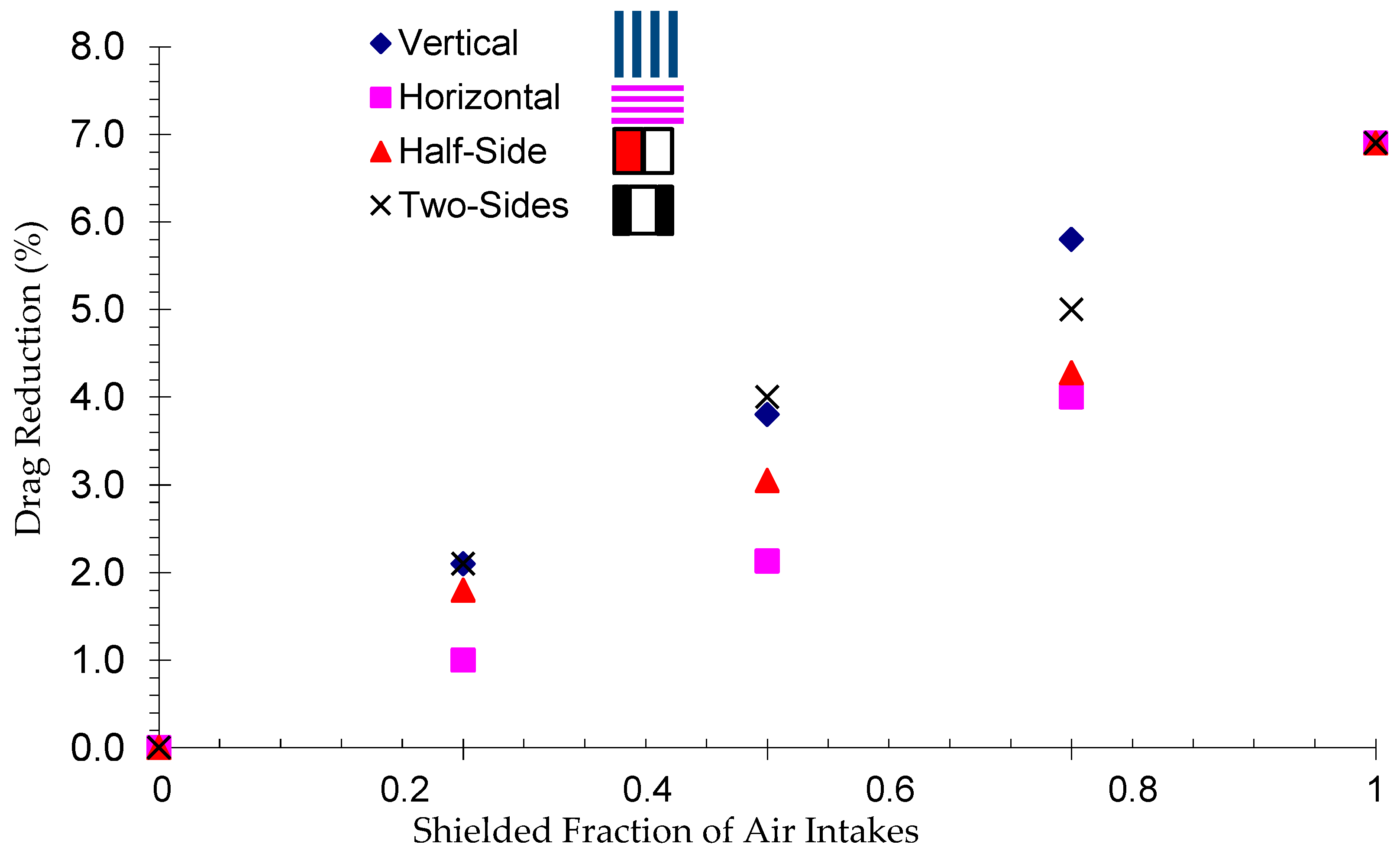
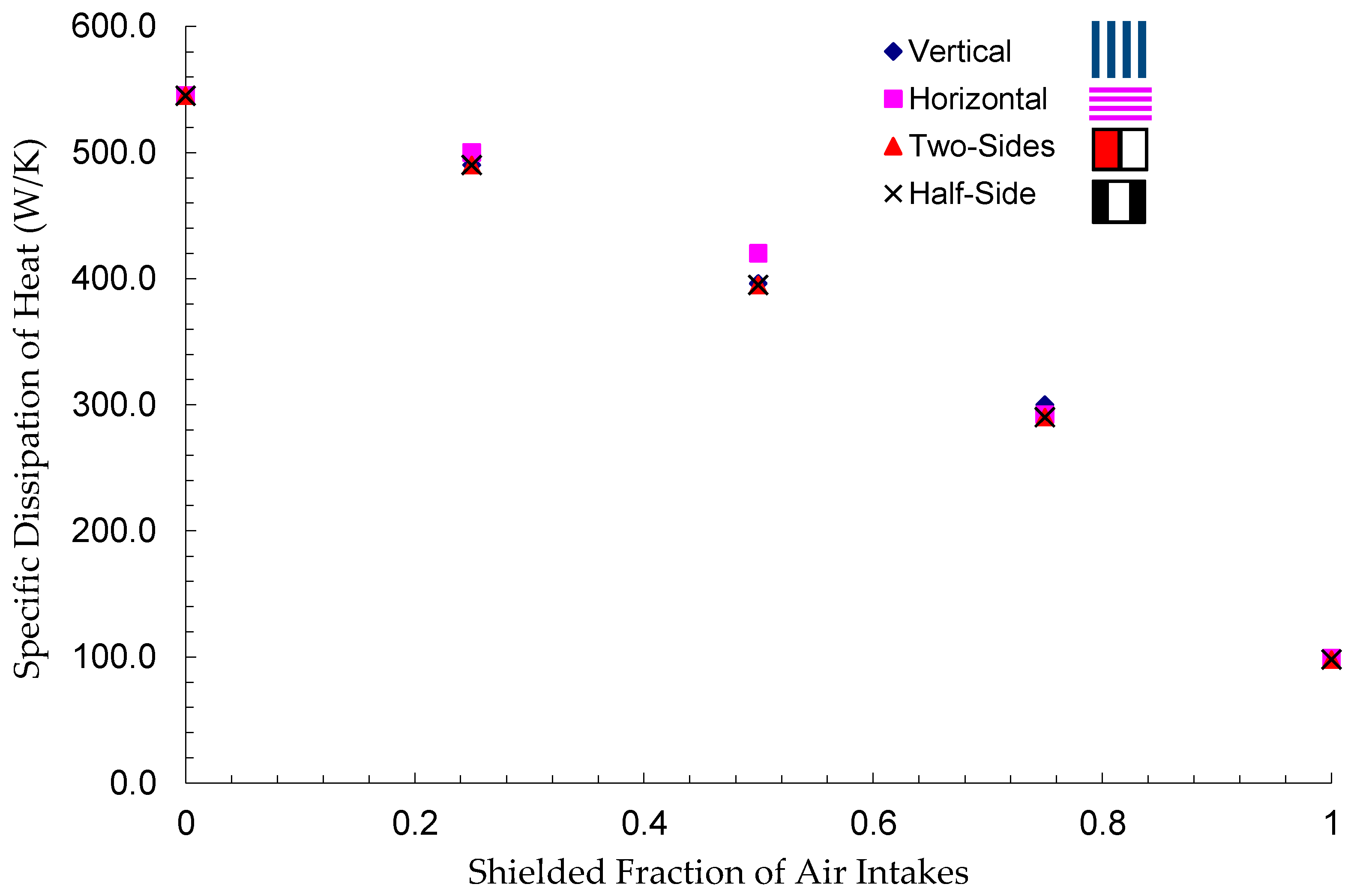
The aerodynamic drag reduction and radiator cooling performance for the air entrance shielding to the radiator with four configurations (vertical method, horizontal method, side-to-side method, and side-to-centre method) along with baseline vehicle (as illustrated in Figure 10 and Figure 11) are analysed. The aerodynamic drag at ±15° yaw angles with an increment of 5° at 100 km/h in a low-blockage wind tunnel (Monash University) and the radiator thermal performance at 60, 80, 100, and 120 km/h at 0° yaw angle in a high-blockage wind tunnel (RMIT University) were measured. The results for aerodynamic drag and thermal performance for 100 km/h wind speed and 0° yaw angle for all four configurations compared to baseline vehicle (without any modification) are presented in this study.
Figure 10. Drag reduction with various shielding techniques at 100 km/h (27.78 m/s).
Figure 11. Heat dissipation with various shielding techniques at 100 km/h (27.78 m/s).
The aerodynamic cooling drag reduction is shown in Figure 10, and the radiator thermal performance for the same configurations is shown in Figure 11. In Figure 10, the horizontal axis indicates shielded fraction of air intakes where “0” (zero) means fully open shield and “1” (one) means fully closed shield of the radiator grill. The cooling drag reduction displayed on the vertical axis of Figure 10 is presented as a percentage (%) compared to the baseline car. However, the vertical axis of Figure 11 is shown in W/K (unit), not in percentage form. As expected, there is no aerodynamic gain when the grill is fully open; in contrast, the maximum gain around 7% of cooling drag reduction is achieved when the radiator grill is fully shielded. However, orientations in between gradual opening and fully closing shielding show notable impact on aerodynamic drag reduction.
Between a ¼ (one quarter) and ¾ (three-fourth) quarter opening, the maximum drag reduction is achieved by vertical shielding (2% at ¼, 4% at ½, and 6% at ¾ quarter openings), and minimal drag reduction is achieved by the horizontal orientation of the shielding.
The cooling drag reduction for the other two orientations (half-side and two-sides) have shown mixed results between vertical and horizontal orientations of the shielding. Nevertheless, the two-sided shielding orientation works better at the small opening and gradually loses its effectiveness compared with the vertical orientation of the shielding. The results indicate that with the increasing opening until the half opening of the radiator grill, both the vertical and two-sided orientations of shielding can be effectively used.
The radiator thermal performance estimated by SD method for all four configurations is depicted in Figure 11. The vertical axis shows the Specific Dissipation (SD), and the horizontal axis indicates shielded fraction of air intake through the radiator grille. As expected, the shielding orientations have no impact on the thermal performance of the radiator when fully shielded or fully opened (as shown in Figure 11), and the highest heat dissipation is achieved at a fully open radiator grille (nearly seven times higher) compared to a fully closed radiator grille. Only a small effect of shielding orientation is noted at ½ opening (as shown in Figure 10). The horizontal orientation shows slightly better performance in terms of heat dissipation compared to three other orientations of shielding.
Analysing the aerodynamic and thermal performance reveals that the shielding technique did not significantly affect the amount of heat dissipated. It is also evident that there is further scope for reducing aerodynamic drag by optimising the radiator grilles at the air intake entrance of a passenger vehicle without compromising the cooling performance of the radiator and condenser of a production vehicle.
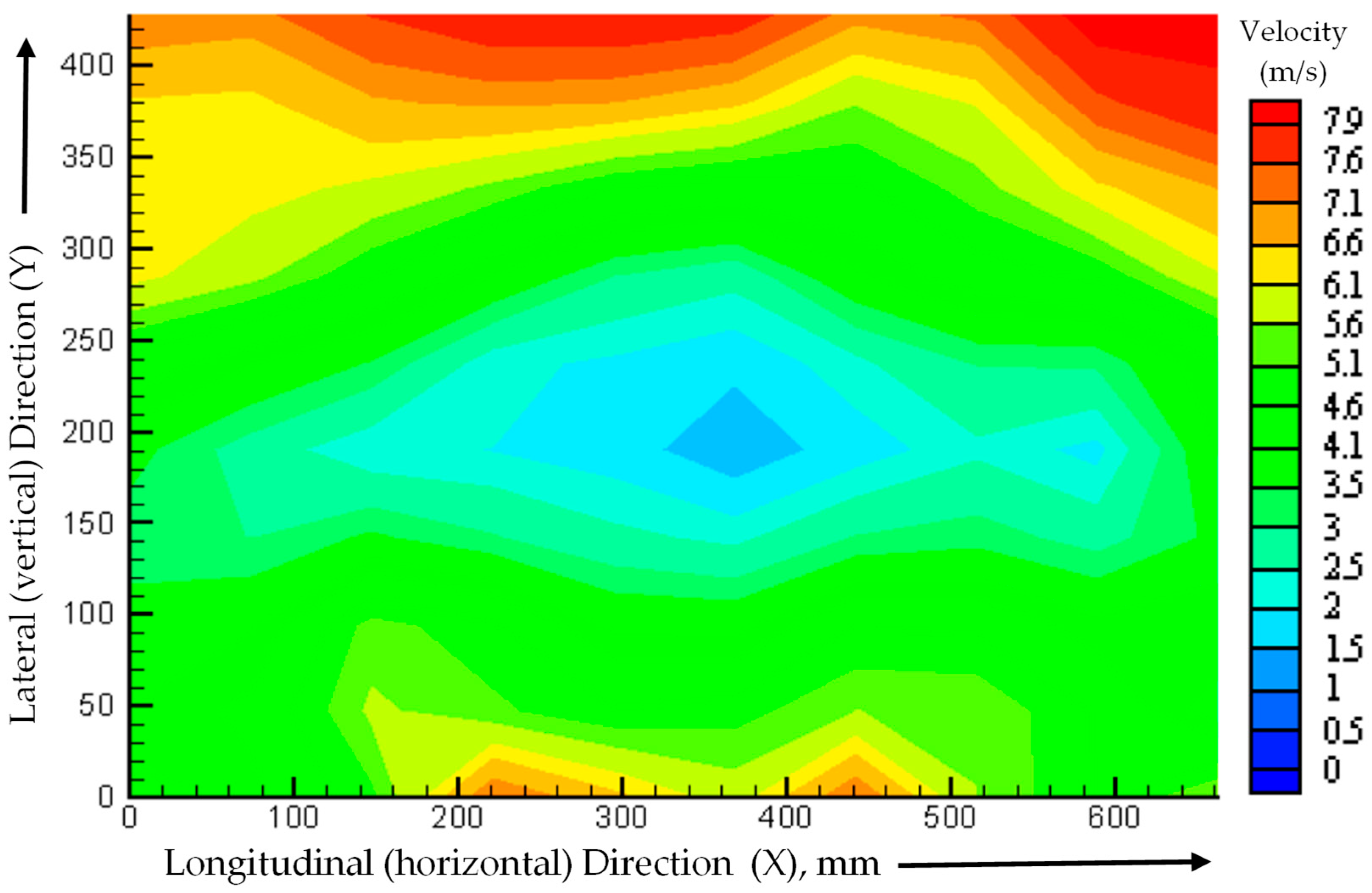
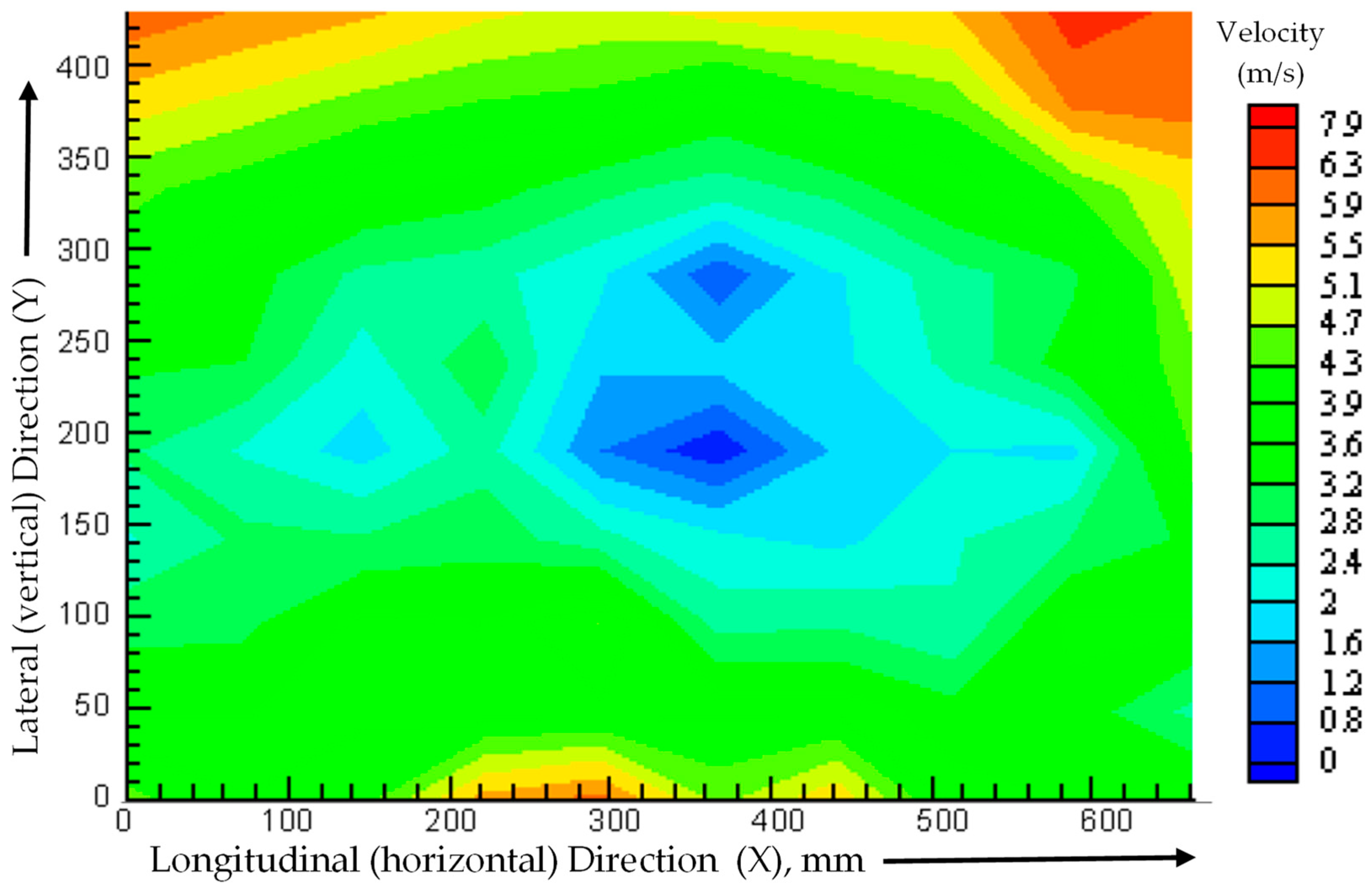
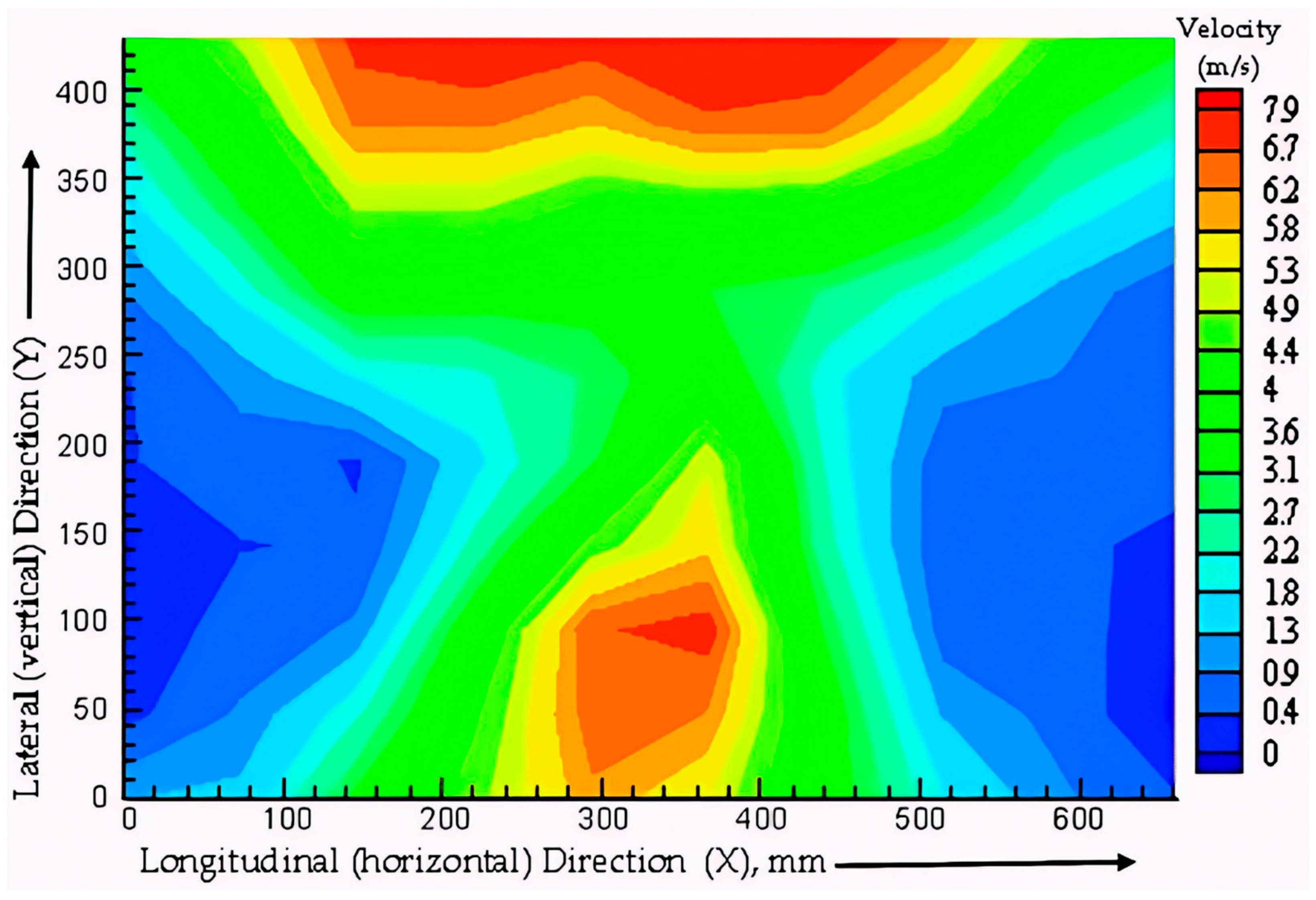
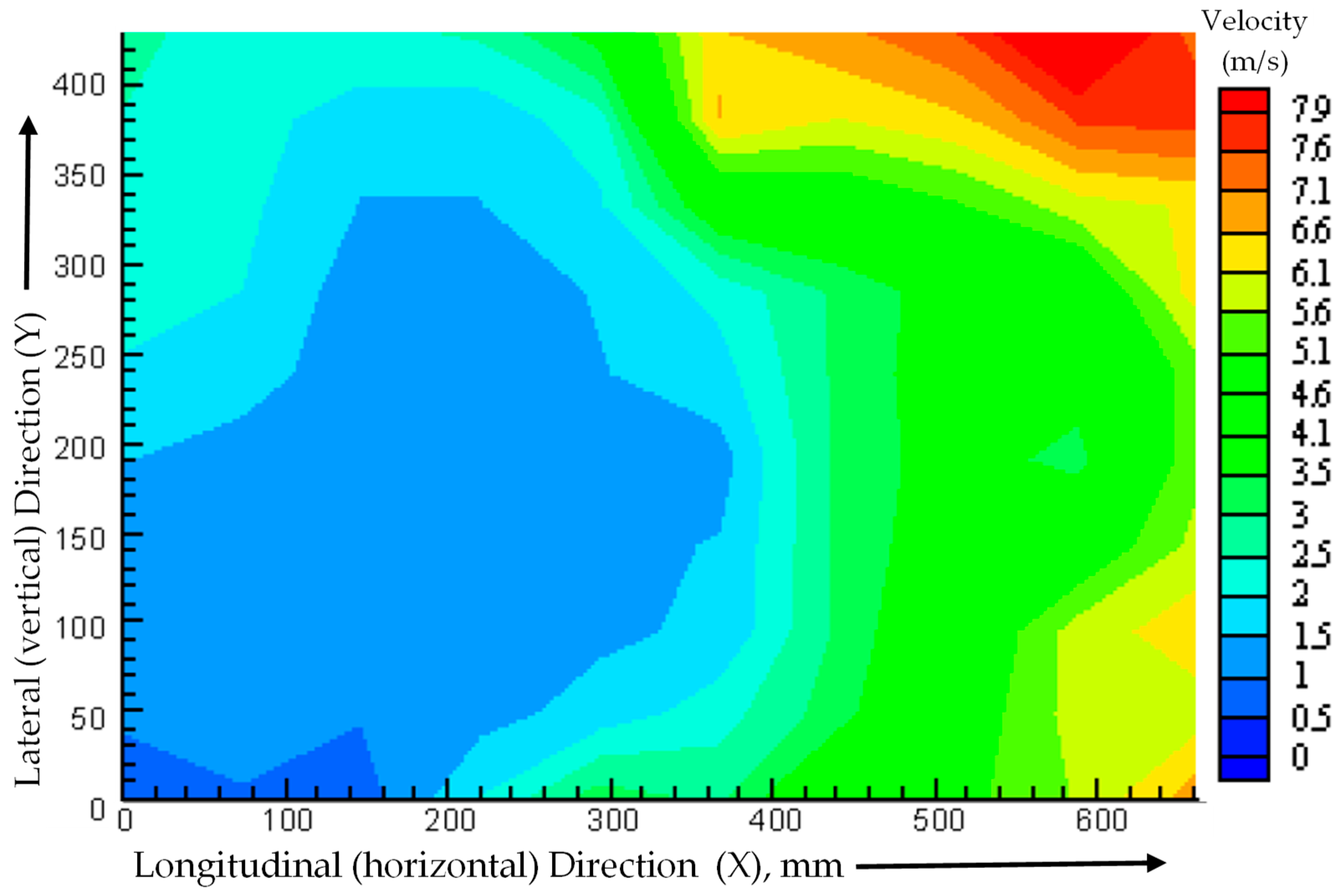
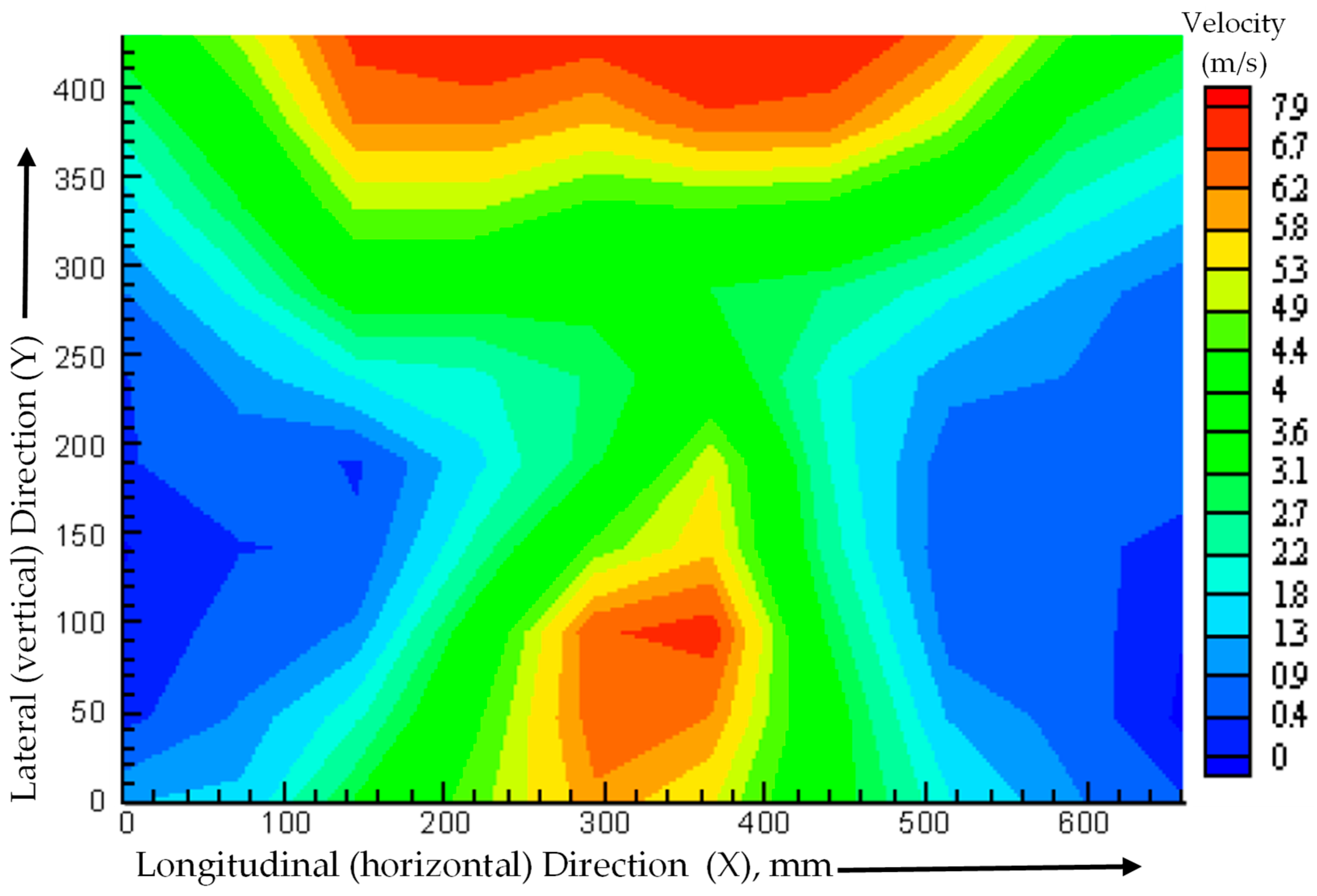
The analysis is conducted on the velocity distribution, average flow velocity, and the airflow nonuniformity index. The data points have been extended to cover the entire radiator area, utilising the Kriging method of spatial statistical interpolation. The Kriging method employs a general trend along with a defined set of points to assign weights, incorporating a random noise component to determine the value of the interpolated point. The contour plots of velocity distribution for all four shielding methods, along with the baseline scenario (without any modifications), are shown in Figure 12, Figure 13, Figure 14, Figure 15 and Figure 16. In each figure, the arrows in the legends of the horizontal and vertical axes show the incremental distance from the radiator’s left bottom origin.
Figure 12. Airflow velocity contour profile of behind the radiator for baseline vehicle (no shielding), 100 km/h (27.78 m/s).
Figure 13. Velocity contour profile of airflow behind the radiator for vertical shielding method, ½ intake area shielded, 100 km/h (27.78 m/s).
Figure 14. Velocity contour profile of airflow behind the radiator for horizontal shielding method, ½ intake area shielded, 100 km/h (27.78 m/s).
Figure 15. Velocity contour profile of airflow behind the radiator for side-to-side shielding method, ½ intake area shielded, 100 km/h (27.78 m/s).
Figure 16. Velocity contour profile of airflow behind the radiator for side-to-centre shielding method, ½ intake area shielded, 100 km/h (27.78 m/s).
The airflow distribution at the radiator for the baseline configuration at a simulated road speed of 100 km/h is shown in Figure 12, exhibiting significant nonuniformity. The upper and lower sections exhibit increased airflow velocities. The areas in question are situated behind the flow inlets and align with the physical placement of the decorative grille panel and lower intake region. The central area shows significantly low velocities, as it is positioned directly behind the bumper bar. The airflow velocities were observed to range from about 0.5 m/s to 7.5 m/s, in contrast to a free-stream velocity of 27.78 m/s. The velocities represent the average for each location documented over a span of 30 s.
Figure 13, Figure 14, Figure 15 and Figure 16 illustrate the distribution of airflow velocities across the radiator when 50% (½) of the radiator grille is shielded. As shown in the visual illustration, Figure 13 and Figure 14 exhibit a relatively more consistent airflow than Figure 15 and Figure 16. The vertical and horizontal shielding methods provide enhanced airflow homogeneity and are comparable to the baseline design, while they present certain dead zones.
The side-to-side and side-to-centre shielding methods, on the other hand, exhibit a significant amount of nonuniformity. Figure 15 shows that there is almost no flow in the area immediately behind the shield. The side-to-side shielding method also results in regions with minimal or non-existent airflow immediately behind the shielded areas, as shown in Figure 16. Furthermore, it is worth mentioning that the average cooling airflow velocity is 3.2 m/s for both cases and 2.6 m/s for the other two methods. Figure 16 shows that the vertical shielding method yielded the lowest velocity, while the horizontal shielding method consistently produced the higher velocities. This distinction is due to the vertical strips used in shielding the front end, which allow airflow, while passing over the upper and lower intake areas to stay attached as it travels over the bonnet.

4. Discussion

4.1. Discussion and Implications on Radiator Air Intake Opening on Cooling Drag and Radiator Thermal Performance

Depending on the shielding of the air entrance to the radiator, the aerodynamic drag reduction can vary by as much as 7%. This study shows that the most noticeable variation exists between side-to-side and side-to-centre configurations relative to the baseline vehicle, as well as in relation to the horizontal and vertical opening shielding. The front-end closure’s aerodynamic drag coefficient (CD) is reduced to the barest minimum by using the horizontal shielding approach. The best way to reduce aerodynamic drag is to close the intake at the front and use vertical and lateral shielding to direct airflow to the radiator. This study indicates that the cooling drag reduction for a large family-sized production passenger car, without sacrificing cooling performance, can lead to fuel consumption reductions of about 2.9% on highways and 1.7% in city driving, respectively.
Wind tunnel tests reveal that as the vehicle’s yaw angles (the angle between the vehicle centreline and the average relative wind velocity direction towards the vehicle) increase up to ±10°, vertical shielding retains its advantage over horizontal shielding. However, the change in CD reduction percentage is minor for a ±15° yaw angle. It may be noted that a vehicle travelling above 60 km/h is unlikely to have yaw angles greater than ±15° [48,68].
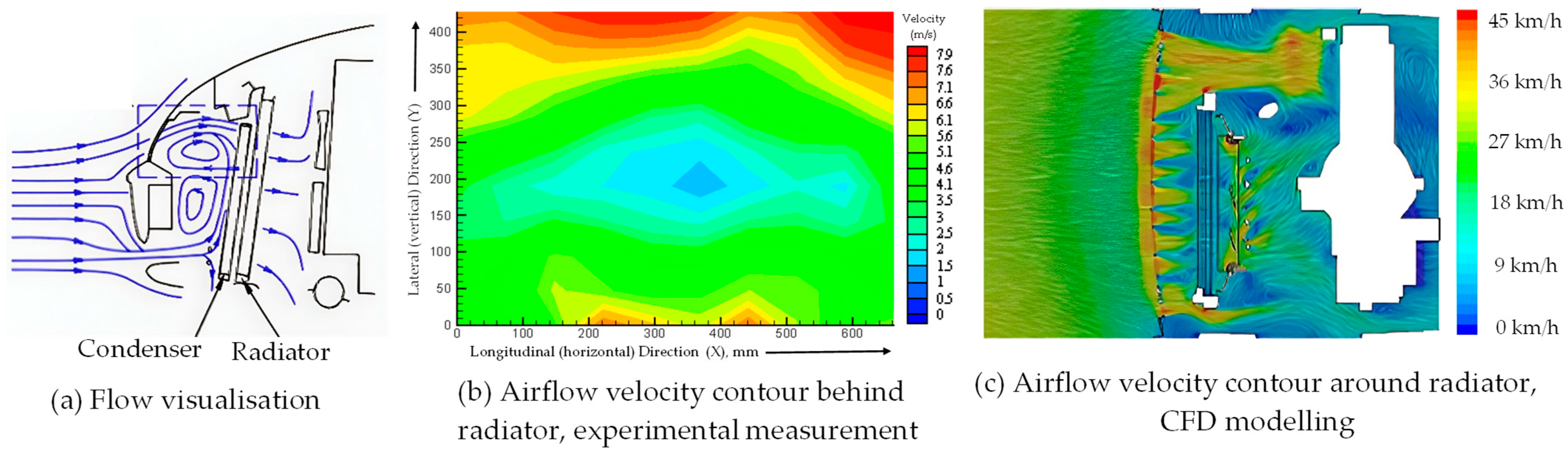
Shielding strategies significantly affect the distribution of wind velocities behind the radiator compared to baseline conditions. The baseline car has an uneven distribution of airflow at the radiator core. The upper and lower halves of the baseline radiator exhibit higher airflow rates. The central portion of the radiator, located just behind the bumper bar, displays very low speeds. When using the horizontal shielding technique, the airflow velocity is more consistent and better distributed behind the radiator, even when 25% of the cooling air intake area is blocked by shielding panels. In contrast to the more distorted airflow produced by side-to-side and side-to-centre closure methods, the vertical shielding approach ensures a well-distributed airflow velocity, as is the baseline vehicle. This study found extremely uneven airflow behind the radiator. Figure 17b illustrates the airflow pattern surrounding the radiator with the unaltered grille opening. Although it is hard to find specific references in the public domain for directly comparing this work, similar complex flow patterns can be observed in the computer simulation by Zhang et al. [37] in Figure 17c and the wool tuft by Ng [36] in Figure 17a. The arrows in Figure 17a indicate the flow direction, while the colour contrast in Figure 17b,c indicates both the magnitude of the velocity and the flow direction. This study and the previously published studies (e.g., Zhang [37] and Ng [36]) show an increase in airflow velocity in the upper and lower sections. The upper and lower sections correspond to the actual location of the bottom intake area and ornamental grille panel, which are behind the flow inlets. The middle section displays high speeds due to its location just behind the bumper bar.
Figure 17. Comparison of airflow velocity profile in and around the radiator (unblocked): current study and published work available in the open literature.
The results show that, from a drag reduction perspective, the front-end area is best shielded using a strategy that uses vertical stripes or protects the intake areas from side to centre. Nevertheless, when the system’s cooling performance is examined, it becomes evident that the horizontal shielding method results in a smaller drop in the Specific Dissipation (SD) of heat and a more uniform dispersion of cooling air. This finding holds true when a more severe form of shielding is planned for a simulated road speed of 100 km/h (27.78 m/s). There will be less cooling demand on the vehicle’s cooling system at that speed. There is a direct correlation between speed and the magnitude of the drag decreases.

4.2. Discussion and Implications of Other Potential Areas on Aerodynamic Drag Reduction

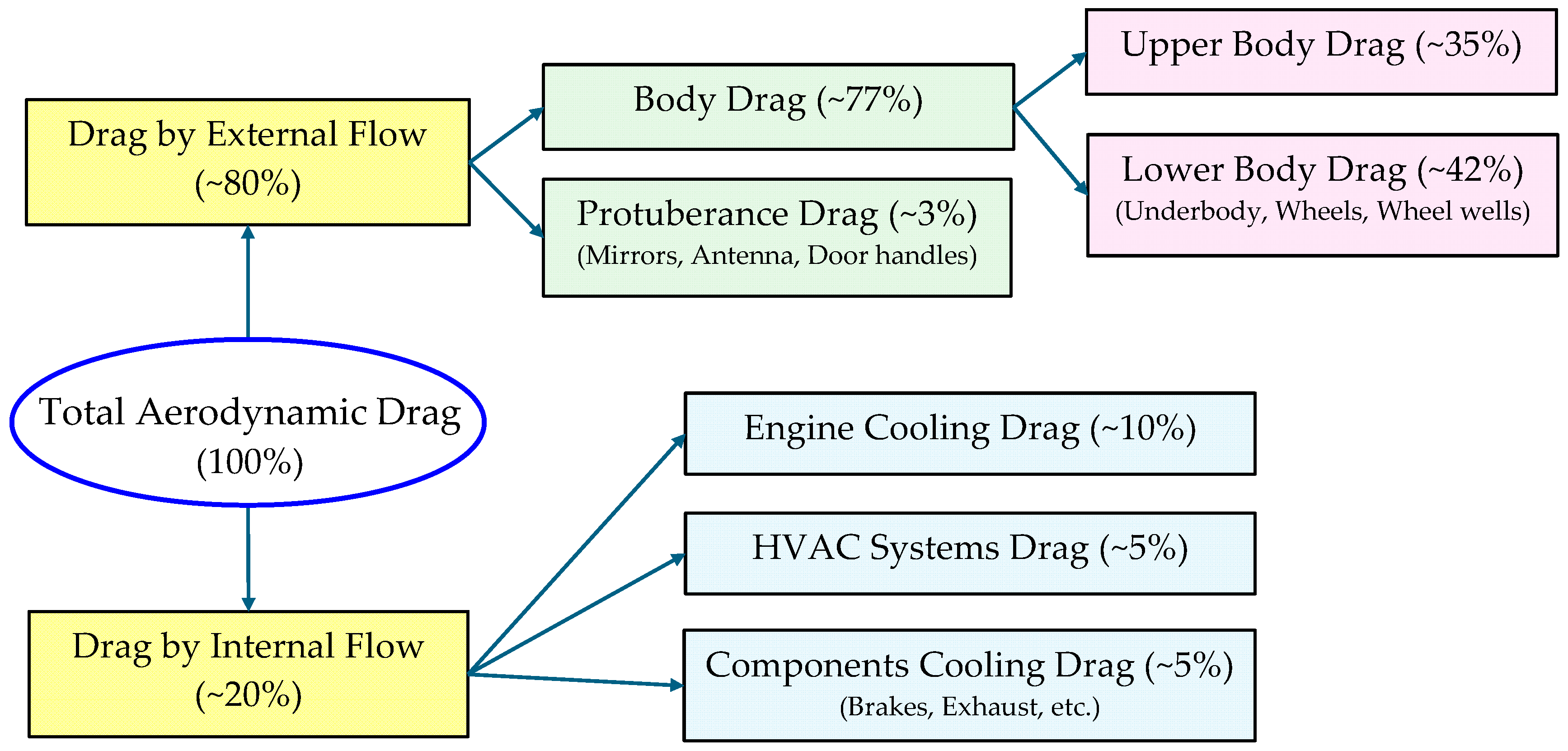
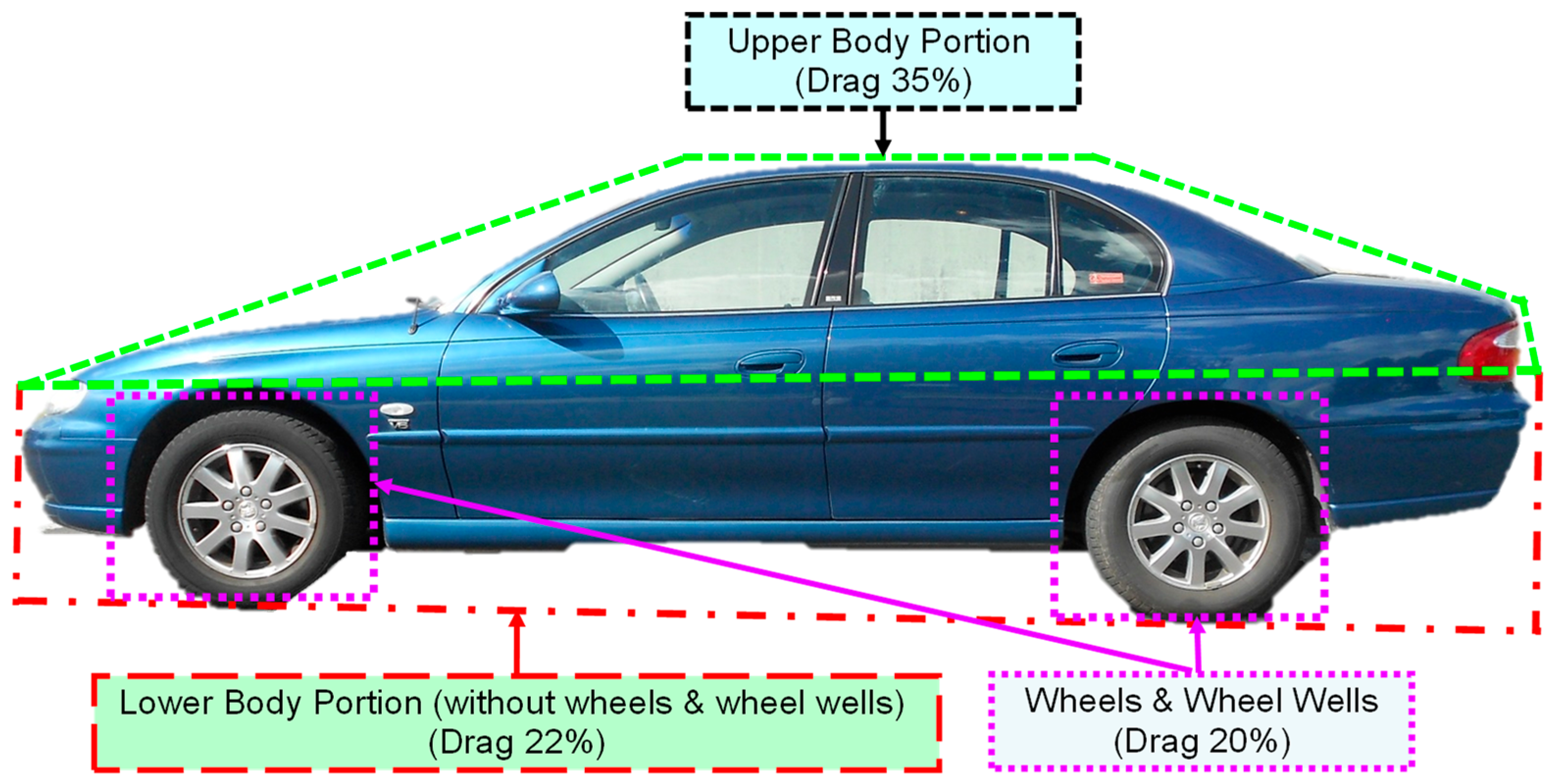
At typical highway driving speeds, the aerodynamic drag of a passenger car constitutes around 70 to 80% of the total drag that needs to be overcome by the power generated by the internal combustion engine or electric traction motor(s). As shown in Figure 18 and Figure 19, the total aerodynamic drag is 100%, out of which the external airflow of vehicle body shape creates around 80% and the remaining 20% is generated by the internal airflow. The vehicle’s underbody, wheels, and wheel wells are very sensitive for aerodynamic drag and cooling. As shown in Figure 19, the lower part of the vehicle body produces 42% of the total aerodynamic drag. The upper part of the body generates 35% of the drag. The lower part of a conventional car body generates all of its drag through its wheels, wheel wells, and underbody. The breakdown of drag indicates which areas would be worth focusing on in order to reduce aerodynamic drag.
Figure 18. Aerodynamic drag breakdown for passenger cars, adapted from [3,4,27].
Figure 19. Components of a typical passenger car’s external flow aerodynamic drag, adapted from [4].
In the discussion in Section 4.1, this study found that effective shielding can reduce cooling drag by 7%, while cooling drag generally constitutes 5% to 15% of the overall aerodynamic drag of a contemporary passenger car (depending on vehicle shape and radiator size, and cooling demand), as seen in Figure 19. The precise proportion is variable and depends on several crucial aspects, since it involves not only the drag of the radiator itself but also the necessity to channel air through the heat exchangers (radiator, intercooler, condenser, etc.) to cool the engine and other systems. Cooling drag comprises two primary elements: internal drag and add-on drag. Internal drag is produced as air traverses the constricted channels of the radiators, grille, and internal ducting, friction, pressure loss, and leakage, whereas add-on drag pertains to the disturbance of streamlined exterior airflow around the vehicle. The air that is decelerated or deflected by the grille opening influences the airflow over the bonnet, windscreen, and A-pillars, frequently resulting in increased drag in other areas. Cooling drag is determined by vehicle type, as described below:
(a)
10–15%: (or more): Cooling drag is more common in large family-sized passenger vehicles or is typical for high-performance cars and sports cars. These vehicles have powerful engines generating a lot of heat, requiring large radiator surfaces and significant air intake areas, which disrupt airflow.
(b)
5–10%: This level of cooling drag is typical for modern, efficiently designed passenger cars (sedans, hatchbacks, SUVs). Researchers, engineers, and vehicle manufacturers spend significant resources optimising coolant airflow to minimise this penalty.
(c)
<5%: Cooling drag is the realm of electric vehicles (EVs) and some very efficient hybrid vehicles (PHEVs and HEVs). EVs generate much less waste heat than internal combustion engines (ICEs) and therefore require less cooling. They often have active shutters that close off the grille entirely when cooling demand is low, reducing drag to nearly zero in those conditions.
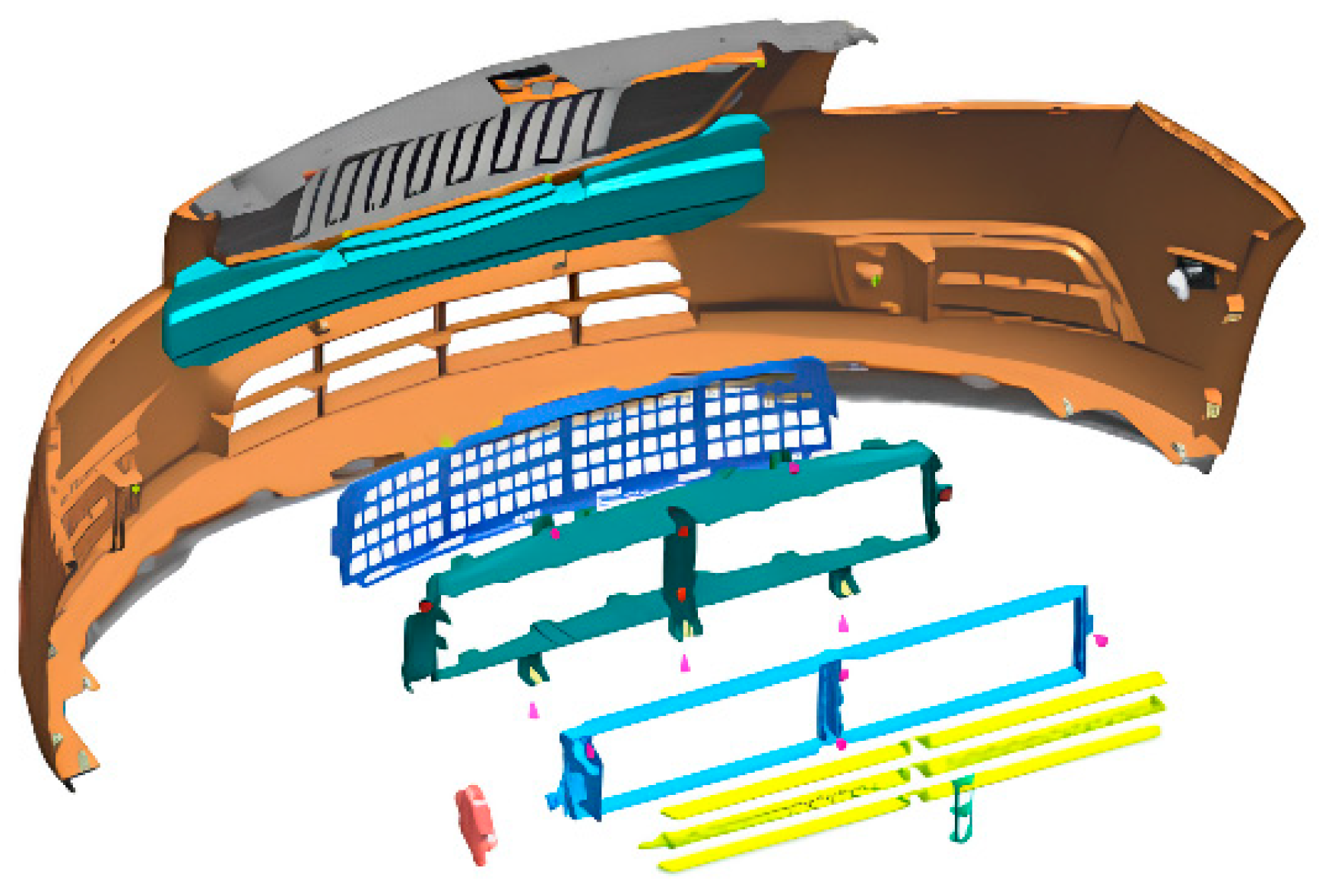
The aerodynamic drag coefficient (CD) value for most internal combustion engine-powered passenger cars remains constant at around 0.26. Further aerodynamic drag reduction can possibly be achieved through vehicle underbody streamlining and optimisation of wheels and wheel wells. Battery electric vehicles (BEVs) and Plug-in Hybrid electric vehicles (PHEVs) offer a unique opportunity to streamline vehicle underbody as well as reduce the radiator grille area at the front of the vehicle, as they need significantly less oncoming air to cool the radiator and condenser compared with conventional internal combustion engine vehicles. For BEVs, there is no need for a radiator for engine cooling (as there is in an internal combustion engine) and exhaust system cooling. Thus, the radiator grille opening area can be notably reduced and the underbody can be streamlined. For conventional internal combustion engine-powered cars, by streamlining the air intake entry to the radiator, it is possible to achieve another 2 to 4% reduction in aerodynamic drag without compromising the radiator’s cooling performance as shown through this study. However, it is an extremely sensitive area for the cooling of a vehicle. In order to obtain a meaningful additional reduction in aerodynamic drag, it is necessary to optimise both the reduction in drag and the cooling requirements simultaneously. The cooling demand is high at low speeds as the volume of airflow through the radiator grille is significantly lower compared with high-speed motion. This is why the radiator opening area needs to be larger at low speeds (i.e., under urban driving conditions) to achieve optimal cooling performance. However, at highway driving conditions, the volume of airflow through the radiator opening is much higher; thus, the reduced air opening area allows achieving the optimal cooling performance without increasing cooling drag. Therefore, variable air shutter devices can be deployed to regulate the opening area for the radiator grille depending on cooling needs. Figure 20 shows a typical shutter grille that the General Motors Chevrolet Cruze Eco passenger car employed. Ford, Toyota, and GM offer similar systems in their Focus, Avensis, and Malibu Eco models.
Figure 20. Chevrolet Cruze “shutter” grille in an exploded perspective, adapted from [69].
The drag coefficient (CD) values for some electric vehicles are claimed to be around 0.20–0.22, as shown in Table 7. However, no reliable independent research confirms these claims yet. Nevertheless, the underbody of electric vehicles offers substantial opportunity for aerodynamic drag reduction due to the lesser requirement for underbody cooling than conventional vehicles.
Table 7. Recent developments in drag reduction for passenger electric cars, adapted from [70,71,72,73,74,75,76].
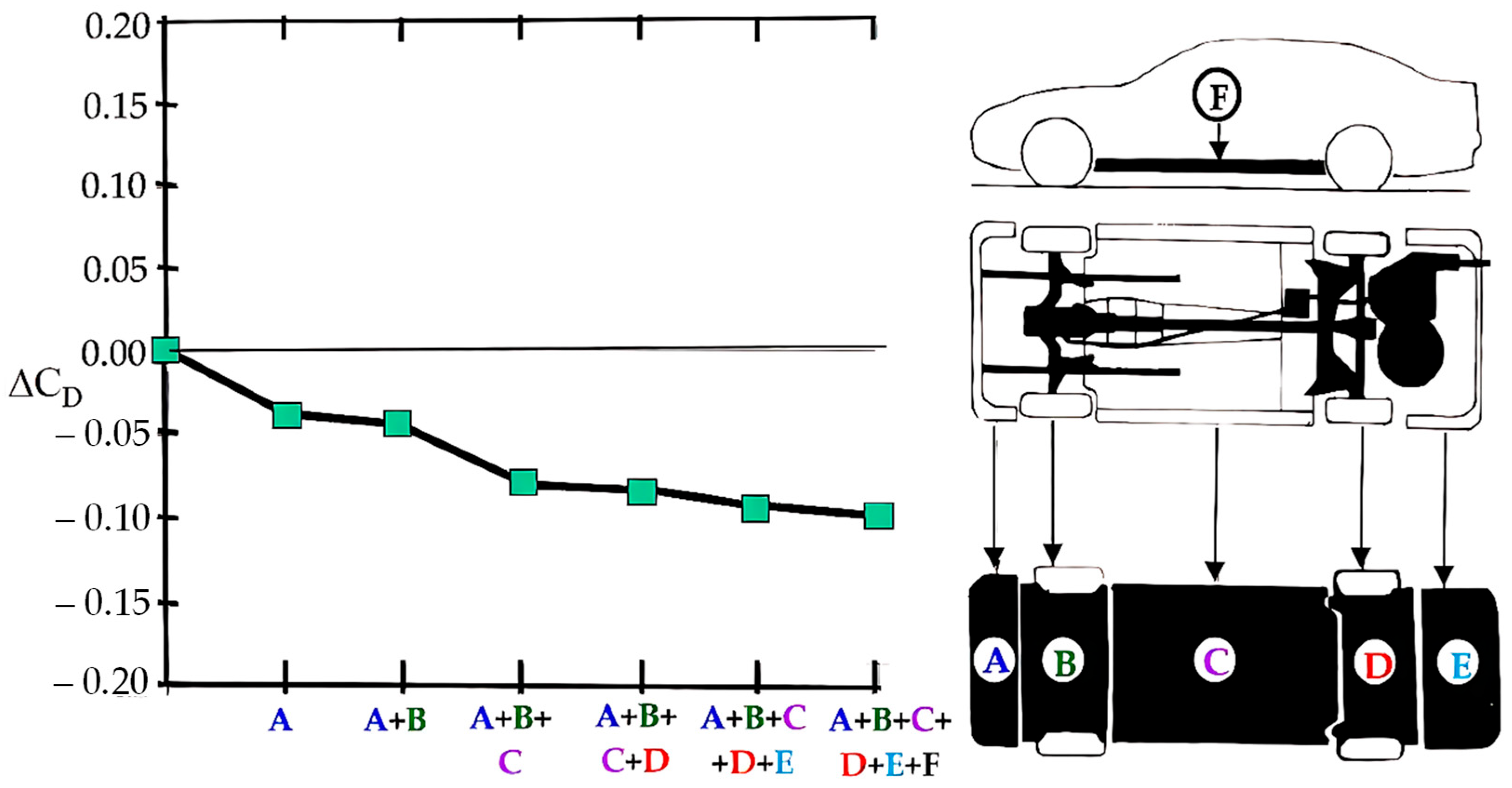
Several automobile manufacturers now include aerodynamic underbody components in their top-of-the-line models, such as a front lower shock absorber, engine covers, a centre floor, tank side and rear floor, front and rear wheel arch spats, rocker mouldings, and vehicle underbody. They also create vents or channels to direct air for cooling brakes, differentials, exhaust systems, and high-voltage batteries (for EVs). Without affecting the cooling performance, some reductions in drag were accomplished. Figure 21 illustrates the typical underbody streamlining and potential aerodynamic drag reduction. In the figure, panels C, D, E, and F better demonstrate the benefits of covering (streamlining) different underbody component sections to reduce drag than panels A and B. In the figure, A-E are underbody panels, and F is the lower side panel between the wheels. Careful design can enhance the performance of thermal cooling. To achieve smooth airflow, diffuser fins are occasionally added to the front under cover and the shaped rear bumper cover. For Toyota Lexus, Mercedes C, and other recent top-end passenger cars, underbody streamlining has been used.
Figure 21. Reduction in drag by underbody streamlining [3,77,78].
Future transportation systems that increasingly transfer driver intelligence to vehicle systems may allow for increased transport efficiencies, which can result from a combination of drag reduction from convoys (platooning) and increased road throughput with decreased average vehicle spacing. The use of active flow management is another possibility for further reducing drag, but it requires extensive research to grasp its practicality, economic viability, safety, and aesthetics.
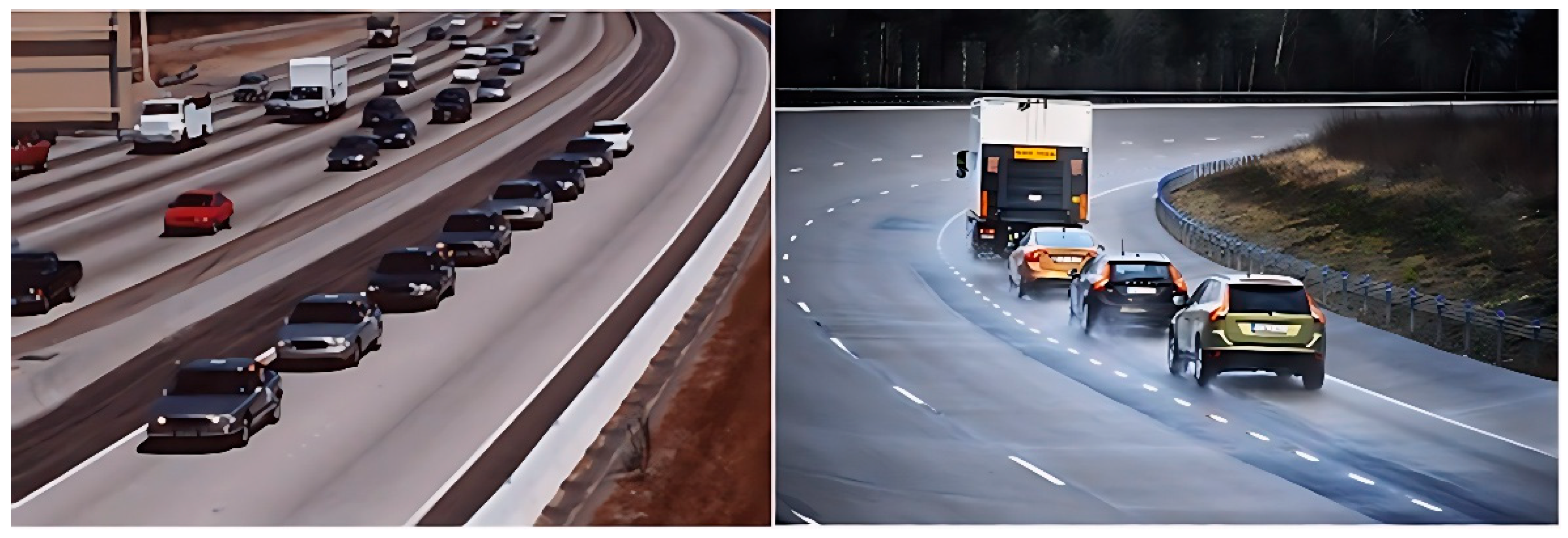
The formation of platoons (convoys) of cars is becoming considerably simpler and more possible than a decade ago due to the growing density of traffic, Intelligent Transport Systems (ITS), and autonomous vehicles. Significantly beneficial interference between vehicles can happen when driving in such close quarters, as shown in Figure 22, which may result in both leading and trailing vehicles experiencing reduced drag. The decreased dynamic pressure in the leading vehicle’s wake influences the drag coefficient of the following vehicle. Therefore, aerodynamic drag can be reduced even when there is a notable gap between the vehicles [79,80]. Motor racing is where platooning was originally used to reduce drag. Gotz and Mayr [81] investigated the implications of platooning for commercial vehicles. According to the study, the second vehicle in a convoy of commercial trucks travelling at 80 km/h with a 40 m inter-vehicle spacing can reduce drag by roughly 20%, while the third and every subsequent vehicle in the platoon can reduce drag by about 30%. This drag decrease is, however, highly shape-specific. Since 2004, a series of studies on platooning effects have been conducted by researchers [82,83,84,85] using both experimental and computational methods. These studies used the “Ahmed body” or box-type body shapes to investigate how fundamental vehicle shape might affect potential drag reduction. The exceptionally low drag coefficients (per unit volume) for streamlined trains are evidence that a considerable reduction is feasible for extremely closely coupled motor vehicles. The use of intelligent transport systems may offer an opportunity for further lowering aerodynamic drag through platooning.
Figure 22. Vehicles’ movement in convoys on the road, adapted from [4,86].
One of the primary obstacles for electric vehicles is their weight, which contributes significantly to the rolling resistance which they must overcome. The weight of the high-voltage energy storage battery ranges typically from 20% to 40% of a vehicle’s weight, depending on its type, range, and extended range. Table 8 details forty-two (42) different battery electric vehicles (BEVs) and their battery capacity, battery weight, vehicle kerb weight, and the ratio of battery weight to kerb weight in percentage. The data in the table indicates the values for the vehicle’s mostly standard range. The battery size and weight notably increase with the increased range [87]. EV manufacturers offer different range options depending on the user’s need.
Table 8. Selected EVs with their battery capacity, weight, and percentage of kerb weight.
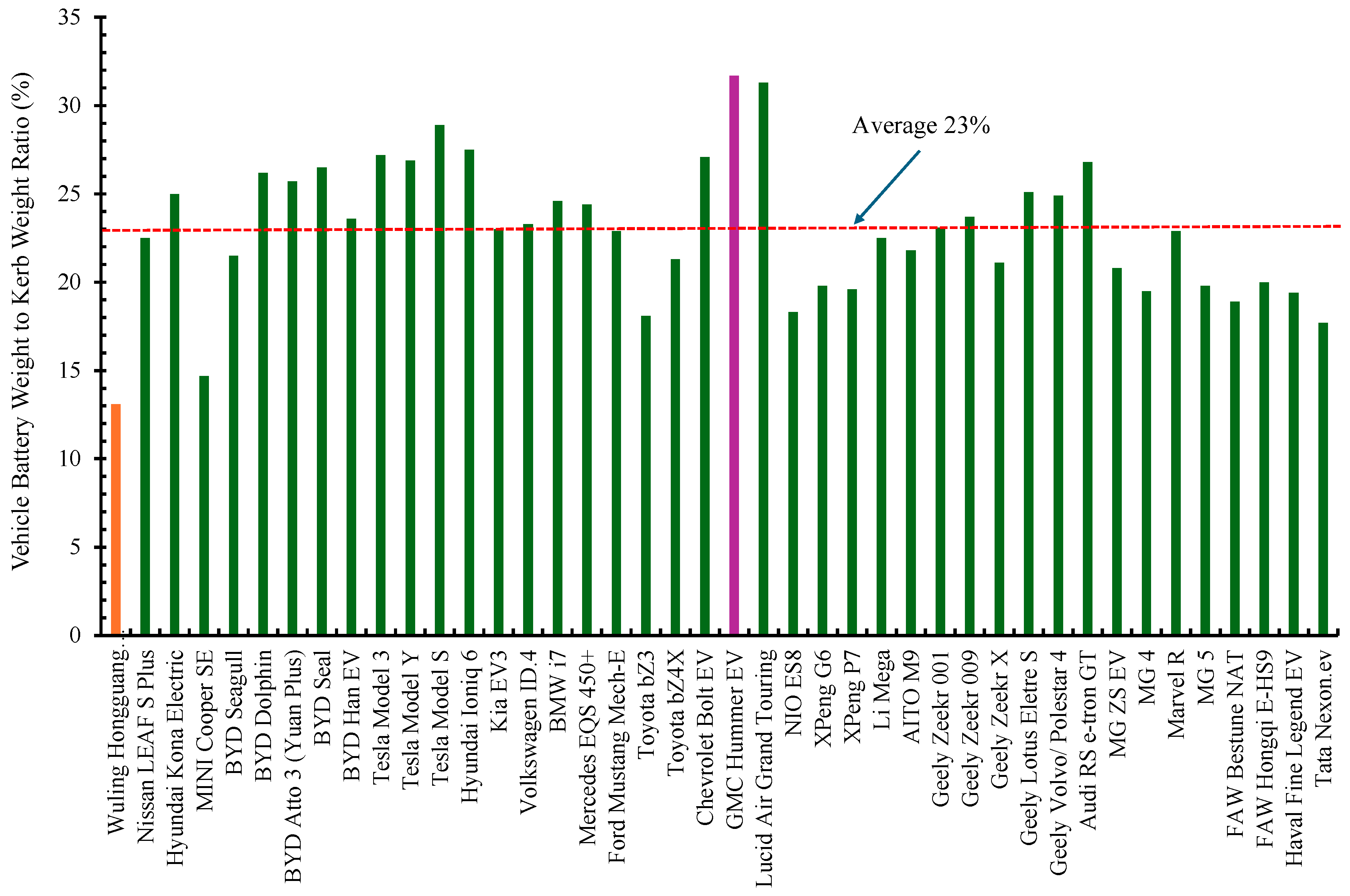
Figure 23 shows that out of 41 BEVs, the average weight ratio is 23%. The GMC Hummer EV has the greatest weight ratio at 31.7%, and the Wuling Hongguang Mini EV has the lowest at 13.1%. The MINI Cooper SE has the second-lowest percentage at 14.7%, followed by the Lucid Air Grand Touring at 31.3%. Consequently, the importance of intelligent aerodynamic design featuring streamlined shapes is crucial for minimising the drag coefficient (CD), alongside a light-weight body and battery, which are essential engineering and strategic objectives for EV manufacturers. A vehicle’s reduced weight not only minimises rolling resistance and enhances driving range but also decreases the energy required for acceleration and maintaining speed. A reduction in mass necessitates less effort from the electric motor, resulting in decreased energy consumption from the battery, quantified in Wh/km. Reduced energy usage allows a battery pack of identical weight to drive the car over a greater distance.
Figure 23. Widely available battery electric vehicles along with their battery weight and kerb weight ratios.
Vehicle manufacturers should aspire to attain a designated target range with a more compact, lighter, and cost-effective battery pack, fostering a beneficial cycle of additional weight reduction. Lightweighting advances electric vehicles towards optimal environmental efficacy. A reduced battery requirement for a light-weight vehicle results in a markedly reduced manufacturing carbon footprint. Additionally, a smaller battery requires a reduced quantity of essential and strategic minerals like lithium, cobalt, and nickel. This mitigates strain on mining, diminishes supply chain vulnerabilities, and resolves ethical sourcing issues. Batteries constitute the costliest element of an electric vehicle. A smaller, lighter battery directly decreases the vehicle’s retail price, enhancing the accessibility of EVs to a wider market. The production of light-weight electric vehicles (BEVs, PHEVs, and FCEVs), particularly those powered by batteries and internal combustion engines, is essential for the future of sustainable transportation.

5. Concluding Remarks and Future Directions

This study investigated ways to reduce aerodynamic drag and enhance cooling performance in a production passenger vehicle, ensuring that cooling efficiency remained uncompromised. This study additionally examined prospective avenues for further reduction in aerodynamic drag in both conventional and electric vehicles. The following are principal findings derived from this study:
A cooling drag reduction of up to 7% has been achieved for a large, family-sized production passenger car without compromising the cooling performance, which is in line with predictions for roughly 2.9% and 1.7% fuel consumption reductions for highway and city driving conditions, respectively.
Simplifying the design of the air intake entry to the radiator does not require an active flow control system, thereby saving energy and ongoing maintenance expenses. This implies that there is further scope for drag reduction in production passenger cars.
Electric vehicles (EVs) exhibit greater potential for aerodynamic drag reduction due to their reduced opening areas for the condenser and enhanced underbody streamlining. Nevertheless, the greater relative weight of electric vehicles (EVs) in comparison to internal combustion engine (ICE) vehicles raises rolling resistance, consequently leading to increased energy consumption.
An analysis of forty-two battery-electric vehicles (BEVs) from prominent companies, intended for standard driving ranges, revealed that the average ratio of battery weight to kerb weight is approximately 25%. The average ratio for greater-driving-range electric vehicles (EVs) may approximate one-third, attributable to the larger battery size and weight, resulting in increased rolling resistance and higher energy consumption compared to standard range EVs.
Putting a focus on light-weight materials and batteries, streamlined shapes, and active and passive airflow management can further help reduce aerodynamic drag and increase driving range. Nevertheless, an active flow control system may necessitate supplementary energy for operation and increase maintenance expenses.
Aesthetics and customer perceptions dictate the radiator grille design. Therefore, future studies should focus on these two aspects while researching the efficacy of shielding for enhancing aerodynamic drag reduction and thermal performance.
Car manufacturers should prioritise light-weight materials—particularly those that reduce battery weight while increasing energy density—active and passive flow controls, effective airflow management, and biomimetic vehicle exterior designs without sacrificing aesthetics or regulatory design standards to improve efficiency, performance, and sustainability.
The limitation of this study is that it could not look at low speeds, as the velocity magnitude behind the radiator is difficult to reliably measure and quantify. If the complex air velocity behind the radiator is less than 2 m/s, the in-house developed pressure measurement device becomes unreliable. This limitation leads to undertaking this study at higher speeds, which are more relevant to highway speeds than city fringe and urban driving conditions.

Author Contributions

F.A.: Conceptualization, Literature Review, Methodology, and Writing—Original Draft Preparation. S.W.: Writing—Reviewing and Supervision. Y.J.: Writing—Reviewing and Editing, Graphics. X.H.: Writing, Graphics, and Validation. All authors have read and agreed to the published version of the manuscript.

Funding

This research received no external funding.

Institutional Review Board Statement

Not applicable for this study not involving humans or animals.

Data Availability Statement

Data will be made available on request.

Conflicts of Interest

The authors declare no conflict of interest.

References

  1. Automotive Market Research. How Many Cars Are There in the World in 2025? Available online: https://hedgescompany.com/blog/2021/06/how-many-cars-are-there-in-the-world/ (accessed on 10 September 2025).
  2. European Automobile Manufacturers’ Association (ACEA). Economic and Market Report Global and EU Auto Industry: Full Year 2024. Available online: https://www.acea.auto/files/Economic_and_Market_Report-Full_year_2024-rev.pdf (accessed on 12 September 2025).
  3. Hucho, W.H. Aerodynamics of Road Vehicles, 4th ed.; SAE International: Warrendale, PA, USA, 1998; 918p, ISBN 0-7680-0029-7. [Google Scholar]
  4. Watkins, S.; Alam, F. Future vehicle thermal cooling and aerodynamic drag savings: Where will they come from? In Proceedings of the 2012 International Conference on Advanced Vehicle Technologies and Integration, Changchun, China, 16–19 July 2012; China Machine Press: Beijing, China, 2012; pp. 775–782. [Google Scholar]
  5. Regin, F. A Numerical Analysis on Air-Cooling Performance of Passenger Cars; SAE Technical Paper 2010-01-0554; SAE International: Warrendale, PA, USA, 2010. [Google Scholar]
  6. Heinemann, T.; Springer, M.; Lienhart, H.; Kniesburges, S.; Becker, S. Active flow control on a 1:4 car model. Exp. Fluids 2014, 55, 1738. [Google Scholar] [CrossRef]
  7. Mestiri, R.; Ahmed-Bensoltane, A.; Keirsbulck, L.; Aloui, F.; Labraga, L. Active flow control at the rear end of a generic car model using steady blowing. J. Appl. Fluid Mech. 2014, 7, 565–571. [Google Scholar] [CrossRef]
  8. Roumeas, M.; Gilli’eron, P.; Kourta, A. Analysis and control of the near-wake flow over a square-back geometry. Comput. Fluids 2009, 38, 60–70. [Google Scholar] [CrossRef]
  9. Wassen, E.; Thiele, F. Drag reduction for a generic car model using steady blowing. In Proceedings of the 4th AIAA Flow Control Conference, Seattle, WA, USA, 23–26 June 2008. [Google Scholar]
  10. Krentel, D.; Muminovic, R.; Brunn, A.; Nitsche, W.; King, R. Application of active flow control on generic 3d car models. In Active Flow Control II; Springer: Berlin/Heidelberg, Germany, 2010; Volume 108, pp. 223–239. [Google Scholar]
  11. Jonathan, M.; Erik, F.; Gregory, R.; Rajan, K.; Kunihiko, T.; Farrukh, A.; Yoshihiro, Y.; Kei, M. Drag reduction on a flat background vehicle with active flow control. J. Wind. Eng. Ind. Aerodyn. 2015, 145, 292–303. [Google Scholar]
  12. Park, H.; Cho, J.H.; Lee, J.; Lee, D.H.; Kim, K.H. Aerodynamic drag reduction of Ahmed model using synthetic jet array. SAE Int. J. Passeng. Cars-Mech. Syst. 2013, 6, 1–6. [Google Scholar] [CrossRef]
  13. Tounsi, N.; Mestiri, R.; Keirsbulck, L.; Oualli, H.; Hanchi, S.; Aloui, F. Experimental study of flow control on bluff body using piezoelectric actuators. J. Appl. Fluid Mech. 2016, 9, 827–838. [Google Scholar] [CrossRef]
  14. Joseph, P.; Amandolese, X.; Aider, J.L. Drag reduction on the 25° slant angle Ahmed reference body using pulsed jets. Exp. Fluids 2012, 52, 1169–1185. [Google Scholar] [CrossRef]
  15. Lehugeur, B.; Gilliéron, P.; Kourta, A. Experimental investigation on longitudinal vortex control over a dihedral bluff body. Exp. Fluids 2010, 48, 33–48. [Google Scholar] [CrossRef]
  16. Lei, Z.; Wan, W.; Xue, A.; Zeng, C.; Zhang, Y.; Chen, Z.; Liu, Y. Energy efficiency optimization of passenger vehicles considering aerodynamic wake flow influence in car-following scenarios. Energy 2025, 328, 136501. [Google Scholar] [CrossRef]
  17. Shadmani, S.; Nainiyan, S.M.M.; Ghasemiasl, R.; Mirzaei, M.; Pouryoussefi, S.G. Experimental study of flow control over an Ahmed body using plasma actuator. Mech. Mech. Eng. 2018, 22, 239–251. [Google Scholar] [CrossRef]
  18. Boucinha, V.; Weber, R.; Kourta, A. Drag reduction of a 3D bluff body using plasma actuators. Int. J. Aerodyn. 2011, 1, 262–281. [Google Scholar] [CrossRef]
  19. Shankar, G.; Devaradjane, G. Experimental and computational analysis on aerodynamic behavior of a car model with vortex generators at different yaw angles. J. Appl. Fluid Mech. 2018, 11, 285–295. [Google Scholar] [CrossRef]
  20. Cho, J.; Kim, T.K.; Kim, K.H.; Yee, K. Comparative investigation on the aerodynamic effects of combined use of underbody drag reduction devices applied to real sedan. Int. J. Automot. Technol. 2017, 18, 959–997. [Google Scholar] [CrossRef]
  21. Song, K.S.; Kang, S.O.; Jun, S.O.; Park, H.I.; Kee, J.D.; Kim, K.H.; Lee, D.H. Aerodynamic design optimization of rear body shapes of a sedan for drag reduction. Int. J. Automot. Technol. 2012, 13, 905–914. [Google Scholar] [CrossRef]
  22. Wang, Y.; Wu, C.; Tan, G.; Deng, Y. Reduction in the aerodynamic drag around a generic vehicle by using a non-smooth surface. Proceeding Int. Mech. Eng. Part D J. Automob. Eng. 2016, 231, 130–144. [Google Scholar] [CrossRef]
  23. Xia, Z.; Huang, M. Optimizing the Aerodynamic Efficiency of Electric Vehicles via Streamlined Design: A Computational Fluid Dynamics Approach. Int. J. Heat Technol. 2024, 42, 865–876. [Google Scholar] [CrossRef]
  24. Connolly, M.G.; Ivankovic, A.; O’Rourke, M.J. Drag reduction technology and devices for road vehicles—A comprehensive review. Heliyon 2024, 10, e33757. [Google Scholar] [CrossRef]
  25. Mukut, A.N.M.M.I.; Abedin, M.Z. Review on Aerodynamic Drag Reduction of Vehicles. Int. J. Eng. Mater. Manuf. 2019, 4, 1–14. [Google Scholar] [CrossRef]
  26. Alam, F.; Chowdhury, H.; Moria, H.; Watkins, S. Effects of Vehicle Add-Ons on Aerodynamic Performance. In Proceedings of the 13th Asian Congress of Fluid Mechanics, Dhaka, Bangladesh, 17–21 December 2010; pp. 186–189, ISBN 978-984-33-22214-2. [Google Scholar]
  27. Carr, G.W. Potential for aerodynamic drag reduction in car design, Impact of Aerodynamics on Vehicle Design. Int. J. Veh. Des. 1983, SP3, 44–56. [Google Scholar]
  28. Unni, T.P.A. Numerical Investigation on Aerodynamic Effects of Vanes and Flaps on Automotive Underbody Diffusers; SAE Technical Paper 2017-01-2163; SAE International: Warrendale, PA, USA, 2017. [Google Scholar]
  29. Tian, G.; Fan, D.; Feng, X.; Zhou, H. Thriving artificial underwater drag-reduction materials inspired from aquatic animals, Progresses and challenges. RSC Adv. 2021, 11, 3399–3428. [Google Scholar] [CrossRef]
  30. Hu, X.; Yang, B.; Lei, Y.; Wang, J.; Li, X.; Liao, L.; Xu, T. Automotive shape optimization using the radial basis function model based on a parametric surface grid. Proc. Int. Mech. Eng. Part D J. Automob. Eng. 2016, 230, 1808–1821. [Google Scholar] [CrossRef]
  31. Chowdhury, H.; Loganathan, B. Biomimetics of boxfish: Designing an aerodynamically efficient passenger car. In Biomimicry for Aerospace; Elsevier: Amsterdam, The Netherlands, 2022; pp. 211–235. [Google Scholar] [CrossRef]
  32. Kozlov, A.; Chowdhury, H.; Mustary, I.; Loganathan, B.; Alam, F. Bio-inspired design: Aerodynamics of boxfish. Procedia Eng. 2015, 105, 323–328. [Google Scholar] [CrossRef]
  33. Wan, Q.; Hu, X.; Wang, J.; Shi, H.; Yu, W.; Wang, D.; Alam, F.; Jin, Y.; Yu, T.; Guo, P.; et al. Beyond primitive bionic surfaces: Bionic structures coupled surface with superhydrophobicity and programmable directional adhesion. Phys. Fluids 2025, 37, 062115. [Google Scholar] [CrossRef]
  34. Venegas, I.; Oñate, A.; Pierart, F.G.; Valenzuela, M.; Narayan, S.; Tuninetti, V. Efficient Mako Shark-Inspired Aerodynamic Design for Concept Car Bodies in Underground Road Tunnel Conditions. Biomimetics 2024, 9, 448. [Google Scholar] [CrossRef] [PubMed]
  35. Srinivas, V. Biomimicry as a tool for the Aerodynamic Drag Reduction of Class 8 Heavy Vehicle Trailers: A Computational Analysis and Wind Tunnel Study. Intersect 2023, 16, 1–11. Available online: https://ojs.stanford.edu/ojs/index.php/intersect/article/view/2656/1580 (accessed on 20 July 2025).
  36. Ng, E.; Watkins, S.; Johnson, P.W.; Grant, L. Wind Tunnel Tests of Vehicle Cooling Performance at High Blockage; SAE 2000-01-0351; SAE World Congress: Detroit, MI, USA, 2000. [Google Scholar] [CrossRef]
  37. Zhang, Y.; Jian, J.; Wang, W.; Jia, Y.; Zhang, J. Research on Vehicle Aerodynamics and Thermal Management Based on 1D and 3D Coupling Simulation. Energies 2022, 15, 6783. [Google Scholar] [CrossRef]
  38. Sawaguchi, S.; Takakura, Y. Reducing of aerodynamically undesirable influences due to engine cooling flow in road vehicle. J. Flow Control Meas. Vis. 2020, 8, 1–24. [Google Scholar] [CrossRef]
  39. Lin, C.; Saunders, J.W.; Watkins, S.; Mole, L. Increased Productivity—Use of Specific Dissipation to Evaluate Vehicle Engine Cooling; SAE Technical Paper 970137; SAE International: Warrendale, PA, USA, 1997. [Google Scholar] [CrossRef]
  40. Lin, C.; Saunders, J.W.; Watkins, S. The Effect of Changes in Ambient and Coolant Radiator Inlet Temperatures and Coolant Flowrate on Specific Dissipation. J. Passeng. Cars Mech. Syst. J. 2000, 109, 760–771. Available online: https://www.jstor.org/stable/44686917 (accessed on 30 May 2025).
  41. Hobeika, T.; Sebben, S.; Lofdahl, L. Experimental and numerical investigation of cooling drag. Proc. Inst. Mech. Eng. Part D J. Automob. Eng. 2017, 231, 1203–1210. [Google Scholar] [CrossRef]
  42. Ng, E. Vehicle Engine Cooling Systems: Assessment and Improvement of Wind-Tunnel Based Evaluation Methods. Ph.D. Thesis, RMIT University, Melbourne, Australia, 2004. [Google Scholar]
  43. Jama, H.; Watkins, S.; Dixon, C. Reduced Drag and Adequate Cooling for Passenger Vehicles Using Variable Area Front Air Intakes; SAE Technical Paper 2006-01-0342; SAE International: Detroit, MI, USA, 2006. [Google Scholar] [CrossRef]
  44. Xu, B.; Leffert, M.; Belanger, B. Fuel Economy Impact of Grill Opening and Engine Cooling Fan Power on a Mid-Size Sedan; SAE Technical Paper 2013-01-0857; SAE International: Warrendale, PA, USA, 2013. [Google Scholar] [CrossRef]
  45. Liu, C.; Wang, Z.; Fan, C.; Zhang, R.; Man, X. A Joint Control Strategy for Automobile Active Grille Shutter and Cooling Fan. Int. J. Automot. Technol. 2021, 22, 1675–1682. [Google Scholar] [CrossRef]
  46. Salehi, H.; Savaripour, H.; Bidhendi, H.M.; Farhani, F.; Rosen, M.A. Experimental and simulation study of an automobile cooling system: Performance improvement using passive flow control. Int. Commun. Heat Mass Transf. 2023, 149, 107168. [Google Scholar] [CrossRef]
  47. Kim, J.M.; Kim, K.M.; Ha, S.J.; Kim, M.S. Grille Design for Passenger Car to Improve Aerodynamic and Cooling Performance using CFD Technique. Int. J. Automot. Technol. 2016, 17, 967–976. [Google Scholar] [CrossRef]
  48. Alam, F. The Effects of Car A-Pillar and Windshield Geometry on Local Flow and Noise. Ph.D. Thesis, RMIT University, Melbourne, Australia, 2000. [Google Scholar]
  49. Alam, F.; Zimmer, G.; Watkins, S. Mean and time-varying flow measurements on the surface of a family of idealized road vehicles. Exp. Therm. Fluid Sci. 2003, 27, 639–654. [Google Scholar] [CrossRef]
  50. Watkins, S.; Oswald, G.; Czydel, R.; Saunders, J. Aerodynamically Induced Noise and Vibration of Automobile Adds-Ons- External Mirrors, Aerials and Roof-racks. In Proceedings of the 9th International Pacific Conference on Automotive Engineering (IPC-9), Bali, Indonesia, 16–21 November 1997. [Google Scholar]
  51. Falcon Facts, AUII Falcon (2000–2001). Available online: https://www.boostedfalcon.net/falconfacts/falcon/auiifalcon.html (accessed on 25 August 2025).
  52. SAE Standard J819_200904; Engine Cooling System Field Test (Air-to-Boil). SAE International: Warrendale, PA, USA, 1962. [CrossRef]
  53. SAE Standard J1393_202302; Heavy-Duty Vehicle Cooling Test Procedures. SAE International: Warrendale, PA, USA, 1984. [CrossRef]
  54. Mosier, J.A.; Jarrett, F.N. Cooling System Analysis; SAE Technical Paper 740689; SAE International: Warrendale, PA, USA, 1974. [Google Scholar] [CrossRef]
  55. Costelli, A.; Gabriele, P.; Giordanengo, D. Experimental Analysis of Engine Cooling Systems; SAE Technical Paper 790397; SAE International: Warrendale, PA, USA, 1979. [Google Scholar] [CrossRef]
  56. Williams, J. An Automotive Front-End Design Approach for Improved Aerodynamics and Cooling; SAE Technical Paper 850281; SAE International: Warrendale, PA, USA, 1985. [Google Scholar] [CrossRef]
  57. Chapman, K.S.; Johnson, J.H.; Chiang, E. The Use of the Vehicle Engine Cooling System Simulation as a Cooling System Design Tool; SAE Technical Paper 880600; SAE International: Warrendale, PA, USA, 1988. [Google Scholar] [CrossRef]
  58. Emmelmann, H.J.; Berneburg, H. Aerodynamic Drag and Engine Cooling—Conflicting Goals? SAE Technical Paper 905128; SAE International: Warrendale, PA, USA, 1990. [Google Scholar]
  59. Ecer, A.; Toksoy, C.; Rubek, V.; Hall, R.; Gezmisoglu, G.; Pagliarulo, V.; Caruso, S.; Azzali, J. Air Flow and Heat Transfer Analysis of An Automotive Engine Radiator to Calculate Air-to-Boil Temperature; SAE Technical Paper 951015; SAE International: Warrendale, PA, USA, 1995. [Google Scholar] [CrossRef]
  60. Lin, C.H. Specific Dissipation as a Technique for Evaluating Motor Car Radiator Cooling Performance. Ph.D. Thesis, RMIT University, Melbourne, Australia, 1999. [Google Scholar]
  61. Stratton, D.G.; Stringer, R.E.; Taylor, S.R.G. Engine Cooling System Design and Development. Proc. Inst. Mech Eng. 1965, 180, 221–228. [Google Scholar] [CrossRef]
  62. Paish, M.G.; Stapleford, W.R. A Rational Approach to the Aerodynamics of Engine Cooling System Design. Proc. Inst. Mech Eng. 1968, 183, 69–82. [Google Scholar] [CrossRef]
  63. Hird, T.G.; Johnson, P.W.; Pitt, B. Aerodynamic Improvements to Car Radiator Performance Using a Wind Tunnel Facility. In Proceedings of the 9th Australasian Fluid Mechanics Conference, Auckland, New Zealand, 8–12 December 1986. [Google Scholar]
  64. Hird, T.G.; Saunders, J.W. Steady-State Evaluation of Radiator Cooling in an Industrial Wind Tunnel. In Proceedings of the Third ATA International Conference on Innovation and Reliability in Automotive Design and Testing, Florence, Italy, 6–8 April 1992. [Google Scholar]
  65. Dib, S. Parametric Study of the Front-End of Australian Cars and its Effects on Cooling. Master’s Thesis, RMIT University, Melbourne, Australia, 1997. [Google Scholar]
  66. SAE Standard J1263_201003; Road Load Measurement and Dynamometer Simulation Using Coastdown Techniques. SAE International: Warrendale, PA, USA, 2010. [CrossRef]
  67. Zimmer, G.; Alam, F.; Watkins, S.; Peric, C. Comparison of a High Blockage Wind Tunnel, an Open Jet Wind Tunnel and On-road Testing with Respect to External Surface Pressures; SAE Technical Paper 2001-01-1087; SAE International: Warrendale, PA, USA, 2001. [Google Scholar] [CrossRef]
  68. Cooper, K.R. Bluff-Body Aerodynamics as Applied to Vehicles. In Proceedings of the Second International Colloquium on Bluff Body Aerodynamics and Applications (BBAA II), Melbourne, Australia, 7–10 December 1992; Volume 1. [Google Scholar]
  69. Shunk, C. Exploded View of Chevy Cruze “Shutter” Grille. 2010. Available online: https://www.autoblog.com/news/exploded-view-of-chevy-cruze-shutter-grille (accessed on 14 June 2025).
  70. Top Gear Review. Twelve Most Aerodynamically Efficient EVs on Sale in the UK. 2025. Available online: https://www.topgear.com/car-news/electric/these-are-12-most-aerodynamically-efficient-evs-sale-uk (accessed on 30 July 2025).
  71. Sherman, D. Five Slippery Cars, Comparo. June 2014, pp. 86–92. Available online: https://www.tesla.com/sites/default/files/blog_attachments/the-slipperiest-car-on-the-road.pdf (accessed on 14 September 2025).
  72. Davis, T. Aerodynamic Advancements See EVs Stretch Their Legs, Financial Review. 9 December 2022. Available online: https://www.afr.com/companies/transport/aerodynamic-advancements-see-evs-stretch-their-legs-20221205-p5c3n4 (accessed on 14 September 2025).
  73. Tallodi, J. Ten (10) of the Most Aerodynamic Cars Ever Made. 12 January 2024. Available online: https://www.carwow.co.uk/best/most-aerodynamic-cars#gref (accessed on 14 September 2025).
  74. Alcala, F. Fifteen (15) Most Aerodynamic Electric Cars. Available online: https://www.topspeed.com/most-aerodynamic-electric-cars/ (accessed on 13 October 2025).
  75. BYD SEAL: Dynamic and Intelligent, 2023. Available online: https://www.byd.com/eu/news-list/BYD_SEAL_Dynamic_and_Intelligent (accessed on 13 October 2025).
  76. Hyundai IONIQ 6 Relieves Range Anxiety with 614 Kilometres Per Charge, 2022. Available online: https://www.hyundai.com/au/en/news/vehicles/hyundai-ioniq-6-relieves-range-anxiety-with-614-kilometres-per-charge (accessed on 13 October 2025).
  77. Landman, D. Flow Field Features and Aerodynamic Drag of Passenger Cars; Lecture Note; Department of Aerospace Engineering, Old Dominion University: Norfolk, VA, USA, 2013. [Google Scholar]
  78. Barnard, R.H. Road Vehicle Aerodynamic Design, 3rd ed.; Mechaero Publishing: St Albans, UK, 2010; pp. 1–276. ISBN 13 978-0954073473. [Google Scholar]
  79. Azim, A.F. An Experimental Study of Aerodynamic Interference Between Road Vehicles; SAE Paper 940422; SAE International: Warrendale, PA, USA, 1994. [Google Scholar] [CrossRef]
  80. Watkins, S.; Vino, G. On Vehicle Spacing and its Effect on Drag and Lift. In Proceedings of the Fifth International Colloquium of Bluff Body Aerodynamics & Applications (BBAA5), Ottawa, ON, Canada, 11–15 July 2004. [Google Scholar]
  81. Götz, H.; Mayr, G. Commercial Vehicles. In Aerodynamics of Road Vehicles, 4th ed.; Hucho, W.H., Ed.; SAE International: Warrendale, PA, USA, 1998; pp. 415–488. ISBN 0-7680-0029-7. [Google Scholar]
  82. Vino, G. An Experimental Investigation into Time-Averaged and Unsteady Aerodynamics of road Vehicles in Isolation and in Convoys. Ph.D. Thesis, RMIT University, Melbourne, Australia, 2005. [Google Scholar]
  83. Rajamani, G.K. CFD Analysis of Air Flow Interactions in Vehicle Platoons. Master’s Thesis, RMIT University, Melbourne, Australia, 2006. [Google Scholar]
  84. Pagliarella, R.; Watkins, S.; Tempia, A. Aerodynamic Performance of Vehicles in Platoons: The Influence of Backlight Angles; SAE Technical Paper 2007-01-1547; SAE International: Warrendale, PA, USA, 2007. [Google Scholar] [CrossRef]
  85. Pagliarella, R.; Watkins, S.; Tempia, A. The Effect of Rear Slant Angle on Vehicle Wakes and Implications for Platoons; SAE Technical Paper 2006-01-0341; SAE International: Warrendale, PA, USA, 2006. [Google Scholar] [CrossRef]
  86. Tech-FAQ. Vehicle Platooning, 2023. Available online: http://www.tech-faq.com/vehicle-platooning.html (accessed on 2 May 2023).
  87. Ritchie, H. The Weighty Issue of Electric Cars, Part 2, Sustainability by Numbers, 2023. Available online: https://www.sustainabilitybynumbers.com/p/weighty-issue-of-electric-cars-two (accessed on 10 September 2025).
Disclaimer/Publisher’s Note: The statements, opinions and data contained in all publications are solely those of the individual author(s) and contributor(s) and not of MDPI and/or the editor(s). MDPI and/or the editor(s) disclaim responsibility for any injury to people or property resulting from any ideas, methods, instructions or products referred to in the content.

Article Metrics

Citations

Article Access Statistics

Multiple requests from the same IP address are counted as one view.