From EU Just Transition Policy to Local Adaptation: Spatial–Economic Pathways for Coal Microregions in Eastern Europe

 , , ,
, , ,  ,
,
Abstract
1. Introduction
- (1)
- How do spatial and economic factors shape the readiness of coal microregions for a just transition?
- (2)
- What lessons from EU coal regions can be adapted to enhance the governance and financing frameworks for transition in Ukraine?
- (3)
- How can public investment management support spatially balanced and socially inclusive regional adaptation?
2. Materials and Methods
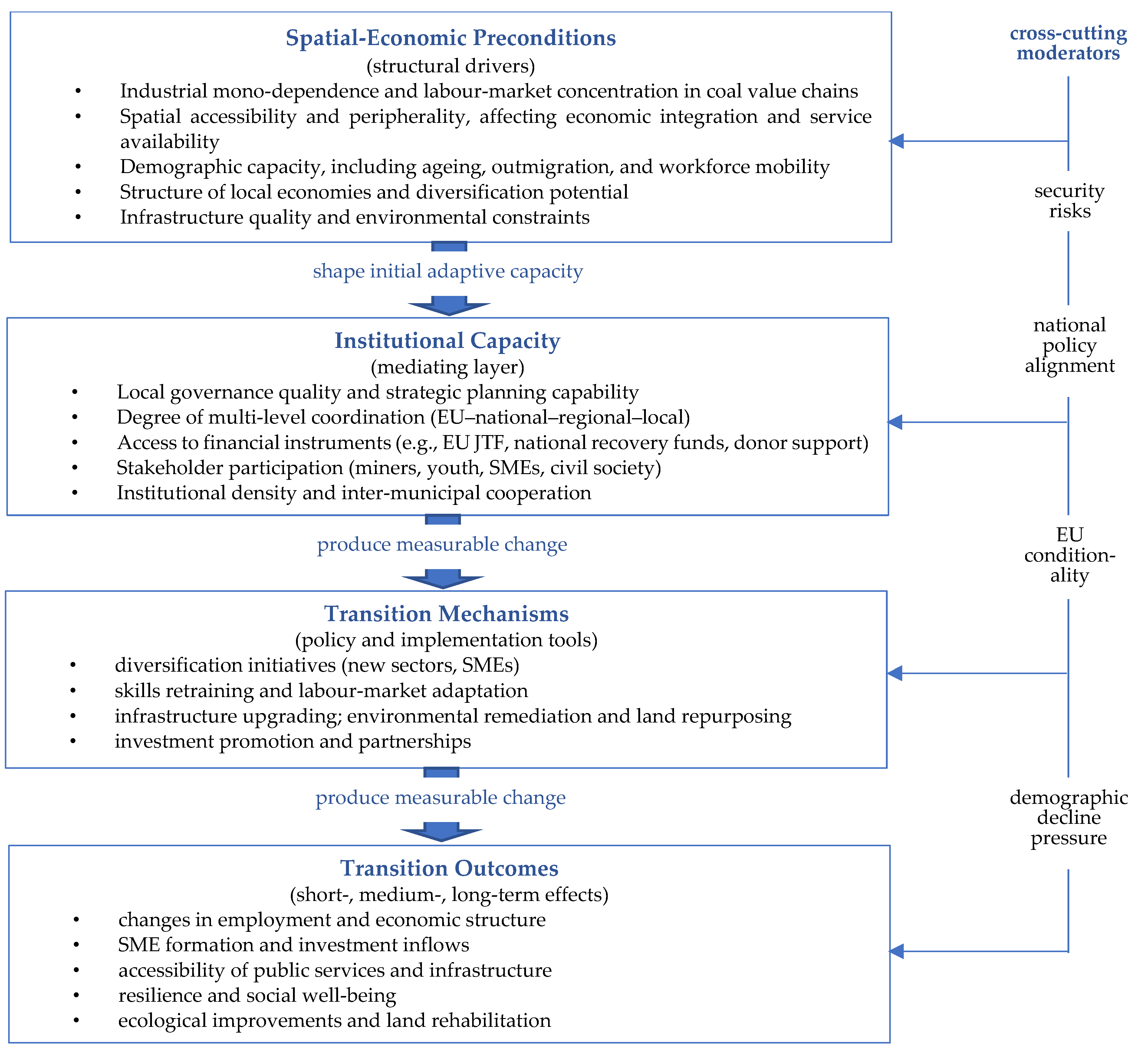
2.1. Conceptual Framework
2.2. Research Methods
2.3. Research Zones and Processes
- -
- Ruhr region (Germany)—a completed transition in an agglomeration-type region with high population density and a predominance of private ownership of coal mines. During the transformation process, the focus was placed on the development of a scientific and innovation base, which allows for assessing the impact of agglomeration effects on economic diversification throughout the transition.
- -
- Saar coal-mining region (Germany)—a region with a transitional economy and state ownership of coal mines. This case enables the examination of the role of institutional leadership and mechanisms for attracting large investors in facilitating regional transition.
- -
- Silesian voivodeship (Poland)—a region in the active phase of transition. Its selection is driven by the need to analyze transition planning and implementation, as well as the specific patterns of resource allocation within a polycentric industrial region, where partial continuation of coal mining (due to demand for coking coal) and an extended transition period are envisaged.
- -
- Jiu Valley coal microregion (Romania)—a region at the initial stage of transition. The choice is based on the specific conditions of the microregion, including spatial peripherality, low population density, and strong dependence on a single industry.
- -
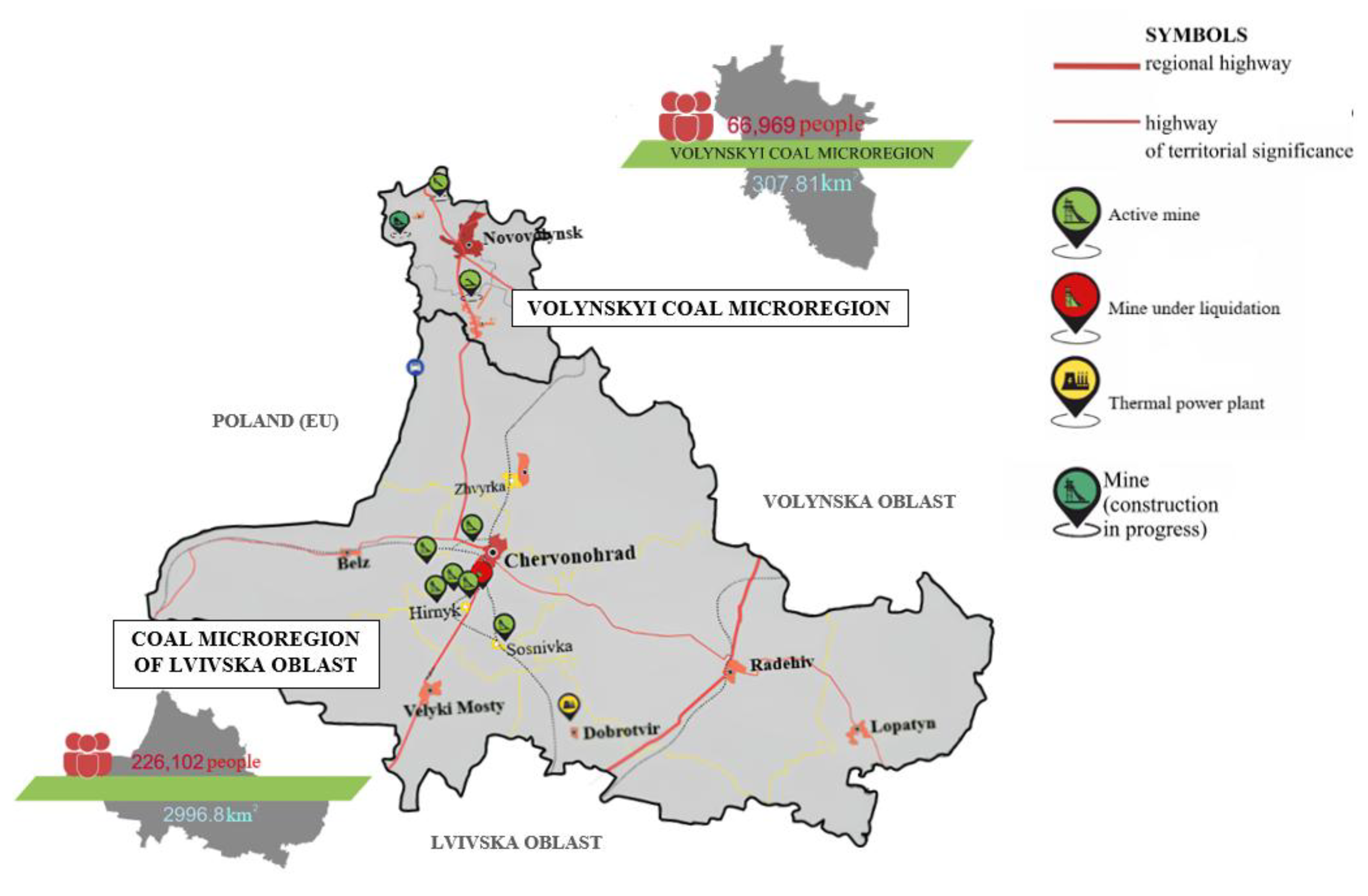
- Coal microregions of Lvivska and Volynska oblasts (Ukraine)—peripheral border territories with low population density and different histories of investment intervention, which enables the comparison of institutional capacities under wartime threats.
3. Results
3.1. Spatial–Economic Preconditions of Coal Microregions (Evidence for H1)
- -
- a rather large area of coal microregions (3304.61 km2)—in terms of this indicator, they can be compared with the coverage area of the Ruhr coal microregion and the Saar region;
- -
- the peripheral location of microregions relative to oblast centres Lviv (for coal microregion of Lvivska oblast) and Lutsk (for Volynskyi coal microregion), which are also the largest cities in the regions and are characterised by agglomeration effects on surrounding territories. This impact on both coal microregions is weak;
- -
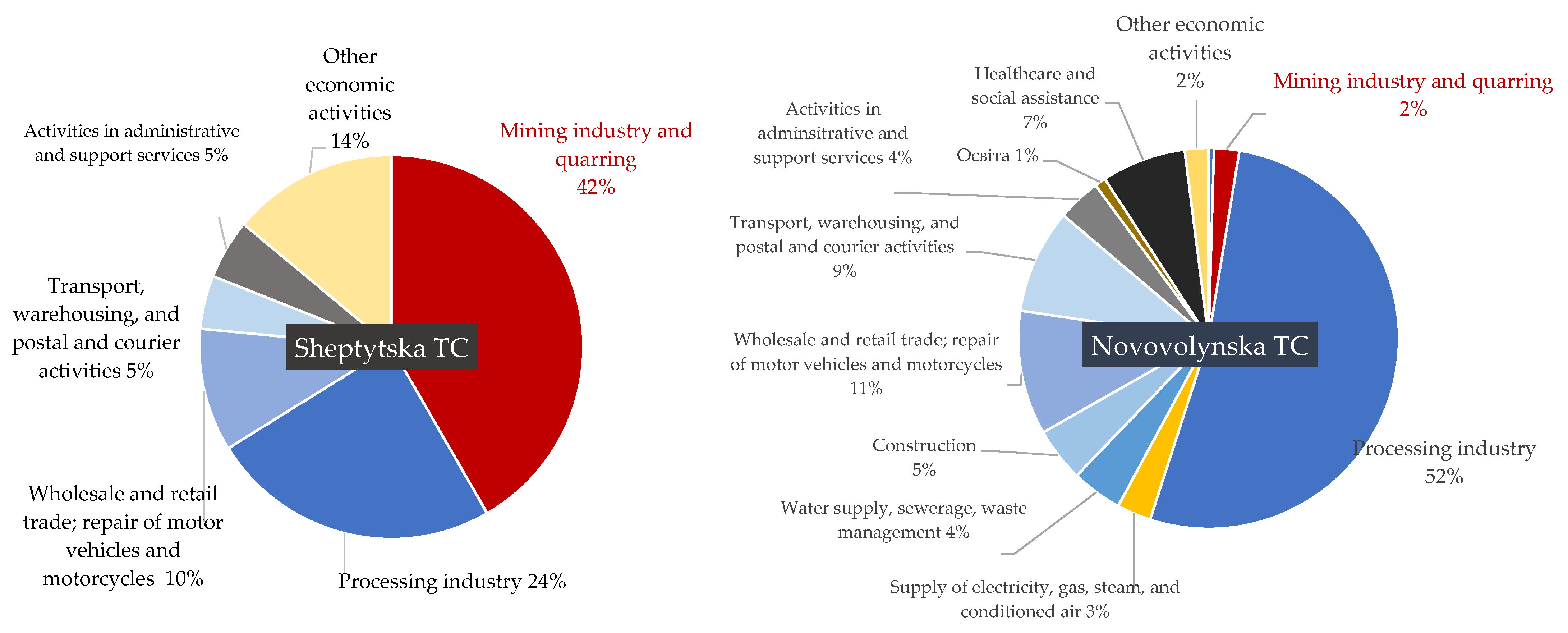
- the absence of large cities as economic growth hubs and strong centres of positive influence on the surrounding territory in terms of centre-periphery interactions. There are 237 settlements (mostly rural) in the coal microregions, with Sheptytskyi (88,200 people, the centre of the coal micro-region of Lvivska Oblast) and Novovolynsk (57,400 people, the centre of Volynskyi coal microregion) being the largest cities.
3.2. Institutional Capacity and Divergent Transition Trajectories (Evidence for H2)
- -
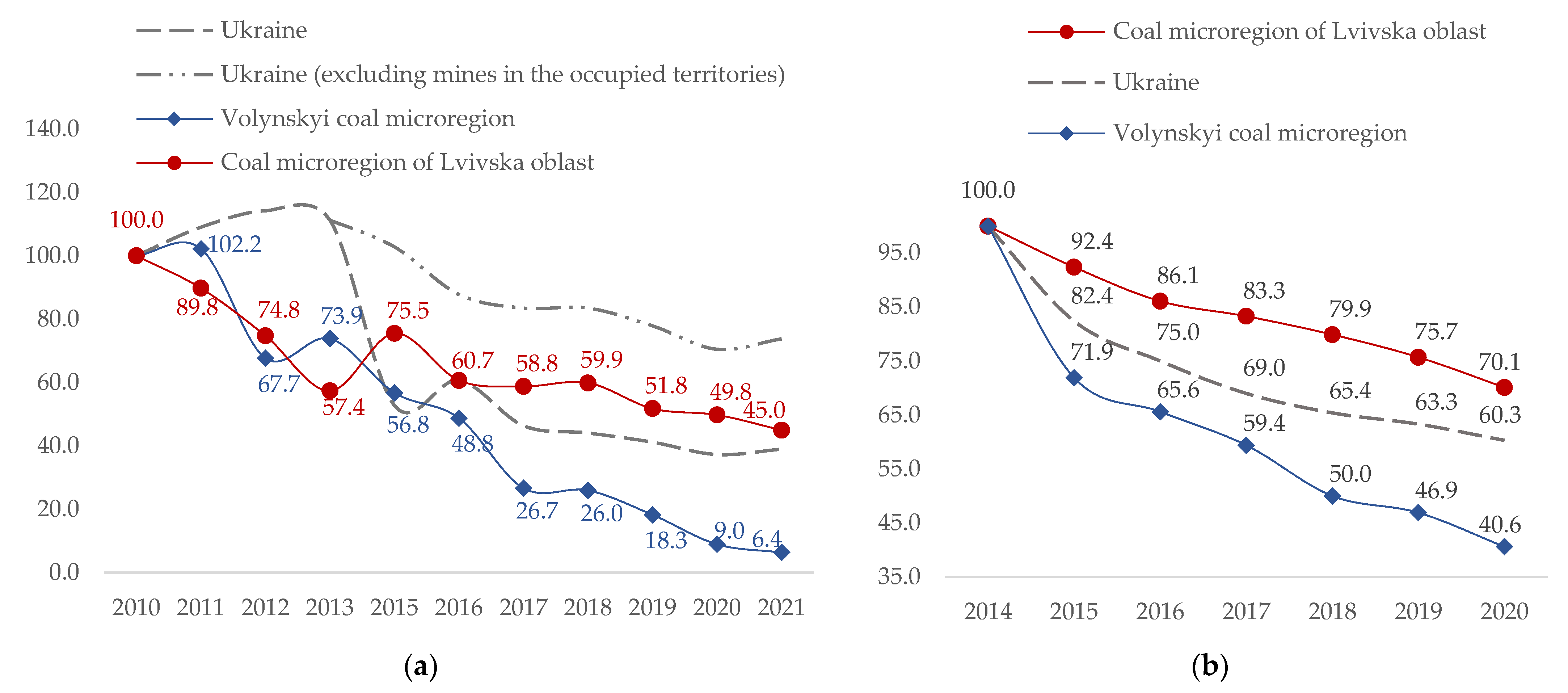
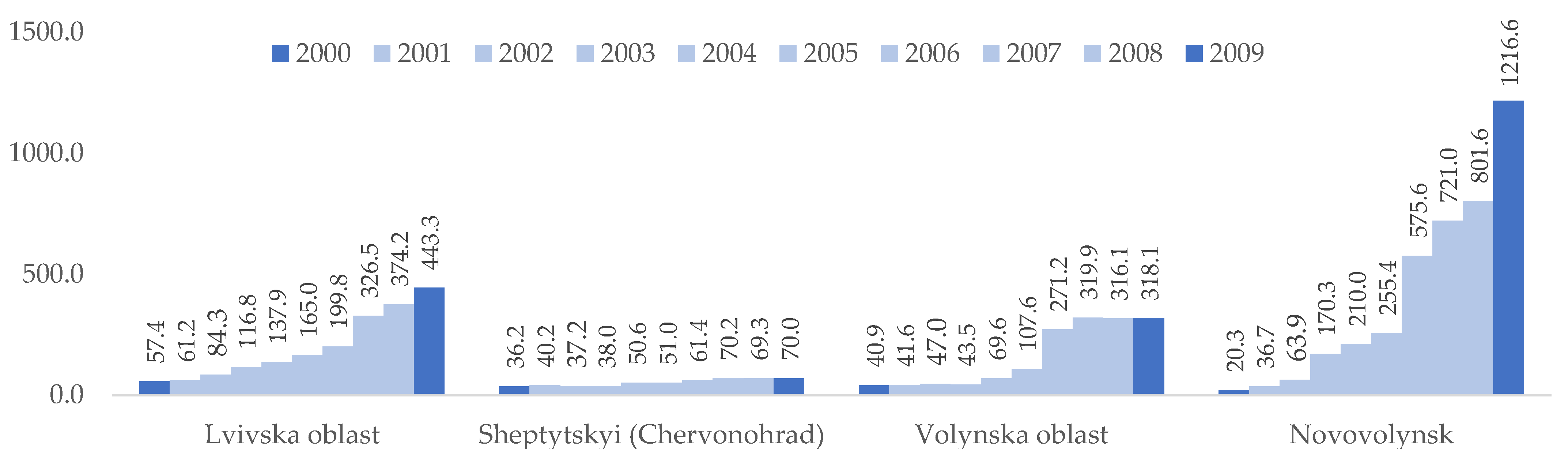
- Novovolynsk, as the centre of Volynskyi coal microregion, has already undergone the main stage of economic transition: it has diversified economy, a significant number of jobs in various sectors, and one of the highest rates of economic development in the region. However, just transition in the microregion must take place outside the city—in two rural communities where mines and other separate divisions of the coal-mining enterprise are the main economic development entities: budget-forming and largest employers;
- -
- The coal microregion of Lvivska oblast is only just entering a phase of significant transition, and Sheptytskyi, as the centre of coal mining and the largest city, requires perhaps the most attention in this context. On the other hand, the microregion covers a large area and, accordingly, local communities vary in their dependence on the coal mining sector. This allows for a territorially oriented approach to the transition of each community’s economy, taking into account the advantages and strengths of each community (e.g., the agricultural orientation of Radehivska and Lopatynska communities; the advantages of narrow specialisation (energy) of Dobrotvirska community, the developed logistics infrastructure of Sheptytska and Sokalska communities).
3.3. Security-Driven Fiscal Reallocation and Transition Mechanisms (Evidence for H3)
- -
- economic diversification through the effective use of post-industrial territories, the creation of economic centres with tax preferences and favourable conditions for business development, and support for the development of small businesses;
- -
- achieving environmental sustainability and a green transition of microregions’ economies through the development of renewable energy sources, restoration of environmental components, modernisation of municipal infrastructure, and effective waste management;
- -
- building up the logistical capacity of microregions based on their border location and diversified well-developed transport infrastructure;
- -
- development of the educational and vocational training systems in line with labour market demand and professional reorientation of laid-off workers from coal-mining enterprises;
- -
- improving the quality of social services, taking into account the needs of all segments and groups of the population.
4. Discussion
4.1. Theoretical Reflections and Critical Reassessment of Existing Frameworks
4.2. Attracting Investment in Conditions of Security Threats and Unfavourable Spatial and Economic Conditions
4.3. Improving the Quality of Human Capital vs. Preserving Human Resources—Which Approach Underpins a Just Transition?
- -
- adapting social policy to the needs of residents in the transition zone—the peripheral location of microregion communities significantly impacts the quality and accessibility of social services. During the Soviet period of development of Ukrainian territories, which coincided with the rise in coal mining, both Novovolynsk and Sheptytskyi were developing as mining cities with a fairly well-developed system of social services. The decentralisation reforms implemented between 2014 and 2020 have brought about significant changes in the system of social service provision to residents throughout Ukraine, ensuring the transfer of powers for their provision to the level of communities and regions. Therefore, conditions have been created in which it is possible to adapt social policy to the specific needs of residents (miners, women, young people, etc.) in these areas;
- -
- stimulating social and professional activity among regions—utilising the unique labour potential of microregions in the process of just transition requires not only promoting the existing qualifications of the working-age population but also developing future resources and preserving their unique skills, experience, and established traditions (in particular, preserving the potential of generations of energy workers who were employed at the Dobrotvirska Thermal Power Plant); as well as ensuring synergy in the interaction between the vocational education system in the region and local employers;
- -
- improving logistical accessibility within communities and of important centres—the peripheral location of microregions makes it difficult for their residents to access the wider system of services developing with large urban centres, in particular higher education for young people. Given the low population density in coal mining microregions and the large number of small settlements, ensuring easy and comfortable access for the population both between settlements within the microregion and to important regional centres is one of the conditions for retaining people in these areas.
4.4. Issues Regarding the Effectiveness of the Approach to the Just Transition of a Single Spatial-Functional Zone with Different Administrative and Management Systems
5. Conclusions
- -
- Theoretical contributions.
- -
- Practical contributions.
- -
- Policy implications.
- -
- Limitations and future research.
Author Contributions
Funding
Data Availability Statement
Conflicts of Interest
References
- Markard, J.; van Lent, H.; Wells, P.; Yap, X.-S. Neglected developments undermining sustainability transitions. Environ. Innov. Soc. Transit. 2021, 41, 39–41. [Google Scholar] [CrossRef]
- Allen, C.; Malekpour, S. Unlocking and accelerating transformations to the SDGs: A review of existing knowledge. Sustain. Sci. 2023, 18, 1939–1960. [Google Scholar] [CrossRef] [PubMed]
- Bennich, T.; Persson, A.; Beaussart, R.; Allen, C.; Malekpour, S. Recurring patterns of SDG interlinkages and how they can advance the 2030 Agenda. One Earth 2023, 6, 1465–1476. [Google Scholar] [CrossRef]
- Cala, M.; Szewczyk-Swiatek, A.; Ostrega, A. Challenges of Coal Mining Regions and Municipalities in the Face of Energy Transition. Energies 2021, 14, 6674. [Google Scholar] [CrossRef]
- Higher Education Institutions, Community Engagement and Just Transition; Publications Office of the European Union: Luxembourg, 2024.
- Otto, I.M.; Donges, J.F.; Cremades, R. Social tipping dynamics for stabilizing Earth’s climate by 2050. Proc. Natl. Acad. Sci. USA 2020, 117, 2354–2365. [Google Scholar] [CrossRef]
- Dunlap, R.E.; Brulle, R.J. Climate Change and Society: Sociological Perspectives; Oxford University Press: New York, NY, USA, 2015. [Google Scholar]
- Banerjee, A.; Schuitema, G. How Just Are Just Transition Plans? Perceptions of Decarbonisation and Low-Carbon Energy Transitions among Peat Workers in Ireland. Energy Res. Soc. Sci. 2022, 88, 102616. [Google Scholar] [CrossRef]
- Alves Dias, P.; Kanellopoulos, K.; Medarac, H. EU Coal Regions: Opportunities and Challenges Ahead; Publications Office of the European Union: Luxembourg, 2018. [Google Scholar]
- Smilevska, N. Financing Possibilities for Just Transition in the Western Balkans; CEE Bankwatch Network: Prague, Czech Republic, 2025. [Google Scholar]
- EU Support to Coal Regions. Limited Focus on Socio-Economic and Energy Transition; Special report; European Court of Auditors; Office of the European Union: Luxembourg, 2022. [Google Scholar]
- Wong, J.; Roser, F.; Maxwell, V. Coal Phase-Out and Just Transitions. Lessons Learned from Europe; New Climate Institute: Cologne, Germany, 2022. [Google Scholar]
- Kamińska, K.; Nowakowska, A. Polityka Zorientowana Terytorialnie Jako Metoda Adaptacji do Zmian Klimatu: Place-Based Policy as A Method for Climate Change Adaptation. Stud. Miej. 2023, 46, 11–26. [Google Scholar] [CrossRef]
- Grześczyk, A.; Niewitała-Re, M. Territorial and Distributional Aspects of Just Transition in the Draft Updated German National Energy and Climate Plan; Report; Reform Institute in Cooperation with Ecologic Institute: Warsaw, Poland, 2024. [Google Scholar]
- Hassink, R. Regional resilience: A promising concept to explain differences in regional economic adaptability? Camb. J. Reg. Econ. Soc. 2010, 3, 45–58. [Google Scholar] [CrossRef]
- Storonyanska, I.; Patytska, K.; Dub, A.; Benovska, L. «Green» transformation of coal microregions of the ukrainian-polish borderland: Problems and directions of process intensification. In Polish-Ukrainian Borderland as an Area of Transformation; Miszuk, A., Shubalyi, O., Eds.; Maria Curie-Skłodowska University Press: Lublin, Poland, 2025; pp. 325–340. [Google Scholar]
- Pandey, J.G.; Gaurav, K.; Singh, A.K.; Atul, K. Just transition beyond extraction: A spatial and comparative case study of two coal mining areas in India. Energy Res. Soc. Sci. 2025, 126, 104136. [Google Scholar] [CrossRef]
- Dragan, W.; Zdurco, A. The spatial dimension of coal phase-out: Exploring economic transformation and city pathways in Poland. Energy Res. Soc. Sci. 2023, 99, 103058. [Google Scholar] [CrossRef]
- On the Ratification of the Paris Agreement. Law of Ukraine No. 1469-VIII of July 14, 2016. Available online: https://zakon.rada.gov.ua/laws/show/en/1469-19?lang=uk#Text (accessed on 14 July 2025).
- Nationally Determined Contributions Registry. United Nations. Climate Change. Available online: https://unfccc.int/NDCREG (accessed on 14 July 2025).
- Wang, X.; Lo, K. Just transition: A conceptual review. Energy Res. Soc. Sci. 2021, 82, 102291. [Google Scholar] [CrossRef]
- Hizliok, S.; Sheer, A. What Is the Just Transition and What Does It Mean for Climate Action? The London Shool of Economics and Political Science 2024. Available online: https://www.lse.ac.uk/granthaminstitute/explainers/what-is-the-just-transition-and-what-does-it-mean-for-climate-action/ (accessed on 4 November 2025).
- Barca, F. An Agenda for a Reformed Cohesion Policy. A Place-Based Approach to Meeting European Union Challenges and Expectations, Independent Report Prepared at the Request of Danuta Hübner, Commissioner for Regional Policy, Brussels. 2009. Available online: https://www.europarl.europa.eu/meetdocs/2009_2014/documents/regi/dv/barca_report_/barca_report_en.pdf (accessed on 4 November 2025).
- Rodríguez-Pose, A.; Palavicini-Corona, E.I. Does local economic development really work? Assessing LED across Mexican municipalities. Geoforum 2013, 44, 303–315. Available online: http://econ.geo.uu.nl/peeg/peeg1224.pdf (accessed on 4 November 2025). [CrossRef]
- Neuhuber, T. One and the Same or Worlds Apart? Linking Transformative Regional Resilience and Just Transitions Through Welfare State Policies. Sustainability 2025, 17, 637. [Google Scholar] [CrossRef]
- Di Rosa, A.; Felice, M.; Fresquet, O.; Obermeyer, C.; Pottier, L.; Vogel, E. The Just Transition Mechanism: Making Sure No One Is Left Behind. SciencesPo. 2025. Available online: https://www.sciencespo.fr/psia/chair-sustainable-development/2025/06/24/the-just-transition-mechanism-making-sure-no-one-is-left-behind/ (accessed on 12 July 2025).
- Ruiz, P.; Medarac, H.; Somers, J.; Mandras, G. Recent Trends in Coal and Peat Regions in the Western Balkans and Ukraine; Publications Office of the European Union: Luxembourg, 2021. [Google Scholar]
- Eurostat. An Official EU Website. Available online: https://ec.europa.eu/eurostat/en/ (accessed on 14 July 2025).
- Oei, P.-Y.; Brauers, H.; Herpich, P. Lessons from Germany’s hard coal mining phase-out: Policies and transition from 1950 to 2018. Clim. Policy 2020, 20, 963–979. [Google Scholar] [CrossRef]
- Burlacu, R.; Suditu, B.; Gaftea, V. Just Transition in Hunedoara. Economic Diversification in a Fair and Sustainable Manner; Centrul Roman de Politici Ecjnjmice: Bucharest, Romania, 2019. [Google Scholar]
- Holman, A.; Popusoi, S. D3.5 Jiu Valley Region Case Study Report; ENergy TRANsitions from Coal and Carbon: Effects on Societies; Halle Institute for Economic Research (IWH): Halle, Germany, 2022. [Google Scholar]
- Terytorialny Plan Sprawiedliwej Transformacji Wojewodztwa Slaskiego 2030; Projekt—V.04; Urząd Marszałkowski Województwa Śląskiego: Katowice, Poland, 2022.
- Nicola, S.; Schmitz, S. Discordant agendas on a just transition in Romanian coal mining areas: The case of the Jiu Valley. Morav. Geogr. Rep. 2022, 30, 257–269. [Google Scholar] [CrossRef]
- Kapetaki, Z.; Alves Dias, P.; Conte, A.; Kanellopoulos, K.; Mandras, G.; Medarac, H.; Nijs, W.; Ruiz, P.; Somers, J.; Tarvydas, D. Recent Trends in EU Coal, Peat and Oil Shale Regions; Publications Office of the European Union: Luxembourg, 2021. [Google Scholar]
- Action Plan for the Just Transition of the Volyn Coal Micro-Region in Volyn Region Until 2030. Draft; Just Transition & Green Energy Sector Recovery Ukraine: Lutsk, Ukraine, 2024.
- Action Plan for the Just Transition of the Coal Micro-Region of Lviv Region Until 2030; Annex to Order of the Head of the Lviv Regional Military Administration No. 1095/0/5-24VA of October 15, 2024; Lviv Regional Military Administration: Lviv, Ukraine, 2024.
- Schepelmann, P.; Kemp, R.; Schneidewind, U. The Eco-restructuring of the Ruhr District as an Example of a Managed Transition. In The Book Handbook on Sustainability Transition and Sustainable Peace; Brauch, H.G., Spring, U.O., Grin, J., Scheffran, J., Eds.; Springer International Publishing: Cham, Switzerland, 2016; Volume 10, pp. 593–612. [Google Scholar]
- Arora, A.; Schroeder, H. How to avoid unjust energy transitions: Insights from the Ruhr region. Energy Sustain. Soc. 2022, 12, 19. [Google Scholar] [CrossRef]
- Storchmann, K. The rise and fall of German hard coal subsidies. Energy Policy 2005, 33, 1469–1492. [Google Scholar] [CrossRef]
- Lerch, W. Strukturwandel und regionale Wirtschaftspolitik im Saarland von 1970 bis heute. In The Book 50 Jahre Saarland im Wandel; Kühne, O., Dörrenbächer, H.P., Wagner, J.M., Eds.; Inst. für Landeskunde im Saarland, Germany: Schiffweiler, Germany, 2007; pp. 121–132. [Google Scholar]
- Lerch, W.; Simon, F.-J. Strukturwandel im Saarland—Ein Uberblick. In The Book Strukturwandel im Saarland. Herausforderungen und Gestaltungsmöglichkeiten; Rampeltshammer, L., Kurtz, H.P., Eds.; Universitätsverlag des Saarlandes: Saarbrücken, Germany, 2011; pp. 15–40. [Google Scholar]
- Otto, A.; Schanne, N. Das Saarland—Der «Sonderweg» eines altindustrialisierten Agglomerationsraumes. Sozialer Fortschr. 2006, 55, 291–294. [Google Scholar]
- Proposal for a Regulation of the European Parliament and of the Council Establishing a Framework for Ensuring a Secure and Sustainable Supply of Critical Raw Materials and Amending Regulations (EU) 168/2013, (EU) 2018/858, 2018/1724 and (EU) 2019/1020; COM (2023) 160 final 2023/0079(COD); European Commission: Brussels, Belgium, 2023.
- Bosco, A.; Fant, S. The Difficult Transformation of Poland’s Coal Region. Green Eur. J. 2024. Available online: https://www.greeneuropeanjournal.eu/the-difficult-transformation-of-polands-coal-region/ (accessed on 15 July 2025).
- EU Cohesion Policy: €3.85 Billion for a Just Transition Toward Climate Neutral Economy in Five Polish Regions. European Commission 2022. Available online: https://ec.europa.eu/commission/presscorner/detail/es/ip_22_7413 (accessed on 15 July 2025).
- Perlowska, M. Climate neutrality in Poland: The role of the coal sector in achieving the 2050 goal. Energy Policy J. 2025, 28, 113–126. [Google Scholar] [CrossRef]
- Paretto, M.; Eichhammer, W.; Susser, D. Just energy transition in coal regions: Innovative framework for assessing territorial just transition plans. Renew. Sustain. Energy Transit. 2025, 7, 100101. [Google Scholar] [CrossRef]
- From Strategy to Action. Delivering a Just Transition in the Jiu Valley, Today and Tomorrow; Association for Integrated Territorial Development Valea Jiului: Jiu Valley, Romania, 2022.
- Energy Map. Available online: https://map.ua-energy.org/uk/ (accessed on 14 July 2025).
- Orel, I. Record Coal Prices Fail to Rescue: Explaining the Continued Losses of State-Owned Mines Despite Rising Demand for Raw Materials. Forbes. 2021. Available online: https://forbes.ua/news/rekordnye-tseny-na-ugol-ne-spasayut-pochemu-dazhe-s-bolshim-sprosom-na-syre-ukrainskie-shakhty-prodolzhayut-terpet-ubytki-10112021-2743 (accessed on 22 July 2025).
- The Regional Economic Impact of Coal Mine Closures and Coal Exit in Western Ukraine; Study for the GIZ project «Supporting Structural Change in Ukrainian Coal Regions»; DIW Econ GmbH: Berlin, Germany, 2024.
- Verkhovna Rada of Ukraine. On the Special Regime of Investment Activity in the Priority Development Territory in Volyn Region. Law of Ukraine No. 2354-III of 5 April 2001. Available online: https://zakon.rada.gov.ua/laws/show/2354-14#Text (accessed on 29 July 2025).
- Ministry of Economy, Environment and Agriculture. Key Indicators for the Priority Development Territory. Available online: https://me.gov.ua/Documents/Detail?lang=uk-UA&id=9a76e9b9-fd83-44de-af22-274d9bc47c78&title=OsnovniPokaznikiPoTpr#top9 (accessed on 29 July 2025).
- Rumyantseva, G. On the issue of the effectiveness of the functioning of priority development territories. Reg. Econ. 2010, 1, 240–247. [Google Scholar]
- StatBank of Lviv Region. Available online: http://database.ukrcensus.gov.ua/statbank_lviv/Database/24PRYRODA/databasetree_uk.asp (accessed on 29 July 2025).
- Main Department of Statistics in Volyn Region. Available online: http://www.lutsk.ukrstat.gov.ua/ (accessed on 29 July 2025).
- Tax Service of Ukraine. Tax Map of Ukraine. Available online: https://map.tax.gov.ua/ (accessed on 29 July 2025).
- Giersch, V. Erfolgreiche Industrieansiedlung—Tragfähige Basis für Wachstum, Beschäftigung und Strukturwandel im Saarland. In The Book 50 Jahre Saarland im Wandel; Kühne, O., Dörrenbächer, H.P., Wagner, J.M., Eds.; Inst. für Landeskunde im Saarland, Germany: Schiffweiler, Germany, 2007; pp. 133–138. [Google Scholar]
- Ministry of Economy, Environment and Agriculture. Key Indicators for the Priority Development Territory. Available online: https://me.gov.ua/News/Detail/667d25e8-5dfd-4c74-90b5-bf05e1a20528?lang=uk-UA&title=MinekonomikiRozpochinaPriiomZaiavokNaSpivfinansuvanniaIndustrialnikhParkiv (accessed on 29 July 2025).
- Kriegesmann, B.; Böttcher, M.; Lippmann, T. Die regionalökonomische Bedeutung der Wissenschaft für das Ruhrgebiet: Hochschulen und außeruniversitäre Forschungseinrichtungen als Motor der regionalen Entwicklung. Standort 2016, 40, 177–183. [Google Scholar] [CrossRef]
- World Bank Group. Notice of Cooperation—Platform in Support of Coal Regions in Transition: Western Balkans and Ukraine. Available online: https://www.worldbank.org/en/topic/extractiveindustries/brief/platform-in-support-of-coal-regions-in-transition-western-balkans-and-ukraine?utm_source=chatgpt.com (accessed on 29 July 2025).
- Dahlbeck, E.; Gartner, S. Analysis of the Historical Structural Change in the German Hard Coal Mining Ruhr Area; German Environment Agency: Dessau-Roßlau, Germany, 2022. [Google Scholar]
- Furnaro, A.; Herpich, P.; Brauers, H.; Oei, P.-Y.; Kemfert, C.; Look, W. German Just Transition: A Review of Public Policies to Assist German Coal Communities in Transition; Resources for the Future and Environmental Defense Fund: Washington, DC, USA, 2021. [Google Scholar]
- Torop, V. Beyond the coal industry: What does the German experience teach us? Review of the results of the study visit to Germany on July 2–7 “Development opportunities beyond the coal industry”, organized by the Heinrich Böll Foundation. Ukr. Energetyka 2017. Available online: https://ua-energy.org/uk/posts/po-toi-bik-vuhilnoi-haluzi-chomu-vchyt-dosvid-nimechchyny (accessed on 22 July 2025).
- Wegener, M. Government or Governance? The Challenge of Planning for Sustainability in the Ruhr. In Planning by Law and Property Rights Reconsidered; Routledge: London, UK, 2012. [Google Scholar]
- Association of Coal Municipalities of Ukraine. Available online: https://accu.in.ua/pro-asotsiatsiiu (accessed on 14 July 2025).



| Stage/Step | Purpose/Research Focus | Methods and Data Sources | Key Indicators/Expected Outputs |
|---|---|---|---|
| 1. Conceptual and theoretical framework | To establish the theoretical foundations of the just transition and its integration into the sustainable regional development model. | Literature review; analysis of EU, UN, and national policy documents (European Green Deal, Territorial Just Transition Plans, UN SDGs). | Principles of just transition; sustainability dimensions (economic, social, environmental); formulation of research hypotheses. |
| 2. Data collection and analytical base | To compile a comprehensive empirical base on the socio-economic conditions and investment dynamics of Ukrainian coal regions. | Official statistical data, regional reports, enterprise data; publicly available datasets from local authorities. | GDP per capita; employment in the coal sector; investment volumes; energy mix; infrastructure quality indicators. |
| 3. Quantitative and comparative analysis | To assess disparities and trends in regional transition readiness and investment efficiency. | Descriptive statistics; trend analysis; cross-regional comparison; correlation analysis. | Dynamics of capital investment; structure of regional GVA; budgetary investment shares; human development and infrastructure indices. |
| 4. Synthesis of policy and institutional aspects | To evaluate institutional frameworks and financing mechanisms for the just transition. | Document analysis; comparative policy review; assessment of strategic and budgetary integration. | Existence of regional transition plans; sources of funding (state, local, donor, private); governance mechanisms. |
| 5. Interpretation and recommendations | To synthesize results and identify directions for improving public investment management and regional transition policies. | Logical and system analysis; synthesis; expert validation. | Policy recommendations; framework for public investment management in transition regions. |
| Coal Region | Ruhr Region | Saar Coal-Mining Region | Silesian Voivodeship | Jiu Valley Coal Microregion | Coal Microregion of Lvivska Oblast | Volynskyi Coal Microregion |
|---|---|---|---|---|---|---|
| Country | Germany | Germany | Poland | Romania | Ukraine | Ukraine |
| Region of location (NUTS-2 in EU, oblast in Ukraine) | DEA1 Düsseldorf | DEC0 Saarland | PL22 Śląskie | RO42 Vest | Lvivska oblast | Volynska oblast |
| Basic Geographic and Demographic Parameters | ||||||
| Area, sq km | 4400 | 2600 | 12,110 | 979 | 2997 | 308 |
| Population, thsd | 5674 (1961) 5239 (2024) | 1083 (1961) 1014 (2024) | 4217 (2024) | 165 (1992) 140 (2019) | 251 (2001) 226 (2022) | 73 (2001) 67 (2022) |
| Population density, persons/sq km | 1011.7 | 394.9 | 348.2 | 50.6 | 75.4 | 217.4 |
| Spatial-Economic Features | ||||||
| Economic specialisation of the region | Coal mining, metallurgy, mechanical engineering | Coal mining, automotive industry | Coal mining, metallurgy, mechanical engineering | Coal mining, agriculture (animal husbandry), processing industry | Coal mining, processing industry, agriculture | Processing industry, trade, agriculture |
| Functional type of the area | Industrial agglomeration | Industrial peripheral area, cross-border area | Monospecialised industrial area, agglomeration | Mountainous monofunctional area | Border area, monofunctional industrial area, rural area | Border area, rural area, special economic zone |
| GDP, EUR/person | 49,900 (2023) | 42,300 (2023) | 20,600 (2023) | 13,000 (2023) (NUTS 3 level) | 3500 (2021) (Lvivska oblast) | 2600 (2021) (Volynska oblast) |
| Coal Mining Sector Development Trends | ||||||
| Employed in the sector, persons | 600,000 (1957) 2000 (2018) | 60,000 (1957) 139 (2017) | 388,000 (1990) 61,057 (2021) | 60,679 (1989) 4840 (2017) | 16,150 (1990) 5610 (2023) | 10,550 (1990) 1050 (2023) |
| Production of coal, mln t | 137.0 (1957) 2.5 (2018) | 15.3 (1949) 1.0 (2008) | 150.0 (1990) 73.0 (2015) | 11.0 (1989) | 2.6 (2010) 1.2 (2021) | 0.4 (2010) 0.02 (2021) |
| Mines, units | 123 (1957) 0 (2019) | 16 (1957) 0 (2013) | ≈70 (1982) 32 (2006) 16 (2021) | 17 (1991) 4 (2024) | 12 (1991) 7 (2025) | 10 (1991) 2 (2025) |
| Ownership of coal companies | Private | Federal and state | Private and state | State | State | State |
| Main period of decline in coal production | 1970–2018 | 1985–2012 | 1990–ongoing | 1997–ongoing | 1991–ongoing | 1991–ongoing |
| State of just transition | Complete | Complete | Active phase | Initial stage | Initial stage | Initial stage |
Disclaimer/Publisher’s Note: The statements, opinions and data contained in all publications are solely those of the individual author(s) and contributor(s) and not of MDPI and/or the editor(s). MDPI and/or the editor(s) disclaim responsibility for any injury to people or property resulting from any ideas, methods, instructions or products referred to in the content. |
© 2025 by the authors. Licensee MDPI, Basel, Switzerland. This article is an open access article distributed under the terms and conditions of the Creative Commons Attribution (CC BY) license (https://creativecommons.org/licenses/by/4.0/).
Share and Cite
Storonyanska, I.; Patytska, K.; Benovska, L.; Ivashko, O.; Chulipa, I.; Choroszczak, J. From EU Just Transition Policy to Local Adaptation: Spatial–Economic Pathways for Coal Microregions in Eastern Europe. Energies 2025, 18, 6427. https://doi.org/10.3390/en18246427
Storonyanska I, Patytska K, Benovska L, Ivashko O, Chulipa I, Choroszczak J. From EU Just Transition Policy to Local Adaptation: Spatial–Economic Pathways for Coal Microregions in Eastern Europe. Energies. 2025; 18(24):6427. https://doi.org/10.3390/en18246427
Chicago/Turabian StyleStoronyanska, Iryna, Khrystyna Patytska, Lilia Benovska, Olena Ivashko, Ihor Chulipa, and Jerzy Choroszczak. 2025. "From EU Just Transition Policy to Local Adaptation: Spatial–Economic Pathways for Coal Microregions in Eastern Europe" Energies 18, no. 24: 6427. https://doi.org/10.3390/en18246427
APA StyleStoronyanska, I., Patytska, K., Benovska, L., Ivashko, O., Chulipa, I., & Choroszczak, J. (2025). From EU Just Transition Policy to Local Adaptation: Spatial–Economic Pathways for Coal Microregions in Eastern Europe. Energies, 18(24), 6427. https://doi.org/10.3390/en18246427