The Role of the European Investment Bank in Financing Renewable Energy Sources in Selected European Union Countries
 ,
,
Abstract
1. Introduction
- (1)
- (2)
- assessment of renewable energy efficiency, for example (e.g.,) multi-criteria decision analysis exemplified through selected countries [16,17]; visions of energy efficiency up to the year 2050 [18]; the relationship between a nation’s level of development and its energy consumption [19]; the impact of the financial system’s efficiency on the demand for renewable energy sources (RESs) [20]; the evaluation of financing models concerning energy efficiency [12]; and the assessment of financial viability in economies characterized by high levels of pollution [21,22],
- (3)
- What is the level of financing provided by the EIB for RES projects caused by the increase in the share of RES in gross final energy consumption in EU countries?
- What factors determine the effectiveness of EIB financing for RES projects in EU countries?
2. Literature Review
2.1. RES in EU Energy Policy—Main Legal Regulations
2.2. Banking Services for Renewable Energy Financing
- The social shareholder plan—Consumer Stock Ownership Plan (CSOP)—a novel consumer ownership model in the renewable energy sector. Studies, including those conducted by Lowitzsch, have compared CSOP with traditional RES financing models. As a result of these investigations, recommendations have been made to implement innovative organizational and contractual solutions that would facilitate the integration and scaling of RES investments, wherein consumers would serve as co-owners [49]. The analyses suggest that CSOP represents a low-threshold financing method, enabling individuals, particularly low-income households, to invest in renewable energy projects [50].
- Effectiveness of financial mechanisms. Research concerning Poland, the Netherlands, and the United Kingdom—primarily driven by fossil fuels—has evaluated the evolution of RES financing, taking into account wind and solar subsidies (grants, awards, crowdfunding, community bonds, ventures, and social investments). These studies demonstrated that the diversity of financial instruments and the increasing volume of funding correlate strongly with global decarbonization efforts and climate change mitigation [51]. Conversely, Mazzucato and Semieniuk have examined how different types of financing influence the pathways of RES deployment, considering specific technological categories and associated risks. Their findings indicated that various financial actors contributed to distinct technological development trajectories. Some entities maintained balanced portfolios, while others were markedly focused on particular technologies. Additionally, these actors differed in their orientation towards high- or low-risk technologies, with private entities significantly favouring low-risk options more than public institutions [52]. Among financial instruments, the issue of determinants influencing green bond issuance during the years 2017–2023 has been explored by Ozyesil and Tembel. Their research concentrated on the impact of interest rates, renewable energy capacity, carbon emission reductions, and GDP on green bond issuance [53].
- Barriers and incentives in the financing strategy for the transition to RES. Research conducted by scientists such as Qadira, Al-Motairi, Tahir, and Al-Faghih has demonstrated that the funding gap can be mitigated through the active involvement of financial institutions in supporting the public—particularly those interested in investing in RES—by offering preferential loans or facilitating the development of community financing platforms and crowdfunding initiatives. The reluctance of individual and corporate investors, as well as energy consumers, to adopt RES has been largely influenced by a lack of public awareness regarding the benefits of renewable energy, as well as misconceptions about the associated costs, including instalment payments and operational expenses [54].
2.3. European Investment Bank—The EU’s Climate Bank
- The Transformation of the EIB. Researchers have focused on analysing the evolution of the EIB’s role, particularly its shift from marginal consideration of ecological issues to strategic environmental financing initiatives beginning in the 1990s. The year 1973 proved to be pivotal, as it marked the recognition of ecology as an eligible lending objective [56]. The process of transforming the EIB into a climate-oriented financial institution has also been examined through the lens of quantum trajectories, drawing on studies of Erwin Schrödinger’s concept of a “quantum leap.” Findings indicate that this “leap” was rapid and occurred during the formative period of the European Union’s climate policy framework, thereby reinforcing the EIB’s institutional and market position [57]. Furthermore, the evolution of the EIB’s activities has been subjected to a multidisciplinary analysis integrating history, economics, law, and political science, highlighting the increasing significance of this bank amid global economic challenges and climate change [58].
- The Banking System in Support of Climate Change Initiatives. The EIB activities aimed at addressing climate change have predominantly constituted a component of broader analyses concerning the banking system’s role. Research conducted between 2009 and 2016 across European Union member states indicates, for example, that global financial investments in RES remain substantially below their potential, primarily due to market barriers and perceptions of elevated risk, which discourage private sector investors. In this context, the financial support provided for RES through EIB loans was viewed positively [59]. Additionally, researchers emphasized that EIB’s efforts should be complemented by a broader transformation towards “green” fiscal, industrial, and monetary policies, which would facilitate a fundamental shift in the economy and society to effectively confront the climate crisis [60]. The analyses also emphasized that in the transition towards a low-emission economy, the EIB and development banks cannot limit themselves to merely providing better, more environmentally friendly, and inclusive loans [61]. The issue of selecting appropriate financial instruments employed by the EIB in the implementation of renewable energy investments was further explored, notably by Spielberger, who focused on evaluating EU regulations concerning green bonds, in which the EIB served as the issuer. Through these activities, the bank accumulated widely recognized expert knowledge and expanded networks within the community dedicated to sustainable finance [62].
- The Banking System during the COVID-19. The research primarily focused on formulating recommendations for the EIB actions amid the public health crisis caused by COVID-19. It specifically addressed increasing the EIB’s own capital contributions and concentrating efforts directly on the final beneficiaries of this support, including sectors such as small and medium enterprises (SMEs) [63].
3. Methodology
- What is the level of financing provided by the EIB for RES projects caused by the increase in the share of RES in gross final energy consumption in EU countries?
- What factors determine the effectiveness of EIB financing for RES projects in EU countries?
- The level of financing provided by the EIB for renewable energy projects does not influence the increase in the share of renewable energy in the gross final energy consumption within EU member states.
- The effectiveness of EIB funding for renewable energy projects in EU countries is determined by non-financial factors.
- (1)
- RE—share of RES in gross final energy consumption in percentage points (p.p.);
- (2)
- EBI—financing at constant prices (EUR million);
- (3)
- —log GDP (Gross Domestic Product) per capita PPP (Purchasing Power Parity) expressed in USD;
- (4)
- EP—energy prices for final users (EUR/kWh);
- (5)
- PI—Policy/regulatory intensity index (unitless). A synthetic index summarizing the intensity of policies and regulations supporting RES; higher values indicate a stronger enabling environment;
- (6)
- EC—CO2 emissions per capita (t)—available in the database, not included in the M1–M5 models presented in the output part.
- Eurostat [72] (data from the area: 1, 3, 4).
- EIB data on financing of RES projects, obtained directly from the bank, taking into account the following: (1) technological structure: hydropower, onshore and offshore wind energy, solar energy (photovoltaics, PV), geothermal energy, solar energy—CSP (concentration of solar energy), biomass/biogas; (2) geographic location. The list required the manual transformation of the source data, cleaning and aggregation at the country level in individual years, which allowed the obtaining of a unique database thanks to which input data were generated and charts were prepared for each country under study (included in the analytical part of the study) (data from the area: 2).
- World Bank [73] (data from the area: 3).
- OECD (Organisation for Economic Cooperation and Development), /Energy Policy Tracker [74] (data from the area: 4).
- EDGAR (Emissions Database for Global Atmospheric Research) database [75] (data from the area: 5).
- Our World in Data [76] (data from the area: 6).
- (1)
- Germany (rapid switch to renewable energy),
- (2)
- France (high level of nuclear energy),
- (3)
- Spain (previously no dependence on Russian gas, diversification of energy sources),
- (4)
- Italy (no dependence on Russian gas),
- (5)
- Poland (dominant share of energy production from coal).
- (1)
- the diversity of leading energy sources,
- (2)
- geographical location and access to energy resources,
- (3)
- the impact of emission-based energy sources on final energy costs [77].
- Unobservable heterogeneity between countries—by using individual αi constants, it is possible to capture specific features of constants for each country, such as institutional structure, energy mix model, political stability, or regulatory culture. Such features, while not directly measurable, can have a significant impact on the pace of the energy transition and the effectiveness of EIB investments.
- Temporal effects—represented by the complete set of binary variables for years ()—capture common shocks and regulatory changes (e.g., COVID-19, RED II/Fit for 55, fluctuations in energy prices), thereby mitigating the bias introduced by omitted time-varying factors.
- Eliminate the influence of unobserved constant variables over time that may be correlated with regressors (explanatory variables).
- Analysing dynamic changes occurring in units (e.g., EU countries) regardless of their individual characteristics.
- Increasing the accuracy of statistical inference, especially in research based on observational data of a panel nature.
4. Results
- What level of financing provided by the EIB for RES projects causes an increase in the share of RES in gross final energy consumption in EU countries?
- What factors determine the effectiveness of EIB financing for RES projects in EU countries?
4.1. Sample Characteristics and Variation of Key Variables
4.2. Model Specifications
5. Discussion
- The disparities among EU member states concerning two categories of indicators are examined: (1) those reflecting changes in end-user energy demand, including considerations of energy derived from renewable sources; and (2) those associated with the security of raw material supplies, specifically, energy dependency indicators segmented by primary energy sources and the overall energy efficiency metric. The analysis revealed no statistically significant correlation between the level of sustainable energy consumption and either energy efficiency or reliance on energy imports. Conversely, a statistically significant correlation was identified between the dependency of crude oil and petroleum products on energy imports and primary energy consumption. Additionally, a notable positive correlation was observed between the share of renewable energy in gross final energy consumption and the overall dependency on energy imports [86].
- Identification of the determinants that significantly influence the share of total RES in the individual voivodeships of Poland within the context of the country’s overall electric energy consumption. Through qualitative analysis covering the years 2005–2019, a negative correlation was established between energy consumption levels and the proportion of renewable energy sources in the total energy production. Conversely, regarding the expenditures allocated to research and development activities as well as the total investments in environmental protection and water management, no statistically significant impact on the development of RES was observed [87].
- The examination of the relationship between GDP and the share of RES in final energy consumption was a central focus of the analysis. Certain segments of the study concentrated on elucidating this dependence while incorporating GDP per capita as an additional variable. Utilizing an analytical framework applied to the EU-28 member states over the period from 2007 to 2017, it was demonstrated that a low but positive correlation exists between these variables. This finding suggests that more developed nations possess a greater potential for increased RES consumption. In essence, countries with higher GDP per capita tend to exhibit a larger share of renewable energy in their final energy use. Nonetheless, other latent factors may also significantly influence the intensive adoption of RES in energy production and consumption [88]. Furthermore, some researchers incorporated additional variables—such as investment rates and energy intensity—into their analyses involving GDP per capita. Such studies, conducted on EU member states between 2015 and 2023, established that the influence of GDP per capita on RES share is structurally positive but lacks statistical significance regarding temporal changes within individual countries. Conversely, the investment rate was found to be positively and significantly correlated with the share of renewable energy. Moreover, during periods in which investment rates increased within a given member state, the share of renewable sources in gross final energy consumption also generally rose. No significant relationship was identified between energy intensity and RES share [89].
- The analysis examined the correlations between the share of renewable energy in final energy consumption and the economic strength of a country, assessed through seven indicators: real GDP growth, unemployment rate, inflation rate, exports of goods and services, public debt, foreign direct investment, and the labour cost index. The findings indicated that the selected macroeconomic indicators do not exert a statistically significant influence on the development of the renewable energy sector within the European Union. Only in certain countries (notably Denmark, Ireland, Greece, France, and Cyprus) was a statistically significant relationship established between several discrete indicators, such as the unemployment rate, export levels, and the labour cost index. More substantial correlations were identified between renewable energy deployment and the volume of foreign direct investment across numerous EU member states. The conclusions emphasized that, although specific macroeconomic factors do not directly drive the growth of renewable energy, its expansion is predominantly determined by broader national conditions and the overarching economic, political, and institutional environment [90].
- Determination of the impact of sectoral economy on the share of renewable energy consumption (case study: Ethiopia). It has been established that sustainable financing programs are indispensable for the development and support of renewable energy projects in both the short- and long-term perspectives [91].
- Assessment of the implementation of models and financing mechanisms within the energy efficiency sector (exemplified by Bulgaria, Croatia, Greece, Romania, and Slovenia) across various domains of economic activity. The analysis emphasizes that the development of sustainable financial instruments is contingent upon robust political support and the acknowledgment of their significance by all relevant stakeholders.
6. Conclusions
- (1)
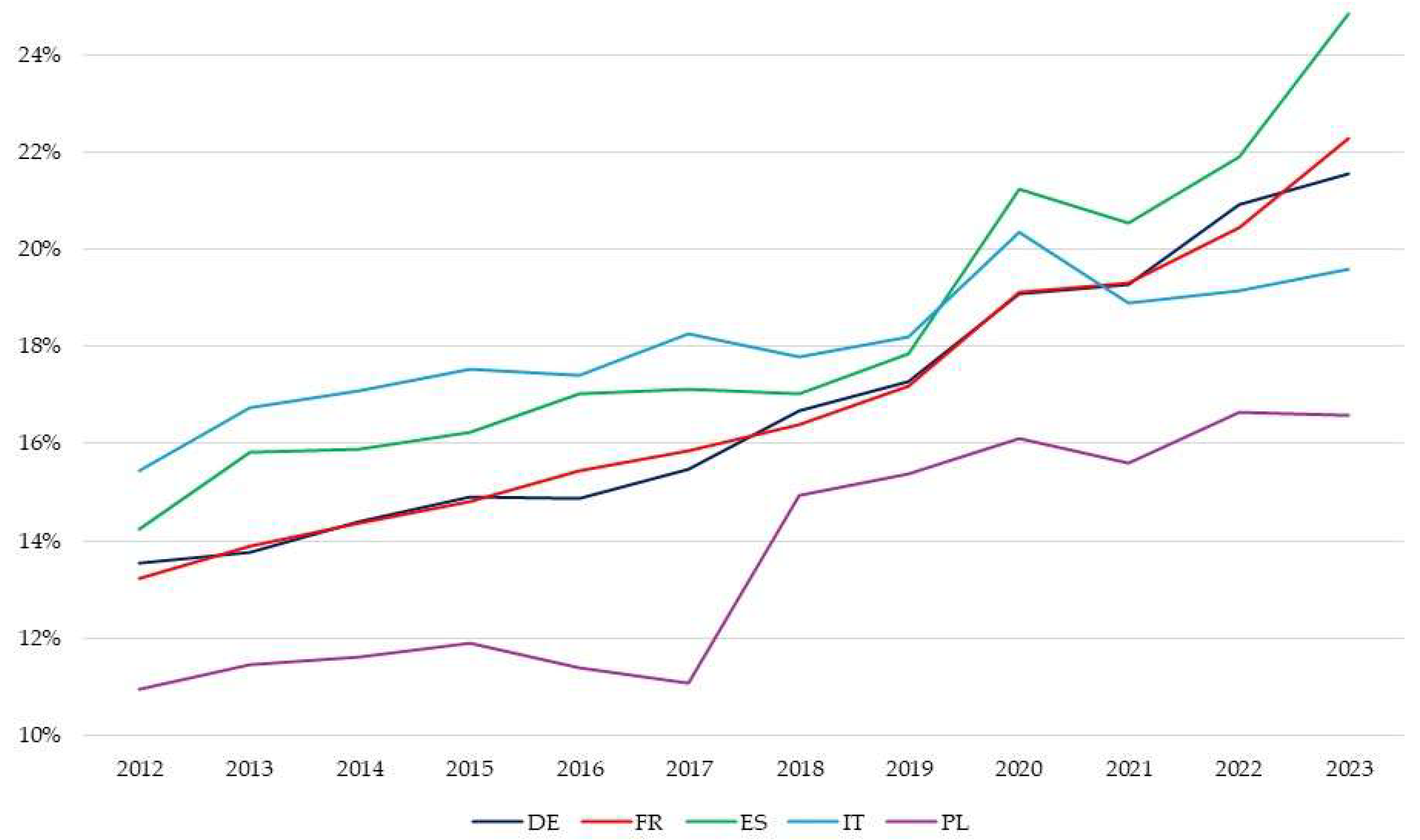
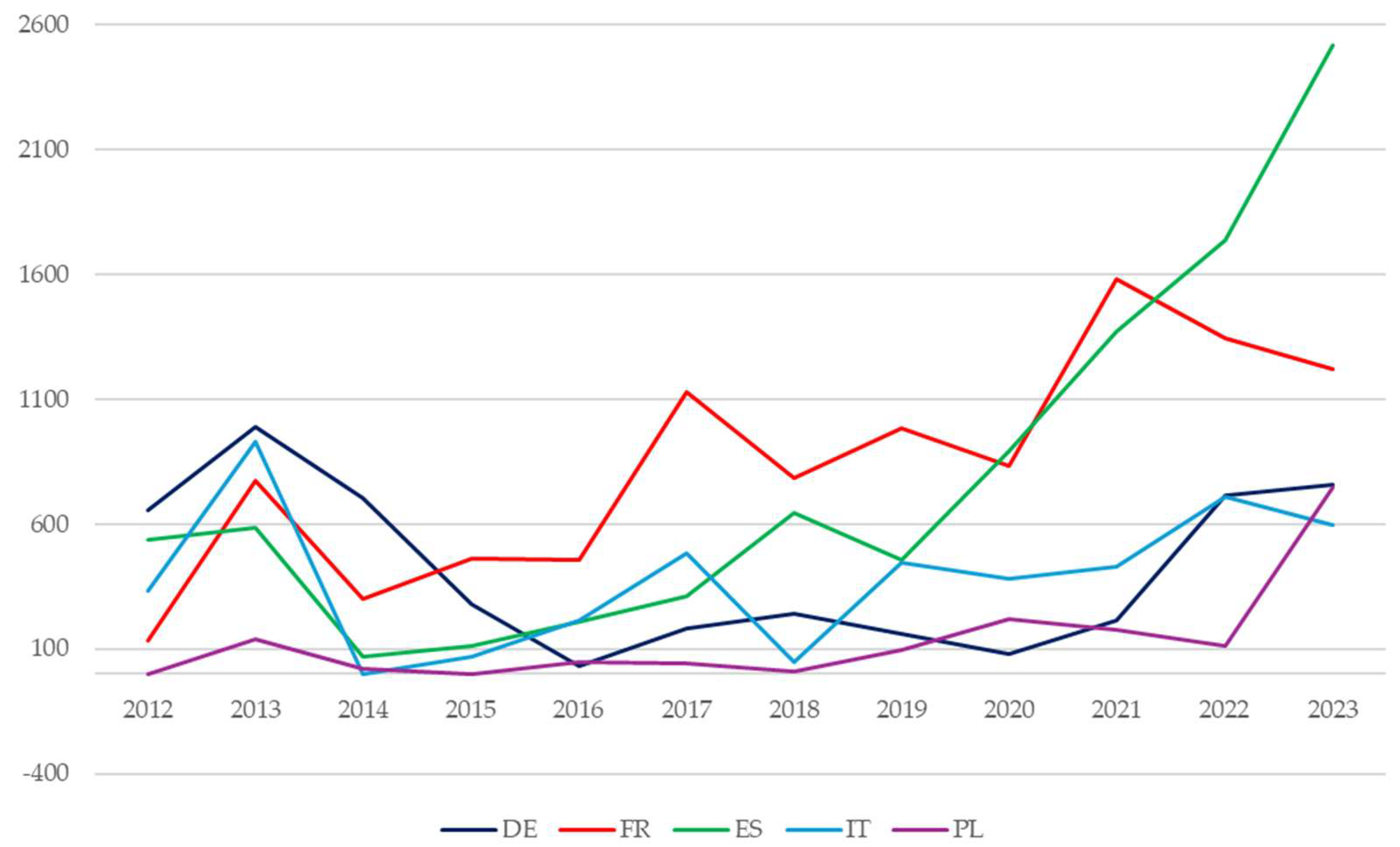
- the level and dynamics of EIB financing in the DE/FR/ES/IT/PL sample in the period 2012–2023;
- (2)
- factors determining the effectiveness of this financing, identified as an increase in the share of RES (RES) in final energy consumption.
Author Contributions
Funding
Institutional Review Board Statement
Informed Consent Statement
Data Availability Statement
Conflicts of Interest
References
- Fact Sheets on the European Union. Renewable Energy. Available online: https://www.europarl.europa.eu/factsheets/pl/sheet/70/energia-ze-zrodel-odnawialnych (accessed on 16 October 2025).
- IEA. Report: European Union. World Energy Investment 2025. Available online: https://www.iea.org/reports/world-energy-investment-2025/european-union (accessed on 15 July 2025).
- Report: Raport PwC na Temat Stanu Dekarbonizacji. 2025. Available online: https://www.pwc.pl/pl/publikacje/raport-na-temat-stanu-dekarbonizacji.html (accessed on 15 July 2025).
- TaiyangNews. Report: Global Clean Energy Technology Costs to Drop by Up To 11% in 2025. 2025. Available online: https://taiyangnews.info/business/bnef-2024-levelied-cost-of-electricity-report (accessed on 15 July 2025).
- BloombergNEF. Report: Energy and Climate Scenarios That Connect the Dots. New Energy Outlook. 2025. Available online: https://about.bnef.com/insights/clean-energy/new-energy-outlook/ (accessed on 15 July 2025).
- IRENA. Report: Renewable Energy and Jobs: Annual Review 2024. Available online: https://www.irena.org/Publications/2024/Oct/Renewable-energy-and-jobs-Annual-review-2024 (accessed on 15 July 2025).
- Chou, C.-H.; Ngo, S.L.; Tran, P.P. Renewable Energy Integration for Sustainable Economic Growth: Insights and Challenges via Bibliometric Analysis. Sustainability 2023, 15, 15030. [Google Scholar] [CrossRef]
- Akademia ESG; Połetek, B. Dekarbonizacja—Przyszłość bez Węgla. Energetyka. 2025. Available online: https://akademiaesg.pl/baza-wiedzy/dekarbonizacja-przyszlosc-bez-wegla/ (accessed on 15 July 2025).
- Kozera, A.; Standar, A.; Stanisławska, J.; Rosa, A. Investments in Renewable Energy in Rural Communes: An Analysis of Regional Disparities in Poland. Energies 2024, 17, 6185. [Google Scholar] [CrossRef]
- Dembicka-Niemiec, A.; Szafranek-Stefaniuk, E. Financial Directions for Renewable Energy Sources Investments as a Support for Sustainable Development Policy—Examples of Polish Cities. Sustainability 2025, 17, 3228. [Google Scholar] [CrossRef]
- Kwilinski, A.; Lyulyov, O.; Pimonenko, T. Spillover Effects of Green Finance on Attaining Sustainable Development: Spatial Durbin Model. Computation 2023, 11, 199. [Google Scholar] [CrossRef]
- Karakosta, C.; Corovessi, A.; Vryzidis, I. Unlocking Sustainable Financing Practices for Energy Efficiency Projects: A Multi-Country Analysis. Energies 2025, 18, 1107. [Google Scholar] [CrossRef]
- Xu, X.; Tan, L.; Zhao, J. Sustainable Finance and Renewable Energy Investment as Dual Drivers of Economic Growth and Environmental Sustainability in the European Union. Res. Econ. 2025, 79, 101065. [Google Scholar] [CrossRef]
- Wen, B.; He, Y.; Jing, X. Advancing renewable energy and green finance for economic growth and ecological resilience. Energy Strategy Rev. 2025, 59, 101747. [Google Scholar] [CrossRef]
- Lugo-Morin, D.R. Global Future: Low-Carbon Economy or High-Carbon Economy? World 2021, 2, 175–193. [Google Scholar] [CrossRef]
- Xue, X.; Zhang, Q.; Cai, X.; Ponkratov, V.V. Multi-Criteria Decision Analysis for Evaluating the Effectiveness of Alternative Energy Sources in China. Sustainability 2023, 15, 8142. [Google Scholar] [CrossRef]
- Bączkiewicz, A.; Kizielewicz, B. Towards Sustainable Energy Consumption Evaluation in Europe for Industrial Sector Based on MCDA Methods. Procedia Comput. Sci. 2021, 192, 1334–1346. [Google Scholar] [CrossRef]
- Brugger, H.; Wolfgang Eichhammer, W.; Nadezhda Mikova, N.; Dönitz, E. Energy Efficiency Vision 2050: How will new societal trends influence future energy demand in the European countries? Energy Policy 2021, 152, 112216. [Google Scholar] [CrossRef]
- Batóg, J.; Pluskota, P. Renewable Energy and Energy Efficiency: European Regional Policy and the Role of Financial Instruments. Energies 2023, 16, 8029. [Google Scholar] [CrossRef]
- Köksal, C.; Katircioglu, S.; Katircioglu, S. The role of financial efficiency in renewable energy demand: Evidence from OECD countries. J. Environ. Manag. 2021, 285, 112122. [Google Scholar] [CrossRef]
- Hafeez, M.; Rehman, U.S.; Faisal, C.M.N.; Yang, J.; Ullah, S.; Kaium, A.; Malik, M.Y. Financial Efficiency and Its Impact on Renewable Energy Demand and CO2 Emissions: Do Eco-Innovations Matter for Highly Polluted Asian Economies? Sustainability 2022, 14, 10950. [Google Scholar] [CrossRef]
- Hu, Y.; Jiang, W.; Dong, H.; Majeed, M.T. Transmission channels between financial efficiency and renewable energy consumption: Does environmental technology matter in high-polluting economies? J. Clean. Prod. 2022, 368, 132885. [Google Scholar] [CrossRef]
- He, J.; Tang, L.; Tao, Y. Impact of green financing on development of renewable energy resources factoring geopolitical risks. Int. J. Hydrogen Energy 2025, 144, 386–399. [Google Scholar] [CrossRef]
- Ibrahiem, D.M.; Esily, R.R.; Sameh, R. Climate change and green finance: The role of central Banks. Encycl. Monet. Policy Financ. Mark. Bank. 2025, 1, 789–796. [Google Scholar] [CrossRef]
- Daszyńska-Żygadło, K.; Jajuga, K.; Zabawa, J. Bank as a Stakeholder in the Financing of Renewable Energy Sources. Recomm. Policy Implic. Poland. Energ. 2021, 14, 6422. [Google Scholar] [CrossRef]
- European Union. Treaty on the Functioning of the European Union (TFEU). Off. J. Eur. Commun. 2016, 202, 1–388. [Google Scholar]
- European Union. Protocol (No 5) on the Statute of the European Investment Bank. Off. J. Eur. Commun. 2016, 202, 251–264. [Google Scholar]
- European Union. Protocol (No 28) on economic, social and territorial cohesion. Off. J. Eur. Commun. 2016, 202, 309–310. [Google Scholar]
- EIB Energy Lending Policy. Supporting the Energy Transformation. Final Version Adopted by the EIB’s Board of Directors on 14 November 2019. Available online: https://www.eib.org/en/publications/eib-energy-lending-policy (accessed on 14 August 2025).
- Kim, J.; Jaumotte, F.; Panton, A.J.; Schwerhoff, G. Energy security and the green transition. Energy Policy 2025, 198, 114409. [Google Scholar] [CrossRef]
- Bałdowski, M.; Będkowski-Kozioł, M.; Bruszewski, M.; Grzejdziak, Ł.; Hawranek, P. Prawo energetyczne. In Ustawa o Odnawialnych Źródłach Energii. Ustawa o Rynku Mocy. Ustawa o Inwestycjach w Zakresie Elektrowni Wiatrowych: Komentarz; C.H. Beck: Warsaw, Poland, 2020. [Google Scholar]
- European Union. Directive 2001/77/EC of European Parliament and of the Council of 27 September 2001 on the promotion of electricity produced from renewable energy sources in the internal electricity market. Off. J. Eur. Commun. 2001, 283, 33–40. [Google Scholar]
- Gołąbeska, E.; Gawrychowska, M.; Biała, I. Odnawialne Źródła Energii w Budownictwie Mieszkaniowym; C.H. Beck: Warsaw, Poland, 2025. [Google Scholar]
- European Union. Directive 2009/28/EC of the European Parliament and of the Council of 23 April 2009 on the promotion of the use of energy from renewable sources and amending and subsequently repealing Directives 2001/77/EC and 2003/30/EC (Text with EEA relevance). Off. J. Eur. Commun. 2009, 140, 16–62. [Google Scholar]
- European Union. Directive (EU) 2018/2001 of the European Parliament and of the Council of 11 December 2018 on the promotion of the use of energy from renewable sources. PE/48/2018/REV/1. Off. J. Eur. Commun. 2018, 328, 82–209. [Google Scholar]
- European Union. Directive (EU) 2023/2413 of the European Parliament and of the Council of 18 October 2023 amending Directive (EU) 2018/2001, Regulation (EU) 2018/1999 and Directive 98/70/EC as regards the promotion of energy from renewable sources, and repealing Council Directive (EU) 2015/652. PE/36/2023/REV/2. Off. J. Eur. Commun. 2023, 2023, 2413. [Google Scholar]
- Montini, M. Addressing the conflicts between climate-related renewable energy goals and environmental protection interests under the RED Directive. Eur. Law Open 2024, 3, 209–219. [Google Scholar] [CrossRef]
- Gurreck, M. The EU’s Renewable Energy Directive–Planning and Permitting Under the RED III. Public Law Stud. 2025, 49, 85–108. [Google Scholar] [CrossRef]
- Communication from the Commission to the European Parliament, The European Council, The Council, The European Economic and Social Committee and the Committee of the Regions the European Green Deal. COM/2019/640 Final. Available online: https://eur-lex.europa.eu/legal-content/PT/TXT/?uri=CELEX:52019DC0640 (accessed on 1 August 2025).
- Szpilko, D.; Ejdys, J. European Green Deal–research directions a systematic literature review. Econ. Environ. 2022, 81, 8–38. [Google Scholar] [CrossRef]
- Horn, M. The European green deal, retail investors and sustainable investments: A perspective article covering economic, behavioral, and regulatory insights. Curr. Res. Environ. Sustain. 2024, 7, 100241. [Google Scholar] [CrossRef]
- Gołąbeska, E.; Harasimowicz, A. Wybrane Problemy Związane z Realizacją Systemów Wykorzystujących Zieloną Energię; Oficyna Wydawnicza Politechniki Białostockiej: Białystok, Poland, 2023; Available online: https://pb.edu.pl/oficyna-wydawnicza/wp-content/uploads/sites/4/2023/08/Wybrane-problemy-zwiazane-z-realizacja-systemow-wykorzystujacych-zielona-energie.pdf (accessed on 14 August 2025).
- Wolf, S.; Teitge, J.; Mielke, J.; Schütze, F.; Jaeger, C. The European Green Deal—More than climate neutrality. Intereconomics Environ. Policy 2021, 56, 99–107. [Google Scholar] [CrossRef]
- Waidelich, P.; Steffen, B. Renewable energy financing by state investment banks: Evidence from OECD countries. Energy Econ. 2024, 132, 107455. [Google Scholar] [CrossRef]
- Amuakwa-Mensah, F.; Näsström, E. Role of banking sector performance in renewable energy consumption. Appl. Energy 2022, 306, 118023. [Google Scholar] [CrossRef]
- Del Gaudio, B.L.; Previtali, D.; Sampagnaro, G.; Verdoliva, V.; Vigne, S. Syndicated green lending and lead bank performance. J. Int. Financ. Manag. Account. 2022, 33, 412–427. [Google Scholar] [CrossRef]
- Baldauf, T.; Jochem, P. Project finance or corporate finance for renewable energy? An agent based insight. J. Econ. Interact. Coord. 2024, 19, 759–805. [Google Scholar] [CrossRef]
- Zhou, X.; Wilson, C.; Caldecott, B. The Energy Transition and Changing Financing Costs; Oxford Sustainable Finance Programme: Oxford, UK, 2021; Available online: https://www.smithschool.ox.ac.uk/sites/default/files/2022-02/The-energy-transition-and-changing-financing-costs.pdf (accessed on 13 October 2025).
- Lowitzsch, J. (Ed.) Energy Transition, Financing Consumer Co-Ownership in Renewables; Palgrave Macmillan: Cham, Switzerland, 2019. [Google Scholar] [CrossRef]
- Lowitzsch, J. Consumer Stock Ownership Plans (CSOPs)—The Prototype Business Model for Renewable Energy Communities. Energies 2020, 13, 118. [Google Scholar] [CrossRef]
- Iskandarova, M.; Dembek, A.; Fraaije, M.; Matthews, W.; Stasik, A.; Wittmayer, J.M.; Sovacool, B.K. Who finances renewable energy in Europe? Examining temporality, authority and contestation in solar and wind subsidies in Poland, the Netherlands and the United Kingdom. Energy Strategy Rev. 2021, 38, 100730. [Google Scholar] [CrossRef]
- Mazzucato, M.; Semieniuk, G. Financing renewable energy: Who is financing what and why it matters. Technol. Forecast. Soc. Change 2018, 127, 8–22. [Google Scholar] [CrossRef]
- Ozyesil, M.; Tembelo, H. The Role of Green Bonds in Financing Sustainable Energy Projects: Trends and Prospect. Int. J. Energy Econ. Policy 2025, 15, 370–379. [Google Scholar] [CrossRef]
- Qadir, S.A.; Al-Motairi, H.; Tahir, F.; Al-Fagih, L. Incentives and strategies for financing the renewable energy transition: A review. Energy Rep. 2021, 7, 3590–3606. [Google Scholar] [CrossRef]
- European Investment Bank Group. Sustainability Report 2023. Available online: https://www.eib.org/attachments/lucalli/20230334_eib_group_sustainability_report_2023_en.pdf (accessed on 15 July 2025).
- Cellini, J. The European Investment Bank and the Environment: The History of the EIB’s Environmental Strategy from the 1970s to the 1990s. 2023. Available online: https://hdl.handle.net/1814/76302 (accessed on 15 July 2025).
- Kavvadia, H. The European Investment Bank’s ‘Quantum Leap’ to Become the World’s First International Climate Bank. Politics Gov. 2021, 9, 185–195. [Google Scholar] [CrossRef]
- Kavvadia, H.; Coppolaro, L. (Eds.) Deciphering the European Investment Bank: History, Politics, and Economics; Routledge: London, UK, 2022. [Google Scholar] [CrossRef]
- Čeryová, D.; Ladvenicová, J.; Bajusová, Z. Evaluation of Renewable Energy Investments from Public Financial Institutions. Visegr. J. Bioecon. Sustain. Dev. 2021, 10, 10–13. [Google Scholar] [CrossRef]
- Mertens, D.; Thiemann, M. The European Investment Bank: The EU’s climate bank? In Handbook on European Union Climate Change Policy and Politics; Rayner, T., Szulecki, K., Jordan, A.J., Oberthür, S., Eds.; Edward Elgar Publishing, Inc.: Northampton, MA, USA, 2023; pp. 68–82. [Google Scholar] [CrossRef]
- Griffith-Jones, S.; Carreras, M. The Role of European Investment Bank (EIB) and National and Regional Development Banks in the Green Transformation. In Climate Change in Regional Perspective; Hoffmann, A.R., Sandrin, P., Doukas, Y.E., Eds.; Springer: Cham, Switzerland, 2024; pp. 83–88. [Google Scholar] [CrossRef]
- Spielberger, L. EIB policy entrepreneurship and the EU’s regulation of Green Bonds. J. Econ. Policy Reform 2025, 28, 37–54. [Google Scholar] [CrossRef]
- Clifton, J.; Díaz-Fuentes, D.; Howarth, D.; Kavvadia, H. The Role of the European Investment Bank in times of COVID-19. In Public Banks and Covid-19: Combatting the Pandemic with Public Finance Publisher; Municipal Services Project: Kingston, ON, Canada; UNCTAD: Geneva, Switzerland, 2020; pp. 135–148. Available online: https://www.researchgate.net/publication/346653554_THE_ROLE_OF_THE_EUROPEAN_INVESTMENT_BANK_IN_TIMES_OF_COVID-19 (accessed on 15 July 2025).
- Knowledge Hub on SDGs. Indicator 7.2.1. UNECE. Available online: https://w3.unece.org/SDG/en/Indicator?id=23 (accessed on 15 October 2025).
- DataBank. WDI, Series EG.FEC.RNEW.ZS. Available online: https://databank.worldbank.org/metadataglossary/world-development-indicators/series/EG.FEC.RNEW.ZS (accessed on 15 October 2025).
- European Court of Auditors. Report: EU Support for Productive Investments in Businesses-Greater Focus on Durability Needed; European Court of Auditors: Luxembourg, 2018; Available online: https://www.eca.europa.eu/Lists/ECADocuments/SR18_08/SR_DURABILITY_EN.pdf (accessed on 14 August 2025).
- Bölük, G.; Kaplan, R. Effectiveness of renewable energy incentives on sustainability: Evidence from dynamic panel data analysis for the EU countries and Turkey. Environ. Sci. Pollut. Res. 2022, 29, 26613–26630. [Google Scholar] [CrossRef]
- Steffen, B. Estimating the cost of capital for renewable energy projects. Energy Econ. 2020, 88, 104783. [Google Scholar] [CrossRef]
- Bellemare, M.F.; Wichman, C.J. Elasticities and the Inverse Hyperbolic Sine Transformation. Oxf. Bull. Econ. Stat. 2020, 82, 50–61. [Google Scholar] [CrossRef]
- Burbidge, J.B.; Magee, L.; Robb, A.L. Alternative Transformations to Handle Extreme Values of the Dependent Variable. J. Am. Stat. Assoc. 1988, 83, 123–127. [Google Scholar] [CrossRef]
- MacKinnon, J.G.; Magee, L. Transforming the Dependent Variable in Regression Models. Int. Econ. Rev. 1990, 31, 315–339. [Google Scholar] [CrossRef]
- Share of Energy from Renewable Sources. Available online: https://ec.europa.eu/eurostat/databrowser/view/nrg_ind_ren/default/bar?lang=en (accessed on 15 July 2025).
- World Bank. Available online: https://data.worldbank.org/country (accessed on 15 July 2025).
- OECD/Energy Policy Tracker. Available online: https://www.energypolicytracker.org/ (accessed on 15 July 2025).
- EDGAR Database. Available online: https://edgar.jrc.ec.europa.eu/country_profile (accessed on 15 July 2025).
- Our World in Data. Available online: https://ourworldindata.org/data (accessed on 15 July 2025).
- Błażejowska, M.; Czarny, A.; Kowalska, I.; Michalczewski, A.; Stępień, P. The Effectiveness of the EU ETS Policy in Changing the Energy Mix in Selected European Countries. Energies 2024, 17, 4243. [Google Scholar] [CrossRef]
- Baltagi, B.H. Econometric Analysis of Panel Data, 6th ed.; Springer: Cham, Switzerland, 2021. [Google Scholar] [CrossRef]
- Wooldridge, J.M. Econometric Analysis of Cross Section and Panel Data; The MIT Press: London, UK, 2010; Available online: https://mitpress.mit.edu/9780262232197/econometric-analysis-of-cross-section-and-panel-data/ (accessed on 15 July 2025).
- Driscoll, J.C.; Kraay, A.C. Consistent covariance matrix estimation with spatially dependent panel data. Rev. Econ. Stat. 1998, 80, 549–560. [Google Scholar] [CrossRef]
- Pesaran, M.H. General Diagnostic Tests for Cross Section Dependence in Panels. 2024. Available online: https://files.econ.cam.ac.uk/repec/cam/pdf/cwpe0435.pdf (accessed on 15 August 2025).
- Fox, J.; Monette, G. Generalized Collinearity Diagnostics. J. Am. Stat. Assoc. 1992, 87, 178–183. [Google Scholar] [CrossRef]
- Schwarz, G. Estimating the dimension of a model. Ann. Stat. 1978, 6, 461–464. [Google Scholar] [CrossRef]
- Akaike, H. A new look at the statistical model identification. IEEE TAC 1974, 19, 716–723. [Google Scholar] [CrossRef]
- Owsiak, S. Finanse; PWE: Warsaw, Poland, 2015; p. 86. [Google Scholar]
- Luty, L.; Zioło, M.; Knapik, W.; Bąk, I.; Kukuła, K. Energy Security in Light of Sustainable Development Goals. Energies 2023, 16, 1390. [Google Scholar] [CrossRef]
- Bednarczyk, J.L.; Brzozowska-Rup, K.; Luściński, S. Determinants of the Energy Development Based on Renewable Energy Sources in Poland. Energies 2021, 14, 6762. [Google Scholar] [CrossRef]
- Simionescu, M.; Strielkowski, W.; Tvaronavičienė, M. Renewable Energy in Final Energy Consumption and Income in the EU-28 Countries. Energies 2020, 13, 2280. [Google Scholar] [CrossRef]
- Török, L. Economic Drivers of Renewable Energy Growth in the European Union: Evidence from a Panel Data Analysis. (2015–2023). Energies 2025, 18, 3363. [Google Scholar] [CrossRef]
- Okunevičiūtė Neverauskienė, L.; Kvietkauskienė, A.; Tvaronavičienė, M.; Danilevičienė, I.; Gedvilaitė, D. Evaluation of Renewable Energy Sources Sector Development in the European Union. Energies 2025, 18, 4786. [Google Scholar] [CrossRef]
- Getachew, E.; Lakner, Z.; Desalegn, G.; Tangl, A.; Boros, A. Sustainable Financing for Renewable Energy: Examining the Impact of Sectoral Economy on Renewable Energy Consumption. Economies 2024, 12, 127. [Google Scholar] [CrossRef]
- International Energy Agency. Report: Renewables 2023. Analysis and Forecast to 2028. Available online: https://iea.blob.core.windows.net/assets/96d66a8b-d502-476b-ba94-54ffda84cf72/Renewables_2023.pdf (accessed on 19 November 2025).
- Communication From the Commission to the European Parliament, The Council, The European Economic and Social Committee and the Committee of the Regions. Available online: https://eur-lex.europa.eu/legal-content/EN/TXT/PDF/?uri=CELEX:52023DC0757 (accessed on 19 November 2025).
- World Energy Transitions Outlook 2023. Executive Summary. IRENA. Available online: https://www.irena.org/-/media/Files/IRENA/Agency/Publication/2023/Jun/IRENA_World_energy_transitions_outlook_summary_2023.pdf?utm_source=chatgpt.com (accessed on 19 November 2025).
- Alcorta, P.; Paz Espinosa, M.; Pizarro Irizar, C. Right and Duty: Investment Risk Under Different Renewable Energy Support Policies. Environ. Resour. Econ. 2024, 87, 3163–3204. [Google Scholar] [CrossRef]
- News announcement: EU Guidance on Ensuring Electricity Grids Are Fit for the Future. 2025. Available online: https://energy.ec.europa.eu/news/eu-guidance-ensuring-electricity-grids-are-fit-future-2025-06-02_en?utm_source=chatgpt.com (accessed on 19 November 2025).
- Report: Renewable Energy Targets. 2023. Available online: https://energy.ec.europa.eu/topics/renewable-energy/renewable-energy-directive-targets-and-rules/renewable-energy-targets_en (accessed on 15 September 2025).
- Report: Electricity Market Design. 2025. Available online: https://energy.ec.europa.eu/topics/markets-and-consumers/electricity-market-design_en (accessed on 15 September 2025).
- European Commission. Communication from the Commission—Guidance on Article 20a on Sector Integration of Renewable Electricity of Directive (EU) 2018/2001 on the Promotion of Energy from Renewable Sources, as Amended by Directive (EU) 2023/2413. Available online: http://data.europa.eu/eli/C/2025/3699/oj (accessed on 16 July 2025).
- Report: France: EDF and the EIB Announce the Signature of EUR 500 Million Financing Contract to Support the Modernisation and the Resilience of Enedis-Managed Public Electricity Grid. 2025. Available online: https://www.eib.org/en/press/all/2025-323-edf-and-the-eib-announce-the-signature-of-eur500-million-financing-contract-to-support-the-modernisation-and-the-resilience-of-enedis-managed-public-electricity-grid (accessed on 15 September 2025).



| Variable | N | Average | SD | Min | P25 | P50 | P75 | Max |
|---|---|---|---|---|---|---|---|---|
| RE (p.p.) | 60.00 | 16.73 | 3.00 | 10.96 | 14.90 | 16.64 | 18.93 | 24.85 |
| EIB (EUR million) | 60.00 | 511.78 | 500.41 | 0.00 | 129.83 | 405.44 | 748.40 | 2516.08 |
| EP (EUR/kWh) | 60.00 | 0.15 | 0.05 | 0.09 | 0.12 | 0.14 | 0.17 | 0.32 |
| GDP per capita (PPP, USD) | 60.00 | 47,176.53 | 9063.48 | 28,371.92 | 41,284.04 | 47,280.62 | 52,976.34 | 62,579.07 |
| PI (index) | 60.00 | 3.27 | 0.70 | 2.22 | 2.83 | 3.09 | 3.47 | 4.89 |
| Model | asinh(EBI/λ) | EP (EUR/kWh) | PI (Indeks) | |
|---|---|---|---|---|
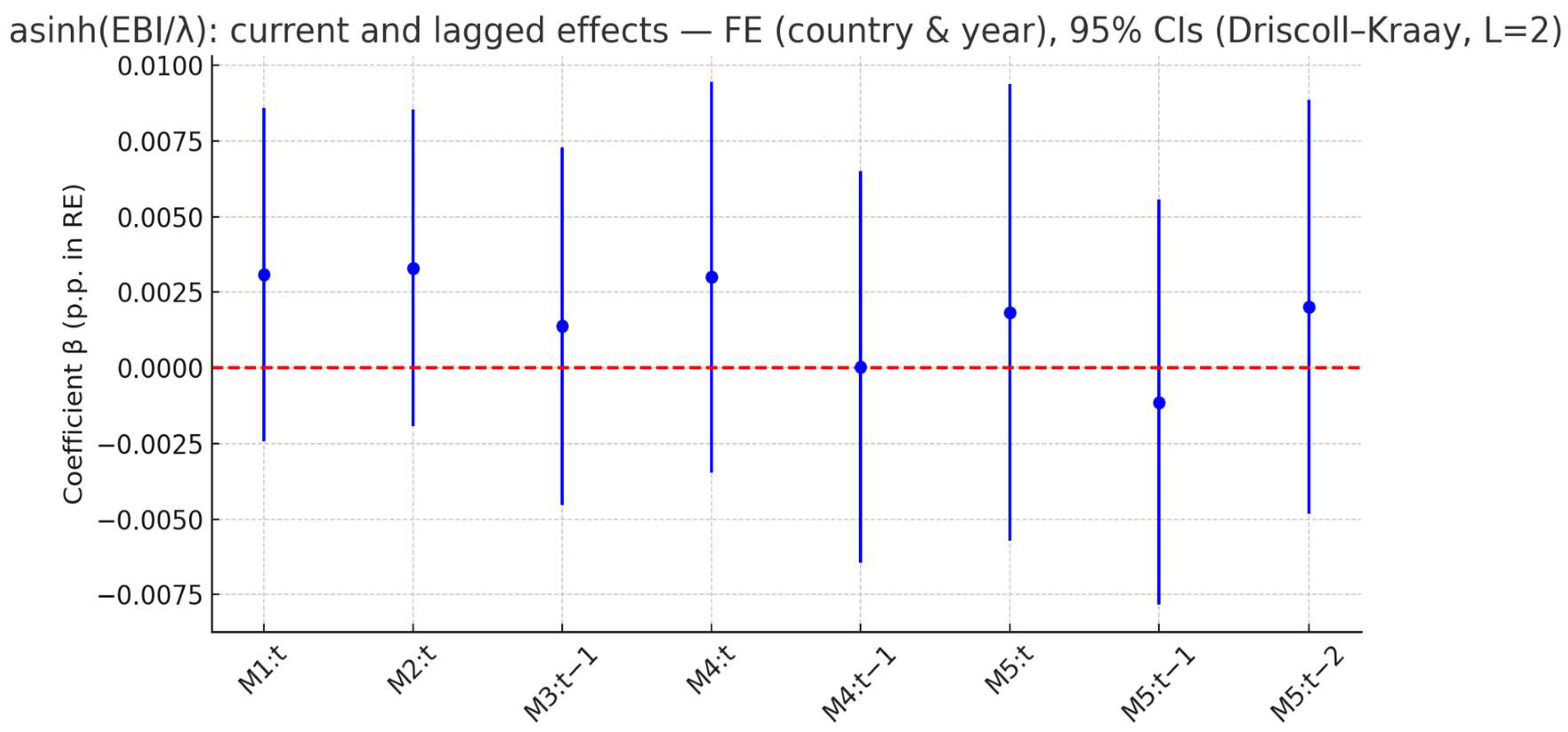
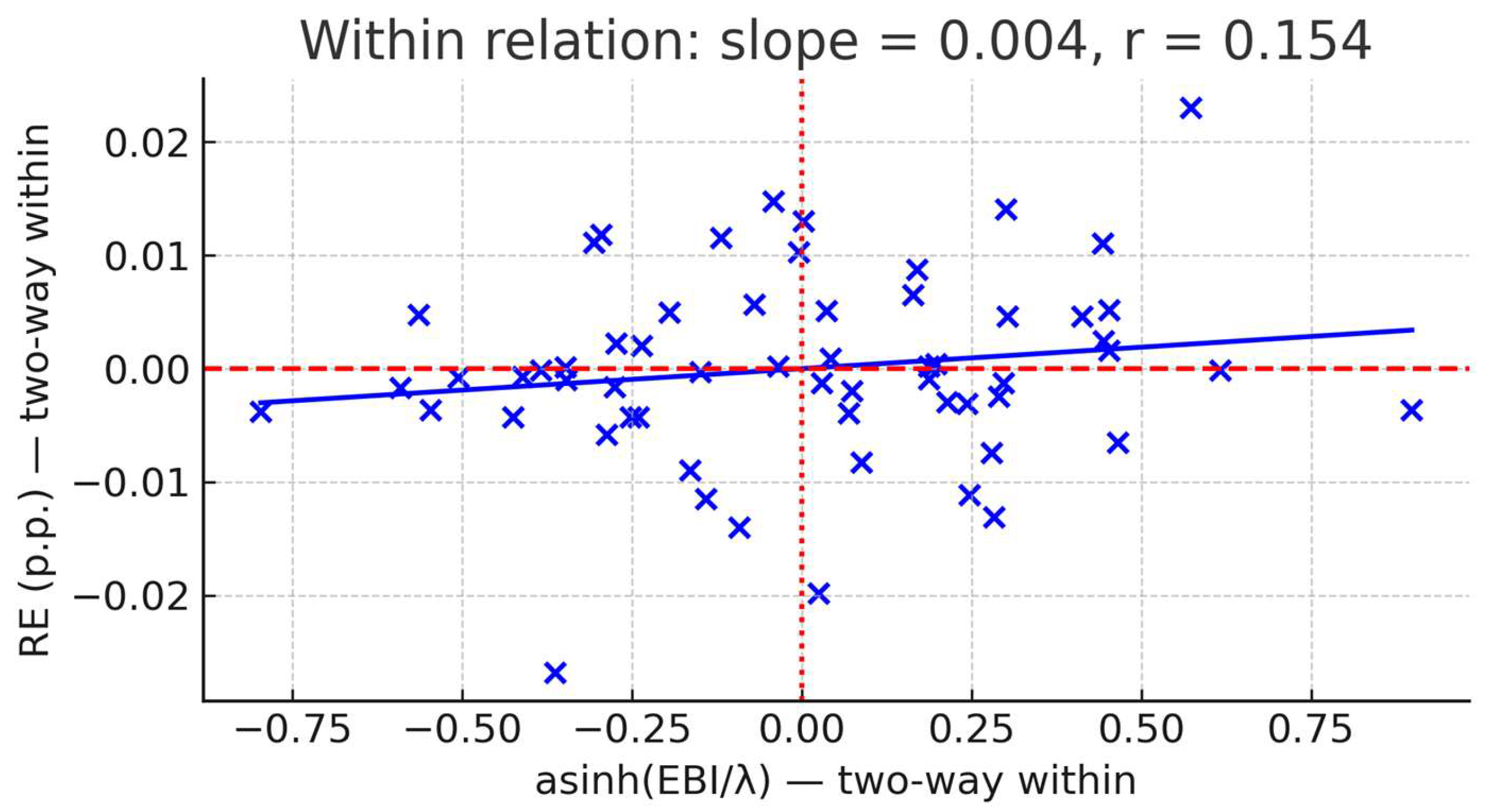
| M1 | 0.0031 (SE_DK 0.0028) [p = 0.333] | −0.0489 (SE_DK 0.0261) [p = 0.135] | −0.1247 (SE_DK 0.0627) [p = 0.118] | |
| M2 | 0.0033 (SE_DK 0.0027) [p = 0.284] | −0.0446 (SE_DK 0.0259) [p = 0.161] | −0.1131 (SE_DK 0.0607) [p = 0.136] | −0.0095 (SE_DK 0.0058) [p = 0.176] |
| M3 (t − 1) | 0.0014 (SE_DK 0.0030) [p = 0.672] | |||
| M4 (t) | 0.0030 (SE_DK 0.0033) [p = 0.415] | −0.0455 (SE_DK 0.0277) [p = 0.176] | −0.1186 (SE_DK 0.0622) [p = 0.129] | −0.0064 (SE_DK 0.0079) [p = 0.467] |
| M4 (t − 1) | 0.0000 (SE_DK 0.0033) [p = 0.991] | |||
| M5 (t) | 0.0018 (SE_DK 0.0038) [p = 0.660] | −0.0454 (SE_DK 0.0315) [p = 0.222] | −0.1144 (SE_DK 0.0611) [p = 0.134] | −0.0089 (SE_DK 0.0084) [p = 0.349] |
| M5 (t − 1) | −0.0011 (SE_DK 0.0034) [p = 0.755] | |||
| M5 (t − 2) | 0.0020 (SE_DK 0.0035) [p = 0.597] |
| Variable | M1 | M2 | M3 (t − 1) | M4 (t) | M4 (t − 1) | M5 (t) | M5 (t − 1) | M5 (t − 2) |
|---|---|---|---|---|---|---|---|---|
| asinh(EBI/λ) | 0.0031 (0.0028) [p = 0.333] | 0.0033 (0.0027) [p = 0.284] | 0.0014 (0.0030) [p = 0.672] | 0.0030 (0.0033) [p = 0.415] | 0.0000 (0.0033) [p = 0.991] | 0.0018 (0.0038) [p = 0.660] | −0.0011 (0.0034) [p = 0.755] | 0.0020 (0.0035) [p = 0.597] |
| −0.0489 (0.0261) [p = 0.135] | −0.0446 (0.0259) [p = 0.161] | −0.0458 (0.0274) [p = 0.169] | −0.0455 (0.0277) [p = 0.176] | −0.0454 (0.0315) [p = 0.222] | ||||
| EP (EUR/kWh) | −0.1247 (0.0627) [p = 0.118] | −0.1131 (0.0607) [p = 0.136] | −0.1185 (0.0625) [p = 0.131] | −0.1186 (0.0622) [p = 0.129] | −0.1144 (0.0611) [p = 0.134] | |||
| PI (indeks) | −0.0095 (0.0058) [p = 0.176] | −0.0074 (0.0080) [p = 0.404] | −0.0064 (0.0079) [p = 0.467] | −0.0089 (0.0084) [p = 0.349] | ||||
| N | 60 | 60 | 55 | 55 | 50 | |||
| R2 corrected | 0.901 | 0.901 | 0.886 | 0.884 | 0.869 |
| Model | N | R2 Corrected | AIC | BIC |
|---|---|---|---|---|
| M1 | 60 | 0.901 | −373.98 | −334.19 |
| M2 | 60 | 0.901 | −373.79 | −331.9 |
| M3 | 55 | 0.886 | −336.99 | −298.85 |
| M4 | 55 | 0.884 | −335.64 | −295.49 |
| M5 | 50 | 0.869 | −300.1 | −261.86 |
| Measure | Value |
|---|---|
| Sum β (t + t − 1 + t − 2) | 0.0027 |
| SE (DK, L = 2) | 0.0044 |
| p (DK) | 0.539 |
| 95% CI (DK) | [−0.0059; 0.0113] |
| N | 50 |
| R2 corrected | 0.869 |
| Model | CD | p | N | T |
|---|---|---|---|---|
| M1 | −1.8844 | 0.0595 | 5 | 12 |
| M2 | −1.9207 | 0.0548 | 5 | 12 |
| M3 | −1.7751 | 0.0759 | 5 | 11 |
| M4 | −1.8664 | 0.062 | 5 | 11 |
| M5 | −1.9808 | 0.0476 | 5 | 10 |
Disclaimer/Publisher’s Note: The statements, opinions and data contained in all publications are solely those of the individual author(s) and contributor(s) and not of MDPI and/or the editor(s). MDPI and/or the editor(s) disclaim responsibility for any injury to people or property resulting from any ideas, methods, instructions or products referred to in the content. |
© 2025 by the authors. Licensee MDPI, Basel, Switzerland. This article is an open access article distributed under the terms and conditions of the Creative Commons Attribution (CC BY) license (https://creativecommons.org/licenses/by/4.0/).
Share and Cite
Błażejowska, M.; Czarny, A.; Gee-Milan, E.; Kowalska, I.; Stępień, P. The Role of the European Investment Bank in Financing Renewable Energy Sources in Selected European Union Countries. Energies 2025, 18, 6173. https://doi.org/10.3390/en18236173
Błażejowska M, Czarny A, Gee-Milan E, Kowalska I, Stępień P. The Role of the European Investment Bank in Financing Renewable Energy Sources in Selected European Union Countries. Energies. 2025; 18(23):6173. https://doi.org/10.3390/en18236173
Chicago/Turabian StyleBłażejowska, Małgorzata, Anna Czarny, Ewelina Gee-Milan, Iwona Kowalska, and Paweł Stępień. 2025. "The Role of the European Investment Bank in Financing Renewable Energy Sources in Selected European Union Countries" Energies 18, no. 23: 6173. https://doi.org/10.3390/en18236173
APA StyleBłażejowska, M., Czarny, A., Gee-Milan, E., Kowalska, I., & Stępień, P. (2025). The Role of the European Investment Bank in Financing Renewable Energy Sources in Selected European Union Countries. Energies, 18(23), 6173. https://doi.org/10.3390/en18236173