Abstract
Producing methanol through carbon capture and utilization presents a sustainable alternative to traditional methods. This study explores two main production pathways, which are further divided into four distinct scenarios. In Nova Scotia, methanol could be produced by combining green hydrogen with either biogenic or fossil-derived carbon dioxide sources. The four scenarios differ in scale, carbon source, and methanol output. Scenario 1, a small biomass plant, captures 0.033 Mt CO2/yr and produces 0.024 Mt methanol, but uses only 3% of the green hydrogen. Scenario 2, a natural gas plant, captures 0.90 Mt CO2/yr and produces 0.66 Mt methanol with 69% hydrogen use. Scenario 3, a coal plant, captures 2.30 Mt CO2/yr, converting 57% to 0.94 Mt methanol. Scenario 4, a proposed BECCS plant, captures 2.46 Mt CO2/yr, converts 53% to 0.94 Mt green methanol, and delivers the highest net-negative emissions, making it the most climate-friendly option. While Scenarios 1, 2, and 3 could benefit from retrofitting existing plants, Scenario 4 would require significant infrastructure investment to make it a reality. The study concludes that while Nova Scotia possesses the resources to support renewable and non-renewable methanol production, challenges related to CO2 availability, green hydrogen production, biomass supply, energy requirement, and public perception must be addressed.
1. Introduction
Methanol, an emerging energy carrier, is composed of carbon, hydrogen, and oxygen [1,2]. Methanol production pathways can be categorized into two types: renewable sources, such as biomass, and non-renewable sources, such as natural gas and coal. Producing a tonne of methanol requires about 1.4 tonnes of carbon dioxide and 0.2 tonnes (one-fifth of a tonne) of hydrogen [3]. Global methanol production mainly uses natural gas through steam methane reforming (SMR), with an average carbon footprint of 110 g CO2eq/MJ [4]. In contrast, coal-based methanol production, mainly in China, emits nearly 300 g CO2eq/MJ, which is almost three times higher [5]. Producing methanol using carbon capture and utilization technologies provides a promising alternative to conventional fossil-fuel-based methods, offering a way to reduce climate impacts while making more efficient use of resources [6].
Methanol, when produced from renewable sources, offers a low-carbon option for the energy transition in the shipping industry [7]. Beyond its growing potential in marine transportation, methanol serves as a key feedstock in a range of industrial applications, including the manufacture of plastics, paints, and cosmetics [8]. Renewable methanol reduces carbon dioxide emissions by up to 95%, cuts nitrogen oxide emissions by up to 80%, and eliminates sulfur oxide and particulate matter emissions compared to conventional fuels [9].
Nova Scotia’s renewable resources can support methanol production, with renewable electricity powering electrolysers to generate green hydrogen and biomass from forest residues or waste wood supplying heat and biogenic carbon dioxide. However, challenges remain, including the variability of solar and wind resources and ecological concerns associated with biomass use, such as deforestation and habitat loss. At the same time, leaving storm-damaged wood to decay or be consumed by wildfire can increase greenhouse gas emissions. Addressing these issues will require a multifaceted approach, including sustainably managed biomass, consideration of carbon dioxide (CO2) capture technologies, and substantial investment in renewable energy infrastructure.
This paper examines the potential for producing methanol from both fossil-based and biogenic CO2 sources in Nova Scotia. It begins by identifying major point sources of CO2 across the province and the quantity that could be captured using post-combustion carbon capture technologies. The captured CO2 is subsequently combined with the green hydrogen in a methanol reactor to synthesize low-carbon methanol. This study demonstrates how a modular trigeneration facility can combine captured carbon dioxide with green hydrogen to synthesize low-carbon methanol. By doing so, methanol can enhance energy resilience while supporting sustainable industrial growth and economic development in the province.
2. Background
Methanol is an important chemical feedstock and energy carrier with applications in the production of plastics, solvents, adhesives, and fuels. It is also increasingly recognized as a sustainable alternative fuel that can support industrial decarbonization and energy transition goals [10]. Conventional methanol production, primarily derived from natural gas through steam methane reforming, generates substantial greenhouse gas emissions. In contrast, low-carbon pathways such as blue methanol, produced with carbon capture, and e-methanol synthesized from green hydrogen and captured carbon dioxide, offer reduced life-cycle emissions [11]. Methanol production requires a source of carbon dioxide and hydrogen. Green hydrogen can be produced through the electrolysis of water using electrolysers powered by renewable electricity, while carbon dioxide can be captured from industrial emissions using carbon capture technologies.
Carbon capture, utilization, and storage (CCUS) play a pivotal role in enabling sustainable methanol production by providing concentrated streams of CO2 that can be converted into valuable products [12]. The CCUS technologies are designed to reduce greenhouse gas emissions by capturing CO2 from large point sources such as power plants and industrial facilities, followed by either permanent storage in geological formations or conversion into valuable products. In this paper, possible CO2 sources include carbon capture from point emission sources, such as on-site biomass combustion using waste wood from storm-damaged forests [13], and CO2 capture from both small-scale biomass heating plants and large-scale fossil fuel-based industrial facilities.
Overall, producing methanol from renewable energy and biomass presents several challenges. Key considerations include sustainable feedstock management, energy conversion efficiency, integration of renewable technologies, pre-treatment of feedstocks, environmental impacts, and public perception and acceptance [14].
2.1. Carbon Dioxide Point Emitters
Point sources of carbon dioxide emissions include fossil-fuel power plants, industrial facilities, and biomass combustion plants. These concentrated emission points provide cost-effective opportunities for capture compared to diffuse sources such as transportation [15]. In Nova Scotia, point sources range from small facilities emitting less than 25 kt CO2 annually to large facilities exceeding 1.2 Mt CO2 annually. The largest emitters include the Lingan and Trenton coal-fired generating stations, while medium emitters include Tufts Cove and Brookfield Cement Plant [16]. Table 1 summarizes point emission sources by size category.
Table 1.
Summary of Point Emission Sources in Nova Scotia in 2022 [16].
2.2. Carbon Capture, Utilization, and Storage

Carbon capture technologies are generally categorized into three types: post-combustion, pre-combustion, and oxy-fuel combustion [17,18]. Post-combustion carbon capture involves separating CO2 from other gases produced after the fuel has been burned or during combustion, typically from the flue gases of power plants or industrial facilities [19]. Pre-combustion carbon capture involves converting the fuel into a synthetic gas (syngas) through processes like gasification, where CO2 can be separated before combustion occurs [19]. Oxyfuel combustion is a technology where fuel is burned using pure oxygen instead of air. This results in a flue gas predominantly consisting of carbon dioxide and water vapor, which makes it easier to capture CO2 for storage or utilization [19]. Post-combustion capture is the most mature and widely deployed approach [12]. It involves removing carbon dioxide from the flue gases after fossil fuels or biomass have been combusted. This method is preferred for many retrofit applications because it requires fewer modifications to existing systems and typically involves lower capital investment compared to pre-combustion or oxy-fuel processes [18]. In this study, post-combustion capture is selected due to its suitability for retrofitting existing facilities and its relative cost-effectiveness. SaskPower, in partnership with Shell, developed the first commercial post-combustion CO2 capture facility using the CANSOLV system developed by Shell Catalysts & Technologies, Montréal, QC, Canada, which achieves over 90 percent CO2 removal with relatively low energy use [20].
Carbon dioxide can be transported in various states: gaseous, liquid, dense, or supercritical. Gaseous CO2 transport is inefficient due to low flow rates, making liquid or supercritical transport the preferred option. Carbon dioxide can be transported via pipelines, ships, rail, or trucks, typically as a liquid or in a supercritical state to maximize density and flow efficiency [21,22]. Liquid CO2 can be moved by ships or trucks, but requires strict safety measures to prevent phase changes. Shipping offers flexibility for cross-border projects, as demonstrated by Europe’s Northern Lights and Dartagnan initiatives, whereas rail and truck transport are typically limited to small-scale or short-distance applications [22]. Pipelines are the most mature and widely deployed method, especially in the United States, with over 5000 miles in operation, offering low operating costs at high volumes but requiring significant capital investment [23,24]. In pipeline transportation, CO2 is typically compressed into a supercritical state, which combines the density of a liquid with the viscosity of a gas, allowing for higher mass transfer at reduced pipeline diameters and costs [22,25,26]. Pipeline transport demands adequate wall thickness to withstand high pressures, with diameters ranging from 12 inches for 2.5 Mtpa over 10 km to 32 inches for 20 Mtpa over 1500 km [24,27].
Carbon dioxide storage is a crucial component of CCUS systems, providing either temporary storage before utilization or long-term sequestration. Geological storage is the most widely studied option, involving the injection of CO2 into deep subsurface formations such as depleted oil and gas reservoirs, coal seams, or deep saline aquifers [28]. The injection of supercritical CO2 into deep saline aquifers is a key strategy for lowering carbon emissions, with the choice of a suitable reservoir being a critical factor in effective carbon sequestration [29]. Numerical modeling studies reinforce that storage capacity in deep saline aquifers is strongly influenced by reservoir properties such as permeability, depth, and pressure, which also affect CO2 plume migration and pressure buildup [29]. Another potential storage pathway is ocean storage, involving the direct injection of CO2 into the deep ocean; however, environmental concerns, including acidification and ecosystem disruption, have significantly constrained research and deployment [30].
Recent research on the behavior of CO2 in a decommissioned coal mine demonstrates possible subsurface storage [31]. The study on abandoned coal mine goafs found that carbon dioxide moves first into the highly permeable caving zones before spreading into the surrounding fracture systems, and that a significant portion becomes adsorbed onto the residual coal [31]. The authors also presented a diffusion model that describes the movement of carbon dioxide within the coal matrix, which helps explain the longer-term storage behavior. These findings align with earlier work that examined the movement of grouting slurry through mining-induced fractures and studies that explored how stress conditions influence fracture development and rock stability in mined areas [32,33]. Taken together, these studies offer insight into how fluids move through fractured rock and the factors that could influence sealing and containment, which can help assess the potential of geological formations for CO2 storage.
Nova Scotia could play a key role in CO2 sequestration due to its numerous offshore sedimentary basins, which offer significant storage opportunities [34]. Estimates for known depleted offshore oil and gas fields, including the Sable Offshore Energy Project with 60 billion cubic meters, Deep Panuke with 4.2 billion cubic meters, and Cohasset-Panuke with 7.1 million cubic meters, suggest that, assuming equivalent injection volumes, a supercritical CO2 density of 600 kg per cubic meter, and secure retention, Nova Scotia could store approximately 38.5 GtCO2 [34]. Beyond geological and mineral storage, liquefied CO2 (LCO2) can also be stored on-site in specially designed cryogenic tanks. Common configurations include vacuum-insulated tanks with perlite or polyurethane layers, refrigeration units, and safety systems such as differential pressure indicators and relief valves [35,36]. Although capital-intensive, on-site LCO2 storage provides a practical solution for short- to medium-term containment before utilization and is already used in industrial gas handling systems [37].
2.3. Renewable Energy Sources
Nova Scotia has potential for renewable energy generation, particularly solar, wind, and biomass resources [38].
Wind power is central to meeting the province’s goal of phasing out coal and generating 80% renewable electricity by 2030. Wind energy can support Nova Scotia’s low-carbon future, with over 300 commercial turbines generating clean electricity; each megawatt reduces emissions by up to 2500 tonnes annually [39,40].
Solar generation, though variable, can support community projects and distributed generation. Nova Scotia ranks ninth in Canada for solar energy potential, with a typical solar system producing approximately 1090 kWh of electricity per kilowatt (kW) of installed capacity each year [41]. Monthly output varies with seasonal changes, peaking in the summer months and reaching lows in winter [41,42]. More so, generation levels vary by location, generally increasing toward the south and west. Solar energy, while limited by seasonal variations and reduced irradiance during winter and the rainy season [43], can support Nova Scotia’s renewable energy goal. Projects like the Amherst Solar Garden, expected to produce approximately 2700 megawatt-hours annually, could power around 240 homes or 700 electric vehicles [39].
Biomass is an important renewable energy source, and Nova Scotia Power utilizes it through a 60 MW power plant in Port Hawkesbury that supplies about 3% of the province’s electricity to complement variable wind generation [39,44]. Biomass, such as forest residues and wood waste, is a key component of Nova Scotia’s bioenergy potential. An emerging concept in this context is biomass trigeneration, which involves the simultaneous production of heat, power, and a concentrated stream of CO2 suitable for capture [45,46]. A paper evaluated the use of woody biomass for heat, electricity, and combined heat and power, with and without district heating [47]. The study showed that integrating combined heat and power (CHP), also known as cogeneration, with district heating is the most efficient option. For example, the modular Wärtsilä CHP solutions, deployed in Bremen, Germany, provide integrated combined heat and power systems suitable for trigeneration energy applications. Incorporating CHP systems increases biomass energy efficiency up to 90% by capturing and reusing waste heat from electricity generation [48].
In Nova Scotia, forest ecologists view biomass use as a travesty [44], arguing that uprooted trees and wood waste from extreme weather events should remain in forests to decay naturally, aiding soil regeneration, wildlife habitats, and forest health. Moreover, Nova Scotia’s forests act as carbon sinks [49], and harvesting for biomass disrupts this function, reducing the province’s capacity to mitigate carbon emissions [50].
On the other hand, wood waste from forest products can increase forest fire risk [51]. Accumulated logging residues and unprocessed wood contribute to significant fuel loads, increase the risk of wildfires, and threaten biodiversity [52]. Proper management of wood waste is essential to reduce fire risks and improve forest resilience [53,54].
Overall, Nova Scotia’s wood harvest for both private and provincial lands from 2018 to 2022 is summarized in Table 2.
Table 2.
Nova Scotia’s wood harvest from 2018 to 2022 [55].
2.4. Green Hydrogen Production
Green hydrogen, a key input for methanol production, is generated through electrolysis, a process that splits water molecules (H2O) into hydrogen (H2) and oxygen (O2) through a process called electrolysis [56]. The chemical equation is shown below [57].
Oxidation (anode): 2H2O → O2 + 4H+ + 4e−
Reduction (cathode): 4H+ + 4e− → 2H2
Water splitting occurs via the hydrogen evolution reaction (HER) at the cathode and the oxygen evolution reaction (OER) at the anode, with mechanisms depending on the electrolyte [58]. Electrolysers are devices where these electrochemical reactions occur, consisting of electrodes coated with catalysts, along with a separator, bipolar plates, and flow channels. Conventional membrane-based electrolysers operate at 50–60% efficiency [59], requiring about 52–55 kWh per kilogram of hydrogen [60]. The main drawback of membrane-based electrolyser designs is the membrane, which increases electrical resistance and cell overpotential (≥0.2 V), leading to low voltage efficiency [61]. Alkaline electrolysers face limitations such as low current densities, high energy consumption, corrosion of stainless-steel components in contact with the alkaline electrolyte, and long startup times, making them less suitable for variable electricity sources. Consequently, various innovative electrolyser designs have been proposed in recent years, making them well-suited for renewable energy sources commonly found in Nova Scotia.
Recent advances in design, such as capillary-fed electrolysers, have achieved improved electrochemical performance up to 95–98% efficiency, lowering the energy requirement to about 41 kWh per kilogram, suitable for renewable energy sources [62,63,64]. In addition to hydrogen production, compression of hydrogen requires 1.7–6.4 kWh/kg H2, with 2–4 kWh/kg typical for industrial applications [65,66]. Green hydrogen’s high production cost is driven by electricity costs, which depend on renewable supply and electrolyser technology [61,67]. Nova Scotia’s EverWind project aims to produce over one million tonnes of ammonia annually from green hydrogen [68,69], though this requires 10–12 TWh of electricity per year [70], highlighting infrastructure and capacity challenges.
If Nova Scotia produces green hydrogen through EverWind, leveraging it for value-added products such as methanol for sustainable fuels will be essential [10,71,72].
2.5. Methanol Production
Producing methanol from hydrogen and captured carbon dioxide presents a promising pathway with both climate and economic benefits [73]. This approach can help reduce greenhouse gas emissions while generating valuable chemical products. This paper explores the potential of producing methanol in Nova Scotia using both green and non-green carbon sources.
The first pathway focuses on methanol production from renewable sources, using CO2 captured from the Port Hawkesbury biomass plant and tri-generation systems. Green hydrogen can be combined with biogenic CO2 to produce e-methanol, a renewable fuel and versatile precursor for various other industrial products [8,74,75].
The second pathway focuses on non-green methanol production by combining green hydrogen with carbon dioxide captured from fossil fuel-based sources. The chemical equation to produce methanol, CH3OH, using green hydrogen, H2, and carbon dioxide, CO2, is shown below [73].
CO2+ 3H2 ↔ CH3OH + H2O ΔH = −49.5 kJ/mol
The chemical equations provided will be used to calculate the quantities of methanol produced from specified amounts of hydrogen and carbon dioxide, based on the stoichiometric coefficients in the balanced equations.
2.6. Barriers to Producing Methanol
Producing methanol from forest biomass, wind, and solar presents several challenges that impact availability and feasibility [76]. The technical challenges include variability in biomass and renewable energy supply, the high energy demands of electrolysis and CO2 capture, and the need for efficient conversion technologies. Non-technical barriers include policy uncertainty, high capital costs, and societal acceptance of biomass and CCS projects. Techno-economic analysis and life cycle assessment are critical to guide system design and ensure environmental and economic feasibility [76]. Addressing these challenges will be essential for scaling methanol production in Nova Scotia and beyond.
3. Methods
This paper identifies and quantifies point sources of carbon dioxide, focusing on stationary emitters such as coal, natural gas, and biomass power plants, and classifying captured CO2 by origin: brown (coal-derived), blue (natural gas-derived), and green (biogenic from biomass). Biomass availability is then assessed by analyzing five years of softwood harvest data to determine an average annual supply, estimating its energy content based on moisture levels, calculating total heat energy, and applying conversion efficiencies to estimate potential electricity generation and CO2 capture. Green hydrogen is produced through water electrolysis using modular electrolyser units powered by renewable sources such as wind, solar, or biomass. The captured CO2 is subsequently reacted with green hydrogen in a methanol synthesis unit via catalytic conversion under controlled conditions to produce methanol classified as brown, blue, or green, depending on the CO2 source. The paper concludes with an evaluation of the technical and non-technical challenges associated with sustainable methanol production.
3.1. Carbon Dioxide Sources
This section identifies potential CO2 sources and evaluates the quantities for utilization in methanol production. Facility-level CO2 emissions and electricity output data for Nova Scotia were obtained from Environment and Climate Change Canada’s reporting database [16]. For each major stationary emitter, annual emissions over the 2018–2022 period were averaged to obtain representative values. The corresponding electricity output was also averaged, and emission intensity was calculated as [77]:
where I is the emission intensity (tCO2/MWh), is the average annual CO2 emissions (tCO2), and Egen is the average yearly estimated electricity generation (MWh).
The CO2 sources were categorized by fuel: coal plants (brown), natural gas (blue), and biomass (green). Facilities were further grouped by scale (small to large) to highlight the most significant emitters, as shown in Table 3.
Table 3.
Facility Categories [78].
3.2. Carbon Dioxide Capture
The power plants (coal, gas, biomass) were selected for retrofit with post-combustion carbon capture systems, assuming a CO2 capture efficiency of ~90–95% [79,80]. The annual captured CO2 was calculated from plant emissions multiplied by the capture efficiency [80]:
where is the captured CO2 and is the capture efficiency.
The energy requirement for CO2 capture is calculated as the product of the amount of CO2 captured and the specific energy requirement per unit of CO2 [81,82]
where is the CO2 capture energy (kWh), is the mass of CO2 captured (tCO2), and is the specific energy requirement (kWh t−1 CO2). Net electrical penalties for post-combustion capture are typically ~90–120 kWh/tCO2 for coal and ~120–150 kWh/tCO2 for natural gas, while biomass combustion has significantly higher penalties of ~266–304 kWh/tCO2 [81,83].
3.3. Carbon Dioxide Transport and Storage
The captured CO2 was assumed to be compressed and transported primarily via pipelines or ships for large volumes, while tank trucks were considered for smaller volumes [22]. On-site cryogenic storage was designed to hold at least 24 h of production-demand mismatch, assuming an allowable filling factor of 95%. The required storage volume was determined by [84]:
where is the captured CO2 mass, is the liquid CO2 density (1077 kg/m3 at −50 °C) [85,86,87].
3.4. Biomass Availability and Energy Yield
Softwood harvest data (2018–2022) from the National Forestry Database were analyzed to determine the average annual biomass supply [55]. The thermal energy potential was calculated as [88]:
where is the biomass thermal energy, is the mass of the harvested wood, and is the energy density.
To estimate the energy potential of wood biomass, this study assumes the use of a combined heat and power system operating at an overall efficiency of approximately 60–80% [89]. The assumed CHP efficiency ranges align with performance benchmarks established by the United States Environmental Protection Agency. The higher heating value (HHV) of dry wood biomass is taken as 17 MJ/kg [90].
The overall efficiency of a combined heat and power system is expressed as:
where is the total system efficiency, is the electrical efficiency, and is the thermal efficiency.
Therefore, the electrical and thermal energy outputs of the CHP system are calculated as:
To estimate the biogenic CO2 emissions captured () from the biomass CHP plant [91], assuming an emission factor () of about 1.85 kg CO2 per kilogram [90], apply the equation:
3.5. Hydrogen Production Using Renewable Energy Sources
Green hydrogen production was estimated via water electrolysis powered by wind and solar energy. The specific energy demand was taken as ~41.5 kilowatt-hours per kilogram of hydrogen, corresponding to a 95 percent efficient electrolyser [63,64]. The total electricity requirement for hydrogen production was calculated as:
where is the hydrogen mass produced and is the specific energy requirement per kilogram of hydrogen.
3.6. Methanol Production
Captured CO2 and electrolytic hydrogen are reacted in a catalytic synthesis unit to produce methanol as shown below:
CO2 + 3H2 ⇌ CH3OH + H2O (ΔH = −49.5 kJ/mol)
Methanol yields were calculated based on stoichiometric ratios, with the limiting reactant determining the maximum output.
3.7. Cost Analysis and Economic Feasibility
Methanol production costs are typically divided into capital expenditures (CAPEX), which include infrastructure for CO2 capture, hydrogen electrolysis, methanol synthesis, and operating expenditures (OPEX), covering energy inputs, labor, and maintenance costs. The Levelized Cost of Methanol (LCOM) is calculated using the equation below [10]:
where is the mass of methanol produced, and CRF is the capital recovery factor
where is the discount rate, and is the system lifespan (years).
Seven of the EU’s top 15 container ports were selected for analysis, and the levelized cost of offshore wind–based green methanol was calculated, yielding values between €967.66 and €1099.73 per tonne, with electricity contributing more than 60 percent of total production costs [92]. Conventional fossil-based methanol prices from Methanex, ranging from €293 to €535 per tonne, were used as comparative benchmarks in the assessment [93].
4. Analysis
This chapter builds on the methodologies outlined in Chapter 3 to assess the technical feasibility of methanol production in Nova Scotia using captured CO2 and green hydrogen. The analysis incorporates facility-level greenhouse gas emissions, the energy and carbon potential of provincial woody biomass, and the electricity demands of hydrogen electrolysis. Feedstock limitations for methanol synthesis are also examined. Results are presented through quantitative scenario comparisons and discussed in relation to both technological and social barriers to implementation.
4.1. The CO2 Point Sources
Facility-level carbon dioxide emissions were sourced from the GHGRP dataset [16], with a focus on point sources across Nova Scotia, shown in Table 4. The selected facilities span a range of energy types, each with distinct carbon intensities and technological profiles. Average annual energy output (GWh) was obtained from NS Power’s production data for 2020 and 2022 [94,95]. Emission intensities (tCO2/MWh) were calculated for each plant, with averages reported for the period from 2018 to 2022. Grouping facilities by fuel type allows classification of captured CO2 as green (biogenic), blue (natural gas), or brown (coal), supporting different carbon sources for methanol synthesis.
Table 4.
Facility Annual Emissions [16,94,96].
4.2. Estimated Carbon Dioxide Capture and Energy Requirements
The selected power plants were retrofitted with post-combustion carbon capture systems with an assumed CO2 capture efficiency of 95% [79,80]. Using the average net electrical penalty for post-combustion carbon dioxide capture [81,82,83], which is approximately 105 kilowatt-hours per tonne of CO2 for coal-fired power plants, 135 kilowatt-hours per tonne for natural gas plants, and 285 kilowatt-hours per tonne for biomass combustion, the estimated quantity of CO2 captured (tCO2) and energy requirements for CO2 capture (GWh) are presented in Table 5.
Table 5.
The quantity of carbon captured and the estimated energy.
4.3. Carbon Dioxide On-Site Storage and Transport
To ensure reliable CO2 handling across each capture site, the required on-site storage volumes are calculated based on daily capture rates and liquid CO2 density (1077 kg/m3) with a 0.95 filling factor [22]. Port Hawkesbury’s biomass facility captures 90.41 tonnes per day, requiring ~88.4 m3 of on-site storage; Tufts Cove’s natural gas plant captures 2.5 kt per day, needing ~2410 m3; and Lingan’s coal plant captures ~6.3 kt per day, demanding ~6149 m3. This volume reflects the required on-site CO2 storage for a 24 h operational mismatch. However, for improved reliability and contingency planning, a 72 h buffer is recommended, which increases the storage requirement by a factor of three.
Given these volumes and site contexts, Port Hawkesbury is best served by tank trucks due to its modest output and routing flexibility; Tufts Cove warrants pipeline transport for its high volume; and Lingan, with the largest volume and coastal access, is suited for pipeline or ship transport.
4.4. Biomass Availability and Its Energy Potential
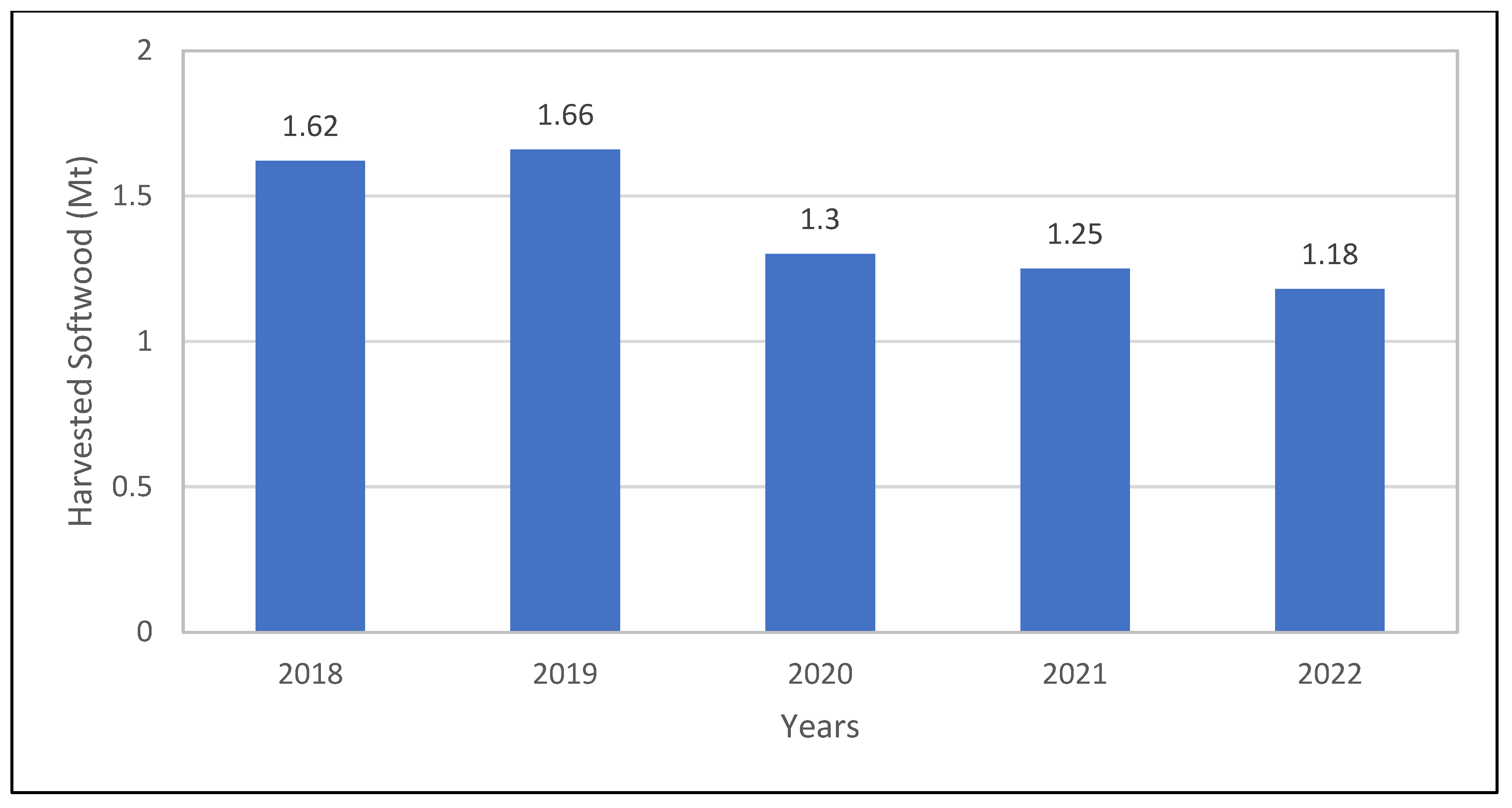
Figure 1 illustrates the trend in softwood harvests in Nova Scotia from 2018 to 2022, indicating an average annual harvest of approximately 1.40 Mt [55]. Over the years, the total quantity of harvested softwood decreased, from 1.62 million tonnes in 2018 to 1.18 million tonnes in 2022, reflecting the possible role of biomass in energy production.
Figure 1.
Softwood availability in Nova Scotia from 2018 to 2022 [55].
The biomass energy potential was estimated based on an average annual harvest of about 1.40 million tonnes and a higher heating value of 17 megajoules per kilogram, resulting in a total energy yield of approximately 6.61 terawatt-hours.
Assuming a CHP system with overall efficiencies between 60 and 80 percent and an equal split between electrical and thermal outputs, the annual electricity generation potential ranges from 1.98 to 2.64 TWh annually, with an equal amount of useful thermal energy produced.
Biogenic CO2 emissions were calculated using an emission factor of 1.85 kg CO2/kg of wood, giving 2.33–2.46 Mt CO2/year for capture efficiencies of 90–95 percent. Applying a capture energy intensity of 285 kWh/t CO2 results in a total CO2 capture energy requirement of approximately 0.66–0.70 TWh per year for the evaluated range of capture efficiencies.
Overall, Table 6 summarizes the outputs of trigeneration from wood biomass combustion, including electrical energy, thermal energy, and CO2 capture.
Table 6.
Trigeneration outputs: electrical energy, thermal energy, and captured CO2.
4.5. Green Hydrogen Production and Its Renewable Energy Demand
EverWind Fuels’ green hydrogen and ammonia initiative at Point Tupper, Nova Scotia, is designed to be developed in two phases. Phase I targets the production of approximately 240,000 tonnes of green ammonia per year, requiring an estimated 42,000 tonnes of hydrogen. Phase II expands production to over one million tonnes of green ammonia annually, corresponding to a hydrogen demand of approximately 177,000 tonnes per year. Using this Phase II production target and a specific electrolysis energy intensity of 41.5 kWh per kilogram of hydrogen, the total electricity demand for large-scale green hydrogen production in Nova Scotia is calculated as approximately 7.35 TWh per year. Furthermore, since the synthesis of one million tonnes of methanol typically requires around 188,000 tonnes of hydrogen, the associated electricity requirement for electrolysis rises to approximately 7.8 TWh per year. Including the compression energy requirement, this would require about 10–12 TWh of electricity per year.
Nova Scotia’s offshore wind resource, estimated at 5 GW, could generate approximately 22–26 TWh per year at a 50–60 percent capacity factor. This output exceeds the province’s projected 12 TWh electricity demand by 2035, indicating that offshore wind could supply both the grid and emerging hydrogen industries, if storage and grid enhancements are implemented to manage variability. Solar power, while a viable supplementary resource, presents a significantly larger spatial footprint. Producing 1 Mt of methanol per year would require about 10 TWh of electricity, equivalent to 9.2 GW of installed solar capacity and approximately 36,700–55,000 acres of land.
Overall, these results highlight the substantial renewable electricity supply needed to support provincial-scale hydrogen and methanol production pathways, reinforcing the requirement for significant investment in wind and solar capacity to meet future green fuel objectives.
4.6. Methanol Production Pathways
Two main pathways for methanol production are examined, which are further broken down into four scenarios. First, the green methanol pathway combines carbon dioxide from biomass sources, such as the Port Hawkesbury power plant or a dedicated wood biomass combustion plant, with hydrogen produced using renewable electricity. Second, the fossil-based methanol (blue/brown) pathway uses carbon dioxide from natural gas or coal combustion plants with renewable hydrogen.
Based on the provincial feedstock availability and EverWind Fuels’ projected hydrogen production capacity of 177 kilotonnes per year, the scenario results are presented in Table 7.
Table 7.
Methanol production scenarios.
Scenario 1 offers a clean but very small-scale route, where a biomass plant captures a modest amount of biogenic CO2 and converts all of it into green methanol, eliminating any need for underground storage. However, the process is held back by a severe hydrogen imbalance, with only 3 percent of the available hydrogen being used, and limits methanol output. Increasing the capture capacity or bringing in additional biogenic CO2 would improve both efficiency and production.
Scenario 2 captures a substantial amount of fossil CO2 from a natural gas plant and converts it into non-green methanol, lowering provincial emissions by about 0.9 Mt per year. This approach shows how carbon capture and utilization can offer a cleaner alternative to conventional natural-gas-based methanol production. However, the system still leaves about one-third of the hydrogen supplied unused, which limits methanol output and reduces overall efficiency.
Scenario 3 captures a very large amount of CO2 from a coal plant and converts just over half of it into non-green methanol, with the rest needing to be stored. All the hydrogen supplied is used efficiently, but only 57 percent of the captured CO2 is converted, leaving roughly 1 Mt of CO2 for sequestration. If this unused CO2 is permanently stored, the system achieves a significant net reduction in coal-related emissions. Despite this strong capture performance, the process still depends on coal, a highly carbon-intensive and unsustainable fuel. It also requires substantial hydrogen and storage capacity. Overall, Scenario 3 offers the highest emissions reduction potential of the three pathways but remains constrained by its fossil feedstock and reliance on large-scale CO2 capture and storage.
Scenario 4 captures 2.46 Mt of CO2 per year from a wood biomass plant, converting just over half into green methanol while the remainder is stored or eventually returns to the atmosphere. Because the CO2 comes from a renewable source, the process still delivers significant climate benefits. This BECCS approach produces net-negative emissions, making it a carbon-negative fuel pathway with high output. The main challenge lies in securing a sustainable and responsibly managed biomass supply to maintain these environmental gains.
Overall, Scenario 1 is limited by the relatively small carbon dioxide stream available at Port Hawkesbury. In contrast, Scenario 4 shows that dedicated biomass combustion with carbon capture could produce approximately 0.94 million tonnes of green methanol per year. Scenarios 2 and 3 show that even though there is enough CO2 to produce substantial amounts of methanol, the process is ultimately limited by the fact that the carbon comes from fossil sources, raising sustainability and long-term environmental concerns.
4.7. Cost Analysis and Economic Feasibility in Nova Scotia
Using the port LCOM range reported by Du et al. [92], €967.66–€1099.73 per tonne, and converting to Canadian dollars at 1 EUR = 1.6337 CAD [97], the LCOM range becomes approximately 1581–1797 CAD per tonne. Assuming electricity accounts for 60 percent of the total cost, the electricity component alone is approximately 949–1078 CAD per tonne. By comparison, the current market price of traditional methanol ranges from 479 to 874 CAD. This emphasizes that electricity cost and electrolysis efficiency are the principal levers for reducing LCOM and improving the competitiveness of power-to-methanol pathways.
Closing this gap will rely on lower electrolyser electricity consumption, capital cost, access to lower-cost low-carbon electricity, or a supportive policy.
5. Discussion
The analysis of methanol production in Nova Scotia reveals both promising opportunities and significant challenges across technical, environmental, and socio-economic dimensions. This discussion synthesizes the findings from carbon dioxide sourcing, biomass availability, hydrogen production, and methanol synthesis pathways to evaluate the feasibility and implications of scaling green methanol in the province.
5.1. Techno-Economic Analysis
Three existing point sources and a dedicated biomass case were analyzed in Table 4 and Table 5. Port Hawkesbury (60 MW biomass) yields approximately 33 ktCO2 captured per year and requires 9.4 GWh per year for capture. Tufts Cove (500 MW natural gas) yields 900 ktCO2 and requires 121.5 GWh for capture. Lingan (620 MW coal) yields 2.30 MtCO2 and requires 241.3 GWh for capture. A dedicated biomass combustion pathway using the provincial average annual softwood harvest of 1.40 Mt per year yields between 2.33 and 2.46 MtCO2 captured per year, depending on capture efficiency.
In Table 6, the trigeneration analysis of wood biomass combustion highlights the interplay between combined heat and power (CHP) efficiency, CO2 capture, and energy allocation. Assuming CHP systems with 60–80% overall efficiency and equal electrical and thermal outputs, electricity generation potential ranges from 1.98 to 2.64 TWh annually. Biogenic CO2 emissions, estimated at 2.33–2.46 Mt/year based on a wood emission factor of 1.85 kg CO2/kg and capture efficiencies of 90–95%, require 0.66–0.70 TWh/year for post-combustion capture at 285 kWh/t CO2. As CHP efficiency increases, the share of electricity consumed for capture declines from 35% to 25%, improving net energy availability for downstream processes such as hydrogen electrolysis or methanol synthesis. These results underscore the importance of optimizing CHP performance and capture efficiency to balance renewable energy generation.
Table 7 shows the analysis of methanol production pathways, highlighting distinct limitations and opportunities based on feedstock availability and hydrogen supply. Green methanol, derived from biomass-based CO2 and renewable hydrogen (assuming a hydrogen supply target of 177 kt per year), is constrained by carbon availability in Scenario 1, where Port Hawkesbury’s limited emissions yield only 0.024 Mt/year of methanol despite full CO2 utilization. Scenarios 2 and 3, using fossil-based CO2 from Tufts Cove and Lingan, respectively, demonstrate higher methanol outputs (0.66–0.94 Mt/year), but shift the limiting factor to hydrogen availability, with Lingan’s abundant CO2 stream underutilized due to capped hydrogen input. Scenario 4, leveraging dedicated biomass combustion, matches Lingan’s output but similarly faces hydrogen constraints. These results underscore the need for integrated planning that balances CO2 capture capacity with scalable green hydrogen production to optimize methanol yields across both renewable and fossil-derived pathways.
The cost analysis for green methanol production in Nova Scotia reveals a significant economic gap compared to conventional methanol. The levelized cost of methanol is about 1581–1797 CAD per tonne. With electricity comprising around 60% of total costs, the energy component alone accounts for 949–1078 CAD per tonne. This is well above the market price of fossil-based methanol at roughly 479 to 874 CAD per tonne. This disparity highlights the crucial role of electricity costs and electrolysis efficiency in enhancing economic viability. Bridging the gap will require advances in electrolyser performance, reductions in capital cost, access to lower-cost renewable electricity, or targeted policy support to incentivize low-carbon fuel adoption.
5.2. Public Acceptance
In Nova Scotia, there is growing concern about the sustainability of wood biomass, particularly the risk of deforestation, habitat loss, and reduced biodiversity from large-scale biomass harvesting. Using all of Nova Scotia’s softwood harvest to produce green methanol would eliminate the province’s forest products industry. These challenges can be addressed by sourcing wood biomass from well-managed forests or from leftover residues caused by extreme weather events such as hurricanes.
Social and ethical concerns also impact acceptance, particularly when local communities feel excluded from decisions regarding biomass projects that affect their land or livelihoods. Using agricultural land for energy crops instead of food production raises additional concerns about food security. Moreover, while biomass emits less carbon than fossil fuels, its combustion process can still raise air quality and health concerns, reinforcing the perception that it is less clean than other renewables. To increase public acceptance in Nova Scotia, it is essential to engage communities early in the planning process, provide information on environmental and economic impacts, and demonstrate the role of well-managed biomass in a sustainable energy mix.
6. Summary
This paper presents a techno-economic assessment of methanol production in Nova Scotia that integrates fossil-based and biogenic CO2 sources with green hydrogen produced by offshore wind-powered electrolysis. Major point sources, Port Hawkesbury, Tufts Cove, and Lingan, exhibit capture potential ranging from 33 kilotonnes to 2.30 megatonnes of CO2 per year, enabling both renewable and non-renewable methanol pathways. Stoichiometric requirements for methanol synthesis are approximately 1.4 tonnes of CO2 and 0.2 tonnes of hydrogen per tonne of methanol, and hydrogen production via electrolysis requires on the order of 10 to 12 MWh of electricity per tonne of methanol when auxiliary loads are included.
A modular trigeneration concept is proposed in which sustainably sourced woody biomass is combusted to provide heat, electricity, and biogenic CO2 for on-site methanol synthesis; alternative pathways use captured fossil CO2 from power plants combined with offshore wind hydrogen. Scenario modeling indicates that methanol output is constrained either by CO2 availability or by hydrogen supply, depending on pathway selection, and that electricity is the dominant cost driver. Levelized cost estimates place green methanol between 1581 and 1797 CAD per tonne, substantially higher than fossil-based benchmarks of 479 to 874 CAD per tonne.
Environmental and social risks such as deforestation, biodiversity loss, and air quality impacts highlight the need for sustainable feedstock management and inclusive community engagement. Despite remaining technical, economic, and social challenges, the proposed pathways offer the potential to reduce provincial emissions, strengthen energy resilience, stimulate local economic activity, and support sustainable development in Nova Scotia.
Limitations
The authors note that some calculations in this paper are based on assumed or approximate values from peer-reviewed studies and benchmarks, providing useful insights into trends but carrying inherent uncertainty. The information presented is intended for general informational purposes only and should not be construed as specific advice. The authors shall not be held liable for any loss, damage, or consequences arising from reliance on the information herein. Further feasibility studies are required to validate the accuracy of the results.
Author Contributions
Methodology, A.O.; Validation, A.O.; Investigation, A.O.; Resources, A.O.; Data curation, A.O.; Writing—original draft, A.O.; Writing—review & editing, L.H.; Visualization, A.O.; Supervision, L.H.; Project administration, L.H.; Funding acquisition, L.H. All authors have read and agreed to the published version of the manuscript.
Funding
This research was financial support by Mitacs (grant number: IT40761) and EverWind Fuels.
Data Availability Statement
The original contributions presented in this study are included in the article. Further inquiries can be directed to the corresponding author.
Conflicts of Interest
The authors declare no conflict of interest.
Abbreviations
The following abbreviations are used in this paper.
| CAD | Canadian dollars |
| CAPEX | Capital Expenditure |
| CCS | Carbon Capture and Storage |
| CCUS | Carbon Capture, Utilization, and Storage |
| CHP | Combined heat and power |
| CO2 | Carbon dioxide |
| CRF | Capital Recovery Factor |
| BECCS | Bioenergy with Carbon Capture and Storage |
| eMethanol | Electro Methanol |
| GHGRP | Greenhouse Gas Reporting Program |
| GJ | Gigajoule |
| GWh | Gigawatt-hour |
| HER | Hydrogen Evolution Reaction |
| HHV | Higher Heating Value |
| kt | Thousand Tonnes |
| kWh/t CO2 | Kilowatt-hour per tonne of carbon dioxide |
| LCO2 | Liquefied CO2 |
| LCOH | Levelized Cost of Heat |
| Mt | Million Tonnes |
| Mtpa | Million Tonnes per annum |
| MWh | Megawatt-hour |
| NSPI | Nova Scotia Power Incorporated |
| OER | Oxygen Evolution Reaction |
| OPEX | Operational Expenditure |
| SMR | Steam methane reforming |
| TWh/year | Terawatt-hour per year |
| € | Euros |
References
- Schorn, F.; Walters, R.; Blunier, B.; Schnorbus, T.; Heuser, B.; Peters, R.; Stolten, D. Methanol as a renewable energy carrier: An assessment of production and transportation costs for selected global locations. Adv. Appl. Energy 2021, 3, 100050. [Google Scholar] [CrossRef]
- Deka, T.J.; Prajapati, R.; Jha, A.; Rooney, D.W. Methanol fuel production, utilization, and technoeconomy: A Review. Environ. Chem. Lett. 2022, 20, 3525–3554. [Google Scholar] [CrossRef]
- Hughes, L. The Hidden Costs of Premier Tim Houston’s Sustainable Aviation Fuel Promise. Halifax Examiner, 25 November 2024. Available online: https://www.halifaxexaminer.ca/commentary/the-hidden-costs-of-premier-tim-houstons-sustainable-aviation-fuel-promise/ (accessed on 12 April 2025).
- Methanol Institute. Marine Methanol: Future-Proof Shipping Fuel; Methanol Institute: Singapore, 2023. [Google Scholar]
- Methanex Corporation. Methanex 2024 Sustainability Report; Methanex Corporation: Vancouver, BC, Canada, 2024. [Google Scholar]
- Rafiq, A.; Farooq, A.; Gheewala, S.H. Life Cycle Assessment of CO2-Based and Conventional Methanol Production Pathways in Thailand. Processes 2024, 12, 1868. [Google Scholar] [CrossRef]
- Skoufa, Z.; Johnson, M. Propelling the Maritime Industry to Sustainability with Methanol. Decarbonization Technology. 20 November 2024, p. 274.
- IRENA. Innovation Outlook: Renewable Methanol; International Renewable Energy Agency: Abu Dhabi, United Arab Emirates, 2021. [Google Scholar]
- Methanol Institute. Carbon Footprint of Methanol. The Methanol Institute. 2025. Available online: https://www.methanol.org/renewable/ (accessed on 12 April 2025).
- Sollai, S.; Piras, G.; Buiatti, G.; Ferrara, F.; Pettinau, A. Renewable methanol production from green hydrogen and captured CO2: A techno-economic assessment. J. CO2 Util. 2023, 68, 102345. [Google Scholar] [CrossRef]
- Kim, T.; Park, J.; Lee, H.; Park, J. Exploring the potential of hybrid green and blue methanol in achieving negative CO2 emissions: A carbon techno-economic perspective. Chem. Eng. J. 2025, 508, 160910. [Google Scholar] [CrossRef]
- Zhao, Z.Q.; Zhang, H.; Jiao, C.; Wang, Q.F.; Lin, X.L. Review on global CCUS technology and application. Mod. Chem. Ind. 2021, 41, 5–10. [Google Scholar] [CrossRef]
- Hughes, L. Wildfires and Nova Scotia’s Net-Zero Targets. 20 June 2023. Available online: http://dclh.electricalandcomputerengineering.dal.ca/enen/2023/230620_ANS_Wildfires_and_NBS.htm (accessed on 24 June 2023).
- Ahmadipour, M.; Ridha, H.M.; Ali, Z.; Zhining, Z.; Ahmadipour, M.; Othman, M.M.; Ramachandaramurthy, V.K. A comprehensive review on biomass energy system optimization approaches: Challenges and issues. Int. J. Hydrogen Energy 2025, 106, 1167–1183. [Google Scholar] [CrossRef]
- Shi, T.; Han, G.; Ma, X.; Pei, Z.; Chen, W.; Liu, J.; Zhang, X.; Li, S.; Gong, W. Quantifying strong point sources emissions of CO2 using spaceborne LiDAR: Method development and potential analysis. Energy Convers. Manag. 2023, 292, 117346. [Google Scholar] [CrossRef]
- ECCC. About the Greenhouse Gas Reporting Program. Environment and Climate Change Canada. 2 May 2024. Available online: https://data-donnees.az.ec.gc.ca/data/substances/monitor/greenhouse-gas-reporting-program-ghgrp-facility-greenhouse-gas-ghg-data/PDGES-GHGRP-GHGEmissionsGES-2004-Present.xlsx (accessed on 20 May 2024).
- Mohammad, Y.; Hussameldin, I. A comprehensive review on recent trends in carbon capture, utilization, and storage techniques. J. Environ. Chem. Eng. 2023, 11, 111393. [Google Scholar] [CrossRef]
- Fu, L.; Zhang, X.; Sun, Y.; Ma, Q.; Huang, W.; Liao, K.; Huang, Z.; Wang, Y.; Li, J.; Xu, P. Research progress on CO2 capture and utilization technology. J. CO2 Util. 2022, 66, 102260. [Google Scholar] [CrossRef]
- NETL. 9.2. Carbon Dioxide Capture Approaches. National Energy Technology Laboratory. Available online: https://netl.doe.gov/research/carbon-management/energy-systems/gasification/gasifipedia/capture-approaches (accessed on 24 February 2024).
- Shell Catalysts & Technologies. Shell CANSOLV® CO2 Capture System: A Leading Post-Combustion Carbon Dioxide (CO2) Removal Technology. Shell Catalysts & Technologies. 2019. Available online: https://catalysts.shell.com/hubfs/Shell%20Cansolv%20CO2%20Capture%20System%20Fact%20sheet.pdf?hsCtaTracking=c10df630-ddd5-4763-9d90-fcfd42d3bbb8%7Ce3e3ca46-36b8-45b4-b248-b51bd9e45613 (accessed on 16 October 2023).
- Al Baroudi, H.; Awoyomi, A.; Patchigolla, K.; Jonnalagadda, K.; Anthony, E.J. A review of large-scale CO2 shipping and marine emissions management for carbon capture, utilisation and storage. Appl. Energy 2021, 287, 116510. [Google Scholar] [CrossRef]
- Simonsen, K.; Hansen, D.S.; Pedersen, S. Challenges in CO2 transportation: Trends and perspectives. Renew. Sustain. Energy Rev. 2024, 191, 114149. [Google Scholar] [CrossRef]
- Smith, E.; Morris, J.; Kheshgi, H.; Teletzke, G.; Herzog, H.; Paltsev, S. The cost of CO2 transport and storage in global integrated assessment modeling. Int. J. Greenh. Gas Control 2021, 109, 103367. [Google Scholar] [CrossRef]
- Lu, H.; Ma, X.; Huang, K.; Fu, L.; Azimi, M. carbon dioxide transport via pipelines: A systematic review. J. Clean. Prod. 2020, 266, 121994. [Google Scholar] [CrossRef]
- Peletiri, S.; Rahmanian, N.; Mujtaba, I.M. CO2 Pipeline Design: A Review. Energies 2018, 11, 2184. [Google Scholar] [CrossRef]
- Onyebuchi, V.; Kolios, A.; Hanak, D.; Biliyok, C.; Manovic, V. A systematic review of key challenges of CO2 transport via pipelines. Renew. Sustain. Energy Rev. 2018, 81, 2563–2583. [Google Scholar] [CrossRef]
- Advisory Council of the European Technology Platform for Zero Emission Fossil Fuel Power Plants. The Cost of CO2 Transport: Post-Demonstration CCS in the EU; EU Zero Emissions Platform ZEP: Brussels, Belgium, 2011. [Google Scholar]
- Khan, M.N.; Siddiqui, S.; Thakur, G.C. Recent Advances in Geochemical and Mineralogical Studies on CO2–Brine–Rock Interaction for CO2 Sequestration: Laboratory and Simulation Studies. Energies 2024, 17, 3346. [Google Scholar] [CrossRef]
- Wang, Q.; Zhang, D.; Li, Y.; Li, C.; Tang, H. Numerical simulation study of CO2 storage capacity in Deep Saline aquifers. Sci. Technol. Energy Transit. 2024, 79, 12. [Google Scholar] [CrossRef]
- Hall-Spencer, J.M.; Harvey, B.P. Ocean acidification impacts on coastal ecosystem services due to habitat degradation. Emerg. Top. Life Sci. 2019, 3, 197. [Google Scholar] [CrossRef]
- Zhou, H.; Wu, Y.; Liu, C.; Geng, H.; Yao, C. Study on the diffusion and migration law of CO2 sequestrated in abandoned coal mine goaf. Deep Undergr. Sci. Eng. 2025. [Google Scholar] [CrossRef]
- Li, X.; Huan, H.; Lin, H.; Li, Z.; Du, F.; Cao, Z.; Fan, X.; Ren, H. Determination method of rational position for working face entries in coordinated mining of section coal pillars and lower sub-layer. Sci. Rep. 2025, 15, 29440. [Google Scholar] [CrossRef]
- Zhengzheng, C.; Yi, X.; Yi, X.; Feng, D.; Zhenhua, L.; Cunhan, H.; Shuren, W.; Yongqiang, Y.; Wenqiang, W.; Minglei, Z.; et al. Diffusion Evolution Rules of Grouting Slurry in Mining-induced Cracks in Overlying Strata. Mech. Rock Mech. Rock Eng. 2025, 58, 6493–6512. [Google Scholar] [CrossRef]
- McCoy, M.; Hughes, L. Nova Scotia’s Carbon Sinks and Pathways to Net-Zero by 2050. 26 November 2021. Available online: http://lh.ece.dal.ca/enen/2021/210827_McCOY_HUGHES_NS_C_Sinks_and_Pathways_to_Net-Zero.pdf (accessed on 20 May 2025).
- Cryoteknik. LCO2 Storage Tanks. 2023. Available online: https://cryoteknik.com/en/product/lco2-storage-tanks (accessed on 16 August 2024).
- Pentair. Bulk Storage of Liquid CO2. 2017. Available online: https://carboncapture.pentair.com/en/solutions/cc-product-liquid-co2-storage-tanks-with-liquid-level-indicator (accessed on 20 May 2025).
- Directank. Understanding the Cost Benefit Analysis for Aboveground Tanks. 10 August 2023. Available online: https://directank.com/aboveground-tanks-understanding-the-cost-benefit-analysis/ (accessed on 10 August 2023).
- Amiri, N.; Shaterabadi, M.; Ben-Brahim, L.; Ahmadi Jirdehi, M. Assessing the eco-environmental aspects of fossil-fuels-based units substitution of Point Aconi thermal power plant by green-based energies: A case study of Canada. Electr. Eng. 2025, 107, 1331–1346. [Google Scholar] [CrossRef]
- NS Power. Powering a Green Nova Scotia, Together: Clean Energy Sources. 2025. Available online: https://www.nspower.ca/cleanandgreen/clean-energy/clean-energy-sources (accessed on 20 April 2025).
- NS Natural Resources. Wind Energy in Nova Scotia. Department of Natural Resources and Renewables. Available online: https://energy.novascotia.ca/renewables/wind-energy (accessed on 20 April 2025).
- Energy Hub. Solar Power Nova Scotia. 9 September 2023. Available online: https://www.energyhub.org/nova-scotia/#solar-irradiance (accessed on 18 May 2025).
- NRCan. Photovoltaic Potential and Solar Resource Maps of Canada. Natural Resources Canada. 16 January 2025. Available online: https://natural-resources.canada.ca/energy-sources/renewable-energy/photovoltaic-potential-solar-resource-maps-canada (accessed on 18 May 2025).
- Nakamoto, Y.; Eguchi, S. How do seasonal and technical factors affect generation efficiency of photovoltaic power plants. Renew. Sustain. Energy Rev. 2024, 199, 114441. [Google Scholar] [CrossRef]
- Halifax Examiner. Nova Scotia Power to Burn More Biomass to Generate “Renewable” Electricity. 7 September 2022. Available online: https://www.halifaxexaminer.ca/government/nova-scotia-power-to-burn-more-biomass-to-generate-renewable-electricity/ (accessed on 20 May 2025).
- Acampora, L.; Grilletta, S.; Costa, G. The Integration of Carbon Capture, Utilization, and Storage (CCUS) in Waste-to-Energy Plants: A Review. Energies 2025, 18, 1883. [Google Scholar] [CrossRef]
- Castro, R. Electricity Production from Renewables: Combined Heat and Power; Springer: Cham, Switzerland, 2022; pp. 351–388. [Google Scholar]
- Furubayashi, T.; Nakata, T. Analysis of woody biomass utilization for heat, electricity, and CHP in a regional city of Japan. J. Clean. Prod. 2021, 290, 125665. [Google Scholar] [CrossRef]
- Gonçalves, A.C.; Malico, I. Forest Bioenergy: From Wood Production to Energy Use; Springer Nature: Cham, Switzerland, 2024. [Google Scholar]
- DNR. State of the Forest 2016; Nova Scotia Department of Natural Resources: Halifax, NS, Canada, 2017; ISBN 978-1-55457-737-8. [Google Scholar]
- Li, Y.; Brando, P.M.; Morton, D.C.; Lawrence, D.M.; Yang, H.; Randerson, J.T. Deforestation-induced climate change reduces carbon storage in remaining tropical forests. Nat. Commun. 2022, 13, 1964. [Google Scholar] [CrossRef] [PubMed]
- Environment. Ecologists Call for Action on Climate Crisis Amidst NS Wildfires. 1 June 2023. Available online: https://environmentjournal.ca/ecologist-calls-for-action-on-climate-crisis-amidst-nova-scotia-wildfires/ (accessed on 10 July 2025).
- Forest NS. Forestry: A Proactive Approach to Wildfire Prevention. 2023. Available online: https://www.forestns.ca/forest-ns-blog/forestry-a-proactive-approach-to-wildfire-prevention (accessed on 10 September 2024).
- Earth. 5 Sustainable Forest Management Strategies for Wildfire Prevention. 7 December 2022. Available online: https://earth.org/wildfire-prevention/ (accessed on 12 October 2024).
- Forestry. How to Effectively Combat and Prevent Forest Fires. 5 April 2024. Available online: https://forestry.com/guides/how-to-effectively-combat-and-prevent-forest-fires/ (accessed on 20 May 2025).
- NFDP. Annual Harvest Versus Wood Supply. Canadian Council of Forest Ministers CCFM: National Forestry Database. 2 February 2023. Available online: http://nfdp.ccfm.org/en/data/harvest.php (accessed on 13 April 2025).
- IRENA. Green Hydrogen: A Guide to Policy Making; International Renewable Energy Agency: Abu Dhabi, United Arab Emirates, 2020. [Google Scholar]
- Energy.gov. Hydrogen Production: Electrolysis. 2 September 2023. Available online: https://www.energy.gov/eere/fuelcells/hydrogen-production-electrolysis (accessed on 2 June 2024).
- Shih, A.J.; Monteiro, M.C.; Dattila, F.; Pavesi, D.; Philips, M.; da Silva, A.H.; Vos, R.E.; Ojha, K.; Park, S.; van der Heijden, O.; et al. Water electrolysis. Nat. Rev. Methods Primers 2022, 2, 84. [Google Scholar] [CrossRef]
- Enapter. AEM Electrolysers—The Best of Both Worlds. Available online: https://www.enapter.com/aem-electrolysers/ (accessed on 15 April 2025).
- Anand, C.; Chandraja, B.; Nithiya, P.; Akshaya, M.; Tamizhdurai, P.; Shoba, G.; Subramani, A.; Kumaran, R.; Yadav, K.K.; Gacem, A.; et al. Green hydrogen for a sustainable future: A review of production methods, innovations, and applications. Int. J. Hydrogen Energy 2025, 111, 319–341. [Google Scholar] [CrossRef]
- Riaz, M.A.; Trogadas, P.; Aymé-Perrot, D.; Sachs, C.; Dubouis, N.; Girault, H.; Coppens, M.O. Water electrolysis technologies: The importance of new cell designs and fundamental modelling to guide industrial-scale development. Energy Environ. Sci. 2025, 18, 5190–5214. [Google Scholar] [CrossRef]
- Hodges, A.; Hoang, A.L.; Tsekouras, G.; Wagner, K.; Lee, C.Y.; Swiegers, G.F.; Wallace, G.G. A high-performance capillary-fed electrolysis cell promises more cost-competitive renewable hydrogen. Nat. Commun. 2022, 13, 1304. [Google Scholar] [CrossRef]
- Hysata. Hysata’s Electrolyser Breaks Efficiency Records. 15 March 2022. Available online: https://hysata.com/news/hysatas-electrolyser-breaks-efficiency-records-enabling-world-beating-green-hydrogen-cost/ (accessed on 13 April 2025).
- New Atlas. Record-Breaking Hydrogen Electrolyzer Claims 95% Efficiency. Available online: https://newatlas.com/energy/hysata-efficient-hydrogen-electrolysis/ (accessed on 16 March 2022).
- DOE. Hydrogen Program. The U.S. Department of Energy. 2009. Available online: https://www.hydrogen.energy.gov/docs/hydrogenprogramlibraries/pdfs/9013_energy_requirements_for_hydrogen_gas_compression.pdf?Status=Master (accessed on 27 October 2025).
- Otsubo, Y. Hydrogen compression and long-distance transportation: Emerging technologies and applications in the oil and gas industry—A technical review. Energy Convers. Manag. X 2025, 25, 100836. [Google Scholar] [CrossRef]
- Gomonov, K.; Permana, C.T.; Handoko, C.T. The growing demand for hydrogen: Current trends, sectoral analysis, and future projections. Unconv. Resour. 2025, 6, 100176. [Google Scholar] [CrossRef]
- Global Affairs Canada. Canada Announces Support for New Hydrogen Project in Nova Scotia. Global Affairs Canada. 29 November 2023. Available online: https://www.canada.ca/en/global-affairs/news/2023/11/canada-announces-support-for-new-hydrogen-project-in-nova-scotia.html (accessed on 21 August 2024).
- EverWind. EverWind Fuels Receives Environmental Approval for First Industrial-Scale Green Hydrogen and Green Ammonia Project in North America. EverWind Fuels Company. 7 February 2023. Available online: https://everwindfuels.com/news/30 (accessed on 26 September 2024).
- Halifax Examiner. Where Will All the ‘Green Energy’ Come from for EverWind Fuels’ ‘Green Hydrogen’ Project? Commentary. 15 December 2022. Available online: https://www.halifaxexaminer.ca/commentary/where-will-all-the-green-energy-come-from-for-everwind-fuels-green-hydrogen-project/ (accessed on 13 April 2025).
- Adeli, K.; Nachtane, M.; Faik, A.; Saifaoui, D.; Boulezhar, A. How Green Hydrogen and Ammonia Are Revolutionizing the Future of Energy Production: A Comprehensive Review of the Latest Developments and Future Prospects. Appl. Sci. 2023, 13, 8711. [Google Scholar] [CrossRef]
- ExxonMobil. ExxonMobil Methanol to Jet Technology to Provide New Route for Sustainable Aviation Fuel Production. 20 June 2022. Available online: https://www.exxonmobilchemical.com/en/resources/library/library-detail/101116/exxonmobil_sustainable_aviation_fuel_production_en (accessed on 12 June 2024).
- Azhari, N.J.; Erika, D.; Mardiana, S.; Ilmi, T. Methanol synthesis from CO2: A mechanistic overview. Results Eng. 2022, 16, 100711. [Google Scholar] [CrossRef]
- Bowker, M. Methanol Synthesis from CO2 Hydrogenation. ChemCatChem 2019, 11, 4238–4246. [Google Scholar] [CrossRef]
- Mærsk. Global Availability of Biogenic CO2 and Implications for Maritime Decarbonization; Mærsk Mc-Kinney Møller Center for Zero Carbon Shipping: Copenhagen, Denmark, 2024. [Google Scholar]
- Galik, C.S.; Benedum, M.E.; Kauffman, M.; Becker, D.R. Opportunities and barriers to forest biomass energy: A case study of four U.S. States. Biomass Bioenergy 2021, 148, 106035. [Google Scholar] [CrossRef]
- Zeng, G.; Liu, D.; Nie, S.; Guan, T.; Luo, Y.; Chen, J.; Gan, H.; Zheng, H. Carbon emission intensity measurement and spatial effect of high energy consuming industries: Evidence from China. Glob. NEST J. 2024, 26, 06437. Available online: https://journal.gnest.org/system/files/2024-10/gnest_06437_final.pdf (accessed on 13 October 2025).
- ECCC. About the Greenhouse Gas Reporting Program. Environment and Climate Change Canada. 24 January 2023. Available online: https://www.canada.ca/en/environment-climate-change/services/climate-change/greenhouse-gas-emissions/facility-reporting/about.html (accessed on 18 February 2024).
- EPA. Chapter 6–CO2 Capture, Storage, and Transport; U.S. Environmental Protection Agency: Washington, DC, USA, 2022. [Google Scholar]
- NETL. Cost and Performance of Retrofitting NGCC Units for Carbon Capture—Revision 3; U.S. Department of Energy, National Energy Technology Laboratory (NETL): Pittsburgh, PA, USA, 2023. [Google Scholar]
- IEAGHG. Power CCS: Potential for Cost Reductions and Improvements; IEAGHG: Cheltenham, UK, 2024. [Google Scholar]
- Rubin, E.S.; Davison, J.; Herzog, H. The outlook for improved carbon capture technology. Prog. Energy Combust. Sci. 2012, 38, 630–671. [Google Scholar] [CrossRef]
- Su, D.; Li, J.; Lucquiaud, M.; Thomson, C.; Chalmers, H. Thermal integration of waste-to-energy plants with post-combustion CO2 capture. Fuels 2023, 332, 126004. [Google Scholar] [CrossRef]
- Bachu, S. Review of CO2 storage efficiency in deep saline aquifers. Int. J. Greenh. Gas Control 2015, 40, 188–202. [Google Scholar] [CrossRef]
- Jianshentank. CO2 Cryogenic Tank. 2019. Available online: https://www.jianshentank.com/products/cryogenic-tank-series/co2-cryogenic-tank.html (accessed on 16 August 2024).
- Okafor, A.C. A Techno-Economic Analysis of the Potential for the Capture and Transportation of Carbon Dioxide for Utilization as an Industrial Feedstock in Nova Scotia. DalSpace. 12 October 2024. Available online: http://hdl.handle.net/10222/84642 (accessed on 15 October 2024).
- Engineeringtoolbox. Carbon Dioxide—Density and Specific Weight vs. Temperature and Pressure. The Engineering ToolBox. 2018. Available online: https://www.engineeringtoolbox.com/carbon-dioxide-d_1000.html (accessed on 24 August 2024).
- Alizadeh, P.; Tabil, L.G.; Mupondwa, E.; Li, X.; Cree, D. Technoeconomic Feasibility of Bioenergy Production from Wood Sawdust. Energies 2023, 16, 1914. [Google Scholar] [CrossRef]
- EPA. Methods for Calculating CHP Efficiency. U.S. Environmental Protection Agency. 4 March 2025. Available online: https://www.epa.gov/chp/methods-calculating-chp-efficiency (accessed on 13 October 2025).
- U.S. Environmental Protection Agency. GHG Emission Factors Hub; U.S. Environmental Protection Agency: Washington, DC, USA, 2025. [Google Scholar]
- Salman, M.; Beguin, B.; Nyssen, T.; Léonard, G. Techno-economic analysis of AMP/PZ solvent for CO2 capture in a biomass CHP plant: Towards net negative emissions. Front. Energy Res. 2024, 12, 1325212. [Google Scholar] [CrossRef]
- Du, Y.; Shen, X.; Kammen, D.M.; Ding, X. Cost-competitive offshore wind-powered green methanol production for maritime transport decarbonization. Nat. Commun. 2025, 16, 5453. [Google Scholar] [CrossRef] [PubMed]
- Methanex. Methanex Posts Regional Contract Methanol Prices for Europe, North America, Asia and China. Methanex Pricing. 2025. Available online: https://www.methanex.com/our-products/about-methanol/pricing/#:~:text=Methanex%20posts%20regional%20contract%20methanol%20prices%20for%20Europe%2C,%28PDF%20134KB%29%20Historical%20Methanex%20Posted%20Price%20%28Excel%20137KB%29 (accessed on 27 October 2025).
- Emera Incorporated. Emera Management’s Discussion & Analysis. 23 February 2023. Available online: https://investors.emera.com/financials/annual-reports/default.aspx (accessed on 20 April 2024).
- NSPI. Nova Scotia Power Final Pre-IRP Report; Nova Scotia Power Incoporated: Halifax, NS, Canada, 2019. [Google Scholar]
- CEEDC. Canadian Energy and Emissions Data Centre. CEEDC IEF District Energy. Available online: https://www.sfu.ca/ceedc/databases.html (accessed on 24 January 2024).
- Xe. Xe Currency Converter. Available online: https://www.xe.com/currencyconverter/convert/?Amount=1&From=EUR&To=CAD (accessed on 20 September 2025).
Disclaimer/Publisher’s Note: The statements, opinions and data contained in all publications are solely those of the individual author(s) and contributor(s) and not of MDPI and/or the editor(s). MDPI and/or the editor(s) disclaim responsibility for any injury to people or property resulting from any ideas, methods, instructions or products referred to in the content. |
© 2025 by the authors. Licensee MDPI, Basel, Switzerland. This article is an open access article distributed under the terms and conditions of the Creative Commons Attribution (CC BY) license (https://creativecommons.org/licenses/by/4.0/).