
Article

Research on the Operation Flexibility of a Combined Heat and Power Generation Unit with Low-Temperature Return Water

1
Key Laboratory for Thermal Science and Power Engineering of Ministry of Education, Department of Energy and Power Engineering, Tsinghua University, Beijing 100084, China
2
China Energy Engineering Co., Ltd., Beijing 100022, China
3
North China Power Engineering Co., Ltd., China Power Engineering Consulting Group, Beijing 100120, China
*
Author to whom correspondence should be addressed.
Energies 2025, 18(24), 6403; https://doi.org/10.3390/en18246403
Submission received: 28 October 2025 / Revised: 1 December 2025 / Accepted: 2 December 2025 / Published: 8 December 2025

Abstract

In northern China, photovoltaic power generation peaks around midday, resulting in a concentrated demand for flexible and deep peak shaving over a period of approximately four hours. This study analyzes the heating and power supply capacity, as well as the operational flexibility, of the low-temperature backwater cogeneration unit at the Gujiao Power Plant. It is found that this unit exhibits stronger thermo-electric coupling and lower flexibility than conventional cogeneration systems. By evaluating the applicability of general flexibility enhancement technologies, the impacts of several thermal storage methods, including the user-side thermal storage, the hot water tank storage, and the combined regulation of the tank with user-side thermal storage, are investigated in terms of their effects on unit flexibility, energy consumption, and economic performance. A combined regulation strategy incorporating a tank-based thermal energy storage system with a rated power of 1000 MW and 20% user-side thermal storage is proposed. This approach can reduce the unit load rate by approximately 28% and significantly enhance both peak shaving capacity and economic efficiency. The correlation analysis presented in this study can serve as a reference for research on improving the operational flexibility of low-temperature backwater combined heat and power units.

1. Introduction

Low-temperature return water cogeneration systems, characterized by their large scale and complex configurations, typically employ multi-stage high back-pressure heating [1,2]. For instance, the Gujiao Power Plant [3] utilizes five-stage high back-pressure heating, Tuoketuo Power Plant [4] implements four-stage high back-pressure heating, and Lingwu Power Plant [5] adopts two-stage high back-pressure heating. These low-temperature return water cogeneration units demonstrate an approximately 40% higher heating capacity than conventional extraction steam heating systems [6], featuring enhanced thermo-electric coupling efficiency but limited potential for improvements in operational flexibility. Notably, such units typically handle substantial thermal loads for surrounding urban areas. For example, the Gujiao Power Plant, with a rated power output of 3120 MW, supplies 3500 MW of heat to Taiyuan City, making it the largest power and heat source in the region. The operational flexibility of these units significantly impacts regional power grid peak shaving, heating supply reliability, and the plant’s economic benefits.
With the massive integration of renewable energy sources, exhibiting notable volatility, intermittency, and instability, peak load regulation has become a fundamental requirement for power systems. According to the publicly available information from the State Grid Corporation of China, by the end of 2024, Shanxi Province had installed 61.89 million kW of new energy capacity, accounting for 50.37% of the total installed capacity, with the installed solar capacity being 40.22 million kW. According to information from the Shanxi Electricity Trading Center, due to concentrated solar power generation during midday hours, the provincial electricity market frequently experiences zero or low electricity prices between approximately 10:00 and 14:00 during the heating season. Reducing thermal power plant loads during this period not only meets renewable energy integration demands but also enhances plant operational efficiency.
Current mainstream technologies for enhancing the flexibility of combined heat and power (CHP) units include non-thermal storage solutions such as high back-pressure heating, high-low pressure bypass heating, low-pressure cylinder zero output, absorption heat pumps, and steam ejectors, as well as thermal storage systems such as electric boilers, hot water tanks, and molten salt storage [7]. Luan et al. [8] established an energy efficiency analysis model for the heating system of cogeneration units and plotted the heat and power generation characteristic curves for extraction-condensing units and high back-pressure units. Zhang [9] suggested that thermal storage tanks can effectively enhance the peak shaving capability of cogeneration units and analyzed the changes in unit heating and power generation energy consumption after configuring a thermal storage tank. The aforementioned studies all focused on two conventional heating units with relatively simple heating systems, which differ significantly in operational characteristics due to the low-temperature return water cogeneration system employing multi-stage high back-pressure technology. The research conditions were limited to specific heating scenarios rather than the entire heating season, and the focus was primarily on energy consumption analysis, overlooking comprehensive economic studies. Consequently, a complete set of technologies and operational measures to enhance the flexibility of heating units has yet to be proposed.
This paper takes the low-temperature return water cogeneration units of the Gujiao Power Plant as the research object, establishes a calculation model for the heating system and a flexibility evaluation index system, and aims to select appropriate flexibility enhancement technologies. It systematically investigates their capability to improve flexibility and their impact on the energy consumption and economics of the plant’s heat and power generation, proposing a comprehensive set of technologies and operational strategies to enhance the flexibility of low-temperature return water cogeneration units.

2. The Calculation Model

A calculation model for the low-temperature return water heating system of the Gujiao Power Plant was constructed, consisting of power plant units, a primary heating station, a long-distance pipeline network, a pressure isolation station, a primary network, and a thermal station.

2.1. Composition of the Heating System

The heating system and key operational parameters of the Gujiao Power Plant are illustrated in Figure 1. The plant operates six direct air-cooled units, with capacities of 300 MW (Units 1 and 2), 600 MW (Units 3 and 4), and 660 MW (Units 5 and 6). These units utilize a six-stage exhaust steam system (multi-stage high back-pressure) combined with a four-stage extraction steam heating system. Specifically, Units 5 and 6 share parallel exhaust steam connections while maintaining high back-pressure through series piping with other units; Units 1 and 2 employ back-pressure generator systems for heat supply.
The pipeline network between the power plant and the Taiyuan relay energy station (pressure isolation station) has a length of 37.8 km. The two supply and two return pipelines in the network feature a diameter of 4 × DN1400. In Taiyuan district, 381 thermal stations are equipped with a cogeneration system based on absorption heat exchange (Co-ah system), covering 60% of the total heating area. Additionally, a 750 MW gas-fired boiler room is configured to provide peak shaving support for the heating system.
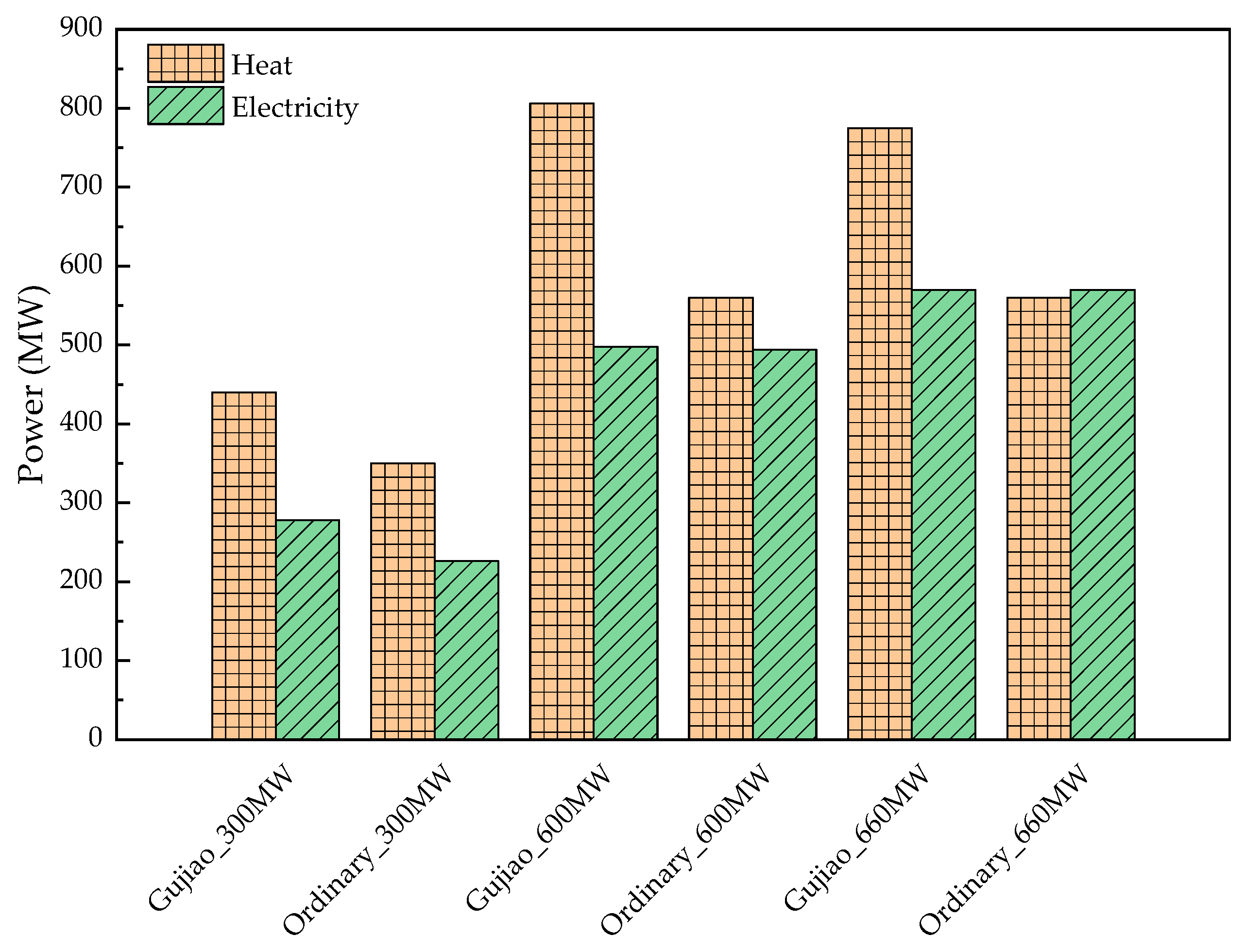
Figure 2 shows the rated heating and power generation capacity of the units. It is evident that the heating capacity of each unit in the Gujiao Power Plant exceeds the conventional extraction steam heating unit by 25~40%, and the power generation load has a greater impact on heating.

2.2. Heating Model

A heating model of the Gujiao heating system is built using Thermalflex33 (Thermoflow Inc., Jacksonville, FL, USA), which is a piece of professional engineering simulation software specializing in thermal analysis and thermal design, mainly applied in fields such as power plant, electronics, automotive, and aerospace to simulate and analyze thermal behaviors of products, including heat conduction, heat convection, and thermal radiation [10]. In this research, the modular graphical interface software is used for the simulation calculations for heating balance, power output, water quantity, water temperature, energy consumption, income from heating power generation, thermal storage, heat release, and other related parameters.

2.2.1. Governing Equations

(1)
Heating equation
The calculation formula for the exhaust steam heating power of each unit (qc,i, MW) is as follows:
q c , i = G i c p 3600 ( t H , i t L , i ) = D cq , i 3600 ( h c , i h cs , i ) η i
where Gi represents the circulating water flow rate of Unit i, t/h; cp represents the specific heat capacity of the water, 4200 J/(kg °C); tH,i represents the outlet water temperature of Unit i, °C; tL,i represents the inlet water temperature of Unit i, °C; Dcq,i represents the exhaust steam flow rate of the Unit i used for heating, t/h; hc,i represents the enthalpy of the exhaust steam, kJ/kg; hcs,i represents the enthalpy of the exhaust steam drainage, kJ/kg; and ηi represents the heat exchange efficiency.
The calculation formula for the extraction steam heating power of each unit (qe,i, MW) is as follows:
q e , i = D e , i 3600 ( h e , i h es , i )
where De,i represents the extraction steam flow rate of the Unit i used for heating, t/h; he,i represents the enthalpy of the extraction steam, kJ/kg; and hes,i represents the enthalpy of the extraction stream drainage, kJ/kg.
The calculation formula for the total heating load of the plant (q, MW) is as follows:
q = i = 1 6 ( q c , i + q e , i ) = G c p 3600 ( t H t L )
where G represents the total circulating water flow rate, t/h; tH represents the outlet water temperature of the circulating water, °C; and tL represents the inlet water temperature of the circulating water, i.e., the return water temperature of the long-distance heating network, °C [11].
The heating equivalent electricity [12,13] refers to the ratio of the power generation reduction caused by extraction steam or exhaust steam heating to the heat supply. The calculation formula for the exhaust steam heating equivalent electricity of Unit i (wc,i, kWh/GJ) is as follows:
w c , i = 277 . 8 ( h c , i h co , i ) χ i ( h c , i h cs , i )
where hco,i represents the exhaust steam enthalpy of Unit i under THA (turbine heat acceptance) condition, kJ/kg, and Χi represents the exhaust steam heating utilization rate of Unit i.
The calculation formula for the extraction steam heating equivalent electricity of Unit i (we,i, kWh/GJ) is as follows:
w e , i = 277 . 8 ( h e , i h co , i ) h e , i h es , i
(2)
Power generation equation
The calculation formula for the power generation of each unit (Pg,i, MW) is as follows:
P g , i = 0.98 3600 [ D Z , i ( h z , i h L , i ) D l , i ( h l , i h L , i ) + D R , i ( h R , i h c , i ) j = 3 8 D j , i ( h j , i h c , i ) ]
where DZ,i, DR,i, D1,i, and Dj,i represent the flow rates of the main steam, reheat hot-section steam, first-stage extraction steam, and other extraction steams, t/h, respectively, and hZ,i, hR,i, hL,i, h1,i, and hj,i represent the enthalpy of the main steam, hot-section steam, cold-section steam, first-stage extraction steam, and other extraction steams, kJ/kg, respectively.
The calculation formula for the standard coal consumption for the power generation (bi, g/kWh) of each unit [14,15] is as follows:
b i = [ D Z , i ( h z , i h s , i ) + D R , i ( h R , i h L , i ) 3600 ( q c , i + q e , i ) ] 29.271 P g , i η b , i η p , i
where hs,i represents the enthalpy of the feed water at the economizer inlet, kJ/kg, and ηb,I and ηp,i represent the boiler efficiency and pipeline efficiency, respectively.
The calculation formula for the coal consumption (B, t) in power plant operation is as follows, in which the coal consumption for heating is calculated as 38 kg/GJ:
B = 10 3 ( i = 1 6 P g , i b i + 3.6 q × 38 ) d t
where t is the time, h.
(3)
Thermal storage equation
When there are thermal storage facilities, the heating load (q, MW) should be calculated as follows:
q = q h q x q y
where qh, qx, and qy represent the design heat load, the heat release load of the thermal storage tank, and the user-side thermal storage load, MW, respectively.
The heat balance calculation formulas for the thermal energy discharge and thermal storage of the tank are as follows:
q x = G x c p 3600 ( t xH t xL )
q x c = G xc c p 3600 ( t xH t xL )
where qxc represents the thermal storage power of the thermal storage tank, MW; Gx and Gxc represent the circulating water flow rates under the tank’s thermal energy discharge and thermal storage conditions, respectively; and txH and txL represent the temperature of the hot water and the cold water in the thermal storage tank, °C, respectively.
(4)
Profit calculation equation
Since this paper primarily studies the impact of flexibility technologies on the revenue from heat supply and power generation of generating units, the revenue calculation only considers the main changing factors, while ignoring costs such as power plant maintenance and auxiliary power.
The calculation formula for the profit (E, 104 CNY) from the heat supply and power generation of the power plant is as follows:
E = E e + E q E b + E f
where Ee, Eq, Eb, and Ef represent the power generation revenue, heating revenue, coal-fired cost, and peak shaving revenue, 104 CNY, respectively. The corresponding calculation formulas are as follows:
E e = P g λ e d t E q = 3.6 q λ q d t E b = B λ b × 10 4
where λe represents the on-grid electricity price, CNY/MWh; λq represents the heat price, CNY/GJ; and λb represents the price of standard coal, CNY/t.
According to the electric peak shaving price policy of Shanxi Province, the peak shaving revenue (Ef) of the Gujiao Power Plant can be calculated using the following formula:
E f = P go ( 0 . 6 γ ) × 300 d t ,           50 % γ 60 % P go ( 0 . 1 × 300 + ( 0 . 5 γ ) × 40 0 ) d t ,           40 % γ 50 % P go ( 0 . 1 × 300 + 0 . 1 × 400 + ( 0 . 4 γ ) × 550 ) d t ,     γ 40 %
where γ represents the power generation load rate, which is the ratio of Pg to Pgo. Pg and Pgo refer to the actual power generation and the nameplate of the power plant, MW, respectively.
Table 1 presents the design parameters of the Gujiao heating system.

2.2.2. Computational Flow

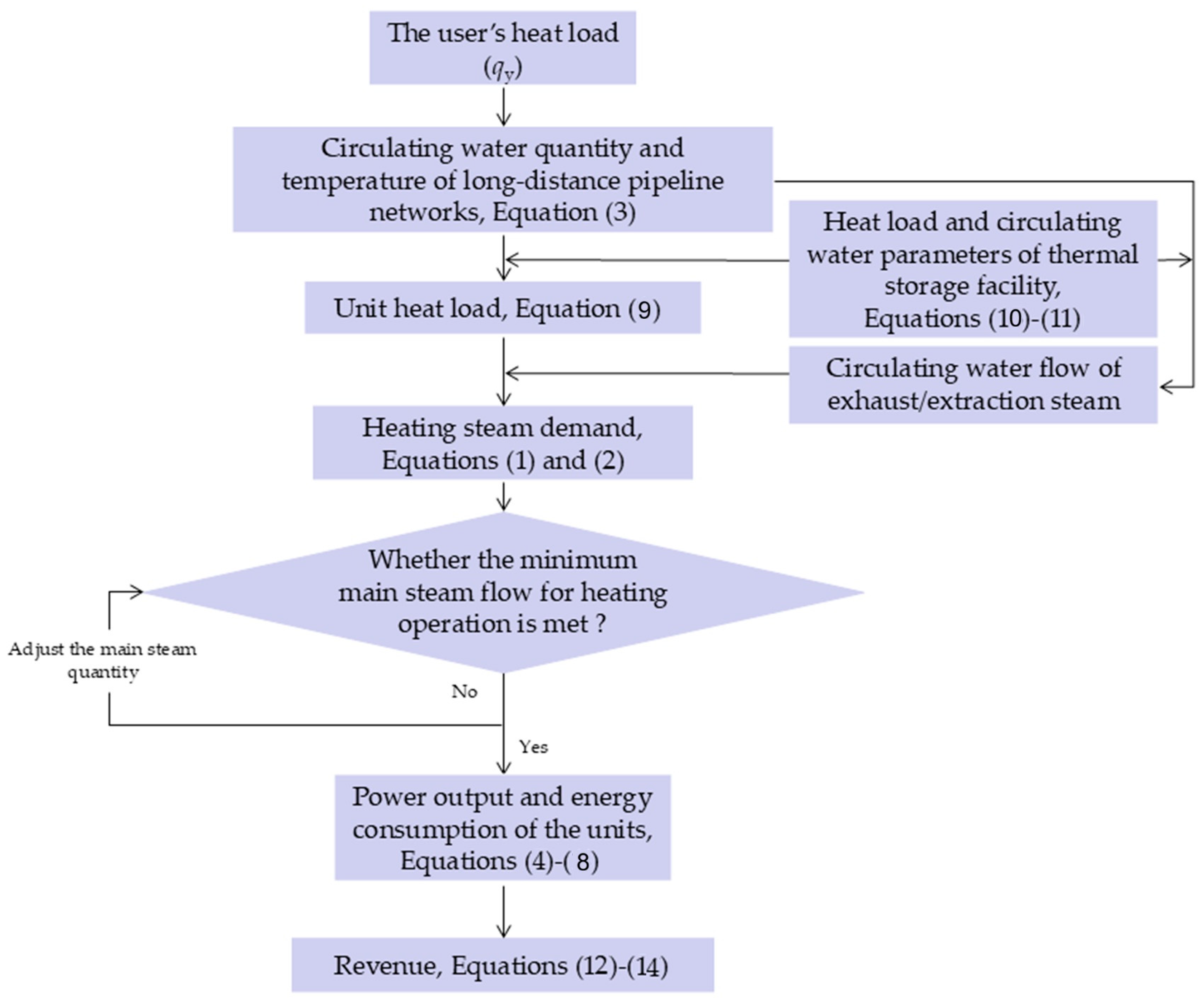
The flowchart for the unit flexibility calculation in this paper is shown in Figure 3.

2.2.3. Analysis of Unit Flexibility

(1)
Heating and power generation capacity during heating season
The heating load of the Gujiao heating system varies from 1466 MW to 3500 MW during the heating season, and a phased quality and quantity regulation method is adopted. When the heating load is between 2052 MW and 3500 MW, the quality regulation is used, with the circulating water flow rate unchanged at 30,000 t/h and the return water temperature at 30 °C, while the supply water temperature is adjusted between approximately 130 °C and 90 °C; when the heating load is between 1466 MW and 2052 MW, the quantity regulation mode is adopted, with the circulating water flow rate regulated within the range of 20,943 to 30,000 t/h, while the supply and return water temperatures remain constant at 90 °C/30 °C.
During the period of new energy generation and low electricity prices at noon, the power plant can actively reduce the main steam flow of each unit to reduce the unit output. As shown in Table 2, the minimum power generation load rate of the power plant ranges from 44% to 85%, and the PSEP (peak shaving electricity price) revenue is low.
(2)
Revenue from heat supply and power generation of the power plant during midday hours
The plant generates negative revenue (about −300,000 CNY/h) during midday hours due to the low electricity prices, and higher thermal and electrical load rates lead to worse profitability, as shown in Table 2. Therefore, investigating the flexibility of the power plant and reducing its generation load rate during the midday period is crucial for meeting the peak shaving requirements and improving the plant’s economic profit.

3. Research on Unit Flexibility Improving Technology

Non-storage technologies such as high- and low-pressure bypass systems, low-pressure cylinder zero-output configurations, absorption heat pumps, and steam ejectors have limited heating adjustment ranges, making them unsuitable for low-temperature return water cogeneration units. Electric boilers demonstrate strong thermal decoupling capabilities; however, their electricity-to-heat conversion efficiency is poor, and a substantial initial investment is required. Molten salt systems with high temperatures require significant upfront costs, making them more suitable for industrial steam storage. Large-scale hot water storage tanks have been successfully implemented in thermal power plants, such as the Dandong Power Plant, effectively enhancing operational flexibility. To improve unit flexibility, it is recommended to further research and develop technologies that utilize external thermal storage capabilities. This paper focuses on several technical pathways, including user-side thermal storage, thermal storage tank systems, and the combined regulation of thermal storage tanks with user-side storage, which enhance the flexibility of low-temperature return water cogeneration units.

3.1. User-Side Thermal Storage

3.1.1. Operating Principle

Qin et al. [16] found that building’s thermal inertia enables peak shaving for CHP units. When the heat supply is high, it allows for a limited rise in the heating medium and indoor temperatures and stores extra thermal energy in both the heat network and the building. Later, when the unit supplies less heat, the stored energy is released. Over a 24 h period, indoor temperatures on the users’ side remain stable, while the primary network’s supply water temperature varies, with heating loads cycling between 67% and 100%.

3.1.2. Operating Mode

From 10:00 to 14:00, the unit heating load is proactively reduced by approximately 20%; from 14:00 to 10:00, the heating load is increased to ensure users’ daily heat supply. When the design heat load of the power plant is 1795 MW or lower, reducing the heating load has little impact on the minimum power generation of the unit. In such cases, the unit heating load for the user-side thermal storage scheme can be set to 1466 MW.
There is an approximately 7 h delay in the propagation of circulating water temperature changes from the plant to users. Therefore, an adjustment made at the plant via quality regulation between 10:00 and 14:00 will reach the users between approximately 17:00 and 21:00. It must be noted that the period of the lowest natural temperature occurs in the early morning and should be avoided.

3.1.3. System Performance

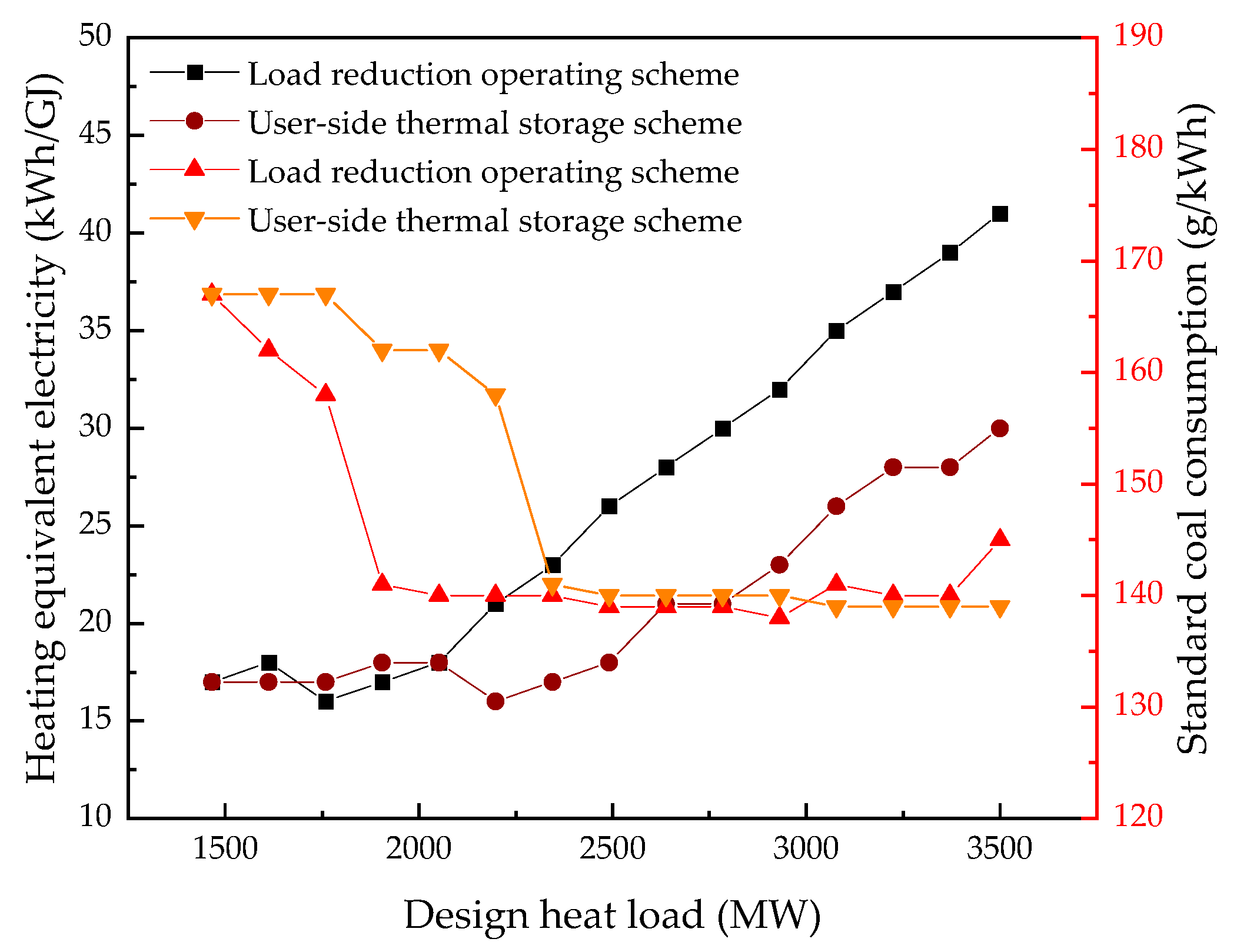
Table 3 summarizes the energy efficiency and profit of the Gujiao Power Plant when using the 20% user-side thermal storage scheme. During the heating season, compared with the load reduction operating scheme in Section 2.2.3, the unit heating load can be further reduced by 0~700 MW; the minimum power generation load rate can be reduced from 44~85% to 44~72%, with an approximately 10% reduction, but it still cannot independently meet the power plant’s flexibility enhancement needs. As shown in Figure 4, for the user-side thermal storage scheme, the heating equivalent electricity decreases by an average of about 5.6 kWh/GJ, while the standard coal consumption for power generation increases by an average of about 4.7 g/kWh; this is due to the decrease in the unit heating load and the increase in the proportion of exhaust steam for heating.
Comprehensively considering the changes in the heating and power generation revenue and coal-fired costs [17], the total revenue increases by approximately 43,000 CNY/a. When the unit heating load is lower than 2638 MW, the power generation load rate is below 60%, and the plant can obtain an average peak shaving revenue of about 97,000 CNY/h.

3.2. Hot Water Tank Thermal Storage

3.2.1. Operating Principle

Hot water tank storage [18] is commonly used in the thermo-electric decoupling of CHP units. The Gujiao Power Plant is located at the highest point of the heating system. The return water first enters the various stages of exhaust steam condensers for heating, is then pressurized by the primary station circulating water pumps, and then enters the peak heater for heating before being supplied to the heat network.
Considering the supply and return water temperatures, normal pressure storage tanks with 90~95 °C hot water and 30 °C cold water can meet the thermal storage requirements [19,20]. A stratified cold and hot water layer is maintained. The return water pipeline of the heat network connects directly to the cold water inlet of the tank, and the circulating water is decompressed by a pressure-reducing valve. A variable-frequency booster pump is installed at the outlet of the tank. In the thermal storage phase, the return water from the network, after being decompressed by the valve, enters the cold water inlet of the tank. The cold water is then pressurized by a variable-frequency booster pump at the tank outlet and introduced into the pipeline before the exhaust steam condenser. After being heated in the system and decompressed by another valve, the water flows back to the tank’s hot water side. The temperature is kept below 95 °C by mixing some cold and hot water. In the heat release phase, hot water is pressurized by the same variable-frequency pump and introduced into the network pipeline after the high back-pressure condenser of Unit 1 but before the circulating water pump.
To meet the 4 h deep peak shaving demand during the midday period, the thermal storage tank operates with a 20 h charging period and a 4 h discharging period, where the charging power is approximately 20% of the discharging power. When the main steam flow of all units at the Gujiao Power Plant increases to the TMCR (turbine maximum continuous rating) condition, the maximum heating capacity provided by the units is 3800 MW, while the maximum user heating load is 3500 MW. Under these conditions, the maximum achievable discharging power of the thermal storage tank is 1500 MW. When the units operate at reduced load, the minimum heating capacity of the exhaust steam section is approximately 500 MW, while the minimum user heating load is 1466 MW. In this scenario, the maximum required discharging power from the thermal storage tank is about 1000 MW. Therefore, the feasible range for the discharging power of the thermal storage tank is between 1000 MW and 1500 MW.

3.2.2. Operating Mode of the 1000 Mw Thermal Storage Tank System

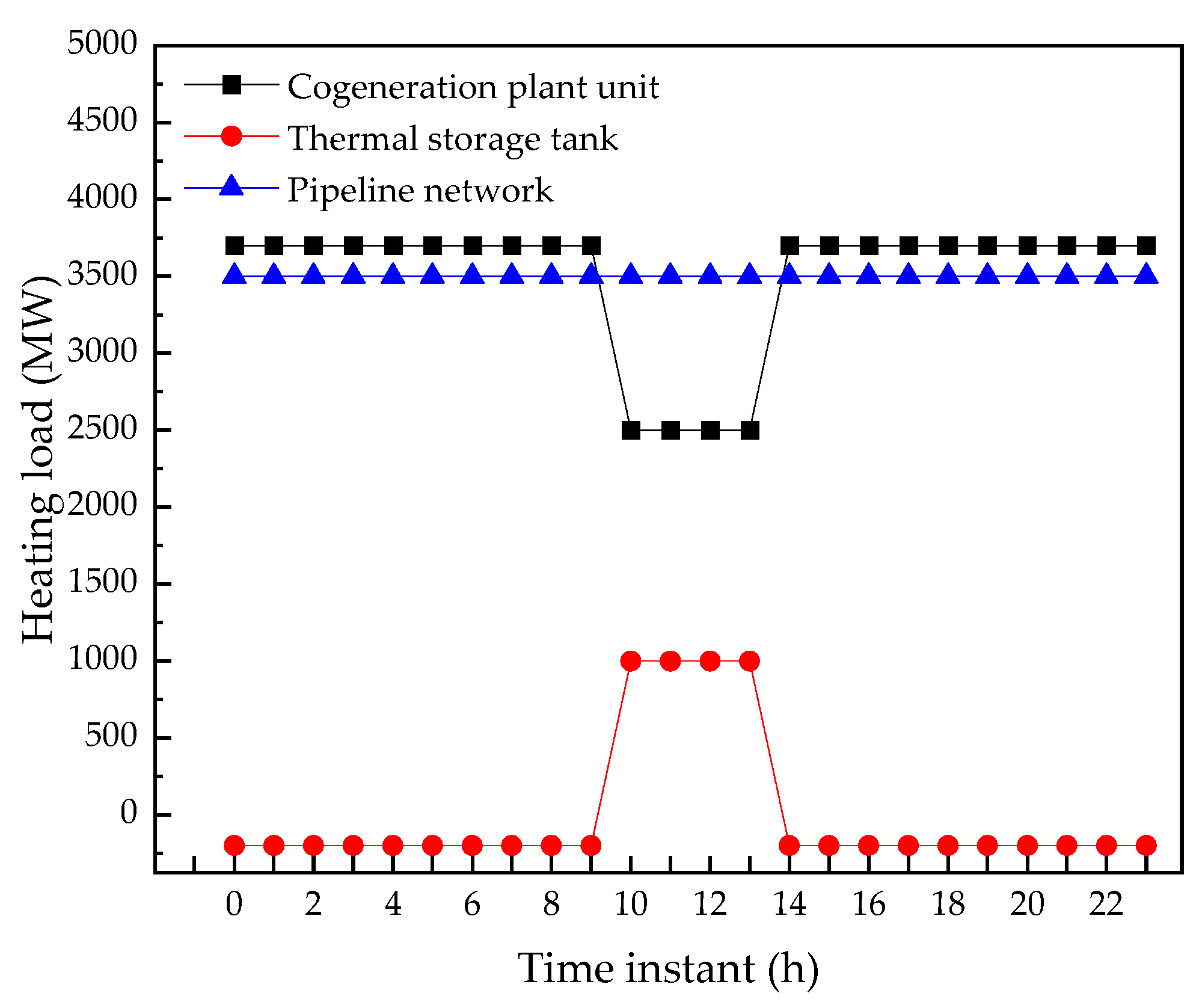
When the thermal storage tank is designed for a discharge capacity of 1000 MW over a 4 h period, its total thermal storage capacity is 4000 MWh, with water storage temperatures of 95 °C/30 °C and a tank volume of 58,000 m3. During the 20 h charging phase, the power plant charges the thermal storage tank at a rate of 200 MW. In the 4 h discharging phase, the tank discharges heat at a rate of 1000 MW. Figure 5 shows the heating operation curve of the thermal storage tank under a design heat load of 3500 MW. The heating load of the unit during the discharging phase in the heating season is presented in Table 4. As the heat load during discharge decreases, the heat network regulation first adopts quality regulation, followed by quantity regulation.

3.2.3. Performance of the 1000 Mw Thermal Storage Tank System

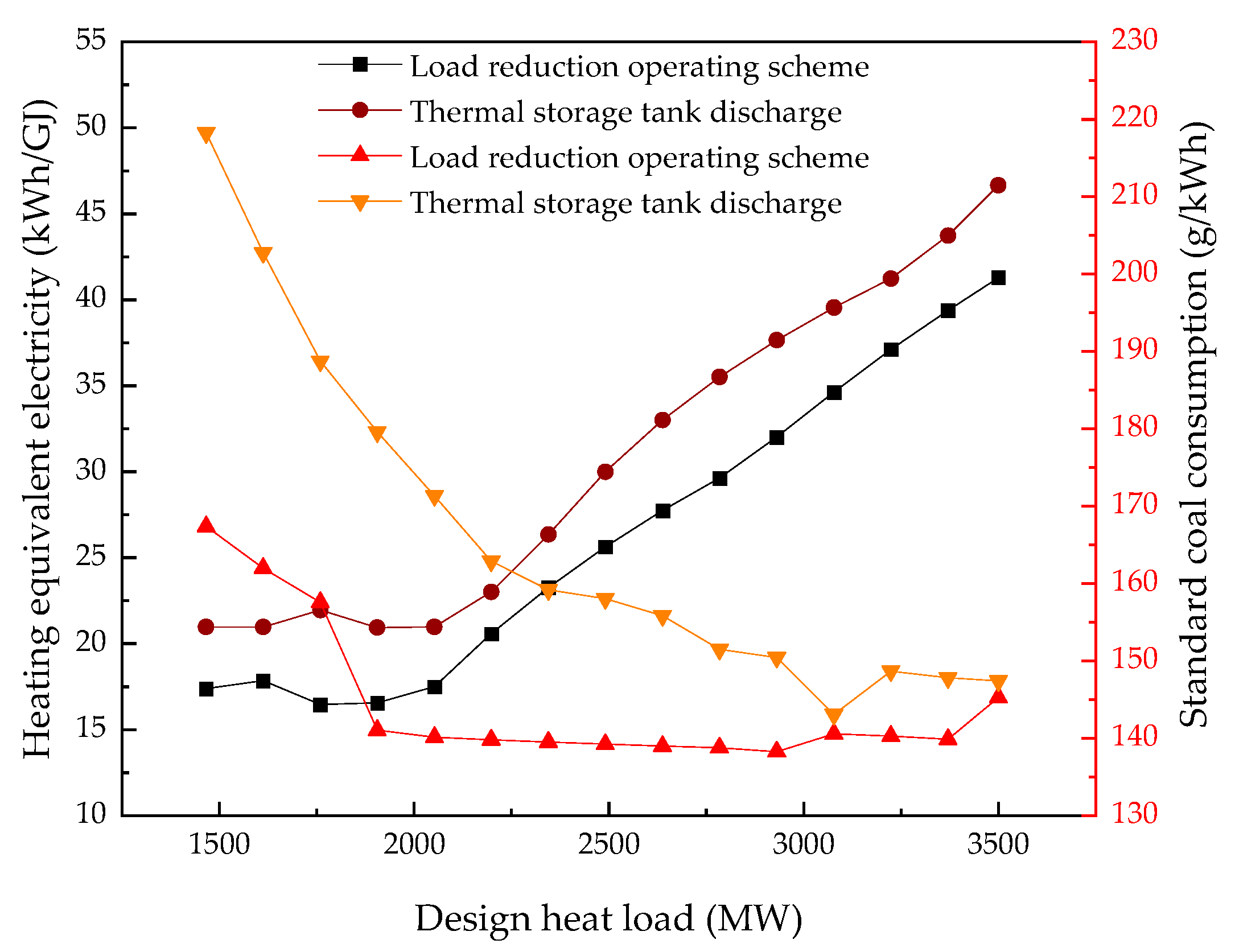
As shown in Table 4, the unit heating load of the tank-based thermal storage scheme can be reduced by 1000 MW, and the minimum power generation load rate is reduced from 44~85% to 30~64%, with an average reduction of approximately 20%. Based on an analysis in combination with Figure 6, it is found that the heat supply from the exhaust steam is relatively small, and the equivalent electricity consumption for heating increases by an average of about 4.3 kWh/GJ. Meanwhile, due to the restriction of the minimum stable combustion load of the boilers in Units 3~6 and the increase in the amount of exhaust steam from the air-cooled system, the standard coal consumption for power generation increases by an average of about 21.1 g/kWh.
Compared with the load reduction operating scheme, the revenue of the plant implemented in accordance with the tank-based thermal storage scheme increases by an average of about 86,000 CNY/h. When the user heating load is lower than 3224 MW, the power generation load rate is below 60%, and an average peak shaving revenue of about 213,000 CNY/h can be obtained.

3.2.4. Operating Mode of the 1500 Mw Thermal Storage Tank System

When the thermal storage tank is designed for a discharge capacity of 1500 MW over a 4 h period, its total thermal storage capacity is 6000 MWh, with water storage temperatures of 95 °C/30 °C and a tank volume of 86,000 m3.

3.2.5. Performance of the 1500 Mw Thermal Storage Tank System

When the user heating demand is below 1759 MW, the thermal storage tank operates strictly at its design discharge capacity of 1000 MW. Therefore, across various heating load conditions during the heating season, the discharge operation of the thermal storage tank can reduce the unit’s heating load by 1500~1000 MW. This reduction lowers the unit’s minimum power generation load rate from 44~85% to 30~56%, as detailed in Table 5.
Additionally, it can be observed that the revenue from the unit’s heat and power generation increases by an average of about 109,000 CNY/h. With the overall minimum power generation load rate of the unit remaining below 56%, the power plant can obtain an average peak shaving revenue of approximately 245,000 CNY/h.
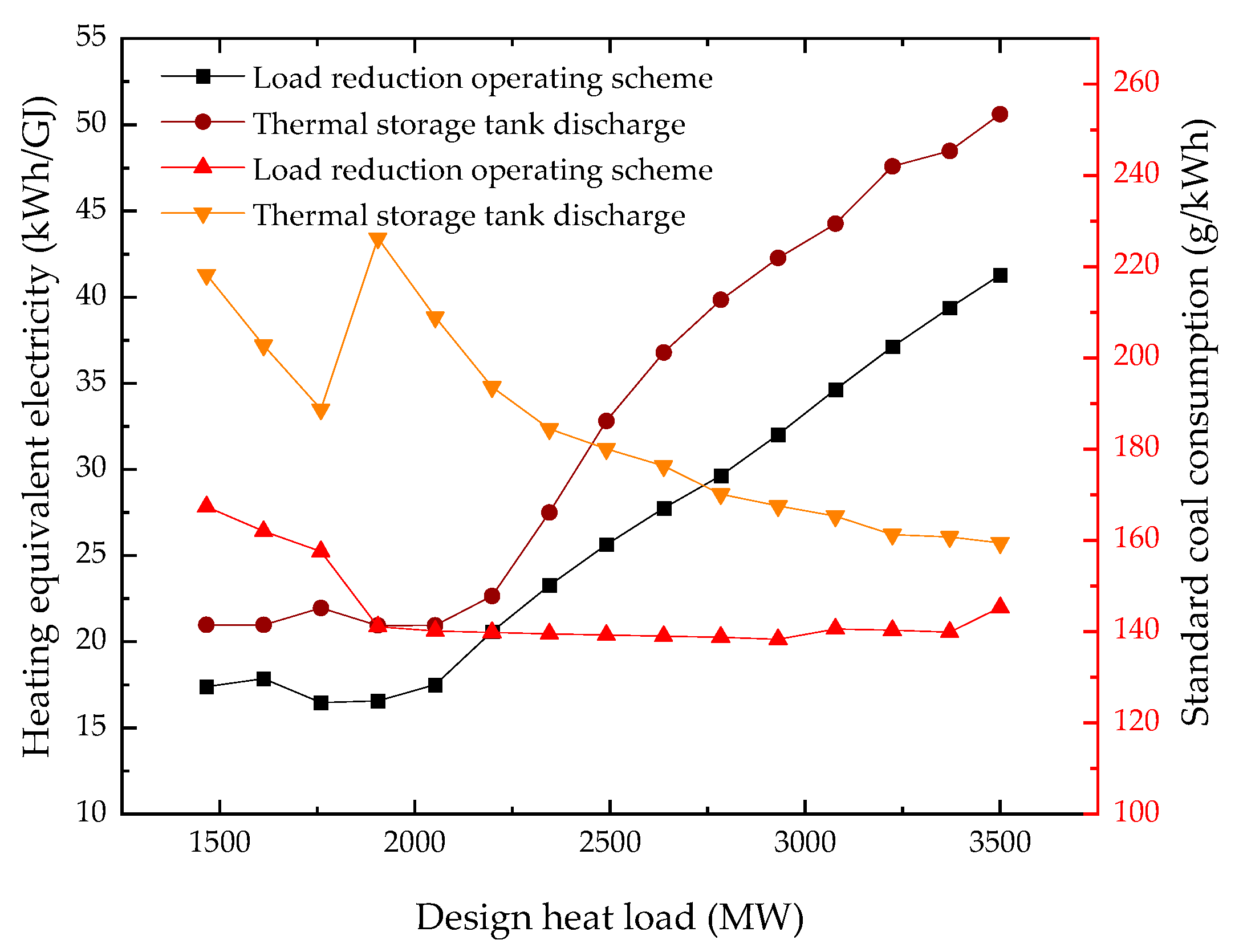
Figure 7 shows the unit energy consumption curve under the 1500 MW thermal storage tank discharge condition. The relatively small amount of circulating water allocated for exhaust steam heating results in an average increase of 6.7 kWh/GJ of heating-equivalent electricity. Additionally, for Units 3 to 6, the standard coal consumption increases by an average of approximately 39.7 g/kWh due to the boiler’s minimum stable combustion load limit and the increased exhaust steam directed to the air-cooling system.

3.3. Combined Regulation of Tank and User-Side Thermal Storage

3.3.1. Operating Mode

To achieve the goal of reducing the power plant’s minimum power generation load rate by 30%, a combined regulation scheme using a 1000 MW thermal storage tank and 20% user-side thermal storage was further investigated. Even when all units operate at TMCR main steam flow, the plant’s maximum heating capacity is only 3800 MW. Therefore, when the user heating load is 3500 MW, the thermal storage capacity during the 20 h charging period is only 300 MW, allocated as 160 MW to the thermal storage tank and 140 MW to the users. During the 4 h discharging period under these conditions, the thermal storage tank discharge power is 800 MW, and the user heating load can be reduced by 700 MW.
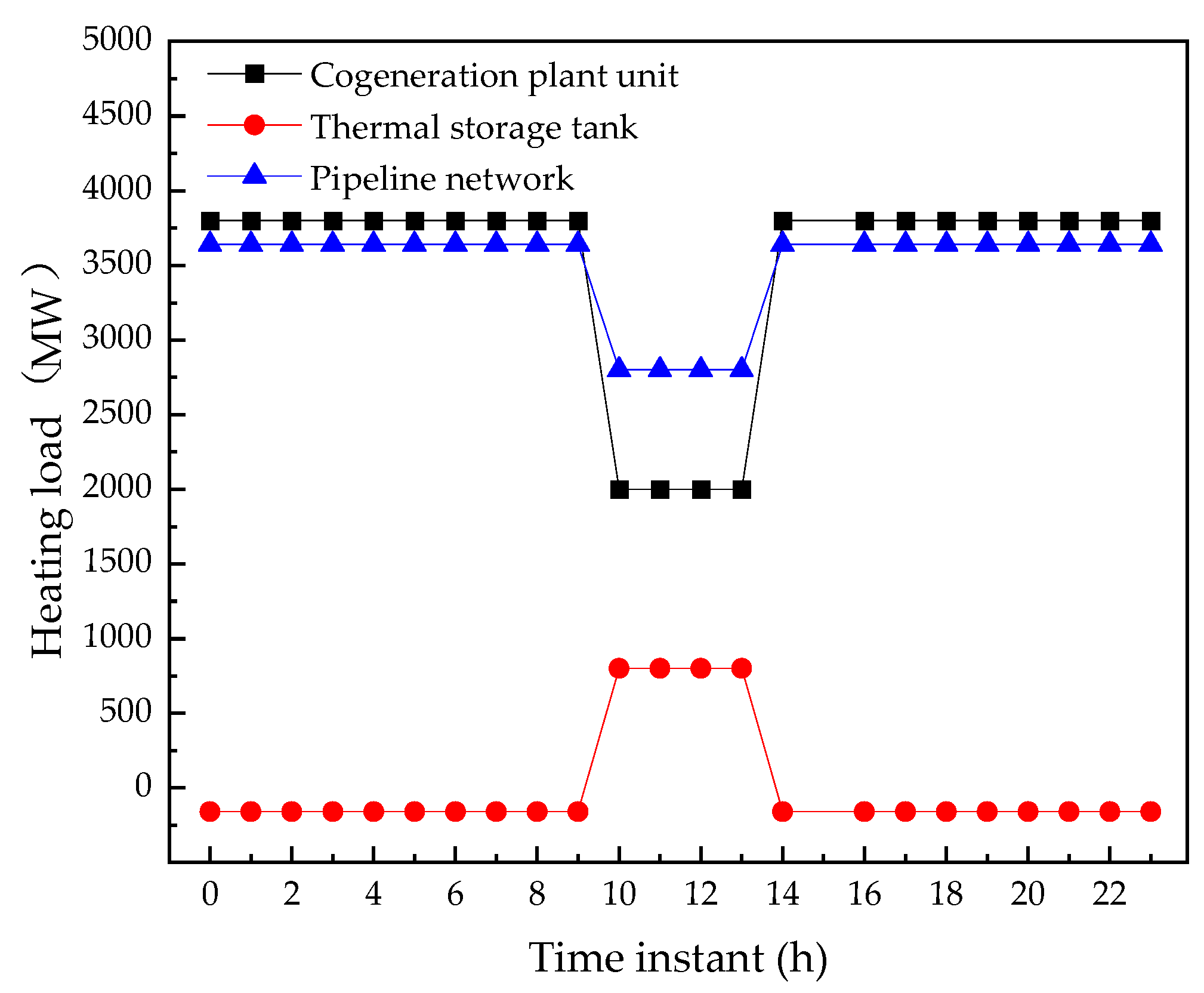
Figure 8 shows a combined regulation operation curve for a design heat load of 3500 MW. During the charging phase, the unit’s heating load is 3800 MW. Of this total, 3640 MW is delivered to users (incorporating user-side storage), while 160 MW is used to charge the central tank. During the discharging phase, the unit’s load is lowered to 2000 MW, with the thermal storage tank complementing the supply by releasing 800 MW. This is combined to provide users with 2800 MW of heat, meeting 80% of the design load.
Under varying user heating loads during the heating season, the heating load, circulating water flow rate, and water temperature of both the units and the thermal storage tank must be adjusted in the heat charging and discharging modes, as detailed in Table 6.

3.3.2. System Performance

As shown in Table 7, the unit heating load can be reduced by 1000~1700 MW; the minimum power load rate can be decreased from 44~85% to 30~53%, with an average reduction of approximately 28%.
Compared with the load reduction operating scheme, the unit revenue of the plant implemented in accordance with the combined regulation heat release scheme increases by an average of about 122,000 CNY/h. During the entire heating season, the power plant can obtain an average peak shaving revenue of approximately 268,000 CNY/h.
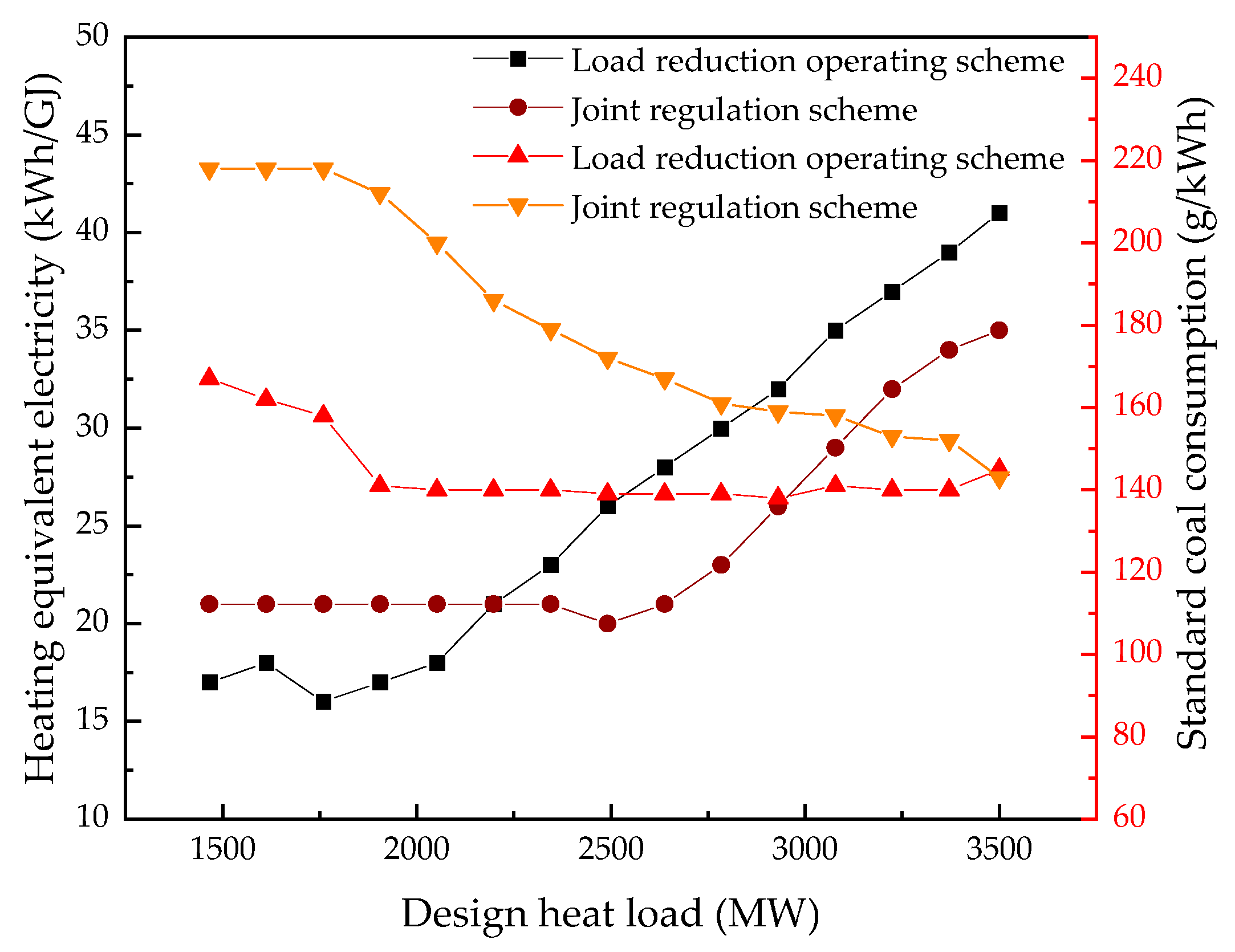
Figure 9 shows the unit energy consumption curve of the combined regulation scheme. The equivalent electricity consumption decreases by an average of 2.0 kWh/GJ, attributed to the reduction in the heating load and the increase in the proportion of exhaust steam for heating. Meanwhile, due to the restriction of the minimum stable combustion load of the boilers in Units 3~6 and the increase in the amount of exhaust steam from the air-cooled system, the standard coal consumption for power generation increases by an average of about 35.2 g/kWh.

3.4. Comparison of Various Schemes

Table 8 compares the unit flexibility and economy of each scheme. It can be seen that the flexibility improvement and economy of the combined regulation scheme are the best; the minimum power generation load rate in the heating season can be reduced to 30~53%, demonstrating that unit flexibility is greatly improved. At noon, the unit heating and power generation income with PSEP are obviously increased, and the investment income is better. Even without considering the peak shaving electricity price, the investment payback period is only 1.1 years; with the addition of peak shaving electricity price compensation, the investment returns become even more substantial.

3.5. Sensitivity Analysis of Electricity Price

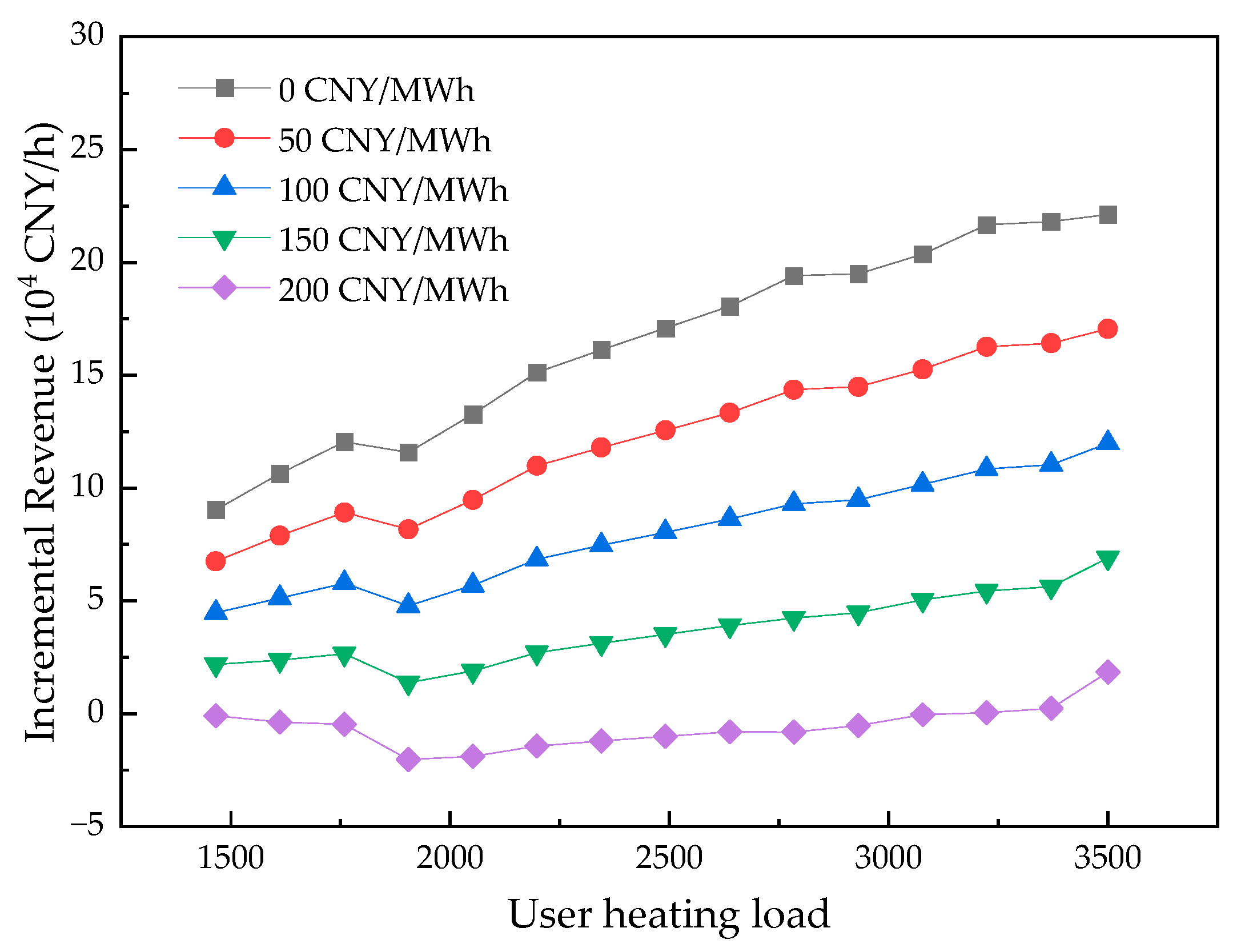
The most sensitive factor affecting the revenue of the combined regulation scheme is the spot transaction electricity price. Figure 10 shows the electricity price sensitivity curves of the combined regulation scheme. For every increase of 50 CNY/MWh in the electricity price, the average incremental revenue from heat and power generation under peak shaving conditions decreases by approximately 43,000 CNY/h. At electricity prices of 100 and 150 CNY/MWh, the investment payback periods (excluding the peak shaving electricity price) are 1.6 and 3.5 years, respectively. When the electricity price reaches 200 CNY/MWh, the incremental revenue from heat and power generation becomes negative, meaning peak shaving does not generate additional revenue. However, with the rapid development of renewable energy in China, it is expected that the demand for deep peak shaving during the 4 h midday period will continue to exist and even intensify in the future. Therefore, the flexibility revenue from combined regulation remains guaranteed.

4. Conclusions

This study focuses on the Gujiao Power Plant and presents key findings from an in-depth analysis of flexible operations in low-temperature return water cogeneration units.
(1)
Compared with conventional heat supply units, the low-temperature return water cogeneration units exhibit a 25~40% increase in heating capacity and stronger thermo-electric coupling. While ensuring the user heating demand, the minimum power generation load rate of the Gujiao Power Plant during the heating season under load reduction conditions ranges from 44% to 85%. The unit flexibility and economic performance during the midday period are poor, urgently requiring enhancements to its flexibility.
(2)
Non-thermal-storage technologies such as high- and low-pressure bypasses, zero output of the low-pressure cylinder, absorption heat pumps, and steam ejectors have a limited adjustment range for their heating capacity and are unsuitable for adoption in low-temperature return water cogeneration units. The exergy efficiency of an electric thermal storage boiler is about 23%, and that of molten salt thermal storage is about 57%, both significantly lower than that of a hot water thermal storage tank (85%).
(3)
The discharge power selection range for the unit’s thermal storage tank is 1000~1500 MW. Under discharge conditions, installing a 1000 MW/4000 MWh thermal storage tank can reduce the unit’s minimum power generation load rate by an average of about 20%, increase the heating equivalent electricity by an average of about 4.3 kWh/GJ, and increase the standard coal consumption by an average of about 21.1 g/kWh; installing a 1500 MW/6000 MWh thermal storage tank can reduce the unit’s minimum power generation load rate by an average of about 25%, increase the heating equivalent electricity by an average of about 6.7 kWh/GJ, and increase the standard coal consumption for power generation by an average of about 39.7 g/kWh.
(4)
The combined regulation of a 1000 MW thermal storage tank and 20% user-side thermal storage can further enhance unit flexibility and optimize energy efficiency. During the heating season, the unit’s minimum power generation load rate ranges from 30% to 53%, with an average reduction of approximately 28%; the average heating equivalent electricity decreases by 2 kWh/GJ, the standard coal consumption for power generation increases by an average of about 35.2 g/kWh, the revenue from heat and power generation increases by an average of about 122,000 CNY/h, and a peak shaving electricity price revenue of approximately 268,000 CNY/h can be obtained.

Author Contributions

Methodology, software, and formal analysis, Y.Z.; validation, S.L.; data curation and writing—original draft preparation, Y.Z.; writing—review and editing, L.L., S.L. and J.L.; project administration, Y.Z.; funding acquisition, Y.Z. All authors have read and agreed to the published version of the manuscript.

Funding

This research was funded by the Shanxi Science and Technology Major Project (20181102001).

Data Availability Statement

The original contributions presented in this study are included in the article. Further inquiries can be directed to the corresponding author.

Conflicts of Interest

Author Yaohua Zhao was employed by the China Energy Engineering Co., Ltd. Authors Lei Lei and Shaohua Li were employed by the North China Power Engineering Co., Ltd., China Power Engineering Consulting Group. The remaining authors declare that the research was conducted in the absence of any commercial or financial relationships that could be construed as a potential conflict of interest.

Abbreviations

The following abbreviations are used in this manuscript:
CHPcombined heat and power
Co-ah systemcogeneration system based on absorption heat exchange
PSEP peak shaving electricity price
THAturbine heat acceptance
TMCRturbine maximum continuous rating
B (g/kWh)the coal consumption in power plant operation
bi (g/kWh)the standard coal consumption for the power generation of Unit i
cp (J/(kg °C))the specific heat capacity of the water
Dcq,i (t/h)the exhaust steam flow rate of the unit i used for heating
De,i (t/h)the extraction steam flow rate of the unit i used for heating
Dj,i (t/h)the flow rate of other extraction steams
DR,i (t/h)the flow rate of the reheat hot-section steam
DZ,i (t/h)the flow rate of the main steam
D1,i (t/h)the flow rate of the first-stage extraction steam
E (104 CNY) the profit from the heat supply and power generation of the power plant
Eb (104 CNY)the coal-fired cost
Ee (104 CNY)the power generation revenue
Ef (104 CNY)the peak shaving revenue
Eq (104 CNY)the heating revenue
G (t/h)design circulating water flow rate
Gi (t/h)the circulating water flow rate of Unit i
Gx (t/h)the circulating water flow rate under the tank’s thermal energy discharge condition
Gxc (t/h)the circulating water flow rate under the tank’s thermal energy storage condition
hc,i (kJ/kg)the enthalpy of the exhaust steam
hco,i (kJ/kg)the exhaust steam enthalpy of Unit i under THA condition
hcs,i (kJ/kg)the enthalpy of the exhaust steam drainage
he,i (kJ/kg)the enthalpy of the extraction steam
hes,i (kJ/kg)the enthalpy of the extraction stream drainage
hj,i (kJ/kg)the enthalpy of the other extraction steams
hL,i (kJ/kg)the enthalpy of the cold-section steam
hR,i (kJ/kg)the enthalpy of the hot-section steam
hs,i (kJ/kg)the enthalpy of the feed water at the economizer inlet
hZ,i (kJ/kg)the enthalpy of the main steam
h1,i (kJ/kg)the enthalpy of the first-stage extraction steam
igenerator unit number
junits other than Unit i
Pg,i (MW)the power generation of Unit i
Pg (MW)the actual power generation of the power plant
Pgo (MW)the nameplate of the power plant
q (MW)the heating load
qc,i (MW)the exhaust steam heating power of each unit
qe,i (MW)the extraction steam heating power of each unit
qh (MW)the design heat load
qx (MW)the heat release load of the thermal storage tank
qxc (MW)the thermal storage power of the thermal storage tank
qy (MW)the user-side thermal storage load
t (h) the time
tH (°C)the outlet water temperature of the circulating water
tH,i (°C)the outlet water temperature of Unit i
tL (°C)the inlet water temperature of the circulating water
tL,i (°C)the inlet water temperature of Unit i
txH (°C)the temperature of the hot water in the thermal storage tank
txL (°C)the temperature of the cold water in the thermal storage tank
wc,i (kWh/GJ)the exhaust steam heating equivalent electricity of Unit i
we,i (kWh/GJ)the extraction steam heating equivalent electricity of Unit i
Χi (%) the exhaust steam heating utilization rate of Unit i
γ (%)the power generation load rate
ηb,i (%)the boiler efficiency
ηp,i (%)the pipeline efficiency
ηi (%)the heat exchange efficiency
λb (CNY/t)the price of standard coal
λe (CNY/MWh)the on-grid electricity price
λq (CNY/GJ)the heat price

References

  1. Fu, L.; Jiang, Y.; Zhang, S. Cogeneration and power district heating method based on Co-ah cycle. J. Tsinghua Univ. Sci. Technol. 2008, 48, 1377–1380. [Google Scholar] [CrossRef]
  2. Fu, L.; Li, Y. Long-distance heat-supply mode with large temperature difference using waste heat of power plants. Huadian Technol. 2020, 42, 56–61. [Google Scholar] [CrossRef]
  3. Chen, P.; Wang, Y. Operation, regulation and control boundary conditions of Taiyuan-Gujiao long-distance heating systems. Dist. Heat. 2019, 2, 19–22. [Google Scholar] [CrossRef]
  4. Jia, Z. Research on the renovation of cogeneration involving long-distance heating pipeline networks. Eng. Technol. Res. 2024, 9, 41–43. [Google Scholar] [CrossRef]
  5. Guan, X. Analysis of heating technology reform and scheme optimization mode for large thermal power units. Value Eng. 2019, 38, 188–189. [Google Scholar] [CrossRef]
  6. Sun, J.; Fu, L.; Li, W. Engineering case of recovering waste heat from power plants by reducing return water temperature of heating networks. Dist. Heat. 2015, 4, 54–58. [Google Scholar] [CrossRef]
  7. Wang, Y.; Zhang, H.; Ji, S.; Frate, G.F.; Duan, L.; Desideri, U.; Yang, Y. Techno-economic analysis of a novel heat-power decoupling system of molten salt coupled steam accumulator used in gas-steam combined cycle CHP unit. Appl. Energy 2025, 400, 126591. [Google Scholar] [CrossRef]
  8. Luan, X.; Ma, J.; Nie, S.; Ding, Y. Operation analysis of large high back pressure cogeneration unit in heating season. J. Eng. Therm. Energy Power 2024, 39, 96–103. [Google Scholar] [CrossRef]
  9. Zhou, C.; Zheng, J.; Liu, S.; Liu, Y.; Mei, F.; Pan, Y.; Shi, T.; Wu, J. Operation optimization of multi-district integrated energy system considering flexible demand response of electric and thermal loads. Energies 2019, 12, 3831. [Google Scholar] [CrossRef]
  10. THERMOFLEX®. Available online: https://www.thermoflow.com/products_generalpurpose.html (accessed on 1 December 2025).
  11. Chen, J.; Wang, J.; Jiang, H.; Yang, X.; Zuo, X.; Yuan, M. Parameter optimization of an absorption heat exchanger with large temperature difference. Prccesses 2024, 12, 1669. [Google Scholar] [CrossRef]
  12. Li, Y.; Fu, L.; Zhang, S.; Jiang, Y.; Xiling, Z. A new type of district heating method with co-generation based on absorption heat exchange (co-ah cycle). Energy Convers. Manag. 2011, 52, 1200–1207. [Google Scholar] [CrossRef]
  13. Li, Y.; Fu, L.; Zhang, S.; Zhao, X. A new type of district heating system based on distributed absorption heat pumps. Energy 2011, 36, 4570–4576. [Google Scholar] [CrossRef]
  14. Nakaishi, T.; Kagawa, S.; Takayabu, H.; Lin, C. Determinants of technical inefficiency in China’s coal-fired power plants and policy recommendations for CO2 mitigation. Environ. Sci. Pollut. Res. 2021, 28, 52064–52081. [Google Scholar] [CrossRef] [PubMed]
  15. Wang, C.; Song, J.; Zheng, W.; Liu, Z.; Lin, C. Analysis of economy, energy efficiency, environment: A case study of the CHP system with both civil and industrial heat users. Case Stud. Therm. Eng. 2022, 30, 101768. [Google Scholar] [CrossRef]
  16. Qin, B.; Jiang, Y.; Fu, L. Regulation of heat-supply system during electric peak-shaving by using CHP plant. Gas Heat 2005, 25, 6–8. [Google Scholar] [CrossRef]
  17. Cheng, S.; Fu, Y.; Zhang, H.; Wang, Z.; Chen, W.; Tian, H. Impact of heat storage on coal consumption of supercritical thermal power units under deep peak shaving. J. Chin. Soc. Power Eng. 2025, 45, 1345–1353. [Google Scholar] [CrossRef]
  18. Li, G.; Li, Z.; Jiao, G. Research on heat storage tank system for long-distance thermal pipe network. Dist. Heat. 2021, 6, 12–18. [Google Scholar] [CrossRef]
  19. Chen, X.; Zuo, C.; Zhao, N.; Huang, K.; Wang, H. Analysis on peak regulation characteristics of thermal power units with integrated heat storage device. Power Gener. Technol. 2024, 45, 392–400. [Google Scholar] [CrossRef]
  20. Liu, H. Design of control scheme for thermal storage tank in thermal power plant. Electr. Power Surv. Des. 2025, 1, 84–88. [Google Scholar] [CrossRef]
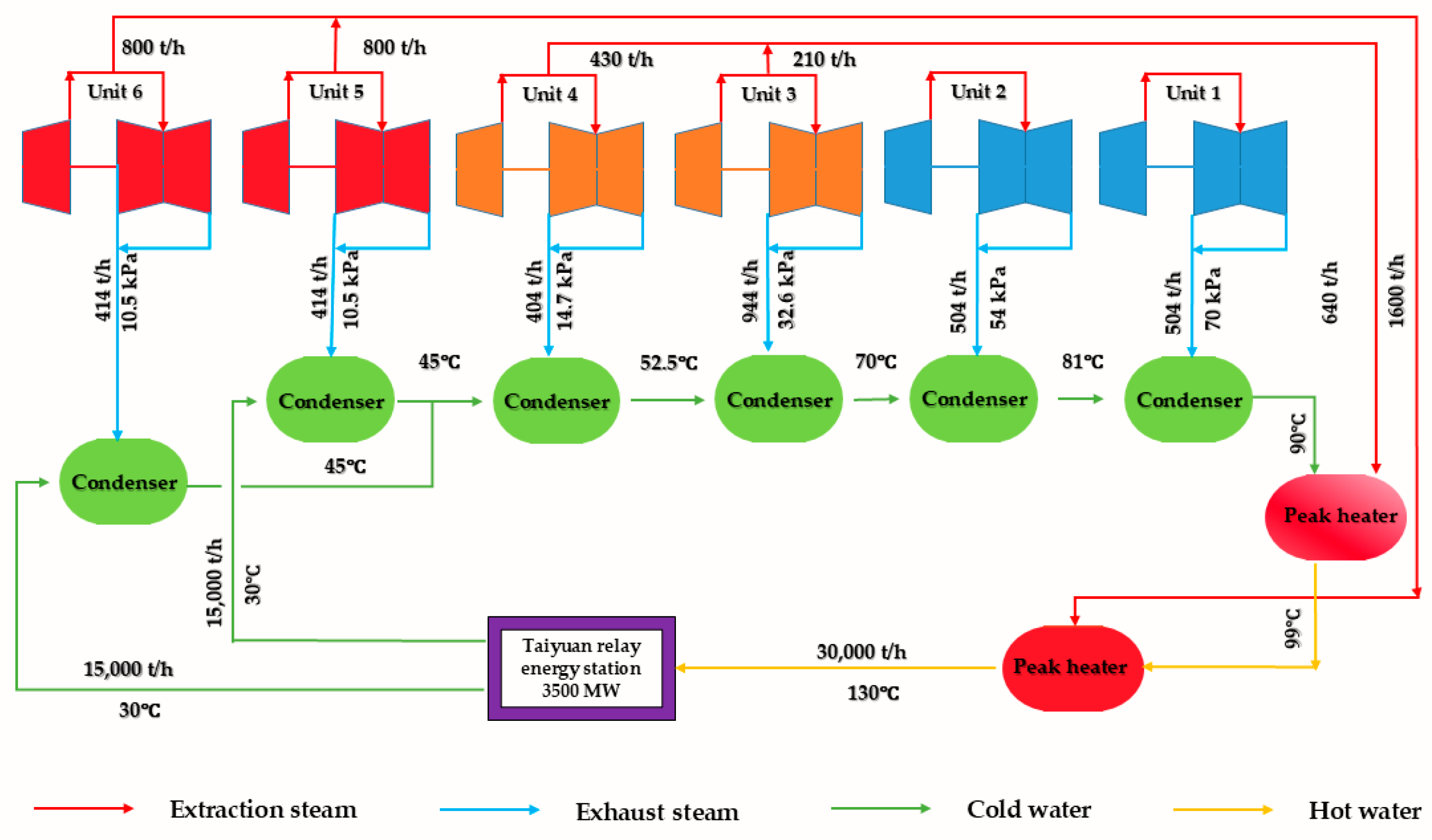
Figure 1. The heating system of the Gujiao Power Plant.
Energies 18 06403 g001
Figure 2. Heat supply and power generation capacity under rated conditions of the Gujiao Power Plant.
Energies 18 06403 g002
Figure 3. The flowchart for the unit flexibility calculation.
Energies 18 06403 g003
Figure 4. The unit energy consumption curve with the user-side thermal storage scheme implemented.
Energies 18 06403 g004
Figure 5. The heating load curve of the 1000 MW tank-based thermal storage scheme.
Energies 18 06403 g005
Figure 6. The unit energy consumption curve under 1000 MW tank discharge condition.
Energies 18 06403 g006
Figure 7. The unit energy consumption curve under 1500 MW tank discharge condition.
Energies 18 06403 g007
Figure 8. The operation curve of the combined regulation scheme.
Energies 18 06403 g008
Figure 9. The unit energy consumption curve of the combined regulation scheme.
Energies 18 06403 g009
Figure 10. Electricity price sensitivity curves.
Energies 18 06403 g010
Table 1. Design parameters of the Gujiao heating system.
No.ParameterUnitValue
1The nameplate of the Gujiao Power Plant (Pgo)MW3120
2The total power generation of the Gujiao Power Plant (Pg)MW3500
3Design circulating water flow rate (G)t/h30,000
4Design return water temperature of circulating water°C30
5Design supply water temperature of circulating water °C130
6Minimum supply water temperature of circulating water°C90
7Boiler efficiency (ηb)%92
8Pipeline efficiency (ηp)%99
9Heat exchange efficiency (η)%100
10Benchmark electricity price for coal-fired power plantsCNY/MWh332
11Electricity price at midday in the electricity spot marketCNY/MWh50
12Heat price (λq)CNY/GJ15
13Price of standard coal (λb)CNY/t800
14Unit investment of thermal storage tank renovationCNY/m31500
Table 2. Energy efficiency and profit of load reduction operating scheme.
Design Heat Load
(MW)
Power Generation Load Rate
(%)
Heating Equivalent Electricity
(kWh/GJ)
Standard Coal Consumption for Power Generation
(g/kWh)
Revenue Excluding PSEP
(104 CNY/h)
PSEP Revenue
(104 CNY/h)
14664417167−21.4316.42
17595016158−23.599.59
20525618140−24.553.94
23456223140−27.68-
26386928139−30.8-
29317432138−33.67-
32248137140−37.25-
35008541145−41.05-
Table 3. Power and heat generation revenue under the 20% user-side thermal storage scenario.
Design Heat Load (MW)Unit Heating Load (MW)Power Generation Load Rate (%)Incremental Revenue Excluding PSEP
(104 CNY/h)
PSEP Revenue
(104 CNY/h)
Additional Revenue Compared with the Load Reduction Operating Scheme (104 CNY)
1466146644016.423228
(excluding PSEP)
4813
(including PSEP)
17591466442.1616.42
20521612472.0012.67
23451905524.727.47
26382198594.900.91
29312345625.99-
32242638696.45-
35002784728.69-
Table 4. Energy efficiency and profit of the 1000 MW tank-based thermal storage scheme.
Design Heat Load
(MW)
Unit Heating Load (MW)Power Generation Load Rate (%)Incremental Revenue Excluding PSEP
(104 CNY/h)
PSEP Revenue
(104 CNY/h)
Additional Revenue Compared with the Load Reduction Operating Scheme
(104 CNY)
1466466306.7639.525477
(excluding PSEP)
11,746
(including PSEP)
1759759338.2334.52
20521052387.2425.61
23451345428.4919.12
26381638498.4911.01
29311931548.495.81
32242224608.93-
35002500649.41-
Table 5. Energy efficiency and profit of the 1500 MW tank-based thermal storage scheme.
Design Heat Load
(MW)
Unit Heating Load (MW)Power Generation Load Rate (%)Incremental Revenue Excluding PSEP
(104 CNY/h)
PSEP Revenue
(104 CNY/h)
Additional Revenue Compared with the Load Reduction Operating Scheme
(104 CNY)
1466466306.7639.527104
(excluding PSEP)
17,934
(including PSEP)
1759759338.2334.52
2052552319.6838.00
23458453411.7732.68
263811384011.7721.63
293114314512.2315.30
322418245311.906.27
350020005614.083.63
Table 6. Operating parameters of the combined regulation scheme.
Design Heat Load
(Mw)
Heat Charging ModeHeat Discharging Mode
User Heating Load (MW)Circulating Water Flow Rate of Pipelines (t/h)Unit Heating Load (MW)Unit Circulating Water Flow (t/h)Unit Outlet Water Temperature (°C)User Heating Load (MW)Unit Heating Load (MW)Circulating Water Flow Rate in the Exhaust Steam Section (t/h)Tank Heating Load (MW)Supply Water Flow Rate of Tank (t/h) Unit Outlet Water Temperature (°C)
1466146620,943166623,80090.014664666657100014,28690.0
1759181825,966201828,82390.014664666657100014,28690.0
2052213430,000233432,81291.016426429166100014,28690.0
2345243930,000263932,46099.7187687613,613100013,18790.0
2638274430,000294432,187108.42110111016,813100013,18790.3
2931304830,000324831,968117.12345134516,813100013,18797.0
3224335330,000355331,789125.82579157916,813100013,187103.7
3500364031,200380032,5711302800200019,45180010,549110.0
Table 7. Energy efficiency and profit of the combined regulation scheme.
Design Heat Load
(MW)
Heating Load (MW)Power Generation Load Rate
(%)
Incremental Revenue Excluding PSEP
(104 CNY/h)
PSEP Revenue (104 CNY/h)Additional Revenue Compared with the Load Reduction Operating Scheme
(104 CNY)
146646630−14.676.768150
(excluding PSEP)
20,362
(including PSEP)
175946630−14.678.92
205264231−15.079.48
234587635−15.8811.80
2638111039−17.4513.35
2931134542−19.1914.48
3224157946−20.9916.26
3500200053−23.9917.06
Table 8. Comprehensive comparison of unit flexibility and economy of the schemes.
No.ItemLoad Reduction Operating Scheme20% User-Side Thermal Storage1000 MW Thermal Storage System Using Tanks 1500 MW Thermal Storage System Using Tanks 1000 MW Thermal Storage System Using Tank +20% User-Side Thermal Storage
1Heating load (MW)BaselineAbout −450About −1000About −1393About −1450
Power generation load (MW)BaselineAbout −280About −600About −800About −850
Minimum power generation load rateBaselineAbout −10%About −20%About −25%About −28%
2Heating equivalent electricity (kWh/GJ)Baseline−5.6+4.3+6.7−2.0
Standard coal consumption for power generation (g/kWh)Baseline+4.7+21.2+39.7+35.2
3Revenue excluding PSEP
(104 CNY/h)
Baseline+4.3+8.6+10.9+12.2
Revenue excluding PSEP
(104 CNY/a)
Baseline3228547771048150
Revenue including PSEP
(104 CNY/a)
Baseline+4813+11,746+17,934+20,362
4Reconstruction investment (104 CNY)00+8700+12,900+8700
5Payback period (a, excluding PSEP)--1.61.81.1
Disclaimer/Publisher’s Note: The statements, opinions and data contained in all publications are solely those of the individual author(s) and contributor(s) and not of MDPI and/or the editor(s). MDPI and/or the editor(s) disclaim responsibility for any injury to people or property resulting from any ideas, methods, instructions or products referred to in the content.