Review

Exploring the Links Between Clean Energies and Community Actions in Remote Areas: A Literature Review


Department of Architecture and Arts, Università Iuav di Venezia, S. Croce 191, 30135 Venice, Italy
*
Author to whom correspondence should be addressed.
Energies 2025, 18(23), 6350; https://doi.org/10.3390/en18236350 (registering DOI)
Submission received: 6 October 2025 / Revised: 4 November 2025 / Accepted: 28 November 2025 / Published: 3 December 2025
(This article belongs to the Section B2: Clean Energy)

Abstract

In the fight against growing energy poverty in Europe, remote and rural areas are most affected but play a crucial role in promoting a fair and sustainable transition. Furthermore, energy communities have been recognized as cost-efficient options and opportunities to enhance the active participation of citizens in electricity markets. Despite the wide recognition of their potential in alleviating energy poverty, evidence is still limited. This paper investigates the ‘missing links’ in producing clean energy through community-based practices in remote areas. This study presents a literature review aimed at identifying case studies at the European level to build a knowledge base on the state of the art in the context of the Green Deal. Of the 4422 publications found, we identified and analyzed 266 publications with one or more European cases. Of these, only 67 publications used keywords relevant to our research objective, which we further explored and categorized according to the primary purpose of the study, i.e., assessment, barriers and gaps, implementation, management and planning, modeling, and public opinion. Our results show that publications serve mainly to test a methodology for potential use and not to recount an experience, lacking practical application and policy integration. Nevertheless, we noticed a tendency to activate citizen engagement forms or gather perceptions to increase social acceptability.

1. Introduction

Energy is one of the essential services [1] that everyone should have access to, as identified by the European Pillar of Social Rights [2]. Nevertheless, according to Eurostat, in 2023 [3], an average of 10.6% of the European population was in a condition of energy poverty (EP) [4]. In particular, in some Mediterranean countries (Portugal, Spain, Bulgaria, Turkey) and Lithuania, this percentage exceeded 19% and reached about 21% [3], as a result of a situation that began to worsen in 2020 [5]. Indeed, the recent crises related to the COVID-19 pandemic (2021) and the ongoing Russian war against Ukraine (2022) have increased EP in Europe due to soaring energy prices and the rising cost of living [6,7,8].
EP typically indicates the condition of an individual or household’s inability to meet household energy needs or access modern energy services, including cooking, heating, and cooling [9,10,11]. Also called ‘energy precarity’ [12] or ‘fuel poverty’ [13,14], EP is understood as the interaction between several socio-economic, environmental, and health factors [15], mainly related to low income, rising energy prices, housing precarity, and building inefficiency [16,17,18].
However, to date, a shared definition is still lacking, thus resulting in multiple ways and indicators to assess EP [19], which sometimes fail to detect its complex and multifaceted nature [20,21] and call for a multidimensional approach [22,23,24]. Moreover, this brings up another, and complementary, issue [25], namely, the hidden energy poverty, which arises when consumers’ energy bills are lower due to self-restriction, i.e., reduced energy consumption because they cannot afford it [26,27,28]. In particular, this aspect can have relevant implications for health and well-being, with cascading effects on related policies and systems [29]. All the above-mentioned aspects contribute to exacerbating vulnerability to EP, conceived from a socio-spatial perspective comprising the concepts of justice and equity [30,31], thus leading to the need to define ‘energy-poverty profiles’ for effective policy formulation [32].
Against this backdrop, alleviating energy poverty becomes crucial to fostering a fair and equitable transition [33,34]. However, Zardo et al. [31] argue that the design of effective policies to reduce energy poverty in the EU is a challenge that faces several barriers, including the lack of (i) a shared definition of energy poverty at the European level, (ii) a set of common indicators to measure and monitor it, and (iii) the disaggregation and spatialization of data.
Since 2009, when the EU introduced the concept of EP into law by Directive 2009/72/EC [35], it has been committed to tackling it. Over the last ten years, the EU has implemented numerous measures, initiatives, and recommendations to combat rising energy prices and EP, specifically designed to reach a just energy transition [9,36,37,38,39,40,41]. Among these actions, and recognizing EP alleviation as a key pillar of the Green Deal and consequent Renovation Wave for Europe, the EU adopted the ‘Clean energy for all Europeans package’ in 2019 to accelerate the clean energy transition by decarbonizing the economy [42]. This package also introduced the concept of energy communities to denote forms of citizen-driven energy actions able to accelerate the transition and foster social innovation. Energy communities [43] are, therefore, opportunities to empower active citizens’ participation in the electricity markets, to promote cooperation and community-building, to pursue energy justice, and to cover energy demands by providing affordable energy services and supporting vulnerable customers with self-consumption [44,45,46]. Moreover, they represent a cost-efficient and inclusive option to reduce consumption and supply tariffs, thus helping to fight EP [47]. However, to date, different terminologies can be found to refer to these forms of renewable or clean energy production, such as, e.g., renewable energy communities [48], bioenergy villages [49], agro-energy districts [50], energy-independent communities [51], smart villages [52], ecovillages [53], and energy cooperatives [54].
Despite the wide recognition of the potential role of energy communities in alleviating energy poverty [55,56,57] and the projects developed [58,59], evidence on the actual and practical handling of the issue and social impact is still limited and unexplored [60,61]. Several studies investigated the barriers preventing the participation of vulnerable groups and the effectiveness of energy communities as a tool to respond to EP [61,62,63]. These mainly relate to policy, legal, financial, economic, technical, and organizational issues, which add to the lack of knowledge and data and the already discussed multiple dimensions of EP [57,64,65,66,67]. Moreover, there is often a lack of connection between policies addressing energy communities and those for energy poverty [68].
These issues are even more pronounced in remote areas—typically rural, mountainous, or otherwise isolated—where poor energy access and socio-economic disadvantage are major challenges. Nevertheless, such regions are potentially crucial in the energy transition given their high availability of natural resources [69].
This work builds on the combination of a fragile spatial context—that of remote areas—and two main gaps identified earlier: on the one hand, the fact that energy communities are a relatively recent concept and, therefore, still scarcely represented in the literature; on the other, the lack of a shared definition of energy poverty. As a result, community-led clean energy initiatives, also involving vulnerable groups, may already exist in the literature but under different labels, while energy poverty could remain overlooked due to its conceptual ambiguity. To the best of our knowledge, no reviews have jointly addressed these three aspects. Thus, our study seeks to bridge this lack of connection between these domains, which has, so far, limited an integrated understanding of the topic. Specifically, we explore practices of clean energy production through multipurpose community actions, focusing on remote areas. Accordingly, the three core domains we identified are clean energy production, community actions, and remote areas.
Our research follows three research questions.
RQ1: To what extent have existing studies addressed these issues jointly? In which research field, and how?
RQ2: If they exist, how can best practices be identified in the literature to develop shared, interdisciplinary solutions in these vulnerable areas?
RQ3: What role does spatial planning play in this context? Can it act as a bridge between multiple disciplines?
In line with the above, our goal was to build a knowledge base on practices working to produce clean energy through community action in remote areas in the context of the European Green Deal. To achieve this, we conducted a literature review to identify published documents reporting experiences, approaches, and suggestions, as well as explore the interconnections among these three domains.

2. Materials and Methods

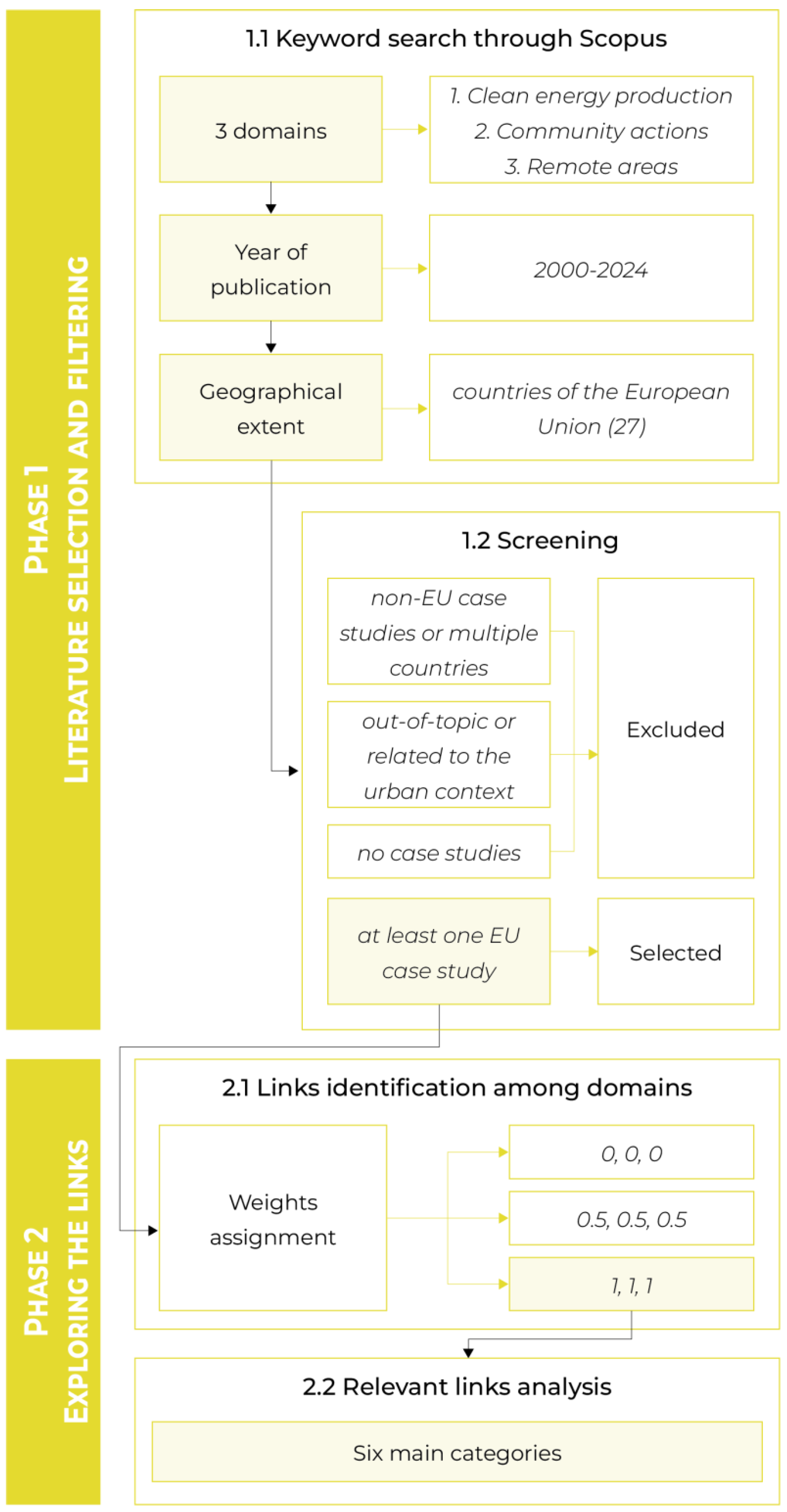
We structured the review starting from the PRISMA 2020 model [70] and organized it into two main phases and four steps, as illustrated in Figure 1. In response to the first research question, phase 1 aims to collect scientific papers related to the three domains (i.e., clean energy production, community actions, remote areas) and investigate which disciplines dealt with them, when, and where. To answer the second research question, phase 2 aims to develop a method for identifying real experiences in the UE that may represent best practices for building the targeted knowledge base. Finally, the results obtained from these two phases will be relevant to replying to the third research question.

2.1. Literature Selection and Filtering

2.1.1. Keyword Search Through Scopus

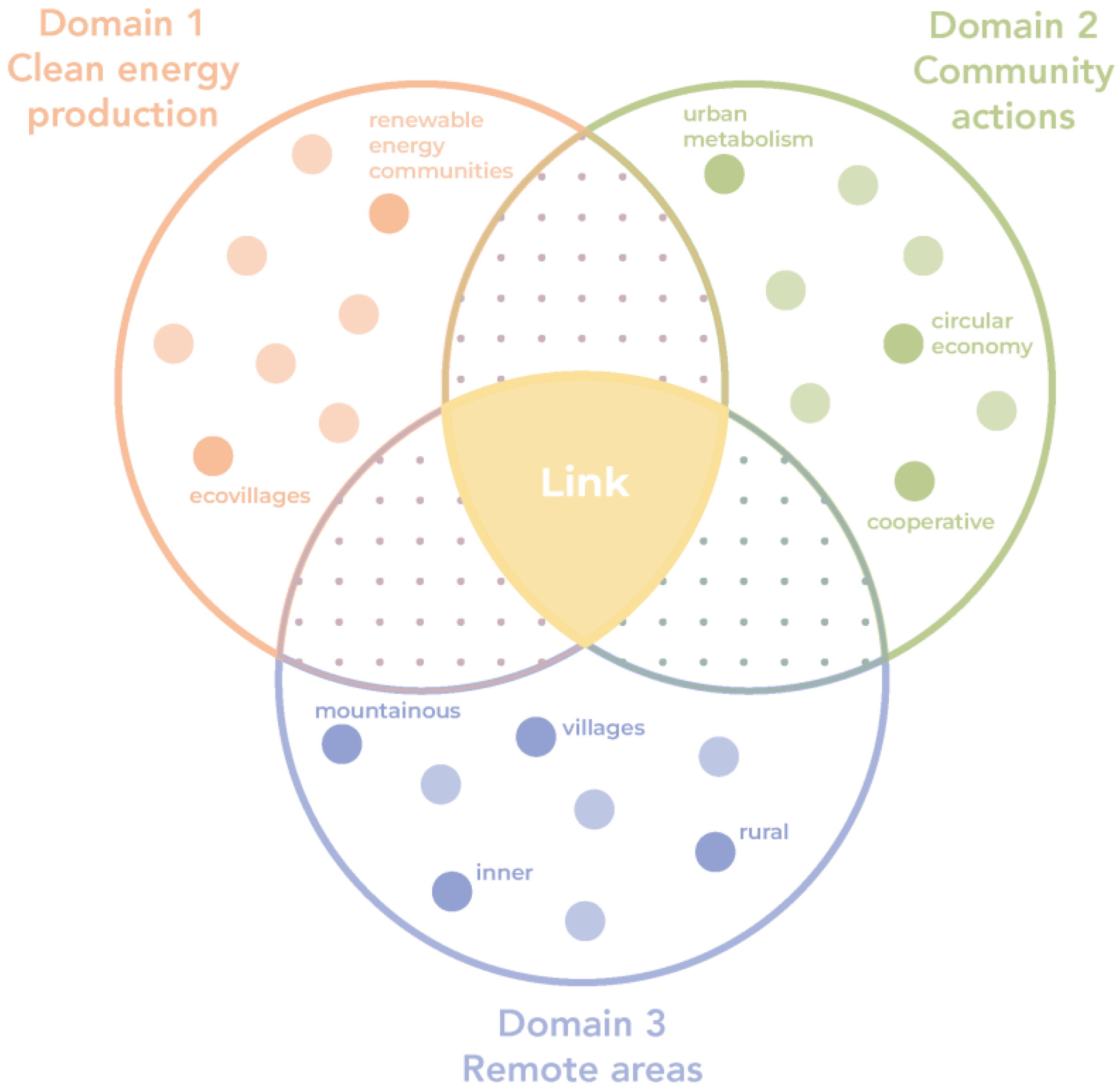
Figure 2 displays our focus on the three domains and the investigation of their links. We defined their meaning according to our research goal before starting with the keyword search. Recognizing that the quality of our lives depends on ‘a reliable supply of energy at an affordable price’ [71], we refer to the EU’s commitment to clean energy production to make it additionally sustainable and secure [72] in line with the REPowerEU actions [73]. Initiatives with this purpose include, for example, renewable energy communities and ecovillages.
By community actions, we mean bottom-up or active citizen participation initiatives concerning shared behavior, values, and interests and co-management of the area and its resources. We especially relate to the role, and its consequent declinations, that communities play in planning theories and urban studies [74]. To this end, we consider the initiatives that take a circular and urban metabolism-related approach particularly relevant.
We use the term ‘remote’ to refer to disadvantaged areas because they are significantly distant from the main urban centers offering essential services, such as health, education, and mobility-related infrastructures, but are rich in environmental and cultural resources [75]. These areas can be rural, mountainous, islands, or can refer to small villages.
We performed the literature search through Scopus on 17 September 2024. We associated each domain with a string. Then, we defined as first criterion to filter the results a set of keywords based on a round table discussion among researchers from different research fields, such as spatial planning, anthropology, agricultural economics, and rural appraisal, using the Delphi method [76].
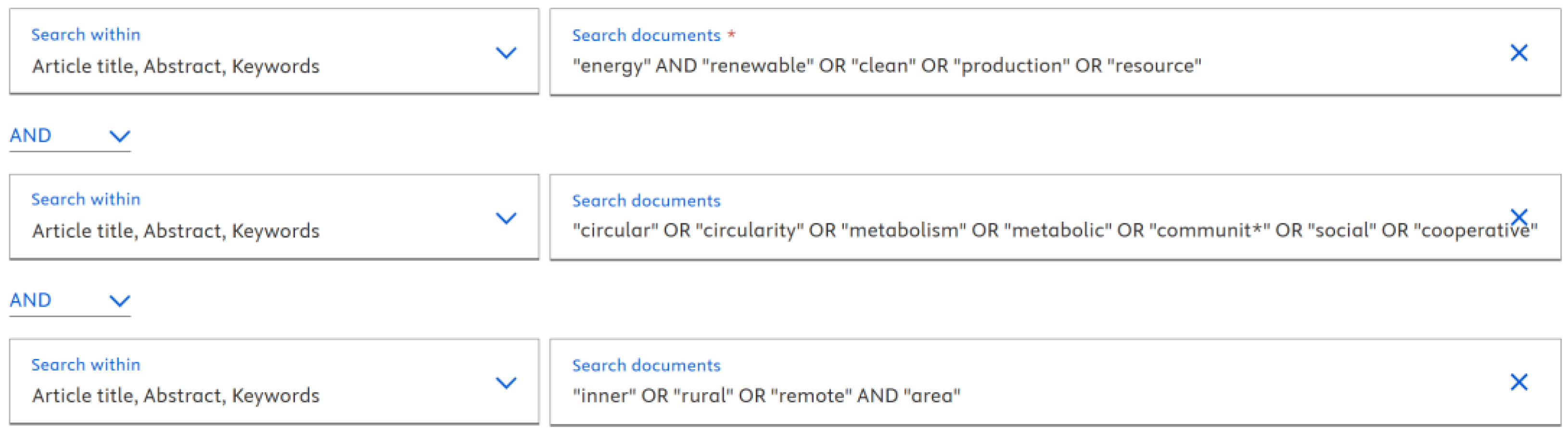
In the first string, we considered the domain of clean energy production, for which ‘energy’ was selected as the main term and associated with ‘clean’ and ‘production’, but also ‘renewable’ and ‘resource’. For the second string, we identified keywords based on the potential (already discussed in the Introduction section) of social and community-based actions, including those related to circular or urban metabolism approaches. In this sense, we chose ‘circular’, ‘circularity’, ‘metabolism’, ‘metabolic’, ‘communit*’, ‘social’, and ‘cooperative’. The third string refers to the localization of these actions, which, consistent with the research focus, is represented by all those territories somehow characterized by a certain degree of marginality. The final query applied to the article title, abstract and keywords is, thus, the following (Figure 3).
The second and third criteria for filtering the results are the year of publication and the geographical extent. We limited the search to the temporal range 2000–2024. It is to be noted that the present study considered only documents published until mid-September 2024. Then, we limited it to the group of countries of the European Union (27), namely, Austria, Belgium, Bulgaria, Croatia, Cyprus, Czechia, Denmark, Estonia, Finland, France, Germany, Greece, Hungary, Ireland, Italy, Latvia, Lithuania, Luxembourg, Malta, Netherlands, Poland, Portugal, Romania, Slovakia, Slovenia, Spain, and Sweden. Among the resulting articles, we only kept the ones written in English.

2.1.2. Screening

We conducted a first round of screening on titles and abstracts through content analysis [77]. In line with our goal, we selected only those documents that presented at least one explicit European case study. We divided the remaining documents into three major categories according to the reason for the exclusion, i.e., (i) studies referring to a non-EU case study or concerning multiple countries (in the EU and extra-EU), (ii) out-of-topic or related to the urban context, and (iii) without case studies, such as reviews or theoretical papers. Among the latter are also those investigations applied to case studies not made explicit and, therefore, not directly traceable to cases in the EU from just reading the title and abstract.

2.2. Exploring the Links

Henceforth, the analysis will focus on the group of publications with EU case studies that emerged from the screening in Section 2.1.2.

2.2.1. Links Identification Among Domains

We conducted a second round of screening on the titles and abstracts of the publications with at least one EU case study. In particular, we deeply investigated the relevance of the use of the selected keywords in each publication to the definitions we provided in Section 2.1.1. By relevance, we intend the closeness of the word’s meaning to the one we ascribe to it.
To achieve this, we attributed the following weights: 0—not relevant/not cited, 0.5—partially discussed, and 1—relevant. The assignment of weights was cross-checked and discussed by the research team to ensure internal consistency of the process. Moreover, this procedure aimed to minimize subjectivity and enhance the reliability of the results, although a certain level of subjectivity is inherent in the interpretation itself. Our recommendation for future studies is to adopt additional approaches, such as using predefined criteria documented in the literature to strengthen methodological robustness.
Once we performed such attribution for all the publications, we could explore the types of links between the domains. In other words, we could analyze the level of interaction between the three research domains in each publication. For example, a situation in which the first domain is relevant, the second not relevant/not cited, and the third partially discussed will be displayed as follows: 1, 0, and 0.5.
Accordingly, the highest interaction will refer to the presence of the three domains as relevant (1, 1, 1), the medium one to partial presence (0.5, 0.5, 0.5), and the lowest to total absence (0, 0, 0).
We excluded some publications as a result of this second round of screening because, when read more carefully, they emerged to be inappropriate for the chosen category.

2.2.2. Relevant Links Analysis

In this step, we used the results from the investigation of the links between domains (Section 2.2.1) and selected the highest interaction (1, 1, 1). We interpreted it as the closest to our aim to identify best practices under the criteria defined to this point. Once again, we adopted the Delphi method to categorize the most relevant links, for which we chose the criterion of the publication’s primary purpose and/or methodological output.
We propose six categories: assessment, barriers and gaps, implementation, management and planning, modeling, and public opinion.
The assessment category includes all those publications containing assessments of a case study or one of its aspects (such as the policy framework or generation capacity), alternative scenarios to support the construction of policies/strategies/actions, elements representing an advancement or contribution to the reference research field or to the development of future research, impact assessments, feasibility assessments (i.e., of the possibility of developing these initiatives), and success factors for the implementation. For barriers and gaps, the limits to implementing actions from a social, economic, physical, or financial perspective are described. The implementation category includes physical actions and solution proposals. Management and planning presents suggestions for developing planning strategies, technically optimal and feasible implementation options, and resource management. Modeling can be divided into three sub-categories, namely, urban or spatial models using Geographic Information Systems (GIS), mathematical models, and business models. Finally, in the public opinion category, we find publications reflecting on social acceptance, public perception, opinions, lived experience, attitudes, and behavior. Moreover, we proposed an additional focus on citizen engagement through interviews, questionnaires, surveys, workshops, and references to the circular economy.

3. Results

3.1. Overview of Selected and Filtered Literature

The literature search (step 1 of the methodology, Section 2.1.1) returned 4647 publications. The publication year criterion reduced the results to 4422 publications; finally, the geographical extent criterion closed with 1127.
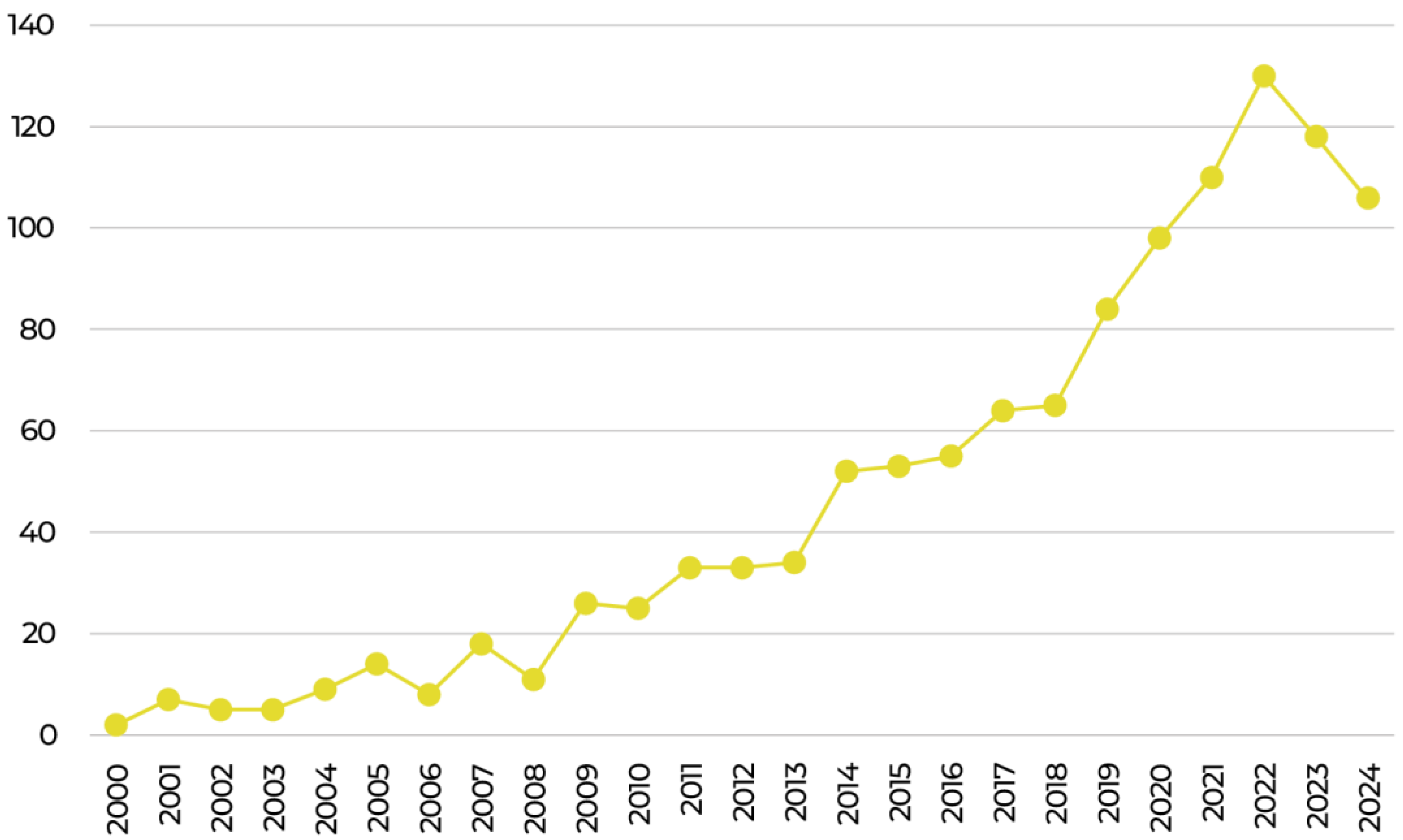
Over the past 24 years, studies on the three research domains have been increasing, except for a decrease in the past two years (Figure 4). That is particularly the case in the literature related to energy issues. The average publication rate changed from 16 publications per year from 2000 to 2013 to 58 between 2014 and 2018 and then rose to an average of 108 publications per year from 2019 to 2023. Conversely, from 2023 to 2024, we registered a percentage variation with a 42% reduction in publications.
As mentioned in Section 2.1.1, we performed the literature search in September 2024. However, the figure below displays the total number of publications at the end of 2024. By re-proposing the same query at the beginning of January 2025, 38 additional publications appear, thus reducing, but not solving, the decrease found. With this updated value, the percentage variation from 2023 and 2024 is reduced to about 10%.
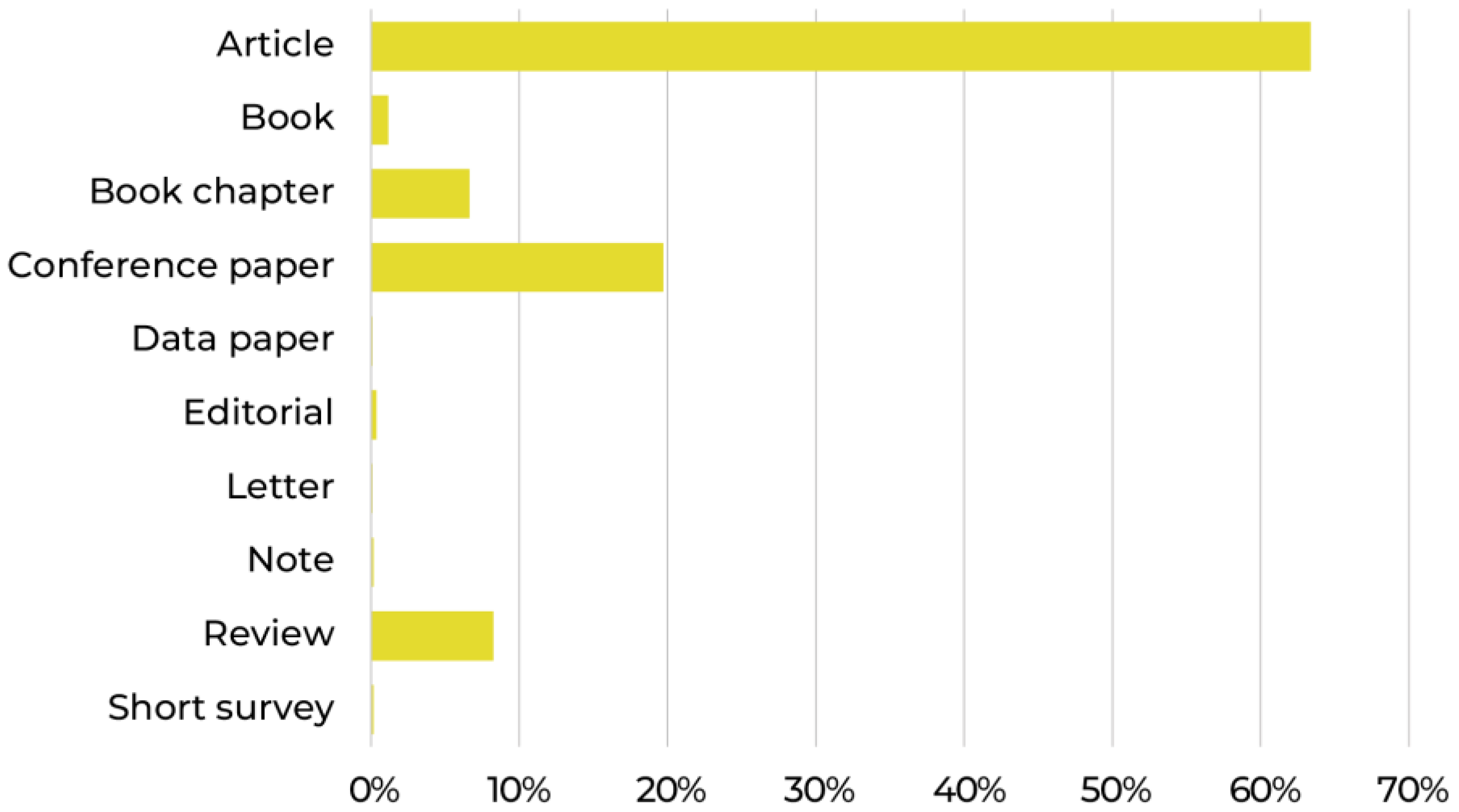
Figure 5 presents the distribution of the number of publications among the typologies proposed by Scopus. Of the 1127 publications, it emerges that the predominant typology is articles, which cover 63% (n = 714). Another 20% (n = 222) are conference papers, while all other typologies do not reach 10%. We found 113 types of sources, among which the most frequent are energy-related journals, such as Energies, Renewable and Sustainable Energy Reviews, Sustainability Switzerland, and Energy Policy journals.
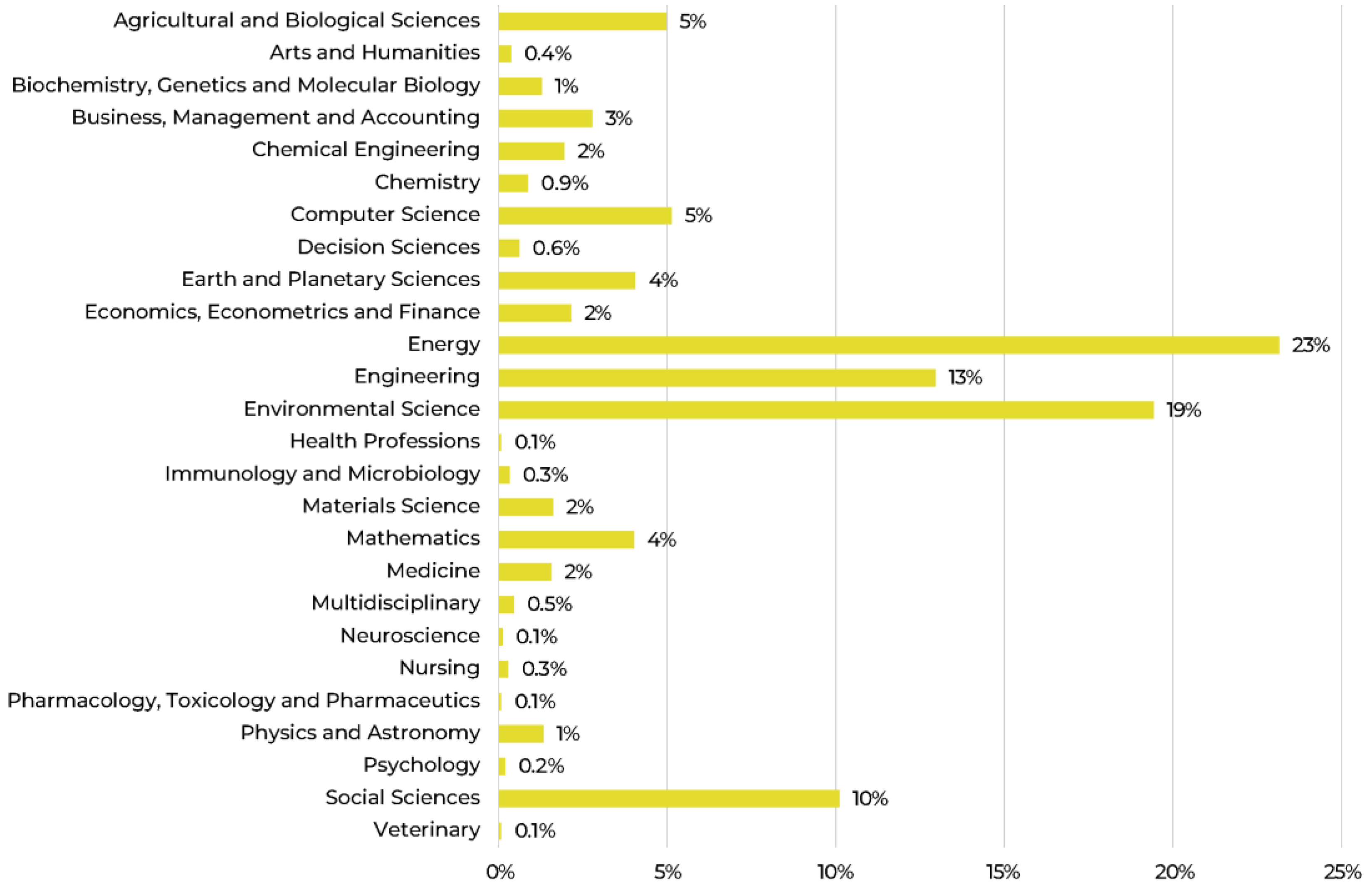
As Figure 6 shows, the publications are mainly derived from the subject areas of energy (23%), environmental science (19%), engineering (13%), and social sciences (10%). These data emerge from the analysis provided by Scopus on documents by subject area, which describes the subject category to which the source belongs. This means that several subject areas may appear for the same publication. Just to cite an example, the Journal of Applied Geography belongs to the following categories: Agricultural and Biological Sciences, Social Sciences, Environmental Science, and Business, Management and Accounting.
For the categories with the lowest number of publications, it should be noted that most of these publications were classified as out of domain or excluded because they presented non-EU case studies. That is the case, in ascending order, for health professions (n = 2), pharmacology, toxicology, and pharmaceutics (n = 2), veterinary (n = 2), neuroscience (n = 3), psychology (n = 5), nursing (n = 7), and immunology and microbiology (n = 8). For these last three, some publications also fall into the sub-category of reviews/theoretical papers. From a more general point of view, of the 29 publications falling into these categories, 55% pertain to the out-of-domain sub-category and 14% to the reviews sub-category. In comparison, 31% were eliminated because they were outside the EU.
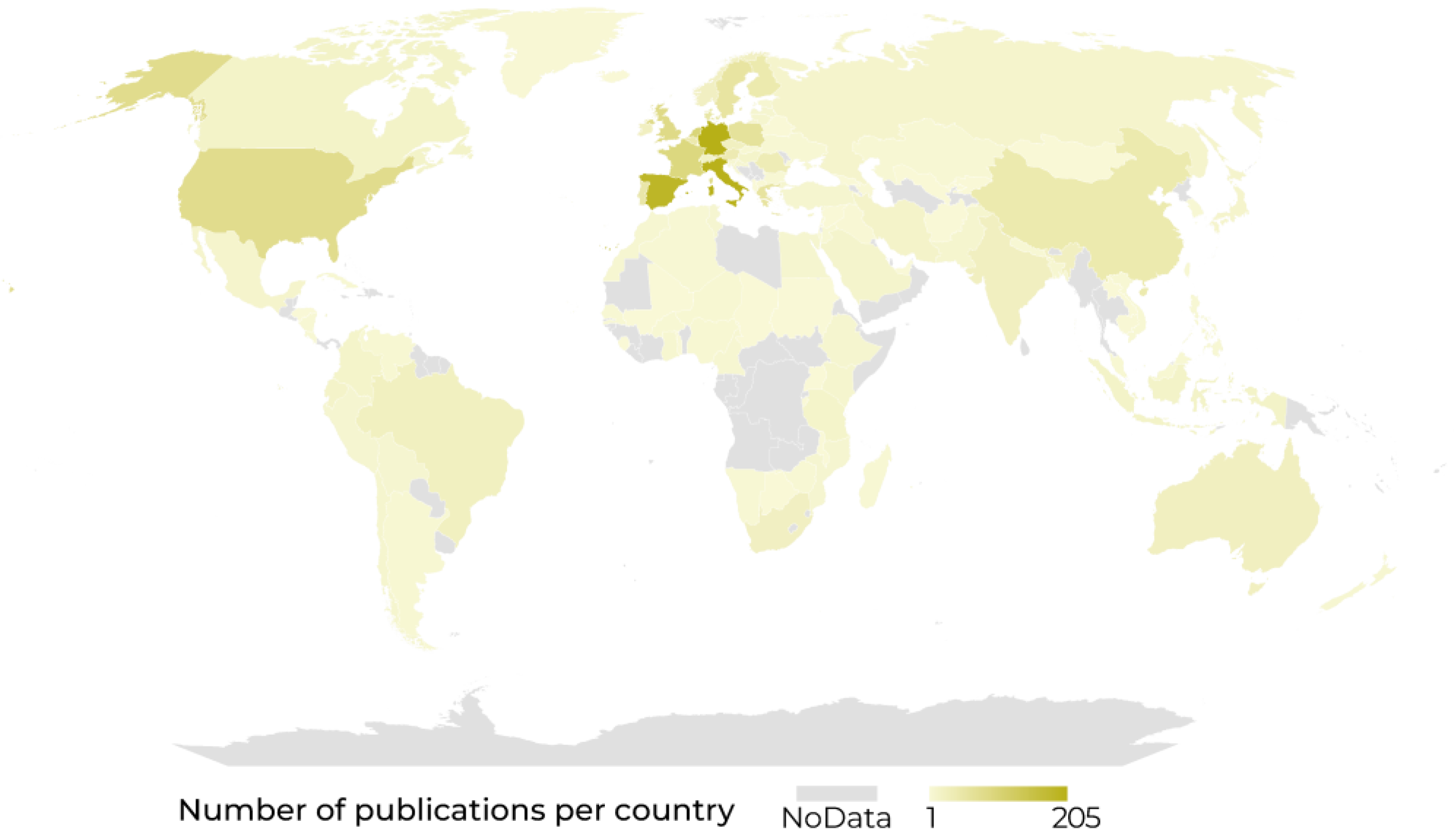
Figure 7 shows the distribution of documents per country/territory, according to Scopus categorization, which considers the country of affiliation of the authors. The majority of publications are concentrated in Europe, and particularly in Germany, Italy, and Spain. The top thirteen countries in the total list belong to this geographical region, except for the seventh position occupied by the United States. In addition to the first three already mentioned, these countries are the Netherlands, France, United Kingdom, United States, Poland, Greece, Sweden, Denmark, Portugal, and Belgium. Among the 27 EU countries, only Malta has no publications, followed by Luxembourg with only two.
The first round of screening (step 2 of the methodology, Section 2.1.2) resulted in 286 relevant publications with EU case studies and 841 excluded (including four duplicates removed). The subdivision into the three major categories is the following: 494 extra-EU case studies or publications concerning multiple countries, 135 out-of-topic, and 208 reviews or theoretical papers.

3.2. Links Identification

After performing the second round of screening and assessing weights on the relevance of keywords in each of the 286 publications with at least one EU case study (step 3 of the methodology, Section 2.2.1), we excluded 20 publications related to urban contexts/out-of-topic (n = 18) or multiple countries (n = 2). We thus reduced the number of relevant publications to 266.
The results obtained from this analysis of EU case studies compared to those provided by the keyword search on Scopus (Section 3.1) present several variations. Regarding the number of publications per country out of the total investigated, at the European level, Italy remains the country with the highest number of publications (n = 15, i.e., 22% of the total). Germany and Spain, which were also at the forefront in the general classification (Figure 7), appear to have halved the number of publications compared to Italy in the case study analysis. Respectively, only 3% (n = 6) and 4% (n = 7) of their publications include a case study. Even for France, the number of publications with a case study is only 2% (n = 2). Conversely, in the EU case study analysis, Poland appears in second place, accounting for 16% (n = 11) of the total number of publications with a case study, which represents 17% of the country’s publications. We observed further positive trends for Hungary, whose case studies account for 38% (n = 5) of its total publications, Ireland (12%, n = 3), and Greece (10%, n = 6). Finally, only the country of Malta was missing in the general classification, whereas, in this analysis, 37% (n = 10) of the countries are missing, namely, Belgium, Bulgaria, Croatia, Estonia, Latvia, Luxembourg, Malta, Slovakia, Slovenia, and Sweden.
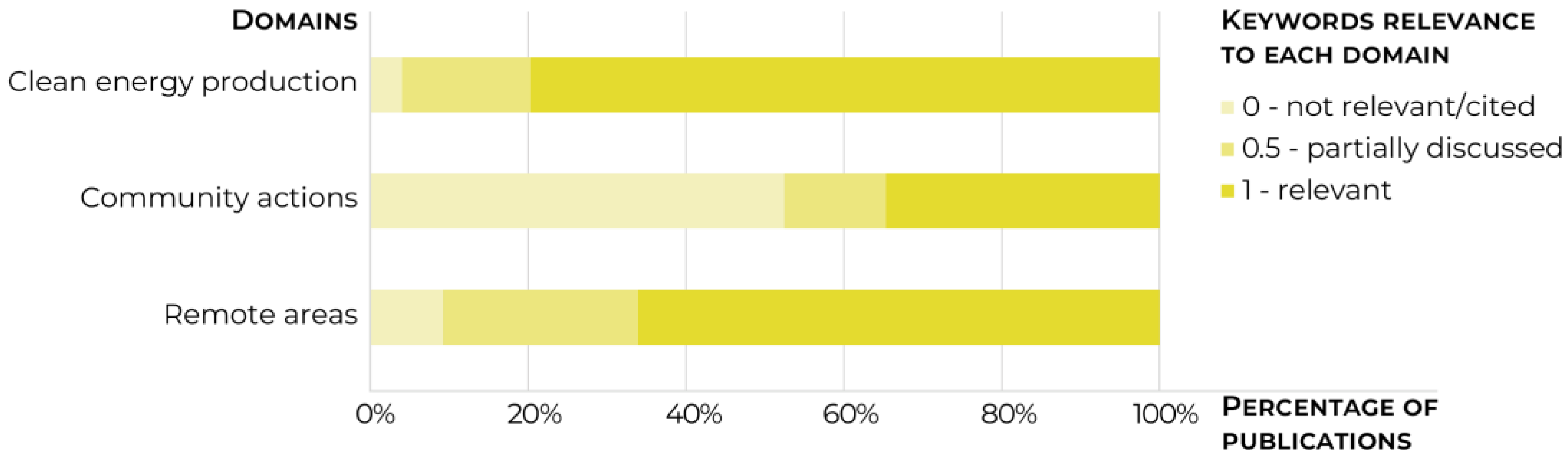
Moving on to the results of the weight assignment, Figure 8 displays the percentage distribution of publications according to keyword relevance for each domain. The domain with the highest number of publications showing relevant use of keywords to our goal is clean energy production. Indeed, it counts for 81% (n = 216) of the publications with weight 1—relevant. Remote areas follow, with 67% (n = 179). Community actions present the lowest percentage of publications with relevant use of keywords (35%, n = 94). Moreover, community actions are the least mentioned in the selected literature, as this domain is absent in 53% of the publications.
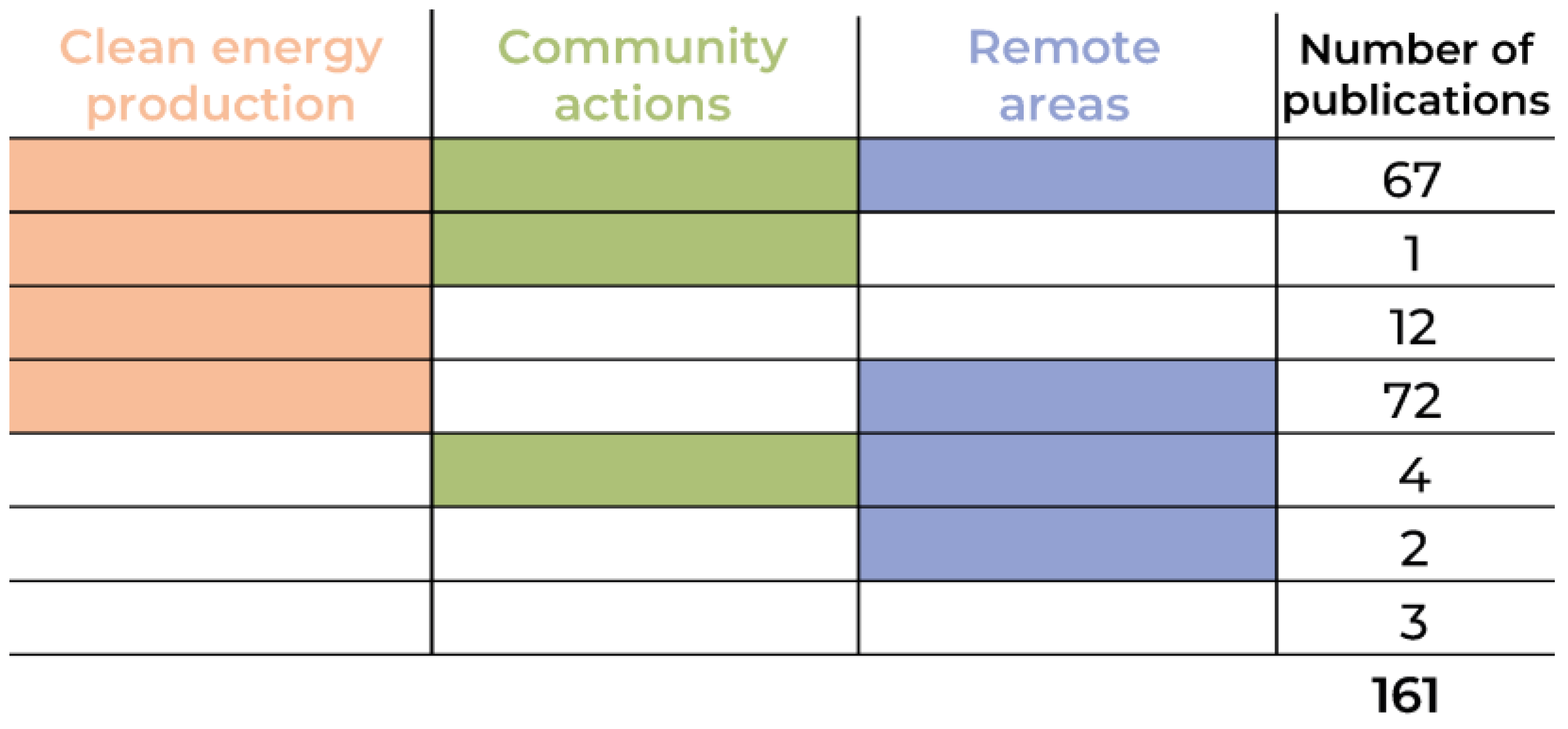
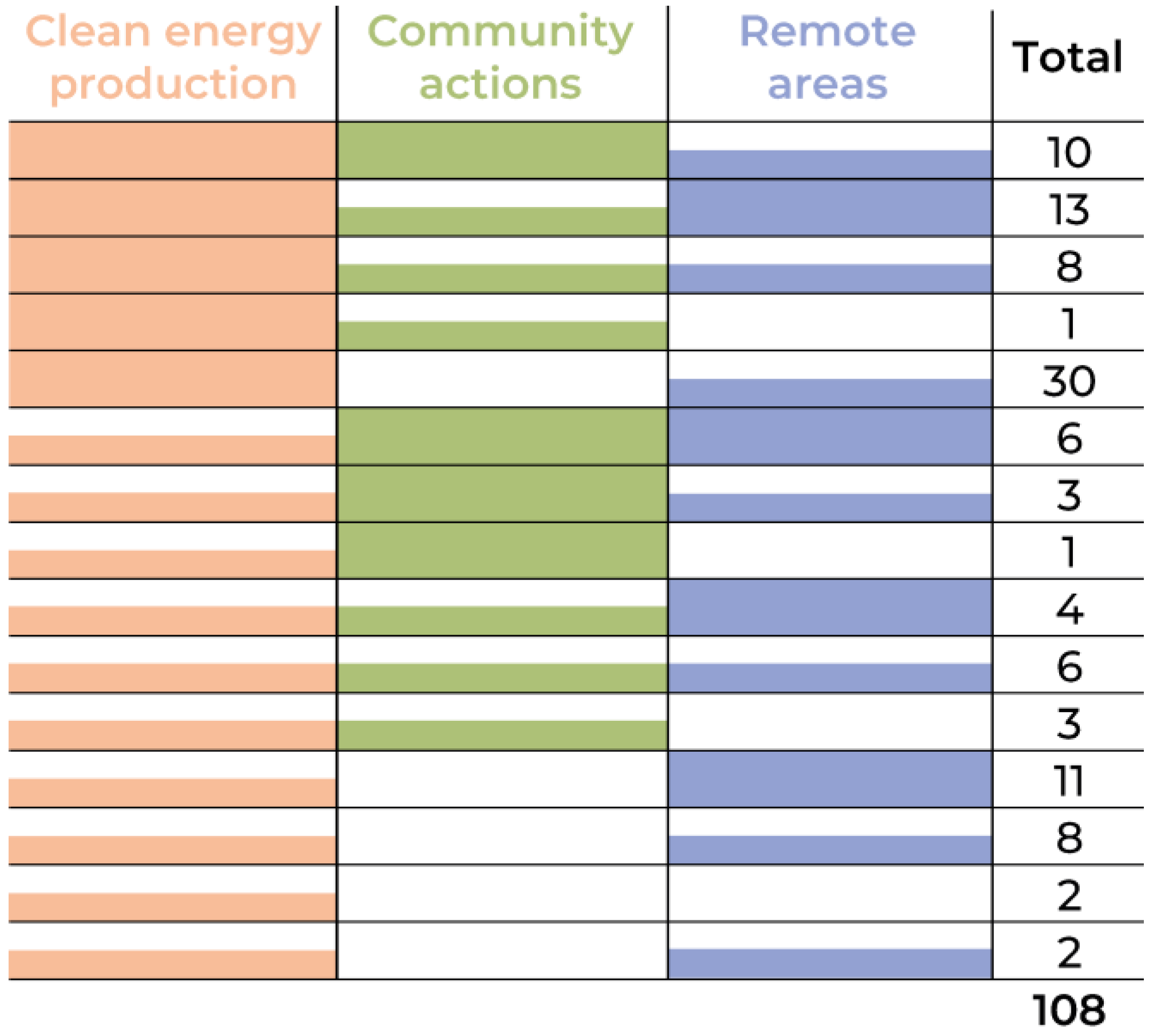
Here we present the links between domains, i.e., the combinations of weights attributed to each publication, in two moments. The first highlights the main links, namely, only where the domain was relevant (1) or not relevant/not cited (0), while the second also considers the intermediate weights, i.e., 0.5—partially discussed.
Figure 9 shows the main links we found between the three domains. These links alone cover about 60% (n = 158) of the publications that fall into the EU case study sub-category. We observed a total of seven combination types. The prevailing combination (n = 72) is between the first and the third domain (1, 0, 1), which represents the 46% among main links and 27% regarding the total publications analyzed.
This is followed by the link between all three (1, 1, 1) with a slight gap (respectively, 42% and 25%). We found the absence of all domains only in three publications, which, as mentioned at the beginning of this section, were excluded and re-categorized in the out-of-topic sub-category. This explains why the total count of publications in the EU case study category is 266 and not 269, as per the results from summing the publications reported in Figure 9 and Figure 10. The first and third domains appear individually, i.e., without any connection with the others, in 12 (5%) and 2 (1%) publications, respectively.
Figure 10 provides additional details on the intermediate weights, i.e., 0.5—partially discussed. We observed a total of fifteen combination types. The most frequent combination is the relevance of the first domain and the partial discussion of the third, in which the second domain is, therefore, absent (n = 30, about 28% in this sub-classification, 11% in the total count of EU case studies publications). Only in four cases do the publications present only one domain, moreover in a partial manner. The rest of the publications are divided almost equally between the co-presence of all three domains (n = 50, 46%) or two out of three (n = 54, 50%), in both a relevant and partial manner. It is interesting to note that the first domain is always present.

3.3. Insights from Relevant Links

In this section, we present the most important results of this research, which are shown in Table 1 and Figure 11.
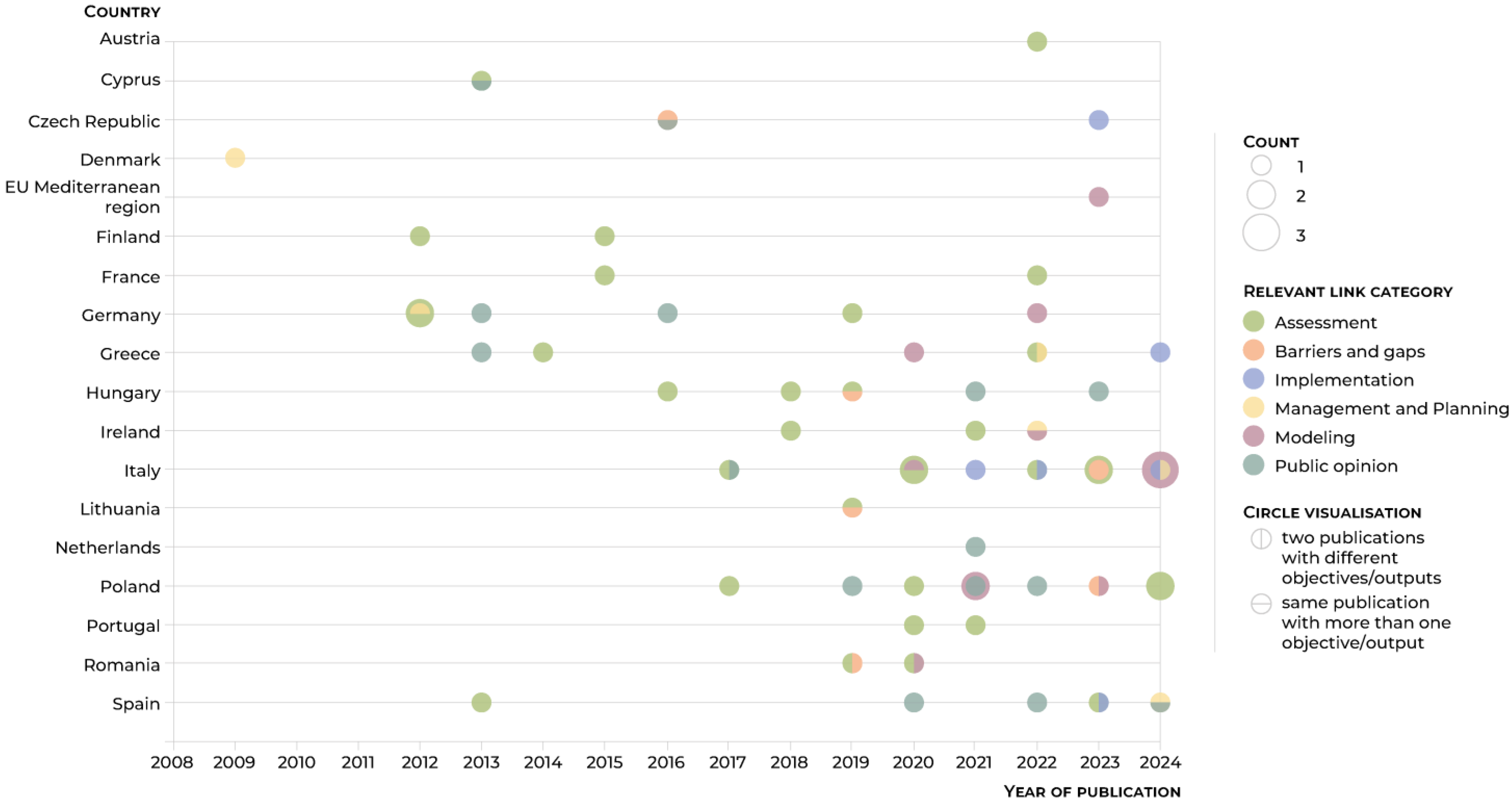
As reported in Figure 9, there are 67 publications in which all three domains feature prominently (1, 1, 1). Table 1 shows the list of publications with relevant links for each of the six categories identified in step 4 of the methodology (Section 2.2.2), i.e., according to their primary purpose and/or methodological output. In addition, Figure 11 displays the distribution over time and across EU countries of these publications, again highlighting the category or categories they belong to. Through this lens of analysis, the period is reduced to the range of 2008–2024 and the EU countries to 17. In addition to the latter, we found another entry referring to a publication that dealt with the European Mediterranean region, but without specifying the countries considered.
The count of publications by country increases from one to three only, which is represented in the figure by the circle dimension. Concerning the colors, circles that have two belong to more than one category. If displayed concentrically, this means that more documents have been published in one category than the other in the same year. If displayed horizontally as two segments of the same circle, this means that the same publication had more than one objective/output. Differently, if displayed vertically as two segments of the same circle, this means that two publications with different objectives/outputs were made in the same year and for the same country.
It is immediately noticeable that there is a lack of publications for the years 2010 and 2011 and a second time gap in management and planning publications between 2012 and 2022. Publications in the implementation category begin in 2021, and in modeling in 2020.
Two main groups can be observed. The first relates to articles published between 2012 and 2016 with a focus on assessment and public opinion. These include the first countries in the list in alphabetical order, namely, Cyprus, Finland, France, Germany, Greece, and Hungary. The second covers the period from 2017 to 2024 and presents variable categories, although always polarized on assessment and public opinion, and includes the second part of the list of countries starting with Germany and ending with Spain. Exceptions are the years 2022 and 2023, where we find France again, adding the EU Mediterranean region, Czech Republic, and Austria.
Denmark is the country with the first and only relevant publication in 2009. The countries with the lowest number of relevant publications are Austria, Cyprus, Lithuania, and Netherlands (n = 1). Conversely, the country with the highest number of publications is Italy (n = 15, 22%), and it is interesting to note that this has been the case for a relatively short time, i.e., since 2017. This is followed by Poland (n = 11, 16%), which is in the same situation as Italy in terms of starting year, and Spain (n = 7, 10%), Germany, and Greece (n = 6, 9%).
The prevailing category is assessment (n = 33, about 50%), followed by public opinion with 22% (n = 15), and modeling with about 18% (n = 12).
Concerning their primary purpose/methodological output, overall, several documents adopted a combination of methods, i.e., a ‘multimethod approach’ [82,93,105]. Indeed, many of them start with an analysis of the national or local regulatory, policy or legal framework, and related documents and, on this basis, identify gaps, propose solutions, or contribute to developing valuable information to overcome the emerged challenges.
The assessment category collects a variety of methods and methodologies, both qualitative and quantitative, spanning from desk research to public engagement. We found a prevalence of the previously mentioned context analyses [101,106] and the use of qualitative research such as interviews and questionnaires [82,86,87,93,97,103,110]. Other methods that are present in more than one document are literature reviews [97,103,105], public engagement, and data collection through workshops, living labs, and round-tables [93,95,100,108]. Finally, we found individual studies concerning a comparative analysis [89], a material flow analysis [80], a social network analysis [96], an analysis of the soil organic matter [92], and a multicriteria decision analysis (MCDA) [108].
Moving to barriers and gaps, which is the less populated category, the publications identified difficulties, efforts, and constraints to achieve the targets for the energy transition and introduce renewable energies in rural areas to support their development, related to technological, digital, and human resources issues [78,111,112]. Two of the five publications argue the lack of ownership by the local community of energy or climate projects and plans [82,97].
On the implementation side, we mainly found proposals of energy options specifically designed for a case study, e.g., the technically optimal solutions of Lode et al. [116] with a view on social acceptability to implement an energy community in a rural Spanish village, the intervention of architectural regeneration by Notariello et al. [117] for a renewable energy community in a remote area of Southern Italy, the sustainable energy solutions identified by a master class of environmental engineering students and reported by Pedrazzi et al. [118] based on a case study analysis, or the building-scale proposal by Balest et al. [113] to rethink the use of an abandoned historical building elaborating the energy retrofit. Janota et al. [114] developed a methodology to support the energy self-efficiency of a rural area based on an agrovoltaic system with the energy crop Miscanthus x giganteus. Finally, the work by Katsaprakakis [115] investigated the capacity of renewable energy technologies to cover 100% energy demand in rural and non-interconnected monasteries with a case from Greece. Just two of these publications adopted participatory methods, i.e., a participatory multiactor multicriteria analysis (MAMCA) combined with mixed-integer linear programming [116] and local community engagement through interviews [113].
Publications in the management and planning category mainly deal with the integration of qualitative data coming from public perceptions, insights and suggestions into planning decisions, and strategies and processes, but also into energy modeling tools. Overall, we detected a positive tendency toward co-production, co-design, or co-development through surveys and interviews [120] or workshops and engagement with residents, experts, and, more generally, stakeholders from different sectors [108,119,122]. An interesting insight is the weighting of groups through the SIMOS method after performing a multicriteria decision analysis (MCDA) [108]. Other publications present case studies as best practices to suggest methodologies, techniques, and solutions for energy planning [121,123].
Regarding modeling, we found three typologies, i.e., spatial, mathematical, and business models, as mentioned in Section 2.2.2. The first typology refers to spatial analysis through mapping techniques, such as 3D GIS and monitoring [92,105,128], or simulation tools, such as the Low Emissions Analysis Platform (LEAP) [122]. Two publications are where one is the continuation of the other, and refer to a ‘dedicated mathematical model in the mixed integer programming technology’ [126,127], while a third publication refers to a mathematical model for maximizing a social welfare problem [105]. For business models, a gap in the design of circular ones has been recognized, as the enabling factors of managerial practices are still poorly described [131]. Other studies discuss the benefits, technical and legal conditions, multidimensionality, and future paths for their development through case studies analysis, applications, and laboratories [124,125,130].
For the public opinion category, surveys are the prevailing method, often accompanied by a preliminary step of desk research or document analysis [134], or by a successive one to analyze public acceptance or weigh the opinions gathered. For the second situation, examples are the ‘multinomial logistic regression model’ by Titov et al. [142], the analysis of relationships between variables with t-test, ANOVA, and error bar graphs by Gargallo et al. [136], or the ‘confirmatory factor analysis’ by Arabatzis & Malesios [133]. Surveys were performed in different ways, i.e., online [135,140], face-to-face, or on-site interviews [133,135,139,144], by distributing paper questionnaires [143], and with visual Q methodology [120]. We also found an analysis of 527 expressions on socio-political acceptance of energy community initiatives retrieved in local and national newspapers [138] and field studies and observations [137,141]. Such contributions mainly observe the acceptance of an intervention already implemented or of the use of clean technologies, e.g., bioenergy use and related projects [144] or the facilities to generate renewable energy [112], the impact of an intervention from a socio-economic point of view [112,135,136,140], the willingness to pay and pro-environmental attitudes [136], and the lived experience of locals (primarily residents) [139,141].
Summing up, we detected three different applications of the case study approach. In the first way, the case study is presented and examined (method) to test or demonstrate an assumption of a belief (objective) [81,94,98]. Another way is the use of the case study as an example (what they look at) to go back to a theoretical framework or explain viable processes (could it be a best practice?) through different lenses, methodologies, and approaches, or just the narration and analysis of experiences [90,91,99,100]. This second approach diverges from the first one in the consideration of the case study as a starting point, thus emphasizing the division between what they investigate and how. The third way is the use of the case study to apply and test a methodology, sometimes irrespective of the specific context characteristics. In this situation, the case study is an ending point to show how the methodology can be employed to make real decisions or be replicated, thus becoming a reference framework for multiple applications [85,108].
We detected only a few small-scale case studies specifically referring to an energy community, i.e., the village of Urueña in the province of Valladolid (Spain) [88], the Sifnos Energy Community in Greece [90], and the Lolland Community Testing Facilities in Denmark [121]. Conversely, most case studies refer to larger territories, such as municipalities, counties, provinces, or regions. Moreover, the focus tends to be on assessing whether it is feasible to establish an energy community rather than describing an existing one.
Entering the content of the publications in detail, within the circular economy, the focus is on Waste-to-Energy plants [103] or the analysis and planning of biomass flows for the valorization of organic waste [80], e.g., generated by the wine industry [92], especially within the agri-food sector [131], and the subsequent co-generation of energy [83,105]. Agro-energy in rural areas is another widely discussed aspect [93,99,123], along with water services [84,119].
Other insights derive from studies assessing viability and scenarios [89,108,145], success factors and difficulties [86,88,111,144], or preconditions [137] necessary for the implementation and functioning of smart rural villages [78,124], bioenergy villages [101,110,125], energy cooperatives/communities [95,130], or, more generally, optimal energy solutions [81]. Several publications investigate the legal regulations to support the development of energy cooperatives [106,126,127] and the elements required to sustainably maintain and manage them [79] through a socio-technical lens [91]. It is interesting to note that local acceptance [138] and public perception [135,136,145] is one of the issues most considered in research on the social sustainability of renewable technologies [107], which is investigated in various forms, from active involvement [141] and attitude assessments [133] to the adoption of theories for analysis [104]. The crucial role of citizens and local actors [82,87,96,97,98], also called ‘social potential’ [142], for the introduction and use of multifunctional renewable energy solutions in disadvantaged local contexts is, thus, emphasized [94,100,132,140], as the ecological transition is seen as a social process [139]. In parallel, a lack of civic engagement is detected as a barrier to the adoption of renewable energy measures [143] as well as the need to expand knowledge and raise awareness among communities directly and indirectly interested in renewable energy installations [134]. Related impacts are also being investigated [85,90,102,109,112]. The integration of community perceptions into spatial planning tools and strategies are indispensable for increasing their sustainability [120,122,128].
A final remark is on the consideration of energy poverty, which was directly addressed in just two publications of the 266 EU case studies analyzed in this study [89,109]. There are still several barriers and challenges preventing energy communities from contributing effectively to the fight against EP, such as its multidimensionality and complexity. Another critical aspect is voluntary participation in energy communities, which implies a choice that people in vulnerable situations are unable to make (think, for example, of the initial investments they would have to bear). Furthermore, these situations are often not distinguished from income poverty, leading to a lack of appropriate data and a limited understanding of what it means to live in energy poverty conditions. Other barriers relate to the business models used for energy communities, which are not always appropriate for meeting the needs of these more vulnerable people, and to the technologies employed in the homes and buildings in which they live, which are generally characterized by low levels of energy performance [61].
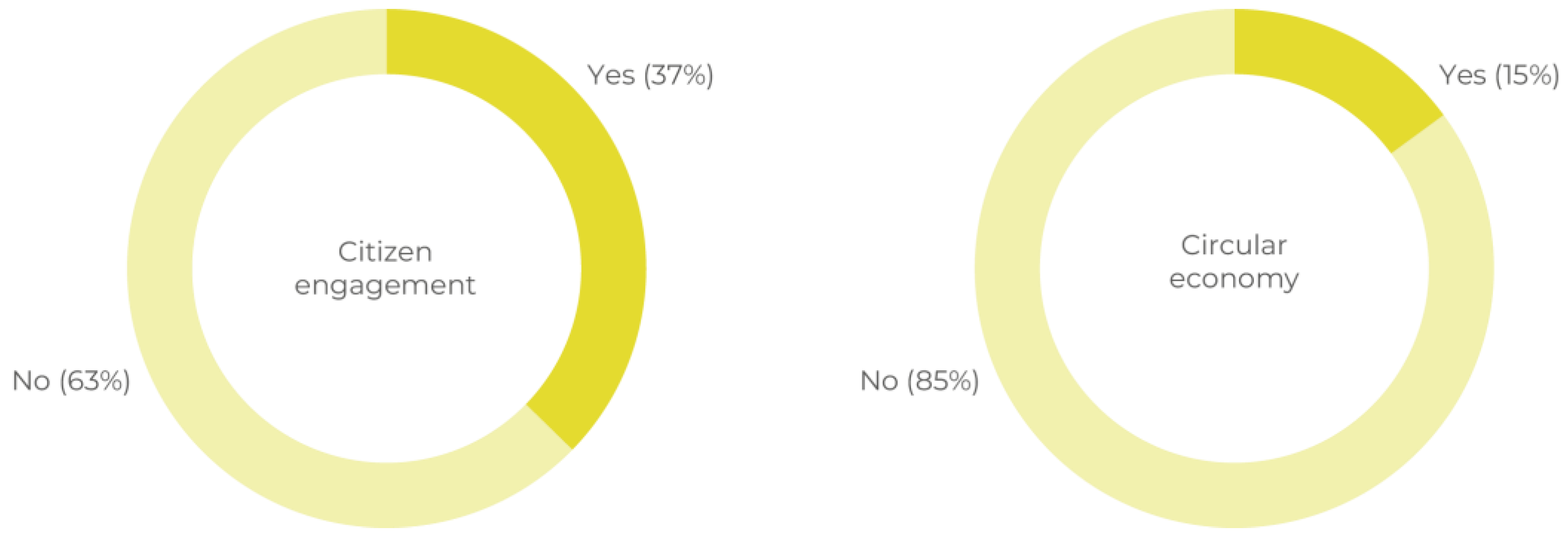
According to our focus for community actions approaches, we highlighted the percentage of publications concerning citizen engagement and circular economy (Figure 12). Both percentages are quite small, as the presence reaches 37% in the first case and only 15% in the second.

4. Discussion

Access to affordable, clean, and sustainable energy is the basis of our well-being. Despite the European Union’s valuable efforts to reduce energy poverty and promote a fair and equitable transition, there is still little evidence on how such issues are actually tackled, either in practice or in research. In this sense, energy communities have been recognized as promising tools to address multiple socio-economic challenges. Through a literature review, the present work sought to investigate examples of best practices in European countries to build a shared, interdisciplinary knowledge base for future research and considerations. Indeed, it contributes to collecting studies from the scientific literature dealing with the production and use of clean energy in remote areas through community actions.
Our search strategy, through a methodology of filtering, categorizing, and analyzing the publications that emerged from Scopus, was able to identify where, how, and which subject areas are addressing the issue. Table 2 presents the number of publications recorded at each screening step.
The definition of categories of publications other than those proposed by Scopus (Section 2.1.2 and Section 3.1) makes it possible to capture aspects that are not central to the publications that can, however, make a difference in such an analysis. That is the case, for instance, of the many reviews not identified by Scopus but which exposed a common picture beyond the proposed—and central—analytical methodology. Subsequently, the refinement process through the assignment of weights and the division into classes of domain combinations (Section 2.2.1 and Section 3.2) helps define the level of priority of individual publications concerning our research objective. This allowed us to narrow the field to 67 relevant links, facilitating a more critical, though not exhaustive, reading of 266 publications containing an EU case study upstream. Finally, categorizing the relevant links (Section 2.2.2 and Section 3.3) is the real contribution because it allows a more explicit understanding of who performed what, how, where, and when (Figure 11). Such knowledge can be valuable in the planning discipline, as planning can fit into this framework by promoting multiobjective actions and/or policies at different scales. Indeed, the novelty of this work lies in adopting this integrated and interdisciplinary observation lens to support the development of remote areas towards an energy transition with a focus on equity and social justice. The choice of words not strictly related to the concept of ‘energy communities’ was precisely intended to recognize, among others, different, non-institutionalized, bottom-up forms of community actions, their success and failure factors, or barriers to their adoption.
The results can be divided between those of methodology (Section 3.1 and Section 3.2) and analysis (Section 3.3).
Keyword selection (Section 2.1.1 and Section 3.1) was effective in identifying publications related to clean energy production and use in remote areas, but was, perhaps, less effective in the domain of community action. The terms ‘metabolism’ and ‘metabolic’ occur in a few publications, mainly about urban contexts. Of the publications with case studies in the EU, only one also, but not exclusively, mentions the rural landscape [146]. The term ‘social’ is too broad and misleading and often has a strictly contextual and introductory value. In its place, it would perhaps have been more useful for our purpose to add keywords more closely related to participatory processes (such as ‘participatory’, ‘participation’, ‘participative’) and citizen engagement (‘engage’ or ‘involve’), as these aspects were often mentioned in the form of interviews, surveys, and questionnaires [53,147,148,149,150,151]. In this sense, it would have been interesting to add ‘empowerment’ to the list to see if there were stimulating suggestions to reflect upon. The term ‘communit*’, on the other hand, sometimes becomes lost in its meaning of collectivity—of a group of people who occupy a certain area, are interconnected by functional relationships, and share activities and interests—and is associated with ‘remote’ and ‘rural’. Despite the difficulties encountered with the keywords in the second string, the third string relating to marginal areas also reported keywords that were used in publications with a different meaning from ours. This is the case with ‘remote’, which we found associated with remote sensing. In contrast, we found the terms ‘village’ and ‘inland’ to indicate what we were looking for. Another lacking term in the keyword search for this string is ‘mountain’. Concerning energy initiatives in the first string, we found a variety of terms other than renewable energy communities, such as energy cooperatives, bioenergy villages, energy villages, and agro-energy districts.
Concerning the year of publication, we decided to include in Figure 4 the total number of documents at the end of 2024 to provide a comprehensive and realistic picture of the situation and observe any continuation of the decline that started in 2022.
The result on the subject areas (Figure 6) reveals that multiple disciplines are dealing with the three domains investigated. Furthermore, the spatialization of the countries of affiliation (Figure 7) indicates the broad coverage of these domains on a global scale, although with a concentration in Europe and North America. Although the dataset provides a broad overview, certain meaningful patterns stand out. Notably, Italy, Spain, and Poland dominate the number of publications related to community energy actions in remote areas, reflecting perhaps regional priorities or policy frameworks that encourage research in these countries. Conversely, there is a striking scarcity of implementation-oriented studies and investigations directly focused on energy poverty, despite their critical importance for just and equitable energy transitions. This gap signals a pressing need for future research to shift towards practical, action-driven investigations that can inform policy and on-the-ground interventions.
The first round of screening (Section 2.1.1 and Section 3.1) halves the results obtained from the Scopus search. In line with the goal, the consequent classification results in the need to identify publications with explicit EU case studies, which represent the majority among those relevant to the domains. Therefore, we decided to focus on case studies and not on reviews to actually find more operational and application cases of community energy actions. Although about half of the publications were excluded because they concerned non-EU case studies, this information proves that the domains are highly debated globally, confirming what we already assumed by the analysis of the geographical distribution. Looking at the publication type classification proposed by Scopus (Figure 5) and the one we proposed, a clear difference emerges regarding the number of articles and reviews. In fact, we found a higher number of reviews than those found by Scopus.
The purpose of assigning weights (Section 2.2.1 and Section 3.2) to the publications was to observe the level of relevance of the keywords used compared to our interpretation (Figure 8). In other terms, this operation of filtering the results helped identify those publications most in line with our domain of investigation, i.e., with a 1, 1, 1 link, thus defining a level of priority. We intended to understand who is dealing with these domains concretely (e.g., through case study assessments, experimentation, and analysis to support implementation, feasibility, and integration), in which disciplinary fields, and how. This can provide an overview of the interaction of these three domains and show whether anyone is already dealing in some form with the use of energy-related community actions to uplift the most marginalized and impacted areas. The assignment of intermediate values (0.5—partially discussed) is useful to examine whether there is some form of relationship between the domains, albeit weak. This is the case, for example, of Knickel et al. [152], where the energy domain is one of the aspects within the concept of agriculture’s multifunctionality—the focus of the study—in rural areas (type of link 0.5, 0, 1).
Expanding on the main weight combinations (Figure 9)—except for the 67 relevant links that were widely discussed in Section 3.3—some examples are provided below. For combination 1, 0, 1 (clean energy production and remote areas), we mainly find studies that describe the introduction or potential adoption of hybrid energy systems in decentralized or isolated areas [153,154,155], or that propose impact assessments using methods such as life cycle assessment (LCA) [156,157] or the synthetic control method to evaluate the demographic and socio-economic effects [158,159] during the planning phase of these systems [160]. Regarding combination 1, 1, 0 (clean energy production and community actions), we recorded only one publication, which discusses the potential for developing the agricultural biogas market in Poland through circular economy principles, emphasizing the importance of raising awareness among farmers and agri-food companies [161]. In the third main combination, i.e., 0, 1, 1 (community actions and remote areas), a prime example is provided by the study by Fallanca [162], which argues how enhancing territorial and social capital through participatory planning and improved public services can counter depopulation in inner areas by fostering sustainable local development and quality of life.
From the EU case study analysis (Section 2.2), we can draw some general results. Many of them deal with the use of natural resources to produce energy for rural development. This tends to translate into the investigation of the costs and benefits of using a particular renewable resource through models, simulations, techno-economic feasibility, and viability, but does not refer to a precise action that is implemented. Thus, case studies often serve only to test a methodology for potential use and not to recount an experience, as in the case of Stolarski et al. [163]. However, in most publications that specifically refer to rural areas, the key role they play or will play in the near future is emphasized. Another aspect that emerges is the discussion of the perceptions and social acceptance of the local population about the installation and use of renewables. Concerning community actions, however, there are few publications referring to it. Finally, an interesting result can be found in the second place occupied by Poland, as it is one of the most coal-dependent countries in Europe [126,127].
The categorization of the relevant links (Section 2.2.2 and Section 3.3) helps describe what each publication does to its objective and the outputs it proposes. For the purpose of the present research, this information becomes useful from a planning perspective to understand which steps of the process are most addressed (analysis, implementation, monitoring, management). Initially, the authors intended to categorize a set of best practices, or at least practical actions [164], which, however, did not apply to the selected publications. In fact, some papers do not tell the experience of a case study in which it is possible to recognize, e.g., the source of energy, actors, and funding, among others. However, it should be noticed that renewable energy technologies differ in their suitability to specific territorial and environmental conditions [165]—for instance, biomass tends to be more feasible in agricultural or forested areas [166,167,168], solar power in arid zones with high irradiation [169], hydropower in mountainous or riverine contexts [170,171], and wind energy in coastal or high-altitude areas [172,173]. Therefore, analyzing the spatial distribution of renewable energy types in relation to local resource potential would represent a useful advance in research. In light of the slant of some publications, it seemed interesting to highlight those that focus on public opinion and engagement, which represent the second category per number of publications. Furthermore, we wanted to highlight how many publications explicitly deal with circular economy given its relevance to our research and consequent selection as a keyword.
The visualization in Figure 11 allows a synoptical reading of which countries deal with the three domains, in what way, and when. In particular, this type of visualization provides a better understanding of the trends that publication categories have had over time, in addition to quantity considerations. An illustrative example is the recent one of modeling, which we record from 2020 onwards. Assessment is the prevailing category, but this can also be explained by the fact that, as mentioned in Section 2.2.2, multiple typologies are included within it. At the same time, however, this result leads us to reflect on the fact that there are few cases of implementation, which could be useful as best practices.
Concerning the actual relevance for our research objective, we found many suggestions and interesting studies from different fields, both expected and unexpected. One of these is, for example, that the protection of biodiversity in relation to renewable energy communities is a scarcely investigated aspect in the urban planning scientific literature [129].
The only study we found for Denmark in 2009 also provided interesting food for thought [121]. It reports as a case study a remote local community on the island of Lolland. As stated in the publication, this island has many years of experience in using renewables to combat peripheral poverty. It, therefore, seems useful to investigate why no further publications have been published since 2009, on the one hand, and how this may be a best practice, on the other.
The observed underrepresentation of community action in the literature raises important interpretive questions. This scarcity may stem from the complex, often localized, nature of community initiatives, which challenges conventional academic methodologies and publication practices. Additionally, community actions frequently operate in informal or bottom-up frameworks that are difficult to capture through standard research designs [174]. Integrating theories of energy justice and socio-technical transitions can provide a valuable lens to understand these phenomena, emphasizing how power dynamics, equity considerations, and systemic transformations intersect with local energy practices [145]. Furthermore, a critical reflection on methodological trends reveals a predominance of descriptive and assessment-focused studies, with fewer interventions or longitudinal analyses that track implementation and impact over time. This gap underscores the potential of spatial planning as a bridging discipline, capable of linking technical feasibility with socio-political realities. Planning mechanisms such as multilevel governance frameworks, participatory decision-making processes, and integrated territorial strategies offer concrete pathways to operationalize community energy actions, ensuring alignment with social justice goals and enabling sustainable transitions at multiple scales.
This work has some limitations. As already discussed, the choice of keywords did not always prove effective and often led to misunderstandings and uses other than those we intended. Perhaps it would have been practical to define such keywords differently, for instance, by making them less generic, as in the case of ‘social’.
Furthermore, the exclusive use of Scopus may preclude the identification of valuable publications, such as those from the gray literature. However, this integrated view in the gray literature may be more challenging if not explicitly presented. In addition, the analysis of the scientific literature seemed interesting for investigating a multiplicity of subject areas. A second limitation of using Scopus lies in the country filter, as it refers to the country of affiliation of the authors and not to the distribution of publications according to what they observe. In this sense, it might be that non-EU authors are looking at cases in the EU, with their publications being automatically excluded from the analysis. However, it is suitable to reduce the number of records initially identified, which in our case was 1127 compared to the resulting 4647. For this reason, we manually broke down the 286 publications by country in Section 3.3 according to the contents of the title and abstract. We, therefore, underline the importance of overcoming this limitation and prioritizing the localization of the case studies in order to include all relevant ones for the purposes of the research.
Observation limited to reading abstracts and titles may have led to misinterpretations of the publications’ content, although given the large quantity revealed by the Scopus search, it was difficult to act otherwise. We could have carried out a full-text reading of the 67 relevant publications, but given the depth level of this search, it probably would not have contributed much more. For instance, we acknowledge the lack of an in-depth analysis of the research needs and gaps by countries, which would have been a valuable starting point for future research developments. Moreover, we chose the categories and sub-categories attributed to the publication types and, subsequently, the weightings of the EU case studies in a discretionary manner; thus, they may be subject to error and, again, misinterpretation or misunderstanding.
Regarding the links between domains exploration, one missing element, which would be interesting to integrate in the future, is the renewable sources that the publications deal with, to see which ones are most investigated and which are still little considered.

5. Conclusions and Policy Implications

With our literature review, we aimed to identify and build a knowledge base on best practices of community-led initiatives to produce clean energy in marginal contexts as key actions in alleviating energy poverty. We posed three research questions, which intended to investigate the following: (i) to what extent and how existing studies have addressed these issues jointly and to which research field they belong; (ii) how to identify best practices in the literature, if any, to develop shared and interdisciplinary solutions in these vulnerable areas; and (iii) what role spatial planning plays in this context and whether it can act as a bridge between multiple disciplines.
Of the 266 publications with one or more European case studies, we found only 6 concerning the implementation of energy solutions, and 2 addressing energy poverty. These data align with the barriers and gaps we observed, which relate to introducing sustainable, efficient, and clean or renewable energy projects in remote areas.
Conversely, we noticed a tendency to activate citizen engagement forms or gather perceptions from different local stakeholders to increase social acceptability. The growing interest witnessed in publications towards public opinion is a positive result, although desk research, analyses, and modeling are the prevailing methods. These often disregard the case study, perhaps with the idea of creating shared frameworks that can be replicated in multiple contexts.
Moving beyond the summary of the results, the latter highlight the need for European programs to adopt an integrated approach to planning community energy actions, with attention to vulnerable groups, and being able to enhance the interconnections between these multiple aspects and dimensions to address their complexity and interdependencies more effectively [175,176,177]. Future research should focus on how to ensure the inclusion of participation in these processes, how to support the upscaling of pilot projects, and determining how policy design can foster the integration of different disciplines in decision making.
We believe that spatial planning can be crucial in bridging the various disciplines and research fields, as proven, for example, in the case provided by Picchi et al. [178]. On this basis, the list of relevant publications we provide in Table 1 is an embryonic attempt to provide greater support in the design of integrated and multipurpose policies for a widespread energy transition.

Author Contributions

Conceptualization, A.L., M.B., G.L., and L.Z.; methodology, A.L.; software, A.L.; validation, M.B., G.L., and L.Z.; formal analysis, A.L.; investigation, A.L.; data curation, A.L.; writing—original draft preparation, A.L.; writing—review and editing, A.L., M.B., G.L., and L.Z.; visualization, A.L.; supervision, M.B., G.L., and L.Z.; funding acquisition, A.L. All authors have read and agreed to the published version of the manuscript.

Funding

This research was funded under the iNEST Interconnected Northeast Innovation Ecosystem research program, from the resources of the National Recovery and Resilience Plan (NRRP), M4C2—Investment 1.5. Creation and strengthening of ‘Innovation Ecosystems for Sustainability’, funded by the European Union, NextGenerationEU, CUP F43C22000200006.

Conflicts of Interest

The authors declare no conflicts of interest.

References

  1. Willand, N.; Middlemiss, L.; Büchs, M.; Albala, P.A. Understanding essential energy through functionings: A comparative study across six energy poverty trials in Europe. Energy Res. Soc. Sci. 2024, 118, 103834. [Google Scholar] [CrossRef]
  2. European Commission: Directorate-General for Employment, Social Affairs and Inclusion. The European Pillar of Social Rights Action Plan; Publications Office: Luxembourg, 2021. [Google Scholar] [CrossRef]
  3. Eurostat. Inability to Keep Home Adequately Warm. 2024. Available online: https://ec.europa.eu/eurostat/databrowser/view/ilc_mdes01/default/table?lang=en). (accessed on 7 March 2025).
  4. Koukoufikis, G.; Ozdemir, E.; Uihlein, A. Energy Poverty in the EU—2024 Status Quo; European Commission: Petten, The Netherlands, 2024. [Google Scholar]
  5. ACER. ACER’s Preliminary Assessment of Europe’s High Energy Prices and the Current Wholesale Electricity Market Design; ACER: Ljubljana, Slovenia, 2021. [Google Scholar]
  6. Barrella, R.; Mora Rosado, S.; Romero, J.C. The 2022 energy and inflationary crises: Data, experiences and opinions of Spanish energy vulnerable households. Energy Res. Soc. Sci. 2025, 121, 103961. [Google Scholar] [CrossRef]
  7. Belaïd, F. Implications of poorly designed climate policy on energy poverty: Global reflections on the current surge in energy prices. Energy Res. Soc. Sci. 2022, 92, 102790. [Google Scholar] [CrossRef]
  8. Middlemiss, L.; Stevens, M.; Ambrosio-Albalá, P.; Pellicer-Sifres, V.; van Grieken, A. How do interventions for energy poverty and health work? Energy Policy 2023, 180, 113684. [Google Scholar] [CrossRef]
  9. Bouzarovski, S.; Thomson, H.; Cornelis, M.; Varo, A.; Guyet, R. Towards an Inclusive Energy Transition in the European Union: Confronting Energy Poverty Amidst a Global Crisis; Publications Office of the European Union: Luxembourg, 2020. [Google Scholar] [CrossRef]
  10. Bouzarovski, S.; Thomson, H. Energy Vulnerability in the Grain of the City: Toward Neighborhood Typologies of Material Deprivation. Ann. Am. Assoc. Geogr. 2018, 108, 695–717. [Google Scholar] [CrossRef]
  11. Filho, W.L.; Rebelatto, B.G.; Salvia, A.L.; Rampasso, I.S.; Gatto, A.; Barrioz, V.; Aina, Y.A.; Hunt, J.D.; Anholon, R.; Ribeiro, P.C.C.; et al. Addressing energy poverty: Regional trends and examples of best practice. Energy Sustain. Dev. 2025, 85, 101647. [Google Scholar] [CrossRef]
  12. Ben Cheikh, N.; Ben Zaied, Y.; Nguyen, D.K. Understanding energy poverty drivers in Europe. Energy Policy 2023, 183, 113818. [Google Scholar] [CrossRef]
  13. Li, K.; Lloyd, B.; Liang, X.-J.; Wei, Y.-M. Energy poor or fuel poor: What are the differences? Energy Policy 2014, 68, 476–481. [Google Scholar] [CrossRef]
  14. Little, E.; Barnes, A.; Power, M. Predictors of fuel poverty and the equity of local fuel poverty support: Secondary analysis of data from Bradford, England. Perspect. Public Health 2024, 144, 187–198. [Google Scholar] [CrossRef] [PubMed]
  15. Ulucak, R.; Sari, R.; Erdogan, S.; Alexandre Castanho, R. Bibliometric Literature Analysis of a Multi-Dimensional Sustainable Development Issue: Energy Poverty. Sustainability 2021, 13, 9780. [Google Scholar] [CrossRef]
  16. Kyprianou, I.; Serghides, D.K.; Varo, A.; Gouveia, J.P.; Kopeva, D.; Murauskaite, L. Energy poverty policies and measures in 5 EU countries: A comparative study. Energy Build. 2019, 196, 46–60. [Google Scholar] [CrossRef]
  17. Thomson, H.; Snell, C.; Bouzarovski, S. Health, Well-Being and Energy Poverty in Europe: A Comparative Study of 32 European Countries. Int. J. Environ. Res. Public Health 2017, 14, 584. [Google Scholar] [CrossRef] [PubMed]
  18. Waldron, R.; Sugrue, S.; Simcock, N.; Holloway, L. Precarious lives: Exploring the intersection of insecure housing and energy conditions in Ireland. Energy Res. Soc. Sci. 2025, 121, 103992. [Google Scholar] [CrossRef]
  19. Faiella, I.; Lavecchia, L. Energy poverty. How can you fight it, if you can’t measure it? Energy Build. 2021, 233, 110692. [Google Scholar] [CrossRef]
  20. Makridou, G.; Matsumoto, K.; Doumpos, M. Evaluating the energy poverty in the EU countries. Energy Econ. 2024, 140, 108020. [Google Scholar] [CrossRef]
  21. Meyer, S.; Laurence, H.; Bart, D.; Middlemiss, L.; Maréchal, K. Capturing the multifaceted nature of energy poverty: Lessons from Belgium. Energy Res. Soc. Sci. 2018, 40, 273–283. [Google Scholar] [CrossRef]
  22. Sokołowski, J.; Lewandowski, P.; Kiełczewska, A.; Bouzarovski, S. A multidimensional index to measure energy poverty: The Polish case. Energy Sources Part B Econ. Plan. Policy 2020, 15, 92–112. [Google Scholar] [CrossRef]
  23. Teixeira, I.; Ferreira, A.C.; Rodrigues, N.; Teixeira, S. Energy Poverty and Its Indicators: A Multidimensional Framework from Literature. Energies 2024, 17, 3445. [Google Scholar] [CrossRef]
  24. Tovar Reaños, M.A.; Palencia-González, F.J.; Labeaga, J.M. Measuring and targeting energy poverty in Europe using a multidimensional approach. Energy Policy 2025, 199, 114518. [Google Scholar] [CrossRef]
  25. Cong, S.; Nock, D.; Qiu, Y.L.; Xing, B. Unveiling hidden energy poverty using the energy equity gap. Nat. Commun. 2022, 13, 2456. [Google Scholar] [CrossRef] [PubMed]
  26. Barrella, R.; Romero, J.C. Unveiling Hidden Energy Poverty in a Time of Crisis. In Living with Energy Poverty. Perspectives from the Global North and South; Routledge: London, UK, 2023; pp. 41–51. [Google Scholar] [CrossRef]
  27. Betto, F.; Garengo, P.; Lorenzoni, A. A new measure of Italian hidden energy poverty. Energy Policy 2020, 138, 111237. [Google Scholar] [CrossRef]
  28. Eisfeld, K.; Seebauer, S. The energy austerity pitfall: Linking hidden energy poverty with self-restriction in household use in Austria. Energy Res. Soc. Sci. 2022, 84, 102427. [Google Scholar] [CrossRef]
  29. Shapira, S.; Teschner, N. No heat, no eat: (Dis)entangling insecurities and their implications for health and well-being. Soc. Sci. Med. 2023, 336, 116252. [Google Scholar] [CrossRef]
  30. Robinson, C.; Lindley, S.; Bouzarovski, S. The Spatially Varying Components of Vulnerability to Energy Poverty. Ann. Am. Assoc. Geogr. 2019, 109, 1188–1207. [Google Scholar] [CrossRef]
  31. Zardo, L.; Cortinovis, C.; Lucertini, G. Prejudices May Be Wrong: Exploring Spatial Patterns of Vulnerability to Energy Poverty in Italian Metropolitan Areas. Sustainability 2024, 16, 8975. [Google Scholar] [CrossRef]
  32. Primc, K.; Slabe-Erker, R.; Majcen, B. Constructing energy poverty profiles for an effective energy policy. Energy Policy 2019, 128, 727–734. [Google Scholar] [CrossRef]
  33. European Commission: Joint Research Centre; Shortall, R.; Mengolini, A. Energy Justice Insights from Energy Poverty Research and Innovation Experiences; Publications Office of the European Union: Luxembourg, 2024. [Google Scholar] [CrossRef]
  34. Janikowska, O.; Generowicz-Caba, N.; Kulczycka, J. Energy Poverty Alleviation in the Era of Energy Transition—Case Study of Poland and Sweden. Energies 2024, 17, 5481. [Google Scholar] [CrossRef]
  35. European Commission. Directive 2009/72/EC of the European Parliament and of the Council of 13 July 2009 Concerning Common Rules for the Internal Market in Electricity and Repealing Directive 2003/54/EC. 2009. Available online: http://data.europa.eu/eli/dir/2009/72/oj (accessed on 7 March 2025).
  36. European Commission. Commission Recommendation (EU) 2020/1563 of 14 October 2020 on Energy Poverty. C/2020/9600. 2020. Available online: http://data.europa.eu/eli/reco/2020/1563/oj (accessed on 7 March 2025).
  37. European Commission. Communication from the Commission to the European Parliament, the Council, the European Economic and Social Committee and the Committee of the Regions ‘Fit for 55’: Delivering the EU’s 2030 Climate Target on the Way to Climate Neutrality. COM/2021/550 Final. 2021. Available online: https://eur-lex.europa.eu/legal-content/EN/TXT/?uri=celex:52021DC0550 (accessed on 7 March 2025).
  38. European Commission. Communication From the Commission to the European Parliament, the European Council, the Council, the European Economic and Social Committee and the Committee of the Regions. Tackling Rising Energy Prices: A Toolbox for Action and Support. COM/2021/660 Final. 2021. Available online: https://eur-lex.europa.eu/legal-content/EN/TXT/?uri=celex:52021DC0660 (accessed on 7 March 2025).
  39. European Commission. Energy Poverty Advisory Hub. 2021. Available online: https://energy-poverty.ec.europa.eu/ (accessed on 7 March 2025).
  40. European Commission. Commission Decision (EU) 2022/589 of 6 April 2022 Establishing the Composition and the Operational Provisions of Setting Up the Commission Energy Poverty and Vulnerable Consumers Coordination Group. C/2022/2082. 2022. Available online: https://eur-lex.europa.eu/legal-content/EN/TXT/?uri=celex:32022D0589 (accessed on 7 March 2025).
  41. European Commission. Commission Recommendation (EU) 2023/2407 of 20 October 2023 on Energy Poverty. C/2023/4080. 2023. Available online: http://data.europa.eu/eli/reco/2023/2407/oj (accessed on 7 March 2025).
  42. Bouzarovski, S.; Thomson, H.; Cornelis, M. Confronting Energy Poverty in Europe: A Research and Policy Agenda. Energies 2021, 14, 858. [Google Scholar] [CrossRef]
  43. Lazaroiu, A.C.; Roscia, M.; Lazaroiu, G.C.; Siano, P. Review of Energy Communities: Definitions, Regulations, Topologies, and Technologies. Smart Cities 2025, 8, 8. [Google Scholar] [CrossRef]
  44. Hanke, F.; Guyet, R. The struggle of energy communities to enhance energy justice: Insights from 113 German cases. Energy Sustain. Soc. 2023, 13, 16. [Google Scholar] [CrossRef]
  45. Hoicka, C.E.; Lowitzsch, J.; Brisbois, M.C.; Kumar, A.; Ramirez Camargo, L. Implementing a just renewable energy transition: Policy advice for transposing the new European rules for renewable energy communities. Energy Policy 2021, 156, 112435. [Google Scholar] [CrossRef]
  46. Parreño-Rodriguez, A.; Ramallo-González, A.P.; Chinchilla-Sánchez, M.; Molina-García, A. Community energy solutions for addressing energy poverty: A local case study in Spain. Energy Build. 2023, 296, 113418. [Google Scholar] [CrossRef]
  47. European Commission. Directive (EU) 2019/944 of the European Parliament and of the Council of 5 June 2019 on Common Rules for the Internal Market for Electricity and Amending Directive 2012/27/EU (Recast). PE/10/2019/REV/1. 2019. Available online: http://data.europa.eu/eli/dir/2019/944/oj (accessed on 7 March 2025).
  48. European Commission. Directive (EU) 2018/2001 of the European Parliament and of the Council of 11 December 2018 on the Promotion of the Use of Energy from Renewable Sources (Recast). PE/48/2018/REV/1. 2018. Available online: https://eur-lex.europa.eu/eli/dir/2018/2001/oj/eng (accessed on 7 March 2025).
  49. Guhl, F.; Zeigermann, U. Local heat transitions—A comparative case study of five bioenergy villages in Northern and Southern Germany. Z. Für Vgl. Polit. 2024, 18, 157–179. [Google Scholar] [CrossRef]
  50. Tziolas, E.; Bournaris, T. Economic and Environmental Assessment of Agro-Energy Districts in Northern Greece: A Life Cycle Assessment Approach. BioEnergy Res. 2019, 12, 1145–1162. [Google Scholar] [CrossRef]
  51. Maturo, A.; Petrucci, A.; Forzano, C.; Giuzio, G.F.; Buonomano, A.; Athienitis, A. Design and environmental sustainability assessment of energy-independent communities: The case study of a livestock farm in the North of Italy. Energy Rep. 2021, 7, 8091–8107. [Google Scholar] [CrossRef]
  52. García Fernández, C.; Peek, D. Connecting the Smart Village: A Switch towards Smart and Sustainable Rural-Urban Linkages in Spain. Land 2023, 12, 822. [Google Scholar] [CrossRef]
  53. Szabó, Z.; Prohászka, V.; Sallay, Á. The Energy System of an Ecovillage: Barriers and Enablers. Land 2021, 10, 682. [Google Scholar] [CrossRef]
  54. Brodzińska, K.; Błażejowska, M.; Brodziński, Z.; Łącka, I.; Stolarska, A. Energy Cooperatives as an Instrument for Stimulating Distributed Renewable Energy in Poland. Energies 2025, 18, 838. [Google Scholar] [CrossRef]
  55. Campagna, L.; Rancilio, G.; Radaelli, L.; Merlo, M. Renewable energy communities and mitigation of energy poverty: Instruments for policymakers and community managers. Sustain. Energy Grids Netw. 2024, 39, 101471. [Google Scholar] [CrossRef]
  56. Caramizaru, E.; Uihlein, A. Energy Communities: An Overview of Energy and Social Innovation, EUR 30083 EN. 2020. Available online: https://op.europa.eu/en/publication-detail/-/publication/a2df89ea-545a-11ea-aece-01aa75ed71a1/language-en (accessed on 7 March 2025).
  57. Young, J.; Halleck Vega, S.M. What is the role of energy communities in tackling energy poverty? Measures, barriers and potential in the Netherlands. Energy Res. Soc. Sci. 2024, 116, 103693. [Google Scholar] [CrossRef]
  58. Cumo, F.; Maurelli, P.; Pennacchia, E.; Rosa, F. Urban Renewable Energy Communities and Energy Poverty: A proactive approach to energy transition with Sun4All project. IOP Conf. Ser. Earth Environ. Sci. 2022, 1073, 012011. [Google Scholar] [CrossRef]
  59. Kanellou, E.; Hinsch, A.; Vorkapić, V.; Torres, A.-D.; Konstantopoulos, G.; Matsagkos, N.; Doukas, H. Lessons Learnt and Policy Implications from Implementing the POWERPOOR Approach to Alleviate Energy Poverty. Sustainability 2023, 15, 8854. [Google Scholar] [CrossRef]
  60. Bielig, M.; Kacperski, C.; Kutzner, F.; Klingert, S. Evidence behind the narrative: Critically reviewing the social impact of energy communities in Europe. Energy Res. Soc. Sci. 2022, 94, 102859. [Google Scholar] [CrossRef]
  61. Koukoufikis, G.; Schockaert, H.; Paci, D.; Filippidou, F.; Caramizaru, A.; Della Valle, N.; Candelise, C.; Murauskaite-Bull, I.; Uihlein, A. Energy Communities and Energy Poverty. The Role of Energy Communities in Alleviating Energy Poverty. 2023. Available online: https://op.europa.eu/en/publication-detail/-/publication/ca1e8f2a-98a5-11ee-b164-01aa75ed71a1/language-en (accessed on 7 March 2025).
  62. Barroco Fontes Cunha, F.; Carani, C.; Nucci, C.A.; Castro, C.; Santana Silva, M.; Andrade Torres, E. Transitioning to a low carbon society through energy communities: Lessons learned from Brazil and Italy. Energy Res. Soc. Sci. 2021, 75, 101994. [Google Scholar] [CrossRef]
  63. Hanke, F.; Lowitzsch, J. Empowering Vulnerable Consumers to Join Renewable Energy Communities—Towards an Inclusive Design of the Clean Energy Package. Energies 2020, 13, 1615. [Google Scholar] [CrossRef]
  64. Boostani, P.; Pellegrini-Masini, G.; Klein, J. The Role of Community Energy Schemes in Reducing Energy Poverty and Promoting Social Inclusion: A Systematic Literature Review. Energies 2024, 17, 3232. [Google Scholar] [CrossRef]
  65. DellaValle, N.; Czako, V. Empowering energy citizenship among the energy poor. Energy Res. Soc. Sci. 2022, 89, 102654. [Google Scholar] [CrossRef]
  66. Hearn, A.X.; Castaño-Rosa, R. Towards a Just Energy Transition, Barriers and Opportunities for Positive Energy District Creation in Spain. Sustainability 2021, 13, 8698. [Google Scholar] [CrossRef]
  67. Herbes, C.; Brummer, V.; Rognli, J.; Blazejewski, S.; Gericke, N. Responding to policy change: New business models for renewable energy cooperatives—Barriers perceived by cooperatives’ members. Energy Policy 2017, 109, 82–95. [Google Scholar] [CrossRef]
  68. Aparisi-Cerdá, I.; Manso-Burgos, Á.; Ribó-Pérez, D.; Sommerfeldt, N.; Gómez-Navarro, T. Panel or check? Assessing the benefits of integrating households in energy poverty into energy communities. Sustain. Energy Technol. Assess. 2024, 71, 103970. [Google Scholar] [CrossRef]
  69. Shi, Z.; Liang, F.; Pezzuolo, A. Renewable energy communities in rural areas: A comprehensive overview of current development, challenges, and emerging trends. J. Clean. Prod. 2024, 484, 144336. [Google Scholar] [CrossRef]
  70. Page, M.J.; McKenzie, J.E.; Bossuyt, P.M.; Boutron, I.; Hoffmann, T.C.; Mulrow, C.D.; Shamseer, L.; Tetzlaff, J.M.; Akl, E.A.; Brennan, S.E.; et al. The PRISMA 2020 statement: An updated guideline for reporting systematic reviews. BMJ 2021, 372, n71. [Google Scholar] [CrossRef]
  71. European Environment Agency. Energy. 2024. Available online: https://www.eea.europa.eu/en/topics/in-depth/energy (accessed on 7 March 2025).
  72. European Environment Agency. Adaptation Challenges and Opportunities for the European Energy System—Building a Climate-Resilient Low-Carbon Energy System; Publications Office: Luxembourg, 2019. [CrossRef]
  73. European Commission. Communication from the Commission to the European Parliament, the European Council, the Council, the European Economic and Social Committee and the Committee of the Regions REPowerEU Plan. COM/2022/230 Final. 2022. Available online: https://eur-lex.europa.eu/legal-content/EN/TXT/?uri=COM:2022:230:FIN (accessed on 7 March 2025).
  74. Tricarico, L. Community action: Value or instrument? An ethics and planning critical review. J. Archit. Urban. 2017, 41, 221–233. [Google Scholar] [CrossRef]
  75. Gallent, N.; Hamiduddin, I.; Juntti, M.; Kidd, S.; Shaw, D. Introduction to Rural Planning: Economies, Communities and Landscapes, 2nd ed.; Glasson, J., Ed.; Routledge Taylor & Francis Ltd.: London, UK, 2015. [Google Scholar]
  76. Fathullah, M.A.; Subbarao, A.; Muthaiyah, S. Methodological Investigation: Traditional and Systematic Reviews as Preliminary Findings for Delphi Technique. Int. J. Qual. Methods 2023, 22, 16094069231190747. [Google Scholar] [CrossRef]
  77. Hsieh, H.F.; Shannon, S.E. Three approaches to qualitative content analysis. Qual. Health Res. 2005, 15, 1277–1288. [Google Scholar] [CrossRef] [PubMed]
  78. Atkočiūnienė, V.; Vaznonienė, G. Smart Village Development Principles and Driving Forces: The Case of Lithuania. Eur. Countrys. 2019, 11, 497–516. [Google Scholar] [CrossRef]
  79. Barreto, R.; Faria, P.; Vale, Z. Demand Response Programs Management in an Energy Community with Diversity of Appliances. E3S Web Conf. 2021, 239, 00023. [Google Scholar] [CrossRef]
  80. Bux, C.; Cangialosi, F.; Amicarelli, V. Biomethane and Compost Production by Anaerobic Digestion of Organic Waste: Suggestions for Rural Communities in Southern Italy. Sustainability 2023, 15, 15644. [Google Scholar] [CrossRef]
  81. Carrosio, G.; Magnani, N. District heating and ambivalent energy transition paths in urban and rural contexts. J. Environ. Policy Plan. 2020, 22, 460–472. [Google Scholar] [CrossRef]
  82. Cebotari, S. Against all odds: Community-owned renewable energy projects in North-West Romania. ACME 2019, 18, 513–528. [Google Scholar]
  83. Ciuła, J.; Sobiecka, E.; Zacłona, T.; Rydwańska, P.; Oleksy-Gębczyk, A.; Olejnik, T.P.; Jurkowski, S. Management of the Municipal Waste Stream: Waste into Energy in the Context of a Circular Economy—Economic and Technological Aspects for a Selected Region in Poland. Sustainability 2024, 16, 6493. [Google Scholar] [CrossRef]
  84. Devereux, C.; Coscia, J.; Adeyeye, K.; Gallagher, J. Energy security to safeguard community water services in rural Ireland: Opportunities and challenges for solar photovoltaics. Sustain. Energy Technol. Assess. 2021, 47, 101377. [Google Scholar] [CrossRef]
  85. Fina, B.; Monsberger, C.; Auer, H. A framework to estimate the large-scale impacts of energy community roll-out. Heliyon 2022, 8, e09905. [Google Scholar] [CrossRef]
  86. Honvári, P.; Kukorelli, I.S. Examining the Renewable Energy Investments in Hungarian Rural Settlements: The Gained Local Benefits and the Aspects of Local Community Involvement. Eur. Countrys. 2018, 10, 74–88. [Google Scholar] [CrossRef]
  87. Huttunen, S. Wood energy production, sustainable farming livelihood and multifunctionality in Finland. J. Rural Stud. 2012, 28, 549–558. [Google Scholar] [CrossRef]
  88. Ioakimidis, C.S.; Gutiérrez, I.A.; Genikomsakis, K.N.; Stroe, E.R.; Savuto, E. The use of district heating on a small Spanish village. In Proceedings of the 26th International Conference on Efficiency, Cost, Optimization, Simulation and Environmental Impact of Energy Systems, ECOS 2013, Guilin, China, 16–19 July 2013. [Google Scholar]
  89. Jasiński, J.; Kozakiewicz, M.; Sołtysik, M. Analysis of the Economic Soundness and Viability of Migrating from Net Billing to Net Metering Using Energy Cooperatives. Energies 2024, 17, 1330. [Google Scholar] [CrossRef]
  90. Katsaprakakis, D.A.; Dakanali, E.; Dimopoulos, A.; Gyllis, Y. Energy Transition on Sifnos: An Approach to Economic and Social Transition and Development. Appl. Sci. 2022, 12, 2680. [Google Scholar] [CrossRef]
  91. Magnani, N.; Cittati, V.-M. Combining the Multilevel Perspective and Socio-Technical Imaginaries in the Study of Community Energy. Energies 2022, 15, 1624. [Google Scholar] [CrossRef]
  92. Manniello, C.; Statuto, D.; Di Pasquale, A.; Giuratrabocchetti, G.; Picuno, P. Planning the Flows of Residual Biomass Produced by Wineries for the Preservation of the Rural Landscape. Sustainability 2020, 12, 847. [Google Scholar] [CrossRef]
  93. Manos, B.; Partalidou, M.; Fantozzi, F.; Arampatzis, S.; Papadopoulou, O. Agro-energy districts contributing to environmental and social sustainability in rural areas: Evaluation of a local public–private partnership scheme in Greece. Renew. Sustain. Energy Rev. 2014, 29, 85–95. [Google Scholar] [CrossRef]
  94. Morell, I.A. Can Renewable Energy Contribute to Poverty Reduction? A Case Study on Romafa, a Hungarian LEADER. In Evaluating the European Approach to Rural Development; Routledge: London, UK, 2016; pp. 183–206. [Google Scholar] [CrossRef]
  95. Nava, C.; Mangano, G. Living Lab for the design and activation of energy communities in the inner areas. TECHNE—J. Technol. Archit. Environ. 2023, 26, 120–130. [Google Scholar] [CrossRef]
  96. Niang, A.; Torre, A.; Bourdin, S. How do local actors coordinate to implement a successful biogas project? Environ. Sci. Policy 2022, 136, 337–347. [Google Scholar] [CrossRef]
  97. Patkós, C.; Radics, Z.; Tóth, J.B.; Kovács, E.; Csorba, P.; Fazekas, I.; Szabó, G.; Tóth, T. Climate and Energy Governance Perspectives from a Municipal Point of View in Hungary. Climate 2019, 7, 97. [Google Scholar] [CrossRef]
  98. Pato, L. Entrepreneurship and Innovation Towards Rural Development Evidence from a Peripheral Area in Portugal. Eur. Countrys. 2020, 12, 209–220. [Google Scholar] [CrossRef]
  99. Pierre, G. Territorial and agro-energy projects in the WesternFrance: The role of farmers-leaders. Cybergeo 2015, 738. [Google Scholar] [CrossRef]
  100. Pohjola, I.; Puusa, A.; Iskanius, P. Potential of community of practice in promoting academia-industry collaboration: A case study. In Proceedings of the 12th International Conference on Intellectual Capital Knowledge Management and Organisational Learning, ICICKM 2015, Bangkok, Thailand, 5–6 November 2015. [Google Scholar]
  101. Roesler, T.; Hassler, M. Creating niches—The role of policy for the implementation of bioenergy village cooperatives in Germany. Energy Policy 2019, 124, 95–101. [Google Scholar] [CrossRef]
  102. Roldán-Porta, C.; Roldán-Blay, C.; Dasí-Crespo, D.; Escrivá-Escrivá, G. Optimising a Biogas and Photovoltaic Hybrid System for Sustainable Power Supply in Rural Areas. Appl. Sci. 2023, 13, 2155. [Google Scholar] [CrossRef]
  103. Savva, P.G.; Costa, C.N.; Charalambides, A.G. Environmental, Economical and Marketing Aspects of the Operation of a Waste-to-Energy Plant in the Kotsiatis Landfill in Cyprus. Waste Biomass Valorization 2013, 4, 259–269. [Google Scholar] [CrossRef]
  104. Scotti, I.; Minervini, D. Performative connections: Translating sustainable energy transition by local communities. Innov. Eur. J. Soc. Sci. Res. 2017, 30, 350–364. [Google Scholar] [CrossRef]
  105. Sebestyén, T.T.; Pavičević, M.; Dorotić, H.; Krajačić, G. The establishment of a micro-scale heat market using a biomass-fired district heating system. Energy Sustain. Soc. 2020, 10, 25. [Google Scholar] [CrossRef]
  106. Suchoń, A.A.; Zuba-Ciszewska, M. Functioning of Cooperatives within the Context of the Tasks of Communes (Especially Rural)—Selected Economic and Law Issues. Lex Localis—J. Local Self-Gov. 2020, 18, 901–925. [Google Scholar] [CrossRef]
  107. Walsh, B. Community: A powerful label? Connecting wind energy to rural Ireland. Community Dev. J. 2016, 53, 228–245. [Google Scholar] [CrossRef]
  108. Wilkens, I.; Schmuck, P. Transdisciplinary Evaluation of Energy Scenarios for a German Village Using Multi-Criteria Decision Analysis. Sustainability 2012, 4, 604–629. [Google Scholar] [CrossRef]
  109. Wozniak, J. Assessment of the chances for regional development through lignite deposits utilization in the light of statistical data comparisons. In Proceedings of the 17th International Multidisciplinary Scientific GeoConference, SGEM, Albena, Bulgaria, 27 June–6 July 2017. [Google Scholar] [CrossRef]
  110. Wüste, A.; Schmuck, P. Bioenergy Villages and Regions in Germany: An Interview Study with Initiators of Communal Bioenergy Projects on the Success Factors for Restructuring the Energy Supply of the Community. Sustainability 2012, 4, 244–256. [Google Scholar] [CrossRef]
  111. Gromek-Broc, K. The European Green Deal and Regionalisation: Italian and Polish Case Studies. In Regional Approaches to the Energy Transition; Springer International Publishing: Cham, Switzerland, 2023; pp. 75–104. [Google Scholar] [CrossRef]
  112. Martinát, S.; Turečková, K. Local development in the post-mining countryside? Impacts of an agricultural ad plant on rural community. Geogr. Tech. 2016, 11, 54–66. [Google Scholar] [CrossRef]
  113. Balest, J.; Lucchi, E.; Haas, F.; Grazia, G.; Exner, D. Materiality, meanings, and competences for historic rural buildings: A social practice approach for engaging local communities in energy transition. IOP Conf. Ser. Earth Environ. Sci. 2021, 863, 012021. [Google Scholar] [CrossRef]
  114. Janota, L.; Vávrová, K.; Weger, J.; Knápek, J.; Králík, T. Complex methodology for optimizing local energy supply and overall resilience of rural areas: A case study of Agrovoltaic system with Miscanthus x giganteus plantation within the energy community in the Czech Republic. Renew. Energy 2023, 212, 738–750. [Google Scholar] [CrossRef]
  115. Katsaprakakis, D.A. Toward a Renewable and Sustainable Energy Pattern in Non-Interconnected Rural Monasteries: A Case Study for the Xenofontos Monastery, Mount Athos. Sustainability 2024, 16, 2111. [Google Scholar] [CrossRef]
  116. Lode, M.L.; Felice, A.; Martinez Alonso, A.; De Silva, J.; Angulo, M.E.; Lowitzsch, J.; Coosemans, T.; Ramirez Camargo, L. Energy communities in rural areas: The participatory case study of Vega de Valcarce, Spain. Renew. Energy 2023, 216, 119030. [Google Scholar] [CrossRef]
  117. Notariello, P.; Aruta, G.; Ascione, F.; Di Palma, B. Architectural Design and Sustainability of a New Rural Renewable Energy Community. In Proceedings of the 2024 9th International Conference on Smart and Sustainable Technologies (SpliTech), Split, Croatia, 25–28 June 2024; pp. 1–6. [Google Scholar] [CrossRef]
  118. Pedrazzi, S.; Ottani, F.; Parenti, M.; Parmeggiani, D.; De Luca, A.; Silvestro, M.G.; Spartà, A.; Tavani, F.; Fontana, P.; Martini, N.; et al. A student-driven multilevel approach for increasing energy sustainability of remote areas in the Emilia Romagna Apennines. IOP Conf. Ser. Earth Environ. Sci. 2022, 1106, 012015. [Google Scholar] [CrossRef]
  119. Alamanos, A.; Koundouri, P.; Papadaki, L.; Pliakou, T.; Toli, E. Water for Tomorrow: A Living Lab on the Creation of the Science-Policy-Stakeholder Interface. Water 2022, 14, 2879. [Google Scholar] [CrossRef]
  120. Codemo, A.; Ghislanzoni, M.; Prados, M.-J.; Albatici, R. Incorporating public perception of Renewable Energy Landscapes in local spatial planning tools: A case study in Mediterranean countries. Appl. Geogr. 2024, 170, 103358. [Google Scholar] [CrossRef]
  121. Magnoni, S.; Bassi, A.M. Creating Synergies from Renewable Energy Investments, a Community Success Story from Lolland, Denmark. Energies 2009, 2, 1151–1169. [Google Scholar] [CrossRef]
  122. McGookin, C.; Mac Uidhir, T.; Gallachóir, B.Ó.; Byrne, E. Doing things differently: Bridging community concerns and energy system modelling with a transdisciplinary approach in rural Ireland. Energy Res. Soc. Sci. 2022, 89, 102658. [Google Scholar] [CrossRef]
  123. Nicolini, E. Energy Self-Sufficiency of Smaller Rural Centers: Experimental Approaches. Buildings 2024, 14, 1862. [Google Scholar] [CrossRef]
  124. González, A.; Arranz-Piera, P.; Olives, B.; Ivancic, A.; Pagà, C.; Cortina, M. Thermal energy community-based multi-dimensional business model framework and critical success factors investigation in the mediterranean region of the EU. Technol. Soc. 2023, 75, 102328. [Google Scholar] [CrossRef]
  125. Ißler, R.; Karpenstein-Machan, M.; Schnitzlbaumer, M.; Wilkens, I. Which concepts make Bioenergy villages sustainable? Business fields based on electricity, heat and fuel marketing. Berichte Uber Landwirtsch. 2022, 100. [Google Scholar] [CrossRef]
  126. Jasiński, J.; Kozakiewicz, M.; Sołtysik, M. The Effectiveness of Energy Cooperatives Operating on the Capacity Market. Energies 2021, 14, 3226. [Google Scholar] [CrossRef]
  127. Jasiński, J.; Kozakiewicz, M.; Sołtysik, M. Determinants of Energy Cooperatives’ Development in Rural Areas—Evidence from Poland. Energies 2021, 14, 319. [Google Scholar] [CrossRef]
  128. Kontopoulos, C.; Barral, M.A.; Ruiz, A.; Prados, M.-J.; Fidani, S.; Tsakoumis, G.; Charalampopoulou, V. Planning and engagement arenas for renewable energy landscapes, Paros Island example. In Proceedings of the Eighth International Conference on Remote Sensing and Geoinformation of the Environment (RSCy2020), Paphos, Cyprus, 16–18 March 2020; p. 83. [Google Scholar] [CrossRef]
  129. Marra, A. Biodiversity-Proof Energy Communities in the Urban Planning of Italian Inner Municipalities. In Geomatics for Environmental Monitoring: From Data to Services; Springer Nature: Cham, Switzerland, 2024; pp. 187–200. [Google Scholar] [CrossRef]
  130. Mroziński, A. Analysis of the possibilities of energy cooperatives functioning in Polish environmental and legal conditions. Przegląd Elektrotechniczny 2023, 1, 288–290. [Google Scholar] [CrossRef]
  131. Vecchio, P.D.; Urbinati, A.; Kirchherr, J. Enablers of Managerial Practices for Circular Business Model Design: An Empirical Investigation of an Agro-Energy Company in a Rural Area. IEEE Trans. Eng. Manag. 2024, 71, 873–887. [Google Scholar] [CrossRef]
  132. Vomero, M.; Leone, A.; Ripa, M.N. Renewables Energy Communities to Restore the City/Country Relationship: The Case of San Severo in the Apulia Region (Italy). In Proceedings of the 24th International Conference on Computational Science and Its Applications (ICCSA 2024), Hanoi, Vietnam, 1–4 July 2024; pp. 32–49. [Google Scholar] [CrossRef]
  133. Arabatzis, G.; Malesios, C. Pro-environmental attitudes of users and non-users of fuelwood in a rural area of Greece. Renew. Sustain. Energy Rev. 2013, 22, 621–630. [Google Scholar] [CrossRef]
  134. Chodkowska-Miszczuk, J.; Kuziemkowska, S.; Verma, P.; Martinát, S.; Lewandowska, A. To know is to accept. Uncovering the perception of renewables as a behavioural trigger of rural energy transition. Morav. Geogr. Rep. 2022, 30, 311–323. [Google Scholar] [CrossRef]
  135. Duarte, R.; García-Riazuelo, Á.; Sáez, L.A.; Sarasa, C. Analysing citizens’ perceptions of renewable energies in rural areas: A case study on wind farms in Spain. Energy Rep. 2022, 8, 12822–12831. [Google Scholar] [CrossRef]
  136. Gargallo, P.; García-Casarejos, N.; Salvador, M. Perceptions of local population on the impacts of substitution of fossil energies by renewables: A case study applied to a Spanish rural area. Energy Rep. 2020, 6, 436–441. [Google Scholar] [CrossRef]
  137. Kowalczyk-Juśko, A.; Listosz, A.; Flisiak, M. Spatial and social conditions for the location of agricultural biogas plants in Poland (case study). E3S Web Conf. 2019, 86, 00036. [Google Scholar] [CrossRef]
  138. Lagendijk, A.; Kooij, H.-J.; Veenman, S.; Oteman, M. Noisy monsters or beacons of transition: The framing and social (un)acceptance of Dutch community renewable energy initiatives. Energy Policy 2021, 159, 112580. [Google Scholar] [CrossRef]
  139. Morton, T.; Müller, K. Lusatia and the coal conundrum: The lived experience of the German Energiewende. Energy Policy 2016, 99, 277–287. [Google Scholar] [CrossRef]
  140. Rodríguez-Segura, F.J.; Frolova, M. How does society assess the impact of renewable energy in rural inland areas? Comparative analysis between the province of Jaén (Spain) and Somogy county (Hungary). Investig. Geográficas 2023, 80, 193–214. [Google Scholar] [CrossRef]
  141. Safonte, G.F.; Trapani, F. A theoretical and methodological framework for the analysis and measurement of environmental heritage at local level. Energy Procedia 2017, 115, 487–501. [Google Scholar] [CrossRef]
  142. Titov, A.; Kövér, G.; Tóth, K.; Gelencsér, G.; Kovács, B.H. Acceptance and Potential of Renewable Energy Sources Based on Biomass in Rural Areas of Hungary. Sustainability 2021, 13, 2294. [Google Scholar] [CrossRef]
  143. Witkowska-Dabrowska, M.; Świdyńska, N.; Napiórkowska-Baryła, A. Attitudes of Communities in Rural Areas towards the Development of Wind Energy. Energies 2021, 14, 8052. [Google Scholar] [CrossRef]
  144. Wüste, A.; Schmuck, P. Social Acceptance of Bioenergy Use and the Success Factors of Communal Bioenergy Projects. In Sustainable Bioenergy Production—An Integrated Approach; Springer: Dordrecht, The Netherlands, 2013; pp. 293–318. [Google Scholar] [CrossRef]
  145. Castán Broto, V. Introduction: Community Energy and Sustainable Energy Transitions. In Community Energy and Sustainable Energy Transitions: Experiences from Ethiopia, Malawi and Mozambique; Broto, V.C., Ed.; Springer Nature: Cham, Switzerland, 2024; pp. 1–21. [Google Scholar] [CrossRef]
  146. Pianegonda, A.; Favargiotti, S.; Ciolli, M. Rural–Urban Metabolism: A Methodological Approach for Carbon-Positive and Circular Territories. Sustainability 2022, 14, 13964. [Google Scholar] [CrossRef]
  147. Gullino, P.; Battisti, L.; Larcher, F. Linking Multifunctionality and Sustainability for Valuing Peri-Urban Farming: A Case Study in the Turin Metropolitan Area (Italy). Sustainability 2018, 10, 1625. [Google Scholar] [CrossRef]
  148. Süsser, D.; Kannen, A. ‘Renewables? Yes, please!’: Perceptions and assessment of community transition induced by renewable-energy projects in North Frisia. Sustain. Sci. 2017, 12, 563–578. [Google Scholar] [CrossRef]
  149. Wilzing, M.; Vaselli, A.; van Herwaarden, D.J.H.; Walma, K.; Hommes, L.; Sanchis-Ibor, C. Contestations of energy transitions in peri-urban areas: The solar parks of the Vall d’Albaida (Spain). Belgeo 2023, 3, 1–27. [Google Scholar] [CrossRef]
  150. Woźniak, M.; Badora, A.; Kud, K. Expectations of the Inhabitants of South-Eastern Poland Regarding the Energy Market, in the Context of the COVID-19 Crisis. Energies 2023, 16, 5530. [Google Scholar] [CrossRef]
  151. Xanthaki, F.; Giannaraki, C.; Zafeiraki, E.F.; Kaldellis, J.K. Exploitation of Wave Energy Potential in Aegean Sea: Greece. In Mediterranean Green Buildings & Renewable Energy; Springer International Publishing: Cham, Switzerland, 2017; pp. 515–529. [Google Scholar] [CrossRef]
  152. Knickel, K.; Kröger, M.; Bruckmeier, K.; Engwall, Y. The Challenge of Evaluating Policies for Promoting the Multifunctionality of Agriculture: When ‘Good’ Questions Cannot be Addressed Quantitatively and ‘Quantitative Answers are not that Good’. J. Environ. Policy Plan. 2009, 11, 347–367. [Google Scholar] [CrossRef]
  153. Katsivelakis, M.; Bargiotas, D.; Daskalopulu, A.; Panapakidis, I.P.; Tsoukalas, L. Techno-Economic Analysis of a Stand-Alone Hybrid System: Application in Donoussa Island, Greece. Energies 2021, 14, 1868. [Google Scholar] [CrossRef]
  154. Figaj, R.; Żołądek, M.; Homa, M.; Pałac, A. A Novel Hybrid Polygeneration System Based on Biomass, Wind and Solar Energy for Micro-Scale Isolated Communities. Energies 2022, 15, 6331. [Google Scholar] [CrossRef]
  155. Kardaras, G.; Kraia, T.; Chatzigavriel, S.; Chatzinikolaou, V.; Panopoulos, K.D. A novel hybrid renewable energy system for small decentralized communities. In European Biomass Conference and Exhibition Proceedings; 2023; pp. 530–532. Available online: https://www.scopus.com/inward/record.uri?eid=2-s2.0-85174604528&partnerID=40&md5=3eaa1713e3933b96aee86b108c5cb798 (accessed on 7 March 2025).
  156. Kardaras, G.; Kraia, T.; Panopoulos, K.D.; Psimmenos, S.; Prosmitis, A.; Voutetakis, S. Life cycle assessment of a 30 MWth biomass district heating plant. In Proceedings of the 32nd International Conference on Efficiency, Cost, Optimization, Simulation and Environmental Impact of Energy Systems (ECOS 2019), Wroclaw, Poland, 23–28 June 2019; pp. 3931–3942. Available online: https://www.scopus.com/inward/record.uri?eid=2-s2.0-85083174728&partnerID=40&md5=3a2477a47edb466dcdbace0b33aad4fe (accessed on 7 March 2025).
  157. Gandiglio, M.; Marocco, P.; Bianco, I.; Lovera, D.; Blengini, G.A.; Santarelli, M. Life cycle assessment of a renewable energy system with hydrogen-battery storage for a remote off-grid community. Int. J. Hydrogen Energy 2022, 47, 32822–32834. [Google Scholar] [CrossRef]
  158. Duarte, R.; García-Riazuelo, Á.; Sáez, L.A.; Sarasa, C. Economic and territorial integration of renewables in rural areas: Lessons from a long-term perspective. Energy Econ. 2022, 110, 106005. [Google Scholar] [CrossRef]
  159. KC, R.; Föhr, J.; Gyawali, A.; Ranta, T. Investment and Profitability of Community Heating Systems Using Bioenergy in Finland: Opportunities and Challenges. Sustainability 2021, 13, 11757. [Google Scholar] [CrossRef]
  160. Poggi, F.; Firmino, A.; Amado, M. Planning renewable energy in rural areas: Impacts on occupation and land use. Energy 2018, 155, 630–640. [Google Scholar] [CrossRef]
  161. Piwowar, A. Agricultural Biogas—An Important Element in the Circular and Low-Carbon Development in Poland. Energies 2020, 13, 1733. [Google Scholar] [CrossRef]
  162. Fallanca, C. A New Renaissance for Small Towns through the Development of Territorial and Social Capital. ArcHistoR 2020, 13, 1524–1541. [Google Scholar]
  163. Stolarski, M.J.; Dudziec, P.; Krzyżaniak, M.; Olba-Zięty, E. Solid Biomass Energy Potential as a Development Opportunity for Rural Communities. Energies 2021, 14, 3398. [Google Scholar] [CrossRef]
  164. Biagini, B.; Bierbaum, R.; Stults, M.; Dobardzic, S.; McNeeley, S.M. A typology of adaptation actions: A global look at climate adaptation actions financed through the Global Environment Facility. Glob. Environ. Change 2014, 25, 97–108. [Google Scholar] [CrossRef]
  165. Ang, T.-Z.; Salem, M.; Kamarol, M.; Das, H.S.; Nazari, M.A.; Prabaharan, N. A comprehensive study of renewable energy sources: Classifications, challenges and suggestions. Energy Strategy Rev. 2022, 43, 100939. [Google Scholar] [CrossRef]
  166. Kożuch, A.; Cywicka, D.; Górna, A. Forest Biomass in Bioenergy Production in the Changing Geopolitical Environment of the EU. Energies 2024, 17, 554. [Google Scholar] [CrossRef]
  167. Saleem, M. Possibility of utilizing agriculture biomass as a renewable and sustainable future energy source. Heliyon 2022, 8, e08905. [Google Scholar] [CrossRef]
  168. Bloch-Michalik, M.; Gaworski, M. Agricultural vs forest biomass: Production efficiency and future trends in Polish conditions. Agron. Res. 2017, 15, 322–328. [Google Scholar]
  169. Belaid, A.; Guermoui, M.; Khelifi, R.; Arrif, T.; Chekifi, T.; Rabehi, A.; El-Kenawy, E.-S.M.; Alhussan, A.A. Assessing Suitable Areas for PV Power Installation in Remote Agricultural Regions. Energies 2024, 17, 5792. [Google Scholar] [CrossRef]
  170. Faraj, N.; Maruzzo, V.; Benesperi, I.; Bousquet, A.; Lushnikova, A.; Baricco, M.; Brunetti, F.; Ménézo, C.; Lartigau-Dagron, C.; Barbero, N. Opportunities for renewable energy sources in mountain areas and the Alps case. Renew. Sustain. Energy Rev. 2025, 223, 115983. [Google Scholar] [CrossRef]
  171. Kos, Ž.; Đurin, B.; Dogančić, D.; Kranjčić, N. Hydro-Energy Suitability of Rivers Regarding Their Hydrological and Hydrogeological Characteristics. Water 2021, 13, 1777. [Google Scholar] [CrossRef]
  172. Tumse, S.; Bilgili, M.; Yildirim, A.; Sahin, B. Comparative Analysis of Global Onshore and Offshore Wind Energy Characteristics and Potentials. Sustainability 2024, 16, 6614. [Google Scholar] [CrossRef]
  173. Onea, F.; Manolache, A.I.; Ganea, D. Assessment of the Black Sea High-Altitude Wind Energy. J. Mar. Sci. Eng. 2022, 10, 1463. [Google Scholar] [CrossRef]
  174. Biswas, S.; Echevarria, A.; Irshad, N.; Rivera-Matos, Y.; Richter, J.; Chhetri, N.; Parmentier, M.J.; Miller, C.A. Ending the Energy-Poverty Nexus: An Ethical Imperative for Just Transitions. Sci. Eng. Ethics 2022, 28, 36. [Google Scholar] [CrossRef] [PubMed]
  175. Campagna, L.; Radaelli, L.; Ricci, M.; Rancilio, G. Exploring the Complexity of Energy Poverty in the EU: Measure it, Map it, Take Actions. Curr. Sustain. Renew. Energy Rep. 2024, 11, 116–126. [Google Scholar] [CrossRef]
  176. Leonhardt, R.; Noble, B.; Poelzer, G.; Fitzpatrick, P.; Belcher, K.; Holdmann, G. Advancing local energy transitions: A global review of government instruments supporting community energy. Energy Res. Soc. Sci. 2022, 83, 102350. [Google Scholar] [CrossRef]
  177. Carfora, A.; Scandurra, G. The Multifaced Challenge to Tackle Energy Poverty: Outlook Scenarios for EU Countries. In Methodological and Applied Statistics and Demography III. SIS 2024. Italian Statistical Society Series on Advances in Statistics; Pollice, A., Mariani, P., Eds.; Springer: Cham, Switzerland, 2025; pp. 347–353. [Google Scholar] [CrossRef]
  178. Picchi, P.; van Lierop, M.; Geneletti, D.; Stremke, S. Advancing the relationship between renewable energy and ecosystem services for landscape planning and design: A literature review. Ecosyst. Serv. 2019, 35, 241–259. [Google Scholar] [CrossRef]
Figure 1. Flow chart of the phases and steps of the literature review. Authors’ own elaboration.
Energies 18 06350 g001
Figure 2. Concept diagram of the links between domains explored in this work. Authors’ own elaboration.
Energies 18 06350 g002
Figure 3. Query with the three thematic strings performed on Scopus. Source: Scopus.
Energies 18 06350 g003
Figure 4. Year distribution of the number (absolute value) of published papers (period 2000–2024).
Energies 18 06350 g004
Figure 5. Percentage of publications according to the typology proposed by Scopus.
Energies 18 06350 g005
Figure 6. Percentage of publications by subject area proposed by Scopus.
Energies 18 06350 g006
Figure 7. Geographical distribution of publications proposed by Scopus based on the authors’ affiliation country.
Energies 18 06350 g007
Figure 8. Percentage of publications with EU case studies according to keyword relevance weighting to each domain.
Energies 18 06350 g008
Figure 9. Types of links between domains for publications classified exclusively as relevant (1) and not relevant/not cited (0).
Energies 18 06350 g009
Figure 10. Types of links between domains for publications with main (1 and 0) and intermediate weights (0.5).
Energies 18 06350 g010
Figure 11. Distribution of relevant links (1, 1, 1) by year of publication and country. The size of the circles indicates the quantity (absolute value) of publications in that intersection. The color indicates the category related to the main objective/output of the publication.
Energies 18 06350 g011
Figure 12. Percentage of publications among those with relevant links dealing with the domain of citizen engagement (left) and circular economy (right).
Energies 18 06350 g012
Table 1. Overview of publications with relevant links sorted by category.
CategoryReferences
Assessment[78,79,80,81,82,83,84,85,86,87,88,89,90,91,92,93,94,95,96,97,98,99,100,101,102,103,104,105,106,107,108,109,110]
Barriers and gaps[78,82,97,111,112]
Implementation[113,114,115,116,117,118]
Management and Planning[108,119,120,121,122,123]
Modeling[92,105,122,124,125,126,127,128,129,130,131,132]
Public opinion[103,110,112,120,133,134,135,136,137,138,139,140,141,142,143]
Table 2. Summary table of the records by screening step.
StepNumber of Records
1.1 Keyword search through Scopus
3 domains + Year of publication4422
Geographical extent1127
1.2 Screening
Non-EU case studies or multiple countries494
Out-of-topic or related to the urban context135
No case studies208
At least one EU case study286
Duplicates4
2.1 Links identification among domains
Second round screening
Non-EU case studies or multiple countries496
Out-of-topic or related to the urban context153
No case studies208
At least one EU case study266
Weights assignment
1, 1, 167
Disclaimer/Publisher’s Note: The statements, opinions and data contained in all publications are solely those of the individual author(s) and contributor(s) and not of MDPI and/or the editor(s). MDPI and/or the editor(s) disclaim responsibility for any injury to people or property resulting from any ideas, methods, instructions or products referred to in the content.