3.1.2. Fuel Properties and Logistics of New Feedstock
The BECoop RESCoop has identified a significant opportunity in valorizing the coffee residues as a viable biomass source, transforming what is currently a largely discarded waste product into a valuable resource. Coffee residues are generated abundantly across various establishments, including coffee houses, hotel complexes, municipal buildings, and private homes, following the coffee brewing process. Presently, these organic residues are disposed with other waste materials, contributing to increased municipal waste management costs. The abundant availability of coffee residues makes them an attractive candidate for bioenergy production. Their composition includes properties conducive to energy generation, which could significantly offset costs associated with waste disposal. Local coffee houses could also be incentivized to contribute their coffee waste towards bioenergy production. Potential incentives could include reductions in municipal taxes, recognizing their efforts in reducing municipal waste management burdens. This strategy not only supports environmental sustainability but also provides financial benefits to participating businesses.
Moreover, another biomass residue of the area that was considered for the new activities of the BECoop RESCoop was that of urban prunings. The routine maintenance of city parks and roadsides includes the annual pruning of trees, a practice essential for plant health and urban aesthetics. This process generates a significant quantity of biomass in the form of urban prunings. Despite their potential as a renewable energy source, these valuable biomass resources are frequently underutilized, often being disposed improperly in landfills or illegally burned in open fields, both of which are environmentally detrimental practices. Illegal burning, in particular, releases harmful emissions that pose risks to both human health and the environment. The current practices of handling urban prunings not only waste a potential bioenergy resource but also contribute to environmental pollution and increased municipal waste management costs. Transitioning from these harmful disposal methods to sustainable utilization strategies for bioenergy production could significantly enhance urban waste management systems and reduce environmental impacts.
A third potential feedstock that was considered for the new activities of the BECoop RESCoop was that of forest residues. The potential of forest residues as a biomass source in the region surrounding Lake Plastira, approximately 20 km from the city of Karditsa, is significant and yet fully untapped. These residues accumulate from harvesting of local forests and the aftermath of extreme weather events, such as the medicane “Ianos”. Notably, the mountainous terrain in this area hosts abundant forest residues from predominantly fir and oak trees, which are recognized as viable sources for biofuel production. The accumulation of forest residues not only represents a missed opportunity for energy recovery but also poses significant fire risks, especially during the hot, dry summer period. The proactive management of these residues by converting them into bioenergy could mitigate such risks while providing renewable energy.
Within the scope of the BECoop project, the assessment of forest residues has primarily remained theoretical, focusing on identifying the potential volumes and properties of these materials. This investigation highlights the need for policy adjustments and innovative management strategies to unlock the bioenergy potential effectively. Utilizing forest residues not only addresses waste management in forest areas but also contributes to local and national energy goals. By converting these residues into bioenergy, communities can reduce their dependence on non-renewable energy sources, decrease carbon emissions, and enhance their energy security.
In brief,
Table 1 presents an overview of the main characteristics of the feedstock that could be exploited during the new activities of the RESCoop.
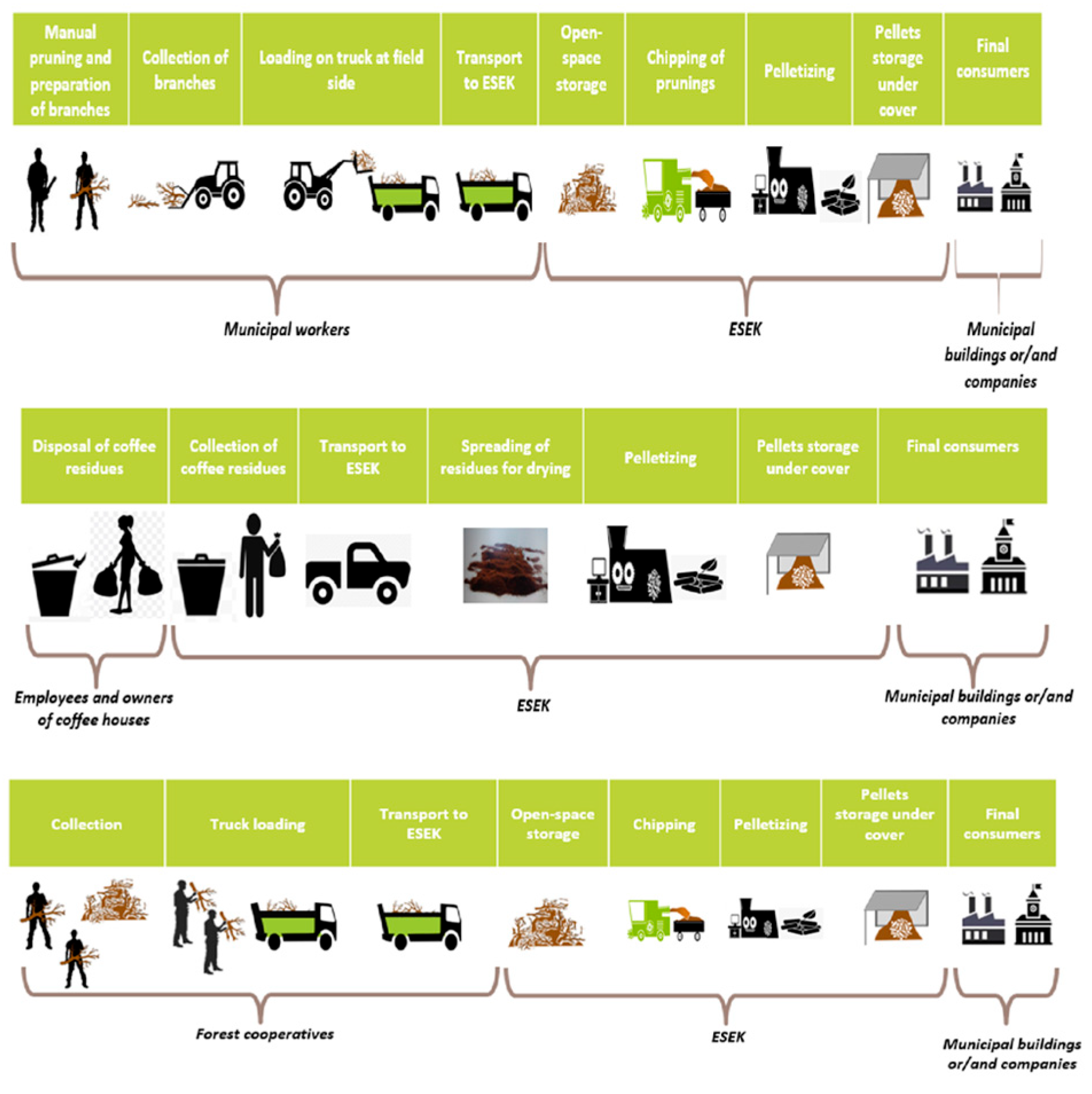
For the investigation of the above-mentioned feedstocks, a specialized value chain was developed that efficiently manages and optimizes their processing. This tailored approach is designed to maximize the potential of each type of biomass, focusing on urban prunings, coffee residues, and forest residues, ensuring that all resources are utilized sustainably and effectively.
The management of urban prunings involves a systematic collection process from city parks and roadside maintenance. Once collected, these prunings are loaded onto municipality-owned trucks, which transport the biomass to ESEK’s processing plant. The management of urban prunings is a key component of the tailored logistics designed to maximize the utilization of various biomass feedstocks. Urban prunings are collected by municipal workers. The collection is carried out manually or with the aid of mechanical equipment such as crane loaders, depending on the volume and location. At the pellet plant, the urban prunings are temporarily stored, allowing moisture to evaporate. The storage period lasts between one to two months, after which the prunings are moved to chipping machines (wood chipper). This practice enhances the sustainability and efficiency of the local bioenergy supply chain, demonstrating a proactive approach to the valorization of residual biomass that could serve as a model for other municipalities and regions.
Regarding spent coffee grounds, they can be collected from various establishments like coffee houses, restaurants or citizens throughout the city center of Karditsa. These residues are first dried to reduce moisture content, enhancing their suitability for pellet production. Subsequently, they are processed into biofuels, providing a local source of renewable energy while addressing waste management issues in local communities. This process involves several key stages, from collection to the final pellet production. Dedicated bins were strategically placed in central locations within coffee houses throughout Karditsa. This setup not only facilitates easy disposal and segregation of coffee residues from other waste but also raises awareness among business owners and customers about the importance of proper waste management and recycling. The residues were collected every 15 days. This frequency was chosen to balance the accumulation rate of coffee waste and reduce the need for daily management while preventing odor issues. Once collected, the coffee residues are transported a distance of 7 km to the biomass processing plant. Upon arrival at the plant, the coffee residues were stored openly, allowing natural processes to reduce moisture content. After a drying period of 2–3 weeks, they are ready to be combined with woody biomass for the pellet production. The designed value chain for coffee residues not only enhances the sustainability of local coffee shops by reducing their waste footprint but also contributes significantly to the community’s energy independence. By converting coffee residues into bioenergy, the RESCoop supports a circular economy future, adds economic value to what would otherwise be waste, and decreases the environmental impact through innovative waste management practices.
Regarding forest residues, they are gathered from nearby mountainous areas, particularly after the harvesting of the logs. This process involves a coordinated effort with local forest cooperatives, which play a crucial role in the sustainable harvesting and transportation of forest residues to the RESCoop processing facility. The forest cooperatives ensure that the collection methods sustain the health of the forest ecosystem, adhering to environmental standards and sustainable forestry practices. Once collected, the residues are transported to the RESCoop plant. Upon arrival at RESCoop’s facilities, the forest residues are initially stored to ensure they are adequately dried before further processing. The RESCoop utilizes a wood chipper to process the forest residues into smaller, uniform pieces, wood chips. The management of forest residues not only helps in reducing the fire hazard in the forested areas but also contributes significantly to the regional biomass potential for biofuels production.
In brief,
Figure 2 illustrates the value chains for all three feedstocks, from collection and transportation to processing and final use.
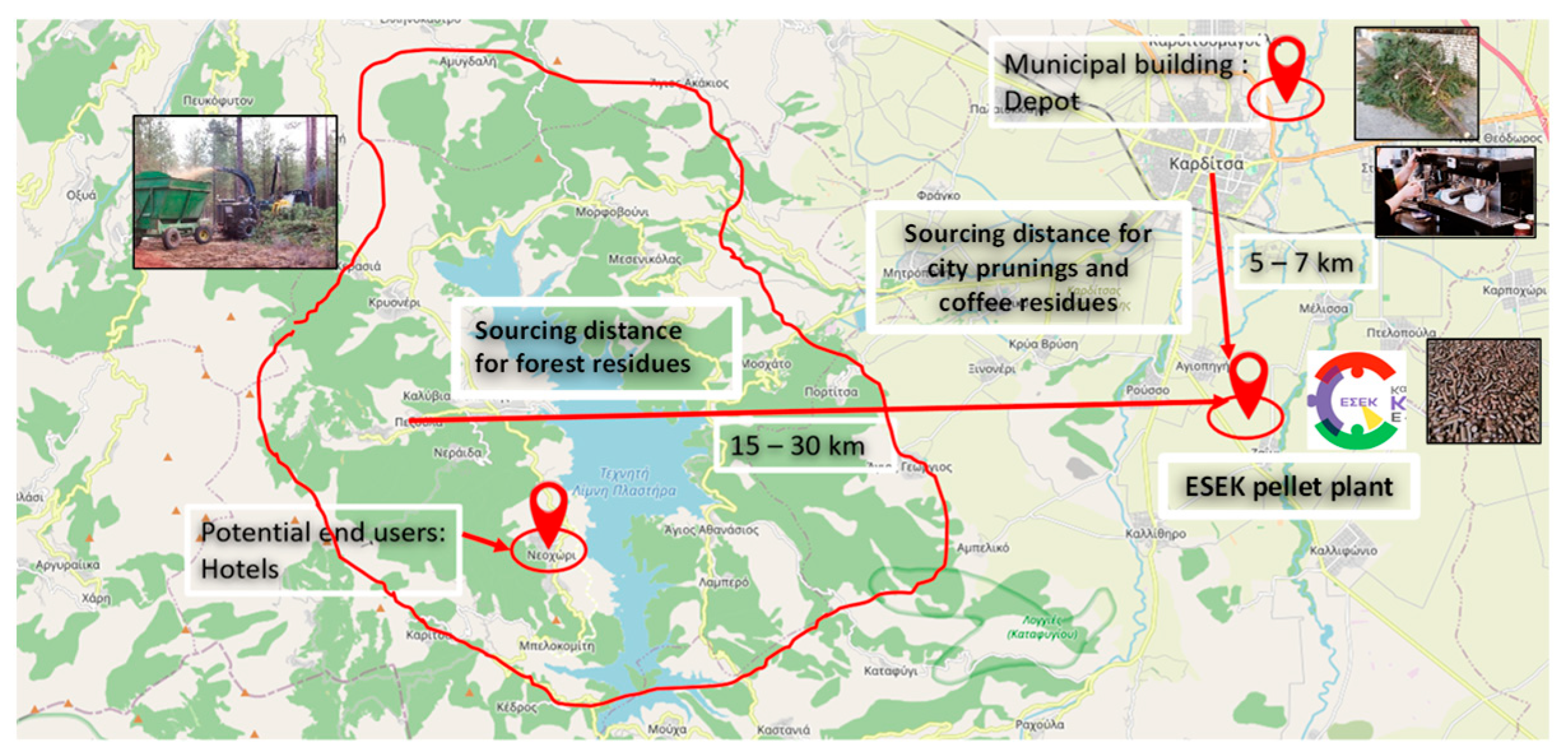
Furthermore, the following figure provides an overview of the RESCoop’s location and the distances of the new feedstocks that are sourced, along with the distance to potential end-users (
Figure 3).
The tailored logistics and optimized processes of the new RESCoop value chain highlight its strategic approach to resource management. By converting locally sourced biomass into energy, the initiative reduces dependency on external energy supplies and enhances the energy security of the region. Additionally, this approach minimizes waste and promotes the use of renewable resources, aligning with broader environmental and economic objectives. This value chain model serves as a blueprint for other regions aiming to develop their bioenergy capabilities, demonstrating the potential benefits of a well-organized approach to biomass utilization.




 ,
,