Article

Energy Costs and the Financial Situation of Farms in the European Union

by
Agnieszka Strzelecka
*,
Ewa Szafraniec-Siluta
and
Danuta Zawadzka
Faculty of Economics, Department of Finance, Koszalin University of Technology, Kwiatkowskiego 6e, 75-343 Koszalin, Poland
*
Author to whom correspondence should be addressed.
Energies 2025, 18(23), 6299; https://doi.org/10.3390/en18236299 (registering DOI)
Submission received: 31 October 2025 / Revised: 21 November 2025 / Accepted: 27 November 2025 / Published: 30 November 2025

Abstract

Within the energy system, agriculture represents a distinct sector, as it functions both as a consumer of energy derived from fossil fuels and renewable sources and as a producer of renewable energy. Since energy consumption is closely linked to production intensity and cost efficiency, energy costs have a direct impact on farm profitability and financial stability. The aim of the study is to analyze and assess the relationships between energy costs and the financial situation of farms in Poland in comparison to the European Union average, based on data from the Farm Accountancy Data Network (FADN) and its successor, the Farm Sustainability Data Network (FSDN), covering the years 2014–2023. The study focuses on differences in the structure and burden of energy costs and their implications for the economic performance and financial resilience of agricultural holdings. The comparative analysis revealed that farms in Poland are characterized by a higher share of energy costs in total production costs and a higher ratio of energy costs to total income compared to the EU average, indicating lower financial resilience to energy price volatility. These findings suggest that measures aimed at improving energy efficiency, supporting technological modernization, and encouraging the adoption of on-farm renewable energy could strengthen the long-term stability and competitiveness of Polish agriculture.

1. Introduction

Within the energy system, agriculture represents a distinct sector. On the one hand, it is a consumer of energy derived from both fossil fuels and renewable sources; on the other, it is a producer of renewable energy [1].
Agriculture is an industry that utilizes energy in a direct manner as fuel or electricity to operate machinery and equipment, to regulate temperature in buildings, and for the purpose of lighting on the farm [2], as well as for irrigation purposes [3]. Additionally, it employs energy in an indirect manner through the production of fertilizers and chemicals that are produced off the farm [2]. Gołasa et al. [4] emphasize that modern agriculture is highly dependent on industrial energy inputs, particularly fossil fuels and electricity. These energy sources are essential for powering agricultural machinery and for supporting indirect processes, including the production of mineral fertilizers and the synthesis of nitrogen compounds.
It should also be emphasized that agriculture has a considerable impact on the environment. Energy consumption—particularly from fossil fuels—is linked to CO2 emissions, other greenhouse gases, and the depletion of natural resources [3,4,5,6,7]. Therefore, the efficient and rational management of energy use in agricultural systems represents an essential component of strategies aimed at achieving sustainable development [5].
According to Eurostat [8], agriculture and forestry accounted for 3.0% of final energy consumption in the EU in 2022, while in Poland the share reached 4.7%. Because energy may represent up to 30% of total production costs in EU agriculture [1], the sector is highly exposed to energy price fluctuations and related market shocks. Improving energy efficiency and investing in renewable energy sources, such as biogas and photovoltaics, can reduce the vulnerability of farms to energy price fluctuations [9]. This issue assumes particular importance in the context of ensuring the energy security of agricultural holdings, as stable and affordable energy supplies are essential for maintaining consistent agricultural output and, consequently, for safeguarding food security [10].
Since mid-2021, global energy markets have experienced sharp price increases driven by post-pandemic recovery and tightening supply conditions [11]. In Europe, wholesale gas and electricity prices rose by approximately 115% and 237%, respectively, during the first half of 2022, highlighting the scale of the energy crisis and the vulnerability of the energy system to global market shocks [11].
Recent studies have emphasized the important role that access to energy plays in improving agricultural performance and ensuring rural sustainability. According to Huang, Abbas, and Sharif [12], agricultural energy poverty negatively affects farm productivity and profitability. Conversely, efficient management of direct and indirect energy costs, combined with the adoption of agro-technologies, significantly enhances profitability [12].
Energy prices are crucial not only for sectoral performance but also for progress toward the Sustainable Development Goals (SDGs) [13]. Access to affordable and reliable energy, highlighted in Targets 7.1 and 7.2, underpins Goal 7 and supports Goal 2 by influencing food production, processing and distribution. Rising energy costs can slow progress toward Targets 2.3 and 2.4, which focus on productivity, farm incomes and sustainable food systems. Therefore, access to affordable and reliable energy (SDG 7) remains essential to ensuring food security (SDG 2). Thus, understanding the structure and dynamics of energy costs in agriculture contributes to assessing progress toward both SDG 7 and SDG 2.
Energy costs in agriculture constitute an important area of research, as reflected in the growing body of scientific literature on this subject. Previous studies have focused on various aspects of energy costs in agriculture [14]. Among them are analyses examining how energy costs relate to bioeconomy principles, showing that family farms can adopt bioeconomic models that reduce operating—especially energy—costs in line with European Commission recommendations [14]. Other studies highlight that family farms, acting as both consumers and producers of renewable energy, can lower operating costs and contribute to the shift toward a low-carbon agricultural sector. Using FADN data for 2014–2022 and applying comparative and panel analyses, Ryś-Jurek [15] found that the level of energy production and consumption depends on the economic size of farms and, to a lesser extent, on their production type. Overall, the literature highlights the economic, social, and environmental dimensions of energy use in agriculture.
Another strand of research focuses on assessing energy security in agriculture. Majeed et al. [16] identified four key dimensions—accessibility, availability, utilization, and sustainability—and found availability to be the strongest and access the weakest. The study emphasized that improving energy access, reducing transportation costs, and promoting the sustainable use of agricultural inputs are key measures for enhancing both energy security and environmental performance in the agricultural sector [16].
The institutional environment also exerts a significant influence on the exposure of farms to energy costs. Within the CAP framework, both in the 2014–2020 and 2023–2027 periods, several instruments shape the cost structure of agricultural holdings. These include investment support under the Rural Development Programmes [17] and measures established in the CAP Strategic Plans to improve energy efficiency and modernize agricultural production systems [18]. Moreover, Member States implement national mechanisms, such as reduced excise taxes on agricultural diesel, as permitted under EU energy-taxation rules [19]. Differences in the uptake of these instruments overlap with structural characteristics of Polish agriculture—such as high land fragmentation [20,21], limited accumulation of fixed assets [22], and persistently weak investment capacity that slows the renewal of production assets [23]. These structural constraints may amplify the relative burden of energy costs compared with the EU average.
The paper addresses the issue of energy costs in the context of the financial situation of entities operating in the agricultural sector. The financial condition of economic entities, including farms, depends on two main factors: revenues from sales and the costs associated with their operations. Both of these factors determine the financial performance of an enterprise.
Costs are incurred across all areas of business activity. Depending on the adopted classification criterion, several main types of costs can be distinguished within an enterprise. From the perspective of cost behavior, they include variable, fixed, and semi-variable (mixed) costs [24,25,26]. When classified by their nature, the main categories are material costs, labor costs, and overheads [27]. Energy costs are typically included in material or overhead categories, depending on their source and use, and often represent a significant share of total production expenses in agriculture. Considering their function, costs are divided into production, administrative, and selling and distribution costs. Finally, according to the criterion of traceability, a distinction is made between direct and indirect costs [24]. In this context, energy expenditures can be classified as either direct costs when directly associated with production processes (e.g., fuel, electricity for machinery), or as indirect costs when linked to general operations, such as heating or lighting. Among the various types of costs, energy costs are of particular significance in agriculture. They reflect both production intensity and the level of technological advancement, and they strongly influence the economic performance and financial resilience of farms.
Despite a growing body of research, significant gaps persist in our understanding of these issues. Although recent studies such as Ryś-Jurek [14] have analyzed the relationship between energy costs and the financial situation of farms in the EU, they stop short of providing a long-term comparative assessment based on harmonized FADN/FSDN data. While Szajner and Wieliczko [28] examine the energy efficiency of Polish farms, their focus is on technical energy-use efficiency rather than on farm financial resilience. Jędruchniewicz [29] documents the rising costs of production inputs in Poland, yet the specific role of energy costs in shaping financial vulnerability remains unexplored. Moreover, structural and institutional factors, such as farm mechanization, investment dynamics and subsidies, are typically analyzed in relation to asset accumulation [22] or general investment needs [30] but are rarely linked directly with energy-cost burdens. Finally, Martinho [31] provides comparative data on energy costs in EU farms, but does not extend the analysis to financial performance or resilience metrics (ROA, ROE, income per AWU). Taken together, the existing literature leaves several important questions insufficiently explored. First, little is known about how the intensity of energy costs translates into the financial performance of farms, including profitability and income indicators. Second, the extent to which the burden of energy costs varies across different institutional and structural settings remains unclear. Third, there is a lack of comparative research that systematically contrasts Poland with the EU average using harmonized FADN/FSDN data. Finally, the role of structural characteristics—such as mechanization levels, investment capacity and land fragmentation—in shaping farms’ vulnerability to energy price shocks has rarely been examined. The present study addresses these gaps by combining a three-stage analytical framework with a conceptual model that links structural conditions, energy-cost intensity and financial outcomes for farms in Poland and the EU.
Taking the above into account, the aim of the study was to analyze and assess the relationships between energy costs and the financial situation of farms in Poland in comparison to the European Union average, based on data from the Farm Accountancy Data Network (FADN) and its successor, the Farm Sustainability Data Network (FSDN), covering the years 2014–2023. The study is descriptive and comparative in nature, and its objective is to determine the extent to which the structure and relationships of energy costs differentiate the economic situation of farms in Poland compared with the average results for the EU.
Although descriptive in nature, the study offers a meaningful contribution to agricultural economics and energy research. Existing literature does not provide an integrated comparison of energy-cost structures and financial outcomes between Poland and the EU, nor does it link these patterns to structural characteristics of farms. By combining harmonized FADN/FSDN data with a three-stage analytical framework, the study fills a documented empirical gap and offers a systematic assessment of farms’ financial resilience to rising energy costs. The descriptive approach is therefore appropriate given the aggregated character of the data and the cross-country scope of the analysis.
The rest of the paper is structured as follows. Section 2 outlines the research methodology and data sources. Section 3 presents the empirical findings and discussion. The final section summarizes the results and proposes potential directions for future research.

2. Materials and Methods

2.1. Research Design

The study focuses on a descriptive examination of the links between energy costs and the financial situation of agricultural holdings in Poland and in the European Union. The empirical analysis was based on data obtained from farms participating in the agricultural accountancy surveys conducted under the European Farm Accountancy Data Network (FADN). In 2025, this system was converted into the Farm Sustainability Data Network (FSDN) [32]. The study covered the period from 2014 to 2023. The study covers an average agricultural holding in the European Union and in Poland.
Given the aggregated nature of the dataset, the analysis focuses on identifying long-term structural differences, relative cost burdens, and financial implications without attempting to estimate causal relationships. The comparison highlights how the structure and intensity of energy costs correspond to farm performance under differing agrarian and economic conditions in Poland and the EU.
The framework is presented in Figure 1, which illustrates the logical sequence connecting energy cost intensity with the economic and financial characteristics of farms in Poland and the EU.
This conceptual scheme provides a structured basis for interpreting differences observed between Poland and the EU average. It allows for describing how the burden of energy costs is reflected in economic and financial indicators without implying statistical causality.
The interpretation of results refers to the following descriptive hypotheses:
H1. 
Agricultural holdings in Poland bear a higher relative burden of energy costs than the EU.
H2. 
Higher energy cost intensity corresponds to weaker profitability and lower income stability.
H3. 
Differences in energy cost intensity between Poland and the EU reflect long-term disparities in investment activity, asset structure, and production efficiency.
These hypotheses serve as guiding assumptions for the comparative analysis and do not involve statistical testing.

2.2. Data Source and Scope

The empirical analysis uses annual, country-level representative farm data published in the FADN Public Database. FADN provides harmonized, standardized, and methodologically consistent information on the economic situation of agricultural holdings across EU Member States. Data refer only to commercially oriented farms that exceed the FADN economic size threshold, ensuring comparability between countries. The study covers: Poland, characterized by a more fragmented agrarian structure and lower mechanization [33,34,35] and the EU average, representing the aggregated economic and structural characteristics of all Member States participating in FADN. The period 2014–2023 was selected to capture both the stability before 2020 and the strong post-2021 energy price shock.

2.3. Analytical Stages and Indicators

The analytical procedure consisted of three main stages, each supported by a specific set of indicators derived from FADN methodologies (Figure 2).
In the first stage of the study, a comparison was made between energy costs and other basic characteristics of farms (including economic size, utilized agricultural area, asset structure, and capital structure) in Poland and the European Union. The explanation of all FADN categories applied in the analysis is provided in Table A1.
In the second stage of the research, the energy intensity of agricultural holdings was assessed. The measures applied in this stage are presented in Table 1.
In the final stage of the research, the financial condition of agricultural holdings was assessed using the measures presented in Table 2.
The indicators applied in the study were selected based on a review of the relevant literature [12,14,15,38,39,40]. Data for farms in Poland were presented in comparison with those for agricultural holdings in the European Union.

2.4. Analytical Approach

Although longer time series are available in the FADN database, the analysis focuses on the most recent ten-year period (2014–2023) to ensure methodological consistency and to capture the dynamics of energy expenditures and financial performance during the period most affected by recent energy market developments. Given the aggregated, representative-farm nature of the indicators, the study does not aim to test statistical relationships or estimate causal effects, but rather to identify structural patterns and economic implications.
This descriptive-comparative approach is fully aligned with the objectives of the study, which focus on identifying long-term structural patterns and differences between Poland and the EU rather than estimating causal statistical relationships.

2.5. Limitations

The use of aggregated FADN data entails several methodological constraints that must be acknowledged. First, all indicators applied in the study refer to annual averages for the representative agricultural holding, rather than to micro-level observations. As a result, the dataset reflects mean values aggregated at the national level, which combine farms of different sizes, production types and technology levels. This limits the ability to control for heterogeneity and may mask the variability present at the farm level. Second, the aggregated nature of FADN indicators affects the treatment of price dynamics. Because the variables used in the analysis (e.g., total output, gross farm income) are composite indicators, each consisting of multiple heterogeneous components with distinct price trajectories, applying uniform deflators would artificially distort their internal structure. For this reason, no deflation procedures were applied, as deflating composite averages without access to disaggregated micro-data could misrepresent the actual cost structure and lead to biased interpretations. Additional limitations include exclusion of very small, subsistence-oriented farms; aggregation of heterogeneous production types within representative-farm averages; inability to isolate indirect energy embedded in fertilizers and chemicals.
Despite these constraints, FADN provides a harmonized and policy-relevant basis for long-term structural comparison between Poland and the EU average.

3. Results and Discussion

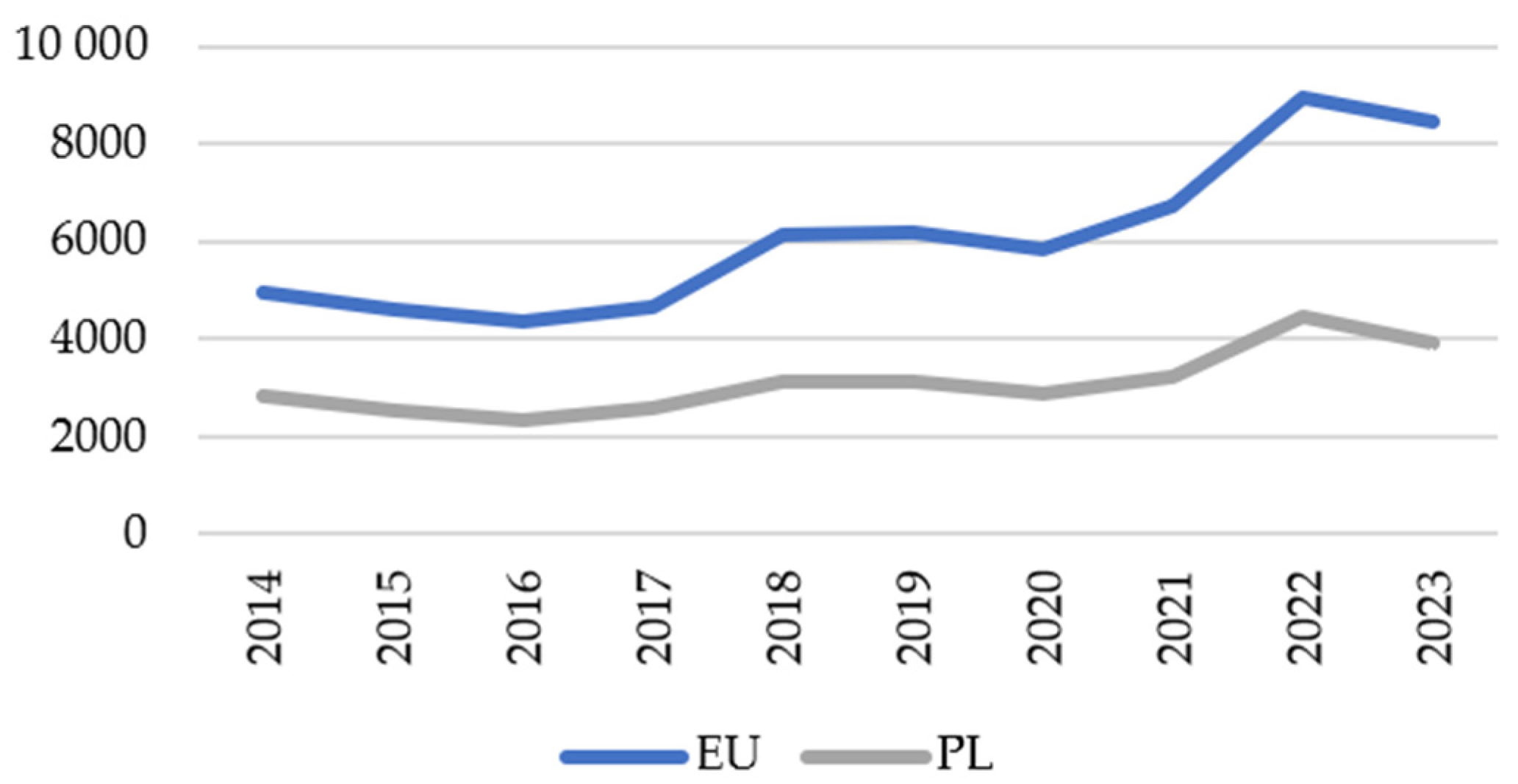
The results of the three analytical stages allow for a comprehensive assessment of both structural and financial dimensions of energy cost intensity in Polish and EU farms. In the first stage of the analysis, farms in the European Union and in Poland were compared for the period 2014–2023. The value of energy expenditures is presented in Figure 3, while the basic characteristics of the holdings are summarized in Table A2.
In 2021–2022, the entire European Union experienced a sharp increase in the prices of fuels, electricity, and gas, which in agriculture translated into a significant rise in production costs. The analyzed data clearly illustrate the impact of this phenomenon on farms in both Poland and the EU, although to varying extents. In EU farms, average energy costs per holding rose from EUR 6751 in 2021 to EUR 8948 in 2022, while in Poland the increase was even more pronounced—from EUR 3226 to EUR 4469. This growth reflects the greater sensitivity of Polish farms to fluctuations in energy and fuel prices, which may stem from smaller production scale, lower investment in energy efficiency, and limited use of renewable energy sources.
The analyzed agricultural holdings differ significantly in terms of their basic characteristics. Farms in the European Union achieve a markedly higher level of economic size, which reflects the average value of output obtained from one hectare of cultivated land or from one livestock unit under typical regional conditions. Agricultural holdings in Poland are characterized by a more fragmented structure compared to the overall population of EU farms. The average utilized agricultural area amounted to 20.71 ha in Poland, compared with 85.9 ha for EU holdings. Polish farms also exhibit a less flexible asset structure, with fixed assets accounting for an average of 88.31% of total assets, compared with 78.13% in the EU. Moreover, these assets are financed primarily with own capital: on average, equity represented 94.38% of total liabilities in Poland and 82.99% in the EU. Throughout the entire analyzed period, Polish farms also recorded a negative level of net investment, meaning that the value of asset depreciation exceeded that of gross investment.
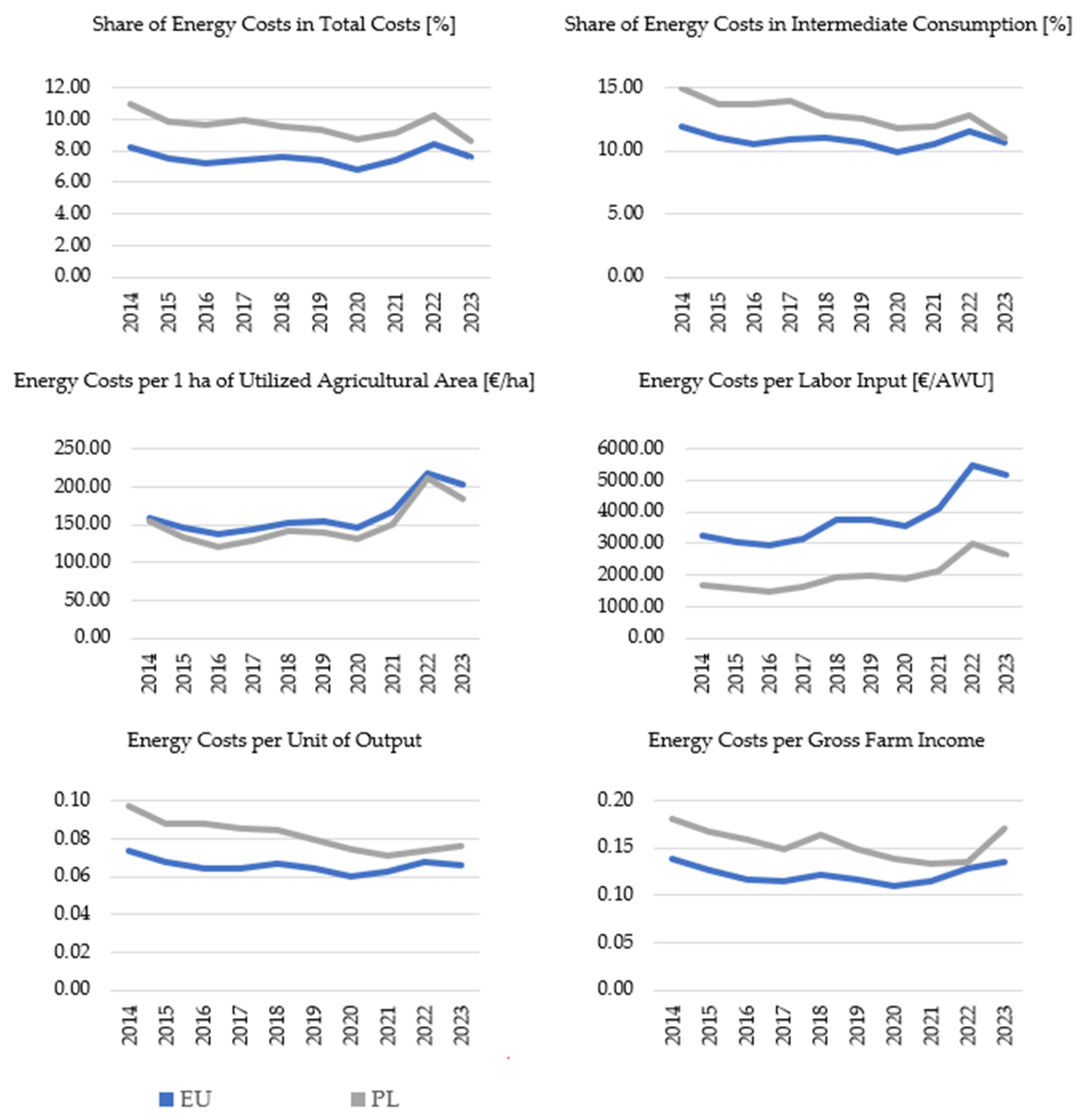
In the second stage of the analysis, the importance of energy costs for the functioning of agricultural holdings was assessed (Figure 4).
The first indicator reflects the share of energy costs in total costs. This share is considerably higher for Poland than for the European Union. The average value for Poland amounted to 9.58%, compared with 7.54% for the EU. A similar pattern is observed for the share of these costs in intermediate consumption, with an average of 12.9% for Poland and 10.86% for the EU. These differences indicate a more energy-intensive cost structure in Poland, which is consistent with H1.
However, energy costs per hectare of utilized agricultural area are higher in the European Union than in Poland. On average, Polish farms incurred EUR 149.61 in energy costs per hectare of land, while the corresponding figure for the EU was EUR 162.51. A comparable relationship was found for energy costs per total labor input—EUR 1993.82 per AWU in Poland and EUR 3814.8 in the EU. The higher per-unit values in the EU reflect differences in technology, mechanization and farm scale, whereas the higher cost shares in Poland point to the relatively greater importance of energy within the cost structure.
Relative indicators confirm these differences. In 2022, the share of energy costs in total costs in Poland exceeded 10%, compared with 8.4% in the EU, showing that energy price increases had a proportionally stronger effect on the Polish cost structure. The higher share of energy within intermediate consumption also indicates a greater dependence of Polish farms on electricity and fuel use. Lower energy expenditure per labor unit in Poland additionally reflects the smaller scale of production and higher labor intensity, as total labor input is comparable or slightly lower than in the EU, yet distributed across a significantly smaller utilized area. This suggests a lower level of mechanization, which in turn limits the ability of Polish farms to mitigate the effects of rising energy costs. Overall, the indicators consistently show that energy costs constitute a structurally more significant component of the cost structure in Poland than in the EU average (H1).
These findings are consistent with previous research indicating that structural characteristics—particularly the economic size of farms—significantly shape energy use patterns in agriculture. Ryś-Jurek [15] demonstrated that differences in economic size are a major determinant of how strongly energy costs affect both production and financial outcomes in EU farms, which corresponds with the disparities observed between Poland and other EU countries. Studies on the bioeconomic transition in agriculture [14] similarly emphasize that smaller and less economically robust farms are more exposed to rising energy costs. The results of this study therefore complement earlier findings by illustrating how a higher burden of energy expenditures translates into measurable financial effects at the farm level.
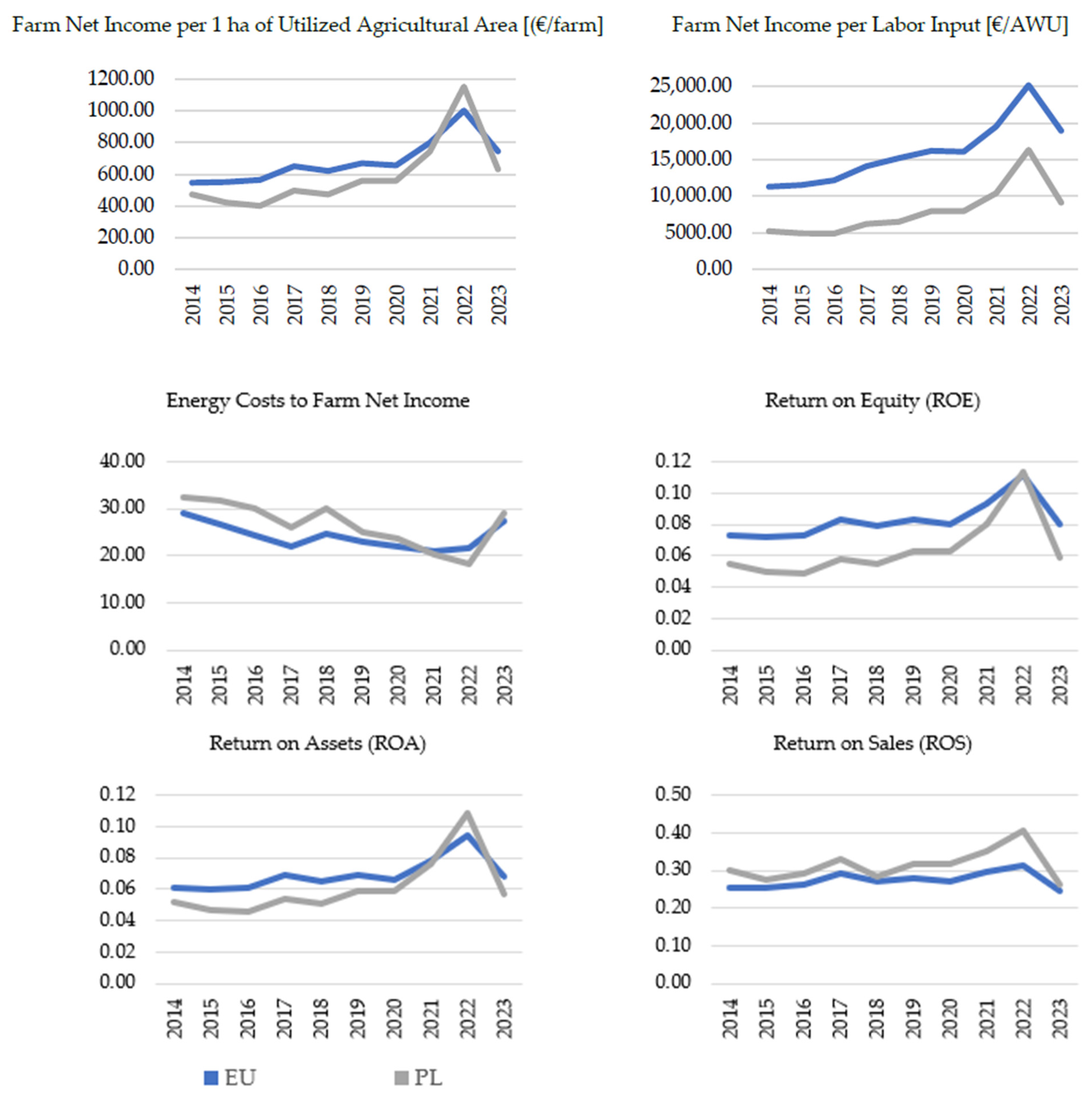
To assess the significance of energy costs for the financial situation of the analyzed agricultural holdings, the third stage of the study involved the evaluation of financial performance indicators (Figure 5).
The first indicator reflects the efficiency of land use in generating economic surpluses. Its value was generally higher for the European Union than for Poland, with the exception of 2022, when farms in Poland achieved EUR 1151.55 of income per hectare of land compared with EUR 1000.61 in the EU. Farms in the European Union also demonstrated substantially higher profitability in relation to labor input. The average income per Annual Work Unit (AWU) amounted to EUR 16,014.39 in the EU and EUR 7957.18 in Poland. The analysis of financial indicators highlights clear differences in the economic condition of farms in Poland and in the EU. Both income levels and profitability indicators confirm that Polish farms are characterized by lower economic efficiency and a weaker capacity for capital accumulation, which translates into reduced resilience to energy cost increases. The values of net income per hectare and per AWU indicate that labor productivity in Polish farms is more than twice as low as in the EU, reflecting their lower level of mechanization, fragmented agrarian structure and limited production specialization. Lower labor productivity constrains the ability of farms to generate income surpluses and, consequently, to absorb rising energy costs without deteriorating financial results. The ratio of energy costs to net farm income illustrates the share of expenditure on motor fuels, oils, electricity and heating fuel in total income. In this respect, Polish farms reported less favorable results, with an average value of 29.09%. Profitability indicators reinforce these differences. Every EUR 100 of equity invested generated approximately 20% lower returns in Poland than in EU farms, indicating weaker utilization of capital resources and a limited capacity for self-financing investment, including those aimed at improving energy efficiency. Conversely, sales profitability, measured as the ratio of net farm income to output value, was slightly higher in Poland than in the EU. However, this does not necessarily indicate a more favorable financial situation but rather results from differences in cost and income structures. Polish farms operate at a lower level of production intensity, with reduced consumption of energy inputs and external services, which limits operating costs. This contributes to a higher income-to-output ratio despite lower labor and capital productivity. The ratio of energy costs to farm income also revealed marked differences between Polish and EU farms. In Poland, the share of energy costs in income was on average higher until 2020, indicating greater financial vulnerability to energy price fluctuations. This stems primarily from lower income levels rather than higher absolute energy costs. In 2021–2022, despite rising energy prices, this ratio temporarily improved due to favorable price conditions in agricultural markets, but it deteriorated again in 2023. In EU farms, higher productivity and capital profitability made energy costs a smaller burden on income, confirming their higher energy and, consequently, financial resilience. In Poland, this improvement proved temporary and did not lead to a lasting increase in financial efficiency.
The observed financial differences can be explained by several structural factors. Polish farms operate on significantly smaller areas, with a more fragmented agrarian structure and a higher share of fixed assets in total assets. These constraints reduce flexibility and limit their capacity to adapt to rising energy prices. At the same time, lower mechanization levels and higher labor intensity reduce energy-use efficiency, which is consistent with earlier evidence on the role of technological gaps and input structure in shaping farm performance [12,14,33,34,35]. In contrast, EU farms benefit from larger scale, higher labor productivity, and greater investment activity, allowing them to absorb energy-related shocks more effectively.
The findings may also be interpreted in a broader context, suggesting several alternative explanations. First, the higher relative burden of energy costs in Poland may not only reflect structural weaknesses but also differences in production specialization, which inherently shape energy-use patterns. Farms engaged in livestock and mixed production typically exhibit higher energy intensity, and their prevalence in Poland could partly explain the observed disparities [15,41]. Second, the lower absolute energy costs per hectare in Poland, combined with a higher share of energy in total costs, may indicate underinvestment in modern technologies that improve energy-use efficiency rather than excessive energy use itself. Third, the temporary improvement in the ratio of energy costs to income during 2021–2022 may stem from exceptionally favorable agricultural prices rather than from any structural improvements in energy management. These alternative interpretations highlight the multifaceted nature of energy use in agriculture and suggest that the financial outcomes observed in this study are shaped by a combination of structural, technological and market factors.
Overall, the financial indicators consistently show that farms in Poland exhibit lower profitability and a higher sensitivity to energy cost fluctuations than the EU average, which confirms the assumptions of H2. Taken together, the results demonstrate that differences in energy cost intensity and financial performance are closely linked to the structural characteristics of agricultural holdings in Poland and in the EU. Smaller farm size, lower mechanization and a less flexible asset structure contribute to the relatively higher burden of energy costs in Poland and limit the ability of Polish farms to absorb energy price shocks. At the same time, higher labor and capital productivity in the EU translate into greater financial resilience and a smaller share of energy costs in farm income. These findings confirm the assumptions of H3, indicating that long-term structural disparities play a decisive role in shaping the economic consequences of energy price fluctuations.
The discussion presented in this study advances existing knowledge by linking structural characteristics, energy cost intensity, and financial outcomes within a unified analytical framework. While earlier studies explored these dimensions separately [12,14,15], this study integrates them to demonstrate how energy costs shape the financial resilience of farms in a cross-country perspective. The comparative approach covering Poland and the EU over a ten-year period provides new empirical insights into the mechanisms through which energy prices affect farm profitability.
In contrast to previous studies by Ryś-Jurek [14,15], which focused primarily on energy use patterns and their determinants, and the work of Szafraniec-Siluta et al. [39], which examined financial energy as a factor of farm security, the present study provides an original contribution by demonstrating how energy-cost intensity directly shapes the financial resilience of farms over a long time horizon and in a cross-country comparative framework.
Theoretically, the findings contribute to a more comprehensive understanding of how energy costs interact with structural characteristics and financial outcomes at the farm level. By linking energy cost intensity with profitability, scale of production and input structure, the study extends existing frameworks used in agricultural economics and energy analysis [12,14,15]. The results demonstrate that energy costs are not an isolated element of farm expenditure but are embedded in the broader configuration of resources, technologies and production decisions. This reinforces the need to treat energy as a strategic input influencing economic resilience rather than merely a component of intermediate consumption.
Practically, the findings have direct relevance for farmers, policymakers and advisory institutions. For farmers, the results point to the importance of investing in energy-efficient machinery, optimizing input use and expanding on-farm renewable energy production to reduce vulnerability to price shocks. For policymakers, the study underscores the need to strengthen support schemes for energy efficiency, modernization and technological upgrading, particularly in countries where small and medium-sized farms dominate. The results also highlight the importance of designing CAP instruments that better account for energy intensity as a determinant of financial resilience. For advisory services, the findings provide evidence to guide decision-making on cost structure analysis, investment planning and risk management under volatile energy markets.

4. Conclusions

The aim of the study was to analyze and assess the relationships between energy costs and the financial situation of farms in Poland in comparison to the European Union average, based on data from the Farm Accountancy Data Network (FADN) and its successor, the Farm Sustainability Data Network (FSDN), covering the years 2014–2023.
Agriculture plays a dual role within the energy system, functioning as both a consumer of energy derived from fossil fuels and renewable sources and a producer of renewable energy. Given its dependence on fossil fuels, electricity, and other industrial energy inputs, energy costs have become a key determinant of farm profitability, competitiveness, and financial stability [1,42]. The results of this study confirm that energy expenditures represent a structurally more important component of production costs in Poland than in the EU, shaping farms’ financial resilience and long-term development prospects.
The analysis based on data collected within the Farm Accountancy Data Network (FADN) reveals clear differences in the functioning of agricultural holdings in Poland and in the European Union. These differences span structural characteristics, energy cost intensity and financial outcomes, confirming the assumptions of H1-H3. The disparities in basic characteristics are both a cause and a consequence of the financial resilience of farms to rising energy prices (Table 3).
The comparative assessment presented in Table 3 reinforces all three research hypotheses. First, the consistently weaker performance of Polish farms across indicators related to economic size, production potential, and investment activity confirms H1, indicating that structural conditions in Poland increase the relative burden of energy costs compared with the EU average. Second, the higher shares of energy expenditures in total costs, intermediate consumption and farm income support H2, demonstrating that energy-cost intensity constitutes a significantly stronger constraint on financial performance in Poland. Finally, the combination of limited mechanization, lower labor and capital productivity, and persistently negative net investment confirms H3, showing that long-term structural disparities fundamentally shape the ability of farms to absorb energy price shocks and maintain financial resilience.
Polish farms demonstrate a considerably smaller economic size than those in the European Union [41]. This may result from several factors, one of which is the area of utilized agricultural land. Farms in Poland are characterized by a more fragmented agrarian structure than the EU average, which affects their efficiency and defines their production potential. Land constitutes the fundamental production factor in agriculture; therefore, its limited availability compared with the EU average is reflected in lower production values.
Furthermore, Polish farms possess assets of substantially lower total value, dominated by fixed assets, which indicates a high capital intensity of production. At the same time, these holdings rely more heavily on own capital to finance their operations than EU farms [39,40]. The negative level of net investment indicates investment activity below the level of asset depreciation. This hampers the modernization of production structures and limits opportunities to invest in energy-saving technologies, highlighting the need to implement measures that improve energy efficiency [43].
It is also worth noting that, despite the higher share of energy costs in total expenses in Poland, EU farms exhibit higher energy costs per hectare of utilized agricultural area. This may be attributed to higher production intensity, greater mechanization, and a more energy-demanding production structure [41]. These holdings consume more energy per hectare but generate higher output, indicating relatively greater energy efficiency compared with Poland.
The energy crisis of 2021–2022 exposed the challenges faced by Polish farms in managing energy costs. Although the rise in energy prices affected all EU Member States, its effects were particularly pronounced in Poland due to smaller production scale, lower mechanization, and limited investment in energy efficiency. EU farms, with their greater production and technological potential, demonstrated stronger capacity to absorb the impact of higher energy costs. This reinforces the conclusion that Polish farms remain structurally more vulnerable to energy market fluctuations and will require targeted support to strengthen their adaptive capacity.
This study has several limitations. It is based on the FADN database, which covers only farms considered to be commercial and exceeding a minimum economic size threshold that varies across Member States. As a result, many small-scale or subsistence farms are excluded from the sample. In addition, because the FADN database aggregates certain cost components at the whole-farm level and applies country-specific sampling thresholds, it may not fully capture the variability of energy expenditures across different types and sizes of farms. Consequently, the results may be slightly biased toward larger and more commercially oriented farms, which typically achieve higher energy efficiency and benefit from lower unit energy prices. Therefore, the findings should be interpreted with caution, particularly when generalizing the conclusions to the entire farming population.
In future research, we plan to address these limitations by conducting a comparative analysis of farms representing identical agricultural types in Poland and other EU Member States. This approach will allow for a more consistent comparison of energy cost structures and energy efficiency among farms with similar production profiles, size classes, and technological characteristics. Using the harmonized FADN typology (TF8 or TF14) will ensure methodological consistency and enhance the comparability of results across countries. Furthermore, future research should explore the role of technological adoption, investment behavior and renewable energy integration in shaping farms’ long-term resilience to energy price volatility. The planned analysis aims to identify structural and policy-related factors responsible for higher energy expenditures in specific farm types and to provide evidence-based recommendations for improving energy efficiency and supporting the transition toward low-carbon agriculture in Poland and the EU [44].
The conducted research can be considered unique in terms of both its analytical scope and applied methodology. The use of data from the FADN enabled a comparative assessment of farms in Poland and across the European Union within a harmonized methodological framework, ensuring full comparability of results. This approach made it possible not only to identify differences in the structure of energy costs and financial performance but also to determine the extent to which Polish farms differ in their financial resilience to rising energy prices relative to the EU average. The adopted multi-stage analytical framework, supported by a conceptual model, provides a coherent basis for linking structural conditions, energy cost intensity and financial outcomes, thereby strengthening the empirical contribution of the study.
The findings may have important practical and policy implications. The proposed indicators can be applied by public institutions and EU agencies to assess the effectiveness of energy and agricultural policies and to design instruments supporting energy efficiency in agricultural holdings; by farmers and agricultural advisors as a tool for diagnosing cost structures and planning investments in energy-saving technologies; and by financial institutions to evaluate credit risk in the context of farms’ resilience to energy price fluctuations. Supporting the development of on-farm renewable energy systems, improving access to investment financing, and strengthening advisory services can significantly enhance the capacity of Polish farms to cope with future energy shocks.
The practical implications of the findings indicate the need for targeted policy interventions tailored to the structural characteristics of Polish farms. First, the higher relative burden of energy costs observed in Poland suggests a need to expand investment support schemes under the CAP towards small- and medium-sized farms, particularly through dedicated measures for machinery replacement, precision agriculture technologies and energy-efficient equipment. Given the persistent negative net investment levels shown in the analysis, investment grants co-financed at a higher rate could help accelerate the replacement of ageing machinery, which is one of the structural drivers of high energy intensity. Second, because Polish farms show lower income per hectare and per AWU relative to the EU, credit-based and guarantee-based instruments should be strengthened to improve access to long-term financing for energy-saving modernization. Credit guarantees could be tied directly to the adoption of technologies that demonstrably reduce energy consumption. Third, the results demonstrating a higher share of energy in intermediate consumption suggest the need to expand on-farm renewable energy schemes, including small-scale biogas installations, photovoltaic micro-systems and heat pumps suitable for livestock buildings. Policy instruments could include simplified permitting procedures, accelerated depreciation mechanisms or feed-in premiums specifically designed for agricultural producers. Finally, the findings highlight the need to incorporate energy intensity indicators into the monitoring systems of future CAP Strategic Plans. This would allow policy-makers to track the effectiveness of interventions aimed at improving energy efficiency and to better target support to those farm types that exhibit the highest vulnerability to energy price shocks.
The findings also contribute to the SDG agenda by demonstrating that energy affordability is a key determinant of farm viability, directly connecting the results to SDG 7 and indirectly to SDG 2. The evidence from this study shows that farms exposed to higher relative energy cost burdens face reduced financial resilience, which may undermine both energy access and stable food production. Therefore, improving energy efficiency and supporting on-farm renewable energy generation can strengthen progress toward both goals.
Overall, the study demonstrates that structural characteristics, energy cost intensity and financial performance are closely interconnected and that Polish farms are structurally more exposed to energy price fluctuations than the EU average. These findings highlight the need to strengthen investment capacity and energy efficiency measures to improve long-term financial resilience. The results contribute to a better understanding of the role of energy costs in agricultural sustainability and provide a foundation for further research on the transition toward low-carbon farming systems in the European Union.

Author Contributions

Conceptualization, A.S., E.S.-S. and D.Z.; methodology, A.S., E.S.-S. and D.Z.; software, A.S., E.S.-S. and D.Z.; validation, A.S., E.S.-S. and D.Z.; formal analysis, A.S., E.S.-S. and D.Z.; investigation, A.S., E.S.-S. and D.Z.; resources, A.S., E.S.-S. and D.Z.; data curation, A.S., E.S.-S. and D.Z.; writing—original draft preparation, A.S., E.S.-S. and D.Z.; writing—review and editing, A.S., E.S.-S. and D.Z.; visualization, A.S., E.S.-S. and D.Z.; supervision, A.S., E.S.-S. and D.Z.; project administration, A.S., E.S.-S. and D.Z.; funding acquisition, A.S., E.S.-S. and D.Z. All authors have read and agreed to the published version of the manuscript.

Funding

This research received no external funding.

Data Availability Statement

These data were derived from the following resources available in the public domain: https://agridata.ec.europa.eu/extensions/FADNPublicDatabase/FADNPublicDatabase.html (accessed on 17 November 2025).

Conflicts of Interest

The authors declare no conflicts of interest.

Abbreviations

The following abbreviations are used in this manuscript:
SDGsSustainable Development Goals
EUEuropean Union
UNUnited Nations
FADNFarm Accountancy Data Network
FSDNFarm Sustainability Data Network
AWUAnnual Work Unit
ROEReturn on Equity
ROAReturn on Assets
ROSReturn on Sales
CAPCommon Agricultural Policy

Appendix A

Table A1. Set of variables used to describe the characteristics of agricultural holdings according to the FADN system.
Description According to the FADN SystemCategory Explanation
(SE005) Economic size (€’000/farm)Economic size of holding expressed in 1000 euro of standard output (on the basis of the Community typology).
(SE025) Total Utilized Agricultural Area (ha/farm)Total utilized agricultural area of holding. Does not include areas used for mushrooms, land rented for less than one year on an occasional basis, woodland and other farm areas (roads, ponds, non-farmed areas, etc.). It consists of land in owner occupation, rented land, land in share-cropping (remuneration linked to output from land made available). It includes agricultural land temporarily not under cultivation for agricultural reasons or being withdrawn from production as part of agricultural policy measures. It is expressed in hectares (10,000 m2).
(SE010) Total labor input (AWU/farm)Total labor input of holding expressed in annual work units = full-time person equivalents.
(SE131) Total output (€/farm)Total value of output of crops and crop products, livestock and livestock products and of other output, including that of other gainful activities (OGA) of the farms. Sales and use of (crop and livestock) products and livestock + change in stocks of products (crop and livestock) + change in valuation of livestock—purchases of livestock + various non-exceptional products.
(SE436) Total assets (€/farm)Fixed assets + current assets.
(SE441) Total fixed assets (€/farm)Agricultural land and farm buildings and
forest capital + Buildings + Machinery and
equipment + Breeding livestock, Intangible
assets and other non-current assets.
Closing valuation
(SE465) Total current assets (€/farm)Non-breeding livestock + Circulating capital (Stocks of agricultural products + Other circulating capital). Closing valuation
(SE485) Total liabilities (€/farm)Value at closing valuation of total of (long-, medium- or short-term) loans still to be repaid.
(SE410) Gross Farm
Income (€/farm)
Output—Intermediate consumption
+ Balance current subsidies and taxes.
(SE501) Net worth (€/farm)Total assets—Liabilities.
(SE420) Farm Net Income (€/farm)Remuneration to fixed factors of production of the family (work, land and capital) and remuneration to the entrepreneur’s risks (loss/profit) in the accounting year.
(SE521) Net investment on fixed assets (€/farm)Gross Investment on fixed assets—Depreciation.
(SE345) Energy (€/farm)Motor fuels and lubricants, electricity, heating fuels.
Source: own study based on EU FADN data [22,23].
Table A2. Characteristics of farms in the European Union and in Poland in 2014–2023.
SpecificationYears
2014201520162017201820192020202120222023
EU
(SE005) Economic size (€’000/farm)62717273959697979799
(SE025) Total Utilized Agricultural Area (ha/farm)31.231.731.932.440.140.240.340.441.241.7
(SE010) Total labor input (AWU/farm)1.511.511.481.491.641.661.651.651.641.64
(SE131) Total output (€/farm)66,95368,55368,49972,50492,02196,85597,176108,183132,018127,340
(SE436) Total assets (€/farm)281,931292,827297,215304,212380,432389,932398,758413,700439,996458,940
(SE441) Total fixed assets (€/farm)229,569236,976239,632244,487303,042305,370307,621312,737324,252337,610
(SE465) Total current assets (€/farm)52,36255,85157,58359,72577,39084,56291,137100,962115,744121,330
(SE485) Total liabilities (€/farm)48,13251,46251,89252,39566,71667,40967,96969,45371,41473,030
(SE501) Net worth (€/farm)233,799241,365245,323251,817313,717322,523330,788344,247368,581385,910
(SE410) Gross Farm Income (€/farm)35,61736,60637,39640,71650,16152,99452,85859,10469,95462,352
(SE420) Farm Net Income (€/farm)17,05317,42718,00621,02624,90026,89826,49532,21141,25531,013
(SE521) Net investment on fixed assets (€/farm)268595−45030415439891454218128123182
Poland
(SE005) Economic size (€’000/farm)28323232373837373736
(SE025) Total Utilized Agricultural Area (ha/farm)18.419.119.619.922.122.221.821.421.321.3
(SE010) Total labor input (AWU/farm)1.71.61.61.61.61.61.51.51.51.5
(SE131) Total output (€/farm)29,12229,16826,75030,11737,19239,27038,34145,22260,64851,397
(SE436) Total assets (€/farm)168,234173,884171,031182,902205,542210,104205,551207,732224,737235,739
(SE441) Total fixed assets (€/farm)151,017156,335152,983163,126182,813185,987182,157181,552190,400204,110
(SE465) Total current assets (€/farm)17,21717,54918,04819,77622,72924,11723,39426,18034,33731,629
(SE485) Total liabilities (€/farm)962210,70110,01310,42114,29613,60612,20810,79494419367
(SE501) Net worth (€/farm)158,612163,183161,017172,482191,247196,498193,343196,938215,297226,372
(SE410) Gross Farm Income (€/farm)15,63515,35014,87017,34219,15920,97220,61924,26933,18022,919
(SE420) Farm Net Income (€/farm)870680397842991010,45712,37912,14515,85524,48213,408
(SE521) Net investment on fixed assets (€/farm)−1100−665−2254−1365−1127−763−1282−869−756−1567
Source: authors’ own study.

References

  1. Sulewski, P.; Wąs, A. Agriculture as Energy Prosumer: Review of Problems, Challenges, and Opportunities. Energies 2024, 17, 6447. [Google Scholar] [CrossRef]
  2. Schnepf, R. Energy Use in Agriculture: Background and Issues; CRS Report No. RL32677; Congressional Research Service: Washington, DC, USA, 2004.
  3. Qin, J.; Duan, W.; Zou, S.; Chen, Y.; Huang, W.; Rosa, L. Global Energy Use and Carbon Emissions from Irrigated Agriculture. Nat. Commun. 2024, 15, 3084. [Google Scholar] [CrossRef]
  4. Gołasa, P.; Wysokiński, M.; Bieńkowska-Gołasa, W.; Gradziuk, P.; Golonko, M.; Gradziuk, B.; Siedlecka, A.; Gromada, A. Sources of Greenhouse Gas Emissions in Agriculture, with Particular Emphasis on Emissions from Energy Used. Energies 2021, 14, 3784. [Google Scholar] [CrossRef]
  5. Raza, M.Y.; Zhongpan, Q.; Pengju, W. Agriculture-Related Energy Consumption, Food Policy, and CO2 Emission Reduction: New Insights from Pakistan. Front. Environ. Sci. 2023, 10, 1099813. [Google Scholar] [CrossRef]
  6. Flammini, A.; Pan, X.; Tubiello, F.N.; Qiu, S.Y.; Rocha Souza, L.; Quadrelli, R.; Bracco, S.; Benoit, P.; Sims, R. Emissions of Greenhouse Gases from Energy Use in Agriculture, Forestry and Fisheries: 1970–2019. Earth Syst. Sci. Data 2022, 14, 811–821. [Google Scholar] [CrossRef]
  7. Paris, B.; Vandorou, F.; Balafoutis, A.T.; Vaiopoulos, K.; Kyriakarakos, G.; Manolakos, D.; Papadakis, G. Energy Use in Open-Field Agriculture in the EU: A Critical Review Recommending Energy Efficiency Measures and Renewable Energy Sources Adoption. Renew. Sustain. Energy Rev. 2022, 158, 112098. [Google Scholar] [CrossRef]
  8. European Commission (Eurostat). Agri-Environmental Indicator—Energy Use; Statistics Explained; European Union: Luxembourg, 2024.
  9. Bathaei, A.; Štreimikienė, D. Renewable Energy and Sustainable Agriculture: Review of Indicators. Sustainability 2023, 15, 14307. [Google Scholar] [CrossRef]
  10. Haghjoo, R.; Choobchian, S.; Abbasi, E. Unveiling Energy Security in Agriculture through Vital Indicators Extraction and Insights. Sci. Rep. 2024, 14, 8626. [Google Scholar] [CrossRef]
  11. Ferriani, F.; Gazzani, A. The Impact of the War in Ukraine on Energy Prices: Consequences for Firms’ Financial Performance. Int. Econ. 2023, 175, 71–88. [Google Scholar] [CrossRef]
  12. Huang, Y.; Abbas, Q.; Sharif, M. Addressing Agricultural Energy Poverty to Enhance Farmers’ Profitability and Productivity: Policy Interventions for Global Food Security Challenges. Energy Policy 2025, 206, 114696. [Google Scholar] [CrossRef]
  13. United Nations. Transforming Our World: The 2030 Agenda for Sustainable Development; A/RES/70/1; United Nations: New York, NY, USA, 2015. [Google Scholar]
  14. Ryś-Jurek, R. Interdependence between Energy Cost and Financial Situation of the EU Agricultural Farms—Towards the Implementation of the Bioeconomy. Energies 2022, 15, 8853. [Google Scholar] [CrossRef]
  15. Ryś-Jurek, R. On-Farm Production of Renewable Energy in 2014–2022. Energies 2024, 17, 5395. [Google Scholar] [CrossRef]
  16. Majeed, Y.; Khan, M.U.; Waseem, M.; Zahid, U.; Mahmood, F.; Majeed, F.; Sultan, M.; Raza, A. Renewable Energy as an Alternative Source for Energy Management in Agriculture. Energy Rep. 2023, 9, 6915–6928. [Google Scholar] [CrossRef]
  17. European Parliament and Council. Regulation (EU) No 1305/2013 of the European Parliament and of the Council of 17 December 2013 on support for rural development by the European Agricultural Fund for Rural Development (EAFRD). Off. J. Eur. Union 2013, L 347, 487–548. [Google Scholar]
  18. European Parliament and Council. Regulation (EU) 2021/2115 of the European Parliament and of the Council of 2 December 2021 establishing rules on support for CAP Strategic Plans drawn up by Member States under the CAP. Off. J. Eur. Union 2021, L 435, 1–186. [Google Scholar]
  19. European Commission. Excise Duties: Current Energy Tax Rules; Taxation and Customs Union: Brussels, Belgium, 2022.
  20. Markuszewska, I. Land consolidation as an instrument of shaping the agrarian structure in Poland: A case study of the Wielkopolskie and Dolnośląskie voivodeships. Quaest. Geogr. 2013, 32, 53–67. [Google Scholar] [CrossRef]
  21. Popa, D.G.; Dinu, T.A. Correlations between fragmentation of farms in the Republic of Poland, Romania and Moldova. Probl. World Agric. 2015, 15, 166–179. [Google Scholar]
  22. Grzelak, A. Accumulation of assets in farms covered by the FADN system in Poland. Management 2019, 23, 156–170. [Google Scholar] [CrossRef]
  23. Bórawski, P.; Dunn, J.W.; Bialczyk, W.; Harper, J.K.; Soroka, A.; Szymańska, E.J. Investments in Polish agriculture: How production factors shape conditions for environmental protection. Sustainability 2020, 12, 8160. [Google Scholar] [CrossRef]
  24. Sinambela, E.A.; Djaelani, M. Cost Behavior Analysis and Categorization. J. Soc. Sci. Stud. 2022, 2, 13–16. [Google Scholar] [CrossRef]
  25. Oberholzer, M.; Ziemerink, J.E.E. Cost Behaviour Classification and Cost Behaviour Structures of Manufacturing Companies. Meditari Account. Res. 2004, 12, 179–193. [Google Scholar] [CrossRef]
  26. Banerjee, B. Cost Accounting: Theory and Practice, 14th ed.; PHI Learning Pvt. Ltd.: New Delhi, India, 2017. [Google Scholar]
  27. Usul, H.; Olgun, E.B. An Analysis of Material Flow Cost Accounting in Companies Using Different Cost Accounting Systems. Heliyon 2025, 11, e42555. [Google Scholar] [CrossRef]
  28. Szajner, P.; Wieliczko, B. Energy Efficiency in Polish Farms. Energies 2024, 17, 3654. [Google Scholar] [CrossRef]
  29. Jędruchniewicz, A. Changes in Prices of Agricultural Inputs and Their Impact on Agricultural Production Costs in Poland. Zagadnienia Ekon. Rolnej/Probl. Agric. Econ. 2023, 374, 23–45. [Google Scholar]
  30. FI-Compass. Agricultural Investment Support-Study on Financial Needs and Instruments in EU Agriculture; European Investment Bank/European Commission: Brussels, Belgium, 2018.
  31. Martinho, V.J.P.D. Energy Consumption across European Union Farms: Efficiency in terms of farming output and utilized agricultural area. Energy 2016, 103, 543–556. [Google Scholar] [CrossRef]
  32. Regulation (EU) 2023/2674 of the European Parliament and of the Council of 22 November 2023 Amending Council Regulation (EC) No 1217/2009 as Regards Conversion of the Farm Accountancy Data Network into a Farm Sustainability Data Network, PE/53/2023/REV/1. Off. J. Eur. Union 2023, L 2023/2674, 1–20.
  33. Badach, E.; Szewczyk, J.; Lisek, S.; Bożek, J. Size Structure Transformation of Polish Agricultural Farms in 2010–2020 by Typological Groups of Voivodeships. Agriculture 2023, 13, 1789. [Google Scholar] [CrossRef]
  34. Wąs, A.; Tsybulska, J.; Sulewski, P.; Krupin, V.; Rawa, G.; Skorokhod, I. Energy Efficiency of Polish Farms Following EU Accession (2004–2021). Energies 2025, 18, 101. [Google Scholar] [CrossRef]
  35. European Commission. Factsheet on 2014–2022 Rural Development Programme for Poland. February 2025. Available online: https://agriculture.ec.europa.eu/system/files/2019-11/rdp-factsheet-poland_en_0.pdf (accessed on 18 November 2025).
  36. European Commission. Definitions of Variables Used in FADN Standard Results (RI/CC 1750); Directorate-General for Agriculture and Rural Development: Brussels, Belgium, 2022. Available online: https://fadn.pl/wp-content/uploads/2022/07/RICC_1750_Standard_Results-v-Jun-2022.pdf (accessed on 23 October 2025).
  37. European Commission. Farm Accountancy Data Network (FADN) Public Database; Directorate-General for Agriculture and Rural Development: Brussels, Belgium, 2019. Available online: https://agridata.ec.europa.eu/extensions/FADNPublicDatabase/FADNPublicDatabase.html (accessed on 23 October 2025).
  38. Kryszak, Ł.; Guth, M.; Czyżewski, B. Determinants of Farm Profitability in the EU Regions: Does Farm Size Matter? Agric. Econ.–Czech 2021, 67, 101–110. [Google Scholar] [CrossRef]
  39. Szafraniec-Siluta, E.; Strzelecka, A.; Ardan, R.; Zawadzka, D. Financial Energy as a Determinant of Financial Security: The Case of European Union Farms. Energies 2025, 18, 1978. [Google Scholar] [CrossRef]
  40. Szafraniec-Siluta, E.; Strzelecka, A.; Ardan, R.; Zawadzka, D. Determinants of Financial Security of European Union Farms—A Factor Analysis Model Approach. Agriculture 2024, 14, 119. [Google Scholar] [CrossRef]
  41. Wysokiński, M.; Golonko, M.; Trębska, P.; Gromada, A.; Jiang, Q. Economic and Energy Efficiency of Agriculture in Poland Compared to Other European Union Countries. Acta Sci. Pol. Oeconomia 2020, 19, 117–126. [Google Scholar] [CrossRef]
  42. Sulewski, P.; Majewski, E.; Wąs, A. The Importance of Agriculture in the Renewable Energy Production in Poland and the EU. Probl. Agric. Econ. 2017, 1, 50–74. [Google Scholar] [CrossRef]
  43. Boczar, P.; Błażejczyk-Majka, L. Economic Efficiency versus Energy Efficiency of Selected Crops in EU Farms. Resources 2024, 13, 123. [Google Scholar] [CrossRef]
  44. Martinho, V.J.P.D. Five Models and Ten Predictors for Energy Costs on Farms in the European Union. Open Agric. 2025, 10, 20250441. [Google Scholar] [CrossRef]
Figure 1. Conceptual framework illustrating the descriptive links between energy inputs, cost structure, profitability, and financial resilience of agricultural holdings in Poland and the EU. Source: authors’ own study based on [1,2,3,4,5,6,7,8,9,10,11,12,13,14,15,16,17,18,19,20,21,22,23,24,25,26,27,28,29,30,31].
Energies 18 06299 g001
Figure 2. Diagram of Research Stages and Analytical Steps. Source: authors’ own study.
Energies 18 06299 g002
Figure 3. Value of energy expenditures in agricultural holdings in Poland and the European Union in the years 2014–2023 (€/farm). Source: authors’ own study.
Energies 18 06299 g003
Figure 4. Indicators reflecting energy use in agricultural holdings in Poland and the European Union in the years 2014–2023. Source: authors’ own study.
Energies 18 06299 g004
Figure 5. Indicators reflecting the income situation of agricultural holdings in Poland and the European Union in the years 2014–2023. Source: authors’ own study.
Energies 18 06299 g005
Table 1. Variables reflecting energy use in agricultural holdings according to the FADN system.
Name of the IndicatorCategories Applied from the FADN System
Share of Energy Costs in Total Costs [%](SE345) Energy (€/farm)/(SE270) Total Inputs (€/farm)
Share of Energy Costs in Intermediate Consumption [%](SE345) Energy (€/farm)/(SE275) Total intermediate consumption (€/farm)
Energy Costs per 1 ha of Utilized Agricultural Area [€/ha](SE345) Energy (€/farm)/(SE025) Total Utilized Agricultural Area (ha/farm)
Energy Costs per Labor Input [€/AWU](SE345) Energy (€/farm)/(SE010) Total labor input (AWU/farm)
Energy Costs per Unit of Output(SE345) Energy (€/farm)/(SE131) Total output (€/farm)
Energy Costs per Gross Farm Income(SE345) Energy (€/farm)/(SE410) Gross Farm Income (€/farm)
Source: own study based on EU FADN data [36,37].
Table 2. Data Illustrating the Financial Performance of Agricultural Farms Based on FADN Data.
Name of the IndicatorCategories Applied from the FADN System
Farm Net Income per 1 ha of Utilized Agricultural Area [(€/farm][(SE420) Farm Net Income (€/farm)/(SE025) Total Utilized Agricultural Area (ha/farm)] × 100
Farm Net Income per Labor Input [€/AWU][(SE420) Farm Net Income (€/farm)/((SE010) Total labor input (AWU/farm)] × 100
Energy Costs to Farm Net Income(SE345) Energy (€/farm)/(SE420) Farm Net Income (€/farm)
Return on Equity (ROE)ROE = (SE420) Farm Net Income (€/farm)/(SE501) Net worth (€/farm)
Return on Assets (ROA)ROA = (SE420) Farm Net Income (€/farm)/(SE436) Total assets (€/farm)
Return on Sales (ROS)ROS = (SE420) Farm Net Income (€/farm)/(SE131) Total output (€/farm)
Source: own study based on EU FADN data [36,37].
Table 3. Comparative mapping of energy indicators and their impact on the financial resilience of agricultural holdings in Poland and the European Union.
VariableRelevance in the Context of Financial Resilience to Energy Price FluctuationsAssessment of Agricultural Holdings in Poland Compared to the European Union
Characteristics of agricultural holdings
(SE005) Economic size (€’000/farm)Greater economic size increases resilience through economies of scale and a higher capacity to absorb rising energy costs.negative
(SE025) Total Utilized Agricultural Area (ha/farm)Larger utilized agricultural area enables diversification and the distribution of unit costs, thereby reducing the impact of energy price increases.negative
(SE131) Total output (€/farm)Higher production levels improve the ability to offset rising costs through increased revenues.negative
(SE436) Total assets (€/farm)Greater asset value reflects a higher investment potential and the ability to modernize towards improved energy efficiency.negative
(SE501) Net worth (€/farm)A higher share of own capital enhances the capacity for self-financing investments.negative
(SE420) Farm Net Income (€/farm)Higher income improves liquidity and flexibility in responding to rising energy costs.negative
(SE521) Net investment on fixed assets (€/farm)Positive net investment indicates ongoing modernization and improvements in efficiency, including energy efficiency.negative
Energy characteristics
Share of Energy Costs in Total Costs [%]Higher share indicates greater dependence on energy prices and lower financial resilience.negative
Share of Energy Costs in Intermediate Consumption [%]It reflects operational energy intensity; lower values indicate higher efficiency and adaptive capacity.negative
Energy Costs per 1 ha of Utilized Agricultural Area [€/ha]It defines the energy burden of production; lower energy costs per hectare improve competitiveness.positive
Energy Costs per Labor Input [€/AWU]It indicates the energy efficiency of labor; lower values suggest better mechanization and production organization.positive
Energy Costs per Unit of OutputIt measures the energy intensity of production; lower ratios increase profitability under rising energy prices.negative
Energy Costs per Gross Farm IncomeIt specifies the share of energy costs in the farm’s gross value added; lower values denote greater economic efficiency.negative
Financial Performance of Agricultural Farms
Farm Net Income per 1 ha of Utilized Agricultural Area [(€/farm]Higher income per hectare increases the ability to maintain profitability despite rising energy prices.negative
Farm Net Income per Labor Input [€/AWU]It reflects labor productivity; higher values indicate greater resilience to increasing costs.negative
Energy Costs to Farm Net IncomeIt shows the sensitivity of income to energy costs; lower values denote stronger financial resilience.negative
Return on Equity (ROE)It determines capital profitability; higher values may drive investments in energy-efficient technologies.negative
Return on Assets (ROA)It reflects asset utilization efficiency; higher values indicate greater financial stability.negative
Return on Sales (ROS)It measures profit margin; higher values potentially enhance resilience to energy cost fluctuations.positive
Legend: Negative—the result for agricultural holdings in Poland is worse than that of agricultural holdings in the European Union. Positive—the result for agricultural holdings in Poland is better than that of agricultural holdings in the European Union. Source: authors’ own study.
Disclaimer/Publisher’s Note: The statements, opinions and data contained in all publications are solely those of the individual author(s) and contributor(s) and not of MDPI and/or the editor(s). MDPI and/or the editor(s) disclaim responsibility for any injury to people or property resulting from any ideas, methods, instructions or products referred to in the content.