


Abstract
The efficiency of underground hydrogen storage (UHS) in an anticlinal dome structure in a saline aquifer largely depends on the geometry of the dome structure and the placement of injection wells, which determine both the dynamic capacity and the migration of the gas plume. In this study, we aimed to assess the impact of well location within the Jeżów anticlinal dome structure (central Poland) on storage capacity and hydrogen plume migration. A geological model of the structure was developed and used in TOUGH2 (version 2.0) software to simulate nine injection scenarios with different well placements. The results indicate that storage capacity increases with both the secant dip angle relative to the top of the dome structure and the tangent dip angle at the well location, reaching a maximum in areas with the steepest dip. During injection, the hydrogen plume migrates upward toward the top of the structure; afterwards, it gradually stabilizes and partially redistributes toward the top of the dome structure. Injection wells located in steeper parts of the anticline promote upward hydrogen migration, which may limit hydrogen recovery during the withdrawal phase. This study confirms that both structural dip and well placement are key factors determining UHS efficiency.
1. Introduction
1.1. The Importance of and Conditions for the Development of Underground Hydrogen Storage (UHS)
Underground hydrogen storage (UHS) is a key component of the energy transition. It integrates technological, economic, and social aspects, enabling the stabilization of energy systems based on renewable sources, strengthening energy security, and supporting the decarbonization of the economy [1,2,3,4]. In UHS systems, hydrogen functions as an energy buffer, allowing for the balancing of variable renewable energy production. Surplus electricity can be converted into hydrogen, stored in geological formations, and later recovered during periods of increased demand [2,5,6,7,8,9,10,11].
From an energy security perspective, UHS enhances national independence by enabling local storage of strategic hydrogen reserves. It supports the diversification of energy sources, with hydrogen serving as an alternative to imported fossil fuels, and creates favorable conditions for the development of regional hydrogen hubs and cross-border transmission corridors [2,12,13,14]. For this reason, UHS is regarded as a strategic technology that enables long-term energy storage and ensures the stability of power systems based on renewable energy sources.
There remains a need for a better understanding of the geological and engineering factors that determine the efficiency and safety of hydrogen storage. One of the key, yet least explored, aspects is the impact of geological structural geometry and injection well placement on dynamic storage capacity and the behavior of hydrogen plumes. Proper design of well layout and selection of operational parameters are essential for optimizing storage performance and minimizing the risk of hydrogen loss.
Geological, technical, economic, legal, and social aspects that determine the feasibility and safety of UHS projects have been the subject of numerous comprehensive studies [15,16,17,18,19,20,21]. From a technological and infrastructural perspective, the selection of suitable geological structures for UHS is crucial [9,15,16,19,21,22,23,24,25,26,27]. Salt caverns provide short-term flexibility, while deep saline aquifer structures enable long-term storage [15,17,18,28,29,30,31]. Cushion gas also plays an important role, as it affects the efficiency of storage system operation [15,25,32,33].
The development of monitoring technologies that ensure operational safety remains an important issue [19,34,35,36]. Previous experience with carbon capture and storage (CCS) and underground gas storage (UGS) allows for knowledge transfer and the use of existing infrastructure [19,37].
From an economic perspective, it is important to consider the costs of converting electricity into hydrogen and then back into energy, as well as the overall profitability of the process, which depends on renewable energy and hydrogen prices and CO2 emission allowance costs. Business analyses explore various operational models for UHS, including strategic, commercial, and local (e.g., within hydrogen valleys) ones. However, their development requires appropriate regulatory support and subsidy systems [12,23,38]. In the environmental and social context, UHS supports CO2 emission reduction by increasing the use of renewable energy sources, while also requiring careful analysis of potential risks such as hydrogen leakage and geochemical and biological interactions within underground reservoirs [15,19,39,40,41,42,43]. Public acceptance and comprehensive regulation are also crucial, as fully developed legal standards and procedures for underground hydrogen storage are still currently lacking [19,34,37,44,45]. Recent geomechanical studies emphasize the relevance of stress distribution and overburden failure analyses for safe underground operations, which also inform UHS research [46,47].
1.2. The Influence of Trap Geometry and Well Placement—Problem Outline and Literature Review
The location of the injection well is one of the key yet least studied factors affecting the efficiency of underground hydrogen storage. Previous research has focused primarily on reservoir parameters such as porosity, permeability, mineralogy, and rock wettability [8,20,48,49,50,51], whereas the geometry of geological structures and the spatial arrangement of wells have been analyzed less frequently [5,52]. Research findings [53,54,55,56,57,58,59] indicate that the optimal location and configuration of wells—combining the advantages of top zones with pressure gradient control—are key elements in designing safe and efficient hydrogen storage in porous structures. These factors directly determine the utilization of reservoirs’ pore space. Moreover, separating injection and production functions can yield positive results. Multi-well configurations can increase working capacity and deliverability, provided that optimal spacing between wells is maintained [5]. These conclusions are also supported by review studies [21].
The literature increasingly emphasizes the importance of properly defining storage capacity and linking it to the geometry of geological structures and the location of injection wells, as key factors determining storage efficiency [17,21,44,60]. This issue has both scientific and practical dimensions—operators must decide on well placement (central or more peripheral), perforation depth, and the number of wells, all of which influence hydrogen recoverability, safety, and investment costs [5,28]. Due to its low density, low viscosity, and high mobility, hydrogen is particularly susceptible to flow instabilities and diffusion. Therefore, the appropriate design of well configurations is critical to ensuring plume stability and minimizing leakage risk [61,62].
Hydrogen possesses characteristics that make it particularly challenging to predict its plume migration under subsurface conditions. Its low density and viscosity, combined with high mobility and diffusivity, lead to unstable flow patterns (fingering) and rapid upward migration of the gas toward the caprock. Due to its low solubility in water, dissolution trapping plays a limited role, while structural trapping is the dominant mechanism [15,48,62]. Pore-scale models indicate that wettability and cyclic hysteretic multiphase flow are critical for assessing retention processes [63]. Experimental studies further suggest that pH and salinity can alter the wettability of mineral surfaces, affecting interfacial tension and gas mobility [64]. Depth-based analyses indicate that the most favorable conditions for UHS are found in the 1100–1500 m range, where capillary and fracturing pressures reach values conducive to safe storage [65,66,67].
Trap geometry determines the volume of hydrogen that can be safely injected and retained in an underground gas storage system. Key factors include gas column height, seal continuity, dome geometry, and the ratio of vertical to horizontal permeability. Studies show that greater reservoir thickness and lower heterogeneity favor higher hydrogen recovery [26,27]. Comparative analyses indicate that, compared to CO2, hydrogen requires tighter structural seals due to its higher buoyancy and mobility, which increase the risk of migration and caprock penetration [62]. Therefore, accurate characterization of structural geometry is crucial for determining dynamic capacity and ensuring operational safety.
Well location affects the manner in which the structure is filled and the pressure distribution within a reservoir. Centrally placed wells lead to pressure buildup in the top zone of the structure, which may increase the risk of exceeding the fracturing pressure, while peripheral wells facilitate faster hydrogen plume migration toward the spill point [5,52]. Studies indicate that separating injection and production wells significantly improves efficiency—by up to twofold in certain scenarios [28]. Therefore, optimal well placement is crucial for maximizing dynamic storage capacity and gas recoverability.
The mobility and buoyancy of hydrogen cause its plume to behave differently within geological structures compared to that of CO2. Simulations indicate that hydrogen remains primarily in the gas phase, thereby increasing the risk of caprock penetration and long-range migration [62]. Studies using anticlinal models indicate that peripheral wells promote a more uniform filling of the structures, whereas central wells lead to greater plume concentration. Multiple injection–withdrawal cycles have also been shown to enhance hydrogen storage performance [60]. Operational parameters also play a significant role—higher injection rates in vertical wells tend to reduce efficiency, while in horizontal wells, they may improve it [61].
Dynamic simulations of hydrogen storage processes in aquifer-type structures are conducted using a range of advanced reservoir simulators, such as CMG GEM [57], ECLIPSE [68], TOUGH [69], MRST [70], DuMuX [71], and COMSOL [71], as well as other tools including Intersect, OPM, and OpenGeoSys [72]. The authors of this study used TOUGH2 (version 2.0) software for modeling hydrogen injection and migration processes—both in the current research and in previous studies [52,67]. In earlier stages of assessment, volumetric methods performed at various scales are also useful [73,74,75,76].
1.3. Research Objective
The aim of this study was to investigate how the dip angle of a geological structure intended for hydrogen storage affects storage capacity and subsequent hydrogen migration. To achieve this, a geological model of the Jeżów structure—originally developed for CO2 injection modeling [77]—was adapted for the analysis of hydrogen capacity and plume migration. Simulations of H2 injection through a single well were carried out for nine different well locations near the top of the dome structure. The results allowed for the assessment of how storage capacity varies depending on well location in differently inclined parts of the anticlinal dome geological structure (over the first 2 years of injection) and how hydrogen migrates within the structure over time (during a 2-year injection period followed by 28 years of post-injection monitoring, totaling 30 years).
Based on this, the following research hypotheses were formulated:
- The dynamic storage capacity for hydrogen injection is lower when the secant dip angle relative to the top of the dome structure and the tangent dip angle at the well location are smaller.
- The dip of the geological structure negatively affects the uniform saturation of the pore space with hydrogen. Within an inclined structure, hydrogen does not spread evenly throughout the reservoir volume but concentrates in the upper and top parts of the dome structure.
- The location of the injection well determines the direction and rate of hydrogen migration within the structure.
The significance of the conducted research is twofold: on the one hand, it has a cognitive dimension, expanding knowledge about the processes occurring during hydrogen injection into geological structures; on the other hand, it has a practical dimension, as it may provide guidance for the design of UHS facilities. The novelty of the present study lies in its integrated approach to analyzing the relationship between the geometry of geological structures and the spatial configuration of injection wells, specifically in the context of optimizing hydrogen storage performance. Unlike previous studies, this research emphasizes a more generalized framework that combines structural geometry with physicochemical properties of hydrogen and key operational parameters. This broader perspective enables the identification of key factors affecting the capacity and stability of the hydrogen plume, contributing to the advancement of scalable and sustainable underground hydrogen storage systems that can support long-term low-emission energy strategies.
2. Materials and Methods
The research methodology consisted of several stages for assessing the impact of injection well location on hydrogen (H2) storage capacity and its migration within the reservoir of the Jeżów dome structure. These stages enabled a comprehensive analysis of gas injection and migration processes. The entire research workflow followed a defined sequence:
- Description of input data.
- Software.
- Analysis of geological data and development of a numerical model for the selected structure.
- Setting the boundary conditions for hydrogen injection.
- Simulation scenarios.
2.1. Description of Input Data
The geological model of the Jeżów anticlinal dome structure (central Poland) was developed using available seismic data, geophysical well logs, and previous studies involving CO2 injection simulations [77,78]. The analyzed geological structure is a salt pillow identified through reflection seismic surveys and two deep exploration wells. It was previously considered a potential CO2 storage site. In the present study, the structure was evaluated in terms of its suitability for hydrogen storage, specifically within the Lower Jurassic reservoir level (Drzewica Formation) [77]. Particular attention was given to petrophysical parameters such as porosity and permeability, which were averaged and implemented into the spatial model to reflect the heterogeneity of reservoir properties. Based on this model, hydrogen injection simulations were carried out using nine wells with different spatial configurations, allowing for analysis of both storage capacity and plume migration within the structure.
2.2. Software
In this study, hydrogen injection was simulated using PetraSim version 5.4, a commercial graphical interface developed by Thunderhead Engineering (Manhattan, KS, USA) and distributed by RockWare, Inc. (Golden, CO, USA). PetraSim serves as a front-end for the TOUGH2 simulator, which was developed by the Lawrence Berkeley National Laboratory (LBNL) [79,80]. The simulations were carried out using the TOUGH2 (version 2.0) simulator’s EOS5 module, which is specifically designed to model two-phase flow of water and hydrogen in porous and fractured geological media [81]. The injection process was modeled to maximize the volume of H2 that could be stored in the structure without exceeding boundary conditions.
2.3. Analysis of Geological Data and Development of a Numerical Model for the Selected Structure
The numerical model of the Jeżów structure includes Lower Jurassic deposits—specifically, the reservoir of the Drzewica Formation. The model was constructed using data from the Jeżów IG-1 well log, structural maps, and geological cross-sections of the structure.
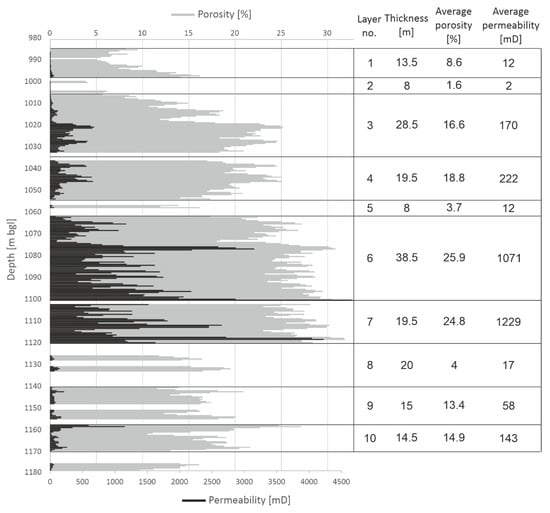
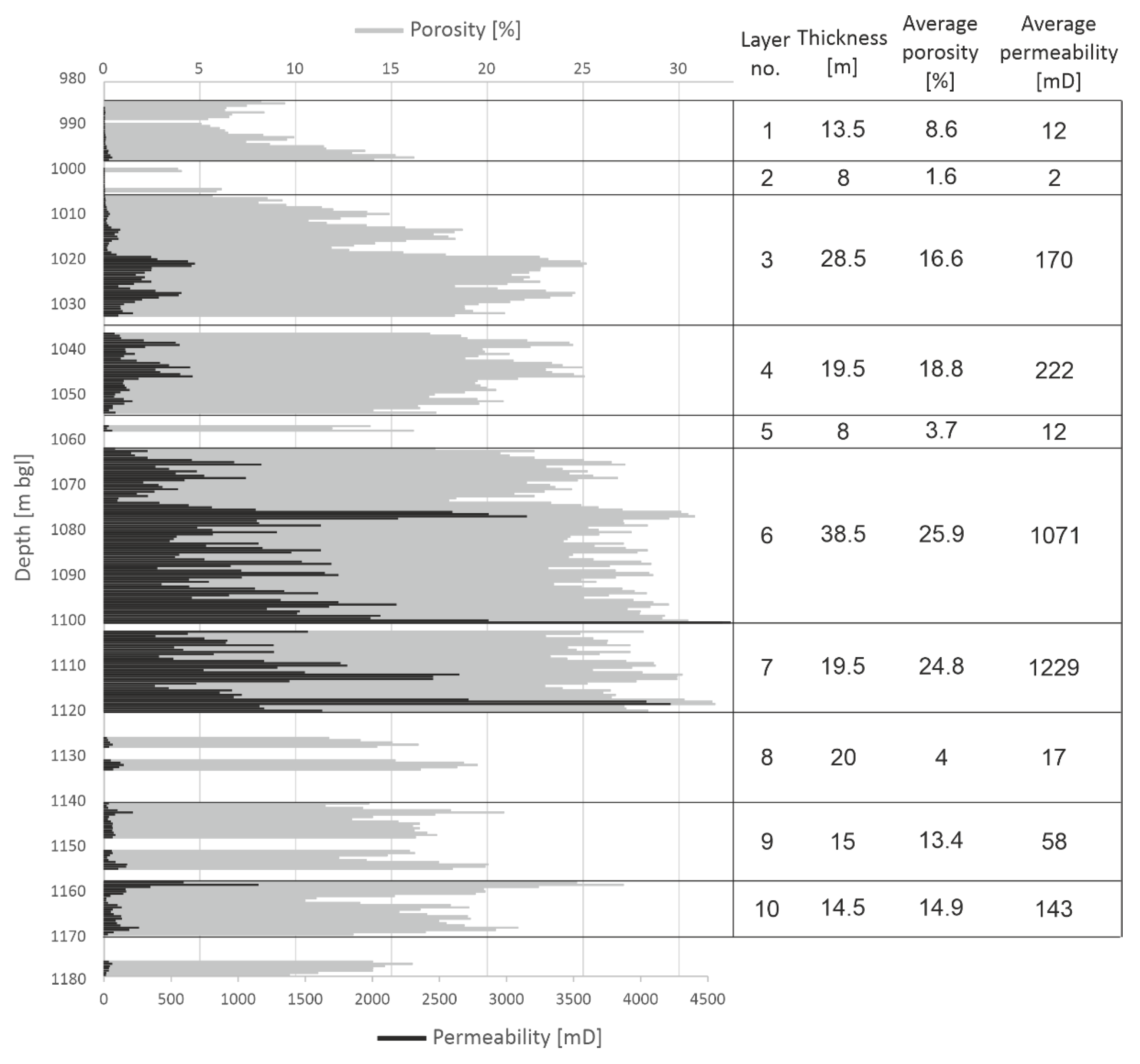
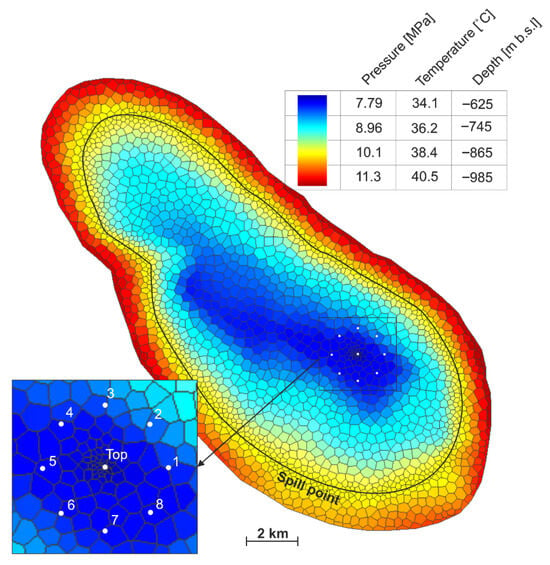
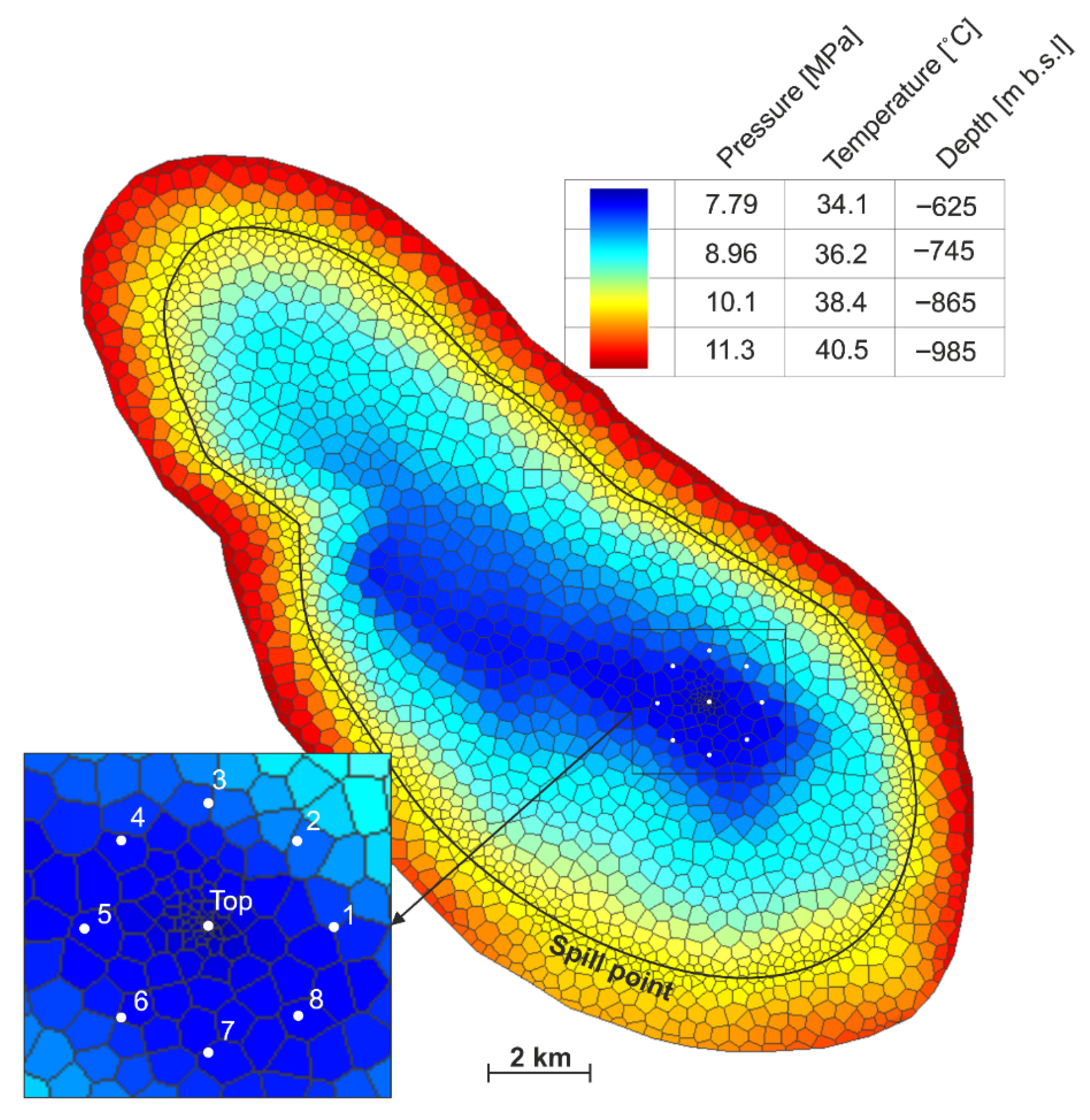
Geophysical analysis from the Jeżów IG-1 well log enabled the determination of rock porosity and permeability and allowed for the identification of 10 distinct layers within the Drzewica Formation, each characterized by different porosity and permeability values [77]. Among these, layers 6 and 7 were selected for hydrogen injection (Figure 1). The model boundary was defined to encompass the entire geological structure, as delineated by the spill point corresponding to the −850 m contour line of the Drzewica Formation top surface (Figure 2); this contour line was selected as the spill point because it represents the lowest closed contour enclosing the structure, ensuring that the injected hydrogen remains trapped and does not migrate outside the dome structure. The colors on Figure 2 represent variations in reservoir depth, temperature, and pressure. Cooler colors (blue) correspond to shallower parts of the structure with lower temperature and pressure, while warmer colors (yellow to red) indicate deeper zones characterized by higher temperature and pressure.
Figure 1.
Porosity and permeability profile of the Drzewica Formation reservoir in the Jeżów IG-1 well [77].
Figure 2.
Model of the Jeżów dome structure presented in PetraSim TOUGH2 software, with injection wells used in the hydrogen injection simulations (an enlarged view shows the detailed locations of the wells).
The modeled area covers 188 km2, with the structural boundary—defined by the –850 m contour of the top of the Drzewica Formation—occupying 122 km2. The total number of computational cells in the PetraSim TOUGH2 model is approximately 20,000. For the purpose of H2 injection simulations, a polygonal grid based on a Voronoi cell partitioning method was applied. The mesh was refined along the structural boundary and in the vicinity of each injection well location (Figure 2). Mesh refinement at the structural boundary (spill point) was applied to accurately capture potential hydrogen migration beyond this boundary and to ensure containment within the closed geological trap. Meanwhile, local mesh refinement was performed around each newly added well to improve resolution in areas of dynamic flow behavior. For clarity in visualization, detailed mesh refinement is only shown at the well on the top of the structure, while for the remaining wells (1–8), only their locations are indicated.
2.4. Setting the Boundary Conditions for Hydrogen Injection
Dynamic capacity was defined as the mass of hydrogen injected until the boundary conditions were reached—pressure values approaching the fracturing pressure and capillary caprock pressure. The analysis also included the direction and extent of hydrogen plume migration, as well as pore saturation levels, in order to assess the risk of uncontrolled gas movement.
The allowable pressure increase resulting from H2 injection into the Jeżów structure—analogous to the calculation of permissible pressures and stresses in underground gas storage—was determined using the Kirsch equation, which estimates pore pressure increase due to fluid injection into a wellbore [82]. The tensile strength of the rock was assumed to be 6.45 MPa, corresponding to the average value obtained from laboratory tests on typical reservoir rock samples from the “Swarzów” underground gas storage facility [83]. In addition to fracturing pressure, capillary pressure was also considered; it was defined using the Young–Laplace equation [84,85,86]. The values of interfacial tension between H2 and brine (γ), as well as the contact angle (θ), were adopted as functions of depth, based on the formulas provided by Iglauer [65]. The characteristic pore radius of the caprock pore space in Poland was determined by Tarkowski and Wdowin [87] and Tarkowski et al. [88] and falls within the range of 0.01–0.1 μm. For further calculations, a conservative pore radius value of 0.1 μm was assumed for safety reasons. The procedure for calculating fracturing pressure is presented in the appendix of the article by Tarkowski et al. [89]. The values of fracturing pressure and capillary pressure are presented in Table 1.
Table 1.
Hydrogen injection rate and storage capacity in the Jeżów dome structure as a function of injection well location, along with the calculated fracturing pressure and capillary pressure for each well.
2.5. Simulation Scenarios
Hydrogen injections were simulated for nine well locations positioned near the top of the structure, within a variably inclined reservoir layer. The scenarios considered different injection flow rates and analyzed hydrogen plume migration as a function of time, enabling a comparison of the efficiency of each variant.
The analyzed well locations (of wells 1–8 and the well located at the top of the dome structure, Top) were characterized by two geometric parameters: the secant dip angle relative to the top of the dome structure and the tangent dip angle at the well location (Table 1).
The secant dip angle was calculated based on the depth difference between the injection well and the top of the dome structure, assuming a fixed horizontal distance of 1000 m (except for the reference well, Top) (Figure 2). The tangent of the angle was defined as the ratio of vertical drop to the assumed horizontal distance, which allowed for a direct representation of variations in the morphology of the reservoir surface.
3. Results
3.1. Capacity Assessment
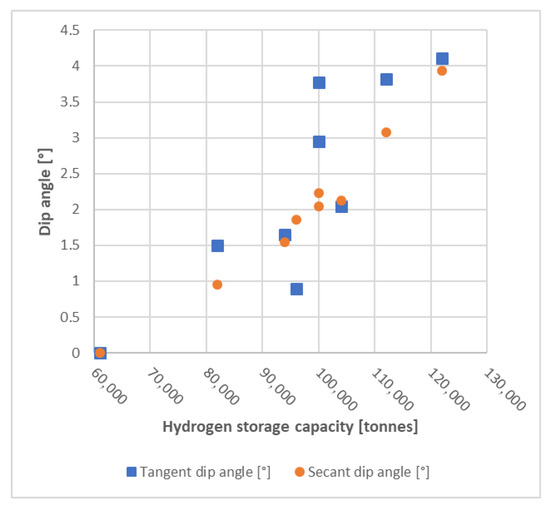
Table 1 presents the two geometric parameters used to characterize the well locations (1–8 and at the top of the dome structure): the secant dip angle relative to the top of the dome structure and the tangent dip angle at the well location. The table also includes the values for injection rate, reservoir depth range, fracturing pressure range, and caprock capillary pressure. Analysis of the hydrogen injection simulation results for the Jeżów structure, summarized in Table 1 and illustrated in Figure 3, clearly confirms that the location of the injection well has a significant impact on the achievable storage capacity. It can be seen that the secant dip angle relative to the top of the dome structure has a more pronounced impact on this capacity than the tangent dip angle at the well location, although both parameters show a trend of capacity increasing with dip angle.
Figure 3.
Graph illustrating the relationship between hydrogen storage capacity and injection well location in the Jeżów structure, expressed in terms of tangent and secant dip angles.
The highest storage capacity—122,000 tonnes of H2—is obtained for well location no. 2, which is characterized by both the greatest secant dip angle relative to the top of the dome structure (3.94°) and the greatest tangent dip angle at the well location (4.11°). The reference point—the well located at the top of the dome structure (Top)—exhibits the lowest capacity, amounting to 61,000 tonnes of H2. This means that the maximum hydrogen storage capacity is twice as high as the minimum value observed at the top of the structure. The average hydrogen storage capacity calculated for all analyzed well locations is approximately 96,400 tonnes. The value for well 2 exceeds the average by about 27%, while that for the Top location is approximately 37% below it.
The graph (Figure 3) shows a clear, nearly linear positive correlation between storage capacity and secant dip angle relative to the top of the dome structure. The tangent dip angle at the well location also shows a positive trend, though it is less consistent and pronounced compared to that of the secant dip angle. This suggests that the secant angle has a more definitive and stronger influence on storage capacity. Consequently, relocating the injection well to a zone where the reservoir layers exhibit a steeper secant dip increases the storage volume.
3.2. Hydrogen Plume Migration
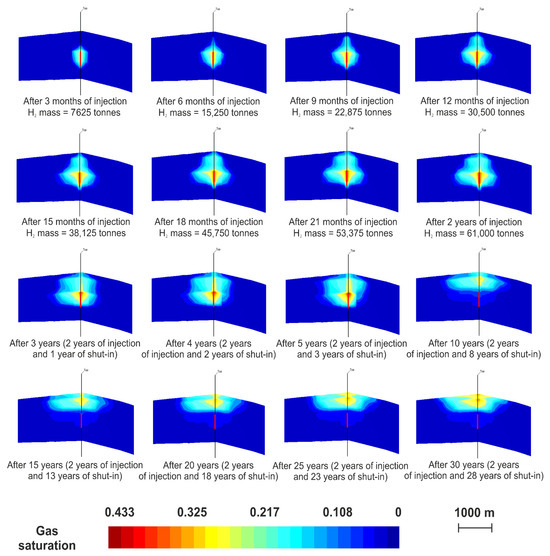
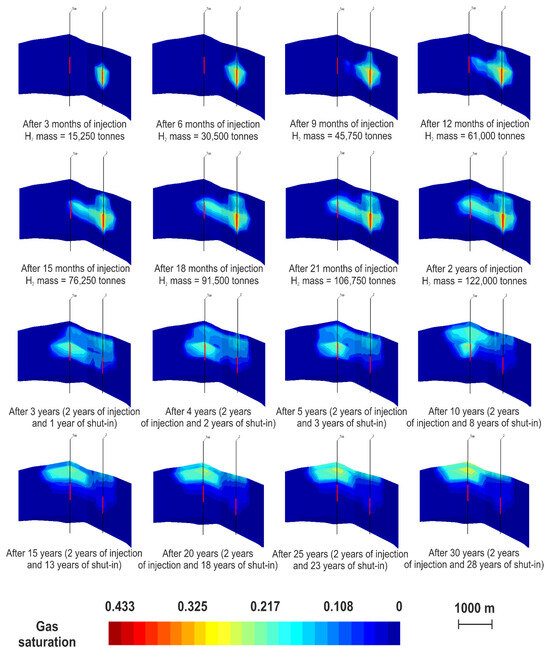
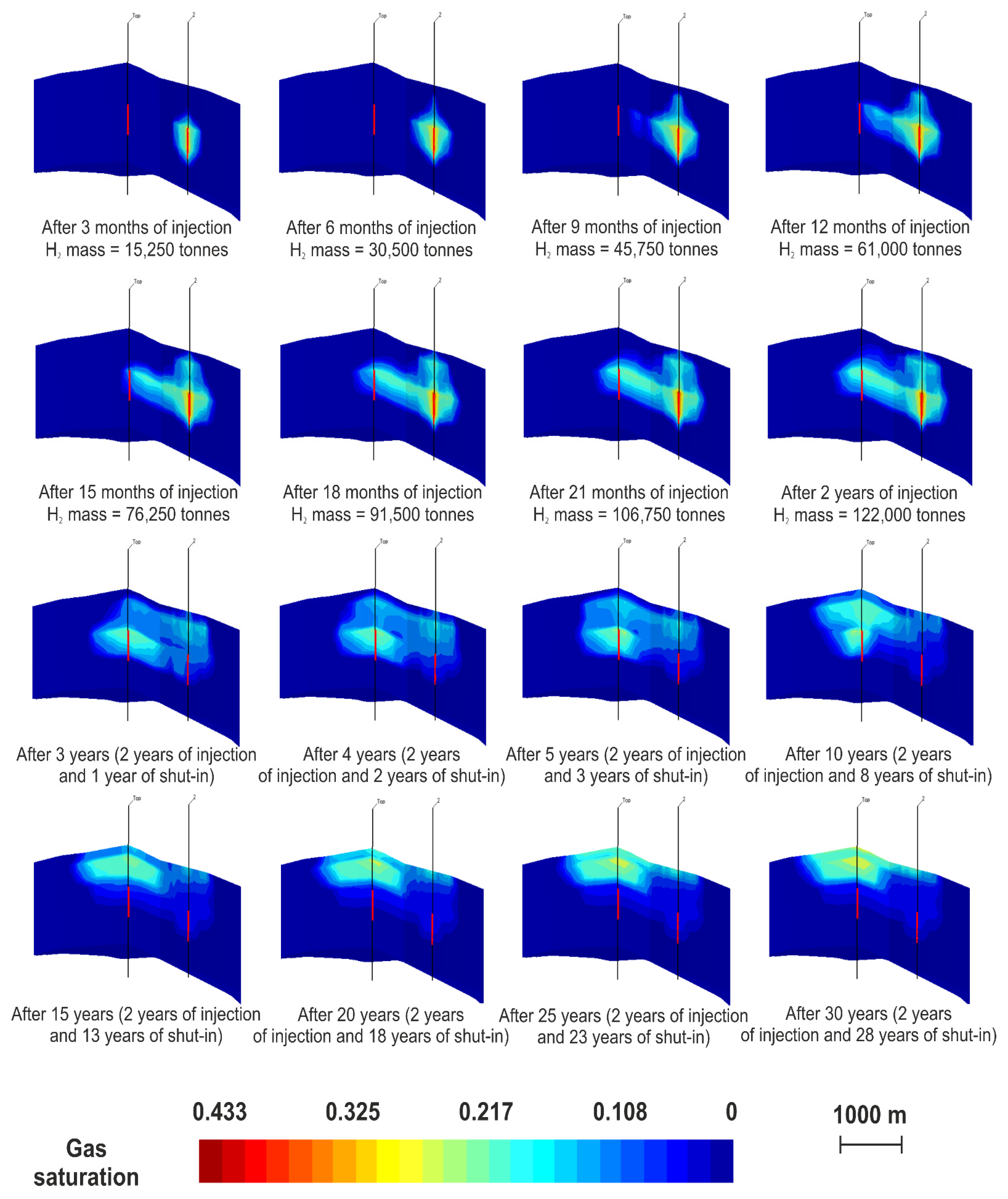
Figure 4 presents a series of cross-sections through the Jeżów structure, illustrating hydrogen migration during the 2-year injection period and in the subsequent years (total observation time: 30 years). The successive cross-sections show changes in hydrogen plume migration (gas phase saturation) along a vertical profile intersecting the injection well located at the top of the dome structure. The red interval within the well corresponds to layers 6 and 7, which exhibit the best reservoir properties and are used for hydrogen injection during the first two years of the simulation. The color scale at the bottom indicates the hydrogen gas saturation values in the pore space.
Figure 4.
Hydrogen plume migration at the top of the dome structure during the 2-year injection period and over the 28-year post-injection phase.
In the initial phase of injection (months 3–9), hydrogen accumulates in the immediate vicinity of the injection well, forming a vertically elongated zone primarily confined to the most permeable reservoir intervals (layers 6 and 7). As injection continues (months 12–24), the gas front gradually expands upward and laterally, eventually reaching the top zone of the structure. Over time, the saturation zone becomes increasingly asymmetrical, reflecting local variations in reservoir layer dip angle. Despite reservoir heterogeneity—particularly the decrease in reservoir quality (porosity and permeability) in the upper parts of the structure—gas migration toward the top of the dome structure is observed. After the injection period ends (2 years), a slow redistribution of the gas is observed—saturation decreases in the near-wellbore zone, while the main volume of hydrogen migrates upward, above the injection interval. In the following decades, the gas stabilizes beneath the sealing layers, showing no tendency to migrate downward. Instead, an increase in saturation is observed in the top zone of the dome structure.
Figure 5 presents the migration of hydrogen during the 2-year injection period and over the 28-year post-injection phase for a well located 1000 m horizontally from the top of the Jeżów dome structure (well no. 2), which demonstrates the highest storage capacity (122,000 tonnes of H2). The individual cross-sections show changes in gas saturation over time during and after injection. This location (Table 1) is also characterized by the greatest secant dip angle relative to the top of the dome structure and the greatest tangent dip angle at the well location, which promotes gas migration and the formation of an extensive hydrogen-saturated zone beneath the sealing caprock. In the initial phase (months 3–9), hydrogen accumulates in the immediate vicinity of the injection interval (highlighted in red), forming a high-saturation zone. Over time (months 12–24), the gas zone expands both upward and laterally toward the structural top, occupying an increasing volume of the reservoir’s pore space. After the injection ends, a decrease in saturation is observed within the injection interval, accompanied by gas migration toward the upper parts of the structure. After 30 years, the main volume of hydrogen remains trapped above the original injection interval, due to the dominant influence of buoyancy and structural trapping mechanisms, despite the lower reservoir quality in terms of porosity and permeability in the upper layers.
Figure 5.
Hydrogen plume migration during the 2-year injection period and over the 28-year post-injection phase for well 2, located 1000 m from the top of the structure, for which the highest storage capacity is obtained.
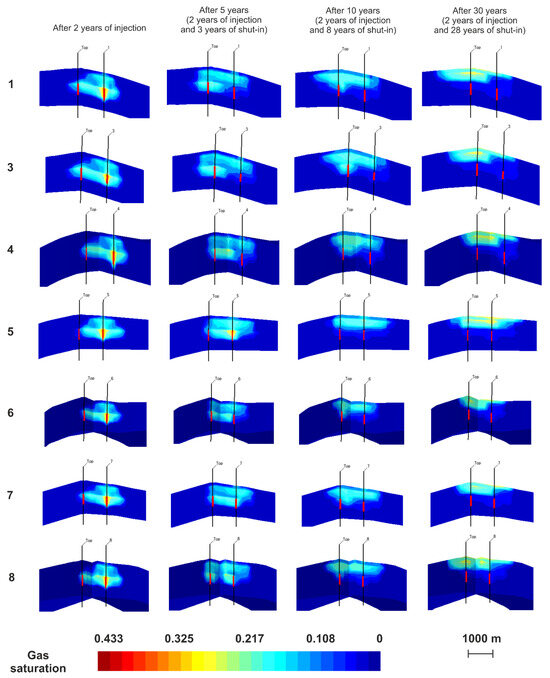
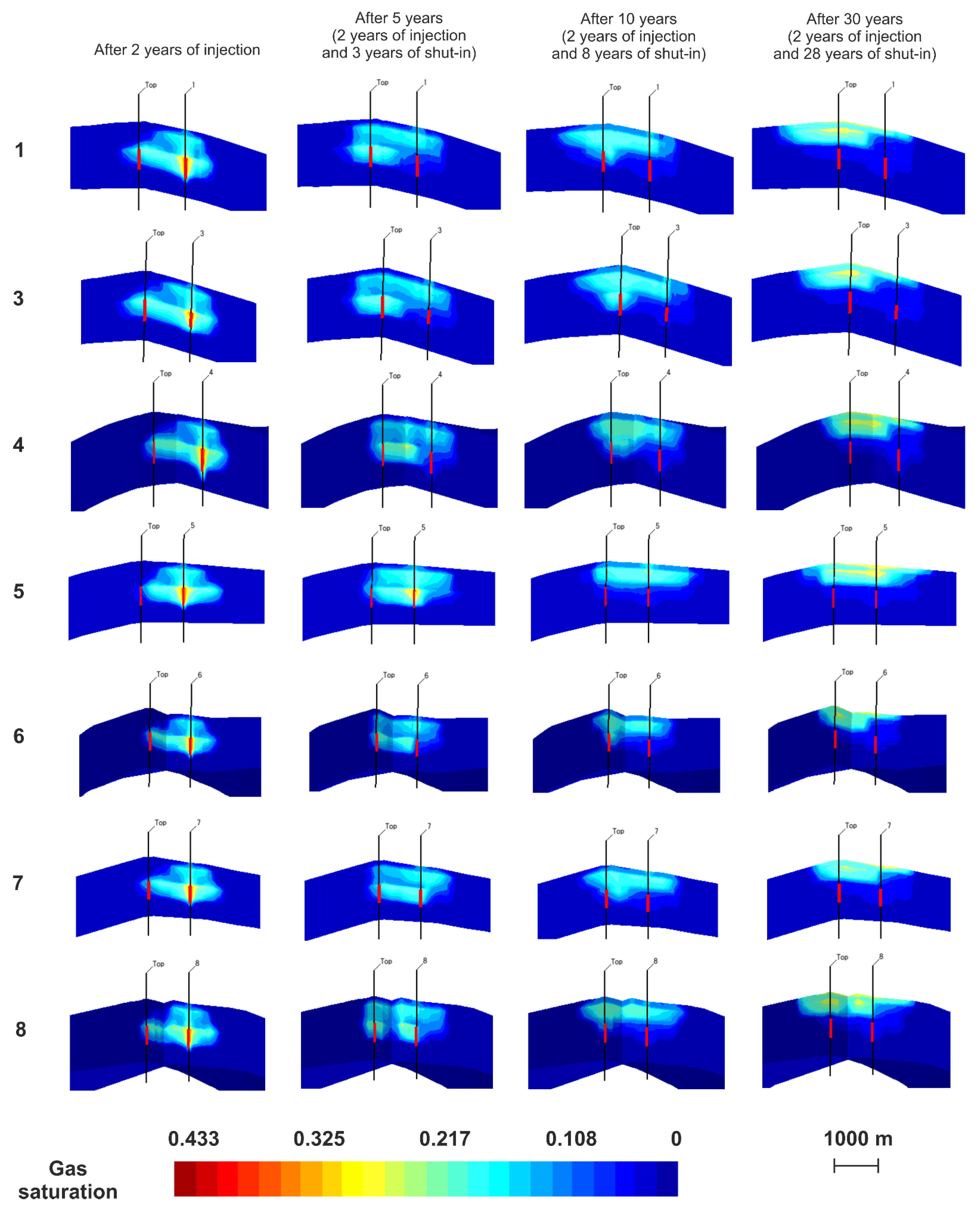
Figure 6 presents hydrogen migration after the 2-year injection period and after 5 years (2 years of injection + 3 years of monitoring), 10 years (2 + 8), and 30 years (2 + 28) for wells 1 and 3–8, located 1000 m from the top of the Jeżów structure (Figure 2). Each row corresponds to a different well location, for which storage capacity, depth, and reservoir surface secant and tangent dip angles are provided in Table 1. The well labeled Top is included in the cross-sections for reference purposes only—to indicate the position of the top of the dome structure. In all analyzed cases, the red interval along each well indicates the section with the most favorable reservoir parameters.
Figure 6.
Hydrogen migration plume after the 2-year injection period and after 3, 8, and 28 years of shut-in for wells (1, 3–8), located 1000 m from the top of the dome structure.
Following the completion of the 2-year injection period, distinct differences in the shape and extent of the hydrogen-saturated zone are observed, depending on time, depth difference, and reservoir dip angle. In wells with steeper dip angles (wells 1, 3, 4, and 2), hydrogen migrates more effectively toward the top of the structure, forming an extensive plume and resulting in the highest dynamic storage capacities. In these cases, the gas spreads more widely within the reservoir, utilizing a greater volume of pore space. The resulting hydrogen plume is more extensive but less concentrated—it does not form a clearly defined, uniform gas cap. In structures with lower dip angles (wells 5, 7, and 8), the saturation zone remains more symmetrical and spatially confined, with the hydrogen plume stabilizing closer to the original injection zone, forming a more stable region with locally elevated saturation. Over the long term (30 years), hydrogen remains in the upper parts of the structure, showing minimal changes in saturation and no tendency for downward migration.
4. Discussion
Hydrogen injection simulations for the Jeżów dome structure confirm that both trap geometry and injection well placement are key factors determining dynamic storage capacity and the stability of the H2 plume. The results indicate that an increased secant dip angle of the reservoir surface relative to the top of the dome structure, as well as a higher tangent dip angle at the well location, favors greater storage capacity. However, this also intensifies gas migration toward the top of the structure, which may lead to the loss of part of the working gas volume—particularly in a single-well storage scenario. Similar relationships between well location and hydrogen dynamic capacity were reported by Luboń and Tarkowski [90] in their analysis of the Sierpc structure.
The dynamics of the hydrogen plume in the Jeżów structure confirm its high mobility and predominantly vertical flow direction. During injection, a gradual upward movement and expansion of the H2 plume toward the caprock and the top of the dome structure is observed, along with a progressive increase in its lateral extent over time. These phenomena are consistent with the findings of numerous simulation studies [52,53,54,55,56,57,59,60,66,69], which also reported vertical hydrogen migration toward the upper parts of reservoirs in the presence of formation water. Even experimental results on sandstone cores [91] confirm that injected hydrogen immediately migrates toward the upper sections of the pore medium, where it accumulates beneath the caprock due to its high buoyancy and low density relative to brine. Misaghi Bonabi et al. [62] demonstrated that hydrogen exhibits greater buoyancy than CO2, resulting in intense upward plume penetration toward the caprock, even in the presence of carbon dioxide. A similar effect—enhanced upward flow in the presence of CO2—was also observed by Bai et al. [61]. Meanwhile, Feldmann et al. [92] emphasize that although the density difference between hydrogen and methane or nitrogen is smaller than that between hydrogen and CO2, hydrogen still shows a clear tendency to rise toward the top of reservoirs in the presence of these gases. This confirms its high mobility and dominant upward migration under underground storage conditions. After the end of the injection phase in the Jeżów structure, gradual stabilization of the hydrogen plume is observed, with partial redistribution beyond the original injection interval—an effect consistent with the trends described by Misaghi Bonabi et al. [62].
The single-well scenario analysis conducted for the Jeżów structure confirmed that while placing the well in a zone with a steeper dip increases dynamic storage capacity, it simultaneously complicates control over gas migration. Harati et al. [5] demonstrated that in dome-shaped structures, multi-well systems provide better control over pressure gradients and reduce the risk of upconing, thereby improving hydrogen recovery efficiency. Similarly, Verma et al. [28] showed that separating injection and production functions can increase gas recovery by up to 50% compared to single-well configurations. Feldmann et al. [92] argued that injection wells should not be placed directly beneath the tops of structures, to avoid excessive gas accumulation beneath the sealing caprock layer; in contrast, multi-well configurations enable more effective control of pressure gradients and reduce the upward migration of hydrogen toward the caprock. In contrast, Wang et al. [56] reached different conclusions, indicating that well configuration and perforation placement significantly influence the saturation distribution—and that the most effective strategy uses a single well located at the top of the structure, with perforations positioned near the top of the reservoir. Likewise, modeling results presented by various authors [54,55,57] commonly locate injection–production wells at the top of dome structures. These authors emphasize that proper design of wells in the upper parts of reservoirs and careful management of buoyancy effects are critical for limiting gas redistribution and minimizing hydrogen losses during the injection–withdrawal cycle. Additionally, Albadan et al. [58] analyzed two injection–production wells located at the tops of two separate domes of the same structure and confirmed that well placement near the structural top enabled effective utilization of hydrogen buoyancy and contributed to the higher purity of the recovered gas. Although these results differ in some respects, they are consistent with our observations, suggesting that operational efficiency requires spatial hydrogen plume control and a functional differentiation of wells within the dome structure.
In summary, the dip of reservoir layers and the configuration of injection wells jointly determine the capacity and stability of underground hydrogen storage systems. Locating wells in parts of a structure with steeper reservoir layer dip favors higher storage capacities but requires precise flow control and a well-designed gas withdrawal strategy. The application of single- or multi-well configurations, along with pressure management—combined with experience gained from CCS and UGS—provides a practical and safe pathway for advancing UHS technology in aquifer-based geology.
In future work, particular attention should be given to evaluating how structural heterogeneity, permeability anisotropy, and the complex geometry of dome-shaped reservoirs at the field scale influence hydrogen plume evolution, containment efficiency, and the overall integrity of underground storage systems.
5. Conclusions
A geological model of the Jeżów anticlinal dome structure was developed and used to dynamically simulate hydrogen injection and storage. Nine injection scenarios corresponding to different well placements were analyzed. The conducted study confirmed the research hypotheses regarding the influence of structural geometry and injection well location on dynamic storage capacity and hydrogen plume migration in an anticlinal dome structure.
The simulation results showed that an increase in the dip angle of reservoir layers—both the secant dip angle relative to the top of the dome structure and the tangent dip angle at the well location—leads to greater dynamic storage capacity due to a more favorable gas trapping geometry. The highest capacity (122,000 tonnes of H2) is obtained at the location with the steepest dip, whereas the well situated directly at the top of the dome yields nearly half that amount (61,000 tonnes of H2). Among the two dip angle measures, the secant angle exhibits a stronger and nearly linear correlation with storage capacity, while the tangent angle shows a positive but less consistent trend. These findings highlight that the geometry of the reservoir, particularly the secant dip angle, plays a critical role in determining storage performance. Therefore, locating injection wells in areas where the reservoir layers dip more steeply from the top of the dome structure can significantly enhance hydrogen storage capacity.
However, while steeper dip angles favor increased capacity, they also influence the spatial behavior of the gas plume. Wells located in zones with steeper dip angles result in higher storage capacity but promote hydrogen migration toward the caprock and the development of an asymmetrical gas plume. In contrast, wells positioned in areas with lower dip angles allow for more stable accumulation, but this is at the cost of reduced storage capacity.
These results indicate that in the case of a single-well configuration for hydrogen storage in a dome-shaped aquifer, the most favorable solution is to locate the well near to the top of the dome structure, which enables effectively utilizing the buoyancy of hydrogen and limits its redistribution. When the well is located on the limb of the structure, gas withdrawal should occur shortly after the injection phase ends—before hydrogen disperses and migrates beyond the original injection interval. However, for long-term storage scenarios, it may be necessary to drill an additional production well to enable efficient gas recovery after redistribution. Additionally, if the injection well is placed on the steeper limb of the structure, the hydrogen plume will migrate more rapidly toward the caprock, which may also require the drilling of a second production well in a higher structural zone and the implementation of a multi-well system.
Author Contributions
Conceptualization, K.L. and R.T.; methodology, K.L.; software, K.L.; validation, R.T.; formal analysis, R.T.; investigation, K.L.; resources, R.T.; data curation, K.L. and R.T.; writing—original draft preparation, K.L.; writing—review and editing, K.L. and R.T.; visualization, K.L.; supervision, R.T.; project administration, R.T.; funding acquisition, R.T. All authors have read and agreed to the published version of the manuscript.
Funding
This work was supported by the Mineral and Energy Economy Research Institute of the Polish Academy of Sciences (Research Subvention).
Data Availability Statement
Data are contained within the article.
Conflicts of Interest
The authors declare no conflict of interest.
References
- Shu, K.; Guan, B.; Zhuang, Z.; Chen, J.; Zhu, L.; Ma, Z.; Hu, X.; Zhu, C.; Zhao, S.; Dang, H.; et al. Reshaping the energy landscape: Explorations and strategic perspectives on hydrogen energy preparation, efficient storage, safe transportation and wide applications. Int. J. Hydrogen Energy 2025, 97, 160–213. [Google Scholar] [CrossRef] [Scilit]
- Ge, L.; Zhang, B.; Huang, W.; Li, Y.; Hou, L.; Xiao, J.; Mao, Z.; Li, X. A review of hydrogen generation, storage, and applications in power system. J. Energy Storage 2024, 75, 109307. [Google Scholar] [CrossRef] [Scilit]
- Uliasz-Misiak, B.; Lewandowska-Śmierzchalska, J.; Matuła, R.; Tarkowski, R. Prospects for the Implementation of Underground Hydrogen Storage in the EU. Energies 2022, 15, 9535. [Google Scholar] [CrossRef] [Scilit]
- Benalcazar, P.; Komorowska, A. Techno-economic analysis and uncertainty assessment of green hydrogen production in future exporting countries. Renew. Sustain. Energy Rev. 2024, 199, 114512. [Google Scholar] [CrossRef] [Scilit]
- Harati, S.; Rezaei Gomari, S.; Gasanzade, F.; Bauer, S.; Pak, T.; Orr, C. Underground hydrogen storage to balance seasonal variations in energy demand: Impact of well configuration on storage performance in deep saline aquifers. Int. J. Hydrogen Energy 2023, 48, 26894–26910. [Google Scholar] [CrossRef] [Scilit]
- Tahmasbi, M.; Siavashi, M.; Ahmadi, R. A comprehensive review of hydrogen production and storage methods: Fundamentals, advances, and SWOT analysis. Energy Convers. Manag. X 2025, 26, 101005. [Google Scholar] [CrossRef] [Scilit]
- Kamran, M.; Turzyński, M. Exploring hydrogen energy systems: A comprehensive review of technologies, applications, prevailing trends, and associated challenges. J. Energy Storage 2024, 96, 112601. [Google Scholar] [CrossRef] [Scilit]
- Muhammed, N.S.; Gbadamosi, A.O.; Epelle, E.I.; Abdulrasheed, A.A.; Haq, B.; Patil, S.; Al-Shehri, D.; Kamal, M.S. Hydrogen production, transportation, utilization, and storage: Recent advances towards sustainable energy. J. Energy Storage 2023, 73, 109207. [Google Scholar] [CrossRef] [Scilit]
- Mwakipunda, G.C.; Franck Kouassi, A.K.; Ayimadu, E.T.; Komba, N.A.; Nadege, M.N.; Mgimba, M.M.; Ngata, M.R.; Yu, L. Underground hydrogen storage in geological formations: A review. J. Rock Mech. Geotech. Eng. 2025, 17, 6704–6741. [Google Scholar] [CrossRef] [Scilit]
- Opoku Duartey, K.; Ampomah, W.; Rahnema, H.; Mehana, M. Underground Hydrogen Storage: Transforming Subsurface Science into Sustainable Energy Solutions. Energies 2025, 18, 748. [Google Scholar] [CrossRef] [Scilit]
- Benalcazar, P.; Komorowska, A. Techno-economics of Green Hydrogen: Present Trends and Future Prospects. In Challenges and Opportunities in Green Hydrogen Production; Singh, P., Agarwal, A.K., Thakur, A., Sinha, R.K., Eds.; Springer: Berlin/Heidelberg, Germany, 2024; Volume Chapter 23, pp. 569–597. ISBN 9789819713387. [Google Scholar]
- Gianni, E.; Tyrologou, P.; Couto, N.; Carneiro, J.F.; Scholtzová, E.; Koukouzas, N. Underground hydrogen storage: The techno-economic perspective. Open Res. Eur. 2024, 4, 17. [Google Scholar] [CrossRef] [Scilit]
- Raza, A.; Mahmoud, M.; Arif, M.; Alafnan, S. Underground hydrogen storage prospects in the Kingdom of Saudi Arabia. Fuel 2024, 357, 129665. [Google Scholar] [CrossRef] [Scilit]
- Tagliapietra, S.; Zachmann, G.; Edenhofer, O.; Glachant, J.M.; Linares, P.; Loeschel, A. The European union energy transition: Key priorities for the next five years. Energy Policy 2019, 132, 950–954. [Google Scholar] [CrossRef] [Scilit]
- Davoodi, S.; Al-Shargabi, M.; Wood, D.A.; Longe, P.O.; Mehrad, M.; Rukavishnikov, V.S. Underground hydrogen storage: A review of technological developments, challenges, and opportunities. Appl. Energy 2025, 381, 125172. [Google Scholar] [CrossRef] [Scilit]
- Taiwo, G.O.; Tomomewo, O.S.; Oni, B.A. A comprehensive review of underground hydrogen storage: Insight into geological sites (mechanisms), economics, barriers, and future outlook. J. Energy Storage 2024, 90, 111844. [Google Scholar] [CrossRef] [Scilit]
- Heinemann, N.; Alcalde, J.; Miocic, J.M.; Hangx, S.J.T.; Kallmeyer, J.; Ostertag-Henning, C.; Hassanpouryouzband, A.; Thaysen, E.M.; Strobel, G.J.; Schmidt-Hattenberger, C.; et al. Enabling large-scale hydrogen storage in porous media-the scientific challenges. Energy Environ. Sci. 2021, 14, 853–864. [Google Scholar] [CrossRef] [Scilit]
- Hematpur, H.; Abdollahi, R.; Rostami, S.; Haghighi, M.; Blunt, M.J. Review of underground hydrogen storage: Concepts and challenges. Adv. Geo-Energy Res. 2023, 7, 111–131. [Google Scholar] [CrossRef] [Scilit]
- Van Gessel, S.; Hajibeygi, H. Hydrogen TCP-Task 42 Underground Hydrogen Storage: Technology Monitor Report; Technische Universiteit Delft: Delft, The Netherlands, 2023. [Google Scholar]
- Navaid, H.; Emadi, H.B.; Watson, M. A comprehensive literature review on the challenges associated with underground hydrogen storage. Int. J. Hydrogen Energy 2023, 48, 10603–10635. [Google Scholar] [CrossRef] [Scilit]
- Zivar, D.; Kumar, S.; Foroozesh, J. Underground hydrogen storage: A comprehensive review. Int. J. Hydrogen Energy 2021, 46, 23436–23462. [Google Scholar] [CrossRef] [Scilit]
- Bade, S.O.; Taiwo, K.; Ndulue, U.F.; Tomomewo, O.S.; Aisosa Oni, B. A review of underground hydrogen storage systems: Current status, modeling approaches, challenges, and future prospective. Int. J. Hydrogen Energy 2024, 80, 449–474. [Google Scholar] [CrossRef] [Scilit]
- Fuentes Quintos, E.J.; Santos, D.M.F. Technical and Economic Viability of Underground Hydrogen Storage. Hydrogen 2023, 4, 975–1000. [Google Scholar] [CrossRef] [Scilit]
- Leng, G.; Yan, W.; Chen, Z.; Li, Z.; Liu, B.; Deng, P.; Zhang, C.; Liu, W.; Qi, H. Technical challenges and opportunities of hydrogen storage: A comprehensive review on different types of underground storage. J. Energy Storage 2025, 114, 115900. [Google Scholar] [CrossRef] [Scilit]
- Heinemann, N.; Scafidi, J.; Pickup, G.; Thaysen, E.M.; Hassanpouryouzband, A.; Wilkinson, M.; Satterley, A.K.; Booth, M.G.; Edlmann, K.; Haszeldine, R.S. Hydrogen storage in saline aquifers: The role of cushion gas for injection and production. Int. J. Hydrogen Energy 2021, 46, 39284–39296. [Google Scholar] [CrossRef] [Scilit]
- Khandoozi, S.; Li, P.; Ershadnia, R.; Dai, Z.; Zhang, Z.; Stauffer, P.H.; Mehana, M.; Cole, D.R.; Soltanian, M.R. An integrated approach for optimizing geological hydrogen storage. Appl. Energy 2025, 381, 125182. [Google Scholar] [CrossRef] [Scilit]
- Miocic, J.; Heinemann, N.; Edlmann, K.; Scafidi, J.; Molaei, F.; Alcalde, J. Underground hydrogen storage: A review. Geol. Soc. Spec. Publ. 2023, 528, 73–86. [Google Scholar] [CrossRef] [Scilit]
- Verma, A.; Malik, S.; Pal, M. Evaluating the Potential for Underground Hydrogen Storage (UHS) in Lithuania: A Review of Geological Viability and Storage Integrity. Appl. Sci. 2025, 15, 1614. [Google Scholar] [CrossRef] [Scilit]
- Caglayan, D.G.; Weber, N.; Heinrichs, H.U.; Linßen, J.; Robinius, M.; Kukla, P.A.; Stolten, D. Technical potential of salt caverns for hydrogen storage in Europe. Int. J. Hydrogen Energy 2020, 45, 6793–6805. [Google Scholar] [CrossRef] [Scilit]
- Lankof, L.; Tarkowski, R. Potencjał magazynowy wodoru w permskich złożach soli kamiennej w Polsce/Hydrogen storage potential in Permian rock salts in Poland. Przegląd Solny 2021, 16, 29–42. [Google Scholar]
- Zeng, L.; Sander, R.; Chen, Y.; Xie, Q. Hydrogen Storage Performance During Underground Hydrogen Storage in Depleted Gas Reservoirs: A Review. Engineering 2024, 40, 211–225. [Google Scholar] [CrossRef] [Scilit]
- Kanaani, M.; Sedaee, B.; Asadian-Pakfar, M. Role of Cushion Gas on Underground Hydrogen Storage in Depleted Oil Reservoirs. J. Energy Storage 2022, 45, 103783. [Google Scholar] [CrossRef] [Scilit]
- Ramsari, M.; Jafari, A.; Namdar, H.; Khoozan, D. Evaluating the role of cushion gas in underground hydrogen storage: Impacts of wells and reservoir parameters. Int. J. Hydrogen Energy 2025, 100, 1338–1352. [Google Scholar] [CrossRef] [Scilit]
- Zamagni, A.; Mancini, L.; Eynard, U.; Arrigoni, A.; Mathieux, F. A Conceptual Framework for Assessing and Monitoring Social Risks and Impacts Related to Hydrogen Technologies and Their Value Chains; Publications Office of the European Union: Luxembourg, 2025; ISBN 9789268291917. [Google Scholar]
- Collina, G.; Bucelli, M.; Paltrinieri, N. Multi-stage monitoring of hydrogen systems for improved maintenance approaches: An extensive review. Int. J. Hydrogen Energy 2025, 105, 458–480. [Google Scholar] [CrossRef] [Scilit]
- DOE/NETL. Best Practices: Monitoring, Verification, and Accounting (MVA) for Geologic Storage Projects; NETL: Albany, Australia; Anchorage, AK, USA; Houston, TX, USA; Morgantown, WV, USA; Pittsburgh, PA, USA, 2017. [Google Scholar]
- Tarkowski, R.; Uliasz-Misiak, B. Public Acceptance of the Underground Storage of Hydrogen: Lessons Learned from the Geological Storage of CO2. Energies 2025, 18, 1335. [Google Scholar] [CrossRef] [Scilit]
- Shahriar, M.F.; Khanal, A.; Khan, M.I.; Pandey, R. Current status of underground hydrogen storage: Perspective from storage loss, infrastructure, economic aspects, and hydrogen economy targets. J. Energy Storage 2024, 97, 112773. [Google Scholar] [CrossRef] [Scilit]
- Dopffel, N.; Jansen, S.; Gerritse, J. Microbial side effects of underground hydrogen storage—Knowledge gaps, risks and opportunities for successful implementation. Int. J. Hydrogen Energy 2021, 46, 8594–8606. [Google Scholar] [CrossRef] [Scilit]
- Labus, K.; Tarkowski, R. Modeling hydrogen—Rock—Brine interactions for the Jurassic reservoir and cap rocks from Polish Lowlands. Int. J. Hydrogen Energy 2022, 47, 10947–10962. [Google Scholar] [CrossRef] [Scilit]
- Panfilov, M. Underground Storage of Hydrogen: In Situ Self-Organisation and Methane Generation. Transp. Porous Media 2010, 85, 841–865. [Google Scholar] [CrossRef] [Scilit]
- Reitenbach, V.; Ganzer, L.; Albrecht, D.; Hagemann, B. Influence of added hydrogen on underground gas storage: A review of key issues. Environ. Earth Sci. 2015, 73, 6927–6937. [Google Scholar] [CrossRef] [Scilit]
- Schwab, L.; Popp, D.; Nowack, G.; Bombach, P.; Vogt, C.; Richnow, H.H. Structural analysis of microbiomes from salt caverns used for underground gas storage. Int. J. Hydrogen Energy 2022, 47, 20684–20694. [Google Scholar] [CrossRef] [Scilit]
- Krevor, S.; Coninck, H.; de Gasda, S.E.; Ghaleigh, N.S.; Gooyert, V.; de Hajibeygi, H.; Juanes, R.; Neufeld, J.; Roberts, J.J.; Swennenhuis, F. Subsurface carbon dioxide and hydrogen storage for a sustainable energy future. Nat. Rev. Earth Environ. 2023, 4, 102–118. [Google Scholar] [CrossRef] [Scilit]
- Sharma, P.; Burolia, A.K.; Mandal, A.; Neogi, S. Commercially available resources for physical hydrogen storage and distribution. In Towards Hydrogen Infrastructure: Advances and Challenges in Preparing for the Hydrogen Economy; Elsevier Ltd.: Amsterdam, The Netherlands, 2023; pp. 225–256. ISBN 9780323955539. [Google Scholar]
- Li, X.; Huan, H.; Lin, H.; Li, Z.; Du, F.; Cao, Z.; Fan, X.; Ren, H. Determination method of rational position for working face entries in coordinated mining of section coal pillars and lower sub-layer. Sci. Rep. 2025, 15, 29440. [Google Scholar] [CrossRef] [Scilit]
- Chaoshang, S.; Chaoyang, S.; Zhiming, Z.; Haixiao, L.; Zhenhua, L.; Feng, D.; Zhengzheng, C.; Pengtao, L.; Lin, L. Overburden failure characteristics and fracture evolution rule under repeated mining with multiple key strata control. Sci. Rep. 2025, 15, 28029. [Google Scholar] [CrossRef] [Scilit]
- Aftab, A.; Hassanpouryouzband, A.; Xie, Q.; Machuca, L.L.; Sarmadivaleh, M. Toward a Fundamental Understanding of Geological Hydrogen Storage. Ind. Eng. Chem. Res. 2022, 61, 3233–3253. [Google Scholar] [CrossRef] [Scilit]
- Hashemi, L.; Glerum, W.; Farajzadeh, R.; Hajibeygi, H. Contact angle measurement for hydrogen/brine/sandstone system using captive-bubble method relevant for underground hydrogen storage. Adv. Water Resour. 2021, 154, 103964. [Google Scholar] [CrossRef] [Scilit]
- Muhammed, N.S.; Haq, B.; Al Shehri, D.; Badmus, S.O.; Adebayo, A.R.; Mahmoud, M. Hydrogen injection and withdrawal performance in depleted gas reservoirs. Int. J. Hydrogen Energy 2024, 96, 427–442. [Google Scholar] [CrossRef] [Scilit]
- Zhong, H.; Wang, Z.; Zhang, Y.; Suo, S.; Hong, Y.; Wang, L.; Gan, Y. Gas storage in geological formations: A comparative review on carbon dioxide and hydrogen storage. Mater. Today Sustain. 2024, 26, 100720. [Google Scholar] [CrossRef] [Scilit]
- Luboń, K.; Tarkowski, R. Numerical simulation of hydrogen injection and withdrawal to and from a deep aquifer in NW Poland. Int. J. Hydrogen Energy 2020, 45, 2068–2083. [Google Scholar] [CrossRef] [Scilit]
- Bai, T.; Tahmasebi, P. Coupled hydro-mechanical analysis of seasonal underground hydrogen storage in a saline aquifer. J. Energy Storage 2022, 50, 104308. [Google Scholar] [CrossRef] [Scilit]
- Ahmed, E.; Møyner, O.; Raynaud, X.; Nilsen, H.M. Phase behavior and black-oil simulations of Hydrogen storage in saline aquifers. Adv. Water Resour. 2024, 191, 104772. [Google Scholar] [CrossRef] [Scilit]
- Sun, Q.; Zhang, M.; Ertekin, T. The Design of Hydrogen Saline Aquifer Storage Processes Using a Machine-Learning Assisted Multiobjective Optimization Protocol. SPE J. 2024, 29, 2086–2105. [Google Scholar] [CrossRef] [Scilit]
- Wang, H.; Xin, Y.; Kou, Z.; He, C.; Li, Y.; Wang, T. Unveil the role of engineering parameters on hydrogen recovery in deep saline aquifer, Rock Springs Uplift, Wyoming. Renew. Energy 2024, 225, 120261. [Google Scholar] [CrossRef] [Scilit]
- Bi, Z.; Guo, Y.; Yang, C.; Yang, H.; Wang, L.; He, Y.; Guo, W. Numerical investigation of fluid dynamics in aquifers for seasonal large-scale hydrogen storage using compositional simulations. Renew. Energy 2025, 239, 122101. [Google Scholar] [CrossRef] [Scilit]
- Albadan, D.J.; Delshad, M.; Sepehrnoori, K. Insights and Strategies for Underground Hydrogen Storage Optimization. In Proceedings of the SPE Asia Pacific Oil Gas Conference Exhibition, Perth, Australia, 15–17 October 2024. SPE-221245-MS. [Google Scholar] [CrossRef] [Scilit]
- Zhang, H.; Zhang, Y.; Al Kobaisi, M.; Iglauer, S.; Arif, M. Effect of cyclic hysteretic multiphase flow on underground hydrogen storage: A numerical investigation. Int. J. Hydrogen Energy 2024, 49, 336–350. [Google Scholar] [CrossRef] [Scilit]
- Chai, M.; Chen, Z.; Nourozieh, H.; Yang, M. Numerical simulation of large-scale seasonal hydrogen storage in an anticline aquifer: A case study capturing hydrogen interactions and cushion gas injection. Appl. Energy 2023, 334, 120655. [Google Scholar] [CrossRef] [Scilit]
- Bai, F.; Jia, C.; Hu, J.; Alsousy, A.; Lu, Y.; Sepehrnoori, K. Storage capacity comparison of hydrogen and carbon dioxide in heterogeneous aquifers. Gas Sci. Eng. 2024, 121, 205182. [Google Scholar] [CrossRef] [Scilit]
- Misaghi Bonabi, A.; van Rooijen, W.; Al Kobaisi, M.; Vuik, C.; Hajibeygi, H. Comparative analysis of carbon dioxide and hydrogen plume migration in aquifers inspired by the FluidFlower benchmark study. Int. J. Hydrogen Energy 2025, 135, 56–68. [Google Scholar] [CrossRef] [Scilit]
- Hashemi, L.; Blunt, M.; Hajibeygi, H. Pore-scale modelling and sensitivity analyses of hydrogen-brine multiphase flow in geological porous media. Sci. Rep. 2021, 11, 8348. [Google Scholar] [CrossRef] [Scilit] [PubMed]
- AlDhuhoori, M.; Belhaj, H.; AlHameli, F.; Aljaberi, F. Hydrogen underground storage potential in sandstone formation: A thorough study utilizing surface complexation modelling. Fuel 2025, 383, 133902. [Google Scholar] [CrossRef] [Scilit]
- Iglauer, S. Optimum geological storage depths for structural H2 geo-storage. J. Pet. Sci. Eng. 2022, 212, 109498. [Google Scholar] [CrossRef] [Scilit]
- Luboń, K.; Tarkowski, R. The influence of the first filling period length and reservoir level depth on the operation of underground hydrogen storage in a deep aquifer. Int. J. Hydrogen Energy 2023, 48, 1024–1042. [Google Scholar] [CrossRef] [Scilit]
- Luboń, K.; Tarkowski, R.; Uliasz-Misiak, B. Impact of Depth on Underground Hydrogen Storage Operations in Deep Aquifers. Energies 2024, 17, 1268. [Google Scholar] [CrossRef] [Scilit]
- Sekar, L.K.; Galvis Silva, H.; Okoroafor, E.R. Development and implementation of a comprehensive multistage ranking criteria for underground hydrogen storage in saline aquifers. J. Energy Storage 2024, 102, 113931. [Google Scholar] [CrossRef] [Scilit]
- Mahdi, D.S.; Al-Khdheeawi, E.A.; Yuan, Y.; Zhang, Y.; Iglauer, S. Hydrogen underground storage efficiency in a heterogeneous sandstone reservoir. Adv. Geo-Energy Res. 2021, 5, 437–443. [Google Scholar] [CrossRef] [Scilit]
- Sarı, E.; Çiftçi, E. Underground hydrogen storage in a depleted gas field for seasonal storage: A numerical case study of the Tekirdağ gas field. Fuel 2024, 358, 130310. [Google Scholar] [CrossRef] [Scilit]
- Ben Rhouma, S.; Dos Santos, A.; de Mesquita, L.; Veloso, F.; Smai, F.; Chiquet, P.; Masson, R.; Broseta, D. H2 storage with CO2 cushion gas in aquifers: Numerical simulations and performance influences in a realistic reservoir model. Int. J. Hydrogen Energy 2024, 110, 101–114. [Google Scholar] [CrossRef] [Scilit]
- Saeed, M.; Jadhawar, P. Modelling underground hydrogen storage: A state-of-the-art review of fundamental approaches and findings. Gas Sci. Eng. 2024, 121, 205196. [Google Scholar] [CrossRef] [Scilit]
- Le Gallo, Y. Assessment of hydrogen storage capacity in porous media at the European scale. Int. J. Hydrogen Energy 2024, 58, 400–408. [Google Scholar] [CrossRef] [Scilit]
- Scafidi, J.; Wilkinson, M.; Gilfillan, S.M.V.; Heinemann, N.; Haszeldine, R.S. A quantitative assessment of the hydrogen storage capacity of the UK continental shelf. Int. J. Hydrogen Energy 2021, 46, 8629–8639. [Google Scholar] [CrossRef] [Scilit]
- Eid, R.; Divko, L.G. Preliminary Investigation of the Hydrogen Storage Potential in the Port Campbell Embayment, Otway Basin, Victoria, Australia; Victorian Government Library Service: Werribee, Australia, 2022; ISBN 978-1-76090-569-9. [Google Scholar]
- Juez-Larré, J.; van Gessel, S.; Dalman, R.; Remmelts, G.; Groenenberg, R. Assessment of underground energy storage potential to support the energy transition in the Netherlands. First Break 2019, 37, 57–66. [Google Scholar] [CrossRef] [Scilit]
- Luboń, K.; Tarkowski, R.; Papiernik, B. The influence of injection well location on CO2 storage capacity for the Jeżów structure (central Poland). Gospod. Surowcami Miner. Miner. Resour. Manag. 2025, 41, 97–119. [Google Scholar] [CrossRef] [Scilit]
- Tarkowski, R. Potential Geological Structures to CO2 Storage in the Mesozoic Polish Lowlands (Characteristics and Ranking)/Potencjalne Struktury Geologiczne do Składowania CO2 w Utworach Mezozoiku Niżu Polskiego (Charakterystyka Oraz Ranking). Studia, Rozprawy, Monog; Wydawnictwo IGSMiE PAN: Krakow, Poland, 2010; ISBN 9788360195734. [Google Scholar]
- RockWare. TOUGHREACT Example: CO2 Disposal in Deep Saline Aquifers. PetraSim 2022. Thunderhead Eng. 2022, 1–24. [Google Scholar]
- Pruess, K. ECO2N: A TOUGH2 Fluid Property Module for Mixtures of Water, NaCl, and CO2; Lawrence Berkeley National Laboratory: Berkeley, CA, USA, 2005; pp. 1–66. [Google Scholar]
- Pruess, K.; Oldenburg, C.; Moridis, G. TOUGH2 User’s Guide, 2nd ed.; Lawrence Berkeley National Laboratory: Berkeley, CA, USA, 1999; pp. 1–197. [Google Scholar]
- Carnegie, A.; Thomas, M.; Efnik, M.S.; Hamawi, M.; Akbar, M.; Burton, M. An Advanced Method of Determining Insitu Reservoir Stresses: Wireline Conveyed Micro-Fracturing. In Proceedings of the 10th Abu Dhabi International Petroleum Exhibition and Conference SPE 78486, Abu Dhabi, United Arab Emirates, 11 March 2002; pp. 1–16. [Google Scholar]
- Woźniak, H.; Zawisza, L. Geomechaniczna ocena masywu skalnego dla potrzeb bezzbiornikowego magazynowania gazu ziemnego na przykładzie PMG Swarzów. Biul. Państwowego Inst. Geol. 2011, 446, 163–172. [Google Scholar]
- Samara, H.; Von Ostrowski, T.; Jaeger, P. Geological Storage of Carbon Dioxide and Hydrogen in Jordanian Shale Formations. In Proceedings of the Proceedings—SPE Annual Technical Conference and Exhibition, Houston, TX, USA, 3–5 October 2022; p. SPE-210202-MS. [Google Scholar]
- Tokunaga, T.K.; Wan, J. Capillary Pressure and Mineral Wettability Influences on Reservoir CO2 Capacity. Rev. Mineral. Geochemistry 2013, 77, 481–503. [Google Scholar] [CrossRef] [Scilit]
- Cavanagh, A. Pressurisation and Brine Displacement Issues for Deep Saline Formation CO2 Storage; IEAGHG: Cheltenham, UK, 2010. [Google Scholar]
- Tarkowski, R.; Wdowin, M. Petrophysical and Mineralogical Research on the Influence of CO2 Injection on Mesozoic Reservoir and Caprocks from the Polish Lowlands. Oil Gas Sci. Technol. Rev. IFP Energies Nouv. 2011, 66, 137–150. [Google Scholar] [CrossRef] [Scilit]
- Tarkowski, R.; Wdowin, M.; Manecki, M. Petrophysical and Mineralogical-Petrographic Investigations of Lower Jurassic Deposits Saturated with CO2: A Case Study of the Zaosie and Chabowo Anticlines/Badania Petrofizyczne i Mineralogiczno- Petrograficzne Skał Dolnej Jury Antykliny Zaosia i Chabowa; Wydawnictwo IGSMiE PAN: Kraków, Poland, 2014; ISBN 9788362922314. [Google Scholar]
- Tarkowski, R.; Lankof, L.; Luboń, K.; Michalski, J. Hydrogen storage capacity of salt caverns and deep aquifers versus demand for hydrogen storage: A case study of Poland. Appl. Energy 2024, 355, 122268. [Google Scholar] [CrossRef] [Scilit]
- Luboń, K.; Tarkowski, R. Influence of capillary threshold pressure and injection well location on the dynamic CO2 and H2 storage capacity for the deep geological structure. Int. J. Hydrogen Energy 2021, 46, 30048–30060. [Google Scholar] [CrossRef] [Scilit]
- Zhou, J.D.; Kovscek, A.R. Hydrogen Storage in Saline Aquifers: Experimental Observations of Viscous-Dominated Flow. In Proceedings of the SPE Western Regional Meeting, Palo Alto, CA, USA, 16–18 April 2024. SPE-218944-MS. [Google Scholar] [CrossRef] [Scilit]
- Feldmann, F.; Hagemann, B.; Ganzer, L.; Panfilov, M. Numerical simulation of hydrodynamic and gas mixing processes in underground hydrogen storages. Environ. Earth Sci. 2016, 75, 1165. [Google Scholar] [CrossRef] [Scilit]

Disclaimer/Publisher’s Note: The statements, opinions and data contained in all publications are solely those of the individual author(s) and contributor(s) and not of MDPI and/or the editor(s). MDPI and/or the editor(s) disclaim responsibility for any injury to people or property resulting from any ideas, methods, instructions or products referred to in the content. |
© 2025 by the authors. Licensee MDPI, Basel, Switzerland. This article is an open access article distributed under the terms and conditions of the Creative Commons Attribution (CC BY) license (https://creativecommons.org/licenses/by/4.0/).