Article

Design and Investigation of a Low-Cogging-Torque and High-Torque-Density Double-Sided Permanent Magnet Motor

1
School of Electrical and Information Engineering, Jiangsu University, Zhenjiang 212013, China
2
School of Physics and Electronic Engineering, Jiangsu University, Zhenjiang 212013, China
3
State Grid Jiangsu Electrical Power Company, Suqian 223800, China
*
Author to whom correspondence should be addressed.
Energies 2025, 18(22), 5995; https://doi.org/10.3390/en18225995
Submission received: 25 October 2025 / Revised: 13 November 2025 / Accepted: 14 November 2025 / Published: 15 November 2025
(This article belongs to the Section F: Electrical Engineering)

Abstract

In this paper, a high-torque and low-cogging-torque double-sided permanent magnet (DS-PMFM) motor is proposed. The research focuses on adopting structure of stator split-tooth and unequal-width rotor poles, enabling the motor to have high output torque, low torque ripple, and low cogging torque. It is found that the DS-PMFM motor causes a non-negligible deterioration of cogging torque and torque ripple while increasing the output torque compared with the single-sided permanent magnet (SS-PMFM) motor. Based on this, in order to achieve the comprehensive performance improvement of a high torque density, low cogging torque, and low torque ripple for the motor, research is carried out from three perspectives: pole-slot ratio, stator modulation pole split-tooth shape design, and unequal-width rotor poles design. Ultimately, the final topology is obtained through optimization. Through comparative analysis, it was shown that the torque performance of the proposed DS-PMFM motor has been effectively improved, providing effective guidance for the design of this type of motor.

1. Introduction

In recent years, in-wheel direct-drive motors have emerged as a key enabling technology for high-performance direct-drive applications in areas such as wind power generation and electric vehicles, owing to their advantages of simplified structure, high space utilization, and outstanding energy efficiency [1,2,3,4]. To meet the performance requirements of in-wheel direct-drive motors for high torque output and low torque ripple, a type of field modulation motor, which utilizes the magnetic gear principle and magnetic field modulation effect for efficient transmission, has attracted extensive research interest in recent years [5,6].
This type of motor achieves the effect of variable speed transmission through magnetic field changes, greatly reducing unnecessary mechanical transmission structures and enhancing system reliability [7]. Its operating principle relies on specially designed salient pole structures on the stator and rotor, which guide magnetic flux along paths of minimum reluctance, creating alternating magnetic circuits. This process excites rich harmonic components in the air-gap magnetic field, thereby increasing the output torque of the motor [8].
For field modulation motors, research on the topological design of the stator and rotor, PMs, and the winding, as well as the common design among the three, provides an effective path for improving the performance of these motors [9,10,11], such as torque performance. Guided by this design concept, various structural motors have been proposed and studied [12,13]. For instance, a surface-mounted PM field modulation motor is proposed in [14]. It is found that the rational design of the pole arc coefficient directly affects the output torque. By reasonably designing the pole arc coefficient of the motor, high torque output of the motor can be obtained. Subsequent research explored an outer rotor field modulation PM motor employing a spoke-type PM arrangement, which improves PM utilization and torque density. Yet, both afore mentioned structures are found to have relatively significant PM leakage flux, which affects PM utilization [15]. Another study analyzes the impact of pole-slot combination on motor performance, pointing out that for inner rotor–outer stator structures, the magnetic gear effect can effectively enhance torque output only when the number of stator slots exceeds the pole pair number of the rotor PMs. Simultaneously, the design of modulation poles is also key to optimizing torque [16]. Furthermore, regarding stator tooth topology, studies have compared conventional stator teeth, U-shaped stator teeth, and U + V-shaped stator teeth. It was found that the U + V design can form parallel magnetic paths, enhance the main harmonic, and thus boost torque [17]. Unequal-width modulation teeth design has also been proven to significantly increase output torque [18]. In terms of windings, star-delta winding configurations have been studied under different pole-slot combinations, with results showing they can improve the harmonic distribution of the armature magnetomotive force, thereby enhancing torque performance and reducing torque ripple [19].
As research on single-excitation source magnetic field modulation motors (with PMs only on the stator or only on the rotor) deepens, their performance improvements in areas like PM utilization and torque density are facing bottlenecks. Under this premise, a class of double-sided permanent magnet field modulation (DS-PMFM) motor with PMs in both the stator and rotor have been studied. It indicates that in such motors, using a tight pole-slot combination where the number of poles is close to the number of slots helps achieve greater torque and smaller torque ripple [20]. In [21], a hybrid multi-permanent magnet double-sided PM motor is proposed, employing Halbach-type array arrangement of PMs on the rotor and stator to obtain a more sinusoidal magnetomotive force waveform, improving torque output capability and torque density. However, this motor structure exhibits high cogging torque. In [22], a split-tooth double-sided PM motor with fault-tolerant teeth was proposed, which has better power factor, but its torque density is relatively low and not as high as that of the traditional DS-PMFM motor.
From the above analysis, it can be seen that designing a hub direct drive motor with a high torque density, low torque ripple, and low cogging torque poses certain challenges. Based on this, this paper proposes a DS-PMFM motor with stator split-tooth and rotor unequal-width modulation pole design, achieving comprehensive performance improvements of a high torque density, low torque ripple, and low cogging torque for the motor. In Section 2, the torque performance of a DS-PMFM motor is analyzed. The research is carried out by varying the pole-slot ratio and stator modulation pole split-tooth shape design, and the basic topological structure of the motor is initially determined in Section 3. In Section 4, the design of unequal-width rotor poles is adopted in the motor, and the motor is further optimized mainly based on the rotor PM width. Then, a comparative analysis of the motor performance before and after optimization is conducted.

2. Motor Structure and Theoretical Analysis

2.1. Schematic Diagram of DS-PMFM Motor and Methodology

As shown in Figure 1, the structure of a traditional double-sided permanent magnet field modulation (DS-PMFM) motor is presented. This DS-PMFM motor adopts a design structure of Ps = Ns = 24, Nr = Pr = 19, and the number of pole pairs of the armature winding Pa = 5. Structurally, it can be regarded as a combination of a 19-pole 24-slot vernier PM motor and a 24-pole 19-slot flux-switching PM motor.
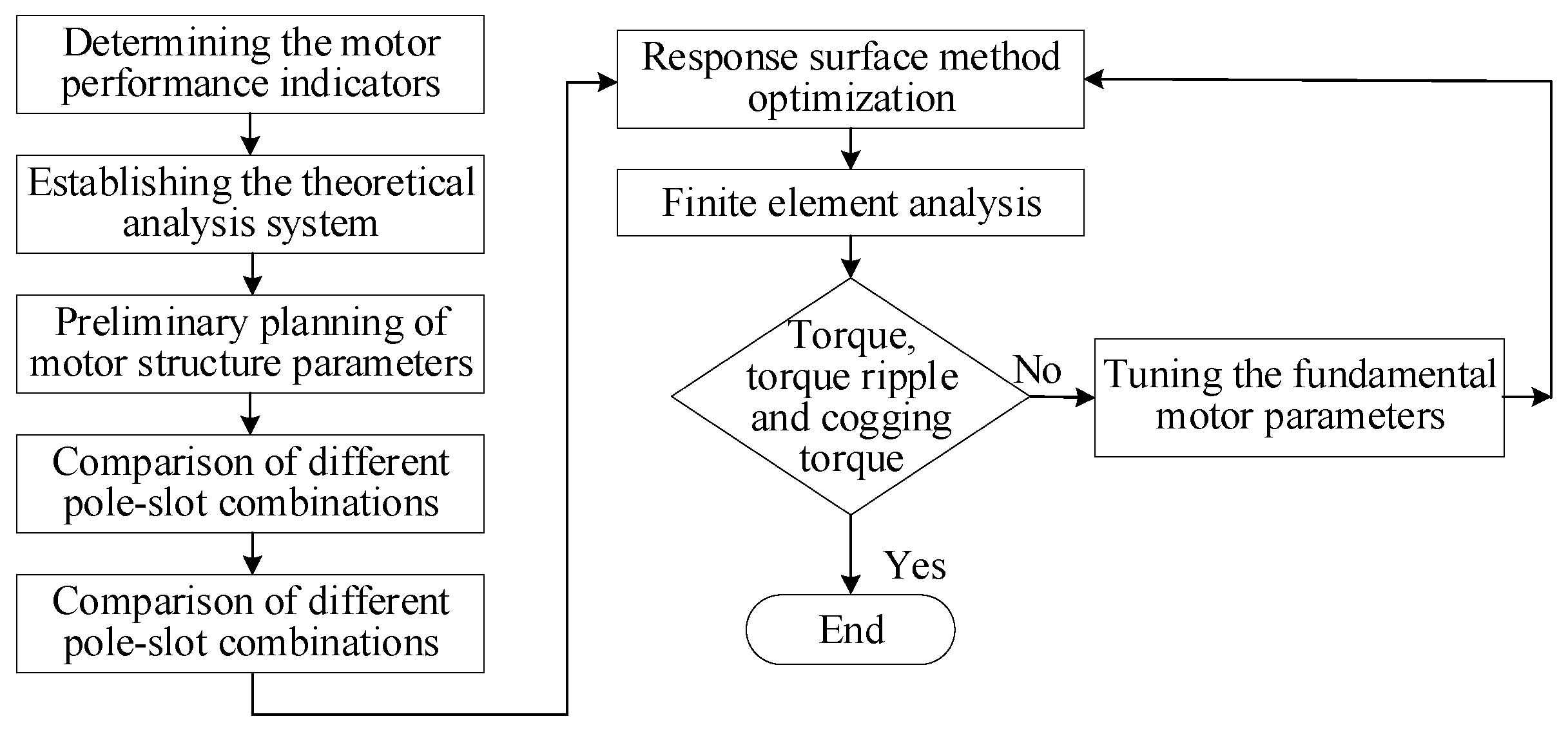
The proposed design process is shown in Figure 2. The first step is to define the performance goals and establish a theoretical analysis system. Then, different pole slot topologies are compared, the torque performance characteristics of the DS-PMFM motor are analyzed, and the advantages of the split-tooth stator of the motor structure are clarified. Subsequently, the different split-tooth structures of motors are compared to generate the initial design. A finite element model of electromagnetic performance is established. Unequal-width rotor poles are adopted and the motor is optimized by the response surface method. Finally, the torque performances are verified until the performance requirements are met.

2.2. Theoretical Analysis

The working principle of the traditional DS-PMFM motor with the number of stator modulation teeth Ns equal to the number of stator PMs Ps is basically the same as that of the single-sided permanent magnet field modulation motor, but there are still some differences in the modulation process of the excitation magnetomotive force (MMF).
The permanent magnetic magnetomotive force (PM MMF) Fspm (θ) and permeability Ms (θ) of the stator of this DS-PMFM motor can be respectively expressed as
F s p m ( θ ) = F s p m 1 cos ( P s θ ) M s ( θ ) = M s 0 M s 1 cos ( N s θ )
where θ is the air-gap circumferential position angle; Ps represents the pole pairs of the stator PMs; Fspm1 represents the amplitude of the fundamental harmonic component of the stator-side PM MMF; Ms0 and Ms1 are the DC component and fundamental harmonic of the stator permeability; and Ns represents the number of stator teeth.
The PM MMF Frpm (θ) and magnetic permeability Mr (θ, t) generated by a rotor rotating at a speed of ωr can be respectively expressed as
F r p m ( θ , t ) = F r p m 1 cos P r ( θ ω r t ) M r ( θ , t ) = M r 0 M r 1 cos N r ( θ ω r t )
where Pr represents pole pairs of the rotor PMs; Frpm1 represents the amplitude of the fundamental harmonic component of the rotor-side PM MMF; Mr0 and Ms1 are the DC component and fundamental harmonic of the rotor permeability; and Nr represents the number of rotor teeth.
Then the air-gap magnetic flux density generated by the stator-side PM as the excitation source Bspm (θ, t) is
B s p m ( θ , t ) = F s p m ( θ ) M r ( θ , t ) = M r 0 F s p m 1 cos ( P s θ ) + 1 2 M r 1 F s p m 1 cos ( P s ± N r ) θ P r ω r t
The air-gap magnetic flux density generated by the rotor-side PM as the excitation source Brpm (θ, t) is
B r p m ( θ , t ) = F r p m ( θ , t ) M s ( θ ) = M s 0 F r p m 1 cos P r ( θ ω r t ) + 1 2 M s 1 F r p m 1 cos ( P r ± N s ) θ P r ω r t
Due to the design features of the traditional bilateral permanent magnet motor structure, namely Ps = Ns and Nr = Pr, the total no-load air-gap flux density generated by the PM source in the air-gap Bpmtotal (θ, t) can be expressed as
B p m t o t a l ( θ , t ) = M r 0 F s p m 1 cos ( P s θ ) + M s 0 F r p m 1 cos P r ( θ ω r t ) + 1 2 ( M r 1 F s p m 1 + M s 1 F r p m 1 ) cos ( P s ± N r ) θ P r ω r t
From the formula, it can be found that the air-gap magnetic flux density generated by the permanent magnet as the excitation source under no-load conditions mainly contains three rotating components, and their pole pairs are Pr, Pr + Ps, and PrPs. Moreover, PrPs is the same as the number of pole pairs Pa of the armature winding. Therefore, the magnetic flux density of this excitation air gap can directly interact with the fundamental wave of the armature winding magnetic field, thereby generating a constant torque, and it is also the main harmonic contributing to the torque. Due to its relatively high amplitude, the PM fundamental wave (Pr) also makes a considerable contribution to the torque.
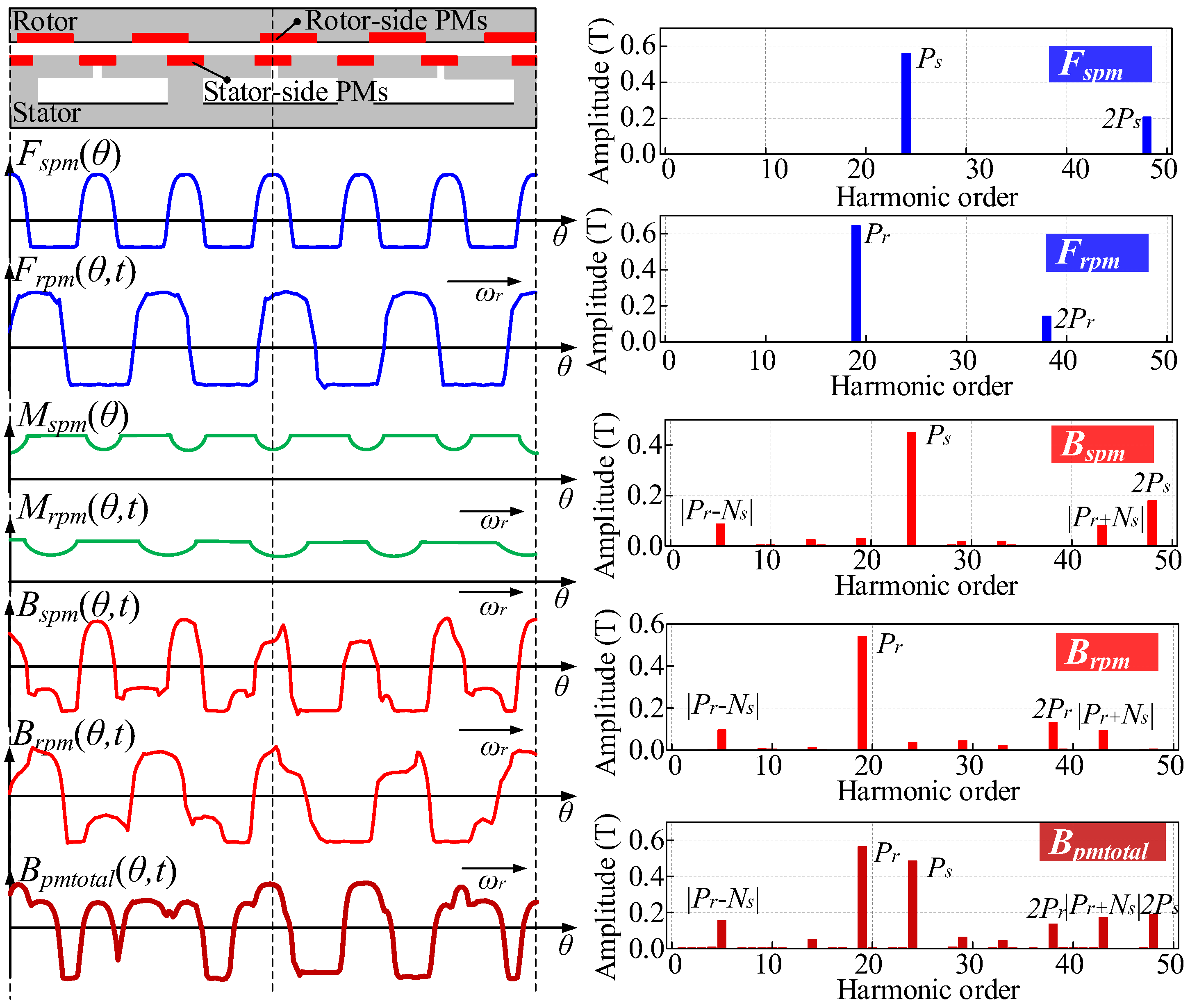
Furthermore, it can be found from Equation (5) that the amplitude of the fundamental MMF of the rotor and the amplitude of the stator permeability constant term determine the amplitude of the fundamental magnetic flux density of the rotor-side PM in the air-gap, while the amplitude of the fundamental MMF of the stator and the amplitude of the rotor permeability constant term determine the amplitude of the fundamental magnetic flux density of the stator-side PM in the air gap. In addition, the amplitudes of the fundamental permeability and fundamental MMF of the stator and rotor determine the amplitude of the modulated air-gap magnetic density. After MMF of the stator and rotor is modulated, the rotational speed of the air-gap harmonic generated will change. Its rotational speed is jointly determined by the fundamental order of the stator-side and rotor-side PM MMF and the number of rotor modulation teeth. In addition, in the traditional DS-PMFM motor, due to the unique design of Ps = Ns and Nr = Pr, the Pa harmonic can be jointly generated by the double-sided PM magnetic sources of the stator and rotor, that is, PrNs = PsNr = Pa. Therefore, the PM magnetic fields on both the stator and rotor can interact with the armature magnetic field to generate torque. Compared with the field-modulated motor with a single-sided PM as the excitation source, the PMs of both the stator and rotor of the DS-PMFM motor can generate Pr ± Ns air-gap harmonics. Therefore, the amplitudes of the Pr ± Ns air-gap harmonics will be increased significantly, while the torque generated by the Pr ± Ns air-gap harmonics can be correspondingly improved. Its modulation process is shown in Figure 3.
In the DS-PMFM motor, the cogging torque Tcog (θ, t) is generated by the superposition of the integrals of the four air-gap magnetic densities produced by the stator and rotor.
B r ( θ , θ 0 ) = B s r ( θ , θ r ) + B r r ( θ , θ r ) B t ( θ , θ 0 ) = B s t ( θ , θ r ) + B r t ( θ , θ r )
T cog θ 0 = π L s R a i r 2 μ 0 0 2 π B r r ( θ , θ r ) B r t ( θ , θ r ) d θ + 0 2 π B s r ( θ , θ r ) B s t ( θ , θ r ) d θ + 0 2 π B r r ( θ , θ r ) B s t ( θ , θ r ) d θ + 0 2 π B s r ( θ , θ r ) B r t ( θ , θ r ) d θ
where Br and Bt respectively represent the radial and tangential components of the air-gap flux density, Bsr (θ,θr) and Brr (θ,θr) are the radial magnetic flux density generated by the PM of the stator and rotor, Bst (θ,θr) and Brt (θ,θr) respectively represent the tangential components of the air-gap flux density generated when the stator-side PM acts alone and rotor-side PM acts, θr represents the initial position of the motor tooth slot, Ls is the axial length of the motor, Rair corresponds to the air-gap radius, and μ0 represents the vacuum permeability. By extrapolating Equation (4) in the previous section, the remaining air-gap magnetic density can be expressed in the form of a Fourier series as follows:
B r r θ , t = B r r 1 θ , t + B r r 2 θ , t = M s 0 i = 1 , 2 F r r i cos i P r θ θ r + i = 1 , 2 j = 1 , 2 1 2 M s j F r r i cos i P r ± j N s θ i P r θ r
B r t θ , t = B r t 1 θ , t + B r t 2 θ , t = M s 0 i = 1 , 2 F r t i cos i P r θ θ r + i = 1 , 2 j = 1 , 2 1 2 M s j F r t i sin i P r ± j N s θ i P r θ r
where i and j are natural numbers. When iPr = |mPr ± nNs| is substituted into the first term of Equation (8) and the second term of Equation (9), and m and n are natural numbers, it can be obtained that
B r r 1 θ , t = m = 1 , 2 n = 1 , 2 1 2 M s 0 F r r m cos ( m P r ± n N s ) θ ( m P r ± n N s ) θ r B r t 2 θ , t = i = 1 , 2 j = 1 , 2 1 2 M s j F r t i sin i P r ± j N s θ i P r θ r
Only when the product of the first term of Equation (8) and the second term of Equation (9) generate cogging torque is the phase angle difference not zero. This also applies to the harmonic combination represented by the second term of Equation (8) and the first term of Equation (9).
Therefore, the cogging torque generated by the rotor PMs Tcog_r can be expressed as
T c o g _ r = 0 2 π i = 1 , 2 , M s 0 B r r i cos i P r ( θ θ r ) m , n = 1 , 2 , B r t ( m p r ± n N s ) sin ( m P r ± n N s ) θ m P r θ r d θ + 0 2 π m = 1 , 2 , M s 0 B r r m sin m P r ( θ θ r ) i , j = 1 , 2 , B r r ( i p r ± j N s ) cos ( i P r ± j N s ) θ i P r θ r d θ = k = 1 i , m = 1 , 2 j , n = 0 , 1 , 2 π sin ( k N s θ r ) [ k = j + n k N s = ± ( i m ) p r ± B r r ( i P r j N s ) B r t ( m P r ± n N s ) k = ± ( j n ) k N s = ( i + m ) p r ± B r r ( i P r j N s ) B r t ( m P r ± n N s ) ]
When there exists a positive integer k satisfying the condition kNs = nPr, a cogging torque component of order kNs will be generated in the motor. The amplitude of this cogging torque component is determined by the product of the air-gap flux density harmonics of the same order, and it is required that the radial and tangential components of the corresponding air-gap flux density harmonics originate from the stator and the rotor magnetic field, respectively. In addition, since kNs needs to be an integer multiple of both Ns and Pr, the cogging torque generated by the rotor PM has the characteristic of a minimum period number Nc = LCM (Pr, Ns). By analogy with the cogging torque generated by the rotor PM, the cogging torque generated by the stator PM Tcog_s can be expressed as
T c o g _ s = 0 2 π B s r ( θ , θ r ) B s t ( θ , θ r ) d θ = k = 1 i , m = 0 , 1 , 2 j , n = 1 , 2 π sin ( k N s θ r ) [ k = j + m k N s = ± ( i m ) P r ± B s r ( P r j N s ) B s t ( m P r ± n N s ) k = ± ( j n ) k N s = ( i + m ) P r ± B s r ( P r j N s ) B s t ( m P r ± n N s ) ]
It can be seen that cogging torque generated by the stator PMs also has the characteristic of a minimum period number of Nc = LCM (Pr, Ns). In addition, in the DS-PMFM motor, apart from the cogging torque generated by the radial and tangential air-gap magnetic flux density interactions between the stator and rotor PMs themselves, it can be seen from Equation (7) that in the DS-PMFM motor, there are also interactions between the stator PM radial and rotor PM tangential flux density, and the cogging torque is generated by the interaction of the stator PM tangential flux density and the rotor PM radial flux density. Therefore, in the DS-PMFM motor, the cogging torque is larger than that of a single-sided permanent magnet field modulation (SS-PMFM) motor.

2.3. Comparison of Performance of DS-PMFM Motor and SS-PMFM Motor

Due to the design of the consequent-pole PMs of the stator and rotor, the MMF generated by the stator and rotor PMs mainly consists of the fundamental wave with the number of pole pairs of the PMs and a certain degree of second-order even harmonics. The 24th fundamental MMF generated by the stator PMs is modulated by the asynchronous permeability fundamental waves produced by the 19 rotor PM slots, generating a 5th harmonic, which is the same order as the fundamental harmonic of the armature winding. Meanwhile, the 19-pole fundamental MMF generated by the rotor PMs will also be modulated by the asynchronous permeability fundamental waves of the stator PM slots, generating a 5th harmonic. Compared with SS-PMFM motors, the fundamental wave of its armature winding is enhanced, and the 43rd harmonic is also strengthened.
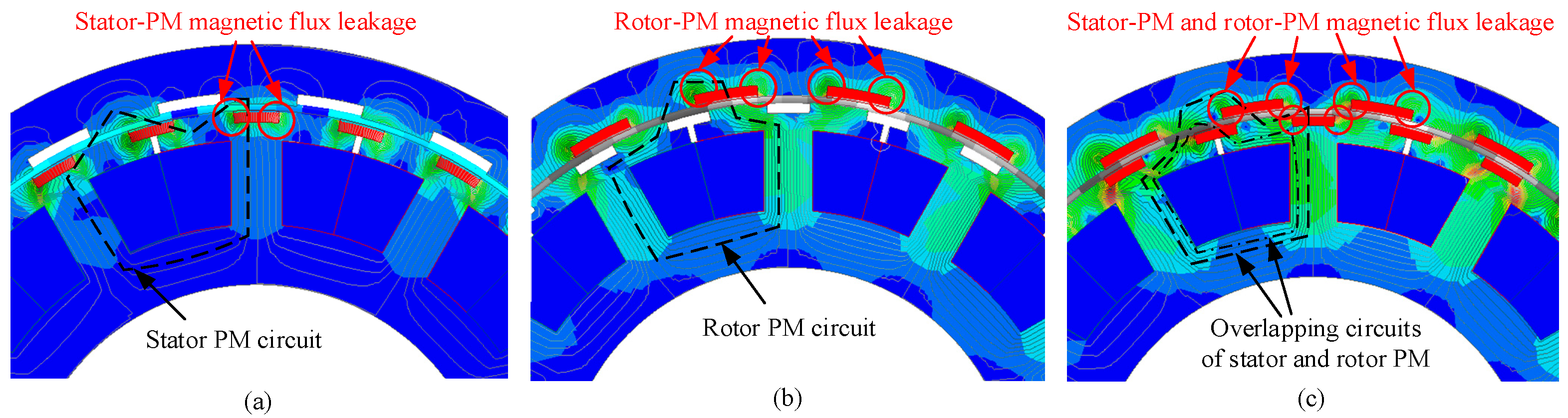
As shown in Figure 4, when the stator and rotor PMs act alone, the phenomenon of relatively large leakage magnetic flux appears. However, when PMs are placed on both the stator and rotor, the stator and rotor PMs will be connected in series in the magnetic circuit, thereby increasing the excitation MMF. On the other hand, the two also act as magnetic resistance to each other, significantly increasing the magnetic resistance of the original leakage magnetic circuit, thereby limiting the leakage MMF and reducing the leakage magnetic field. The leakage magnetic field of the stator PMs has completely disappeared, and the entire stator PMs are involved in the construction of the excitation magnetic circuit. This greatly improves the utilization rate of the PMs and can enhance the torque output capacity per unit volume of the motor.
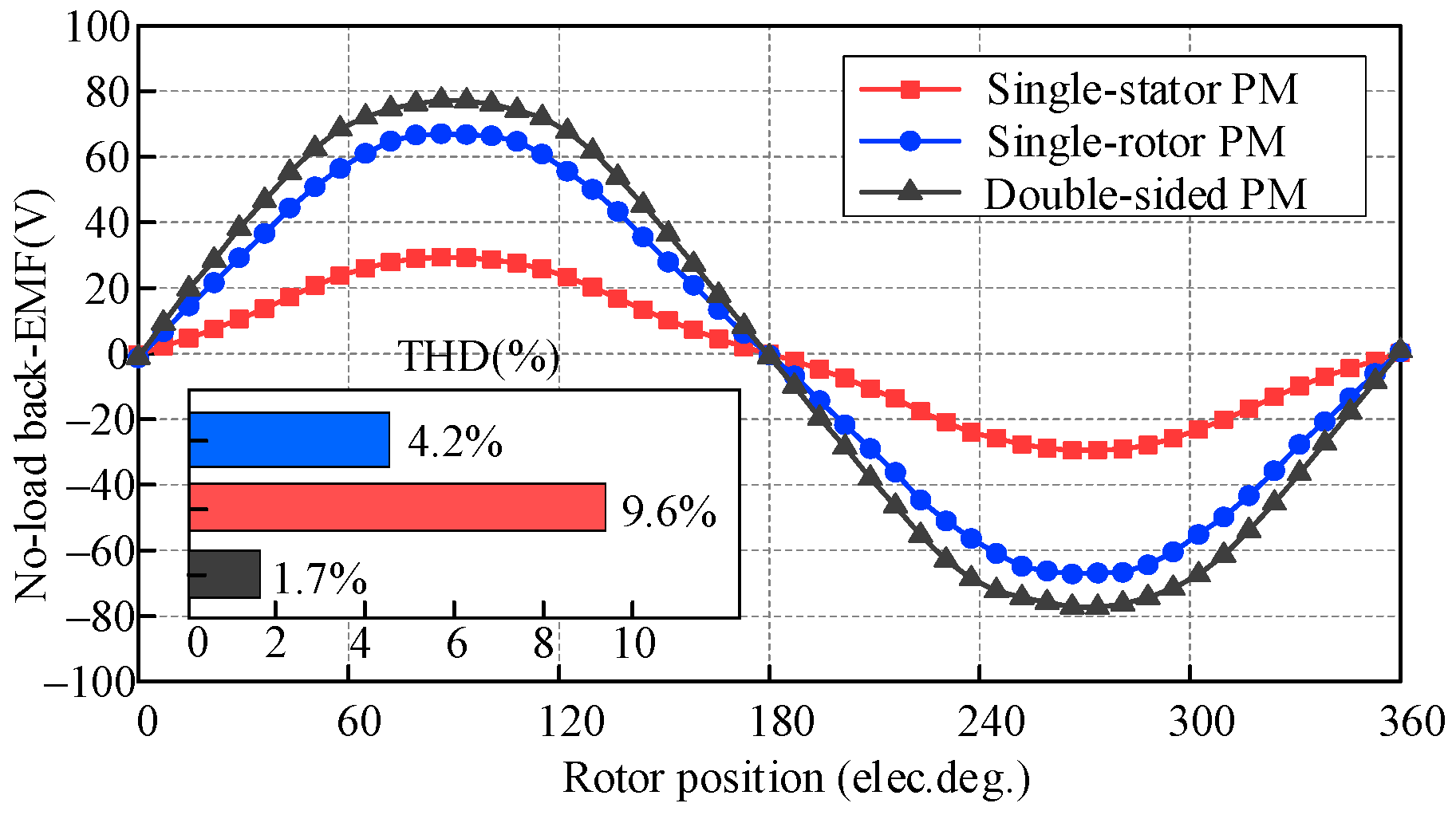
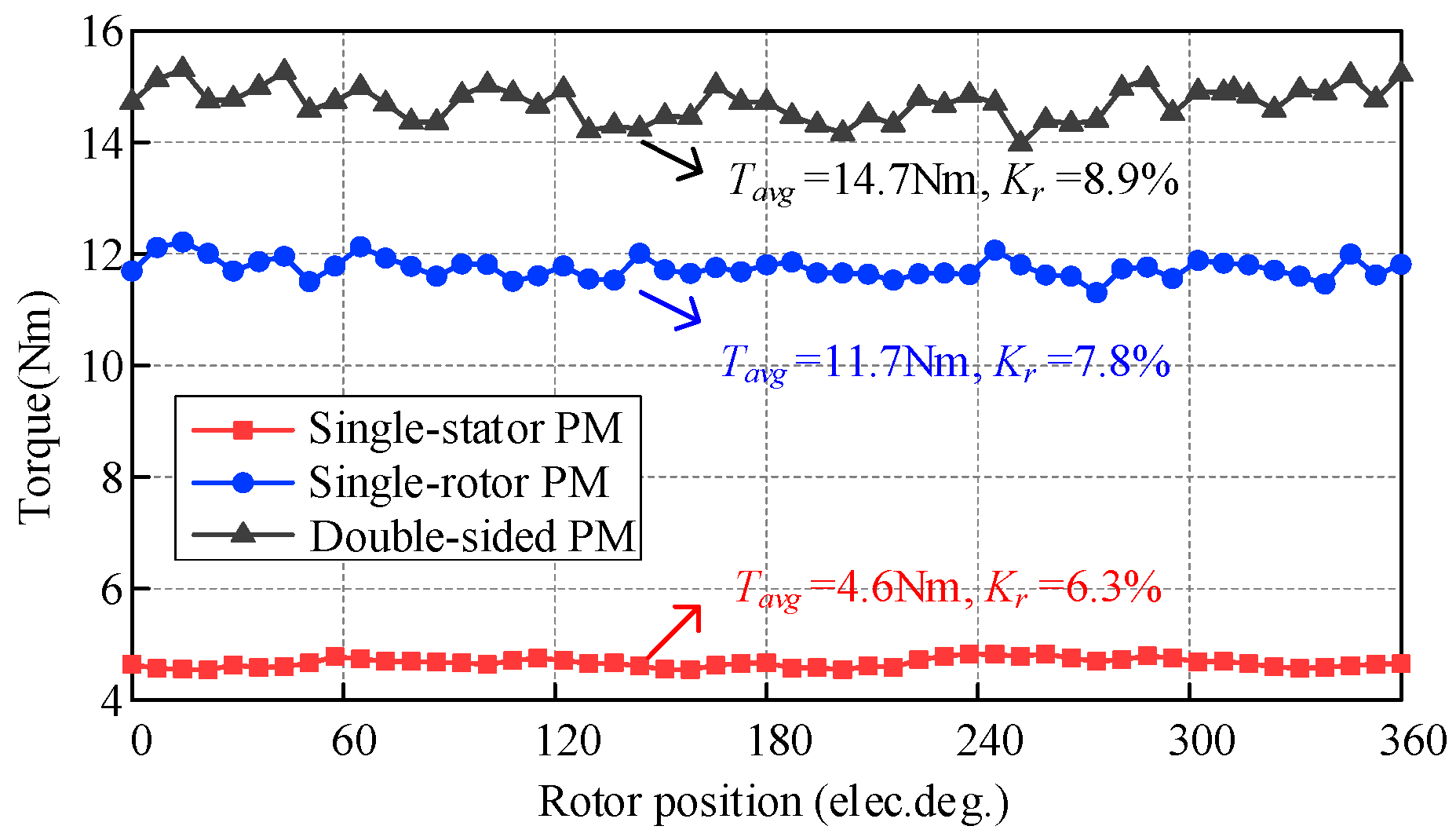
Figure 5 shows the no-load back EMF of the motor. When the double-side PMs act together, the magnetic circuits of the stator and rotor PMs overlap, and the effects generated by the two sides are consistent. Therefore, the value of the no-load back EMF of the motor is increased, and the waveform distortion rate is significantly reduced. Due to the extensive magnetic circuit overlap and partial mutual obstruction between the stator and rotor PMs, the no-load back EMF cannot be simply and directly equal to the superposition of the single-stator-PM and single-rotor-PM motors. Similarly, in the torque waveforms of the motor shown in Figure 6, the motor torque under the action of double-side PMs also differs from the superimposed value of the torques generated by the single-stator-PM and single-rotor-PM.
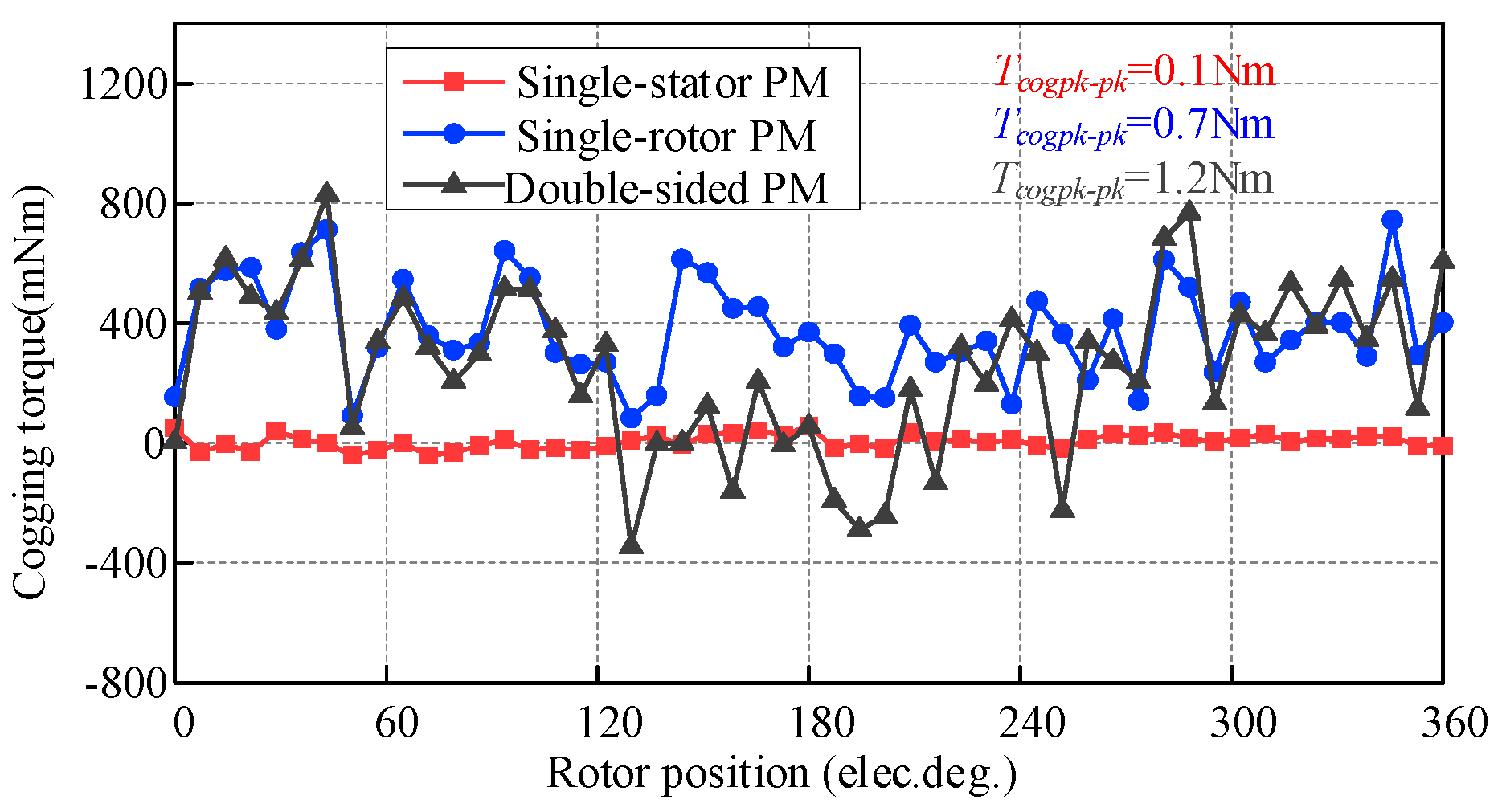
In addition, due to the existence of the double-sided PMs and double-sided asynchronous magnetic permeability of the DS-PMFM motor, the cogging torque of the motor will be higher than the sum of the stator and rotor SS-PMFM motors, as shown in Figure 7. In conclusion, under the condition of the same motor volume, the DS-PMFM motor has a significantly higher torque density. However, the cogging torque of the DS-PMFM motor is relatively high, which is highly likely to cause higher torque ripple.
Therefore, in the design of DS-PMFM motors, torque ripple and cogging torque will be regarded as important design indicators of the DS-PMFM motor.

3. Design Method of DS-PMFM Motor with Low Cogging Torque

3.1. Variation Law of Cogging Torque in DS-PMFM Motor

In magnetic field modulated motors, the amplitude of the cogging torque is determined by the fundamental content of the cogging torque to a certain extent, whose order is determined by its minimum number of periods Nc. The smaller Nc, the lower the harmonic order that generates the cogging torque, and thus the greater the cogging torque it generates. To achieve a low cogging torque for the DS-PMFM motor, Nc should be relatively high. However, when the number of pole pairs increases to a certain extent, the peak-to-peak value of the cogging torque no longer decreases with the increase in Nc. This is because when the order of the air-gap harmonic increases to a certain extent, the amplitudes of the high-order harmonics of the stator and rotor MMF and permeability are very low. Therefore, there is a theoretical upper limit to the effect of reducing the cogging torque by increasing the number of the stator and rotor pole pairs to increase Nc.
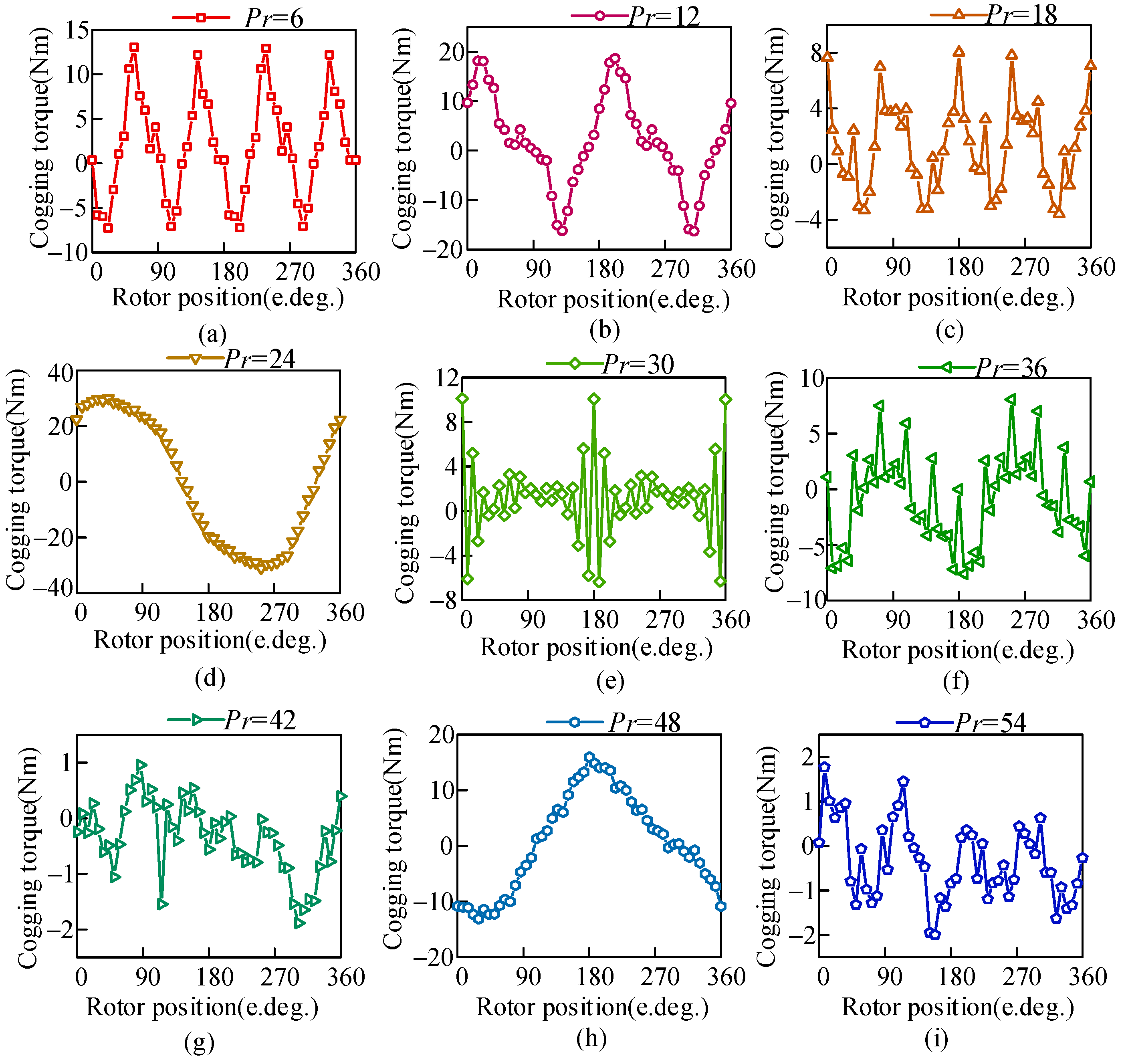
As shown in Figure 8, when Pr = 6, since Nc = 24, the period of the cogging torque is a multiple of the number of pole pairs of the rotor PMs, and the period of the cogging torque is 4. The waveform in Figure 7 is consistent with the theoretical analysis. When Pr = 12 and Nc = 24, the period of the cogging torque is equal to Nc/Pr = 2. However, due to the lower period of the cogging torque, its fundamental amplitude is larger, resulting in a higher peak-to-peak value of the cogging torque than when Pr = 6. It is also worth noting that when Pr = 24 and Pr = 48, the cogging torque increases sharply. This is because in these two cases, the period number of the cogging torque is 1.
With the continuous increase in Pr, the fundamental pole pairs of the cogging torque rise rapidly, the amplitude of the cogging torque decreases, and it no longer shows obvious periodicity. When Pr = 42 and Pr = 54, the cogging torque will be significantly lower compared to the motor with a smaller Pr. In addition to their large Nc, the fundamental orders of the rotor-side MMF and magnetic permeability increase, the fundamental amplitude is suppressed, and the modulation harmonic order is high. Meanwhile, the low-order cogging torque harmonics generated by the stator cogging effect begin to dominate. These low-order cogging torque harmonics with similar harmonic orders make the total cogging torque waveform more complex and also reduce the peak of the cogging torque to a certain extent. The main solution lies in how to ensure that the motor has a high Nc while also increasing the amplitude of the low-order cogging torque harmonic. Under the guidance of this idea, a DS-PMFM motor with stator split-tooth is proposed in this paper.

3.2. The Design of Pole Slot Ratio and Tooth Slot Structure

The number of stator modulation teeth Ns can be relatively high by adopting the split-tooth design of the stator teeth. Additionally, since the stator teeth Zs no longer needs to be consistent with stator modulation teeth Ns, the number of Zs can be reduced, thereby lowering the amplitude of LCM (Pr, Zs) and increasing the low-order cogging torque harmonics.
As shown in Table 1, within the allowable range of Ns, since Ns is even, when Pr is odd, the period of the cogging torque will be greater, and at this time, the amplitude of the cogging torque will be lower. However, pursuing more cogging torque periods will lead to a larger Pa, a lower pole ratio PR of the motor, and a reduction in the motor’s torque output capacity. Under the multiple constraints of a high torque density, low cogging torque, and low torque ripple for the motor, Pa = 2 is selected. At this time, a higher number of cogging torque period can be obtained, as well as a higher pole ratio. Therefore, the final design scheme was chosen, with the number of stator modulation teeth Ns = 30 and the number of rotor permanent magnet pole pairs Pr = 28.
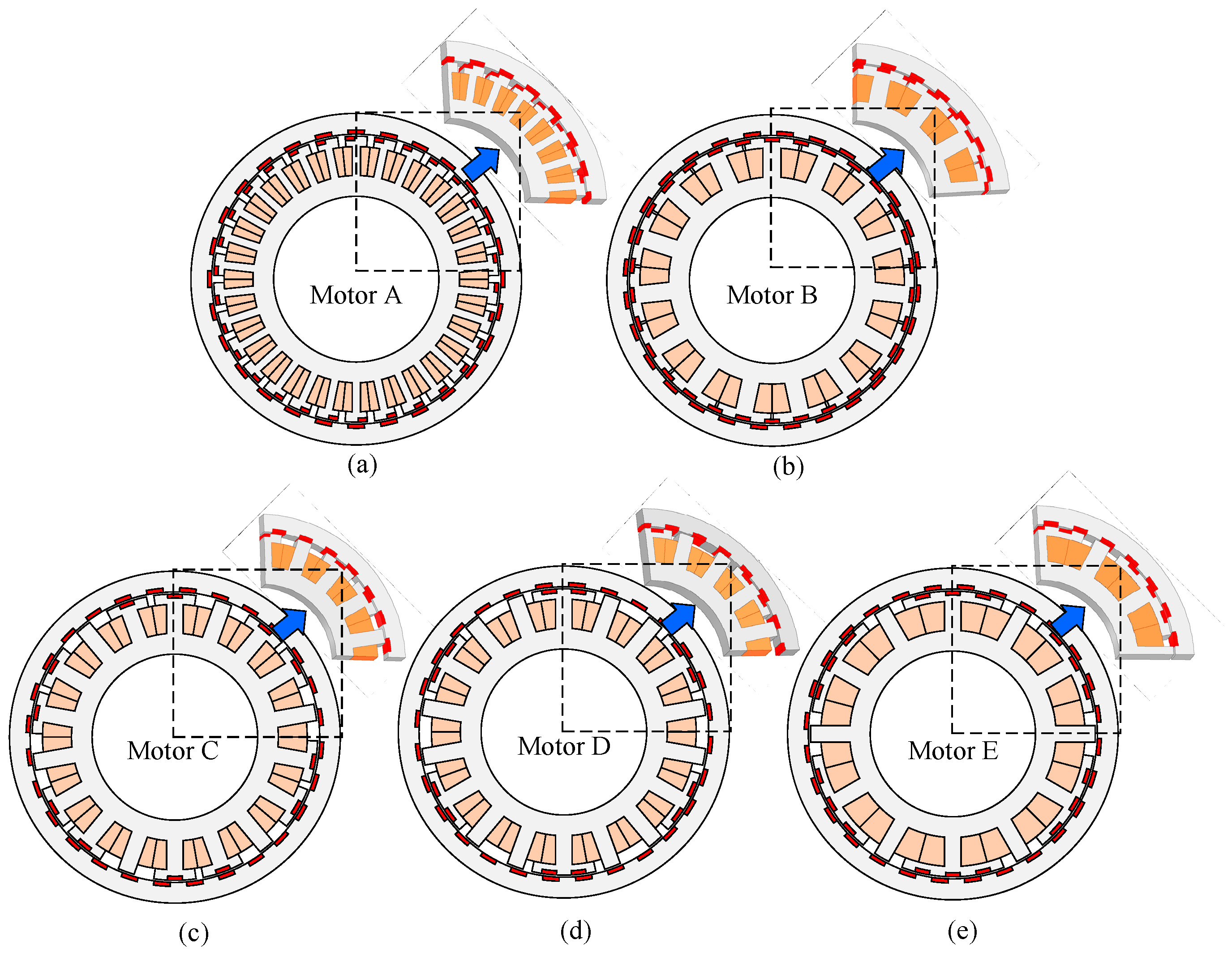
On this basis, we adopted a split-tooth design for the stator teeth. Feasible structures include the following types, which are shown in Figure 9. Motor A is the motor structure with only one-pole PM placed on each stator tooth. This design needs to ensure that Ns = Ps is maintained, that is, the number of stator modulation teeth is equal to the pole pairs of the stator-side PM. Only in this way, the harmonic order of |iPr ± nNs| and |jPs ± mNr| flux density harmonics be generated. These two groups of harmonics are superimposed and amplified. Then, they interact with the air-gap magnetic density harmonic generated by the armature magnetic field, thereby generating electromagnetic torque. Motor B is the motor structure with a one-pole PM placed in the middle of each stator tooth and another between the two stator teeth. The common point of these two topologies is that the numbers of Ps and Ns are equal.
In addition, some stators adopt a partial split-tooth structure, such as the Motor C, Motor D, and Motor E. The numbers of Ps and Ns are not equal when a split-tooth structure is adopted where one slot is opened on the stator teeth, that is, two teeth are split. In Motor C, the ratio of the number of cracked stator teeth to the number of non-cracked stator teeth should be 2:1. Motor D adopts a design with two slots on one stator tooth, that is, a split three-tooth structure. The ratio of the number of split stator teeth to the number of non-split stator teeth at this time is 1:2. The Type III partial split-tooth structure (Motor E) has one stator tooth with three slots and four teeth split. At this time, the ratio of the number of split teeth to the number of non-split teeth of the stator should be 1:1, and the number of stator teeth Zs is 6.

3.3. Discussion About the Cogging Torque Characteristic of Proposed Motors

As mentioned above, the proposed split-tooth DS-PMFM motors have the potential to simultaneously achieve high torque and low cogging torque. In this part, the torque characteristics of these topologies are analyzed.
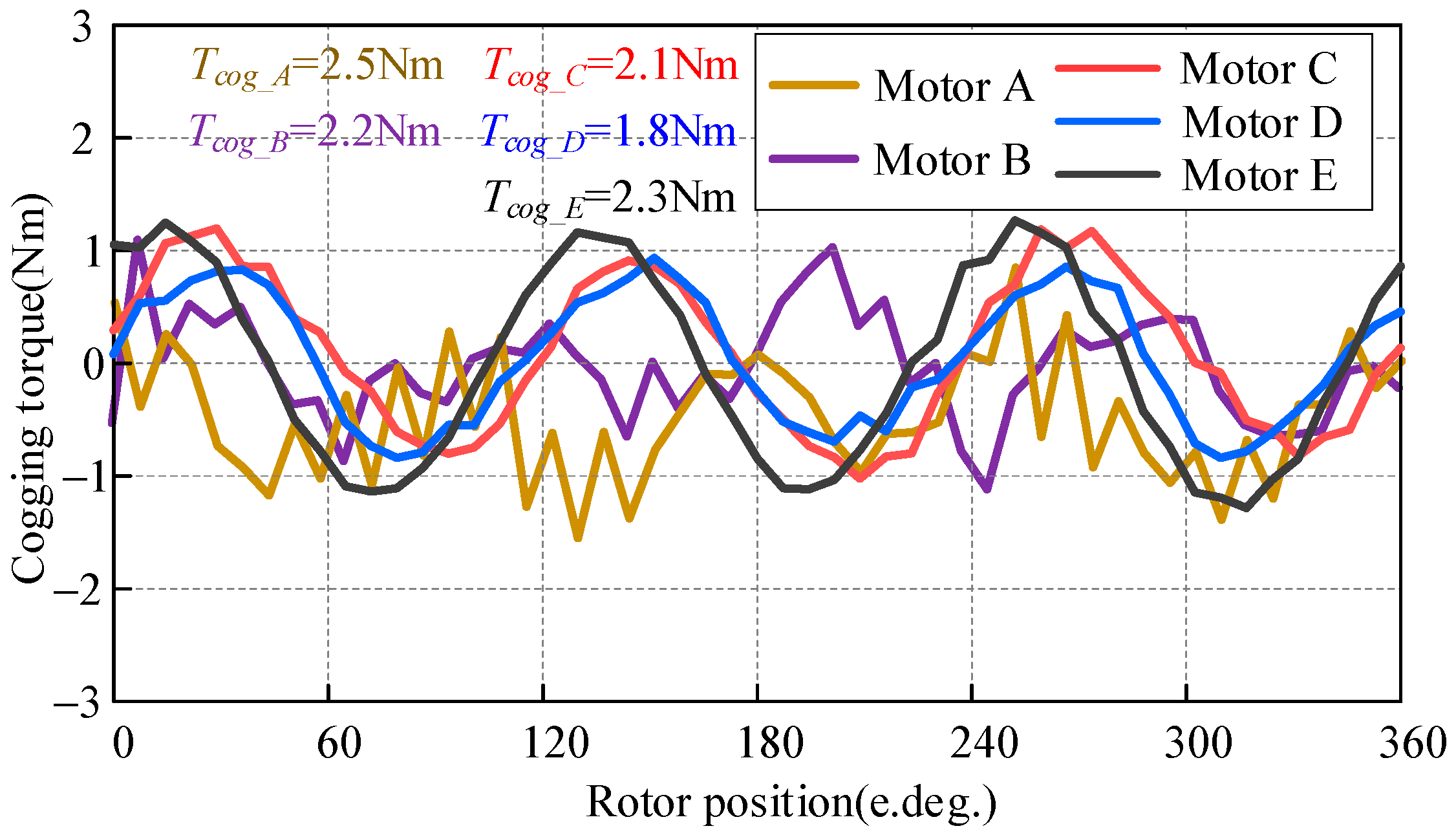
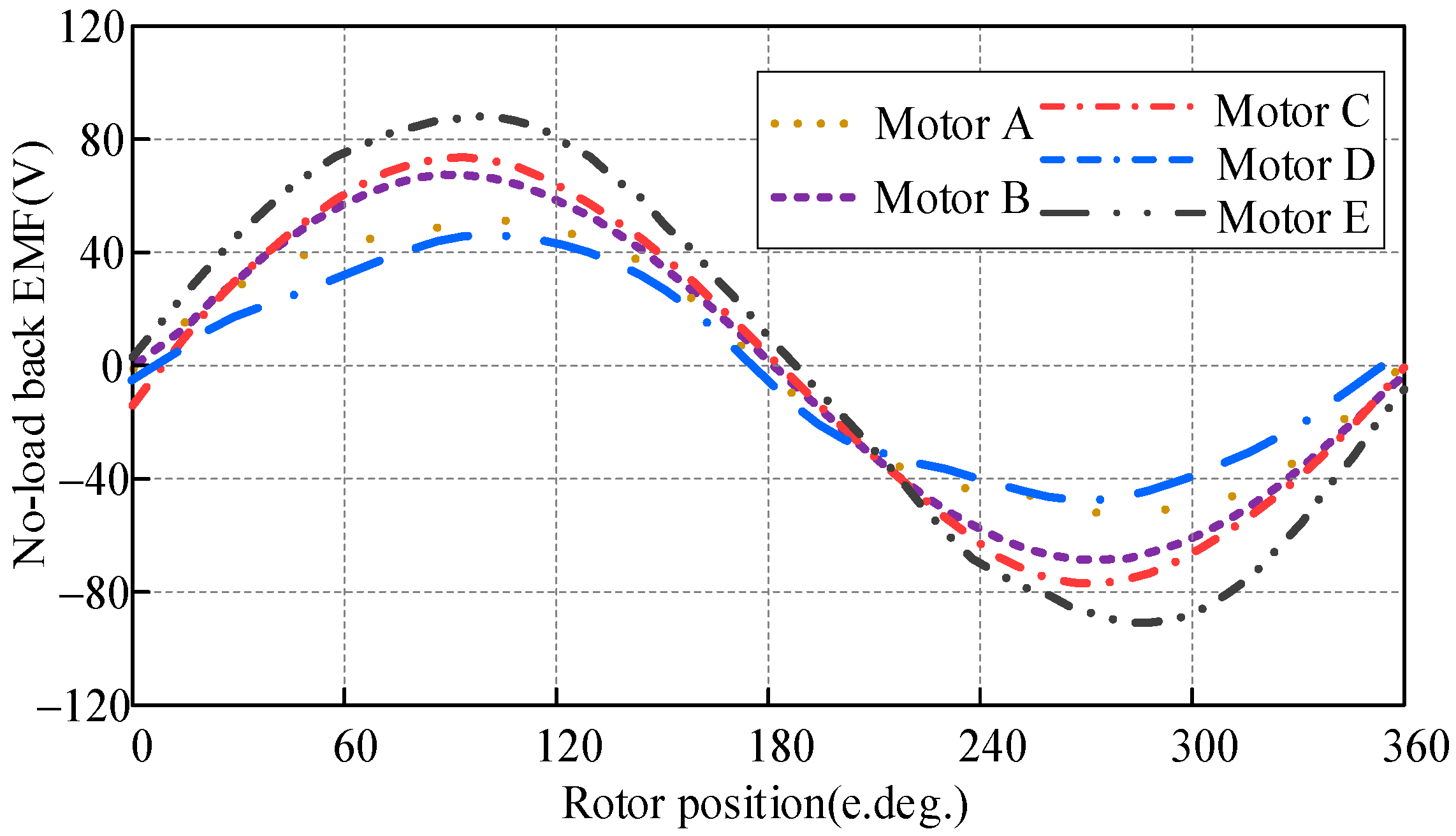
As can be seen from Figure 10, under the pole-slot combination of 30/28, the value of LCM (30, 28) is relatively large, so the period number of the cogging torque is high, which weakens cogging torque. In addition, under this pole-slot combination, the overall cogging torque is relatively low, which also verifies the rationality of the above pole-slot ratio design. Among them, the stator slots in Motor B are almost entirely generated by permanent magnets. For the deep slots where windings are placed, the rate of change of stator magnetic permeability is relatively low, so the change in magnetic field energy is small, which leads to a lower cogging torque. Motor B reduces the air-gap magnetic resistance caused by the winding slots and adds more core magnetic resistance in the magnetic circuit, thereby increasing the no-load back EMF of the motor. The back EMF of the motors are shown in Figure 11. The ratio of the maximum no-load back EMF of Motor A to the area of the PM is 0.09 V/mm2, while that of Motor B is 0.12 V/mm2, which is an increase of 33%. Furthermore, for motors with a partial split-tooth topology design, since the partial stator teeth adopt a split-tooth structure, and the slots placed in the PM serve as modulation teeth, and the thickness of PM is very small relative to the thickness of the slot, the period of cogging torque is no longer dominated by LCM (Pr, Ns)/Pr. Instead, it is determined by the number of pole pairs of the stator teeth and the permanent magnets of the rotor, that is, LCM (Pr, Zs)/Pr is dominant, which is shown in Table 2. Because the fundamental order of the cogging torque is relatively low, the cogging torque is not significantly lower than that of Motors A and B. In addition, with the same number of stator-side PMs, Motor D has a lower cogging torque. However, due to its greater magnetic circuit resistance than Motor C, the fundamental amplitude of its PM flux linkage is 32.5% lower than that of Motor C. This also leads to the no-load back EMF generated per unit area of its PMs being 33% lower than that of Motor C. The results of the comparative analysis are shown in Table 2.
Based on the above analysis of the cogging torque and no-load back-EMF of these topologies, Motor B was selected for further design, with the goal of achieving high torque density.

4. Design Method of DS-PMFM Motor with High Torque Density

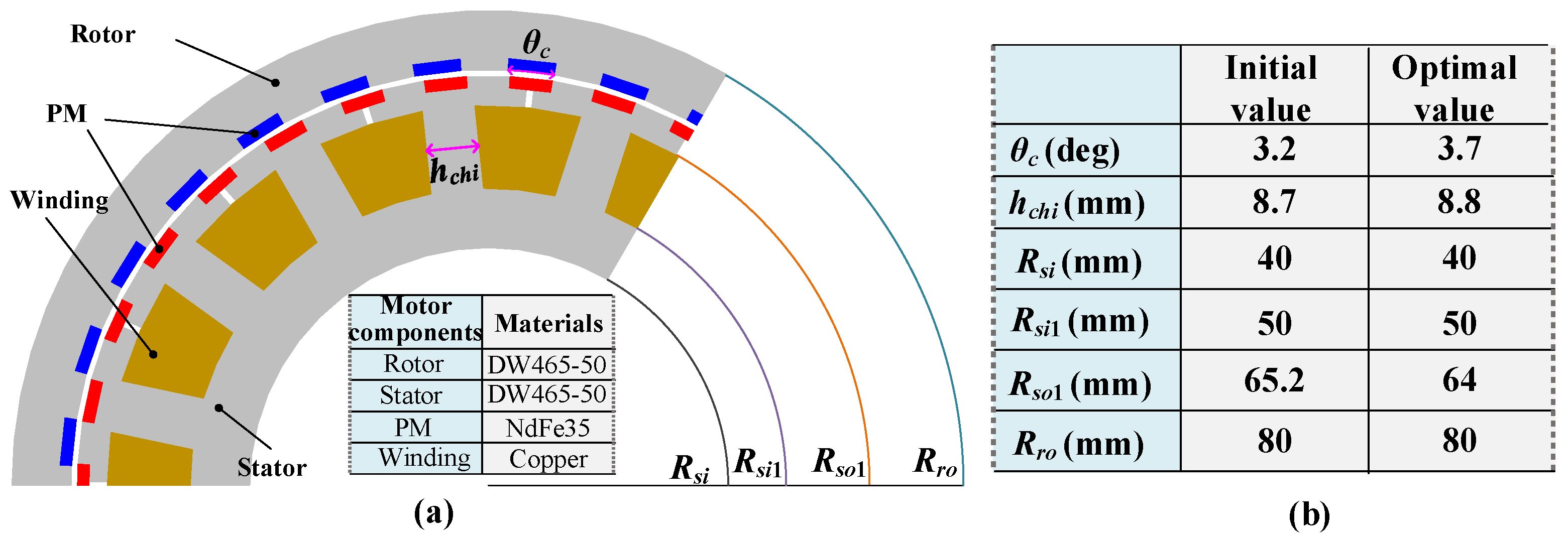
For motor B, the rotor adopts a non-equal-width design, that is, the widths of the permanent magnets and the rotor modulation poles are not consistent. The motor marking diagram is shown in Figure 12a, in which its key design parameters can be seen. At the same time, the initial and optimal values of these parameters are shown in Figure 12b. To achieve a high torque density, low torque ripple, and low cogging torque for the motor, the key design parameters of the motor are optimized.
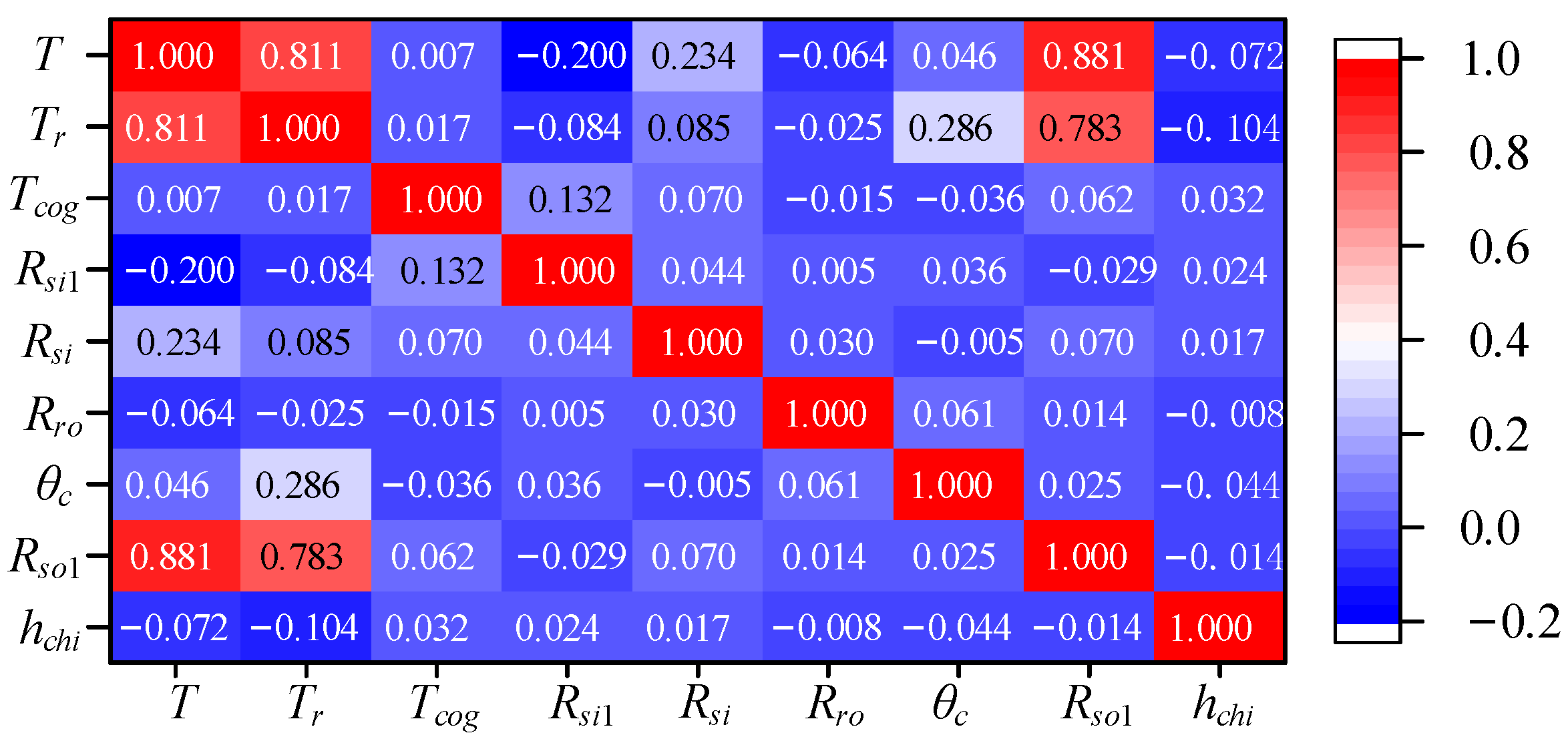
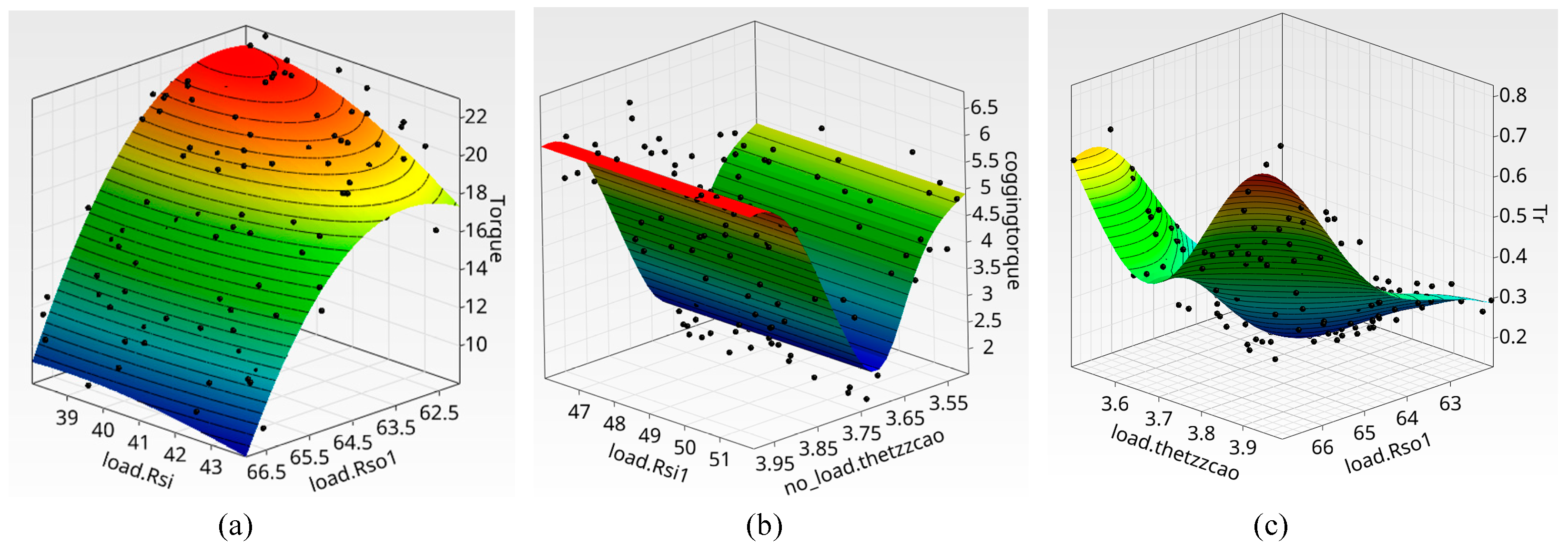
First, correlation analysis of the parameters is conducted, and the results are shown in Figure 13. It can be seen that torque is highly affected by Rso1 and Rsi, torque ripple is affected by θc and Rso1, and cogging torque is affected by Rsi1 and θc. The influence of highly sensitive parameters on performance is further demonstrated (Figure 14). It can be seen from Figure 14a that the torque rises as the value of Rso1 and Rsi decrease. At the same time, the variation in cogging torque appears to have a relatively low regularity, as illustrated in Figure 14b. Overall, the cogging torque first decreases and then increases with increasing θc, which is the same as the influence on torque ripple, and the cogging torque also increases slightly with the increase of Rsi1. Regarding the influence of parameters on torque ripple, as Rso1 increases, the motor torque ripple deteriorates. At the same time, Figure 14a–c presents the response surface diagrams of the motor load torque, cogging torque, and torque ripple, respectively, which vary with their strongly correlated parameters. Response Surface Method (RSM) is an optimization approach that integrates experimental design and mathematical modeling. It establishes a mathematical model between input variables and output responses through limited experimental data to identify the optimal topology.
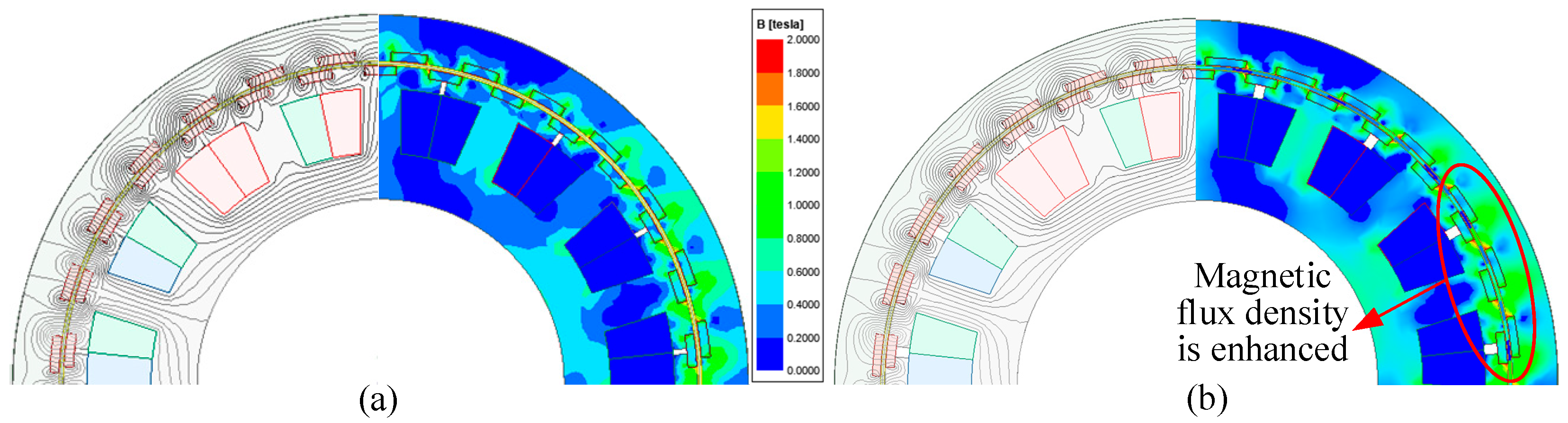
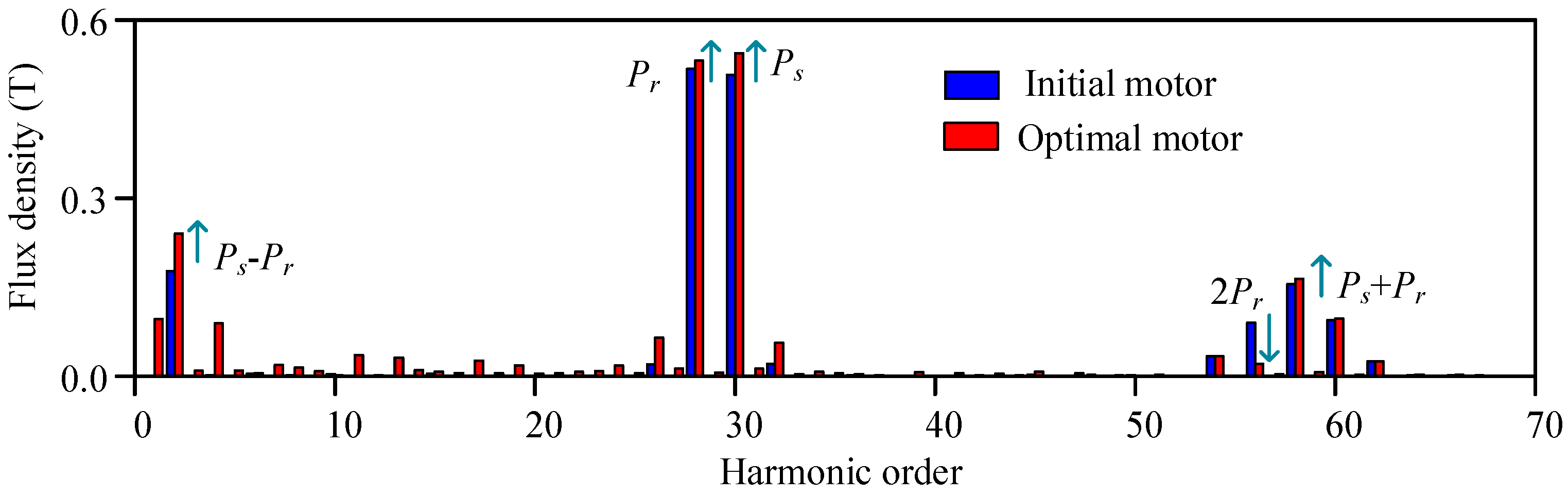
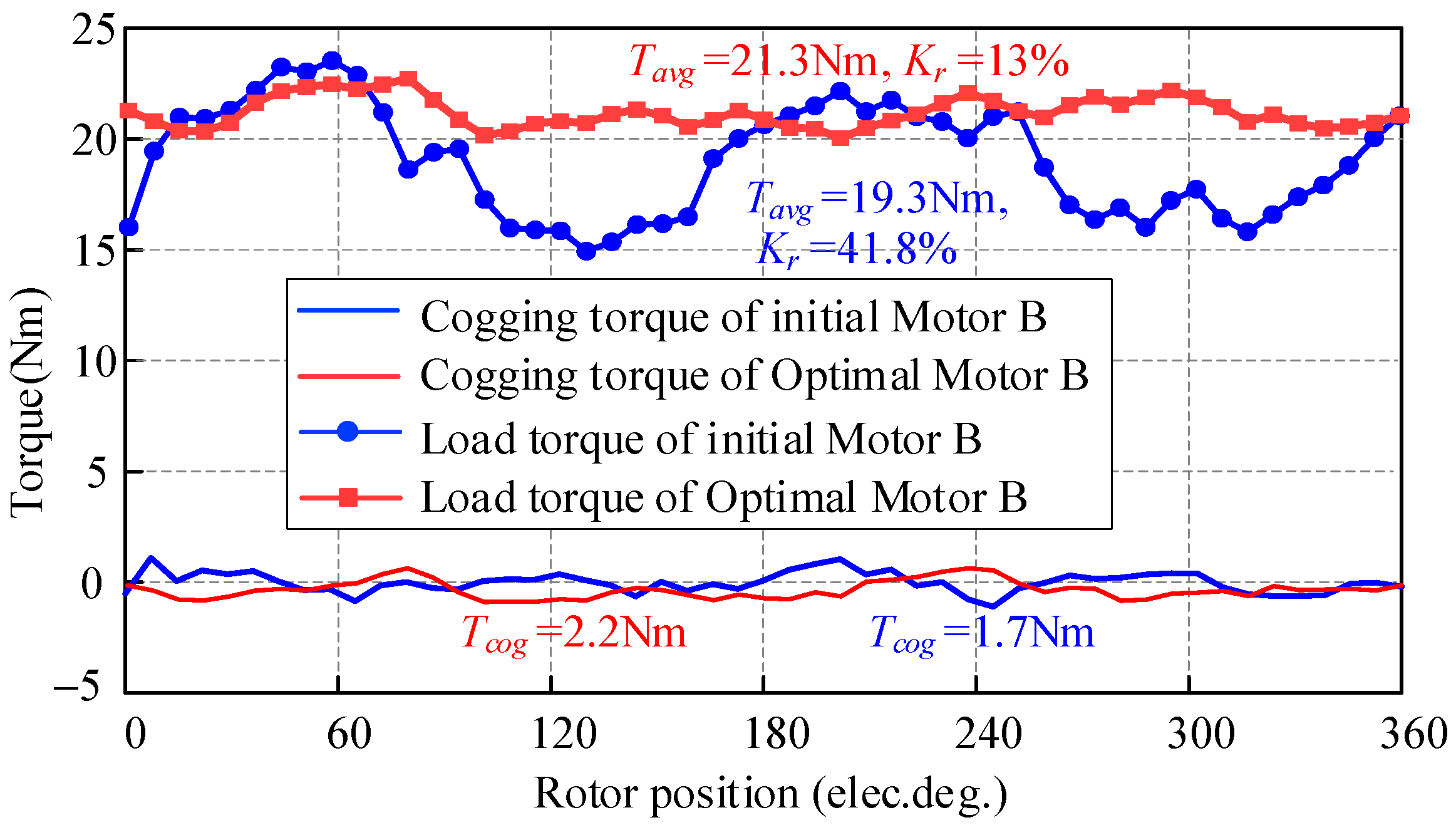
Based on these analysis results, the final motor topology is obtained. The two motors before and after optimization are compared based on aspects such as the distribution of magnetic field lines of the motor, magnetic density cloud diagram, harmonic distribution of air-gap magnetic density, and torque performance. It is worth mentioning that, under the premise of maintaining the same PM usage of the motor, after adopting unequal-width rotor modulation poles, the magnetic density on the PM side of the rotor is enhanced, which is simultaneously reflected in the magnetic density cloud diagram and the amplitude of the 28th (Pr) harmonic, as can be seen in Figure 15 and Figure 16. Furthermore, as can be seen in Figure 16, after adopting unequal-width rotor modulation poles and improving the width of stator split-tooth, the amplitudes of the 2nd (PsPr), 28th (Pr), 30th (Ps), and 58th (Ps + Pr) harmonics of the motor have all increased, while the amplitude of the 56th harmonic has been suppressed. This directly leads to an increase in motor torque and a decrease in torque density. Figure 17 shows the results of the torque performance comparison and analysis of the motor. Before and after the design, the motor torque increases by 2 Nm, approximately 1.1 times that of the initial motor. The motor torque ripple is reduced to 70% of that of the initial motor, and at the same time, the motor cogging torque decreases by 23%.
We then compared the unit PM torque and torque density of the two motors under the same cost conditions, that is, with the basic parameters such as the PM usage of the motor and the number of turns of the motor winding remaining unchanged. It can be seen from Table 3 that the torque density of the motor has been improved after optimization. In addition, the core loss of the motor has decreased by 6%, and the power factor of the motor has also been improved, while the PM solid loss has increased. The main geometric parameters and material of the final DS-PMFM motor are presented in Table 4.

5. Conclusions

In this article, a high-torque, low-cogging-torque, double-sided permanent magnet (DS-PMFM) motor was proposed and studied. The focus of this research was to realize comprehensive improvement of high output torque, low torque ripple, and low cogging torque through stator split-tooth and unequal-width rotor pole designs. The research work can be summarized as follows:
(1)
The DS-PMFM motor causes a non-negligible deterioration of cogging torque and torque ripple while increasing the output torque compared with the single-sided permanent magnet (SS-PMFM) motor;
(2)
After adopting the stator modulation pole split-tooth design, the number of stator modulation teeth and the number of stator teeth of the motor are inconsistent, making it possible for the motor to simultaneously meet the high Nc and small amplitude of cogging torque harmonic;
(3)
The adoption of the rotor unequal-width modulation pole design can effectively improve the motor torque performance. The torque is increased by 10% and the torque ripple is decreased by 70% while the cogging torque is reduced by 23%.
In future studies, efforts will be made to verify the simulation results through experimental verification. In addition, future research will consider the limitations of the actual application of the motor, including the thermal stability and the processability of the motor, etc.

Author Contributions

Conceptualization, Y.Z. and Z.X.; methodology, Y.Z. and S.G.; software, Y.Z. and S.G.; validation, Y.Z., Z.X. and S.G.; formal analysis, Q.L.; investigation, Y.Z. and S.G.; resources, Z.X. and Q.L.; data curation, Y.Z.; writing—original draft preparation, Y.Z. and S.G.; writing—review and editing, Y.Z., Z.X., Q.L. and S.G.; visualization, Y.Z.; supervision, Z.X. and Q.L.; project administration, Z.X. and Q.L.; funding acquisition, Z.X. All authors have read and agreed to the published version of the manuscript.

Funding

This research was funded in part by the National Key Research and Development Program (grant number 2022YFB2502704-7) and the National Natural Science Foundation of China (grant number 52177046 and grant number 52577056).

Data Availability Statement

The original contributions presented in this study are included in the article. Further inquiries can be directed to the corresponding author(s).

Conflicts of Interest

Author Suiyuan Gui was employed by the company State Grid Jiangsu Electrical Power Company. The remaining authors declare that the research was conducted in the absence of any commercial or financial relationships that could be construed as a potential conflict of interest.

Nomenclature

NsNumber of stator modulation teeth
PsNumber of stator permanent magnets
PaNumber of pole pairs of the armature winding
Fspm1Amplitude of the fundamental harmonic component of the stator-side PM MMF
Ms0DC component of the stator permeability
Ms1Fundamental harmonic of the stator permeability
PrPole pairs of the rotor PMs
NrNumber of rotor teeth
Mr0DC component of the rotor permeability
Ms1Fundamental harmonic of the rotor permeability
ωrRotor rotating speed
LsAxial length of the motor
RairAir-gap radius of the motor
μ0Vacuum permeability
ZsNumber of stator teeth
NcMinimum number of periods

References

  1. Nory, H.; Yildiz, A.; Aksun, S.; Aksoy, C. Design and Analysis of an IE6 Hyper-Efficiency Permanent Magnet Synchronous Motor for Electric Vehicle Applications. Energies 2025, 18, 4684. [Google Scholar] [CrossRef]
  2. Wang, R.; Zhang, S.; Yang, Y.; Wen, Y.; Sun, X.; Zhou, Z.; Li, Y. Overview of Deadbeat Predictive Control Technology for Permanent Magnet Synchronous Motor System. Energies 2025, 18, 4668. [Google Scholar] [CrossRef]
  3. Xiang, P.; Yan, L.; Liu, X.; He, X.; Du, N.; Wang, H. Structural Topology Design for Electromagnetic Performance Enhancement of Permanent-Magnet Machines. Chin. J. Mech. Eng. 2025, 38, 26. [Google Scholar] [CrossRef]
  4. Cui, S.; Zhang, Y.; Song, B.; Xu, K.; Feng, C.; Qi, S. High-Torque-Density Composite-Cooled Axial Flux Electrically Excited Synchronous Motor. Energies 2025, 18, 4585. [Google Scholar] [CrossRef]
  5. Yu, Y.; Pei, Y.; Chai, F.; Doppelbauer, M. Performance Comparison Between Permanent Magnet Synchronous Motor and Vernier Motor for In-Wheel Direct Drive. IEEE Trans. Ind. Electron. 2023, 70, 7761–7772. [Google Scholar] [CrossRef]
  6. Zhu, X.; Jiang, M.; Xiang, Z.; Quan, L.; Hua, W.; Cheng, M. Design and Optimization of A Flux-Modulated Permanent Magnet Motor Based on An Airgap-Harmonic-Orientated Design Methodology. IEEE Trans. Ind. Electron. 2020, 67, 5337–5348. [Google Scholar] [CrossRef]
  7. Xiang, Z.; Wei, J.; Zhu, X. Torque Ripple Suppression of a PM Vernier Machine from Perspective of Time and Space Harmonic Magnetic Field. IEEE Trans. Ind. Electron. 2024, 71, 10150–10161. [Google Scholar] [CrossRef]
  8. Jiang, M.; Zhu, X.; Xiang, Z.; Zheng, S.; Fan, D. Dual-Sub-Region Rotor Design of a Permanent Magnet Hub Motor with Enhanced Speed Regulation and Output Torque for Electric Vehicles. IEEE Trans. Ind. Electron. 2024, 71, 13659–13669. [Google Scholar] [CrossRef]
  9. He, Z.; Du, Y.; Xiao, F.; Zhu, X.; Chen, H.; Zhang, C. Comprehensive Performance Improvement of Permanent Magnet Vernier Motor for Electric Tractors. IEEE Trans. Transp. Electrif. 2024, 10, 4821–4832. [Google Scholar] [CrossRef]
  10. Xiang, P.; Yan, L.; Ge, L.; He, X.; Du, N.; Liu, X. Development of a Radial-Flux Machine with Multi-Shaped Magnet Rotor and Non-Ferromagnetic Yoke for Low Torque Ripple and Rotor Mass. IEEE Trans. Ind. Appl. 2025, 61, 2897–2910. [Google Scholar] [CrossRef]
  11. Geng, W.; Wang, Y.; Wang, J.; Hou, J.; Guo, J.; Zhang, Z. Comparative Study of Yokeless Stator Axial-Flux PM Machines Having Fractional Slot Concentrated and Integral Slot Distributed Windings for Electric Vehicle Traction Applications. IEEE Trans. Ind. Electron. 2023, 70, 155–166. [Google Scholar] [CrossRef]
  12. Fang, L.; Li, D.; Ren, X.; Qu, R. A Novel Permanent Magnet Vernier Machine with Coding-Shaped Tooth. IEEE Trans. Ind. Electron. 2022, 69, 6058–6068. [Google Scholar] [CrossRef]
  13. Xiang, Z.; Zhou, Y.; Zhu, X.; Quan, L.; Fan, D.; Liu, Q. Research on Characteristic Airgap Harmonics of a Double-Rotor Flux-Modulated PM Motor Based on Harmonic Dimensionality Reduction. IEEE Trans. Transport. Electrific. 2024, 10, 5750–5761. [Google Scholar] [CrossRef]
  14. Lin, Q.; Zhao, X.; Cai, F.; Wu, Q.; Pang, J.; Guo, X. Design of a Dual-Permanent-Magnet Vernier Machine to Replace Conventional Surface-Mounted Permanent Magnet Motor for Direct-Drive Industrial Turbine Application. IEEE Access 2023, 11, 2291–2302. [Google Scholar] [CrossRef]
  15. Xiang, P.; Yan, L.; Guo, Y.; He, X.; Gerada, C.; Chen, I. A Concentrated-Flux-Type PM Machine with Irregular Magnets and Iron Poles. IEEE/ASME Trans. Mechatron. 2024, 29, 691–702. [Google Scholar] [CrossRef]
  16. Fang, L.; Li, D.; Qu, R. Torque Improvement of Vernier Permanent Magnet Machine with Larger Rotor Pole Pairs Than Stator Teeth Number. IEEE Trans. Ind. Electron. 2023, 70, 12648–12659. [Google Scholar] [CrossRef]
  17. Shen, F.; Yan, Y.; Wang, S.; Onn, B.C.S.; Gajanayake, C.J.; Gupta, A.K.; Lee, C.H.T. Investigation of a Flux-Switching Machine with U-V-Array Permanent Magnet Arrangement for Traction Applications. IEEE Trans. Veh. Technol. 2023, 72, 12580–12591. [Google Scholar] [CrossRef]
  18. Gong, C.; Deng, F. Design and Optimization of a High-Torque-Density Low-Torque-Ripple Vernier Machine Using Ferrite Magnets for Direct-Drive Applications. IEEE Trans. Ind. Electron. 2022, 69, 5421–5431. [Google Scholar] [CrossRef]
  19. Zhao, W.; Zheng, J.; Ji, J.; Zhu, S.; Kang, M. Star and Delta Hybrid Connection of a FSCW PM Machine for Low Space Harmonics. IEEE Trans. Ind. Electron. 2017, 65, 9266–9279. [Google Scholar] [CrossRef]
  20. Sun, P.; Jia, S.; Yang, D.; Liang, D. Comparative Study of Novel Dual Winding Dual Magnet Flux-Modulated Machines with Different Stator/Rotor Pole Combinations. IEEE Trans. Transp. Electrif. 2024, 10, 9691–9700. [Google Scholar] [CrossRef]
  21. Huang, J.; Fu, W.; Niu, S.; Zhao, X. Comparative Analysis of Different Permanent Magnet Arrangements in a Novel Flux Modulated Electric Machine. IEEE Access 2021, 9, 14437–14445. [Google Scholar] [CrossRef]
  22. Xu, L.; Chen, Z.; Zhao, W.; Jiang, T. Analysis of a Fault-Tolerant Dual-Permanent-Magnet Vernier Machine with Hybrid Stator. IEEE Trans. Transp. Electrif. 2024, 10, 6559–6570. [Google Scholar] [CrossRef]
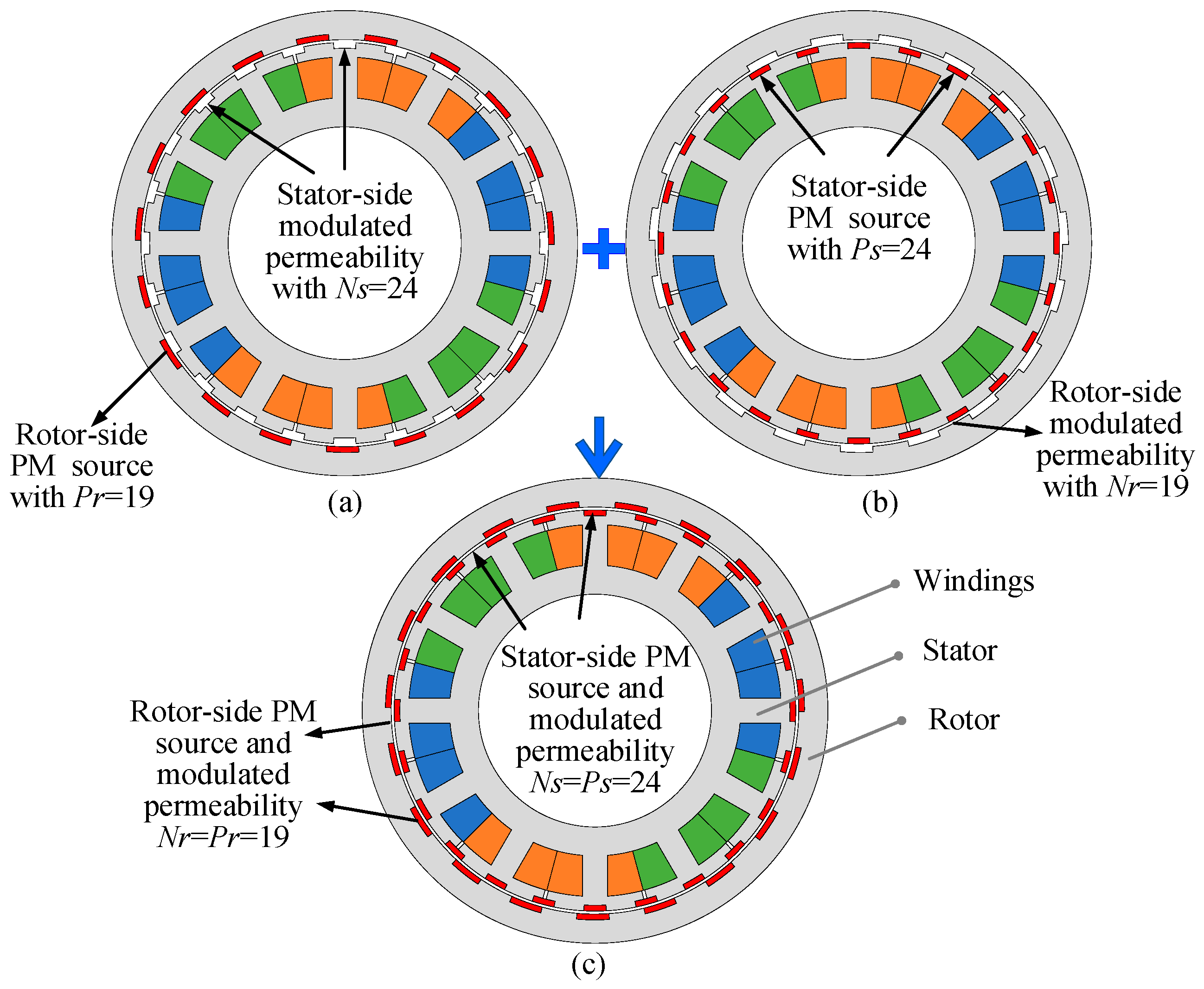
Figure 1. Structure decomposition diagram of DS-PMFM motor. (a) Rotor vernier permanent magnet motor; (b) stator flux switching permanent magnet motor; (c) DS-PMFM motor.
Energies 18 05995 g001
Figure 2. The design flowchart.
Energies 18 05995 g002
Figure 3. Analysis of modulation process of DS-PMFM motor.
Energies 18 05995 g003
Figure 4. Analysis of magnetic force line and magnetic density cloud diagram. (a) Under the sole action of the stator-side PM; (b) under the sole action of the rotor-side PM; (c) under the sole action of the double-sided PM.
Energies 18 05995 g004
Figure 5. Analysis of no-load back electromotive force.
Energies 18 05995 g005
Figure 6. Analysis of load torque.
Energies 18 05995 g006
Figure 7. Analysis of cogging torque.
Energies 18 05995 g007
Figure 8. Comparison of cogging torque of DS-PMFM motor with different rotor pole pairs. (a) Pr = 6; (b) Pr = 12; (c) Pr = 18; (d) Pr = 24; (e) Pr = 30; (f) Pr = 36; (g) Pr = 42; (h) Pr = 48; (i) Pr = 54.
Energies 18 05995 g008
Figure 9. Multiple topological schemes of split-tooth DS-PMFM motors. (a) Type I split-tooth DS-PMFM motor named Motor A; (b) Type II split-tooth DS-PMFM motor named Motor B; (c) Type I partial split-tooth DS-PMFM motor named Motor C; (d) Type II partial split-tooth DS-PMFM motor named Motor D; and (e) Type III partial split-tooth DS-PMFM motor named Motor E.
Energies 18 05995 g009
Figure 10. Analysis of cogging torque of the five motors.
Energies 18 05995 g010
Figure 11. Analysis of no-load back electromotive force of the five motors.
Energies 18 05995 g011
Figure 12. Parameter annotation diagram and parameter values of Motor B. (a) Parameter annotation diagram; (b) parameter values of the initial motor and optimal motor.
Energies 18 05995 g012
Figure 13. Correlation heat map analysis results for Motor B.
Energies 18 05995 g013
Figure 14. Response surface 3D plot. (a) Load torque versus Rsi and Rso1. (b) Cogging torque versus θc and Rsi1. (c) Torque ripple versus θc and Rso1.
Energies 18 05995 g014
Figure 15. Comparison of distribution of magnetic field lines and magnetic cloud map of motors under no-load condition before and after optimization. (a) Initial motor; (b) optimal motor.
Energies 18 05995 g015
Figure 16. Comparison of harmonic spectrum distribution of motors before and after optimization.
Energies 18 05995 g016
Figure 17. Comparison of torque performance of motors before and after optimization.
Energies 18 05995 g017
Table 1. Selection of pole-slot ratio of stator split-tooth DS-PMFM motor.
PaNsPrPRLCM (Pr, Ns)/PrPaNsPrPRLCM (Pr, Ns)/Pr
22018910320175.720
2220101122196.322
24221112242178
2624121326237.726
2826131428258.328
302814153027910
42016455201534
22184.51122173.422
24205624193.824
26225.51326214.226
28246728234.628
30266.515302556
Table 2. Comparison of cogging torque per unit volume of different topologies.
MotorLCM (Pr, Zs)/PrTcogpk-pk/Spm
(Nm/mm2)
U0max/Spm
(V/mm2)
Pr-th (T)Pa-th (T)Pr + Ns-th (T)
Motor A150.00350.090.480.100.09
Motor B150.0025 (−28.5%)0.12 (+33%)0.520.100.09
Motor C150.0028 (−20%)0.12 (+33%)0.490.040.05
Motor D90.0017 (−51.4%)0.08 (−11.1%)0.480.040.02
Motor E30.0029 (−17.1%)0.14 (+55%)0.510.100.08
Table 3. Comparison of initial and optimal motors in terms of unit torque, voltage, torque density, core loss, power factor, and total area of permanent magnets.
MotorSpm (mm2)Tavg/Spm
(Nm/mm2)
Torque Density (Nm/L)Core Loss (W)Solid Loss (W)Power Factor
Initial motor873.40.022119.2112.210.50.61
Optimal motor873.40.024321.2105.813.70.68
Table 4. The main geometric parameters and material of the final DS-PMFM motor.
ItemValueItemMaterial
The outer radius of the rotor 80 mmRotorDW465-50
The inner radius of the rotor70 mmStatorDW465-50
The outer radius of the stator69 mmPMNdFe-35
The height of the stator split tooth5 mmWindingCopper
The width of the stator yoke10 mmStack length50 mm
The inner radius of the stator40 mmPr28
The width of the stator’s straight teeth 8.8 mmPS30
The thickness of the rotor PM1.76 mmRated speed600 rpm
The thickness of the stator PM2 mmRated current10 A
Disclaimer/Publisher’s Note: The statements, opinions and data contained in all publications are solely those of the individual author(s) and contributor(s) and not of MDPI and/or the editor(s). MDPI and/or the editor(s) disclaim responsibility for any injury to people or property resulting from any ideas, methods, instructions or products referred to in the content.