1. Introduction
The Dual Fluid Reactor (DFR) is an innovative Generation IV nuclear reactor concept based on the principle of separating the fuel and cooling functions into two independent liquid circuits. This design, which can use either molten salt [
1] or a liquid metal alloy as fuel and liquid lead as a coolant, allows for the independent optimization of each loop [
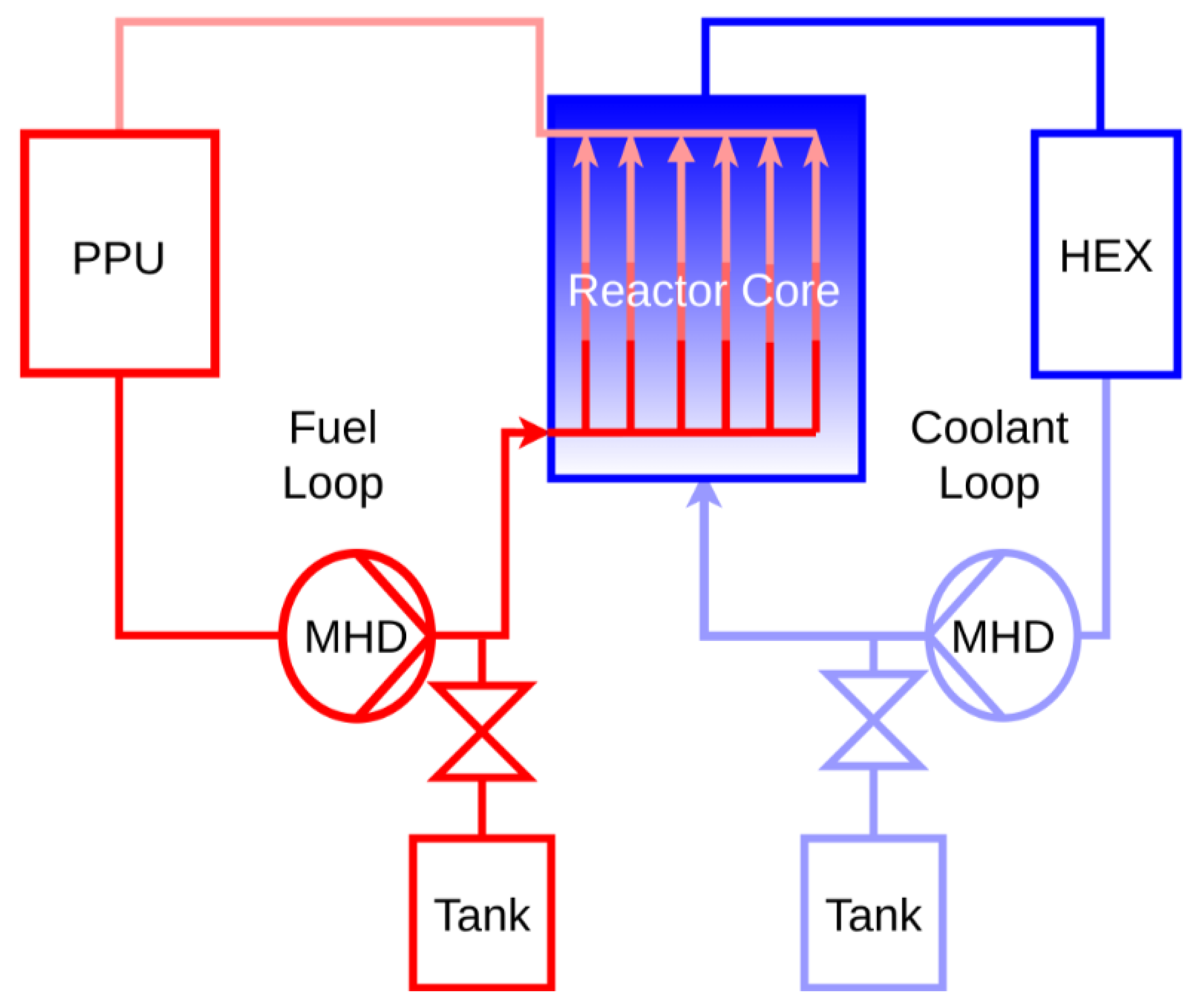
2]. The DFR diagram is shown in the
Figure 1. The technology is a combination of the Molten Salt Reactor (MSR) [
3] and the Lead Fast Reactor (LFR) [
4,
5].
A distinction is made between the DFR(m), which uses liquid metal fuel, and the DFR(s), which uses molten salts [
6,
7]. The DFR is characterized by very high operating temperatures (1000–1300 °C for fuel and 800 °C for coolant), which necessitates a coolant with a very high heat capacity, such as liquid metals [
8,
9].
Because the DFR(m) is a new reactor concept, simplified models must first be established to allow for tests and experiments to be conducted under safe, controlled conditions. These test systems, known as demonstrators, are designed to perform thermal-fluid experiments [
10]. The purpose of this work is to select appropriate dimensionless numbers to compare these demonstrators. This will create a methodology to predict the operating parameters of a larger minidemonstrator—and eventually the final DFR—based on data obtained from a smaller microdemonstrator.
The purpose of the work was to select appropriate dimensionless numbers, with which to compare demonstrators among themselves. This solution would allow us, based on the data from the microdemonstrator, to predict the operating parameters for the minidemonstrator and then for the conceptual DFR reactor. Specifically, applying fundamentals of the Similarity Theorem, experimental data gathared from micro-, mini- and other demonstrators will provide detailed knowledge of actual and potential flow patterns and heat transfer parameters.
The fundamental design of the Dual Fluid Reactor is elegantly captured in its two-circuit system, which efficiently separates the nuclear and thermal functions of the plant [
11]. The first circuit, the Fuel Loop, circulates the liquid fuel through the reactor core, where fission takes place. This loop also contains a Pyroprocessing Unit (PPU) for continuous, online removal of fission products and an MHD (magnetohydrodynamic) pump to maintain circulation. The second circuit, the Coolant Loop, pumps liquid lead through the reactor core to absorb the intense heat generated in the Fuel Loop. This heat is then transported via another MHD pump to a heat exchanger (HEX), where it is transferred to a conventional power conversion system to generate electricity [
11]. DFR flow parameters are presented in
Table 1.
Demonstrators
The DFR concept is a very complicated device in many aspects, and before a full-scale Dual Fluid Reactor can be constructed, a strategic, phased approach using demonstrators is essential. These demonstrators serve as proof-of-concept and first-of-a-kind facilities, allowing for a plethora of experiments on key technologies under safe, controlled conditions. This pathway involves building systems with gradually increasing fidelity and operating temperatures, mitigating risks and validating the design at each stage.
The demonstrator pathway is shown in table [
12] and begins with the microdemonstrator (µDEMO), a small-scale facility operating at lower temperatures (200–400 °C) with lead–bismuth eutectic. This facility will have similar velocities as the actual concept of the DFR. It then progresses to the minidemonstrator (mDEMO) [
10], which uses liquid lead at higher temperatures (800–1000 °C) [
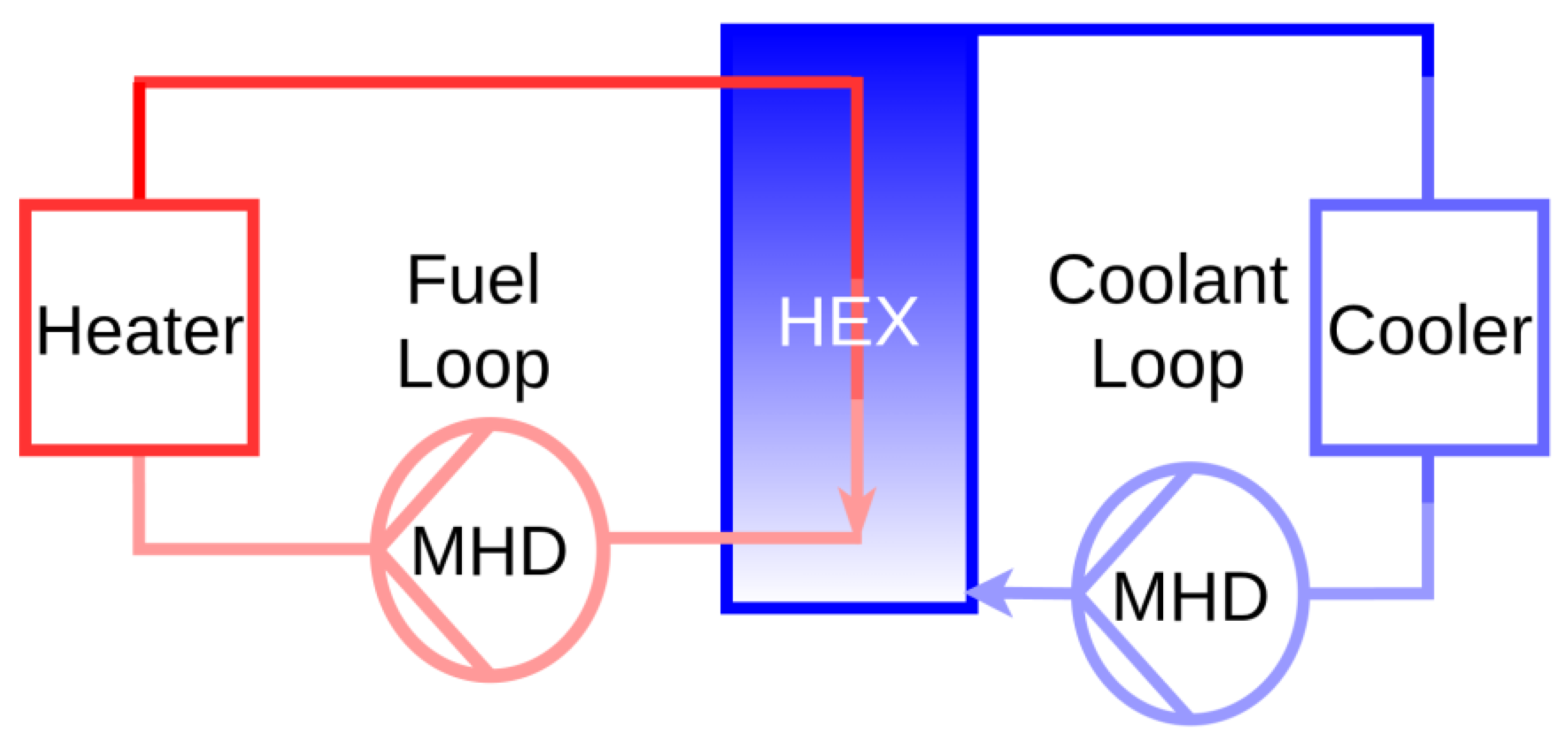
13]. This progression allows for critical experiments on phenomena concerning liquid metal thermal hydraulics (studying the unique flow and heat transfer characteristics of liquid metals), materials science and engineering (testing the performance and corrosion resistance of advanced piping and heat exchanger materials when exposed to high-temperature, corrosive fluids), and pumping solutions (validating and optimizing novel pumping solutions, such as magnetohydrodynamic (MHD) pumps, which are necessary because conventional pumps cannot handle the high-temperature liquid metals). The micro- and minidemonstrator diagram is shown in
Figure 2.
On the other hand, the minidemonstrator will share similar operating medium, velocities, and temperatures as the DFR concept. Data gathered from these demonstrators is invaluable for validating computational models, refining component design, designing following stages of demonstrators, and ultimately ensuring the safety and reliability of the final DFR.
2. Theoretical Framework
The theoretical framework for scaling the experimental data between the DFR demonstrators is grounded in the Similarity Theorem. This theorem is the cornerstone of thermal-hydraulic scaling, providing a rigorous method to ensure that a small-scale model accurately represents the phenomena of a full-scale prototype. Its application relies on the use of dimensionless numbers to characterize the physical system, making the results independent of the absolute size or operating conditions.
Similarity numbers (or dimensionless numbers) are ratios that help engineers and physicists understand how a system behaves without getting bogged down by specific units or sizes. They are essential for scaling experiments, like predicting the behavior of a large reactor based on a small model, which is the core issue discussed in the paper. Three key theorems from Similarity Theory together form the rulebook for scaling phenomena [
14].
Newton’s Theorem (The Principle): This is the basic idea. It states that if two physical phenomena are truly similar, then their corresponding similarity numbers must be identical. For example, if a small model of a pump is dynamically similar to its full-size version, their Reynolds numbers (a similarity number for fluid flow) will be the same [
15].
Buckingham’s
Theorem (The Method): This theorem provides a method for finding the similarity numbers in the first place. This shows that all physical variables describing the phenomenon (like velocity, density, viscosity, and pipe diameter) can be grouped into a smaller, basic set of dimensionless similarity numbers. This drastically simplifies the problem [
15].
Kirpichev–Guchman Theorem (The Condition) [
15]: This is the most critical theorem for practical application. It states that to guarantee two phenomena are similar, two conditions must be met as follows:
- (a)
The “uniqueness conditions” (geometry, material properties, and initial and boundary conditions) must be similar.
- (b)
The “defining” similarity numbers must be equal.
Defining numbers (the “Inputs” or Criteria) are constructed from the parameters that can be controlled or that define the system’s setup (the “uniqueness conditions”). To achieve similarity between two systems, these numbers must be deliberately aligned. This approach is essential for the DFR’s phased development, as it provides a scientifically sound basis for extrapolating findings from the low-temperature microdemonstrator to the high-temperature minidemonstrator.
Defining numbers, such as the Reynolds number (Re) and the Peclet number (Pe), are constructed from controllable “inputs” like fluid velocity, geometry, and inherent material properties [
16]. To achieve true similarity, the primary objective is to match these defining numbers between the two demonstrators, ensuring that the fundamental physical ratios—such as inertial to viscous forces (Re) and convective to conductive heat transfer (Pe)—are identical [
17]. In contrast, non-defining numbers, like the Nusselt number (Nu), are “outputs” because they include a resulting quantity like the heat transfer coefficient (h). The correct application of the theorem dictates that if the defining numbers are matched, the non-defining numbers will also match as a direct consequence of the established physical similarity [
18].
The application of this theorem is central to the validation of computational tools like the Cathare-2 code. By carefully designing experiments where the microdemonstrator’s operating conditions are adjusted to match the defining numbers (Re and Pe) of a target scenario in the minidemonstrator, a “similarity zone” is created. Experimental data gathered from the microdemonstrator within this zone provide a direct, one-to-one benchmark for validating the code’s predictive accuracy. This process ensures that the computational models are not just theoretically sound but are also anchored by real-world data from a physically analogous system.
Equally important is the theorem’s role in guiding experiments that fall outside the scope of direct similarity. The framework can identify conditions where the demonstrators are fundamentally different, such as operating in vastly different turbulence regimes. Intentionally performing experiments in these “out-of-similarity” zones is crucial for building a broader, more comprehensive database on liquid metal interactions, flow mechanics, and heat transfer. This expands the overall engineering knowledge base, ensuring the final DFR design is robust and safe across its entire operational envelope, not just under the limited conditions where direct scaling is possible.
To ensure that the experimental data from the micro- and minidemonstrators can be accurately compared and scaled, it is essential to use a theoretical framework that can describe the complex physical phenomena independently of the system’s size or temperature. This is achieved using a specific set of defining dimensionless numbers that characterize the dominant transport mechanisms at play. For the DFR, the three most critical phenomena are the transport of momentum (fluid flow), heat (energy extraction), and mass (fission product movement). Each of these is best described by a corresponding dimensionless number, making them the most suitable for identifying similarities between the demonstrators.
The two defining numbers are the Reynolds number (Re) and the Peclet number for heat transfer (Pe
h). Reynolds number characterizes the fluid dynamics by describing the ratio of inertial forces to viscous forces. Matching the Reynolds number ensures that the flow regimes (e.g., laminar or turbulent) are similar in both the micro- and minidemonstrator, which is fundamental to achieving any further similarity. This number is expressed by the following equation:
where,
v,
,
, and
are velocity, hydraulic diameter, fluid density, and dynamic viscosity.
Peclet number for heat transfer (Peheat) describes the ratio of convective heat transport (heat carried by the fluid’s motion) to conductive heat transport (heat spreading through the fluid). For liquid metals, which have very high thermal conductivity, the Peclet number is the most accurate defining number for thermal similarity, as it captures the dominant heat transfer mechanisms more effectively than other numbers. It is expressed by the following equation:
where
is a Prandtl number which is the ratio of momentum diffusivity to thermal diffusivity. In simpler terms, it compares how quickly momentum (velocity changes) spreads through a fluid versus how quickly heat spreads through it. It is a fundamental property of the fluid itself and is critical for understanding heat transfer. A low Prandtl number (
≪ 1), like that of liquid metals, means that heat diffuses much faster than momentum. This results in the thermal boundary layer being much thicker than the velocity boundary layer. Conversely, a high Prandtl number (
≫ 1), like that of oils, means momentum diffuses faster than heat, leading to a thermal boundary layer that is thinner than the velocity boundary layer. It is defined as
where
and
k are specific heat and thermal conductivity.
3. Reference Calculations
To provide a reliable benchmark for the subsequent scaling analysis, referential calculations for the heat exchangers of both the micro- and minidemonstrators are necessary. For this purpose, the Cathare-2 computer code was selected, as it is capable of providing high-fidelity values for fluid velocities and temperatures. As a well-established thermal-hydraulic software based on a robust six-equation, two-phase model, its suitability for high-temperature modeling has been demonstrated in its application to gas-cooled reactors. Critically, the code has been specifically validated for liquid metal systems, including a liquid sodium loop experiment with satisfactory results, and its library includes the necessary working fluids for both demonstrators by default.
CATHARE [
19] (Code for Analysis of THermalhydraulics during an Accident of Reactor and safety Evaluation) is a two-phase thermal-hydraulic software developed since 1979 at CEA-Grenoble under an agreement between CEA, EDF, AREVA, and IRSN. The software is based on a two-phase model with six equations (conservation of mass, moments, and energy for both phases). This software’s modular structure can operate in 0D, 1D, or 3D and is capable of modeling any type of reactor. The native support for liquid metals in Cathare-2 is essential for accurately modeling the DFR demonstrator systems [
20]. After simplification and reorganization, the momentum balance which is used to calculate pressure drop is as follows:
where
represents the inertia (temporal and convective acceleration).
is the pressure gradient.
is the distributed wall friction term. includes the single-phase friction factor .
represents the localized singular pressure loss (form loss) over a length . K is the singular pressure drop coefficient.
is the gravitational force term.
represents external momentum sources or sinks per unit volume.
This equation is the standard form of the one-dimensional momentum balance for a single-phase, incompressible or compressible fluid.
For the heat transfer law, for high Reynolds number liquid heat transfer a Dittus–Boelter correlation is applied as follows:
where
is the turbulent forced convection heat transfer coefficient ().
is the Reynolds number for the liquid phase.
is the Prandtl number for the liquid phase.
is the thermal conductivity of the liquid ().
is the hydraulic diameter associated with the liquid phase ().
3.1. Cathare-2 Model Setup
The simulations were performed using the Cathare-2 V2.5_3mod9.1 system code [
19], which employs a two-fluid, six-equation model [
21]. Both the µDEMO and mDEMO were represented using a simplified 1D counter-flow tube-in-tube heat exchanger geometry to serve as a consistent basis for scaling analysis. The inner tube had an inner diameter of
and a thickness of
, while the outer tube had an inner diameter of
. The heated length for both models was
. The µDEMO tube material was INOX317 stainless steel, whereas the mDEMO used a Titanium–Zirconium–Molybdenum (TZM) alloy. Axial nodalization comprised 50 nodes (
each), with 10 radial nodes for wall conduction. Temperature-dependent thermophysical properties for lead–bismuth eutectic (LBE) and pure lead (Pb), sourced from the Cathare-2 library, were used as defined in
Table 2.
3.2. Results
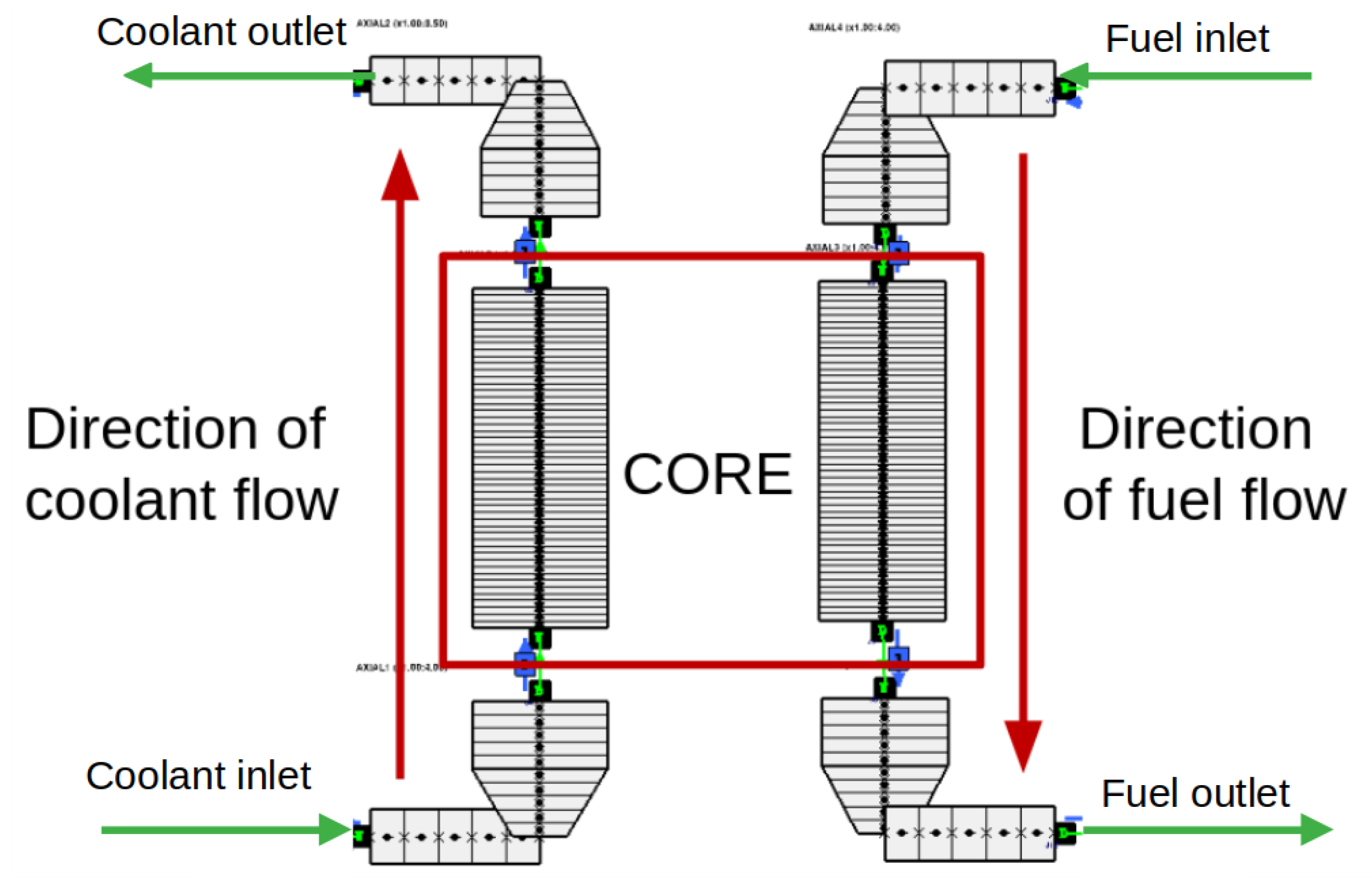
While the Cathare-2 models for the micro- and minidemonstrator share an identical core geometry to provide a consistent basis for comparison (
Figure 3), they differ fundamentally in three key areas. The primary differences are the operating media (lead–bismuth eutectic vs. pure liquid lead), the operating conditions of these fluids, which result in distinct densities and viscosities, and the heat exchanger materials required to withstand the vastly different temperature ranges. Consequently, even with the same geometry, the resulting dimensionless numbers for each system will differ, requiring a scaling analysis to bridge the gap between their performance. The fluid properties are presented in
Table 2, where T, in all equations, must be in Kelvin (K). The validity of these formulas has been checked and confirmed using a build-in CATHARE-2 post-processor.
Boundary conditions for the reference calculations are shown in
Table 3. The core that is depicted in
Figure 3 is simplified to a tube in a heat exchanger with an inner diameter of 0.0465 m, inner tube thickness of 0.002 m, and outer tube inner diameter of 0.08 m. The temperatures are imposed in the inlets in
Figure 3. However, the values of velocities and Reynolds numbers are checked at the core inlet. For the microdemonstrator, the heat exchanger has been designed with INOX317 stainless steel, since it operates at lower temperatures and for minidemonstrator, the heat exchanger is made of Titanium–Zirconium–Molybdenum alloy [
23] to withstand high temperatures [
24,
25]. The height of both heat exchangers is 0.5 m. The nodalization for calculations for both models is presented in
Table 4.
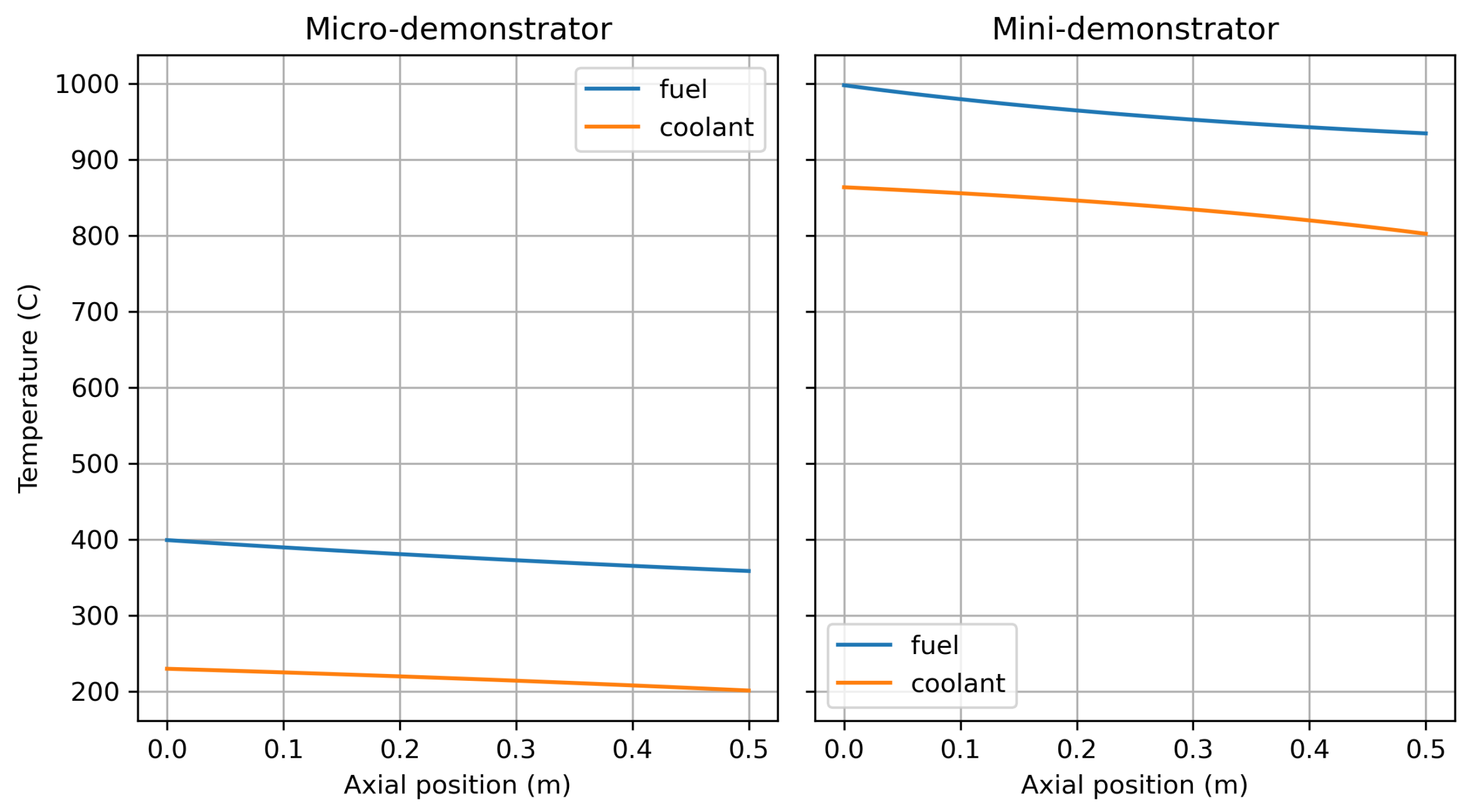
For such defined reference operating conditions, the temperatures of both fluids are depicted in
Figure 4.
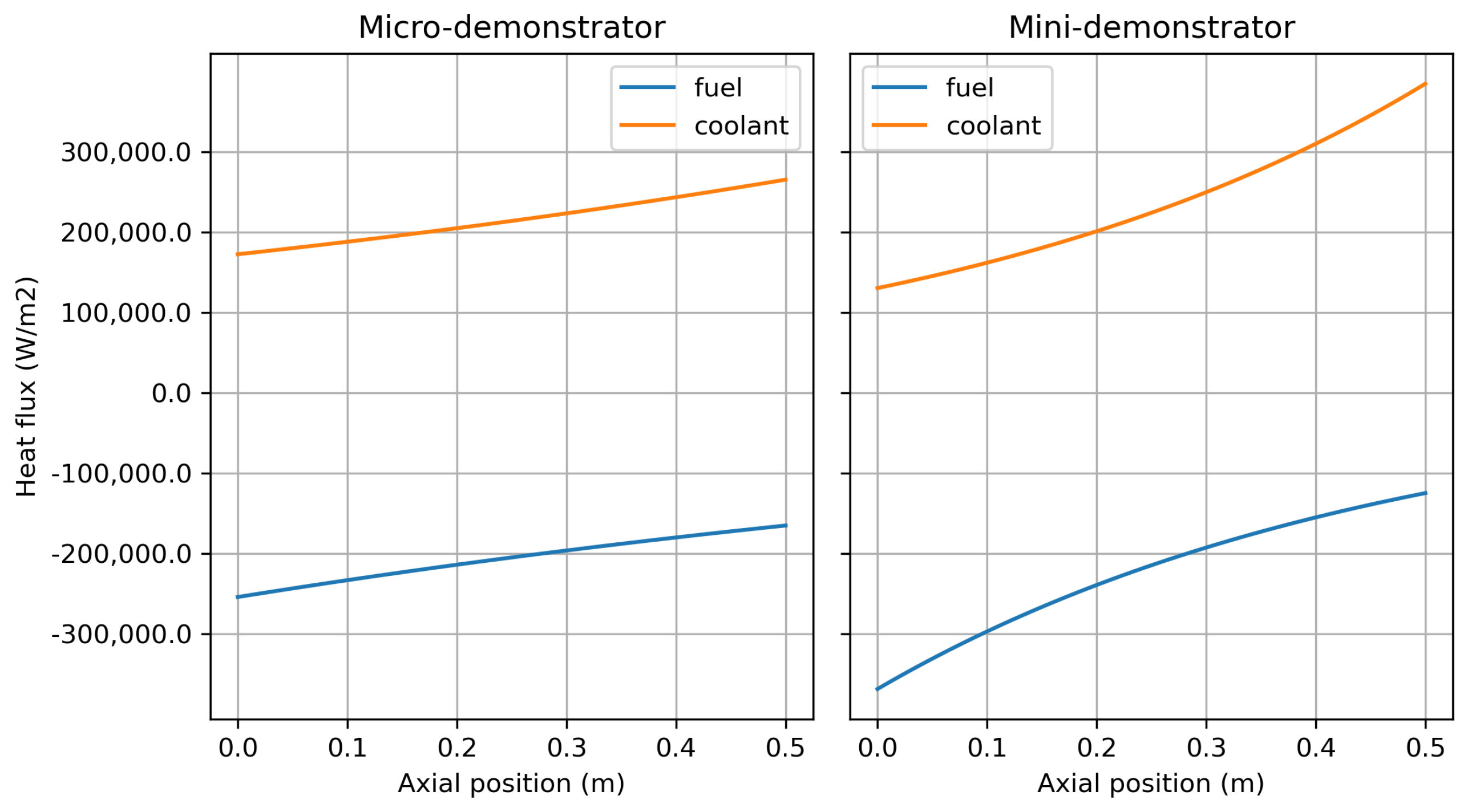
For such defined reference operating conditions, the heat flux of both fluids are depicted in
Figure 5.
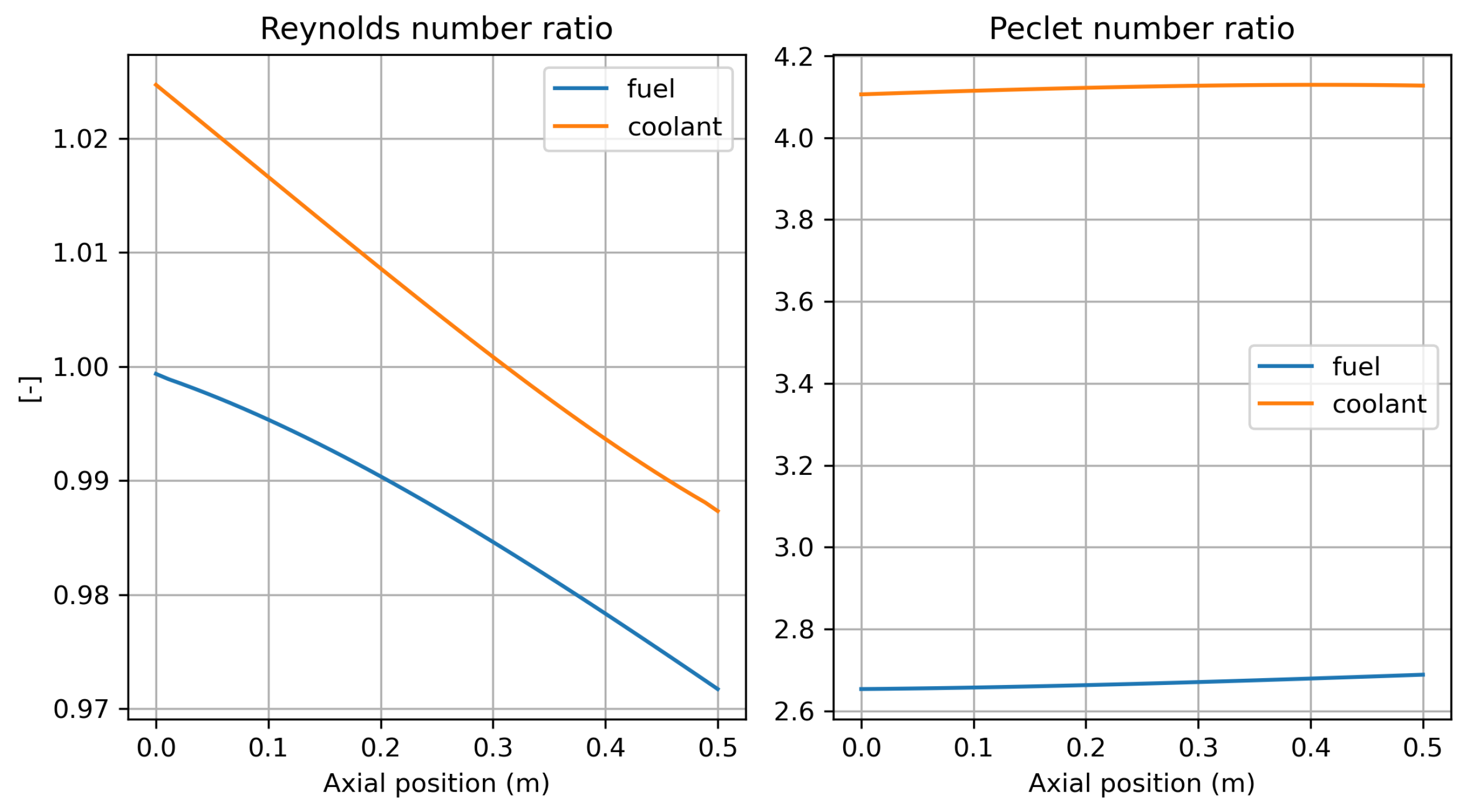
Lastly, the comparison of Reynolds and Peclet numbers is presented in
Figure 6. In this figure, on the left, one can observe a comparison of Reynolds numbers ratios for fuel and coolant between micro- and minidemonstrators defined as
4. Achieving Similarity Between Demonstrators
This section presents the Cathare-2 simulation results for the micro- and minidemonstrators, focusing on the specific operating conditions required to achieve similarity in their dimensionless numbers. The analysis is presented in two main cases: one targeting dynamic similarity (matching Reynolds numbers) and the other targeting thermal similarity (matching Peclet numbers). The criterion established in the article regarding the similarity of dimensionless numbers is that the relative difference between them cannot exceed 10%. The results demonstrate that the conditions required to satisfy each similarity case are distinct.
4.1. Dynamic Similarity
This subsection details the analysis performed to achieve dynamic similarity between the micro- and minidemonstrator. The primary objective was to identify the operating conditions that result in an identical Reynolds number () in both systems. Matching this key defining number is the foundation of a valid scaling experiment, as it ensures that the fundamental fluid dynamics—including the flow regime and turbulence characteristics—are directly comparable. To find these conditions, numerous calculations were performed in a systematic parametric study. For a given fluid velocity in the microdemonstrator, the Reynolds number similarity equation was solved to determine the precise corresponding velocity required in the minidemonstrator to yield the same value. This process was iterated across a wide spectrum of initial velocities for both the lead–bismuth eutectic and liquid lead, effectively mapping the operational relationship between the two systems.
A critical constraint on this study was to keep the results within realistic operational limits. The calculations were bounded by velocities that represent real-life values for magnetohydrodynamic pumps to avoid scenarios that would lead to excessive material erosion or impractical power requirements. This constrained approach successfully identified the ranges of applicability-specific, paired velocity ranges for each demonstrator, within which dynamic similarity can be confidently achieved, thus defining the precise conditions for valid experimental comparison.
From the
Table 5 above, it is important to note that as long as fuel velocity in the minidemonstrator is slower than fuel velocity in the microdemonstrator by exactly
times, the dynamic similarity will be achieved between system. For the coolant case, the ratio of micro-D coolant velocity to mini-D coolant velocity must be equal to
. Both values are estimated from the definition of the Reynolds number.
which can be re-arranged into the following:
Substituting actual properties of fuel and coolant to Equation (
8), we receive confirmation of the velocities ratio from
Table 5.
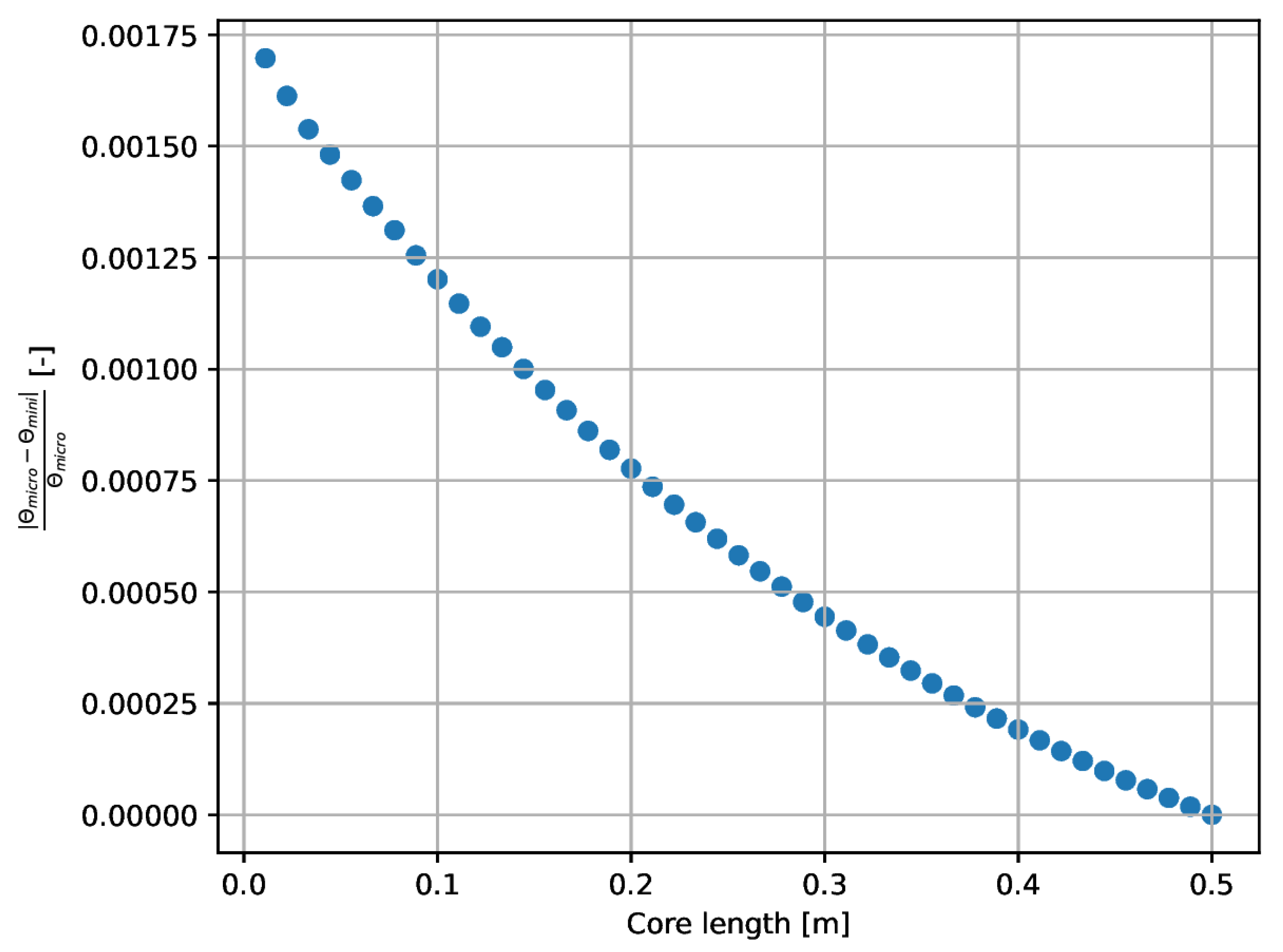
Finally, matching dynamic similarity, we achieve that the deviation of dimensionless pressure drop, defined in Equation (
9), between micro- and minidemonstrators, is lower than 2%—as depicted in
Figure 7.
4.2. Thermal Similarity
This subsection focuses on achieving thermal similarity by identifying the operating conditions that yield an identical Peclet number for heat transfer () in both the micro- and minidemonstrator. Matching the Peclet number is paramount for scaling heat transfer experiments in liquid metals, as it ensures the fundamental ratio of convective to conductive heat transport is the same in both systems. This provides a valid basis for comparing and extrapolating thermal performance from the low-temperature model to the high-temperature prototype.
To determine these conditions, a comprehensive parametric study involving numerous calculations was performed. For a given fluid velocity within the microdemonstrator’s model, the Peclet number similarity equation was solved to find the precise corresponding velocity needed in the minidemonstrator to achieve an equal
value. This iterative process was repeated across a broad spectrum of initial velocities, allowing for a complete mapping of the operational relationship between the two systems (
Table 6).
The entire study was constrained by velocities that represent real-life values for magnetohydrodynamic pumps, ensuring the findings are applicable to a practical engineering design and avoiding scenarios that would lead to excessive material erosion or impractical power requirements. This constrained approach allowed for the clear identification of the ranges of applicability—the specific, paired velocity ranges for each demonstrator—within which thermal similarity can be confidently achieved. It is important to note that these conditions for thermal similarity are distinct from those required to achieve dynamic similarity, a key finding that will be discussed further.
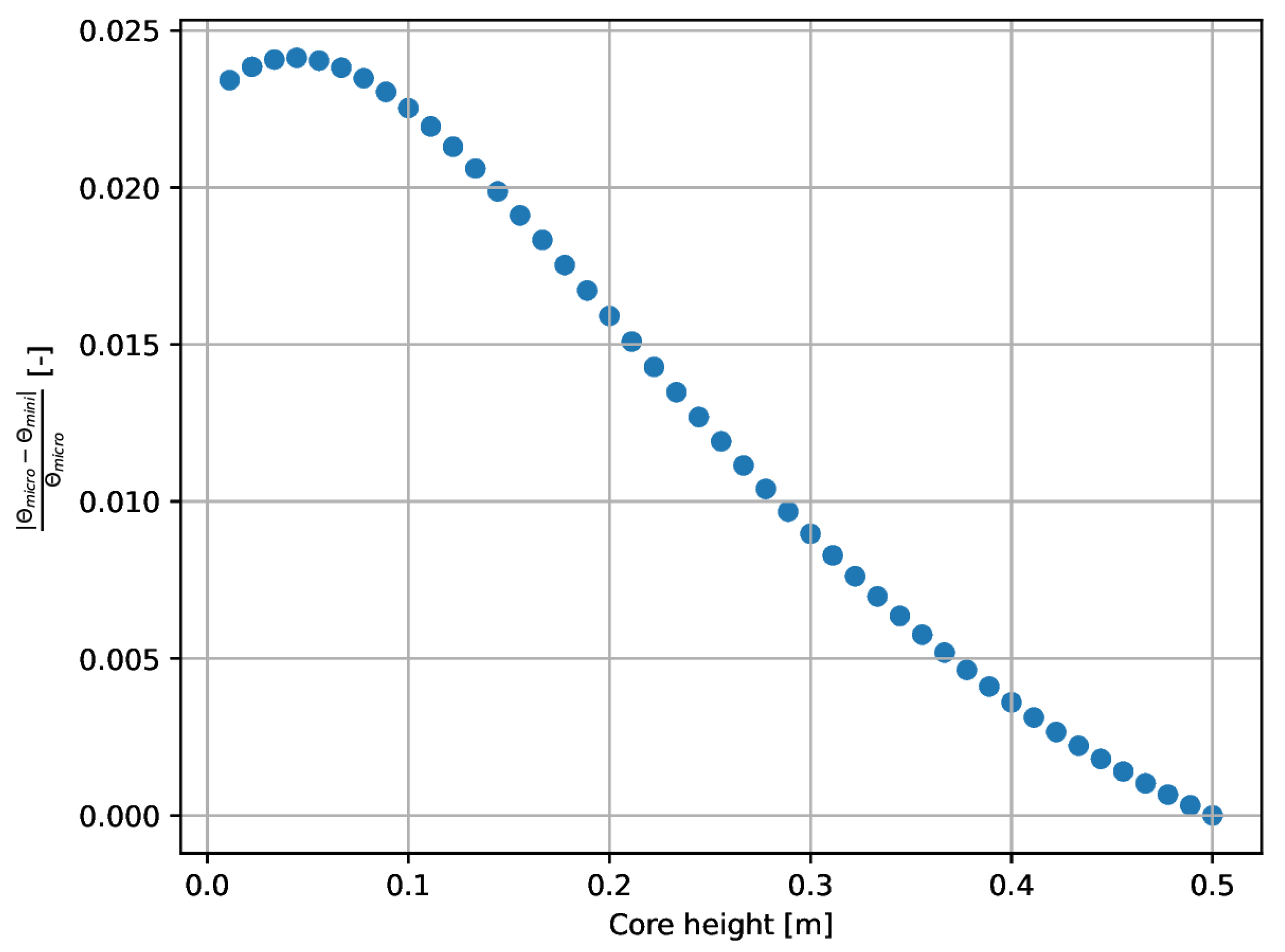
Finally, matching thermal similarity, we achieve that the deviation of dimensionless temperature, defined in Equation (
10), between micro- and minidemonstrators, is lower than 3%—as depicted in
Figure 8.
5. Discussion
The primary objective of this work was to establish a scaling methodology for thermal-hydraulic phenomena between a low-temperature microdemonstrator (DEMO) and a high-temperature minidemonstrator (mDEMO). A parametric study successfully identified the operating ranges required to achieve either dynamic similarity, by matching the Reynolds number (), or thermal similarity, by matching the Peclet number ().
The central finding from the parametric study is the critical conflict inherent to scaling these systems: dynamic and thermal similarity cannot be achieved simultaneously. This challenge stems from the physical relationship . The two demonstrators use different liquid metals at vastly different operating temperatures (200 °C to 400 °C for the DEMO vs. 1000 °C to 1200 °C for the mDEMO), resulting in significantly different Prandtl numbers (). Because the Prandtl number is an intrinsic and unequal property between the two systems, it is impossible to satisfy the conditions for both similarities at once. If fluid velocities are adjusted to make the Reynolds numbers equal (), the differing Prandtl numbers ensure the Peclet numbers will not match.
6. Conclusions
This paper establishes a cornerstone methodology for the design and validation of the Dual Fluid Reactor’s technology demonstrators. The core contribution is the creation of a clear pathway to align the working conditions of these disparate systems for meaningful scientific investigation. By conducting a systematic parametric study, this analysis has successfully identified the precise, actionable operational ranges required to achieve either dynamic or thermal similarity. Using Cathare-2 simulations, this study produced the following key quantitative results. The specific operating ranges (velocities and mass flow rates) required to achieve dynamic similarity (matching
) were identified (
Table 5). Achieving this similarity allows the dimensionless pressure drop (
, Equation (
9)) to be scaled between demonstrators with a maximum deviation below 0.2%. Distinct operating ranges necessary for achieving thermal similarity (matching
) were also successfully identified (
Table 6). Under these conditions, the dimensionless temperature profile (
, Equation (
10)) can be scaled with a maximum deviation below 2.5%.
The critical finding that these two similarity states are mutually exclusive provides an essential guiding principle that directly impacts the designing aspects of potential demonstrators. This forces engineers to make a deliberate choice: is the primary goal of a given experimental facility to validate hydrodynamic models (requiring dynamic similarity) or to confirm thermal performance (requiring thermal similarity)? This decision directly informs the engineering specifications of key components—such as the required flow rates for the MHD pumps—and the necessary experimental instrumentation.
Furthermore, this scaling methodology is not limited to the micro- and minidemonstrators; its principles can be extrapolated to bridge the gap between each successive demonstrator stage and, ultimately, to the full-scale Dual Fluid Reactor itself. Therefore, the presented methodology is a foundational tool that provides the essential “rulebook” for ensuring the entire DFR demonstrator pathway is built on a foundation of reliable, scalable, and physically meaningful data, paving the way for the safe and successful development of the final reactor.
Author Contributions
Conceptualization, M.S. and M.M.N.; methodology, M.S. and M.M.N.; software, M.M.N.; validation, M.S. and M.M.N.; formal analysis, M.S.; investigation, M.S.; data curation, M.M.N.; writing—original draft preparation, M.S.; writing—review and editing, M.S. and M.M.N.; visualization, M.S. and M.M.N.; supervision, M.S. All authors have read and agreed to the published version of the manuscript.
Funding
This work was supported by the Polish National Research and Development Center (NCBR) project “New Reactor Concepts and Safety Analyses for the Polish Nuclear Energy Program”, POWR.03.02.00-00-I005/17 (years 2018–2023).
Data Availability Statement
The raw data supporting the conclusions of this article will be made available by the authors on request.
Conflicts of Interest
The authors declare no conflicts of interest.
Abbreviations
The following abbreviations are used in this manuscript:
| DFR | Dual Fluid Reactor |
| HEX | Heat Exchanger |
| DEMO | Microdemonstrator |
| mDEMO | Minidemonstrator |
| MHD | Magnetohydrodynamic |
| PPU | Pyroprocessing Unit |
References
- Wang, X.; Seidl, M.; Macian-Juan, R. Preliminary Analysis of Basic Reactor Physics of the Dual Fluid Reactor Concept. In Proceedings of the ICAPP, Nice, France, 3–6 May 2015. [Google Scholar]
- Huke, A.; Ruprecht, G.; Weißbach, D.; Gottlieb, S.; Hussein, A.; Czerski, K. The Dual Fluid Reactor—A novel concept for a fast nuclear reactor of high efficiency. Ann. Nucl. Energy 2015, 80, 225–235. [Google Scholar] [CrossRef]
- Uhlíř, J. Chemistry and technology of Molten Salt Reactors-history and perspectives. J. Nucl. Mater. 2007, 360, 6–11. [Google Scholar] [CrossRef]
- Smith, C.F.; Halsey, W.G.; Brown, N.W.; Sienicki, J.J.; Moisseytsev, A.; Wade, D.C. SSTAR: The US lead-cooled fast reactor (LFR). J. Nucl. Mater. 2008, 376, 255–259. [Google Scholar] [CrossRef]
- Huke, A.; Goetz, R.; Hussein, A.; Czerski, K.; Gottlieb, S. Dual Fluid Reactor. Patent WO2013041085A2, 30 May 2013. [Google Scholar]
- Sierchuła, J.; Weissbach, D.; Huke, A.; Ruprecht, G.; Czerski, K.; Da¸browski, M.P. Determination of the liquid eutectic metal fuel dual fluid reactor (DFRm) design–steady state calculations. Int. J. Energy Res. 2019, 43, 3692–3701. [Google Scholar] [CrossRef]
- Sierchuła, J.; Dąbrowski, M.P.; Czerski, K. Negative temperature coefficients of reactivity for metallic fuel Dual Fluid Reactor. Prog. Nucl. Energy 2022, 146, 104126. [Google Scholar] [CrossRef]
- Weissbach, D.; Sierchuła, J.; Dąbrowski, M.P.; Czerski, K.; Ruprecht, G. Dual Fluid Reactor as a long-term burner of actinides in spent nuclear fuel. Int. J. Energy Res. 2021, 45, 11589–11597. [Google Scholar] [CrossRef]
- Hanusek, T.; Macian-Juan, R. Analyses of the shutdown system and transients scenarios for the dual fluid reactor concept with metallic molten fuel. Int. J. Energy Res. 2022, 46, 225–235. [Google Scholar] [CrossRef]
- Elgendy, H.; Czerski, K. Numerical Study of Flow and Heat Transfer Characteristics in a Simplified Dual Fluid Reactor. Energies 2023, 16, 4989. [Google Scholar] [CrossRef]
- Nowak, M.; Spirzewski, M.; Czerski, K. Optimization of the DC magnetohydrodynamic pump for the Dual Fluid Reactor. Ann. Nucl. Energy 2022, 174, 109142. [Google Scholar] [CrossRef]
- Nowak, M. Reactivity Control by the Pumping System in the Dual Fluid Reactor. Ph.D. Thesis, National Centre for Nuclear Research, Otwock, Poland, 2023. [Google Scholar]
- Elgendy, H.; Kubacki, S.; Czerski, K. Enhancing Thermal-Hydraulic Modelling in Dual Fluid Reactor Demonstrator: The Impact of Variable Turbulent Prandtl Number. Energies 2025, 18, 396. [Google Scholar] [CrossRef]
- Marín, E.; Calderón, A.; Delgado-Vasallo, O. Similarity theory and dimensionless numbers in heat transfer. Eur. J. Phys. 2009, 30, 439. [Google Scholar] [CrossRef]
- Durst, F. Similarity Theory. In Fluid Mechanics: An Introduction to the Theory of Fluid Flows; Springer: Berlin/Heidelberg, Germany, 2022; pp. 239–266. [Google Scholar] [CrossRef]
- Argyropoulos, S.; Mikrovas, A.; Doutre, D. Dimensionless correlations for forced convection in liquid metals: Part I. Single-phase flow. Metall. Mater. Trans. B 2001, 32, 239–246. [Google Scholar] [CrossRef]
- Lienhard, J.H., IV; Lienhard, V.J.H. A Heat Transfer Textbook, 5th ed.; Phlogiston Press: Cambridge, MA, USA, 2020; Version 5.10. [Google Scholar]
- Fu, H.; Chen, J.; Tong, Y.; Peng, S.; Liu, F.; Lyu, X.; Zhao, H. New Nusselt Number Correlation and Turbulent Prandtl Number Model for Turbulent Convection with Liquid Metal Based on Quasi-DNS Results. Energies 2025, 18, 547. [Google Scholar] [CrossRef]
- Geffraye, G.; Antoni, O.; Farvacque, M.; Kadri, D.; Lavialle, G.; Rameau, B.; Ruby, A. CATHARE 2 V2.5_2: A single version for various applications. Nucl. Eng. Des. 2011, 241, 4456–4463. [Google Scholar] [CrossRef]
- Tenchine, D.; Baviere, R.; Bazin, P.; Ducros, F.; Geffraye, G.; Kadri, D.; Perdu, F.; Pialla, D.; Rameau, B.; Tauveron, N. Status of CATHARE code for sodium cooled fast reactors. Nucl. Eng. Des. 2012, 245, 140–152. [Google Scholar] [CrossRef]
- Polidori, M.; Nitti, F.S.; Meloni, P.; Lombardo, C.; Bandini, G.; Geffraye, G.; Kadri, D. CATHARE thermal-hydraulic system code for HLM preliminary validation in natural convection tests. In Proceedings of the International Congress on Advances in Nuclear Power Plants 2012, ICAPP 2012, Chicago, IL, USA, 24–28 June 2012. [Google Scholar]
- NEA. Handbook on Lead-Bismuth Eutectic Alloy and Lead Properties, Materials Compatibility, Thermalhydraulics and Technologies; NEA: Paris, France, 2015; p. 950. [Google Scholar] [CrossRef]
- Milošević, N.; Nikolić, I.; Grelard, M.; Hay, B. Thermophysical properties of the molybdenum alloy TZM (Mo-0.5Ti-0.08Zr-0.02C) over a wide temperature range. High Temp.-High Press. 2023, 52, 353–364. [Google Scholar] [CrossRef]
- Park, J.J.; Butt, D.P.; Beard, C.A. Review of liquid metal corrosion issues for potential containment materials for liquid lead and lead–bismuth eutectic spallation targets as a neutron source. Nucl. Eng. Des. 2000, 196, 315–325. [Google Scholar] [CrossRef]
- Chakraborty, S.; Banerjee, S.; Singh, K.; Sharma, I.; Grover, A.; Suri, A. Studies on the development of protective coating on TZM alloy and its subsequent characterization. J. Mater. Process. Technol. 2008, 207, 240–247. [Google Scholar] [CrossRef]
| Disclaimer/Publisher’s Note: The statements, opinions and data contained in all publications are solely those of the individual author(s) and contributor(s) and not of MDPI and/or the editor(s). MDPI and/or the editor(s) disclaim responsibility for any injury to people or property resulting from any ideas, methods, instructions or products referred to in the content. |
© 2025 by the authors. Licensee MDPI, Basel, Switzerland. This article is an open access article distributed under the terms and conditions of the Creative Commons Attribution (CC BY) license (https://creativecommons.org/licenses/by/4.0/).