Article

Performance Modeling of Rooftop PV Systems in Arid Climate, a Case Study for Qatar: Impact of Soiling Losses and Albedo Using PVsyst and SAM


by
Sachin Jain
*,
Mohamed Abdelrahim
,
Amir A. Abdallah
,
Dhanup S. Pillai
and
Sertac Bayhan
Qatar Environment & Energy Research Institute (QEERI), Hamad Bin Khalifa University (HBKU), Doha P.O. Box 34110, Qatar
*
Author to whom correspondence should be addressed.
Energies 2025, 18(22), 5876; https://doi.org/10.3390/en18225876
Submission received: 28 September 2025 / Revised: 22 October 2025 / Accepted: 28 October 2025 / Published: 7 November 2025

Abstract

This study presents a comparative performance modeling and optimization framework for a 5 kWp rooftop photovoltaic (PV) system in Qatar, using two widely adopted simulation tools, PVsyst and the System Advisor Model (SAM). The research addresses a key limitation in existing PV modeling practice: the restricted capability of standard software to represent site-specific soiling and dynamic albedo effects under arid climatic conditions. To overcome these limitations, the Humboldt State University (HSU) soiling model was calibrated using field measurements from a DustIQ sensor, and its parameters, rainfall cleaning threshold and particulate deposition velocity were optimized through a Differential Evolution algorithm. Additionally, the study utilized dynamic albedo inputs to better account for ground-reflectance effects in energy yield simulations. The optimized approach reduced the root mean square error (RMSE) of predicted soiling ratios from 7.30 to 1.93 and improved the agreement between simulated and measured monthly energy yields for 2024, achieving normalized RMSE values of 4.66% in SAM and 4.86% in PVsyst. The findings demonstrate that coupling data-driven soiling optimization with refined albedo representation modernizes the predictive capabilities of PVsyst and SAM, yielding more reliable performance forecasts. This methodological advancement supports better-informed design and operation of rooftop PV systems in desert environments where soiling and reflectivity effects are pronounced.

1. Introduction

As most of the investment in photovoltaic (PV) systems occurs before they begin generating energy and revenue, the risk associated with PV plant or technology investments primarily hinges on investor confidence in the system’s predicted long-term performance. The cost of financing this risk is heavily impacted by uncertainty, whether actual or perceived, surrounding long-term performance estimates. Sharing best practices in performance prediction is essential to reducing costs tied to perceived uncertainty. By addressing and eliminating perceived uncertainty, attention can shift to real, quantifiable uncertainties, such as future weather and solar irradiance, which are more measurable and manageable.
To model the performance of PV system several commercial and open-source tools are available. Models refer to mathematical or conceptual tools that represent real-world systems, developed to help understand and predict observable or measurable behaviors. For photovoltaic (PV) systems, these models are used to estimate energy or power output under various environmental conditions, system designs, and site-specific factors. However, it is important to approach PV performance models with a healthy degree of caution. All models rely on simplifying assumptions, which inevitably lead to a level of discrepancy between predicted and actual performance. Additionally, all measurements related to PV system performance, such as current, voltage, temperature, and orientation (tilt and azimuth) carry inherent uncertainties that further contribute to this variation.
Several studies have been carried out to compare different available tools for PV system performance modeling. For instance, Comparative studies conducted by the National Renewable Energy Laboratory (NREL) have evaluated PVsyst [1] and SAM [2], among other photovoltaic performance modeling tools, to assess their predictive accuracy and limitations. The results showed that both tools achieve annual energy prediction errors within ±8%. While both tools employ similar single-diode and thermal models, discrepancies arise mainly from parameterization choices, irradiance inputs, and user-defined losses rather than from the models themselves [3]. A subsequent validation in 2018, which included HelioScope [4] alongside PVsyst, SAM, and PV*SOL [5], confirmed similarly narrow error ranges (−7% to +4%) and reinforced that all detailed modeling tools yield comparable performance when consistent input data and assumptions are applied [6]. Milosavljević et al. [7] compare 14 PV simulation tools, PVGIS [8], PVWatts [9], SolarGIS [10], RETScreen [11], BlueSol [12], PVsyst, HelioScope, PV * SOL, Solarius PV [13], PV F-Chart [14], PolySun [15], SolarPro [16], SAM, and HOMER [17], against experimental data from a 2 kWp system in Niš, Serbia. PVGIS and SolarPro showed the lowest deviations in energy output and irradiation estimates, respectively. Tools using regional datasets and advanced models performed better than those relying on global data and simpler models. Results emphasize the need for location-specific validation to ensure accurate PV system performance forecasting. Islam et al. [18] provide a comprehensive evaluation of five widely used PV simulation tools, System advisor model (SAM), PVsyst, HOMER, PV * SOL, and RETScreen based on ten key criteria, including cost, database access, modeling capabilities, and ease of use. Using the Analytic Hierarchy Process (AHP), SAM ranked highest overall, particularly excelling in accuracy, with the lowest RMSE (6.65) and MAPE (12.02%) when compared to real-world data. PV * SOL followed closely, offering strong modeling and reporting features. The results highlight SAM and PVSOL as the most reliable tools for accurate PV system design and analysis, aiding users in making informed software choices.
For distributed generation, rooftop solar photovoltaic (PV) systems offer a practical and scalable solution to meet localized energy demands. However, their performance is significantly affected by environmental factors such as temperature fluctuations, solar irradiance variability, partial shading from nearby structures, and soiling. Some recent studies specifically analyze rooftop PV systems by using some aforesaid tools and software. In Bahrain, a study focusing on the modeling and simulation of energy losses due to shading under different climatic conditions. The results demonstrate a noticeable decline in energy output when panels are partially shaded, highlighting the need for careful design and placement in urban environments [19]. Singh et al. [20] present a five-year performance analysis of a 10 kWp rooftop grid-connected PV system in Sagolband, Imphal, India, comparing measured data with PVsyst simulations. Key performance indicators such as array yield, final yield, system efficiency, capacity utilization factor, and performance ratio were analyzed. The system achieved an average daily yield of 3.2 kWh/kWp and a performance ratio of 70.71%, with actual energy generation reaching 75.75% of predicted values. Discrepancies were attributed to inverter downtime, environmental variability, temperature effects, and soiling. Despite these losses, the system demonstrated strong financial viability with a payback period of 4 years and 10 months, emphasizing the importance of predictive accuracy, regular maintenance, and seasonal performance optimization.
Studies that emphasize performance in arid and desert regions include the work of Zaghba et al. [21] evaluate the long-term performance of a 2.25 kWp grid-connected micromorph thin-film PV system operating in the harsh desert climate of southern Algeria from 2015 to 2020. Using IEC 61724 guidelines, key performance metrics and a low annual degradation rate of 0.22% were assessed, demonstrating strong thermal stability and consistent energy output. The system avoided 14.17 tons of CO2 emissions and showed a payback period of 9–12 years, confirming its economic feasibility. Performance data were validated against four simulation tools, PVsyst, PVGIS, NREL’s PVWatts® Calculator, and Solar Med-Atlas, highlighting the reliability of thin-film technology for large-scale deployment in arid regions. Polo et al. [22] investigate the impact of soiling losses on rooftop PV systems in a suburban forest area of Madrid, focusing on one year of measurement data. The results show that soiling losses can reach up to 6% per day during the summer with a tilt angle of 8°. Two soiling models, the simple Kimber model and the more detailed HSU model, were evaluated using experimental data. Both models provided good predictions, particularly in summer, with the HSU model showing strong performance when incorporating air quality data from local monitoring stations. The findings highlight the importance of proper characterization and modeling of soiling losses, especially for the growing distributed PV systems in urban and suburban areas across Europe.
The influence of modeler dependent variability in photovoltaic performance simulations has been clearly highlighted by the Photovoltaic Performance Modeling Collaborative (PVPMC) [23] blind studies. In the first exercise, Stein et al. [24] provided identical weather and system data to multiple participants using tools such as PVsyst, PVWatts, and other in-house models, and found substantial discrepancies in predicted annual yields, mainly arising from differences in parameterization, data interpretation, and user assumptions rather than from the models themselves. A decade later in year 2023, the renewed intercomparison by Theristis et al. [25] demonstrated improved consistency and reduced bias (median annual energy deviation ≈ −3%), though human and methodology driven uncertainties remained the dominant factors. Collectively, such developments emphasize that while modeling tools have matured, further gains in predictive reliability depend on standardized modeling practices, the modeler’s skill in understanding, choosing, and using the models and their parameters correctly, transparent workflows, and robust uncertainty quantification. Although both SAM and PVsyst implement many of the same internal sub models, the types of inputs they accept or require differ slightly. These differences provide insight into the relative complexity of each tool and highlight the specific aspects of PV system performance that each tool emphasizes.
This study focuses on the performance modeling of a rooftop photovoltaic (PV) system using two widely adopted simulation tools: PVsyst (Version 8.0.14) and the System Advisor Model (SAM, version 2025.4.16 r1). It further examines the influence of soiling losses under harsh climatic conditions, particularly in arid regions where such losses constitute a major component of overall optical degradation. Due to the limited availability of soiling sensors in urban environments, quantifying soiling losses through in situ measurements remains challenging. Given the site-specific nature of soiling and its pronounced impact in dry climates, accurate modeling of these losses is crucial. Accordingly, this work aims to enhance predictive accuracy by optimizing soiling-loss estimation and utilizing time-varying albedo data. The following Materials and Methods Section details the datasets, model configurations, and optimization procedures employed to quantify and minimize modeler driven uncertainties. The pursuit of more reliable estimation methods thus forms the central motivation of this study

2. Materials and Methods

PV performance modeling focuses on the energy journey, starting from sunlight as it travels through space and Earth’s atmosphere to reach a PV array, where it is converted into electrical energy. At each stage of this process, some energy is inevitably “lost,” typically as heat. The goal of PV performance models is to calculate or estimate the amount of energy that is successfully converted into usable electrical power. This process generally involves the following steps: (1) defining the design parameters of the PV system, (2) selecting appropriate irradiance and weather data, (3) converting irradiance data to the plane of the array, (4) estimating optical losses due to shading, soiling, and surface reflections, (5) calculating the effective irradiance on the modules, (6) estimating the PV cell temperature, (7) determining the current–voltage (I–V) characteristics of the modules, (8) evaluating DC wiring and mismatch losses, (9) estimating DC-to-AC conversion losses, and (10) accounting for AC wiring and transformer losses. Most PV performance models generally follow these steps. However, in this study, we utilize SAM and PVsyst, with a primary focus on soiling losses due to their significant impact in this region.

2.1. Study Region

Qatar, a peninsular country in the Middle East, is characterized by a hot subtropical desert climate. The weather is predominantly hot and humid during the summer months, with temperatures often exceeding 47 °C (116.6° F) [26]. In contrast, winters are mild, but the overall climate remains arid with very low annual precipitation, averaging around 75 mm per year [27]. In Qatar, the average daily GHI is approximately 5.80 kWh/m2/day, totaling around 2116 kWh/m2/year [28]. Soiling losses in Qatar, without regular cleaning, soiling can reduce PV output power by up to 43% over six months [29]. Dust storms, which are more frequent in summer, exacerbate soiling losses, causing an 8% reduction in solar radiation reaching the PV panels and increasing the annual soiling rate by 23% [30,31]. Albedo value for Qatar, the measure of reflectivity of a surface, varies with different conditions. Studies from nearby regions like Saudi Arabia show mean annual albedo values ranging from 0.15 to 0.54, with higher values typically observed in winter [32]. Given the similar climatic and geographical conditions, Qatar’s albedo values are likely to fall within this range.
The rooftop PV system considered in this study is a 5 kWp installation, commissioned in November 2018, located at 25.32° N latitude, 51.42° E longitude, and an altitude of 30 m. Monthly time-series energy generation data from the system were used for comparison with simulated results. These data were accessed through the Sunny Portal platform provided by SMA [33].

2.2. Three-Dimensional Model of the Building for Shading Analysis

Figure 1 shows a 3D perspective of the rooftop PV system generated in PVsyst for shading analysis. The model enables a detailed assessment of potential shading from roof features. No nearby buildings are causing near shading; however, far shading from the horizon was incorporated using the PVGIS web tool and imported into the PVsyst horizon tool to account for any distant obstructions.

2.3. Irradiance and Weather Data Sources

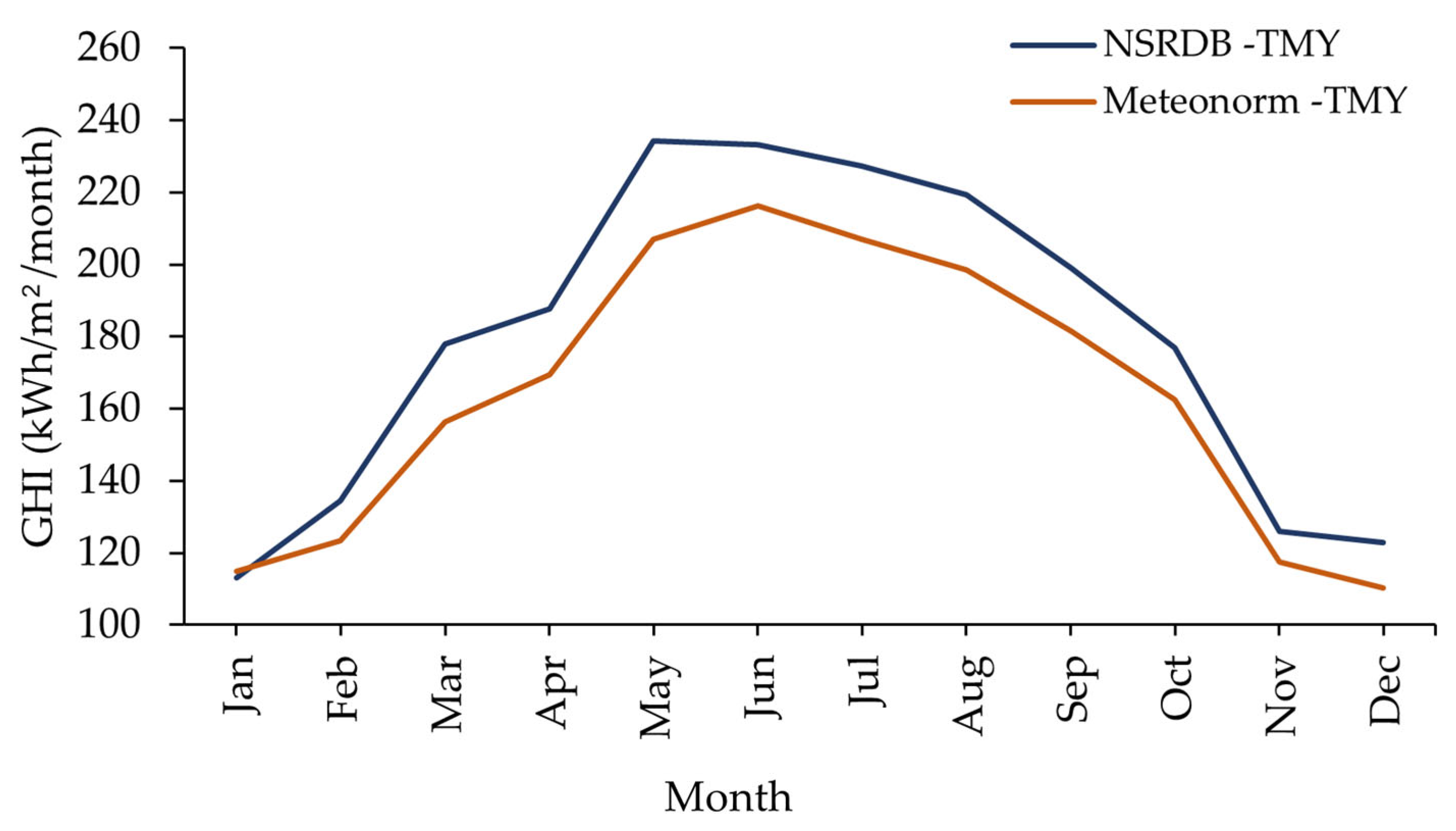
For PVsyst simulations, the default Typical Meteorological Year (TMY) data from Meteonorm version 8 were used, which provide monthly and hourly weather and irradiance parameters including global horizontal irradiance (GHI), direct normal irradiance (DNI), ambient temperature, and wind speed [34]. SAM simulations, on the other hand, employed weather input from the default National Solar Radiation Database (NSRDB),by NREL [35], which additionally includes hourly albedo data, allowing for a more detailed representation of ground reflected irradiance compared to the static or monthly albedo values in Meteonorm data. Although both datasets contain similar meteorological parameters (e.g., GHI (Figure 2), DNI, temperature, wind speed), their numerical values and derivation methodologies differ, potentially leading to variations in simulation outputs. To ensure a consistent comparison and minimize discrepancies arising from such differences in input weather data, PVsyst was also simulated using the same NSRDB file. This approach enables a direct assessment of both tools under identical meteorological inputs, thereby avoiding inconsistencies due to differing data sources.

2.4. System Description and Parameters

The technical specifications of the rooftop PV system considered in this study are summarized in Table 1. The system consists of bifacial SolarWorld SunModule Bisun SW 280 Duo modules, connected in a series configuration of 18 modules arranged across two rows. Power conversion is carried out by an SMA Sunny Tripower 6000TL-20 inverter(SMA Solar Technology AG, Niestetal, Germany), rated at 6 kW. To ensure realistic simulations, system-specific parameters such as module and inverter characteristics were directly matched to the existing rooftop installation. AC and DC ohmic losses were estimated based on the approximate lengths and cross-sections of the wiring. The rooftop albedo was assumed to be 0.15, corresponding to the black pebble surface.

2.5. Soiling Model

In most PV performance models, soiling losses are not explicitly calculated; instead, assumptions are made regarding the overall impact of soiling on the system’s performance [36,37]. The Humboldt State University (HSU) soiling model [38] is used here, physical-based model used to estimate dust accumulation on PV modules, considering factors like deposition velocity and particle concentration, specifically for particulate matter such as PM10 and PM2.5. These factors vary with environmental conditions like wind speed and air quality. Rainfall data, along with PM10 and PM2.5 concentrations for the year 2024, were obtained through [39] a weather API to provide site-specific inputs. Unlike simpler empirical models, the HSU model provides a more detailed and accurate prediction of soiling losses, making it particularly useful in areas with available air quality data. According to Redondo et al. [40], in their review on soiling modeling approaches for photovoltaic systems, analytical models such as the HSU model have shown strong potential for improving the estimation and optimization of soiling losses based on environmental conditions.

2.6. In Situ Measurements

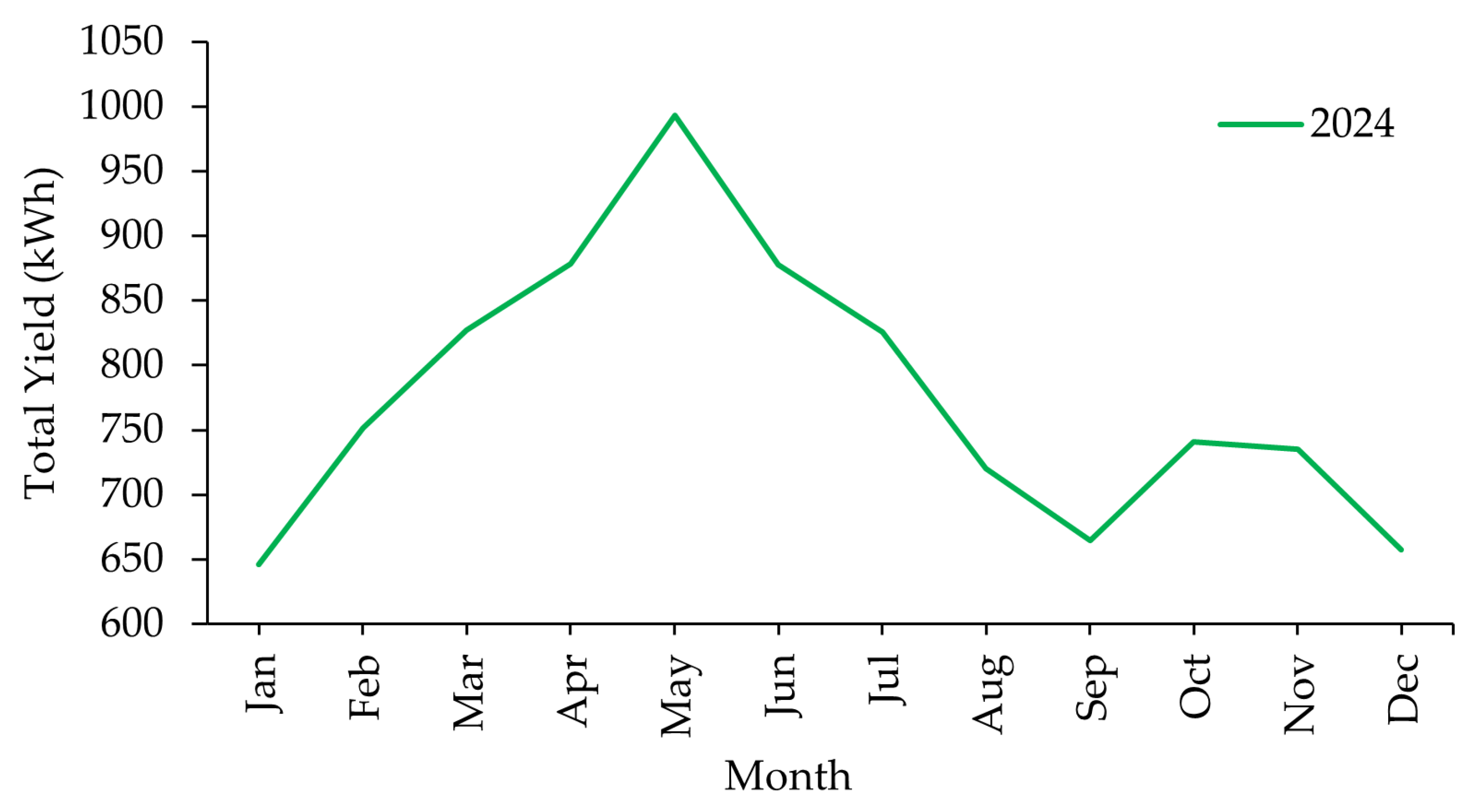
Monthly total energy yield (kWh) was obtained from the SMA Sunny Portal, which logs and stores data directly from the installed PV system. Due to discrepancies in the multi-year dataset, only the data from 2024 were considered for analysis and represented in Figure 3. The monthly values were used to examine seasonal variations in the total energy yield and to compare the measured results with simulated outputs.

3. Results

3.1. PVsyst, SAM Simulation, and In Situ Measurement Comparison and Analysis

3.1.1. Albedo Contribution

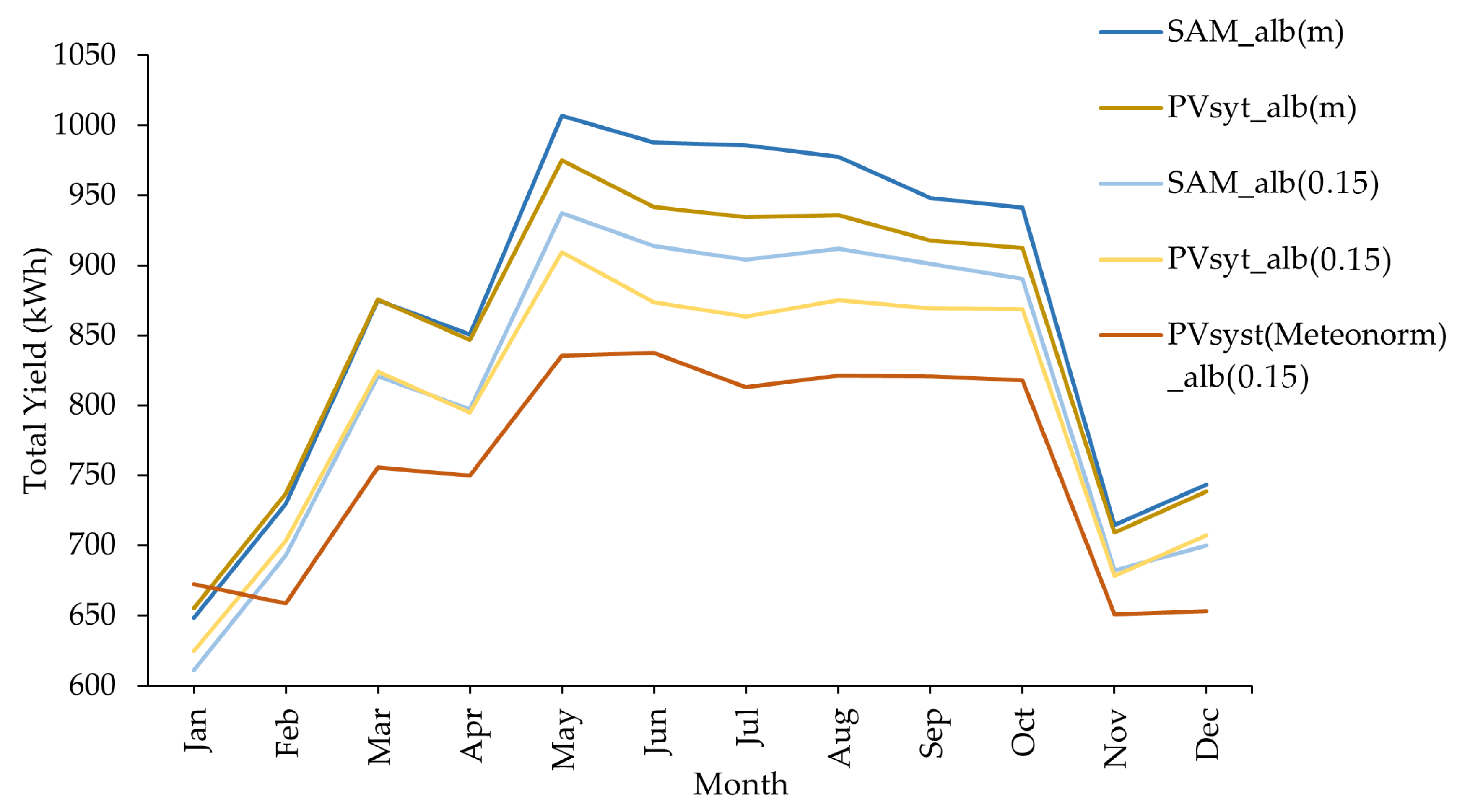
Figure 4 compares the monthly total energy yield simulated using PVsyst and SAM under different albedo configurations, with zero soiling losses applied in all cases. The baseline scenario corresponds to a fixed albedo value of 0.15 for both models. Additional cases include SAM with monthly (m) albedo, PVsyst with monthly(m) albedo, and PVsyst with fixed albedo (0.15) using default Meteonorm meteorological data. The figure includes five simulation cases, namely SAM_alb(0.15), SAM_alb(m), PVsyt_alb(0.15), PVsyt_alb(m), and PVsyst(Meteonorm)_alb(0.15). All cases display a consistent seasonal pattern, energy production increases from January to May, remains relatively stable from June through September, and decreases toward December primarily following the annual solar resource variation as shown in Figure 2.
Among the compared simulations, the SAM_alb(m) case predicts the highest energy yield, followed by PVsyt_alb(m), SAM_alb(0.15), and PVsyt_alb(0.15) based on NSRDB weather data, while PVsyst(Meteonorm)_alb(0.15) produces comparatively lower yields because the Meteonorm weather data differs significantly from NSRDB. As noted in the PVsyst documentation [41], the software does not support hourly albedo variation, allowing only monthly or constant inputs [42], whereas SAM can directly implement hourly albedo data. However, the difference between SAM’s hourly and monthly albedo simulations was found to be less than 0.1%, and therefore, the SAM hourly albedo case was excluded from the figure to maintain visual clarity. However, such site-specific factors can become significant in harsh climates.
The analysis indicates that albedo variability predominantly affects the overall magnitude of simulated energy yield, with minimal impact on the seasonal distribution profile. Incorporating time-varying albedo (hourly or monthly) enhances the predicted output by better accounting for surface reflectivity effects, while using a constant albedo value may lead to underestimation or overestimation of annual production. These findings are consistent with previous studies that also emphasized the influence of dynamic albedo on PV performance [43].

3.1.2. Soiling Losses

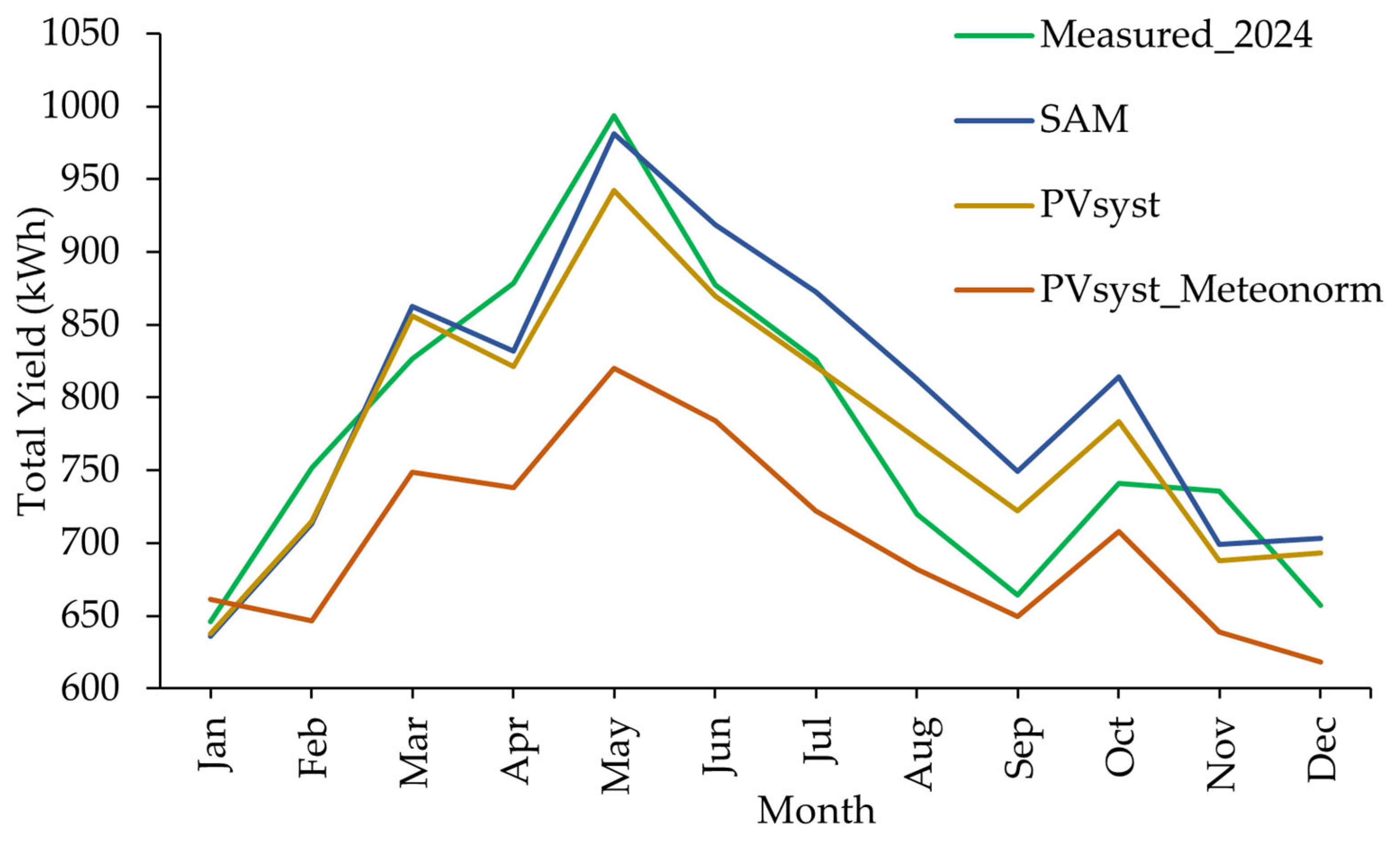
As shown in Figure 5, the line labeled Measured_2024 represents the actual recorded monthly total PV energy yield, while the SAM and PVsyst line correspond to simulations that include NSRDB weather data, monthly albedo and soiling inputs derived from the HSU model. The PVsyst_meteonorm line represents the PVsyst simulation performed using default Meteonorm weather data, a fixed default albedo value of 0.20, and HSU-based soiling losses. Both SAM and PVsyst simulations show close agreement with the Measured_2024 data, successfully capturing the seasonal variation in energy yield. The SAM results slightly overestimate the energy output during high-irradiance months (April–August), while PVsyst provides a closer match throughout the year. In contrast, PVsyst_meteonorm consistently underestimates the energy yield, highlighting the importance of employing site-specific and temporally varying albedo and soiling inputs for accurate PV performance modeling under Qatari climatic conditions.

3.2. Optimization of the HSU Soiling Model

To improve the predictive accuracy of the HSU soiling model under Qatari conditions, its parameters were calibrated against field measurements obtained in the year 2024 from a DustIQ sensor [44] installed at the solar outdoor test facility (OTF; latitude 25.32° N, longitude 51.43° E, approximately 1.5 km from the solar rooftop location). The model parameters—namely, the rainfall cleaning threshold and the deposition velocities of PM2.5 and PM10—were optimized using the Differential Evolution (DE) algorithm, a population-based global optimization method known for its robustness and ability to avoid local minima [45]. The optimization was implemented in python using the pvlib and SciPy libraries, with the objective function defined as the root mean squared error (RMSE) between the daily soiling ratio predicted by the HSU model and the measured DustIQ soiling ratio. The algorithm iteratively evaluated multiple candidate parameter sets within physically reasonable bounds (rain-cleaning threshold: 0–10 mm; deposition velocities: 1 × 10⁻⁸–5 × 10⁻³ m s−1) until stable convergence was achieved.
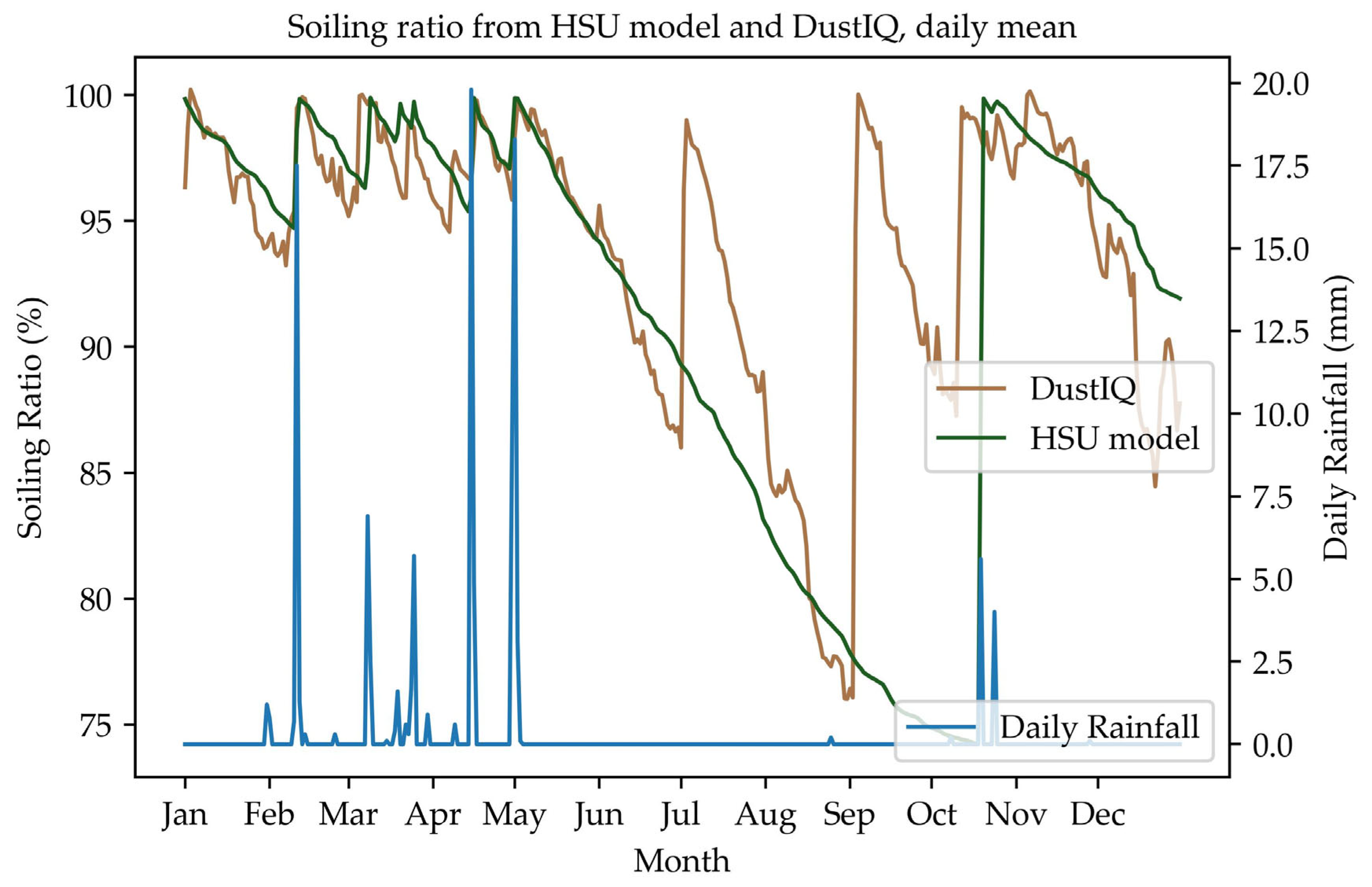
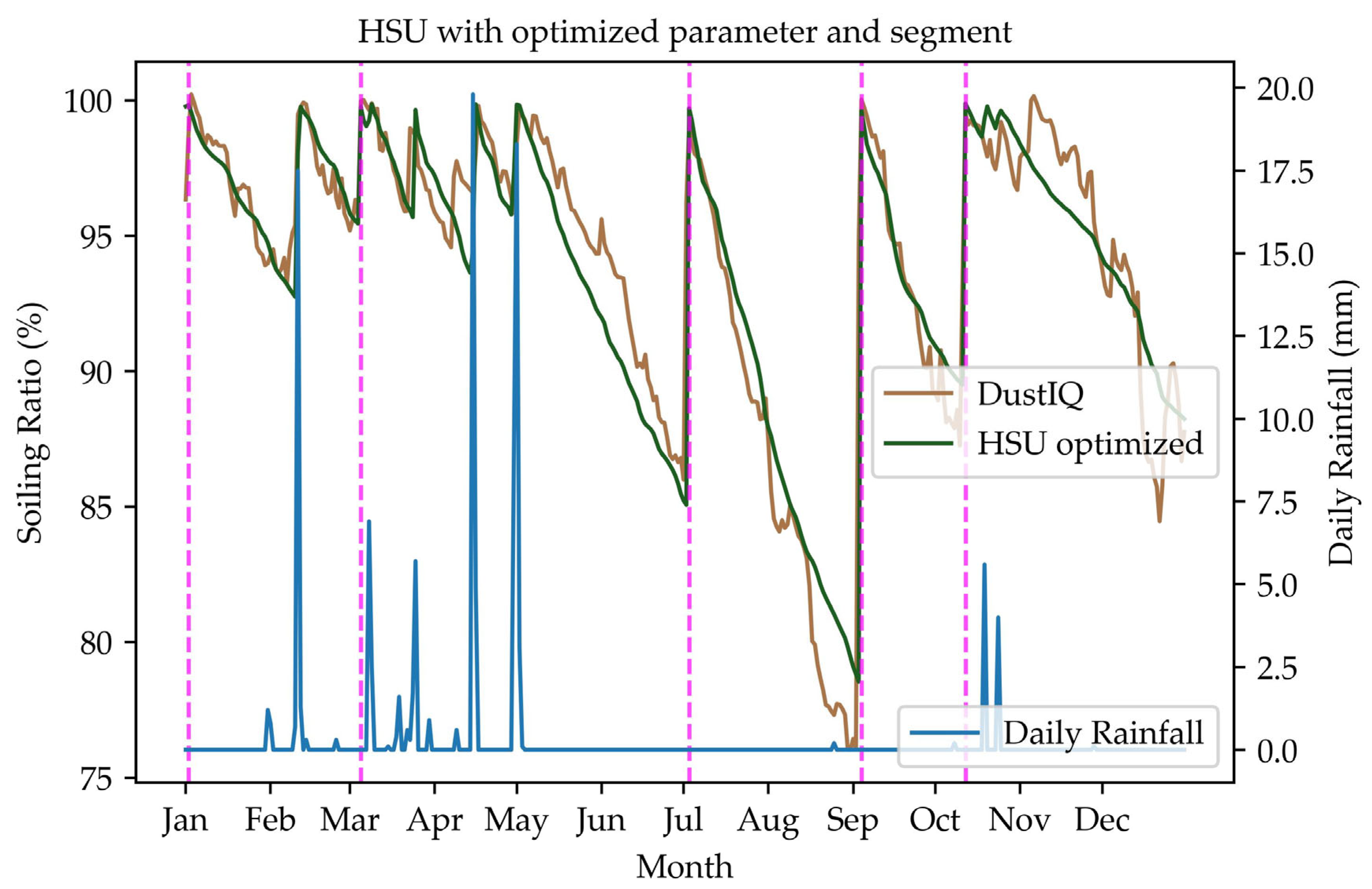
A root mean square error (RMSE) of 7.30 was observed when comparing the soiling ratio derived from the original HSU model with the measurements from the DustIQ sensor prior to parameter optimization, as shown in Figure 6. After applying the optimal parameter set, the HSU model output exhibited a significantly lower RMSE of 1.93 when compared with the DustIQ sensor at the OTF, as presented in Figure 7.
To account for manual cleaning events, a segmentation approach was applied, resetting the soiling ratio after each detected cleaning to preserve realistic soiling dynamics [46,47]. These cleaning events were identified automatically from the DustIQ time series based on sharp recovery jumps and low concurrent rainfall and are indicated by pink dashed vertical lines in Figure 7, representing the points at which the soiling ratio was reset to 100%. This segmentation enabled the optimization process to realistically capture the dust accumulation and removal behavior observed under field conditions.
The HSU model calibration at the Outdoor Test Facility (OTF) location yielded optimized parameters that replace the default values provided in Table 2. The rain cleaning threshold increased slightly from 1.00 to 1.17 mm, while the deposition velocities for PM2.5 and PM10 were adjusted upward from 0.0009 to 0.004 m/s and from 0.004 to 0.005 m/s, respectively.
These modifications reflect the more rapid particle accumulation and higher rainfall threshold observed under local conditions, thereby improving the accuracy of soiling loss estimation when applied to the rooftop PV system. The updated simulation yielded new monthly soiling values, as presented in Table 3.
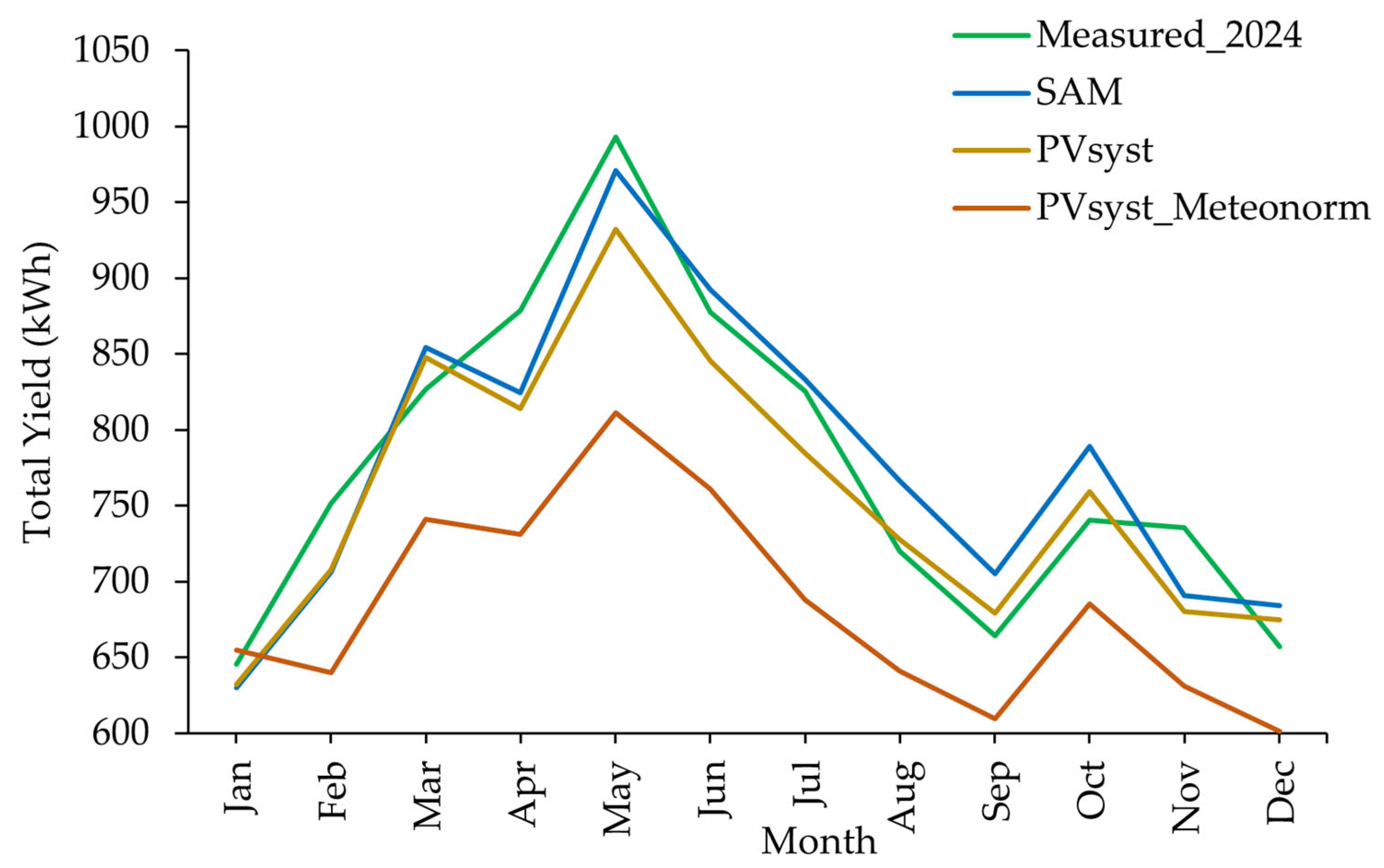
As shown in Figure 8, incorporating the optimized HSU soiling model losses significantly improves the agreement between simulated and measured monthly energy yields. Both SAM and PVsyst simulations capture the seasonal variation and monthly fluctuations with reduced deviations throughout the year. The normalized root mean square error (NRMSE) analysis, summarized in Table 4, confirms this improvement: for SAM, the NRMSE decreased from 6.83% to 4.66%, for PVsyst from 5.21% to 4.86%, and for the PVsyst_Meteonorm case, the NRMSE increased slightly from 12.88% to 13.60% after optimization. The stronger alignment of the SAM and PVsyst curves with the measured data, particularly during the high-irradiance months (April–August), indicates that the optimized HSU model effectively represents site-specific dust accumulation and cleaning behavior. In contrast, the PVsyst_Meteonorm simulation continues to underestimate the total yield despite the optimization, underscoring the necessity of using location-specific dynamic albedo variation, and calibrated soiling parameters for reliable PV performance modeling under Qatari desert conditions. Overall, these results highlight that integrating time-dependent and optimized soiling inputs substantially enhance model accuracy, with SAM providing a slightly closer match to the measured system performance.

4. Discussion and Conclusions

The results of this study demonstrate the strong potential of integrating optimized soiling characterization and time-varying albedo data into photovoltaic (PV) performance modeling for arid environments such as Qatar. Although both PVsyst and SAM employ similar underlying electrical and thermal models, their predictive accuracies are highly dependent on how site-specific environmental parameters are represented. The calibration of the HSU soiling model against locally measured DustIQ data substantially improved its capability to reproduce real soiling dynamics, reducing the RMSE of daily soiling ratios from 7.30 to 1.93. This refinement directly translated into better energy yield prediction, as reflected by the reduced NRMSE values of 4.66% for SAM and 4.86% for PVsyst. These results confirm that incorporating realistic dust accumulation and cleaning mechanisms can significantly narrow the gap between modeled and measured system performance.
Dynamic albedo representation, although contributing modestly compared to soiling optimization, was also found to influence the absolute energy yield. However, it did not improve the match to real performance trend. Fixed or default albedo assumptions, such as those applied in the PV modeling simulation, consistently underestimated output, emphasizing the importance of temporal albedo variability for accurately reproducing surface reflectivity conditions. This effect is particularly relevant for rooftops in the Gulf region, where strong seasonal and diurnal changes in surface reflectance occur due to dust deposition and cleaning cycles.
The combined analysis highlights that modeling errors in arid climates are dominated not by the intrinsic limitations of simulation tools but by environmental input uncertainties and modeler-dependent assumptions. However, certain tool-related limitations also contribute to predictive uncertainty. For instance, soiling losses are not explicitly modeled in either PVsyst or SAM, with both relying on user-defined empirical assumptions. Moreover, hourly albedo variations cannot be incorporated in PVsyst, and neither tool allows direct integration of hourly soiling-loss profiles through their default GUIs, an omission that can be particularly significant in dust-prone regions such as the Gulf, where soiling and surface reflectivity vary rapidly over time. Hence, future modeling workflows should prioritize localized calibration, sensor-based validation, and adaptive modeling of site conditions. Integrating satellite-derived aerosol data, rainfall patterns, and real-time albedo monitoring could further enhance the robustness of performance predictions.
Overall, this work reinforces that reliable PV energy yield estimation in desert regions requires explicit consideration of soiling and albedo dynamics. The proposed methodology, optimizing soiling model parameters using field measurements and utilizing temporally resolved albedo, offers a practical, transferable framework for reducing uncertainty in PV performance modeling. Such improvements support better investment confidence, design optimization, and operational planning for rooftop PV deployment in arid urban environments.

Author Contributions

Software, writing—original draft preparation, methodology, S.J.; Provide OTF data for calibration of HSU model, D.S.P.; review and support in 3d design, M.A.; writing—review and editing, provide resources (PVsyst) A.A.A.; supervision, S.B. All authors have read and agreed to the published version of the manuscript.

Funding

This research received no external funding.

Data Availability Statement

Data used in the current study are confidential and can be partly made available under conditional terms.

Acknowledgments

Open Access funding provided by the Qatar National Library.

Conflicts of Interest

The authors declare no conflicts of interest.

References

  1. PVsyst|Photovoltaic Software, Design and Simulate Photovoltaic Systems. Available online: https://www.pvsyst.com/ (accessed on 14 September 2025).
  2. Welcome–System Advisor Model–SAM. Available online: https://sam.nrel.gov/ (accessed on 14 September 2025).
  3. Freeman, J.; Whitmore, J.; Blair, N.; Dobos, A. Validation of Multiple Tools for Flat Plate Photovoltaic Modeling Against Measured Data. In Proceedings of the 2014 IEEE 40th Photovoltaic Specialist Conference (PVSC), Denver, CO, USA, 8–13 June 2014. [Google Scholar] [CrossRef]
  4. HelioScope|Commercial Solar Software. Available online: https://helioscope.aurorasolar.com/ (accessed on 14 September 2025).
  5. PV*SOL Online–A Free Tool for Solar Power (PV) Systems. Available online: https://pvsol-online.valentin-software.com/#/ (accessed on 14 September 2025).
  6. Guittet, D.L.; Freeman, J.M. Validation of Photovoltaic Modeling Tool HelioScope Against Measured Data; National Renewable Energy Lab.(NREL): Golden, CO, USA, 2018. [CrossRef]
  7. Milosavljević, D.D.; Kevkić, T.S.; Jovanović, S.J. Review and Validation of Photovoltaic Solar Simulation Tools/Software Based on Case Study. Open Phys. 2022, 20, 431–451. [Google Scholar] [CrossRef]
  8. JRC Photovoltaic Geographical Information System (PVGIS)—European Commission. Available online: https://re.jrc.ec.europa.eu/pvg_tools/en/ (accessed on 14 September 2025).
  9. PVWatts Calculator. Available online: https://pvwatts.nrel.gov/ (accessed on 14 September 2025).
  10. Solar & Meteo Data and Analysis Software|Solargis. Available online: https://solargis.com/products (accessed on 14 September 2025).
  11. RETScreen—Natural Resources Canada. Available online: https://natural-resources.canada.ca/maps-tools-publications/tools-applications/retscreen (accessed on 14 September 2025).
  12. Home–BlueSol. Available online: https://www.bluesolpv.com/ (accessed on 14 September 2025).
  13. Solar Design Software|Solarius PV|ACCA. Available online: https://www.accasoftware.com/en/solar-design-software (accessed on 14 September 2025).
  14. PV F-CHART: Photovoltaic Systems Analysis|F-Chart Software: Engineering Software. Available online: https://www.fchartsoftware.com/pvfchart/ (accessed on 14 September 2025).
  15. Polysun|Simulation and Energy Modeling Software. Available online: https://www.velasolaris.com/en/ (accessed on 14 September 2025).
  16. Photovoltaic System Simulation–Solar Pro∣Laplace System Viet Nam. Available online: https://lapsys.vn/en/products/pro/index.html (accessed on 14 September 2025).
  17. HOMER–Hybrid Renewable and Distributed Generation System Design Software. Available online: https://www.homerenergy.com/products/pro/index.html (accessed on 14 September 2025).
  18. Islam, M.A.; Ali, M.M.N.; Benitez, I.B.; Sidi Habib, S.; Jamal, T.; Flah, A.; Blazek, V.; El-Bayeh, C.Z. A Comprehensive Evaluation of Photovoltaic Simulation Software: A Decision-Making Approach Using Analytic Hierarchy Process and Performance Analysis. Energy Strateg. Rev. 2025, 58, 101663. [Google Scholar] [CrossRef]
  19. Sumsudeen, R.M.; Alarfaj, M.; Jeyanthy, P.A. Investigating the Effect of Shade on Rooftops Solar PV Systems in Hot Arid Regions. In Proceedings of the 2024 Third International Conference on Intelligent Techniques in Control, Optimization and Signal Processing (INCOS), Tamil Nadu, India, 14–16 March 2024; pp. 1–5. [Google Scholar] [CrossRef]
  20. Singh, T.S.D.; Shimray, B.A.; Meitei, S.N. Performance Analysis of a Rooftop Grid-Connected Photovoltaic System in North-Eastern India, Manipur. Energies 2025, 18, 1921. [Google Scholar] [CrossRef]
  21. Zaghba, L.; Khennane, M.; Mekhilef, S.; Fezzani, A.; Borni, A. Long-Term Outdoor Performance of Grid-Connected Photovoltaic Power Plant in a Desert Climate. Energy Sustain. Dev. 2023, 74, 430–453. [Google Scholar] [CrossRef]
  22. Polo, J.; Martín-Chivelet, N.; Sanz-Saiz, C.; Alonso-Montesinos, J.; López, G.; Alonso-Abella, M.; Battles, F.J.; Marzo, A.; Hanrieder, N. Modeling Soiling Losses for Rooftop PV Systems in Suburban Areas with Nearby Forest in Madrid. Renew. Energy 2021, 178, 420–428. [Google Scholar] [CrossRef]
  23. PV Performance Modeling Collaborative (PVPMC)—Sandia National Laboratories. Available online: https://pvpmc.sandia.gov/ (accessed on 14 October 2025).
  24. Stein, J.S. The Photovoltaic Performance Modeling Collaborative (PVPMC). In Proceedings of the 2012 38th IEEE Photovolta-ic Specialists Conference, Austin, TX, USA, 3–8 June 2012; pp. 3048–3052. [Google Scholar] [CrossRef]
  25. Theristis, M.; Riedel-Lyngskær, N.; Stein, J.S.; Deville, L.; Micheli, L.; Driesse, A.; Hobbs, W.B.; Ovaitt, S.; Daxini, R.; Barrie, D.; et al. Blind Photovoltaic Modeling Intercomparison: A Multidimensional Data Analysis and Lessons Learned. Prog. Photovolt. Res. Appl. 2023, 31, 1144–1157. [Google Scholar] [CrossRef]
  26. Khandakar, A.; Touati, A.; Touati, F.; Abdaoui, A.; Bouallegue, A. Experimental Setup to Validate the Effects of Major Environmental Parameters on the Performance of FSO Communication Link in Qatar. Appl. Sci. 2018, 8, 2599. [Google Scholar] [CrossRef]
  27. Mamoon, A.A.; Regan, B.; Sylianteng, C.; Rahman, A.; Alkader, A.A.A. Flood Study in Qatar-Challenges and Opportunities. In Proceedings of the 36th Hydrology and Water Resources Symposium (HWRS 2015), Hobart, Australia, 7–10 December 2015. [Google Scholar]
  28. Solar Resource Maps & GIS Data for 200+ Countries|Solargis. Available online: https://solargis.com/resources/free-maps-and-gis-data?locality=qatar (accessed on 23 September 2025).
  29. Zeedan, A.; Barakeh, A.; Al-Fakhroo, K.; Touati, F.; Gonzales, A.S.P. Quantification of Pv Power and Economic Losses Due to Soiling in Qatar. Sustainability 2021, 13, 3364. [Google Scholar] [CrossRef]
  30. Pillai, D.S.; Lopez Garcia, J.; Figgis, B.; Jain, S.; Benito, V.B. Impact of Robotic Cleaning on the LCOE of Utility Scale PV Power Plants: A Global Assessment Based on Koppen-Geiger Climatic Zones. In Proceedings of the 2024 IEEE 52nd Photovoltaic Specialist Conference (PVSC), Seattle, WA, USA, 9–14 June 2024; pp. 435–437. [Google Scholar] [CrossRef]
  31. Javed, W.; Guo, B.; Figgis, B.; Martin Pomares, L.; Aïssa, B. Multi-Year Field Assessment of Seasonal Variability of Photovoltaic Soiling and Environmental Factors in a Desert Environment. Sol. Energy 2020, 211, 1392–1402. [Google Scholar] [CrossRef]
  32. Maghrabi, A.H.; Al-Mostafa, Z.A. Estimating Surface Albedo over Saudi Arabia. Renew. Energy 2009, 34, 1607–1610. [Google Scholar] [CrossRef]
  33. SMA Solar Technology AG—Sunny Portal. Available online: https://www.sunnyportal.com/Templates/Start.aspx?logout=true (accessed on 14 September 2025).
  34. Meteonorm. Available online: https://meteonorm.com/en/meteonorm-version-8 (accessed on 13 May 2025).
  35. NSRDB. Available online: https://nsrdb.nrel.gov/data-viewer (accessed on 13 May 2025).
  36. Soiling Loss-PVsyst Documentation. Available online: https://www.pvsyst.com/help/project-design/array-and-system-losses/soiling-loss.html (accessed on 19 October 2025).
  37. Losses. Available online: https://samrepo.nrelcloud.org/help/pv_losses.html (accessed on 19 October 2025).
  38. Coello, M.; Boyle, L. Simple Model for Predicting Time Series Soiling of Photovoltaic Panels. IEEE J. Photovolt. 2019, 9, 1382–1387. [Google Scholar] [CrossRef]
  39. 🌤️ Free Open-Source Weather API|Open-Meteo.Com. Available online: https://open-meteo.com/ (accessed on 14 September 2025).
  40. Redondo, M.; Platero, C.A.; Moset, A.; Rodríguez, F.; Donate, V. Review and Comparison of Methods for Soiling Modeling in Large Grid-Connected PV Plants. Sustainability 2024, 16, 10998. [Google Scholar] [CrossRef]
  41. Albedo-PVsyst Documentation. Available online: https://www.pvsyst.com/help/physical-models-used/irradiation-models/albedo.html (accessed on 17 October 2025).
  42. Lopez-Lorente, J.; Neubert, A.; Hamer, M. Uncertainty Considerations in Bifacial Photovoltaic Systems with High Albedo Seasonality. In Proceedings of the 2023 IEEE 50th Photovoltaic Specialists Conference (PVSC), San Juan, PR, USA, 11–16 June 2023. [Google Scholar] [CrossRef]
  43. Golroodbari, S.; van Sark, W. On the Effect of Dynamic Albedo on Performance Modelling of Offshore Floating Photovoltaic Systems. Sol. Energy Adv. 2022, 2, 100016. [Google Scholar] [CrossRef]
  44. DustIQ for PV Soiling Monitoring-Kipp & Zonen. Available online: https://www.kippzonen.com/Product/419/DustIQ-Soiling-Monitoring-System (accessed on 15 September 2025).
  45. Storn, R.; Price, K. Differential Evolution—A Simple and Efficient Heuristic for Global Optimization over Continuous Spaces. J. Glob. Optim. 1997, 11, 341–359. [Google Scholar] [CrossRef]
  46. Dehghan, M.; Rashidi, S.; Waqas, A. Modeling of Soiling Losses in Solar Energy Systems. Sustain. Energy Technol. Assess. 2022, 53, 102435. [Google Scholar] [CrossRef]
  47. Rashid, M.; Yousif, M.; Rashid, Z.; Muhammad, A.; Altaf, M.; Mustafa, A. Effect of Dust Accumulation on the Performance of Photovoltaic Modules for Different Climate Regions. Heliyon 2023, 9, e23069. [Google Scholar] [CrossRef]
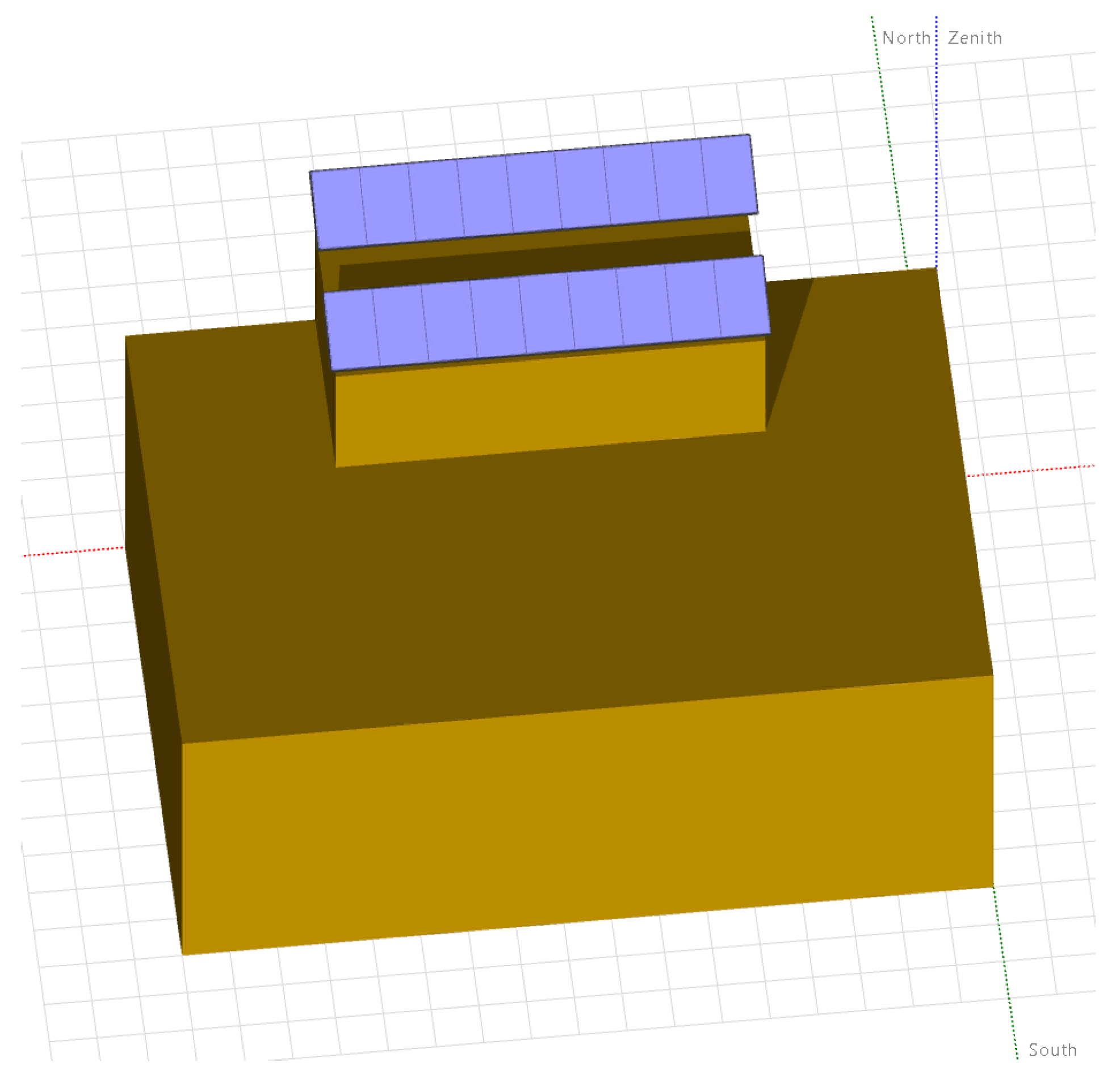
Figure 1. Three-Dimensional perspective for rooftop shading analysis in PVsyst.
Energies 18 05876 g001
Figure 2. GHI, monthly values from NSRDB and Meteonorm database.
Energies 18 05876 g002
Figure 3. Monthly total energy yield from the PV system.
Energies 18 05876 g003
Figure 4. Comparison of monthly energy yield simulated by SAM and PVsyst using NSRDB and Meteonorm datasets with different albedo configurations (no soiling losses).
Energies 18 05876 g004
Figure 5. Monthly total PV energy yield comparison between measured and simulated results for 2024.
Energies 18 05876 g005
Figure 6. HSU model and DustIQ soiling ratio before optimization.
Energies 18 05876 g006
Figure 7. Comparison of HSU model and DustIQ soiling ratios after optimization, with manual cleaning events shown as pink dashed vertical lines.
Energies 18 05876 g007
Figure 8. Monthly total PV energy yield comparison between measured and simulated results for year, 2024 after HSU model optimization.
Energies 18 05876 g008
Table 1. Technical specifications of the rooftop PV system.
ComponentSpecification
ModuleSolarWorld SunModule Bisun SW 280 Duo
Rated maximum power (per module)280 W
Configuration18 modules in series, arranged in 2 rows
InverterSMA Sunny Tripower 6000TL-20
Rated inverter power6 kW
Table 2. Optimized HSU model parameters calibrated at the OTF location compared with the default values.
ParameterDefault ValueOptimized Value (OTF Calibration)
Rain cleaning threshold1.001.17
PM2.5 deposition velocity0.00090.004
PM10 deposition velocity0.0040.005
Table 3. Soiling losses, from the HSU default parameter and optimized parameter.
MonthJanFebMarAprMayJunJulAugSepOctNovDec
Soiling loss (%), default parameter2.12.51.62.53.08.213.519.723.815.42.46
Soiling loss (%), optimized parameter3.13.62.73.54.211.318.125.129.018.43.78.8
Table 4. Comparison of normalized root mean square error (NRMSE, %) in annual energy yield simulated using PVsyst and SAM under different input and loss configurations. PVsyst_Meteonorm represents simulations using Meteonorm weather data, while PVsyst (NSRDB) and SAM (NSRDB) use NSRDB weather data.
CasePVsyst_MeteonormPVsyst (NSRDB) SAM (NSRDB)
Default albedo and
default soiling losses
12.0813.2913.99
Monthly soiling losses and monthly albedo (non-optimized)12.885.216.83
Monthly albedo and optimized monthly soiling losses (HSU)13.604.864.66
Disclaimer/Publisher’s Note: The statements, opinions and data contained in all publications are solely those of the individual author(s) and contributor(s) and not of MDPI and/or the editor(s). MDPI and/or the editor(s) disclaim responsibility for any injury to people or property resulting from any ideas, methods, instructions or products referred to in the content.