Decarbonizing Wastewater Systems: Thermal Energy Recovery from Sludge



Abstract
1. Introduction
2. Sustainable Development
3. Characteristics of Sewage Sludge
- primary sludge—these are sludge separated in primary settling tanks in the process of mechanical sewage treatment. They contain organic solids of a greasy consistency. The water content in primary sludge reaches 93–97%;
- secondary sludge—these are sludge generated in biological sewage treatment processes, separated in secondary settling tanks. Secondary sludge is divided into recirculated (returned to the treatment cycle) and excess (removed from the cycle). A homogeneous, flocculated structure characterizes them;
- chemical precipitation sludge—formed as a result of the chemical precipitation of pollutants, e.g., phosphorus compounds. They are formed in different places in the technological chain, which is related to the place of application of chemicals;
- mixed sludge—formed after mixing primary and secondary sludge.
- high hydration, approx. 99% in the case of excess sludge and 96–98% for primary sludge;
- high (approx. 75%) content of organic compounds susceptible to biological decomposition;
- high content of nitrogen compounds (2–7% TS);
- varied content of heavy metals;
- generally low content of organic hazardous substances (PAHs, chlorinated compounds—PCBs);
- varied degree of sanitary hazard, the highest for primary raw sludge, the lowest for stabilized and hygienized sludge.
4. Characteristics of Selected Technologies for Thermal Treatment of Sewage Sludge
4.1. Anaerobic Stabilization of Sewage Sludge
- from 1 kg of carbohydrates—453 dm3 CH4 + 456 dm3 CO2;
- from 1 kg of protein—547 dm3 CH4 + 516 dm3 CO2;
- from 1 kg of lipids—1095 dm3 CH4 + 449 dm3 CO2.
4.2. Combustion
- preliminary drying of the sludge (to reduce the water content to <50%);
- combustion of gases and slag in the combustion chamber;
- cooling and cleaning of exhaust gases.
4.3. Pyrolysis

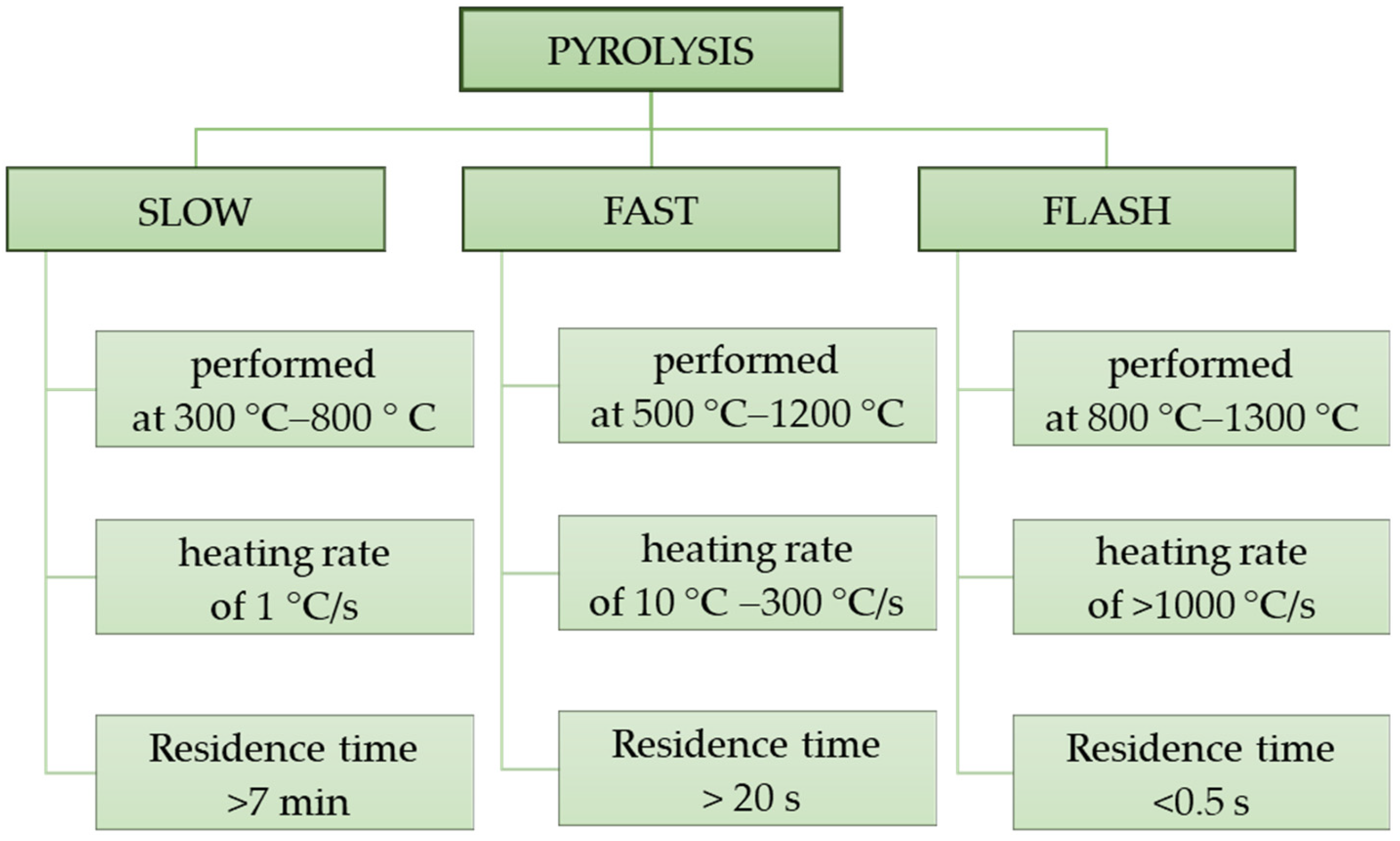
| Pyrolysis | Batch | Temperature | Reactor | Syngas Heating Value | Liter. |
|---|---|---|---|---|---|
| Flash pyrolysis | thickened excess activated sludge | 500 °C | semi-continuous lab scale reactor | 15.7 MJ/kg | [91] |
| Inert gas—nitrogen | Sewage sludge + Rice husk | 900 °C | vacuum fixed bed reactor | 3.30 MJ/m3 | [92] |
| Slow pyrolysis | biosolids | 300–800 °C | batch pyrolysis—stainless steel | 14% | [93] |
| Slow pyrolysis | Sewage sludge | 450 °C | auger type reactor | 32.3 MJ/kg | [94] |
| High temperature pyrolysis | domestic sewage | 450 °C, 600 °C, 850 °C | electrically heated rotary kiln pyrolysis system | 19.598 kJ/m3 18.054 kJ/m3 17.422 kJ/m3 | [95] |
4.4. Gasification
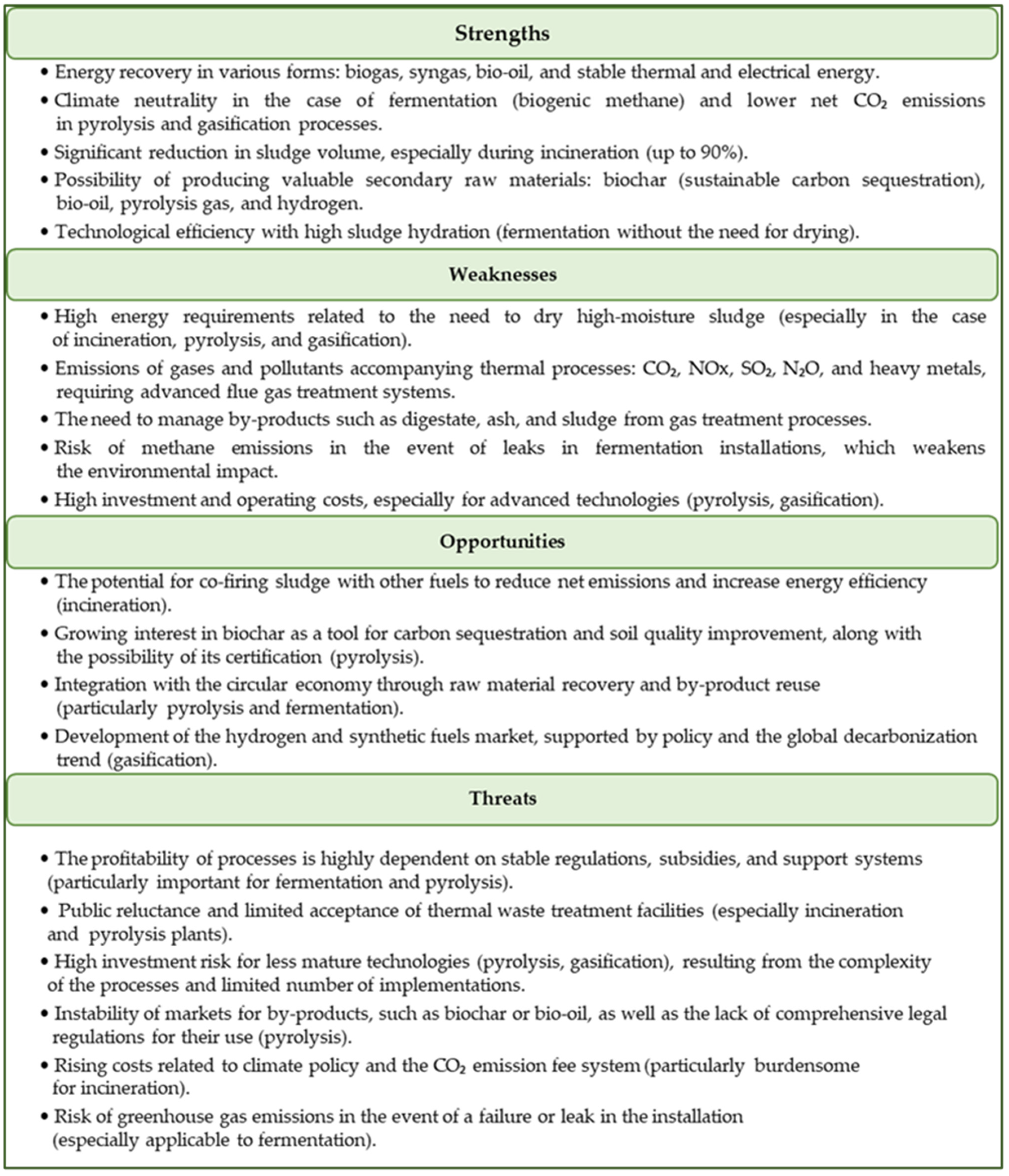
5. Prospects for the Development of Thermal Methods of Sewage Sludge Processing
6. Summary
Author Contributions
Funding
Data Availability Statement
Acknowledgments
Conflicts of Interest
Abbreviations
| BOD5 | Biochemical Oxygen Demand, mg O2/L |
| CAPEX | Capital Expenditures |
| CFB | Circulating Fluidized Bed |
| CH4 | Methane |
| CHP | Combined Heat And Power |
| CO | Carbon Monoxide |
| CO2 | Carbon Dioxide |
| COD | Chemical Oxygen Demand, mg O2/L |
| GHG | Greenhouse Gas |
| H2 | Hydrogen |
| H2S | Hydrogen Sulfide |
| I-TEQ | International Toxic Equivalent |
| LHV | Lower Heating Value |
| MGF | Moving Grate Furnace |
| MHF | Multiple Hearth Furnace |
| N2 | Nitrogen |
| NaOH | Sodium Hydroxide |
| NEW | Nutrient–Energy–Water |
| NH3 | Ammonia |
| NiO | Nickel Oxide |
| NiO/MD | Nickel(II) Oxide Catalyst Supported On A Mineral-Derived Material |
| NOx | Nitrogen Oxides |
| O2 | Oxygen |
| OPEX | Annual Operating Costs |
| PAHs | Polycyclic Aromatic Hydrocarbons |
| PCBs | Polychlorinated Biphenyls (Chlorinated Compounds) |
| SDC | Sustainable Development Criteria |
| SO2 | Sulfur Dioxide |
| SOx | Sulfur Oxides |
| SWOT | Strengths, Weaknesses, Opportunities, And Threats |
| TS | Total Solids |
| VFA | Volatile Fatty Acids |
| WWTPs | Wastewater Treatment Plants |
References
- Rani, A.; Snyder, S.W.; Kim, H.; Lei, Z.; Pan, S.-Y. Pathways to a net-zero-carbon water sector through energy-extracting wastewater technologies. NPJ Clean Water 2022, 5, 49. [Google Scholar] [CrossRef] [Scilit]
- Asunis, F.; Cappai, G.; Carucci, A.; De Gioannis, G.; Dessì, P.; Muntoni, A.; Polettini, A.; Pomi, R.; Rossi, A.; Spiga, D.; et al. Dark fermentative volatile fatty acids production from food waste: A review of the potential central role in waste biorefineries. WMR J. A Sustain. Circ. Econ. 2022, 40, 11. [Google Scholar] [CrossRef] [Scilit]
- Lewandowski, I.; Gaudet, N.; Lask, J.; Maier, J.; Tchouga, B.; Vargas-Carpintero, R. Bioeconomy: Shaping the Transition to a Sustainable, Biobased Economy; Springer Nature: Cham, Switzerland, 2018. [Google Scholar]
- Dahiya, S.; Kumar, A.N.; Sravan, J.S.; Chatterjee, S.; Sarkar, O.; Mohan, S.V. Food Waste Biorefinery: Sustainable Strategy for Circular Bioeconomy. Bioresour. Technol. 2018, 248, 2–12. [Google Scholar] [CrossRef] [Scilit] [PubMed]
- Grübel, K.; Machnicka, A.; Nowicka, E.; Wacławek, S. Mesophilic–thermophilic fermentation process of waste activated sludge after hybrid disintegration. Proc ECOpole 2013, 7, 567–573. [Google Scholar] [CrossRef] [Scilit]
- Lorenzo-Toja, Y.; Vázquez-Rowe, I.; Amores, M.J.; Termes-Rifé, M.; Marín-Navarro, D.; Moreira, M.T.; Feijoo, G. Benchmarking wastewater treatment plants under an eco-efficiency perspective. Sci. Total Environ. 2016, 566, 468–479. [Google Scholar] [CrossRef] [Scilit] [PubMed]
- Zawieja, I. Sewage Sludge as a Source of Energy and Resources in the Aspect of Sustainable Development; Częstochowa University of Technology Publishing House: Częstochowa, Poland, 2024. [Google Scholar]
- Xie, J.; Xin, X.; Ai, X.; Hong, J.; Wen, Z.; Li, W.; Lv, S. Synergic role of ferrate and nitrite for triggering waste activated sludge solubilisation and acidogenic fermentation: Effectiveness evaluation and mechanism elucidation. Wat. Res. 2022, 226, 119287. [Google Scholar] [CrossRef] [Scilit]
- Zawieja, I.; Brzeska, K. Effect of Fenton’s reagent on the Intensification of the hydrolysis phase of methane fermentation of excess sludge and microbiological indicators. Desalin. Water Treat. 2022, 263, 156–167. [Google Scholar] [CrossRef] [Scilit]
- Bień, J.; Worwąg, M.; Wystalska, K.; Zawieja, I.; Gałwa-Widera, M. Potential Possibilities of Processing Excess Sludge Generated in the Technological Line of a Municipal Sewage Treatment Plant. Gas Water Sanit. Technol. 2013, 6, 45–52. [Google Scholar]
- Renewable and Low-Carbon Hydrogen—State of Play and Outlook. Available online: https://www.europarl.europa.eu/RegData/etudes/BRIE/2025/767227/EPRS_BRI (accessed on 20 October 2025).
- International Energy Agency. Hydrogen. Updated 27 February 2025. Available online: https://www.iea.org/reports/hydrogen (accessed on 20 October 2025).
- Du, R.; Li, C.; Liu, Q.; Fan, J.; Peng, Y. A review of enhanced municipal wastewater treatment through energy savings and carbon recovery to reduce discharge and CO2 footprint. Bioresour. Technol. 2022, 364, 128135. [Google Scholar] [CrossRef] [Scilit]
- Maktabifard, M.; Al-Hazmi, H.E.; Szulc, P.; Mousavizadegan, M.; Xu, X.; Zaborowska, E.; Li, X.; Mąkinia, J. Net-zero carbon condition in wastewater treatment plants: A systematic review of mitigation strategies and challenges. Renew. Sust. Energ. Rev. 2023, 185, 113638. [Google Scholar] [CrossRef] [Scilit]
- Neczaj, E.; Grosser, A. Circular economy in wastewater treatment plant–challenges and barriers. Proceedings 2018, 2, 614. [Google Scholar] [CrossRef] [Scilit]
- Gandiglio, M.; Lanzini, A.; Soto, A.; Leone, P.; Santarelli, M. Enhancing the energy efficiency of wastewater treatment plants through co-digestion and fuel cell systems. Front. Environ. Sci. 2017, 5, 70. [Google Scholar] [CrossRef] [Scilit]
- Obaideen, K.; Shehata, N.; Sayed, E.T.; Abdelkareem, M.A.; Mahmoud, M.S.; Olabi, A.G. The role of wastewater treatment in achieving sustainable development goals (SDGs) and sustainability guideline. Energy Nexus 2022, 7, 100112. [Google Scholar] [CrossRef] [Scilit]
- Urrea Vivas, M.A.; Seguí-Amórtegui, L.; Guerrero-García-Rojas, H. Analysis of greenhouse gas production at the El Prat del Llobregat wastewater treatment plant, Spain: The decarbonization challenge. Int. J. Environ. Sci. Technol. 2025, 22, 10415–10432. [Google Scholar] [CrossRef] [Scilit]
- Ren, Z.J.; Pagilla, K. Pathways to Water Sector Decarbonization, Carbon Capture and Utilization; IWA Publishing: London, UK, 2022. [Google Scholar]
- Faber, A.; Jarosz, Z. Characteristics of Sustainable Development of Bioeconomy in Poland-Ecological Dimension. Sci. J. Warsaw Univ. Life Sci.—World Agric. Probl. 2023, 23, 4–18. [Google Scholar] [CrossRef] [Scilit]
- Neczaj, E.; Grosser, A.; Częstochowa University of Technology. Environmental Safety of Biowaste in the Circular Economy: Monograph; Publishing Office of Czestochowa University of Technology: Częstochowa, Poland, 2022; ISBN 8371938500. [Google Scholar]
- The European Parliament; The Council of the European Union. Directive (EU) 2018/2001 of the European Parliament and of the Council on the Promotion of the Use of Energy from Renewable Sources. Off. J. Eur. Union 2018, 2018, 82–209. [Google Scholar]
- Lubowicz, J. RED II Directive—Calculation of GHG Emissions for Renewable Fuels. Naft.-Gaz 2023, 79, 278–285. [Google Scholar] [CrossRef] [Scilit]
- Fetting, C. The European Green Deal; ESDN Report 2020; ESDN Office: Vienna, Austria, 2020. [Google Scholar]
- Przybojewska, I. Forests in the Context of Legal Regulations of Climate Protection. Prawne Problemy Górnictwa I Ochrony Środowiska 2023, 1, 1–29. [Google Scholar] [CrossRef] [Scilit]
- Kacprzak, M.J.; Kupich, I. The Specificities of the Circular Economy (CE) in the Municipal Wastewater and Sewage Sludge Sector—Local Circumstances in Poland. Clean Technol. Environ. Policy 2023, 25, 519–535. [Google Scholar] [CrossRef] [Scilit]
- Gromiec, M. A New "Nutrition-Energy-Water" Paradigm for Water and Sewage Companies. Water Supply, Water Quality, and Water Protection; Dymaczewski, Z., Walkowiak, J., Urbaniak, A., Eds.; PZITS: Poznań, Poland, 2016; pp. 69–80. [Google Scholar]
- Krawczyk, Ł.; Iskra, K.; Przygoda-Kuś, P.; Józefiak, P. Directions of Development of Municipal Wastewater Treatment Plants: Innovative Solutions in the Face of a Circular Economy: Monograph; Institute of Environmental Protection-National Research Institute: Warsaw, Poland, 2022; ISBN 8360312990. [Google Scholar]
- Smol, M. Green Deal Implementation Strategies; Institute of Environmental Protection-National Research Institute: Warsaw, Poland, 2021; ISBN 9788396196033. [Google Scholar]
- Vu, M.T.; Nguyen, L.N.; Zdarta, J.; Mohammed, J.A.H.; Pathak, N.; Nghiem, L.D. Wastewater to R3–Resource Recovery, Recycling, and Reuse Efficiency in Urban Wastewater Treatment Plants. In Clean Energy and Resource Recovery; Elsevier: Amsterdam, The Netherlands, 2022; pp. 3–16. [Google Scholar]
- Błaszczyk, W.; Siatecka, A.; Tlustoš, P.; Oleszczuk, P. Occurrence and Dissipation Mechanisms of Organic Contaminants during Sewage Sludge Anaerobic Digestion: A Critical Review. Sci. Total Environ. 2024, 945, 173517. [Google Scholar] [CrossRef] [Scilit]
- Dymaczewski, Z.; Oleszkiewicz, J.A.; Sozański, M.M. Sewage Treatment Plant Operator’s Guide; PZITS: Poznań, Poland, 1997. [Google Scholar]
- Podedworna, J.; Heidrich, Z. Characterization of Sludge from Selected Sewage Treatment Plants with a View of Their Use for Non-Industrial Purposes. Environ. Eng. Prot. 2001, 4, 179–196. [Google Scholar]
- Kijo-kleczkowska, A.; Otwinowski, H.; Środa, K. Properties and Production of Sewage Sludge in Poland with Reference to the Methods of Neutralizing. Arch. Waste Manag. Environ. Prot. 2012, 14, 59–78. [Google Scholar]
- Cardoso, B.J.; Rodrigues, E.; Gaspar, A.R.; Gomes, Á. Energy Performance Factors in Wastewater Treatment Plants: A Review. J. Clean. Prod. 2021, 322, 129107. [Google Scholar] [CrossRef] [Scilit]
- Bień, J.; Bień, J.D.; Wystalska, K. Problems of Sludge Management in Environmental Protection; Częstochowa University of Technology Publishing House: Częstochowa, Poland, 1998; ISBN 8371930313. [Google Scholar]
- Liang, Y.; Xu, D.; Feng, P.; Hao, B.; Guo, Y.; Wang, S. Municipal Sewage Sludge Incineration and Its Air Pollution Control. J. Clean. Prod. 2021, 295, 126456. [Google Scholar] [CrossRef] [Scilit]
- Pietraszek, P.; Podedworna, J. Laboratory Exercises in Sewage Sludge Technology; Publishing House of the Warsaw University of Technology: Warsaw, Poland, 1990. [Google Scholar]
- Bien, J.B. Sewage Sludge. Theory and Practice; Częstochowa University of Technology: Częstochowa, Poland, 2007. [Google Scholar]
- Zawieja, I.; Wolny, L. Generation of Volatile Fatty Acids from Thickened Excess Sludge Subjected to the Disintegration of High Acoustic Power Ultrasonic Field. Pol. J. Environ. Stud 2011, 20, 346–350. [Google Scholar]
- Płuciennik-Koropczuk, E.; Myszograj, S. New Approachin COD Fractionation Methods. Water 2019, 11, 1484. [Google Scholar] [CrossRef] [Scilit]
- Neyens, E.; Baeyens, J. A Review of Thermal Sludge Pre-Treatment Processes to Improve Dewaterability. J. Hazard. Mater. 2003, 98, 51–67. [Google Scholar] [CrossRef] [Scilit]
- Novak, J.T.; Carlson, D.A. The Kinetics of Anaerobic Long Chain Fatty Acid Degradation. J. Water Pollut. Control Fed. 1970, 42, 1932–1943. [Google Scholar]
- Wang, Q.; Kuninobu, M.; Kakimoto, K.; Ogawa, H.I.; Kato, Y. Upgrading of Anaerobic Digestion of Waste Activated Sludge by Ultrasonic Pretreatment. Bioresour. Technol. 1999, 68, 309–313. [Google Scholar] [CrossRef] [Scilit]
- Neczaj, E.; Bohdziewicz, J. Anaerobic Stabilisation of Excess Sludge Thickened with the Ultrafiltration Process. Inz. I Ochr. Sr. 2003, 6, 313–324. [Google Scholar]
- Eastman, J.A.; Ferguson, J.F. Solubilization of Particulate Organic Carbon during the Acid Phase of Anaerobic Digestion. J. Water Pollut. Control Fed. 1981, 53, 352–366. [Google Scholar]
- Zawieja, I.; Lidia, W.; Marta, P. Impact of the Excess Sludge Modification with Selected Chemical Reagents on the Increase of Dissolved Organic Substances Concentration Compounds Transformations in Activated Sludge. Environ. Res. 2017, 156, 652–656. [Google Scholar] [CrossRef] [Scilit] [PubMed]
- Xu, D.; Han, X.; Chen, H.; Yuan, R.; Wang, F.; Zhou, B. New Insights into Impact of Thermal Hydrolysis Pretreatment Temperature and Time on Sewage Sludge: Structure and Composition of Sewage Sludge from Sewage Treatment Plant. Environ. Res. 2020, 191, 110122. [Google Scholar] [CrossRef] [Scilit] [PubMed]
- Zhang, B.; He, P.; Lü, F.; Shao, L.; Wang, P. Extracellular Enzyme Activities during Regulated Hydrolysis of High-Solid Organic Wastes. Water Res. 2007, 41, 4468–4478. [Google Scholar] [CrossRef] [Scilit] [PubMed]
- Müller, J.; Lehne, G.; Schwedes, J.; Battenberg, S.; Näveke, R.; Kopp, J.; Dichtl, N.; Scheminski, A.; Krull, R.; Hempel, D.C. Disintegration of Sewage Sludges and Influence on Anaerobic Digestion. Water Sci. Technol. 1998, 38, 425–433. [Google Scholar] [CrossRef] [Scilit]
- Shimizu, T.; Kudo, K.; Nasu, Y. Anaerobic Waste—Activated Sludge Digestion—A Bioconversion Mechanism and Kinetic Model. Biotechnol. Bioeng. 1993, 41, 1082–1091. [Google Scholar] [CrossRef] [Scilit]
- Li, Y.Y.; Noike, T. Upgrading of Anaerobic Digestion of Waste Activated Sludge by Thermal Pretreatment. Water Sci. Technol. 1992, 26, 857–866. [Google Scholar] [CrossRef] [Scilit]
- Dohányos, M.; Zábranská, J.; Jenícek, P. Enhancement of Sludge Anaerobic Digestion by Using of a Special Thickening Centrifuge. Water Sci. Technol. 1997, 36, 145–153. [Google Scholar] [CrossRef] [Scilit]
- Kim, J.; Park, C.; Kim, T.H.; Lee, M.; Kim, S.; Kim, S.W.; Lee, J. Effects of Various Pretreatments for Enhanced Anaerobic Digestion with Waste Activated Sludge. J. Biosci. Bioeng. 2003, 95, 271–275. [Google Scholar] [CrossRef]
- Fukas-Płonka, Ł.; Zielewicz-Madej, E. Stabilization of Excess Sludge in the Methane Fermentation Process. Environ. Prot. Eng. 2000, 3, 37–48. [Google Scholar]
- Zielewicz, E. Ultrasonic Disintegration of Excess Sludge in the Extraction of Volatile Fatty Acids; Scientific Silesian University of Technology: Gliwice, Poland, 2007; pp. 1–232. [Google Scholar]
- Marquez, G.P.B.; Santiañez, W.J.E.; Trono Jr, G.C.; Montaño, M.N.E.; Araki, H.; Takeuchi, H.; Hasegawa, T. Seaweed Biomass of the Philippines: Sustainable Feedstock for Biogas Production. Renew. Sustain. Energy Rev. 2014, 38, 1056–1068. [Google Scholar] [CrossRef] [Scilit]
- Zawieja, I. Influence of Ultrasonic Field on Methane Fermentation Process: Review. Chem. Process Eng. New Front. 2023, 44, e35. [Google Scholar] [CrossRef] [Scilit]
- Momčilović, A.J.; Stefanović, G.M.; Rajković, P.M.; Stojković, N.V.; Milutinović, B.B.; Ivanović, M.P. The Organic Waste Fractions Ratio Optimization in the Anaerobic Co-Digestion Process for the Increase of Biogas Yield. Therm. Sci. 2018, 22, S1525–S1534. [Google Scholar] [CrossRef] [Scilit]
- Li, X.; Liu, H.; Liu, K.; Wang, H.; Hua, Y.; Dai, X. Modulating Interspecies Electron and Proton Transfer by Conductive Materials toward Enhanced Anaerobic Digestion: A Review. Chem. Eng. J. 2024, 498, 155411. [Google Scholar] [CrossRef] [Scilit]
- Magrel, L. Methodology for Evaluating the Efficiency of the Methane Fermentation Process of Selected Sewage Sludge; PB Publishing House: Warszawa, Poland, 2002. [Google Scholar]
- Nwokolo, N.; Mukumba, P.; Obileke, K.; Enebe, M. Waste to Energy: A Focus on the Impact of Substrate Type in Biogas Production. Processes 2020, 8, 1224. [Google Scholar] [CrossRef] [Scilit]
- Parameswaran, T.; Gogolek, P.; Hughes, P. Application of Waste Heat Recovery in Biomass-Fired Systems. Appl. Therm. Eng. 2014, 73, 982–992. [Google Scholar] [CrossRef] [Scilit]
- Skorek-Osikowska, A.; Martín-Gamboa, M.; Iribarren, D.; García-Gusano, D.; Dufour, J. Thermodynamic, Economic and Environmental Assessment of Energy Systems Including the Use of Gas from Manure Fermentation in the Context of the Spanish Potential. Energy 2020, 200, 117452. [Google Scholar] [CrossRef] [Scilit]
- Publications Office of the EU. EU Bioeconomy Strategy Progress Report; European Bioeconomy Policy: Stocktaking and Future Devel-Opments; Publications Office of the European Union: Luxembourg, 2022; ISBN 978-92-76-50201-2. [Google Scholar]
- Zawieja, I.; Wolski, P.; Wolny, L. Recovering of Biogass from Waste Deposited on Landfills. Ecol. Chem. Eng. A 2011, 18, 923–932. [Google Scholar]
- Prussi, M.; Padella, M.; Conton, M.; Postma, E.D.; Lonza, L. Review of Technologies for Biomethane Production and Assessment of Eu Transport Share in 2030. J. Clean. Prod. 2019, 222, 565–572. [Google Scholar] [CrossRef] [Scilit]
- Scarlat, N.; Fahl, F. Heat and Power from Biomass: Technology Development Report; Joint Research Centre (JRC), European Commission: Brussels, Belgium, 2020; ISBN 9276124322. [Google Scholar]
- Hagos, K.; Zong, J.; Li, D.; Liu, C.; Lu, X. Anaerobic Co-Digestion Process for Biogas Production: Progress, Challenges and Perspectives. Renew. Sustain. Energy Rev. 2017, 76, 1485–1496. [Google Scholar] [CrossRef] [Scilit]
- Oladejo, J.; Shi, K.; Luo, X.; Yang, G.; Wu, T. A Review of Sludge-to-Energy Recovery Methods. Energies 2019, 12, 60. [Google Scholar] [CrossRef] [Scilit]
- Wiechmann, B.; Dienemann, C.; Kabbe, C.; Brandt, S.; Vogel, I.; Roskosch, A. Sewage Sludge Management in Germany; Umweltbundesamt: Berlin, Germany, 2013. [Google Scholar]
- Mosko, J.; Pohořelyý, M.; Zach, B.; Svoboda, K.; Durda, T.; Jeremias, M.; Šyc, M.; Vaclavkova, S.; Skoblia, S.; Beňo, Z. Fluidized Bed Incineration of Sewage Sludge in O2/N2 and O2/CO2 Atmospheres. Energy Fuels 2018, 32, 2355–2365. [Google Scholar] [CrossRef] [Scilit]
- Ogada, T.; Werther, J. Combustion Characteristics of Wet Sludge in a Fluidized Bed: Release and Combustion of the Volatiles. Fuel 1996, 75, 617–626. [Google Scholar] [CrossRef] [Scilit]
- Urciuolo, M.; Solimene, R.; Chirone, R.; Salatino, P. Fluidized Bed Combustion and Fragmentation of Wet Sewage Sludge. Exp. Therm. Fluid Sci. 2012, 43, 97–104. [Google Scholar] [CrossRef] [Scilit]
- Han, X.; Niu, M.; Jiang, X.; Liu, J. Combustion Characteristics of Sewage Sludge in a Fluidized Bed. Ind. Eng. Chem. Res. 2012, 51, 10565–10570. [Google Scholar] [CrossRef] [Scilit]
- Werther, J.; Ogada, T. Sewage Sludge Combustion. Prog. Energy Combust. Sci. 1999, 25, 55–116. [Google Scholar] [CrossRef] [Scilit]
- Kamyab, H.; Yuzir, A.; Ashokkumar, V.; Hosseini, S.E.; Balasubramanian, B.; Kirpichnikova, I. Review of the Application of Gasification and Combustion Technology and Waste-to-Energy Technologies in Sewage Sludge Treatment. Fuel 2022, 316, 123199. [Google Scholar] [CrossRef] [Scilit]
- Untoria, S.; Rouboa, A.; Monteiro, E. Hydrogen-Rich Syngas Production from Gasification of Sewage Sludge: Catalonia Case. Energies 2024, 17, 1492. [Google Scholar] [CrossRef] [Scilit]
- Śpiewak, K. Gasification of Sewage Sludge—A Review. Energies 2024, 17, 4476. [Google Scholar] [CrossRef] [Scilit]
- Nakamura, A.; Iwasaki, T.; Noto, T.; Hashimoto, H.; Sugiyama, N.; Hattori, M. Application of CFB (Circulating Fluidized Bed) to Sewage Sludge Incinerator. NKK Tech. Rev. 2002, 86, 30–35. [Google Scholar]
- Kowalski, Z.; Wzorek, Z.; Jodko, M.; Gorazda, K. Properties of Sewage Sludge and of the Thermally Processed Sewage Sludge Ash. Przem. Chem. 2003, 82, 1034–1036. [Google Scholar]
- ISWA Working Group on Sludge and Waste. Sludge Treatment and Disposal: Management Approaches and Experiences; Office for Official Publications of the European Communities: Luxembourg, 1998; ISBN 9291670812. [Google Scholar]
- The European Parliament; The Council of the European Union. European Council Directive 2010/75/EU Industrial Emissions. Off. J. Eur. Union 2010, L334, 17–119. [Google Scholar] [CrossRef]
- Salva, J.; Sečkár, M.; Schwarz, M.; Samešová, D.; Mordáčová, M.; Poništ, J.; Veverková, D. Analysis of the Current State of Sewage Sludge Treatment from the Perspective of Current European Directives. Environ. Sci. Eur. 2025, 37, 59. [Google Scholar] [CrossRef] [Scilit]
- Ostojski, A. The Importance of the Energy Potential of Sewage Sludge in the Aspect of Circular Economy—The Example of the Wastewater Treatment Plant in Gdańsk. Master’s Thesis, Gdańsk University of Technology, Gdańsk, Poland, 2018. [Google Scholar]
- Szydełko, A.; Pawlak, M. Incineration and Co-incineration of Sewage Sludge with Mineral Additives in the Aspect of Chlorine Binding and Chloride Corrosion. Energy J. 2014, 1, 165–174. [Google Scholar]
- Piippo, S.; Lauronen, M.; Postila, H. Greenhouse Gas Emissions from Different Sewage Sludge Treatment Methods in North. J. Clean. Prod. 2018, 177, 483–492. [Google Scholar] [CrossRef] [Scilit]
- Zaman, C.Z.; Pal, K.; Yehye, W.A.; Sagadevan, S.; Shah, S.T.; Adebisi, G.A.; Marliana, E.; Rafique, R.F.; Johan, R. Bin Pyrolysis: A Sustainable Way to Generate Energy from Waste. Pyrolysis 2017, 1, 3–36. [Google Scholar]
- Zaharioiu, A.M.; Bucura, F.; Marin, F.; Ionete, R.E.; Oancea, S.; Constantinescu, M. Sustainable Fuels Obtained From the Pyrolysis Process of Sewage Sludge. Curr. Trends Nat. Sci. 2021, 10, 16–24. [Google Scholar] [CrossRef] [Scilit]
- Gao, N.; Li, J.; Qi, B.; Li, A.; Duan, Y.; Wang, Z. Thermal Analysis and Products Distribution of Dried Sewage Sludge Pyrolysis. J. Anal. Appl. Pyrolysis 2014, 105, 43–48. [Google Scholar] [CrossRef] [Scilit]
- Pokorna, E.; Postelmans, N.; Jenicek, P.; Schreurs, S.; Carleer, R.; Yperman, J. Study of Bio-Oils and Solids from Flash Pyrolysis of Sewage Sludges. Fuel 2009, 88, 1344–1350. [Google Scholar] [CrossRef] [Scilit]
- Zhang, W.; Yuan, C.; Xu, J.; Yang, X. Beneficial Synergetic Effect on Gas Production during Co-Pyrolysis of Sewage Sludge and Biomass in a Vacuum Reactor. Bioresour. Technol. 2015, 183, 255–258. [Google Scholar] [CrossRef] [Scilit]
- McNamara, P.J.; Koch, J.D.; Liu, Z.; Zitomer, D.H. Pyrolysis of Dried Wastewater Biosolids Can Be Energy Positive. Water Environ. Res. 2016, 88, 804–810. [Google Scholar] [CrossRef] [Scilit]
- Salimbeni, A.; Di Bianca, M.; Lombardi, G.; Rizzo, A.M.; Chiaramonti, D. Opportunities of Integrating Slow Pyrolysis and Chemical Leaching for Extraction of Critical Raw Materials from Sewage Sludge. Water 2023, 15, 1060. [Google Scholar] [CrossRef] [Scilit]
- Karaca, C.; Sözen, S.; Orhon, D.; Okutan, H. High Temperature Pyrolysis of Sewage Sludge as a Sustainable Process for Energy Recovery. Waste Manag. 2018, 78, 217–226. [Google Scholar] [CrossRef] [Scilit] [PubMed]
- Yörüklü, H.C.; Filiz, B.C.; Figen, A.K. Use of Waste—Activated Sludge for the Production of Hydrogen. In Materials for Hydrogen Production, Conversion, and Storage; Elsevier: Amsterdam, The Netherlands, 2023; pp. 625–653. [Google Scholar]
- Cao, Y.; Pawłowski, A. Sewage Sludge-to-Energy Approaches Based on Anaerobic Digestion and Pyrolysis: Brief Overview and Energy Efficiency Assessment. Renew. Sustain. Energy Rev. 2012, 16, 1657–1665. [Google Scholar] [CrossRef] [Scilit]
- Gopinath, A.; Divyapriya, G.; Srivastava, V.; Laiju, A.R.; Nidheesh, P.V.; Kumar, M.S. Conversion of Sewage Sludge into Biochar: A Potential Resource in Water and Wastewater Treatment. Environ. Res. 2021, 194, 110656. [Google Scholar] [CrossRef] [Scilit] [PubMed]
- Capodaglio, A.G.; Callegari, A.; Dondi, D. Properties and Beneficial Uses of Biochar from Sewage Sludge Pyrolysis. In Proceedings of the 5th International Conference on Sustainable Solid Waste Management, Athens, Greece, 21–24 June 2017; Volume 16. [Google Scholar]
- Fahmy, T.Y.A.; Fahmy, Y.; Mobarak, F.; El-Sakhawy, M.; Abou-Zeid, R.E. Biomass Pyrolysis: Past, Present, and Future. Environ. Dev. Sustain. 2020, 22, 17–32. [Google Scholar] [CrossRef] [Scilit]
- Kan, T.; Strezov, V.; Evans, T. Effect of the Heating Rate on the Thermochemical Behavior and Biofuel Properties of Sewage Sludge Pyrolysis. Energy Fuels 2016, 30, 1564–1570. [Google Scholar] [CrossRef] [Scilit]
- Arazo, R.O.; de Luna, M.D.G.; Capareda, S.C. Assessing Biodiesel Production from Sewage Sludge-Derived Bio-Oil. Biocatal. Agric. Biotechnol. 2017, 10, 189–196. [Google Scholar] [CrossRef] [Scilit]
- Gwenzi, W.; Muzava, M.; Mapanda, F.; Tauro, T.P. Comparative Short-Term Effects of Sewage Sludge and Its Biochar on Soil Properties, Maize Growth and Uptake of Nutrients on a Tropical Clay Soil in Zimbabwe. J. Integr. Agric. 2016, 15, 1395–1406. [Google Scholar] [CrossRef] [Scilit]
- Muniz, R.N.; Buratto, W.G.; Cardoso, R.; Barros, C.F.D.O.; Nied, A.; Gonzalez, G.V. State-of-the-Art Decarbonization in Sludge Thermal Treatments for Electrical Power Generation Considering Sensors and the Application of Artificial Intelligence. Water 2025, 17, 1946. [Google Scholar] [CrossRef] [Scilit]
- Yang, Z.; Liu, Y.; Zhang, J.; Mao, K.; Kurbonova, M.; Liu, G.; Zhang, R.; Wang, W. Improvement of Biofuel Recovery from Food Waste by Integration of Anaerobic Digestion, Digestate Pyrolysis and Syngas Biomethanation under Mesophilic and Thermophilic Conditions. J. Clean. Prod. 2020, 256, 120594. [Google Scholar] [CrossRef] [Scilit]
- Syed-Hassan, S.S.A.; Wang, Y.; Hu, S.; Su, S.; Xiang, J. Thermochemical Processing of Sewage Sludge to Energy and Fuel: Fundamentals, Challenges and Considerations. Renew. Sustain. Energy Rev. 2017, 80, 888–913. [Google Scholar] [CrossRef] [Scilit]
- Hu, M.; Ye, Z.; Zhang, H.; Chen, B.; Pan, Z.; Wang, J. Thermochemical Conversion of Sewage Sludge for Energy and Resource Recovery: Technical Challenges and Prospects. Environ. Pollut. Bioavailab. 2021, 33, 145–163. [Google Scholar] [CrossRef] [Scilit]
- Moreira, R.; Bimbela, F.; Gil-Lalaguna, N.; Sánchez, J.L.; Portugal, A. Clean Syngas Production by Gasification of Lignocellulosic Char: State of the Art and Future Prospects. J. Ind. Eng. Chem. 2021, 101, 1–20. [Google Scholar] [CrossRef] [Scilit]
- Tsybina, A.; Wuensch, C. Analysis of Sewage Sludge Thermal Treatment Methods in the Context of Circular Economy. Detritus 2018, 2, 3–15. [Google Scholar] [CrossRef] [Scilit]
- Di Fraia, S.; Massarotti, N.; Vanoli, L.; Costa, M. Thermo-Economic Analysis of a Novel Cogeneration System for Sewage Sludge Treatment. Energy 2016, 115, 1560–1571. [Google Scholar] [CrossRef] [Scilit]
- Jeong, Y.S.; Mun, T.Y.; Kim, J.S. Two-Stage Gasification of Dried Sewage Sludge: Effects of Gasifying Agent, Bed Material, Gas Cleaning System, and Ni-Coated Distributor on Product Gas Quality. Renew. Energy 2022, 185, 208–216. [Google Scholar] [CrossRef] [Scilit]
- Nowicki, L.; Antecka, A.; Bedyk, T.; Stolarek, P.; Ledakowicz, S. The Kinetics of Gasification of Char Derived from Sewage Sludge. J. Therm. Anal. Calorim. 2011, 104, 693–700. [Google Scholar] [CrossRef] [Scilit]
- Dogu, O.; Pelucchi, M.; Van de Vijver, R.; Van Steenberge, P.H.M.; D’hooge, D.R.; Cuoci, A.; Mehl, M.; Frassoldati, A.; Faravelli, T.; Van Geem, K.M. The Chemistry of Chemical Recycling of Solid Plastic Waste via Pyrolysis and Gasification: State-of-the-Art, Challenges, and Future Directions. Prog. Energy Combust. Sci. 2021, 84, 100901. [Google Scholar] [CrossRef] [Scilit]
- Lee, U.; Dong, J.; Chung, J.N. Experimental Investigation of Sewage Sludge Solid Waste Conversion to Syngas Using High Temperature Steam Gasification. Energy Convers. Manag. 2018, 158, 430–436. [Google Scholar] [CrossRef] [Scilit]
- Hu, M.; Gao, L.; Chen, Z.; Ma, C.; Zhou, Y.; Chen, J.; Ma, S.; Laghari, M.; Xiao, B.; Zhang, B.; et al. Syngas Production by Catalytic In-Situ Steam Co-Gasification of Wet Sewage Sludge and Pine Sawdust. Energy Convers. Manag. 2016, 111, 409–416. [Google Scholar] [CrossRef] [Scilit]
- Gil-Lalaguna, N.; Sánchez, J.L.; Murillo, M.B.; Rodríguez, E.; Gea, G. Air-Steam Gasification of Sewage Sludge in a Fluidized Bed. Influence of Some Operating Conditions. Chem. Eng. J. 2014, 248, 373–382. [Google Scholar] [CrossRef] [Scilit]
- Elbl, P.; Baláš, M.; Lisý, M.; Lisá, H. Sewage Sludge and Digestate Gasification in an Atmospheric Fluidized Bed Gasifier. Biomass Convers. Biorefinery 2024, 14, 21821–21829. [Google Scholar] [CrossRef] [Scilit]
- Hu, Q.; Dai, Y.; Wang, C.-H. Steam Co-Gasification of Horticultural Waste and Sewage Sludge: Product Distribution, Synergistic Analysis and Optimization. Bioresour. Technol. 2020, 301, 122780. [Google Scholar] [CrossRef] [Scilit]
- Khan, M.A.; Naqvi, S.R.; Taqvi, S.A.A.; Shahbaz, M.; Ali, I.; Mehran, M.T.; Khoja, A.H.; Juchelková, D. Air Gasification of High-Ash Sewage Sludge for Hydrogen Production: Experimental, Sensitivity and Predictive Analysis. Int. J. Hydrogen Energy 2022, 47, 37374–37384. [Google Scholar] [CrossRef] [Scilit]
- Hu, M.; Deng, W.; Su, Y.; Wang, L.; Chen, G. Production of Hydrogen-Rich Syngas through Microwave-Assisted Gasification of Sewage Sludge in Steam-CO2 Atmosphere. Fuel 2024, 357, 129855. [Google Scholar] [CrossRef] [Scilit]
- Calvo, L.F.; García, A.I.; Otero, M. An Experimental Investigation of Sewage Sludge Gasification in a Fluidized Bed Reactor. Sci. World J. 2013, 1, 479403. [Google Scholar] [CrossRef] [Scilit]
- Chiang, K.Y.; Lu, C.H.; Liao, C.K.; Ger, R.H.R. Characteristics of Hydrogen Energy Yield by Co-Gasified of Sewage Sludge and Paper-Mill Sludge in a Commercial Scale Plant. Int. J. Hydrogen Energy 2016, 41, 21641–21648. [Google Scholar] [CrossRef] [Scilit]
- Gao, N.; Kamran, K.; Quan, C.; Williams, P.T. Thermochemical Conversion of Sewage Sludge: A Critical Review. Prog. Energy Combust. Sci. 2020, 79, 100843. [Google Scholar] [CrossRef] [Scilit]
- Sikarwar, V.S.; Zhao, M.; Fennell, P.S.; Shah, N.; Anthony, E.J. Progress in Biofuel Production from Gasification. Prog. Energy Combust. Sci. 2017, 61, 189–248. [Google Scholar] [CrossRef] [Scilit]
- Carotenuto, A.; Di Fraia, S.; Massarotti, N.; Sobek, S.; Uddin, M.R.; Vanoli, L.; Werle, S. Sewage Sludge Gasification Process Optimization for Combined Heat and Power Generation. Energies 2023, 16, 4742. [Google Scholar] [CrossRef] [Scilit]
- Han, J.; Kim, H. The Reduction and Control Technology of Tar during Biomass Gasification/Pyrolysis: An Overview. Renew. Sustain. Energy Rev. 2008, 12, 397–416. [Google Scholar] [CrossRef] [Scilit]
- Lamers, P.; Tan, E.C.D.; Searcy, E.M.; Scarlata, C.J.; Cafferty, K.G.; Jacobson, J.J. Strategic supply system design—A holistic evaluation of operational and production cost for a biorefinery supply chain. Biofuels Bioprod. Biorefining 2015, 9, 648–660. [Google Scholar] [CrossRef] [Scilit]
- Schiavon, M.; Ravina, M.; Zanetti, M.; Panepinto, D. State-of-the-Art and Recent Advances in the Abatement of Gaseous Pollutants from Waste-to-Energy. Energies 2024, 17, 552. [Google Scholar] [CrossRef] [Scilit]
- Zhang, J.; Zuo, W.; Tian, Y.; Chen, L.; Yin, L.; Zhang, J. Sulfur Transformation during Microwave and Conventional Pyrolysis of Sewage Sludge. Environ. Sci. Technol. 2017, 51, 709–717. [Google Scholar] [CrossRef] [Scilit] [PubMed]
- Jama-Rodzeńska, A.; Sowiński, J.; Koziel, J.A.; Białowiec, A. Phosphorus Recovery from Sewage Sludge Ash Based on Cradle-to-Cradle Approach—Mini-Review. Minerals 2021, 11, 985. [Google Scholar] [CrossRef] [Scilit]
- Sugurbekova, G.; Nagyzbekkyzy, E.; Sarsenova, A.; Danlybayeva, G.; Anuarbekova, S.; Kudaibergenova, R.; Frochot, C.; Acherar, S.; Zhatkanbayev, Y.; Moldagulova, N. Sewage Sludge Management and Application in the Form of Sustainable Fertilizer. Sustainability 2023, 15, 6112. [Google Scholar] [CrossRef] [Scilit]
- Agaton, C.B.; Santos, M.J.A. Social Acceptability of Waste-to-Energy: Research Hotspots, Technologies, and Factors. Clean Technol. 2025, 7, 63. [Google Scholar] [CrossRef] [Scilit]
- Mills, N.; Pearce, P.; Farrow, J.; Thorpe, R.B.; Kirkby, N.F. Environmental & Economic Life Cycle Assessment of Current & Future Sewage Sludge to Energy Technologies. Waste Manag. 2014, 34, 185–195. [Google Scholar] [CrossRef] [Scilit]
- Lee, I.S.; Parameswaran, P.; Rittmann, B.E. Effects of Solids Retention Time on Methanogenesis in Anaerobic Digestion of Thickened Mixed Sludge. Bioresour. Technol. 2011, 102, 10266–10272. [Google Scholar] [CrossRef] [Scilit]
- Donatello, S.; Cheeseman, C.R. Recycling and Recovery Routes for Incinerated Sewage Sludge Ash (ISSA): A Review. Waste Manag. 2013, 33, 2328–2340. [Google Scholar] [CrossRef] [Scilit]
- Magdziarz, A.; Wilk, M. Thermogravimetric Study of Biomass, Sewage Sludge and Coal Combustion. Energy Convers. Manag. 2013, 75, 425–430. [Google Scholar] [CrossRef] [Scilit]
- Manara, P.; Zabaniotou, A. Towards Sewage Sludge Based Biofuels via Thermochemical Conversion–a Review. Renew. Sustain. Energy Rev. 2012, 16, 2566–2582. [Google Scholar] [CrossRef] [Scilit]


| Factor | Mesophilic Fermentation | Thermophilic Fermentation |
|---|---|---|
| Temperature range | 30–38 °C | 45–55 °C |
| Process speed | Slower | Faster |
| Retention time | Longer (e.g., 20–60 days) | Shorter (e.g., 20 days) |
| Process stability | More stable, less sensitive to temperature fluctuations | Less stable, more sensitive to temperature changes |
| Technical requirements | Less demanding, easier to maintain | More demanding, requires precise temperature control |
| Process Efficiency | Lower | Higher |
| Application | Most frequently used in practice, e.g., 85% of installations in Germany | Less common, but gaining importance |
| Combustion Process | Circulating Fluidized Bed (CFB) [77] | Moving Grate Furnace (MGF) [78] | Multiple Hearth Furnace (MHF) [79] |
|---|---|---|---|
| Batch | Wet sewage sludge | Dehydrated/dried sewage sludge; the sludge is dried before the grate to 40–50% water content. | Dehydrated sludge (“cake”) fed to the upper furnace level. |
| Temperature | 800–850 °C | 1100–1300 °C | Drying zone 425–760 °C, combustion zone approx. 925 °C |
| Combustion efficiency | 99% | 99.9% | 99% |
| Hydrogen gas (H2) content | 40% | 5–25% | 5–30% |
| Syngas heating value | 6–7 MJ/Nm3 | 5.57 MJ/Nm3 | 3–10 MJ/Nm3 |
| Gasification Factor | Batch | Temperature | Reactor | Gas Yield | Yield H2 | Syngas Heating Value | Liter. |
|---|---|---|---|---|---|---|---|
| water stem | sewage sludge | 1000 °C | vertical alumina tube | 0.82–0.99 Nm3/kg | 43–46 vol.% | - | [114] |
| steam + air | sewage sludge + pine sawdust (40%) | 900 °C | modified dolomite with NiO | 0.87–1.23 Nm3/kg | 11.410–14.44 mol/kg | 10.65 MJ/m3 | [115] |
| steam + oxygen | sewage sludge | 770–850 °C | tubular reactor made of refractory steel | 0.89–1.32 Nm3/kg | 11.0–25.1 vol.% | 11.80 MJ/m3 | [116] |
| air steam + air | sewage sludge | 750 °C | fluidized bed-ash | 1.57 m3/kg 1.79 m3/kg | 10.4 vol.% 11.2 vol.% | 4.11 MJ/Nm3 | [117] |
| steam | sewage sludge + horticultural waste | 750–900 °C | quartz tube | - | 12.94–28.70 mol/kg | 11.40 MJ/m3 | [118] |
| air | sewage sludge | 850 °C | bubbling fluidized bed | - | 16.26 vol.% | 3.3 MJ/Nm3 | [119] |
| steam + CO2 | sewage sludge | 400–700 °C | microwave-assisted gasification | - | Max 67.73 vol.% | 10.51 MJ/Nm3 | [120] |
| air | sewage sludge | 850 °C | tubular reactor | 40.7–44% | 20.6–21 vol.% | 8.42–9.33 MJ/Nm3 | [121] |
| steam | sewage sludge + paper-mill sludge | - | bubbling fluidized bed reactor | - | 2.15–4.13 vol.% | 1.67–2.56 MJ/Nm3 | [122] |
Disclaimer/Publisher’s Note: The statements, opinions and data contained in all publications are solely those of the individual author(s) and contributor(s) and not of MDPI and/or the editor(s). MDPI and/or the editor(s) disclaim responsibility for any injury to people or property resulting from any ideas, methods, instructions or products referred to in the content. |
© 2025 by the authors. Licensee MDPI, Basel, Switzerland. This article is an open access article distributed under the terms and conditions of the Creative Commons Attribution (CC BY) license (https://creativecommons.org/licenses/by/4.0/).
Share and Cite
Madeła, M.; Zawieja, I.; Rak, M. Decarbonizing Wastewater Systems: Thermal Energy Recovery from Sludge. Energies 2025, 18, 5726. https://doi.org/10.3390/en18215726
Madeła M, Zawieja I, Rak M. Decarbonizing Wastewater Systems: Thermal Energy Recovery from Sludge. Energies. 2025; 18(21):5726. https://doi.org/10.3390/en18215726
Chicago/Turabian StyleMadeła, Magdalena, Iwona Zawieja, and Mateusz Rak. 2025. "Decarbonizing Wastewater Systems: Thermal Energy Recovery from Sludge" Energies 18, no. 21: 5726. https://doi.org/10.3390/en18215726
APA StyleMadeła, M., Zawieja, I., & Rak, M. (2025). Decarbonizing Wastewater Systems: Thermal Energy Recovery from Sludge. Energies, 18(21), 5726. https://doi.org/10.3390/en18215726