Review

The Usage of Big Data in Electric Vehicle Charging: A Comprehensive Review

Department of Engineering, School of Economics and Management, Chongqing Jiaotong University, Chongqing 400074, China
*
Author to whom correspondence should be addressed.
Energies 2025, 18(19), 5066; https://doi.org/10.3390/en18195066
Submission received: 25 July 2025 / Revised: 28 August 2025 / Accepted: 15 September 2025 / Published: 23 September 2025
(This article belongs to the Special Issue Energy, Electrical and Power Engineering: 4th Edition)

Abstract

With major effects on power grids and people’s lifestyles, the quick uptake of electric vehicles (EVs) poses serious problems for the robustness of charging infrastructure. By enabling spatiotemporally optimal charging strategies that optimize grid operations, big data technologies provide game-changing solutions. In order to solve the following issues, this paper summarizes state-of-the-art applications of EV charging big data, which are derived from vehicles, charging stations, and power grids: (1) optimized control of grid operation; (2) charging infrastructure layout; (3) battery development; and (4) safety of charging equipment. Future research opportunities include: (1) deep integration of intelligent transportation and smart grids; (2) renewable energy and intelligent energy management optimization; (3) synergizing smart homes with EVs; and (4) AI for energy demand forecasting and automated management. This study establishes big data as a pivotal tool for low-carbon EV transition, providing actionable frameworks for researchers and policymakers to harmonize electrified transport with energy sustainability goals.

1. Introduction

The intensification of the global warming crisis has made carbon neutrality a central goal, with the transport sector as the main source of emissions, accounting for more than 21.2% of energy-related carbon emissions [1]. Electric vehicles (EVs), capable of reducing lifecycle emissions by 23 tonnes per vehicle and cumulatively 1.8 billion tonnes by 2035 [2], face adoption barriers: 59% of consumers cite inadequate charging infrastructure planning [3], compounded by long charging times [4,5], unsatisfactory battery performance [6], and inefficient power resource scheduling [7]. These challenges stem from the multi-dimensional complexity of the EV charging ecosystem—defined in this paper as an integrated system centered on EV charging demands, connecting four key entities (drivers, EVs, charging infrastructure, power grids) and relying on multi-source data integration. Such complexity arises from its integration of multi-source data: driver behavior [8,9,10], vehicle battery status [11,12], charging infrastructure operations [13], and grid load dynamics [14,15]. However, the rational use of big data in ecosystems offers a beacon of hope, enabling predictive modeling [16,17], optimization of operations [18,19], and management of equipment [20]. This potential of big data to revolutionize the EV charging ecosystem is a promising development that should inspire optimism about the future of EVs.
The core of integrating big data technology into charging ecosystems lies in analyzing its role between drivers, EVs, infrastructure, and the power grid. From the perspective of drivers, high-quality charging services can attract their participation [21,22,23]. Big data technology can analyze the historical data of drivers to obtain their activity preferences, thereby providing personalized charging services [23]. Analyzing household travel data [23], travel and parking, charging information [24], and charging session data [25] provides a basis for the rational layout and configuration of charging facilities, thereby promoting the realization of high-quality charging services.
The purpose of high-quality charging services is to enhance the user experience. Improving user experience can also start with understanding the remaining charging time of EVs [26]. Shi et al. [26] used a residual charging time algorithm to analyze EVs’ historical and real-time charging data. The proposed method reduced the estimation error of remaining charging time by 73.6–84.4 compared to traditional methods, achieving errors of 2.0165 min and 2.735 min in constant current and constant voltage charging stages, respectively. Big data technology can also analyze current, voltage, and charging duration data to detect the battery’s health status [27]. Correct battery remaining time estimation and safety guarantee can help drivers save time.
In addition to relying on proper control of the remaining charging time for EVs, a stable and efficient charging infrastructure can also improve users’ charging experience. The deployment location, charging technology type, charging convenience, charging waiting time, charger power, and capacity of charging infrastructure affect whether drivers can complete the charging process smoothly and quickly, thereby affecting user experience and market acceptance of EVs [28,29]. Big data technology can measure charging demand indicators, thereby revealing the spatial relationship between charging demand and infrastructure and assisting in infrastructure layout planning [30]; it can also filter useful information from massive operational data to identify data features that can characterize the health status of charging devices, construct fault diagnosis models to detect the operational status of charging devices [20], and help improve user experience.
The power grid is responsible for providing stable power support for charging infrastructure. With the increase in EVs, the power grid faces tremendous pressure, especially during peak hours. From the power grid perspective, EV charging demand growth represents a significant threat to grid stability [31,32,33]. Because the charging demand for EVs fluctuates wildly, the uncertainty of its charging and discharging mode will affect the supply and demand balance of the power grid. Big data technology optimizes charging scheduling by analyzing historical and real-time data of EVs in the power environment, effectively reducing peak consumption of the power grid by 6–7% [34] and providing load regulation solutions. In addition, big data technology can optimize the access and distribution of renewable energy [35,36]; through data analysis and prediction, we can ensure the stable input of renewable energy, improve the intelligent management level of the power grid, and establish a more efficient, green and environmentally friendly energy system.
In order to cope with the challenges brought by the increasing demand for EV charging, the power grid is gradually transforming towards intelligence. Traditional charging infrastructure makes it difficult to cope with the dynamic changes in traffic flow, charging demand, and grid load [37], resulting in insufficient accuracy in grid supply and demand regulation and low efficiency in traffic flow management. If big data technology is applied correctly, data processing and prediction models can be used to estimate traffic flow [38], charging demand [39], and electricity consumption [40], to help intelligentize the power grid.
The green and low-carbon development of smart grids has increased the proportion of renewable energy in the grid, posing new challenges to load management [35]. As one of the driving forces behind low-carbon power grids, EVs’ charging and discharging behavior also affects the supply-demand balance of the power grid [41]. Big data technology can help coordinate the power grid and renewable energy scheduling, promoting joint management between the power grid, EVs, and renewable energy [42,43].
Smart homes can help alleviate the pressure on the power grid. The collaborative management between EVs and smart homes can improve the flexibility of the power grid. Vehicle-to-home (V2H) technology has gradually become a research hotspot. As Higashitani et al. [44] pointed out, V2H technology and EV batteries can serve as temporary energy storage devices to meet the demand of insufficient grid load. However, not everyone brings electric cars home to charge. Song et al. [45] identified EV owners who charge at home based on smart meter data and big data technology. The above achievements prove that integrating EVs with smart homes is a promising future research direction.
As EVs’ impacts on the electricity grid deepen, big data technology is no longer limited to grid scheduling optimization. However, it is also integral to intelligent charging management [46]. With analysis based on user data, big data can give drivers personalized and intelligent charging plans [47] to optimize charging efficiency and user experience [48].
To illustrate the importance of systematically analyzing big data within the EV charging ecosystem, we first review the latest research progress related to charging big data in drivers, EVs, charging infrastructure, and the power grid. We found that although big data has a wide range of application scenarios, most of the relevant review literature is still limited to the classification of big data-related technologies themselves or fragmented analysis of the ecosystem. These studies fail to characterize the EV charging ecosystem systematically and exhibit research gaps in the deep integration of multi-source data and its diverse application scenarios. This article summarizes the core focus of relevant reviews and their discussions on the EV charging ecosystem in Table 1 (in cases where the literature search timeline is unclear, the primary timeline of references is adopted; when the number of retrieved documents is unspecified, the number of references serves as a proxy).
From a systemic perspective, EVs are an opportunity to achieve zero-carbon transportation and the key to achieving low-carbon power grids, households, and society. As a bridge between transportation and the power grid, EVs promote the zero-carbon transformation of transportation via big data. By leveraging their role as a distributed energy source with dual capabilities of energy consumption and storage, they facilitate the integration of distributed renewables and advance grid decarbonization. Based on dual capabilities, the deep integration of smart homes and EVs in household electricity presents excellent low-carbon household application prospects. At the level of a low-carbon society, big data-driven charging management adopts a user-centric approach, fully taps into user data, meets personalized needs, and supports the development of a low-carbon society.
Therefore, compared with the existing research, the main innovations of this paper are as follows: (1) from the perspective of four key stakeholders of the EV charging ecosystem (drivers, EVs, charging infrastructure, and power grid), it explores the generation of big data of EV charging; (2) it explains the key issues that big data can address in EV charging; (3) based on these issues, it explores data collection and data processing in EV charging applications; and (4) it analyzes future research opportunities for EV charging big data. The research structure is shown in Figure 1.

2. Review Methodology

This section will elaborate on the complete process of literature search and screening, aiming to clarify the scope of literature sources, screening logic, and the research basis of this review, and improve the transparency, reproducibility, and scientific rigor of conclusions.

2.1. Databases Searched

As a review article, data collection of the research field literature is crucial as it defines the domain of knowledge from which conclusions are drawn from the study. Given the interdisciplinary nature of this topic, the Web of Science database was selected as our database, as it enables access to significant research findings across various academic fields [56].

2.2. Exclusion Criteria

In order to avoid missing literature, we used the keyword “big data ev charg*” in the fielded search interface of the Web of Science Core Collection dataset and selected the search scope as “All fields” (Searches all of the searchable fields using one query) for search. Meanwhile, the publication time range of the literature is set between 30 June 2000 and 30 June 2025. To select literature that is highly relevant and of reliable quality to the research topic, we excluded conference papers. Due to the relatively strict peer review process of journal articles, the quality of journal articles is usually higher compared to other document types such as conference papers. We obtained 307 articles in our first search.
As the main purpose of this study is to review the literature on EV charging in the context of big data, it is necessary to filter out all papers outside the scope of the research. Therefore, we further screened literature related to “big data” and “EV charging” based on titles, keywords, abstracts, methods, etc. In the end, a total of 142 papers were retained. For these 142 eligible papers, we systematically extracted, analyzed, and summarized them based on six dimensions, data collection, data analysis, modeling methods, research advantages, limitations, and future prospects, forming the core literature foundation of this review.

3. Big Data Generated by EV Charging

3.1. The Chain of EV Charging

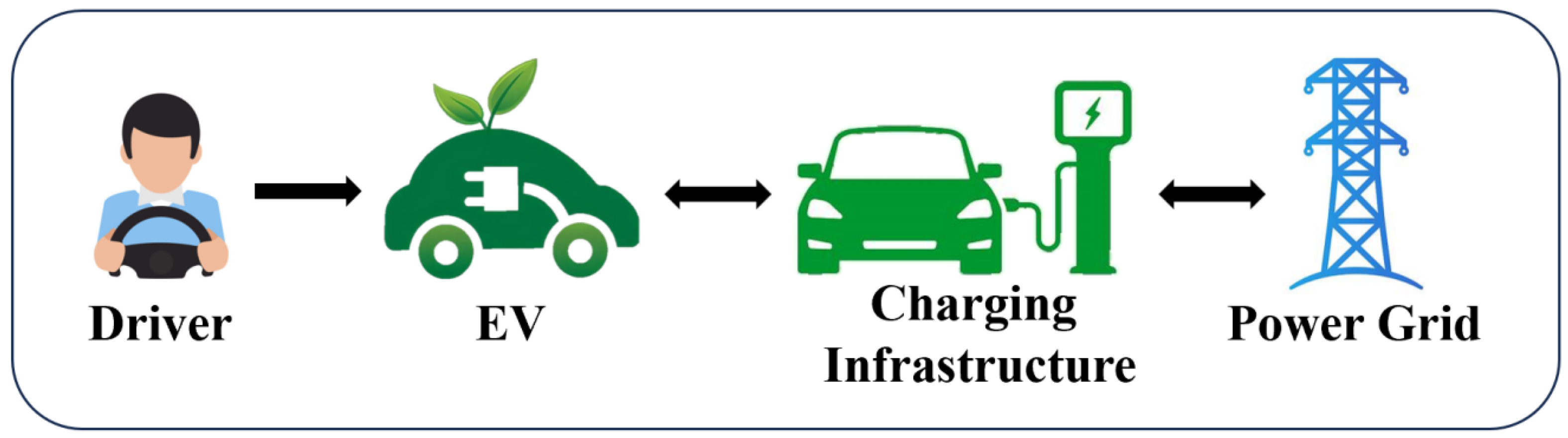
The chain of EV charging involves several elements. The user drives the EV and determines the behavior of charging [57]. The EV is the object of charging, and the capacity of its battery affects the range [58]. Charging infrastructures including charging stations and private charging posts are supported by the grid and decide charging locations. The power grid provides energy and is influenced by the charging load [59]. The whole charging chain is as follows: the user drives the EV to the charging station, the charging pile or charging device transforms the grid’s power into Direct Current, and the electricity is then transmitted to the EV’s battery. The electrical energy will be stored in the EV’s battery to power the car after it has been received [60]. The EV charging process not only consists of the behavior of energy transmission [61] but is also the process of data generation and interaction [62]. The chain of the EV charging process is shown in Figure 2.

3.2. Big Data Generated by EV Drivers

The user’s decision directly influences how the EV is used and charged and indirectly influences the big data generated by EV charging. EV trajectory data includes miles traveled, travel time, location information and speed [63,64]. These data are closely related to the user’s travel behavior. The user’s activity range, which includes residential, commercial, industrial, public service, road facility and green areas, affects dynamic charging demand and the distribution of charging locations [65]. Drivers’ charging behavior can be influenced by a variety of factors, including charging preferences and habits [66] and charging methods such as fast charging and slow charging [46]. Additionally, charging expenses were taken into account, along with the quantity of coupons, coupon ID, and discount amount [67]. The analysis of these data will help to gain insights into drivers’ charging behaviors and preferences to better meet the needs of EV customers.

3.3. Big Data Generated by EVs

Big data of EVs is crucial for EV charging. The configuration data for various EV types varies. For example, Shi et al. [68] used configuration big data of pure EVs and plug-in hybrid vehicles to explore issues related to EV charging capacity; differences in battery State of Charge (SOC), before and after charging; charging duration; and driving range. They concluded that the actual charging capacity of most EVs is lower than the rated capacity and that the charging interval mileage is positively correlated with battery capacity. In addition, more detailed data of EVs, including engine status, electric motor data, electric motor drive systems, vehicle modes, vehicle manufacturing time, and 100 percent charge range, are collected and analyzed [69].
The battery plays the most important part when charging an EV. EV charging is significantly impacted by a number of factors, including the battery management system (BMS), battery pack voltage, battery current, SOC minimum and maximum battery voltage, and minimum and maximum temperature data [70]. Analyzing historical data from battery swapping stations to predict the number of swapping events at each station during specific future time periods is also an important area of research [71]. Big data from EVs will help to diagnose charging status and improve battery performance.

3.4. Big Data Generated by Charging Infrastructures

EVs need charging infrastructure for charging, and charging infrastructure is built and developed to meet the charging needs of EVs. The interdependent relationship between EVs and charging infrastructure generates a large amount of data. First of all, the location information of charging infrastructure is often of concern. This includes charging station and equipment characteristic information such as station ID, charger ID, location, charger type, timestamp, current status (whether it is charging an EV), charging facility ID number, and facility type [18,46,72]. Second, new data emerges along with the start of charging for EVs. This includes charging data characteristics during the charging process, such as charging duration [72], charging frequency, charging energy [18,73], average transacted power [18], and charging charges [46]. In addition, information related to charging start time, charging duration, charging start SOC, charging end SOC, and charging consumption will be tracked [74]. In addition to the data on the charging process, the charging infrastructure can also record the information of the charging station users, including the user’s perception of the charging station and the environment, the user’s information, and the user’s charging card number [46]. The organization and classification of these data provide strong support for an in-depth understanding of EV charging system operation and user behavior.

3.5. Big Data Generated by Power Grid

Compared with the traditional grid, more and more smart devices are installed in the smart grid to make it more reliable and efficient. On the one hand, these devices generate a large amount of data that is used for monitoring, recording, and communication [75]. For example, the generated residential total load data will be utilized in EV charging [76]. On the other hand, the total EV charging load also affects the grid by reducing grid quality and system stability [77]. Therefore, during EV charging, there is a need to document the load impacts of charging on the grid, including grid loads during charging, grid stability, and operational data.

3.6. Big Data Generated by Others

In addition to the types mentioned above, there are some other types of big data that can influence EV charging behavior, although they are not generated by EV charging. Weather big data (maximum temperature, average temperature, average humidity, and average wind speed) can significantly affect EV bus traffic [78]. The congestion index varies with the hourly traffic flow, and a specific congestion index can be used to determine the charging demand at different times of the day [79]. Data on electricity generation from solar power plants can help people utilize electricity to charge EVs, increasing energy efficiency, reducing operator costs, and mitigating the negative effects of grid overloads [80]. The use of big data tools to obtain information on parking and EV spaces, such as parking lots, on-street parking spaces, and plazas, can optimize current layouts and provide new layout options for further research and applications [81]. Moreover, wireless charging for EVs is an emerging technology that is gaining increasing attention. Due to its principle of magnetic field coupling, there are common concerns about potential risks such as magnetic radiation and magnetic-thermal coupling [82]. With the help of big data, safety analysis and assessment models can be trained to generate real-time safety management decisions [83]. Due to space limitations, this paper will not discuss these aspects in detail.

4. Key Issues in EV Charging That Big Data Can Address

EV charging faces a number of problems that hinder its enhancement and expansion. Big data, as an emerging technology, provides huge amounts of information, which provides new ideas to solve these problems.

4.1. Optimized Control of Grid Operation

As the energy demand for EVs continues to increase, there is growing regulatory uncertainty in the grid, placing significant deployment pressure on the grid [84]. EV charging has a large impact on the operation of the power system through loads and harmonics, as well as losses in the grid. The uncertainty and randomness of user vehicles and charging behaviors increase the difficulty of controlling the power grid and are prone to EV charging peaks, which lead to peak power consumption and increased load on the grid [31]. Moreover, EV battery charging is a nonlinear load, and the electronic power equipment will generate harmonics, which will interfere with the power equipment connected to the power grid. This undoubtedly presents new challenges to the hardware equipment of the grid, the planning of the grid system, and its operation [85]. Big data on EV charging can be applied to address the above issues. For example, using charging big data to calculate peak or off-peak contribution factors to set a flat rate can shift electricity consumption from peak to off-peak hours without affecting the rest of consumers’ daily lives [34]. The above program enhances the stability of the grid by shifting peaks and valleys to address grid congestion.
In addition, V2G technology, in which the onboard battery of an EV is used as a distributed energy storage unit to realize the two-way transfer of energy and information between the vehicle and the grid, is also inseparable from big data. In the context of V2G, rapid response to electricity demand is required [86]. Therefore, Sun et al. [87] used trajectory data to estimate the charging and discharging needs of leased EVs, in order to guide the strategic and policy formulation of V2G technology charging and discharging events in the power grid.

4.2. Charging Infrastructure Layout

Charging stations are the core of the charging infrastructure and an important infrastructure for the charging behavior of EVs. Long charging times and a limited supply of chargers hinder the rapid popularization of EVs, and one of the solutions to this problem is to expand the charging infrastructure. In recent years, charging station layout optimization has been one of the hotspots of research in the field of EV charging, and charging station layout optimization has a close relationship with big data on EV charging. Tu et al. [88] developed a location model for electric cab charging station location optimization. The study extracted public cab demand with spatiotemporal attributes from massive cab GPS data and constructed a location model under spatial and temporal constraints such as Electric taxi (ET) range, charging time, and charging station capacity by modeling the periodic interactions between cab demand, ETs, and charging stations with a spatiotemporal path tool. Jia et al. [89] collected and processed large-scale cellular signal data to generate travel demand beyond commuting trips to capture the real travel patterns of EVs. Charging demand locations are grouped based on travel patterns, and then charging station sites are identified through optimization. In addition, GPS trajectory datasets with seasonal characteristics (travel, parking, and charging information [24], The charging event dataset [90], Mobile Signal Data [90], Urban Statistical Information and Geographic Data [90], Road density data [91], and Population density data [91] of charging stations have all been applied to optimize charging stations.

4.3. Battery Development

The battery system is an important, expensive, and partially interchangeable component of EVs [69,92], which directly affects the performance and range of EVs. Studying and developing battery voltage and capacity is one of the key directions of the technologies facing EV charging.
Battery voltage refers to the voltage of the battery cells. In order to achieve the required output voltage and range of an EV, hundreds of battery cells are connected in parallel and series to form a battery pack [93]. Therefore, increasing the voltage of a single battery will improve the voltage level of the entire battery pack, thereby enhancing the performance and efficiency of the vehicle. However, the pursuit of high voltage poses a great challenge to battery safety [94]. The detection of battery safety can be associated with big data technology. Zhou et al. [95] designed an online State of Health (SOH) estimation method for in-service EV batteries based on the charging data collected under the normal operating conditions of EVs, with the error of online SOH estimation controlled within 8%. Sun et al. [94] employed two parameters, namely correlation and variability, to capture abnormal voltage fluctuations, and applied an improved K-means method to identify faulty battery cells. This method reduced the computation time by approximately three times compared with existing methods, enabling accurate detection of different types of faults such as progressive faults and sudden faults. Its reliability and robustness were also verified using real-world EV fault data and thermal runaway accident data.
Battery capacity is typically defined as the total available capacity of a battery discharged from the upper cut-off voltage to the lower cut-off voltage under specified conditions set by the manufacturer [96]. Battery capacity is a key performance parameter reflecting battery aging, and capacity estimation is a prerequisite for determining the SOC and state of energy (SOE) of a battery [97,98,99]. Scholars use big data to predict battery capacity. Reference [12] combined particle swarm optimization with convolutional neural networks and long short-term memory networks to extract various health indicators from the real EV operation and environmental temperature data. The error in predicting the battery health status in real EV scenarios was about 3%. Reference [11] used big data collected from 707 EVs, including detailed records of driving, charging, and resting periods, to predict battery capacity using Gaussian process regression with an error of 2.07%. If a deep fusion transfer learning network is used, the average error is as low as 1.42%.

4.4. Dynamic Pricing of Charging Network

The dynamic pricing in the EV charging network is to adjust the charging price in real time according to factors such as charging demand, traffic flow, and charging station location [100,101], thereby unleashing the flexibility of EV customers [102]. In practice, big data can help charging stations to make reasonable dynamic pricing. For example, Lu et al. [103] analyzed EV behavior data to implement dynamic pricing, thereby estimating the utility and demand information of EVs. The results showed that the revenue loss of EV charging stations did not exceed 20%, even in the case of the worst prediction outcomes. Yang [104] designed and verified the Price-Responsive Pre-charging Adaptive Control (PRECC) scheme focusing on dynamic pricing: PRECC factors were extracted from historical EV data via data mining, and simulations were conducted by combining base load data and dynamic electricity price data. The results showed that by accurately responding to dynamic pricing signals, PRECC achieved an average profitability of 5.87%, outperforming the online (dynamic) scheduling by B&C algorithms (linear programming-based dynamic scheduling, 1.33%) and the fixed SOC threshold scheme (4.01%). Moreover, by means of dynamic pricing, charging service providers can reshape space-time charging demand through pricing signals, reduce the impact on the power grid [105] and contribute to stable energy distribution [106].

4.5. Safety of Charging Equipment

The security of EV charging is limited not only to the safety of the battery but also to the security and reliability of the charging equipment. A large number of smart charging stations have been deployed in the past few years, and most of them are online and connected, thus presenting potential threat risks. While there is relevant work on smart vehicle security, little work has been performed on charging device security [107]. Big data analysis can be used to monitor the operational status of charging equipment. By collecting real-time data from the equipment, potential problems can be detected, and preventive maintenance can be carried out in time to improve the safety and reliability of the charging equipment. For example, detecting anomalies in smart car charging and station power supply systems in real-life scenarios. Gao et al. [20] used big data technology to extract useful information from massive operational data, filter out data features that characterize the health of charging equipment, and construct a fault diagnosis model. The model has been tested in practical engineering, and has certain progressiveness and high classification accuracy, which can be used for fault diagnosis of charging equipment. Xu et al. [108] utilized a front-end and back-end feature information fusion module, combined with deep learning techniques, to diagnose charging pile faults by mining and fusing spatial and temporal features. In subsequent experimental tests, the fault diagnosis accuracy of this method reached 96.36%, far higher than that of the comparison model.

5. Data Collection and Data Processing in EV Charging Applications

5.1. EV Charging Big Data Collection
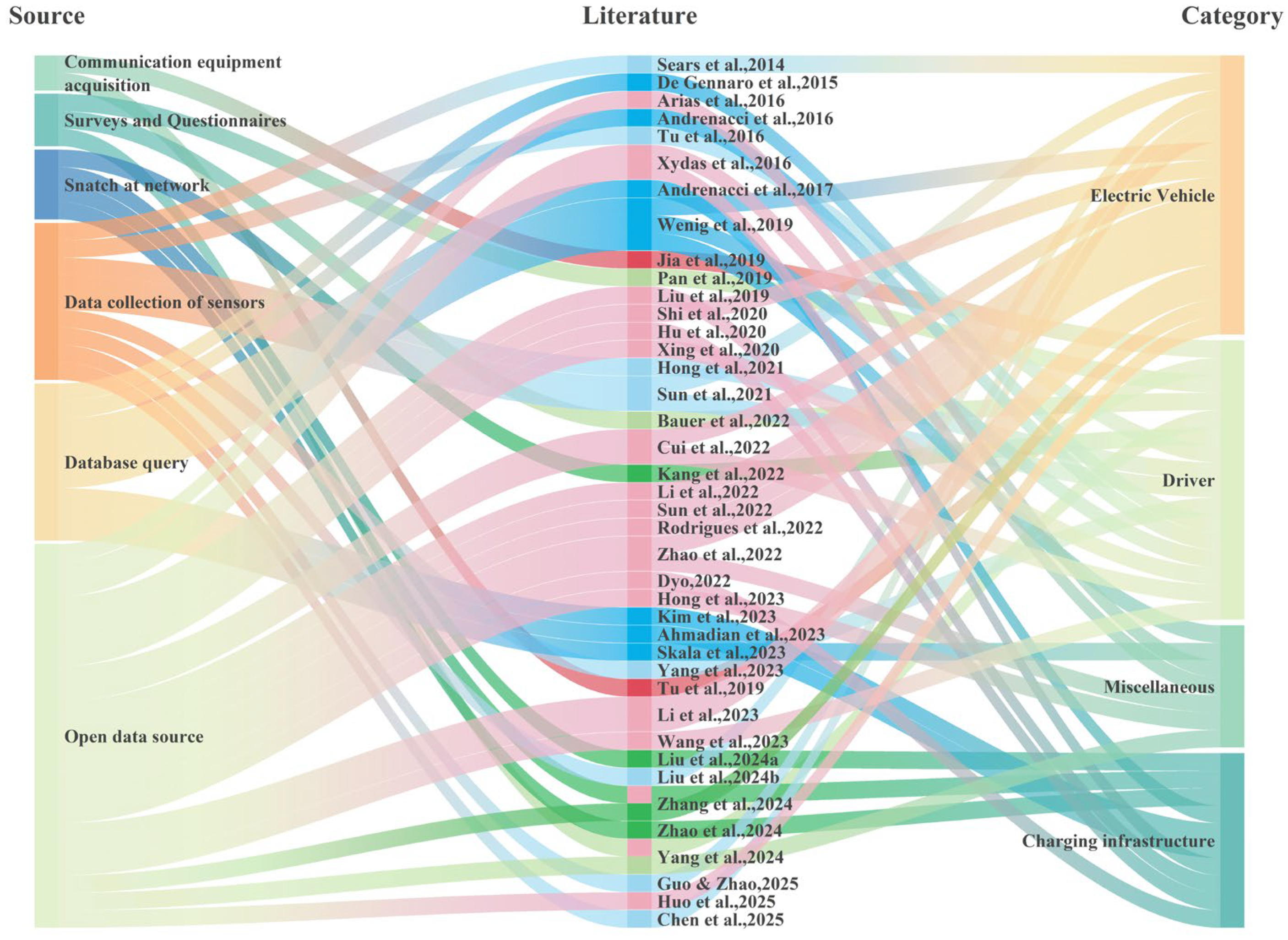
In the field of EV charging, there are more methods of data acquisition. As can be seen in Figure 3, open data sources are one of the main methods of acquiring big data for EV charging. Open data sources refer to the use of open data interfaces (API, Application Programming Interface) to obtain data from public databases, government agencies or other organizations. The National New Energy Vehicle Monitoring and Management Platform (NNEVMP), as a governmental organization, provides a large amount of EV big data that can be used for scientific research. The raw data on the NNEVMP used by Li et al. [70] were collected by the on-board terminals of electric buses and then uploaded to the data platform. The dataset includes 38 entries of big data such as sampling time, BMS number, battery pack voltage, battery current, SOC, minimum battery voltage, maximum battery voltage, minimum temperature, maximum temperature, and so on. Li et al. [109] utilized data collected from five EVs of the same brand on the NNEVMP including voltage, current, SOC, and temperature values. Huo et al. [12] also used battery data, motor data, electronic control unit data, and alarm data from the National New Energy Vehicle Big Data Alliance dataset for estimating battery health status
Data can also be obtained through database queries. Database queries are usually performed for data stored in specific databases, and access to such databases usually requires authorization. Andrenacci et al. [48] extracted the required data via the Octo Telematics database containing information such as, for example, vehicle ID; instantaneous GPS longitude, latitude, and speed; timestamp; and distance from the previous trajectory. Kim et al. [110] accessed the Korea Environment Corporation (KEC) database via the KEC API to determine whether any EVs were occupying any EV chargers for charging in the target area at the time of performing the data query. Sensor collection is also a major method; Chen et al. [111] used a real charging dataset collected from 20 EVs over a period of 29 months, including battery pack current and voltage SOC. The maximum and minimum battery voltages within the battery pack, as well as the maximum and minimum battery temperatures, predict the capacity of the battery. In addition to the specific data collection methods described in detail above, web crawlers [112], The questionnaire survey [113] and other methods are used in the EV charging data collection set. The specific collection methods and data categories can be found in Figure 3.
However, current EV charging data collection has obvious gaps: key data like long-term charging demand [110], real-time high-dimensional data [39,50], seasonal trajectories and renewable energy data [24,114] are insufficient or missing. Influencing factor data—holiday effect, charging tech, pricing policies [115], population density [116] and traffic flow—are also underincorporated. These gaps limit coverage of transport, weather, etc., leading to one-sided analyses and impractical strategies.
Figure 3. EV charging big data collection [11,12,16,24,30,39,65,68,69,70,72,73,77,80,88,89,90,94,109,110,111,112,113,117,118,119,120,121,122,123,124,125,126,127,128,129,130,131,132,133].
Energies 18 05066 g003

5.2. EV Charging Big Data Analysis

With the growth of big data and the rapid development of information technology, big data analysis tools and methods are emerging. Algorithms have become effective tools for processing and analyzing massive data, and they occupy a major position in EV charging big data. Table 2 shows several big data analysis algorithms commonly used in EV charging, such as K-means clustering, random forest, and genetic algorithm.
Clustering is an essential tool in data mining research and applications. It is the subject of active research in many fields of study, such as computer science, data science, statistics, pattern recognition, artificial intelligence, and machine learning [134]. One of the most popular clustering methods is the k-means algorithm, which identifies clusters by minimizing the clustering error. In EV charging k-means algorithm mainly analyzes charging data, driver data. Random forest is a statistical or machine learning algorithm used for prediction [135]. In EV charging Random Forest algorithm is analyzing charging behavior characteristics, fall and spring weekday data. Genetic Algorithm (GA) is a representative example of a group of methods known as evolutionary algorithms. Genetic algorithms are iterative algorithms based on the concept of generation, but they are also highly parallel in themselves, as they model the evolution of a series of solutions [136]. Genetic algorithms are used in EV charging to solve the spatio-temporal demand coverage localization model and the dual objective deployment model for electric truck battery exchange stations. In addition to this, the KNN algorithm, logistic regression algorithm and support vector machine algorithm are used to analyze which variables affect the maximum range of a vehicle after fully charging. An a priori algorithm can be used to analyze and study the effect of weather and holidays on the user’s charging. The greedy heuristic algorithm analyzes the optimal location of charging posts. A more detailed representation is in Table 2.
Table 2. Big Data Analytics Algorithms in EV Charging.
Big Data Analytics AlgorithmProblems SolvedReferences
DBSCAN and K-means clustering algorithm
To classify EV drivers.
Analysis of EV charging demand location.
[46,89]
K-means and direct and hierarchical and DPC clustering algorithm
EV load clustering.
[137]
K-means clustering algorithm
To identify the user’s charging mode.
Zoning of charging stations.
To classify drivers.
To analyze drivers’ preferences.
To explore the inherent laws of charging behavior.
To analyze charging habits.
To analyze destination GPS coordinates.
To cluster similar dates
[9,66,69,74,117,118,138,139]
PCA algorithm
To analyze EV charging station data.
To reduce the dimensionality of data while preserving key information.
[75,140]
Random forest algorithm
To analyze the charging behavior characteristics of EV.
To analyze household electricity consumption data on weekdays in spring and autumn to identify households that charge EVs.
[119,141]
GBDT algorithm
To analyze the factors that influence user frequency and vehicle preferences in shared EVs.
[142]
Genetic algorithm
Solving the space-time demand coverage positioning model.
Solving the dual-objective deployment model of electric truck battery swapping station.
[10,88]
KNN algorithm and logistic regression and SVM
To analyze the variables that affect the maximum cruising range of the car after it is fully charged.
[120]
Greedy heuristic algorithm
To analyze the best position of the charging pile.
[143]
Two-stage guided constrained differential evolution algorithm
Combining electricity load data, optimizing multi-objective queuing strategies, and finding win-win strategies between the power grid and users.
[84]
Dynamic Time Warping algorithm
To obtain the most similar mode in the driving cycle.
[121]
Ridge Regression
To predict the driving range of EVs
[144]
Gradient Boosting algorithm and XGBoost algorithm
To analyze the charging demand factors affecting station utilization.
[145]
XGBoost algorithm
To analyze historical photovoltaic power and weather data for short-term photovoltaic power prediction.
[146]
Besides algorithms, there are other ways to analyze big data. Han et al. [147] used Monte Carlo simulation to generate charging and V2G scenarios and analyze the impact of V2G on peak hours. Hu et al. [46] used an extended RFM model, i.e., RFMLT model, a combination of a two-stage clustering method and entropy weighting method for clustering and analyzing EV drivers. Cao et al. [148] used decentralized computing to process driving big data of EVs. Shi et al. [68] used time series data analysis to study EV data.
Although many methods exist for analyzing EV charging big data, existing models have limitations: insufficient scenario adaptability, reliance on short/long-term ML to improve prediction accuracy [50,107], and unproven geographical portability (e.g., Long Short-Term Memory (LSTM); [149]). Data-wise, multi-source data real-time processing faces technical barriers [150], and balancing privacy and algorithm performance remains unsolved.

5.3. Applications for EV Charging Big Data

Applications of big data for EV charging include forecasting, detection, and charging station optimization layout. Forecasting is the process of analyzing historical data as well as real-time data to help predict charging demand and future trends. Detection refers to the use of historical data to detect the safety status of battery packs and identify malfunctions and to detect anomalies in the power supply system of smart car charging stations. EV charging big data is also often used to solve the problem of optimizing the layout of charging stations. By analyzing the literature, we found that machine learning (ML) techniques dominate the application techniques of EV charging big data. So, we categorize big data applications in EV charging into machine learning techniques and other application methods.
ML is used in data applications to extract useful information from large amounts of data, to make predictions and decisions, and to help automate data processing [151]. There are various machine learning techniques, and the machine learning used for EV charging big data is shown in Table 3. It can be seen that prediction with ML (such as LSTM, a variant of recurrent neural networks [152]) occupies an absolutely dominant position. The predictions include grid generation, battery exchange demand, battery capacity, battery internal resistance, remaining battery power, charging station capacity, number of EVs, charging behavior, and charging demand. In addition, machine learning is used for fault detection and user classification.
In addition to machine learning, there are many methods from other fields that have been applied to the field of big data for EV charging. Methods from the field of operations research are also commonly used to analyze big data on EV charging. He et al. [157] used a two-tier planning framework, collaborative capacity optimization (CCO) method, large M method to linearize the nonlinear problem, and analytic target cascading (ATC) technique to optimize charging station siting. Discrete mathematical optimization is also used to find the best solution for electrification of urban bus fleets [158]. Kernel density functions and p-median models in statistics are used for the deployment of charging facilities [24,30]. In terms of evaluation, Liang et al. [143] used the entropy weight-TOPSIS method to form an index system for evaluating the location of EV charging piles, proposed an ensemble coverage model based on the evaluation, and used a greedy heuristic algorithm to find the optimal location of charging piles. Yang et al. [18] used the sequential construction research method, which is commonly used in social science and education research fields, to analyze the regional public EV charging facilities. Zhao et al. [128] employed a decoupling framework in the field of software engineering in order to investigate the partial relationship between EV performance degradation and each individual variable (e.g., temperature and total driving distance). Strielkowski et al. [159] employed an energy internet in the field of internet to design a market design for a high-renewable power system. Hong et al. [80] also used 6G Internet of Things (IoT) in the Internet domain to optimize charging configurations at multiple charging station locations for fleet operators.
Big data is widely used in EV charging but has clear limitations. On one hand, while it helps control charging to ease grid transformation/operation costs [119], long-term adaptation still needs major grid reforms (reallocating generation sites, integrating renewables, etc. [48]). On the other hand, though big data supports V2G (e.g., demand forecasting) with economic potential [160], it is limited by weak infrastructure and low driver participation (battery degradation concerns [161]), requiring big data-driven battery monitoring to balance benefits and risks.

6. Future Research Opportunities

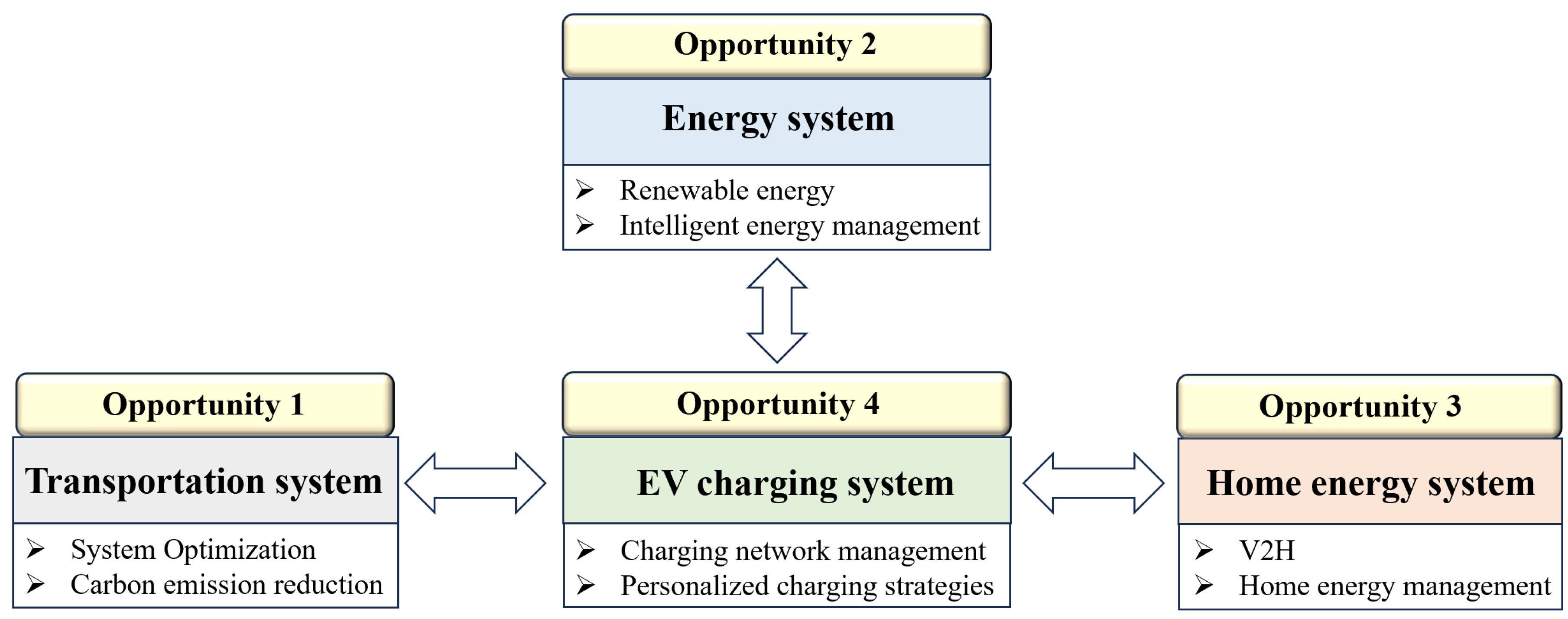
The aforementioned study indicates that there are four primary areas for future research opportunities: (1) Transportation system, (2) Energy system, (3) Home energy system and (4) EV charging system. Detailed research directions are shown in Figure 4.

6.1. Opportunity 1: Deep Integration of Intelligent Transportation and Smart Grid

The deep integration of intelligent transportation and smart grid aims to achieve high coordination between transportation systems and energy networks. Intelligent transportation systems provide services in navigation, railways, waterways, and air transport systems, resulting in a large amount of information [162], while smart grids also need to provide real-time information when achieving a near-immediate balance between grid supply and demand [163], both of which generate large amounts of data. By fully leveraging the big data of the traffic and power grid and using EVs as a bridge between them, we could expect to achieve the coordinated optimization of the road traffic network and the power grid, with zero-carbon traffic as the guide.
Context 1: Synergistic optimization of transportation systems and power grids
The large-scale application of EVs makes the power grid and the transportation network deeply coupled, showing an interdependent state [164]. In real life, using the electricity price signal of a smart grid to guide EVs to charge in low peak hours can alleviate the power grid’s load pressure and reduce drivers’ charging costs [165]. At the same time, combined with traffic flow data, the layout of charging piles is optimized to reduce vehicle waiting time [166]. This coordination addresses resource waste from independent operations by aligning transportation demand with grid load distributions. The traffic flow of the transportation system, the grid load of the power grid, and the charging period of the EV big data are analyzed to achieve the purpose of forecasting the load [167], optimizing the charging schedule, and improving the efficiency of resource utilization [124], so as to help the coordinated optimization of the transportation system and the power grid.
Context 2: Zero-carbon transportation and energy transition
Transportation electrification is a key strategy to decarbonize the transportation system [168]. As a representative of electrified transportation, many countries actively promote EVs. For example, China plans to build a large-scale car network interactive system and intelligent charging network by 2030 [169]. Similarly, Germany plans to have 7 to 10 million EVs on the road by 2030 and to increase investment in charging infrastructure [170]. These policies are moving toward reducing or eliminating carbon emissions from transportation and achieving zero-carbon transportation. Achieving the goal of zero-carbon transportation requires an assessment of transportation carbon emissions. Big data on transportation [171], electricity [172], and user travel behaviors [173] can help evaluate and predict transportation carbon emissions. Then, providing a basis for achieving zero-carbon transportation. More importantly, integrating traffic flow and power grid load big data enables dynamic matching of EV charging demand with the grid’s low-carbon supply periods, reducing high-carbon energy use [174] and supporting zero-carbon transportation networks in line with energy transition.

6.2. Opportunity 2: Renewable Energy and Intelligent Energy Management Optimization

The intermittency and randomness of renewable energy [175] increase the difficulty of energy management [176]. However, the intelligent energy management system can maximize renewable energy consumption through demand response services, interact well with EVs [177], and help energy management. Renewable energy sources such as wind and light energy [178] and EVs are distributed energy sources [179]. To make the two collaboratively optimize energy management, it is necessary to fully integrate distributed energy sources.
Context 3: Integration and optimization of distributed energy
Driven by global net-zero commitments [180] and rising fossil fuel costs, centralized thermal power generation is facing increasingly strict environmental regulations and resource constraints, while distributed energy resources (DERs) are gradually becoming an important supplement and development direction for the energy system due to their flexibility [181] and low-carbon advantages. DERs are resources connected to the distribution network that provide services to nearby or on-site energy loads. These resources include wind energy, solar photovoltaic systems, batteries, natural gas fuel cells, EVs, demand response, and energy efficiency measures [179]. DERs are becoming essential to power grids, and while their integration with the power system offers benefits, it also presents challenges [182]. EVs as mobile DERs should be integrated. Yi et al. [183] proposed a hierarchical collaborative optimization planning framework that includes energy storage and various flexible resources on the demand side, such as hydrogen energy and V2G technologies. The case study showed that V2G reduced the average load variance of microgrids by 56.22%. Similarly, Huang et al. [184], in optimizing the design of the campus microgrid, formulated a charging and discharging policy for participating in power grid dispatching according to the residence time of EVs in the parking lot, narrowing the gap between peak and off-peak hours. The above research results show that EVs’ full bidirectional charging function can reduce the peak-valley difference.
Context 4: EVs and energy storage optimization in urban energy systems
EVs are gradually regarded as flexible energy storage resources in urban energy systems [185], and their role in the distribution network is increasingly prominent [186]. EVs help to improve the stability of the power grid and promote the flexible scheduling of the power system. For example, Borozan et al. [160] showed that among the three modes of Grid-to-Vehicle (G2V), V2G, and Vehicle-to-Building (V2B), V2G has the most significant economic potential in network planning, and V2B has important application value at the transmission level. It is not difficult to see that EVs can enhance the stability of the power grid [187], support building-level energy management [188], and further improve the operating efficiency of the overall energy system.

6.3. Opportunity 3: Synergizing Smart Homes with EVs

Integrating smart homes and EVs provides important opportunities for flexible planning and resource sharing, enhancing energy management capabilities [189]. With the help of V2H technology, various problems related to power consumption and consumer energy demand in smart homes can be solved [190]. At the same time, artificial intelligence (AI) can use energy consumption data in smart homes to make energy management decisions [191] and combine ML to predict the charging demand of EVs [192]. Therefore, combining AI and V2H can optimize EVs’ charging and discharging timing and strengthen energy management.
Context 5: V2H Technology
V2H technology, as a subset of V2X (Vehicle-to-Everything) frameworks, enables bidirectional interaction between EVs and home energy systems. León et al. [193] p proposed and evaluated a strategy that combines time of use pricing (TOU) with V2H operation to promote the popularization of EVs. Similarly, Wu et al. [194] found that V2H technology can reduce household energy costs by at least 22.92%. The above research demonstrates the potential of V2H in reducing household energy expenditure and reveals that EVs have transformed from simple transportation to mobile energy for households. Tostado-Véliz et al. [195] combined V2H technology with the flexible requirements of smart homes in their residential electrification system design, which can reduce total costs by up to 41.5%.
Context 6: AI for energy demand forecasting and automated management
Combining AI, particularly ML, improves the accuracy of predicting power demand at charging stations and helps determine optimal charging station characteristics [192]. If smart home systems apply AI, they could predict household energy demand, allowing residents to adjust their consumption plans for optimal efficiency [196]. Adelman and Uçkun [197] found that the dynamic pricing of smart homes dramatically reduces users’ electricity costs. The EV, with the function of a mobile energy storage unit combined with the vehicle-home-network data interaction platform driven by artificial intelligence, can realize home energy management and further reduce user costs.

6.4. Opportunity 4: Data-Enabled and User-Driven Smart EV Charging Management

This section discusses the necessity of a user-oriented EV charging strategy. Based on user data analysis, the user’s charging habits can be used to construct a personalized charging strategy to improve user satisfaction. Further, the user satisfaction measurement index is not limited to the charging process but extended to the charging management network, including charging infrastructure location and charging infrastructure.
Context 7: Personalized user needs and data-driven decision-making
A data-driven strategy is an important method to meet the personalized needs of EV drivers, and it can improve the efficiency and adaptability of charging systems [198]. Yang et al. [9] found differences in charging modes among different groups of EV users (such as commuters and non-commuters) by analyzing their charging locations. Similarly, Ahmadian et al. [16] used deep neural networks to predict EV drivers’ dwell/charge time and energy consumption. The above research results provide theoretical support for the design of personalized charging strategies. Personalized charging strategies can recommend the best charging time and location and combine time of use dynamic electricity pricing strategies to optimize charging efficiency and cost, achieving the goal of efficient charging management based on user behavior.
Context 8: User-driven intelligent management of charging networks
User-driven charging network management models can better address user charging demands and improve user satisfaction [199], thus facilitating the widespread popularization of EVs [200]. More and more studies have regarded user satisfaction as an important indicator for measuring the quality of charging management systems. For example, Tang et al. [201] proposed a multi-objective EV charging station location method based on a travel chain that can improve location selection efficiency, reducing user search time by 47.91% and charging waiting time by 65.83%, thereby improving user satisfaction. At the same time, Menos-Aikateriniadis et al. [202] pointed out in their case study that when the charging management strategy follows the principle of “user orientation”, the charging strategy based on Deep QNetwork can reduce daily electricity costs by up to 49.83% and charge up to 86.22% within the same period as the user’s historical charging mode. These studies indicate that user-centered charging management can optimize charging resources and improve users’ charging experience and satisfaction.

7. Conclusions

EVs are a crucial part of the solution to meet global carbon reduction targets, and big data on EV charging offered fresh perspectives on a number of issues. This study focuses on reviewing the applications of big data in EV charging, aiming to provide a reference for the future development of big data in the field of energy science. Based on a literature review and other methods, we reviewed the following:
(1) By combining EV charging chains, we analyzed four main kinds of big data generated by the EV charging process: (i) big data generated by drivers; (ii) big data generated by EVs; (iii) big data generated by charging infrastructures and (iv) big data generated by the power grid.
(2) We reviewed key issues in EV charging that big data can address, including: (i) optimized control of grid operation; (ii) charging infrastructure layout; (iii) battery development; (iv) dynamic pricing of the charging network and (v) safety of charging equipment.
(3) We reviewed the collection and processing of big data applications, especially analytics algorithms in EV charging.
(4) We discussed future opportunities of EV charging big data, including the opportunities in four systems: (i) the transportation system; (ii) energy system; (iii) home energy system and (iv) EV charging system.
This study systematically sorts out the sources, core applications, and future directions of charging big data by leveraging the EV charging chain. It helps researchers clearly grasp the overall context of this field while also providing references for subsequent studies focusing on specific issues (such as charging infrastructure optimization and power grid coordination) to facilitate more targeted advancement of research in this domain. The limitation of the proposed research is that it did not take into account the development of EV charging big data over time and did not assess the probability of each future opportunity.

Funding

This research work was supported by Chongqing Postdoctoral Science Foundation Program (Grant No. CSTB2023NSCQ-BHX0227), China Postdoctoral Science Foundation (Grant No. 2023M740427), Chongqing Social Science Planning Program (Grant No. 2023BS024), Humanities and Social Sciences Research Program of Chongqing Municipal Education Commission (Grant No. 23SKJD084), Ministry of Education Humanities and Social Sciences Fund (Grant No. 24YJA630023), and the 2024 “Revelation and Leadership” Project Foundation of Chongqing Jiaotong University (Grant No. CQJTU202401).

Data Availability Statement

Data is contained within the article.

Conflicts of Interest

The authors declare no conflict of interest.

References

  1. IEA. World Energy Outlook 2024. Available online: https://www.iea.org/reports/world-energy-outlook-2024 (accessed on 15 April 2025).
  2. IEA. Global EV Outlook 2024. Available online: https://www.iea.org/reports/global-ev-outlook-2024 (accessed on 15 April 2025).
  3. Ipsos. How to Create a Friendly Environment for EVs and Accelerate Market Adoption? Available online: https://www.ipsos.com/sites/default/files/ct/publication/documents/2024-06/N200_CEX_How_EVs_Incentives_can_Charge_the_Market_CHN.pdf (accessed on 15 April 2025).
  4. Zhang, J.; Wang, Z.; Liu, P.; Zhang, Z. Energy consumption analysis and prediction of electric vehicles based on real-world driving data. Appl. Energy 2020, 275, 115408. [Google Scholar] [CrossRef]
  5. Li, H.; Son, D.; Jeong, B. Electric vehicle charging scheduling with mobile charging stations. J. Clean. Prod. 2024, 434, 140162. [Google Scholar] [CrossRef]
  6. Yang, Z.; Hu, X.; Sun, J.; Lei, Q.; Zhang, Y. Is it worth promoting battery swapping? A social welfare perspective on provider- and consumer-side incentives. J. Environ. Manag. 2023, 330, 117157. [Google Scholar] [CrossRef] [PubMed]
  7. An, Y.S.; Gao, Y.X.; Wu, N.Q.; Zhu, J.W.; Li, H.Z.; Yang, J.H. Optimal scheduling of electric vehicle charging operations considering real-time traffic condition and travel distance. Expert Syst. Appl. 2023, 213, 118941. [Google Scholar] [CrossRef]
  8. Mahmoudi, E.; Barros, T.A.D.; Ruppert, E. Forecasting urban electric vehicle charging power demand based on travel trajectory simulation in the realistic urban street network. Energy Rep. 2024, 11, 4254–4276. [Google Scholar] [CrossRef]
  9. Yang, X.; Zhuge, C.X.; Shao, C.F.; Guo, R.H.; Wong, A.T.C.; Zhang, X.Y.; Sun, M.D.; Wang, P.X.; Wang, S.Q. Dominant charging location choice of commuters and non-commuters: A big data approach. Transportation 2023, 52, 439–466. [Google Scholar] [CrossRef]
  10. Wang, S.; Shao, C.; Zhuge, C.; Sun, M.; Wang, P.; Yang, X. Deploying Battery Swap Stations for Electric Freight Vehicles Based on Trajectory Data Analysis. IEEE Trans. Transp. Electrif. 2022, 8, 3782–3800. [Google Scholar] [CrossRef]
  11. Liu, H.; Deng, Z.; Che, Y.; Xu, L.; Wang, B.; Wang, Z.; Xie, Y.; Hu, X. Big field data-driven battery pack health estimation for electric vehicles: A deep-fusion transfer learning approach. Mech. Syst. Signal Process. 2024, 218, 111585. [Google Scholar] [CrossRef]
  12. Huo, W.W.; Chang, Y.H.; Luo, T.Q.; Lu, B.; Guo, C.D.; Li, Y.C. Integrating particle swarm optimization with convolutional and long short-term memory neural networks for real vehicle data-based lithium-ion battery health estimation. J. Energy Storage 2025, 111, 115427. [Google Scholar] [CrossRef]
  13. Liu, C.; Liu, L.; Peng, Z.; Wu, H.; Wang, F.; Jiao, H.; Wang, J. Planning public electric vehicle charging stations to balance efficiency and equality: A case study in Wuhan, China. Sustain. Cities Soc. 2025, 124, 106314. [Google Scholar] [CrossRef]
  14. Munshi, A.A.; Mohamed, Y. Unsupervised Nonintrusive Extraction of Electrical Vehicle Charging Load Patterns. IEEE Trans. Ind. Informat. 2019, 15, 266–279. [Google Scholar] [CrossRef]
  15. Wang, H.; Guo, F.; Sivakumar, A. Analysing the impact of electric vehicle charging on households: An interrelated load profile generation approach. Energy Build. 2025, 335, 115558. [Google Scholar] [CrossRef]
  16. Ahmadian, A.; Ghodrati, V.; Gadh, R. Artificial deep neural network enables one-size-fits-all electric vehicle user behavior prediction framework. Appl. Energy 2023, 352, 121884. [Google Scholar] [CrossRef]
  17. Huo, Y.N.; Xing, H.W.; Yang, Y.; Yu, H.Y.; Wan, M.C.; Geng, G.C.; Jiang, Q.Y. Real-time estimation of aggregated electric vehicle charging load based on representative meter data. Energy 2025, 321, 135162. [Google Scholar] [CrossRef]
  18. Yang, X.Y.; Guo, X.P.; Li, Y.; Yang, K. The sequential construction research of regional public electric vehicle charging facilities based on data-driven analysis—Empirical analysis of Shanxi Province. J. Clean. Prod. 2022, 380, 134948. [Google Scholar] [CrossRef]
  19. Liu, G.; Wang, B.; Li, T.; Deng, N.; Song, Q.; Zhang, J. Multi-objective electric-carbon synergy optimisation for electric vehicle charging: Integrating uncertainty and bounded rational behaviour models. Appl. Energy 2025, 389, 125790. [Google Scholar] [CrossRef]
  20. Gao, D.; Lin, X.; Yang, Q. Design and Application of a Fault Diagnosis and Monitoring System for Electric Vehicle Charging Equipment Based on Improved Deep Belief Network. Int. J. Control Autom. Syst. 2022, 20, 1544–1560. [Google Scholar] [CrossRef]
  21. Wang, Y.; Yao, E.J.; Pan, L. Electric vehicle drivers’ charging behavior analysis considering heterogeneity and satisfaction. J. Clean. Prod. 2021, 286, 124982. [Google Scholar] [CrossRef]
  22. Zhang, T.Y.; Yang, Y.; Zhu, Y.T.; Yao, E.J.; Wu, K.Q. Deploying Public Charging Stations for Battery Electric Vehicles on the Expressway Network Based on Dynamic Charging Demand. IEEE Trans. Transp. Electrif. 2022, 8, 2531–2548. [Google Scholar] [CrossRef]
  23. Li, X.R.; Wang, W.; Jin, K.; Gu, H. A blockchain-enabled personalized charging system for electric vehicles. Transp. Res. Part C Emerg. Technol. 2024, 161, 104549. [Google Scholar] [CrossRef]
  24. Yang, X.; Peng, Z.H.; Wang, P.X.; Zhuge, C.X. Seasonal variance in electric vehicle charging demand and its impacts on infrastructure deployment: A big data approach. Energy 2023, 280, 128230. [Google Scholar] [CrossRef]
  25. Wolbertus, R.; Kroesen, M.; van den Hoed, R.; Chorus, C. Fully charged: An empirical study into the factors that influence connection times at EV-charging stations. Energy Policy 2018, 123, 1–7. [Google Scholar] [CrossRef]
  26. Shi, J.Z.; Tian, M.; Han, S.W.; Wu, T.Y.; Tang, Y.F. Electric vehicle battery remaining charging time estimation considering charging accuracy and charging profile prediction. J. Energy Storage 2022, 49, 104132. [Google Scholar] [CrossRef]
  27. Zhang, J.W.; Zhang, W.G.; Sun, B.X.; Zhang, Y.R.; Fan, X.Y.; Zhao, B. A novel method of battery pack energy health estimation based on visual feature learning. Energy 2024, 293, 130656. [Google Scholar] [CrossRef]
  28. Qin, Y.D.; Dai, Y.X.; Huang, J.H.; Xu, H.; Lu, L.G.; Han, X.B.; Du, J.Y.; Ouyang, M.G. Charging patterns analysis and multiscale infrastructure deployment: Based on the real trajectories and battery data of the plug-in electric vehicles in Shanghai. J. Clean. Prod. 2023, 425, 138847. [Google Scholar] [CrossRef]
  29. Davidov, S. Optimal charging infrastructure planning based on a charging convenience buffer. Energy 2020, 192, 116655. [Google Scholar] [CrossRef]
  30. Kang, J.; Kong, H.; Lin, Z.; Dang, A. Mapping the dynamics of electric vehicle charging demand within Beijing’s spatial structure. Sustain. Cities Soc. 2022, 76, 103507. [Google Scholar] [CrossRef]
  31. Cai, L.; Hu, P.; Tan, Z. Research on the effect of large-scale electric vehicle based on smart wearable equipment access to grid. J. Ambient. Intell. Humaniz. Comput. 2018, 10, 3231–3237. [Google Scholar] [CrossRef]
  32. Li, J.L.; Wang, G.L.; Wang, X.F.; Du, Y.K. Smart charging strategy for electric vehicles based on marginal carbon emission factors and time-of-use price. Sustain. Cities Soc. 2023, 96, 104708. [Google Scholar] [CrossRef]
  33. Pan, K.; Liang, C.D.; Lu, M. Optimal scheduling of electric vehicle ordered charging and discharging based on improved gravitational search and particle swarm optimization algorithm. Int. J. Electr. Power Energy Syst. 2024, 157, 109766. [Google Scholar] [CrossRef]
  34. Kaur, A.P.; Singh, M. Time-of-Use tariff rates estimation for optimal demand-side management using electric vehicles. Energy 2023, 273, 127243. [Google Scholar] [CrossRef]
  35. Liao, S.Y.; Liu, Y.P.; Xu, J.; Jia, L.W.; Ke, D.P.; Jiang, X.X. Data-Driven Real-Time Congestion Forecasting and Relief With High Renewable Energy Penetration. IEEE Trans. Ind. Informat. 2024, 21, 12–29. [Google Scholar] [CrossRef]
  36. Yang, X.; Li, Y.Z.; Zhao, Y.; Yu, Y.W.; Lian, Y.C.; Hao, G.K.; Jiang, L. Data-driven nested robust optimization for generation maintenance scheduling considering temporal correlation. Energy 2023, 278, 127499. [Google Scholar] [CrossRef]
  37. Zhou, Z.; Zhang, X.; Guo, Q.L.; Sun, H.B. Integrated pricing framework for optimal power and semi-dynamic traffic flow problem. IET Renew. Power Gener. 2020, 14, 3636–3643. [Google Scholar] [CrossRef]
  38. Zheng, L.J.; Yang, J.; Chen, L.; Sun, D.H.; Liu, W.N. Dynamic spatial-temporal feature optimization with ERI big data for Short-term traffic flow prediction. Neurocomputing 2020, 412, 339–350. [Google Scholar] [CrossRef]
  39. Wang, S.; Chen, A.; Wang, P.; Zhuge, C. Predicting electric vehicle charging demand using a heterogeneous spatio-temporal graph convolutional network. Transp. Res. Part C Emerg. Technol. 2023, 153, 104205. [Google Scholar] [CrossRef]
  40. Lv, L.L.; Wu, Z.Y.; Zhang, J.H.; Zhang, L.; Tan, Z.Y.; Tian, Z.H. A VMD and LSTM Based Hybrid Model of Load Forecasting for Power Grid Security. IEEE Trans. Ind. Informat. 2022, 18, 6474–6482. [Google Scholar] [CrossRef]
  41. Bai, Y.; Qian, Q. Optimal placement of parking of electric vehicles in smart grids, considering their active capacity. Electr. Power Syst. Res. 2023, 220, 109238. [Google Scholar] [CrossRef]
  42. Weng, Y.; Ly, S.; Wang, P.; Nguyen, H.D. Hypothesis Testing for Mitigation of Operational Infeasibility on Distribution System Under Rising Renewable Penetration. IEEE Trans. Sustain. Energy 2023, 14, 876–891. [Google Scholar] [CrossRef]
  43. Ali, H.A.E.; Alham, M.H.; Ibrahim, D.K. Big data resolving using Apache Spark for load forecasting and demand response in smart grid: A case study of Low Carbon London Project. J. Big Data 2024, 11, 59. [Google Scholar] [CrossRef]
  44. Higashitani, T.; Ikegami, T.; Uemichi, A.; Akisawa, A. Evaluation of residential power supply by photovoltaics and electric vehicles. Renew. Energy 2021, 178, 745–756. [Google Scholar] [CrossRef]
  45. Song, H.; Liu, C.; Jalili, M.; Yu, X.H.; McTaggart, P. Ensemble Classification Model for EV Identification From Smart Meter Recordings. IEEE Trans. Ind. Informat. 2023, 19, 3274–3283. [Google Scholar] [CrossRef]
  46. Hu, D.; Zhou, K.; Li, F.; Ma, D. Electric vehicle user classification and value discovery based on charging big data. Energy 2022, 249, 123698. [Google Scholar] [CrossRef]
  47. Liu, J.; Guo, H.; Xiong, J.; Kato, N.; Zhang, J.; Zhang, Y. Smart and Resilient EV Charging in SDN-Enhanced Vehicular Edge Computing Networks. IEEE J. Sel. Areas Commun. 2020, 38, 217–228. [Google Scholar] [CrossRef]
  48. Andrenacci, N.; Ragona, R.; Genovese, A. Evaluation of the Instantaneous Power Demand of an Electric Charging Station in an Urban Scenario. Energies 2020, 13, 2715. [Google Scholar] [CrossRef]
  49. Pevec, D.; Babic, J.; Podobnik, V. Electric Vehicles: A Data Science Perspective Review. Electronics 2019, 8, 1190. [Google Scholar] [CrossRef]
  50. Shahriar, S.; Al-Ali, A.R.; Osman, A.H.; Dhou, S.; Nijim, M. Machine Learning Approaches for EV Charging Behavior: A Review. IEEE Access 2020, 8, 168980–168993. [Google Scholar] [CrossRef]
  51. Tappeta, V.S.R.; Appasani, B.; Patnaik, S.; Ustun, T.S. A Review on Emerging Communication and Computational Technologies for Increased Use of Plug-In Electric Vehicles. Energies 2022, 15, 6580. [Google Scholar] [CrossRef]
  52. Ali, W.A.; Fanti, M.P.; Roccotelli, M.; Ranieri, L. A Review of Digital Twin Technology for Electric and Autonomous Vehicles. Appl. Sci. 2023, 13, 5871. [Google Scholar] [CrossRef]
  53. Mololoth, V.K.; Saguna, S.; Ahlund, C. Blockchain and Machine Learning for Future Smart Grids: A Review. Energies 2023, 16, 528. [Google Scholar] [CrossRef]
  54. Ali, K.N.; Hemmati, M.; Miraftabzadeh, S.M.; Mohammadi, Y.; Bayati, N. A Mini Review of the Impacts of Machine Learning on Mobility Electrifications. Energies 2024, 17, 6069. [Google Scholar] [CrossRef]
  55. Cavus, M.; Dissanayake, D.; Bell, M. Next Generation of Electric Vehicles: AI-Driven Approaches for Predictive Maintenance and Battery Management. Energies 2025, 18, 1041. [Google Scholar] [CrossRef]
  56. Chen, K.; Zhou, X.; Bao, Z.; Skibniewski, M.J.; Fang, W. Artificial intelligence in infrastructure construction: A critical review. Front. Eng. Manag. 2025, 12, 24–38. [Google Scholar] [CrossRef]
  57. Abbas, F.; Feng, D.; Habib, S.; Numan, M.; Rahman, U. A heuristically optimized comprehensive charging scheme for large-scale EV integration. Int. Trans. Electr. Energy Syst. 2020, 30, e12313. [Google Scholar] [CrossRef]
  58. Weng, C.; Cui, Y.; Sun, J.; Peng, H. On-board state of health monitoring of lithium-ion batteries using incremental capacity analysis with support vector regression. J. Power Sources 2013, 235, 36–44. [Google Scholar] [CrossRef]
  59. Çelik, D.; Khan, M.A.; Khosravi, N.; Waseem, M.; Ahmed, H. A review of energy storage systems for facilitating large-scale EV charger integration in electric power grid. J. Energy Storage 2025, 112, 115496. [Google Scholar] [CrossRef]
  60. Thangaraju, I. Fractional order Adaptive Integral Hierarchical Sliding Mode Controller for Energy Management System in Electric Vehicles. J. New Mater. Electrochem. Syst. 2025, 28, 56–67. [Google Scholar] [CrossRef]
  61. Tang, Y.; Liu, W.; Chau, K.T.; Hou, Y.; Guo, J. Stochastic Behavior Modeling and Optimal Bidirectional Charging Station Deployment in EV Energy Network. IEEE Trans. Intell. Transp. Syst. 2025, 26, 6231–6247. [Google Scholar] [CrossRef]
  62. Sørensen, Å.L.; Sartori, I.; Lindberg, K.B.; Andresen, I. A method for generating complete EV charging datasets and analysis of residential charging behaviour in a large Norwegian case study. Sustain. Energy Grids Netw. 2023, 36, 101195. [Google Scholar] [CrossRef]
  63. Fraile-Ardanuy, J.; Castano-Solis, S.; Álvaro-Hermana, R.; Merino, J.; Castillo, Á. Using mobility information to perform a feasibility study and the evaluation of spatio-temporal energy demanded by an electric taxi fleet. Energy Convers. Manag. 2018, 157, 59–70. [Google Scholar] [CrossRef]
  64. Li, T.; Wu, J.; Dang, A.; Liao, L.; Xu, M. Emission pattern mining based on taxi trajectory data in Beijing. J. Clean. Prod. 2019, 206, 688–700. [Google Scholar] [CrossRef]
  65. Xing, Q.; Chen, Z.; Zhang, Z.; Xu, X.; Zhang, T.; Huang, X.; Wang, H. Urban Electric Vehicle Fast-Charging Demand Forecasting Model Based on Data-Driven Approach and Human Decision-Making Behavior. Energies 2020, 13, 1412. [Google Scholar] [CrossRef]
  66. Li, Z.; Wu, X.; Zhang, S.; Min, L.; Feng, Y.; Hang, Z.; Shi, L. Energy Storage Charging Pile Management Based on Internet of Things Technology for Electric Vehicles. Processes 2023, 11, 1561. [Google Scholar] [CrossRef]
  67. Poyrazoglu, G.; Coban, E. A stochastic value estimation tool for electric vehicle charging points. Energy 2021, 227, 120335. [Google Scholar] [CrossRef]
  68. Shi, Y.; Zhang, Q.; He, A.; Pan, A.; Zhang, M.; Li, C.; Liao, Q.; Yang, X.; Wang, Z. A real-world investigation into usage patterns of electric vehicles in Shanghai. J. Energy Storage 2020, 32, 101805. [Google Scholar] [CrossRef]
  69. Wenig, J.; Sodenkamp, M.; Staake, T. Battery versus infrastructure: Tradeoffs between battery capacity and charging infrastructure for plug-in hybrid electric vehicles. Appl. Energy 2019, 255, 113787. [Google Scholar] [CrossRef]
  70. Li, X.; Wang, T.; Li, J.; Tian, Y.; Tian, J. Energy Consumption Estimation for Electric Buses Based on a Physical and Data-Driven Fusion Model. Energies 2022, 15, 4160. [Google Scholar] [CrossRef]
  71. Wang, S.; Chen, A.; Wang, P.; Zhuge, C. Short-term electric vehicle battery swapping demand prediction: Deep learning methods. Transp. Res. Part D Transp. Environ. 2023, 119, 103746. [Google Scholar] [CrossRef]
  72. Xydas, E.; Marmaras, C.; Cipcigan, L.M.; Jenkins, N.; Carroll, S.; Barker, M. A data-driven approach for characterising the charging demand of electric vehicles: A UK case study. Appl. Energy 2016, 162, 763–771. [Google Scholar] [CrossRef]
  73. Dyo, V. Behavior-Neutral Smart Charging of Plugin Electric Vehicles: Reinforcement Learning Approach. IEEE Access 2022, 10, 64095–64104. [Google Scholar] [CrossRef]
  74. Wei, W.; Zhang, Z.; Liu, P.; Wang, Z.; Xue, L. Analyzing Charging Behavior of Electric City Buses in Typical Chinese Cities. IEEE Access 2020, 8, 4466–4474. [Google Scholar] [CrossRef]
  75. Zhang, Q.; Liu, L.P.; Liu, C. Data Compression and Reconstruction for EV Charging Stations Based on Principal Component Analysis. Appl. Mech. Mater. 2014, 556–562, 4317–4320. [Google Scholar] [CrossRef]
  76. Liu, P.; Yu, J. Identification of charging behavior characteristic for large-scale heterogeneous electric vehicle fleet. J. Mod. Power Syst. Clean Energy 2017, 6, 567–581. [Google Scholar] [CrossRef]
  77. Jawale, S.A.; Singh, S.K.; Singh, P.; Kolhe, M.L. Priority Wise Electric Vehicle Charging for Grid Load Minimization. Processes 2022, 10, 1898. [Google Scholar] [CrossRef]
  78. Arias, M.B.; Bae, S. Electric vehicle charging demand forecasting model based on big data technologies. Appl. Energy 2016, 183, 327–339. [Google Scholar] [CrossRef]
  79. Xia, Y.; Hu, B.; Xie, K.; Tang, J.; Tai, H.-M. An EV Charging Demand Model for the Distribution System Using Traffic Property. IEEE Access 2019, 7, 28089–28099. [Google Scholar] [CrossRef]
  80. Hong, T.; Cao, J.; Fang, C.; Li, D. 6G Based Intelligent Charging Management for Autonomous Electric Vehicles. IEEE Trans. Intell. Transp. Syst. 2023, 24, 7574–7585. [Google Scholar] [CrossRef]
  81. Zou, H.; Xiong, Y.; Hu, X. Research on Planning and Layout of Electric Vehicle Public Charging Piles in Historical and Cultural Street Based on Big Data. IOP Conf. Ser. Earth Environ. Sci. 2020, 510, 062026. [Google Scholar] [CrossRef]
  82. Niu, S.Y.; Yu, H.; Niu, S.X.; Jian, L.N. Power loss analysis and thermal assessment on wireless electric vehicle charging technology: The over-temperature risk of ground assembly needs attention. Appl. Energy 2020, 275, 115344. [Google Scholar] [CrossRef]
  83. Niu, S.Y.; Zhao, Q.Y.; Chen, H.B.; Niu, S.X.; Jian, L.N. Noncooperative Metal Object Detection Using Pole-to-Pole EM Distribution Characteristics for Wireless EV Charger Employing DD Coils. IEEE Trans. Ind. Electron. 2024, 71, 6335–6344. [Google Scholar] [CrossRef]
  84. Sung, T.-W.; Li, W.; Liang, Q.; Hong, C.; Fang, Q. Research on charging behavior of electric vehicles based on multiple objectives. Math. Biosci. Eng. 2023, 20, 15708–15736. [Google Scholar] [CrossRef] [PubMed]
  85. Clack, C.T.M.; Qvist, S.A.; Apt, J.; Bazilian, M.; Brandt, A.R.; Caldeira, K.; Davis, S.J.; Diakov, V.; Handschy, M.A.; Hines, P.D.H.; et al. Evaluation of a proposal for reliable low-cost grid power with 100% wind, water, and solar. Proc. Natl. Acad. Sci. USA 2017, 114, 6722–6727. [Google Scholar] [CrossRef] [PubMed]
  86. Shui, D.Y.; Xie, Y.; Wu, L.B.; Liu, Y.N.; Su, X. Lightweight three-party key agreement for V2G networks with physical unclonable function. Veh. Commun. 2024, 47, 100747. [Google Scholar] [CrossRef]
  87. Sun, M.; Shao, C.; Zhuge, C.; Wang, P.; Yang, X.; Wang, S. Exploring the potential of rental electric vehicles for vehicle-to-grid: A data-driven approach. Resour. Conserv. Recycl. 2021, 175, 105841. [Google Scholar] [CrossRef]
  88. Tu, W.; Li, Q.; Fang, Z.; Shaw, S.-l.; Zhou, B.; Chang, X. Optimizing the locations of electric taxi charging stations: A spatial–temporal demand coverage approach. Transp. Res. Part C Emerg. Technol. 2016, 65, 172–189. [Google Scholar] [CrossRef]
  89. Jia, J.; Liu, C.; Wan, T. Planning of the Charging Station for Electric Vehicles Utilizing Cellular Signaling Data. Sustainability 2019, 11, 643. [Google Scholar] [CrossRef]
  90. Liu, C.X.; Peng, Z.H.; Liu, L.B.; Wu, H. Analysis of Spatiotemporal Characteristics and Influencing Factors of Electric Vehicle Charging Based on Multisource Data. ISPRS Int. J. Geo-Inf. 2024, 13, 37. [Google Scholar] [CrossRef]
  91. Wu, R.; Wang, T.; Wang, Z.; Fang, Z.; Zhou, X.; Xu, N. Spatial adaptability evaluation and optimal location of electric vehicle charging stations: A win-win view from urban travel dynamics. Energy Strateg. Rev. 2023, 49, 101122. [Google Scholar] [CrossRef]
  92. Zhou, J.M.; Rong, J.F.; Zhang, J.M.; Liu, C.R.; Yi, F.Y.; Jiao, Z.P.; Zhang, C.Z. Deep learning estimation of state of health for lithium-ion batteries using multi-level fusion features of discharge curves. J. Power Sources 2025, 653, 237781. [Google Scholar] [CrossRef]
  93. Zhang, C.; Jiang, Y.; Jiang, J.; Cheng, G.; Diao, W.; Zhang, W. Study on battery pack consistency evolutions and equilibrium diagnosis for serial- connected lithium-ion batteries. Appl. Energy 2017, 207, 510–519. [Google Scholar] [CrossRef]
  94. Sun, Z.; Han, Y.; Wang, Z.; Chen, Y.; Liu, P.; Qin, Z.; Zhang, Z.; Wu, Z.; Song, C. Detection of voltage fault in the battery system of electric vehicles using statistical analysis. Appl. Energy 2022, 307, 118172. [Google Scholar] [CrossRef]
  95. Zhou, D.; Fu, P.; Yin, H.; Xie, W.; Feng, S. A Study of Online State-of-Health Estimation Method for In-Use Electric Vehicles Based on Charge Data. IEICE Trans. Inf. Syst. 2019, E102.D, 1302–1309. [Google Scholar] [CrossRef]
  96. Song, L.; Liang, T.; Lu, L.; Ouyang, M. Lithium-ion battery pack equalization based on charging voltage curves. Int. J. Electr. Power Energy Syst. 2020, 115, 105516. [Google Scholar] [CrossRef]
  97. Zhang, J.; Zhang, W.; Zhang, Y.; Zhang, C.; Zhao, B.; Zhao, X.; Ma, S. Capacity estimation for series-connected battery pack based on partial charging voltage curve segments. J. Energy Storage 2024, 95, 112576. [Google Scholar] [CrossRef]
  98. Jia, C.; Liu, W.; He, H.; Chau, K.T. Deep reinforcement learning-based energy management strategy for fuel cell buses integrating future road information and cabin comfort control. Energy Convers. Manag. 2024, 321, 119032. [Google Scholar] [CrossRef]
  99. Jia, C.C.; Liu, W.; He, H.W.; Chau, K.T. Health-conscious energy management for fuel cell vehicles: An integrated thermal management strategy for cabin and energy source systems. Energy 2025, 333, 137330. [Google Scholar] [CrossRef]
  100. Cui, L.; Wang, Q.Y.; Qu, H.Q.; Wang, M.S.; Wu, Y.L.; Ge, L. Dynamic pricing for fast charging stations with deep reinforcement learning. Appl. Energy 2023, 346, 121334. [Google Scholar] [CrossRef]
  101. Li, Y.; Wang, J.; Wang, W.; Liu, C.; Li, Y. Dynamic pricing based electric vehicle charging station location strategy using reinforcement learning. Energy 2023, 281, 128284. [Google Scholar] [CrossRef]
  102. Zhao, Z.; Lee, C.K.M. Dynamic Pricing for EV Charging Stations: A Deep Reinforcement Learning Approach. IEEE Trans. Transp. Electrif. 2022, 8, 2456–2468. [Google Scholar] [CrossRef]
  103. Lu, C.B.; Wu, J.A.; Cui, J.S.; Xu, Y.Y.; Wu, C.Y.; Gonzalez, M.C. Deadline Differentiated Dynamic EV Charging Price Menu Design. IEEE Trans. Smart Grid 2023, 14, 502–516. [Google Scholar] [CrossRef]
  104. Yang, S. Price-responsive early charging control based on data mining for electric vehicle online scheduling. Electr. Power Syst. Res. 2019, 167, 113–121. [Google Scholar] [CrossRef]
  105. Luo, C.; Huang, Y.F.; Gupta, V. Stochastic Dynamic Pricing for EV Charging Stations With Renewable Integration and Energy Storage. IEEE Trans. Smart Grid 2018, 9, 1494–1505. [Google Scholar] [CrossRef]
  106. Bae, S.; Kulcsár, B.; Gros, S. Personalized dynamic pricing policy for electric vehicles: Reinforcement learning approach. Transp. Res. Part C Emerg. Technol. 2024, 161, 104540. [Google Scholar] [CrossRef]
  107. Li, Y.; Zhang, L.; Lv, Z.; Wang, W. Detecting Anomalies in Intelligent Vehicle Charging and Station Power Supply Systems With Multi-Head Attention Models. IEEE Trans. Intell. Transp. Syst. 2021, 22, 555–564. [Google Scholar] [CrossRef]
  108. Xu, Y.Z.; Zou, Z.H.; Liu, Y.L.; Zeng, Z.Y.; Zhou, S.; Jin, T. Deep Learning-Based Multifeature Fusion Model for Accurate Open-Circuit Fault Diagnosis in Electric Vehicle DC Charging Piles. IEEE Trans. Transp. Electrif. 2025, 11, 2243–2254. [Google Scholar] [CrossRef]
  109. Li, F.; Min, Y.; Zhang, Y.; Wang, C. A Method for Abnormal Battery Charging Capacity Diagnosis Based on Electric Vehicles Operation Data. Batteries 2023, 9, 103. [Google Scholar] [CrossRef]
  110. Kim, D.; Kwon, D.; Han, J.; Lee, S.M.; Elkosantini, S.; Suh, W. Data-Driven Model for Identifying Factors Influencing Electric Vehicle Charging Demand: A Comparative Analysis of Early- and Maturity-Phases of Electric Vehicle Programs in Korea. Appl. Sci. 2023, 13, 3760. [Google Scholar] [CrossRef]
  111. Chen, X.; Wang, X.X.; Deng, Y.L. Federated learning-based prediction of electric vehicle battery pack capacity using time-domain and frequency-domain feature extraction. Energy 2025, 319, 135002. [Google Scholar] [CrossRef]
  112. Zhao, M.; Wang, D.; Li, W.; Liu, J. Unraveling influencing factors of public charging station utilization. Transp. Res. Part D Transp. Environ. 2024, 137, 104506. [Google Scholar] [CrossRef]
  113. Yang, Y.; Yang, S.; Moon, H.; Woo, J. Analyzing heterogeneous electric vehicle charging preferences for strategic time-of-use tariff design and infrastructure development: A latent class approach. Appl. Energy 2024, 374, 124074. [Google Scholar] [CrossRef]
  114. Ding, X.; Gan, Q.; Shaker, M.P. Optimal management of parking lots as a big data for electric vehicles using internet of things and Long–Short term Memory. Energy 2023, 268, 126613. [Google Scholar] [CrossRef]
  115. Fescioglu-Unver, N.; Yıldız Aktaş, M. Electric vehicle charging service operations: A review of machine learning applications for infrastructure planning, control, pricing and routing. Renew. Sust. Energy Rev. 2023, 188, 113873. [Google Scholar] [CrossRef]
  116. Ma, R.; Huang, A.; Cui, H.; Yu, R.; Peng, X. Spatial heterogeneity analysis on distribution of intra-city public electric vehicle charging points based on multi-scale geographically weighted regression. Travel Behav. Soc. 2024, 35, 100725. [Google Scholar] [CrossRef]
  117. Zhang, G.; Liu, H.; Xie, T.; Li, H.; Zhang, K.; Wang, R. Research on the Dispatching of Electric Vehicles Participating in Vehicle-to-Grid Interaction: Considering Grid Stability and User Benefits. Energies 2024, 17, 812. [Google Scholar] [CrossRef]
  118. Andrenacci, N.; Ragona, R.; Valenti, G. A demand-side approach to the optimal deployment of electric vehicle charging stations in metropolitan areas. Appl. Energy 2016, 182, 39–46. [Google Scholar] [CrossRef]
  119. Liu, Y.; Hong, Y.; Hu, C. Research on Big Data Mining Technology of Electric Vehicle Charging Behaviour. Elektron. Elektrotechnika 2019, 25, 55–61. [Google Scholar] [CrossRef]
  120. Rodrigues, R.; Albuquerque, V.; Ferreira, J.C.; Dias, M.S. EV Battery Degradation: A Data Mining Approach. In Intelligent Transport Systems, Proceedings of the 5th EAI International Conference, INTSYS 2021, Virtual Event, 24–26 November 2021; Lecture Notes of the Institute for Computer Sciences, Social Informatics and Telecommunications Engineering; Springer: Cham, Switzerland, 2022; pp. 177–191. [Google Scholar]
  121. Hong, S.; Hwang, H.; Kim, D.; Cui, S.; Joe, I. Real Driving Cycle-Based State of Charge Prediction for EV Batteries Using Deep Learning Methods. Appl. Sci. 2021, 11, 11285. [Google Scholar] [CrossRef]
  122. Skala, R.; Elgalhud, M.A.T.A.; Grolinger, K.; Mir, S. Interval Load Forecasting for Individual Households in the Presence of Electric Vehicle Charging. Energies 2023, 16, 4093. [Google Scholar] [CrossRef]
  123. Guo, S.; Zhao, C. iEVEM: Big Data-Empowered Framework for Intelligent Electric Vehicle Energy Management. Systems 2025, 13, 118. [Google Scholar] [CrossRef]
  124. Bauer, G.S.; Zheng, C.; Shaheen, S.; Kammen, D.M. Leveraging Big Data and Coordinated Charging for Effective Taxi Fleet Electrification: The 100% EV Conversion of Shenzhen, China. IEEE Trans. Intell. Transp. Syst. 2022, 23, 10343–10353. [Google Scholar] [CrossRef]
  125. Tu, W.; Santi, P.; Zhao, T.; He, X.; Li, Q.; Dong, L.; Wallington, T.J.; Ratti, C. Acceptability, energy consumption, and costs of electric vehicle for ride-hailing drivers in Beijing. Appl. Energy 2019, 250, 147–160. [Google Scholar] [CrossRef]
  126. Andrenacci, N.; Genovese, A.; Ragona, R. Determination of the level of service and customer crowding for electric charging stations through fuzzy models and simulation techniques. Appl. Energy 2017, 208, 97–107. [Google Scholar] [CrossRef]
  127. Pan, L.; Yao, E.; MacKenzie, D. Modeling EV charging choice considering risk attitudes and attribute non-attendance. Transp. Res. Part C Emerg. Technol. 2019, 102, 60–72. [Google Scholar] [CrossRef]
  128. Zhao, Y.; Wang, Z.; Shen, Z.-J.M.; Zhang, L.; Dorrell, D.G.; Sun, F. Big data-driven decoupling framework enabling quantitative assessments of electric vehicle performance degradation. Appl. Energy 2022, 327, 120083. [Google Scholar] [CrossRef]
  129. Sears, J.; Roberts, D.; Glitman, K. A comparison of electric vehicle Level 1 and Level 2 charging efficiency. In Proceedings of the 2014 IEEE Conference on Technologies for Sustainability (SusTech), Portland, OR, USA, 24–26 July 2014; pp. 255–258. [Google Scholar]
  130. De Gennaro, M.; Paffumi, E.; Martini, G. Customer-driven design of the recharge infrastructure and Vehicle-to-Grid in urban areas: A large-scale application for electric vehicles deployment. Energy 2015, 82, 294–311. [Google Scholar] [CrossRef]
  131. Hu, L.Q.; Yadav, A.; Khan, A.; Liu, H.; Haq, A.U. Application of Big Data Fusion Based on Cloud Storage in Green Transportation: An Application of Healthcare. Sci. Program. 2020, 2020, 1–8. [Google Scholar] [CrossRef]
  132. Sun, M.; Shao, C.; Zhuge, C.; Wang, P.; Yang, X.; Wang, S. Uncovering travel and charging patterns of private electric vehicles with trajectory data: Evidence and policy implications. Transport. 2021, 49, 1409–1439. [Google Scholar] [CrossRef]
  133. Cui, D.; Wang, Z.; Liu, P.; Wang, S.; Zhang, Z.; Dorrell, D.G.; Li, X. Battery electric vehicle usage pattern analysis driven by massive real-world data. Energy 2022, 250. [Google Scholar] [CrossRef]
  134. Ezugwu, A.E.; Ikotun, A.M.; Oyelade, O.O.; Abualigah, L.; Agushaka, J.O.; Eke, C.I.; Akinyelu, A.A. A comprehensive survey of clustering algorithms: State-of-the-art machine learning applications, taxonomy, challenges, and future research prospects. Eng. Appl. Artif. Intell. 2022, 110, 104743. [Google Scholar] [CrossRef]
  135. Speiser, J.L.; Miller, M.E.; Tooze, J.; Ip, E. A comparison of random forest variable selection methods for classification prediction modeling. Expert Syst. Appl. 2019, 134, 93–101. [Google Scholar] [CrossRef]
  136. Laboudi, Z.; Chikhi, S. Comparison of Genetic Algorithm and Quantum Genetic Algorithm. Int. Arab. J. Inf. Technol. 2012, 9, 243–249. [Google Scholar]
  137. Li, Y.; Yang, G.; Luo, W.; Zhou, Y.; Hu, R.; Liu, Y.; Zhan, H.; Yu, Q. Research on EV loads clustering analysis method for source-grid-load system. Energy Rep. 2022, 8, 718–722. [Google Scholar] [CrossRef]
  138. Choumal, A.; Rizwan, M.; Jha, S. Big data analytics for photovoltaic and electric vehicle management in sustainable grid integration. J. Renew. Sustain. Energy 2025, 17, 016102. [Google Scholar] [CrossRef]
  139. Mohsenimanesh, A.; Entchev, E. Charging Strategies for Electric Vehicles Using a Machine Learning Load Forecasting Approach for Residential Buildings in Canada. Appl. Sci. 2024, 14, 11389. [Google Scholar] [CrossRef]
  140. Gallo, R.; Monopoli, T.; Zampolli, M.; Jaboeuf, R.J.P.; Tosco, P.; Patti, E.; Aliberti, A. A Novel Procedure for Real-Time SOH Estimation of EV Battery Packs Based on Time Series Extrinsic Regression. IEEE Access 2025, 13, 326–340. [Google Scholar] [CrossRef]
  141. Verma, A.; Asadi, A.; Yang, K.; Maitra, A.; Asgeirsson, H. Analyzing household charging patterns of Plug-in electric vehicles (PEVs): A data mining approach. Comput. Ind. Eng. 2019, 128, 964–973. [Google Scholar] [CrossRef]
  142. Hu, S.; Lin, H.; Chen, X.; Xie, K.; Shan, X. Modeling Usage Frequencies and Vehicle Preferences in a Large-Scale Electric Vehicle Sharing System. IEEE Intell. Transp. Syst. Mag. 2022, 14, 74–86. [Google Scholar] [CrossRef]
  143. Liang, Y.; Fei, X.; Li, J.; He, X.; Gu, H. Location of Electric Vehicle Charging Piles Based on Set Coverage Model. World Electr. Veh. J. 2022, 13, 77. [Google Scholar] [CrossRef]
  144. Priya, S.; Radha, R.; Prakash, P.A.; Nandhini, R. Optimizing the Selection of Intermediate Charging Stations in EV Routing Through Neuro-Fuzzy Logic. IEEE Access 2024, 12, 140021–140038. [Google Scholar] [CrossRef]
  145. Khaleghian, S.; Doan, T.N.; Knox, J.; Harris, A.; Sartipi, M. Data-Driven Insights Into EV Charging Patterns: Machine Learning Models Reveal Key Predictors of Station Utilization in Tennessee. IEEE Access 2025, 13, 51458–51483. [Google Scholar] [CrossRef]
  146. Rani, G.S.A.; Priya, P.S.L.; Jayan, J.; Satheesh, R.; Kolhe, M.L. Data-Driven Energy Management of an Electric Vehicle Charging Station Using Deep Reinforcement Learning. IEEE Access 2024, 12, 65956–65966. [Google Scholar] [CrossRef]
  147. Han, H.-S.; Oh, E.; Son, S.-Y. Study on EV Charging Peak Reduction with V2G Utilizing Idle Charging Stations: The Jeju Island Case. Energies 2018, 11, 1651. [Google Scholar] [CrossRef]
  148. Cao, Y.; Song, H.; Kaiwartya, O.; Zhou, B.; Zhuang, Y.; Cao, Y.; Zhang, X. Mobile Edge Computing for Big-Data-Enabled Electric Vehicle Charging. IEEE Commun. Mag. 2018, 56, 150–156. [Google Scholar] [CrossRef]
  149. Wang, S.; Zhuge, C.; Shao, C.; Wang, P.; Yang, X.; Wang, S. Short-term electric vehicle charging demand prediction: A deep learning approach. Appl. Energy 2023, 340, 121032. [Google Scholar] [CrossRef]
  150. Silva, B.; Moreira, J.; Costa, R.L.d.C. Logical big data integration and near real-time data analytics. Data Knowl. Eng. 2023, 146, 102185. [Google Scholar] [CrossRef]
  151. Zhou, L.; Pan, S.; Wang, J.; Vasilakos, A.V. Machine learning on big data: Opportunities and challenges. Neurocomputing 2017, 237, 350–361. [Google Scholar] [CrossRef]
  152. Yu, Z.; Gong, Y. ChatGPT, AI-generated content, and engineering management. Front. Eng. Manag. 2024, 11, 159–166. [Google Scholar] [CrossRef]
  153. Li, D.; Deng, J.; Zhang, Z.; Wang, Z.; Zhou, L.; Liu, P. Battery Safety Risk Assessment in Real-World Electric Vehicles Based on Abnormal Internal Resistance Using Proposed Robust Estimation Method and Hybrid Neural Networks. IEEE Trans. Power Electron. 2023, 38, 7661–7673. [Google Scholar] [CrossRef]
  154. Wang, Z.; Song, C.; Zhang, L.; Zhao, Y.; Liu, P.; Dorrell, D.G. A Data-Driven Method for Battery Charging Capacity Abnormality Diagnosis in Electric Vehicle Applications. IEEE Trans. Transp. Electrif. 2022, 8, 990–999. [Google Scholar] [CrossRef]
  155. Shi, D.P.; Zhao, J.Y.; Wang, Z.H.; Zhao, H.; Wang, J.B.; Lian, Y.B.; Burke, A.F. Spatial-Temporal Self-Attention Transformer Networks for Battery State of Charge Estimation. Electronics 2023, 12, 2598. [Google Scholar] [CrossRef]
  156. Shi, D.; Zhao, J.; Wang, Z.; Zhao, H.; Eze, C.; Wang, J.; Lian, Y.; Burke, A.F. Cloud-Based Deep Learning for Co-Estimation of Battery State of Charge and State of Health. Energies 2023, 16, 3855. [Google Scholar] [CrossRef]
  157. He, K.; Jia, H.; Mu, Y.; Yu, X.; Dong, X.; Deng, Y. Coordinated Planning of Fixed and Mobile Charging Facilities for Electric Vehicles on Highways. IEEE Trans. Intell. Transp. Syst. 2023, 24, 10087–10098. [Google Scholar] [CrossRef]
  158. Würtz, S.; Bogenberger, K.; Göhner, U. Big Data and Discrete Optimization for Electric Urban Bus Operations. Transp. Res. Rec. J. Transp. Res. Board 2022, 2677, 389–401. [Google Scholar] [CrossRef]
  159. Strielkowski, W.; Streimikiene, D.; Fomina, A.; Semenova, E. Internet of Energy (IoE) and High-Renewables Electricity System Market Design. Energies 2019, 12, 4790. [Google Scholar] [CrossRef]
  160. Borozan, S.; Giannelos, S.; Strbac, G. Strategic network expansion planning with electric vehicle smart charging concepts as investment options. Adv. Appl. Energy 2022, 5, 100077. [Google Scholar] [CrossRef]
  161. Sagaria, S.; van der Kam, M.; Boström, T. Vehicle-to-grid impact on battery degradation and estimation of V2G economic compensation. Appl. Energy 2025, 377, 124546. [Google Scholar] [CrossRef]
  162. Kaffash, S.; Nguyen, A.T.; Zhu, J. Big data algorithms and applications in intelligent transportation system: A review and bibliometric analysis. Int. J. Prod. Econ. 2021, 231, 107868. [Google Scholar] [CrossRef]
  163. Dileep, G. A survey on smart grid technologies and applications. Renew. Energy 2020, 146, 2589–2625. [Google Scholar] [CrossRef]
  164. Wu, F.Z.; Yang, J.; Jiang, H.; Zhan, X.P.; Liao, S.Y.; Xu, J.; Fan, H.; Liang, J.F. Cascading failure in coupled networks of transportation and power grid. Int. J. Electr. Power Energy Syst. 2022, 140, 108058. [Google Scholar] [CrossRef]
  165. Spencer, S.I.; Fu, Z.; Apostolaki-Iosifidou, E.; Lipman, T.E. Evaluating smart charging strategies using real-world data from optimized plugin electric vehicles. Transp. Res. Part D Transp. Environ. 2021, 100, 103023. [Google Scholar] [CrossRef]
  166. Abdalrahman, A.; Zhuang, W.H. PEV Charging Infrastructure Siting Based on Spatial-Temporal Traffic Flow Distribution. IEEE Trans. Smart Grid 2019, 10, 6115–6125. [Google Scholar] [CrossRef]
  167. Zhang, Y.; Liu, L.F.; Yuan, F.M.; Zhai, H.P.; Song, C. Multifactor and multiscale method for power load forecasting? Knowl.-Based Syst. 2023, 268, 110476. [Google Scholar] [CrossRef]
  168. Yuan, M.; Thellufsen, J.Z.; Lund, H.; Liang, Y.T. The electrification of transportation in energy transition. Energy 2021, 236, 121564. [Google Scholar] [CrossRef]
  169. National Development and Reform Commission; National Energy Administration; Ministry of Industry and Information Technology; The State Administration for Market Regulation. Implementation Opinions of the National Development and Reform Commission and Other Departments on Strengthening the Integrated Interaction Between New Energy Vehicles and the Power Grid. Available online: https://www.gov.cn/zhengce/zhengceku/202401/content_6924347.htm (accessed on 9 April 2025).
  170. ICCT. Regional Charging Infrastructure Requirements in Germany Through 2030. Available online: https://theicct.org/wp-content/uploads/2021/06/germany-charging-infrastructure-20201021.pdf (accessed on 19 April 2025).
  171. Wen, Y.; Wu, R.; Zhou, Z.; Zhang, S.; Yang, S.; Wallington, T.J.; Shen, W.; Tan, Q.; Deng, Y.; Wu, Y. A data-driven method of traffic emissions mapping with land use random forest models. Appl. Energy 2022, 305, 117916. [Google Scholar] [CrossRef]
  172. Chen, H.; Wang, R.H.; Liu, X.Y.; Du, Y.T.; Yang, Y.T. Monitoring the enterprise carbon emissions using electricity big data: A case study of Beijing. J. Clean. Prod. 2023, 396, 136427. [Google Scholar] [CrossRef]
  173. Liu, J.; Li, J.; Chen, Y.; Lian, S.; Zeng, J.; Geng, M.; Zheng, S.; Dong, Y.; He, Y.; Huang, P.; et al. Multi-scale urban passenger transportation CO2 emission calculation platform for smart mobility management. Appl. Energy 2023, 331, 120407. [Google Scholar] [CrossRef]
  174. Li, R.; Ren, H.; Wu, Q.; Li, Q.; Gao, W. Cooperative economic dispatch of EV-HV coupled electric-hydrogen integrated energy system considering V2G response and carbon trading. Renew. Energy 2024, 227, 120488. [Google Scholar] [CrossRef]
  175. Kaps, C.; Marinesi, S.; Netessine, S. When Should the Off-Grid Sun Shine at Night? Optimum Renewable Generation and Energy Storage Investments. Manag. Sci. 2023, 69, 7633–7650. [Google Scholar] [CrossRef]
  176. Thirunavukkarasu, G.S.; Seyedmahmoudian, M.; Jamei, E.; Horan, B.; Mekhilef, S.; Stojcevski, A. Role of optimization techniques in microgrid energy management systems—A review. Energy Strateg. Rev. 2022, 43, 100899. [Google Scholar] [CrossRef]
  177. Colmenar-Santos, A.; Muñoz-Gómez, A.-M.; Rosales-Asensio, E.; López-Rey, Á. Electric vehicle charging strategy to support renewable energy sources in Europe 2050 low-carbon scenario. Energy 2019, 183, 61–74. [Google Scholar] [CrossRef]
  178. Massana, J.; Burgas, L.; Herraiz, S.; Colomer, J.; Pous, C. Multi-vector energy management system including scheduling electrolyser, electric vehicle charging station and other assets in a real scenario. J. Clean. Prod. 2022, 380, 134996. [Google Scholar] [CrossRef]
  179. Barrows, S.E.; Homer, J.S.; Orrell, A.C. Valuing wind as a distributed energy resource: A literature review. Renew. Sust. Energy Rev. 2021, 152, 111678. [Google Scholar] [CrossRef]
  180. IPCC. Climate Change 2023: Synthesis Report A Report of the Intergovernmental Panel on Climate Change; Lee, H., Romero, J., The Core Writing Team, Eds.; IPCC: Geneva, Switzerland, 2023. [Google Scholar]
  181. Zhou, Y.; Essayeh, C.; Morstyn, T. Aggregated Feasible Active Power Region for Distributed Energy Resources With a Distributionally Robust Joint Probabilistic Guarantee. IEEE Trans. Power Syst. 2025, 40, 556–571. [Google Scholar] [CrossRef]
  182. Dippenaar, J.A.; Bekker, B. Understanding interconnection rule non-compliance: Lessons from South Africa’s surge in unauthorised distributed energy resources. Energy Sustain. Dev. 2025, 85, 101661. [Google Scholar] [CrossRef]
  183. Yi, T.; Li, Q.X.; Zhu, Y.L.; Shan, Z.J.; Ye, H.D.; Xu, C.B.; Dong, H.X. A hierarchical co-optimal planning framework for microgrid considering hydrogen energy storage and demand-side flexibilities. J. Energy Storage 2024, 84, 110940. [Google Scholar] [CrossRef]
  184. Huang, Y.Y.; Masrur, H.; Lipu, M.S.H.; Howlader, H.O.R.; Gamil, M.M.; Nakadomari, A.; Mandal, P.; Senjyu, T. Multi-objective optimization of campus microgrid system considering electric vehicle charging load integrated to power grid. Sustain. Cities Soc. 2023, 98, 104778. [Google Scholar] [CrossRef]
  185. Strezoski, L.; Stefani, I. Enabling mass integration of electric vehicles through distributed energy resource management systems. Int. J. Electr. Power Energy Syst. 2024, 157, 109798. [Google Scholar] [CrossRef]
  186. Chen, Y.B.; Zheng, K.D.; Gu, Y.X.; Wang, J.X.; Chen, Q.X. Optimal Energy Dispatch of Grid-Connected Electric Vehicle Considering Lithium Battery Electrochemical Model. IEEE Trans. Smart Grid 2024, 15, 3000–3015. [Google Scholar] [CrossRef]
  187. Shang, Y.T.; Shang, Y.M.; Yu, H.; Shao, Z.Y.; Jian, L.N. Achieving Efficient and Adaptable Dispatching for Vehicle-to-Grid Using Distributed Edge Computing and Attention-Based LSTM. IEEE Trans. Ind. Informat. 2022, 18, 6915–6926. [Google Scholar] [CrossRef]
  188. He, Z.W.; Khazaei, J.; Freihaut, J.D. Optimal integration of Vehicle to Building (V2B) and Building to Vehicle (B2V) technologies for commercial buildings. Sustain. Energy Grids Netw. 2022, 32, 100921. [Google Scholar] [CrossRef]
  189. Rehman, M.A.; Numan, M.; Tahir, H.; Rahman, U.; Khan, M.W.; Iftikhar, M.Z. A comprehensive overview of vehicle to everything (V2X) technology for sustainable EV adoption. J. Energy Storage 2023, 74, 109304. [Google Scholar] [CrossRef]
  190. Zafar, B.; Slama, S.A.B. PV-EV integrated home energy management using vehicle-to-home (V2H) technology and household occupant behaviors. Energy Strateg. Rev. 2022, 44, 101001. [Google Scholar] [CrossRef]
  191. Lu, Y.; Vijayananth, V.; Perumal, T. Smart home energy prediction framework using temporal Kolmogorov-Arnold transformer. Energy Build. 2025, 335, 115529. [Google Scholar] [CrossRef]
  192. Jauhar, S.K.; Sethi, S.; Kamble, S.S.; Mathew, S.; Belhadi, A. Artificial intelligence and machine learning-based decision support system for forecasting electric vehicles’ power requirement. Technol. Forecast. Soc. Change 2024, 204, 123396. [Google Scholar] [CrossRef]
  193. León, R.; Carvajal, G.; Guerra-Vallejos, E.; Ramírez, G. Techno-economic evaluation of a vehicle to home and time of use tariff scheme to promote the adoption of electric vehicles in Chile. Sustain. Energy Technol. Assess. 2023, 60, 103565. [Google Scholar] [CrossRef]
  194. Wu, Y.; Aziz, S.M.; Haque, M.H. Vehicle-to-home operation and multi-location charging of electric vehicles for energy cost optimisation of households with photovoltaic system and battery energy storage. Renew. Energy 2024, 221, 119729. [Google Scholar] [CrossRef]
  195. Tostado-Véliz, M.; León-Japa, R.S.; Jurado, F. Optimal electrification of off-grid smart homes considering flexible demand and vehicle-to-home capabilities. Appl. Energy 2021, 298, 117184. [Google Scholar] [CrossRef]
  196. Shajalal, M.; Boden, A.; Stevens, G. ForecastExplainer: Explainable household energy demand forecasting by approximating shapley values using DeepLIFT. Technol. Forecast. Soc. Change 2024, 206, 123588. [Google Scholar] [CrossRef]
  197. Adelman, D.; Uçkun, C. Dynamic Electricity Pricing to Smart Homes. Oper. Res. 2019, 67, 1520–1542. [Google Scholar] [CrossRef]
  198. Powell, S.; Vianna Cezar, G.; Apostolaki-Iosifidou, E.; Rajagopal, R. Large-scale scenarios of electric vehicle charging with a data-driven model of control. Energy 2022, 248, 123592. [Google Scholar] [CrossRef]
  199. Arias, N.B.; Sabillón, C.; Franco, J.F.; Quirós-Tortós, J.; Rider, M.J. Hierarchical Optimization for User-Satisfaction-Driven Electric Vehicles Charging Coordination in Integrated MV/LV Networks. IEEE Syst. J. 2023, 17, 1247–1258. [Google Scholar] [CrossRef]
  200. Zhu, S.X.; Zhao, D.T.; Li, Y.H. Comparing Mini and full-size electric vehicles in China: Evidence from user heterogeneity and satisfaction asymmetry. J. Clean. Prod. 2024, 449, 141839. [Google Scholar] [CrossRef]
  201. Tang, M.N.; Jiang, Y.D.; Yu, S.Y.; Qiu, J.D.; Li, H.T.; Sheng, W.X. Non-dominated sorting WOA electric vehicle charging station siting study based on dynamic trip chain. Electr. Power Syst. Res. 2025, 244, 111532. [Google Scholar] [CrossRef]
  202. Menos-Aikateriniadis, C.; Sykiotis, S.; Georgilakis, P.S. Unlocking the potential of smart EV charging: A user-oriented control system based on Deep Reinforcement Learning. Electr. Power Syst. Res. 2024, 230, 110255. [Google Scholar] [CrossRef]

Figure 1. The research structure.
Energies 18 05066 g001
Figure 2. EV charging chain.
Energies 18 05066 g002
Figure 4. Future research opportunities.
Energies 18 05066 g004
Table 1. Summary of review studies.
AuthorsTimelineNumber of PapersCore FocusEV Charging Ecosystem
Pevec et al. [49]2011–201896Exploring research on EVs from the perspectives of social economy (market acceptance, sales forecasting) and social technology (batteries, charging facilities, Vehicle-to-Grid (V2G))Fragmentation analysis of various parts of the EV charging ecosystem
Shahriar et al. [50]2010–202096Machine Learning (ML) methods in EV charging behavior (mainly applied in analysis and prediction)Fragmented discussion from a technical perspective
Tappeta et al. [51]2011, 2013–2022130The protocols, standards, emerging communication and computing technologies emerging in EVsFragmented application of computational technology in EV charging systems
Ali et al. [52]2018–202286Application of digital twin technology in EVs and autonomous vehiclesFocusing on technical analysis of EVs, charging infrastructure, and power grids
Mololoth et al. [53]2011–2014, 2016–2022123Research on the application of blockchain technology and ML in smart gridsDiscussing EVs and the power grid
Ali et al. [54]2015–2024120Review the impact, application, and models of ML/Deep Learning (DL) in the field of mobile electrificationIsolation analysis of various parts of the EV charging ecosystem from ML/DL perspective
Cavus et al. [55]2010–2016,
2018–2024
123Exploring the application of Artificial Intelligence (AI) technology in battery management Systems and system control technologies for EVsFocusing on the optimization and technological application of EVs
Table 3. Application of ML in EV charging.
CategoryApplication in EV ChargingMachine Learning MethodReferences
Power Grid
Day-ahead forecast of green energy power generation.
Hybrid Neural Network[80]
Family load forecasting.
LSTM and Bayesian Neural Networks[122]
Battery
Predicting battery swapping demand for EVs.
LSTM, GRU, Bi-LSTM and Bi-GRU[71]
Predicting the normal IRs of temperature, mileage and charging state input.
Hybrid Neural Network[153]
Predicting the SOC of the real driving cycle.
LSTM[121]
Predicting battery charging capacity.
XGBoost regression model[154]
Detecting the abnormal points of the voltage.
K-means algorithm[94]
Charging Infrastructure
Industrial Control System network traffic anomaly detection.
Multiple Head Attention model[107]
EV charging equipment monitoring and fault diagnosis system.
Deep Belief Network[20]
Determining the optimal charging scheduling strategy for low-power EV
Deep Reinforcement Learning[47]
EV capacity prediction under privacy protection.
Convolutional Neural Network (CNN) and Feedforward Neural Network (FNN)[111]
Abnormal energy consumption vehicle detection.
XGBoost regression [123]
Estimating the SOH of lithium batteries.
Particle Swarm Optimization and CNN and LSTM[12]
Estimating the SOH of the battery.
Gaussian process Regression[11]
SOC prediction of EVs.
Transformer[155]
Estimating SOC and SOH.
Transformer[156]
EV
Predicting the number of EVs in charging stations in the next few hours.
LSTM[149]
Online health state estimation method for in-use EVs
Iterative extended Gaussian process regression-Kalman filter[95]
Estimation of electric bus energy consumption.
CatBoost Decision Tree Model[70]
Obtaining optimal parameters of the boost and low power charging stages.
Reinforcement Learning[73]
Driver
Forecasting EV charging demand.
Heterogeneous spatio-temporal graph convolutional network[39]
Predicting the charging level, EV location and parking lot connection time when EV enters the parking lot.
LSTM[114]
Forecasting EV charging demand.
Decision Tree[78]
Explaining the influencing factors of charging demand in different regions of South Korea
Binary Logic Model[110]
Predicting travel time, queuing time of charging stations, and charging consumption at different times of the day.
Gradient Hoist Model[124]
Revealing the cycle travel mode of online ride-hailing drivers.
K-means clustering [125]
Assigning BEV drivers to stations by convenient standards.
Fuzzy model[126]
Establishing the charging choice behavior model of EV.
Hybrid Choice model[127]
To capture user behavior in car sharing systems.
Gradient Boosting Decision Tree[142]
Disclaimer/Publisher’s Note: The statements, opinions and data contained in all publications are solely those of the individual author(s) and contributor(s) and not of MDPI and/or the editor(s). MDPI and/or the editor(s) disclaim responsibility for any injury to people or property resulting from any ideas, methods, instructions or products referred to in the content.