Article

Location of Charging Stations Considering Services and Power Losses: Case Study

by
Cristian Giovanni Colombo
*,
Carola Leone
,
Seyed Mahdi Miraftabzadeh
,
Nicoletta Matera
and
Michela Longo
Department of Energy, Politecnico di Milano, 20156 Milan, Italy
*
Author to whom correspondence should be addressed.
Energies 2025, 18(18), 4923; https://doi.org/10.3390/en18184923
Submission received: 25 July 2025 / Revised: 1 September 2025 / Accepted: 5 September 2025 / Published: 16 September 2025

Abstract

The wide adoption of environmentally friendly solutions for transportation, such as Electric Vehicles (EVs), is crucial to reducing greenhouse gases and mitigate the effects of climate change. To meet the growing demand of EVs, enough Charging Stations (CSs) must be deployed. In this study, the Ultra-Fast Charging (UFC) technology is investigated, and a method is proposed to locate the minimum indispensable UFC infrastructure to enable a nationwide travel, considering both infrastructure costs and power losses. To address the location problem, first the average electric range of the EVs currently on the market is analyzed to estimate the maximum allowable distance between two consecutive CS. In the assessment of the driving range all the factors which influence the energy consumption are considered. The CSs are then located within the existing Service Areas (SAs) to save infrastructure costs while meeting the maximum distance constraint between charging stations. Then, a cost comparison is performed between the economic impact of power losses and the savings from reduced infrastructure costs. The methodology is applied to the Italian highway network. Results show that installing charging infrastructure within existing SAs is more cost-effective than placing them near Medium Voltage (MV) cabins.

1. Introduction

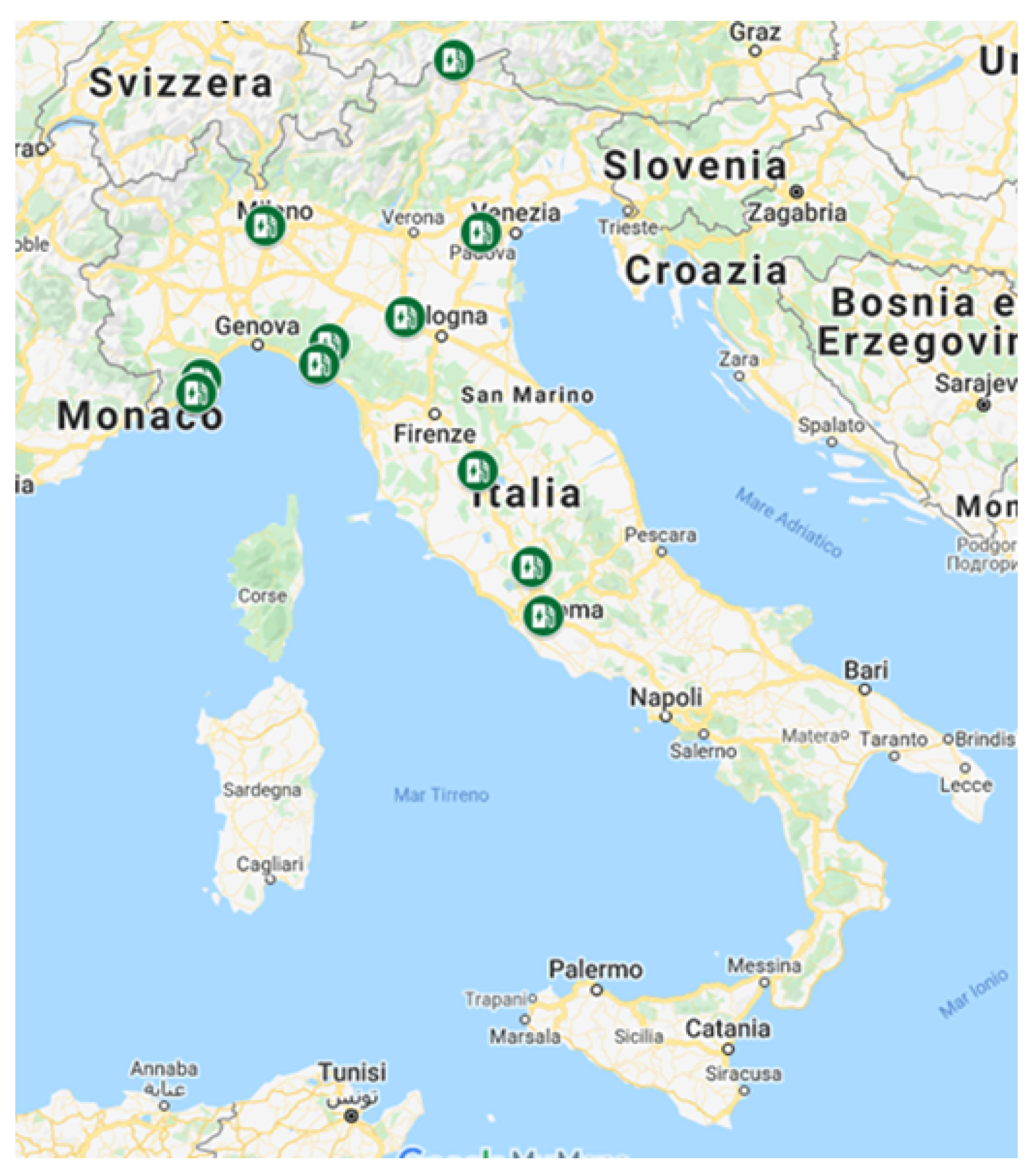
Global warming and its impacts are a major societal concern. In the European Union (EU-27), transport accounted for about 29% of total greenhouse gas (GHG) emissions in 2022, and preliminary estimates indicate a slight decline in 2023 relative to 2022 [1]. In the United States and Canada, transportation represented approximately 28% and 22% of national greenhouse gas emissions in 2022, respectively [2]. Accelerating the transition to sustainable transport is therefore essential. Battery Electric Vehicles (BEVs) offer a credible alternative to Internal Combustion Engine Vehicles (ICEVs), reducing dependence on fossil fuels and overall greenhouse gas emissions [3]. Their widespread use can also improve urban air quality and support sustainable mobility goals [4]. Many countries have introduced policies to encourage BEV adoption and plan to ban new ICEV sales within the next decade [5]. Despite this momentum, several barriers still limit large-scale adoption: higher upfront cost relative to ICEVs [6,7], range limitations and range anxiety [8,9], longer charging times, and insufficient public infrastructure. Financial incentives can partially offset purchase costs [8], but infrastructure remains critical especially for long-distance travel. AC charging modes 1–3 are generally adequate for home and workplace charging. Inter-city travel, however, relies on high-power DC charging (mode 4). Ultra-Fast Charging (UFC) infrastructure, with output power up to 350 kW, can recharge compatible BEVs from 10% to 80% State-of-Charge in about 30 min [10]. A robust highway UFC network is therefore essential to enable nationwide electric mobility. This study proposes a methodology to estimate the minimum UFC infrastructure required to support long-distance travel while containing costs. First, we determine the Maximum Distance Between Charging Stations (MDCS) by combining the average range of BEVs currently on the market with key real-world factors that affect consumption (driving behaviour, ambient temperature, and route characteristics). Second, we map UFCS locations onto existing motorway Service Areas (SAs) to leverage available amenities and reduce ancillary infrastructure costs. Third, we quantify the cost trade-off between these savings and the electrical power losses introduced by the distance between SAs and Medium-Voltage (MV) cabins. Our contribution is complementary to FRLM/FCLM coverage–capture models. We derive a factor-informed, closed-form spacing constraint (MDCS) that aggregates real-world range drivers (temperature, speed, driving style, congestion, route), then map feasible sites to existing Service Areas to account for amenity cost avoidance, and finally compare these savings with MV-connection loss costs. This analytical layer can pre-filter candidates or be enforced as a spacing constraint within FRLM/FCLM formulations. We apply the methodology to the Italian motorway network. Unlike several Northern European countries (e.g., Sweden, Norway, Iceland, Germany), Italy is still at an early stage in deploying >50 kW charging infrastructure directly accessible from highways. For context, Figure 1 illustrates existing UFCS along Italian motorways [11]. The outcomes can guide Charge Point Operators (CPOs) in prioritizing corridors and candidate sites for motorway electrification. Once the MDCS is established, subsequent work should incorporate traffic flows and regional BEV penetration to refine station sizing and phasing. The paper is organized as follow. In Section 2 the main studies related to this topic are analyzed. Section 3 explains all the steps and the methodology followed along the study. Section 4 presents the case study and in Section 5 the results are discussed. Finally, the conclusions are presented in Section 6.

2. Literature Review

Prior studies on siting and sizing of charging infrastructure can be broadly grouped into: (i) urban settings [12,13,14] and (ii) extra-urban/highway corridors where fast/ultra-fast charging is required [15,16,17,18,19]. Our focus is on Ultra-Fast Charging Stations (UFCSs) along motorways. A large body of highway siting work builds on the FRLM, originally adapted for battery charging in [20]. Coverage-driven formulations are extended in [21] to allow multi-stop itineraries on the 2030 European network. Further developments such as [18] incorporate vehicle-range limitations to maximize completed long-distance person-trips in the U.S. An alternative approach is the FCLM, which “captures” OD flows when at least one station lies on the fastest path. Two applications to motorways are [22,23]: Ref. [23] maximizes the number of served EVs (with gravity-based demand), while [22] proposes a three-layer hierarchy that sequentially addresses location (FCLM), QoS enhancement, and revenue maximization. Beyond coverage/capture, several works examine determinants of demand and network/operational aspects. For country-scale spacing, ref. [15] estimates the minimum number of UFCSs in Spain via average BEV range plus a safety margin. Methodologies that identify key demand drivers (traffic flow, range, fleet size) include [24]. Sizing and budget constraints on highway networks are analyzed in [25]. Candidate-location strategies focused on freeway exits and intersections—and the role of reservations to mitigate congestion—are discussed in [26]. Finally, technology-imposed limits on practical charging rates (about 1.5C–2C) and their implications for dwell times are summarized in [27]. The EU Alternative Fuels Infrastructure Regulation (AFIR) sets binding, distance-based targets and minimum installed power for high-power recharging pools on core TEN-T corridors, while IEA reports document accelerated deployment of public and DC fast charging in Europe [28,29]. Recent studies integrate queueing and operational performance into planning, capturing waiting times and service levels in corridor contexts; these works complement FRLM/FCLM coverage/capture metrics [30,31,32]. Practice-oriented frameworks model energy use along routes as a function of traffic, speed, temperature and grade; we align our factorized MDCS with these approaches [33,34,35]. Distribution-grid impact assessments and smart/managed charging studies quantify constraints and potential cost savings, underscoring the importance of coupling siting with MV-connection economics and operational strategies [36,37]. For heavy-duty corridors, the Megawatt Charging System (MCS) has progressed via interoperability events and pre-standardization work, informing hub design and grid-impact assumptions [38,39]. However, recent models paired with high-power DC chargers now achieve sub-30-min sessions for the 10–80% state-of-charge (SoC) window under favorable conditions; for example, the Tesla Model 3 Long Range typically requires about 27 min on a 250 kW V3 Supercharger [40]. Where FRLM/FCLM optimize coverage or captured flows under capacity/budget constraints, our approach contributes a factor-informed, closed-form spacing constraint (MDCS) that: (i) internalizes real-world range drivers (temperature, speed, driving style, congestion, optional grade), (ii) endogenizes the use of existing motorway Service Areas (SAs) for amenity-cost avoidance, and (iii) monetizes MV-connection electrical losses. We position MDCS as a transparent screening/constraint layer that can reduce FRLM/FCLM search space and improve cost realism, rather than as a substitute for those models (see Section 3). Table 1 collects representative studies on UFCS corridors charging, highlighting recent additions that complement the fundation work.

3. Methodology

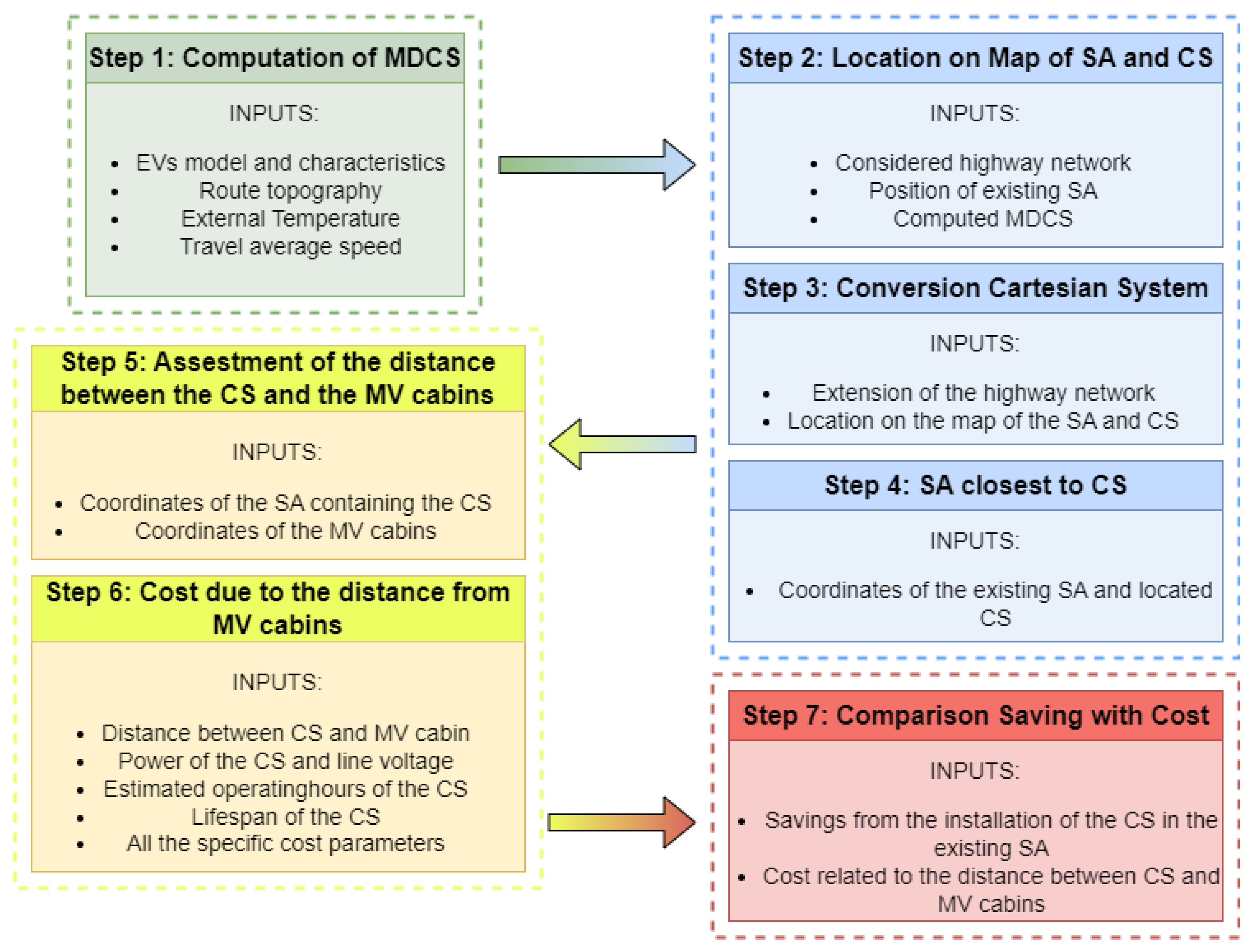
The work approach follows the seven steps depicted in Figure 2. It starts from the computation of the MDCS to arrive to the cost comparison between the two different solutions: install the charging infrastructure in the existing service areas or near the MV cabins.

3.1. Definition of the Maximum Distance Between Ultra-Fast Charging Stations

The first step performed is the computation of the maximum distance between two charging stations, which expresses the number of kilometers between fast charging stations that would allow every EV to reach the next station. The calculation of the distance between two consecutive charging points along the highway network has been recognized as a priority need for a correct infrastructure planning, since this value makes the optimal position of the charging stations easily locatable. The main relevant input data to compute this parameter are the technical characteristics of the EV models currently on the market and their energy consumption values. Indeed, what it is necessary to define is the driving range of such models since the distance between two charging station is computed in order to satisfy the average range of the vehicles.

3.1.1. Electric Vehicle Models

To examine the average available range for EVs, the main technical characteristic of the most common electric car models on the market are selected and reported in Table 2. All the city vehicles with small ranges and the EVs lacking fast charging capacity have been excluded. Following the typical lower nounds for compatibility with motorway UFCSs use cases and the current European EV market data, small ranges are defined as a WLTP range below the 200 km, and the absence of fast charge refers to the absence of DC charging capability or a maximum DC charging power below 22 kW [41].
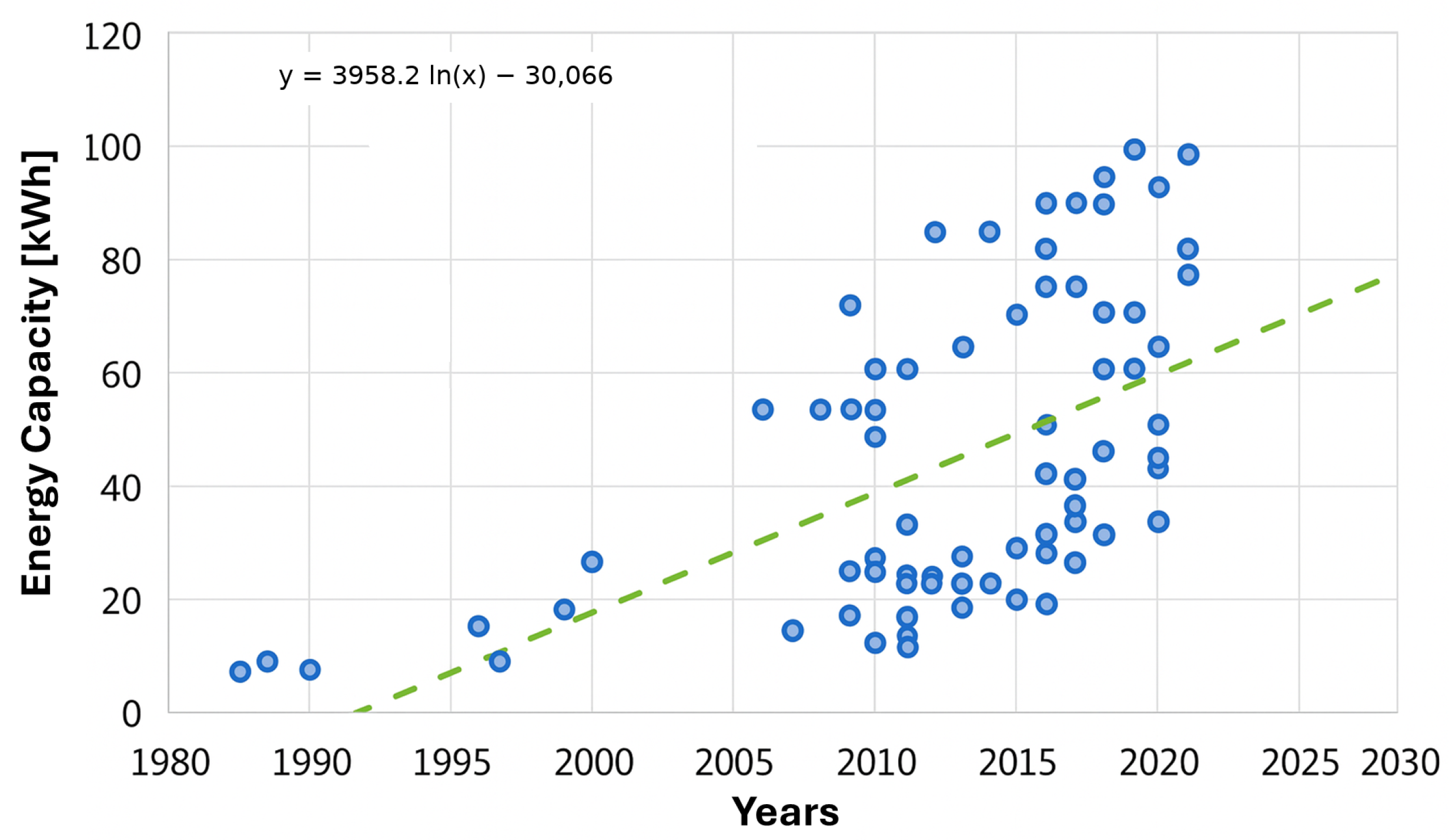
The average range, computed by taking into account the most sold BEVs (reported in Table 2) in Europe, results about 325 km. Another option could have been to choose the BEV with the lowest available range on the market. However, this choice reduces the maximum distance between charging stations significantly, and hence it causes an increase of the overall investment cost which is not desired in the study. Hence, the average range of the BEVs are calculated considering the most common vehicles on the market. As can be seen in Table 2, the referring buying year have been specified. Indeed, the characteristics of the models vary a lot in the years. Thanks to the improvements on the battery technology (i.e., increase power and energy density trends) and to the fall of battery prices, the new electric vehicle models are expected to present lower consumptions and higher battery capacities. In Figure 3 is reported the trend of the average energy capacity installed in the EVs along the years, estimated according to the data of all the model in [42].
Since the complete process behind a charging infrastructure takes some years from the planning to its operation, it is reasonable to think that the average range of the EVs on the market at that time will have undergo an extension. This range supplement is estimated in (1), where β y is the expected increase in the average capacity after y years, and its value is assessed according to Figure 3.
R av y = R av ( 1 + β y )

3.1.2. Factors Influencing the Available Range

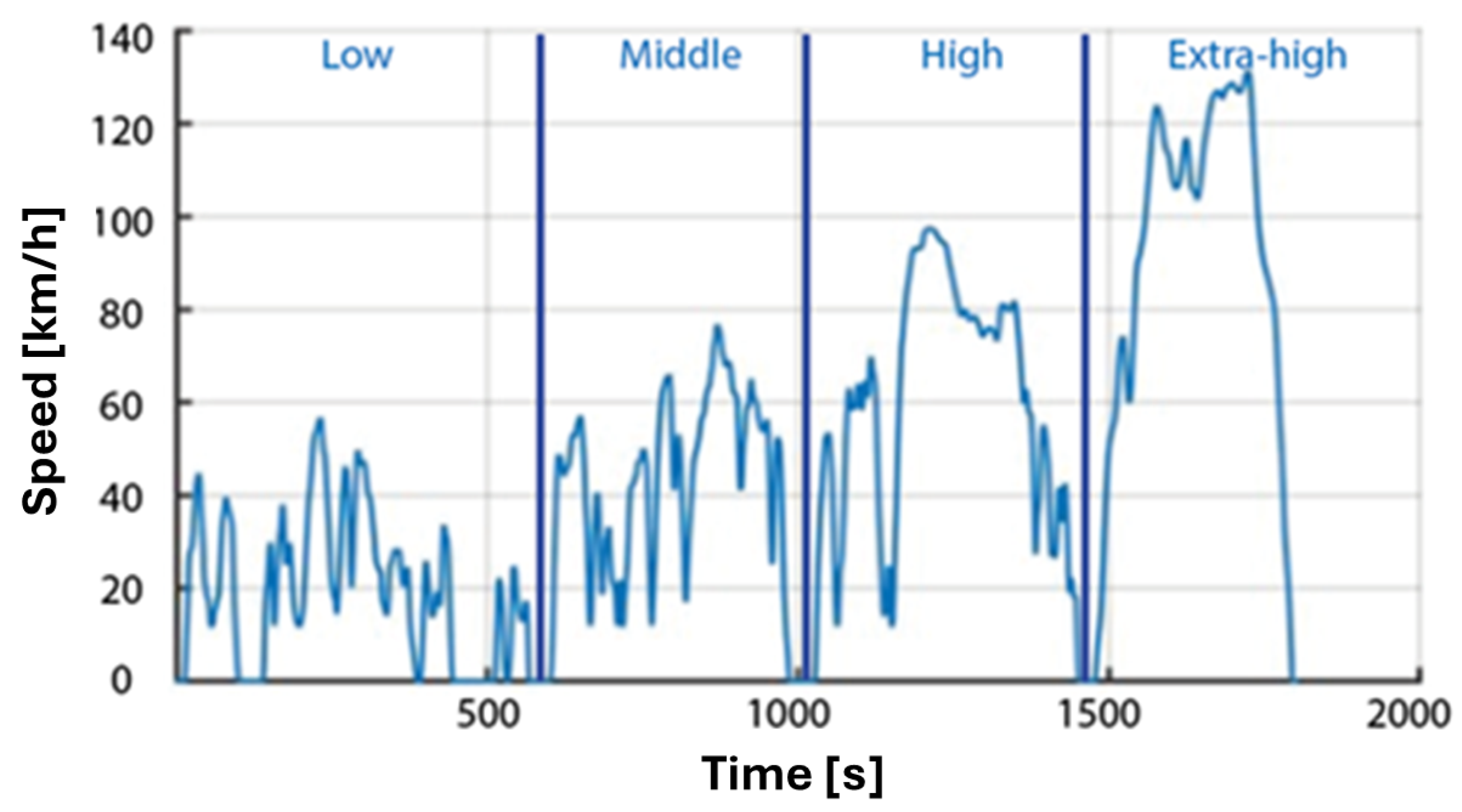
Range is the most striking limitation of EVs today. In table, the range of each EVs car model has been compute according to the World harmonized Light-duty vehicles Test Procedure (WLTP), which is a standardized driving cycle, for the assessment of emissions and fuel consumption of light-duty vehicles. It means that the available range of the vehicle is computed according to the speed profile reported in Figure 4, which is characterized by four different phases: Low, Middle, High, Extra-High for a total duration of 1801 s to cover 23,266 m.
However, this cycle and, more in general, all the standardized cycles do not reflect the actual behavior of the driver or other influencing aspects (i.e., topography, weather, braking energy recovery strategy, etc.); and hence to have a more complete and reliable estimation, some affecting factors such as the external temperature, the driving style, the path condition, etc. that influence the real driving range of EVs must be taken into account [43,44]. Moreover, as the infrastructure deployment may take several years and since the available battery range of EVs is expected to be ever longer in the future years, a factor, which includes this progressive range extension evolution, is considered.
External Temperature
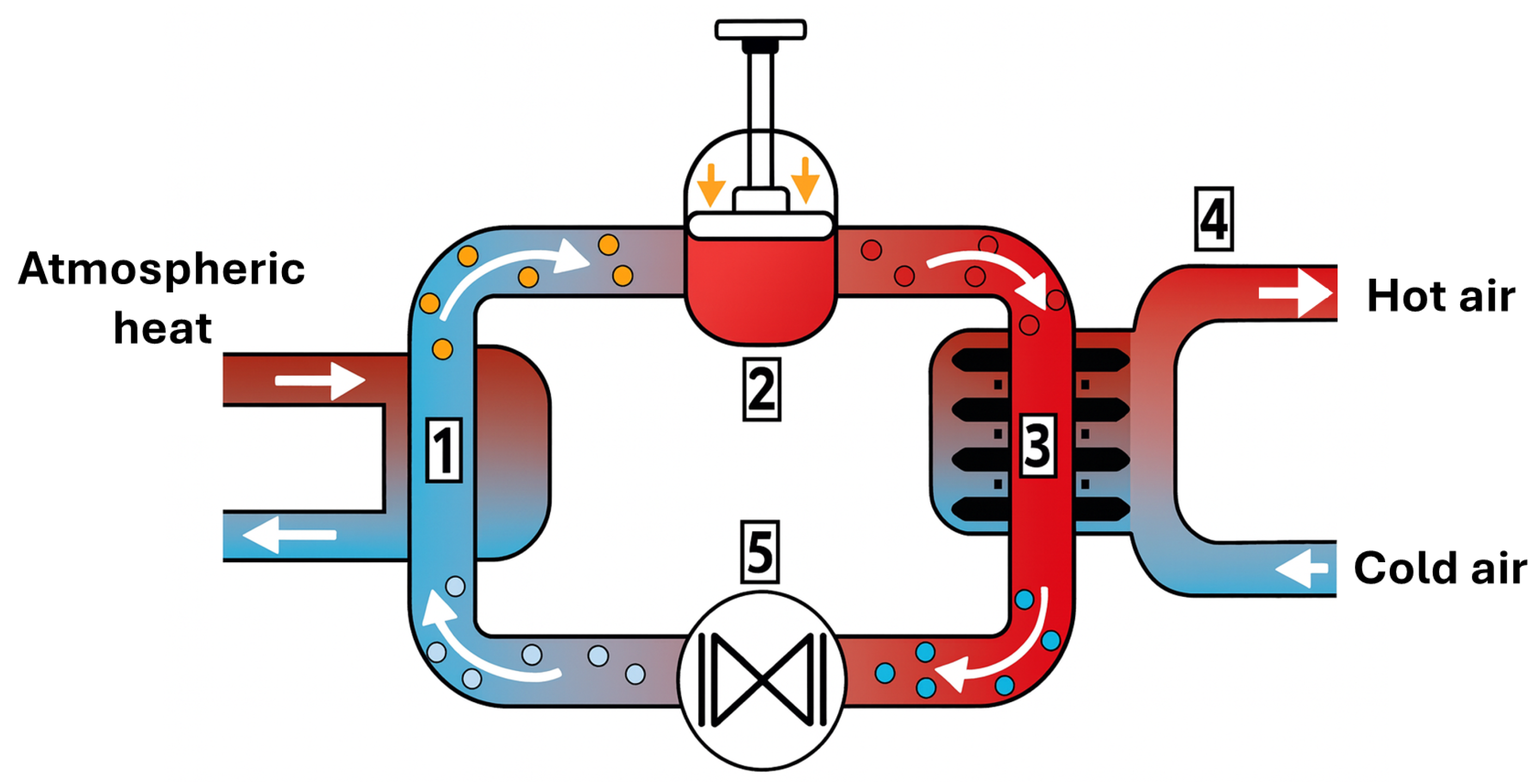
The energy consumption and consequently the available range of an EV are strongly influenced by the weather conditions, more precisely by the consumption of the Heat, Ventilation and Air Conditioning (HVAC) system. The heating of the cabin in conventional vehicle is practically “free”, it means it does not increase the vehicle’s consumption of fuel. Indeed, the heating system is obtained from the energy generated by the engine itself. The hot coolant produced by the heat of the ICE drives from the radiator to the heater core. The fresh air coming from outside is hence forced to pass across the heater core that behaving as a heat exchanger will warm up the passing air, which finally will arrive inside the vehicle. EVs, on the other hand, are cooled down through mainly two methods the first one consists in directly converting electricity into heat with a resistor, the second one is based on the use of heat pump which basically actively transport heat from a colder location to a warmer one. Resistors have the advantage of being very reliable since they are really simple electric devices, however they are much lower efficient than heating pumps. Another advantage of the heating pump with respect to the resistor is that it can operate in both the directions, which means that it can provide heating or cooling of the passenger cabin. Almost all the new electric vehicles on the market are equipped with the heat-pump system [45]. In Figure 5 the operation of a heat-pump system is presented [46]. When the system is in use, the heat is absorbed from the external atmosphere (1) and then it is compressed into high-temperature heat (2). The temperature inside the vehicle is hence heated thanks to the presence of a heater exchanger (3) and the hot air is blown into the passenger internal space (4). Finally, cold air from the inside of the vehicle is released outside because of an expansion valve (5). During summer, the cycle is reversed. The heat is taken from the indoor environment and released out of the vehicle.
Even if the heat pump-system prove itself to be up to 3 times more efficient than the old resistive method [47]; according to [48] a full load heat-pump system still has a significant impact on the total driving range, indeed it can cause a decrease percentage about 16.7% up to 55% for cooling and heating respectively. Similar results have been found in [49] and in authors confirm too that the HVAC system is still the biggest energy burden for a battery electric vehicle.
Therefore, in order to consider the effect of the external ambient temperature on the range of the vehicle a weather reducing factor w t will be considered. In particular the available range will be decreased by a certain amount directly dependent on the difference between the outside temperature and the desirable internal one, which is usually set in the range 18 ÷ 22 °C. The percentage of range reduction because of the external temperature is listed in Table 3. The worst-case scenario appears when the external temperature is lower than −10 °C; indeed, in this case the heating system of the EV is expected to work at the maximum power. The temperature factor was derived from [50], based on empirical measurements of EV consumption with respect to ambient temperature in European fleets.
Range Anxiety
One of the main limits of EVs adoption is the so-called range anxiety phenomenon. Range anxiety denotes the EV drivers’ panic of running out-of-charge of their vehicle battery before reaching their destinations or the closest available charging point [51]. This means that typically EV driver’s do not employ entirely the battery capacity of their vehicle, but they behave as the overall amount of available energy is decreased by a certain percentage which hence will be kept in the battery to allow the user in emergency condition. The fact that the drivers use only a limited quantity of the battery capacity because they are afraid of running out of energy will inevitably imply a rise in the charging infrastructure costs [52]. Several factors in electric vehicle industry have led to user range anxiety [53]. The main ones are insufficient presence of charging station in some areas, limited range of EVs, long recharging time, incorrect estimation of the available range, battery performances degradation over time. According to the results of the survey performed in [54], the range anxiety percentage is strongly influenced by the length of the trip that the driver has to perform. Indeed, as the length increases the user tends enhance the range safety buffer which means the energy to be left in the battery and hence increasing the initial charging SoC. This behavior is also due to the fact that long trips are usually performed in highway networks and in this environment the user experience the absence of a well-consolidated Ultra-fast charging (UFC) infrastructure. The range anxiety impact on the estimated range R a v in (1) is estimated in this model through the parameter R a , which represent the percentage of the battery the user feels safe to use in his trip. The values of R a are set according to Table 4.
In this study, R a is defined as the conditional average range anxiety buffer for the analyzed trip lengths, representing a reference value for the case study. While individual users may experience different available ranges depending on their driving style, EV model, and environmental conditions, Ra can be rescaled by proportionally adjusting it in order to match a different average trip length or specific EV data.
Speed
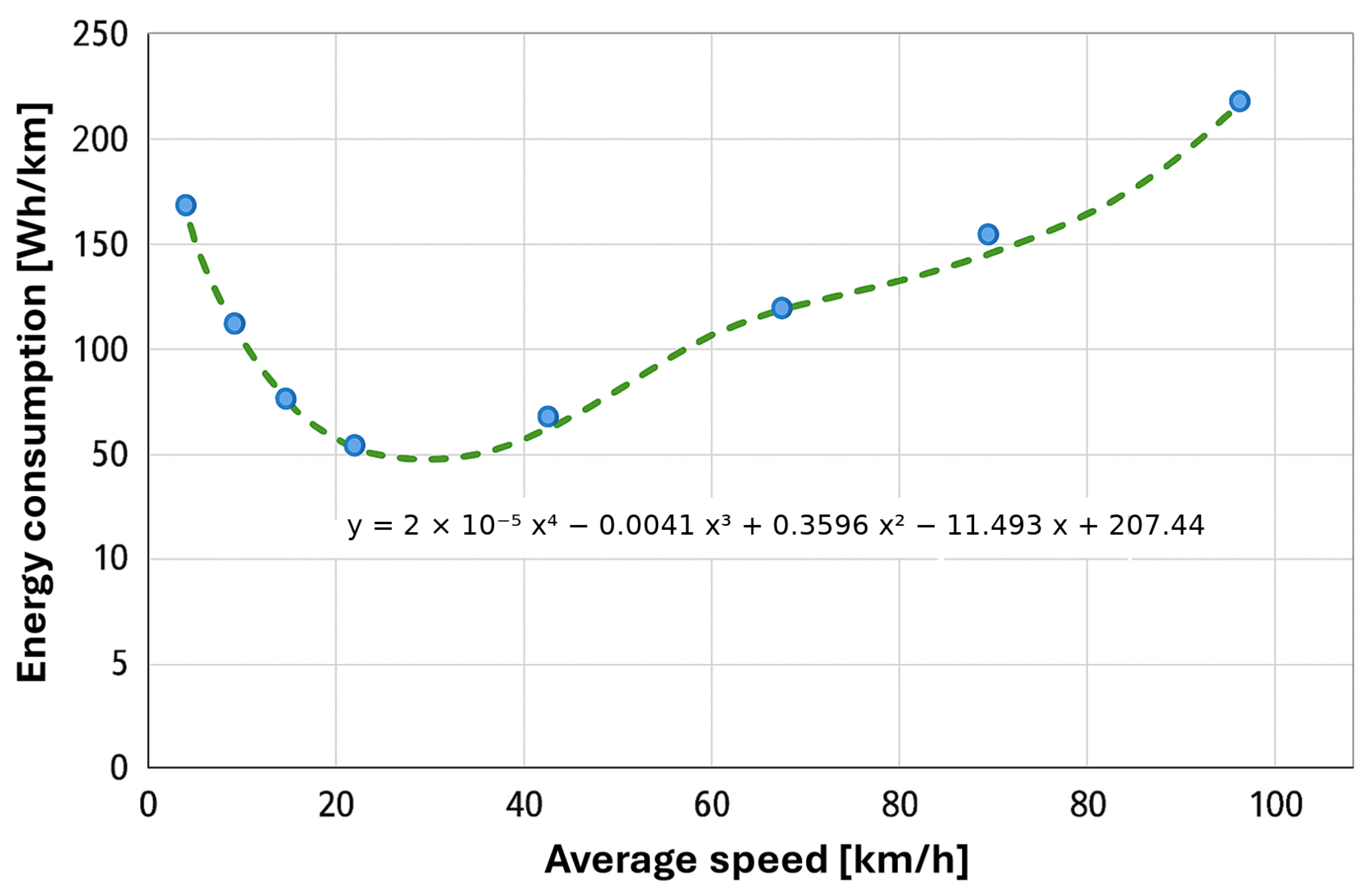
It has been widely proved in literature that, unlike ICE vehicles, electric ones consume more energy driving on highways than in short urban paths [55,56]. In [44,57] the authors validate with real-word measurements a model according to which the trend of the energy consumption for e-cars as a function of the average speed of the trip is shown in Figure 6. Therefore, for urban paths in which usually the mean speed of travel is between 20–60 km/h an electric vehicle would consume about 100 Wh up to 150 Wh per km, instead for long travels at high speed the energy consumption will be higher than 180 Wh each km.
The speed factor was estimated from EPA and WLTP tests cycles, adjusting for aerodynamic and rolling resistance increases [41]. The impact of the speed on the available range is estimated according to the values reported in Table 5.
It must be noted that in this work ambient temperature and driving speed were modeled as independent multiplicative factors, in line with existing large-scale EV range modeling approaches [58]. This represents an approximation, considering real behaviors, where low temperature combined with high cruising speed may cause a range reduction due to non-linear interactions. However, using this approach is possible to simplify processes which require high-resolution empirical data.
User Driving Cycle
As demonstrated in the literature, EVs energy consumption is highly correlated to the adopted driving style. The driving styles that a user can adopt generally differs for the values of acceleration and deceleration, regenerative braking efficiency, and lateral acceleration [59]. The acceleration percentage and speed fluctuations as well distinguish the driving style. Usually, three different driving style are defined:
  • Eco driving: with acceleration varying in the range 1.5–2 m/s2 and a speed profile a smooth as possible;
  • Normal driving: with acceleration values among 2–3 m/s2 and a typical speed profile;
  • Aggressive driving: high value of acceleration in the range 3–4 m/s2 and many speed variations;
According to [60] an aggressive urban driving can bring to an increase up to 30% with respect to a calm driving behavior, as expressed in Table 6. Instead in a motorway area the difference among the driving styles is less perceived since the driving cycle in this environment is composed of a lower number of accelerations and speed fluctuations. Table 7 is hence built according to this observation.
Route Characteristics
In the previous points, we have seen that the average speed of the travel, as well as the driving style and the range anxiety safety buffer, influence the available operational range of an electric vehicle. However, all these parameters are in their turn influenced by the route characteristics. For instance, if the path belongs to an urban context is it clear that the average speed would be in the range of 20–60 km/h or again if the route is performed in a highway context it will be characterized most likely by high average speed values. Therefore, the route positioning affects the energy consumption in an indirect way by means of impacting other parameters such as, for instance, the traveling speed. Nevertheless, there is a characteristic of the path which directly and strongly influence the power consumption of the vehicle: the topography [61]. The impact of this parameter on the energy consumption is assessed in Table 8 according to the results obtained in [62]. In this reference the authors investigate the impact of road gradient on EVs consumption by combining long-term GPS tracking data with digital elevation map data.
Unlike traffic congestion, road gradient profiles are static along a determined route and do not vary dynamically within a day. Therefore, in this work is applied a single aggregated correction factor for the whole segment rather than segmented approach. In our motorway case study, the grade derating is set to w g = 0 (baseline).
Traffic Congestion
In [63] the authors prove that in case of a high traffic congestion the energy consumption can increase up to about 15%. The congestion factor follows the segmented approach in [64], considering acceleration and deceleration cycles. The values of the impact factor which take into account this fact are reported in Table 9.
The congested-share parameter is corridor-specific ( p cong ); in our baseline case study we adopt p cong = 0.10 . After the definition of all the parameters which influence the energy consumption and the assessment of their impact on the available range of the vehicle, the formula reported in (2) can be used to compute the final maximum distance among two consecutive charging stations. The formula we propose to assess the maximum distance among charging stations is an extension of the one proposed in [15].
MDCS = R av · ( 1 + β y ) · R a · [ 1 ( w t + w d s + w s + w r g + i x i · w t r , i ) ]
i x i = 1
where x i is the percentage of the travel length at which the w r c i condition is applied, and it must satisfy the constraint shown in (3). Quantitative values for the factors in the bracket of (2) (i.e., w t , w s , w d s , w cong , and optional w g ) are grounded in recent evidence: temperature derating w t follows [35]; speed/traffic effects ( w s , δ cong ) and the driving-style term w d s align with route-energy frameworks and validation studies [33,34]; congestion is modeled as w cong = p cong δ cong , where p cong is corridor-specific (baseline p cong = 0.10 ); road grade is represented by an optional derating w g derived from cumulative positive elevation gain and set to w g = 0 for the motorway segments analyzed.
This study do not incorporate dynamic traffic flow data in the MDCS calculation, as the primary goal was the definition of a reproducible methodology applicable to national motorways with current available data. The inclusion of dynamic traffic flow would allow for more precise station sizing, improved prediction of peak charging demand, and potentially different optimal station corridors [65].

3.2. Mapping of Charging Stations and Existing Service Areas

Once computed the MDCS, the charging stations can be located along the chosen highway network starting from the northern point arriving to the southern one, or vice versa. In the same way, the position of the existing service areas can be easily found through their coordinates. Then the highway links and all the elements located in the previous step must be translated into a cartesian coordinate system starting from the latitude longitude system. The origin of the Cartesian system has been chosen with the following method: as y-axis the position of the most western element has been taken and as the x-axis the position of the most southern element. All the other elements are consequently located. The Small conversion errors are neglected for the sake of convenience. Knowing the (x, y) coordinates of each element, the Euclidean distance between each service area and charging station is computed through Algorithm 1. Then, for each charging station, the closest service area is found, and the coordinates of the potential service area to be electrified to include the charging station are saved into an array. It must be highlighted that distances between candidate sites were computed using Euclidean coordinates projected from latitude and longitude. Considering motorways, where deviations from straights lines are limited, the error induced by this approximation is acceptable [66,67]. The use of GIS-based shortest-path algorithms can increase the precision of this method.
Algorithm 1 Minimum Distance Between Service Areas and Charging Stations.
Require:  N s a , N c s , x c s , y c s , x s a , y s a
Ensure: Coordinates A of the closest service areas
  1:
Initialize matrix D
  2:
for  n = 1 to N s a  do
  3:
      for  m = 1 to N c s  do
  4:
            Compute:
                                    D ( n , m ) ( x c s ( m ) x s a ( n ) ) 2 + ( y c s ( m ) y s a ( n ) ) 2
  5:
      end for
  6:
end for
  7:
for  m = 1 to N c s  do
  8:
       val min ( D ( : , m ) )
  9:
       k index such that D ( k , m ) = val
10:
       A ( m ) ( x c s ( k ) , y c s ( k ) )
11:
end forreturn  A
In the Italian distribution network, MV cabins refers to MV/LV substation, with grid connection points converting medium voltage (15–20 kV) to low voltage. In the proposed study, they are considered potential independent locations for UFCSs, typically located outside motorway service area.

3.3. Distance with MV Cabins and Cost Analysis

The solution approach so far has been to install the required charging stations in the existing service areas, since this approach would lead to a reduction in the overall infrastructure costs. Indeed, if an EV driver running on the highway wants to have a break and charge his car, this method saves the person from an extra trip because the person can both charge his/her EV and have a break in the service areas at the same time. However, another aspect should be taken into account in the installation of UFCS along the highways: ultra-fast charging infrastructure requires, indeed, a very high amount of energy in short period of time which are translated into high current levels; and therefore, if the distance between the charging stations and the MV cabins at which the stations are connected increases, the power losses increases too and at some value of the distance the cost of the power losses may reach and exceed the saves got by installing the charging infrastructure into an existing service area. Therefore, in these final steps the cost of the power losses should be determined according to the distance of the ultra-fast charging stations, and it should be compared with the savings coming from the previous approach. In order to calculate the total cost of the power losses, the cost function is formulated in (4):
C power = ( C losses + C cable + C M + C CO 2 ) · d MV
where C l o s s e s is the cost associated with the dissipated energy, C c a b l e is the cost related to the purchase of the cable, C M is cost of the maintenance operation, and lastly C CO 2 is the cost related to the emission produced to generate the energy which is then dissipated on the cable. The distance d M V between the SA containing the CS and the MV cabin is computed trough an algorithm similar to Algorithm 1. Instead, the computation of each cost term is seen in detail in the following sub-paragraphs.

3.3.1. Resistive Losses Cost

The power losses on the transmission lines are caused by radiation losses, conductor losses, heating losses (dielectric), coronal losses, and coupling losses [68]. Since the majority of the losses are caused by resistive losses, the other contributions are neglected for the sake of convenience. Resistive losses are also defined as conductor losses; indeed, they are mainly due to the resistance of the conductor material. Cable resistance was consider from standard manufacturer datasheet and assumed constant along the network. Given that resistive losses contribute marginally to the total cost, moderate variations in resistances would have negligible impact on the MDCS and on the relative cost-effectiveness. Through (5) the power loss per km due to the conductor resistance is computed.
P l = r · I ch 2 = r · P ch V MV 2
where r is the resistivity of the material per km, I c h is the current which passes through the line due to the operation of the charging station which hence can be computed as the ration between the power of the charging station P c h and the rated voltage of the MV system V M V . Once compute the power loss, C l o s s e s is computed in (6) and results, where h o p are the expecting operating hours of the charging station ports in a year, l is the charging station lifespan and c e l is the cost of energy.
C losses = P l · h op · l · c el

3.3.2. Cable Cost

The cable cost C c a b l e of a power line is a one-time cost that is paid during the design and installation phase of the project. It mainly consists of the cost of the transmission cable per unit length. In order to estimate the cable cost of the transmission line the following (7) is used:
C cable = m x · c x
where m x represents the mass of the conductor per km used in the transmission line and c x represents the cost of the conductor material per kg.

3.3.3. Maintenance Cost

The transmission line will be put into service once the construction is done. Some costs, such as the one relates to the maintenance procedures, will be generated at this stage. In order to ensure the safety and reliability of the power lines, power companies need to have regular maintenance. Indeed, the maintenance of cable installation includes inspection, routine checking of current loading, and maintenance of cables, joints and end terminations to be carried out to avoid failure, risks, more expensive maintenance later and to extend the life of the system. The maintenance cost per km can be calculated through (8):
C M = l · t M · p M
where p M represents the overall costs per inspection, t M is the maintenance cycle (inspection times per year) and l is the expected lifespan of the charging station.

3.3.4. Emissions Cost

In the last few years, the European Union has started a decarbonization process that involves all the countries. One of the main policies applied to dissuade the CO 2 emissions is the carbon pricing: it introduces carbon rates for every ton of CO 2 produced in order to promote renewable solutions. To assess the cost of the CO 2 emissions generated from the energy lost on the power lines, the equation is formulated in (9).
C CO 2 = P l · h op · l · e · c e
where P l represents the power loss per km, h o p are the expecting operating hours of the charging station in a year, l is the lifespan, e is the emission factor for grid electricity CO 2 kg per kWh, and c e is the cost of the produced CO 2 per kg [69].

4. Case Study

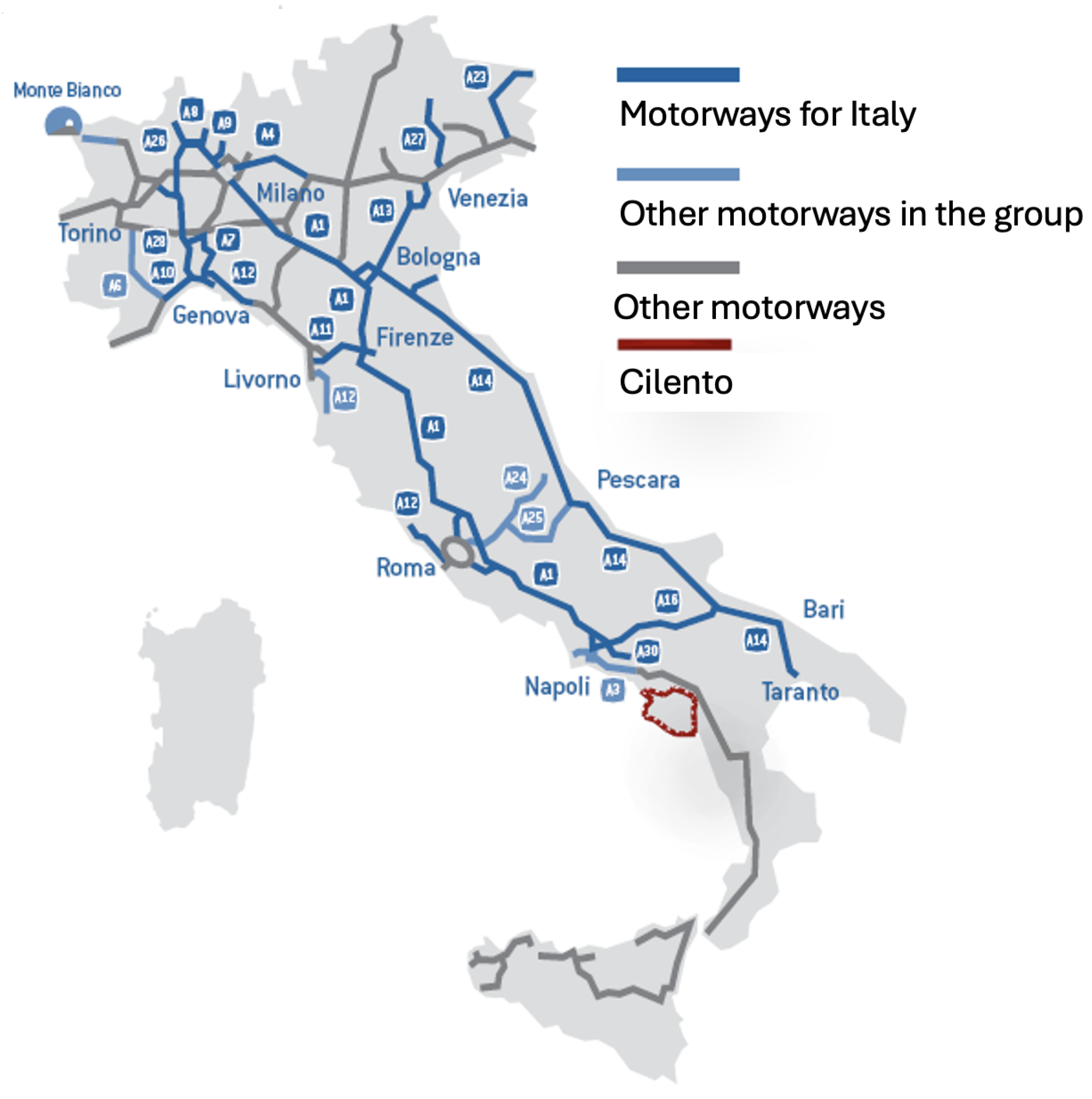
The method described in Section 3 is applied to the Italian highway network depicted in Figure 7. In such network the service areas appear every 30–40 km.
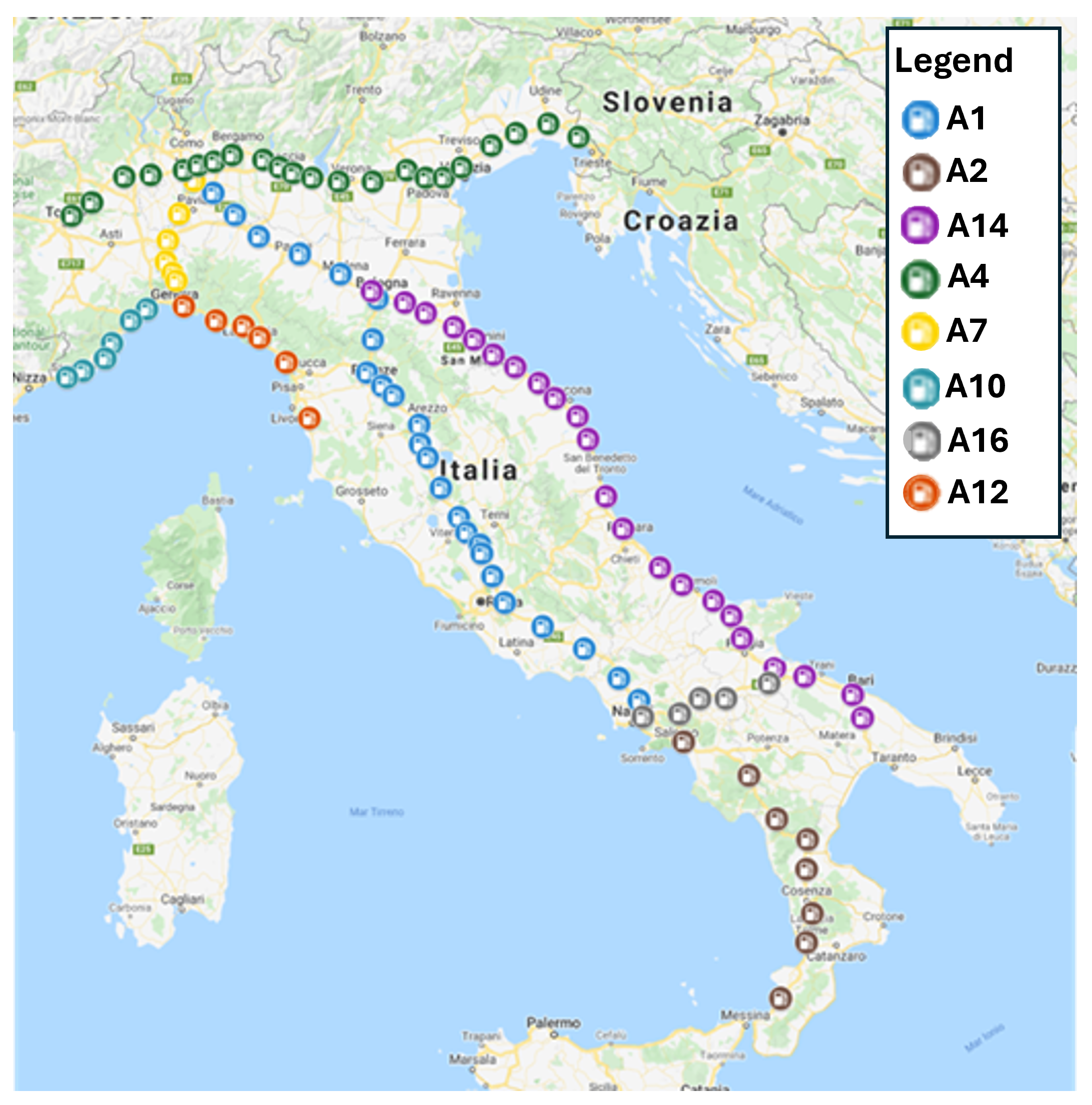
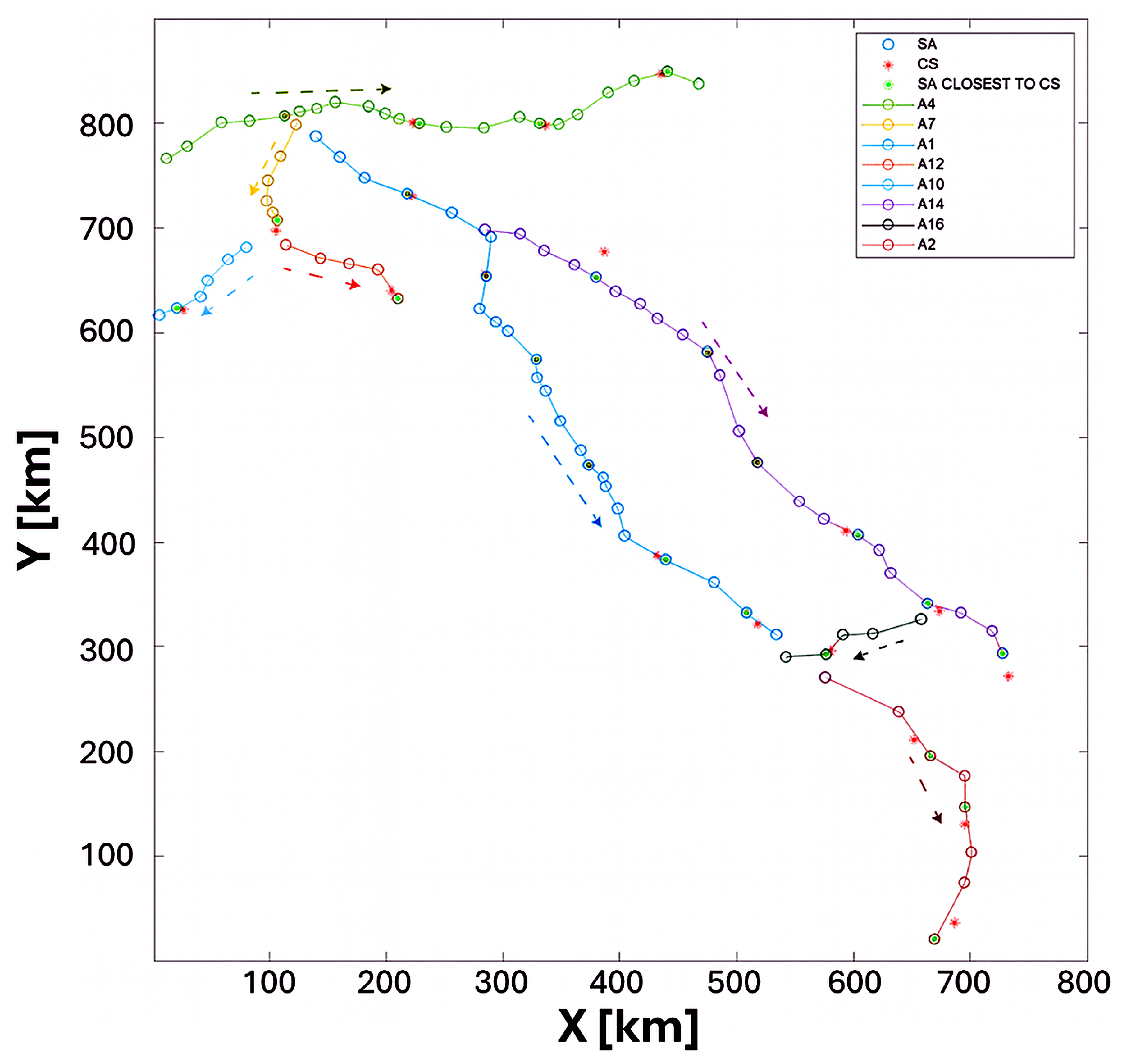
In this study, we will focus on the main highways that link the north and the south and the east and west part of Italy: A1-A4-A7-A16-A10-A12-A14. Along these ways, the 98 service areas listed in Table 10 and represented in Figure 8 are pointed out. Only one direction of travel has been considered, however in the other direction the services areas are located usually in the same position for a total number of 196 service areas.
The average slope of almost all the highway network is quite small, in Italy the maximum gradient is about 6%. Indeed, for higher values the heavy-duty vehicle would have problems to face them, and they would be constrained to proceed at very low speeds. For this reason, given the topography of Italy, many tunnels and viaducts have been built for the motorways. Therefore, according to this consideration, the impact of the topography will be neglected in this study ( w r c = 0 ). Concerning the external temperature impact the worst-case scenario is related to a trip during the winter season in which the temperature is in the range 0–10 °C. The travel length is for sure higher than 100 km since we are considering country-side trips on highways and hence the range anxiety safety buffer is expected be about 75%. Regarding traffic conditions since high level of congestion are not typical in long-distance trips along highways a small percentage of the overall trip has been considered congested. Finally, the building time of the UFCS is considered to last 3 years. Table 11 summarizes the value of the influencing factors used for this case study.
For the cost comparison aluminum MV cables with a cross section of 95 mm2 are selected given their lower density, their current carrying capacity and their extensive use in these type of lines in Italy [69,70]. The electrical resistance of aluminum at the selected cross section is about 0.3 Ω /km. In order to calculate the resistive losses, the current flowing through the transmission line should be calculated first. Electricity transmission is provided by a three phase 15 kV AC line and two ultra-fast chargers are assumed to be on the charging station with a total capacity of 300 kW (150 kW × 2). The assumption of two UFCSs per site reflects the current motorways deployments in Italy, where most sites host between two and four chargers. This allows a realistic cost estimation, keeping comparability with current infrastructure [71]. The current flowing through the distribution line can be calculated through (10) by assuming a unitary cosφ.
I ch = P ch V MV cos φ = 20 A
In this evaluation I c h assumes a power factor ( cos φ ) close to unity, consistent with the performance of modern UFCSs with active power factor correction. The probability of simultaneous use of both charging cables is taken as 100% to model the worst-case condition, ensuring that the infrastructure is sized to meet peak load scenarios. While in practice factors may slightly reduce the effective current, their impact on MDCS estimation and cost comparison is marginal. Assuming that the average lifespan of a charging station is 10 years, the total effective days and the total effective hours in a year should be determined. It is assumed that an ultra-fast charging station on a highway operates on average 8 h in a day. Hence, the total lifespan of the charging station in hours is about 29,200 h. The electricity cost in Italy is selected at 0.216 €/kWh. Currently, the price of aluminum is 2.39 €/kg and the mass of aluminum per km is 1665 kg. Installation cost for aluminum alloy cable is estimated from [72] as 7666 €/km. Aluminum price volatility may affect the cable cost component and, indirectly, the total CAPEX. In this study, this aspect is discussed qualitatively, as including it in the calculations would require additional assumptions and would alter the reported CAPEX values reliability. This choice allows the reliability of the model and the results, while acknowledging that material cost variability represents an important practical consideration. Concerning the maintenance cost per inspection, it is assumed equal at 566 €/km and 12 inspection cycles are necessary per year [69]. Finally, to compute the emission cost of the energy losses the CO 2 emissions related to the Italian energy mix in 2019 were about 255 g CO2/kWh and the European Union charges a price of about 100 €/tCO2 which is expected to further increase in the next few years. All economic parameters are expressed in 2024 EUR (baseline). For reproducibility, costs can be rebased to year t using C ( t ) = C 2024 · I ( t ) I ( 2024 ) , with I ( · ) the appropriate official price index (materials, labor, energy). All the parameters necessary to perform the cost analysis described in Section 3.3.4 have been defined and, for the sake of clarity, they are summarized in Table 12.

5. Results and Discussions

In this paragraph the results obtained applied the methodology described in Section 3 to the Italian case are reported and discussed. The maximum distance among CSs is get by inserting the values of Table 11 in (2). Therefore, as shown in (11), it results about 120 km.
MDCS = 324.77 · ( 1 + 0.12 ) · 0.75 · 1 ( 0.2 + 0.05 + 0.30 + 0.1 · 0.1 ) 120 km .
According to the extension of the considered highway network, in order to satisfy the minimum required charging demand and hence to allow wide country travels for BEVs, 23 UFCSs should be installed in the locations show in Figure 9. However, their position has been found considering only one way of travel, which is the one represented by the arrows in Figure 9. If both the directions are considered, then the number of necessary UFCSs is doubled. As shown in the work flowchart in Figure 2, the next step consists in finding the closest SAs to the CSs which are highlighted with green stars in Figure 9. The arrows represent the considered direction of travel used to set the position of the charging stations.
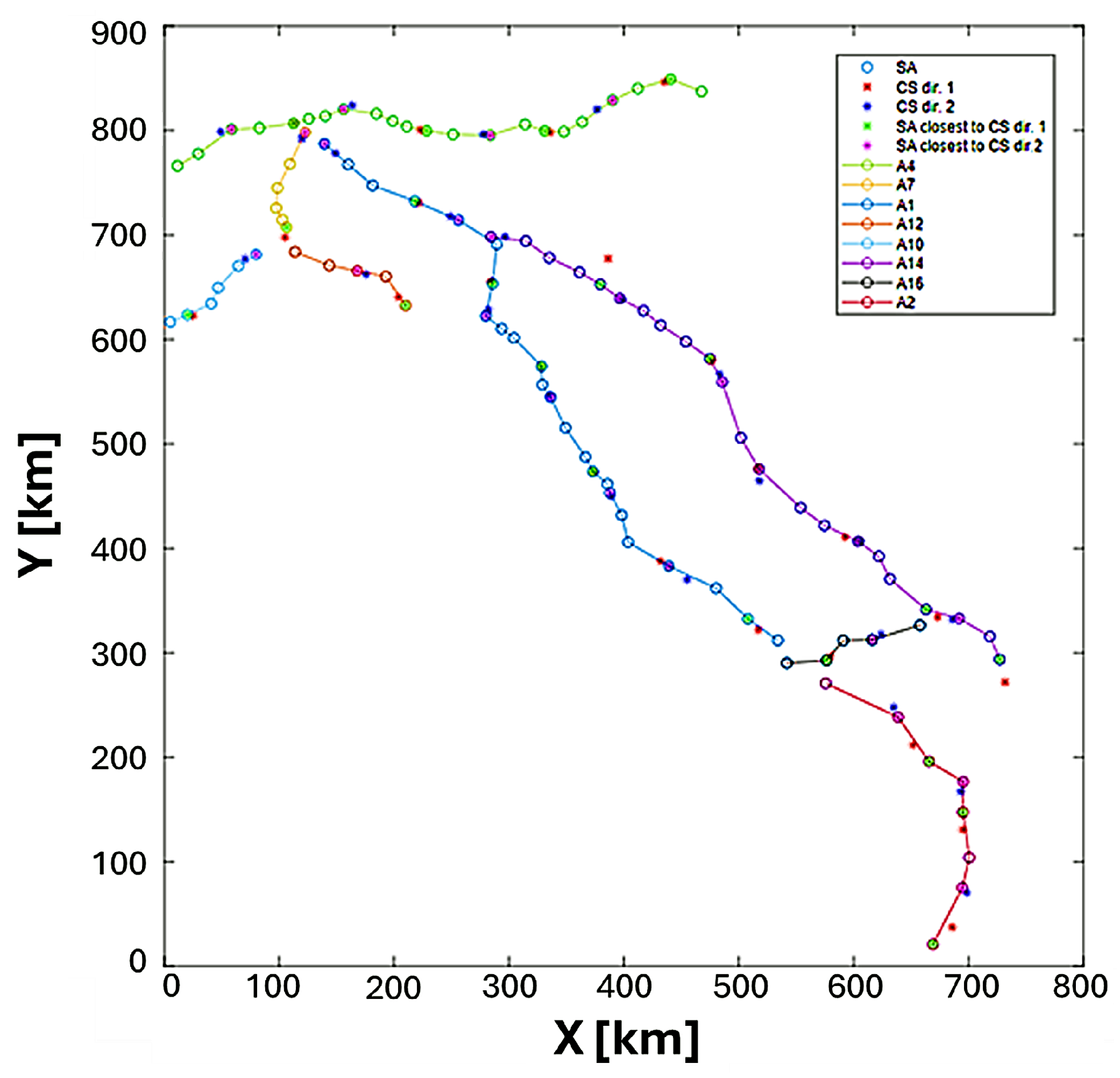
As mentioned before, just one way of travel have been considered. Hence, if both the highway directions are analyzed it means that the required number of charging stations doubles and hence 46 out of 196 service areas should contain a charging infrastructure. In Figure 10 the final situation is depicted.
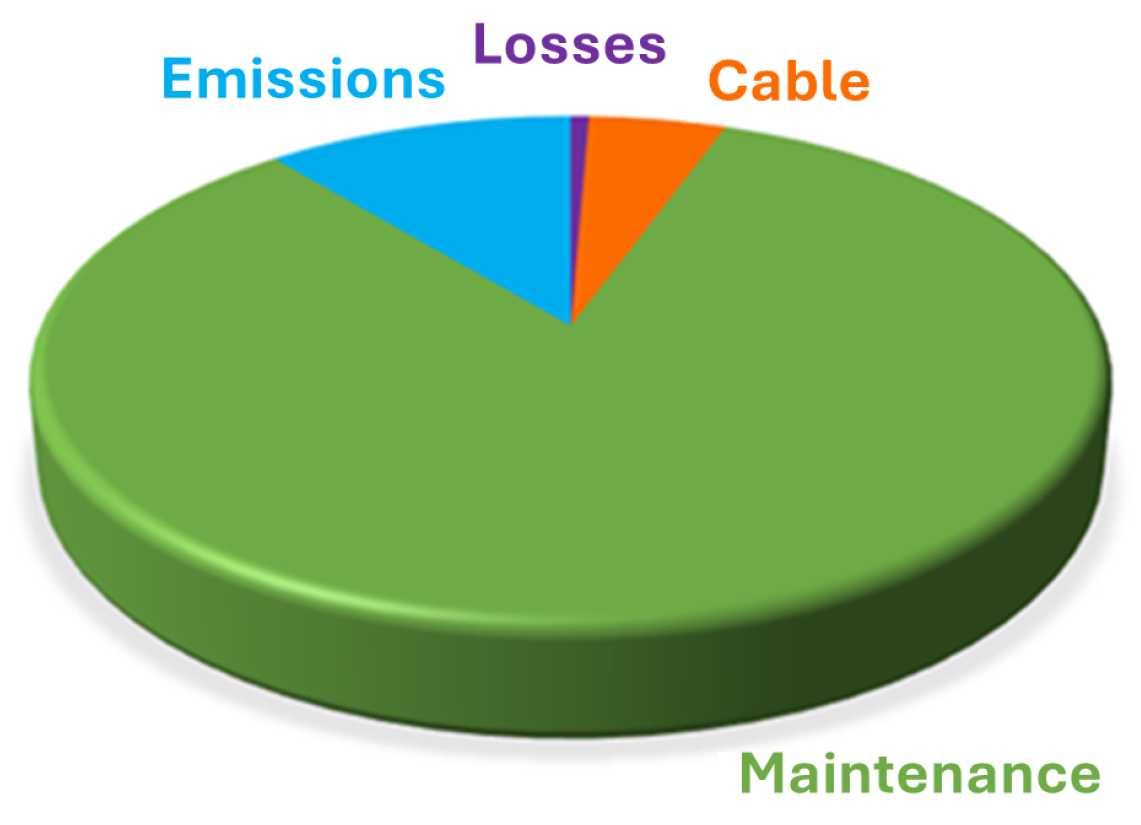
In the next steps the cost analysis related to the power losses generated from the distance with the MV cabins is carried out in order to understand what is the maximum value of distance beyond which the approach of installing the CS inside the existing SA is no longer convenient. In Table 13 is reported the value [€/km] of each component of the cost power lost computed through the values reported in Table 12. As illustrated in Figure 11, most of the cost contribution comes from the maintenance cost, since during the lifespan of the transmission line to ensure proper operation and safety the transmission line needs maintenance several times in a year. Considering that the average lifespan of the charging station is 10 years, the maintenance cost adds up to have the biggest share in the cost analysis.
C power = 81362.15 · d MV [ ]
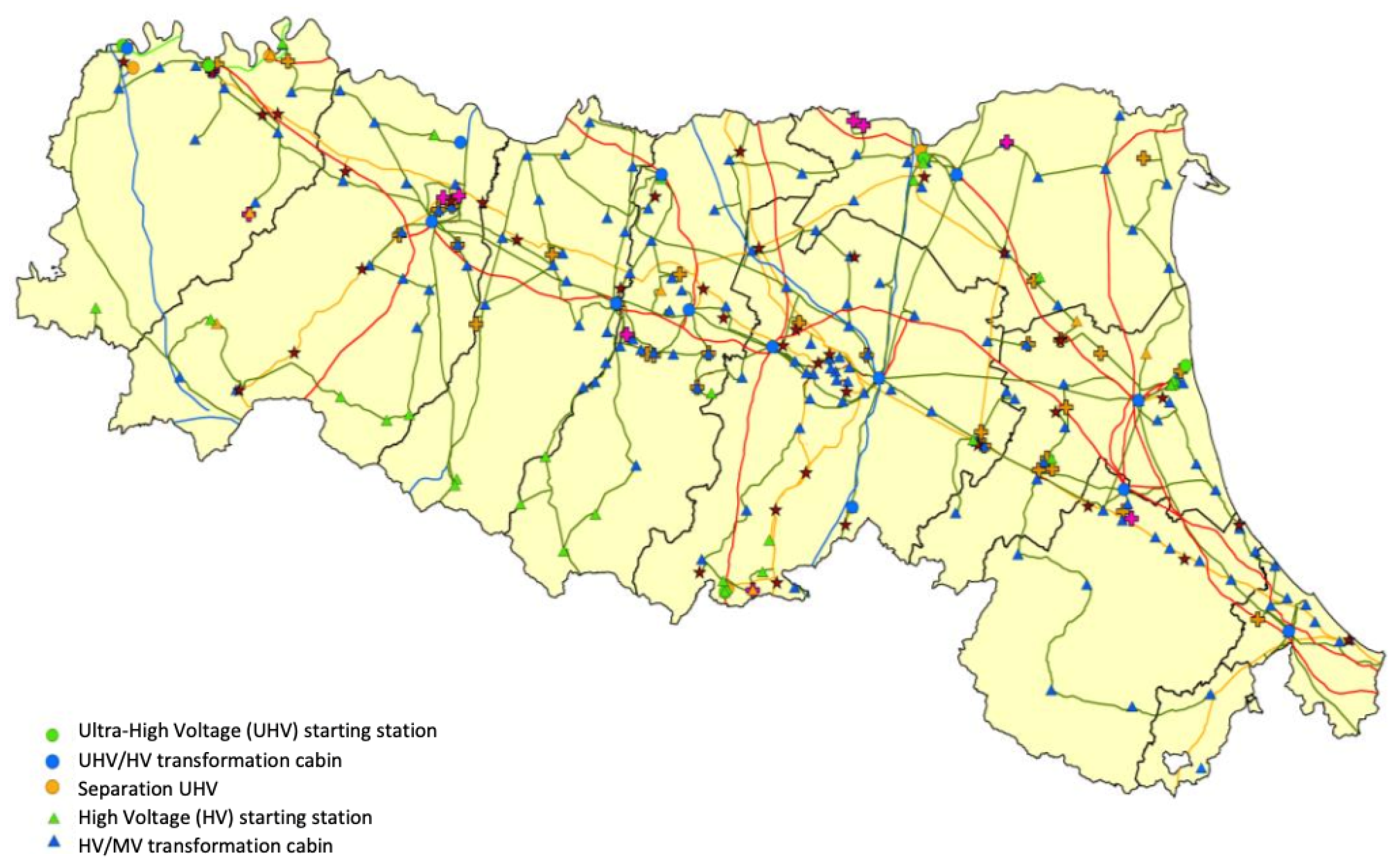
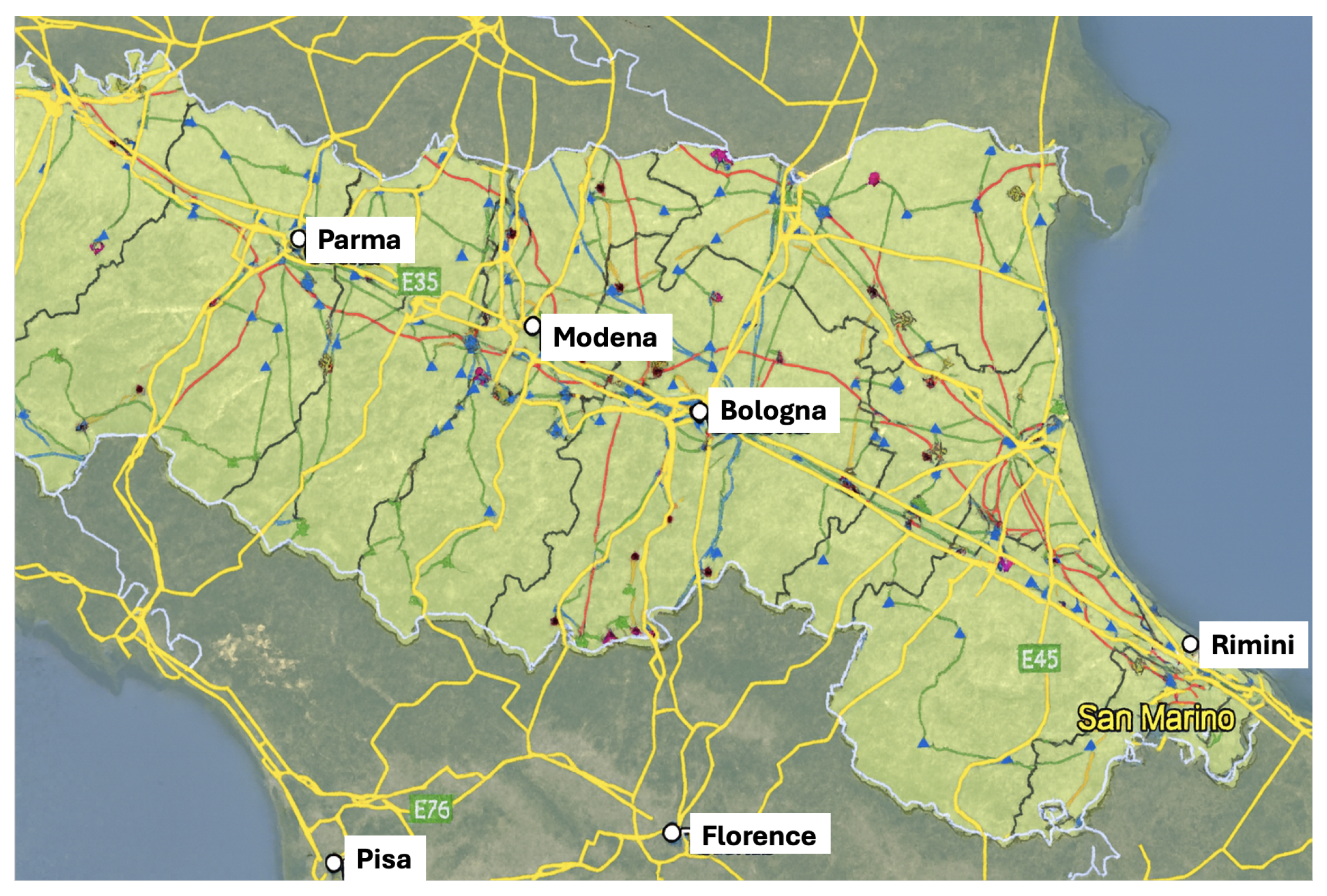
To finalize the decision on the deployment of charging stations, the cost of the infrastructure (i.e., restaurant, cafe, rest room, shop, general infrastructure etc.) should be determined and compared with the calculated cost of the power loss. The rest area is a must for long-distance travel. However, the installation cost of the rest areas is quite high. Depending upon the type of facility, each new rest stop cost ranges between $1.5–5 million, equal to €1.30–4.5 million [73]. Therefore, according to the lowest infrastructure value of €1.3 million, the installation of the charging system in an existing service area would be no longer convenient if this latter is more than 16 km away from the MV cabin. To analyze a real case, the Italian Emilia-Romagna region is selected as representative area. The position of the HV/MV cabins in the region is highlighted in Figure 12. The position of the cabins and hence their x and y coordinates are then found by overlaying Figure 12 to a real map of Emilia Romagna region as shown in Figure 13. The Emilia-Romagna region was chosen as a representative case study because it already hosts a moderate number of charging stations and, at the same time, provides the most comprehensive and processable dataset among the Italian regions. This allows to test the proposed methodology in a realistic context. the cost-saving analysis for the region follows the steps described. Once got the x and y coordinates of the cabins the distance between the service areas containing the charging infrastructure and the closest cabins to them is obtained through a procedure like that expressed in Algorithm 1. The results are then depicted in Table 14. In Emilia-Romagna 6 service areas should contain an Ultra-Fast charging system in order to allow wide-country travels for electric vehicles. The average distance between the SA and the closest MV cabins is 2.27 km for this region, therefore, considering the cost the simplest infrastructure equal to €1.3 million, installing the charging system in the existing service areas result in an average saving of €1,115,577.627.

6. Conclusions

This study estimates a country wide ultra-fast charging infrastructure for Italy to meet the EV demand on highways. Maximum distance between charging stations is calculated taking into account several country-specific factors, range anxiety and the most common BEVs on the market. The result implies a total number of 46 ultra-fast charging stations (UFCs) 120 km away allocated throughout highway links of Italy. The charging infrastructure is assumed to be located in the closest existing area in order to save the cost due to the installation of additional services (e.g., rest areas, restaurants, bars). In the study the cost coming from the power losses due to the distance between the existing SA and the MV grid is estimate in order to verify the distance value at which the installation in the SA is no longer convenient. From the computation this value results to be about 16 km, depending on the type of infrastructure the investor decides to install. Such a value is hardly exceeded, since the HV lines usually skirt the highway network. Indeed, it is calculated that locating UFCs at existing service areas can save an average of €1.12 million for the region of Emilia-Romagna. This works aims to estimate the minimum required charging infrastructure to allow long-range travels, the penetration level and the flow of electric vehicles have not been taken into consideration. Therefore, the progressive expansion of the charging system along the highway network is not contemplated. Try to optimize the number of charging ports inside the station as well as the locations for new stations when there will be much more circulating electric vehicles (e.g., a penetration level higher than 30%) is fundamental, especially in a long-term view. For this reason, this aspect is as a possible development of this work.

Author Contributions

C.G.C.: Data Curation, Methodology, Software, Formal analysis, Conceptualization, Investigation, Writing—original draft preparation, Writing—review and editing, Visualization. C.L.: Investigation, Conceptualization, Writing—original draft preparation. S.M.M.: Investigation, Visualization. N.M.: Data Curation, Formal analysis, Writing—Review & Editing, Visualization. M.L.: Writing—Review & Editing, Supervision, Project administration, Funding acquisition. All authors have read and agreed to the published version of the manuscript.

Funding

This study was carried out within the MOST—Sustainable Mobility Center and received funding from the European Union Next-GenerationEU (PIANO NAZIONALE DI RIPRESA E RESILIENZA (PNRR)—MISSIONE 4 COMPONENTE 2, INVESTIMENTO 1.4—D.D. 1033 17 June 2022, CN00000023). This manuscript reflects only the authors’ views and opinions, neither the EU nor the European Commission can be considered responsible for them.

Data Availability Statement

The data presented in this study are openly available in Study on Actual GHG Data for Diesel, Petrol, Kerosene and Natural Gas at https://ec.europa.eu/energy/studies/study-actual-ghg-data-diesel-petrol-kerosene-and-natural-gas_it, reference number [11].

Conflicts of Interest

The authors declare no conflict of interest.

Correction Statement

This article has been republished with a minor correction to the Data Availability Statement. This change does not affect the scientific content of the article.

Abbreviations

The following abbreviations and symbols are used in this manuscript:
EVElectric Vehicle
BEVBattery Electric Vehicle
ICEVInternal Combustion Engine Vehicle
UFCUltra-Fast Charging
UFCSUltra-Fast Charging Station
CSCharging Station
SAService Area
MDCSMax. Distance Charging Station
CPOCharging Point Operator
FRLCFlow-Refueling Location Model
FCLMFlow-Capturing Location Model
SoCState-of-Charge
ODOrigin-Destination
WLTPWorldwide harmonized Light-duty vehicles Test Procedure
HVACHeating, Ventilation and Air Conditioning
MVMedium Voltage
RavAverage driving range of electric car models
nNumber of considered EV models
yYears passed since CS installation
β y Increase coefficient in average range
R a v y Estimated average range after y years
R a Range anxiety safety buffer
w d s Driving style impact
w r g Road gradient impact
w s Speed impact on energy consumption
w t r Traffic conditions impact
NSANumber of service areas
NCSNumber of charging stations
d M V Distance between MV cabin and CS
C p o w e r Cost due to MV-CS distance
C l o s s e s Power losses cost
C c a b l e MV cable cost
C M Maintenance cost
C C O 2 CO2 emission cost
rLine material resistivity
P c h Rated power of CS
V M V Rated voltage of MV line
P l Line power losses
h o p Expected operating hours
lCS lifespan
c e l Electricity cost
m x Mass of conductor per km
c x Conductor cost per kg
t M Maintenance inspections per year
p M Maintenance inspection cost
eEmissions for electricity mix
c e CO2 cost per kg

References

  1. European Environment Agency. Greenhouse Gas Emissions from Transport in Europe. Available online: https://www.eea.europa.eu/en/analysis/indicators/greenhouse-gas-emissions-from-transport (accessed on 12 August 2025).
  2. Ritchie, H.; Roser, M. Greenhouse Gas Emissions by Sector. Our World in Data. Available online: https://ourworldindata.org/emissions-by-sector (accessed on 12 August 2025).
  3. Messagie, M.; Boureima, F.; Matheys, J.; Sergeant, N.; Timmermans, J.M.; Macharis, C.; Van Mierlo, J. Environmental performance of a battery electric vehicle: A descriptive Life Cycle Assessment approach. World Electr. Veh. J. 2010, 4, 782–786. [Google Scholar] [CrossRef]
  4. Hu, X.; Chen, N.; Wu, N.; Yin, B. The potential impacts of electric vehicles on urban air quality in Shanghai city. Sustainability 2021, 13, 496. [Google Scholar] [CrossRef]
  5. Reuters. EU Proposes Effective Ban for New Fossil-Fuel Car Sales from 2035. 14 July 2021. Available online: https://www.reuters.com/business/retail-consumer/eu-proposes-effective-ban-new-fossil-fuel-car-sales-2035-2021-07-14/ (accessed on 28 October 2021).
  6. Anosike, A.; Loomes, H.; Udokporo, C.K.; Garza-Reyes, J.A. Exploring the challenges of electric vehicle adoption in final mile parcel delivery. Int. J. Logist. Res. Appl. 2021, 26, 683–707. [Google Scholar] [CrossRef]
  7. Kirsanovs, V.; Barisa, A.; Safronova, A. Cost-benefit assessment of electric vehicle vs. internal combustion engine in Latvia. In Proceedings of the 2020 IEEE 61th International Scientific Conference on Power and Electrical Engineering of Riga Technical University (RTUCON), Riga, Latvia, 5–7 November 2020. [Google Scholar] [CrossRef]
  8. Vilchez, J.J.G.; Thiel, C. The Effect of Reducing Electric Car Purchase Incentives in the European Union. World Electr. Veh. J. 2019, 10, 64. [Google Scholar] [CrossRef]
  9. Pevec, D.; Babic, J.; Carvalho, A.; Ghiassi-Farrokhfal, Y.; Ketter, W.; Podobnik, V. Electric vehicle range anxiety: An obstacle for the personal transportation (r)evolution? In Proceedings of the 2019 4th International Conference on Smart and Sustainable Technologies (SpliTech), Split, Croatia, 18–21 June 2019. [Google Scholar] [CrossRef]
  10. Leone, C.; Longo, M.; Fernández-Ramírez, L.M. Optimal Size of a Smart Ultra-Fast Charging Station. Electronics 2021, 10, 2887. [Google Scholar] [CrossRef]
  11. Study on Actual GHG Data for Diesel, Petrol, Kerosene and Natural Gas | Energy. Available online: https://ec.europa.eu/energy/studies/study-actual-ghg-data-diesel-petrol-kerosene-and-natural-gas_it (accessed on 16 November 2021).
  12. Frade, I.; Ribeiro, A.; Gonçalves, G.; Antunes, A.P. Optimal Location of Charging Stations for Electric Vehicles in a Neighborhood in Lisbon, Portugal. Transp. Res. Rec. 2011, 2252, 91–98. [Google Scholar] [CrossRef]
  13. Akbari, M.; Brenna, M.; Longo, M. Optimal Locating of Electric Vehicle Charging Stations by Application of Genetic Algorithm. Sustainability 2018, 10, 1076. [Google Scholar] [CrossRef]
  14. Jia, L.; Hu, Z.; Liang, W.; Lang, W.; Song, Y. A novel approach for urban electric vehicle charging facility planning considering combination of slow and fast charging. In Proceedings of the 2014 International Conference on Power System Technology, Chengdu, China, 20–22 October 2014; pp. 3354–3360. [Google Scholar] [CrossRef]
  15. Colmenar-Santos, A.; de Palacio, C.; Borge-Diez, D.; Monzón-Alejandro, O. Planning minimum interurban fast charging infrastructure for electric vehicles: Methodology and application to Spain. Energies 2014, 7, 1207–1229. [Google Scholar] [CrossRef]
  16. Liu, Q.; Wang, W.; Hua, X. Path Planning Method for Electric Vehicles Based on Freeway Network. J. Adv. Transp. 2021, 2021, 3030050. [Google Scholar] [CrossRef]
  17. Fredriksson, H.; Dahl, M.; Holmgren, J. Optimal placement of Charging Stations for Electric Vehicles in large-scale Transportation Networks. Procedia Comput. Sci. 2019, 160, 77–84. [Google Scholar] [CrossRef]
  18. He, Y.; Kockelman, K.M.; Perrine, K.A. Optimal locations of U.S. fast charging stations for long-distance trip completion by battery electric vehicles. J. Clean. Prod. 2019, 214, 452–461. [Google Scholar] [CrossRef]
  19. Quintana, C.L.; Arbelaez, A.; Climent, L. Robust eBuses Charging Location Problem. IEEE Open J. Intell. Transp. Syst. 2022, 3, 856–871. [Google Scholar] [CrossRef]
  20. Kuby, M.; Lim, S. The flow-refueling location problem for alternative-fuel vehicles. Socioecon. Plann. Sci. 2005, 39, 125–145. [Google Scholar] [CrossRef]
  21. Jochem, P.; Szimba, E.; Reuter-Oppermann, M. How many fast-charging stations do we need along European highways? Transp. Res. Part D Transp. Environ. 2019, 73, 120–129. [Google Scholar] [CrossRef]
  22. Kong, C.; Jovanovic, R.; Bayram, I.S.; Devetsikiotis, M. A hierarchical optimization model for a network of electric vehicle charging stations. Energies 2017, 10, 675. [Google Scholar] [CrossRef]
  23. Cruz-Zambrano, M.; Corchero, C.; Igualada-Gonzalez, L.; Bernardo, V. Optimal location of fast charging stations in Barcelona: A flow-capturing approach. In Proceedings of the 2013 10th International Conference on the European Energy Market (EEM), Stockholm, Sweden, 27–31 May 2013. [Google Scholar] [CrossRef]
  24. Csiszár, C.; Csonka, B.; Földes, D.; Wirth, E.; Lovas, T. Location optimisation method for fast-charging stations along national roads. J. Transp. Geogr. 2020, 88, 102833. [Google Scholar] [CrossRef]
  25. Wang, Y.; Shi, J.; Wang, R.; Liu, Z.; Wang, L. Siting and sizing of fast charging stations in highway network with budget constraint. Appl. Energy 2018, 228, 1255–1271. [Google Scholar] [CrossRef]
  26. Zhang, L.; Shaffer, B.; Brown, T.; Samuelsen, G.S. The optimization of DC fast charging deployment in California. Appl. Energy 2015, 157, 111–122. [Google Scholar] [CrossRef]
  27. Yourey, W.; Fu, Y.; Li, N.; Battaglia, V.; Tong, W. Design considerations for fast charging lithium ion cells for NMC/MCMB electrode pairs. Batteries 2021, 7, 4. [Google Scholar] [CrossRef]
  28. European Union. Regulation (EU) 2023/1804 of the European Parliament and of the Council of 13 September 2023 on the Deployment of Alternative Fuels Infrastructure. Available online: https://eur-lex.europa.eu/eli/reg/2023/1804/oj/eng (accessed on 13 August 2025).
  29. International Energy Agency (IEA). Global EV Outlook 2025—Electric Vehicle Charging. Available online: https://www.iea.org/reports/global-ev-outlook-2025/electric-vehicle-charging (accessed on 13 August 2025).
  30. Pourvaziri, H.; Sarhadi, H.; Azad, N.; Afshari, H.; Taghavi, M. Planning of electric vehicle charging stations: An integrated deep learning and queueing theory approach. Transp. Res. Part E Logist. Transp. Rev. 2024, 186, 103568. [Google Scholar] [CrossRef]
  31. An, Y.; Chow, J.Y.J.; Woo, S.; Lee, J. Urban public charging infrastructure planning for electric vehicles: A continuum approximation approach. Transp. Res. Part D Transp. Environ. 2025, 141, 104605. [Google Scholar] [CrossRef]
  32. Varshney, S.; Panda, K.P.; Shah, M.; Srinivas, B.A.; Deshmukh, A.; Rubanenko, O. Novel control strategies for electric vehicle charging stations using stochastic modeling and queueing analysis. Sci. Rep. 2025, 15, 21391. [Google Scholar] [CrossRef] [PubMed]
  33. National Renewable Energy Laboratory (NREL). RouteE: Route Energy Prediction Modeling Tools. 2025. Available online: https://www.nrel.gov/transportation/route-energy-prediction-model (accessed on 13 August 2025).
  34. Holden, J.; Reinicke, N.; Hoshiko, J.; Gonder, J. RouteE Powertrain Validation Report, NREL Technical Report. 2025. Available online: https://docs.nrel.gov/docs/fy25osti/83057.pdf (accessed on 13 August 2025).
  35. U.S. Department of Energy (DOE). Impact of Cold Ambient Temperatures and Extreme Weather Events on Battery Electric Vehicle Performance. Technical Report, 2024. Available online: https://www.energy.gov/sites/default/files/2024-10/Impact_of_Cold_Ambient_Temperature_on_BEV_Performance_v15_TechEditFinal_12Sep2024__0.pdf (accessed on 13 August 2025).
  36. Wood, E.; Borlaug, B.; McKenna, K.; Keen, J.; Liu, B.; Sun, J.; Narang, D.; Kiboma, L.; Wang, B.; Hong, W.; et al. Multi-State Transportation Electrification Impact Study: Preparing the Grid for Light-, Medium-, and Heavy-Duty Electric Vehicles; DOE/EE-2818; U.S. Department of Energy: Golden, CO, USA, 2024. [Google Scholar] [CrossRef]
  37. Regulatory Assistance Project (RAP); International Council on Clean Transportation (ICCT). Savings from Smart Charging Electric Cars and Trucks in Europe: A Case Study for France in 2040, March 2025. Available online: https://theicct.org/publication/smart-charging-cars-trucks-europe-mar25/ (accessed on 13 August 2025).
  38. Tolbert, I.; Kogalur, N.; Martin, J.; Meintz, A. CharIN Megawatt Charging System (MCS): 4th Event Summary Report, National Renewable Energy Laboratory (NREL). 2024. Available online: https://docs.nrel.gov/docs/fy24osti/89238.pdf (accessed on 13 August 2025).
  39. CharIN. White Paper for Megawatt Charging System (MCS). 2025. Available online: https://www.charin.global/technology/knowledge-base (accessed on 13 August 2025).
  40. EV-Database. Tesla Model 3 Long Range AWD—Fast Charging (10–80%). Available online: https://ev-database.org/car/1992/Tesla-Model-3-Long-Range-AWD (accessed on 12 August 2025).
  41. All Electric Vehicles in Europe—EV Database. Available online: https://ev-database.org (accessed on 11 August 2025).
  42. Sanguesa, J.A.; Torres-Sanz, V.; Garrido, P.; Martinez, F.J.; Marquez-Barja, J.M. A Review on Electric Vehicles: Technologies and Challenges. Smart Cities 2021, 4, 372–404. [Google Scholar] [CrossRef]
  43. Smuts, M.; Scholtz, B.; Wesson, J. A critical review of factors influencing the remaining driving range of electric vehicles. In Proceedings of the 2017 1st International Conference on Next Generation Computing Applications (NextComp), Mauritius, 19–21 July 2017; pp. 196–201. [Google Scholar] [CrossRef]
  44. Badin, F.; Le Berr, F.; Briki, H.; Dabadie, J.C.; Petit, M.; Magand, S.; Condemine, E. Evaluation of EVs energy consumption influencing factors: Driving conditions, auxiliaries use, driver’s aggressiveness. World Electr. Veh. J. 2013, 6, 112–123. [Google Scholar] [CrossRef]
  45. Bayram, H.; Sevilgen, G.; Kılıç, M. Advances on heat pump applications for electric vehicles. Adv. Automot. Eng. 2018, 1, 79–104. [Google Scholar] [CrossRef]
  46. Heat-Pump Cabin Heater | NISSAN | Technology. Available online: https://www.nissan-global.com/EN/INNOVATION/TECHNOLOGY/ARCHIVE/EV_THERMAL_CONDITIONING/ (accessed on 30 November 2021).
  47. Rabl, B. Heat Pump Air Conditioning Systems for Optimized Energy Demand of Electric Vehicles. In Comprehensive Energy Management—Safe Adaptation, Predictive Control and Thermal Management; SpringerBriefs in Applied Sciences and Technology; Springer: Cham, Switzerland, 2018; pp. 81–92. [Google Scholar] [CrossRef]
  48. Qi, Z. Advances on air conditioning and heat pump system in electric vehicles—A review. Renew. Sustain. Energy Rev. 2014, 38, 754–764. [Google Scholar] [CrossRef]
  49. Paffumi, E.; Otura, M.; Centurelli, M.; Casellas, R.; Brenner, A.; Jahn, S. Energy Consumption, Driving Range and Cabin Temperature Performances at Different Ambient Conditions in Support to the Design of a User-Centric Efficient Electric Vehicle: The QUIET Project. In Proceedings of the 14th SDEWES Conference, Dubrovnik, Croatia, 1–6 October 2019. [Google Scholar]
  50. Seo, J.; Vijayagopal, R.; Kim, N.; Rousseau, A.; Stutenberg, K. Effects of ambient temperature on electric vehicle range considering battery Performance, powertrain Efficiency, and HVAC load. Energy Convers. Manag. 2025, 326, 119493. [Google Scholar] [CrossRef]
  51. Tate, E.D.; Harpster, M.O.; Savagian, P.J. The electrification of the automobile: From conventional hybrid, to plug-in hybrids, to extended-range electric vehicles. SAE Int. J. Passeng. Cars—Electron. Electr. Syst. 2009, 1, 156–166. [Google Scholar] [CrossRef]
  52. Mashhoodi, B.; van der Blij, N. Drivers’ range anxiety and cost of new EV chargers in Amsterdam: A scenario-based optimization approach. Ann. GIS 2020, 27, 87–98. [Google Scholar] [CrossRef]
  53. Salah, K.; Kama, N. Reducing Range Anxiety by Unifying Networks of Charging Stations. MATEC Web Conf. 2016, 70, 04003. [Google Scholar] [CrossRef]
  54. Yuan, Q.; Hao, W.; Su, H.; Bing, G.; Gui, X.; Safikhani, A. Investigation on Range Anxiety and Safety Buffer of Battery Electric Vehicle Drivers. J. Adv. Transp. 2018, 2018, 8301209. [Google Scholar] [CrossRef]
  55. Fetene, G.M.; Kaplan, S.; Mabit, S.L.; Jensen, A.F.; Prato, C.G. Harnessing big data for estimating the energy consumption and driving range of electric vehicles. Transp. Res. Part D Transp. Environ. 2017, 54, 1–11. [Google Scholar] [CrossRef]
  56. Galvin, R. Energy consumption effects of speed and acceleration in electric vehicles: Laboratory case studies and implications for drivers and policymakers. Transp. Res. Part D Transp. Environ. 2017, 53, 234–248. [Google Scholar] [CrossRef]
  57. Besselink, I.J.; Hereijgers, J.A.J.; Van Oorschot, P.F.; Nijmeijer, H. Evaluation of 20000 km driven with a battery electric vehicle. In Proceedings of the European Electric Vehicle Congress, Brussels, Belgium, 26–28 October 2011; pp. 1–10. [Google Scholar]
  58. Plötz, P.; Funke, S.Á.; Jochem, P. Empirical Fuel Consumption and CO2 Emissions of Plug-In Hybrid Electric Vehicles. J. Ind. Ecol. 2018, 22, 773–784. [Google Scholar] [CrossRef]
  59. Donkers, A.; Yang, D.; Viktorović, M. Influence of driving style, infrastructure, weather and traffic on electric vehicle performance. Transp. Res. Part D Transp. Environ. 2020, 88, 102569. [Google Scholar] [CrossRef]
  60. Szumska, E.M.; Jurecki, R. The effect of aggressive driving on vehicle parameters. Energies 2020, 134, 6675. [Google Scholar] [CrossRef]
  61. Perger, T.; Auer, H. Energy efficient route planning for electric vehicles with special consideration of the topography and battery lifetime. Energy Effic. 2020, 13, 1705–1726. [Google Scholar] [CrossRef]
  62. Liu, K.; Yamamoto, T.; Morikawa, T. Impact of road gradient on energy consumption of electric vehicles. Transp. Res. Part D Transp. Environ. 2017, 54, 74–81. [Google Scholar] [CrossRef]
  63. Hu, K.; Wu, J.; Liu, M. Exploring the Energy Efficiency of Electric Vehicles with Driving Behavioral Data from a Field Test and Questionnaire. J. Adv. Transp. 2018, 2018, 1074817. [Google Scholar] [CrossRef]
  64. Grigorev, A.; Mao, T.; Berry, A.; Tan, J.; Purushothaman, L.; Mihaita, A.-S. How will electric vehicles affect traffic congestion and energy consumption: An integrated modelling approach. In Proceedings of the 2021 IEEE International Intelligent Transportation Systems Conference (ITSC), Indianapolis, IN, USA, 19–22 September 2021; pp. 1635–1642. [Google Scholar] [CrossRef]
  65. Pagany, R.; Ramirez Camargo, L.; Dorner, W. A review of spatial localization methodologies for the electric vehicle charging infrastructure. Int. J. Sustain. Transp. 2019, 13, 433–449. [Google Scholar] [CrossRef]
  66. Haklay, M.; Weber, P. OpenStreetMap: User-Generated Street Maps. IEEE Pervasive Comput. 2008, 7, 12–18. [Google Scholar] [CrossRef]
  67. Tatit, P.; Adhinugraha, K.; Taniar, D. Navigating the Maps: Euclidean vs. Road Network Distances in Spatial Queries. Algorithms 2024, 17, 29. [Google Scholar] [CrossRef]
  68. Li, X.-R.; Malik, O.P.; Zhao, Z.-D. Computation of Transmission Line Transients Including Corona Effects. IEEE Power Eng. Rev. 1989, 9, 67–68. [Google Scholar] [CrossRef]
  69. Zhu, Z.; Lu, S.; Gao, B.; Yi, T.; Chen, B. Life Cycle Cost Analysis of Three Types of Power Lines in 10 kV Distribution Network. Inventions 2016, 1, 20. [Google Scholar] [CrossRef]
  70. Colella, P.; Napoli, R.; Pons, E.; Tommasini, R.; Barresi, A.; Cafaro, G.; De Simone, A.; Di Silvestre, M.L.; Martirano, L.; Montegiglio, P.; et al. Currents Distribution during a Fault in an MV Network: Methods and Measurements. IEEE Trans. Ind. Appl. 2016, 52, 4585–4593. [Google Scholar] [CrossRef]
  71. Prodotti e Soluzioni per la Mobilità Elettrica | Enel Energia. Available online: https://www.enel.it/it-it/mobilita-elettrica (accessed on 11 August 2025).
  72. Thurner, L.; Scheidler, A.; Probst, A.; Braun, M. Analysing the Degree of Meshing in Medium Voltage Target Grids—An Automated Technical and Economical Impact Assessment. arXiv 2018, arXiv:1802.01492. [Google Scholar]
  73. Gates, T.J.; Kay, J.; Savolainen, P.T. Evaluation of the Nevada DOT Rest Area System: Recommendations to Reduce Gaps in Traveler Services. 2022. Available online: https://rosap.ntl.bts.gov/view/dot/64850 (accessed on 7 August 2025).
Figure 1. UFCSs currently operating along Italian highways.
Energies 18 04923 g001
Figure 2. Flowchart of the applied method.
Energies 18 04923 g002
Figure 3. BEVs energy capacity variation during the years.
Energies 18 04923 g003
Figure 4. WLTP driving cycle.
Energies 18 04923 g004
Figure 5. Operating principle of the heat-pump system. (1) Evaporator; (2) Compressor; (3) Condenser; (4) Hot/cold air stream; (5) Expansion valve. White arrows: refrigerant flow; curved arrows: heat transfer; coloured dots: refrigerant state (blue: low pressure/low temperature, red: high pressure/high temperatur.
Energies 18 04923 g005
Figure 6. Energy consumption vs. average speed.
Energies 18 04923 g006
Figure 7. Italian highway network.
Energies 18 04923 g007
Figure 8. Service areas on Italian highway network with CSs highlighted on each corridor network.
Energies 18 04923 g008
Figure 9. Service areas and charging stations position along Italian highway network, one way travel.
Energies 18 04923 g009
Figure 10. Service areas and charging stations position along Italian highway network, two directions.
Energies 18 04923 g010
Figure 11. Pie chart illustrating the power cost distribution.
Energies 18 04923 g011
Figure 12. Transmission and distribution network in Emilia Romagna.
Energies 18 04923 g012
Figure 13. Power infrastructure layout superimposed to the map of Emilia Romagna.Only the power grid overlay (lines and substations) is relevant to the analysis; other coloured lines and symbols belong to the cartographic basemap and are shown for geographic orientation only.
Energies 18 04923 g013
Table 1. Summary of representative studies on fast/ultra-fast corridor charging. Recent (2023–2025) additions complement foundational work.
ReferenceSetting/ScopeMethodKey Limitations vs. This Work
 [21] (extends [20])EU highways (2030)FRLM + multi-stopCoverage focus; limited treatment of factorized range and MV-connection economics.
 [18]U.S. highwaysFRLM with range limitsVehicle-range constraints modeled; SA amenities and MV loss-cost trade-off exogenous.
 [23]Urban/motorwayFCLM + gravityMaximizes served EVs; no SA integration or MV electrical-loss economics.
 [22]Network-wideHierarchical (FCLM, QoS, revenue)Service/revenue layers; lacks factorized range and MV-connection costs.
 [15]Country-scaleAverage-range spacingSafety margin only; no per-factor quantification (temperature, speed, style, grade).
 [24]Highway corridorsDeterminants of demandIdentifies key drivers; siting not coupled to SA amenities or MV losses.
 [30,31,32]CorridorsQueueing-integrated planningCaptures waiting and sizing; complements coverage/capture but omits SA/MV economics.
 [28,29]EU contextPolicy/deploymentFrames corridor targets and rollout; not a siting method, informs assumptions.
This workItalian motorwaysMDCS + SA mapping + MV loss-costJointly models factorized range reduction, SA amenity integration, and MV electrical-loss economics.
Table 2. BEV models and characteristics.
ManufacturerModelYearGross Battery
Capacity [kWh]
WLTP Range [km]Fast-Charging
Speed [km/h]
TeslaModel S Performance2018100592563
Model 3201960491630
Model X Long Range2019100592466
BMWi3 94 Ah201633.2200230
i3 120 Ah202042.2308270
CitroenC-Zero201616100
e-Berlingo202150280270
Fiat500-E202042320420
KIASoul202067.5452350
HyundaiIONIQ Electric201640.4311220
KONA201867.5484370
VolkswagenID 3 Pro201862427490
e-Golf201735.8232220
e-up!201936.8258170
Nissane-NV200201940200170
Leaf201940270230
Leaf e+202062385390
PeugeotPartner Electric202022.5106140
iOn201616100170
RenaultZoe Q90201844.1317190
Zoe R110201954.7395230
Table 3. External temperature impact factor.
External Temperature w t
<−10 °C0.50
−10 to 0 °C0.35
0 to 10 °C0.20
10 to 25 °C0.50
25 to 35 °C0.10
>35 °C0.20
Table 4. Range anxiety impact factor.
Trip Length R a
<10 km90%
10–50 km85%
50–100 km80%
>100 km75%
Table 5. Travel average speed impact factor.
Mean Speed w s
<20 km/h0.10
20–60 km/h0.00
60–100 km/h0.15
>100 km/h0.30
Table 6. Driver’s style impact in urban area.
Driving Style (Urban) w ds
Eco 0.10
Normal 0.00
Aggressive 0.20
Table 7. Driver’s style impact in highway.
Driving Style (Highway) w ds
Eco 0.05
Normal 0.00
Aggressive 0.05
Table 8. Road gradient impact.
Slope (%) w rg
1–30.080
3–50.152
5–70.203
7–90.306
9–110.358
>110.552
Table 9. Traffic congestion impact.
Traffic Conditions w tr
Smooth0.00
Congested0.10
Extremely Congested0.15
Table 10. Service areas on the studied highways.
A1 (Milano–Napoli)A2 (Salerno–Reggio)A14 (Bologna–Taranto)A4 (Torino–Trieste)
S. ZenoneSalernoLa PioppaSettimo
SomagliaSala ConsilinaSillaroSan Rocco
ArdaGaldoSanternoVillarboit
S. MartinoFrascinetoBevanoNovara
SecchiaTarsiaRubiconeRho South
CantagalloRoglianoMontefeltroLambro
RoncobilaccioLameziaFogliaBrianza
Chianti EastRosarnoMetauroBrembo
ArnoEsinoSebino
Badia Al PinoConeroValtrompia
LucingnanoChientiSan Giacomo
MontepulcianoTortoretoMonte Alto
FabroTorre CerranoVal di Sona
TevereSangroScagliera
GioveTrignoTesina South
SabinaTorre FantineLimenella
FlaminiaTrifoneArino
MascheroneGarganoCalstorta
PrenestinaLe SalineGonars
La MacchiaCanne BattagliaDuino
CasilinaMurge
TeanoLe Fonti
S. Nicola
A7 (Milano–Genova)A10 (Genova–Ventimiglia)A16 (Napoli–Canosa)A12 (Genova–Roma)
CantalupaPiani D’InvreaMirabellaS. Ilario
DornoValeggiaCaleggioRiviera
ScriviaCerialeOfantoBrugnato
NoviRinovoAvellinoMagra
Valle ScriviaCastellaroVesuvioVersilia
GioviBordighera
Table 11. Parameters numerical values.
ParameterNumerical Value
R a 0.75
β y 0.12
w t 0.2
w d s 0.05
w s 0.3
w t r i [0.1,0]
x i [0.1,0.9]
w r g 0
Table 12. Cost parameters values.
ParameterNumerical Value
r0.3 Ω /km
I ch 20 A
h op 2920 h
l10 y
c el 0.216 €/kWh
m x 1665 kg/km
c x 2.39 €/kg
t M 12
p M 566 €/km
e0.255 tCO2/MWh
c e 100 €/tCO2
Table 13. Cost component values.
ParameterNumerical Value
C losses 525.6 €/km
C cable 3979.35 €/km
C M 67,920 €/km
C CO 2 8936.2 €/km
Table 14. Emilia Romagna case results.
SA with CSHighwayMV Cabin
Distance
Power Losses CostSavings
San Martino WestA11.2 km€97,634.58€1,202,365.42
Secchia EastA13.7 km€301,039.96€998,960.05
La Pioppa EastA142.7 km€219,677.81€1,080,322.20
Roncobilaccio WestA10.8 km€65,098.72€1,234,901.28
Rubicone WestA143.5 km€284,767.53€1,015,232.48
Montefeltro EastA141.7 km€138,315.66€1,161,684.35
Disclaimer/Publisher’s Note: The statements, opinions and data contained in all publications are solely those of the individual author(s) and contributor(s) and not of MDPI and/or the editor(s). MDPI and/or the editor(s) disclaim responsibility for any injury to people or property resulting from any ideas, methods, instructions or products referred to in the content.