Article

Examining the Nexus Between Renewable Energy, CO2 Emissions, and Economic Factors: Implications for Countries Marked by High Rates of Coronary Heart Disease

by
Raufhon Salahodjaev
1,* and
Avazbek Sadikov
2
1
University of Tashkent for Applied Science, Gavhar Street 1, Tashkent 10000, Uzbekistan
2
National University of Uzbekistan Named After Mirzo Ulugbek, Universitet Ko’chasi 4, Tashkent 100174, Uzbekistan
*
Author to whom correspondence should be addressed.
Energies 2024, 17(23), 6057; https://doi.org/10.3390/en17236057
Submission received: 20 October 2024 / Revised: 26 November 2024 / Accepted: 30 November 2024 / Published: 2 December 2024
(This article belongs to the Section C: Energy Economics and Policy)

Abstract

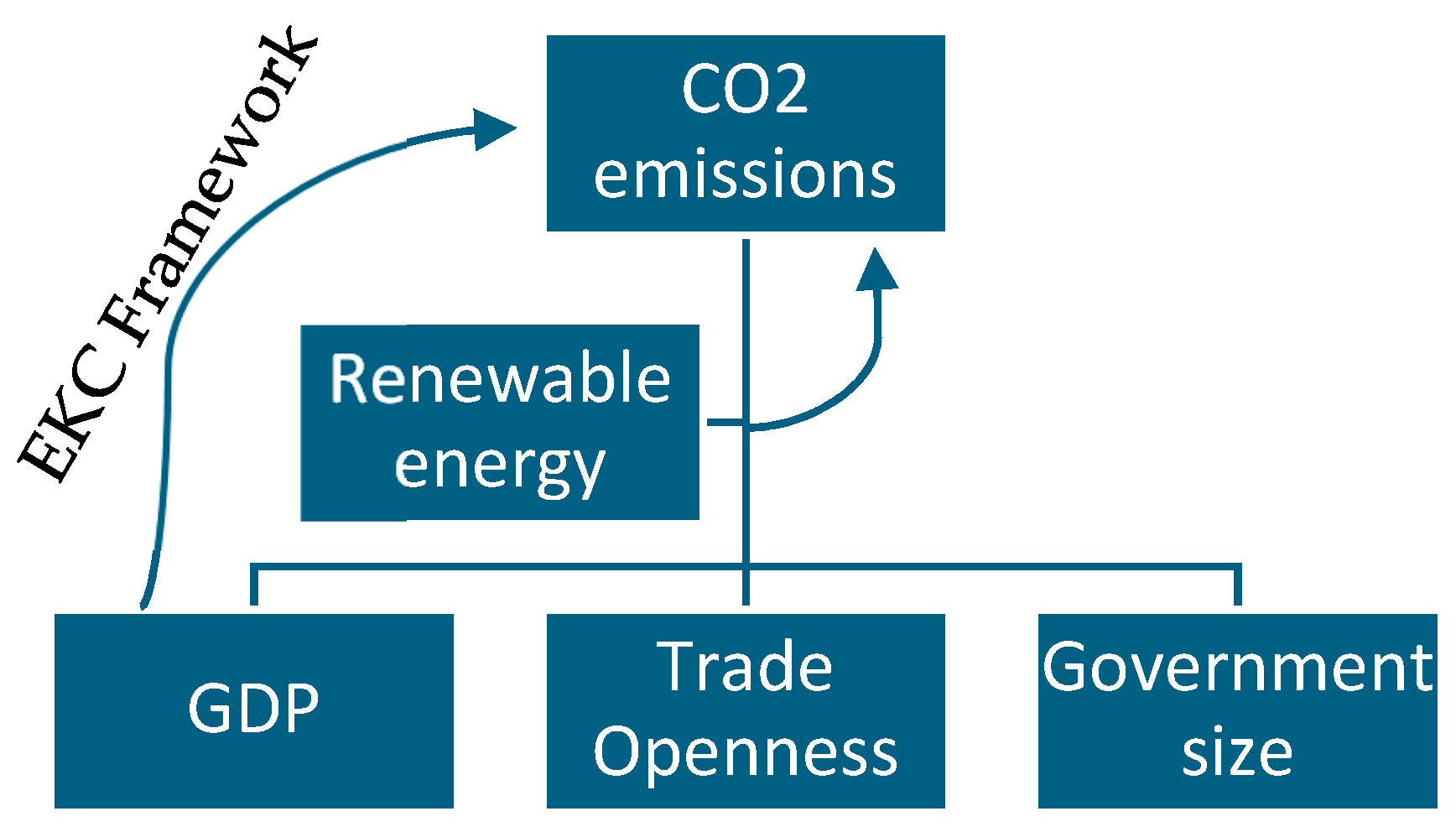
This study investigates the complex interconnections between renewable energy adoption, carbon dioxide (CO2) emissions, and economic factors in 50 countries marked by high rates of coronary heart disease (CHD) between 2000 and 2020. Utilizing a sophisticated two-step system generalized method of moments (GMM) estimator and panel data method, our analysis reveals a significant negative impact of renewable energy on greenhouse gas emissions, emphasizing the role of sustainable energy sources in mitigating environmental and quality of life degradation. Additionally, our findings support the existence of the environmental Kuznets curve (EKC), demonstrating an inverted U-shaped relationship between gross domestic product (GDP) per capita and CO2 emissions. In line with nascent studies, the EKC for CO2 emissions suggests that as a country’s GDP per capita increases, the CO2 emissions initially rise but eventually decline after reaching a certain level of economic development, forming an inverted U-shaped relationship. Specifically, nations facing high cardiovascular heart disease mortality rates display an important link between renewable energy integration and improved environmental quality. These insights underscore the urgency for countries to transition rapidly to green energy, advocating for policies that promote renewable technologies through partnerships between the public, private sector, and government entities. Furthermore, the study emphasizes the necessity of innovative structural reforms in developing countries to stimulate economic growth beyond the EKC turning point, ensuring sustainable development while curbing their carbon footprint resulting from economic activities. Future research should explore the broader global contexts, considering variables like social capital and globalization to inform targeted policies aimed at safeguarding public health and the environment.
Keywords: renewable energy; CO2 emissions; heart disease; sustainable development renewable energy; CO2 emissions; heart disease; sustainable development