Article

A Day-Ahead Economic Dispatch Method for Renewable Energy Systems Considering Flexibility Supply and Demand Balancing Capabilities

1
Central China Branch of State Grid Corporation of China, Wuhan 430077, China
2
School of Electrical Engineering and Automation, Wuhan University, Wuhan 430072, China
*
Author to whom correspondence should be addressed.
Energies 2024, 17(21), 5427; https://doi.org/10.3390/en17215427
Submission received: 28 September 2024 / Revised: 22 October 2024 / Accepted: 26 October 2024 / Published: 30 October 2024
(This article belongs to the Special Issue Planning, Operation, and Control of New Power Systems)

Abstract

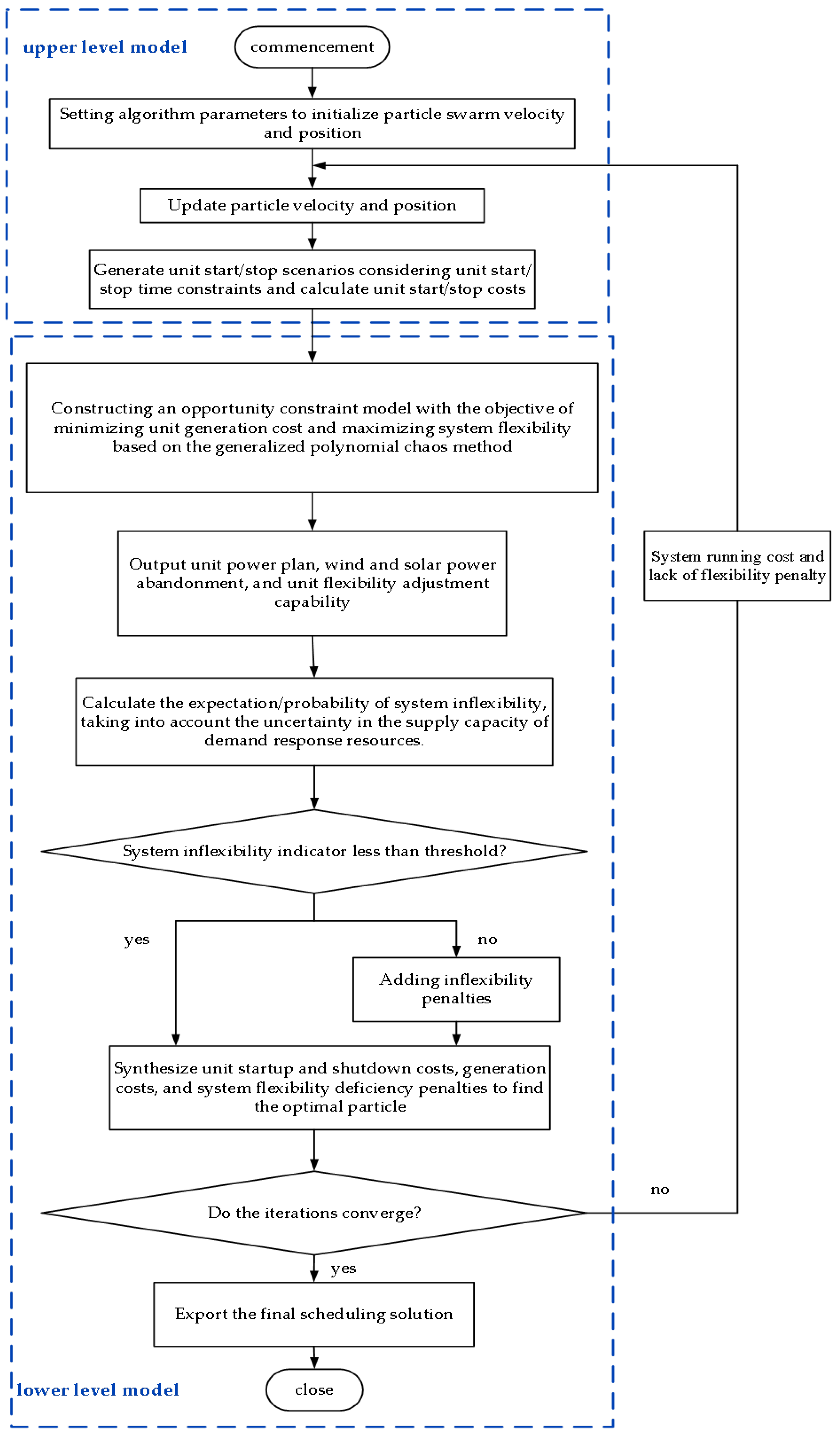
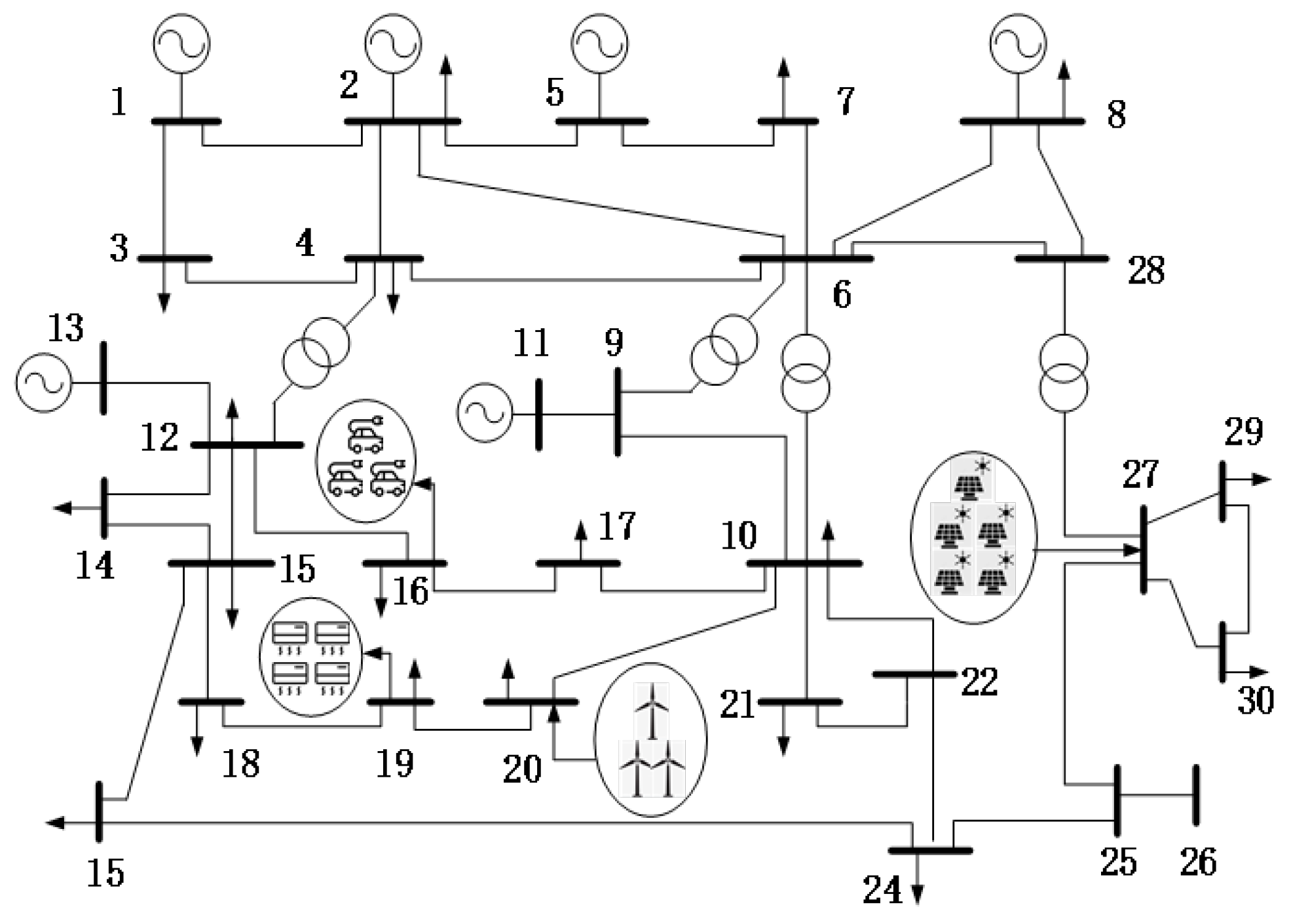
The increase in new energy grid connections has reduced the supply-side regulation capability of the power system. Traditional economic dispatch methods are insufficient for addressing the flexibility limitations in the system’s balancing capabilities. Consequently, this study presents a day-ahead scheduling method for renewable energy systems that balances flexibility and economy. This approach establishes a dual-layer optimized scheduling model. The upper-layer model focuses on the economic efficiency of unit start-up and shut-down, utilizing a particle swarm algorithm to identify unit combinations that comply with minimum start-up and shut-down time constraints. In contrast, the lower-layer model addresses the dual uncertainties of generation and load. It employs the Generalized Polynomial Chaos approximation to create an opportunity-constrained model aimed at minimizing unit generation and curtailment costs while maximizing flexibility supply capability. Additionally, it calculates the probability of flexibility supply-demand insufficiency due to uncertainties in demand response resource supply and system operating costs, providing feedback to the upper-layer model. Ultimately, through iterative solutions of the upper and lower models, a day-ahead scheduling plan that effectively balances flexibility and economy is derived. The proposed method is validated using a simulation of the IEEE 30-bus system case study, demonstrating its capability to balance system flexibility and economy while effectively reducing the risk of insufficient supply-demand balance.
Keywords: renewable energy system; flexibility supply-demand balance; generalized polynomial chaos; dual-layer optimization; day-ahead dispatch renewable energy system; flexibility supply-demand balance; generalized polynomial chaos; dual-layer optimization; day-ahead dispatch