Article

A Study Regarding the Relationship between Carbon Emissions, Energy Consumption, and Economic Development in the Context of the Energy Growth Nexus


by
Laurențiu-Stelian Mihai
1,*,
Laura Vasilescu
1,
Cătălina Sitnikov
1,
Anca Băndoi
1,
Leonardo-Geo Mănescu
2 and
Lucian Mandache
2
1
Faculty of Economics and Business Administration, University of Craiova, 200585 Craiova, Romania
2
Faculty of Electric Engineering, University of Craiova, 200585 Craiova, Romania
*
Author to whom correspondence should be addressed.
Energies 2024, 17(17), 4526; https://doi.org/10.3390/en17174526
Submission received: 31 July 2024 / Revised: 27 August 2024 / Accepted: 7 September 2024 / Published: 9 September 2024
(This article belongs to the Topic Energy Economics and Sustainable Development)

Abstract

As the EU strives to achieve its climate goals, it is becoming increasingly crucial to understand the complex relationships between economic activity, energy consumption, and carbon emissions. In this context, our paper aims to investigate the correlation between carbon emissions, energy consumption, and economic development. To fulfill our aim, we have used Eurostat and OECD data for the EU-27 member states for a period of 13 years (2010–2022), using a linear regression as the main analysis method. Our results have shown that there is a strong correlation between demand-based and production-based CO2 emissions as well as between production-based CO2 emissions and final energy consumption, while at the same time, our findings have shown that there is no direct correlation between energy consumption and economic development, aligning our study with the neutrality hypothesis of the energy growth nexus. This paper expands the ongoing discussion on sustainable development and climate change mitigation by conducting a thorough analysis of the EU-27 countries over a span of thirteen years. The results emphasize the need for integrated strategies that address both production and consumption emissions, emphasize the vital role of energy efficiency, and raise questions about the effectiveness of increasing energy consumption to enhance economic productivity or CO2 efficiency.

1. Introduction

The European Union (EU) has long been at the forefront of global efforts to combat climate change, setting ambitious targets for reducing greenhouse gas emissions and transitioning to a low-carbon economy. The use of energy is a key measure of wealth and economic growth, while the resulting CO2 emissions are the main determinants for pollution, environmental degradation, and climate change. The EU-27, as a major economic bloc, plays a significant role in global carbon emissions, and understanding the dynamics between these factors is essential for developing sustainable energy policies. As EU-27 member states strive to meet their greenhouse gas (GHG) emission reduction targets, they need to focus on understanding the complex relationships between economic activities, energy consumption, and carbon emissions in order to develop effective strategies and policies.
In the current context of rapid economic development, researchers are progressively acknowledging the expenses associated with economic expansion while demonstrating that the sole pursuit of quantitative economic growth is not sustainable. In recent years, energy use has emerged as a crucial factor influencing human prosperity, while the disparity in economic growth and living standards has been greatly impacted by the disparity in energy consumption between rich and developing nations [1]. Furthermore, the environmental quality and the potential for sustainable development are directly dependent on the energy composition. Energy is regarded as a crucial resource that has a significant impact on the results of wars, drives economic progress, and both pollutes and cleans up the environment [2] (p. 1). Researchers from throughout the world have extensively studied the correlation between energy use and economic growth as well as their combined effect on environmental pollution. Economists have been pushed to explore the compatibility of clean energy with quicker economic growth due to the urgent need to achieve better economic growth while reducing pollution levels [3,4].
The increasing use of natural resources associated with economic progress presents an escalating peril to the environment. In this context, the European Green Deal is the European Union Commission’s answer to the worsening ecological crisis, aiming to achieve long-term economic growth that is environmentally and socially sustainable [5,6]. This is a strategy direction aimed at constructing a thriving and flourishing European community based on a modern, resource-efficient, and competitive economy and at the same time trying to lower the greenhouse gas emissions to a level that is at least 55% lower than the emissions recorded in 1990 by the year 2030. An integrated strategy for studying the correlation between economic development, energy consumption, and carbon emissions could provide significant information for policy makers and aid them in resolving misspecification issues.
In this context, an extensive investigation of the relationship between carbon emissions, energy use, and economic growth and development could reveal crucial factors for future progress in a dynamic environment and in addressing emerging energy-related challenges.
While there is extensive research on the energy growth nexus, the existing literature often overlooks the specific relationship between different types of carbon emissions (demand based vs. production based) and their connection with energy consumption and economic productivity. Additionally, most studies focus on either developed or developing countries, with few examining the EU-27 as a unified block over an extended period.
This research paper aims to investigate the relationships between CO2 emissions (both production and demand based), energy consumption, and economic development (measured through CO2 productivity and GDP/capita) among the EU-27 member countries over the period 2010–2022, using Eurostat [7,8] and OECD [9] data for the five variables, which will be analyzed using the linear regression model. The use of a linear regression as the primary analytical method is appropriate given the study’s objective to identify and quantify the relationships between the selected variables. This methodology allows us to analyze the correlations and ensures that the conclusions drawn are statistically significant and reliable.
Through this study, we seek to provide empirical evidence that is crucial for understanding how these variables interact in a developed economic context as well as to uncover insights that can inform more effective climate policies and economic strategies within the EU.
The results reveal several novel findings, particularly the lack of significant correlation between final energy consumption and both CO2 productivity and GDP per capita, challenging some conventional assumptions in the literature and aligning our study with the neutrality hypothesis of the energy growth nexus. Furthermore, the strong positive correlation between demand-based and production-based CO2 emissions highlights the relationship between economic activities and carbon output, providing a new perspective on the mechanisms driving emissions in the EU-27.
The paper is structured as follows: This introduction is followed by a Section 2, which represents a review of the relevant literature, highlighting the current state of knowledge and the gaps that this study aims to address. Section 3 outlines the methodology, including the data sources and the analytical techniques employed. Section 4 reports the results of the empirical analysis and discusses the findings and their implications. Finally, Section 5 concludes the paper and provides recommendations for future research and policy considerations.
The findings of this study are expected to contribute to the ongoing academic and policy debates on sustainable economic development and climate change mitigation strategies within the European Union. The insights gained can inform more effective policymaking and help guide the transition towards a low-carbon, energy-efficient, and economically prosperous future for the EU-27 member countries.

2. Literature Review

There exists a substantial body of scholarship examining the correlation between energy consumption and economic growth as well as a second, even more comprehensive body of the literature investigating the correlation between economic growth and carbon emissions. Several researchers have contended that these two branches of research are interconnected and should be examined in conjunction to address the inherent limitations of each branch [10]. Moreover, understanding the connections between these factors will aid in resolving any contradictory effects that economic, environmental, and energy conservation measures may have on each other. Ang [11] contends that there is a correlation between energy consumption, economic growth, and carbon emissions, and in order to accurately analyze this link, it is necessary to use an integrated framework and eliminate any errors in specification.

2.1. CO2 Emissions

The International Energy Agency identifies seven sources of CO2 emissions generated by energy combustion: industry, transportation, housing, commercial and private services, agriculture/forestry, fisheries, and other energy consumers. Most energy consumers fall into the three economic sectors within a country: industry, agriculture, and services. The operations of these sectors depend on the accessibility of energy as a resource, which subsequently leads to an indirect escalation in the volume of CO2 emissions resulting from energy combustion. Hence, the presence of energy is an indispensable requirement for the sustained progress of all sectors of national development. On the other hand, residential energy users refer to individuals who consume energy for their home needs and engage in various daily activities that result in the production of CO2. In certain countries, residential energy usage is a significant contributor to CO2 emissions [12].
Nguyen and Kakinaka [13] conducted a study to investigate the factors that have an impact on CO2 emissions, identifying energy consumption and oil prices as significant determinants. Their findings align with the results of Mugableh [14], which examined the correlations between CO2 emissions, GDP per capita, and energy consumption per capita and concluded that energy consumption and GDP per capita were positively associated with CO2 emissions. Moreover, the research conducted by Saidi and Hammami [2] has established a direct correlation between energy consumption and CO2 emissions. Similarly, other studies by Ang [11], Ozturk and Acaravci [15], Rafinandi [16], and Mardani et al. [17] have demonstrated that factors such as gross domestic product (GDP), GDP per capita, and energy consumption have a significant influence on CO2 emissions, these results being further supported by Acheampong [10].
CO2 emissions can be measured using two separate approaches: production-based carbon emissions (PBE) and demand-based carbon emissions (DBE). PBE quantifies emissions by considering the direct use of fossil fuels and relevant industrial processes within a nation while disregarding imports and exports. The production-based CO2 emission refers to the direct emissions released by a certain country during its domestic production activities [16]. This metric quantifies the amount of greenhouse gas emissions resulting from the utilization of fossil fuels in a nation, encompassing the activities of private households, industrial manufacturing of goods and services, and the energy production. Demand-based emissions refer to both the direct and indirect greenhouse gas (GHG) emissions that result from domestic production and net imports [18].
The demand-based method is gaining popularity since it allows for the measurement of the direct impacts of emissions based on the consumption of end-users. This technique is considered more effective and reasonable because it is directly linked to final consumption [19,20]. According to Adebayo and Rjoub [21], there is a theoretical belief that when consumers’ wealth increases, their consumption likewise increases. This is considered a crucial component in the global expansion of resource utilization and degradation of environmental quality. The phenomenon of globalization might result in the transfer of the expenses associated with emissions caused by consumer demand to the end consumers. Additionally, it accelerates the flow of goods and services along regional and worldwide supply chains. Therefore, it is the responsibility of national economies to be held responsible for CO2 emissions that are generated through production. Additionally, governments should implement strict policies to mitigate the environmental impacts that arise from consumption [22].
Traditionally, studies on this subject have yielded fragmented perspectives. Previous research has predominantly examined either the emissions resulting from consumer demand [23] or the emissions associated with production activities [24,25,26]. However, there is a lack of empirical studies that have comprehensively assessed both aspects. Although this fragmented strategy has contributed to the corpus of knowledge, it has also resulted in gaps in the comprehensive understanding of all the factors that determine CO2 emissions.
Although previous research has examined this topic [23,24,25,26,27,28], there has been a lack of focus in the literature on distinguishing between the two types of CO2 emissions in terms of inventory or accounting. Production-based CO2 emissions have received more extensive attention compared to demand-based carbon emissions. The scholarly attention on PBE is motivated by the fact that measuring and monitoring CO2 emissions based on production is easier in comparison to emissions based on consumption [28,29]. To calculate the overall emissions of a country or region, one must aggregate the carbon dioxide emissions from many sectors, including energy generation, transportation, and industry [28,29]. The data might be acquired from national statistical agencies or international organizations, such as the World Bank. Measuring demand-based emissions is difficult because it requires data on the amount of CO2 emissions produced by consumer products and services within a certain country or region, regardless of where they were produced [28,29]. The accessibility of these data may be restricted, and their estimation may require complex models [30].

2.2. Energy Consumption

Energy consumption plays a significant role in influencing both CO2 emissions and economic growth [31,32], and thus, a myriad of studies have focused on the relationship between energy use, the environment, and the economy [33,34,35]. Initially, researchers frequently employed total energy consumption as a metric to assess the environmental and economic consequences of energy consumption [36,37]. Subsequent research has demonstrated that various forms of energy consumption can have distinct effects on both the environment and the economy [38,39,40].
In recent times, researchers have begun examining the topic from two angles: the renewable energy use and non-renewable energy [41]. The literature investigating the influence of renewable energy use on sustainable development analyzes the environmental effects of consuming renewable energy, usually showing that the use of energy from renewable sources may lead to a decrease in carbon emissions, particularly in the highest 10% of cases [42,43]. Advocates contend that developing nations should increase their allocation of research and development expenditures to bolster the adoption of renewable energy sources [44,45,46]. Ozcan and Ozturk [47] asserted that there exists a minimum level of renewable energy consumption, below which both energy production and consumption are limited, and the utilization of renewable energy is inadequate to foster economic development. When the renewable energy surpasses this barrier, it is quite probable that it will stimulate economic expansion. Dogan et al. [48] contended that the impact of renewable energy consumption on economic growth is contingent upon a nation’s reliance on fossil energy sources. If a nation’s reliance on fossil fuels is the primary driver of its economic growth, then it is not necessarily possible to attain sustainable economic growth only using renewable energy [49,50]. Contradictory results emerge due to the varying settings of the countries under examination as well as due to the variation in production conditions and the level of development among market participants, which contribute to differences in the average economic potential and total-factor productivity across various industries [51].
Likewise, the body of literature regarding the effects of non-renewable energy usage on sustainable development analyzes the effects of non-renewable energy consumption on the environment. The findings usually indicate a direct relationship between the usage of non-renewable energy and the release of carbon emissions [52,53,54,55,56].
The relevant literature uses two measurements of energy consumption: primary energy consumption (PEC) and final energy consumption (FEC) [42,56,57]. PEC refers to a nation’s total need of energy, excluding the use of energy resources (petrol, coal, natural gas, etc.) for non-energy-related purposes (chemical production with natural gas), and it includes the energy consumption of final users, such as industry, households, agriculture, transport and other services, the energy industry’s own consumption, and losses that happen along the value chain [57]. Similarly, FEC determines a country’s final energy consumption without non-energy related purposes, but unlike PEC, it only includes the final users (agriculture, industry, services, transport, and households) without the energy sector’s own use and the losses that may happen along the value chain [57].
In this paper, we have chosen to use FEC as the variable for energy consumption because it specifically measures the final users’ energy consumption as well as being included in the Sustainable Development Goal (SDG) 7—Affordable and sustainable energy, which is one of the European Commissions’ priorities under the European Green Deal.

2.3. CO2 Productivity

CO2 productivity is a widely recognized concept used to assess the effectiveness of carbon consumption [56,58]. Consequently, numerous studies have concentrated on developing an indicator that may provide a more precise measurement and evaluation of CO2 productivity. According to most definitions of CO2 productivity, when carbon productivity grows, the economic value generated per unit of carbon emissions also increases. This helps to link economic progress and environmental protection. A substantial body of research exists on the quantification of carbon productivity, which can be broadly categorized into two methodologies: single-factor and full-factor measurements.
The single-factor approach was initially suggested by Kaya and Yokobori [59]. It defines CO2 productivity as the ratio of economic progress, often measured by GDP, to CO2 emissions. This technique is based on data collected at the industrial level. In addition, a number of researchers [56,60,61,62,63,64,65,66,67] have assessed carbon productivity by employing single-factor indicators, such as energy consumption per unit of GDP, carbon dioxide emissions per unit of energy, and carbon dioxide emissions per unit of GDP, respectively.
This approach utilizes a single factor to measure the proportional connection between carbon emissions and economic output. It takes into account only the output and disregards the impact of capital and labor as input factors [68]. To address this limitation of the single-factor approach, researchers have started to assess carbon productivity using a total-factor measure. This method integrates input, desired outputs, and undesired outputs of production factors into a unified framework, resulting in more precise and comprehensive findings [69]. The measuring model used by Wang et al. [56] often incorporates both labor and capital, as demonstrated in previous studies [69,70,71]. According to Wu et al. [72], evaluating complete factor productivity considers many input components and emphasizes the need of reducing carbon emissions to achieve the dual carbon target. The dual carbon target refers to the fact that while enhancing labor and capital efficiency might lead to overall productivity improvement, achieving the same level of efficiency in reducing carbon emissions may be more challenging.
This single-factor approach measures a single proportional relationship between carbon emissions and economic output, considering only output and ignoring the effects of capital and labor as input factors [68]. In order to tackle this shortcoming of the single-factor approach, researchers have begun to measure carbon productivity using a total-factor measure. This approach incorporates input and desired and undesired outputs of production factors into a unified framework, making the results more accurate and comprehensive [56], and it typically includes labor and capital in the measurement model [73,74,75]. Wu et al. [72] argue that measuring full-factor productivity takes into account multiple input factors but underlines the importance of carbon emission reduction under the dual carbon target. The dual carbon target refers to the fact that while the total productivity can be improved by improving labor and capital efficiency, the reduction in carbon emissions may not be as efficient.
However, numerous experts concur that measuring CO2 productivity is a crucial indicator for evaluating low-carbon economic development [76,77], with the objective of connecting economic growth and environmental preservation. The underlying notion of low-carbon development aims to decrease carbon dioxide emissions while simultaneously promoting economic growth. Hence, studying the empirical correlation between carbon productivity and economic growth is valuable for managing low-carbon transition [77].

2.4. Economic Development and Environment Degradation

In the contemporary world, energy is a very important factor that influences economic growth and development [78], being an essential resource for all economic sectors. Sadorksy [79] states that as a country develops, its energy needs grow as well. At the same time, as the accelerated consumption of energy and other natural resources degrades the natural environment, so do fossil fuel-generated carbon emissions, which damage the environment and the atmosphere [80,81,82,83]. In this context of accelerated economic development driven primarily by industrial production, CO2 emissions have been rising since the beginning of the 20th century. There has been a 70% increase in CO2 levels since 1970, while nearly 78% of the overall rise in greenhouse gas emissions between 1970 and 2011 can be attributed to CO2 emissions resulting from the combustion of fossil fuels and industrial activities [84].
One of the most popular theories regarding the relationship between economic development and environment quality is the so-called environmental Kuznets curve (EKC), which states that while a country develops, various environmental degradation indicators will become worse until the economic development reaches a certain level, after which they will start improving. Basically, this hypothesis suggests that as a country’s income rises, its environmental degradation will become worse before it becomes better and that the long-term solution to pollution is, in fact, economic growth and development. The inverted U-shaped relationship between income and environmental degradation shows that pollution will initially increase along with income, but after reaching a critical threshold, it will start decreasing while income continues to rise [1,85,86,87,88,89,90].
Despite ongoing discussions, there is substantial evidence to support the use of the environmental Kuznets curve for different environmental indicators, including water, air pollution, and ecological footprint, which prove the U-shape curve as GDP increases [87]. For instance, between 1970 and 2006, the United States experienced a 195% growth in its inflation-adjusted GDP, a more than doubling of the number of automobiles and trucks in the country, and a 178% increase in the overall number of miles driven. Nevertheless, within that identical timeframe, specific alterations in regulations and advancements in technology resulted in significant reductions in yearly carbon monoxide emissions, declining from 197 million tons to 89 million. Similarly, nitrogen oxide emissions decreased from 27 million tons to 19 million, sulphur dioxide emissions dropped from 31 million tons to 15 million, particulate emissions were reduced by 80%, and lead emissions were diminished by over 98% [91].
However, the applicability of the EKC model to additional pollutants, certain forms of natural resource use, and the preservation of biodiversity is a subject of debate [89,92]. For instance, the ecological footprint (which includes the use of energy, land, and natural resources for economic development) may not decrease as income increases. Although the energy-to-real GDP ratio has decreased, the overall energy consumption is still increasing in most industrialized nations, along with the total emissions of various greenhouse gases. In developed countries, the status of various important “ecosystem services” offered by ecosystems, such as freshwater provision, soil fertility, and fisheries, may continue to deteriorate. Supporters of the EKC argue that the diverse relationships between economic and environmental indicators do not necessary contradict the hypothesis. Instead, they claim that the suitability of Kuznets curves for different ecosystems, economic systems, regulatory frameworks, and technologies may vary.

2.5. Hypothesis Development

Lean and Smith [93] investigated the cause-and-effect connection between carbon emissions and energy consumption using a panel vector error correction model for five ASEAN nations from 1980 to 2006. The long-term calculations demonstrate a statistically significant positive correlation between energy usage and carbon emissions. Saidi and Hammami’s [2] findings indicate that economic expansion has a favorable and substantial impact on energy utilization, whereas CO2 emissions have a positive influence on energy consumption, which indicates a close relationship between economic growth, CO2 emissions, and energy consumption, three variables that should be studied together.
Several researchers [52,94,95] have examined the correlation between carbon emissions, economic growth, and energy consumption in various groups of nations and successfully demonstrated a reciprocal cause-and-effect link between energy usage and CO2 emissions. However, Acheampong [10] and Bekhet et al. [96] have contradictory findings on the relationship between energy and emissions. In addition, several others [97,98,99,100,101,102,103] have discovered a substantial and mutually influential relationship between CO2 emissions and total energy consumption, using these two variables as indicators of economic growth.
Most of these studies reveal that that globally, there is a one-way correlation running from energy consumption to economic growth, but some manage to show that energy use is a negative determinant of economic growth [10]. These results show that energy use reduction measures may have a positive impact on global economic growth. Moreover, Acheampong [10] managed to prove that economic growth has a negative effect on carbon emissions, while carbon emissions have a positive effect on economic growth. Their findings suggest that environmental and energy conservation policies, designed to decrease carbon emissions, may have a negative impact on global economic growth, but structural policies, aimed at economic development, will enhance the quality of the environment [10].
Based on these previous studies, we made the following assumptions:
H1: 
There is a direct positive correlation between demand-based CO2 emissions (PbCO2) and production-based CO2 emissions (DbCO2).
H2: 
There is a direct positive correlation between production-based CO2 emissions (PbCO2) and final energy consumption (FEC).
Several studies indicate that achieving both carbon reduction and economic development simultaneously necessitates a rise in carbon productivity, which refers to the amount of GDP generated per unit of carbon output [104,105].
In order to achieve a significant enhancement in carbon productivity, it is imperative for governments and corporations to identify methods that effectively reduce the highest amount of carbon emissions at the lowest possible cost. In the absence of the technique, the cost of reducing emissions would be very high, and governments will be confronted with a difficult choice between reducing carbon emissions and promoting economic growth [104]. Bai et al. [58] conducted a study on the carbon productivity of 88 economies from 1975 to 2013 using a parametric Malmquist index approach. They found that carbon productivity increased significantly at the national level, with developed countries experiencing a faster rate of increase compared to developing countries.
Some papers have begun analyzing the factors that influence carbon productivity, aiming to enhance it. Technology innovation is widely recognized as the primary catalyst for economic growth, productivity growth, and carbon productivity in society [106,107,108]. One relatively recent study has shown that the growth of carbon productivity in the industry is mostly driven by technology innovation, particularly in high-carbon sectors [109]. It is important to acknowledge that various forms of technological advancement can have varying effects on carbon productivity. Fan et al. [108], while corroborating the favorable impact of technological advancement on carbon productivity, found that in comparison to carbon technology, advancements in energy technology have a greater influence on enhancing carbon productivity. This conclusion was reached through the utilization of envelopment analysis-based methods and dynamic panel data models [104].
Energy transition models commonly rely on the established relationship between energy consumption and gross domestic product (GDP) to ensure ongoing economic growth [110]. Ucan and Yücel [111] conducted a study to examine the cointegration of real GDP, both traditional and environmentally friendly energy consumption, greenhouse gas emissions, and research and development utilizing a diverse panel of data. Saleem et al. [54] also support these assumptions, proving a unidirectional relationship between economic progress and energy consumption levels.
The literature regarding the relationship between economic growth, carbon emissions, and energy use, also known as the energy growth nexus, has not reached a consensus regarding the relationship between these variables, their findings falling in one of four possible scenarios. In the first one, commonly known as the “growth hypothesis” economic growth is intricately linked to energy consumption, and thus, many attempts to decrease energy usage will provide a significant challenge since it would inevitably have a detrimental impact on economic growth [1,112,113,114,115,116,117].
The second scenario, known as the “conservation hypothesis”, suggests a reverse causality between economic growth and energy use, meaning that economic development leads to an increase in energy use [93,118,119,120,121]. The third type of results commonly found by researchers who study the correlation between economic growth, carbon emissions, and energy use is called the “feedback hypothesis”, referring to a bidirectional relationship between the three variables [122,123]. Additionally, increased energy consumption is typically accompanied by higher emissions, as observed in research conducted by Ozturk and Acaravci [15], Farhani and Rejeb [124], Saboori et al. [125], and Chen et al. [95].
Labor and capital are the primary factors in the production process in certain low-income countries. Due to the relatively low proportion of energy in the manufacturing process, empirical studies have been unable to establish a significant influence of energy consumption on both economic growth and carbon emissions. This is referred to as the “neutrality hypothesis”. Some researchers [57,126] have also proven the neutral hypothesis, which proposes that there is no relationship between energy and growth, the hypothesis being valid only for low-income countries.
Based on these previous studies, we made the following assumptions:
H3a: 
There is a no significant correlation between final energy consumption (FEC) and CO2 productivity (CO2_prod).
H3b: 
There is no significant correlation between final energy consumption (FEC) and GDP/capita.

3. Materials and Methods

3.1. Data and Variables

The main objective of this paper was to study the relationship between CO2 emissions, energy consumption, and economic growth among the EU-27 member countries. In order to conduct this study regarding the energy growth nexus, we used Eurostat [7,8] and OECD [9] data for Austria, Belgium, Denmark, Finland, France, Germany, Ireland, Italy, Luxembourg, Malta, Netherlands, Portugal, Spain, Sweden, Bulgaria, Croatia, Czech Republic, Cyprus, Estonia, Greece, Hungary, Latvia, Lithuania, Poland, Romania, Slovenia, and Slovakia. Our paper used a varied approach, analyzing data for both developed and developing European countries for a span of 13 years (2010–2022), a fact that led to a large variety of values among our variables.
In our analysis, we used 5 variables: demand-based CO2 emissions (DbCO2) [9], production-based CO2 emissions (PbCO2) [9], final energy consumption (FEC) [7], CO2 productivity (CO2_prod) [9], and GDP per capita (GDP/capita) [8].
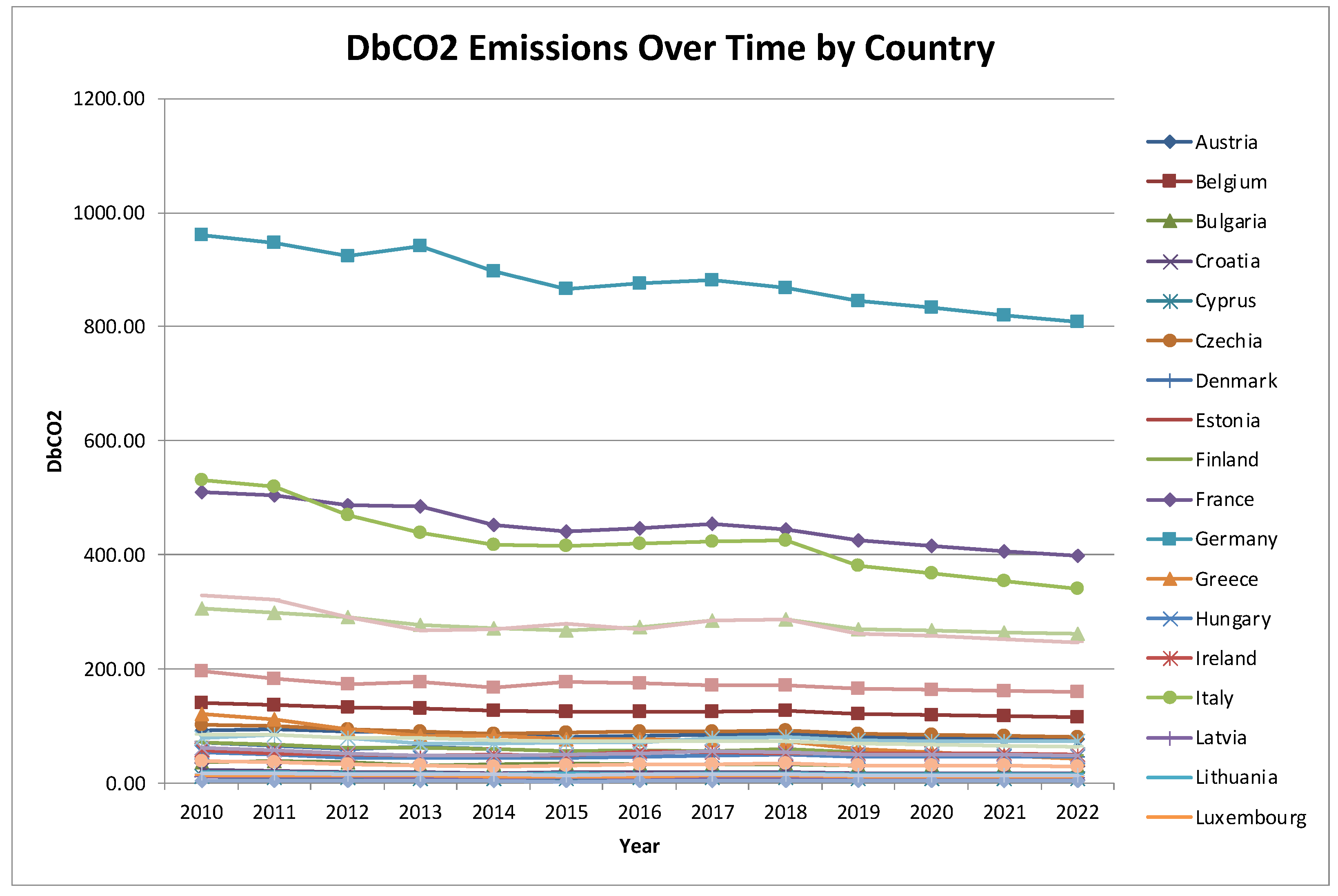
Demand-based CO2 emissions (DbCO2) is an indicator that measures the emissions generated in the production of goods and services by assigning them to the place those goods and services were consumed rather than where they were produced. This method adjusts production-based emissions (emissions produced domestically) for trade by subtracting emissions embedded in exports and adding emissions embedded in imports. Demand-based emissions are calculated by using global input–output tables to account for global production networks and value chains and can be used for structural decomposition analysis to reveal the drivers of emissions in final demand. Figure 1 is showing the evolution of this variable for each of the 27 countries along the 13 years used in this analysis.
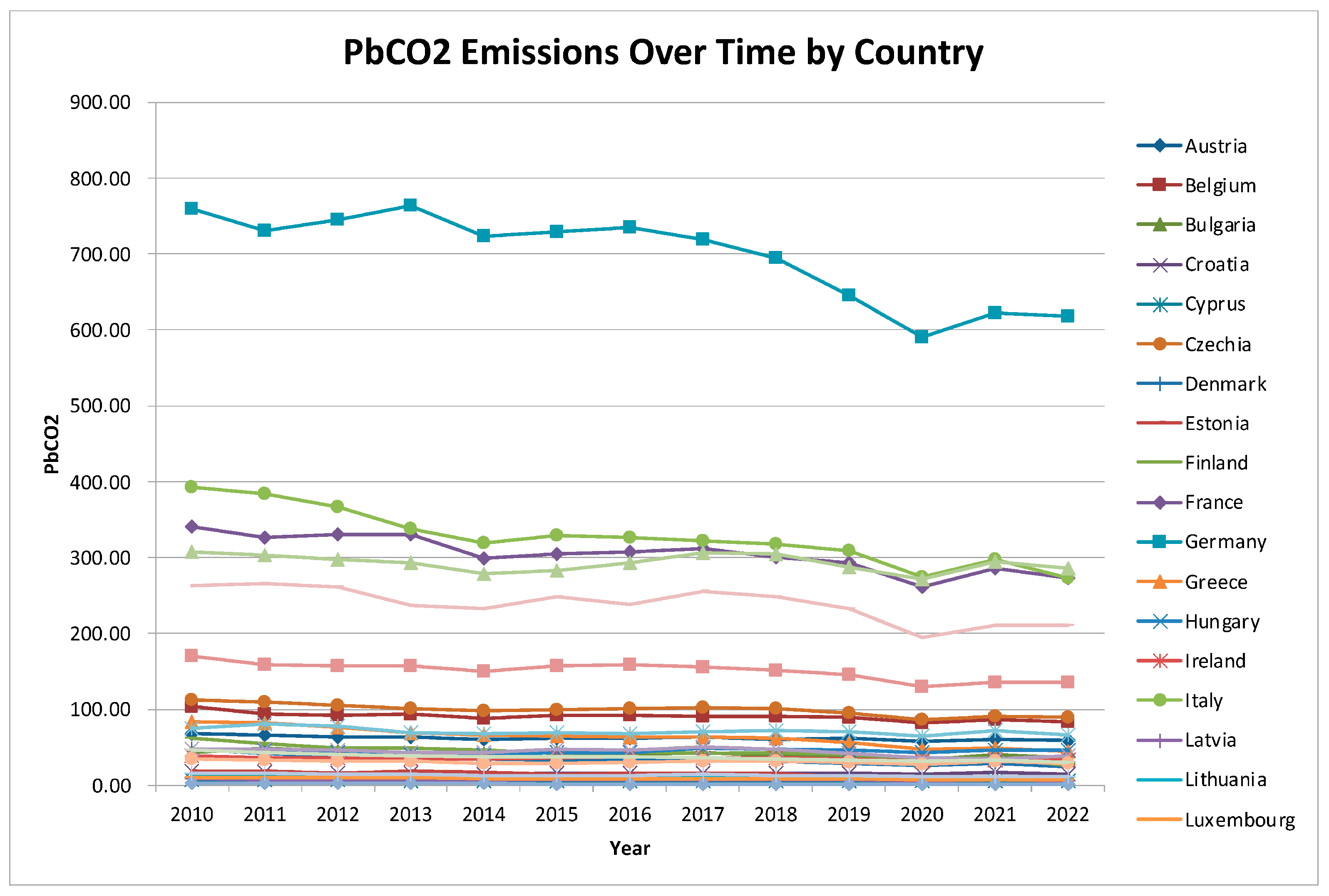
Production-based CO2 emissions (PbCO2) refer to the emissions generated within a country’s borders regardless of whether the goods and services produced are consumed domestically or exported. This is the standard approach used to measure and report a country’s greenhouse gas emissions under international frameworks like the Paris Agreement. This indicator measures the emissions produced during the manufacturing, transportation, and disposal of goods and services within a country’s borders but does not account for emissions embedded in imported goods and services. It is relatively straightforward to calculate using national energy and industrial production data, it allows for direct tracking of emission trends within a country over time while aligning with current international climate policy frameworks and reporting requirements. However, it can have several drawbacks, such as the fact that it does not capture emissions associated with a country’s consumption patterns and trade flows and can underestimate the true carbon footprint of wealthy, service-oriented economies that import a lot of goods, and thus, it can incentivize the offshoring of emission-intensive industries to other countries. Figure 2 is showing the evolution of the production-based emissions over time for the 27 countries.
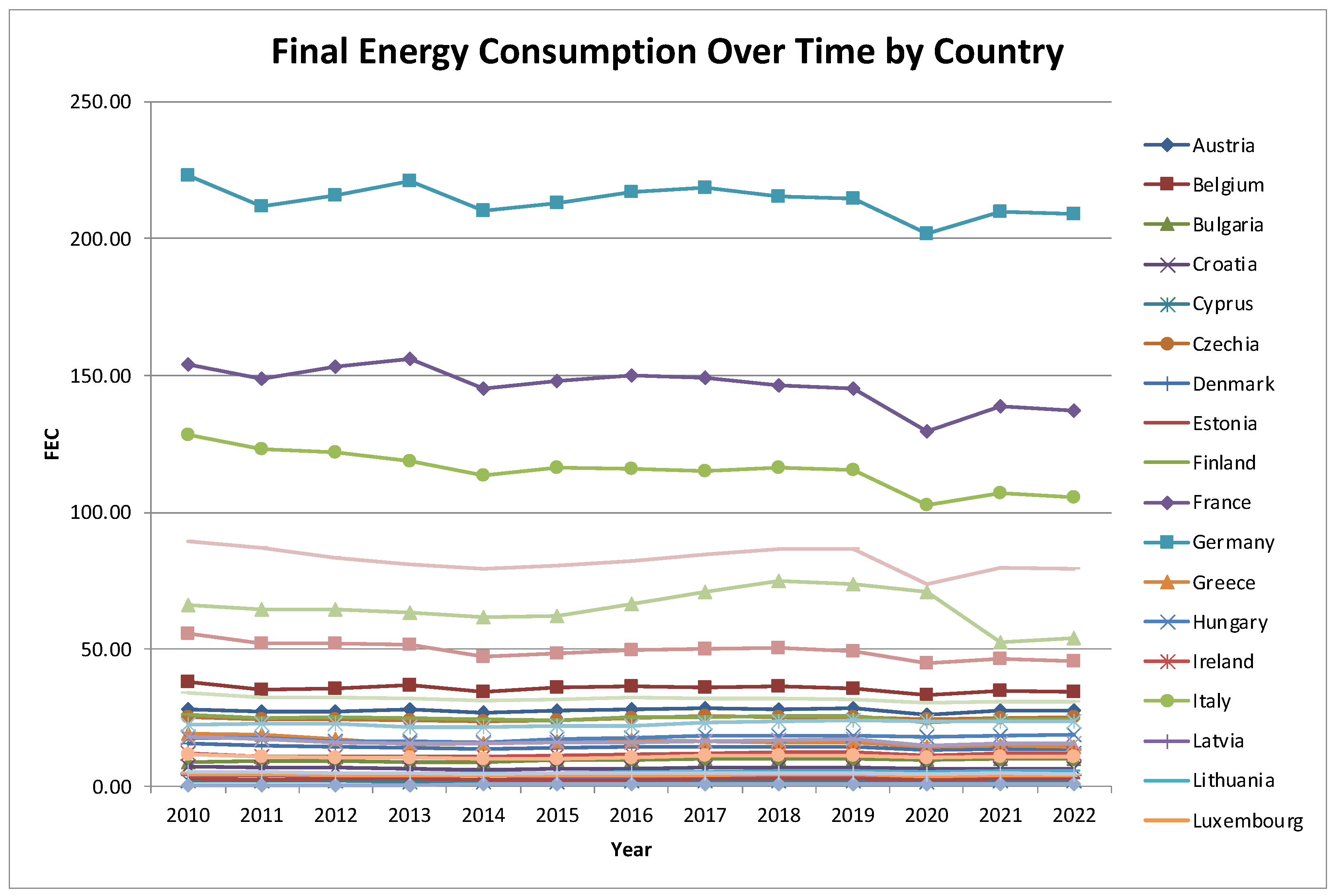
Final energy consumption refers to the total energy consumed by end users, such as households, industry, agriculture, and transport. It is the energy that reaches the final consumer’s door and excludes the energy used by the energy sector itself for deliveries and transformation. This is a key indicator for tracking progress in improving energy efficiency and reducing environmental impacts of energy use. Figure 3 is showing the evolution of this indicator for every European member state from 2010 to 2022.
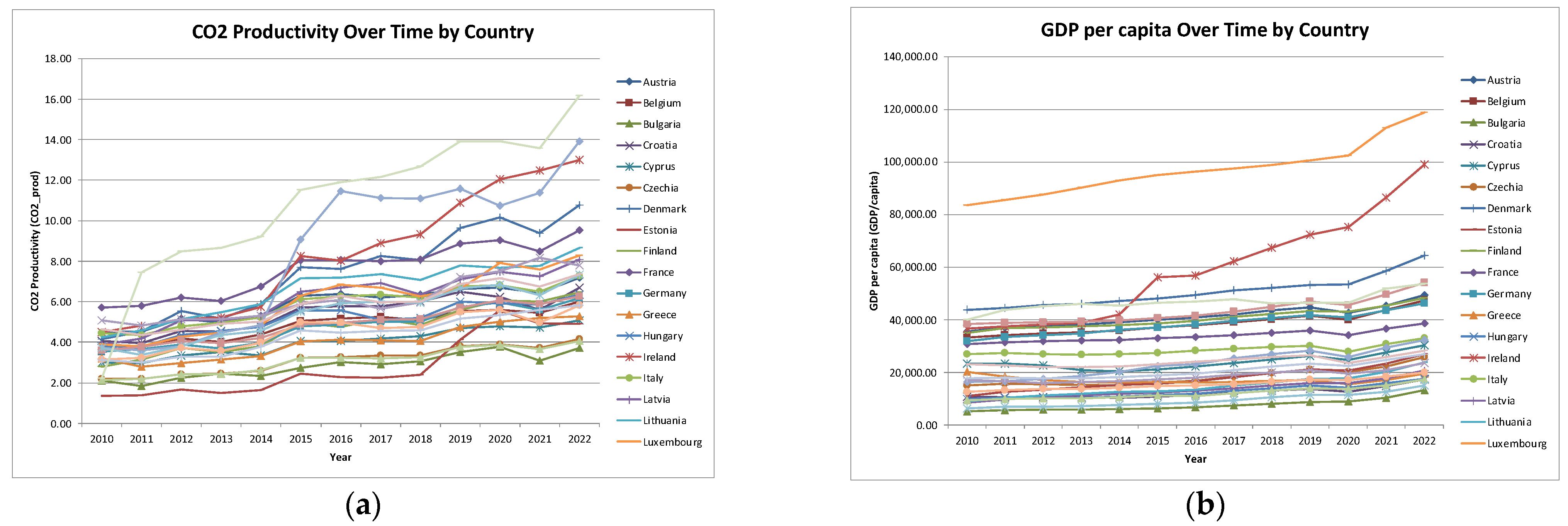
Regarding the economic growth dimension of our study, we have chosen two variables: CO2 productivity and GDP/capita. CO2 productivity, also known as carbon productivity, is a measurement of how much economic value is generated per unit of CO2 emissions. It is calculated as the ratio between total GDP to production-based CO2 emissions and provides a measurement of the carbon efficiency of a country’s economic activity; it can track improvements in technology, energy efficiency, and structural changes in the economy, and it is very useful for setting targets and monitoring progress on low-carbon economic growth. The main limitation of this indicator is the fact that it does not capture all environmental impacts beyond just CO2 emissions; it can be influenced by outsourcing of emission-intensive industries. We chose to use the production-based CO2 emissions in measuring CO2 productivity because this is the standard approach used in international climate reporting frameworks like the UNFCCC or the Paris Agreement. At the same time, since production-based CO2 productivity focuses on emissions generated within a country’s borders, it allowed us to isolate the impact of domestic energy use, policies, and economic structure of each of the EU-27 member states. In Figure 4a, we can see the evolution of CO2_prod across 13 years (2010–2022) for EU-27 states, while Figure 4b is showing the evolution of GDP/capita for the 27 member states for the period 2010–2022.
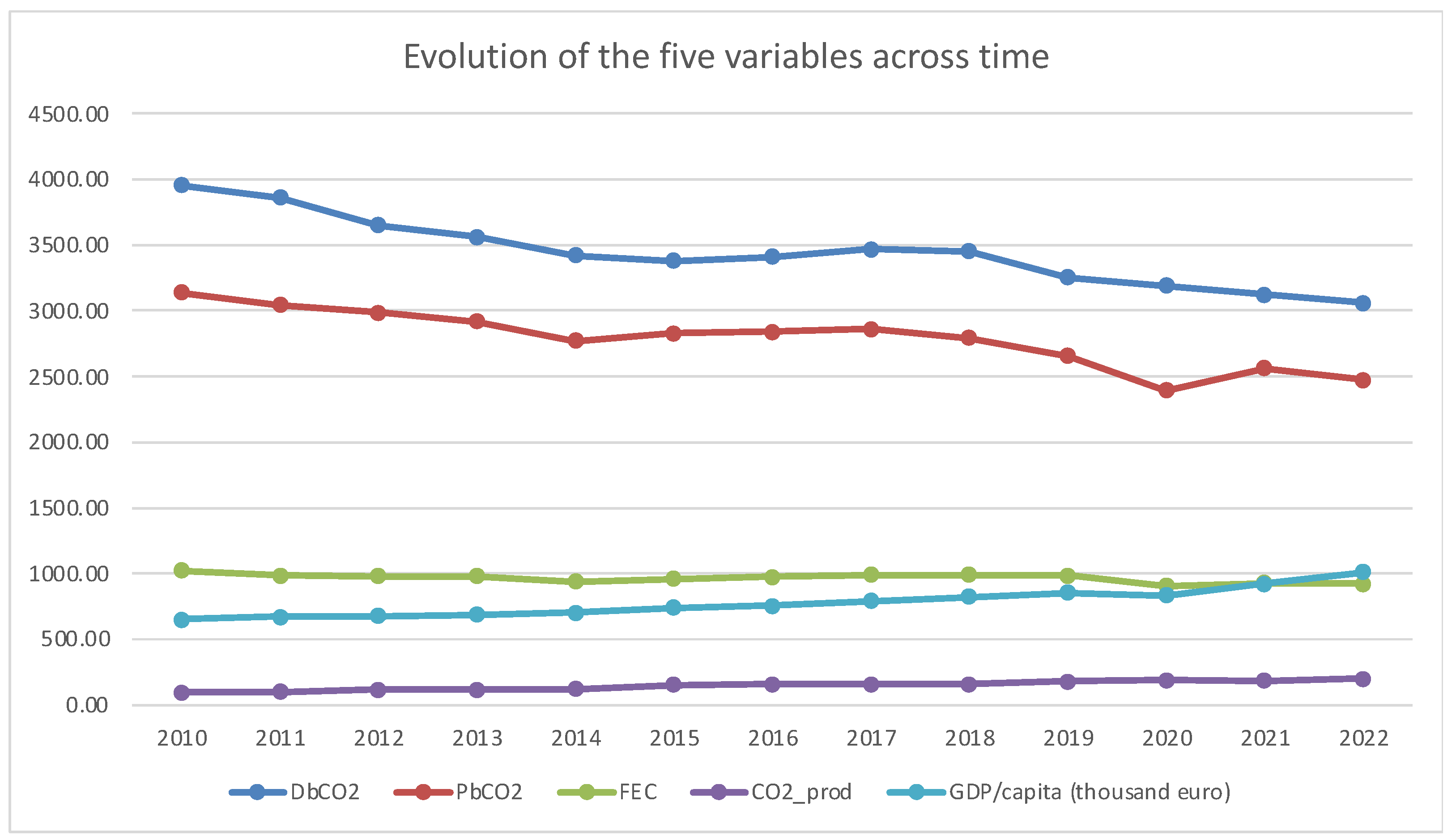
Figure 5 is showing the evolution of the five variables for the whole EU (as a sum of the data for individual countries) across the 13 years included in our analysis. As we can see, both the production-based emissions and the demand-based emissions as well as the final energy consumption decreased in 2022 compared to 2010, while the carbon productivity and the GDP/capita increased significantly. This evolution is showing that in these 13 years, the European Union registered significant economic development coupled with a reduction in carbon emissions and final energy consumption.

3.2. Model

In order to fulfill our research objective, we organized the five variables in four hypotheses that cover the relationship between CO2 emissions, energy consumption, and economic growth as follows:
H1: 
There is a direct positive correlation between demand-based CO2 emissions (PbCO2) and production-based CO2 emissions (DbCO2).
H2: 
There is a direct positive correlation between production-based CO2 emissions (PbCO2) and final energy consumption (FEC).
H3a: 
There is a no significant correlation between final energy consumption (FEC) and CO2 productivity (CO2_prod).
H3b: 
There is no significant correlation between final energy consumption (FEC) and GDP/capita.
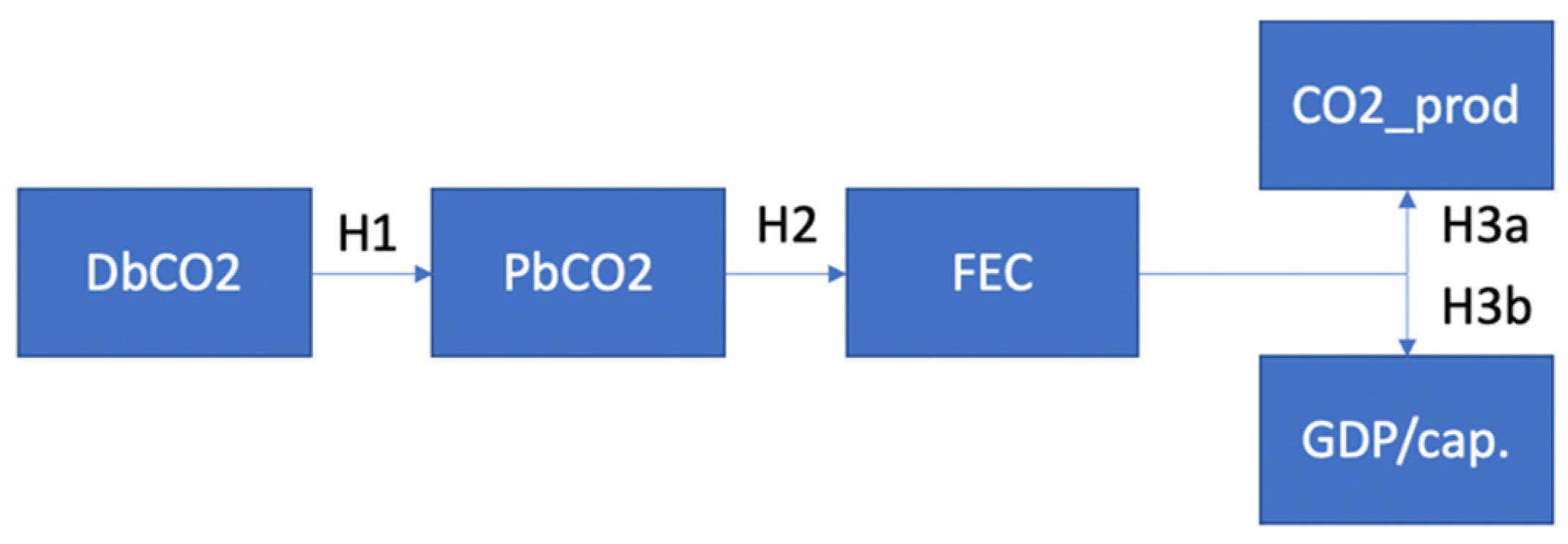
The relationship between the five variables is presented in the theoretical model shown in Figure 6.

3.3. Methods

In the current study, choosing the appropriate methodology was a crucial step. After careful consideration of the research objectives and the nature of the available data, the authors opted for the use of linear regression as the main tool of analysis. This decision was not taken arbitrarily but was based on a number of important considerations that merit further examination. Linear regression is distinguished by its ability to examine and quantify relationships between continuous quantitative variables that correspond to the type of data used in the study. Whether in terms of CO2 emission levels, energy consumption rates, or economic development indicators such as GDP/capita, this method allows for the connections between variables to be analyzed in a rigorous and statistically significant way.
An important aspect of linear regression is its conceptual simplicity, which does not compromise the strength of the analytical analysis. The basic model provides an intuitive representation of the relationship between the variables of interest. Clarity and simplicity are not only aesthetic advantages but also facilitate the interpretation of the results, allowing for the conclusions of the study to be communicated in a way that is accessible to the academic community as well as to environmental and economic policy makers.
Other approaches, including more complex models, such as quadratic and cubic models, were also considered in the methodology selection process. However, preliminary data analysis indicated that simple linear regression provides the best balance between accuracy and conceptual economy for the research hypotheses. This finding underscored not only the suitability of the method for the current study but also its versatility in addressing various relationships between environmental and economic variables.
It should be emphasized that the methodological choice was not isolated from the broader scientific context but was part of a rich tradition of research in the area of the relationships between environmental and economic factors. Previous studies, such as those by Acheampong [10], Salahuddin et al. [103], or Shahbaz et al. [102], have demonstrated the effectiveness of linear regression in similar contexts. This study explored the interconnections between energy consumption, CO2 emissions, and economic growth in various geographical and economic contexts, ranging from national case studies to global multi-state analyses. Placing the current study in this broad context not only validated the methodological choice but also facilitated the comparison and integration of the results obtained into the wider body of knowledge in the field.
As a result, the choice of linear regression as the central methodology in the current study reflects a careful balance between scientific rigor, practical applicability, and contextual relevance. This approach allowed for the complex relationships between CO2 emissions, energy consumption, and economic development to be identified and quantified, helping to provide a sound basis for policy conclusions and recommendations. Through this methodology, the authors attempted to contribute to a nuanced understanding of the interactions between critical variables, thereby strengthening future discussions and decisions in the field of energy sustainability and economic development.
During the first stage of the linear regression model, the primary goals are to select an optimal number of predictor variables and determine the correlation between the dependent and independent variables. The outcome will be a model presented in Equation (1).
Y = δ0 + δ1X1 + δ2X2 + … + δnXn
In the given equation, δ0, δ1, …, δn represent regression coefficients that need to be estimated using the observations made by the researchers. Curve fitting using the least square method is a commonly employed approach that aims to minimize the discrepancy between observed and predicted values. As part of our statistical analysis, we also examined the quadratic model as seen in Equation (2) as well as the cubic model shown in Equation (3) in order to find the optimal relationships for each hypothesis. Based on the validation criteria, the tests have shown that simple linear regression, as seen in Equation (4) should yield the most accurate results for the four hypotheses.
Y = δ2X2 + δ1X2 + δ0
Y = δ3X3 + δ3X2 + δ1X + δ0
Y = δ1X + δ0
In the simple linear regression Equation (4), Y is the dependent variable, X is the independent variable, while δ1 and δ0 are the regression coefficients, the former being known as the intercept parameter, while the latter is called the slope parameter. If we assume that there is a sample of n sets of paired X1Y1 (i = 1, 2, …, N) observations, the correlation between the two variables is considered significant if the observations follow the simple linear regression model from Equation (5).
Y = δ1X + δ0
i = 1, 2, …, n
The principle of least squares determines the values of δ0 and δ1 by minimizing the sum of the squared differences between the observed values and the line in the scatter diagram. To minimize the mean squared error (MSE), the values of parameters δ1 and δ0 need to be determined, as seen in Equations (6) and (7):
δ 1 = i = 1 n ( Y i X i Y X ) ¯ i = i n ( X i 2 X ¯ 2 )
δ 0 = Y ¯ δ 1 X ¯
where, X ¯ = 1 n i = 1 n X i and Y ¯ = 1 n i = 1 n Y i .
Our analysis used the linear regression model that includes the squared residual coefficient (R2), which is commonly referred to as the deterministic coefficient, and the root mean squared error (RMSE) as a global validation criterion, as recognized in the literature and seen in Equations (8) and (9).
RMSE = i = 1 n ( Y i Y ^ 1 ) 2 n
R 2   = i = 1 n ( Y i Y ^ 1 ) 2 i = 1 n ( Y i Y ¯ ) 2
where Yi represents the true value of the k-th element of the dependent variable Y, while Y ^ i represents the value assigned to it by the regression model. The RMSE and R2 both assess the accuracy of a model by calculating the squared difference between predicted and actual values. Regression model evaluation involves quantifying the magnitude of errors in the prediction, and the squared residual coefficient examines the squared difference for each individual data point, whereas the RMSE calculates the square root of the average of these squared differences across the entire dataset. If the squared residual coefficient is close to 1 and the root mean squared error is lower relative to the scale of the response variable, the regression model shows a stronger correlation between the variables.

4. Results and Discussion

Table 1 reveals the descriptive statistics of our four variables, mainly the mean, the standard deviation, skewness, and kurtosis. Thus, the standard deviation is showing the high variability of all variables across the dataset, which is to be expected considering that the dataset covers all EU-27 members across a period of 13 years (2010–2022).
Moreover, we can see that the demand-based CO2 emissions (DbCO2), production-based CO2 emissions (PbCO2), and final energy consumption are positively skewed (skewness > 2), indicating a longer right tail, which means that there were some countries or years with significant higher emissions and consumption. CO2 productivity, while positively skewed as well (skewness = 1.26), is closer to symmetry while compared with the other variables and GDP/capita, it is positively skewed as well (skewness = 1.81), showing a high variability among the dataset in terms of economic development, which is to be expected considering the significant economic differences between the EU-27 countries.
Regarding kurtosis, all variables are showing a leptokurtic distribution, with heavy tails indicating frequent extreme values, except for CO2_prod (kurtosis = 2.17), which shows that in this case, the dataset is close to a normal distribution, indicating moderate tails.
In order to analyze the correlation between the variables, we used the Pearson correlation coefficient and created a correlation matrix, which can be seen in Table 2. Each cell of this matrix displays the relationship between two variables. As we can see, there are three pairs of variables (DbCO2/PbCO2, DbCO2/FEC, and PbCO2/FEC) that are showing a very high Pearson coefficient (0.99, 0.99, and 0.97), which indicates a strong positive correlation between these pairs. At the same time, our results indicate a moderate positive correlation between CO2_prod and GDP/capita and a weak, positive relationship between DbCO2 and GDP/capita and between FEC and GDP/capita. The only negative correlation, albeit a weak one, can be seen between PbCO2 and CO2_prod, while the other three pairs of variables are showing negligible correlations.
The correlation matrix serves as a diagnostic tool for regression analysis. Multiple linear regression models operate under the assumption that there is no significant correlation between any of the independent variables. Multicollinearity occurs when there is a strong correlation between two independent variables, which can complicate the interpretation of the regression model.
H1: 
There is a direct positive correlation between demand-based CO2 emissions (DbCO2) and production-based CO2 emissions—validated.
Energy is responsible for most climate change-causing greenhouse gas emissions, mostly from the burning of fossil fuels. The growing volume of international trade has prompted increased economic activity and higher energy consumption, thereby escalating carbon emissions [127]. Despite efforts to reduce these emissions, the trajectory of CO2 emissions in Europe remains high and threatens the possibility to avoid the effects of climate change: the European Union produced approximately 2.73 billion metric tons of carbon dioxide (GtCO2) emissions in 2022, which was a slight decline in comparison to the previous year [126].
Production-based CO2 emissions refer to the carbon emissions registered during the process of domestic production [22] by private households, industrial production of goods and services, and electricity production. The demand-based approach measures the direct effects of emissions based on the consumption of end-users, which is a more effective and reasonable approach due to its linkage with final consumption [19].
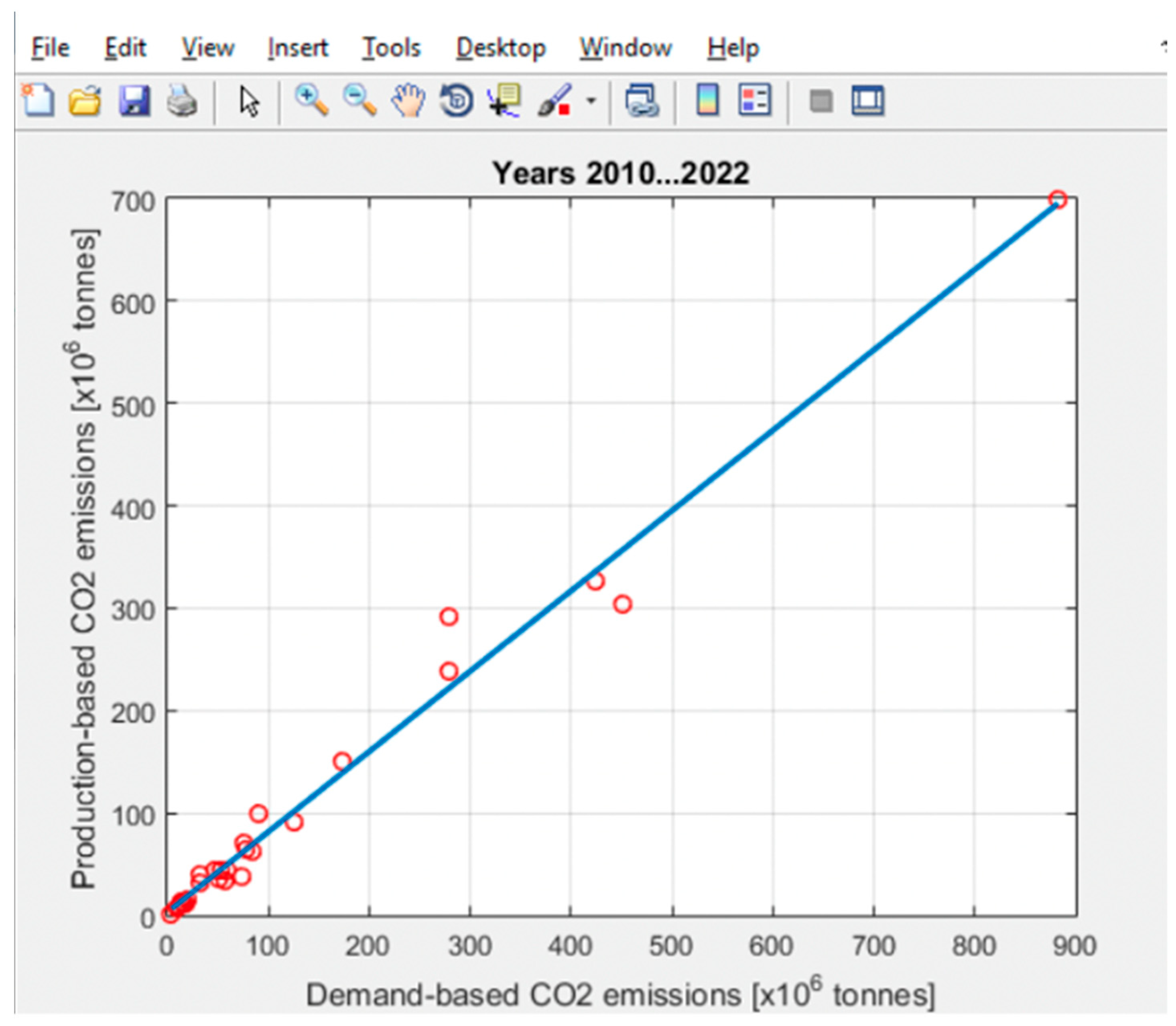
Our results have validated this hypothesis, the Pearson correlation between the two variables registering a value of 0.99 while R-squared = 0.983 and p-value = 1.053 × 10⁻²³. Moreover, as we can see in Figure 7, the linear regression model for PbCO2 = f(DbCO2), using average multi-annual values, is validated: the statistical data (red dots) is following closely the regression function chart (blue).
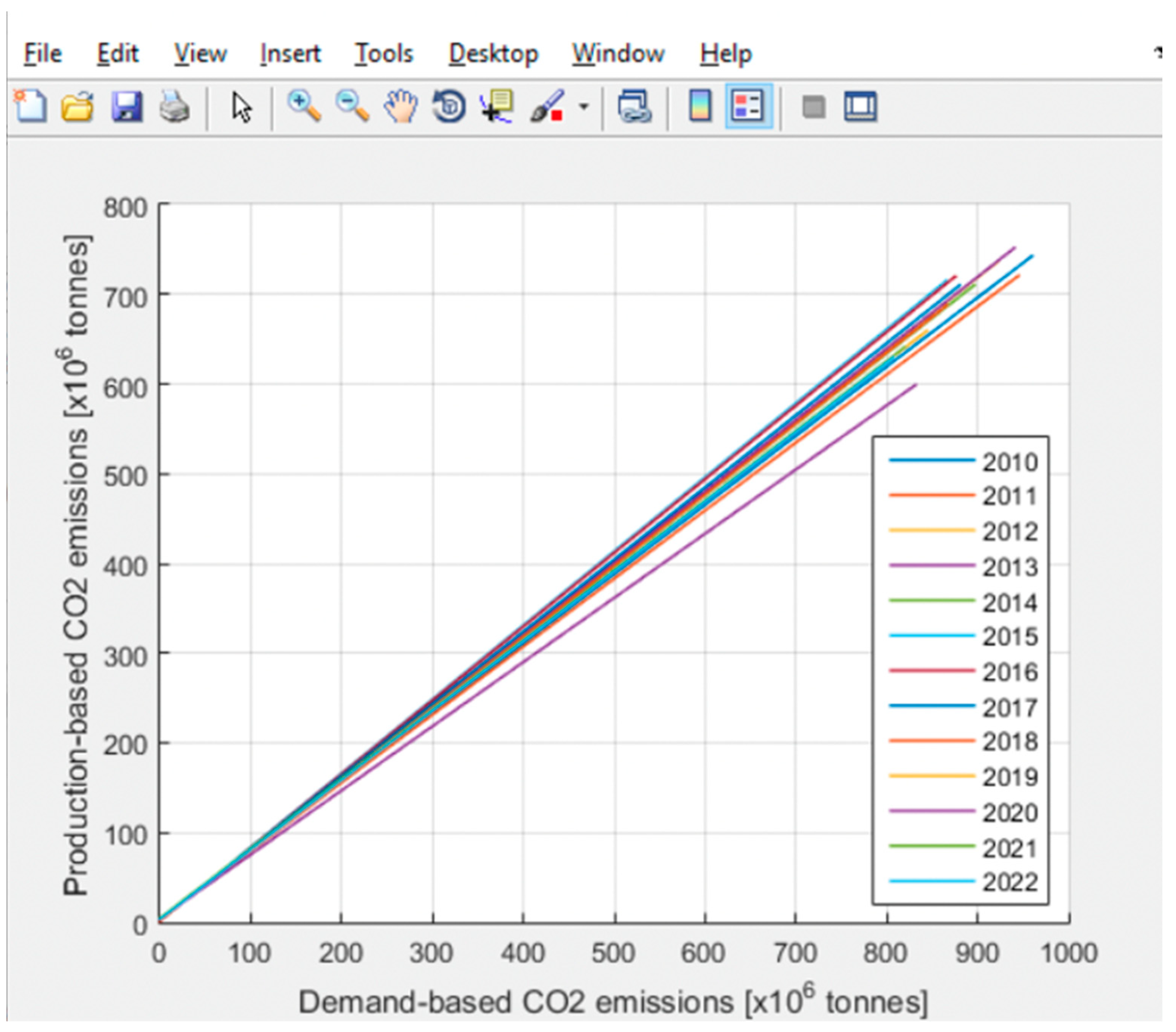
Moreover, we have calculated the linear regression function for each of the 13 years (2010–2022), and as we can see in Table 3, the R2 values range between 0.979 and 0.985 and p-values are infinitesimal (thus expressed as 0), confirming the strong correlation between the two variables for every year included in this analysis.
Figure 8 represents the chart for linear regression functions for each of the 13 years that we analyzed, the similarity of the charts further confirming the validation of the hypothesis.
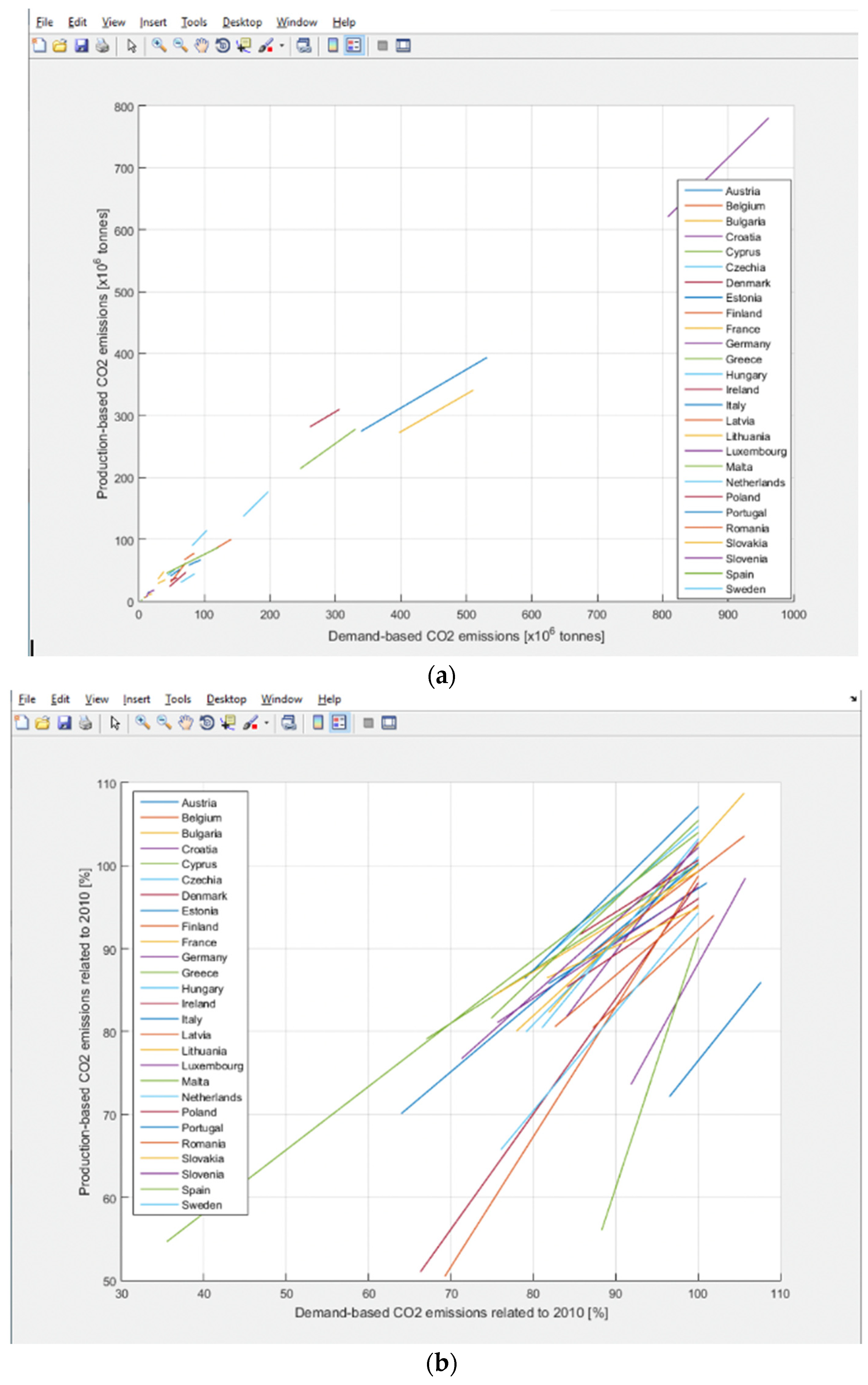
At the same time, we calculated the multi-annual linear regression function for DbCO2 and PbCO2 for each of the 27 member states both in absolute (Figure 9a) and normalized values (Figure 9b). Both figures are confirming the correlation between the two variables, while Figure 9a is also showing significant differences between the 27 countries, which can be explain by the different levels of economic development. For instance, the correlation is stronger in countries such as France, Belgium, Netherlands, Italy, and Spain, while Estonia, Hungary, Latvia, Malta, and Portugal are showing weaker correlations.
Our results that show a positive and direct relationship between demand-based CO2 emissions and production-based CO2 emissions that is consistent with several other studies. For instance, Karakaya et al. [128] found that production-based and consumption-based emissions show similar trends over time for Annex-B countries of the Kyoto Protocol, and Afionis et al. [129] reviewed the literature and concluded that production-based and consumption-based emissions are positively correlated, as countries with higher production-based emissions also tend to have higher consumption-based footprints, while research by the OECD has shown that demand-based and production-based CO2 emissions tend to follow similar trajectories, as exports and imports of emission-intensive goods offset each other to some degree. Moreover, a study by Jiang et al. [73] analyzed the carbon emissions embodied in China’s trade and found a strong positive correlation between production-based and consumption-based emissions over time, attributing this correlation to China’s status as the world factory. At the same time, Meng et al. [130] conducted a multi-region input–output analysis and concluded that production-based and consumption-based emissions tend to move in tandem globally, though the gap can widen for some individual countries, while Malik and Lan [131] examined the carbon footprint of Australia and found a high degree of correlation between production-based and consumption-based emissions, highlighting the importance of both perspectives. Other studies that confirm our results are Peters and Hertwich [132] and Peters et al. [133], both showing that as demand increases, production activities escalate, leading to higher CO2 emissions.
On the other hand, there are several other studies that manage to reach different conclusions regarding the relationship between demand-based and production-based CO2 emissions. Kanemoto et al. [132] found that the gap between production-based and demand-based emissions can grow over time, as countries offshore emission-intensive industries, while Davis and Caldeira [134] found that a significant portion of emission growth in emerging economies was due to the production of goods for export, suggesting the two metrics may not always move in lockstep. Moreover, Jorgenson and Clark [135] argued that in some high-income countries, economic growth has become less carbon-intensive due to advancements in energy efficiency and shifts towards service-oriented economies, suggesting a weaker correlation between demand-based and production-based emissions. Additionally, Ergas and York [136] question the extent of the direct relationship, emphasizing the role of technological innovation and regulatory frameworks in mitigating emissions despite high demand. Other studies that contradict our findings are Feng et al. [20] and Knight and Schor [137], who both found some highly developed and industrialized countries managed to decouple demand-based emission growth from production-based emissions through the outsourcing of carbon-intensive industries, production-based emissions growing faster than demand-based emissions due to export-oriented manufacturing.
The strong and positive correlation between demand-based and production-based CO2 emissions has several implications in terms of theory, practice, and national administration. Thus, from a theoretical point of view, the positive correlation between demand-based and production-based emissions supports the idea that economic activity, energy use, and emissions are fundamentally linked, regardless of how they are accounted for, aligning our paper with the general literature regarding the energy growth nexus. However, the divergences highlighted by some studies suggest the relationship is more nuanced, and that factors like trade, offshoring, and consumption patterns can decouple production from final demand to some degree. This points to the need for a more comprehensive, system-level understanding of the drivers of emissions.
At the same time, the validation of this hypothesis reinforces the theories of environmental economics, particularly the environmental Kuznets curve (EKC) hypothesis. The EKC suggests that as economies grow, environmental degradation increases up to a certain point, after which it starts to decline due to increased environmental awareness, better technologies, and regulatory policies. The correlation highlights the ongoing challenge of mitigating emissions in the face of rising demand, emphasizing the need for sustainable consumption and production patterns. In addition, our findings support the theory of demand-driven emissions, suggesting that consumer behavior and economic demand are key drivers of both local and global CO2 emissions, thus challenging the notion that emissions are primarily a supply-side issue and emphasizes the role of consumption patterns in climate change.
From a practical standpoint, the positive correlation implies that policies and interventions targeting production-based emissions, such as industrial decarbonization, can have spillover benefits in terms of reducing demand-based footprints as well. However, the existence of a gap between the two metrics also suggests the need to consider both production and consumption perspectives when designing climate policies. Focusing only on production-based targets may miss important leaks, losses, and offshoring effects.
Understanding the direct link between demand-based and production-based CO2 emissions has practical implications for businesses and industries. Companies need to adopt more sustainable production practices and improve energy efficiency to meet consumer demand without proportionately increasing emissions. This might involve investing in renewable energy sources, optimizing supply chains, and implementing circular economy principles. Furthermore, consumers can play a role by making more environmentally conscious purchasing decisions, driving demand for greener products.
From an economic point of view, the validation of H1 highlights the intrinsic connection between consumption and production activities within the EU-27 economies. Economically, this suggests that as consumer demand increases, production activities ramp up, leading to higher CO2 emissions. This relationship also highlights the challenge of decoupling economic growth from carbon emissions, as traditional economic activities tend to escalate production in response to demand, thereby increasing emissions. Policymakers should consider strategies that focus on reducing the carbon intensity of production processes and promoting sustainable consumption patterns to mitigate this effect.
In terms of policy, the findings highlight the importance of using both production-based and demand-based emission accounting to inform climate policy. Production-based data remains crucial for national reporting and target-setting under frameworks like the Paris Agreement. Policymakers should consider a mix of supply-side and demand-side measures to achieve emission reductions since demand-based analysis can provide additional insights to identify carbon-intensive consumption patterns, address carbon leaks and losses, and promote more sustainable production and consumption systems globally. In addition, policies should aim to reduce the carbon footprint of goods and services throughout their lifecycle, from production to consumption. This could involve implementing carbon taxes, encouraging sustainable production methods, and promoting consumer awareness and education. Additionally, international cooperation is essential to address emissions embodied in trade, ensuring that emission reductions in one country do not simply result in higher emissions elsewhere.
H2: 
There is a direct positive correlation between production-based CO2 emissions (PbCO2) and final energy consumption (FEC)—validated.
In the last century, the energy consumption of the European countries has been steadily growing due to the continuous transformations in the economies and environment. Currently, the energy consumption continues to grow, but it at a slower rate, averaging around 1% to 2% per year [138]. Final energy consumption (FEC) is an important contributing factor for CO2 emissions, but there are several scholars that propose a correlation running from CO2 emissions towards energy consumption [138,139]. In this sense, we should consider the availability of energy as well as its influence on both the economic and natural environment. Moreover, Ritche et al. [138] highlights the importance of the different types of energy sources (fossil, nuclear, hydro, solar, wind, etc.) as well as the ratio of these sources in a nation’s total energy production and consumption.
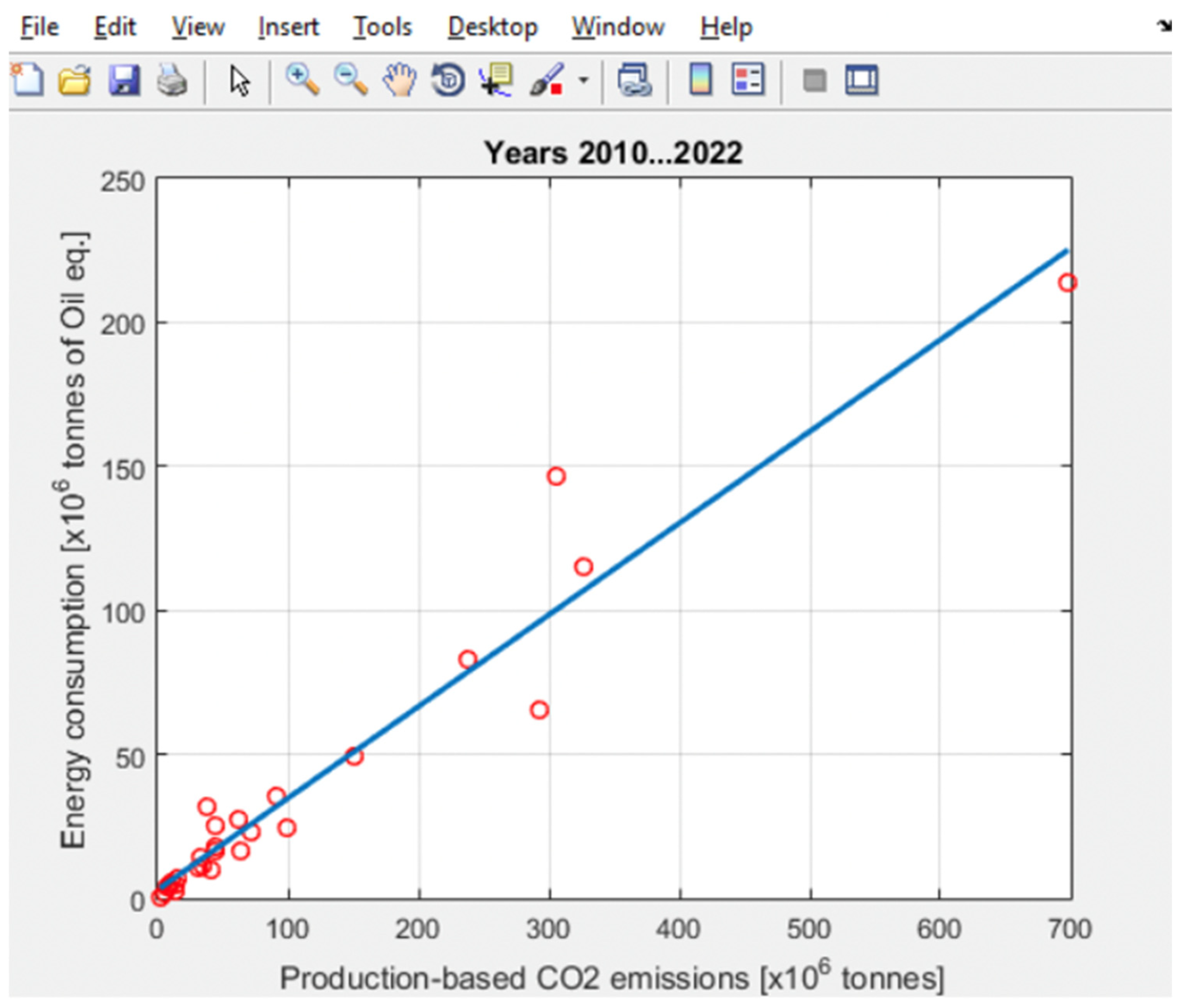
In order to test the correlation between CO2 emissions and energy consumption, first, we looked at the Pearson coefficient (Table 2), which has a value of 0.97, indicating a strong direct correlation between the two variables. Moreover, we applied a linear regression equation to the multi-annual averages of the two variables, registered R-squared = 0.94 and p-value = 9.34 × 10⁻¹⁷, both coefficients showing a strong correlation. Figure 10 is showing the linear regression chart for FEC = f(PbCO2), which indicates a strong correlation since the statistical data (red dots) is following closely the regression function (blue line).
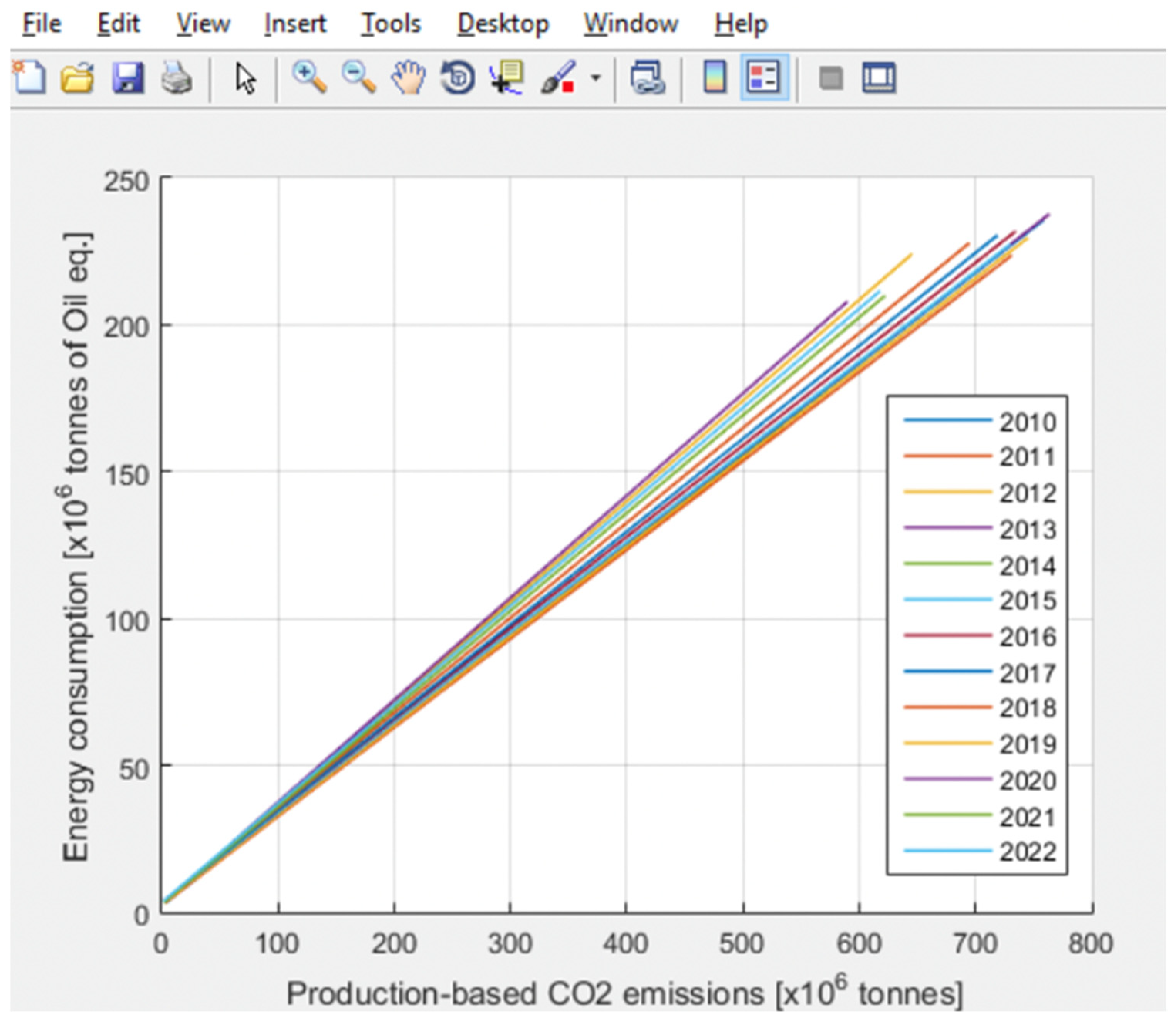
Moreover, we applied a linear regression model for FEC = f(PbCO2) for each of the 13 years (2010–2022), registering R-squared values between 0.945 and 0.981 and p-values extremely close to 0, thus further confirming our assumption that CO2 emissions have a direct and positive influence on energy consumption. The linear regression chart for the 13 years can be seen in Figure 11.
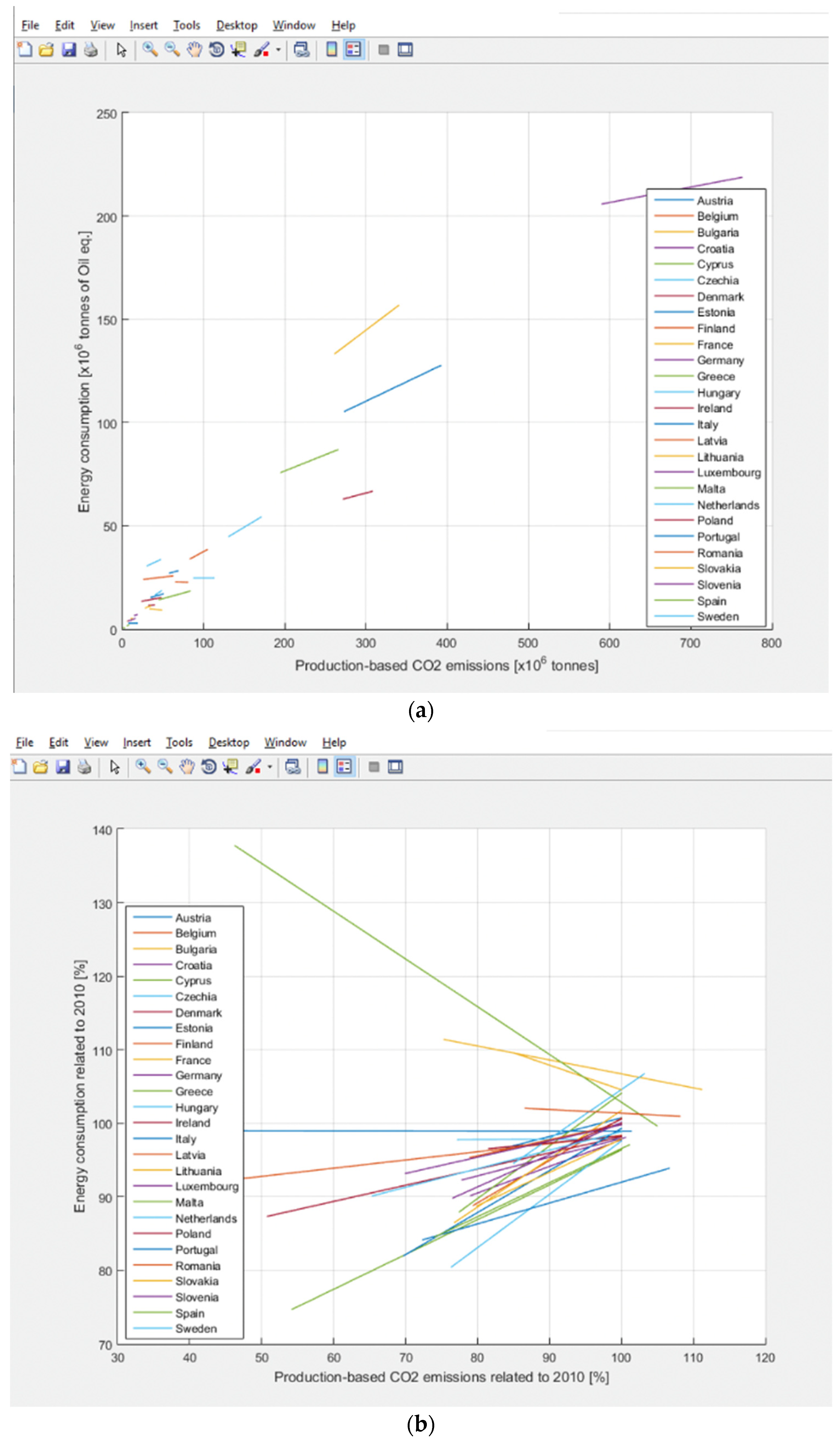
Moving on, we applied the linear regression function for each of the EU-27 member countries, both in absolute (Figure 12a) and normalized values (Figure 12b).
As it was the case with H1, the linear regression functions for each country are highlighting the different levels of economic development present among the 27 member countries of the European Union. For 23 of the 27 countries, the linear regression function is showing a positive influence of PbCO2 on FEC, meaning that an increase in carbon emissions causes an increase in energy consumption, thus confirming our second hypothesis. Bulgaria, Estonia, Lithuania, and Malta are the only countries that are showing negative influence of PbCO2 on FEC that could be explained by a higher rate of use of renewable energy.
The validation of H2 means that we managed to find a significant positive correlation between CO2 emissions and energy consumption, a result that is consistent with several other studies from the literature. For instance, a study by Li et al. [66] found a strong positive correlation between production-based emissions and energy use across countries, arguing that economic activities and energy consumption are the key drivers of global CO2 emission growth, while Meng et al. [130] also showed that production-based and consumption-based emissions tend to move in tandem globally, as energy use for domestic production is a major determinant of a country’s carbon footprint. In addition, Malik et al. [128] examined the case of Australia and concluded that production-based emissions are closely linked to the country’s energy consumption patterns and economic structure, and Kaya and Yokobori [57] introduced the Kaya Identity, which explicitly links CO2 emissions to energy consumption, economic output, and carbon intensity. Similarly, studies by Wang et al. [74], Sadorsky [79], and Perone [140] have empirically validated the strong relationship between CO2 emissions and energy consumption.
While most of the evidence support our findings, there are a few studies that have found more complex or divergent relationships between production-based emissions and final energy use. Some research has shown that the relationship can be influenced by factors like energy efficiency improvements, structural changes in the economy, and the decarbonization of energy supplies [123,141,142]. Moreover, a study by Kanemoto et al. [143] argued that the offshoring of emission-intensive industries can lead to a growing disconnect between a country’s domestic energy use and its production-based emissions, while Peters and Hertwich [132] cautioned that relying solely on production-based data may not fully capture the emissions embodied in a country’s consumption and trade patterns. Similarly, studies by Ang [11] and Stern [144] argue that energy consumption does not necessarily equate to higher CO2 emissions if there is a significant shift towards renewable energy sources and improvements in energy efficiency. These studies suggest that technological advancements and energy policy reforms can decouple energy consumption from CO2 emissions, indicating that under certain conditions, the correlation may not be as direct or positive as hypothesized. Other studies that found contradicting evidence related to the correlation between CO2 emissions and energy consumption are Ozturk and Acaravci [15], who found no long-run relationship between energy consumption and CO2 emissions in Turkey, suggesting that the correlation might not hold universally, and Coondoo and Dinda [145], who observed bidirectional causality between income and emissions in developed countries, implying that the energy–emission relationship might be more complex in certain economies.
The validation of this hypothesis has several implications in terms of theory, practice, and administrative policy. From a theoretical point of view, the positive correlation between production-based emissions and final energy consumption aligns with established economic theories on the energy growth nexus. It suggests that economic activities, energy use, and emissions are fundamentally linked, as energy is a key input to production processes. However, the divergences highlighted by some studies indicate that the relationship is more nuanced and can be influenced by technological, structural, and policy factors. This points to the need for a more comprehensive, system-level understanding of the drivers of emissions and energy use. Moreover, our findings align with the environmental Kuznets curve (EKC) hypothesis, which posits that environmental degradation initially increases with economic growth (and thus energy consumption) but decreases after reaching a certain income level due to greater environmental awareness and cleaner technologies. It also supports the IPAT equation (impact = population × affluence × technology), where energy consumption is a key factor influencing environmental impact.
The practical implications of this correlation are significant for industries and businesses. Companies need to focus on reducing energy consumption through efficiency improvements and adopting cleaner technologies. This may involve investing in energy-efficient machinery, optimizing production processes, and transitioning to renewable energy sources. Furthermore, businesses can achieve competitive advantages by lowering their carbon footprint, meeting regulatory requirements, and addressing consumer demand for sustainable products, while efforts to reduce emissions should focus on improving energy efficiency in the production processes.
The strong positive correlation between production-based CO2 emissions and final energy consumption indicates that energy consumption is a significant driver of carbon emissions in the production sector. From an economic perspective, this relationship suggests that energy-intensive industries are likely contributing substantially to the overall carbon footprint of the EU-27 economies. To achieve economic growth while managing emissions, it is essential to improve energy efficiency across industries and shift towards cleaner energy sources. Investments in renewable energy and energy-saving technologies could play a critical role in sustaining economic growth while reducing the carbon intensity of production activities.
Regarding administrative policies, the positive correlation implies that policies and interventions targeting final energy consumption, such as energy efficiency measures and fuel switching, can have direct benefits in terms of reducing production-based emissions as well. At the same time, national governments should focus the policies on implementing standards and incentives for energy-efficient technologies and practices, promoting the adoption of renewable energy sources through subsidies, tax incentives, and infrastructure investments, introducing carbon taxes or cap-and-trade systems to internalize the external costs of CO2 emissions and investing in R&D to drive innovations in clean energy technologies and low-carbon industrial processes.
H3a: 
There is no significant correlation between final energy consumption (FEC) and CO2 productivity (CO2_prod)—validated.
Final energy consumption is an indicator that measures the final users’ (agriculture, industry, services, transport, and households) actual energy use, while CO2 productivity is an indicator of economic development that measures the amount of GDP (in EUR) that a kilogram of CO2 emissions is generating.
The relevant literature [1,15,57,93,95,112,113,114,115,116,117,118,119,120,121,122,123,124,125,126,146,147,148,149] identifies four different causal relationships between energy consumption and economic development: the growth, conservation, feedback, and neutrality hypothesis. The neutrality hypothesis assumes that there is no significant correlation between the two variables and represents the theoretical basis upon which we have constructed the third and fourth hypothesis.
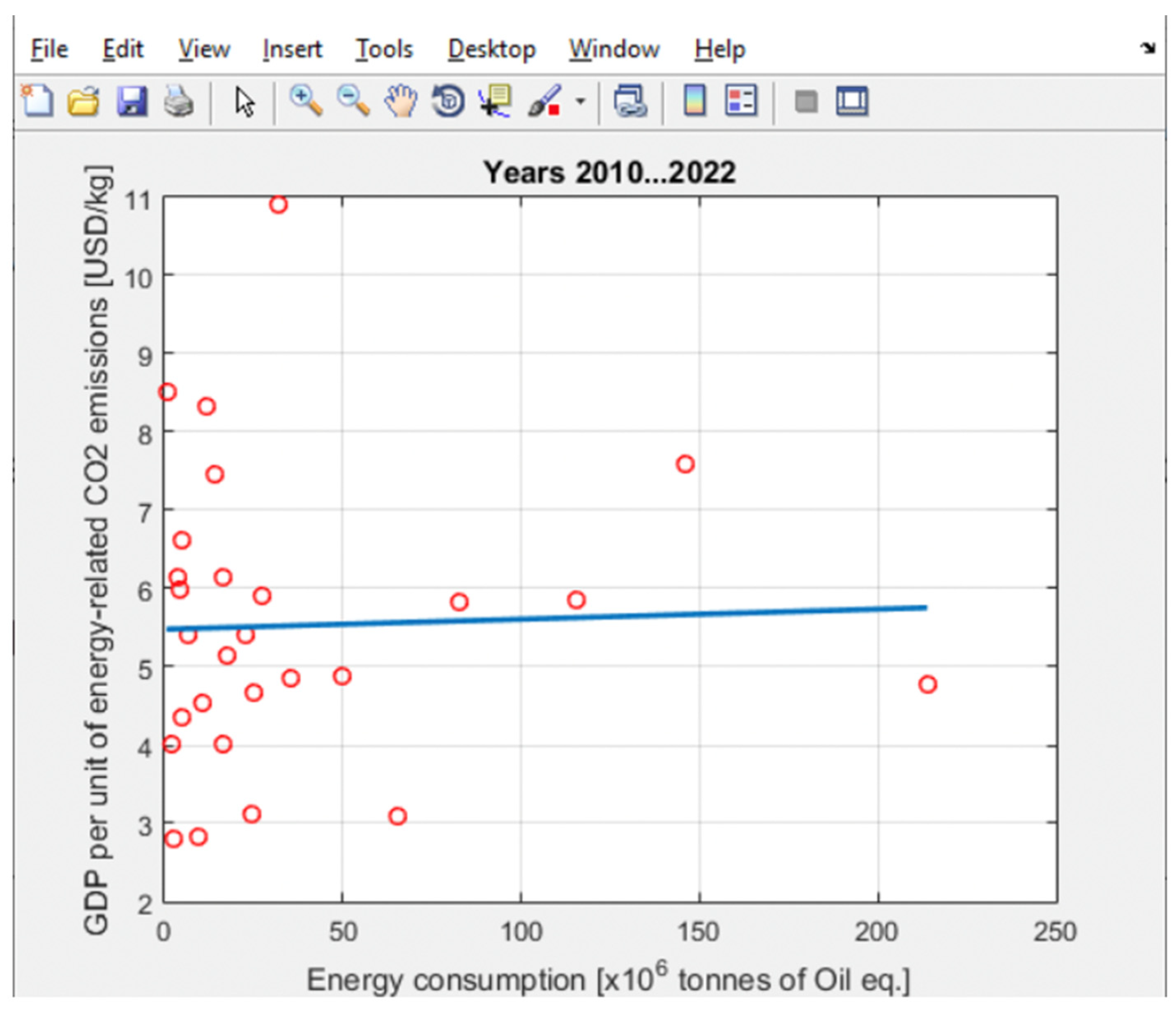
Our results have validated this hypothesis, confirming the lack of correlation between FEC and CO2_prod, thus aligning our study with the neutrality hypothesis literature. As we can see from the correlation matrix in Table 2, the Pearson correlation between the two variables is 0,04, which indicates a very weak or non-existent relationship. Moreover, the results of the linear regression model (based on the multi-annual means for each variable for each of the EU-27 countries) have returned R-squared = 0.00118 and p-value = 0.865, which further confirm the lack of a significant correlation between final energy consumption and CO2 productivity.
Figure 13 shows the chart of the regression function CO2_prod = f(FEC), being a suggestive image of the lack of correlation between FEC and CO2_prod: the regression function, pictured in blue, cannot forecast the statistical data (red dots).
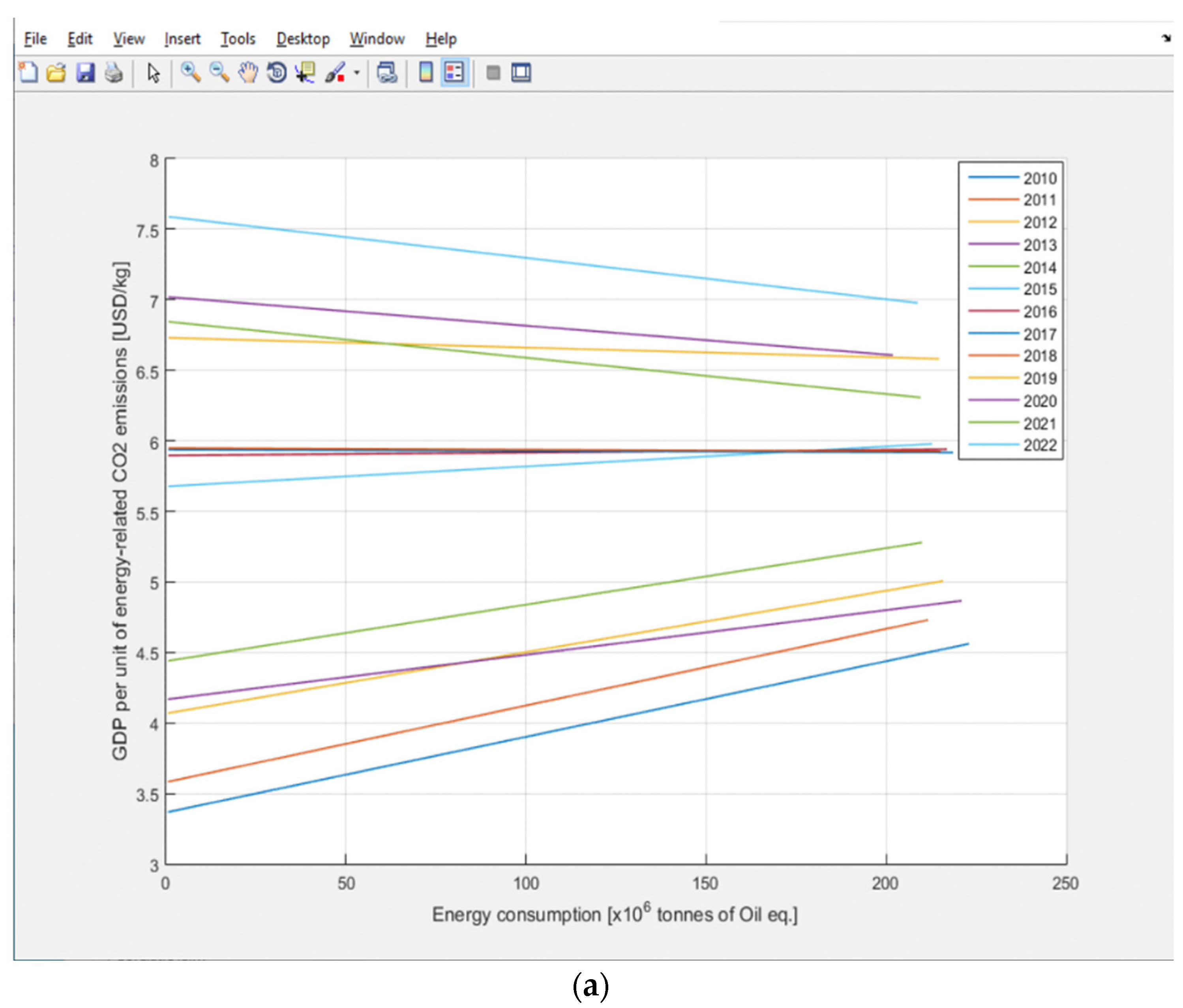
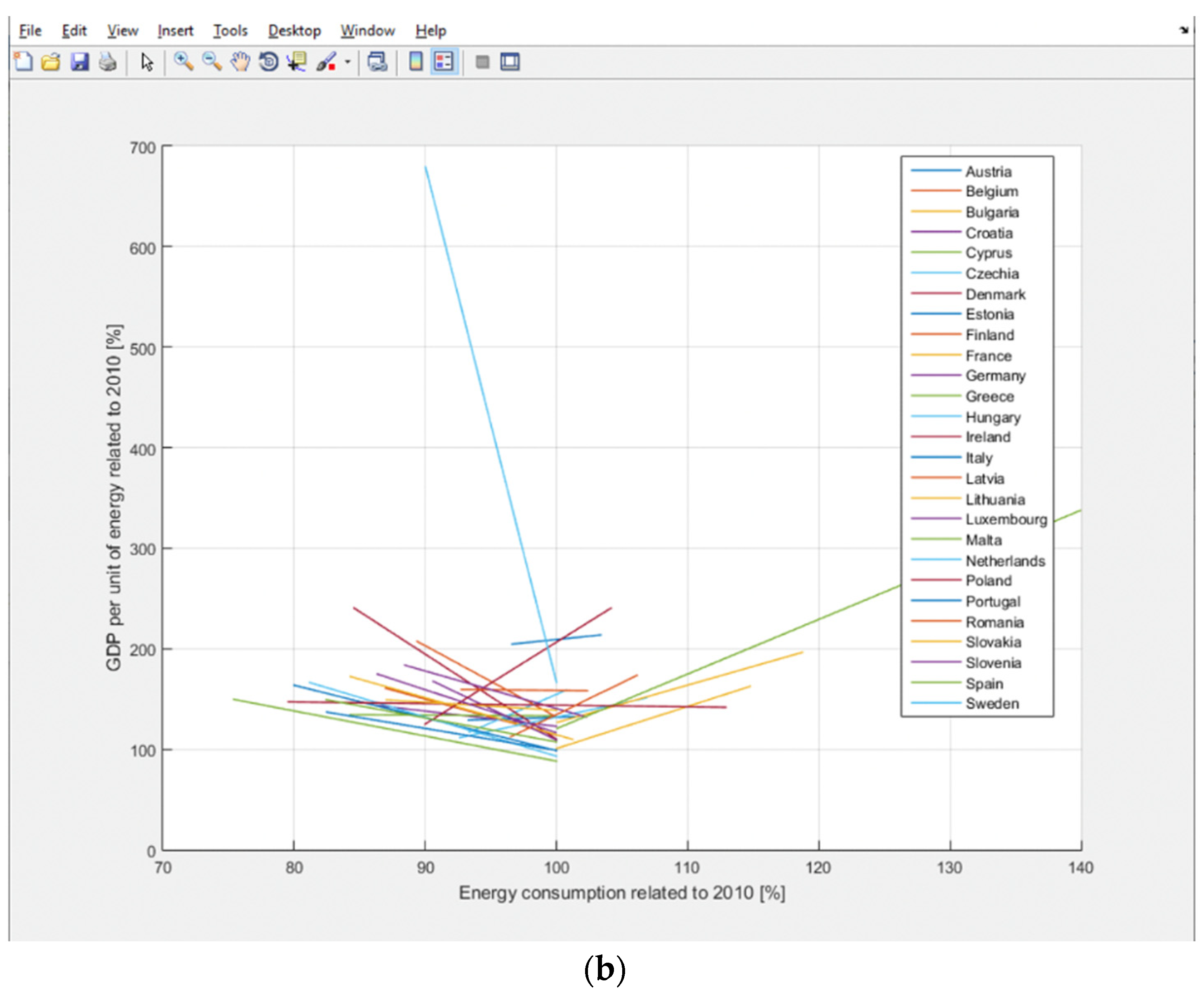
Moreover, we calculated the linear regression function for the two variables for each of the 13 years, 2010–2022 (Figure 14a), and for each of the EU-27 states (Figure 14b), normalized and based on 2010. Both figures confirm that there is no significant correlation between FEC and CO2_prod across either the 13 years or the 27 countries.
Since both H3a and H3b refer to the correlation between energy consumption and economic development, the discussion of these results will be performed together in the following pages.
H3b: 
There is no significant correlation between final energy consumption (FEC) and GDP/capita—validated.
This hypothesis is related to the energy growth nexus as well, assuming a lack of a statistically significant correlation between the final energy consumption and GDP/capita as an economic growth indicator, being aligned with the neutrality hypothesis. As we said before, FEC is an indicator that measures the energy consumption of final users except for the energy used by the energetic industry itself and the potential losses along the value chain, while GDP is a measurement of the economic output of a country per person, often used as an indicator of the standard of living and economic health of a nation. This metric helps to understand and compare the average economic performance and wealth distribution among countries or regions. Higher GDP per capita generally indicates a higher standard of living and greater economic prosperity for the population.
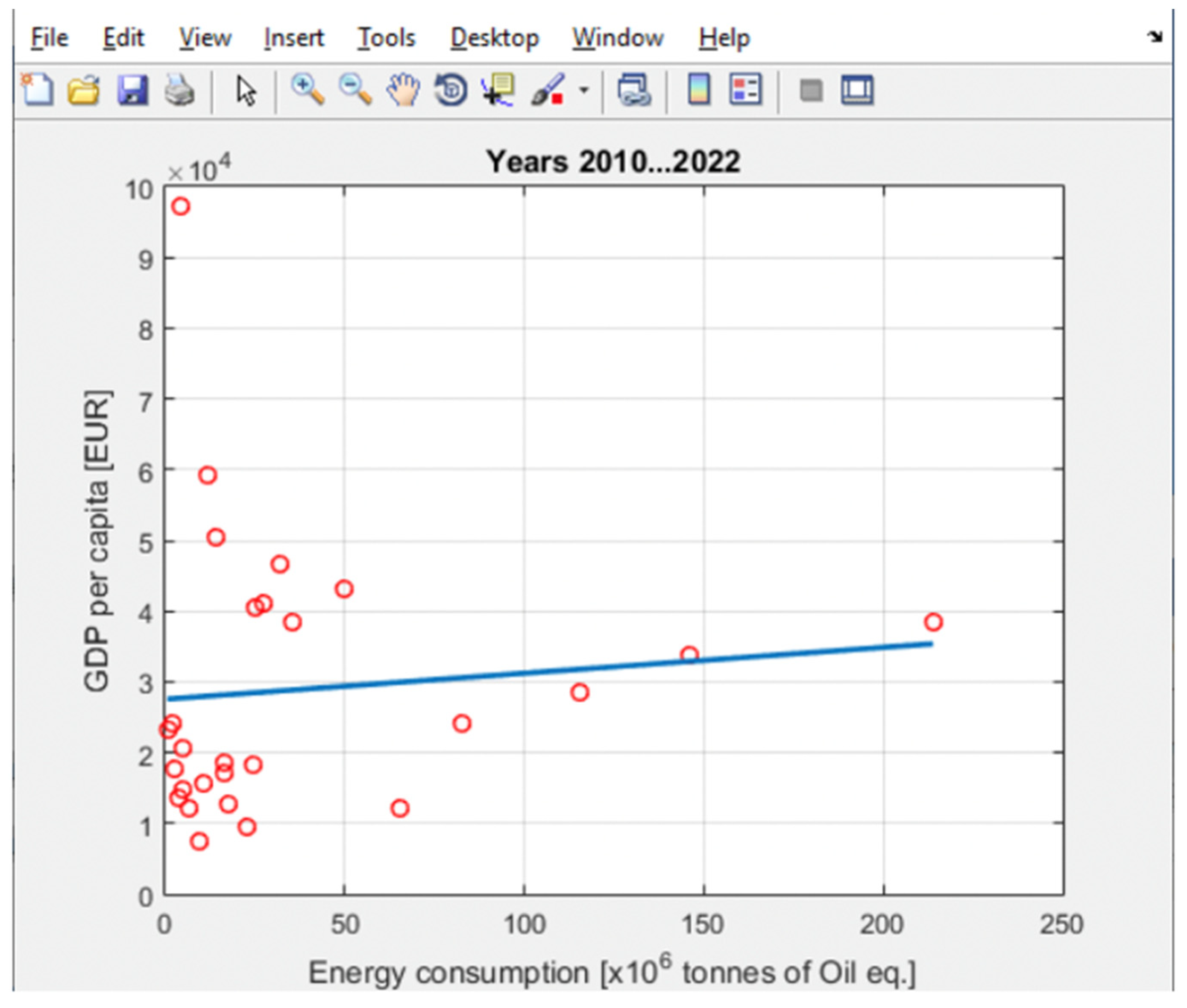
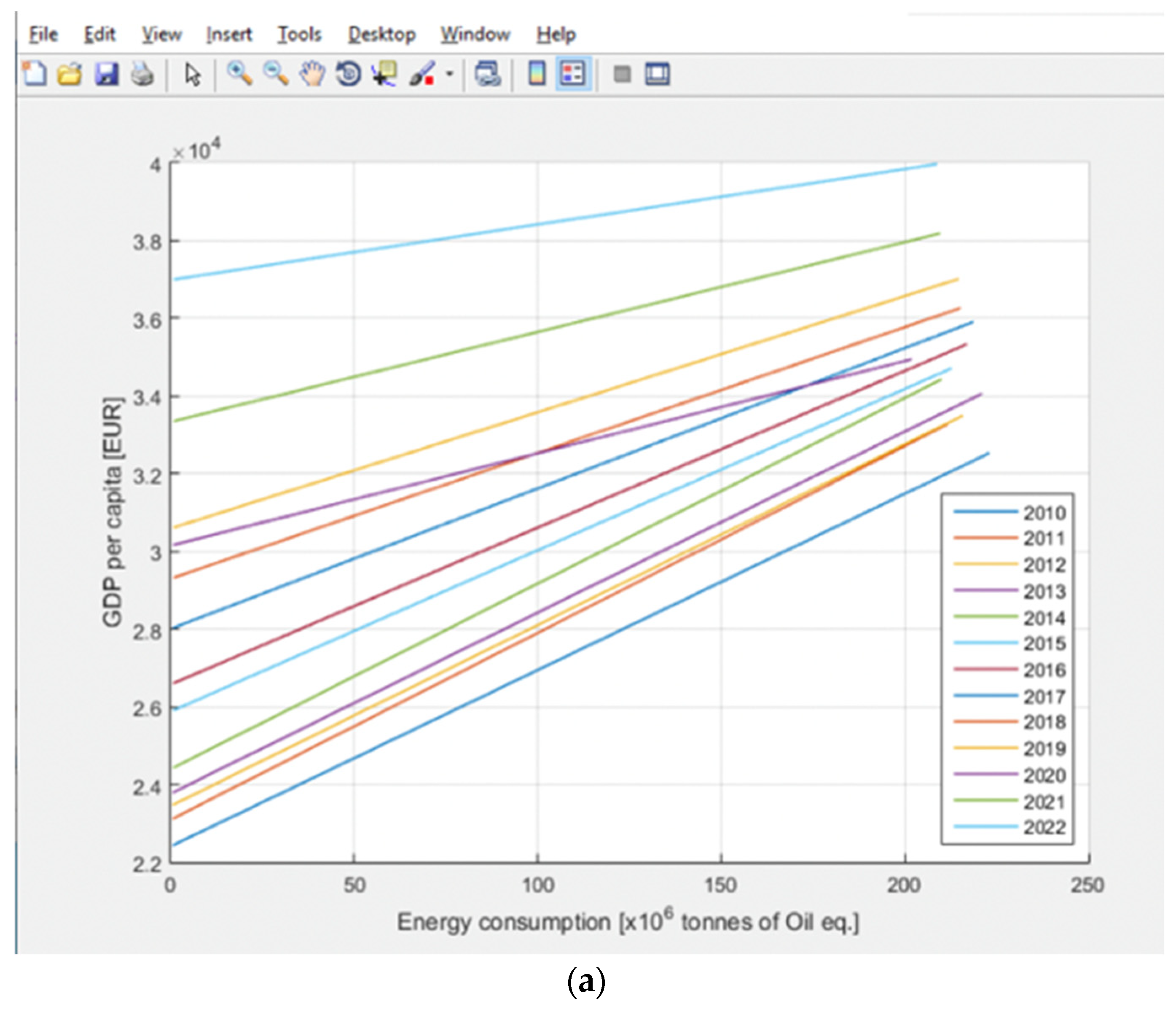
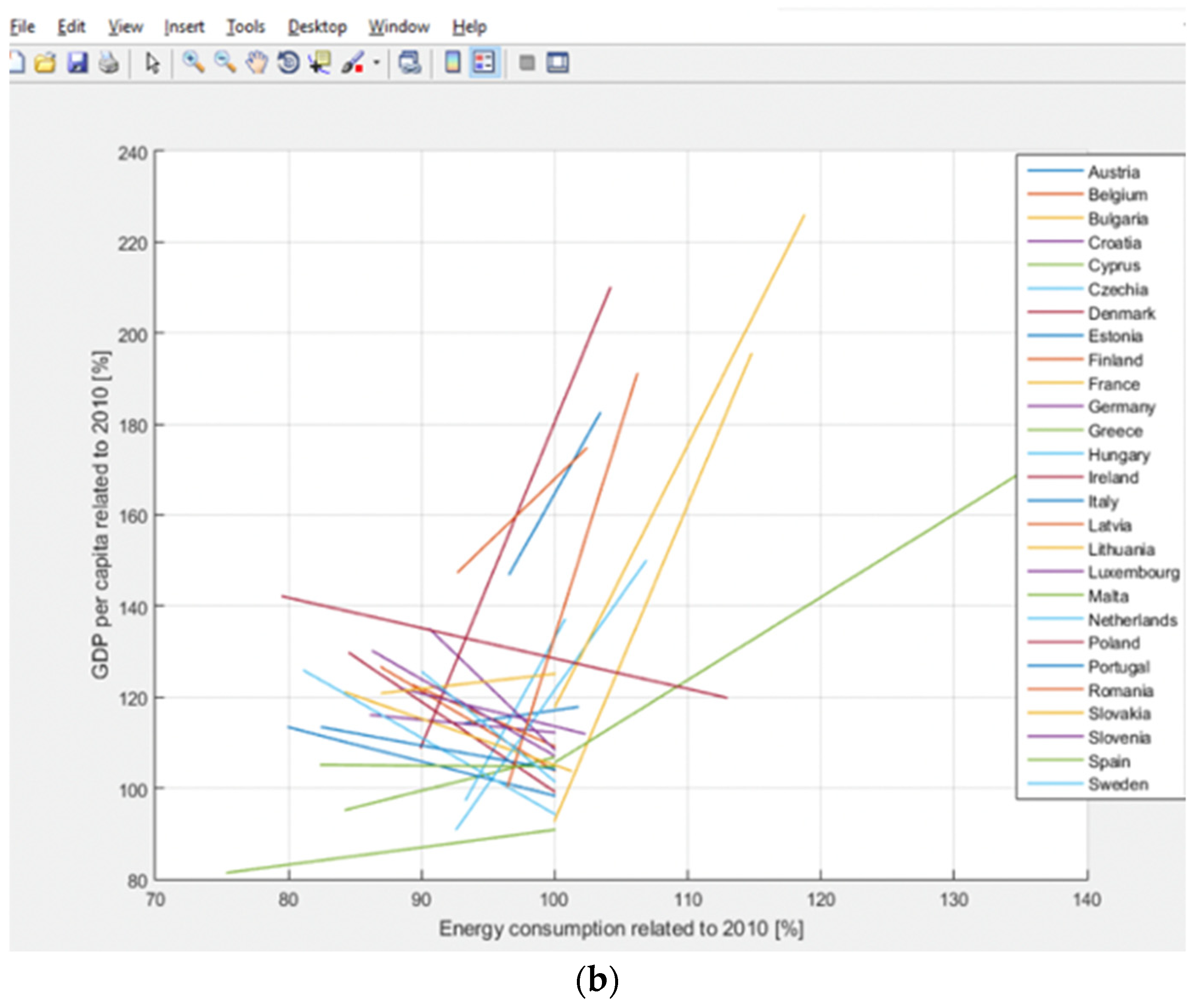
Similar to H3a, H3b has been validated, meaning we did not find any significant correlation between FEC and GDP/capita, confirming our study’s alignment with the neutrality hypothesis of the energy growth nexus. According to the correlation matrix from Table 2, the Pearson correlation for this pair of variables is 0,11, which shows a possible weak direct and positive relationship between FEC and GDP/capita. As with the other pairs of variables, we calculated the multi-annual means for each variable and then proceeded to calculate the linear regression function GDP/capita = f(FEC). The function’s chart can be seen in Figure 15, and our results have yielded R-squared = 0.00886 and p-value = 0.641, both indicators showing a lack of significant correlation between the two variables. As we can see in Figure 14, the statistical data (the red dots) are spread out and do not follow the regression function, further confirming that in the EU-27 countries, there is no significant relationship between energy consumption and economic development.
Moving on, we continued our analysis with the linear regression function for GDP/capita = f(FEC) for each of the 13 years (Figure 16a) as well as for each of the 27 member states of EU (Figure 16b), the latter using normalized values based on the year 2010. The two charts further confirm the validation of our hypothesis and our study’s alignment with the neutrality theory of the energy growth nexus.
As we said before, our results align our study with the neutrality hypothesis, which states that there is no significant correlation between energy consumption and economic development. Ozturk [150], in his literature review of over 100 papers regarding the energy growth nexus, has identified several studies that align with the neutrality hypothesis and thus support our results: Akarca and Long [151]; Yu and Hwang [152]; Yu and Jin [153]; Payne [154] for the USA; Altinaty and Karagol [155], Jobert and Karanfil [63], and Halicioglu [156] for Turkey; and Begum et al. [157] for Malaysia. More recent studies that also confirm our results are Ozturk and Acaravci [15], who analyzed GDP/capita, CO2 emissions/capita, total energy consumption/capita, and the employment rate in Turkey for 38 years (1968–2005), as well as Dogan [48], Lin et al. [158], Bekun et al. [159], Menyad and Wolde-Rufael [160], and Kohler [161], who found no significant correlation between energy consumption and economic growth for several African countries. At the same time, Tudor et al. [57], in their research study regarding the empirical correlations between energy efficiency, energy productivity, energy use, and economic development in the EU states, could not find a significant correlation between energy consumption and energy productivity.
There is no consensus among the myriad of studies on the energy growth nexus, and thus, our results are contradicted by other studies, which fall into the growth, conservation, or feedback hypothesis. The growth hypothesis states that there is direct and unidirectional correlation between energy consumption and economic growth, considering energy consumption as a significant factor for economic growth, either directly or as a support to capital and labor. Therefore, policies aimed at conserving energy to protect the environment are likely to hinder the process of economic growth. This growth hypothesis is supported by Alam et al. [162] for Bangladesh; Alshehry and Belloumi [163] for Saudi Arabia; Lee et al. [164], Ozturk, and Acaravaci [15] for Switzerland; Asafu-adjaye [165], Yoo and Kim [166], Wahid et al. [167], and Chandran and Tang [168] for Indonesia; Stern [169], Stern [170], and Bowden and Payne [171] for the USA; Soytas et al. [98] for Turkey; Oh and Lee [172] for Korea; Lee and Chang [173] for Taiwan; and Ho and Siu [174] for Hong Kong.
On the other hand, the conservation hypothesis states that there is a unidirectional correlation running from economic growth to energy consumption, which implies that energy conservation measures will not hinder economic growth. This hypothesis, which also contradicts our results, is supported by Chang [175] for China; Govindaraju and Tang [176] for India; Soile [177], Hwang and Yoo [178], and Khan et al. [179] for Indonesia; Farhani et al. [124] for Tunisia; Salahuddin and Gow [180] for GCC Countries (Bahrain, Kuwait, Oman, Qatar, Saudi Arabia, and the United Arab Emirates); Kraft and Kraft [181] and Abosedra and Baghestani [182] for the USA; Cheng and Lai [183] for Taiwan; Aqeel and Butt [120] for Pakistan; Lise and Van Montfort [184] for Turkey; and Zhang and Cheng [185] for China.
The third hypothesis of the energy growth nexus that contradicts our studies is called the feedback hypothesis and assumes a bidirectional correlation between energy consumption and economic growth. In this particular case, environmental protection measures need to be carefully regulated to avoid the negative impacts of biased policy selection on both economic growth and ecological balance as well as the energy consumption budget. This hypothesis has been confirmed by Pao and Tsai [100] and Sebri and Ben-Salha [186] for BRICS countries; Eggoh et al. [187], Mahadevan and Asafu-adjaye [188], Chiou et al. [189], and Shahbaz et al. [102] for Indonesia; Hwang and Gum [190] for Taiwan; Glasure [191] for Korea; Hondroyiannis et al. [192] for Greece; and Erdal et al. [193] for Turkey.
The fact that the validation of H3a and H3b aligns our results with the neutrality hypothesis of the energy growth nexus has several theoretical, practical, and administrative implications. First of all, from a theoretical point of view, our findings highlight the complex nature of economic development, suggesting that factors other than energy consumption may play more significant roles in determining GDP per capita and CO2 productivity, such as advancements in energy efficiency, shifts towards cleaner energy sources, more efficient human capital practices, economic development, the structure of the economy, the energy mix, technological progress, and institutional and policy frameworks.
From a practical point of view, the neutrality hypothesis implies a potential decoupling of economic growth from energy consumption, supporting the argument that economic growth can be achieved without a proportional increase in energy use, a theory known as absolute decoupling. According to Ritchie [138], this has already been achieved in countries like Sweden and Denmark (included in our study) as well as the UK and Switzerland (not included in our study). Absolute decoupling can be achieved through investing in the right kinds of capital and infrastructure to drive clean, green, job-rich growth, as well as transforming key systems like energy, transport, industry, cities, and land through innovation, institutional change, standards, regulation, and good policy and implementing policies to foster investments, innovation, and a just transition. Moreover, investing in energy efficiency and clean energy technologies can drive productivity gains while reducing energy use. By 2030, low-carbon solutions could be competitive in sectors accounting for nearly three-quarters of emissions, compared to one-quarter today.
At the same time, economic growth does not have to mean more consumption but rather better consumption. Putting a monetary value on protecting the environment means people will pay the true cost of their consumption. Taxing pollution generates a “double dividend” by restoring fair competition between polluting and non-polluting products and generating tax revenue to invest for everyone’s benefit.
The lack of a significant correlation between energy consumption and CO2 productivity suggests that increasing energy consumption does not necessarily lead to proportional improvements in carbon efficiency. Economically, this implies that merely consuming more energy does not enhance the ability of economies to produce more output per unit of CO2 emitted. This finding is particularly relevant for policymakers, as it indicates the need for targeted investments in technologies and practices that enhance CO2 productivity rather than focusing solely on increasing energy consumption. Policies should prioritize innovation in energy-efficient processes and technologies that can decouple energy use from carbon emissions.
Moreover, the absence of a significant correlation between final energy consumption and GDP per capita suggests that economic growth in the EU-27 is not heavily dependent on increases in energy consumption. This finding aligns with the concept of decoupling, where economies can grow without a corresponding rise in energy use. Economically, this indicates that the EU-27 countries may be transitioning towards more energy-efficient and service-oriented economies, where value is generated with less reliance on energy consumption. For policymakers, this emphasizes the importance of fostering sectors that contribute to GDP growth without increasing energy demand, such as digital services, knowledge-based industries, and green technologies.
From an administrative perspective, the lack of a strong link between energy consumption and economic growth suggests that policymakers may have more flexibility in designing energy policies without fear of significantly impacting economic growth. Environmental policies aimed at reducing CO2 emissions should focus more on regulatory frameworks, carbon pricing mechanisms, and the promotion of clean energy technologies, rather than simply targeting reductions in energy consumption, as well as other policies that foster energy efficiency, economic diversification, innovation in high-value sectors, sustainable energy sources and resilience to energy price fluctuations. At the same time, authorities could develop sector-specific policies that focus on reducing energy intensity and improving CO2 productivity in industries where the impact on economic growth is minimal and prioritize energy efficiency measures and conservation strategies to mitigate environmental impacts without significantly affecting economic development.
Recognizing the global context of climate change, national policies could align with international agreements and commitments (e.g., Paris Agreement) by setting ambitious targets for emission reductions and promoting global cooperation in technology transfer and capacity-building in renewable energy. National authorities should emphasize educating the public about the importance of energy conservation and sustainable practices, which could foster a culture of environmental responsibility, supporting broader conservation efforts beyond policy frameworks alone.

5. Conclusions

Our paper aimed to study the relationship between CO2 emissions, energy consumption, and economic development for the 27 European Union member states over the period 2010–2022. Utilizing Eurostat [7,8] and OECD [9] data and employing linear regression models, our study confirmed four key hypotheses that shed light on the dynamics of CO2 emissions and energy consumption in the European context.
By providing a comprehensive analysis of the EU-27 countries over a twelve-year period, this paper contributes to the ongoing discourse on sustainable development and climate change mitigation. The findings underscore the necessity for integrated approaches that address both production and consumption emissions, highlight the critical role of energy efficiency, and question the efficacy of increasing energy consumption as a means to boost economic productivity or CO2 efficiency. Through this study, we aimed to inform more nuanced and effective strategies for reducing CO2 emissions while supporting economic growth within the European Union.
First, we validated a positive correlation between demand-based CO2 emissions (DbCO2) and production-based CO2 emissions (PbCO2), indicating that increases in consumer demand drive production activities, leading to higher emissions. This finding underscores the need for policies that integrate both production and consumption strategies to effectively reduce CO2 emissions. However, given the mixed evidence in the literature regarding the relationship between production-based and demand-based carbon emissions, further research is needed to fully understand the relationship between production-based and demand-based emissions and the factors that can drive divergence between the two metrics. Overall, the positive correlation between the two emission accounting methods not only provides valuable empirical support but also highlights the need for a more nuanced, multi-dimensional understanding of the complex relationship between economic activity, energy use, and environmental impact.
Moving on, we confirmed Hypothesis 2 (H2), indicating a direct, positive, and unidirectional correlation between production-based CO2 emissions and final energy consumption. This result reinforces the established understanding that energy consumption, predominantly derived from fossil fuels, is a significant contributor to production-based CO2 emissions. The findings emphasize the importance of enhancing energy efficiency and transitioning to renewable energy sources within the production sector to reduce overall emissions, but the existence of a potential gap between the two metrics also suggests the need to consider both production and consumption perspectives when designing climate policies. Focusing only on production-based targets may miss important leakage and offshoring effects.
Interestingly, our analysis reveals (H3a and H3b) that there is no significant correlation between final energy consumption and CO2 productivity or between final energy consumption and GDP per capita, suggesting that increases in final energy consumption do not necessarily translate into improvements in CO2 productivity or economic growth per capita. These findings challenge some conventional assumptions about the relationships between energy use, economic output, and carbon efficiency, aligning our study with the neutrality hypothesis of the energy growth nexus literature. They suggest that EU countries have achieved varying levels of decoupling between energy consumption and both economic growth and carbon productivity.
Future research should delve deeper into sector-specific analyses to identify high-impact areas and explore the potential of emerging technologies to further reduce CO2 emissions. Additionally, investigating the role of behavioral changes and policy interventions in shaping energy consumption and emission patterns could provide valuable insights for more effective climate action. At the same time, we recommend that scholars should explore the various channels and mechanisms through which energy use, economic growth, and environmental factors interact as well as incorporate contextual factors in order to better understand the heterogeneity in the energy growth nexus. Moreover, the validation of the neutrality hypothesis calls for the expansion of analytical frameworks used in energy growth nexus research. At the same time, future studies should explore the use of more sophisticated econometric techniques, such as panel data analysis, threshold models, and nonlinear approaches, to better capture the potential asymmetries and structural breaks in the relationship between energy consumption and economic growth.

Author Contributions

Conceptualization, L.-S.M., L.V. and C.S.; methodology and data collection, A.B. and L.-G.M.; software, validation and formal analysis, L.M.; literature review, L.V.; writing—original draft preparation, L.-S.M.; writing—review and editing, C.S.; supervision, C.S. All authors have read and agreed to the published version of the manuscript.

Funding

This study received no external funding.

Data Availability Statement

The original contributions presented in the study are included in the article, further inquiries can be directed to the corresponding authors.

Acknowledgments

The research within this paper was conducted within and with the support of the Interdisciplinary Research Center for Economics and Social Sciences, INCESA (Research Infrastructure in Applied Sciences), University of Craiova.

Conflicts of Interest

The authors declare no conflicts of interest.

References

  1. Pradhan, K.C.; Mishra, B.; Mohapatra, S.M. Investigating the relationship between economic growth, energy consumption, and carbon dioxide (CO2) emissions: A comparative analysis of South Asian nations and G-7 countries. Clean Technol. Environ. Policy 2024. [Google Scholar] [CrossRef]
  2. Saidi, K.; Hammami, S. The impact of CO2 emissions and economic growth on energy consumption in 58 countries. Energy Rep. 2015, 1, 62–70. [Google Scholar] [CrossRef]
  3. Shabbir, M.S.; Shahbaz, M.; Zeshan, M. Renewable and non-renewable energy consumption, real GDP and CO2 emissions nexus: A structural VAR approach in Pakistan. Bull. Energy Econ. 2014, 2, 91–105. [Google Scholar]
  4. Usman, M.; Balsalobre-Lorente, D.; Jahanger, A.; Ahmad, P. Pollution concern during globalization mode in financially resource rich countries: Do financial development, natural resources, and renewable energy consumption matter? Renew. Energy 2022, 183, 90–102. [Google Scholar] [CrossRef]
  5. Yu, Y.; Nie, J.; Jahanger, A. An evaluation of the energy-related carbon dioxide emissions from China’s light sector to achieve sustainable development goals. Eval. Rev. 2024, 48, 7–31. [Google Scholar] [CrossRef] [PubMed]
  6. Nazarko, Ł.; Žemaitis, E.; Wróblewski, Ł.K.; Šuhajda, K.; Zajaczkowska, M. The Impact of Energy Development of the European Union Euro Area Countries on CO2 Emissions Level. Energies 2022, 15, 1425. [Google Scholar] [CrossRef]
  7. Eurostat. Eurostat Data Browser. Available online: https://ec.europa.eu/eurostat/databrowser/bookmark/cc313fd7-ecac-49e5-a93e-179e5de9f1e3?lang=en (accessed on 19 October 2023).
  8. Eurostat. Eurostat Data Browser. Available online: https://ec.europa.eu/eurostat/databrowser/bookmark/b7a59bfe-55da-41fa-9fb9-4bf2563113e5?lang=en (accessed on 19 October 2023).
  9. OECD. OECD Data Viewer. Available online: https://data-viewer.oecd.org/?chartId=df4f6e31-8516-4a8e-ae2b-5c0fa5b2710b (accessed on 19 October 2023).
  10. Acheampong, A.O. Economic growth, CO2 emissions and energy consumption: What causes what and where? Energy Econ. 2018, 74, 677–692. [Google Scholar] [CrossRef]
  11. Ang, J.B. CO2 Emissions, Energy Consumption, and Output in France. Energy Policy 2007, 35, 4772–4778. [Google Scholar] [CrossRef]
  12. Nugraha, A.T.; Osman, N.H. The Environmental Study on Causality Relationship among Energy Consumption, CO2 Emissions, the Value Added of Development Sectors and Household Final Consumption Expenditure in Indonesia. Ekoloji 2018, 27, 837–852. [Google Scholar]
  13. Nguyen, H.; Kakinaka, M. Renewable energy consumption, carbon emissions, and development stages: Some evidence from panel cointegration analysis. Renew. Energy 2018, 132, 1049–1057. [Google Scholar] [CrossRef]
  14. Mugableh, M. Analysing the CO2 Emissions Function in Malaysia: Autoregressive Distributed Lag Approach. Procedia Econ. Financ. 2013, 5, 571–580. [Google Scholar] [CrossRef]
  15. Ozturk, I.; Acaravci, A. CO2 emissions, energy consumption and economic growth in Turkey. Renew. Sustain. Energy Rev. 2010, 14, 3220–3225. [Google Scholar] [CrossRef]
  16. Rafindadi, A.A. Does the Need for Economic Growth Influence Energy Consumption and CO2 Emissions in Nigeria? Evidence from the Innovation Accounting Test. Renew. Sustain. Energy Rev. 2017, 62, 1209–1225. [Google Scholar] [CrossRef]
  17. Mardani, A.; Nikoosokhan, S.; Moradi, M.; Doustar, M. The Relationship Between Knowledge Managment and Innovation Performance. J. High. Technol. Manag. Res. 2018, 29, 12–26. [Google Scholar] [CrossRef]
  18. Davis, S.J.; Caldeira, K.; Matthews, H.D. Future CO2 emissions and climate change from existing energy infrastructure. Science 2010, 329, 1330–1333. [Google Scholar] [CrossRef] [PubMed]
  19. Barrett, P.; Zhang, Y.; Moffat, J.; Kobbacy, K. A holistic, multi-level analysis identifying the impact of classroom design on pupils’ learning. Built Environ. 2013, 59, 678–689. [Google Scholar] [CrossRef]
  20. Feng, K.; Davis, S.; Sun, L.; Hubacek, K. Drivers of the US CO2 emissions 1997–2013. Nat Commun 2015, 6, 7714. [Google Scholar] [CrossRef]
  21. Hafeez, M.; Yang, J.; Jadoon, A.K.; Zahan, I.; Salahodjaev, R. Exploring the asymmetric determinants of consumptionand production-based CO2 emissions in China. Environ. Sci. Pollut. Res. 2022, 29, 65423–65431. [Google Scholar] [CrossRef]
  22. Balezentis, T.; Ribasauskiene, E.; Morkunas, M.; Volkov, A.; Streimikiene, D.; Toma, P. Young farmers’ support under the Common Agricultural Policy and sustainability of rural regions: Evidence from Lithuania. Land. Use Policy 2020, 94, 104542. [Google Scholar] [CrossRef]
  23. Adebayo, T.; Rjoub, H. A new perspective into the impact of renewable and nonrenewable energy consumption on environmental degradation in Argentina: A time-frequency analysis. Environ. Sci. Pollut. Res. Int. 2021, 29, 16028–16044. [Google Scholar] [CrossRef]
  24. Bargaoui, S.; Liouane, N.; Nouri, F. Environmental Impact Determinants: An Empirical Analysis based on the STIRPAT Model. Procedia Soc. Behav. Sci. 2014, 109, 449–458. [Google Scholar] [CrossRef]
  25. Agyeman, F.O.; Gyamfi Kedjanyi, E.A.; Sampene, A.A.; Dapaah, M.F.; Monto, A.R.; Buabeng, P.; Guimatsie Samekong, G.C. Exploring the nexus link of environmental technology innovation, urbanization, financial development, and energy consumption on environmental pollution: Evidence from 27 emerging economies. Heliyon 2023, 9, e16423. [Google Scholar] [CrossRef] [PubMed]
  26. Fan, J.-L.; Hou, Y.-B.; Wang, Q.; Wang, C.; Wei, Y.-M. Exploring the characteristics of production- based and consumption-based carbon emissions of major economies: A multiple-dimension comparison. Appl. Energy 2016, 184, 790–799. [Google Scholar] [CrossRef]
  27. Bhattacharya, M.; Inekwe, J.N.; Sadorsky, P. Consumption-based and territory-based carbon emissions intensity: Determinants and forecasting using club convergence across countries. Energy Econ. 2020, 85, 104550. [Google Scholar] [CrossRef]
  28. Liddle, B. Consumption-based accounting and the trade-carbon emissions nexus. Energy Econ. 2018, 69, 71–78. [Google Scholar] [CrossRef]
  29. Tukker, A.; Pollitt, H.; Henkemans, M. Consumption-Based Carbon Accounting: Sense and Sensibility. Clim. Policy 2020, 20 (Supple. S1), S1–S13. [Google Scholar] [CrossRef]
  30. Emenekwe, C.C.; Onyeneke, R.U.; Nwajiuba, C.U.; Anugwa, I.Q.; Emenekwe, O.U. Determinants of Consumption-Based and Production-Based Carbon Emissions. Environ. Dev. Sustain. 2023. [CrossRef]
  31. Adedoyin, F.; Zakari, A. Energy Consumption, Economic Expansion, and CO2 Emission in the UK: The Role of Economic Policy Uncertainty. Sci. Total Environ. 2020, 738, 140014. [Google Scholar] [CrossRef]
  32. Mirza, F.M.; Kanwal, A. Energy Consumption, Carbon Emissions and Economic Growth in Pakistan: Dynamic Causality Analysis. Renew. Sustain. Energy Rev. 2017, 72, 1233–1240. [Google Scholar] [CrossRef]
  33. Nawaz, S. Energy Poverty, Climate Shocks, and Health Deprivations. Energy Econ. 2021, 100, 105338. [Google Scholar] [CrossRef]
  34. Waheed, R.; Sarwar, S.; Wei, C. The Survey of Economic Growth, Energy Consumption and Carbon Emission. Energy Rep. 2019, 5, 1103–1115. [Google Scholar] [CrossRef]
  35. Xue, F.; Yao, E. Impact Analysis of Residential Relocation on Ownership, Usage, and Carbon-Dioxide Emissions of Private Cars. Energy 2022, 252, 124110. [Google Scholar] [CrossRef]
  36. Arouri, M.; Ben Youssef, A.; M’Henni, H.; Rault, C. Energy Consumption, Economic Growth and CO2 Emissions in Middle East and North African Countries. Energy Policy 2012, 45, 342–349. [Google Scholar] [CrossRef]
  37. Esso, J.; Keho, Y. Energy Consumption, Economic Growth and Carbon Emissions: Cointegration and Causality Evidence from Selected African Countries. Energy 2016, 114, 492–497. [Google Scholar] [CrossRef]
  38. Bilgili, F.; Koçak, E.; Bulut, Ü. The Dynamic Impact of Renewable Energy Consumption on CO2 Emissions: A Revisited Environmental Kuznets Curve Approach. Renew. Sustain. Energy Rev. 2016, 54, 838–845. [Google Scholar] [CrossRef]
  39. Murshed, M.; Apergis, N.; Alam, M.; Khan, U.; Mahmud, S. The Impacts of Renewable Energy, Financial Inclusivity, Globalization, Economic Growth, and Urbanization on Carbon Productivity: Evidence from Net Effects of Moderation and Mediation of Energy Efficiency Gains. Renew. Energy 2022, 196, 824–838. [Google Scholar] [CrossRef]
  40. York, R.; McGee, J.A. Does Renewable Energy Development Decouple Economic Growth from CO2 Emissions? Socius 2017, 3, 2378023116689098. [Google Scholar] [CrossRef]
  41. Ehigiamusoe, K.; Lean, H.H.; Babalola, S.; Poon, W.C. The Roles of Financial Development and Urbanization in Degrading Environment in Africa: Unravelling Non-Linear and Moderating Impacts. Energy Rep. 2022, 8, 1665–1677. [Google Scholar] [CrossRef]
  42. Sharma, R.; Shahbaz, M.; Kautish, P.; Vo, X.V. Does Energy Consumption Reinforce Environmental Pollution? Evidence from Emerging Asian Economies. J. Environ. Manag. 2021, 297, 113272. [Google Scholar] [CrossRef]
  43. Bayar, Y.; Gavriletea, M.D.; Ucar, Z. Financial Sector Development, Openness, and Entrepreneurship: Panel Regression Analysis. Sustainability 2018, 10, 3493. [Google Scholar] [CrossRef]
  44. Adams, S.; Acheampong, A.O. Reducing Carbon Emissions: The Role of Renewable Energy and Democracy. J. Clean. Prod. 2019, 240, 118245. [Google Scholar] [CrossRef]
  45. Akram, T.; Shen, L.; Naqvi, M.H.; Syed, T.; Hussain, S. The Impact of Organizational Justice on Employee Innovative Work Behavior: Mediating Role of Knowledge Sharing. J. Innov. Knowl. 2020, 5, 117–129. [Google Scholar] [CrossRef]
  46. Samour, A.; Onwe, J.C.; Inuwa, N.; Imran, M. Insurance Market Development, Renewable Energy, and Environmental Quality in the UAE: Novel Findings from a Bootstrap ARDL Test. Energy Environ. 2024, 35, 610–627. [Google Scholar] [CrossRef]
  47. Ozcan, B.; Ozturk, I. Renewable Energy Consumption-Economic Growth Nexus in Emerging Countries: A Bootstrap Panel Causality Test. Renew. Sustain. Energy Rev. 2019, 104, 30–37. [Google Scholar] [CrossRef]
  48. Dogan, E.; Tzeremes, P.; Altinoz, B. Revisiting the Nexus Among Carbon Emissions, Energy Consumption, and Total Factor Productivity in African Countries: New Evidence from Nonparametric Quantile Causality Approach. Heliyon 2020, 6, e03566. [Google Scholar] [CrossRef]
  49. Włodarczyk, B.; Firoiu, D.; Ionescu, G.H.; Ghiocel, F.; Szturo, M.; Markowski, L. Assessing the Sustainable Development and Renewable Energy Sources Relationship in EU Countries. Energies 2021, 14, 2323. [Google Scholar] [CrossRef]
  50. Simionescu, M.; Păuna, C.B.; Diaconescu, T. Renewable Energy and Economic Performance in the Context of the European Green Deal. Energies 2020, 13, 6440. [Google Scholar] [CrossRef]
  51. Wei, Y.; Du, M.; Huang, Z. The effects of energy quota trading on total factor productivity and economic potential in the industrial sector: Evidence from China. J. Clean. Prod. 2024, 445, 141227. [Google Scholar] [CrossRef]
  52. Dogan, E.; Seker, F. Determinants of CO2 Emissions in the European Union: The Role of Renewable and Non-Renewable Energy. Renew. Energy 2016, 94, 429–439. [Google Scholar] [CrossRef]
  53. Koffi, D.; Li, Y.; Amouzou, E.; Mintah Ampaw, E.; Kursah, M.; Akakpo, K. Modeling the Dynamic Nexus Among CO2 Emissions, Fossil Energy Usage, and Human Development in East Africa: New Insight from the Novel DARDL Simulation Embeddedness. Environ. Sci. Pollut. Res. 2022, 29, 56265–56280. [Google Scholar] [CrossRef]
  54. Saleem, H.; Bilal Khan, M.; Mahdavian, S.M. The Role of Green Growth, Green Financing, and Eco-Friendly Technology in Achieving Environmental Quality: Evidence from Selected Asian Economies. Environ. Sci. Pollut. Res. 2022, 29, 57720–57739. [Google Scholar] [CrossRef]
  55. Usman, M.; Kousar, R.; Makhdum, M.; Yaseen, M.R.; Nadeem, A. Do Financial Development, Economic Growth, Energy Consumption, and Trade Openness Contribute to Increase Carbon Emission in Pakistan? An Insight Based on ARDL Bound Testing Approach. Environ. Dev. Sustain. 2023, 25, 444–473. [Google Scholar] [CrossRef]
  56. Wang, Q.; Li, L.; Li, R. The Asymmetric Impact of Renewable and Non-Renewable Energy on Total Factor Carbon Productivity in 114 Countries: Do Urbanization and Income Inequality Matter? Energy Strategy Rev. 2022, 44, 100942. [Google Scholar] [CrossRef]
  57. Tudor, M.A.; Vasilescu, L.; Mihai, L.; Sitnikov, C. Exploring Empirical Correlations Among Energy Efficiency, Energy Productivity, Energy Use and Economic Development in EU Countries. Brain 2023, 14, 519–550. [Google Scholar] [CrossRef]
  58. Bai, X.; Huang, Y.; Ren, W.; Coyne, M.; Jacinthe, P.-A.; Tao, B.; Hui, D.; Yang, J.; Matocha, C. Responses of soil carbon sequestration to climate-smart agriculture practices: A meta-analysis. Glob. Chang. Biol. 2019, 25, 2591–2606. [Google Scholar] [CrossRef] [PubMed]
  59. Kaya, Y.; Yokobori, K. Environment, Energy and Economy: Strategies for Sustainability; United Nations University Press: Tokyo, Japan, 1997. [Google Scholar]
  60. Ang, B. Is the energy intensity a less useful indicator than the carbon factor in the study of climate change? Energy Pol. 1999, 27, 943–946. [Google Scholar] [CrossRef]
  61. Aldy, J.E. Per capita carbon dioxide emissions: Convergence or divergence? Environ. Resour. Econ. 2006, 33, 533–555. [Google Scholar] [CrossRef]
  62. Fan, Y.; Liu, L.-C.; Wu, G.; Tsai, H.-T.; Wei, Y.-M. Changes in carbon intensity in China: Empirical findings from 1980–2003. Ecol. Econ. 2007, 62, 683–691. [Google Scholar] [CrossRef]
  63. Jobert, T.; Karanfil, F.; Tykhonenko, A. Convergence of per capita carbon dioxide emissions in the EU: Legend or reality? Energy Econ. 2010, 32, 1364–1373. [Google Scholar] [CrossRef]
  64. Sun, Y.; Li, H.; Andlib, M.G.; Genie, F. How do renewable energy and urbanization cause carbon emissions? Evidence from advanced panel estimation techniques. Renew. Energy 2022, 185, 996–1005. [Google Scholar] [CrossRef]
  65. Beinhocker, E.; Oppenheim, J.; Irons, B.; Lahti, M.; Farrel, D.; Nyquist, S.; Remes, J.; Naucler, T.; Enkvist, P.-A. The Carbon Productivity Challenge: Curbing Climate Change and Sustaining Economic Growth; McKinsey Global Institute: Washington, DC, USA, 2008. [Google Scholar]
  66. Li, Z.-Z.; Li, R.Y.M.; Malik, M.Y.; Murshed, M.; Khan, Z.; Umar, M. Determinants of Carbon Emission in China: How Good Is Green Investment? Sustain. Prod. Consum. 2021, 27, 392–401. [Google Scholar] [CrossRef]
  67. Lu, Q.; Zhao, Y.; Robinson, A.L. Comprehensive Organic Emission Profiles for Gasoline, Diesel, and Gas-Turbine Engines Including Intermediate and Semi-Volatile Organic Compound Emissions. Atmos. Chem. Phys. 2018, 18, 17637–17654. [Google Scholar] [CrossRef]
  68. Jaraite-Kažukauskė, J.; Di Maria, C. Efficiency, Productivity and Environmental Policy: A Case Study of Power Generation in the EU. Energy Econ. 2012, 34, 1557–1568. [Google Scholar] [CrossRef]
  69. Dong, J.; Li, C.; Wang, Q. Decomposition of Carbon Emission and Its Decoupling Analysis and Prediction with Economic Development: A Case Study of Industrial Sectors in Henan Province. J. Clean. Prod. 2021, 321, 129019. [Google Scholar] [CrossRef]
  70. Wang, W.H.; Moreno-Casas, V.; Huerta de Soto, J. A Free-Market Environmentalist Transition Toward Renewable Energy: The Cases of Germany, Denmark, and the United Kingdom. Energies 2021, 14, 4659. [Google Scholar] [CrossRef]
  71. Wang, Q.; Liu, S. How Do FDI and Technological Innovation Affect Carbon Emission Efficiency in China? Energies 2022, 15, 9209. [Google Scholar] [CrossRef]
  72. Wu, N.; Lan, K.; Yao, Y. An Integrated Techno-Economic and Environmental Assessment for Carbon Capture in Hydrogen Production by Biomass Gasification. Resour. Conserv. Recycl. 2023, 188, 106693. [Google Scholar] [CrossRef]
  73. Jiang, W.; Sun, Y. Which Is the More Important Factor of Carbon Emission, Coal Consumption or Industrial Structure? Energy Policy 2023, 176, 113508. [Google Scholar] [CrossRef]
  74. Wang, Z.; Wei, L.; Niu, B.; Liu, Y.; Bin, G. Controlling Embedded Carbon Emissions of Sectors Along the Supply Chains: A Perspective of the Power-of-Pull Approach. Appl. Energy 2017, 206, 169–178. [Google Scholar] [CrossRef]
  75. Jiang, T.; Yu, Y.; Jahanger, A.; Balsalobre-Lorente, D. Structural Emissions Reduction of China’s Power and Heating Industry Under the Goal of “Double Carbon”: A Perspective from Input-Output Analysis. Sustain. Prod. Consum. 2022, 31, 346–356. [Google Scholar] [CrossRef]
  76. Shen, L.; Zhao, T.; Wang, H.; Liu, J.; Bai, Y.; Kong, S.; Zheng, H.; Zhu, Y.; Shu, Z. Importance of meteorology in air pollution events during the city lockdown for COVID-19 in Hubei Province, Central China. Sci. Total Environ. 2021, 754, 142227. [Google Scholar] [CrossRef] [PubMed]
  77. Wu, Y.; Yao, L. Carbon Productivity and Economic Growth Patterns in China. Econ. Res.-Ekon. Istraž. 2023, 36, 1247–1260. [Google Scholar] [CrossRef]
  78. Mukhtarov, S. Do Renewable Energy and Total Factor Productivity Eliminate CO2 Emissions in Turkey? Environ. Econ. Policy Stud. 2024, 26, 307–324. [Google Scholar] [CrossRef]
  79. Sadorsky, P. Renewable Energy Consumption, CO2 Emissions and Oil Prices in the G7 Countries. Energy Econ. 2009, 31, 456–462. [Google Scholar] [CrossRef]
  80. Mukhtarov, S.; Yüksel, S.; Dinçer, H. The Impact of Financial Development on Renewable Energy Consumption: Evidence from Turkey. Renew. Energy 2022, 187, 169–176. [Google Scholar] [CrossRef]
  81. Mukhtarov, S.; Mikayilov, J.I.; Maharramov, S.; Aliyev, J.; Suleymanov, E. Higher Oil Prices: Are They Good or Bad for Renewable Energy Consumption? The Case of Iran. Renew. Energy 2022, 186, 411–419. [Google Scholar] [CrossRef]
  82. Mukhtarov, S.; Aliyev, F.; Aliyev, J.; Ajayi, R. Renewable Energy Consumption and Carbon Emissions: Evidence from an Oil-Rich Economy. Sustainability 2023, 15, 134. [Google Scholar] [CrossRef]
  83. Stern, N. The Economics of Climate Change: The Stern Review; Report to the Cabinet Office, HM Treasury; Cambridge University Press: Cambridge, UK, 2006. [Google Scholar]
  84. Boden, T.A.; Marland, G.; Andres, R.J. Global, Regional, and National Fossil-Fuel CO2 Emissions; Carbon Dioxide Information Analysis Center, Oak Ridge National Laboratory, U.S. Department of Energy: Oak Ridge, TN, USA, 2017. [Google Scholar] [CrossRef]
  85. Grossman, G.M.; Krueger, A.B. Environmental Impacts of a North American Free Trade Agreement. Natl. Bur. Econ. Res. 1991, 5, 201–222. [Google Scholar] [CrossRef]
  86. Selden, T.M.; Song, D. Environmental Quality and Development: Is There a Kuznets Curve for Air Pollution Emissions? J. Environ. Econ. Manag. 1994, 27, 147–162. [Google Scholar] [CrossRef]
  87. Stern, D.I.; Common, M.S.; Barbier, E.B. Economic Growth and Environmental Degradation: The Environmental Kuznets Curve and Sustainable Development. World Dev. 1996, 24, 1151–1160. [Google Scholar] [CrossRef]
  88. Panayotou, T. Demystifying the Environmental Kuznets Curve: Turning a Black Box into a Policy Tool. Environ. Dev. Econ. 1997, 2, 465–484. [Google Scholar] [CrossRef]
  89. Ziabina, Y.; Kwilinski, A.; Lyulyov, O.; Pimonenko, T.; Us, Y. Convergence of Energy Policies between the EU and Ukraine under the Green Deal Policy. Energies 2023, 16, 998. [Google Scholar] [CrossRef]
  90. Iftikhar, Y.; Zhang, B.; Wang, B. Energy and CO2 Emissions Efficiency of Major Economies: A Network DEA Approach. Energy 2018, 147, 30–40. [Google Scholar] [CrossRef]
  91. Don’t Be Very Worried. The Wall Street Journal, 23 May 2006. Available online: https://web.archive.org/web/20060615222424/http://www.opinionjournal.com/columnists/pdupont/?id=110008416 (accessed on 15 July 2024).
  92. Mills, J.H.; Waite, T.A. Economic Prosperity, Biodiversity Conservation, and the Environmental Kuznets Curve. Ecol. Econ. 2009, 68, 2087–2095. [Google Scholar] [CrossRef]
  93. Lean, H.H.; Smith, R. CO2 Emissions, Energy Consumption and Output in ASEAN. Appl. Energy 2010, 87, 1858–1864. [Google Scholar] [CrossRef]
  94. Anwar, M.; Iftikhar, M.; Bakhat, B.; Sohail, N.; Baqar, M.; Yasir, A.; Nizami, A.-S. Sources of Carbon Dioxide and Environmental Issues. In Advances in Environmental Research; Springer: Cham, Switzerland, 2019. [Google Scholar] [CrossRef]
  95. Chen, P.-Y.; Chen, S.-T.; Hsu, C.-S.; Chen, C.-C. Modeling the Global Relationships among Economic Growth, Energy Consumption and CO2 Emissions. Renew. Sustain. Energy Rev. 2016, 65, 420–431. [Google Scholar] [CrossRef]
  96. Bekhet, H.A.; Matar, A.; Yasmin, T. CO2 Emissions, Energy Consumption, Economic Growth, and Financial Development in GCC Countries: Dynamic Simultaneous Equation Models. Renew. Sustain. Energy Rev. 2017, 70, 117–132. [Google Scholar] [CrossRef]
  97. Erdal, G.; Erdal, H.; Esengün, K. The Causality between Energy Consumption and Economic Growth in Turkey. Energy Policy 2008, 36, 3838–3842. [Google Scholar] [CrossRef]
  98. Soytas, U.; Sari, R. Energy Consumption and GDP: Causality Relationship in G-7 Countries and Emerging Markets. Energy Econ. 2003, 25, 33–37. [Google Scholar] [CrossRef]
  99. Lise, W. Decomposition of CO2 Emissions over 1980–2003 in Turkey. Energy Policy 2006, 34, 1841–1852. [Google Scholar] [CrossRef]
  100. Pao, H.-T.; Tsai, C.-M. CO2 Emissions, Energy Consumption and Economic Growth in BRIC Countries. Energy Policy 2010, 38, 7850–7860. [Google Scholar] [CrossRef]
  101. Alam, A.; Kilpeläinen, A.; Kellomäki, S. Impacts of Initial Stand Density and Thinning Regimes on Energy Wood Production and Management-Related CO2 Emissions in Boreal Ecosystems. Eur. J. For. Res. 2011, 131, 597–611. [Google Scholar] [CrossRef]
  102. Shahbaz, M.; Adnan Hye, Q.M.; Tiwari, A.K.; Leitão, N.C. Economic Growth, Energy Consumption, Financial Development, International Trade and CO2 Emissions in Indonesia. Renew. Sustain. Energy Rev. 2013, 25, 109–121. [Google Scholar] [CrossRef]
  103. Salahuddin, M.; Gow, J.; Ozturk, I. Is the Long-Run Relationship Between Economic Growth, Electricity Consumption, Carbon Dioxide Emissions, and Financial Development in Gulf Cooperation Council Countries Robust? Renew. Sustain. Energy Rev. 2015, 51, 317–326. [Google Scholar] [CrossRef]
  104. Wang, R.; Usman, M.; Radulescu, M.; Cifuentes-Faura, J.; Balsalobre-Lorente, D. Achieving Ecological Sustainability through Technological Innovations, Financial Development, Foreign Direct Investment, and Energy Consumption in Developing European Countries. Gondwana Res. 2023, 119, 138–152. [Google Scholar] [CrossRef]
  105. He, Y.; Zou, D.; Jin, L. Exploiting the Goldmine: A Lifestyle Analysis of Affluent Chinese Consumers. J. Consum. Mark. 2010, 27, 615–628. [Google Scholar] [CrossRef]
  106. Los, B.; Timmer, M.P.; de Vries, G.J. How Global Are Global Value Chains? A New Approach to Measure International Fragmentation. J. Reg. Sci. 2015, 55, 66–92. [Google Scholar] [CrossRef]
  107. Acemoglu, D.; Restrepo, P. The Race between Man and Machine: Implications of Technology for Growth, Factor Shares, and Employment. Am. Econ. Rev. 2018, 108, 1488–1542. [Google Scholar] [CrossRef]
  108. Fan, X.; Liu, J.; Zhang, S.; Zhang, X.; Liu, Y. A Bibliometric Analysis of the Water-Energy-Food Nexus Based on the SCIE and SSCI Database of the Web of Science. Mitig. Adapt. Strateg. Glob. Chang. 2021, 26, 8, Erratum in Mitig. Adapt. Strateg. Glob. Chang. 2023, 28, 51. [Google Scholar] [CrossRef]
  109. Li, T.; Horton, R.; Bader, D.; Liu, F.; Sun, Q.; Kinney, P. Long-Term Projections of Temperature-Related Mortality Risks for Ischemic Stroke, Hemorrhagic Stroke, and Acute Ischemic Heart Disease under Changing Climate in Beijing, China. Environ. Int. 2017, 112, 1–9. [Google Scholar] [CrossRef]
  110. Hannesson, R. Energy and GDP Growth. Int. J. Energy Sect. Manag. 2009, 3, 157–170. [Google Scholar] [CrossRef]
  111. Ucan, O.; Yücel, F. Energy Consumption and Economic Growth Nexus: Evidence from Developed Countries in Europe. Int. J. Energy Econ. Policy 2014, 4, 411–419. [Google Scholar]
  112. Tiwari, A.K. Energy Consumption, CO2 Emissions and Economic Growth: A Revisit of the Evidence from India. Appl. Econ. Int. Dev. 2011, 11, 165–189. [Google Scholar]
  113. Obradović, S.; Lojanica, N. Energy Use, CO2 Emissions and Economic Growth–Causality on a Sample of SEE Countries. Econ. Res.-Ekon. Istraž. 2017; 30, 511–526. [Google Scholar] [CrossRef]
  114. Nugrahanto, C.; Windarta, J.; Aminata, J. Analysis of Causality Relationship Energy Consumption and CO2 Emissions to Economic Growth Based on the LEAP Model: Case Study of Energy Consumption in Indonesia 2010–2025. E3S Web Conf. 2018, 73, 01002. [Google Scholar] [CrossRef]
  115. Chontanawat, J. Relationship between Energy Consumption, CO2 Emission and Economic Growth in ASEAN: Cointegration and Causality Model. Energy Rep. 2020, 6 (Suppl. S1), 660–665. [Google Scholar] [CrossRef]
  116. Saqib, N.; Dincă, G. Exploring the Asymmetric Impact of Economic Complexity, FDI, and Green Technology on Carbon Emissions: Policy Stringency for Clean-Energy Investing Countries. Geosci. Front. 2024, 15, 101671. [Google Scholar] [CrossRef]
  117. Jahanger, A.; Usman, M.; Balsalobre-Lorente, D. Linking Institutional Quality to Environmental Sustainability. Sustain. Dev. 2022, 30, 1749–1765. [Google Scholar] [CrossRef]
  118. Chang, T.H.; Huang, C.M.; Lee, M.C. Threshold Effect of the Economic Growth Rate on the Renewable Energy Development from a Change in Energy Price: Evidence from OECD Countries. Energy Policy 2009, 37, 5796–5802. [Google Scholar] [CrossRef]
  119. Chan, H.L.; Lee, S.K. Forecasting the Demand for Energy in China. Energy J. 1996, 17, 19–30. [Google Scholar] [CrossRef]
  120. Aqeel, A.; Butt, M.S. The Relationship between Energy Consumption and Economic Growth in Pakistan. Asia-Pac. Dev. J. 2001, 8, 101–110. [Google Scholar]
  121. Bartleet, M.; Gounder, R. Energy Consumption and Economic Growth in New Zealand: Results of Trivariate and Multivariate Models. Energy Policy 2010, 38, 3505–3517. [Google Scholar] [CrossRef]
  122. Dritsaki, C.; Dritsaki, M. Causal Relationship between Energy Consumption, Economic Growth and CO2 Emissions: A Dynamic Panel Data Approach. Int. J. Energy Econ. Policy 2014, 4, 125–136. [Google Scholar]
  123. Zaidi, S.; Ferhi, S. Causal Relationships between Energy Consumption, Economic Growth and CO2 Emission in Sub-Saharan: Evidence from Dynamic Simultaneous-Equations Models. Mod. Econ. 2019, 10, 2157–2173. [Google Scholar] [CrossRef]
  124. Farhani, S.; Ben Rejeb, J. Energy Consumption, Economic Growth and CO2 Emissions: Evidence from Panel Data for MENA Region. Int. J. Energy Econ. Policy 2012, 2, 71–81. [Google Scholar]
  125. Saboori, B.; Sapri, M.; Baba, M. Economic Growth, Energy Consumption and CO2 Emissions in OECD (Organization for Economic Co-operation and Development)‘s Transport Sector: A Fully Modified Bi-Directional Relationship Approach. Energy 2014, 66, 763–770. [Google Scholar] [CrossRef]
  126. Huang, L.; Krigsvoll, G.; Johansen, F.; Liu, Y.; Zhang, X. Carbon Emission of Global Construction Sector. Renew. Sustain. Energy Rev. 2017, 81, 1065–1083. [Google Scholar] [CrossRef]
  127. Peters, G.P.; Davis, S.J.; Andrew, R. A Synthesis of Carbon in International Trade. Biogeosciences 2012, 9, 3247–3276. [Google Scholar] [CrossRef]
  128. Karakaya, E.; Burcu, Y.; Sedat, A. How Production-Based and Consumption-Based Emissions Accounting Systems Change Climate Policy Analysis: The Case of CO2 Convergence. Munich Personal RePEc Archive. 2018. Available online: https://mpra.ub.uni-muenchen.de/88781/1/MPRA_paper_88781.pdf (accessed on 14 July 2024).
  129. Afionis, S.; Sakai, M.; Scott, K.; Barrett, J.; Gouldson, A. Consumption-Based Carbon Accounting: Does It Have a Future? Wiley Interdiscip. Rev. Clim. Chang. 2017, 8, e438. [Google Scholar] [CrossRef]
  130. Meng, B.; Peters, G.P.; Wang, Z.; Li, M. Tracing CO2 Emissions in Global Value Chains. Energy Econ. 2018, 73, 24–42. [Google Scholar] [CrossRef]
  131. Malik, A.; Lan, J. The Role of Outsourcing in Driving Global Carbon Emissions. Econ. Syst. Res. 2016, 28, 168–182. [Google Scholar] [CrossRef]
  132. Peters, G.P.; Hertwich, E.G. CO2 Embodied in International Trade with Implications for Global Climate Policy. Environ. Sci. Technol. 2008, 42, 1388–1393. [Google Scholar] [CrossRef] [PubMed]
  133. Peters, G.P.; Minx, J.C.; Weber, C.L.; Edenhofer, O. Growth in Emission Transfers via International Trade from 1990 to 2008. Proc. Natl. Acad. Sci. USA 2011, 108, 8903–8908. [Google Scholar] [CrossRef]
  134. Davis, S.J.; Caldeira, K. Consumption-Based Accounting of CO2 Emissions. Proc. Natl. Acad. Sci. USA 2010, 107, 5687–5692. [Google Scholar] [CrossRef] [PubMed]
  135. Jorgenson, A.K.; Clark, B. Are the Economy and the Environment Decoupling? A Comparative International Study, 1960–2005. Am. J. Sociol. 2012, 118, 1–44. [Google Scholar] [CrossRef]
  136. Ergas, C.; York, R. Women’s Status and Carbon Dioxide Emissions: A Quantitative Cross-National Analysis. Soc. Sci. Res. 2012, 41, 965–976. [Google Scholar] [CrossRef] [PubMed]
  137. Knight, K.W.; Schor, J.B. Economic Growth and Climate Change: A Cross-National Analysis of Territorial and Consumption-Based Carbon Emissions in High-Income Countries. Sustainability 2014, 6, 3722–3731. [Google Scholar] [CrossRef]
  138. Ritchie, H. A Number of Countries Have Decoupled Economic Growth from Energy Use, Even If We Take Offshored Production into Account. Published Online at OurWorldInData.org 2021. Available online: https://ourworldindata.org/energy-gdp-decoupling (accessed on 14 July 2024).
  139. Annual Carbon Dioxide (CO2) Emissions Worldwide from 1940 to 2023. Available online: https://www.statista.com/statistics/276629/global-co2-emissions/ (accessed on 17 July 2024).
  140. Perone, G. The Relationship between Renewable Energy Production and CO2 Emissions in 27 OECD Countries: A Panel Cointegration and Granger Non-Causality Approach. J. Clean. Prod. 2024, 434, 139655. [Google Scholar] [CrossRef]
  141. Wiebe, K.S.; Yamano, N. Estimating CO2 Emissions Embodied in Final Demand and Trade Using the OECD ICIO 2015: Methodology and Results. OECD Sci. Technol. Ind. Work. Pap. 2016, 2016, 5. [Google Scholar]
  142. Steininger, K.; Lininger, C.; Droege, S.; Roser, D.; Tomlinson, L.; Meyer, L. Justice and Cost Effectiveness of Consumption-Based versus Production-Based Approaches in the Case of Unilateral Climate Policies. Glob. Environ. Chang. 2014, 24, 75–87. [Google Scholar] [CrossRef]
  143. Kanemoto, K.; Moran, D.; Lenzen, M.; Geschke, A. International Trade Undermines National Emission Reduction Targets: New Evidence from Air Pollution. Glob. Environ. Chang. 2014, 24, 52–59. [Google Scholar] [CrossRef]
  144. Stern, D. Between Estimates of the Emissions-Income Elasticity. Ecol. Econ. 2010, 69, 2173–2182. [Google Scholar] [CrossRef]
  145. Coondoo, D.; Dinda, S. Causality between Income and Emission: A Country Group-Specific Econometric Analysis. Ecol. Econ. 2002, 40, 351–367. [Google Scholar] [CrossRef]
  146. Zou, S.; Zhang, T. CO2 Emissions, Energy Consumption, and Economic Growth Nexus: Evidence from 30 Provinces in China. Math. Probl. Eng. 2020, 2020, 8842770. [Google Scholar] [CrossRef]
  147. Payne, J.E. The Convergence of Carbon Dioxide Emissions: A Survey of the Empirical Literature. J. Econ. Stud. 2020, 47, 1757–1785. [Google Scholar] [CrossRef]
  148. Payne, J.E.; Apergis, N. Convergence of Per Capita Carbon Dioxide Emissions Among Developing Countries: Evidence from Stochastic and Club Convergence Tests. Environ. Sci. Pollut. Res. 2020, 28, 33751–33763. [Google Scholar] [CrossRef]
  149. Baranzini, A.; van den Bergh, J.C.J.M.; Carattini, S.; Howarth, R.B.; Padilla, E.; Roca, J. Carbon Pricing in Climate Policy: Seven Reasons, Complementary Instruments, and Political Economy Considerations. Wiley Interdiscip. Rev. Clim. Chang. 2017, 8, e462. [Google Scholar] [CrossRef]
  150. Ozturk, I. A Literature Survey on Energy–Growth Nexus. Energy Policy 2010, 38, 340–349. [Google Scholar] [CrossRef]
  151. Akarca, A.T.; Long, T.V. On the Relationship between Energy and GNP: A Reexamination. J. Energy Dev. 1980, 5, 326–331. [Google Scholar]
  152. Yu, E.S.H.; Hwang, B.K. The Relationship between Energy and GNP: Further Results. Energy Econ. 1984, 6, 186–190. [Google Scholar] [CrossRef]
  153. Yu, E.S.H.; Jin, J.C. Cointegration Tests of Energy Consumption, Income, and Employment. Resour. Energy 1992, 14, 259–266. [Google Scholar] [CrossRef]
  154. Payne, J.E. On the Dynamics of Energy Consumption and Output in the US. Appl. Energy 2009, 86, 575–577. [Google Scholar] [CrossRef]
  155. Altinay, G.; Karagol, E. Structural Break, Unit Root, and the Causality between Energy Consumption and GDP in Turkey. Energy Econ. 2004, 26, 985–994. [Google Scholar] [CrossRef]
  156. Halicioglu, F. An Econometric Study of CO2 Emissions, Energy Consumption, Income, and Foreign Trade in Turkey. Energy Policy 2009, 37, 1156–1164. [Google Scholar] [CrossRef]
  157. Begum, R.A.; Sohag, K.; Abdullah, S.M.S.; Jaafar, M. CO2 Emissions, Energy Consumption, Economic and Population Growth in Malaysia. Renew. Sustain. Energy Rev. 2015, 41, 594–601. [Google Scholar] [CrossRef]
  158. Lin, B.; Moubarak, M.; Ouyang, X. Carbon Dioxide Emissions and Growth of the Manufacturing Sector: Evidence for China. Energy 2014, 76, 830–837. [Google Scholar] [CrossRef]
  159. Bekun, V.F.; Alola, A.A.; Asumadu Sarkodie, S. Toward a Sustainable Environment: Nexus between CO2 Emissions, Resource Rent, Renewable and Nonrenewable Energy in 16-EU Countries. Sci. Total Environ. 2019, 657, 1023–1029. [Google Scholar] [CrossRef]
  160. Menyah, K.; Wolde-Rufael, Y. CO2 Emissions, Nuclear Energy, Renewable Energy and Economic Growth in the US. Energy Policy 2010, 38, 2911–2915. [Google Scholar] [CrossRef]
  161. Kohler, M. CO2 Emissions, Energy Consumption, Income and Foreign Trade: A South African Perspective. Energy Policy 2013, 63, 1042–1050. [Google Scholar] [CrossRef]
  162. Alam, M.M.; Chamhuri, S.; Abdul Talib, B.; Mokhtar, M.; Toriman, M.F. Climate Change Adaptation Policy in Malaysia: Issues for Agricultural Sector. Afr. J. Agric. Res. 2012, 7, 1368–1373. [Google Scholar] [CrossRef]
  163. Alshehry, A.S.; Belloumi, M. Energy Consumption, Carbon Dioxide Emissions and Economic Growth: The Case of Saudi Arabia. Renew. Sustain. Energy Rev. 2015, 41, 237–247. [Google Scholar] [CrossRef]
  164. Lee, K.-H.; Min, B.; Yook, K.-H. The Impacts of Carbon (CO2) Emissions and Environmental Research and Development (R&D) Investment on Firm Performance. Int. J. Prod. Econ. 2015, 167, 1–11. [Google Scholar] [CrossRef]
  165. Asafu-Adjaye, J. The Relationship between Energy Consumption, Energy Prices and Economic Growth: Time Series Evidence from Asian Developing Countries. Energy Econ. 2000, 22, 615–625. [Google Scholar] [CrossRef]
  166. Yoo, S.-H. The Causal Relationship between Electricity Consumption and Economic Growth in the ASEAN Countries. Energy Policy 2006, 34, 3573–3582. [Google Scholar] [CrossRef]
  167. Wahid, H.; Ha, Q.; Duc, H.; Azzi, M. Neural Network-Based Meta-Modelling Approach for Estimating Spatial Distribution of Air Pollutant Levels. Appl. Soft Comput. 2013, 13, 4087–4096. [Google Scholar] [CrossRef]
  168. Chandran, V.G.R.; Tang, C.F. The Impacts of Transport Energy Consumption, Foreign Direct Investment, and Income on CO2 Emissions in ASEAN-5 Economies. Renew. Sustain. Energy Rev. 2013, 24, 445–453. [Google Scholar] [CrossRef]
  169. Stern, D.I. Energy and Economic Growth in the USA: A Multivariate Approach. Energy Econ. 1993, 15, 137–150. [Google Scholar] [CrossRef]
  170. Stern, D.I. A Multivariate Cointegration Analysis of the Role of Energy in the US Macroeconomy. Energy Econ. 2000, 22, 267–283. [Google Scholar] [CrossRef]
  171. Bowden, N.; Payne, J.E. The Causal Relationship between U.S. Energy Consumption and Real Output: A Disaggregated Analysis. J. Policy Model. 2009, 31, 180–188. [Google Scholar]
  172. Oh, W.; Lee, K. Energy Consumption and Economic Growth in Korea: Testing the Causality Relation. J. Policy Model. 2004, 26, 973–981. [Google Scholar] [CrossRef]
  173. Lee, C.-C.; Chang, C.-P. Structural Breaks, Energy Consumption, and Economic Growth Revisited: Evidence from Taiwan. Energy Econ. 2005, 27, 857–872. [Google Scholar] [CrossRef]
  174. Ho, C.-Y.; Siu, K. A Dynamic Equilibrium of Electricity Consumption and GDP in Hong Kong: An Empirical Investigation. Energy Policy 2006, 35, 2507–2513. [Google Scholar] [CrossRef]
  175. Chang, C.-C. A Multivariate Causality Test of Carbon Dioxide Emissions, Energy Consumption and Economic Growth in China. Appl. Energy 2010, 87, 3533–3537. [Google Scholar] [CrossRef]
  176. Govindaraju, C.V.G.; Tang, C.F. The Dynamic Links between CO2 Emissions, Economic Growth and Coal Consumption in China and India. Appl. Energy 2013, 104, 310–318. [Google Scholar] [CrossRef]
  177. Soile, I. Energy-Economy Nexus in Indonesia: A Bivariate Analysis. Asian J. Empir. Res. 2012, 2, 205–218. [Google Scholar]
  178. Hwang, J.H.; Yoo, S.-H. Energy Consumption, CO2 Emissions, and Economic Growth: Evidence from Indonesia. Qual. Quant. 2014, 48, 63–73. [Google Scholar] [CrossRef]
  179. Khan, A.; Khan, A.Q.; Abdullah, H.; Qureshi, M. The Impact of CO2 Emissions on Economic Growth: Evidence from Selected Higher CO2 Emissions Economies. Environ. Sci. Pollut. Res. 2016, 23, 11460–11472. [Google Scholar] [CrossRef]
  180. Salahuddin, M.; Gow, J. Economic Growth, Energy Consumption and CO2 Emissions in Gulf Cooperation Council Countries. Energy 2014, 73, 44–58. [Google Scholar] [CrossRef]
  181. Kraft, J.; Kraft, A. On the Relationship between Energy and GNP. J. Energy Dev. 1978, 3, 401–403. [Google Scholar]
  182. Abosedra, S.; Baghestani, H. New Evidence on the Causal Relationship between United States Energy Consumption and Gross National Product. J. Energy Dev. 1989, 14, 285–292. [Google Scholar]
  183. Cheng, B.S.; Lai, T.W. An Investigation of Co-Integration and Causality between Energy Consumption and Economic Activity in Taiwan. Energy Econ. 1997, 19, 435–444. [Google Scholar] [CrossRef]
  184. Lise, W.; Montfort, K. Energy Consumption and GDP in Turkey: Is There a Co-Integration Relationship? Energy Econ. 2007, 29, 1166–1178. [Google Scholar] [CrossRef]
  185. Zhang, X.-P.; Cheng, X.-M. Energy Consumption, Carbon Emissions, and Economic Growth in China. Ecol. Econ. 2009, 68, 2706–2712. [Google Scholar] [CrossRef]
  186. Sebri, M.; Ben-Salha, O. On the Causal Dynamics between Economic Growth, Renewable Energy Consumption, CO2 Emissions and Trade Openness: Fresh Evidence from BRICS Countries. Renew. Sustain. Energy Rev. 2014, 39, 14–23. [Google Scholar] [CrossRef]
  187. Eggoh, J.C.; Bangake, C.; Rault, C. Energy Consumption and Economic Growth Revisited in African Countries. Energy Policy 2011, 39, 7408–7421. [Google Scholar] [CrossRef]
  188. Mahadevan, R.; Asafu-Adjaye, J. Energy Consumption, Economic Growth and Prices: A Reassessment Using Panel VECM for Developed and Developing Countries. Energy Policy 2007, 35, 2481–2490. [Google Scholar] [CrossRef]
  189. Chiou-Wei, S.Z.; Chen, C.-F.; Zhu, Z. Economic Growth and Energy Consumption Revisited—Evidence from Linear and Nonlinear Granger Causality. Energy Econ. 2008, 30, 3063–3076. [Google Scholar] [CrossRef]
  190. Hwang, D.; Gum, B. The Causal Relationship between Energy and GNP: The Case of Taiwan. J. Energy Dev. 1991, 16, 219–226. [Google Scholar]
  191. Glasure, Y. Energy and National Income in Korea: Further Evidence on the Role of Omitted Variables. Energy Econ. 2002, 24, 355–365. [Google Scholar] [CrossRef]
  192. Hondroyiannis, G.; Lolos, S.; Papapetrou, E. Energy Consumption and Economic Growth: Assessing the Evidence from Greece. Energy Econ. 2002, 24, 319–336. [Google Scholar] [CrossRef]
  193. Erdal, G.; Esengun, K.; Erdal, H.; Gunduz, O. Energy Use and Economical Analysis of Sugar Beet Production in Tokat Province of Turkey. Energy 2007, 32, 35–41. [Google Scholar] [CrossRef]
Figure 1. DbCO2 emissions over time by country. Our own elaboration based on data from [9].
Energies 17 04526 g001
Figure 2. PbCO2 emissions over time by country. Our own elaboration based on data from [9].
Energies 17 04526 g002
Figure 3. FEC over time by country. Our own elaboration based on data from [7].
Energies 17 04526 g003
Figure 4. Economic growth over time by country: (a) CO2 productivity and (b) GDP/capita. Our own elaboration based on data from [7,9].
Energies 17 04526 g004
Figure 5. The evolution of the five variables in 2010–2022 in the EU. Our own elaboration based on data from [7,8,9].
Energies 17 04526 g005
Figure 6. The theoretical model for the correlation between CO2 emissions, energy consumption, and economic development. Our own elaboration based on the developed hypotheses.
Energies 17 04526 g006
Figure 7. Multi-annual regression function for PbCO2 = f(DbCO2). Our own elaboration based on data from [9].
Energies 17 04526 g007
Figure 8. Yearly linear regression functions for 2010–2022. Our own elaboration based on data from [9].
Energies 17 04526 g008
Figure 9. Multi-annual regression function for EU-27: (a) absolute values; (b) normalized values. Our own elaboration based on data from [9].
Energies 17 04526 g009
Figure 10. Linear regression chart for FEC = f(PbCO2) using multi-annual averages. Our own elaboration based on data from [7,9].
Energies 17 04526 g010
Figure 11. Linear regression chart for FEC = f(PbCO2) for 2010–2022. Our own elaboration based on data from [7,9].
Energies 17 04526 g011
Figure 12. Linear regression function for EU-27: (a) absolute values; (b) normalized values. Our own elaboration based on data from [7,9].
Energies 17 04526 g012
Figure 13. Multi-annual linear regression function CO2_prod = f(FEC). Our own elaboration based on data from [7,9].
Energies 17 04526 g013
Figure 14. Linear regression function CO2_prod = f(FEC) by year (a) and country (b). Our own elaboration based on data from [7,9]
Energies 17 04526 g014aEnergies 17 04526 g014b
Figure 15. Regression function for GDP/capita = f(FEC). Our own elaboration based on data from [7,8].
Energies 17 04526 g015
Figure 16. Linear regression function GDP/capita = f(FEC) by year (a) and country (b). Our own elaboration based on data from [7,8].
Energies 17 04526 g016aEnergies 17 04526 g016b
Table 1. Descriptive statistics.
VariableMeanSt.DSkewnessKurtosisN
DbCO2 (Mil. Tons)132.32197.172.596.86351
PbCO2 (Mil Tons)104.26152.422.577.02351
FEC (Mil Tons oil equiv.)36.1049.872.244.59351
CO2_prod (EUR/kg CO2)5.362.271.262.17351
GPD/capita (EUR/capita)28,853.2819,944.631.814.10351
Table 2. Correlation matrix.
DbCO2PbCO2FECCO2_prodGPD/capita
DbCO21.000.990.990.000.10
PbCO20.991.000.97−0.090.04
FEC 0.990.971.000.040.11
CO2_prod 0.00−0.090.041.000.42
GPD/capita 0.100.040.110.421.00
Table 3. Quality parameters for PbCO2 = f(DbCO2).
2010201120122013201420152016201720182019202020212022
R2 0.9850.9830.9840.9840.9830.9850.9830.9810.9810.9810.9790.9780.979
p-value≈0≈0≈0≈0≈0≈0≈0≈0≈0≈0≈0≈0≈0
Disclaimer/Publisher’s Note: The statements, opinions and data contained in all publications are solely those of the individual author(s) and contributor(s) and not of MDPI and/or the editor(s). MDPI and/or the editor(s) disclaim responsibility for any injury to people or property resulting from any ideas, methods, instructions or products referred to in the content.