Article

Assessment of Energy Consumption Characteristics of Ultra-Heavy-Duty Vehicles under Real Driving Conditions


1
School of Mechanical Engineering, Chonnam National University, 77 Yongbong-ro, Buk-gu, Gwangju 61186, Republic of Korea
2
National Institute of Environmental Research, 42 Hwangyeong-ro, Seo-gu, Inchon 22689, Republic of Korea
3
School of Mechanical and Aerospace Engineering, Konkuk University, 120 Neungdong-ro, Gwangjin-gu, Seoul 05029, Republic of Korea
*
Author to whom correspondence should be addressed.
These authors contributed equally to this work.
Energies 2023, 16(5), 2333; https://doi.org/10.3390/en16052333
Submission received: 4 December 2022 / Revised: 12 February 2023 / Accepted: 22 February 2023 / Published: 28 February 2023
(This article belongs to the Topic Energy Saving and Energy Efficiency Technologies)

Abstract

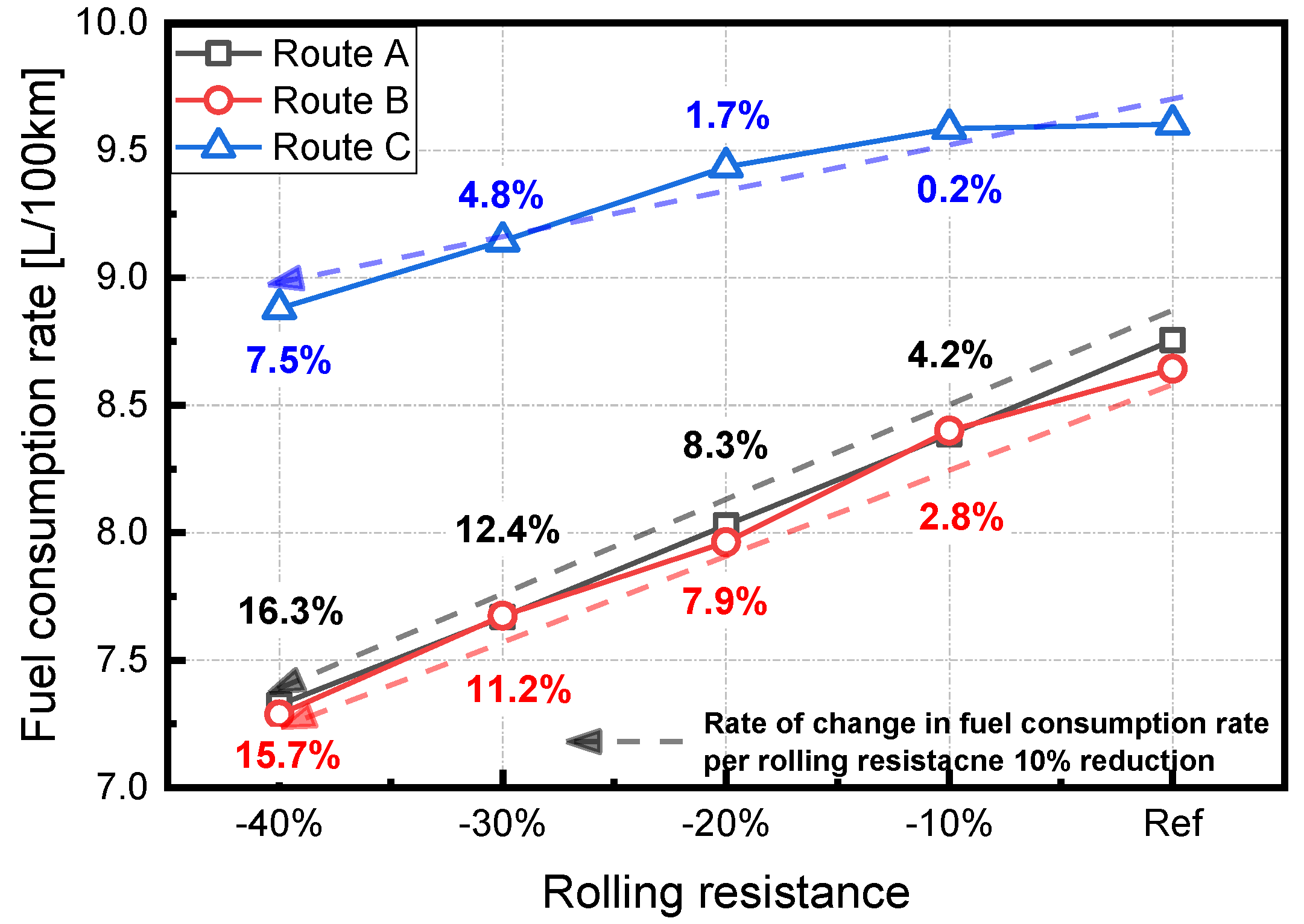
Passenger cars account for the largest share of GHG emissions in the road sector. However, given that the number of heavy-duty vehicles registered is lower but accounts for about a quarter of GHG emissions in the road sector, it is necessary to reduce carbon dioxide (CO2) emissions by improving the fuel efficiency of heavy-duty vehicles. However, experiments using dynamometers during the vehicle development process consume a lot of time and cost. Conversely, simulations can quantitatively analyze the sensitivity of parameters and accelerate optimization. Therefore, in this study, we modeled a heavy-duty vehicle using an AVL Cruise simulation and analyzed the effects of payload, air drag coefficient, and rolling resistance on fuel economy, CO2 emission, and the valid window ratio among the moving average window (MAW) for three driving routes. When the average vehicle speed was higher, the effect of the air drag coefficient on fuel economy was high. Additionally, when the average vehicle speed was lowered, the effect of the reduced rolling resistance on improving fuel efficiency was higher than that of the reducing air drag. Thus, the fuel efficiency improvement rate according to each 10% decrease in rolling resistance was higher by 2.2%, on average, in the low average speed route. Additionally, it was confirmed that the valid window ratio was high when driving in a section with a high vehicle speed first. Thus, the valid window ratio was almost 100% in the test of the route conditions starting from the highway section.
Keywords: heavy-duty vehicle; payload; rolling resistance; air drag coefficient; fuel consumption rate; carbon dioxide heavy-duty vehicle; payload; rolling resistance; air drag coefficient; fuel consumption rate; carbon dioxide