Article

Shale Gas Reservoir Pore Pressure Prediction: A Case Study of the Wufeng–Longmaxi Formations in Sichuan Basin, Southwest China


by
Or Aimon Brou Koffi Kablan
1,2 and
Tongjun Chen
1,2,*
1
Laboratory of Resource and Earth Sciences, Ministry of Education, China University of Mining and Technology, Xuzhou 221116, China
2
Laboratory of Coalbed Methane Resource and Reservoir Formation Process, Ministry of Education, China University of Mining and Technology, Xuzhou 221008, China
*
Author to whom correspondence should be addressed.
Energies 2023, 16(21), 7280; https://doi.org/10.3390/en16217280
Submission received: 5 October 2023 / Revised: 16 October 2023 / Accepted: 24 October 2023 / Published: 26 October 2023
(This article belongs to the Section H: Geo-Energy)

Abstract

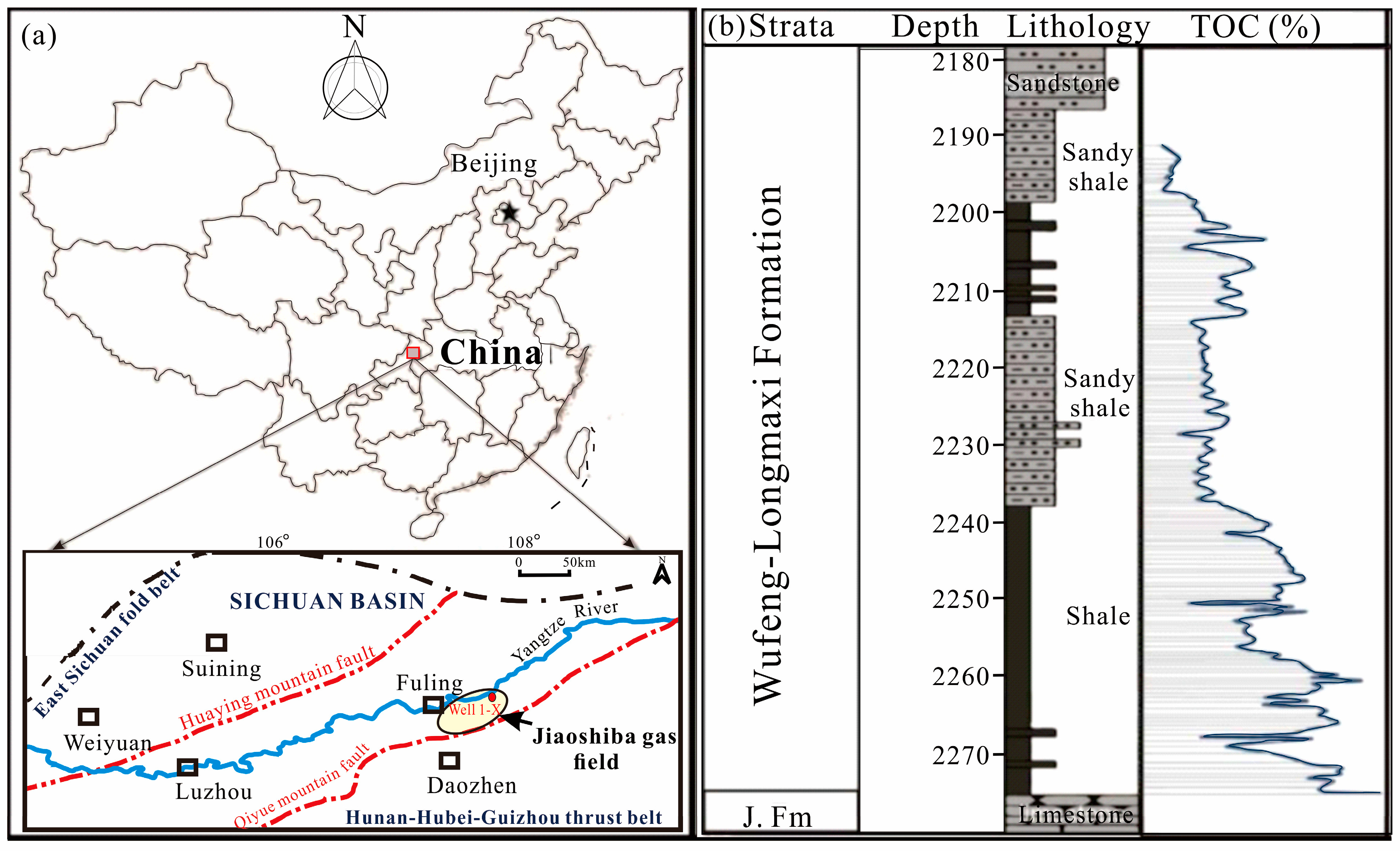
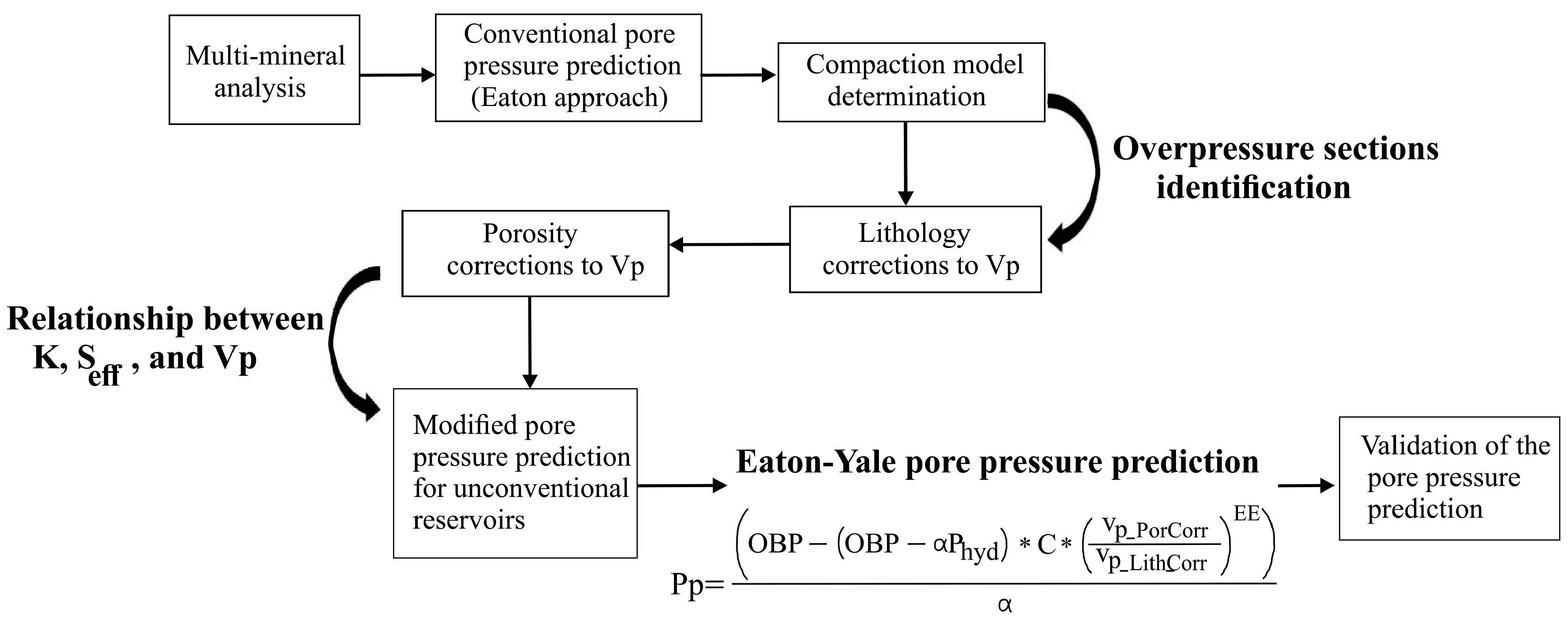
Pore pressure prediction is critical for shale gas reservoir characterization and simulation. The Wufeng–Longmaxi shale, in the southeastern margin of the Sichuan Basin, is identified as a complex reservoir affected by overpressure generation mechanisms and variability in lithification. Thus, standard methods need to be adapted to consistently evaluate pore pressure in this basin. Based on wireline logs, formation pressure tests, and geological data, this study applied the Eaton–Yale approach, which extends the theoretical basis of Eaton and Bowers methods to reservoir geological conditions and basin history. The method was developed by integrating petrophysical properties, rock physics interpretations, and geology information. The essential steps include (1) a multi-mineral analysis to determine mineral and fluid volumes; (2) a determination of the normal pressure trend line and extending it to overpressured sections; (3) predicting pore pressure using the basic Eaton approach and identifying overpressured zones; (4) correcting compressional velocity using lithology logs and a rock physics model; (5) determining the Biot Alpha coefficient and vertical-effective stress and estimating the new pore pressure values using the Eaton–Yale method. Overpressure zones were corrected, and reservoir pore pressure varied between 30.354 and 34.959 MPa in the wells. These research results can provide a basis for building reservoir simulation models, identifying reservoir boundaries, and predicting relative permeability.
Keywords: pore pressure prediction; Eaton–Yale method; shale gas reservoirs; overpressure zones; Sichuan Basin pore pressure prediction; Eaton–Yale method; shale gas reservoirs; overpressure zones; Sichuan Basin